Posts Tagged ‘ancestors’
The House of the Ancestors
An excerpt from the book House of the Ancestors
Some months into our connection with Dakota, a woman I loved, I dreamt I was in a large empty house alone. Perhaps I should call it a building, as it had several floors and extended in size beyond what I knew. I was on what was perhaps the second floor, or as it is known in Britain, the first floor. The room I was in was not brightly lit and although dark with age, was in no way a ruin or damaged. I was standing looking at a hole in the floor. I knew my ancestors had lived in the area or rooms below me, and I was trying to see if I could bring any object from there up to where I was. To do this I was swinging a rope or wire around through the hole. But I made no connection with anything and gave up. Then I realised I had the key to the door of the rooms below and went down to enter the apartments.
The door was of very solid construction but easily opened with the key. It led into a large area with much the same feeling as the floor above – old and empty but not ruined.
Then suddenly, as if he were a caretaker or butler, Lurch, the character in the TV series in which he plays Frankenstein’s monster, stepped out from the shadows. I observed him without feeling any anxiety, and noticed he had a large kitchen knife in his belt. I asked him why he needed such a knife, thinking that perhaps he might threaten me with it. He said that there was a large puma that sometimes jumped out on you unexpectedly from the shadows, and you needed a knife to protect yourself. Having said that he handed me such a knife, knowing somehow that I had come to explore this house of my ancestors. The suggestion in handing me the knife was that I killed the puma if it leapt on me. Then he and I started to walk into the shadowy areas of the house to begin my search.
We had only gone about ten yards into the dim space stretching before us when a very large puma leapt on me. As I felt its impact on my chest I held it firmly in my arms and realised that I had no intention to kill or hurt it. Its head was close to my face, and with surprise and love I could see that, although it had the face of a big cat, it was the face of Dakota. The puma was, I saw, her beautiful and wild sexual love for me, and an embodiment of her spirit self ready to share the journey into the house of the ancestors. So I put Puma down, and Lurch, Puma and I walked together into the darkness.
During the day following the dream I spoke with Dakota, telling her the dream. She has strong links with the Native American traditions. But what I had not previously known, and she then told me, was that the puma is her totem animal.
During the next days, weeks and months, I began a conscious search of the House of the Ancestors. I did this by identifying as fully as I could with the images and environments in the dream; by literally imagining myself within the form and or being of the person, creature or structure, and allowing feelings, associations and insights to arise.
I always find I penetrate much more deeply into that inner ocean if I make the exploration with a friend who is supportive and not disturbed by what I express. In fact my first entrance into the house of the ancestors dream was incredibly emotional. I was visiting my friend David, who I was helping to do some maintenance on his house. So after we had finished work for the day I asked him if he would give me some time while I explored the dream.
What arose is too long to report in detail but I will summarise.
When I identified with the house it took a while to really experience it as a living process rather than simply an intellectual interpretation. But when I did become the structure and experienced the extent of the house, I realised it as my body. But it was not my body as I had been taught to see it through my training as a nurse. I did not experience it simply as a biological process, or a physiological machine. I experienced it as an incredibly ancient thing, carrying or incorporating in its form and functions lessons of life gathered over millions of years of human and animal evolution. I felt that it holds within its darkness – the presently unconscious areas developed and lived in the past – enormous amounts of information or memories. We fail to be aware of these because our attention is so fixed on the world outside of us. But of course, even there, if we look carefully, we can see we are the result, our culture and language are the result, of the events and lives stretching back into the ancient past.
The great house of my dream, as I felt its atmosphere and quality, as I gave it attention and allowed what was sensed within to become more fully conscious, I knew to be not only the impersonal past out of which my present identity had been formed, but also the very personal links with my ancestors. As I met this I felt some anxiety because there are so many unknowns in such a huge place. But I wanted to become aware of the real dimensions of myself. And it must be understood that I use the word ancestors in a wider sense than referring just to my physical predecessors. But this will become clear as the exploration unfolds.
The hole in the floor was simple to grasp. Most of my adult life had been given to attempting, in many different ways, to gain entrance to and explore what is generally known today as the unconscious. I don’t mean by this Freud’s view of the unconscious as repressed infantile trauma and adult sexual drives. I mean any and every aspect of oneself that has not as yet been made conscious. And that includes not only trauma, but also talents or potentials not yet claimed; buried creative insights; the hidden and mysterious processes of the body and mind; the problem solving processes of the non-rational mind; awareness of the deep core of our being; and an awareness of the Odyssey our being has made to reach this moment, this condition, now!
So the hole depicted glimpses I had gained of the influence of my ancestors in my life of today. The glimpse had arisen through my lifelong delving into the unconscious. But the hole is not the real door to the ancestral life, just a way of seeing it exists.
A previous dream depicts this in another way. In the dream I was crossing the rooftops of houses and came to one that I recognised as a home I had once lived in. There was a hole in the roof and I could see into a room that had being sealed off. It contained things I had once owned, but had lost and forgotten when the room was sealed off. So I decided I must sometime enter the room to see what was relevant and useful in my present circumstances.
In that dream there is once more reference to a hole, and my looking through to realise that there are things from my past, from previous dwelling places, that I want to reclaim or investigate. It gives the very powerful suggestion that my present personality can reclaim things from its long past that will be useful in the life of today.
The key, I realised, were qualities that gave me the right to enter the dwelling place of my ancestors. It shows the ability to enter more fully into what had been glimpsed through the hole. These qualities or abilities were gained slowly over years in which I practised and learned the skills of entering the unconscious and dealing with what was found there. I tend to call this lucidity. I don’t mean just waking up in a dream, but the ability while awake to enter into a condition that allows what is existing unconsciously to be known.
I also realised, as I explored, what was suggested by the key. I saw it was forged out of confidence in moving around in the extraordinary realm of experience that is the unconscious. That confidence or sureness, allows penetration into oneself that anxiety or disbelief would prevent. Subtle ideas, beliefs, attitudes or opinions, are the very material or “world” that make up the top levels of our personal awareness.
Terminology is difficult here because I have to use the word awareness to represent the whole realm of self that includes what is conscious and what is unconscious. Using awareness in that sense for a while, I believe there is no real separation between what or who you are consciously and unconsciously. But there is a borderline, a doorway, between the two. Perhaps it would be better to call it a filter or tuning system as with radio or TV. If that didn’t exist you would have all the memories/signals from the unconscious bombarding consciousness at the same time.
The filter is controlled by what you fear, what you allow yourself to feel or experience, whether you instinctively pull away from pain, and what you believe or disbelieve. It usually is tuned quite without your awareness unless you start carefully observing what you repress, what you edit out of what plays in your consciousness. Over the years I have learned to work with the filter to allow more to flow through. But I think my ability is still rudimentary.
Nevertheless, using that key allowed me to enter more fully into a dimension of experience I had only glimpsed previously. So to state it clearly, the key depicted the abilities I had forged to work with what I have called the filter or tuning. I have learned to gradually manipulate my conscious attitudes, beliefs and fears, enough to allow more of myself to surface. And the door was that natural threshold between the conscious and the unconscious that we all have. Self-awareness, or what we call our identity or personality, is a very new and fragile thing in terms of evolution. The door or threshold that exists between this fragile personality and the unconscious protects us from being overwhelmed by what really is an awareness of reality.
Love, security and persistence in love, were also part of that key. Dakota had helped me cut the last few notches in that key and thereby enabled me to open the door to the house of the ancestors.
When I opened the door I was overwhelmed by such a huge awareness of what had been left me as an inheritance by my ancestors that I sobbed for many minutes. It wasn’t pain causing me to weep, but the intensity of what I experienced. The strength, persistence, ability to love, as imperfect as it was, the sharpness of mind, the ability to exist within a modern community, were all gifts hammered out of raw human material by my forebears, enabling me to take the few further steps in life that I have.
This is so important that I want to see if I can describe it more clearly. Recently I travelled to Namibia and stayed in the capital city Windhoek. Perhaps this is a simplification, but there are several tribal groups living together in that community. There is a dominant tribal group, a competing tribal group, and a group or tribe that were once the slaves of the now dominant tribal group. There is still enormous segregation within the community, and the old tribal feelings and views are still very much influencing them. So what I am saying about my ancestors is that they left me the heritage of being able to stand above those older patterns of behaviour. They had already dealt with many of those issues, and the gift they left me was that I could move on from there. That is an extraordinary gift, to find myself capable of thinking and moving in ways that are still very difficult for many people in the world today. I am capable of moving beyond some of the rigid forms of loving and working that my ancestors battled with and developed strategies to deal with.
For instance one thing was that my forebears lived for generations within a very rigid and in some ways punitive religious system. So one of the great gifts they left me was the ability to recognise the limitations of that system and stand beyond it. That wonderful gift was a heritage from my ancestors, along with the ability to work independently, to be creative, to learn easily, to integrate and cooperate with males or females, to be no longer a tribal being. Those are phenomenal gifts to have inherited. That was why I wept and felt such gratitude for having received so much.
Then stepping into the area beyond the door I met Lurch. In identifying with Lurch to explore what he depicted, and in watching what feelings and associations arose, I almost immediately knew Lurch to be, or to represent the guardian, the door keeper of this realm. I realised that as Lurch I am the Guardian of the Threshold. There can be no entrance into this realm unless the seeker passes me. And there are tests he or she must pass also.
As I experience these realisations I was once more amazed how our dreaming self uses images so carefully and precisely. And although I quickly got some insight into what part Lurch played in my growing awareness of what was a new realm of experience for me, it took longer to appreciate some aspects of his significance.
As a young man I had read about the Guardian of the Threshold in the writings of Rudolf Steiner and the Rosicrucian Order, where there is an initiation into the Guardian. It is a name given by western mystical traditions to a process active in what those traditions called the psychic world. Before you can enter that world you meet your past negative deeds. You meet and deal with pains and actions that still imprison you, or in some way are still unmet. In eastern traditions the Guardian is simply called karma.
Lurch, as the Guardian I met, is partly a scary figure, but is a comic character too. So in my dream I meet the guardian, but I did not turn back through fear, or the pain of experiencing past tragic events. I passed into the house of the ancestors.
Later I realised that Lurch also embodies important aspects of the house. He is Frankenstein’s monstrous creation. As such he is created out of the dead bodies of many different people. That is a truly powerful image, showing that your present life is a weaving together of many people who have lived and died in the past.
Lurch also tested me in giving me the knife. Love is an important strength in the inward odyssey. If I had killed Puma I believe I would have been rejected from the house, and have had to learn that lesson. As it was, I neither felt fear, nor had any desire to kill, so the journey could begin. That wasn’t because I was squeaky clean, just that for years I had being clearing out the infant and childhood miseries that were like blockages in the way. I had worked hard to change old destructive patterns of behaviour. There was still a lot to do, but apparently I had done enough for Lurch to let me through.
I set about exploring the further realms of the house of the ancestors. I had explored the dream itself with David. But now I planned to continue walking into the darkness that confronted Lurch, Puma and me at the end of the dream. Suzanne was my listening friend this time.
I started by imagining myself standing in the shadows of the house with Puma and Lurch. Then we walked together into the darkness. The subjective images took on a life of their own and I saw we were walking in a large underground space like great catacombs. The light was dim but we could see our surroundings, and not very far into the cave like space was a tomb on our right. It had the form of a low wall about a foot high in an oblong, and the wall surrounded a long stone in the centre, which was roughly body shaped .

As we drew level with the tomb an enormous change occurred in me. Suddenly I became a woman. It was no longer imagination. I was now completely experiencing myself as a woman whose tomb we had approached. As such I was torn by an immense pain of loss. As my complete identification deepened my body curled up with the pain as I was torn by wretched crying. Suzanne told me my voice changed as I cried out again and again for release from the pain of losing all my children, my husband, even my parents. My hands were clawing my legs in an effort to express the misery, and I was screaming that I could not bear to live any longer with such pain. I cried out to God to take me, for there was nothing left for me to live for. “Why? Why did this happen to me? Why has everything I loved been taken from me?”
There was no response to these awful cries and tearing sobs. But slowly a shift began. It seemed to me as an observer witnessing this awful pain, that by entering this place the spirit of that woman had woken in me. But as she had died in such unresolved agony of loss, that is what was met when she awoke. But gradually she realised she was alive again in a new way. She began to recognise that I was holding her within me. Because I was not frightened of pain and emotions, the misery could play itself out in me. And because my understanding of what was happening flowed into her awareness, she slowly saw and felt her loss in a different way. In fact we were both realising she was experiencing resurrection, and that in turn meant there was no final death as believed by many. Therefore there was no loss as she had originally felt it.
At this point something truly incredible occurred. She and I both realised she was one of my past dwelling places. But for her the viewpoint was slightly different; for she saw me as a continuation of a life that she had failed to be a part of because of the awful pain of loss. It had kept her from flowing into what was her future as my life.
From my perspective she was one of the past dwelling places the spirit that was at the core of my present personality had lived in and as. She was not one of my past lives, because the personality that I am was unique and had not lived that woman’s life.
What Shaun had explained about the gradual loss of his personality, and its absorption into something more inclusive and connected with all life, illustrates this. If we give the name of spirit to what Shaun was absorbed into, and if we see that spirit dips into aspects of itself in the life of the body, and develops a unique personality, then we begin to grasp the relationship between the woman and myself.
Perhaps a clumsy analogy of this is to say an artist might paint many pictures. Each picture is unique. The artist learns from the work and difficulties in creating each picture, and can use what is learned in the next painting. But the next painting is not the reincarnation of the previous. The only link is through the artist.
Because I was gradually becoming aware of the spirit that had given me life, I was meeting the previous personalities, the previous life experiences and lessons my personality was shaped out of. The woman was a previous dwelling place of my spirit. To know her was to know more of my spirit and its eternal odyssey.
In knowing me the woman’s grief melted away, for in our meeting we both realised we gained existence out of an eternal spirit flowing into our lives. I could feel the change in her as she knew she was part of ongoing life here in the present, and the children and family she thought dead were also part of that river of lives.
It was a wonderful thing to witness and experience her resurrection. I could feel that she was a part of myself I had not known, a part of my potential I had not claimed. But the greatest feeling was of wonder that her life of the past could be resurrected into the present and given a new being, a new body, a new heaven and earth. This is a very moving thing to remember.
Looking back at this I feel that the term previous dwelling place really fits what I experienced. The woman’s personality and life events were where the spirit that lies behind my life had dwelt at one time. Remembering it meant that I was realising the continuum of experience that had, over ages, led to my present personal existence.
As I felt her integrating into my present life I asked her what she brought to me. I asked because I wondered what quality or ability this enormous experience brought to my present life. Her simple reply was, “A woman’s love.”
The dream of being on the rooftops and recognising a place I used to live in, and the decision to see what had been walled up there, was, I believe, a very clear precursor of the experience. The pain of loss had been walled up, and needed to be felt and integrated – resurrected and given life.
Meeting Dakota
So, I dived into the ocean and moved through the huge creatures that are the denizens of that realm – great thought forms created by the beliefs of millions. Such beliefs as death being the end of existence; the body and the material world being the only reality; these are living influences at that level, moving in that ocean, ready to engulf you and hold you in thrall unless you can see them for what they are – beliefs, attempts at understanding reality – never reality itself. And so, I moved among them, occasionally finding myself lost in and possessed by one of these leviathans, until liberation was found again by becoming naked awareness once more.
Then suddenly I felt the presence of Dakota with me in the ocean. But I could not see her, and called out, “Dakota, can you hear me? Are you aware of being here with me?” There was no response, and I wondered if I was creating the feeling in some way.
But just as suddenly as her presence was felt everything changed. In that realm where thoughts and emotions take on form, and form itself is fluid, Dakota and I faced each other as magnificent wolves. And I, in the manner of wolves, put my head low to the ground and tail high in the posture of invited play. Then we danced around each other in mock battle rushing headlong, bumping, rolling, pushing shoulder to shoulder, or breathlessly nose to nose. I, grabbing a stick in my mouth and throwing it in the air to distract her, or feigning indifference. She, at each new twist of the dance, came back at me, ever resourceful, ever full of vigour and intensity. And in the dance, we discovered each other, tested strengths, explored responses, found a living connection.
Then, when the dance was finished, we changed forms and expressed other qualities to each other in the shape of the Native American Indians. As such I stood before my lodge as the elder of my tribe, greeting her and saluting her qualities. For she wore the feathers showing her achievements as a wife maintaining her own family lodge; as a woman in her culture who had carved a position for herself in the world of work; as someone who reached beyond her own nearest kin and gave of herself. So, I saluted her and invited her into my lodge, and she accepted.
It was with those experiences freshly imprinted on me that I emerged from the ocean eager to tell Dakota of what had arisen. I carefully wrote the events in my journal, then copied them to send as an email. But just as I was about to send, an email arrived from Dakota. Its title read, “Dances with Wolves.” And the message was a quote from Nietzsche. It said, “Those who watched them dancing thought they were mad because they couldn’t hear the music.”
I still weep when I read those words. As much as I have roamed the immense ocean of mind I am still a man of my culture and penetrated by its blindness. To dance as wolves beyond closed eyes was one thing, but to know it was shared in some way released a blossoming wonder that is still growing. We can believe things as a defence against our own insecurities and littleness. But to experience something that was real within, and have it confirmed as an external fact is an extraordinary thing to confront. It unifies. It opened me to influences that perhaps I was previously suspicious of at some level.
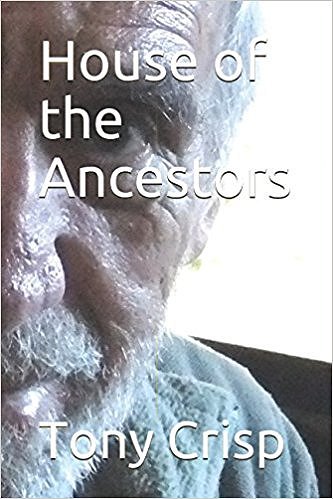
To see the whole book go to HOUSE
House of the Ancestors
Tony Crisp’s true story of a passionate love affair and the death of my best friend
 |
|
“Shaun always did introduce me to firsts. I think someone I knew turned up with him at my house, and he adopted me. He used to call me his ‘old man,’ and each time I saw him after that he had a different woman with him. Gillian and I had plenty of rooms in the place – after all it was a converted dancehall – and Shaun would find a space and sleep with whoever was with him.
That was what I mean about the firsts. I had never seen anything like that before, and to begin with it was like someone screeching chalk on a black board to my nervous system. But one gets used to things, and Shaun told us our place was his spiritual home. He never rang to ask if he could come, he would just turn up. Gradually it would be without a woman. But he needed women like some people need a drink. He had the knack though of finding one wherever he was. So he would go out for a coffee and come back with a woman’s phone number.”
Dreams and Your Ancient Past
Through the Eye of Dreams
There has been a conjuring trick performed in regard to our view of who we are. It is almost as if we have stepped into a photo booth, and instead of a realistic image of ourselves being produced we are given one with most of our features missing. The strange thing is we usually accept this distorted image of ourselves as real, though most of us feel odd about it, and some of us actually get around to searching for a different image.
What I mean is that we have the notion from the current popular mythology of reality that we are produced by the combination of our parent’s sperm and ovum. The genetic combination is, we believe, the print of who we are.
I know this is a massive simplification, and I am not saying it as a criticism, simply a statement of popular belief. Nevertheless it is a belief that shapes the concepts people have of themselves. But the sperm and ovum, the genes, do not provide language, they do not give us culture, books, music or religion, despite any connections there might be. Children raised by animals do not develop any of these culturally given enhancements. They are not innate. See Animal Children.
The myths of our times also suggest that our personality is either God given; or it is formed out of the whims and neurosis of our parents and events during our infancy; or perhaps it is just made that way like a piece of equipment stamped out in a factory or by the position of the stars at our birth, and there’s not much one can do about it. This modern myth goes on to suggest that the only eternal life any of us can hope for is that arising through procreation. It is only our genes, we are assured, that will live on if we successfully procreate and our children survive and prosper. Because of this, it is further explained, our sexual urge drives us all forward into the convoluted avenues of sexual relationships. And these are factors influencing how the image we have of ourselves comes out strangely distorted.
I sometimes think there is an odd quirk in human nature that makes us want only one answer to any riddle in life. It is as if there can only ever be one right thing, one truth about anything, and everything else is thereby false. This is a, ‘if religion is correct, then science is wrong’ type of reasoning, as if they are both looking at the same piece of the cosmos from the same direction. It is like the Indian story of the blind men describing the elephant. One has his hands on a leg, another on the trunk, and so on. None of them are able to see the whole animal and therefore have a distorted impression of it.
Therefore one must beware of the urge to avoid insecurity by hanging on to the tail of the elephant and feeling one is safe because at least we know what the beast is. It is in fact dubious whether we can ever know ‘the beast’, though it might be possible to have an intuition or sense of it. The universe and the mystery of life and consciousness are so vast that none of us can possibly hold all the factors involved in mind at any one time. Therefore we cannot possibly arrive at any inclusive understanding of the big questions – why am I here? What is life about? How did life come about?
Coming back to the distorted image we can arrive at of ourselves, if we take time to consider our origins, it can bring us a bit more toward a feeling of wholeness and sense of reality. For instance it is obvious and wonderful how the bodies of our parents, through the gift of their own genetic material, have shaped our own body and its inclinations. This much is now demonstrable, but where I want to go from here is to look at common human experience in an uncommon way, through the eye of a dream.
The Voice of My Dead Forebears
The dream is that of a man in his mid forties.
“I am walking along a cobbled road going slightly down–hill. I know as I dream that I am in Italy. I do not feel a stranger in this land, and am learning the language.” Ron.
Ron describes his exploration and insights into the dream by saying:
This was a very short dream and I didn’t think it had any real significance, but I was regularly exploring my dreams, and it interested me because I couldn’t understand what it referred to in showing me learning the language. I had never learned Italian and was not doing so.
When I relaxed and allowed the free flow of my associations and feelings, the first part of the dream was easy. My father was born in England of two Italian parents. So being in Italy, a country I had never visited myself, I could immediately feel and understand as referring to my family on my father’s side and the influences that has left in the way I think and live.
But I felt myself falling deeper into the dream. It was something I had learned to do. I not only kept the question ticking over quietly of what does the dream indicate, but at the same time I relaxed control of my thoughts, my body and emotions. This is like being half asleep in a state where the body can twitch spontaneously, and perhaps I can even hear myself making slight vocal sounds, and yet I am wide–awake watching what arises. Because of this state a flow of memories began to arise about my father, and I realised something I had only been partially aware of before.
My father had taken over the family shop when his father had died. The shop was in London, just over a mile away from the old Covent Garden fruit and vegetable market. Most days my father walked, pushing a barrow, and in later years drove to the market to buy produce for the shop. I often went with him, helping carry and load, and perhaps push the barrow. In my youth I wasn’t aware of it, but now in my flowing memories I realised that my father was very distant or cautious in his dealings with the market salesmen and porters. A distinct and overall realisation arose out of the many memories and impressions; it was that my father was expressing a particular type of caution in all his dealings with other people. I saw this as keeping who he was secret – keeping his head down.
As I saw this in my father it hit me with great power that this attitude had passed to me, and although I expressed it in a different way, I had inherited it with equal strength. Why? And, how?
The perception that was taking place was not like my normal thinking. It comprehensively gathered memories and put them together in a way that made patterns and themes stand out. So as the process of insight was taking place I saw just how the urge to keep my head down, not stand out in the crowd, not get involved with people, had influenced my actions. For a start I had never voted in my life. This was because I could never identify with groups pushing for power. I had avoided everyday social activity, although relationships with individuals were not threatening.
Now I started seeing how this attitude had passed to me so strongly. My thought, as I witnessed the flow of memories, was that perhaps such information was genetic, because my father had never talked to me much at all. He had certainly never urged me to keep out of the limelight – to keep my head down, and until now I hadn’t been aware that he had been doing it himself, so it wasn’t simply conscious emulation. I can only say that I ‘saw’ how it had happened. What I mean is that through the still flowing memory and feelings it was as if I could actually look into the heart of things and see how they worked. The insight I achieved was that we as humans, like other mammals, in our earliest years particularly, still learn like most mammals do, and that is not verbal at all. A massive amount of information is absorbed from our parents without any effort or awareness.
What Ron realised is that just as a fox cub ‘learns’ how to hunt from its parents, so we absorb the deeply etched survival strategies of our parents simply by being around them. If genes come into it anywhere, they perhaps create the reflex response that instinctively draws in the survival tactics that perhaps even our parents themselves have never really been aware they live by. In doing this the higher animals learn what cannot be passed on as instinct, what is not ‘hard wired’ into them. This holds in it a tremendous advantage because ‘hard wiring’ takes a long time. Through this faster method we learn what to be afraid of, what to eat, how to hunt, because the lessons learned by pain through many generations are exhibited in our parents behaviour in dealing with events. The experiments with apes in Japan, where Imo the macaque ape learned the ability to wash sweet potatoes to remove sand grains, show how this was passed on from this one female to the whole group, and then to subsequent young macaques, and illustrates how survival information is passed on non verbally for generations. An important aspect of this is that whatever of such information is held in the present generation, it is an accumulation of skills and responses learned over many generations, and is the fundamental survival strategies of that particular family or group line. Ron goes on to say:
The degree of this was staggering to me. It led me to wonder just where my father had got the information from, and although this was obvious from my own perception of where I had received the messages from, the resulting experience profoundly moved and impressed me. It taught me things about myself I don’t think I could have learned in any other way. A floodgate of impressions rushed into my awareness at such a pace I can only record the main ones.
Suddenly my mind let the power of the messages my father had carried and passed to me speak, as if they were alive. I experienced what appeared to be a direct connection with my far ancestors. This may sound strange, but my father had, as it were, handed me a recording. He and I had been impressed with the cover and it had led us to live in a particular way. But now I had put the recording on the player and the ancient originators expressed their own message.
Obviously this is only an analogy to convey the experience, but in some way the message played out in me from centuries back. From it I learned that my forebears had lived in Italy during a period of great religious and political tension. The pressures to conform had been enormous. Not only were my ancestors told to believe in a particular sort of God, but also to accept leadership from people they had no respect for. If they did not live this belief and submit to it they were killed or rejected by the community they had been born into. In their own words I heard them saying to me something like ‘The worst was they did not kill us, but they cut our vine at the roots. They burnt our land and they killed our children. If you want your sons to live, teach them not to hold their head up, but to keep their eyes on the ground.’
And out of that trauma the message had been passed to me many generations later. It was survival. I was still living it, but perhaps it was time to reappraise.
I Am an Ancient Thing
Ron’s description helps us look at what is a common experience, and in a different way, an established observation in biology. It is common knowledge that animals learn through example. It is common knowledge that traits pass on through generations. What is added here is the powerful way such behaviour can pass on in humans. It shows how we communicate behaviour to our children without any conscious intention. Looking through the eye of dreams we see here a psychological or psychic [ii] realm that extends beyond the mere transmission of behaviour. It includes or leads to meaning, to understanding ones roots. This may seem mysterious or unfeasible if one has not actually experienced the way the dream process puts apparently abstract experience into imagery leading to insight. [iii] If one has witnessed this process at work, what Ron speaks of does not seem remarkable.
Looking through the eye of Ron’s dream there is a suggestion that aspects of Ron’s personality did not begin with his birth. Parts of his personality preceded his birth, being carried and passed on by his father. This module or facet of Ron’s character had been formed hundreds of years previously. It had been part of the lives of his forebears, and had been carried forward into his life. It did not pass on to Ron through any genetic material. It entered him through absorption of the behaviour of his parent. So it is saying that just as the genes we receive are ancient and passed to us, this survival information is also ancient and passed on. It influences who we are as profoundly as any genes.
Of course, Ron is only seeing his connection with his father. There would also be packages of behaviour and information handed to him by his mother. [iv] So not only can one have a ‘gene pool’ from which our being is formed, there is also a ‘behavioural pool’ acting as a similar resource. This does not so much shape the body, but certainly gives form to the character and responses. In fact unlike the genetic passage where a set of genes in the mother is united with a set from the father, the behavioural pool may have several ‘sets’ or packages which can be triggered by different environmental circumstances. My experience suggests that the behavioural packages from the mother and father certainly do not splice as do the genes.
The behaviour Ron observed in himself, in his father and grandfather, although according to Ron’s insight it arose at a particular period in history, it obviously rested upon traits already existing in the family from an even more ancient past. So the trauma of persecution may have modified existing traits rather than set in place entirely new ones.
Because of pre–existing traits, another family might have responded quite differently to being subjugated. They might have pushed for dominance rather than anonymity. They may have aggressively opposed, sought opportunity to join the ranks of power, or actively supported as a subordinate.
This is supposition based on insufficient evidence; but if the basic idea of the passage of behaviour is correct, it shows human nature as having several dimensions to what forms who they know themselves to be. These are almost like different streams from the past meeting in the person, and in some way passing on into the future, perhaps separated again. For instance we have the stream arising from the body and its genetic material; we have the stream arising from cultural language with all its massive inbuilt data; we have the behavioural pool that we inherit, again with massive innate information. When we begin to look at what it is to be human from this perspective we see we are multi dimensional creatures, existing in the flow of huge streams of influence. And these streams themselves mingle in different ways creating a variety of experiences and further dimensions.
Coming back to Ron though, there is certainly a transitory and short lived aspect to him, in that his unique body and many of his personality traits will only exist during his physical life. But facets of Ron have existed for millions of years – in the genetic stream for instance. And even in his highly ephemeral personality itself, there are parts that have had a long life before Ron woke to his personal existence. For instance the language he was brought into existence by and the behavioural influences he absorbed.
This makes nonsense of the myth that we only have eternal life through procreation. It also suggests that if Ron identifies with the aspects of himself that are short lived, such as the transitory aspects of his body, his less permanent personality traits, his changing likes and dislikes, then he faces death. All that he thinks of as himself will perish. In this sense he cannot survive bodily death.
In fact it seems as if Western society faces the issue of death in a much more catastrophic way than other cultures. The reason for this is that many older cultures see the personality as transitory anyway, and identify more fully with the family ancestors and the longer lasting aspects of life.
It might be argued that as the behavioural traits passed on to Ron preceded him, he cannot really identify with them as himself, so cannot see them as an aspect of himself that has a long life. The problem here is that hardly anything in the personality is unique except perhaps the exact mixture of traits and responses, memories and dreams that make up that particular person. Everything is taken from somewhere else, or is a mixture or development of what already existed. We all identify with the contents of our mind, our language and our traits, yet these are not new with our own personal awakening as a person. So we cannot separate Ron from what he has inherited. It is still him. If it has a long life, then we must say aspects of Ron have a long life.
Once we grasp this idea of the passage of behavioural traits from generation to generation, I believe it can be observed fairly easily in everyday life. Much of folk beliefs suggest it without filling in the details. Such sayings as ‘like father like son’ – ‘like mother like daughter’ have the belief implicit in them. The generally held view that each nation has a different cultural identity also suggests it. In fact we often use the word culture to describe the behavioural traits peculiar to a particular group of people, in reference to their observable behaviour traits which are passed on from generation to generation throughout the group or nation. We are therefore talking about a behavioural pool with particular characteristics.
I have frequently observed family groups out shopping and seen the intense mimicry of a child for its father or mother, even to certain positions of the hands, or posture of the body. Such passage of very particular behavioural traits is especially noticeable in the learning of language. The unique sounds of certain words, even within one language such as English, are mimicked in an extraordinary way by children, creating a local dialect in which sounds are made that are often quite difficult for people outside of the area to make.
It is innate in us to soak in and mimic the behaviour of those close to us. That is obvious. All I am adding to that is the suggestion that deeply seated personality traits, and the shape of our psyche, are also radically influenced in the same way. Not only do we soak in actual behaviour, but we are capable of transforming the messages coded in behaviour into personal psychological experience such as described by Ron.
I Speak Therefore I Am
That our often closely guarded personality is made up of pieces of behaviour that existed long before we did, may be a strange idea to many people. The way we present our film stars and pop idols as special, or particularly talented; the way we often think of ourselves, is as hermetically sealed units that have been influenced from outside by environment and people, but on the whole we are unique. Sometimes people even adopt a superior attitude, as if to say ‘I am vastly different to the rest of humanity’. This makes it difficult for us to actually observe our origins.
If we think of an acorn, it is easy enough to believe that if we planted it, a tree would grow from it that would be very much the same as the trees from which its genetic material arose. In its particular growth however, factors of soil, weather and events would shape it to its own uniqueness. With human beings we think similarly, except we commonly leave out factors of great importance, factors which contribute to our personal existence in such a major way that to forget them is to be like the blind men with the elephant once more. For example a tree doesn’t learn speech, or the customs of its cultural group.
Particularly in past centuries, when there was a much closer relationship between humans and wild animals, it was noticed that if a baby was lost and raised by a creature of the wild, such as a she–wolf or bear, the child never became properly human. Being human is not innate. Something rubs off from functioning mature humans onto their babies to make them into human beings. The major differences are that the baby raised by an animal lacks self awareness; it cannot speak any language other than that of the animal it was raised by, and it lacks a sense of time; and in many cases there is a deep sense of connection with animals and the natural environment. Its reactions to surroundings are those of the animal it was raised by. Thus the behaviour traits it learned were not those of the human animal, but of the mammal that mothered it.
A headline in the Daily Star on April 17 1991, at the time the film Dances With Wolves was popular reads: “TRAGIC BOY’S DANCE IN WOLF’S LAIR.” It goes on to say:
A tragic orphan brought up by a pack of wild wolves will never be able to live like a normal man, say doctors. The boy who REALLY danced with the wolves was aged about seven when he was found 29 years ago in the wastes of Southern Russia by a team of oil explorers. He howled like a wolf and savagely bit one of the oil men who christened him Djuma – the Wolf Boy.
Professor Rufat Kazirbayev said doctors had battled to re–educate him to act like a normal human being – but failed. They are now giving up the fight.
“His mind is with the wolves. He will howl at the moon for the rest of his life,” he said.
Djuma, now about 36, is still in hospital. He still crawls on all fours, eats raw meat and bites when frightened. He can speak only disjointed phrases – “Mother dead. Father dead. Brother dead. Sister dead. Mother nice. Father bad.”
Dr. Anna Ticheenskaya said: “presumably his family were killed in a purge. He has shown us in sign language how his mother saved him by throwing herself over his body.”
Djuma has learned to brush his hair, clean his teeth and use the toilet “Like a trained animal.” But when taken to the zoo he howls as if he was urging the animals to take him to freedom. Sadly that will never happen. Djuma will probably spend the rest of his life in the clinic where, doctors say, he spends his days like a dog – half asleep and dreaming.
The autobiography of Helen Keller helps in understanding what may be the difference between an animal, or an animal man like Djuma and a human being with self awareness. Helen, made blind and deaf through illness prior to learning to speak, described how she lived in a dark unconscious world lacking any sense of self until the age of seven when she was taught the deaf and dumb language. At first her teacher’s fingers touching hers were simply a tactile but meaningless experience. Then, perhaps because she had learned one word prior to her illness, meaning flooded her darkness. She tells us that “Nothingness was blotted out.” Through language she became a person and developed a sense of self, whereas before there had been – nothing.
This ‘nothingness’ described by Helen Keller is difficult for most of us to imagine, having all our life been exposed to other human beings through behaviour and speech. Helen describes it as having no awareness of personal pain or events. She says that perhaps things happened to her, perhaps they were painful, but as she had no personal self to appreciate this, they were merely passing tactile sensations. She was not personally disturbed by them because she had no ‘person’ to be disturbed.
The learning of language was the pivot around which Helen’s self awareness evolved, with its attendant ability to think, to have a sense of ‘I’ or ‘me’ and all the personal relationships with others and the world arising from that. Without the learning of a complex language which holds in it the concept of ‘selfhood’ there is apparently no possibility of self awareness. Without the passage of the ‘behavioural pool’ from a human being to a human infant, there is no possibility of a self aware human maturing from the baby.
The information gathered from the many cases of ‘animal children’ suggests that not only do the behavioural traits of the fostering animal pass to the child, but also the state of soul can be thought of as a form of behavioural response which is also learned. In other words, self awareness, which is so taken for granted in our own life, is passed to us as a learned response by the humans who are our role models and mentors. Selfhood is not genetically given, it is a behavioural response.
The story of Imo the macaque mentioned earlier helps us imagine a possible first scene for the emergence of self awareness in the human species.
There must have been a gradual development of the complexity of language bringing the pre–human to the point where self awareness was ready to emerge, but hadn’t quite been realised. Then, perhaps an event or a particular situation in the life of the pre–human triggered the new awareness. Suddenly the pre–human was self aware and stepped into human experience.
This must have been a momentous experience for the individual or individuals it occurred to. If compared with the descriptions of people in our present times who achieve a new state of awareness such as Maurice Bucke describes in his book Cosmic Consciousness, it was probably a ‘religious’ experience – something appearing to have been visited upon the individual from a power exterior to them. In such cases the experience, the new state of awareness, usually only lasts a short time, but may become more prolonged as the individual is further exposed to it. One might even speculate that just as animals will repeat an action that provides food or pleasure, so the experience of self awareness in early pre–humans may have led to ritual performance of actions, or the re–creation of circumstances, that were part of the first experience. These I imagine as the roots of religious ritual. I believe such achievement of a new type of awareness by certain individuals is also behind traditions such as yoga and Sufism. This can be observed in particular in Subud in which one individual experienced what he was certain was a new experience and passed it on to others through contact. In his book The Origin of Consciousness in the Bicameral Mind, Julian Jaynes gives a detailed historical perspective of these beginnings in the not so distant past.
The following dream of Joan C. illustrates and further describes the collective life of early humans, and the experience of developing from it to self awareness. Joan’s work on the dream provides us with another example of the information possible to gain through the eye of dreams.
In my dream I was in the garden of a large house. To the right of the house, my right that is, I saw the garden had been changed. I realised that I knew the garden from childhood, and there used to be a large pool by the house in which we all bathed when young. The ground sloped up from the house and was rough, but part of it had been dug over. The care and skill with which this had been done deeply impressed me.
There were no direct associations I could make with the house or the pond, so I started allowing spontaneous material to enter into the dream, allowing my mind to roam freely and show me out of what images and feelings the dream had been fashioned.
I started with the pond, and had the most unexpected set of fantasies and feelings bubble up from within. The garden when we were children referred to a condition of mind, which I now experienced, in which a group shared a common awareness, and felt at one with their environment. In other words there was no separate identity. No one in the group knew themselves as an individual. I knew as I experienced this that it was about the early condition of human beings, and was represented in the Bible as the Garden of Eden. It was about the history of our development as human beings. It showed me that in the early stages of evolution all human beings lived in a state of awareness in which they had no sense of separation from nature itself. They had no sense of individual existence either, but lived in a sort of paradise where there was no idea of birth or death or right or wrong. They felt at one with each other in their small groups and with the forces of nature.
When I experienced this I understood at last what the story of Genesis meant. It was about stages of psychological development, not physical or mythical history. Humans had come out of the pool though, out of the collective awareness, and at that point I experienced a mass of impressions and images I still cannot completely understand. The images suggested that at first, maybe one or two humans climbed out of that pool, and they left a mark. They climbed out and put one stone on top of another. The images developed further into suggesting that many ancient monuments were an expression of this enormous sense of the newly found identity – of personal existence.
I understood this to mean that one or two humans had achieved personal identity. In that state they realised something about themselves – they could say ‘I am’. They could ask ‘Who am I?’ That had never been possible before.
I need to say what arose in me were not those words or memory or vision of definite events, but a sense of touching or experiencing an overall memory, a vast overall process. So I am trying to put into words what I sensed. It was such a wonderful thing, so full of experience, to see this that I want to try to describe it. At the same time, it was an immense process and difficult to capture.
What I felt was that the pool was a collective consciousness such as Jung speaks of, and that it still exists now in our unconscious. At the early stages of human development though, it was the everyday experience, but the individuals who attained self awareness began to build a new type of life. They left stone monuments, carvings, paintings in caves, stone circles, pyramids; each person, each group realising deep down that this new level of awareness was a thing to be given and built. The Sphinx is an image of this half way state of human and animal.
This is where words are difficult, but the dug ground in the dream depicts it. If the son of a farmer takes over the farm, his work and achievement are built upon what his father did with the land. The father’s work is built upon by the son, and is a continuation, of what his father did. Even if one was to take a piece of land which had never been farmed before, one would farm it with tools, experience and attitudes developed gradually through thousands of years of human effort. I saw that I, although I am not usually aware of it, am formed out of the ideas, words, attitudes, pleasure and pain left to me as a heritage by millions of people. If I had not been raised by modern humans I would, in fact, not have developed an identity. My identity is a gift to me from the great river of human beings who left a mark, one stone on top of another, a concept enshrined in art, a struggle or love immortalised in stone, a realisation and transcendence depicted in a religious ritual or in a new word.
The garden, the dug plot was myself, my personality. But my personality, the attitudes and reactions of its very foundations and structure, the words with which my mind realises its existence, are the living remains of countless other lives and their endeavour, their love, their ignoble failure, their genius and their prayers. I AM my ancestors. That I have also dug that plot by my work on my dreams, by trying to transform the unwieldy loam of myself into finer stuff, gives me a place in the river of life, in the eternal process of continuity.
Most important of all, perhaps, in such simple acts as writing out this dream, I leave a mark. I etch upon the world the sign of my own realisation, the changed lines of transformation. For self consciousness is a sort of collective consciousness which forever depends upon giving, and upon physical records of living beings to enshrine its existence. Without living beings who carry the words and responses gradually developed by myriad ancestors; without books, paintings, music, science and architecture, we have no existence as people. In one generation we could be swallowed up by that pool, that sea of self–forgetting symbolised by the waters that swallowed Noah’s contemporaries. Even now, without the love of giving, that sea can swallow us. That was my dream.
Joan’s description further illustrates how our mind, approached in the right way, can pour out realisations and insights that are deeply educational. It is a form of outpouring and mental function that few of us are ever taught to look to or use in our schooling. But it IS a common experience in the sense of it being described in all the cultures throughout history. It IS accessible.
Joan and Ron’s descriptions taken together also say that there is a function in the human mind that takes external information, such as language, behaviour and architecture, and treats it like a code. Perhaps if the example of the printed word is used this makes it easier to understand. A book might be a couple of hundred years old. A baby who grows and is taught the language of the book can eventually read it. As it is being read, what was a physical object unfolds in the child huge amounts of information and imagery. Perhaps it moves the child emotionally also. It may even explain aspects of their own existence they knew nothing about before.
That is not an exact analogy, but Ron and Joan suggest that the external objects of culture we see around us and take for granted, actually produce in us the release of a massive amount of information and deeply felt experience. Most often however, we fail to appreciate this as it is covered, or obscured by the dominant sensory impressions and taught responses, as already described.
When it is appreciated and released, the result is probably due to a complex interaction between genetically produced inclinations, the environment, and culturally provided education, plus an up–welling of unconscious material from the ocean of information we all live within. This fuller understanding of our cultural environment is probably necessary for optimum survival, but is not necessary to become a conscious individual stumbling along through life.
The View So Far
Looking through the eye of dreams and human experience, such as Ron and Joan’s dream–work and the account of Helen Keller, a situation is described stating that our personal identity rests on –
- The passage of behavioural traits from adults to the new born.
- The learning of language.
- The interaction between people affirming personal identity.
- A collective consciousness. This is created physically by the written and spoken word, but also by all other works of humanity such as music, art, architecture, and of course social structure. Its fundamental base is living human beings who have learned language and carry ancestral behavioural traits. In a sense, the enormity of who we are is external to us and our body and brain are decoding instruments.
- The collective consciousness is a code that can come to life in the individual. Only the cultural environment plus the personal response to it make a whole.
- A collective unconscious is the source of our personal existence.
Australian Aborigine Dream Beliefs
The Australian native peoples are divided into more than 500 tribal groups. These tribes are also of two major types – those who live inland, and those who live along the coastline. The separation of tribes and the division provided by the environment led to differences in views about the nature of human life and death, and the part dreams played. But some beliefs, such as reincarnation and the ‘Dreamtime’, were universally held.
Dreamtime refers to an experience and to beliefs that are largely peculiar to the Australian native people. There are at least four aspects to Dreamtime – The beginning of all things; the life and influence of the ancestors; the way of life and death; and sources of power in life.
Dreamtime includes all of these four facets at the same time, being a condition beyond time and space as known in everyday life. The aborigines call it the ‘all-at-once’ time instead of the ‘one-thing-after-another’ time. This is because they experience Dreamtime as the past present and future coexisting. This condition – See: altered states of consciousness – is met when the tribal member lives according to tribal rules, and then is initiated through rituals and hearing the myths of the tribe.
Although Dreamtime may sound rather mystical or mysterious to the Western mind, the experience is based on understandable and observable facts of social and mental life which are unfortunately little valued in Western society. For instance the present is observably the result of past actions or events. Present society is particularly the result of past great men and women and their – heroic – deeds. For the Australian native peoples, as with many other ancient races, the heroic deeds of past ancestors were remembered with great veneration. It was seen that all present life, and even the personal skills and character of tribal members, arose out of the life of the ancestors. The ancestors, their deeds, and what arise from them into the life of the tribe in the present, are all held in the Dreamtime beyond the shifting events of things happening one-after-the-other.
The aborigine people believed that each person had a part of their nature that was eternal. This eternal being pre-existed the life of the individual, and only became a living person through being born to a mother. The person then lived a life in time, and at death melted back into the eternal life. See Archetype of the Big Bang
In writing about the state of mind – the mental world – of early races, J. B. Priestley – in Man and Time – says that if we are to properly understand the ancient peoples we must never project onto them our own state of mind and rational thought. Studies have shown that ancient people experienced what is called an undifferentiated state of mind. Their sense of being a separate and independent person was much less than is commonly experienced in modern life. They did not separate their religious life, their social life, their economic life, their artistic life and their sexual life from each other. This is obvious to even a casual observation of such societies, or even third world cultures, where religion and eating, and work are all very much connected. To be banished from the tribe was tantamount to death for primitive individuals, so deeply were they identified in psychological and practical ways to the rest of the tribe. But it is not an unusual thing for a modern man or woman to leave their place of birth, their family or their country, and live abroad. Such simple facts illustrate the deep divide between the modern and ancient state of mind.
If we remember our early childhood, with the absence of an awareness of passing time, the fullness of each day, the eternity of a week or a month, the enormous and unquestioned – if still untraumatised – sense of connection with our family, then we will have an idea of the mental world of the older races. For the aborigine these facts of their life were tangible realities, known through their inner experience in dreams and waking visions. Prior to the development of the reasoning and questioning mind, people did not consider things by thinking about them in neat ideas and definitions. Like the parables in the Bible or Aesop’s fables, which say so much, but do so with images and through the relationship of one thing or person with another, early human beings thought in pictures or dream like images. So the aborigine would meet the influence of the ancestors in their life as an actual visionary person, rather than thoughts about tribal history. With the visionary meeting would come deep feelings and insights, making it a real educational experience. This is exactly how dreams express, and in this manner most creative or problem solving ‘thinking’ was done by ancient peoples. Therefore the entrance into dreams, or into a condition in which the imagery of dreaming could function while awake, as in visions or altered states of consciousness, was important for the aborigine. Common ways of accessing this state of mind were through ritual or initiation rites. In this way enormous learning experiences could be met, a sense of complete identification with ancestors and tribal history achieved, and personal change or growth accomplished.
This condition of mind or being in which time is ‘all-at-once’ and the past is felt as intensely close as the present, is a natural and fundamental state. It is what the baby experiences in the womb prior to the separation at birth and the development of concepts through the learning of language. So the rituals which enable the aborigine to return to the womb of all time and existence enables them to feel connected once more to all nature, to all their ancestors, and to their own personal meaning and place within the scheme of things. The Dreamtime is a return to the real existence for the aborigine. Life in time is simply a passing phase – a gap in eternity. It has a beginning and it has an end. The life in Dreamtime has no beginning and no end.
The experience of Dreamtime, whether through ritual or from dreams, flowed through into the life in time in practical ways. The individual who enters the Dreamtime feels no separation between themselves and their ancestors. The strengths and resources of the timeless enter into what is needed in the life of the present. The future is less uncertain because the individual feels their life as a continuum linking past and future in unbroken connection. Through Dreamtime the limiatations of time and space are overcome. It is a much observed feature of aboriginal life that knowledge of distant relatives and their condition is frequently displayed. Therefore if a relative is ill, a distant family member knows this and hurries to them. Often the intuitive knowledge of herbal medicine is gained also.
For the aborigine tribes, there is no ending of life at ‘death’. Dead relatives are very much a part of continuing life. It is believed that in dreams dead relatives communicate their presence. At times they may bring healing if the dreamer is in pain. Death is seen as part of a cycle of life in which one emerges from Dreamtime through birth, and eventually returns to the timeless, only to emerge again. It is also a common belief that a person leaves their body during sleep, and temporarily enters the Dreamtime.
The aboriginal tribes are connected with their local landscape in a way that perhaps no other race of recent times is. The landscape is almost an externalisation of the individual’s inner world. Each tribe had a traditional area of the land which was theirs alone, and it was believed that in the Dreamtime the ancestors shaped the flat landscape into its present features. Each feature was in some way an act of the ancestors, and therefore the tribe. Like many tribal peoples, the Australian native people were deeply dependent upon their beliefs, the landscape and their inner life for their identity and strength. This makes them vulnerable to anything which disrupts their beliefs, although, apart from such vulnerability, they have a greater psychic sense of wholeness and identity with their tribe and environment than is common in Western individuals.
See the feature Spirit-Child: The Aboriginal Experience of Pre-Birth Communication.