Posts Tagged ‘animal brain’
I The Animal
The animal in us all, including the story of the Wolf Boy and Frankenstein.
by Tony Crisp
This feature originally appeared in the Australian magazine SIN
Frankenstein
The story of Frankenstein is in part at least depicting a person suddenly awakening as a full adult, with all the difficulties of adapting to who they are and what the world does with them and they with it. In this situation, the preparation and de-briefing of childhood never took place, so the wonder and shock were deep.
Another sort of awakening is played out in Dr Jekyll and Mr Hyde, where the civilised doctor is confronted by a violent animal-self running out of control. It is a classic story because it depicts something we all meet in one form or another – the animal within! Considering that one of the great animal urges is to fight over territory, modern warfare as irrational as it is, makes one realise how important it is to meet the animal within and ease it into our ‘civilised’ self.
But there is an even older story in which an animal wakes up and realises it is a human. This story is portrayed in its incredibly varied forms by the animal headed gods of many ancient cultures, and in the animal bodied gods of mythology. The drama of such stories lie in the pain and confusion arising from having self awareness while still remaining an animal.
I believe this is one of the greatest well kept secrets, the pain we went through in early childhood when we were artificially woken up to self awareness – you know, having an ego with all the conflict and eternal anxiety, fear of death, pain of love, that goes with it. And what I mean by artificially woken up is that children never exposed to language do not attain self awareness. They remain in a guilt free world of a present day Eden where there is no right or wrong, evil or good. Apparently not even time ruins that unspoilt place of the soul.
The Wolf Boy
A headline in the Daily Star on April 17 1991, at the time the film Dances With Wolves was popular reads: “TRAGIC BOY’S DANCE IN WOLF’S LAIR.” It goes on to say:
A tragic orphan brought up by a pack of wild wolves will never be able to live like a normal man, say doctors. The boy who REALLY danced with the wolves was aged about seven when he was found 29 years ago in the wastes of Southern Russia by a team of oil explorers. He howled like a wolf and savagely bit one of the oil men who christened him Djuma – the Wolf Boy.
Professor Rufat Kazirbayev said doctors had battled to re-educate him to act like a normal human being – but failed.
So where is the being who existed before we learnt to talk? Does it hide in dark corners of our mind keeping out of sight? Perhaps it only comes out at night when we dream. In fact most of us meet this animal not only in the dark hours of our sleep, but also when events surprise us and for moments we drop the circus training we went through as a child. Even if the meeting is wonderful as in the following dream, it is still difficult to accept our own potent untamed self. Maybe because it wants us to be so honest and passionate.
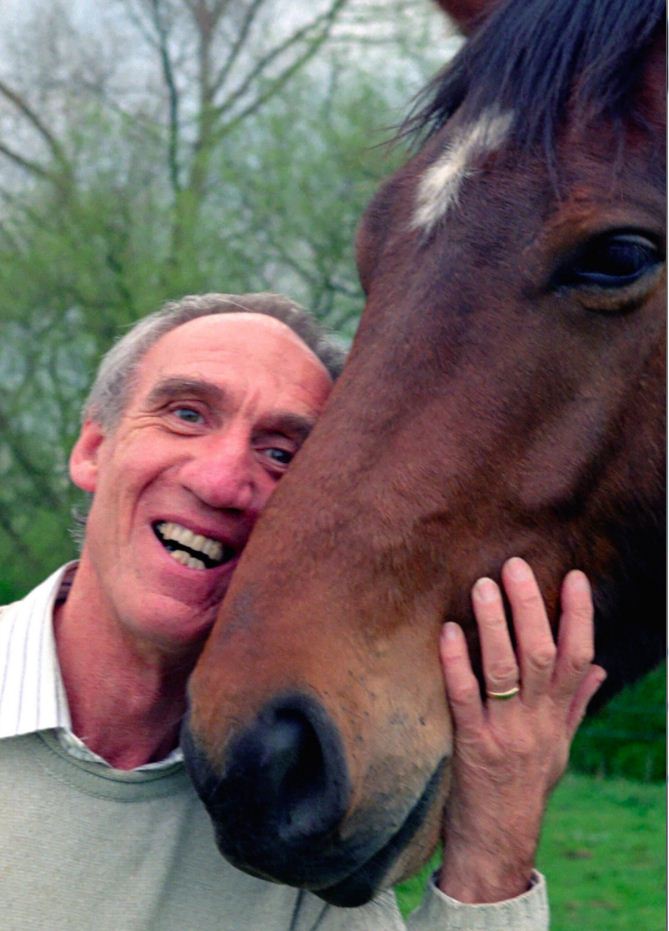
When the horse saw me it ran to me and become very excited and loving, rubbing against me and licking me with a very long tongue. I was both pleased and slightly threatened. Threatened because it was so intense. At one point though we rubbed against each other with a degree of sexual pleasure.
The Many Brains
Some recent studies of the brain by Paul Maclean suggest that anatomically we have in fact more than one animal in us. Our brain, like an ancient dwelling that has been added to over the millennia, has three levels. The oldest, the brain stem (medulla), is like the brain of very ancient creatures, the reptiles. In us it deals with just what it does in them – flight and flight, reproduction, territory and ritual behaviour. From this comes rigid behavioural response to an event. Next is the part of the brain we share with other mammals such as cats and rats, the limbic system (cerebellum). Maclean sees this as dealing with the fine sense of caring for young, social relationships such as heirarchy in animal groups and fine survival skills. Overlying these two like a mantle is the cerebrum, the large part of the brain that gives us the potential for human characteristics such as highly developed language and reasoning skills.
The skills and information linked with the cerebrum add to and extend the impulses from the other two ‘older’ animal brains we have. So usually we modify and augment our internal animal. But occasionally the cerebral influence gets distracted or knocked out by drugs, such as alcohol, or exhaustion. Then our animal can live through us again without having to hide in the obscurity of sleep. At such a time we might make love for the first time in our life with total passion, sensation and abandonment of guilt. A sudden extra awareness as if with sharpened senses might arise, enabling us to precisely read another persons body language and non-verbal communication.
But there is a darker side too. A young man of usually gentle behaviour, whose work in his home town in USA, was to spray peoples lawn with a powerful weedkiller, abruptly murdered one of his clients. He had suddenly, and quite out of character, wanted to urinate while working. Instead of finding a toilet he had peed in the customer’s garden. She had come out and complained to him, whereupon he killed her.
Findings show that one of the chemicals in the weedkiller produce a diuretic effect making one want to urinate. It also acts on the brain, and possibly inhibits the cerebrum and cerebellum. If that is so, what the young gardener was left with was his reptilian responses without moral judgement.
So if you want to say hello to your natural self, better not walk alone into that garden of Eden where it dwells, free of morals, words and time. Better take your cerebrum with you.
Animals in Your Dreams
The animals we dream of express the wealth of our own feelings and depth of our unconscious understanding of life.
Few of the things we do as an individual in today’s world are uniquely human. Like other animals we build dwellings, we eat, sleep and reproduce. We care for our young with the same passion and self sacrifice seen in other mammals. We follow leaders and develop hierarchy as do wolves and primates. Above all else, we share with our fellow creatures our existence in a physical body we have inherited from a long line of forebears and pre-human animals. From this long past we carry traits and urges, fears and dispositions that underpin our self aware human personality. In dreams, these largely unconscious responses to what we face in life are shown as animals. See Animals in your Brain
For instance some of these traits we know as the flight, fight or freeze response; as the new born baby’s instinct to suckle and bond with its parent; as our urge to find a partner and mate; and particularly we see it in the drive to survive and thrive. But there are many more subtle aspects of the animal inheritance we carry with us. Some of these we see in our social behaviour, as when we shrewdly asses a person’s character, or discover what we call the ‘chemistry’ that exists between us and another person. Such things arise largely from our unconscious intuitions and senses. Such senses and responses were developed over millions of years by our animal forbears. In fact we are like a small face on top of a long line of beautiful animals.
This ancient heritage that dreams portray as our animal is not simply a psychological belief. It is built into our body and is very evident in the fact that we have three interwoven brains. The most ancient brain, one we share with reptiles and birds is called the R complex – R for reptilian. This part of your brain deals with deeply instinctive behaviour such as flight or fight, swallowing, automatic reflexes, inbuilt mating behaviour, territorial defence and aggression. This R complex developed about 200 million years ago and is still an underpinning part of what influences your behaviour today. Dreams often portray these urges in you as snakes or lizards.
The second part of your brain is called the Limbic System. This is wrapped around the R complex, and is something we share with other mammals such as cats, dogs and horses. It developed about 60 million years ago and deals with your emotions, feelings responses to people and events, the subtler inner life you feel in love and sex, and it provides a deep wisdom about social and individual relationships. Dreams often use mammals or apes to portray the influence in your life of this part of your unconscious drives and intuitions.
Many people are frightened or terrified of their dream animals. That is rather like being terrified of a picture on a cinema screen, for dreams are nothing more than moving images on the screen four sleeping mind. Like a computer game you can be attacked or even killed many times but you are still whole and unhurt. Face up to the animals in your dreams and make friends of them, because they are really helpful assets to have. See Inner World
Useful questions:
Is there any concern about the animal’s health?
The third part of your brain is the Cortex. This is unique to humans and takes up five sixths of the brain mass. It deals with all the things that are distinctly human, such as logical thought, writing, analysis, self awareness and conscious movements.
An American advertising company, describing these three brains in its instructions to planning advertising campaigns says, “Our Reptilian Brain is more powerful than the Limbic (emotional) Brain, which in turn is more powerful that the Cortex (thinking) Brain. It is best to take all three brains into account when planning a marketing/branding campaign.” See Animals.
Meeting your dream animals
What has been said about your three brains and what sort of dream arises from them is of course a generalisation. When you are looking at your own animal dreams you want to know specifically how they refer to you. So we will move from the general to the specific in looking at the dream meanings of animals such as a dog, cat, snake, horse, tiger and elephant. Those are mentioned because they are, in the order given, the most frequently dreamed of animals.
As explained in an earlier chapter, these are not to be thought of as symbols. They are more like computer desktop icons that if you connect with them lead you to awareness of, and ability to work with, what are usually unconscious processes in you. To gain even the beginnings of insight into your dream animals, you first need to remember that you as a person are a tiny spark of consciousness. You are a little bit of self awareness riding an incredibly ancient animal you call your body. Remember that your body has formed from cells and genetic information that has gradually developed over millions of years. It holds that information in it unconsciously. To actually make a living connection with your dream animals see Acting in your Dream
 |
To gain an understanding of your dream animals, it is helpful to imagine that you are the keeper of a prehistoric type of human being. As such you would need to be aware what the correct diet is for this big creature; what type of dwelling it needs; what are its sexual and emotional needs; what frightens it or causes it stress; what amount of exercise keeps it healthy, what its stages of growth are and how it can best develop through those stages; and what satisfies it in relationships with others of its kind? Your animal dreams are showing you exactly those issues. They are giving you insight into how to care for the instinctive, the spontaneous and natural in you. |
Therefore ask yourself the following questions about your animal dreams, and write down any responses. If the answer is no to a question, move on the next one:
Is your dream animal struggling to survive?
Survival is the most powerful and fundamental drive in your body and personality. Survival skills today are often linked with managing to remain alive in difficult terrain or harsh countryside, but we all live in the midst of challenges even in civilised surroundings. Your everyday social, work and political environments confront you with enormous difficulties. Also, every cell in your being is trying to survive. Your body and its systems are constantly involved in maintaining balance amidst powerful counter influences, or even against your own bad habits. Understanding what difficulties you face in surviving, and what resources you have to handle them is a huge step toward a better life. If you had the reptilian brain and the mammalian brains removed you would not function.
Therefore define if you can what your dream animal is struggling with or against in its efforts to survive. Look for connections with your everyday life. In doing so remember that the dream is putting into graphic form, perhaps like a mime, something that needs to be lifted into everyday words and perceptions.
We all have so many aspects to what we need in life to survive as a whole person. We might be doing very well in work or social recognition, but our need for warmth and love might be struggling. So it is helpful to list the facets of your own life, such as physical health, mental health and vitality, emotional needs, finance, acclaim, and so on, and asses their survival rating.
Is the animal domesticated or wild?
This illustrates the difference between urges within yourself that you have completely socialised or learned to cooperate with, and those that are in conflict with your conscious actions or what other people expect of you. An example of this can be seen in youthful rebellion, and in the difference between what is instinctive and spontaneous in a young person, such as aggression or fear, and what is expected of them by others. The rebellious youth might allow their unsocialised urges to express as criminal acts, or disruptive social behaviour. On the other hand they might express it in the form of music or art that, while it is still anti establishment, is rewarded, as with the Rolling Stones.
So the need here is to recognise what of your feelings or urges are involved, and ask yourself if the wild is healthy as it is, or does it need a better relationship with your social or work activities? On the other hand, sometimes social restraints or needs deaden the spontaneous and natural in oneself, and so need to be reduced for greater personal harmony.
- Is there any concern about the animal’s health?
- Is there an indication the animal has been injured?
- Does love, caring or affection enter into the dream?
We have inherited and enlarged the great tenderness and care seen in other mammals.
- Are sexual feelings involved?
- Does the animal show unusual intelligence or ability to speak?
- Is the animal giving advice or showing you something?
- Are baby animals involved?
- Is the animal attacking or being attacked?
- Is there a herd or group of these animals?
- Has the animal been neglected or mutilated?
- Are you trapped by or running away from an animal?