Posts Tagged ‘anxiety’
Sleep walking
Very common with some people, especially during adolescence or times of stress. Sometimes accompanied by hallucinations. Sleep walking is normal as an occasional event in children. If the child is agitated, excited or acting in a manner to injure themselves during the sleep walking, then it may be a sign of emotional distress.
Sleep walkers can even drive a car without waking
The same applies to adults. Many sleep walkers perform complex acts without coming to harm. A young Portsmouth boy drove his father’s car 27 miles before waking in Southampton. The police checked his story and did not charge him. But sometimes severe injury is inflicted either upon themselves or others. In America and England, homicidal acts have been committed while the person claimed to be sleepwalking, and the people involved were acquitted of murder.
cause of such powerful activity during sleep, many people who experience this type of sleep walking are worried about what they might do to a partner sleeping next to them. In most cases one wakes as the contact is made, or the involved person wakes one, but the element of risk cannot be denied.
Help for sleep walkers
Where such worry exists, hope can be gained by understanding what was observed with many men who began to sleep walk after war combat. In their cases the movements, speech and emotions were observably connected with trauma occurring during their war experience. The self regulatory process in dreams was thereby attempting to release the tension, horror or emotional pain of the events. Where these emotions could be met consciously, perhaps with the help of a psychotherapist, the sleep movements stopped. This suggests that dramatic activity while sleep walking has similar roots, and can be dealt with. See LifeStream.
Night Terrors
Night terrors may occur due, not to frightening dreams such as a nightmare, but to sudden and powerful body changes such as difficulty in breathing, or a sudden drop in your pulse.
Night Terrors often Linked with Difficulty in Breathing
Night terrors occur most often in children and usually decrease as the children mature. A cause noticed as long ago as the nineteenth century was that many cases of night terrors happened to children who showed early signs of heart disease. In other children, after removal of the adenoids the terrors disappeared. Like tonsils, adenoids are a glandular tissue that lies at the back or the mouth behind the soft palate. If enlarged they can interfere with breathing.
Night terrors are characterized by abrupt awakening, sometimes with a scream; a sleeping child may sit up in bed, apparently terror-stricken, with wide-open eyes, and often with frozen posturing that may last several minutes. Afterward there typically is no recollection of dreamlike experience.
According to Professor Colin Sullivan, head of the clinic, people gripped in a night terror are in a “state of absolute panic .
“I have seen patients injure themselves by pushing their hand through a plate glass window and run out onto a balcony and fall off,” he said.
Night Terrors are Differnt to Nighmares
Sleepers sufferind night terrors who are shocked awake will likely be disoriented and confused. Try very gently to help them find their own way to a couch, the floor, or back to their beds. Sometimes a softly repeated suggestion will do the trick. When waking them is necessary, try repeating their names, very quietly, over and over again.
Scientists distinguish between nightmares and night terrors, the term for terrifying nocturnal experiences that mainly affect young children in deep sleep. The principal difference is that the sleeper seldom remembers a night terror. Sleepers in the throes of a night terror often awaken to the feeling of being suffocated or choked.
Although this doesn’t apply to children, learning a different relationship with emotions and dream images can cure night terrors. Most people take their emotions as some sort of reality. I mean by this that a dreamed of car cannot hurt you in any way. A car in the physical world can crush your body. If you begin to realise that the only thing that can raise terror is our own reaction to your emotions.
Emotions Can Kill
In 1898 Crile was on an army transporter off Cuba and examined a young officer who was delirious with fear due to facing his first battle. He was as deep in shock as if his legs had been crushed by a wagon as William Lyndman’s had. This led Crile to become interested in exophthalmic goitre, an illness which produces a similar type of anxiety condition. Despite the use of anaesthetics, no one had successfully operated on such a goitre condition. Every patient died. Crile discovered why when he attempted such an operation in 1905.
While under anaesthesia the patients heart rate rose to 218 and the body temperature rose to a dangerous level. Despite no physical injury or infection, the patient died that night with a temperature of 109.6 F. Crile realised from his previous observations that it was fear which had killed the patient. Therefore he told his next patient, a young woman who needed the goitre operation, that he was going to give her a simple inhalation treatment. When she breathed in the anaesthetic, she therefore thought she was having a ‘treatment’ not an operation. She was the first person to survive the operation for exopthalmic goitre. Crile called it “stealing the goitre”, and was so impressed by the influence of emotion on the body he constantly stressed the importance of self control, and taught that calmness is strength.
Dream Lovers
Can you imagine eating your breakfast porridge and finding something black bobbing about in it? Then discovering with horror it is a cockroach. You flick it out with your spoon onto the kitchen floor, where it clatters on the tiles. You feel nauseous and then notice there are now two cockroaches. They are copulating, and you begin to vomit.
Maybe you feel easier if I tell you I have just described a dream. With those cockroaches copulating, it is difficult not to recognise it as a nightmare about sex. It is fairly obvious too, that the woman is ‘sick’ of sex.
Some people believe a dream is just a dream – a meaningless fantasy of the night. They see dreams as akin to a kaleidoscope of images, random and without relevance. Having heard thousands of dreams from people throughout the world, I feel differently. Again and again, the outer situation and personality are directly reflected in the drama of the dream.
For instance, one woman says, “This dream has been recurring for years. In it a man is trying. to make love to me. At the last moment I repel him, as I know it will cause a pregnancy.”
The woman, who is a mature spinster, and who wishes to remain anonymous, goes on to say, “When I was about ten, I was raped. As a result I have had a horror and fear of men for years. It has spoilt my life from the sexual angle as I hate to be touched.”
The dream is recurring, which shows that Ann (short for anonymous), has an unchanging habit in her life. In Ann’s case this can be confirmed by her actual experience of avoiding sex. Her dream and her waking life are the same. So while the dream recurs, we can feel reasonably sure that she still remains stuck in her same reaction to sex because of her anxiety. She is repressing her need for love and so the dream continues. See Avoid Being Victims
However, dreams have many functions. They do not simply reflect our everyday situation or express hidden wishes. They also explore the new, state what we are unwilling to look at consciously, and consider most likely outcomes of our present activities and attitudes.
In her book Dream Power, Dr. Ann Faraday mentions a dream which sums up these various facets. Sally dreams she is presented to a Persian King in the garden of his palace. As she talks with him, a group of laughing girls arrive with a sad looking middle aged woman. Sally felt the woman was in charge of the harem, and was sad because the King no longer wanted her sexually. Then one of the girls approached Sally and said, “Don’t you recognise me? We were together in a previous incarnation.”
Sally woke feeling depressed. She had been reading The Perfumed Garden, an Eastern book on sex, and she felt the dream was in some way about her own life. Because she and her husband had grown apart sexually, she saw the older woman as herself. What she gave of herself to the relationship now, was to devote more of her time and energy to the house and family. This helped her to understand that the young woman’s reference to a previous incarnation was about her own ‘past life’, or earlier years spent in greater sexual involvement with her husband.
Although her husband worked in the film industry and had contact with many young women, she could not understand the last part of the dream. “He’s too inhibited”, she said. Some months later, however, her husband brought a young woman home, explaining she needed temporary lodging. There followed a number of affairs with girls he brought home, while Sally acted as housekeeper.
If we can accept that dreams reflect a summary of our present situation; show us what we might not otherwise see; and look at future outcomes – what do they reveal about the sexual life of women and their dream lovers?
So far, the dreams have said that a woman can be ‘sick of sex’, and that anxiety about sex can rob her of that pleasure for a lifetime. Also, in middle age a woman may lose her man sexually. But there are also less obvious issues here which need to be brought out. For instance, even though Ann remained a virgin in her waking life, why did she refuse her dream lover year after year?
The next dream gives us insight into this. Jane dreams she meets a younger woman in a street. They hug each other warmly. Together with many other women, they queue to enter a building where a creative expression activity is to be held. The women were happy. Then somebody grabbed Jane playfully from behind and said “Guess who?” It was a man, who crouched to child’s height as Jane turned, eyes closed, to guess. She felt his head, then opened her eyes to see it was Tim, husband of a friend. They walked away together, still playful. Then Jane began to feel anxious and guilty in case her husband found out and saw the pleasure she had. It begins to snow, and the dream ends in a tortuously complicated plot to meet Tim without her husband finding out.
In waking life, Jane had met Tim while on holiday visiting relatives. He was separated from his wife – her doing – and when Jane needed somewhere to stay, offered to share his flat. Jane refused. So much for her waking life, but remember, she is dreaming. Why does she need to deny harmless pleasure while she is asleep? See Secrets of Power Dreaming
It’s called ‘introversion’. Most of us take in, or introvert, into our dream and fantasy life, things that may be vital or useful in our outer life, but have no satisfying place in our dreams. While asleep, Jane is not actually in a street; she is not in reality hugging a man; she is not physically flirting with a man. The street, the man, are her own feelings and urges given form. The plot of the dream is an expression of her creative femininity and values, So, enjoying the dream lover is, in the end, only an enjoyment of her own feelings.
Part of the function of dreaming is, for our psychological self, what sweating and shivering is for our body – a means of self regulation. Sweating and shivering regulates our temperature – dreaming balances our urges by expressing in sleep what we refuse to express in waking. So if Jane denied herself the enjoyment of Tim’s company during the day, to deny it at night too, is unhealthy. When this was pointed out to Jane, she said “I see now what a tight spot I got myself into over being with men other than my husband. Also I feel my full creativity will not be available to me until I sort this out.” Because of her awareness of this introverted tension, Jane later began to have directly sexual dreams for the first time in her life. Her realisation that her sexuality and creativity are closely linked, is an expression on her part, of a statement which appears repeatedly in sex dreams.
Many women’s dreams show great reticence in allowing enjoyable sex. This also means that they are inwardly holding back their own full expression and creativity as a person. It is also a reverse of the situation in which a young wife dreamt her husband made passionate love to a blonde. The wife was furious, and on waking, confronted the husband with what he had done. When reminded that it was only a dream she said, “Yes, but if you do that sort of thing in my dreams, what do you do in your own”
Because marriage is such an important event, dreams constantly analyse one’s chances of success. As our dreams tend to consider the needs of all aspects of our nature, they give a balanced view of whether we could relate well to the man we consider marrying. Many women have told us dreams they had prior to marriage which pointed out the problems they encountered once married. Sarah, who had a strong sexual attraction for her fiancé, dreamt he was ignoring her. She then went off with a man she was sexually attracted to, but not in love with. Feeling this as unsatisfactory, she tries masturbation, but even in the dream, feels it is a poor substitute. She then decides that if she can’t marry the man she loves, she will be his mistress. On waking, however, she realises that part of her need is for security, family life and children. So although the dream has said that her fiancé does not care for her sufficiently, and has tried various solutions, it has not yet solved the problem. However, a later dream revealed how much anger Sarah had about her fiancé’s lack of real care. She realised that she had been trying to make the best of a poor situation, and left him.
Although Sarah’s dream is openly sexual, she realises there is a need for mutual caring and the satisfaction of the desire to have children. Dreams see sex as an energetic flow, which if denied, builds up like water behind a dam. If not expressed it flows sideways into tension and irritable or depressed emotions. As energy, it can emerge not only as the sex act, but as warm feelings, caring for others, and creative activities generally. But in relationships, it exists as the subtle emotions which flow between a couple.
Brenda’s dream shows this. She says, “Ted and I are in bed together. I am feeling hurt as he has his back to me and is masturbating. I thought to myself ‘why turn your back?’ He then turns and faces me, his legs and thighs close to me. With legs apart, he openly starts to masturbate again. This time I do not feel he is cutting me off, so I share the feeling of quiet peace and pleasure.”
This is a good example of how direct and honest sex dreams can be about a couple’s intimate feelings. The dream indicates that Brenda’s reaction to how Tim relates to her is that he wishes to feel his sexuality is not possessed by anyone else. She discovers that when she allows him this he is willing to share his pleasure with her. Tim and Brenda both felt this was an accurate and helpful summary of their situation. Brenda said she had often woke to find Tim gently giving himself pleasure while he slept. This upset her as she felt left out. For Tim, Brenda’s attitude reminded him of his mother, who seemed to want to possess his sexual pleasure by trying to stop him masturbating as a youth. He felt he needed to own his own pleasure before he could share it. Sorting out these subtle reactions to each other led to a more relaxed relationship.
Like Jane, Brenda never allowed herself sexual pleasure in her dreams. Some time after the above dream though, Tim was aware that Brenda was, as she put it, “comforting herself” while she slept. As soon as he moved softly to turn in bed, she withdrew her hand. He therefore took hold of her hand and replaced it on her vagina, and told her he felt okay about it. It was her vagina and she could pleasure it when she wanted to. Then she fell asleep and dreamt – “I was with a dark curly haired man. He was very brown, perhaps a native, but he didn’t feel a stranger to me. We began to make love, and I became aware of the pleasure in my lower body. It was very slippy, slidy and wet. There was enjoyment for us both, with very intense body feelings and a child-like quality, not passion, but pleasure and joy in my vagina.”
The dream is an obvious expression of how Brenda has relaxed her usual inhibiting of her inner sexual pleasure. The man is an embodiment of her own natural desires.
Sympathetically sharing of our sex dreams with our partner can lead to the growth of mutual caring and understanding. Sylvia dreamt she was in bed with her husband Dave. She felt close and warm, and Dave began to become more intimate, but a woman came in and wanted to ask something. Dave got up and dealt with the woman. Sylvia saw he had got dressed, and felt he had given up trying to get close, and felt alone and withdrawn. But suddenly Dave was in bed again with her, but she was still hurt and cut off from him.
At that point she woke to feel in the same situation with Dave. He got out of bed and Sylvia told him her dream. He immediately responded by saying it was almost an exact replica of the day before. He had wanted to make love to Sylvia, but friends or family had kept arriving. Then when they did go to bed she had seemed distant and unattractive. But Sylvia had been withdrawn because she believed Dave was disinterested. Realising how they had misunderstood each other, Dave got back into bed and completed Sylvia’s dream.
These dreams show how much need there is for women in general to be more honest and direct sexually. Although they may choose a particular man to share their body with, in their dreams they need to let themselves loose. They need to sizzle and writhe with their own pleasure while they sleep. Pleasure is a healing force in us. Women need to bathe in it often, not only for the sake of health, but also to discover their own creativity.
Perhaps Pat’s experience sums it up. After not making love for a month, her husband Ed came home from work one afternoon and spent a long time touching, playing with, and being with Pat sexually. The next morning Pat was cleaning the house and started singing as she arranged a vase of flowers. Suddenly, she remembered a dream. In it, Ed and she were going in the same direction and she started to sing because of their happy feelings. Then she felt she ought to stop singing because Ed would say she was happy because they had enjoyed sex. But she realised Ed knew what she was thinking. As she walked quietly, Ed himself began to sing, and Sylvia walked with him, smiling to herself.
Charlene Gowrie’s Dream Journal
Within me was the belief that nothing good could ever happen to me, that success in life was not for me and so my positive dreams I discredited. I decided to ignore my dreams. I felt that by trusting them, I was using them as an escape. I wanted a better life and I was committed to doing all within my power to improving myself and discarding the things I felt could not help me in my quest – and this meant letting go of dreams.
But somehow, I could not completely abandon the notion they meant something. In my more faithful moments, I knew that because of the mere fact of the dream, that they existed, proved that they had meaning. And I had my own personal experience with dreams – for as long as I could remember I had always dreamt the results of my examinations. Not the actual grades, but whether I had passed the exam or not. Strangely, they had also predicted the outcome of certain situations, like interviews and job situations. I found myself looking to my dreams to guide me. I looked to the dreams to help prepare me for the day, the future. And that’s why the anxiety causing dreams scared the hell out of me.
So I Would Not Let Go of My Dreams
So despite the doubt and uncertainty, there was a part of me that would not let go. Not the rational, logical, defensive, fearful part, but that part of me that believed and held on tenaciously to the possibility that dreams had to mean something. That part of me that believed in miracles, believed in goodness, believed in possibility and hoped; the part of me that felt that life was more than a pay-cheque; a little voice inside of me that said there had to be more.
Very occasionally, I would, because of a dream, visit a certain bookstore in which resided a particular Dream Dictionary. There, I would look up the symbols and would somewhat guiltily enjoy processing the dream. I rationalized that by not buying the dictionary, I was not taking the dreams seriously. After all, they were just dreams and it was ridiculous to give them any credence.
And this was my plight for a very long time – torn between trust and doubt, both co-existing at the same time, sometimes one stronger that the other, but both always alive.
Then Came the Spider Dreams
Then the spider dreams started, the dreams were not about the spider but for some reason they would appear in the dreams, just there, not threatening, just there. Well, doubt or not, I felt this had to be explored. Something about the spider dreams and what the dictionary said about spiders caught my attention. Maybe it was the depth of the explanation, that dreaming a spider did not just mean “money” as I had been told. Maybe because I felt the author was taking dreaming seriously and it was not like one of those other dream dictionaries that just gave a meaning without any analysis or offering any link between the dreamer and the dream.
The spider dreams had to do with not wanting to confront or handle difficult feelings. At this time I was actually dealing with the end of a relationship that I had invested very heavily in, and I did not want to see it end. One thing that I had always known about dreams (although I did not believe in them!) was that once you understood the message of the dream, the dreams would cease. As soon as I linked the spider dreams to my feelings about the possible end of that relationship, the dreams stopped occurring.
One Dream Ends – Another Begins
Then began the car dreams. Almost every night, I would dream my car was either lost or stolen. In the dreams, I would first panic, but reason would save me. Either I had forgotten where I had parked, or the car would be found in a different street, sometimes the police or members of my family would help me. Again I turned to the Dream Dictionary – and this time I bought it!
The dictionary was a gift from God. It helped me through one of the most difficult times in my life. I think what appealed to me the most was that it was myself helping myself. There was something mystical and comforting in that. And who knew better than me exactly what I was going through. I did not have to explain anything, all the information was there – and the support and guidance came from within me.
This meant a great deal to me – because though a natural skeptic, I knew that I could trust myself. It was not a drug, it was not a distraction – through the dream I was able to understand and manage what was happening to me.
It showed me that I was not alone in the Universe. That there was something out there that knew, that understood, that guided, perhaps even cared – there was a plan, even if I did not know what it was.
Moving Beyond the Small Me
Then I had the mandala dream. When I read in the dictionary what this symbolized, I was so impressed with myself. I had always wanted to hope and this gave me such hope for myself, for the future. It was fascinating to me that I had dreamt something that I had no knowledge of, to find it existed, to find it had meaning.
So slowly, my doubts gave way to faith. Slowly, I stopped wondering and began to see, to believe. Slowly, in my own time and at my own pace, things began to unfold. I began to give up the very little, nagging doubts, the inconsistencies, the nuances, and the questions. Slowly, I let go.
And then the ultimate test – what about the dream, the dream that I had placed so much faith in that had not materialized at all. I remembered it very clearly, although it was about nine years old. This had been the one red flag that I had never been able to stand down.
And do you know – on processing the dream I discovered that, exactly how things had played themselves out, had actually been said in the dream.
And so now I know – and that has made all the difference.
Black Magic, Evil and Dreams
Although thorough investigation of claimed injury or death attributed to black magic has shown the real cause to be malicious aggression or murder, scientific research into the deaths of people who were said to have died as the result of a curse or a voodoo ritual, has shown the victims to have died of fear.
Death through fear is fairly common, and is reported by some doctors in connection with surgical operations, especially in the past. In 1887 Dr. Crile had watched helpless as his friend, William Lyndman died of shock after amputation of both legs. My uncle also died of the shock of losing his arm. My uncle, like William had lost little blood, and no vital organs were injured. Crile went on to develop anaesthesia and blood transfusion to counteract death through shock. But some forms of shock appeared to be outside any physical cause. In 1898 Crile was on an army transporter off Cuba and examined a young officer who was delirious with fear due to facing his first battle. He was as deep in shock as if his legs had been crushed by a wagon as William Lyndman’s had. This led Crile to become interested in exopthalmic goitre, an illness which produces a similar type of anxiety condition. Despite the use of anaesthetics, no one had successfully operated on such a goitre condition. Every patient died. Crile discovered why when he attempted such an operation in 1905.
While under anaesthesia the patients heart rate rose to 218 and the body temperature rose to a dangerous level. Despite no physical injury or infection, the patient died that night with a temperature of 109.6 F. Crile realised from his previous observations that it was fear which had killed the patient. Therefore he told his next patient, a young woman who needed the goitre operation, that he was going to give her a simple inhalation treatment. When she breathed in the anaesthetic, she therefore thought she was having a ‘treatment’ not an operation. She was the first person to survive the operation for exopthalmic goitre. Crile called it “stealing the goitre”, and was so impressed by the influence of emotion on the body he constantly stressed the importance of self control, and taught that calmness is strength.
Crile’s experience illustrates what can occur through threat of a curse or black magic. In our dreams we often portray something we deeply fear as an evil influence or person, or as an awful monster or ghost. Such fears usually relate to our own urges, such as anger or sexuality, but can be about any urge or thought that we have been led to feel is not permissible, or downright evil. A demonic figure or environment might also be connected with very early babyhood experiences. The pain of birth is often depicted as hell or demonic influence in our dream symbolism. On exploring dreams that have a very evident evil force or devil in them, what is discovered is that the ‘evil’ is actually the person’s own repressed or hurt sexuality or urges. See: evil; witchcraft; The Con About Evil.
Because the unconscious will use any belief system or cultural symbols we have absorbed to express a theme, the powerful images of witches or evil characters we see on films or in fiction are often used to depict important experiences. For example a dream in which a spell or curse is placed on one can portray the influence a painful experience has left on ones emotions. If you had been deeply hurt while in your mother’s arms, your unconscious would equate pain with being held close by a woman. This ‘cross wiring’ of associations could meaningfully be portrayed as a ‘spell’ which makes one feel frightened in the apparently loving situation. See Victims; Dream Like a Computer Game; spell.
Behavioural Modification Therapy
Modifying the behaviour of other human beings has a long history. Whatever can change the way we feel and act can be a means of altering behaviour. Methods as widely separate as religion, political torture and brain washing, can be thought of as behavioural modification techniques. A major demarcation can be seen in the use of such techniques with people – there are those who want them applied, and those who have them applied against their will.
As a form of therapy or aid to mental and social health, behavioural modification has been practised in every culture in all periods of history. Rituals in which individuals or groups felt more in harmony with each other, or which induced a feeling of cohesion against a common enemy, can be thought of behavioural modification.
In more recent times, although the age old techniques are still used, an enormous amount of research has been undertaken to define exactly how human beings, and of course animals, can be changed or manipulated. After all, such information is incredibly important to religious and political organisations, and to businesses that wish to induce people to buy their products. This has given rise to such varied approaches as physical and mental intimidation, brain surgery, brainwashing, electric shock therapy, drug use, subtle advertising and propaganda, the use of suggested fear to sell or induce and psychotherapy.
In modern psychology, the term behaviour modification means something specific. Ivan Pavlov developed the foundation for modern approaches through his work with conditioned reflexes in dogs. Apart from showing that a dog could be conditioned to salivate when a bell was rung, Pavlov experimented further and performed experiments in which a dog was trained to salivate when the image of a circle was projected on a screen, but when an ellipse was shown it was not trained to have any response. When this was established the shape of the circle was gradually changed toward and ellipse. As the circle was changed the dog showed signs of agitation and lost the response to salivate. The disturbance experienced by the dog was seen as an ‘experimentally induced neurosis’. See: Example under brain levels.
In 1920 these methods were tried on human beings. The American psychologists John Watson and Rosalie Rayner worked with an eleven-month-old baby who showed no fear while playing with a white laboratory rat. By producing a loud noise each time the baby touched the rat, the baby was conditioned to experience a fearful response when the rat was present.
Having learnt how to artificially create fears in children, Mary Cover Jones experimented with reducing fears already established in children. The two methods she found most effective were 1) Linking the feared object or situation with a new stimulus capable of arousing a positive response. 2) Putting the anxious child with children who showed no fear of the object or situation.
Later, people like Joseph Wolpe, Hans Eysenck, and M. Shapiro, used and developed these methods. This was mostly in connection with people with disabling fear reactions. The ideas of B. F. Skinner who led the behavioural movement in psychology, played a leading role in some approached to modifying human behaviour. Different approaches evolved, and some of these became well known enough to have particular names – systematic desensitisation; aversion therapy; and biofeedback.
There are usually five steps in behaviour modification.
- Defining what the individual needs to improve their problem.
- Putting together a method that changes undesirable behaviour and aids the development of desirable responses.
- Using the program according to the principles of behavioural modification.
- Careful observation and recording of results .
- Changing the approach if it aids improvement.
See: aversion therapy; desensitisation therapy.
The Beast in Dreams
The beast is usually an animal of extraordinary power or a creature causing great terror is a feature of many dreams or nightmares. The figure may be partly human, or an animal which has strange characteristics, or perhaps it is a figure which never quite declares itself, remaining unseen but causing or projecting great fear. In some dreams the beast takes the form of a prehistoric creature.
When explored in any depth such dream images are realised to be an expression of powerful internal emotions, responses and drives which have in most cases previously remained unconscious or repressed. The reason for this lack of expression in conscious life is varied. It may be that painful childhood experiences created a block, or fear surrounding some basic drives such as anger, sexuality or self expression. Therefore major areas of one’s potential are withheld and become symbolised by the beast. That such a beast appears threatening and aggressive, or even bent on one’s destruction, is a simple statement of the way we relate to the forces of our psyche that are bound up with it. For instance if we have been made terrified that our parents will desert us, the expression of our need for love may create this terror. So the beast, in itself, is usually not a thing of terror. The awful feelings are what we experience in connection with what it signifies.
As this terror originally occurred in early childhood at a time when our developing identity was very fragile, or during later traumatic events, the force of such feelings are often life threatening as far as our growing identity was concerned. But similar repression may surround the strength of our own sexuality or basic driving forces.
As many of us are not at ease with our emotions and irrational urges, to meet this ‘beast’ may not be easy even as an adult. This would mean feeling the intensity of our childhood emotions and fears, reappraising them, and integrating the information gathered from such an experience. The information might well include insights into why we avoided certain life situations, or why strong feelings were evoked by seemingly simple events. The example below gives some small insight into this. The information is told by a woman who helped Margaret work on her dream.
Margaret dreamt there was a whole lot of downy little feathers falling from the sky and covering her, like snow. The sky was full of them. She had been watching a baby eagle very high up in tree tops flying from tree to tree. She felt it was looking for it’s mother/ parents. Then a man had caught the baby eagle by a string around it’s leg and Margaret was appalled and said to him, ‘You can’t do that. You must let it go.’ Then the feathers started to fall and Margaret felt that any moment now the irate parent eagles would arrive. They didn’t but she was with her back to a wall sheltering as best she could.
While we explored Margaret’s feelings and memories connected with the dream symbols, she told me that her man friend prodded an old childhood pain which he didn’t know about. Margaret and her son had been with him and his mother for a good weekend camping. She told her son he could go play in the park while they packed the car and they would pick him up on the way out. They were all in the car and drove to where the son was and called him, he saw them and started to run towards them and then the man friend drove the car forward as if to make out they were leaving him behind. Margaret burst with pain and anger.
The underlying cause of this was that her own parents had split up and neither of them wanted Margaret to live with them. She had therefore been looked after by her grandparents. The event that crystallised her feelings occurred one day when her Grandfather had, on the Grandmother’s instructions, driven Margaret, who was 7 years old, to the edge of the town, told her to get out and started to drive away. This was because she wouldn’t eat her breakfast. She still carries the pain of that day. She told her father many years later and he was very angry with his own father for doing that to Margaret. She says – ‘Anyway, it came out again when we were looking at the dream. The male friend grew up with an alcoholic father who has just died, but he says he hasn’t any trauma to deal with?’
The theme of the beast is very important in women’s dreams, but may hold a slightly different theme than in men’s. This difference is illustrated by the story of Beauty and the Beast, in which a young girl meets and lives with a powerful beast. The story emphasises the girl’s relationship with her father as a counterpoint to that with the beast. It suggests that a young woman meets a different kind of love when she leaves the affection from and for her father. To become fully a woman and mother, she must discover the deeply animal urges which underlie the personality and social traits she has developed so far. These urges are not at all uncouth, but are certainly primitive. They open her to experience deep sexual longing, and the power to give herself with passion to her children and to her man. Thus she allows in herself something forbidden in her relationship with her father – an erotic and procreational love.
Overall the beast represents the forces in our personality out of which we emerge into social and intellectual life. Unless we make friends with our beast there may always be conflict in us between the rational and non-rational. We existed as a beast for millions of years before the sort of consciousness which led to personal awareness emerged. Self-awareness is still very new and vulnerable. It needs the greater depth and innate wisdom of the beast to survive. See: under animals.
Here is an extract from the dreamwork of a man exploring a dream about snakes which he feared would attack him.
As I imagine myself to be the snakes I have a distinct feeling that for millions of years I have existed as an animal. As human beings we often reject the animal in us. I see the meaning of the snakes. The snakes are so powerful. They are urges in all of us, to be felt if we are not afraid of them. The urges they depict can become a part of our everyday life. A man is somebody who has all that power there but it is under control. I have been brought up to feel one is supposed to be meek and mild or something. It was not socially acceptable to growl a bit.
I am a mixture of a beast and this awareness of self. WHY? WHY? (I feel like a wordless animal which has just got awareness). Intellect is developing and can ask these questions but there is still the powerful beast here. Why has this happened to me? Why have I woken up from being an unconscious animal and become conscious? What is this all about? It feels like it ought to be a swamp outside the window now – or a jungle.
I am a man! What is a man? What is it to be a man? I really feel this isn’t a way to be. It is too strange to be a man. I am really something odd. It is odd being a man. It is frightening. I am not like the other beasts. The other beasts haven’t got this difficulty of self awareness. The don’t carry this difficult thing – self awareness. They don’t carry the difficulty all the time. Why should I be different? I don’t like it. DON’T like it.
There is something I am looking at which is to do with how human beings got to be in the situation they are in today. Part of it is this feeling of wanting to turn back – wanting to go back to being unconscious – to being asleep. A lot of them did it. They turned back. Hundreds and hundreds turned back. That was the story of Noah. Hundreds turned back because they didn’t want to bear consciousness. Huge numbers of people attempt it today with drugs or suicide because being aware is so difficult.
The Archetype of the Shadow
The shadow archetype is depicted as a shadowy figure, often the same sex as dreamer but inferior; a zombie or walking dead; a dark shape; an unseen ‘Thing’; someone or something we feel uneasy about or in some measure repelled by or frightened of; drug addict; pervert; what is behind one in a dream; anything dark or threatening; sometimes a younger brother or sister; a junior colleague; a foreigner; a servant; a gypsy; a prostitute; a burglar; a sinister figure in the dark, a person or thing that we can see but not put a face or defined form to. Usually there is an air of disrepute about the person, or of danger. In literature we find the negative aspect of the shadow depicted in such stories as Dr Jekyll and Mr. Hyde; Frankenstein’s monster or Lurch; Wilde’s The Picture of Dorian Gray; Hesse’s Steppenwolf, and in many stories about werewolves or haunting. Ackroyd, in his Dictionary of Dream Symbols, even points to Cinderella as a shadow figure, as she is seen as inferior by her socially accepted sisters, and is kept shut in the house, thus repressed.
But as usual we all live a dual or many sided life. So there is what Carl Jung called our ‘Golden Shadow’; this is the creative, loving and powerful side of our nature that we also tend to keep hidden, repress or do not believe we are worthy of. Many, many people hold themselves back maybe because their sense of themselves arises out of your personal misery, out of depression or emotional pain. Is that how you see yourself? Is that the limit of what you know yourself to be? Is that the lie that you have taken to be the truth? If that is so it is a tragedy. It is from that painful, tiny and limited world that you are rescued by the action of the core. When you recognise that it enables you to transcend the prison bars of those limitations. See Opening to Life
In occult literature the Shadow is called The Guardian of the Threshold. It is described as a great – subjective – figure we meet at a certain stage of growth. The Guardian holds in it all the negative and positive actions and deeds that have been repressed aspects of self committed or developed in the past, even in past lives, which must be met and transformed or allowed to grow more fully. See: guardian of the threshold.
The Shadow is any part of ourselves that we reject, and so do not allow sufficient expression in our life. We may so dislike aspects of our nature we fail to recognise them altogether and instead see them in other people and criticise them. Nations as well as individuals do this. The Nazis projected all problems onto the Jews. The Americans have not wished to see their own social sickness, and looked instead at the Russians. No doubt the Irish blame the English, and the English use the class system, with its projections between employee and employer. It is easier than looking at one’s own shadow. The foreigner is one of the favourite shadow projections. This may be because through living in our culture we develop certain likes and dislikes, certain value judgements and ways of doing things. In other cultures their normal and acceptable values and ways of living may be vastly different. In dealing with the foreigner we therefore meet our own unconscious potential for living in a different way. Many individuals who worked in the British Commonwealth in vastly different cultures to their own, started out loathing the native customs, and then changed their life to live within the new culture. In the English language it was called ‘going native’.
The shadow develops in us, according to Jolande Jacobi, because as we grow and absorb our culture, we naturally repress parts of our nature as they are not acceptable to ourselves and/or society. These grow and mature in just the way our conscious personality does, through experience and further information – except the shadow has a life under the surface – in the darkness – like any socially unacceptable organisation, criminal activity or individual. But often it is the functions or instincts in us that date from prehistory, when present day social and sexual restraints did not have survival value, that make up a large part of the shadow.
If you can think of the characteristics you loathe in others, that is a fair picture of what you repress in yourself. The great ‘ladies man’ may hide a shadow which feels inadequate sexually. The loving Christian mother might meet a shadow full of resentment and anger at how she has been taken for granted. The rigid heterosexual might hide homosexual tendencies. Meeting the shadow through our dreams is a meeting with our own reality, which in turn enables us to look at the world realistically. If the shadow can be met it leads to wholeness.
Example: During his analysis of women patients, sexual advance or assault by the woman’s father was often revealed. Freud struggled with this, wondering whether the assault was memory of an actual event, or a psychic reproduction of it. He eventually came to the conclusion that hysterical and neurotic behaviour was often due to the trauma caused by an early sexual assault by the parent. Where there was not evidence of physical assault, then he saw the neurosis as due to sexual conflict or a trauma caused by some other event. This led to Freud being rejected by university colleagues, fellow doctors, and even by patients.
This an excellency example of the shadow working in individual and society. People refused and still do refuse to see the awful side of the repressed side of ourselves and others. Fraser Boa tells the story of a man who told his analyst he had dreamt of Red Rooster – a cartoon character used in American national parks. Red Rooster is bossy and tells people to keep their litter and cigarettes and not to make a mess. The analyst asked the man if he recognised Red Rooster in himself. After some thought he said no, he couldn’t see he was like that. The analyst suggested he go ask his wife if she could see Red Rooster in him. He did this and was astonished when she said she could. After a few minutes of his attempts to suggest she was mistaken, she suggested he ask each of his three children. He took each one aside and was amazed when each said that of course they could see Red Rooster in him. He was always bossing people around and being authoritative. Red Rooster was his shadow.
A main feature of many archetypal figures, and particularly of the shadow, is their autonomous activity in us. This is called an autonomous complex, or in some schools ‘sub personality’. We experience this as an influence to act in particular ways that have a lot of feeling and motivation in them, but may be very different to our image of ourselves. For instance we may deeply criticise a man for leaving his wife for another woman, only to find later that we have the same urge, and have been denying it. Therefore, when we detest something in another person, our dislike for them is very strong and often unreasonable in its degree. So much so that we cannot stop mentioning them or criticising them. See: autonomous complex; sub-personality.
P. W. Martin says the shadow is ‘something which comes between a person and their fulfillment: his laziness, his fecklessness, his tendency to let things slide or to over-do things, his cowardice, his rashness, his self-indulgence, his carping and envious nature, his murkiness.’ It is all the negatives which we prefer not to see about ourselves.
Example: Before I started my serious yoga practice I had dreamt my wife and I had been talking about whether there were any ghosts in the house. On going to bed I sat in bed and challenged any ghosts to show themselves, certain I could handle them. There was no response, and feeling rather smug I lay down to go to sleep. Just then the door creaked open, and in walked two black men who looked as if they had climbed out of an old grave. Their flesh was falling off them and they were blank eyed. I was terrified and made the sign of the cross and said a few holy words to ward them off. It worked and they went, but not for long. This time all my signs and prayers didn’t get rid of them and they put their dead hands around my throat strangling me. I woke screaming and frightened. Some years later I dreamt of these two black men again, this time on an underground train. They were no longer zombies and were well dressed. One of them still went for my throat though. I caught his hands and wrestled with him, pulling his hands down, overpowering him. As I did so I realised this was what yoga had done – given me the strength to meet this attack. After another long period of time another dream came in which I was sitting with this black man in a circle with other people meditating. We were all opening ourselves to the spiritual power. Suddenly the power took hold of my whole body and moved me around the room, along with the chair I was sitting in. Then I experienced it moving my mouth and vocal organs, speaking through me. The word flowed through me talking to the group about the spiritual life. Afterward the black man came to me and asked if I had really been moved, or was I acting. I said as far as I knew it had been spontaneous, not acted. He said he would like to surrender to that same influence with me. What I gathered from these dreams was that originally I had repressed parts of my own natural sexual feelings, shown as the black men. They were dead because I had killed this part of myself as a teenager. But I was deeply frightened of these sexual urges because of what had happened in adolescence. Therefore, in my meditation, in trying to enter more fully into myself, I always turned back through fear, because in meeting more of myself, I met these black men – my own sexual urges. My practice of yoga had gradually helped me find strength in meeting this part of myself, show in the second dream. There was also a change going on in my unconscious – the underground train – as the men were healthy and well dressed.
However, because the shadow is the ‘out of sight’ area of our psyche, it also holds in it great treasure through its connection with our unconscious potential. In fact a great deal of our energy is involved in our ‘negatives’. When we meet our shadow or our fears, we are enormously more energised. Meeting the shadow and unfolding the possibilities held unexpressed is our life’s work. Without it we may never become the mature and full person we are capable of. As Prospero says of Caliban, we need to say ‘this thing of darkness I acknowledge mine’. Through this we gain not only our own greatness, whatever that might be, but also the acceptance of our common connection with humanity. Jung says that if we could fully meet our shadow, we would be immune to any moral or verbal insinuations. We would already have seen this for ourselves. Finding this sort of transformation to a state beyond guilt is a task for the hero/ine who has the strength to descend into the underworld and wrestle dark creatures; to open Pandora’s Jar and deal with what is revealed. See: black person; black under colour; shadow.
Useful Questions and Hints:
What do I hate in others – and what can I gather from that about what I repress in myself?
Where is my shadow appearing in my dreams – and what happens if I explore its qualities?
For help doing this see Talking As and Processing Dreams. If I observe what I think and feel, can I catch myself editing/deleting certain thoughts or feelings?
Lumpkin – The Baby Who Became Tony
I existed long before my conception and birth. What was new was this particular body conceived by a young country girl, fathered by the son of an Italian immigrant to England, and born in Amersham just before the Second World War. It was a completely new configuration.
There are memories of being in the womb, feeling like the yolk of an egg. My genitals were the pulsing centre of that yolk, and they pulsed with gentle pleasure in time with my tiny heart. There was no sense yet of being a person, but there was an integrity that gave a feeling of being something different to other things in my awareness. And there was sense of love. It came to me in waves as the beating of my small heart roused pleasure in the centre of me, pleasure raised high as my mother’s heart and mine beat together while the two rhythms crossed.
Birth is seldom ever completely commonplace to its witnesses, and certainly not to the baby being born. Sometimes we have the strangely naïve attitude that this is a new being who has entered the world. But what is there new in nature? Can we say, if we plant an acorn, that the oak tree growing is new? Well, yes. The body and leaves of the tree will be unique. But millions of years in the lives of other trees are involved in the growth of this particular oak. It cannot, it hasn’t, simply emerged from itself, for each of us have a history of our beginnings started from the single cells from which all started. What an incredible journey we have all been on!!!
Whatever way we explain birth, the baby carries with it the influences of an immense number of men and women who lived, struggled, loved, in the past.
I have memories of my birth. Not as pictures in my mind, like old photographs. I remember through the pain in my guts, and through my feeling response to some situations. I remember because the experience of that birth sometimes wells up like a great tide overwhelming my normal, everyday, self.
My tiny body was born two months early, apparently dead. I was told the doctor threw my body to one side, saying, “Forget the baby. We need to look after the mother.” The doctor’s words were not flung out casually. I was born in the thirties, prior to intensive care units for premature babies – prior to antibiotics. Each of us is a witness to our times. We all exist within a huge web of influences and understandings, and if I try to grasp the view from which the doctor’s words arose, there is sense in what he implied. If we have children and say to one of them as he or she goes out the door, “Be careful”, we don’t need to mention all the things in today’s world that one needs to be careful of. If the child is old enough to manage the streets alone, they can already fill in most of the details about dangers they should avoid, such as drug pushers, muggers, child molesters, and other violent children. So the doctor was saying to my mother, “Within this present social and medical situation your baby has little chance of survival. If it does survive it will be weak. Let this one die and have another one.”
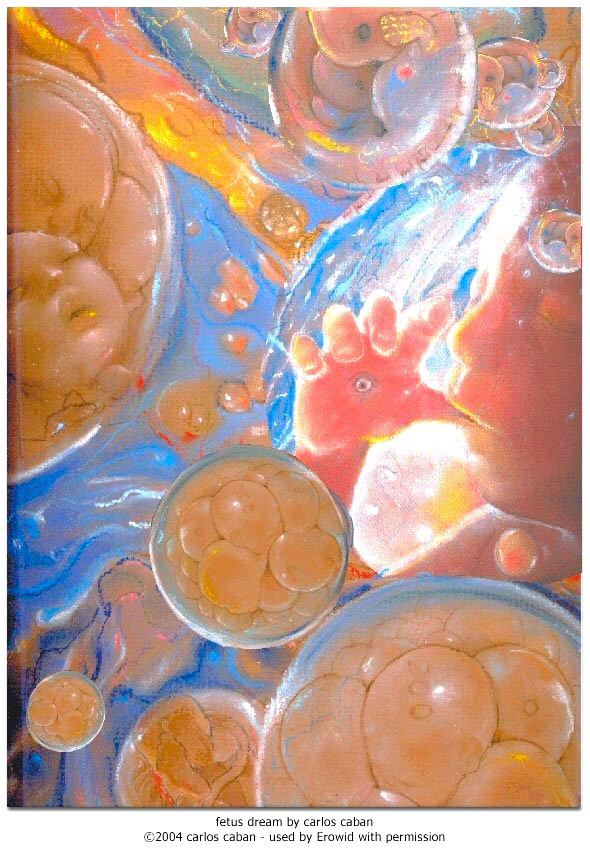 |
It wasn’t an auspicious beginning, but my grandmother carried off the limp body and managed to provoke breathing.I have a sense — I cannot call it a clear memory — that in reviving me, my grandmother baptised me in case I died. She blessed me with her love, and marked a cross on my forehead in oil and water. That mark has remained in my being indelibly, having been given with true love. It has opened connections to me with mysteries I might otherwise not have known. |
It wasn’t just my body that was impressed with the experience of birth. There are levels of awareness in us right from conception, along with the learning of responses to what is confronted. Not only does the unborn body mature in readiness for birth, so does the awareness, the receptive sentience.
In my 40s, when I traced back troublesome reactions to everyday life events, I discovered memories of the period just after birth. I found the experience of being a tiny vulnerable creature, and as that creature I was very definitely reacting to a feeling of awful exposure, even though I didn’t know myself as Tony.
Remember that in the womb my small being did not need to breathe. Food did not have to be taken in and digested. There was a stable temperature, so no exposure to temperature shifts. My nervous system was geared to survive, and in some way respond to stimuli. There was no assault of powerful and unknown sounds in the womb – sounds such as birdsong, dogs barking, house sounds. Also, in the womb one is buffered against bacterial and viral attack.
A baby is aware of all these in its own way. It has a functioning brain and nervous system that is already learning — not in words, but certainly feeling responses.
What I recall from that early period after birth — recall and put into words by my adult self — is of being afraid I could not survive in this new environment. At the time of my birth there were no intensive care units to plug my tiny body into a drip feed or oxygen tent, or an incubator to keep me warm. Neither were there antibiotics to help fight the deadly diseases so many infants and children of the time were laid low by. At that time premature babies were very likely to die.
So I couldn’t breathe easily. I couldn’t digest easily, and I was deeply anxious about the strange sounds around me. A tremendous feeling response took place in my tiny self. As an adult we would call this a decision. But in my infant self it had nothing to do with thinking or analysing. It was a total feeling and fear response. It was a rejection of life. A turning away from scrambling, struggling, for survival. I didn’t want to be in the world. I wanted to remain in the egg!
The effect this had on my adult behaviour was that I never developed the ambition to “get somewhere in life.” Just existing felt like an enormous struggle, an exhausting struggle. I turned away from opportunities because they needed involvement and participation. I didn’t want to be involved, and often had to crash out of social activities, as I did not have the coping mechanisms to engage in ordinary social events.
There was also, in my budding awareness, a sense of death. Even though my body was ill prepared for life outside the womb, it still functioned strongly enough to stand between me and death. But death felt very close. I needed to be back in the womb, kept warm, protected and given a chance to grow undisturbed. Second-best would have been to be held skin to skin against my mother’s body and breast, a sort of constant drip-feed in a warm environment. Unfortunately that did not happen. She was a working mother dashing back from work to breast feed me.
I gather from these memories, and the feelings accompanying them, that my mother, being young and inexperienced — I was her first and only child — was frightened by my fragility. All her sisters had produced heavy full-term babies. So she may even have felt lacking in some way. And I felt something of this anxiety. My own struggle, and feelings that death was sniffing around me like a waiting hyena, were not held at bay by my mother’s anxiety. As the little budding me existed beyond any sense of time there was no knowledge that things could change, only a feeling of impending doom.
Then a truly life changing event occurred. I have no awareness at all of its place in the sequence of things. But picture if you can this vulnerable and helpless creature, this spark of life and awareness not ready to deal with independent life, retreating from it, yet not wanting to die. And my spark of awareness, my forming sense of myself, is afraid, and feels alone in this fear, alone in the dark, with death as a predator sniffing around. Then suddenly I am picked up and held in arms that are strong; held by a being of love who is not afraid of death, and communicates love and courage to me. Communicates so profoundly that I feel I am in the arms of a higher being, a being who has lifted me out of darkness and fear, and has driven away skulking death itself. So I cry out to this being with the only passionate sound I can make, the panting, weeping of an infant. But if there had been the gift of words I would have been looking into the eyes of this being, crying out, “I love you! I love you! I am bonding with you! I am connecting with you forever!”
When I remembered this, when I re-experienced the moment as an adult, I too bawled like a baby, and felt the exquisite love and strength, the relief from darkness, of those moments. In fact I still weep as I write these words, for that experience was so profound.
That was my second, and most deeply felt experience of love. It was also the first, and perhaps most fundamental, experience of religious awe. It stands as some sort of nucleus in the development of myself as an adult personality. It is a touchstone against which is tested any meeting I have with love. Also, when I first re-experienced this event it was accompanied by a revelation, a certainty, that this was the resurrection.
The wonderfully loving higher being who had the power to lift me beyond the reach of death, was of course my grandmother. She was the mother of 13, some of whom had not survived. My mother was the youngest, born on the eve of the Great War. My grandmother did not have long to live herself, but I think had developed that serenity, not of the mind, for I doubt she was a thinking person, but of the heart, that comes with deep acceptance. I also have a feeling out of these experiences, that she was the heir to the wisdom gathered by a long line of women who were her ancestors. I don’t see this wisdom passed on verbally, because I doubt it was ever put into words. It was passed from eyes to eyes, from heart to heart. It was passed in the passionate responses to hard times and loss and love. And I feel my grandmother baptised me in the essence of it, and I am blessed for all time.
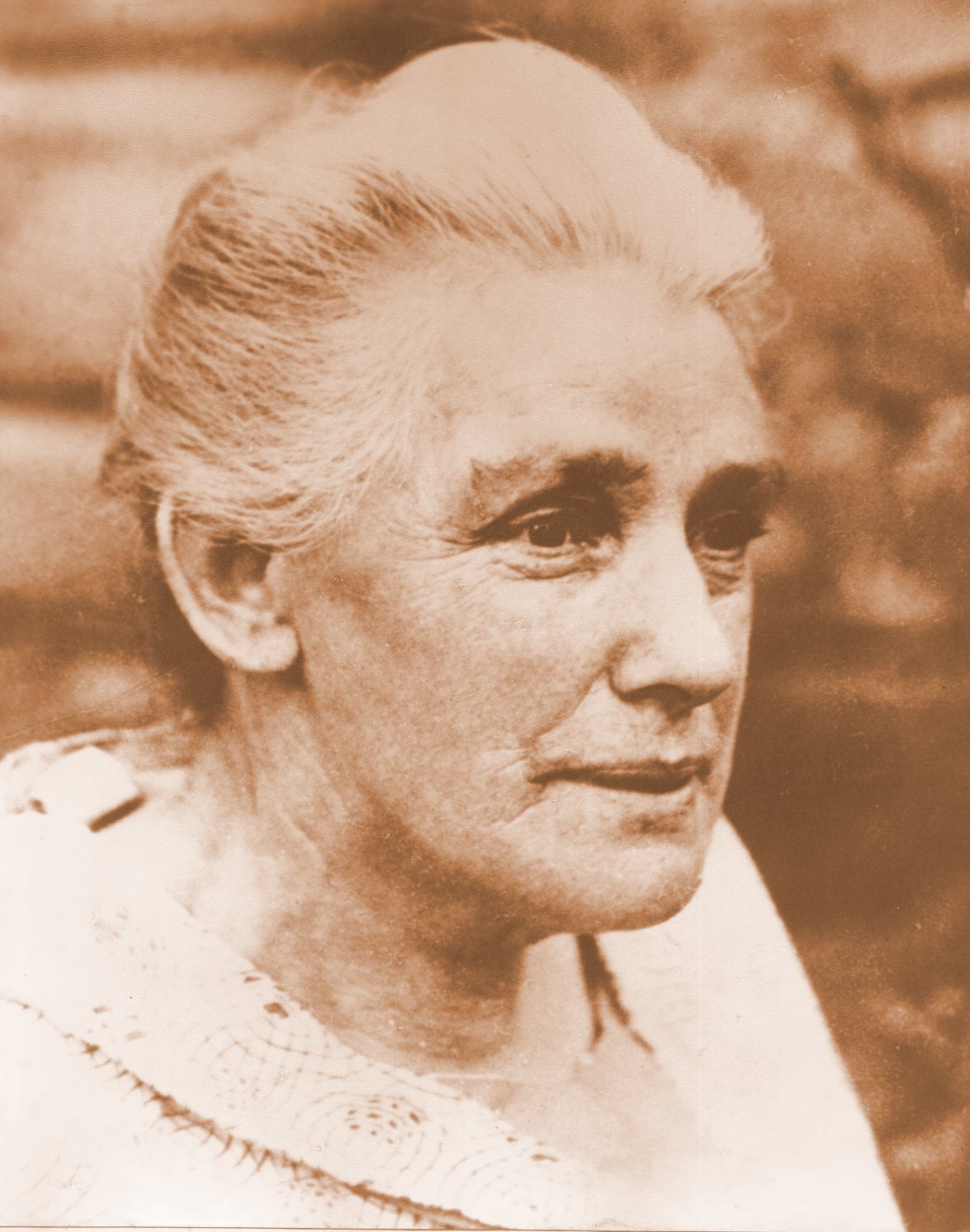 My Grandmother
I have wondered a great deal about what was meant by the resurrection. I know it has to do with love. I feel people apply the term to Christ because the Christ being represents, or is a symbol of, a form of love we sense in ourselves occasionally, and sometimes see in other people. It is the type of love that in its weakest form is seen in the love of parents for their children. It shows itself as the giving that enables a mother to almost totally devote herself to the needs of the helpless and completely demanding life of her baby. It is the ability some fathers have to toil year after year to feed and provide for their children.
But that is its weakest form. That love is often partly instinctive, built into us if we are healthy. Its most profound form is seen in those who reach beyond their love for their children and family, and extend it in depth, not just in duty or to be seen to do good, to people who are not their kin, and from whom no financial, sexual or social advantage is expected.
I sense the resurrection as a form of love that transcends the boundaries of kin, and is not afraid of death or risking of one’s own life for the need of another. In essence, this is the story Christianity tells. Although I am personally uncertain about the existence of an historical Jesus, I can see that as humans, we collectively sense there is a profound wonder in such self-sacrificing love. In sensing this we have created a deeply perceptive mythology around it. The mythology tells us that even if we can allow a little of such love into our life, it will give us entrance into becoming aware of an essence — the spirit — that pervades all existence, and to the survival of bodily death.
To some extent I have to acknowledge that by getting my newborn body to start breathing, my grandmother did raise me from the dead. So my unconscious mind has powerful material around which to create its own personal mythology. But the love I experienced I sense as a force beyond that, and has to be acknowledged too.
In our collective myth of Christ we have created, or witnessed, a being who extends love to all living things, and offers a life beyond death in its existence – the mystical body of Christ. Just as my grandmother lifted me from darkness and death, so Christ is said to lift humankind.
My grandmother took over my care soon after I was born. My mother told me that I slept in the same bed as she did, but one morning she woke and couldn’t find me. She panicked, and then discovered I had slipped out the side of the bed, and was as cold as stone. From that point on my grandmother took charge, which probably did nothing for my mother’s confidence.
I have not recovered memories of this period, but from looking at photographs, I grew from a tiny shrunken little creature into a happy and sometimes radiant looking child with blond hair. Things soon changed though. My grandmother died of a stroke before I was two. So suddenly the great love in my life was gone.
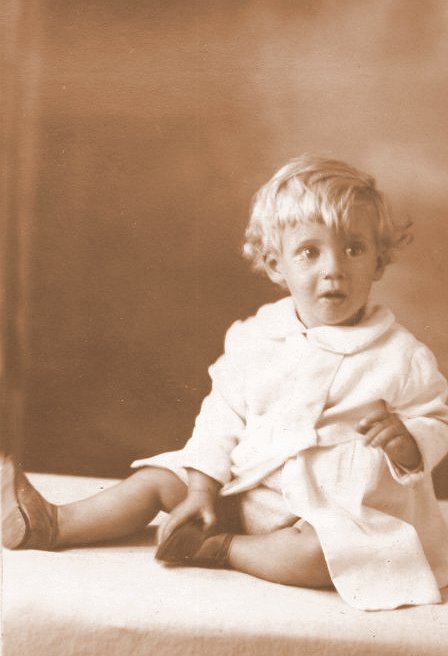
This was such a major event in my life that it left massive residues in strata of my psyche. The petrified remains of that event were only uncovered slowly, plunging again and again into the depths to find the heartbreaking remains of that lost love.
From my teens, through to the time of uncovering these buried feelings connected with my grandmother, I had an almost compulsive religious drive. This was never something leading me to attend church or listen to sermons, or study the Bible. It was a direct need to find God as a personal experience. I wanted to communicate, to meet, and to have a direct confrontation.
Understanding of this drive dawned slowly as I developed the skills of mental archaeology, and learned to carefully brush away the debris of years. My first discovery in this old burial mound was anger. I was angry with God – violently angry. Only slowly were the roots of that anger uncovered.
My grandmother died after a second stroke. As a young child I had no foreknowledge of this, so it was a terrible shock suddenly to no longer be able to find her. Literally she was no longer there. I didn’t even see her dead body, and I feel that was a great mistake on the part of my family. Seeing her corpse would have given me a tangible experience of her death. Lacking that experience she had simply disappeared mysteriously. I was left to seek an answer to this, and when I asked where she had gone was told that my grandmother had gone back to God.
When that one sentence was lifted out of the darkness of years, along with the emotions buried with it, the anger and the compulsive religious search were understood. I was angry with God for taking away the person I loved. I was searching for God because, according to what I had been told, in finding God I would find my grandmother.
It’s crazy how the mind and emotions work, but logical too. As a child I didn’t have the equipment to question the information I had been given. So it was buried intact, still channelling the energy of my drives and emotions until I managed to uncover it and re-evaluate it against a much wider database of experience and information.
Isn’t love a strange and terrible thing to keep a child held to its determined search through the long years into adulthood? Some ghost, some spirit of that small boy that I was, remained waiting in a corner of myself. Waiting and hoping for the return of his beloved grandmother. Waiting and bearing the weight of that waiting each day, gradually becoming walled up in a dungeon of debris dropped by the passing years.
The vulnerable and beautiful spirit of that child, buried in the shadows of myself, was the hidden artist behind much of the beauty and tragedy in the love story of my life. It became known to me in a dream as Lumpkin.
That’s how I waited out the years with my mother. Because I had been so close to my grandmother, in some ways my mother was a stranger. Living with her left the love child in me constantly waiting to go home. There was a feeling in me that if I could wait through this day, maybe today, or the next day, I could go home. If not today, maybe tomorrow I could be with my grandmother!
That feeling of desperate waiting, of feeling I was never “at home”, of constantly wondering where home was, lasted most of my life. A dream I experienced in Italy in 2000 shows the depth and dilemma of this. In the dream I was driving home along a country road. Ahead of me the road forked and I took the right-hand fork. I drove a little further and arrived home. It was a lovely house in its own grounds. My wife and children were happy to see me and came to greet me warmly. But something was wrong. I had no sense that these people were my family. This was not my home, and I hurried away, back to the fork in the road. There I took the left fork. Again I arrived home – another lovely house, another wife and children who warmly greeted me as husband and father. But there was still no feeling in me that I was home. Again I must go to look for where I belonged.
That dream sums up the feelings that haunted me most of my life, and the split shown by the forked road. As with the religious drive, the feeling arose because of my desire to be once more with my grandmother. After all, it was a desire etched into me over many years. Strangely enough, at the time this memory really surfaced, I was living with a friend, being homeless at the time. On the very day it came to light my friend told me I would have to find somewhere else to live. It was so strange it was almost comical.
Therefore, before ever I had any real sense of time or identity, those early experiences set patterns in me that have influenced the rest of my life. My prematurity, with its consequences of unreadiness for an outgoing life that would grasp the world and its opportunities, left a yearning, and I think an open door, to enter into the mysterious in the worlds of the mind and spirit. I wasn’t looking outward to the world. All my energy was flowing backwards into the life of the womb and its dark mystery. And there were negative aspects to that, such as lack of worldly ambition and a failure to understand the needs and functions of placing oneself well in the world to gain financial and social benefits.
What I have gained though, is an extraordinarily rich inner life. I suppose it was also a major factor in my becoming well-known in connection with dreams. Also, for never having any sense that I ought to absorb the subjects offered through schooling, as given by the establishment. But I believe there are other factors not mentioned, that played a big part in that.
The other main pattern put in place by my infant years, was the foundations upon which would be built a terror of losing the one I loved and the compulsion to be loved as desperately and urgently as I myself loved. In this way the scene was set for the drama of my destiny to unfold.
Last Thoughts About Lumpkin
I end by thinking about Lumpkin and realise what a wonderful part of me he is. I have an image of him as the Lion headed dwarf. The tiny malformed being who is yet enormous, with strength, wisdom, and power. He has that in his weakness. And in his love and compassion, he has more strength than soldiers. I have a sense that my female has taken Lumpkin deeply into herself. I have a feeling she is going to carry Lumpkin deep in her being, perhaps into another lifetime. And if that is so, I want her to recognise that Lumpkin has the seeds of enormous strength, great wisdom and love. I know that is why my lover has taken Lumpkin into herself.
Lumpkin is now also flesh of my flesh, blood of my blood.

Here is the Lumpkin dream.
“I believe it was a man, rather shadowy, who gave me a leather pull string purse or pouch. In the pouch was powder that I poured onto my rather stained trousers. Strangely, they looked like the one’s I wear now. Immediately the powder started working like yeast, or at least, I thought of it as yeast. It was cleansing and purifying my trousers in a spreading action. I knew that this yeast, or pollen, had also penetrated my body, and was gradually working through my being, purifying and healing.
I looked at the opening of the pouch, and it was in the shape of a mouth and a vagina. The powder that came out was like millions of living motes, or particles, life giving and alive. I thought at first that using the powder would empty the pouch, but I saw that in fact the living counts replenished itself. They were like sperm or pollen, they regenerated.
Then suddenly the scene shifted and it was later in the day. I was the only person at an eating-place. I heard sounds of people coming, and wasn’t sure if they were friendly or not. So, I acted as if I were working at the place by clearing one of the tables. There didn’t seem to be any proprietors or staff. Then, into the room, or space, because I believe it was outdoors, walked my friend Sheila, with a man who was shadowy, ill-defined, like the man who gave me the pouch. Sheila was now like a warrior figure, a man/woman, the genders blended. I understood, or could see, that Sheila had gone through an incredible journey or adventure. This was like one of the mythological odysseys that had transformed her in meeting its dangers and trials. She was now a very powerful figure. In her hands Sheila carried a tiny being. She held it out to me and said, “Lumpkin has been asking for you.” (Some days before the dream of the pouch and Lumpkin I experience a powerful uprising of feeling and joy. In listening to the feeling I received the distinct message that in four days I would receive a gift. I wondered what this gift might be, and understood that it was something that had always existed, but I had now grown, or opened, to the point where the gift could be received.)
Strangely, since that time, my dreams have given me four gifts – the two books, the pouch, and Lumpkin. None of them are easy gifts, and I am still riding the waves that lift me and thrown me down in my relationship with love and loneliness.
I understood that Lumpkin, this little being, had missed me and wanted to be with me. I held out my arms and took this creature, who was about 10 inches high, with spindly legs and arms. From his appearance he was incapable of individual locomotion. Lumpkin wasn’t a baby, nor an animal, but he was intelligent and could speak. He came to me and I held him, with the feeling we have known each other in the past.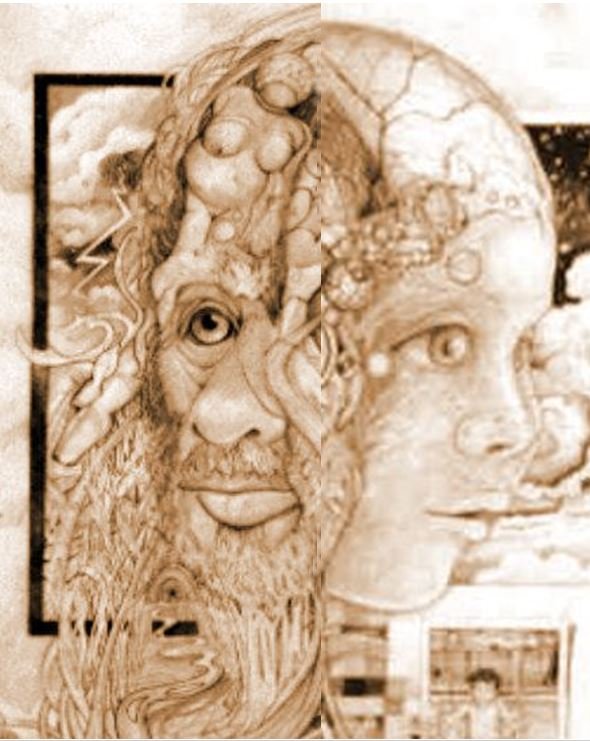 Art by Carlos Caban
In fact what he brings me it is the possibility of the compassion for the helpless and injured. He has, because of his own weakness, a sense of humility that allows a link with other people’s vulnerable and perhaps a hidden, nature.”
A Psychotherapeutic Experience of Premature Birth
Without hesitation I begin to feel my connection with another human being. I experience that being connected with another human being is a fundamental part of life and procreation. If something threatens that connection, then it is life threatening – the reason being, I am in the womb! To lose my connection threatens my life. But my life is threatened. I am expelled from the womb before my body and soul are mature enough to be ready to be separated, ready enough to undertake life disconnected from the placenta. I feel incredibly vulnerable. Each sound, whether a bird singing or a car going by, is a possible threat to my existence. I had been physically and psychically attached to my mother. Now the bond is broken.
I realise as I experience this that the broken bond, the feeling of life threatening isolation, enormously increased my sensitivity to threats. It set me up for what happened at three when I was placed in a convalescent home and was deeply traumatised. In itself the short absence of my mother was not as potentially traumatising as it turned out to be. But because of the birth experience, I was already traumatised to abandonment. To be hit by it again increased the volume of it enormously.
I wasnt properly formed, so it was very traumatic to be separated as a baby. I am trying to heal this at the moment. I feel the struggle of resisting what has happened to me. I cry out that I dont want to be born. I am not ready. I feel deeply alone. There is in me a sense that tells me I shouldnt be alone. It is like something that pushes me to seek not to be alone. I feel lost. Im not ready for this world. Im feeling awful.
In fact I do feel awful, like I am ill and can barely move, or move only with effort and concentration. I go on to say that I have felt awful most of my fucking life. I can see from the feelings I am meeting how they have contributed to my lifelong feelings of being lost and cut off – alone. I have always called it independence, and perhaps seen the positive side of it more than the negative. But it has been a source of restlessness and a spur to seeking a bonding with someone. Of course I want to find the security of the womb. I want to know someone is deeply committed and bonded to me.
I am so alone. Even when someone loves me I cant feel it. I want to change. I dont want to keep hurting Hy by living like she isnt there at an emotional level. But that is the feeling world I have lived in – who is there for me? I was part of something and I lost it. I was part of something that was good, and I lost it. I was a part of a woman and I lost her. I was rejected. I was rejected. Now I face this struggle just to exist, just to breath, just to be. This feeling of life being a terrible struggle just to keep going has pervaded me all my life. I’ve got to struggle to exist just to keep alive. Got to struggle just to keep alive! GOT TO STRUGGLE TO EXIST – JUST TO KEEP ALIVE! GOT TO STRUGGLE BECAUSE THERE’S NOTHING THERE. I WANT SOMETHING TO HOLD ONTO. I’VE GOT TO STRUGGLE JUST TO KEEP ALIVE.
I cry like a baby. The question burns in me – Why is life like this? I cry again. Then I realise that at first when I was born I was too small and undeveloped even to be able to cry properly, so I couldnt let out my misery. It is such a relief to cry now and be understood, to have known what I felt at that terrible time.
I am aware of my connection with my stream of life having been broken – the umbilical cord. What I realise as the adult watching this, is that because of its proximity to the genitals, there is an unconscious connection made between the genitals and the connection I seek to sustain my life. So even as a baby I am reaching for that connection with my genitals. I want to be fed. I attempt to reconnect through my genitals, but the pain of the separation is so acute even when I do try in adulthood, the pain of the separation turns me back. This is the story of the Garden Of Eden. I was in the garden and was cast out. Now when I attempt to return, an angel with a burning sword turns me back. Not only was it painful every time I attempted reconnection, but I had the unconscious expectation to be fed, to be nourished. Instead of that every time I had sex I felt cheated, deceived and betrayed. I was not fed, but deeply sucked dry of what small nourishment I had managed to build up. I wasnt fed, I was fed upon by a predator. Each sexual act was a betrayal, a predation, and a torturous pain. Yet I had to find my way to the garden again, because there lay the secret of my genesis and myself. So I would return, to be wounded once more. It is even painful to look back on those years of misery now. Why is life so painful?
Seen from this level of experience, that of the uterine baby, God is a projection. You were in connection with a great creator, the mother. You were at one with them, but now you have been cast out of the Garden of Eden, so you have lost your contact with God, the creator in whose bosom you had existed. Perhaps that is why I searched so long for God.