Posts Tagged ‘bible’
Techniques for Lucid Dreaming
Lucidity Part 3
Your body and mind are the most amazing instruments, and there is so much more music for you to play as you move to a fuller life. And a first step in learning lucid dreaming is to begin remembering and recording your dreams. In doing so you will be taking the first steps into lucidity. In fact remembering a dream is a penetration of the unconscious by your awareness.
Your Dream Creator is in some ways as shy as a deer in the woods, and in other ways as ready to please you as a dog that loves you. It is certainly as old and as natural as the creatures of the forests. Like any creature, this natural part of you is moved by feelings, by curiosity and love. Therefore your first step in remembering your dreams lies in stimulating interest in that usually hidden and natural world within you. Remember that a lot of great art arises from the unconscious in dreams and unbidden inspirations. Sigmund Freud wrote that, “Not I, but the poet discovered the unconscious.” So open yourself again to those things you find moving, beautiful or rouse passions in you, and allow your curiosity to question what more of wonder is still unknown in you. Use the steps in the following exercise to help you remember your dreams and become lucid. (Quoted from my book Lucid Dreaming.)
This directs your attention to the subtle dream process that can so easily be ignored or lost in the welter of waking impressions. But keep your intention playful as you might with a good friend. Don’t let early failures bring difficult feelings. If possible avoid taking sedatives or stimulants before going to sleep – such as coffee, alcohol, tea, cocoa derivatives or a heavy meal.
3) Put a notepad or small tape recorder near your bed so you can record any dream you remember. Dreams melt like snowflakes on your hand unless you record them quickly. This is especially so of dreams remembered during the night. The tape recorder is probably the easiest as you do not have to put a light on or rouse yourself too much to use it.
4) As you start to fall asleep, wonder what strange world of beauty or learning your dreams are going to explore. You dream about five times a night, so you will certainly have a different life in your sleep. Wonder what it is, and determine to ask yourself what you have dreamt as you start to wake during the night or in the morning. What is life telling you in your dreams? Build an image of yourself remembering a dream and recording it.
5) When you wake, do not move or open your eyes. This floods your awareness with massive new impressions and can blast the dream memory away. Tests also show the passage of time, even a few minutes, between dreaming and attempting to remember, causes many dreams to fragment and be lost. So lie still for a while and look backwards into the dimness of sleep. Imagine yourself drifting backwards into the place you are just emerging from. Leave your mind like a keyboard that can be played by subtle feelings and images. Having given time for your dream to emerge, record it right away.
6) Write your remembered dreams into a dream journal, either in a good thick book, or in a computer file. Such a journal is a precious resource. It will gradually develop into a record of your most intimate and whole self. It can become a rich mine of inspiration, of creativity, and definitely of insight into yourself and your endeavours. When you have written your dream, think about it as a drama that reflects your own hidden nature. Ask yourself what the images depict. This is not an attempt to interpret the dream, but a necessary technique to make you aware that dreams are only like a book cover. What is important is what lies underneath.
A computer file has the advantage of being easy to search, so it is worthwhile noting any themes, characters and places that appear.
The Second Steps
An important next step is for you to practice being lucid in waking life. You can do this by visualising, imagining the things that lucidity allows you to do. So try the following:
- The first thing that lucidity allows is an escape from the little box of your body. Even if you are a great athlete you know there are barriers you cannot cross. But you can in the freedom of the mind. So imaging you can jump so far it becomes flight. Try it, fly! It might take practice but you can do it.
- You cannot die in your dreams, but you might feel the feelings you associate with dying. So imagine a very tall building and jump off it. If you feel the fear let yourself feel it and see you can survive. With practise there will be no fear. If you like, try a smaller jump until you get used to it.
- Your mind is immense and full of creative ideas. So imagine yourself expanding out of the top of your head into the huge space beyond. And as you get the feeling of it explore ideas without the usual barriers you put in the way. Remember that your thoughts are things in this world. So you create your own limitations. So any thoughts such as this is impossible, or “I cannot and never have been capable of this!” are a tremendous brick wall in your way.
- In lucidity you can travel to the very core and creation of yourself. To do this you need to practise dropping all preconceptions of who and what you are. You need to tense your body and then slowly drop the tension. Ten do it over and over with less tension each time until you can only feel the tension without and movement of your muscles. Then continue into the feeling of dropping, letting go of everything.. everything.
These exercises are vital if you wish to enter your dreams lucidly. As you practice you will see the quality of yoru dreams change – and that means you will change.
Link back to Chapters – Link Forward to Chapter 4
Introduction to The Unknown God
“AIN SOPH”
The Unknown God
by
F. J. MAYERS
Published &
THOMAS’S PUBLICATIONS LIMITED,
SEVERN STREET, BIRMINGHAM 1.
Publication date 1st January 1948 by Thomas Publishers
AUTHOR’S NOTE
This book is an attempt to explain to any open – minded, intelligent “man in the street” the real nature and teachings of one of the most wonderful, and certainly one of the most misunderstood, books ever written: The “Book of Genesis.” It deals only with the first three chapters. It is based entirely on a close study of the original Hebrew text, and the writer’s aim is simply and solely to show what that text actually says and teaches, and then to leave it to the judgement of the reader. The type of reader who “dotes on the occult” will he disappointed in this book. It is neither occult nor mystic. Like good old 18th century Bishop Berkeley, the author is the “sworn enemy of all that is not clear, precise, completely and universally intelligible, and in harmony with that famous ‘common sense’ which has always been the guardian deity of British thought.”
Editors Note
A letter to me from the granddaughter of the author F. J. Mayers.
Hi Tony,
Thankyou so much for your kind words and your appreciation of my grandfather’s work. I really wish I’d had the chance to meet him but my Dad always said he was a lovely man and a real gentleman.
As I think I told you he was also a carpet designer and he designed the carpets for the Original Queen Mary and Queen Elizabeth ships, he also published a book on carpet design.
He was obviously a religious man with strong beliefs and apparently was well aquainted with quite high ranking church men from various religions but in particular Judaism. I understand that on a personal level he was very good friends with Stanley Baldwin the Prime Minister and in fact named one of his sons after him. He was always friends with the Composer Elgar who I’m told taught my grandfather to play chess!
I know my Aunt has some of his manuscripts and also his diary which we had considered at one point putting in print but decided not too as we weren’t sure if anyone else apart from us would be interested as although we find him fascinating we are of course slightly biased!
I hope that these little bits of info are of interest to you I’m sorry it’s not much but I can try and find out more if you would like me too. Thank you so much again and please contact me anytime if I can help.
Kind regards
Jill Payne
INTRODUCTION
MANY years ago I had the pleasure of a visit from a very well known Divine – a delightful old gentleman, and much beloved by those who knew him personally. While chatting together one evening I casually mentioned that I had been for some time interested in the study of Hebrew, and that I hoped at some future time to do a little useful work with it. My guest’s reply to the remark was not exactly encouraging: “If you mean that you think of attempting original work, my friend, I advise you not to waste your time on it. So many great scholars have devoted their whole lives to the study and have done all that is possible in the way of interpreting the language that neither you nor I could ever hope to add anything to what they have done. Be content with their work.” I had, however, already gone far enough to satisfy myself that the well – meaning old gentleman was mistaken; so I did not continue the conversation on that topic.
Shortly afterwards, I was spending the evening with another old friend, who happened to be the Principal of an important Theological Training College. He was well known both among Christian and Jewish scholars as one of the foremost Hebrew scholars in Britain. He counted among his intimate friends many of the most learned London Rabbis, and had a very high opinion of them. “Grand men, some of those Rabbis; grand men,” he would say to me. And they had as high an opinion of him. I told him of the incident mentioned above. He leaned back in his chair and laughed heartily. Then, turning to me in his humorous Scottish way, he said : “Dear old Dr. O, that’s just exactly what he would say! Stick to your studies, man.” I took his advice.
My interest in the subject had been aroused by an extraordinary book, written by an extraordinary man. I had seen references to it in the works of Edouard Shure, and other writers. The book was “La Langue Hebraique Restituee,” by Fabre d’Olivet, a writer of the time of the French Revolution. It was little known here, and only to a comparatively small circle in France. I failed to get a copy of it in London, but with the kind assistance of an acquaintance, Madame Claudel, widow of the well known French writer Leon Called. I obtained a copy in Paris. (In 1903 a Paris publisher, M. Chacornac, to whom I owe many a kindness in the way of obtaining little known books. and also personal introductions to writers of high literary and scientific standing, issued a reprint of the original. It was again reprinted by him in 1922.)
As the present book owes so much to d’Olivet’s work, a few notes about him may not be out of place.
Fabre d’Olivet was born at saint – Hypolyte (Gard) in 1769. He belonged to a French Protestant family, descendants of the Camisards and Vaudois. Probably owing to the troublous times before and during the Revolution, much of his early life was spent out of France. In a letter he wrote Lord Byron anent his remarkable translation of Byron’s poem Cain” into French blank verse, he mentions his family as being resident in Great Britain. and also that he was partly educated in Aberdeen. At another time he was living in Germany and there, under the tuition of German Rabbis, he first studied Hebrew; also Arabic under Elions Boctor. He was already an excellent Classics scholar with an exceptionally wide knowledge of Greek and Latin literature. Later he extended his studies to Sanscrit, Chinese Samaritan, Syrian, Chaldee, and Ethiopian. Whatever he studied, he studied with deep penetrating insight and understanding.
His first important literary work was to collect from every possible source all the existing fragments of the “Golden Verses” of Pythagoras, which he translated and accompanied by a valuable philosophic commentary. That work was followed by “L’Histoire Philosophique du Genre Humain,” a large and important work which has provided many writers of recent years with valuable “material” (not always acknowledged by the borrowers). But undoubtedly his greatest achievement was “La Langue Hebraique Restituee.” Saint – Yves d’Alvedre, the author of “The Mission of the Jews,” describes it as “the real monument which will make the memory of Fabre d’Olivet immortal.” He adds: “Thanks to it the ‘Sepher’ (The Book) is no longer a collection of ‘tales of a grandmother,’ as it has hitherto been considered, but a Book which is veritably sacred, and which contains the substance of all Truth and Science.” D’Olivet’s interests were not theological but linguistic. He states emphatically in his book that he had no intentions whatever of making it a “commentary on the Mosaic writings. “My sole purpose,” he says, “ is to give my readers the means of reading and understanding those writings for themselves.” That was really a wise decision for more than one reason. Perhaps it was the only possible one at that time. As a matter of fact, it was only through the intervention of a very influential friend, Lazare Carnot. that he obtained the necessary permit to get the book printed at all. Fortunately, difficulties of that particular kind are less known to us today. I, therefore, feel at liberty now, as far as my very limited abilities permit, to make – in part at least – the commentary” which d’Olivet abstained from making. Whether my interpretation of the first three Chapters of Genesis (which is as much as I feel able to deal with just now) will bear any resemblance to what d’Olivet might have written. it is of course impossible to say. Most likely it will not. He would probably have treated the subject in a more strictly philosophic manner.
I may perhaps mention that before finally accepting d’Olivet’s principles as the basis of my work, I made some study of other authorities on the language and also took lessons from a competent Jewish Professor of Hebrew, an enthusiastic devotee of the “Holy Language.” I am entirely convinced that if d’Olivet’s work had been’ known and used in English Theological Colleges from the time it was published in 1815, the so – called “Higher Criticism” would never have made any headway here. Neither would the Darwinian interpretation of the fact of “Evolution” have had any power to produce the fatal effect, which it did produce, on the old Faith in the Bible as Divine Revelation, if the Book – of Genesis had been understood aright. It was not Moses, but his misinterpreters who were responsible for the absurdities which were taught in the Churches, and which Science could not fail – sooner or later – to scatter like dust to the four winds. Moses did indeed say that the Universe was “created” as a perfect conception in “six manifestations of the Divine Intelligence,” but he never said that it was “made “realised and perfected in six periods of twenty four hours each. He was very far indeed from any such idea. On the contrary, he himself proposed a doctrine of “Evolution” more complete and more scientific than the hypotheses of Darwin and Haeckel. Science did but sweep away the cobwebs. The real trouble was that the churches were unprepared with anything to put in place of the errors which they had taught too long. Science had a much too hasty victory – and made the mistake of overrating the extent of its success. It was, after all, only a relatively small part of the whole Truth which Science had conquered.
However, it is not too late to undo some of the evil that was done – and there are some favourable omens. When the doctrine of the “literal inspiration” of the Scriptures (which was applied not, as it should have been, to the original text but to very imperfect translations, and “second – hand” translations at that) – when that failed the Churches, they were forced to search for something more spiritual They knew from the most positive personal experience that the Bible held “Divine Truth,” and yet that something must be wrong with their reading of it. The result has been that the pulpit in Britain has been growing much more “spiritual” than it was even fifty years ago. That at least is one great gain. WHAT IS NOW NEEDED IS A KNOWLEDGE OF THE REAL TEACHING OF THE BOOK OF GENESIS, AND POSITIVE EVIDENCE FOR THAT TEACHING BEING CONTAINED WITHIN THE ANCIENT TEXT. Make that evidence known and new life will come into all religious activity, new Faith into many doubt – haunted minds – new Hope into many despondent hearts; and new Love for a God Who has been woefully misunderstood and misrepresented.
F.J.M.
Back to Chapters List – Forward to Chapter 1
Bibliography
Ain Soph – The Unknown God
F. J. Mayers
Bibliography
Adams W. Marsham. – “The House of the Hidden Places.” and “The Book of the Master.”
Adam and Eve – Middleton Murray
Analytical Hebrew and Chaldee Lexicon – B. Davidson.
Ancient Hebrew Tradition – Prof. F. Hommel.
Aryan Origin of the Alphabet – L. A. Waddell, Ll.D.
The Ancient Cubit – Sir Charles Warren.
Ancient Hebrew – Names Jeffries.
The Bible Comes Alive – Sir C. Marston.
“Sa vie, ses oiuvres et ses doctrines” Sedir. Paris, 1897
“The Signature of all things” Edited Clifford Bax. – Bohme, Jacob.
Book of the Dead – H. M. Tirard.
La Cabbale – Papus.
Cave of Treasures – Sir E. A. Wallis Budge.
Century Bible. Genesis – Ed Dr. W. H. Bennett.
Civil and Ecclesiastical Rites used by the Hebrews – Thomas Godwyn, B.D., 1641.
Chaldean Account of Genesis – Geo. Smith.
Compendium of Swedenborg’s Theological Writings – Rev. S. M. Warren.
Conquest of Peru -W. H. Prescott.
Divina Commedia – Dante.
Vita Nuova.
Commentary on Genesis; Commentary on Proverbs; Commentary on Isaiah; Isis; Essays; Lectures. – Delitzsch, Prof. Fr.
Dichtung und Wahrheit – Goethe
Digging up the Past – Sir Leonard Woolley.
Egyptian Collections-British Museum – E. A. Wallis Budge.
Egyptian Mythology and Egyptian Christianity – Samuel Sharpe.
Einleitung in den Talmud – Dr. Hermann L. Strack.
Esoteric Astrology – Alan Leo.
L’Esprit des Races Jaunes; Sept elements de l’homme; Le Taoisme – Matgioi
Ethics of the Great Religions – Gorham.
Filosofia della Spirito – Benedetto Crose Bari, 1943.
Fragments of a Faith Forgotten – O. R. S. Mead.
Gaelic Grammar – Duncan Reid.
Gaelic Dictionary – Malcolm Macfarlane.
Autobiography; Dichtung und Wahrhei – Goethe.
Ensayos Criticos – U. Gonzalez Serrano.
His Life and Work; Riddle of the Universe – Haeckel, Ernst.
Wonders of Life – Bolsehe.
Head of Jade – Salvador de Madariaga.
Hebrew Grammar – Gesenius.
Hebrew Grammar – Wolfe.
Hermes Trismegiste.
Les Livres Hermetiques – Louis Menard, Paris, 1910.
Il Pimandro de Mercurio Trimagisto – Firenze, 1549.
Hidden Truth in Myth and Ritual – David Davidson.
History of the Hebrew Text – O.T. Thomas H. Weir, B.D.
Human Immortality – William James.
Human Origins – S. Laing.
Human Personality – F. W. H. Myers.
Igdrasil. Vol. ii. Journal of Ruskin Guild.
Immortality – A. W. Momerie, Ll.D.
The Inward Light – H. Fielding Hall.
Israel’s Racial Origin and Migrations – W. H. Fasken, C.B.
Is the Higher Criticism Scholarly? – R. D. Wilson, Ph.D., DD.
“The House of the Hidden Places.” and “The Book of the Master.” – Adams W. Marsham. –
Guide to Modern Thought – C. E. M. Joad.
Commentary on Exodus; Commentary on Leviticus – Kalisch.
Kama Soutra – Vatsyayana.
The Koran -George Sale.
Krishnamurti – Carlo Suares.
La Langue Hebraique Restituee – Fabre d’Olivet.
Man Visible and Invisible – C. W. Leadheater.
Lectures and Essays – Thomas Huxley.
Lex Mosaica – Ed. R. V. French.
The Lost Continent of Mu – Col. James Churchward.
The Lost Language of Symbols – H. Bailey.
La Lumiere d’Egypte – Anon.
Manual of Astrology – W. G. Old.
Maori Symbolism – E. A. Rout.
Mazzaroth – Anon.
La Messa nella sua storia e nel suoi simboli – P. G. Semeria, Rome, 1907.
The Miraculous Birth of Language – Prof. R. A. Wilson.
The Mistletoe and its Philosophy – Peter Davidson.
Modern Science and Modern Thought – S. Laing.
La Musique – Fabre d’Olivet.
Mysteries of Genesis – Charles Filmore.
The Mystery of Egypt – Le Plongeon.
With Mystics and Magicians in Tibet – Alexander David-Neel.
Names and Places-Old and New Testament – George Armstrong.
Palestine Exploration Fund. Nature and Destiny of Man -Reinhold Niebuhr.
L’Occulte chez les Aborigenes de l’Amerique due Sud – Dr. Henri Girgois.
Occult Science in Medicine – Franz Hartmann, M.D.
The Old Documents and the New Bible – J. Paterson Smyth, Ll.B., BD.
The Oldest Laws in the World.The Hammurabi Code – Chilperie Edwards.
Origins of Species – Charles Darwin.
Ossian – J. Macpherson.
Our Bible and the Ancient Manuscripts – F. G. Kenyon, M.A.
Our British Ancestors – Rev. S. Lysons.
Prehistoric London – S. O. Gordon.
The Primordial Ocean – W. J. Perry, M.A., D.Sc.
Problem of the Future – S. Laing.
The Proving of Psyche – Hugh Janson Fausset, Jonathan Cape.
Psychic Phenomena – T. J. Hudson.
Le Ramayana de Valmiki – Translation by H. Fauche, Paris, 1864.
Reincarnation – Annie Besant.
The Renaissance – Walter Pater,
Root Principles – Thomas Child.
Sacred Symbols of Mu – J. Churchward.
Les Grands Initiation; Sanctuaires d’Orient; – Schure, Edouard.
Science and the Bible – C. J. Grist.
The Secret of the West – Dmitri Merejkowski.
The Shu King. Chinese History – W. G. Old.
The Soul and the Stars – Dr. Richard Garnett.
Solar Symbols and their Origins – Avola
The Philosophy of Spiritual Activity; The Manifestations of Karma; The East in the Light of the West; Theosophy; Anthroposophy Quarterly; Letters and Various Lectures; Anthroposophical Ethics – Steiner, Rudolph, Ph.D.
The Story of Creation – Ed. Clodd.
Strong’s Exhaustive Concordance.
Studies in the Spiritual Life, ‘story of the Gael, complete works of “Fiona Macleod.’
Thought Power – A. Besant.
Ur of the Chaldees – Sir Leonard Woolley.
Le Vie Sage.
Commentaires sur les vers d’or des Pythagoriciens – Dr. Paul Carton
Le Voile d’Isis. Three Vols.
Wilson, Canon J. M. Bibliography.
The World Before Abraham, H. G. Mitchell.
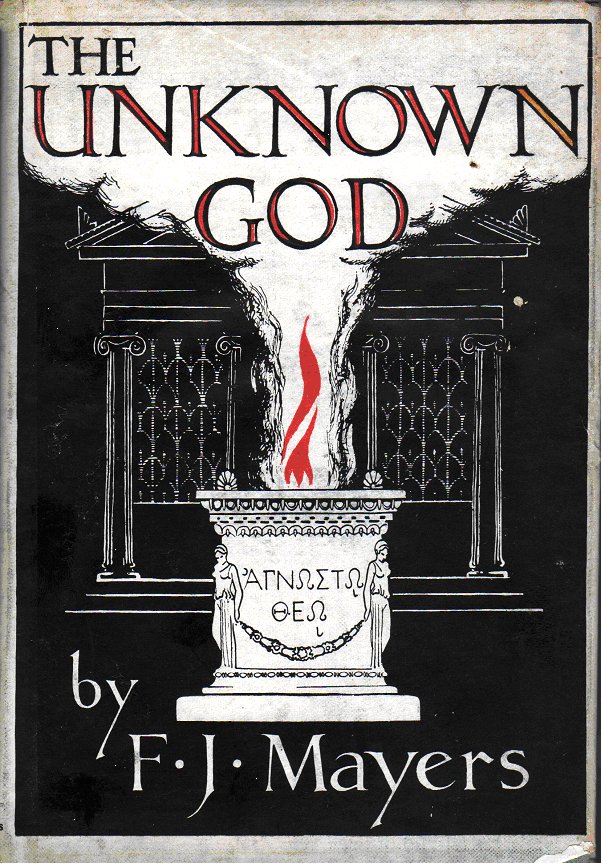
Ain Soph – The Unknown God
by F J Mayers

Ain Soph – The Unknown God, was written in the first half of the twentieth century. I came across it while I was selling alternative books in the fifties. Although it is not easy reading the ideas in the book are transformative. I had never realised that the story of Genesis, of Adam and Eve, might be anything more than a simplistic creation myth. Mayers looks at the Hebrew language as a sign language, each letter having a meaning. So the name Adam, taken in this way, is not even a singular name. It is plural, and has nothing to do with an individual that God made, but rather a huge process underlying the emergence of human beings.
I offer the book here because I feel it needs to be read more widely. When I discovered the book it had been lying in a damp cellar for many years. I resurrected it and sold all the remaining copies. Here it is for the first time in electronic form.
Editors note – a communication from Jill Payne, granddaughter of F J Mayers
As I think I told you my grandfather was also a carpet designer and he designed the carpets for the Original Queen Mary and Queen Elizabeth ships, he also published a book on carpet design.
He was obviously a religious man with strong beliefs and apparently was well acquainted with quite high ranking church men from various religions but in particular Judaism. I understand that on a personal level he was very good friends with Stanley Baldwin the Prime Minister and in fact named one of his sons after him. He was always friends with the Composer Elgar who I’m told taught my grandfather to play chess!
I know my Aunt has some of his manuscripts and also his diary which we had considered at one point putting in print but decided not too as we weren’t sure if anyone else apart from us would be interested as although we find him fascinating we are of course slightly biased! Jill Payne
What follows are 30 carefully researched chapters explaining every word of Genesis. I have attempted to synthesis what is said in The Secret Bible.

Chapters
Ain Soph
Ain Soph – The Unknown God
Chapter 1
Fred Mayers
“Ex Nihilo Nihil Fit.” “From ‘nothing’ nothing comes.”
To make “Creation” a possibility, it is necessary to postulate the existence of a Creator. It is equal necessary to postulate this Creator as containing within Himself potentially everything that He can ever bring into existence. He must possess the power to create (i.e. Thought). He must posses the will to do so, and “Will” requires Motive, Purpose, Desire, behind it. He power to create (i.e., Thought); He must possess the Will to do must possess also every quality that is to find expression in His work, as all creative work is necessarily self – expression. These basic truths are self – evident to rational human thought.
When we consider the vast universe of nature around us our, souls must be “dead” indeed if we do not question and speculate on the meaning of it all – its origin and purpose. As a matter of fact, man has speculated for ages on the “how” and “why” of his own being, and the universe around him. To some extent ancient man’s ideas have been preserved to us, more or less intelligibly, in “myths” and “traditions.” But when we study these, a curious thing strikes us, viz.: that they give evidence of quite a different kind of “thinking” from what we are now accustomed to. Instead of our deductive reasoning from observed facts, we find the “thought” of the’ ancients taking the form of dream – pictures and imaginings, which are often of great power and poetry, but which are not the work of the reasoning, observing mind. They come through the “subconscious mind, the mind in which our dreams arise in sleep.
The deductive “conscious” mind of modem humanity had not in ancient lays been developed. If it existed at all, it was only in a very embryonic state. The ancients knew nothing of our scientifically ordered “thought,” but, on the other band, they were in far more direct contact with the Spiritual Cosmos. They “knew” the Spiritual World because They lived in it; they did not need to “reason out” its existence. We, today, stand in quite a different relation to the Spiritual World. We live a thought – life that has become so materialised that many people even doubt the existence of a Spiritual World, or of a Spiritual Supreme Being at all. This is especially noticeable in Scientists, especially those who specialise in any one particular branch. (“See Dr. Alexis Carrel’s book, “Man, the Unknown,” published by Hamish Hamilton.) The very nature and method of their work wears grooves in their minds, which their thinking continually deepens, but does not overflow. This is why, of all interpreters of the Bible, the “Higher Critics” are the worst. It requires a very special self training and discipline to “run” the modern scientific mind and the intuitive spiritual mind m double harness.” It can be done, and there is every probability that at no very distant time ‘ it will be done normally; but, in the meantime, what the ancients “knew” instinctively, we only accept so far as we can “reason it out” to our modern satisfaction from such “positive ‘ I evidences” as are available to us. If we to – day wish to know anything about the “Beginning” we have to work back to it, step, – by step, deducing from our observations and researches the necessary” immediate causes of phenomena. By bringing our thought to hear on our observations, we gradually build up mental conceptions of the processes at work in the universe.
These “conceptions” we call “laws of Nature.” They are at first tentative “suppositions,” but if we find that they appear to explain satisfactorily the phenomena around us consistently and continually, we accept them provisionally as “true,” and it use them as stepping stones to deeper and more complete knowledge. It is worth noting here that it is “thinking” that creates our knowledge. Apart from “thinking.” all the scientific observations ever made could not produce a “theory” or deduce a law.” So even the most materialistically – minded of scientists really owes all his “results” to the Spiritual activity of Thought, whether he acknowledges a Spiritual World or not.
As already said, one does not find this process of thought in ancient times. The Bible and other “sacred” Scriptures claim, instead, to be the result of “Inspiration.” which just as means, in modern terms, that they were based on Spiritual impressions received by the subconscious intuitional mind. Men did not then consciously create their own thoughts. They “felt” that thoughts came to them from a spiritual source outside themselves. Their translations of these spiritual impressions into verbal expression could not fail to be “coloured” more or less – by their personal qualities of mind training or experience. Inspiration is not entirely dependent on the Inspirer. It depends also on the spiritual development of the medium who receives it. This “human” element accounts for much being attributed to God in early periods that no intelligent Christians of today could associate with the God of later revelation. As man has developed there has been a gradual raising of the idea of God.
But, before considering what inspired Scripture has to say respecting human origins, it would be useful to see how far Scientific investigation can go, and to what it leads us. It is big not necessary to go into detail but merely to get a general idea of the results of scientific observation and deductive thought.
Modern Science has developed a number of specialised and separate lines of study through which to work: Astronomy for investigating the physical universe in outside space; Geology for unravelling the story of the physical earth; Physics, Mathematics, Chemistry, Electricity, etc., etc., dealing with the formation of material things. Then we have Biology for the study of forms of life, vegetable, animal or human; Botany for the study of the Vegetable Kingdom; Zoology for that of the Animal World, Archaeology, Study of Man. Anthropology – study etc., etc., for the These main as of tend continually to subdivide into endless specialised departments. In the early days of Science there was a certain synthesis of all the above mentioned branches of study into one general science, which ensured some unity of thought activity, but gradually each branch developed into so wide a field of work in itself that it became enough and more than enough to demand all the time, labour and thought that any one man could give to it. For that reason every branch and sub – branch of Science tends to become completely independent of the others. so that scientists find themselves working in “water tight” compartments. This has curious results. For instance, in his recent book “A Guide to Modem Thought,” Professor Joad points out that Physicists, working in their special field in one direction, and Biologists in theirs in another, independently, at last find their deductions and conclusions so completely contradictory as to cancel one another out, So, obviously, something has gone wrong. Some element necessary to arrive at Truth is lacking. This means that Science is lacking something. What that is we may see later. In the meantime, all strictly scientific observations can be accepted as satisfactory documentary evidence to work on, but we can reserve judgement as to the correctness, or otherwise, of the deductions which Scientists may make from their observations.
Rudolph Steiner was a friend and great admirer of Haeckel, who he considered to he one of the greatest “scientific investigators,” but he added that Haeckel was “the worst possible interpreter of the significance of his own discoveries.” It is, unfortunately, true that not all scientists are philosophic nor all philosophers scientific.
One great general fact that appears to be deducible from scientific investigation of the universe, is that of a progressive development from simplicity to complexity, from low forms to is higher, from the universal to the infinitely individualised. This suggested to Darwin the idea of “Evolution,” and he tried to explain the “upward” development by his theories of “Natural Selection” and “Survival of the Fittest: It is doubtful whether Darwin himself ever felt fully satisfied that those theories really solved the problems they were intended to solve, and he was honest and modest enough to refrain from making exaggerated claims for them. He offered them as his “opinions.” His successors, however, were less scrupulous. World thought at the time was passing through a particularly “materialistic” phase and to materialistic minds the “Evolution” idea offered a fascinating possibility of explaining away any Spiritual or Super – natural origin of the universe. The still unsolved difficulties and considerations which Darwin himself was more or less conscious of, they simply ignored. To them, the theories were so attractive that they felt they must be true, and apply universally; if there were gaps in the evidence, contradictions or apparent contradictions to be reconciled, or any other difficulties, they thought it could only be for lack of more complete evidence, and that would certainly be forthcoming in due time, and the “missing links” would certainly be found. They never seemed to have dreamed of questioning the real validity of the “suppositions” which they accepted as “Truth.” But we are perfectly justified in doing so. We can freely accept as fact the observed “order” – from the “simple to the complex” – from the universal to the infinitely individualised,” in all the Kingdoms of Nature. We can accept the picture given by Science of the growth of a Solar system, because the universe provides us with examples of solar systems in various stages of formation. In one place we can see a dimly – glowing gaseous mist; in another we can see the mist taking a spiral movement; in another the formation of a brighter nucleus of light, which in another stage is consolidated into a “Sun” which may perhaps have a planetary family like our own. So far we are dealing only with observations which anyone who has available the necessary instruments and the necessary mathematical, chemical. or other knowledge, can test and confirm for himself. But, when a scientist gets beyond his observations, he enters the realm of speculation, and speculation is not science. When he imagines that the universe originated in some “chance” spontaneous movement in the depth of space; that all the “laws” and “order” we can see at work in it were “self – produced” and so on. he ceases to be scientific, and soon finds himself lost in absurdities, impossibilities. and assumptions that are flatly contradictory to the very basic principles of science. One can ask endless questions to which he can give no answer.
One might ask: “How could motion, heat, matter, originate in the infinite stillness and cold of immaterial space? How could ‘bent’ condense itself into a fire mist, and the fire mist into flaming gas or incandescent matter?” Heat rarefies, expands, disperses; how can one attribute to it the properties of gravitational attraction, which depend on the existence of masses and weight of matter. There can be no such force at work in infinitely dispersed “ether.” To conceive of infinitely dispersed “Spirit matter” becoming concentrated in a certain place to form a “mass” of ever increasing density, and finally a material solid, obliges us to conceive of some power capable of overcoming the tendency of Nature to resist any disturbance of its normal balance.
Increase of density in one place must mean decreasing the density of what is outside the concentration and, natural law would at once be at work to restore the balance. So that the natural tendency in any universally – dispersed element would never be to concentrate but to resist concentration. ‘Whence then the “masses” and the gravitational forces? If the problem of “matter” were solved, we could go on to ask how “life” could originate in an inorganic universe; or how could such things as thought, reason, art, science, or moral qualities originate in, or inhabit “matter” at all. The plain fact is that, as far as scientific investigation alone can go to explain it, the whole visible universe is a physical impossibility – and yet, it exists.
But to return to the Keynote of this chapter: No single item or element in the universe could come from anything but a direct, sufficient, and strictly relevant Cause. In the infinite “Nothingness” which preceded the manifest universe, there must have existed in potentiality. from Eternity. All that is, or ever was, or will be. It did not exist materially, therefore, it must have existed in Spiritual Being. That Spirit “Being” in whom lay the potentiality of All things was, by ancient Hebrew philosophy denominated “Ain Soph”: the as yet unmanifested and, therefore, the “UNKNOWN GOD.”
The ancient spiritual faculties enjoyed by man during the “intuitional” stage of his “consciousness and evolution” are not dead, but they are submerged in our present stage of development, beneath the activities of the reasoning mind, and our more materialistic thought and consciousness. This materialistic phase of our development was not really a “fall” to a lower state. But was absolutely necessary to the full development of true manhood and complete individual self – consciousness.
The reawakening of the spiritual faculties is already begun, and when men repossess them, they will not only “know” the spiritual world by subconscious intuition; they will also know it intelligently and understand it. And then, also, Science will walk head in hand with the Ancient Wisdom – and “Faith” with “Knowledge.”
Back to Chapters List – Forward to Chapter 2
–
Elohim – Creator
Ain Soph – The Unknown God
Chapter 2
Fred Mayers
Chapter 1 carried us back to “God” unmanifested in any way, and therefore Unknowable, but whom sheer necessity of logical thought obliged us to postulate. The Universe was not yet in existence, even as an idea.
The opening verse of the Bible describes what takes place, and sums up in one sentence everything that follows: “Firstly, Elohim created the heavens and the earth.” That is a literal translation of the Hebrew text, except that, like all the translations of the Bible, it leaves untranslated, and omits one curious little word: “eth.” Grammarians say that this little word is the “sign of the Accusative,” and leave it at that. But, it is not necessary to form the Accusative, – what, then, is its meaning and purpose? “Eth” is nothing more or less than the first and last letters of the Hebrew alphabet. This has evidently a hieroglyphic significance. Does it not instantly remind us of one of the sentences with which the last book of the Bible ends? I am Alpha and Omega. the First and the Last, the “Beginning and the End.” Does it not clearly suggest that when Elohim created the “Heavens” and the “Earth,” He “created” them in their entirety. from the Eternity that was before “time” to the Eternity that will be when time has ceased from their beginning in Himself, throughout the whole course of their evolution, to the final completion of their purposes?
This first verse of Genesis is the keynote to the whole Bible and every word in it should be carefully studied, Let us take it word by word: “In the beginning” (English A.V.) (B’resheth Heb.). The first point to notice is that the definite article “the” which appears in the English version is not in the original. It is this “the” which gives the entirely incorrect idea that “beginning” was a point of time. The word “resheth” is a purely abstract adverbial expression. It does not suggest “when” but “how.” “B’resheth” means “primarily” or “in principle.” It is worth noting that in Chapter 1, v. 1 of St. John’s Gospel (see Century Bible, “Genesis Notes”) the definite article “the” is also omitted in the original. The root of the word “resheth” is “resh” or “rash,” denoting “head,” “chief,” “leader,” “starting point,” and in a more abstract application, “principle,” etc. (Compare Arabic ras, same meaning; or Indian “rishi,” etc.).
“Elohim.” (English A.V. “God.”) – The name “Elohim” is one of the many different names, each with a clearly defined meaning, which are applied in the Bible to “God” considered under various aspects. We are accustomed to use the name “God” in a very “general” way, but the Bible used the various Divine names with significant discrimination. This name “Elohim” is a very interesting name, which will well repay study. In the first place it is a plural name. There is a singular form of the name: “Eloha,” i.e., a “god” (small “g”). “Elohim,” therefore, literally means “gods” – a word which we associate with almost any nation rather than the Hebrews. We read of the “gods many and lords many” of surrounding nations. What, really, were the “gods”? They appear to have been personifications of Divine Attributes, or the Forces at work in Nature. Around these “gods” the old mythologies were built.
It is very probable that the earliest idea of God that humanity acquired was a vague monotheism, such as the conception of the “Great Spirit” held by the North American Indians; but in the Mosaic age, polytheism was general. The idea of One Supreme, Eternal Being was perhaps never lost by the educated and spiritually – minded few, but it was in general crowded out by the idea of “gods.” There were “great gods” and “lesser gods.” They were worshipped as individual beings, and rather indiscriminately. It was quite a common thing to invoke the power of one ‘god” to counteract the power of another. The Bible gives many examples of this. But now we come to the second interesting thing about the name “Elohim,” which is that, although it is clearly a plural name, it is invariably used with a singular verb ; i.e., it is used grammatically as if it were singular. The significance of this is that although “Elohim” denotes, like the “gods” of the nations, the various powers, attributes, qualities, and activities of the Supreme Being, they are all conceived of as a Unity; they all work together as One; they express One Will, One Purpose, One Harmony; their activities are the manifestation of the Eternal One, the Absolute.
One might, therefore, explain the name “Elohim” as “He – the – gods,” or “the Unity of gods,” or “the Activities of the Eternal One,” i.e., God expressing and revealing Himself outwardly in creative activity.
How completely this harmonises with the New Testament “In (the) beginning was the ‘Word,’ and the ‘Word’ was with (literally ‘in’) God, and the ‘Word’ was God. All things were – made by Him, and without Him was not anything made that is made,” etc. “Elohim” was the Creative Aspect of God; He was the Creator and Maker of all things. So was the “Word.”
“Elohim” was the Revealer of the Eternal One. So was the “Word”: – “He hath declared Him.” “Elohim was the outward expression of God – the Divine “Image’’ “likeness” – which was to be formed ultimately, as we shall see later, in universal Man. So was the “Word.” The two names express the same idea, one in Hebrew idiom, and the other in Greek idiom. Each is, in the language of Theology, the “second person” of the Divine Trinity. But it will be noticed that the two names belong to different ages, and correspond to different stages of human evolution. The earlier name “Elohim” corresponds to an age in which man was still dominantly an instinctive being, far from being fully self – conscious. Although his gifts of Freewill and Reason were sufficient to differentiate him clearly from the animal, and he had already progressed considerably beyond the ability to light a fire or chip out a flint axe – head, yet in many ways he was still in his infancy. His “thinking,’ as has already been mentioned, was a passive response in the form of “dream pictures” to impressions received from the spiritual world around him, not the active creative “thinking” of the deductive reasoning mind.
He “pictured” the divine powers that he “felt” to be at work in Nature as the “gods.” The name “Elohim” brought the idea of “the gods” into a strictly monotheistic – conception. But, between the age of Moses and the Christian era, – man had developed. A succession of Teachers, Seers, Prophets, and Psalmists had done much, and in the Greek Civilisation “philosophic” thinking had also developed. It was not, – strictly speaking, what we now call “Scientific” thought, but it went much farther than the Ancient mentality. Man could now speak of “Divine Intelligence” – and begin to transform the Mythological “gods” into intellectual ideas. The Time had been reached when the Divine self – revelation could be made to men’s intelligence. God could “speak” directly to the minds and thought of men, and His “speech” was the “Word.” Just as “Elohim” was the Creative aspect of God in the Cosmos, so the “Word” is the Creative aspect of God working within man – in his mind, heart, spirit and daily life. The “Word,” in the person of Jesus “the Christ” incarnated the Divine in a human being – in human spirit, human mind, human feeling, and human living. For the first time, “man” in the “likeness of God” was fully realised in Jesus Christ.
*The name generally applied to God in the “Hermetic” writings.
Back to Chapters List – Forward to Chapter 3
God Created
Ain Soph – The Unknown God
Chapter 3
Fred Mayers
Continuing our notes on Gen. I, v. I, we will consider the meaning of “Creation.” God “created” (bara). The word “created” gives an excellent opportunity to explain some characteristics of the Hebrew language which are not very generally recognised, but which we shall find most useful to know.
In the first place, a few notes on “words,” “roots,” and “signs.” Hebrew shows a curious predilection for basic words of three consonants. This characteristic is so marked that grammarians considered these three – letter words as the “roots” of the language. Two letter words were thought to be “imperfect” or abbreviated, and words of more than three letters as “compounds,” etc. Quite obviously, however, the real “roots” of any language must have been monosyllabic. A bisyllabic word is always a combination of two roots, or at least of one root modified by the addition of a letter, or letters, with a “sign” value of their own. Really the foundation of Hebrew is the “letter,” and every letter is a “sign”; that is to say, each letter has a very definite significance of its own, and this significance of the letters (or “signs”) determines the meaning of the “roots.”
We will explain the meaning of a letter being a “sign” by a few examples, as in modern languages they have no “sign value” except such as is unconsciously retained in some ancient “root” which has survived in modern words. (There is an exception to the last paragraph. in English, when we signify numbers by Roman numerals: V=5; C=lOO; M=l,000, etc. But this usage is not quite parallel with the Hebrew usage as the numeral letters have no numerical significance in themselves. They are merely used because they happen to be the initial letters of the Latin names of the corresponding numbers.)
It will “kill two birds with one stone” if we take for our examples the three letters in the Hebrew word ‘Bara,” “he created.” We will take them in their natural alphabetical order
(1) “A” as a Sign. So far as is known, every existing language which has an alphabet basis – commences with “A” (ah). This in itself is significant it suggests that in early times
other languages than Hebrew must have had “Sign values.” “A” represents the simplest of all sounds – a mere audible out-breathing. It is the most common of all vowels, especially in old, primitive languages, Being always placed first in the alphabet, it becomes naturally symbolic of all that is “first. (Par, ex,: “I am Alpha and Omega, the First and the Last.”) As a “sign,” therefore, it denotes the “First Cause”; the origin; the starting point; the “1st person singular” in Hebrew grammar. As a numeral it is No. 1.
(2)”B” as a sign, is known as the “internal sign.” It signifies any internal activity ; interior ; inwardness. etc. It is very frequently used as a word in itself, especially as a prefix to other words, and then it means “in” or “within.” It was used in that way in the very first word of the Hebrew Bible which has already been explained.
(3) “R” is known as the “sign” of movement, motion, activity of any ‘kind. “R” is an example of the unconscious survival of “sign value” in modem languages which were referred to previously. One has only to recall some of the host of English words expressing motion of some kind in which it is the most “forceful’’ letter : “run” “rub,’’ “rip,’’ “mar,’’ “rage.’’ “current,” etc., ad lib., to get a “feeling’’ that it “comes naturally” to express movement.
If we now put together the three “signs” just explained to make the word “BRA,” they clearly express an “internal movement of the Spirit,” as Spirit is always the “First Cause,” the “Originator” of all activity. That is exactly the “idea” in the word “create,” properly understood. No one is more fully conscious of the real meaning of “creation” than the Artist, whether he or she be painter, poet or musician; or of the difference between “creating” and “producing” or “making.”
“Creation” is the starting point of all real “Art.” Every “work of Art” (and much else besides – an “invention,” for instance) starts in an “idea,” some “conception” formed in the mind and shaped by the Spirit. But the “creative idea” is not the “Work of Art.” That has to be produced afterwards, often in many stages, and with much patient labour. Many an Artist has laboured for years to “realise” outwardly, in concrete form, the spiritual conception which, once “created,” haunts his soul. Often he fails altogether, and seldom does he feel that he has fully succeeded. His work, as far as he has been able to carry it, may seem to the outsider, to be a “masterpiece.” but to the Artist himself, who holds in his soul the created prototype, it appears unsatisfying. Between the dream and the attempted realisation, he sees the difference between “Heaven” and “Earth,” That is why we pray: “Thy will be done in “earth” as it is in “heaven.”
God, having created His Idea, we are told, “looked upon it.” (The Hebrew word means to “consider anything with close attention”) and “knew that it was good.” – (Heb. “tob mod,” i.e., “good to the utmost.”) But for the fall realisation of that Idea He has worked and waited for countless ages and still works and waits. Nevertheless, in His case, “Will and Power” are one. “Hath He spoken and shall He not do it?” God cannot fail, but great indeed must be the Purpose that could be followed up with such infinite patience. – It is “The joy set before Hun an infinite, divine, eternal joy, which He will never abandon, or leave unrealised.
When we look around at the hideous sin which man has brought into God’s good world – Sin which seems during the last few years to have reached depths of wickedness never before even imagined – all this horror after Christian teaching has been at work for two thousand years – it is not easy to look ahead to the time when sin shall be overcome, and the “Kingdom of God” be realised. But let us remember that Night’s darkest hour is just before the dawn. There are two great forces at work, not only one – one for evil, and the other for good, and both have been growing in intensity. Evil has done its worst now. The day of resurrection of “Abel” dawns, and “Cain” will cease to be a “wanderer on the face of the earth.” We shall see later that even Cain was an instrument for the furtherance of the Divine Purpose. God has not failed and – will not fail.
Back to Chapters List – Forward to Chapter 4
Heavens and Earth
Ain Soph – The Unknown God
Chapter 4
Fred Mayers
The “Heavens.” In order to explain satisfactorily many of the words we have to deal with, we shall find that it is hardly possible to take them strictly in the order in which we find them. We may either have to refer back to some word already studied, or pass on to a word we have not yet reached.
This word “heavens,” for instance, cannot be explained except through the explanation of the word “waters” in the following verse, so we will study that first. The real meaning of the word “water” is not at all easy either to explain or grasp, but it is important to get at it. We must remember that we are dealing with something spiritual, of which material water is only an analogue. The Hebrew word for “waters” is “Ma-im,” and the word for “heavens is shamaim.” They are the same word with the difference that in the word “heavens” the word “waters” is compounded with another word, “shem.” This word means something “high.” “exalted,” “superior,” glorious,” etc. So if we get the meaning of “waters” we shall know that the “heavens” are the same thing raised to a higher and more glorious state. The meaning of the word “waters” depends entirely on the significance of the Hebrew letter “M.” This letter is perhaps the most interesting one in the language. It appears to be the first “consonant” uttered by every baby who comes into the world and, therefore, it may be considered the starting point of speech. Apparently it is a universal. spontaneous “mother” call of baby humanity. “Am.” “Ma,” “Mama.” “Maam,” “Mem,” etc. – (“Mem,” by the way, is the name of the letter in Hebrew) – are found in languages all the world over, from that of ancient Quichis of South America, to India. It may well be called the “mother” sign. (We spoke before of “B” as the sign of “internal activity”; it is also known as the “paternal” sign.) “M” has many meanings, all of which grow in various ways out of the original “mother” idea. For example, motherhood implies increasing the number in a family, so “M” as a final letter becomes the sign of the masculine plural. Extending this idea indefinitely, it becomes the sign of “universality,” “infinity.” “endlessness. Then again, motherhood suggests a “source” of life and sustenance. “M” expresses this idea in various ways; used as a word in itself (as a prefix to other words) it means “from” or “out of.”
“Mi” is “water” – the ancients thought water to he the “source of life.” The plural form “Maim” means “waters”; “anything held in solution,” universally. (Egyptian: “Ma” water, “Mera” =flood, inundation.)
The association of the “mother” idea with the “water” idea finds expression in many languages, as, for instance, in French “mere” – mother, and “mer” – sea. But a much more curious and equally widespread association is that between the word for “water” and that for the word “what.” – Ex. German wasser – water, “was” – – what; Latin “aqua” – water and” ua” – what. Even in Chinese, “choui” – water and “choui” – who or what. In Hebrew “Ma” or “me” denotes both “water” and “what.” (“Manna” – What is it?). The cause of this association would need to be sought a long way back in the early growth of languages. But the fact remains.
Notes of this kind could he extended indefinitely, but enough. perhaps. has been said to show that the spiritual idea of the word “waters” is some kind of universal source from which everything that constitutes the universe must he drawn’.
In Gen. I, v. 2. we are told that “the Spirit of Elohim moved upon the faces of the “waters’ ‘ – while at the same time we are told that the “earth” was as yet merely a “germ within a germ” – a “possibility within a possibility.” Neither material land nor material water yet existed. But the “possibilities” of everything existed, latent, in universal Spirit. This vast “deep” of possibilities was the “waters”. Now, if this idea is grasped. it will be clear that the “heavens” are something – some constituent of the “waters,” which are separated from the rest and raised to a more exalted and glorious state. But this will be explained more fully when we come to verses 6, 7, 8. In the meantime we have to explain the word “earth;” “aretz.” The root of the word is “AR” (aer), which denotes in a broad way the “primal element,” the “substance” of the Universe. – This root has also survived in modern languages in words which denote material elements of any kind. For instance, in English we have: ether, air, water. fire. earth, matter, etc. In French: terre, mer, matiere, etc., while in German, strangely enough. “ertz” is just simply the same as the Hebrew “aretz.” To this root “AR” is added the letter “tz.” This letter is the “sign” of “finality,” “limit.” The complete word denotes “the final or most material state” that anything can be brought to. It is, so to speak, the “polarisation of Spirit.” Before the work of Creation there was only “Spirit – matter” universally. Just as the passing of an electric current round a soft iron bar transforms the inert iron bar into an electromagnet with + and – “poles,” one of which attracts and the other repels, so Creative activity produced a similar effect in Universal Spirit – matter. In one (heavens) direction there arose a tendency toward “pure Spin in the other (earth) towards “matter.” The limit of the downward movement was “earth,” the “mineral kingdom,” hard and “dead.” The limit of the upward movement was the Eternal One Himself.
There is an interesting point about the root “AR.” We have already said that “A” was the “sign” of the “First Cause” the “First Being” – the “First” of anything. – “the primal element”; and that “R” was the sign of “movement.” So it is evident that the idea conveyed by the root “AR” was that of “motion.” Is it not surprising that an ancient language should use, to denote any material substance, a word the root of which denoted “motion’? Is it not also surprising to find this word expressing a spiritual idea in writings which Dr. Fr. Delitzsch, – in “Babel und Bible,” rather disparagingly called “ancient Hebrew Myths,” and then to discover that, after discarding many “theories of matter” the last word that modern science has to say on the subject coincides with the ancient conception of “motion” embodied in the root “AR.” What the ancients had grasped unconsciously, intuitively, is confirmed by modern thought.
The “Heavens,” therefore, were the divine spiritual + pole of Creation, and “Earth” the lowest, most material – pole. This applies on every plane of creative manifestation.
Back to Chapters List – Forward to Chapter 5
Darkness on the Face of the Deep
Ain Soph – The Unknown God
Chapter 5
Fred Mayers
Genesis I, v. 2.
“And the earth was waste and void; and darkness was upon the face of the deep; and the Spirit of God moved upon the face of the waters.” (English Revised Version.)
So far we have been pointing out meanings of the words of our Bible which go deeper and farther than the meanings of the same words have when used in the everyday language of a simple. ancient people. We have tried to show that these deeper meanings are actually bound up with the original significations of letters and roots. It is quite easy in most cases to perceive how words containing deep and wide significance come to be applied to the simple objects and purposes of everyday life. What we call a “literal” translation of the text is one that takes the words of the original in the concrete meaning which they have in ordinary everyday language and does not attempt to go deeper. These simple, everyday meanings, as far as they go, are true and they are intelligible to everybody; they do not, however, in any way destroy or annul the deeper meaning. It will be seen, also, that the simplest, most concrete significance of a word in daily use always reveals some correspondence or analogy of idea with the deeper and more spiritual meanings.
This fact is taken advantage of in all spiritual literature. It enables deep spiritual truth to be communicated in very simple representative” language. Anyone possessed of spiritual perception can always to some extent “sense” the spiritual message that underlies the simplest narrative hence we have “fables,” “parables,” “myths.” etc. How much we can learn in this depends. of course, upon our perceptive powers. But in the case of the Hebrew language, the spiritual basis of its simplest elements and construction, makes it possible, not only for the deeper truth to be perceptible through analogy, but for it also to be actually expressed in the words themselves. We can “see through” a “literal” translation – but we “see” only as “through a glass darkly”; when we have the clues to the inner nature of the original, we see plainly. The whole history of the Bible throughout the ages is sufficient proof of the immense value of even the simplest and most commonplace rendering. Far be it from us to undervalue the attempts that have been made to translate the Bible “literally.” But, equally far from us – be the blindness of those who would have us consider the “literal” word as the whole. Translators of all times have worked hard to give us a true and satisfactory “literal” translation, but the difficulties of the task are greater than many people realise. Try as they would, they found in many cases that no “literal” rendering would “make sense,” and then they have floundered about very badly. It was difficult enough even with words that were in current use in everyday language, or on which light could be thrown from cognate words in allied languages; but occasionally the writer of Genesis goes out of his way deliberately to use words that were not of a nature ever to enter into the ordinary language of the people; words that throughout the whole Bible, never appear again unless they happen to be quoted. It is obvious that the real meanings of such words must be found in the words themselves, or not at all. The words in Gen. I, v. 2, which are translated by “without form and void,” or “waste and void” are examples of such exceptional words.
Let us try to arrive at the true meaning of the Hebrew words: “Thohou wa bohou.” As has just been said, they are very unusual words, and none of the translators seem to have been able to satisfy themselves as to their meaning.
Let us see what the words themselves have to say. We will quote what one great Hebrew scholar, d’Olivet, has to say about them : “The Hebrew words ‘Thohou wa bohou’ are of the type that sages create in learned language, and that the vulgar never understand. We will examine their figurative and hieroglyphic meaning. We know that the sign ‘H’ is the sign of ‘life.’ We have seen also that when this sign is doubled, it forms the essential ‘living’ root ‘HH’ or ‘HoH’ which, by the insertion of the verbal sign ‘O’ becomes the verb ‘HoH’ ‘to be being.’ But suppose now that we wish to express, not an existence in actuality, but only in ‘potentiality,’ we reduce the verbal root to only one sign of life, and that we lower the luminous verbal sign ‘0’ to make it the ‘conversive’ sign ‘oo,’ we shall then have a contracted root in which ‘being’ will only be latent, or, so to speak, in germ. Such exactly is the root ‘boo.’ This root, composed of the sign of ‘life’ ‘H’ and the sign ‘oo’ which we know serves as a bond between ‘nothingness’ and ‘being,’ expresses marvellously well that incomprehensible state of a thing when it does not yet exist, but is none the less in potentiality of existing. Now Moses takes this root and, prefixing to it the sign of mutual reciprocity ‘th,’ makes it into the word ‘Tho – hoo’ by which he expresses ‘a contingent and potential existence.’ He then proceeds to modify the word by omitting the ‘Th’ and inflecting the root with the prepositional article ‘B’ – ‘in’ – ‘bo-hoo.’ Thus, by the combination of the two words, the phrase means ‘a contingent and potential existence.’ The above quotation may be rather technical for many readers, but it clearly gives an explanation of the two difficult words, which quite removes the absurdities and self – contradictions of the old renderings. It is also clearly in complete harmony with all we have said in previous pages, or that we shall have to say later.
What the author 0 the original meant was clearly that the “earth had been ‘created’ as a spiritual ideal, bat it was not yet existing in actual reality,” (By a curious coincidence, immediately after writing the above passage, the present writer picked up the “Daily Telegraph,” 8th May, 1943, and reading through the leading article, came upon The following sentence: “Though it” (the Dunkirk incident) “was a military disaster of the first order, There was a deliverance within the disaster, and . . a victory – that of the R.A.F. over the Luftwaffe – within the deliverance.” There we have an excellent illustration of “a contingent potential existence within another potential existence.”)
The narrative continues : “and darkness was upon the face of the deep (or abyss,)” The only two words needing any explanation are darkness” and “deep?’ or “abyss.” We will take the word “deep” first because it happens to be very closely related to the two words just discussed. The Hebrew word for the “deep” or the “abyss” is “Tho-hom.” It has the same root exactly as the words “Tho-hoo” and “bo-hoo” with another little modifying change of a letter: it now ends with the “universal” sign “M” final, it denotes “all the potentialities of things to be, universally.” What these “potentialities” were did not yet appear. Everything was veiled in “darkness,” invisible, incognisable. It is perhaps superfluous to mention that “darkness” and “ignorance” have always been synonyms spiritually.
The ideas contained in the Hebrew word “‘hosheck” were of anything that “closes in on one, bringing a feeling of helpless ignorance, of being lost, etc. But “Chaos” was not to remain. Already, the “breath” or “Spirit” of Elohim was “moving” over it. The word “rouch” means equally “breath,” “Spirit” or “Wind.” The root of the word expresses the ideas of “extension,” “expansion,” “exaltation,” “animation,” “spiritualisation.” The word translated “moved” (merache-pheth) is based on the same root and covers the same ideas, (It is worth noting in passing, that this practice of using together nouns and verbs which are built on the same root, is an out – standing peculiarity of the author of Genesis. One comes across it constantly, on every page. Frequently it is quite obvious that a word has been specially “coined” for the purpose. The waters “swarm swarms”; the plants “seed seeds”; the “breath” of God “breathes” life, breath, into, etc., etc. It is a curious literary trait. One may wonder whether the “Higher Critics” who have spent so many years of patient study – (utterly useless, spiritually, by the way) – in the attempt to attribute The writing of Genesis to a number of different authors, have ever noticed this little peculiarity of style!
We noted in an earlier chapter, the close correspondence of O.T. “Elohim” with the N.T. “Word,” In this second verse of Genesis, we have undoubtedly, in the expression “rouch ha Elohim – “Spirit of God” a similar’ correspondence with the “Holy Spin ‘ of the N.T.; the third aspect of the Triune God – God the “Life giver” and “Indweller.” “Elohim” – “God the Creator” – creates the principles, the “Mother ideas” of the Universe, and He works on throughout endless ages for their complete realisation.
The “Spirit of God” breathes “Life” into everything, He makes “ideas” into living forces. He is, cosmically, the “Lord and Giver of Life.” He breathes the “divine” into human beings as individuals – giving them “Life” – “Life “Eternal” as their own individual possession – restoring to man the immortality lost in “Eden.”
There is really, no insoluble “mystery” in the doctrine of the “Trinity, nothing which defies understanding and must just be believed” blindly. God does not ask That kind of belief” from any creatures made “in His likeness.” The simple fact is that God and man are Mike Trinities, and can never be understood except as trinities. Probably the theological use of the word “persons” is responsible for making a perfectly intelligible fact into a “mystery.” Yet the word is really quite correct, if properly understood. If God were not a “personal” God, no one created in His image could have any “personality,” and “personality” – conscious personality, is the very essential of Man. Being personal, all God’s “Self expression” must have a personal nature also. All self – expression, whether of God or man, is personal; it shows that quality in everything it produces. And what God the Holy Spirit breathes into any human being is a personal “life.” When He enters a human soul, religion becomes no longer a matter of creed or ceremonial, but of life.
All that we are told in these early statements of the Bible may seem at first as if they belong to an inconceivably distant “past.” “Time” has nothing to do with them. There was no “time” while all was spiritual. Every process of “Creation” was an internal process. – All that ever was, ever is. We are dealing with processes that have no before or after, they are eternal and universal, and they just as much enter into the processes of present day human thought and action as they do throughout God’s creative work. This will be dealt with later.
Back to Chapters List – Forward to Chapter 6
Let there be Light
Ain Soph – The Unknown God
Chapter 6
Fred Mayers
Genesis I, v.3.
“And God said: Let there be light; and there was light.” (English R.V.)
We have here the first desire or purpose which God ever gave expression to. It was for “Light.”
As regards the word “said,” which has caused so much discussion at times-so materialistic have been the thoughts of people, and so narrow the “literalism” of their understanding of the Scriptures that they could actually ask such questions as: “To whom did God speak?”; “With what voice did he speak?”; “What language did He speak?,” etc., etc. It seems incredible that any human being to-day could ask questions revealing such a lack of Spiritual perception. Yet the writer has come into personal contact with many such people, who yet were in other respects quite intelligent men and women. It is bard to realise that there are still people in whose minds “God” is still the patriarchal, bearded, benevolent old gentleman pictured in childish imaginations. Even in the olden days when there was little of what we now call “learning,” or “knowledge,” and “thought” itself appeared in the form of picture images, the ideaswithin the “pictures” were spiritual An expression such as “God said,” or “God spoke,” or “God talked” with anyone would offer no difficulty to them. The phrases were just the simplest way they had of expressing the spiritual fact. They had inner experience of their own and they knew that God does speak to men, in a speech that needs no human words-and yet speaks “to every man in his own language.” And millions know to-day that God still “speaks,” and that men can still “hear” the still, soundless voice.
The Hebrew word for “said,” “amor,” like all the words we have been dealing with, holds quite wide meanings. It is very closely related to the word for “light,” “aor.” Both words start from the same root: “AR” or “ER,” which we have already explained as signifying the “primal element” of all things. The sign of “light,” “intelligence,” “action,” (O) is inserted in the root and it becomes “aor”- “light.” It is not limited to the idea of “physical” light, such as the light of the sun, or of a lamp, by any means. There is also mental light; when something is explained to us, and we understand, we say “I see.” When spiritual light opens on us, we know what the “light” which “lighteth every man” is. In the present case there is no question at all of physical light, as no physical source of light had yet been created or formed. It refers to “Intelligence” which is the Spiritual prototype of all “light.” Spiritually, “light” and “intelligence” are always Synonymous. When we make a “verb” of the word, it means to “enlighten”; to “bring to light”; to “make anything clear or manifest”; to explain”; to “elucidate”; to “make anything known.” These are the ideas conveyed in the word “said.” A little consideration will show that it covers any and every means that can be taken to express Will or Purpose. God makes known His will by the Simple fact that it instantly becomes realised. This is brought out in a very graphic way in the Hebrew text of this verse by the use of a very curious grammatical expedient, which has no counterpart in any other language: When the letter vav is used as a consonant (pronounced “va” or “wa”), it is a little word of itself with exactly the meaning of our conjunction “and.” It is then called the “conversive” sign because if it is prefixed to a verb in the “future tense,” it has the effect of converting the “future” into the “past”; or vice-versa, if prefixed to a ‘past tense” verb it converts the “past” into “future” without any change being made in the verb itself. In the present instance we have “ye-he” (which we can only render in English by “let there be” or “there shall be”) in the first place, followed by “va ye-he,” which we must translate: “and there was.” The verb in the Hebrew is the same in each case. The effect that this grammatical construction has on the reader is to give him the suggestion that, in the very act of the Creator expressing His will for “light” to be – “light” already was. “Light” in the meaning we have tried to make clear appears to have been the great dominant idea in ail the great ancient religions.
Let us turn aside from the direct line of our studies and pay a visit to one of the great temples of antiquity. The digression will bring us back to our subject, but the path we shall take will have a very definite signification for any readers who may be initiates of one great spiritual Brotherhood, at least.
Most of the great ancient religions – even far back beyond the records of history, were remarkable for their great temples. These temples were much more than places of worship for the people. They were great training colleges. They had large populations of priests and priestesses. The priesthood was the Supreme “caste.” It comprised practically the whole intelligentsia of the nation. The kings themselves were priests of the highest rank. Yet in one way the priesthood was very democratic. Any man might knock at the temple door and ask to be admitted to their community, and if he could prove himself worthy of admission, he was never refused. There were, of course, conditions to be complied with. He must come as a “free” man. He must apply for admission entirely of his own free will and accord; he must be of sufficiently mature age to understand what he is undertaking; he must be of good intelligence, high moral character, and sound judgement. If he satisfied his examiners on these points, whether he were highborn or low-born, rich or poor, mattered nothing; he was deemed a fit and proper candidate for initiation into the “mysteries.” He was warned that the trials he would have to undergo were not without danger, and once entered upon, they must be gone through to the end; there could be no turning back, and failure at any stage would be “fatal.” The word “fatal” was not a figure of speech in those days. He was told that fear or hesitancy on the one hand, or over-rashness on the other, would be equally fatal. If, after careful consideration, he felt any doubt of his courage or ability to proceed, he was still perfectly free to withdraw from the enterprise and return to the outer world. If he decided that he would accept all the risks and would proceed, he was allowed to do so and his “initiation” began-and it began in darkness-total darkness to him. He set out on his path not knowing whither or to what any step would lead him. But he was never alone. Every step he took was guided by an unseen Guide. They take a pace or two together and halt. A question comes to the candidate: “When you find yourself in difficulty or danger, to whom or to what do you turn for help?” The reply he gives is always the same as is given in many a familiar psalm: “The Lord is my refuge and strength.” And again the voice speaks to him: “I am glad to know that your faith is so well founded, with His help you may follow your guide in calm confidence, and we trust, in safety.” So his guide leads him on through the darkness, a long strange orbital path. There are many pauses, and many questions on the way. He very vaguely understands the meaning of it all. He is aware only that each pause and questioning results in something to help him on his way, just some suggestive word or some little tangible sign, all rather chaotic to him. Yet he is dimly conscious that influences and powers unknown are active about him, and that they are shaping something in his soul, fitting him for something. Then comes a moment when the voice that first addressed him from the distant darkness speaks again, this time quite close to him, and as if the speaker were reading his inmost thoughts, the questions is put to him: “What is your first and greatest wish just at this moment, and in your present circumstances?” He answers: “Light-to see and understand.” “It shall be given you.’,
We need not follow him any further at present. He had been led to feel and to express that very need which God Himself first felt and expressed-the need for “light.” And as with God, so with man, the feeling and expression of the desire was in itself the first manifestation of Intelligence.
We can now go on to the completion of this first section of the Creation story.
V. 4. And God saw the light that it was good; and God divided the light from the darkness.
We have already seen the meaning of “darkness,” and how it covered and permeated the “vasty deep” in which lay latent the infinite “potentialities” of all that could ever be-that boundless and fathomless ocean of “Spirit-Matter” in which everything was confused, undifferentiated, indefinable, unintelligible nothingness-yet potentially everything.
Words are useless to give any “idea” of that “chaos”; there was nothing to give form to an idea. It was just the absolute negation of anything conceivable–the polar opposite of “being.” The awakening powers and attributes of the Eternal One first seek the means of transforming this “nothingness” into “being”; this confusion into order; this universal indifferentiation into infinitely individualised existences, possessing form and attributes. God had to find within Himself, in the powers of “Elohim” the needed means. He felt that the first necessity was “Light”- “Intelligence.” He “willed” Light, and the Divine Intelligence flashed into active being. As a man may look in upon himself and consider the capabilities and qualities of his own mental powers, so we are told, did God look in upon Himself and “considered carefully”-(that is the meaning of the Hebrew word which our English Version translates by saw’) the “Intelligence” He had Willed into being. He saw that it was “Good’ ‘-suited to carry out His purposes and powerful, for the task. So He set it in opposition to the “darkness, separated it absolutely from the darkness as a “Being of Light” to shine into the darkness. Thus the Divine Intelligence becomes, within chaos, a separative, selective, ordering Force. It draws forth from the “deep” all He needs (and as he requires it) for the “realisation” of His every purpose. Thus Universal “Intelligence” was the first manifestation of Divinity.
Going on to verse 5. God gives, as it were, a “name” to this Intelligence, characterising it as “day”-not “a” day, but the very essence, the spiritual nature of all that “day” means or implies, or suggests for us. The Hebrew word for “day” is IOM (yom). It means quite clearly “a manifestation of light universally.” To apply it to a “day” in the sense of a 24-hour period, even in the lowest, most material acceptation of the word, is not in agreement with the essential meaning of the word itself. It can only apply properly to the light hours of the period; the dark hours are not “day” but “night.” The use of the word for a period of 24 hours has, however, become so universal that it is not likely to be corrected now, but we must not on any account think of it in that sense in connection with the word in our text. We must think of it only as the antonym of “night.” It has nothing whatever to do with any period. Chaos was the universal “night” in which God was unmanifest, unknown. “Day” is the “Light” in which and through which He becomes manifest, knowable.
“And there was evening, and there was morning. Day one.” The word translated “evening,” “ereb,” means something which is “over”; finished; past. The word “morning,” “boker,” means something which “arises” or “commences.” It is frequently used in Hebrew as a synonym of “light” itself. We must note also that “evening” and “morning” do not in any way represent two different periods. As we have already said many times, we are dealing with universal spiritual processes in which time has no part. They are processes which are eternally at work, and like everything in the “sovereign work, “ “melacheth” of God, they are always progressive. As, and in proportion as, the Divine Intelligence shines forth, chaos and darkness pass away. “Evening” is the darkness which passes away, and “morning” is the arising of the Divine Light; they are just two coincident aspects of the same thing. The rising light destroys the darkness by its rising. It is just this flashing into existence of Divine Intelligence that constitutes, in itself, the first great manifestation of Divinity and it is this “manifestation” which God calls “Day one.” And “Day one” is an eternal day ; it has lasted and will last as long as God is working out His purposes.
Yet a great divine like Dr. Driver can tell us in his commentary on “Genesis” that if the word “day” does not mean a day of 24 hours he does not see what it can mean! How utterly blind the materialistic mind can be; and how little a very learned Christian scholar sometimes may understand the wonderful language of the Bible.
According to ancient Jewish Rabbinic tradition, Moses, before he died, selected eight men of high intelligence and character, and under an oath of absolute secrecy, communicated to them orally certain instructions for the reading and interpretation of his writings. He knew the deeper meanings hidden within his words; he also recognised clearly that the time was a long way distant when it would be wise, or even possible, to open up to mankind in general, these deeper truths. He also told them that, as any one of their number died, they should select the wisest and holiest man they could find to fill the gap in their number, and should pass on to him, orally, and under the same pledge of absolute secrecy, the instructions they had themselves received. This was to continue from generation to generation until such time as some Divine “revelation” should show them that the time had arrived for lifting the veil.
This secret “tradition,” we are told, was faithfully guarded by its custodians generation after generation. They considered it as a sacred divine commission to be held on behalf of the Hebrew people. The very possession of it they felt to be a divine honour which made their nation indeed a “chosen” people, specially destined to be the ministers of the Divine purposes for all mankind. It was their supreme pride and glory. Through all troubles, difficulties, and persecutions they held fast, and cherished their “secrets.
When Ptolomy II in the third century BC, for the enrichment of his great library, sent to the leaders of the Jewish nation a request-or command (one was much the same thing as the other in such cases) that they should give him a Greek translation of their sacred books, they complied without demur, giving him as faithful a translation as they could make of the “literal” meaning of the texts. What they did not do was to give even the slightest hint that there was anything deeper to give. They were probably quite right to act in that way, for the same reasons that led Moses to give any secret oral tradition at all.
After the destruction of Jerusalem and the final dispersion of the nation there was grave danger that the initiates of the secret tradition might be scattered and the tradition itself be lost. They, therefore, decided that the time had come to commit to writing some of the tradition, and this was done, but always in a very veiled manner. The writings would mean little or nothing to any ordinary reader unless he already possessed much spiritual perception. However, through the centuries of the Christian era, even up to the 18th century, a considerable amount of Kabbalist literature was produced, though it remained unknown to more than a small circle of scholars.
About the middle of the 18th century something happened in the world. It was the dawning of a new age of “illumination”-an age in which very much that had for thousands of years been buried in impenetrable darkness was brought to light. One of the earliest manifestations of the new age was the giving to the world of religious thought by Swedenborg of his “Science of Correspondences,” which opened up much of the Spiritual significance of the Bible. Soon afterwards a great French philologist and thinker, Fabre d’Olivet, commenced important work in a different direction. D’Olivet belonged to a French Protestant family. He tells us in the introductory notes to a translation in “prosodie rythmique” of Lord Byron’s poem, “Cain,” which he made, that much of his boyhood was spent in Aberdeen, and that he received part of his education there. He became deeply interested in the study of languages and their origin. He became a master of Greek and Latin and classical literature, but that did not go far enough back for his purpose, so he learned all that could be taught him of Hebrew from German Jewish Rabbis. Then he mastered Sanscrit and Chinese. Finally he decided to concentrate his studies on Hebrew and languages connected with Hebrew (as he thought that would be of most value to the Western World): Assyrian, Syriac, Samaritan, Arabic and Ethiopian. The result of his work was the publication in 1816 of a most remarkable book: “La Langue Hebraique Restitute.” The book is not very widely known even to the present day, but it will certainly, in due time, have great influence on Hebrew studies. In some side issues of the book, there are errors, which no information, at the time it was written, was available to correct. But the “Grammar” section is a marvellous, and unanswerably logical analysis of the construction of the language, and the “Dictionary of Hebrew Roots” is invaluable. The second volume of these work consists, firstly, of an analysis of the first ten chapters of Genesis, from the linguistic point of view. There is much valuable information in the “notes” to this section, but at the same time it is obvious that he is only very partially working out his own principles. He admits this freely in many places, saying it would be dangerous to reveal too much at the period he was writing in. When one recalls that he wrote in the period of the French Revolution, and held a Government appointment, his hesitation to say much that he might have said, becomes understandable. “My purpose,” he says, “is not to act as a commentator of Moses, but to put at the service of my readers the means by which they can read him and understand him themselves.” D’Olivet considered his mission to be only to lay foundations for others to build on.
About the very time that d’Olivet’s book was printed, Champollion and others were working hard to decipher an inscription on a stone dug up in Egypt in 1799. Finally they succeeded, and soon the vast literature of the Egyptian Hieroglyphic language came to life again. The same thing happened with the long-buried and forgotten remains and records of the Babylonian civilisation. A great campaign of exploration, excavation and study was commenced. Mystery after mystery, secret after secret was solved and unveiled. “Light” came from a thousand sources: from Egyptian tombs, from Palestinian and Mesopotamian excavations from the buried temples of Yucatan, from the caves and barrows of our stone-age ancestors. The “House of Light” (the Great Pyramid) gave up its secrets.
Was it mere “accident;” mere coincidence that all this should come like a torrent of illumination just when it did? May we not look upon it as the outward sign of the dawning of the day, foreseen by Moses, when the secrets of his tradition would be secrets no longer? The present writer believes that we may ; and this is his reason-and he hopes, justification-for writing this book. He would feel that his life had not been lived fruitlessly if, even to a small number of seekers for truth, he could bring a few rays of “Light” to bear on the most wonderful Book ever written.
Back to Chapters List – Forward to Chapter 7