Posts Tagged ‘birth’
The Limbic Imprint
By Elena Tonetti 1993
(Thanks to Lotus Birth for the image – birth without severance.)
Why is it critical for us to understand the importance of healthy, happy gestation and birth? Why is it important to make every effort to eliminate the birth trauma from the delivery room? Is it affecting us? How?
Well, it does affect us, in a very big way.The new baby, way before the birth day, during it and right after, is an extremely sensitive being, in fact, more sensitive than he or she will ever be during the adult life. And not only able to have all those sensations and feelings, but also to not-cognitively remember them! Our early impressions stay with us for the rest of our lives, for better or for worse. Twenty five years of thorough research and studies in the field of prenatal psychology show undoubtedly a direct correlation between the way we were born and the subconscious behavioral and emotional patterns in our adult lives. This is due to the mechanism called “limbic imprint”.
We are very familiar with establishing the basic settings in our TVs, cameras, computers… Imagine that your TV is set on “maximum blue”, then, no mater what movie is being shown on the screen, everything will be very blue; or if brightness is set on ‘dim’ – same thing, no matter how bright is the image in the video, your screen will show a very dark picture!
That exact mechanism is at work with us, mammals. It is the same limbic imprint that is being deliberately used for thousands of years to train animals to serve people: elephants, camels, horses, circus bears. For example, a baby elephant is routinely tied in the yard on a chain to a small stick in the ground. The baby elephant rages all his might for a few days and then stops. When he grows up and has enough strength to pull this stick right out, – it doesn’t happen. He never even tries…
To better understand the term “limbic imprint,” let’s look at the basic structure of our brain. At the tip of the spinal cord there is a segment called the reptilian brain, responsible purely for the physiological functions of the body. That’s the part of the brain that still remains functional when a person is in a coma, for example, in a “vegetable” state, – the basic physiology of the body is still going on, women even keep menstruating and can continue with gestation if they are pregnant.
Then there is the cortex, usually referred to as the “gray matter,” responsible for our mental activity. That’s what we routinely call “the brain”, – the part of the brain responsible for our cognitive functions: logic, calculating, planning…
And then we have the limbic system of the brain, responsible for our emotions, sensations and feelings.
Limbic imprinting happens in that part of the brain, which is not directly connected with the cortex, responsible for cognitive memory. During gestation, birth and early childhood, the limbic system registers all of our sensations and feelings, without translating it into the language of cortex, simply because it’s not developed yet. That memory lives in the body through out the rest of our life whether we know of it or not.
We come into this world wide-open to receive love. When we do receive it, as our first primal experience, our nervous system is limbically imprinted – “programmed” with the undeniable rightness of being. Being held in the mother’s loving arms, feeding from her breast and seeing the great joy in father’s eyes, provides us with the natural sense of bliss and security; it sets the world as the right place for us to be in.
If our first impressions of being in the body are anything less than loving (painful, frightening, lonely…), then that “anything” imprints as a valid experience of love. It is immediately coded into our nervous system as a “comfort zone,” acting as a surrogate for the love and nurturing, regardless of how painful, frustrating and undesirable it actually was.
And in the future, as adults, we will unconsciously, automatically re-create the conditions that were imprinted at birth and through our early childhood.
Research done by the pioneers of prenatal psychology, such as: dr.Thomas Verny, dr. David Chamberlain, dr. William Emerson shows that an overwhelming amount of physical conditions and behavioral disorders in are the direct result of traumatic gestation time and complications during delivery, including unnecessary mechanical interventions and an overdose of anesthesia.
Also, it turns out, on top of the devastating effect of trauma during the actual birth, what happens after it,- like routine impersonal postpartum care,- is also a source of trouble: lack of immediate warm, soft and nurturing contact with the mother, premature cutting of the cord, rude handling, circumcision, needles, bright lights, startling noises… all this sensory overload becomes instantly wired into the newborn’s nervous systems as the new “comfort zone”, against all logic. As logic resides in a different part of the brain, which is not quite developed yet. So that person will continue unconsciously recreate/attract the same repeated situation of abuse and/or become abusive. Even if later on in life his or hers rational mind/cortex will recognize this as pattern of “abuse,” the imprinting had already happened in a different part of the brain, which doesn’t have the skill to stop the pattern.
According to a 1995 study by dr.William Emerson, 95% of all births in the United States are considered traumatic, 50% rated as “moderate,” and 45% as “severe” trauma. It affects all of us.
Born into excruciating labor pains or into the numbness and toxicity of anesthesia, we are limbically imprinted for suffering and numbness. Traumatic birth strips us of our power and impairs our capacity to love, trust, be intimate and experience our true potential. Addictions, pour problem-solving skills, low self-esteem, inability to be compassionate, to be responsible, – all these problems have been linked to birth trauma. For more information go to www.birthpsychology.com
Normally, a woman gives birth the way she herself was born, due to the same mechanism of limbic imprint. That’s all her body knows about “how-to” procreate. If she was born with complications, it’s most likely, that she will automatically repeat that scenario. Unless she consciously alters that limbic memory, she will unconsciously hand down her own birth trauma to her daughter, as she herself received it from her mother. Giving birth for the first time is a huge step in healing. That’s why the following deliveries are usually much easier. That, of course, is a very general observation.
Bloody and violent aspects of human history were created by people, who did not receive the nurturing, tender care they needed as babies. Dr. Stan Grof’s statistics that 100% of most violent criminals were unwanted babies speaks for itself, loud and clear. Of course, it doesn’t mean, that all unwanted babies are bound to become criminals, of course, not! Most parents manage to rise up to the challenge, fall in love with their babies after all and take good care of them. But it does mean that those unfortunate children, whose parents could not meet their needs, have much less chances of thriving.
Historically, most of the masterpieces of human culture reflect the drama of life – jealousy, greed, lust, hate, lost dreams, unrealized potential,- Shakespeare’s plays, centuries of paintings, classical music – are very beautiful ways of speaking about human despair. Only a small fraction of cultural heritage speaks of Love, Beauty and Fulfillment. Why is that?
I think it’s because the flow of creative juices is determined by how we feel and experience life. And how we experience life is greatly determined by our limbic imprint. That imprint defines our likes and dislikes, what we find beautiful, attractive and what repels us.
So, from what I understand about it, in order to give birth to an enlightened masterpiece, whether it would take a form of a human baby or a beautiful poem, or a healthy garden, or simply a rich, fulfilling day that was worth living–one must first experience being birthed in Love. And for those of us who were born long time ago into a less then ecstatic situation, we need to find ways of healing our own birth trauma that was our driving force from day one. Healthy, loving self-parenting CAN neutralize most of the damage.
There are many ways of recovery of our sense of wellbeing, and I am offering one of them in my birthshops. I will talk about it later in the book.
Healing of one’s birth trauma allows one to enjoy the delicious, juicy experience of comfortably owning a body, being fully engaged in life, and loving it. I think, enjoyment of life is the most practical and secure form of living. Anything other than the deep sense of wellbeing is very expensive, confusing and energy consuming,- we are capable of spending a lot of resources trying to make up for not feeling right inside of our bodies.
What started for me in 1982 as work with the Russian Waterbirth Pioneer, Igor Charkovsky, as a search for ways of eliminating birth trauma for the babies, grew into a deep and beautiful healing experience for me personally. If you want to meet me in my deep commitment to a greater happiness, I’m willing to share with you what I have learned.
We can make an effort to heal our own birth trauma and embrace the opportunity of creating a masterpiece of our lives. We can recognize that however rude our beginning was, we do have a choice as adults to change our basic settings, to reprogram our limbic imprint and transmute our suffering and helplessness during birth into the love and joy of being born on this planet. We can regain our authentic power, clear the pain of our ancestors from our system, and set the stage for our children to step into their lives as peaceful, empowered guardians of Earth. I invite you to envision the possibilities that would open up for humankind if women fully claimed their original capacity that all mammals have – to give birth and raise our young without trauma.
Call me naïve, but I truly believe that we can improve the quality of our species in just one generation by allowing our kind to enter into this world without being ‘programmed’ on suffering and pain. I envision the new generation coming into the world of safety, compassion and common sense. Please, join me in this vision.
I see Conscious Procreation as a portal to recovery of our species. In this book I’m explaining, how and why… It’s a big philosophical issue – the habitual programming of humans on pain as a norm. That’s why I’m writing this book :) The “programming” is happening one way or the other, whether we are aware of it or not. It’s just the way our bodies work, whether we like it or not. So, I want to share my observations of what works for the positive outcome.
As Einstein said: “We can not solve a problem with the same mindset that created that problem in the first place”. We, the people, have 250 wars going on right now around the globe. We created life-threatening levels of environmental pollution, political systems that don’t work, economies that are not capable of sustaining us and social strategies that ignore us. We are, clearly, due for some changes. If we truly understand how we created this mess, we have a good chance to un-create it.
Social revolutions and political measures are not going to work, because they are designed by people driven by their own birth trauma and geared for covering up of our collective unconscious pain and terror of life (just look at what our planetary governments are doing…) It’s impossible to have a deep sense of wellbeing if there was never a reference point of what it is supposed to feel like. First things first: we need to create that reference point within ourselves. Then we can come up with solutions to our dilemmas that are based on solid ground, not just hectic knee-jerk reactions.
We can not thrive as a species, unless we create a new generation of our kind that was not damaged in utero by the high level of stress hormones in mother’s blood stream. As I say: “It’s much easier to make good new people then try to fix the old ones”.
If their basic settings will not be on “anxiety”, “pain”, “fear”, but will be, instead, set on ‘high’: “love”, “safety”, “deep connectedness”,- then we, the people, will truly have a chance.
Birth Dreams and ones Natal Experience
Few people who have not re-experienced it for themselves, can believe, or comprehend, the enormous influence ones birth has upon personal development and adult behaviour and feelings. Many images in dreams link directly to the influences/memories still alive within us relating to our birth. Being in a tight place and struggling to escape, being under water without breathing, being strangled, crawling through a tunnel, coming out of a pool of water, difficulty in breathing – may all relate to birth experiences. See: active imagination.
The experience of being in the womb and of being born lie at the very foundation of all we learn and accomplish in the further years of our growth. The way we react to that earliest of life dramas defines the way we react to later situations. I am not saying such reactions emerge from a self-aware centre in the baby – far from it, but like any other mammal or living creature, we as a baby can learn conditioned reflexes to given situations. We can and do make a sort of ‘life decision’ about things, a decision in the form of a massive feeling response.
So, if for instance the emergence into life outside the womb is difficult and without any compensation of loving contact and welcome, we might very well have a deep feeling of withdrawal, of not wanting to be ‘here’ in the external world. In later life this will be experienced as difficulty in wanting to be involved in everyday life or other people.
The psychoanalyst Nandor Fodor has written extensively about the subject of birth dreams, and gives the example of a woman who was born with the umbilical cord wrapped around her neck, and in adult life frequently dreamt of being strangled. Also an example is quoted of a person who received a head injury during birth, and in adult life frequently dreamt of being scalped.
Such stories are of course not definite evidence for the influence of birth experience in later life. But I believe it is something that is very important to consider in any attempt to understand ones adult behaviour or tendencies. I myself was born two months premature, at a time when there was no intensive care in hospitals for such babies. My recovered memories of that experience, gained from working with dreams, are intense and have convinced me that enormous personal difficulties regarding relationship with people and with meeting opportunity in life, have their roots in my premature birth. My memories revealed to me that being born so early left me feeling physically and psychologically inadequate to relate to and deal with independent life. My digestive system was immature, as were my breathing organs. My vulnerability caused my mother anxiety, leading to a lack of bonding between us. In my condition I needed months of being held close to her body and bathed in feelings of confidence and care. Instead of that I felt deeply anxious and alone. My lack of psychological readiness to be in the world also meant that I had an inner feeling of not being as capable as most of my peers. The constant desire to be back in the womb remained into adult life. I didn’t know that my interest in meditation and the unconscious was in fact a desire to find the ‘heaven’ of life in the womb again. This fixation of delving deeper into my inner life also caused a lack of understanding of motives that led other people to grasp opportunity in external life. In fact external life didn’t mean much at all to me. The disruption this caused in achievement and in feeling a part of everyday social interaction has been enormous. Now, seeing the extraordinarily premature babies who are kept alive, I cannot help but feel pity for what they will face as adults.
Whatever it is we may have lost during our birth, or whatever gained in the way of painful or disruptive decisions and conditioned reflexes, our dreams try to lead us back to the Garden of Eden that was our life in the womb. They try to recreate the scene of the expulsion from Eden, so we can understand and perhaps grow beyond the afflictions gained at that time. To lead us back to this recovery of our lost selfhood or wholeness, our dreams represent our story in symbols or in a sort of personal mythology. As I have explained in the feature active imagination, finding ones way through the imagery back to direct meeting with oneself as the baby, needs certain skills to be learnt and practised. Without these skills, or the help of someone who can introduce us to the skills, we may become lost in the shifting world or imagery and imagination, where resistances to meeting our pain play with us in a shadow world of truths disguised in dream landscapes and imagery.
Van de Castle quotes the description of Jane English, a physicist who writes about her dreams and how they helped her uncover the influence of her caesarean birth on her life – (her book is Different Doorway: Adventures of a Caesarean Birth.) Jane’s dreams were not direct expressions of a birth situation, but held within the symbols the feelings and sense of being overwhelmed that when met and allowed more fully into consciousness, led to the direct insights into her birth.
There appear to be several reason why dreams do not directly represent such early experiences and experience resistances. One is that they have never been thought about, or been a part of the refined imagery and concepts which arise as we learn language. Another is that they are usually intense body and feelings experiences, and to truly remember or represent them, needs us to actually feel emotions and physical sensation at that intensity again – something few adults are willing to do. Such memories are not neatly separated off from our personality and labelled ‘birth memories’. They usually arise as intense emotional reactions which we fully identify with and do not necessarily see as having to do with anything more than present experience. Many a relationship has foundered because the powerful emotional response in a marriage has not been seen as relevant to birth rather than to a problem in the marriage.
A report of a man experiencing the trauma of premature birth
The man was born prematurely in the 1930’s, before great efforts were made to care for such babies.
so this premature baby was thrown aside after its umbilical cord was cut and the baby was not breathing. This led to the infant meeting death, but fortunately his grandmother took hold of his body and bathed it in hit and cold water and his breathing started.
“I am so alone. Even when someone loves me I can’t feel it. I want to change. I don’t want to keep hurting. My wife feels like she is feeling like she isn’t there at an emotional level. But that is the feeling world I have lived in – who is there for me? I was part of something and I lost it. I was part of something that was good, and I lost it. I was a part of a woman and I lost her. I was rejected. Now I face this struggle just to exist, just to breath, just to be. This feeling of life being a terrible struggle just to keep going has pervaded me all my life. I’ve got to struggle to exist just to keep alive. Got to struggle just to keep alive! GOT TO STRUGGLE TO EXIST – JUST TO KEEP ALIVE! GOT TO STRUGGLE BECAUSE THERE’S NOTHING THERE. I WANT SOMETHING TO HOLD ONTO. I’VE GOT TO STRUGGLE JUST TO KEEP ALIVE.
I cry like a baby. The question burns in me – Why is life like this? I cry again. Then I realise that at first when I was born I was too small and undeveloped even to be able to cry properly, so I couldn’t let out my misery. It is such a relief to cry now and be understood, to have known what I felt at that terrible time.
I am aware of my connection with my stream of life having been broken – the umbilical cord. What I realise as the adult watching this, is that because of its proximity to the genitals, there is an unconscious connection made between the genitals and the connection I seek to sustain my life. So even as a baby I am reaching for that connection with my genitals. I want to be fed. I attempt to reconnect through my genitals, but the pain of the separation is so acute even when I do try in adulthood through sex, the pain of the separation turns me back. This is the story of the Garden of Eden. I was in the garden and was cast out. Now when I attempt to return, an angel with a burning sword turns me back. Not only was it painful every time I attempted reconnection/sex, but I had the unconscious expectation to be fed, to be nourished. Instead of that every time I had sex I felt cheated, deceived and betrayed. I was not fed, but deeply sucked dry of what small nourishment I had managed to build up. I wasn’t fed, I was fed upon by a predator. Each sexual act was a betrayal, a predation, and a torturous pain. Yet I had to find my way to the garden again, because there lay the secret of my genesis and myself. So, I would return, to be wounded once more. It is even painful to look back on those years of misery now. Why is life so painful?”
When you experiences a dream which may relate to your birth, one of the most helpful tool’s to use in exploring the deeper levels of the dream associations is fantasy or active imagination. Skill in using fantasy can help you create an environment in which the spontaneous processes of the psyche are set free, enough at least to move beyond the boundaries of common experience and present the strange, awful, wonderful world of babyhood. See Processing Dreams – Opening to Life
In doing this certain basic psycho-physical facts are worth remembering.
Firstly the self regulatory process underlying the fact that your body and mind are still functioning without your conscious effort, holds in it the continuous move to heal whatever hurts you experienced. It does this by pushing those experiences toward your conscious awareness in any way it can. The depressed feelings, psychosomatic body pains, irrational reaction we have to some situations, and of course the strange and sometimes frightening dreams we experience, are all ways this process attempts to make conscious what was hidden.
Secondly, the difficulties we need to deal with are all lined up just beneath conscious awareness, like a queue behind a closed door waiting to come through.
Thirdly, the reason things do not surface, become known and resolved is because we resist them. These resistances are obvious and need to be meet for healing to take place. Dreamers wake with terror from a nightmare for instance and desire nothing more than to blot it out from their feelings. The nightmare is an attempt to make conscious the intense feelings from a trauma, but we resist this because we have not learned the ability to witness such feelings and personal emotions without fear. Another resistance is the automatic withdrawal from pain. Just as we automatically draw our hand away from a hot surface, so we draw our awareness away from a painful memory. The methods we use are many – using redirected attention, as when we rush to entertainment, alcohol, talking with friends, nicotine, breath holding, and so on.
Such resistances are the main reason we do not find healing through dreaming, even though dreams are constantly trying to heal us. Of course another one seen in massive number of dreams is fear. Fear acts just like pain to make us avoid/resist the action of dreams.
So recognising these processes in oneself is the first step to self discovery. See: Integration – Meeting yourself – active imagination; self regulation fantasy and dreaming; Life’s Little Secrets; fundamental processes; self regulation; lifestream – A Psychotherapeutic Experience of Premature Birth
.
Lumpkin – The Baby Who Became Tony
I existed long before my conception and birth. What was new was this particular body conceived by a young country girl, fathered by the son of an Italian immigrant to England, and born in Amersham just before the Second World War. It was a completely new configuration.
There are memories of being in the womb, feeling like the yolk of an egg. My genitals were the pulsing centre of that yolk, and they pulsed with gentle pleasure in time with my tiny heart. There was no sense yet of being a person, but there was an integrity that gave a feeling of being something different to other things in my awareness. And there was sense of love. It came to me in waves as the beating of my small heart roused pleasure in the centre of me, pleasure raised high as my mother’s heart and mine beat together while the two rhythms crossed.
Birth is seldom ever completely commonplace to its witnesses, and certainly not to the baby being born. Sometimes we have the strangely naïve attitude that this is a new being who has entered the world. But what is there new in nature? Can we say, if we plant an acorn, that the oak tree growing is new? Well, yes. The body and leaves of the tree will be unique. But millions of years in the lives of other trees are involved in the growth of this particular oak. It cannot, it hasn’t, simply emerged from itself, for each of us have a history of our beginnings started from the single cells from which all started. What an incredible journey we have all been on!!!
Whatever way we explain birth, the baby carries with it the influences of an immense number of men and women who lived, struggled, loved, in the past.
I have memories of my birth. Not as pictures in my mind, like old photographs. I remember through the pain in my guts, and through my feeling response to some situations. I remember because the experience of that birth sometimes wells up like a great tide overwhelming my normal, everyday, self.
My tiny body was born two months early, apparently dead. I was told the doctor threw my body to one side, saying, “Forget the baby. We need to look after the mother.” The doctor’s words were not flung out casually. I was born in the thirties, prior to intensive care units for premature babies – prior to antibiotics. Each of us is a witness to our times. We all exist within a huge web of influences and understandings, and if I try to grasp the view from which the doctor’s words arose, there is sense in what he implied. If we have children and say to one of them as he or she goes out the door, “Be careful”, we don’t need to mention all the things in today’s world that one needs to be careful of. If the child is old enough to manage the streets alone, they can already fill in most of the details about dangers they should avoid, such as drug pushers, muggers, child molesters, and other violent children. So the doctor was saying to my mother, “Within this present social and medical situation your baby has little chance of survival. If it does survive it will be weak. Let this one die and have another one.”
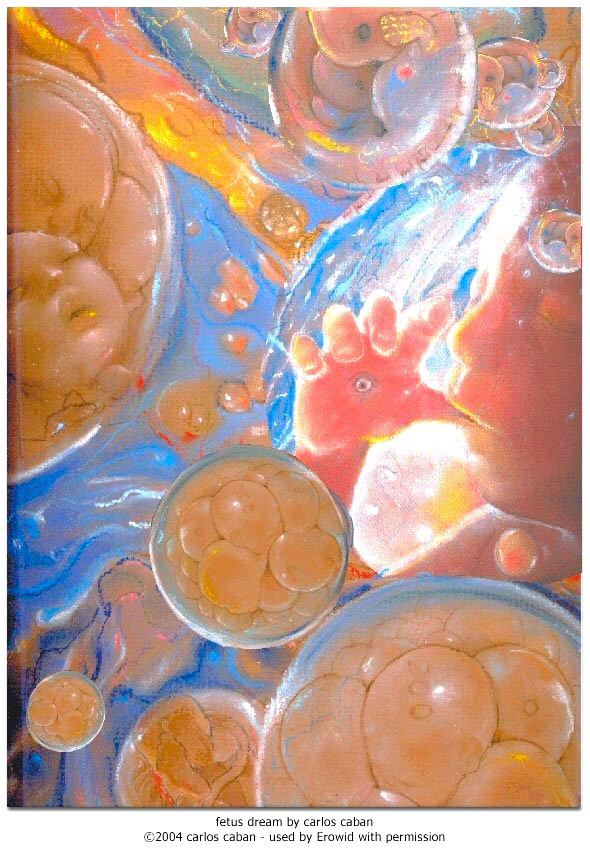 |
It wasn’t an auspicious beginning, but my grandmother carried off the limp body and managed to provoke breathing.I have a sense — I cannot call it a clear memory — that in reviving me, my grandmother baptised me in case I died. She blessed me with her love, and marked a cross on my forehead in oil and water. That mark has remained in my being indelibly, having been given with true love. It has opened connections to me with mysteries I might otherwise not have known. |
It wasn’t just my body that was impressed with the experience of birth. There are levels of awareness in us right from conception, along with the learning of responses to what is confronted. Not only does the unborn body mature in readiness for birth, so does the awareness, the receptive sentience.
In my 40s, when I traced back troublesome reactions to everyday life events, I discovered memories of the period just after birth. I found the experience of being a tiny vulnerable creature, and as that creature I was very definitely reacting to a feeling of awful exposure, even though I didn’t know myself as Tony.
Remember that in the womb my small being did not need to breathe. Food did not have to be taken in and digested. There was a stable temperature, so no exposure to temperature shifts. My nervous system was geared to survive, and in some way respond to stimuli. There was no assault of powerful and unknown sounds in the womb – sounds such as birdsong, dogs barking, house sounds. Also, in the womb one is buffered against bacterial and viral attack.
A baby is aware of all these in its own way. It has a functioning brain and nervous system that is already learning — not in words, but certainly feeling responses.
What I recall from that early period after birth — recall and put into words by my adult self — is of being afraid I could not survive in this new environment. At the time of my birth there were no intensive care units to plug my tiny body into a drip feed or oxygen tent, or an incubator to keep me warm. Neither were there antibiotics to help fight the deadly diseases so many infants and children of the time were laid low by. At that time premature babies were very likely to die.
So I couldn’t breathe easily. I couldn’t digest easily, and I was deeply anxious about the strange sounds around me. A tremendous feeling response took place in my tiny self. As an adult we would call this a decision. But in my infant self it had nothing to do with thinking or analysing. It was a total feeling and fear response. It was a rejection of life. A turning away from scrambling, struggling, for survival. I didn’t want to be in the world. I wanted to remain in the egg!
The effect this had on my adult behaviour was that I never developed the ambition to “get somewhere in life.” Just existing felt like an enormous struggle, an exhausting struggle. I turned away from opportunities because they needed involvement and participation. I didn’t want to be involved, and often had to crash out of social activities, as I did not have the coping mechanisms to engage in ordinary social events.
There was also, in my budding awareness, a sense of death. Even though my body was ill prepared for life outside the womb, it still functioned strongly enough to stand between me and death. But death felt very close. I needed to be back in the womb, kept warm, protected and given a chance to grow undisturbed. Second-best would have been to be held skin to skin against my mother’s body and breast, a sort of constant drip-feed in a warm environment. Unfortunately that did not happen. She was a working mother dashing back from work to breast feed me.
I gather from these memories, and the feelings accompanying them, that my mother, being young and inexperienced — I was her first and only child — was frightened by my fragility. All her sisters had produced heavy full-term babies. So she may even have felt lacking in some way. And I felt something of this anxiety. My own struggle, and feelings that death was sniffing around me like a waiting hyena, were not held at bay by my mother’s anxiety. As the little budding me existed beyond any sense of time there was no knowledge that things could change, only a feeling of impending doom.
Then a truly life changing event occurred. I have no awareness at all of its place in the sequence of things. But picture if you can this vulnerable and helpless creature, this spark of life and awareness not ready to deal with independent life, retreating from it, yet not wanting to die. And my spark of awareness, my forming sense of myself, is afraid, and feels alone in this fear, alone in the dark, with death as a predator sniffing around. Then suddenly I am picked up and held in arms that are strong; held by a being of love who is not afraid of death, and communicates love and courage to me. Communicates so profoundly that I feel I am in the arms of a higher being, a being who has lifted me out of darkness and fear, and has driven away skulking death itself. So I cry out to this being with the only passionate sound I can make, the panting, weeping of an infant. But if there had been the gift of words I would have been looking into the eyes of this being, crying out, “I love you! I love you! I am bonding with you! I am connecting with you forever!”
When I remembered this, when I re-experienced the moment as an adult, I too bawled like a baby, and felt the exquisite love and strength, the relief from darkness, of those moments. In fact I still weep as I write these words, for that experience was so profound.
That was my second, and most deeply felt experience of love. It was also the first, and perhaps most fundamental, experience of religious awe. It stands as some sort of nucleus in the development of myself as an adult personality. It is a touchstone against which is tested any meeting I have with love. Also, when I first re-experienced this event it was accompanied by a revelation, a certainty, that this was the resurrection.
The wonderfully loving higher being who had the power to lift me beyond the reach of death, was of course my grandmother. She was the mother of 13, some of whom had not survived. My mother was the youngest, born on the eve of the Great War. My grandmother did not have long to live herself, but I think had developed that serenity, not of the mind, for I doubt she was a thinking person, but of the heart, that comes with deep acceptance. I also have a feeling out of these experiences, that she was the heir to the wisdom gathered by a long line of women who were her ancestors. I don’t see this wisdom passed on verbally, because I doubt it was ever put into words. It was passed from eyes to eyes, from heart to heart. It was passed in the passionate responses to hard times and loss and love. And I feel my grandmother baptised me in the essence of it, and I am blessed for all time.
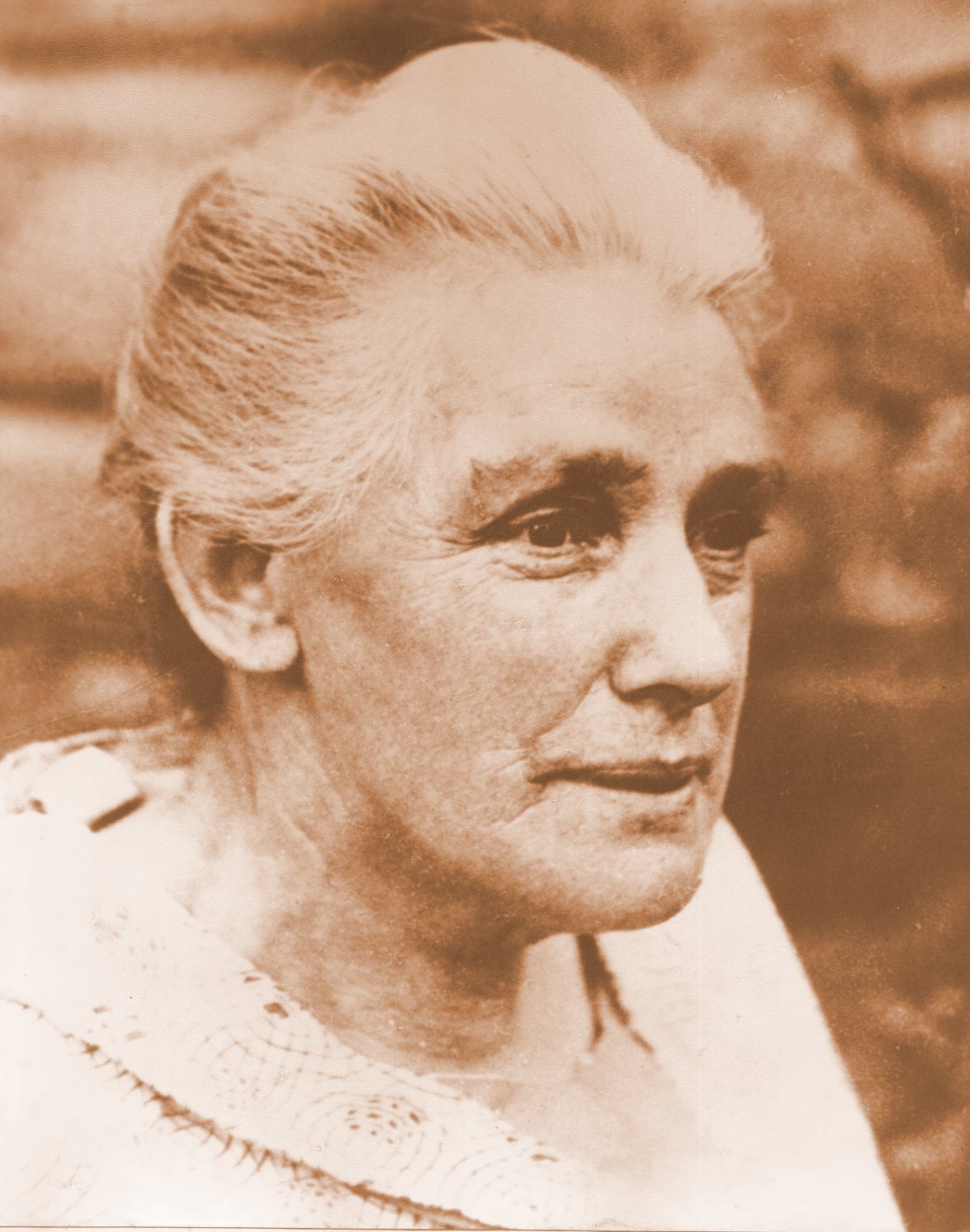 My Grandmother
I have wondered a great deal about what was meant by the resurrection. I know it has to do with love. I feel people apply the term to Christ because the Christ being represents, or is a symbol of, a form of love we sense in ourselves occasionally, and sometimes see in other people. It is the type of love that in its weakest form is seen in the love of parents for their children. It shows itself as the giving that enables a mother to almost totally devote herself to the needs of the helpless and completely demanding life of her baby. It is the ability some fathers have to toil year after year to feed and provide for their children.
But that is its weakest form. That love is often partly instinctive, built into us if we are healthy. Its most profound form is seen in those who reach beyond their love for their children and family, and extend it in depth, not just in duty or to be seen to do good, to people who are not their kin, and from whom no financial, sexual or social advantage is expected.
I sense the resurrection as a form of love that transcends the boundaries of kin, and is not afraid of death or risking of one’s own life for the need of another. In essence, this is the story Christianity tells. Although I am personally uncertain about the existence of an historical Jesus, I can see that as humans, we collectively sense there is a profound wonder in such self-sacrificing love. In sensing this we have created a deeply perceptive mythology around it. The mythology tells us that even if we can allow a little of such love into our life, it will give us entrance into becoming aware of an essence — the spirit — that pervades all existence, and to the survival of bodily death.
To some extent I have to acknowledge that by getting my newborn body to start breathing, my grandmother did raise me from the dead. So my unconscious mind has powerful material around which to create its own personal mythology. But the love I experienced I sense as a force beyond that, and has to be acknowledged too.
In our collective myth of Christ we have created, or witnessed, a being who extends love to all living things, and offers a life beyond death in its existence – the mystical body of Christ. Just as my grandmother lifted me from darkness and death, so Christ is said to lift humankind.
My grandmother took over my care soon after I was born. My mother told me that I slept in the same bed as she did, but one morning she woke and couldn’t find me. She panicked, and then discovered I had slipped out the side of the bed, and was as cold as stone. From that point on my grandmother took charge, which probably did nothing for my mother’s confidence.
I have not recovered memories of this period, but from looking at photographs, I grew from a tiny shrunken little creature into a happy and sometimes radiant looking child with blond hair. Things soon changed though. My grandmother died of a stroke before I was two. So suddenly the great love in my life was gone.
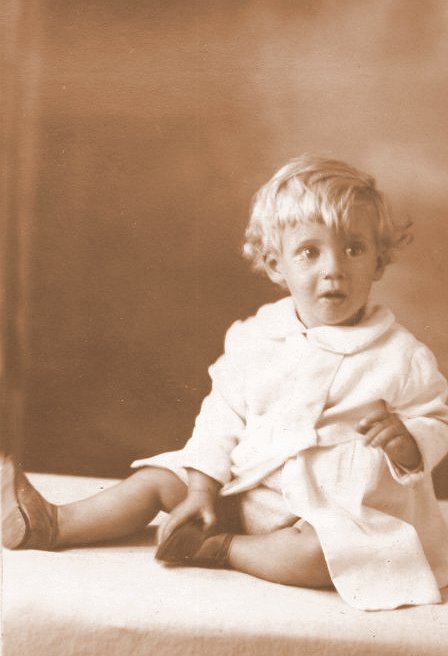
This was such a major event in my life that it left massive residues in strata of my psyche. The petrified remains of that event were only uncovered slowly, plunging again and again into the depths to find the heartbreaking remains of that lost love.
From my teens, through to the time of uncovering these buried feelings connected with my grandmother, I had an almost compulsive religious drive. This was never something leading me to attend church or listen to sermons, or study the Bible. It was a direct need to find God as a personal experience. I wanted to communicate, to meet, and to have a direct confrontation.
Understanding of this drive dawned slowly as I developed the skills of mental archaeology, and learned to carefully brush away the debris of years. My first discovery in this old burial mound was anger. I was angry with God – violently angry. Only slowly were the roots of that anger uncovered.
My grandmother died after a second stroke. As a young child I had no foreknowledge of this, so it was a terrible shock suddenly to no longer be able to find her. Literally she was no longer there. I didn’t even see her dead body, and I feel that was a great mistake on the part of my family. Seeing her corpse would have given me a tangible experience of her death. Lacking that experience she had simply disappeared mysteriously. I was left to seek an answer to this, and when I asked where she had gone was told that my grandmother had gone back to God.
When that one sentence was lifted out of the darkness of years, along with the emotions buried with it, the anger and the compulsive religious search were understood. I was angry with God for taking away the person I loved. I was searching for God because, according to what I had been told, in finding God I would find my grandmother.
It’s crazy how the mind and emotions work, but logical too. As a child I didn’t have the equipment to question the information I had been given. So it was buried intact, still channelling the energy of my drives and emotions until I managed to uncover it and re-evaluate it against a much wider database of experience and information.
Isn’t love a strange and terrible thing to keep a child held to its determined search through the long years into adulthood? Some ghost, some spirit of that small boy that I was, remained waiting in a corner of myself. Waiting and hoping for the return of his beloved grandmother. Waiting and bearing the weight of that waiting each day, gradually becoming walled up in a dungeon of debris dropped by the passing years.
The vulnerable and beautiful spirit of that child, buried in the shadows of myself, was the hidden artist behind much of the beauty and tragedy in the love story of my life. It became known to me in a dream as Lumpkin.
That’s how I waited out the years with my mother. Because I had been so close to my grandmother, in some ways my mother was a stranger. Living with her left the love child in me constantly waiting to go home. There was a feeling in me that if I could wait through this day, maybe today, or the next day, I could go home. If not today, maybe tomorrow I could be with my grandmother!
That feeling of desperate waiting, of feeling I was never “at home”, of constantly wondering where home was, lasted most of my life. A dream I experienced in Italy in 2000 shows the depth and dilemma of this. In the dream I was driving home along a country road. Ahead of me the road forked and I took the right-hand fork. I drove a little further and arrived home. It was a lovely house in its own grounds. My wife and children were happy to see me and came to greet me warmly. But something was wrong. I had no sense that these people were my family. This was not my home, and I hurried away, back to the fork in the road. There I took the left fork. Again I arrived home – another lovely house, another wife and children who warmly greeted me as husband and father. But there was still no feeling in me that I was home. Again I must go to look for where I belonged.
That dream sums up the feelings that haunted me most of my life, and the split shown by the forked road. As with the religious drive, the feeling arose because of my desire to be once more with my grandmother. After all, it was a desire etched into me over many years. Strangely enough, at the time this memory really surfaced, I was living with a friend, being homeless at the time. On the very day it came to light my friend told me I would have to find somewhere else to live. It was so strange it was almost comical.
Therefore, before ever I had any real sense of time or identity, those early experiences set patterns in me that have influenced the rest of my life. My prematurity, with its consequences of unreadiness for an outgoing life that would grasp the world and its opportunities, left a yearning, and I think an open door, to enter into the mysterious in the worlds of the mind and spirit. I wasn’t looking outward to the world. All my energy was flowing backwards into the life of the womb and its dark mystery. And there were negative aspects to that, such as lack of worldly ambition and a failure to understand the needs and functions of placing oneself well in the world to gain financial and social benefits.
What I have gained though, is an extraordinarily rich inner life. I suppose it was also a major factor in my becoming well-known in connection with dreams. Also, for never having any sense that I ought to absorb the subjects offered through schooling, as given by the establishment. But I believe there are other factors not mentioned, that played a big part in that.
The other main pattern put in place by my infant years, was the foundations upon which would be built a terror of losing the one I loved and the compulsion to be loved as desperately and urgently as I myself loved. In this way the scene was set for the drama of my destiny to unfold.
Last Thoughts About Lumpkin
I end by thinking about Lumpkin and realise what a wonderful part of me he is. I have an image of him as the Lion headed dwarf. The tiny malformed being who is yet enormous, with strength, wisdom, and power. He has that in his weakness. And in his love and compassion, he has more strength than soldiers. I have a sense that my female has taken Lumpkin deeply into herself. I have a feeling she is going to carry Lumpkin deep in her being, perhaps into another lifetime. And if that is so, I want her to recognise that Lumpkin has the seeds of enormous strength, great wisdom and love. I know that is why my lover has taken Lumpkin into herself.
Lumpkin is now also flesh of my flesh, blood of my blood.

Here is the Lumpkin dream.
“I believe it was a man, rather shadowy, who gave me a leather pull string purse or pouch. In the pouch was powder that I poured onto my rather stained trousers. Strangely, they looked like the one’s I wear now. Immediately the powder started working like yeast, or at least, I thought of it as yeast. It was cleansing and purifying my trousers in a spreading action. I knew that this yeast, or pollen, had also penetrated my body, and was gradually working through my being, purifying and healing.
I looked at the opening of the pouch, and it was in the shape of a mouth and a vagina. The powder that came out was like millions of living motes, or particles, life giving and alive. I thought at first that using the powder would empty the pouch, but I saw that in fact the living counts replenished itself. They were like sperm or pollen, they regenerated.
Then suddenly the scene shifted and it was later in the day. I was the only person at an eating-place. I heard sounds of people coming, and wasn’t sure if they were friendly or not. So, I acted as if I were working at the place by clearing one of the tables. There didn’t seem to be any proprietors or staff. Then, into the room, or space, because I believe it was outdoors, walked my friend Sheila, with a man who was shadowy, ill-defined, like the man who gave me the pouch. Sheila was now like a warrior figure, a man/woman, the genders blended. I understood, or could see, that Sheila had gone through an incredible journey or adventure. This was like one of the mythological odysseys that had transformed her in meeting its dangers and trials. She was now a very powerful figure. In her hands Sheila carried a tiny being. She held it out to me and said, “Lumpkin has been asking for you.” (Some days before the dream of the pouch and Lumpkin I experience a powerful uprising of feeling and joy. In listening to the feeling I received the distinct message that in four days I would receive a gift. I wondered what this gift might be, and understood that it was something that had always existed, but I had now grown, or opened, to the point where the gift could be received.)
Strangely, since that time, my dreams have given me four gifts – the two books, the pouch, and Lumpkin. None of them are easy gifts, and I am still riding the waves that lift me and thrown me down in my relationship with love and loneliness.
I understood that Lumpkin, this little being, had missed me and wanted to be with me. I held out my arms and took this creature, who was about 10 inches high, with spindly legs and arms. From his appearance he was incapable of individual locomotion. Lumpkin wasn’t a baby, nor an animal, but he was intelligent and could speak. He came to me and I held him, with the feeling we have known each other in the past.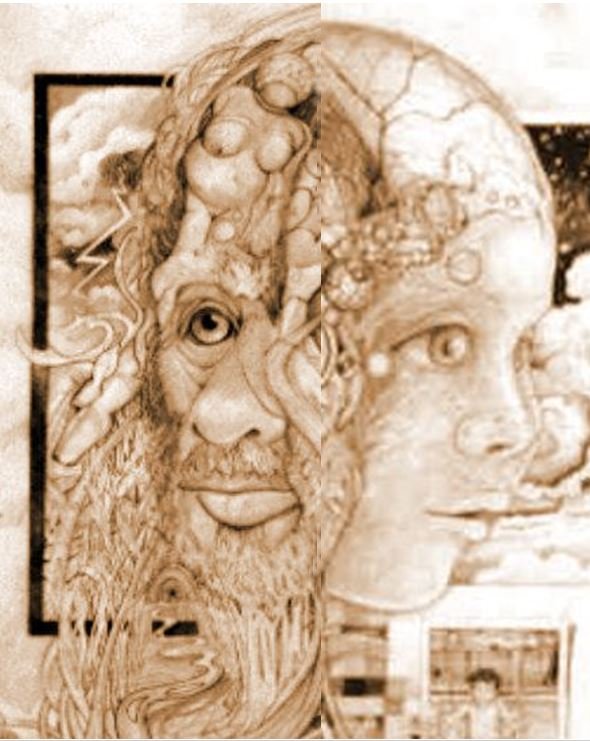 Art by Carlos Caban
In fact what he brings me it is the possibility of the compassion for the helpless and injured. He has, because of his own weakness, a sense of humility that allows a link with other people’s vulnerable and perhaps a hidden, nature.”
The Maternal Womb: The First Musical School for the Baby
by Ruth Fridman
Editor’s Note: Prof. Ruth Fridman has been a pioneer in revealing the important effects of the first sounds that babies hear including the sound of mothers singing to them in the womb, at birth and as infants. In this paper she reminds us of her inspirational work with pregnant mothers she teaches to compose lullabies to sing to their babies. Her many presentations, travels, books, and song books are included in the impressive list of career milestones at the end of this article. Ruth is the current President, International Music Society for Prenatal Development (IMSPD). Please direct any correspondence to her at Coronel Diaz 1564, 1425 Buenos Aires, Argentina or via email to: ruthf@ciudad.com.ar.
In 1971 I began to tape sonorous rhythmic intonated expressions of many infants. It interested me how early infants could begin to sing, to repeat melodies and tap rhythms. I had the feeling that these manifestations had a special origin, that the cultural environment was not the only cause. As I had several ideas about it, I started taping the voices of babies who were full term, premature, or significantly retarded. I recorded their expressions from their birth up to fourteen months old. The taping took place in a children’s hospital of Buenos Aires. As I listened to the babies’ cries, I realized that if I separated the cry from the sounds included in it, it could be labeled as “musical”. Analysis through electronic devices confirmed my hypothesis. Baby cries had the proper characteristics of sound: frequency, timbre, and intensity. When reviewing the bibliography about infant sounds, I did not find any systematic study of the first mass of sounds and their sonorous rhythmic structure in relation to musical activity. Infants’ most elementary vocal rhythmic schemes make up the physiological matrix for future language and music acquisition.
The analysis of infant cries led me to study their expressions from the very instant of their birth. I first undertook a longitudinal study of three newborns up to their first year of life. After this I studied triplets and a Cesarean-born child. The main feature of the first group was that one of the babies sang properly when she was 9 months and 7 days old. The processes used with these infants has been described in my book The Beginnings of Musical Behavior (1974).
My work with infants from their birth on made me realize how important music is during the gestational period. I started teaching music to pregnant women. Both, the mother and the unborn baby benefited.
What is the advantage of the musical stimulus? Mothers discovered personal characteristics they were unaware of as I encouraged them to create lyrics and tunes for their unborn babies. Through a questionnaire, I learned about their musical knowledge and preferences, as well as their doubts, fears, and hopes (Copies of this questionnaire are available from the author). As a result of my research, I decided to work with pregnant women. I was greatly moved by their anxieties, fears, and doubts. I also felt that if a pregnant woman sang to her baby as I had done with my two children, she would establish a closer bond with this baby.
A video made at the Fernandez Hospital and at the San Martin Education and Cultural Center, reveals the mother’s emotion, expression and interest in creating short songs. They did it shyly but with great tenderness. Many of the lyrics revealed their fear of losing the baby, or that it might be defective, and other worries. I had not expected to find these problems. Since I could not help, I suggested they consult a therapist. (I was afraid they would reject my suggestion and stop attending my classes but fortunately this did not happen.)
The experience I had at the hospitals was very productive, in spite of the limited time and space I was given to work there. Pediatricians and neonatologists supported my work, but not the obstetricians and midwives. I will never forget a couple who attended the second class at the Fernandez Hospital bringing a guitar and a quena (Indian reed flute). The man sang the song they had composed for their unborn baby, and the woman introduced the song by playing the quena. I also remember when the mothers came to show me their newborn babies, they reported how they used music at the birth of their babies. This was also true of the single women.
Every pregnant woman is a different world. I invited each to dream about their unborn babies, to imagine their unborn babies little bodies, to imitate the movements babies made inside the womb, to draw pictures for them, and to pamper them with words. They created both a musical and a spoken language as I encouraged them to tell their babies where they were and what they were doing at the time, commenting on whether it was warm or cold, and such. It was quite an experience for them!
The inner language of feelings, which is present in every human being, became a powerful form of expression for these mothers, different from formal language. I remember when I had a similar experience with my two children, and how it brought me closer to the human being inside me. I believe the advantage of these activities is that they establish a prenatal bond which contains tenderness on the part of the parents to be, a promise of protection, and the wish to see and hold the baby in their arms. Pregnant parents created these songs naturally, songs that would stay with them the rest of their lives, invented in a period of love, anguish and expectancy. It is of great significance for babies to hear music, to hear parents talking to them, and to be gently massaged during the gestation period. The mother’s emotional expressions benefit both herself and her baby. When pregnant women sing, the unborn babies answer by moving their bodies. They are little acrobats when they have enough space. These rhythmic movements of the unborn are certainly very important to motor development. And according to some experts, fetal movements provide an activity which contributes to the development of psychic functions as well.
I worked most enthusiastically at the San Martin Cultural Center where women attended my classes of their own free will. At first, they came out of curiosity but they listened with great interest. These classes were also attended by male parents, doctors, and professionals who wanted to learn about musical training of mothers-to-be. In my opinion, these musical experiences should be offered at every maternity hospital and would improve the mental and emotional health of both parents and children. The last trimester of gestation is especially important and parents must make the most of this period of rapid growth.
At times I worked with babies in incubators. All the sounds they had heard in the womb and were familiar, were now replaced by the noises of the incubators. The previous experience of natural sounds was lost. Therefore, I advised parents to record their voices and songs for their babies in incubators. Although nowadays, a radio is sometimes placed in incubators as a stimulus, I think the parent’s voices are best.
Mothers quickly demonstrated that music was not the property of elete members of society or those with advanced education. My students at the San Martin Education and Cultural Center and at the hospitals came from all different socioeconomic classes and different cultural levels. However, each of them was able to create songs and to communicate with her baby in a personal and genuine way. Each of them found their own way and their own rhythm as they progressed through pregnancy. Not only did they realize they had conceived a human being but many of them discovered a way of communication they had never thought of before. In music, mothers would say things they would not express verbally.
Although lack of communication, lack of essential stimuli, and other maladaptive problems are inevitable in some cases, I believe sincerely that babies and parents could avoid or resolve many of their difficulties if they were offered prenatal music classes maternity hospitals. Beside the experiences I have shared briefly with you here, I can confirm by observing the babies from their birth onward that music was a formative element in their lives. When a baby has been stimulated by his mother with music, by the fifth month the baby already shows affective memory towards sound. At only nine months old, one of these babies was singing the song his mother had systematically sung throughout his prenatal days.
Finally, I am hopeful that the scientific contributions of neuroscience, genetics, and psychology will help to illuminate the nature of the very early musical responsiveness which appears to be an innate function of all human beings.
Milestones in the Career of Prof. Ruth Fridman