Posts Tagged ‘Christ’
Bible – Its Dreams and Symbols
And He said, “Hear now my words: If there be a prophet among you, I the LORD will make myself known unto him in a vision, and will speak unto him in a dream” (Num. 12:6).
“I will pour out of My Spirit upon all flesh: and your sons and your daughters shall prophesy, and your young men shall see visions, and your old men shall dream dreams” (Acts 2:17).
“For God speaketh once, yea twice, yet man perceiveth it not. In a dream, in a vision of the night, when deep sleep falleth upon men, in slumberings upon the bed; Then He openeth the ears of men, and sealeth their instruction, That He may withdraw man from his purpose, and hide pride from man. He keepeth back his soul from the pit, and his life from perishing by the sword.” (Job 33:14- 18).
There are about 121 mentions of dreaming in the Bible and 89 mentions of sleep. (King James version.)The very first description of a dream is that in connection with Abraham.
Genesis 015:012 And when the sun was going down, a deep sleep fell upon Abram; and, lo, an horror of great darkness fell upon him. And – The Lord – he said unto Abram, Know of a surety that thy seed shall be a stranger in a land that is not theirs, and shall serve them; and they shall afflict them four hundred years; And also that nation, whom they shall serve, will I judge: and afterward shall they come out with great substance. And thou shalt go to thy fathers in peace; thou shalt be buried in a good old age. But in the fourth generation they shall come hither again: for the iniquity of the Amorites is not yet full.
From that point on dreams are mentioned openly in such phrases as ‘020:006 And God said unto him in a dream’ – or ‘020:003 But God came to Abimelech in a dream by night, and said to him’ or ‘028:012 And he dreamed’. But no dreams of women are mentioned in the Old Testament.
Most of us can understand that such dreams or visions as Abraham experienced, and later Jacob and Joseph, are not recognisable as the type most of us wake from and remember. One might say these are a ‘once in a lifetime’ kind of dream. Explaining these dreams, and criticising the modern regard for dreams, some Christians are inclined to believe that only in the past did God directly communicate with ordinary men and women, and such a relationship does not apply to us today.
It must be remembered however that these early tribal people did not emerge from a vacuum. They inherited from previous cultures views and concepts about all aspects of life including dreams. They also lived within a particular view of the world and a system of beliefs which coloured their dreams, what they expected of them, and their manner of reporting them. Therefore it is worth looking at this background to biblical dreams. But in modern terms it can still be seen that dreams come from our core self – whether we like to call that self God or Life – see Core; The Two Powers for an explanation.
The very first mention of sleep occurs when we are told that God caused Adam to fall into a deep sleep. These statements were written in Hebrew, a language whose alphabetical characters each had a symbolic meaning, much as the characters alpha and omega mean something by themselves in the Greek alphabet. The words ‘deep sleep’, when used in connection with Adam were ‘thareddemah’. The roots of this word – according to Fred Myers – are rad and dam. In the English language we use the ‘rad’ root in such words as radiate, radium, radical. The Hebrew word ‘radah’ means to rule to govern. The same root used as a ‘passive’ verb means to be insensible, to be fast asleep, or to lose consciousness and control.
The root ‘dam’ means to be connected through blood, similarity, kinship or identity. The whole word suggests a form of sleep in which the person loses self control and is directed by the will of another, perhaps as happens in hypnotic sleep.
This concept of sleep and dreams having the possibility of ones mind and experience being directed by another will, in fact the Divine will, lies at the root of the way dreams were considered in the Bible. Both Adam’s sleep, and Abraham’s vision, have to do with identity. With Adam something emerged from him that had a separate identity from himself, and which led to an awareness of self outside God. So this story is about the emerging of a personal will into an existence that had previously been linked wholly with the will of God.
If the concept of God has difficult associations we can substitute the idea of early humankind having little sense of separate identity from their environment and from their tribe. Their feeling of a collective identity with nature and their tribe we can give an overall name of God – the forces which gave them existence. A study of the Australian aborigines particularly illustrates this enormous identification with the tribal territory and with the tribe itself. With the Aborigines their sense of self was in direct relationship with the territory in which they lived, and their tribal group.
This is important because much of the story in Genesis is about a tribal people trying to attain and maintain an identity. This is true of most tribal people. The struggle to establish and maintain their identity as a group of people, and in competition with other tribes or kingdoms, explains much of their behaviour. Just as our body destroys millions of bacteria each day in its attempt to maintain its integrity, so the tribal peoples often killed their rivals as a part of establishing and maintaining their own existence, identity and territory. Belief systems such as the tribal religion were of immense importance in this. Abraham’s visionary communication with God – the overall and powerful factors underlying his existence – set a path which enabled Abraham’s people to survive as a group through experiences which could easily have disintegrated the tribal cohesion. A common religious belief acted as a social ‘glue’ and a means of establishing mutual direction and the ability to work toward a goal as a group. It was a form of agreed law which established order in the community. Anything threatening the religious belief threatened the community, just as much as bacteria that disrupt the integrated working of our body threaten our personal existence.
Looked at from this standpoint, many of the dreams reported in the Bible are about the direction an individual can take regarding the destiny of the family or nation. Such dreams were not only important to the individual, but also became landmarks and pointers for later generations. They were and still are great statements summarising the beliefs, possibilities and character of the people. They looked at possibilities from the collective viewpoint – the good of the tribe or group – and gave insights that would benefit the tribe or nation. In the book Black Elk Speaks, the American Indian Black Elk tells how many of his great visions were about the healing of tribal conflicts or uncertainties. See: Prayer And Dream Interpretation; Native American Dream Beliefs.
The vision of God, the dream in which the Divine is directly experienced within us is not isolated to any one culture. Remembering this helps one to gain a clearer picture of just what such dreams or visions are. For instance a Hindu visionary does not meet with the divine in the image of the Christian God, but with a vision of Krishna or Shiva. The Indian visionary or dreamer makes contact with their own sense of the collective via their personal cultural images of the divine. The American Indian visionary met their sense of the collective psyche or tribe through an image of their own totem animal or family spirit. If ones own identity is deeply embedded in one religious belief system, then such alien images as those belonging to another culture might be as threatening as the invasion of bacteria already mentioned. They would undermine ones sense of self based on a particular belief system.
If we can accept that as a human we have the capacity to touch parts of the mind that have the amazing ability to integrate personal and cultural information, and from it present a view of where current trends and social moods are leading, then we have an understanding from which insight into Biblical dreams and visions can arise. If it is also seen that the form of the vision is shaped by cultural ideas and feelings about divinity – the collective and underlying forces of personal existence – then many of the Biblical dreams become understandable.
As the Bible proceeds, the dreams mentioned become more linked with personal rather than social identity. Joseph’s dream of his brothers sheaves of wheat bowing down to him, and paying homage, is less to do with tribal direction than the vision of Abraham. (Genesis 37:05). But Pharaoh’s dream of the fat and thin cattle is back in the mould of a dream showing the way for his nation.
Example: 037:006 And he said unto them, Hear, I pray you, this dream which I have dreamed: For, behold, we were binding sheaves in the field, and, lo, my sheaf arose, and also stood upright; and, behold, your sheaves stood round about, and made obeisance to my sheaf. And his brethren said to him, Shalt thou indeed reign over us? or shalt thou indeed have dominion over us? And they hated him yet the more for his dreams, and for his words. And he dreamed yet another dream, and told it his brethren, and said, Behold, I have dreamed a dream more; and, behold, the sun and the moon and the eleven stars made obeisance to me.
Joseph and his family clearly understood that the sheaves of wheat in his dream represented themselves. The meaning of symbols and images was clearly understood by many ancient people. Perhaps they could not verbalise exactly what the image meant, but it was often a deeply felt part of their life. It is this aspect of the Bible which is often completely overlooked by readers today. Is the story of Adam and Eve talking about two individuals who were divinely created and walked the earth in a golden age? Is the story of Jonah and the whale literally true? Are the stories of Jesus about a historical character? Or are they wonderfully evocative images which tell of another sort of truth than that of historical fact?
This side of the Bible is incredibly rich. It stands beyond all the attempts to fix a literal and dogmatic meaning to it, and speaks of life experience which most of us can identify with and understand. If we look at the Bible as if it were a description of a dream instead of a statement of history, light shines through the stories and enlivens us.
Starting with the story of Adam and Eve, it is clearly about the beginning of life. It is about human consciousness and its beginnings. In the manner of dreams, where each part expresses some aspect of our own life and feelings, God, Adam, Eve and Eden are all aspects of the one being – the human being. In fact in Hebrew the word Adam is a plural word, not singular, so the story is talking about the human essence, not about a man and a woman.
And God said, Let us make man in our image, after our likeness: and let them have dominion over the fish of the sea, and over the fowl of the air, and over the cattle, and over all the earth, and over every creeping thing that creepeth upon the earth. See God and the Big Bang are the Same.
Notice that God is given to speak the word ‘us’ showing there are creative forces rather than one creator. Also the man who is created is referred to as ‘them’.
The Garden of Eden suggests a state of mind or a state of existence other than our present normal waking awareness. The story tells us that there was a condition humans lived in prior to their present one. This prior condition was lost. And if the descriptions in the story of the state of Eden are compared with the condition that Adam and Eve found themselves in after Eden was lost, we can see that the story suggests women and men at first had no will of their own. They responded to life out of their sense of connection with what is called God – their connection with their life process, with their innate and instinctive urges and insights.
This is not a revolutionary idea. Every one of us go through such enormous personal changes. From the condition of the womb, in which we know no language or organised thought, where there is no need to make an effort to breathe or exist, we are thrust into separation, into survival, into independent existence. But we still have no language or organised thoughts. In yet another fantastic leap, our brain takes in the programming of language and achieves self awareness and the sense of aloneness. Prior to this we had no concept of time or space.
So Adam – the human race – at first existed in a state in which there was no sense of time, without any personal identity. In an animal we would call this instinct. Instinct guides the animal without the animal needing to have any personal ideas or decisions. It doesn’t have to think, it responds. Many people have associated this life in Eden as the period we each spend in the womb, and when we are cast out of Eden that is birth. But the story has a larger picture. In fact human beings in their development have lived in a transitional period when they were guided by instinct, and later developed refined language and the ability to make personal decisions in some degree. In our growth from the womb we pass through the whole range of our developmental modes, right from the creature with gills to the air breathing life form with a developing sense of personal identity.
Reading about Eve (Aisha), and how she listened to promptings to do a deed her inner life, her habits, her instincts, forbade, the story takes us to the emergence of personal will. Interestingly, in the original Hebrew, up until this point in the story the word for mankind was always Adam. But as soon as this new being is formed the word for mankind is Aish, and the new being is Aisha. The new human being that has come about, Aish (Adam) says is ‘now bone of my bones, flesh of my flesh’ confirming that in fact the story is about one being, not two. But it is a new being with a will of its own.
Many years ago I read the true account of a Bali tribesman who had need one day to leave his tribal village. This was the first time in his life that he was going to depart from his people. As he got to the boundary of his tribal territory he fainted.
If we have been born and raised in a modern Western society, we will find it difficult to understand the enormous part the tribal group and the tribal beliefs play in the psyche of the tribesman. It is difficult for us to understand what it is like to feel so much a part of a group or a family that simply walking away from it can cause one to collapse. Developing a will of our own, learning to exist outside of our family and tribal group, has cost us a lot, and the story of Adam who becomes Aish and Aisha, sums up the price that is paid by modern humans as they meet the anxiety, the guilt, the loneliness of life as an individual. We are, like Aisha, caste out from a sense of belonging to the universe, nature, and our tribe. We have lost a feeling of being in harmony even within ourselves. We no longer have the innocence of an animal or a child. We are alone together.
The New Testament moves on and uses different symbols and images. The story of Mary’s virgin birth while married to an old man; of how a divine child is born, and how this wondrous child matures and heals others and is the way to regain heaven, is a further chapter in the story of human development.
Looking at the New Testament once more as a dream, Joseph represents the rational mind which is not capable of going beyond reason to touch any sense of personal wholeness. Only Mary, the integrated feelings and thoughts, which are capable of being virginal, without prior conception (without holding on to prior conceptions as to the nature of life as the rational mind does) can bring forth the birth of an intuition, a new response to oneself and ones environment, that transforms ones life. This is a living relationship with the mystery that underlies our life. If we generate a ‘Mary’ part of us, a part that is not held prisoner by habits of thought, stereotypes of behaviour, by habitual patterns of thinking, then we can begin to allow into consciousness what was previously impossible to know. Mary, the virginal or open state of mind and feelings, acts as a link between the identity or personality, and the deep unconscious life processes. This link allows the birth of realisations and inner change that brings healing and a possibility of experiencing the eternal aspect of oneself. This is a great boon considering the rational mind, the independent will, has closed the door to personal experience of the timeless. This experience of the transcendent, or ones own wholeness is what Christ represents. See The Inner Path of Christ.
The story of Joseph, Mary and Jesus is a continuation of the events depicted in the Old Testament. The emergent individual lost any sense of connection with the whole, and with the community of which he or she was a part. Erich Fromm, in his book Escape From Freedom, explains the recent historical events and psychological changes in people that have widened this gap between the security that was at one time felt by individuals with a sense of being part of nature, or part of a community. The shift the New Testament symbols depict is that of the individual rekindling an awareness of his/her connection with the living power of the creative power, nature and community. In fact one of the major rites of Christianity – communion – directly celebrates this. This communion is not a loss of self as portrayed in Eastern religious teachings, but a willing connection made between an aware individual and the whole.
Example: It was perhaps the dream experiences that led Saint Jerome to mistranslate the Hebrew word for witchcraft, anan, as “observing dreams” (in Latin, observo somnia) when commissioned to translate the Bible by Pope Damasus I. Anan appears ten times in the Hebrew Scriptures (the Old Testament), but Jerome translates it as “observing dreams” only three times, in such statements as, “you shall not practice augury nor observe dreams,” which more accurately reads, “you shall not practice augury or witchcraft.” These simple changes, which made the Bible appear to discourage attending to one’s dreams, significantly altered the course of how dreams were viewed for centuries.
Looked at through its symbols instead of its historical relevance, the Bible unfolds the drama not only of your personal growth toward maturity, toward an independent identity, and toward a greater realisation of your own potential, it also paints the great picture of the pathway humanity took toward personal awareness and a sense of separate identity. It depicts in its stories and characterisations, the wonder and difficulties of becoming an individual and of discovering satisfaction in ones life. See:archetype of Christ; meeting with Christ; Individuation; myths legends and fairy tales in dreams; spiritual life in dream
But remember Christianity as it is expressed today, was set in this way by the Roman Catholic church many years after Christianity started – The early Christians were name ‘Atheists Of The Ancient World’. Inhabitants of the Roman Empire had a variety of gods and goddesses, but there were people back then who would be considered early Christians. Ironically, these people were considered atheists by the ancient Romans because they didn’t pay tribute to any of the pagan gods.
Lumpkin – The Baby Who Became Tony
I existed long before my conception and birth. What was new was this particular body conceived by a young country girl, fathered by the son of an Italian immigrant to England, and born in Amersham just before the Second World War. It was a completely new configuration.
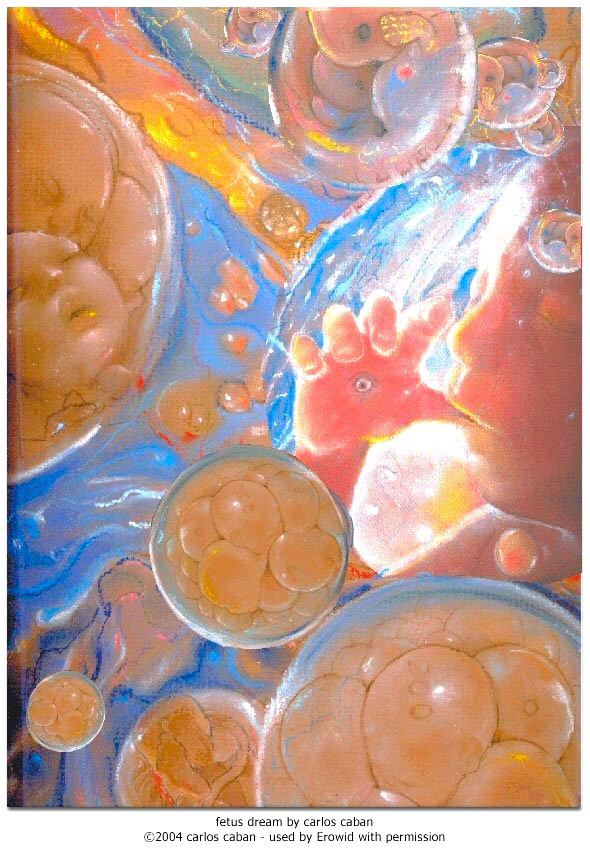
There are memories of being in the womb, feeling like the yolk of an egg. My genitals were the pulsing centre of that yolk, and they pulsed with gentle pleasure in time with my tiny heart. There was no sense yet of being a person, but there was an integrity that gave a feeling of being something different to other things in my awareness. And there was sense of love. It came to me in waves as the beating of my small heart roused pleasure in the centre of me, pleasure raised high as my mother’s heart and mine beat together while the two rhythms crossed.
Birth is seldom ever completely commonplace to its witnesses, and certainly not to the baby being born. Sometimes we have the strangely naïve attitude that this is a new being who has entered the world. But what is there new in nature? Can we say, if we plant an acorn, that the oak tree growing is new? Well, yes. The body and leaves of the tree will be unique. But millions of years in the lives of other trees are involved in the growth of this particular oak. It cannot, it hasn’t, simply emerged from itself, for each of us have a history of our beginnings started from the single cells from which all started. What an incredible journey we have all been on!!!
Whatever way we explain birth, the baby carries with it the influences of an immense number of men and women who lived, struggled, loved, in the past.
I have memories of my birth. Not as pictures in my mind, like old photographs. I remember through the pain in my guts, and through my feeling response to some situations. I remember because the experience of that birth sometimes wells up like a great tide overwhelming my normal, everyday, self.
My tiny body was born two months early, apparently dead. I was told the doctor threw my body to one side, saying, “Forget the baby. We need to look after the mother.” The doctor’s words were not flung out casually. I was born in the thirties, prior to intensive care units for premature babies – prior to antibiotics. Each of us is a witness to our times. We all exist within a huge web of influences and understandings, and if I try to grasp the view from which the doctor’s words arose, there is sense in what he implied. If we have children and say to one of them as he or she goes out the door, “Be careful”, we don’t need to mention all the things in today’s world that one needs to be careful of. If the child is old enough to manage the streets alone, they can already fill in most of the details about dangers they should avoid, such as drug pushers, muggers, child molesters, and other violent children. So the doctor was saying to my mother, “Within this present social and medical situation your baby has little chance of survival. If it does survive it will be weak. Let this one die and have another one.”
 |
It wasn’t an auspicious beginning, but my grandmother carried off the limp body and managed to provoke breathing.I have a sense — I cannot call it a clear memory — that in reviving me, my grandmother baptised me in case I died. She blessed me with her love, and marked a cross on my forehead in oil and water. That mark has remained in my being indelibly, having been given with true love. It has opened connections to me with mysteries I might otherwise not have known. |
It wasn’t just my body that was impressed with the experience of birth. There are levels of awareness in us right from conception, along with the learning of responses to what is confronted. Not only does the unborn body mature in readiness for birth, so does the awareness, the receptive sentience.
In my 40s, when I traced back troublesome reactions to everyday life events, I discovered memories of the period just after birth. I found the experience of being a tiny vulnerable creature, and as that creature I was very definitely reacting to a feeling of awful exposure, even though I didn’t know myself as Tony.
Remember that in the womb my small being did not need to breathe. Food did not have to be taken in and digested. There was a stable temperature, so no exposure to temperature shifts. My nervous system was geared to survive, and in some way respond to stimuli. There was no assault of powerful and unknown sounds in the womb – sounds such as birdsong, dogs barking, house sounds. Also, in the womb one is buffered against bacterial and viral attack.
A baby is aware of all these in its own way. It has a functioning brain and nervous system that is already learning — not in words, but certainly feeling responses.
What I recall from that early period after birth — recall and put into words by my adult self — is of being afraid I could not survive in this new environment. At the time of my birth there were no intensive care units to plug my tiny body into a drip feed or oxygen tent, or an incubator to keep me warm. Neither were there antibiotics to help fight the deadly diseases so many infants and children of the time were laid low by. At that time premature babies were very likely to die.
So I couldn’t breathe easily. I couldn’t digest easily, and I was deeply anxious about the strange sounds around me. A tremendous feeling response took place in my tiny self. As an adult we would call this a decision. But in my infant self it had nothing to do with thinking or analysing. It was a total feeling and fear response. It was a rejection of life. A turning away from scrambling, struggling, for survival. I didn’t want to be in the world. I wanted to remain in the egg!
The effect this had on my adult behaviour was that I never developed the ambition to “get somewhere in life.” Just existing felt like an enormous struggle, an exhausting struggle. I turned away from opportunities because they needed involvement and participation. I didn’t want to be involved, and often had to crash out of social activities, as I did not have the coping mechanisms to engage in ordinary social events.
There was also, in my budding awareness, a sense of death. Even though my body was ill prepared for life outside the womb, it still functioned strongly enough to stand between me and death. But death felt very close. I needed to be back in the womb, kept warm, protected and given a chance to grow undisturbed. Second-best would have been to be held skin to skin against my mother’s body and breast, a sort of constant drip-feed in a warm environment. Unfortunately that did not happen. She was a working mother dashing back from work to breast feed me.
I gather from these memories, and the feelings accompanying them, that my mother, being young and inexperienced — I was her first and only child — was frightened by my fragility. All her sisters had produced heavy full-term babies. So she may even have felt lacking in some way. And I felt something of this anxiety. My own struggle, and feelings that death was sniffing around me like a waiting hyena, were not held at bay by my mother’s anxiety. As the little budding me existed beyond any sense of time there was no knowledge that things could change, only a feeling of impending doom.
Then a truly life changing event occurred. I have no awareness at all of its place in the sequence of things. But picture if you can this vulnerable and helpless creature, this spark of life and awareness not ready to deal with independent life, retreating from it, yet not wanting to die. And my spark of awareness, my forming sense of myself, is afraid, and feels alone in this fear, alone in the dark, with death as a predator sniffing around. Then suddenly I am picked up and held in arms that are strong; held by a being of love who is not afraid of death, and communicates love and courage to me. Communicates so profoundly that I feel I am in the arms of a higher being, a being who has lifted me out of darkness and fear, and has driven away skulking death itself. So I cry out to this being with the only passionate sound I can make, the panting, weeping of an infant. But if there had been the gift of words I would have been looking into the eyes of this being, crying out, “I love you! I love you! I am bonding with you! I am connecting with you forever!”
When I remembered this, when I re-experienced the moment as an adult, I too bawled like a baby, and felt the exquisite love and strength, the relief from darkness, of those moments. In fact I still weep as I write these words, for that experience was so profound.
That was my second, and most deeply felt experience of love. It was also the first, and perhaps most fundamental, experience of religious awe. It stands as some sort of nucleus in the development of myself as an adult personality. It is a touchstone against which is tested any meeting I have with love. Also, when I first re-experienced this event it was accompanied by a revelation, a certainty, that this was the resurrection.
The wonderfully loving higher being who had the power to lift me beyond the reach of death, was of course my grandmother. She was the mother of 13, some of whom had not survived. My mother was the youngest, born on the eve of the Great War. My grandmother did not have long to live herself, but I think had developed that serenity, not of the mind, for I doubt she was a thinking person, but of the heart, that comes with deep acceptance. I also have a feeling out of these experiences, that she was the heir to the wisdom gathered by a long line of women who were her ancestors. I don’t see this wisdom passed on verbally, because I doubt it was ever put into words. It was passed from eyes to eyes, from heart to heart. It was passed in the passionate responses to hard times and loss and love. And I feel my grandmother baptised me in the essence of it, and I am blessed for all time.
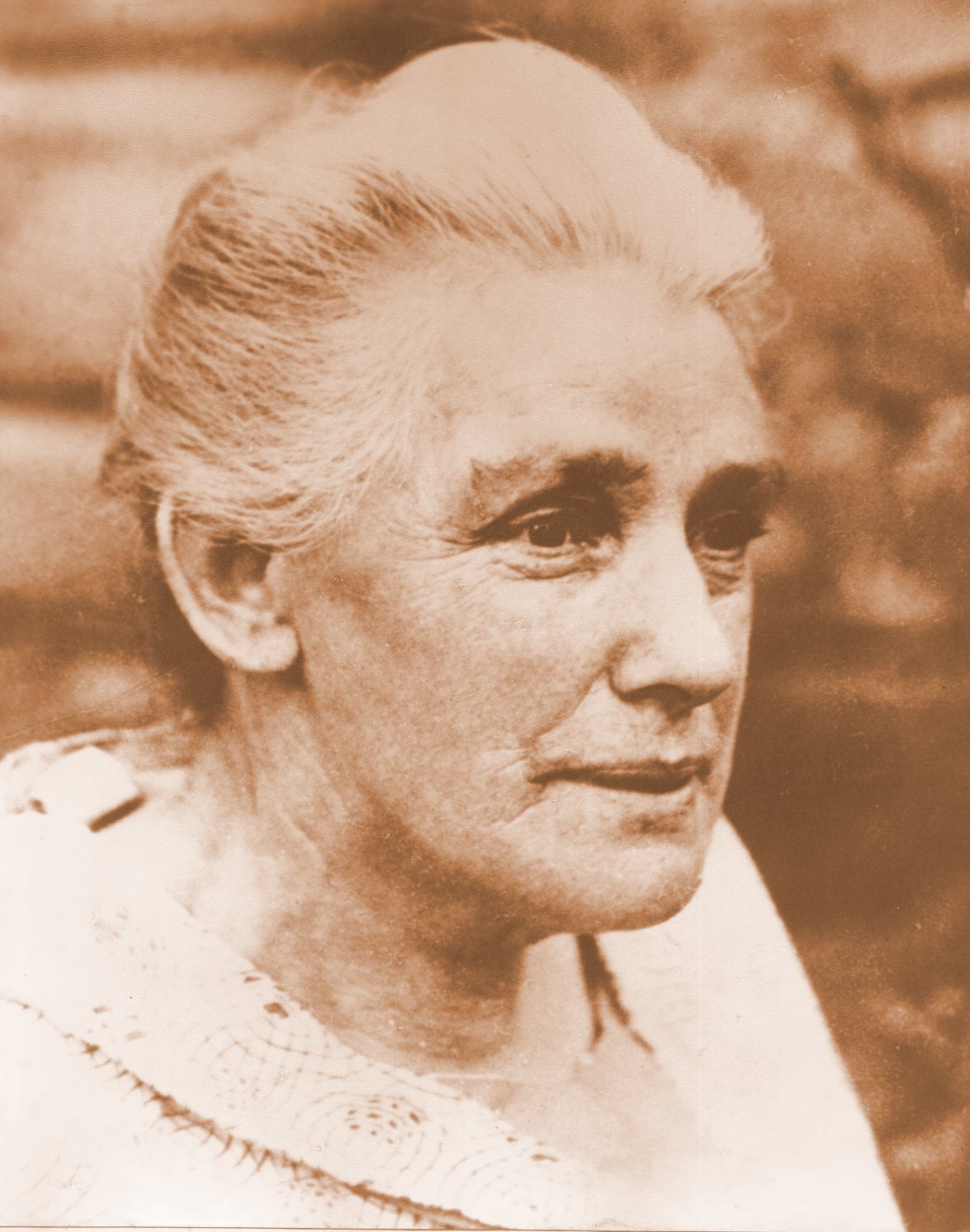 My Grandmother
I have wondered a great deal about what was meant by the resurrection. I know it has to do with love. I feel people apply the term to Christ because the Christ being represents, or is a symbol of, a form of love we sense in ourselves occasionally, and sometimes see in other people. It is the type of love that in its weakest form is seen in the love of parents for their children. It shows itself as the giving that enables a mother to almost totally devote herself to the needs of the helpless and completely demanding life of her baby. It is the ability some fathers have to toil year after year to feed and provide for their children.
But that is its weakest form. That love is often partly instinctive, built into us if we are healthy. Its most profound form is seen in those who reach beyond their love for their children and family, and extend it in depth, not just in duty or to be seen to do good, to people who are not their kin, and from whom no financial, sexual or social advantage is expected.
I sense the resurrection as a form of love that transcends the boundaries of kin, and is not afraid of death or risking of one’s own life for the need of another. In essence, this is the story Christianity tells. Although I am personally uncertain about the existence of an historical Jesus, I can see that as humans, we collectively sense there is a profound wonder in such self-sacrificing love. In sensing this we have created a deeply perceptive mythology around it. The mythology tells us that even if we can allow a little of such love into our life, it will give us entrance into becoming aware of an essence — the spirit — that pervades all existence, and to the survival of bodily death.
To some extent I have to acknowledge that by getting my newborn body to start breathing, my grandmother did raise me from the dead. So my unconscious mind has powerful material around which to create its own personal mythology. But the love I experienced I sense as a force beyond that, and has to be acknowledged too.
In our collective myth of Christ we have created, or witnessed, a being who extends love to all living things, and offers a life beyond death in its existence – the mystical body of Christ. Just as my grandmother lifted me from darkness and death, so Christ is said to lift humankind.
My grandmother took over my care soon after I was born. My mother told me that I slept in the same bed as she did, but one morning she woke and couldn’t find me. She panicked, and then discovered I had slipped out the side of the bed, and was as cold as stone. From that point on my grandmother took charge, which probably did nothing for my mother’s confidence.
I have not recovered memories of this period, but from looking at photographs, I grew from a tiny shrunken little creature into a happy and sometimes radiant looking child with blond hair. Things soon changed though. My grandmother died of a stroke before I was two. So suddenly the great love in my life was gone.
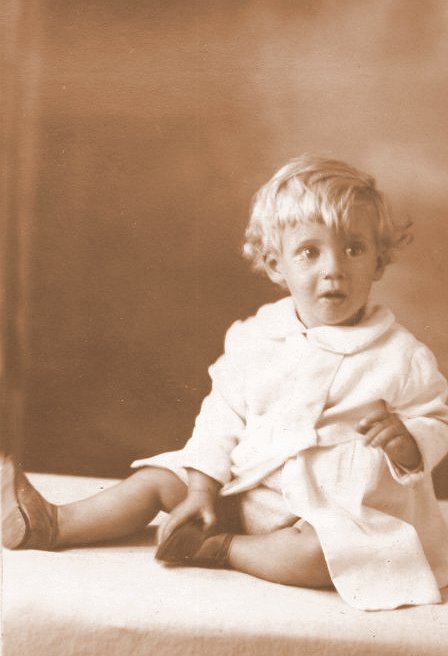
This was such a major event in my life that it left massive residues in strata of my psyche. The petrified remains of that event were only uncovered slowly, plunging again and again into the depths to find the heartbreaking remains of that lost love.
From my teens, through to the time of uncovering these buried feelings connected with my grandmother, I had an almost compulsive religious drive. This was never something leading me to attend church or listen to sermons, or study the Bible. It was a direct need to find God as a personal experience. I wanted to communicate, to meet, and to have a direct confrontation.
Understanding of this drive dawned slowly as I developed the skills of mental archaeology, and learned to carefully brush away the debris of years. My first discovery in this old burial mound was anger. I was angry with God – violently angry. Only slowly were the roots of that anger uncovered.
My grandmother died after a second stroke. As a young child I had no foreknowledge of this, so it was a terrible shock suddenly to no longer be able to find her. Literally she was no longer there. I didn’t even see her dead body, and I feel that was a great mistake on the part of my family. Seeing her corpse would have given me a tangible experience of her death. Lacking that experience she had simply disappeared mysteriously. I was left to seek an answer to this, and when I asked where she had gone was told that my grandmother had gone back to God.
When that one sentence was lifted out of the darkness of years, along with the emotions buried with it, the anger and the compulsive religious search were understood. I was angry with God for taking away the person I loved. I was searching for God because, according to what I had been told, in finding God I would find my grandmother.
It’s crazy how the mind and emotions work, but logical too. As a child I didn’t have the equipment to question the information I had been given. So it was buried intact, still channelling the energy of my drives and emotions until I managed to uncover it and re-evaluate it against a much wider database of experience and information.
Isn’t love a strange and terrible thing to keep a child held to its determined search through the long years into adulthood? Some ghost, some spirit of that small boy that I was, remained waiting in a corner of myself. Waiting and hoping for the return of his beloved grandmother. Waiting and bearing the weight of that waiting each day, gradually becoming walled up in a dungeon of debris dropped by the passing years.
The vulnerable and beautiful spirit of that child, buried in the shadows of myself, was the hidden artist behind much of the beauty and tragedy in the love story of my life. It became known to me in a dream as Lumpkin.
That’s how I waited out the years with my mother. Because I had been so close to my grandmother, in some ways my mother was a stranger. Living with her left the love child in me constantly waiting to go home. There was a feeling in me that if I could wait through this day, maybe today, or the next day, I could go home. If not today, maybe tomorrow I could be with my grandmother!
That feeling of desperate waiting, of feeling I was never “at home”, of constantly wondering where home was, lasted most of my life. A dream I experienced in Italy in 2000 shows the depth and dilemma of this. In the dream I was driving home along a country road. Ahead of me the road forked and I took the right-hand fork. I drove a little further and arrived home. It was a lovely house in its own grounds. My wife and children were happy to see me and came to greet me warmly. But something was wrong. I had no sense that these people were my family. This was not my home, and I hurried away, back to the fork in the road. There I took the left fork. Again I arrived home – another lovely house, another wife and children who warmly greeted me as husband and father. But there was still no feeling in me that I was home. Again I must go to look for where I belonged.
That dream sums up the feelings that haunted me most of my life, and the split shown by the forked road. As with the religious drive, the feeling arose because of my desire to be once more with my grandmother. After all, it was a desire etched into me over many years. Strangely enough, at the time this memory really surfaced, I was living with a friend, being homeless at the time. On the very day it came to light my friend told me I would have to find somewhere else to live. It was so strange it was almost comical.
Therefore, before ever I had any real sense of time or identity, those early experiences set patterns in me that have influenced the rest of my life. My prematurity, with its consequences of unreadiness for an outgoing life that would grasp the world and its opportunities, left a yearning, and I think an open door, to enter into the mysterious in the worlds of the mind and spirit. I wasn’t looking outward to the world. All my energy was flowing backwards into the life of the womb and its dark mystery. And there were negative aspects to that, such as lack of worldly ambition and a failure to understand the needs and functions of placing oneself well in the world to gain financial and social benefits.
What I have gained though, is an extraordinarily rich inner life. I suppose it was also a major factor in my becoming well-known in connection with dreams. Also, for never having any sense that I ought to absorb the subjects offered through schooling, as given by the establishment. But I believe there are other factors not mentioned, that played a big part in that.
The other main pattern put in place by my infant years, was the foundations upon which would be built a terror of losing the one I loved and the compulsion to be loved as desperately and urgently as I myself loved. In this way the scene was set for the drama of my destiny to unfold.
Last Thoughts About Lumpkin
I end by thinking about Lumpkin and realise what a wonderful part of me he is. I have an image of him as the Lion headed dwarf. The tiny malformed being who is yet enormous, with strength, wisdom, and power. He has that in his weakness. And in his love and compassion, he has more strength than soldiers. I have a sense that my female has taken Lumpkin deeply into herself. I have a feeling she is going to carry Lumpkin deep in her being, perhaps into another lifetime. And if that is so, I want her to recognise that Lumpkin has the seeds of enormous strength, great wisdom and love. I know that is why my lover has taken Lumpkin into herself.
Lumpkin is now also flesh of my flesh, blood of my blood.

Here is the Lumpkin dream.
“I believe it was a man, rather shadowy, who gave me a leather pull string purse or pouch. In the pouch was powder that I poured onto my rather stained trousers. Strangely, they looked like the one’s I wear now. Immediately the powder started working like yeast, or at least, I thought of it as yeast. It was cleansing and purifying my trousers in a spreading action. I knew that this yeast, or pollen, had also penetrated my body, and was gradually working through my being, purifying and healing.
I looked at the opening of the pouch, and it was in the shape of a mouth and a vagina. The powder that came out was like millions of living motes, or particles, life giving and alive. I thought at first that using the powder would empty the pouch, but I saw that in fact the living counts replenished itself. They were like sperm or pollen, they regenerated.
Then suddenly the scene shifted and it was later in the day. I was the only person at an eating-place. I heard sounds of people coming, and wasn’t sure if they were friendly or not. So, I acted as if I were working at the place by clearing one of the tables. There didn’t seem to be any proprietors or staff. Then, into the room, or space, because I believe it was outdoors, walked my friend Sheila, with a man who was shadowy, ill-defined, like the man who gave me the pouch. Sheila was now like a warrior figure, a man/woman, the genders blended. I understood, or could see, that Sheila had gone through an incredible journey or adventure. This was like one of the mythological odysseys that had transformed her in meeting its dangers and trials. She was now a very powerful figure. In her hands Sheila carried a tiny being. She held it out to me and said, “Lumpkin has been asking for you.” (Some days before the dream of the pouch and Lumpkin I experience a powerful uprising of feeling and joy. In listening to the feeling I received the distinct message that in four days I would receive a gift. I wondered what this gift might be, and understood that it was something that had always existed, but I had now grown, or opened, to the point where the gift could be received.)
Strangely, since that time, my dreams have given me four gifts – the two books, the pouch, and Lumpkin. None of them are easy gifts, and I am still riding the waves that lift me and thrown me down in my relationship with love and loneliness.
I understood that Lumpkin, this little being, had missed me and wanted to be with me. I held out my arms and took this creature, who was about 10 inches high, with spindly legs and arms. From his appearance he was incapable of individual locomotion. Lumpkin wasn’t a baby, nor an animal, but he was intelligent and could speak. He came to me and I held him, with the feeling we have known each other in the past.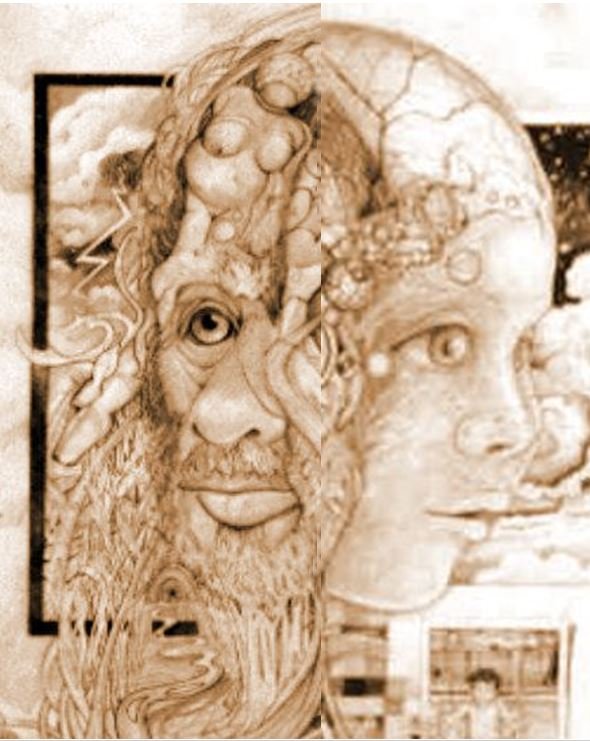 Art by Carlos Caban
In fact what he brings me it is the possibility of the compassion for the helpless and injured. He has, because of his own weakness, a sense of humility that allows a link with other people’s vulnerable and perhaps a hidden, nature.”