Posts Tagged ‘literary criticism’
Lord of the Flies by William Golding
To what extent is the novel concerned with social and historical contradictions in the period after the Second World War?
There is a clear indication in Lord of the Flies that the story deals with war and the effects of war. Even before characters other than Ralph and Piggy have been introduced, Piggy says to Ralph, “Didn’t you hear what the pilot said? About the atom bomb? They’re all dead. “2 This idea of mass death is later modified when Ralph sights a ship’s smoke at sea.3 The war is defined as still continuing by the narrator, and as being near at hand. He says, “… but there were other lights in the sky, that moved fast, winked or went out, though not even a faint popping came down from the battle fought at ten miles height. ” 4
|
Considering this setting to the story I do not feel there is a convincing argument for the novel being a comment on post war events or society in particular. What I will argue for however is that the novel is a many faceted comment on individual human and social conflicts as revealed during the years preceding Golding’s work on the book. These years include the World War II and the post war years. In particular I will explore what I consider to be the main theme of the novel, which is the relationship between various factors of individual and social life, as they are brought into play by powerful external events. In the novel the external events are war, the air-crash, and uncertainty in regard to the future. The factors of ‘individual and social life’ are those to do with cultural attitudes, propensities toward domination, leadership and organising of a social group. But even these issues are not clear-cut. Not only are various and changing responses to being marooned shown in the book, but also there are many different responses to and by individuals and the collective group. Some of these differences and shifts are shown in Ralph’s relationship with Piggy. Early in their relationship Piggy says to Ralph, “We got to find the others. We got to do something. “5 Piggy is obviously worried and wants action to feel assured. Ralph’s response is to ignore him. |
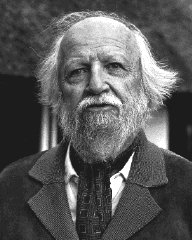
William Golding |
“Ralph said nothing. Here was a coral island. Protected from the sun, ignoring Piggy’s ill-omened talk, he dreamed pleasantly.”6
In this situation Piggy is actively pushing for an organising activity, but Ralph is lethargic and unconcerned. He treats Piggy with some coldness and disdain. At the end of the book however this disdain has completely disappeared, and Ralph is risking his life for the sake of his own conviction concerning social order. This is made clear where Golding writes, “And in the middle of them, with filthy body, matted hair, and unwiped nose, Ralph wept for the end of innocence, the darkness of man’s heart, and the fall through the air of the true, wise friend called Piggy.”7
The friendship between Ralph and Jack – “Jack and Ralph smiled at each other with shy liking”8 – was a friendship which become mortal enmity, and is another example of such shifts. Yet another interesting shift is that the group of choir boys who appear on the scene so disciplined and connected with religion, turn into the group who are highly barbarous.
Listening to some people’s comments on the novel, I have frequently heard the feelings expressed that the book is about violence and barbarism. Certainly it has that feature strongly evident, but in looking not simply at one part of the novel, the violence tends to highlight its opposite – Ralph and Piggy’s attempts to maintain a different social order for instance.
Conversely, Ralph and Piggy’s attempts to maintain this non-violent social order – despite their own frightening traits of violence9 – highlight Jack’s rule using physical force and brutality. So it is not enough to say the story is about barbarism. It would be more correct, but not entirely, to say it is about forms of social order conflicting with each other. The exceptions to this way of considering the novel exist in the figure of Simon and the ‘young ‘uns’. Simon in particular is an interesting character in the story. He is introduced as the boy who fainted,”… the choir boy who had fainted sat up against a palm trunk, smiled pallidly at Ralph and said that his name was Simon.”10 He becomes the companion of both Ralph and Jack, but has a discrete life of his own. That he is killed, and both Jack and Ralph are involved in some degree with his death, suggests unease with individuals who have their identity outside of the group. Piggy’s comment about Simon is, “He’s cracked.”11
Because of space I am purposely leaving out such possibly symbolic aspects of the story as the shape of the island being like a ship; the title of the novel,12 that there are only boys on the island, the various ‘monster’ images, etc. But I do think it is worth bringing in the fact that the island setting, with plentiful food and water easily obtained, and more than enough physical space, does add a particular factor to what happens. Common concepts of the causes of war are of them having economic or territorial roots. The island, however, is a wonderfully easy environment. The boys had no need to fight over food or lack of space. Nevertheless conflict and death ensue. Golding gives us clues to why this conflict emergence throughout the story. When Jack and Ralph first meet there is a direct contest for leadership. When Ralph was elected leader due to a larger vote,”.. the freckles on Jack’s face disappeared under a blush of mortification. ” Ralph senses the problem and quickly says, “The choir belongs to you of course. They could be the army. The suffusion drained away from Jack’s face.”13
 |
This drive for leadership between Jack and Ralph, and through it the power to direct the affairs of the group and be in control of their own life, gradually escalates into direct conflict. But on the way it is met as a power that influences the details of relationship existing between Jack and the group he commands, and Ralph. When there is tension and argument about who will face a presumed ‘monster’ on the island’s mountain, Jack sneeringly says to Ralph, “Don’t you want to go to the mountain?”14 Golding describes Ralph’s response by saying, “Ralph sighed, sensing the rising antagonism, understanding that this was how Jack felt as soon as he ceased to lead.”15 In attempting to bring together these many strands, what stands out for me is the theme of human conflict, and the perversity of human responses in face of conscious ideals. Ralph and Jack can, I believe, easily be seen as representing political organisations or approaches. Jack, with his willingness to dominate others through physical force, even death or threat of death, represents the totalitarian approach, where a dictator requires complete subservience in subjects. Ralph, with his adviser Piggy, attempts to be democratic, being elected by a vote, and allowing each to speak in turn. |
Nevertheless the outsider, Simon, is still put to death. Ralph’s urge for peace also puts himself, Piggy and the younger children at risk, because he does not step in and make a stand against Jack before Jack gains power. This is very like the British people and politicians prior to the Second World War.
If there are direct contradictions depicted in the novel, this attempt to create peace amidst war-like actions is perhaps the most evident, and has certainly been, and still is, one of the greatest problems faced in this century.16 In the novel, Golding has Ralph and Piggy walk right up to the ‘Tribe’s’ stronghold. In finding courage to do this, to find a peaceful solution, Piggy says:
“I’m going to him (Jack) with this conch in my hands. I’m goin’ to say, you’re stronger than I am and you haven’t got asthma. You can see, I’m goin’ to say, and with both eyes. But I don’t ask for my glasses back, not as a favour. I don’t ask you to be a sport, I’ll say, not because you’re strong, but because what’s right’s right. Give me my glasses, I’m going to say – you got to!”17
Piggy, as a figure of moral conscience, is presented as a weak person, using Ralph to be his means of actively influencing the world. He takes the conch, as a symbol of each person’s right to be heard, and respected, and he pits it against a force in human nature that is without conscience or willingness to be moved by rational urgings to do what is ‘right’. He is killed for his efforts.
I see this as a possible comment on the ridiculously difficult, and yet called for action, of a peace-keeping force such as United Nations, to enter a battle arena where both sides are driven in compulsive urgency to wipe out all opposition. If the peace-keeping force hold out the conch shell, will it be any more effective than was Piggy’s effort? As Douglas Heard said on Radio Four recently, “What is one to do, bomb them into submission?”
The solution to this in Golding’s novel is the arrival of a British naval cruiser, and a “naval officer” standing on the beach. This ‘higher power immediately robs Ralph, Jack, and his ‘Tribe’, of their authority, and eliminates their rivalry. Yet it is a vessel of war that brings this peace, an ambassador of war its representative. Here I think is one of the most devastating contradictions faced in this century. In an attempt to keep peace, many or the world’s nations developed and held the most destructive weapons ever known.
So in summarising, I see the implications of the novel as suggesting that when an ‘adult’ – a powerful and organised body of people – is not overshadowing the behaviour of social groups, these polarise into conflicting bodies. A recent example of this is the withdrawal of Russian power from what were colonies, or occupied countries. Schisms formed and bloody war followed. Such groups often develop a sort of organic integrity such as our body does. Individuals or groups exterior to this integrity are sensed as threats – just as our body senses many bacteria as threats and kills them – millions each day. It also appears innate in human beings to elect leaders, and polarise around such leaders, often in opposing groups. Of course, there are many other ways of existing in society, and Golding gives us Simon as one such example. But because of the factor of integrity within groups, such outsiders are often felt as threats by both sides. Hitler’s ‘tribe’ not only killed the Jews, but also any individualists who had their own opinions about his party.
Golding does not appear to work out this difficulty in any other way than restating it in a readable form. His resolution is the re-introduction of the ‘adult’ in war garb.

1 Lord of The Flies – by William Golding. Published by Faber and Faber in 1954. Version used is the paperback edition published in 1958. ISBN: 0-571-08483-4. 2 Page 14.
3 Page 71
4 Page 104
5 Page 15
6 Page 15
7 Page 223
8 Page 25
9 Piggy and Ralph are disturbed by and afraid of their guilt after the death of Simon. Page 172
10 Page 23
11 Page 146
12 The Lord of the Flies is also the name of an Assyrian demon, the Pazuzu. According to the Assyrian mythology, this demon tries to destroy the space of the universe. Golding possibly used this name allegorically (the human nature is the “Lord of the Flies”, the Pazuzu, the creature which is trying to destroy space/the world). Quoted with thanks to Velissarios Valsamas from an Internet page on Golding.
13 Page 24/25
14 Page 130
15 Page 130
16 Northern Ireland, Korea, Viet Nam, African States, Bosnia, Yugoslavia.
17 Page 189
|
|
Gender and Sexuality in Lawrence’s The Fox
A text can represent something by way of a setting. Objects, creatures or even people, can be used to intimate or directly refer to something other than their face value. Also, the interactions between people themselves can suggest even where it does not directly display something. Lawrence appears to use all of these means of representation in the story of The Fox(1), and gives the impression of doing so very consciously.
A setting is something like a stage backdrop, which can immediately, and without any word from the characters, tell us whether it is night or day, safe or dangerous, abroad or near at hand. In The Fox the backdrop has several layers. First to be presented is the farm and the animals, then later the World War and the army camp.
In introducing the reader to the farm, Lawrence carefully puts details into this setting. He tells us that March and Banford, in connection with the chickens kept “were disgusted at the chickens tendency to strange illnesses, at their exacting way of life, and at their refusal, obstinate refusal to lay eggs.” And regarding two cows, Lawrence says, “Then, just before the other beast was expecting her first calf, the old man died, and the girls, afraid of the coming event, sold her in a panic.”
Because the women had already been described as unmarried, childless, and living without male company, the female animals, and the comments about them, suggest particular qualities in the two women themselves. They represent or suggest a rather seedy, neurotic and non-productive aspect of womanhood behind the capable exterior. The dispatch of the cow prior to delivering its calf adds the idea of anxiety in dealing with birth and responsibility for offspring. Lawrence gives us a clue this may refer to March in particular by saying, “Her mouth, too, was almost pinched as if in pain and irony. There was something odd and unexplained about her.” This idea of her strangeness is deepened later by descriptions of her “lapsing into this odd, rapt state, her mouth rather screwed up. It was a question whether she was there, actually conscious present, or not.”
So altogether the farm and its animals seem to represent a distinctly female situation, along with anxieties about difficulties that may attend the function of childbirth. This added to the relationship of the women living alone, may even point to something Lawrence doesn’t say directly, but portrays in events, that there may be a difficulty in relating to men as sexual partners. This I will deal with more fully later.
Into this portrayal of a very female environment, and into the lives of the two women themselves comes the fox. Apart from two old and fatherly men – Banford’s father and the grandfather who died – this is the first potent male figure in the story. We are assured of its gender in the first mention of it – “Since the war the fox was a demon. He carried off the hens under the very noses of March and Banford.”
The fox signifies something that touches March deeply. Through its “sly” “impudent” and exasperating manner, it becomes a focus for March of urges and feelings which arise in her, placing her on a borderline at once exciting and dangerously unknown. The dangerous unknown is maleness outside of her own self. The fox depicts a male-related sexual relationship. This gradually becomes apparent as Lawrence describes the appearance of Henry, and shows how March sees, even smells him as the fox – “She became almost peaceful at last. He was identified with the fox-and he was here in full presence. … She could at last lapse into the odour of the fox.” This says clearly that through the fox the male was present but not clearly so. At Henry’s arrival however, what had been unclear was now real.
The fox as a symbol of maleness – or at least March’s feelings about a male – has the same beauty many symbols have. They awaken us, they frighten us, they suggest strange and wonderful things, but they are never themselves the things they represent. They are wonderfully ambiguous. We can therefore remain slightly distant from the reality.
So in hunting the fox, March is hunting the male. Or at least she is hunting her own feelings, “her consciousness held back” as Lawrence puts it. This act is depicting once more something other than itself – March’s sexuality and her manner of dealing with it. Does she want to kill it? Or does she wish it to live? She is herself uncertain. When she confronts it in the fox she doesn’t even raise her gun till it has casually run away. It is Henry who kills the fox, and if Lawrence is using the creature to represent March’s barely allowed sexual desires, her fantasy of a relationship with a male, then Henry kills this, confronting her with the reality of his desire for her.
Coming more directly to March and Banford, they too may be representations. As characters in dramas so often do, they can be seen to depict different character types. Banford is a more traditional female, frail and needing someone else to care for her, to sympathise with her weakness and needs. She at first has a sisterly relationship with the male – Henry – who appears. March is described as the one who “would be the man about the place.” Gradually she emerges as a woman who has developed greater self sufficiency than Banford, someone who has female warmth and longings, but can also make her own decisions without depending on a male in what had been the traditional female role. So these two women can be seen as representatives of two aspects of character that many a woman found perhaps competing in herself, during and after the first world war. Through earning her own wage, making her own decisions while the husband was away, not simply in the home, but in the environment of work and business, a woman might find herself in conflict. The attitudes and responses she had unconsciously learnt in childhood about being a woman, could be at variance with the new person she was becoming. Therefore the two women are not only of a particular gender, but they also represent different conditions of gender at the time of the story.
If we accept this, the relationship between Henry Grenfel and the two women can be seen as the working out, the portrayal, of a traditional male female relationship within a new social and economic setting. To emphasise what this might do in ones personality Lawrence makes much use of the process of sleep and fighting to stay awake as an image of the competing drives. The following sentences capture this – “March looked back from the door. ‘Jill!’ she cried in a frantic tone, like someone just coming awake. And she seemed to start towards her darling. But the boy had March’s arm in his grip, and she could not move. She did not know why she could not move. It was as in a dream ….”
The struggle between staying awake and falling asleep is depicted as the swing between Banford and Henry, between being a traditional or a new woman. But Lawrence uses this imagery to refer to Henry also. For instance in a passage where Henry first kisses March, Lawrence writes, “When the curious passion began to die down, he seemed to come awake to the world.” Then in the same paragraph the description turns to March and says, “It made her feel so young, too, and frightened, and wondering: and tired, tired, as if she were going to sleep.” At the end of the text the image of sleep is played strongly, with emphasis on what it depicts – “He wanted her to commit herself to him, and to put her independent spirit to sleep.”
In attempting to fit these various parts together, the three way relationship stands out as representative of the difficulties and conflicts faced when a woman of that time developed a new independence. This new self is symbolised by being awake or waking up. March only feels sleep claiming her when she starts to be drawn into a traditional male/female relationship with Henry, or symbolically with the fox. Henry kills both the fox and Banford because they are escape routes for March. The fox was an escape into fantasy, and Banford was an escape into a traditional male/female role – March playing the psychological male. As the drama focuses fully on March and Henry, the imagery of sleep is used to depict March attempting to stay awake – to keep hold of her newly found ability to think for herself and remain independent of the sort of emotional, physical and social ties marriage at that time involved many women in. To remain awake becomes imperative. That Grenfel chose March suggests he too wants something more than a woman like Banford.
Lawrence therefore appears to be dramatising the situation many women and men faced at that period, or were about to face. The message is that a woman would need to remain alert against falling ‘asleep’ – dropping back into the attitudes and responses so ready-made for her. The man would need to remain aware of his own unconscious drive to have the woman ‘yield’ and ‘sleep’ in him – for Henry too fell asleep into his passion for March.
If this alertness were not attended to, conflict would result. I therefore conclude that Lawrence was well aware of this emerging problem, and that he used not only the images of the farm, the farm animals and the fox to depict it, but also the characters of the people involved, and the powerful influence of sleep to take away resolve and awareness when it is most needed.
(1)
D. H. LAWRENCE – Short Stories –Selected and introduced by Stephen Gill, Lincoln College, Oxford. Published by J. M. Dent & Sons Ltd, London, EVERYMAN’S LIBRARY. 1992. ISBN 0 460 87127 7.
Comparison of the Significance of Single Working Women in Two Novels
The Millstone and The Prime Of Miss Jean Brodie.
Although these two novels were published within four years of each other, they provide a fascinating contrast. This is due, I believe, to the different historical period, and the social/geographic situation each novel deals with. Some of the differences of major significance are those to do with motherhood, sexual relationships and work. It is these three areas I aim to deal with in considering the two novels.
The area of work is represented as a problem for Jean Brodie from very early in the text. Talking to the clique of girls who are named the ‘Brodie set’ she says,(3) “We shall discuss tomorrow night the persons who oppose me. … But rest assured they shall not succeed.” This moment of sharing a confidence with girls who had been her pupils is an important and frequently mentioned part of themes the novel unfolds. Although the words ‘We shall discuss’ suggest there will be mutual sharing of ideas, in fact Jean Brodie is usually the information or advice giver, much as parents might be with their children. Like some parents, she also has a direction mapped out for the girls who are her favoured pupils. Her reprimand to an offending girl is therefore a suggestion, frequently repeated, that the girl who has not lived up to her expectation “… will never belong to life’s élite or, as one might say, the crème de la crème.”(4) The idea of this parental relationship is strengthened by such text as, “Miss Brodie’s brood…”(5) where her relationship with her pupils may be seen as one in which she uses them as subjects for her desire to have a special relationship with children. Jean Brodie’s struggle with spinsterhood is not directly mentioned, but there is a hint in the sentences,(6) “I tell you Mr. Geddes, birth control is the only answer to the problem of the working class. A free issue to every household….”
Despite being described as having love affairs, Jean Brodie is nevertheless a childless woman. Apart from the aside about birth control, there is never mention of the difficulty a single but sexually active woman might have in the 1930’s in connection with avoiding pregnancy and the stigma of having an illegitimate child. But Brodie is shown as a woman who navigates such treacherous seas with resolve, vigour and a powerful direction arising from her feelings that a sexual relationship is a thing of romantic passion and art. For instance her first lover’s death is described as falling “like an autumn leaf” and he being one of the “Flowers of the Forest…”(7) Talking about the man she loves but never has sex with – Teddy Lloyd – she says, “I am his muse, but I have renounced his love to dedicate my prime to the young girls in my care.”(8)
The statement that she was giving her ‘prime’ to her girls is a much-repeated phrase. It is nowhere stated that any of the girls asked her to do this. The phrase also suggests that she could have given it elsewhere and that it was something very valuable. The ‘elsewhere’ could have been a male lover who fitted her sense of romantic passion for instance. The constant repetition might also be seen as a sign of uncertainty regarding the very value she claims to be giving. If the references to love, sexuality, work and creativity are a clue, then the uncertainty is in regard to herself as a woman, herself as a spinster, and her relationships with men. The text points to this where it says, “… for in many ways Miss Brodie was an Edinburgh spinster of the deepest dye.”(9)
This idea of an Edinburgh spinster – of the deepest dye – needs defining. Firstly it does not say Jean Brodie is wholly such, but ‘in many ways’. This means we must allow her variations in her character. Considering that toward the end of the novel one of the Brodie set, Sandy, gives thought to the underlying Calvinism, there is an implied connection between Jean Brodie being of Edinburgh stock, and her sometimes Calvinistic response to being a spinster having love affairs. One obvious result is that she would not become the mistress or wife of Teddy Lloyd, because he was married. This is put into words when she says, “But I renounced him. … He was a married man. I renounced the great love of my prime.”(10) She also describes how she ‘managed’ her sexual needs and emotions in renouncing Teddy Lloyd – “I renounced Teddy Lloyd. But I decided to enter into a love affair, it was the only cure.”(11) Although it is not stated directly, the situation seems to be one of great stress. I think this becomes obvious when we read such passages as this expression of Sandy’s thoughts:-
“In this oblique way, she began to sense what went to the makings of Miss Brodie who had elected herself to grace in so particular a way and with more exotic suicidal enchantment than if she had simply taken to drink like other spinsters who couldn’t stand it any more.”(12)
Miss Brodie’s affair with Gordon Lowther was the attempted means of ‘curing’ or coping with her sexual drive, her need for a man she could admire in face of her innate Calvinism, or the Calvinism(13) surrounding her. Not only the affair, but her search for political meaning in Fascism and Nazism, also suggest the stress and hidden pain she was experiencing.
To be even more explicit, Jean Brodie did not fully allow her need for Teddy Lloyd because of the social climate she lived in, and because of her own moral code. To compensate for this and her own spinster’s life, she developed an unusual and in many ways problematical relationship with some of her pupils, as well as an affair with Gordon Lowther. The failure to satisfy her own needs and ideals led also to the side effect of her conflict with authority in her work scene.(14) This unresolved conflict eventually enabled a successful plot to discredit her and thus remove her from her position as teacher.
In comparing the situation of Jean Brodie with that of Rosamund Stacey, Rosamund does not live in a climate where it is so necessary either to avoid a sexual relationship with a married man, or being the parent of an illegitimate child. Jean Brodie is not portrayed as fearing sex, but as living within social and personal attitudes that were critical of what, in the thirties in Edinburgh, were considered ‘looseness’ of character or morals, and of course threatened ones likelihood of employment. An indication that this was an important issue is revealed when the headmistress, Miss Mackay, is questioning Sandy. Mackay is trying to find a way to oust Jean Brodie, and Sandy says, “Yes. But you won’t be able to pin her down on sex. Have you thought of politics?”(15) So Jean Brodie is shown as walking a tightrope, attempting to keep her balance between her personal needs and social/work demands.
Rosamund clearly states her difference. “My crime,” she says, “was my suspicion, my fear, my apprehensive terror of the very idea of sex. I liked men, and was forever in and out of love for years, but the thought of sex frightened the life out of me….”(16) Such statements make the plot believable, enabling Rosamund to have sex, become pregnant, and yet not stay with the father of the child. In lying with her lover, despite great joy, she realises, as she puts it, “I was incapable, even when happy, of exposing myself thus far.”(17) By this she means not exposing her pleasure and desire for him – George – to stay. Unlike Jean Brodie, Rosamund has a place to live despite having almost no income, so events do not push her to grasp at her needs in quite the same way, until she has a baby.
This is quite a different situation. Rosamund nowhere feels her devious forms of love affairs will endanger her work. In her case it is the possibility of having a baby that makes her wonder if motherhood will interfere with her ambitions and work. These are only passing fears however, not, as with Jean Brodie, constants with which she must confront and wrestle again and again.
Both books could be thought of as survival guides for women living alone within particular environments. Rosamund survives her sexual/emotional needs by having two men friends from whom she gets enough cuddles and “enjoyed being in love and being kissed on the doorstep,”(18) even if in general she avoided sex with her men friends. So here is instruction for women who want company but not sexual involvement with its complications and dangers. Jean Brodie manages her environment by bonding with a number of girls and having secret and carefully concealed sex with a male she doesn’t really love.
With The Millstone, the main feature however, is its instruction for the intelligent, capable, female single parent who has supportive parents. Particularly I see the descriptive passages about hospitalisation and dealing with hospital authority as instruction. The “nice woman” who is allowed in to see her sick child, tells Rosamund, “Oh, I got in all right. I made them give it to me in writing before I let him (her baby) in, that I could come. Then all one has to do is show the letter.”(19) Rosamund goes on to say, “That shows foresight. I had to have hysterics.”(20)
Therefore, both books are explicitly about how a single woman can cope with her needs as a human being, needs such as love, company and means of livelihood. The means of coping, of dealing with what arises, is shown through comparing the novels, as being necessarily very different. The dissimilarities arise out of being in social, moral and class settings that require and allow specially adapted behaviour and responses. For instance it would have been unthinkable for Jean Brodie to straightforwardly have an illegitimate child, or openly consort with a married man. She could not extend her period of studying for higher qualification because of her need to earn her livelihood. These issues were not productive of the same sort of stress for Rosamund. Of course, Rosamund’s responses are also well adapted to her social, historical and class possibilities. So the novels, in relationship to each other, also point out the need to be, as it were, street wise, in regard to ones times and possibilities. The books are also handbooks in certain respects, indicating to women who may not have arrived at such pointed awareness, some of the ways of dealing with special needs.
Lastly, both novels show that an attempt to live normally within the social and historical periods dealt with, produced some level of neurosis in the two main characters. I use the word neurosis here to mean inability to be at ease with ones social, work and environmental surroundings. Being at ease means very basic things such as being able to breathe. If breathing is curtailed for more than a minute or so we become deeply stressed. If longer, dead! In lesser degrees the other fundamental needs are to eat, to reproduce, and to have some level of social recognition and company. Many people struggle enormously with their need or desire to eat – either because they cannot economically get enough food, or because they have fears surrounding eating. In The Millstone, Rosamund admits, in the quote already given, that she is terrified of sex. Out of this she avoids close contact in case it will be demanded of her. With Jean Brodie the opposite is true. She wants a sexual relationship, but with a man she respects. As the novel points out early, the man she loved was killed in the Great War. Even her second choice, Teddy Lloyd, had lost one arm in the war. So the environment she must deal with is that of diminished choice because there are few men. This stress compounds into problems related to work and thus her economic welfare. Rosamund’s inability to ask for her needs, her fear of sex, are not, as with Jean Brodie, shown as exterior factors, except inasmuch as they arose from her social/family training and early habits of relationship.
Therefore, not only are the novels about how a single woman can survive in the environments described, but also how she can meet the neurosis/stress such an internal or external environment may give rise to.
Bibliography
Drabble, Margaret. The Millstone. Published by Penguin Books. ISBN: 0-14-002842-0.
Funk and Wagnells New (28 volume) Encyclopaedia on CD ROM as Infopedia. 1994. REF: 0061-0055-07 V1.7.
Spark, Muriel. The Prime of Miss Jean Brodie. Published by Penguin Books. ISBN: 0-14-002235-X.
(1)
Footnotes
Drabble, Margaret. The Millstone. Published by Penguin Books, 1968 – first published 1965.
(2)
Spark, Muriel. The Prime of Miss Jean Brodie. Published by Penguin Books, 1965 – first published 1961.
(3)
Page 9 – 8th paragraph.
(4)
Page 23 – 10th paragraph
(5)
Page 31 – 3rd paragraph.
(6)
Page 43 – 4th paragraph.
(7)
Page 13/13 – last and 3rd paragraph.
(8)
Page 120 – 4th paragraph.
(9)
Page 26 – two-thirds down the first paragraph.
(10)
Page 56 – 6th paragraph.
(11)
Page 60 – 2nd paragraph.
(12)
Page 109 – 3rd paragraph.
(13)
Calvin taught that those people who learn the truth about human depravity, that even the best deeds are tainted and none is pure, can repent and depend on God the Father for salvation. Human sin, inherited from Adam and Eve, produces in each person an “idol factory” Calvin taught also people are predestined either to be saved or dwell in Hell. This pessimistic view is not one to encourage hope.
But another aspects of Calvinism is as follows – Many of the tenets of Calvinism have had profound social implications, in particular, that thrift, industry, and hard work are forms of moral virtue and that business success is an evidence of God’s grace. Because these views helped to create a climate favourable to commerce, Calvinism played a role in the establishment of capitalism.
Paraphrased from Funk & Wagnall’s 28-volume Encyclopaedia – Infopedia, 1994.
(14)
Fritz Perls, the founder of Gestalt Therapy, believed that modern civilisation inevitably produces neurosis, because it forces people to repress natural desires and consequently frustrates an inherent human tendency to adjust biologically and psychologically to the environment. Neurotic anxiety results. From Infopedia – CD ROM – 1994.
(15)
Page 124 – 14th paragraph.
(16)
Page 17 – 2nd paragraph.
(17)
Page 19 – end of 2nd paragraph.
(18)
Page 18 – middle of 1st paragraph.
(19)
Page 137 – 3rd paragraph.
(20)
Page 137 – 4th paragraph.
The Importance of Being Earnest
How do identity and masculinity intersect in the play?
Of The Importance of Being Earnest, Wilde wrote:
It is exquisitely trivial, a delicate bubble of fancy, and it has it’s philosophy … that we should treat all the trivial things of life seriously, and all the serious and studied things of life with sincere and studied triviality.(2)
At first sight The Importance of Being Earnest may appear to be the trivia Wilde claims of it. Despite this it is has been stated as the most perfect play Wilde wrote, and also the best British play of the 19th Century.(3) Although written in a style that makes it appear like an upper class drawing room comedy, it expresses several powerful themes. At the beginning, for instance, one of the major themes is introduced in the conversation between Jack and Algernon. Jack, we learn, at times becomes a young man called Ernest. Algernon, also, leaves one persona to do what he calls Bunburying, and eventually becomes Earnest also.
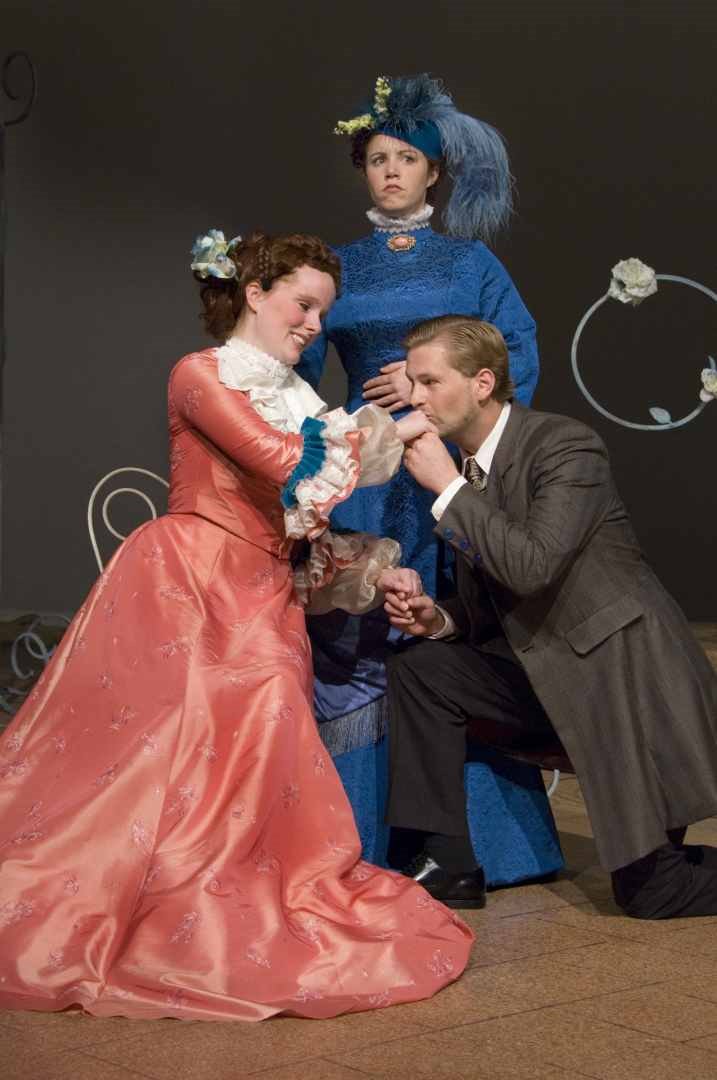 |
Because both Jack and Algernon have this double identity (I class Bunburying as using another identity) we have a clear depiction of the need to have different roles or identities in one situation than in another. Although Algernon is very open about this need, Jack, although he is doing the same thing, doesn’t like it when it is described honestly. The suggestion is that both men find the society and roles they live in restrictive. To be the person they want to be they must lie or deceive. This creates the confusion of a split in social identity, which is humorously dramatised in the events at the end of the play. Humorous though it may be, it dramatises an everyday fact in the lives of many upper class men and women of that time. In an attempt to live what a social role necessitated on one hand, and on the other hand to satisfy their own personal needs, they lived double lives. Jack sums this up in the text by saying, “When one is in town one amuses oneself. When one is in the country one amuses other people. It is excessively boring.”(4) |
This difficulty with a specific identity is heightened in the play by the muddle over who exactly is Ernest. Both men reject and want the name – want it because it is desirable to the woman they wish to marry. But the irony of this is increased by the meanings of the name itself. These are a) serious; ardent or not joking, perhaps even being sincere. b) money paid to confirm a contract, or as an instalment. As the name is a central point regarding marriage to women with money and status, the contract side of the name is relevant. The sincere meaning of the name is an irony in that the men are, to start with, anything but sincere or truthful.
For Jack, the name also links with his lack of information about his birth, and therefore his true family background. This ties the name powerfully with the theme of identity. A factor in this is amusingly enacted when Lady Bracknell questions Jack about his habits, his income and his background. Perhaps this is why Wilde used the word trivia.
JACK. Well, yes, I must admit I smoke.
LADY BRACKNELL. I am glad to hear it. A man should always have an occupation of some kind. There are far too many idle men in London as it is.(5)
After more such frivolous responses to equally ridiculous replies, Lady Bracknell asks Jack about his family background. Despite her willingness to accept Jack as her son-in-law on the basis of replies that show him as a complete loafer, when he gives details of his birth she says:
LADY BRACKNELL. … To be born, or at any rate bred, in a hand-bag, whether it had handles or not, seems to me to display a contempt for the ordinary decencies of family life that reminds one of the worst excesses of the French Revolution. And I presume you know what that unfortunate movement led to? As for the particular locality in which the hand-bag was found, a cloak-room at a railway station might serve to conceal a social indiscretion – has probably, indeed, been used for that purpose before now-but it could hardly be regarded as an assured basis for a recognised position in good society.(6)
JACK. That is nonsense. If I marry a charming girl like Gwendolen, and she is the only girl I ever saw in my life that I would marry, I certainly won’t want to know Bunbury.
ALGERNON. Then your wife will. You don’t seem to realise, that in married life three is company and two is none.(8)
In most of these exchanges Jack is making comments to which Algernon gives clever and perhaps cynical replies. This can be seen as argument, or as a technique to enable the character Algernon to express particular comments about social habits or traditions such as marriage. The suggestion in the above is that there is no real happiness in marriage, and to make it work one must have other people involved, or the excuse to escape its demands. This idea is also suggested later:
|
Oscar Wilde |
|
LADY BRACKNELL. I’m sorry if we are a little late, Algernon, but I was obliged to call on dear Lady Harbury. I hadn’t been there since her poor husband’s death. I never saw a woman so altered; she looks quite twenty years younger.(9) Once more this is a clear suggestion that marriage is a burden, and the woman has regained her life and health now her husband is dead. Taking this together with the text stating how one attains recognition through social status, the implication is that from a mature woman’s point of view, a man is simply someone to gain social respectability and status through, and possibly benefit from economically. From the male point of view – as suggested by the play – a woman is a highly desirable creature. But marriage is something within which one must have plenty of room for independence. True love need not be forever. A cryptic remark to this effect is made by Gwendolen. Having been asked by Jack if her decision about his name is irrevocable, she says: |

GWENDOLEN. I never change, except in my affections.
CECILY. What a noble nature you have, Gwendolen!
These whimsical contradictions in the same sentence occur too often to be an accident. They lead one to look behind the stage curtain of the wit to see from what it arose. I never change except in my affections – means there is no constancy; although it also suggests the speaker believes they are in some way constant. Looking to an overall sense of the play from this and the other quotes, and aligning it with the question of identity and masculinity, some things stand out. The flippancy hides a deep cynicism or self doubt. The humour, if it is reduced to straightforward statements, is saying that relationships, social status, money as a means of personal worth, are all shams and are ridiculous.
Those may be criticisms or mockery of the society or upper class of the time. But there is a more profound suggestion to be found, not so much in any one statement in the text, but in the very farcical nature of the statements made. Behind the frippery, hiding behind the lightness and froth, is a darkness of spirit. This is seen in the suggestion that a man can find no satisfying identity except by the use of profound intellectual wit. Life, relationships, status, have no meaning, so the wisest thing is to mock them. “… that we should treat all the trivial things of life seriously, and all the serious and studied things of life with sincere and studied triviality.” “Sincere and studied triviality” – those are the key words. Scorn all of it. Stand aside and mock, but do so with great intellect, or else you too are a fool and trivial.
Ref: 1 – 2
Bibliography
Edward W. Said. The World, The Text and the Critic. Vintage. UK. 1991.
Infopedia UK ’96. Hutchinsons New Century Encyclopaedia. CD ROM edition.
Oscar Wilde. The Importance of Being Earnest – the Project Gutenberg Etext of the play, scanned and proofed by David Price ccx074@coventry.ac.uk. Website – http://www.promo.net/pg/.
Oscar Wilde. The Importance of Being Earnest. Penguin Books. UK. 1994.
The Importance of Being Earnest. Notes by Christopher Nassaar. Longman. UK. 1980.
(1)
Notes
Oscar Wilde. The Importance of Being Earnest. Penguin Books. UK. 1994.
(2)
Oscar Wilde. The Importance of Being Earnest. Penguin Books – frontispiece.
(3)
“… his masterpiece” – frontispiece The Importance of Being Earnest. Penguin Books. “It stands today as the best play that Great Britain produced in the nineteenth century.” Christopher S. Nassaar . The Importance of Being Earnest. Longman. UK. 1980.
(4)
Oscar Wilde. The Importance of Being Earnest. Penguin Books. Page 8.
(5)
Oscar Wilde. The Importance of Being Earnest. Penguin Books. Page 20.
(6)
Oscar Wilde. The Importance of Being Earnest. Penguin Books. Page 22.
(7)
The Importance of Being Earnest. Notes by Christopher Nassaar. Page 34.
(8)
Oscar Wilde. The Importance of Being Earnest. Penguin Books. Page 14
(9)
Oscar Wilde. The Importance of Being Earnest. Penguin Books. Page 15.