Posts Tagged ‘resurrection’
The Archetype of Rebirth or Resurrection
The symbols of rebirth are: The cave; an egg; spring; the tree; the cross; dawn; emerging out of the sea; the snake; the bird; a seed; arising from the earth or faeces; green shoot from a dead branch or trunk; phoenix; drinking alcohol or blood red wine; flame; a pearl; the womb.
Rebirth is the Death of the Old Life
Rebirth is as difficult to face as death. It holds within it not just the memories of the struggles and difficulties of our own physical birth and growth, but also the challenge of becoming the unknown future, the dark possibility, the new. The dream of Andrew in the underground cavern below, is an example of positive rebirth. After realising himself as bodiless awareness he emerges from the cave, and finds himself near a tree.
Example: ‘A tremendous jolt of power poured into me from the tree. I saw that we had arrived at a place where a line of trees, about a 100 yards in length, stood very close together in a slight semicircle on the top of a bank. The trees had great spiritual power and the place was a holy temple. Two spiritual beings were there – an ancient Earth Being, and Christ.’ Andrew.
The next example is of a dream typical of meeting memories of physical birth. As can be seen, the experience is powerful enough to cause physical shaking.
Example: ‘All I can see of what I enter is a very narrow space with a light showing through. But immediately I enter I realise I have made a mistake for I am being forced swiftly through a dark, very narrow tunnel. I feel pain as I am dragged along and I hear loud banging noises which frighten me, but although they are loud they seem to come from inside my head. I feel terrified and breathless and very relieved when I wake before reaching the end of the tunnel. In fact as I write this account I am shivering.’ Female. Anon.
We usually face a deeply felt experience of death before encountering the archetype of rebirth. Neither the death nor the rebirth or resurrection are things that happen quickly. There may be dreams, waking subjective experiences or a short period in ones life when death or rebirth are felt very strongly – but the process as a whole is a psychological one which may take years to unfold and stabilise. With many experiences of archetypal nature, such as entering puberty and meeting the process that unfolds manhood or womanhood, we are working out psychic growth which involves our entire nature. Puberty is an excellent example of how an archetypal human process works in us individually, yet is very unique for each of us. At the same time however, while puberty is a well worn path which virtually everyone travels, some aspects of human possibilities, like death and rebirth, are not universal. Only comparatively few people really manage these points of growth.
Here is a very clear example of death and rebirth. It occurred when the man explored a dream of entering an old house that was lived in previously by his ancestors. Puma was a great cat that had leapt on him as he started his journey. Lurch was a figure representing the guardian of the threshold:
I started by imagining myself standing in the shadows of the house with Puma and Lurch. Then we walked together into the darkness. The subjective images took on a life of their own and I saw we were walking in a large underground space like great catacombs. The light was dim but we could see our surroundings, and not very far into the cave like space was a tomb on our right. It had the form of a low wall about a foot high in an oblong, and the wall surrounded a long stone in the centre, which was roughly body shaped.
As we drew level with the tomb an enormous change occurred in me. Suddenly I became a woman. It was no longer imagination. I was now completely experiencing myself as a woman whose tomb we had approached. As such I was torn by an immense pain of loss. As my complete identification deepened my body curled up with the pain as I was torn by wretched crying. Suzanne told me my voice changed as I cried out again and again for release from the pain of losing all my children, my husband, even my parents. My hands were clawing my legs in an effort to express the misery, and I was screaming that I could not bear to live any longer with such pain. I cried out to God to take me, for there was nothing left for me to live for. “Why? Why did this happen to me? Why has everything I loved been taken from me?”
There was no response to these awful cries and tearing sobs. But slowly a shift began. It seemed to me as an observer witnessing this awful pain, that by entering this place the spirit of that woman had woken in me. But as she had died in such unresolved agony of loss, that is what was met when she awoke. But gradually she realised she was alive again in a new way. She began to recognise that I was holding her within me. Because I was not frightened of pain and emotions, the misery could play itself out in me. And because my understanding of what was happening flowed into her awareness, she slowly saw and felt her loss in a different way. In fact we were both realising she was experiencing resurrection, and that in turn meant there was no final death as believed by many. Therefore there was no loss as she had originally felt it.
At this point something truly incredible occurred. She and I both realised she was one of my past dwelling places – past lives. But for her the viewpoint was slightly different; for she saw me as a continuation of a life that she had failed to be a part of because of the awful pain of loss. It had kept her from flowing into what was her future as my life.
From my perspective she was one of the past dwelling places the spirit that was at the core of my present personality had lived in and as. She was not one of my lives, because the personality that I am was unique and had not lived that woman’s life, but my spirit had. Because she was now part of me and me of her I asked her what she had brought into my life. Her reply was, “A woman’s love”.
Example: I’m imagining Christ emerging from the grave. Who is he now? Not the man he was even if he looks the same and more or less has the same qualities which you do and you don’t. So I think death needs to be factored in whenever there’s a break in the reality that you knew, and it’s not just you have to know it, but everyone around needs to know it. I’m reminded of after my father died, that when I met people, I felt I couldn’t be with them until I said that my father had died because that had changed everything and they couldn’t possibly know I was without that. So in the same way, anyone who’s died and come back is not the same.
I suppose I can say that whatever happens to you, even if the worse happens, you have something that can re-grow you, if you’ve lost everything, that means you haven’t lost everything, that basic clear quality, maybe it’s a new form, maybe it has gone on a few steps, but it’s still there if you listen to it. Don’t struggle with it unless it is a struggle, let it happen, don’t make it a big fight because you may be fighting against what is emerging.
The Great Cycles of Life
The cycle of death and rebirth happen mostly to people passing from adult maturity to old age. It connects with physical and psychological changes to do with altered relationship with life and society, and with ones own body and self image. The cycle may appear in young people however, if they face death, physically or in a deeply psychological way. In ageing ones relationship with children or procreation alters. Whereas they were at one time consuming and motivating drives, they are no longer sustaining or motivating. Work and ones relationship with society may also undergo a similar change. The identity one gained from having a place in society, and connections with other people through being a mother or in ones work, falls away. The personality, the attitudes, the hopes and ambitions built from the many years of life as a procreative, creative person meshed into society, dies through the lack of a relationship with the world that sustains it. This ‘death’ may be very painful, creating a great and sometimes crushing sense of pointlessness, of having no value in the world, of having nothing to live for. In some cases these feelings are triggered by the onset of menopause in women, or impotence in men – but also for men the absence of a sexual life or family life, or simply the process of ageing.
One man described it as, “The feeling of being paralysed, or being unable to move. It is not so much a physical impediment, but a sense of having no motivation, no ability to want anything, no drive to reach out.”
Fears may arise as to what is happening. Such fears are based on concepts we hold regarding ageing or death. The loss of identification with oneself as a procreative and higly motivated person may seem to be a sign of emerging incapability or even senility. The fear then sets up a conflict with the process of psychic growth.
A woman who had worked as a nurse, describes her experience of this as, “‘The feelings I have about dying, about losing my drive to live, link with ideas of being incapable as one is in hospital. Those are feelings or ideas I connect with it. Those images have made it – or are making it – hard to meet.”
However, such a felt death is only a precursor to the experience of resurrection, and this leads toward a new relationship with oneself and the world. The attitudes and way of life that was necessary as a procreative, work oriented individual whose self image was largely based on family background, physical looks, sexual potency, ability to get the goods of the world or gain power, steadily shifts. It moves toward a sense of self that is centred more on what there is on ones existence that is more timeless and less ravaged by change than the body, the emotions, ones intellectual concepts and the social scene.
Have I Lost Everything?
The change that takes place in this experience of an inwardly felt death, may at times feel like losing everything, shedding the past, becoming completely insecure. It usually leads to the realisation in ones life of parts of oneself that were never lived before, or never allowed expression before. There is not in the end a loss of anything, only a gaining that requires one to let go of the dominance of what was previously important. From this arises a feeling of wholeness and connection with the world and self in a new way. In her book about the individuation process, Jolande Jacobi says, ‘…. transformation is an integral component of the individuation process, which in turn follows a line of development whose goal is psychic-totality.’
Example: Last night, I very vividly had a lucid dream, where I saw a pregnant (very pregnant) women hanging from a rough rope in a bathroom. The bathroom was unfamiliar to me.
A dream expressive death and rebirth. The rope was death, the pregnancy was rebirth.
There is however, no final death or rebirth. The cycle is a fundamental process in nature, and therefore active too in the physical and psychological nature of humans. It is not only old age or approaching death causing the experience to arise. It can also happen during profound personal growth, when old fears, traumas and habits fall away and allow a completely new relationship with sexuality, with work, with being alive.
See: Life and Death.
Lumpkin – The Baby Who Became Tony
I existed long before my conception and birth. What was new was this particular body conceived by a young country girl, fathered by the son of an Italian immigrant to England, and born in Amersham just before the Second World War. It was a completely new configuration.
There are memories of being in the womb, feeling like the yolk of an egg. My genitals were the pulsing centre of that yolk, and they pulsed with gentle pleasure in time with my tiny heart. There was no sense yet of being a person, but there was an integrity that gave a feeling of being something different to other things in my awareness. And there was sense of love. It came to me in waves as the beating of my small heart roused pleasure in the centre of me, pleasure raised high as my mother’s heart and mine beat together while the two rhythms crossed.
Birth is seldom ever completely commonplace to its witnesses, and certainly not to the baby being born. Sometimes we have the strangely naïve attitude that this is a new being who has entered the world. But what is there new in nature? Can we say, if we plant an acorn, that the oak tree growing is new? Well, yes. The body and leaves of the tree will be unique. But millions of years in the lives of other trees are involved in the growth of this particular oak. It cannot, it hasn’t, simply emerged from itself, for each of us have a history of our beginnings started from the single cells from which all started. What an incredible journey we have all been on!!!
Whatever way we explain birth, the baby carries with it the influences of an immense number of men and women who lived, struggled, loved, in the past.
I have memories of my birth. Not as pictures in my mind, like old photographs. I remember through the pain in my guts, and through my feeling response to some situations. I remember because the experience of that birth sometimes wells up like a great tide overwhelming my normal, everyday, self.
My tiny body was born two months early, apparently dead. I was told the doctor threw my body to one side, saying, “Forget the baby. We need to look after the mother.” The doctor’s words were not flung out casually. I was born in the thirties, prior to intensive care units for premature babies – prior to antibiotics. Each of us is a witness to our times. We all exist within a huge web of influences and understandings, and if I try to grasp the view from which the doctor’s words arose, there is sense in what he implied. If we have children and say to one of them as he or she goes out the door, “Be careful”, we don’t need to mention all the things in today’s world that one needs to be careful of. If the child is old enough to manage the streets alone, they can already fill in most of the details about dangers they should avoid, such as drug pushers, muggers, child molesters, and other violent children. So the doctor was saying to my mother, “Within this present social and medical situation your baby has little chance of survival. If it does survive it will be weak. Let this one die and have another one.”
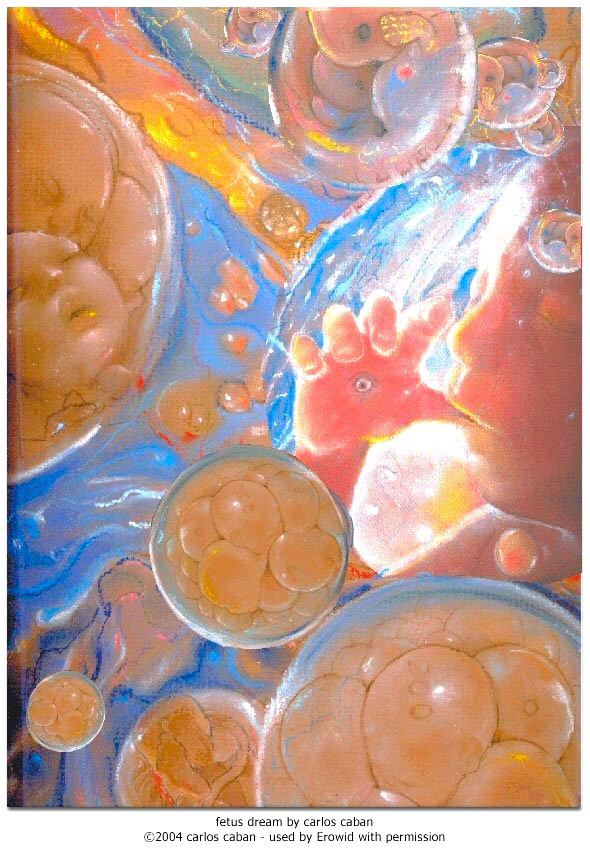 |
It wasn’t an auspicious beginning, but my grandmother carried off the limp body and managed to provoke breathing.I have a sense — I cannot call it a clear memory — that in reviving me, my grandmother baptised me in case I died. She blessed me with her love, and marked a cross on my forehead in oil and water. That mark has remained in my being indelibly, having been given with true love. It has opened connections to me with mysteries I might otherwise not have known. |
It wasn’t just my body that was impressed with the experience of birth. There are levels of awareness in us right from conception, along with the learning of responses to what is confronted. Not only does the unborn body mature in readiness for birth, so does the awareness, the receptive sentience.
In my 40s, when I traced back troublesome reactions to everyday life events, I discovered memories of the period just after birth. I found the experience of being a tiny vulnerable creature, and as that creature I was very definitely reacting to a feeling of awful exposure, even though I didn’t know myself as Tony.
Remember that in the womb my small being did not need to breathe. Food did not have to be taken in and digested. There was a stable temperature, so no exposure to temperature shifts. My nervous system was geared to survive, and in some way respond to stimuli. There was no assault of powerful and unknown sounds in the womb – sounds such as birdsong, dogs barking, house sounds. Also, in the womb one is buffered against bacterial and viral attack.
A baby is aware of all these in its own way. It has a functioning brain and nervous system that is already learning — not in words, but certainly feeling responses.
What I recall from that early period after birth — recall and put into words by my adult self — is of being afraid I could not survive in this new environment. At the time of my birth there were no intensive care units to plug my tiny body into a drip feed or oxygen tent, or an incubator to keep me warm. Neither were there antibiotics to help fight the deadly diseases so many infants and children of the time were laid low by. At that time premature babies were very likely to die.
So I couldn’t breathe easily. I couldn’t digest easily, and I was deeply anxious about the strange sounds around me. A tremendous feeling response took place in my tiny self. As an adult we would call this a decision. But in my infant self it had nothing to do with thinking or analysing. It was a total feeling and fear response. It was a rejection of life. A turning away from scrambling, struggling, for survival. I didn’t want to be in the world. I wanted to remain in the egg!
The effect this had on my adult behaviour was that I never developed the ambition to “get somewhere in life.” Just existing felt like an enormous struggle, an exhausting struggle. I turned away from opportunities because they needed involvement and participation. I didn’t want to be involved, and often had to crash out of social activities, as I did not have the coping mechanisms to engage in ordinary social events.
There was also, in my budding awareness, a sense of death. Even though my body was ill prepared for life outside the womb, it still functioned strongly enough to stand between me and death. But death felt very close. I needed to be back in the womb, kept warm, protected and given a chance to grow undisturbed. Second-best would have been to be held skin to skin against my mother’s body and breast, a sort of constant drip-feed in a warm environment. Unfortunately that did not happen. She was a working mother dashing back from work to breast feed me.
I gather from these memories, and the feelings accompanying them, that my mother, being young and inexperienced — I was her first and only child — was frightened by my fragility. All her sisters had produced heavy full-term babies. So she may even have felt lacking in some way. And I felt something of this anxiety. My own struggle, and feelings that death was sniffing around me like a waiting hyena, were not held at bay by my mother’s anxiety. As the little budding me existed beyond any sense of time there was no knowledge that things could change, only a feeling of impending doom.
Then a truly life changing event occurred. I have no awareness at all of its place in the sequence of things. But picture if you can this vulnerable and helpless creature, this spark of life and awareness not ready to deal with independent life, retreating from it, yet not wanting to die. And my spark of awareness, my forming sense of myself, is afraid, and feels alone in this fear, alone in the dark, with death as a predator sniffing around. Then suddenly I am picked up and held in arms that are strong; held by a being of love who is not afraid of death, and communicates love and courage to me. Communicates so profoundly that I feel I am in the arms of a higher being, a being who has lifted me out of darkness and fear, and has driven away skulking death itself. So I cry out to this being with the only passionate sound I can make, the panting, weeping of an infant. But if there had been the gift of words I would have been looking into the eyes of this being, crying out, “I love you! I love you! I am bonding with you! I am connecting with you forever!”
When I remembered this, when I re-experienced the moment as an adult, I too bawled like a baby, and felt the exquisite love and strength, the relief from darkness, of those moments. In fact I still weep as I write these words, for that experience was so profound.
That was my second, and most deeply felt experience of love. It was also the first, and perhaps most fundamental, experience of religious awe. It stands as some sort of nucleus in the development of myself as an adult personality. It is a touchstone against which is tested any meeting I have with love. Also, when I first re-experienced this event it was accompanied by a revelation, a certainty, that this was the resurrection.
The wonderfully loving higher being who had the power to lift me beyond the reach of death, was of course my grandmother. She was the mother of 13, some of whom had not survived. My mother was the youngest, born on the eve of the Great War. My grandmother did not have long to live herself, but I think had developed that serenity, not of the mind, for I doubt she was a thinking person, but of the heart, that comes with deep acceptance. I also have a feeling out of these experiences, that she was the heir to the wisdom gathered by a long line of women who were her ancestors. I don’t see this wisdom passed on verbally, because I doubt it was ever put into words. It was passed from eyes to eyes, from heart to heart. It was passed in the passionate responses to hard times and loss and love. And I feel my grandmother baptised me in the essence of it, and I am blessed for all time.
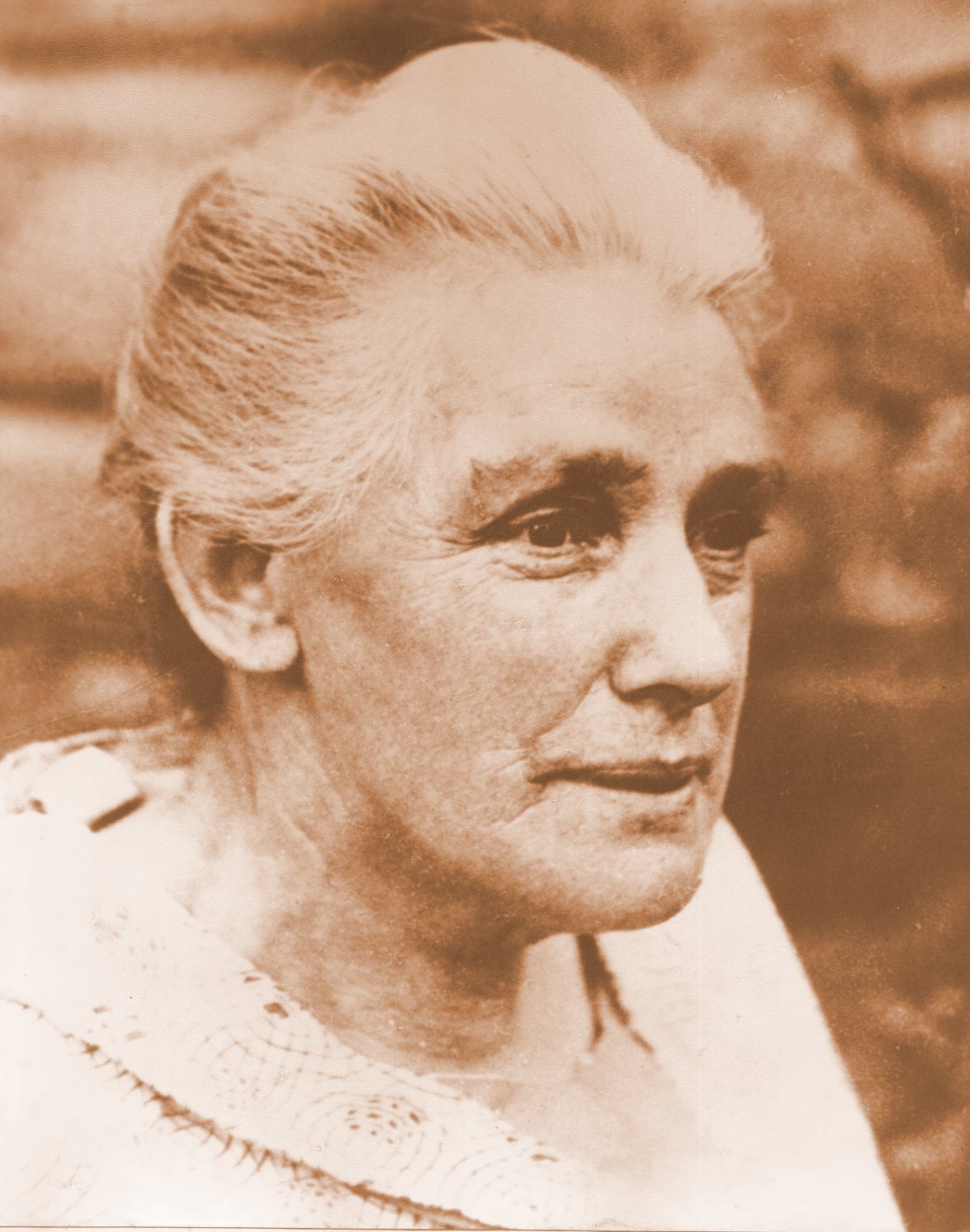 My Grandmother
I have wondered a great deal about what was meant by the resurrection. I know it has to do with love. I feel people apply the term to Christ because the Christ being represents, or is a symbol of, a form of love we sense in ourselves occasionally, and sometimes see in other people. It is the type of love that in its weakest form is seen in the love of parents for their children. It shows itself as the giving that enables a mother to almost totally devote herself to the needs of the helpless and completely demanding life of her baby. It is the ability some fathers have to toil year after year to feed and provide for their children.
But that is its weakest form. That love is often partly instinctive, built into us if we are healthy. Its most profound form is seen in those who reach beyond their love for their children and family, and extend it in depth, not just in duty or to be seen to do good, to people who are not their kin, and from whom no financial, sexual or social advantage is expected.
I sense the resurrection as a form of love that transcends the boundaries of kin, and is not afraid of death or risking of one’s own life for the need of another. In essence, this is the story Christianity tells. Although I am personally uncertain about the existence of an historical Jesus, I can see that as humans, we collectively sense there is a profound wonder in such self-sacrificing love. In sensing this we have created a deeply perceptive mythology around it. The mythology tells us that even if we can allow a little of such love into our life, it will give us entrance into becoming aware of an essence — the spirit — that pervades all existence, and to the survival of bodily death.
To some extent I have to acknowledge that by getting my newborn body to start breathing, my grandmother did raise me from the dead. So my unconscious mind has powerful material around which to create its own personal mythology. But the love I experienced I sense as a force beyond that, and has to be acknowledged too.
In our collective myth of Christ we have created, or witnessed, a being who extends love to all living things, and offers a life beyond death in its existence – the mystical body of Christ. Just as my grandmother lifted me from darkness and death, so Christ is said to lift humankind.
My grandmother took over my care soon after I was born. My mother told me that I slept in the same bed as she did, but one morning she woke and couldn’t find me. She panicked, and then discovered I had slipped out the side of the bed, and was as cold as stone. From that point on my grandmother took charge, which probably did nothing for my mother’s confidence.
I have not recovered memories of this period, but from looking at photographs, I grew from a tiny shrunken little creature into a happy and sometimes radiant looking child with blond hair. Things soon changed though. My grandmother died of a stroke before I was two. So suddenly the great love in my life was gone.
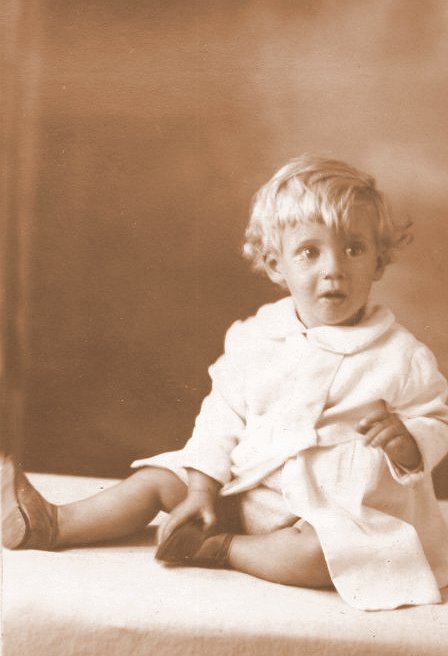
This was such a major event in my life that it left massive residues in strata of my psyche. The petrified remains of that event were only uncovered slowly, plunging again and again into the depths to find the heartbreaking remains of that lost love.
From my teens, through to the time of uncovering these buried feelings connected with my grandmother, I had an almost compulsive religious drive. This was never something leading me to attend church or listen to sermons, or study the Bible. It was a direct need to find God as a personal experience. I wanted to communicate, to meet, and to have a direct confrontation.
Understanding of this drive dawned slowly as I developed the skills of mental archaeology, and learned to carefully brush away the debris of years. My first discovery in this old burial mound was anger. I was angry with God – violently angry. Only slowly were the roots of that anger uncovered.
My grandmother died after a second stroke. As a young child I had no foreknowledge of this, so it was a terrible shock suddenly to no longer be able to find her. Literally she was no longer there. I didn’t even see her dead body, and I feel that was a great mistake on the part of my family. Seeing her corpse would have given me a tangible experience of her death. Lacking that experience she had simply disappeared mysteriously. I was left to seek an answer to this, and when I asked where she had gone was told that my grandmother had gone back to God.
When that one sentence was lifted out of the darkness of years, along with the emotions buried with it, the anger and the compulsive religious search were understood. I was angry with God for taking away the person I loved. I was searching for God because, according to what I had been told, in finding God I would find my grandmother.
It’s crazy how the mind and emotions work, but logical too. As a child I didn’t have the equipment to question the information I had been given. So it was buried intact, still channelling the energy of my drives and emotions until I managed to uncover it and re-evaluate it against a much wider database of experience and information.
Isn’t love a strange and terrible thing to keep a child held to its determined search through the long years into adulthood? Some ghost, some spirit of that small boy that I was, remained waiting in a corner of myself. Waiting and hoping for the return of his beloved grandmother. Waiting and bearing the weight of that waiting each day, gradually becoming walled up in a dungeon of debris dropped by the passing years.
The vulnerable and beautiful spirit of that child, buried in the shadows of myself, was the hidden artist behind much of the beauty and tragedy in the love story of my life. It became known to me in a dream as Lumpkin.
That’s how I waited out the years with my mother. Because I had been so close to my grandmother, in some ways my mother was a stranger. Living with her left the love child in me constantly waiting to go home. There was a feeling in me that if I could wait through this day, maybe today, or the next day, I could go home. If not today, maybe tomorrow I could be with my grandmother!
That feeling of desperate waiting, of feeling I was never “at home”, of constantly wondering where home was, lasted most of my life. A dream I experienced in Italy in 2000 shows the depth and dilemma of this. In the dream I was driving home along a country road. Ahead of me the road forked and I took the right-hand fork. I drove a little further and arrived home. It was a lovely house in its own grounds. My wife and children were happy to see me and came to greet me warmly. But something was wrong. I had no sense that these people were my family. This was not my home, and I hurried away, back to the fork in the road. There I took the left fork. Again I arrived home – another lovely house, another wife and children who warmly greeted me as husband and father. But there was still no feeling in me that I was home. Again I must go to look for where I belonged.
That dream sums up the feelings that haunted me most of my life, and the split shown by the forked road. As with the religious drive, the feeling arose because of my desire to be once more with my grandmother. After all, it was a desire etched into me over many years. Strangely enough, at the time this memory really surfaced, I was living with a friend, being homeless at the time. On the very day it came to light my friend told me I would have to find somewhere else to live. It was so strange it was almost comical.
Therefore, before ever I had any real sense of time or identity, those early experiences set patterns in me that have influenced the rest of my life. My prematurity, with its consequences of unreadiness for an outgoing life that would grasp the world and its opportunities, left a yearning, and I think an open door, to enter into the mysterious in the worlds of the mind and spirit. I wasn’t looking outward to the world. All my energy was flowing backwards into the life of the womb and its dark mystery. And there were negative aspects to that, such as lack of worldly ambition and a failure to understand the needs and functions of placing oneself well in the world to gain financial and social benefits.
What I have gained though, is an extraordinarily rich inner life. I suppose it was also a major factor in my becoming well-known in connection with dreams. Also, for never having any sense that I ought to absorb the subjects offered through schooling, as given by the establishment. But I believe there are other factors not mentioned, that played a big part in that.
The other main pattern put in place by my infant years, was the foundations upon which would be built a terror of losing the one I loved and the compulsion to be loved as desperately and urgently as I myself loved. In this way the scene was set for the drama of my destiny to unfold.
Last Thoughts About Lumpkin
I end by thinking about Lumpkin and realise what a wonderful part of me he is. I have an image of him as the Lion headed dwarf. The tiny malformed being who is yet enormous, with strength, wisdom, and power. He has that in his weakness. And in his love and compassion, he has more strength than soldiers. I have a sense that my female has taken Lumpkin deeply into herself. I have a feeling she is going to carry Lumpkin deep in her being, perhaps into another lifetime. And if that is so, I want her to recognise that Lumpkin has the seeds of enormous strength, great wisdom and love. I know that is why my lover has taken Lumpkin into herself.
Lumpkin is now also flesh of my flesh, blood of my blood.

Here is the Lumpkin dream.
“I believe it was a man, rather shadowy, who gave me a leather pull string purse or pouch. In the pouch was powder that I poured onto my rather stained trousers. Strangely, they looked like the one’s I wear now. Immediately the powder started working like yeast, or at least, I thought of it as yeast. It was cleansing and purifying my trousers in a spreading action. I knew that this yeast, or pollen, had also penetrated my body, and was gradually working through my being, purifying and healing.
I looked at the opening of the pouch, and it was in the shape of a mouth and a vagina. The powder that came out was like millions of living motes, or particles, life giving and alive. I thought at first that using the powder would empty the pouch, but I saw that in fact the living counts replenished itself. They were like sperm or pollen, they regenerated.
Then suddenly the scene shifted and it was later in the day. I was the only person at an eating-place. I heard sounds of people coming, and wasn’t sure if they were friendly or not. So, I acted as if I were working at the place by clearing one of the tables. There didn’t seem to be any proprietors or staff. Then, into the room, or space, because I believe it was outdoors, walked my friend Sheila, with a man who was shadowy, ill-defined, like the man who gave me the pouch. Sheila was now like a warrior figure, a man/woman, the genders blended. I understood, or could see, that Sheila had gone through an incredible journey or adventure. This was like one of the mythological odysseys that had transformed her in meeting its dangers and trials. She was now a very powerful figure. In her hands Sheila carried a tiny being. She held it out to me and said, “Lumpkin has been asking for you.” (Some days before the dream of the pouch and Lumpkin I experience a powerful uprising of feeling and joy. In listening to the feeling I received the distinct message that in four days I would receive a gift. I wondered what this gift might be, and understood that it was something that had always existed, but I had now grown, or opened, to the point where the gift could be received.)
Strangely, since that time, my dreams have given me four gifts – the two books, the pouch, and Lumpkin. None of them are easy gifts, and I am still riding the waves that lift me and thrown me down in my relationship with love and loneliness.
I understood that Lumpkin, this little being, had missed me and wanted to be with me. I held out my arms and took this creature, who was about 10 inches high, with spindly legs and arms. From his appearance he was incapable of individual locomotion. Lumpkin wasn’t a baby, nor an animal, but he was intelligent and could speak. He came to me and I held him, with the feeling we have known each other in the past.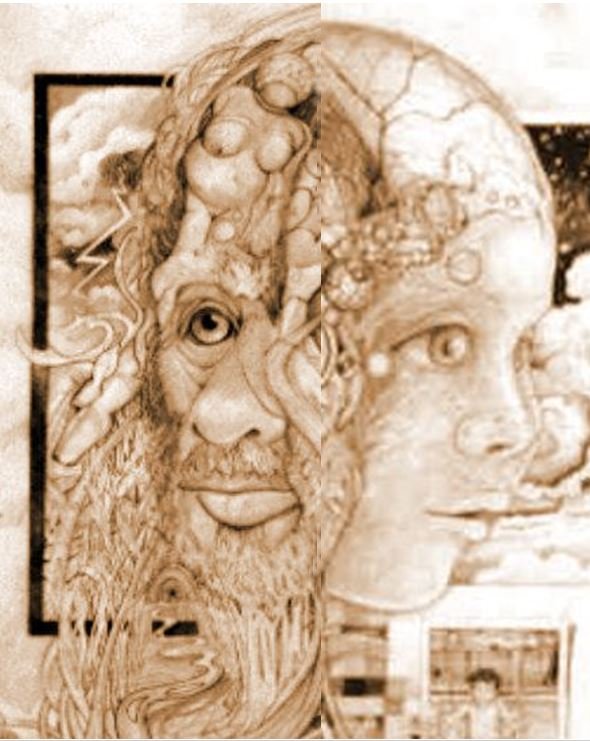 Art by Carlos Caban
In fact what he brings me it is the possibility of the compassion for the helpless and injured. He has, because of his own weakness, a sense of humility that allows a link with other people’s vulnerable and perhaps a hidden, nature.”
Archetype of Christ
Although people generally think of Christ as an historical figure, as a human experience he depicts powerful influences acting upon your personality. For a start, Christianity is a huge social and political force in the world. Many of us as children are educated to accept its beliefs or we meet its influence in one way or another. Therefore Christ in our dreams often depicts this enormous influence and how we relate to it – the influence can be many sided, from a recognition of the best in oneself to the hatred and anger about what organised Christianity has done to many.
Although people generally think of Christ as an historical figure, Christ is never that – even though pictures and paintings depict Christ as a human being. That is because we have been taught that Jesus and Christ are the same person. But it clearly says that when Jesus was baptised something immense happened to him. “Now when all the people were baptised, it came to pass, that Jesus also was baptised – of John in Jordan – and praying, the heaven was opened, and the Holy Ghost descended in a bodily shape like a dove upon him, and a voice came from heaven which said, ‘Thou art my beloved Son: in thee I am well pleased.’ (Luke 3:21-22).”
It tells us that the heavens opened and something from the cosmos entered Jesus and transformed him into having Christ Consciousness. For Christ was an aspect of Godness and had always existed. It is easier to see it rather like our growth. When we were babies we grew and entered another level of awareness and ability called childhood. Later another huge change entered us and we became adolescents – again with a different mental and emotional state.
Many people have attained the change of Christ consciousness. It is a further stage of human growth. As an example Siddartha became the Buddha when he experienced such a great change. In different languages this change has different names such as Krishna Consciousness. It might shock some people to see Christ linked with Buddha and Krishna – if so you have a lot of growing to do and if you do you too can enter Christ consciousness.
Like any of the world’s great religious figures, Christ can also be a very potent compensatory symbol. Each of us have feeling responses to events. Some events lead to a pleasurable response, others to a painful response. As children, and often as adults, we are largely at the mercy of events as to whether our life is experienced as painful or pleasurable. But there is also a way of creating our own response that a few of us use consciously. If we are lonely or depressed for instance, we may read a book, go out with a friend or watch a film, stimulating feelings that displace the loneliness or despair. This ability to produce positive or different feelings is often seen in the dream process. By holding in mind an image connected with hope and love, feelings will be produced that will compensate in some measure for pain or depression we may be feeling.
But Christ is used to compensate for what may be felt as crushing or defeating life circumstances or inner despair. Such compensation may also be used to deal with things missing from ones life, such as a sexual partner or social achievement.
However, being able to achieve Christ Consciousness, or Buddha Consciousness, or even Krishna Consciousness, is much more that a compensation, it is a transformation of ones life from one in which misery is often a part to one of which is symbolised in the New Testament as walking on water. If we take it out of its symbolism it tells us that our emotions that can be stormy and difficult to deal with can be dealt with and even tamed by the immense power we hold within us, which most of us have lost contact with. I am talking about a huge force that can be contacted or allowed into ones life. Without it we are often powerless to deal with negative feelings, and so many people take the path of suicide. But with it we can meet them easily, walking over the surface of such stormy emotions.
The fundamental power of Christ as an archetypal force lies in a that direction however. As an archetype Christ enters our life with powers of redemption, of transformation, as an aid to lead us out of awful life situations, and a type of love transcending the human limitations of jealousy and dependence.
It it is a universal consciousness which is a part of every person, whatever their beliefs. To become aware of it we must somehow have broken our heart and self so be aware of such a huge awareness. See Ages of Love.
Example: It is difficult to convey the immediacy of these experiences deep in the sleep state. Over and over I experienced fantasies, the drama, of being a sacrifice. As one who expressed the new ideas, the new consciousness, I was beaten and smashed to death because I was a threat to the old instinctive order. But the fragments of my strewn body, my flesh, were eaten by those who had killed me. And my flesh was like Seeds that grew within those who devoured, and became in them the new awareness they had sought to destroy. In another of the series I was a willing sacrifice. Through the stress and ritual of being willingly lead to death, I would receive the new consciousness and in some way bring it to my people.
I am going through masses of evolutionary feelings. The struggle to develop self-consciousness, and how the Messiah was first of all a fantasy, then an embodiment of this by individuals. Then how other people lived certain aspects of it, and were taken to be the Messiah, the Krishna, whatever. They did bring into the body another type of awareness, that mankind had been struggling toward for so long. This is where the mystery of the birth of Christ comes from. Why there is no real historical person. Why there is so much myth and legends surrounding such events. It is the embodiment of something mankind needed so much, to help them out of their crisis into the next revolutionary level.
Often overlooked in this influence is the power to look at oneself and life very clearly, very honestly, without hiding behind excuses or self deceptions. Perhaps more than anything else though, Christ is a cultural image depicting the power of our own highest possibilities. It is the outreach to us of collective human love.
Christ is not the only historical figure with these associations. Krishna and Shiva in the Indian culture, Mohammed in Islamic culture, Odin in the Viking age, and Quetzalcoatl/ Kukulkán/ Gukumatz in the South American culture have the same sort of power. Some aspects of the Buddha are approached for redemption and there are many saviour heroes from other cultures such as Anansi in Africa, Cúchulainn in Eire, Osiris in Egypt and Hercules in Greece. Apollonius of Tyana is also recorded as living a sacred life. But Christianity is simply a new expression of an ancient theme.
Mithra was born in a cave, and on the 25th December. He was born of a Virgin. He travelled far and wide as a teacher and illuminator of men. His great festivals were the winter solstice and the Spring equinox (Christmas and Easter). He had twelve companions or disciples (the twelve months). He was buried in a tomb, from which however he rose again; and his resurrection was celebrated yearly with great rejoicings. He was called Savior and Mediator, and sometimes figured as a Lamb; and sacramental feasts in remembrance of him were held by his followers.
Osiris was born on the 361st day of the year, say the 27th December. He too, like Mithra and Dionysus, was a great traveller. As King of Egypt he taught men civil arts, and “tamed them by music and gentleness, not by force of arms”; he was the discoverer of corn and wine. But he was betrayed by Typhon, the power of darkness, and slain and dismembered. “This happened,”says Plutarch, “on the 17th of the month Athyr, when the sun enters into the Scorpion” (the sign of the Zodiac which indicates the oncoming of Winter). His body was placed in a box, but afterwards, on the 19th, came again to life, and, as in the cults of Mithra, Dionysus, Adonis and others, so in the cult of Osiris, an image placed in a coffin was brought out before the worshippers and saluted with glad cries of “Osiris is risen.” “His sufferings, his death and his resurrection were enacted year by year in a great mystery-play at Abydos.” Quoted from Pagan and Christain Creeds by Edward Carpenter
“Such a myth, however, consists of symbols that have not been invented consciously. They have happened. It was not the man Jesus who created the myth of the god-man. It existed for many centuries before his birth. He himself was seized by this symbolic idea, which, as St. Mark tells us, lifted him out of the narrow life of the Nazarene carpenter.” Quoted from Man and His Symbols by Carl Jung
I know I hung on the wind-swept tree Nine nights through, Pierced by a spear, dedicated to Odin, I myself to myself.
There is, above all, the self-sacrifice of the hero-saviour: as Toynbee puts it in A Study of History, ‘A very god who dies for different worlds under diverse names-for a Minoan World as Zagreus, for a Sumeric World as Tammuz, for a Hittite World as Attis, for a Scandinavian World as Balder, for a Syriac World as Adonis (“Our Lord”), for an Egyptian World as Osiris, for a Shi’i World as Husayn, for a Christian World as Christ.’
Depending upon the culture we were raised in, we will unconsciously put an image to the power of change and transformation that we experience. People in all ages, all cultures and all social circumstances have experienced what is often felt to be a divine influence touching them in some way.
I believe through observation that such long held and powerful traditional beliefs are based on something functional. The description of compensation above is an example of this. To be able to survive crushing life experience is a real achievement, not an imagined one, and is therefore functional. Using an image to evoke hope and motivation doesn’t make it less of an achievement. But the archetype links with patterns of love and strength actually lived by others. They are then patterns remaining in the collective experience of us and can be accessed. When we touch these powerful racial memories we may clothe them in the image of our cultural hero or saviour.
To be clear about this, the power that is found is a release of our own potential emerging from our core self. So in this sense the image of Christ is a graphic presentation of our own innate wonder. The patterns of love and strength mentioned above, and other behaviours lived by past individuals that remain in collective memory, offer keys or clues as to how to release this innate potential. That such keys, as well as ones innate potential, are often clothed in symbols and traditional imagery, is simply because we have not made such parts of our potential or heritage clearly conscious. They thus emerge from our unconscious clothed in whatever imagery or ideas we can accept or allow. See The Inner Path of Christ.
So what does the archetype of Christ the Redeemer and Good Shepherd mean in this sense?
To understand this we must first remember that our ego, the sense that we have of being a distinct person, is not one and the same thing as our body’s biological processes, or of our deep psychological processes. We all have some understanding of this because we can observe in ourselves or in others, that we – our personality – may want something that is very much against what our body wants. People with eating disorders for instance may actually die from malnutrition. People who have a fear of sex may constantly fight or repress their sexual urge. A person is often at odds with the natural processes and urges that underlie their conscious ego.
Norman MacKenzie explains this very well in his book . Dreams and Dreaming. Writing about the clinical use of LSD to help patients deal with various forms of neurosis, he says that the drug enabled a massive observation of how people’s mind worked, and how people related to their unconscious drives. When a patient first took LSD one of the commonest reactions was massive anxiety. This degree of anxiety usually arises only when we are threatened physically or mentally. The patient fears the drug is robbing them of control and will overwhelm them. In fact what is happening is that the repressive defences the person uses to keep their inner drives and processes under control are being relaxed. See The Two Powers Explained.
People relate to this threat in two major ways. They either fight to keep control, and employ all manner of techniques such as keeping their attention focused outwardly by such things as talking, walking about, drawing, holding their breath or dancing – or they surrender to what is being experienced. To meet the parts of ones nature that have previously been pushed into unconsciousness, one needs to surrender in some degree. If the person fights the loss of control as the new material from within is emerging, it sometimes feels as if they are disintegrating. Their body may feel as if it is changing or dying, and they are losing themselves.
Below are two descriptions from people who used LSD therapeutically that illustrates these different responses.
It didn’t happen at first, but gradually I began to feel that if I relaxed I would not be able to hold back my emotions, that I would do something that would be seen as crazy. So I sat holding onto myself, literally tensing my muscles to hold back whatever might happen to me. Time seemed to stretch and I felt as if I would never get out of this tension and difficulty. I just had to sit through it, live through it, and hope there would be an end. I also wanted to get away, but I was frightened I would get lost, like I was a child of four or five. Maybe that’s how I felt at that age, so I had to stop myself from doing what I wanted to do. A.K.
Here is someone else’s description of a similar situation.
Early in the session I started having fantasies about being attacked. Each time it happened I put the fantasy aside because I couldn’t see why I would be having these feelings that I was being attacked. There were a lot of images flowing into my mind also about the horror of life in general – babies abused, children murdered, men and women shot or tortured. The fantasies returned and several men attacked me and were trying to drag me off somewhere against my will. As the fantasy progressed, or replayed, I began to realise that it only appeared like an attack because I was resisting the process. In fact the men wanted to show me something that was important to me. They were being quite gentle, but because of my resistance, it felt to me like an aggressive act. I then let myself be carried off by the men, and began to feel as if a great chunk of my nature has been held back since childhood because of anxiety. In fact I had been frightened to ‘live’ this part of me. I had held so much of myself back throughout most of my life that I constantly felt there was something I was missing and had to search for. But it wasn’t an external thing – it was the me I had denied. B.M.
AK was using tensions and experiencing fears he had developed in childhood to hold back feelings that he had been taught were not acceptable. In BM’s experience he learned to move beyond such tensions and fears.
In observing such struggles in thousands of people, the doctors and clinicians working with them saw that no matter what the patient was experiencing, even if they felt completely overwhelmed for a while and were lost in their fears and emotions, something within them was learning from the experience and attempting to integrate not only the insights gained, but also the various parts of their nature that were in conflict or split. Mackenzie says, ‘No one knows what type of ‘thinking’ this may be. It appears to be different both from ‘reality thinking’ and ‘autistic thinking,’ from the patterns of conscious thought and the imagery of fantasy – a kind of bridge between two types of mental process.’
Jung observed something similar in the psyche. He called it the Transforming Principle, or the self-regulating action, which constantly attempts psychic growth. He stated that one can watch this at work by noting many dreams from the same individual over a period of time. When one does this ‘tendencies become visible, then vanish, then return again. …… one can observe a sort of hidden regulating or directing tendency at work, creating a slow, imperceptible process of psychic growth-the process of individuation.’
Most religions call it the power of God at work in ones life, and many of them teach that if one surrenders to it, one will be healed and made whole. Different people and cultures represent or depict this transforming power within them in their own way. It is often represented as Christ, but equally as well as something more abstract. However, whatever we wish to name it, there is in us a potential that has in it more than we presently know of ourselves, and it has the power to heal and transform. It is observable that healing or therapy proceeds by a series of problem-solving movements. As soon as one difficulty is reviewed and removed, another appears, waiting in line to take its place.
In BM’s experience he learned to move beyond such tensions and fears. But also he says something that is at the heart of what this archetype brings. He says, “It wasn’t an external thing – It was the ‘me’ I had denied.”
That is the heart of the Christ archetype. It holds in it the you that may have been crushed, denied, traumatised, repressed, in some way held back from emerging as a reality in your life. It is the potential you hold within you that has not been allowed to flower. It is the very best of what you are, not some distant possibility that you have to get from outside yourself. See: life’s little secrets; compensation theory; self-regulation dreams and fantasy;.
Here is another personal description. This time not from an LSD session, but from a man allowing the transforming action to take place while fully awake and without drugs. This makes clear what it is like to confront the power of transformation within.
In the previous week I had met a feeling I could not account for, which had left me wondering what was happening. I had the very strong impression that I had killed a man and now had the guilt of blood on my hands. This time in the group, when I surrendered, something I could never have suspected happened. I was standing with my eyes closed, but it seemed I could see, because the spontaneous mental imagery was so clear, that I was standing under a clear night sky, with the stars brilliant above. But there was a star more brilliant than the others that fell to Earth, and I knew it was something wonderful and special so hurried to see what it was. Others had also seen it, simple rural people like myself. What we found was a baby. But the wonder of it was so much I fell on my knees and couldn’t stop myself crying out again and again – A baby! A baby!
The tears and the cries were because I had the clear feeling or knowledge, a direct knowing, that all of the heavens, all of life’s mystery, had come to life in this baby. And to actually know this, to feel the impact of it, was almost more than I could bear. But part of the amazement was that this was every baby born. It wasn’t just one special baby. It was my own birth too! All the mystery of life was born in me. I sobbed with the pain and wonder of it.
Then the scene changed and I was standing by a dirt road. There were lots of people lining the road waiting. I didn’t know what for. Then excitement rose as a man came walking along the road toward us. He looked very ordinary to me. But as he got near he looked right at me and a huge feeling of love swept through me. I knew this man loved me in a way I had never been loved before. Then he walked directly to me and took hold of my hands and said, ‘You are my disciple’.
I stumbled backwards away from him. The love was too much, too painful. Looking into his eyes I knew I had been born with all that love, but I had killed it in myself. The blood on my hands was because I had murdered Him/myself. I had crushed the flower of my sexuality through fear. I had denied my own wonder and value in the world, looking to others for guidance. I had killed Christ in me – Christ who was the splendour of my own life and love if I dared to live it – my own birthright. But he had touched my hands, and I went to each of the people in the group and put my hands on them, trying to rub some of that magic onto them. Thomas.
As can be seen from Thomas’s description, the image of Christ holds in it not only the power of self-revelation for him, but also the relationship of teacher to disciple, and transforming love for one in need of wholeness. Thomas cannot help but think of Christ as separate from himself, even though at the same time he realises with deep emotion, that he is gazing at and being touched by his own wholeness, his own potential. See: compensation theory; the fundamental process.
This paradox needs to be remembered not only when meeting the Redeemer archetype, but almost any archetype. Also implicit in this meeting is the possibility that because confronting ones own wholeness and seeing ones own guilt, or the smallness of oneself, can lead to great personal transformation, it may lead the present personality, as it is at the moment, to dying and being left behind. Thus the meeting with Christ may include a personal experience of death and resurrection.
So the experience of meeting Christ may be a representation of the denied force of joyous life within – denied out of attempting to live social or religious rules and regulations, or social pressure to conform. Therefore, because ultimately we are an integral part of the universe, and have no existence outside of it, when we meet Christ/our wholeness and potential, we also become aware in some degree of the hugeness we are a part of or an expression of. We meet a sense of eternity, an awareness of the symbiotic – or cooperative processes or forces – operative in human life and the cosmos.
The Sunday School or Church Christ
This is another aspect of the Christ archetype and depicts social norms, the generally accepted morals and social rules. This ‘Christ’ comes about because the church tends to represent traditional values and national history, and attempts to press people to live these values. The dreamer may have a child-like relationship with this Christ, or if attempting to be self responsible, be in conflict with it. Some people find this Christ has a castrating role in their life, and flee in horror. In fact this aspect of social indoctrination may lead to such a burden of guilt and suppression that it can create psychic cripples. Trying to do all the ‘right’ things may lead us to the point where ‘we can’t say no to a glass of water without a pang of guilt.’
Two of the great forces that push at the human soul or psyche are, firstly, social pressure, such as the moral norm; and secondly, biological pressures such as the sex drive. Individuals may fight a lifelong battle with one or the other of these. The social criminal typifies battle with social authority pressures and rules; the ascetic and the bulimic battle with biological drives.
These two forces can be seen in the symbols of Christ and Mary Magdalene. The battle of these two immense forces is not really won until there is the marriage or unity between the two. The following dream and its exploration illustrate this dynamically.
I was in the basement of the house where I lived in London. I had taken some floorboards up because they were rotten. Underneath I saw a large white serpent or worm, somehow connected with a dead evil woman like a force of destruction and evil. I seemed to understand the evil could corrupt all of London, that it lived in a great underground lake that existed under all of London. I poked at the serpent with a piece of wood and it came to life and plunged into the earth. There seemed to be an air filled hole that I poked into and the wood I was using was wrenched away from my hands.
My family thought I was crazy because I was trying to tell them about this and sent for a doctor. I was very pleased to see him because he was very unbiased though, not believing – nor disbelieving. I explained my experience and feelings. With him there I dared to poke at the floor with a long scaffold pole. The pole was ripped from my grasp by some force below. Then we tied the pole to a beam and it ripped part of the beam off. I felt there was enough power to tear down my house if I had used it as an anchor. Then I saw Christ standing on my right, and the terrifying woman on my left, and they came together and the evil was neutralised – but so was the power of Christ. Mathew
Mathew saw the Christ figure as the moral norm in the society he was raised; a morality he had struggled with all his life. The woman he experienced as the urges such as his sexual needs, with which he had also struggled. When Christ and the woman merged he felt enormous peace.
The positive aspect of ‘Sunday School Christ’ is that prior to maturing enough to take realistic self and social responsibility, people need guidelines for behaviour. They often yearn for security or certainty. Religion in the form of powerful positive declarations of ‘truth’, supply this need for many people. For such people, making personal decisions in the face of the ever shifting external situations is enormously stressful. So organised and dogmatic religion is of great strength to them.
The Ideal Christ
This is yet another facet of this archetype, and is the psychological process which causes us not to take responsibility for our own highest ideals; our own yearnings for the good; our own most powerful urges arising against what we see as evils in the world. This influences us to wait for a sign from Christ or God in our dream or waking life in order to gain authority, or to overcome the anxiety associated with the urges. We want God to say we should act in a certain way because we are not willing to be self responsible. We deny in ourselves the core self and its divinity.
Example: ‘I stood outside a castle. It was closed and guarded by soldiers in armour. Wondering how to get in I thought that if I dressed and acted as a soldier I would be allowed entrance. It worked and inside Christ met me and said he had important work for me to do.’ Sonia.
The closely guarded secret is Sonia’s own impulses to do some sort of socially creative work. She doesn’t want to own them as her own. It is much easier if she can say ‘Christ told me to do this.’ In this way she avoids direct encounter with opposition and has a feeling that she has greater authority than her own. Joan of Arc might well be seen in this light.
The Healing Christ
The Christ archetype has powerful healing influence for many people.
Example: ‘A fierce battle was raging with bullets flying. I immediately fell down and ‘played dead’. It wasn’t that I was hurt in any way, but I didn’t want to be at any risk in the fight. As I lay there I saw a tall well built man in soldiers uniform walk to me. He gave no sign of any fear concerning the bullets, and quietly knelt beside me. I felt he was Christ, but was confused by him being a soldier. He placed a hand on my back and gradually worked his fingers under the shell of a large limpet type creature that I had never before known was parasitically attached to my back. I could feel him pull it away, but knew its tentacles still ran right into my chest. It seemed and alien had entered me. He then sat me up and told me how I could rid myself of the tentacles and so be healed.’ Peter Y.
Peter, whose dream this was, had a debilitating psychosomatic illness at the time of the dream, causing pain where the tentacles ran. The shell is his defences against feeling his own hurts and inner conflicts. The dream shows him contacting a strength which is not afraid of his internal battlefield or conflicts, and can show ways of healing real human problems. The healing rests upon the dreamer’s conscious action, not Christ’s, suggesting the dreamer taking responsibility for his own situation. Peter realised he had been avoiding his own internal battles, but felt he had found a strength – in the Big Man – which would support his efforts to find healing. In fact he met his conflicts and grew beyond his ailments.
Peter’s conflicts were between his love for his children and his love for another woman. The Christ he met was his own undammed life, the flood of loving sexuality, the strength to burst through social rules and regulations because love or life pushes. When we find it in ourselves we don’t give a hang about bullets, death, right or wrong, because we have a sense of our own integral existence within life, and our own rightness and place in eternity.
The Integral or Cosmic Christ
Each of us have, perhaps deep in their unconscious, a sense of connectedness with the whole, with the cosmos. Perhaps it is best to call this our own wholeness, which incorporates all the light and darkness in us, all the expressed and the potential. We may be little aware of this. We may be denying it sceptically as Lester is in the example below.
Example: ‘I am a journalist reporting on the return of Christ. He is expected on a paddle steamer going upstream on a large river. I am very sceptical and watch disciples and followers gather on the rear deck. The guru arrives, dressed in simple white robes. He has long, beautiful auburn hair and beard, and a gentle wise face. He begins to tap a simple rhythm on a tabla or Indian drum. It develops into complex intermingling of orchestral rhythms as everyone joins in. I now realise he is Christ, and feel overwhelmed with awe as I try to play my part in the music. I’m tapping with a pen and find myself fumbling. A bottle or can opener comes to me from the direction of Christ. I try to beat a complementary rhythm, a small part of a greater, universal music.’ Lester S.
Finding this inner connection with things can enrich all that we do in life, even if it is a very humble thing like Lester’s can opener. The awareness of connectedness and wholeness brings with it a realisation of taking part in the unimaginably grand drama of life. It gives a feeling, no matter what the state of our body, crippled or healthy, that we have something that makes any faults insignificant. It doesn’t take all the difficulties out of life, but it is a wonderful companion on the way. We come to know that at base we are a wonderful shining being, and that life and its circumstances and events, are a way in which we are learning to let that internal wonder shine out.
Another way of looking at this is by seeing Christ as a process. Christ might then be seen as a collective identity arising in the consciousness of humanity. This relates to us as individuals much as our identity relates to the cells of our body. Just as our identity survives the death of billions of cells in our lifetime, so the Christ consciousness survives our death and change, integrates our experience, transcends our function, and has a personal relationship with us.
Example: We are each living that mystery play – that mysterious drama of which the Christian myth is a summary. Each in our own way play out that drama we call life. Each of us give birth to or abort the divine in us. Each of us chooses whether we are going to wash our hands of meeting that splendid call of our own being, or whether we will crucify it on our own political, monetary, or power hungry demands. Each of us makes the decision of whether we will denounce our relationship with the love that is in our own heart.
We don’t have to be a saint to live that Mystery. We are living it now! We live every tiny part of the story. For some of us, one tiny part of that grand story becomes a central theme for us — motherhood, the loss of the lover, the departed parents, the betrayal, the struggle with the forces of evil, or that grand search for the beloved.
What part of the story are you experiencing? Is it the raising of the dead? The healing of personal blindness? Feeding the hunger of the multitude? Working in the garden of life? Being a shepherd?
In dreams and religion Christ is also represented as the son of the Cosmos or God. This aspect of Christ possibly comes about because of a sense many people have that the origin of their personal life is from beyond the Earth. This powerful urge to see oneself as more than a physical body is symbolised by Christ, a being who transcends physical boundaries. Perhaps this is why the film ET is so moving for many.
Human beings of all ages have, when opening to the influence of their larger perceptions during meditation, trance, prayer, or drug use, experienced awareness of love existing behind the creation of things, a love that is the source of the big-bang itself, a love that willingly died that we might exist. Humanity became aware of this at a particular stage of the development of self-awareness. The arrival at this stage of self-awareness was expressed in what we know as the historical Jesus. The internal awareness of the love that gave us being was projected outwardly and became the Christian Myth.
As one man who encountered Christ said, “Christ is like the sun, a principle of nature. No one can own it, although different individuals or groups can relate to it or use it in various ways, as happens with electricity. The Roman Catholic Church cornered the market so to speak. Prior to the Council of Nicaea there was a free market. You could say the church fenced off a beach and started charging people to go to it on Sundays. And there are different names for this natural principle in different languages.”
See: meetings with Christ; religion and dreams; Archetype of the self.
Useful Questions and Hints:
What aspects of the Christ archetype, if any, am I influenced by?
Am I repulsed or held by the influence of the ‘live by these rules’ pressure?
Am I helped by the belief there is a divine loving presence?
Do I feel the power of an inner wonder and potential I am allowing into my life?
In recognising my relationship with Christ, can I evolve it to something more satisfying?
Try Talking with a Dream Character.