Posts Tagged ‘Seitai’
Yoga and Japan Part 2
A Japanese Yoga Class
Taking part in the yoga class, my wife Hyone and I could easily have mistaken it for a class in Birmingham or London. The same leotards or jeans being worn by the women in the class; the same postures being practised: the same situation of teacher leading a group, and the same quiet, centred stretching and relaxation. Yet we were in Japan, and all the people, apart from ourselves, were brown skinned Orientals. A small shrine to the gods of Shinto was fixed high on the wall in one corner, the custom for all large rooms and each house. Also, something that fascinated me in the room was an extraordinary 2ft square paraffin heater fired by electricity, giving no smell whatsoever. It heated the large room to the sort of warmth needed for conformable yoga.
KOSEI MORI, the teacher, is short compared with Europeans. He is 40 years old, married, with three children. The hall in which the class is being taken is not simply a hired hall, but Kosei’s HOME and yoga centre. The hall is on the first floor of a building that does not appear very large from the outside, but has a small shop front displaying goods and signs to do with the classes Kosei takes. Although there were only a few people in the class we attended, being in the afternoon, Kosei estimated there were 5 to 6 hundred members associated with the centre, which is his full time work.
Because the centre has to support him and his family, Kosei charges about £1.70 per person. He also advertises, and we had first seen mention of the centre on a bus poster. In Japan, buses are full of advertisements.
From our point of view, Kosei’s approach to yoga is very modern. He does not attempt to be a guru, but has the pupil teacher relationship common in the West. The classes themselves also have to fulfil the popular demand for a situation where a group of people can practise exercises and stretches to keep physically fit and, in the case of the ladies, attractive. The centre also has treatment rooms, sells health aids such as vitamins, and is geared to peoples self help needs regarding health. So on the surface anyway, there is very little oriental mystery about the centre. Like most of the many full-time yoga centres in Japan, it caters for the practical needs of people in a large town.
However, Kosei does see his work as being something more than altering the surface shape and flexibility of people. He has travelled to India, and tries to keep his class presentation firmly based on yogic traditions. His own teacher is a Japanese man named Sahoda, who is well known in Japan for his teachings and writings on yoga. But Kosei also has links with the Sivananda Divine Life Society in India. His great ambition is to enable many people to experience the change yoga can make in their life. His statement is that “being healthy is being happy.”
Before his full time involvement with yoga Kosei was a successful fashion designer. His interest in yoga developed out of seeing that many people were beautiful on the exterior, few had the same sort of beauty within themselves. Even with most of the forms of keeping healthy, he feels they are geared only to growth and health of body, not to mind and insight into life also. His particular love of yoga arises out of his certainty that it deals with the whole person, and leads to an inner growth. “You know,” he said “that when you are using yoga something inside as well as outside is changing. This change leads toward a wider love; love to all life.”
The inner change Kosei spoke of, he felt was something of prime importance. Because of the increasing amount of individual and social breakdown, he believes a harmonious relationship with ones own being can be the most important factor in survival.
The postures Kosei used in the class were all classic postures, such as the Bow, The Triangle, The Cobra, The Plough. This, more than anything else, shows his adherence to Indian traditions. After every series of three or four stretches he led the class into one or two minutes of relaxation in the Corpse posture. At the end of the postures he used five minutes of gentle breath control, then a longer relaxation. He stresses the teaching of relaxation, during, between and after the postures. At no time during his demonstration of the postures did his face or body show any signs of strain. The actual techniques of relaxation he uses are the well know intentional relaxation by tensing and relaxing each part of the body.
Kosei has been involved in yoga for nine years and his centre open for three. Visiting his centre, in the midst of a large and busy city – Kanazawa – the most powerful impression for me was the universality of yoga in the world today. The postures, the approach, the aims, were so much the same as classes on the other side of the world, one cannot help but see the same spirit, the same breath of life in them all.
When we left the centre over an hour after we arrived, we were confronted by something I can’t imagine finding elsewhere. We had taken a taxi to the centre, and on emerging from the building, there was the same taxi waiting nearby in the busy road. As soon as he saw us he hurried out of his car to present us with an umbrella we had left in the car. For over an hour he had gone backwards and forwards in the hope of finding us again. But that is part of the yoga of Japan.
Buddhist yoga in Japan
The friends who had invited me to teach in Japan had arranged for me to meet Buddhist monks, and some teachers and practitioners of traditional Japanese techniques of health and harmony. As my visit was comparatively short these meetings could not continue to the depth I would have liked, but are nevertheless worth sharing. Just as Japan took Buddhism and developed particular facets of it in an extraordinary way, such as in Zen; so I believe other spiritual teachings and practical therapeutic techniques have been developed by the Japanese into their own forms of ‘yoga’ or ways to harmony.
The first Buddhist ‘monk’ I was taken to meet was in charge of a fairly modern sect. The monk was old but alert, completely shaven head, many gold teeth, and with a feeling of sureness and calm which is found in some old people who have come to terms with themselves and life. I was surprised and interested when Tomiko, my friend and interpreter, told me the ‘monk’ was a women. She had adopted a son who was training to be the monk of the temple when she died. Squatting on our heels we were served clear green tea and small wrapped sweets. Apparently most Buddhist sects do not have weekly or frequent services in which worshippers take part. The public only visit a temple on special occasions, such as marriage, or certain festivals during the year. This temple was different. Those who supported the temple visited frequently.
As I did not have time to gradually learn from these two monks I soon asked what particular techniques of meditation, healing or consciousness expansion they taught. Their response was very guarded and I was told the traditional Buddhist teaching that you could not find anything through the efforts of the mind or rigorous use of ‘techniques’. Several questions I asked were thrown back to me in that way, and I began to despair that I would be allowed a glimpse into the inner life of these two human beings who had devoted their lives to one of the forms of Buddhism.
Ritual instruments
I then tried a different approach. The temple had many symbolic statues and pieces of equipment very similar in appearance to Tibetan ritualistic implements. So I asked the meaning and function of some of them. At this the young male monk suddenly came alive and with much enthusiasm explained their use in the rituals. Most of them, such as the horsehair fly whisk, the bell, the incense, were used to call the notice of the spiritual world to the monk/priest, and to ward off evil influences. It seemed, from what was being said, this aspect of Buddhism saw human consciousness moved, uplifted or dashed by the forces of mind, emotion and instinct. The ritual implements focused and directed attention in ways to helpfully deal with fears and disruptive attitudes. The subtle forces of mind could thereby be led through innate difficulties and dangers to transcendence.
The cleansing breathe
I was then shown a breath technique which seems to be widely used in Japan, and preceded the practice of meditation or prayer. Sitting on ones heels, or in a cross-legged posture one takes a deep breath and imagines all the evils and sickness or darkness leaving the body as one expels the air. As one breathes in, one imagines breathing in infinity, or, breathing in from infinity. A cleaner feeling of this may arise if we imagine we are taking in some part or feeling of all things. The outbreath and in-breath, with the images of expelling darkness and inhaling all things, are repeated twice more.
By the end of the meeting we were sharing real warmth and enthusiastic contact. As I was going the young monk pointed to his fairly long hair and said “I have stopped shaving my head, for a while at least, because I have recently married.” We both shared laughter when I replied that I had already had my hair long for some time, and I was now beginning to shorten it.”
A Japanese yoga teacher
Toward the end of my stay I met two people who added much to my experience of yoga in Japan. The first was Masaharu Iwasaki, a young man who acted as my interpreter during my days in Kyoto. He works as an acupuncturist and yoga teacher. He described his yoga class as having little to do with postures, mostly taking as its theme breath control and meditations. He explained to me that one of the oldest forms of therapeutic yoga in Japan was still used by some Buddhist monks. It consisted of the patient recounting to the monk the story of their life starting from the present and moving backwards. Masaharu San stressed that particular attention was given to relationships, and the person was encouraged and helped to feel any anger, tears or pain they still had in connection with past events or people.
Later I met Yuzuru Katagiri, who is a lecturer at Kyoto Seika College. Yuzuru San taught me and explained many details of another traditional form of Japanese yoga called Seitai (pron. sayt-eye). This technique has similarities to an ancient form of yoga still taught in India called Shaktipat or Kriya yoga. Actually the roots or meaning of the word Seitai and Shakti are similar. Both words are to do with the release and direction of the biological or potential energy in our being.
The magic of Seitai
Seitai was brought up to date in recent time’s by Noguchi San, who taught it in the form I am going to describe. Also, Seitai has three forms. These are:
a) Katsugen Undo. This is the form of Seitai in which a person practises alone, or separately in a group.
b) Yuki. In this form two people work together, communicating by touch.
c) Soho. This is used only by, for instance, a doctor who is trained in Seitai. The word means operation or treatment, and the therapist does something to the body of the client.
Noguchi San taught that by the regular use of Seitai many illnesses or despondent feelings could he healed. This was done through the release of the self regulatory healing energies in ones system expressing as spontaneous movements. These energies or functions are particularly at work during sleep. They lead to movements during sleeping and dreaming. But through Seitai they are released into conscious action and increased in effectiveness. In Japan, the Katsugen Undo form of Seitai is very popular, and is often to be seen in women’s magazines and the general press. But it also has its deeply philosophical side, because Seitai can lead to personal experience of what religion and spiritual teachings speak of.
Outwardly the practise of Seitai appears to be very simple. Here are the basic movements of Katsugen Undo.
1. Kneeling on the floor without shoes or restricting or tight clothing, sit on the heels. With awareness and quiet place fingertips on solar plexus. This is to help oneself test or be aware of whether this area is relaxed.
When ready, breathe in, and as the breath is released allow the head and trunk to relax forward to the floor. Also, imagine breathing out evil, ill health or inner darkness.
While the head is down, relax until ready to come up. Then repeat the process until a deeper feeling of relaxation comes. Noguchi taught that it is permissible during this to yawn. In fact yawning is the sign relaxation deepening.
2) This movement is much more dynamic. Sitting on heels turn head and shoulders to the right. At the same time lift hips from heels slightly, perhaps three or four inches, and breathe in. Hold the position for a moment then suddenly let the breath out powerfully and drop back on to the heel’s bringing head and trunk to centre again.
Repeat this to alternate sides until you feel you have satisfied yourself in the movement. If one side feels more difficult than the other do the last twist to that side.
3) Now place thumbs in the palms of hands and hold down tightly with fingers. Raise the arms so the upper arms are horizontal, with hands up, still sitting on heels. On a slow out-breath gather tension or strength to the base of the back of the neck by pulling head and arms slightly back. Then suddenly relax and drop arms. This is to be done no more than three times.
4) As soon as the last movement is finished take on a relaxed and allowing state of body and mind. Let the body, breathe, voice and feelings move as spontaneous impulse suggests. Do not attempt to think what to do, but allow your being to move or relax from its own sensations and feelings. Any movement is permissible, so one does not have to stay in the kneeling position. This is the most important part of Katsugen Undo and Seitai as a whole, and half an hour or more can be given to the movements arising. As one learns to put the mind into a watching, non interfering state, ones being can be allowed to doodle freely, and perform its healing, releasing and balancing action. Perhaps gradually or very soon, it will be seen that although the movements and feelings are non volitional or irrational, a theme of action arises, sometimes very creatively. But beware of trying to direct what occurs into making sense. That simply limits the action. Be content to leave this space of time open for ones being to do whatever occurs, even if it is quite meaningless.
Noguchi San wrote, “There are some who try to force difficult thoughts into the heads of little children. Soon having enough the children will only tire and yawn. Some try to force nutrients into sickly persons. But a living creature only takes into itself what meets its own ability.”
Japanese Landscapes
Everywhere I went in Japan I saw forest covered mountains. I was told they could not be cleared of trees to be farmed because the soil is so sandy the rains would soon erode them. The tree covered peaks became for me a symbol of the spiritual life. While in Japan I experienced a great sense of liberation, my spirit free from clinging, and seeing the mountains, being near to them increased this feeling, lifting it up. I imagined pilgrims of the past walking into the mountains as they let go of the worldly life; climbing into a joy with their staff and robe.
The God of the Jungle
So on one of my last evenings in Kyoto a friend and I left the town and climbed into the hills. We sat among trees on one slope, looking across a small valley to the brooding presence of the mountains opposite. Sitting huddled together against the evening cold and the occasional rain the darkness came as we talked and watched.
Some time past eleven we decided to walk down to look at some of the Temples and shrines on the lower hillside. We knew the path quite well because we had been along it in daylight on another occasion. Picking our way in single file through the jungle we came to a clearing. We both knew two stone monuments stood at the far edge of the clearing, we had examined them in detail the day before. But suddenly both of us were stopped by the sense of a powerful presence. She reached out for my hand, and we stood experiencing but not seeing, something immense over and around the stones. I felt as if I had been privileged to stumble upon a jungle clearing in which a god dwelt, and it was around such the ancients built temples. This was a jungle god of death, related to the forces of the earth and the decay of vegetation and life amidst the trees. It seemed to me I was standing near something akin to a humming cable carrying enormous electricity, and I felt the same care and respect one would have in that situation.
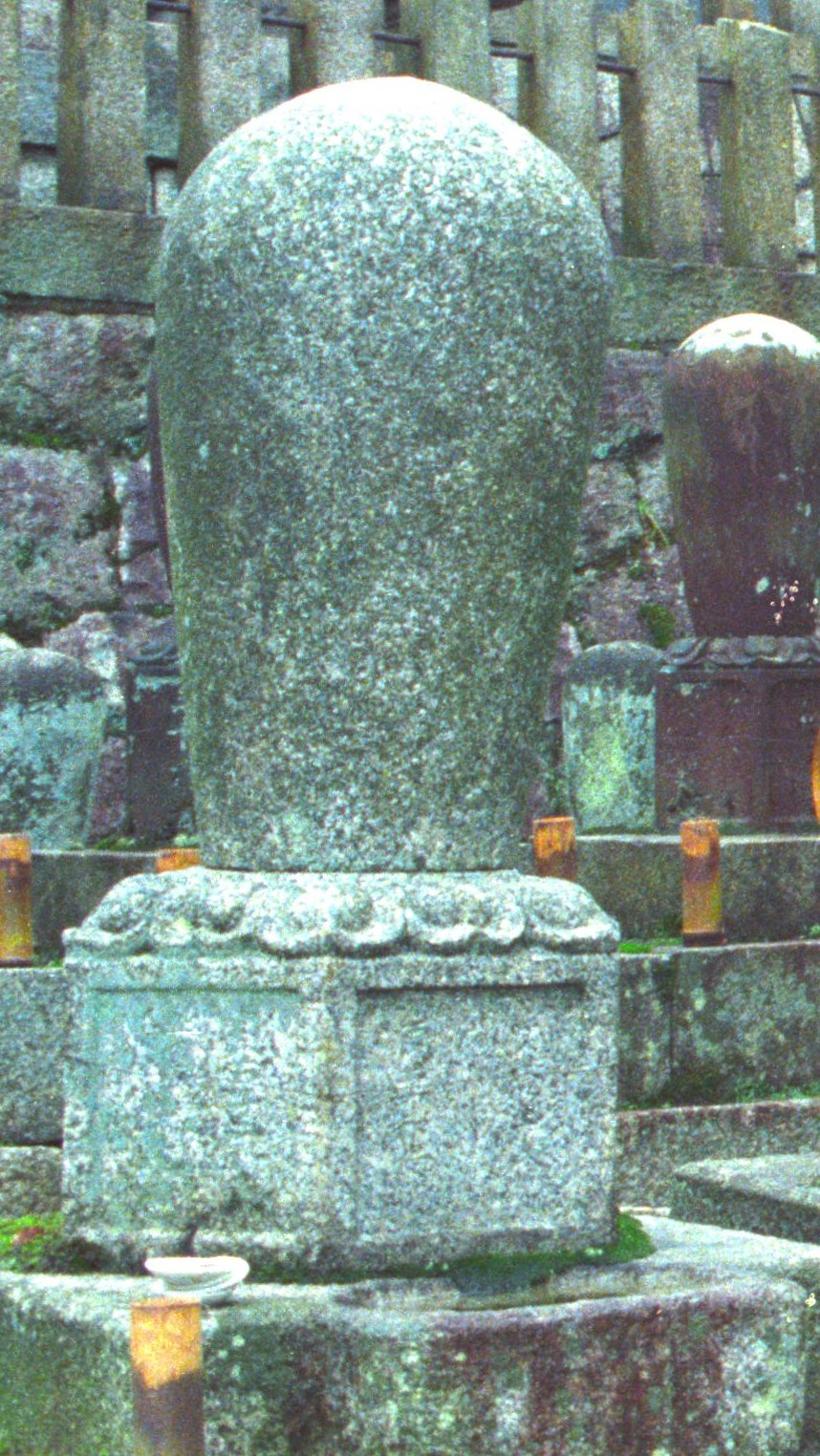 The stone represents two of the great and venerated forces of nature – the Negative and Positive; the Female and the Male. The base bears the lotus blossom in the centre of which a phallic symbols pushes forth. My friend later wrote: “As a wickerwork of light and shadows, as a life death place.” But it can also be a wickerwork of Female and Male in which the paradox of the unity of both sexes is experience as one amazing enlightenment.
“Sitting before the mountain, listening, I heard you saying all was just a feather blowing in the wind. This sentence came over me as a strong feeling. I looked up at the hills along the valley through the night, and I knew in that moment –
You are not held by any arms.
No arms of final answers.
No arms of any beginning.
From shell to shell to shell.
Through a corridor, but without walls,
This is your destiny, but without path
You are going along a valley
Through the night
That is endlessly transparent.
Then we met the stones, who faced me without face. I was terrified and could not answer. But beside, in the small tree, I heard the voice of a bird, and what it was singing was life-death; twisted together in the same breath. Why this bird goes on singing? Why are we born? Feel it.”
The eternal decaying spirit of life
For me, as I stood and felt the impact of this eternal yet decaying spirit of Life, I understood that in some way it was created out of the energies of nature by the collective life experience and veneration of generations of Japanese men and women. It was the essence of their experience in regard to death and eternity, collected through the long years of human life in the jungles of Asia. To touch this god with consciousness as we were doing was to have the honour of sharing the collective wisdom of the Japanese spirit.
My friend goes on to say – “we went on, and before we came to the abandoned door, we saw the jungle in the twilight. It was the same place we saw at noon in the daylight; but now it was all changed. I felt it as the voice of the bird: as a wickerwork of light and shadows, as a life death place. Then in the morning beside you I heard the same bird singing before the window; but now so beautifully, so life-fully as I had never heard a bird singing before. It was the counterpoint to the night-bird voice.
“Back in Kanazawa I stayed writing nearly day and night for not to burst, because the experience of that night exploded in me like a volcano. When I had almost written all out of me I recognised this was like an inner experience of the beginning of the Ten Ox herding Pictures: searching for the ox…. lost in the jungle… seeing the traces….. by the stream and under the tree….. seeing the ox….. and, on yonder branch a nightingale was cheerfully singing. What we heard actually the Japanese nightingale called uginsa.” See Ox Herding
Impending sense of death
My own next day was full also. It was spent alone, my only companion being the most powerful sense of impending death I had ever experienced. I recognised this as an almost certain consequence of coming so near to such a powerful archetype, but I still felt death would arrive soon. Yet I made peace with death, and felt ready and willing if it came. Then in the late afternoon I had an urge to enter the mountain jungle again, to find the greater feeling of liberation. I walked up out of a suburb of Kyoto, along a quiet pathway by the side of a canal. No people were about. Houses were set back distant from the canal. And as I walked by, my feet quiet in the dust, the dogs barked. In my being I felt they knew that death had passed near, and had called out. But I could find no path into the jungle, it was fenced, only one to a Buddhist Temple graveyard. Eventually I turned back, feeling the loneliness and sadness of my journey. Then suddenly the presence was gone. Perhaps for a while I had taken a closer walk with the spirit of death and renewal. We had become more fully acquainted, and it had passed on into the jungle I was not yet to enter again.
It is worth realising the the Japanese do not have anything that can be thought of as religion with a God separated from human awareness. Buddhism is not a religion and denies the exists of God. In my own attempt to understand, I see their belief system as, “Created out of the energies of nature by the collective life experience and veneration of generations of Japanese men and women.” The Japanese see the wonder in nature and natural phenomena which are often approached with great reverence. 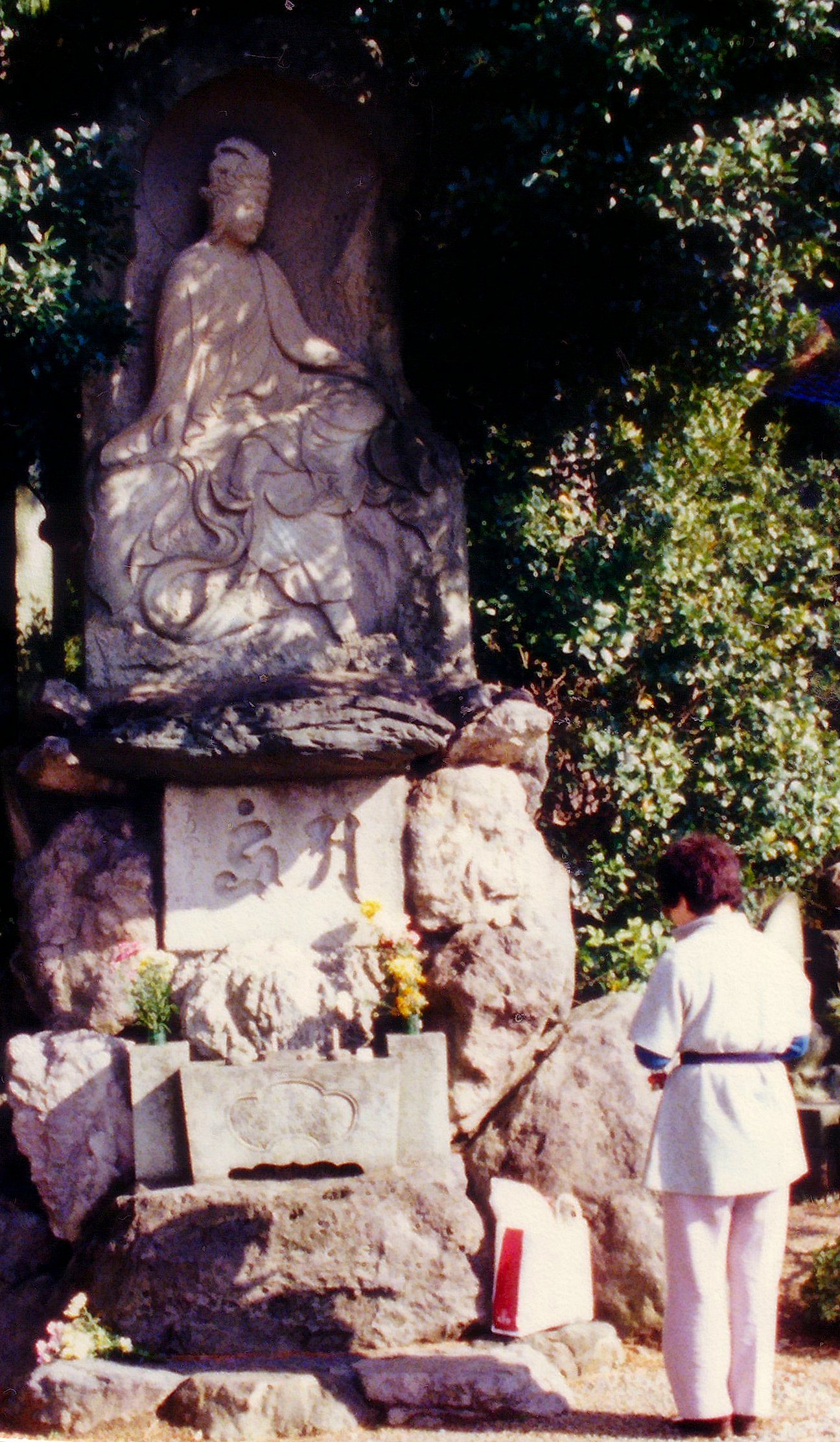
The photo shows a Japanese woman with her shopping bag in front of her showing reverence for the stone statue. At another meeting my wife and I were sitting outside of a place to eat, and I saw just a couple of shops away an open fronted temple. A woman who had no difficulty in going through movements in public view of what seemed worship, so I said to our female Japanese translator, “Your people are very religious,” indicating the woman outside the temple. The translator, Hiroko I believe her name was looked very puzzled at my question and said no it was not religious. So I see their actions as maybe a way of working with obvious laws of nature, not an invisible God – the rising Sun, the giver of all life.
The next day I journeyed across Japan and from a lifting jet plane I said a sincere Sayonara – Goodbye, feeling showered by blessings.
Seitai And The Healing Touch
Noguchi taught three approaches to the Japanese form of inner-directed movement he named Seitai. The first approach, katsugen-undo, is basically the same as what has been described as the open approach. My observation of it is that the only difference is the voice is not allowed so much freedom in Japan. In fact each approach produces slightly different results, due most likely to the cultural attitudes and group expectations and environment present.
There are three given movement/postures preceding katsugen-undo. In Japan these are performed from the position of sitting on ones heels. If this is difficult however, try them either from a kneeling position, or kneeling then sitting back onto a thick cushion or books. The movements are to produce a mixture of relaxation and tension after which one will have a desire to stretch and move.
Posture One
1 – From the position of kneeling and sitting back on your heels, or onto some books or similar thing to take your weight off your heels, place
your finger tips on your upper abdomen. This is just above your navel. The aim is to be aware of whether you are tensing your abdomen and aid you to keep it relaxed during the movement.
2 – Take a slow breath in and as you do so imagine you are filling your being not only with fresh air, but also with light and health. As much as possible feel the positive force of cleansing fill your body.
3 – As you slowly breath out let your trunk drop forward toward the floor, feeling relaxed and keeping the abdomen free of tension. Also, imagine you are breathing out all darkness and ill health from your being.
4 – As you inhale bring your trunk to the upright position again, once more imagining breathing in light and health. Continue this movement and breathing meditation until you feel satisfied with it and feel more relaxed. If there is any desire to yawn during these movements, allow it. This is much encouraged in Seitai.
Posture Two
1- The aim of this next movement is to produce tension in the body. From the sitting position breathe in fairly quickly and lift your hips no more than three inches from your heels. As you do this twist your trunk and arms to the left.
2 – Hold that tense position for a few moments then drop back into the sitting position with a quick out-breath.
3 – Repeat this turning to the right, and continue twisting to alternate sides until you feel satisfied with the movement.
4 – End by turning one last time to the right, to balance your starting turn.
Posture Three
1 – Next comes the last of the preliminary posture/movements. This is only performed three times, at the end of which you relax and allow your body to stretch or move in any way it wishes. Allow the movements to continue for about twenty minutes or longer if you are inclined.
2 – Place your thumbs across your palms toward your little fingers. Clasp your fingers around your thumbs tightly to form a fist.
3 – Raise your arms so your hands and upper arms are vertical, and your lower arms are horizontal. Take an in-breath and pull your head and arms back slightly to create a tension between the shoulders and at the base of the neck.
4 – Hold the tension for a few seconds then breath out in a gasp and relax. Do this three times and allow spontaneous movement.
Teachers of Seitai place a lot of stress upon relying on your own being’s internal healing functions. In the book Colds And Their Benefits Noguchi points out that people who are ill have often lost sensitivity to their body’s natural response. As examples he says that such people, on trying to relax actually tense their body. They are unaware of their natural feelings of tiredness, perhaps they bury them with artificial stimulants such as coffee. Their body does not expand and contract naturally, but is stiff and immobile. Their own healing processes have been denied again and again. The cure for this is to start allowing their spontaneous action again. Symptoms of illness must not be suppressed by drugs. Such symptoms are signs of the body trying to heal itself, so must be worked with rather than against. The aim is not to cure the symptom, such as a headache, but to heal the causes. Noguchi goes so far as to say that the really healthy person is always feeling slight feelings of illness because they are aware of their reactions to the environment, and are constantly adjusting to it.
Noguchi stresses that it is not the movements of Seitai which heal us. To do the movements mechanically as if they were the thing which healed, is to miss the whole point, and be a return to keep-fit. But once you have learned to allow your body to heal itself more vigorously, you do not need to practise. It is cooperating with the process of your being’s own regulating and growth forces that is important. As you gain experience of this it becomes natural and automatic in your everyday life, so doesn’t need ‘practise’. Noguchi defines the use of Seitai as a movement to train the autonomic nervous system. So if your body’s capacity to order itself becomes sensitive, your body will naturally maintain itself in a normal, pleasurable condition. This might be like a windsurfer who is much more sensitive to the movements of the board than an inexperienced windsurfer. So the experienced windsurfer is always moving into balance, and their adjustments are much finer.
Noguchi teaches that an open and receptive state of mind is needed, and this he calls ‘tenshin’. Anybody who has watched animals such as a pet cat or bird, can see that occasionally the cat will do certain stretches or movements. This is not because they have read a book about what the best exercises are. They do them instinctively. Babies have this open state of mind also, and they can be seen to make a great many of these movements and sounds spontaneously. Therefore, if you have a relaxed state of mind in which your body is allowed free expression, katsugen undo will occur by itself. Maybe you will start to stretch, yawn, or even scratch without thinking about it or directing the process.
For those who are so out of balance they are not aware of their body’s needs, initial help from another practitioner is useful. To this end Seitai has an approach named yuki – pronounced rather like you-key. It means to touch.
Yuki – Touch Healing – Touch Play
In the Far East there is a concept concerning human energy or life force which they call Ki. In China it is called Chi, as in Tai Chi. Noguchi describes Ki as the force behind the form of the body and its processes. He says it is the Ki that directs cellular processes, and causes them to grow in the correct shape and size to form our human body. The movement of our heart, for instance, is not the same, Noguchi says, as a piece of chalk being moved around. Our movements come from within, directed by Ki. In its expression, Ki is felt as our motivations. From these motivations we move an arm or leg. But more important still, without motivations, as occurs with some people who retire and lose their motivations, their being loses its health. Therefore, Noguchi says that instead of treating the shell, the body, one ought in such cases to treat the Ki and to restore the quality of its positive motivations.
Most ancient cultures have developed explanations of this subtle energy field within and around the body. Western science and medicine is now beginning to be able to demonstrate it also. Dr. Dolores Krieger, who is a professor of nursing at New York University became interested in the subject after studying the work of Oscar Esteban, a Hungarian healer. After studying with Dora Kunz, Kreiger was able to work with the energy field in effective healing. She went on to teach ‘therapeutic touch’ to nurses in a master’s level course at New York University.
Valerie Hunt, a professor of kinesiology at UCLA has been able to demonstrate the presence and importance of the energy field using a electromyograph. This is an electronic device measuring electrical activity in the muscles.
The Japanese teach that when you place your hands on another persons body, you respond to it. You will feel the energy field if you take time to watch your sensations with awareness. Sometimes your hands feel cold, or there is the sensation of ants crawling on them. If there is a cold response, it may be that there is a lack of vitality in that part of their body. You must continue Yuki – that is, directing Ki energy – until the hands return to normal. They also say that you will gradually learn to work with these subtle feelings with greater discernment through practise. Noguchi says that on the part of the person receiving Yuki there are observable changes. Their pulse rate increases, they feel more relaxed and sometimes sleepy. The effects are 1) relaxation. 2) heightened sensitivity. 3) discharge. There is certainly a very real help from Yuki, and at present there is much research into how such techniques can be used in healing the sick.
The way I was taught yuki was very simple and without any theoretical background. It is as follows:
The Practice Of Yuki
Yuki is practised with two people. There can of course be many couples using yuki at the same time. One person is the receiver and one the giver. The Japanese who taught me did not limit themselves with ideas of the healthy healing the sick. They used yuki because it was fun to do. But it can be used to help someone who is below par.
1 – The starting point is that the receiver can choose whether to lie down, sit or stand. They become quiet and receptive to the giver. The giver allows their own inner-directed movements, as occurs in katsugen-undo. But the giver holds in mind that what they are allowing is in response to the receiver. I have found a useful way to begin is to be about three feet away from the receiver and hold your hands out towards them as if warming your hands. From there follow the delicate urges to move. The idea is not to massage the person, but touch is allowed as you simply follow what your hands and body want to do.
2 – The receiver can also allow their own movements in response to the contact with the giver. In watching the Japanese use yuki, there were all levels of response. Sometimes the receiver remains very quiet, even sleepy. Other times both partners move into a lovely dance of responsive spontaneous movement and contact – or a fast moving play with lots of laughter. The contact may be delicate or full. Very often the hands of the giver do not touch the receiver, but move at a distance from them.
3 – The receiver is to be respected. In Western groups who were unfamiliar with ‘tenshin’ or waiting, on occasion I have seen the giver drop any openness to the needs of the receiver and consciously decide what ought to happen, and drag a receiver to their feet. The giver felt that was where they ought to go. The inner situation or movements of the receiver were thus completely ignored. This non respect for another person’s integrity is not the way to use yuki. The interaction between giver and receiver in yuki, if allowed to develop naturally, often shifts to a mutual giving and receiving.
The experience of yuki is one of the most delightful facets of inner-directed movement. Not only does it develop sensitivity in a relationship, but it also enables two people to discover a world of non verbal communication and meeting. It develops the sensitivity of responsiveness necessary in intimate relationships. Finding that the Japanese had developed this gentle way of strangers meeting and touching showed me an unsuspected side to their culture. Teaching it in the West people have sincerely thanked me for showing them how to discover their own beauty and flow in meeting another person.
Working With A Sick Person
The Japanese practitioners of Seitai say that yuki can be useful if a person is feeling unwell. If the person you are giving yuki to is actually ill, there need be no change in the way you give it. It is best if you have practised inner-directed movement for some time to feel easy with allowing spontaneous movement. It is enough to hold the sick person in mind and open yourself to what arises from within. It doesn’t even matter if physical contact is not made.
In Subud the movements (latihan) are sometimes allowed in the presence of a sick person. Unlike yuki, there is no attempt to touch the sick person. Members of Subud are not allowed to work with the opposite sex when giving healing or help with questions. This must be understood as being a culturally created difference. It is important to remember however that the different approaches demonstrate the significant fact that the process can work well in various settings and ways. The physical distance of thousands of miles in reality makes no difference. The biggest barrier is not distance or even degree of illness, it is the beliefs, convictions and limitations we live within.
Open to your inner-directed movements with the person in mind who needs support. It does not matter whether the person is near to you or many miles away.
Paths Of Wonder And Joy
The dimensions of experience you can meet within yourself through inner-directed movement appear to be without limits. If you have tried the different approaches described above and in the earlier chapters, you will have seen that a slight shift of attitude or a different image or question held in mind focuses you in another experience. This means that as long as you have established yourself in the basic open and surrendered process, you can reach into many different areas of your own potential.
The pathways described below are not necessary to use in practising inner-directed movement. Although the simplest form of the practice – the ‘open approach’ – is the most profound, because you are unique and have your own special needs, it may be that you get special help from using these pathways. Opening your being to allowing spontaneous movement is still the basis of each pathway however.
The Pathways do have a great power of healing and personal growth. This is because you are not just a physical body. As described elsewhere, your internal nature can become stiff and aching through lack of activity, just as your body does. The Pathways are designed to take you through a series of experiences that mobilise your being in a way difficult to find outside an extraordinarily full and wide life. If you work through these Pathways you will emerge feeling a very different person, and in real ways reborn. To get to this point it is not enough to practise each path once. You will need to use each one until you feel easy and fluid in it. If you are using the first one ‘Contraction and Expansion’, being easy and fluid means that you can move easily between the opposites, and any tensions or hesitation within the practice have been worked through. This does not mean you have to stick with one path to the exclusion of the others until it is perfect. By all means move around in them to add variety.
The paths are great sources of healing and personal growth. They will bring about a remarkable change in your experience of life and relationships. They will open doors to aspects of your own talents and love not previously met. They will take you into an awareness of what was previously invisible within you.
The Japanese Have Seitai
While teaching my approach to homeostasis in Japan I was introduced to another Oriental approach to self-regulation which is widely used in that country. It is called Seitai and was taught in its present form by Haruchika Noguchi. In Japan Seitai is thought of as a way of keeping healthy, but it has a particular quality about it which comes out in Noguchi’s teachings. He constantly stressed that you cannot understand what a human being is by dissecting one, or by trying to understand the function of separate organs such as the liver or brain.
For instance, he said that,
One person may find his appetite increases when he is in love, another may find that his heart rather than his stomach responds. Similarly, the same stressful situation may result in rheumatism in one person and diabetes in another. What causes these differences? Sonic individuals are so tough they are calm even with a million pound debt, while others become ill over obligations of only ten pounds. The physical tendencies of each person are different, and unless one takes ones stand on this fact the health problems of different people cannot be grasped.
Seitai’s starting point is from a completely different concept of health to that of a keep-fit class. In keep-fit, and in just about every form of exercise from yoga to weight training, there are certain movements or postures which are said to exercise particular muscles, or to be ‘good’ for the thighs, abdomen, etc. These are then applied or practised from outside, as it were. Seitai has the concept that our life process knows what sort, and how much exercise we need, and the exercise arises from within. In other words it is stimulated by our unconscious sense of our own needs, just as a sneeze is.
Let me quote Noguchi again to explain this. He says:
In my teens I started to guide people to health by means of what we now call Seitai Soho and Katsugen Undo, though at that time I had no knowledge of medicine or of the body’s anatomical structure. I did not know anything about the kind of food we should eat, yet I was able to lead people to health.
What was the basis for the guidance? It was that I asked myself why human beings stayed alive and what should be done to activate their strength to live. . . We find various excuses for suppressing ourselves and, without realising we are putting our innate powers for health asleep, we convince ourselves that we are weak and blame it on our surroundings, the food we eat or the hours we sleep, unaware that the real responsibility lies with us.
So Seitai creates a situation in which we listen and allow response. Noguchi taught that the spontaneous movements which arise as the response are the same as those occurring during sleep. Seitai considers whether our vitality and enthusiasm for life is active or withdrawn. If withdrawn, then it is encouraged to express itself again. Because a great deal of the suppressive factors in us are mental and emotional, Seitai encourages a strong and healthy confidence in ones ability to survive. If we fear we will become ill if a night’s sleep is missed, the anxiety creates tension which suppresses the defence systems of the body. If illness then occurred, would it mean one was naturally sickly? See Seitai please watch this wonderful video.
Put in another way, we are learning to allow the body’s own natural mechanisms, such as the eyes watering if dust enters them, and other such more subtle reactions, to function more vitally. Noguchi stresses that it is not the movements of Seitai which heal us. The symptoms of illness are the body’s own attempts to heal itself, and Seitai helps us work with that process. To do the movements mechanically as if they were the thing which healed, is to miss the point and would be a return to keep-fit. But once
you have learned to allow your body to heal itself more vigorously, you do not need to practise it any more.
Coming right up to the present, Rolfing, Primal Therapy, EST, Re-Birthing, Bioenergetics, all offer their particular genius to a culture convulsing with activity to become whole. Unfortunately most of these approaches offer their help through highly paid experts to those who feel in need of paying for it. The Expert/Patient relationship is something that is badly in need of renovation. As Laing suggests, what we need is not more experts and organisations, but something seen as a central function in a sane society. We need courage and faith in our own ability to move toward wholeness – and companions who will be with us while we experience the Journey.
But it is such a pity that whever you look eveyone poses as a expert and wants to charge money to teach. Yet Seitai is as natural as breathing.We seem to be polluted by the commercial influence.
See Seitai And The Healing Touch – Yuki – Touch Healing – Touch Play