Author Archive
Dreams – The Magic Mirror of Yourself
Every one of us dream.
Whether we remember or not, each time we sleep we create an apparently real world out of our remembered impressions, habits and emotions. As the stage managers of our inner theatres, we have the most abundant props, costumes and backdrops imaginable. Yet, because a dream is our own creation, no part of it, no emotion contained in it, no flight of fancy portrayed, is other than oneself. Even when we dream vividly of another person, such as the man in our life, the dream personality is made up of our own impressions, memories of them, hopes and feelings. Most people are often totally unaware of the experience they take in and how it interacts with them when we live with someone. See Inner People
In other words the memories and experience we gather unconsciously change us and are not lost. It is part of you and is symbolised in dreams as a person or event. You have taken in millions of bit of memory, lessons learnt, life experiences along with all the feelings or problems met by loving and living with someone and they are what makes you the person you are. Your dreams tend to put all that in the image of the past person when you are dealing with the influences left in you from the relationship. Please read this wonderful example, it will show how much we take in from those we love or lived with.
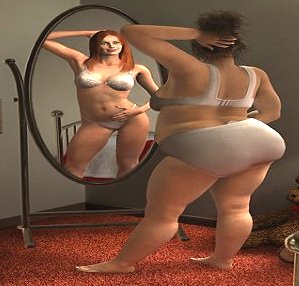 |
Your dreams are a magic mirror that reflects nothing but your own beliefs, worries, fears, wisdom and even genius. To do this it creates characters, situations and drama that are all reflections of your own inner world. All the images and drama, along with the emotions you feel are simply you looking at yourself. Most of it we do not recognise because we are so blind to our failings and of course our wonder. |
If you are afraid of your own emotions, your fears, or are locked into particular beliefs, then you are certainly a victim of them, you are powerless. But if you recognise them as simply your own feelings reflected as imagery they are simply you becoming the master of your own inner world. It is the best lesson you can learn – in dreams and in life.
What do you see in the mirror of your dreams?
See Martial Art of the Mind; Man in your Dream – Techniques for Exploring your Dreams – Habits – Edgar Cayce
Dream Symbols – What Do They Mean
By John Hodgson
Readers sometimes ask why the Dream Dictionary gives so many possible meanings for the imagery we find in dreams, and why many of the meanings are tentative and depend on the context of the specific dream. Old-fashioned dream dictionaries often give each symbol an exact meaning, and it would be reassuring – but misleading – to suggest that this is the way dreams work. But dream signs and symbols operate in the same way as signs and symbols in waking life. Their meaning depends on the way they are put together by the dreamer. Each of us combines signs and symbols in our own way, and it is by understanding this that we can come to an understanding of a dream.
The Swiss linguist Ferdinand de Saussure (1857-1913) was the first person to study systematically the way in which signs work. He called this new study semiotics, or the study of signs. He postulated that experiencing the world is a matter of interpreting a language, or code. It is easy to see this in terms of traffic lights, where we obviously have to learn the meaning of red and green. De Saussure, however, went further, and suggested that everything we experience is a series of signs that we learn to “read”. The expression on our partner’s face, the clothes our neighbour wears, the shape of the door on a building – all these are a language. De Saussure prophesised that, just as we have a grammar of spoken and written language, it would eventually be possible to construct a grammar of signs, of which conventional language would be only a sub-set.
This has not come to pass, and it seems unlikely that it will ever happen. This is because de Saussure assumed that each sign has one essential meaning: what is sometimes called its denotation. Thus we all know a barking domestic animal denotes a dog. Yet, as Roland Barthes pointed out, in many cases the most important meanings of a sign are its connotations – the cluster of meanings that any sign has. These meanings are partly socially constructed, partly personal. For example, an Asian Indian village child and a British child in a middle-class suburb are likely to have different associations when they see a dog in the road: the Indian is more likely to see it as a source of danger and disease.
De Saussure’s structuralist account, which hoped to systematise the whole world of experience into an enormous dictionary of signs, has been succeeded by a post-structuralist view, in which the meaning of any sign is shifting, contingent, and highly dependent on its context. Does this mean, then, that creating a dictionary of dream symbols is a hopeless task? The answer is no, for two reasons. One is that every human culture combines signs (denotations and connotations) into what Barthes called myths – “stories” (true or false) that are meaningful for that culture. So the image of a gunfighter has connotations, in western (particularly north American) culture, that bring up associations of the frontier and the conquest of the American west. Most members of a culture will share many of the associations of a sign, and so interpretation is possible. The second reason is Jung’s theory of archetypes. This suggests that humanity carries certain archetypes in its collective unconscious – a common repository of signs and meanings that may transcend culture. Thus every sign and symbol contains meaning for the individual and for humanity at large. De Saussure was right to point out the affinity of signs and language. Both are at the same time personal and social, and both can be interpreted in the same way – by understanding what an individual’s combination of words, signs or symbols has to say about that person’s life.
The following is quoted from David Lodge’s novel Nice Work – It can be found at http://www.aber.ac.uk/media/Documents/S4B/sem07.html
A typical instance of this was the furious argument they had about the Silk Cut advertisement… Every few miles, it seemed, they passed the same huge poster on roadside hoardings, a photographic depiction of a rippling expanse of purple silk in which there was a single slit, as if the material had been slashed with a razor. There were no words in the advertisement, except for the Government Health Warning about smoking. This ubiquitous image, flashing past at regular intervals, both irritated and intrigued Robyn, and she began to do her semiotic stuff on the deep structure hidden beneath its bland surface.
It was in the first instance a kind of riddle. That is to say, in order to decode it, you had to know that there was a brand of cigarettes called Silk Cut. The poster was the iconic representation of a missing name, like a rebus. But the icon was also a metaphor. The shimmering silk, with its voluptuous curves and sensuous texture, obviously symbolized the female body, and the elliptical slit, foregrounded by a lighter colour showing through, was still more obviously a vagina. The advert thus appealed to both sensual and sadistic impulses, the desire to mutilate as well as penetrate the female body.
Vic Wilcox spluttered with outraged derision as he expounded this interpretation. He smoked a different brand himself, but it was as if he felt his whole philosophy of life was threatened by Robyn’s analysis of the advert. ‘You must have a twisted mind to see all that in a perfectly harmless bit of cloth,’ he said.
‘What’s the point of it, then?’ Robyn challenged him. ‘Why use cloth to advertise cigarettes?’
‘Well, that’s the name of ’em, isn’t it? Silk Cut. It’s a picture of the name. Nothing more or less.’
‘Suppose they’d used a picture of a roll of silk cut in half – would that do just as well?’
‘I suppose so. Yes, why not?’
‘Because it would look like a penis cut in half, that’s why.’
He forced a laugh to cover his embarrassment. ‘Why can’t you people take things at their face value?’
‘What people are you referring to?’
‘Highbrows. Intellectuals. You’re always trying to find hidden meanings in things. Why? A cigarette is a cigarette. A piece of silk is a piece of silk. Why not leave it at that?
‘When they’re represented they acquire additional meanings,’ said Robyn. ‘Signs are never innocent. Semiotics teaches us that.’
‘Semi-what?’
‘Semiotics. The study of signs.’
‘It teaches us to have dirty minds, if you ask me.’
‘Why do you think the wretched cigarettes were called Silk Cut in the first place?’
‘I dunno. It’s just a name, as good as any other.’
“Cut” has something to do with the tobacco, doesn’t it? The way the tobacco leaf is cut. Like “Player’s Navy Cut” – my uncle Walter used to smoke them.’
‘Well, what if it does?’ Vic said warily.
‘But silk has nothing to do with tobacco. It’s a metaphor, a metaphor that means something like, “smooth as silk”. Somebody in an advertising agency dreamt up the name “Silk Cut” to suggest a cigarette that wouldn’t give you a sore throat or a hacking cough or lung cancer. But after a while the public got used to the name, the word “Silk” ceased to signify, so they decided to have an advertising campaign to give the brand a high profile again. Some bright spark in the agency came up with the idea of rippling silk with a cut in it. The original metaphor is now represented literally. Whether they consciously intended or not doesn’t really matter. It’s a good example of the perpetual sliding of the signified under a signifier, actually.’
Wilcox chewed on this for a while, then said, ‘Why do women smoke them, then, eh?’ his triumphant expression showed that he thought this was a knock-down argument. ‘If smoking Silk Cut is a form of aggravated rape, as you try to make out, how come women smoke ’em too?’
‘Many women are masochistic by temperament,’ said Robyn. ‘They’ve learnt what’s expected of them in a patriarchical society.’
‘Ha!’ Wilcox exclaimed, tossing back his head. ‘I might have known you’d have some daft answer.’
‘I don’t know why you’re so worked up,’ Said Robyn. ‘It’s not as if you smoke Silk Cut yourself.’
‘No, I smoke Marlboros. Funnily enough, I smoke them because I like the taste.’
‘They’re the ones that have the lone cowboy ads, aren’t they?’
‘I suppose that makes me a repressed homosexual, does it?’
‘No, it’s a very straightforward metonymic message.’
‘Metawhat?’
‘Metonymic. One of the fundamental tools of semiotics is the distinction between metaphor and metonymy. D’you want me to explain it to you?’
‘It’ll pass the time,’ he said.
‘Metaphor is a figure of speech based on similarity, whereas metonymy is based on contiguity. In metaphor you substitute something like the thing you mean for the thing itself, whereas in metonymy you substitute some attribute or cause or effect of the thing for the thing itself’.
‘I don’t understand a word you’re saying.’
‘Well, take one of your moulds. The bottom bit is called the drag because it’s dragged across the floor and the top bit is called the cope because it covers the bottom bit.’
‘I told you that.’
‘Yes, I know. What you didn’t tell me was that “drag” is a metonymy and “cope” is a metaphor.’
Vic grunted. ‘What difference does it make?’
‘It’s just a question of understanding how language works. I thought you were interested in how things work.’
‘I don’t see what it’s got to do with cigarettes.’
‘In the case of the Silk Cut poster, the picture signifies the female body metaphorically: the slit in the silk is like a vagina -‘
Vic flinched at the word. ‘So you say.’
‘All holes, hollow places, fissures and folds represent the female genitals.’
‘Prove it.’
‘Freud proved it, by his successful analysis of dreams,’ said Robyn. ‘But the Marlboro ads don’t use any metaphors. That’s probably why you smoke them, actually.’
‘What d’you mean?’ he said suspiciously.
‘You don’t have any sympathy with the metaphorical way of looking at things. A cigarette is a cigarette as far as you are concerned.’
‘Right.’
‘The Marlboro ad doesn’t disturb that naive faith in the stability of the signified. It establishes a metonymic connection – completely spurious of course, but realistically plausible – between smoking that particular brand and the healthy, heroic, outdoor life of the cowboy. Buy the cigarette and you buy the lifestyle, or the fantasy of living it.’
‘Rubbish!’ said Wilcox. ‘I hate the country and the open air. I’m scared to go into a field with a cow in it.’
‘Well then, maybe it’s the solitariness of the cowboy in the ads that appeals to you. Self-reliant, independent, very macho.’
‘I’ve never heard such a lot of balls in all my life,’ said Vic Wilcox, which was strong language coming from him.
‘Balls – now that’s an interesting expression…’ Robyn mused.
‘Oh no!’ he groaned.
‘When you say a man “has balls”, approvingly, it’s a metonymy, whereas if you say something is a “lot of balls”, or “a balls-up”, it’s a sort of metaphor. The metonymy attributes value to the testicles whereas the metaphor uses them to degrade something else.’
‘I can’t take any more of this,’ said Vic. ‘D’you mind if I smoke? Just a plain, ordinary cigarette?’
|
John Hodgson |
The Trackless Way and Growth
Any serious and prolonged exploration of your inner world, yourself or dreams will lead to pronounced changes. Carl Jung called this psychic growth. He used the word psychic to refer to the psyche, meaning the whole realm of personal awareness and experience. Such psychic growth is natural and in most areas occurs spontaneously, how it does when we move from babyhood to childhood, childhood to adolescence. And of course, such changes are seldom purely psychic or psychological. They usually run parallel to physical change as well.
Many of these changes from one level of maturity to another are quite difficult. As with adolescence, the emerging trends often make it feel as if all that one is at the time is dying or being lost. What is emerging is unknown. It has never been experience before and so can even be felt as threatening. Such shifts through the levels of possible maturity are at the very core of human experience. Although our attention may largely be claimed by exterior factors such as relationships, education, the struggle toward achievement for success in one form or another, in many ways these are far less important than the processes of psychic growth that underlie any exterior event or participation in it. I believe that the great myths and religions of the world are in great part dramatisations, often in deeply symbolic form, of these huge transformations we face or are capable of. This may explain why religions and myths claim so much attention over such long periods of time. After all, the heroes and heroines of such myths are confronting, and giving examples of, meeting and dealing with the great dramas and trials of human experience.
Somehow I stood upon the Mount,
Standing upon the edge,
Looking into the abyss.
Turning, I gazed back
Upon the way I had come.
I could see
The ruined churches and mosques,
The libraries and schools,
Where people forever searched
Through the river of books,
Or the spoken word.
I called to them
As loudly as I could,
“Why are you searching
For the Real
In all these frozen words?
Why wander through
The never-ending labyrinth
Of emotions, thoughts and beliefs?
For they are like
Photographs of the Real,
Capturing only moments,
Fragments of it?”
And I could see
The people in those labyrinths,
Setting up the photographs
Those words engraved
Like holy icons.
They fought over them,
As if their photograph
Held in its fragment
More of the Real
Than any other –
Or sold them,
Like treasures,
One to another.
And I, turning to the abyss,
Emerged from my chrysalis,
Broke open the cocoon
Of words and beliefs
I had formed about me,
Spread my wings and flew,
Melting into the abyss.
Although, as already said, much of this psychic change is spontaneous, some of it has to be faced consciously, decisively and with personal cooperation and effort. The possibility is that of the stages of growth that the race has already met and successfully dealt with en masse, is now passed through largely without personal effort. But the frontiers of human maturity still call upon us in a different way. Two of these challenges are particularly relevant in present times, and comparatively few of us have successfully passed through them. This means that they are new ground, and although we have the literary and artistic records from other individuals who have faced these challenges already, they are still difficult.
The two that I have in mind are what might be called in mythological terms, the cleansing of the Aegean stables, and the entrance upon the Trackless Way — or what is sometimes called the Mountain Path.
The cleansing of the stables refers to consciously meeting and transforming the many influences, such as childhood traumas and inherited behavioural patterns, that block, twist and pervert the expression of our true potential. This is an area, often associated with psychotherapy in its various forms, which has a huge amount of literature dealing with it, along with countless practitioners. But any individual can undertake this journey without recourse to such professionals.
Example: Dreamt I was living in a mountain village in France or Switzerland. A group of us, like a yoga class group, were together doing something. I remember Margaret Strange in particular. Now I was cycling through steep hills; a bit like a cycle race, but not any road or track. It was hard going sometimes. I had to descend to gain speed to cycle over the crest of some hills.
Next, I was in a room with other people. They were the cyclists. One of my wheels had broken, apparently a new wheel was supposed to be in the room, which was like a spares store. I looked in a cupboard on the left of the room, but although other people’s wheels were there, I couldn’t find mine.
“This dream gives an excellent example of how wheels represent so much. The dreamer Roberto explored his dream and says, “This dream showed me what is now happening within the group I am involved in. It shows the things occurring at the heights of my awareness – in the mountain village. These things are not apparent at the everyday, valley, level of awareness.
The dream shows me aiding the group, but the last part of the dream shows my difficult journey along the trackless way – shown by cycling along a way without road or track. Remember that way was trodden by you long ago in other lives, I received that from a life I lived in France as a past existence. This next part of your life journey will be the remembering of what was already accomplished. But there comes even within this dream the meeting with difficulties.”
The second area, the entrance upon the Trackless Way, is much less represented in our times. This is strange, because the psychic growth that often comes about from transforming the traumas and behavioural patterns mentioned, leads to a meeting with the trackless way, or what in Christian literature is known as The Cloud of Unknowing or in Buddhist literature is often called, the Void.
In brief, meeting this new level of possible maturity involves the dropping away of the rigid self-images, personal defences, and unbending belief systems that are such a large part of earlier levels of maturity. For instance, for many of us our sense of self is almost entirely to do with our physical appearance, gender, and social standing. Perhaps it also relates strongly to the amount of money we have been able to command or accumulate. A self-image based on such factors is incredibly vulnerable. In the New Testament we are told not to build our house upon the sands. A foundation of sand does not resist change. Neither does a self-image based upon our physical appearance, changing so radically as it does with the ageing process.
The meeting with the Trackless Way is an introduction to the core of self. It is a meeting with a self that is formless, that is essentially without gender, that is not limited by concepts of time and space, that knows itself as an integral part of what lies behind the cosmos. In meeting such enormity, such freedom, a freedom that is or maybe at first disturbing. It may feel as if everything is being taken, or might be taken, away from us. For some the entrance is marked by an experience of death, this is either a deeply psychological experience, or for some an actual near death experience. For this is how it feels for many of us, that our ego, our self, is dying. See Core Self
Dream Deprivation
A factor that is missing in many scientific arguments and even therapeutic arguments about whether dreams are functional and meaningful rather than random pieces of flotsam, is the question of their possible self-regulatory function. After the first and second world wars, hundreds of ex-soldiers suffered recurring nightmares about battle scenes. The dreams re-presented the original experience, often accompanied by the original body movements made to escape the horror being faced. Charles Rycroft, in his book anxiety and Neurosis, describes the observed results on people of unexpected disasters such as earthquakes and train accidents. Among other things they have a tendency to ‘waking actions and dreams in which the traumatic experience is repeated.’ He goes on to say that these repetitions in dreams or actions can be ‘thought of as manifestations of the healing process. By repeating the trauma the traumatised person is, as it were, trying to get it in front of himself again so that he can anticipate it, react anxiously to it and then assimilate or ‘get over’ it in the way he would any other distressing experience.’
Working with such dreams leads to the view that there is a self-regulatory process within our psyche, which attempts to find healing through the presentation of such traumatic incidents in dreams. Jung and Hadfield in particular supported this view of dreaming. See Life’s Little Secrets
The findings in researching also link with this self-regulatory theory. Dr. Dement and others experimented with dream deprivation with many subjects. The most obvious finding was that if the REM – dreaming – period of sleep is disturbed or prevented by waking the subject each time the REM activity begins, the REM periods of dreaming quickly became more and more frequent. The experiments had to be abandoned because without the use of force it became impossible to stop REM sleep, and the subjects were becoming seriously effected. (6)
When the subjects were awoken during their normal sleep for similar periods of time, these critical effects did not arise. While such findings might be explained in a purely physiological way, the mind body unity prevents us from saying, ‘Yes but that is only the result of brain chemicals’. There is obviously a great need on the part of the body/mind to dream. If for no other reason, dreams thereby have a meaningful function.
When the subjects whose REM sleep had been prevented, were allowed normal undisturbed REM dreaming, a massive increase in REM dreaming occurred. This suggested to researchers that the brain has some real need for dreaming, and when deprived will later fulfil its need by increased activity. In the 1970’s research by Ramon Greenberg and Chester Pearlman suggested that REM sleep was an important ingredient in learning from experience. They deprived rats and mice of REM sleep and observed their performance while running a variety of mazes. It was found that loss of REM sleep – no loss of sleep altogether – hardly impaired the performance of running mazes already learnt. However, there was a marked drop in performance of learning new a new maze or performing new tasks of any complexity.
Similar research was later performed with human subjects and showed similar results. These findings led psychiatrists to believe our mind is doing serious work while we dream. It is integrating what has recently been learnt into our long-term memory and possibly practising how to use this in enhancing personal skills. REM may therefore be important in stimulating the development of connective links of thought in infants and young children. The theory would explain why humans, who are constantly adapting to meet new challenges, exhibit so much REM activity.
That dreams occur more frequently after a period of deprivation certainly shows their link with a regulatory process. Learning is also a part of our survival needs, and much of it would appear to occur in a self-regulatory way.
(1) The initials REM stand for ‘rapid eye movement’. This refers to the fact detailed later in the book, that in 1953 Aserinsky and Kleitman found rapid eye movements occurred while people slept. In 1957 the REM were linked with dreaming. Therefore sleep was observed to have two different phases, REM and NREM – non rapid eye movement, or non-REM. Later it was found that even during NREM sleep, a form of dreaming took place that is different to the REM dream with its pronounced imagery and drama.
(2) Van de Castle, Robert L. Our Dreaming Mind. Aquarian. London 1994.
(3) For instance Jules Verne wrote about submarines before they became a reality. Flying machines had been drawn by Leonardo da Vinci.
(4) In the USA by Basic Books, Inc., New York 1988. Published in UK by Penguin Books 1990.
- c(5) An expression of what is happening in the physical body. Some doctors consider dreams to show signs of illness long before they are evident in other ways. Women frequently know they are pregnant very early on through sleep awareness in a dream. See: body.
- A link between the sleeping mind and what is occurring externally. A person may be falling out of bed and dream of flying or falling for instance.
- A way of balancing the physiological and psychological activities in us. When a person is deprived of dreaming in experiments, a breakdown in mind and body quickly occurs. This type of dreaming can often be a safety valve releasing tension and emotion not dealt with in waking life. See: compensation theory; self-regulation dreams and fantasy; science and dreams.
- An enormously original source of insight and information. Dreams tap our memory, our experience, and scan information held in our unconscious to form new insights from old experience. Dreams often present to us summaries or details of experience we have been unable to access consciously. Sometimes this is as early as life in the womb. See: creativity and problem solving in dreams.
- A means of compensating for failure or deprivation in everyday life, and as a means of expressing the otherwise unacknowledged aspects of oneself. Such dreams are a move toward wholeness.
- In dreams we may be integrating new experience with what we have already gathered and digested. In this way our abilities, such as social skills, are gradually upgraded.
- Dreams often stand in place of actual experience. So through dreams we may experiment with new experience or practice things we have not yet done externally. For instance many young women dream in detail of giving birth. This function of what might be called ‘imagination’ is tremendously undervalued, but is a foundation upon which human survival is built.
- An means of exercise for the psyche or soul. Just as the body will become sick if not moved and stressed, so the mind and emotions need stimulus and exercise. Dreams fulfil this need.
- An expression of human supersenses. Humans have an unconscious ability to read body language – so they can assess other humans very quickly. Humans have an unimaginable ability to absorb information, not simply from books, but from everyday events. With it they constantly arrive at new insights and realisations. Humans frequently correctly predict the future – not out of a bizarre ability, but from the information gathered about the present. All these abilities and more show in our dreams. See: esp in dreams.
- A means of solving problems, or formulating creative ideas, both in our personal life, and also in relationships and work. Many people have produced highly creative work directly from dreams.
- A presentation in symbols of past traumatic experience. If met this can lead to deep psychological healing. Such dreams are therefore an attempt on the part of our spontaneous inner processes to bring about healing change. See: abreaction; compensation theory; nightmares.
- In the widest sense nearly all dreams act as a process of growth or a move toward maturing. Some dreams are very obviously presenting internal forces or dimensions of experience that might lead the conscious personality toward a greater balance and inclusiveness. See: Individuation.
- A way of reaching beyond the known world of experience and presenting intimations from the unknown. Many people have dreams in which ESP, out of the body experiences, and knowledge transcending time and space occur. This type of dream may indicate a link between the present person and people who had lived in the distant past; or between the dreamer and all existing life. Some of these dreams present powerful insights into how the transitory human personality may arise out of an eternal consciousness. They thus deal with the spiritual aspects of human nature.
(6) In the mid-1960s, a psychiatrist named Howard Roffwarg, at Columbia University in New York, suggested that nervous activity during REM sleep helps to stimulate the developing brain in very young children, thus promoting the growth of neural connections necessary for learning. In adults, according to Roffwarg, REM serves, like physical exercise, to maintain tone in the central nervous system.
The notion that REM could be a crucial ingredient in the learning process gained momentum during the 1970’s following the work of Boston psychiatrists Ramon Greenberg and Chester Pearlman. In the laboratory, Greenberg and Pearlman deprived rats and mice of REM sleep while training the animals to run through a variety of mazes. The researchers discovered that while REM loss caused test rodents to perform only slightly worse on simple routines that they had already mastered, it had a markedly adverse impact on the animals’ ability to carry out more complex tasks or to learn new ones, of whatever degree of complexity.
Greenberg and Pearlman noted that the same pattern appeared to be true with people. Human volunteers who went without REM sleep could per-form routine activities without much trouble but had much greater difficulty tackling complicated word-memorising tasks. This finding led the psychiatrists to conclude that the mind is doing serious work when it dreams-specifically, it is incorporating newly learned information into a long-term memory bank. According to this theory, REM may thus be critical in stimulating the development of associative thought in infants and young children. The theory would also explain why humans, who must constantly adapt to meet new challenges, exhibit so much REM activity. See The Secret Power
Dream Meaning and Therapy
The history of dreams being used in some sort of healing context did not start with Freud at the beginning of the 1900’s. It trails back into pre-history through all the various human cultures. From the immense literature on the therapeutic use of dreams, especially from the most recent writings, there is no doubt that dreams have immense meaning, and can reveal things to the dreamer who explores them, that they were not previously aware of. Hobson questions this and states that dreams do not reveal anything that wasn’t in some way already known. As this is a view held by many of the scientific community, it has some weight, and Hobson backs it up by saying that he has kept a dream journal for many years, and has exposed himself to therapeutic uses of dreams.
Unfortunately this is one of those arguments which is like saying ‘I visited the South Seas and I didn’t find any pearl oysters. Therefore there are no pearl oysters.’ It is not a good analogy however, as there are pearls about which can be looked at. With a personal experience of arriving at understanding, it is so easy for other people to ignore it, or tell you how you actually arrived at it. Of course, ANY explanation of how we arrived at radical new insights is still only a theory, as quantum mechanics suggests. At a practical level however, any therapist using dreams, can observe that the greatest insight held in dreams can only be arrived at by people who have the ability to allow deep emotional response or expression in their dream work. Simple intellectual analysis of the dream by the dreamer or someone else does not give access to the immensely powerful pockets of experience held in dreams. Without this depth of experience, the insights do not arise. Like the pearl, it isn’t simply lying around on the surface to be picked up or read like a book. It takes personal courage to feel the intensity that lies within us, the sort of total feeling response that babies have. Many intellectuals, scientists among them, have a purely rational approach to dreams, and therefore fail to discover this important area of experience. This will be dealt with more fully later.
See Dreams – Practical Techniques to explore their meaning
Are Dreams Meaningless?
The opinion that dreams are meaningless was frequently encountered while researching this book. People with this belief usually prescribe to the theory that dreams are flotsam of the mind, random wanderings of thought and feelings while the body and personality sleep. This approach to dreams arose from the rationalist view of human life and mind, from a lack of acquaintance with dreams, or from some areas of recent scientific research.. This view is not new. Shakespeare says “True, I talk of dreams, Which are the children of an idle brain, Begot of nothing but vain fantasy.”
The old concept of our dreaming mind tumbling through random bits of memory and imagination without any function or point was more recently enhanced or qualified by the theory arising from neurological research, that the sleeping brain uses dreaming as a sort of refuse disposal function. This is of course only one of many different scientific theories about dreams. Unfortunately it is one that has been grasped by people skeptical of the range of dream phenomena. When doing a computer search in the Bodleian Library in Oxford for recent papers on dream research that appeared in scientific journals, over three thousand papers were listed. In looking through abstracts of these, the spectrum of viewpoints is enormous. Certainly they do not as a whole point to refuse/flotsam theory.
I can see that any person who has not really explored a dream by getting into the unconscious would see the dream made up of different images and see it as all disconnected. But similarly words on paper are made up of disconnected images or ideas, and it takes an overall view of the words to see that they make up a whole sentence which when put together has meaning. And all the disconnected images in dreams also needs a mind which understands the meaning behind all the separated images – it needs understanding of our tendency to associated feelings and thoughts to everything we see.
As an example I was recently asked by a man who had given no thought to dreams how on earth you could extract any meaning from them. He was wearing a fairly old T-shirt, so I said, “OK, lets imagine you dreamt of your T-shirt, what would you make of that?”
After a while he said, “I don’t know that I would make anything of it.”
My response was to say, “Right, but now tell me where you bought the T-shirt, and what memories it has for you.” Whereupon he told me, with some hesitation his memories of being in the USA, and that the shirt was part of memories that he didn’t want to talk about. Not only did he realise he had very powerful associations with the T-Shirt, but he wanted to hide them. See Associations Working With
One of the most carefully researched of recent scientific statements is that of Allan Hobson in his various papers and his book The Dreaming Brain.(5) Hobson rejects the idea of dreams being flotsam of the brain, but he does say they are constructed from random bits of memory and feeling responses. Like some other investigators, Dement for instance, who examined the fact that while dreaming the brain is shut off from external sensory stimuli. During this shutdown from external stimuli, and while dreaming, the brain is said to fire randomly, producing imagery and experience. Hobson says that because of the innate tendency of the brain to interpret and give meaning to sensory input, while dreaming, which appears to be real sensory input, we create some sort of order. The order, or theme of the dream, depends upon personal fears, hopes, predispositions and preoccupations. So although dreaming is said to originate in a random way, Hobson and Dement say the outcome can be examined to give clear information about the person who dreamt it because it was shaped by the dreamer’s predispositions. Hobson goes so far as to disagree with Freud that dreams have hidden and censored meaning. He believes that dreams are in fact transparently obvious in what they show of the dreamer’s feelings and motivations.
This approach to the possible meaning of dreams is not unlike the modern way medicine deals with things like urine, blood and tissue samples. These parts of the body and its products are not in themselves meaningful, but through examining them in particular ways we can gain immense amounts of information about the person. Researchers like Hall particularly looked at dreams in this way, searching a series of dreams for insight into the dreamer. But Jung had also mentioned this approach. This dream sampling is one of the easiest ways to discover insights, and will be dealt with more fully later.
The theories underlying quantum mechanics are very similar. Some of the latest thinking in connection with physics states that a careful examination of the phenomena underlying the physical world suggests that we can never finally know what reality is. All we do is give a name or definition to an observable aspect of the phenomena, and in observing and naming it, in some way we create what we call reality. So the argument which surrounds dreams – do they have an innate meaning – may be relevant to every aspect of our daily life.
But if we truly investigate dreams we find something quite different. See Answer to Critics – Techniques for Exploring your Dreams
Here are examples:
Examples: Just before his title fight in 1947, Sugar Ray Robinson dreamt he was in the ring with Doyle. ‘I hit him a few good punches and he was on his back, his blank eyes staring up at me.’ Doyle never moved and the crowd were shouting ‘He’s dead! He’s dead!’ He was so upset by the dream Robinson asked Adkins, his trainer and promoter, to call off the fight. Adkins told him, ‘Dreams don’t come true. If they did I’d be a millionaire.’ In the eighth round Doyle went down from a left hook to the jaw. He never got up, and died the next day.
Example: When my wife and I were trying to sell our house and advertised nationally without success, my wife told me that she dreamt that if I put a notice in the window the fist people passing would buy the house. I put the notice in the window and that evening a young couple knocked on our door and told us they had seen the notice in the morning and were interested. They went ahead and bought the house.
The Wonder of Imagination
If you are among the few people who cannot ever remember their dreams, you are missing one of the great wonders of human experience. To dream is to discover a virtual reality so authentic, that the people we meet, the sensations we experience, the dramas we are involved in, strike to our heart as deeply as the events we meet while awake. In fact sometimes the memory of dreams may stay with us for years, more potently than many everyday memories.
The realm of sleep and dreams offers us a world so vastly different from waking, that our life may be enriched by happenings and realisations totally impossible otherwise. It has been said that travel broadens the mind. Dreams expand it far more. Without them, and without the act of imagination and fantasy that arises from such powers of the mind as dreams emerge from, we would indeed be impoverished. Without the process of mind that lies behind the inventive fancy of dreams, art, music, drama, literature and architecture would have remained starkly utilitarian. Imagination, in dreams or otherwise, is a divine power which lifts us out of today and transports us to yesterday, or to the future. Consider what it would be like if you could never remember details of the past, or think about what you would like to do in the future. Consider also what it would be like if you could never reshape in your mind or feelings, an event or words you have heard. There would be no comedy, no stories, no art, no drive to build something that is different.
Imagination changes the shape of the world, penetrates its external solidity to transform its shape and its events into innumerable fresh experiences. Imagination sees the wonderful possibilities in a piece of rock, or some coloured earth, and with them creates art. Imagination discovered the submarine and the motor car long before scientific endeavour developed the technology to manufacture them. (4) Even people who appear to lack this divine power while awake, can in dreams spread wings of fancy and find ingenious dramatic creation while they sleep.
Even more than that I believe that Imagination coupled with belief can create a hell on earth, or a heaven here and now. It is what we believe as truth that creates our inner world. This is so obvious in dreams when people run in terror from the creations of their own imagination.
If you are someone who not only remembers, but soaks up the lush dimensions of dreams, then you already know that your visions of the night allow you entrance into strange worlds, new ideas, fresh and sparkling perspectives, as well as horror movies of your own creation.
So why not exercise your imagination by stepping into your dreams in a fascinating adventure.
Being the Person or Thing
One of the most important things about actually understanding your dream rather that interpreting it is to become the dream person or object – to actually completely identify with it. This needs to be practiced as most people feel the dream person or object is something other than themselves and are often hesitant to become it. For instance the Devil in a dream is simply your own emotions and fears given an exterior image. And also Christ in a dream is the same thing. In doing this you can step beyond the imagery of the dream into direct experience of yourself in all its variety and wonder. The Christ for instance become an actual experience of the highest in you.
So do do this the dreamer next choose one of the characters or images in the dream to explore. The character can be themselves as they appear in the dream, or any of the other people or things. It is important to realise that it does not matter if the character is someone known or not, or whether they are young or old. The character needs to be treated as an aspect of their dream, and not as if they were the living person exterior to the dream. So do not attempt to describe them an outside person, but the dream character.
In choosing an image to work with, such as a person, a tree, cat, place, or an environment like the street in the example dream above, it must again be treated as it appears in the dream, not as it may appear in real life. One can take any image from the dream to work with.
Stand in the Role of Character or Object
The dreamer stands in the role of the character or image they are using. So if they chose to be a person they would close their eyes, imagine themselves as stepping into the body of the dream character and describe him or herself as the person they now are.
To do this it usually changes the way your body or feelings feel. As this is done notice any changes in how you feel as that person – or object – speak as them in the first person. Do not say, “I feel as if this person is …” but say, “I feel I am and am doing ..” As this happens watch any realisations or insights that arise and explore the person. Ask question of this dream character until you feel you have realised what is is of you that is being revealed.
I know it is difficult for some people to say ‘I’ instead of talking as if the dream character is someone else. But if you start claiming the dream image as your own in this way by saying such things as, “I am a tree” you will quickly realise you are talking about yourself.
Here is an example. The dream was of a railway station that was an old castle keep/tower. In using the magic word I, this is what he described himself as. “I am an old castle keep. I used to be for defense and repelling people, but now I can let people in and out easily.” The dreamer realised this was a really excellent insight into his character and the change taking place in him.
The Reality of Imagination
Because dreams, imagination and creative thinking or intuition occur in a vastly different dimension than everyday life, we need to take time to reassess it and our use of it. We need to recognise what we are in touch with when we imagine. I honestly believe we are in touch with the future when we have a new and creative idea. For often we are moved by what we imagine and we begin to put it into our activities, in music, art, writing or engineering or technology. Then if we succeed we are now in the future we imagined, for our imagination came before the reality.
Imagination doesn’t necessarily need us to sit and try, making an effort to imagine something. It often arises spontaneously and we catch it like catching sight of a beauty, an idea, a passing feeling of love. If we manage to hold onto the glimpse, then we can craft it and make it physically real, and that is a wonder that something so ephemeral can take shape and be born. But the truth as I see it is that imagination is real and solid in its own dimension, the dimension of consciousness or mind.
But there is another aspect of it that many people fail to recognise. It is that anything we think and believe often becomes a reality. I see those women and men who believe they have no talent, no future, no love, often live a life exactly like that. I know because for a period of my life I lived in those beliefs and was suicidely depressed. And at the time I was so certain that they were true it was extremely difficult to get past them. Yet it is all imagination, for what is truth? Well it can be anything you like – a dark and threatening thing that can lead to constant feelings of despair or failure – or a creative promise that leads into an effortless state of wonder and newness.
Of course turning the corner from darkness to light – or not even that for we live in a world of duality in which there is darkness and light, a daily experience. So learning to exist in the middle of the extremes is a workable way.
A day many years ago, a spent butterfly with tattered wings was trapped inside the window of my house. What happened was a great surge if imagination as I watched it.
I begin to pass
And see a butterfly
In the lowest corner
Still – as in death.
Its wings tattered
By its own earnest
Yet fruitless quest.
I pick it carefully
And place it
Stood upon the very brink
Of that great open void
Toward the sky.
Motionless still
I nudge it toward the space,
Either to fall lifeless
Or to have what life is in it
Called upon fresh.
It falls.
Like a leaf dropping
In the air.
And then it flies
Lifting me with it
On tattered wings
Already spent.
Up, and up yet
Against the dark clouds
Lit from behind
In mighty grandeur wild.
Climbing against sea and sky,
Daring across the wind,
Bold amid the unending
Impersonal immense.
The Many Facets Of Dreaming
Although there is no final agreement on what dreams are and what their value is, if we look at the various findings, dreams can be seen to hold in them something of all the many aspects of human life. Just as society overall has hospitals and churches, schools, libraries and sports facilities to cater for the physical, spiritual, mental and recreational needs of people, so dreams express these departments of ourselves.
· Body Dreams – Bernard S. Seigal, M.D., assistant clinical professor of surgery, Yale University School of Medicine originated the ‘Exceptional Cancer Patient’ group therapy. Through encouraging his patients to tell their dreams and express their feelings via paintings, he found that patients often dreamt clearly about the condition of their body long before normal diagnostic methods could define the illness or healing. Other physicians, such as Kasatkin in Russia, have also drawn notice to this aspect of dreaming, and kept careful records of such dreams in patients.
· Virtual Reality – Sigmund Freud recognised that dreams are different in quality to waking fantasies or daydreams. While dreaming we are usually convinced that our surroundings and what is happening, is completely real. This sense of complete immersion in the dream does not pervade our fantasies. Although during a nightmare this feeling of reality can cause us to be very frightened, the positive side to it is that dreams give us experience as full of impact, and therefore as educational as waking life.
· Regulating – In experiments where volunteers were woken each time they began to dream, a breakdown in the efficiency of mind and body soon became apparent. The Swiss psychiatrist Carl Jung described dreams as compensatory. He was particularly referring to the way dreams help balance our conscious personality. According to this view, any extreme is compensated for by an expression of the opposite in our dreams. In this way, lack of love or success in our life may be compensated for by a very powerful release of dream imagery and experience. One may have a vision of ones dead mother or Christ for instance. Without such compensatory experience, continuing life in the face of failure and loneliness might be extremely difficult.
· Personal Growth – The growth of our personality from infancy is a very complex interplay between largely unconscious factors in our body, our experience of our environment, and the way we integrate and deal with these different influences. Dreams do appear to present clear indications of what is emerging as transforming forces in oneself. They also definitely reveal past experience that through trauma may need to be met in order to live ones life more satisfyingly or efficiently. This is why they are so often used in psychotherapy. Because our mind integrates experience, as described below under Creativity, some investigators believe that during our dreaming we ‘upgrade’ such skills as social interaction, speech, etc., which also leads to personal growth. There is neurological evidence that brain cells undergo a learning process during dreaming. Also in the area of personal growth, inquiry into dreams such as recurring nightmares, shows them to be an attempt, occasionally successful, to bring to consciousness and release past traumas such as childhood abandonment, involvement in war environments, or car accidents.
· Creativity – In 1912 Gestalt psychology was launched in Germany when Max Wertheimer published a paper on a visual illusion called apparent motion. Wertheimer had noticed that when we view a sequence of still pictures, as happens watching a film, we have the illusion of seeing movement. This perception of movement was different to the perception of its components – the many static images. This led to the understanding that many of the perceptions we have of the world around us, and many of the concepts we build, are radically different to the many pieces of information or experience they arise from. The sum is therefore different or greater than the parts. Sudden inspirations and creative leaps, when seen from this point of view, are usually a new ‘whole’ formed out of many parts which previously had no connection. The symbols and drama of dreams particularly express this creative forming of new experience and new realisations, new gestalts, out of the mass of separate pieces of experience or information.
· Imagination – This has been listed separately to creativity because they are not necessarily the same. Imagination has been described as the “ability of the mind to be creative or resourceful.” To be creative or resourceful is considered highly admirable, yet being imaginative is frequently put down as a time waster. Most of the greatest things in the external world arose out of imagination. Such things as vacuum cleaners and pictures that could be sent through the air – TV – seemed outlandish to logical rational people when they were first mentioned. Dreams are possibly the most powerfully imaginative experiences we can have. Through them we can break free of the restrictions and lack of perception the logical mind has.
· Exercise For The Psyche – Freud believed that dreams expressed repressed sexual desires such as sex and anger. Jung said that in dreams we compensate for what is not experienced in our life. Seen in a more positive light, we can each see that our daily life only allows us to live a small range of the things we would like to do or feel. The circumstances of our life may lead us to prevent ourselves from expressing openly the intensity of the love, the pain, the anger, the creativity we have inside us. In dreams such restrictions fall away to some degree, and our mind, our emotions and sexuality can unfold and we can discover our fuller range of expression and capability. Howard Roffwarg, a psychiatrist at Columbia University in New York, suggested that nervous activity during REM sleep helps to stimulate the developing brain in very young children, thus promoting the growth of neural connections necessary for learning. In adults, according to Roffwarg, REM serves, like physical exercise, to maintain tone in the central nervous system.
· The Supersenses – Even if we cannot accept there are aspects of life that our senses and sensitive instruments do not show us, most of us agree that our mind, through our senses and emotions, can extrapolate from the thousands of bits of information we take in. For instance is we look at a person for a few minutes we might have few thoughts about what type of person they are. But if questioned carefully, we will realise that we have very definite impressions about them from the way they dress, stand, talk and move. In fact we ‘know’ a great deal about them. In our dreams we not only browse through the huge amount of information we have taken in and build insight or knowledge out of it, but sometimes we leap right beyond what our senses have enables us to gather, and arrive at true intuitive perception.
(2)What a waste of a wonderful resource, what criminal negligence it is if we therefore fail to remember dreams and gain enrichment from their fresh and unique perspectives, their ability to give pungent comments on our relationships and their possible outcome, and the opportunities dreams present to explore new approaches to our everyday life. What a loss if we do not discover the many splendored facets of our own mind and consciousness. As Robert Van De Castle says – You were issued a lifetime pass to free dreams at birth. Why not take advantage of it? (3)
Functions of Dreams
Over the years many theories to explain the ‘why’ of dreams have been put forward. These range from dreams being messages from spirits; being results of food eaten prior to sleep; the mind freewheeling nonsensically; the garbage disposal system of the mind; suggestions from waking experience; a computer re-programming for the brain; to Freud’s wish fulfilment and Jung’s compensation theory.
But I feel I know the function of dreams, and it isn’t knowledge gained through neurological experiment or scientific thinking. It is through years spent in delving into what is usually unconscious. My experience of this started in 1953, when I was sixteen, and already deeply interested in the possibilities of the human mind, I took a course in deep relaxation.
I practiced every day for three months, tensing my muscles, relaxing them, then passing my awareness over and over my body, dropping the feeling of tension. After three months I was quite proficient. One evening, after coming home from dining out with friends, I went to bed thinking I would leave my usual practice, but in the end decided to practice even though it was late. After going over my body several times I suddenly lost any awareness of my right arm. I had no sensation of it other than space, hugeness. Then I lost my left arm, and – my whole body. It was like falling through a trap-door into the huge space. I had no sense of having a body. Thoughts had ceased, except for a murmur apparently a thousand miles away. Yet in blackness, in immensity, in absence of thought I existed vitally as bodiless awareness.
As I could pass into that state quite often after that I wondered what had happened and what the possibilities of it were. What I eventually, after much more experience realised, is that I had fallen into deep dreamless sleep and yet held onto awareness. Usually we are unconscious in sleep, so I was exploring what was for me a new world of experience. Of course I realised later that most ancient cultures had already written about this.
You might be able to get a sense of this by trying an experiment. Before going to sleep while lying in bed, make yourself comfortable and with eyes closed imagine yourself standing on the lip or an active volcano. It is not erupting but the hot lava is shining below you. When you are ready jump into the hot lava.
If you are not experienced in dreaming you may have fears or hesitations about doing this – but nothing can hurt you and you are only experiencing your imagination. So as you fall into the hot lava feel your flesh and bones disappear until you know yourself as naked awareness.
That naked awareness without the sense of space and direction is what we are basically – naked awareness. That awareness is enormous because there are no boundaries of size and body, and many people in dreams are very frightened as they even brush by their hugeness. That naked awareness feels like nothing and people who have not experienced it therefore say that at death we are nothing. True it is the polar opposite to focussed body awareness, but it is far from nothing – it is everything, for everything arises from it. Because it is everything we cannot think of it as something, for it cannot take shape. That would be something.
Friedrich Nietzsche wrote that “If you gaze into the abyss, the abyss gazes also into you.”
The next step
About two years later I experienced another inner wonder. I had an amazing experience of my awareness leaving my body – I had an extraordinary out of body experience. I was in the RAF living in Germany, and one night I had gone to bed early. I must have fallen asleep when suddenly I felt as if I were shooting upwards and experienced a feeling of coming out of pressure and was now free – like a cork out of a bottle. Then I was awake and looking down at my sleeping body and felt terrified (I realised afterwards it was terror that I was dying). Then I remembered reading about experiences such as this and was laughing uncontrollably through the release from terror. Then I was flying across the German countryside where I was living, curled up with my knees to my chest, looking down at the countryside beneath me. I noticed as I passed over the rural countryside what looked like radiations emerging from several places; they were a bit like ripples on the surface of water when a stone has been thrown into it. But these ripples were three dimensional, and I wondered it they were emerging from people, perhaps praying.
Then I was over the sea and saw many ships below, but suddenly I was standing in our sitting room at home in London. It was such an astonishing experience I stood in shock looking down at my body, feeling it and trying to understand. My body felt solid and real and I was dressed in outdoor clothes not my pyjamas. Then with great enthusiasm I looked up and saw my mother sitting alone knitting, our Alsatian dog lying asleep in front of the gas fire. I felt sure my mother would see me because I felt physically present and absolutely and vitally awake in a way I had never experienced before. So I called out to her, “Mum, look what has happened.” She stopped knitting for a moment but obviously didn’t see me or hear me. So I felt if I shouted this would reach her. “Mum” I shouted, “look it’s me Tony”.
There was no obvious sign that she had heard me, but two things did happen. One was that I saw or realised that she had an upstairs side of her and a downstairs side. Her upstairs (conscious) side had no awareness of me, but her downstairs side (unconscious) gave me a wonderful welcome and I had the awareness of us knowing each other in a formless love.
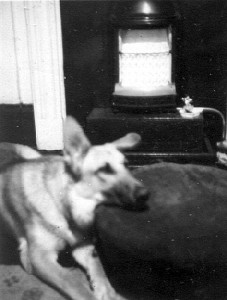 |
Then at the same time my dog must have heard me shout because he woke and came rushing to me and was so full of love for me he rushed around where I stood barking and showing his joy. I later heard from my mother saying she had had been alone that night as my father was out, and she had seen the dog get up and bark and jump around behind the settee, where I stood, for no apparent reason |
My dog Vincent in front of the gas fire – 1956
I learned enormous and important lessons from that. I realised that having no physical body the living cannot usually hear us. They need physical sound to know we are present, but yet another part of her knew and responded. So I saw that if she had thought of me and spoken to me I would know, even though she might not be able to hear my reply – unless she was a medium or learned to listen to thoughts. The reason being that in the body most people cannot communicate via thoughts. I also learnt that I had an inner life as real to me as the ordinary waking life. This inner life was a fusion of the bodiless awareness and the life of form we experience in the body. This was obvious because my sleeping body was dressed in pyjamas, and my body I knew in the experience was dressed in outdoor clothes. Also it was not limited to space and time as the physical body is – shown by my sudden shift across mile to my home in London. Somehow it stood between two very different worlds of experience. I say that because although I was invisible to my mother, I was visible to my dog with much finer senses. Remember that humans can only see 1% of visible light, and hear only1% of sound so are virtually blind and deaf. See Inner World – Jesse Watkins Enlightenment
Another step
Having realised that we have a core self which is felt by some to be nothingness, it is important to realise that during dreaming (REM sleep) our voluntary muscles are paralyzed – except for our eyes. It is thought this was developed during a period when our forebears were sleeping in trees. Any movement would have made them fall. The eye movements were of course not dangerous.
An important fact about dreaming is that all the signals for movement while we dream are sent by the sleeping brain to the muscles but are blocked by a part of the brain called the pons. See Sleep paralysis
But this block can be bypassed by having a passive attitude while awake (See The Keyboard Condition). This allows for a little recognised phenomenon which, while awake and in a passive state, allows the dream process to break through as spontaneous movement, sound and emotion, exactly as with dreams. In the past, and still in the present, this spontaneous movements and speech are all things that happen when this dream process breaks through into consciousness. Things like Seitai, Subud, Chi Gong, Shaktipat, Pentecostalism, and Reichian therapy, where spontaneous movement is practiced by thousands of people.
Remember that our life depends and arises from our core self, whereas our ego and personalit are all the time upheld and given life by what flow from what is largely unconscious. So the movements that the dream process give rise to are for our benefit, and are not a threat. But when this spontaneous movement breaks through to consciousness many people are frightened of it and rush to the doctor to sedate it. See Life’s Little Secrets; Reaction to the unconscious
So here is real lucid dreaming because it happens while you are awake. Apart from that it is very clear and can be seen to stay on a theme unitl it works out. As such you can witness the ‘dream process’ coming slowly from a formless begiing and making its way to conscious awareness.
Linking it all up
It is worth reading the piece How it Flows.
A couple of examples may help to make this clear.
Example: I felt as if I were falling down a long hole, like Alice in Wonderland. The observing part of me understood that I was dropping backwards through my whole life. At times I seemed to bang into things, or bump off things, and these were the painful times in my history. At one point I wondered if I were experiencing some sort of healing regression, but I only touched the events of my life as I fell back.
Eventually I came to rest. It was wonderfully peaceful and even my thinking had stopped. I didn’t have any feelings of having a body or shape. I simply existed. Again the observing part of me wondered if this was the womb, but it quickly became apparent, or I knew, that this wasn’t the womb, it was the basic level of my awareness, how it felt to be before thinking and speech. I began to feel afraid as I realised that if I dropped any further back I would cease to exist. Then I knew the fear was unnecessary as every time we go to sleep we drop back into the condition where we lose any sense of personal existence, yet we emerge none the worse the next day. So I let myself drop.
I fell into immensity, black and without features. Suddenly I was aware that something held me. It was the process that had grown me from seed in the first place. My ego had not created me or grown me. But now this deep part of me was unfolding me again, like a plant opening. I understood that we each have this force at our centre, and as I watched it working in my body and life, it seemed to communicate with me. At least I understood from it that if I opened to it each day, if I surrendered to its action, then it would grow me to a fuller life and realise itself in me. This felt like a holy gift, that the mystery of life would live in me.
Here he touches or experiences his centre – his core self – which was without features and yet held him. He also felt that although he had fallen into nothingness yet it communicated with him. He also understood that we all have this force at our centre out of which our growth comes – and it brings understanding of ones life and purpose. He says later on about his purpose, “I was lying on my back as I was experieincng these things, and it felt, directed by that inner force, that my hands and feet were like roots into the earth, and my penis was a tree, and when it was full of branches and leaves it could give shelter to other beings who sought to grow.” See The Sacred Tree
The Age Old Secret
To show you examples of this I will quote from peoples experience of the different ways this has been used throught history.
Shaktipat
I am not sure What one came first, but considering Buddha was known to have lives around 500 BC, Shaktipat may have been practised long before the Pentcostal experience.
In his article Between Coma and Convulsion, in Energy and Character, David Boadella quotes the report of a person studying the self regulatory practices in India. Although this is a recent account, the yoga practice it describes has been used for many centuries in India:
I have been in India for about four months now and I thought the readers of Energy and Character might be interested in the similarities between Reichian work and Shaktipat or Kriya Yoga. The Sanscrit word ‘shakti’ means energy, bio-energy, or more correctly, bio— cosmic energy. Shaktipat is a practice which is described as the loosening of this energy by a guru from the way it may be blocked in us. When this shakti energy is loosened and no longer tightly bound by the control of the conscious mind it begins to circulate in the body. It is then said to open up energy channels or pathways, and usually begins to manifest in what are known as ‘kriya’. Kriyas are spontaneous movements of the body and of the respiratory system. One interesting aspect of kriyas, which resemble Reichian abreaction, is that they very often manifest as highly involved asanas (body postures) and as mudras (meditational postures involving the hands). I have seen many persons who practice shakipat enter a phase of intense energy flow in which breathing becomes rapid and involuntary and in which people begin with great rapidity to do asanas they never knew and which they ordinarily would never have been able to perform.
Although the conscious practice of asanas facilitates this process, true hatha yoga (Indian techniques using physiological processes to integrate ones being) occurs involuntarily in this kriya phase. The burst of energy that results is sometimes astounding and may continue for well over an hour. The movements in some individuals are so intense and frantic they appear dangerous. In other persons the movements are soft, delicate and flowing. Thus some persons may breathe like locomotives, beat themselves repeatedly, stand on their heads, bellow, twist their limbs in the most unbelievable postures; others begin to dance harmoniously, to sing softly in languages they have never learned, to become playful and flirtatious and to utter strange sounds.
The explanation for this is that the shakti is opening or purifying obstructions in the energy pathways, that the individual is working out the results of past actions and experience, and that an evolutionary process is allowed to unfold which eventually will result in an expansion of awareness.
In this kind of meditation the individual sits still, but not rigidly; he doesn’t concentrate in any way, but simply relaxes as much as possible and permits the energy to do its thing. The energy is of course thought of as ultimately cosmic or divine. Hence the path of enlightenment lies in relinquishing ego control and identifications and allowing this bio—cosmic energy to express itself and lead us. The final results of this process is the opening of the highest brain centres in a new type of consciousness in which the individual merges with the universal consciousness. The total process takes a very long time but this should not dissuade us as each stage has its own rewards. The bodily spasms, automatic breathing, asanas, contortions and reflex patterns that manifest spontaneously as the energy gains momentum all serve to purify the organism. Though some of these phenomena may sound strange they are not experienced as unpleasant once the practitioner no longer totally identifies with bodily processes. Thus the meditator can be totally in their body without identifying totally with its experiences.
Pentecost
Pentecostal Christianity speaks of gifts of the spirit. These are listed as the gift of: the word of wisdom; the word of knowledge; faith healing; the working of miracles; prophecy; the discerning of spirits; diverse kinds of tongues; and interpretation of tongues.
Most of these are easily recognizable descriptions of faculties of the unconscious. The unconscious is constantly scanning information and considering the highest probable outcome – thus prophecy. Access to universal aspects of consciousness allow the gaining of insights which might also account for prophecy, wisdom and words of knowledge. See Edgar Cayce
Speaking in tongues is a common way in which the unconscious expresses its feelings and insights. It is a level three expression in Van Rhijn/Caldwell’s levels of consciousness. When the ‘tongues’ are considered as symbolic expression they transform into meaningful words, just as dream symbols do. My experiments with such phenomena convincingly show the common link between these often considered unrelated phenomena and coex. See How it Flows
Discerning of spirits means the ability to look into a human heart and see what is hidden there. Considering how much we can learn subliminally through body language and verbal cues, this is another straightforward unconscious faculty.
But imagine a group of people all ‘worshipping’ as is described of Pentecost, when the disciples were taken to be drunk. (Acts 1:12 to 2:13) There were 120 gathered in a room, men and women being equals – “All these with one accord devoted themselves to prayer, together with the women and Mary the mother of Jesus, and with his brothers.” Considering present day Pentecostalism and other forms of coex, this large group would include people who would be shouting in tongues, others would be crying, moving their bodies, discerning spirits, and generally creating a bedlam of noise. Any newcomer to the group, not having had explained what was being attempted – that each be open to the Spirit and be moved by it – might think the people were crazy or drunk.
Franz Mesmer
Coming nearer to our own times we find a connecting link between past and present in Franz Anton Mesmer. In about the year 1775 Mesmer, a qualified doctor three times over, began to experiment with magnets. He found that patients who had previously been incurable were healed when these were placed on their bodies. For a year he had a mania for experimenting with magnets in quite extraordinary ways. But within that period he realised the same healing results could be obtained without using the magnets. He found that simply by stroking or touching the patient along the line of the nerves, the muscles would begin to twitch. This twitching, he said, should not cause alarm, even if it led, as it usually did, to an intensification of the patients symptoms or even convulsive movements. Throughout these releases, noisy and explosive though they were, he saw how patients could experience a healing of the distressing symptoms.
Prior to this time these convulsive releases were considered to be the work of devils or spirits. This attitude arose out of Christian belief, and Jesus and the disciples clearly used the same technique. In the New Testament are descriptions of people cured by these convulsive releases. Mesmer is a transforming link with our own times because his approach to this phenomena was an experimental and evaluative one. Nevertheless he was still bound to the past by his belief that another human beings presence was necessary to act as a channel for a cosmic energy to reach the sick person. Thus he still remained, in this aspect, in connection with the guru as agent of change tradition.
Stefan Zweig, in his book Mental Healers, describes Mesmer’s way of working as follows:
With a serious and dignified mien, calmly, slowly, radiating tranquility he would draw near to the patients. At his proximity a gentle fit of trembling would spread through the assembly. He wore a lilac robe, thus calling up the image of a Zoroastrian or Indian magician.
Usually no great time elapsed before one or the other of the company would begin to tremble, then the limbs would twitch convulsively, and the patient would break out in perspiration, scream or groan. No sooner had such tokens manifested themselves in one member of the chain, than the others too, would feel the onset of the famous crisis which was to bring relief. Some would fall to the ground and go into convulsions, others would laugh shrilly, others would scream, and choke, and dance like dervishes, others would appear to faint or sink into a hypnotic sleep. According to Mesmer’s ‘theory of crisis’ the malady had to be provoked into its utmost marge of development, it had so to speak to be sweated out of the organism if the body was to retain healthy.
The importance of Mesmer to the history of homeostasis is that, to the individuals who claim to have ‘discovered’ a new approach to human ills via abreaction, or say they have channeled a new cosmic force for the use of humanity, Mesmer stands as a direct contradiction. Three hundred years ago, despite his exotic dress and manner, he ran individual and group psychotherapy of a very successful nature. Although he thought of himself as a channel for a cosmic energy, he nevertheless recognised an agent other than technical psychiatric skill at work. Perhaps the ‘cosmic energy’ theory was not so far out either, as Reich revived it in new form in our own century. The work of Mesmer gradually moved into greater and greater complication — people dancing around trees for instance — instead of simplification and clarity. Out of it came Mesmerism which took the form of positive suggestion, completely leaving behind the aspect of allowing the organism to discharge its own tension and negativity. The spontaneous forces capable of self healing were ignored — even suppressed. The vainglorious power or forceful skill of the mesmerist or therapist took its place.
The Method Never quite Dies
The approach started by Mesmer has never completely died out. While living in Russia in 1912 Sir Paul Dukes met Lev Lvovitch who used a self regulatory method to deal with a variety of illnesses. He would stroke patients limbs and induce shaking and trembling. In his book Unending Quest he describes the case of a boy whose legs were paralysed. “There was a broken exclamation from the boy in the middle of the room. ‘It’s b-b—beginning!’ The lad was quivering from head to foot so much that he had to hold on to his chair.” After several treatments Dukes observed that the boy’s condition improved, and in a few weeks he was cured.
Only in very recent years has any serious scientific work been done in understanding what takes place in this healing which arises from within — with or without the help of an outside agent. Despite this research there is still virtually no socially established ways in which individuals are taught to trust their own internal processes. People in the West, and especially those trained in the helping professions, are forever committing the crime against human nature of ‘doing something’ to it, and seldom letting ‘It’ do something to them. Nevertheless some individuals and groups have done a tremendous amount to make us aware of our lack, and point out ways of overcoming it. Freud does not leave us with any sense of there being a powerful and helpful self—regulatory action in us. He gives no sense of finding a transformative power with which one can work toward spontaneous analysis and self help. But in Jung we find again and again very clear reference to what has been named in this book as homeostasis.
Carl Jung Linking East and West
In Psychological Commentary On The Tibetan Book of The Great Liberation, Jung says:
“If we snatch these things directly from the East, we have merely indulged our Western acquisitiveness, confirming yet again that ‘everything good is outside’ whence it has to be fetched and pumped into our barren souls. It seems to me we have really learned something from the East when we understand that the psyche contains riches enough without having to be primed from outside, and when we feel capable of evolving out of ourselves with or without divine grace. . . We must get at the Eastern values from within and not from without, seeking them in ourselves, in the unconscious. Because of these resistances we doubt the very thing that seems so obvious to the East, namely, the SELF LIBERATING POWER OF THE INTROVERTED MIND. This aspect of the mind is practically unknown to the West, though it forms the most important component of the unconscious.
The whole process is called the ‘transcendent function’. It is a process arid a method at the same time. The production of unconscious compensation (self-regulation) is a spontaneous PROCESS; the conscious realisation is a METHOD.
In Jung we find something of the reverence for what is met within a human being – a reverence for life itself. A great deal of Jung’s attitudes and thoughts have already been quoted, enough to show that he did not use the self-regulatory process in such a cathartic way as Mesmer.
Reich – Cosmic Energy and the Death of Guru’s
Dr. Wilhelm Reich offers us a very different approach to this world of experience. In the 1920’s Reich gradually felt his way from an orthodox use of Freudian psycho-analysis to a more biological, physiological or energetic point of view. Not that he lost sight of the human soul, but he realised how much body, energy and personality are unified. By working with body attitudes or postures he found he could help the patient melt tensions and emotional blocks. By relaxing muscular tensions, flows of energy, movement and feeling were unblocked. Perhaps more than any other clinical therapist or doctor of his time, he recognised that a spontaneous, self-regulating activity or energy was at work in all living organisms. He says of this energy, which he eventually called orgone that it was cosmic and acts on the human being.
Gradually Reich developed very definite techniques, working with respiration, muscular tension and character attitudes. He particularly explored the place of sexuality individual, social and political structures. He helped people release their own self-regulatory process and work with it toward health and wholeness. As people learnt this they experienced spontaneous movement, trembling, changed feeling states and emotional and sexual release.
The actual results, as compared with those already mentioned in this short history, were no different to those in Shaktipat or in Mesmer’s work. Nevertheless Reich brought a new openness, a new technical understanding to the subject with his genius. Unlike Mesmer he did not rest until he had pinpointed clearly what released self-regulatory action into conscious operation. He did not stop, as Mesmer and the gurus did, in believing himself and certain other special men and women were the channels of a cosmic energy which healed. Reich made the tremendous step, while yet remaining a scientist and clinical therapist, of seeing an integral law of human nature at work, and active in individuals quite apart from his personal influence.
In this Reich helped people in the present to begin a link with their spontaneous energies which earlier peoples had known only in a religious context. The deeply religious, surrendered attitudes so prevalent in the past are seldom found today in the West. Certainly not in the way demonstrated by the original Christians who surrendered body and mind to a force they trusted. Looked at in this way, even the Godly in the West are frightened of God’s power. Jung makes the statement that people in the West cannot find God because none of us can bow low enough. Being unable to form the trust out of our religious convictions, Reich enabled people to meet this vital part of themselves from a different more acceptable starting point. The new standpoint is that which includes our critical and analytical intellect. To deny it in an attempt to emulate the East in approaching their inner life uncritically, would be to do ourselves a great disservice. Reich proved that as Westerners we can still touch our deep spontaneous energies while retaining our new-found intellect.
Also a person close to Reich is reported to have said that Reich told him that cosmic consciousness was available via this method.
The Way of Subud
Considering Reich’s work it is interesting now to look at the influence of Muhammed Subuh. He was born and lived in Indonesia, working as an accountant for many years. His main interest in life was to seek out some of the many gurus in his country, and attempt a deeper awareness of life’s mysteries and the nature of God. In his late twenties, in the year 1925, he experienced a vision while out walking. It seemed to him that a ball of light or fire rushed across the sky and descended on his head. He began to shake and tremble, and felt a powerful and divine energy had begun to work in his being. On reaching home he opened himself to the influence of this power and found spontaneous movements and experiences occurred.
From that time onwards he frequently ‘opened’ himself to what he felt to come from God, and found that each time movements, sounds, and a wide variety of inner experience arose. He observed that the movements and experiences were ways in which his being was gradually cleansed and made whole. It was as if some influence were gradually guiding him through experiences in a direction he could not preconceive, but IT could. Also, his physical health improved, his experiences educated him regarding his and other peoples life on Earth, and he found his intuitive faculties enormously enlarged. Often he could also be instrumental in helping other people to experience healing. The film star Eva Bartok told her story in the newspapers at the time of her own healing in connection with Pak Subuh and her baby.
By 1932 Pak Subuh had discovered that other people who relaxed in his presence could also receive the same experience and be led through cleansing and integration. Groups of people in Indonesia began to practice this ‘opening’ to what they felt to be the grace of God working in their lives. The manner of these group experiences is like that described under Shaktipat. People found their bodies making spontaneous movements; they experienced themselves in a wide variety of ways, were led through catharsis and great inspirational insights. Like the Pentecostal approach, there was a tendency toward remaining on the symbolic level, and editing all but the transcendental.
The experience of being moved from within was called ‘Latihan’, which in Indonesian means to be moved, cleansed and disciplined by the power of God. But until 1957 comparatively few people were in these groups doing latihan. Those who were had mostly been using latihan several times a week for many years. Sometimes the length of practice was ten or fifteen years. These practitioners had found that their nature and body had been gradually changed by the practice. Their awareness and sympathies had widened. Problems had shifted, and in general they felt more in touch with the force or meaning behind their existence.
At this point a European working in Indonesia – Rofe – asked to be introduced to the latihan. Rofe taught it to people in England who started an international centre at Coombe Springs. From there the practice went world-wide, and at one time the followers numbers were claimed to be 200,000. People of all nationalities, religious belief, political views and social status found they could experience the latihan. The lives of many were deeply changed by it.
If we are to understand how modern men and women relate to their core self there are things we must be aware of in regard to the latihan, and the organisation named Subud. J.P. Barter, for instance, writing about his involvement in the latihan says, “We do not know for any certainty why the force which is received in Subud has been made uniquely available to mankind today rather than at some earlier period in history.” The statement is typical of the sort of historical blindness and spiritual pomposity that is common in the practice. Pak Subuh states that the experience is unique to him and new in the world. When I myself started a coex group many years ago, based on Reichian work and Mesmer’s groups, a spy was sent from a Subud group in a nearby town to find out where or how I had stolen their latihan. That people like J.G. Bennet, a well educated man, and Barter, bright enough to write an orderly account of Subud, can accept such statements is a warning that the Western mind, in attempting to reestablish connection with the deeper layers of the psyche, can often revert to primitive attitudes, ignoring or discarding information and lessons learnt through hard experience.
In later years Pak Subuh told his followers that the experience was not unique.
Summary
A lot of words, but I hope it clearly shows how we each have an inner life which owes its existence to our core self. I believe I have given enough examples of how our core self works, and how it is the polar opposite to our conscious personality. I hope too that it can be seen that dreams arise from our core self and are a half way house between the formless core self and our conscious mind, and how dreams are part of the action of our growth and well being from the deep well of our innermost self.
See: compensation theory; movements during sleep; the dream process as computer; Adler; Freud; Jung.
Dreams Death and Dying – Eastern cultures describe death and dying.
In most of the great faiths and traditions of the world, there are similar teachings about the relationship with the dead. The Egyptian Book of The Dead, one of the oldest books in the world, explains how the soul of the dead person is brought before the gods and has to answer their queries. The Tibetan Book of The Dead gives detailed instructions for a living person to read to the dead. The text explains how the soul of the person will face his or her own deeds, thoughts and fears in a new way, and will come face to face with the gods. It explains how each of these can be best dealt with. Even the recent investigation into near-death-experiences echoes this theme of the person facing their deeds when they have died.
Although The Tibetan Book of the Dead arises from a very different cultural standpoint than that of the West, it is more than simply a strange or superstitious document. It encompasses a profound attempt to look at the subtle side of the human mind and speculate on what we face in death. See Levels of Awareness
In ancient China, the tradition of ancestor worship was of tremendous importance. Here again we see the personal value of relating to the dead. Most aboriginal races have a similar strong feeling of connection with, and remembrance for, their dead. In Catholic Christianity, there are a whole series of sacraments linking one with death or the dead. From the very first, baptism aims at bringing one into a new relationship with God, and making one ready for direct and conscious entrance into Heaven at death. The sacrament of the Mass applies not only to the living but also to the dead: Mass by the living being given for the dead.
This question of what fate human consciousness faces at death is in fact explored by most past races. Looking at these ideas from the standpoint of what we now know about sleeping and dreaming, perhaps some light can be thrown on these ancient ideas.
Two possibilities may exist in sleep, and therefore perhaps in death also. One is that we may penetrate sleep with self-awareness, as happens occasionally in lucid dreams. The other is that we may be carried along by images and emotions, influences and drives, whether we like it or not, as occurs in nightmares. Some of the images and experiences may be beautiful, and some may be terrible. In using this approach to understand ancient texts about death, it is helpful to clarify exactly what it is we experience in a dream. Whether what we experience is beautiful or terrible, are they anything more than tremendous experiences of virtual reality? If they are not, then any horror or beauty we meet are self-created. If this can be accepted, that the apparently real people we meet in dreams are not more real than the experience of colour we have when we look at a rose – considering that we are not seeing the colour, but nerve impulses sent by the eyes to an area of the brain where it is translated into what we apparently see – then we are dealing with our own unconscious creations. But this still leaves us with the question of what is the difference between that and our so called waking experience. Possibly the only big difference is that our waking experience is less prone to change than the dream state. See You Are a Dual Being; Dreams are a reflection of your inner world; Inner World
The Eastern texts mentioned state that if we lack the ability to stand back from involvement in these swirling impressions and fail to see them for what they are, we will be carried wherever the seeds of thought, emotion and fear move us. This much is not speculation. We need very little examination of our own experience to see how time and again our ability to coolly respond to situations is swept away by unbidden emotional or physical responses. If we can see these powerful feeling reactions, or subtle influences for what they are – our own swirling thoughts, emotions and sense impressions – we enter another level of experience entirely. In this sense our identity is like a small boat swept along in a rushing river. The river in this case is our sense impressions, our emotional responses triggered by glandular secretions such as the adrenals, and our imagination or anxieties. See Avoid Being Victims
If you can accept for a moment that when you are totally involved in a dream, you are immersed in experiencing your own largely unconscious attitudes, fears, longings and ideas are external realities, then it gives a starting point to explore these ideas about death. We can begin to understand from our own observable experience rather than from subtle oriental philosophy.
The example of a nightmare you have experienced at some time will be helpful in this. During the nightmare you were almost certainly convinced that it was real. All your actions and feelings also arose directly out of feeling that the nightmare was an external reality, and not a play of internal emotions and fears. Most likely only waking was able to begin dispersing the fear you felt. But supposing you had become aware in your nightmare that what you were facing was not an illusion, but a projection of internal memories, past experience and attitudes. What would that be like?
It is not necessary to speculate too much on this, as many people have been able to become lucid in this way. (See: Buddhism and Dreams for some examples.) What people meet who have done this is a breaking through the apparently real images and events of the dream into direct personal insight. In other words the images of the nightmare give way to direct memoirs of past events that lay the foundation of feelings out of which the nightmare arose. For instance Robert Van de Castle writes that when he has helped people explore nightmares about a ghost, it has always led back to the childhood memory of a parent coming to the bedroom and lifting them or moving them to prevent bed wetting. See Our Dreaming Mind by Robert Van de Castle.
Such direct experiences also help us understand what happens when we fail to face the images of a nightmare, or in fact any other troubling fears and anxieties. We know from personal experience that they remain to haunt us. They continue to influence the way we deal with life, with opportunity, with relationships. It is this influence in the present arising out of the past that Eastern peoples call karma.
interaction of past and present
If we create a scheme of the levels of the mind in meeting a nightmare, first of all we meet the dreams images. In most cases this is as far as we go. Our experience of the dream people or creatures is that they are as real as any object or person we meet while awake. Because of this we react to them as if they are real, and can harm us.
So at this first level of interaction we are victims of the virtual reality of the nightmare. Our actions and reactions arise out of acceptance of the reality of the dream characters and situation.
Moving to the next level, from the experience of people who become lucid in their dream, the characters, drama and objects of the dream are experienced as a projection from our own past, from our own fears or imaginations. So the nightmare can be equated with life events. Using the Eastern term of karma, we can say that in the nightmare we are experiencing our karma – outflow of past experience and events.
The doctrine of Karma in Eastern cultures states that our experience of life and its events depends upon the actions, thoughts, desires, longings, that have become built into ourselves from the past – this life and others. When we break through the images or surface life events, we come to the realm of Karmic influences. That is, we discover the pattern of past habits, attitudes, fears, pains, plans and aspirations that have projected into our conscious life and its events.
Therefore this second level of experience is one of penetrating what is at first an apparently external virtual reality, and in penetrating it discovering the influences, the processes or energies that create it. I have summed this up by using the word karma. So we begin to see the karmic influences out of which our life is woven.
Imagine what it would be like to penetrate deeply into your own mind in this way. Again, many people have done it, so it is not a ‘What if’? When it happens the events and directions we have taken in life are seen to be the outworking of deeply etched patterns of behaviour; of passionately made decisions, perhaps from the experience of betrayal; out of lessons learned sometimes over generations of our family. Our conscious biases, opinions, abilities, fears, failings and illnesses, are seen to emerge from this matrix of past experience.
If we think of our past deeds as a colour transparency in a projector, and our conscious self as the screen, we gain an idea of this. Hatred, love, fear, built into us in the past, act as images on the transparency, influencing, colouring, the life-giving energies of our being. If we experienced something that has hurt us sexually or emotionally, and we thus deadened parts of ourselves rather than face our pain, then our present sexuality and emotions will be lacking the full outflow to that degree. These blockages are dense areas on the transparency of our Karmic nature, blocking the light. The light itself is all the range of our experience, sensual, sexual, emotion, mental and spiritual. This is not altogether a good analogy, because our Karmic matrix may contain frozen lumps of our life energy.
If we could consciously meet our fears or pains, our passionately felt decisions of the past, we might arrive back to awareness of the ‘transparency’ or matrix. In the Catholic sense, we would have now ‘admitted’ to consciousness – to ourselves – our past ‘sin’ or error. Becoming conscious of such patterns often wipes them away. In modern psychological terms, awareness transforms. If we see some of the ancient teachings in this light they are less esoteric, and more easily understood as amazing expressions of past psychological insight.
healing force
Coming back to the experience of a nightmare, or in fact any dream, while we are alive we can wake up. But what ancient cultures say is that when we die we cannot wake from this world of dreaming, or perhaps of nightmare. This is precisely why masses are said, or why teachings of the East expound ways of helping the dead find their way out of the apparent reality of a strange and perhaps disturbing environment.
In the ‘Bardo Thodol’ (Tibetan Book of The Dead) the dying or dead person is told to hold himself or herself in the Clear Light, without letting anything such as thoughts or karmic influences claim them. What this means in today’s terms is that a living person reads to the dead, telling them not to get lost in their own thoughts and feelings. They are told that underlying the apparent reality of the ‘dream’ or mental landscapes and environment they find themselves in, is the clear consciousness without form. All the mental images and emotions, terrors and wonders experienced, are things the mind creates. But it is all a moving torrent of experience that is not ultimately satisfying. Only the clear consciousness gives the person an experience of their fundamental nature.
In Christianity this clear light is called Christ the Redeemer.
If we gain some concept or feeling of the power that has grown us from conception onwards; that has unified the millions of body cells; that organises all the functions and organs of our body and mind, we have an understanding of this unifying power. Modern psychology has also shown us how hate, fear, shock, jealousy, interfere with this activity as it attempts to keep us whole and healthy.
If we think of the totality of our past experience as the karmic matrix mentioned, we might see even more clearly how hate, fear, shock, jealousy interferes with the principle behind our own growth and stable existence. The Catholic sacraments look upon the negative influence of this karmic matrix as our ‘state of sin’ and tell us Christ can redeem us.
When we experience the power of this internal life principle in the way healing or ‘redemption’ takes place in us during and after illness, our awareness of its power and reality becomes very great. It is the energy that upholds our existence, and which we can either, co-operate with or work against.
The ‘Bardo Thodol’ calls this the Secondary Clear Light. In experiencing it we are aware of the effect of the Clear Light and its power on and in us. But we are not conscious of the Light itself. The ‘Bardo’ says that very few people can actually remain fixed in the Clear Light itself. The reason being that it is formless, impersonal, and transcendental.
Again, in the ‘Bardo’ it says, ‘The common people call this the state wherein the consciousness principle (object knowing principle) hath fainted away.’ These teachings declare that if we cannot hold onto this condition, we drop into the next level, which is experiencing the effect of the Clear Light. If this is not possible to maintain, we drop into our karmic matrix. If this is not maintained, we become lost in images and ‘dreams’ arising from the karma we have gathered, i.e. our loves, hates, fears, and aspirations. This means we are back in the nightmare situation.
four levels
Looking at the previous statements, we can see that four levels of experience are defined. These four levels are not difficult to understand if we look at our own experience of waking and sleeping. If we once more look at sleep, we will perhaps understand what the ‘Bardo Thodol’ is saying. For instance, experiments in sleep laboratories have shown that when we sleep, at first we drop into a deep dreamless state. Then we gradually move to a condition nearing waking consciousness in which we dream.
In dreamless sleep our ‘object knowing’ self disappears. There is only ‘being’, pure consciousness, without images, emotions or sense of self. We experience it every night when we sleep. So it is not anything strange or unknown. But because we usually lose any sense of our ego in this ‘dreamless sleep’ state, we usually say we were unconscious or asleep. Nevertheless, we went into the void of dreamless sleep, and we emerged from it again. Some people even mange to maintain a level of awareness, as in lucid dreaming, and so carry back a memory of the void.
Those people, who have melted into the void and carried back awareness of it, describe it as the basic level of existence, universal, imageless consciousness. Another way of attempting a description is to say it is unchanging and self-existent, as opposed to the ever-changing experience of our senses, emotions and thoughts, all of which are linked with other phenomena, and so not self-existent.
Because few of us can even begin to grasp that this daily experience of dreamless sleep, this seeming absence of being, as a reality – The Reality – we cannot, do not wish to, are frightened of, maintaining it. As the Bardo explains, most of us cannot maintain the Clear Light, so we enter again into the acceptance of the world of sensory experience, of dreams.
Working from outside in, if we break through the experience of our senses and dream images to the karmic matrix, and dare to meet the passions and pains out of which our life is woven, we have now woken up at the dream level. At this point we are no longer completely dominated by, and at the mercy of, the passions and pains that previously moved us unconsciously. See Steiner Life after death
From here we can begin to see why the sacred teachings of many races have said the living can help the dead. In their book ‘Dream Telepathy’, Krippner and UlIman tell of their years of scientific research into the sensitivity of sleeping persons to the thoughts of others. Their research at the Dream Laboratory of Maimonides Medical Centre in New York has now become world famous.
Many people who were not a part of Krippner and Ullman’s research have also noted how the thoughts or prayers of others frequently alter the pattern of their dreams.
We can understand this further if we think of it in the terms used generally in these articles. The state of hell can be thought of as being personally submerged in the images and experiences of one’s own violence, hate, terrors and incohesiveness.
Purgatory is the same as this, but with one main-difference, the personality before death had, through baptism and confirmation (i.e. opening consciousness to and fixing it in a transforming influence) contacted the unifying principle. The expressed power of the Clear Light, God, has the effect of integrating and redeeming the images and energies we would otherwise become lost in or possessed by, in the sleep or death state.
Free will, for nearly all of us, is missing at that level, as is the ability to stand apart from the images. Nevertheless, those who have contacted and opened consciousness to the unifying power causing their existence, find the nature of their dreams changing. The integrating power is actually opened to even in dreams, and relates us differently to the images and events being faced. This psychological fact seems to explain a great deal about he theological catholic statements in regard to the power of baptism and the laying on of hands to give a different ‘quality’ to the soul, and making the difference between being lost in hell, or being capable of direct or indirect entrance into heaven. If we equate baptism and confirmation with the opening of consciousness to the unifying principle, these statements can be understood.
consciously work on a dream
The question of helping the dead is one of the clear will of the living, being used to pierce through the confusing images of the dream state, to aid the central ego of the person to open to the influence of God. We can achieve a very clear impression of what this means when we ourselves consciously work on a dream, or directly face images we ran from during sleep. Consciousness can decide to do things that are not possible during sleep.
It has been said above that if the unifying power has been a conscious experience, the quality of dreams is changed. It is also true that when our conscious understanding of dreams is clarified, another type of change occurs.
A different approach results, which leads to seeing beyond dreams to their causes. This relationship between our own conscious understanding and our sleep experiences also appears to exist between the living and the dead. They complement each other in a very real sense. For waking consciousness limits, defines and decides. In this way it can direct energies through understanding them.
This rational defined and separate consciousness is generally better developed in occidental peoples, and has been the basis of our technological culture. The interior sleep awareness is unlimited, ranging through space and time, possible and impossible, fact and fancy. It is not defined.
Almost any dream one attempts to analyse has a great power of avoiding final analysis. One can only arrive at general understanding. This is more the tone in which the oriental peoples are masters. Then one cannot easily go beyond the visible or obvious; the other tends not to be tied down to defining in external abilities or creations their interior life.
help of prayer
If we therefore pray for the dead, in the sense of opening ourselves and them to the unifying principle, this releases a power into the condition they may find themselves in. Such prayer will aid in releasing them from images and psychological difficulties being experienced. Also, if we have a clear View of the after death state, and talk to our dead as the Tibetans and others do, this brings to them the clarity of our consciousness to aid them. We, in return, through this subtle contact, receive impressions of wider awareness and understanding. If the experiments of non-physical communication between the living were practised and remembered, some idea of how this communion is experienced will be yours.
In Spiritualist ‘rescue circles’, someone with this type of sensitivity acts as the connecting link between the living and dead. The group then throws the light of their waking consciousness, argument and explanation, into the experience of the dead person being helped. Thus, those trapped by suicidal urges, ignorance of their situation, uncontrollable desires or fears, are aided to find release.
Subud members also practise what they call a ‘latihan’ (spiritual surrender to the unifying power) for the dead. They say that the dead have very intimate contacts with their living family. If one of their family opens to the unifying principle, or life force, and thus becomes themselves more integrated, this influences the condition of the dead. If this surrender to God is done in the name of the dead person, family or not, it has, they say, a tremendous power to help, and ‘wake them up’ in death.
Although all these methods are very different in outer form, we can see a thread of similar aims and ideas passing through each. Something to be dealt with later on, but not out of place here, is to say that the dead have a similar relationship to us as our own sleep consciousness. This is only an extension of what has already been said, but may easily be overlooked. To put it into a few words: the dead are now parts of our own interior, and often unconscious, being. They are aspects of our own total psyche. The insight, love, prayer, release of healing power, or attempt at understanding we bring to them, influences them in precisely the same way it influences ourselves.
The ‘cult of the dead,’ as it is sometimes called, if persisted in long enough in an attempt to aid a soul through the miasma of unconscious truth and error to the Clear Light, is also a legal spiritual path. The soul we help to the clear light is a part of our greater being, and its attainment is for us also a consciousness of the highest. If there is a criticism, it is only that most such attempts give up at the level of communicating chit chat and proof of survival.
‘When through illusion,’ says the Bardo, ‘I and others are wandering in the false images, Along the bright light-path of undistracted listening, reflection and meditation, May the Gurus of the Inspired Line lead us:
May the etherical elements not rise up as enemies; May the watery elements not rise up as enemies; May the earthy elements not rise up as enemies; May the fiery elements not rise up as enemies; May the airy elements not rise up as enemies; May the elements of the rainbow colours not rise up as enemies;
May it come that all the sounds in the death state be known as one’s own sounds;
May it come that all the Radiances will be known as one’s own radiances;
May it come that the Clear Light will be realised in the state of death.’
See: Near Death Experiences Journal; Near Death Experience; Levels of Awareness; Journeying Beyond Dreams and Death