Posts Tagged ‘communication with core’
Introduction to the I Ching
Apart from being a book of wisdom in the ancient Chinese tradition, the I Ching was also consulted on questions of state, warfare and personal decision making. It is this aspect of it which is dealt with here. Consulting the I Ching does not present us with statements of what will happen as a fated future. The wisdom behind the book does not see the future as unalterably fixed, but rather like a constantly shifting flux similar to the seasons, with which we can interact. What we receive in a consultation is like a conversation with a wise and experienced friend, who through their experience might point out that if we take our present course within the situation as it stands, the results might be in a direction we do not wish – but if we take another attitude circumstances could change, then we can act more forcefully and effectively.
The I Ching intrigued me, not so much because it is a very ancient book, the culmination of many great minds and a great culture, but because it was largely couched in symbols. My work with dreams and the way people use imagery in thinking and expression, made me want to tackle the I Ching. I wanted to see if I could put into clearer English what is usually said in rather poetic and indefinite prose. Below you can access two working examples of people consulting the I Ching. The text is from my interpretation – originally written for New Zealand Teletext as phone in scripts but never used by them. If you are unacquainted with the I Ching there is also a brief explanation of its principles.
“Your I Ching interpretation(s) are, ultimately, the best I have seen. DEEP BOW. – Sara”
The Hexagrams
| U | P | P | E | R | |||||
 |
 |
 |
 |
 |
 |
 |
 |
||
 |
1 | 34 | 5 | 26 | 11 | 9 | 14 | 43 | |
| L |  |
25 | 51 | 3 | 27 | 24 | 42 | 21 | 17 |
| O |  |
6 | 40 | 29 | 4 | 7 | 59 | 64 | 47 |
| W |  |
33 | 62 | 39 | 52 | 15 | 53 | 56 | 31 |
| E |  |
12 | 16 | 8 | 23 | 2 | 20 | 35 | 45 |
| R |  |
44 | 32 | 48 | 18 | 46 | 57 | 50 | 28 |
 |
13 | 55 | 63 | 22 | 36 | 37 | 30 | 49 | |
 |
10 | 54 | 60 | 41 | 19 | 61 | 38 | 58 |
The Magical Dream Machine
We all dream every night, so we each have what could be called a Magical Dream Machine.
To gain a feeling of this, imagine yourself entering one of those game machine areas where youngsters can ride a motorbike, or ski down a slope. But instead of a simulation of a car, you discover a large machine that you can climb into and become completely enclosed. When you close the door, contacts link onto your body and head in the complete darkness. It is quiet as all the external sounds disappear, and you relax your hold on your body and senses. Your whole experience of yourself shifts as the external world melts away, along with your awareness of your body. That is sleep.
But now – in the darkness a light glimmers. Gradually it takes shape. The shape of a person is suggested. In the time that follows he or she evolves form, moves, and you have full sensory experience. You are totally involved, with all your emotions and sexual responses. Changes occur and you love, fight, fear, murder or bring to life again the person, who can become an animal, a devil, God or a bodiless voice lost in a sombre countryside. Your experiences are totally real, and you move through heaven and hell, despair and joy, darkness and light. Scenes from your past can be revisited – or totally new experiences can be felt so clearly, you are enriched. That is a dream.
Seeing Is Not Believing
If you had been in such a machine, and on coming out of the total involvement of these moving experiences, you were told you had created it all yourself – that on the black screen you had, out of your fears, habits, secret longings and passion; out of your immense store of memories; with your unbelievable range of feelings and creativity – you had given form to urges and processes in your body and made this rich world of experience, what would you feel? Would you disclaim responsibility? Would you consider it meaningless? Would you realise what amazing creativity and potential you have?
In your dreams you create such a world and such experiences. But perhaps you have not taken time to consider the wonder of your creative process in dreams. Every night you create a new drama. You conjure out of your own being the people, the creatures, the surroundings of your dream. Then you give life to what you create – not only life but purpose and drama. You are a supreme dramatist, playwright, actor and actress. You are the great Creator – in your dreams. Considering this, have you ever wondered why that enormous creativity does not flow into your waking life? You can see that some people have that creativity and are enriched by it personally and financially. Why not you?
But what is the REAL world?
In considering how you reply to this, remember a few well-known facts about how you encounter the so-called ‘real’ world of waking life. Firstly, when you look at an object such as an orange or apple, remember that although you have the sense of seeing what colour and texture the fruit has, in fact all you are seeing is reflected light. You never see the actual colour of the object.
Also, as far as texture is concerned, this is a mystery to you. Texture depends entirely on what you approach the fruit with. If it is an electron microscope, then the texture is one of shifting swirling atoms and subatomic particles. If you were tiny the apple would have a very different appearance than it does to you at your present size. Also, remember that you never actually know what the apple feels like or looks like directly. Your eye takes in streams of light that are translated into nervous impulses transmitted along the optic nerve. In the brain these nerve impulses are again translated into an image that enables you to have some relationship with an apparently external world. In the same way the nerve endings on your fingers transmit signals that are translated into sensation.
Similarly the television picture you watch on a screen is translated from signals the TV set is sensitive to and changes into pictures, colour and sound. The signals are not in themselves images, colour or sound. So, like the TV, the world you feel so sure you are seeing and experiencing, is one your brain has created in order to enable you to deal with survival. Even so it is a translation of ‘the world’ that has been shaped by evolution and its limited needs. You only respond to very narrow wavebands of light and sound for instance. So you do not know much of what is actually going on in the world anyway. Your eye, as a lens produces an upside down image of your surroundings, and this is ‘corrected’ to help you move around more easily.
Considering that you only experience a virtual reality of the external world created by your brain – and that is itself limited to a tiny fraction of what is actually surrounding you – you cannot take seriously your perceptions of the world or people. There are so many radiations, energies, and depth upon depth of texture in the cosmos and objects around us, that in effect we are blind and deaf. See Inner World
You Are the Creator
So it is true to say that you live in a world, in conceptions of yourself and your surroundings that are a self-created virtual reality. You could just as correctly be asked the question of whether you accept that you create all you experience in regard to the objective world, as you could of the magical dream machine.
However, we are discussing dreams, but remember that what is said could equally as well refer to your waking life.
So, your dreams are a magical place in that you have the ability in them to create a totally real world. Do you discount them? Do you see that you create your own world of experience in them? If you do, have you wondered why you may have a propensity for creating what you do? Or why, with such creative potential, you might still lack self-confidence? Just as you create your surroundings in dreams, you also create the psychological and sensory world you live in. Understanding your dreams can help you to clarify why you at times create what does not satisfy you, and how to generate a whole new world of experience. You can take charge of your creativity and ride with it instead of being at its mercy. Such power, after all, can as easily produce misery and ill health as pleasure and ability – unless you learn to direct it. Such creativity can lead you into hell, or create a heaven.
A few magic words to remember to say to yourself – “I have the magical power of creation. So I can create a hell for myself or a heaven. I have immense ranges of ability and problem solving. So here I go in believing in myself!”
Amazing Storehouse of the Mind
Although you constantly use the huge storehouse of memory and developed skills in your everyday life, you may usually fail to recognise what you are doing, and what a miracle it is. As an example, you now hold in store millions of bits of information. By asking you a simple question such as ‘What is your present home address?’ I can call to conscious awareness a minute part of the information lying unconscious. If I were to present you with a bicycle, or you were dropped in deep water, the skill of cycling or swimming could also emerge from latency if you had previously learned those skills.
Apart from these aspects of your immense storage of information, there is also the possibility that by the right series of questions or experience, you could arrive at a creative synthesis of information already held. In other words something not previously held in memory could arise by putting together old ideas or experiences. With the right stimulus, in the same way you could bring to expression potential within you that is at the moment lying dormant.
While we dream we have a very full access to the storehouse of our experience. If we learn to use the dream process we can more capably use the riches of what usually lies unconscious like treasures at the bottom of the ocean. There is a natural process of putting together the separate pieces of your experience into creative new combinations. All of this can be accessed by exploring the treasures held in your dreams and the dream process. See Using Your Intuition; Clicking On
Mind Watching
Because of the many nature films shown on television we are now used to the idea of mature and intelligent adults spending days or years watching the behaviour of animals such as hyenas or chimpanzees. In her book In The Shadow of Man, Jane Von Lawick Goodall explains how, by watching chimpanzees and taking note of her observations, radical new insight into the behaviour of chimpanzees arose. She didn’t think beforehand what she expected to find, but simply observed and put together the information that arose. For instance on several occasions she saw the chimpanzees kill another animal and eat its flesh. The knowledge that chimpanzees were meat eaters was entirely new.
In a similar way, by observing dreams and laying bare the emotions and associated ideas and memories you have with your dream imagery, you gradually define your personality, its strengths and weaknesses, in a depth you had never managed previously. I have called this mind watching, but it covers every aspect of human nature, not simply the intellect or thinking. See Self Help
This mind watching through observation of your dreams first presents information about your personal experiences and memories and how they influenced your growth and influence present responses. Gradually the information arising from such watching leads beyond your present boundaries of self. It shows in many cases how your unique self has arisen from, and has indissoluble links with your forebears, with your culture, with the past as a whole, and with the cosmos itself. It leads from yourself to the edge of the known, and perhaps helps you take a few steps beyond that edge into the unknown, to create new understanding, and enter new dimensions of experience.
Remember that you are probably one of the millions of humans suffering amnesia. If you doubt this ask yourself why you do not remember your childhood. No doubt you have also forgotten your life as a baby. You fail to remember your life in the womb. Perhaps, more importantly, you have also forgotten your link with the rest of the cosmos. In fact you are an amnesiac, and by ‘dream watching’ your memory can gradually be restored. It takes time and perseverance, but gradually the time line of your existence will be filled with detail.
This mind watching also gradually reveals to you the many aspects of your mind’s working, and with such insight may come the growing ability to use these facets of yourself. Not only may you discover great vistas of personal memory, but also the roots of your creativity, the subtle senses of your emotions and unconscious, and the treasures of experience you have gathered.
The Path To Take
There are many methods you can use to discover the enormous content within your dreams. For instance look at the following features and explore them to discover what works best for you: Introduction to DreamWatching; The AmplificationMethod – PeerDream Group – Active Imagination.
Another method that can be used with great benefit if you are a person who meditates, is as follows:
The meditation method of dream understanding rests on the function of memory. The aim is to hold the dream in mind, and at the same time hold the question of what are the activities, passions, memories or pains in you that have formed the dream?
You hold this question in the same way that you hold any question – such as the one asked above about your address. Do not strive, and do not struggle to arrive at an answer. Simply sit and WATCH the dark space of your mind and feelings. Take note of whatever memories, feelings and fantasies arise.
It helps to think of your being as a keyboard that your unconscious knowledge and intuitions can play upon. Holding your self stiffly, in mind or body blocks this mobility. See the passage on using the body in dream work for further information.
This may not be a quick method. So be patient, even when nothing seems to be happening. The mind is a wonderfully responsive thing, and will attempt to present what you are seeking. But at first perhaps only stray memories or feelings will arise. Also, the insight might require you to feel something deeply, so be ready for that and let it happen if you can.
Over a period of days gradually more and more will arise, and it is worth the time spent in the exploration. But do not be content with airy-fairy insight. Do not make the dream a platitude or a cliché. Dreams are powerful expressions of your down to earth, here and now self. You will know if you have arrived at insight because it will be deeply moving and clarify areas of your life that were previously obscure.
It is important to consider what you have received and weigh it against practical observation. See if there is something you can learn from it and apply. Test it wherever practical. Do not be afraid to doubt it and try it against the world. If you are not accessing the best in yourself you need to know it. This avoids the trap of wanting your intuitions about your dream to be true at any cost. The intuitions arising from the meditation method are a valid way of gaining information, just as your senses are, or your ability to read. But your senses and your ability to read can also be ways in which false information is taken in. So your discrimination is needed when using your intuition, as it is in everyday life. The more you use it the more sharp your faculty will become. But discrimination must not act as a source of doubt that blocks your ability to receive spontaneous information.
The Hidden Buttons in the Machine
One of the things we take for granted in our experience of the world is that there are many possibilities hidden in nature that nature itself does not express. For instance lightning is one of the few ways nature expresses electricity. But as a species we have learned there are many other possibilities for the use of electricity. By directing it in various ways we can produce heat, light, sound, power to move things, and pictures as we see on the television, PC monitor or in the cinema.
This applies also to our own body and personality. The example we can use here is the drive towards sex. This has developed in us through millions of years of evolution in the process of reproduction. This gradual development has formed organs and traits, such as courting behaviour, that lead directly toward an attempt to plant the seeds or receive the seeds to reproduce.
In our own culture we largely accept this except where there is psychological trauma that may prevent a normal expression of sexual drive. We have the unconscious concept that there is no other possibility. This is rather like looking at lightning and saying, “Well, that’s how nature does it, and that is the only possible way it can be experienced.” But some other cultures have looked upon the sexual drive in a similar way that we have looked upon electricity. They have explored its possibilities.
To explain what they found, and its relevance to what is being said about your personal potential, we need to remember that in nature the electricity in the lightning simply earths itself. All that tremendous energy flows into the earth. What we have learned to do is to put something in between the flow, such as an electric fire or a television set. In this way the flow back to earth produces many different phenomena. New potentials of the electricity are manifest.
Although this is an analogy, we could say the same thing about human sexuality. The discharge of feelings and body fluids in sexual orgasm and ejaculation are like the flowing back to earth. Nature does its thing and the energy is gone. In most human sexuality today there is not even the possibility of reproduction. What other cultures have developed is the concept of this as energy. They say that this energy is potentially many other things than physical reproduction. So they divert the energy into the body toward the brain, rather than out of the body to be earthed. The results of this when successful are extended functions of the brain and senses.
The techniques and teachings lying behind yoga are fundamentally about recognising the potentials lying dormant in you and learning to use them. The eastern cultures, far more than is true in the West, have developed techniques to extend possibilities of human life. See Kundalini
Bringing this back to the “Magical Dream Machine”, once we recognise the enormous creative potential we have, and that we can see active in our dreams, we can begin to realise we are only at the foothills of the possibilities open to us. For a start, millions of tonnes of drugs are taken each year to deal with depression. Yet here we each are, capable of creating a full surround virtual reality, with extraordinary people and creatures, but we are still victims of our own feelings and fears. Isn’t that strange? Isn’t that a tragedy? See – Avoid Being Victims; Life’s Little Secrets; Archetype of the Paradigm –
Take the journey! Learn how your magical dream machine works. Find out which buttons you unconsciously press to create heaven and which buttons you press to create hell! Create your own music. Create your own life!
Dreams – What Are They?
Experts discussing any subject will disagree, and expert opinions on dreams and what they are differ considerably. A neurologist might describe them as random firings of the brain; a biologist would consider them in the light of their evolutionary emergence and advantage and say they are a way of practising life skills. Psychologists such as Freud and Jung also disagreed, but both saw them as doorways to deeper self understanding; while in his book Dreams and Nightmares, the psychiatrist J. A. Hadfield says dreams reproduce difficult or unsolved life situations or experiences. They thereby aid the dreamer toward solving or resolving problems.
But for myself I believe that if you really investigate dreams, first you will meet yourself. You will walk again the long road of your growth with the etched-in experiences that shaped you into the person you are. You will however, if you persist, see that there is a vaster self than this present personality, one that can reshape who you are, if you so dare.
Example: When someone falls asleep, he takes the stuff of the entire world, and he himself takes it apart, and he himself builds it up, and by his own bright light he dreams. … There are no chariots there, no harnessings, no roads; but he emits chariots, harnessings, and roads. There are no joys, happinesses, or delights there; but he emits joys, happiness, and delights. There are no ponds, lotus pools, and flowing streams, but he emits ponds, lotus pools, and flowing streams. For he is the Maker.
Finding your way through these different theories may be difficult. However, if you remember that there countless ways you could examine or relate to a house, some of the difficulty drops away. You could see it from the perspective of a builder, a buyer, a sociologist, a historian, a chemist, or even a psychologist, as the place and environment of where we live greatly influences us. We can’t say any of these approaches is wrong. They all have value. But none of them by themselves cover every aspect of the house and what it is or can be.
The same applies to dreams. The neurologist who from that particular study might refute the possibility of precognitive dreams, or their psychological meaning and benefit is telling the truth – from that perspective and discipline. And the biologist and psychologist are giving their truths from their perspectives, disciplines and experience.
So if you are actually serious about understanding your dreams or their relevance in your life, there are bits of information you can take from the various disciplines that can clarify and help, remembering of course that all theories are constantly being revised.
At one time one argument was as good as another about what dreams were, how often they occurred, and what length of time a dream took to experience, but in 1953 Eugene Aserinsky stumbled upon a way to begin a science of sleep and dreams. This occurred while working under the direction of Nathaniel Kleitman in a sleep study laboratory, and Aserinsky was the first to observe the Rapid Eye Movements – REM – now known to occur during dreaming. As Aserinsky had seen this in the sleep of babies, it was first assumed only to occur with infants. Later investigation proved it occurred with all people observed. This finding started a period of intense research into the psycho-physical functioning of dreams. See: Aserinsky.
To sum up what such science found, we now know that –
1 – When we dream the brain produces full sensory and muscular impulses to express what is done and experienced in the dream. But the impulses to move the body are suppressed by a small area of the brain called the pons, otherwise we would perform all the movements dreamt. It is only the eyes that are allowed full movement.
2 – While dreaming our voluntary muscles are thus paralysed making it difficult or impossible to move. This is probably what gives rise to such dreams as feeling your limbs are like lead and hard to move. Also it is behind the experience of sleep paralysis in which the dreamer struggles to wake from a dream, often with great fear, and is unable to move. See: Sleep Paralysis.
3 – Waking a person each time they dream quickly leads to psychological breakdown. Animals died when this was continued. We can therefore say that dreaming is not simply random firing of the brain. It is in some way vital to physical and psychological health. See: Dream Deprivation.
4 – Almost without exception, we all dream every night, on average about five times in regular periods of dreaming. The longest of these periods is just prior to waking.
5 – The most ancient creature to show signs of dreaming is the duck billed platypus. As this creature has existed for 250 million years, dreaming has been around for a long time before human emergence.
6 – Some neurological research has shown that a learning process is observable during dreaming.
These scientific insights have done much to dispel older speculations about what dreaming is and what it does, but it has not done much to help us understand and relate to our own very personal dreams and nightmares. As an aid in doing this we are often directed to the writings of experts on how to interpret or analyse our dreams. Unfortunately these are intellectual activities, and as the platypus connection suggests, dreaming existed long before the rational mind. A dream is an ancient and primeval process, and to actually experience it you might need to strip off your civilised veneer of thinking and enter into the jungle of the deeper parts of your nature – the unconscious – the unknown parts of yourself that lie beneath your usual awareness, the parts that actually do all the work of your existence, like heartbeat and cellular integration.
Having trod those ancient pathways of dreams for the past forty years, I believe that thinking about a dream is like attempting to know what swimming is without getting into the water. Swimming is a total physical, emotional and sensory experience. As with swimming, the surface of a dream – the dream imagery – often holds beneath it a vast depth. Beneath the image lies enormous data, emotional response and created patterns of behaviour. So when you actually plunge into a dream you are in a full surround databank of fantastic information. Even the trees and animals in your dreams are enormous reservoirs of information, linking back perhaps infinitely with your potential, your memories and experience, and your biological past through the millennia.
This need to dive beneath the rational mind exists because it is your ancient self, your platypus self, the process of life in you, that is creating the dream imagery as a primeval form of problem solving or ‘thinking’.
But, and this is a key to such dream swimming, all the data held in the dream imagery and drama is unconscious. Most of it has never ever been brought anywhere near language, and language is what we use to think and analyse with. The dream is imagery and drama expressive of issues and processes that are still without words, without a voice. Thinking about a dream is, as already said, like thinking about swimming without getting into the water. You can only really understand after directly experiencing immersion. Words will come later.
Nevertheless, the thinking questioning mind is vital in bringing this massive and ancient unconscious life experience into awareness. Dogs and cats dream, but they cannot take the lantern of personal awareness back into the usually unconscious process of their being to investigate it. That is what you do when you truly know a dream.
As for how you can directly experience your dream beyond thinking, it is a learning process. You have to discover how to be something of an animal that experiences life without words or thinking. You need to learn how to be aware of your feeling response to what is around you and the imagery and drama of your dreams. You must learn to enter into things with your feelings wide open. So instead of thinking about a friend who sits beside you, imagine yourself in their body, with their movements and their expression, and observe what happens, what you feel. Then do the same with your dream characters, animals and places. Eventually you will arrive at very positive felt responses that give you recognisable insight into yourself and others. You will touch passions so deep, so felt, that your whole body will experience excitation and depths of things that only great adventurers, mystics and lovers usually know.
As for what you will find if you do that – well anything and everything. The ancient world of the unconscious is not, as Freud suggested, full of dark repressed infantile urges, though of course it has its share of those. Like an ocean it stretches away gradually from the shores of personal, limited awareness – limited to sensory impressions and what has been learned and experienced. From the reasonably stable and concrete world of the physical it moves to the more plastic world of what has been called the psychic – the world of dream imagery that can be shifted by a thought or change in attitude. But it moves far beyond that into realms only suggested by quantum physics in the last century – where everything is at the same time past, present and future, where here and there are the same yet separable, where life and death do not have fixed boundaries.
But first you will meet yourself. You will walk again the long road of your growth with the etched-in experiences that shaped you into the person you are. You will however, if you persist, see that there is a vaster self than this present personality, one that can reshape who you are, if you so dare. See Techniques for Exploring your Dreams
Creative Dreaming and Problem Solving
Few dreams are, by themselves, problem solving or creative – even so, most dreams, especially nightmares, are attempts to deal with our psychological or spiritual problems. The few exceptions are usually very clear. Also, when they occur, the problem solving can apply to a wide range of human experience. For instance the problem might be a personal or psychological one; it might be a mathematical problem, or insight that produced a creative idea, thus solving a problem to do with questions being asked or something being attempted. These first two examples illustrate how a dream can resolve a psychological problem.
Example: ‘My mother in law died of cancer. I had watched the whole progression of her illness, and was very upset by her death. Shortly after she died the relatives gathered and began to sort through her belongings to share them out. That was the climax of my upset and distress, and I didn’t want any part of this sorting and taking her things. That night I dreamt I was in a room with all the relatives. They were sorting her things, and I felt my waking distress. Then my mother in law came into the room. She was very real and seemed happy. She said for me not to be upset as she didn’t at all mind her relatives taking her things. When I woke from the dream all the anxiety and upset had disappeared. It never returned.’ Told to author during a talk given to The Housewives Register in Ilfracombe.
Example: I was lying in my bed and a man was beside me. Gradually he got older and older until he was dead. Then he became a skeleton in bed beside me. I felt horrible. When I woke there was still some difficult feelings but these went. I realised that things, emotions, troubling me for ages had all been cleared. Previously at church the vicar had talked about the healing of forgiveness, and in some way this had happened while I was dreaming. Now, quite a time after the dream I am still in the state of ease. Stephanie – Chester
Although in any collection of dreams such clear cut problem solving is fairly rare, nevertheless, the basic function in dreams appears to be problem solving. The proof of this lies in research done in dream withdrawal. As explained in the entry science sleep and dreams, subjects are woke as they begin to dream, therefore denying them dreams. This quickly leads to disorientation and breakdown of normal mental functioning. Therefore, a lot of problem solving is occurring in dreams even though it may not be as obvious as the example.
Example: I can see, from my past behaviour, I have always needed something to fight. I create a fear, then struggled to combat it. If I haven’t got a problem I will create one. I get a feeling of strength from solving problems. I want to be a hero.
This feature of dreaming can be enhanced to a marked degree by processing dreams and arriving at insights into the information they contain. This enables old problems to be cleared and new information and attitudes to be brought into use more quickly. Through such active work one becomes aware of the Self, which Carl Jung describes as a Core, but we might think of it as a synthesis of all our experience and being. Gaining insight and allowing the Self entrance into our waking affairs, as M. L. Von Franz says in Man and His Symbols, gradually produces ‘a wider and more mature personality’ which ‘emerges, and by degrees becomes effective and even visible to others.’ This is of course a very subjective event, yet it has obvious practical results. The person arrives at a greater social connectivity through it, and this usually results in marked changes in the opportunities life presents them. See Street Wisdom; Techniques for Exploring your Dreams
The function of dreams may well be described as an effort on the part of our life process, to support, augment and help to mature waking consciousness. A study of dreams suggests that the creative forces which are behind the growth of our body, are also inextricably connected with psychological development. In fact, when the process of physical growth stops, the psychological growth continues. If this is thwarted in any way, it leads to frustration, physical tension, and psychosomatic, and eventually, physical illness. The integration of experience which dreams are always attempting, if successful, cannot help but lead to personal growth. But it is often frozen by the individual avoiding the ‘growing pains’, or the discomfort of breaking through old concepts and beliefs. See Individuation
Where there is any attempt on the part of our conscious personality to cooperate with this, the creative aspect of dreaming emerges. In fact, anything we are deeply involved in, challenged by, or attempting, we will dream about in a creative way. Not only have communities like the American Indians used dreams in this manner – to find better hunting; solve community problems; find a sense of personal life direction – but scientists, writers, designers, and thousands of lay people have found very real information in dreams. After all, through dreams we have personal use of the greatest computer ever produced in the history of the world – the human brain. But if we are so afraid of our emotional responses, our creative self is made inactive.
Example: Then the throat pain became unbearable. I investigated it and I became aware of doom. If I didn’t fight it, doom would take over. I was weary of fighting it so I let doom take over and sank into the doom and it was then that I found myself at the foot of the great being and total acceptance of my life. Spontaneously, before I knew it I was offering everything as a sacrifice, including past mistakes and cock-ups, and that I had to do this. And then there were the images again of clefts: the earth, female genitals, undersea-ocean crusts opening and something, as yet formless, emerging. This, I suspect, is my creativity in the world. Sylvia
In Genesis 41, the story of Pharaoh’s dream is told – the seven fat cows and the seven thin cows. This dream was creative in that with Joseph’s interpretation it resolved a national situation where famine followed years of plenty. It may very well be an example of gathered information on the history of Egypt being in the mind of Pharaoh, and the dream putting it together in a problem solving way. See: The dream process as computer; Prayer and Dream Interpretation.
- In the June 27, 1964, edition of the San Francisco Chronicle, golfer Jack Nicklaus described how he had fallen into a bad slump. Despite intensive analysis of what could be wrong, he continued to do poorly. He then experienced a dream in which he was holding his golf club differently and swinging perfectly. He told the newspaper reporter, ‘When I came to the course yesterday morning, I tried it the way I did in my dream and it worked. … I feel kind of foolish admitting it, but it really happened in a dream.’ After the dream, his scores improved rapidly.
- Dana Cushing, an acquaintance of mine from Boston, has made a hobby of riding old-fashioned, high-wheeled bicycles. After he bought his first one, he spent about three months repairing it. During this interval, Dana had several dreams in which he joyously rode this velocipede. He was surprised by this because he had never actually ridden one in his waking life. When the repairs were finished, Dana discovered that he was able to successfully ride his velocipede on his very first attempt. It seemed as if the ‘practice’ sessions in his dreams had enabled him to achieve waking mastery of the complicated balancing skills necessary for such a performance.
- From Oxford Book Of Dreams – Before the Coronation [of King Edward VII] I had a remarkable dream. The State coach had to pass through the Arch at the Horse Guards on the way to Westminster Abbey. I dreamed that it stuck in the Arch, and that some of the Life Guards on duty were compelled to hew off the Crown upon the coach before it could be freed. When I told the Crown Equerry, Colonel Ewart, he laughed and said, ‘What do dreams matter?’ ‘At all events,’ I replied, ‘let us have the coach and Arch measured.’ So this was done, and, to my astonishment, we found that the Arch was nearly two feet too low to allow the coach to pass through. I returned to Colonel Ewart in triumph, and said, ‘What do you think of dreams now?’ ‘I think it’s damned fortunate you had one,’ he replied. It appears that the State coach had not been driven through the Arch for some time, and that the level of the road had since been raised during repairs. So I am not sorry that my dinner disagreed with me that night; and I only wish all nightmares were as useful. William Cavendish-Bentinck, Duke Of Portland, Men, Women and Things, 1937
- William Blake dreamt his brother showed him a new way of engraving copper. Blake used the method successfully.
- Otto Loewi dreamt of how to prove that nervous impulses were chemical rather than electrical. This led to his Nobel Prize.
- Frederich Kekule tried for years to define the structure of benzene. He dreamt of a snake with its tail in its mouth, and woke to realise this explained the molecular formation of the Benzene ring. He was so impressed he urged colleagues, ‘Gentlemen, learn to dream.’
- Hilprecht had an amazing dream of the connection between two pieces of agate which enabled him to translate an ancient Babylonian inscription.
- Elias Howe faced the problem of how to produce an effective sewing machine. The major difficulty was the needle. He dreamt of natives shaking spears with holes in their points. This led to the invention of the Singer Sewing machine.
- Robert Louis Stevenson claims to have dreamt the plot of many of his stories.
- Albert Einstein said that during adolescence he dreamt he was riding a sledge. It went faster and faster until it reached the speed of light. The stars began to change into amazing patterns and colours, dazzling and beautiful. His meditation on that dream throughout the years led to the Theory of Relativity.
- Parkinson, a Bell Laboratory engineer, in 1940. He was attempting to develop an automatic level recorder to improve the accuracy of measurements in telephone transmission. In his dream, he was with an anti-aircraft crew in a gun pit. One of the guns brought down an airplane with every shot. One of the crew members beckoned Parkinson to come closer to the gun and pointed to the exposed end. To Parkinson’s surprise, he saw that the control potentiometer of his level recorder was mounted there. From research based upon Parkinson’s dream, the first all-electric gun director evolved and became known as the M-9 electrical analogue computer. The M-9 was the precursor of guidance systems for later antiaircraft and anti ballistic missiles.
To approach your dreams in order to discover their creativity, first decide what problematical or creative aspect of your life needs ‘dream power’. Define what you have already learned or know about the problem. Write it down, and from this clarify what it is you want more insight into. If this breaks down into several issues, choose one at a time. Think about the issue and pursue it as much as you can while awake. Read about it, ask people’s opinions, gather information. This is all data for the dream process. If the question still needs further insight, before going to sleep, imagine you are putting the question to your internal store of wisdom, computer, power centre, or whatever image feels right. For some people an old being who is neither exclusively man or woman is a working image.
In the morning note down whatever dream you remember. It does not matter if the dream does not appear to deal with the question and it can simple be an image like a photograph. Elias Howe’s native spears were an outlandish image, but nevertheless contained the information he needed. Investigate the dream using the techniques given in the entry Techniques for Exploring your Dreams. Some problems take time to define, so use the process until there is a resolution. If it is a major life problem, it may take a year or so. After all, some resolutions need restructuring of the personality, because the problem cannot disappear while we still have the same attitudes and fears. See: Avoid Being Victims; secret of the universe dreams.
Dream Books – Bibliography
This feature is an excerpt from The New Dream Dictionary by Tony Crisp, published by Little Brown, UK. It is therefore copyright material.
Aaronson and Osmond. “Psychedelics”. Doubleday, 1970.
Adler, Gerhard. Studies in Analytical Psychology. International Universities Press 1967. Adler’s view of dreams. To see book click here
Ackroyd, Eric. A Dictionary Of Dream Symbols. Blandford, 1993. To see book click here
Alex, William. Dreams, the Unconscious and Analytical Therapy. C. D. Jung Institute of San Francisco, 1992. To see book click here
Anch A. and others. Sleep: A Scientific Perspective. Prentice Hall 1988. To see this book click here.
Anon. The Universal Interpreter of Dreams and Visions. Baltimore, USA, 1795.
Antrobus, John. The Mind In Sleep. Hillsdale. 1978.
Arthos, John. Shakespeare’s Use of Dream And Vision. Bowes and Bowes, London, 1977.
Barclay, David and Therese Marie. UFO’s The Final Answer? Blandford, 1993. Has a great deal about dreams, the mind, and environmental influence on the mind and hallucinations. To ssee this book click here.
Becker, Raymond De. The Understanding of Dreams – And Their Influence On The History Of Man. Hawthorn 1968.
Bogart, Greg. Dreamwork and Self Healing – Unfolding the Symbols of the Unconscious. Karnac Books Ltd. This is a very readable book giving a great many insights into the dreaming process, how dreams can heal, and how to work and understand one’s dreams. It does this by giving masses of people’s dreams with some commentary and insights from the dreamer, and also from Bogart’s long experience working with people on their dreams. There are chapters giving a client’s dreams and seeing how they worked through to a healing experience. But there are other chapters such as a wonderful list of archetypes and their meaning. The work owes a lot to Jung’s influence.
As some other reviewers say: “This is a book on dreams like no other”. “This book will be a beacon for anyone seeking the guidance that comes from the mystery within.” “That Jungian dream work can advance psychological healing is convincingly illustrated in this book.”
Bogart, Greg. Dreamwork in Holistic Psychotherapy of Depression – An Underground Stream that Guides and Heals. Published by Karnac Books Ltd This book describes how dreamwork can help alleviate depression, in both long-term and time-limited psychotherapy, and in self-treatment. The author shows how dreams shed light on issues contributing to depression—including drug and alcohol abuse, divorce, death and bereavement, conflicts about sex, health and body image, parenting, workplace stress and burnout, and ancestral, intergenerational trauma.
Bonime, Walter. The Clinical Use Of Dreams. Da Capo Press. 1983. To see this book click here.
Bro, Harmon. Edgar Cayce On Dreams. Warner Books 1970.
Bro, Harmon. Edgar Cayce – Seer Out Of Season. Aquarian 1990. Biography of Edgar Cayce. To see book
Bro, Harmon. Dreams In The Life of Prayer. Harper And Row, New York 1970. To See this book .
Brook, Stephen. The Oxford Book of Dreams. Oxford University Press 1983. A dream anthology, from pre-Christian to present times. To see this book click here.
Brooks, Janice (with Jay Vogelsong and J. Allan Hobon). The Conscious Exploration of Dreaming: Discovering How We Create and Control Our Dreams. Published by Unknown, ISBN: 1585005398.
Bunker, Dusty. Dream Cycles. Para Research, 1981. To See this book click here.
Burroughs, William S. My Education: A Book of Dreams. First published Viking Press, U.S.A. 1995. Also Picador, London, 1996. To See this book click here.
Caldwell, W. V. LSD Psychotherapy. Grove Press, 1969. Caldwell travelled widely in the USA and Europe visiting and studying results in the practices or clinics of psychiatrists using LSD as a psychotherapeutic tool. In the book he gives an excellent synthesis of the mass of information and experience gathered. In doing so he maps the heights, depths and fantasies of the human psyche, in a way that is beyond any particular school of thought. Such a map is of great use to anyone seriously investigating dreams.
Campbell, Joseph. Myths To Live By. Paladin 1988. Wonderful reading, although not directly about dreams. Campbell shows how human beings create certain myths, no matter what their culture or historic period. This myth creating faculty is obviously linked with dreaming, and portrays life and death as the unconscious sees them. To see book click here.
Campbell, Joseph. The Portable Jung. The Viking Press, 1974. To See this book click heree.
Cannegeiter, Dr. C. A. Around The Dreamworld. Vantage Press, USA, 1985. To See this book click here.
Capacchione, Lucia. The Creative Journal. Newcastle Pub. Co. 1993. To See this book click here.
Caprio and Hedberg. At a Dream Workshop. Paulist Press, 1988. See this book click here.
Carskadon, Mary A. Encyclopedia of Sleep and Dreaming. Macmillan, 1992. To See this book click here.
Cartwright, Rosalind. A Primer On Sleep And Dreaming. Addison Wesley. 1978.To See this book click here
Cayce, Edgar – For all books about Edgar’s work see ARE Press
Cartwright, Rosalind. Crisis Dreaming. Aquarian Press. 1993.
Cerminara, Gina. Many Mansions: The Edgar Cayce Story on Reincarnation. An affirmation of the age-old belief in reincarnation, a profile of the legendary psychic reveals Cayce’s remarkable healing abilities and prophecies and examines the legacy of his work in terms of such issues as past life regression, hypnosis, parapsychology, karma, and more.
Chetwynd, Tom. Dictionary for Dreamers. Paladin 1974. Good dictionary.
Circlot, J.E. A Dictionary of Symbols. Routledge and Kegan Paul, 1962.
Clift, J.D. and W. Symbols Of Transformation.
Cooper, J.C. The Illustrated Encyclopaedia of Traditional Symbols. Thames and Hudson, 1993. To See this book click here.
Corriere, Karle. Dreaming and Waking. Peace Press 1980. Exploring the idea of whether, if we meet the feeling content of dreams, they gradually cease to be symbolic. A landmark in dream theory.
Cotterell, Arthur. A Dictionary of World Mythology. OUP, 1986. To see book click here.
Coxhead and Hiller. Dreams – Visions of the Night. Thames And Hudson 1981. To See this book click here.
Crisp, Tony. Do You Dream. Spearman, 1971.
Crisp, Tony. The Instant Dream Book. C. W. Daniel Co. Ltd. 1984. Explains techniques which can be used to transform the fears and emotions of dreams without analysing them. It also considers the different areas of dream activity, such as body dreams, problem solving, extra sensory, sexual dreams, etc. To see book click here.
Crisp, Tony. Mind and Movement. C.W. Daniel Co. Ltd. 1987. Considers the problem solving or self-regulating psychological and physiological process underlying dreaming. It also considers how the process which produces dreams underlies many other puzzling phenomena such as ESP, abreaction, flashbacks to past events, etc.
Crisp, Tony. Dream Dictionary. Macdonald, Optima. 1990. Revised version as . Little Brown, 1994. One of the most comprehensive and researched of dream dictionaries. To see this book click here.
Crisp, Tony. Liberating The Body. Aquarian. 1992. Using the dream process to use resources of the unconscious for health and intuition. An update of Mind and Movement.
Crisp, Tony. Dreams and Dreaming. London House. 1999. To see book Click here.
Crisp – For all 40 odd of Tony Crisp’s books see My Books
Cunningham, Scott. Sacred Sleep: Dreams and the Divine. Crossing Press, 1992.
Dee, Nerys. Your Dreams and What They Mean. Aquarian 1984. To See this book click here.
David-Neel. The Secret Oral Teachings of The Tibetan Buddhist Sects. Published by Martino Fine Books (February 14, 2017. “This is the most direct, no-nonsense, and down-to-earth explanation of Mahayana Buddhism that has been written. Specifically, it is a wonderfully lucid account of the Middle Way method of enlightenment worked out by the great Indian sage Nagarjuna.” —Alan Watts,
Delaney, Gayle. New Directions In Dream Interpretation. State University Press. 1983. To See this book click here.
Delaney, Gayle. Living Your Dreams. Harper and Row, 1988. To see book click here.
Delaney, Gayle. Breakthrough Dreaming. Bantam. 1991. To See this book click here.
Delaney, Gayle. Sexual Dreams. Piatkus 1994. To See this book click here.
Diamond, Edwin. The Science of Dreams. Eyre and Spottiswoode 1962. A fascinating collection of researched information on dreams.
Edinger, Edward. Ego and Archetype. Shambhala, 1991. To See this book click here.
Eliade, Mircea. Yoga Immortality and Freedom. Princeton University Press, 1970.
Empson, Jacob. Sleeping and Dreaming. Faber and Faber, 1989.
English, Jane. Different Doorway: Adventures of a Caesarean Birth. Description of dreams and work leading up to Jane’s memory of her caesarean birth and its influence on her life. To see book .
Evans, Christopher. Landscapes of the Night. Victor Gollancz 1983. The computer theory of dreaming, with excellent survey of other theories. To See this book click here.
Fagan and Shepherd. Gestalt Therapy Now. Harper Colophon 1970. Contains an explanation of Fritz Perls approach to achieving insight into ones dreams.
Faraday, Ann. Dream Power. Hodder and Stoughton, 1972. Good basic textbook, written for lay people, but intelligently. To see the book click here.
Faraday, Ann. The Dream Game. Harper and Row, 1974.
Fay, Maria. The Dream Guide. Centre For The Healing Arts. 1978.
Flanagan, Owen J. Dreaming Souls: Sleep, Dreams, and the Evolution of Mind. Publisehd by Oxford Univ Pr (Trade); ISBN: 0195126874.
Fordham, Freida. Introduction To Jung’s Psychology. Penguin Books, 1972.
von Franz, Marie-Louise. On Death and Dreams. To See this book click here.
von Franz, Marie-Louise. The Way Of The Dream. Windrose 1988. Recorded conversations with von Franz taken by Frazer Boa – a transcript of the film The Way Of The Dream.
Freud, Sigmund. The Interpretation of Dreams. Allen and Unwin 1955. The first of all modern dream books.
Fromm, Erich. The Forgotten Language. George Allen and Unwin 1952. This is subtitled – An introduction to dreams, fairy tales and myths. To see the book click here.
Fromm, Erich, The Art of Loving’
Fromm, Erich, The Art of Being
Fromm, Erich, The Fear of Freedom
Garfield, Patricia. Creative Dreaming. Ballantine 1974 – 81 edition. Clear description of taking dreams to satisfaction. To see the book click here.
Garfield, Patricia. Pathway to Ecstacy. Holt, Rhinehart and Winston, 1979.
Garfield, Patricia. Your Child’s Dreams. Ballantine, 1984.
Gaskell. G.A. Dictionary of All Scriptures and Myths. Crown, 1960. To See this book click here.
Gendlin, Eugene. Let Your Body Interpret Your Dreams. Chiron, 1986. To See this book click here.
Gnuse, Robert Karl. The Dream Theophany of Samuel: Its Structure in Relation to Ancient Near Eastern Dreams and Its Theological Significance. University Press of America, 1984. To See this book click here.
Green, Celia. Lucid Dreams. IPR 1968. The foundation research on Lucidity in dreams. To See this book click here.
Green, Celia. (With Charles McCreery)Lucid Dreaming : The Paradox of Consciousness During Sleep. Publisehd by Routledge; ISBN: 0415112397.
Grof, Stanislav. Realms of the Human Unconscious. All Grof’s books are incredible because he was involved in exploring the unconscious and the different dimensions of human experience for years. An excellent book.
Hadfield, J. A. Dreams and Nightmares. Penguin 1954. Hadfield proposes a biological theory of dreams, which stands between Freud, Jung, and more modern theories. It is also an interesting book.
Hall, Calvin S. The Meaning of Dreams. Harper and Row 1953. Hall worked a lot with series of dreams, and with content analysis. This is the result of his research, written in easily readable form.
Hall, Calvin S. Jungian Dream Interpretation: A Handbook of Theory and Practice. To See this book click here.
Hamilton, Edith. Mythology. Re-issue. New American Library, 1991. To See this book click here.
Hannah, Barbara. Encounters With The Soul: Active Imagination. SIGO, 1981. To See this book click here.
Harary, Keith. Lucid Dreams In 30 Days. Aquarian. 1990. To See this book click here.
Harding, M. Ester. The I and the Not I. Princeton UP, 1965.
Harris, Thomas. I’m OK – You’re OK. Pan books, 1975.
Hartmann, Ernest. The Nightmare. Basic Books. 1984.
Hearne, Dr. Keith. Visions Of The Future. Aquarian, 1989. An investigation of premonitions.
Heyer, G. R. Organism of The Mind. Kegan Paul, 1933. Although Heyer is not writing directly about dreams, the book is an interesting commentary on what was being discovered by Analytical Psychology in the early part of the 20th century.
Hillman, James. Re-Visioning Psychology. Harper, 1975.
Hobson, J. Allan. The Dreaming Brain. Penguin, 1990. Latest information on research into dreams and the brain. A good section on understanding dreams – not as things with hidden meanings, but as straightforward expressions of our own unique self. To See this book click here.
Hobson, J. Allan. Dreaming As Delirium : How the Brain Goes Out of Its Mind. Publishsed by MIT Press; ISBN: 0262581795.
Hodgson and Miller. Self Watching. Published by Century Publishing Co. 1982.
Holbech, Soozi. The Power Of Your Dreams. Piatkus. 1991.
Hubbard, Ron. Dianetics. Bridge 1985. To See this book click here.
Hunt, Harry. The Multiplicity of Dreams. Yale University Press. 1991. To See this book click here.
Jacobi, Jolande. The Way Of Individuation. Hodder and Stoughton 1967. Explanation of Jung’s concept of the stages in becoming a person.
Jobes, Gertrude. Dictionary of Mythology Folklore and Symbols, Parts 1 and 2. Scarecrow, 1962. To See this book click here.
Johnson, Robert A. Inner Work: Using Dreams and Active Imagination for Personal Growth. Harper and Row, 1986. To See this book click here.
Jouvet, Michael. The Paradox of Sleep: The Story of Dreaming. Publisshed by MIT Press; ISBN: 0262100800.
Jung, Carl. Dreams. Ark Paperbacks 1986. Very technical consideration of the subject. To See this book click here.
Jung, Carl. Mandala Symbolism. Princeton University Press 1972.
Jung, Carl. Man and His Symbols. Aldus 1964. The breadth and depth of dreams. It is in paperback, excellent reading. To see the book click here.
Jung, Carl. Memories Dreams Reflections. Collins and Routledge and Kegan Paul, 1963. To see the book click here.
Jung, Carl. Modern Man in Search of a Soul. Kegan Paul 1933. To See this book click here.
Jung, Carl. On The Nature Of Dreams. Princeton University Press, 1974.
Jung, Carl. The Portable Jung. Edited with an interpretive introduction, chronolgy, notes and bibliography by Joseph Campbell. The Viking Press, 1971. To See this book click here.
Jung, Carl. Secret of the Golden Flower. Kegan Paul 1942. Jung’s commentary on this ancient Chinese book on meditation, is wonderful reading for those seriously interested in their own inner life. To See this book click here.
Karagulla, Dr. Shafica, an international neurologist, has explored the professional use of intuition in her book Breakthrough to Creativity
Kelsey, Morton. Dreams – A Way to Listen To God. Paulist, P, US, 1978. To See this book click here.
Kent, Caron. The Enigma Of The Body. An unpublished mss.
Kent, Caron. The Puzzled Body. Vision Press, 1969. A voyage of discovery of how the mond and body interact leading tyo depression and human problems. To See this book click here.
Kleitman, Nathaniel, Sleep And Wakefulness. Chicago, London: University of Chicago Press, revised edition 1963. To See this book click here.
Kluger, Yechezkel. Dreams and Other Manifestations of the Unconscious.
Krippner, Stanley. Dreamtime and Dreamwork. Jeremy Tarcher. 1990. To See this book click here.
Krippner, Stanley. Dreamworking. Bearly. 1988. To See this book click here.
LaBerge, Stephen. Lucid Dreaming. Ballantine Books, 1985. To see the book click here.
LaBerge, Stephen and Rheingold, Howard. Exploring The World of Lucid Dreaming. Ballantine Books, 1990.
Langs, Robert. Decoding Your Dreams. Unwin Hyman, 1989. A good basic handbook on learning to discover the wealth of information and wisdom in ones own dreams. To See this book click here.
Layard, John. The Lady Of The Hare. Faber and Faber 1944.
Leach, Maria. Standard Dictionary of Folklore Mythology and Legend. As author, 1949.
Lee, S.G.M. and Mayes, A.R. – Editors. Dreams and Dreaming. Penguin 1973.
Lincoln, J. S. The Dream in Primitive Cultures. The Cresset Press, 1935.
Ling and Buckman. “Lysergic Acid and Ritalin in The Cure of Neurosis”. Published by Lambarde Press, 1964.
Linn, Denise. A Pocketful of Dreams. Piatkus. 1993.
MacKenzie, Norman. Dreams And Dreaming. Bloomsbury Books 1989.
Macmillan, Willian John. The Reluctant Healer, Gollancz 1952. An extraordinary autobiography of an equally extraordinary healer.
Mahoney, Maria. The Meaning in Dreams And Dreaming. Citadel Press, US, 1987.
Martin, P. W. Experiment in Depth. Routledge and Kegan Paul 1964. Martin was one of the early pioneers, along with Rev. Leslie Weatherhead, who started helping people to adequately explore their own dreams – i.e. without the psychiatrist.
Mathews, Boris. The Herder Symbol Dictionary. Chiron Publications, US, 1993. .
Mattoon, Mary Ann. Understanding Dreams.
Maybruck, Patricia. Romantic Dreams. Pocket Books. 1991.
Meddis, Dr. Ray. The Sleep Instinct. Routledge and kegan Paul, 1977.
Mindell, Arnold. Dreambody: The Body’s Role in Revealing The Self. Sigo Press, 1982. To See this book click here.
Mindell, Arnold. Working With The Dreaming Body, 1984.
Moffitt, Alan. The Function of Dreaming. State University Press. 1993.
Monroe, Robert. . Journeys Out Of The Body Anchor Press, 1975. Monroe describes his experiences of leaving his physical body in sleep.
Moody, Raymond A. . Life After Life. Mockingbird Books, 1975. The wonderful description of research into near death expereinces.
Moorcroft, William. . Sleep, Dreaming and Sleep Disorders, University Press America. 1994. To See this book .
Moon, Sheila. Dreams of A Woman. Sigo P, US, 1991.
Morse, Dr Melvin. Closer to the Light. Ivy Books, 1991. An investigation into Near Death Experiences.
Murray, Alexander. Who’s Who in Mythology. Studio, 1992.
Natterson, Joseph. The Dream In Clinical Practice. Jason Aronson. 1994.
Neihardt, John G. Black Elk Speaks. University of Nebraska press, 1979. The story of an American Indian Holy Man. To See this book .
Newland, Constance. Myself and I. Frederick Muller Ltd, 1963. Suffering frigidity, Constance Newland successfully underwent a number of psycho-analytical sessions using the drug LSD. The connection with dreaming is the enormously rich and potent fantasies she met and dealt with during her analysis. The book is therefore a powerful description of the world one meets in dreams, and the personal fears and forces which underlie the strange imagery of the unconscious. She also spontaneously understood some of her dreams.
Noone, Robert – and Holman, D. In Search of The Dream People. William Morow, 1972.
O’Conner, Peter. Dreams And The Search For Meaning.
Oldis, Daniel. Lucid Dream Manifesto. iUniverse Inc. 2006.
Oswald, Ian. Sleep. Penguin 1966. The great landmark in researched basis of sleep and dreams.
Ousby, William J. When I was 15 he taught me a method that changed my life. See his book – Theory and Practice of Hypnotism.
Parker, Julia. The Secret World of Your Dreams. Piatkus. 1990.
Partridge, Eric. Origins. Routledge and Kegan Paul, 1966.
Patanjali, Bhagwan Shri. Aphorisms of Yoga. With commentary by Shree Purohit Swami and introduction by W. B. Yeats. Published by Faber and Faber Ltd., 1938. There are many modern translations and commentaries still in print. To See this book click here.
Perls, Fritz. The Gestalt Approach. Science and Behaviour. 1989. To See this book click here.
Priestley, J. B. Man And Time. Aldus Books London, 1964.
Rainer, Tristine. The New Diary. Angus and Robertson, 1980.
Rawson, Wyatt. The Way Within. Vincent Stuart 1965. Interesting results of a dream group working together over some years. Arising from the work of P.W. Martin.
Reed, Henry. Getting Help From Your Dreams. Inner Vision.
Reich, Wilhelm. The Function of the Orgasm. The Noonday Press, 1961. A landmark in the perception of psychological stress as it works in the body and mind. .
Rennick, Teresa. Inner Journeys. Turnstone Press, 1984. Handbook on the use of visualisation and fantasy in problem solving and personal growth. It is useful to work with dream images in this way, especially in taking the dream forward toward satisfaction.
Rossi, Ernest. Dreams And The Growth Of The Personality. Pergamon Press, 1972.
Russo, Richard. Dreams Are Wiser Than Men. North American Books 1987. To See this book click here.
Rycroft, Charles. The Innocence of Dreams. Hograth Press. 1991. To See this book click here.
Rycroft, Charles. Anxiety and Neurosis. Penguin Books. 1968. To See this book click here.
Sanford, John A. Dreams And Healing. Paulist P., US, 1978.
Sanford, John A. Dreams – God’s Forgotten Language, Lippencott, 1968. To See this book click here.
Seafield, Frank – (Alexander Grant) The Literature and Curiosities of Dreams. 1865.
Sechrist, Elsie. Dreams – Your Magic Mirror. Cowles 1968. Expressive of the Edgar Cayce view of dreams. To see the book click here.
Shohet, Robin. Dream Sharing. Thorson, 1985. Working as a dream group.
Sparrow, Gregory Scott. Lucid Dreaming – Dawning of The Clear Light. A.R.E. Press, 1976.
Stafford and Golightly. “LSD – The Problem Solving Drug.” Published by Award and Tandem Books.
Stevens, William Oliver. The Mystery of Dreams. George Allen and Unwin 1950. Examples of different types of dreams.
Sugrue, Thomas. There Is A River. Dell. The extraordinary life of Edgar Cayce. If you read no other book about the possibilities of human life, read this. To See this book click here.
Talbot, Michael. The Holographic Universe. Grafton Press, 1991. Not directly about dreams, but fascinating reading for those trying to understand the dimension out of which dreams occur, and occasionally reach beyond the normal. To See this book click here.
Tart, Charles. Altered States of Consciousness. Doubleday Anchor 1969. Has a whole section on dreaming and self induced dreams.
Taylor, Jeremy. Dreamwork. Paulist Press 1983.
Ullman, Montague. Working With Dreams. Delacourte, 1979.
Ullman and Krippner, Dream Telepathy. Turnstone 1973. Researched results of telepathy during dreaming.
Ullman And Limmer. The Variety Of Dream Experiences. Delacorte, 1979.
Ullman and Zimmerman. Working With Dreams. Crucible, 1989.
Van de Castle, Robert L. Our Dreaming Mind. Aquarian. London 1994. Too see the book .
deVries, Ad. Dictionary of Symbols and Imagery. North Holland Pub. Co., 1974. To See this book click here.
Walker, Barbara G. The Woman’s Encyclopedia of Myths and Secrets. Harper and Row, 1983. To See this book click here.
Weaver, Rix. The Old Wise Woman. Vincent Stuart Ltd. 1964. To See this book click here.
Weatherhead, Leslie. Psychology In Service Of The Soul. Epworth Press (Sharp). 1929.
Webb, W. B. Sleep, The Gentle Tyrant, Prentice Hall, 1975.
West, Katherine L. Crystallising Children’s Dreams.
Whitmont and Perera. Dreams: A Portal to the Source. Routledge, 1991. To See this book click here.
Williams, Strephon K. Jungian-Senoi Dreamwork Manual. Aquarian Press, 1991. See: Dreamwork 2000
Wiseman, Ann Sayre. Nightmare Help.
Zeller, Max. The Dream, The Vision Of The Night. Sigo, 1990. To See this book click here.
Zimbardo, Philip. “Psychology and Life.” Published by Scott, Foresman and Company, U.S.A. Harper Collins, 1992. Excellent summary of psychology today. To See this book click here.
Zweig, Stefan. Mental Healers. (Contains a chapter on Anton Mesmer.) Cassell, 1933.
For any of these books that are out-of-print, try Used Booksearch. They trade in UK and in USA.
Bible – Its Dreams and Symbols
And He said, “Hear now my words: If there be a prophet among you, I the LORD will make myself known unto him in a vision, and will speak unto him in a dream” (Num. 12:6).
“I will pour out of My Spirit upon all flesh: and your sons and your daughters shall prophesy, and your young men shall see visions, and your old men shall dream dreams” (Acts 2:17).
“For God speaketh once, yea twice, yet man perceiveth it not. In a dream, in a vision of the night, when deep sleep falleth upon men, in slumberings upon the bed; Then He openeth the ears of men, and sealeth their instruction, That He may withdraw man from his purpose, and hide pride from man. He keepeth back his soul from the pit, and his life from perishing by the sword.” (Job 33:14- 18).
There are about 121 mentions of dreaming in the Bible and 89 mentions of sleep. (King James version.)The very first description of a dream is that in connection with Abraham.
Genesis 015:012 And when the sun was going down, a deep sleep fell upon Abram; and, lo, an horror of great darkness fell upon him. And – The Lord – he said unto Abram, Know of a surety that thy seed shall be a stranger in a land that is not theirs, and shall serve them; and they shall afflict them four hundred years; And also that nation, whom they shall serve, will I judge: and afterward shall they come out with great substance. And thou shalt go to thy fathers in peace; thou shalt be buried in a good old age. But in the fourth generation they shall come hither again: for the iniquity of the Amorites is not yet full.
From that point on dreams are mentioned openly in such phrases as ‘020:006 And God said unto him in a dream’ – or ‘020:003 But God came to Abimelech in a dream by night, and said to him’ or ‘028:012 And he dreamed’. But no dreams of women are mentioned in the Old Testament.
Most of us can understand that such dreams or visions as Abraham experienced, and later Jacob and Joseph, are not recognisable as the type most of us wake from and remember. One might say these are a ‘once in a lifetime’ kind of dream. Explaining these dreams, and criticising the modern regard for dreams, some Christians are inclined to believe that only in the past did God directly communicate with ordinary men and women, and such a relationship does not apply to us today.
It must be remembered however that these early tribal people did not emerge from a vacuum. They inherited from previous cultures views and concepts about all aspects of life including dreams. They also lived within a particular view of the world and a system of beliefs which coloured their dreams, what they expected of them, and their manner of reporting them. Therefore it is worth looking at this background to biblical dreams. But in modern terms it can still be seen that dreams come from our core self – whether we like to call that self God or Life – see Core; The Two Powers for an explanation.
The very first mention of sleep occurs when we are told that God caused Adam to fall into a deep sleep. These statements were written in Hebrew, a language whose alphabetical characters each had a symbolic meaning, much as the characters alpha and omega mean something by themselves in the Greek alphabet. The words ‘deep sleep’, when used in connection with Adam were ‘thareddemah’. The roots of this word – according to Fred Myers – are rad and dam. In the English language we use the ‘rad’ root in such words as radiate, radium, radical. The Hebrew word ‘radah’ means to rule to govern. The same root used as a ‘passive’ verb means to be insensible, to be fast asleep, or to lose consciousness and control.
The root ‘dam’ means to be connected through blood, similarity, kinship or identity. The whole word suggests a form of sleep in which the person loses self control and is directed by the will of another, perhaps as happens in hypnotic sleep.
This concept of sleep and dreams having the possibility of ones mind and experience being directed by another will, in fact the Divine will, lies at the root of the way dreams were considered in the Bible. Both Adam’s sleep, and Abraham’s vision, have to do with identity. With Adam something emerged from him that had a separate identity from himself, and which led to an awareness of self outside God. So this story is about the emerging of a personal will into an existence that had previously been linked wholly with the will of God.
If the concept of God has difficult associations we can substitute the idea of early humankind having little sense of separate identity from their environment and from their tribe. Their feeling of a collective identity with nature and their tribe we can give an overall name of God – the forces which gave them existence. A study of the Australian aborigines particularly illustrates this enormous identification with the tribal territory and with the tribe itself. With the Aborigines their sense of self was in direct relationship with the territory in which they lived, and their tribal group.
This is important because much of the story in Genesis is about a tribal people trying to attain and maintain an identity. This is true of most tribal people. The struggle to establish and maintain their identity as a group of people, and in competition with other tribes or kingdoms, explains much of their behaviour. Just as our body destroys millions of bacteria each day in its attempt to maintain its integrity, so the tribal peoples often killed their rivals as a part of establishing and maintaining their own existence, identity and territory. Belief systems such as the tribal religion were of immense importance in this. Abraham’s visionary communication with God – the overall and powerful factors underlying his existence – set a path which enabled Abraham’s people to survive as a group through experiences which could easily have disintegrated the tribal cohesion. A common religious belief acted as a social ‘glue’ and a means of establishing mutual direction and the ability to work toward a goal as a group. It was a form of agreed law which established order in the community. Anything threatening the religious belief threatened the community, just as much as bacteria that disrupt the integrated working of our body threaten our personal existence.
Looked at from this standpoint, many of the dreams reported in the Bible are about the direction an individual can take regarding the destiny of the family or nation. Such dreams were not only important to the individual, but also became landmarks and pointers for later generations. They were and still are great statements summarising the beliefs, possibilities and character of the people. They looked at possibilities from the collective viewpoint – the good of the tribe or group – and gave insights that would benefit the tribe or nation. In the book Black Elk Speaks, the American Indian Black Elk tells how many of his great visions were about the healing of tribal conflicts or uncertainties. See: Prayer And Dream Interpretation; Native American Dream Beliefs.
The vision of God, the dream in which the Divine is directly experienced within us is not isolated to any one culture. Remembering this helps one to gain a clearer picture of just what such dreams or visions are. For instance a Hindu visionary does not meet with the divine in the image of the Christian God, but with a vision of Krishna or Shiva. The Indian visionary or dreamer makes contact with their own sense of the collective via their personal cultural images of the divine. The American Indian visionary met their sense of the collective psyche or tribe through an image of their own totem animal or family spirit. If ones own identity is deeply embedded in one religious belief system, then such alien images as those belonging to another culture might be as threatening as the invasion of bacteria already mentioned. They would undermine ones sense of self based on a particular belief system.
If we can accept that as a human we have the capacity to touch parts of the mind that have the amazing ability to integrate personal and cultural information, and from it present a view of where current trends and social moods are leading, then we have an understanding from which insight into Biblical dreams and visions can arise. If it is also seen that the form of the vision is shaped by cultural ideas and feelings about divinity – the collective and underlying forces of personal existence – then many of the Biblical dreams become understandable.
As the Bible proceeds, the dreams mentioned become more linked with personal rather than social identity. Joseph’s dream of his brothers sheaves of wheat bowing down to him, and paying homage, is less to do with tribal direction than the vision of Abraham. (Genesis 37:05). But Pharaoh’s dream of the fat and thin cattle is back in the mould of a dream showing the way for his nation.
Example: 037:006 And he said unto them, Hear, I pray you, this dream which I have dreamed: For, behold, we were binding sheaves in the field, and, lo, my sheaf arose, and also stood upright; and, behold, your sheaves stood round about, and made obeisance to my sheaf. And his brethren said to him, Shalt thou indeed reign over us? or shalt thou indeed have dominion over us? And they hated him yet the more for his dreams, and for his words. And he dreamed yet another dream, and told it his brethren, and said, Behold, I have dreamed a dream more; and, behold, the sun and the moon and the eleven stars made obeisance to me.
Joseph and his family clearly understood that the sheaves of wheat in his dream represented themselves. The meaning of symbols and images was clearly understood by many ancient people. Perhaps they could not verbalise exactly what the image meant, but it was often a deeply felt part of their life. It is this aspect of the Bible which is often completely overlooked by readers today. Is the story of Adam and Eve talking about two individuals who were divinely created and walked the earth in a golden age? Is the story of Jonah and the whale literally true? Are the stories of Jesus about a historical character? Or are they wonderfully evocative images which tell of another sort of truth than that of historical fact?
This side of the Bible is incredibly rich. It stands beyond all the attempts to fix a literal and dogmatic meaning to it, and speaks of life experience which most of us can identify with and understand. If we look at the Bible as if it were a description of a dream instead of a statement of history, light shines through the stories and enlivens us.
Starting with the story of Adam and Eve, it is clearly about the beginning of life. It is about human consciousness and its beginnings. In the manner of dreams, where each part expresses some aspect of our own life and feelings, God, Adam, Eve and Eden are all aspects of the one being – the human being. In fact in Hebrew the word Adam is a plural word, not singular, so the story is talking about the human essence, not about a man and a woman.
And God said, Let us make man in our image, after our likeness: and let them have dominion over the fish of the sea, and over the fowl of the air, and over the cattle, and over all the earth, and over every creeping thing that creepeth upon the earth. See God and the Big Bang are the Same.
Notice that God is given to speak the word ‘us’ showing there are creative forces rather than one creator. Also the man who is created is referred to as ‘them’.
The Garden of Eden suggests a state of mind or a state of existence other than our present normal waking awareness. The story tells us that there was a condition humans lived in prior to their present one. This prior condition was lost. And if the descriptions in the story of the state of Eden are compared with the condition that Adam and Eve found themselves in after Eden was lost, we can see that the story suggests women and men at first had no will of their own. They responded to life out of their sense of connection with what is called God – their connection with their life process, with their innate and instinctive urges and insights.
This is not a revolutionary idea. Every one of us go through such enormous personal changes. From the condition of the womb, in which we know no language or organised thought, where there is no need to make an effort to breathe or exist, we are thrust into separation, into survival, into independent existence. But we still have no language or organised thoughts. In yet another fantastic leap, our brain takes in the programming of language and achieves self awareness and the sense of aloneness. Prior to this we had no concept of time or space.
So Adam – the human race – at first existed in a state in which there was no sense of time, without any personal identity. In an animal we would call this instinct. Instinct guides the animal without the animal needing to have any personal ideas or decisions. It doesn’t have to think, it responds. Many people have associated this life in Eden as the period we each spend in the womb, and when we are cast out of Eden that is birth. But the story has a larger picture. In fact human beings in their development have lived in a transitional period when they were guided by instinct, and later developed refined language and the ability to make personal decisions in some degree. In our growth from the womb we pass through the whole range of our developmental modes, right from the creature with gills to the air breathing life form with a developing sense of personal identity.
Reading about Eve (Aisha), and how she listened to promptings to do a deed her inner life, her habits, her instincts, forbade, the story takes us to the emergence of personal will. Interestingly, in the original Hebrew, up until this point in the story the word for mankind was always Adam. But as soon as this new being is formed the word for mankind is Aish, and the new being is Aisha. The new human being that has come about, Aish (Adam) says is ‘now bone of my bones, flesh of my flesh’ confirming that in fact the story is about one being, not two. But it is a new being with a will of its own.
Many years ago I read the true account of a Bali tribesman who had need one day to leave his tribal village. This was the first time in his life that he was going to depart from his people. As he got to the boundary of his tribal territory he fainted.
If we have been born and raised in a modern Western society, we will find it difficult to understand the enormous part the tribal group and the tribal beliefs play in the psyche of the tribesman. It is difficult for us to understand what it is like to feel so much a part of a group or a family that simply walking away from it can cause one to collapse. Developing a will of our own, learning to exist outside of our family and tribal group, has cost us a lot, and the story of Adam who becomes Aish and Aisha, sums up the price that is paid by modern humans as they meet the anxiety, the guilt, the loneliness of life as an individual. We are, like Aisha, caste out from a sense of belonging to the universe, nature, and our tribe. We have lost a feeling of being in harmony even within ourselves. We no longer have the innocence of an animal or a child. We are alone together.
The New Testament moves on and uses different symbols and images. The story of Mary’s virgin birth while married to an old man; of how a divine child is born, and how this wondrous child matures and heals others and is the way to regain heaven, is a further chapter in the story of human development.
Looking at the New Testament once more as a dream, Joseph represents the rational mind which is not capable of going beyond reason to touch any sense of personal wholeness. Only Mary, the integrated feelings and thoughts, which are capable of being virginal, without prior conception (without holding on to prior conceptions as to the nature of life as the rational mind does) can bring forth the birth of an intuition, a new response to oneself and ones environment, that transforms ones life. This is a living relationship with the mystery that underlies our life. If we generate a ‘Mary’ part of us, a part that is not held prisoner by habits of thought, stereotypes of behaviour, by habitual patterns of thinking, then we can begin to allow into consciousness what was previously impossible to know. Mary, the virginal or open state of mind and feelings, acts as a link between the identity or personality, and the deep unconscious life processes. This link allows the birth of realisations and inner change that brings healing and a possibility of experiencing the eternal aspect of oneself. This is a great boon considering the rational mind, the independent will, has closed the door to personal experience of the timeless. This experience of the transcendent, or ones own wholeness is what Christ represents. See The Inner Path of Christ.
The story of Joseph, Mary and Jesus is a continuation of the events depicted in the Old Testament. The emergent individual lost any sense of connection with the whole, and with the community of which he or she was a part. Erich Fromm, in his book Escape From Freedom, explains the recent historical events and psychological changes in people that have widened this gap between the security that was at one time felt by individuals with a sense of being part of nature, or part of a community. The shift the New Testament symbols depict is that of the individual rekindling an awareness of his/her connection with the living power of the creative power, nature and community. In fact one of the major rites of Christianity – communion – directly celebrates this. This communion is not a loss of self as portrayed in Eastern religious teachings, but a willing connection made between an aware individual and the whole.
Example: It was perhaps the dream experiences that led Saint Jerome to mistranslate the Hebrew word for witchcraft, anan, as “observing dreams” (in Latin, observo somnia) when commissioned to translate the Bible by Pope Damasus I. Anan appears ten times in the Hebrew Scriptures (the Old Testament), but Jerome translates it as “observing dreams” only three times, in such statements as, “you shall not practice augury nor observe dreams,” which more accurately reads, “you shall not practice augury or witchcraft.” These simple changes, which made the Bible appear to discourage attending to one’s dreams, significantly altered the course of how dreams were viewed for centuries.
Looked at through its symbols instead of its historical relevance, the Bible unfolds the drama not only of your personal growth toward maturity, toward an independent identity, and toward a greater realisation of your own potential, it also paints the great picture of the pathway humanity took toward personal awareness and a sense of separate identity. It depicts in its stories and characterisations, the wonder and difficulties of becoming an individual and of discovering satisfaction in ones life. See:archetype of Christ; meeting with Christ; Individuation; myths legends and fairy tales in dreams; spiritual life in dream
But remember Christianity as it is expressed today, was set in this way by the Roman Catholic church many years after Christianity started – The early Christians were name ‘Atheists Of The Ancient World’. Inhabitants of the Roman Empire had a variety of gods and goddesses, but there were people back then who would be considered early Christians. Ironically, these people were considered atheists by the ancient Romans because they didn’t pay tribute to any of the pagan gods.
Assisted Passage
Assisted Passage
Working with a partner or a group in exploring your dreams or yourself is a very wonderful process. The thrill of discovering depth after depth within yourself is enormous. The immense feeling of contact between yourself and another person is also hard to find in most other human relationships. Even in many marriages the level of intimacy does not match that occurring when you move into another person’s deepest feelings and longings.
I have experienced this pleasure over and over again. I can see from it there are certain skills, certain standpoints, and a few ideas that are extremely helpful in finding this for oneself.
For a start the setting deeply influences possible results people achieve. Although it may at first seem rather abstract, it is in fact of great importance to create a mental emotional setting with as few limitations as possible. For instance quite a number or people come to dream work or the process of self exploration with already fixed ideas or of a goal or a result. It might be that they believe by returning to childhood ordeals, or going once again through the experience of birth they will find greater psychological wellbeing. Or perhaps they see dream work as a sort of quiz game where you think up the right answers and have a feeling of success when giving the correct response. These, and many other similar ready made views are extremely limiting.
But I am not in any way suggesting such things should be avoided. What I am stressing is the importance of being as open to directly experiencing yourself as possible, rather than seeking particular goals in the hope they will fulfil you. You are the central reality. Other people’s ideas of what may be appropriate for you are simply that – other people’s ideas.
The Three Basics of Assisted Passage
1 – The open condition.
2 – Being given and giving attention.
3 – Space to play or experiment.
The Open Condition
The Open Condition Consists Of
a) Not holding ones attention in a fixed mode, such as limiting awareness to ones thoughts or body sensations. It means being in a state of poised responsiveness to a wide range of possible experience. this means a readiness to experience emotions, thoughts, memories, fantasy, body movements, and even feelings that might be disturbing.
b) Not holding to already conceived views or conceptions. Being ready to experience the new in thought, emotion and movement.
The open condition needs to be practised and learned.
Things To Do –
The open approach is an access to your whole self. Because much of yourself still awaits discovery, is still unknown to you, it is impossible to know just where to look to find your own wholeness and health. You are unique. You have a different background in family or cultural traditions than many others. You have personal and particular life experiences and different personal qualities of mind and body which make your needs distinctive or unique. Allowing your being freedom of expression empowers your ability to work at and express your own special needs.
Your voice, your body and your emotions are linked. Restraint in one restrains the others. So working with the voice can help free and mobilise the body and emotions. Tense or rigid emotions are just as difficult to live with as a tense and rigid body. Just as physical pain and restriction arises from muscular tension, emotional pain and limitation derives from emotional blocks.
If there are changes in pace during the period of practice, allow them. The range of possible movements and forms of expression are so enormous it would be boring to list them. They include all tones of feeling from angry to loving and exalted – all vocal expressions from deep crying to imitation of the sound and feeling of foreign languages – all types of movement from the most exquisite stillness to frantic tribal dancing. These are some of the spectrum of inner qualities you are healthily capable of as a whole human being. Sometimes people say ‘I have never expressed myself like this before, I wonder if I am bizarre’. The answer is that only whole human beings are capable of a wide range of expression which they can choose to end at any moment. It is the unhealthy person who is locked into compulsive and limited patterns of behaviour. Liberation is a sign of health.
1 – Prepare your environment of space, clothing, mood and music.
2 – Put on some music which has energy but does not grab your attention too much. Use a couple of warm up movements to get your circulation more active and your body loosened.
3 – Stand in the middle of your space with feet about shoulder width apart. For a few moments hold the thought and feeling that for the next half hour you are giving up your own conscious efforts. You are allowing your being to express its own needs in its own way by opening to the WHOLE you.
4 – Get the ‘keyboard’ feeling in yourself. In other words give yourself permission to allow spontaneous or unexpected movements of body and mind – don’t forget to leave yourself open to vocal expression too.
5 – Allow spontaneous movements to develop. Take an open, observing state of mind.
6 – If movements are tardy in emerging, start by slowly circling the arms. Make the circles cross the front of the body. This will mean the right hand will cross in front of your pelvis as it moves left and upwards above your head.
7 – When you have the arms moving with ease, become aware of the shapes your finger tips are carving in space. Stay with this observation for a few moments, then notice whether your hands and fingers have any urge to create their own shapes in space. It may feel as if delicate magnetic pulls are directing your hands. If so, follow these delicate urges by letting your arms be moved by them. Let your hands and arms discover any movements or speed which satisfies you. Permit your whole body and voice to become involved if there is a tendency toward this.
8 – When you are ready to finish the session, stop the movements and relax on the floor or in an easy chair for a few minutes. There is often a natural sense of an end of the theme that has arisen.
Being Given Attention
Being given someone’s undivided attention is a great privilege, especially if that attention allows you to be yourself in a wide variety or in explorative ways.
Listening Skills –
There are a wide variety of ways in which a person can be given attention in the open condition or in play space. These are like tools or skills we can learnt to use. These will be explained and practised as we use Assisted Passage.
Space To Play And Experiment
This means the mutual creation of a reasonably safe environment that allows you to explore your own potentials and possibilities. Because of the often necessary restrictions existing within general social roles such as work or family life, there may not be opportunity to try out varieties of behaviour with different people in order to discover the spectrum of your own experience and responses. Play space allows this, and affords you the means of establishing new aspects of yourself that are useful or enjoyable in everyday life.
Wholeness Is the Aim Of Assisted Passagee
The aim is not psychotherapy. That is a rather one-sided goal. The aim is personal wholeness rather than seeking one particular goal such as therapy or spirituality. I believe each aspects of ourselves has something of great value. Without reasonable acquaintance with the major aspects of ourselves we feel in some measure unsatisfied or incapable – maybe weak.
Becoming Oneself – The result we can achieve is discovery of who or what we are. Although apparently an oversimplification, the realisation of what we are includes complexity. It includes any complications we may have in our nature, involving meeting past experience, uncovering personal conflicts or problems, as well as the perception of different dimensions of our being if they exist.
Results – Possibilities – These can be described in the light of what one might experience rather than what the results might be.
Space – Awareness – Growth – Practice
When we hold an open and aware state of mind, it is something like having time off without external pressing issues to take care of. At such a time we might cut our toe nails, or do some of the jobs around the house we have been putting off for ages, but perhaps enjoy doing. The open state allows your internal processes to:
a) Catch up on its home-work. This means things like emotions, decisions, habits, gathered expereice, that have arisen in the past can now be evaluated or re-evaluated.
b) Space to explore and develop aspects of yourself that may have been unheeded in the hurry or concentration of everyday life.
c) The setting to practice new skills or refine old ones. By practice is not meant an attempt to get something right, but to achieve greater satisfaction.
DON’T TAKE IT PERSONALLY – Two people alive and aware together create a totally different relationship than not being aware, or one being aware.
To take this further see Life’s Little Secrets; The LifeStream; Peer Dream.
Archetype of the Nun and Monk
In some ways this is similar to the ascetic archetype, but it more directly deals with the impulse in human beings to either seek meaning, to find what is at their core, the ground of being, or what is culturally called God, or perhaps to avoid or live away from everyday human activities.
The nun or monk can depict the focussing of ones energies toward self searching, toward a wider awareness, what is generally called the spiritual path. But it sometimes reveals a drive in oneself toward flight from the pain in dealing with the normal sexual drives, relationship and survival in the economic and social whirlpool of life. See: archetype of the ascetic above.
What happens if I ask important questions of my mentor – can I get answers?
Useful Questions and Hints:
How do I relate to this archetypal influence?
Do I seek refuge from everyday life and relationships, or am I asking the grand question – Who am I?
Have I grown beyond sexual and worldly needs in some degree, or am I avoiding them because I am afraid or hurt by them?
Can I identify with the monk?
See Being the Person or Thing – Questions – Questions Put to Tony
Do Children Exist Prior to Conception and Birth?
Elisabeth Hallett
See Elisabeth’s site and books at Light Hearts
Do our children really exist somehow before conception? And if they do, what are the patterns that bring us together as parent and child? Personally, I would love to believe that my children were destined for me and nobody else… that I was chosen as the ideal mother for this pair of wonder-kids. And indeed many stories of pre-birth communication do support the view that our children are predestined to be with us.
An Australian woman recently sent me her story. She had two daughters, and didn’t plan to bear any more children; her husband had undergone a vasectomy following the second girl’s arrival. But six years later, the mother had a vision at the edge of sleep. Three beings in luminous robes presented her with a beautiful baby boy and told her that she was ready to have her “next child,” and that this child awaited her. The message and vision were compelling enough to lead to a vasectomy reversal-and the birth of a baby boy the following year.
The stories in last month’s column (“Trailed By A Cherub”) suggest there are persevering souls who are determined to join their destined parents. But are these arrangements hard and fast? Some experiences point to a certain creative flexibility at play in the pre-conception world. For example, a four-year-old girl told her mother that before she was born, she and Jesus used to sit together while she decided whether to be a boy in one family or a girl in another. “She said she decided at the last minute to come to us as a girl,” the mother reports, “and then she and Jesus laughed and went off to play till it was time to go.” It may not be hard evidence, but it’s thought-provoking!
When parents-to-be experience a persistent “visitor,” there is sometimes the suggestion of a time limit-a window of opportunity. Patricia was fearful of becoming pregnant, although she had powerful dreams of a little boy for over a year. While wide awake one day, she finally heard a clear message that this was her last chance to bear this child, as he had to “move on.” Move on to where? Perhaps to another prospective family?
Sharon was the mother of two small boys when she wrote, “As Daniel is getting older, we think often about whether or not we will give birth to another child. I still feel the presence of a little one ‘waiting in the wings,’ a little blond boy.” After a year of uncertainty, Sharon decided against having another child. But she mused, “I have a question as to what happens to these little guys who seem to have such a strong spirit, when you say ‘no’ to their birth?”
In researching my book “Soul Trek,” I occasionally encountered a situation where a woman felt uncomfortably pressured by the sense of “someone wanting to be born.” In one such case, a mother already had three children but was reluctantly preparing to conceive another boy whose presence she felt around her. “I’m pretty resigned that I will do it,” she wrote, “because I don’t want to get to the other side and meet this person who will tell me that I just didn’t want him to come.”
True, there are stories of pre-birth experiences that seem to suggest we’re duty-bound to bear the children appointed to us by destiny or a higher power. But other stories imply more of a give and take, a process of mutual choosing with freedom on both sides-potential parent and possible child. Such accounts can provide creative ideas for entering into this kind of conversation.
APPPAH member Mary Knight (author of “Love Letters Before Birth and Beyond”) shares her own experience. “For years, I’ve felt a little girl presence waiting patiently ‘in the ethers.’ She appears in my mind’s eye as having dark, black curly hair and brown eyes. When I mentioned her to some writer friends many years ago, one of them suggested that perhaps I was imagining a character in a future novel. In the last few years, her presence has been seen by two psychics on two different occasions-unsolicited. The last one said that if I didn’t bring her in through my body that she’d probably find another way to me-which is what I’ve told her she needs to do.
“Still, there’s a pull… and a little guilt that I’m not complying. However, I know that she wants it to be a free choice for all of us, and I just can’t bring myself to it. There is a sense of loss with this choice. I know that I am missing a precious gift. I think I should probably create and perform a ritual in which we acknowledge letting go of each other. I will promise to be ‘looking for her’ in other places throughout my life.”
A mother of two found that the persistent visits of a potential child helped her to clarify her life’s direction. “About six months after my second child was born, I became aware of another female being who wanted to be born to us. She would always appear off to my upper right consciousness and even though I love babies and nurturing, I knew having another baby would be very hard for me. I sent those messages to her with love whenever she appeared.
“I can’t remember when she stopped visiting me; perhaps four to six months later. I wanted to get back into my music and I have been able to do that now. I feel so vitalized, so excited about what I am doing now that a baby would be quite an adjustment for me. I feel that she hung around a respectable amount of time, giving me time to really think about my priorities, yet not pressuring me in any way; I believe she stopped appearing when I made a firm commitment to pursue my music again.”
Some accounts even offer glimpses of the alternate routes a child may take, when the answer turns out to be “no.” Anne lives in a community of families with shared values. Early in their marriage, she and her husband decided to remain childless. “Around the time that the whole question got settled,” she recalls, “I became aware that someone was hovering around me quite often, hoping that she could be born to us. One day, as I was walking through the woods, the presence became much stronger than usual and it was almost as if I could see her-for it was clearly now a she. It would be an exaggeration to say that it was a vision of any kind. It was more like a clear picture in my mind. She wasn’t pretty, or even cute in the usual sense. But she was very interesting looking. She had lots of character in her face, and dynamic greenish eyes, a largish nose, dark curly hair. Very mischievous and looking very strong willed.
“I spoke to her definitely, telling her that I could see she would be great fun to be with and it would no doubt be a joy to be her mother. But it really wasn’t in the plan for us to have any children at all. So I suggested to her that there were many other fine families around the community that she could join. And if there was any particular reason she wanted to know us, we could still be part of her life. Shortly after this, I didn’t feel her around any more.
“Recently, it occurred to me that a certain girl in our community may be the same soul. Not because I have any particular affinity with her, but because she resembles the girl I saw in my mind and also because the personality she is apparently exhibiting-which is quite forceful and unusual-reminds me of the child that I met in my mind.”
A prominent psychologist has questioned the value of sharing personal stories that suggest pre-birth communication. He asks, “How much of this is wishful thinking or fantasy, combined with a modicum of intuition, and a certain level of inner processing that provides images and inner dialogue?” His point is well taken and sounds a valid note of caution; yet I’m persuaded the subject is worth pursuing in spite of such factors. Our colleague goes on to say, “The main question is what can be meaningfully learned from all of this?”
Perhaps to say “we learn” is not quite right. These stories can change us. They free the imagination to explore what was once an absolute void before the beginning of life. They allow us to guess at possible patterns in the mystery of relationships. On this frontier, our vision of reality may “shapeshift”.
More intimately, they’ve changed the way I see my children, bringing a certain grace of gratefulness. From time to time I find myself thinking — even saying aloud-“Thank you for coming to our family.” The possibility that they might as easily have joined some other set of parents is a humbling one. Consider the surprising conversation with her little boy that one mother recalls:
“When Brett was between three and four years old, he was very angry with me one day. He said, ‘I hate you, Mommy. You weren’t even my first choice for a Mommy.’ I somehow managed to stay centered and asked, ‘Who was your first choice?’
“It was a woman from the Philippines but she was already taken.”
Editor’s Note: Special thanks to Mary Knight for her story.
For more information about her book Love Letters: Before Birth and Beyond, email:singleeyeo@aol.com
Carol Bowman for a short quote from her message board at Children’s Past Lives; contributors to Soul Trek, and Light Hearts.
Please join in exploring this frontier. If you have had experiences that suggest communication before conception or before birth, please consider sharing them through future installments of this column.
You can reach the editor by email or write to Elisabeth Hallett, P.O. Box 705, Hamilton, MT 59840
Brief Book Review
Sarah Hinze: Coming From the Light: Spiritual Accounts of Life Before Life (Simon & Schuster, 1997).
It is often said that when the time is ripe for a new idea, it will occur to several people at once.
Unknown to each other, Sarah Hinze and I both gathered stories of pre-birth and pre-conception contacts over many years. Her book, initially published as Life Before Life, has been revised and reissued in a Pocket Books edition as Coming From the Light: Spiritual Accounts of Life Before Life (Simon & Schuster, 1997). The new edition is enhanced by an Afterword by Sarah’s husband, psychologist Brent Hinze, Ph.D., in which he draws comparisons between near-death and pre-birth experiences and analyzes the aspects of a “typical” pre-birth contact.
Sarah’s approach is deeply spiritual and reverent. She presents more than thirty inspiring personal stories from parents and adoptive parents, describing connections with their children before conception and during pregnancy (or the pre-adoption period). Sarah’s own experiences are perhaps the most remarkable of all, told in the moving first chapter. It opens with the words, “My interest in life before life is very personal. Before each of our nine children was born, I sensed that he or she was preparing to come to earth.”
Excerpts of this lovely book can be read online at Sarah’s website.
INVITATION: Please join in exploring the mysteries of communication before conception. If you have had such an experience, please consider sharing it here! You can contact me by e-mail at soultrek@montana.com or by letter: Elisabeth Hallett, Box 705, Hamilton MT 59840.
Spiritualism and Heaven
Life and Death
Part Two
At the age of sixty, Andrew Jackson Davis received his diploma of MD from the United States Medical College of New York. He had, in fact, been unofficially practising as a doctor for many years, but at this late date wished to have formal recognition. The year was 1886. Before this, Davis had used what he called his ‘superior condition’ as a means of diagnosis. In her book Breakthrough to Creativity Dr. Karagulla describes many of her colleagues and laymen who can do the same thing. They, like Davis, can see into the human being as if with X-ray eyes, and watch the activity not only of organs and cells, but also of energies at work.
Using this ability with a dying patient, Andrew Jackson Davis gives the following account of what he saw:
Now the head of the body became suddenly enveloped in a fine, soft, mellow, luminous atmosphere; and, as instantly, I saw the cerebrum and the cerebellum expand their most interior portions.
I saw them discontinue their appropriate galvanic functions; and then I saw that they became highly charged with the vital electricity and vital magnetism which permeates subordinate systems and structures. That is to say, the brain, as a whole, suddenly declared itself to be tenfold more positive over the lesser portions of the body than it ever was during the period of health. This phenomenon invariably precedes physical dissolution.Now the process of dying, or of the spirit’s departure from the body was fully begun. The brain began to attract the elements of electricity, of magnetism, of motion, of life, and of sensation, into its various and numerous departments. The head became intensely brilliant, and I particularly remarked that just in the same proportion as the extremities of the organism grew dark and cold, the brain appeared light and glowing.Now I saw (in the mellow, spiritual atmosphere which emanated from and encircled her head) the distinct outlines of the formation of another head. This more and more distinctly. While this spiritual head was being created out of, and above, the material head, I saw that the surrounding aroma from the material head was in great commotion. As the new head became more distinct and perfect, this brilliant atmosphere disappeared.
In the same way as the spiritual head was formed, I saw, in their natural, progressive order, the harmonious development of the neck, the shoulders, the breast and entire spiritual organisation. The spirit rose at right angles over the head or brain of the deserted body.
But before the dissolution between the spiritual and material bodies, I saw – playing energetically between the feet of the elevated spiritual body and the head of the prostrate physical body – a bright stream or current of vital electricity.
This taught me that what is customarily termed Death is just a Birth of the Spirit from a lower into a higher state; that an inferior body and mode of existence are exchanged for superior and corresponding endowments and capabilities of happiness. I learnt that the correspondence between the birth of a child into this world and the birth of the spirit from the material body into a higher world is absolutely complete – even to the umbilical cord, which was represented by the thread of vital electricity.

The Father of Spiritualism
DAVIS has been called by many the father of modern spiritualism. He died in 1910, leaving a legacy of many books, such as ‘The Principles of Nature’ – ‘Penetralia’ – ‘The Great Harmonia’ and ‘Death and The After Life.’ His books described (often rather wordily) what he saw of life and death, growth, sickness and health, with his ‘Superior faculty’. Before Darwin published his works, Davis had already written and published very clear details on evolution, and his uniqueness as a spiritualist is in his wide range and depth of comment on life and its experience.
In trying to understand death, we cannot put aside the enormous amount of human experience gathered and synthesised into modern spiritualism. Spiritualism, unlike most religions, did not arise out of the life or teachings of one person, such as Jesus, Buddha, or Mohammed. It is based on fairly common human experience such as clairvoyance, projection of consciousness from the body, contact with the dead, mediumship and psychism generally. But we have to realise, looking at Spiritualism, that it concentrates on one area of experience, and this must be taken into account. Without trying to be precise, we can describe the varieties of human experience as –
|
Andrew Jackson Davis |
What happens after death?
Having said this, let us look at what spiritualism tells us of life after death.
So far, the cases of death and return explain how spiritualists feel about the moment of death. But more can be said about what occurs from there on. Although many people quickly understand what has occurred to them, quite a number, due to lack of teaching or understanding, do not realise they are dead. So fixed is the idea that death is extinction, that when they find themselves, for instance after a car accident or sudden passing, fully conscious, and in no way different except for being invisible to most people, they are extremely confused.
A tremendous frustration grows, because although they appear to themselves exactly as in ‘life’, they lack the ability to be seen or heard by most of us in the body, and cannot move physical objects in the same way.
Some people in this state at first believe that some enormous conspiracy is underfoot to ignore them or to drive them mad. Arising dazed from a bad car crash, they fail to see their mangled body. and wander of to seek help. When nobody responds to them, or appears not to see them, tremendous confusion arises.
Dennis Wheatley, in his book ‘The Ka of Gifford Hillory‘, gives a fictional account of this, and Joan Grant, in her autobiography ‘Time out of Mind’ tells how during the world wars, she left her body asleep each night, and consciously helped the dead troops to realise their situation and find their way into the ‘death’ experience. Some of the things she did were verified by returning troops.
When we enter a swimming bath, we know it is pointless trying to walk. A different set of movements and reactions have to be used to deal with water. This is like entering an out-of-the-body existence. Most of the difficulties experienced are due to using our old values and reactions in a different ‘element’.
Two of the major problems are communication with those in the body, and the power of thought and desire. Both are easy enough to understand though. Let us take communication first.
I believe that all of the central ideas to be mentioned can be proved or disproved by your own experience. In fact there is an experimental way of approaching your own inner experience, so let us perform one of these experiments to determine difficulty in bodiless communication. This experimental approach is vital if we are not to get lost within opionions about psychic phenomena.
Try the experiment yourself
Have a partner for this experiment. Read from a book to your partner who should sit facing you. In doing so you are communicating ideas, images, emotions. Having performed this first part of the experiment, go on to the second part. Continue with the book, communicate with your partner without using your body!
If you perform this experiment hundreds of times, or even dozens of times, you will come to see two things at least.
- With most people, without using the body in speech, mime, expressions, etc., no conscious communication takes place.
- With those where it does occur, it is communication of a completely different order. It arises in fact as subtle inner urges, feelings, mental images, subjective sounds, emotions, or a sense of knowing.
Experimentally then, we can say if human consciousness does exist apart from a physical body, communication is almost impossible for most people, and where it does occur, it arises as subtle ideas, sensations, mental images, dreams or a sense of knowing. Obviously, neither the dead, nor the living, can usually communicate without using a physical body. So communication is not just a problem of the dead.
The second question, in regard to thought, power and desire, can also be approached experimentally. Our laboratory, as in the above experiment is ourselves. The above experiment shows that if there is coninuance of existence after death, communication with the dead is in no way different to life, except that one of the major factors – the body – has been removed in one of the participants. Because of this removal, the way we relate to others and ourselves is greatly altered, and often in unexpected ways. If we hold on to this idea of death being only life with the body removed, the experiences described become logical sequences of events instead of superstitions or seeming fantasy.
For instance, in our experiment, if we remove the influx of impressions via the body senses – i.e. if we remove the body – we have nothing to anchor us to sensory experiences and an objective world. Suddenly the whole bias of our existence is pushed into the subjective, interior realm of our thoughs and emotions – and perhaps the transcendental realm of experience also.
REMEMBER, these levels of your being have always existed, and in varying degrees you are acquainted with them. But if most of your life has been given to objective and casual subjective experience, the loss of body will at first seem like being pushed in the deep end of a swimming pool. If you have already, during life in the body, explored your inner life of thoughts and emotions, our interior and transcendental self, you already have experienced something of what you would find in the death state. This is why I say, death is only life with the body removed. Also, it is the reason for the statement that Yoga is a preparation for death – that is, when Yoga or extensive self exploration is used to explore the interior and transcendental levels of your being. See: Levels of Consciousness in Sleeping and Waking.
Death is like a dream – Full surround virtual reality
We will explore that idea more fully later. First though, let us return to the problem of desires and thoughts. Spiritualism tells us the ‘dead’ live in a land in many ways similar to physical life, except in its beauty, colour, lack of sickness, pain, war, and in the expanded possibilities life without the body offers.
In this land we can fly like birds, swim underwater like fish, communicate heart to heart, mind to mind, soul to soul, without the use of clumsy words.
We have a body, but it is a body at its prime, without weight or tiredness. We have clothes, but they are creations of our thoughts and unconscious dispositions, and we are clothed by our own love and wisdom, or lack of it. We experience heaven or hell, not as punishment or reward, but because we create our own environment by our own thoughts and emotions.
Here we explore music, the arts, creativeness, knowledge, relationships, without the limitations the body imposes, and with the added wonder of a new dimension of experience. We can see in colour, sound or telepathic communication between art work and observer – or artist and observer.
William Lilley, was a spiritual healer. He lived an extraordinary life, uniting in his practice the use of ordinary medicine, herbs, massage, manipulation, sound therapy, vibration therapy, along with a clairvoyant ability to look into the body and diagnose sickness. He was able to consciously ‘leave his body’ and visit the ‘Beautiful Place’, where he met the dead. His description of this is typical of many other people’s even to the ‘going through the mists’, but it contains an unusual element not often given – but he can describe it best:
|
|

When I am going into trance, I breathe in the Yoga method shown me by Dr. Letari. Immediately I get a sensation as though I am falling, or being pulled backwards. As this sensation comes to a climax, I seem to be travelling through space at terrific speed.
I have opened my eyes many times at this point, but the only vision I have is of passing through a dense fog. Then, quite suddenly, the fog clears and I am at a stile. I climb over this stile and immediately there is a voice speaking to me over my shoulder. This voice is always with me, explaining everything I see and everyone I meet. The stile seems to be on the edge of a large field, which rises gradually to the form of a hill. I walk up the hill, and beyond it I visit many places.
I have been to the Children’s Land many times and have spoken to children with whom I used to go to school, many of whom I did not know had died until I met them. I have paid visits too, to the Halls of Learning, which seem to me more like the Acropolis at Athens.
It is always the same stile, the same hill, the same voice, and it just seems like a large country with so many different towns to visit.
The most interesting and remarkable experience I ever had during these visits into the Spirit, happened before I went into trance. Several people had been speaking of consciousness. They had asked me to describe the Spirit. Was it solid? Did I appear solid? I promised them that if I could, I would find out.
I arrived at my stile, the voice came to me, and it evidently knew my desire, because it said “Feel the earth!” I did. It was solid. “Feel the grass beneath your feet!” I did. That was solid too, and even had dew on it. “Smell these flowers!” They were perfectly natural and had the usual perfume. In fact, everything around was natural. Then I was told, “Feel your body”. I did so. It was as solid as I am materially.
‘The voice then said, “Close your eyes; make your consciousness passive”, or as you would do when preparing for a trance state. “Now feel the earth beneath your feet!” There was nothing. “Open your eyes”. It wasn’t dark, it wasn’t light. “Feel at your body”. It wasn’t there. “Such is Spirit” said the voice. “Just a consciousness holding within it all experiences of your lifetime, all the joys and sorrows, your desires, achievements and failures, whence comes spiritual evolution. In your world of the material, you are able to examine matter; everything is matter. When you think of the spiritual, naturally you build in your consciousness another material world.”
There are very few comments on spiritualism, by a renowned spiritualist, quite as descriptive and cogent as this. But before we approach it, and the other quoted experiences, I will mention two more examples to complete the evidence, so to speak.
Going beyond time and space
Sir Aukland Geddes, MD, one time Professor of Anatomy, and also British Ambassador to the United States, reported an experience to a meeting of the Royal Medical Society in Edinburgh. It was reported the next day in the Scotsman of February 27th, 1937.
Sir Aukland read the account on behalf of a doctor who wished to remain anonymous. The man in question was stricken in the middle of the night with acute gastro enteritis. At ten o’clock he tried to ring for help, but found himself unable to move.
Gradually he found his consciousness split in two; one part was now outside, and distinct from, his body, the other still in his physical form. The exterior consciousness grew stronger as time passed, and eventually the body consciousness disappeared. The remaining consciousness, “which was now me, seemed to be altogether outside my body, which it could see.”
Then he began to realise he could see, not only his body, but any other person or place he thought of or concentrated on, whether in London, Scotland, or anywhere.
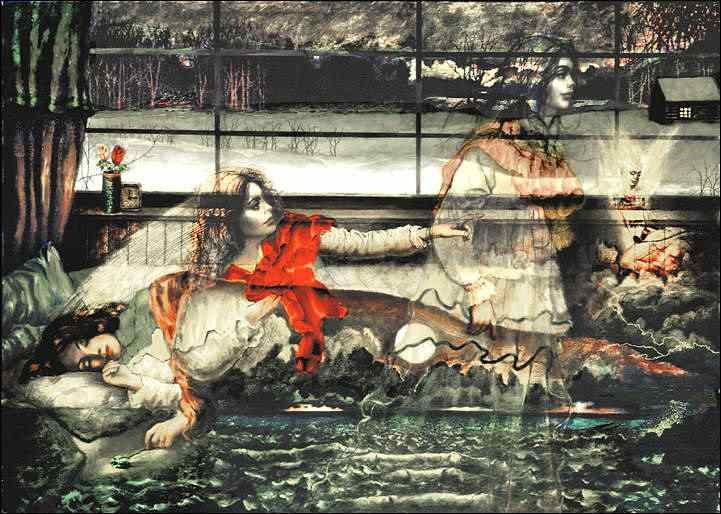 |
‘The explanation I received – from what source I do not know – was that I was free in a time dimension of space wherein ‘now’ was in some way equivalent to ‘here’ in the ordinary three-dimensional space of everyday life. I next realised that my vision included not only ‘things’ in the ordinary three-dimensional world, but also ‘things’ in those four or more dimensional places I vas in.” |
I understood from my mentor that all our brains are just end organs projecting, as it were, from the three dimensional universe into the psychic stream and flowing with it into the fourth and fifth dimensions. Around each brain, as I saw it, there seemed to be what I can only describe as a condensation of the psychic stream, which formed in each case as though it were a cloud. but it was not a cloud.”
Beside this, he saw people’s thoughts and emotions in the form of a coloured cloud around them. Someone then discovered him in his sickness and telephoned for another doctor. Camphor was injected, his heart began to speed up, and to his intense annoyance he found himself drawn back into his body, and his heightened consciousness diminishing again.
The next account is of a woman’s dream. She says:
I was looking at a blotting paper. There were two small dots on it. As I looked. they spread wider and wider, merged, and began to cover the paper. As I watched, a voice spoke from behind, and explained that the small blots represented what people had been doing to themselves in order not to have children. Although the effects seemed small at the beginning, the results would spread, creating far wider effects than ever envisaged. Instead of over population, human infertility and impotence will occur because of the things people do to themselves. This would not only be in the individuals themselves, but in their children also. “Unto the third and fourth generation”. I was told also, how difficult “the blot” would be to remove once it had occurred. This was dreamt in the 1960’s.
Three interesting cases, each with a voice, or mentor or teacher, giving unusual information and speaking authoritatively. One is a dream, one a self induced trance, one a spontaneous near death experience, and yet they have very similar elements. It might be that we can understand death through understanding trance and sleep – or understand trance and sleep through death.
If, in our laboratory of self we experiment on dreams and consciousness, we may discover the face of death. There are two sayings which we find in every language, all over the world. One says ‘Sleep is the little death.’ The other says, ‘Death is the long sleep.’ Who then can be afraid of death, when we experience it nightly?