Posts Tagged ‘connection with core’
Life’s Little Secrets
The processes of life itself are about constant change. If our body could not go through radical internal changes to meet different temperatures we would die very quickly. It is a force of change that never stops. It is the power that has constantly moved you through babyhood, childhood, adolescence into adulthood, and will continue to push you through old age and death into life again.
We can all see that, but there are fundamental things about this that I have never heard anyone say they were taught at school. Yet these little secrets are life sustaining, and enable us to survive awful knocks and immense changes.
In 1885 the Belgian physiologist Leon Fredericq described it this way, “The living being is an agency of such sort that each disturbing influence induces by itself the calling forth of compensatory activity to neutralise or repair the disturbance. The higher in the scale of living beings, the more numerous, the more perfect and the more complicated do these regulatory activities become. They tend to free the organism completely from the unfavourable influences and changes occurring in the environment.”
That last sentence is an incredible statement. It says that innate in all of us is a process that automatically deals with the challenges our environment, our life, confronts us with.
A little later, in 1900, Charles Richet a French physiologist went further by saying, “The living being is stable. It must be so in order not to be destroyed, dissolved or disintegrated by the colossal forces, often adverse, which surround it. Everything in our universe strives to reach a state of Homeostasis or equilibrium. This principle applies to single individual entities to massive complex systems either metabolically, physically, socially or psychologically, even spiritually. By an apparent contradiction it maintains its stability only if it is excitable and capable of modifying itself according to external stimuli and adjusting its responses to the stimulation. In a sense it is stable because it is modifiable – the slight instability is the necessary condition for the true stability of the organism.”
It took me a long time of searching to find, in my own way of life, the wisdom in those two statements. It took me even longer to learn how to apply that in my life. When I did an extraordinary process revealed itself.
I have written elsewhere about suffering depression and terrible exhaustion in my twenties and how I found my way out of it. And it was through dreams and life’s little secrets stated above that it was done.

In searching for relief from misery I tried many different things, relaxation, yoga, meditation , fasting, and diet among them. They promised to be helpful but something was missing that I only began to uncover when I started teaching relaxation/surrender. Some of those yoga classes I taught were huge back in the sixties and seventies. To help people I would wander around the class and lift an arm or leg of some of those lying quietly relaxed. I lifted the limb to let the person have an enhanced awareness of their relaxed condition. What amazed me was that often the arm or leg was so rigid with tension it was hard to move. If I let go the limb would remain suspended. On asking the person how they felt they would say, ‘Fine. Really relaxed.’ They didn’t know they were carrying enormous tensions.
Are you relaxing or suppressing?
It took me a while to realise what that indicated. You could relax surface muscles and feelings, but a mass of tensions were unconscious. Later I learned that such tensions had often arisen from difficult or traumatic past experiences, still locked in the body and emotions. By using relaxation techniques such as dropping the tension of the voluntary muscles or meditating on positive things, those inner tensions were being pushed back into the unconscious – undealt with. When left at that point, relaxation and meditation were a method of suppression and control, not of healing.
With shock I realised this was true of many things that were supposed to be helpful, such as meditation and positive thinking. What they often did was to calm surface feelings by controlling thoughts and body. They did not deal with the real difficulties that had been pushed into the unconscious. Their purpose was to quieten the conscious mind and the voluntary movements of the body, not release unconscious tensions.
I went on an almost fanatical search for what could be done to change that – to release the unconscious problems. The clue was, as Richet says, that ‘the slight instability is the necessary condition for the true stability of the organism.’ I gradually realised that to really adjust to the many knocks and changes we meet in life, our body and mind need to be capable of a type of ‘instability’. It needs to be able to move, to express freely, and to respond automatically or spontaneously. Yet all our cultural training and habits are about control and suppression. Governments also sometimes give huge threats to the people if they do not conform. All in all, we have in many ways been trained to be sick – as I was myself. And, amazingly, my doctor, to deal with depression and physical but undiagnosble pains, was telling me to take a drug, a tranquiliser, to maintain the status quo.
 |
To deal with it is something we need to experience, not something we are taught. The simplest way of describing it is to say it is a process of allowing parts of ourselves to express that in everyday life may never have had opportunity to declare themselves. It is about surrendering our personal egoistic control, and trusting that our Life Process knows how to bring us to wholeness once we yield to It.
“Only those who will risk going too far can possibly find out how far one can go.” — T.S. Eliot
“Do nothing, but let things happen.” Carl Jung
In most social settings we usually restrain everything except what may be acceptable to others, expedient in the situation, or judged as correct. This means that we may not give ourselves the freedom elsewhere to allow our own creative imagination – our body, our real self to discharge tension through movement – experience our intuitive process – and our full range of feeling responses. In this way we gradually diminish ourselves, blocking out much of ourselves that is not of immediate use in everyday affairs. We may in fact diminish our relationship with Life itself.
Later, I found in the writings of Carl Jung and J. A. Hadfield information about how this self-regulatory action also works in the psyche. Jung stated that the psyche is self regulatory. He said that if internal tensions can be allowed to be conscious, then something will happen internally to resolve the conflict.
Hadfield, writes in his book Dreams and Nightmares, ‘If a branch of a tree is cut, new shoots spring out; if you injure your hand, all the forces of the blood are mobilised until that wound is healed and you are made whole. It is a law of nature.’
He later enlarges this by saying, ‘There is in the psyche an automatic movement toward readjustment, towards an equilibrium, toward a restoration of the balance of our personality. This automatic adaptation of the organism is one of the main functions of the dream as indeed it is of bodily functions and of the personality as a whole. This idea need not cause us much concern for this automatic self-regulating process is a well known phenomenon in Physics and Physiology. The function of compensation which Jung has emphasised appears to be one of the means by which this automatic adaptation takes place, for the expression of repressed tendencies has the effect of getting rid of conflict in the personality. For the time being, it is true, the release may make the conflict more acute as the repressed emotions emerge, and we have violent dreams from which we wake with a start. But by this means, the balance of our personality is restored.’
As for how we can enable this to happen, Jung’s student Marie von Franz says that we ‘must get rid of purposive and wishful aims. The ego must be able to listen.’ Jung also encouraged his clients to allow spontaneous movement. Quoting from my book Mind and Movement Jung says, “In most cases the results of these efforts are not very encouraging at first. Moreover, the way of getting at the fantasies is individually different… oftentimes the hands alone can fantasy; they model or draw figures that are quite foreign to the conscious.
“These exercises must be continued until the cramp in the conscious is released, or, in other words, until one can let things happen; which was the immediate goal of the exercise.” See Letting things Happen
A shaking experience
I gradually found a way through dreams, and also using T. S. Elliot’s advice to, “… be still and wait without hope For hope would be hope for the wrong thing; wait without love For love would be love of the wrong thing;”
I had been dreaming for some weeks that I was marching with troops to the battlefront. Then one day I dreamt of being in the trenches and going over the top as the bullets were flying – something I had been scared of previously.
Then having sat for months dropping my aims and beliefs, one night after going to the toilet, I was just getting back into my bed and I heard a disembodied voice say to me, “You have asked how God touches the human soul. Now watch closely.” A couple of days later, having realised all that, I got together with three friends – Mike Tanner, Sheila Johns and Chris Stevens at the Kingston Club/Ashram in Combe Martin, Devon – to experiment with how to allow this process of self-regulation to express. How did you give your being freedom to express spontaneously so it could rid itself of what it held unconsciously? How did you allow it to re-balance itself when it has been knocked out of balance? (Ashram in Combe Martin is now called The Wild Pear Centre – EX34 0AG).
We started our experiments with yoga postures and movements. But instead of pushing our body into a particular given position, we tried to listen to see what our body wanted to do; what posture or movement our own internal feelings led us to. Then sitting with my friends one day in our experimental group I started to shake. I thought I must be cold so restrained the shaking. But at our next meeting it started again, and this time I was wearing a warm jersey, and in no way felt nervous, so pulled slightly apart from my friends and let myself really shake.
 |
What happened was incredible. My body and my emotions discharged the whole experience of having my tonsils out as a six year old. My head pulled back, my mouth clamped open and my arms were in the position of being strapped to my side. Perhaps I had not been fully anaesthetised – I don’t know. What I do know is that I had carried that enormous tension and shock inside me from six until I was thirty five. |
Up until that day I had experienced a powerful neck tension that I had tried again and again to ‘relax’ away. My being didn’t need to relax, it needed to discharge in powerful tension, physical struggles and emotion. After this ’shaking’ experience there was never again a tension in my neck, a tension that had been caused by trying to pull away from the surgeon cutting my throat. However, it was not simply a physical tension it released. Powerful emotions were also discharged, ones that had created difficult responses to everyday life.
That was an amazing experience, and from there on I could allow the process to continue its work on me. Gradually it ‘discharged’ the other things from childhood, and another medical operation, that had thrown my body and mind out of balance. But it didn’t stop at clearing out difficult past experiences, its process went on to expansion of awareness and growth – it moved toward making me more than I had been. All of that came about by allowing my being to express spontaneously without my conscious intervention, by allowing spontaneous movement and sounds, by surrendering or offering my body, sexual self, me emotions and mind to the life that had brought me forth; to the unknown of myself and trusting it.
Example: “At first I found it difficult to let go enough for my body to freely express. When I did learn to do this my movements were very strong. At the time I was lying on my bed because my movements had started from quietness and stillness. They became so strong I fell off the bed at one point. My impression was that without realising it I had been holding back enormous amounts of my own energy. It was when I let the full current of my energy be expressed that I could achieve a new experience of myself. It is like having a dimmer switch on a light in an internal room, and all the time you have it just glimmering, and the room looks dark and dismal. Then one day you turn the power up and the whole room is transformed. All the colours glow, and features not seen before stand out.”
Life’s simple secrets are that your being knows how to deal with the things you carry in you that have harmed you, creating despair, emotional darkness and even physical pain. The process of life in you is also part of the life on this planet. It can read the signs of change and will ready you if you let it.
We are a culture trained to need experts and to pay them; such experts are greatly needed, but our greatest expert is our amazing and wonderful process of life. To let it heal us it needs to be released from its years of restraint, of suppression, and being pushed into unconsciousness.
The simple secret is that inasmuch as we can allow our being to do its own thing occasionally – to move, cry, shake, discharge, laugh and cry or sing spontaneously – to that degree life in us keeps us balanced and healthy. Most ancient cultures had situations in which this was allowed. Wasn’t this the great secret early Christianity found in the Pentecostal experience, where they let themselves be moved as if they were drunk? Controls such as relaxation, meditation, breath control, positive thinking, all have their place, but they do not deal with the dynamic and amazingly powerful process of LIFE and its need to discharge what is poisonous to its workings and positive in its growth.
Look around. Life on our planet is earthquakes as well as sunny calm. It is storms as well as gentle rain. It is lightning as well as cloudless days. That is how nature balances itself. To find our own balance we too need to let our being spontaneously earthquake sometimes – spontaneously let our body shake itself apart to let the tensions discharge. You can’t make that happen by willing it consciously. That is you trying to be in control again, just as our culture has tried to be in control and rape nature. You can only let it happen by letting go of your self control for a while.
What happens when I do?
Rita, a nurse who had been hospitalised with psychiatric problems, describes what happened to her when she let go of her ’self control’ in what at the time we called self-regulation, (SR), but now name LifeStream.
Example: In most every part of me I have felt energy stirring or moving since I started LifeStream. I look different now. When I look in the mirror I see I am a different shape. I am much stronger than I was. I think this is because I am not wasting energy now. I am also less afraid of my feelings. I was a very passionate person and would get into arguments about everything. Now I can be more detached. I never thought I would be like that. Somehow ones energy gets re-organised in self regulation. You get rid of the stuff which is potentially destructive, and you are left with what is really a force for growth. The process of LifeStream seems so sensible to me. Having had a fairly good medical training the idea of homeostasis and energy being blocked, even though it may not be charted in Gray’s Anatomy, is very straightforward. It seems no more puzzling, although it’s mystical. The process is trying to do its work, whether we open to it or not in our body. It is quicker and easier if you give it the right conditions. Most of the time, almost deliberately we give it adverse conditions. All we need to do is take the concrete off so it can grow. This force seems to be there all the time. Our society deals so much in second-hand experience. The immediacy of it really took my breath away. I am beginning to allow myself now a glimpse of what we often put down as so much religiosity. I am allowing myself now, having had almost an overdose of grieving and anguish, to open up to the other extreme which I have never experienced very much, which is the sheer joy of living.
The other day I found myself walking into the sea and shouting, ‘Hey sea, I love you’ and it really came up from my boots. We get stuck in the bad stuff and don’t let ourselves feel the good. |
 |
A couple of months back I went through, with M. the event of my son’s birth. It was thought he might not live and I had been super controlled from the nurses point of view. I hadn’t given way to anguish at the thought this child might not live. But when he was born healthy, what I wanted to do, much more than that, was to shriek with joy, and I hadn’t allowed that. We think so often, being a puritan society, it’s only the pain we have got to face, but it seems we have got to open those channels of joy too. It’s too easy to become hooked on the masochistic element. When I began to let myself experience joy in SR I even began to think I was no longer doing real self regulation because it was so pleasurable.
A simple way you might be able to learn the beginnings of this clearing out and movement toward joy is to do try using the moving sea approach. See People’s Experience of LifeStream
You will need about an hour to complete this session. The aim of ‘moving sea’ is to continue the development of allowing spontaneous movement. Once you have used the ‘water’ approach as suggested below, there is no need to go through the preparatory stages in future uses. For instance do not do the yawning and arm lifting . Go straight into exploring the water movements. These can be used over and over with enjoyment and gain.
2 – Remind yourself of the feeling of spontaneous movement by using the ‘arm against the wall’ exercise.
Stand about a foot away from a wall, side on, so your right hand is near to a clear space on the wall.
Lift your right arm sideways, keeping your arm straight, until the back of your hand is against the wall. Because you are near to the wall and your arm is straight you will only manage to lift your arm part of the way. So when the back of your hand touches the wall, press it hard against the wall as if trying to complete the movement of lifting the arm.
Do not press the hand against the wall by leaning, but by keeping the arm straight and trying to complete the lifting motion. Using a reasonable amount of effort stay with the hand pressing against the wall for about twenty seconds.
Now move so you face away from the wall, and with eyes closed relax and be aware of what happens.
Try the experiment before reading on, and use the left arm afterwards. In fact try it a couple of times with each arm before reading the next paragraph.
- Extend your awareness of how your body and feelings move spontaneously by simulating yawns and allowing them to develop into stretches or movements. Stand in the middle of your space and close your eyes. Lift your arms from your sides and take your hands high above your head. Do this a few times noticing the difference in feeling with hands high or low.
Pause with hands by your sides. Now hold the idea of taking the hands up high again without consciously attempting the movement. Take your time, and be aware of how your hands and arms want to make the movement. This means watching to see if the sort of feelings that entered into your yawning and arm rising sideways exercises are in operation here. If this includes the rest of your body, or your arms go in another direction than above your head, that is fine.
Stand in your space with eyes closed. Drop unnecessary tensions as you listen to the music. Hold in mind for a moment the idea that you are giving your body space to explore the expression of the quality of water. There is no need to think up what to do. Let your body explore. Trust it to find its own way to expressive movements. Allow yourself about 30 minutes for this.
Let your experience of yawning and listening to how your arms wanted to move be used here. Take time to observe and allow the delicate motivations – magnetic pulls – directing your body to watery movement.
You will find you have resources of imagination you did not suspect. Aspects of water you hadn’t consciously set out to explore will be expressed in your movements. If you are expressing deep still waters, you will actually feel a deep quietness and power. Or if it is the power of rushing rivers, then a feeling of power will surge through your body as you touch your resources of strength and healing. The flowing feelings that arise are actually healing.
As you learn to trust this process and allow it to grow in expression, you will find unexpected themes will arise. Even though you are expressing water, your expression will have in it feelings that are particular to yourself.
While recently leading a group practising inner-directed movement, I was struck again by how creative we all are if given an environment in which we can allow our originality. One woman in the group, exhausted from the demands of her job, experienced deep relaxation out of which enthusiasm and pleasurable energy arose, leading her to dance and bathe in her own joy. A man explored his relationship with love, and saw that he needed to gather to himself the love he received from others to call out his own resources of affection. A woman who worked as a nurse met the painful emotions arising from observing the difficulties of a mentally retarded patient. Her creative movements led her to find a way of accepting the reality of life’s difficulties. The pain cleared and she felt was ready to give a more flowing response to others in difficulty.
As with the woman mentioned above who found new enthusiasm in the midst of tiredness, you will find your creative movements deal with and heal personal situations. I believe this is because the self regulating or problem solving process that underlies dreams surfaces during inner-directed movement.
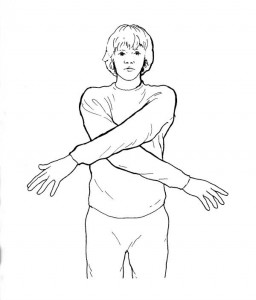
what I call the ‘arm circling exercise’. But it may help to first learn how to yawn spontaneously. You can do this by acting out a few yawns till they come spontaneously. Let them come and let the rest of your body join in if an urge to stretch comes. This is to learn how to continue allowing your body and feelings to express spontaneously. When you can allow spontaneous yawns and stretches, then try the arm circling.
 |
You need sufficient floor space to move easily, or even lie full length if necessary. It also helps to have loose clothing. Then you stand in the middle of your space, giving yourself time to explore what you feel and experience. |
Start by circling your arms. Take the arms above the head, down the sides of the body with the arms fully extended, then upward crossing the front of the trunk. In the full movement the hands are then forming wide circles that cross the front of your body. Do this until the movement is easy and flowing.
Then, as you are circling your arms with eyes closed, bring your awareness to the shape your hands are making in space. As you become aware of the shapes the hands are carving in space, watch what feelings you have as to how you would like to move. Give your body permission to doodle, to make any sort of shapes your feelings or body incline you to. Allow any sort of posture or movement, as active or quiet as you like. Allow sounds to accompany the movements if there is an urge to, and allow whatever feelings accompany them.
What you are doing doesn’t have to make sense. Nor does it have to comply with what other people might expect of you. Realise that you are allowing another part of yourself, perhaps a non verbal part, or a facet unknown to the rational mind, to express. With a non critical watching attitude, relax and let your body and feeling sense direct what happens.
There is no need to fiercely concentrate in order to wipe the mind clear of other influences. But you may need to hold back the part of the mind that always needs to know beforehand what you are going to do.
This is not like creative dance, in which there may exist a need to produce something pleasing for others to watch. With this exercise you need an open attitude in which your inner being can make its own adjustments, and movements, and feelings have a chance to express outside of rational criticism and demands of everyday life. Give yourself at least fifteen to thirty minutes in which to explore what spontaneous movements and feelings emerge.
The skill needs to be learned
This ability to allow life to stream through us in its own way is not a skill we are taught in our western culture. We are taught how to control, how important it is to repress anger or even immense joy, but we are not taught the balance of this – how to let go of control. Therefore the arm circling exercise needs to be repeated until the ’stiffness’ of our control is loosened and you can flow with what emerges spontaneously. When that begins to happen you will see that it is leading you along in a direction that is full of meaning and explains itself as it emerges.
Lily Kershaw – As It Seems [Official Music Video] – https://www.youtube.com/watch?v=utXz08ICZg4
As that happens you will not need to start with arm circling, but will be able to simply stand in your space and allow the process to happen. Wherever possible use this process, that I now call LifeStream, with friends who want to share it with you. This group practice enormously increases the power of it.
See Opening to Life; Lifestream – The Greatest is Often the Simplest
Dream Interpretation Example 3
Story of Reincarnation
Before I went to sleep that night I focused on the question -Who am I, really?
The dream was vivid, and still gives me shivers to this day. I dreamed that I looked up and there was this incredible star that was emanating points of light in the sky. It got brighter and brighter and the bottom-most point reached down to where I was and transported me up to the star. The points of light came out from the centre in all directions, and I found myself on the end of one of the horizontal points. A wonderful (female) voice spoke to me and said this is who you are, and I had the strong sense of being located at the end of the horizontal light bar. Then she said and this is who you are and carried (transported in some way) me to the next bar of light, where I saw another version (incarnation?) of myself (in a different time and place, although I knew that the essence of this version of me was really me)
She continued transporting me from bar to bar where I experienced myself in many different versions in the past, present, and future. I had different skills and interests that were the focal point of each version of myself–a musician in one, a farmer in another. Some of the versions were females, although I experienced the same sense of self in all of them. Then she returned me to the horizontal bar of my current self and said to me that all of this is who I am, but that now she was going to show me who I really am. Then she drew me into the centre of the star (light, energy source) where I merged with her and could see each of the emanating points of light as manifestations of a single source or spirit.
It was one of the most incredible feelings of being integrated and whole that I’ve ever experienced, and I basked in the feeling for awhile just absorbing and soaking it in. Then she returned me to myself (with a cosmic wink) and I slept peacefully for the rest of the night. Ever since then I haven’t felt the need to ask who or what I am, and I’ve seen my various abilities and struggles in life in a totally new way. C.A.
Mind and Movement 1- Introduction
It is new years eve of 1986 as I write this introduction. The book beyond these pages has already been written. Over the past few weeks I have received cards and letters from people who have used the techniques and approaches described in it. In wondering how best to tell you about what this book contains, and what it may have to offer, I cannot think of any better way than allowing these letters to tell their own story.
The most exuberant letter was sent by Paul, a well known musician. The SEED GROUP he mentions is one of the approaches to personal healing and creativity described fully in chapter six. Paul writes: “I thank you again for the Seed Group experience at Atsitsa. With that I let go of so much accumulated rubbish! When I got back I had a session of Soul Directed Therapy and haven’t looked back. Those two experiences must rank among the most important of my life. In fact my life is rolling, my creativity is rolling, my relationships are rolling!! I hope you are too!”
Here are two short letters, the first from Sarah who says: “Life has been somewhat difficult and confusing lately – not such a bad thing, but I can’t see when it’s going to sort itself out. I’m still with Michael but also seeing Steve. I just don’t know what I want. Still, here’s to 1986 and hopefully some decision making!
“Michael has been doing coex here in D.. – amazingly – which has been very useful, thanks to you.”
From a very different situation Tony writes: “Just a line of thanks for your having passed on to me the practice of Inner Directed Movement / Lifestream. It is a path which has deepened and broadened over the years and although it functions differently it is still a source of eternal life. All my love, Tony.”
The last letter is much longer, but from it a fuller idea of what coex is, and how it works in ones life can be gained. It is from Pat Hudson who studied with me a few years ago. Since then she has explored in many different directions and has brought coex into her life and love in an everyday sense. She writes: “I want to write to you about a dream and its process which I had a couple of nights ago. It’s a marvellous dream. But first I need to say that there seems to be a tremendous healing process taking place in my inner being in three different areas. 1 I have been experiencing a growing sense of forgiveness love and compassion towards my mother. I see her as a very vulnerable, sensitive spirit crippling herself by alcoholism and arthritis because she didn’t and doesn’t know how to deal with what society puts on her.
I am becoming so much more alive sexually with my husband. It really astounds me at my age – fifty next birthday. I feel so much more loving and understanding towards him too. I am much more ready to receive his full-cream -milk kind of love.
He and I have been going to Blackpool once every fortnight to visit a recently bereaved aunt of his and this experience is turning out to be so healing for me. In the past I have hated common Blackpool and its common people. Now I have turned right round to find that I actually love the whole Blackpool experience, commonness and all. Instead of feeling separate and superior – I really thought was once – I feel so linked with those people. I love being in the crowds on the sea front. I love them wearing their purple tinsel wigs and foam plastic hats. Thank God I’m losing that awful sense of superiority. Goodbye – I’m well rid of you.
“Now for the dream. First of all it pushed me into reluctant wakefulness from a deep sleep in the middle of the night. I tried to kid myself that I would remember it next morning, but I was obliged to put on the light and write it down. It was one of my sobbing, sobbing, sobbing dreams which I’ve had now and then over the years. I had been doing dreamwork with a friend during the day, and I had told her about a sobbing dream I had the previous week. I said I had never got to the bottom of why I had such dreams. In this dream I was sobbing down to my very guts. The scene was a man, his wife and a lodger. It was in Victorian times and the woman wore a long white dress. She loved her husband with all of herself. The three of them were sitting at a small round table, and the lodger had to expose the husband as a betrayer of her love. She was sobbing and felt as if everything was wiped away and made as nothing. It seemed to her the basis of her life was taken away.
“Then the husband and she were walking along a river, she in a long white dress, still sobbing, knowing life would never be the same. And that was the end of the dream – yet it wasn’t the end because more was to come. I lay half awake dreamily wondering how Garry my husband had betrayed me. He never has, I know that, so I was puzzled. I kept sniffing around wanting to go deeper when suddenly a vision swept through me. I was standing deep down inside myself on the edge of a black hole, a black precipice, and I was shouting, ‘Well. what do you mean you silly devil?’ It was as if I was shouting down to the me right at the wellspring of my being. I came more awake, had a laugh at the daftness of it, then suddenly realised the black hole was a birth canal. It wasn’t my birth canal but my mother’s. Then the whole thing began to flow. I suddenly knew with utter certainty that when I was in my mother’s womb I was totally loved. I can’t tell you how marvellous it felt to know that love again – being totally, safely, securely lapped in love. I simply lay there experiencing the love. I knew, with a great sense of compassion, understanding and forgiveness that as soon as I left the womb my mother couldn’t love me the same way, couldn’t cope with the stresses life put on her. I remembered a vision I had when I was with you in Devon. I saw my mother’s breast dripping milk, a thin watery, vinegary milk and I burst into tears saying I wanted full-cream milk. I now felt totally linked with my mother again. All the rage and anger which had gradually been dropping away over the past few months was now gone. The tremendous linking remained.
“After that lot I lay in bed awake feeling happy. I lay awake for about two hours . I realised I had never been able to accept love – never been able to accept Gary’s full-cream-milk love. I was constitutionally unable to.”
When I first met Pat she struck me a someone with very frozen feelings, especially in regard to her sexuality. It therefore gave me a lot of pleasure to hear her news of change. But I wondered what Pat had needed to be or do to find such satisfying transformation. I wrote to her telling her this. She replied: “The first thing which sprang to mind when I read your words ‘someone as frozen as you were’ was a brief dream I had when I was first with you. I was standing in front of an enormous iceberg. In my hand was a little ice pick and I was picking away at this great big berg. How vivid and wonderful. I have never stopped picking away at that berg since.
“This picking away has taken many forms. I have for some time worked with three friends doing explorative counselling work each week. None of us are trained, and we use all sorts of tools such as Reichian and Gestalt work. Through this I have come across much that needed to be made aware in myself, and have had three big traumatic sessions. So big that each time I was ill and had to go to bed for two or three days to recover. During one such session feelings about my religious up-bringing arose. As a teenager I longed and searched for the living spirit. I made the mistake of searching in the Church of England. The phrase comes, ‘I searched for bread and you gave me a stone.’ Kneel down. Stand up. Put your hands thus. Say this. Sing this. Nothing but stones. Such rage erupted from me I began vomiting green bile and kept on for almost two days.
“So I continue coming across chunks of stuff like that. I see it as searching for the inner flame of myself. I am no longer living a false self as I did for at least eighteen years of my life. I see that false self as socially imposed – but I accepted it. It was when the pain of living by this false self grew too great that I had to break out and came down to work with you. I have worked at stripping away the false bits and re-building the realer me ever since.”
Coex is the way of working with the spontaneous process which led Pat to remember her mother’s love in the womb. It is the function in us which produced the healing she found. It is the magical force which created Pat’s dream, her visions, her gradual change. It is a process which has been so often overlooked, twisted into a mystery, covered with the ornate overlay of religious ritual and dogma. Yet it is something alive in each of us. It awaits our contact with it if we dare to look and meet the challenges of our own life and existence.
Mind and Movement 3 – Honouring Yourself
When attempting to use coex we must remember that we are dealing with natural processes, and they have the possibility of entering into our conscious life when, and as they need. However, because of the way our personality relates to spontaneous drives, and perhaps also because of our social training as children, the self regulatory process of coex does not work spontaneously in most people. Nevertheless, the movements and techniques given in chapter three, and those about to be explained in this chapter, must be seen as exercises to re-establish our natural spontaneity. Therefore, when we use coex in a situation where we have chosen to apply it, to be clear, we need to recognise that we are choosing to allow it, or are ‘practising’ it rather than it is emerging in its own way. Practising coex, or allowing it to emerge are both valid ways of experiencing it. The need to be clear about this point however, arises from that fact that if we ‘practise’ coex, it will gradually begin to ‘emerge’ in ones life anyway, and that is natural and good.
Some examples will illustrate how this works in everyday life. But I want to set the scene a little to bring out certain aspects of what we will look at. So Peter and Adelaide, who we are going to consider, need to be seen as human animals. As physical animals they have certain very real needs such as a reasonable amount of food, air to breathe, sexual expression and protection from the extremes of temperature. Physically they feel these needs and respond to there absence or their fulfilment. This response can be by feeling well and happy, or feeling ill and dying. But their organism as a whole responds in a whole range of ways to many more things than food, air and temperature. Having conscious personalities which are named Peter and Adelaide extend this range of response enormously, and make it more complex also. For instance Peter’s father may be ill in hospital. At a physical level Peter’s body was looked after by his father while Peter was too young to fend for himself. From purely basic animal kinship feelings Peter has a drive to return that caring, but because of personality clashes between the two males, Peter doesn’t visit his father while he is ill. He suppresses any feelings of wanting to care with memories of past arguments.
In this situation Peter’s psychological self-regulatory process would attempt to find some sort of balance between the kinship drive and the hurt feelings in the personality. Biologically the kinship drive is more important than a hurt pride, so the drive would attempt to express into conscious life. If Peter had learnt to suppress such feelings however, they would remain unconscious. If Peter suppressed such attempts at self regulation over a period of time, then a growing feeling of dis-ease would occur, with Peter unaware of its cause.
That is purely a ‘suppose’ situation created to illustrate how coex can be suppressed from spontaneous emergence. But let us look at a real situation existing with Adelaide. She is 42, a good looking woman with a strong drive toward sex, (i.e. relating to a man, procreating, raising children). Adelaide’s mother recently died, and this triggered an emotional breakdown, causing Adelaide to withdraw from caring for her children, caring for her home or herself. Her husband left her during this period and Adelaide found another man who lived with her. Normal conversation was difficult with her because she spoke on and on in a long blurt about sex, her children, other people, her work. After a few months her new man left her. Adelaide was hospitalised several times.
From the intensity and length Adelaide spoke about love making, having a man, and suicide, her organism had very powerful responses to these areas, yet her expression in regard to them was not organismic. I mean that if an organism, a cell, a creature, a human animal, is hurt or pleasured, it responds in a physical way and with obvious feelings. The reaction might be sexual erection, deep sobbing or any other straight response. But Adelaide’s was almost wholly verbal. This suggests that Adelaide had a powerful suppression on her self-regulatory process, preventing the experience of emotions flowing from her real inner fears and pains. Yet why would a person suppress the very things which would balance their being and bring about greater ease?
The answer could be linked with how Adelaide is structured as a personality, and how her personality relates to the processes of her body. Clues to this lie in her age, that her breakdown occurred after her mothers death, and her preoccupation with procreation. One of her statements was that the man she lived with couldn’t give her a baby, and this was the only real form of love. So we can see that the structure of her personality is deeply bound up with being capable of childbirth. That she is 42, faced with losing her procreative ability, confronted by death and the loss of two men, must not only threaten to destroy her personality as it is, but cause many inner responses to occur which she is not allowing to express. If she allowed the responses to emerge into consciousness, she, Adelaide, would have to meet and integrate the very facts of life she most rejects – meet them WITHIN HERSELF!!!
Peter is in his late forties in his second marriage, and has attempted to honour self regulation in his life for some years. What follows is his description of how this emerges into his life spontaneously now.
“After some years of gradually learning to let myself meet the sort of feelings I used to hold inside, I now meet the self regulatory activities in quite gentle yet effective ways. For instance this morning I woke feeling good, but knowing that I needed a sexual meeting with my wife Eileen. When I got close to her though I could feel her withdrawal and lack of physical excitement, so I didn’t push my need. As I was dressing the conversation revolved around how Eileen related to her first husband who was more sexually active than I, – a topic she initiated – and how we were relating which was not very active – initiated by myself. We had not reached any satisfying conclusion by the time I was ready to start the day by visiting the post office, and I left feeling I wasn’t going to be pulled down by her mood, and determined to be independent. As I left I had an uneasy feeling inside. I started to push it down but realised that my attitude to Eileen only satisfied my independent self, and there was another part of me which was upset by what had happened. By the time I was walking back from the post office the feeling was clear enough for me to see that although it was fine to be independent, I was attempting to achieve it at the expense of my feelings of care and connection I had built with Eileen over the years. When I arrived back Eileen was sitting playing with her granddaughter. She looked okay but I went to her, hugged her and said, ‘It’s a big world out there, and I don’t want to go it alone.’ Tears sprang to her eyes, so I saw she had been trying to play silly buggers just as I had. Then the tension which had existed between us vanished.
“Maybe that sounds like a very small incident, but I know that in the past I let those small things mount up until they were huge grudges inside. Now I can allow the feelings which arise, and so I let my whole self have a say in how I live, instead of being the sort of dictator I used to be.”
The simplest way of allowing coex to enter our life is to honour what we feel. While working with a man – Andy – recently, one of the common errors connected with this was demonstrated to me again. Andy had allowed spontaneous movements and feeling while working alone, and had arrived at a sense of confusion and failure. In his words, “I feel blitzed”. When I asked him to explain what he meant he said that he just couldn’t do whatever was necessary to succeed with coex, and felt devastated. In other words, Andy was looking for a feeling of success and confidence as the thing he should have found. When I suggested he allow himself to experience the ‘blitzed’ feeling instead of searching elsewhere, he cried with real emotion, and could directly see how the feelings were related to his childhood when he was put in an orphanage. In his very search he had been avoiding the things most meaningful by only wanting to see the positive side of himself. Allowing the tears enabled him to acknowledge how important his ‘orphanage’ feelings were in influencing his life. Letting them be felt was the beginning of their integration into his conscious life.
This integration would let them grow and change instead of being locked unconsciously into him in the same form they were in his childhood.
HONOURING OUR FEELING SENSE
===========================
Apart from our well known five senses such as seeing and hearing, we have other senses, equally as well known to us through experience, but seldom mentioned or defined. We have a sense of balance, a moral sense, a musical sense and a feeling sense. When using coex the feeling sense is particularly important, and the experiences of Peter and Andy show how this sense worked for them. Long before the development of language in the human race, or in our childhood, the feeling sense was the urge or means by which the complexities of life were dealt with. When we watch animals in the wild deal with difficult situations and survive without being able to think as we do, it is obvious how practical the feeling sense is. It becomes understandable when we remember that most of our memories and experience are unconscious. Also, many impressions we gather, and many of our mental functions such as cross referencing information, take place outside of our waking awareness. Information arising from these sources and expressing through the feeling sense has been given a variety of names such as hunches, intuition, presentiment, and so forth. Obviously, what some people call premonition or a hunch is simply their own anxieties or prejudices. My mother in law, before I married my second wife, told us she had experienced an intuitive insight that our marriage would only last eighteen months before it failed. Our marriage is now in its seventh year, and what was claimed as intuition was obviously an expression of hidden desire.
Most of us have correct hunches arising from our feeling sense though. Such hunches or insights can be about our own internal psychology, such as Peter and Andy experienced, or about any aspect of our life. Years ago while I was running a book business and was only beginning to learn how to use my feeling sense, I read a book about Edgar Cayce. For two days I had a powerful urge to write to people who were continuing his work in America, and make contact with them. I did this but still the feeling persisted. It subsided only when I wrote again and offered the services of my book business if they needed it. A week later two letters arrived from Virginia Beach. The one with the earliest postmark explained the work of the organisation – A.R.E. – and then asked if I knew of someone who would stock their books, as they had a lecture tour planned, and needed someone to act as agent for them. The second letter simply said, “We must be working a fine case of telepathy here. Thanks. The books are on their way, and our lecturer, Col. Adams, will arrive soon.” The results are seldom that dramatic, but are nevertheless generally helpful.
Memories and processes occurring outside of verbalisation and conscious thinking, have often never been formatted into words or clear concepts. Therefore they cannot be conceptualised – but they can be FELT! Our subtle feelings and senses enable the unconceptualised material to be presented to our conscious mind. Feelings form a link between our thinking, verbal self, and the deep unconscious self. If, like my mother in law in her response to my marrying her daughter, one is the victim of ones feelings and anxieties rather than the observer of them, hunches are confusing rather than helpful. But there are very clear techniques which enable us to meet our feeling sense in a constructive way. These techniques form an excellent introduction to the ‘practice’ of coex.
NONE OF THE FOLLOWING METHODS ARE ‘BETTER’ OR ‘WORSE’ THAN ANY OF THE OTHERS.
I THEREFORE SUGGEST YOU TRY THEM IN THE ORDER EXPLAINED, AND FIND WHICH MOST SUIT YOUR NEEDS AND ENVIRONMENT.
DISCOVERING THE SEED OF GROWTH
==============================
There are exercises of mind and body one needs to practise to develop acquaintance with the feeling sense. Each of us have a feeling sense, but often we have not developed it or learnt to use it consciously. So these exercises are rather like an artist learning to use their sight for their art. Eugene Gendlin, in his excellent book FOCUSING, (Bantam Books) calls it the ‘felt sense’, and says that it is what we experience before we speak. We seldom know beforehand the words we are going to use, except in a formal situation, but we do have a ‘felt sense’ of what we are going to say. This then becomes verbalised when we say it. Also, if we think of two friends, if we move from one to the other in our mind, we have a feeling sense of how different each one is. We have these feeling responses about everybody we meet, everything we think, and everything we do. They underlie our whole life, but very often we fail to notice them. In the following exercises we are going to spend time considering, exploring and learning to work with them.
To begin this first practice you need to create the right setting and situation. You need to wear comfortable clothes which you can easily move and relax in. Take your shoes off, put a blanket on the floor area you choose to practice on, and clear a space big enough for you to stretch out in and spread arms and legs. Create a space in time also. It is important to give yourself about half an hour without other pressing issues to properly meet your inner feelings. Drop self criticism and give yourself permission to express sounds and movement freely.
When you are ready to begin, stand or lie in the centre or your space and raise you arms above your head. Hold them so they are quite extended. Then bring to mind the idea or image of an unplanted seed. It can be any sort of seed. Now notice whether your body in its present posture feels as if it is expressing the form and condition of the seed. The aim is to consider how you and your body feel in relationship to the idea and sense you have of the seed.
Many people find, for instance, that having the arms extended does not ‘feel’ like an unplanted seed. Don’t struggle with this. It is just an experiment, play with it, have fun. So if you do not feel your being is expressive of the seed, move about, explore different postures until you begin to feel more satisfied. Explore in this way until you feel you have found a position that is right. Take your time. Notice whether the arms and head are right. Would a seed that is not growing feel alert, sleeping, waiting? See if you can find an inner feeling which for you feels like a seed. Do not attempt to think the whole thing out or consider it scientifically. Let whatever feeling sense you have guide you. If you get lost, come back to arms and legs extended and spread and again consider whether that FEELS like a dry unplanted seed. If not, work with that feeling of ‘not right’ until it gets to be ‘right’.
When you find a position and inner feeling which suits you, take the next step by letting yourself explore, in just the same way, what happens when the seed is planted in warm moist soil and begins to grow. Continue your feeling exploration to find out what will occur when the seed grows, puts out leaves, blossoms and fulfils its cycle. Explore the whole cycle of the seed’s expression. Don’t hold a rigid idea of what the growth of the seed means. What we are looking for is that you explore your own feeling sense in regard to the thought of the seed’s growth. It might be that as the seed you feel very strongly you do not want to grow. In which case simply remain in the form of the seed until you feel a change and an urge to grow, or until your session time is up.
Not only is this an exercise for our feeling sense, but it is also a way the process of coex can express. The concept of the seed structures what happens, but it is still a channel for self regulation to occur. You can consider it a successful coex experience if some aspect of what arises is spontaneous or unexpected. Even if the unexpected does not emerge in the first session, it will do so as you learn to let go of thinking and critical appraisal of what is happening, and leave the body open to free expression. So at first it doesn’t matter if the session feels mechanical and contrived. Having those feelings means you are sensing what is happening, and you can thereby refine your technique with their help. By letting go of the controlling urge, you can let the spontaneous and creative part of you express.
It is helpful to use this form of coex once or twice a week for a full half hour or longer each time. What happens may differ each time, for the unconscious is very creative. In symbols, or in direct experience, something of your own nature will be expressed in the drama of growing. As you practice, any stiffness of feelings or hesitancy will lessen. The theme of what emerges will become clearer and more fully felt. As this happens you can use different starting points. Instead of the seed, use the image of WATER, of AIR, of EARTH, or the SUN. Just thinking about them they may seem very abstract, but my experience is that very few people are unable to enter into them quite deeply through their feeling sense and coex.
Judith, who teaches a yoga class, describes her use of this approach to coex as follows:
“….I felt as if I were the bud of a crocus. I seemed to be slowly unfolding with difficulty. Not until I fully opened did I feel a great relief. The results of this have made me feel very positive in my outlook, and far happier…..I am a trainee yoga teacher and have been teaching for three years. I have a small class of fourteen students who are keen and attend regularly. I decided to have my students try coex to see how they would react. I explained it as well as I could, and the feedback I got was:- A man in his thirties said, ‘I felt I was in a womb. It was very comfortable, cosy and dark. I wanted to stay there. I didn’t want to come away – it was so peaceful. I have never experienced anything like it before.’ He was very impressed. A woman in her thirties felt like throwing her arms around and kicking her legs. ‘I felt I wanted to give birth and was about to deliver.’ She didn’t fling herself about, but held back. I think it was a pity she didn’t let go. Perhaps I didn’t explain the whole procedure clearly enough for them to understand that it was entirely free movements. The majority acted out being flowers. Only one in the class thought it was a lot of ‘bloody rubbish’, her words. She didn’t even try. She thought she would feel stupid acting out a seed. I personally was surprised at the outcome, that so much should happen first time.”
When using the starting point of the seed, or water, etc., we are giving the unconscious a ready made structure to work with. Because we may be unfamiliar with a completely unstructured approach to our inner processes, such a structure gives at least some sense of familiarity and confidence. Even so, some people find they want everything fully described, scripted or choreographed. The very point of coex however, is to begin moving beyond the known in ourselves, towards creative newness and the unexpected. So even if some anxiety is felt, as with the woman Judith describes who defends her anxiety of the unknown by calling the exercise ‘bloody rubbish’, one needs to gradually move beyond such resistant feelings.
With the structured approach one also needs to leave the result open ended. With the man in Judith’s group, for instance, although he started with the structure of the seed, his experience was one of being in a womb, in a peaceful feeling state, and the woman felt as if she was about to give birth. With a large enough sample, the results would be enormously varied. Many people would go through the whole cycle of the plant’s life; some would find they grew to a certain place and stopped; some would have no impulse to grow at all; some would move quickly from the seed structure to personal feelings. So in your own practice leave yourself open to what emerges. If you stay with the seed and its growth that’s fine, but if you find you inner process diverging, let it express what it wants to.
IF FEELINGS ARE A NEW WORLD
===========================
Eugene Gendlin suggests exercises which are less active physically than the seed structure, and are helpful if you are uncertain whether you have feelings or not. People often tell me that they are not sure if what they are observing in themselves is a feeling or a thought, and Gendlin’s approach is helpful. He suggests:-
1] When in a time of quiet, think of something or someone you love or think is beautiful. It can be a pet, an object, a person, anything.
2]Consider why you love what you have chosen, or why it is beautiful.
3] Notice what different feelings arise in you, how your body feels, when you consider what you have chosen, than when you think of something else.
I find it helpful to think of the body as a T.V. screen you are watching. Before you think about your beautiful thing, notice what tensions or peace are on the screen. Take note of any aches and pains, any sense of tiredness or energy, and any attitudes such as boredom, or being pleased, which are there. Don’t try to banish these, just note them. Then bring to mind your chosen object and note what changes take place on the screen of your being.
4] See if you can find any words which fit what you can observe or feel. Let yourself feel what the words are about, and note whether what is on your screen changes, and what it is expressing.
A series of exercises I devised which help to define this important feeling sense, is an extension of considering oneself as a screen. With a similar sort of setting as used for the seed exercise, stand and relax unnecessary tension. Take note of what is then happening on ones ‘screen’. Simply note, do not alter. Then think of a word such as ashamed. Hold the word in mind and note what changes occur on the ‘screen’, and what changes in body posture. Give this some minutes, then change the word to unashamed and note the difference.
Try this with different words such as depressed/happy, failure/success, etc.
Most people, but not everyone, can find an easily noticeable change with the different words. Even the body posture alters. And the exercise not only help us to note the different feeling qualities we have with each word, but also demonstrates how just holding a thought can alter our whole body and feeling situation.
Because the ability to consciously verbalise or be able to clearly think about what one is considering, is the last and integrating stage in levels of awareness, it is important to express what one experiences in these experiments. I believe a good test of integration is that what one describes is understandable not only to oneself, but also to any casual listener. For some people the word and the feeling are very much connected. Something which is very important is that when we look at the ‘screen’ and note what is happening, some parts of what are being experienced will be clear and easily put into words. But there will also be an area which is not yet clear, not yet capable of being expressed. You are looking into a place in yourself which is beyond words. If you continue to observe it however, it begins to open up, to grow, as it were, and gradually becomes clear enough to join with words. That is the most important area. In watching it we are looking into the unconscious. When it ‘opens’ the unconscious emerges into consciousness where it can be verbalised. WHEN YOU ALLOW THE FREE EXPRESSION OF COEX TO UNITE WITH THE OBSERVATION OF THE WORDLESS PLACE IN ONESELF, A NEW AND WONDERFUL LIFE SKILL HAS BEGUN. The process of coex can begin to release into consciousness important experiences which were previously unavailable. Our observation of the place beyond words allow a communication between our deep unconscious and our conscious sense of self. If these exercises in contacting the feeling sense are used, and the greater facility in this area is brought into the seed approach to coex, a much fuller experience will result.
THE UNSTRUCTURED APPROACH
=========================
Because there are so many facets to human nature, ranging from nameless anxieties to insights into the nature of life, any structure we place on coex may limit it. I have noticed with groups which approach coex from a particular standpoint, such as psychotherapy or religion, that although the basic functioning is the same, the experience in the group is largely within that heading. In Primal Therapy for instance, even when the feelings arising are spontaneous and unexpected, they are nearly always about childhood pain. In Subud groups however, which is a spiritual brotherhood, although the activity is obviously self regulatory, what arises is mostly idealistic and to do with moral development. Barter for example, describing his early experiences in Subud, says it was like being baptised in a flow of water. Participants in Primal Therapy describe their experiences as reliving the pain of being born, etc.
W.V. Caldwell, writing about the findings arising from LSD psychotherapy says, “The kaleidoscopic patterns and heightened sensory perceptions; the sumptuous and exotic fantasies that seem to bear no personal application, the symbolic myths and rituals that do; the experiences of fusion, Samadhi, and psychosis; the physiological urges to squeeze, or bite, or throw; the passage of protoplasmic disorganisation; the historical recalls of childhood; the splendid religious and philosophical revelations – how can one make sense of them all? If the psychedelic experience had confirmed the theories of Freud, or Jung, or anybody else we might have been relieved. Instead it has confirmed them all and added a few more besides.”
We must beware of putting any rigid conceptual framework onto what it is to be a human being, especially in regard to our unconscious life. If we feel naked and anxious without such firm theories, then by all means use what is necessary. But recognise at least that your approach will limit what you allow yourself to find. It is easy to see that our being spans the distance between solid physical substances, such as our bones, to the most extraordinary subtleties of mind. All of these are ourselves. To open to only a part of what we are is to miss a great deal of the wonder.
The approach to coex in this unstructured form needs the same sort of approach we used in the structure of the seed – i.e. sufficient floor space, etc. You start by standing in the middle of your floor space, giving yourself the same sort of time and attitude as before. This time, instead of holding your arms above your head as with starting the seed, start by circling the arms. Take the arms above the head, down the opposite sides of the body with the arms fully extended, then upward crossing the front of the trunk. In the full movement the hands are then forming wide circles which cross the front of body. This arm circling, just like the arms stretched above the head in the structured approach, is simply to help you begin coex. Dispense with it as soon as you can allow coex without it.
Meanwhile, circle the arms with the eyes closed and bring your awareness to the shape your hands are making in space. As you become aware of the shapes the hands are carving in space, watch what feelings you have as to how you would like to move. Give yourself permission to ‘doodle’, to make any sort of shapes your feelings or body incline you to. Allow any sort of posture or movement, as active or quiet as you like. Allow sounds to accompany the movements if there is an urge to, and allow whatever feelings accompany them. Hold the attitude that what you are doing doesn’t have to make sense. Nor does it have to comply with what other people might expect of you. Realise that you are allowing another part of yourself, perhaps a non verbal part, or a facet unknown to the rational mind, to express. With a non critical watching attitude, relax and let your body and feeling sense direct what happens. There is no need to fiercely concentrate in order to wipe the mind clear of other influences. But you may need to relax the part of the mind that always needs to know beforehand what you are going to do. This is not like creative dance, in which there may exist a need to produce something pleasing for others to watch. With coex you need an open area in which your being can make its own adjustments, and movement and feeling has a chance to express outside of rational criticism and demands of everyday life.
Give yourself at least half an hour in which to explore what spontaneous movements and feelings emerge. Below is a summary of what may happen in this practice.
1] Although the movements may at first appear haphazard and irrational, if you allow them to continue without criticism, they usually express – perhaps only over a period of several sessions – a particular theme or point.
2] Like a dream, the theme or drama often symbolises ones life situation, or something within oneself, such as the remaining emotions or attitudes from past experience, or a creative realisation. Or the movements may be expressive of the body’s own need to release energy or mobilise itself and its urges.
3] There are obvious stages or depths to the experience. Movement is often the first. Feelings and fantasy can then combine with the movement. Only with a few people do they occur without each other. If met in the right way these can lead to insight into what is being expressed. In other words the symbolic movements, if that is what they are, can give way to rational understanding. This is not because one has thought out a plausible explanation for what happens. An example given by Barbara will make this plain.
“For several sessions in the group I was practising with, my hands had made complicated movements as if I were making something. I realised as I observed that my hands were working at something, operating on someone in a healing way. As this happened I had strong sensations of energy and feelings streaming along my arms into my hands. There was a woman in our group who had cataracts of the eyes, and what my hands were doing was a psychic or spiritual healing on her eyes.
The physical sensations and feelings were strong enough to make me wonder what would happen. I didn’t tell the woman, but watched to see if her eyes improved. Each week the same thing occurred, but the woman’s eyes did not improve. This left me with the question, ‘What on earth am I doing?’ Leaving this question in mind I allowed the thing to continue. As I was watching it during the session straight after I had considered the question I suddenly had a memory of my teenage, when I read a lot of books about spiritual healing. I felt again something of the intensity of desire which I had felt in wanting to be a healer myself. Suddenly the answer popped into my head. My urge to heal had set up a message in my unconscious to satisfy my ideals. There was something like a ‘program’ in me which diverted some of my energies toward healing, or at least, acting it out. As soon as I realised what was happening my hands stopped their movements and they never occurred again. Up until that point I had thought my inner self was lying to me. It was saying I could heal when I couldn’t. But with the new realisation I realised it wasn’t lying at all. It was simply expressing energy in ways I had set up in the past. That such expression was non-realistic had now become evident, and so I could let go of that old pattern.”
Barbara’s description shows that her understanding came out of observation, a ‘floating’ – not a forcefully searched – question, and by allowing the continuing process to respond to her question. Also, what she says illustrates another point about coex. Namely that some themes in coex express habitual patterns of energy use or attitudes. For instance if we have a habitual pattern of turning our anger inwards, our coex movements or theme might express as banging our own chest aggressively. Our awareness of such habits enables us to begin changing them. 5] The basic action in our sessions is self regulatory. In these movements, themes and fantasies, our organism attempts its own healing and balancing. But a part of self regulation is the process of physical and/or psychological growth. So some parts of what emerge are to do with adding to our psychic experience and stature. 6] The process is amenable to direction. It is a learnt skill, allowing the unconscious to express in a way that is meaningful and integrative with consciousness. Some of the possibilities of this direction will be explained in other chapters. 7] What arises, if we are open, comes from many facets of ourselves. Overall there is a uniting of the light and dark sides of ourselves. Caldwell describes this as follows:
One person, “looking for herself, came upon a tightly closed box. Tearing it open – in her fantasy – she found inside a lovely rose, and realised that she had been enclosed in a box of Puritanism, of self denial and physical shame. The outer petals of the rose, pink and mauve, seemed to whirl and dance; they sent her fancy spinning off like a ballerina into flowered landscapes of delicious femininity. The inner petals were shaded from the light, obscure and mysterious. Here the colours darkened to deep crimson and velvet purple. They reflected her deep animality. These she avoided, until she realised that it took both the light and the dark to make a lovely rose. She could not have one without the other. Gradually the rose became a nourishing symbol in her life and growth.”
TWO’S A POWER GREATER THAN ONE
==============================
Anyone who has practised coex alone and then has the chance to experience it with another person, or other people with whom they feel safe, knows what tremendous amplification or added power is brought to it. Such a person or group need to have the same absence of destructive criticism and judgement, the same open curiosity that one brings to oneself in the practise. When this happens you may be able to enter areas of experience previously closed. Even though I have been using coex for many years, having a good partner or group who will witness my work is still an enormous stimulus.
A simple way to work in a group of two or more is to find a room or space that is suitable and start off just as one would if practising alone. Use the arm circling if you have never practised coex before – or if you can allow coex easily, start by standing together for a few moments to drop what has been happening in everyday life. Get into the feeling of an open body and non-judgement. Then stand apart and allow coex for the time allotted. This format can handle a group of two or a hundred. Size doesn’t matter. But by having other people with you, a good environment in which the action of coex can express is formed through mutual support. In such a setting it does not matter if very little or a great deal happens. Being in close proximity to other people allowing coex is helpful even if little outwardly occurs. It establishes in one the realisation that people can allow the irrational and be none the worse afterwards. So a sense of trust in ones own unconscious builds.
For some people coex will not occur until this trust is established, so they may need an ongoing group which will allow them to witness coex in action. Ursula began reasonably quickly, practising with Krysia who had learnt coex in a group with myself. She here describes her first three sessions:
The first time we met I was active in a pleasant mild way with the odd disturbance thrown in.
The second time was also quite contained and at the end I sat as in a meditation but aware of what was going on around me. Then Krysia came to me to let me know time was up. She knelt before me. I did not move. She touched me and it was like a dam breaking and release happened. I cried a strange cry. As I cried I was happy to the same measure as I was sad I had well-being in me to the same degree I was involved in it.
The coex after that started with yawning which could not be satisfied no matter how much the body helped the momentum of the yawn, or how loud the sighs were. Then the yawns became shouts and screams. I wanted to give the final yawn as I did not see much sense in spending an hour yawning. But then came a final piercing scream which only vaguely seemed to come from me; as I heard it more than did it. As it happened I was no longer looking out of the window of that room, but saw my mother’s portrait etched against the window, as I saw her once when I was a child. She was fighting an angina attack and screaming with pain, losing control of her body functions and senses almost. Then I broke into sobs and tears. Strange sobs to me, as I felt all the panic, yet all compassion, all the lies with which she held me, the negative lies, and I felt love for her too. Yet I was also watching myself sobbing; ‘Oh mum. Oh mum.’ And ‘Let go. Let Go.’ And later I felt freed and quiet after the storm. As my hands smoothed over my body it felt so good. As the sound ‘U’ came out on breathing deeply it made a warm vibration in the small of my back which radiated up to the ribs and down to the tailbone. During the period of quiet which followed I saw that place in me filled with light. I was coated in the light, and a counterpart of me, made of light, penetrated me and extended beyond me. I also felt my posture in that area had changed and I had no more difficulty with being comfortable in certain sitting positions.”
Ursula managed to allow herself greater freedom of expression in just three sessions. Although she was applying judgement to her yawns, she nevertheless allowed them until they became sounds which incorporated feelings. Her flowing energy could then clear a source of stress which had remained in her for years. When that cleared Ursula was able to allow feelings of pleasure which incorporated a sense of light. The result of this was an immediate change in her posture.
Another way of working is with just one partner, where one allows coex and the other witnesses. Although this may sound little different to the way Ursula was practising, where both people allow coex, in use there is a great difference. The witness acts as an unspoken question which stimulates our process to respond more fully. It is the format most often used in therapeutic situations, and in groups such as Co-Counselling. Its advantages are that the witness can give feedback to the worker, and with experience, can point out what the worker may have missed. But perhaps the fundamental strength is that when we have someone else’s attention our being is much more expressive. After all, it is the basic form in which communication takes place. Even if one regularly works with a therapist using Gestalt or Co-counselling approach, I find it an advantage to bring to them the freedom of movement and expression coex allows.
During a recent course I taught, I took advantage of being able to work with a partner and had a very helpful session with Barry, one of the students. Afterwards he said he had felt helpless at times because he didn’t know what to do or what to say. From my point of view that wasn’t true at all. Just by being there Barry had been a great help. Also, at no point did he judge what I was doing as good or bad. I felt an active sympathy and involvement from him, and that was enough. However, learning creative listening can aid the process still further. So below some useful points are listed.
1) There is no need to respond to what the worker says or does. It is their work session. They are working on themselves. Your main function is to witness, so do not be tempted to begin a conversation. In one class in which I was teaching creative listening, Di, a rather motherly woman, could not stop herself responding every time her partner spoke. Di had years of caring motherhood behind her, and she couldn’t get out of the role. So when her partner said something like, “Last week I had a real bust up with my wife”, Di would respond with something like, “What a pity. You shouldn’t row with your wife like that. It doesn’t do any good”.
Such responses are highly judgmental and are value judgements at that. If you are on the receiving end of such comments, they either irritate or lead you to feel you do not wish to expose you inner life to such a person.
2) Some of the most helpful responses are:
3) A summary of what the worker did physically given at opportune times. Thus you might say, ‘At first you were quite still, then you crumpled to the ground.’ If you can gain an impression of what such movements describe in a dramatic sense that is helpful too. So in the already stated movements we might add, ‘When you crumpled I felt you were expressing despair. You remained quiet for a while then got up with what seemed like a new strength.’ If such information is given as an opinion rather than a fact, it allows the worker to find their own response, and to see whether it fits their experience.
4) A statement of any overall theme you notice. So you might say, ‘Many of the movements you made were backwards as if retreating.’ Or, Almost all you said seemed to have a note of complaint, as if you felt a victim.’ While using coex there is no need for the worker to respond to these comments as in a conversation. It is enough to hear them and let their inner process respond.
5) Questions are a very powerful tool in such a relationship and should be used with great care. If a worker is in the middle of a session in which subtle feelings are emerging, and you suddenly ask, ‘Has this got something to do with your mother?’ could draw them straight into an intellectual consideration of the question, inviting them to respond verbally. It would be much better to put the information as a suggestion, such as, ‘My feeling is that this has something to do with your mother.’ This does not call for an immediate response and so allows the worker to carry on with their experience.
6) Beware of preconceived opinions about what the worker is dealing with. I remember in one of my early experiences as a witness the worker, a woman, kept rubbing her vagina. I felt sure it must have something to do with a repressed urge to masturbate. Fortunately I kept my opinion to myself, and it turned out to be childbirth. If we do get stuck in an opinion, and pin it on the worker, it can cause a powerful conflict between what is arising within them, and what we are pushing on them from outside. It help to remember that our opinions on what someone else is experiencing are just that, OPINIONS. With experience our statements can be enormously helpful, but not until we have learnt some humility and discipline.
7) There are important questions, however, and these should be used at the end of a session. For instance, if the session is symbolic in some way, it is helpful to ask what the worker feels it expresses. For instance they may act out being locked up in a small space, and when asked for opinions of what it expresses, say it feels just like their work situation, where they feel stifled and cramped. Having moved from symbol to life situation the next step is ask the worker to explore via coex how they might satisfyingly get out of the trap. At first this might once more be in symbols, but can be brought into everyday terms by discussion.
If the worker uncovers an area of childhood experience that was painful, or any other important event, it is bound to have left certain habit patterns in them. Even when the stress of the event has been released, the habits will remain unless made conscious. Eddie had released the shock of being put in a hospital and separated from his mother at three. He went on to re-enact the scene where his mother used the threat of putting him in a ‘home’ in order to make him obedient. The tensions had been released, but when Eddie was asked what the experience left him with, how it influenced his life ‘now’, he discovered previously unconscious habits. Namely, he had made an unconscious decision as a child never to trust a woman with his love again. This meant that in his marriage Eddie always kept a lot of his feeling cut off from his wife to avoid the possibility of getting hurt again, as he was in childhood. Being aware of this pattern enabled Eddie to gradually take the risk of sharing more of himself with his wife.
Therefore the questions need to lead 1) from symbols to insight. 2) From past experience to what habits the experience left. From the awareness of the habit(s) to a re-assessment of what the person wants to do with that part of themselves now.
If the worker contacts feelings which are not clear, they need to look at what they are experiencing to see if they can recognise having felt it at any time in their life. Andy, mentioned at the beginning of this chapter, from his unclear ‘blitzed’ feelings became clear when he saw them as results of being in an orphanage. One cannot always make this sort of connection with feelings, but if you can it integrates them much faster.
9) Discussion of the session is useful in nearly every case, whether as witness and worker, or as a co-practising group. It helps to clarify and define what occurred. It also means the person exposes to other people what may have been hidden even from themselves, which in a sympathetic setting can be healing.
THE SEED GROUP
==============
The structured seed approach can be used in a group form as well as alone. In group form it has a slightly different framework and a lot more possibilities than when practised alone. It needs three or four people, with or without experience of coex. It is best if at least one person has used coex though, and probably best if each person has used the ‘alone seed’ at least once.
To start the group, one of the members chooses to be the Seed. This person is the worker. The other members take on the roles of earth and water. But these latter roles are only loose guides, and I am not suggesting any attempt to act them out rigidly should be made. Basically they are witnesses, but in a slightly different form to the one-to-one work. Whoever is the Seed starts by standing in the middle of the others, who take time to make contact with her/him. They allow time to find an attitude which enables them to get closer physically and emotionally than usual social roles. So without forcing or acting mechanically, the members touch and draw near to the Seed. When this is established the Seed curls up on a prepared space – with blanket or cushions – on the floor. The members draw near and make contact again. Get close, cover the Seed’s body with yours, penetrate with your touch, as does earth and water.
As a guide to this, it is helpful to consider in human terms, if you are in the water role, how you would penetrate the seed to stimulate its growth process? If you are in the earth role, again in human terms, how would you relate to the seed to give it a medium in which or from which to grow? If you are in the seed role, then you allow your spontaneous reaction to this. Allow the process of coex to move you without considering what you should do. Trust your inner process. The group is an intimate one. It has many dimensions of experience possible. Not only is it a meeting of people in a way not usually possible socially, but it is also a place to learn human contact, how to give caring and support to another human being, and how to communicate with others non verbally.
Because there are so many different ways people experience the seed group, I will quote a few responses. “I’ve never been with people in that way before. I think it was the first time I really relaxed with a group.”—”When I was the seed I didn’t have any urge to move or grow at all. At first this worried me. I kept wondering if the others would be bored or disappointed. When I told them, the worry disappeared; they were all just enjoying being close.” — “Being the helper was great. I got so much pleasure from supporting and being near the Seed and the others in the group. But when it was my turn to be the Seed I didn’t enjoy that at all. I felt restless and claustrophobic and quickly pulled out. It has made me realise for the first time in my life that I find it difficult to receive that sort of closeness from others. I have to be the giver.”— “Until I became the seed I had never realised how hungry I was to have other people near me. I wanted to hold and touch in a way I had never allowed myself before. Since then it has been easy for me to hold people, babies, my wife, with more giving than I could in the past.”— “First I was just curled up. I felt comfortable, and relaxed into it while the others completely covered my body with theirs. It really was like being planted. After a while a flicker of movement arose pushing my head out. This came in waves, increasing in strength, until my head was pushing out and up like a plant growing. I didn’t try to think what I ought to do, just went with the pleasure of it. In the early stages this didn’t seem to involve the others, although I could feel them close. But by the time I was up on my knees there was such pleasure flowing through me, such joy at being close, being able to feel the soft skin of a face against mine, that my pleasure involved the others. It is the nearest thing to making love without sex I have ever come across. I felt all the flow, the contact, without in any way going into areas that are unacceptable. When I was standing, growing from the sheer energy of movement welling up from within, we all seemed to be one moving, living process. I felt I had given something of myself to the others without saying one word. And I also experienced them as distinct qualities around me. At the end I could sit with them for a long time, holding hands, head on them, without the need to speak.”
Although we start with the structure of the seed and its growth, you do not need to stay within that structure if your own experience takes you out of it. Some people feel they are a baby being born. Others have a direct here and now relationship with the group which needs to be explored. But basically one is setting up the group as an environment in which to allow coex to occur. The coex action might take up the seed image and use it, or express in another way. Because other people are so near, what emerges may be quite different to what arises alone. Like the person who found it difficult to receive, ones theme might be about the difficulty or pleasure in relating to others.
The notes given about the creative listening or witnessing also apply with the seed group. As a helper we are supporting the Seed in their work. The Seed is the one to say when they are ready to finish the session, but as a witness you may be able to give them an assisted passage by careful feedback. Also, discussion and feedback are important at the end of each session. There is a great deal to learn about ourselves, the way we relate, and what emerged in the seed group. It is an unusual social setting and we may have reached beyond boundaries we usually erect. To know how others felt about you laughing, touching, not moving, expressing deep feelings, etc., is vital to your realistic appraisal of future relationships. Again, this is something which although important, we do not experience often enough. The experience of Jane quoted below shows another side of the need to complete, through discussion and careful witnessing, what began in a non verbal way.
“When I got back – from the seed group – I felt quite ill, and dragged around for a few weeks feeling like death. I even went to the doctor, but all he could find was mild anaemia. This feeling developed into a period of absolutely compulsive eating, with an awful feeling of never feeling satisfied by what I ate, and guilt at eating too much. This went on for a couple of weeks until, trying to find out what was causing it, I remembered that after my birth experience in the seed group, I had a tremendously strong urge to suck. I checked with my mother and found she didn’t feed me as soon as I was born – so a possible explanation is that I’d gone back to this infantile experience of wanting to suck and not being able to. It certainly explains a lot – like my thumb sucking in particular and, more generally, my strong and continued dissatisfaction with everything, that nothing is quite right. After all, it was the first thing I ever wanted, and I didn’t get it. It seems to me I’ve been looking for that all my life. Anyway, once I’d realised this and thought about it the obsession for eating just disappeared, and I felt much better straight away.”
This situation could have been speeded up by attempting to see where the feelings had been experienced in the past; or by having another session with the question held as to where the continuous urge to eat arose from. Also, the woman was not regularly using coex, so it took her longer to clear what arose in the one session.
As was said at the beginning of this chapter, coex is a natural process. As such it does not need any techniques or special settings. But like any natural force, such as electricity, different structures cause it to express different qualities. These structures are ones I have found useful. You need to find which is most suitable for yourself.
Mind and Movement 6 – The Dream and Coex
In general, and even from medical and psychological viewpoints, there is a blind spot in regard to the dream process and the action I have outlined under the name of coex. Because of the blind spot there is very little ‘trust’ in the ability of our organism to heal itself, to solve its own problems, or to act creatively outside the conscious rational mind. During the time my wife and I worked for The Daily Mail as dream interpreters, we collected thousands of dreams. One of the things which struck us as we studied the dreams was how few of them arrived at solutions to difficulties arising in the dream. Considering the almost awesome problem solving faculties of the unconscious this suggests we are culturally untrained in, or out of touch with, our own potential in this area.
Working as a psychotherapist for many years, using coex as the basis for my work, I observed how many therapists leave no room for the clients internal process and creativity to be expressed. It was during these years I realised first about the blind spot people have to their own possibilities. This is very clearly stated by S.M. Chrem in his thesis, The Role of Energy In The Psychotherapeutic Process. He says:
It seems to us that although the body therapies described above, claim to practise organismic self-regulating techniques, all of them have highly developed structures in their therapeutic approaches. The least structured approaches in which the process of self-regulation is much more respected are best exemplified by the work of David Boadella and Tony Crisp. Although they have a wide range of techniques to apply when necessary the client plays the most active role. These therapists trust in the self-regulative process and follow the client, waiting for the development of his process. This attitude serves as a model for the client, who soon starts to trust in his own internal spontaneity and the creativity of his unconscious. With the arousal and amplification of the involuntary movements, gestures symbols or words, spontaneous activity is integrated with consciousness, will and analytic power. The therapist who applies the self regulative approach establishes contact with the client and accepts him as he is.
Lastly, I would like to briefly mention an intense experience which I lived through within the therapeutic context of my training course in Bioenergetics led by David Boadella and Helen Davis. In this experience I could feel how physical, emotional and mental aspects reflect and influence each other, functioning as a whole.
It was in a workshop run by Tony Crisp. I was working on a dream I had had many times in the previous two years. During this work, not only did I experience the energy flowing in my body, from my head down to the tip of my toes, as a pleasurable and relaxed sensation, but I also felt a sensation of freedom during the process. My movements were easy and coordinated. I experienced these movements as a dance. I felt that the energy flowing through my body directed my movements. I began to express different sounds and to laugh noisily. I was truly happy. I had awareness of my inner potential. I had a clear, complete and vivid image of my body and there came to my mind flashes of scenes that I had lived in different moments of my life.
I felt that the good rapport that I had with the therapist was very important for me to express some parts of my being which had been buried for a long time. I felt deep gratitude to Tony who accompanied me and allowed me to go through this process of self discovery.
For me this experience was very significant from the therapeutic point of view. It gave me a great confidence in the self-regulative process for my body and simultaneously provoked a change in my mental attitude. That is, I was more open to feeling and sensations as well as flexible and adaptable to different situations.
Moving into the Dream
If a dream is an expression of the same process we meet in coex, then it is clear that if we approach a dream we are already confronting deep and spontaneous activities of our inner being. In 1985 I helped a woman, Marilyn, to use coex in regard to the pain and anxiety she was experiencing about her impending divorce. Marilyn had dreamt of seeing a dinosaur standing in her path, devouring all who approached it. The dream was a part of her own self-regulatory process which was easily available to work with. So we explored it by having Marilyn find a body posture and movements which for her expressed the feeling of the dinosaur. By doing this we gave more attention or consciousness to what might otherwise have remained an apparently unimportant part of her experience – the dream.
In her experiment with posture and feelings, Marilyn did not sense anger or aggression, but she did feel like a predator which always had to TAKE to gain her own needs. This feeling immediately reminded her of her family life as a child. She remembered one time when she was sent shopping as a very young child of three or four, and as well as buying what she had been asked, she purchased some sweets for herself. When she arrived home she was treated as if she had done a terrible thing, and that was when she began to feel like a predator. It seemed to her as if her own needs were always gained at the expense of someone else.
With this awareness, she could now see that the dinosaur standing in her path clearly related to her present situation. Bargaining to gain a realistic share of the house and property jointly owned by her husband and herself, felt to her as if she were gaining her needs at his expense, like a predator. That made her feel so awful, she was almost ready to allow her husband to take all, leaving her without a house or money to start again. Her awareness of where the feelings arose from however, and the unrealistic part they played in her life, allowed her to relate to the situation with less pain and more wisdom.
There were two main ways Marilyn gained insight from her dream. Firstly she took on the physical posture of the dinosaur – inasmuch as she could. From that starting point she allowed herself to spontaneously express body movements, etc. So she was giving the coex process a key starting point by holding the posture and thinking of the dream. Also, when she allowed spontaneous movement her unconscious was enabled to ‘comment’ on the dream, add to it, or continue it – and by continue I here mean bring it nearer to conscious understanding. One might, for instance, in intellectually considering the meaning of the dinosaur, think of it as an angry beast. When Marilyn explored her feelings and spontaneous expression of the creature, she found it not to be angry but all – devouring. the subtle difference between the two was important for her in enabling her to define what it portrayed of herself.
When Marilyn reached points where she could gain no further insight another approach was used. I asked her to imagine that she stepped into the body of the dinosaur and see what it ‘felt’ like. If this was unclear I suggested she swung between being herself and being the dinosaur, and compare the difference between the two states. In our dreams we often create people or objects which are important. The approach of standing in the very form of the person or thing, using the ‘open screen’ technique described in chapter two, and noting changes of feeling, is a way of grasping very subtle and basic qualities being expressed in the dream. By themselves the movements and feelings may not bring insight into the dream. What happened for Marilyn was that once she had become aware of the ‘predator’ feeling it immediately recalled to mind her experience as a child. So in working in this way one must leave the doors of ones being open, so to speak, to allow these associated memories and realisations to emerge. Therefore it helps if the question is in the back of ones mind as to what connection the movements, words or arising feeling, have with past or present experience. Do not be content with a purely intellectual understanding or interpretation. When you find real insight into a dream it will be accompanied by something of a thrill or feeling of satisfaction, and there will be little or no room for doubt that the dream has been unveiled.
Do You Like Eating People?
While Hyone and I were working at the holistic summer community of Atsitsa on the Greek island of Skyros, we learnt another approach to dreams which has proved to be extremely useful. Dina Glouberman, director of the community, and Senior Lecturer in Social Psychology at Kingston Polytechnic, taught us her ‘creative visualisation’ approach to the self regulatory process of the unconscious. It is extremely straightforward and effective. When we applied it to dreams it added an extra helpfulness to gaining insight. It can be used while one is exploring the dream symbol as Marilyn was doing through body movement and posture, or simply through speech. In fact the method is to work with a partner or group who ask you questions based on the symbol on which you are working.
If Marilyn were working in this way, we might ask her such questions as:- Do you like eating people?.. . What does it feel like being a dinosaur?. . . Are you eating everything because you are hungry?.. . Are you a young dinosaur? The questions should not take Marilyn away from what she is exploring, but lead her into identification with her symbol. They need to be simple questions. The strength of Dina’s approach is in its ability to lead one into watching how we respond to our dream image through the stimulus of the questions. For instance, when we first used the technique with a dream group I was leading at Atsitsa, I was exploring my own dream image of a house. The members of the group asked me such questions as: Are your doors open to let people in?. . . Are you light or dark inside?. . . Are you a new or old house?. . . Are you a house to live in or a business premises? I found that with most of the questions I had a clear feeling response to them. As the house I was quite sure, out of how I felt, as to whether I liked people in me or not, how old I was, and what my function was. Out of the replies I gave, a clearer insight into how I personally felt about people, about whether I was ‘open’ to people ‘entering’ my life, etc, was defined for me.
In teaching her technique Dina explained that it is easier for people to talk about the house/dog/dinosaur and their depth of feelings and reactions to life, than it is to respond to the same questions about themselves personally. Therefore, it is most helpful only to come back to what the questions reveal to us about ourselves after we have fairly fully explored the symbol. Also, if any particular question arouses feelings or more than usual response, it is helpful to stay around the topic of the question for some time. For instance, if a question about age evokes a strong response, then other question such as – Is it difficult being the age you are?. . . Do dinosaurs of your age have special problems to face? – need to be asked.
If the questions are being asked while the person is exploring spontaneous movement, they need to be slanted to what is happening as well. So one could ask – Show me how dinosaurs eat things. . . What is that movement expressing? etc.
Whatever way you choose to work with dreams using the action of coex, it is important to remember the differences between dream action while asleep, and possible change while awake. Freud pointed out that we take feelings of guilt or fear into our dreams, and there repress what might otherwise be openly and explicitly expressed. His examples were the use of keys, locks, fingers, to represent sexual activity. In such cases sex was symbolised because of fear or guilt instead of being directly experienced in the dream. What we allow into our conscious personality is a highly edited version of what we feel and have impulse to do within ourselves. While the unexpurgated version of ourselves is certainly more varied than our conscious edited edition, it is certainly not a monster, as suggested by Dr. Jekyll and Mr. Hyde. It is, in fact, a more balanced and rounded self. What we repress is not only our sexuality or our pain. As is suggested by the experience of Dr. Semmelweis already quoted, we might also repress our noble instincts of caring and empathy.
Each of us has habits regarding what we edit out of our behaviour and conscious life. Some people edit any urge toward violence for instance, while for some people violence is their profession. Whatever our habit, we carry it into our dream life. It might be that our habit is to edit any emotion. In such a case, even if our spouse dies, we may not allow ourselves to cry our grief while awake. Because the habit is carried into our dreams, we find it hard to release our feelings even there. So the attempt on the part of the dream process to bring psychological balance through self-regulatory release is stifled. Recent studies of the connection between repressed emotion and the incidence of cancer, suggest the seriousness of this type of editing.
The reason these points are mentioned is because uniting dream-work with coex enables us to over-ride some of our editing habits. While asleep it is difficult to notice where our habits are causing negative side effects or killing our creativity. While awake and allowing the conscious dreaming of coex, we still have our critical faculties alert enough to see where negative editing is taking place and re-evaluate the process. In my INSTANT DREAM BOOK, I mention how Roger faced his habit of feeling anxious about what ‘might’ happen in his life. Because of his anxiety Roger avoided taking risks in regard to his work. Although he felt frustrated he stayed in a safe job because of this. In recognising his habit however, he began to be able to allow creative drives in himself which would require him to take risks. Although it promised no regular wage, he started free lance work in which he could express some of his own ideas.
Marilyn’s dream work also illustrates how she was able to recognise her habitual response and change it into something more satisfying. Her habitual response was to feel like a predator when it came to asking for what she needed. Her re-evaluation of this was to see herself as having been led to the predatory feelings by others in her childhood, and to recognise her present needs as valid. This enabled her to seek them with more confidence.
If it is repressed emotions or insight we are dealing with, because it is our habit to repress them we will confront this habit as we work on a dream which contains them in symbols. In other words, because we repress the emotion we neither express it in waking or dream it openly, but symbolise it instead. While working on the dream we may conic to the point of realising the symbol represents our feeling of grief, but we still do not feel the grief. Sonic- times this critical point of change is typified by feeling as if one can go no further, or that ‘nothing is happening’. Although one may have been working well on the dream before, the reason ‘nothing happens’ is because the habit of repression has come into play, blocking further fantasy or feeling. To overcome our habit and pass beyond this point we need to consciously decide to allow our feelings. This following dream and description of Margery L’s, shows how feelings may be locked in us. She says:- My husband died suddenly four months ago. We had been married for 31 years. Ever since his death I’ve been trying to remember his face but cannot, which I find very queer and upsetting. I look at his picture but can’t see him in my mind. However, last night, for the first time since his death I slept fairly well, and I dreamt of him. We were together in our back garden. Suddenly I spotted lots and lots of horrible slugs and started to kill them by treading them into the ground – there were also a lot crawling up the shed wall! ‘Don’t kill them’, said my husband, ‘everything has a right to life. They will probably do some good, and we mustn’t kill them.’ He looked at me so kindly and seemed so peaceful and happy. Then I woke up. Normally, in real life if he’d seen a slug in his garden he would have said, ‘Fetch the salt Marge, that’ll shift him!’
What did this dream mean? I was brave all the days and months following his death. But lately I have been crying a lot, because it has suddenly struck me that I’ll never see him again. But today I feel more at peace. Can you explain it?
The slugs are Margery’s difficult feelings about her husband, which she has been vigorously killing. When she says she was ‘brave’, what she really means is that she was suppressing her feelings, which in the long run could have caused illness. The dream shows both her attitude of ‘killing’ the feelings, and also the change which allows her to cry and feel the resulting peace.
All the examples given of dreams show how a change can come about the way we view or deal with life through dreamwork. The three factors responsible for this appear to be:
- Awareness of some aspect of ourselves is achieved. Through becoming aware of what reaction she had to gaining her needs, Marilyn could begin to avoid its negative consequences.
- Releasing what was suppressed. Margery could begin to sleep again and feel at peace because the self-regulatory action in her dream helped her to allow the suppressed emotions for her husband.
- Integration of our personality with the life processes which form it. By opening his personality to the forces active in his dream, Chrem found a change which resulted in greater trust in his own inner process and a sense of greater wellbeing. The forces in the dream were accepted and integrated into his personality.
The Collective Unconscious
Some thinkers, like Jung and Sheldrake, see individual human consciousness like an island in a huge ocean in which there are countless other islands. Above the surface of the water – waking self-awareness – there is a sense of separate existence, with definite boundaries where the shore meets the sea. Beneath the surface however, one island is connected to all other islands. The land stretches away under the waves and rises here and there into other islands. So, it is thought, personal awareness, beneath our everyday consciousness, shades off into a connection with a collective unconscious we all share. Through this connection we may be able to arrive at insights into other people otherwise denied to us.
In recent years there has been a lot of research very strongly suggesting that the quantum level of the universe is such a universal memory and consciousness. See Physics – new physics and the mind
Jung describes the collective unconscious as the ‘inherited potentialities of human imagination. It is the all controlling deposit of ancestral experiences from untold millions of years, the echo of prehistoric world events to which each century adds an infinitesimal small amount of variation and differentiation. These primordial images are the most ancient, universal, and deep thoughts of mankind.’
However, such ideas have been stated long before Jung and modern psychology. Eastern philosophy has talked of the akasha, the fundamental substance that holds in it memory of all that has happened. In Western occultism levels of awareness have been defined for hundreds of years. At the end of the 19th century Dr. Richard Maurice Bucke wrote about Cosmic Consciousness that was described as having the same universality as the collective unconscious.
A lucid experience describes this very clearly:
Now it seemed as if my awareness went beyond the frontier. This was a very visual experience. I was seeing a vast desert and I knew this represented immense periods of time, perhaps what we call eternity. So it could be called the Desert of Eternity. Here and there in the desert were huge rock formations, a little bit like what one sees in Monument Valley in Arizona. But these rock formations were not plain or slightly coloured rock. Also they were immense. They had the appearance of massive mosaics – brightly coloured mosaics. But the mosaics did not form illustrations or patterns. However, some pieces of the mosaics were larger than others. And each piece might be in itself multicoloured and a sort of miniature pictograph.
As I looked at these massive formations I understood that they had been carved or created through events in the passage of time. Each mosaic, each part of the overall mosaic, had been formed by enormous creative acts, or by long-standing actions. So these latter were like ideograms or archetypes. So, for instance, mother creatures have cared for, fought for, died for their young. This pattern of behaviour has been so enormously potent and perhaps we can use the word successful, that it has created, shaped aspects of eternity. It has left its pattern, its artwork, on time itself. Thus eternity honours that pattern by giving it a place in the very structure of itself. No one being created such a mosaic in the formations. Such a mosaic was large and had in it the essence of all the lives that formed it.
So the rock formations and the mosaics on them represented influences that will flow into the future. They were sources of power or influence that shaped the phenomenal world. They were the body under the coat so to speak. See Archetypes – Links to
This explains some forms of intuition, as one person’s mind is said to connect to all others beneath the surface in the unconscious. In this way, questions or inquiry about a particular person will draw information pertaining to them from the enormous collective unconscious. In fact Einstein said that “Human beings, vegetables, or cosmic dust – we all dance to a mysterious tune, intoned in the distance by an invisible piper”. So our individual consciousness is rather an outcrop of a huge and ancient collective consciousness.
Edgar Cayce discovered in his adulthood, that he could put himself at will into the state of mind in which he could tap this unconscious reservoir of knowledge. Because he could diagnose people’s illness without examining them, his work was supported by doctors. Investigators of psychology and philosophy also sought him, and he dictated 14 million words while in this state of wider awareness. His findings suggest that we all have this ability to tap the wealth of unconscious information – truly a collective unconscious – but few of us can bring it to waking awareness. His biography, There is a River, and Seer Out of Season, are astonishing and inspiring books to read. See: Edgar Cayce.
We see this markedly in animals that are largely instinctive. Birds have no present memory of how to fly or build a nest, yet when the time comes they draw on something that enables them to express the collective experience of their species.
I am a Child of the Universe
If this connection is a fundamental part of everybody’s life, the waters of self and the waters of the ocean are not separated. Jung called this universal consciousness the collective unconscious. Other cultures have given it other names – the ocean of Brahm for instance in Hinduism. Within Buddhism there is also the phrase, ‘the dewdrop slips into the shining sea’. Australian Aborigines call it The Dreamtime.
The image of the dewdrop slipping into the ocean illustrates the individual becoming aware of melting the boundaries of their personal awareness, and becoming aware of the ocean of sentience within which they exist.
When we first begin to ‘hear the voice of God’ again – i.e. feel the immense power of the collective unconscious, the foundation of our awareness – we are often afraid, even terrified, as the story of Adam and Eve depicts. The fear arises because whether we admit it or not, we feel we might be swallowed up, be lost in the immensity. Basically it is a fear of death. See What Happens When I Die?
Reaching the shore of consciousness
Looking back at the psychological history of humanity, at their emergence of identity out of an animal level of awareness, all consciousness was originally merged, as it were, in a great ocean or pool. At that point no creature had crawled out of that pool. Nothing had arrived at self-awareness. No sense of separateness or identity had emerged. Then out of that ocean onto the shore of self-awareness, perhaps for moments only at first, a daring creature crawled and said – ‘I am’. Doing so they left a mark – footprints, two stones rolled together, scratches on a rock, a cave painting. And those creatures still in the ocean looked out upon others and wondered, until a spark was struck in them too. Perhaps struggling for a closer view they emerged and gasping also exclaimed – I am – and added another rock.
So the ocean is the world of sleep, babyhood, life of the nameless herd, consciousness immersed completely in the streams of instinct, reproduction, eating, sleeping and the senses, the collective unconsciousness. But the shore is the pathway of consciousness, the spoken word, art, drama, music, education and questioning enquiry. We all take this path if today we can say ‘I am’! We too, in our infancy, emerged from the collective consciousness. We too were gained a soul, an identity, when we were given a name and speech. You too stepped out of the great waters of life – and will meet them again at death. See Programmed
As already quoted, Jung describes this as the ‘inherited potentialities of human imagination. It is the all controlling deposit of ancestral experiences from untold millions of years, the echo of prehistoric world events to which each century adds an infinitesimal small amount of variation and differentiation. These primordial images are the most ancient, universal, and deep thoughts of mankind.’
What this means in practical terms is that through our dreams, or through any of the ways people access this immense reservoir of human experience, we can find patterns of behaviour – archetypes – and whole memories of people who have lived through and found solutions to the problems we face, or defined the understanding we are seeking. Also, Cayce found actual details of medicines and techniques that had been used successfully in the past and were part of the memory within the collective unconscious.
In trying to present this to sceptical colleagues and intellectuals and scientists of his time, Jung tried to explain his observation of a strata of being in which individual minds have their collective origin in a genetic way. This seems unlikely, and Rupert Sheldrake sees it as a mental phenomena. Dr Maurice Bucke called it Cosmic Consciousness. J. B. Priestley saw it as ‘the flame of life’ which synthesised the experience of all living things and held within itself the essentials of all lives. If we think of it as a vast collective memory of all that has existed, then we can say the life of Edgar Cayce exhibited a working relationship with it.
Such a collective level of mind would explain many things, such as telepathy, so called out of body experiences, life after death, which have always been puzzling because it is difficult to explain them using presently known beliefs. Mostly this difficulty has been because our language and the concepts arising from it insist of a duality of mind and body. However, researches into the nature of fundamental particles – quantum – show us that such divisions do not exist, except in our limited sensory view of the world.
For more information See: Quantum Physics; Levels of Awareness – Levels of the Brain – Consciousness – The Brain Mind Split; Cayce, Edgar; archetype of the self; religion and dreams; sea; Dimensions of Human Experience
Archetype of the Void
Fundamental to all experience are the opposites of emptiness and fullness, space and substance, sound and silence, something and nothing, female and male, light and darkness. We not only meet these polarities at every moment in such things as hearing a sound that is only apparent because it is surrounded by silence – the silence between the sounds – but also all people and objects are only individually identifiable because they exist in empty space. But more important than that in understanding the archetype of the void is that each day we cycle through the alternating experience of existing and not existing – of having focussed personal awareness and then meeting the loss of it in sleep. The midway point between these polarities is dreams.
In dropping into this experience of sleep where there is a void or loss of personal awareness, we lose any sense of self and body and so the transition from waking self awareness to the void is easy. But the archetype of the void is about meeting it with awareness. For many people this can be a difficult or frightening thing. We tend to think of the void as a huge nothingness, a vacuum in which the human personality will disappear. This can seem very frightening, that behind everything is a sort of nothingness. The amusing thing is that this is an everyday human experience. In sleep we have dropped into that void. Our personality has indeed, as far as we are concerned, melted away and disappeared. Yet the next morning we awake and all is well. We have survived.
When people think of the void they usually see it as a destruction of everything – a death of self. But the nothingness of the void is part of the paradox of existence – for the nothingness is at the same time everything. But everything is all inclusive. As such it cannot have any defined characteristics or shape, otherwise it wouldn’t be everything. This is because if you were to say what a beach is, you could not say the sea was the beach, or the sky, or the land. None of them separately is the beach. The beach is the indefinable amalgam of them all. In just that way the Nothing is the indefinable everything that underlies the particulars of life. The Next Step.
The conscious meeting with the void is part of the gradual expanding of personal awareness. It is akin to, or the same as, going to sleep with full awareness. When we sleep our body and brain enter into a very different state; we lose awareness of sight, hearing, taste, smell and touch; our voluntary muscles are paralysed, and our experience is internalised. So, consciously entering sleep is a journey into a very strange world completely unlike our waking life. Part of that world is the full surround virtual reality of dreams, but there are dimensions beyond imagery, beyond form, beyond the opposites, beyond personal separated existence. This is the void, and to confront it consciously is a transformative experience.
Seeking the void is at the heart of the Buddhist way of life, as it is also at the heart of Christian mysticism. See Dimensions of Human Experience; Cloud of Unknowing; buddhism and dreams; void; yoga and dreams.
The void may be depicted in a dream by a shimmering haze, a transparent wall into which you can walk and become absorbed. At times it might be shown as the ocean, falling into space with just points of light, or a huge abyss’ or a massive hole. At other times it might be met as an ordinary scene or object that yet is seen as infinite space or complete liberation or a wonderful or threatening emptiness. Meeting such imagery or experiences in any degree produces powerful personal change. It produces a new sense of oneself; one no longer focussed on the ego or body personality – the self we consider ourselves to be through our body shape, gender, beauty or ugliness, or through our social position, our wealth, work or acclaim. It is, as the Buddhists name it, liberation. Meeting it is part of what Jung calls individuation. See: example under void.
Example: To my amazement a huge living and wondrous circle appeared on the wall. It was full of movement, everything dancing in time to music. At the very centre of the circle was emptiness, nothing, a void. Yet out of this nothingness all things emerged. There were plants, animals, people, hills, rivers and mountains all coming to birth. They danced out in their own individual movement, yet each unknowingly was part of the whole wonderful and intricate dance which made a great pattern and movement in the body of the circle. All danced to the periphery and there turned and moved, still in their ballet, back to the centre. At that centre they plunged into its oblivion again. But at that very moment new life sprang from it to dance once more.
When we do meet it however, the strange thing is that what appeared as an absence or denial of oneself is actually an addition. Suddenly we see that everything has been added, and nothing taken away.
The negative aspect of this archetypal experience is the loss of any personal meaning or motivation, the feeling of melting and perhaps even death. The positive side is of tremendous opportunity to live beyond previous limitations and boundaries; the realisation of ones own core existence in timelessness and infinite potential, along with the meaninglessness of prevalent views of death.
Useful Questions and Hints:
What do I feel about the nothingness that constantly surrounds me?
Am I scared of the idea of that at base I might not exist in the same way I usually see myself?
Can I let go of all that is involved in the little me and surrender to the vast me?
It might be helpful to read Individuation and Methods of Awakening.
The Archetype of the Artist
This includes authors, actors, playwrights, chefs, musicians, sculptors, etc. The fundamental influence of this archetype is toward giving form either to what is at present formless in the depths of the human spirit or society, or formless in oneself. It is also about bringing something new to the world, so is sometimes akin to childbirth, parenthood or prophecy. Sometimes the power of this archetype leads to an enormous drive to do something outstanding that will claim attention from others. But often it is a drive within the person to give form to an influence they barely understand themselves, and as it comes into being is as much a surprise to the creative artist as it is to her or his audience. See art and dreams.
The negative aspect of this is the urge to live out a hollow copy of the artistic life, perhaps living in self imposed poverty or eccentric behaviour to give form to their need to be acknowledged as an artist. Or they may spend all their own or someone else’s wealth in a desperate bid to create something that is worthless. Caroline Myss, in her book Sacred Contracts, suggests that supporting such a person is as much an influence of the negative artist archetype as being the crazy artist.
Useful Questions and Hints:
If the artist is a powerful force within my life, what is it I am trying to give form to?
Do I believe that to be an artist I have to be eccentric or live in ways to give me a confidence I don’t have?
What have I learned from the artist archetype?
Try using Talking As and Processing Dreams to explore your dream.