Posts Tagged ‘dream interpreter’
Indigo
Indicates the deep peace of the night.
Useful questions:
What are my immediate feelings and associations with this colour?
What feelings were linked with this colour in the dream, and what do I gather from those feelings?
Have I been thinking on or feeling things to do with the spiritual dimension of life – if so what?
Spring of Water
Free flowing feeling and rejuvenating energy. It often refers to your source of life and consciousness – the life that enlivens you that arises from unknown depths. This is especially so if the spring is in a cave or underground. It then suggests you are becoming more aware of your connection with universal life as in the following dream. See: Water
I and a number of other people were in a chapel or church. There was a holy spring arising in a basin such as are found containing holy water outside Catholic churches. I drank some of this water, only a small medicine glassful. It was powerfully healing. Most of the people there drank some water, seeking to be healed. A man came and told me not to be too frugal with the water, as, although there was only a basin full, you could never empty it. The spring was perpetually replenishing it. I believe I filled containers to give to other people who could not get to the spring. I then partially awoke from this dream, and was aware of a vibratory force acting on my body. My feet were actually trembling, not through tension, but through the passage of this force.
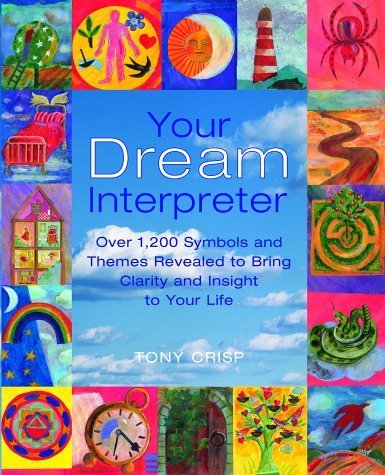
Your Dream Interpreter
Your Dream Interpreter
In dreams you are freed from the usual restrictions of mind and body, of social rules and personal limitations. But beside meeting your wonderful creativity, you may also meet and transform the shadows of your fears and negative attitudes.
Your Dream Interpreter is available at Amazon USA and Amazon UK.

Sections Include
THE DREAMERS’ WORKBOOKINTRODUCTION – What are dreams? The Amazing experience of dreaming.
THE DREAM DICTIONARY – An A to Z of DreamsINDEX OF DREAM THEMES AND OBJECTSBIBLIOGRAPHY |
Introduction – Your Dream Interpreter
Tony Crisp
IntroductionDreams are one of the most extraordinary experiences any of us can have. This is why they have fascinated men and women in every culture throughout the ages. The roots of our own culture show that we are no exception to this. The Old and New Testament are full of dreams and dreaming, such as that of Pharaoh and of the warning dreams experienced by Joseph. (1) In our own times an enormous amount of experiment into the nature and meaning of dreams and sleep has taken place. This has occurred both in the laboratory and in the testing bed of everyday experience of tens of thousands of men, women and children, along with the professionals dealing with human problems. A vast amount has been learned, showing that dreams are more profoundly revealing of transformative insights and self-understanding than even the ancient cultures realised. This flood of new understanding has shown that dreams are not mysterious jumbles of random images, but arise from the innate mental and physical processes of life within us. They express the unconscious wisdom that enabled and sustains the growth and health of your body and mind. This enormous experiment and research have also defined ways that each of us can learn to understand the dramatic and graphic language of our dreams. What are dreams?As with any area of thought, there are a wide variety of views as to what dreams are and what function they play in life. But if we attempt to find a synthesis of these ancient and modern views, it is that dreams are an expression of the most fundamental processes of life in us reaching toward awareness. Creatures have dreamt for millions of years prior to human emergence, and in their dreaming we see the biological life of our planet arriving at its own kind of consciousness, but achieving it in a very different way than we know in our waking life. It is like a huge pool of collective awareness that never knows itself as any one thing, but is the experience of all living creatures. The Psychiatrist Carl Jung gave it the name of the Collective Unconscious. The Australian aborigines called it The Dreamtime, and recognised that all creatures emerge from it, and pass back into it in sleep and dreams. The aborigines call it the ‘all-at-once’ time instead of the ‘one-thing-after-another’ time. Whether we want to see this fundamental level of awareness as instinct, as holy, or as a collective unconscious, this fundamental part of us has the experience of millions of years. It has within it the essence of all human experience, from all cultures. Not only is this pool of collective experience ancient, holding all patterns of relationship already developed, but also it is always changing, always forming new possibilities from gathered experience. In our waking state we have built an image of who we are. We frequently really believe we are the person that image creates. What you touch in your dreams is the person you can be beyond those limitations and concepts. Dreams open to you this possibility of vastly extending your own experience, and finding wholeness and a connection with your roots. (2) Dreams are more than random imagesCountless experiments have shown that each of us dream about four or five times each night. While we dream our voluntary muscles no longer respond to our attempts to move, and our eyes move rapidly under closed eyelids. Our muscles are paralysed in this way because, if they were not, we would actually run around or act out what we are dreaming. Animals in which the brain area that blocks such impulses has been damaged live out their dream in movement. It can then be seen they are practising their basic life skills such as hunting or survival tactics. But dreams do not simply extend your experience and allow you to practice your future actions; they express all the other functions of the human mind and spirit, reaching beyond the limits of waking awareness and your senses. Dreams solve problems; they reflect the state of health of your body and mind; they reach into your past and often access your earliest memories and responses; they are an expression of the self-regulating process of your body and your mind; dreams express your deepest creative ability and reach into new views and possibilities; they are a safe area to directly experience, and therefore practice, having a baby, getting married, dying and exploring the unknown. Dreams reveal to you what you fail to see about yourself while awake. They show what you miss realising about the world around you, and the directions you are taking in life. They unveil things that usually lie beyond the boundaries of your five senses. But their information is sometimes obscured in apparently strange drama or feelings. Fortunately men and women throughout the ages, and especially in recent times, have clarified ways of extracting information from even the most obscure of dreams. Using these techniques enables you to gain insights that can transform the way you live and experience yourself. (3) It allows you to release old tensions and hurts. More than anything else it starts to unveil your immense potential. Notes(1) See Genesis 40:007 to 41:49 – and Mathew 1:20 and 2:11 (2) It would spoil the flow of the ideas to quote all references to support the statements made. However, the stated view of the dream and what lies behind it can be further explored in such books as: The section by Marie L. von Franz ‘The Process of Individuation’, in Man and His Symbols by Carl Jung. There is a River – The Story of Edgar Cayce, by Thomas Sugrue. Cosmic Consciousness – A Study in the Evolution of the Human Mind by Dr. Richard Maurice Bucke. The Tao of Physics by Fritjof Capra. Supernature by Lyall Watson. The Holographic Universe by Michael Talbot. Collision With The Infinite by Suzanne Vega. (3) The word insight is used purposely. It is defined as ‘the capacity to discern the true nature of a situation; penetration. The act or outcome of grasping the inward or hidden nature of things or of perceiving in an intuitive manner.’ |
The Vision of Dreams
Dreams reveal to us things we are ususally blind to
That we have a word such as unconscious in our vocabulary means we acknowledge there are things we cannot ‘see’ about our own existence, about our own body, and about our own mind, intentions and feelings. Many writers on psychology have suggested that the part we know about our own brain/mind is about one tenth its possible size, and we use about one tenth or less of our potential.
In trying to understand this we may come to see that most of our own existence and mind is outside the boundary of our everyday knowing. This has always been realised in most ancient cultures, and many strange and refined techniques were developed to take awareness beyond the boundary of its normal knowing into the land of the ‘unknown’. In this century many people have attempted the same thing using mind expanding drugs or techniques of meditation or altered states of consciousness. See: altered states of consciousness; esp in dreams; the definitions of dreaming under Freud; out of body experience; yoga and dreams.
This difficulty in crossing the boundary of knowing into the unknown is a sort of general blindness most of us suffer. Considering that dreams portray a very different view of life in which this boundary often does not exist, we can say that dreams are a leap beyond our blindness into full supersensual life. In our dreams we can often see the meaning of life experiences we are failing to understand in waking; we can look ahead into what our attitudes and temperament are creating in our life; we can look deep into the workings of our body, and in general extend our senses and awareness beyond any known limits. See: Cayce, Edgar; collective unconscious; wife; dead husband and cannot find husband under family and relationships; hallucinations.
Many modern physicists, working with the information arising in experiments with quantum theory, tell us that our view of the world is based upon our blindness, and is very limited, and through its limitation, unreal. Yet this view we take to be the REAL universe.
The physicist Bohm defines this problem by saying that there are two orders in our experience of the world around us. There is the “explicate” order and the “implicate” order of the physical universe. He defines the explicate order as the impressions of the world gained via our senses and the interpretations the brain places on these impressions. These impressions and the brain’s interpretations – based on millions of years of evolutionary experience and input – lead to a view that we each have separate minds in isolated bodies. The implicate order is the universe as it is when we move beyond the limitations of the senses and the brain’s evolutionary programs. Then we begin to see the universe as a single indivisible whole, and ourselves as intricately part of that whole.
Bohm says that “if we don’t see this it’s because we are blinding ourselves to it.” He goes on to say that “If we don’t establish these absolute boundaries between minds, then it’s possible they could unite as one mind.”
An example of this seeing beyond our conditioned blindness is given in this man’s description of something he ‘saw’ when he moved beyond his usual boundaries:-
I saw an influence in action pressing human society into ever greater super-organisms. These organisms either evolve into functioning new forms, or fail and break down. And by organisms I mean huge groups of people working toward similar goals, such as we find in political or religious groups, or even in nations or social groups. The human body is a super-organism for instance, and combines the workings of billions of cells. What I had failed to see previously is that human beings, despite their felt isolation and individual identity, are actually moved by similar forces as cause cells to gain a common identity in a body.
I saw a push toward a new level of complexity and size which is integrating and using is technology. This new super organism within human society is digesting technology or interiorising it as an integral part of its new organisation and size. This is similar to the way the body has integrated certain things into its own cells, or uses exterior bacteria to help digest food.
The jump to a vastly greater size is enabled by the technology the super-organism incorporates. So if we take human beings as the cells in the body of this huge super-organism, they constitute the living soft tissue, but the nervous system are being formed of the computer driven information and control highways emerging at the moment. And if we are not blind, we will recognise that the equipment we have created is part of our greater body now. Still more though, we must recognise that the huge organism we are incorporated into is more than we are ourselves, just as the body is greater than the cell. If we can see this then we may also recognise that as a human being we may be driven by urges arising in us that are not from our own isolated mind – because our mind is not isolated. Overall our direction arises in large measure from the drives pushing the super organism, and the direction of society is created by the direction of the super-organism.
But how does that help us? What can we do about our blindness?
It helps to understand what dreams can do, so here are some examples.
- An expression of what is happening in the physical body. Some doctors consider dreams to show signs of illness long before they are evident in other ways. Women frequently know they are pregnant very early on through sleep awareness in a dream. See: body; body dreams; Kasatkin_Vasily; consciousness-mind body split.
- A link between the sleeping mind and what is occurring externally. For instance, a person may be falling out of bed and dream of flying or falling.
- A way of balancing the physiological and psychological activities in us. When a person is deprived of dreaming in experiments, a breakdown in mind and body quickly occurs. This type of dreaming can often be a safety valve releasing tension and emotion not dealt with in waking life. See: compensation theory; self-regulation dreams and fantasy; science and dreams.
- An enormously original source of insight and information. Dreams tap our memory, our experience, and scan information held in our unconscious to form new insights from old experience. Dreams often present to us summaries or details of experience we have been unable to access consciously. Sometimes this is as early as life in the womb. See: creativity and problem solving in dreams.
- A means of compensating for failure or deprivation in everyday life, and as a means of expressing the otherwise unacknowledged aspects of oneself. Such dreams are a move toward wholeness. See: compensation theory.
- In dreams we may be integrating new experience with what we have already gathered and digested. In this way our abilities, such as social skills, are gradually upgraded. See: computer, computer-dream process as a; Evans, Christopher.
- Dreams often stand in place of actual experience. So through dreams we may experiment with new experience or practice things we have not yet done externally. For instance many young women dream in detail of giving birth. This function of what might be called ‘imagination’ is tremendously undervalued, but is a foundation upon which human survival is built. See: imagination and dreaming.
- An means of exercise for the psyche or soul. Just as the body will become sick if not moved and stressed, so the mind and emotions need stimulus and exercise. Dreams fulfil this need.
- An expression of human supersenses. Humans have an unconscious ability to read body language – so they can assess other humans very quickly. Humans have an unimaginable ability to absorb information, not simply from books, but from everyday events. With it they constantly arrive at new insights and realisations. Humans frequently correctly predict the future – not out of a bizarre ability, but from the information gathered about the present. All these abilities and more show in our dreams. See: esp in dreams.
- A means of solving problems, or formulating creative ideas, both in our personal life, and also in relationships and work. Many people have produced highly creative work directly from dreams.
- A presentation in symbols of past traumatic experience. If met this can lead to deep psychological healing. Such dreams are therefore an attempt on the part of our spontaneous inner processes to bring about healing change. See: abreaction; compensation theory; nightmares.
- In the widest sense nearly all dreams act as a process of growth or a move toward maturing. Some dreams are very obviously presenting internal forces or dimensions of experience that might lead the conscious personality toward a greater balance and inclusiveness. See: individuation.
- A way of reaching beyond the known world of experience and presenting intimations from the unknown. Many people have dreams in which ESP, out of the body experiences, and knowledge transcending time and space occur. This type of dream may indicate a link between the present person and people who had lived in the distant past; or between the dreamer and all existing life. Some of these dreams present powerful insights into how the transitory human personality may arise out of an eternal consciousness. They thus deal with the spiritual aspects of human nature.
Some examples can be see at Inspiring Stories; Life Changes; Breaking through to the Psychic and Spiritual; My Life in Death; Acting in Your Dreams:
Admiral
The ability to direct the many facets of yourself across the sea of life experience. In other words the ability to meet the difficulties of life decisively and to make decisions direct action. This may also be a father or authority figure. The admiral may also represent the best or transformative in you.
Or if you have connections with the navy you need to think or feel what an admiral means to you.
Useful questions:
Am I the admiral in my “sea of life experience”?
Does the admiral represent an authority figure I know, such as father or schoolteacher?
Am I meeting a need to deal with challenging circumstances?
See: Roles.
Addict Addicted Addiction
Something or someone may be influencing you in a way that undermines your ability to make choices. There may also be a connection with powerful emotional or economic dependence. These activities or influences are not arising from your will or responsibility, but from the emotions and fears, symbolised by that to which you are addicted in your dream. One can be addicted to a relationship, or to work. Your dream may be commenting on such a situation. If so, it is wise to consider how to move toward greater independence.
Perhaps there is an indication of fearing loss of control in regard to something or someone.
The dream may actually refer to a drug you are using and being warned about in your dream. Sometimes the fear of something is the power which actually dominates us – not the thing itself. Each of us have areas dominated by such fears or feelings, and the dream action will point to what they are. To dream of an addict who is other than oneself will still point to some issue about addiction in oneself. See Obsession.
Useful Questions and Hints:
What in my life might be overpowering my freedom of choice?
Am I in a relationship that is influencing me negatively?
Is there addictive behaviour I am not admitting to?
Use Processing Dreams to help with this dream.
Soft Toy
As a child our toys can be extremely important. A soft toy might be the only non-threatening relationship we have, and so depict security, love, and the ability to control instead of be controlled. It could therefore represent the ability to create, with the aid of an external object, an internal source of love and assurance. As an adult it might suggest a desire for a non-threatening emotional or sexual relationship. It can also be a means of venting anger or pain. See: Doll; Toy.
Stranger
May be referring to an unrecognised part of yourself, your behaviour or character, or something you fail to see or recognise as you. In a way this might even be a new growing part of you you haven’t met before. So if it is an ‘alien’ stranger it is something so new it is out of your present world view.
The stranger could also involve feelings of not belonging, of not connecting, not feeling you have a home or know where home is.
Stranger can mean we do not recognise who someone is in relationship to us, what they feel for us or we them. The stranger is also the person you have rejected – the you that is rejected.
Stranger at the door could mean a new and unexpected meeting or an opportunity.
A ragged or dirty stranger may not be about something awful appearing in your life, as sometimes the dirt hides value. But you can find out by using Being the Person or Thing
Useful Questions:
What sort of person is this – threatening, loving, interesting – see of you can define it, and ask yourself what of those is at your door of opportunity?
What is your response to the stranger, and what does this suggest?
What is the stranger doing, or what is the actions in the dream, and how does this reflect your daily life?
Abandon Abandoned
There may be a fear of being left or losing someone, perhaps arising from an actual experience of loss in the past. You need to consider whether your feelings of abandonment are also feelings of dependence. But it depends what you have a given yourself to – if it is careless abandonment it could lead to careless results. If it is to your wholeness then it might mean a journey into yourself.
Nearly always such feelings offer opportunities to meet ones fears and learn greater independence. Difficulties surrounding this are often linked with what we frequently call love, but might, for greater clarity, be called dependence. For instance, if a partner leaves us and we experience great pain, much of that pain and anxiety comes about because we have depended upon our partner to supply, or help supply, such needs as money, a place to live, social standing, sexual satisfaction, a sense of being wanted, companionship and support in crises.
Dependence and need are often so closely intertwined it is difficult to really separate them. But I feel that life in us is constantly trying to move toward survival and independence. But being independent does not mean leaving a partner. But if the thought or feeling brings distress or difficult feelings it becomes suspect and might have links with childhood experiences. But an amazing sense and experience can flower from the freedom of true independence. It is more rewarding than simple independence, and with infinite possibility. Life could begin in an entirely new way. Relationships could be things of depth, variability, and beauty, once freed of the shackles of the eternal buzzing fears and pains. Because on the end none of us are totally independent – or totally alone unless we have shut ourselves up in a small and lifeless inner world. See Inner World Making
Example: For instance, if a partner leaves us and we experience great pain, much of that pain and anxiety comes about because we have depended upon our partner to supply, or help supply, such needs as money, a place to live, social standing, sexual satisfaction, a sense of being wanted, companionship and support in crises.
Perhaps the difference is found in awareness? As in if the co-operation on different levels between two (or more) people was a conscious choice. I have struggled a lot with this dependence on my partner in the past and have often questioned if I had made the right choice to walk this path with him. Now I dare to trust that I did.
Perhaps all needed is to add “TOO MUCH” as in …….because we have depended too much upon our partner…………….too much would then mean a dependence beyond the mutual agreed co-operation.
Longer Explanation
Although, as an adult, you might now be capable of gaining your needs, such powerful feelings of helplessness, anxiety or sense of abandonment, can be stimulated by any situation reminiscent of the childhood situation that first called them into play. Therefore, it can help to carefully look at your life situation to see what changes are producing these feelings. You also need to decide whether there is real cause for fear, or whether you are suffering anxiety due to past experience.
Example: I was in a very loving relationship in which I had developed powerful emotional links with D. We communicated many times each day while apart at work, etc. But one day there was no communication. I felt tremendous anxiety and emotional pain and shock, really frightened that she had dropped me. In fact she hadn’t, but my fears were very real and difficult to deal with. A real shock.
In a certain sense, the pain arising from abandonment, and feelings attending it, can arise from other losses, such as termination of employment or a baby or loss of status. This can be seen as a confrontation with one’s own internal poverty. If this can be accepted, then the situation becomes an opportunity to gradually transform old pains and dependencies. The roots of these frequently become revealed if we accept the pain as a signpost to its source and understanding. Awareness of the part such pain has played in your life is a tremendous means of transformation. See Self Observation
But because facing the enormous emotions that are locked up with feeling abandoned are difficult, sometimes it needs us to grow to greater strength to meet them.
In general the dream might link with a sense of how others, particularly our parents, felt about us while we were a child. This feeling of not being wanted may have become habitual. It may not be true that we were not wanted, but our feelings are saying it is. A sense of abandonment powerfully influences our relationships as an adult, and can lead to feelings of being unloved in the midst of what is really a happy and caring relationship; sometimes carries an element of self pity. The feeling if abandonment can represent big changes in your life such as leaving home, or travelling and living in another country, and so feeling abandoned by all ones friends and usual sources of support.
Dreaming of abandonment may also link with feeling life has no meaning or purpose. They may occur after going through separation or divorce, or even the death of a loved one, especially a parent or spouse.
Such dreams can reveal grief, anger, resentment and despair that has not been faced or dealt with. Meeting such feelings is a way meeting and working through these feelings and is important and may show emotional blockages. See Life’s Little Secrets
If by a friend or relative: Suggests either anxiety about losing friendship, or of illness creating a loss. It can also suggest that you feel unloved and unwanted.
Being abandoned in the sense of allowing sexual and emotional liberty: Finding a new freedom; dropping usual social codes and unashamedly expressing ourselves.
An abandoned building, project etc: Something that you were involved in and had life for you at some time, but is now either in the past, or that you have withdrawn energy or enthusiasm from, or perhaps given up on.
Also: It can be an example of one of the functions of dreams, which is to release held back sexuality and emotion. See: alone; functions of dreams; hero/ine.
Example: ‘My Mother asked me to go and buy some butter for her. A chain on my left leg prevented me from going very far. I look down the road and see my Mum, Dad and my four brothers in the back of a car. I wave and call and they drive right past me, going over the chain I am wearing on my leg.’ Lorraine. LBC.
Lorraine’s dream illustrates not only her feelings of being left out of family life, but also the chain on her leg shows her not fully independent. We often feel ‘abandoned’ while we are trying to become more independent.
Useful questions:
Is the feeling in the dream one I have often?
If I look backwards through my life, when did this feelings start?
Because this feeling might deeply influence the way you feel in a relationship, it is helpful to recognise the difference between the history of this feeling as it has played in your life, and what is actually real in your present relationship?
What or who have I abandoned or been abandoned by?
What are you seeking through being abandoned?
Are you gaining anything from it?
See Talking As – Habits – Techniques for Exploring your Dreams