Posts Tagged ‘dream theory’
The Vision of Dreams
Dreams reveal to us things we are ususally blind to
That we have a word such as unconscious in our vocabulary means we acknowledge there are things we cannot ‘see’ about our own existence, about our own body, and about our own mind, intentions and feelings. Many writers on psychology have suggested that the part we know about our own brain/mind is about one tenth its possible size, and we use about one tenth or less of our potential.
In trying to understand this we may come to see that most of our own existence and mind is outside the boundary of our everyday knowing. This has always been realised in most ancient cultures, and many strange and refined techniques were developed to take awareness beyond the boundary of its normal knowing into the land of the ‘unknown’. In this century many people have attempted the same thing using mind expanding drugs or techniques of meditation or altered states of consciousness. See: altered states of consciousness; esp in dreams; the definitions of dreaming under Freud; out of body experience; yoga and dreams.
This difficulty in crossing the boundary of knowing into the unknown is a sort of general blindness most of us suffer. Considering that dreams portray a very different view of life in which this boundary often does not exist, we can say that dreams are a leap beyond our blindness into full supersensual life. In our dreams we can often see the meaning of life experiences we are failing to understand in waking; we can look ahead into what our attitudes and temperament are creating in our life; we can look deep into the workings of our body, and in general extend our senses and awareness beyond any known limits. See: Cayce, Edgar; collective unconscious; wife; dead husband and cannot find husband under family and relationships; hallucinations.
Many modern physicists, working with the information arising in experiments with quantum theory, tell us that our view of the world is based upon our blindness, and is very limited, and through its limitation, unreal. Yet this view we take to be the REAL universe.
The physicist Bohm defines this problem by saying that there are two orders in our experience of the world around us. There is the “explicate” order and the “implicate” order of the physical universe. He defines the explicate order as the impressions of the world gained via our senses and the interpretations the brain places on these impressions. These impressions and the brain’s interpretations – based on millions of years of evolutionary experience and input – lead to a view that we each have separate minds in isolated bodies. The implicate order is the universe as it is when we move beyond the limitations of the senses and the brain’s evolutionary programs. Then we begin to see the universe as a single indivisible whole, and ourselves as intricately part of that whole.
Bohm says that “if we don’t see this it’s because we are blinding ourselves to it.” He goes on to say that “If we don’t establish these absolute boundaries between minds, then it’s possible they could unite as one mind.”
An example of this seeing beyond our conditioned blindness is given in this man’s description of something he ‘saw’ when he moved beyond his usual boundaries:-
I saw an influence in action pressing human society into ever greater super-organisms. These organisms either evolve into functioning new forms, or fail and break down. And by organisms I mean huge groups of people working toward similar goals, such as we find in political or religious groups, or even in nations or social groups. The human body is a super-organism for instance, and combines the workings of billions of cells. What I had failed to see previously is that human beings, despite their felt isolation and individual identity, are actually moved by similar forces as cause cells to gain a common identity in a body.
I saw a push toward a new level of complexity and size which is integrating and using is technology. This new super organism within human society is digesting technology or interiorising it as an integral part of its new organisation and size. This is similar to the way the body has integrated certain things into its own cells, or uses exterior bacteria to help digest food.
The jump to a vastly greater size is enabled by the technology the super-organism incorporates. So if we take human beings as the cells in the body of this huge super-organism, they constitute the living soft tissue, but the nervous system are being formed of the computer driven information and control highways emerging at the moment. And if we are not blind, we will recognise that the equipment we have created is part of our greater body now. Still more though, we must recognise that the huge organism we are incorporated into is more than we are ourselves, just as the body is greater than the cell. If we can see this then we may also recognise that as a human being we may be driven by urges arising in us that are not from our own isolated mind – because our mind is not isolated. Overall our direction arises in large measure from the drives pushing the super organism, and the direction of society is created by the direction of the super-organism.
But how does that help us? What can we do about our blindness?
It helps to understand what dreams can do, so here are some examples.
- An expression of what is happening in the physical body. Some doctors consider dreams to show signs of illness long before they are evident in other ways. Women frequently know they are pregnant very early on through sleep awareness in a dream. See: body; body dreams; Kasatkin_Vasily; consciousness-mind body split.
- A link between the sleeping mind and what is occurring externally. For instance, a person may be falling out of bed and dream of flying or falling.
- A way of balancing the physiological and psychological activities in us. When a person is deprived of dreaming in experiments, a breakdown in mind and body quickly occurs. This type of dreaming can often be a safety valve releasing tension and emotion not dealt with in waking life. See: compensation theory; self-regulation dreams and fantasy; science and dreams.
- An enormously original source of insight and information. Dreams tap our memory, our experience, and scan information held in our unconscious to form new insights from old experience. Dreams often present to us summaries or details of experience we have been unable to access consciously. Sometimes this is as early as life in the womb. See: creativity and problem solving in dreams.
- A means of compensating for failure or deprivation in everyday life, and as a means of expressing the otherwise unacknowledged aspects of oneself. Such dreams are a move toward wholeness. See: compensation theory.
- In dreams we may be integrating new experience with what we have already gathered and digested. In this way our abilities, such as social skills, are gradually upgraded. See: computer, computer-dream process as a; Evans, Christopher.
- Dreams often stand in place of actual experience. So through dreams we may experiment with new experience or practice things we have not yet done externally. For instance many young women dream in detail of giving birth. This function of what might be called ‘imagination’ is tremendously undervalued, but is a foundation upon which human survival is built. See: imagination and dreaming.
- An means of exercise for the psyche or soul. Just as the body will become sick if not moved and stressed, so the mind and emotions need stimulus and exercise. Dreams fulfil this need.
- An expression of human supersenses. Humans have an unconscious ability to read body language – so they can assess other humans very quickly. Humans have an unimaginable ability to absorb information, not simply from books, but from everyday events. With it they constantly arrive at new insights and realisations. Humans frequently correctly predict the future – not out of a bizarre ability, but from the information gathered about the present. All these abilities and more show in our dreams. See: esp in dreams.
- A means of solving problems, or formulating creative ideas, both in our personal life, and also in relationships and work. Many people have produced highly creative work directly from dreams.
- A presentation in symbols of past traumatic experience. If met this can lead to deep psychological healing. Such dreams are therefore an attempt on the part of our spontaneous inner processes to bring about healing change. See: abreaction; compensation theory; nightmares.
- In the widest sense nearly all dreams act as a process of growth or a move toward maturing. Some dreams are very obviously presenting internal forces or dimensions of experience that might lead the conscious personality toward a greater balance and inclusiveness. See: individuation.
- A way of reaching beyond the known world of experience and presenting intimations from the unknown. Many people have dreams in which ESP, out of the body experiences, and knowledge transcending time and space occur. This type of dream may indicate a link between the present person and people who had lived in the distant past; or between the dreamer and all existing life. Some of these dreams present powerful insights into how the transitory human personality may arise out of an eternal consciousness. They thus deal with the spiritual aspects of human nature.
Some examples can be see at Inspiring Stories; Life Changes; Breaking through to the Psychic and Spiritual; My Life in Death; Acting in Your Dreams:
America
If you live in America then it expresses your feelings and experiences of the culture and politics you are immersed in. What is America for you, a land of opportunity and freedom, or a land of subjugation? It will help to define what it is by using Talking As.
If the dreamer does not live in America and is not American: Could associate with opportunity; material wealth; dreams to do with success, whether in love or business; recognition; extremes. See: abroad.
Useful Questions and Hints:
What do you associate with America?
What is my view or experience of it?
What are the events and setting of the dream saying about my relationship with America?
If I take out the word America from the dream and write down what my feelings are, what would I say?
It might help if you use Processing Dreams.
The Magical Dream Machine
We all dream every night, so we each have what could be called a Magical Dream Machine.
To gain a feeling of this, imagine yourself entering one of those game machine areas where youngsters can ride a motorbike, or ski down a slope. But instead of a simulation of a car, you discover a large machine that you can climb into and become completely enclosed. When you close the door, contacts link onto your body and head in the complete darkness. It is quiet as all the external sounds disappear, and you relax your hold on your body and senses. Your whole experience of yourself shifts as the external world melts away, along with your awareness of your body. That is sleep.
But now – in the darkness a light glimmers. Gradually it takes shape. The shape of a person is suggested. In the time that follows he or she evolves form, moves, and you have full sensory experience. You are totally involved, with all your emotions and sexual responses. Changes occur and you love, fight, fear, murder or bring to life again the person, who can become an animal, a devil, God or a bodiless voice lost in a sombre countryside. Your experiences are totally real, and you move through heaven and hell, despair and joy, darkness and light. Scenes from your past can be revisited – or totally new experiences can be felt so clearly, you are enriched. That is a dream.
Seeing Is Not Believing
If you had been in such a machine, and on coming out of the total involvement of these moving experiences, you were told you had created it all yourself – that on the black screen you had, out of your fears, habits, secret longings and passion; out of your immense store of memories; with your unbelievable range of feelings and creativity – you had given form to urges and processes in your body and made this rich world of experience, what would you feel? Would you disclaim responsibility? Would you consider it meaningless? Would you realise what amazing creativity and potential you have?
In your dreams you create such a world and such experiences. But perhaps you have not taken time to consider the wonder of your creative process in dreams. Every night you create a new drama. You conjure out of your own being the people, the creatures, the surroundings of your dream. Then you give life to what you create – not only life but purpose and drama. You are a supreme dramatist, playwright, actor and actress. You are the great Creator – in your dreams. Considering this, have you ever wondered why that enormous creativity does not flow into your waking life? You can see that some people have that creativity and are enriched by it personally and financially. Why not you?
But what is the REAL world?
In considering how you reply to this, remember a few well-known facts about how you encounter the so-called ‘real’ world of waking life. Firstly, when you look at an object such as an orange or apple, remember that although you have the sense of seeing what colour and texture the fruit has, in fact all you are seeing is reflected light. You never see the actual colour of the object.
Also, as far as texture is concerned, this is a mystery to you. Texture depends entirely on what you approach the fruit with. If it is an electron microscope, then the texture is one of shifting swirling atoms and subatomic particles. If you were tiny the apple would have a very different appearance than it does to you at your present size. Also, remember that you never actually know what the apple feels like or looks like directly. Your eye takes in streams of light that are translated into nervous impulses transmitted along the optic nerve. In the brain these nerve impulses are again translated into an image that enables you to have some relationship with an apparently external world. In the same way the nerve endings on your fingers transmit signals that are translated into sensation.
Similarly the television picture you watch on a screen is translated from signals the TV set is sensitive to and changes into pictures, colour and sound. The signals are not in themselves images, colour or sound. So, like the TV, the world you feel so sure you are seeing and experiencing, is one your brain has created in order to enable you to deal with survival. Even so it is a translation of ‘the world’ that has been shaped by evolution and its limited needs. You only respond to very narrow wavebands of light and sound for instance. So you do not know much of what is actually going on in the world anyway. Your eye, as a lens produces an upside down image of your surroundings, and this is ‘corrected’ to help you move around more easily.
Considering that you only experience a virtual reality of the external world created by your brain – and that is itself limited to a tiny fraction of what is actually surrounding you – you cannot take seriously your perceptions of the world or people. There are so many radiations, energies, and depth upon depth of texture in the cosmos and objects around us, that in effect we are blind and deaf. See Inner World
You Are the Creator
So it is true to say that you live in a world, in conceptions of yourself and your surroundings that are a self-created virtual reality. You could just as correctly be asked the question of whether you accept that you create all you experience in regard to the objective world, as you could of the magical dream machine.
However, we are discussing dreams, but remember that what is said could equally as well refer to your waking life.
So, your dreams are a magical place in that you have the ability in them to create a totally real world. Do you discount them? Do you see that you create your own world of experience in them? If you do, have you wondered why you may have a propensity for creating what you do? Or why, with such creative potential, you might still lack self-confidence? Just as you create your surroundings in dreams, you also create the psychological and sensory world you live in. Understanding your dreams can help you to clarify why you at times create what does not satisfy you, and how to generate a whole new world of experience. You can take charge of your creativity and ride with it instead of being at its mercy. Such power, after all, can as easily produce misery and ill health as pleasure and ability – unless you learn to direct it. Such creativity can lead you into hell, or create a heaven.
A few magic words to remember to say to yourself – “I have the magical power of creation. So I can create a hell for myself or a heaven. I have immense ranges of ability and problem solving. So here I go in believing in myself!”
Amazing Storehouse of the Mind
Although you constantly use the huge storehouse of memory and developed skills in your everyday life, you may usually fail to recognise what you are doing, and what a miracle it is. As an example, you now hold in store millions of bits of information. By asking you a simple question such as ‘What is your present home address?’ I can call to conscious awareness a minute part of the information lying unconscious. If I were to present you with a bicycle, or you were dropped in deep water, the skill of cycling or swimming could also emerge from latency if you had previously learned those skills.
Apart from these aspects of your immense storage of information, there is also the possibility that by the right series of questions or experience, you could arrive at a creative synthesis of information already held. In other words something not previously held in memory could arise by putting together old ideas or experiences. With the right stimulus, in the same way you could bring to expression potential within you that is at the moment lying dormant.
While we dream we have a very full access to the storehouse of our experience. If we learn to use the dream process we can more capably use the riches of what usually lies unconscious like treasures at the bottom of the ocean. There is a natural process of putting together the separate pieces of your experience into creative new combinations. All of this can be accessed by exploring the treasures held in your dreams and the dream process. See Using Your Intuition; Clicking On
Mind Watching
Because of the many nature films shown on television we are now used to the idea of mature and intelligent adults spending days or years watching the behaviour of animals such as hyenas or chimpanzees. In her book In The Shadow of Man, Jane Von Lawick Goodall explains how, by watching chimpanzees and taking note of her observations, radical new insight into the behaviour of chimpanzees arose. She didn’t think beforehand what she expected to find, but simply observed and put together the information that arose. For instance on several occasions she saw the chimpanzees kill another animal and eat its flesh. The knowledge that chimpanzees were meat eaters was entirely new.
In a similar way, by observing dreams and laying bare the emotions and associated ideas and memories you have with your dream imagery, you gradually define your personality, its strengths and weaknesses, in a depth you had never managed previously. I have called this mind watching, but it covers every aspect of human nature, not simply the intellect or thinking. See Self Help
This mind watching through observation of your dreams first presents information about your personal experiences and memories and how they influenced your growth and influence present responses. Gradually the information arising from such watching leads beyond your present boundaries of self. It shows in many cases how your unique self has arisen from, and has indissoluble links with your forebears, with your culture, with the past as a whole, and with the cosmos itself. It leads from yourself to the edge of the known, and perhaps helps you take a few steps beyond that edge into the unknown, to create new understanding, and enter new dimensions of experience.
Remember that you are probably one of the millions of humans suffering amnesia. If you doubt this ask yourself why you do not remember your childhood. No doubt you have also forgotten your life as a baby. You fail to remember your life in the womb. Perhaps, more importantly, you have also forgotten your link with the rest of the cosmos. In fact you are an amnesiac, and by ‘dream watching’ your memory can gradually be restored. It takes time and perseverance, but gradually the time line of your existence will be filled with detail.
This mind watching also gradually reveals to you the many aspects of your mind’s working, and with such insight may come the growing ability to use these facets of yourself. Not only may you discover great vistas of personal memory, but also the roots of your creativity, the subtle senses of your emotions and unconscious, and the treasures of experience you have gathered.
The Path To Take
There are many methods you can use to discover the enormous content within your dreams. For instance look at the following features and explore them to discover what works best for you: Introduction to DreamWatching; The AmplificationMethod – PeerDream Group – Active Imagination.
Another method that can be used with great benefit if you are a person who meditates, is as follows:
The meditation method of dream understanding rests on the function of memory. The aim is to hold the dream in mind, and at the same time hold the question of what are the activities, passions, memories or pains in you that have formed the dream?
You hold this question in the same way that you hold any question – such as the one asked above about your address. Do not strive, and do not struggle to arrive at an answer. Simply sit and WATCH the dark space of your mind and feelings. Take note of whatever memories, feelings and fantasies arise.
It helps to think of your being as a keyboard that your unconscious knowledge and intuitions can play upon. Holding your self stiffly, in mind or body blocks this mobility. See the passage on using the body in dream work for further information.
This may not be a quick method. So be patient, even when nothing seems to be happening. The mind is a wonderfully responsive thing, and will attempt to present what you are seeking. But at first perhaps only stray memories or feelings will arise. Also, the insight might require you to feel something deeply, so be ready for that and let it happen if you can.
Over a period of days gradually more and more will arise, and it is worth the time spent in the exploration. But do not be content with airy-fairy insight. Do not make the dream a platitude or a cliché. Dreams are powerful expressions of your down to earth, here and now self. You will know if you have arrived at insight because it will be deeply moving and clarify areas of your life that were previously obscure.
It is important to consider what you have received and weigh it against practical observation. See if there is something you can learn from it and apply. Test it wherever practical. Do not be afraid to doubt it and try it against the world. If you are not accessing the best in yourself you need to know it. This avoids the trap of wanting your intuitions about your dream to be true at any cost. The intuitions arising from the meditation method are a valid way of gaining information, just as your senses are, or your ability to read. But your senses and your ability to read can also be ways in which false information is taken in. So your discrimination is needed when using your intuition, as it is in everyday life. The more you use it the more sharp your faculty will become. But discrimination must not act as a source of doubt that blocks your ability to receive spontaneous information.
The Hidden Buttons in the Machine
One of the things we take for granted in our experience of the world is that there are many possibilities hidden in nature that nature itself does not express. For instance lightning is one of the few ways nature expresses electricity. But as a species we have learned there are many other possibilities for the use of electricity. By directing it in various ways we can produce heat, light, sound, power to move things, and pictures as we see on the television, PC monitor or in the cinema.
This applies also to our own body and personality. The example we can use here is the drive towards sex. This has developed in us through millions of years of evolution in the process of reproduction. This gradual development has formed organs and traits, such as courting behaviour, that lead directly toward an attempt to plant the seeds or receive the seeds to reproduce.
In our own culture we largely accept this except where there is psychological trauma that may prevent a normal expression of sexual drive. We have the unconscious concept that there is no other possibility. This is rather like looking at lightning and saying, “Well, that’s how nature does it, and that is the only possible way it can be experienced.” But some other cultures have looked upon the sexual drive in a similar way that we have looked upon electricity. They have explored its possibilities.
To explain what they found, and its relevance to what is being said about your personal potential, we need to remember that in nature the electricity in the lightning simply earths itself. All that tremendous energy flows into the earth. What we have learned to do is to put something in between the flow, such as an electric fire or a television set. In this way the flow back to earth produces many different phenomena. New potentials of the electricity are manifest.
Although this is an analogy, we could say the same thing about human sexuality. The discharge of feelings and body fluids in sexual orgasm and ejaculation are like the flowing back to earth. Nature does its thing and the energy is gone. In most human sexuality today there is not even the possibility of reproduction. What other cultures have developed is the concept of this as energy. They say that this energy is potentially many other things than physical reproduction. So they divert the energy into the body toward the brain, rather than out of the body to be earthed. The results of this when successful are extended functions of the brain and senses.
The techniques and teachings lying behind yoga are fundamentally about recognising the potentials lying dormant in you and learning to use them. The eastern cultures, far more than is true in the West, have developed techniques to extend possibilities of human life. See Kundalini
Bringing this back to the “Magical Dream Machine”, once we recognise the enormous creative potential we have, and that we can see active in our dreams, we can begin to realise we are only at the foothills of the possibilities open to us. For a start, millions of tonnes of drugs are taken each year to deal with depression. Yet here we each are, capable of creating a full surround virtual reality, with extraordinary people and creatures, but we are still victims of our own feelings and fears. Isn’t that strange? Isn’t that a tragedy? See – Avoid Being Victims; Life’s Little Secrets; Archetype of the Paradigm –
Take the journey! Learn how your magical dream machine works. Find out which buttons you unconsciously press to create heaven and which buttons you press to create hell! Create your own music. Create your own life!
Forgiveness As a Power Source
Forgiveness may sometimes be mistaken for an action taken through weakness, or as an act of “goodness” or Christian sentiment. But when understood, forgiveness has the power to transform us, and change the future we are creating out of our attitudes and actions.
As an example of this, some years ago life events led me to face a very painful experience. My wife was living abroad for a while and I did not know when she was coming back. This triggered the release in me of a terror I had kept buried since the age of three. At that time my mother, at the doctor’s suggestion, had sent me away to a convalescent hospital because my health was poor. Unfortunately, because my grandmother had been my prime carer, and had died before I had reached the age of two, I had already experienced great loss. This had left me open to the fear of abandonment. Being at the hospital released this terror that I had been abandoned.
Meeting that terror again in my late 40s was almost more than I could bear. Although the feeling was originally connected with my mother, as usually happens, whoever we love becomes the target for such fears. In meeting these awful feelings, I traced the origin of them back to the events mentioned. But the terrific anger I felt to my mother at exposing me to such unbearable emotions, also spilled over onto my wife.
The anger did not abate and it became obvious that unless I could forgive my mother, I would ruin my marriage with my anger.
It was difficult to find this forgiveness because I felt that what my mother had done was unforgivable. Of course none of this was neatly rational. The feelings were burning beyond reason, and could not be rationalised away. But I could not ignore the fact that this was not, in the end, about my mother, but about myself. My continued anger was ruining my life. So for my own sake I had to sincerely forgive my mother. This was not a fast change, and it was not easy. But it did release me from the crippling effects of the anger. And some effects of non-forgiveness in these situations are quite subtle. One might, for instance, avoid success in one’s life so that those close to you could never feel the pleasure or relaxation of that.
However, forgiveness sometimes has a much more profound significance. I believe that our primal life difficulties, such as mine connected with abandonment, actually have their roots in the long past. It may be easy for us to recognise that my terror can be traced back to the events mentioned in this lifetime. From this we can say, “Yes, the fears he faced as an adult were caused by the loss of his grandmother. And his mother’s decision to put him in the hospital restimulated that fear.”
However, if we can agree that we can trace things back to causative events, why can’t we also say, the original events also had causes? For instance, my mother did other things later in my life to deepen my terror of abandonment. Why?
From the viewpoint of modern genetics, it is understandable that a present day sickness in an individual’s life may be the result of events from generations ago. We understand that the gene pool from which our own physical body arises, has had negative and positive features added to it over tens of thousands of years. Therefore our present physical, and to some extent psychological, situation, arises out of events in the long past. If we can understand this, then we might also understand and accept that besides a gene pool, there is also a behavioural pool out of which a great deal of human behaviour arises. This is particularly evident in comparing different cultures where certain types of behaviour are passed on for thousands of years.
Some people think of this in terms of past lives. But we can also think of it simply as past events that influence our present life experience as causative factors. So, because it is easier to explain, I will create a scenario using the imagery of past lives.
Supposing in the far past I had hurt and abandoned a child. Supposing the child I had hurt in that previous lifetime is my mother in this lifetime, and she has never forgiven me for what I did. In other words, the actions generated by the past hurt are causative factors, are active and alive in the life of my mother, and are therefore influencing her. In this present life, my mother is in a position of power, and I am the vulnerable child now. So, from whatever it was in her deep unconscious that influenced her actions, she still wishes to hurt me, and did so several times.
I am presenting this as a speculation because I wish to present you with an idea, a viewpoint.
So, if you can follow this example simply as a possibility, what would have happened if I could not have forgiven my mother when I discovered the origins of my terror? Instead of ending the cycle of revenge, the hurt and anger could have been stored deep in me, generating more causative factors in the future. Those causative factors would have flowed into my life in the future, or influenced another life to perpetuate the hurt. And where or when would that end?
Also, the misery would spread out into the lives of those around me — to my wife for instance. Ripples upon ripples, and the world has enough waves of vengeance and bitterness riding through it already.
I wonder what the origins of your own hurt are. Where did they begin, and where will they end? Forgiveness can be the power that cancels them from further influence in your life.
The act of forgiveness has stages. The first is to recognise that the pain, or lack of inner peace, is arising from a withheld feeling or grudge. Was it Robbie Burns who said we can nurse a grudge to keep it warm?
Such withheld feelings may be on any scale. It may, for instance, be about a misunderstanding between you and a partner or friend. This can usually be dealt with by careful communication, and sharing of information or feelings. Then the difficulty is melted away or let go of.
But sometimes communication doesn’t help. It may in fact lead to argument or a deepening of the hurt or misunderstanding. Then we have to deal with it alone. Also some situations are difficult to really understand, and are not clear-cut. We may struggle for years to understand or come to terms with why a marital breakdown occurred; why someone we trusted betrayed us; why a situation suddenly changed. We might never reach understanding without a very open and honest communication with the person or persons involved. Sometimes people do not really know their motives — so even such communication would not help.
We are therefore left with our own distress and feelings of hurt, and what we will do with them. Even if we can see and admit what stress they cause, and damage they do, it is often not possible to simply let go of them. Such strong feelings, rooted in real pain, have a life and will of their own. If, in the manner of dreams, such feelings took on an identity of their own, and stood before you as a person, they might simply say, “No” to any suggestion of letting go the anger or hurt. Then there is nothing to be gained by fighting with such a secondary character in yourself.
The Empty Chair technique can be a great help if such a resistance exists. But before we look at ways of using that, a couple of examples may show how difficult forgiveness can sometimes be, and what a change can be made when it is found.
The process that lies behind dreams continually attempts to bring a state of balance or peace within us. But it can only do this if we can allow ourselves to experience a wide range of feelings, and to let go of the grudges or pains we have been holding on to. Stephanie, whose dream this is, tells us that it is only when she allowed forgiveness into our life that real change could occur.
She says, I was lying in my bed and a man was beside me. Gradually he got older and older until he was dead. Then he became a skeleton in bed beside me. I felt horrible. When I woke there was still some difficult feelings but these went. I realised that things, emotions, troubling me for ages, had all been cleared. Previously at church the vicar had talked about the healing of forgiveness, and in some way this had happened while I was dreaming. Now, quite a time after the dream, I am still in the state of ease.
The next dream shows how a solution can be sought and found in a dream. The woman, May, had suffered years of emotional misery and alienation from her family.
She says, “Because of this, when I was down to absolute rock bottom emotionally, I consulted a hypnotherapist who explained that hypnosis was used only as a last resort. I went to her once a week for over a year. I was treated under psychotherapy, and I had to write down my dreams every day. Through this I recognised my areas of problems, and in time my problems lessened. However, I had to travel seventy miles altogether for each visit, and with petrol becoming more expensive I gave up the consultations. All the same, I felt I hadn’t really reached the real root of the trouble. I delved into my known past, but not my unknown past. Consequently, after about six months I drifted back into my old depression and aggressive dreams and nightmares.
“I always seemed to be searching for the lost years. My real mother died when I was nineteen months old and my sister was one month. In the same week my Dad was called up for the War. Unable to get anyone to look after two young children, Dad paid a woman to look after me, while my sister was adopted by an aunt and uncle. My father re-married when I was seven, and I have two half brothers and one half sister. As I grew up none of my family would let me speak about the past, making it a taboo subject. Because of this I used to fall out with them on and off. I am now forty three, and when my father died five years ago, I got in such a rage, telling my family I was never one of them, and now that Dad was dead I had no family. The guilt and depression I felt about this was what led me to go to the hypnotherapist.
“This year, in January, forty one years from the day my own mother died, my stepmother died. This sent me into such agonising emotions I had to give up my job, and was near to a nervous breakdown. However, on the nineteenth of March I had this dream.
“My son had a spray which made him very small. He was able to speak to and see various small characters and Walt Disney people. He sprayed me so I could see the characters too. He found a tiny friend, a girl of his own age. He was so small – insect size – that when he crossed a road with his friends he got trodden on. I had a terrible feeling of loss. Then my son laughed and said, ‘We are all okay. We are too small for anyone to hurt us.’
“My son sprayed other members of the family and I began to have the feeling I knew the answer to my years of depression and guilt. Then we were walking down a sunny promenade. I saw my father sitting on a bench. I hesitated, feeling I could not go to him. My son told me not to worry. He said, ‘If you can’t love your father I will love you both as son and Father. If you are too silly as grown ups to see it doesn’t matter about all the past, I’ll make up the love to you.’ The little girl with him went to my father and said the same thing. Then my father and I both laughed and went to each other, thinking how silly we had been all those years. We both got the feeling of forgiveness and saw how we had wasted all those years because we didn’t have the simple love of a child.
“My father had then been sprayed and could see the characters, who all began to dance. On the beach nearby were my stepsister and stepbrother and wife, sun-bathing in the warmth. Instead of my usual pit feeling I felt playful and kicked some sand over them. I had the wonderful feeling of happiness and floating. I told them the story, and said the answer was so simple. Forgive each other, love and forget the past and look to the future. I felt it was a miracle, and knew it was the answer to finding peace with my family, living and deceased. And as the dream ended there was a crescendo of moving music. All the Disney characters were there, with pairs of birds in nests all around in trees. They had little comic notices hung outside such as ‘Goodnight’, ‘God Bless’, ‘Don’t Snore.’
“Since the dream, six months ago, I have become reconciled with most of my family, though I doubt if they can understand the reasoning behind it. I now have this wonderful feeling of well-being. ‘Though life still has its difficulties.’”
May’s dream shows how one does not necessarily have to interpret the symbols to find healing or understanding. The dream itself is clear enough to understand directly. Also the dream actually gives May the direct experience of what it feels like to forgive, to feel the warmth of love, and to look forward instead of back. She had developed the habit from a year of psychotherapy, of looking within herself for answers, and expecting help from her dreams. So those things are important.
This last dream shows the funny side of what we are doing when we hold on to rigid self-righteousness, and thereby avoid forgiveness.
Some time ago I had a dream that illustrates this situation. In the dream I stood facing myself. The second me stood above on something, and was condemning me for not being as good a father as I might have been. Meanwhile I stood below begging forgiveness for all the wrong things I had done, and feeling terribly guilty and an awful failure. But gradually the funny side of the situation struck me, and I called out to the second me, ‘Come down from there, you fool. You’re only me condemning myself and making me a failure.’
When I woke from the dream I could see how true the dream was, and what a destructive habit I had. If I projected the feeling of being a second-rate father, my children would feel it and believe they were second-rate children.
Many of us in fact have such a voice, which stands superior, creating less creativity and depression.
Part of the wonder of dreams is that through them the unconscious activities in us are made conscious. Our self-destructive habits are brought to light, the whisperings of our fears are heard and dealt with.
Therefore, by expecting help and an experience of forgiveness to occur in your dreams you may be able to bring it about. However, if this does not occur, you can use the Empty Chair technique.
For this, you will need two chairs place opposite each other and fairly close. Before you start you need to define what hurt, or what anger you are going to deal with, and to what person the anger or grudge is directed.
When you have done this, and you have set the scene, you sit in one of the chairs. You now imagine your feelings of anger or hurt in the form of a person sitting opposite you. Give them a name if you can.
Now ask them what they are upset or hurt about. Then sit in what was the empty chair and take on the role of the hurt character. Do not attempt to be the two aspects of yourself at the same time. If you want to comment on something that has been said by the first character, move back to the other chair.
As the hurt character, do not edit or repressed what you feel. You can be as angry, vocal and emotional as you like. Nobody is going to get hurt, because nobody is there to hear or receive what is expressed except yourself.
For example, as the hurt character I might say, “There’s no way I am going to forgive them. Bugger me, they did it in cold blood! If you forgive somebody like that, they could easily creep back into your favour and do it again!”
As yourself, you could reply to this as, “There is a difference between forgiving and forgetting. Nobody is asking you to forget. That would be silly because you would not have learned from the event. What I am asking you is what you feel, and what damage your feelings are creating in our life?”
Allow your imagination and creative fantasy to take part in this conversation. If you get stuck, wait for inspiration. Perhaps remind the hurt and unforgiving character that what they are doing is creating difficulties for both of you. If necessary, come back to this several times until you feel a real shift and sense that forgiveness has happened.
So, to sum up, look to your dreams for help in resolving the pains and anger that may arise because you cannot forgive.
Be ready to feel things you may not have faced before, as Stephanie did in her dream.
Confront yourself with the negative effects that lack of forgiveness is producing in your life.
Be patient with yourself. Sometimes these shifts take time, and perhaps occasionally need events to push you into the change.
Dreams – The Magic Mirror of Yourself
Every one of us dream.
Whether we remember or not, each time we sleep we create an apparently real world out of our remembered impressions, habits and emotions. As the stage managers of our inner theatres, we have the most abundant props, costumes and backdrops imaginable. Yet, because a dream is our own creation, no part of it, no emotion contained in it, no flight of fancy portrayed, is other than oneself. Even when we dream vividly of another person, such as the man in our life, the dream personality is made up of our own impressions, memories of them, hopes and feelings. Most people are often totally unaware of the experience they take in and how it interacts with them when we live with someone. See Inner People
In other words the memories and experience we gather unconsciously change us and are not lost. It is part of you and is symbolised in dreams as a person or event. You have taken in millions of bit of memory, lessons learnt, life experiences along with all the feelings or problems met by loving and living with someone and they are what makes you the person you are. Your dreams tend to put all that in the image of the past person when you are dealing with the influences left in you from the relationship. Please read this wonderful example, it will show how much we take in from those we love or lived with.
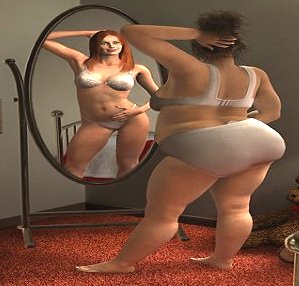 |
Your dreams are a magic mirror that reflects nothing but your own beliefs, worries, fears, wisdom and even genius. To do this it creates characters, situations and drama that are all reflections of your own inner world. All the images and drama, along with the emotions you feel are simply you looking at yourself. Most of it we do not recognise because we are so blind to our failings and of course our wonder. |
If you are afraid of your own emotions, your fears, or are locked into particular beliefs, then you are certainly a victim of them, you are powerless. But if you recognise them as simply your own feelings reflected as imagery they are simply you becoming the master of your own inner world. It is the best lesson you can learn – in dreams and in life.
What do you see in the mirror of your dreams?
See Martial Art of the Mind; Man in your Dream – Techniques for Exploring your Dreams – Habits – Edgar Cayce
The Collective Unconscious
Some thinkers, like Jung and Sheldrake, see individual human consciousness like an island in a huge ocean in which there are countless other islands. Above the surface of the water – waking self-awareness – there is a sense of separate existence, with definite boundaries where the shore meets the sea. Beneath the surface however, one island is connected to all other islands. The land stretches away under the waves and rises here and there into other islands. So, it is thought, personal awareness, beneath our everyday consciousness, shades off into a connection with a collective unconscious we all share. Through this connection we may be able to arrive at insights into other people otherwise denied to us.
In recent years there has been a lot of research very strongly suggesting that the quantum level of the universe is such a universal memory and consciousness. See Physics – new physics and the mind
Jung describes the collective unconscious as the ‘inherited potentialities of human imagination. It is the all controlling deposit of ancestral experiences from untold millions of years, the echo of prehistoric world events to which each century adds an infinitesimal small amount of variation and differentiation. These primordial images are the most ancient, universal, and deep thoughts of mankind.’
However, such ideas have been stated long before Jung and modern psychology. Eastern philosophy has talked of the akasha, the fundamental substance that holds in it memory of all that has happened. In Western occultism levels of awareness have been defined for hundreds of years. At the end of the 19th century Dr. Richard Maurice Bucke wrote about Cosmic Consciousness that was described as having the same universality as the collective unconscious.
A lucid experience describes this very clearly:
Now it seemed as if my awareness went beyond the frontier. This was a very visual experience. I was seeing a vast desert and I knew this represented immense periods of time, perhaps what we call eternity. So it could be called the Desert of Eternity. Here and there in the desert were huge rock formations, a little bit like what one sees in Monument Valley in Arizona. But these rock formations were not plain or slightly coloured rock. Also they were immense. They had the appearance of massive mosaics – brightly coloured mosaics. But the mosaics did not form illustrations or patterns. However, some pieces of the mosaics were larger than others. And each piece might be in itself multicoloured and a sort of miniature pictograph.
As I looked at these massive formations I understood that they had been carved or created through events in the passage of time. Each mosaic, each part of the overall mosaic, had been formed by enormous creative acts, or by long-standing actions. So these latter were like ideograms or archetypes. So, for instance, mother creatures have cared for, fought for, died for their young. This pattern of behaviour has been so enormously potent and perhaps we can use the word successful, that it has created, shaped aspects of eternity. It has left its pattern, its artwork, on time itself. Thus eternity honours that pattern by giving it a place in the very structure of itself. No one being created such a mosaic in the formations. Such a mosaic was large and had in it the essence of all the lives that formed it.
So the rock formations and the mosaics on them represented influences that will flow into the future. They were sources of power or influence that shaped the phenomenal world. They were the body under the coat so to speak. See Archetypes – Links to
This explains some forms of intuition, as one person’s mind is said to connect to all others beneath the surface in the unconscious. In this way, questions or inquiry about a particular person will draw information pertaining to them from the enormous collective unconscious. In fact Einstein said that “Human beings, vegetables, or cosmic dust – we all dance to a mysterious tune, intoned in the distance by an invisible piper”. So our individual consciousness is rather an outcrop of a huge and ancient collective consciousness.
Edgar Cayce discovered in his adulthood, that he could put himself at will into the state of mind in which he could tap this unconscious reservoir of knowledge. Because he could diagnose people’s illness without examining them, his work was supported by doctors. Investigators of psychology and philosophy also sought him, and he dictated 14 million words while in this state of wider awareness. His findings suggest that we all have this ability to tap the wealth of unconscious information – truly a collective unconscious – but few of us can bring it to waking awareness. His biography, There is a River, and Seer Out of Season, are astonishing and inspiring books to read. See: Edgar Cayce.
We see this markedly in animals that are largely instinctive. Birds have no present memory of how to fly or build a nest, yet when the time comes they draw on something that enables them to express the collective experience of their species.
I am a Child of the Universe
If this connection is a fundamental part of everybody’s life, the waters of self and the waters of the ocean are not separated. Jung called this universal consciousness the collective unconscious. Other cultures have given it other names – the ocean of Brahm for instance in Hinduism. Within Buddhism there is also the phrase, ‘the dewdrop slips into the shining sea’. Australian Aborigines call it The Dreamtime.
The image of the dewdrop slipping into the ocean illustrates the individual becoming aware of melting the boundaries of their personal awareness, and becoming aware of the ocean of sentience within which they exist.
When we first begin to ‘hear the voice of God’ again – i.e. feel the immense power of the collective unconscious, the foundation of our awareness – we are often afraid, even terrified, as the story of Adam and Eve depicts. The fear arises because whether we admit it or not, we feel we might be swallowed up, be lost in the immensity. Basically it is a fear of death. See What Happens When I Die?
Reaching the shore of consciousness
Looking back at the psychological history of humanity, at their emergence of identity out of an animal level of awareness, all consciousness was originally merged, as it were, in a great ocean or pool. At that point no creature had crawled out of that pool. Nothing had arrived at self-awareness. No sense of separateness or identity had emerged. Then out of that ocean onto the shore of self-awareness, perhaps for moments only at first, a daring creature crawled and said – ‘I am’. Doing so they left a mark – footprints, two stones rolled together, scratches on a rock, a cave painting. And those creatures still in the ocean looked out upon others and wondered, until a spark was struck in them too. Perhaps struggling for a closer view they emerged and gasping also exclaimed – I am – and added another rock.
So the ocean is the world of sleep, babyhood, life of the nameless herd, consciousness immersed completely in the streams of instinct, reproduction, eating, sleeping and the senses, the collective unconsciousness. But the shore is the pathway of consciousness, the spoken word, art, drama, music, education and questioning enquiry. We all take this path if today we can say ‘I am’! We too, in our infancy, emerged from the collective consciousness. We too were gained a soul, an identity, when we were given a name and speech. You too stepped out of the great waters of life – and will meet them again at death. See Programmed
As already quoted, Jung describes this as the ‘inherited potentialities of human imagination. It is the all controlling deposit of ancestral experiences from untold millions of years, the echo of prehistoric world events to which each century adds an infinitesimal small amount of variation and differentiation. These primordial images are the most ancient, universal, and deep thoughts of mankind.’
What this means in practical terms is that through our dreams, or through any of the ways people access this immense reservoir of human experience, we can find patterns of behaviour – archetypes – and whole memories of people who have lived through and found solutions to the problems we face, or defined the understanding we are seeking. Also, Cayce found actual details of medicines and techniques that had been used successfully in the past and were part of the memory within the collective unconscious.
In trying to present this to sceptical colleagues and intellectuals and scientists of his time, Jung tried to explain his observation of a strata of being in which individual minds have their collective origin in a genetic way. This seems unlikely, and Rupert Sheldrake sees it as a mental phenomena. Dr Maurice Bucke called it Cosmic Consciousness. J. B. Priestley saw it as ‘the flame of life’ which synthesised the experience of all living things and held within itself the essentials of all lives. If we think of it as a vast collective memory of all that has existed, then we can say the life of Edgar Cayce exhibited a working relationship with it.
Such a collective level of mind would explain many things, such as telepathy, so called out of body experiences, life after death, which have always been puzzling because it is difficult to explain them using presently known beliefs. Mostly this difficulty has been because our language and the concepts arising from it insist of a duality of mind and body. However, researches into the nature of fundamental particles – quantum – show us that such divisions do not exist, except in our limited sensory view of the world.
For more information See: Quantum Physics; Levels of Awareness – Levels of the Brain – Consciousness – The Brain Mind Split; Cayce, Edgar; archetype of the self; religion and dreams; sea; Dimensions of Human Experience
Black Magic, Evil and Dreams
Although thorough investigation of claimed injury or death attributed to black magic has shown the real cause to be malicious aggression or murder, scientific research into the deaths of people who were said to have died as the result of a curse or a voodoo ritual, has shown the victims to have died of fear.
Death through fear is fairly common, and is reported by some doctors in connection with surgical operations, especially in the past. In 1887 Dr. Crile had watched helpless as his friend, William Lyndman died of shock after amputation of both legs. My uncle also died of the shock of losing his arm. My uncle, like William had lost little blood, and no vital organs were injured. Crile went on to develop anaesthesia and blood transfusion to counteract death through shock. But some forms of shock appeared to be outside any physical cause. In 1898 Crile was on an army transporter off Cuba and examined a young officer who was delirious with fear due to facing his first battle. He was as deep in shock as if his legs had been crushed by a wagon as William Lyndman’s had. This led Crile to become interested in exopthalmic goitre, an illness which produces a similar type of anxiety condition. Despite the use of anaesthetics, no one had successfully operated on such a goitre condition. Every patient died. Crile discovered why when he attempted such an operation in 1905.
While under anaesthesia the patients heart rate rose to 218 and the body temperature rose to a dangerous level. Despite no physical injury or infection, the patient died that night with a temperature of 109.6 F. Crile realised from his previous observations that it was fear which had killed the patient. Therefore he told his next patient, a young woman who needed the goitre operation, that he was going to give her a simple inhalation treatment. When she breathed in the anaesthetic, she therefore thought she was having a ‘treatment’ not an operation. She was the first person to survive the operation for exopthalmic goitre. Crile called it “stealing the goitre”, and was so impressed by the influence of emotion on the body he constantly stressed the importance of self control, and taught that calmness is strength.
Crile’s experience illustrates what can occur through threat of a curse or black magic. In our dreams we often portray something we deeply fear as an evil influence or person, or as an awful monster or ghost. Such fears usually relate to our own urges, such as anger or sexuality, but can be about any urge or thought that we have been led to feel is not permissible, or downright evil. A demonic figure or environment might also be connected with very early babyhood experiences. The pain of birth is often depicted as hell or demonic influence in our dream symbolism. On exploring dreams that have a very evident evil force or devil in them, what is discovered is that the ‘evil’ is actually the person’s own repressed or hurt sexuality or urges. See: evil; witchcraft; The Con About Evil.
Because the unconscious will use any belief system or cultural symbols we have absorbed to express a theme, the powerful images of witches or evil characters we see on films or in fiction are often used to depict important experiences. For example a dream in which a spell or curse is placed on one can portray the influence a painful experience has left on ones emotions. If you had been deeply hurt while in your mother’s arms, your unconscious would equate pain with being held close by a woman. This ‘cross wiring’ of associations could meaningfully be portrayed as a ‘spell’ which makes one feel frightened in the apparently loving situation. See Victims; Dream Like a Computer Game; spell.
Artemidorus and the First Dream Dictionary
To Artemidorus of Daldis we owe one of the first and most famous books on dream interpretation – Oneirocritica – ‘The Interpretation of Dreams’. Artemidorus lived in Greece about 140 AD, and almost certainly drew on older works, such as Assurbanipal’s dream book, and also the mystery schools in Egypt. Clay tablets found at Nineveh, part of the library of the Assyrian king Assurbanipal – 669 and 626 BC – tell of the importance of dreams in the life of kings and commoners. The Assurbanipal dream book is itself only a link in a chain of tradition, as the library possibly held records starting about 5000 BC or earlier.
If this is correct, the Oneirocritica links the remote past with present day theories of dream interpretation. This is made clear by MacKenzie in Dreams and Dreaming. He points out that in the Assurbanipal tablets it says that if a man flies frequently in his dreams he will lose his possessions. In Zolar’s Encyclopaedia and Dictionary of Dreams printed in 1963 in USA it says ‘Flying at a low altitude: ruin is ahead for you.’ Other obvious similarities suggest that the most recent of popular dream books is largely a copy of the most ancient.
However, Artemidorus added many personal observations to what he had learned from the ancient books which preceded him. In fact he and his followers believed that dreams could be understood best, not from divine inspiration, but by observing the details of ordinary everyday life. One can see in his writings, which included methods of interpreting ones own dreams, signs of connecting popular association between object and dream image. Therefore Artemidorus was probably one of the first to see the connection between dream imagery and the way we associate particular feelings or ideas to objects. His observations led him to say that ‘dreams and visions are infused into men for their advantage and instruction’ and ‘the rules of dreaming are not general, and therefore cannot satisfy all persons, but often, according to times and persons, they admit of varied interpretations.’
This subtlety of thinking is obvious in what he says about the meaning of shaving in ones dreams – ‘To dream of having one’s whole head shaved, except in the case of priests of the Egyptian gods, and those who study how to raise a laugh, and those whose custom it is to shave, for whom it is good, is in general a bad dream, because it signifies the same thing that nudity does, and indeed foretells sudden and dire misfortune. To sailors it clearly portends shipwreck, and to the sick a most critical collapse, but not death. For the shipwrecked, and men preserved from a serious illness are shaved; the dead not at all. As to the former, it is a good dream because of their custom of shaving. To have one’s hair cut by a barber, however, presages good to everyone equally.’
As can be seen, there is no difference here between what Artemidorus advises and how we arrive at insight into our dreams today. The situation of the dreamer, and the common associations prevalent socially, are all a part of the insight. Artemidorus therefore advised dreamers to consider such points as whether what they dream is a lawful action, whether it is usual for the dreamer to do or be engaged in, what puns or association exist in the dream, and even what language the dreamer speaks – for each language has different puns, associations and idioms.
Although his main preoccupation was to present dreams as omens of the future, or of the outcome of present actions, Artemidorus also speculated upon many other aspects of dreaming. He considered the importance of recurring dreams. He was interested in the question of why some dreams produced such intense emotions. He wondered how and why a dream might show clear signs of physical illness long before it became evident externally. In attempting to understand these various phenomena of dreams, he classified them into two types – the Somnium, and the Insomnium. Dreams of the Insomnium type Artemidorus related to the feelings and concerns evoked by everyday life – ‘The lover occupies himself with his sweetheart, the fearful man sees what he fears, the hungry man eats, the thirsty one drinks.’ Dreams of the Somnium type he saw as presenting a wider awareness of the dreamer’s life, perhaps forecasting their future, divining outcomes of actions. MacKenzie sees these as similar to Jung’s ‘great dreams’ which are rich in symbols and full of powerful deeper associations.
Some examples taken from the Oneirocriticus are as follows –
Bathing. In clean, clear water, a dream of great good fortune; in muddy water, the reverse.
Blossoming Tree. An invariable dream of gladness and of prosperity.
Bridge. To see one, successful undertakings, probably a change; a broken bridge, fear and trouble and a warning to take no steps on the unknown road: to fall from a bridge denotes brain trouble.
Candle. To see one being lighted forecasts a birth; to exhibit a lighted candle augurs contentment and prosperity; a dimly burning candle shows sickness, sadness and delay.
Cupid. A dream of love and happiness.
Geese. The cackling of geese means good luck and speedy success in business. Some interpretations correspond to those of animal behaviour.
Porpoise. A dream of joy and happiness.
Rice. To dream of eating rice denotes abundance of instruction.
See: Aesculapius; Greece (ancient) dream beliefs; interpretation of dreams; Babylonian dream beliefs; Mesopotamiam dream beliefs.
Aristotle on Dreams
Aristotle, a Greek born in the Ionian city of Stagira (384-322 B.C.) was one of the first writers to attempt a study of the mind and dreams in a systematic way. He was the son of Nicomachus the court physician to Amyntas III, king of Macydon. In 367 B.C. he went to Athens and studied at Plato’s Academy until Plato’s death in 347 B.C.. Along with Socrates and Plato, he became one of the great philosophers who were instrumental in forming the foundations of Western rational thinking.
Although in his early years Aristotle followed the Platonic belief that the soul and the body were separate entities, he later formulated the non-dualistic idea that the body and soul (soul in Greek thought was ones personal consciousness, personal memories and experiences) were polarities of one thing. In his treatise De Anima, part of his mature writings, he defines the soul as that which animates the body, that which quickens it to life. The soul is that which also directs the process of the body’s growth and survival. So the soul is the blueprint that directs the purpose of the material side of human nature. To quote from Search For The Soul (Time Life Books), ‘The oak tree is the purpose that the matter of the acorn serves.’
This concept, without of course detailed knowledge of DNA, is not unlike the present day view of the non dualistic view of body and mind, both linked not only to the blueprint from our genetic material, but also that our being is constantly a dynamic interrelationship between all parts.
Aristotle deals with the subtleties of sleep and dreams in three great treatises – De Somno et Vigilia; De Insomnis; and De Divinatione Per Somnum. (On Sleep and Dreams – On Sleeping and Waking – On Divination Through Sleep.) The views on dreaming are developed out of Aristotle’s concepts of mind and imagination, and his observation of how people deal with sleeping and waking. For instance he saw imagination as the result of sensory and subjective perception occurring after the disappearance of the sensed object. Recognising that the human mind can form powerful and realistic ‘afterimages’ of things no longer present. Aristotle carried this insight into the realm of sleep and applied it to dreaming. He added to this the observation that while awake we have the easy ability to distinguish between what is an external object and what is our imagined object. In sleep however this faculty disappears or is almost completely absent. This produces the sense of enormous reality we have in dreams, and the feeling that we are facing actual events and people. It is what Freud called the hallucinatory property of dreams. See: Freud; hallucinations and hallucinogens; hallucinations and visions.
Dreams were therefore, in Aristotle’s observations, not sent by a god – even animals could be seen to dream – but the product of experiences had while awake, and then used by our imagination during dreaming; or else arising from internal but perhaps subtle sensations such as the symptoms of illness. Because our ‘common sense’ faculty that usually distinguishes between fact and fancy is absent during sleep, we are thus prone to the amazing fantasies of dreams, beyond correction of our judgement or evaluation. However he does qualify this slightly by making one of the first historical references to the faculty of lucid dreaming, by saying, ‘often when one is asleep, there is something in consciousness which declares that what then presents itself is but a dream.’ Many authorities quote Aristotle as the first to mention lucidity in dreaming. However, this seems to be part of the mistaken Western sense of superiority. Buddhism, founded in 500 BC, had lucidity as part of its basic goals. Yoga, an even older practice, gave methods to wake up in sleep. See: Greece (ancient) dream beliefs – Buddhism and Dreams – Yoga and Dreams.
Useful Questions and Hints:
See Aristides.
Do I have a common sense attitude to dreams or am I lost in fantasy? If I have a common sense attitude to dreams, does my ‘common sense’ tend to kill out my creativeness?
Aristotle didn’t say much about altered states of consciousness – see ASC’s.
Aristides and the First Dream Diary
Aristides was a Greek who is thought to have written the first dream diary during the period of time dated 530 to 468 BC. This diary, titled The Sacred Teachings, was a huge work five volumes in length – although 27 portions of it may have been lost.
The reason for the title is that many of the dreams concerned Aesculapius the god of healing. They give accounts of how Aesculapius appeared to Aristides in his dreams and taught him various methods of healing illnesses. Many of these methods were what would be considered extreme today, consisting of bathing in icy cold streams, taking mud baths in freezing weather, and so on. Interestingly, in Japan, the teachings of Seitai, which are said by their founder Noguchi to be based on observations of the process underlying dreaming, also recommend freezing baths and other rigorous disciplines. The reason given is that much illness arises from having what might be described as a limp personality – one which constantly worries over inconsequential things, or retreats from any minor discomfort. The rigorous disciplines are said to strengthen the will and resolve of the practitioner, and thus make them more forceful in the way they meet experience. This is mentioned as the ancient practices may have had a similar aim. In some modern pain clinics, the patients are helped to gradually increase their exposure to pain, even to the point of powerfully moving painful joints and body areas. The results reported are said to increase the persons ability to meet and deal with pain and difficulties. See: Greece (ancient) dream beliefs.
Useful Questions and Hints:
Do you worry about inconsequential things? If so you could do with disciplines such as described in the slow breath.
It is also worthwhile to read and take to heart what is said in Dream Yoga.
Can you face and integrate emotional pain or do you hide it with nicotine and alcohol – or even worse heavy drugs? Use Integrating.