Posts Tagged ‘innate potential’
The Magical Dream Machine
We all dream every night, so we each have what could be called a Magical Dream Machine.
To gain a feeling of this, imagine yourself entering one of those game machine areas where youngsters can ride a motorbike, or ski down a slope. But instead of a simulation of a car, you discover a large machine that you can climb into and become completely enclosed. When you close the door, contacts link onto your body and head in the complete darkness. It is quiet as all the external sounds disappear, and you relax your hold on your body and senses. Your whole experience of yourself shifts as the external world melts away, along with your awareness of your body. That is sleep.
But now – in the darkness a light glimmers. Gradually it takes shape. The shape of a person is suggested. In the time that follows he or she evolves form, moves, and you have full sensory experience. You are totally involved, with all your emotions and sexual responses. Changes occur and you love, fight, fear, murder or bring to life again the person, who can become an animal, a devil, God or a bodiless voice lost in a sombre countryside. Your experiences are totally real, and you move through heaven and hell, despair and joy, darkness and light. Scenes from your past can be revisited – or totally new experiences can be felt so clearly, you are enriched. That is a dream.
Seeing Is Not Believing
If you had been in such a machine, and on coming out of the total involvement of these moving experiences, you were told you had created it all yourself – that on the black screen you had, out of your fears, habits, secret longings and passion; out of your immense store of memories; with your unbelievable range of feelings and creativity – you had given form to urges and processes in your body and made this rich world of experience, what would you feel? Would you disclaim responsibility? Would you consider it meaningless? Would you realise what amazing creativity and potential you have?
In your dreams you create such a world and such experiences. But perhaps you have not taken time to consider the wonder of your creative process in dreams. Every night you create a new drama. You conjure out of your own being the people, the creatures, the surroundings of your dream. Then you give life to what you create – not only life but purpose and drama. You are a supreme dramatist, playwright, actor and actress. You are the great Creator – in your dreams. Considering this, have you ever wondered why that enormous creativity does not flow into your waking life? You can see that some people have that creativity and are enriched by it personally and financially. Why not you?
But what is the REAL world?
In considering how you reply to this, remember a few well-known facts about how you encounter the so-called ‘real’ world of waking life. Firstly, when you look at an object such as an orange or apple, remember that although you have the sense of seeing what colour and texture the fruit has, in fact all you are seeing is reflected light. You never see the actual colour of the object.
Also, as far as texture is concerned, this is a mystery to you. Texture depends entirely on what you approach the fruit with. If it is an electron microscope, then the texture is one of shifting swirling atoms and subatomic particles. If you were tiny the apple would have a very different appearance than it does to you at your present size. Also, remember that you never actually know what the apple feels like or looks like directly. Your eye takes in streams of light that are translated into nervous impulses transmitted along the optic nerve. In the brain these nerve impulses are again translated into an image that enables you to have some relationship with an apparently external world. In the same way the nerve endings on your fingers transmit signals that are translated into sensation.
Similarly the television picture you watch on a screen is translated from signals the TV set is sensitive to and changes into pictures, colour and sound. The signals are not in themselves images, colour or sound. So, like the TV, the world you feel so sure you are seeing and experiencing, is one your brain has created in order to enable you to deal with survival. Even so it is a translation of ‘the world’ that has been shaped by evolution and its limited needs. You only respond to very narrow wavebands of light and sound for instance. So you do not know much of what is actually going on in the world anyway. Your eye, as a lens produces an upside down image of your surroundings, and this is ‘corrected’ to help you move around more easily.
Considering that you only experience a virtual reality of the external world created by your brain – and that is itself limited to a tiny fraction of what is actually surrounding you – you cannot take seriously your perceptions of the world or people. There are so many radiations, energies, and depth upon depth of texture in the cosmos and objects around us, that in effect we are blind and deaf. See Inner World
You Are the Creator
So it is true to say that you live in a world, in conceptions of yourself and your surroundings that are a self-created virtual reality. You could just as correctly be asked the question of whether you accept that you create all you experience in regard to the objective world, as you could of the magical dream machine.
However, we are discussing dreams, but remember that what is said could equally as well refer to your waking life.
So, your dreams are a magical place in that you have the ability in them to create a totally real world. Do you discount them? Do you see that you create your own world of experience in them? If you do, have you wondered why you may have a propensity for creating what you do? Or why, with such creative potential, you might still lack self-confidence? Just as you create your surroundings in dreams, you also create the psychological and sensory world you live in. Understanding your dreams can help you to clarify why you at times create what does not satisfy you, and how to generate a whole new world of experience. You can take charge of your creativity and ride with it instead of being at its mercy. Such power, after all, can as easily produce misery and ill health as pleasure and ability – unless you learn to direct it. Such creativity can lead you into hell, or create a heaven.
A few magic words to remember to say to yourself – “I have the magical power of creation. So I can create a hell for myself or a heaven. I have immense ranges of ability and problem solving. So here I go in believing in myself!”
Amazing Storehouse of the Mind
Although you constantly use the huge storehouse of memory and developed skills in your everyday life, you may usually fail to recognise what you are doing, and what a miracle it is. As an example, you now hold in store millions of bits of information. By asking you a simple question such as ‘What is your present home address?’ I can call to conscious awareness a minute part of the information lying unconscious. If I were to present you with a bicycle, or you were dropped in deep water, the skill of cycling or swimming could also emerge from latency if you had previously learned those skills.
Apart from these aspects of your immense storage of information, there is also the possibility that by the right series of questions or experience, you could arrive at a creative synthesis of information already held. In other words something not previously held in memory could arise by putting together old ideas or experiences. With the right stimulus, in the same way you could bring to expression potential within you that is at the moment lying dormant.
While we dream we have a very full access to the storehouse of our experience. If we learn to use the dream process we can more capably use the riches of what usually lies unconscious like treasures at the bottom of the ocean. There is a natural process of putting together the separate pieces of your experience into creative new combinations. All of this can be accessed by exploring the treasures held in your dreams and the dream process. See Using Your Intuition; Clicking On
Mind Watching
Because of the many nature films shown on television we are now used to the idea of mature and intelligent adults spending days or years watching the behaviour of animals such as hyenas or chimpanzees. In her book In The Shadow of Man, Jane Von Lawick Goodall explains how, by watching chimpanzees and taking note of her observations, radical new insight into the behaviour of chimpanzees arose. She didn’t think beforehand what she expected to find, but simply observed and put together the information that arose. For instance on several occasions she saw the chimpanzees kill another animal and eat its flesh. The knowledge that chimpanzees were meat eaters was entirely new.
In a similar way, by observing dreams and laying bare the emotions and associated ideas and memories you have with your dream imagery, you gradually define your personality, its strengths and weaknesses, in a depth you had never managed previously. I have called this mind watching, but it covers every aspect of human nature, not simply the intellect or thinking. See Self Help
This mind watching through observation of your dreams first presents information about your personal experiences and memories and how they influenced your growth and influence present responses. Gradually the information arising from such watching leads beyond your present boundaries of self. It shows in many cases how your unique self has arisen from, and has indissoluble links with your forebears, with your culture, with the past as a whole, and with the cosmos itself. It leads from yourself to the edge of the known, and perhaps helps you take a few steps beyond that edge into the unknown, to create new understanding, and enter new dimensions of experience.
Remember that you are probably one of the millions of humans suffering amnesia. If you doubt this ask yourself why you do not remember your childhood. No doubt you have also forgotten your life as a baby. You fail to remember your life in the womb. Perhaps, more importantly, you have also forgotten your link with the rest of the cosmos. In fact you are an amnesiac, and by ‘dream watching’ your memory can gradually be restored. It takes time and perseverance, but gradually the time line of your existence will be filled with detail.
This mind watching also gradually reveals to you the many aspects of your mind’s working, and with such insight may come the growing ability to use these facets of yourself. Not only may you discover great vistas of personal memory, but also the roots of your creativity, the subtle senses of your emotions and unconscious, and the treasures of experience you have gathered.
The Path To Take
There are many methods you can use to discover the enormous content within your dreams. For instance look at the following features and explore them to discover what works best for you: Introduction to DreamWatching; The AmplificationMethod – PeerDream Group – Active Imagination.
Another method that can be used with great benefit if you are a person who meditates, is as follows:
The meditation method of dream understanding rests on the function of memory. The aim is to hold the dream in mind, and at the same time hold the question of what are the activities, passions, memories or pains in you that have formed the dream?
You hold this question in the same way that you hold any question – such as the one asked above about your address. Do not strive, and do not struggle to arrive at an answer. Simply sit and WATCH the dark space of your mind and feelings. Take note of whatever memories, feelings and fantasies arise.
It helps to think of your being as a keyboard that your unconscious knowledge and intuitions can play upon. Holding your self stiffly, in mind or body blocks this mobility. See the passage on using the body in dream work for further information.
This may not be a quick method. So be patient, even when nothing seems to be happening. The mind is a wonderfully responsive thing, and will attempt to present what you are seeking. But at first perhaps only stray memories or feelings will arise. Also, the insight might require you to feel something deeply, so be ready for that and let it happen if you can.
Over a period of days gradually more and more will arise, and it is worth the time spent in the exploration. But do not be content with airy-fairy insight. Do not make the dream a platitude or a cliché. Dreams are powerful expressions of your down to earth, here and now self. You will know if you have arrived at insight because it will be deeply moving and clarify areas of your life that were previously obscure.
It is important to consider what you have received and weigh it against practical observation. See if there is something you can learn from it and apply. Test it wherever practical. Do not be afraid to doubt it and try it against the world. If you are not accessing the best in yourself you need to know it. This avoids the trap of wanting your intuitions about your dream to be true at any cost. The intuitions arising from the meditation method are a valid way of gaining information, just as your senses are, or your ability to read. But your senses and your ability to read can also be ways in which false information is taken in. So your discrimination is needed when using your intuition, as it is in everyday life. The more you use it the more sharp your faculty will become. But discrimination must not act as a source of doubt that blocks your ability to receive spontaneous information.
The Hidden Buttons in the Machine
One of the things we take for granted in our experience of the world is that there are many possibilities hidden in nature that nature itself does not express. For instance lightning is one of the few ways nature expresses electricity. But as a species we have learned there are many other possibilities for the use of electricity. By directing it in various ways we can produce heat, light, sound, power to move things, and pictures as we see on the television, PC monitor or in the cinema.
This applies also to our own body and personality. The example we can use here is the drive towards sex. This has developed in us through millions of years of evolution in the process of reproduction. This gradual development has formed organs and traits, such as courting behaviour, that lead directly toward an attempt to plant the seeds or receive the seeds to reproduce.
In our own culture we largely accept this except where there is psychological trauma that may prevent a normal expression of sexual drive. We have the unconscious concept that there is no other possibility. This is rather like looking at lightning and saying, “Well, that’s how nature does it, and that is the only possible way it can be experienced.” But some other cultures have looked upon the sexual drive in a similar way that we have looked upon electricity. They have explored its possibilities.
To explain what they found, and its relevance to what is being said about your personal potential, we need to remember that in nature the electricity in the lightning simply earths itself. All that tremendous energy flows into the earth. What we have learned to do is to put something in between the flow, such as an electric fire or a television set. In this way the flow back to earth produces many different phenomena. New potentials of the electricity are manifest.
Although this is an analogy, we could say the same thing about human sexuality. The discharge of feelings and body fluids in sexual orgasm and ejaculation are like the flowing back to earth. Nature does its thing and the energy is gone. In most human sexuality today there is not even the possibility of reproduction. What other cultures have developed is the concept of this as energy. They say that this energy is potentially many other things than physical reproduction. So they divert the energy into the body toward the brain, rather than out of the body to be earthed. The results of this when successful are extended functions of the brain and senses.
The techniques and teachings lying behind yoga are fundamentally about recognising the potentials lying dormant in you and learning to use them. The eastern cultures, far more than is true in the West, have developed techniques to extend possibilities of human life. See Kundalini
Bringing this back to the “Magical Dream Machine”, once we recognise the enormous creative potential we have, and that we can see active in our dreams, we can begin to realise we are only at the foothills of the possibilities open to us. For a start, millions of tonnes of drugs are taken each year to deal with depression. Yet here we each are, capable of creating a full surround virtual reality, with extraordinary people and creatures, but we are still victims of our own feelings and fears. Isn’t that strange? Isn’t that a tragedy? See – Avoid Being Victims; Life’s Little Secrets; Archetype of the Paradigm –
Take the journey! Learn how your magical dream machine works. Find out which buttons you unconsciously press to create heaven and which buttons you press to create hell! Create your own music. Create your own life!
Energy, Sex and Dreams
Dreams depict this in a variety of ways. It might be shown as electricity, as something flowing, like water, or as a house. But one of the frequently used symbols is the snake. In fact many ancient cultures used the snake or serpent and even the dragon in their religious symbols to illustrate how we relate to the huge process and energy of life, but a modern symbol of it is electricity.
So, instead of using the word energy, we could use the word potential, in its latent and expressed form. Personal potential, and the part your sexual feelings play in your life, becomes clearer in the way dreams use images of the snake, electricity and water.
A good example of this is the way electricity exists in a house. First, we have the supply of electricity into the house. The wires carrying the supply to the house are not in themselves the electricity. The current is invisible, but it has great potential for good or harm. So we usually deal with it carefully, and have means of controlling it via insulation, fuses and switches. When the electricity is wired into the house, its potential can be expressed in a huge variety of ways. It can manifest as heat, light, and power to move or do things, such as with a drill or vacuum cleaner. It can produce sound or images as with television, and can, via programs for the computer, manifest in almost magical ways, storing and retrieving huge amounts of information and manipulating it.
Limitless Potential
The usefulness of this image of the house with its electricity is that we can use it as an analogy of energy in your own life. Your potential can express as cellular activity, or physical movement. You can experience it as sexual drive and its pleasure and pain, as emotions, as sight, hearing, sensation, smell and taste. You can express it as thinking, and vocalising in speech or singing, or as the creation of a personal virtual reality, as you do in fantasy and dreams. Some psychic experiences even suggest that part of your potential is to extend your awareness over huge distances, or gain penetrating insight into another person’s state of mind or body. But all these are expressions of it, and are not IT. See Edgar Cayce; Dimensions of Your Experience
As with electricity, your potential is probably limitless, and depends upon the state of body and mind you use to approach and express it. In connection with this, something interesting happened the first time I slept in the same bed as my wife Hyone. She fell asleep quickly, and I noticed there was a great struggle with her breathing through her nose. My impression from listening was that as she started breathing in, a tension occurred in her nose, closing it in some way. This led to a gasping sound as air was forced into her closed mouth.
While she still slept I spoke to her quietly, suggesting that the muscles in her nose and face would relax. I repeated this a few times and Hyone’s breathing became easy and normal. Seeing that she responded so well, I decided to try something else. So I quietly suggested that her whole body would drop unnecessary tensions, and emotional and mental stress would melt away. I went on to say that this would open all the doors of her being, allowing cleansing and healing throughout.
There was no apparent response to this, so I lay quietly ready to sleep. But suddenly, about eight minutes later, Hyone woke, almost with a jerk, and said enthusiastically, “I just had the most amazing dream.”
In the dream Hyone had been with her mother and sisters in a garden at the back of a house. Hyone was lying in the sun relaxing. As she relaxed she felt a wave of energy flow up her body to her head. Then, wave after wave moved up her body, giving her tremendous pleasure and feelings of well-being. But the waves got stronger and stronger, and she was frightened they would overwhelm her, and at that point she woke.
This is a very important dream because we know what prompted it, and therefore exactly what the symbols refer to. We can also see that Hyone’s energy potential, released as a healing influence, was felt as threatening when it became intense. Also, Hyone doesn’t symbolise her potential as electricity or a snake, but experiences it directly as waves of pleasure.
The Power of Life or Death
There is no suggestion in Hyone’s dream that the enormous energy flow she was experiencing would harm her. It was felt as healing and life enhancing. But we need to remember there is also a negative facet of our potential, and we need to avoid becoming a victim of it. In the following two dreams this is shown clearly. See Reaction to the unconscious
Example: I am in overalls working in a house. I am kneeling on the floor. The house is not familiar to me. In some way I had hold of, or was connected with, a large electric cable. The cable was live with electricity, and it touched my right shoulder. The effect was excruciating and shocking pain. The most intense memory is of struggling to pull the cable away from myself, fighting to stay conscious against the terrible current lashing through me. I screamed out for my mother, who I was sure was in the building somewhere, to switch off the electricity. I knew I only had a little time because I could not survive that current long. I have a vague sense that the current stopped, and then the current and struggle started again. Steve.
The second dream uses the image of the snake.
Example: I am quietly lying in bed, alone at night. I see a snake slithering toward me. It comes across the bed and bites me in the region of the heart. I manage to pull it off and suck out the poison. Jane.
Both the dreams portray a dangerous situation. We know that touching an uninsulated electrical supply wire can kill. We know that snakebite can be dangerous or fatal. But what are these dreams saying about human potential being so dangerous? But the electricity in the dream was found by the dreamer to be his own powerful energy turned inwards, short-circuited by what he felt to be the criticism, the rejection, non-understanding of his two last women partners. “I felt that I had tried and tried, while preserving my own integrity, to live in the way they wanted me to. But this felt as if it was an enormous self-denial at times. It was a self-denial that created this almost death dealing introversion of energy.”
But sex is not a universal impulse, but is determined by the energy we take in by foo and air. Experimental “starvation” was the physical condition in some other studies which made it clear the link between food and sexusl impulse.. In an investigation reported in 1919, the subjects were two groups of twelve young men. One group had their usual caloric content reduced by one-third or one-half for a period of four months, and the other group was maintained on an even lower caloric level for three weeks. Of the twenty-four men, twenty-two reported a decrease in sexual interest, sixteen claimed a decrease in nocturnal emissions, and none of them claimed recall of any sexual dreams. 43 In a 1948 study involving thirty-six male conscientious objectors, the subjects maintained a good diet for three months (about thirty-five hundred calories), a markedly reduced diet of less than sixteen hundred calories for six months, and then a rehabilitative diet for three months. The men lost about one-quarter of their body weight during the starvation period. Sex feelings and expression were virtually extinguished” in all but a few subjects. One subject declared, “I have no more sexual feeling than a sick oyster.” According to the investigators, nocturnal emissions were absent or greatly reduced and sex dreams also were greatly reduced in number and intensity.
Looking back to where the possibilities of human potential were listed, among the descriptions were thinking, fantasy, and emotions. The dangerous aspect of these is that if someone you sincerely believed was a doctor examined you and told you he or she had discovered signs of a terminal illness, you would experience all the anxieties and emotions connected with that information, even if the statement was not true. Such anxieties and emotions, even though based on a lie, could cause an illness through anxiety and stress. The point being made is that whatever negative idea you believe to be true, produces the accompanying negative emotions. Also, whatever negative emotions, such as resentment, guilt, anger or fear are generated, by whatever cause, they poison your system. Jane’s dream of the snake illustrates this. Jane had experienced feelings of resentment, anger and betrayal, in connection with her husband. Her emotional energy has the potential to be expressed in any form, but perhaps because of the betrayal, Jane was feeling anger and resentment, and the dream shows this poisoning her. However, at the time of the dream, Jane is making changes in her lifestyle and relationships that are not only stopping the poisonous emotions (she had actually experienced a breakdown and had been on antidepressants), she was also drawing out the poison from her heart. See Avoid Being Victims – Emotions_mood
Your Emotional and Physical Energy
The first dream of the electricity depicts this even more dramatically. The dreamer, Steve, feels he will die if he cannot stop the electricity. In exploring his dream, Steve felt the electricity illustrated how his enormous emotional and physical energy was being turned back on himself. Steve expressed a lot of his love through work, supporting and helping others. But in his relationship he had felt deeply criticised. And through this criticism had been holding back his flow of love. In other words his energy was being interiorised, turned back on itself. This is depicted as the electricity flowing into his body. Steve realised from the dream that he must not allow past or present criticisms to cause him to hold back his positive flow of life and love.
The damage such in-turned or negative emotions can do is enormous. Many years ago a woman who could hardly walk came to stay with my wife and I. She hobbled along using two sticks. Within a week, without any treatment, she could walk normally. She told us with great enthusiasm that she now knew what had caused her illness. Three years previously her son had married and had asked if he and his new wife could lodge in his parent’s house for a few weeks while they looked for a house of their own. His mother felt resentful that he and his wife had stayed for years and made no effort to move out. But being a Christian woman she kept her feelings to herself. She ended the story by saying, “Being on holiday away from the situation has allowed me to be free of the resentment, and this has healed my legs. So I know what I am going to do when I get home. I am going to tell my son and his wife to pack their things and move out.”
Understanding this energy and the personal misery we can create with it if we do not understand how it works, is fundamental to a satisfying life. It is strange, considering this, that it is deemed more important in school to teach children how to write, how to add and subtract, perhaps to learn the religious beliefs of those around them, rather than how to deal with their own being. Using the analogy of a car to represent yourself, it is like learning the history and make of the car and motor vehicles; learning to calculate how many miles per gallon of fuel the car might do; learning the different types of motor vehicles – but developing no understanding at all of how the accelerator, the clutch, the brake are used to control your speed and direction. Even as adults few of us learn how to handle the vehicle of our body, mind and spirit with any great skill. It is not something that is well understood or practised in western culture.
Example: In observing and thinking about this as it happened, I thought it might be some childhood trait or habit I was dealing with, or even childhood obstinacy of some sort. But it gradually developed into the circling arm movements, accompanied by the, “Yes. No.” The yes and the no coincided with the direction of the energy flow upwards or downwards.
There was a part also where I was saying, “I am. I am my life.” This has been a theme that occurred occasionally for some time. I took it simply to be a very general statement.
I was still wondering what this was about and so asked the process to help me understand. Gradually it became clear that the yes and no was a switch. For instance, life energy can be expressed in any number of ways. It can be movement, sexuality, thought, emotion, writing, swimming, and so on. The direction, or the way we direct, our energy, comes about through the yes/no action. Perhaps we do it unconsciously, but we are always applying the switch of yes or no to direct each movement, each action, each thought even
Example: Then the throat pain became unbearable. I investigated it and I became aware of doom. If I didn’t fight it, doom would take over. I was weary of fighting it so I let doom take over and sank into the doom and it was then that I found myself at the foot of the great being and total acceptance of my life. Spontaneously, before I knew it I was offering everything as a sacrifice, including past mistakes and cock-ups, and that I had to do this.
And then there were the images again of clefts: the earth, female genitals, undersea-ocean crusts opening and something, as yet formless, emerging. This, I suspect, is my creativity in the world.
To be aware in more detail how a dream can portray, not simply the mishandling of this energy, but also the life effects it has on a person, the following dream and the dreamer’s comments are helpful. The dream and comments were written by a man in his late forties who, as a child, was placed in an orphanage, despite his parents still being alive.
Example: Seeing an overall view of dreams has gradually led me from a goal oriented view of life and human beings, to one that can be called Repertoire. By this I mean that often we are led to believe that if we achieve a certain position or place we will find satisfaction – this is goal orientation which influences large numbers of people. Dreams suggest that there is no goal, but rather a fuller meeting with all the facets of oneself. One person may live largely in an experience of their genital drive; another in their emotions; someone else through their religious feelings; another in their anxieties, mind, etc. The discovery of these different aspects of oneself leads to enormous flexibility and satisfaction. Each time another ‘room’ of ones being is opened to access, your repertoire is increased, and another area of pleasure and creativity emerges.
The Pain of Being a Child
Example: Dreamt I was standing on a street somewhere in the city of London watching an old-fashioned phone box. It was a weekend and all was quiet. The door of the phone box is open and on the floor are a variety of bones. At first I think they are from an animal, but quickly see they are human. A man enters the box to make a call. Suddenly three or four savage dogs attack, ripping him to pieces.
I worked with this dream. To begin with I felt a knotted feeling in my stomach. In exploring this by focussing my attention inwards and allowing spontaneous imagery and emotions, I found a lump that I had kept deep within that no one could touch or ever has. I split the lump and two halves of a walnut appeared. There was a picture of my mother in one half and my father in the other, as they were when I was a child. As I looked, the two halves crumpled into dust.
This was the secret I have carried since childhood, that unlike the other children in the orphanage I had parents. Yet I too was left. The emotions came to the surface and I really cried. After this wave passed I was left in a very passive state. I then saw myself go into the telephone box and try to make the call to reconnect with my parents. Again another shock. There was nobody to connect with. So once again the realisation came that I am an orphan. This brought another great wave of emotion that tore me apart.
I then turned toward the dogs as they came at me. I began to feel the sickness that I have always experienced in sessions, but I just shrugged and let the feeling wash over me. It felt like I have always ended up in hell by that route, and I realised afterwards that hell is hell and will never be anything else. I felt there was something deeper, so I kept to a centre line, trying to reach it. Again there was no feeling, so I turned toward the God dream that I had when my friend Rob was with me. The look of total love for me in God’s eyes gave me the strength to trust my own process. I then experienced God holding my hand and telling me to surrender and allow myself to die.
Then the crisis broke through, and there I was in the kid’s home as my father was leaving. I saw myself, or I should say my being, go out to him. I felt that if I loved him he wouldn’t leave my sister and me. Then he left, and I felt split in half between him and my mother, creating a schism in which I was left with a personality on either side. Schizophrenia is the word that covers this state. I felt what I would call the primal scream emerge from my being. Then I was through. I saw the dogs as my anxieties that have taken up two thirds of my energy through my life, constantly tearing me apart. I also saw that as a kid I didn’t have enough information to redirect the energy elsewhere. Kevin K.
Kevin graphically describes to us a shock and pain that split his developing personality as a child. That split and its accompanying pain directed Kevin’s potential energy into almost constant anxiety, and into feelings that he was not loved and was not lovable. In his dream the telephone depicted his attempt to reconnect the split halves of himself and to attempt to find the love he so wanted from his parents. And the dogs are his own energy turned against himself through anxiety. The dogs, his emotional energy, could have been caring and supportive. This is true of Jane’s dream of the snake also. The snake is simply potential energy. It can be poisonous or protective depending upon how we unconsciously direct it. If there are difficulties in learning how to transform the poisonous into the supportive, they lie in making conscious the unconscious factors that direct the energy. In exploring his dream, Kevin was doing exactly that. He became aware of the split in his personality. He saw how the pain created fear of abandonment, and how that fear in turn created continual anxiety. Kevin describes something of feelings that he continually lived with in the following.
Example: I have been observing that I become very upset if I am left alone for more than five minutes. Either I return to my head and experience images of me killing someone, or else I breakdown in tears. I have very little energy to really converse with people, and when quiet I choke down my feelings. I am currently feeling sorry for myself, not self-pity, just sad that a child has had to endure such pain and suffering, worse in some ways that it is myself. I have also realised that although I have stepped out of the telephone box, I am still standing alone in an empty street. It does not surprise me why I have always needed to keep a connection with several women; this feeling of isolation, and anxiety has ruled my life. I also feel that I have destroyed a lot of my relationships through these problems.
What Fear Can Do
In the early years of being a parent, my wife and I lived in a two-bedroom house. Our three young children slept in one bedroom, my wife and I in the other. At that time I was also running a part time book business. Because it was quite a small house with little cupboard space, I used a cupboard in the children’s bedroom to store new books. Much of the work I did with the books was done in the evenings when the children were in bed. Unfortunately this meant entering the children’s bedroom while they were asleep, and with a small torch searching for books I needed. Quite quickly it became apparent that one of my children showed signs of terror each time I entered the room. From his point of view all that was visible was a small light accompanied by shuffling sounds. I realised that he believed I was some sort of strange or ghostly creature coming into his bedroom. Of course, with this belief, he was terrified.
As soon as I understood this, I waited for darkness and entered the room with my torch. I could hear my small son’s sharp intake of breath and feel his sense his terror. Then I gently spoke, explaining that I was in the room looking for a book, and I switched the light on so he could assure himself of this truth. The terror never reappeared.
I explain this because Kevin’s fears, locked in the darkness of his unconscious childhood experiences, were acting upon him like my son’s terror of a ghostly presence. Kevin had no insight into where his enormous anxieties were arising from. Therefore he could not dismiss them or deal with them. However, in understanding their source, when they arose he could remind himself that they come from childhood pain, and being a grown man he can now care for himself.
Recently, while in a waiting room, I read an article in Eve Magazine about women who work as psychologists in prisons with men with violent behaviour. A statement in the feature remained with me. The psychologist being interviewed said that without exception each of the prisoners had a history of being abused or treated with violence as children. We may have escaped such a horrific upbringing, but each of us have lesser degrees of violence in our history in some way. It is these that twist our energy into self-destruction, violent behaviour, or inner pain.
This is deeply important. Often the redirection of our emotional energy cannot take place until we are assured of certain things about what causes our energy to become an attacking force. This shift in the way one relates to one’s own potential energy is illustrated in the following two dreams. They occurred several years apart to Trevor, a man who through most of his life struggled with low self-esteem and anxiety.
The Deadly and the Healing Snake
Example: I dreamt I was walking over the hills near where I live. There were worms about that were snakes in the grass. They became poisonous snakes, only visible by their rapid movements. I had to keep a penetrating look out in case one attempted to bite and poison me. Several times I stamped on them until I broke them in half to kill them. Then my dog, who was also trying to protect me, got bitten. I thought he would die, but he slowly turned into a wildcat. I knew I had to get well away from him before the transformation was completed or else he would attack me, but if I was well away, there was no danger. Trevor.
The dream gives a very clear picture of the situation we meet when feelings pull us down into depression, or we feel threatened by them. Fear, aggression, a sense of danger, are all exhibited in the dream. It is obvious too, especially at the end of the dream that Trevor feels he must distance himself from his emotions because they might attack him. In the next dream Trevor moves towards a completely different relationship with the snakes, and therefore with himself.
Example: Last night I dreamt I was outdoors walking through open ground, like gardens. I was with others and we frequently came across large snakes that we reacted to us as if they were venomous. Then I came across a lot of them in long grass and they swarmed onto me. I froze, terrified that if I made a move I would be fatally bitten. But they just swarmed over my body and got under my clothes without harming me. Gradually I relaxed and slowly began to move about with the snakes still on me. They started to feel like a built-in defence system that would attack anyone who was aggressive to me. At one point several large and aggressive dogs walked past me. They turned as if thinking about attacking, then appeared to sense the snakes and ran off cowed. As time passed the snakes became part of my body. Trevor.
What was a drain on Trevor’s ability to deal with the world, and something he had to protect himself against, is shown in the dream as a new found strength. Knowing Trevor, I can see these changes have actually become observable in his daily life.
In such features as peer dream group; Techniques for Exploring your Dreams; A Master Class in Dreams; and Life’s Little Secrets, I have explained in detail how to explore your dreams and move toward personal transformation. Therefore I will not repeat those instructions here. Instead, I will move on to explore something of what dreams reveal about love and sexuality.
For this study I am using a collection of seven thousand dreams. Unfortunately this collection does not include any appreciable number of dreams from young children and teenagers, nor from homosexuals. Therefore I am not able to explore what dreams say about those areas of sexuality.
Nevertheless, the subject is enormous, and looking at a few dreams will help to begin the definition of this. The first dream is from a man in his 40s.
Example: I was sitting with a group of young people mostly girls. There was one in particular about 14 with long dark hair. I noticed that she kept looking over at me. When I returned the look I could see she wanted to be near me. I felt all right about this but realised that it would involve sex in a way that society could not handle, and so I sat calmly and let the feeling pass over me. Dan.
Dan’s dream illustrates a number of issues that relate to or influence how we deal with sexual urges. The basic theme of the dream is that Dan would like to have sex with a young girl. In his waking life there was opportunity for this, but Dan never followed through in that direction. In his dream Dan is saying that society could not deal with him having sex with a 14 year-old girl. But in our dreams we can do what we wish without harm, without social repercussions. We all know this, and yet we inject our waking difficulties, morals, and rules into our dream life. So Dan is struggling not with what society could handle, but with what he could handle in dealing with other people.
The other obvious factor in the dream is that Dan is exploring sexual feelings that he might not easily admit to himself while awake. The next example shows another side to this.
Your Dreams Are a Safe Place in Which to Love
Example: A young girl kept coming up to me and placing my hand upon her breast. She was just developing her breasts, and they felt so very beautiful. Les.
In this dream Les is not holding back from being involved with the young girl. The dream, any dream, is a full surround experience of virtual reality. While in the dream it usually seems totally real to us. So as far as Les is concerned, while he is dreaming, he is actually experiencing what it would be like if a young girl came up to him and put his hands on her developing breasts. This means that dreams are a wonderful gymnasium of the soul, a place where we can play, experiment, try new things, in fact allow ourselves areas of experience that we or others might forbid in waking life. The next dream shows this even more vividly. At the time of her dream Heather’s husband was frequently avoiding any sexual relationship with her. However Heather does not have any reservations about allowing herself the pleasure of her own feelings.
Example: I was with a dark, curly haired man. He was very brown, could have been a native, but he didn’t feel strange to me. We were making love, I was very aware of the pleasure in my lower body. It was very slippy-slidy and wet. There was enjoyment for both of us. Very intense body feelings with a childlike quality, not passion – but pleasure and joy in my vagina. Heather.
Although this is not yet obvious, the recognition that your dreams are a safe area in which to allow any experience, ties indirectly with what has been said above about the negative and positive aspects of personal energy. The next dream, experienced by Heather’s husband, shows this very clearly.
Example: I was in a farmyard watching a bull loose in the yard. There were cows in the field beyond a wooden fence. The bull saw the cows and smashed through the fence. It then charged the first cow to mount it, but so terrible was its energy and emotion that it could not expressed as sex. It smashed the cow aside as it had done the fence. Then it rushed the next and tossed it over its head, charging and smashing the next. Meanwhile I climbed into somebody’s garden trying to get out of the district. Peter.
Peter had grown up in a Christian culture that, at the time, looked upon sex as something not to be spoken about. Underlying that attitude was that restraining sex was somehow a spiritual discipline. Also, while in his early teens, Peter’s mother had pushed a strong fear into him that sex could kill you. She probably did this because tuberculosis was a killer disease at the time, a strong sex drive was one of the signs of the illness, and she was scared that Peter had caught TB. Consequently Peter avoided sex until overwhelmed by his own desires. In fact it took most of his adult life to find normal loving and sexual feelings.
Sex Can Also be a Pain in the Arse
Peter’s dream suggests that his restrained sexuality transforms into destructive anger. It also shows him running away from, or trying to avoid, this side of himself. Peter often experienced sexual fantasies, and desires for women other than his wife – and that because fantasy sex never became real – so he could both avoid it and experience it at the same time. But there is no sign of this in his dream, so the dream is not a wish fulfilment. It is not a way that he can fulfil his desires without actually having sex. The dream points out to Peter what he doesn’t want to see. Namely, that he is damaging himself, and those around him are suffering from his irritability and anger. Importantly, the dream reminds us of something seen in many dreams, that repressed sexual energy can transform into anger, or even murderous rage.
So, our dreams can be an area where we can freely explore any manner of experience. They can be a way of looking at and trying to resolve a conflict, such as Dan is doing in his dream of the young girl, where his desire for her conflicts with his feelings about what society permits. Our dreams can also be a mirror showing us the problems, the sickness or the beauty we hold within us. Heather’s dream shows her as a healthy passionate woman who is at ease with her own feelings and desires. Peter’s dream depicts him as avoiding the enormous conflict and destruction taking place within himself and in his own life. Yet, innate in Peter’s dream is the possibility of healing. By showing the harm that is being done, Peter’s dream is also pointing out how such harm could be avoided.
Through working with his dreams, Peter did in fact transform his relationship with the bull, and therefore with his sexuality. This is clearly seen in the following two dreams. The first one still shows his battle with himself.
Example: I climbed up a wire fence, like those around tennis courts. The bull came and reared up after me. Having a thick piece of oak in my hand, I brought it down full on the bull’s nose, knocking it down. Peter.
In the next dream, the aspects of Peters conflicts are shown together – his mother, the bull and the cow. The dream occurred some years after the two quoted above, and after much personal work with his dreams.
Example: I and two other people, a man and woman, are entering a field. It is a field in which I used to play as a child. We enter through a gate that borders a wide verge near a road, and the field rises in a fairly steep hill. The woman, who it seems now to be my mother, is leading a magnificent bull by a halter. We are going to introduce it to the cows already in the fields. Once we are through the gate, which is left open, my mother halts because she thinks the bull is resisting her and it will be difficult to lead uphill. I point out that it is not resisting her it is just walking slowly. So she walks on and the bull follows willingly. She then drops the halter to give the bull freedom. I am now above the bull slightly further up the hill. Looking down I see how beautiful the bull is. It is young, not too bulky, but obviously powerful and streamlined. I realise it has unusual features in the shape of its head, and think this will pass on genetically. As I watch, the bull lowers its head to the grass, which is lush and green, and pushes its nose deep to smell. I feel it is absorbing this new territory and becoming at one with its surroundings. It is beautiful and moving to watch. I sense I am watching a wild and live creature being moved by deeply wise and instinctive urges.
The bull then turns to the left, where a cow is visible. The halter is still hanging from its neck, so to prevent it being hindered I approach it to remove the halter. I am careful because its horns are long and splendid. I notice that the very tips of the horns are delicately carved in a simple curved design. I manage to pull the halter off and the bull sees the cow. It responds, its whole body indicating a change. I particularly notice or see its tail. This appears to be stretched out on the ground as if the bull is lying down with tail pointing backwards. As I watch I see ripples of movement in the tail, surging and pulsing. I have the impression of deep impulses of life surging in the body of the bull. The cow at first does not want the bull. There is some memory of the cow running for the open gate, but it doesn’t go out. It is unnecessary anxiety.
This is a wonderful dream and shows an enormous deepening of Peter’s personality. Instead of his conflict with his own sexuality, he now sees it as “deep impulses of life surging” through his own being. He also describes his sexuality as “deeply wise and instinctive”. The dream is so rich a very long commentary could be written about it.
Because the subject of dreams and sexuality is so huge, we can only deal with some aspects of it in this feature. But something that is fundamental and important is that of gender as dealt with in dreams. The following dream is very direct in its presentation of this. I was sent this dream while working for UK Teletext.
Example: I have several recurring dreams, but all have a common theme. I am always a young woman of about thirty years of age, and always doing mundane things such as shopping or picking up the kids from school. I know what this female ‘me’ looks like. I see her reflection in shop windows. Why am I always changing sex when I dream? Bernard – a concerned Chap!
I Don’t Know if I’m a Man or a Woman!
Unfortunately some of our cultural values lead us to believe that if we are male and have feelings of being female it must mean we are gay. Also, that if we are female and have feelings of being male it must suggest we are butch or a lesbian. Dreams suggest something quite different, and can meaningfully explain some of the situations we find ourselves in as a human being. The next dream clarifies this point.
Example: I was giving an exercise class in a small field. It was sunny and everybody was spread out, seated on blankets, some stripped to the waist. I was only wearing my brief underpants. Somehow, in one of the exercises my pants came right off. Nobody noticed, not even myself, until I was seated with knee up, heal in groin. Then looking down I noticed my legs were very smooth skinned and I had female sex organs. There was no pubic hair at all. Making a joke of the situation I told the class to look the other way while I put my pants on. As I was putting them on a couple of the women did not look away and I noticed I now had male sex organs again. After this the class had lost its centre of interest. I had found a pair of my class trousers washed and sun dried on a wall, and put them on. I did this because I had put on an old pair of my swimming trunks over my pants, but they were split. A man in the class said that he felt bad because he had few clothes on. There was an atmosphere of shame because of sex or the body, so I told him to put his shirt on. Bob.
The message of this dream is that Bob has the characteristics of both genders. It suggests that psychologically Bob is basically male, especially in a relationship with a woman (a couple of the women did not look away and I noticed I now had male sex organs again). This is not something that Bob at first finds easy to look at about himself. This is shown by Bob trying to cover himself up again, and where the man in the class says he feels bad because he has few clothes on. As the dreaming Bob says, “There was an atmosphere of shame because of sex or the body.” But this is a cultural view Bob had taken in, and is not innate. Later dreams in this series show Bob accepting and loving his female characteristics. The following dream is an example of this.
Example: I am in love with a woman who is not from this planet. The love is so complete we literally swap minds or souls. So now I have all that she is inside me, and she has all of what I am inside her. This, I feel, will gradually merge into the rest of me and will extend all that I am capable of. Bob.
If we look back to what was said about energy, and remember that at base our psychobiological energy is pure potential, this ties in with what is emerging about how our dreams see our gender. Our energy can express as anything, creative or destructive. Also, within ourselves, we can be anything, any gender, any age, and any disposition.
This may at first seem to be an exaggeration. But if you have kept a record of your dreams over a period of years you will see the extraordinary number of people, of creatures, of places and situations you create while you sleep. For instance, Bob actually felt what it was like to be totally loved by a woman, and to have his being merged with hers in his dream. We could argue with this and say, yes but that is just a dream, and has nothing to do with reality, with waking life. But if you have that viewpoint, it is just an assumption you make based on what you have experienced so far. From those assumptions would you think that the following dream and its events were real? See Archetype of the Animus and Archetype of the Anima
You Are More Than You Dare to Believe
Example: I was in what looked like huge white ribs. In the ribs was a big heart beating. Beyond that was my homeopath. I could hardly breath, struggling to live. I could hear the heart beating, but as I listened I could also hear another heart beating. It seemed to me it was my sister’s heart connected to my own invisibly. The homeopath came forward and stretching open the ribs, reached into them, took hold of the invisible heart – it was like a shadow behind the other heart – and pulled it out. Immediately I could breath again and felt I was whole.
In everyday life my sister and I have been incredibly linked, even to the point of having cramps at night on the same nights, though living in different parts of the world. I had become ill recently out of this connection, but as soon as I had this dream I was well again, but my sister became ill. She has just been diagnosed as HIV positive and is dying.
Many other such dreams could be quoted, but would that convince you? It is enough if the idea has been planted so there is the possibility of future experience proving or disproving this to you.
The point being stressed is not that you can physically become anything or anybody – although that is not beyond the realms of possibility. However, within yourself you are formless, and can take on an unimaginable number of forms. You are in fact doing this each night in your dreams when you create a whole new surrounding environment, new characters, and new experiences. If you can grasp this, if you can recognise that your fundamental energy is simply potential, perhaps infinite potential, and that the personality you take to be so formed, and so immutably you, then you can shift and change and roam through babyhood, through gender, through all manner of experience. You will begin to drop away your limitations and explore a strange new limitless world. You will in fact have touched your spirit.
Whatever name you give to that enormous potential underlying your existence, whether you call it Life, Chaos, God, The Mystery, it is the source of your physical existence. We struggle with words, with concepts, when we approach that Mystery. Even the words used here, such as energy and potential, are simply attempts to define something that in the end is more than the words we use to describe it. We struggle to understand how we can to be. With great passion and one pointedness we have learned some of the secrets, as in recognition of DNA and the genetic code. But if you have followed what has been said above, dreams lead us beyond forms, beyond definitions. They cut suggest that the flow of energy that you call your sexual drive and your urge to parenthood, does not in the end belong to you. Yes, you can restrain it, deny it, completely give yourself over to it, or even attempt to wash your hands of it. You can add quality or brutality to the way it is expressed. But in the end it is like a river that flows on, and passes through you.
And isn’t love like that too? Do you ever possess it? Dreams suggest that the painful love so many of our cultural love songs mention arises out of our attempts to control or possess this natural flow, this wonder that is not ours to possess. We relate to it so personally.
See Ages of Love – Dimensions of Human Experience – Near death experience – Unconscious – Inner World – Learning to Love
Autonomous Complex
Many of the characters or elements of our dreams act quite contrary to what we consciously wish. This is why we often find it so difficult to believe all aspects of a dream are part of our own psyche. Some drives or areas of self act or express despite what we would want. These are named autonomous complexes. Recent research into brain activity shows that in fact the brain has different layers or strata of activity. These strata often act independently of each other or of conscious will. Sensing them, as one might in a dream, might feel like meeting an opposing will or being possessed by an alien force. Integration with these aspects of self can of course be gained. See Levels of the Brain; The Two Powers.
A modern view of the personality says that our mind is made up of many modules which are quite distinct. These modules, such as the sexual drive and the ability to speak, usually function in a way which is reasonably integrated. But many areas of dissimilarity are evident if we closely observe the workings of our own responses to life experiences. Because we each hold certain ideas about ourselves – our self image – things we do which do not express this self image may shock or even frighten us. Actions arising from a module of oneself which does not express our accepted self image, may give rise not only to fear, but also a sense of evil, or being possessed by evil.
An autonomous complex may be recognised by any one of four major signs. Firstly we may project enormous feelings of love, repulsion, hate or even fear upon another person we know or meet. The power of these feelings or convictions is so great they create a bond between oneself and the other person. Often these feelings lead us to feel there is a fault in the other person that is repulsive or immoral, and which we find very difficult to accept. For instance a man might see another man he knows committing adultery, and feel so repulsed by the act that he goes around criticising the man, only to find years later that he had been repressing the trait in himself. The very strength of the energy with which we criticise it in others may be equal to the strength with which we repress the urge or characteristic in ourselves.
Another way the autonomous complex may announce itself its to take over or invade the conscious personality. It may be an idealistic vision that possesses the person, a mission such as preaching or improving the lot of other people, or something that re-directs the life of the person in a manner that is not rational. This may lead to extraordinary deeds, done in the possessing influence of the vision or urge – or it may lead to foolishness or disillusionment. The apparent change, however, is that the person is under the influence of urges that were not natural, or the person was not capable of, before the invasion. The life of Joan of Arc is an example of being led to great deeds which were beyond the person prior to the invasion.
But of course the complex may express as something evil, the devil or something or someone possessing one. This can be very frightening to many people because they believe that an actual devil or evil is possessing them, rather than a repressed part of them, or the results of a traumatic experience showing itself in frightening images
The third relationship with an autonomous complex is where something happens to destroy or stop all expression or action of these inner characteristics. As much of our uniqueness and facility for variety arises out of the interaction with these various aspects of self, their disappearance leaves a person empty and without any creativeness – a dried husk without any spark of life.
The fourth possibility is that in which the person consciously attempts to find a working relationship with these disparate aspects of their personality and unconscious.
Example: “We spoke to our “primary selves” which were very well developed. They ran our lives or, as we liked to put it, they drove our psychological cars. They were the ones that made up our personalities; the selves that “knew all the answers” when we first met. Then we went on to learn about our “disowned selves.” For each primary self there were opposite disowned selves that were buried or repressed so that the primaries could keep control of our lives. The primary selves were familiar and we were comfortable with them. It was easy to get them to talk and to tell us how cleverly and successfully they ran our lives. The disowned selves were unfamiliar and threatening to our primary selves. Each primary self felt that the disowned self on the other side was a potential destroyer of our wellbeing. For instance: “What happens if you really let go and learned to ‘be’ instead of to ‘do?’ You might never want to work again!” would be the Pusher’s concern.”
As the autonomous complexes hold in them such varied and spontaneous responses to life, they have enormous creative potential if they can be met and expressed in a way that does not dominate or destroy the central personality. The characters we meet in dreams, their variety and difference to how we know and think of ourselves, present us very clearly with the enormous variety of talents, sensitivities, possible approaches to a situation, and personality types that we hold within us. If we can tap them they are an enormous resource. Although it can be very disorienting and even frightening to meet ones internal infant, and feel its explosive moods and deep instinctive longings, it can enlarge our perspective of life enormously, as well as our ability to relate more widely.
Apart from the infant there are many beings we touch in our dreams. Everything from the deeply animal such as the dog in our dreams, or the wolf, to the sadist, the lover, the monk and the business tycoon. If we do not meet these characters and manage them in our life, they will certainly manage us, and lead us into relationship tangles, emotional responses and actions that are not what we ourselves choose to be or feel. See: examples under compensation; sub-personalities; Integrating a Parent or an ex; Unconscious; Alien
Artists and Dreams
We are constantly giving meaning to a torrent of impressions that we meet through our senses and from within us. We give form to raw experience. We scan our enormous wealth of words, phrases, context, to arrive at an understanding of what is communicated verbally or in writing. If we could watch this process taking place, we would observe a constant searching and rejection of non-hits, a lining up of possibilities, and a bringing to the forefront of what we sense are highest probabilities.
Our mind/brain is a flashing loom of connections, a constantly moving wonderful network of links between billions of cells. This flashing creative network that constitutes the miraculous background to our responses, our feelings, our thoughts and spontaneous fantasies and dreams, is constantly forming patterns from the multitude of experiences we have. It constantly tries to match these patterns against what is already known or learnt. It draws out from the chaos of memory and incoming experience whatever it can liken to what was met in the past. What it can’t match it tries to put into some sort of order or to give a form to. And within all this constant activity the search for personal meaning goes on – Who or what am I? How can I survive? Is there a way ….?
Out of such a profoundly integral search for meaning, as artist, writer, musician, we may project the subtle forms of our inner meanings into the art form we use. We may create shapes, places, people, and feelings. Out of the flashing web of our own sentience we create life – our life – with its own conceptions of what it is to exist, what it is to love or hate, to strive or fail.
Even the most modern of dream theories agree that it is out of the fathomless depths of our drive to give meaning to impressions, that we create dreams. It is out of the barely formed impressions and understanding of the dreaming impulse that we create and live. In fact many artists of every discipline – and I now use the word to include musicians, painters, writers and architects – have directly drawn from their dream life.
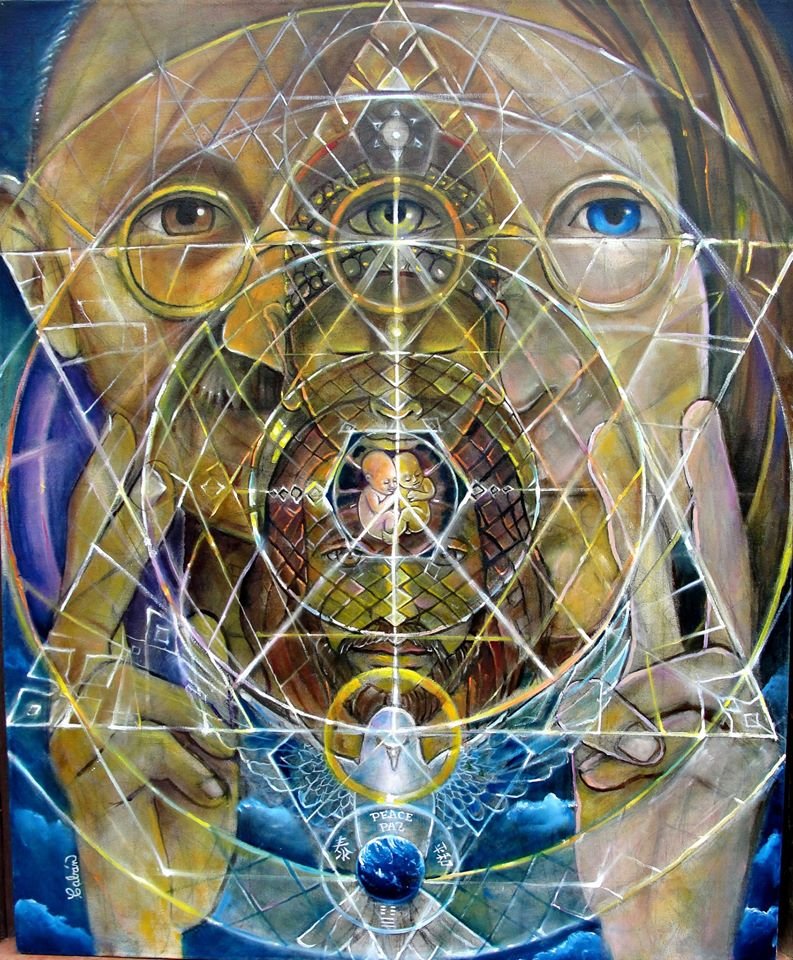
What we cannot quite grasp – what is too vast and many sided for us to hold entirely in our thoughts, we give form to in paintings, in carvings, in sound, in piling rocks one upon another to form a monument. We may then venerate or hold as of immense value such art forms. They hold in them for us the vast dimension of the ungraspable, of the infinity of our own within. They stand before us as represent a journey of lives of the alien in our midst, in ourselves. They remind us of what we are not masters of, and what may take hold of our life. See
 |
In past times tribal people stood in awe of their own existence. They recognised, even if it were unconsciously, the incredible journey they had made from being an unconscious animal, to the attainment of personal awareness and human society. They represented this awe-full experience in rituals, and symbolic paintings and sculptures such as the totem. They also recognised in their art the immense journey ahead, of claiming the possibilities of human life, and put this into their art. How do we deal with the powers that overwhelm us and drag us into mass murder in war and social upheaval? How do we create a personal and social world that we can be proud of? |
In writing about Symbolism In The Visual Arts, (Page 255 in Man And His Symbols, Jung)
Aniela Jaffe mentions the drawing of Klee, interestingly called The Limits of Understanding, which expresses this attempt to put into form what cannot be thought. Jung said that a true symbol appears only when there is a need to express what thought cannot think or what is only divined or felt.
The great artists of any culture give to us what we may have failed to see ourselves. They portray to us the spirit of our times, and our predicament, and perhaps even a passage through the dilemmas we face. Sometimes they manage to break through the cultural plethora and froth of everyday life and display an insight into the fundamental forces of life, renewing our own connection. To do this they face a personal death into the unconscious. They experience darkness and light that many of us may not dare to face. They live within the great forces of their dreams more intensely, more fully than those of us whose awareness is centred on the everyday surface produced by the concepts of life generally agreed upon.
When an artist manages to meet and give birth to one of the spirits of our age, whether it is a terrible demon of our times, or a healing angel, it speaks to us beyond our reasoning. It draws crowds, it holds attention. In the early part of this century the artist Kandinsky wrote that ‘The art of today embodies the spiritual matured to the point of revelation.
Something that we must recognise as an enormous shift in human awareness that has taken place in our own times, and which must influence art from here forwards, is the attainment of self-awareness we have been helped toward by the findings of modern psychotherapeutic schools. This form of self examination has enabled us to explore the wealth of pain and wonder usually forgotten in the mists of childhood. But it also lays bare the struggle, the enormity of the evolutionary movement toward consciousness, toward being human. And there is tremendous art here when it is discovered; art expressing the meeting between the social individual we try to be, and the animal we are still largely immersed in within the depths of our mind and body. In fact we are the whole spectrum of things from sub-atomic particles, through molecular survival and interactions, on into the basic living organisms and creatures up through the lizard, the mammal and the human. All these things are active in us, in harmony, in conflict, in process of becoming. Out of this weaving loom of life all art and music arise; all life experiences an expression of it.
As an example, Thomas De Quincey’s Confessions of an English Opium Eater describes his fantastic dream life over a period of years. De Quincey started to take opium as a sedative. It led to a heightened awareness of how the mind can produce powerful images and memories. He writes that ‘In the middle of 1817, this faculty became increasingly distressing to me.’ Not only did his inner visions present ‘… nightly spectacles of more than earthly splendour.’ But also ‘…. vast processions moved along continually in mournful pomp. Concurrently with this, a corresponding change took place in my dreams; a theatre seemed suddenly opened and lighted within my brain.’ Such experiences led De Quincey to feel ‘deep-seated anxiety and funereal melancholy.’ At times he might recall the ‘minutest incidents of childhood, or forgotten scenes of later years, were often revived.’ ‘I could not be said to recollect them; for, if I had been told of them waking, I should not have been able to acknowledge them as parts of my past experience.’ In his visionary state however, he says ‘I recognised them instantaneously . . . I feel assured that there is no such thing as an ultimate forgetting.’
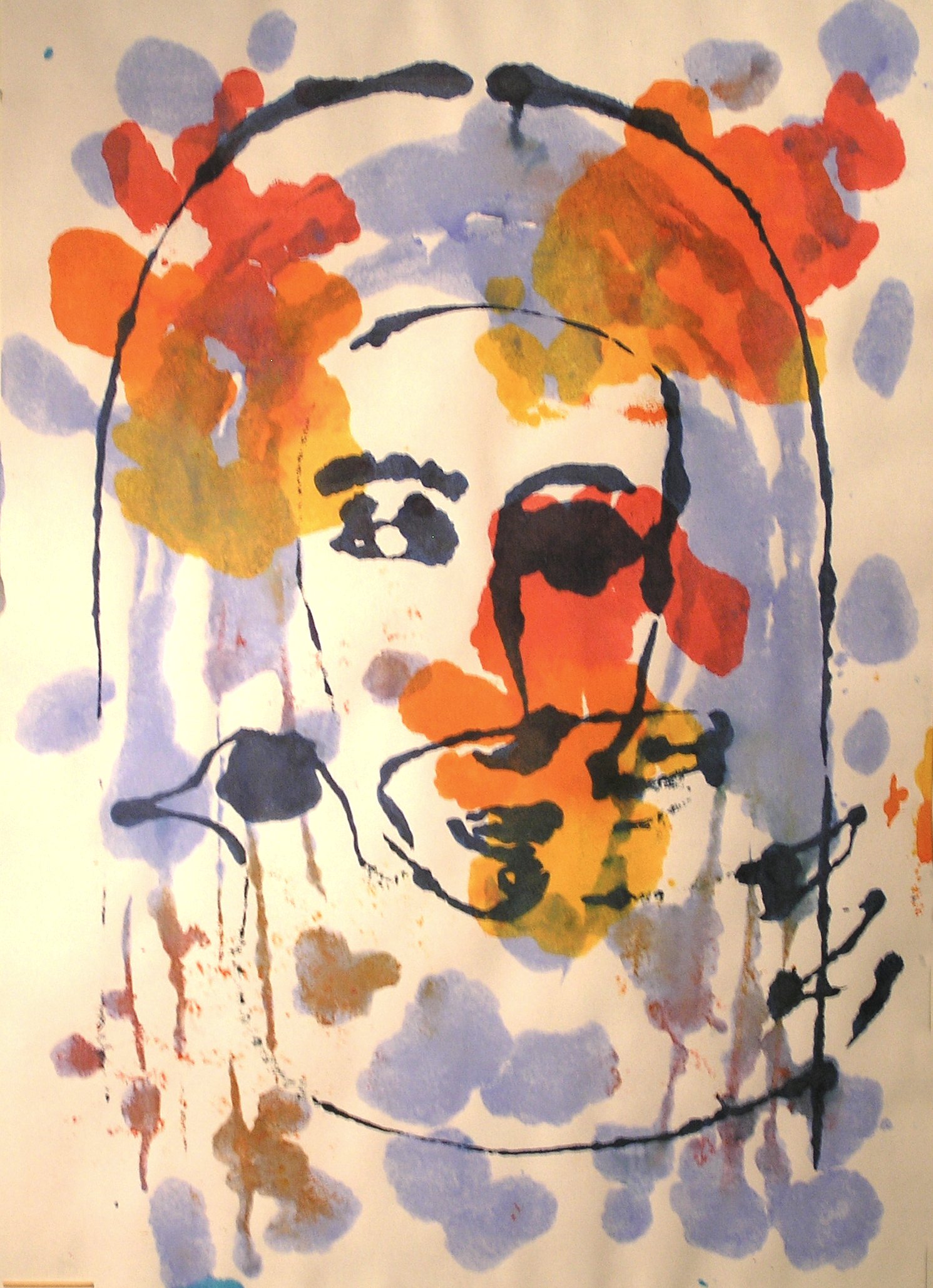 |
De Quincey’s deep seated anxiety and melancholy, in our present times, would be signs of an underlying neurosis which could have been dealt with by exploring his fantasies to their roots in his personal history – already being touched on spontaneously by him. Whether we take the example of De Quincey’s opium aided fantasies, or the visions of Christian mystics such as the temptations of St. Antony, art and religion has at least a facet of being a symbolic way of meeting a neurosis. It is only when we reach through the symbol into what it depicts about us personally, that we move from this historical symbolic form of healing and representation. |
One cannot of course limit the definition of art and dreams to that of dealing with hidden neurosis, or even of the move toward wholeness. Therefore it is interesting to remember some of the artists who directly used dreams as part of their work. William Blake for instance purposefully made use of dreams not only as sources for his art, but also for invention – his method of printing for instance. He particularly tells of the man who taught him painting in his dreams. Blake actually drew the face of this character.
In the 1950’s the painter Jasper Johns was working as a window dresser in New York. In a dream he saw himself painting an American flag. In waking he painted the flag from his vision of it in the dream. The painting became a powerful force in an American revolution in art.
Salvador Dali consistently used dreams as a basis for his paintings. He tried to preserve his dream imagery in his art, and particularly to portray the subtleties of time and space. He referred to his paintings as ‘hand painted dream photographs.’
A number of film directors also used their dreams in the art. Ingmar Bergman tried to portray episodes from his dreams as accurately as possible. He felt that dreams have the ability to help people find points of connection, to link people. Carlos Saura used fragments from his dreams to capture atmosphere and environment.
For each of us, our dreams are our own studio in which we nightly create beyond our waking talent to produce the new, the novel, the unexpected and the deeply true. We are each visionaries, artists of the night and live in another dimension than that of the body. See: archetype of the artist; compensation theory; creativity and problem solving; hallucinations and hallucinogens; hallucinations and visions.
Archetype of the Outsider Outcast
Like many other animals, humans are very territorial and suspicious of anyone who is in some way different. Thus, living as an immigrant or child of an immigrant; being abused or abandoned in some way by ones parents; not having the skin colour or language of the majority; having a malformed body or being ill in some way; having greater intelligence or a different mindset, can all lead to a sense of being an outcast, and thus a connection with the archetypal feelings of abandonment or alienation. This has been such a common experience throughout the evolution of the human body and mind, that it is a powerful archetype and still strongly at work in individuals and groups today, where alienation is common.
Living out this particular stance in life leads to various attitudes that people throughout the ages have used to survive. There may be an intense form of independence, or hidden feelings of anger toward the nation or society one lives in. One may rebel against being a part of normalcy, even to rebelling against ones personal sexual characteristics; or else one hides within a formed group such as a religion. There is often a powerful drive to fight to become recognised as part of the group, or even become an active against what is the norm, being a criminal or even murderer.
The alienation can also occur because for one reason or another you cannot live within the patterns of behaviour accepted, or built into, your family or social group. This is particularly evident in religious or political groups, which, to function well, require a high degree of conformity.
There is often a high level of anxiety linked with this stance, as there is a great deal more vulnerability living outside the group than there is in being an integral part of it. The extant story of Adam and Eve is a fundamental expression of this sense of being outcast from ones very self – not even possessing oneself. In some degree we all feel as if we have lost our home – the place where we would be at ease and welcomed – and we long for it. See Adam and Eve
There is a very positive side to this archetype however, and it is one that is enormously potent in our times. This is described in the following words by a man meeting this archetype.
I committed myself to this direction of the outsider, and yet to a love of life. I need to remember that. I am not sure if I had said it clearly in my language for my son, but I need to say to my son and to those who tread this path, “This is an ancient path. It was first opened by people who were outcasts from their tribe, or their race. Maybe they were outcasts because of disease or illness. They deepened this path because they either descended into despair or developed a new life, a new awareness, a new relationship with themselves and the world. They changed something inside of themselves, and that change became a possible new pattern for other human beings. Some of these people, in today’s world, would be judged as crazy or unbalanced in some way, perhaps fanatics. If we look back into the past we see there were groups of people living the life of hermits in deserts or in isolated places. Some of them tortured themselves in various ways, such as starvation or flagellation. It was out of such strangeness that a new type of inner life developed, a new way of relating to the world arose. Of course, those early pilgrims on that path were unclear about what they were doing, and were often confused, and so included many strange and unnecessary practices.
But through their lives they began to form the possibility of a new direction for human beings, a new inner or mental life. It developed alternative ways of experiencing oneself, or living in society, and of discovering ones inner resources. And out of those many lives and the new ways they developed of relating to their mind, their body and the world around them, a new paradigm has arisen that I see is now transforming the unconscious life of many people. It is reprogramming them while they sleep. It has great power because it is so relevant in today’s world where enormous numbers of people feel alienated from what is going on around them.
However, we cannot really understand this archetype of the outsider or outcast without some understanding of what has been called the serpent power, or in India, kundalini. A great deal of mystery has surrounded this, probably because it was not clearly understood, but in practical terms the serpent power is the psychobiological energy that expresses in you as the many processes and functions of your body and mind. It is like the electricity that flows into a house, that while it is not the picture on the television screen, or the movement of the cooling fan, is the power underlying all the many things arising from electricity.
The serpent power, your psychobiological energy, is at the same time the energy underlying your physical movements, your digestion, heartbeat, your emotions, awareness and thinking; and also a potential that has not yet been expressed or manifest. It is particularly relevant to the outcast because he or she does not express themselves in the same way as the ‘normal’ or average person. Very often their sexual expression or social expression is not flowing easily. All that energy backs up like water behind a dam. It creates a pressure that will seek to flow somewhere. In many cases it moves into neurosis. In other words, because it is not flowing outwardly and satisfyingly into social and sexual relationships, it may turn inwards, enlivening the usually unconscious and disturbed patterns of feeling. Then the person lives out neurotic ways of expressing sexually and socially. They may for instance express anti social behaviour in violence or destruction. They may express in destructive sexual behaviour, or be even more introverted into deep depression.
Example: “Meeting death, the bodiless state, is just like another big fear. It is like the fear of going it alone without mum and dad. Can we face just consciousness? Can we live in the world of the mind minus the body? Can we live in the body minus mum and dad?”
“Yes, I’m not doing too badly. I’m not a genius, but I’m not doing too badly. I feel unafraid of the bodiless state because I have experienced it and can exist in it. Like swimming, I can swim a few strokes so have no great fear of water.”
“There was a crazy thing mankind did in these spiritual disciplines. They are so simple. They are simply to get you out of this matrix of consciousness. Once you become an individual in waking consciousness, and you just learn to suppress any of the desires a little bit – fasting – sex – any of them – you make a little pathway of your own. That is your individual consciousness. So simple. That is your own matrix, not the patterns of the general herd or species, within the universal pathways of consciousness around you.”
“It seems that frustration of the universal drives creates a different pattern in the whole. This pattern is used, and if it is strong enough, can exist outside of physical existence in an energy, consciousness, state.”
“I think, in modern day terms I’ve got it. I have got it. It’s free of all the old moralism. That was how they saw it, in the past, and that was how it works. But I have got it.”
I then had masses of realisations or insights into many things. My experience of death, now, added to my other experience and united to form many new ideas or realisations. In experiencing death I was left with consciousness. That consciousness was beset by fantasies, fears, ideas, but it did not lose itself in them, was not swallowed up or drowned in them. If it had been, it would not yet be ripe to exist in the bodiless state.
Also, it struck me with tremendous force that the experience of waking consciousness in the body, however we explained it, was reality. Death, however we explained it, was also reality. What was happening was that I continued to experience this changed reality of death.
But the normal human behaviour is simply one of the ways we as mammals can express. The life process itself can be expressed in an infinite number of ways, as we see in the different creatures on the earth. The fact that we are as we are is simply the result of the global, environmental and social changes we have faced. What some of the ancient outcasts found was that there are possibilities beyond the normal and beyond the neurotic. They drew out of the potential in the serpent power the possibility of what we call enlightenment, a life beyond the limitations of the ‘normal’, beyond the pain of everyday living. That is how the practices of yoga, Tai chi, and many of the other personal disciplines of mind and body arose – as methods of expanding the potential of the serpent power.
Out of this some religious organisations or leader figures made rulings that their followers should not express sexual love casually or at all. The reason for this is probably dual. Firstly the frustration of the sexual flow leads to the build up of the serpent power, and thereby offers the possibility of personal transformation. Secondly, religious organisations are like large business corporations. They have enormous property and staff to deal with. They need money and goods to do that. When we flow to someone sexually and emotionally our money and goods flow to them as well. Sometimes we share our all. If it is blocked in the individual, it flows to the religious organisation or figure who tells us to block it. It does this because they promise salvation or a better life. The organisation or guru assumes wonderful charisma because the serpent power, unable to flow in its usual way, fills such a relationship with great emotional and sexual feelings. Blocking sexual and emotional flow in followers can therefore be a way of directing funds to the organisation or leader figure.
Meeting this archetype is therefore a meeting with the need to identify the causes of our expulsion from our own happiness, our own ability to love and feel loved; our own resources of fruition and creativity in this life – now. It is a time of decision about what we will do with the energy diverted from the ‘normal’ into its new channels of expression. See Individuation
The other side of the archetype is whether you can abandon or transform the life you have lived, a life that doesn’t satisfy you, and is one in which major parts of you are left buried or imprisoned. The paradox is that we may have cast out – denied – parts of ourselves, and so feel outcasts. Here is an example of such transformation.
Example: “I was in a prison cell waith two other men. I felt it was in Spain somewhere. We ate, slept and defecated in the cell. I was standing at the bars of the cell, and had the impression I had been in the prison for years. I was shouting and cursing the people who had put me in the prison, full of hate and self pity.
One day as I stood raging at the bars I suddenly realised that my years of shouting had availed nothing. The only person who was upset by it was me. I was the victim of my own anger and turmoil. It was as if I had been haunted all my life by ghosts of anger and passion. I dropped the attitudes or ‘ghosts’ and was free of them. Years went by and one by one I recognised and dropped other habits of emotion and thought that had trapped and tortured me. I realised I could be totally free within myself.
One morning I woke and sat up on the mattress on the floor that was my bed. The last ghost of inner entrapment fell away. A fountain of joy opened in my body, pouring upwards through me. It was so intense I cried out. My cell mates called a warden because they thought I had gone mad. They stood looking at me as I experienced radiance so strong I felt as if I must be shining. I was aware my joy poured into them, although they thought I was possibly insane. I could sense the enormous change in me influencing them, and I knew it couldn’t help but change them also. I realised that I might never be released from the prison, but it didn’t matter as I had found a fuller release than simply walking the streets. Even though remaining behind prison bars, I would still be touching people’s lives deeply. Nothing would ever be the same again.”
Useful Questions and Hints:
Do I feel as if I am not really connected or identified with the society in which I live?
Have I been led to develop different ways of using my mind and developing innate abilities than those around me?
Am I still locked in anger about alienation, or have I moved to recognising the benefits of not being immersed in my surrounding culture?
Have I learnt to be a shape shifter – if not try Being the Person or Thing
See Summing Up – Definition of Spiritual – Life’s Little Secrets – Avoid Being Victims
Archetype of God/Goddess
This archetype arises out of the paradox of human existence. If an ancient human being saw a modern adult step out of a helicopter, talk to distant people using a small decorated ‘stone’ (mobile phone) they held in their hand, and produced images immediately using a digital camera or video, they would believe the person to be a god. The paradox is that what the ancient man or woman see as a god is a fulfilment or projection of their own potential. They are the ancestor of this modern person.
A fundamental process of what we call the mind or consciousness is to give form or words to abstract experiences or things sensed. When we dream this becomes amazingly obvious. The emotions, conflicts, sexual urges we feel are put into imagery and drama in our dreams. If we strip away the images we are left with raw feelings insights and urges. The dream imagery makes it all so much more memorable and clear. If we experience fear while we sleep that might be memorable. But if we dream of being chased by a two headed monster like a snake, that sticks with our waking awareness with greater intensity.
The point being made is that even the most subtle things we sense – out of the corner of our eye as it were – can be dramatically represented in imagery either while awake or asleep. While awake such realisations are called visions, but are expressions of the same dream, process breaking through into waking. See: hallucinations and hallucinogens.
The development of self awareness presented the human animal with an enormous and perhaps traumatic change. Prior to having any sense of being a person, the early human being was constantly directed either by instincts or learned behaviour common to the group. They didn’t have to make decisions or think about what to do. Millions of years of experience had etched instinctive responses into them. Also, tens of thousands, or even millions of years of collective learned behaviour was passed on in the same way non-human mammals pass on skill to their young. As an example of this, a wonderful study of the African wild dogs showed the power of this. The dogs had been wiped out in a large area and attempts were being made to reintroduce them. A documentary film showed two packs of dogs. The one pack were established, and had arisen from an unbroken line of descent and social relationship for thousands of years. The second pack had been reared in captivity and released in the wild with some support. The descended pack showed enormous social skills in acknowledging and supporting each other’s rank, in working together to hunt, in feeding the pups and mutually caring for them, and in sharing food with those who stayed to care for the young. See The Conjuring Trick
The released pack didn’t have any of those skills. The information was not being passed on to them from a previous generation. They couldn’t work together. They fought amongst themselves instead of respecting leadership. They didn’t share food but fought over it. They all quickly died. The unspoken wisdom of generations had not been passed to them. They had no survival skills. Perhaps this reminds us of some people in our society today, whose parents pass on terrible or anti social survival skills, and points to possible causes.
The arising of self awareness was like a massive new input impinging on this ready made wisdom early human beings lived with. When the split came and the new self awareness became more dominant there was a great sense of loss, and what had been an everyday part of them was now felt as distant or exterior to them. Because the instinctive or unconscious survival wisdom had been everything to them, their dream process of giving form to such an intangible, showed it as a great parental figure. It was the great Mother/Father out of which they had emerged. In fact becoming self aware was akin to being born, to emerging from an immense and ancient womb. This is clearly stated in story form in Genesis. It says, “And the eyes of them both were opened, and they knew that they were naked; and they sewed fig-leaves together, and made themselves aprons. And they heard the voice of Jehovah God walking in the garden in the cool of the day: and the man and his wife hid themselves from the presence of Jehovah God amongst the trees of the garden. And Jehovah God called unto the man, and said unto him, Where art thou? And he said, I heard thy voice in the garden, and I was afraid, because I was naked; and I hid myself.”
If we take Jehovah here to mean the enormous ocean of mind, instincts and behaviour early humans were guided by, and the awakening to the arising of self awareness, then the fear is that of being swallowed up, of losing their new and vulnerable identity in that ocean of creative life. They were truly naked of the instinctive knowledge that had previously guided and supported. Ancient races such as the Kalahari Bushmen in fact say their great fear is the loss of soul – identity – by being swallowed up again in unconsciousness. i.e. in loss of self awareness.
Obviously this is conjecture, but it is conjecture based on anthropological studies, on the exploration of the deep unconscious in modern people, and in recovered experience from depth psychology. The outcome in ancient and modern humans is that there is still a sense, an ‘out of the corner of the eye’ awareness of the enormous depths of mind within us shading right back to pre-consciousness and even cellular life within. We sense this as the creative matrix out of which we have arisen. We sense it as having enormous potential. After all, if we have evolved from pre-conscious human animals, and they from ape like forms, a human could emerge from us that would be as god like to us as we would appear to an ancient predecessor. Therefore the god archetype is an expression of what we sense as our own potential and of the enormity of life and cosmic processes out of which we have existence.
The archetype itself, or what lies behind it, is beyond any one definition. But being what we are, and considering that we constantly try to define and give substance to such important processes, past cultures have given many forms and attributes to their expression of god or God. They have even at times defined aspects of what they experienced as the underlying forces of life and personal awareness, and we therefore have the goddesses and gods.
This archetype has a very powerful influence in everybody’s life simply because it is about our own fundamental potential and origins. How you relate to it shows the level of connection or conflict you have with your own resources and origins. It also shows how far you have come in your mature understanding of how your inner life functions. In some ways the difficulties and stages we go through in our relationship with our mother and father are similar to the acceptance, rejection, killing of, or deep dependence we have in relationship with what is called God. We may of course relate to this archetypal power in us like a child frightened of a parent; like an obedient child who wants to conform; like a rebellious child who seeks their own independence; like an angry or confused person who denies any link with their origins; like someone who has lost their memory, and so has not recognition of their ancestry; like an adult who has come to terms with their origins and has integrated into their own processes of mind and emotions, the matrix of strengths and weaknesses inherited.
None of us can escape the source of our own existence. We can, however, relate to it in many different ways. These ways are depicted in the New Testament as the manner in which people related to Christ. Taking Christ as a symbol of the cosmic web of sentient life, people can love it, wash their hands of it, crucify it, ignore it, be healed by it, lie about it, offer themselves to it, worship it – and so on and on. The stance we take in our relationship with this larger life we are an integral part of, is the basic stuff of how we live, and the quality of our life.
I witnessed a man talking to a woman he was confronting, “Religion;” he said, “that’s surely a direction for failures and people who can’t really cope with facing reality.”
And the woman he was accusing of this inability to face reality said, “You poor man! Is your mind or awareness so tiny that you have never realised the forces and processes of your own body are beyond anything you understand? Can’t you see that your very existence is brought about by things so far beyond your knowledge that it is only a statement of your impoverishment to suggest an awareness of God is an expression of some sort of smallness and failure. Have you never understood that? Have you not seen that religion is not only an acknowledgement of what we fail to understand and yet depend upon, but it is also an opening to it, a willingness to relate to it? It can also be something far more even than that. It can be an active loving relationship with what gives you life. And such love is an exchange, a sharing, and a way of merging one with another. It is an exchange – a sharing of bodily fluids – the very substance of life.
Imagine that; a glorious love affair with the very spirit of life! A love affair with the invisible and forever indefinable. Is that something you are afraid of?”
Here is an example of a man exploring expanded consciousness and God.
Example: A major point is however, that these different forms of cognition are not in themselves ‘truth’. They are simply ways we can organise experience and information.
At this point there arose a question about what the ‘mind space’ is. It didn’t arise in those words, but was certainly about what the space is that one appears to inhabit as expanded awareness. It feels as if one is exterior to ones body, filling space and yet without form. So does mind exist outside of the body?
My sense at that moment was that in fact there are no real spaces in the universe. Everything is connected. Nothing can occur without some link or influence upon or from something else. Everything works because it has developed a relatedness or relationship with everything else, according to its size and place. Therefore the planets do what they do because of their relationship to the sun, their size and nature. This led on to a view or feeling that at death the personal awareness can exist, but not in a void. It does so within the organic ‘space’ of living human beings. It does so out of relatedness.
I then slipped into an immense experience of the universe as God. Unfortunately the tape recorder battery ran out at this point, so what I said is not recorded, but I have memory of the overall experience, though the details are gone.
As I experienced it our known universe is a huge integrated ‘body’. In its totality this is what we call God. The universe, or God, is not all there is. What we know as God is only one being among other realities. In other words, the being of God came about because in a period before our universe it gradually evolved into total relationship with reality. In doing so it created what I have called its body, our universe. The universe is a particular sort of organism that can exist in a special way because it relates to the wider reality in which it has its life. There are other such beings creating different ‘realities’ within the greater reality. I felt several times with much emotion, how much pain the being had faced to move through all the change it had to be capable of being God.
Our universe is set up so there is the possibility of life occurring. Although God is a being of an order we cannot really comprehend, it still has a relationship with us. The relationship is strangely paradoxical. It is at one level completely impersonal. This has to be so otherwise there is not an open arena for development to take place. But God cannot help but be personally involved as well wherever someone opens to this relationship. After all, the very nature of the universe as I saw it earlier is relatedness. So there is an active love, like a flashing touch here and there, invisible in general. I saw it as something causing minute parts of our body or world to flash with energy for a moment, then move on to cause other patterns of energy to touch the world. Perhaps this is similar to the way the brain works, where patterns of activity or energetic process occurs – but this is speculation.
One cannot help but be a part of this immense being, yet one can, in ones life, be at odds with it, be unsympathetic to it. This causes a condition of stress within oneself, and within ones relationship with it. But I felt that if one completely accepts ones place in this being, even though one is a minute and seemingly insignificant part of it, then one is aligned with its huge universal life and purpose. Then one become part of its ‘circulation’ more fully and is revivified is some way.
My personal consciousness is the limited area of God that I have made my own through millennia of conditioning and learned response. But the huge ocean of awareness that is this larger being’s life and consciousness is ours to share. It is at once the thing that remains permanent, and yet it is the very substance of change too.
I gave myself to God as fully as I was able, and in this state of awareness of the larger life, looked at my own life and future. I felt that the future lay in moving around the world a bit, as if we are evolving into a free floating population that is emerging in the world. I felt almost as if I knew where I was going to be born next time around. It would be south of Japan on one of the pacific islands. The mixture of high grade Anglo Saxon with Chinese oriental and South Pacific I felt was something I needed. The Chinese awareness of the inner life and ease with it; the Anglo Saxon acute rational mind, and the Polynesian sensuality. I particularly need to warm up in the sense of my sensual side being a bit undeveloped.
had a very real sense of God being incredible near at hand. This was strange because I had been brought up to believe that one had to be very special to get near and know God. Yet God is everywhere and everything. If I can’t find God, it is only because I keep my eyes and soul closed. Or else I am so busy feeling I have to be holy and spiritual I miss the meeting.
I spent some time wondering what one was supposed to do having ‘found’ God. I had thought one would be imbued with some sort of zeal to go out and teach, as with the Christian enthusiasm. But I could find nothing of this. I saw that everybody is in that presence, so it is ridiculous to think everyone must rush out and tell everyone else they have found God. But my RC background, I could see, had planted so many misconceptions about hell and damnation, about threats of excommunication and being pushed out of God’s presence.
Useful Questions and Hints:
Can I recognise that fundamentally my existence depends upon the creative processes of the universe, and that I am at base the potential of life?
How do I relate to that mystery of the divine or wondrous at the core of myself?
Am I taking responsibility for my own potential, or do I project it outwards as a god figure, or deny it all together?
See Enlightenment – Jesse Watkins Enlightenment – Philosophy From The Edgar Cayce Readings