
Archetype of the Animus – The male in the female
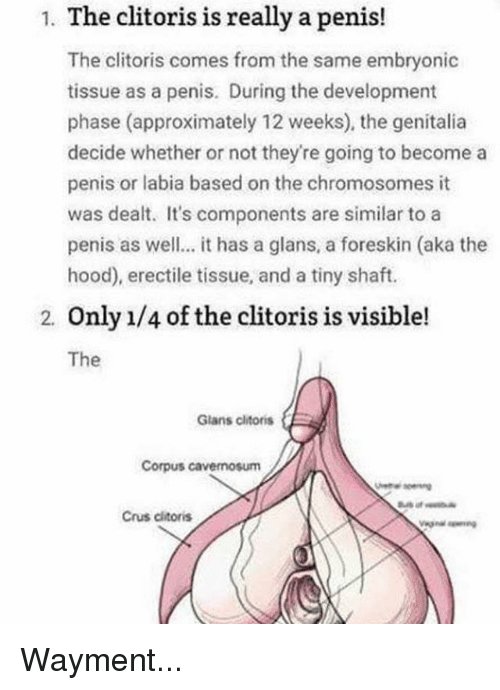
The male within the female, is shown as a man in a woman’s dreams. Physically a woman is predominantly female, but also has a clitoris and produces some male hormones. Psychologically, we may only express part of our potential in everyday life. In a woman, the more physically dynamic, intellectual and socially challenging side of herself such as assertiveness and taking charge of situations may be given less expression. Apart from this some features, such as innovation and creative rational thought, may be held in latency. Even if this is not true for the modern woman, there are features of her full potential that are held as secondary or latent characteristics, and are depicted by the male in female dreams.
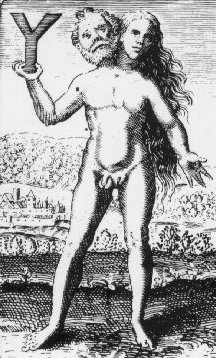 |
Jung was not the first to recognise that we are male and female. It was seen in ancient times. |
In general we can say the man in a woman’s dreams represents the woman’s mental and social power, her ability to act creatively in ‘the world’. It also holds in it an expression of her complex of feelings about men, gained as experience mostly from her relationship with – or lack of relationship with – her father. The animus is also a synthesis of all her male contacts. So the whole realm of her experience of the male can be represented by the man in her dream, and is accessible through the image. Femaleness or maleness must not be confused with personality as expressed as her body. The conscious personality is a very flexible and shapeshifting thing. See Programmed |
 |
|
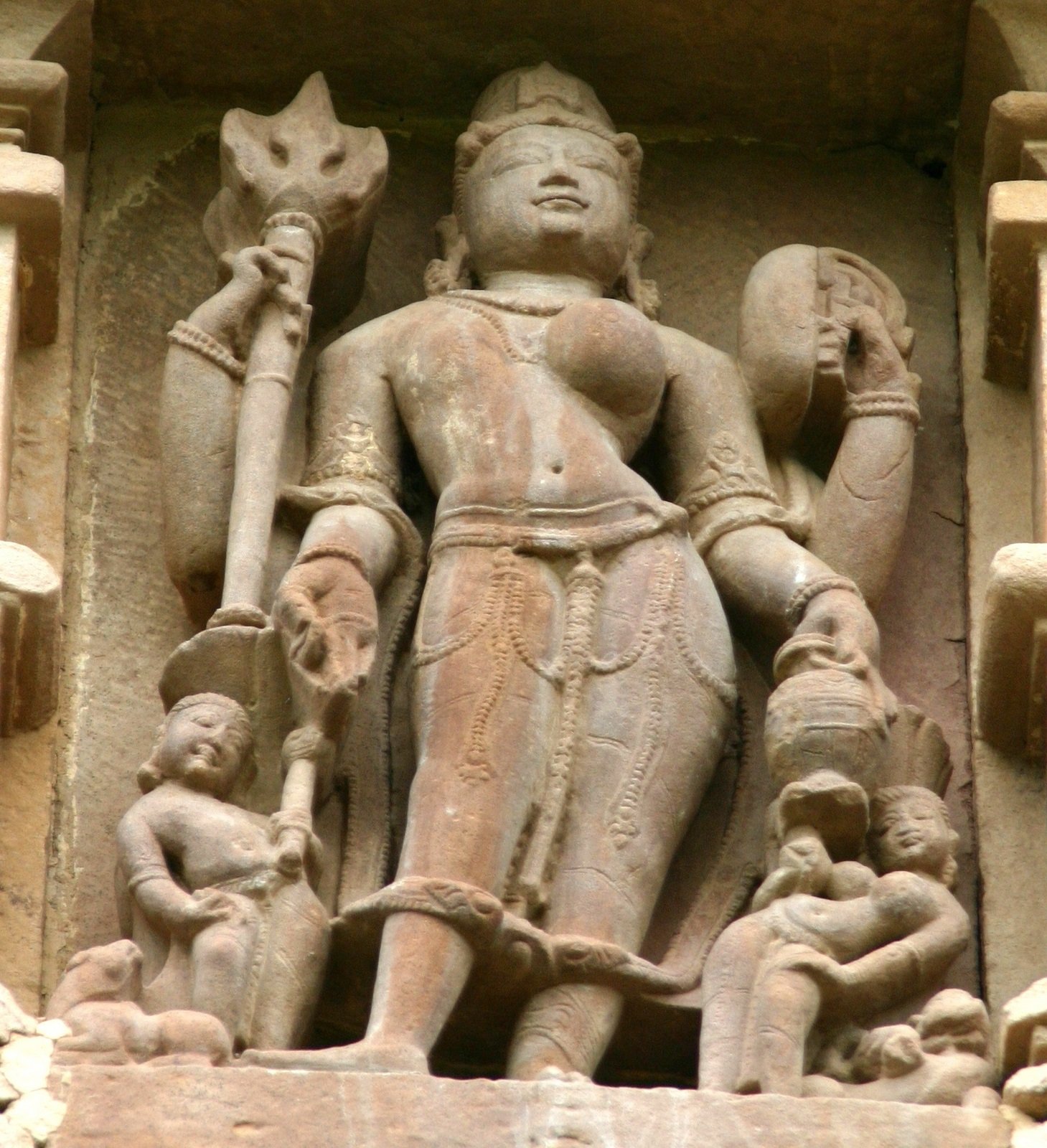
The Hindu male figure of Shiva with female breast. This is from an older culture and shows Shiva as a male and female figure. It was common knowledge in older cultures that our ultimate nature is everything – which includes male, female and animals. in fact all creation.
|
It can be male or female in quality no matter what the body gender. But in dreams, the male is the facet of dynamic action that projects into the world of this shapeshifting personality.
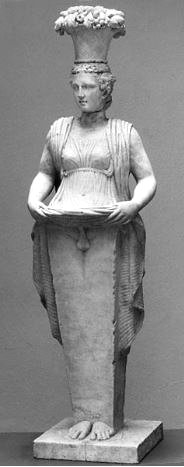 |
An ancient statue of an Aphroditus – a female with a male genitals.One of the earliest surviving images from Athens is a fragment (late 4th century BC), found in the Athenian agora, of a clay mould for a terracotta figurine. The figurine would have stood about 30 cm high, represented in a style known as άνασυρόμενος (anasyromenos), a female lifting her dress to reveal male genitals,[7] a gesture that was believed to have apotropaic qualities, averting evil influences and bestowing good luck. |
As Jung says in Man and His Symbols:
“The animus, just like the anima, exhibits four stages of development as male images in women’s dreams or fantasies. He first appears as a personification of mere physical power-for instance, as an athletic champion or “muscle man.” In the next stage he possesses initiative and the capacity for planned action. In the third phase, the animus becomes the “word,” often appearing as a professor or clergyman. Finally, in his fourth manifestation, the animus is the incarnation of meaning. On this highest level he becomes (like the anima) a mediator of the religious experience whereby life acquires new meaning. He gives the woman spiritual firmness, an invisible inner support that compensates for her outer softness. The animus in his most developed form sometimes connects the woman’s mind with the spiritual evolution of her age, and can thereby make her even more receptive than a man to new creative ideas. It is for this reason that in earlier times women were used by many nations as diviners and seers. The creative boldness of their positive animus at times expresses thoughts and ideas that stimulate men to new enterprises”.
The animus can be depicted in a dream by an heroic or spiritual male figure, by her brother or father, a giant, a lion or bull. The animus can be wonderfully creative or powerfully destructive, depending upon ones relationship with it. Cultural symbols one may use are of leader figures from either national or religious backgrounds; a male dwarf; a medicine man such as a shaman, or a man the woman is marrying. The negative aspect of the animus may show as the seducer, the man who imprisons or leads her into danger or tortures or beats her. The positive animus shows as the man who solves problems, shows how things work, exhibits love despite trials, and is the deliverer from death. P. W. Martin says that more than anything else the animus figure has two characteristic marks: energy and ambivalence.
Marie von Franz says of the animus that it often takes the negative form of a ‘sacred conviction’ in a woman rather than erotic fantasies. When a woman has such an animus impulse working in her she may be recognised by the way she preaches her particular ‘sacred conviction’ in a loud and sometimes masculinised voice. She may even impose such beliefs on others in ‘brutal emotional scenes’. Such a woman may be at times obstinate, cold and inaccessible. An example of a woman with such a sacred conviction is Joan of Arc. While Bluebeard is an example of a negative animus figure.
These convictions a woman may hold are related to the present situation or the woman’s own personality. They simply ARE. The negative animus may also lead a woman into destructive relationship with her husband or children. Von Franz quotes the story of a woman who showed her a picture of the woman’s son who died by drowning at 27. The woman commented that ‘I prefer it this way: better than giving him away to another woman.’ Such hidden possessiveness and domination can lead to awful situations in those related to such a woman, making it difficult for children to become independent, and husbands to become men.
Good relationship with or marrying the man
Shows the woman integrating her own ability to be independent and capable in outwardly active terms. This makes her more whole, balancing her ‘female’ qualities. She would then be less dependent upon an external male to feel whole. It also shows the woman meeting her experience of her father in a healing way. This enables the woman to have a realistic relationship with an actual man. It also brings a sense of connectedness between her conscious self and what she senses as the ‘commercial’ world. See: Archetype of the father; Digest.
This marriage – a sacred marriage – may take many dreams and personal growth to find an actual full marriage in ones inner world. This can be seen also in the integration of the female in the male. See Integrating the female in the male
Example: The girl was confiding in me; telling me she’d met the man of her dreams and she was so happy. The man turned out the be a married man in his 70s whom I would probably characterise as being a good, kind person but who is also rather bound up with getting things ‘right’ – he likes loads of meetings and organisation. The young girl who was called Mary was naive, bubbly and not particularly bright.
Maybe there is a clue in the name Mary. The old guy, Joseph married the young girl Mary and couldn’t or didn’t father the child. So she had a virgin birth. But such stories are actually fables, that need to be understood. Joseph worked with wood, the already grown – the intellect. As your dream suggests, more interested in organising and getting things right, all typical of an intellectual approach. Mary, as a young girl represents someone who is not conditioned by pre-conceived ideas. In effect she is a virgin ready to receive something special. So if we consider that your dream has a little of that in, it certainly doesn’t suggest the old man and the young girl getting together. Also I think you may be looking at this from an intellectually analytical viewpoint. And maybe the young girl has a lot of possibilities that you could mature with some patience. Maybe even to a virgin birth of wonderful new possibilities, when you let go of preconceived ideas. See How I Became A Virgin
A vast number of myths and fairy tales tell of a prince, turned by witchcraft into a wild animal or monster, who is redeemed by the love of a girl-a process symbolising the manner in which the animus becomes conscious. Very often the heroine is not allowed to ask questions about her mysterious, unknown lover and husband; or she meets him only in the dark and may never look at him. The implication is that, by blindly trusting and loving him, she will be able to redeem her bridegroom. But this never succeeds. She always breaks her promise and finally finds her lover again only after a long, difficult quest and much suffering.
The parallel in life is that the conscious attention a woman has to give to her animus problem takes much time and involves a lot of suffering. But if she realises who and what her animus is and what he does to her, and if she faces these realities instead of allowing herself to be possessed, her animus can turn into an invaluable inner companion who endows her with the masculine qualities of initiative, courage, objectivity, and spiritual wisdom. Quoted from The process of individuation by Marie von Franz in Man and his Symbols by Carl Jung.
Example: I told my family members…they were all sitting at a large dining room table…that I was marrying Jesus. It was an odd dream as they were all there in one place…they were mostly the women in my family who have neither been strong for themselves or supportive of me…pretty toxic.
In this dream the woman is taking a real step to integrate with her ideal man – Jesus often represents the best, our whole enormous potential that is usually not expressed by us. There are still things in the way though, the opinions and influence of her family. See Potential
Here is a dream of the union achieved.
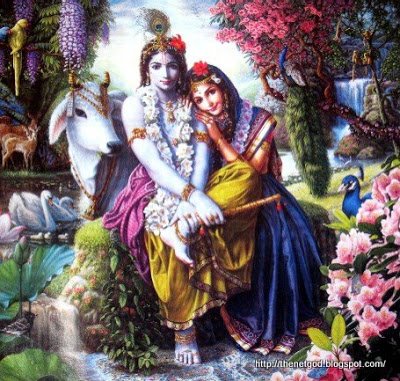
Example: In my being I am Radha and Krishna. In me they both live in a wonderful union of bliss. I am both the incarnation of godhead and also the worshipper before that wonder. That this wonder can live in me is beyond my understanding. I feel all this because I am that blissful union of Krishna and Radha. In myself I know the union and the love. I have been and am that sweet love forever joined.
Integrating ones male self is not done by acting it out by trying to be a physical male. Integrating our male does not mean dressing up in male clothes or even having an operation. That is further developing an unbalanced self. Integration means having both the female and the male self equally developed. That is wholeness. So therefore being firmly female, male or homosexual are all unbalanced. It takes courage and hard work to achieve. See Life’s Little Secrets
Negative relationship with ones animus
By nursing secret destructive attitudes, a wife can drive her husband, and a mother her children, into illness, accident, or even death. Or she may decide to keep the children from marrying-a deeply hidden form of evil that rarely comes to the surface of the mother’s conscious mind. (A naive old woman once said to me, while showing me a picture of her son, who was drowned when he was 27: “I prefer it this way: it’s better than giving him away to another woman.”)
A strange passivity and paralysis of all feeling, or a deep insecurity that can lead almost to a sense of nullity, may sometimes be the result of an unconscious animus opinion. In the depths of the woman’s being, the animus whispers: “You are hopeless. what’s the use of trying? There is no point in doing anything. Life will never change for the better.”
Unfortunately, whenever one of these personifications of the unconscious takes possession of our mind, it seems as if we ourselves are having such thoughts and feelings.
The ego identifies with them to the point where it is unable to detach them and see them for what they are. One is really “possessed” by the figure from the unconscious. Only after the possession has fallen away does one realise with horror that one has said and done things diametrically opposed to one’s real thoughts and feelings-that one has been the prey of an alien psychic factor.
Like the anima, the animus does not merely consist of negative qualities such as brutality, recklessness, empty talk, and silent, obstinate, evil ideas. He too has a very positive and valuable side; he too can build a bridge to the Self through his creative activity. The following dream of a woman of 45 may help to illustrate this point:
Two veiled figures climb onto the balcony and into the house. They are swathed in black hooded coats, and they seem to want to torment me and my sister. She hides under the bed, but they pull her out with a broom and torture her. Then it is my turn. The leader of the two pushes me against the wall, making magical gestures before my face. In the meantime his helper makes a sketch on the wall, and when I see it, I say (in order to seem friendly), “Oh! But this is well drawn!” Now suddenly my tormentor has the noble head of an artist, and he says proudly, “Yes, indeed,” and begins to clean his spectacles.
The sadistic aspect of these two figures was well known to the dreamer, for in reality she frequently suffered bad attacks of anxiety during which she was haunted by the thought that people she loved were in great danger – or even that they were dead. But the fact that the animus figure in the dream is double suggests that the burglars personify a psychic factor that is dual in its effect, and that could be something quite different from these tormenting thoughts. The sister of the dreamer, who runs away from the men, is caught and tortured. In reality this sister died when fairly young. She had been artistically gifted, but had made very little use of her talent. Next the dream reveals that the veiled burglars are actually disguised artists, and that if the dreamer recognises their gifts (which are her own), they will give up their evil intentions. Quoted from Man and his Symbols by Carl Jung
To be in conflict with the man, or unable to make real physical and pleasurable contact with him
Suggests difficulty in meeting what may have been a painful or threatening experience of father or some other man. This can lead to lack of ability to make clear judgements, and lack of decisiveness in areas outside of feeling values. She is prone to acceptance of collective or long held social norms without question; family or national attitudes not applicable to present situations; and ‘reasoning’ which actually arises out of emotions connected to such family or social norms. Actual relations with men will be difficult, or entered into simply as a duty. Emotional or intimate merging is threatening because it brings the woman close to the conflicts and pain connected with father/man. Sex may be possible but not a close feeling union. See: man.
The Mystical Marriage
This marriage between the two sides of you is fairly clearly shown in dreams, and even the Bible tells how important this marriage is, “For many are invited, but few are chosen”
“When you make the two into one, and when you make the inner as the outer, and the upper as the lower, and when you make male and female into a single one, so that the male shall not be male, and the female shall not be female: . . . then you will enter [the kingdom].” Quoted from ‘The Gnostic Apostle Thomas’
Useful Questions and Hints:
Am I still at odds with my internal male – if so what still stands in the way of unity?
If I have found unity with my inner male what has this brought into my life?
Is my form of reasoning really a form of intense emotional conviction?
What are my dreams saying about how I can find a greater unity with my male self?
Try these to work on or heal any aspect of the animus – Talking As – Processing Dreams – Active Imagination.
Comments
Hello,
Was wondering if you could help me with a dream.
I dreamt I had left dinner and gotten into my car, as I started driving I looked in the review mirror and there was a man sitting in the back seat. I was terrified and we was staring at me. I tried to swerve into other cars for help but the car never hit anything. We went from the city to the country into a neighborhood. Suddenly I’m in the passénger seat and he is driving and we get to an abandoned house. He parks and I reach for his glasses and take them off hoping he won’t be able to see. I reach for the keys and threw them out, I tried to shut the driver side door but he just reached in the window and opened the door. He was very calm and never said a word but I felt terrified. I woke up with my heart racing and told myself to not be afraid of him. I went back to sleep and I wound up on the sofa and I saw the same man. Then the dream got sexual and he was very controlling but I was having fun but felt guilty and full of shame as I saw myself as young and him as older. Any thoughts ? Thank you!
Hi – I am sorry to suddenly stop replying to dreams like this, but I must upgrade the dream dictionary – I started the revising in 2006, and haven’t got near the end yet.
So for a while I urge you to read https://dreamhawk.com/approaches-to-being/i-am-no-longer-interpreting-dreams/
Also here are so ways you can find your dreams meaning – https://dreamhawk.com/approaches-to-being/questions-2/#Summing – https://dreamhawk.com/dream-dictionary/getting-at-your-dreams-meaning/ or https://dreamhawk.com/dream-encyclopedia/acting-on-your-dream/#BeingPerson and https://dreamhawk.com/approaches-to-being/opening-to-life/
Hundreds of questions about your dreams have already been answered if you scroll down to the very bottom of the page were people’s questions/comments were replied to. Also see https://dreamhawk.com/approaches-to-being/questions-2/
Tony
All the images, people, animals, places we see in our dreams, are simply your own feelings, fears, hopes and wonder projected onto the screen of your sleeping mind as images. So, it makes sense to take the image of your dream person, thing or animal back into you and own it. In that way, you are actually meeting and dealing with the things about yourself you are not owning or conscious of. That is why dreams are often difficult to understand, because we are hiding things from ourselves. To do this you can use https://dreamhawk.com/dream-encyclopedia/acting-on-your-dream/#BeingPerson
So you are both attracted toward sexuality and also afraid of it, so you have a conflict. Try exploring your dream as explained above.
p.s. I should probably clarify that when I said my life had been ‘disrupted’ just before I dreamt of the androgynous couples on the hillside, I really minimized the quality of the experience of disruption for the sake of brevity. This ‘disruption’ as a meeting of and dealing with the Dweller can be a indescribably shattering and devastating (as well as potentially transformative) experience, and I wouldn’t want to give anyone the impression that I thought it was anything less than that. Entering into the conflict lightly would be a mistake, in my opinion. Also, knowing that facing the great difficulties can ultimately lead to the Light, as you’ve written about, has been extremely useful, by the way.
I often see myself as a male in my dreams. Apparently the body is of female but the behaviors are of a male. And the dreams are usualy of sexual content . Why is that so?
Nanny – Nanny – Dreams portray energy and sexuality in a more comprehensive way than if we defined energy as movement and genital sex. Dreams depict energy in the way it is sometimes described in eastern approaches. For instance in the description of kundalini, the energy underlying personal existence, the yoga teachings say that kundalini is at base pure potential. This potential is not in itself anything known. Only when the potential is expressed in some way can we know it.
Unfortunately some of our cultural values lead us to believe that if we are male and have feelings of being female it must mean we are gay. Also, that if we are female and have feelings of being male it must suggest we are butch or a lesbian. Dreams suggest something quite different, and can meaningfully explain some of the situations we find ourselves in as a human being. The next dream clarifies this point.
Example: I was giving an exercise class in a small field. It was sunny and everybody was spread out, seated on blankets, some stripped to the waist. I was only wearing my brief underpants. Somehow, in one of the exercises my pants came right off. Nobody noticed, not even myself, until I was seated with knee up, heal in groin. Then looking down I noticed my legs were very smooth skinned and I had female sex organs. There was no pubic hair at all. Making a joke of the situation I told the class to look the other way while I put my pants on. As I was putting them on a couple of the women did not look away and I noticed I now had male sex organs again. After this the class had lost its centre of interest. I had found a pair of my class trousers washed and sun dried on a wall, and put them on. I did this because I had put on an old pair of my swimming trunks over my pants, but they were split. A man in the class said that he felt bad because he had few clothes on. There was an atmosphere of shame because of sex or the body, so I told him to put his shirt on. Bob.
The message of this dream is that Bob has the characteristics of both genders. It suggests that psychologically Bob is basically male, especially in a relationship with a woman (a couple of the women did not look away and I noticed I now had male sex organs again). This is not something that Bob at first finds easy to look at about himself. This is shown by Bob trying to cover himself up again, and where the man in the class says he feels bad because he has few clothes on. As the dreaming Bob says, “There was an atmosphere of shame because of sex or the body.” But this is a cultural view Bob had taken in, and is not innate. Later dreams in this series show Bob accepting and loving his female characteristics. The following dream is an example of this.
Example: I am in love with a woman who is not from this planet. The love is so complete we literally swap minds or souls. So now I have all that she is inside me, and she has all of what I am inside her. This, I feel, will gradually merge into the rest of me and will extend all that I am capable of. Bob.
If we look back to what was said about energy, and remember that at base our psychobiological energy is pure potential, this ties in with what is emerging about how our dreams see our gender. Our energy can express as anything, creative or destructive. Also, within ourselves, we can be anything, any gender, any age, and any disposition.
Please also read https://dreamhawk.com/dream-dictionary/sex/
https://dreamhawk.com/dream-encyclopedia/sex-and-identity/
https://dreamhawk.com/dream-encyclopedia/energy-sex-and-dreams/
Anna 🙂
Ive had two dreams whereI’m home and a man comes onto me and I have to fight them off and literally throw them out the door…..?
Dear Shel – Out of my own experience I know that it is not always easy to have a harmonic relationship with your inner male. In the I Ching this is expressed in line 6 as:
“When there is conflict between the male and the female, the receptive and the dynamic, there is a loss of power. Do not be in conflict when there can arise a joining together.”
https://dreamhawk.com/i-ching/hexagram-two/
I have found that we might have given a certain role to our inner male and then, because we do not feel happy with the role we gave him, we exclude him all the way from our inner world by killing him or throwing him out of the door; https://dreamhawk.com/inner-life/inner-world/#MakesInner
So I do believe it serves a purpose to explore what kind of inner male you would allow to enter your “home” and so your mind and “how much room” you want to give him there.
https://dreamhawk.com/dream-encyclopedia/secrets-power-dreaming/
Using this approach you no longer have to feel a victim of the inner world/inner male you have created and you can start the process of learning to join with your inner male instead of fighting him.
Anna 🙂
Hi –
I’ve had some dreams that seem to relate to this post. I’m female, with long brown hair and fairly ‘feminine’ in appearance. In one dream, I was shown that as soon as I leave old struggle behind me, I would find myself on a hillside, where couples were walking through a doorway. The doorway was symbolic, as there was no structure around it, just an open door and each couple walked through it (but could have just as easily walked around it). Each couple was a sort of androgynous pair. The one I remember most clearly was two ‘women’, each with short, masculine cropped hair, each manly in their physique. They were identical except that one had blond hair, and the other dark. I was about to walk through that doorway that all such couples were entering, except I had no partner. A couple of years later, I had a seemingly related dream and in that one, I had my male counterpart. Not sure what this doorway is about, but it seems in the first dream, I realized I was going to go back and retrieve my counterpart by setting some things right in my life that had been disrupted just prior to that dream. Any thoughts about these things? Obviously, there are more details that I am not including for the sake of brevity. Thank you for your blog and the interesting comments elsewhere.
Christine – It often happens that we cannot go through the door until we have cleared things in us that were preventing our realising our completeness. Or else it need time to grow or mature a bit more to do it.
Your dreams wonderfully illustrate this. The door represents a state of mind which allows you to be aware of parts of you that previously were hidden. Well, not really hidden but you could not access.
You are on on the journey of integration and individuation. See – https://dreamhawk.com/dream-encyclopedia/individuation/
p.s. I should also mention that I would be very interested to know what any defining difference between a shaman’s spirit spouse and an anima/animus might be. Is the shaman’s spirit spouse a separate being/entity, while the animus/anima are just parts of her that need integration, or is there another way to explain these apparently related ‘beings’ and phenomena?
All the images, people, animals, places we see in our dreams, are simply your own feelings, fears, hopes and wonder projected onto the screen of your sleeping mind as images. So, it makes sense to take the image of your dream person, thing or animal back into you and own it. In that way, you are actually meeting and dealing with the things about yourself you are not owning or conscious of. That is why dreams are often difficult to understand, because we are hiding things from ourselves. To do this you can use – https://dreamhawk.com/dream-encyclopedia/acting-on-your-dream/#BeingPerson.
So everything we dream is a part of your own enormous potential. It is broken up in our mind because we are only used to seeing everything from the sense of separateness. Please see https://dreamhawk.com/news/there-is-a-huge-change-happening/
Hi Tony, thank you for your reply. I’ve read different parts of your blog/website here before and always enjoy very much the way you explain things. There’s something wondrous about it. I have met my ‘dweller on the Threshold’ back when my ‘integration’ dreams started, etc., and you’ve always got a unique and valuable perspective on such complicated topics. Of course, I have hundreds of more questions and thoughts about these things, but am limiting myself here so as not to become bothersome. One thing that you might find interesting is that my dream about the androgynous couples on the hillside with the doorway took place way back in 2009., when i first met my ‘dweller’ in this world (I had dreamt of him about 30 years before this when I was a child, long story). Anyway, at the beginning of this year, after several years of battling with this dweller, a Butterfly appeared to me in a dream showing me that the process was nearly complete. She came to me as a giant white Butterfly, with all of her (opposite’) black spots and marks beautifully integrated and a big smile on her face 🙂 Thanks again for your insightful comments and leads to other interesting discussions. I’ve found so many parallels for my experiences in what you’ve been writing.
Hi, Im a 32year old, single mother of 3. When I was younger I used to dream that I would go to the toilet in my primary school, id stand up to the toilet and a penis would grow, I would pee then leave as a girl child again.
what does this mean?
also, last night I dreamt that my chin was the focal point in a mirror and I had a single strand of weak feeble hair growing out of my chin, it grew and I cut it, it grew and I plucked it out, it grew again and I left it to grow. It stopped after a while and I looked at my reflection to see that I had a deformed nose, a wart on my cheek, my skin had turned a blue/green. I went to walk out of the house and I woke up.
could you please help me to work out what this dream means… thanks.
franny.
Franny – Well Freud would have said you suffered from penis envy. But I think there are several other explanations. For instance I have often dreamt of having a vagina, even having a baby, and that could be because we all unconsciously know that it is only our body that gives us a particular gender, and basically we are both. See https://dreamhawk.com/dream-encyclopedia/archetype-of-the-animus-jungs-view-of-the-male-in-the-female/
But it could also be that boys were given so much attention that you could be a tomboy. Something that happened to me when my daughter was still only small was that one day while I peeing in the toilet my daughter came to me and said, “Why has Mark – her brother – got a willy that sticks out and I haven’t got one?” My immediate reply was that she had a Mary – a name my mother called her vagina – and that meant she could have babies and Mark can’t do that.” She never again worried about it.
Maybe you mother never explained it to you. But remember that angels are both male and female – hermaphrodites. To quote form Edgar Cayce’s philosophy: “The nucleus of the soul was in balance, positive and negative force in equal power, producing harmonious activity: the positive initiating, impregnating, thrusting forward; the negative receiving, nourishing, ejecting.
Your other dream was of the mirror which usually suggests your image of yourself and examining it. It suggests that you have a rather twisted image of who you are, probably started when you were young. So work on the image until you can recognise that you are beautiful – and I am not talking about your body or positive thinking. See https://dreamhawk.com/dream-encyclopedia/secrets-power-dreaming/
Tony
Hi tony
The last few nights I have dreamt of making love with a black man.when I was a teenager I always dreamt of running from a black man or being chased.
In the first of the recent dreams he was warrior like,indigenous & stood above a cave he held sacred knowledge we made love silently.in the second I sat next to a large black man like a gentil giant in a university lecture.i had a vivid vision of his big black hand holding my white one. Then he led me up the back of the room where first I comforted a very white blond woman stroking her hair as she grieved then the man & I made love.
Carly – I take it you are white skinned, because the black man in your dreams represents your own natural and instinctive feelings and urges. You ran from him to start with because most of the white races have had their natural sexual instincts badly dented. But you came through the teenage years a fully functioning woman. The warrior who stood above a cave held sacred knowledge because the cave was your vagina, which is sacred and holds the mystery of creation.
The second dream had more of the animus archetype in it. I wonder what the white blonde lady was grieving about – maybe the loss of feeling part of it all.
But please try using and reading https://dreamhawk.com/dream-encyclopedia/acting-on-your-dream/#BeingPerson – https://dreamhawk.com/approaches-to-being/questions-2/#Summing – https://dreamhawk.com/dream-encyclopedia/instinct – https://dreamhawk.com/approaches-to-being/lifes-little-secrets/ – https://dreamhawk.com/dream-dictionary/holy/
Tony
Last night I dreamt I was at some sort of swim gala and when I got up to get in the pool I looked in the mirror and saw I had hair all over my chest neck and body. What does this mean?