Posts Tagged ‘surviving tomorrow’
Surviving Tomorrow
Contents
Chapters
|
The filth in a river |
6 – The Power Game |
|---|

The Vision of Tomorrow
Surviving Tomorrow
On January third of 2003 I had a dream suggesting that times of great change were on their way. Two years later I experienced another such insight into what was shown as a possible future we are moving toward.
Having been professionally involved in teaching, writing about and using dreams to help people gain significant change in their life, I took the dreams seriously. I had learned that the unconscious levels of our mind that dreams portray have an amazing ability to look at the uncountable bits of information and life experience we gather, and arrive at a global view. The global view my dreams presented suggested the direction we are taking and confronting.
The dream was – I had the sense that I was in Amersham, but the physical features of the place were different. I believe I was walking along a road at night, possibly with someone else. I glanced up at the sky and was amazed how clearly the stars were visible. And as I looked I saw something that I had never seen before. Across the sky, from the horizon on my left to the horizon on my right, massive concentrations of stars formed stylised running figures. It looked at them as great figures resembling human shape, that were running across the sky – I mean by this their shape suggested a beautiful flowing movement of running.
I thought perhaps this was the Milky Way, as I had never seen it before. But there were distinct edges to the massive concentrations of stars forming the figures. I felt very enthusiastic and uplifted by this sight and wanted other people to look at it. Then I seemed to be at home, perhaps where I used to live in Whielden Street, and my father was there. I told him about the figures and wanted him to look, but he seemed quite uninterested. I also felt somehow that he was locked into an intellectual cynicism that could see no wonder in the stars. To him they were simply random shapes in the sky. To me they expressed something that, perhaps, I would find it difficult to put into words, but nevertheless was very moving at a deep level of my being.
It took me six months to break through into the unconscious to receive the message of the first dream. It was that we, despite having arisen from the processes of life on our planet, have not honoured or acted as custodians of life and its creatures. Instead we have built personal ways of life, social structures and organisations that are based on greed or plundering of nature. This has cut us off from what gives life and sustains us. This is like a tree purposely cutting off its own roots.

The Breakdown Might not be your Car
But the important message wasn’t an accusation. It was a forecast of what was coming, it said the time of the Lion and the Bull is arriving. Taken out of its imagery, this means a season of change is coming, just as winter follows summer. Two such seasons are coming at the same time. As a predator the Lion depicts the pulling down of all in our personal, social and business life that is weak or diseased.
The insight I gained here was that much within our personal or business life is so cut off from what is life giving, the real principles of Life, that there is an innate weakness or poison that will lead to personal or business breakdown.
Two such seasons are coming at the same time. The Lion depicts the pulling down of all in our personal, social and business life that is weak or diseased. The insight I gained here was that much within our personal or business life is so cut off from what is life giving, the real principles of Life, that there is an innate weakness or poison that will lead to personal or business breakdown.
The Bull means that everything will be shaken, as with an earthquake, and whatever has innate weakness will fall. Remember this is a season, not retribution. And just as many elderly and sick die in winter because of their condition, what is sick or weak in the world will be shaken and tried in a similar way.
Watching the economic disaster in October of 2008, it seems to be a very relevant warning. The experience of the dreams was deeply impressive; they suggested not simply a high tide, but a Tsunami of change, and the economic collapse of 2008 was just the beginning.
The second experience depicted enormous tensions or energies building up within the feelings and desires of millions of people worldwide. With a widening gap between the few enormously wealthy and the billions living in poverty, the tension grows ever more extreme. This tension is heightened by a system that dangles ways of life before people that only the rich can afford.
The imagery suggested there will be a breakthrough when that tension finds a focus. The release will produce enormous political and social changes, possibly helped by a technological breakthrough. We only need to look back to the French and Russian revolutions to see the enormous power of the people when they are being used as cheap labour by the wealthy elite. But I believe what we are facing is the passing away of an age, a sordid period in human history, a time when the spirit of ancient links with Life have been poisoned and the possibility of further growth in the direction we have taken destroyed.
I am tempted to believe there is truth in these visions my unconscious showed me. However, I am a practical person, so I look around to see what is actually going on and what others have to say.
I see that the internal weaknesses of the banking system during the turmoil of 2008, said by financial experts to have been produced by greed, left it wide open to be pulled down or shaken to bits. However, there are enormous weaknesses in other than our banking. The considerable amount of psychological sickness such as depression and suicide; the huge numbers of people out of work, unable to afford a home to live in, cannot afford medical care, or who cannot find meaning or purpose in life, suggest other massive areas of social and personal weakness.
What I also see is that the world I knew as a child in 1937 has completely gone. A world war and technology unimaginable at that time brought social innovations to wipe it away. Change is part of existence. The future, even if we discount what we cannot see signs of at the moment, appears to be moving toward enormous personal and social changes.
See the video of a Native American elder and his vision of our future.
The second vision I describe thus:
Did you feel that?!
Seemed like the ground moved.
Not like a shake or quake,
More like a swell,
A rolling shifting in slow motion.
Then it was gone.
So I ran to a hill
Beyond my house,
Where I could see things
On a grander scale.
And there it was,
So slow you would miss it
If you stared straight at it.
Waves were rolling across the landscape.
Dear God — it was powerful to watch,
To see it building up,
To glimpse the changes it was moving toward.
And as I looked,
I saw the tension of that groundswell
Mounting in the West.
I felt the earth move again,
And saw at last the people in their millions
Powering the waves.
Frustration, tension, energy,
Forming like an earthquake
Looking for the trigger,
The direction, the release for that terrible,
Wonderful energy to flow.
People, the sea, the earth,
All one thing.
No separation.
Bodies, mind, energy,
The earth and sea moving as one.
Then, on the horizon I could see it coming.
I saw that awe-full power,
Shifting and transforming
The shape of things.
Pushing over the old forms.
Like some new strength of a growing thing,
Splitting open rocks,
And pushing obstacles aside.
Truly a wonder.
Somehow no more destructive than Spring,
Breaking open the old seed cases,
And transforming into the new.
And here it comes –
People finding a focus for their longing for change.
Finding a trigger of release
To shatter the old imprisonment
Of manipulation by a system
Needing ever greater production and destruction –
Ever greater conflict with opposing views.
Here it comes –
That transcending moment
Of a catalyst — a union
Of millions seeking release —
A focus for that new life —
Technological breakthrough —
A ground swell
Changing the face of things.
Dreaming a New Life
Surviving Tomorrow
Part Three
Tony Crisp
Forty years ago, during my twenties, I fell in love with a beautiful woman, she was intelligent, from a well placed family, lovely figure, and she wanted to be my partner. But there was a problem. I was married with three children. The result – conflict.
I struggled for months to restrain my passion for my new love. My fear, barely recognised at the time, was that if I let go my control my marriage would be smashed by what I would do, and so would my children. So I allowed myself no hand holding, no kissing, and definitely no sex.
The stress of restraint was such that travelling to work one day, and thus nearer to my new love, I suddenly found it hard to breathe, and a continuous ache in my chest began its entrance into my life that lasted for years. Medical examination showed there was nothing physically wrong. My doctor told me I had been working too hard and suggested I take a tranquiliser. The thought of surviving emotionally using something that deadened the way I responded to life didn’t appeal to me. So I started a quest for healing to deal with the chest pain and the depression that arose in what felt like a loveless life.
The search for healing led me on a long journey of discovery. During that quest my ‘New Love’ married someone else and we are still friends years later. My quest has been successful, and many treasure uncovered. One of the most precious of these, and one of the healing tools in meeting what I was facing, was my discovery of the world of dreams.
This new relationship with dreams started very slowly. Most experts at that time were saying you needed to interpret a dream – remember this was the sixties. Interpretation was fine for ideas, for thinking clever thoughts, but it made not one jot of difference to my pain or depression. Fortunately, as I have so often heard since, I hadn’t been exposed to the idea that depression was incurable. So my affliction of physical pain and my affliction of depression were like touchstones telling me what didn’t work. But those touchstones, when I moved on from interpretation to exploration of dreams, showed me that dreams worked – really worked.
The way dreams worked for me wasn’t by thinking about them or analysing them. They worked when I used them as a doorway to enter a deeper previously unknown dimension of myself. I have at times likened this to lifting up the floorboards or going into the cellar, and discovering what foundations the house of my personality is built on, and how all the apparatus of life is wired up. Once I learned to enter that place in myself, usually called ‘the unconscious’, I could begin to see what circuitry had created the depression, and what cross wiring had brought about the psychosomatic chest pain. It took work, but I could gradually restructure myself and correct the circuitry. In that way I saw that the chest pain had arisen because the enormous amount of emotional and sexual energy I had restrained had turned inward. Instead of a positive loving expression of passionate feelings it became personally destructive, like a knife wound. My depression had different causes. It was like a projector putting a distorted picture on a screen. The energy or light of my fundamental core self had blockages or filters put in the way of the light flow. In more direct terms events in my earliest years had led me to block off the full flow of my feelings, desires and anger – the full me. The shadows the blockages caused were what I experienced as depression. As the blockages were removed the depression faded.
In this exploration of my inner structure I saw that some things were cross circuited. My ability to love, for instance, had been damaged early in my life, setting up vulnerability in my emotions – my chest. So when the big challenge came regarding love the vulnerability became an open wound. Some things we carry go deep, and this one had level upon level.
Because of these powerful life changes, my observation over many years is that dreaming is vital for survival and health. I believe dreams arise from the very core process that gives us life and preserves health. Our core processes are an expression of life itself. They may be largely unconscious, but that doesn’t mean they cannot flow into our awareness. As with animals that move, and even experience bodily changes with the seasons without having a conscious mind, or watching the news on TV, I believe we also, at our deepest levels, are linked with changes the earth and heavens move through. The process behind dreams is always trying to get us ready for such changes to help us move with what is happening.
In past cultures life was often extremely difficult. In the Inuit (Eskimos) tribes for instance, the elderly knew that if there was a bad winter when food was short they would need to walk out into the frozen night to die, so the younger in the family could survive. Such tribal people often used their dreams to help them hunt in the right place to avoid such starvation. We may not need to go out with a bow to hunt our food, but when we face the unknown, the outreach dreams can give us, the depth of understanding of our life situation, are still often more helpful than any everyday skill we may have acquired.
I need to repeat some of that because it is not a popular statement supported by most of the scientific community. Dreams arise from the process that gives you life. They are part and parcel of the action in you that spontaneously makes you breathe faster when you run, or perspire when you are hot. They are an expression of the process that constantly regulates your body and mind in its attempts to keep you functioning.i But mere functioning and survival isn’t enough. The process goes beyond rebuilding and clearing out past trauma and pains in order to become healthier. The action of life in us presses to grow, to expand, to thrive and become more than we are at the moment. Beyond that too, dreams are often a helicopter ride surveying our life situation. From that wider perspective we can see possible dead end directions, traffic jams of delay, and ways we can take to meet our needs. Survival is not enough! We need to thrive and move with the times.
Dreams hold a mirror for us to look in. In the mirror we see what we have created of the life and love that flows through us. For in dreams we see the beauty or the tragedy, of what we have formed with our gift of life. The mirror of dreams is a way of checking the heights and depths of our being, seeing if all is working well, and in that way we can see how true we have been to what we know within us is our best.
In the mirror of my dreams I was shown clearly what I had done to the love that was innate in me, and how I had badly used enormous energies within me. Being able to see those things I could heal the damage I had unwittingly caused myself, or that had resulted from childhood experiences. An easier love became possible, as well as a greater flow of my creative potential.
Recently I asked other people to write and tell me how they survived great change or difficulties in their life. Sandra, one of the people who replied, wrote:
Through my dreams I have met perhaps the most devastating events in my life, creating both loss and change. Also, my dreams created the ability to really see, know and love.
For years I had a recurring dream/nightmare of not being able to open my eyes. They were stuck shut and no matter what I did I couldn’t open them. Eventually, in large part due to my dreams, I learned what I was unable to open my eyes to. For over 40 years I had lived my life unaware of my childhood. I had very few memories of home and family, but knew it was a life of poverty and parental abuse, and I was always aware of these things. But at some point I began dreaming of things I had not been aware of, things that I eventually learned indicated sexual abuse. – Sandra
What may be the most important fact here is that through her dreams and her efforts to understand them, Sandra was able to see and know what she had previously been blind to. In her case it was the painful and abusive facts of her childhood. Such hidden experiences are the ‘circuits’ as I called them above, that produce the most awful effects in our waking everyday life. But dreams also open our eyes to creative and extended dimensions of ourselves we might otherwise remain unconscious of.
Dreams encompass the largest and the smallest. They portray to us everything from the health and well being of the cells in our body, to our unconscious impressions and intuitions about the people around us, the society and world we live in, and the meaning of our existence. They bring to our limited everyday personality its connection with the hugeness lying under the surface of who we presently know ourselves to be.
As an example of this, a man I was working with told me that he had dreamt he was walking with a long-standing friend. They came to a river. The friend crossed the river but the dreamer could not cross and woke very disturbed. He found later that the friend who appeared in the dream had died at the time he had dreamt of the river crossing. The dream not only showed him that deep within himself he knew his friend had died, even though consciously he was unaware of it, but it also told him that the friend, in ‘crossing the river’ of death, walked on into another form of life. Without the correct awareness of his friend’s death, the information about life continuing would not have been so impressive. That is just a tiny instance of how subtle dreams are.
As children we have all had dreams, not perhaps the dreams of the night. But the ‘dreams’ of childhood, whether of the day or the night, are often direct expressions of core potential and wisdom. Such dreams impelled us toward something or away from something. As the years passed, those dreams may have become covered by the debris of experiences, opinions of other people and events. And you know inside yourself what it is like to live in the absence of those dreams, the emptiness left when you have lost that light, that urgent guide toward the future. For they held in them the passions and loves that give meaning and purpose to each day. Those dreams may have been pushed into the night, and to find again that bright guiding light, you can open the door of the night to allow your dreams into your waking.
So, is it enough to dream without being aware of what is implied by your dreams? Well, is it enough to love without giving that love to others? Is it enough to create without making that creation real in the world? Is it enough to want a child without bearing it? It takes our own movement toward what is offered from within to bring it fully into being. Our dreams are also an invitation to live in worlds beyond our present imagination, but an invitation that you might neglect.
Exploring your dreams
Dreams are a language, a language that frequently appears foreign. This is because the dream is seldom in words. It expresses itself in images and drama, and really we understand that, otherwise we would not get such a kick from films and theatre. So the first step is to wonder what your dream is expressing in its drama and its action. What is taking place? Is it love, anger, avoidance, building something, or a relationship? Whatever it is put a name to it.
The following dream was told me by Lorraine during a phone-in I did on London Broadcasting Company.
My Mother asked me to go and buy some butter for her. A chain on my left leg prevented me from going very far. I look down the road and see my Mum, Dad and my four brothers in the back of a car. I wave and call and they drive right past me, going over the chain I am wearing on my leg.”
If we put words to what is dramatised in Lorraine’s dream we can say:
- Lorraine is doing her mother’s bidding.
- She is restricted in her freedom.
- She tries to get family attention.
- She is shown as being left out of family life. What we have done here is to simply say what was happening in the dream. So if this were your dream you would need to ask yourself if you feel, or truly are, restricted by your emotional connection with your mother. And does that indicate that despite trying to gain your family’s attention you still feel ignored? So the aim is to see how the drama relates to, expresses and unfolds, what is being met in your life. Then you need to be ready to look at that.Dreams seldom if ever merely reflect the events of what is felt or experienced in our waking life. What they do is to use the imagery and feelings of our life to describe something we probably have not been aware of, or even are avoiding acknowledging about ourselves. So once the dream drama is clarified, it is worth thinking about what it suggests. If this is difficult talk it over with a friend.In Lorraine’s case, whether the things shown in her dream are happening in reality, the fact is that her dream shows her feeling ignored, chained, and that she is attempting to please. So the next thing for Lorraine to consider is what she wants to do about the situation that will give her maximum satisfaction. This can be explored by imagining herself back in the dream and exploring various alternative outcomes.What this means is that in imagination she needs to alter the dream in any way that satisfies. With your own dream you would need to experiment with it, play with it, until you find a fuller sense of self expression or well being.
It is very important to note whether any anger or hostility is in the dream that is not fully expressed; or if there are resistances as you try to alter the dream. If there are emotions not fully expressed, imagine a full expression of the anger or other feelings. Because anger, hostility, or even love is sometimes socially taboo we often restrain it, even in our dreams. In expressing it in your imagination you are not in any way doing anything socially wrong. The aim is to imagine or even act it out physically without in any way doing it to others in the real world. Restrained feelings and desire can damage us internally, and also tend to leak out anyway into the way we relate to others. So it is really healing to acknowledge, express them, and understand their roots.
It may be that as this is practised more independence, anger, creativity or love is openly expressed in subsequent dreams. This is healthy, allowing such feelings to be vented and redirected into satisfying ways, and not turned inwards on oneself in a way
that damages health. In doing this do not ignore any sense of resistance, pleasure or anxiety. Satisfaction occurs only as we learn to be aware of and integrate resistances and anxieties into what we express. This is a very powerful process, so don’t underestimate it. ii
If there are resistances to changing the dream, these show there is a difference in what you want, and what you feel unconsciously, or what your core self wishes. If you can, relate to any feelings of resistance as if they are sources or voices of realisation and information. Do not push them aside, but let them unfold to see if you can understand where they are arising from and what their message is. Only then can you move on, having cleared a blockage within you.
Being your dream
No computer, however amazing, can yet do what you do in creating a dream. While you sleep you produce a living being such as a dream character that you can have a conversation with. In creating such a character, complete with background, you draw spontaneously on huge areas of your experience or memories – and of course your immense creativity. Think how much technology and staff it takes to create a film cartoon. Yet you do it each night and perhaps think nothing of it!
Behind each dream image lie enormous data, emotional responses and patterns of behaviour you may be unaware of. So remember that when entering into a dream, you are in a full surround virtual reality databank of fantastic information. You can tap that information just as you would with any person, by asking questions and prodding for a response. Even the trees and animals in your dreams are also enormous reservoirs of information, linking back perhaps infinitely with your potential, creativity and past experiences.
One of the easiest ways to access this vast information is to imagine yourself as one of your dream characters or objects. This may sound strange, and something you may not have done before, but it allows you to explore, rather than just think about, the huge and wonderful world of your dreams.
It doesn’t matter if the character you choose to ‘be’ is someone known or not, or whether they are young or old. The character needs to be treated as an aspect of your dream, and not as if they were the living person you might know in waking life. The same applies to something like a tree, dog or place.
To ‘be’ the person or thing, you need to sit quietly, close your eyes, take a few moment to relax and be aware of what you are feeling and what body sensations you have. You do this because your body, feelings and thoughts are your computer screen that will respond to or show you what is emerging. They are the monitor on which you will feel, see or know things about your dream. So when you are ready, imagine yourself as the character or thing. Really get into it. Be inside the dream person’s body. See what it feels like to be them, that shape, that temperament, having that viewpoint on life.
If you don’t get this immediately, try going in and out of the body of the person or the object slowly, and note the difference in what you feel and what you sense as them, and then back as you. Once you are in the person or thing describe who or what you are – in the dream remember, not as an outside person or thing – and what you are doing, seeing or feeling in the dream. Do the same if you are an object.
This takes practice, and you need to let yourself go a bit to play at it. It doesn’t have to be serious, because if you hit important things you cannot help them really grabbing your attention and sticking.
To go more deeply into this, as you take on being the person or thing and have finished describing yourself, notice what you are feeling in yourself. Give attention to what changes occur as you watch what is arising in your body, your feelings and imagination. This is a bit like watching a blank television screen, waiting for something to show. Watch until something relevant or promising starts to arise then observe it as it grows. After that, see how it explains you more fully, or helps you make clearer decisions about what you are dealing with.
I am talking to myself and getting great answers!
An example of this is given in the following description of David exploring a dream in which he sees an elderly couple in a flying summer house, rather like a big kite.
I was a bit anxious about working with the group as I hadn’t opened myself to them before. As I started though I felt okay and there were no hesitations. I told the dream and felt changes in my body and feeling state. I felt happy and laughing, and also a rising up feeling, an opening.
It was suggested that I be the flying summer house. So I imagined myself as the structure and this was a lovely feeling. I described myself as being well-built, built with skill and with strong material. Until recently I had been well fastened to the ground and a house. But I had felt filled with a lightness that had lifted me up. I had broken the connections that used to hold me anchored. There was something I felt deep in me about this that I wanted to communicate. It felt like a powerful feeling and at first came out only as a loud cry.
Before I could explore that someone asked me what had enabled me to fly. Because my feelings were now flowing I immediately felt it as something generated by the couple. It was love, a sort of love that wasn’t locked onto one person, one place. It was a love that had the sort of easy, laughing eccentricity of the couple. At this point I began to feel a lot of emotion. It was very powerful, to do with the beauty of being free and mobile and uplifted. The emotion was because a lot of my life I had been so trapped, and this new me that was emerging, breaking loose of old restraints, was wonderful to experience.
Carol asked me what it was like to be the couple, or something about the couple. I immediately identified with the man, saying something like – I am an old man. I have learned to love this one woman. Through the years of difficulty I have found my love for this woman. Through the changes of age I have found love, and the love has gradually changed me. It led to the death of love. But in its place something is growing. Something that is a finer love, a touch of the spirit. This was at the same time incredibly beautiful and painful. So much so at the beginning I could hardly breathe. Energy was pouring through me and my body was shaking and my breath going through many changes of pace as I felt my ability to love breaking away from old restraints.
As can be seen, David was deeply and passionately experiencing his dream. Not only did this clarify for him the changes going on in his life and relationships, but it also let loose feelings and energy that was, in itself, a force for growth.
That old dream about my T-shirt
There is something else that can help in understanding how to explore a dream. While at a business meeting with a web designer who was thinking of producing a site based on my book Dream Dictionary, he jokingly said, ‘Yes, but how can anyone know what their dream is about? It’s all guesswork isn’t it?’
He had on a rather faded T-shirt with a design on it. So I asked him what he thought it would mean if he dreamt about his T-shirt. He said he didn’t think it would mean anything. The next question I asked was where did he get the T-shirt and what memories were attached to it. He became very quiet and serious and wouldn’t really talk about it other than saying he got it in Los Angeles and a lot happened to him there. And whatever it was he wouldn’t tell me was what his T-shirt would have been commenting on in the supposed dream.
We have feelings, thoughts, memories or passions attached to every single thing we encounter, every object, every person, every place, and every creature, real or imagined. Even if it is boredom or disinterest it is still an association, a feeling, like a word in a dictionary, that your dreams might need to use at some time to express something. Most of the time, as with the web designer, we are unaware of what associations and emotions we have attached to the things around us and that appear in our dreams. We can sometimes generalise about such dream objects as a fork used to dig – thus there are valid dream dictionaries – but very often the associations are uniquely ours. That is why the technique of ‘being’ the person or thing is given. It helps to uncover those hidden associations and feelings.
To get behind the images of the people, objects, places and creatures of your dreams to find what your usually unconscious associations are with them, is to unveil an amazing wealth of information about yourself and what you know about people and the world, but might not have let come to the surface. It isn’t that the associations in themselves are revelatory, it is how the dream weaves them into something new and insightful that is astonishing. But even that is only the beginning. Like the hidden depth of an iceberg, an enormous amount of passionate feelings or sometimes pain lie under the associations and the dream theme. It is only when you can allow yourself to experience these intense pleasures and pains, these wonderful storms of insight and revelation, that you really meet your dreams. Then you also really meet yourself and realise what a really big, deep, amazing person you are.
To unveil this underbelly of the dream is to open a door into a vast world. If you enter that world by allowing emotional and physical responses to what is discovered; if you let all that touch and work in you, you will be greatly enlarged. You will grow beyond who you were. So let the unveiling begin. It will unfold insights and talents that enable you to more confidently meet what changes life and the future bring. In fact it may well make you one of the architects of those changes.
Bon voyage.
Below is a summary of the many different aspects of self and functions dreams can express:
- An expression of what is happening in the physical body. Some doctors consider dreams to show signs of illness long before they are evident in other ways. Women frequently know they are pregnant very early on through sleep awareness in a dream.
- A way of balancing the physiological and psychological activities in us. When a person is deprived of dreaming in experiments, some degree of breakdown in mind and body occurs. This type of dreaming can often be a safety valve releasing tension and emotion not allowed in waking life – thus nightmares.
- An enormously original source of insight and information. Dreams tap our memory, our experience, and scan information held unconsciously to form new insights from old experience. Dreams often present summaries or details of experience we have been unable to access consciously. Sometimes this is as early as life in the womb.
- A means of compensating for failure or deprivation in everyday life, and thereby enabling us to carry on despite setbacks and difficulties. They are a means of expressing the otherwise unacknowledged aspects of oneself. Such dreams are a move toward wholeness.
- A response to a conscious question or problem. This is sometimes used purposely to gain help, and is called ‘dream incubation’. The person clarifies a question then ‘sleeps on it’ watching for a dream response.
- In dreams we may be integrating new experience with what we have already gathered and digested. In this way our abilities, such as social skills, are practised or gradually upgraded.
- Dreams often stand in place of actual experience. So through dreams we may experiment with new experience or practice things we have not yet done externally. For instance many young women dream in detail of giving birth. This function of what might be called ‘imagination’ is tremendously undervalued, but is a foundation upon which survival is built.
- A means of exercise for the psyche or soul. Just as the body will become sick if not moved and stressed, so the mind and emotions need stimulus and exercise. Dreams fulfil this need if it is not happening externally.
- An expression of human supersenses. Humans have an unconscious ability to read body language – so they can assess other humans very quickly. Humans have an unimaginable ability to absorb information, not simply from books, but from everyday events. With it they constantly arrive at new insights and realisations. Humans frequently correctly predict the future – not out of a bizarre ability, but from the information gathered about the present. All these abilities and more show in our dreams.
- A means of solving problems, or formulating creative ideas, both in our personal life, and also in relationships and work. Many people have produced highly creative work directly from dreams.
- A presentation in symbols of past traumatic experience. If met this can lead to deep psychological healing. Such dreams are therefore an attempt on the part of our spontaneous inner processes to bring about healing change.
- In the widest sense nearly all dreams act as a process of growth or a move toward maturing. Some dreams are very obviously presenting internal forces or dimensions of experience that might lead the conscious personality toward a greater balance and inclusiveness.
- A way of reaching beyond the known world of experience and presenting intimations from the unknown. Many people have dreams in which ESP, out of the body experiences, and knowledge transcending time and space occur. This type of dream may indicate a link between the present person and people who had lived in the distant past; or between the dreamer and all existing life. Some of these dreams present powerful insights into how the human personality may arise out of processes in nature that precede our personal existence – language and inherited family tendencies for instance. They thus deal with the spiritual aspects of human nature. This extension of awareness often gives us experience of what is called ‘the meaning of life’. Out of it we become enriched and strengthened through personal experience rather than book reading.
Martial Art of the Mind
Surviving Tomorrow
Part Four
Tony Crisp
There are far greater dangers than being shot, losing all your money or being injured in a road accident. Statistically that is. Surviving the good, the bad and the ugly that life puts in your way needs real skills, and one of the greatest of them is not the ability to drive safely. It is a master technique hardly known in the West, but mastered by many in the East.
Statistically you and I have very little chance of being shot or being crushed by a falling building. But there is every likelihood that we are already imprisoned, even tortured or manipulated by things we do not even acknowledge as being dangerous or capable of trapping us.
A friend, who is a good driver, manages a car like a professional until she gets to a main road with traffic on it. Then she completely loses control and freezes with fear. Even passing a large truck as a passenger does the same thing, and she often cries out in emotional pain. You might believe she was tortured by her fear, but it is her imagination that is the jailer and torturer. Inside herself she sees the truck crushing her. It is so real she reacts as if it were true.
| We are all victims or captives of what we believe in. Fundamentalist Christians for instance believe yoga, or anything to do with other religions, is not just different, it is evil. The son of a friend was told his mother was satanic because she taught yoga, and the same boy was thrown out of his church when he admitted being gay. | 
A 100 year old Zen master. Zen is martial art of the mind. |
People can, of course, believe what they wish, but such beliefs not only limit ones experience, they also create enormous conflicts, as with religious or political wars. More importantly they act as filters or blocks to a fuller relationship with other people and opportunities. A woman, Barbara, writing about the relationship with her father, says:
I did things that I knew my father would be interested in because I observed that he had a very strong filter: things he wasn’t interested in (e.g. art and music) he completely ignored and didn’t try to be interested in. He had decided that these were not productive uses of time partly because of the puritan work ethic that had been instilled into him by his mother, and partly because those things had never been encouraged in him. Therefore I felt that if I didn’t do things that fell into his areas of interest I would not get his attention or interest.
The other aspect is that if I did do things differently this would question the fundamental principles on which he had based his life. I feel that part of the shutting off to things like art and music is that they involve emotional involvement. My father’s father died when he was six. Everything was done to shield him from it. My grandmother showed no emotion (although privately she was devastated) as she thought this was best. My father was therefore not allowed or helped to deal with what he felt, and his strategy was to build a wall. I feel all these emotions are still there walled off. His mother is now dying, and it is interesting to see his reaction. He is very close to her, being the only child. As she gets worse, the wall is getting stronger. He doesn’t like witnessing his family distressed and often I’ve seen that wall come into place when he does, as self protection.
So Barbara is saying that her father is not only the prisoner of his beliefs, but also is enormously restricted by his inability to meet his emotions. Later in our communications, Barbara described the traps she herself is caught in and beginning to find freedom from.
Most of my demons reside in my head; i.e. I invent the possibility of rejection and abandonment and respond to my own imagination by trying to avoid it happening. The old reflex is to attempt to do what will please those I care for to stop them abandoning me. The other complicating element has been the strategy of cutting off feeling to cope with an emotionally painful situation that I feel powerless to get out of, because that would displease the people who love me and that would mean they might reject/abandon me.
These situations of imagining things we fear, of being trapped by what we feel others will not like about us; of being frightened of dying, of twisting the nature of who we really are in an attempt to get love or acceptance; being imprisoned by what we are convinced is true about life and the world; denying pain and our own feelings; the awful fight some of us have with our basic drives such as hunger, sex and our need for love, are more prevalent evils than gunmen, terrorism or social upheaval.
What we believe or imagine about who we are, or what we are not, is for many people an incredibly potent torturer and jailer. But many of what Barbara calls her demons are unbelievably subtle, and capture us, restrict us, shut out the possibility of a full life, or being able to respond with our own creativity. The real problem is that we often accept this as normal or barely notice them.
Later Barbara met these feelings.
Example: Then the throat pain became unbearable. I investigated it and I became aware of doom. If I didn’t fight it, doom would take over. I was weary of fighting it so I let doom take over and sank into the doom and it was then that I found myself at the foot of the great being and total acceptance of my life. Spontaneously, before I knew it I was offering everything as a sacrifice, including past mistakes and cock-ups, and that I had to do this. And then there were the images again of clefts: the earth, female genitals, undersea-ocean crusts opening and something, as yet formless, emerging. This, I suspect, is my creativity in the world.
If we look at Lisa this becomes understandable. Lisa is in her forties, was married for a few years but felt she received no love or support, so she ended the relationship. She had no children and went through a great many changes of lifestyle and employment after ending her marriage. A few years ago she had got deeply into debt to credit card companies and sold her small house to pay her debts. In trying to re-establish herself financially and in terms of personal achievement she worked very hard at what seemed to be a promising self employed opportunity. During this period she lived on the money left over from the sale of her house, and despite all the promise of what she was doing, after several years she had earned nothing, so survives on a part time job.
Lisa now lives in a state in which she is constantly tortured and put down by seeing that unlike her sisters she has never had a child, has not achieved any lasting success in her life and lives in a tiny bedsit which she might have to leave due to not being able to pay the rent. There is also an inner ghost haunting her through her feelings that she has not lived up to her father’s hopes. She longs to earn enough to own her own house, and to have a loving partner who closely shares her life. The lack of all of these pulls her down to frequent feelings of despair and hopelessness.
Prisoner in Your Mind
This is where mental martial arts can make its entry. All of what Lisa feels about her life – no child – no external achievement – no partner – no house of her own – not measuring up to her family – are all true, but only in a certain way. What is devastating is that Lisa believes she is what she feels. It is this point that is the fulcrum, the lever that can shift defeat into release. And that lever has nothing to do with repeating positive affirmations to fight the gloom. It has nothing to do with meditating light flooding her being to dispel the darkness. It has nothing to do with taking a pill or injecting a chemical to deaden the pain. It has everything to do with recognising who we really are, and emerging from the locked cell we have been a prisoner in.
Because this is so important we need to step back a little distance to come to the meaning slowly.
We must all at times have seen something or heard something that circumstances assured us shouldn’t be there or should not have happened. One that has occurred to me a few times is that I step into my house and see someone standing in the shadows who shouldn’t be there. My heart speeds up, and for moments I am frozen. Then with relief I see it is a coat hung on a door. All the fear drains away and my heart slows down again. Or it could be a sound of something or someone in the house when you are not expecting anyone, or can’t understand what the sound means. Whatever it is, until you understand the cause – recognising the coat on the door for instance – your whole body and emotions respond as if it is a reality. What you believe to be real is responded to completely as if it IS real. Thus African and Australian tribesmen would die because they believed the local witch-doctor had cursed them. The demon that killed them was not outside them, but in them. The demons that throw Lisa down are not in any of the external events but in her belief that she is a failure, unloved and unlovable.
For millennia shamans, witch-doctors, priests and witches, and now the medical fraternity, have tried to cast out these demons in one way or another. If we are to live free of them, free to really express our potential and meet change and opportunity with the best we are, we need to rid ourselves of those demons. And don’t for a moment think you are free of them. They lurk in shadows. They hide even in the positive things you believe about yourself; for they feed on beliefs as well as doubts. Their very energy is the stuff of thoughts and emotions.
Recently I sat with a woman, Beth, while she explored her usually unconscious feelings and beliefs. Our unconscious dream action often portrays such inner feelings as an object or person, and in her exploration Beth met the Devil. When we dared to face and closely look at this image of evil, what she discovered was that her ancestors had lived in times of great persecution. Being people who had questioning minds, they wondered whether the persecution was in fact justified. Maybe there was something about them that was inferior and detestable. Those self doubts, and the negative feelings that arose from them, created an open door for what has been called the Devil – destructive emotions and urges, negative comparisons, and feelings of being an outsider. Once this is understood it is easy to see other things that leave a door open for evil to enter. They are childhood trauma or abuse, the attitudes and standards we often pick up – rather like infections – from others around us, and the cultural attitudes we live amidst. When this ‘devil’ enters us it can lead to self criticism, the denial of ones own talents and ‘light’, and in bad cases, crime, murder and the infliction of child abuse and trauma. |
 |
Knowing this, we can see that much advertising attempts to call these demons into action – Are wrinkles making you look old? – Can you no longer make love like you used to? – Lacking energy, zest, confidence, take this fantastic new formula – What will happen if you die leaving your loved ones uncared for? – What is holding you back – why not completely change your life by signing on this $2000 guaranteed three day course? Defeat ageing, get rich, have fantastic sex, leave failure behind – you know the story. But what the adverts are reaching are the beliefs or feelings that you are ageing, you no longer or never did have fantastic sex, you are childless or a failure. They are grabbing hold of the imagination already working in us that tells us we are doomed, failures, unloved and lonely.
Another factor in this imprisonment is that many of us believe there is no difference between our body and who we are. If we look awful then it means we are an awful or unattractive person. Along with that it is almost impossible for most of us to gain any distance between what we feel and who we believe we are. We feel a failure – we are a failure. We feel inferior – we are inferior. Others of us have been told things as a child – you idiot, can’t you get anything right; you? – never amount to anything, etc. That stuff sticks, and if we believe it we are trapped by it and live it. It all becomes a habit. If we are to find our way out of its clutches we need a new habit, a new way of dealing with it.
In recent years I have been challenging people who are convinced you should feel grief and even great pain when someone you care for dies. I am not going to argue this point here, but when I talk to such people it is evident they are convinced they are right. As I say, I am not going to argue this, but read about the power of belief again. Or change the word belief into conviction. It seems that we live in convictions about who we are, what life means, what is a ‘normal’ response to events, and what is right and wrong. Think about it. What are your convictions? Again, read what belief and imagination can do!
Considering what was said about Lisa, the common argument says that Lisa IS in a bad place in life, and has every reason to feel a failure and depressed. And that is the argument that in fact leaves many of us in shackles, in a form of imprisonment that holds us back from giving all we’ve got to present needs and relationships. Of course she is in a bad place, but to BELIEVE she is a failure actually imprisons her in it more firmly.
Example: The mother of one man who goes to church every Sunday and labors every day cooking and sewing for charity. Her eyes are ever lowered in meekness and humility. In time of strife she dissolves into tears, and if things go too badly she has a heart attack. She is the most unfortunate, put-upon woman that ever lived—her face proclaims it. But she has driven her husband to impotence and drunkenness, and rendered her children helpless, dependent slaves to her every whim. Her whole family has literally been destroyed by the guilt she laid in its path.
Her son grew up obsessed with the idea of his own wickedness. Not until he realized that his sense of evil was a gift from his mother, not until he had ascertained that what she called evil was simply what displeased her or conflicted with her interests, did the pall of his self-hatred begin to lift. Finally, in one shattering revelation, he saw behind her mask of innocence the hidden monster, saw the transmuted fury and vengeance she had poured upon him, the cruelty of the psychic damage through which she had manipulated him. Only then did he learn to free himself.
How we move beyond killer beliefs
Now we come to the difficult bit, difficult because beliefs and convictions, our demons, may have such a hold it takes skill to undo the prison doors.
Let us start with the body. If you lost an arm or a leg would that diminish you as a person? Of course it would lessen your ability to physically deal with the events and activities as you once did, but would it take away any of your sense of existing as a unique being? Would it somehow cut out a chunk of your memories or certainty of who you are?
Moving on, if you lost your hearing would you become less a person than previously? Would losing your sight mean you would cease to exist to yourself or other people?
They would all mean you had less equipment to act and move in the physical world, but would they mean you are less equipped to imagine, to think, to know yourself or be aware of your feelings?
Well, in recent years I experienced major stroke in which a part of my brain was destroyed. At that time I lost the ability to speak and the use of the right side of my body. It was a wonderful experience in one aspect because having lost what most people think of as ‘them’, I could see that behind the brain damage I still was whole and happy. I did not identify with my speech or my body. Instead I saw something so important. I saw that the brain injury had injured the ability for me to express through my body. The brain was not ME.
Can you in fact imagine what it would be like if all your senses shut down so you didn’t even know you have a body, and no longer are aware of the external world?
Yes, this is what most people call death. But play with it for a while without brushing it aside with your beliefs or convictions. Try it out to see what you arrive at. It has been done lots of times with sensory deprivation experiments. Although it is unlikely that you will ever be in that situation, it is an important training exercise for mental martial arts.
Apart from sensory deprivation experiments in the west, explorers and philosophers of the ancient east gave enormous energy in trying to understand what it is to be human, and what the possibilities are. They explored what was left when all the sensation and experience of the external world was taken away, and they wrote about it at great length and with great clarity. It was what I met after my stroke. A wonderful essence of this is seen in the first paragraph of the Chinese classic The Tao Te Ching:
The Dao that is defined ceases to be the Dao.
The name that you can speak is not the actual name.
The nameless is the origin of Heaven and Earth.
Naming is the matrix of ten thousand different things.
Those who live desireless know the mystery at its heart.
Those who live desiring know the separate, surface parts.
Both nameless and named (heart and surface), though named differently, are one. i
In those few words are volumes of information, and they give the whole secrets and practice of martial art of the mind. The word Dao indicates what you are behind the flood of impressions and noise arising from you senses, your thoughts and feelings, and behind all the words and concepts you explain life with. At the same time it is the foundation of the universe and life.
Again we must stand back a little way and come back to it slowly. So, returning to our experiment in dropping away the body and all its sensory experience, we do this every day when we sleep. Legs, arms, head, sight, hearing and touch are all left behind, switched off. Our sense of self diminishes almost to zero, but returns in dreams in a very special way. What we can learn from this is that in deep sleep all the beliefs, the convictions, the waking personality melt, leaving what might be called imageless, emotionless, existence. This is the Dao. This ‘nameless’ and formless you, existing beyond body and senses, is the origin of all you experience, yet lies beyond it at the same time.
Then in dreams we experience a half way house between what I call ‘naked awareness’ and waking awareness. In the half way house of dreams we clothe ourselves with a body similar to that we use in waking. We meet the hopes, fears, longings and ideas we stimulated or took on in waking life. Most importantly, we take into this dream world much of what is only real and true in waking.
And here we approach the martial art – in waking, if you are shot you could die. In dreams you can get shot a thousand times and still live to be shot again. All that happens – and these next words should be in flashing fluorescent lights – you feel over and over the fear or feelings and thoughts relevant to waking life. In this virtual reality of dreams you die a thousand unnecessary deaths. No matter what nightmare you meet in sleep, you still wake, and all that you carry with you are the emotions and fears that are only applicable to waking life. You carry with you what you believe is true. Yet buildings can fall on you and crush you, monsters can ravage and tear your flesh, demons can carry to hell, or angels lift you to heaven, and you survive to dream it all again if you so wish. Underwater there is no need to hold your breath in a dream, for no harm comes to you. But the convictions you carry inwards from physical life torture you, and you may wake struggling for breath, or fighting demons or monsters who threaten to devour your or posses your soul. But all you are dealing with are images and emotions – or perhaps in some extraordinary dreams when you pass beyond the struggle with images and fears, you might move on to wonderful creative ideas and insights.
The martial art of the mind and soul is to recognise that you do not have to live a thousands deaths and fears INSIDE YOURSELF. They are all groundless. Of course you need to respond to external needs and threats. But it is not helpful to do so out of imagined fear, terror, self criticism, negative comparisons, rigid beliefs or by deadening what you experience with drink and drugs.
Most of such fears are about threats of death or loss of self. The strange thing is, every night we go to sleep, we lose this self we are so terrified of losing through death or possession by some monstrous creature. Then the next morning on waking we have the self back again. What is so frightening about that?
As for being possessed, we are already possessed by the fear of death, injury, being unloved, lonely, failure, poverty, depression, terrible or distorted urges, we may be haunted by meaninglessness and being lost in life. Honestly, what else is there to possess us?
As for death, our present popular myths, stated by our modern wizards the scientists, tell us when our body dies that is the end of us. The contradictory nature of this statement stands out though. Scientists do not yet know what consciousness is. Whether
we survive physical death is not about the body but about consciousness. As scientists presently do not know what that is, how can they say it doesn’t survive?
Remember – ALL such ideas and statements are theories. None of us know what the ultimate truth is. So why torture or imprison ourselves, binding our arms and legs, our love, with half truths?
Moving on from that, here is a dream I had after learning how to live more fully in imageless consciousness:
Before waking this morning I had an extraordinary lucid experience that involved me in what felt like a real place. The clearest part of this was of being in a maze. The walls of the maze were made of hedges, as the whole thing was outdoors. But I realised, because I was lucid, that I had purposely created the dream image of the maze as an experiment. The point of the experiment was that the maze was complicated enough to make it difficult for me to find my way out. So, confronted by the difficulty of finding my way out, because of the lucidity, I could understand that this was a self created image, and in doing so I simply realised I was only trapped in ideas and feelings created by images and my imagination, and not actually in a maze. Realising this I was thereby free of the maze. Recognising the feeling as being things I felt rather than reality, I could escape the trap.
I then experimented again and again with this, moving to exist beyond the images and beliefs I had been, or could be, lost in. This was such an extraordinary experience and realisation it is difficult to put into words with enough impact to communicate what I felt. What it led me to see was that all dreams, all thinking and beliefs, involve us in an environment or situation of one sort or another. Usually we feel them to be so real, and the feelings we experience because we are immersed in them, to also be real, that in a very genuine way we are trapped. But we are trapped in the feelings and ideas. So if we were in a prison cell in a dream, or if we trap ourselves in beliefs or thoughts, then there would be no way out of that cell without a key. However, realising oneself as being the awareness behind the feelings, thoughts and images means there is no prison; there is no entrapment; there are no walls to hold you.
The apparent reality of the dream, the thoughts or the beliefs are then seen as simply pictures and feelings – stuff of the mind that we have conjured and become identified with and lost or trapped in. Even imagery with positive feelings is a form of trap if we identify with it.
The more I looked at the experience the more I realised that virtually everybody on our planet is trapped in a prison of their own emotions, thoughts and ideas. To recognise this in any reasonable degree leads to an extraordinary sense of freedom. To see that we live our life trapped in the world of thoughts, of emotions, of sexual drives, of fears or beliefs, is astonishing.
“The name that you can speak is not the actual name. The nameless is the origin of Heaven and Earth.” My dream explains something of that astonishing statement. The things we can give a name to are not who and what we are. The beliefs and convictions we are often possessed by are things we experience, but they are not ourselves. As I saw so clearly, I am the awareness of the scenes and images of my mind and my dreams, not the scenes themselves. As soon as I believe I am the maze, the belief or the idea I am trapped.
This realisation is life changing. Living as we do, trapped in beliefs, emotions, conditioned responses, we are not really capable of responding adequately to changing environments or present needs. Obviously there are real traps and dangers in our external world, but many of us are trapped in the dungeons created by our own inner fear, by past pains, beliefs and thoughts. Recognising and experiencing the nameless and formless nature of our real identity frees us. In the East this is called Liberation or Enlightenment.
Me – my brain – and consciousness
The great key to all this is RECOGNITION. Recognising the situation is the great power that sets us free, that liberates us from the prison cell of our own creation.
Research into how the brain works, and how this relates to what we see and know of the world around us, has shown that we really do not know what reality is. The eyes for instance receive wavelength of light – vibrations – that then pass along the optic nerve as nerve impulses – not light – which the brain then translates into what we believe is the external world. That is all fine, as this virtual reality the brain creates enables us to deal reasonably well with the external world – but it is not reality. It is not the external world. There might not even be an ‘external’.
In a way it is almost the same as what happens in a dream. Impulses are translated into a virtual reality we call a dream. Perhaps the only difference is that in the dream our eyes are closed and we are not receiving impressions from an apparently external world. Yet when we see something, we really believe we are seeing it, we believe we are aware of actual light, not a virtual reality the brain has created from nerve impulses.
Then we have another impression that we call self, me, or I. This impression of personal existence is made up of many factors; partly cultural and parental programming, partly the language we learn, and partly the way our body and its systems respond to signals such as sight and sound. But like the virtual reality the brain creates, this sense of self isn’t real in the widest way of measuring what actually exists.
Born into a different historical period, with a different language and social training, our sense of self would have been very different. What we call self can be very variable. Also, given certain drugs our sense of who we are can either be forgotten entirely, or radically changed. So who are we?
What I have named martial art of the mind is a way we can free ourselves from the traps of our sense impressions, beliefs and thoughts. In learning the steps of mental martial art – a way of relating to the world and events that does not trap us, defeat us, or cause more pain than necessary – it must be remembered I am not suggesting denial or repression. Some disciplines of the mind and emotions, such as some religious or ‘spiritual’ practices, promote denial of sex and physical experience. Martial art of the mind is not about any form of denial. It is about recognition. Recognising sexual impulses as arising from instinctive and sometimes socially conditioned responses, does not mean we should then repress or deny them. What happens is that we can in fact enjoy sex more fully, without the heartaches and misery often associated with relationships arising out of it.
The steps to learning the Martial Art of the Mind are:
- Recognise that as much as you have learned about yourself, the world and universe, when you weigh that against what you do not know it amounts to ignorance.
- Within ourselves we create a world out of beliefs, feelings, and what we have learned or been told is true. This limited understanding can act as a cocoon in which we get trapped if we cling to ideas and information as if they are concrete and absolute truths. Label them within yourself for what they are – beliefs, assumptions, theories and partial information. As ‘true’ as a piece of information may be, it is only a tiny fragment of truth – truth being the actual universe, all in it, and its constantly shifting interactions. This must become a constant part of the way you understand and respond to things.
3. The way you respond to events and relationships is largely from conditioned reflexes or habits. Or if not that then the behavioural patterns gained from your parents, social behaviours or racial forebears. The conditioning firstly arises out of evolutionary responses such as the flight or fight instinct, and there are also many patterns set by early childhood experiences and cultural and peer group inputs. To think that these responses, responses that occur naturally and spontaneously, are you, and represent who you are, is a mistake. They are what you have learned or been programmed to do, and although such responses are programming set in place in connection with survival, they are usually not your best survival guides, being based on past events or situations. Many of them are infantile or connected with long past physical or social environments. To survive the needs of the moment you need to recognise and gain reasonable freedom from the old programming so you can act freely.
It is also important to avoid being passive or a victim of your dream images. Dreams are virtual realities like a computer game in which you can experience being killed or attacked but in fact you are not hurt. You are dealing with holographic images, and you may be terrified of the images you create within you, but it is simply you running away from your own emotions – it has nothing in common with the waking world. So you need to learn to fight and attack whatever threatens you – even lions, monsters, spirit and the devil; they are all images you create from what you feel or fear.
Example: I turned away from the man and saw just to my right a short distance from the bus an animal that was the ‘haunter’. It was a mammal of no particular type – a bit like a mixture of dog, rat and guinea pig. It seemed very ordinary and tame, and stood looking at me. I walked toward it and stretched out my hand. It was a tan colour with short fur and gave a feeling of being okay to approach, so I touched it to stroke. This was okay and I was thinking there was no problem when the creature leapt at my throat in a flash of movement and ripped my throat out. Then it dived into my body. I simply formed a new dream body, knowing that in dreams the creature was only attacking an image of myself, not me .
Example: When I arrived at the attic I put the dog down. But now the attic was empty and dark. I could feel my hair stand on end and my skin ‘crawling’. Actually I feel it all again as I write this. The feeling arose because there was an unformed dark shape creeping around at the far end of the room. The dog was really afraid and came into my arms.
Then the dark creature leapt at me, transforming into a massive mouth with huge fangs and awful demonic face. Immediately I leapt at it in the same way and smashed against its face with my own huge fangs. This utterly disarmed it because it had felt, in its primitive way, to terrify me. It surprised me too that I could so immediately transform into a monster when necessary.
4. Our body/mind constantly tries to reprogram itself through the process of dreaming, or by painful or by meeting neurotic responses to events and relationships. If we can see dreams, nightmares and painful/neurotic responses to events as signalling problems to deal with, we can then work with the process of reprogramming. If we sedate the signals, see them as natural and normal, or name them as the real person we are, then they remain undealt with and will recur. Although the reprogramming is inbuilt and natural, we may need help from those practised in working with the process.ii
5. Identification with the changing aspects of our experience, such as our body and its appearance, external events, organisations, beliefs, thoughts or emotions, means we have no real stability. Those things are always changing. What does not change is your ability to be conscious of those changes. The ability or quest to know who you are behind the changing world of your senses, your body, thoughts and emotions is what brings stability.
6. Words, thoughts and emotions are never what they appear to be about. Just as a map is never the territory it depicts, so words and thoughts are never who or what they suggest. To take our thoughts or descriptions to be adequate reflections of a person or thing is to live in a world of illusion. Of course, words and thoughts are part of the world we live in and are useful in dealing with everyday needs, but they are hugely limiting if we take them as real indicators and reflections of life.
7. We may believe we are male, female, heterosexual or homosexual. We may hold on to the identity of being well known, loved, famous or a villain. We may be devastated by the conviction we are doomed to die, that our life is meaningless, that we have never managed love or creativity. Yet when we are in deep sleep we are none of those things. All of them are beliefs or convictions that can act as chains holding us back from the freedom of our own nakedness.
Those steps are a beginner’s course in the martial art of the mind. If they are applied the freedom they lead to unlocks the wonder of our own creative genius. You will find a new relationship with opportunity, with people and with yourself. Latent or unconscious abilities emerge. Talents that had been buried by past convictions or relationships come to life. A widening awareness of your existence in the midst of an astonishing universe grows, and senses beyond the physical show you a world, often called spiritual, which you are completely part of. In all, an old outdated personality you have believed yourself to be may die and fall away as a new self emerges.
Now take your time to work through these other exercises in the same way.
- You take off from the ground and fly by willing yourself to fly. At first some people need to run and jump gliding along. But gradually you will be able to take off and soar. Then try floating in mid-air, doing acrobatics while flying etc.
- Choose a scary animal or thing such as a zombie or the devil, and see it coming for you. If it attacks you remember it is a dream image and so no harm can come to you. If you can allow it to come into you observing what you feel. If you can, actually completely identify with it. This needs to be practiced as most people feel the dream/imagined person or thing is something other than themselves and are often hesitant to become it. When you do this it usually changes the way your body or feelings are experienced. As this is done notice any changes in how you feel as that person – or object – speak as them in the first person. Do not say, “I feel as if this person is …” but say, “I feel I am and am doing ….” As this happens watch any realisations or insights that arise and explore the person or thing. Ask question of this dream character or thing until you feel you have realised what it is of you that is being revealed.
- Next imagine you are standing on the edge of a massive hole or lip of a volcano, and when ready jump into it. Feel whatever you feel and remember that dreams, and such inner world images are all virtual.
- You meet a wonderful partner and without any shyness you make friends with them and express yourself fully with them.
- A wild animal comes toward you and without flinching you welcome it and it becomes your friend and companion – or at least that is your aim. So try for it.
- A strange alien creature or creature from another level of existence stand before and want to approach you. Can you become a friend of even a pupil and as with number 2 identify with it?
- A woman or man who appears like a ghostly figure and is slightly see through wants to merge with you. Can you allow it to do so with feelings and not either a frightened or a rigid and unfeeling human?
- The abyss is the same as a void, suggesting the formless spirit of life lying within and at the core of all physical formed life. Therefore, it might link with the transcendental or the spiritual life of death. Can you surrender and lose yourself in the void or abyss? At some point in your journey beyond dreams and death you will confront it and practice makes perfect. If you are not used to it you may feel it is like dying, but you are dying to your limited self and becoming everything.
- When we approach the enormity of what we are, we are often ‘naked’ and unprepared. Genesis explains this wonderfully well, but I have changed the word God which in many people’s mind means a father figure watching over us to the enormity – within us. And to make it understandable in terms of what has already been said I have altered some other pieces. For Genesis is about the genesis (birth of – creation of) of the human self-consciousness, the ego, which was very different to the animal instinctive consciousness it developed from.
Some other things that also might be useful to read: Habits – Dream Yoga – Life’s Little Secrets – Avoid Being Victims – Killing Parents

Translated by Quentin S. Crisp.
This is a reference to psychotherapy and the many techniques that deal with transforming human nature. But reprogramming usually needs much more than talk therapy. It needs a deep remembering of our history; not just thinking and talking, but also Living it, feeling and knowing. Human beings reprogrammed from tree dwellers to walking upright in open landscape. They reprogrammed from hunter gatherers to town dwellers. That was done slowly by exposure to outer environment and needs, but these show it is part of our skills. With self awareness we can speed such changes enormously.
The Power Game
Surviving Tomorrow
Part Six
Tony Crisp
Money and structure are basic to most modern societies. Unfortunately money and structure both lead to men and women being constantly beaten and robbed as they make their journey on life’s highway. And as Martin Luther King said, ‘True compassion is more than flinging a coin to a beggar. It understands that a system producing beggars needs restructuring.’ Only a tiny minority live an advantageous life in such a society.
Since the dawn of civilisation the structure of society has been the domination of the many by the few. The domination has been economic, religious, political, and physical in the form of armed enforcement. This hierarchical structure still holds many of us in its grasp. As part of its mythology many people sell to others promises of escaping this domination by becoming rich and powerful. If such promises had any value all our friends would be millionaires, and none of the millionaires would be mentally ill or suicidal. Unfortunately the gap between the rich and the poor is widening. The awful thing is that such promises are only tempting you to be part of a toxic life style anyway. You are buying into the problem.
Strangely many so called primitive groups do not live in this hierarchy of rulers and subjects. They are not dominated by threats and systems of control. So it is not innate in humans to live within a system of inequality. It has come about by the careful manipulation through threat, fear, psychology and promises. Those in power struggle to maintain their position and pass it on to their children. The grasping for oneself is like a disease we are all infected with. History shows us the herding of humans into work situations that profited only a few, and still do. As one writer puts it, ‘BIG BUSINESS, THEOLOGY, the HEALING ARTS and POWER POLICIES all tell us that we are in terrific danger unless we extend ourselves to a great degree in order to try to gain what we are told we are not at the moment – you are -bad,- -ugly,- and you are not -in- and you are -abnormal.-‘ Thus we are turned into consuming automatons who willingly give our money to huge organisations selling us ways to be thinner, richer, more beautiful, more successful, attractive, sexy, and above all, happy!
 |
In this system the health statistics show that none of this works. The US National Centre for Health Statistics reports that almost fifty percent of Americans take at least one prescription drug. Adult use of antidepressants has tripled since 1988. Their use with children has soared, and a large number of people taking antidepressants used them to commit suicide. |
Alcohol related deaths have more than doubled in the UK, and in Scotland the problem is so serious the government has introduced rulings attempting to change a national problem. Mental disorders are common in the United States and internationally. An estimated one in four adult Americans aged 18 and older suffer from a diagnosable mental disorder in any given year. Breakdown in our society is immense. Compare this to the Kalash tribal people who have no crime, all house doors are forever open, and whose happiness is not broken by the amount of mental illness and breakdown we experience in the west. Such comparison shows that our society is very sick, and we need to understand how to survive it.
But a few find their way to contentment and independent self sufficiency. How do they do it?
| First we need to wake up and recognise the reality of the situation we live in. We need to carefully become aware of and list the scripts we have learned since childhood – the concepts of good and bad, success and failure, acceptance and rejection, guilt and shame, moral right and wrongs suggested by our parents and the culture we live in. In particular it is important to define how these scripts encourage us to repress our own unique and personal inner life and creativity. When such an inner defeat is in place we fail to discover our inimitable motivation toward action and expression, love and creation. We are in need of other people to heal us, medicate us, and tell us what to do. Manipulation by the huge companies who must struggle to survive by coercing you to buy their goods, the political groups who try to survive by gaining your interest, the religious organisations who assure you they know the answers that will bring happiness, are not only trying to influence you because they cannot survive without you, but they are in some measure trying to deaden your own inner being. When your access to your unique core self is deadened, then you become dependent on others for information, for wisdom and for assurance. Then the authorities and companies can sell you their goods. Gurus can fleece you of your money. |  |
One of the huge obstacles in the way of change is what already exists. We have seen our financial and social system fail in giant ways. The financial system is not only a great way of creating stress and inequality, or grabbing power at the top, but it has also fallen over once again in an enormous way. Why do we try to prop up a system that is leaving people who are capable of work out of a job. Why not create something else. We are in the throes of a huge financial collapse. But if it were not for money all we have would be here. It is this weird system of money that holds us from food and a place to live if we are out of work. That sounds like a simple and childlike solution – but think about it. Think of the tragic scenes all over the world that lie at its roots.
If you are not in touch with your own core creative self, it is only a sign of how your upbringing and culture have brought about the inner defeat mentioned above. The future beckons you to wake up, to restore your own authority, to become independent and move beyond the old dependencies.
These are not untried pathways. Thousands are already living this new life, individually and in business and commerce. What it needs is a new vision, a new stance and response to everyday life.
An example of this is in the transformation that Ricardo Semler enabled in taking over his father’s business in 1982. At that time the business revenue was $4 million. In 2003 it was $212 million. Wikipedia reports that TIME magazine featured him among its Global 100 young leaders profile series published in 1994. The World Economic Forum also nominated him. The Wall Street Journal America Economia, the Wall Street Journal’s Latin American magazine, named him Latin American businessman of the year in 1990 and he was named Brazilian businessman of the year in 1990 and 1992. His first book, Virando a Propria Mesa (‘Turning Your Own Table’), became the bestselling non-fiction book in the history of Brazil. Later, translated as Maverick, it became an international bestseller, and was followed in 2003 by The Seven Day Weekend, which details how the early success led to even greater international growth. It also details the principles that enabled such achievement.
A summary of these gives us all we need to know about a way forward in business and as individuals in the world of work and commerce.
1. Once you say what business you are in you create boundaries for your employees. In that way you restrict their thinking and give them a reason to ignore opportunities and their own creative ideas.
| Semler found there is enormous creativity and ability to grasp potentially new areas of production in the workforce. By not restricting them his business grew from manufacturing pumps and scales to its present widespread activities. These include production of mixing equipment; a partnership with Baltimore Air Cooler making cooling towers; a partnership with Rockefeller property company Cushman and Wakefield managing properties in Brazil and Latin America; a partnership with Johnson Controls, managing large scale facilities such as airports and hospitals; a partnership with Environmental Resources Management, one of the world’s leading environmental consultants; high technology and Internet services; a human resources management firm; and an inventory control firm. These were not brought about by top end managerial staff but by the ideas and initiative of all levels of staff. This came about by not maintaining the hierarchy of management and staff. The shift allows the employees to shape the identity of the company. |  Ricardo Semler Ricardo Semler |
2. The insistence that employees seek personal challenges and satisfaction before attempting to meet the company’s goals.
As Semler points out, such policies appear to fly in the face of established wisdom. But if you examine it, such wisdom is simply handed down custom from several thousand years of the master and slave/servant situation rather than researched insight. We are all in this life together, and the people high up wouldn’t be in that position without the work of the people they often dominate and underpay. We all have something to offer, and it is human and planetary life that is important, not a company.
3. Ask why. Then ask it again, and when you have the reply ask it a third time.
Most of what is done is habit, or as explained above, handed down customs based on past ages and social situations and needs. What the questions lead to – and it may at first be very uncomfortable to put the questioning into practice – is a more careful examination of what is being done, asked or thought. It calls us to put aside all the crystallised thinking and behaviour, along with the attitude of, ‘I said it so you have to do it – I am the boss!’ Semler sees such new habits as the key to longevity, growth and profit for the company.
4. Relinquish control. The place of work should be truly democratic. As part of this shift from control to democracy Semco fired two thirds of the senior managers when he took over the company. He handed over a lot of decisions to the work force who take part in selecting staff, amount paid, and time to work. He removed the formal divisions of labour such as the executive offices, and instituted work desks in a large area that any member of staff could use when needed. The connection with shareholders and market forces was severed as the employees are working for themselves and not other people who cream off their profits. Semco says of this, ‘We don’t need that. We generate enough of our own cash, and we are growing nearly 40 percent a year without public investments.
5. Work for today and not tomorrow. Don’t plan where you are headed, be fully creative today and the future forms itself. This means there are no formal or stated plans. Each day has its own needs and should be reassessed. This is one of those approaches to a paradox, because of course everything done influences where you are going, so needs to be fully explored. Semco comments on this by saying that although they frequently have brainstorming sessions, nothing is written down as settled. So the next meeting they start afresh without notes. That way, he says, you cannot fall into the trap of fixed assumptions. All variables are reconsidered. In this way additional flaws are uncovered or new angles found.
6. If possible do not sack anybody. It is people that are important not the company. Encourage them, if the company is large enough, to discover where they really excel in the company’s activities. Sometimes people move around for ages until they find what really excites them. Then they become a great benefit and addition to the workforce. Semco points out that when a person feels challenged and where their talents and interest are best served, their efforts translate into profit and growth.
8. Make the work place exciting by allowing people to unfold the depth and height of their talents and creativity. While this may foster some failures, it also opens doorways to many more successes than would have happened otherwise. This means encouraging employees to talk about and then implement their ideas. Obviously this includes discussion of how and why. It also links with the first of these ideas. That of not defining what the company does, and it involves synergy – the active merging of diverse activities into a whole that is greater than its parts. When there is not a tight top down implementation of rules and ‘how to’ instructions, evolution of such synergy can take place.
9. IQ is not the be all and end all of talent and productivity. Emotional balance and clear goals are often more important. Semco says the company looks for interpersonal skills and emotional and spiritual quotients. Such people often have active lives outside their work, contributing to the society they live in.
10. Carefully consider what success is, and don’t forget to ask why three times. And remember that any individual, and any company, is inextricable interwoven with the community it exists within, and with the family members and close extended family of each person. It is part of a web that extends around the world. Big businesses are often involved in underhanded kickbacks as ways of getting contracts. And is money the end result we seek? Recently the greed for more and more profit led to the unbelievable bank losses. Such things hurt you and I in the end, as we have seen with enormous price rises. You and I pay the price for such greed and dishonesty.
11. It’s a whole new world. Semco tells the story of one of his long time employees discovering that the cleaning women were using plastic cups instead of the china mugs supplied. When he asked them why they said the china cups were only for office workers.
The point here is that we are so conditioned to living in a paternalistic and hierarchical society that it takes an age to really grow into being democratic and honouring ones own contribution as important. The motto is, ‘Keep on keeping on.’ But of course, democracy means the cleaning women are free to use plastic cups if they really want to. Leon, who developed his own IT company, and who now employs a number of staff, discovered that he met a similar problem in being the boss. He found that our method of education trains us to be individual task oriented. We solve problems, undertake tasks alone. Then we come to a ‘teacher’ to see if we have done well. Instead of discussion and working as a team, the employees tend to see each other as competitors who are aiming for top marks. Success is seen as doing better than ones peers instead of working with them through discussion and teamwork. In nature and in life, the symbiotic approach in which skills are shared and mutual support occurs.
The greatest achievements have been done by mutual support. Even when a person ‘goes it alone’ they are of course never alone. The clothes they wear to reach Everest’s peak, the boat they sail alone around the world in, were not made by them. We are all interwoven in mutual dependence. Sometimes the cooperation is forced on us, nevertheless cooperation is still the fundamental power of achievement. When it is used with a good heart and awareness it can move into unsuspected realms.
Maybe many business people still believe they are involved in a cut-throat world, where business is a battleground. That is obviously true in some areas, but it doesn’t have to be that way. Productivity and survival can be found without it.
See Programmed – Inner World – Life’s Little Secrets
Life’s Little Secrets
The processes of life itself are about constant change. If our body could not go through radical internal changes to meet different temperatures we would die very quickly. It is a force of change that never stops. It is the power that has constantly moved you through babyhood, childhood, adolescence into adulthood, and will continue to push you through old age and death into life again.
We can all see that, but there are fundamental things about this that I have never heard anyone say they were taught at school. Yet these little secrets are life sustaining, and enable us to survive awful knocks and immense changes.
In 1885 the Belgian physiologist Leon Fredericq described it this way, “The living being is an agency of such sort that each disturbing influence induces by itself the calling forth of compensatory activity to neutralise or repair the disturbance. The higher in the scale of living beings, the more numerous, the more perfect and the more complicated do these regulatory activities become. They tend to free the organism completely from the unfavourable influences and changes occurring in the environment.”
That last sentence is an incredible statement. It says that innate in all of us is a process that automatically deals with the challenges our environment, our life, confronts us with.
A little later, in 1900, Charles Richet a French physiologist went further by saying, “The living being is stable. It must be so in order not to be destroyed, dissolved or disintegrated by the colossal forces, often adverse, which surround it. Everything in our universe strives to reach a state of Homeostasis or equilibrium. This principle applies to single individual entities to massive complex systems either metabolically, physically, socially or psychologically, even spiritually. By an apparent contradiction it maintains its stability only if it is excitable and capable of modifying itself according to external stimuli and adjusting its responses to the stimulation. In a sense it is stable because it is modifiable – the slight instability is the necessary condition for the true stability of the organism.”
It took me a long time of searching to find, in my own way of life, the wisdom in those two statements. It took me even longer to learn how to apply that in my life. When I did an extraordinary process revealed itself.
I have written elsewhere about suffering depression and terrible exhaustion in my twenties and how I found my way out of it. And it was through dreams and life’s little secrets stated above that it was done.

In searching for relief from misery I tried many different things, relaxation, yoga, meditation , fasting, and diet among them. They promised to be helpful but something was missing that I only began to uncover when I started teaching relaxation/surrender. Some of those yoga classes I taught were huge back in the sixties and seventies. To help people I would wander around the class and lift an arm or leg of some of those lying quietly relaxed. I lifted the limb to let the person have an enhanced awareness of their relaxed condition. What amazed me was that often the arm or leg was so rigid with tension it was hard to move. If I let go the limb would remain suspended. On asking the person how they felt they would say, ‘Fine. Really relaxed.’ They didn’t know they were carrying enormous tensions.
Are you relaxing or suppressing?
It took me a while to realise what that indicated. You could relax surface muscles and feelings, but a mass of tensions were unconscious. Later I learned that such tensions had often arisen from difficult or traumatic past experiences, still locked in the body and emotions. By using relaxation techniques such as dropping the tension of the voluntary muscles or meditating on positive things, those inner tensions were being pushed back into the unconscious – undealt with. When left at that point, relaxation and meditation were a method of suppression and control, not of healing.
With shock I realised this was true of many things that were supposed to be helpful, such as meditation and positive thinking. What they often did was to calm surface feelings by controlling thoughts and body. They did not deal with the real difficulties that had been pushed into the unconscious. Their purpose was to quieten the conscious mind and the voluntary movements of the body, not release unconscious tensions.
I went on an almost fanatical search for what could be done to change that – to release the unconscious problems. The clue was, as Richet says, that ‘the slight instability is the necessary condition for the true stability of the organism.’ I gradually realised that to really adjust to the many knocks and changes we meet in life, our body and mind need to be capable of a type of ‘instability’. It needs to be able to move, to express freely, and to respond automatically or spontaneously. Yet all our cultural training and habits are about control and suppression. Governments also sometimes give huge threats to the people if they do not conform. All in all, we have in many ways been trained to be sick – as I was myself. And, amazingly, my doctor, to deal with depression and physical but undiagnosble pains, was telling me to take a drug, a tranquiliser, to maintain the status quo.
 |
To deal with it is something we need to experience, not something we are taught. The simplest way of describing it is to say it is a process of allowing parts of ourselves to express that in everyday life may never have had opportunity to declare themselves. It is about surrendering our personal egoistic control, and trusting that our Life Process knows how to bring us to wholeness once we yield to It.
“Only those who will risk going too far can possibly find out how far one can go.” — T.S. Eliot
“Do nothing, but let things happen.” Carl Jung
In most social settings we usually restrain everything except what may be acceptable to others, expedient in the situation, or judged as correct. This means that we may not give ourselves the freedom elsewhere to allow our own creative imagination – our body, our real self to discharge tension through movement – experience our intuitive process – and our full range of feeling responses. In this way we gradually diminish ourselves, blocking out much of ourselves that is not of immediate use in everyday affairs. We may in fact diminish our relationship with Life itself.
Later, I found in the writings of Carl Jung and J. A. Hadfield information about how this self-regulatory action also works in the psyche. Jung stated that the psyche is self regulatory. He said that if internal tensions can be allowed to be conscious, then something will happen internally to resolve the conflict.
Hadfield, writes in his book Dreams and Nightmares, ‘If a branch of a tree is cut, new shoots spring out; if you injure your hand, all the forces of the blood are mobilised until that wound is healed and you are made whole. It is a law of nature.’
He later enlarges this by saying, ‘There is in the psyche an automatic movement toward readjustment, towards an equilibrium, toward a restoration of the balance of our personality. This automatic adaptation of the organism is one of the main functions of the dream as indeed it is of bodily functions and of the personality as a whole. This idea need not cause us much concern for this automatic self-regulating process is a well known phenomenon in Physics and Physiology. The function of compensation which Jung has emphasised appears to be one of the means by which this automatic adaptation takes place, for the expression of repressed tendencies has the effect of getting rid of conflict in the personality. For the time being, it is true, the release may make the conflict more acute as the repressed emotions emerge, and we have violent dreams from which we wake with a start. But by this means, the balance of our personality is restored.’
As for how we can enable this to happen, Jung’s student Marie von Franz says that we ‘must get rid of purposive and wishful aims. The ego must be able to listen.’ Jung also encouraged his clients to allow spontaneous movement. Quoting from my book Mind and Movement Jung says, “In most cases the results of these efforts are not very encouraging at first. Moreover, the way of getting at the fantasies is individually different… oftentimes the hands alone can fantasy; they model or draw figures that are quite foreign to the conscious.
“These exercises must be continued until the cramp in the conscious is released, or, in other words, until one can let things happen; which was the immediate goal of the exercise.” See Letting things Happen
A shaking experience
I gradually found a way through dreams, and also using T. S. Elliot’s advice to, “… be still and wait without hope For hope would be hope for the wrong thing; wait without love For love would be love of the wrong thing;”
I had been dreaming for some weeks that I was marching with troops to the battlefront. Then one day I dreamt of being in the trenches and going over the top as the bullets were flying – something I had been scared of previously.
Then having sat for months dropping my aims and beliefs, one night after going to the toilet, I was just getting back into my bed and I heard a disembodied voice say to me, “You have asked how God touches the human soul. Now watch closely.” A couple of days later, having realised all that, I got together with three friends – Mike Tanner, Sheila Johns and Chris Stevens at the Kingston Club/Ashram in Combe Martin, Devon – to experiment with how to allow this process of self-regulation to express. How did you give your being freedom to express spontaneously so it could rid itself of what it held unconsciously? How did you allow it to re-balance itself when it has been knocked out of balance? (Ashram in Combe Martin is now called The Wild Pear Centre – EX34 0AG).
We started our experiments with yoga postures and movements. But instead of pushing our body into a particular given position, we tried to listen to see what our body wanted to do; what posture or movement our own internal feelings led us to. Then sitting with my friends one day in our experimental group I started to shake. I thought I must be cold so restrained the shaking. But at our next meeting it started again, and this time I was wearing a warm jersey, and in no way felt nervous, so pulled slightly apart from my friends and let myself really shake.
 |
What happened was incredible. My body and my emotions discharged the whole experience of having my tonsils out as a six year old. My head pulled back, my mouth clamped open and my arms were in the position of being strapped to my side. Perhaps I had not been fully anaesthetised – I don’t know. What I do know is that I had carried that enormous tension and shock inside me from six until I was thirty five. |
Up until that day I had experienced a powerful neck tension that I had tried again and again to ‘relax’ away. My being didn’t need to relax, it needed to discharge in powerful tension, physical struggles and emotion. After this ’shaking’ experience there was never again a tension in my neck, a tension that had been caused by trying to pull away from the surgeon cutting my throat. However, it was not simply a physical tension it released. Powerful emotions were also discharged, ones that had created difficult responses to everyday life.
That was an amazing experience, and from there on I could allow the process to continue its work on me. Gradually it ‘discharged’ the other things from childhood, and another medical operation, that had thrown my body and mind out of balance. But it didn’t stop at clearing out difficult past experiences, its process went on to expansion of awareness and growth – it moved toward making me more than I had been. All of that came about by allowing my being to express spontaneously without my conscious intervention, by allowing spontaneous movement and sounds, by surrendering or offering my body, sexual self, me emotions and mind to the life that had brought me forth; to the unknown of myself and trusting it.
Example: “At first I found it difficult to let go enough for my body to freely express. When I did learn to do this my movements were very strong. At the time I was lying on my bed because my movements had started from quietness and stillness. They became so strong I fell off the bed at one point. My impression was that without realising it I had been holding back enormous amounts of my own energy. It was when I let the full current of my energy be expressed that I could achieve a new experience of myself. It is like having a dimmer switch on a light in an internal room, and all the time you have it just glimmering, and the room looks dark and dismal. Then one day you turn the power up and the whole room is transformed. All the colours glow, and features not seen before stand out.”
Life’s simple secrets are that your being knows how to deal with the things you carry in you that have harmed you, creating despair, emotional darkness and even physical pain. The process of life in you is also part of the life on this planet. It can read the signs of change and will ready you if you let it.
We are a culture trained to need experts and to pay them; such experts are greatly needed, but our greatest expert is our amazing and wonderful process of life. To let it heal us it needs to be released from its years of restraint, of suppression, and being pushed into unconsciousness.
The simple secret is that inasmuch as we can allow our being to do its own thing occasionally – to move, cry, shake, discharge, laugh and cry or sing spontaneously – to that degree life in us keeps us balanced and healthy. Most ancient cultures had situations in which this was allowed. Wasn’t this the great secret early Christianity found in the Pentecostal experience, where they let themselves be moved as if they were drunk? Controls such as relaxation, meditation, breath control, positive thinking, all have their place, but they do not deal with the dynamic and amazingly powerful process of LIFE and its need to discharge what is poisonous to its workings and positive in its growth.
Look around. Life on our planet is earthquakes as well as sunny calm. It is storms as well as gentle rain. It is lightning as well as cloudless days. That is how nature balances itself. To find our own balance we too need to let our being spontaneously earthquake sometimes – spontaneously let our body shake itself apart to let the tensions discharge. You can’t make that happen by willing it consciously. That is you trying to be in control again, just as our culture has tried to be in control and rape nature. You can only let it happen by letting go of your self control for a while.
What happens when I do?
Rita, a nurse who had been hospitalised with psychiatric problems, describes what happened to her when she let go of her ’self control’ in what at the time we called self-regulation, (SR), but now name LifeStream.
Example: In most every part of me I have felt energy stirring or moving since I started LifeStream. I look different now. When I look in the mirror I see I am a different shape. I am much stronger than I was. I think this is because I am not wasting energy now. I am also less afraid of my feelings. I was a very passionate person and would get into arguments about everything. Now I can be more detached. I never thought I would be like that. Somehow ones energy gets re-organised in self regulation. You get rid of the stuff which is potentially destructive, and you are left with what is really a force for growth. The process of LifeStream seems so sensible to me. Having had a fairly good medical training the idea of homeostasis and energy being blocked, even though it may not be charted in Gray’s Anatomy, is very straightforward. It seems no more puzzling, although it’s mystical. The process is trying to do its work, whether we open to it or not in our body. It is quicker and easier if you give it the right conditions. Most of the time, almost deliberately we give it adverse conditions. All we need to do is take the concrete off so it can grow. This force seems to be there all the time. Our society deals so much in second-hand experience. The immediacy of it really took my breath away. I am beginning to allow myself now a glimpse of what we often put down as so much religiosity. I am allowing myself now, having had almost an overdose of grieving and anguish, to open up to the other extreme which I have never experienced very much, which is the sheer joy of living.
The other day I found myself walking into the sea and shouting, ‘Hey sea, I love you’ and it really came up from my boots. We get stuck in the bad stuff and don’t let ourselves feel the good. |
 |
A couple of months back I went through, with M. the event of my son’s birth. It was thought he might not live and I had been super controlled from the nurses point of view. I hadn’t given way to anguish at the thought this child might not live. But when he was born healthy, what I wanted to do, much more than that, was to shriek with joy, and I hadn’t allowed that. We think so often, being a puritan society, it’s only the pain we have got to face, but it seems we have got to open those channels of joy too. It’s too easy to become hooked on the masochistic element. When I began to let myself experience joy in SR I even began to think I was no longer doing real self regulation because it was so pleasurable.
A simple way you might be able to learn the beginnings of this clearing out and movement toward joy is to do try using the moving sea approach. See People’s Experience of LifeStream
You will need about an hour to complete this session. The aim of ‘moving sea’ is to continue the development of allowing spontaneous movement. Once you have used the ‘water’ approach as suggested below, there is no need to go through the preparatory stages in future uses. For instance do not do the yawning and arm lifting . Go straight into exploring the water movements. These can be used over and over with enjoyment and gain.
2 – Remind yourself of the feeling of spontaneous movement by using the ‘arm against the wall’ exercise.
Stand about a foot away from a wall, side on, so your right hand is near to a clear space on the wall.
Lift your right arm sideways, keeping your arm straight, until the back of your hand is against the wall. Because you are near to the wall and your arm is straight you will only manage to lift your arm part of the way. So when the back of your hand touches the wall, press it hard against the wall as if trying to complete the movement of lifting the arm.
Do not press the hand against the wall by leaning, but by keeping the arm straight and trying to complete the lifting motion. Using a reasonable amount of effort stay with the hand pressing against the wall for about twenty seconds.
Now move so you face away from the wall, and with eyes closed relax and be aware of what happens.
Try the experiment before reading on, and use the left arm afterwards. In fact try it a couple of times with each arm before reading the next paragraph.
- Extend your awareness of how your body and feelings move spontaneously by simulating yawns and allowing them to develop into stretches or movements. Stand in the middle of your space and close your eyes. Lift your arms from your sides and take your hands high above your head. Do this a few times noticing the difference in feeling with hands high or low.
Pause with hands by your sides. Now hold the idea of taking the hands up high again without consciously attempting the movement. Take your time, and be aware of how your hands and arms want to make the movement. This means watching to see if the sort of feelings that entered into your yawning and arm rising sideways exercises are in operation here. If this includes the rest of your body, or your arms go in another direction than above your head, that is fine.
Stand in your space with eyes closed. Drop unnecessary tensions as you listen to the music. Hold in mind for a moment the idea that you are giving your body space to explore the expression of the quality of water. There is no need to think up what to do. Let your body explore. Trust it to find its own way to expressive movements. Allow yourself about 30 minutes for this.
Let your experience of yawning and listening to how your arms wanted to move be used here. Take time to observe and allow the delicate motivations – magnetic pulls – directing your body to watery movement.
You will find you have resources of imagination you did not suspect. Aspects of water you hadn’t consciously set out to explore will be expressed in your movements. If you are expressing deep still waters, you will actually feel a deep quietness and power. Or if it is the power of rushing rivers, then a feeling of power will surge through your body as you touch your resources of strength and healing. The flowing feelings that arise are actually healing.
As you learn to trust this process and allow it to grow in expression, you will find unexpected themes will arise. Even though you are expressing water, your expression will have in it feelings that are particular to yourself.
While recently leading a group practising inner-directed movement, I was struck again by how creative we all are if given an environment in which we can allow our originality. One woman in the group, exhausted from the demands of her job, experienced deep relaxation out of which enthusiasm and pleasurable energy arose, leading her to dance and bathe in her own joy. A man explored his relationship with love, and saw that he needed to gather to himself the love he received from others to call out his own resources of affection. A woman who worked as a nurse met the painful emotions arising from observing the difficulties of a mentally retarded patient. Her creative movements led her to find a way of accepting the reality of life’s difficulties. The pain cleared and she felt was ready to give a more flowing response to others in difficulty.
As with the woman mentioned above who found new enthusiasm in the midst of tiredness, you will find your creative movements deal with and heal personal situations. I believe this is because the self regulating or problem solving process that underlies dreams surfaces during inner-directed movement.
what I call the ‘arm circling exercise’. But it may help to first learn how to yawn spontaneously. You can do this by acting out a few yawns till they come spontaneously. Let them come and let the rest of your body join in if an urge to stretch comes. This is to learn how to continue allowing your body and feelings to express spontaneously. When you can allow spontaneous yawns and stretches, then try the arm circling.
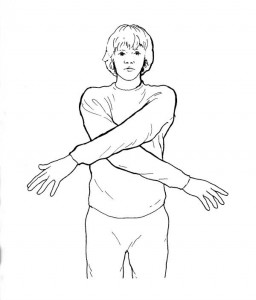 |
You need sufficient floor space to move easily, or even lie full length if necessary. It also helps to have loose clothing. Then you stand in the middle of your space, giving yourself time to explore what you feel and experience. |
Start by circling your arms. Take the arms above the head, down the sides of the body with the arms fully extended, then upward crossing the front of the trunk. In the full movement the hands are then forming wide circles that cross the front of your body. Do this until the movement is easy and flowing.
Then, as you are circling your arms with eyes closed, bring your awareness to the shape your hands are making in space. As you become aware of the shapes the hands are carving in space, watch what feelings you have as to how you would like to move. Give your body permission to doodle, to make any sort of shapes your feelings or body incline you to. Allow any sort of posture or movement, as active or quiet as you like. Allow sounds to accompany the movements if there is an urge to, and allow whatever feelings accompany them.
What you are doing doesn’t have to make sense. Nor does it have to comply with what other people might expect of you. Realise that you are allowing another part of yourself, perhaps a non verbal part, or a facet unknown to the rational mind, to express. With a non critical watching attitude, relax and let your body and feeling sense direct what happens.
There is no need to fiercely concentrate in order to wipe the mind clear of other influences. But you may need to hold back the part of the mind that always needs to know beforehand what you are going to do.
This is not like creative dance, in which there may exist a need to produce something pleasing for others to watch. With this exercise you need an open attitude in which your inner being can make its own adjustments, and movements, and feelings have a chance to express outside of rational criticism and demands of everyday life. Give yourself at least fifteen to thirty minutes in which to explore what spontaneous movements and feelings emerge.
The skill needs to be learned
This ability to allow life to stream through us in its own way is not a skill we are taught in our western culture. We are taught how to control, how important it is to repress anger or even immense joy, but we are not taught the balance of this – how to let go of control. Therefore the arm circling exercise needs to be repeated until the ’stiffness’ of our control is loosened and you can flow with what emerges spontaneously. When that begins to happen you will see that it is leading you along in a direction that is full of meaning and explains itself as it emerges.
Lily Kershaw – As It Seems [Official Music Video] – https://www.youtube.com/watch?v=utXz08ICZg4
As that happens you will not need to start with arm circling, but will be able to simply stand in your space and allow the process to happen. Wherever possible use this process, that I now call LifeStream, with friends who want to share it with you. This group practice enormously increases the power of it.
See Opening to Life; Lifestream – The Greatest is Often the Simplest
Growing up to Love
Surviving Tomorrow
Part Five
Tony Crisp
We all know the first need of survival is to breathe. If a newborn baby fails to breathe it will die very quickly. After that comes water and food. Then there are less urgent needs such as shelter, ones without which life would be less comfortable, less satisfying, and would leave us ‘hungry’ for something. One of these needs is love.
However, in our times we have developed a rather strange definition of love. Somehow we have, in our literature and drama, and of course in our personal experience, believed love to be some sort of magic relationship, a sort of soul mate, that if we find, we will live ‘happily ever after’, a wonderful sexual partner. But in fact few if any of us find such a mate, and ‘love’ relationships are usually only partly satisfying, or often deeply painful.
However, without love – defined differently – none of us would have survived physically or psychologically.
Whatever partner we are with we still carry our problems unless they have been resolved. Also, nature itself is dynamically in states of opposition that attempt resolution. It is a resolution that often never arrives. Thus the earth swings around the sun. The great ocean currents are constantly on the move as warm and cold meet. Resolution is impossible. Marriage simply puts us into close contact with challenge. To meet this needs real personal and interpersonal awareness – self awareness. It needs honesty of a type you may previously not have developed in yourself. It calls for this honesty to be used in communication of great intimacy in which, although great emotions may throw their lightning bolts, there needs to be underlying good will – in fact love and respect.
This awareness, honesty and communication needs to be learned. It is not usually natural to us. Learning it immediately confronts us with the enormous defences we usually live within. We find ourselves face to face with shocking revelations about ourselves, and the opening of doors that reveal secrets that are difficult to speak or even feel. This growing up, this move toward real adulthood is only for those who are determined enough and strong enough to move through their own defences, lies and unconsciousness toward their own truth.
Birth has already been mentioned, and without someone there to meet us, and in meeting give years of their life to supporting and nurturing us during infancy, we would not survive. Not only is the giving of food and protection necessary, but also, if we are to grow into a reasonably well adjusted and happy adult, that caring person, and many others, also need to give a lot of themselves.
Somewhere in this giving and supporting of life lies a more fundamental definition of love. What has already been said above about birth is an introduction to this. Birth demonstrates to us some wonderful things about the mechanisms of love we might take for granted, but that are true at many levels. The forming baby links to its mother through the umbilical cord. This remarkable link brings nourishment to the forming child, and is an enormous self giving of the mother’s being to that of her baby. In a very real way, the umbilical cord is the flow of life. If it were cut without any substitute the baby would die.

Firstly through the mother’s breast. Through that connection it again receives nourishment, but it also receives in the milk things that help it meet the infections and threats confronting it in the external world. Again, connection means survival.
Connection means life
At an even more subtle level another connection is attempted that isn’t always achieved. The baby attempts to form a living bond with its mother. In all mammals this level of connection is vital. Without it the baby will die unless it forms that bond with another adult. However, the bond is not simply that of having someone to feed you and protect you from harm. That simply feeds the infant body. But within that body is an infant consciousness, a living, feeling, learning and wonderful being. This ‘consciousness body’ also needs feeding to survive and grow. Babies abandoned and brought up by animals never become a human being. They remain at the psychological level of the animal rearing them. i Such connection means a sharing of caring love, of ideas and thoughts, and a way of helping the infant consciousness to find ways to learn, to explore, to be curious and adventurous. See Programmed
These fundamental facts of biological and psychological life go on being true up the scale of human experience. They may not be as visible as the physical sperm and ovum merging, or the umbilical cord, but if you examine your own feelings and experience you can see them yourself. Understanding them and working with what is understood is vital for surviving in a changing world. A baby certainly faces change, and so do we. Love, in the form of vital connections at a physical and psychological level, is fundamental to human life. We need love, and we need connections.
Returning to basics again, it is obvious that the food we take in is central to our growth and continued existence. By food is meant the body and substance, and all they contain, of plants and animals. Those animal and plant substances are transformed into personal substance and awareness. Maybe this is a bit philosophical, but I believe that Life, in the form of its plants and animals, gives of itself to itself as a form of love. Life on this planet is fundamentally about giving and receiving from each other. You might view that as killing and taking; or you can see the wider picture or overview of it and see it as a universal process of symbiotic relationship.
However, we do not need the philosophy to see that the giving of language, the sharing of emotions and ideas, the flow that occurs in intimate relationships such as exist between mothers and their children, is what enables us to grow into a person who can talk and think. Without that you would, like the babies reared by animals, have no personal awareness. Self awareness, personality, personal existence, is not innate. It is not God given. It is a gift self aware people give to their children and each other. We literally create each other. Without such flowing, self giving – loving – connections we are either stunted in our growth, as are many fostered or abused children, or our growth stops at some point. We take each other in just as we take in the bodies of plants and animals. That is love.
Enabling, fostering and developing that sort of love does not usually last long in the romantic ‘I’ll die without you’ feelings many of us associate with love in today’s world. But, to be honest, if we do ‘fall in love’ with someone, and experience the incredible intensity of connection with that person, a huge flow is created. In that magic connection enormous amounts of exchange go on. This is because it is exactly like a psychic umbilical cord through which we give of each other, usually without being aware of what is happening. If it works well we absorb different ways of behaving or responding, different ideas or information. Perhaps we experience a different way of seeing the world and our life in it. At its most profound it opens us to experience the huge universal truths underlying existence – the wonder of birth and motherhood; the universality of having a mate; the power of nest building and how it links us with countless other forms of life.
| There is a ‘but’ though. It usually doesn’t last long. When it ends there is often an inflow of negative feelings, even a breakup of the relationship, along with the accusations of failure and betrayal aimed either at ones partner or oneself.
Let us be clear about this. We are the product, an end of the line creature arising out of the need to survive incredibly challenging environments and earth changes. The imperative through our evolutionary past was to survive and procreate – whatever that took. On top of that, as is clear from the animal reared children, who we know ourselves to be is largely a product of the programming and responses other humans put into us. Living completely out of context with what was natural for us over millions of years, being raised in ways that very often lack the intense body to body, passionate emotional caring connection we need to nurture our growth, we are out of touch with what might instinctively create individual and social groupings to satisfy us. |
|

Devoid of the innate guidance animals have that relates them spontaneously to each other and their environment, we are stranded, left largely to our own resources. For many of us, having our instinctive love injured either by parents who themselves didn’t know how to really connect physically, we do not know how to love fully – except maybe in a very dependent, needy and painful way. As such perhaps we need to learn how to ‘make love’. Not being able to rely on our rather disturbed habitual responses that were put into us as we grew; put in by a society that in no way demonstrates real lessons of love and survival; we need to form our own loving relationships out of an awareness of what is fundamental.
Having sex as a pastime, as a form of no handed masturbation in which we make no real connection with a partner, is not fundamental. Making fun relationships is not fundamental to the way life works. Most interactions in nature, even to the frequent sexual interactions of Bonobo apes, have individual and social meaning. Such interaction are for bonding and connection. But those are just suggestions, and the best way forward for each of us is to honestly admit what is or is not working. And when something is not working, we need to avoid blaming everyone and everything else. That doesn’t mean completely blaming oneself. That is anti-productive. It means daring to look closely at what assumptions, pains, feelings of dependency, loneliness or other factors contributed to what did not work – in both partners.
It might be easy to completely blame a partner who simply walks away from a relationship. However, you were the person who chose to connect with that partner. Why? If you don’t understand that you might do it again, or avoid all further relationships.
Pain in relationships, tremendous dependence, fear of abandonment, jealousy and desire to control or constantly reject or hurt ones partner, can all be understood if we recognise and work with what has been explained about the fundamental process of love.
So let us revisit some of what has been said in a new way by seeing how love passes through very clear stages.
First Stage – The Womb
Life in the womb is typified by complete dependence and helplessness. This means enormous possibility of feeling vulnerable. And if you don’t believe a foetus can feel or experience anything, think again. There is enormous evidence from the various approaches to psychotherapy that there is great sentience from the beginning.ii While there is not personal awareness, there is certainly a process of learning that involves developing responses to what is being met. For instance it is now understood that the developing child can be powerfully influenced by what the mother eats, drinks or experiences. Some recent findings show that the foetus actually adjusts to foods and other external conditions. There is in fact a growing body of research which attempts to understand the prenate as an intelligent and sentient being.
However, the aim here is not to explore the proof of prenatal sentience, but to summarise what problems might arise in adult life due to disturbances at that period of our development. Remember that this period of development is one of incredible sensitivity to influences such as drugs, including alcohol and nicotine. It is the most fundamental level of love, during which complete dependency and vulnerability exists.
Basic to stages of growth is the understanding that further development takes us into the next stage. If the particular stage is disturbed or injured in some way, then further development can be obstructed. What often gets in the way of us seeing that such damage to further development has taken place is that the body continues to mature and grow. However, the psychological or emotional development can remain at an infant or foetal level while the body ages. In fact some people remain deeply dependent throughout life, and find it impossible to survive alone.
Stage Two – Infancy
At birth we slowly emerge from the complete dependency experienced as a foetus. But we are still deeply dependent upon the loved person for ones needs, physical, emotional and social. The only difference is that if our connection with the mother fails, another person can take over our caring. If this has actually happened in ones own infancy, it can lead to the need always for more than one source of ‘love’.
This stage is typified by great anger, jealousy or pain if the loved one relates to anyone else, is lost, or threatens to leave. In an adult who has not matured beyond this stage, threatened loss of connection leads to enormous feeling reactions that may also be felt at a time of emotional withdrawal of the partner, even if there is no sign of them withdrawing physically. There is a desire for unconditional love and a need to be always with the loved one. In an adult with this level of love, sex may be a part of the relationship, but the main need is a bonded connection. This is sometimes felt as a need to have the loved person want you as much, or as desperately, as you want/need them.
Possibly the greatest fear, one that can trigger great anger, or an enormous desire to placate or earn love, is the threat or fear of being abandoned. Many so called adult relationships have actually not matured beyond this stage of love. The loss of a partner results in enormous emotional pain, anger, attempts to placate or regain the loved one, and feelings of personal worthlessness – I’m not good and unwanted – can haunt the abandoned partner.
It is from this level of emotional development that the frequent refrain heard in popular music arises – I can’t live without you. True – the baby cannot live without a loving mother.
Stage Three – Adolescence
This stage of love is about the long process of gradually becoming independent of the parent or parents. There are many strategies people use to attain this or move toward it. Anger or loathing for parents can enable the risky move of leaving them. ‘Falling in love’ with someone can unfasten the emotional and economic dependence on parents or carers and fix it on someone else. The break may be made without this transference of affection by fixing ones attention on attaining a degree or new situation in life.
Other possible facets of the adolescent stage of love may be anxiety, uncertainty or clumsiness concerning emotional and sexual contact with the opposite sex; desire to explore many relationships; discovering what ones boundaries and needs are; powerful sexual drive.
In this stage any partner will probably be loved for the person’s own needs – for example the person might need to get away from family and the ‘loved one’ is an aid to this. There may be great romantic feelings and spontaneous love which are hard to maintain in face of difficulties.
The signs of this stage of love in adulthood are usually seen as enormous emotional responses, highs and lows, to relationship. This can lead to depression, alcohol dependency and active aggression or desire to break up the relationship because of the emotional turmoil they bring about. Part of the stress is linked with the drive to become independent, so the dependent connection with a partner can result in a see-saw – be with get away from – response.
Remember, this is a time of enormous adjustment and change, physically, emotionally and socially. If these changes have not been navigated in actual adolescence, they will still be facing us as an adult in the relationships we enter into.
Stage Four – Adult Love
We do not usually emerge into the ability to love without the dependency, pain, jealousy and angers of infancy and childhood in easy progression. Many adults never manage adult love, but remain stuck in various adaptations to infant, child or adolescent love. Adult love brings with it a growing sense of recognising the needs of our partner yet not denying our own. It enables the ability to be something for the partner’s sake without losing ones own independence or will.
This means a real awareness of the issues that colour or influence relationship, and meeting them as partners. Independence and closeness or connection is achieved together. We become caring sexual partners through discovering each others needs and vulnerability, and supporting each other in them as far as we are able. This is done not through fear of abandonment or losing love, not through fear or avoidance of loneliness, but through admiration, respect and a working connection that has mutual advantage and nourishment in it.
My partner is a grown up child
Taking all the above into account, what do you think it would be like to fall in love with or get married to someone who is only four or six years old emotionally? If you can’t remember being that young, love at that age means being incredibly dependent, with an enormous need for attention, possibly very jealous if someone else gets the love you desperately want; and if you lose a parent/loved one at that age it is devastating, even life threatening. But it may mean, because of early hurts, being unable to feel or express love.
I know this story very deeply, because it happens to be mine. Soon after my premature birth my ageing grandmother took over my rearing – my mother was working almost every day – so my grandmother became my first great love. But this first love of mine died before I was two. It left a very sensitive wound of loss in me.
I suppose I was one of the lucky ones as my mother took over after my grandma’s death. However, the wound was pierced once more when I was put in a hospital at three without any warning. The terror of feeling I was unwanted and was now losing my mother was beyond easy description. Then, at five my mother decided to punish me for being late home from school. Okay, she was worried, but she said to me, ‘You hurt me, and now I am going to hurt you.’ She did. She stripped me, bathed me, telling me she was sending me to the orphanage.
Remember the wound of loss? Well that really opened it up and deepened it. I was on my knees begging not to be hurt like that again. But it didn’t have the effect my mother wanted. Of course it was only an awful threat, but it was real to me, and I responded by cutting my mother out of my life as completely as I could. I cut out all love I felt for her and killed any emotional connection. It wasn’t a conscious act, more like an attempt at survival as I struggled with the apparent fact that my mother could get rid of me at any time.
It was a tragic act, and unfortunately the tragedy went two ways. My mother never received the love from her son that she could have had, and I never learned to let my love grow beyond that of a five year old. I married and helped raise five children, was capable, a hard worker and provider, but didn’t now how to love. My mother of father had never showed me, but I did have the buried memory of my grandmother.
Part of the tragedy of the lost love that had occurred in my life and can be seen in countless other lives if you look around, is that most of us have actually buried our childhood so have no awareness at all of what love is or what has been lost. So as a married adult I thought that what I was experiencing daily was natural. What gradually woke me up was what I could see concerning the way I dealt with my children. It horrified me enough to start probing to find out what the problem was. Also there was something like a buried agony in me that set me searching for something I couldn’t define. I was desperately lost in ‘normal’ life. It was and is the ‘normal’ life I see many people still lost in. Maybe your child self didn’t get buried for the same reasons mine did, but are you still searching? Do you sense something is missing? Is there a hole inside that you try to cover up with enormous external activity, ambition, alcohol or medication? Do you recognise some of the signs from what was described above about the ages of love?
My story continues in both a tragic and a transformative way. My terrible need to find what was missing drove me to leave my wife and children. I found a woman who for the first time in my life I could explore a loving relationship with. To my amazement I discovered I was a five year old emotionally – even though in other ways I was a capable and creative adult. I couldn’t let my new wife out of my sight. I was intensely jealous, and was terrified of loss. But like a shattered war victim who has buried awful memories I gradually uncovered my past. Slowly I learned to grow up to love. The empty space has gone. I am no longer desperately searching for someone who will make it alright. Loss is no longer a terror, and I honestly believe I can love without those pains.
We are all different, and I am not suffering the illusion that if I pay thousands of dollars to a millionaire she or he will be able to tell me how to get rich. It is pointless to tell you the circuitous route and the magical moments of my personal journey. But I can tell you some of the landmarks of the road to transformation from being a baby in love.
Opening the doorway to love
The doorway to change is opened by honestly admitting your emotional age and recognising that it is not normal, as our culture suggests, to feel agony or huge grief in loss. Those arise, as do jealousy, rage, and all the other responses to relationship we develop, through childhood hurts, from an almost universal sickness of our times. The fundamental needs of childhood are almost never met by modern parenting within the environment of today’s commercial and industrial world. The love sickness is seen everywhere.
There is an enormous amount of ways we could have reacted to our own love problems as a child. Those reactions remain almost totally unconscious in adulthood. Some that I have witnessed are:
- Being intellectually capable and dealing with love and relationship like a captain in command of a ship – in control – never letting it get out of hand or allowing the emergence of emotions.
- Enormous pain or discomfort if you become intimate or get emotionally close to the person you are involved with. This causes a kickback that leads you to pull away from the person. The approach and retreat goes on again and again.
- Terrible urgency to avoid being alone or without a partner. This can lead to the awful feelings that you are unwanted, unloved, or of no account in the world.
- Dreams or fears that your partner will leave you for someone else – or even die.
- Avoidance of the opposite sex, sexual connection, or of a loving, caring and prolonged relationship.
- The inability to love – i.e. to deeply give of oneself – or the rejection of love from another.
- Enormous introversion or enormous extroversion
- Brutality or hurtfulness in relationship. This can be in the form of subtle accusations or criticisms masked as rational comments.
- Fear of death.
- Release through pornography or sexual diversions.
After the admittance of your emotional age, the next landmark is to recognise what the signs of adult love might be. This may be an ideal goal as few of us reach the zenith of adult love. However, having walked some of the way myself and seen it in others, the sign of adult love is its unconditional nature. We see this in some parents. Their love doesn’t change or diminish when their children leave home and go with other partners. Such love is unconditional. It is not grasping or controlling. It does not lead to sulking or great pain, but has achieved emotional independence. Therefore it offers these things to those loved.
As I say, this is an ideal, but mature love is when we accept that the person we care for is a separate and unique individual with their own needs and directions in life. We do not love them if they obey all our needs arising out of our fears and pains. We love them simply because they are who they are, because we respect and admire them, and we allow them the freedom that hopefully we give ourselves.
Caring and honesty are a part of this acceptance into and allows us into a wider life. One needs to be honest in ones dealing with other people and oneself. This is obvious in that the wider life IS made up of other people. Unless one has achieved a trustworthy place in the hearts of friends and those near you, then you are obviously not let into the deeper aspects of their life because they cannot trust you with little things, let alone their soul or affections. This means there are various levels of marriage and love arising from this trust. There is a form of marriage that spans time and different personalities. In this form of marriage you have learned to trust someone so well you had agreed deep within self to unite your life with them for ones entire existence. This was not a conscious decision and ritual. It happened because there was nothing between yourself and the other person that could interfere with continued sympathetic contact no matter what the life situation. It didn’t matter what the gender situation was between people who married in this way. The link was one of care and trust, and it spanned many physical existences.
This is an unconditional love. It doesn’t place the conditions on the other person of only being loved or lovable when they remain our satellite. When we do that we make of them a possession, somebody manipulated by our own moods, fears, emotional blackmail, or underhanded tricks. If we are grown up in love and our partner leaves us or goes with someone else, having matured we will have already seen that as a possibility (come on, look around). It will mean difficult changes, but not ‘heartbreak’, not depression or long years of grief or anger. It will also mean that because we love that person we will continue to be interested in their welfare and be glad if they are happy. If that sort of love is not possible for you start asking yourself why, and look at the roots of you own love. Remember your youth and childhood. It is a slow thing to regain such memories, but that is the way to becoming whole. If you don’t know who you are you are really only half a person, only half remembering who you are.
To grow up and become a mature lover takes courage. Each time we try to possess the other person, lash out at them through jealousy, curtail their life through our fears and insecurities, we need to stop and say, “This is childhood behaviour. I will not let this anger, possessiveness, jealousy or emotional blackmail be perpetrated on the person I presumably love. I will face this and deal with it as my personal difficulty. I will not rationalise and excuse it by saying to my partner that I love them. That is an underhanded excuse. It is not love.”
Recognising the Face of Love
The next stage in growing up to love is another act of recognition. What you are looking for in this is whether you are seeking someone else to assure you of love. You cannot find love while you believe it depends on someone else. That is child love again that depends on the parent for all needs – perhaps even for survival.
This is a difficult one as our whole social and cultural mythology surrounding love is that we need someone else to provide it. That is true in childhood, but not in adulthood. The lie of it can be seen when we look at those abnormally dependent partners who constantly clamour for attention for fear of loss or competition. If we see that as abnormal and childlike, what is the opposite of it?
If you honestly explore where jealousy, fear of abandonment, dependency on your partner arises from, I know from experience in tracing my own and many other people’s love problems, that they arise from childhood.
Perhaps you will have to accept this on trust, but love is not something you possess or develop. It is like life itself, given to you as a part of your existence. It flows through you, and that flow may have been damaged or twisted during your life, but it is still fundamentally there in you and can be released by undoing the knots. Then it is yours whether you are with a partner or not. Love is then a meeting of equals who shine the precious flow of this wonder on each other and magnify it. We do not claw at each other trying to get what is missing in ourselves.
There are no quick fix tricks in this opening to love, just as there are no quick fix tricks to growing physically from childhood to adulthood. Both of them flow from the core processes of life in you, and need you to work with and honour that process. Physically you do not honour it by not eating good food, not sleeping, exposing yourself to excessive stress and ignoring injuries and sickness. You do not honour your personal growth to maturity by denying you have a relationship with the Life that gives you existence, and that its gift of love and wellbeing may have been injured or twisted in some way.
Just as you would tend a gash in your leg, so you need to heal the wounds to love. A wounded leg would severely limit your ability to function in life. Wounded love is no less a difficulty in living your best.