Posts Tagged ‘core self’
Example 7 Out of Body
Once the awareness is independent of the body, the boundaries of time and space as they are known in the body do not exist. One can easily pass through walls, fly, travel to or immediately be in a far distant place, witnessing what may be, or appears to be, physically real there. Sir Auckland Geddes, an eminent British Anatomist, describes his own OBE, which contains many of these features. See: second example in spiritual life in dreams.
Example: Becoming suddenly and violently ill with gastro-enteritis he quickly became unable to move or phone for help. As this was occurring he noticed he had an ‘A’ and a ‘B’ consciousness. The ‘A’ was his normal awareness, and the ‘B’ was external to his body watching. From the ‘B’ self he could see not only his body, but also the house, garden and surrounds. He need only think of a friend or place and immediately he was there and was later able to find confirmation for his observations. In looking at his body, he noticed that the brain was only an end organ, like a condensing plate, upon which memory and awareness played. The mind, he said, was not in the brain, the brain was in the mind, like a radio in the play of signals. He then observed his daughter come in and discover his condition, saw her telephone a doctor friend, and saw the doctor also at the same time.
What is the experience of enlightenment like?
Enlightenment Part 3
Tony Crisp
People attempt to describe it in many ways. Ramana Maharshi says that when you realise the Self (enlightenment), the sense of yourself as distinct from the world disappears.
Another person describes it by saying, ‘I was sitting opposite someone during an enlightenment intensive workshop. We had been posing the question for days – “Who are you?” Suddenly I realised that it was a silly question, because I was the answer. All thought stopped and I existed as the answer. My being had always been this. In this state there was an awareness of being connected with everything around me, in the beginning of creation. This was the first day.
While in the state of simple existence I was able to observe many things I am usually not aware of. For instance while I simply existed, my usual pattern of behaviour and thought went through contortions to be the centre of awareness again. I could see them almost like habits, systems, that have life, like a body does, and they were dying and twitching in their death throes. Also I saw that I knew that all thought is like a mimic, so all our thinking is like photocopies, without any real life. Also as I saw this I had an image of a monkey that was actually me normal thinking self running alongside my every motion and trying to mimic it. It was almost as if as I as a person walked along, another mechanical person ran alongside trying to keep up and mimicking everything I did in an attempt to be alive and real. Yet thought can never be life.’
Another person says, ‘Unexpectedly everything changed and my fundamental self was something that existed throughout all time. It didn’t have a beginning or end. There was no goal to achieve. I am.’
Slightly different but still the same enlightenment. ‘Everything seemed to slip away and I felt as if I melted back into the primal being of the universe. It didn’t seem as if my ego was gone, just melted into everything else. It was blissful.’
Here is a wonderful description from John Wren Lewis:
“My experience itself, which I have described elsewhere (Wren-Lewis, 1985), lacked almost all the dramatic features emphasized in the now voluminous literature on the subject (Lundahl, 1982). I had no “out-of-body” vision of myself in the hospital bed, no review of my life, no experience of hurtling through a tunnel towards a heavenly landscape and no encounter with supernatural figures urging me to return to bodily existence. I simply dissolved into an apparently spaceless and timeless void which was total “no-thing-ness” yet at the same time the most intense, blissful aliveness I have ever known.
The after-effects of the experience, however, were dramatic indeed, and I have found no account of anything comparable in the NDE literature. I have been left with a change of consciousness so palpable that in the early days I kept putting my hand up to the back of my head, feeling for all the world as if the doctors had removed the top of my skull and exposed my brain to the infinite darkness of space. In fact the Living Void is still with me as a kind of background to my consciousness. The effect is that I experience everything, including this sixty-year-old body-mind, as a continuous outpouring of Being, wherein every part is simultaneously the whole, manifesting afresh moment by moment from that infinite Dark. As “John” I seem to have no separate existence, but am simply the Void knowing itself in manifestation, and in that process of continuous creation everything seems to celebrate coming into being with a shout of joy—”Behold, it is very good!” Yet the experience is in no sense a high, for its feeling-tone is one of gentle equanimity. My impression is rather that I am now knowing the true ordinariness of everything for the first time, and that what I used to call normal consciousness was in fact clouded.
I still slip back into that old clouded state frequently, but this is not a process of “coming down.” What happens is something I would have found unbelievable had I heard of it second-hand—namely, I again and again simply forget about the pearl of great price. I drift off into all kinds of preoccupations, mostly trivial, and become my old self, cut off from the Void-Background. Then, after a while, there begins to dawn on me a sense of something missing, at which point I recall the Void and usually click back into the new consciousness almost immediately, with no effort at all.
I think this is what is meant by the mystical notion that so-called normal human life is really a state of chronic forgetfulness of “who we really are,” and I suppose my NDE must somehow have shocked me into recognizing my identity with the Void, with the result that my forgetfulness is now spasmodic rather than chronic. Needless to say, I was bowled over by all this at first, and spent many weeks coming to terms with it. I soon found that the new consciousness did not seem to demand any drastic changes of life-style. In keeping with its sense of utter ordinariness, I remained recognizably John, and neither my tendency to drift out of the new consciousness nor my ability to click back into it seemed affected in any way by variations in diet, environment, or activities such as meditation.”
In her book Collision With the Infinite, Suzanne Segal writes, ‘In the midst of a particularly eventful week, I was driving north to meet some friends when I suddenly became aware that I was driving through myself. For years there had been no self at all, yet here on this road, everything was myself, and I was driving through me to arrive where I already was. In essence, I was going nowhere because I was everywhere already. The infinite emptiness I knew myself to be was now apparent as the infinite substance of everything I saw.’
As can be seen, there is no final description of enlightenment, just as there is no final definition of life, or love, or any human person. Everything is, in the end, transcendent.
Everything, even the commonest of objects or events, transcends final definition. For instance a cup we drink from can be seen as a household item. It can be looked at chemically. We can see it as a piece of art. There may be personal associations or feelings we link with it. There can be an atomic or subatomic examination of it, or a cultural interpretation. Which one of these is correct? Which one is the final or fullest definition?
There is no final definition. The cup is a part of transcendence. Enlightenment occurs when we directly know the transcendence of our own existence, beyond any definition. It is a direct knowing beyond thought or feeling, of the world and self as One.
I am a wave on a shoreless sea.
From no beginning
I travel to no goal,
Making my movements stillness.Here is another description from a great spiritual healer, William Lilley. Who says he was able to consciously ‘leave his body’ and visit the ‘Beautiful Place’, where he meets the dead. His description of this is typical of many other peoples, even to the ‘going through the mists’. Quoted from his book Gift of Healing.
“When I am going into trance, I breathe in the Yoga method shown me by Dr. Letari. Immediately I get a sensation as though I am falling, or being pulled backwards. As this sensation comes to a climax, I seem to be travelling through space at terrific speed. I have opened my eyes many times at this point, but the only vision I have is of passing through a dense fog. Then, quite suddenly, the fog clears and I am at a stile. I climb over this stile and immediately there is a voice speaking to me over my shoulder. This voice is always with me, explaining everything I see and everyone I meet. The stile seems to be on the edge of a large field, which rises gradually to the form of a hill. I walk up the hill, and beyond it I visit many places. It is always the same style, the same hill, the same voice, and it just seems like a large country with so many different towns to visit.
The most interesting and remarkable experience I ever had during these visits happened before I went into trance. Several people had been speaking of consciousness. They had asked me to describe the world I experienced. Was it solid? Did I appear solid? I promised them that if I could, I would find out. I arrived at my stile, the voice came to me, and it evidently knew my desire, because it said “Feel the earth!” I did. It was solid. “Feel the grass beneath your feet!” I did. That was solid too, and even had dew on it. “Smell these flowers!” They were perfectly natural and had the usual perfume. In fact, everything around was natural. Then I was told, “Feel your body”. I did so. It was as solid as I am materially.
‘The voice then said, “Close your eyes; make your consciousness passive”, or as you would do when preparing for a trance state. “Now feel the earth beneath your feet!” There was nothing. “Open your eyes”. It wasn’t dark, it wasn’t light. “Feel at your body”. It wasn’t there. “Such is Spirit” said the voice. “Just a consciousness holding within it all experiences of your lifetime, all the joys and sorrows, your desires, achievements and failures, whence comes spiritual evolution. In your world of the material, you are able to examine matter; everything is matter. When you think of the spiritual, naturally you build in your consciousness another material world.” It is an amazing inner world which offers freedom. It is ours to create, and the very core of us is bodiless awareness”.

If you want to experience enlightenment try Enlightenment Intensives in the USA or UK it really works. It has for thousands.
What part do thoughts and feelings play in enlightenment?
Enlightenment Part 1
Tony Crisp
If you think about a friend, ask yourself, ‘Is this thought my friend?’ If you have feelings about the friend, ask yourself, ‘ Are these feelings an actual representation of my friend?”
You cannot conjure your friend into existence by thinking about him or her. Thoughts and emotions are copies of things, just as a photo is a copy of something. They are never the people or things they attempt to copy. They are never reality.
Therefore we cannot experience enlightenment by thinking about it. Enlightenment is not something we create with thoughts or emotions. We cannot make it by thinking inspiring thoughts or feelings. Enlightenment is a self-existent reality. It does not depend upon what you think or feel. It is not brought about by concentrated thought, meditation or inspiring emotions. It already exists. You are it already.
In some approaches to enlightenment, such as the Zen koan, or the Enlightenment Intensive questions, enlightenment occurs when the mind is baffled and exhausted by the question. Thinking cannot answer the question and collapses. Suddenly there is enlightenment.
But someone who failed says, “Yes, I am doubtful about the effectiveness of psychoanalysis and New Age cliches about “healing the ego”. Zen is ineffective and inefficient to the extreme. 30 years of sitting and being utterly frustrated is extreme. The broad path of Buddhism is a dismal failure. How many has it enlightened? There are distant rumors of one here, another over there… nothing more. Buddhism has become so dark that it has become proud of how elusive its knowledge is, how difficult its way is, what an all-consuming challenge it makes of enlightenment.
All existing paths to enlightenment are profoundly unsatisfactory. They practically don’t work. Who would disagree? Who would claim that many have been enlightened? Who would claim the rewards of these “paths” to be reasonably attainable? Paths, paths, that is their problem. They are a path that leads on, and on, and on, the signs ever announcing “Enlightenment, Next Exit”, but the exit never comes.”
It is true, but it can be found, “But then I was shown the way out – it was by admitting that I was a heap of shit, and asking for help as the twelve steps in Alcoholics Anonymous define it. In opening myself to that wonderful otherness my heap of shit became a compost heap which offered new growth.”
Example: While in the state of simple existence people call enlightenment, I was able to observe many things I am usually not aware of. For instance while I simply existed, my usual pattern of behaviour and thought went through contortions to be the centre of awareness again. I could see them almost like habits, systems, that have life, like a body does, and they were dying and twitching in their death throes. Also I saw that thought is like a mimic. As I was directly being, thought ran alongside my every motion and tried to mimic it. It was almost as if as I as a person walked along, another mechanical person walked alongside and mimicked everything I did in an attempt to be alive and real. Yet thought can never be life.
The ego or personality was still all intact as a series of responses learned during life. I understood that sometimes people take these responses to be themselves, and attach to them with incredible power. These responses are useful in most cases – though some are habits that have outlived their usefulness, and need to be modified or deleted. Since that time, it has seemed quite clear that these can be likened to computer programs, many of which run at the same time. So we have a speech program that may run at the same time as a driving a car program, and a program dealing with social mannerisms and responses. If the person who has developed this ‘software’ becomes identified with it, there is less possibility of them upgrading it from experience, or realising that they are not the responses.
Thus, Self-inquiry is the direct path taught by Bhagavan Ramana. “The ‘I’-experience is common to all. Of all thoughts, the ‘I’-thought is the first to arise. What one has to do is to inquire into the source of the ‘I’-thought. This is the reverse process of what ordinarily happens in the life of the mind. The mind inquires into the constitution and source of everything else which, on examination, will be found to be its own projection; it does not reflect on itself and trace itself to its source. Self-discovery can be achieved by giving the mind an inward turn. This is not to be confused with the introspection of which the psychologists speak. Self-inquiry is not the mind’s inspection of its own contents; it is tracing the mind’s first mode, the ‘I’-thought to its source which is the Self. When there is proper and persistent inquiry, the ‘I’-thought also ceases and there is the wordless illumination of the form ‘I’-‘I’ which is the pure consciousness. This is release, freedom from bondage. The method by which this is accomplished, as has been shown, is inquiry which, in Vedanta, is termed jnana, knowledge. You sit and ask yourself, “Who am I”?
Link back to Chapter Heading – Link to Chapter 2

Is enlightenment a state of mind I can develop?
Enlightenment Part 2
Tony Crisp
R. D. Laing, the psychiatrist, in describing the search for ones fundamental self said, ‘The Life I am trying to grasp is the me that is trying to grasp it.’
One of the enlightenment sites listed has a heading, ‘What you are looking for is what is looking.’
Enlightenment is not a state of mind you can create or develop. It is something beyond any change, outside of anything you can develop. After all, development suggests change.
The frustrating thing about enlightenment is that the harder one tries to grasp it, the further away from it one gets. The more effort one makes in trying to achieve it, the less one finds of it.
It is the ever present, self existent core of yourself that remains when all else drops away.
So the question should not be can I develop the state of mind that is enlightenment, but how can I realise this fundamental state?
One of the enilightenment experiences someone describes was as follows:
The many different paths to the one great ocean of Life can be summarised in a simple way because they all have a common factor. It, like dancing or meditating for extended periods, quietens your normal way of thinking and looking at the world. In a meditation seminar I attended that lasted for several days I observed this with great clarity. After three days of meditation I saw my thinking mind faint. It could no longer sustain the continued concentrated pursuit of the question we were asking. In the moment of my rational thinking mind fainting there was an experience of divine Life knowing itself as this man people call B. In that state I knew connection with all the people around me, and the birds, trees and earth. For they and I shared the same spirit. I had arrived home at the source of things. I felt I was in the Garden of Eden, and that we had never left it. That experience, as ephemeral as it may sound, has given me something that strengthened me to pass through big life changes, and travel joyfully into old age.
Human beings has evolved through huge periods of time to have self awareness, a truly amazing thing, but for many it is a state of constant pain and suffering leading many to commit suicide. But Dr. Maurice Bucke, who himself lived in constant physical pain tells of how him and many others were able to evolve to a new state in which their suicidal pains no longer were active in them. He called it Cosmic Consciousness, but it has been known for ages under different names such as Enlightenment and Liberation. Those who evolved to this level of awareness often say, “That we could all be experiencing this, if only we could stop being typical suffering humans. Regardless of what hell one might fall into an enlightened one is an ordinary person who acts like a true adult.” All the major faiths recognise this and so have left records of how to reach this evolution of self.
Here are some – Ox Herding Pictures – The Many Ways To A New Life – Psychological Vomiting – Communicating With Your Inner Guide
Why is enlightenment sometimes called liberation?
Enlightenment Part 4
Tony Crisp
The state of enlightenment is beyond any sense of good or evil, beyond any opposites, or of oneself and otherness. Because of this it liberates us from the enormous load of old habits, guilts, painful responses, limitations we carry around from the attitudes and viewpoints arising from the habits of duality, of division, of right and wrong.
The sense of oneself as a separate entity, along with all the concepts and feelings we have about the world can disappear. This is enormously liberating. You are given a new world, a new life, with immense freedom of choice.
Link Back to Chapter Headings – Link to Chapter 5
Are Heaven and Enlightenment the same?
Enlightenment Part 5
Tony Crisp
Many things that Jesus is reported to have said can be recognised as connecting with the state of enlightenment. For instance he said you do not have to earn heaven, that it is already here for us to claim. This is like saying heaven is self existent as your own fundamental nature, and you don’t have to be good or perform certain acts to get it.
The story of the pearl of great price is also recognisably about enlightenment. The story says the man has to sell all to get the pearl. In other words he gives up all and then he has the pearl. This does not mean that you have to be impoverished to know the condition of enlightenment. If that were so the beggars in the streets of the world would all be wonderuflly enlightened and wise. It is not a case of having nothing, but of holding onto nothing, of wanting nothing as fully as one wants ones own true existence.
Enlightenment often arises in a person when all their desires, all their thoughts and feelings, for one reason or another, subside, are let go of, even momentarily. That is what is meant by having nothing or giving all up.
The Pearl of Great Price is that awareness of the Divine within you that can be born out of having no preconceptions – the virginal mind.
Link Back to Chapter Headings – Link to Chapter 6
Toward the Light that is Myself?
Enlightenment Part 8
Tony Crisp
After his initial years of meditation, Gopi Krishna came to see that ‘Contrary to the belief which attributes spiritual growth to purely psychic causes, to extreme self denial and renunciation or to an extraordinary degree of religious fervour, I found that a man can rise from the normal to a higher level or consciousness by a continuous biological process as regular as any other activity of the body.’ (See his book)
The energies of this higher consciousness in man and woman is a natural process. It is as natural as the arrival of teeth in the child, or sexuality in adolescence. In fact it is a continuation of the same process. But it seems as if this natural process of growth that extrudes the body, brings about human consciousness and personality, does not take us to enlightenment without our conscious cooperation. For this further growth, it appears that we must agree to go along with life – must decide that this is what we want. We must co-operate with the process or else be stranded. See Life
The first step is to recognise that your personality did not arise out of your own efforts. Then you offer yourself to be acted upon by whatever underlies your existence. And this offering means some measure of becoming empty, of becoming receptive or surrendered to an action other than that of your own mind, your own emotions, anxieties and habits.
What acts upon you when you do this has been given unccountable names. Sri Aurobindo says: ‘One commences in a method, but the work is taken up by a Grace from above, from that to which one aspires. It was in this last way that I myself came by the mind’s absolute silence, unimaginable to me before I had its actual experience’.
How do we do this? First recognise clearly that some process, some force, causes you to exist. You can call this what you wish, it does not matter. It remains what it is. Next recognise that this process that you are, causes changes in your life, and its action is apparent as growth. Next, decide to go along with this process. Offer yourself as you are to it. Let things happen – allow changes to take place. You will be shown the way. This path does not attempt to crush the ego, the appetites, the instincts. Rather, you hand them over living so that they can be transformed to higher levels of expression, and reach towards fuller self-realisation in everyday life.
Rudyard Kipling, in his book Kim, describes one of the simplest and effective meditations we can use toward enlightenment. He says:
“Who is Kim- Kim- Kim?” He squatted in a corner of the clanging waiting-room, rapt from all other thoughts; hands folded in lap, and pupils contracted to pin-points. In a minute- in another half second- he felt he would arrive at the solution of the tremendous puzzle; but here, as always happens, his mind dropped away from those heights with the rush of a wounded bird, and passing his hand before his eyes, he shook his head. A long-haired Hindu bairagi (holy man), who had just bought a ticket, halted before him at that moment and stared intently. “I also have lost it,” he said sadly. “It is one of the Gates to the Way, but for me it has been shut many years.”
The technique is to daily sit and ask that question for at least twenty minutes – Who am I? You can use your name like a mantra, repeating it over and over. Use it as a focal point, not to think about but to take awareness away from everything else to the quietness beyond thinking and feeling. Look silently into that darkness and silence. Drop all effort. Let go of desire to get anywhere or find anything.
An Experience of Enlightenment
Many years ago I had an experience that assured me the wrongness of believing the scientific view of human life. At the time I had an unforgettable experience of lucidity that after all these years remains a fount of inspiration and guidance. I also began to realise that enlightenment was a process of growth – not a one time experience.
I had let go of any other motives and deeply entered a state of lucidity in which I felt like I was falling down a very deep hole. This wasn’t frightening, but reminded me of Alice in the rabbit hole. As I fell I passed through memories of things that had hurt me during my life, like the time I broke my nose.
Then I hit the bottom, experiencing a womblike feeling of great peace. I realised as I observed, that it wasn’t the womb, but the very basic level of my personal awareness. But there was still a current carrying me back further, and I resisted, fearing I would lose my identity. Then I suddenly realised there was nothing to fear. After all, I did this every time I went to sleep – trusting myself to the bosom of the deep. So I slipped into what I have called the ocean of consciousness, and it caught me and started growing me as if from a tiny seed. This is what we experience when we go to sleep. The difference is that I maintained awareness during the descent into sleep. It felt as if I had no body, and that I had spread out, like a drop of water in the ocean. I knew as this happened that at the core of me was this power that had grown me in the first place, and that there was so much more of me to discover than I presently knew. Then the immense Life spoke to me. “Come to me each day like this (with an open heart to the power that had grown me) and I will know myself in you”. See Life’s Little Secrets
Link Back to Chapter Headings – Link to Chapter 9
A Dream Points the Way
Enlightenment Part 12
Tony Crisp
In my dream I was in a prison cell with two other men. We ate, slept and defecated in the cell. I was standing at the bars of the cell, and had the impression of having been in the prison for years. I was shouting and cursing the people who had put me in the prison, full of hate and self-pity. I had done this day after day while in the prison. Suddenly I realised that my years of shouting had availed nothing. The only person who was upset by it was myself. I was the victim of my own anger and turmoil. So I dropped the attitudes behind the anger and shouting and was free of them. Years went by, and one by one I dropped other habits of emotion and thought with which I had trapped and tortured myself. I realised I could be totally free within myself. One morning I woke and sat up on the mattress on the floor that was my bed. The last ghost of inner entrapment fell away. A fountain of joy opened in my body, pouring upwards through me. So intense was it I cried out. The cellmates called a warden. They stood looking at me as I experienced a radiance so strong I felt as if I must be shining. I was aware my joy poured into them, although they thought I was mad. Nothing would ever be the same again.
Commentary
We are all prisoners of our emotions, of our thoughts, and of our sense impressions. Mostly we live in these as if they are reality. This is a form of confusion, but also of imprisonment. The bars of this prison are often invisible to the person they enslave. Or else the person calls them ‘Me’. We say, ‘That is how I feel. I don’t like this. I am afraid. I am in love.’ Or else we depend entirely upon events and others to stimulate pleasure or pain in us.
The identification between the thoughts, the emotions, and the sense of self is so immense, that no life outside this imprisoning identification is even suspected. Yet here is the source of most human misery.
Drop the identification, as the dream suggests, and immediately a degree of liberation arises. Drop the multitude of other identifications and gradually the bliss of liberation opens.
Link Back to Chapter Headings – Link to Chapter 13
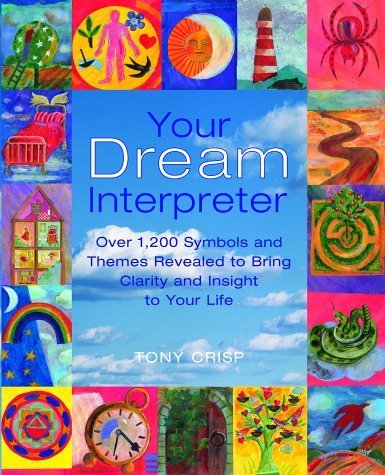
Your Dream Interpreter
Your Dream Interpreter
In dreams you are freed from the usual restrictions of mind and body, of social rules and personal limitations. But beside meeting your wonderful creativity, you may also meet and transform the shadows of your fears and negative attitudes.
Your Dream Interpreter is available at Amazon USA and Amazon UK.
Sections Include
THE DREAMERS’ WORKBOOKINTRODUCTION – What are dreams? The Amazing experience of dreaming.
THE DREAM DICTIONARY – An A to Z of DreamsINDEX OF DREAM THEMES AND OBJECTSBIBLIOGRAPHY |
The Vision of Dreams
Dreams reveal to us things we are ususally blind to
That we have a word such as unconscious in our vocabulary means we acknowledge there are things we cannot ‘see’ about our own existence, about our own body, and about our own mind, intentions and feelings. Many writers on psychology have suggested that the part we know about our own brain/mind is about one tenth its possible size, and we use about one tenth or less of our potential.
In trying to understand this we may come to see that most of our own existence and mind is outside the boundary of our everyday knowing. This has always been realised in most ancient cultures, and many strange and refined techniques were developed to take awareness beyond the boundary of its normal knowing into the land of the ‘unknown’. In this century many people have attempted the same thing using mind expanding drugs or techniques of meditation or altered states of consciousness. See: altered states of consciousness; esp in dreams; the definitions of dreaming under Freud; out of body experience; yoga and dreams.
This difficulty in crossing the boundary of knowing into the unknown is a sort of general blindness most of us suffer. Considering that dreams portray a very different view of life in which this boundary often does not exist, we can say that dreams are a leap beyond our blindness into full supersensual life. In our dreams we can often see the meaning of life experiences we are failing to understand in waking; we can look ahead into what our attitudes and temperament are creating in our life; we can look deep into the workings of our body, and in general extend our senses and awareness beyond any known limits. See: Cayce, Edgar; collective unconscious; wife; dead husband and cannot find husband under family and relationships; hallucinations.
Many modern physicists, working with the information arising in experiments with quantum theory, tell us that our view of the world is based upon our blindness, and is very limited, and through its limitation, unreal. Yet this view we take to be the REAL universe.
The physicist Bohm defines this problem by saying that there are two orders in our experience of the world around us. There is the “explicate” order and the “implicate” order of the physical universe. He defines the explicate order as the impressions of the world gained via our senses and the interpretations the brain places on these impressions. These impressions and the brain’s interpretations – based on millions of years of evolutionary experience and input – lead to a view that we each have separate minds in isolated bodies. The implicate order is the universe as it is when we move beyond the limitations of the senses and the brain’s evolutionary programs. Then we begin to see the universe as a single indivisible whole, and ourselves as intricately part of that whole.
Bohm says that “if we don’t see this it’s because we are blinding ourselves to it.” He goes on to say that “If we don’t establish these absolute boundaries between minds, then it’s possible they could unite as one mind.”
An example of this seeing beyond our conditioned blindness is given in this man’s description of something he ‘saw’ when he moved beyond his usual boundaries:-
I saw an influence in action pressing human society into ever greater super-organisms. These organisms either evolve into functioning new forms, or fail and break down. And by organisms I mean huge groups of people working toward similar goals, such as we find in political or religious groups, or even in nations or social groups. The human body is a super-organism for instance, and combines the workings of billions of cells. What I had failed to see previously is that human beings, despite their felt isolation and individual identity, are actually moved by similar forces as cause cells to gain a common identity in a body.
I saw a push toward a new level of complexity and size which is integrating and using is technology. This new super organism within human society is digesting technology or interiorising it as an integral part of its new organisation and size. This is similar to the way the body has integrated certain things into its own cells, or uses exterior bacteria to help digest food.
The jump to a vastly greater size is enabled by the technology the super-organism incorporates. So if we take human beings as the cells in the body of this huge super-organism, they constitute the living soft tissue, but the nervous system are being formed of the computer driven information and control highways emerging at the moment. And if we are not blind, we will recognise that the equipment we have created is part of our greater body now. Still more though, we must recognise that the huge organism we are incorporated into is more than we are ourselves, just as the body is greater than the cell. If we can see this then we may also recognise that as a human being we may be driven by urges arising in us that are not from our own isolated mind – because our mind is not isolated. Overall our direction arises in large measure from the drives pushing the super organism, and the direction of society is created by the direction of the super-organism.
But how does that help us? What can we do about our blindness?
It helps to understand what dreams can do, so here are some examples.
- An expression of what is happening in the physical body. Some doctors consider dreams to show signs of illness long before they are evident in other ways. Women frequently know they are pregnant very early on through sleep awareness in a dream. See: body; body dreams; Kasatkin_Vasily; consciousness-mind body split.
- A link between the sleeping mind and what is occurring externally. For instance, a person may be falling out of bed and dream of flying or falling.
- A way of balancing the physiological and psychological activities in us. When a person is deprived of dreaming in experiments, a breakdown in mind and body quickly occurs. This type of dreaming can often be a safety valve releasing tension and emotion not dealt with in waking life. See: compensation theory; self-regulation dreams and fantasy; science and dreams.
- An enormously original source of insight and information. Dreams tap our memory, our experience, and scan information held in our unconscious to form new insights from old experience. Dreams often present to us summaries or details of experience we have been unable to access consciously. Sometimes this is as early as life in the womb. See: creativity and problem solving in dreams.
- A means of compensating for failure or deprivation in everyday life, and as a means of expressing the otherwise unacknowledged aspects of oneself. Such dreams are a move toward wholeness. See: compensation theory.
- In dreams we may be integrating new experience with what we have already gathered and digested. In this way our abilities, such as social skills, are gradually upgraded. See: computer, computer-dream process as a; Evans, Christopher.
- Dreams often stand in place of actual experience. So through dreams we may experiment with new experience or practice things we have not yet done externally. For instance many young women dream in detail of giving birth. This function of what might be called ‘imagination’ is tremendously undervalued, but is a foundation upon which human survival is built. See: imagination and dreaming.
- An means of exercise for the psyche or soul. Just as the body will become sick if not moved and stressed, so the mind and emotions need stimulus and exercise. Dreams fulfil this need.
- An expression of human supersenses. Humans have an unconscious ability to read body language – so they can assess other humans very quickly. Humans have an unimaginable ability to absorb information, not simply from books, but from everyday events. With it they constantly arrive at new insights and realisations. Humans frequently correctly predict the future – not out of a bizarre ability, but from the information gathered about the present. All these abilities and more show in our dreams. See: esp in dreams.
- A means of solving problems, or formulating creative ideas, both in our personal life, and also in relationships and work. Many people have produced highly creative work directly from dreams.
- A presentation in symbols of past traumatic experience. If met this can lead to deep psychological healing. Such dreams are therefore an attempt on the part of our spontaneous inner processes to bring about healing change. See: abreaction; compensation theory; nightmares.
- In the widest sense nearly all dreams act as a process of growth or a move toward maturing. Some dreams are very obviously presenting internal forces or dimensions of experience that might lead the conscious personality toward a greater balance and inclusiveness. See: individuation.
- A way of reaching beyond the known world of experience and presenting intimations from the unknown. Many people have dreams in which ESP, out of the body experiences, and knowledge transcending time and space occur. This type of dream may indicate a link between the present person and people who had lived in the distant past; or between the dreamer and all existing life. Some of these dreams present powerful insights into how the transitory human personality may arise out of an eternal consciousness. They thus deal with the spiritual aspects of human nature.
Some examples can be see at Inspiring Stories; Life Changes; Breaking through to the Psychic and Spiritual; My Life in Death; Acting in Your Dreams: