Posts Tagged ‘dimensions of self’
Autonomous Complex
Many of the characters or elements of our dreams act quite contrary to what we consciously wish. This is why we often find it so difficult to believe all aspects of a dream are part of our own psyche. Some drives or areas of self act or express despite what we would want. These are named autonomous complexes. Recent research into brain activity shows that in fact the brain has different layers or strata of activity. These strata often act independently of each other or of conscious will. Sensing them, as one might in a dream, might feel like meeting an opposing will or being possessed by an alien force. Integration with these aspects of self can of course be gained. See Levels of the Brain; The Two Powers.
A modern view of the personality says that our mind is made up of many modules which are quite distinct. These modules, such as the sexual drive and the ability to speak, usually function in a way which is reasonably integrated. But many areas of dissimilarity are evident if we closely observe the workings of our own responses to life experiences. Because we each hold certain ideas about ourselves – our self image – things we do which do not express this self image may shock or even frighten us. Actions arising from a module of oneself which does not express our accepted self image, may give rise not only to fear, but also a sense of evil, or being possessed by evil.
An autonomous complex may be recognised by any one of four major signs. Firstly we may project enormous feelings of love, repulsion, hate or even fear upon another person we know or meet. The power of these feelings or convictions is so great they create a bond between oneself and the other person. Often these feelings lead us to feel there is a fault in the other person that is repulsive or immoral, and which we find very difficult to accept. For instance a man might see another man he knows committing adultery, and feel so repulsed by the act that he goes around criticising the man, only to find years later that he had been repressing the trait in himself. The very strength of the energy with which we criticise it in others may be equal to the strength with which we repress the urge or characteristic in ourselves.
Another way the autonomous complex may announce itself its to take over or invade the conscious personality. It may be an idealistic vision that possesses the person, a mission such as preaching or improving the lot of other people, or something that re-directs the life of the person in a manner that is not rational. This may lead to extraordinary deeds, done in the possessing influence of the vision or urge – or it may lead to foolishness or disillusionment. The apparent change, however, is that the person is under the influence of urges that were not natural, or the person was not capable of, before the invasion. The life of Joan of Arc is an example of being led to great deeds which were beyond the person prior to the invasion.
But of course the complex may express as something evil, the devil or something or someone possessing one. This can be very frightening to many people because they believe that an actual devil or evil is possessing them, rather than a repressed part of them, or the results of a traumatic experience showing itself in frightening images
The third relationship with an autonomous complex is where something happens to destroy or stop all expression or action of these inner characteristics. As much of our uniqueness and facility for variety arises out of the interaction with these various aspects of self, their disappearance leaves a person empty and without any creativeness – a dried husk without any spark of life.
The fourth possibility is that in which the person consciously attempts to find a working relationship with these disparate aspects of their personality and unconscious.
Example: “We spoke to our “primary selves” which were very well developed. They ran our lives or, as we liked to put it, they drove our psychological cars. They were the ones that made up our personalities; the selves that “knew all the answers” when we first met. Then we went on to learn about our “disowned selves.” For each primary self there were opposite disowned selves that were buried or repressed so that the primaries could keep control of our lives. The primary selves were familiar and we were comfortable with them. It was easy to get them to talk and to tell us how cleverly and successfully they ran our lives. The disowned selves were unfamiliar and threatening to our primary selves. Each primary self felt that the disowned self on the other side was a potential destroyer of our wellbeing. For instance: “What happens if you really let go and learned to ‘be’ instead of to ‘do?’ You might never want to work again!” would be the Pusher’s concern.”
As the autonomous complexes hold in them such varied and spontaneous responses to life, they have enormous creative potential if they can be met and expressed in a way that does not dominate or destroy the central personality. The characters we meet in dreams, their variety and difference to how we know and think of ourselves, present us very clearly with the enormous variety of talents, sensitivities, possible approaches to a situation, and personality types that we hold within us. If we can tap them they are an enormous resource. Although it can be very disorienting and even frightening to meet ones internal infant, and feel its explosive moods and deep instinctive longings, it can enlarge our perspective of life enormously, as well as our ability to relate more widely.
Apart from the infant there are many beings we touch in our dreams. Everything from the deeply animal such as the dog in our dreams, or the wolf, to the sadist, the lover, the monk and the business tycoon. If we do not meet these characters and manage them in our life, they will certainly manage us, and lead us into relationship tangles, emotional responses and actions that are not what we ourselves choose to be or feel. See: examples under compensation; sub-personalities; Integrating a Parent or an ex; Unconscious; Alien
Artists and Dreams
We are constantly giving meaning to a torrent of impressions that we meet through our senses and from within us. We give form to raw experience. We scan our enormous wealth of words, phrases, context, to arrive at an understanding of what is communicated verbally or in writing. If we could watch this process taking place, we would observe a constant searching and rejection of non-hits, a lining up of possibilities, and a bringing to the forefront of what we sense are highest probabilities.
Our mind/brain is a flashing loom of connections, a constantly moving wonderful network of links between billions of cells. This flashing creative network that constitutes the miraculous background to our responses, our feelings, our thoughts and spontaneous fantasies and dreams, is constantly forming patterns from the multitude of experiences we have. It constantly tries to match these patterns against what is already known or learnt. It draws out from the chaos of memory and incoming experience whatever it can liken to what was met in the past. What it can’t match it tries to put into some sort of order or to give a form to. And within all this constant activity the search for personal meaning goes on – Who or what am I? How can I survive? Is there a way ….?
Out of such a profoundly integral search for meaning, as artist, writer, musician, we may project the subtle forms of our inner meanings into the art form we use. We may create shapes, places, people, and feelings. Out of the flashing web of our own sentience we create life – our life – with its own conceptions of what it is to exist, what it is to love or hate, to strive or fail.
Even the most modern of dream theories agree that it is out of the fathomless depths of our drive to give meaning to impressions, that we create dreams. It is out of the barely formed impressions and understanding of the dreaming impulse that we create and live. In fact many artists of every discipline – and I now use the word to include musicians, painters, writers and architects – have directly drawn from their dream life.
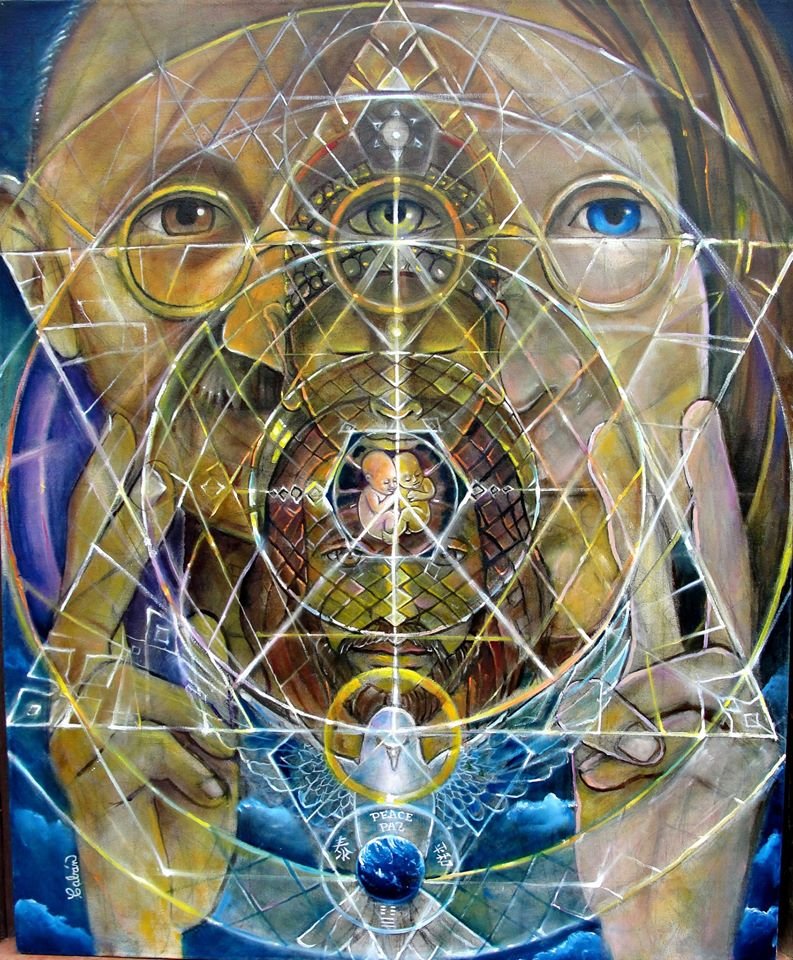
What we cannot quite grasp – what is too vast and many sided for us to hold entirely in our thoughts, we give form to in paintings, in carvings, in sound, in piling rocks one upon another to form a monument. We may then venerate or hold as of immense value such art forms. They hold in them for us the vast dimension of the ungraspable, of the infinity of our own within. They stand before us as represent a journey of lives of the alien in our midst, in ourselves. They remind us of what we are not masters of, and what may take hold of our life. See
 |
In past times tribal people stood in awe of their own existence. They recognised, even if it were unconsciously, the incredible journey they had made from being an unconscious animal, to the attainment of personal awareness and human society. They represented this awe-full experience in rituals, and symbolic paintings and sculptures such as the totem. They also recognised in their art the immense journey ahead, of claiming the possibilities of human life, and put this into their art. How do we deal with the powers that overwhelm us and drag us into mass murder in war and social upheaval? How do we create a personal and social world that we can be proud of? |
In writing about Symbolism In The Visual Arts, (Page 255 in Man And His Symbols, Jung)
Aniela Jaffe mentions the drawing of Klee, interestingly called The Limits of Understanding, which expresses this attempt to put into form what cannot be thought. Jung said that a true symbol appears only when there is a need to express what thought cannot think or what is only divined or felt.
The great artists of any culture give to us what we may have failed to see ourselves. They portray to us the spirit of our times, and our predicament, and perhaps even a passage through the dilemmas we face. Sometimes they manage to break through the cultural plethora and froth of everyday life and display an insight into the fundamental forces of life, renewing our own connection. To do this they face a personal death into the unconscious. They experience darkness and light that many of us may not dare to face. They live within the great forces of their dreams more intensely, more fully than those of us whose awareness is centred on the everyday surface produced by the concepts of life generally agreed upon.
When an artist manages to meet and give birth to one of the spirits of our age, whether it is a terrible demon of our times, or a healing angel, it speaks to us beyond our reasoning. It draws crowds, it holds attention. In the early part of this century the artist Kandinsky wrote that ‘The art of today embodies the spiritual matured to the point of revelation.
Something that we must recognise as an enormous shift in human awareness that has taken place in our own times, and which must influence art from here forwards, is the attainment of self-awareness we have been helped toward by the findings of modern psychotherapeutic schools. This form of self examination has enabled us to explore the wealth of pain and wonder usually forgotten in the mists of childhood. But it also lays bare the struggle, the enormity of the evolutionary movement toward consciousness, toward being human. And there is tremendous art here when it is discovered; art expressing the meeting between the social individual we try to be, and the animal we are still largely immersed in within the depths of our mind and body. In fact we are the whole spectrum of things from sub-atomic particles, through molecular survival and interactions, on into the basic living organisms and creatures up through the lizard, the mammal and the human. All these things are active in us, in harmony, in conflict, in process of becoming. Out of this weaving loom of life all art and music arise; all life experiences an expression of it.
As an example, Thomas De Quincey’s Confessions of an English Opium Eater describes his fantastic dream life over a period of years. De Quincey started to take opium as a sedative. It led to a heightened awareness of how the mind can produce powerful images and memories. He writes that ‘In the middle of 1817, this faculty became increasingly distressing to me.’ Not only did his inner visions present ‘… nightly spectacles of more than earthly splendour.’ But also ‘…. vast processions moved along continually in mournful pomp. Concurrently with this, a corresponding change took place in my dreams; a theatre seemed suddenly opened and lighted within my brain.’ Such experiences led De Quincey to feel ‘deep-seated anxiety and funereal melancholy.’ At times he might recall the ‘minutest incidents of childhood, or forgotten scenes of later years, were often revived.’ ‘I could not be said to recollect them; for, if I had been told of them waking, I should not have been able to acknowledge them as parts of my past experience.’ In his visionary state however, he says ‘I recognised them instantaneously . . . I feel assured that there is no such thing as an ultimate forgetting.’
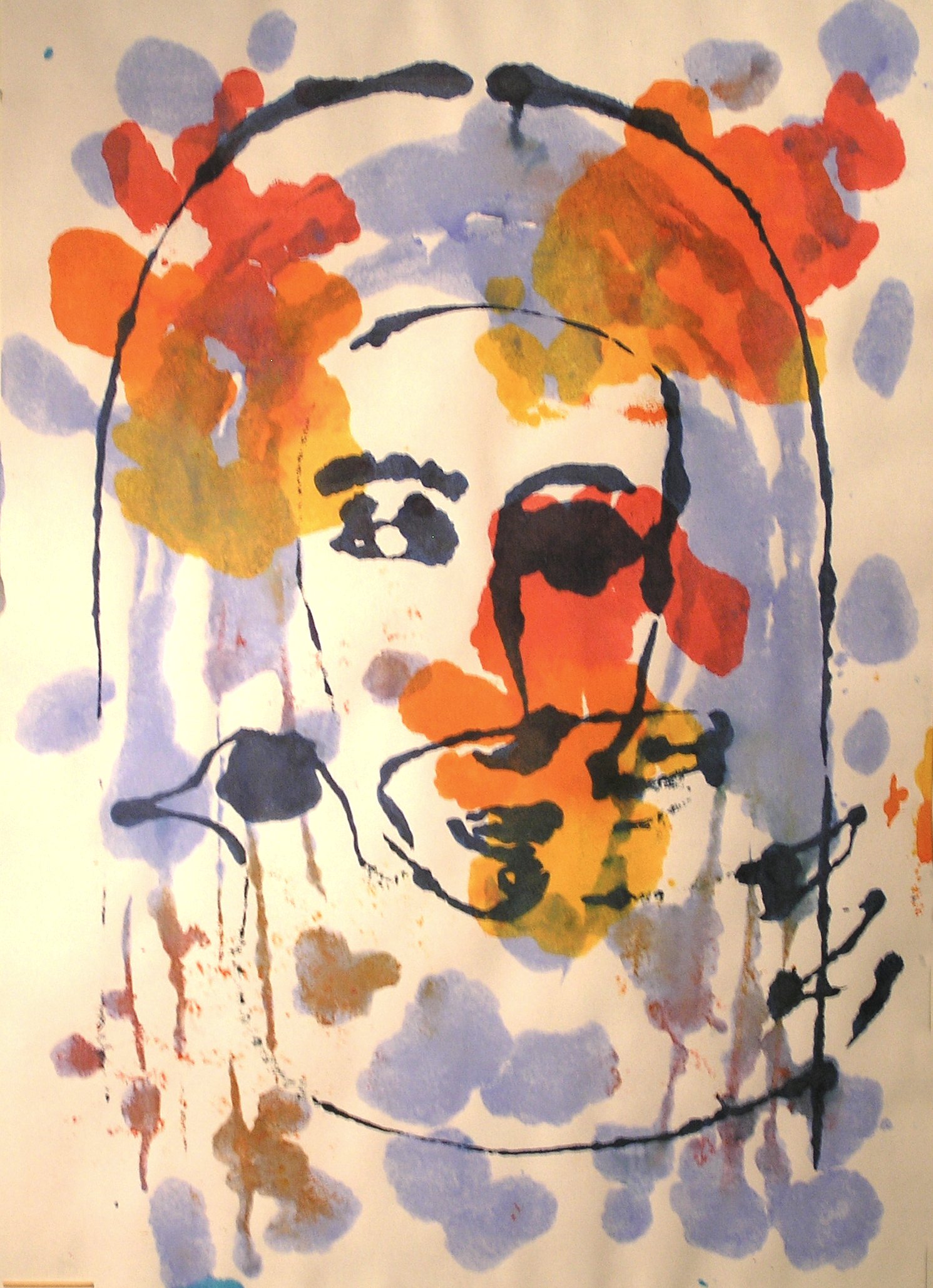 |
De Quincey’s deep seated anxiety and melancholy, in our present times, would be signs of an underlying neurosis which could have been dealt with by exploring his fantasies to their roots in his personal history – already being touched on spontaneously by him. Whether we take the example of De Quincey’s opium aided fantasies, or the visions of Christian mystics such as the temptations of St. Antony, art and religion has at least a facet of being a symbolic way of meeting a neurosis. It is only when we reach through the symbol into what it depicts about us personally, that we move from this historical symbolic form of healing and representation. |
One cannot of course limit the definition of art and dreams to that of dealing with hidden neurosis, or even of the move toward wholeness. Therefore it is interesting to remember some of the artists who directly used dreams as part of their work. William Blake for instance purposefully made use of dreams not only as sources for his art, but also for invention – his method of printing for instance. He particularly tells of the man who taught him painting in his dreams. Blake actually drew the face of this character.
In the 1950’s the painter Jasper Johns was working as a window dresser in New York. In a dream he saw himself painting an American flag. In waking he painted the flag from his vision of it in the dream. The painting became a powerful force in an American revolution in art.
Salvador Dali consistently used dreams as a basis for his paintings. He tried to preserve his dream imagery in his art, and particularly to portray the subtleties of time and space. He referred to his paintings as ‘hand painted dream photographs.’
A number of film directors also used their dreams in the art. Ingmar Bergman tried to portray episodes from his dreams as accurately as possible. He felt that dreams have the ability to help people find points of connection, to link people. Carlos Saura used fragments from his dreams to capture atmosphere and environment.
For each of us, our dreams are our own studio in which we nightly create beyond our waking talent to produce the new, the novel, the unexpected and the deeply true. We are each visionaries, artists of the night and live in another dimension than that of the body. See: archetype of the artist; compensation theory; creativity and problem solving; hallucinations and hallucinogens; hallucinations and visions.
Archetype of the Void
Fundamental to all experience are the opposites of emptiness and fullness, space and substance, sound and silence, something and nothing, female and male, light and darkness. We not only meet these polarities at every moment in such things as hearing a sound that is only apparent because it is surrounded by silence – the silence between the sounds – but also all people and objects are only individually identifiable because they exist in empty space. But more important than that in understanding the archetype of the void is that each day we cycle through the alternating experience of existing and not existing – of having focussed personal awareness and then meeting the loss of it in sleep. The midway point between these polarities is dreams.
In dropping into this experience of sleep where there is a void or loss of personal awareness, we lose any sense of self and body and so the transition from waking self awareness to the void is easy. But the archetype of the void is about meeting it with awareness. For many people this can be a difficult or frightening thing. We tend to think of the void as a huge nothingness, a vacuum in which the human personality will disappear. This can seem very frightening, that behind everything is a sort of nothingness. The amusing thing is that this is an everyday human experience. In sleep we have dropped into that void. Our personality has indeed, as far as we are concerned, melted away and disappeared. Yet the next morning we awake and all is well. We have survived.
When people think of the void they usually see it as a destruction of everything – a death of self. But the nothingness of the void is part of the paradox of existence – for the nothingness is at the same time everything. But everything is all inclusive. As such it cannot have any defined characteristics or shape, otherwise it wouldn’t be everything. This is because if you were to say what a beach is, you could not say the sea was the beach, or the sky, or the land. None of them separately is the beach. The beach is the indefinable amalgam of them all. In just that way the Nothing is the indefinable everything that underlies the particulars of life. The Next Step.
The conscious meeting with the void is part of the gradual expanding of personal awareness. It is akin to, or the same as, going to sleep with full awareness. When we sleep our body and brain enter into a very different state; we lose awareness of sight, hearing, taste, smell and touch; our voluntary muscles are paralysed, and our experience is internalised. So, consciously entering sleep is a journey into a very strange world completely unlike our waking life. Part of that world is the full surround virtual reality of dreams, but there are dimensions beyond imagery, beyond form, beyond the opposites, beyond personal separated existence. This is the void, and to confront it consciously is a transformative experience.
Seeking the void is at the heart of the Buddhist way of life, as it is also at the heart of Christian mysticism. See Dimensions of Human Experience; Cloud of Unknowing; buddhism and dreams; void; yoga and dreams.
The void may be depicted in a dream by a shimmering haze, a transparent wall into which you can walk and become absorbed. At times it might be shown as the ocean, falling into space with just points of light, or a huge abyss’ or a massive hole. At other times it might be met as an ordinary scene or object that yet is seen as infinite space or complete liberation or a wonderful or threatening emptiness. Meeting such imagery or experiences in any degree produces powerful personal change. It produces a new sense of oneself; one no longer focussed on the ego or body personality – the self we consider ourselves to be through our body shape, gender, beauty or ugliness, or through our social position, our wealth, work or acclaim. It is, as the Buddhists name it, liberation. Meeting it is part of what Jung calls individuation. See: example under void.
Example: To my amazement a huge living and wondrous circle appeared on the wall. It was full of movement, everything dancing in time to music. At the very centre of the circle was emptiness, nothing, a void. Yet out of this nothingness all things emerged. There were plants, animals, people, hills, rivers and mountains all coming to birth. They danced out in their own individual movement, yet each unknowingly was part of the whole wonderful and intricate dance which made a great pattern and movement in the body of the circle. All danced to the periphery and there turned and moved, still in their ballet, back to the centre. At that centre they plunged into its oblivion again. But at that very moment new life sprang from it to dance once more.
When we do meet it however, the strange thing is that what appeared as an absence or denial of oneself is actually an addition. Suddenly we see that everything has been added, and nothing taken away.
The negative aspect of this archetypal experience is the loss of any personal meaning or motivation, the feeling of melting and perhaps even death. The positive side is of tremendous opportunity to live beyond previous limitations and boundaries; the realisation of ones own core existence in timelessness and infinite potential, along with the meaninglessness of prevalent views of death.
Useful Questions and Hints:
What do I feel about the nothingness that constantly surrounds me?
Am I scared of the idea of that at base I might not exist in the same way I usually see myself?
Can I let go of all that is involved in the little me and surrender to the vast me?
It might be helpful to read Individuation and Methods of Awakening.
The Night Journey – the Search for Self
Each of us are constantly gathering information about who we are, what we are capable of and what the meaning of our life is. This is often put into an archetypal form as the great quest, a journey or the great pilgrimage. For many it is expressed as the search for God, Allah, or the many names people of the world give to what they experience as the Great Unknow Mystery, and the often extraordinary efforts people make to grow beyond the pain of childhood or adult trauma. In some it becomes the quest for knowledge when one truly tries to understand rather than simply remember facts. It is seen in artists attempts to go beyond themselves in creative acts; in the spiritual quest for the imperishable; the search for real love or even the way some people manage to transcend the limitations of their body. They are all aspects of this search for self. The journey is endless because it is a journey through infinity.
I am a wave on a shoreless sea.
From no beginning
I travel to no goal,
Making my movements stillness.
Constantly I am arriving
And departing,
Being born and dying.
I am always with you
And yet have never been.
Throughout history we have examples of how such quests were lived out. Mohammed for instance, describes his massive breakthrough into what he felt was a cosmic revelation as The Night Journey, which occurred in a dream. Siddhartha, after years of discipline and privation, finds a new way of experiencing life in what we now called enlightenment, and became the Buddha. Jesus transformed from a carpenter to the Christ at baptism through an opening to a new type of awareness. Thousands of people in today’s world have followed in the footsteps of those early pioneers and experienced for themselves the meeting with what Jung calls The Self – the emergence into an experience of greater wholeness or completeness; the falling away of the defences, resistances and fears that have held us back from our fullest and most profound experience of ourselves; an experience of enlightenment. It is not a case of developing an attribute we didn’t already have, but of bursting through the personal or culturally imposed barriers that have walled off this greater expanse of self from easy access. See Enlightenment
In a sense, every dream is a part of this huge journey which is our life. Each dream is a facet of what is met in experiencing – meeting – our own existence. There are definitely highlights in our many dreams – times of critical and arduous difficulties, such as we find in the great quests such as Jason and The Golden Fleece, and the Odyssey. The journey is one we are all on, and our dreams and archetypal images are but ways of depicting aspects of what we meet, the enormity of the ordinary, the hidden depths of a problem we encounter, the wonder of possibilities awaiting discovery, the way into the trackless realm beyond collective norms. The journey is from dependence toward independence, from being a part of collective humanity to the actualisation of our own unique identity. This journey to oneself is, paradoxically, also the journey to the universal, to merging of self with the One. See: archetype of the hero/ine; Inner World
Example: I was in the army. We were going to fight the Germans. We collected together in a large flat, the Germans coming also. We came to know each other not as enemies but as people. I was so moved by the feeling of brotherhood I nearly wept.
Then I was on a ship. It was night. Ahead loomed land, some miles away. On the left, high up in the hills, flashes of guns could be seen. The captain explained that the guns were bombarding and terrorising people. It was our mission to stop them. As this was explained I felt, for the first time in my life, a real feeling of being a part of a group, and being willing to risk or give my life for my people. It was almost a religious feeling. T.
This is a typical ‘night sea journey’ dream. The dreamer was starting to delve into himself and the dream shows him ready to give his life to dealing with his internal conflicts. It also shows the love and courage necessary to make this journey.
There are grand stages or points on the journey. Most of the great religions attempt to depict these stages, although there can never be a final definition. In Christian symbols for instance we have the annunciation, the divine birth, the recognition at the temple, the baptism, the teaching, the marriage; the trial and crucifixion, the death and the resurrection, and finally the ascension. All of these depict psychological events in the process of meeting ones own depths, of the growth to ones own maturity and wholeness. Other cultures define these stages in other ways. The Hindu teachings give them as four major stages. Namely the student, the householder, the retired person, and the fourth is the ascetic (also known as a sanyassin or a sadhu). See The Inner Path to Christ Intro
Example: I remember leaving some place and embarking on a journey at night. I’m frightened but I want to make this journey. I approach a stream with a very narrow bridge. It’s dark and I’m afraid I may fall off the bridge. But to continue I must cross the bridge. R.
This extract from R’s dream is typical of the starting of the process of uncovering ones own unconscious darkness and the night of the unknown self we are journeying to. This is the beginning of what is often called the Night Journey and the facing of fears. The Night Journey is itself an archetype involving the search for self. It is called a journey in the night because the person enters into what was previously dark, hidden and unconscious. They enter into awareness of the unconscious. Carl Jung’s frontispiece to his book Man and His Symbols is the entrance to an Egyptian tomb, leading into profound darkness.
Example: My dream is of an endless journey, which takes a road that turns into a circle or maze that is endless. There is cloth covering the sides of the pathway. I have to take sticks of wood to try to lift it out of the way. J. P.
Example: Then imagery came and I was walking in a beautiful forest. The trees were very big and widely spaced, so it was light and giving the impression of quiet space. I felt as if I were beginning a journey and the forest was my starting place. As I walked in the forest I heard a sound coming from somewhere. I had the sense of it beckoning me or attracting me so I go off in search of it. But although it beckons it is difficult to know exactly where it is coming from. There is a sense that it is coming from higher up, from the mountains that stand beyond the forest.
I am experiencing something the imagery is of being in the midst of a tribal group perhaps they are like people from New Guinea or South America. I seem to be lying on the ground and they are in front of me in a long column, all males. They are not threatening, but they seem to be expressing masculinity, perhaps even the source of strength that would go into being warriors. I am apart from the group, an old male. I feel it is something about facing death.
Now they have gone and the women of the tribe are dancing in front of me. They are bare breasted and their dance is about being female. My sense is that they are calling my masculine energy, raising or rousing it in preparation for something like an initiation I am about to pass through. I am the elder and they are readying me for a further initiation. What they are doing is traditional, and it is to set the scene for what I am to face or confront.
Now the preparations have ended and I am to go off alone up the mountains to meet whatever waits for me there. Now it feels as if something is flowing into my body. I am now experiencing a state or condition that has been very marked or strong in my life lately. My breathing became very slow, it seems even at times as if it has stopped, and everything becomes very still. It feels like being dead. My body becomes so still it disappears and all that is left is awareness submerged in enormous emptiness or space. There is a paradox in this experience because it feels as if I, my sense of self, has melted away, and yet there is still a very definite experience of existing. I suppose what has stopped is what I have called movement. The movement of thinking, of feeling, of longing or hoping for things.
There is this huge reality confronting us all the time. We call this reality death. And often that has an awful face for us. But I am feeling it as joy, a most wonderful joy. It is here in the darkness I am experiencing – that joy. The waves of this gentle joy flow through me. It is like floating in a subtle ocean and my consciousness, my being, is gently lifted and moved by the waves of this quiet joy.
Here the waves of that joy were big, lifting me high in a coloured spectrum of rippling, vibrating radiance. My being was the waves. I was myself waves of rippling sparkling radiance. At the same time my awareness could switch back to what was happening with my body, and it was shaking, vibrating with energy flowing through it. As this happened it really seemed as if my body was being absorbed into the energy. This felt to me as if my body was melting and becoming part of the emptiness that was rippling through me, that was me. The great waves of life were absorbing my personality. It was being broken down just as our body breaks down food we eat and digests. It was drawing me back into itself. Living or dying is a joy. I love you life. I love you death. You are both the same beauty. Beautiful mystery. I cried out with the wonder of it, “Oh my Darling.”
Our dreams often insist that the journey is everlasting, not even ending with death, but moving through the great cycles of the universe. Only by making the journey can we find our own wholeness and our own place in life with any awareness. The term probably arose with the description of Muhammad’s experience of enlightenment which he called The Night Journey. Jung called it the Night Sea journey.
Paul Levy writing about this says: “This process can be so extreme, so radical, that the ego experiences it as death …. This experience is related to the shaman’s and Jesus’s descent to the underworld as well as the archetypal journey of the wounded healer. See Vibrate Vibrating
Example: As I walked among them I saw their lined faces, bent backs, and thought/wondered whether this could be healed and released. Now their doctor/priest came to them. A big man who seemed to have a slightly lame right (I think) leg. He had penicillin on his hands – to heal the many sores his people had. He then laid down in the small channel seen in cowsheds to carry of the urine and cow shit. It had been cleaned, but a cow had shit in its slightly. He asked for blankets to lay on. These were brought. He lay down and prayed. This was the inner strength his people needed.
This is an example of the wounded healer.
To quote an ancient alchemical text “…the Tincture, this tender child of life…must needs descend into the darkness of Saturn (which symbolizes the point of lowest descent, of death), wherein no light of life is to be seen; there it must be held captive, and be bound with the chains of darkness.”
Mythologically the night sea journey is described as being swallowed up by a sea monster and thereby carried into the depths of the sea – the story of Jonah. Psychologically it is the experience of ones life energy turning inwards and descending back toward its root or source. In doing so our poor vulnerable self awareness, our tiny spark of consciousness is carried beneath the protective boundary of waking awareness into its own depths. This is akin to travelling into the darkness of sleep with awareness. Sleep, after all, is a strange country in which our waking self seldom if ever travels. Imagine, if you have not already made the journey, delving into the level of yourself where your eyes no longer see, your body sense of form or size and touch have disappeared. There is no hearing of the external world. You are sinking into the country of what we call the mind or consciousness, the world of sleep, death and dreams, in which the usual boundaries of experience are taken away. Here you meet – given form by your fears and cultural symbols, as if with real bodies – your own fears, the pains buried deep in your past, the residues of all past actions so far unredeemed.
But you also meet the wonder of an enormously enlarged awareness, the sparkling immediacy of questions answered, the splendour of bodiless life linking in love and mind with an infinity of others. Here you experience the vision of the spirit’s journeys into time and space, and its life in eternity. Here you are the genderless consciousness of angels.
Example: This is when I entered into the house of God. At first I saw the image of a huge cathedral or church with a magnificent domed roof and I knew that I was in the house of God. I felt the utopia, I felt like I have never felt before, so very good, so excellent. I knew all things. I didn’t have to read the bible or any kind of teachings because the answers are all here in the presence of God. In this state I could ask any question and know the answer. I knew God, yet I was God because there was no separation. Neal C.
Example: Suzanne Segal in her book, Collision with the Infinite, says, There is no one I could instruct to do something to make you the vastness. That’s already and always who you are.
There is no end to all of this, just as there was no beginning. There are constant “bus hits,” as I now call them, in which the infinite expands yet again and again. The substance of the vastness is so directly perceivable to itself in every moment that the circuitry at times requires another adjustment phase to get used to more infinite awareness. When asked who I am, the only answer possible is: I am the infinite, the vastness that is the substance of all things. I am no one and everyone, nothing and everything—just as you are.
And before you say you think that is all preposterous think about this – you can see Less than 1% of the electromagnetic spectrum and hear less than 1 % of the acoustic spectrum. As you read this, yon are travelling at 220 kilometres per second across the galaxy. 90% of the cells in your body carry their own microbial DNA and are not “you”. The atoms in your body are 99.9999999999999999% empty space and none of them are the ones you were born with, but they all originated in the belly of a star. Human beings have 46 chromosomes, 2 less than the common potato. The existence of the rainbow depends on the conical photo receptors in your eyes; to animals without cones, the rainbow does not exist. So you don’t just look at a rainbow, you create it. This is pretty amazing, especially considering that all the beautiful colors you see represent less than 1% of the electromagnetic spectrum. See: The Next Step.
Useful Questions and Hints:
Have I consciously made the decision to take the journey of self revelation?
If I am on this journey what stage am I at? See: individuation for stages.
Am I meeting, or have I met the dying of self – if so what changes is it bringing?
Also it is worth reading Levels of Awareness – Jesse Watkins Enlightenment – Methods of Awakening – Meditation with Seed – Life’s Little Secrets – Dimensions of Human Experience