Posts Tagged ‘Dream Encyclopedia’
The New Dream Dictionary
The New Dream Dictionary
On the 11th of April 2013 I published a revised version of The New Dream Dictionary. It is a much fuller and comprehensive book and is wonderful and full of information. It is not the Dream Dictionary Ultimate that I am in the middle of working on, but was produced for the US cell phones. Please note: The New Dream Dictionary is currently unavailable, pending re-working (June 2017)
 |
RECURRING DREAMS and their significance NIGHTMARES – what they reveal and how to banish them OUT OF BODY EXPERIENCES – Giving real insight into the subject RELATIONSHIPS – what your dreams are telling you PSYCHIC AND PROPHETIC DREAMS – Tells you what they are WORK – are you following the right career path? Your dreams will tell. FAMILY – how to resolve old hurts and gain new perspectives PROBLEM SOLVING – in your dreams – how to carry the solutions into real life GAINING INSIGHT – into your own behaviour and that of others MAXIMIZING HEALTH – recognize healing foods, danger signs and more. See what is happening in your body, in your mind, and in your most guarded self and intuitions…. Discover what your style of dreaming (color, smell, setting, and other key elements) say about you. It’s all here, and more, in the ultimate guide to your world of dreams. |
“I’ve been using Mr Crisp’s book for years and find it invaluable in my quest to understand my dreams better. Unlike many other books which seek to tell you what your dreams mean, Crisp guides you through interpreting your dreams as individual and personal stories about your own psyche.”
Dream Dictionary
Now On Kindle and Amazon Books – also directly from Random House
 |
|
Get Dream Dictionary in Kindle format from Amazon USA – Or get it direct from
Random House
You do not need a Kindle to read Kindle publications, you can get them and read them on your PC or Apple machine by clicking Kindle for PC or Kindle for Mac.
And from Amazon Books UK and USA.
Did You Know……
- A dream can be a forewarning of things to come?
- Dreams can help you solve problems in your everyday life?
- Women dream more during PMS?
- Sleepwalking occurs most frequently in adolescence?
- You can direct your dreams?
- You can enter a dream while awake and explore it – so a walk in the unconscious?
What People Say:
“Once in a while, you find a special book that remains with you always, a book that is inexhaustible in the wealth of information on its pages. DREAM DICTIONARY is one such book”
“I am constantly amazed by how clear my dreams become when I look up their elements in this book.” From: “Shaw 14”
“I have purchased 10-12 dream dictionaries over the years, and this one is the best that I have encountered” and “Without fail, this book has brought me to a greater understanding of my dreams” From “Outwood”
“It’s easy to say this is the best, but if you are interested in understanding and interpreting your dreams, this is the standard by which all other dream books are measured” From: “A Reader”
Individuation Independence
Change Within Change
One of Carl Jung’s most interesting areas of thought is that of individuation. In a nutshell the word refers to the processes involved in becoming a self aware and independent human being. The area of our being we refer to when we say ‘I’, ‘me’ or ‘myself’, is our conscious self awareness, our sense of self, which Jung calls the ego. In recent years a few of Jung’s followers have begun to study the events occurring as an individual ego grows from infancy through childhood. This changing growth is described as never becoming final without a major break with the person’s original wholeness. This is why the person must constantly strive to re-establish its relation to the Self (ones wholeness, often represented by a holy figure) in order to maintain a condition of psychic health.
From Animal to Human
The autobiography of Helen Keller has helped in understanding what may be the difference between an animal and a human being with self-awareness. Helen, made blind and deaf through illness prior to learning to speak, lived in a dark unconscious world lacking any self-awareness until the age of six when she was taught the deaf and dumb language. At first her teacher’s fingers touching hers were simply a tactile but meaningless experience. Then, perhaps because she had learned one word prior to her illness, meaning flooded her darkness. She tells us that ‘Nothingness was blotted out.’ Through language she became a person and developed a sense of self, whereas before there had been – nothing. See Programmed; Every 7 Years You Change
So the words that a parent says to their growing child – or fails to say in encouragement – can have lasting effects.
The journey of individuation is not only that of becoming a person, but also expanding the boundaries of what we can allow ourselves to experience as an ego. As we can see from an observation of our dreams, but mostly from an extensive exploration of their feeling content, our ego is conscious of only a small area of experience. The fundamental life processes in our being may be barely felt. In many contemporary women, the reproductive drive is talked about as something that has few connections with their personality. Few people have a living feeling contact with their early childhood, in fact many people doubt that such can exist. Because of these factors the ego can be said to exist as an encapsulated small area of consciousness, surrounded by huge areas of experience it is unaware of. These unconscious areas of their being direct their life to an extraordinary degree. Individuation means to emerge from unconscious dependence on this hidden side of self. It means to become functionally independent of the archetypes that dominate human life. In many ways it is similar to, and includes, becoming functionally independent of one’s mother and father.
We Grow Like a Tree
In a different degree, there exists in each of us a drive toward the growth of our personal awareness, towards greater power, greater inclusion of the areas of our being which remain unconscious. A paradox exists here because the urge is toward integration, yet individuation is also the process of greater self-differentiation. Another paradox is that this is a spontaneous process, just as the growth of a tree from a seed is – the tree in dreams often represents this process of self-becoming. But our personal responsibility for our process of growth is necessary at a certain point, to make conscious what is unconscious. See Tree Trees
In other words to become a full individual we must accept that we are not alone, but are an integral part of the huge process of life and therefore of everyone and everything.
Because dreams are constantly expressing aspects of individuation it is worth knowing the main areas of the process. Without sticking rigidly to Jungian concepts – which see individuation as occurring from mid life onwards in a few individuals – an aspect of some of the main stages are as follows. See Sacred Tree
Early babyhood – The emergence of self consciousness through the deeply biological, sensual and gestural levels of experience, all deeply felt. The felt responses to emerging from a non changing world in the womb. Also the emergence from a feeling of deep unity with the mother, and of being undifferentiated life awareness. The need to reach out for food and make other needs known. Learning how to deal with changing environment, and otherness in terms of relationship. But particularly, the experience of needing another person for survival, and the process of love-bonding with that person, leaves deep impressions on the developing identity.
Levels of Growth
Childhood – Learning the basics of motor, verbal and social skills. The following dream shows the enormity of what is learned in this stage, and what great changes take place in the psyche through the learning of language. Language itself is like installing a massive computer type program into the developing consciousness. Like any such program, it enables functions and processes to take place that would be impossible without it.
Example: From flying at a great height in the sky I glided down and approached the field to land. It was near where council houses backed right onto the open hillside above two old elm trees – a place I knew well from my childhood. A young girl of about three or four was playing in the field. As I came in to land she saw me and ran away very frightened. I was gliding in the same direction she was running and I called out to her not be frightened. She stopped and I landed. In amazement she looked at me and said, “How did you get to be up there?” Steve M.
Steve explored this dream, and in the role of the young girl came across insights he describes as follows:
As the young girl I had walked from the back door of my house, along the garden path, across a footpath behind the houses, into the field. As I looked through her eyes and feelings, I realised what a long journey it was for me to get into the field. Not a long journey physically in distance, but an enormous journey within myself. To be able to go from the door to the field, I had gone through the long process of learning to walk; I had learned the confidence to be alone; through language and understanding what my parents had passed to me, I had found out how to avoid stinging nettles, and how not to be overcome by my fears of them and of the huge creatures that I knew as cows. This had all taken ages, and so walking into the field was an enormous achievement, especially as I was doing it by myself. Learning to walk itself had taken tremendous practice and perseverance. Learning to be independent of my mother was also something I had had to learn. I had made the inner journey of acquiring an immense stock of information and conditioning regarding the external environment I was facing too. I had slowly learned survival responses to stinging nettles, walking alone, nests, birds, the sun, trees, spiders, stones, the wind, children, adults, worms, leaves on the trees, cars, etc, etc, etc, etc, and so on.
I had never realised before what an amazing education a child has, before ever it goes to school.
At this stage we are learning the basics of physical and emotional independence. We face here the attempt to find strength to escape the domination, or felt domination, of mother/carer – difficult because one is dependent upon the parent in a very real way – and develop in the psyche a satisfying sexual connection. In dream imagery this means, for the male, an easy sexual relationship with female dream figures, and a means of dealing with male figures such as father in competition. See: sex in dreams.
Example: When a child is small she believes that external world is her inner life. There’s no boundary. A baby in the first months of life does not understand that she and mom are two different people. So everything that happens in her life IS her inner life experience. That’s why early experiences shape our inner landscape and ingrave subconscious patterns of coping as adults.
If things develop well, a child separates and differentiates from the parents in time. Still she internalises parents (I knew only about parents before). If the process does not go well or is not completed, toxic internalised parents keep driving an adult inner life and also many of the external behaviours.
In my opinion the separation process from parents might not be complete therefore a small influence from outside has a strong impact on internal life. Weedy
The dream of the mystic beautiful woman precedes this – a female figure one blends with in a idealistic sense, but is never sexual. The conflict with father – really the internal struggle with one’s image of father as more potent than self – when resolved becomes an acceptance of the power of one’s own manhood. The struggle also takes place in the female, in regard to her male dream images.
Women are Different
Women face a slightly different situation. The woman’s first deeply sensual and sexual love object – in a bonded parent child relationship – was her mother. So beneath any love she may develop for a man lies the love for a woman. Whereas a man, in sexual love that takes him deeply into his psyche, may realise he is making love to his mother, a woman in the same situation may find her father or her mother as the love object. In the unconscious motivations that lead one to choose a mate, a man is influenced by the relationship he developed, or failed to develop with his mother – both mother and father influence a woman in her choice.
Another important thing is that in becoming a woman, she is faced by being taken over by a Life process – menstruation. Today many women control it using drugs. In doing so they may miss a great Life lesson – the fact that they are instruments of Life in its creative process. By controlling it they may not have learn that part of living is controlling, and the other important part is surrendering control. If they never learn that they may not be able to explore their own depths. For their blood is the flow of creation.
At these deep levels of fantasy and desire, one has to recognise that the first sexual experience is – hopefully – at mothers breast. This can be transformed into later fantasies / dreams / desires of penis in the mouth; or penis in vagina; or penis as breast, mouth as vagina.
Example: I have recently gained a new girlfriend. We used to look forward to going out together and going to bed. Since she moved in with me my feelings have changed. I dreamt about her with real hatred. I woke up shouting ‘I hate you!’ Just before I woke her face and hair changed to look like my mother. John – Teletext.
For most of us however, growth toward maturity does not present itself in such primitively sexual ways, simply because we are largely unconscious of such factors. In general we face the task of building a self-image out of the influences, rich or traumatic, of our experience. We learn to stand, as well as we may, amidst the welter of impressions, ideas, influences and urges, which constitute our life and body. What we inherit, what we experience, and what we do with these, create who we are.
Puberty – In a real sense, one has already undergone radical transformations before reaching puberty. The loss of the womb, the death of babyhood with it delicious or terrible dependence, the learning of language, the falling away of early childhood, have all been journeyed through. But now there is greater self-awareness, self-consciousness than ever before, and this makes puberty a transition and a death with many more difficulties. The major changes here are the meeting of sexual drive that urges one toward the opposite sex; the finding of a sense of self that enables one to meet other adults in a world of action and interaction; the success or failure to let the flame of ones life forge action in the world sufficient to satisfy ones urge to power, to creativity, toward recognition and acknowledgment by ones fellows. Failure to achieve these may lead to some level of remaining dependence upon parents for money, emotional support an even housing – lack of full heterosexual adaptation, and so a remaining in adolescent homosexuality – a partial passivity in the world or a difficulty in initiating change.
Learning to Love a Stranger
One of the great areas of learning for this period connects with how to meet other adults outside our family. We begin to turn toward strangers for important reasons such as intimate attention and appreciation; looking for a mate; finding others to work with or acknowledge our own ideas such as music, writing , etc. We try to make things happen in human society, and so meet the co-operation and antagonism of others more fully than protected childhood and its groupings allowed.
During the change from adolescent to adult, one of the greatest of our childhood needs becomes apparent in the way we meet situations, and the choices we make. The need is for parental enthusiastic love and recognition of oneself as a unique person. If we have not received this love we carry in us such pain and need, it influences all our decisions. Even without any maltreatment, the lack of love traumatises us. There are so few of us who have actually received this love to the degree we needed, that the dealing with this inner lack is one of the major tasks before us if we are to reach our full potential. This is often worked out in our relationships and the tribulations that arise out of our desperate need for, or pain regarding, intimacy.
Example: I am a 16-year-old girl. In my dream I wake up in bed with the boy I am in love with beside me. He wakes and we start kissing. My parents come in and throw us out. I am pregnant and he stands by me. When the baby arrives another boy, who is a close friend, says it is his. Jordan – Teletext.
Example: I’m an eleven-year-old girl, and have fancied this boy for ages. I dream I meet him in a town, and he tells me he loves me. Then we are in school uniform and older boys from my school beat him up. I dream this often and wake crying. Now I’m frightened to tell him I love him in case he gets hurt. H.M.J. – Teletext.
Example: I have had this dream for about 3 months now. It is about a bus driver I really like. I am only 15 1/2, and I see him and me making love. He is about 23. The other day he asked me when my 16th birthday was. I wonder if that meant anything. Could you let me know if anything serious could happen between us. Debbie. – Teletext.
Independent Love
Our further process of maturing includes some of the major themes of individuation such as: The journey from attachment and dependence toward independence. This is experienced as an involved detachment with the possibility of loving independence within a relationship. Independence is an overall theme we mature in all our life. In its widest sense, it pertains to the fact that the origins of our consciousness lie in a non-differentiated state of being in which no sense of ‘I’ exists. Out of this womb condition we gradually develop an ego and personal choice. In fact we may swing to an extreme of egotism and materialistic feelings of independence from others and nature. The observable beginnings of this move to independence are seen in our attempt to become independent of mother and father; but dependence has many faces. We may have a dependent relationship with husband or wife. We may depend upon our work or social status for our self-confidence. Our youth and good looks may be the things we depend upon for our sense of who we are – our self-image. With the approach of middle and old age we will then face a crisis in which an independence from these factors is necessary for our psychological equilibrium. The Hindu practice of becoming a sanyassin, leaving behind family, name, social standing, possessions, is one way of meeting the need for inner independence from these to meet old age and death in a positive manner. Most people face it in a quieter, less demonstrative way. Indeed, death might be thought of as the greatest challenge to our identification with body, family, worldly status and the external world as means to identity. We leave this world naked except for the quality of our own being.
Meeting oneself and self responsibility – The fact that our waking self is a small spotlight of awareness amidst a huge ocean of unconscious life processes creates a situation of tension, certainly a threshold or ‘Iron Curtain’, between the known and unknown. If one imagines the spotlighted area of self as a place one is standing, then individuation is the process of extending the boundary of awareness, or even turning the spotlight occasionally into the surrounding gloom. In this way one places together impressions of what the light revealed of the dark landscape in which we stand; clues to how we got to be where we are, and where we might move on. See
The Inner Journey
The landscape is in fact made up of our past, the massive prior experience of the cosmos, nature, our culture and our family, and how we relate to these. This past is the basis upon which all our present experience is built. It is the fact of our physical body, our language, and our family genetic history. But one may remain, or choose to remain largely unconscious of self in connection with these. The Iron Curtain may be defended with our desire not to know what really motivates us, what past hurts and angers we hide, what individual, family and cultural traumas forged our likes and dislikes, our talent and ignorance. It may be easier for us to live with an exterior God or authority than to recognise the ultimate need for self-responsibility and self cultivation. To hide from this, humanity have developed innumerable escape routes – exteriorised religious practice; making scapegoats of other minority groups or individuals; remaining unconscious of oneself through social drugs such as alcohol or tobacco; rigid belief in a political system or philosophy; search for samadhi or God as a final solution; suicide.
This aspect of our maturing process shows itself as a paradox, common to maturity, of becoming more sceptical, and yet finding a deeper sense of self in its connections with the cosmos. We lose God and the beliefs of humanity’s childhood, yet realise we are the God we searched for. This meeting with self, in all its deep feeling of connection, its uncertainty, its vulnerable power, is not without pain and joy. See: First example in spiritual life in dreams.
Master of Dreams
The last of the great themes of individuation is summed up in William Blake’s words – ‘I must Create a System, or be enslav’d by another Man’s; I will not Reason and Compare: my business is to Create.’ A function observable in dreams is that of scanning our massive life experience. Even a child’s life experience has millions of bits of information from which it can gather enormous information about LIFE and SURVIVAL. Out of this we unconsciously create a working philosophy of what life means TO US, and what is real in the world. It is made up not only of what we have experienced and learned in the general sense, but also from the hidden information in the cultural riches we have inherited from language, literature, music, art, theatre and architecture. The word ‘hidden’ is used because the unconscious ‘reads’ the symbolised information in these sources. It is, after all the master of imagery, being the creator of dreams. But unless we expand the boundaries of our awareness we may not know this inner philosopher. If we do get to know it through dreams, the beauty of its insight into everyday human life will amaze us.
In connection with this there is an urge to BE, and perhaps to procreate oneself in the world. Sometimes this is experienced as a sense of frustration – that there is more of us than we have been able to express, or to make real. While physical procreation can be seen as a physical survival urge, this drive to create in other spheres may be an urge to survive death as an identity. Dreams frequently present the idea that our survival of death only comes about from what we have given of ourselves to others. This creative aspect of ourselves apparently is active at the moment of death according to the many accounts of the deathbed review of ones entire life – particularly as such reviews seem to be largely about what one has ‘gathered’ or learned from the experience of living.
There is a disinclination to deeply consider death in North Western culture. What passes for this is the excuse that physical death ends all life, when such a statement is observable not true. Nothing that we can see in the physical world exists outside of evolutionary connections with past objects or forms. Our language, our body, our personality, have all arisen out of what existed previously. The past is obviously alive in the present, so how can there be death to anything except the limited awareness people consider to be themselves, their ego?
Death is the great adventure of the psyche. The great undertaking of individuation takes us into the meeting with our birth and infant traumas. We face the monsters created by our sense of being unloved, of parental desertion or betrayal. The demons of self doubt, of self destructiveness, of worldly struggle and fear spring up to meet us on the journey and we have to do battle. The negative habits of our lifetime pull at us or bind us to our past unless we can break free. The instinctive hungers and drives, of reactive fear, challenge us. Can we take the tiny boat of our self awareness across their swirling and torrential waters? Can we swim in the whirlpool of desire and use its energy to achieve a new awareness and transcendence? Can we meet the unconscious influences of the archetypes and find some ability not to be lost in them? Even if we can, after all these great feats, should we find our way through them, lies not an upliftment of our being into wonder – but death!
The Empty Cave of the Holy Grail
What a strange blow it is, after journeying so far in the psychic adventure of ourselves, after being the hero or heroine of so many battles, that when we come to the Holy Grail, the Golden Fleece, the inner sanctum of ourselves, we meet not a treasure but an empty cave. Nothing is there waiting for us – except death – the strangest paradox of all. Strangely though, it is this nothing, this emptiness, this loss of self, which holds in it the centre of ourselves. With extinction of our effort and drive, with the dying of ourselves, there comes a self-existent radiance in us. The meeting with nothing, the void, is the great treasure itself that penetrates us and transforms us.
Dreams, when they are the great creations of high awareness, suggest the cosmos arose out of a huge death – the big bang – a death planned out of love so that we might exist. Meeting death while alive – relinquishing all we have considered to be the reason for our personal existence – dropping the urge to grasp what has been the goals of ones life, such as sex, money, power, self expression – brings a new life in which we realise our intimate oneness with life. And although this seems like an end as we enter it, as we die to it, the vastness of it promises new and wondrous life. This is an end to the life we have led up to that point. But ends are beginnings in the wider life. For at our very centre is the ever shifting mystery that is life itself. See Void
Nearing The End
“To look truth in the eye is a test of courage. It demands insight into the necessity of growing old, and the courage to renounce what is no longer compatible with it. For only when one is able to discriminate between what must be discarded and what still remains as a valuable task for the future will one also be able to decide whether one is ready to strike out in the new direction consciously and positively. If the “change of dominance” fails to appear, the psyche knows no rest; it gets into a state of discontentment and uncertainty, finally ending in neurosis. Everything cries out for readjustment. That is why these years are rightly called the “change of life” the menopause.
It is no longer disputed today that men as well can be subject to this change. Yet, though its effects in a man are often stronger than in a woman, they run their course as a rule only in the psychological realm. Although those affected may not care to admit it, they undergo during their “change of life” specific psychic and often psychosomatic-disturbances characterised by increased lability, anxiety states of all kinds, depressions, crises of impotence, etc. Men find it even more difficult to accept growing old than women, for whom the menopause is something that can be neither kept secret nor got rid of nor reversed. Men fear the loss of virility, which they identify with vitality. This can drive them to the most astonishing antics and to all kinds of attempts to hang on to being young. They equate instinct, potency, and strength with their human value and their capacity to work and their self-confidence becomes precarious even though this may not be immediately noticeable because of skilled disguises. There are, of course, exceptions, but they are fewer than one thinks. The picture of primitives who kill the leader of the tribe as soon as he is no longer capable of begetting progeny and has thus become totally useless still lives unconsciously in the soul of modern, civilised men and throws them into agitation.
Try as one may to turn a blind eye to growing old, sooner or later it can no longer be overlooked. Some sort of psychic readjustment becomes unavoidable if one does not wish to succumb to a neurosis. That is true of both forms of the individuation process, the “natural” and the “analytically assisted”, and it is also true of both sexes. “To the psychotherapist an old man who cannot bid farewell to life appears as feeble and sickly as a young man who is unable to embrace it. And as a matter of fact, it is in many cases a question of the self-same infantile greediness, the same fear, the same defiance and wilfulness, in the one as in the other.” Quoted from The Way of Individuation by Jolande Jacobi.
Processing Dreams
Gaining Insight Into Your Dreams
Below are described simple techniques that make it possible to quickly gain information from your dreams. They have been put as a series of questions. If you take time to consider and answer the question you will find your way into a new experience of dream understanding. At the end is an example of a man exploring his dream is this way – Example.
What is the background to the dream?
The most important aspects of your everyday life may have influenced the dream or feature in it. Briefly consider any aspects of your life that connects with what appears in the dream.
Example: ‘I have a plane to catch. I get to the plane but the suitcase is never big enough for my clothing that I have left behind. I am always anxious about stuff left behind. I wake still with the feeling of anxiety.’ Jane. LBC.
When asked, Jane said plane flights had been a big feature of her life. She had moved home often, travelling to different parts of the world, leaving friends and loved ones behind.
What is the main action in the dream?
There is often an overall activity such as walking, looking, worrying, building something, or trying to escape. Define what it is and give it a name, such as those listed or something like ‘waiting’ – ‘searching’ – ‘following’. Activities such as walking or building a house, need to be seen as generalisations. Walking can simply represent taking a direction in life or going somewhere, and building can be seen as creating something new or developing what already exists in your life. When you have defined the action, look for further information under the headings in this book, such as SWIMMING or SITTING. Having considered the general meaning of whatever your dream action is, consider if it is expressive of something you are doing in waking life. See: key words.
What is your role in the dream?
Are you a friend, lover, soldier, dictator, watcher or participant in the dream? Consider this in relationship with your everyday life, especially in connection with how the dream presents it. Where possible, look for the entry on the role in this book. See: the dreamer. Are you active or passive in the dream? By passive is meant not taking the leading role, being only an observer, being directed by other people and events. If you are passive, consider if you live a similar attitude in your life. See: active/passive.
What do you feel in the dream? Define what is felt emotionally and physically. In the physical sense are you tired, cold, relaxed or hungry? In the emotional sense did you feel sad, angry, lost, tender or frightened anywhere in the dream? This helps clarify what feeling area the dream is dealing with. It is important also to define whether the feelings in the dream were satisfyingly expressed or whether held back. If held back they need fuller expression. See: emotions and mood; Letting things Happen
What is the drama in the dream?
Drama may include comedy or tragedy, and usually in the modern sense is a story played by actors – or in the case of dreams, characters within the dream. The dream often is a story or plot but it may not be obvious because it depends on the dreamer’s associations to ‘bring it together’. But sometimes a very clear plot is obvious. Is the plot about relationship – escaping – finding your way – seeking something – digging up things? Ask yourself where you can see you living the plot. Whatever it is look it up in the dictionary or explore it yourself using Techniques for Exploring your Dreams See Characters and People in Dreams; Working with associations
Is there a ‘because’ factor in the dream?
In many dreams something happens, fails to happen, or appears, because! For instance, trapped in a room you find a door to escape through. All is dark beyond and you do not go through the door ‘because’ you are frightened of the dark. In this case the because factor is fear. The dream also suggests you are trapped in an unsatisfying life situation through fear of opportunity or the unknown. So what is your ‘because’ factor?
I had the same experience yesterday where something had triggered unresolved issues from a relationship with my ex-husband. While dealing with my current partner, in my mind I distorted every part of our communication and merely related to him with feelings of the past.
This led me to jump to conclusions about his feelings that had not been part of his experience at all; it was a story running in my mind only. When I checked with him later it turned out that every “because” – like I thought he did not want to communicate with me “because” he did not love me anymore the way he used to – was wrong. Anna
Am I meeting the things I fear in my dream?
Because a dream is an entirely inward thing, we create it completely out of our own internal feelings, images, creativity, habits and insights. So even the monsters of our dream are a part of ourselves. If we run from them it is only aspects of ourselves we are avoiding. We can never escape ourselves, so we might as well find a way of internal ease.
Through defining what feelings occur in the dream you may be able to clarify what it is you are avoiding. It is also helpful to replay the dream several times while awake and relaxed, and imagine facing or meeting the things one fears or is running away from.
It is of enormous help also to rephrase, or rescript the underlying messages attached to ones fears. For instance one may have had very reasonable fears as a baby/child that ones mother would abandon one – perhaps because you went into hospital and felt abandoned. So the original message might have been, ‘The person I love and utterly depend upon can leave me and I am powerless to make her love me in a way to bind her to me.’ The new message might be, ‘I am not a baby any longer, and can actually survive alone, though I love having a partner to share love with. So I don’t need to feel complete panic when there is any sign of them withdrawing or getting emotionally distant.’ This needs to be done over and over again to develop a new habit of relaxed relationship or response to a life situation. Sometimes it is a shift of attitude we need. The following dream illustrates this.
Example: I ran away from home because I was found out for skipping school. I ended up in a chip shop with some friends. I saw my brothers and a friend out of the window. They told me my older sister had died of a heart attack. Then with my sister’s boyfriend, who told me she was already buried, and only my mum had been at the funeral. Cathy – Teletext
Cathy makes the move of being independent, but does so to avoid problems rather than face them. Being independent – running away from home – means making your own decisions and being strong enough to live them. If Cathy did leave her family behind like this she would worry if any mishap occurred. It’s a big step to sink or swim by yourself, and let others do the same. So Cathy could try being independent using another attitude than ‘running away’. See: Secrets of Power Dreaming; dialogue between characters; nightmares; carrying the dream forward under peer dream work; spiritual life in dreams; Summing Up
Active or Passive
By passive is meant not taking the leading role, being only an observer, being directed by other people and events. It can also mean you are abused, bullied, or constantly end in unsatisfactory or unfulfilled situations in your dreams.
If you recognise these situations in your dreams consider if you live similar attitudes in your life. In other words are you passively accepting what happens to you and how people relate to you? Do you need to wait for other people to direct or give you motivation?
For the sake of research, a group of young women in a creative writing class was divided into two groups – those who were spontaneously creative in their written work and those who were not. They were then asked to record their dreams over a period of time. The non-creative girls had a large percentage of dreams in which they were sexually passive, accepted secondary roles and felt vulnerable. The creative girls had a high percentage of dreams in which they were actively satisfying themselves, creating non-conventional settings and experiencing open sexual encounters. The results show that habitual attitudes and responses to everyday life are reflected in what we dream.
Enormous change can be made in your life if you recognise an overall tendency in your dreams such as being passive. The change can come about by using the technique described below, of carrying the dream forward – in the section Am I meeting what I fear or dislike in my dream?
What is the Relationship with any Human or Animal Figures?
Most dreams depict relationship in one form or another. Some dreams however, specifically show us in a particular relationship. Such dreams are usually highly significant in that they reveal aspects of what we are doing in the relationship that we may not admit or realise consciously. It can therefore be transformative to gain insight into any dreams that show us in relationship with present partners or lovers.
Animal relationships often show either that we are scared or that we feel real connection with the animal. If we realise that you cannot be hurt in your dreams. You cannot drown, you can’t die in a dream, no tiger or other animal can harm you. Of course you can feel feelings of dying, or being hurt, or drowning, but they are all images you create because you feel afraid and you haven’t faced up to your fears. See Avoid Being Victims; Dreams are Like a Computer Game
So the animals you feel in your dream will harm you are actually your own instincts and feelings that frighten you and are actually harmless. This is because every dream image, animal or person is a subtle or powerful aspect of your own inner working.
Below is an example of a relationship with a woman. It is only showing a particular relationship, so you ned to see what is shown in your own dream.
Example: I was with Lorna, a woman I was having a relationship with but not committed to. She told me she was pregnant. I said to her this was impossible and it couldn’t be my child. She looked at me and shrugged saying ‘Okay, I’m not pregnant’. N. C.
On exploring the dream N. realised the enormous feelings involved. He had not realised consciously that Lorna had completely offered herself to him in their relationship. The dream shows him rejecting this complete offering of her sexuality and womanhood, and her turning away when he rejected her. This had actually happened, but Neal had not been conscious of what was occurring between them. The dream enabled him to realise how he pulled away from a woman’s full flow of self expression, and began to change this.
Look at I
If you have written the dream down, look to see where you have used the word ‘I’. For instance a man dreaming about running toward tunnels said “I had to decide which tunnel to enter.” If this is simplified we can see that the person is saying they were making a decision.
So take note of whatever is said after the word ‘I’ – whether I want; I was willing; I didn’t like; I left it behind, etc. – and consider what connection such things have to everyday life. What decisions in waking life was the man making who dreamt of tunnels for example?
What economic, political, social or sexual situation does the dream show you in?
None of us exist in a vacuum. Like fish immersed in water, we live, sometimes unconsciously, in a social environment; in a paradigm that colours the way we see the world; in an economic situation; in a gender that relates us to other people and opportunities in particular ways; and sometimes within the boundaries set by religious beliefs, family attitudes or personal habits. These factors may not be shouting at you from the foreground, but it can enormously enlarge the information your dream portrays if you can see what background they give to the foreground of the dream.
What does the dream mean?
We alone create the dream while asleep. Therefore, by looking at each symbol or aspect of the dream, we can discover from what feelings, thoughts or experience, what drive or what insight we have created the drama of the dream.
In a playful relaxed way, express whatever you think, feel, remember or fantasy when you hold each symbol in mind. Say or write it all, even the seemingly trivial or ‘dangerous’ bits. It helps to act the part of each thing if you can. For instance as a house you might describe yourself as ‘a bit old, but with open doors for family and friends to come in and out. I feel solid and dependable, but I sense there is something hidden in my cellar.’
Such statements portray oneself graphically. Consider whatever information you gather as descriptive of your waking life. Try to summarise it, as this will aid the gaining of insight. When doing this remember that dreams are multidimensional in a certain sense, just like words in a sentence.
Morton Hunt, in his book The Universe Within illustrates how words have an unusual dimension. For instance, what do you make of the following sentence? ‘Mary heard the ice-cream truck coming down the street. She remembered her birthday money and ran into the house.’ You have probably already got an image of Mary, her age, skin colour, an approximation of what she is dressed in, and what she is doing. You believe she is going to buy an ice cream and she is young. But where does it say this in the sentence? And if you change any of the words – say truck for bus or money for gun, an entirely new image of Mary arises.
The factors relating to how we extract meaning out of words and images is crucial when considering our dreams. In our dreams any one factor – such as Mary, alters enormously in its meaning because of its context with the other dream factors, such as objects, people, setting and plot or theme. Get a sense of this overall connection when looking at the various parts of your dream. Maybe use Techniques for Exploring your Dreams
Can you amplify the dream?
You will need the help of one or two friends to use this method. The basis is to take the role of each part of the dream, as described above. This may seem strange at first, but persist. Supposing your name is Julia and you dreamt you were carrying an umbrella, but failed to use it even though it was raining, you would talk in the first person present – ‘I am an umbrella. Julia is carrying me but for some reason doesn’t use me.’
Having finished saying what you could about yourself, your friends then ask you questions about yourself as the dream figure or object, or of course you could ask such questions yourself. These questions need to be simple and directly about the dream symbol. So they could ask – Are you an old umbrella? Does Julia know she is carrying you? What is your function as an umbrella? Are you big enough to shelter Julia and someone else? – and so on.
The aim of the questions is to draw out information about the symbol being explored. If it is a known person or object you are in the role of – your father for instance – the replies to the questions need to be answered from the point of view of what happened in the dream, rather than as in real life. Listen to what you are saying about yourself as the dream symbol, and when your questioners has finished, review your statements to see if you can see how they refer to your life and yourself.
If you are asking the questions, even if you have ideas regarding the dream, do not attempt to interpret. Put your ideas into simple questions the dreamer can respond to. Maintain a sense of curiosity and attempt to understand – to make the dream plain in an everyday language sense. Lead the dreamer toward seeing what the dream means through the questions. When you have exhausted your questions ask the dreamer or yourself to summarise what they have gathered from the replies. See: postures movements and body language for an example of how to work with body movement to explore a dream meaning. See: peer dream work.
Summarise
To summarise effectively gather the essence of what you have said about each symbol and the dream as a whole and express it in everyday language. Imagine you are explaining to someone who knows nothing about yourself or the dream. Bring the dream out of its symbols into everyday comments about yourself. A man dreamt about a grey, dull office. When he looked at what he said about the office, he realised he was talking about the grey, unimaginative world he grew up in after the Second World War, and how it shaped him. See: amplification; associations of ideas; compensation theory; biological dream theory; plot of dream; the adventure of the dream world; the dreamer; peer dream work; postures movement and body language; settings; symbols and dreaming; word analysis of dreams; wordplay and puns.
What Did You Dream Last Night?
Do You Dream
Tony Crisp
Chapter One
I was in a large, old house. It was pleasant, and interesting, being like an old “folly”. It had passages leading off all over the place that one could explore. I was being led up the stairs by a very wilful child. It wanted to explore the house, and was dragging me with it. As we went up the stairs, a man came out of a door and walked down past us. He looked at me as if to say, “Don’t go up”; or, “if you go up, be prepared.” He looked like a caretaker, but was very indistinct and shadowy.
The child led me on up however into what was like a loft where I had never been before. it was attached to, yet somehow distinct from the rest of the house. Also it was very light and filled with ancient books and objects. I looked at them and felt that there was something oriental and mysterious about them. Somehow they seemed like a treasure, all dusty, but full of wisdom about life.
Then the child went to a door that was split in two halves, a higher and lower. It could not get through the lower, but went out the top half.’
Yes, of course, it is only an account of a dream. An experience in that strange inner world we travel in sleep. A wandering along what at first sight appears as a senseless footpath of thoughts and feelings. Some people are certain they never dream, but experiments on sleeping people prove that everyone dreams. Even if we do dream, however, what is the point? Again, painstaking research has come to our aid in answering that question. All dreaming is accompanied by eye movements. Having discovered this, researchers were able to wake those being tested each time they began to dream, The result was that within a few days, the non-dreamers showed signs of mental illness and breakdown, So, in some way, dreaming is necessary to maintain psychological and physical health; exactly how is not yet quite understood. But what of the dream itself? Can this tell us anything? Taking the dream already mentioned, although it is not as fantastic or wild an account as dreams go, it still appears senseless at face value, but let us look beyond its surface.
The person who told me the dream is a young married woman in her twenties. whom I will call Ann, Ann was a student teacher until events led to marriage. An early child took her from college to the new discipline of parenthood and homemaking. This she enjoyed a great deal, but she also missed her other, college life, with its promise of a career.
In the dream, Ann sees herself in an ‘old folly’. Could this be the ‘folly’ of her sudden marriage due to pregnancy, and the inner struggle it led to? However, the old house is not oppressive, it has many passages and rooms possible of exploration, which in itself is an excellent description pictorially of Ann herself. At college Ann found her interests running here and there, exploring this, tasting that, building odd bits of information in any old way as her interest led her. So behind the image of the house we find a shrewd summing up of Ann.
Coming to the next part of the dream, we see that Ann is being led, or pulled along by a ‘wilful child’. When we first spoke of this dream, neither Ann nor I could understand even a part of it. As we talked, however, first of all the house, then the meaning of the child ‘ became clear. Just prior the dream, Ann had become deeply immersed in an evening class dealing with the works of T. S. Eliot.
The study had taken such a hold on her, that for some weeks she could think of nothing else but exploring the meaning of his poetry. She had literally been dragged along by her interest, and through it had discovered a new world of understanding about life and one’s relationship to it. At the time she had rather wondered where it was all leading to, but the dream clearly and distinctly outlines its possibilities. Her interest in Eliot is shown as a child, youthful urges that had previously not satisfied themselves in her other interests. These urges show her a part of herself (the house) she had never seen before.
The books and objects clearly depict the mystery about life and religion she found in her understanding of Eliot. While the man is seen as the more down to earth part of her, worrying lest she is swept away by her interest in ‘higher’ things. But it was only in this way that the child, her impetuous desire to explore and so ‘discover’ herself, found release. It could not get out of a lower door through interests in household pursuits, only through the higher door of self understanding.
Of course, when it is all written down, with all the meanings neatly explained, it looks so easy. It becomes obvious in the wider knowledge of Ann, and her inner feelings, what the dream is all about. In fact, it would now be difficult not to understand the dream. Yet it took Ann and I a good hour of conversation to unravel it. Of such are the mysteries of dreams made.
Why is it then that most of our dreams, or even all of them appear to be ridiculous or devoid of any meaning? Is it perhaps simply because we do not have the key to unlock the sense in them? Let me put it this way; if a political cartoonist draws a fat man sitting upon a tiny thin man; at first sight. if we are not following or knowledgeable upon world events at the time, it may be quite meaningless; but if we know that a very large country has, through its tariffs, immobilised the exports of another country, we easily see meaning in the cartoon. A dream is very much like a cartoon. If we do not follow the politics of our own hopes and fears, our own best interests, the dream will be meaningless. Once we understand the symbols, however, it is often difficult not to understand. Not that all dreams will become open books to us, because we are not usually that well up on the politics of our own inner world. But many dreams will become crystal clear when I approached correctly. In fact you will understand them as easily as you have understood my use of pictorial analogies in the above sentences, in the words, ‘open books’, ‘well up’, ‘crystal clear’.
Looking at what has been said about Ann’s dream, we can see that it has several important results, First of all the image of the house brought a clearer summing up of herself. So a dream can bring self understanding. In the child we see that the need to explore one’s own mental and emotional possibilities is often as urgent and compelling, and as important as one’s sexual life or career. This part of her had remained a child due to never having found release. So a dream clarifies our inner politics, what is going on within. The books and objects, which were only glanced at in the dream, show Ann the wealth of inner wisdom that awaits investigation. So a dream can give us new information, and confidence in ourselves.
In fact, depending upon our interests, dreams can open to us a wealth of new ideas, energies and information, It is well known, for instance, that Robert Louis Stevenson wrote Dr Jekyll and Mr Hyde from the plot of a dream, but it is not usually realised that many of his stories also had their basis in dreams, Stevenson said, ‘What shall I say they are but my Brownies, God bless them! who do one half my work for me while I am fast asleep.’ ‘When the bank begins to send letters and the butcher to linger at the back gate, he (Stevenson) sets to belabouring his brain after a story, for that is his readiest money-winner; and behold! at once the little people begin to bestir themselves in the same quest, and labour all night long, and all night long set before him truncheons of tales upon their lighted theatre.’
Mary, the wife of Shelley, dreamt the plot of Frankenstein; while in the world of philosophy, Descartes had, as the basis of much that he wrote, a series of dreams, Dante and Bunyan alike claim a dream as the inspiration of their greatest works, More recently, John Oxenham, best known for his religious poetry in inspirational message on life after ‘Bees in Amber’, Wrote his most death through a dream experience.
At one time, in the Middle East great temples were set up as centres for dreams of healing, Thousands upon thousands visited these Temples of Aesculapius, and many were cured by a release of healing forces within a dream, Even science has not been left untouched by the world of dreams, Dr Otto Loewi, who discovered the chemical theory for the transmission of the nervous impulse in a body, claims that the crucial experiment to prove the theory came to him while asleep. Fredrich Kekule, who discovered the arrangement of atoms within a molecule of benzene, also arrived at the idea in sleep.
Such events are only touched on here, however, as this book is designed not to argue the validity of dreams, but to explain a method of using them, and discovering for oneself whether such validity exists. But let us return to the point – do apparently senseless dreams hold meanings for us? Let us look at a few more dreams to find out.
In his book Psychology In Service of the Soul Dr Leslie Weatherhead mentions one of his experiences in regard to dreams. A woman under severe emotional stress was sent to him by her medical doctor An accompanying letter said that the doctor could find nothing wrong with her physically, and could only prescribe sedatives and a holiday. These he felt would not really effect a cure.
Even during the interview with Dr Weatherhead, the woman was very disturbed, crying and shaking, making it difficult to arrive at the cause of her trouble, The difficulty was solved, however, when she told of a dream she had experienced. In the dream a great storm was raging. The woman was standing under the cover of her porch, but her brother was in the middle of the road getting drenched. Eventually the dreamer ran out to her brother, threw her coat over him, and took him into her house. Having made a study of dreams, Dr Weatherhead was able to read the fairly obvious symbolism of the dream, and asked the woman to make up her quarrel with her brother. She was amazed that be should know of such a quarrel, but agreed to write to her brother, inviting him to visit her. In doing so she was cured. Her problem being her feelings of guilt over her self-righteous attitude, that bad left her brother to face his problems alone.
In dreams storms usually represent emotional turbulence, hatred, fears, etc., and in this dream we see that a way out of her ill-health is shown by the dream. From this, one can gain a little understanding of how health or healing could be regained in the Temples of Aesculapius.
Taking the dream of a young man, we can see how dreams can also show the possible outcome of a particular attitude of mind. In the dream the young man saw himself walking up a dimly lit cobbled street. The street was going up a hill, and on the left was a pub with two young men standing outside. They were holding pint jugs of bitter, As the dreamer drew near them, one turned to the other, looking at his bitter, and said, ‘Shall I let him have it?’ Being encouraged, he threw the bitter over the dreamer. Naturally he was very annoyed, and tried to brush it off his overcoat. He wanted to retaliate, but felt himself no match for these two, who walked back into the pub. Someone with the dreamer said that there was a policeman at the top of the bill, why not tell him. So climbing the test of the hill. and turning to the right, he found the policeman and told him. The policeman very officiously took out his notebook and asked whether there were any witnesses. There were, but the policeman maintained his air of doing only what he was forced to do by law, which upset the dreamer and he walked away.
Looking at the symbolism, this ‘young man’ begins to take shape before us, for we see him through his dream. To climb a hill in real life is not only to expend energy, to face a difficulty, but also, if successful. to benefit by seeing the view from the top. A hill, in fact, gives us a wider view of things. So to climb a hill is to face the energetic task of widening our opinions. rising above narrow limited views, growing up. In fact, the dreamer was going through a period of finding new ideas and outlooks. The pub and young men, on the left, are symbols for the pleasure loving, down to earth, rough and ready side of himself. Something on the left of us in a dream often means that it is unknown, or little used (i.e. the left band is usually the one we are least conscious of, and use the least).
The dream is saying these parts of him are not expressed much in life. This is quite true, as the man was a quiet, serious person, religious and somewhat introverted. The dream shows that his pleasure loving. outgoing side, due to their repression. are drinking the hitters of life, and in fact, this stifled side of his nature causes him to be bitter himself. He tries to ‘brush this bitterness off’, rather like one might say, ‘I feel depressed, but I’ll soon overcome it.’ Due to his retiring temperament, he does not feel he can face these other parts of himself. In a similar way, a person who inwardly wished to be noticed, might through shyness, not even he able to converse. Thus (two parts of oneself may war against each other.
The dream goes on to show the dreamer’s present. conscious efforts to deal with the conflict leading to bitterness. The policeman is on the right, representing his more conscious attitudes. The policeman usually represents our sense of right and wrong, conscience and law-giving. So the dreamer, in his efforts to deal with his attack of bitterness, tries to use his morals, his sense of right and wrong. But this side of himself is shown as unsympathetic. only really worried about the rules, and the dreamer realises he will not be helped by that attitude.
This particular dream only outlines the problem, and how one is trying to deal with it. It does not, as the previous dream, show a positive method of dealing with the situation. When we see how clearly such dreams explain and fit she dreamer’s everyday life, it is difficult to understand why dreams are not more generally understood. When one hears the parables of Jesus, such as that of the Talents, one immediately sees behind the story to its symbolical meaning. Aesop’s Fables have amused and educated children and adults for centuries. We can see ourselves in the frog who tried to gain respect by believing he was bigger and greater than he was. We can see that in a parable or fable, she outer story hides an inner truth, yet for hundreds of years in the West. dreams have been looked upon as nonsense.
Even with the coming of Freud, only a limited interpretation of these night-time parables was broached. Now, through the work of more liberal thinkers, the dream has at last come into its own again.
In the three dreams that follow, we can see, not only this parable making ability of one’s own mind, but also its concentration on particular problems, and its sense of continuity through several dreams. The dreams are all by one woman. whom we will call June. They were all dreamed within a period of three weeks, during a time of financial insecurity. June’s husband had been on social security, but was now working. He was not due to receive any wages until the work was complete however, So the problem was one of surviving for many weeks on next to no money.
Here are the dreams. ‘I dreamt that I was sitting in my bedroom and Bill was with me (friend of husband). I had two children by him, and one by Man (husband). Suddenly Bill turned into Alan and had a parcel that Richard (next door neighbour) was expecting containing drugs. He opened it and started smoking “pot” (hashish). As he smoked he changed rapidly into a hard, depraved sort of man, careless of others. Sue (Bill’s wife) came into the room at this point, sorrowful at what had happened between myself and Bill. I told her that this wasn’t important. What was important were the changes taking place in Bill-Man. At that moment the police came and rounded up all those who were smoking pot. As I expected, they betrayed Alan to the police. and denial was useless because his entire state gave him away. They took him. and I didn’t know what would happen now. His picture was on the front page of the newspaper; it would finish off our business. Even as I thought this a customer came, and I thought that when she knew, she wouldn’t want to do business with us.’
2nd dream
‘I had a huge pile of coloured washing to do, hut the machine wasn’t working properly. I put the washing in anyway and stood back. A tall. unknown male figure was beside me all the time. He gave me the impression of being a priest or teacher of some kind, with arms folded into wide hanging sleeves of a long robe. As we stood back a small explosion occurred and I could see a small fire had started beneath the machine. As I looked there appeared to be a huge pit under the machine, filled with a great glowing fire. A person stood in the midst of the fire supporting the machine, and as the fire burned so the machine began to be powered. and the clothes were washed. Both figure and machine remained unharmed by the flames, and I was reminded of Daniel in the lion’s den.’
3rd dream
‘I was with a group of people who had found a very small tunnel in a hillside, I knew that we all had to go through it; although it was so small and dark that it seemed impossible. There was barely room to even wriggle through, and a woman declined to go.
Once we were in the tunnel I was surprised to find bow short it was in length. It was so short it could hardly be called a tunnel. One of the others then went back to fetch the woman who had stayed behind.’
At first sight. these dreams appear to have little or nothing in common with each other. Also, the size of the first one. and its complexity, make it difficult for a simple explanation. Starting with tins one but sticking to the main features, the theme soon begins to appear, however. so we find in June’s associations that Bill is an idealistic, youthful and impetuous person, who seeks to leave a mark on the world. This represents June’s own idealism and desire to leave something of herself in the world.
This part of her nature has given her two children – that is, has developed two traits in her. The Bill within her never really came to the fore until her marriage. and thus these parts of her are still growing. They are her interest in the mysteries of life and death, and her practice of self analysis. The self analysis was born of her desire to express in life, due to the fact that in trying to be herself, she found inner problems.
Her husband, Man, is like Bill in many ways. but more mature, more ready to accept things as they are. The dream child from this part of her represents her growing ability to face the difficulties of life, to face her own inner problems. However, due to her financial situation, or at least, the worries arising from it, Alan takes pot. which for June symbolises a fear of not having what it takes to meet the problems of life, or to face her own fears courageously. Pot is an avoidance, a running away from difficulties for her, This represents the breaking down of her strength to cope with her own inner fears and doubts concerning the outer situation. This gives rise to feelings of cutting off all sympathetic links with other people and the world. Such links of sympathy are painful to her diminished faith in life. Then June’s sense of rightness (police) comes along to make her realise the social, inner, danger of these attitudes of mind. In fact, such feelings of unsympathy, of giving up, fear of not meeting one’s problems, threaten to break down her ability to support herself in the workaday world symbolised by the business.
That first dream outlined her problem, which is quite complex. as it shows various parts of her implicated and threatened by her fears. The next dream deals with how to find a way through these difficulties. The huge pile of coloured washing is the pile of feelings and emotions that need cleaning. But the machine, which in real life is an automatic washing machine, is not working properly. In other words, usually she simply thinks to herself. ‘Things will take care of themselves. Just be patient and my worries will disperse.’ This attitude of mind, that usually automatically clears her worries. Is now not working. Meanwhile. in her dream there is the figure standing slightly to one side and behind her. This represents her innermost feelings. Her deepest intuitions. In the dream she feels the man is encouraging her to put the washing in the machine despite the fact it does not seem to be working. Previous to this particular period of financial difficulty. June used her attitude of carrying on despite troubles automatically. But this time she had begun to wonder whether such an attitude was right. Was she hiding behind it just to let things slide from bad to worse? Was her faith really an excuse to avoid life? (We see even clearer here the inferences of taking pot in the first dream.) It is because of this doubt that the automatic washing machine is not working. The dream, through the figure of the teacher, points out very clearly that she is not wrong here, but to use the machine again. In doing so, which is a direct act of faith in her deepest feelings (in other words, through deciding to let events and the financial situation work itself out), an explosion occurs. new energy is released, and she sees her faith as a male, creative figure, engulfed in flames, yet not hurt. Faith is a state of mind constantly threatened, yet not destroyed; but through the very flames, gaining energy to drive the machine that cleanses us of unnecessary worries and fears.
The third dream confirms this, and suggests that the ‘tight squeeze through the darkness of her own fears and difficulties, will not be nearly as long as she expected. The symbolism, with its tunnel also suggests a birth into a different type of experience altogether. Even her fearful part. is eventually brought through the darkness. In the above review of a few dreams. the possibility of finding an understanding of them becomes evident. Although what has been said so far may raise a host of sympathetic, information seeking, or critical questions; as already explained, this book does not attempt to justify the methods used in any detail. But there are a host of other books that will occupy the critical mind. Meanwhile, our quick look at dreams has revealed but a fraction of their possibilities. So, let’s hasten on!
We work at home, so we usually lock the doors to stop friends and neighbours getting a puzzling impression of us. if they found us lying inert on the bed I don’t think they’d believe us if we said we were usefully employed.
Lying about, dramatising, is part of our work researching and interpreting dreams. For instance, a woman wrote to us about a dream in which she is with relatives and friends at a party in a restaurant. She becomes petrified with fear because a big wild cat, a lion perhaps, or a puma, sniffs round her, rubs against her and stares at her. She says of herself, “I am 34 and although happily married I have difficulty with relationships. This dream has recurred for ten years. Can you explain it?”
We walk into your dreams
To respond helpfully to her question, we imagined ourselves inside her dream, as if we were dreaming it ourselves. With this particular dream, we felt the woman was anxious about her own uninhibited and unpredictable sexuality. The cat was untamed, and capable of expressing its natural feelings unpredictably. The dream showed the “cat” side of the woman’s nature doing no harm to herself or others. It suggested she could relax and allow herself more freedom of expression. The dream recurred because she was stuck amid unnecessary fear and tension over her natural feelings.
Dreams provide a safe area of experiment and growth: if the dreamer in this case recognises the absence of danger, she can relax the tension/fear, and allow herself to develop an easier relationship with the cat in future dreams. It will help even more if, while she is awake, she imagines herself making friends with the cat. In so doing she will become less afraid of what is, after all, part of herself, and will develop greater confidence in meeting other people. She will also relate more creatively to other women.
But, you ask, how do we know that is what the dream means? Aren’t we just making an interesting guess?
That might be true. But it is an educated guess. Between us we have 27 years’ experience of working with dreams. During those years we have worked with many groups and individuals as therapists, teaching ways of using dreams to help people achieve satisfying life-changes, greater creativity and to solve problems. In that role, in which we are still involved, we are not interpreters. We help people learn techniques which enable them to experience the emotions, memories and processes of growth within themselves.
For instance, one man we worked with dreamt he was in the dim entrance passageway of a house. It was not a welcoming place. When he let himself experience the feelings involved in the dream, he realised the corridor described how he had unconsciously felt about himself. He had held back from sharing himself with other people because he felt dull and uninteresting – like the passage. The positive side of the dream was that although he had not developed a fascinating exterior life, he/the corridor had great depth. This encouraged him to take the risk of allowing more people into his life. The passageway, leading as it did from the front door to the house interior, was an excellent symbol of the part of his own character which connected his own inner feelings and qualities with the people he met.
From the overall experience of working with many people in that way, seeing the meaning of dreams through the insight of the dreamer, we have come to understand enough of the language of dreams to give a shrewd interpretation of them – especially when the dreamer tells us something about her or his life, circumstances, age, and feelings associated with the dream.
A common question too is how did we get involved ~n this field? Tony often tells the story of how as a child of three living in London just before the last war, he sat in his pedal car fascinatedly watching a drain cleaner. In those days the man carried various rods and ladles to clean the street drains. As Tony watched him probing the damp mud and bringing up money and other objects washed there by the rain, an enormous feeling of revelation came over him. He was going to be a drain cleaner when he grew up. Tony feels the drain symbolised his desire to probe into the unknown area of the mind for what treasures might be found.
Self Help
As a teenager, Tony took courses in hypnosis and relaxation, taught by a Dr Ousby, and also in journalism. The first led him, in his 2O’s, to teach relaxation classes. He was trying at the time to discover practical self-help methods to enable people to deal with problems non-clinically. For a while he worked as relaxation instructor at Tyringham Naturopathic Clinic in Buckinghamshire. He considered existing relaxation techniques inadequate to help people to the degree he wished and began thinking about the possibilities of working with dreams. He wrote Do You Dream?, which was published in 1972 by Neville Spearman. With a small research group, he investigated the healing and creative potential of dreaming, and how it might be more fully exploited. He discovered that many people, if shown, could “dream” while they were fully awake.
One of the first women to whom he taught the technique was referred by her doctor because she was in danger of suffering a breakdown. Through “waking-dreaming” she relived an abortion she had had four years before. Her body went on to complete the movements and sounds of giving birth to that baby. Her dream allowed her to “complete” the process she was anxious about having cut short, and to feel whole again.
Teaching this technique in this country and Japan for the last ten years, Tony became recognised as a therapist, and some of his methods have been adopted by other psychotherapists. Summarising the experience of this period he has recently written The Instant Dream Book, to be published by Spearman within the next few months.
A dream gave me my name
My own involvement with dreams began before my birth. Until a few days before I was born, my mother was sure I was going to be a boy. I was to be named Alexander, and she said a prayer to the effect that if God or the powers that be had made me a girl, then they had better come up with a name too.
The next morning my grandmother came down to breakfast with a puzzling dream. In it she had seen letters, and heard someone saying what appeared to be a name, “Hyone”. My grandmother had no knowledge of my mother’s ponderings, so the dream was taken as a sign that I was a girl and Hyone should be my name.
When my first marriage was breaking up, I joined a group which met weekly to use the techniques Tony taught. I had always been a passive wife, hardly daring to hold personal opinions. What happened to me through the release of the’ dream process, which we now call “coex”, was that I began to unfold as a person, discovered my own opinions and the strength to express them. I decided to end my marriage, and I began to lead seminars with Tony. What I enjoy about the work is the satisfaction of helping people, as I was helped, to deal practically with some of their problems in their life – whether it’s a back-ache caused by repressed sexuality or creativity, or lack of initiative brought about by a negative self-image.
A new facet of our work began in 1982 when the Daily Mail asked us to write a regular dream interpretation feature in Femail, which we did for 14 months. Receiving dreams from hundreds of women, men and children all over the country was like switching viewpoints from the first floor window of a flat to a helicopter. The inner life of Britain unveiled itself to us. What did men feel about women having babies, for instance? What happened to a woman emotionally when she stopped having children? What did women feel about their new-found sexual freedom? How did you leave or lose a lover and stay in one piece? These were all issues which began to shout for attention; they were the common themes in the dreams we examined.
For example, men often dream of giving birth.
Sometimes this shows a new part of their potential emerging, but in some dreams it arises out of a sense of awe at women’s ability to bring forth life. We suspect from these dreams that men have a carefully guarded sense of envy. Biologically, a man realises that nothing he can do, from building a skyscraper to walking on the moon, is quite as wonderful. Men’s involvement in politics, work, war, art, and other ‘important” issues, may arise in part out of this envy.
It seems likely from other dreams that the original religion was closely linked with worship of the woman giving birth. The mystery of creativity made it a woman centred world – signs of this can still be seen in the adoration of the Madonna. Gradually the realisation dawned of the part the penis played in creation, and cultures moved to a veneration of, and dominance by, male power. Perhaps now we are learning a sense of balance.
The new experience of childbearing
Women who have had children and have decided to have no more often dream that they are in never-ending labour. This points to a problem which is new to women, and must be very widespread. In the past, there were few – if any – effective birth controls. Women continued to bear children until they were incapable and, in general, their biological drives urged them to do so. But when the conscious personality dares to stop, and can implement the decision with contraceptives, what happens to the biological drive? The dreams suggest that the drive to reproduce goes on functioning unconsciously, and unless satisfied in some way, may be felt as a sense of dissatisfaction or even psychosomatic illness.
Human experience is changing at an alarming pace, outstripping what we are instinctively prepared for. Birth control is readily available, and so are abortions. When children grow up, they are these days more likely to move to another town, city or country than to a couple of streets away. The list of changes goes on and on.
Women must learn to deal with these problems wisely if they are to remain physically and psychologically healthy. How many childless women, for instance, breed cats or dogs, perhaps in an unconscious attempt to solve an emotional problem? This morning while waiting in our local post office, I heard a woman saying that when her 17-year-old dog had been put down, she could hardly talk to anyone for a week, and that much of her hair had fallen out. There is a huge reservoir of creative/destructive energy to be found in women who choose not to have children, and in men whose paternal role is disappearing. How we deal with this may be the making or breaking of our society.
You dream about every aspect of yourself
Dreams deal with every facet of experience. We dream about the health and needs of our body, about intimate details of our sex life, about death. We dream useful new ideas. We dream humorously and – of course – we dream nightmares. Even while we are awake, our subconscious is constantly filing, cross-referencing, predicting, and controlling our functions. While we sleep it has time to work and play in its own way, taking over our being and wills to express itself through dreams. In a recent article in New Scientist, Morton Schatzman posed a difficult problem, partly mathematical, entirely difficult. Readers were asked to send in their dream response. The large numbers of people who dreamt the correct solution showed that not only can we dream an answer to a problem, but that we can consciously seek such a dream.
Tony and I want to carry on encouraging people to start using their dream resources. We want to share our enthusiasm with people who wish to improve the quality of their life by learning from their dreams.
Meanwhile, we hope to continue our research. We have gained our insights only because countless people have shared themselves and their dreams with us. Every time we receive a batch of dreams, we cannot help but feel warmth for the senders. Neither can we help wanting to reflect back, even if indirectly, what we see and learn.
Link To Chapters – Link to Chapter Two
What I Have Discovered In My Life As A Dreamer
1 – The living laboratory of dreams enables thoughts and emotions to take on their own physical reality as people, objects or places outside of you. Meeting them you live in a universe, a community of beings with which you have an ongoing relationship. Yet it is an apparently exterior world that is but a reflection of your own inner life. Because of this, if you are wise, you may discover in it the sources of your own obstacles in life, and transform them into opportunities. The magical variety of the things met in this world reveal your own impressive creativity. For you are the Grand Creator of all that exists in this special universe of experience. Yet – and here is the jewel – you are not imprisoned by all you have made in this world, whether noble or evil, cherished or feared. Not trapped that is, unless you choose to be, or fail to realise you have created it all.
2 – If you drive a car you cannot afford to lack skill. Your life and other people’s life depend on it. However, even if you do not drive a car you are nevertheless the driver or operator of one of the most complex vehicles ever created. It is a vehicle with many functions. It can be one of the most destructive or creative implements, and so needs enormous skill to understand and handle well. The vehicle is your own body and mind.
The essential you – the naked, decision making, responsive spark of consciousness – stands in the middle of myriad flows of energy and influence. Everything from internal urges to eat, mate, be angry, to external influences such as social pressure, music or opportunity, call you to decide or respond. To respond or decide in ways which actually satisfy you takes great skill – the lack of which leads to internal tensions, ill health, frustration, social rejection or lack of recognition and so on. Because dreams play out this position of consciousness amidst a multitude of influences, they are an excellent guide to the life skill of ‘driving’ oneself.
3 – We are all born victims of circumstance. But we need not remain a victim.
Your natural response to your environment is to be influenced by it. A disturbing event would stimulate you to feel fear, a calming event to feel pleasure. Your moods are usually influenced by what happens to you. So being in prison would be more depressing than being free. Being rejected would cause more pain than being admired or loved.
Your emotions and feelings about yourself are like a keyboard that is played upon by people and events. If you are praised or rewarded your self confidence and therefore performance will usually be enhanced. That is fine except it means you will usually depend upon the world to create your moods and your sense of your own value. This makes us victims. We may not be dependent on a drug, but on praise, success, being admired or wanted. Without them we may experience the lows the drug user does on withdrawal.
As a human being though, you have an extraordinary possibility. This dream of Ed’s explains it.
I was in a prison with several others – all in one cell. It felt as if I had been in the prison for years. I was standing near the bars angry and shouting about the injustice of my incarceration. As I stood raging I suddenly realised that all my anger was having no affect on the world. I was the only one suffering it. I saw that the peace and freedom I wanted from release I could have now by letting go of my anger. I would then be in peace, and would be free of my own negative emotions. I forgave my judges and gaolers, and a change came over me. In the following years I learnt to drop the other ideas and emotions I tortured myself with. I was filled with joy until my bliss filled the cell. In this way all had a changed relationship. In a strange way I was now utterly free.
The greatest prison of all, the greatest of torturers, is our own emotions and our concepts or ideas. While Ed felt angry and held the idea he had been wrongly accused, he was tormented and trapped – imprisoned in his own ideas and emotions. To have received a public apology and released would have changed his feelings, but he would still have remained a passive victim of events. Instead he found in his dream the greatest freedom of all – a blissful freedom – the release from his mind and emotions.
Almost every dream you have shows you what world of experience you are creating out of your memories, your habitual attitudes, your fears and hopes. Because of this, each dream can be another step toward blissful freedom. The following dream shows clearly how Emma is imprisoned in difficult feelings.
I’ve had this dream for years. I’m trapped in a long passageway or corridor. I can’t get out. I’m feeling my way along the wall – there is a small light at the end of the tunnel, I can’t get to it. I’m very frightened. I wake up before I get to the end. Then I feel afraid to go back to sleep.
Emma cannot escape by struggling. Her trap is one of the emotions and mind. No matter what helped her create the trap, she can be free by standing out of the particular web of ideas and feelings which weave together to create her trap.
4 – If I lived without ever remembering my dreams I would have a one dimensional life devoid of the possibility of extraordinary riches of experience. Dreaming, daydreaming, imagination and fantasy, so extend your range of experience, that you double or treble your experiential life span. I see this ability of the mind to play with experience or information, to rearrange it and try it in different guises and formats, as fundamental to the enlarged creativity and functioning of the human mind.
Of course, these two great principles – the gaining of experience other than through our senses from the external world; and the ability to play with information and creatively experience it in different formats, or practice new responses to old situations – are not limited rigidly to dreams. Whatever it is that creates dreams however, does appear to be the very fount of our ability to transcend the one dimensional time track of our physical life. Instead of Tuesday following Monday; and Wednesday coming after Tuesday, mechanically on and on, we have the ability on Wednesday of lifting up into the other dimension of mind and looking back at Monday. We may even imagine how we might have lived Monday differently. We can harvest information and glean new experience from it by replaying Monday over and over, if we wish. When Friday comes we are then armed with a wealth of experience, that Monday by itself never gave us, with which to enrich the day.
5 – Seeing an overall view of dreams has gradually led me from a goal oriented view of life and human beings, to one that can be called Repertoire. By this I mean that often we are led to believe that if we achieve a certain position or place we will find satisfaction – this is goal orientation which influences large numbers of us. Dreams suggest that there is no goal, but rather a fuller meeting with all the facets of oneself. One person may live largely in an experience of their genital drive; another in their emotions; someone else through their religious feelings; another in their anxieties, mind, etc. The discovery of these different aspects of oneself leads to enormous flexibility and satisfaction. Each time another ‘room’ of ones being is opened to access, your repertoire is increased, and another area of pleasure and creativity emerges.
6 – In our times a sense of the spiritual, although now a word much used, is actually atrophied. As individuals, few of us have a real sense of link with a connected whole. Lots of people meditate on ideas of the spiritual, or have an emotional response to a symbol of the whole, but few find this a function of their own being, such as their eyes are a function of their sense of an external world. Dreams show how human beings create a concept of a whole external to themselves.
The study of such imagery suggests however, that humans have a long history of disconnection from their own wholeness. To understand this one needs to consider the idea of humans prior to self consciousness – a humanoid animal still moved by deeply instinctive drives. As self consciousness emerged, with its possibility of personal will, such human beings may have felt themselves like a beast which had woken up. It was difficult, because they still had their instinct pouring through them. A shock or pain may have occurred due to becoming aware instead of being lost in unconscious and instinctive urges. History, especially that of religion, with its manipulation of sexuality and aggression, suggests there was a break with the instincts. There was a denial of the instincts. This occurred because human beings developed a society and religious beliefs which began to treat the instincts as paranoia, as an illness or disease. If you were like a beast then you were less than human. This is a part of our psychological history.
Prior to this development of personal and social influence or will, the human animal had always had a guiding light, a very present help in every situation of stress – instinctive prompting. With the suppression of instinctual guidance – the inner god who gave advice – we had to erect something else because the human beings felt devoid without their instincts. They felt devoid without their internal guidance. So we erected God. We erected religion instead. It was to serve the place of the voice of instinct which had always guided human beings in the past. We split it off from the individual human being and made it a social function. Now society would dictate the direction of the individual.
The external symbol of human instincts – god, the gods – became a means to manipulate individuals. The ability to manipulate – to ‘guide’ humans now their personal guidance was suppressed – led to a new form of human society, the human termite hill, with its hierarchy, and suppressants – i.e. kings, priests, armed guards, police, soldiery, etc.
Having seen something of this in human dreams, I feel individuals can only become self responsible if they understand these ancient processes which make them still liable to ‘guidance’. The recovery of ones own instinctive nature, allied now to rational consciousness, becomes the stimulus to a new type of human experience.
7 – Again and again dreams circle around a representation of what Jung calls The Self (See Core Experience). Such dreams develop the image of only one process, one being, one life in all the universe. Although we experience a three dimensional world in which there appears to be a passage of time, the concept of the self suggests that we are also creatures of a timeless experience beyond time and space. The strange anomalies which erupt into human life, and which appear to have little or nothing to do with time, and space and human limitation, are signs of this timeless self occasionally making its presence felt in our ‘normal’ world.
Out of this we have the apparently inexplicable phenomena seen in some dreams and in general life of telepathy, miraculous healing, knowledge of the future’ insight into people and things without the aid of the physical senses, telekinesis, flight of consciousness, etc.
Simple Ways of Exploring Your Latent Potential
Being a Seed is just one way of exploring your potential but here are some more wonders to explore.
This is a very simple way of encouraging the flow of self-expression. Although simple it can be very satisfying and interesting to do. Have plenty of space for this. You will need room to pace about without feeling restricted. So, comfortable clothes are also important. The length of time can be anything from ten minutes at the minimum, to an hour, depending on how absorbed you are in what arises.
1 – Start by walking around your space. Aim to get an easy flowing pace without having to worry about where you are walking or having to change direction.
2 – When you feel easy and relaxed in your pacing start repeating the words ‘I AM’. Keep repeating this as you pace and allow yourself to complete the sentence in any way that occurs. So you might simply keep on saying I AM, but the feeling of it might change. Or you might say, ‘I am bored of this’ – ‘I am feeling frustrated’ – I am always getting myself into arguments’ – ‘I am so happy’. Whatever comes to mind, whatever arises spontaneously, allow it to flow through into words and the pacing. This will probably mean that what you say and feel will change as time passes.
3 – It is important to have something of the ‘piano key’ in which, like a piano key, the slightest touch can produce something different that opens new feelings in yourself. Let whatever ridiculous, beautiful, painful or meaningful things you feel about yourself during the practice be stated as fully as you can in the pacing and the ‘I Am’ statements.
The I Am approach leads to a fuller realisation of who you are. It aids in easy self expression, and is enjoyable and interesting to do.
Having learn to walk or better still jog in a circle, here is a great extension the the exercise.
Running Meditation and Your Up and Downstairs Self
About forty years ago I was asked to lead a group in personal exploration. I was given no information about what the activity should deal with, so I decided to make it an exploration of one’s neglected abilities. Having witnessed the explosion of new abilities in several people I felt I has something to offer.
The group when they arrived were all strangers to me and there were about eight of them, evenly mixed group of women and men. In particular two of them remain in my memory – a female nurse and a businessman.
It was a long time ago but I believe I started the group moving to music, not the frantic dance movements we see enacted in films, I asked them to try to express in their body whatever the slow music led them to feel.
They enjoyed that and it loosened them up a little. Sometimes I get crazy new ideas, and on that day, I had an idea to try something new. The first part I had tried before with completely different results. In Japan I was teaching a very large group and wanted them to try using their voices by making animal or odd noises. I had the impression that the Japanese were a rather controlled people, but this group went wild and in the end after several minutes I had to shout to stop them. Arriving back in the UK I tried the same exercise with another large group. I was mortified when the whole group stopped within a few seconds and I had to shout to keep them going, without much success. I felt that the British were much more reserved in exposing themselves than the Japanese.
So, the new idea was to get the group to jog or run in a circle. It was a large hall and so they ran easily and when I asked them to make any crazy noises, they did it easily. I am not sure if running in a circle reminded them of schooldays or if running makes it difficult to stay in the upstairs everyday reasoning state of mind. Maybe a bit of both because the next step was the ‘master class’ of the method.
I asked them to stop running and see if there were any problems they needed answers to. The two people I remembered easily was the businessman and the young nurse. The businessman said he was facing a difficult question regrading his business, the nurse said that she was almost ready to leave nursing. She said that she faced death nearly every day; babies died, children, teenagers, mature individuals, and the elderly – everywhere she felt overwhelmed by the emotions of experiencing it all.
Everyone had such a question, so set them running again making noises. Then when they were in full flow, I shouted for them to now asked the question they sought an answer to. I said for them to allow any words, thoughts or feeling to arise as the answer.
I left them running and said when they had arrived at whatever they experienced they could sit and relax. When they had all finished, they sat in a circle and told their experience. I was actually astonished that every one of them had received an answer.
The nurses experience was one I recalled easily. She said that her difficulty about death was resolved and she was ready to continue with enthusiasm. I cannot remember her exact words, but it was about the essence of being a nurse. For nursing was not simply handing out medicines or dealing with wounds, nursing was to be a companion during the journey of life from birth to death. As a nurse we walk with the mystery of Life all the time, through the dark moments and light, and our companionship in that long walk give enormous amounts to the others making that journey. That young nurse was ready to continue walking with others making the journey.
It reminded me of when I was nursing on a geriatric ward. A bedridden patient, a lovely old man who had no relatives to visit him, called me and asked to sit and hold his hand. I sat for some time with his hand in mine, but the sister in charge of that ward was like a sergeant major and insisted we kept moving. I explained that to the patient and left him. That night he died.
The business man said his business had left him feeling he could no longer face the never ending push to succeed and it had got him to the end of his resources.
he saw during the meditation that he had himself set up the enormously high goals, ones he could never achieve, so he dropped his ambitious goals and just ran his business that provided his actual needs.
Running or making silly noises has the effect of making it difficult to carry on thinking in and orderly way. This opens up the possibility for another aspect of level of your mind to express. This is often called intuition but giving it such a name may limit our understanding if it.
The limitation occurs because we are still locked in our thinking that sees only one thing at a time and I always judging or trying to fix a meaning on what it experiences. Our thinking mind in a way often acts like a judge, jury, and executioner for what we perceive. This other aspect of our mind opens when that side of us is quietened. It is similar to walking out of a small dimly lit room onto an immense sunlight meadow. You can see animals trees the sky, the earth, people, and rivers all at once.
Ire reminds me of a scene I was trying to sum up. I was standing on a beach, but when I tried to define or sum up what a beach was, at first it seemed subtle and unreachable as ever. Then I imagined being the beach to define what I was – a meeting place for water, earth, air and sun – earth, air, fire and water. But the beach is not any one of them. It changes with the seasons and with the action of storms, of erosion and temperature. It isn’t the air, or the sea or the earth. It changes yet stays the same – the beach. Suddenly I felt this in myself, saying, “I am not anything. I change yet am unchanged. I am all things but nothing.” This gave me a very powerful sense of my own eternal spirit underlying all the changes of my body and personality.
Therefore, I cannot say I am this body or this mind; I cannot even claim to be this person. None of them separately is what I am. So, I am the indefinable amalgam of them all. In just that way I am the indefinable everything that underlies the particulars of my life. To be aware of that is amazing experience.
A man experiencing this said, “I recognise myself as existing without body, without family ties. I am still living the life of a man in this century. Without love I am nothing. Love is the key, and most people’s life is like a prison. But here I have access to everyone’s life. I can enter into your being D, or into that of your children. You are all wonderful. Your struggle is unique, and I love you and take you into my being. I exist out of each of you. I do not have an existence outside of you. I came into being out of countless lives that were lost, giving. I am the fire of life in its many forms. I do not organise life. I am totally out of control. I have no security, only an awareness of each moment, life living and dying each moment, constantly, forever.”
How can I enter this state of being; well the frustrating thing about being able to experience this state is that the harder one tries to grasp it, the further away from it one gets. The more effort one makes in trying to achieve it, the less one finds of it.
It is the ever present, self-existent core of yourself that remains when all else drops away.
Playing With the Voice
I know this one has been done already but there is a lot more to the voice to discover. It may help to use music as a background. Something not too invading.
In this next exercise you explore the use of sound. To make different sounds you need to move not only your throat, but also your trunk and even limbs in different ways. Sounds also evoke feelings and move or exercise them. Just as many of us do not move our body outside of certain restricted and habitual gestures and actions, so also your range of sounds may be quite small. So, for several minutes you will explore making sounds.
As your sound production improves though, and you begin to enjoy it, also it is good to use it in different sessions by exploring making all sorts of happy sounds; different sorts of laughter, proud, childish, funny, etc.; angry noises; animal and bird noises; sensual sounds; the sound of crying or sobbing; natural sounds such as wind, water, earthquakes; make the sounds of different languages and different situations such as a warriors chant, a mothers lullaby (without real words, just evocative sounds), a lover’s song, a hymn to Life, or even sounds about birth and death; and just plain nonsense noises. Don’t attempt to explore all these different types of sound at one session. Just choose one and explore it until you can feel yourself limbering up in it and getting past restricting feelings such as shyness or stupidness. Those are the walls of restriction.
1 – Start by taking a full breath and letting it out noisily with an AHHHH sound.
2 – Do this until you feel it resonating in your body. This may take one or two minutes.
3 – Change to a strong EEEEEEEEEE sound. Once more, continue for at least a minute.
3 – Now try MMMMMMMAAAAAA.
4 – If you are doing this exercise for the first time, that is sufficient for one session. If not, go on to use one of the themes suggested above.
African Dancing
This might better be called ‘native dancing’. But the name is used because most of us have seen film of African villagers or tribes-people celebrating a dance. The movements are often very repetitive and powerful. The use of stamping is frequently used to beat out a rhythm. Movements of the pelvis are often a part of it. There is open expression of all the basic drives, from sex to awe of the divine. Suppression of our own earthy and divine feelings may lead to tension and depression. The use of African dancing is very invigorating and helpful in being more happily assertive or expressive.
The following description of African dance appeared in the magazine Mothering, Winter 1990, under the title African Dance & Childbirth. It was written by Amy Trussell.
“In Black Africa, many women traditionally pride themselves on being dancers and birthers – endeavours that require uncompromising physical strength, mental clarity, rhythmic integrity, and a direct link to forces greater than themselves. As dancers they give birth, bringing to the birth process the tremendous strength acquired over years of night long and sometimes week-long- ‘spirit dances’. Daily work, the honouring of womanhood, the deities, the ancestors, the darkness, and the celebration of birth itself are all depicted in the dance. And the dance is carried into the fibres of everyday life.”
1 – There is no need to learn African dancing. Deep within us we all remember our ancient heritage. We are all descendants from our African ancestors, from our primeval forebears who danced. To start you may need a recording of native drumming, but even this is not essential. If you use a recording, stand in your space and let your body feel the drum beats.
2 – Do not attempt to take control of your body to follow the sounds. Let your body find its own movement and its own theme to dance. If you stumble and get out of time, don’t let this stop you. This is not a dance competition. You are not trying to win a cup.
3 – Let your feet, your body, your emotions and voice move with the drums. Allow your strength, your womanhood or manhood, to flow into the movements with exuberance. Be aware of the movement and bounce of your breasts, pelvis and genitals, and let pleasure flow from them.
4 – If you wish, when you have used African dance a few times, dance out some big event in your life, like the death of your parent or baby, if such things have happened. Dance marriage, dance the struggle and wonder of growing up, dance your life!
African dance puts you in touch with the roots of life – with being a man or woman in the body – with the power of emotions and love, of loss and gain – with the divine joy of living. Through it you reclaim the so called primitive in you that links you with nature and the fundamental life drives. Through it the events of your individual life, its pains and joys, are allowed to connect with a greater whole that sustains you.
See https://dreamhawk.com/approaches-to-being/opening-to-life/
Seitai and the Healing Touch
Noguchi taught three approaches to the Japanese form of inner-directed movement he named Seitai. The first approach, katsugen-undo, is basically the same as what has been described as the open approach. My observation of it is that the only difference is the voice is not allowed so much freedom in Japan. In fact each approach produces slightly different results, due most likely to the cultural attitudes and group expectations and environment present.
There are three given movement/postures preceding katsugen-undo. In Japan these are performed from the position of sitting on ones heels. If this is difficult however, try them either from a kneeling position, or kneeling then sitting back onto a thick cushion or books. The movements are to produce a mixture of relaxation and tension after which one will have a desire to stretch and move.
Posture One
1 – From the position of kneeling and sitting back on your heels, or onto some books or similar thing to take your weight off your heels, place
your finger tips on your upper abdomen. This is just above your navel. The aim is to be aware of whether you are tensing your abdomen and aid you to keep it relaxed during the movement.
2 – Take a slow breath in and as you do so imagine you are filling your being not only with fresh air, but also with light and health. As much as possible feel the positive force of cleansing fill your body.
3 – As you slowly breath out let your trunk drop forward toward the floor, feeling relaxed and keeping the abdomen free of tension. Also, imagine you are breathing out all darkness and ill health from your being.
4 – As you inhale bring your trunk to the upright position again, once more imagining breathing in light and health. Continue this movement and breathing meditation until you feel satisfied with it and feel more relaxed. If there is any desire to yawn during these movements, allow it. This is much encouraged in Seitai.
Posture Two
1- The aim of this next movement is to produce tension in the body. From the sitting position breathe in fairly quickly and lift your hips no more than three inches from your heels. As you do this twist your trunk and arms to the left.
2 – Hold that tense position for a few moments then drop back into the sitting position with a quick out-breath.
3 – Repeat this turning to the right, and continue twisting to alternate sides until you feel satisfied with the movement.
4 – End by turning one last time to the right, to balance your starting turn.
Posture Three
1 – Next comes the last of the preliminary posture/movements. This is only performed three times, at the end of which you relax and allow your body to stretch or move in any way it wishes. Allow the movements to continue for about twenty minutes or longer if you are inclined.
2 – Place your thumbs across your palms toward your little fingers. Clasp your fingers around your thumbs tightly to form a fist.
3 – Raise your arms so your hands and upper arms are vertical, and your lower arms are horizontal. Take an in-breath and pull your head and arms back slightly to create a tension between the shoulders and at the base of the neck.
4 – Hold the tension for a few seconds then breath out in a gasp and relax. Do this three times and allow spontaneous movement.
Teachers of Seitai place a lot of stress upon relying on your own being’s internal healing functions. In the book Colds and Their Benefits Noguchi points out that people who are ill have often lost sensitivity to their body’s natural response. As examples he says that such people, on trying to relax actually tense their body. They are unaware of their natural feelings of tiredness, perhaps they bury them with artificial stimulants such as coffee. Their body does not expand and contract naturally, but is stiff and immobile. Their own healing processes have been denied again and again. The cure for this is to start allowing their spontaneous action again. Symptoms of illness must not be suppressed by drugs. Such symptoms are signs of the body trying to heal itself, so must be worked with rather than against. The aim is not to cure the symptom, such as a headache, but to heal the causes. Noguchi goes so far as to say that the really healthy person is always feeling slight feelings of illness because they are aware of their reactions to the environment, and are constantly adjusting to it.
Noguchi stresses that it is not the movements of Seitai which heal us. To do the movements mechanically as if they were the thing which healed, is to miss the whole point, and be a return to keep-fit. But once you have learnt to allow your body to heal itself more vigorously, you do not need to practise. It is co-operating with the process of your being’s own regulating and growth forces that is important. As you gain experience of this it becomes natural and automatic in your everyday life, so doesn’t need ‘practise’. Noguchi defines the use of Seitai as a movement to train the autonomic nervous system. So if your body’s capacity to order itself becomes sensitive, your body will naturally maintain itself in a normal, pleasurable condition. This might be like a windsurfer who is much more sensitive to the movements of the board than an inexperienced windsurfer. So the experienced windsurfer is always moving into balance, and their adjustments are much finer.
Noguchi teaches that an open and receptive state of mind is needed, and this he calls ‘tenshin’. Anybody who has watched animals such as a pet cat or bird, can see that occasionally the cat will do certain stretches or movements. This is not because they have read a book about what the best exercises are. They do them instinctively. Babies have this open state of mind also, and they can be seen to make a great many of these movements and sounds spontaneously. Therefore, if you have a relaxed state of mind in which your body is allowed free expression, katsugen undo will occur by itself. Maybe you will start to stretch, yawn, or even scratch without thinking about it or directing the process.
For those who are so out of balance they are not aware of their body’s needs, initial help from another practitioner is useful. To this end Seitai has an approach named yuki – pronounced rather like you-key. It means to touch.
Yuki – Touch Healing – Touch Play
In the Far East there is a concept concerning human energy or life force which they call Ki. In China it is called Chi, as in Tai Chi. Noguchi describes Ki as the force behind the form of the body and its processes. He says it is the Ki that directs cellular processes, and causes them to grow in the correct shape and size to form our human body. The movement of our heart, for instance, is not the same, Noguchi says, as a piece of chalk being moved around. Our movements come from within, directed by Ki. In its expression, Ki is felt as our motivations. From these motivations we move an arm or leg. But more important still, without motivations, as occurs with some people who retire and lose their motivations, their being loses its health. Therefore, Noguchi says that instead of treating the shell, the body, one ought in such cases to treat the Ki and to restore the quality of its positive motivations.
Most ancient cultures have developed explanations of this subtle energy field within and around the body. Western science and medicine is now beginning to be able to demonstrate it also. Dr. Dolores Krieger, who is a professor of nursing at New York University became interested in the subject after studying the work of Oscar Esteban, a Hungarian healer. After studying with Dora Kunz, Kreiger was able to work with the energy field in effective healing. She went on to teach ‘therapeutic touch’ to nurses in a master’s level course at New York University.
Valerie Hunt, a professor of kinesiology at UCLA has been able to demonstrate the presence and importance of the energy field using a electromyograph. This is an electronic device measuring electrical activity in the muscles.
The Japanese teach that when you place your hands on another persons body, you respond to it. You will feel the energy field if you take time to watch your sensations with awareness. Sometimes your hands feel cold, or there is the sensation of ants crawling on them. If there is a cold response, it may be that there is a lack of vitality in that part of their body. You must continue Yuki – that is, directing Ki energy – until the hands return to normal. They also say that you will gradually learn to work with these subtle feelings with greater discernment through practise. Noguchi says that on the part of the person receiving Yuki there are observable changes. Their pulse rate increases, they feel more relaxed and sometimes sleepy. The effects are 1) relaxation. 2) heightened sensitivity. 3) discharge. There is certainly a very real help from Yuki, and at present there is much research into how such techniques can be used in healing the sick.
The way I was taught Yuki was very simple and without any theoretical background. It is as follows:
The Practice Of Yuki
Yuki is practised with two people. There can of course be many couples using yuki at the same time. One person is the receiver and one the giver. The Japanese who taught me did not limit themselves with ideas of the healthy healing the sick. They used yuki because it was fun to do. But it can be used to help someone who is below par.
1 – The starting point is that the receiver can choose whether to lie down, sit or stand. They become quiet and receptive to the giver. The giver allows their own inner-directed movements, as occurs in katsugen-undo. But the giver holds in mind that what they are allowing is in response to the receiver. I have found a useful way to begin is to be about three feet away from the receiver and hold your hands out towards them as if warming your hands. From there follow the delicate urges to move. The idea is not to massage the person, but touch is allowed as you simply follow what your hands and body want to do.
2 – The receiver can also allow their own movements in response to the contact with the giver. In watching the Japanese use yuki, there were all levels of response. Sometimes the receiver remains very quiet, even sleepy. Other times both partners move into a lovely dance of responsive spontaneous movement and contact – or a fast moving play with lots of laughter. The contact may be delicate or full. Very often the hands of the giver do not touch the receiver, but move at a distance from them.
3 – The receiver is to be respected. In Western groups who were unfamiliar with ‘tenshin’ or waiting, on occasion I have seen the giver drop any openness to the needs of the receiver and consciously decide what ought to happen, and drag a receiver to their feet. The giver felt that was where they ought to go. The inner situation or movements of the receiver were thus completely ignored. This non respect for another person’s integrity is not the way to use yuki. The interaction between giver and receiver in yuki, if allowed to develop naturally, often shifts to a mutual giving and receiving.
The experience of yuki is one of the most delightful facets of inner-directed movement. Not only does it develop sensitivity in a relationship, but it also enables two people to discover a world of nonverbal communication and meeting. It develops the sensitivity of responsiveness necessary in intimate relationships. Finding that the Japanese had developed this gentle way of strangers meeting and touching showed me an unsuspected side to their culture. Teaching it in the West people have sincerely thanked me for showing them how to discover their own beauty and flow in meeting another person.
Contraction and Expansion
This is similar to the ‘seed approach’. The only difference is that instead of taking the idea of a seed and allowing your being to explore it spontaneously, you take the idea first of contraction, then expansion.
This is to do with fundamental life processes. If you watch your chest for a while you will observe its contractions and expansions in breathing. Your heart too constantly contracts and expands. Sleeping and waking contract and expand consciousness. Life and death are an expansion and contraction. Perhaps even the universe goes through such a cycle.
1 – Create and stand in your space – with or without music.
2 – Observe for a minute or so the contraction and expansion of your chest. As you do so allow the feeling of letting yourself drop more fully into the contraction and emptiness. Contraction might also be defined as giving up, feeling empty of any urge to do anything, dropping out of social activity. Allow your body to find its own spontaneous expression of this in posture, movement, and even sound if there is an urge to do so.
3 – If you find it difficult to find a spontaneous posture of contraction, try kneeling on the floor and going down into a heap or curling up in a ball. This is a position of contraction.
4 – As you go into your expression of contraction hold in mind that you will wait in the contraction to see if any urge toward expansion occurs. This may take time, or not happen at all, so be willing to wait.
5 – Explore how your body as a whole contracts. What does this mean as far as a posture or movement is concerned? What does it feel like inside? What does it mean in your life?
6 – If movements and feelings arise leading to expansion, go along with them. Just observe and let yourself take in what arises.
7 – If there are conflicts or painful memories holding you in one of the attitudes – contraction or expansion – these will be discharged during the practice
Using the pathway of expansion and contraction heals any area of your being locked in one or the other of these opposites. The practice enables you to learn to move easily in and out of these opposites that play such a big part in life. If you are stuck in an expansionary attitude, then the practice will balance you – or vice versa.
The Animal
This approach is quite playful and enjoyable. It might introduce you to movements and feelings you were not in touch with before.
To meet the animal in you is not only to contact the part of yourself stuck in fixed repertoires of response to people and situations. Such fixed responses – which might be as simple as only saying ‘Good morning’ to the people you meet in the street and never getting beyond that to deeper friendship – trap you. They are habits of behaviour that need reorganisation. But there is also the wonderful wisdom of your internal animal as well, with its deep understanding of relationships and body language. The meeting with your ‘animal’ can therefore be multi-faceted. It is in the mammals that playful behaviour developed and is very marked. Many humans have lost this easy physical contact and playfulness with each other, and this can be regained through meeting your ‘animal’.
The experience of your internal animals, or the traits you have gathered through love from animals you have known, may surface during your general practise of inner-directed movement. To touch it directly you can try this path to the animals.
1 – After setting up your ‘space’ drop any arising thoughts as well as you can for about fifteen minutes. During this time hold your attention on your physical sensations and inner feelings.
2 – Allow any movements and responses to external noises and environment to arise only from your physical sensations – sight, touch, smell, taste, hearing – and from feelings such as comfort, discomfort, pleasure, pain, restlessness, tiredness, but not from your thinking. Explore your environment from this basic level of yourself – comfort, discomfort and your feelings. Look for a comfortable place like a dog. Rub against the furniture like a cat. If you are with friends using this path, meet each other without speech, but through smell and physical contact.
3 – As you enter into this allow your inner-directed movements to emerge, with the permission for your inner animal to express itself. Let it lead you along and show you its view of the world and its wisdom or its needs in your life.
4 – When you begin to get the feel of this, start with the awareness of physical and feeling responses again while crawling or lying on the floor. From the feelings of an animal, sensitive to sound, feeling its own instinctive aliveness and desire to survive – its survival anxiety – take time to see if you can stand up. See if you can discover what it means to stand up with all your senses and feelings working.
5 – Another approach is to start again from basic physical and sensory awareness. Move about in this for a while, then explore what it might have been like for the human animal to become self conscious, to realise its own body, to look at itself in water/mirror with a sense of ‘I’.
Giving permission for the animal within you to emerge enlarges your experience of yourself and the world. It can help heal the hurts and reactive fears this aspect of yourself feels, because it is the animal – i.e. the basic biological – that fears are felt. Passion for life can be regained, for it is the animal that feels honest and strong feelings about life. Your body can regain its natural pride and pleasure in movement, and the war between the intellect and the basic drives can be resolved. Through it you can gain new levels of perception of other people and society, and even find new abilities.
CONTACT
Being Polly
During this period (April 1976) a new technique of group or partner work was evolved. I have called it Contact. It has arisen out of much that we have done in the past. It is deeply penetrating and effective.
Actually experiencing this form of meeting can be an amazing adventure or a real enlightenment. Here is an account of one such session between Ed and Polly.
I had know Polly for some time, but I had never used this form of meeting with her. Polly is a divorcee, a nurse, and someone I naturally like. My own situation at the time was of being married.
We sat opposite each other and were quiet for a while. I wanted to be in touch with Polly’s body in some way so I told her and she felt easy with that so we moved closer and held hands. I can’t remember every detail but I remember I was feeling close but without any desire to get closer. Then Polly started telling me she had warm feelings for me. With quite some feelings she said she loved me. I had used this approach quite often so it didn’t knock me back or anything. But in observing my own feelings I couldn’t notice any response to what Polly was saying, and I had the sense she expected a reply. So I said something like, “Well, what you are saying is really strong, but I don’t feel anything like what you say. I just feel calm and observing.”
Polly seemed to experience something powerful and started crying, and when she did that I could feel my own emotions respond. Then she explained that what I had said had suddenly pushed her to remember that this situation we were in was like a replay of something that used to happen between herself and her father. She had felt it as some sort of duty to tell her father that she loved him, but in fact she didn’t have any feelings for him. She had grown to believe her lie though, and it wasn’t until we had started being honest with each other that the lie had been exposed. This relieved me as I couldn’t understand how, if someone felt love for me, I wouldn’t have some sense of it.
After that it was like a wall had been dropped between us. I began to feel feelings of warmth and connection with Polly, and she with me. We played a bit and laughed and put our noses together looking into each others eyes close up. All I could see was one big eye looking straight into me. It was a very nice feeling. Then something amazing happened and I can’t even begin to understand how. Suddenly I was Polly. I was completely in her body although I was physically sitting in front of her. It was one of the strangest things I have ever known. Although Polly didn’t feel it to the same degree, she still felt something big had happened and held me close.
Gradually the feeling got clearer. It was like I was trapped in a woman’s body, and was scared I wouldn’t be able to get out. I realised it was about being born and told Polly. She then held me by wrapping her legs around me so I could really feel a woman’s body holding me tight. Slowly I wriggled free, and in doing so knew that I was facing a fear that getting near a woman might somehow trap me, and with Polly’s help I was finding my way beyond this fear.
Boundaries – are they fear or intuition?
What is the Technique behind using Contact
It can be used either as a group where people form couples to work together, or simple a couple, male to male, female to female or male to female who wish to explore each other in depth.
It must be understood that the couples have agreed to be completely honest with each other, and they start by either choosing a partner to work with, or sitting opposite each other and really looking at each other. Take your time with this because in looking at each other you are deciding to give each other honest and straight feedback.
Such honesty might be, “I find you extremely attractive, but am scared of showing it.” Or something like, “I am feeling extremely shy and unable to really say what I feel.”
If you are being honest and watching your partner and your own feelings you often note subtle changes in your partners face or body and you know what they indicate – if so say what you see to your partner.
An enormous part of this technique is about being aware of the flow of feelings and even emerging images that you note in observing yourself. Observing your own ebb and flow of thoughts and feelings, your own habits and responses to things, it is one of the most powerful of tools to use in transforming your life. This also leads to a fuller connection with your intuitive connection with your core.
Much of our behaviour is largely or wholly unconscious. Becoming aware of something can by itself produce a change. If you are not aware of how you act or respond, there is less likelihood of satisfying change.
But before you start, remember that some things you do are not comfortable to become aware of. Personal growth is not a constant delight. There are growing pains occasionally. Remember also that self-observation is not aimed at correcting wrong behaviour. There are not a set of right things to do. But there are ways you can discover of satisfying yourself more fully, and there are ways of responding and living that have the opposite effect to producing satisfaction and peace.
Another important thing to remember is that most of what we do is habitual. It takes no thought or effort to do it. Habits feel right because they have been done for so long. Even emotional responses are often habitual. So when you change you are going to confront a habit. Practising the new thing is necessary. Practice self observation until it is itself a habit and easy. See Habits
Such honestly can have amazing effects. Here is part of an explanation of a couple of males meeting while using contact. “I also remember seeing a vision of you spinning around in a huge golden light filled tube and feeling very sad (more tears) by realizing that as a spiritual teacher it could be very lonely on that mountain top as not many people could scale those heights, then I remember us rolling around on the floor like a couple of animals hugging shouting and laughing……I described it once, as having a spiritual/psychic orgasm.”
I believe the rolling around the floor started because after some time of honest sharing, Bob said to Andrew as they were breaking through barriers that had held them apart, “But if you say you love me, I wonder if the next moment you could walk away and leave me.” To which Andrew replied, “Yes, I could walk away.”
And that broke the last barrier and led them to meet deeply.
It is so simple and yet so powerful, why not try it?
Being Born
In Seitai there is no exploration of the mental and emotional possibilities of the practice. For many people inner-directed movement is largely an enjoyment of their body’s activity with some accompanying shift of feelings as the movements are enjoyed. In fact there is no need to deeply explore the realms of the psyche to gain great enjoyment and benefits from its use. However, I would not be properly describing what is achievable through the technique, if I did not give a small introduction to what might be found within the enormous realms of your mind and memory. The approaches given below are therefore for those who wish to open the door to an exploration of their own interior world of experience.
There is a warning needs to be sounded here though. The experience of your own inner life is very real. It may put you in contact with areas of yourself you may not have met before as an adult. Therefore unless you already have experience of working therapeutically – as with psychotherapy – it is best to use these aspects of inner-directed movement only with a supportive group to start with. It is a bit like learning to swim. If you did use the approaches below successfully they might introduce you to the deep waters of your feelings. So, like swimming, until you gain confidence in dealing with the new environment, it is best to learn with others. Of course, if you have already worked in this way there is no problem. Or if you are a group leader working therapeutically, the approaches are gentle ways into personal growth.
The following approaches are described for those who wish to explore something of the psychologically therapeutic side of inner-directed movement. If you are content with your experience of the practice as it is, there is no need at all to explore the mental and emotional side of yourself.
Being born was one of the great moments of your life. Not only is it an important physical event, but it is also a truly powerful process psychologically. That unborn babies have rememberable experiences, and that birth itself leaves strong memories and influences, although not yet generally accepted, appears to be well documented. Thousands of people have now recovered memories of birth through various forms of therapy, meditation and hypnosis. Some of these areas of experience suggest consciousness is in some degree continuous throughout all levels of being. (See The Secret Life of The Unborn Child by Dr. Thomas Verny, MD., and John Kelly – Sphere Books Ltd., 1982. In USA by Summit Books 1981)
To take the path of birth in inner-directed movement may mean recovering memories of your own birth and how it influenced your development. Such memories are completely non verbal and are composed purely of physical and emotional experience and body postures and movements. Apart from personal memories though, you may discover the power of renewal and the urge to grow expressed in the symbol of birth. This symbolic way experiencing was described well by Judith – in chapter three – when she felt like a crocus flower, struggling to open. In this way you might touch resources within yourself that have the possibility for you of emerging from old and restricting emotions, habits and ways of life.
1 – If possible do this with two or three friends who are supportive and used to the action of inner-directed movement. This is not because it is unsafe to do otherwise, but because with friends you can create an excellent ‘womb’ environment.
2 – If with friends, create your ‘space’ with enough room for you all to occupy a place close together on a soft duvet or blanket on the floor. Sit together making contact through holding hands, and centre down into the mood of what you are doing. Imagine yourself slipping backwards to the time when you were in the womb. When ready break contact and take an appropriate position in the middle of the blanket. Try curling up, knees to chest. Your two or three friends should now make close physical contact and cover you with their bodies so you are comfortable but enclosed in the warmth of their physical contact.
3 – Once this has been done relax and wait for inner-directed movements to arise. There is no need to concentrate on the theme of being born. It is enough for you to have thought about this at the beginning. Now you can let go of any thoughts and wait and watch.
4 – Do not attempt to make anything happen, or perform something for your friends. If all you do is to lie there for half an hour without movement, just do that. It is a very rewarding experience just to be quiet and close to friends in this non-verbal way. But you will probably find that after a few minutes there are changes of feeling occurring within you, and waves of impulse leading to some sort of movement or expression of feelings. Let these waves roll through you. Any movements that occur will come in waves too, so drop into quiet resting between them, and let the process unfold.
5 – If practising by yourself – or alone in a group – imagine yourself going back in time and size to the point where you are in the womb ready to be born. Take up a position on your blanket that expresses this as nearly as you can. Then allow inner-directed movement as described above in 3 & 4 above.
6 – What emerges will be unique to yourself. But in general it may feel like a direct experience of your own birth and relationship with your mother. Or it may be felt as an experience of psychological birth – a leaving behind of past attitudes and ways of expressing yourself that you have outgrown. It might be that you realise that for much of your life you have hardly been alive, and at last you are born and are living.
7 – Perhaps what happened was incomplete, and you will need to use the path again to carry it further. Birth is such a major feature, you will need to come back to this theme anyway to really find the treasure of insights and energy dormant in it.
8 – Whatever has been raised it is helpful to write it down and consider if you can see any relevance to your everyday life. For instance Joe, who used this path in his forties, experienced a difficult birth. He discovered a strong feeling of not wanting to be born, of a desire to avoid life by staying in the womb. He found this of great help in understanding the way he felt about life. His birth had been two months premature, so he could understand the feelings of not being ready to be involved in life. He had always had strong feelings of not wanting to participate in what other people were doing, of wanting to withdraw at social gatherings. On practising the ‘birth’ pathway again the feeling of withdrawal gradually receded and was replaced by a readiness to be involved in life. This made an observable difference to the way he met other people and was ready to be a part of activities.
If you practised with friends or within a group, share your experience with them and talk over what relevance you feel there might be with your everyday life. Also, ask for their comments on what they felt or observed. It is important to clarify for yourself what habits of feeling or attitude your birth has left, and how you wish to change these. For instance Joe was left with the habit of withdrawing from involvement with others.
The Pathway of birth offers the discovery of change in the amount of yourself you can bring to expression in relationship and work. It develops the ability to drop the past and to leave what is outgrown behind. Facets of yourself that were never really alive before can be born and live.
Body Dowsing – Releasing the Unconscious Wisdom
Every movement we make is an expression of our feelings, of what we think and will to do, of our unconscious emotions and ideas. Very often our movements express habits, such as when we are walking along a road and without thought take the turning for home when we really want to go to the shop. Through movement we show what we may not yet have fully thought or understood. And it is because of this aspect of it, especially as it arises through spontaneous movement, that such practices as dowsing are possible.
In various forms dowsing has been known throughout history and the world. In early European history dowsing became associated with a rod or forked stick, and was used to help find water, precious metals in the soil, coal, and lost objects. Despite the scientific scepticism of our times dowsing is still widely used even by government departments – because it works.
Dowsing is not always connected with a stick or rod though. Navaho Indians in the United States practise what they call ‘trembling hands’’’’’’.’ After a simple ritual they allow their hands to move spontaneously. From these movements they understand questions asked of them. The American anthropologist Dr. Clyde Kluckhohn and his wife investigated a practitioner on a Navaho reservation. Mrs. Kluckhohn had lost her handbag three days previously so asked the practitioner, Gregorio, if he could find it. Standing in the open air on a hill, and after rubbing corn pollen on his hands, Gregorio was able to tell them the location of the handbag. This was later confirmed.
Dr. Paul Brunton, in his book Search in Secret India, tells of meeting an Indian ascetic who used his arms to answer questions. He would allow his arms to move spontaneously, and from their movements could give a yes or no response. Indian dowsers do not use a rod, but experience powerful changes of sensation in their body, and are thus able to detect sources of water and minerals.
While investigating the intuitive faculties of Australian Aborigines, Ronald Rose tells of a more refined form of body dowsing. In his book Living Magic (Chatto and Windus, 1957) he says that the tribesmen he lived with used different areas of their body to represent relatives. So their father might be represented by their right forearm, their mother by their left forearm, their first uncle by their right bicep, and so on. In this way, if an unaccountable pain or sensation developed in a part of the body, they were able to tell which relative was hurt or needed help. Rose witnessed this in action and describes it as extremely accurate and reliable.
All these forms of dowsing, even when a rod is used, depend upon the involuntary responses acting through the body in answer to a question. Taken overall they demonstrate the wide range of ways such responses can be sought or experienced. All are ways to call upon the information we have perhaps unknowingly gathered in our unconscious, or upon our intuition. It is now understood that the most fundamental way information or feelings not yet conscious are expressed is through gestures or body movements. The next level of expression for unconscious content is through symbolic behaviour such as mime or drama. Freud demonstrated that slips of the tongue were another way we let our inmost but inhibited feelings show. This explains how knowledge we cannot yet vocalise clearly can be expressed through subtle body movements such as dowsers experience.
Within the practice of Subud there is a technique which synthesises all these approaches. It is called ‘testing’. In testing it is accepted that clear and helpful information can be gained by allowing inner-directed movement to arise in response to a question. Members of Subud often use this method to clarify the suitability of a new member to the practice, or to find what may help a sick member. It can be used to explore any question though.
Enhancing Your Intuition
Dreams and imagination are a multifaceted way of sensing things. If you consider an early human being, prior to the emergence of complex speech and the ability to think in the abstract symbols we call words, all their thought would most likely have been in images like a waking dream. A human couple in the dawn of our history, standing in wild terrain and seeing dust on the horizon, would need to know very quickly whether the dust was a sign of food to eat or an enemy to run from. Without the tool of thought using words, they would have relied upon their emotional response, and their unconscious scanning of experience and instincts, to aid them. The result would have been experienced as urges to movement and emotion, and as mental imagery. I believe it is because of this long period in our past history, when our ancestors relied on what we might now call intuition – this rapid scanning of information beneath conscious awareness – that we have this latent ability of insight without reasoning.
You can reclaim something of these lost abilities through the use of inner-directed movement. The amplification of the intuitive link between your conscious self and your unconscious, occurs because body dowsing – I will refer to it as Inquiring or Inquiry from here on – allows the basic forms of internal communication described above to be operative. Movement, emotions, sound and imagery are all freed to be used as means of expressing unconscious content or intuitive insights.
The general use of inner-directed movement opens again the door between your conscious self and your connection with your unconscious through your intuition. Inquiry enables this connection to be used to access the practical and spiritual resources you need. Inquiry works because it relies on the fundamental ways your conscious self receives information from within.
Communicating With Your Inner Guide
It is important to connect with the best in you, with the mass of unconscious life experience and intuition you hold within, with the shoreless sea of life of which you are a part. It is not like fortune telling or Ouija boards or a party trick. It is a meeting with the extra stores of wisdom in yourself. But do not think of the information or insight you gain as if it were an oracle, or prophecy. You are the creator of your life. You ask for inner help to gain more insight, more information from which to make wise decisions – not to search for something to hand decisions over to.
The possible uses for Inquiry are:
Help to understand life problems.
Unravelling the meaning of a dream.
Information about illness and what might be done to help.
Fresh insights into any research project.
Suggestions for creative ideas about work.
Finding lost objects.
Help in making difficult decisions.
Deeper understanding of a person you are dealing with in your work or in your relationships.
Insight into your spiritual life and growth.
At first you may be ‘stiff’ in your response, but even so you will usually get a direct reaction. A more fluid or subtle response – one in which greater detail or insight arises – comes with practise. The following steps are designed to help even the least intuitive of people find greater access to their own wider awareness. If you find your experience of inner-directed movement is very fluid, has full emotional response and leads to insights, these first stages are not necessary.
Move on the section on Advanced Options of Extending Your Awareness.
First Steps in Extending Your Awareness
Imagine you are going to communicate with a part of yourself that has an unlimited amount of information and influence to share with you. What this dimension of yourself gives you will be in direct response to what you ask. So the question you ask will be the factor shaping the response. Therefore it is occasionally worth asking what is the right question to get effective help. Remember that all you receive has to pass through your own body, your emotions and your mind. YOU are the instrument that transforms the communication into understandable experience. If your body is full of tensions and drugs there will obviously be interference. If your emotions are taut with anxiety, flooded with disbelief, there will be blockages. If your mind is rigid in its opinions, locked into habits of thought, you will need to practise listening and receiving. Even if you can be ready to drop these for a few moments the channel can clear.
One of the basic actions of inner-directed movement is to make your body and psyche more mobile. This mobility gradually produces a greater intuitive link with your unconscious, and thus the collective experience and creative impulse of your life.
1 – Because the basic level of your intuitive sense tends to express itself as body movements and symbols, it brings a quicker response if you use these from the start, and gradually drop them as your ability refines.
2 – Create your ‘space’ and environment as described in the initial practices. Use background music if it helps.
3 – Stand in the middle of your space and do two or three of the warming up movements.
4 – Get into the responsive ‘piano key’ feeling. Now mentally ask the question how your body will give you a ‘no’ signal. Each person has a different way of signalling ‘no’. So your signal may be head shaking, a particular movement of a hand or some other part of your body.
5 – Getting this ‘no’ response is the first step in a growing communication between your conscious self and your unconscious faculties. It is your practise area of having a to and fro ‘conversation’. Try it a few times until you are clear about the signal. If there is any uncertainty ask your unconscious for clarification.
Always remember – every part of you is vitally alive and full of intelligence. Your body and mind will respond and communicate if you can listen.
6 – Now ask for the ‘yes’ response. Your body will move and give another movement to signify a positive response.
7 – Although the yes and no response is very basic, it has enormous uses, and many questions you need clarification on can be explored deeply by investigating in this way. All the amazing processes of computers are founded on series of yes and no responses. Investigating a health question for instance, you could ask if your diet was okay in general. If there was a yes response, you could ask if there was a particular aspect of diet that was at fault. Depending on whether there was a yes or no response, you could frame further questions.
8 – When you have practised using this yes and no response, you can enlarge the vocabulary used in the communication. Your unconscious will readily accept or even suggest symbols or symbolic movement. This means you could set up a sort of ‘keyboard’ representing aspects of the question you want to pursue.
I watched a very capable and impressive dowser work, and was struck by the excellent system he had for communicating with his unconscious source of information. He found water by allowing a series of movements with his wand, so at that stage the movements and their strength were the symbols he worked with. Once he had found the site however, he tested for depth. He did this by simply calling out a depth and watching the reaction. So he called out “20 feet – 30 feet – 40 feet” until the agreed reaction occurred.
This is rather like the yes/no reaction already dealt with, but it has a difference. The reaction has already been agreed, so he does not have to go through a lot of yes/no questions.
9 – I have found some useful ways of putting this into practise. You can create a visual or imaginary symbolic map on the floor. A very elementary one would be a straight line. If you stood on the straight line stretching to your right and left, behind you could represent the past, and ahead of you the future. Behind you could represent your inner world, in front of you the external world. Your movements in relationship to this line would describe what area of experience – past/future, inner/outer – you were exploring.
10 – Symbolic movements such as turning to face backwards or reaching forwards could equally well be used to represent these same concepts. Or you can ask what body movements represent the various aspects of the question you are exploring. Thus if you were exploring a business question and calling on your innate experience and intuition to look at a problem, you could create a map of the different areas such as manufacture; finance; work force; etc. Or you could ask what movements represented these before you started.
Although this may sound clumsy, and it certainly is less streamlined than the more accomplished ways of enhancing insight, it is amazing how much information can be gained in this way with practise. Also, for people who think they completely lack the intuitive faculty, these stages are ways to make accessible what appeared unobtainable.
Thoughts about Inner Directed Movement
First there is our personality or awareness. This offers itself and is acted upon – and there is that which acts upon it which men have given uncountable names. These two are really one but are seen as such only later. Sri Aurobindo says: ‘One commences in a method, but the work is taken up by a Grace from above, from that to which one aspires. It was in this last way that I myself came by the mind’s absolute silence, unimaginable to me before I had its actual experience’.
After his initial years of meditation, Gopi Krishna came to see that ‘Contrary to the belief which attributes spiritual growth to purely psychic causes, to extreme self denial and renunciation or to an extraordinary degree of religious fervour, I found that a man can rise from the normal to a higher level or consciousness by a continuous biological process as regular as any other activity of the body.’
The energies of this higher consciousness in man and woman are a natural process. It is as natural as the arrival of teeth in the child, or sexuality in adolescence. In fact it is a continuation of the same process. But it seems as if this process of growth which extrudes the body, brings about human consciousness and personality, washes us up onto a seashore from the ocean of Life processes. To grow beyond the point of ordinary everyday awareness, it appears that we must agree to go along with life – must consciously decide that this is what we want – we must co-operate with the process or else be stranded on the shore.
Each of us is immersed in a ‘river’ of constant change. If you think about it you have been carried, pushed, impelled by this current as you were moved through babyhood, childhood, teenage and adulthood, and there are more stages of growth beyond adulthood. And as we passed through these changes we died to our old self in order to change to the new. It is the current of Life. This current then carries us on through old age and through the gates of death. All the time we are faced by decisions, and each decision directs us on a different path, helping to create our future. And this is a force of growth and change; and is fought like hell by many as they are afraid of such changes, especially getting old and facing death.
How do we do this? First you have to recognise clearly that some process, some force, causes you to exist. You can call this what you wish, it doesn’t matter. It remains what it is. Next recognise that this process that you are, causes changes in your life, and is apparent as growth and maturing. It does this by integrating your life and everyday experience. Next, decide to go along with this process. Offer yourself as you are to it. Let things happen – allow changes to take place. You will be shown the way.
This path does not attempt to crush the ego, the appetites, or the instincts. Rather, it hands them over living so that they can be transformed to higher levels of expression and reach towards fuller self-realisation in everyday life. So this opening, this ability to allow things to happen, just during the time of the exercise, is what we are aiming for.
Now you are ready to use one of the most productive of the approaches – the Growing Seed approach.
- Repeat the step of finding a position and feeling of a dried seed. When you find a position and inner feeling that suit you, take the next step by letting yourself explore, with inner directed body movements, postures, and awareness of your feelings, what might happen when you as the seed are planted in warm moist soil and begin to grow. Continue your feeling exploration to find what will occur when you as the seed grow, put out leaves, blossoms and fulfil your cycle. Explore the whole cycle of the seed’s expression. Don’t think about what the growth of the seed means. What you are looking for is that you explore your own feeling sense in regard to the seed’s growth.
What this means is that as the dried seed you wait with the open, keyboard feeling that you have been practising. Don’t make things happen. Surrender your effort. It doesn’t matter if no movements occur. The waiting and openness are the important things.
It might be that as the seed you feel very strongly you do not want to grow. In which case remain in the form of the seed until you feel a change and an urge to grow, or until your session time is finished.
- When you sense the experience has finished, rest quietly for about five minutes and end the session.
The following quote from a letter I received gives an idea of the wide range of experience that can arise from this approach. Judith describes her use of this ‘seed’ approach to inner-directed movement as follows:
I am a trainee yoga teacher and have been teaching for three years. I have a small class of fourteen students who are keen and attend regularly. I decided to have my students try the seed approach to see how they would react. I explained it as well as I could, and the feedback I got was as follows – A man in his thirties said, ‘I felt I was in a womb. It was very comfortable, cosy and dark. I wanted to stay there. I didn’t want to come away – it was so peaceful. I have never experienced anything like it before’. He was very impressed.
A woman in her thirties felt like throwing her arms around and kicking her legs. ‘I felt I wanted to give birth and was about to deliver’. She didn’t fling herself about but held back. I think it was a pity she didn’t let go. Perhaps I didn’t explain the whole procedure clearly enough for them to understand that it was entirely free movements. The majority acted out being flowers. Only one in the class thought it was a lot of ‘bloody rubbish’, her words. She didn’t even try. She thought she would feel stupid acting out a seed.
I was surprised at the outcome, that so much should happen first time. I personally felt as if I became the bud of a crocus. I seemed to be slowly unfolding with difficulty. Not until I fully opened did I feel a great relief. The results of this have made me feel very positive in my outlook, and far happier.
Experiencing your growth as the seed is enjoyable without any concern about what it might do or be beneficial for. Its possibilities are worth understanding though. Judith’s experience of feeling difficulty in opening, and great relief when opened, typifies its action.
What this means is made clear by the experience of a man, Graham, whom I worked with personally. He found that while being the seed he had no urge whatsoever to grow. He lay on the ground for the whole period and felt how wonderful it was that he didn’t have to actively express himself.
When we talked this over Graham told me he could easily see the connection this had with his life. He said that although he was energetic, and as a male nurse had to deal actively with people all day, he never felt he was really present as himself. As a person he hid behind his role as a nurse and seldom exposed his real feelings to other people. In fact he wondered if he had ever really expressed actively what he felt or believed.
Graham then used the seed approach again. This time he felt the urge to grow and emerge from his non-expression. He gradually opened out from a curled up position and slowly moved, with hesitations, to a kneeling position. At that point he stopped. He explained that standing up – being present with his own feelings and potential with other people – was so new to him, that the half way position was as far as he could grow at that time. Nevertheless, it gave him an exultant feeling to be at last, for what he felt as the first time in his life, daring to go into the world as a real human being. He felt sure that in following sessions of the seed approach he would progressively emerge more fully.
The seed approach deals specifically with your growth as a person. It helps you work out, through creative movement, any restriction in expressing your potential and your physical energy. People who have not lived out their own inner needs, or are inexpressive physically, will find this helpful. But the seed approach goes far beyond that. It is a meditation in growing toward your own potential, and in doing so growing beyond any darkness and pain within you.
Birth
Prior to the birth of my third son I had a series of unusual dreams. In the first I stood with my wife in a room. Both of us were afraid as the presence of an invisible being pervaded the place. Then a voice spoke to assure us. “Do not be afraid. I have come to ask you to make love to form a body for me.”
The dream deeply impressed me. My wife and I did, after hesitation and concerns about years of responsibility, go ahead. Before we knew if conception had taken place – this was before the days of easy pregnancy testing – I had a dream in which I heard my wife sobbing. I went to find her and discovered that she was pregnant and it was a difficult pregnancy to bear. In a third dream we both knew that it was a son she was carrying.
Such dreams are not unusual. Many women dream what gender and what temperament of child they are carrying. Of course many ‘pregnancy’ dreams are about anxieties and other more psychological situations. But dreams such as the above present the idea of a pre-existent being waiting for an appropriate birth situation and body to become involved in. Or the unborn personality directly asks to come into your life through being born to you. Some women have told me that they had such strong experience of meeting their unborn while pregnant, they had already bonded with their child and knew its temperament before their baby was born.
Robert van de Castle made a study of the dreams of pregnant women, and found that in many such dreams the mother to be ‘what was happening inside her body. These dreams enabled the woman to see how her baby was developing or if there were complications. Studies made by Carolyn Winget and Frederic Kapp suggested that many dreams about the growing baby were anxiety based, and usefully released fears, making birth easier.
Dreams in adulthood that in exploration lead back to birth show that we can remember the deeply engraved feelings experienced prior to and during our birth. Sometimes the theme of birth is presented in the form of meeting a person who was born with some difficulty, or the dream in some way has the theme of birth.
Drawn from this ‘colourless’ or timeless self is a particular theme or facet around which the present personality evolves. This personality is confronted by particular life experiences consistent with the theme being worked on. Perhaps the theme is one of persecution or there is some work desired to be done. If so then the present personality is confronted by experiences of that nature. If the present personality touches its own transcendent awareness however, the difficulties or theme of its present lifetime are seen as something only relevant to life in the present physical body. Nevertheless, at times a past personality does appear to return intact as the following example suggests.
An Italian couple, Captain and Mrs Battista, had a daughter who was born in Rome. The child was named Blanche. The couple employed a French-speaking Swiss “Nanny” called Marie. Marie taught Blanche to sing a lullaby in French. Blanche loved the song and sang it repeatedly. Unfortunately Blanche died and Marie returned to Switzerland. Captain Battista writes: “The cradle song which would have recalled to us only too painful memories of our deceased child, ceased absolutely to be heard in the house … all recollection of it completely escaped our minds.”
Three years later Signora Battista, became pregnant again. During the fourth month of her pregnancy she had a waking dream. In it Blanche appeared to her and said clearly, “Mother, I am coming back.” When the child was born it was once more a girl and because of Signora Battista’s insistence she was named Blanche.
‘Nine years after the death of the first Blanche, when the second Blanche was six years of age, an extraordinary phenomena happened. I will use Captain Battista’s own words: “While I was with my wife in my study which adjoins our bedroom, we heard, both of us, like a distant echo, the famous cradle song, and the voice came from the bedroom where we had put our little daughter Blanche fast asleep.
… We found the child sitting up on the bed and singing with an excellent French accent the cradle song which neither of us had certainly ever taught her. My wife asked her what it was she was singing, and the child, with the utmost promptitude answered that she was singing a French song. “Who taught you this pretty song?” I asked her. “Nobody, I know it out of my own head,” she replied.[i] [ii]
Death
In his book Death Dreams, Kenneth Paul Kramer says that, “Our investigation begins with the unconscious because that is the domain in which unadulterated (or as close as possible) expressions of the death-instinct can be seen to interact with awareness.”[iii]
In being told thousands of dreams I have seen that the death of someone close to us often presents itself in a dream. A friend’s son woke one morning troubled and told his mother that he was very distressed by a dream about a school friend. In the dream he was with his friend near a door. His friend, a young man, opened the door, beyond which was a beautiful landscape, and went through. When the dreamer tried to follow him he was stopped and could not pass through the door. On arriving at school that day he discovered that his friend had died in a motorbike accident on the way to school.
Another person told me that in a dream he was walking with a long-standing friend. They came to a river. The friend crossed the river but the dreamer could not cross and woke very disturbed. He found later that the friend who appeared in the dream had died about the time he had dreamt of the river crossing.
Dreams often portray death as a change as in those above. Passing through the door or crossing the river depict a shifting from one place or condition to another. They do not in any way show an ending of the personality, but they do show how the person who is still alive in the body cannot share the change.
The many dreams of those who have had a near-death-experience portray death as a time of meeting and digesting your life experience. All that you have done in life is placed against a more inclusive or universal life. These experiences suggest that your personal life is measured against the collective spirit of humankind. It is also quite clearly portrayed that in losing your body you enter into a world akin to dreams. It is a world or condition in which your very thoughts, attitudes and emotional tone become real as an exterior environment. In this condition thoughts and emotions are creative forces to an unimaginable extent. So what sort of world would a person filled with anger or darkness create for themselves? What sort of world would a person who was bubbly and loving create? Here is certainly where the concepts of heaven and hell as distinct places arose.
The death state is not shown in dreams – taken as a whole – as something to be afraid of. It is more like an awakening after a long troubling sleep. Or sometimes it is shown as a returning home after being held in a foreign country as in the following example:
I dreamt I was dying or dead, and it felt like my own little life had merged into everything and become a part of it. This was blissful and like being at peace and still. In trying to describe this I have to use the image of a great mural painted on a cliff face. The mural has trees and grass, animals and humans. I am one of the humans in the picture and have stepped out of the mural to become three dimensional. Being three dimensional is everyday life. This is life as an individual with all its difficulties, but at death I step back into the mural again. I fade into the background of life again and disappear. This is wonderful. My sense of self recedes and there is a blissful merging with all things. I want to stay there forever. I want to go to sleep into this ocean of blissfulness. I feel that I could stay there for a hundred years, and if I then took a breath I would emerge from the mural again and take up my everyday life just as I left it off, except that events will have moved on. I want to do this – Tom.
The face of death is therefore not an unpleasant one when we have looked beyond our fears conjured by the awful images our culture erects. As Tom suggests, meeting death is meeting all of life. It is a time to harvest, to digest all we have gathered. This beautiful description portrays something of this:
For me it was a total reliving of every thought I had ever thought, every word I had ever spoken, and every deed I had ever done; plus the effect of each thought, word and deed on everyone and anyone who had ever come within my environment or sphere of influence, whether I knew them or not (including unknown passers-by on the street). P H Atwater.[iv]
This last piece attempts to convey this final meeting with everything and everyone when death stands revealed.
Of a sudden I see the face of Death. I hear its voice. I know it – for we have met often and always. Death has the features of a child I made cry; the profile of my loved woman; your countenance. Have I known you? Then I have known Death. Have I betrayed any? Then I have betrayed Death. And death’s face is beauty for it is all things – naked, undressed of flesh, leafless, exposed, unclad Life – without the garment which our selfhood is – Mathew H.
Destiny
At birth you enter a very particular and largely unique set of circumstances. The genes you inherit carry certain tendencies of strength or weakness. You may inherit a particular physical strength or weakness. Also your parents, your time of birth in the history of events, the culture you are born into, along with the social status, financial wealth, education and background of your parents, are all deeply influential factors.
The influence of these factors upon the shaping of your personality, and your response to them, create what can be thought of as a personal destiny. That is, you have a tendency toward certain interests and actions or ways of acting. But the word destiny is often defined as an unalterable fate, and dreams depict it more as a destination we move toward. Maybe this is like the compass always moving to point in a certain direction no matter how it is swung about.
This links with what was said about birth and the bringing into incarnation of a certain theme or themes to deal with and transcend. But the more one considers the wisdom of dreams, the more it seems that there may be several threads to the possibility of destiny. This is what one dream explorer says about her intuitions when exploring a dream:
Suddenly, toward the end of working on my dream, I seemed to leap beyond anything I had ever experienced before. Instead of being someone separated from everybody else living a certain day in time, I was a river that flowed through all time. I had always existed and was involved in all history. As this happened I knew just as clearly as in ordinary life I know my name, that a life had been lived in which the ‘I’ of that person had been persecuted for their religious beliefs. In persecution some of their family had been killed, and as that person I had made a decision to never again to trust groups of people. The decision brought about the desire to live isolated from human group activity. With an amazing heightened vision I could see this influence flowing through all my present life, subtly shaping it. The things I had chosen to do or work at were all connected either as a means of trying to change that decision or as an expression of it – Tracy M.
Tracy tells us that her ‘destiny’ arose out of a long past. But it is equally true that your destiny arises from passions and pains etched into you from your present history. You may fight for those who are oppressed because you have been oppressed. You may search for meaning because you were fed lies. The passions that move you are often overlooked in the duties of daily life. Dreams remind you from where your greatest energy and creativity arise.
Dr Melvin Morse, a Washington-based pediatrician, studied critically ill children at the University of Washington School of Medicine. He recorded their experiences as they were dying or were resuscitated. He quotes the words of one child who was resuscitated, and says they are typical of what children experience/dream as they near death:
Gosh, something really weird happened to me, and if you promise not to laugh, I’ll tell you. I thought I was floating out of my body, and I saw a light, and there were a lot of good things in that light. One boy said that he was told: “You can come back later, but you have a job to do now.”[v]
As they brush with death, adults also have this message of a job to undertake. The task is not usually anything fancy. It is to live ones life and harvest its experience. In this way we are all gardeners in the vineyard.
Illness and Misfortune
The unconscious is like an immense storage box that has everything in it. Not only are there wonderfully effective medicines and healing information, but there are toys, tricks, pieces of behaviour no longer used, memorabilia and things other people have left. Sometimes we discover in this box promissory notes that seem very difficult to claim. I mean by this that we may find in our dreams and our unconscious statements that we can be perfectly healthy, perfectly happy, and very wealthy and with wonderful talents. Claiming these promises may be altogether harder than receiving them.
Nevertheless, in many years of travelling the unconscious, I do not see it producing lies. What may happen is that we place our own interpretation or hopes on what is experienced. Our dream may be a reflection of our own deep desire that a particular thing may happen rather than a prediction that it will.
Transformation of health and of ones inner feelings of pain or despair can happen though. The power of life within us is always there to be tapped. It is like a fountain in which we can bathe and find healing and peace. There is a strange paradox in it however. Ronnie Laing, writing in his poem Bird Of Paradise[vi]says, “The truth I am trying to grasp is the grasp that is trying to grasp it.” Later he adds, “The Life I am trying to grasp is the me that is trying to grasp it. There is really nothing more to say when we come back to that beginning of all beginnings that is nothing at all. Only when you begin to lose that Alpha and Omega do you want to start to talk and to write, and then there is no end to it, words, words, words.”
As Laing suggests, part of the paradox is that what we want – we have to be. To get well you have to be well. But how can you be well when you are sick? Your dreams will help in this by putting you in touch with powerful images from or through which the energy of your wholeness can flow into your dis-ease. Sometimes the healing symbol may be in the form of a wonderful circle, a mandala. It may be like a beautiful jewel, a healing fountain, or a radiant love-emanating person. Here is an example. Even though this is not your dream it is nevertheless a healing symbol that you can use, by opening to its centre.
In the dream I looked over at a plain wall in the room. It was light green. To my amazement a huge living and wondrous circle appeared on the wall. It was full of movement, everything dancing in time to music. At the very centre of the circle was emptiness, nothing, a void. Yet out of this nothingness all things emerged. There were plants, animals, people, hills, rivers and mountains all coming to birth. They danced out in their own individual movement, yet each unknowing was part of the whole wonderful and intricate dance which made a great pattern and movement in the body of the circle. All danced to the periphery and there turned and moved, still in their ballet, back to the centre. At that centre they plunged into its oblivion again. But at that very moment new life sprang from it to dance once more – Bonnie.
To touch that centre, to be renewed by it, you may need to surrender to it, to let things happen. You need to hold it as an image and drop into the centre with as much trust as you can. By doing so you are opening to the primal essence in you for renewal, for guidance – a guide in the dance. You may be out of step even with yourself. That is your sickness.
Alongside the surrender however, you may need a focussed and penetrating intelligence. Few of us are healed miraculously with only faith as our key. The rest of us may need to dig into our unconscious through our dreams to find the steps to help us retrace our way to that centre. These steps are made up usually of events in your life that have led you to make certain decisions, to take particular directions, to hold specific grudges and pains. Undoing these you undo your sickness too. Even if the knives you find embedded in your heart were pressed there by those you loved, discovering them leads to strength. The burdens you have carried have shaped your power and sensitivity.
Marriage and Relationship
Gaining information from your dreams is one of the most powerful aids to understanding and improving relationships. But this chapter is about what dreams have to say about relationships, not how to improve them.
The philosophy of the unconscious as it shows itself through dreams is that in our essence we are neither male nor female, but a being transcending such polarities. Also we are an integral part of a great ocean of life. There is only separation when you view the world through your physical senses and the concept of your identity, as in the following dream:
A small speed boat was at sea. But the sea dissolved anybody who fell in. One man fell in but held himself together as a blob of water and jumped back to the speedboat. I remember the words “The sea is a great solvent.” Anthony.
In Anthony’s dream the man and the sea are one and the same. He can come out of it and be an individual, or plunge into it and merge as one with it. This is important when you consider relationships and whether there is such a thing as a soul mate or perfect partner. Does the drop merged in the ocean relate more to one drop than to another? The droplet living as a ‘blob of water’ in time and space, certainly relates more fully to some people than to others – simply from being in closer proximity in one way or another.
One of the great principles the unconscious frequently presents in dreams is that we create each other – that we are made up of countless other people. Even your mind is not your own. You do have individual thoughts, but your means of thinking them is ancient and not your own. Language preceded you and will survive your individual life. You were immersed in it at birth and gradually learned it. You certainly never initiated even a few of the words you use or the concepts you hold. So where did they originate from? Even the energy in your body, the oxygen you breathe, the minerals of your bones have been recycled perhaps many times. The sun gave you energy. It was taken up by plants and then absorbed into your body and used. Similarly the ideas you have, your attitudes have almost entirely been passed on to you from others. Who was the first human to punch another in the face? And who was the first to share a portion of their food with another? Observation of a monkey group has shown that the innovation of washing sand out of rice practised by one female monkey was taken up by the whole group and became an accepted practice for further generations.
According, to the unconscious, love is a sort of eating of each other, a taking of someone else into yourself.[vii] This love can become so deep that in some way you blend with each other in some degree, just as Anthony’s man blended with the sea. At such a time you learn, or take into yourself, an enormous amount from the loved one. What appears to be telepathy emerges as you know each other so deeply, sharing thoughts and feelings at the same moment. If a loved one dies, there is no real separation because you hold them inside you so fully. The pain is from their physical absence, but much of this may be out of dependence rather than love.
With children, if you dare to be parents instead of baby-sitters, the unconscious shows again and again in dreams that from giving yourself to another you gain an immense spiritual reward. The reward is not something you can gain from the exterior world like the desire for money. Giving of yourself is a fundamental part of nature. The sun pours out its energy to you. The earth offers itself as food for living creatures in combination with the sun’s energy. The big-bang itself was perhaps a huge act of self giving through death so that otherness could exist. So in giving you develop a link of sympathy with the heart of life itself. If you have learnt that self-giving you find the doors to the temple of life in the unconscious are open to you. If you have fought for your children through love, then you are kin with the millions of other life forms, whether tigress or sparrow, who give themselves so fully to their offspring. Life knows you and welcomes you to its heart and its secrets.
My emotions were ripped open as if I were being burst, or torn apart in my soul. I managed to gasp out between cries that I had been in this place so many times – the Temple of the Animals – but always in the past with a closed heart. I realised as I was opened more and more that it wasn’t my heart that was closed. It was that I had always been too proud. I had been shutting out the common animal. I had killed my sexuality, my common humanity because I wanted to be different. I didn’t want to be like the common herd who had, as I felt, rejected me. I wanted to be above them. But now I felt the most extraordinary love and wisdom as I stood before all the animals – Sandra.
Relationship is at the heart of information we gather from the unconscious. Love is the key to relationship, but not what society usually calls love which is often about sex. That is a sort of dependent romantic, perhaps childlike, form of love. The love presented by the unconscious is about the ability to take another being into yourself. It is the strength to give of your being to another as an animal does when we eat it, or when the sperm enters the ovum and the two different worlds totally die to each other to create new life. Out of this sort of relationship the world works. And through this type of relationship you can slowly become more than you were. You gradually gain strength to allow more of life to be felt and known. In the end this widening sympathy is what leads to an experience of the transcendent.
Sex
Writing about her experience of frigidity and how she found release from it, Constance Newland says, ‘I would like to emphasise that I achieved this cure for myself. I believe one can achieve psychic health without recourse to therapy. It is only when one fights a consistently losing battle against an important problem one needs help.’[viii]
The full flowering of the sexual feelings is a subject of many dreams, as with the following:
I looked in the mirror and saw that my face had certain ‘Mongol’ features, especially the lower lip. I realised that I had always had these, but they had remained latent. In the dream I knew that this was Bright’s disease, of which I would surely die. Then it came to me that this had all come about through not having sex, and if I started again the features would go – Rosie.
It doesn’t seem to be important in dreams that you have genital sex. What is vital is that you engage in sexual intercourse. The difference is that with genital sex there may be very little ‘intercourse’ or relationship between yourself and your partner. According to dreams, it is the relationship and the blending of different personalities that is the vital centre of sex. The sex drive pushes you toward personal transcendence if only momentarily. The most awful sex confronts you with another person even if you are brutal in that meeting. I am not suggesting such brutality is acceptable, only that the drive makes you confront someone other than yourself. Without it you might never attempt anything other than a superficial relationship. Through sex there is the possibility that you may take in another person’s being and become more.
Sex is the most powerful form of transcendence we have. It transcends religion, politics, physical difference, skin colour, age, and culture. You and I extend beyond the narrow boundary of ourselves and dare to want another person, to need, to admit we are not self contained. Clumsy as it may be, lovers want, offer, take and give. Without love, there would only be containment, isolating and isolated. There would be no need to take in what a lover offers, there would be no absorbing and growing from the infinite richness of another being’s difference.
The Final Frontier
In her book Dream Power, Ann Faraday writes that from her research stretching over twenty years, she sees that the vast majority of a person’s dreams are about a “reflection of our everyday lives and conflicts.” She goes on to say that as we use such dreams to get more in “touch with ourselves and with the myriad processes that are taking place all the time just below the surface of conscious awareness,” so our growth will “open up other, more mysterious aspects of dream life …”[ix]
Some of these ‘other’ and mysterious aspects of dreams have already been mentioned, but it is worth defining certain of the possibilities more fully. They illustrate the immense possibilities of human potential. Although Charles Tart has written extensively about this, some of the most fascinating research was done by Stanislav Grof while observing clients undertaking drug assisted psychotherapy. Along with Jung, Grof noticed that exploring the unconscious in a consistent way not only enabled an individual to overcome personal conflicts and problems, but also revealed a continuity of communication between the conscious and unconscious. It appeared there was a drive from the unconscious to clear unfinished business and conflicts in order to move into areas uncharted by Western psychology. When his clients started experiencing things such as memories of life in the womb, Grof thought they were pure fantasy. But he checked whatever information was given and found to his astonishment that the memories often connected with real events or environments.[x] Prior to these finding Grof had been a conventional psychiatrist working within the limited attitudes of his training. As he checked the experiences of his patients, his direction changed, although at first he was not inclined to share his findings with his professional colleagues. It is difficult to summarise Grof’s findings because they are so extensive, but below is a short list:
– Memory of Uterine Life – People who gained these memories were convinced that as a foetus they subjectively experienced all their mother felt. This included attempted abortion, sounds, the mothers distress if she were ill, her emotions of pleasure, anger or hate, sexual arousal, as well as being unwanted or loved. They could feel the effect of alcohol, nicotine or other drugs. For some there was the memory of uterine bliss and union with the mother.
– Experiencing Ancestors – Grof said that in some people the experience was of ancestors fairly near in time, such as grandparents or great grandparents. But sometimes they felt as if they broke out of their usual limits of memory and found deep knowledge of ancient ancestors. These regressions were felt to be very much a part of the sub-strata of the person’s present life. I have personally experienced this and what I met gave me an enormously enlarged understanding of my grandfather, my father and my own life tendencies. My recover of ‘memory’ was of several hundred years in the past. It arose from exploring what appeared to be a simple dream.[xi] My sense was that I was not reading my genetic code, but a heritage of behaviour strategies passed on to me unconsciously by my father.
– The Racial or Collective Unconscious – This differs from meeting ones ancestors in that it does not bring definite information about how your present personality has grown out of ancestral or parental experience. What you meet is an experience of cultures and historical periods not directly related to you. It is nevertheless an amazing experience, bringing a rich understanding of the lives and destiny of a race, and its gift to the present. Grof reports an example where the person experienced himself as an embalmer in ancient Egypt. From it he was able to “describe the size and quality of the mummy bandages, materials used in fixing the mummy cloth, and the shape and symbolism of the four canopic[xii] jars and the corresponding canopic chests”.
– Past Incarnations – The memory of a past life linked with the present is quite common. This has already been mentioned elsewhere. See the sections above on Birth and Destiny. All that needs to be added here is that Grof reports that these memories have the theme of revealing important loves, hates or work that have carried over from the past and need to be worked out or extended in the present life. They reveal the apparent injustices of the present in disabilities or impoverishment as having their roots in the past. Grof’s comment on this is:
Because there is not space to consider all of the many things Grof saw in his thousands of clients, I will list some without comment – Meetings with the dead – Meeting non-human intelligences or god like beings – Being at-one with all life – Experiencing creation – Other universes – Intuitive understanding of cultural or religious symbols – Identification with plants and minerals – Extraordinary healing of sickness – Time travel.
NOTES
[i] Paraphrased from The Case for Reincarnation by Dr. Leslie Weatherhead.
[ii] For a fuller examination of the question of rebirth see the book Many Mansions by Gina Cerminara. It is published by Signet Books. ISBN: 0451168178.
[iii] Quoted from Death Dreams by Kenneth Paul Kramer and John Larkin. Published by The Paulist Press. ISBN 0-8091-3349-0 (pbk.)
[iv] Taken from P H Atwater’s ‘Coming Back to Life’ but quoted from an article in Time Out, November 7-14 1990 – Nearly Departed, by Colette Maud.
[v] Dr. Morse’s findings have been published in the American Medical Association’s American Journal of Diseases of Children and in his book ‘Closer to the Light’. Published by Bantam – ISBN: 0553404490. The quotes appeared in an article in Time Out, November 7-14 1990 – Nearly Departed, by Colette Maud.
[vi] From The Politics of Experience and The Bird of Paradise, by R. D. Laing. Published by Penguin Books. ISBN: 357910864
[vii] As for instance in eating the body of Christ in mass.
[viii] Quoted from Myself and Iby Constance Newland. Published by Frederick Muller Ltd, 1963.
[ix] Quoted from Dream Power, by Ann Faraday. Published by Hodder & Stoughton Ltd, 1972. ISBN: 0 340 10560 7.
[x] See Grof, Stanislav. Realms of the Human Unconscious. Published by Souvenir Press 1979. ISBN: 0 285 64882 9.
[xi] See a fuller description in The Instant Dream Book, by Tony Crisp. Chapter Nine in the section The Dream As Microscope, Telescope And Time Travel. Published by C. W. Daniel Co. Ltd, 1984. ISBN: 85435 125 6.
[xii] An urn used to hold the entrails of the embalmed person.
[xiii] The sum total of past actions and attitudes that act to produce present experience, negative or positive.
“The opening of the area of past-incarnation experiences … is sometimes preceded … by instructions received intuitively that introduce the individual to the fact of reincarnation, make him recognise the responsibility for his past deeds, and present the law of karma[xiii] as an important part of the cosmic order that is mandatory for all sentient beings.”
So far we have not found a boundary to what is possible in certain states of consciousness. Because these various possibilities have not been well explored, we do not yet know, for instance what it really means to feel you have travelled in time. What do you find if you touch ‘another universe’ for example? Is it a purely subjective and personal experience relating to ones own growth? Or is it in some way an observation of an objective reality? We do not yet know.
See Your Guru the Dream – Your Guru the Dream eBook : Crisp, Tony: Amazon.co.uk: Kindle Store – also Big Bang – http://dreamhawk.com/dream…/archetype-of-the-big-bang/
The Unconscious
As dreams apparently emerge from what has been named the unconscious, it is helpful to understand ideas regarding it and something of its nature.
In ancient cultures we occasionally find hints regarding the unconscious, but no definite statements as were presented by Freud. In the dream theories worked out by the Iroquois Amerindians, they believed that through dreams the hidden or unconscious area of psyche makes its desires known. See Iroquoian dream cult. The Greek stories of the Underworld also clearly depict common unconscious activities.
In general however, many ancient peoples developed concepts of exterior agents such as devils, angels, spirits and God, to account for phenomena which today we connect with the unconscious. The first philosopher to clearly talk of an aspect of the mind being unconscious was Leibniz – 1646/1716. He observed that one often recalled at a later date some detail of experience which at the time one was unaware of. One must therefore have observed it unconsciously. So in general the word means anything we are not generally aware of in our being.
Freuds concept of an unconscious element of human nature which influenced conscious behaviour was strongly resisted. It was disturbing to many people and questioned the idea of humans being the captain of their soul. The Freudian slip has become one of the popular examples of the influence of the unconscious. Saying to guests arriving at our house, I’m so sorry – I mean glad – you could come suggests ones real feeling was sorrow at their arrival, not gladness. There is a story of a faculty member of Oxford University who asked the guests at a function to toast the queen, his actual words were Let us toast our queer dean.
Jung saw Freud’s view of the unconscious as a mere appendix of consciousness (or, more picturesquely, as a trash can that collects all the refuse of the conscious mind).
Taking into account not only Freudian and Jungian approaches to the unconscious, but something of more recent research, the term unconscious must be taken to represent many functions and aspects of self, rather than something we can neatly define. Therefore, we might think of the term as being like the word BODY, which means a whole spectrum of organs, functions, chemical processes, neurological events, systems, cell activities, as well as ones experience of these.
In general a helpful way of thinking about the unconscious is to realise its function in memory and skills. For instance a mass of your experience is presently not in your conscious awareness. It is therefore unconscious. But if I pose the question – What is your present home address? – what was unconscious a moment ago becomes known and communicable. Millions of bits of other information lies unconscious in you at any one moment, along with skills not being accessed, and other functions not used. So in this sense your conscious self is a tiny part of your total potential.
Perhaps the most important feature of the unconscious is that which controls the vital body functions such as breathing. digestion and heartbeat. We have little or no awareness of these functions, operating as they do even while asleep, making them unconscious.
There is also an action of the unconscious level of mind that scans our life experience, that attempts a healing process in the psyche, and through these urges us toward actions or experience that is more expressive of our total self rather than the one-sidedness of conscious viewpoints. Dreams not only reflect this drive arising from wholeness, but also present potentials we have which we ignore because they lie outside our daily experience.
memory Penfields experiments with memory, along with the experiential side of Humanistic psychology, suggest that most if not all of our experiences are retained in a level of memory we seldom have access to. Our everyday experience of accessing parts of our memory, and only occasionally touching other parts, is an example of this. Even prenatal life has been shown to leave memory, although it is not verbal. The word unconscious can refer to the memories which we have little access to, or have not been able to recall since their inception, but which can be recalled under special circumstances.
communication Careful research into speech shows that we constantly use a miracle of mental functioning in communicating with each other. Each sentence we hear spoken undergoes enormous forms of analysis. Each word is taken and a meaning sought. This is compared with other meanings depending on context in sentence, conversational direction, speaker and speakers tone. At unbelievably speed, we formulate our response, with similar search and comparisons, as well as filters controlling social situation, mood, status of person being addressed, and so on. All this takes place with almost no awareness, so we can think of it as a process of the unconscious. Factors which govern subjects spoken of and choice of words are also largely unconscious.
information processing According to modern theory, the amount of information the human brain can hold is more than is held in all the books in the Library of the British Museum. Gradually, it is becoming recognised that information gathered is not simply what we learn from vocal communication, or read, or set out to learn. In fact an unimaginable amount of information gathering has gone on prior to speech, and goes on at an unimaginable speed prior to school years.
Consider a small pre-school child walking into the garden. It has learned gradually to relate to muscular movement, balance, and its own motivations and feeling reactions in a way enabling it to walk. It has already grasped thousands of bits of information about such things as plants in the garden, the neighbours cat, the road outside, possible dangers, safe areas. Stupendous amounts have already been absorbed about interrelationships. An idea of reality in the sense of what is probable, and what would be dangerously out of norm, has been formed.
We gather information in ways little recognised. How our parents relate to environment and people is all recorded and learned from, bringing about enormous programming regarding how we later act in similar circumstances. As explained in the entry on spiritual life in dreams , we have great ability in reading symbols, ritual, art, music, body language, architecture, drama, and extracting meaning from them. So we have immense stores of information from these sources.
Work done with people exploring their dreams over a long period, suggests that some of these information resources are never focused on enough to make conscious what we have actually learned. Sometimes, it is enough simply to ask oneself a question to begin to focus some of these resources. Such questions as – What social attitude and response to authority did I learn at school? What feeling reaction do I get when I am in the presence of – someone you know well? – may help to bring to awareness aspects of information gathered but remaining unconscious. These unfocused, or unconscious, areas of information can explain why we have apparently irrational feeling responses to some people or situations.
the body A lot of what we call the unconscious are basic physiological and psychological functions. For instance, in a modern house, when we flush the toilet, we do not have to bring a bucket of water and fill the cistern again. A self regulating mechanism allows water to flow in and switches it off when full. This is a clever built-in function that had to be done manually at one time. Nowadays we have built into some dwellings fire sprinklers or burglar alarms. Through repeated actions over thousands or millions of years, many basic functions, or functions only switched on in emergencies, have been built into our being. We do not need to think about them, just as we do not have to give awareness to the fire sprinkling system or toilet each time we walk through a room or flush the toilet. They are therefore unconscious.
Research with animals done in connection with rewards and conditioned reflex, have shown that by gradually leading an animal toward a certain performance by rewarding it each time it gets nearer to the goal, it can do the most amazing things. It can increase the circulation of blood to its ear, slow its heart, and in fact influence body functions which were thought to be completely involuntary. Where human beings have learned to use some of these techniques – such as raising the temperature of an arm at will, helping to increase the efficiency of the immune system – the actual processes still remain unconscious. In general however, the functions of the body are thought to be outside of our awareness, and so are one of the areas of the unconscious.
species behaviour and habits As a species, humans have certain norms of behaviour, many of which we share with other animals. We tend to find a partner of the opposite sex and produce children. We care for our children. We have strong feelings about territory. In groups this becomes nationalism, and like ants or some group animals, we fight to defend our territory. We elect leaders, and have complicated rituals regarding group status or personal face. We seek outward signs of our status, and wherever possible show them.
Many individuals barely recognise these drives. Yet they are powerful enough when manipulated to gather huge armies of people who then march to their death. They are behind enormous hostility between neighbours and nations. Although irrational, and not in our best interest to be influenced by, millions of us are moved by them as if we had little will of our own. The feelings behind them, although seldom acknowledged directly by our conscious self, are often raised to religious status. The procreative drive, the election of leaders, the parental and child raising urges, are all to be seen in the Christian religion as the bones behind the robes and rituals. Why does Catholicism ban the condom and divorce; make a giant figure out of the Pope; worship a woman with a baby in her arms – if it is not based on these mighty urges and biological drives?
Dreams reveal that much of human life arises out of these patterns. The patterns are in us unconsciously. We often venerate the norm of these patterns and raise them, religiously or politically, to a level of tremendous importance. The problem is that many of these patterns are no longer serving us well. They are habits developed through thousands or millions of years of repetition. While they remain unconscious we find it difficult to redirect them or even admit to their influence in our life.
There are, of course, many other aspects of the unconscious, such as memories of childhood trauma, the dream process, the image formation process and sensory apparatus. It is enough to begin with if we recognise that a lot of ourselves and our potential remains unknown to us because it remains unconscious, or a part of our unconscious processes. Then perhaps we can move on to recognising that beyond the boundary of what we know of ourself is an immense territory where our awareness touches and is part of all life.
If you take time to watch where any type of memory arises from, you will perhaps realise that it arises from what you experience as a dark place in yourself. Then it is known and is held in the light of awareness. that dark place I link with the core of your existence – the great mystery of the unknown, the mystery of Life. If you care to walk into and explore that dark place you will find wonders.
If we realise that Life existed quite capably for millions of years before the self-aware human personality came on the scene. In all that time the ancestors of the modern human being survived without having a rational mind to reason with, or self consciousness to ask such questions as ‘What do I do about this?’ Nevertheless survival strategies were still developed in their unconscious intelligence. Dreams express this unconscious wisdom that was developed in humans and animals through millennia.
Life’s age old unconscious processes are still the major part of our being, yet we seldom consciously meet them – except in dreams. As our physical and psychological health depend upon a reasonable co-operation between the spontaneous processes of life and our conscious decisions and actions, the encounter in dreams is vital.
Example of meeting the unconscious:
What happened was that I seemed to go through the ground to what lies underneath. I don’t literally mean under the earth, but underneath people, underneath the events in life, what is usually hidden; only I felt it as like going into a vast place underneath everything. I understood that this was what is usually called the unconscious, or in past ages the underworld. In it I felt at the roots of all living things.
The first thing I saw was my youngest son. He was crouched just below the surface, unable to break through to the outside – what we call everyday life. This was a revelation because it explained so much about his behaviour. It showed me exactly what difficulties he was facing. Lots of people never get to even glimpse this hidden world of beings and energies, but my son had always known it and been held by it, almost like he had never been born from it. Seeing him at first deeply concerned me. But I understood that this was his life. Although it was difficult he would learn things denied to most people. He would know them instinctively because he was a native to this underneath world, the place inside us. So I stored the memory and moved on.
I found that I could think of anyone I knew and gain insights into what they were like inside. This was because this place, or condition I was in was like a space underneath a town. From here you could get into anyone’s house. You could touch the roots of trees and all living things, because they all emerged from here. My own sense of myself was different too. I knew without doubt that I had existed throughout all time. If I asked a question about the past, I knew just what had happened then, the whole struggle of humanity to grow, to meet itself. I knew because my central self had been a part of it all.
Then I came to what I called the Temple of The Animals. Again I have to describe it as a picture, a scene, but it was more like a direct knowing or experience. Here all that lived was gathered together. Not only as rank upon rank of animals in a great amphitheatre, but gathered in being linked as one mind, one spirit, knowing each other. So that when I walked into the temple I met this vast spirit which was as ancient as life, and had experienced all that life had done on this planet, and knew all the wisdom of its immense experience. And this Great Spirit looked upon me and knew me. It entered my own spirit looking to see if I knew how to love my mate and care for my children. It did this, as I understood it, because central to all that life had done in its many forms, was this great theme of self giving in caring for offspring and mate. It had learned how to love, and if I had not learned that lesson, I couldn’t receive the blessing it could give. As it was, it judged I had sufficiently learned the lesson of giving myself. Then I received the blessing of sharing a small part of its wisdom and ancient love.
For more information see What we Need to Remember About Us
Virtual Reality of Dreams
Dreams are virtual realities that we create in our sleep. Even the wonderful dreams of God and angels are an external virtual reality, and mirror of our own inner immensity and our enormous variety. Unfortunately people either accept them as externally real, or as fantasy. But they are reflections of your potential, that cannot be seen in your daily life that is so dominated by your physical senses and hungers and fears. See Magical Dream Machine
So, the images and fears we experience in our dreams are projection upon the vast screen of our mind. They are all projections from you. Running from them is like trying to escape from yourself. But such dreams are like a computer game with full surround virtual reality. In such games you can be killed a thousand times and yet you survive to deal with the monsters again. That is unless you learn a way through and go on through the levels. But unlike those games there is a wonderful intelligence behind the dreams we have, and if you listen and learn from it you will find a real mastership – not a false one of deny any fear or repressing anything that threatens you.
Turku, a member of the Department of Philosophy in a Finish university, argues that both dreams and the everyday phenomenal world may be thought of as constructed virtual realities. Recent neurological findings show how the brain constructs a sense of, or a view of, reality out of your sense impressions and cultural/personal values. Reality is different to what you see or hear or believe. In your dreams you can create unlimited types of reality. The wonder of this is that you can explore experiences you might be too timid to experiment with in waking life. Some ideas about how the human mind interacts with reality suggest that you actually create the world around you similarly to the way you do it in dreams.(5)
While I was working for Teletext in the UK I received a number of dreams illustrating these ideas. This first one is from Sandra. She was 16 at the time of the dream.
I enter the pub from ‘Eastenders’ and see Sarha Mitchell, a US actor I find attractive. I fancy him and decide to attract him by adjusting my clothes to reveal plenty of cleavage. I approach him so he can ask me what I would like to drink. He is looking down at my breasts and is suddenly interested in me. We begin to chat and make a date.
Here is another one from Joanne:
I dreamt I was heavily pregnant and naked, lying on the floor of a dark room with one light directed on me. My ex-boyfriend was next to me, naked, stroking my hair, telling me everything was going to be alright. In the dream I felt physically sick but inwardly perfectly calm and at peace. But I am confused as I am only 15 and there’s no chance I’m pregnant.
Within the virtual reality of her dream, Sandra is experimenting with her ability to attract a man using her physical appeal. Having tried this out in her dream Sandra may or may not use this in her everyday life. The dream Joanne describes is common among young women. It involves either being pregnant, or actually giving birth. In both cases it is a way of gaining confidence and meeting anxieties about the possibility of pregnancy. It allows the dreamer to gain experience in an area that would be difficult, painful or dangerous to experiment with in waking life. In this and many other ways, your dreams allow you to explore without the risks you would meet in waking life.
Considering that you only experience a virtual reality of the external world created by your brain – and that is itself limited to a tiny fraction of what is actually surrounding you – you cannot take seriously your perceptions of the world or people. There are so many radiations, energies, and depth upon depth of texture in the cosmos and objects around us, that in effect we are blind and deaf.
So, your dreams are a magical place in that you have the ability in them to create a totally real world. Do you discount them? Do you see that you create your own world of experience in them? If you do, have you wondered why you may have a propensity for creating what you do? Or why, with such creative potential, you might still lack self-confidence? Just as you create your surroundings in dreams, you also create the psychological and sensory world you live in. Understanding your dreams can help you to clarify why you at times create what does not satisfy you, and how to generate a whole new world of experience. You can take charge of your creativity and ride with it instead of being at its mercy. Such power, after all, can as easily produce misery and ill health as pleasure and ability – unless you learn to direct it. Such creativity can lead you into hell or create a heaven.
You Dream Problem Solving
All of us face and solve countless problems each day. They include everything from how to open a cupboard door to wrapping a parcel or finding a telephone number. However, some problems you face are not easily resolved. Sometimes these difficult problems are only resolved when you access information or insights that are usually unconscious, or not reached by rational thought. Or perhaps you have apparently forgotten the piece of information that would solve the difficulty. Such necessary information, such new views, or totally different experience, can be reached in the virtual reality of your dreams. Here is an excellent example of this. It appeared in the June 27, 1964, edition of the San Francisco Chronicle.
The golfer Jack Nicklaus had a long period of bad performance. He had spent a lot of time trying to analyse what he was doing wrong, but this did not help. He then had a dream in which he was holding his golf clubs differently. This led to his swings feeling perfect. He told a reporter that, “When I came to the course yesterday morning, I tried it the way I did in my dream and it worked. … I feel kind of foolish admitting it, but it really happened in a dream.” From that time on his performance improved rapidly. See The Magical Dream Machine
Prophetic Dream of the Coming Years
Visions In The River Of Dreams
On January the third of 2003 I experienced a wonderful and prophetic dream.
I dreamt I was walking outdoors at night. I had the sense that I was in the small country town in which I was born, but the physical features of the place were different. I believe I was walking along a road, possibly with someone else. I glanced up at the sky and was amazed how clearly the stars were visible. And as I looked I saw something that I had never seen before. Across the sky, from the horizon on my left to the horizon on my right, massive concentrations of stars formed stylised running figures. These great figures resembled human shape, and suggested to me that they were running across the sky. Their shape suggested a beautiful flowing movement of running or dancing. I felt it was a great pageant of life, ancient and wonderful. The figures expressed something that I find difficult to put into words, but nevertheless were very moving at a deep level of my being.
The dream so caught at my feelings and curiosity I have meditated on it, explored it, and generally pondered on it for six months. In June of this year the gates to the dream suddenly opened for me, and a torrent of experience and realisation poured into consciousness.
Below is my vision in the river of dreams, and my meeting with the Star Beings.
As the gates of my dream opened I became aware of meeting actual beings. I knew in a direct way that these beings were the very substance and processes of our universe. Literally, the air we breathe, the water we drink is a part of their ‘bodies’. But we must not think of them as like us in the way we have a body. I was reminded at that point of the statement in Genesis where it says, God said, “Let us make man in our image, after our likeness: and let them have dominion over the fish of the sea, and over the birds of the sky, and over the cattle, and over all the earth, and over every creeping thing that creeps on the earth.”
God says, “Let us” and that is plural. He does not say I will. And in the same way that I sensed these great beings, I also knew that these beings were there from the beginning of time. We see them as the processes, the laws, the manifestation of our universe, and locally our solar system and earth. I also felt that these beings are described in astrology. In other words astrology attempts to define what they are and their influence in the cosmos and in our lives. Unfortunately we have a degraded and limited view of this. But literally they are our parents, and shape our body and life. It is difficult to conceive of beings whose very body is the world around us and the sky and stars. This is why I saw them in the dream as having a body of stars and dancing across the night sky. In the dream I sensed them as a cavalcade of life — ancient life. And that was an actual awareness of them, because they are the very pageant of life and death.
As I became aware of them I knew also that they were asking something of us, something that we were not giving. If we listen, they are telling us that there are shifts going on that will require something of us, something more than we are giving as a race. If we are not capable of giving it, then our time is nearing an end. Of course, what we have already done and lived will be absorbed if we cannot meet the shifts that will take place, that are already beginning to take place.
The message I receive from the ancient beings, the Star Beings, is that the time of the bull and the lion is approaching. This is simply a cycle just as summer and winter are cycles.
And I am shown that the lion represents what we can call the carnivore. The carnivore lives off the weak or the sick. It pulls down what is old or decrepit. In the terms of the Star Beings it represents processes or forces that pull down those things in society and in the world that are ailing, that are weak, that are not flowing with the energy of life. This force pulls down what is sick — the degenerative parts of society and of the world.
The bull, as in the ancient Mediterranean world, represents the Earth Shaker. In its most physical sense it depicts earthquakes. But it is really about forces that shake the world making weak structures crumble. So the lion and the bull together suggest incredibly powerful forces acting upon society and the world. Things that do not have a good foundation, things that are degenerate, diseased or weak are gradually cleansed. In a way, what is weak shakes itself to bits through its own internal energy because of the energy playing upon it.
I have the sense that large companies, social structures, governments, if they want to survive need to employ a seer. The seer is not one to look at market forces, to consider the rise and fall of the Dow Jones, but to have access to those wider processes that underlie these shorter smaller cycles. They look at the tides of life. The rising and falling of influences acting upon all of us.
This is rather like having weather reports. If a ship knows a storm is coming it can pull into harbour, or make adjustments so it can meet the changing circumstances.
There are major changes coming about. This is not to be thought of in anyway as retribution, as a judgment. It is simply a change of season. They are the processes of nature. If you were a tree and your leaves fell off, you might cry out, “Is this retribution? Oh God, all my leaves have fallen off! They all turned brown and fell off. And now look at me?”
That is not retribution it is simply a change in the season. And because if we are not a part of the life process, if we have cut ourselves of from Life then it will be a hard time.
Whatever cow we fed in the good season — whatever cow we fed in that season — we now need to be ready to milk it.
To remain a living process on our earth, we have to become a part of the living process of the cosmos. We are so self-centred we do not look around and see that our very existence has arisen out of the processes of nature and the cosmos. These great Star Beings are our parents our mother and father, and that is the real meaning of honouring ones mother and father – if we do not then we become dead things and what we create has the nature of death in it. Nature never wastes anything. If something is not expressing the flow of life — if it becomes disconnected from that flow — then it develops the power of self-destruction so its energies can pass back into the flow of things. And that is what our way of life has within it — the power of self-destruction.
I asked the Star Beings what is required of us. The response was that we must be custodians. That is all that is asked of us, that we be custodians of the life around us. That is all that was ever required of us. This is also clearly stated in Genesis where it says, “and let them have dominion over the birds of the sky” etc. However, in the original Hebrew text the word “over” is not used. The word used is “in”.
This is a very important difference, and what I was being told by my awareness of these beings, was that our custodianship was as an awareness within the processes of nature, of life. To be, as it were, workers in the vineyard of life, helping nature and the earth to manifest its potential, and in doing so realising our own potential — co-workers in the process of creation.
As humans we have the almost miraculous gift of self-awareness, and awareness that can look back upon our own nature and discover its roots in eternity and processes of life. But hardly any of us use this gift as it can be used. We are all so busy grasping for ourselves, living our own lives and maintaining our separateness. This gift of self-awareness enables us to wake up in the different levels of nature, to become aware of the mineral kingdom, the vegetable kingdom, the animal kingdom and the human kingdom. All of these are within our own being through the process of our own evolution. Instead of looking around and recognising our place in the scheme of things, we make of ourselves little castles, little guarded citadels cut off from life. We create small defended territories from which we grab everything we can.
What do we give back?
This is what present day astrology has not told us. It is out of these beings, their vitality, their essence, that we have our life and our existence. They are the gods. In genesis, where it says, “Let us,” the word used is Elohim. In “The Chaldean Account of Creation” by George Smith, among the translations of the Babylonian tablets containing the story of creation, one tablet begins: “When the ‘gods in their assembly’ had created.” This is very much the meaning of Genesis. These great beings, given the title of gods in older civilisations, are intelligent processes linked to and expressive of the One.
These beings are our real mother and father. This is why we sometimes feel so lost. Finding our “heavenly” parents is a real homecoming. Acknowledging them is a return to love and kinship. How often do we look at our physical parents and feel, “Are they really my parents? Have I really emerged from them? They don’t even really understand who I am.”
Modern astrology is a real sham. It doesn’t help us to connect with this underlying harmony and find our place in the cosmic scheme of things. It has become a type of fortune telling, a parade, and entertainment. So often it is advertised in connection with your “love stars” — a sort of erotic titillation. It’s true nature is far beyond that. It is a story in symbols of our emergence from these great beings, and a statement of the part they play in the changes and processes of life on earth and social events.
I felt that perhaps in our own age we prefer to see these ancient beings as processes in the cosmos and in nature. But I sensed that the air we breathe, the water we drink, is an emanation of their being — and we poison it. People don’t even drink that wonderful essence, that wonderful flowing blood of life from the ancient beings. We don’t drink water in general. We drink tea, coffee, alcohol, fizzy drinks, whatever is artificial and poured out of a factory, rather than the pure liquid flows from the earth. People want to take into themselves something polluted something artificial.
Even wine was originally just the juice of the grape. It was the fluid, the blood that runs out of the grape when you crush it. The juice of the grape is its life that it gives you freely. It is the blood of its being it lets flow and gives to you. It does this to perpetuate its seed. But this act of survival is done in a way of self-giving. That is why the grape and its juice has become a symbol of the eternal life, the blood of Christ, the love that flows out to us from God and from the ancient beings. They constantly give of their body to us. The grape is therefore a symbol of our relationship with God.
I realise that I have been a watcher of the river of dreams. I have stood on the bridge over the river of dreams and seeing visions in the flow. I have seen the essence of human life in the river. Seen its pain and its wonder, its struggle and its triumph, its destiny. I have swum in that river and dived into the ocean of life. There in the ocean I met the great beings.
The influence of these great beings passes through various configurations. It is out of this shifting change that human destiny arises. Events take shape in the earth and in the cosmos itself. The ancient beings are the very processes of life and death. They are the seeds of life and form. They are creation and destruction.
When our present culture looks back on the gods, such as those in the Roman or Greek pantheon, we tend to give them ridiculous imagery. They portray them as human beings, with all their jealousies and foibles, who yet have great powers and are long-lived. This is quite ridiculous. These ancient beings want nothing of the sort. The state of their existence is almost beyond our imagining. They have existed since the beginning of time and taken part in the very creation of our universe. They are the weavers of worlds. But in wholeness there is not only creation — there is also destruction, the breakdown of the old and the rebirth of the new.
The ancient beings are the regulators of all that we see around us. They are the forces that keep balance.
Out of these beings we have our existence. The uniqueness of who we are arises from a particular interweaving of their influences. Out of that we make of choices in life. Because we are born from such parents, we to have godlike powers innate in us. But are choices are such that we often diminish ourselves. We deny whole areas of our being. We crush the animal in us. We stamp out the vegetative forces, and even deny that we have a spiritual nature. It is only as we accept our wholeness that the door to our wider life opens. This also is hinted in genesis where God brings before Adam all the creatures to be named. This is because Adam — humanity — has in it all that manifests in the natural world.
Because we are the children of life, because we are inextricably interwoven with processes of life, unless we consciously become a part of that we become distressed as a person, out of phase, and begin to die psychologically and emotionally. With the distress of individuals comes the distress of society and the world. That is when the force of self-destruction takes over to destroy what is not an expression of life. Despite this, the very core of our being is still the stuff of eternity. But the damage is so extreme in our culture and in our education that hardly any of us realise as an experience that we are of the eternal. We may read it, we may think it, but we do not know it as an experience.
As already said, these Elohim are our real mother and father. It is because of this that one of the commandments says: “Honor your father and your mother, that your days may be long in the land which Yahweh your God gives you.” Put in a simple way it is only out of nature as a whole that we have life. Not only does nature feed us at its breast through the plants and the animals, the sunshine and the rain, but also our culture feeds us and nourishes the development of us as a person. Out of all that our sense of myself as an independent person arises. Unless they acknowledge our roots in this way we have cut off our identity from what gives it life. That is sickness. That is self-destruction. It is a doorway that is open to us if we so choose. The conservation of energy is — self-destruct. Return the energy to its source to be used again.
If is that is all your life means to you — if that is all your suffering means to you — that you wish to self-destruct, that you are not ready to feel the pleasure and suffering of your life and hand it over to the spirit within you to be transformed, then you have closed the door to your eternal life. The key to all this is to experience life fully, with daring, with courage. This is the meaning of the parable of the talents. If we have that ability, that courage, to feel deeply, to suffer, to laugh, to live and love, then we leapt the gap between our own individual existence and that magnificent experience of co-operating in creation. Such is the ideal of unconditioned love. That despite any pains of love we still continue to give our love away. In fact it is not ours to overhaul grasp or possess. It is only when we realise and lived this that our life becomes a part of nature itself. When we know that and live it then jump the gap. Life itself, in its own magnificence, in its own agony of giving itself to us constantly, continues to love.
See 2012 The Mayan Years of Destiny; 2012 Prophecies
The Sacred Tree In Dreams And Myths
The tree is one of those images taken from nature that plays a significant role in shaping the worldview of our own and many other cultures. Although the tree in this role is a mythic creation, this does not detract from its power in our daily life or in our unconscious. In the introduction to her book Primal Myths, Barbara Sproul explains this by saying that myths “organize the way we perceive facts and understand ourselves and the world. Whether we adhere to them consciously or not, they remain pervasively influential.” As an example of this she quotes Genesis in which humans are said to be created in the image of God. “Most Westerners” she writes, “whether or not they are practicing Jews or Christians, still show themselves to be the heirs of this tradition by holding to the view that people are sacred, the creatures of God. Declared unbelievers often dispense with the frankly religious language of this assertion by renouncing God, yet even they still cherish the consequence of the myth’s claim and affirm that people have inalienable rights (as if they were created by God).”
Other examples are the way we organise our week into seven days, and the attitude we have in the west to animals. Namely, that we as humans are dominant and can treat them in any way we wish. As Sproul points out, this originates from the statement in Genesis that says, “And God said, Let us make man in our image, after our likeness: and let them have dominion over the fish of the sea, and over the birds of the heavens, and over the cattle, and over all the earth, and over every creeping thing that creepeth upon the earth.” Other cultures, depending upon the foundations of their own mythology, have quite different attitudes toward their relationship with the earth and animals the holy cow in India for example.
If this is true, then the place of the tree in our dreams and mythology is of enormous importance, in reference as it is to human destiny, to independence, to guilt, and to our own ancient past.
|
|
.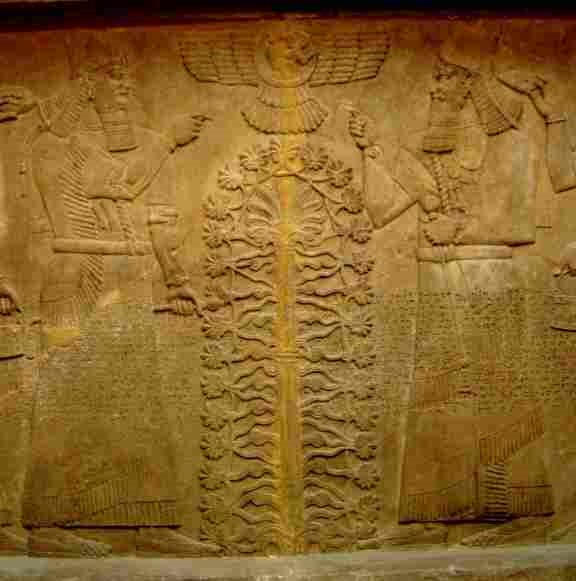 |
Also, such traditions certainly arose from even earlier cultures, and from the mother of all cultures, the continent of Africa. (1) In his book The Lightning Bird, Lyall Watson describes a cave rock painting shaped like a ‘spidery symbol a little like the cross of Lorraine’. This represented the tree of Life, and had done so since pre-history.
In general the tree from ancient times was linked with powerful human feelings or intuitions to do with fertility, fruitfulness, with the cycle of human life and its many seasons and trials. But as with the incident of Buddha’s enlightenment, it also has connections with the emergence of human potential, or even transcendence.
 |
So we have the legend of Odin being hung on a tree as a sacrifice as he transcended human life and limitations. “I know I was hanged upon a tree shaken by the winds for nine long nights. I was transfixed by a spear; I was moved to Odin, myself to myself.” The fastening of Jesus to a wooden cross and ‘transfixed by a spear’ echoes the Odin story and many others like it. The connection with this ancient past is still met in people’s dreams today. Below is a dream showing the connection between the tree and transcendence. On the left is A representation of the Bodhi Tree. Notice the snake at the base of the tree. |
I was floating atop a tree near houses and a rising walkway. I was saying to people around the tree that I had found something wonderful. Reaching out my hand I told them they could join me if they accepted this possibility in themselves. Some thought it was a publicity campaign, but were enjoying the spectacle. A few reached out and were immediately with me, until there were about six of us men and women. We joined hands, experiencing a most amazing sense of well-being. Then we slowly and effortlessly flew to a great height, leaving a trail of coloured smoke that could be seen for miles. It was to demonstrate the triumph of the human spirit. We then descended and were going somewhere else to show others. Margareta H.
This next dream is in some ways even more direct.
A tremendous jolt of power poured into me from the tree. I saw that we had arrived at a place where a line of trees, about a hundred yards or so, stood very close together in a slight semicircle on the top of a bank. The trees had great spiritual power, and the place was a holy temple. Two spiritual beings were there – an ancient Earth being, and Christ. They told me something to do with me practising healing.
Such myths and dreams are not irrelevant or superstitious. They are portrayals of the deeps of human nature and the path of human development, along with an indication of what we are capable of as individuals. But to understand this to properly grasp it for ourselves it helps to gain some insight into how such connections with the tree arose, why they arose, and what import they have for us today.
The Human Condition
The human condition is fundamental to any creation of myths, and at the core of the emergence of any religion or personal dream. The journey from conception to maturity, and on from there to death, is a heroic one no matter which one of us makes it. The beauty of life, the struggle, the pain and challenges, both crush us and call upon whatever we have innate in us. In our most magnificent acts of creation we project gods and goddesses, stories and images on the world, upon the stars in the sky, upon animals and trees, and upon rivers and mountains. We create majestic and unearthly heroes who face the demons that torment us, who heal sickness and conquer death. Throughout the ages these heroes have appeared under different names — Odin, Mithras, Krishna, Quetzalcoatl, Christ; Amun, Morrigan. The stories we weave around their life and teachings evoke from some depths within us what appear to be intuitions of our own origins and possibilities — a view of our small and fleeting life as seen on a vaster canvas. Each one of us must decide whether these magnificent stories reflect a truth, or are a means of comfort in a meaningless life.
What we can be assured of though, is that the myths and dreams of humanity have enabled millions of us to live a richer and fuller life. They have done this by providing doorways to the abundant strength of hope. They have provided a pathway to the experience of transcending the transitory nature of our own body and identity. They have given a context within which our life has connection and meaning.
That is not to say anything found in myths and dreams is either true or false. The greatest secret of them is that whatever we live is our truth. If a belief or hope, however foolish, enables as to give love, to patiently care for our children and each other, then that love and patience is our reality. If kneeling before a statue gives us the strength to transcend the angers and pains that beset us, or move beyond the seeming injustices of life, then the act of transcending is our reality no matter how we managed it. Unfortunately we often take hold of our beliefs as if they were a piece of metal we are testing to see if it is gold. We pour acid upon these gentle and beautiful parts of our nature to test their reality. In doing so we miss the wonderful secret that the truth lies not in the belief, the dream, or the religion, but in what we live of it. That is the important decision we make what shall I live?
Looked at in this way the great religions and myths outline for us what great men and women, what striving cultures of the past, have depicted for us of the best they could live and move toward. Because of this a careful look at some of these creative moments of the past might portray our own possibilities and powers of transcendence.
So, with this in mind, let us look at the tree and how it has been seen and represented in myths and dreams.
If we are to understand, even in a small degree, what the tree has represented through the ages, we have to recognise that the human mind, the experience of existing as a man or woman, has not always been as it is today. It is tempting to think that earlier human beings were ignorant, or savage and uneducated, but fortunately recent findings have found that this is not so. Many tribal people had an immense knowledge of their environment, hunting skills, skills of manufacturing clothing and tools, and a deep knowledge of the medical use of herbs. This knowledge was often encyclopaedic, and the individuals, lacking writing or means of keeping records, had amazingly developed memories.
The Ancient Mind
Neanderthals actually had a larger brain than present human beings, so we cannot think of them as lacking the means to complex associations and insights. The lack of a vast and subtle language would have restricted them in the type of thinking that we take as normal today. Also, the development of identity seems to be a quite recent thing. (2) Early human beings possibly thought less in words, and used images of external things, rather like a waking dream, to ‘think’. The development of writing from ideograms or images such as in Egyptian writing is a possible indication of this. The stories of early discoveries, mentioning as they do the meeting with a god or goddess, also suggest a powerful process of seeing images as a means of exploring a creative realisation. As I have said in an early work,(3) the mind of early humans had to be able to form a gestalt an insight from such diverse pieces of information as dust rising on the horizon, silence of birds, movement of animals, a drought in the area. They needed to know whether the dust was caused by an enemy or food? Survival depended on having a clear response. But prior to the use of words, and until recent times, there was no ability to reason. The creative solution had to be reached by intuition, a feeling response or a dream.
Early human beings were not as distanced from their instinctive responses to their environment and each other as we are today. This distance is largely due to the way we look at the world through the agency of words and thoughts. The instinctive guidance was not simply an automatic way of dealing with events. It also held in it the vast experience of forebears, just as a bird holds in itself the knowledge of how to make an intricate nest. But in the case of human beings, with the beginnings of personal awareness, this inner wisdom often felt like a guiding being or influence, and was presented as such by their image forming process of thinking.
This is still seen today in dreams and visions. And if we can grasp something of that, then we can conceive that the inner world of early human beings would perhaps have been an amazing meeting of external objects being illuminated by a vast inner wisdom that used imagery to express itself. This is not fantasy, as our dreams still do this. Therefore the stylised carving or painting of a tree would have depicted the tremendous and perhaps awe inspiring feelings these early humans experienced in realising things about the depths and wonders of their own existence and of life around them.
The Seed and the Tree
For instance, living as they did in the very midst of untamed nature, they would have observed a seed fall from a tree. Later that strange object seemingly so inert would be seen to sprout roots and a stem. Then the tiny plant would grow into an immense tree. The inner processes of the observer would at some point see this as a whole, and their innate intuition fill it with the realisation that within the small seed a huge tree existed. And although to the unselfconscious early human this might not be immediately seen as a description of their personal inner emergence and maturity, something of the wonder of this would be felt and associated with the tree. From this point on the tree would come to represent the mystery of how something can emerge into the world, and would be used to represent this mystery of how the unseen or small can grow. This could then link with creation stories. Also, the sense that a huge tree existed in the tiny seed, leads to the concept of a germinal tree already existing beyond the body of the seed and gradually forming itself. This view has a direct link with what later became known as the Great Man that exists beyond the individuals of the human race, and manifests through them trying to realise itself. This almost certainly led to a realisation that some trees never reach maturity or full expression of the great tree within the seed. So an idea of a spiritual power or potential arose suggesting the same thing in human life. There is an immensity in us that stands beyond what we attain physically, and perhaps in only a few people, really manages full growth.
To bring this to a more personal and present day meaning, it suggests that we may still use a tree in our dreams or artistic creations to depict what lies within us unexpressed. It depicts the possibility of manifesting our own innate potential, and a conscious realisation of what is trying to manifest itself in our life.
Recently I had a conversation with a friend who told me she feels constantly frustrated, as if some vital part of her, perhaps her creativity, has not been released. This is not an unusual state for any of us, living in a way in which our own innate and natural push to growth and fruition may be overshadowed by economic needs and a rather constrained and controlled existence cut off from instinctive or intuitive feelings, in a rather mechanistic society.
As the complexity of language and thought developed, so the subtlety of the tree as a symbol also deepened. People developed more self-awareness, and so brought their insight more directly to bear upon the human condition and personal existence. After all, no matter what we may have as our innate potential, the external facts of life challenge us; disease and difficulties may cripple the expression of what or who we are. The struggle of the growing tree to deal with extremes of climate, of insect attack and of competition from other trees, all feed in to the sense of our personal difficulties and achievements in maturing. But what many of us fail to do, looking at the world as we do through our self conscious ego and rational mind, is to recognise and experience the power of our core self the Great Man/Woman that has been the driving force behind our own growth from seed. For some strange reason we seem to believe that it is only our ego that exists, separate and separated from those great natural processes that grew us. As Marie Louise von Franz points out, “The ego must be able to listen attentively and to give itself, without any further design or purpose, to that inner urge toward growth. Many existentialist philosophers try to describe this state, but they go only as far as stripping off the illusions of consciousness: They go right up to the door of the unconscious and then fail to open it.” (4)
In fact the tree of our dreams and of mythology has its roots in the unconscious, and unless we manage to experience those roots, not just think about them, we fail to truly understand our own foundations. It is in the unconscious, the true temple of the Mysteries, that we meet initiation into the great truths underlying our personal being. Here we find the source of creation and procreation, birth and death. Here is the garden in which the tree grows.
Commenting on this in his book Pagan and Christian Creeds, Edward Carpenter writes:
The Tree therefore was a most intimate presence to the Man. It grew in the very midst of his Garden of Eden. It had a magical virtue, which his tentative science could only explain by chance analogies and assimilations. Attractive and beloved and worshipped by reason of its many gifts to mankind Its grateful shelter, its abounding fruits, its timber, and other invaluable products why should it not become the natural emblem of the female, to whom through sex man’s worship is ever drawn? If the Snake has an unmistakable resemblance to the male organ in its active state, the foliage of the tree or bush is equally remindful of the female. What more clear than that the conjunction of Tree and Serpent is the fulfilment in nature of that sex-mystery which is so potent in the life of man and the animals? (5)
The Old Old Story
Considering what has already been said, if we look at the story of Genesis and the Garden of Eden, we must understand it as a myth using symbolic language to convey intuitive insights into the creative beginnings of human consciousness. Unfortunately it has often been presented as a literal description of human origins, and therefore lost much of its depth, subtlety and beauty. Because of this view translators working with the original Hebrew twisted meanings to make the literal story work. For instance the word Adam, when analysed, is like the words Man or Mankind, often used to represent individual men and women in the collective sense. So Adam is both a singular and plural word, but it does not refer to an individual person. So to think of a lonely man called Adam wandering the earth without a woman companion is a complete misunderstanding of the text. (6)
But not only does the word Adam represent the single species we call ‘human’ it also points to the many individuals who can be born from ‘humanity’ or Adam. However, the Hebrew text is very subtle and points to something more than that. It depicts Adam as the potential that lies within humanity the great tree lying within the seed. It suggests that as individuals we have Adam within us as the potential leading toward transcending the aggressive, destructive creatures we are at the moment. It is an important point, because it is saying we already have the transcendent within us. It will emerge if we allow ourselves to grow. It is not something we must weld onto ourselves from outside by harsh discipline and controls. It is something already innate in us. As Marie von Franz says, if we are to find it, “The ego must be able to listen attentively and to give itself, without any further design or purpose, to that inner urge toward growth.” (7)
Not only is Adam a primal factor in this story, but also the Garden of Eden is the environment or background in which the story takes place. It is there for Adam to “dress it and keep it.” The Hebrew word for what is translated garden is ‘gan’. Its root meaning is an enclosure, or a sphere of activity. It refers to the realm of physical existence. But remember that Adam is only a potential from which humanity can grow or emerge. Therefore the sphere of this emergence is physical life, or at least, the processes and forces that are the formative matrix of physical life.
So this is like planting a seed the Adam within the flux of natural processes that flow into the formation of the physical worlds. This seed is designed to move ‘man-wards’ as life unfolds. The physical body we today call self has to be evolved through long process. (8)
But we cannot leave Adam alone, for Eve appears in the Garden. The Genesis story as it is translated into English says that God felt Adam would be lonely without a companion. The Hebrew word for lonely is ‘l’abaddo’. It means ‘In a state of internal oneness’. In the text it suggests a lack of self-realisation, of only being a reflection of the creative process of Life, and having no separate will of one’s own. It does aloneness in the sense of an individual man or woman feeling alone
East of Eden
The sentence including the words ‘woman’ and ‘man’ (And the rib, which the LORD God had taken from man, made he a woman, and brought her unto the man.) says – ‘To this he gave (the name) Aisha, because from Aish this was taken’. It doesn’t say ‘she’ was taken, but ‘this’ was taken. Aisha means: ai – desire, inclination, self expression. Aish – all activity in which oneself is expressed. Aisha or Eve as we call it, is therefore, the faculty of will and emotion, individual feeling and personal decision. It is the ability to conceive personal desires, thoughts and plans. So Eve is not a separate person, just as Adam is not a separate person. Eve is the ability to make personal choices, to have a will distinct apart from the will of ‘God’ or the creative forces and instinctive drives out of which humanity have emerged.
There is quite a beautiful concept hidden in the term ‘East of Eden’. The word that is wrongly translated East is ‘m’kedem’. It rightfully suggests ‘what existed beforehand’ and refers to the eternity, the unknown forever that existed prior to the formation of the universe out of a timeless existence.
This brings us to the central theme the tree planted in the midst of the Garden. The word translated tree is ‘whetz’. Its root meaning is something that grows and spreads, branching out yet connected. Considering that Adam is only a seed in the processes of life, this tree cannot be a material one remember the story is symbolic. In the story, Adam/Eve does not take on physical form until, as it says in Genesis, “they sewed fig leaves together, and made themselves aprons.” This translation is a hideous example of trying to make up a story about two individuals. The Hebrew word translated ‘sewed’ is ‘va ithepherou’. It means fruitfulness, to produce or bring forth. The word leaves is ‘aleh thaeneh’. It is singular, and so cannot refer to leaves. But it does mean a covering or awning or protection. The word translated as fig thanah means suffering or pain. The prefix of ‘th’ suggests being plunged into. And the word aprons in its rightful translation suggests a fugitive, or being lost. So the overall meaning is that Adam/Eve, by attaining the ability to will something apart from the guiding will of their creative impulse, chose to experience physical life, with its experience of male female, sexuality, and knowledge of good and evil. The good being following the creative will, and the evil meaning turning toward a direction that took the gift of consciousness more deeply into physical sensation only.
Now we come to the central scene in Genesis. It is a turning point, revolving around the serpent Nahash the Tree of Life, and its fruit.
Remember that Adam/Eve is the potential that has not yet taken on physical form until they leave the Garden. This is exactly the same as an idea that you have not yet given form to in word or deed. The idea is still a reality at its own level. So Adam/Eve are not unreal or imaginary. The are as real as the potential in the seed. It is a real force in nature, having gradually expressed as all animal forms. It has also developed independent will, and the scene in the garden is a difficult one. The Adam/Eve being faces a decision. It, like us, has a multiplicity of facets. It has a sense of connection with the creative forces that gave rise to it. But it also has another facet enabling it to make independent choices.
However, it knows, from its connection with the creative forces (the word of God) that to partake of the tree of knowledge will cause it to die. But this is a contradiction, because it knows that its essence can never die. But the death it faces is of dying to its present condition of being whole a male female unity a being knowing eternal life a being with direct awareness of its source, and partaking in tending the garden of material evolution, and being a conscious part of the creative process.
This moment has been described elsewhere in the following words:
Now that the human spirits could follow their own feelings, there arose a question from the forces that caused the Adam/Eve to have individual existence. It entered their consciousness asking, “Did the Creator really mean that I should not totally experience material existence? Surely, if I entered the sphere of opposites I would gain knowledge and experience from it?”
And the divine wisdom in Adam warned it of the consequence of this, saying, “You must not centre your consciousness in matter, for by that you will die to your cosmic awareness and have only consciousness through physical senses.”
But the forces of individuation, flowing into matter Nahash the serpent (9) seemed to say that if they allowed their being to enter into and experience physical life, how could they lose their eternal consciousness? Instead they would gain knowledge of the opposites, of the paradox the Creator knows.
Then the desires for this fired their will, for many spirits wished to know life in physical realms; to experience fully the knowledge of time and space, of the incompleteness of being just male or female, of looking out through the senses of a physical body, and knowing the feel of winds and water, separation and aloneness. Thus came about the fall of the angels, and many spirits fell into life within a physical body.
Kundallini – Nahash – and the Serpent
If these pieces of information are put together the meaning of the tree falls into place. The snake, the potential for individual human awareness and the tree are all linked.
The snake appears in many myths throughout the world. In Indian mythology and philosophy it is described particularly clearly, and given the name Kundalini. As such it is shown residing coiled at the base of the spine the tree of life upon which the body of man/woman is hung. It is the energy that lies latent unless released in personal growth and the expansion of awareness. As an aspect of human nature it is not the potential itself, but the flow of energy as that potential expresses. In this sense it can be thought of as the evolutionary process. It is not driving to be expressed, but is there as a potential.
There is a difference between a huge lake held behind floodgates, and the enormous energy released if those floodgates are opened. The snake depicts the energy when it is released, or the energy that is potential and can be released.
The tree, in its mythological and Hebraic symbolism, is something that grows. It is something that can grow from a tiny thing into something grand. It can then bear fruit and reproduce itself countless times. In doing so it is both victim to time and circumstances, and eternal, in that the essential tree remains throughout its generations.
The tree is also portrayed in two ways in this story. It is the “the tree of life” and the “tree of the knowledge of good and evil.”
As already explained, the good and evil represent two directions for the potential of human awareness to go. The good is the awareness of connection with the creative and eternal forces lying behind existence. The evil is the centring of awareness in the physical world and therefore dying to a sense of eternity and awareness of connection with all creation.
Therefore, the story tells us that lying in the centre of our being in the centre of our potential to be human individuals, lie these two possibilities of growth.
The tree of lives still remains within us. It holds in it the power that heals, that redeems; it resurrects us from the virtual death of life in the body. It is the growth toward remembering our life in eternity. In other words the awareness of the potential we hold within that is the Great Man/Woman beyond all human existence.
The other tree holds in it the power to reproduce, to experience life in the body, and the ability to survive amidst the storms and pains and summers of physical existence. But even as this physical emblem of mortality, it still represents the power that grows us from seed. It still reminds us of the life that exists in us unconsciously; the power that grew us from the seed in the womb, without our will. It holds out to us something we can allow into the life of our ego that will gradually link it again with the creative forces at our core. It offers redemption.
Buddha is shown experiencing enlightenment under the Bhodi tree because he became aware of the forces of evolutionary energy that had led to the formation of the body, and the formation of the mind, and through that the culture in which he lived. Both he saw as structures that gained their reality out of a series of circumstances human beings had passed through. He saw that mind and our view of the world had arisen out of the evolving concepts of self linked with tribal group, kinship, locality, language, and nationhood. The mind is not something to take as a reality, or as a means of properly understanding who we are. It evolved and has shape and limitations in the same way our body does.
The snake linked with the tree shows the energy that can lead to transcending the limited view the mind gives. But the snake can be dangerous, just as the energy of the released lake can be dangerous when the floodgates are opened. So careful discipline is necessary.
Christ is shown on the wooden cross because he is both suffering the life of the body, and also dying to the physical life through the redemptive potential of the tree. The cry from the cross, “Father, Father, why have you forsaken me” can be interpreted as his loss of any sense of separation from the One – a falling back into the cosmic life. He therefore becomes a sign of the way, the pattern of growth for humanity.
Our own personal experience of this inner process, represented by the tree of our dreams, can be that of accessing the possibility of growing beyond our present limitations and miseries. As Marie von Franz say:
The fact that we often speak of “arrested development” shows that we assume that such a process of growth and maturation is possible with every individual. Since this psychic growth cannot be brought about by a conscious effort of will power, but happens involuntarily and naturally, it is in dreams frequently symbolised by the tree, whose slow, powerful, involuntary growth fulfils a definite pattern. (10)
While writing this feature I had the following experience, along with the dream mentioned at the end.
This morning I was finishing work in my big bedroom, painting walls and ceiling. It is an old cottage with thick walls, and the windowsill is deep enough to sit in. While filling cracks and holes in this alcove something attracted my attention outside. A couple were on the rooftop next door, looking for somewhere to live – a couple of jackdaws that is. I could see from her movements as she looked down the nearest chimney pot, that the female was keen on this property. The male was sitting on another pot watching her though. He must have seen my slight movement and given her a signal, and they flew off. I seemed to know exactly what he communicated to her. “Let’s get out of here. This place has got nosy neighbours.”
I then went downstairs to find something to open the lid of a can of paint. When I took my toolbox out of the cupboard under the stairs and opened it, something extraordinary happened. There was the shiny little tool I had bought so many months beforehand for just such a need. As I picked it up I had an immense experience of my father, and his father, and all the people who have used tools to create their home — and beyond this the animals that strive so hard to build a nest, to make a den, in which to rear their children.
| And the wonder was that I knew I am not in any way separated. I am an extension of all they have done or longed to do. Because, there in the small space under my stairs, were all the tools they had left me through their endeavours. And more than that – I knew in those moments, moving me to tears, that my very urge to make my dwelling a place to be proud of is their spirit flowing through me. It is a beautiful clear river of life. | 
|
A Dream of a Whole Life
Some days ago I dreamt that I stood before an immense tree. It was old. It was gnarled with the storms and summers of its life. It was wonderful to see. And as I crouched over my toolbox half in the cupboard under the stairs, with tears streaming down my face, I knew that I am the tree of life. I could feel all that has lived before living in me.
It was a precious moment.
Notes
(1) See Lyall Watson’s book Lightning Bird. Published by Hodder and Stoughton.
(2) See The Origin of Consciousness in the Breakdown of the Bicameral Brain, by Julian Jaynes. Published by Allen Lane.
(3) The Instant Dream Book, by Tony Crisp. Published by Daniel.
(4) From Man and His Symbols, by Carl Jung and others. Published by Picador.
(5) Pagan and Christian Creeds Their Origin and Meaning by Edward Carpenter. This and many other books are available in electronic form at: http://www.gutenberg.net/index.php
(6) See The Unknown God – Ain Soph, by F. J. Mayers.
(7) Nevertheless, the serpent energy that is released when that surrender is achieved needs wrestling with.
(8) See: http://dreamhawk.com/cabala.htm
(9) The word translated ‘serpent’ is Nahash. The word for snake in Hebrew is sheretz. Nahash is a special word that does not refer to a snake at all, but to a force or process. It means evolutionary energy, or energy which tends to individualisation or selfhood. A whirlpool is simply water. But it is water drawn by an energy circling toward its centre. This circle of force draws things to its own centre – to its own self.
(10) Quoted from Man and His Symbols the section by Marie von Franz on The Process of Individuation.