Posts Tagged ‘health’
Sex and Identity
Many dreams show how we gain much of our identity out of our sexual attractiveness, relationship, or lack of it. Men and women often feel they are inadequate or lacking in personal worth if they are not in a relationship where their partner is fascinated by them sexually. Our sense of personal value and positive existence, may be built on many things, but can ultimately become less dependent upon particulars such as physical attractiveness or sexual partnership.
Example: Here one must come to terms with the androgenous psychic nature of man. The anxieties of every human being who ever doubted his own sexuality are true; they point at a wrinkle of the mind which cannot be smoothed away. And therapists who try to calm patients’ fears with reassurances are whistling down the wind. Reassurances will never obliterate the doubt in every man’s mind that he’s not quite all male, or the parallel doubt in woman’s mind, simply because the doubt is psychically valid. Of course, objectively it’s not true at all. Although scientists have pointed out a certain overlapping between the sexes in vestigial organs and hormones, most men are obviously men and women are women. This knowledge of biological similarities hardly prepares men and women for the subjective experience of bisexuality, which can only be explained by the plasticity of the imagination and the sense of identity. In every man’s mind are areas of consciousness that proclaim, in effect, “I am a woman!” In every woman’s psyche occurs the reverse. This is not a matter of observation and analysis but a conviction at the very seat of consciousness.
Sex has it mystery in the depths of our being, in the sperm and egg, and these although they may not be easily reached by our conscious personality, are found in dreams, in visions and deep human experience. Psychically man will, man must return to his beginnings. If he denies sexuality he will return mystically. If he accepts sexuality he will seek to return by any means. For deep within the psyche reigns the mother and beyond her the edges of an instinctive infinity which is still herself. To this heaven man must never lose the path; to this heaven he will return at last.
It is the lack of recognition of this out of phase difference that keeps us seeking sex of one sort or another. It is also the cause of much of the misery the sexes create between them. Wholeness comes not by acting out or even physically trying to be the opposite sex, but by diving into oneself finding the wholeness that we all are. See Archetype of the Anima – Archetype of the Animus
Secrets the Body Knows
Liberating the Body
Chapter One
The Beginnings of Inner-Directed Movement
Life is movement and is the sign that you are alive, and you already know of how to relax enough to allow the beginnings of allowing your body to make its own spontaneous movements. As examples of this yawning and sneezing are the side of this process you can already allow. Also if you breathe in harmful dust your body makes the spontaneous movement of sneezing to protect the lungs and rid itself of the dust. Other similar movements are coughing, shivering when you are cold, and watering of your eyes. In these ways your body self-regulates and protects itself. But this is just the tip of the iceberg in regard to what you are capable of if you understand and learn to work with this process. It is the very edge of what you innately know about your own mental and physical needs and how to satisfy them.
It may seem strange I am suggesting that the process behind something as ordinary as yawning can have a potential which can revolutionise the way you feel about yourself, can improve the mobility and well-being of your body and mind, and can reveal your intuition and creativity. But that is what I have witnessed in helping people use inner-directed movement. Not only do you know, through inner-directed movement, just what your body needs to keep it functioning healthily, but also you know how to keep the feelings and mind mobile and healthy too. An intuitive function opens within yourself that can inform you wisely on important areas of your life.
This is understandable if certain facts are remembered. To grow physically, and psychologically your being moves and directs itself from its own unconscious resources. You see this in everyday things such as your heartbeat, digestive movements, perspiration, and even your ability to speak without searching for every word or worrying about what gestures you make. The important processes of your being, such as breathing, nearly all express as inner-directed movement – that is, movements you do not have to consciously think about or copy from outside. They are movements that arise from your unconscious mental and physical life. The difference between a dead body and a live one is movement. All the gross and most subtle aspects of your life are expressed as movement. Laughter, crying, lovemaking are all powerful movements, largely inner-directed. Such movements integrate the different aspects of yourself. For instance love making is not just a physical activity, but blends emotions, personal needs, as well as deeper instinctive drives. In fact you, as a living being, are a master of expressive movement, but you may be holding yourself back. Having no self confidence doesn’t remove your skill. I have discovered that even shy people, as they learn to relax deeply, have a world of splendid expressive movement inside them waiting to become known.
The organising principle that regulates the growth and shape of your body expresses through inner-directed movement. It is the unconscious self-regulating process of life in you. Its action continues working night and day. It is common to all of us, but few of us know how to work with it consciously to allow its magic to unfold more fully. This is possible through inner-directed movement.
In helping people to learn how to relax enough to allow such simple movements as yawning to extend into fuller spontaneous movement I witnessed people discovering the wide range of exercises, mimes and feelings their body could express unexpectedly. As people learnt to really relax they opened the door to abilities within their body and mind that had previously remained unconscious. For those who made this discovery it was rather like the dream some people experience in which they have lived in a house for years, then one day they find a door leading to a whole wing of the building they have never known before.
When they open to inner-directed movement, people find it is:-
1 – A fuller expression of the natural power that regulates the body and mind. This can lead to physical and mental health. The contact is sensed as an awareness of the essence of life active in them.
2 – An inbuilt and spontaneous urge to move and express the parts of oneself inhibited by the specialised environment of family, society or work. This is an urge toward wholeness. Wholeness because when the concentration upon a limited area of yourself such as thoughts or emotions is relaxed, then a greater symphony of expression between mind body and spirit occurs.
3 – Creative and intuitive abilities of the mind. This is frequently experienced as spontaneous visualisation.
4 – You are being taught how to learn the immense force of transformation in your life – Self Regulation/Homeostasis – See Self Regulation
Your Unconscious Source of Life and Growth
To get an even clearer picture of what it is you tap during inner-directed movement, it is helpful to consider how you might see yourself if a film were made of you like those showing speeded-up plant growth. On such films you see the plant moving and growing with incredible vigour. Its leaves and flowers open with powerful movement. If the film showed you from conception onwards, you would see amazing change and expansion. An extraordinary process would be seen causing your body and mind to unfold. You would observe incredible amounts of movement, many of them spontaneous. The movements in the womb, in babyhood and even in your adult sleep, you would see as inner-directed, and powerful. You would notice that as you gradually matured, conscious control of movement became more prevalent. But still your sleep movements, breathing, yawning, stretching, laughter and tears kept you in touch with the incredibly wise process which directs your overall growth and survival. It is the often forgotten, but very real process underlying your original growth and continued existence, that you allow into a new level of expression when you relax fully.
Inner-directed movements, occurring as spontaneous movements, they do when you relax deeply, arise from the unconscious processes that control your existence and growth. It a fuller expression of what lies behind the growth of your body and mind. It is what enables you to maintain a stable existence amidst the ever moving forces of your environment. It holds all the systems of your being integrated in common purpose and is the foundation of consciousness. It is not something distant or separate from you, but is innately in everything you are and do.
Freedom To Be Yourself
One of the first person’s I taught inner-directed movement to was a woman in her sixties. Maria was married, had a lovely country cottage, but had not been outdoors for months. She was suffering from aches and pains in her arms, felt life had lost its interest, and asked for help. Maria quickly learned to relax enough to allow her body freedom to express without inhibiting self criticism. Her movements were slow and tentative at first but soon included her whole body, producing feelings of pleasure. To allow such movements Maria had to learn how to give her body and feelings time in which to explore unplanned movement – movement arising from her own subtle body impulses. Such subtle urges are often overlooked, or are crowded out by ones thoughts of what one ought to be doing, or what is appropriate in the circumstances. So Maria created a mood, and gave herself time, in which she could allow irrational movement – movement that had not been thought-out beforehand, or given by someone else. Such movements are usually quite different to the sort of things one finds recommended in exercise books. The reason being that they are often unique mixtures of exercise, dance, mime, and generally letting oneself go enough to do what might have otherwise be seen as ridiculous. Nevertheless, such irrational expression is very satisfying. In Maria’s case she started with slow arm movements. Gradually the rest of her body was included in an expression of pleasure and sensual enjoyment in which she rolled and squirmed on the floor – movements and feelings that surprised Maria.
Within three weeks Maria went out with her husband, and bought new clothes, something she hadn’t done for years. She told me she realised she had been holding back all her pleasure, all her positive drive and feelings. In fact Maria had unconsciously been holding back HERSELF. In liberating her body and emotions she had liberated herself from the prison of her own depression. Frequently depression or lack of enthusiasm for life occurs through the suppression of our own feelings – the stagnation of our urge to move and live.
The freedom and release which arises from inner-directed movement is also evident in what happened to Jim. A group using inner-directed movement started in Bristol. Jim, an unmarried gas fitter, bored with his work and life, joined the group. Within a couple of weeks Jim had learnt to give his body and feelings freedom to move. He was amazed at how fertile an imagination he had when he stopped holding himself back. His movements were creative and deeply felt. Less than two months had passed before Jim had given up his job, found a woman whom he married, and together they started working in a Steiner School for children. Jim also had been holding himself back.
Both of these examples show that inner-directed movement is basically a way of allowing what is already innate in oneself to be expressed more fully or easily. Put in the simplest of terms, by restraining the way you express in movement and voice, you may be inhibiting important parts of your physical or psychological nature.
How Do You Learn Inner-Directed Movement?
Learning inner-directed movement is in part learning how to drop the inhibitions and physical tensions you may be applying to yourself unconsciously. So the first stages are a series of physical and mental exercises that help you drop unnecessary inhibitions enough to let your body, emotions and voice express in ways you may previously have restrained because of social or personal expectations. As you learn to allow yourself to express more freely, then you will learn how to work with the emerging inner-directed movements in various ways.
What Will Happen If I Really Let Go?
For most of us to ‘let go’ or deeply relax enough to allow inner-directed movement is a learnt skill. To learn anything new means you tread new ground, you open yourself to new experience. This is certainly true of inner-directed movement. What you learn is largely non intellectual. It is something you experience rather than think. Because it involves movement it opens you to the realm of what you sense and perceive through body postures and feelings. This is an extraordinarily rich area, much overlooked in general schooling. In his book The Turning Point, Fritjof Capra, writing about the tendency in Western culture to overemphasis the intellectual capacity of the mind to the point where we see the universe and earth as mechanical systems, says, “Retreating into our minds, we have forgotten how to ‘think’ with our bodies, how to use them as agents of knowing.” Later, describing the effect the intellectual and mechanistic view has had on modern medicine and the lay person’s approach to their body, he says we are led to see our body as a machine “which is prone to constant failure unless supervised by doctors and treated with medication. The notion of the organism’s inherent healing power is not communicated, and trust in ones own organism not promoted.” See Super Heroes and Mythical Creatures
This ‘knowing’ through your body and heart has many dimensions of experience. Some of the possibilities of what you might find can be illustrated from my own and other people’s experiences. When my friends Sheila Johns, Mike Tanner and I first realised the possibilities of spontaneous movement in 1972, we created an environment in which we could explore. This meant dropping our usual expectations of behaviour, and allowing ourselves great freedom of possible self expression. We took time to listen to how our body and emotions wanted to announce themselves. We let ourselves move in ways we had not preconceived. We followed the usually unacknowledged impulses in our body and soul. I was amazed over and over again by what emerged from us.
One of the earliest experiences for me was that while sitting quietly one day, my head began to move backwards. It was a gentle movement and I could have stopped it at any point. In fact I was so interested in it I tried to help it – tried to make it happen, and the movement stopped. Later, when I learnt to remain in a more relaxed state while my body moved, the spontaneous motion started again and my body re-enacted having my tonsils out as a six year old. Tensions had remained in my neck for all the years between six and thirty four, and now that I had actually relaxed in the right way, my body could discharge the inner disturbance. Just prior to starting inner-directed movement my neck tension had got so bad that as I lay down to sleep at night my head pulled backwards painfully. After the release during inner-directed movement the pain never recurred.
Less specifically I remember that at first I would repeat really peculiar movements, what seemed an endless number of times. I felt that my body was working at freeing itself from habitual postures, attitudes and the results of past experience as well as massaging internal organs. Gradually my movements became freer and more mobile – although since my teens I had exercised and stretched regularly. Also the movements became mobility of my feelings as well as my body. For the first time in my life I realised that my soul, my psyche, had also been tense and stiff, and was being gently made more responsive, alive and whole.
This mobilising of my psyche was effected by lots of movements in which I expressed powerful feelings. For instance I remember once doing a forceful stamping dance in which I felt like a Japanese warrior. My voice also came into full play with such dances and movements. I need to stress that I had never danced before in my life, and I found such movements surprising. So apart from the purely physical movements during inner-directed movement, there is also as aspect some people experience in which there is a fuller experience of inner feelings.
Because of such encounters, and there were dozens of them, I felt I was allowing myself to experience something extraordinary. The experiences arising spontaneously from within created a sense of wonder in me. I recognised I was touching a secret which existed in everyone. The secret is that we are much more than we usually suspect. We are capable of more than we dare imagine, and have access to internal founts of healing, adventure and wisdom, and experience that can enlarge and liberate us, not only physically but in our psyche as well. Our unconscious is full of creativity and splendid experience.
Voice As Well As Body
As already suggested, the voice is also one of the important aspects of inner-directed movement. It is one of the areas of our life in which many inhibiting factors may occur. When sound and movement combine, as they do in this practice, a huge realm of experience and healing is possible. This is described by Joan as follows. “Nothing else I have ever done is comparable to my experiences with inner-directed movement. When I began attending the group I honestly envied some people their ability to let-go and say through their voice and body what was obviously deeply important to them and just as deeply satisfying. Seeing myself today I realise I have reached that sort of freedom and enjoyment.
Friends ask me just what it is I do in the group. I just say I let my body express freely and they nearly always have a look of puzzlement. As far as they are concerned they already relax their body, but it doesn’t dance or sing like mine. I don’t even bother to explain as I know from experience they will not understand unless they do it themselves. All I know is that I have experienced all manner of magical things. I have felt the joyous abandonment of a baby and the fire of my body’s power and sexuality. More than anything else though, I have discovered I am a much wider and deeper person than I ever knew before.”
Because I have not simply been a teacher, but have practised inner-directed movement myself, I am just as much an enthusiast as Joan. I have no difficulty at all in being positive about what has come into my life from the practice. I look back from my mid fifties, to when I began at thirty four, and see that my body is far more mobile now. It is unbelievable to consider the attitudes and moral rigidity I lived with in my early thirties, and how tired I felt constantly, as well as how depressed. The dark cloud I lived under, or in, has gone. Of course I had to meet some of the difficult emotions I had stored inside myself. Gradually ‘blue sky’ peeped through as the clouds I had unwittingly created in my life cleared. Also, because inner-directed movement puts you in touch with your creative centre, after twenty years I am not through, I am still learning from the process.
Liberating The Body Is More Than Avoidance Of Tension
Learning how to promote inner-directed movement is learning to trust yourself in a new way. It is also a way of learning how to use areas of your potential not previously employed, and to keep in contact with yourself and other people in a more enriching manner. But perhaps the most important fact about learning to allow inner-directed movement concerns liberation.
The difficulty is not that of saying or being what is innately yourself, it is in doing so in a manner which does not conflict with the needs of others. The liberation you can find through inner-directed movement is very complete. It is not something you do to someone else or inflict on the world. It is yours to experience in your own physical and emotional privacy. Just as when we dream we can have the most intimate and complete experiences without involving anyone else, so we can relax and find full self expression without anyone else present.
Therefore liberating your body through inner-directed movement releases reserves of energy and enthusiasm which might have been subdued by attempts to live within the boundaries of social or interpersonal demands. For many people, it is this enormous freedom which is the most important feature of the practice. Many people using inner-directed movement have told me they never before felt such freedom, even in childhood. They either had never been allowed it by parents or teachers, or they had never allowed it to themselves.
How Does It Happen?
Earlier in this century Dr. Wilhelm Reich observed the process of spontaneous movement during relaxation and wrote about it, becoming the father of modern body oriented therapy. Adding to the basic biological statement that a function of life is movement, he studied the frequency in living organisms of particular types of movement. He saw movements such as contraction and expansion, and the sexual pelvic movement as fundamental life movements, and connected with personal wholeness. He found that if such movements were inhibited, frustration or illness of some sort resulted. But his work was still prior to the publication of information arising from research into sleep and dreams, which has thrown such extraordinary light on how our body and mind work together. In particular, the observation that one’s eyes always move rapidly during dreaming gives insight into how movements can arise without consciously attempting them. The brain produces all the impulses to the muscles during the dreamt movements, that it would during waking activity. So the variety of experience occurring when we relax and allow our movements to become inner-directed, may be arising from the same source as our dreams. I make this connection because the powerful mimes and experiences, such as that in which I danced, have an intensity and reality akin to dreams. Inner-directed movement and dreams arise out of a relaxed condition. Both produce spontaneous movements and dramatic experience or fantasy.
Laboratory tests in which subjects were prevented from dreaming show that those tested developed symptoms of great stress and decreased mental efficiency. The conclusion was that the process underlying dreaming is of critical importance in keeping the mind and body functioning properly. If we remember that dreams do this by releasing spontaneous drama, movement and emotions, then the spontaneity of inner-directed movement can be see as linking with the important release and balancing action of the dream process.
The evidence showing dreaming as critical to mental and physical health suggests that dreams may be a last ditch stand against the inhibition of some of the most important aspects of yourself. There may therefore be a connection between the expression of subtle needs and emotions in dreams, and the uninhibited expression of your body and feelings during inner-directed movement. People also find that inner-directed movement enhances their personal growth and intuition.
The Experience of Inner-Directed Movement
A female student once said to me, ‘I have relaxed thousands of times and no unwilled movements have happened, so why will it be different this time?’ She went on to say, ‘I don’t believe there is anything in me to create the sort of experience you are talking about anyway!’
Her question and statement have behind them viewpoints and attitudes that in fact make it difficult to understand just what inner-directed movement is, and how it can happen. They imply that there is nothing about oneself to experience beyond what is already known – that after years of life, surely if there were dimensions of oneself full of rich experience you would have had hints of them – and also perhaps that the body is dumb flesh, largely mechanical and lacking deep intelligence.
Nevertheless, laboratory tests have shown that the most materialistic people, while they are in the relaxed state of sleep, develop spontaneous fantasies, accompanied by body movements, emotions and speech. Namely they dream, even if they do not remember. The spontaneous movements we make in sleep, and the deeply moving feelings and dramas we experience in connection with them, are usually not strong enough to break through to conscious life except in a few cases. To work with this process which is vital to your well-being, you need to be receptive and create the right mood and environment. The body and mind are not disconnected. The wisdom that keeps the body-heat at the correct level, the intelligence that keeps millions of various cells interacting in an integrated way, though unconscious, unknown, untouched by yourself in everyday life, can begin to bubble up into awareness and self realisation when you listen by letting it express in its own way.
That is the theory. The experience is that if you do take time to let this subtle action have a space in waking life, you will first learn to let your body be free enough to move to delicate impulses. This will lead to movements that at first you may not know whether you are making them up, or they are occurring by themselves. As they strengthen through learning to trust yourself in letting-go, the movements will follow certain themes. Perhaps at the end of the session you will see your body has been exercising and loosening. Or maybe you have made dance like movements that have a theme such as emerging from restrictions and growing. You may see this relates to how you feel in everyday life. In this way you will see for yourself that the unconscious resources of body regulation usually only expressing at the level of blood pressure or temperature control, are manifesting at a new level because you are learning to work with them. You will see that the creative imagination of dream life is clarified and showing itself to you while you are awake.
It’s An Old Truth In A New Form
The view that you do not need to practise disciplined or energetic given exercises to keep physically and psychologically healthy may be new to you. Everything from PE. at school, Aerobics at the fitness gym, and Yoga, suggest series of given movements or postures. And you must perform them correctly to get the benefits. Inner-directed movement is not a new practice though. Because it is a basic human function, and an extension of movements like yawning, it has been frequently used in the past. In fact it has a history of many thousands of years, different cultures giving it different names and explanations.
While I was teaching inner-directed movement in Japan I was introduced to an almost identical practice called Seitai. The founder of Seitai, Haruchika Noguchi, is said to have modernised an older practice which was a part of Buddhist traditional technique.
I had the pleasure of meeting several Seitai practitioners who taught me their approach to inner-directed movement. My wife Hyone and I were also able to attend group practices. Seitai is popular in Japan with the sort of popularity that causes articles about it to appear in high class women’s magazines. But its practitioners come from a wide age range and are equally represented by both sexes. The ongoing group we attended had about thirty people in it. There were teenagers, married couples, young and old, and lots of single people. In this group each person is encouraged to allow their spontaneous movements, such as their desire to stretch. They all practise at once, so each person does their own personal movements at their own pace.
Seitai’s appeal is probably due to Noguchi’s practical and down to earth approach. Through Seitai many people in Japan have improved their physical and psychological health using this very simple practice. What I learnt from the people who shared Seitai with me was how much fun it can be. Before my stay I had thought the Japanese would be very serious people. In the street and in formal social gatherings this is perhaps true, but individually or in informal groups they are very playful. Several times I watched groups of people decide, during a break in activity on a conference, to practice yuki, a form of Seitai in which two people practise together. Within minutes it had developed into active dance like movements which included lots of laughter and playfulness. In the following chapters some of Seitai’s approaches will be explained.
In India the use of inner-directed movement is called Shaktipat. It has a different approach to Seitai, contact with a teacher or Guru being recommended though not seen as indispensable. Individuals in most of these approaches practice both alone or in groups.
While working in Australia I was told by Jack Thompson the Australian film star who had been taught Tai Chi by a Chinese teacher, that for three years the teacher had him perform the given movements. Then one day he said to Jack “Now I will show you the real Tai Chi.” He then encouraged Jack to allow spontaneous movement – inner-directed movement.
Tai Chi is a stylised series of movements from China used for health and harmonising ones being. While in Hong Kong I saw hundreds of people in the early morning practising Tai Chi in Kowloon Park. Hyone and I joined in and it was a great pleasure to have the freedom to openly explore movement in public. Also originating in China there is a more direct approach to spontaneous movement called Qi Gong. As in Seitai the individual or group directly wait for spontaneous movement.
These Eastern approaches see the movements as expressing a subtle energy called Chi or Ki. This energy is seen as the creative, body forming, energy of life. Therefore the practice is considered to balance and harmonise the way this energy expresses in oneself.
The West has its traditional approaches to inner-directed movement also. Apart from groups such as the Quakers and Shakers, who gave inner-direction a religious orientation connected with the spontaneous movements of the original Pentecost, Anton Mesmer founded a form of group practice three hundred years ago. He was probably one of the first to attempt a scientific evaluation of the process. Without the recent findings which have arisen from psychological and neurological research however, his explanations were still based on older ideas.
In Hawaii there is a form of spontaneous movement that is allowed to express as dance. Ancient tribal healing or decision making frequently involved spontaneous movements and vocal expression. These are often linked to what is today known as Shamanism. It is a way ancient people found wholeness and healing, or sought intuitive information vital to their existence.
A more recent practice that started in Indonesia is called Subud. It has a format that has allowed it to become world-wide, although unlike Seitai, it has an element of religious feeling because of the culture and character of its founder, Pak Subuh. In Subud, groups of people meet twice a week. Someone in the group says, ‘Begin’, and the members allow spontaneous expression of body and voice.
Although all these approaches have a very similar core in that practitioners are asked to let go of their self-willed activity, the explanations of the practice, and the details may vary. For instance, in Seitai there is not very much vocal expression. The men women and children can all practice together, and there is no religious connection. In Subud the men and women are segregated. There is a lot of vocal expression, and there is a cultural religious connection.
The Best of Self-Help and Spiritual Adventure
The techniques described in the following pages have been developed from an acquaintance with approaches used in the past by other cultures, from study and practice of traditional and recent Western methods, and from my own twenty years of experience of personal use and teaching inner-directed movement internationally. From this I know that the aims of self-help and self responsible health, aimed at by alternative forms of healing, are available through inner-directed
movement. I find the practice combines the energy balancing of acupuncture, the release and personal growth of psychotherapy, and the inner adventure of meditation or dream work.
*********************************
Link to Chapter two – Link to Chapter List
Letting the Body Speak
Liberating the Body
Chapter Two
LETTING YOUR BODY SPEAK
Spontaneous movement was natural to you as a baby. You moved arms and legs in ways that would develop muscles, express feelings and stimulate growth. Your emotions were vented directly and powerfully through such movements. You cried when you were upset, laughed when happy, and when the time was right practised all manner of sounds in preparation for speech. All this without the intervention of any planning or list of exercises to do. In this way you maintained your physical and psychological health. In a similar unselfconscious manner you were able to traverse formidable stages of physical and psychological growth.
Without formal lessons or given exercises you practised what was new from an inner-directed source. You learnt the lessons of language and walking quickly and persisted despite many failures. Without boredom you practised the same movements and sounds endlessly until you were capable in them and could move from them to extended skills. You took in the cultural and grammatical information around you and put it to work. Without sitting and concentratedly thinking about the mass of information presented, you found order in its chaos. Even as a baby your body and mind were incredibly resourceful in their own right without formal tuition. Nearly all this was a natural response to your environment. It occurred because you were letting your body and mind move spontaneously in response to your environment.
Regaining Youthful Abilities
Learning inner-directed movement is relearning how to trust your own innate capability and power again. To trust the life enhancing drives you felt in childhood. It is learning to trust the subtle urges your body has to move and feel, urges arising from the unconscious centre from which your growth and life emerged. Trust, because it takes self reliance to allow the new, the previously unknown and unplanned to emerge and be felt. We must learn to let ourself play and move without the deadening self criticism that can cripple expression in adult life. You also learn in some degree to stand outside the social conditioning you acquired as you grew up.
Learning to allow the same inner-directed movement and mental learning that operated in early childhood, is not done to replace your hard won conscious will, your reasoning and decision making. The more instinctive or intuitive source of growth and learning promotion that operated in childhood is a great addition to conscious will, not a replacement. In fact when the rational mind acts in a co-operative and monitoring way with the unconscious or intuitive self, a much greater efficiency occurs in both.
Through this co-operation you access resources that can lead to greater health, and an improvement in the functioning of the immune system. You can also meet your own creativity in a degree usually only glimpsed in the adventure and strangeness of dreams. One of the most significant aspects of inner-directed movement however, is its ability to continue the action of your psychological growth into greater maturity and freedom.
Letting-go and allowing your being to fulfil its own spontaneous needs is a thing of great simplicity. It is easy. It takes no effort or thought at all. It is even easier than attempting to relax. But because we have habits of constantly deciding or willing what to do – the feeling that nothing will happen unless we do it – you may need to take time to learn how to let-go in a way that allows action. In Eastern practices this is called action in non action. It is helpful to see it akin to holding yourself in a condition of sensitive balance, like the keys on a piano. A touch on a piano key causes it to move and the note to play, but as soon as the finger is removed the key springs back into place ready to move again if necessary. The difference between the piano key being moved and the action of inner-directed movement is that no external finger or force motivates you during inner-directed movement. The same sort of subtle but persuasive impulses that move your chest in breathing are allowed to flow into action and feeling.
If there is anything to be learnt, it is to feel and allow the flow and movement of these life impulses – to let them lead you into unanticipated and creative movement and self expression. You learn to meet and melt the subtle resistances causing you to hold back from wholeness, from bringing to awareness more of yourself. It is therefore helpful to explore and respond to some of these subtle feelings in yourself before attempting the full freedom of inner-directed movement.
Liberating the Body – Phase One
Warm-Up and Loosening Movements
It is useful, at least in the early days of learning inner-directed movement, to warm-up your body with some given movements. Below are listed some that are extremely helpful.
The series of movements were arrived at in a special way. After I had learnt to allow inner-directed movement and my body and mind felt expressive in it, I found the spontaneous movements would respond to a question. For example if I had a dream that puzzled me, I could ask what a particular figure in it represented, and my body would respond spontaneously in a descriptive mime. Because the information the mime presented often added to what I knew consciously, I felt the ‘answer’ that arose through movement was expressing unconscious insights.
One day I was experimenting with this question and response, and asked what would be a helpful way to bring the body and mind to harmony. I was astonished as an extremely long and detailed response flowed spontaneously from me. Movement after movement arose apparently from my unconscious, along with an understanding of how the movements influenced basic biological and psychological processes such as introversion and extroversion of energy and awareness. As I used these movements, I realised they are not simply exercises to make the body active and stimulated. For instance if I cannot breathe properly I am not functioning well. If my hips are locked in tension and my pelvis cannot express tender sexual feelings, or if my abdomen is tight and my internal organs cannot digest food properly, then the basic urges of life are being interfered with. The exercises loosen the body in a way to allow a more fuller expression of these basic life-movements – such as the expansion and contraction of the chest in relationship to the spine; the swinging pelvis expressing sexuality and its connection with the chest, neck and head. Tensions restricting the way life-processes expresses in movements such as breathing lie at the root of much physical and psychological illness.
The following movements are those I learnt that day. If you enjoy them and have time, by all means do the movements consecutively. They are excellent for health in themselves, but they are not inner-directed movement. They are given to warm your body and help mobilisation and internal balancing.
Use these movements at least three times over a period of a week or so, before going on to the next phase. Practice each movement for between one minute to three minutes, depending on your energy and time. Try doing them with music sometime to see if it aids the good feelings they can produce. Later suggestions for types of music are given in detail. At this point something fairly flowing without too much drama in it.
These are only warm-up movements, they are not inner-directed movement. Inner-directed movement, once learnt, can be used easily and for a few minutes. There is not a long list of ‘movements’ to use in the proper practice, although there are a variety of ways you can use it.
It is helpful to ‘meditate’ on some of the movements after performing them. This means that you try to recreate the feelings, or sensation of the movement again without allowing your body to make the movement. The idea is to exercise your inner awareness and feelings of energy movement. So in the third of the movements, the pelvic swing, you would create the feeling of the hips pushing forward and up, followed by the pulling back and down of the pelvis. This meditation exercise is important as it enables you to gain some control of your inner feelings. Often such feelings are stimulated by external events or unconscious worries. Your meditation is harmonising and balancing these feelings.
These movements take time, so if you are not able to do them all in sequence, do those you can within the time available and work through the other movements during future sessions. You need a reasonable space – something at least the size of a single blanket, so you can feel free to move without bumping into things.
Squatting and Rising
This first movement you start from a standing position. With feet slightly apart you take an in-breath, and as you reach the high point of inhalation you take head and arms backwards to really open up the chest. From that standing position with head back you then begin to breath out and bend the knees so that you can drop quickly into a squat. As you do so let the arms move forward and up so the hands come palms together near to the face. Meanwhile you drop into a squatting position expelling your breath fast as you go down. You rest there for a moment and then the movement carries on by breathing in and rising back up to the first position again. So you slowly stand as you breath in, then when standing expand the rib cage again by opening the arms slightly backwards and apart, and taking the head slightly back.
When you get used to the movement, going down into the squat position should be done fairly fast with the out-breath quite strong so there is an audible blowing of air out of the lungs. It can be done gently, but if possible, do it strongly as the body drops. Let the hips go down as far as you comfortably can, and let the head collapse down too so the body is relaxed. Some people need to put their heels on books to make squatting comfortable, so do that if necessary. The hands come forward in a scything movement until they meet just above the dropped head. If you cannot squat so low, use a stool or chair to sit on as you go down, so you only drop a short way.
At least two feeling states are involved in this movement. One is the standing erect and ‘open’ feeling. The other is the down, closed and relaxed feeling. When you feel fluid in the movement see if you can enhance these feeling changes as you move between the opposites of up and down. While down feel the relaxed letting-go feeling. While up feel the active, energetic feeling.
- In this first movement you start from a standing position, with feet slightly apart.
- Take an in-breath, and as you reach the high point of inhalation take head and arms slightly backwards to widen the chest.
- From the standing position you then begin to breathe out and bend the knees so that you can drop into a squat. Let your arms move forward and up so the hands come palms together near to the face and expel your breath while dropping into the squatting position .
- At this point you should be squatting with head relaxed forward. Rest there for a moment and then carry the movement on by breathing in and rising back to the first position again. This means you have slowly stood as you breathed-in, and expanded the rib cage again by opening the arms slightly backwards and apart, letting the head drop slightly back.
- Repeat the cycle of Squatting and rising in your own time.
- Now ‘meditate’ the movement for about a minute. This means standing or sitting with eyes closed and imagining doing the movement, but hardly moving your body. Try to reproduce the feelings of the movement. Feel the relaxed, down condition, then move into the up, dynamic feeling. This is an important exercise in becoming aware of the subtle feelings connected with movement, and learning to mobilise them.
Circling the Hips
Suggestions – To get the movement satisfyingly mobile, it is helpful to imagine yourself standing in the middle of a large barrel. The aim is then to run your hips around the inside of the barrel, touching it all the way around. This helps to get the full circling of the pelvis. So, as the hips are circling back the trunk is bent slightly forward, but still with the head high. The hips should go well out to the side, and as they swing to the front they should be far forward enough to cause the trunk to be inclined slightly backwards. If you cannot manage this at first, simply do what you can.
The knees and ankles should be kept relaxed, as should the hips themselves, so they adapt to the circling. The breathing should then also find its own rhythm. Generally it is out as the hips swing forward, and in as they swing backwards. This is because the chest is slightly compressed as the hips are forward if the head is floating erect.
1 Begin from a standing position as the first, but feet slightly farther apart, about shoulder width.
2 Keeping your head and shoulders more or less floating in the same position, circle the hips horizontally. The pelvis is taken gradually into a wide circle.
3 At half time rotate the hips in the opposite direction for the rest of the time.
4 Meditate the movement for about one minute. You can stand or sit to do this.
Pelvic Swing
Suggestions – If you imagine a vertical circle – seen from one side of your body – and move the hips around it fluidly while letting the legs and trunk follow, that is the movement. Although simple this is an important movement as far as becoming aware of the subtler side of your own being is concerned.
The movement is similar to the backward and forward movement of sexual intercourse, except that it is circular and involves bending and straightening the legs. But it does still involve the pelvis swinging backwards and forwards. Do the movement until you can feel your body loosening and flowing more easily. Then, do the movement slowly, being aware of the different feelings of the pelvis being forward and backward. These feelings are quite subtle, but are strong enough to be easily noticed if the movement is done with awareness of the change.
1 Standing with your feet about a foot apart move your pelvis backwards – as if starting to sit down – to begin a circle. This half sitting position brings the head and trunk forward and bends the knees slightly .
2 Start to push the hips well forward. As you do so the knees are straightened again, and this completes the full circle with the hips in a way that describes or ‘draws’ a vertical circle.
3 Do the movement in a way that keeps the hips swinging in the circle in a continuous flow.
4 Meditate the movement while sitting or standing.
Roller Skating
Suggestions – If possible let most of the movement occur from below the navel. You can keep your eyes looking ahead, your arms swinging in time with the hips as well to let the body move fully. But it is the lower back that is being worked here. The movement massages the lower internal organs as well, so you may get the stitch until you adapt to the exercise. Do the movement fairly vigorously. If you do get the stitch, don’t stop altogether, just slow down. The movement will then massage the area of discomfort.
1 Stand with feet a little wider than shoulder width, with trunk bent forward and knees bent also. Your back should be reasonably straight although at an incline.
2 Now swing the hips from side to side, making the lowest part of the spine alternate to the left and right.
3 When finished meditate the movement.
Swinging the Trunk
Suggestions – Be careful to check how slippery your feet are on the floor surface. If you cannot easily maintain a feet wide position, it may help to stand with bare feet. The movement is an active one, with a light pause as you reach top and bottom. Some people like to allow their arms to extend in a wide arc as they come up. It feels more balanced. Also, as you come to the upright position with the in-breath, let the head drop back slightly, and arms extend sideways and back to increase the chest stretch. This balances the deep exhalation accomplished by dropping the trunk forward.
This is a very pleasing movement, and because it connects with the breath cycle, develops a particular rhythm. If you can manage it without becoming giddy, let the exhaling of breath as you go down be quite energetic.
1 Stand with the feet about twice shoulder width.
2 Let your head and trunk drop forward, and the arms hang relaxed, allowing the spine to be gently stretched.
3 When you feel your spine has adapted to the position, from an out-breath swing your head and trunk to the left, allowing it to roll over and up to the standing position as you breathe in.
4 Drop the trunk downwards in the mid-line again, breathing out – do it fairly fast – then roll head and trunk to the right as you come up and breathe-in again.
5 Continue the cycle with a slight pause at the high and low of each swing.
6 When finished meditate the movement, reproducing the relaxed drooping feeling, and the active, ‘up’ feeling.
Surrendering Backwards
This movement works the abdominal muscles quite strongly, and needs to be approached slowly until you feel confident and able in it. It is not primarily a physical exercise. It is an expression of letting-go of self, of surrendering. You start with feet about shoulder width apart. The aim of the movement is not to see how far backwards you can go. It is to express the feeling of letting go of self, of dropping control in a disciplined way. At first, when the head and shoulders are back, hold the position for a very short time, then recover to the upright stance. As you get used to the movement, you can stay in the surrendered position longer – just as long as is comfortable – then recover.
1 From an in- breath you drop your head slowly back and breathe out, allowing your head, shoulders and trunk to drop slightly backwards with the arms limp.
2 If you are comfortable in that breathe as normally as you can while your trunk is backwards.
3 Hold for a short time then return to the upright position.
4 Repeat several times.
5 Meditate on the movement, moving between the surrendered feeling and the taking control upright feeling.
Sideways Lunge
This movement uses the legs a lot more, and introduces more spinal twist. Because you are reaching forwards with the opposite hand to the bent kneed, there is a common tendency for people to extend the whole trunk forward too, and that is unnecessary. The trunk curves upright from the trailing leg. The breathing sequence for this is out as you lunge, in as you centre again.
When you are reasonably capable at the movement try doing it as slowly as possible. Make the breath slow, and move in time with the breath – out as you lunge and in as you centre. This is a very powerful movement so don’t attempt too many repetitions at first.
1 You start with feet about a metre apart in a standing position, with the hands palms together in front of the chest.
2 Turn the left foot to point to the left and turn the trunk to face in that direction also.
3 Let the left knee bend until the hips drop right down near the left heel. To make this easier, let the left heel rise if necessary. In other words, don’t try to keep the foot flat on the floor unless this is easy. Meanwhile the right leg is trailing, forming an curve from the floor up along the spine. The right knee is on the floor but hardly bent.
4 As you lunge to the left, let the right hand reach forward in the direction you are lunging. The right arm stretches out backward toward the right foot – i.e., in the same direction as the right foot. This gives a slight spinal twist.
5 From the lunge position, using the strength of the left leg, push back into the upright position until the trunk faces forward, and bring the hands to the centred position in front of the chest again.
6 From the centred position you lunge to the right. Don’t forget that it is now the left arm you extend forwards – always the opposite hand.
7 Pause in the lunge, then, using the strength of the right leg push up and centre again.
8 With a slight pause at each lunge, and while ‘centred’, repeat the movement alternatively to left and right.
9 Meditate on the movement, remembering to get the ‘centred’ poised feeling between each imagined lunge.
Spinal Twist
This is more of a spinal twist, more so than the last. The arms are extended describing a wide arc, and coming to rest where you feel comfortable, but not floppy. The breath cycle is to complete exhalation as the spinal twist is complete, and to complete inhalation as you reach midpoint between the left and right twist. Like the previous exercise, if the breathing is united with the movement, it makes for a more satisfying experience. Once you have got the feel for integrating breathing and movement, perform this one fairly slowly and purposefully.
1 – Stand with feet a little wider than shoulder width and with hands at your sides.
2 – Leading with the head, turn to the left, letting your arms describe a wide circle, and continuing their movement when head and trunk can turn no further. As the trunk turns to the left, let the feet and knees accommodate the twist, so when you have turned as far as you can to the left, your left knee is slightly bent in a semi lunge to allow the fullest twist, and your foot is pointing to the left.
3 – Now turn from there to the right, going round as far as you can, fairly slowly to let the feet and legs change.
4 – Continue this slow swing, making sure you allow a semi-lunge at the end of each swing. This gives a little more twist.
5 – |Meditate on the movement.
The Swinging Rib-cage
This exercise aims at mobilising the rib cage in one of its movements seldom made in everyday life. To make sure your movement is actually doing what it should, it is helpful at first to practice in front of a mirror. Keeping the hips still and rib-case centred, hold your index fingers about two inches away from each side of your lower ribs. Now see if you can swing the ribs sideways towards the extended but still finger without swaying the whole trunk and hips sideways as well. At first it might be that you do not know just what muscles to move to accomplish this, but with practise it becomes simple.
Like one of the earlier movements, this one may cause you to develop a `stitch’ if you do it fairly actively. This is because it strongly massages the internal organs, and this is a healthful stimulus to them. It may also cause an unusual bellows action with the lungs, causing a pumping of air in and out of the lungs without actually breathing. This is quite normal for the movement, and is not harmful. No need to meditate this one.
1 – Keeping the hips still, swing the lower ribs slightly sideways. If you do this with the right side of the rib-case, it causes the left shoulder to drop, and the right to rise. When you alternately swing to the right and left, the shoulders alternately rise and fall also.
2 – Therefore, if you lift and drop the shoulders alternately, this may help produce the extending of the rib-case, but not necessarily so. Many people move their shoulders thus, or swing their hips energetically, without their rib-case being mobilised at all.
3 – Swing alternatively left and right until you can do the movement easily.
The Crawl
Your attention has been moving up the body in this series of exercises, and so are concentrating more on the chest and shoulders at the moment. This exercise is primarily to mobilise the shoulders and rib-case in relationship to the spine. But it also brings the arms into action in more than a supporting role.
It helps if you imagine the hands are pulling backwards through water. Meanwhile, the head and hips should remain facing forward, so the shoulders swing around the steady spine. The movement can be done slowly but strongly, or fast and energetically. This is a wonderful movement to massage neck and lungs.
1 – Start by standing with feet about shoulder width apart.
2 – Be aware of the knees, and keep them very slightly bent and relaxed.
3 – Keeping your head and hips still make the swimming movements of the ‘crawl’ with your arms. This means the right arm swings up and forward above the head as the left arm is low and moving backwards. Then the left arm is up and forward as the right drops.
4 – The movement is a slow circling of the arms.
5 – Finish with the still meditation of the movement.
The Breath Meditation
This is more of a meditation than an exercise, but is important in mobilising inner feelings that lie behind movements. When you begin this meditation, do not be in a hurry to open the hands to let the feeling of pleasure radiate out. In fact, let the hands be as spontaneous in expressing what you feel as you can. It may be that your hands thereby move a great deal, or very little. If there is an urge to move the hands in other ways than suggested allow this to happen.
1 – Stand in a comfortable balanced position with the hands in front of the chest, palms together and eyes closed.
2 – Imagine that as you breathe-in, the air is fanning a small glowing coal inside the chest. The incoming air makes the coal glow gently, and you breathe slowly and with awareness. This coal is just a symbol of the subtle pleasure sensations generated by slow purposeful inhalation. If you can be directly aware of this pleasure, dispense with the image of the coal.
3 – In either case, let the hands indicate the amount of this glow or pleasure. Let them do this by moving apart, so if the pleasure is intense the hands reach wide. As you exhale and the glow fades, let the hands come together. But if there is little felt, then the hands remain unopened.
Playing With the Voice
If you have lots of time you can use this after the warming-up movements. Otherwise use it by itself, taking up to fifteen minutes. It may help to use music as a background. Something not too invading.
In this exercise you explore the use of sound. To make different sounds you need to move not only your throat, but also your trunk and even limbs in different ways. Sounds also evoke feelings and move or exercise them. Just as many of us do not move our body outside of certain restricted and habitual gestures and actions, so also your range of sounds may be quite small. So for several minutes you will explore making sounds.
As your sound production improves though, and you begin to enjoy it, in different sessions explore making all sorts of happy sounds; different sorts of laughter, proud, childish, funny, etc.; angry noises; animal and bird noises; sensual sounds; the sound of crying or sobbing; natural sounds such as wind, water, earthquakes; make the sounds of different languages and different situations such as a warriors chant, a mothers lullaby (without real words, just evocative sounds), a lover’s song, a hymn to Life, or even sounds about birth and death; and just plain nonsense noises. Don’t attempt to explore all these different types of sound at one session. Just choose one and explore it until you can feel yourself limbering up in it and getting past restricting feelings such as shyness or stupidness. Those are the walls of restriction.
1 – Start by taking a full breath and letting it out noisily with an AHHHH sound.
2 – Do this until you feel it resonating in your body. This may take one or two minutes.
3 – Change to a strong EEEEEEEEEE sound. Once more, continue for at least a minute.
3 – Now try MMMMMMMAAAAAA.
4 – If you are doing this exercise for the first time, that is sufficient for one session. If not, go on to use one of the themes suggested above.
The Yawning Exercise
Do not use this exercise until you have used the Warm-Up and Loosening Movements a few times, as well as the voice exercise.
One of the easiest ways to begin inner-directed movement is to use your body’s own urge to express spontaneous movement, as with yawning. To do this first take time to create the right setting for the practice. You need a reasonable space – something at least the size of a single blanket, so you can feel free to move without bumping into things. Play some music that is flowing, but without a strong beat. A strong rhythm grabs the body and feelings too much and so prevents creativity in your expression. Most of Kitaro’s music is useful for this. Try also – Moods, a collection of modern mood music – most of the Enyo music – Meditation by Thais, and some of the Vangelis albums. Music also ‘gives permission’ for easier self-expression in that you are less worried about making a noise or moving.
Do not go onto the other exercises described after the yawning exercise. Practice this one a few times on different days before attempting the next ones.
You need clothes suitable for easy movement, and about ten to twenty minutes during which time you can give yourself fully to whatever your body and feelings suggest. Do not take this suggestion of time rigidly though. If your session is shorter or longer follow your own needs.
1 – When ready, stand in the space, listen to the music and drop unnecessary tensions. Remind yourself that for the next few minutes you are going to let your body play. You are going to let it off the lead.
2 – Open your mouth wide with head slightly dropped back and simulate yawns. As you do so notice whether a natural yawn starts to make itself felt. If it does, allow it to take over and have a really luxurious yawn. Any following impulse to yawn again should be allowed.
3 – Let the yawns come one after the other if they want to. Without acting it out, let the impulse to yawn take over your body, not just your mouth and face. So if the urge to move includes the arms or elsewhere, let it happen.
4 – Give yourself over to the enjoyment of having time to really indulge your own natural feelings and body pleasure. If the yawning develops into other movements and stretches, let it. In the same way you would normally allow your body to express itself in a yawn, let it express itself in whatever other form of movement, postures or stretches arise. Maybe it will be noisy yawns, so allow whatever noises you want to make, however ‘silly’. If this flows into movements following the music, don’t hold yourself back. Or your movements might not follow the music, but have a direction of their own. This is play-time with your body, so enjoy it. What has gone before has simply been preparatory. Now you can do what you want.
5 – Until you feel ready to stop, simply enjoy or explore the movements and feelings that arise – even if what arises for you after the initial yawns is a desire to lie on the floor and rest. That also is you expressing your needs.
The yawning exercise is an excellent way to release tensions, especially those of the neck and face. It is also the beginning of inner-directed movement.
Fiona, a woman who allowed herself this liberation of the body for the first time, describes her experience as follows –
“I found a quiet moment, spread a rug on the floor, knelt down with my head touching my knees and started running my hands through my hair – I have always found this very comforting. Soon I noticed myself beginning to wobble and shake, and it seemed so funny I began to laugh. I laughed without stopping for twenty minutes, rolling about the floor, on my face; on my back kicking my legs in the air; on my knees beating my hands on the floor. The tears rolled down my face, my voice became cracked, my diaphragm began to ache with unaccustomed exercise and still I went on laughing. Eventually I ended up by going round and round on the rug on my knees and elbows, banging my elbows on the floor in joyous abandon, my head and arms muffled up in my jersey which had slipped off me at some time, singing a wordless song of joy and freedom. Absolutely nothing mattered.”
Experiencing Your Body’s Magic – The Relaxed Arm Test
This interesting test helps to experience the sensation of inner-directed movement in a playful way. Try it with your friends.
It is important to let go of effort and allow your body to have the ‘piano key’ poise when you relax your arm at the end of the experiment.
1 – Stand about a foot away from a wall, side on, so your right hand is near to a clear space on the wall.
2 – Lift your right arm sideways, keeping your arm straight, until the back of your hand is against the wall. Because you are near to the wall and your arm is straight you will only manage to lift your arm part of the way. So when the back of your hand touches the wall, press it hard against the wall as if trying to complete the movement of lifting the arm.
3 – Do not press the hand against the wall by leaning, but by keeping the arm straight and trying to complete the lifting motion. Using a reasonable amount of effort stay with the hand pressing against the wall for about twenty seconds.
4 – Now move so you face away from the wall, and with eyes closed relax and be aware of what happens.
5 – Try the experiment before reading on, and use the left arm afterwards. In fact try it a couple of times with each arm before reading the next paragraph.
What you have done is to attempt a movement. Because the wall prevented this, the body was not able to complete the movement you asked it to make. Therefore a muscular charge built up in your shoulder (deltoid) muscle. When you stepped away from the wall the arm, if relaxed, was free to complete the movement. So your arm may have risen from your side as if weightless, thus discharging its energy. Some people need several tries before they can find the right body feeling to allow the arm its movement. It is easy to prevent it moving because the impulse is quite a subtle one.
The technique enables you to learn how to give your body freedom to move under its own impulse. The way the arm moved, and the experience of an unwilled movement, is so similar to inner-directed movement you are thus provided with an experimental experience of the real thing. It is also an example of how the body self-regulates through spontaneous movement. It is therefore helpful either to practice the technique until you can do it, or use it a number of times to establish your relationship with the feeling of it. The sense of allowing movement can then be used in inner-directed movement itself.
It would be quite helpful to practice this experiment a few times though before moving on to the next.
Liberating the Body – Phase Two
In Phase One you began to learn the process of permitting your body to move in a way that allowed it more freedom of expression. Now this will be extended showing the beginnings of your own creativity.
Once more create an open space for yourself in which to allow not only freedom of movement, but also freedom to express yourself. The space is both physical and mental. You need to have enough space to stand or lie on. That is why a blanket size was mentioned. If you have more available space though, use it. Clear it of objects you might bump into, as you might like to practice with your eyes closed. Remove jewellery that might get caught or broken by free movement. Wear clothes – or be without clothes – allowing you to feel unrestricted.
Creating the Right Setting
The mental space you create for yourself might be even more important than the physical. This is because just physical space is not enough. You must be able to give yourself permission to express freely with your body, your feelings, and your voice. The restrictions in your mental space might be obstacles such as – wanting to know what it is you are going to do before you let yourself do it – worry about what someone might think if they knew or could hear what you are doing – the feeling there is nothing worthwhile in you to emerge anyway, so you are just acting the fool.
A man who had just started exploring inner-directed movement explained to me that certain requirements are very important to him. When he started the practice he found that although he was getting results he felt he was holding himself back. He took time to consider why this was and realised it was because, living on the first floor, he was anxious about the possibility of people seeing him. He closed the curtains and immediately had very full spontaneous movement. He explained it was also necessary for him to be alone. What he said referred to him personally, but shows the importance of setting.
To create the right mental setting it is necessary to decide that for at least half an hour, you have the complete luxury of being able to move and express yourself in any way pleasing you within the physical space you have prepared. What you do within that time doesn’t have to make sense. It doesn’t have to please anyone else. It does not have to produce anything. It can be quiet, active, noisy, sleepy, aggressive – because there is nobody but yourself involved, nobody to be judged by, and you are going to withhold judgement of yourself until the end of the session.
During the half hour any spontaneous movements that occur might come in waves of activity followed by waves of quietness. If there is quietness simply rest, holding the ‘piano key’ feeling in the body so it is ready to respond to any arising impulses. You do not have to be continually active. Give yourself this period of time in which you allow yourself this liberation. It means letting your being find its own way of resting, its own level of activity, its own path of healing and growth.
In speaking you seldom know beforehand the words you are going to use, except in a formal situation, but you do have a ‘felt sense’ of what you are going to say. This only becomes real to you when speak. Also, if you think of two friends, and move from one to the other in your thought, you have a feeling sense of how different each one is. You have these feeling responses regarding everybody you meet, everything you see. They underlie your whole life, but you may fail to notice them. It is this feeling sense you are going to use and exercise in the next form of movement.
With all our technology and scientific understanding we cannot create anything near the complexity and wonder of a living creature or a simple life form. Despite this, few modern human beings have much veneration for the process of life as it shows itself in their own body. There is certainly a growing attempt to work with the natural, but nearly always with readily formed techniques. As individuals we also frequently kill out what is natural or instinctive in us, perhaps even with our ideals of spirituality or environmental harmony. It is rare to find someone who will drop aside ready-made approaches, and listen to what their own being has to say. Such listening and learning is real respect. It is an admittance that the process of life sustaining us, in its experience of millions of years, in its creative struggle, its countless lives and deaths, has something of great value to show us. It is also an expression of trust that the unconscious secrets of Life’s experience are communicable to our listening consciousness.
Your Body Is a Moving Sea – Steps in Liberation
You will need about an hour to complete this session. The aim of ‘moving sea’ is to continue the development of body awareness and how you allow spontaneous movement. Once you have used the ‘water’ approach as suggested below, there is no need to go through the preparatory stages in future uses. For instance do not do the yawning and arm lifting . Go straight into exploring the water movements. These can be used over and over with enjoyment and gain.
1 – To start Phase Two, use again any three of the movements given to warm up.
2 – Remind yourself of the feeling of spontaneous movement by using the ‘arm against the wall’ exercise.
3 – Extend your awareness of how your body and feelings move spontaneously by simulating yawns and allowing them to develop into stretches or movements.
4 – Stand in the middle of your space and close your eyes. Lift your arms from your sides and take your hands high above your head. Do this a few times noticing the difference in feeling with hands high or low.
5 – Pause with hands by your sides. Now hold the idea of taking the hands up high again without consciously attempting the movement. Take your time, and be aware of how your hands and arms want to make the movement. This means watching to see if the sort of feelings that entered into your yawning and arm rising sideways exercises are in operation here. If this includes the rest of your body, or your arms go in another direction than above your head, that is fine.
6 – Stand in your space with eyes closed. Drop unnecessary tensions as you listen to the music. Hold in mind for a moment the idea that you are giving your body space to explore the expression of the quality of water. There is no need to think up what to do. Let your body explore. Trust it to find its own way to expressive movements. Allow yourself about 30 minutes for this.
7 – Let your experience of yawning and listening to how your arms wanted to move be used here. Take time to observe and allow the delicate motivations – magnetic pulls – directing your body to watery movement.
8 – You will find you have resources of imagination you did not suspect. Aspects of water you hadn’t consciously set out to explore will be expressed in your movements. If you are expressing deep still waters, you will actually feel a deep quietness and power. Or if it is the power of rushing rivers, then a feeling of power will surge through your body as you touch your resources of strength and healing. The flowing feelings that arise are actually healing.
As you learn to trust this process and allow it to grow in expression, you will find unexpected themes will arise. Even though you are expressing water, your expression will have in it feelings that are particular to yourself.
While recently leading a group practising inner-directed movement, I was struck again by how creative we all are if given an environment in which we can allow our originality. One woman in the group, exhausted from the demands of her job, experienced deep relaxation out of which enthusiasm and pleasurable energy arose, leading her to dance and bathe in her own joy. A man explored his relationship with love, and saw that he needed to gather to himself the love he received from others to call out his own resources of affection. A woman who worked as a nurse met the painful emotions arising from observing the difficulties of a mentally retarded patient. Her creative movements led her to find a way of accepting the reality of life’s difficulties. The pain cleared and she felt was ready to give a more flowing response to others in difficulty.
As with the woman mentioned above who found new enthusiasm in the midst of tiredness, you will find your creative movements deal with and heal personal situations. I believe this is because the self regulating or problem solving process that underlies dreams surfaces during inner-directed movement.
Using the ‘water movements’ has the benefit of toning the body. It brings harmony between the emotions and body. Your feelings are allowed to be active and thereby move to emotional well-being. Areas of your body and mind not usually allowed pleasure are bathed in it.
The Magical Dream Machine
We all dream every night, so we each have what could be called a Magical Dream Machine.
To gain a feeling of this, imagine yourself entering one of those game machine areas where youngsters can ride a motorbike, or ski down a slope. But instead of a simulation of a car, you discover a large machine that you can climb into and become completely enclosed. When you close the door, contacts link onto your body and head in the complete darkness. It is quiet as all the external sounds disappear, and you relax your hold on your body and senses. Your whole experience of yourself shifts as the external world melts away, along with your awareness of your body. That is sleep.
But now – in the darkness a light glimmers. Gradually it takes shape. The shape of a person is suggested. In the time that follows he or she evolves form, moves, and you have full sensory experience. You are totally involved, with all your emotions and sexual responses. Changes occur and you love, fight, fear, murder or bring to life again the person, who can become an animal, a devil, God or a bodiless voice lost in a sombre countryside. Your experiences are totally real, and you move through heaven and hell, despair and joy, darkness and light. Scenes from your past can be revisited – or totally new experiences can be felt so clearly, you are enriched. That is a dream.
Seeing Is Not Believing
If you had been in such a machine, and on coming out of the total involvement of these moving experiences, you were told you had created it all yourself – that on the black screen you had, out of your fears, habits, secret longings and passion; out of your immense store of memories; with your unbelievable range of feelings and creativity – you had given form to urges and processes in your body and made this rich world of experience, what would you feel? Would you disclaim responsibility? Would you consider it meaningless? Would you realise what amazing creativity and potential you have?
In your dreams you create such a world and such experiences. But perhaps you have not taken time to consider the wonder of your creative process in dreams. Every night you create a new drama. You conjure out of your own being the people, the creatures, the surroundings of your dream. Then you give life to what you create – not only life but purpose and drama. You are a supreme dramatist, playwright, actor and actress. You are the great Creator – in your dreams. Considering this, have you ever wondered why that enormous creativity does not flow into your waking life? You can see that some people have that creativity and are enriched by it personally and financially. Why not you?
But what is the REAL world?
In considering how you reply to this, remember a few well-known facts about how you encounter the so-called ‘real’ world of waking life. Firstly, when you look at an object such as an orange or apple, remember that although you have the sense of seeing what colour and texture the fruit has, in fact all you are seeing is reflected light. You never see the actual colour of the object.
Also, as far as texture is concerned, this is a mystery to you. Texture depends entirely on what you approach the fruit with. If it is an electron microscope, then the texture is one of shifting swirling atoms and subatomic particles. If you were tiny the apple would have a very different appearance than it does to you at your present size. Also, remember that you never actually know what the apple feels like or looks like directly. Your eye takes in streams of light that are translated into nervous impulses transmitted along the optic nerve. In the brain these nerve impulses are again translated into an image that enables you to have some relationship with an apparently external world. In the same way the nerve endings on your fingers transmit signals that are translated into sensation.
Similarly the television picture you watch on a screen is translated from signals the TV set is sensitive to and changes into pictures, colour and sound. The signals are not in themselves images, colour or sound. So, like the TV, the world you feel so sure you are seeing and experiencing, is one your brain has created in order to enable you to deal with survival. Even so it is a translation of ‘the world’ that has been shaped by evolution and its limited needs. You only respond to very narrow wavebands of light and sound for instance. So you do not know much of what is actually going on in the world anyway. Your eye, as a lens produces an upside down image of your surroundings, and this is ‘corrected’ to help you move around more easily.
Considering that you only experience a virtual reality of the external world created by your brain – and that is itself limited to a tiny fraction of what is actually surrounding you – you cannot take seriously your perceptions of the world or people. There are so many radiations, energies, and depth upon depth of texture in the cosmos and objects around us, that in effect we are blind and deaf. See Inner World
You Are the Creator
So it is true to say that you live in a world, in conceptions of yourself and your surroundings that are a self-created virtual reality. You could just as correctly be asked the question of whether you accept that you create all you experience in regard to the objective world, as you could of the magical dream machine.
However, we are discussing dreams, but remember that what is said could equally as well refer to your waking life.
So, your dreams are a magical place in that you have the ability in them to create a totally real world. Do you discount them? Do you see that you create your own world of experience in them? If you do, have you wondered why you may have a propensity for creating what you do? Or why, with such creative potential, you might still lack self-confidence? Just as you create your surroundings in dreams, you also create the psychological and sensory world you live in. Understanding your dreams can help you to clarify why you at times create what does not satisfy you, and how to generate a whole new world of experience. You can take charge of your creativity and ride with it instead of being at its mercy. Such power, after all, can as easily produce misery and ill health as pleasure and ability – unless you learn to direct it. Such creativity can lead you into hell, or create a heaven.
A few magic words to remember to say to yourself – “I have the magical power of creation. So I can create a hell for myself or a heaven. I have immense ranges of ability and problem solving. So here I go in believing in myself!”
Amazing Storehouse of the Mind
Although you constantly use the huge storehouse of memory and developed skills in your everyday life, you may usually fail to recognise what you are doing, and what a miracle it is. As an example, you now hold in store millions of bits of information. By asking you a simple question such as ‘What is your present home address?’ I can call to conscious awareness a minute part of the information lying unconscious. If I were to present you with a bicycle, or you were dropped in deep water, the skill of cycling or swimming could also emerge from latency if you had previously learned those skills.
Apart from these aspects of your immense storage of information, there is also the possibility that by the right series of questions or experience, you could arrive at a creative synthesis of information already held. In other words something not previously held in memory could arise by putting together old ideas or experiences. With the right stimulus, in the same way you could bring to expression potential within you that is at the moment lying dormant.
While we dream we have a very full access to the storehouse of our experience. If we learn to use the dream process we can more capably use the riches of what usually lies unconscious like treasures at the bottom of the ocean. There is a natural process of putting together the separate pieces of your experience into creative new combinations. All of this can be accessed by exploring the treasures held in your dreams and the dream process. See Using Your Intuition; Clicking On
Mind Watching
Because of the many nature films shown on television we are now used to the idea of mature and intelligent adults spending days or years watching the behaviour of animals such as hyenas or chimpanzees. In her book In The Shadow of Man, Jane Von Lawick Goodall explains how, by watching chimpanzees and taking note of her observations, radical new insight into the behaviour of chimpanzees arose. She didn’t think beforehand what she expected to find, but simply observed and put together the information that arose. For instance on several occasions she saw the chimpanzees kill another animal and eat its flesh. The knowledge that chimpanzees were meat eaters was entirely new.
In a similar way, by observing dreams and laying bare the emotions and associated ideas and memories you have with your dream imagery, you gradually define your personality, its strengths and weaknesses, in a depth you had never managed previously. I have called this mind watching, but it covers every aspect of human nature, not simply the intellect or thinking. See Self Help
This mind watching through observation of your dreams first presents information about your personal experiences and memories and how they influenced your growth and influence present responses. Gradually the information arising from such watching leads beyond your present boundaries of self. It shows in many cases how your unique self has arisen from, and has indissoluble links with your forebears, with your culture, with the past as a whole, and with the cosmos itself. It leads from yourself to the edge of the known, and perhaps helps you take a few steps beyond that edge into the unknown, to create new understanding, and enter new dimensions of experience.
Remember that you are probably one of the millions of humans suffering amnesia. If you doubt this ask yourself why you do not remember your childhood. No doubt you have also forgotten your life as a baby. You fail to remember your life in the womb. Perhaps, more importantly, you have also forgotten your link with the rest of the cosmos. In fact you are an amnesiac, and by ‘dream watching’ your memory can gradually be restored. It takes time and perseverance, but gradually the time line of your existence will be filled with detail.
This mind watching also gradually reveals to you the many aspects of your mind’s working, and with such insight may come the growing ability to use these facets of yourself. Not only may you discover great vistas of personal memory, but also the roots of your creativity, the subtle senses of your emotions and unconscious, and the treasures of experience you have gathered.
The Path To Take
There are many methods you can use to discover the enormous content within your dreams. For instance look at the following features and explore them to discover what works best for you: Introduction to DreamWatching; The AmplificationMethod – PeerDream Group – Active Imagination.
Another method that can be used with great benefit if you are a person who meditates, is as follows:
The meditation method of dream understanding rests on the function of memory. The aim is to hold the dream in mind, and at the same time hold the question of what are the activities, passions, memories or pains in you that have formed the dream?
You hold this question in the same way that you hold any question – such as the one asked above about your address. Do not strive, and do not struggle to arrive at an answer. Simply sit and WATCH the dark space of your mind and feelings. Take note of whatever memories, feelings and fantasies arise.
It helps to think of your being as a keyboard that your unconscious knowledge and intuitions can play upon. Holding your self stiffly, in mind or body blocks this mobility. See the passage on using the body in dream work for further information.
This may not be a quick method. So be patient, even when nothing seems to be happening. The mind is a wonderfully responsive thing, and will attempt to present what you are seeking. But at first perhaps only stray memories or feelings will arise. Also, the insight might require you to feel something deeply, so be ready for that and let it happen if you can.
Over a period of days gradually more and more will arise, and it is worth the time spent in the exploration. But do not be content with airy-fairy insight. Do not make the dream a platitude or a cliché. Dreams are powerful expressions of your down to earth, here and now self. You will know if you have arrived at insight because it will be deeply moving and clarify areas of your life that were previously obscure.
It is important to consider what you have received and weigh it against practical observation. See if there is something you can learn from it and apply. Test it wherever practical. Do not be afraid to doubt it and try it against the world. If you are not accessing the best in yourself you need to know it. This avoids the trap of wanting your intuitions about your dream to be true at any cost. The intuitions arising from the meditation method are a valid way of gaining information, just as your senses are, or your ability to read. But your senses and your ability to read can also be ways in which false information is taken in. So your discrimination is needed when using your intuition, as it is in everyday life. The more you use it the more sharp your faculty will become. But discrimination must not act as a source of doubt that blocks your ability to receive spontaneous information.
The Hidden Buttons in the Machine
One of the things we take for granted in our experience of the world is that there are many possibilities hidden in nature that nature itself does not express. For instance lightning is one of the few ways nature expresses electricity. But as a species we have learned there are many other possibilities for the use of electricity. By directing it in various ways we can produce heat, light, sound, power to move things, and pictures as we see on the television, PC monitor or in the cinema.
This applies also to our own body and personality. The example we can use here is the drive towards sex. This has developed in us through millions of years of evolution in the process of reproduction. This gradual development has formed organs and traits, such as courting behaviour, that lead directly toward an attempt to plant the seeds or receive the seeds to reproduce.
In our own culture we largely accept this except where there is psychological trauma that may prevent a normal expression of sexual drive. We have the unconscious concept that there is no other possibility. This is rather like looking at lightning and saying, “Well, that’s how nature does it, and that is the only possible way it can be experienced.” But some other cultures have looked upon the sexual drive in a similar way that we have looked upon electricity. They have explored its possibilities.
To explain what they found, and its relevance to what is being said about your personal potential, we need to remember that in nature the electricity in the lightning simply earths itself. All that tremendous energy flows into the earth. What we have learned to do is to put something in between the flow, such as an electric fire or a television set. In this way the flow back to earth produces many different phenomena. New potentials of the electricity are manifest.
Although this is an analogy, we could say the same thing about human sexuality. The discharge of feelings and body fluids in sexual orgasm and ejaculation are like the flowing back to earth. Nature does its thing and the energy is gone. In most human sexuality today there is not even the possibility of reproduction. What other cultures have developed is the concept of this as energy. They say that this energy is potentially many other things than physical reproduction. So they divert the energy into the body toward the brain, rather than out of the body to be earthed. The results of this when successful are extended functions of the brain and senses.
The techniques and teachings lying behind yoga are fundamentally about recognising the potentials lying dormant in you and learning to use them. The eastern cultures, far more than is true in the West, have developed techniques to extend possibilities of human life. See Kundalini
Bringing this back to the “Magical Dream Machine”, once we recognise the enormous creative potential we have, and that we can see active in our dreams, we can begin to realise we are only at the foothills of the possibilities open to us. For a start, millions of tonnes of drugs are taken each year to deal with depression. Yet here we each are, capable of creating a full surround virtual reality, with extraordinary people and creatures, but we are still victims of our own feelings and fears. Isn’t that strange? Isn’t that a tragedy? See – Avoid Being Victims; Life’s Little Secrets; Archetype of the Paradigm –
Take the journey! Learn how your magical dream machine works. Find out which buttons you unconsciously press to create heaven and which buttons you press to create hell! Create your own music. Create your own life!
God and Dreams
God in a dream can depict several things: it can point to a set of emotions you use to deal with anxiety – i.e. our own belief that a higher power is in charge, so therefore you are okay in the world and are not responsible – maybe a way to lessen self responsibility. God can represent a parent image from early infancy, or a set of moral or philosophical beliefs you hold. In some dreams, because of personal feelings or beliefs, God depicts self judgement on your behavior or value – or something/someone you worship. In dreams of positive and uplifting experience, God can indicate a feeling of connection with humanity, an expression of the fundamental creative/destructive process in yourself, or an experience of your living interaction or relationship with all beings and the universe.
So to dream of God might be an expression of your religious feelings or emotional feelings about God. But it is helpful to remember that if you have strong feelings for a friend, or think about them and feel uplifted or moved, the feelings in no way are that friend. They are only about that friend. So in most cases, when someone tells us they were moved by God, they are usually meaning they were moved by feelings or ideas they experienced about God.
Jung says that while the Catholic Church admits of dreams sent by God, most theologians make little attempt to understand dreams in relationship to God.
God can also depict processes in you that can be enormously transformative. Seen in a very practical way, if a person believes there is nothing in life that stands beyond their present situation and weakness, they might never open to the possibility of healing change. Even if God is only an idea, opening to the influence of that idea allows the action within oneself of an enormous enlargement of functions such as self-healing, widening of awareness, and reaching beyond ones previous limitations and boundaries.
In some dreams however, one has an experience almost as if there is no separation between what is sensed as God, and oneself. This formless, often emotionless experience, may be thought of as an opening to your fundamental and core self. The following dream illustrates this full experience of God as ones fundamental self.
Example: I thought about the dream that I had about L., the dream was that L. had a very red face and told me that she was pregnant. But I didn’t think that I could have made her pregnant and I told her so. She then changed her mind and said, ‘OK then I’m not pregnant’.
In working on the dream I imagined becoming L. I entered into her pregnant body and felt her sexuality and understood the dream. She had offered herself to me, her sexuality and her body but I hadn’t recognised it, I didn’t see it and so she withdrew. L. wants another child and she had offered herself to me but I couldn’t give myself to her. I had never given myself before. In the dream I felt I was not responsible for her pregnancy, and that represents the denial of my own sexuality and of all that results from it.
This is when I entered into the house of God. At first I saw the image of a huge cathedral or church with a magnificent domed roof and I knew that I was in the house of God. I felt the utopia. I felt like I have never felt before, so very good, so excellent. I knew all things. I didn’t have to read the bible or any kind of teachings because the answers are all here in the presence of God. In this state I could ask any question and know the answer. I knew God, yet I was God because there was no separation. Neal C.
The archetypal image of God, when investigated as in the above dream, often reveals itself to be an underlying sense that our core self is in some way life itself, the creative impulse of life. We find that the mystery that created the universe is at the core of us. This unconscious realisation that within us is the Creator, that the holy essense of life itself is expressing through us as our own being, is often so difficult to accept that it is usually projected outward to form an external God. We approach this external God as if it is something distinct from us. Yet again and again, when people delve deeply into themselves they arrive at the realisation – I AM THAT I AM.
Of course this doesn’t refer to ones personality, but to the essence of life that causes you to exist and can flow out into what you do and who you are. If it is taken personally then it can become a sort of mental confusion.
Also, the powerful emotions we sometimes experience about God may well be connected with our tremendous childhood need for love and approval from parents. But equally as likely is that the immense feelings we have about meeting God in a dream, may express the wonder and perhaps terror we experience in meeting the enormity of realising that our fundamental self is the Creator. As the ego melts and realises itself as the One Great Life, undifferentiated, there can no longer be a sense of real separation.
However, the dream God can be many things, and the next exploration of God in dreams shows a very different aspect of it.
When I explored the emotions that had surfaced in recent dreams about God, I came across something totally unexpected. I had decided I would treat the image of God like a dream image, and ‘get inside it’, find out what was behind it. When I managed to do this I found with amazement that my desperate need for my father’s love, a love he found difficult to express, had been transported into my internal sense of God.
At this point I suddenly saw that my urge for God is actually the urge for my father’s love. My unsatisfied urge to receive love from my father, became a power to create an image of a loving God, an image of a cosmic father who can love – and from this inner creation I can get the love I need. I created a loving God because that was my need. But others may create an avenging God to deal with their feelings of guilt; or a mysterious beautiful ever present God to deal with a sense of parental loss, and so on. The image takes the place of real human love – a second best. I saw also that it is much more honest to say – not God loves me – but I am touching the love within myself. I have become the father. I am the God. I have dared to take on the role of father and God.
This makes sense and links with what has been said about the fundamental creative core in ourselves when we express it in a different way. You are always the hero of your own life. You are the central character of your own drama of experience. You are the one facing life and death, love and despair. As such you are the deed doer, the hero or fallen god, especially when the dream is portraying dramatic life events.
To make what has been said about God clearer in practical language we can look at the universe we exist in. Without the universe we do not exist. We can therefore say all we experience, all that we are, has arisen out of the processes of the universe.
Taken a step further, the universe as we experience it, as far as we understand through scientific investigation, did not originally exist in its present form. Originally there existed something very difficult to reason about because there was no time or space or physical matter as we now know it. Time and space, and the material universe came about after the big bang. So originally there was, or still is according to quantum physics, a timeless and spaceless existence.
An aspect of this that is often overlooked is that one condition died to give rise to another. This death and birth are repeated everywhere in what we can see in our universe. The sun is dying as it radiates its energy, and this allows life on our planet.
However we conceive of it, the coming into being of the universe was an incredibly creative process. If we consider what we know about the universe, this creativity, this death and rebirth is still going on everywhere. It is an everyday human experience. It is what underlies every aspect of our own existence.
Example: I witnessed a conversation between a man and a woman, and the man says, “Religion; that’s surely a direction for failures and people who can’t really cope with facing reality.”
And the woman he is accusing of this inability to face reality says, “You poor person! Is your mind or awareness so tiny that you have never realised the forces and processes of your own body are beyond anything you understand? Can’t you see that your very existence is brought about by things so far beyond your knowledge that it is only a statement of your impoverishment to suggest religion is an expression of some sort of smallness and failure. Have you never understood that? Have you not seen that religion is not only an acknowledgement of what we fail to understand and yet depend upon, but it is also an opening to it, a willingness to relate to it? It can also be something far more even than that. It is can be an active loving relationship. And such love is an exchange, a sharing, a way of merging one with another. It is an exchange – a sharing of bodily fluids – the very substance of life. Is that something you are afraid of?”
As expressions of the universe, that creativity, that creative leap into being from a timeless and spaceless existence is fundamantal in your own life. You and I are an expression of it. And what is found in dreams and in deep self enquiry is that if you dig deep enough into yourself, you come to an encounter with that timeless and spaceless core. You discover that what created the universe, whatever name you want to give it, is at the core of you too. And that core is eternal and enormously creative. You are enormously creative – if you touch your core.
Below are two more examples of dreaming about God, or ones core self.
I felt myself to be a primitive tribal male. Suddenly I encountered a force – or what I saw as an immense being. This being I felt was a god or God, but looking back it wasn’t an all encompassing being, so was more like a god, or an aspect of God. My visual impression of it though, was of something so huge yet visible, that I was at first terrified of it, and so were my ‘people’. If one can imagine an immense skyscraper rising into the clouds and beyond, yet not a building but a living being, that was my view of it. This being I knew as the All Shaper. It was the power that gave form or shape to everything. As such it could influence the shape one had become through the errors of history or the deeds of ones family or oneself. The pristine shape or matrix which guides the cells to form organs could be restored.
There was a problem however. This being was terrifying and beyond the gods of my people. To stand before it or acknowledge it was akin to transgressing all the lore of the tribe, all its customs. So not only was the All Shaper something more than we had known before and so threatening to our – and my – world view, but also to take it as ones god was to break with all the tribal traditions and to stand apart and different to ones whole tribe. Christopher.
Before I went to sleep that night I focused on the question -Who am I, really?
The dream was vivid, and still gives me shivers to this day. I dreamed that I looked up and there was this incredible star that was emanating points of light in the sky. It got brighter and brighter and the bottom-most point reached down to where I was and transported me up to the star. The points of light came out from the centre in all directions, and I found myself on the end of one of the horizontal points.
A wonderful (female) voice spoke to me and said this is who you are, and I had the strong sense of being located at the end of the horizontal light bar. Then she said and this is who you are and carried (transported in some way) me to the next bar of light, where I saw another version (incarnation?) of myself (in a different time and place, although I knew that the essence of this version of me was really me). She continued transporting me from bar to bar where I experienced myself in many different versions in the past, present, and future. I had different skills and interests that were the focal point of each version of myself–a musician in one, a farmer in another.
Some of the versions were females, although I experienced the same sense of self in all of them. Then she returned me to the horizontal bar of my current self and said to me that all of this is who I am, but that now she was going to show me who I really am. Then she drew me into the centre of the star (light, energy source) where I merged with her and could see each of the emanating points of light as manifestations of a single source or spirit. It was one of the most incredible feelings of being integrated and whole that I’ve ever experienced, and I basked in the feeling for a while just absorbing and soaking it in. Then she returned me to myself (with a cosmic wink) and I slept peacefully for the rest of the night. Ever since then I haven’t felt the need to ask who or what I am, and I’ve seen my various abilities and struggles in life in a totally new way. C.A.
When Einstein gave lectures at numerous US universities, the recurring question that students asked him was:– Do you believe in God?And he always answered:– I believe in the God of Spinoza.I hope this gem of history, serves you as much as it does me:Baruch de Spinoza was a Dutch philosopher considered one of the three great rationalists of the 17th century philosophy, along with the French Descartes.Here’s some of him.This is the God of nature of Spinoza:God would have said:Stop praying and punching yourself in the chest!What I want you to do is go out into the world and enjoy your life.I want you to enjoy, sing, have fun and enjoy everything I’ve made for you.Stop going to those dark, cold temples that you built yourself and say they are my house!My house is in the mountains, in the woods, rivers, lakes, beaches. That’s where I live and there I express my love for you.Stop blaming me for your miserable life; I never told you there was anything wrong with you or that you were a sinner, or that your sexuality was a bad thing!Sex is a gift I have given you and with which you can express your love, your ecstasy, your joy. So don’t blame me for everything they made you believe.Stop reading alleged sacred scriptures that have nothing to do with me. If you can’t read me in a sunrise, in a landscape, in the look of your friends, in your son’s eyes…➤ you will find me in no book!Trust me and stop asking me. Will you tell me how to do my job?Stop being so scared of me. I do not judge you, or criticize you, nor get angry, or bother, or punishment. I am pure love.Stop asking for forgiveness, there’s nothing to forgive. If I made you… I filled you with passions, limitations, pleasures, feelings, needs, inconsistencies… free will. How can I blame you if you respond to something I put in you? How can I punish you for being the way you are, if I’m the one who made you Do you think I could create a place to burn all my children who behave badly for the rest of eternity?What kind of god can do that?Forget any kind of commandments, any kind of laws; those are wiles to manipulate you, to control you, that only create guilt in you.Respect your peers and don’t do what you don’t want for yourself. All I ask is that you pay attention in your life, that your alert is your guide.My beloved, this life is not a test, not a step, not a step in the way, not a rehearsal, nor a prelude to paradise. This life is the only thing here and now and all you need.I have set you absolutely free, no prizes or punishments, no sins or virtues, no one carries a marker, no one keeps a record.You are absolutely free to create in your life heaven or hell.➤ I could tell you if there’s anything after this life but I can give you a tip. Live as if there is no. As if this is your only chance to enjoy, to love, to exist.So, if there’s nothing, then you will have enjoyed the opportunity I gave you. And if there is, rest assured that I won’t ask if you behaved right or wrong, I’ll ask. Did you like it? Did you have fun? What did you enjoy the most? What did you learn?…Stop believing in me; believing is assuming, guessing, imagining. I don’t want you to believe in me, I want you to feel in you. I want you to feel me in you when you kiss your beloved, when you tuck your little girl, when you caress your dog, when you bathe in the sea.Stop praising me, what kind of egomaniac God do you think I am?I’m bored being praised, I’m tired of being thanked. Feeling grateful? Prove it by taking care of you, your health, your relationships, the world. Feeling looked at, shocked?… Express your joy! That’s the way to praise me.Stop complicating things and repeating as a parakeet what you’ve been taught about me.The only thing for sure is that you are here, that you are alive, that this world is full of wonders.What do you need more miracles for? Why so many explanations?➤ I you look for me outside, you won’t find me. Find me inside… there I am beating on you.Spinoza.
See: the archetype of the self; bible -dreams and symbols; religion and dreams. See also: individuation.
Forgiveness As a Power Source
Forgiveness may sometimes be mistaken for an action taken through weakness, or as an act of “goodness” or Christian sentiment. But when understood, forgiveness has the power to transform us, and change the future we are creating out of our attitudes and actions.
As an example of this, some years ago life events led me to face a very painful experience. My wife was living abroad for a while and I did not know when she was coming back. This triggered the release in me of a terror I had kept buried since the age of three. At that time my mother, at the doctor’s suggestion, had sent me away to a convalescent hospital because my health was poor. Unfortunately, because my grandmother had been my prime carer, and had died before I had reached the age of two, I had already experienced great loss. This had left me open to the fear of abandonment. Being at the hospital released this terror that I had been abandoned.
Meeting that terror again in my late 40s was almost more than I could bear. Although the feeling was originally connected with my mother, as usually happens, whoever we love becomes the target for such fears. In meeting these awful feelings, I traced the origin of them back to the events mentioned. But the terrific anger I felt to my mother at exposing me to such unbearable emotions, also spilled over onto my wife.
The anger did not abate and it became obvious that unless I could forgive my mother, I would ruin my marriage with my anger.
It was difficult to find this forgiveness because I felt that what my mother had done was unforgivable. Of course none of this was neatly rational. The feelings were burning beyond reason, and could not be rationalised away. But I could not ignore the fact that this was not, in the end, about my mother, but about myself. My continued anger was ruining my life. So for my own sake I had to sincerely forgive my mother. This was not a fast change, and it was not easy. But it did release me from the crippling effects of the anger. And some effects of non-forgiveness in these situations are quite subtle. One might, for instance, avoid success in one’s life so that those close to you could never feel the pleasure or relaxation of that.
However, forgiveness sometimes has a much more profound significance. I believe that our primal life difficulties, such as mine connected with abandonment, actually have their roots in the long past. It may be easy for us to recognise that my terror can be traced back to the events mentioned in this lifetime. From this we can say, “Yes, the fears he faced as an adult were caused by the loss of his grandmother. And his mother’s decision to put him in the hospital restimulated that fear.”
However, if we can agree that we can trace things back to causative events, why can’t we also say, the original events also had causes? For instance, my mother did other things later in my life to deepen my terror of abandonment. Why?
From the viewpoint of modern genetics, it is understandable that a present day sickness in an individual’s life may be the result of events from generations ago. We understand that the gene pool from which our own physical body arises, has had negative and positive features added to it over tens of thousands of years. Therefore our present physical, and to some extent psychological, situation, arises out of events in the long past. If we can understand this, then we might also understand and accept that besides a gene pool, there is also a behavioural pool out of which a great deal of human behaviour arises. This is particularly evident in comparing different cultures where certain types of behaviour are passed on for thousands of years.
Some people think of this in terms of past lives. But we can also think of it simply as past events that influence our present life experience as causative factors. So, because it is easier to explain, I will create a scenario using the imagery of past lives.
Supposing in the far past I had hurt and abandoned a child. Supposing the child I had hurt in that previous lifetime is my mother in this lifetime, and she has never forgiven me for what I did. In other words, the actions generated by the past hurt are causative factors, are active and alive in the life of my mother, and are therefore influencing her. In this present life, my mother is in a position of power, and I am the vulnerable child now. So, from whatever it was in her deep unconscious that influenced her actions, she still wishes to hurt me, and did so several times.
I am presenting this as a speculation because I wish to present you with an idea, a viewpoint.
So, if you can follow this example simply as a possibility, what would have happened if I could not have forgiven my mother when I discovered the origins of my terror? Instead of ending the cycle of revenge, the hurt and anger could have been stored deep in me, generating more causative factors in the future. Those causative factors would have flowed into my life in the future, or influenced another life to perpetuate the hurt. And where or when would that end?
Also, the misery would spread out into the lives of those around me — to my wife for instance. Ripples upon ripples, and the world has enough waves of vengeance and bitterness riding through it already.
I wonder what the origins of your own hurt are. Where did they begin, and where will they end? Forgiveness can be the power that cancels them from further influence in your life.
The act of forgiveness has stages. The first is to recognise that the pain, or lack of inner peace, is arising from a withheld feeling or grudge. Was it Robbie Burns who said we can nurse a grudge to keep it warm?
Such withheld feelings may be on any scale. It may, for instance, be about a misunderstanding between you and a partner or friend. This can usually be dealt with by careful communication, and sharing of information or feelings. Then the difficulty is melted away or let go of.
But sometimes communication doesn’t help. It may in fact lead to argument or a deepening of the hurt or misunderstanding. Then we have to deal with it alone. Also some situations are difficult to really understand, and are not clear-cut. We may struggle for years to understand or come to terms with why a marital breakdown occurred; why someone we trusted betrayed us; why a situation suddenly changed. We might never reach understanding without a very open and honest communication with the person or persons involved. Sometimes people do not really know their motives — so even such communication would not help.
We are therefore left with our own distress and feelings of hurt, and what we will do with them. Even if we can see and admit what stress they cause, and damage they do, it is often not possible to simply let go of them. Such strong feelings, rooted in real pain, have a life and will of their own. If, in the manner of dreams, such feelings took on an identity of their own, and stood before you as a person, they might simply say, “No” to any suggestion of letting go the anger or hurt. Then there is nothing to be gained by fighting with such a secondary character in yourself.
The Empty Chair technique can be a great help if such a resistance exists. But before we look at ways of using that, a couple of examples may show how difficult forgiveness can sometimes be, and what a change can be made when it is found.
The process that lies behind dreams continually attempts to bring a state of balance or peace within us. But it can only do this if we can allow ourselves to experience a wide range of feelings, and to let go of the grudges or pains we have been holding on to. Stephanie, whose dream this is, tells us that it is only when she allowed forgiveness into our life that real change could occur.
She says, I was lying in my bed and a man was beside me. Gradually he got older and older until he was dead. Then he became a skeleton in bed beside me. I felt horrible. When I woke there was still some difficult feelings but these went. I realised that things, emotions, troubling me for ages, had all been cleared. Previously at church the vicar had talked about the healing of forgiveness, and in some way this had happened while I was dreaming. Now, quite a time after the dream, I am still in the state of ease.
The next dream shows how a solution can be sought and found in a dream. The woman, May, had suffered years of emotional misery and alienation from her family.
She says, “Because of this, when I was down to absolute rock bottom emotionally, I consulted a hypnotherapist who explained that hypnosis was used only as a last resort. I went to her once a week for over a year. I was treated under psychotherapy, and I had to write down my dreams every day. Through this I recognised my areas of problems, and in time my problems lessened. However, I had to travel seventy miles altogether for each visit, and with petrol becoming more expensive I gave up the consultations. All the same, I felt I hadn’t really reached the real root of the trouble. I delved into my known past, but not my unknown past. Consequently, after about six months I drifted back into my old depression and aggressive dreams and nightmares.
“I always seemed to be searching for the lost years. My real mother died when I was nineteen months old and my sister was one month. In the same week my Dad was called up for the War. Unable to get anyone to look after two young children, Dad paid a woman to look after me, while my sister was adopted by an aunt and uncle. My father re-married when I was seven, and I have two half brothers and one half sister. As I grew up none of my family would let me speak about the past, making it a taboo subject. Because of this I used to fall out with them on and off. I am now forty three, and when my father died five years ago, I got in such a rage, telling my family I was never one of them, and now that Dad was dead I had no family. The guilt and depression I felt about this was what led me to go to the hypnotherapist.
“This year, in January, forty one years from the day my own mother died, my stepmother died. This sent me into such agonising emotions I had to give up my job, and was near to a nervous breakdown. However, on the nineteenth of March I had this dream.
“My son had a spray which made him very small. He was able to speak to and see various small characters and Walt Disney people. He sprayed me so I could see the characters too. He found a tiny friend, a girl of his own age. He was so small – insect size – that when he crossed a road with his friends he got trodden on. I had a terrible feeling of loss. Then my son laughed and said, ‘We are all okay. We are too small for anyone to hurt us.’
“My son sprayed other members of the family and I began to have the feeling I knew the answer to my years of depression and guilt. Then we were walking down a sunny promenade. I saw my father sitting on a bench. I hesitated, feeling I could not go to him. My son told me not to worry. He said, ‘If you can’t love your father I will love you both as son and Father. If you are too silly as grown ups to see it doesn’t matter about all the past, I’ll make up the love to you.’ The little girl with him went to my father and said the same thing. Then my father and I both laughed and went to each other, thinking how silly we had been all those years. We both got the feeling of forgiveness and saw how we had wasted all those years because we didn’t have the simple love of a child.
“My father had then been sprayed and could see the characters, who all began to dance. On the beach nearby were my stepsister and stepbrother and wife, sun-bathing in the warmth. Instead of my usual pit feeling I felt playful and kicked some sand over them. I had the wonderful feeling of happiness and floating. I told them the story, and said the answer was so simple. Forgive each other, love and forget the past and look to the future. I felt it was a miracle, and knew it was the answer to finding peace with my family, living and deceased. And as the dream ended there was a crescendo of moving music. All the Disney characters were there, with pairs of birds in nests all around in trees. They had little comic notices hung outside such as ‘Goodnight’, ‘God Bless’, ‘Don’t Snore.’
“Since the dream, six months ago, I have become reconciled with most of my family, though I doubt if they can understand the reasoning behind it. I now have this wonderful feeling of well-being. ‘Though life still has its difficulties.’”
May’s dream shows how one does not necessarily have to interpret the symbols to find healing or understanding. The dream itself is clear enough to understand directly. Also the dream actually gives May the direct experience of what it feels like to forgive, to feel the warmth of love, and to look forward instead of back. She had developed the habit from a year of psychotherapy, of looking within herself for answers, and expecting help from her dreams. So those things are important.
This last dream shows the funny side of what we are doing when we hold on to rigid self-righteousness, and thereby avoid forgiveness.
Some time ago I had a dream that illustrates this situation. In the dream I stood facing myself. The second me stood above on something, and was condemning me for not being as good a father as I might have been. Meanwhile I stood below begging forgiveness for all the wrong things I had done, and feeling terribly guilty and an awful failure. But gradually the funny side of the situation struck me, and I called out to the second me, ‘Come down from there, you fool. You’re only me condemning myself and making me a failure.’
When I woke from the dream I could see how true the dream was, and what a destructive habit I had. If I projected the feeling of being a second-rate father, my children would feel it and believe they were second-rate children.
Many of us in fact have such a voice, which stands superior, creating less creativity and depression.
Part of the wonder of dreams is that through them the unconscious activities in us are made conscious. Our self-destructive habits are brought to light, the whisperings of our fears are heard and dealt with.
Therefore, by expecting help and an experience of forgiveness to occur in your dreams you may be able to bring it about. However, if this does not occur, you can use the Empty Chair technique.
For this, you will need two chairs place opposite each other and fairly close. Before you start you need to define what hurt, or what anger you are going to deal with, and to what person the anger or grudge is directed.
When you have done this, and you have set the scene, you sit in one of the chairs. You now imagine your feelings of anger or hurt in the form of a person sitting opposite you. Give them a name if you can.
Now ask them what they are upset or hurt about. Then sit in what was the empty chair and take on the role of the hurt character. Do not attempt to be the two aspects of yourself at the same time. If you want to comment on something that has been said by the first character, move back to the other chair.
As the hurt character, do not edit or repressed what you feel. You can be as angry, vocal and emotional as you like. Nobody is going to get hurt, because nobody is there to hear or receive what is expressed except yourself.
For example, as the hurt character I might say, “There’s no way I am going to forgive them. Bugger me, they did it in cold blood! If you forgive somebody like that, they could easily creep back into your favour and do it again!”
As yourself, you could reply to this as, “There is a difference between forgiving and forgetting. Nobody is asking you to forget. That would be silly because you would not have learned from the event. What I am asking you is what you feel, and what damage your feelings are creating in our life?”
Allow your imagination and creative fantasy to take part in this conversation. If you get stuck, wait for inspiration. Perhaps remind the hurt and unforgiving character that what they are doing is creating difficulties for both of you. If necessary, come back to this several times until you feel a real shift and sense that forgiveness has happened.
So, to sum up, look to your dreams for help in resolving the pains and anger that may arise because you cannot forgive.
Be ready to feel things you may not have faced before, as Stephanie did in her dream.
Confront yourself with the negative effects that lack of forgiveness is producing in your life.
Be patient with yourself. Sometimes these shifts take time, and perhaps occasionally need events to push you into the change.
Dreams – The Magic Mirror of Yourself
Every one of us dream.
Whether we remember or not, each time we sleep we create an apparently real world out of our remembered impressions, habits and emotions. As the stage managers of our inner theatres, we have the most abundant props, costumes and backdrops imaginable. Yet, because a dream is our own creation, no part of it, no emotion contained in it, no flight of fancy portrayed, is other than oneself. Even when we dream vividly of another person, such as the man in our life, the dream personality is made up of our own impressions, memories of them, hopes and feelings. Most people are often totally unaware of the experience they take in and how it interacts with them when we live with someone. See Inner People
In other words the memories and experience we gather unconsciously change us and are not lost. It is part of you and is symbolised in dreams as a person or event. You have taken in millions of bit of memory, lessons learnt, life experiences along with all the feelings or problems met by loving and living with someone and they are what makes you the person you are. Your dreams tend to put all that in the image of the past person when you are dealing with the influences left in you from the relationship. Please read this wonderful example, it will show how much we take in from those we love or lived with.
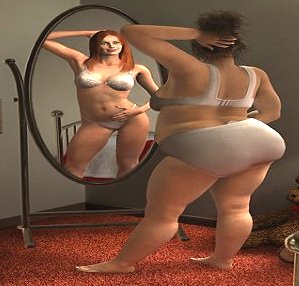 |
Your dreams are a magic mirror that reflects nothing but your own beliefs, worries, fears, wisdom and even genius. To do this it creates characters, situations and drama that are all reflections of your own inner world. All the images and drama, along with the emotions you feel are simply you looking at yourself. Most of it we do not recognise because we are so blind to our failings and of course our wonder. |
If you are afraid of your own emotions, your fears, or are locked into particular beliefs, then you are certainly a victim of them, you are powerless. But if you recognise them as simply your own feelings reflected as imagery they are simply you becoming the master of your own inner world. It is the best lesson you can learn – in dreams and in life.
What do you see in the mirror of your dreams?
See Martial Art of the Mind; Man in your Dream – Techniques for Exploring your Dreams – Habits – Edgar Cayce
The Collective Unconscious
Some thinkers, like Jung and Sheldrake, see individual human consciousness like an island in a huge ocean in which there are countless other islands. Above the surface of the water – waking self-awareness – there is a sense of separate existence, with definite boundaries where the shore meets the sea. Beneath the surface however, one island is connected to all other islands. The land stretches away under the waves and rises here and there into other islands. So, it is thought, personal awareness, beneath our everyday consciousness, shades off into a connection with a collective unconscious we all share. Through this connection we may be able to arrive at insights into other people otherwise denied to us.
In recent years there has been a lot of research very strongly suggesting that the quantum level of the universe is such a universal memory and consciousness. See Physics – new physics and the mind
Jung describes the collective unconscious as the ‘inherited potentialities of human imagination. It is the all controlling deposit of ancestral experiences from untold millions of years, the echo of prehistoric world events to which each century adds an infinitesimal small amount of variation and differentiation. These primordial images are the most ancient, universal, and deep thoughts of mankind.’
However, such ideas have been stated long before Jung and modern psychology. Eastern philosophy has talked of the akasha, the fundamental substance that holds in it memory of all that has happened. In Western occultism levels of awareness have been defined for hundreds of years. At the end of the 19th century Dr. Richard Maurice Bucke wrote about Cosmic Consciousness that was described as having the same universality as the collective unconscious.
A lucid experience describes this very clearly:
Now it seemed as if my awareness went beyond the frontier. This was a very visual experience. I was seeing a vast desert and I knew this represented immense periods of time, perhaps what we call eternity. So it could be called the Desert of Eternity. Here and there in the desert were huge rock formations, a little bit like what one sees in Monument Valley in Arizona. But these rock formations were not plain or slightly coloured rock. Also they were immense. They had the appearance of massive mosaics – brightly coloured mosaics. But the mosaics did not form illustrations or patterns. However, some pieces of the mosaics were larger than others. And each piece might be in itself multicoloured and a sort of miniature pictograph.
As I looked at these massive formations I understood that they had been carved or created through events in the passage of time. Each mosaic, each part of the overall mosaic, had been formed by enormous creative acts, or by long-standing actions. So these latter were like ideograms or archetypes. So, for instance, mother creatures have cared for, fought for, died for their young. This pattern of behaviour has been so enormously potent and perhaps we can use the word successful, that it has created, shaped aspects of eternity. It has left its pattern, its artwork, on time itself. Thus eternity honours that pattern by giving it a place in the very structure of itself. No one being created such a mosaic in the formations. Such a mosaic was large and had in it the essence of all the lives that formed it.
So the rock formations and the mosaics on them represented influences that will flow into the future. They were sources of power or influence that shaped the phenomenal world. They were the body under the coat so to speak. See Archetypes – Links to
This explains some forms of intuition, as one person’s mind is said to connect to all others beneath the surface in the unconscious. In this way, questions or inquiry about a particular person will draw information pertaining to them from the enormous collective unconscious. In fact Einstein said that “Human beings, vegetables, or cosmic dust – we all dance to a mysterious tune, intoned in the distance by an invisible piper”. So our individual consciousness is rather an outcrop of a huge and ancient collective consciousness.
Edgar Cayce discovered in his adulthood, that he could put himself at will into the state of mind in which he could tap this unconscious reservoir of knowledge. Because he could diagnose people’s illness without examining them, his work was supported by doctors. Investigators of psychology and philosophy also sought him, and he dictated 14 million words while in this state of wider awareness. His findings suggest that we all have this ability to tap the wealth of unconscious information – truly a collective unconscious – but few of us can bring it to waking awareness. His biography, There is a River, and Seer Out of Season, are astonishing and inspiring books to read. See: Edgar Cayce.
We see this markedly in animals that are largely instinctive. Birds have no present memory of how to fly or build a nest, yet when the time comes they draw on something that enables them to express the collective experience of their species.
I am a Child of the Universe
If this connection is a fundamental part of everybody’s life, the waters of self and the waters of the ocean are not separated. Jung called this universal consciousness the collective unconscious. Other cultures have given it other names – the ocean of Brahm for instance in Hinduism. Within Buddhism there is also the phrase, ‘the dewdrop slips into the shining sea’. Australian Aborigines call it The Dreamtime.
The image of the dewdrop slipping into the ocean illustrates the individual becoming aware of melting the boundaries of their personal awareness, and becoming aware of the ocean of sentience within which they exist.
When we first begin to ‘hear the voice of God’ again – i.e. feel the immense power of the collective unconscious, the foundation of our awareness – we are often afraid, even terrified, as the story of Adam and Eve depicts. The fear arises because whether we admit it or not, we feel we might be swallowed up, be lost in the immensity. Basically it is a fear of death. See What Happens When I Die?
Reaching the shore of consciousness
Looking back at the psychological history of humanity, at their emergence of identity out of an animal level of awareness, all consciousness was originally merged, as it were, in a great ocean or pool. At that point no creature had crawled out of that pool. Nothing had arrived at self-awareness. No sense of separateness or identity had emerged. Then out of that ocean onto the shore of self-awareness, perhaps for moments only at first, a daring creature crawled and said – ‘I am’. Doing so they left a mark – footprints, two stones rolled together, scratches on a rock, a cave painting. And those creatures still in the ocean looked out upon others and wondered, until a spark was struck in them too. Perhaps struggling for a closer view they emerged and gasping also exclaimed – I am – and added another rock.
So the ocean is the world of sleep, babyhood, life of the nameless herd, consciousness immersed completely in the streams of instinct, reproduction, eating, sleeping and the senses, the collective unconsciousness. But the shore is the pathway of consciousness, the spoken word, art, drama, music, education and questioning enquiry. We all take this path if today we can say ‘I am’! We too, in our infancy, emerged from the collective consciousness. We too were gained a soul, an identity, when we were given a name and speech. You too stepped out of the great waters of life – and will meet them again at death. See Programmed
As already quoted, Jung describes this as the ‘inherited potentialities of human imagination. It is the all controlling deposit of ancestral experiences from untold millions of years, the echo of prehistoric world events to which each century adds an infinitesimal small amount of variation and differentiation. These primordial images are the most ancient, universal, and deep thoughts of mankind.’
What this means in practical terms is that through our dreams, or through any of the ways people access this immense reservoir of human experience, we can find patterns of behaviour – archetypes – and whole memories of people who have lived through and found solutions to the problems we face, or defined the understanding we are seeking. Also, Cayce found actual details of medicines and techniques that had been used successfully in the past and were part of the memory within the collective unconscious.
In trying to present this to sceptical colleagues and intellectuals and scientists of his time, Jung tried to explain his observation of a strata of being in which individual minds have their collective origin in a genetic way. This seems unlikely, and Rupert Sheldrake sees it as a mental phenomena. Dr Maurice Bucke called it Cosmic Consciousness. J. B. Priestley saw it as ‘the flame of life’ which synthesised the experience of all living things and held within itself the essentials of all lives. If we think of it as a vast collective memory of all that has existed, then we can say the life of Edgar Cayce exhibited a working relationship with it.
Such a collective level of mind would explain many things, such as telepathy, so called out of body experiences, life after death, which have always been puzzling because it is difficult to explain them using presently known beliefs. Mostly this difficulty has been because our language and the concepts arising from it insist of a duality of mind and body. However, researches into the nature of fundamental particles – quantum – show us that such divisions do not exist, except in our limited sensory view of the world.
For more information See: Quantum Physics; Levels of Awareness – Levels of the Brain – Consciousness – The Brain Mind Split; Cayce, Edgar; archetype of the self; religion and dreams; sea; Dimensions of Human Experience
Black Magic, Evil and Dreams
Although thorough investigation of claimed injury or death attributed to black magic has shown the real cause to be malicious aggression or murder, scientific research into the deaths of people who were said to have died as the result of a curse or a voodoo ritual, has shown the victims to have died of fear.
Death through fear is fairly common, and is reported by some doctors in connection with surgical operations, especially in the past. In 1887 Dr. Crile had watched helpless as his friend, William Lyndman died of shock after amputation of both legs. My uncle also died of the shock of losing his arm. My uncle, like William had lost little blood, and no vital organs were injured. Crile went on to develop anaesthesia and blood transfusion to counteract death through shock. But some forms of shock appeared to be outside any physical cause. In 1898 Crile was on an army transporter off Cuba and examined a young officer who was delirious with fear due to facing his first battle. He was as deep in shock as if his legs had been crushed by a wagon as William Lyndman’s had. This led Crile to become interested in exopthalmic goitre, an illness which produces a similar type of anxiety condition. Despite the use of anaesthetics, no one had successfully operated on such a goitre condition. Every patient died. Crile discovered why when he attempted such an operation in 1905.
While under anaesthesia the patients heart rate rose to 218 and the body temperature rose to a dangerous level. Despite no physical injury or infection, the patient died that night with a temperature of 109.6 F. Crile realised from his previous observations that it was fear which had killed the patient. Therefore he told his next patient, a young woman who needed the goitre operation, that he was going to give her a simple inhalation treatment. When she breathed in the anaesthetic, she therefore thought she was having a ‘treatment’ not an operation. She was the first person to survive the operation for exopthalmic goitre. Crile called it “stealing the goitre”, and was so impressed by the influence of emotion on the body he constantly stressed the importance of self control, and taught that calmness is strength.
Crile’s experience illustrates what can occur through threat of a curse or black magic. In our dreams we often portray something we deeply fear as an evil influence or person, or as an awful monster or ghost. Such fears usually relate to our own urges, such as anger or sexuality, but can be about any urge or thought that we have been led to feel is not permissible, or downright evil. A demonic figure or environment might also be connected with very early babyhood experiences. The pain of birth is often depicted as hell or demonic influence in our dream symbolism. On exploring dreams that have a very evident evil force or devil in them, what is discovered is that the ‘evil’ is actually the person’s own repressed or hurt sexuality or urges. See: evil; witchcraft; The Con About Evil.
Because the unconscious will use any belief system or cultural symbols we have absorbed to express a theme, the powerful images of witches or evil characters we see on films or in fiction are often used to depict important experiences. For example a dream in which a spell or curse is placed on one can portray the influence a painful experience has left on ones emotions. If you had been deeply hurt while in your mother’s arms, your unconscious would equate pain with being held close by a woman. This ‘cross wiring’ of associations could meaningfully be portrayed as a ‘spell’ which makes one feel frightened in the apparently loving situation. See Victims; Dream Like a Computer Game; spell.
Artemidorus and the First Dream Dictionary
To Artemidorus of Daldis we owe one of the first and most famous books on dream interpretation – Oneirocritica – ‘The Interpretation of Dreams’. Artemidorus lived in Greece about 140 AD, and almost certainly drew on older works, such as Assurbanipal’s dream book, and also the mystery schools in Egypt. Clay tablets found at Nineveh, part of the library of the Assyrian king Assurbanipal – 669 and 626 BC – tell of the importance of dreams in the life of kings and commoners. The Assurbanipal dream book is itself only a link in a chain of tradition, as the library possibly held records starting about 5000 BC or earlier.
If this is correct, the Oneirocritica links the remote past with present day theories of dream interpretation. This is made clear by MacKenzie in Dreams and Dreaming. He points out that in the Assurbanipal tablets it says that if a man flies frequently in his dreams he will lose his possessions. In Zolar’s Encyclopaedia and Dictionary of Dreams printed in 1963 in USA it says ‘Flying at a low altitude: ruin is ahead for you.’ Other obvious similarities suggest that the most recent of popular dream books is largely a copy of the most ancient.
However, Artemidorus added many personal observations to what he had learned from the ancient books which preceded him. In fact he and his followers believed that dreams could be understood best, not from divine inspiration, but by observing the details of ordinary everyday life. One can see in his writings, which included methods of interpreting ones own dreams, signs of connecting popular association between object and dream image. Therefore Artemidorus was probably one of the first to see the connection between dream imagery and the way we associate particular feelings or ideas to objects. His observations led him to say that ‘dreams and visions are infused into men for their advantage and instruction’ and ‘the rules of dreaming are not general, and therefore cannot satisfy all persons, but often, according to times and persons, they admit of varied interpretations.’
This subtlety of thinking is obvious in what he says about the meaning of shaving in ones dreams – ‘To dream of having one’s whole head shaved, except in the case of priests of the Egyptian gods, and those who study how to raise a laugh, and those whose custom it is to shave, for whom it is good, is in general a bad dream, because it signifies the same thing that nudity does, and indeed foretells sudden and dire misfortune. To sailors it clearly portends shipwreck, and to the sick a most critical collapse, but not death. For the shipwrecked, and men preserved from a serious illness are shaved; the dead not at all. As to the former, it is a good dream because of their custom of shaving. To have one’s hair cut by a barber, however, presages good to everyone equally.’
As can be seen, there is no difference here between what Artemidorus advises and how we arrive at insight into our dreams today. The situation of the dreamer, and the common associations prevalent socially, are all a part of the insight. Artemidorus therefore advised dreamers to consider such points as whether what they dream is a lawful action, whether it is usual for the dreamer to do or be engaged in, what puns or association exist in the dream, and even what language the dreamer speaks – for each language has different puns, associations and idioms.
Although his main preoccupation was to present dreams as omens of the future, or of the outcome of present actions, Artemidorus also speculated upon many other aspects of dreaming. He considered the importance of recurring dreams. He was interested in the question of why some dreams produced such intense emotions. He wondered how and why a dream might show clear signs of physical illness long before it became evident externally. In attempting to understand these various phenomena of dreams, he classified them into two types – the Somnium, and the Insomnium. Dreams of the Insomnium type Artemidorus related to the feelings and concerns evoked by everyday life – ‘The lover occupies himself with his sweetheart, the fearful man sees what he fears, the hungry man eats, the thirsty one drinks.’ Dreams of the Somnium type he saw as presenting a wider awareness of the dreamer’s life, perhaps forecasting their future, divining outcomes of actions. MacKenzie sees these as similar to Jung’s ‘great dreams’ which are rich in symbols and full of powerful deeper associations.
Some examples taken from the Oneirocriticus are as follows –
Bathing. In clean, clear water, a dream of great good fortune; in muddy water, the reverse.
Blossoming Tree. An invariable dream of gladness and of prosperity.
Bridge. To see one, successful undertakings, probably a change; a broken bridge, fear and trouble and a warning to take no steps on the unknown road: to fall from a bridge denotes brain trouble.
Candle. To see one being lighted forecasts a birth; to exhibit a lighted candle augurs contentment and prosperity; a dimly burning candle shows sickness, sadness and delay.
Cupid. A dream of love and happiness.
Geese. The cackling of geese means good luck and speedy success in business. Some interpretations correspond to those of animal behaviour.
Porpoise. A dream of joy and happiness.
Rice. To dream of eating rice denotes abundance of instruction.
See: Aesculapius; Greece (ancient) dream beliefs; interpretation of dreams; Babylonian dream beliefs; Mesopotamiam dream beliefs.