Posts Tagged ‘psychoanalysis’
Dialogue With a Dream Character or Object
Every part of a dream, whether an object, person or animal, is alive with our own intelligence. Each part has been created out of ourselves in some way, and depicts some area of our own total being. We can therefore talk with them. Such dialogue is of great importance and very revealing.
As I wrote in my book, Lucid Dreaming:
No computer, however amazing, can yet do what your mind does in creating a dream. It produces a living being such as a dream character that can have a conversation with you, and in doing so draw spontaneously from huge areas of your experience or memories. Behind the image lies enormous data, emotional response and created patterns of behaviour. So the main thing to remember at this level is that you are in a full surround databank of fantastic information. You can tap this information just as you would with any person, by asking questions and prodding for a response. But, even the trees and animals in your dreams are also enormous reservoirs of information, linking back perhaps infinitely with your potential and experience.
To do this, imagine yourself as one of the characters, animals or objects in your dream. It may help at first to have two chairs – one empty and one you are sitting in. The character or object of your dream is in the empty chair. When you are ready to be that character move from your chair, sit in the empty chair and speak as that character. You really need to let that character speak without any editing. So in the case of your dream, if it is a person you cannot see who is a hidden person, you could say, “I don’t really want to be known, because I like to hide my activity of getting you to feel like you might find out my real motives.”
A quick way of understanding your dream is to realise that the images in our dreams are just emotions, thoughts, fears. traumas, ideas and feeling projecting out of you and appearing as images, people or scenes outside you on the screen of your mind. If you draw back the imagews of your dream to make them a part and become them in your imagination, you might then discover what they represent about you. This is so simple that many people fail to try it, and instead try ‘thinking’ about their dream’. I have found that many people feel sqeemish abouit doing this – but your dreams do it all the time.
If it is difficult to get rid of the image, then take the image into you again – after all it was projected out of you, so taking it back into you by imaging you are it introduces you to whatever caused it. Imagine yourself becoming the image. For more information about doing this see Being the Person or Thing
So after you have imagined yourself as the person, care ot thing and felt what was the feeling underneath it, ask yourself, “When have I felt this before – even years ago? What is the feeling about and what part does it play in my life?”
That is only an example so let yourself speak freely.
Be playful and curious in doing this. Question the character, and when you move to that role, let whatever your feelings are as that character motivate what you say and do. Exploring your dream in this way unfolds a great deal of information that would otherwise remain unconscious. It also enables you to make real changes in unconscious attitudes or habits, as you are literally dialoguing with areas of character patterning or programming, and can change them.
Example: When I spoke as the new born baby of my dream I really felt as if this was me, newly born. I had had a difficult birth and my reaction was that I wanted nothing to do with life. I wanted to stay curled up like an egg, not getting involved in the exterior world.
The adult observing me could see how this aspect of my inner life had led me to be withdrawn from social activity all my life, so I explained this to the baby me, saying – I need you to be ready to meet the world. You are a part of me and if you continue to withdraw I lack the enthusiasm to get involved with other people.
Back as the baby I felt totally vulnerable and didn’t want to take any risks – No I don’t want to come out of the egg.
As the adult again I said – Look, if you remain curled up this is more of a gamble than actually getting out and taking risks in life. Just lying there anything can get you. I had watched a documentary of baby turtles hurry to the sea, and some of them got eaten by seagulls.
The view of the seagulls really really got to me as the baby. I could see that simply lying there was more dangerous than being still. I felt a change in me and a readiness to begin the journey of meeting life outside the womb.
This change really made a difference to my everyday activities. A lifelong habit of being introverted gradually dropped away. Trevor P.
Obviously it is important to use this a few times to really feel confident in it. Also do not feel as if you have to be guarded or careful about saying what is important or ‘true’. None of that matters because only what really connects with you is of any use, the rest you can let go of. In the example of the new born baby, it was what was really felt in the role, and what made a difference that was important.
Carrying the dream forward
Imagine yourself in the dream and continue it as a fantasy or daydream. Consider what it is that troubles you or is not what you want in your dream. Now take time to think how you would alter it and how to have an ending that would satisfy you. Not, in your imagination enter your dream and alter the dream in any way that satisfies. Experiment with it, play with it, until you find a fuller sense of self expression. It is very important to note whether any anger or hostility is in the dream but not fully expressed. If so, let yourself imagine a full expression of the anger. It may be that as this is practised more anger is openly expressed in subsequent dreams. This is healthy, allowing such feelings to be vented and redirected into satisfying ways, individually and socially. In doing this do not ignore any feelings of resistance, pleasure or anxiety.
Satisfaction occurs only as we learn to acknowledge and integrate resistances and anxieties into what we express. This is a very important step. It gradually changes those of our habits which trap us in lack of satisfaction, poor creativity or inability to resolve problems.
These are very important steps. They gradually change those of our habits that trap us in lack of satisfaction, poor creativity or inability to resolve problems.
Example: When my husband died, for quite a few times I had this funny dream. I was walking along a field and saw a lot of sheep guiding me, and I followed them. Suddenly they disappeared into a cave. I went in the cave and a row of mummies were there. One was wearing a medallion on a chain round its neck. The dream recurred quite often. One day Tony came to me and I told him the dream. He asked me to sit in a chair and relax, which I did. Then he said for me to go to the cave, and in my relaxed state I went and walked to the mummy with the medallion. Then he said take off the bandage from the top. As I unwound it the face of my husband was uncovered. I screamed and screamed and came out of the relaxation. Tony then said now let him go. I have never had that dream since. Betty E.
Australian Aborigine Dream Beliefs
The Australian native peoples are divided into more than 500 tribal groups. These tribes are also of two major types – those who live inland, and those who live along the coastline. The separation of tribes and the division provided by the environment led to differences in views about the nature of human life and death, and the part dreams played. But some beliefs, such as reincarnation and the ‘Dreamtime’, were universally held.
Dreamtime refers to an experience and to beliefs that are largely peculiar to the Australian native people. There are at least four aspects to Dreamtime – The beginning of all things; the life and influence of the ancestors; the way of life and death; and sources of power in life.
Dreamtime includes all of these four facets at the same time, being a condition beyond time and space as known in everyday life. The aborigines call it the ‘all-at-once’ time instead of the ‘one-thing-after-another’ time. This is because they experience Dreamtime as the past present and future coexisting. This condition – See: altered states of consciousness – is met when the tribal member lives according to tribal rules, and then is initiated through rituals and hearing the myths of the tribe.
Although Dreamtime may sound rather mystical or mysterious to the Western mind, the experience is based on understandable and observable facts of social and mental life which are unfortunately little valued in Western society. For instance the present is observably the result of past actions or events. Present society is particularly the result of past great men and women and their – heroic – deeds. For the Australian native peoples, as with many other ancient races, the heroic deeds of past ancestors were remembered with great veneration. It was seen that all present life, and even the personal skills and character of tribal members, arose out of the life of the ancestors. The ancestors, their deeds, and what arise from them into the life of the tribe in the present, are all held in the Dreamtime beyond the shifting events of things happening one-after-the-other.
The aborigine people believed that each person had a part of their nature that was eternal. This eternal being pre-existed the life of the individual, and only became a living person through being born to a mother. The person then lived a life in time, and at death melted back into the eternal life. See Archetype of the Big Bang
In writing about the state of mind – the mental world – of early races, J. B. Priestley – in Man and Time – says that if we are to properly understand the ancient peoples we must never project onto them our own state of mind and rational thought. Studies have shown that ancient people experienced what is called an undifferentiated state of mind. Their sense of being a separate and independent person was much less than is commonly experienced in modern life. They did not separate their religious life, their social life, their economic life, their artistic life and their sexual life from each other. This is obvious to even a casual observation of such societies, or even third world cultures, where religion and eating, and work are all very much connected. To be banished from the tribe was tantamount to death for primitive individuals, so deeply were they identified in psychological and practical ways to the rest of the tribe. But it is not an unusual thing for a modern man or woman to leave their place of birth, their family or their country, and live abroad. Such simple facts illustrate the deep divide between the modern and ancient state of mind.
If we remember our early childhood, with the absence of an awareness of passing time, the fullness of each day, the eternity of a week or a month, the enormous and unquestioned – if still untraumatised – sense of connection with our family, then we will have an idea of the mental world of the older races. For the aborigine these facts of their life were tangible realities, known through their inner experience in dreams and waking visions. Prior to the development of the reasoning and questioning mind, people did not consider things by thinking about them in neat ideas and definitions. Like the parables in the Bible or Aesop’s fables, which say so much, but do so with images and through the relationship of one thing or person with another, early human beings thought in pictures or dream like images. So the aborigine would meet the influence of the ancestors in their life as an actual visionary person, rather than thoughts about tribal history. With the visionary meeting would come deep feelings and insights, making it a real educational experience. This is exactly how dreams express, and in this manner most creative or problem solving ‘thinking’ was done by ancient peoples. Therefore the entrance into dreams, or into a condition in which the imagery of dreaming could function while awake, as in visions or altered states of consciousness, was important for the aborigine. Common ways of accessing this state of mind were through ritual or initiation rites. In this way enormous learning experiences could be met, a sense of complete identification with ancestors and tribal history achieved, and personal change or growth accomplished.
This condition of mind or being in which time is ‘all-at-once’ and the past is felt as intensely close as the present, is a natural and fundamental state. It is what the baby experiences in the womb prior to the separation at birth and the development of concepts through the learning of language. So the rituals which enable the aborigine to return to the womb of all time and existence enables them to feel connected once more to all nature, to all their ancestors, and to their own personal meaning and place within the scheme of things. The Dreamtime is a return to the real existence for the aborigine. Life in time is simply a passing phase – a gap in eternity. It has a beginning and it has an end. The life in Dreamtime has no beginning and no end.
The experience of Dreamtime, whether through ritual or from dreams, flowed through into the life in time in practical ways. The individual who enters the Dreamtime feels no separation between themselves and their ancestors. The strengths and resources of the timeless enter into what is needed in the life of the present. The future is less uncertain because the individual feels their life as a continuum linking past and future in unbroken connection. Through Dreamtime the limiatations of time and space are overcome. It is a much observed feature of aboriginal life that knowledge of distant relatives and their condition is frequently displayed. Therefore if a relative is ill, a distant family member knows this and hurries to them. Often the intuitive knowledge of herbal medicine is gained also.
For the aborigine tribes, there is no ending of life at ‘death’. Dead relatives are very much a part of continuing life. It is believed that in dreams dead relatives communicate their presence. At times they may bring healing if the dreamer is in pain. Death is seen as part of a cycle of life in which one emerges from Dreamtime through birth, and eventually returns to the timeless, only to emerge again. It is also a common belief that a person leaves their body during sleep, and temporarily enters the Dreamtime.
The aboriginal tribes are connected with their local landscape in a way that perhaps no other race of recent times is. The landscape is almost an externalisation of the individual’s inner world. Each tribe had a traditional area of the land which was theirs alone, and it was believed that in the Dreamtime the ancestors shaped the flat landscape into its present features. Each feature was in some way an act of the ancestors, and therefore the tribe. Like many tribal peoples, the Australian native people were deeply dependent upon their beliefs, the landscape and their inner life for their identity and strength. This makes them vulnerable to anything which disrupts their beliefs, although, apart from such vulnerability, they have a greater psychic sense of wholeness and identity with their tribe and environment than is common in Western individuals.
See the feature Spirit-Child: The Aboriginal Experience of Pre-Birth Communication.
Artists and Dreams
We are constantly giving meaning to a torrent of impressions that we meet through our senses and from within us. We give form to raw experience. We scan our enormous wealth of words, phrases, context, to arrive at an understanding of what is communicated verbally or in writing. If we could watch this process taking place, we would observe a constant searching and rejection of non-hits, a lining up of possibilities, and a bringing to the forefront of what we sense are highest probabilities.
Our mind/brain is a flashing loom of connections, a constantly moving wonderful network of links between billions of cells. This flashing creative network that constitutes the miraculous background to our responses, our feelings, our thoughts and spontaneous fantasies and dreams, is constantly forming patterns from the multitude of experiences we have. It constantly tries to match these patterns against what is already known or learnt. It draws out from the chaos of memory and incoming experience whatever it can liken to what was met in the past. What it can’t match it tries to put into some sort of order or to give a form to. And within all this constant activity the search for personal meaning goes on – Who or what am I? How can I survive? Is there a way ….?
Out of such a profoundly integral search for meaning, as artist, writer, musician, we may project the subtle forms of our inner meanings into the art form we use. We may create shapes, places, people, and feelings. Out of the flashing web of our own sentience we create life – our life – with its own conceptions of what it is to exist, what it is to love or hate, to strive or fail.
Even the most modern of dream theories agree that it is out of the fathomless depths of our drive to give meaning to impressions, that we create dreams. It is out of the barely formed impressions and understanding of the dreaming impulse that we create and live. In fact many artists of every discipline – and I now use the word to include musicians, painters, writers and architects – have directly drawn from their dream life.
What we cannot quite grasp – what is too vast and many sided for us to hold entirely in our thoughts, we give form to in paintings, in carvings, in sound, in piling rocks one upon another to form a monument. We may then venerate or hold as of immense value such art forms. They hold in them for us the vast dimension of the ungraspable, of the infinity of our own within. They stand before us as represent a journey of lives of the alien in our midst, in ourselves. They remind us of what we are not masters of, and what may take hold of our life. See
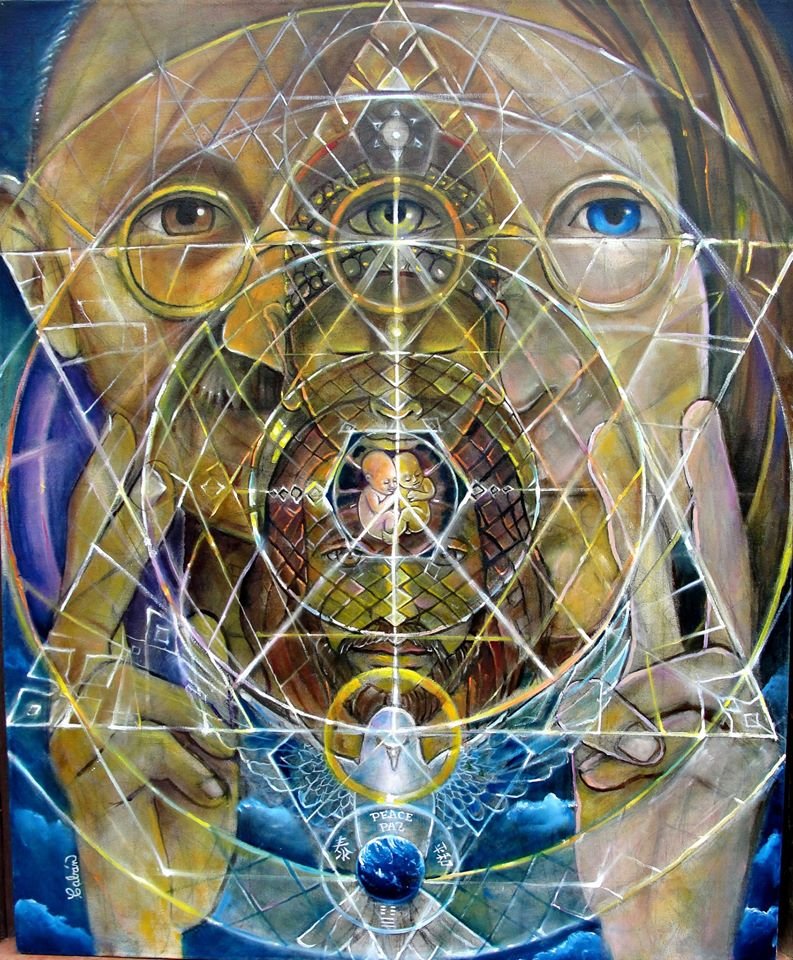 |
In past times tribal people stood in awe of their own existence. They recognised, even if it were unconsciously, the incredible journey they had made from being an unconscious animal, to the attainment of personal awareness and human society. They represented this awe-full experience in rituals, and symbolic paintings and sculptures such as the totem. They also recognised in their art the immense journey ahead, of claiming the possibilities of human life, and put this into their art. How do we deal with the powers that overwhelm us and drag us into mass murder in war and social upheaval? How do we create a personal and social world that we can be proud of? |
In writing about Symbolism In The Visual Arts, (Page 255 in Man And His Symbols, Jung)
Aniela Jaffe mentions the drawing of Klee, interestingly called The Limits of Understanding, which expresses this attempt to put into form what cannot be thought. Jung said that a true symbol appears only when there is a need to express what thought cannot think or what is only divined or felt.
The great artists of any culture give to us what we may have failed to see ourselves. They portray to us the spirit of our times, and our predicament, and perhaps even a passage through the dilemmas we face. Sometimes they manage to break through the cultural plethora and froth of everyday life and display an insight into the fundamental forces of life, renewing our own connection. To do this they face a personal death into the unconscious. They experience darkness and light that many of us may not dare to face. They live within the great forces of their dreams more intensely, more fully than those of us whose awareness is centred on the everyday surface produced by the concepts of life generally agreed upon.
When an artist manages to meet and give birth to one of the spirits of our age, whether it is a terrible demon of our times, or a healing angel, it speaks to us beyond our reasoning. It draws crowds, it holds attention. In the early part of this century the artist Kandinsky wrote that ‘The art of today embodies the spiritual matured to the point of revelation.
Something that we must recognise as an enormous shift in human awareness that has taken place in our own times, and which must influence art from here forwards, is the attainment of self-awareness we have been helped toward by the findings of modern psychotherapeutic schools. This form of self examination has enabled us to explore the wealth of pain and wonder usually forgotten in the mists of childhood. But it also lays bare the struggle, the enormity of the evolutionary movement toward consciousness, toward being human. And there is tremendous art here when it is discovered; art expressing the meeting between the social individual we try to be, and the animal we are still largely immersed in within the depths of our mind and body. In fact we are the whole spectrum of things from sub-atomic particles, through molecular survival and interactions, on into the basic living organisms and creatures up through the lizard, the mammal and the human. All these things are active in us, in harmony, in conflict, in process of becoming. Out of this weaving loom of life all art and music arise; all life experiences an expression of it.
As an example, Thomas De Quincey’s Confessions of an English Opium Eater describes his fantastic dream life over a period of years. De Quincey started to take opium as a sedative. It led to a heightened awareness of how the mind can produce powerful images and memories. He writes that ‘In the middle of 1817, this faculty became increasingly distressing to me.’ Not only did his inner visions present ‘… nightly spectacles of more than earthly splendour.’ But also ‘…. vast processions moved along continually in mournful pomp. Concurrently with this, a corresponding change took place in my dreams; a theatre seemed suddenly opened and lighted within my brain.’ Such experiences led De Quincey to feel ‘deep-seated anxiety and funereal melancholy.’ At times he might recall the ‘minutest incidents of childhood, or forgotten scenes of later years, were often revived.’ ‘I could not be said to recollect them; for, if I had been told of them waking, I should not have been able to acknowledge them as parts of my past experience.’ In his visionary state however, he says ‘I recognised them instantaneously . . . I feel assured that there is no such thing as an ultimate forgetting.’
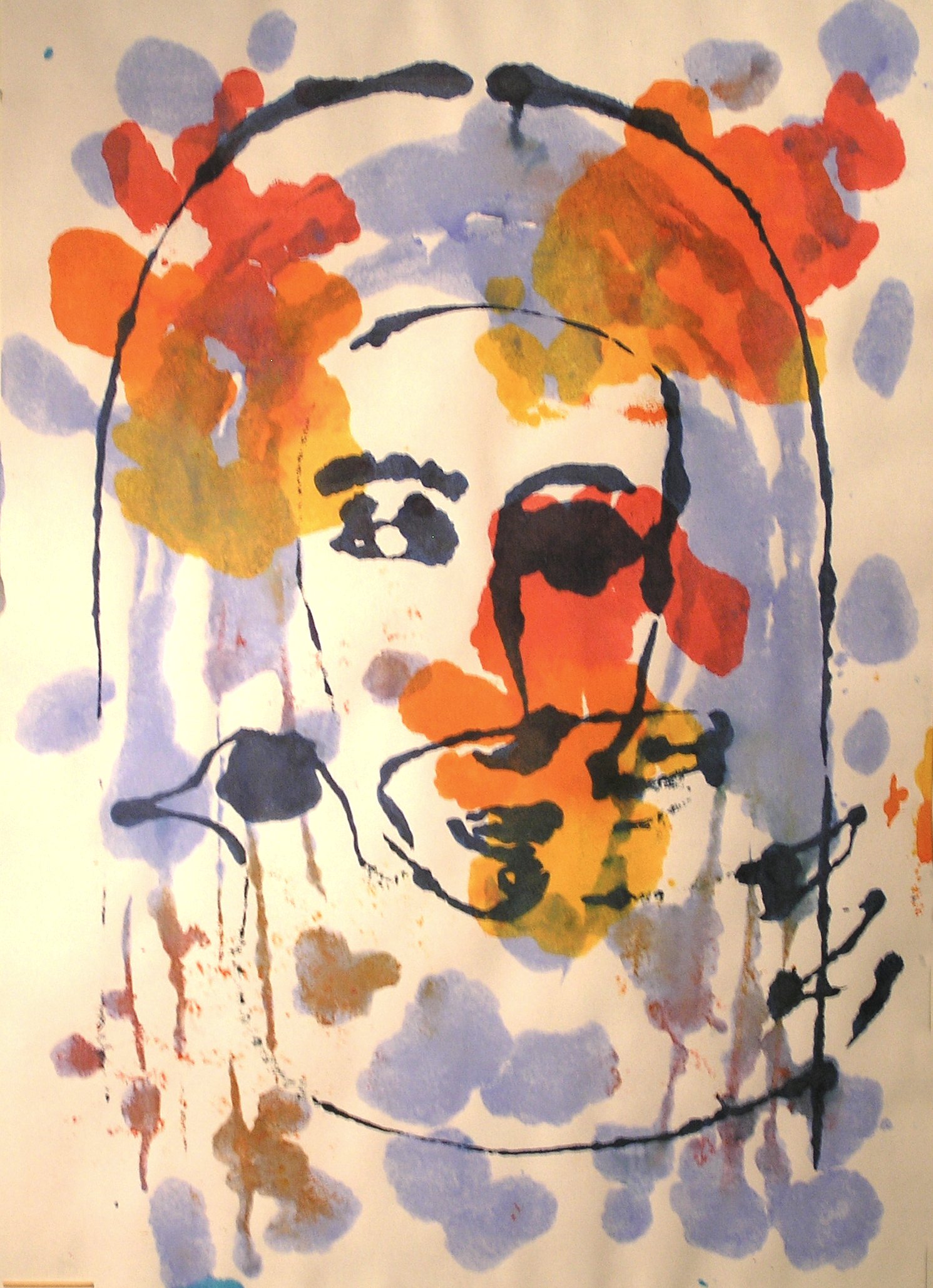 |
De Quincey’s deep seated anxiety and melancholy, in our present times, would be signs of an underlying neurosis which could have been dealt with by exploring his fantasies to their roots in his personal history – already being touched on spontaneously by him. Whether we take the example of De Quincey’s opium aided fantasies, or the visions of Christian mystics such as the temptations of St. Antony, art and religion has at least a facet of being a symbolic way of meeting a neurosis. It is only when we reach through the symbol into what it depicts about us personally, that we move from this historical symbolic form of healing and representation. |
One cannot of course limit the definition of art and dreams to that of dealing with hidden neurosis, or even of the move toward wholeness. Therefore it is interesting to remember some of the artists who directly used dreams as part of their work. William Blake for instance purposefully made use of dreams not only as sources for his art, but also for invention – his method of printing for instance. He particularly tells of the man who taught him painting in his dreams. Blake actually drew the face of this character.
In the 1950’s the painter Jasper Johns was working as a window dresser in New York. In a dream he saw himself painting an American flag. In waking he painted the flag from his vision of it in the dream. The painting became a powerful force in an American revolution in art.
Salvador Dali consistently used dreams as a basis for his paintings. He tried to preserve his dream imagery in his art, and particularly to portray the subtleties of time and space. He referred to his paintings as ‘hand painted dream photographs.’
A number of film directors also used their dreams in the art. Ingmar Bergman tried to portray episodes from his dreams as accurately as possible. He felt that dreams have the ability to help people find points of connection, to link people. Carlos Saura used fragments from his dreams to capture atmosphere and environment.
For each of us, our dreams are our own studio in which we nightly create beyond our waking talent to produce the new, the novel, the unexpected and the deeply true. We are each visionaries, artists of the night and live in another dimension than that of the body. See: archetype of the artist; compensation theory; creativity and problem solving; hallucinations and hallucinogens; hallucinations and visions.
The Archetype of the Self
The symbols of the Self are a ring; a square or square area; a great tree; Christ or other major holy figure such as Krishna or Buddha; a shining thing, being or animal; a talking animal; a strange stone or rock; symbols like the cross or mandala; a round table; God; a guru; an elephant; a crowned or shining snake.
Our conscious self or ego is only a tiny part of our totality, as is obvious when we consider how much of our memory or experience we can hold in mind at any one time. The Self, as defined by Jung, is both what we are consciously aware of, and the massive experience and potential remaining unconscious. That potential is not simply our own personal memories, but also areas of possibility beyond what we usually think of as our personal self. The Self has no known boundaries, for we do not yet know the end of what the mind is capable of, or what consciousness is, or touches, out of sight of waking.
Modern physics is making it clear to us that our concepts and words are simply our own definition of our surrounding or inner reality that is always infinitely more than the definition. A piece of our fingernail for instance, might be thought of as a part of your personal body, a little bit of yourself. It can also be examined as a product of long evolutionary and genetic processes. Another point of view on it would be its molecular and atomic structure, and even the events of its sub-atomic processes. From there you could even begin to see it as part of a cosmic process, its substance being interwoven with the substance of the stars, and the processes of our solar system and beyond – and so on. This escalation of viewpoints applies just as well to any part of us – our brain and mind also.
The mass of experience and potential which lies behind our waking awareness is like an inner factor that, apart from expressing precise information in the form of remembered facts and events, can act as a huge reference base if we listen, through intuition, feeling states, dreams or visions. When we meet this inner potential or healing principle, we may have a powerful experience of meeting Christ, Buddha, Krishna or God, or any number of figures with great powers. Gradually our meetings go beyond form and cultural imagery into a direct awareness of existing throughout all time and space; of involvement in all living and inanimate things. Dante, in his great poem The Divine comedy, describes his experience of this by saying, “I saw within Its depth how It conceives all things in a single volume bound by Love, of which the universe is the scattered leaves; substance, accident, and their relation so fused that all I say could do no more than yield a glimpse of that bright revelation.”
To glimpse that revelation of the core of self, that is at the same time the core of all existence, is to be pervaded by something you can never grasp and hold. It forever flickers and changes, yet at the same time is changeless. Dante says of this, “As I grew worthier to see, the more I looked, the more unchanging semblance appeared to change with every change in me.”
This involvement is not in the end a mystical experience, it is the recognition, sometimes with awe, sometimes with shock, of an existing reality. It is so much a part of everyday life we fail to see it – as perhaps the fish might not know it lived in water. For instance, none of us grow all our food, make our own clothes or their material, produce the energy or gas or electricity in our homes – neither do any of us form the language we exist within and which forms the very structure and self awareness we identify with as ourselves. We exist constantly as an integral and dependent part of this huge web of interactions; we cannot exist outside of it or without it – yet we may fail constantly to hold our integral existence in awareness. We may never see we are part of ONE huge organism. Dreams frequently depict this situation with such symbols as the sea, or symbols of the Self.
In short, the Self is the totality of our being, and any symbol of it within our dreams depicts some level of awareness of, and therefore contact with or communication with, our totality.
An excellent summary of the Self is give in Rudolph Steiners desciption.
“When we come to the fifth level of our awareness, we come to what is frequently called, ‘the Self.’ Here we find the matrix, not of our personal karma, but of our eternal selfhood, the divine individual we could become. It is the awareness and impulse behind all the many earth lives, and is the essence of all these lives, yet not them.
This it is that often appears to us in dreams or visions as our guardian angel or Christ, or a great spiritual being. Here is the archetype, the architectural plan, for our real self, our maturity in God. When we come to this region we see how well or badly we have realised these eternal attributes of our eternal selfhood in our physical life. We gain a view of the many past lives, and how we have again and again sought to become this being that we potentially are. A summary of the past, and a plan for the future comes into being when we measure the fruits of our life against our Self. These fruits are also seen in the light of the eternal wisdom, love and power, shining through the Self. Due to the fact the Self dies to its realm, and is nailed to matter, suffering the loss of awareness of existence in the divine, life after life, that our soul may achieve eternal life, it has a Christ like love, patience and gentleness. Here too we meet those great beings of all nations, religions and times who have trod the path before us. If we remain conscious at this stage, the wisdom and experience of these saints and masters, comes to us as fully as we can receive it.”
Below are some examples of the Self in dreams.
Example: ‘I am climbing a tree to get a stone. This stone has special powers that flower. I’m nearly there when I look down and notice that there aren’t any branches on the left side of the tree. This causes me to consider the possibility of falling and that in turn leads to a fear of climbing any higher. I wake with my heart beating strongly, but little feeling of fear.’ Alan J.
Example: I am standing in the toilet peeing into the water. This creates lots of bubbles. As I look at these bubbles I notice each one has an eye looking at me. Fascinated I bend lower to look back at these eyes. When I do so I see they are not ‘eyes’ but ‘I’s’. Each is a tiny reflection of myself looking back at me. Amused I ponder this multitude of me. Each tiny being, with its own individual sense of self, its own eyes and legs and fingers, feels it is separate from its fellows – and it is. But what they don’t realise is that their awareness, their consciousness is a reflection of me. I am their god. Out of me all have their being. Then suddenly I realise I am myself a bubble. I too have a sense of being independent, with my own eyes, fingers and legs. Yet in reality I am only a reflection of one great life – One Self existent in all diversity and multifarious forms. I felt afraid. Tony.
Example: ‘I look into the third square, it was filled with an iridescent blue colour, shining and beautiful to look at, a beautiful substance. I felt it had to do with religion, but I couldn’t quite grasp it.’ Hyone C.
Example: I watched an insect emerging from what appeared to be its chrysalis – shaped a little like a mermaid’s purse. As it emerged it was vibrant with life, movement and colour. In fact it shifted its shape so quickly I was amazed at how it moved in and out of shapes as it adjusted to its final form. It had a beautiful gold barred design on its back, like a symbol – perhaps a bit like one of the zodiacal symbols. I watched another insect doing the same thing, and began to realise how life was bursting forth in the garden. Looking up in the hedge I noticed a large pod expanding on top of a stalk. Its was visibly getting larger, like a balloon. Suddenly it opened, forming many stalks with leaves and small rose like buds. Another pod was doing the same. As I watched I noticed a young woman nearby. I called to her to witness this extraordinary explosion of growth and life – a dynamic extravagant springtime of activity. She didn’t appear to really see. I was very moved though, and stood leaning against what felt like a wall, perhaps the wall of a house, and wept at the beauty. I started to restrain my emotions, as the woman did not share them, but then thought I wouldn’t hold back because of her. Andrew.
What leads Andrew to weep is his sense of the profound wonder of the formless reality that underlies the vast ever changing world of phenomena.
The only difference was these dancing people weren’t opening to the sacred, to the spirit. So I stepped into the dance area and opened to the spirit. As I did so a most wonderful and extraordinary thing happened to me. I was taken up into the spirit, literally lifted off my feet high into the air and held there by the power and glory of what was happening. Then, still in the air, my body was spun like a top, and at the same time in a circle, until an enormous energy was built up. This energy then flashed down upon the people, entering their body and soul in a transforming way. The feeling of glory and wonder was enormous. I could see this energy, this sacred power flowing down as other people entered this condition, and I saw the transformation of people’s lives, and the change entering into the way they lived, even into the way people were farming their land. I knew that the time of quickening was upon us. But I was one of many who were receiving this power and allowing it to flow into the lives of others.
Here is a very different description of meeting the Self, also from a man’s dream.
In the dream I met my “teacher”. It was a powerful meeting of two men who respected each other. I met him because of my own independence. I recognised his greatness because of my own success and craft in life. Then I was a teacher among disciples. There were only about six. They were all capable and mature adults who were my pupils because they loved and respected me. They gave me great and practical support. One of them, a woman, came to me and said that if I ever needed to be held, I need only go to her.
In exploring the dream I uncovered a lot of emotion. I felt Christ was the teacher I met. The dream expresses qualities of Christ I had never seen clearly before. Namely that Christ is so many-sided. Christ is approachable or open to children – to fishermen – to scholars – to women in love – to the sick – to businessmen.
Also, Christ is understandable by a child. As a child one feels as if Christ is a friend who is just a few steps ahead of oneself, showing the way. But as one grows, Christ is always there, just a few steps ahead. What a wonder that is. Thank goodness there is always that presence beyond one’s best, gently calling us on to greater humanity, greater humility, greater craftsmanship in life.
But contact with the Self can be in so many forms. Here is another one.
Now a most extraordinary thing happened. I experience feelings of being made love to, but not through the genitals, but through my head right the way through my being down into my genitals. For a long time it felt as if I didn’t need to breathe, and in fact I seemed to exist without breathing for quite a long time. There was a feeling of tremendous quietness. Inside something gently moving through the openness in my head down my being, flowing to my genitals. Once there it was like it opened something. It changed something. Then, gradually, that influence of change started moving up my being. I could feel it particularly touch and change things in places like my solar plexus and my heart. When it reached my throat I could feel it tickling and opening something there. It really felt painful as it went through these places, particularly as it reached into my head. It wasn’t a physical pain, but it felt as if something deep inside me was being stretched and opened, and that stretching was painful at a subtle level. I cried out in the pain. I wept. I cried out in pleasure – the mixture of pleasure and pain, just as if I were being made love to in a wonderful and delicate and yet painful way. As it touched and passed through my head I cried out, “Why? Why?”
And here again, a real experience.
Then it was one feather tied to a twig by piece of wool, blowing in the wind – a feather blowing in the wind. This was very stable and persistent in the fantasy. Everything resolved back to the feather blowing in the wind. It seemed like a Red Indian symbol, perhaps tied to the suspended body of the dead, but I could not understand.
Then it came to me that I had to listen in deep stillness – not think, not seek to understand, not struggle, just listen. My whole being entered into silence, gently listening as one might listen to the rain falling on a lake. Then suddenly it was known – the feather blowing in the wind – the sound of one hand clapping – the essence of human existence. Open against the sky – emptiness – enormity.
This was truly an experience of enlightenment. All cares, all pain fell away from me. I had an incredible sense of freedom such as I had never experience before. Every moment of every day we were free – free to choose – free to create pain or peace – free to go or stay – free to live or die. This extraordinary experience of freedom, and of the dropping away of normal perceptions, lasted for three days. Everything looked different. I don’t mean it felt different. I mean it looked different. I remember seeing a bird flying across the sky and it was simply Bird. Maybe even that isn’t true. It was simply what it is without any name.
And here is a magic contact:
I had struggled so long to find a realistic experience of God. After years of effort, meditation and discipline I realised that I didn’t know what to do. So I sat every day without any direction or effort and waited. I did this for an hour each day. I felt that if there is any real thing it would be like me waiting on a street corner for a friend to come. If he or she came I would feel a touch on my shoulder and would know it for real, and not as a sort of imaginary or emotional thing.
Then one evening I had got out of bed to go to the toilet, and just as I was approaching my bed to get back in I heard a voice very clearly saying, “You have asked what are the results of God’s activity upon one – now watch closely.” Within days I was led into a direct experience of that touch. It was a very powerful experience of the spirit cleansing me and growing me toward the stature we can all attain, and it carried on week after week. It was like an initiation into the Mother Church – an experience of where all beliefs have sprung from.
Awareness of the Self is important. It contains what is our own personal wisdom and insight regarding life in general and particular. It is not full of creeds and dogmas and conflict as are organised attempts to express the spiritual. But it does have its dark side. To grasp the stone with special powers; understand the significance of the iridescent blue square; or realise we are a bubble, as these dreams depict, we need a clear rational mind which allows intuition and feeling but is not relinquished or lost in the immensity of the Self. Touching the vastness of our being we may ourselves feel vast, all knowing, a guru, the great world leader, Christ or Buddha. In this state Jung says a person may lose all sense of humour and drop ordinary human contacts. One is then lost in the archetype, possessed by it in some degree.
Negative relations with this archetype might be that as a defence against meeting our pain and childhood trauma as we enter this vast storehouse of our being. As a way of escaping the self responsibility for our difficult human condition we might fly off into feelings of loving all things, of knowing the mystery of it all, of being the Buddha. The problem is that while it might be true we are in essence the Christ, or have wisdom, these realisations are distorted by the undealt with childhood traumas and longings. See: aura; first example under archetypes; compensation theory; mandala; ring; spiritual life in dreams; yoga and dreams.
Useful Questions and Hints:
In what way have I ever touched this wonder that underlies all things?
Have I ever opened myself to its possibility, or am I locked into the prevalent belief system that sees the body as the only reality?
Do I still see Christ or Buddha as belonging to particular organisations or dogmas, or have I moved to realising they are more than that, and represent the core of myself?
It might help reading The Keyboard Condition – Individuation – Methods of Awakening
The Archetype of Rebirth or Resurrection
The symbols of rebirth are: The cave; an egg; spring; the tree; the cross; dawn; emerging out of the sea; the snake; the bird; a seed; arising from the earth or faeces; green shoot from a dead branch or trunk; phoenix; drinking alcohol or blood red wine; flame; a pearl; the womb.
Rebirth is the Death of the Old Life
Rebirth is as difficult to face as death. It holds within it not just the memories of the struggles and difficulties of our own physical birth and growth, but also the challenge of becoming the unknown future, the dark possibility, the new. The dream of Andrew in the underground cavern below, is an example of positive rebirth. After realising himself as bodiless awareness he emerges from the cave, and finds himself near a tree.
Example: ‘A tremendous jolt of power poured into me from the tree. I saw that we had arrived at a place where a line of trees, about a 100 yards in length, stood very close together in a slight semicircle on the top of a bank. The trees had great spiritual power and the place was a holy temple. Two spiritual beings were there – an ancient Earth Being, and Christ.’ Andrew.
The next example is of a dream typical of meeting memories of physical birth. As can be seen, the experience is powerful enough to cause physical shaking.
Example: ‘All I can see of what I enter is a very narrow space with a light showing through. But immediately I enter I realise I have made a mistake for I am being forced swiftly through a dark, very narrow tunnel. I feel pain as I am dragged along and I hear loud banging noises which frighten me, but although they are loud they seem to come from inside my head. I feel terrified and breathless and very relieved when I wake before reaching the end of the tunnel. In fact as I write this account I am shivering.’ Female. Anon.
We usually face a deeply felt experience of death before encountering the archetype of rebirth. Neither the death nor the rebirth or resurrection are things that happen quickly. There may be dreams, waking subjective experiences or a short period in ones life when death or rebirth are felt very strongly – but the process as a whole is a psychological one which may take years to unfold and stabilise. With many experiences of archetypal nature, such as entering puberty and meeting the process that unfolds manhood or womanhood, we are working out psychic growth which involves our entire nature. Puberty is an excellent example of how an archetypal human process works in us individually, yet is very unique for each of us. At the same time however, while puberty is a well worn path which virtually everyone travels, some aspects of human possibilities, like death and rebirth, are not universal. Only comparatively few people really manage these points of growth.
Here is a very clear example of death and rebirth. It occurred when the man explored a dream of entering an old house that was lived in previously by his ancestors. Puma was a great cat that had leapt on him as he started his journey. Lurch was a figure representing the guardian of the threshold:
I started by imagining myself standing in the shadows of the house with Puma and Lurch. Then we walked together into the darkness. The subjective images took on a life of their own and I saw we were walking in a large underground space like great catacombs. The light was dim but we could see our surroundings, and not very far into the cave like space was a tomb on our right. It had the form of a low wall about a foot high in an oblong, and the wall surrounded a long stone in the centre, which was roughly body shaped.
As we drew level with the tomb an enormous change occurred in me. Suddenly I became a woman. It was no longer imagination. I was now completely experiencing myself as a woman whose tomb we had approached. As such I was torn by an immense pain of loss. As my complete identification deepened my body curled up with the pain as I was torn by wretched crying. Suzanne told me my voice changed as I cried out again and again for release from the pain of losing all my children, my husband, even my parents. My hands were clawing my legs in an effort to express the misery, and I was screaming that I could not bear to live any longer with such pain. I cried out to God to take me, for there was nothing left for me to live for. “Why? Why did this happen to me? Why has everything I loved been taken from me?”
There was no response to these awful cries and tearing sobs. But slowly a shift began. It seemed to me as an observer witnessing this awful pain, that by entering this place the spirit of that woman had woken in me. But as she had died in such unresolved agony of loss, that is what was met when she awoke. But gradually she realised she was alive again in a new way. She began to recognise that I was holding her within me. Because I was not frightened of pain and emotions, the misery could play itself out in me. And because my understanding of what was happening flowed into her awareness, she slowly saw and felt her loss in a different way. In fact we were both realising she was experiencing resurrection, and that in turn meant there was no final death as believed by many. Therefore there was no loss as she had originally felt it.
At this point something truly incredible occurred. She and I both realised she was one of my past dwelling places – past lives. But for her the viewpoint was slightly different; for she saw me as a continuation of a life that she had failed to be a part of because of the awful pain of loss. It had kept her from flowing into what was her future as my life.
From my perspective she was one of the past dwelling places the spirit that was at the core of my present personality had lived in and as. She was not one of my lives, because the personality that I am was unique and had not lived that woman’s life, but my spirit had. Because she was now part of me and me of her I asked her what she had brought into my life. Her reply was, “A woman’s love”.
Example: I’m imagining Christ emerging from the grave. Who is he now? Not the man he was even if he looks the same and more or less has the same qualities which you do and you don’t. So I think death needs to be factored in whenever there’s a break in the reality that you knew, and it’s not just you have to know it, but everyone around needs to know it. I’m reminded of after my father died, that when I met people, I felt I couldn’t be with them until I said that my father had died because that had changed everything and they couldn’t possibly know I was without that. So in the same way, anyone who’s died and come back is not the same.
I suppose I can say that whatever happens to you, even if the worse happens, you have something that can re-grow you, if you’ve lost everything, that means you haven’t lost everything, that basic clear quality, maybe it’s a new form, maybe it has gone on a few steps, but it’s still there if you listen to it. Don’t struggle with it unless it is a struggle, let it happen, don’t make it a big fight because you may be fighting against what is emerging.
The Great Cycles of Life
The cycle of death and rebirth happen mostly to people passing from adult maturity to old age. It connects with physical and psychological changes to do with altered relationship with life and society, and with ones own body and self image. The cycle may appear in young people however, if they face death, physically or in a deeply psychological way. In ageing ones relationship with children or procreation alters. Whereas they were at one time consuming and motivating drives, they are no longer sustaining or motivating. Work and ones relationship with society may also undergo a similar change. The identity one gained from having a place in society, and connections with other people through being a mother or in ones work, falls away. The personality, the attitudes, the hopes and ambitions built from the many years of life as a procreative, creative person meshed into society, dies through the lack of a relationship with the world that sustains it. This ‘death’ may be very painful, creating a great and sometimes crushing sense of pointlessness, of having no value in the world, of having nothing to live for. In some cases these feelings are triggered by the onset of menopause in women, or impotence in men – but also for men the absence of a sexual life or family life, or simply the process of ageing.
One man described it as, “The feeling of being paralysed, or being unable to move. It is not so much a physical impediment, but a sense of having no motivation, no ability to want anything, no drive to reach out.”
Fears may arise as to what is happening. Such fears are based on concepts we hold regarding ageing or death. The loss of identification with oneself as a procreative and higly motivated person may seem to be a sign of emerging incapability or even senility. The fear then sets up a conflict with the process of psychic growth.
A woman who had worked as a nurse, describes her experience of this as, “‘The feelings I have about dying, about losing my drive to live, link with ideas of being incapable as one is in hospital. Those are feelings or ideas I connect with it. Those images have made it – or are making it – hard to meet.”
However, such a felt death is only a precursor to the experience of resurrection, and this leads toward a new relationship with oneself and the world. The attitudes and way of life that was necessary as a procreative, work oriented individual whose self image was largely based on family background, physical looks, sexual potency, ability to get the goods of the world or gain power, steadily shifts. It moves toward a sense of self that is centred more on what there is on ones existence that is more timeless and less ravaged by change than the body, the emotions, ones intellectual concepts and the social scene.
Have I Lost Everything?
The change that takes place in this experience of an inwardly felt death, may at times feel like losing everything, shedding the past, becoming completely insecure. It usually leads to the realisation in ones life of parts of oneself that were never lived before, or never allowed expression before. There is not in the end a loss of anything, only a gaining that requires one to let go of the dominance of what was previously important. From this arises a feeling of wholeness and connection with the world and self in a new way. In her book about the individuation process, Jolande Jacobi says, ‘…. transformation is an integral component of the individuation process, which in turn follows a line of development whose goal is psychic-totality.’
Example: Last night, I very vividly had a lucid dream, where I saw a pregnant (very pregnant) women hanging from a rough rope in a bathroom. The bathroom was unfamiliar to me.
A dream expressive death and rebirth. The rope was death, the pregnancy was rebirth.
There is however, no final death or rebirth. The cycle is a fundamental process in nature, and therefore active too in the physical and psychological nature of humans. It is not only old age or approaching death causing the experience to arise. It can also happen during profound personal growth, when old fears, traumas and habits fall away and allow a completely new relationship with sexuality, with work, with being alive.
See: Life and Death.
The Night Journey – the Search for Self
Each of us are constantly gathering information about who we are, what we are capable of and what the meaning of our life is. This is often put into an archetypal form as the great quest, a journey or the great pilgrimage. For many it is expressed as the search for God, Allah, or the many names people of the world give to what they experience as the Great Unknow Mystery, and the often extraordinary efforts people make to grow beyond the pain of childhood or adult trauma. In some it becomes the quest for knowledge when one truly tries to understand rather than simply remember facts. It is seen in artists attempts to go beyond themselves in creative acts; in the spiritual quest for the imperishable; the search for real love or even the way some people manage to transcend the limitations of their body. They are all aspects of this search for self. The journey is endless because it is a journey through infinity.
I am a wave on a shoreless sea.
From no beginning
I travel to no goal,
Making my movements stillness.
Constantly I am arriving
And departing,
Being born and dying.
I am always with you
And yet have never been.
Throughout history we have examples of how such quests were lived out. Mohammed for instance, describes his massive breakthrough into what he felt was a cosmic revelation as The Night Journey, which occurred in a dream. Siddhartha, after years of discipline and privation, finds a new way of experiencing life in what we now called enlightenment, and became the Buddha. Jesus transformed from a carpenter to the Christ at baptism through an opening to a new type of awareness. Thousands of people in today’s world have followed in the footsteps of those early pioneers and experienced for themselves the meeting with what Jung calls The Self – the emergence into an experience of greater wholeness or completeness; the falling away of the defences, resistances and fears that have held us back from our fullest and most profound experience of ourselves; an experience of enlightenment. It is not a case of developing an attribute we didn’t already have, but of bursting through the personal or culturally imposed barriers that have walled off this greater expanse of self from easy access. See Enlightenment
In a sense, every dream is a part of this huge journey which is our life. Each dream is a facet of what is met in experiencing – meeting – our own existence. There are definitely highlights in our many dreams – times of critical and arduous difficulties, such as we find in the great quests such as Jason and The Golden Fleece, and the Odyssey. The journey is one we are all on, and our dreams and archetypal images are but ways of depicting aspects of what we meet, the enormity of the ordinary, the hidden depths of a problem we encounter, the wonder of possibilities awaiting discovery, the way into the trackless realm beyond collective norms. The journey is from dependence toward independence, from being a part of collective humanity to the actualisation of our own unique identity. This journey to oneself is, paradoxically, also the journey to the universal, to merging of self with the One. See: archetype of the hero/ine; Inner World
Example: I was in the army. We were going to fight the Germans. We collected together in a large flat, the Germans coming also. We came to know each other not as enemies but as people. I was so moved by the feeling of brotherhood I nearly wept.
Then I was on a ship. It was night. Ahead loomed land, some miles away. On the left, high up in the hills, flashes of guns could be seen. The captain explained that the guns were bombarding and terrorising people. It was our mission to stop them. As this was explained I felt, for the first time in my life, a real feeling of being a part of a group, and being willing to risk or give my life for my people. It was almost a religious feeling. T.
This is a typical ‘night sea journey’ dream. The dreamer was starting to delve into himself and the dream shows him ready to give his life to dealing with his internal conflicts. It also shows the love and courage necessary to make this journey.
There are grand stages or points on the journey. Most of the great religions attempt to depict these stages, although there can never be a final definition. In Christian symbols for instance we have the annunciation, the divine birth, the recognition at the temple, the baptism, the teaching, the marriage; the trial and crucifixion, the death and the resurrection, and finally the ascension. All of these depict psychological events in the process of meeting ones own depths, of the growth to ones own maturity and wholeness. Other cultures define these stages in other ways. The Hindu teachings give them as four major stages. Namely the student, the householder, the retired person, and the fourth is the ascetic (also known as a sanyassin or a sadhu). See The Inner Path to Christ Intro
Example: I remember leaving some place and embarking on a journey at night. I’m frightened but I want to make this journey. I approach a stream with a very narrow bridge. It’s dark and I’m afraid I may fall off the bridge. But to continue I must cross the bridge. R.
This extract from R’s dream is typical of the starting of the process of uncovering ones own unconscious darkness and the night of the unknown self we are journeying to. This is the beginning of what is often called the Night Journey and the facing of fears. The Night Journey is itself an archetype involving the search for self. It is called a journey in the night because the person enters into what was previously dark, hidden and unconscious. They enter into awareness of the unconscious. Carl Jung’s frontispiece to his book Man and His Symbols is the entrance to an Egyptian tomb, leading into profound darkness.
Example: My dream is of an endless journey, which takes a road that turns into a circle or maze that is endless. There is cloth covering the sides of the pathway. I have to take sticks of wood to try to lift it out of the way. J. P.
Example: Then imagery came and I was walking in a beautiful forest. The trees were very big and widely spaced, so it was light and giving the impression of quiet space. I felt as if I were beginning a journey and the forest was my starting place. As I walked in the forest I heard a sound coming from somewhere. I had the sense of it beckoning me or attracting me so I go off in search of it. But although it beckons it is difficult to know exactly where it is coming from. There is a sense that it is coming from higher up, from the mountains that stand beyond the forest.
I am experiencing something the imagery is of being in the midst of a tribal group perhaps they are like people from New Guinea or South America. I seem to be lying on the ground and they are in front of me in a long column, all males. They are not threatening, but they seem to be expressing masculinity, perhaps even the source of strength that would go into being warriors. I am apart from the group, an old male. I feel it is something about facing death.
Now they have gone and the women of the tribe are dancing in front of me. They are bare breasted and their dance is about being female. My sense is that they are calling my masculine energy, raising or rousing it in preparation for something like an initiation I am about to pass through. I am the elder and they are readying me for a further initiation. What they are doing is traditional, and it is to set the scene for what I am to face or confront.
Now the preparations have ended and I am to go off alone up the mountains to meet whatever waits for me there. Now it feels as if something is flowing into my body. I am now experiencing a state or condition that has been very marked or strong in my life lately. My breathing became very slow, it seems even at times as if it has stopped, and everything becomes very still. It feels like being dead. My body becomes so still it disappears and all that is left is awareness submerged in enormous emptiness or space. There is a paradox in this experience because it feels as if I, my sense of self, has melted away, and yet there is still a very definite experience of existing. I suppose what has stopped is what I have called movement. The movement of thinking, of feeling, of longing or hoping for things.
There is this huge reality confronting us all the time. We call this reality death. And often that has an awful face for us. But I am feeling it as joy, a most wonderful joy. It is here in the darkness I am experiencing – that joy. The waves of this gentle joy flow through me. It is like floating in a subtle ocean and my consciousness, my being, is gently lifted and moved by the waves of this quiet joy.
Here the waves of that joy were big, lifting me high in a coloured spectrum of rippling, vibrating radiance. My being was the waves. I was myself waves of rippling sparkling radiance. At the same time my awareness could switch back to what was happening with my body, and it was shaking, vibrating with energy flowing through it. As this happened it really seemed as if my body was being absorbed into the energy. This felt to me as if my body was melting and becoming part of the emptiness that was rippling through me, that was me. The great waves of life were absorbing my personality. It was being broken down just as our body breaks down food we eat and digests. It was drawing me back into itself. Living or dying is a joy. I love you life. I love you death. You are both the same beauty. Beautiful mystery. I cried out with the wonder of it, “Oh my Darling.”
Our dreams often insist that the journey is everlasting, not even ending with death, but moving through the great cycles of the universe. Only by making the journey can we find our own wholeness and our own place in life with any awareness. The term probably arose with the description of Muhammad’s experience of enlightenment which he called The Night Journey. Jung called it the Night Sea journey.
Paul Levy writing about this says: “This process can be so extreme, so radical, that the ego experiences it as death …. This experience is related to the shaman’s and Jesus’s descent to the underworld as well as the archetypal journey of the wounded healer. See Vibrate Vibrating
Example: As I walked among them I saw their lined faces, bent backs, and thought/wondered whether this could be healed and released. Now their doctor/priest came to them. A big man who seemed to have a slightly lame right (I think) leg. He had penicillin on his hands – to heal the many sores his people had. He then laid down in the small channel seen in cowsheds to carry of the urine and cow shit. It had been cleaned, but a cow had shit in its slightly. He asked for blankets to lay on. These were brought. He lay down and prayed. This was the inner strength his people needed.
This is an example of the wounded healer.
To quote an ancient alchemical text “…the Tincture, this tender child of life…must needs descend into the darkness of Saturn (which symbolizes the point of lowest descent, of death), wherein no light of life is to be seen; there it must be held captive, and be bound with the chains of darkness.”
Mythologically the night sea journey is described as being swallowed up by a sea monster and thereby carried into the depths of the sea – the story of Jonah. Psychologically it is the experience of ones life energy turning inwards and descending back toward its root or source. In doing so our poor vulnerable self awareness, our tiny spark of consciousness is carried beneath the protective boundary of waking awareness into its own depths. This is akin to travelling into the darkness of sleep with awareness. Sleep, after all, is a strange country in which our waking self seldom if ever travels. Imagine, if you have not already made the journey, delving into the level of yourself where your eyes no longer see, your body sense of form or size and touch have disappeared. There is no hearing of the external world. You are sinking into the country of what we call the mind or consciousness, the world of sleep, death and dreams, in which the usual boundaries of experience are taken away. Here you meet – given form by your fears and cultural symbols, as if with real bodies – your own fears, the pains buried deep in your past, the residues of all past actions so far unredeemed.
But you also meet the wonder of an enormously enlarged awareness, the sparkling immediacy of questions answered, the splendour of bodiless life linking in love and mind with an infinity of others. Here you experience the vision of the spirit’s journeys into time and space, and its life in eternity. Here you are the genderless consciousness of angels.
Example: This is when I entered into the house of God. At first I saw the image of a huge cathedral or church with a magnificent domed roof and I knew that I was in the house of God. I felt the utopia, I felt like I have never felt before, so very good, so excellent. I knew all things. I didn’t have to read the bible or any kind of teachings because the answers are all here in the presence of God. In this state I could ask any question and know the answer. I knew God, yet I was God because there was no separation. Neal C.
Example: Suzanne Segal in her book, Collision with the Infinite, says, There is no one I could instruct to do something to make you the vastness. That’s already and always who you are.
There is no end to all of this, just as there was no beginning. There are constant “bus hits,” as I now call them, in which the infinite expands yet again and again. The substance of the vastness is so directly perceivable to itself in every moment that the circuitry at times requires another adjustment phase to get used to more infinite awareness. When asked who I am, the only answer possible is: I am the infinite, the vastness that is the substance of all things. I am no one and everyone, nothing and everything—just as you are.
And before you say you think that is all preposterous think about this – you can see Less than 1% of the electromagnetic spectrum and hear less than 1 % of the acoustic spectrum. As you read this, yon are travelling at 220 kilometres per second across the galaxy. 90% of the cells in your body carry their own microbial DNA and are not “you”. The atoms in your body are 99.9999999999999999% empty space and none of them are the ones you were born with, but they all originated in the belly of a star. Human beings have 46 chromosomes, 2 less than the common potato. The existence of the rainbow depends on the conical photo receptors in your eyes; to animals without cones, the rainbow does not exist. So you don’t just look at a rainbow, you create it. This is pretty amazing, especially considering that all the beautiful colors you see represent less than 1% of the electromagnetic spectrum. See: The Next Step.
Useful Questions and Hints:
Have I consciously made the decision to take the journey of self revelation?
If I am on this journey what stage am I at? See: individuation for stages.
Am I meeting, or have I met the dying of self – if so what changes is it bringing?
Also it is worth reading Levels of Awareness – Jesse Watkins Enlightenment – Methods of Awakening – Meditation with Seed – Life’s Little Secrets – Dimensions of Human Experience
Analysis of Dreams
A great preoccupation of humans has always been ‘What intention does the world have in regard to ME?’ And also, ‘What do I want in regard to the world?’ If we understand that the sense of ‘me’ or ‘I’ includes all one holds dear, such as family, ‘tribe’, reproduction, hunting or business and general survival, then we have in a nutshell the essence of many dreams. We seek to deal in our dreams with the things that threaten these interests, whether they emerge from within us as urges or emotions, or from an external source. Dreams allow us to explore these difficulties of meeting our inner and outer worlds, and perhaps to find courage, resources or wisdom in facing them. The fact that the dreams of many ancient peoples included confronting gods or demons need not seem strange to us considering our present day dreams – see examples below. Whether the wisdom comes out of the mouth of a god or computer in our dream, the result is much the same. Whether fear arises out of the image of a ghost or an alien, it is still our own emotion we are meeting. See dream yoga.
All analysis of dreams rests upon concepts of what a dream is, what the events or images in the dream represent, and what we feel about them. Analysing dreams has a very long history, and this history shows the various concepts different cultures had about dreams and dreaming. But the analysis of a dream must not be confused with exploring a dream or using something like active imagination or the amplification method. Analysis is largely an intellectual approach while the other methods tend to encourage the dreamer toward direct personal experience, or allow unconscious content to emerge. See: Greece (ancient) dream beliefs; history of dream beliefs; religion and dreams; spiritual life in dreams; peer dream work.
Most societies, ancient and modern, have had professional dream interpreters. India had its Brahmin oneirocritics; in Japan the om myoshi; the Hasidic rabbis in Europe fulfilled this role; in ancient Egypt the pa-hery-tep; ancient Greece had the priesthood within the Asclepian temples given to dreams; among the Aztecs, dream interpretation and divination were the prerogative of the priestly class teopexqui, the Masters of Secret Things; in today’s world the Freudian and Jungian psychoanalysts fulfil this role – the author has worked as resident analyst for television’s channel four Teletext in the UK, New Zealand Teletext, London Broadcasting Company, as well as a major national newspaper.
Some of the most ancient written documents are about dream interpretation and are direct expressions of the attempt to understand or interpret dreams. The Chester Beatty papyrus on dreams for instance, dates from 1250 BC, from Egypt. This contains records of 200 dreams and their interpretations according to the priests of Horus.
Most social roles that survive for such long periods of time fulfil some useful purpose. The most fundamental purpose of dream analysis is probably that of reducing tension and anxiety in the dreamer. In skillful use of dream interpretation there may also be a powerful shift in the dreamer towards greater understanding of their life situation, or their internal process. With such understanding they find themselves in greater accord with themselves and their social and general environment. As with any role however, there is also the aspect of manipulation and control of ideas and behaviour that can occur when a lay person seeks the advice of priest or professional. Some such analysis of dreams, in the past and today, have most likely been ways of influencing the individual to fit present social or political norms or expectations, or to serve in some measure to maintain the role of the interpreter socially and economically.
Different cultures and ages approached dream interpretation in different ways. But one of the fundamental early ideas concerning what a dream meant has become folk philosophy. It has influenced thinking in regard to the mind and spirit to this day. Perhaps the most obvious example of this is that because many dreams place the dreamer in surroundings different to those in which they sleep, early thinkers were convinced this meant the human awareness or spirit left the body during sleep and travelled to far regions, or perhaps even to other worlds of the spirit. The idea of the personal awareness being able to leave the body gave rise to much speculation about the nature of human life. It became a fundamental belief that the mind or consciousness and the body were quite separate, but during life joined together in some way, perhaps like a letter in an envelope, or water within a tree. This view dominated the way personal awareness or consciousness was thought about for millennia, and was undoubtedly influenced by observation of such phenomena as out of body or near death experiences. In many people’s mind this duality is still a prime way of thinking about such phenomena of the mind as out of OBE’s and NDE’s. In fact, even with a much wider base of cultural viewpoints and philosophical and scientific debate and experiment with which to approach such phenomena, they are still not easily explained. There are however, completely different standpoints to approach the phenomena from. See: out of body experience; consciousness – the body mind split.
The Kalapalo Indians of central Brazil are a Carib-speaking community of fewer than 200 people. To the Kalapalo, dreaming represents an experience of life that frees the imagination and memory, and dreams must be interpreted with reference to the future of the dreamer.
The interpretation of dreams requires special linguistic resources that might be different from those appropriate for speaking about the ordinary waking life. Dreaming is believed to occur when, during sleep, an individual’s “interactive self” awakens and wanders until it achieves an experience. The dream experience begins when the interactive self stops wandering and starts to participate actively in some event.
According to the Kalapalo, the process of remembering is responsible for the experience of particular images, which can be associated with the memory of recent events. Dreaming is claimed to be a means of communication with powerful beings who visit the sleeper and are drawn to the interactive self when it detaches itself from a person’s physical body and begins to wander about. The appearance of powerful beings in their dreams allows the Kalapalo to acquire direct knowledge about them and about their properties, which can be subsequently used in waking life (in the event that the vision is not fatal). A person who experiences frequent and successful contacts with a powerful being becomes a shaman, after a period of apprenticeship. Quoted from Dream Enclopedia by R. Lewis James and Evelyne Dorothy Oliver.
The mental and spiritual world the ancients lived in can fairly easily be understood by our own present day dreams. This is because some of our dreams emerge from the primordial in us, such as ancient psychological and cultural patterns laid down over millennia. Therefore in our dreams we may meet with a rock, a tree or an animal that can speak to us. We face and have to deal with evil or benign spirits. We talk with our dead parents. We have warning or problem solving dreams. We are told by wise beings what will be the outcome of a situation. We experience landscapes or events that are awful or wonderful. All that has changed over the ages is the explanations given to such dreams, and the personal feelings involved.
We learn from this that we have an innate tendency in our dreams to portray the world around us, even if it is a rock, as having consciousness and intention. Other ways of putting it are that we project meaning onto the world around us, or that we have powerful emotional and thought associations with all that we experience. Of immense importance also is that we create an image of things we sense ‘out of the corner of our eye’ but cannot or do not have a clear concept of. In our dreams these obscure perceptions appear as definite images or beings with which or with whom we have a relationship. Therefore such things as social pressure, the collective or cultural character, are given form, as we find in cartoon characters such as John Bull representing the British, and Uncle Sam representing the Americans collectively.
A great preoccupation of humans has always been ‘What intention does the world have in regard to ME?’ And also, ‘What do I want in regard to the world?’ If we understand that the sense of ‘me’ or ‘I’ includes all one holds dear, such as family, ‘tribe’, reproduction, hunting or business and general survival, then we have in a nutshell the essence of many dreams. We seek to deal in our dreams with the things that threaten these interests, whether they emerge from within us as urges or emotions, or from an external source. Dreams allow us to explore these difficulties of meeting our inner and outer worlds, and perhaps to find courage, resources or wisdom in facing them. The fact that the dreams of many ancient peoples included confronting gods or demons need not seem strange to us considering our present day dreams – see examples below. Whether the wisdom comes out of the mouth of a god or computer in our dream, the result is much the same. Whether fear arises out of the image of a ghost or an alien, it is still our own emotion we are meeting. See dream yoga.
Example: My toddler was on the landing and he had red silk shorts on with plastic pants half pulled up over the shorts. I ask him how he got like that as he is too small to do it himself. Then behind him my husband just appeared and said he had dressed him, but I knew my husband was out and this must be an apparition or something really evil. I was extremely frightened and ran into our bedroom and saw my husband floating over the bed head. Then I woke. Mrs. H. C.
Example: There were a few strangers in a chemistry laboratory, with myself – one at each table all waiting for something. Suddenly we all looked at a large house spider on the wall. At the same time one of us, it seemed to be me, turned into some sort of evil monster-man. We all ran away terrified, while he rampaged round the building. Mrs. K.L.S.
Example: I was in an ancient room. It had the feeling of it being an old church. Then my wife and I were in bed in the room. A middle aged woman was in the room. She was a ghost. I felt afraid of her, but to confront the fear I reached out my hand to her. I was crying out in my sleep from fear. As she took my hand I was amazed and shocked to feel it as physically real. I cried out ‘I can feel you – I can feel you!’ She was also surprised. I had the impression this level or dimension was recognised by ‘them’. She said to companions ‘I do not understand, ‘He is from the fourth level.’ I then said I wanted to understand. A.T.
Example: I was with a young boy and went to his house. I believe his mother was there and a cat. The vivid part was that the cat spoke to me. It spoke in a rather female voice, very clearly. As it spoke I felt great amazement. I had lots of thoughts about how it had learned language – that it could speak because of human language – what did language do to its mind – and so on. I didn’t reach any conclusions. I noticed as it spoke that it had tiny lips, but they were perfectly formed like a woman’s. They had lipstick on – or at least were red and attractive. I cannot remember what the cat said, but this didn’t seem to be important. It was the fact it spoke that was so wonderful. I left the house and was asking people whether they had ever heard a cat talking – still full of wonder. A.T.
The major difference between the way ancient people interpreted their dreams and the way we generally approach them today is that ancient people were certain the dream was real, whereas we have a certainty of its illusionary quality. This enormous difference meant that ancient peoples generally approached their dreams with a conviction they could find help, healing or information from them. See what we need to remember about dreams.
In many cases in the past, dreams were looked to for signs of prophecy about important issues such as ones health, long life, fertility, wealth or victory in a battle. For instance an ancient Babylonian prayer reads: ‘Either let me see it in a dream, or let it be discovered by divination, or let a divinely inspired man declare it, or let all the priests find out by incubation whatever I demand of them.’
In the oldest known book, the story of Gilgamesh, it is told how Enkidu, the king’s great friend, dreamt an awful prediction of his own death. ‘There is the house whose people sit in darkness; dust is their food and clay their meat. They are clothed like birds with wings for covering, they see no light, they sit in darkness. I entered the house of dust and I saw the kings of the earth, their crowns put away forever; rulers and princes, all those who once wore kingly crowns and ruled the world in the days of old. And there was Ereshkigal the Queen of the Underworld; and Belit-Sheri squatted in front of her, she who is recorder of the gods and keeps the book of death. She held a tablet from which she read. She raised her head, she saw me and spoke: ‘Who has brought this one here?’ Then I awoke like a man drained of blood who wanders alone in a waste of rushes; like one whom the bailiff has seized and his heart pounds with terror.’
Enkidu goes on to say – ‘The dream was marvellous but the terror was great; we must treasure the dream whatever the terror; for the dream has shown that misery comes at last to the healthy man, the end of life is sorrow.’ Following the dream Enkidu became increasingly ill and died twelve days later.
The dreams that have come down to us in such written form are of course greatly memorable. The following is another example of this – The night before (the parents of Alexander the Great) lay in wedded bed, the bride dreamed that lightning fell into her belly, and that withal, there was a great light fire that dispersed itself all about into divers flames. King Philip her husband also, shortly after he was married, dreamed that he did seal his wife’s belly, and that the seal wherewith he sealed, left behind the print of a lion. Certain wizards and soothsayers, told Philip that this dream gave him warning to look straightly to his wife. But Aristander Telmesian answered again, that it signified his wife was conceived with child, for that they do not seal a vessel that hath nothing in it: and that she was with child with a boy, which should have a lion’s heart. From Plutarch’s ‘The Life of Alexander the Great’, AD 100.
A dream such as this is also reported by the mother of Buddha prior to his birth. (See Buddhism and dreams.) It is also much the same as Mary’s vision prior to her conception of Jesus. In fact in the Jewish and Moslem traditions regarding dreams, an encounter with God in a dream was regarded of very great importance, and was not seen as different to a vision or waking encounter with God or an angel. For more everyday dreams however, we must read those collected by anthropologists from present day tribal people. See: Native American dream beliefs; Babylonian dream beliefs; Hebrew dream beliefs; Iroquoian dream cult; Islamic dream traditions; Chinese Dream Beliefs; Mesopotamian Dream Beliefs; Australian Aborigine Dream Beliefs.
We can generalise and say that Babylonian dream interpreters tended to see dreams as being either good or bad. The good were sent by supportive gods, and the bad by demons. The Babylonians had a goddess of dreams named Mamu. The function of the priests of Mamu was to prevent bad dreams.
The Assyrians believed dreams to be mostly omens of good or ill luck. Like the Babylonians they tried to deal with the possible fate following from bad dreams. In fact this sense of an ill fate being presaged by bad dreams was common to most ancient cultures. But this was gradually extended in Egyptian, Greek and Roman culture. This development of what people expected to find in their dreams probably arose from folk wisdom arising from observation of actual events. Diodorus for instance said that ‘in Egypt, dreams are regarded with religious reverence, especially as means of indicating remedies in illnesses’; and that ‘the prayers of worshipers are often rewarded by the indication of a remedy in a dream.’ An Egyptian prayer to this effect reads ‘Turn thy face to-wards me. Tis thou who dost accomplish miracles and art benevolent in all thy doings; ‘tis thou who givest children to him that hath none. Tis thou who hast created magic, and established the heavens and the earth and the lower world; ‘tis thou who canst – grant me the means of saving all.’
This idea of dreams being a source of information that can help heal a physical illness, or as a source of inspiration in making difficult decisions is widespread in ancient cultures. The Egyptian story of Satni tells of Mahituukhit going to the temple of Imuthes in ancient Memphis, praying to the god, then falling asleep in the temple. She then received a dream from the god showing a cure for her infertility. The god said to her ‘When tomorrow morning breaks, go thou to the fountain of Satni, thy husband; there thou shalt find growing a plant of colocasia; pull it up, leaves and all, and with it make a potion which thou shalt give to thy husband: then shalt thou sleep with him, and that very night shalt thou conceive.’ It was common in seeking such dreams as the above to prepare by ritual fasting and bathing as a means of purification and then to sleep in the temple.
These early forms of dream analysis arose then out of a quite limited set of values. A dream was either good or bad. A dream either prognosticated good or ill fortune. It illuminated the way to death or to regained health. Lastly the dream may be a message from a god showing a wise decision in life, battle or politics. Therefore early analysis was limited to such views, as is show in the account of Pharaoh’s dream of the seven fat kine and the seven thin kine who ate the fat cattle. The dream and its interpretation, showing the future of the nation’s fortune, was both a dream about a dire fate, and about a political or state decision.
The Huron and Seneca Indians of America had a view of the dreams which stands in the balance between the ancient world and the modern psychological concept of dreams. They saw dreams as expressing psychological tension and unexpressed desires. This was a definite forerunner of modern understanding. Nevertheless the main sources of modern dream interpretation lie in the ancient dream interpreters such as Artemidorus who wrote the Oneirocriticus – Interpretation of Dreams – in AD 200; in the commentaries on dreams of Aristotle which so influenced Western thinking; and in the early criticisms such as we find in Cicero, in which he says – ‘Even if true interpretations of dreams could exist, it is certainly not in the possession of those who profess it, for these people are the lowest and most ignorant of the people.’ He reached this view by observing that dreams were infinitely variable, and one could observe that different people having the same dream did not experience the same results. One could not therefore base any conclusive conclusion upon them. He ended by saying ‘Let us reject, therefore, this divination of dreams, as well as all other kinds. For, to speak truly, that superstition has extended itself through all nations, and has oppressed the intellectual energies of all men, and has betrayed them into endless imbecilities.’ However it is apparent in what Cicero says that he is talking about the interpretation of dreams which sees them all as divinatory.
Aristotle moved beyond this viewpoint and was perhaps the first to leave a record of careful and analytical thought about dreams and sleep that link with today’s approach in which information is gathered and sifted. His suggestions in regard to how one might analyse dreams are summed up in three short essays: On Sleep and Dreams, On Sleep, and On Divination Through Sleep. See: Aristotle on dreams.
Strangely, European history appears to have been a slide into the deeps of superstitious imaginations regarding dreams and dreaming. It was a state of mind which appears to have had no links with the clarity of past cultures, or observations of collective experience. During this period all manner of fantastic explanations of dreams arose. The ancient dream dictionaries, the first of which was written by Artemidorus, and was published in the second century BC – were slowly degraded into statements of good luck or bad luck unconnected with cultural symbolism such as was found in Artemidorus original work. The influence of these European dream dictionaries are still found on sale in book shops today. Raphael’s Dictionary of Dreams, and the like are still purchased and read, and are modern expressions of this dark period of European psychological learning regarding dreams.
During this time dreams were also linked with numerology. In 1654 The Palace of the Curious was published in France. It explained how algebra and the laws of chance are means by which we can interpret the most puzzling of dreams. This became a tradition and many dream dictionaries published today still explain dreams in this way. Alongside these there were many claiming to explain dreams according to ancient Egyptian wisdom. As Norman Mackenzie says in his excellent review of these books in his Dreams and Dreaming, these ‘modern dream books represent the most degenerate form of what was once regarded as a divine art; they lack any real religious or magical sanction, and are simply an expression of popular superstition, like the belief in lucky numbers, lucky colours or birthstones. Whatever meaning may once have lain behind the symbols and the interpretation has long been lost.’
There were however lights within this gloom. Amidst the darkness created by a repression of any attempt to explore fresh understanding, there were still groups and individuals who attempted to discover and protect what was good of ancient thought, and what might be uncovered by personal observation. An illustration is this quote of Paracelsus rediscovered by Jung. ‘That which the dream shows is the shadow of such wisdom as exists in the man, even if during his waking state he may know nothing about it; for we ought to know that God has given us our own wisdom and knowledge, reason, and the power to perceive the past and the future; but we do not know it, because we are fooling away our time with outward and perishing things, and are asleep in regard to that which is real within ourselves.’
Although Sigmund Freud is popularly thought of as the founder of modern therapeutic analysis of dreams, many other people set the scene for him by careful observation and experiment. Freud encouraged clients to relax on a couch and allow free association of ideas arise in connection with aspects of their dream. In this way he helped the person move from the surface images – manifest content – of the dream, to the underlying emotions, fantasies and wishes – latent content – often connected with early childhood. Because dreams use condensation – a mass of different ideas or experiences all represented by one dream image or event – Freud stated that the manifest content was ‘meagre’ compared with the ‘richness and variety’ of latent content. If one succeeds in touching the feelings and memories usually connected with a dream image, this becomes apparent because of the depth of insight and experience that arise. Although ideally the Freudian analyst helps the client discover their own experience of their dream, it can occur that the analyst puts to the client ready made views of the dream. Out of this has occurred the idea of someone else ‘analysing’ or telling us about our dream. See: Freud, Sigmund; latent content; manifest content.
Carl Jung used a different approach. He applied amplification, helped the client explore their associations, used active imagination, and stuck to the structure of the dream. Because what arises for the dreamer is frequently still shaped and presented according to the information and experience of the therapist, again the dream work might still be largely verbal and intellectual, rather than experiential. See: amplification; active imagination; association of ideas with dream; Jung, Carl.
In the approach of Fritz Perls Gestalt Therapy and Moreno’s Psychodrama the approach to dream analysis is almost entirely experiential. The person exploring the dream acts out or verbalises each role or aspect of the dream. If one dreamt of a house, in using the Gestalt approach, one might start by saying, ‘I am a house’ and then go on to describe oneself just as one is as the particular house in the dream. It is important, even if the house were one existing externally, not to attempt a description of the external house, but to stay with the house as it was in the dream. This is like amplification, except the client gives all the information. This can be a very dramatic and emotional because we begin to consciously reveal the immense realms of experience usually hidden behind the image. When successful this leads to personal insights into behaviour and creativity. So this is experiential rather than analytical. See: gestalt dream work.
Modern dream analysis, if not limited to the approach of one clinical school such as Freudian or Jungian, is a very rich technique. It spans the best of the ancient cultures such as the use of dreams for help in decision making or healing of physical health. It incorporates techniques that enable dreams to be accessed by any intelligent person in order to be enriched by them. Many tools are available in this modern eclectic approach, tools that enable one to mine the various treasures from ones inner life of dreams. But foremost among the additions to the jewels of understanding garnered in the past, is that of insight into ones personal psychological history and personal traumas. This I believe is unique to our times, and not fully appreciated generally. From this new skill a way is being developed to integrate the many aspects of ones own multifaceted being. See: amplification; gestalt dream work; processing dreams; psychodrama and dreams.