Posts Tagged ‘spirit’
Is enlightenment the same as awareness of God?
Enlightenment Part 7
Tony Crisp
This depends upon what is meant by awareness of God. What many people call an awareness of God is really exalted emotional feelings. That emotions are wonderful does not make them God. They remain emotions. They come and they go.
If what is experienced is naked awareness itself, not an awareness of an object or subject, then that is enlightenment. If what is experienced is recognised as having no cause, no beginning or end, and exists always as the foundation of you, that is enlightenment. That is also an experience of God, for God and you are the same.

Link Back to Chapter Headings – Link to Chapter 8
Secrets the Body Knows
Liberating the Body
Chapter One
The Beginnings of Inner-Directed Movement
Life is movement and is the sign that you are alive, and you already know of how to relax enough to allow the beginnings of allowing your body to make its own spontaneous movements. As examples of this yawning and sneezing are the side of this process you can already allow. Also if you breathe in harmful dust your body makes the spontaneous movement of sneezing to protect the lungs and rid itself of the dust. Other similar movements are coughing, shivering when you are cold, and watering of your eyes. In these ways your body self-regulates and protects itself. But this is just the tip of the iceberg in regard to what you are capable of if you understand and learn to work with this process. It is the very edge of what you innately know about your own mental and physical needs and how to satisfy them.
It may seem strange I am suggesting that the process behind something as ordinary as yawning can have a potential which can revolutionise the way you feel about yourself, can improve the mobility and well-being of your body and mind, and can reveal your intuition and creativity. But that is what I have witnessed in helping people use inner-directed movement. Not only do you know, through inner-directed movement, just what your body needs to keep it functioning healthily, but also you know how to keep the feelings and mind mobile and healthy too. An intuitive function opens within yourself that can inform you wisely on important areas of your life.
This is understandable if certain facts are remembered. To grow physically, and psychologically your being moves and directs itself from its own unconscious resources. You see this in everyday things such as your heartbeat, digestive movements, perspiration, and even your ability to speak without searching for every word or worrying about what gestures you make. The important processes of your being, such as breathing, nearly all express as inner-directed movement – that is, movements you do not have to consciously think about or copy from outside. They are movements that arise from your unconscious mental and physical life. The difference between a dead body and a live one is movement. All the gross and most subtle aspects of your life are expressed as movement. Laughter, crying, lovemaking are all powerful movements, largely inner-directed. Such movements integrate the different aspects of yourself. For instance love making is not just a physical activity, but blends emotions, personal needs, as well as deeper instinctive drives. In fact you, as a living being, are a master of expressive movement, but you may be holding yourself back. Having no self confidence doesn’t remove your skill. I have discovered that even shy people, as they learn to relax deeply, have a world of splendid expressive movement inside them waiting to become known.
The organising principle that regulates the growth and shape of your body expresses through inner-directed movement. It is the unconscious self-regulating process of life in you. Its action continues working night and day. It is common to all of us, but few of us know how to work with it consciously to allow its magic to unfold more fully. This is possible through inner-directed movement.
In helping people to learn how to relax enough to allow such simple movements as yawning to extend into fuller spontaneous movement I witnessed people discovering the wide range of exercises, mimes and feelings their body could express unexpectedly. As people learnt to really relax they opened the door to abilities within their body and mind that had previously remained unconscious. For those who made this discovery it was rather like the dream some people experience in which they have lived in a house for years, then one day they find a door leading to a whole wing of the building they have never known before.
When they open to inner-directed movement, people find it is:-
1 – A fuller expression of the natural power that regulates the body and mind. This can lead to physical and mental health. The contact is sensed as an awareness of the essence of life active in them.
2 – An inbuilt and spontaneous urge to move and express the parts of oneself inhibited by the specialised environment of family, society or work. This is an urge toward wholeness. Wholeness because when the concentration upon a limited area of yourself such as thoughts or emotions is relaxed, then a greater symphony of expression between mind body and spirit occurs.
3 – Creative and intuitive abilities of the mind. This is frequently experienced as spontaneous visualisation.
4 – You are being taught how to learn the immense force of transformation in your life – Self Regulation/Homeostasis – See Self Regulation
Your Unconscious Source of Life and Growth
To get an even clearer picture of what it is you tap during inner-directed movement, it is helpful to consider how you might see yourself if a film were made of you like those showing speeded-up plant growth. On such films you see the plant moving and growing with incredible vigour. Its leaves and flowers open with powerful movement. If the film showed you from conception onwards, you would see amazing change and expansion. An extraordinary process would be seen causing your body and mind to unfold. You would observe incredible amounts of movement, many of them spontaneous. The movements in the womb, in babyhood and even in your adult sleep, you would see as inner-directed, and powerful. You would notice that as you gradually matured, conscious control of movement became more prevalent. But still your sleep movements, breathing, yawning, stretching, laughter and tears kept you in touch with the incredibly wise process which directs your overall growth and survival. It is the often forgotten, but very real process underlying your original growth and continued existence, that you allow into a new level of expression when you relax fully.
Inner-directed movements, occurring as spontaneous movements, they do when you relax deeply, arise from the unconscious processes that control your existence and growth. It a fuller expression of what lies behind the growth of your body and mind. It is what enables you to maintain a stable existence amidst the ever moving forces of your environment. It holds all the systems of your being integrated in common purpose and is the foundation of consciousness. It is not something distant or separate from you, but is innately in everything you are and do.
Freedom To Be Yourself
One of the first person’s I taught inner-directed movement to was a woman in her sixties. Maria was married, had a lovely country cottage, but had not been outdoors for months. She was suffering from aches and pains in her arms, felt life had lost its interest, and asked for help. Maria quickly learned to relax enough to allow her body freedom to express without inhibiting self criticism. Her movements were slow and tentative at first but soon included her whole body, producing feelings of pleasure. To allow such movements Maria had to learn how to give her body and feelings time in which to explore unplanned movement – movement arising from her own subtle body impulses. Such subtle urges are often overlooked, or are crowded out by ones thoughts of what one ought to be doing, or what is appropriate in the circumstances. So Maria created a mood, and gave herself time, in which she could allow irrational movement – movement that had not been thought-out beforehand, or given by someone else. Such movements are usually quite different to the sort of things one finds recommended in exercise books. The reason being that they are often unique mixtures of exercise, dance, mime, and generally letting oneself go enough to do what might have otherwise be seen as ridiculous. Nevertheless, such irrational expression is very satisfying. In Maria’s case she started with slow arm movements. Gradually the rest of her body was included in an expression of pleasure and sensual enjoyment in which she rolled and squirmed on the floor – movements and feelings that surprised Maria.
Within three weeks Maria went out with her husband, and bought new clothes, something she hadn’t done for years. She told me she realised she had been holding back all her pleasure, all her positive drive and feelings. In fact Maria had unconsciously been holding back HERSELF. In liberating her body and emotions she had liberated herself from the prison of her own depression. Frequently depression or lack of enthusiasm for life occurs through the suppression of our own feelings – the stagnation of our urge to move and live.
The freedom and release which arises from inner-directed movement is also evident in what happened to Jim. A group using inner-directed movement started in Bristol. Jim, an unmarried gas fitter, bored with his work and life, joined the group. Within a couple of weeks Jim had learnt to give his body and feelings freedom to move. He was amazed at how fertile an imagination he had when he stopped holding himself back. His movements were creative and deeply felt. Less than two months had passed before Jim had given up his job, found a woman whom he married, and together they started working in a Steiner School for children. Jim also had been holding himself back.
Both of these examples show that inner-directed movement is basically a way of allowing what is already innate in oneself to be expressed more fully or easily. Put in the simplest of terms, by restraining the way you express in movement and voice, you may be inhibiting important parts of your physical or psychological nature.
How Do You Learn Inner-Directed Movement?
Learning inner-directed movement is in part learning how to drop the inhibitions and physical tensions you may be applying to yourself unconsciously. So the first stages are a series of physical and mental exercises that help you drop unnecessary inhibitions enough to let your body, emotions and voice express in ways you may previously have restrained because of social or personal expectations. As you learn to allow yourself to express more freely, then you will learn how to work with the emerging inner-directed movements in various ways.
What Will Happen If I Really Let Go?
For most of us to ‘let go’ or deeply relax enough to allow inner-directed movement is a learnt skill. To learn anything new means you tread new ground, you open yourself to new experience. This is certainly true of inner-directed movement. What you learn is largely non intellectual. It is something you experience rather than think. Because it involves movement it opens you to the realm of what you sense and perceive through body postures and feelings. This is an extraordinarily rich area, much overlooked in general schooling. In his book The Turning Point, Fritjof Capra, writing about the tendency in Western culture to overemphasis the intellectual capacity of the mind to the point where we see the universe and earth as mechanical systems, says, “Retreating into our minds, we have forgotten how to ‘think’ with our bodies, how to use them as agents of knowing.” Later, describing the effect the intellectual and mechanistic view has had on modern medicine and the lay person’s approach to their body, he says we are led to see our body as a machine “which is prone to constant failure unless supervised by doctors and treated with medication. The notion of the organism’s inherent healing power is not communicated, and trust in ones own organism not promoted.” See Super Heroes and Mythical Creatures
This ‘knowing’ through your body and heart has many dimensions of experience. Some of the possibilities of what you might find can be illustrated from my own and other people’s experiences. When my friends Sheila Johns, Mike Tanner and I first realised the possibilities of spontaneous movement in 1972, we created an environment in which we could explore. This meant dropping our usual expectations of behaviour, and allowing ourselves great freedom of possible self expression. We took time to listen to how our body and emotions wanted to announce themselves. We let ourselves move in ways we had not preconceived. We followed the usually unacknowledged impulses in our body and soul. I was amazed over and over again by what emerged from us.
One of the earliest experiences for me was that while sitting quietly one day, my head began to move backwards. It was a gentle movement and I could have stopped it at any point. In fact I was so interested in it I tried to help it – tried to make it happen, and the movement stopped. Later, when I learnt to remain in a more relaxed state while my body moved, the spontaneous motion started again and my body re-enacted having my tonsils out as a six year old. Tensions had remained in my neck for all the years between six and thirty four, and now that I had actually relaxed in the right way, my body could discharge the inner disturbance. Just prior to starting inner-directed movement my neck tension had got so bad that as I lay down to sleep at night my head pulled backwards painfully. After the release during inner-directed movement the pain never recurred.
Less specifically I remember that at first I would repeat really peculiar movements, what seemed an endless number of times. I felt that my body was working at freeing itself from habitual postures, attitudes and the results of past experience as well as massaging internal organs. Gradually my movements became freer and more mobile – although since my teens I had exercised and stretched regularly. Also the movements became mobility of my feelings as well as my body. For the first time in my life I realised that my soul, my psyche, had also been tense and stiff, and was being gently made more responsive, alive and whole.
This mobilising of my psyche was effected by lots of movements in which I expressed powerful feelings. For instance I remember once doing a forceful stamping dance in which I felt like a Japanese warrior. My voice also came into full play with such dances and movements. I need to stress that I had never danced before in my life, and I found such movements surprising. So apart from the purely physical movements during inner-directed movement, there is also as aspect some people experience in which there is a fuller experience of inner feelings.
Because of such encounters, and there were dozens of them, I felt I was allowing myself to experience something extraordinary. The experiences arising spontaneously from within created a sense of wonder in me. I recognised I was touching a secret which existed in everyone. The secret is that we are much more than we usually suspect. We are capable of more than we dare imagine, and have access to internal founts of healing, adventure and wisdom, and experience that can enlarge and liberate us, not only physically but in our psyche as well. Our unconscious is full of creativity and splendid experience.
Voice As Well As Body
As already suggested, the voice is also one of the important aspects of inner-directed movement. It is one of the areas of our life in which many inhibiting factors may occur. When sound and movement combine, as they do in this practice, a huge realm of experience and healing is possible. This is described by Joan as follows. “Nothing else I have ever done is comparable to my experiences with inner-directed movement. When I began attending the group I honestly envied some people their ability to let-go and say through their voice and body what was obviously deeply important to them and just as deeply satisfying. Seeing myself today I realise I have reached that sort of freedom and enjoyment.
Friends ask me just what it is I do in the group. I just say I let my body express freely and they nearly always have a look of puzzlement. As far as they are concerned they already relax their body, but it doesn’t dance or sing like mine. I don’t even bother to explain as I know from experience they will not understand unless they do it themselves. All I know is that I have experienced all manner of magical things. I have felt the joyous abandonment of a baby and the fire of my body’s power and sexuality. More than anything else though, I have discovered I am a much wider and deeper person than I ever knew before.”
Because I have not simply been a teacher, but have practised inner-directed movement myself, I am just as much an enthusiast as Joan. I have no difficulty at all in being positive about what has come into my life from the practice. I look back from my mid fifties, to when I began at thirty four, and see that my body is far more mobile now. It is unbelievable to consider the attitudes and moral rigidity I lived with in my early thirties, and how tired I felt constantly, as well as how depressed. The dark cloud I lived under, or in, has gone. Of course I had to meet some of the difficult emotions I had stored inside myself. Gradually ‘blue sky’ peeped through as the clouds I had unwittingly created in my life cleared. Also, because inner-directed movement puts you in touch with your creative centre, after twenty years I am not through, I am still learning from the process.
Liberating The Body Is More Than Avoidance Of Tension
Learning how to promote inner-directed movement is learning to trust yourself in a new way. It is also a way of learning how to use areas of your potential not previously employed, and to keep in contact with yourself and other people in a more enriching manner. But perhaps the most important fact about learning to allow inner-directed movement concerns liberation.
The difficulty is not that of saying or being what is innately yourself, it is in doing so in a manner which does not conflict with the needs of others. The liberation you can find through inner-directed movement is very complete. It is not something you do to someone else or inflict on the world. It is yours to experience in your own physical and emotional privacy. Just as when we dream we can have the most intimate and complete experiences without involving anyone else, so we can relax and find full self expression without anyone else present.
Therefore liberating your body through inner-directed movement releases reserves of energy and enthusiasm which might have been subdued by attempts to live within the boundaries of social or interpersonal demands. For many people, it is this enormous freedom which is the most important feature of the practice. Many people using inner-directed movement have told me they never before felt such freedom, even in childhood. They either had never been allowed it by parents or teachers, or they had never allowed it to themselves.
How Does It Happen?
Earlier in this century Dr. Wilhelm Reich observed the process of spontaneous movement during relaxation and wrote about it, becoming the father of modern body oriented therapy. Adding to the basic biological statement that a function of life is movement, he studied the frequency in living organisms of particular types of movement. He saw movements such as contraction and expansion, and the sexual pelvic movement as fundamental life movements, and connected with personal wholeness. He found that if such movements were inhibited, frustration or illness of some sort resulted. But his work was still prior to the publication of information arising from research into sleep and dreams, which has thrown such extraordinary light on how our body and mind work together. In particular, the observation that one’s eyes always move rapidly during dreaming gives insight into how movements can arise without consciously attempting them. The brain produces all the impulses to the muscles during the dreamt movements, that it would during waking activity. So the variety of experience occurring when we relax and allow our movements to become inner-directed, may be arising from the same source as our dreams. I make this connection because the powerful mimes and experiences, such as that in which I danced, have an intensity and reality akin to dreams. Inner-directed movement and dreams arise out of a relaxed condition. Both produce spontaneous movements and dramatic experience or fantasy.
Laboratory tests in which subjects were prevented from dreaming show that those tested developed symptoms of great stress and decreased mental efficiency. The conclusion was that the process underlying dreaming is of critical importance in keeping the mind and body functioning properly. If we remember that dreams do this by releasing spontaneous drama, movement and emotions, then the spontaneity of inner-directed movement can be see as linking with the important release and balancing action of the dream process.
The evidence showing dreaming as critical to mental and physical health suggests that dreams may be a last ditch stand against the inhibition of some of the most important aspects of yourself. There may therefore be a connection between the expression of subtle needs and emotions in dreams, and the uninhibited expression of your body and feelings during inner-directed movement. People also find that inner-directed movement enhances their personal growth and intuition.
The Experience of Inner-Directed Movement
A female student once said to me, ‘I have relaxed thousands of times and no unwilled movements have happened, so why will it be different this time?’ She went on to say, ‘I don’t believe there is anything in me to create the sort of experience you are talking about anyway!’
Her question and statement have behind them viewpoints and attitudes that in fact make it difficult to understand just what inner-directed movement is, and how it can happen. They imply that there is nothing about oneself to experience beyond what is already known – that after years of life, surely if there were dimensions of oneself full of rich experience you would have had hints of them – and also perhaps that the body is dumb flesh, largely mechanical and lacking deep intelligence.
Nevertheless, laboratory tests have shown that the most materialistic people, while they are in the relaxed state of sleep, develop spontaneous fantasies, accompanied by body movements, emotions and speech. Namely they dream, even if they do not remember. The spontaneous movements we make in sleep, and the deeply moving feelings and dramas we experience in connection with them, are usually not strong enough to break through to conscious life except in a few cases. To work with this process which is vital to your well-being, you need to be receptive and create the right mood and environment. The body and mind are not disconnected. The wisdom that keeps the body-heat at the correct level, the intelligence that keeps millions of various cells interacting in an integrated way, though unconscious, unknown, untouched by yourself in everyday life, can begin to bubble up into awareness and self realisation when you listen by letting it express in its own way.
That is the theory. The experience is that if you do take time to let this subtle action have a space in waking life, you will first learn to let your body be free enough to move to delicate impulses. This will lead to movements that at first you may not know whether you are making them up, or they are occurring by themselves. As they strengthen through learning to trust yourself in letting-go, the movements will follow certain themes. Perhaps at the end of the session you will see your body has been exercising and loosening. Or maybe you have made dance like movements that have a theme such as emerging from restrictions and growing. You may see this relates to how you feel in everyday life. In this way you will see for yourself that the unconscious resources of body regulation usually only expressing at the level of blood pressure or temperature control, are manifesting at a new level because you are learning to work with them. You will see that the creative imagination of dream life is clarified and showing itself to you while you are awake.
It’s An Old Truth In A New Form
The view that you do not need to practise disciplined or energetic given exercises to keep physically and psychologically healthy may be new to you. Everything from PE. at school, Aerobics at the fitness gym, and Yoga, suggest series of given movements or postures. And you must perform them correctly to get the benefits. Inner-directed movement is not a new practice though. Because it is a basic human function, and an extension of movements like yawning, it has been frequently used in the past. In fact it has a history of many thousands of years, different cultures giving it different names and explanations.
While I was teaching inner-directed movement in Japan I was introduced to an almost identical practice called Seitai. The founder of Seitai, Haruchika Noguchi, is said to have modernised an older practice which was a part of Buddhist traditional technique.
I had the pleasure of meeting several Seitai practitioners who taught me their approach to inner-directed movement. My wife Hyone and I were also able to attend group practices. Seitai is popular in Japan with the sort of popularity that causes articles about it to appear in high class women’s magazines. But its practitioners come from a wide age range and are equally represented by both sexes. The ongoing group we attended had about thirty people in it. There were teenagers, married couples, young and old, and lots of single people. In this group each person is encouraged to allow their spontaneous movements, such as their desire to stretch. They all practise at once, so each person does their own personal movements at their own pace.
Seitai’s appeal is probably due to Noguchi’s practical and down to earth approach. Through Seitai many people in Japan have improved their physical and psychological health using this very simple practice. What I learnt from the people who shared Seitai with me was how much fun it can be. Before my stay I had thought the Japanese would be very serious people. In the street and in formal social gatherings this is perhaps true, but individually or in informal groups they are very playful. Several times I watched groups of people decide, during a break in activity on a conference, to practice yuki, a form of Seitai in which two people practise together. Within minutes it had developed into active dance like movements which included lots of laughter and playfulness. In the following chapters some of Seitai’s approaches will be explained.
In India the use of inner-directed movement is called Shaktipat. It has a different approach to Seitai, contact with a teacher or Guru being recommended though not seen as indispensable. Individuals in most of these approaches practice both alone or in groups.
While working in Australia I was told by Jack Thompson the Australian film star who had been taught Tai Chi by a Chinese teacher, that for three years the teacher had him perform the given movements. Then one day he said to Jack “Now I will show you the real Tai Chi.” He then encouraged Jack to allow spontaneous movement – inner-directed movement.
Tai Chi is a stylised series of movements from China used for health and harmonising ones being. While in Hong Kong I saw hundreds of people in the early morning practising Tai Chi in Kowloon Park. Hyone and I joined in and it was a great pleasure to have the freedom to openly explore movement in public. Also originating in China there is a more direct approach to spontaneous movement called Qi Gong. As in Seitai the individual or group directly wait for spontaneous movement.
These Eastern approaches see the movements as expressing a subtle energy called Chi or Ki. This energy is seen as the creative, body forming, energy of life. Therefore the practice is considered to balance and harmonise the way this energy expresses in oneself.
The West has its traditional approaches to inner-directed movement also. Apart from groups such as the Quakers and Shakers, who gave inner-direction a religious orientation connected with the spontaneous movements of the original Pentecost, Anton Mesmer founded a form of group practice three hundred years ago. He was probably one of the first to attempt a scientific evaluation of the process. Without the recent findings which have arisen from psychological and neurological research however, his explanations were still based on older ideas.
In Hawaii there is a form of spontaneous movement that is allowed to express as dance. Ancient tribal healing or decision making frequently involved spontaneous movements and vocal expression. These are often linked to what is today known as Shamanism. It is a way ancient people found wholeness and healing, or sought intuitive information vital to their existence.
A more recent practice that started in Indonesia is called Subud. It has a format that has allowed it to become world-wide, although unlike Seitai, it has an element of religious feeling because of the culture and character of its founder, Pak Subuh. In Subud, groups of people meet twice a week. Someone in the group says, ‘Begin’, and the members allow spontaneous expression of body and voice.
Although all these approaches have a very similar core in that practitioners are asked to let go of their self-willed activity, the explanations of the practice, and the details may vary. For instance, in Seitai there is not very much vocal expression. The men women and children can all practice together, and there is no religious connection. In Subud the men and women are segregated. There is a lot of vocal expression, and there is a cultural religious connection.
The Best of Self-Help and Spiritual Adventure
The techniques described in the following pages have been developed from an acquaintance with approaches used in the past by other cultures, from study and practice of traditional and recent Western methods, and from my own twenty years of experience of personal use and teaching inner-directed movement internationally. From this I know that the aims of self-help and self responsible health, aimed at by alternative forms of healing, are available through inner-directed
movement. I find the practice combines the energy balancing of acupuncture, the release and personal growth of psychotherapy, and the inner adventure of meditation or dream work.
*********************************
Link to Chapter two – Link to Chapter List
Letting the Body Speak
Liberating the Body
Chapter Two
LETTING YOUR BODY SPEAK
Spontaneous movement was natural to you as a baby. You moved arms and legs in ways that would develop muscles, express feelings and stimulate growth. Your emotions were vented directly and powerfully through such movements. You cried when you were upset, laughed when happy, and when the time was right practised all manner of sounds in preparation for speech. All this without the intervention of any planning or list of exercises to do. In this way you maintained your physical and psychological health. In a similar unselfconscious manner you were able to traverse formidable stages of physical and psychological growth.
Without formal lessons or given exercises you practised what was new from an inner-directed source. You learnt the lessons of language and walking quickly and persisted despite many failures. Without boredom you practised the same movements and sounds endlessly until you were capable in them and could move from them to extended skills. You took in the cultural and grammatical information around you and put it to work. Without sitting and concentratedly thinking about the mass of information presented, you found order in its chaos. Even as a baby your body and mind were incredibly resourceful in their own right without formal tuition. Nearly all this was a natural response to your environment. It occurred because you were letting your body and mind move spontaneously in response to your environment.
Regaining Youthful Abilities
Learning inner-directed movement is relearning how to trust your own innate capability and power again. To trust the life enhancing drives you felt in childhood. It is learning to trust the subtle urges your body has to move and feel, urges arising from the unconscious centre from which your growth and life emerged. Trust, because it takes self reliance to allow the new, the previously unknown and unplanned to emerge and be felt. We must learn to let ourself play and move without the deadening self criticism that can cripple expression in adult life. You also learn in some degree to stand outside the social conditioning you acquired as you grew up.
Learning to allow the same inner-directed movement and mental learning that operated in early childhood, is not done to replace your hard won conscious will, your reasoning and decision making. The more instinctive or intuitive source of growth and learning promotion that operated in childhood is a great addition to conscious will, not a replacement. In fact when the rational mind acts in a co-operative and monitoring way with the unconscious or intuitive self, a much greater efficiency occurs in both.
Through this co-operation you access resources that can lead to greater health, and an improvement in the functioning of the immune system. You can also meet your own creativity in a degree usually only glimpsed in the adventure and strangeness of dreams. One of the most significant aspects of inner-directed movement however, is its ability to continue the action of your psychological growth into greater maturity and freedom.
Letting-go and allowing your being to fulfil its own spontaneous needs is a thing of great simplicity. It is easy. It takes no effort or thought at all. It is even easier than attempting to relax. But because we have habits of constantly deciding or willing what to do – the feeling that nothing will happen unless we do it – you may need to take time to learn how to let-go in a way that allows action. In Eastern practices this is called action in non action. It is helpful to see it akin to holding yourself in a condition of sensitive balance, like the keys on a piano. A touch on a piano key causes it to move and the note to play, but as soon as the finger is removed the key springs back into place ready to move again if necessary. The difference between the piano key being moved and the action of inner-directed movement is that no external finger or force motivates you during inner-directed movement. The same sort of subtle but persuasive impulses that move your chest in breathing are allowed to flow into action and feeling.
If there is anything to be learnt, it is to feel and allow the flow and movement of these life impulses – to let them lead you into unanticipated and creative movement and self expression. You learn to meet and melt the subtle resistances causing you to hold back from wholeness, from bringing to awareness more of yourself. It is therefore helpful to explore and respond to some of these subtle feelings in yourself before attempting the full freedom of inner-directed movement.
Liberating the Body – Phase One
Warm-Up and Loosening Movements
It is useful, at least in the early days of learning inner-directed movement, to warm-up your body with some given movements. Below are listed some that are extremely helpful.
The series of movements were arrived at in a special way. After I had learnt to allow inner-directed movement and my body and mind felt expressive in it, I found the spontaneous movements would respond to a question. For example if I had a dream that puzzled me, I could ask what a particular figure in it represented, and my body would respond spontaneously in a descriptive mime. Because the information the mime presented often added to what I knew consciously, I felt the ‘answer’ that arose through movement was expressing unconscious insights.
One day I was experimenting with this question and response, and asked what would be a helpful way to bring the body and mind to harmony. I was astonished as an extremely long and detailed response flowed spontaneously from me. Movement after movement arose apparently from my unconscious, along with an understanding of how the movements influenced basic biological and psychological processes such as introversion and extroversion of energy and awareness. As I used these movements, I realised they are not simply exercises to make the body active and stimulated. For instance if I cannot breathe properly I am not functioning well. If my hips are locked in tension and my pelvis cannot express tender sexual feelings, or if my abdomen is tight and my internal organs cannot digest food properly, then the basic urges of life are being interfered with. The exercises loosen the body in a way to allow a more fuller expression of these basic life-movements – such as the expansion and contraction of the chest in relationship to the spine; the swinging pelvis expressing sexuality and its connection with the chest, neck and head. Tensions restricting the way life-processes expresses in movements such as breathing lie at the root of much physical and psychological illness.
The following movements are those I learnt that day. If you enjoy them and have time, by all means do the movements consecutively. They are excellent for health in themselves, but they are not inner-directed movement. They are given to warm your body and help mobilisation and internal balancing.
Use these movements at least three times over a period of a week or so, before going on to the next phase. Practice each movement for between one minute to three minutes, depending on your energy and time. Try doing them with music sometime to see if it aids the good feelings they can produce. Later suggestions for types of music are given in detail. At this point something fairly flowing without too much drama in it.
These are only warm-up movements, they are not inner-directed movement. Inner-directed movement, once learnt, can be used easily and for a few minutes. There is not a long list of ‘movements’ to use in the proper practice, although there are a variety of ways you can use it.
It is helpful to ‘meditate’ on some of the movements after performing them. This means that you try to recreate the feelings, or sensation of the movement again without allowing your body to make the movement. The idea is to exercise your inner awareness and feelings of energy movement. So in the third of the movements, the pelvic swing, you would create the feeling of the hips pushing forward and up, followed by the pulling back and down of the pelvis. This meditation exercise is important as it enables you to gain some control of your inner feelings. Often such feelings are stimulated by external events or unconscious worries. Your meditation is harmonising and balancing these feelings.
These movements take time, so if you are not able to do them all in sequence, do those you can within the time available and work through the other movements during future sessions. You need a reasonable space – something at least the size of a single blanket, so you can feel free to move without bumping into things.
Squatting and Rising
This first movement you start from a standing position. With feet slightly apart you take an in-breath, and as you reach the high point of inhalation you take head and arms backwards to really open up the chest. From that standing position with head back you then begin to breath out and bend the knees so that you can drop quickly into a squat. As you do so let the arms move forward and up so the hands come palms together near to the face. Meanwhile you drop into a squatting position expelling your breath fast as you go down. You rest there for a moment and then the movement carries on by breathing in and rising back up to the first position again. So you slowly stand as you breath in, then when standing expand the rib cage again by opening the arms slightly backwards and apart, and taking the head slightly back.
When you get used to the movement, going down into the squat position should be done fairly fast with the out-breath quite strong so there is an audible blowing of air out of the lungs. It can be done gently, but if possible, do it strongly as the body drops. Let the hips go down as far as you comfortably can, and let the head collapse down too so the body is relaxed. Some people need to put their heels on books to make squatting comfortable, so do that if necessary. The hands come forward in a scything movement until they meet just above the dropped head. If you cannot squat so low, use a stool or chair to sit on as you go down, so you only drop a short way.
At least two feeling states are involved in this movement. One is the standing erect and ‘open’ feeling. The other is the down, closed and relaxed feeling. When you feel fluid in the movement see if you can enhance these feeling changes as you move between the opposites of up and down. While down feel the relaxed letting-go feeling. While up feel the active, energetic feeling.
- In this first movement you start from a standing position, with feet slightly apart.
- Take an in-breath, and as you reach the high point of inhalation take head and arms slightly backwards to widen the chest.
- From the standing position you then begin to breathe out and bend the knees so that you can drop into a squat. Let your arms move forward and up so the hands come palms together near to the face and expel your breath while dropping into the squatting position .
- At this point you should be squatting with head relaxed forward. Rest there for a moment and then carry the movement on by breathing in and rising back to the first position again. This means you have slowly stood as you breathed-in, and expanded the rib cage again by opening the arms slightly backwards and apart, letting the head drop slightly back.
- Repeat the cycle of Squatting and rising in your own time.
- Now ‘meditate’ the movement for about a minute. This means standing or sitting with eyes closed and imagining doing the movement, but hardly moving your body. Try to reproduce the feelings of the movement. Feel the relaxed, down condition, then move into the up, dynamic feeling. This is an important exercise in becoming aware of the subtle feelings connected with movement, and learning to mobilise them.
Circling the Hips
Suggestions – To get the movement satisfyingly mobile, it is helpful to imagine yourself standing in the middle of a large barrel. The aim is then to run your hips around the inside of the barrel, touching it all the way around. This helps to get the full circling of the pelvis. So, as the hips are circling back the trunk is bent slightly forward, but still with the head high. The hips should go well out to the side, and as they swing to the front they should be far forward enough to cause the trunk to be inclined slightly backwards. If you cannot manage this at first, simply do what you can.
The knees and ankles should be kept relaxed, as should the hips themselves, so they adapt to the circling. The breathing should then also find its own rhythm. Generally it is out as the hips swing forward, and in as they swing backwards. This is because the chest is slightly compressed as the hips are forward if the head is floating erect.
1 Begin from a standing position as the first, but feet slightly farther apart, about shoulder width.
2 Keeping your head and shoulders more or less floating in the same position, circle the hips horizontally. The pelvis is taken gradually into a wide circle.
3 At half time rotate the hips in the opposite direction for the rest of the time.
4 Meditate the movement for about one minute. You can stand or sit to do this.
Pelvic Swing
Suggestions – If you imagine a vertical circle – seen from one side of your body – and move the hips around it fluidly while letting the legs and trunk follow, that is the movement. Although simple this is an important movement as far as becoming aware of the subtler side of your own being is concerned.
The movement is similar to the backward and forward movement of sexual intercourse, except that it is circular and involves bending and straightening the legs. But it does still involve the pelvis swinging backwards and forwards. Do the movement until you can feel your body loosening and flowing more easily. Then, do the movement slowly, being aware of the different feelings of the pelvis being forward and backward. These feelings are quite subtle, but are strong enough to be easily noticed if the movement is done with awareness of the change.
1 Standing with your feet about a foot apart move your pelvis backwards – as if starting to sit down – to begin a circle. This half sitting position brings the head and trunk forward and bends the knees slightly .
2 Start to push the hips well forward. As you do so the knees are straightened again, and this completes the full circle with the hips in a way that describes or ‘draws’ a vertical circle.
3 Do the movement in a way that keeps the hips swinging in the circle in a continuous flow.
4 Meditate the movement while sitting or standing.
Roller Skating
Suggestions – If possible let most of the movement occur from below the navel. You can keep your eyes looking ahead, your arms swinging in time with the hips as well to let the body move fully. But it is the lower back that is being worked here. The movement massages the lower internal organs as well, so you may get the stitch until you adapt to the exercise. Do the movement fairly vigorously. If you do get the stitch, don’t stop altogether, just slow down. The movement will then massage the area of discomfort.
1 Stand with feet a little wider than shoulder width, with trunk bent forward and knees bent also. Your back should be reasonably straight although at an incline.
2 Now swing the hips from side to side, making the lowest part of the spine alternate to the left and right.
3 When finished meditate the movement.
Swinging the Trunk
Suggestions – Be careful to check how slippery your feet are on the floor surface. If you cannot easily maintain a feet wide position, it may help to stand with bare feet. The movement is an active one, with a light pause as you reach top and bottom. Some people like to allow their arms to extend in a wide arc as they come up. It feels more balanced. Also, as you come to the upright position with the in-breath, let the head drop back slightly, and arms extend sideways and back to increase the chest stretch. This balances the deep exhalation accomplished by dropping the trunk forward.
This is a very pleasing movement, and because it connects with the breath cycle, develops a particular rhythm. If you can manage it without becoming giddy, let the exhaling of breath as you go down be quite energetic.
1 Stand with the feet about twice shoulder width.
2 Let your head and trunk drop forward, and the arms hang relaxed, allowing the spine to be gently stretched.
3 When you feel your spine has adapted to the position, from an out-breath swing your head and trunk to the left, allowing it to roll over and up to the standing position as you breathe in.
4 Drop the trunk downwards in the mid-line again, breathing out – do it fairly fast – then roll head and trunk to the right as you come up and breathe-in again.
5 Continue the cycle with a slight pause at the high and low of each swing.
6 When finished meditate the movement, reproducing the relaxed drooping feeling, and the active, ‘up’ feeling.
Surrendering Backwards
This movement works the abdominal muscles quite strongly, and needs to be approached slowly until you feel confident and able in it. It is not primarily a physical exercise. It is an expression of letting-go of self, of surrendering. You start with feet about shoulder width apart. The aim of the movement is not to see how far backwards you can go. It is to express the feeling of letting go of self, of dropping control in a disciplined way. At first, when the head and shoulders are back, hold the position for a very short time, then recover to the upright stance. As you get used to the movement, you can stay in the surrendered position longer – just as long as is comfortable – then recover.
1 From an in- breath you drop your head slowly back and breathe out, allowing your head, shoulders and trunk to drop slightly backwards with the arms limp.
2 If you are comfortable in that breathe as normally as you can while your trunk is backwards.
3 Hold for a short time then return to the upright position.
4 Repeat several times.
5 Meditate on the movement, moving between the surrendered feeling and the taking control upright feeling.
Sideways Lunge
This movement uses the legs a lot more, and introduces more spinal twist. Because you are reaching forwards with the opposite hand to the bent kneed, there is a common tendency for people to extend the whole trunk forward too, and that is unnecessary. The trunk curves upright from the trailing leg. The breathing sequence for this is out as you lunge, in as you centre again.
When you are reasonably capable at the movement try doing it as slowly as possible. Make the breath slow, and move in time with the breath – out as you lunge and in as you centre. This is a very powerful movement so don’t attempt too many repetitions at first.
1 You start with feet about a metre apart in a standing position, with the hands palms together in front of the chest.
2 Turn the left foot to point to the left and turn the trunk to face in that direction also.
3 Let the left knee bend until the hips drop right down near the left heel. To make this easier, let the left heel rise if necessary. In other words, don’t try to keep the foot flat on the floor unless this is easy. Meanwhile the right leg is trailing, forming an curve from the floor up along the spine. The right knee is on the floor but hardly bent.
4 As you lunge to the left, let the right hand reach forward in the direction you are lunging. The right arm stretches out backward toward the right foot – i.e., in the same direction as the right foot. This gives a slight spinal twist.
5 From the lunge position, using the strength of the left leg, push back into the upright position until the trunk faces forward, and bring the hands to the centred position in front of the chest again.
6 From the centred position you lunge to the right. Don’t forget that it is now the left arm you extend forwards – always the opposite hand.
7 Pause in the lunge, then, using the strength of the right leg push up and centre again.
8 With a slight pause at each lunge, and while ‘centred’, repeat the movement alternatively to left and right.
9 Meditate on the movement, remembering to get the ‘centred’ poised feeling between each imagined lunge.
Spinal Twist
This is more of a spinal twist, more so than the last. The arms are extended describing a wide arc, and coming to rest where you feel comfortable, but not floppy. The breath cycle is to complete exhalation as the spinal twist is complete, and to complete inhalation as you reach midpoint between the left and right twist. Like the previous exercise, if the breathing is united with the movement, it makes for a more satisfying experience. Once you have got the feel for integrating breathing and movement, perform this one fairly slowly and purposefully.
1 – Stand with feet a little wider than shoulder width and with hands at your sides.
2 – Leading with the head, turn to the left, letting your arms describe a wide circle, and continuing their movement when head and trunk can turn no further. As the trunk turns to the left, let the feet and knees accommodate the twist, so when you have turned as far as you can to the left, your left knee is slightly bent in a semi lunge to allow the fullest twist, and your foot is pointing to the left.
3 – Now turn from there to the right, going round as far as you can, fairly slowly to let the feet and legs change.
4 – Continue this slow swing, making sure you allow a semi-lunge at the end of each swing. This gives a little more twist.
5 – |Meditate on the movement.
The Swinging Rib-cage
This exercise aims at mobilising the rib cage in one of its movements seldom made in everyday life. To make sure your movement is actually doing what it should, it is helpful at first to practice in front of a mirror. Keeping the hips still and rib-case centred, hold your index fingers about two inches away from each side of your lower ribs. Now see if you can swing the ribs sideways towards the extended but still finger without swaying the whole trunk and hips sideways as well. At first it might be that you do not know just what muscles to move to accomplish this, but with practise it becomes simple.
Like one of the earlier movements, this one may cause you to develop a `stitch’ if you do it fairly actively. This is because it strongly massages the internal organs, and this is a healthful stimulus to them. It may also cause an unusual bellows action with the lungs, causing a pumping of air in and out of the lungs without actually breathing. This is quite normal for the movement, and is not harmful. No need to meditate this one.
1 – Keeping the hips still, swing the lower ribs slightly sideways. If you do this with the right side of the rib-case, it causes the left shoulder to drop, and the right to rise. When you alternately swing to the right and left, the shoulders alternately rise and fall also.
2 – Therefore, if you lift and drop the shoulders alternately, this may help produce the extending of the rib-case, but not necessarily so. Many people move their shoulders thus, or swing their hips energetically, without their rib-case being mobilised at all.
3 – Swing alternatively left and right until you can do the movement easily.
The Crawl
Your attention has been moving up the body in this series of exercises, and so are concentrating more on the chest and shoulders at the moment. This exercise is primarily to mobilise the shoulders and rib-case in relationship to the spine. But it also brings the arms into action in more than a supporting role.
It helps if you imagine the hands are pulling backwards through water. Meanwhile, the head and hips should remain facing forward, so the shoulders swing around the steady spine. The movement can be done slowly but strongly, or fast and energetically. This is a wonderful movement to massage neck and lungs.
1 – Start by standing with feet about shoulder width apart.
2 – Be aware of the knees, and keep them very slightly bent and relaxed.
3 – Keeping your head and hips still make the swimming movements of the ‘crawl’ with your arms. This means the right arm swings up and forward above the head as the left arm is low and moving backwards. Then the left arm is up and forward as the right drops.
4 – The movement is a slow circling of the arms.
5 – Finish with the still meditation of the movement.
The Breath Meditation
This is more of a meditation than an exercise, but is important in mobilising inner feelings that lie behind movements. When you begin this meditation, do not be in a hurry to open the hands to let the feeling of pleasure radiate out. In fact, let the hands be as spontaneous in expressing what you feel as you can. It may be that your hands thereby move a great deal, or very little. If there is an urge to move the hands in other ways than suggested allow this to happen.
1 – Stand in a comfortable balanced position with the hands in front of the chest, palms together and eyes closed.
2 – Imagine that as you breathe-in, the air is fanning a small glowing coal inside the chest. The incoming air makes the coal glow gently, and you breathe slowly and with awareness. This coal is just a symbol of the subtle pleasure sensations generated by slow purposeful inhalation. If you can be directly aware of this pleasure, dispense with the image of the coal.
3 – In either case, let the hands indicate the amount of this glow or pleasure. Let them do this by moving apart, so if the pleasure is intense the hands reach wide. As you exhale and the glow fades, let the hands come together. But if there is little felt, then the hands remain unopened.
Playing With the Voice
If you have lots of time you can use this after the warming-up movements. Otherwise use it by itself, taking up to fifteen minutes. It may help to use music as a background. Something not too invading.
In this exercise you explore the use of sound. To make different sounds you need to move not only your throat, but also your trunk and even limbs in different ways. Sounds also evoke feelings and move or exercise them. Just as many of us do not move our body outside of certain restricted and habitual gestures and actions, so also your range of sounds may be quite small. So for several minutes you will explore making sounds.
As your sound production improves though, and you begin to enjoy it, in different sessions explore making all sorts of happy sounds; different sorts of laughter, proud, childish, funny, etc.; angry noises; animal and bird noises; sensual sounds; the sound of crying or sobbing; natural sounds such as wind, water, earthquakes; make the sounds of different languages and different situations such as a warriors chant, a mothers lullaby (without real words, just evocative sounds), a lover’s song, a hymn to Life, or even sounds about birth and death; and just plain nonsense noises. Don’t attempt to explore all these different types of sound at one session. Just choose one and explore it until you can feel yourself limbering up in it and getting past restricting feelings such as shyness or stupidness. Those are the walls of restriction.
1 – Start by taking a full breath and letting it out noisily with an AHHHH sound.
2 – Do this until you feel it resonating in your body. This may take one or two minutes.
3 – Change to a strong EEEEEEEEEE sound. Once more, continue for at least a minute.
3 – Now try MMMMMMMAAAAAA.
4 – If you are doing this exercise for the first time, that is sufficient for one session. If not, go on to use one of the themes suggested above.
The Yawning Exercise
Do not use this exercise until you have used the Warm-Up and Loosening Movements a few times, as well as the voice exercise.
One of the easiest ways to begin inner-directed movement is to use your body’s own urge to express spontaneous movement, as with yawning. To do this first take time to create the right setting for the practice. You need a reasonable space – something at least the size of a single blanket, so you can feel free to move without bumping into things. Play some music that is flowing, but without a strong beat. A strong rhythm grabs the body and feelings too much and so prevents creativity in your expression. Most of Kitaro’s music is useful for this. Try also – Moods, a collection of modern mood music – most of the Enyo music – Meditation by Thais, and some of the Vangelis albums. Music also ‘gives permission’ for easier self-expression in that you are less worried about making a noise or moving.
Do not go onto the other exercises described after the yawning exercise. Practice this one a few times on different days before attempting the next ones.
You need clothes suitable for easy movement, and about ten to twenty minutes during which time you can give yourself fully to whatever your body and feelings suggest. Do not take this suggestion of time rigidly though. If your session is shorter or longer follow your own needs.
1 – When ready, stand in the space, listen to the music and drop unnecessary tensions. Remind yourself that for the next few minutes you are going to let your body play. You are going to let it off the lead.
2 – Open your mouth wide with head slightly dropped back and simulate yawns. As you do so notice whether a natural yawn starts to make itself felt. If it does, allow it to take over and have a really luxurious yawn. Any following impulse to yawn again should be allowed.
3 – Let the yawns come one after the other if they want to. Without acting it out, let the impulse to yawn take over your body, not just your mouth and face. So if the urge to move includes the arms or elsewhere, let it happen.
4 – Give yourself over to the enjoyment of having time to really indulge your own natural feelings and body pleasure. If the yawning develops into other movements and stretches, let it. In the same way you would normally allow your body to express itself in a yawn, let it express itself in whatever other form of movement, postures or stretches arise. Maybe it will be noisy yawns, so allow whatever noises you want to make, however ‘silly’. If this flows into movements following the music, don’t hold yourself back. Or your movements might not follow the music, but have a direction of their own. This is play-time with your body, so enjoy it. What has gone before has simply been preparatory. Now you can do what you want.
5 – Until you feel ready to stop, simply enjoy or explore the movements and feelings that arise – even if what arises for you after the initial yawns is a desire to lie on the floor and rest. That also is you expressing your needs.
The yawning exercise is an excellent way to release tensions, especially those of the neck and face. It is also the beginning of inner-directed movement.
Fiona, a woman who allowed herself this liberation of the body for the first time, describes her experience as follows –
“I found a quiet moment, spread a rug on the floor, knelt down with my head touching my knees and started running my hands through my hair – I have always found this very comforting. Soon I noticed myself beginning to wobble and shake, and it seemed so funny I began to laugh. I laughed without stopping for twenty minutes, rolling about the floor, on my face; on my back kicking my legs in the air; on my knees beating my hands on the floor. The tears rolled down my face, my voice became cracked, my diaphragm began to ache with unaccustomed exercise and still I went on laughing. Eventually I ended up by going round and round on the rug on my knees and elbows, banging my elbows on the floor in joyous abandon, my head and arms muffled up in my jersey which had slipped off me at some time, singing a wordless song of joy and freedom. Absolutely nothing mattered.”
Experiencing Your Body’s Magic – The Relaxed Arm Test
This interesting test helps to experience the sensation of inner-directed movement in a playful way. Try it with your friends.
It is important to let go of effort and allow your body to have the ‘piano key’ poise when you relax your arm at the end of the experiment.
1 – Stand about a foot away from a wall, side on, so your right hand is near to a clear space on the wall.
2 – Lift your right arm sideways, keeping your arm straight, until the back of your hand is against the wall. Because you are near to the wall and your arm is straight you will only manage to lift your arm part of the way. So when the back of your hand touches the wall, press it hard against the wall as if trying to complete the movement of lifting the arm.
3 – Do not press the hand against the wall by leaning, but by keeping the arm straight and trying to complete the lifting motion. Using a reasonable amount of effort stay with the hand pressing against the wall for about twenty seconds.
4 – Now move so you face away from the wall, and with eyes closed relax and be aware of what happens.
5 – Try the experiment before reading on, and use the left arm afterwards. In fact try it a couple of times with each arm before reading the next paragraph.
What you have done is to attempt a movement. Because the wall prevented this, the body was not able to complete the movement you asked it to make. Therefore a muscular charge built up in your shoulder (deltoid) muscle. When you stepped away from the wall the arm, if relaxed, was free to complete the movement. So your arm may have risen from your side as if weightless, thus discharging its energy. Some people need several tries before they can find the right body feeling to allow the arm its movement. It is easy to prevent it moving because the impulse is quite a subtle one.
The technique enables you to learn how to give your body freedom to move under its own impulse. The way the arm moved, and the experience of an unwilled movement, is so similar to inner-directed movement you are thus provided with an experimental experience of the real thing. It is also an example of how the body self-regulates through spontaneous movement. It is therefore helpful either to practice the technique until you can do it, or use it a number of times to establish your relationship with the feeling of it. The sense of allowing movement can then be used in inner-directed movement itself.
It would be quite helpful to practice this experiment a few times though before moving on to the next.
Liberating the Body – Phase Two
In Phase One you began to learn the process of permitting your body to move in a way that allowed it more freedom of expression. Now this will be extended showing the beginnings of your own creativity.
Once more create an open space for yourself in which to allow not only freedom of movement, but also freedom to express yourself. The space is both physical and mental. You need to have enough space to stand or lie on. That is why a blanket size was mentioned. If you have more available space though, use it. Clear it of objects you might bump into, as you might like to practice with your eyes closed. Remove jewellery that might get caught or broken by free movement. Wear clothes – or be without clothes – allowing you to feel unrestricted.
Creating the Right Setting
The mental space you create for yourself might be even more important than the physical. This is because just physical space is not enough. You must be able to give yourself permission to express freely with your body, your feelings, and your voice. The restrictions in your mental space might be obstacles such as – wanting to know what it is you are going to do before you let yourself do it – worry about what someone might think if they knew or could hear what you are doing – the feeling there is nothing worthwhile in you to emerge anyway, so you are just acting the fool.
A man who had just started exploring inner-directed movement explained to me that certain requirements are very important to him. When he started the practice he found that although he was getting results he felt he was holding himself back. He took time to consider why this was and realised it was because, living on the first floor, he was anxious about the possibility of people seeing him. He closed the curtains and immediately had very full spontaneous movement. He explained it was also necessary for him to be alone. What he said referred to him personally, but shows the importance of setting.
To create the right mental setting it is necessary to decide that for at least half an hour, you have the complete luxury of being able to move and express yourself in any way pleasing you within the physical space you have prepared. What you do within that time doesn’t have to make sense. It doesn’t have to please anyone else. It does not have to produce anything. It can be quiet, active, noisy, sleepy, aggressive – because there is nobody but yourself involved, nobody to be judged by, and you are going to withhold judgement of yourself until the end of the session.
During the half hour any spontaneous movements that occur might come in waves of activity followed by waves of quietness. If there is quietness simply rest, holding the ‘piano key’ feeling in the body so it is ready to respond to any arising impulses. You do not have to be continually active. Give yourself this period of time in which you allow yourself this liberation. It means letting your being find its own way of resting, its own level of activity, its own path of healing and growth.
In speaking you seldom know beforehand the words you are going to use, except in a formal situation, but you do have a ‘felt sense’ of what you are going to say. This only becomes real to you when speak. Also, if you think of two friends, and move from one to the other in your thought, you have a feeling sense of how different each one is. You have these feeling responses regarding everybody you meet, everything you see. They underlie your whole life, but you may fail to notice them. It is this feeling sense you are going to use and exercise in the next form of movement.
With all our technology and scientific understanding we cannot create anything near the complexity and wonder of a living creature or a simple life form. Despite this, few modern human beings have much veneration for the process of life as it shows itself in their own body. There is certainly a growing attempt to work with the natural, but nearly always with readily formed techniques. As individuals we also frequently kill out what is natural or instinctive in us, perhaps even with our ideals of spirituality or environmental harmony. It is rare to find someone who will drop aside ready-made approaches, and listen to what their own being has to say. Such listening and learning is real respect. It is an admittance that the process of life sustaining us, in its experience of millions of years, in its creative struggle, its countless lives and deaths, has something of great value to show us. It is also an expression of trust that the unconscious secrets of Life’s experience are communicable to our listening consciousness.
Your Body Is a Moving Sea – Steps in Liberation
You will need about an hour to complete this session. The aim of ‘moving sea’ is to continue the development of body awareness and how you allow spontaneous movement. Once you have used the ‘water’ approach as suggested below, there is no need to go through the preparatory stages in future uses. For instance do not do the yawning and arm lifting . Go straight into exploring the water movements. These can be used over and over with enjoyment and gain.
1 – To start Phase Two, use again any three of the movements given to warm up.
2 – Remind yourself of the feeling of spontaneous movement by using the ‘arm against the wall’ exercise.
3 – Extend your awareness of how your body and feelings move spontaneously by simulating yawns and allowing them to develop into stretches or movements.
4 – Stand in the middle of your space and close your eyes. Lift your arms from your sides and take your hands high above your head. Do this a few times noticing the difference in feeling with hands high or low.
5 – Pause with hands by your sides. Now hold the idea of taking the hands up high again without consciously attempting the movement. Take your time, and be aware of how your hands and arms want to make the movement. This means watching to see if the sort of feelings that entered into your yawning and arm rising sideways exercises are in operation here. If this includes the rest of your body, or your arms go in another direction than above your head, that is fine.
6 – Stand in your space with eyes closed. Drop unnecessary tensions as you listen to the music. Hold in mind for a moment the idea that you are giving your body space to explore the expression of the quality of water. There is no need to think up what to do. Let your body explore. Trust it to find its own way to expressive movements. Allow yourself about 30 minutes for this.
7 – Let your experience of yawning and listening to how your arms wanted to move be used here. Take time to observe and allow the delicate motivations – magnetic pulls – directing your body to watery movement.
8 – You will find you have resources of imagination you did not suspect. Aspects of water you hadn’t consciously set out to explore will be expressed in your movements. If you are expressing deep still waters, you will actually feel a deep quietness and power. Or if it is the power of rushing rivers, then a feeling of power will surge through your body as you touch your resources of strength and healing. The flowing feelings that arise are actually healing.
As you learn to trust this process and allow it to grow in expression, you will find unexpected themes will arise. Even though you are expressing water, your expression will have in it feelings that are particular to yourself.
While recently leading a group practising inner-directed movement, I was struck again by how creative we all are if given an environment in which we can allow our originality. One woman in the group, exhausted from the demands of her job, experienced deep relaxation out of which enthusiasm and pleasurable energy arose, leading her to dance and bathe in her own joy. A man explored his relationship with love, and saw that he needed to gather to himself the love he received from others to call out his own resources of affection. A woman who worked as a nurse met the painful emotions arising from observing the difficulties of a mentally retarded patient. Her creative movements led her to find a way of accepting the reality of life’s difficulties. The pain cleared and she felt was ready to give a more flowing response to others in difficulty.
As with the woman mentioned above who found new enthusiasm in the midst of tiredness, you will find your creative movements deal with and heal personal situations. I believe this is because the self regulating or problem solving process that underlies dreams surfaces during inner-directed movement.
Using the ‘water movements’ has the benefit of toning the body. It brings harmony between the emotions and body. Your feelings are allowed to be active and thereby move to emotional well-being. Areas of your body and mind not usually allowed pleasure are bathed in it.
Dream Interpretation Example 3
Story of Reincarnation
Before I went to sleep that night I focused on the question -Who am I, really?
The dream was vivid, and still gives me shivers to this day. I dreamed that I looked up and there was this incredible star that was emanating points of light in the sky. It got brighter and brighter and the bottom-most point reached down to where I was and transported me up to the star. The points of light came out from the centre in all directions, and I found myself on the end of one of the horizontal points. A wonderful (female) voice spoke to me and said this is who you are, and I had the strong sense of being located at the end of the horizontal light bar. Then she said and this is who you are and carried (transported in some way) me to the next bar of light, where I saw another version (incarnation?) of myself (in a different time and place, although I knew that the essence of this version of me was really me)
She continued transporting me from bar to bar where I experienced myself in many different versions in the past, present, and future. I had different skills and interests that were the focal point of each version of myself–a musician in one, a farmer in another. Some of the versions were females, although I experienced the same sense of self in all of them. Then she returned me to the horizontal bar of my current self and said to me that all of this is who I am, but that now she was going to show me who I really am. Then she drew me into the centre of the star (light, energy source) where I merged with her and could see each of the emanating points of light as manifestations of a single source or spirit.
It was one of the most incredible feelings of being integrated and whole that I’ve ever experienced, and I basked in the feeling for awhile just absorbing and soaking it in. Then she returned me to myself (with a cosmic wink) and I slept peacefully for the rest of the night. Ever since then I haven’t felt the need to ask who or what I am, and I’ve seen my various abilities and struggles in life in a totally new way. C.A.
I Died – But I’m Alive – Super Minds 17
When young Debbie N. was dying in hospital, she suddenly started saying to the nurses that her brother had come to meet her and he was telling her not to be afraid of death. The strange thing was that Debbie had never been told she had a brother who had died. Her parents were amazed when they knew what Debbie had said. They had kept their son’s death a secret.
Debbie had looked through the door of death as it opened to receive her. But some people pass through the door and come back to tell us what it was like.
Sam was a baby when his mother died.[1] He was still only four when something tragic and wonderful happened to him. He was playing with other boys near a mill-stream. As he was in the water, one of his friends pushed him into deeper water just as the mill-gates opened. Sam was dragged under by the flood and drowned. Other boys ran for help and Sam was pulled out, apparently dead.
Visiting the world of the dead
After tense minutes of resuscitation however, Sam breathed again. His father carried him home, and in his arms Sam excitedly told his father that something amazing had happened to him in the water. Sam said he felt himself dragged down into the water and everything went black and he seemed to sink further and further. Then he felt a change and experienced a rising feeling of floating upwards. Gradually it got lighter and he surface above the water in the waves of a great sea. Other people were surfacing too, and they were all carried toward the shore where people were waiting for them. As he got near the beach he saw his grandmother and grandfather waving to him. In front of them stood his mother, so pleased to see him. She bent down to lift him out of the water, catching hold of his arms. As she did so a cross she was wearing around her neck swung down in front of Sam’s face, and sparkling on the cross Sam saw seven jewels. Just at that moment Sam felt himself dragged back, down into the darkness again, and when he came out of the darkness he was on the river bank, and his father carried him home.
As he told this story, Sam’s father was very quiet, and never commented. It was only years later that he told Sam something he had kept as a precious secret. Sam’s mother had died suddenly just on her birthday. Before this Sam’s father had saved and bought a special present for her of a cross with seven jewels in it. It had been a surprise, and Sam’s father, telling nobody, opened his wife’s coffin one night before the burial, and with love placed the cross around her neck.. So when Sam told him about the cross, he was so ready to cry he had not said anything to Sam.
Leaving your body behind
Many children and adults have what is called a ‘near-death-experience’ or NDE. This may occur while they are ill, or due to an accident. For instance 11-year-old Brad Steiger was caught in the blades of a large piece of machinery on his parents farm in Iowa. He suffered several skull fractures as the metal blades hit his head. While on this borderline state between life and death, Brad felt himself drift away from his body and was able to watch what was happening from a distance. He could see his injured body on the ground, and saw his sister run for help. He could both watch his father carrying him, and feel something of the sensations of being in his father’s arms all at the same time. While out of the body he also became aware of knowledge beyond his usual ability, being able to see the patterns or processes in life. Although young, he felt he had been shown a plan of the universe and people’s life in it. He wanted to tell people that we are all part of eternal life, and are not alone in the universe.
When people experience being out of their body they are able to do and know things they are not usually capable of. When I was 18 and living in Germany, I had such an experience, and was able to see what my mother was doing in London. But a fascinating example of this appeared in the newspaper The Scotsman of February 27th, 1937. It reported a talk given by Sir Aukland Geddes, MD, to a meeting of the Royal Medical Society in Edinburgh. He described the case of a doctor friend who late at night was suddenly ill with acute gastro-enteritis. At ten o’clock the doctor had tried to ring for help, but found himself unable to move. Gradually he felt as if he were being split in two. One part was outside, and distinct from his body, the other still existing as the self in his body. The awareness outside his body grew stronger though, and the body consciousness disappeared. He was dying from his illness, and could watch his body from a distance. Then he began to realise he could not only see his body, but any other person or place he thought of or concentrated on, whether in London, Scotland, or anywhere. Whoever he thought of he could instantly be with and see what they were doing and knew what they were thinking.
Someone came into the room where his sick body was dying. He could witness that person running to the telephone to call a doctor, and the doctor answering on the distant telephone. Watching his own body and the body of those people he saw, it appeared to him that the brain was like a receiver not only of impressions from the three dimensional world our body exists in, but also from dimensions beyond that. So the mind was not in the brain, but the brain was in the midst of the mind, like a radio is within radio signals.
The brain is a radio set in an ocean of mind
Near death experiences suggest that our awareness can at times reach far beyond the limitations of our seeing, hearing and feeling. We live in a universe in which our mind is still a largely unknown territory. Scientifically we have travelled further within our solar system to map and understand it, than we have within the huge space of the human mind.
Perhaps yours will be the adventure and wonder of helping chart those infinite spaces of mind.
Return to Chapter Links or Go to Seventeen
[1] I have given fictitious names to Debbie and Sam, but they are real people.
Levels of Awareness in Waking and Dreaming
There is an immense amount of obscure writing in connection with words such as spiritual, consciousness, God, and death. However, most of us come back to the fact that everyday life confronts us with the most observable experience of reality that we have. Fortunately, if we carefully examine what we experience every day, much of the mystery surrounding the words mentioned disappears.
If we start with the word consciousness or awareness, we can begin to open the book of our own life experience. Daily we pass through an extraordinary change that we often take so much for granted we miss the wonder of it. The change occurs between sleeping and waking. For most of us being awake is when we most fully feel ourselves. Compared with this sleeping is a period during which we lose any focused awareness of being an individual, and we sink into what is generally called unconsciousness — the lack of personal awareness.
This swing between waking and sleeping can be seen as the extremes within the possibilities of our experience. Sleeping and waking are the polarities, the North and South Poles of what we can confront. In quite a real sense we can say there is nothing beyond what is included in those polarities. For without consciousness there is nothing.
Obviously that is a very general statement and needs further explanation. So to start with let me give you an example. When I was a youth I met a man who quite subtly led me to listen to music in a way that I had never done before. He played a piece of Beethoven and said that some people believed they could hear several themes playing at any one time. He asked me how many I could hear. I listened carefully and thought I could hear three or perhaps four. He then played Beethoven’s pastoral symphony and asked me to tell him when I thought the storm was approaching.
These two exercises helped me to listen to music in a new way and began my appreciation for the classics, something that I had not done previously. It also showed me that things existed that I had not been aware of. The music had been there, and I had heard it before, but I had never known there were several themes playing at once. I had never listened carefully to the music.
I use that example as an analogy of the way we live our life. There is so much of our experience that we do not “listen to carefully” and so do not appreciate its depth or possibilities. There are many aspects of waking life that this applies to, but it is particularly relevant to sleep. This may seem like a strange statement because in sleep we lose awareness, so how can we more fully appreciate it?
Of course, one of the well-known ways of discovering what lies within the obscure depths of sleep is to explore the resources of one’s dreams. When this is done the apparently black depths of sleep begin to reveal an amazing life and energy. Light is taken into the darkness. Things become visible that were hidden. What was unconscious begins to become known. The huge area of our experience that seemed to be a blank gains life and substance. Then the unconscious is recognised as an area as vast and varied as the physical world.
However, it has to be remembered that dreams occur when our core self is almost awake. During sleep the core of our being dips deep into what we call unconsciousness or ‘the unconscious’. Several times during sleep our core rises from those depths almost to the point of waking. At that point we dream. In a dream, deeper levels of our being express in the imagery and sensations of our waking experience. They express in the images and experiences we have gathered through our senses while awake, and are largely culturally programmed. It is only when we break through the dream images and touch the forces those images portray that we begin to move into the unconscious. This is explained more fully in How it Flows and Answer to Critics
The picture on the right graphically illustrates what it is like to break through surface appearances and enter into the formless worlds of experience contained in our unconsciousness.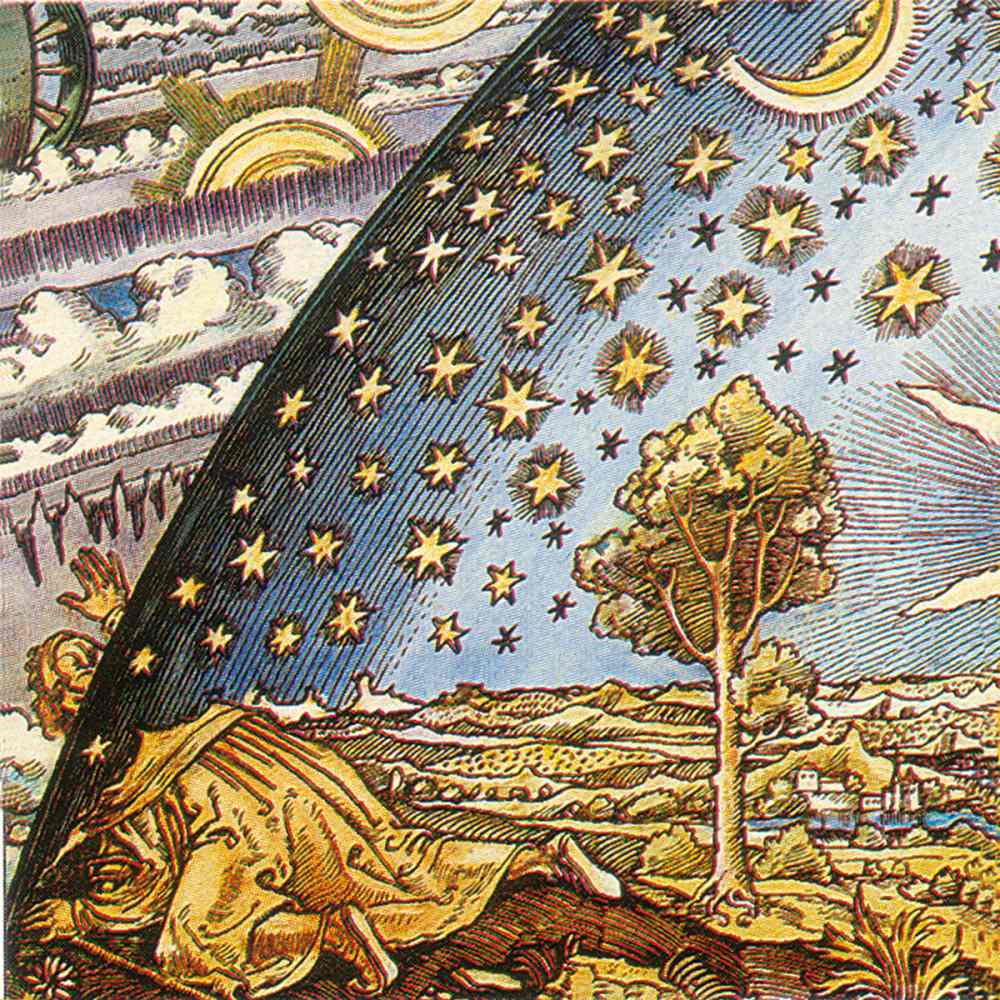
When this happens we begin to meet the cosmic forces that form our being and the universe.
In this way, the organic, cellular and other ‘life’ processes that are usually unknown and unconscious are met. Focussed consciousness can dive all the way down through all the levels of being and know them.
The Polarities of Existence
I want to bring the word “natural” in here because it is relevant to what is being explained. If we see animals as examples of what is natural, or what happens in nature without human intervention, then we could say that it is not natural to have one’s appendix taken out when it is inflamed. It is not natural to have breast implants. It is not natural to have vaccinations against disease. But these things are all options we are capable of, along with the countless other things that humans do because they are possible. So although animals do not spend time examining their dreams, it is possible for us to do so, and thereby expand our awareness of who we are and what the possibilities of our existence are. Perhaps it was not natural for human beings to travel to the North and South Pole’s, or to journey into space; but by doing so we have enlarged our awareness of the environment and the cosmos in which we live.
There are, of course, other ways in which we can explore the polarities of our experience. Meditation, and the use of certain drugs, enables people to explore areas of experience that do not occur “naturally”. For instance, some forms of meditation enable the practitioner to enter the condition of sleep while maintaining a certain amount of critical awareness, as happens in lucid dreaming. This really is a voyage of exploration, and is different to what happens when a person explores a dream. Exploring a dream brings contents of the unconscious into waking experience. Meditation and lucidity enables a personal dive into levels of awareness that are usually cloaked in unconsciousness. Perhaps this can be likened to the first humans who dived under the sea with a submarine and began to personally witness the immense range and variety of life that exists under the surface. See LSD Hypnosis and Dreams
But it has to be mentioned that the imagery of dreams and lucid fantasy are still almost at the level of waking.
Almost immediately after Albert Hoffman discovered LSD in 1943, it was used for psychological research and psychotherapy. During that period of intense research and therapeutic use, huge areas of the unconscious became available for exploration and mapping. As with meditation, the person’s conscious sense of self could travel in areas that were usually blanketed by the fog of sleep. The human experience behind such obscure words as spirit and God became available to the West for analysis and study – although Eastern explorers had done an excellent job centuries before. The depths and heights of what is usually unconscious within us revealed worlds completely different to what we know during waking life. Those worlds are no less real than the world of our conscious personality. They are in fact a balancing polarity to what we know and experience in our daily life. (1) See: The Mind Bomb.
From the research mentioned it was seen that in waking life we generally have a sense of ourselves as distinct from anybody else. Thus your memories and experiences seem completely separated from those of another person. We refer to this personal and unique set of experiences and responses as, “Me” — or “I”. When the researchers examined the experiences of people exploring their deep unconscious, it was seen that this sense of self gradually diminishes. There are levels of this experience that can be likened to what was said about the polarities of experience. At one end of the polarity is focused self-awareness. At the other end is an ocean of awareness without any focused sense of self. This ocean of consciousness that is at the core of our being is what has been called God in other cultures or Nirvana. In India it has been described as Sat-Chit-Ananda – Being-Consciousness-Bliss. When we discover it as the centre of ourselves it is no longer seen as exterior or distant. But in waking life where we lack awareness of it we see it either as non-existent or as separate and distant. See: Realms of the Human Unconscious by Stanislav Grof.
But many people in the west have an image of God as a sort of great man in the sky; that is because the Catholic church has presented it as such an image, and it has been painted over and over again. But the Christian religion was an outcrop from the Hebrew view of God, which was Ain Soph – the Unknowable God. This was because the creative force was ‘Everything’ and so could not be presented as a thing, such as a man. So, I am supposing the Catholic church purposely changed that. See Criticism – Answers To – Big Bang and God are the Same
One interesting part of this exploration of the depths of human consciousness is that if you go deep enough you arrive back at what we call the external or physical world. The formless and the formed are seen to be different ends of the same thing. The ancient symbol of the snake with its tail in its mouth illustrates this closed system. Quantum physics, digging deep into the world of form, is arriving back to what mystics of all ages have discovered in their inner depths. See Tao of Physics by Fritjof Capra
This leads us to an extremely important point – what we are not capable of being personally aware of does not exist for us. In a very real way nothing exists for us unless we can be aware of it in some way. There is nothing outside of consciousness. Or to put it another way, without personal awareness nothing exists for us. Therefore the polarities of our awareness hold the whole cosmos of experience for us. If most of that lies in darkness in our ‘unconscious’ then much of what we hold as a possibility remains unknown. See: The Dancing Wu Li Masters.
The Remarkable Roots of Being
Seen as a circle in which there are polarities of focussed awareness at one end and unfocused sentience at the other, helps us to realise that what occurs when self awareness plumbs the depths of its source – the unconscious – is remarkable. The roots of our being lie in the mysterious depths of subatomic particles. At this very moment you contain in yourself that level of existence. It is also a fact that what you are has emerged from, and is intricately enmeshed in, the universe and its origins. Also, you are what you are because life on this planet emerged and you hold in yourself in your very genes, cells, organs and overall structure, the full history of that emergence. So diving below the level of waking awareness is an entry into the most profoundly amazing discovery of what you are and how you have come into being. There is not space in this short feature to spell that out, but such books as The Holographic Universe and Realms of the Human Unconscious, vastly extend what is being said here.
So, with a little reflection it can be seen that each of us experience these polarities every day. As our sense of self diminishes we become unconscious. In the depths of sleep the self we know in waking does not exist — or at least, it is greatly diminished. But these areas of human experience can be known if we learn to “listen carefully”. This is what some forms of mental and emotional discipline helps us to do.
Anyone who seriously undertakes this voyage into what was previously unconscious meets phenomena that at first seem strange, or sometimes even frightening. Remember that usually we enter this realm of the unconscious in the form of sleep and dreams, and in most cases dreams use our cultural and everyday imagery and experience. So our focused self-awareness is guarded from a direct confrontation with these phenomena. The nearest most of us get to experiencing life under the surface is when we recall a dream. And in fact a dream illustrates this first level of what we meet. See Jesse Watkins Enlightenment
But there are difficulties in meeting our larger self
The human personality – the You that you call yourself, with a name, is only a tiny thing. It is moved and tossed around by all manner of drives, ambitions, emotions, fears, temptations, worries, love and desire with its pains and hopes; it is something we take so seriously and get carried away into awful situations; we take many sorts of pain killers to deal with ourselves. Things such as alcohol, coffee, medical drugs and street drugs, and yet we are still prone to break down, as can be seen by the number of people who need antidepressants or are totally lost in themselves. See Programmed
And a lot of the pain and the mental misery are largely because we put so much trust in what we think and feel. We are totally identified with it. Yet thoughts are simple photocopies of reality and are never the real things. They are just sounds we make into words to help us move around a strange and confusing world. And feelings to are simply a response to what we meet. Do you believe the person you think of is them? It can only ever be your own thoughts and feelings about them.
We are small because we know nothing about who we are and how we came to be – except of course in the words we have been taught are really the truth. We do not know anything about the mass of things that keep is alive – except what we have read, yet more words. We are largely unconscious of what makes our heart beat, and all the millions of things that life behind our existence does, so we are moved by whatever moves us – whatever that is – childhood fears and social programming, or haunted by the past.
Also as we begin to meet the Hugeness that we are we often react to it with fear or panic. So we dream or being attacked by aliens or frightening creatures. If we realise that they are things we have created with fear we will pass on.
We are many things and are unaware of our own complexity
We are probably all acquainted now with looking at the instruments on the dashboard of a car. On such a panel we can see an indication of the speed, of the amount of fuel, and of the temperature of the water cooling system. When we look at any of these gauges we are not of course directly aware of the hot water, of the amount of fuel, or of the engines revolutions. We are only seeing a graphic display of what is taking place in unseen parts of the car.
Our body and mind are far more complex than any car. There is far more that goes on in the hidden places of our being than ever goes on in an engine. But dreams perform the same function as the gauges on the dashboard. They illustrate processes that are going on in the depths of our body and mind — and in fact often in the very deepest places of the unconscious. As with the gauges, we are not directly experiencing the processes displayed in images and drama. What we are witnessing is a process that puts into imagery, into emotions and drama, things that in themselves may be quite formless, that may never previously have come near to verbal definition or conscious conceptualisation. The word imagine has its root in the word image. We literally put into images those things that lie beyond our usual senses in the formless and timeless regions of our being.
So this image making process, this myth forming creative activity of dreaming, forms environments and experiences that seem as convincing as waking life. If we find ourselves in the midst of a dream, or in the midst of this virtual reality without understanding how it works, we may be completely immersed in its apparent reality. I suppose this might be likened to looking at our hand, then looking at it with a microscope, and then with an electron microscope. There are worlds within worlds and you hold them all within you and can be conscious of. See Summing Up – Jesse Watkins Enlightenment
For many people, especially those who have stumbled upon this inner journey without guidance or understanding, or have been “opened” to it through the use of a drug, shock or mental illness, this is as far as they can travel. They become lost in the imagery and the emotions, the conflict and fears, the subtle and enchanting glamour or illusion of this first level. Or they may lose some of their mental balance, haunted by what is revealed or released into consciousness, as often happens to people who frequently take mind expanding drugs without the skills to deal with what they confront. They release these aspects or ‘creatures of the unconscious without having learned the psychotherapeutic tools or personal disciplines and understanding to integrate what they meet. They are then haunted by what emerged.
Many myths throughout the ages have illustrated this part of the journey in various ways. One Arabic myth instructs the traveller to use a sword to cut down whatever appears in front of them, even if it seems to be their mother or father. Perhaps this is a bit harsh, but it does point to the fact that at this level things are not what they may appear. Neither are they complete illusions. They are images and environments portraying something. The aim is to break through the surface level to the source from which they emerge. The point being that if you can destroy or cut through an image you are still not meeting its source. The core self is indestructible. But whenever we dream its images are not like real life. Because a dream is nothing like outer life where things could hurt you, but is an image like on a cinema screen so that even if a gun is pointed at you and fired it can do no damage – except if you run in fear. So all the things that scare you are simply your own fears projected onto the screen of your sleeping mind.
The Indian sage Ramakrishna says of his own journey beyond forms, “Tota Puri taught me to detach my mind from all objects and to plunge it into the heart of the Atman (core self). But despite all my efforts, I could not cross the realm of name and form and lead my spirit to the Unconditional state. I had no difficulty in detaching my mind from all objects with the one exception of the too familiar form of the radiant Mother, the essence of pure knowledge, who appeared before me as a living reality. I said to Tota Puri in despair, ‘It is no good, I shall never succeed in lifting my spirit to the “Unconditioned” state and find myself face to face with the Atman.’
He replied severely, ‘What! You say you cannot? You must!’ Looking about him, he found a piece of glass. He took it and stuck the point between my eyes, saying, ‘Concentrate your mind on that point.’ Then I began to meditate with all my might, and as soon as the gracious form of the Divine Mother appeared I used my discrimination as a sword, and I clove Her in two. The last barrier fell and my spirit immediately precipitated itself beyond the plane of the ‘conditional’, and I lost myself in Samadhi (unconditioned bliss).
However, for many people there is an enormous amount to be experienced and used at this level, existing as it does amidst the images of the ‘psychic’ realm, and expressing in a sort of more fluid mirroring of the three dimensions, time and space limited experience we meet through our senses and body. This is the world the psychic works in when they extend their perceptions to ‘communicate with the dead’, tell us about our life situation without us giving clues, and having glimpses of the future.
In attempting to understand these experiences, it must be remembered that beyond the images of a person, of a situation, of voices heard, in the way dreams present things, lies a more formless dimension of experience. It is one where the boundaries of personality and distance, time and space break down. So for many people, it is an easier task to look at this formless dimension through the translating instrument of dream image formation, and see people, places, environments, or hear voices talking to them.
The Guardian of the Threshold
This breaking through into other dimensions of experience, which occurs in successful dream insights, mediation and in some facilitated drug use, takes one to the next level of the unconscious.
In one of the old western traditions in which people were guided to make this journey, the illusionary imagery and environments were called the psychic world, as described above. One was warned that at some point you would meet The Dweller or Guardian of the Threshold. Sometimes this was illustrated as a shadowy and perhaps frightening figure, the sort we often meet in scary dreams. If you could face the Dweller without running away, the realm you enter beyond the Guardian was described as the meeting with all the forces you had perhaps unwittingly released or created in the past. They are the factors or experiences out of which the waking experience of your life has been woven. In the past this was called one’s fate, kismet, or karma. Today we tend to think of it as the many influences carried from genes, birth and early childhood, that shape the way we respond in our daily life; in other words, inherited tendencies, cultural programming and psychological traumas. But the Guardian also represented influences from prior to ones present birth. See Reincarnation
Not only is it a guardian, but also, if you meet it without fear and pass the tests it presents you with, it is also a guide and companion on the journey. If you meet this by actually facing the ‘scary monster’ of a nightmare, a similar thing happens – you meet forces that arise from the past and shape your present personality.
Any deeper exploration of the unconscious shows that it is not simply one’s infancy and its problems that we face. There are influences streaming from the long past through the body that we have inherited. There are the family influences and massive inputs from the culture we were born into, and also other intangible forces playing upon our life. As we cut through the images and drama of the dream creator, we begin to discover and gain insights into this incredible process of creation that forms and guides our life. See The Conjuring Trick
The image of Frankenstein’s creation illustrates the Guardian of the Threshold very clearly. The Guardian, like Frankenstein’s creation, is made of many different people or bodies. We face, in the Guardian, what we have created in our long past; the many personalities assumed, and lives lived, by our core self. See: Archetype of the Shadow.
Light of My Life
This world of the formative, of the archetypes, of the physiological and the cosmic processes — even the intelligences – that are the creative matrix out of which we have arisen, is strange and wonderful. Very often the traveller has to lose a great deal before they can safely explore this realm with awareness. The reason for this is quite simple. Identity, the ego, what one calls self, is an extremely new and vulnerable thing in terms of evolution. It might be likened to the fragile filament in an electric light bulb. When the current is switched on the filament glows brightly, and we can liken this to personal awareness. The current passing through us is the air, water and food that flow through in an almost continuous stream to form our energy. Whether we consider the electric light bulb, or our own sense of self, behind the existence of both, immense activities take place making them possible. The light bulb needs a great deal of cable, switching gear, and some sort of generator. Our personal existence needs a great deal more. The whole universe lies behind the ‘light’ of our self awareness. Without the cosmos we do not exist. Without the sun and the earth we do not exist. Without the bacteria and processes of plant and animal life on our planet we do not exist. Without other human beings who have taught us language and perform the constant background and foreground to our life, we do not exist.
However, this fragile thing we call self often builds powerful defences or boundaries to protect it from knowing its dependence upon the forces forming it. These defences often show themselves in rigid beliefs, in a fog of ignorance, in emotional outbursts against anything that might be felt to threaten, and also of course in the many ways in which we use drugs such as alcohol, medications and nicotine to deaden our sense perceptions of what is taking place around and within us. We do this because our ego is fragile and vulnerable. We may also do it because the journey into the unconscious diminishes the sense of self, and this can be threatening. It can be felt as a form of death, or an experience of breaking open. The boundaries that were so necessary at a certain stage of our growth fall away. The journey into that more inclusive polarity of our being is actually a form of growth, of greater maturity, of a meeting with something more permanent than the fragile ego.
Another way of looking at the business of defences against a widening awareness of oneself is to see all of it as a process of growth. Perhaps we cannot let go of our defended relationship with our identity while we still feel vulnerable or insecure. Perhaps the change comes about naturally once we feel confident enough to let down our defences.
If you have managed to enter this level of experience for any length of time you will be confronted by an enormous paradox. This is, in essence, no different to the paradox we face every day in experiencing focused individual identity, and the loss of that identity in sleep. What we meet when we pass beyond the dream stage in which everything is represented as images external to us, is a vast ocean of mind or consciousness in which all that has lived exists. It exists as an unseparated part of the ocean of awareness — yet at the same time it can manifest independently and as a separate identity. This applies to oneself also. You sense yourself as having no real separate existence from what lives and knows itself in all things. Yet at the same time you experience your own separated identity. This is a difficult paradox, and human language tends to express things as either this, or that. Things cannot be both things at once. But in this journey to one’s own centre such separation is transcended. You experience a sense of things that transcend the limitations of time and space. Things can be here and there at the same time.
The old Newtonian physics has never included mind or consciousness in its equations. As the atom was the fundamental particle, and the atom was a physical object, it was seen that there could be nothing beyond the body, its molecules and atoms. Therefore personal awareness was a trick played by the play of chemicals, and organs in the body. As for consciousness surviving death, it was seen as a childish superstition created by weak minds to deal with fear of death.
But the new physics, quantum physics, has since its earliest days included mind and consciousness in its concepts. It has had to because from the earliest days of quantum experiments two unimaginable phenomena were unveiled. Irish physicist John Stewart Bell put forward a quantum theorem that has revolutionised the way reality is considered. In brief, the theorem states that when two sub-microscopic particles are split and moved to a distance from each other, the action on, or of, particle ‘A’, is instantaneously reproduced with particle ‘B’. This interaction does not rely on any known link or communication and is considered to stand above normal physical laws of nature, as it is faster than light.
Faster Than Light
Prior to such findings it was thought nothing could transcend the speed of light. Nick Herbert, in an interview published in High Frontiers writes, ‘THERE ARE LOTS OF THINGS that are being kept from the public as far as the subjects of physics and consciousness are concerned. Bell’s Theorem was proved in 1964, and it is still not taught in physics classes, and you don’t hear it on your science news programs. A theorem is a proof, and no one has found a flaw in this theorem. It’s such a simple proof that a high school kid can understand it. So physicists can understand it. They have various ways of trying to ignore it, but it can’t be refuted because it’s so simple.’
The second finding that transformed our understanding of life and the universe is that an electron can be either a particle or a wave like energy. The change occurs when a human observes it. If we do not observe it an electron remains as an energy form. If we observe it a transformation occurs and it changes into a particle. This locks human consciousness into the very fundamental workings of the deepest levels of our body and the universe. In fact quantum physicists have said we are co-creators because consciousness alters ‘reality’.
To quote Gary Zukav, ‘Quantum mechanics is THE theory. It has explained everything from subatomic particles to transistors to stellar energy. It has never failed. It has no competition.’ The implications of the theorem are enormous. Something can be in two places at once. Apparently distant objects, or people, are intricately linked in an immediate way. There is no separate existence as we previously thought. Our view of the world is not one supported by the facts of physics. Time and space are transcended. David Bohm, an eminent physicist, goes as far as to say that all things in our observable universe are inextricable linked. Nothing has separate existence. Also we all have infinite potential
When we personally meet this level of experience, when we transcend our awareness of separateness, the experiences we have gathered through our everyday life are gradually transformed. They shift, wherever possible, into concepts or insights that approach the universal or timeless and unchanging. Just as our physical body is formed by the continuous partaking of food water and air, so a more permanent body or identity is formed by the transformation of sensory experience into a body or identity that has connections with the unchanging and eternal. Buddhism calls this the diamond body, the imperishable self.
We can glimpse the meaning and possibility of this by once more looking into everyday life. At some point in human history an individual must have realised how to count. This realisation could be passed on to other people. They in turn developed it until we have the incredibly subtle knowledge of mathematics available today. This knowledge, the concepts of mathematics, preceded your own personal existence. It will also survive your own physical demise. In this sense it has a subtle life of its own, transcending the individual lives of those who first realised it, and also those of us who now learn it and perhaps develop it further.
As one meets the deeper levels of the unconscious a similar experience of self emerges. The identity we know is seen to be something that has emerged from countless lives lived in the past, the essence of which has given us shape and form. This is precisely the same as we meet in language. The language we take for granted is the result of thousands of years in which individuals, cultures and groups contributed their concepts, passions and wisdom to form new words. The words we use are living connections with the past, and if we investigate them unfold their history. Similarly, as we meet the deeper levels of self we find our own personal connections with the past. The difference is that the connections we meet in the deeper levels of self are living and profoundly felt.
In confronting this awareness of what contributes to our individual existence we cannot help but be transformed in some measure. The limited viewpoint of life we had drops away. A more inclusive and deeply centred viewpoint arises. In some manner you also meet with the realisation that all that has ever lived, and all and everybody that exists today, is alive at the core of your being. (See Creativity – Doorway to the Wonderful Fire).
This incredible background to personal life is so vast and inclusive, and holds so many wonders, that when we meet it, it becomes apparent that this is what many people have called God. It presents another of the paradoxes we find in this experience beyond opposites. It is both impersonal and yet we can have a personal relationship with it, experiencing direct communication. It is this real life beyond the limitations of our sensory experience and limited waking self, which is indicated by the word spiritual or spirit.
However, this is not the fundamental level of being. The causeless cause, the self-existent centre of us, when we find it, is seen to be one and the same as the origin of the physical universe.
In brief, our present theory of the emergence of the cosmos is that there existed what has been called a Singularity. From this emerged what is known as the Big Bang. One commentator describes our understanding of this as follows:
Because scientists cannot look back in time beyond that early epoch, the actual big bang is hidden from them. There is no way at present to detect the origin of the universe. Further, the big bang theory does not explain what existed before the big bang. Time and space began at the big bang, so that it makes no sense to discuss what happened “before” the big bang from a consciousness locked in a sense of time and space. (2)
As is suggested, it is understood that time and space was actually created during the Big Bang. So what existed prior to the big Bang is known to be beyond our concepts of time and space. Because of this we cannot even think about it because our concepts are all formed around our experience of time, space and individual existence. This is exactly what we meet when we touch that indefinable core of our being. It is impossible to reason about this experience or in any way to describe it. One translation of the Tao Te Ching, an ancient Chinese classic about the foundation of existence, says that ‘The Tao that can be named is not the Tao.’
Who am I?
One of the main constituents of what we call ‘me’ or myself, is identification. Although our sense of self seems so concrete and definite, if we turn attention back on it the creature we call self is a very slippery customer to get hold of. What does seem obvious as we make the journey to our core self, is that the body sensations, the thoughts, the emotions felt, and the image we have of ourselves, are identified with so deeply, that most people take them to be who they are. They believe their body is who they are; or their thoughts are what constitutes their real being, or their emotions or sexual experience are what they identify with. However, one can lose limbs, or even be paralysed and still have a sense of self. You can be sterilised and so lose your sexual self -and yet you still exist. And if you gradually ‘undress’ yourself of all these things – imaginatively take away hearing, remove visual impression and body sensations – you still have a sense of self without them. Dreams make this very clear. Without the senses being active, without sight, without body sensations, you still dream and have a sense of existing. Usually though, even in dreams you clothe yourself in the usual trapping of the three dimensional body life of waking awareness.
When we approach our core awareness it is like undressing. We lose body awareness if we do it while asleep. We pass through the realm of thought governed by language – so we lose thoughts. We lose all the things consciousness ‘clothes’ itself in while awake – yet we still exist. It is a very different form of existence, beyond the limitations of the body, and even time and space, but we still exist as an incredible creature alive in a world with almost no boundaries. We are godlike. In fact it seems to many when they experience this, that they are meeting God – in fact they are God.
This Core experience is often described as enlightenment. It can also be described as naked awareness. This is because what we usually know of self has become “undressed”. What that means is that what we usually call self has dropped away.
This dropping away of self is what had been called ‘enlightenment’. However, there is enormous confusion about this, as what some people who have touched it say is that you are left with no self. They say this sometimes almost like a threat – “Go there and you will lose everything. You will no longer exist.”
I see this as an incomplete process of meeting and integrating the polarity of the Core. Certainly the self that we believed we were from our sense impressions and our almost total identification with our body, thoughts, emotions and sexual feelings drops away. But what such statements fail to tell is that the Core is EVERYTHING. An unimaginable amount is added, and in the end nothing is taken away. You still have your body sensations, you can still make love with even more wonder, you have your thoughts, your emotions, you can still love and laugh and carry on with life – you simply do not identify with them as fully as you did. The concepts and sense of self arising from them is seen as limiting.
Also, one great fact that is almost never mentioned, is that the formless and the formed are not separate. They co-exist at the same time. To gain one is not to lose the other. It is part of that huge paradox that is life.
Beyond Time and Space
This opening to naked awareness, can, when healthy and adjusted to, be recognised as an expanded awareness, an unconditional love, and a deep understanding and compassion for the human condition. The limitations of time and space have fallen away to some extent.
So the past, present and future are all here and now. In terms of waking awareness, this means the person will often know something of the future, and of the past – the far past. The boundaries between themselves and other people have also to some extent fallen away, so they frequently know very much what is going on in another person’s mind and feelings. (Witness the life of Swedenborg and Edgar Cayce).
When this transcendence of time and space, and its boundaries, are very marked in the person, they express extraordinary genius and great creativity. They often demonstrate a multitude of abilities, as for instance seen in somebody like Rudolph Steiner. Whoever the author of the Shakespeare plays was, the enormous insight into human nature and the wonderful creativity, suggest he had transcended the usual boundaries of self. Wouldn’t you know a great deal more, express a great deal more, if you had transcended the boundaries of time and space, knowing as you would your core self – a self that is at the same time the core of the universe?
Of course there are all stages in between normal waking awareness bounded by the body and sense impressions, and the boundless self of naked awareness. It is a new and emerging possibility for our race, and many people only reach it either in a maladjusted form, or in small degree in a sort of psychism.
To achieve it reasonably fully in waking awareness does not make a mystic or peculiar human of you. Self awareness is fairly new to the human species. Being self awareness has an enormous range of ways it is expressed – from criminal to genius. This is also true of achieving the Core experience. Touching your core does not make of you an all wise guru. The experience is new and unstable in our species as yet. But if you achieve it you are no less human than someone who has achieved self awareness. Maurice Bucke, in his major work Cosmic Consciousness, spelt all this out in 1863.
In meeting this core however, there is something we do know. We know that everything has emerged from that Core, and all will fall back into it. The changing changes and passes away – the changeless remains pouring forth change.
(1) See LSD Psychotherapy by W. D. Caldwell: The Tao of Physics, by Fritjof Capra; Myself and I. by Constance Newland; Realms of the Human Unconscious By Stanislav Grof; and LSD – The Problem Solving Psychedelic by P. G. Stafford and B. H. Golightly.
(2) “Big Bang Theory,” Microsoft® Encarta® 98 Encyclopedia. © 1993-1997 Microsoft Corporation. All rights reserved.
Introduction to the I Ching
Apart from being a book of wisdom in the ancient Chinese tradition, the I Ching was also consulted on questions of state, warfare and personal decision making. It is this aspect of it which is dealt with here. Consulting the I Ching does not present us with statements of what will happen as a fated future. The wisdom behind the book does not see the future as unalterably fixed, but rather like a constantly shifting flux similar to the seasons, with which we can interact. What we receive in a consultation is like a conversation with a wise and experienced friend, who through their experience might point out that if we take our present course within the situation as it stands, the results might be in a direction we do not wish – but if we take another attitude circumstances could change, then we can act more forcefully and effectively.
The I Ching intrigued me, not so much because it is a very ancient book, the culmination of many great minds and a great culture, but because it was largely couched in symbols. My work with dreams and the way people use imagery in thinking and expression, made me want to tackle the I Ching. I wanted to see if I could put into clearer English what is usually said in rather poetic and indefinite prose. Below you can access two working examples of people consulting the I Ching. The text is from my interpretation – originally written for New Zealand Teletext as phone in scripts but never used by them. If you are unacquainted with the I Ching there is also a brief explanation of its principles.
“Your I Ching interpretation(s) are, ultimately, the best I have seen. DEEP BOW. – Sara”
The Hexagrams
| U | P | P | E | R | |||||
 |
 |
 |
 |
 |
 |
 |
 |
||
 |
1 | 34 | 5 | 26 | 11 | 9 | 14 | 43 | |
| L |  |
25 | 51 | 3 | 27 | 24 | 42 | 21 | 17 |
| O |  |
6 | 40 | 29 | 4 | 7 | 59 | 64 | 47 |
| W |  |
33 | 62 | 39 | 52 | 15 | 53 | 56 | 31 |
| E |  |
12 | 16 | 8 | 23 | 2 | 20 | 35 | 45 |
| R |  |
44 | 32 | 48 | 18 | 46 | 57 | 50 | 28 |
 |
13 | 55 | 63 | 22 | 36 | 37 | 30 | 49 | |
 |
10 | 54 | 60 | 41 | 19 | 61 | 38 | 58 |
The Many Facets Of Dreaming
Although there is no final agreement on what dreams are and what their value is, if we look at the various findings, dreams can be seen to hold in them something of all the many aspects of human life. Just as society overall has hospitals and churches, schools, libraries and sports facilities to cater for the physical, spiritual, mental and recreational needs of people, so dreams express these departments of ourselves.
· Body Dreams – Bernard S. Seigal, M.D., assistant clinical professor of surgery, Yale University School of Medicine originated the ‘Exceptional Cancer Patient’ group therapy. Through encouraging his patients to tell their dreams and express their feelings via paintings, he found that patients often dreamt clearly about the condition of their body long before normal diagnostic methods could define the illness or healing. Other physicians, such as Kasatkin in Russia, have also drawn notice to this aspect of dreaming, and kept careful records of such dreams in patients.
· Virtual Reality – Sigmund Freud recognised that dreams are different in quality to waking fantasies or daydreams. While dreaming we are usually convinced that our surroundings and what is happening, is completely real. This sense of complete immersion in the dream does not pervade our fantasies. Although during a nightmare this feeling of reality can cause us to be very frightened, the positive side to it is that dreams give us experience as full of impact, and therefore as educational as waking life.
· Regulating – In experiments where volunteers were woken each time they began to dream, a breakdown in the efficiency of mind and body soon became apparent. The Swiss psychiatrist Carl Jung described dreams as compensatory. He was particularly referring to the way dreams help balance our conscious personality. According to this view, any extreme is compensated for by an expression of the opposite in our dreams. In this way, lack of love or success in our life may be compensated for by a very powerful release of dream imagery and experience. One may have a vision of ones dead mother or Christ for instance. Without such compensatory experience, continuing life in the face of failure and loneliness might be extremely difficult.
· Personal Growth – The growth of our personality from infancy is a very complex interplay between largely unconscious factors in our body, our experience of our environment, and the way we integrate and deal with these different influences. Dreams do appear to present clear indications of what is emerging as transforming forces in oneself. They also definitely reveal past experience that through trauma may need to be met in order to live ones life more satisfyingly or efficiently. This is why they are so often used in psychotherapy. Because our mind integrates experience, as described below under Creativity, some investigators believe that during our dreaming we ‘upgrade’ such skills as social interaction, speech, etc., which also leads to personal growth. There is neurological evidence that brain cells undergo a learning process during dreaming. Also in the area of personal growth, inquiry into dreams such as recurring nightmares, shows them to be an attempt, occasionally successful, to bring to consciousness and release past traumas such as childhood abandonment, involvement in war environments, or car accidents.
· Creativity – In 1912 Gestalt psychology was launched in Germany when Max Wertheimer published a paper on a visual illusion called apparent motion. Wertheimer had noticed that when we view a sequence of still pictures, as happens watching a film, we have the illusion of seeing movement. This perception of movement was different to the perception of its components – the many static images. This led to the understanding that many of the perceptions we have of the world around us, and many of the concepts we build, are radically different to the many pieces of information or experience they arise from. The sum is therefore different or greater than the parts. Sudden inspirations and creative leaps, when seen from this point of view, are usually a new ‘whole’ formed out of many parts which previously had no connection. The symbols and drama of dreams particularly express this creative forming of new experience and new realisations, new gestalts, out of the mass of separate pieces of experience or information.
· Imagination – This has been listed separately to creativity because they are not necessarily the same. Imagination has been described as the “ability of the mind to be creative or resourceful.” To be creative or resourceful is considered highly admirable, yet being imaginative is frequently put down as a time waster. Most of the greatest things in the external world arose out of imagination. Such things as vacuum cleaners and pictures that could be sent through the air – TV – seemed outlandish to logical rational people when they were first mentioned. Dreams are possibly the most powerfully imaginative experiences we can have. Through them we can break free of the restrictions and lack of perception the logical mind has.
· Exercise For The Psyche – Freud believed that dreams expressed repressed sexual desires such as sex and anger. Jung said that in dreams we compensate for what is not experienced in our life. Seen in a more positive light, we can each see that our daily life only allows us to live a small range of the things we would like to do or feel. The circumstances of our life may lead us to prevent ourselves from expressing openly the intensity of the love, the pain, the anger, the creativity we have inside us. In dreams such restrictions fall away to some degree, and our mind, our emotions and sexuality can unfold and we can discover our fuller range of expression and capability. Howard Roffwarg, a psychiatrist at Columbia University in New York, suggested that nervous activity during REM sleep helps to stimulate the developing brain in very young children, thus promoting the growth of neural connections necessary for learning. In adults, according to Roffwarg, REM serves, like physical exercise, to maintain tone in the central nervous system.
· The Supersenses – Even if we cannot accept there are aspects of life that our senses and sensitive instruments do not show us, most of us agree that our mind, through our senses and emotions, can extrapolate from the thousands of bits of information we take in. For instance is we look at a person for a few minutes we might have few thoughts about what type of person they are. But if questioned carefully, we will realise that we have very definite impressions about them from the way they dress, stand, talk and move. In fact we ‘know’ a great deal about them. In our dreams we not only browse through the huge amount of information we have taken in and build insight or knowledge out of it, but sometimes we leap right beyond what our senses have enables us to gather, and arrive at true intuitive perception.
(2)What a waste of a wonderful resource, what criminal negligence it is if we therefore fail to remember dreams and gain enrichment from their fresh and unique perspectives, their ability to give pungent comments on our relationships and their possible outcome, and the opportunities dreams present to explore new approaches to our everyday life. What a loss if we do not discover the many splendored facets of our own mind and consciousness. As Robert Van De Castle says – You were issued a lifetime pass to free dreams at birth. Why not take advantage of it? (3)
Creativity – Doorway to the Wonderful Fire
While staying in London with one of my sons I had the following strange dream and experience. In the dream I was a young man living in Italy. The surroundings gave me the impression of it being during a period several hundred years ago. I was walking through the streets of a town. As I did so I was thinking about the liver disease I had and about my plans to move to another town where a learned doctor lived that specialised in liver complaints. I wanted to not only be his patient but also his student, to learn what he knew about liver illnesses.
As I walked I started to sing Ave Maria – I believe it is Gounod’s version. My singing was beautiful, exhibiting wonderful voice control and expression of emotion. I am not sure of the sequence of this but there was a building I was looking at. People wanted to have the building restored but could not raise the money. So I had painted a huge mural on the building depicting scaffolding covering the house. This attracted public attention and interest in the house, and so money was raised. I realised that I was not just an artist but also an architect and musician.
It was on this thought, and with Ave Maria still sounding its lovely quality that I realised I was dreaming and became awake enough to observe and think about what was happening. I realised that as a musician I had very great ability as a composer, and decided to compose an ‘Ode to Mozart’. No sooner had I decided this than the music poured through my consciousness. So much so I heard it as if listening to an orchestra or record. The music soared and moved in a wonderful expression of human vision and transcendence. As this occurred I could observe the process of creativity or composition, which was spontaneous to an extraordinary degree. It appeared that by asking for or seeking the composition I had opened a window in my mind. Through it I could observe a huge and unlimited sea of mind or consciousness. In it was all that has ever existed, merged and yet distinct. Every human talent and thought was in it alive and vital. My ‘Ode to Mozart’ drew on this unfathomed depth of being. I knew as I observed this that the music itself, although precise and clear and Mozart’s own work, proclaimed the human ability to leap beyond boundaries into this immense and apparently limitless world of experience – to allow the mind to soar and fly, to move beyond its own conceptions and rejoice.
I wanted to test this amazing ability and asked the huge mind how I could compose ‘modern’ music. What followed was like being instructed. The thoughts arose as if I were being told, that music was a reflection of basic life processes. Using the example of a simple life form in the beginning of evolution, such as a single celled creature or a crystal, this was like one note sounding over and over. After doing this over and over for infinite repetition, the process of life stumbles upon or manages a slight change in itself. This is when the single celled creature develops other attributes and moves toward multiplicity of cells. This would be like the playing of different notes over and over. Then maybe another basic process has learned to play three different notes, and if these two meet they play a more complex music together.
To this meeting was added theme upon theme until an orchestral music was built up, and I was told, “This is your body, with its many different processes playing together.” Or it could be likened to society in which so many opposing ‘themes’ in the end form a whole.
The Ancient Mystery of Baptism
The act of baptism long pre-dated the Christian community. One can find water for purification outside very ancient temples. Therefore the tradition of baptism is older than the historical Christian church. It had its ascendance in the love a mother felt for her children, and beyond that the love she felt and gave to other children. Beyond that still, a loving woman might suckle a creature and extend her love beyond the normal boundaries. She might hold that other child, or that creature, with the same tenderness that she held her own baby. In such a moment she would know something that was beyond herself. It is something that flows through all of us. We symbolise it as the water, the milk, the wine, or the blood. It is the flow of love that comes from beyond our own small personality.
The urge that enables us to reach out to another person who is not our own kin, or to another creature, is a small awareness of that universal life and consciousness that pervades all things. It is an expression of the Mystery that we can perhaps never understand, that is Life.
Baptism represents a conscious opening or an introduction to that Life. It is an experience of that life flowing into and through us. It is also an entrance into the recognition of the wider family; of that mysterious body we call Christ. We become brothers and sisters in a wider community. It takes some skill to recognise who these brothers and sisters are, and what part they might play in our life. Calling yourself a Christian does not necessarily mean you have been truly baptised in that spirit of life and love. In fact you might still be imprisoned by attitudes of class, creed, skin colour or gender.
Fundamentally baptism means a change in the stance or condition of your inner attitudes. It means relinquishing fixed opinions and having an open mind. It means opening the doors of your being to new experiences, to new possibilities, pleasurable and painful. It means learning to love without bending others to your will, without grasping them for your own needs. It also means becoming a channel for that river of Life to flow through. This path does not dangle a carrot of eternal bliss, or the resolution of all human problems. “I come”, that flow of Life in us says, “not to bring peace, but a sword…. take up your cross and follow me.” What is offered is participation in everyday life and death in a new way. We can become workers in the vineyard – that is, co-workers with the processes of growth and evolution in the worlds of nature.
From a scientific view we are all of the same kin. We all started our journey toward humanity as a single celled creature. We go back to that beginning when we reproduce and start our growth for the sexual ovum. Also it is now known that virtually everyone had the same mother – this has been shown through the analysis of our genes. Countless generations ago a woman gave birth to children that became our present race. Some us changed skin colour as we moved into darker climates because vitamin D was essential to our health, and with dark skins we could not absorb enough of it. Unfortunately we also inherited the tribal tendency to look at a slightly different sister and brother as alien and enemies. See archetype of baptism.