Posts Tagged ‘wisdom from core’
Entering the Silence
I started with images of masses of people. At one point the images were to do with aggressive people, “people who would eat you”. There are people like that. In some parts of the world or the country, it is best not to get out of your car. Don’t open the door to ask the way. It is too dangerous.
Then I seemed to be looking at people from a slight remove, as if the people were on a train, and I was outside it or above it watching them. They were so engrossed in their own experience they didn’t notice me. In fact it was almost like looking at them from an invisible place. I could see they were so engrossed in struggling and competing with each other to exist as animals do, and as many of us do because we are not long emerged from being animals, so there was nothing much else in the world for them. I didn’t feel as if I was trying to criticise them or look down on them, but I certainly didn’t want to get mixed up in their way of life, or get lost in the way they felt about or responded to events. I think, I feel, there are human beings who can step beyond such immersion and look, as it were, over the heads of the crowd immersed in competition and combat, and recognise each other. They can say “Hi” and find out who you are and what you have to offer. They are straightforward human beings who enquire what you are up to in case it has some place in their own life. They can go beyond competition and combat. They can trade, or if not that, they have no problem about giving you directions if you are seeking them.
At this point I became aware of subtle but persistent noise everywhere. It seemed almost to be inside me, but it was the environment, physical as well as psychic. “I just hear so much noise. I feel there is so much psychic noise going on.” I got up and switched the computer off. Its quiet hum was part of the noise. But the noise wasn’t just the sound of the fan in the machine, it was also the electrical impulses and currents all around making a noise. I was surrounded by noisy technology. Noisy in the way it was clattering away with its currents and activities and electronic impulses.
Having switched the computer off I felt a greater ease, a greater quiet around and within myself. I felt as if I was sinking deeper and closer to the primitive having stopped the noise of the technical. I began to feel as if I was touching a primal part of myself, and therefore a primal part of life. I sensed a deep silence. The sort of silence I sometimes experience here in Wales, or outdoors away from traffic when the wind drops and the silence seems to penetrate one. Last week I visited Ireland and was privileged to be allowed to enter some of the ancient burial mounds thousands of years old. Inside them one is exposed to the same sort of deep silence, to the earth, and to the great rocks from which they are built. One is sheltered from the ‘noise’ of technology and introduced to the primitive and ancient. So as I experienced this silence and primitive in myself I remembered the ancient tombs and felt as if I had received a real influence from them. The tombs help us to move beyond the ‘noise’. The noise isn’t bad, but it acts as a shield or a barrier to us more easily touching the deeper spiritual experiences within us. We lose contact with our own spiritual growth and journey.
As I slipped into the experience of this deeper place in myself my breathing slowed and for a while halted. The silence was perfect. I felt myself melted into a life that was blissful and all pervading. This still felt connected with my recent visit to the ancient Irish burial tombs. The silence and the oneness with the underlying life of creatures seemed to be the same. This halted breathing and blissfulness is something I have experienced many times. This time however a new thing dawned. I needed to emerge from the tomb, from the womb, and carry the sense of personal connection with the pervading life into the act of breathing and extroverted existence. I felt ready and capable of doing this, most likely because of past growth and preparation. So still breathing I felt the flaming sense of connection with the rest of life. I was/am myself a radiant flame of the one life. I am a beautiful and alive man. I had usually gone back to the womb to find it, back to not breathing. But if I am to face society, to become a real part of the world, I have to breathe, to carry the wonder out from the tomb/womb.
The wonderful life is in all of us. It is the realisation of universality. However, we may shut it out from consciousness by fighting to maintain our separate identity, by struggling because we are afraid of death, the death of US our personality, just for our own needs, and fending off others through anger, fear or competition. The silly thing is our personality is not us, for it was was slowly created after we were born and learnt language and words such as ‘I’, ‘Me’. What had happened to me in the tombs was initiation.
I saw that some of the wonderfully common things in life prepare us for this meeting with the universal within oneself. Falling in love and caring for another person starts to erode the protection we surround our own identity with. Being a parent and giving oneself to the needs of our children takes us further still beyond the isolation of living only for and in oneself. Being a husband or wife who cares for ones partner stretches the fabric of ones psyche to include more than oneself. Through the sympathies aroused one can also begin to empathise with the feelings of other parents, other lovers, other partners. Their loss, their wonder, their tragedy and joy is felt more fully as ones own. And all of this opens one toward the universal spirit of life within oneself. Though imperfect in all my own endeavours in these areas, I had still been helped by them toward finding the wonder of the All within myself. See Parenting is a Spiritual path
The common life of love and caring, of social endeavour in service is the path to the wider life of the spirit. Through them you learn the world of love that transcends ones own small life, and gives you entrance to Life’s love.
Life is vital and wondrous. It is just as vital and the mysterious wonder of Life. just as physical and subtle as any human. So from a full life one learns to reach up with desire and suck the tits of life. You touch its mystery, roll and fight with it, sit quietly or roar with animal pain. Life is all of these and more. The beautiful sexuality of a man or woman is part of that mystery which we share with each other. It is a part of the universal life. If we are at odds with it, then in some way we are at odds with life. Loving a person we may fall through the personality at the surface and fall into the deeps of desire and love that lies behind or around the conscious psyche. Therefore sex, if it is not for procreation can be a time of worship.
All these insights into how one touches the universal in oneself all suggested the need we all have of touching that Centre, that universal within us from time to time. Out of our contact with it arises all our real growth as a person. Without the contact our growth would be stunted or in some way misshapen. With the contact we are more fully expressing what our potential is, and what our fundamental qualities are. I saw how my life had led me systematically into greater attunement with the universal in me. I could see how without a sense of ones connection with the central life in us while we are young, we can lack any cohesion with other people around us, any real motivation to be a full part of society from other than ambitious or self-centred motives.
I had an image of young people being offered initiation as one of the ways they mature to social integration. Through initiation they could pledge their efforts toward the welfare of others, toward a healthy social helpfulness and creativity. For adults initiation gradually leads to a healthy connectivity with ones fellows, to a functional relationship with death, and a fuller maturing of oneself.
My own initiation has been the gradual discovery of my own past through delving into my own feelings and particularly reliving/remembering my childhood. In the last few years this has been particularly to do with my birth and my relationship split between my grandmother and my mother. In this session the tomb represented the womb, and the ‘initiation’ was a sort of acknowledgement that I have at last emerged from the womb experiences into a more mature manhood. It is manhood not cut off from my central being.
Out of these experiences I saw, or realised that I need to write about Initiation. My feelings about this in the session were connected mostly with the feeling that society does not understand, respect or support the action of initiation. Without social acknowledgement the initiation is still only a personal thing. This is very personal, but with social acknowledgement it integrates the individual more fully into the world and makes of him a more satisfied and useful member of society. I had a great desire to press for governments to allow use of the ancient tombs such as the ones I visited, for the sake of individual initiation. I had no sense of there having to be a priest. The sincerity and readiness of the initiate is the ‘priest’, or the power that opens the person. What I did feel was necessary was that the person was supported by friends and family, and so the initiation and the entrance into a fuller life which it provides, was witnessed by loving and supportive members of the community connected with the initiate.
I saw that this form of initiation was an important part of a person’s life. In the past the church or national religion dealt with it. But organised religions and their creeds do not at the moment fulfil many people’s needs.
The idea came to me that the phrase ‘thrice born’ means that at first one is born from ones mother. Then if one has the courage and persistence one is born again by reliving ones birth, by descending back into the womb experience and emerging once more with knowledge and healing the scars. Thirdly one is born into society as a more complete and mature person.
At this third birth you are given another name. This is not the birth name given by mother and father. It is not a name you give yourself. It arises out of your relationship with others and the quality of that meeting. It is the name descriptive of ones personal qualities forged by courage and perseverance to re-form oneself. One often has to wait for this name to be known. This in itself is initiation.
As I waited after emerging from the tomb/womb I was given two names. The first was Recorder, as I record the struggles of my tribe and their spiritual endeavour. The second name, given me after some longer time, was Path Maker. This second name I could feel within me is very apt. I understood as I was given it that it does not necessarily mean the making of a path that is fruitful or wonderful. It means I have an explorative spirit, and I cannot help beating my way through terrain that may not have any clear path through it. Perhaps I may open a path that is actually useful to my tribe. Perhaps I do not. It does not matter. What matters is that some of us in the tribe explore. In this way new and useful paths are opened and eventually become highways for many people.
“I am a recorder. I cannot claim a link with my birth name anymore. I am no longer that person who was born. I have been transformed, injured, damaged and repaired beyond recall – and I am the recording that has taken place. I am the life that has lived these times. I am the men and the women who have survived intact, and the reaching out to each other to be acknowledged. I am Recorder. I acknowledge you, and I acknowledge you. And I acknowledge you, even you in the darkness. Even in the darkness you have some love in you that shines out as a light, that I might recognise you and call you unto us. You are my brother. You are my sister. We are children of damaged Life. We are Life that strives to be whole and despairs. How shall we survive?”
“I am Recorder, if I can but stand beyond personal desire for my own fame, my own aggrandisement of self. As recorder I am a priest. Not a priest in a temple. Not a priest who needs some building or creed. I am a priest of Life, because I am blessed with the ability to stand naked in the middle of Love. Imperfect as I am, I can still stand here as a witness.”
“I am standing in my own weakness, in the presence of love, Life and naked.
Example 7 Out of Body
Once the awareness is independent of the body, the boundaries of time and space as they are known in the body do not exist. One can easily pass through walls, fly, travel to or immediately be in a far distant place, witnessing what may be, or appears to be, physically real there. Sir Auckland Geddes, an eminent British Anatomist, describes his own OBE, which contains many of these features. See: second example in spiritual life in dreams.
Example: Becoming suddenly and violently ill with gastro-enteritis he quickly became unable to move or phone for help. As this was occurring he noticed he had an ‘A’ and a ‘B’ consciousness. The ‘A’ was his normal awareness, and the ‘B’ was external to his body watching. From the ‘B’ self he could see not only his body, but also the house, garden and surrounds. He need only think of a friend or place and immediately he was there and was later able to find confirmation for his observations. In looking at his body, he noticed that the brain was only an end organ, like a condensing plate, upon which memory and awareness played. The mind, he said, was not in the brain, the brain was in the mind, like a radio in the play of signals. He then observed his daughter come in and discover his condition, saw her telephone a doctor friend, and saw the doctor also at the same time.
Teenage Male Dreams
Adolescence is the time of your greatest sexual growth, and development of new ranges of emotion, intellect, and sensitivity. So any adolescent in your dream often points to yourself at that age, and the things you faced – or if you are not yet a teenager, then the things you feel about moving toward adolescence.
During adolescence we move from youth to becoming a mature adult. This means learning to become more independent of the work energy, the money and time given by parents. It means making your own decisions, moving toward earning your own keep and establishing yourself in the community and the world. Sometimes the break from parents is made by establishing a relationship with someone. However the shift needs a level of heroism in many ways, and if you succeed the difficulties change and deepen you.
At such a time you may unconsciously use certain strategies to become independent. One is to become angry, defensive or down right obnoxious. What this does is to give strength to break away – even if it means feeling your parents are a heap of shit.
Another way is to become a mothers boy and cling – but this doesn’t mean you become independent emotionally, but it might make you feel safe.
On one site about teenage behavior it list sucht things as:
Does your child often:
- lose his temper
- argue with adults
- refuse to comply with rules and requests
- deliberately annoy people
- blame others for his mistakes and misbehavior
=> Is your child often:
- touchy and easily annoyed by others
- angry and resentful
- spiteful and vindictive
These are all ways to become yourself. After all, all your life you have had to be dependent on parents or carers. And it is quite something to emerge from it. But if you understand what happening it can become an easier journey.
The dream world of the adolescent shows very big shifts from that of the child. One of the major themes here is illustrated in this dream from Natalie, a thirteen year old:
I have this recurring nightmare. I see my mother standing by my bedroom door, blocking it as if I am being trapped and stopped from getting out. I often call to her, “Let me out Mum” but she just stands there staring with no expression on her face at all. I end up getting out of bed and switching my bedroom light on and then she disappears. Sometimes I will see her standing by my wardrobe. It seems as if she is always standing by a door and trying to trap me.
The dream shows how a teenager is trying to find a way out of her dependence on mother. The dependence is felt as if it is the power of the mother over the child, a sort of restrictive force. This theme of moving toward independence physically and psychologically is a huge step to take, and many dreams in this period explore how this can be achieved, and the various paths one could take to attain it.
Example: Back with my lover I felt, still young, inexperienced and a bit clumsy, but laughing and happy, the flow of pleasure to my lover, leading to a kiss. The deep internal pleasure of kissing gradually widened until it led to genital feeling. I realised so many things as this lovely gentle growth of feeling and flowing occurred. I realised that I and most teenagers have too much technical sex instruction, so it is portrayed as an erect penis entering the vagina.
But I was seeing it wasn’t like that at all. First of all came the gradual relationship with my lover. As that deepened it led to touching, being happy together and kissing. The kiss, oral pleasure, was our first area of loving with our mother. From that original centre of pleasure, it grows into anal and genital pleasure. This was what was happening. Then gently the body began to move. But there was still no erection. The movement was the forerunner of the inner pleasurable urge to thrust and penetrate. So there was a slow and internal growth through escalating feelings, and not an outwardly ordained set of movements that led to “sex”!
The following dream shows a particular facet of this. It is from Eric Fromm’s book on dreams, The Forgotten Language. The dreamer was a young man, an only child, who had been cosseted by over protective parents, and was finding it difficult to face life without their support.
He dreamed that he was about five or six years old and was faced by a river he must cross. He looked for a bridge but found none. He thought of swimming but then realized he could not swim. (In the waking state he actually could swim). He then sees a tall, dark man who indicates he will carry him across the river in his arms. He is greatly relieved and allows the stranger to pick him up and begin. But then he is seized with panic. He suddenly realizes that if he does not escape from this man he will die!
They are already in the river, he in the man’s arms, when he gathers his courage and makes a desperate leap into the river. He is sure he will drown but suddenly finds that he can swim and soon reaches the other side. The frightening man disappears.
How do I leave home?
Dr. Fromm describes crossing the river as the need, and the difficulty, of moving from childhood toward adult independence. The man represents all the support he gets from parents and other people such as teachers and friends – excellent while he was a child, but something he must learn to do without if he is to develop his own innate strengths. When the dreamer takes the risk of daring the river, he finds he has the ability to survive.
In many teenage dreams a darker note arises as the emerging independence starts to make a dramatic break with parental authority and with the dependence upon the succouring received. Because the break is difficult it sometimes needs anger or a form of violence. This is not because the parents are necessarily holding on to the child, but because the need of the child is so strong, that to cut those ties a form of violence is used. We then find a dream such as the following:
I dreamed I dared not move from home as I had murdered my father and hid the body in the rubbish tip at the end of the garden.
If it is not murder, then the dreamer sees the parent or parents die. In either case, the child still faces life without them, and this seems to be the point of such dreams. In waking life there may at such times also be some anger or aggressiveness toward the parents – once again a means of making the break. After all, how could you move away if you were still tied emotionally? The next dream illustrates the quieter form of getting rid of a parent.
For the past year I have had recurring dreams about fairground rides. Occasionally members of my family, including my father have died on the rides. When I’m on the ride I’ve survived, but I can sense danger all around me. This dream is beginning to bother me. I am 15 years old.
Sexual development is of course of prime importance at this time. So dreams explore the facets of this in a variety of ways.
Example: As I considered teenage I had a series of wonderful scenes occur. They were so lovely I laughed with pleasure. I felt the explosion of energy which occurs in adolescence, and I saw teenagers, running, dancing, loving, fighting, and exploring relationships. They were life exploding into the new, into experiment, into growth. If we held them back too firmly it would be like my stuck record, and my vision of the cosmos had shown me life never repeats itself, never stops. It always moves on, changes, dances.
Many things we face while young are never resolved, or remain as potentials, and are frequently confronted later in life. So the dream teenager can depict these unresolved issues or potential still to discover and work through them by keeping in touch with their dreams and attempting to understand them.
Useful questions:
What did I face as a teenager that is still a factor in my life?
What am I exploring about being a teenager, and what can I learn from this?
What is the character of this adolescent and how does that relate to me at the moment?
What theme or actions surround the teenager, and do they give clues my present situation?
What things are happening in the relationship with this adolescent and do they throw light on a present relationship?
LSD Hypnosis Meditation the Dream
Do You Dream
Tony Crisp
Chapter Eight
There has always been a great deal of criticism aimed at dream interpretation. It has been called many things. Those who have not investigated it have denied any truth in it. Others have said that most dream interpretation was in the head of the analyst, and dreams were meaningless. This has been due to the various interpretations one can give to a dream, and the difficulty of arriving at any interpretation in the case of some dreams. Like an ink blot one can see all sorts of faces in it. But the ink blot is really just a blot, and depicts no face at all, or if it does it is pure coincidence.
When one begins to attempt an interpretation of one’s dreams, especially if doing it alone, these criticisms become important. To start with, dreams present a shifting phantasmogoric world in which one is a stranger, and cannot find the way. It is a world of changing shapes and shadows; a land of hinted meanings, where nothing holds still long enough to determine its real character, and a snake can slip into the form of a frog as easily as a man can become a stone, or learn to fly. It would be unusual then, in this land for which there can never be a fixed map, due to its changing contours, if one did not suffer serious doubts about finding one’s way, or arriving at meaning. This is because different values apply in this world than those of the outer world. To get somewhere in the dream world, we cannot simply follow a road as in the outer world, for the road may quickly become a trackless bog or change into a seashore covered with ferocious lettuce leaves which threaten to eat all the hair off one’s body. It is the world of Alice in Wonderland, of Hercules and the Heroes, it is Fairyland, where one gets somewhere ‘because’, and not by walking at all. Therefore, if we judge this land with our old ideas based on outer, conscious life, we shall certainly be dismayed. If we persist in the face of such difficulties, however, then gradually we shall develop new senses, new values, and the ability to move around in this strange world. We will then be able to converse with the natives of this land, and understand what they are saying. For the natives are symbols and allegory, and their language is not usually in words.
It is fortunate, therefore, that to help our doubting mind in its persistence to understand, evidence does point to the feasibility of dream interpretation. What has already been said about symbols and imagery being an early type of thinking is a part of this evidence. We can test it for ourselves. In the same way, our experiments in active imagination also demonstrate to us personally, that dream images do arise from our psychic values. They can, therefore, through analysis, be traced to these underlying emotions, and thus be understood. When we arrive at an interpretation of our own dreams that thoroughly explains us to ourselves, this too constitutes personal evidence. There are other sources of evidence, however, and because these throw light on another method of interpretation, they will be mentioned.
During the early part of this century, investigators set out to test some of Freud’s conclusions regarding dream symbols. Three men, Gaston Roffenstein, Karl Schroetter, and M. Nachmansohn, used hypnosis for this aim. They hoped in this way to throw light on three dream factors; the dream censor, the symbol making process, and whether dreams help us to stay asleep.
For one experiment, Schroetter used a 24 year old female pharmacist he calls ‘Miss E’. Having put the subject into a ‘deep hypnotic sleep’, he then told her she would dream of having homosexual intercourse with her female friend L. Schroetter comments that Miss E is Aryan, while L is Jewish. The dream that followed during the night was of Miss E sitting in a small dingy cafe’ holding a huge French newspaper. Talking with a strong Yiddish accent, a woman twice asks her, ‘Don’t you need anything?’ Miss E doesn’t answer, but the woman comes a third time, and is recognised as her friend L. She is holding a worn suitcase with a label that reads, ‘For ladies only!’ Miss E goes out of the cafe? with her, and walks along an unfamiliar street, while L hangs on to her. She doesn’t like this, but does not like to be rude by telling her to stop. They arrive at L’s house, where she pulls out a huge bunch of keys from a rag. She chooses a key and gives it to Miss E, saying, ‘I trust only you with it, it is the key to this case. You might like to use it. Just watch that my husband doesn’t get hold of it.’ L then leaves her with the key.
As, according to Freud’s symbology, a case is a woman, a key the male organ, and walking up a strange street, new sexual conquest, this dream is very interesting. It can be seen how a forbidden idea is hidden within the symbols, and how the symbols express the hidden idea. As Miss E had no knowledge of Freudian concepts these symbols are spontaneous products of her own dream state.
Roffenstein, because he wished to be quite certain of the subject’s ignorance of formulated dream symbols, chose a 28 year old nursemaid. She is described as of sub-average intelligence, totally uneducated, and quite innocent of his proposed experiment. She was likewise hypnotised and told to dream, amongst other things, of having sexual intercourse with her father. The dream was of her father. He gave her a large bag, and with it a big key. It was a very big key, like the key to a house. She felt sad, but opened the bag. Then a snake jumped out of it against her mouth, when she screamed and awoke.
Once more, the bag and the key, and one other classic sex symbol, the snake as male penis. If there were not other evidence but this, we still have to admit that they do not suggest dreams being meaningless. Unfortunately, because Freud’s ideas were being tested, which reduce most symbols to male or female, we cannot see how the dream expresses religious feelings, concepts of life, or ambitious drives, but we can see this for ourselves in our own dreams.
Although the two dreams mentioned are full of information and evidence they were nevertheless induced. Another source of evidence helps us to see dreams from a different direction. In the hypnotically induced dreams, the dreamer does not interpret them. But there are cases where dreams are interpreted spontaneously without conscious attempts; or intervention by an analyst to inject their opinions. The most evidential of the ways in which this spontaneous interpretation or understanding takes place, is during the dream itself. While one may not have a lot of dreams where the understanding takes place during the dream, it is by no means uncommon. Most people have such a dream at one time or another, and some people have a whole batch of dreams that are understood while they are taking place. Below is a description of a dream, and the spontaneous interpretation that arose with it.
‘A young girl kept coming up to me and placing my hand on her breasts. She was just developing her breasts, and they felt so very beautiful. Then, while still dreaming, I asked myself what it meant, and an answer came without any effort. The girl represented my desire for sexual satisfaction. That is, not just physical, but also the mating of emotions, mind and soul. I caress her breasts due to the fact that my sexuality is still developing. This means that the other levels of union, such as mental and spiritual, develop out of the physical. So I have to allow this stage to go on being experienced so that the other levels can unfold from it. The girl also represents the Divine Mother, or the female, unconscious counterpart of my outer, male nature. She herself develops as my feelings mature, and this suddenly threw a new light on all my sexual dreams in the past.’
Not only can we see how the interpretation beautifully fits each aspect of the dream, but it is also interesting to see how much longer the interpretation is than the dream. This shows just how much information a small dream can contain. The example gives us the ideal of interpretation as well. It should arise out of the dreamer as understanding, and fit each part of the dream.
Another way in which dreams can be interpreted spontaneously is during hypnosis. The hypnotic state is similar to sleep in some respects, the most obvious being that critical sense, full reasoning powers and conscious judgement are to some extent less active. This is possibly why one can solve the riddle of dreams more easily, and also why they are so fully understood. As we have seen with memory, or active imagination, preconceived ideas, or moral judgements, prevent ideas or inner contents from surfacing. We can see exactly the same process at work in our conversations with others. Certain events in our life we may easily be able to talk about to one friend, but find it impossible even to mention to another. This is very often because one friend is sympathetic, interested, broad minded, does not ridicule, judge or criticise; while the one we cannot tell misunderstands such things, thinks less of us for them, ridicules or criticises. We do exactly the same to ourselves. Because of our attitude to parts of ourself, they can never ‘talk’ to us or tell us about themselves. In sleep or hypnosis, many of these attitudes are put aside, and a more direct contact made with these parts of us. Also, because, with an ultra conscious attempt to understand dreams we may hold the wrong idea in mind, the right one cannot come through. Or else our doubt may press back what we need to know. In fact, what was said earlier about memory is worth reviewing in the light of spontaneous interpretation. In hypnosis, the association of ideas to symbols and dream structure, are also easier and more certain. This is because there is less interference from our reasoning faculties. Even a light hypnotic state, or deeply relaxed condition aids this process.
In the book Three Faces of Eve by Thigpen and Cleckley an example is given of this. The patient, Eve White, has told of a dream which she cannot relate to any of the events or details of her life. The dream is of being in a huge room, in the middle of which is a pool of stagnant green water. Eve is in the pool with her baby, Bonnie. Her husband and uncle stand on the edge of the pool. She tries to get the baby out, because they both seem to be drowning, but tries to avoid putting the baby girl near her husband. Despite this she eventually puts her in her husband’s hands. Then her uncle, whom she loves, pushes Eve’s head under the water. The psychiatrist treating her suggested trying hypnosis as a means of interpreting the dream. During the hypnotic condition it was suggested she Would be able to explain the dream on being wakened and this in fact she did. The room was her existence, the pool was the religious associations of her husband, who was Roman Catholic. She was trying to escape from being drowned in this Church, and to prevent her baby from being educated as a RC. As in life, her husband refused to help her in this struggle. Her uncle had in life suggested she fulfil her promise and have the child brought up as a Catholic, and this is seen as a pushing under.
Further proof of this type of interpretation is shown in recent use of LSD for therapeutic purposes. C. Newland, in her book Myself and I which describes in detail the course of her analysis under LSD, experienced spontaneous interpretation under the drug several times. The LSD analysis was not concerning itself with her dreams. It simply occurred that she knew her dream meanings several times while using LSD. This happened despite the fact that during normal consciousness she had not the vaguest idea what the dreams meant. One of the dreams she mentions is as follows:
In this dream a primitive, powerful country had invaded the United States and I had found refuge, together with friends and relatives, in an underground shelter so well provisioned and camouflaged that we could survive the duration of the war there comfortably. Unexpectedly, enemy shock troops attacked the shelter. My friends and relatives scattered but I was captured and forced above ground, where I was ordered to round up those who had escaped. As soon as I did, I realized, these barbarian shock troops would destroy us all.
Her spontaneous understanding of this is as follows:
About fifteen minutes after having taken the drug, this dream which had been incomprehensible spontaneously revealed its meaning – The underground shelter was obviously meant to be a symbol for my unconscious mind which existed below the surface and had been so well camouflaged that it could survive indefinitely without being discovered. My friends and relatives in the shelter were symbols too – of my symptoms and neuroses which could have survived the duration comfortably had not those barbarian shock troops discovered the underground hiding place. Those barbarian shock troops, I quickly realized, were symbols again – and very apt symbols – for Doctors E and M who were using the barbarian (experimental) shock therapy of LSD. They had already forced my unconscious above ground, and were now asking me to round up those friends and relatives (symptoms and neuroses) that had escaped. As soon as I did round them up, we were to be destroyed. As this interpretation unfolded, the nightmare lost its terror and became instead an encouragement: unconsciously I might be frightened at losing my neuroses but consciously I was delighted.
The more we consider these dreams, and how understanding of them was arrived at, the more it is seen how necessary it is to have the right state of mind. This method of interpretation (the open state of mind) may not be possible for many people, but some people on trying it, will find it comes naturally to them. It will be as if they have a ‘gift’ for it. Others will be able to develop it with some practice. For what can be induced by sleep, hypnosis or drug, can also be arrived at through discipline. Which brings us to the other method capable of giving spontaneous understanding. This is the intuitive method, or meditation. With this method, one consciously tries to take up exactly the same state of mind described in the chapter on remembering dreams.
But LSD and other consciousness altering drugs can open you to your unconscious content,which many people are not prepared for. Many people as their awareness reaches beyond what they feel is their normal self feel scared. Such resistances cause us to create awful dreams and fears as a means of avoiding our own inner world and its wonders. We feel that we will be swallowed up and we will die. It is important to say that when we meet the experience of powerlessness through becoming aware of the hugeness of your Life, which we are usually unaware if, it feels like something alien or attacking, and it is a shock.
When we begin to meet the Hugeness that we are, we often react to it in our dreams or in waking with fear or panic. So we dream of being attacked by aliens or frightening creatures; or being swallowed by a whale or something huge, a tsunami, or even possessed by evil entities.
Example: I took some LSD in 1980 which caused a dissociation from my feelings because it opened up so much from my unconscious and terrified me. The energy got held in my gut causing pain, spasms and shaking which I have to this day. I have tried many kinds of healing and therapy over the years but not much has helped, mainly because I am stuck in my head and terrified to let go. I hope you can suggest someone or something to help me. When the trip wore off I had this huge energy blockage in my gut and a sense of being dazed and disconnected from everything – my body and feelings, life and others, and I just functioned from my head. I have been trying to get myself back into my body ever since but still have a lot I need to release.
Another approach
If one analyses carefully the state of mind necessary for one to fall asleep, then this is it. There is no effort to go to sleep. One waits without worrying when sleep will overtake you, without trying to control the thoughts. It is an open, relaxed state of being. If we introduce the dream into this; ask ourselves what it means, and simply wait without trying to dig out the answer, ideas may begin to naturally collect around the question. It can be likened to fishing. The conscious mind is rod and line. The dream is the bait, the question the hook. These are lowered into the waters of the unconscious by becoming quiet and passive, letting the question and dream sink into lower levels of consciousness by stilling the upper levels. Then, like the fisherman, one has to be patient. One waits for the line to pull. It is no use thinking.
The following dream and interpretation is an example of this. ‘I dreamt I was courting an Indian girl. We were on a beach, and I was making love to her. All her family knew this. Then we wanted to get married, but now tremendous formalities began, and a banquet was prepared, and my question of worthiness brought up.
In trying to find an answer to this dream I sat and just wondered about it. I didn’t try to find answers for it. Then suddenly it all fell into place. The day before, I had gone for a walk, and had thought about an experience I had the year before. I had seen deeply into myself at that time, and found it very beautiful, often wishing I could reach the same level again. Now I saw that the dream showed me on the beach, representing the borderline of consciousness between unconscious and conscious. It was because I had found a way to this borderline state that the previous experience had happened. As the dream shows, I merged, or made love to, this dark part of myself at the time, but now I wished to reach that level of experience frequently. I wanted to own it, marry it, but this requires the formalities of enquiring into my worthiness. Can I “maintain” the girl by my life. Can I deliberately produce the state of mind that made our former liaison possible?’
While this type of interpretation may be difficult for us, it is at least worth trying when other methods fail. One may even find one has an aptitude for it.
Link To Chapters – Link to Chapter Nine
After Understanding What?
Do You Dream
Tony Crisp
Chapter Ten
We may have discovered in a dream greater self understanding, a knowledge of mankind’s origins, new attitudes to outer competitive living, or even suggestions as to what lies ahead. Like the schoolchild, a great many facts and understandings may have been given to us, but the same question must concern us that concerns the child. What am I going to do with them in life?
Remembering the analogy of the instrument panel, we realise that it depends upon us what we do with the information displayed. Dreams, of and by themselves, do not, will not, solve all our problems. Who has ever removed all problems anyway? Those who have found peace and fulfilment in life did not do so through an escape from difficulties. They did it by relating to their problems in a new way. Likewise, we too can use what is revealed in dreams to relate to the old world in a new way, but this can only be done if we bring certain things to the study of our dreams. For there are many who have most profound and amazing revelations, but whose lives remain unchanged. While there are others who glimpse only a passing fragrance of wisdom, but who take it and transform their lives. So one can truly say that it is not the extent of the wisdom revealed which changes a man, but the extent to which a man or woman can use that wisdom in their daily dealings with life, that produces the change.
Through a dream one may see the folly of acting upon desires arising from possessiveness and jealousy, yet one may go on acting from these same parts of oneself. While the same realisation by another person leads them to think twice before expressing them, which changes their life. That is, not repressing these feelings, but simply recognising where they lead to if acted upon. For if we act upon jealousy, it often leads us to imprison another person in our desires, not allowing them their rightful freedom. Thus a child might be prevented from making deep contacts with new friends, or a wife or husband chained to the limitations of one person’s affection and friendship; or we imprison other parts of our own nature.
Obviously, difficulties beset our path, but life has found a way around difficulties since its inception on Earth millions of years ago. If life had not consistently found ways to deal with problems, we should not be here now. Therefore, a problem solving apparatus is built into us, and expresses itself in dreams. But again, if we do not act upon our innate wisdom, how can it be of value? Nor must we believe that there is only one set way to deal with a situation. One person might easily be able to act upon what is revealed, while another may not have the energy or ability to do so. This does not mean that the latter should therefore give in. They are in a different situation, and have to deal with their problems differently. For everybody starts from a different point, and encounters a different stretch of terrain. Instead of feeling inferior because he does not have the same powers as the man who can immediately act upon his knowledge, he should ask himself, his dreams, ‘Well, how do I cope with this? I have seen it is not for my own good to act out of jealousy, but I don’t seem to have the strength to do otherwise. Is there an alternative? Or can I find strength somehow?’ It is such questions, unconscious though they may have been, that have enabled species to survive ice ages, floods, earthquakes, climatic and environmental changes, and famines. The outwardly strongest, the quickest to act, have not always been the survivors; but those who could adapt even their weaknesses to face the new situation, the new challenge, have continued in the face of problems. Men did not say, ‘Ah, the ice age is too cold, we have not fur enough to face it’ – they put on clothes. So we, too, can find an alternative, even for our weaknesses.
One of the first things to be remembered in dealing with dreams is the persistence in searching for a way to use what we have discovered. It lies in applying our new ‘tool’ to deal with life. But it is no good either, being lazy when, with a little effort, we could use what has already been seen, without alternatives. There is always the temptation to forget, and to let oneself slide back into old attitudes, old habits. Certainly nobody can be condemned for doing so. Life is often difficult enough, without the additional strenuous burden of changing our ways; but one has to admit frankly to oneself, that although change is thus avoided, one still has to suffer the limitations of the old way of life, and we must accept the latter if we choose the former. In the end, it is usually a pressing and painful problem, the desire for something ‘more’ or better, that gives us the necessary energy to meet ourselves and face change.
Even if we have accepted this, we still need help, and this is where the ‘art’ forms of interpretation are invaluable. Unless we have given concrete form in an easily understood manner to the understanding we have gained, it may slip away back into unconsciousness despite our interest in it. Therefore, wherever possible, a record should be kept of interpretations. It is adequate even if only in writing, but if one can catch the essence of it and put it into story form, a new symbol, song, poetry or painting, it becomes a much more powerful aid in conscious life. Especially so if it is then easily seen. In this way, a Christian who carries or wears a cross has a constant reminder of religious resolves through the symbol of the cross.
It is not necessary to do this to all dreams. One usually has a series of ‘small’ dreams, culminating in one or several ‘big’ dreams. Here, the size does not refer to length of dream, but to the amount of understanding and help we discover in it. Therefore, it is only necessary to express the big dreams, as they usually collect all the information in the previous ones, and bring it to highlighted meaning.
To illustrate this, let me use a dream which a friend recently sent to me. He teaches art, and says of the dream, ‘My art class gets a little out of hand, the students rebel. I try to discipline them but am confused, though not unduly worried, except that I feel I may have failed in the task of teaching them as they should be taught.’ We will interpret this purely arbitrarily for the purpose of explanation. We can say that it shows that the controlling factor(s) in his conscious life have become ‘confused’. Any crisis makes all our being act together as a unit.
When we are struggling to stop from drowning, the questions of whether we like the scenery, should we marry the person we are engaged to, or is premarital intercourse right, do not bother us. They are all ‘sub-merged’ (unconsciously united) in the problem of survival. Once the problem has been overcome, however, these other issues may ‘rebel’ and become unsettling influences. Similarly, when we are very sure of our direction, doubts, problems are all ‘submerged’. But if we become uncertain, or wonder whether we should not have chosen another direction, all the voices of our other opinions and doubts can rise Up. We then find it difficult to discipline them, lacking certainty ourselves.
All of which suggests that the dream points to loss of certainty in a previously ruling attitude or direction in life. Let us imagine now that he dreams the class is out on the beach. One of the class looks in a dustbin and finds a beautiful and glowing shell. All the class gather round and wish to paint the shell. If this is now interpreted, we see that the shell is something from deep within that one has discarded. In the light of the first dream, the class has left the restrictions of the old attitude represented by the classroom. The discarded feeling or idea is re-discovered and it draws the whole class to a common end again, uniting them in purpose. If the dreamer associates the shell with intuitive feelings he has had for some time, but discarded due to doubt as to their value, the dream falls into place. The intuitive ideas, the dream suggests, are powerful enough, carrying inner light or energy, to unite once more the conflicting aspects of self. If the dreamer now paints this interpretation, he has a constant reminder of the understanding arrived at. This could be depicted as a group of people sitting around a shell painting it If he frequently sees or thinks about the painting, he is thereby often reminded of what he has learnt about himself. This helps him to allow his intuitive feelings to centre or guide his actions, instead of allowing only his conscious fixed attitudes. These last remarks, and the second dream, of course, are purely speculation to illustrate the use of a painting or symbol.
THE MANDALA OR YANTRA
In many books on dreams, where symbols are being mentioned in regard to expressing the essence of a dream, or series of dreams, one finds comment on Mandalas. The word usually refers to a simple or complex diagram or pattern within a circle or square. The pattern of a maze can be considered as a mandala or yantra. Or the interlaced triangles of the Star of David, if within a circle or square, can also be thought of as yantra or mandala. We do not have a word, or words, in the English language that mean quite the same thing. Therefore, to define their meaning, one could say that they are a symmetrical or meaningful diagram, usually held within a circle or square. If looked at, thought over, or contemplated for any length of time, especially under guidance, the mandala or yantra is seen to symbolise or synthesise knowledge we were previously unaware or unconscious of. In other words, the Star of David could symbolise the interlacing of the visible and invisible forces in the universe. If we carried on thinking about it, we could gradually collect, or realise, more and more about the relationship of seen and unseen. The symbol continuously unites in our mind all this information. It also represents all that remains consciously unknown to us.
Therefore mandalas or yantras are powerful symbols in uniting, making conscious, yet reminding us of the still unknown contents of our own conscious and unconscious being. As symbols they remind us of what we have discovered of ourselves, and of what remains to be discovered. They help us to apply what we have learnt, while remaining receptive to further growth. They can also summarise a whole series of inner events which have already happened, while pointing to the unknown but possible direction these events are leading us to.
Having defined the mandala and yantra, perhaps it can already be seen how the idea can be used to synthesise the understanding of dreams. In the dream already discussed, where a painting showing a circle of people painting a shell was suggested, we could make this into a mandala. The purpose being that in a very simple design, the elements are easier to remember, and can often suggest more powerfully than a more complex symbol. Thus, when looking at an ink blot, we can imagine more faces than if a proper face were drawn. This is because it allows the creative function of our imagination more scope. It also gives our unconscious contents a more plastic form to project upon. Therefore, the simpler the symbol, the more of our inner unconscious contents we can continue to bring up and incorporate into it. The cross, for instance, can symbolise Christianity as a whole. When Jesus is added, its meaning becomes more restricted, and so on. Thus, to make a mandala out of the dream example used, we have to look for the most basic elements. In this particular dream, we have the shell, representing the known, the becoming known, and the still unknown of the depth; and the circle of people representing outer creative expression of what has emerged. We can say the basic elements are the shell and a circle. A mandala could therefore be drawn of a shell in the middle of a circle. Or if we wish to cut it down even more, simply a dot in a circle. Despite its simplicity, this would still remind us of all our interpretation, and be capable of integrating further information.
A STEP FURTHER – MEDITATION
Yantras and mandalas are not absolutely necessary. Nothing is absolutely necessary, but each thing is helpful when used in its appropriate place. Nevertheless, some things revealed through interpretation of dreams, call for frequent application. using the arbitrary interpretation of my artistic friend’s dream once more, we see that the need to drop a more conscious attitude in order to be guided by intuition, which sometimes speaks with the essence of our total self in its present situation, rather than parts of our self such as ambition, and desire for creature comforts, then it becomes wise to listen. After all, intuition is probably one of the few means of expression which our complete memory and experience have. We cannot recall much of what we have read, studied, felt, done, seen or heard; we know next to nothing consciously of the biological processes that formed us, and intuition, waking or in dreams, is an expression of them. When the part of us we call our conscious self gets a helpful message from this other self, it is important that we consider it. We have to remember, however, that not all things that emerge from within are good, helpful or true. The dream, as instrument panel, merely tells us what is going on. It is for us to decide whether that knowledge is applicable, and in what way. In the above dream and interpretation, however, where it seems an association with the intuitive factors will be unifying, action is called for. The only problem is, intuition can be so easily drowned out by daily events. What can be done? In answering this question, we have to realise it is about a specific dream. This is done to make the method clear. But it is hoped the general effectiveness can nevertheless be seen in what is said.
It must be reasonably obvious that any idea or emotion we dwell on or experience for long periods of time, begins to channel a great deal of our energy. It also influences our behaviour. When we think of Henry Ford, whose central thought and desire for many years was to produce an inexpensive motor car, we can see how this aim and desire influenced his behaviour, and even his fate. Almost any great name in history, when studied, reveals a similar story. They have held to particular ideas and desires, sometimes of a negative character, and this has channelled their energies and shaped their destinies. When working with dreams, our aims are not so much to become an historical figure, as to become a happier and whole person. Nevertheless, we can still learn from the example of the famous or infamous. For our own ends we can apply the method of keeping our attention fixed upon ideas and emotions that are important. Naturally, the demands of each day bring forgetfulness, but if we set aside a few minutes before starting work, or at midday, or before sleeping, then we can make a habit of remembering.
Returning once more to our hypothetical dream, we have reached the point of capturing the dream’s essence as a mandala, or if not this, then we have at least reduced it to the idea of the outer conscious self, directing its attention in a receptive manner to the centre, or intuition. As far as the dream is concerned, this is important, and will lead to uniting conflicting emotions and tendencies. If the dreamer, having got this far, now simply forgets the whole thing, little or nothing will have changed for him. His outer life may continue to be ‘confusing’ and rebellious; but if he spends some time each day practising what has been revealed, then his life cannot help but change in some degree. Even if nothing stupendous occurs the very fact that he practises in itself shows he has changed his attitude towards himself. In and by itself, this makes him a more unified person, for he is attempting to listen to his whole spectrum of desires and ideas, directions and needs, rather than just a portion of self. If he practises this new attitude of mind regularly for a long period, then his energies will gradually be diverted from their old course, and begin to express in this more fulfilling direction.
It is repeated that here we are dealing with a particular dream, and one’s own dreams may suggest an entirely different course; but the rules remain the same, the direction of one’s energies can be slowly changed by practising the new attitude of mind as a meditation. As to how this can be done, and what its results will be, I will now try to explain. All that is necessary is to take the mandala or synthesised interpretation, and consider it for a period of fifteen minutes to an hour, depending on temperament. This should be done once or twice each day. By ‘consider’ is meant to think about its meaning; to wonder whether we have applied it; to try to see its implications and results. But more important than thinking about it, one should practise the attitudes of mind and emotion suggested by it. In this case it means that the dreamer should become outwardly still, quieten his thoughts and conscious desires, and then direct his attention to those feelings or ideas suggested by the shell. For the period of the meditation this should be maintained. Each time the attention wanders or attitude changes, it should be gently but firmly brought back. Very little of interest may occur at all during these periods. In fact they must not be thought of as reaching for the spectacular or phenomenal; but as practice sessions, just as one might exercise the body so that it remains strong and supple. This will require a great deal of discipline, but will be seen, after some months, to be worth while.
It is necessary then, to understand the dream, grasp its essence, and practise this; but such dreams only come very seldom, and so we shall not be constantly practising new attitudes. What usually happens is that eventually, after having dealt with one’s dreams for some time, a dream of great importance occurs, summarising all that has gone before. If the message of this dream is applied and practised as suggested then another dream appears much later adding to our understanding and slightly modifying the practice. In this way one slowly progresses through a very personal and intimate course of instructions in self development.
The man who dreamt of the white mouse, and wrote The Shining Mouse, used the story as a starting point for meditation. The white mouse he associated with contact and experience of his deepest life-giving self. If this was to be gained, certain attitudes had to be changed. As the story shows, the mouse cannot be caught by searching for it, grasping it, longing for it or thinking about it. The dreamer realised that he had to give up trying to ‘grab this inner experience to make me more important or wonderful. I saw that I didn’t even know the dwelling place, or source of this part of me. So I had to give up looking. Because, after all, I did not know where to look. I simply had to be quiet and let the Shining Mouse come to me in its own time and way. When I first tried to assume these feelings, everything in me rebelled, and I often gave up the practice, or thought some other type would be better. But I came back to it and kept on, until gradually it began to be easier and natural, and slowly it began to change certain parts of my life.’
GROUP WORK
Wherever possible, it is of enormous help to work on dreams as a group. This is difficult because many people cannot find others as interested in dreams as themselves. But even two people working together can be of great help to each other; but it is safer, where the two are of opposite sexes, to be part of a larger group, unless man and wife. This is said not out of prudishness, but because a great deal of sexual energy is often released in the process, and can cause difficulties unless understood.
One of the main things about working with others is that their questions make us talk, or allow us to talk. Time and time again, a difficult dream has been suddenly understood through talking to somebody else who is interested in dreams. This is not necessarily because they help us to understand through their greater insight. It is as if the meaning pops up as we speak. As if speaking draws it out. This has to be experienced to be believed, but one can be quite hopelessly clueless one moment, and the next moment the answer is there. Possibly this has something to do with the act of speaking, and thus expressing ideas. The fact that one talks about the non-understanding, and unsatisfactory ideas about the dream, seems to clear them out, and make way for the real answer by making one receptive.
Another group benefit is that several different viewpoints and types of questioning about the symbolism of the dream, are often more helpful than simply one narrower viewpoint. Seeing how other people’s dreams are dealt with, and the difficulties they face, also aids us in gaining insight into our own. At first, any such group are almost certainly shy of each other. This is because dreams deal with such intimate and personal aspects of our lives, that to reveal them to others in dream interpretation is not easy. But gradually, as each person realises that everybody else has similar inner contents, these barriers fall, and a great depth of contact, encouragement and love can spring up. The contact comes because we see each other without our social masks and reserves; naked so to speak. The encouragement lies in the fact that because others have similar problems, and are dealing or have dealt with them, this gives us the courage to face them also. While the love arises through sympathy, and knowing the deep spirit that lies beyond the outer tangle or ‘show’ of each person.
Because another person can stand aside from our own situation, they can often see our dreams better than we can ourselves. We may unconsciously not wish to know or understand, and a group helps us to be honest with ourselves. Sometimes, a small advertisement in the local newspaper is all that is necessary to put us in touch with others thus interested.
PROBLEMS AND DANGERS
It is difficult in this book to give anything more than a hint of the difficulties one faces on the ‘dream journey’. It requires a book itself to map out the various experiences one is likely to meet. But fortunately others have already written adequately on the subject, as in P. W. Martin’s Experiment in Depth. Perhaps we can sum up what he has said as follows:
One of the big perils is releasing more emotion or inner contents than we can easily cope with. We see this in the dream of the bull rushing among the cows, and the dreamer being nearly carried away by sexual desires. It is the old problem of biting off more than we can chew. usually, however, dreams will have given us a method of dealing with this before it happens. This may take the form it did with the dreamer of the shining mouse, where he practises the attitude of quietness and not being moved by doubts, fears or desire. Thus, although not repressing the inner contents, one is learning a technique of calm amidst the storm – of finding a rock to cling to amidst the sea’s turmoil. But unless such methods are practised, they cannot be effective. Martin calls this danger being ‘Swallowed up by the unconscious’. Those who retreat completely from everyday life, to live in their inner world can be classified under the same heading. The balance being a unity between inner and outer life.
Another problem occurs if we start the journey of seriously delving into self, and after a long period, suddenly give it up. For things have been glimpsed, possibilities seen that will not let us rest, but cause us a sense of frustration and loss. Or else problems have been released but not dealt with, and haunt us. Obviously, such events do not occur to those of us who are only mildly interested, and merely try to unravel one or two dreams every so often.
The danger of what psychologists call inflation, or hubris, is also met along the way. Contact with the inner wisdom makes one feel ‘special’, ‘different’ or ‘superior’, and here is the danger. For if we feel superior or different, we may act in the same way. This not only alienates us from all except those who seek a new messiah or leader to follow, but it gives us the false impression of being above normal care and events. Thus it can easily happen that one crashes violently with ‘the bars of experience’ the world provides in the outer life. In other words, physical reality – the facts of life. The person may then either be tempted to retreat from the outer life because it questions or attacks their sense of importance – or else the other extreme is to drop into depths of depression, due to feelings of worthlessness, of having failed because life questioned their ideals.
Martin says that experience is usually the lesson that helps us learn how to keep our balance between the extremes, and walk safely. When we have veered to inflation and depression a few times, we can look back and see that this is not the way. It is not what we seek. To feel ‘on top of the world’ and superior may seem like an advancement for a while. Only its results tell us its real value. Nor does morbid criticism of ourselves and the world satisfy us.
A further danger lies in taking dreams or intuition as oracular, godly, or supernatural truths, instead of pointers on our instrument panel. This makes them as much a threat to our wholeness as acting only out of ambition, or sexual desires. These too must be only a ‘part’ of our life, not the controlling factor. After all, not only truths or wisdom are shown in dreams, but also represented are our murderous impulses, homosexual desires, feelings of power and grandeur, etc. All dreams are truths of the inner life, because they represent what is actually going on inside. But we do not therefore have to act upon them all, or believe that the future is ordained by them. This is all a form of irresponsibility.
A danger to women lies in their ability to enter more fully into their inner world of dreams and intuitions, but not being able to construct meaning and purpose so easily as men. They thus may find a man who sympathises with their inner feelings and dreams; who sees great meaning in them, and helps the woman see how they may be applied. This leads to the danger of making the man into a godlike figure who is the soul mate, or spiritual counterpart. This weakens the woman’s own powers of determination, or construction. But, to quote Martin, ‘This is in no way to condemn the true master/ student relationship, where those less gifted or experienced learn from those having special knowledge or insight.’
While the danger for men is to make of the inner journey only an intellectual experience. The man may read and understand, but refuse to free his emotions from the rein of his intellect so that he can experience it. Thereby the man may never know, he will only think he knows.
These are a sort of basic ‘highway code’ for those who wish to make the journey into self discovery. If we learn them by heart, and attempt to understand them, they may remain rather dry at present, but on the journey they could easily be living realities.
Link To Chapters – Link to Chapter Eleven
The Vision of Dreams
Dreams reveal to us things we are ususally blind to
That we have a word such as unconscious in our vocabulary means we acknowledge there are things we cannot ‘see’ about our own existence, about our own body, and about our own mind, intentions and feelings. Many writers on psychology have suggested that the part we know about our own brain/mind is about one tenth its possible size, and we use about one tenth or less of our potential.
In trying to understand this we may come to see that most of our own existence and mind is outside the boundary of our everyday knowing. This has always been realised in most ancient cultures, and many strange and refined techniques were developed to take awareness beyond the boundary of its normal knowing into the land of the ‘unknown’. In this century many people have attempted the same thing using mind expanding drugs or techniques of meditation or altered states of consciousness. See: altered states of consciousness; esp in dreams; the definitions of dreaming under Freud; out of body experience; yoga and dreams.
This difficulty in crossing the boundary of knowing into the unknown is a sort of general blindness most of us suffer. Considering that dreams portray a very different view of life in which this boundary often does not exist, we can say that dreams are a leap beyond our blindness into full supersensual life. In our dreams we can often see the meaning of life experiences we are failing to understand in waking; we can look ahead into what our attitudes and temperament are creating in our life; we can look deep into the workings of our body, and in general extend our senses and awareness beyond any known limits. See: Cayce, Edgar; collective unconscious; wife; dead husband and cannot find husband under family and relationships; hallucinations.
Many modern physicists, working with the information arising in experiments with quantum theory, tell us that our view of the world is based upon our blindness, and is very limited, and through its limitation, unreal. Yet this view we take to be the REAL universe.
The physicist Bohm defines this problem by saying that there are two orders in our experience of the world around us. There is the “explicate” order and the “implicate” order of the physical universe. He defines the explicate order as the impressions of the world gained via our senses and the interpretations the brain places on these impressions. These impressions and the brain’s interpretations – based on millions of years of evolutionary experience and input – lead to a view that we each have separate minds in isolated bodies. The implicate order is the universe as it is when we move beyond the limitations of the senses and the brain’s evolutionary programs. Then we begin to see the universe as a single indivisible whole, and ourselves as intricately part of that whole.
Bohm says that “if we don’t see this it’s because we are blinding ourselves to it.” He goes on to say that “If we don’t establish these absolute boundaries between minds, then it’s possible they could unite as one mind.”
An example of this seeing beyond our conditioned blindness is given in this man’s description of something he ‘saw’ when he moved beyond his usual boundaries:-
I saw an influence in action pressing human society into ever greater super-organisms. These organisms either evolve into functioning new forms, or fail and break down. And by organisms I mean huge groups of people working toward similar goals, such as we find in political or religious groups, or even in nations or social groups. The human body is a super-organism for instance, and combines the workings of billions of cells. What I had failed to see previously is that human beings, despite their felt isolation and individual identity, are actually moved by similar forces as cause cells to gain a common identity in a body.
I saw a push toward a new level of complexity and size which is integrating and using is technology. This new super organism within human society is digesting technology or interiorising it as an integral part of its new organisation and size. This is similar to the way the body has integrated certain things into its own cells, or uses exterior bacteria to help digest food.
The jump to a vastly greater size is enabled by the technology the super-organism incorporates. So if we take human beings as the cells in the body of this huge super-organism, they constitute the living soft tissue, but the nervous system are being formed of the computer driven information and control highways emerging at the moment. And if we are not blind, we will recognise that the equipment we have created is part of our greater body now. Still more though, we must recognise that the huge organism we are incorporated into is more than we are ourselves, just as the body is greater than the cell. If we can see this then we may also recognise that as a human being we may be driven by urges arising in us that are not from our own isolated mind – because our mind is not isolated. Overall our direction arises in large measure from the drives pushing the super organism, and the direction of society is created by the direction of the super-organism.
But how does that help us? What can we do about our blindness?
It helps to understand what dreams can do, so here are some examples.
- An expression of what is happening in the physical body. Some doctors consider dreams to show signs of illness long before they are evident in other ways. Women frequently know they are pregnant very early on through sleep awareness in a dream. See: body; body dreams; Kasatkin_Vasily; consciousness-mind body split.
- A link between the sleeping mind and what is occurring externally. For instance, a person may be falling out of bed and dream of flying or falling.
- A way of balancing the physiological and psychological activities in us. When a person is deprived of dreaming in experiments, a breakdown in mind and body quickly occurs. This type of dreaming can often be a safety valve releasing tension and emotion not dealt with in waking life. See: compensation theory; self-regulation dreams and fantasy; science and dreams.
- An enormously original source of insight and information. Dreams tap our memory, our experience, and scan information held in our unconscious to form new insights from old experience. Dreams often present to us summaries or details of experience we have been unable to access consciously. Sometimes this is as early as life in the womb. See: creativity and problem solving in dreams.
- A means of compensating for failure or deprivation in everyday life, and as a means of expressing the otherwise unacknowledged aspects of oneself. Such dreams are a move toward wholeness. See: compensation theory.
- In dreams we may be integrating new experience with what we have already gathered and digested. In this way our abilities, such as social skills, are gradually upgraded. See: computer, computer-dream process as a; Evans, Christopher.
- Dreams often stand in place of actual experience. So through dreams we may experiment with new experience or practice things we have not yet done externally. For instance many young women dream in detail of giving birth. This function of what might be called ‘imagination’ is tremendously undervalued, but is a foundation upon which human survival is built. See: imagination and dreaming.
- An means of exercise for the psyche or soul. Just as the body will become sick if not moved and stressed, so the mind and emotions need stimulus and exercise. Dreams fulfil this need.
- An expression of human supersenses. Humans have an unconscious ability to read body language – so they can assess other humans very quickly. Humans have an unimaginable ability to absorb information, not simply from books, but from everyday events. With it they constantly arrive at new insights and realisations. Humans frequently correctly predict the future – not out of a bizarre ability, but from the information gathered about the present. All these abilities and more show in our dreams. See: esp in dreams.
- A means of solving problems, or formulating creative ideas, both in our personal life, and also in relationships and work. Many people have produced highly creative work directly from dreams.
- A presentation in symbols of past traumatic experience. If met this can lead to deep psychological healing. Such dreams are therefore an attempt on the part of our spontaneous inner processes to bring about healing change. See: abreaction; compensation theory; nightmares.
- In the widest sense nearly all dreams act as a process of growth or a move toward maturing. Some dreams are very obviously presenting internal forces or dimensions of experience that might lead the conscious personality toward a greater balance and inclusiveness. See: individuation.
- A way of reaching beyond the known world of experience and presenting intimations from the unknown. Many people have dreams in which ESP, out of the body experiences, and knowledge transcending time and space occur. This type of dream may indicate a link between the present person and people who had lived in the distant past; or between the dreamer and all existing life. Some of these dreams present powerful insights into how the transitory human personality may arise out of an eternal consciousness. They thus deal with the spiritual aspects of human nature.
Some examples can be see at Inspiring Stories; Life Changes; Breaking through to the Psychic and Spiritual; My Life in Death; Acting in Your Dreams:
Dreaming a New Life
Surviving Tomorrow
Part Three
Tony Crisp
Forty years ago, during my twenties, I fell in love with a beautiful woman, she was intelligent, from a well placed family, lovely figure, and she wanted to be my partner. But there was a problem. I was married with three children. The result – conflict.
I struggled for months to restrain my passion for my new love. My fear, barely recognised at the time, was that if I let go my control my marriage would be smashed by what I would do, and so would my children. So I allowed myself no hand holding, no kissing, and definitely no sex.
The stress of restraint was such that travelling to work one day, and thus nearer to my new love, I suddenly found it hard to breathe, and a continuous ache in my chest began its entrance into my life that lasted for years. Medical examination showed there was nothing physically wrong. My doctor told me I had been working too hard and suggested I take a tranquiliser. The thought of surviving emotionally using something that deadened the way I responded to life didn’t appeal to me. So I started a quest for healing to deal with the chest pain and the depression that arose in what felt like a loveless life.
The search for healing led me on a long journey of discovery. During that quest my ‘New Love’ married someone else and we are still friends years later. My quest has been successful, and many treasure uncovered. One of the most precious of these, and one of the healing tools in meeting what I was facing, was my discovery of the world of dreams.
This new relationship with dreams started very slowly. Most experts at that time were saying you needed to interpret a dream – remember this was the sixties. Interpretation was fine for ideas, for thinking clever thoughts, but it made not one jot of difference to my pain or depression. Fortunately, as I have so often heard since, I hadn’t been exposed to the idea that depression was incurable. So my affliction of physical pain and my affliction of depression were like touchstones telling me what didn’t work. But those touchstones, when I moved on from interpretation to exploration of dreams, showed me that dreams worked – really worked.
The way dreams worked for me wasn’t by thinking about them or analysing them. They worked when I used them as a doorway to enter a deeper previously unknown dimension of myself. I have at times likened this to lifting up the floorboards or going into the cellar, and discovering what foundations the house of my personality is built on, and how all the apparatus of life is wired up. Once I learned to enter that place in myself, usually called ‘the unconscious’, I could begin to see what circuitry had created the depression, and what cross wiring had brought about the psychosomatic chest pain. It took work, but I could gradually restructure myself and correct the circuitry. In that way I saw that the chest pain had arisen because the enormous amount of emotional and sexual energy I had restrained had turned inward. Instead of a positive loving expression of passionate feelings it became personally destructive, like a knife wound. My depression had different causes. It was like a projector putting a distorted picture on a screen. The energy or light of my fundamental core self had blockages or filters put in the way of the light flow. In more direct terms events in my earliest years had led me to block off the full flow of my feelings, desires and anger – the full me. The shadows the blockages caused were what I experienced as depression. As the blockages were removed the depression faded.
In this exploration of my inner structure I saw that some things were cross circuited. My ability to love, for instance, had been damaged early in my life, setting up vulnerability in my emotions – my chest. So when the big challenge came regarding love the vulnerability became an open wound. Some things we carry go deep, and this one had level upon level.
Because of these powerful life changes, my observation over many years is that dreaming is vital for survival and health. I believe dreams arise from the very core process that gives us life and preserves health. Our core processes are an expression of life itself. They may be largely unconscious, but that doesn’t mean they cannot flow into our awareness. As with animals that move, and even experience bodily changes with the seasons without having a conscious mind, or watching the news on TV, I believe we also, at our deepest levels, are linked with changes the earth and heavens move through. The process behind dreams is always trying to get us ready for such changes to help us move with what is happening.
In past cultures life was often extremely difficult. In the Inuit (Eskimos) tribes for instance, the elderly knew that if there was a bad winter when food was short they would need to walk out into the frozen night to die, so the younger in the family could survive. Such tribal people often used their dreams to help them hunt in the right place to avoid such starvation. We may not need to go out with a bow to hunt our food, but when we face the unknown, the outreach dreams can give us, the depth of understanding of our life situation, are still often more helpful than any everyday skill we may have acquired.
I need to repeat some of that because it is not a popular statement supported by most of the scientific community. Dreams arise from the process that gives you life. They are part and parcel of the action in you that spontaneously makes you breathe faster when you run, or perspire when you are hot. They are an expression of the process that constantly regulates your body and mind in its attempts to keep you functioning.i But mere functioning and survival isn’t enough. The process goes beyond rebuilding and clearing out past trauma and pains in order to become healthier. The action of life in us presses to grow, to expand, to thrive and become more than we are at the moment. Beyond that too, dreams are often a helicopter ride surveying our life situation. From that wider perspective we can see possible dead end directions, traffic jams of delay, and ways we can take to meet our needs. Survival is not enough! We need to thrive and move with the times.
Dreams hold a mirror for us to look in. In the mirror we see what we have created of the life and love that flows through us. For in dreams we see the beauty or the tragedy, of what we have formed with our gift of life. The mirror of dreams is a way of checking the heights and depths of our being, seeing if all is working well, and in that way we can see how true we have been to what we know within us is our best.
In the mirror of my dreams I was shown clearly what I had done to the love that was innate in me, and how I had badly used enormous energies within me. Being able to see those things I could heal the damage I had unwittingly caused myself, or that had resulted from childhood experiences. An easier love became possible, as well as a greater flow of my creative potential.
Recently I asked other people to write and tell me how they survived great change or difficulties in their life. Sandra, one of the people who replied, wrote:
Through my dreams I have met perhaps the most devastating events in my life, creating both loss and change. Also, my dreams created the ability to really see, know and love.
For years I had a recurring dream/nightmare of not being able to open my eyes. They were stuck shut and no matter what I did I couldn’t open them. Eventually, in large part due to my dreams, I learned what I was unable to open my eyes to. For over 40 years I had lived my life unaware of my childhood. I had very few memories of home and family, but knew it was a life of poverty and parental abuse, and I was always aware of these things. But at some point I began dreaming of things I had not been aware of, things that I eventually learned indicated sexual abuse. – Sandra
What may be the most important fact here is that through her dreams and her efforts to understand them, Sandra was able to see and know what she had previously been blind to. In her case it was the painful and abusive facts of her childhood. Such hidden experiences are the ‘circuits’ as I called them above, that produce the most awful effects in our waking everyday life. But dreams also open our eyes to creative and extended dimensions of ourselves we might otherwise remain unconscious of.
Dreams encompass the largest and the smallest. They portray to us everything from the health and well being of the cells in our body, to our unconscious impressions and intuitions about the people around us, the society and world we live in, and the meaning of our existence. They bring to our limited everyday personality its connection with the hugeness lying under the surface of who we presently know ourselves to be.
As an example of this, a man I was working with told me that he had dreamt he was walking with a long-standing friend. They came to a river. The friend crossed the river but the dreamer could not cross and woke very disturbed. He found later that the friend who appeared in the dream had died at the time he had dreamt of the river crossing. The dream not only showed him that deep within himself he knew his friend had died, even though consciously he was unaware of it, but it also told him that the friend, in ‘crossing the river’ of death, walked on into another form of life. Without the correct awareness of his friend’s death, the information about life continuing would not have been so impressive. That is just a tiny instance of how subtle dreams are.
As children we have all had dreams, not perhaps the dreams of the night. But the ‘dreams’ of childhood, whether of the day or the night, are often direct expressions of core potential and wisdom. Such dreams impelled us toward something or away from something. As the years passed, those dreams may have become covered by the debris of experiences, opinions of other people and events. And you know inside yourself what it is like to live in the absence of those dreams, the emptiness left when you have lost that light, that urgent guide toward the future. For they held in them the passions and loves that give meaning and purpose to each day. Those dreams may have been pushed into the night, and to find again that bright guiding light, you can open the door of the night to allow your dreams into your waking.
So, is it enough to dream without being aware of what is implied by your dreams? Well, is it enough to love without giving that love to others? Is it enough to create without making that creation real in the world? Is it enough to want a child without bearing it? It takes our own movement toward what is offered from within to bring it fully into being. Our dreams are also an invitation to live in worlds beyond our present imagination, but an invitation that you might neglect.
Exploring your dreams
Dreams are a language, a language that frequently appears foreign. This is because the dream is seldom in words. It expresses itself in images and drama, and really we understand that, otherwise we would not get such a kick from films and theatre. So the first step is to wonder what your dream is expressing in its drama and its action. What is taking place? Is it love, anger, avoidance, building something, or a relationship? Whatever it is put a name to it.
The following dream was told me by Lorraine during a phone-in I did on London Broadcasting Company.
My Mother asked me to go and buy some butter for her. A chain on my left leg prevented me from going very far. I look down the road and see my Mum, Dad and my four brothers in the back of a car. I wave and call and they drive right past me, going over the chain I am wearing on my leg.”
If we put words to what is dramatised in Lorraine’s dream we can say:
- Lorraine is doing her mother’s bidding.
- She is restricted in her freedom.
- She tries to get family attention.
- She is shown as being left out of family life. What we have done here is to simply say what was happening in the dream. So if this were your dream you would need to ask yourself if you feel, or truly are, restricted by your emotional connection with your mother. And does that indicate that despite trying to gain your family’s attention you still feel ignored? So the aim is to see how the drama relates to, expresses and unfolds, what is being met in your life. Then you need to be ready to look at that.Dreams seldom if ever merely reflect the events of what is felt or experienced in our waking life. What they do is to use the imagery and feelings of our life to describe something we probably have not been aware of, or even are avoiding acknowledging about ourselves. So once the dream drama is clarified, it is worth thinking about what it suggests. If this is difficult talk it over with a friend.In Lorraine’s case, whether the things shown in her dream are happening in reality, the fact is that her dream shows her feeling ignored, chained, and that she is attempting to please. So the next thing for Lorraine to consider is what she wants to do about the situation that will give her maximum satisfaction. This can be explored by imagining herself back in the dream and exploring various alternative outcomes.What this means is that in imagination she needs to alter the dream in any way that satisfies. With your own dream you would need to experiment with it, play with it, until you find a fuller sense of self expression or well being.
It is very important to note whether any anger or hostility is in the dream that is not fully expressed; or if there are resistances as you try to alter the dream. If there are emotions not fully expressed, imagine a full expression of the anger or other feelings. Because anger, hostility, or even love is sometimes socially taboo we often restrain it, even in our dreams. In expressing it in your imagination you are not in any way doing anything socially wrong. The aim is to imagine or even act it out physically without in any way doing it to others in the real world. Restrained feelings and desire can damage us internally, and also tend to leak out anyway into the way we relate to others. So it is really healing to acknowledge, express them, and understand their roots.
It may be that as this is practised more independence, anger, creativity or love is openly expressed in subsequent dreams. This is healthy, allowing such feelings to be vented and redirected into satisfying ways, and not turned inwards on oneself in a way
that damages health. In doing this do not ignore any sense of resistance, pleasure or anxiety. Satisfaction occurs only as we learn to be aware of and integrate resistances and anxieties into what we express. This is a very powerful process, so don’t underestimate it. ii
If there are resistances to changing the dream, these show there is a difference in what you want, and what you feel unconsciously, or what your core self wishes. If you can, relate to any feelings of resistance as if they are sources or voices of realisation and information. Do not push them aside, but let them unfold to see if you can understand where they are arising from and what their message is. Only then can you move on, having cleared a blockage within you.
Being your dream
No computer, however amazing, can yet do what you do in creating a dream. While you sleep you produce a living being such as a dream character that you can have a conversation with. In creating such a character, complete with background, you draw spontaneously on huge areas of your experience or memories – and of course your immense creativity. Think how much technology and staff it takes to create a film cartoon. Yet you do it each night and perhaps think nothing of it!
Behind each dream image lie enormous data, emotional responses and patterns of behaviour you may be unaware of. So remember that when entering into a dream, you are in a full surround virtual reality databank of fantastic information. You can tap that information just as you would with any person, by asking questions and prodding for a response. Even the trees and animals in your dreams are also enormous reservoirs of information, linking back perhaps infinitely with your potential, creativity and past experiences.
One of the easiest ways to access this vast information is to imagine yourself as one of your dream characters or objects. This may sound strange, and something you may not have done before, but it allows you to explore, rather than just think about, the huge and wonderful world of your dreams.
It doesn’t matter if the character you choose to ‘be’ is someone known or not, or whether they are young or old. The character needs to be treated as an aspect of your dream, and not as if they were the living person you might know in waking life. The same applies to something like a tree, dog or place.
To ‘be’ the person or thing, you need to sit quietly, close your eyes, take a few moment to relax and be aware of what you are feeling and what body sensations you have. You do this because your body, feelings and thoughts are your computer screen that will respond to or show you what is emerging. They are the monitor on which you will feel, see or know things about your dream. So when you are ready, imagine yourself as the character or thing. Really get into it. Be inside the dream person’s body. See what it feels like to be them, that shape, that temperament, having that viewpoint on life.
If you don’t get this immediately, try going in and out of the body of the person or the object slowly, and note the difference in what you feel and what you sense as them, and then back as you. Once you are in the person or thing describe who or what you are – in the dream remember, not as an outside person or thing – and what you are doing, seeing or feeling in the dream. Do the same if you are an object.
This takes practice, and you need to let yourself go a bit to play at it. It doesn’t have to be serious, because if you hit important things you cannot help them really grabbing your attention and sticking.
To go more deeply into this, as you take on being the person or thing and have finished describing yourself, notice what you are feeling in yourself. Give attention to what changes occur as you watch what is arising in your body, your feelings and imagination. This is a bit like watching a blank television screen, waiting for something to show. Watch until something relevant or promising starts to arise then observe it as it grows. After that, see how it explains you more fully, or helps you make clearer decisions about what you are dealing with.
I am talking to myself and getting great answers!
An example of this is given in the following description of David exploring a dream in which he sees an elderly couple in a flying summer house, rather like a big kite.
I was a bit anxious about working with the group as I hadn’t opened myself to them before. As I started though I felt okay and there were no hesitations. I told the dream and felt changes in my body and feeling state. I felt happy and laughing, and also a rising up feeling, an opening.
It was suggested that I be the flying summer house. So I imagined myself as the structure and this was a lovely feeling. I described myself as being well-built, built with skill and with strong material. Until recently I had been well fastened to the ground and a house. But I had felt filled with a lightness that had lifted me up. I had broken the connections that used to hold me anchored. There was something I felt deep in me about this that I wanted to communicate. It felt like a powerful feeling and at first came out only as a loud cry.
Before I could explore that someone asked me what had enabled me to fly. Because my feelings were now flowing I immediately felt it as something generated by the couple. It was love, a sort of love that wasn’t locked onto one person, one place. It was a love that had the sort of easy, laughing eccentricity of the couple. At this point I began to feel a lot of emotion. It was very powerful, to do with the beauty of being free and mobile and uplifted. The emotion was because a lot of my life I had been so trapped, and this new me that was emerging, breaking loose of old restraints, was wonderful to experience.
Carol asked me what it was like to be the couple, or something about the couple. I immediately identified with the man, saying something like – I am an old man. I have learned to love this one woman. Through the years of difficulty I have found my love for this woman. Through the changes of age I have found love, and the love has gradually changed me. It led to the death of love. But in its place something is growing. Something that is a finer love, a touch of the spirit. This was at the same time incredibly beautiful and painful. So much so at the beginning I could hardly breathe. Energy was pouring through me and my body was shaking and my breath going through many changes of pace as I felt my ability to love breaking away from old restraints.
As can be seen, David was deeply and passionately experiencing his dream. Not only did this clarify for him the changes going on in his life and relationships, but it also let loose feelings and energy that was, in itself, a force for growth.
That old dream about my T-shirt
There is something else that can help in understanding how to explore a dream. While at a business meeting with a web designer who was thinking of producing a site based on my book Dream Dictionary, he jokingly said, ‘Yes, but how can anyone know what their dream is about? It’s all guesswork isn’t it?’
He had on a rather faded T-shirt with a design on it. So I asked him what he thought it would mean if he dreamt about his T-shirt. He said he didn’t think it would mean anything. The next question I asked was where did he get the T-shirt and what memories were attached to it. He became very quiet and serious and wouldn’t really talk about it other than saying he got it in Los Angeles and a lot happened to him there. And whatever it was he wouldn’t tell me was what his T-shirt would have been commenting on in the supposed dream.
We have feelings, thoughts, memories or passions attached to every single thing we encounter, every object, every person, every place, and every creature, real or imagined. Even if it is boredom or disinterest it is still an association, a feeling, like a word in a dictionary, that your dreams might need to use at some time to express something. Most of the time, as with the web designer, we are unaware of what associations and emotions we have attached to the things around us and that appear in our dreams. We can sometimes generalise about such dream objects as a fork used to dig – thus there are valid dream dictionaries – but very often the associations are uniquely ours. That is why the technique of ‘being’ the person or thing is given. It helps to uncover those hidden associations and feelings.
To get behind the images of the people, objects, places and creatures of your dreams to find what your usually unconscious associations are with them, is to unveil an amazing wealth of information about yourself and what you know about people and the world, but might not have let come to the surface. It isn’t that the associations in themselves are revelatory, it is how the dream weaves them into something new and insightful that is astonishing. But even that is only the beginning. Like the hidden depth of an iceberg, an enormous amount of passionate feelings or sometimes pain lie under the associations and the dream theme. It is only when you can allow yourself to experience these intense pleasures and pains, these wonderful storms of insight and revelation, that you really meet your dreams. Then you also really meet yourself and realise what a really big, deep, amazing person you are.
To unveil this underbelly of the dream is to open a door into a vast world. If you enter that world by allowing emotional and physical responses to what is discovered; if you let all that touch and work in you, you will be greatly enlarged. You will grow beyond who you were. So let the unveiling begin. It will unfold insights and talents that enable you to more confidently meet what changes life and the future bring. In fact it may well make you one of the architects of those changes.
Bon voyage.
Below is a summary of the many different aspects of self and functions dreams can express:
- An expression of what is happening in the physical body. Some doctors consider dreams to show signs of illness long before they are evident in other ways. Women frequently know they are pregnant very early on through sleep awareness in a dream.
- A way of balancing the physiological and psychological activities in us. When a person is deprived of dreaming in experiments, some degree of breakdown in mind and body occurs. This type of dreaming can often be a safety valve releasing tension and emotion not allowed in waking life – thus nightmares.
- An enormously original source of insight and information. Dreams tap our memory, our experience, and scan information held unconsciously to form new insights from old experience. Dreams often present summaries or details of experience we have been unable to access consciously. Sometimes this is as early as life in the womb.
- A means of compensating for failure or deprivation in everyday life, and thereby enabling us to carry on despite setbacks and difficulties. They are a means of expressing the otherwise unacknowledged aspects of oneself. Such dreams are a move toward wholeness.
- A response to a conscious question or problem. This is sometimes used purposely to gain help, and is called ‘dream incubation’. The person clarifies a question then ‘sleeps on it’ watching for a dream response.
- In dreams we may be integrating new experience with what we have already gathered and digested. In this way our abilities, such as social skills, are practised or gradually upgraded.
- Dreams often stand in place of actual experience. So through dreams we may experiment with new experience or practice things we have not yet done externally. For instance many young women dream in detail of giving birth. This function of what might be called ‘imagination’ is tremendously undervalued, but is a foundation upon which survival is built.
- A means of exercise for the psyche or soul. Just as the body will become sick if not moved and stressed, so the mind and emotions need stimulus and exercise. Dreams fulfil this need if it is not happening externally.
- An expression of human supersenses. Humans have an unconscious ability to read body language – so they can assess other humans very quickly. Humans have an unimaginable ability to absorb information, not simply from books, but from everyday events. With it they constantly arrive at new insights and realisations. Humans frequently correctly predict the future – not out of a bizarre ability, but from the information gathered about the present. All these abilities and more show in our dreams.
- A means of solving problems, or formulating creative ideas, both in our personal life, and also in relationships and work. Many people have produced highly creative work directly from dreams.
- A presentation in symbols of past traumatic experience. If met this can lead to deep psychological healing. Such dreams are therefore an attempt on the part of our spontaneous inner processes to bring about healing change.
- In the widest sense nearly all dreams act as a process of growth or a move toward maturing. Some dreams are very obviously presenting internal forces or dimensions of experience that might lead the conscious personality toward a greater balance and inclusiveness.
- A way of reaching beyond the known world of experience and presenting intimations from the unknown. Many people have dreams in which ESP, out of the body experiences, and knowledge transcending time and space occur. This type of dream may indicate a link between the present person and people who had lived in the distant past; or between the dreamer and all existing life. Some of these dreams present powerful insights into how the human personality may arise out of processes in nature that precede our personal existence – language and inherited family tendencies for instance. They thus deal with the spiritual aspects of human nature. This extension of awareness often gives us experience of what is called ‘the meaning of life’. Out of it we become enriched and strengthened through personal experience rather than book reading.
Lucid Dreams
The Way to a New Adventure
Tony Crisp
To dream with awareness that you are dreaming is called Lucid Dreaming. It is one of the most amazing frontiers of human life. It opens possibilities denied by our phsyical body. You then enter sleep with critical faculties, with active curiosity, and the ability to explore what you find. When you become lucid in sleep you carry the bright torch of personal awareness into the depths of your body and mind. This is a frontier only a few people have crossed. Like the frontiers of sea and sky that past generations overcame, the frontier of awareness holds enormous treasures and benefits. However, unlike the frontiers presented by the exploration of the oceans and space, the crossing of this frontier is open to us all.
This swing between waking and sleeping can be seen as the extremes within the possibilities of our experience. Sleeping and waking are the polarities, the North and South Poles of what we can confront. In quite a real sense we can say there is nothing beyond what is included in those polarities. But usually we call sleep a period of unconsciousness, but in lucid experience we can explore to the very beginning of our being – what I call The Core. And that gives freedom of an extraordinary kind.
Chapters
1 – Some Truths about Lucid Dreaming
2 – Lucidity Means Awareness
3 – Techniques to Lucid Dreaming
4 – Lucidity – Awake in Sleep
5 – The New Frontier of Lucidity
6 – The Waking Lucid Dream
7 – Going Deeper
 |
Life’s Little Secrets
The processes of life itself are about constant change. If our body could not go through radical internal changes to meet different temperatures we would die very quickly. It is a force of change that never stops. It is the power that has constantly moved you through babyhood, childhood, adolescence into adulthood, and will continue to push you through old age and death into life again.
We can all see that, but there are fundamental things about this that I have never heard anyone say they were taught at school. Yet these little secrets are life sustaining, and enable us to survive awful knocks and immense changes.
In 1885 the Belgian physiologist Leon Fredericq described it this way, “The living being is an agency of such sort that each disturbing influence induces by itself the calling forth of compensatory activity to neutralise or repair the disturbance. The higher in the scale of living beings, the more numerous, the more perfect and the more complicated do these regulatory activities become. They tend to free the organism completely from the unfavourable influences and changes occurring in the environment.”
That last sentence is an incredible statement. It says that innate in all of us is a process that automatically deals with the challenges our environment, our life, confronts us with.
A little later, in 1900, Charles Richet a French physiologist went further by saying, “The living being is stable. It must be so in order not to be destroyed, dissolved or disintegrated by the colossal forces, often adverse, which surround it. Everything in our universe strives to reach a state of Homeostasis or equilibrium. This principle applies to single individual entities to massive complex systems either metabolically, physically, socially or psychologically, even spiritually. By an apparent contradiction it maintains its stability only if it is excitable and capable of modifying itself according to external stimuli and adjusting its responses to the stimulation. In a sense it is stable because it is modifiable – the slight instability is the necessary condition for the true stability of the organism.”
It took me a long time of searching to find, in my own way of life, the wisdom in those two statements. It took me even longer to learn how to apply that in my life. When I did an extraordinary process revealed itself.
I have written elsewhere about suffering depression and terrible exhaustion in my twenties and how I found my way out of it. And it was through dreams and life’s little secrets stated above that it was done.

In searching for relief from misery I tried many different things, relaxation, yoga, meditation , fasting, and diet among them. They promised to be helpful but something was missing that I only began to uncover when I started teaching relaxation/surrender. Some of those yoga classes I taught were huge back in the sixties and seventies. To help people I would wander around the class and lift an arm or leg of some of those lying quietly relaxed. I lifted the limb to let the person have an enhanced awareness of their relaxed condition. What amazed me was that often the arm or leg was so rigid with tension it was hard to move. If I let go the limb would remain suspended. On asking the person how they felt they would say, ‘Fine. Really relaxed.’ They didn’t know they were carrying enormous tensions.
Are you relaxing or suppressing?
It took me a while to realise what that indicated. You could relax surface muscles and feelings, but a mass of tensions were unconscious. Later I learned that such tensions had often arisen from difficult or traumatic past experiences, still locked in the body and emotions. By using relaxation techniques such as dropping the tension of the voluntary muscles or meditating on positive things, those inner tensions were being pushed back into the unconscious – undealt with. When left at that point, relaxation and meditation were a method of suppression and control, not of healing.
With shock I realised this was true of many things that were supposed to be helpful, such as meditation and positive thinking. What they often did was to calm surface feelings by controlling thoughts and body. They did not deal with the real difficulties that had been pushed into the unconscious. Their purpose was to quieten the conscious mind and the voluntary movements of the body, not release unconscious tensions.
I went on an almost fanatical search for what could be done to change that – to release the unconscious problems. The clue was, as Richet says, that ‘the slight instability is the necessary condition for the true stability of the organism.’ I gradually realised that to really adjust to the many knocks and changes we meet in life, our body and mind need to be capable of a type of ‘instability’. It needs to be able to move, to express freely, and to respond automatically or spontaneously. Yet all our cultural training and habits are about control and suppression. Governments also sometimes give huge threats to the people if they do not conform. All in all, we have in many ways been trained to be sick – as I was myself. And, amazingly, my doctor, to deal with depression and physical but undiagnosble pains, was telling me to take a drug, a tranquiliser, to maintain the status quo.
 |
To deal with it is something we need to experience, not something we are taught. The simplest way of describing it is to say it is a process of allowing parts of ourselves to express that in everyday life may never have had opportunity to declare themselves. It is about surrendering our personal egoistic control, and trusting that our Life Process knows how to bring us to wholeness once we yield to It.
“Only those who will risk going too far can possibly find out how far one can go.” — T.S. Eliot
“Do nothing, but let things happen.” Carl Jung
In most social settings we usually restrain everything except what may be acceptable to others, expedient in the situation, or judged as correct. This means that we may not give ourselves the freedom elsewhere to allow our own creative imagination – our body, our real self to discharge tension through movement – experience our intuitive process – and our full range of feeling responses. In this way we gradually diminish ourselves, blocking out much of ourselves that is not of immediate use in everyday affairs. We may in fact diminish our relationship with Life itself.
Later, I found in the writings of Carl Jung and J. A. Hadfield information about how this self-regulatory action also works in the psyche. Jung stated that the psyche is self regulatory. He said that if internal tensions can be allowed to be conscious, then something will happen internally to resolve the conflict.
Hadfield, writes in his book Dreams and Nightmares, ‘If a branch of a tree is cut, new shoots spring out; if you injure your hand, all the forces of the blood are mobilised until that wound is healed and you are made whole. It is a law of nature.’
He later enlarges this by saying, ‘There is in the psyche an automatic movement toward readjustment, towards an equilibrium, toward a restoration of the balance of our personality. This automatic adaptation of the organism is one of the main functions of the dream as indeed it is of bodily functions and of the personality as a whole. This idea need not cause us much concern for this automatic self-regulating process is a well known phenomenon in Physics and Physiology. The function of compensation which Jung has emphasised appears to be one of the means by which this automatic adaptation takes place, for the expression of repressed tendencies has the effect of getting rid of conflict in the personality. For the time being, it is true, the release may make the conflict more acute as the repressed emotions emerge, and we have violent dreams from which we wake with a start. But by this means, the balance of our personality is restored.’
As for how we can enable this to happen, Jung’s student Marie von Franz says that we ‘must get rid of purposive and wishful aims. The ego must be able to listen.’ Jung also encouraged his clients to allow spontaneous movement. Quoting from my book Mind and Movement Jung says, “In most cases the results of these efforts are not very encouraging at first. Moreover, the way of getting at the fantasies is individually different… oftentimes the hands alone can fantasy; they model or draw figures that are quite foreign to the conscious.
“These exercises must be continued until the cramp in the conscious is released, or, in other words, until one can let things happen; which was the immediate goal of the exercise.” See Letting things Happen
A shaking experience
I gradually found a way through dreams, and also using T. S. Elliot’s advice to, “… be still and wait without hope For hope would be hope for the wrong thing; wait without love For love would be love of the wrong thing;”
I had been dreaming for some weeks that I was marching with troops to the battlefront. Then one day I dreamt of being in the trenches and going over the top as the bullets were flying – something I had been scared of previously.
Then having sat for months dropping my aims and beliefs, one night after going to the toilet, I was just getting back into my bed and I heard a disembodied voice say to me, “You have asked how God touches the human soul. Now watch closely.” A couple of days later, having realised all that, I got together with three friends – Mike Tanner, Sheila Johns and Chris Stevens at the Kingston Club/Ashram in Combe Martin, Devon – to experiment with how to allow this process of self-regulation to express. How did you give your being freedom to express spontaneously so it could rid itself of what it held unconsciously? How did you allow it to re-balance itself when it has been knocked out of balance? (Ashram in Combe Martin is now called The Wild Pear Centre – EX34 0AG).
We started our experiments with yoga postures and movements. But instead of pushing our body into a particular given position, we tried to listen to see what our body wanted to do; what posture or movement our own internal feelings led us to. Then sitting with my friends one day in our experimental group I started to shake. I thought I must be cold so restrained the shaking. But at our next meeting it started again, and this time I was wearing a warm jersey, and in no way felt nervous, so pulled slightly apart from my friends and let myself really shake.
 |
What happened was incredible. My body and my emotions discharged the whole experience of having my tonsils out as a six year old. My head pulled back, my mouth clamped open and my arms were in the position of being strapped to my side. Perhaps I had not been fully anaesthetised – I don’t know. What I do know is that I had carried that enormous tension and shock inside me from six until I was thirty five. |
Up until that day I had experienced a powerful neck tension that I had tried again and again to ‘relax’ away. My being didn’t need to relax, it needed to discharge in powerful tension, physical struggles and emotion. After this ’shaking’ experience there was never again a tension in my neck, a tension that had been caused by trying to pull away from the surgeon cutting my throat. However, it was not simply a physical tension it released. Powerful emotions were also discharged, ones that had created difficult responses to everyday life.
That was an amazing experience, and from there on I could allow the process to continue its work on me. Gradually it ‘discharged’ the other things from childhood, and another medical operation, that had thrown my body and mind out of balance. But it didn’t stop at clearing out difficult past experiences, its process went on to expansion of awareness and growth – it moved toward making me more than I had been. All of that came about by allowing my being to express spontaneously without my conscious intervention, by allowing spontaneous movement and sounds, by surrendering or offering my body, sexual self, me emotions and mind to the life that had brought me forth; to the unknown of myself and trusting it.
Example: “At first I found it difficult to let go enough for my body to freely express. When I did learn to do this my movements were very strong. At the time I was lying on my bed because my movements had started from quietness and stillness. They became so strong I fell off the bed at one point. My impression was that without realising it I had been holding back enormous amounts of my own energy. It was when I let the full current of my energy be expressed that I could achieve a new experience of myself. It is like having a dimmer switch on a light in an internal room, and all the time you have it just glimmering, and the room looks dark and dismal. Then one day you turn the power up and the whole room is transformed. All the colours glow, and features not seen before stand out.”
Life’s simple secrets are that your being knows how to deal with the things you carry in you that have harmed you, creating despair, emotional darkness and even physical pain. The process of life in you is also part of the life on this planet. It can read the signs of change and will ready you if you let it.
We are a culture trained to need experts and to pay them; such experts are greatly needed, but our greatest expert is our amazing and wonderful process of life. To let it heal us it needs to be released from its years of restraint, of suppression, and being pushed into unconsciousness.
The simple secret is that inasmuch as we can allow our being to do its own thing occasionally – to move, cry, shake, discharge, laugh and cry or sing spontaneously – to that degree life in us keeps us balanced and healthy. Most ancient cultures had situations in which this was allowed. Wasn’t this the great secret early Christianity found in the Pentecostal experience, where they let themselves be moved as if they were drunk? Controls such as relaxation, meditation, breath control, positive thinking, all have their place, but they do not deal with the dynamic and amazingly powerful process of LIFE and its need to discharge what is poisonous to its workings and positive in its growth.
Look around. Life on our planet is earthquakes as well as sunny calm. It is storms as well as gentle rain. It is lightning as well as cloudless days. That is how nature balances itself. To find our own balance we too need to let our being spontaneously earthquake sometimes – spontaneously let our body shake itself apart to let the tensions discharge. You can’t make that happen by willing it consciously. That is you trying to be in control again, just as our culture has tried to be in control and rape nature. You can only let it happen by letting go of your self control for a while.
What happens when I do?
Rita, a nurse who had been hospitalised with psychiatric problems, describes what happened to her when she let go of her ’self control’ in what at the time we called self-regulation, (SR), but now name LifeStream.
Example: In most every part of me I have felt energy stirring or moving since I started LifeStream. I look different now. When I look in the mirror I see I am a different shape. I am much stronger than I was. I think this is because I am not wasting energy now. I am also less afraid of my feelings. I was a very passionate person and would get into arguments about everything. Now I can be more detached. I never thought I would be like that. Somehow ones energy gets re-organised in self regulation. You get rid of the stuff which is potentially destructive, and you are left with what is really a force for growth. The process of LifeStream seems so sensible to me. Having had a fairly good medical training the idea of homeostasis and energy being blocked, even though it may not be charted in Gray’s Anatomy, is very straightforward. It seems no more puzzling, although it’s mystical. The process is trying to do its work, whether we open to it or not in our body. It is quicker and easier if you give it the right conditions. Most of the time, almost deliberately we give it adverse conditions. All we need to do is take the concrete off so it can grow. This force seems to be there all the time. Our society deals so much in second-hand experience. The immediacy of it really took my breath away. I am beginning to allow myself now a glimpse of what we often put down as so much religiosity. I am allowing myself now, having had almost an overdose of grieving and anguish, to open up to the other extreme which I have never experienced very much, which is the sheer joy of living.
The other day I found myself walking into the sea and shouting, ‘Hey sea, I love you’ and it really came up from my boots. We get stuck in the bad stuff and don’t let ourselves feel the good. |
 |
A couple of months back I went through, with M. the event of my son’s birth. It was thought he might not live and I had been super controlled from the nurses point of view. I hadn’t given way to anguish at the thought this child might not live. But when he was born healthy, what I wanted to do, much more than that, was to shriek with joy, and I hadn’t allowed that. We think so often, being a puritan society, it’s only the pain we have got to face, but it seems we have got to open those channels of joy too. It’s too easy to become hooked on the masochistic element. When I began to let myself experience joy in SR I even began to think I was no longer doing real self regulation because it was so pleasurable.
A simple way you might be able to learn the beginnings of this clearing out and movement toward joy is to do try using the moving sea approach. See People’s Experience of LifeStream
You will need about an hour to complete this session. The aim of ‘moving sea’ is to continue the development of allowing spontaneous movement. Once you have used the ‘water’ approach as suggested below, there is no need to go through the preparatory stages in future uses. For instance do not do the yawning and arm lifting . Go straight into exploring the water movements. These can be used over and over with enjoyment and gain.
2 – Remind yourself of the feeling of spontaneous movement by using the ‘arm against the wall’ exercise.
Stand about a foot away from a wall, side on, so your right hand is near to a clear space on the wall.
Lift your right arm sideways, keeping your arm straight, until the back of your hand is against the wall. Because you are near to the wall and your arm is straight you will only manage to lift your arm part of the way. So when the back of your hand touches the wall, press it hard against the wall as if trying to complete the movement of lifting the arm.
Do not press the hand against the wall by leaning, but by keeping the arm straight and trying to complete the lifting motion. Using a reasonable amount of effort stay with the hand pressing against the wall for about twenty seconds.
Now move so you face away from the wall, and with eyes closed relax and be aware of what happens.
Try the experiment before reading on, and use the left arm afterwards. In fact try it a couple of times with each arm before reading the next paragraph.
- Extend your awareness of how your body and feelings move spontaneously by simulating yawns and allowing them to develop into stretches or movements. Stand in the middle of your space and close your eyes. Lift your arms from your sides and take your hands high above your head. Do this a few times noticing the difference in feeling with hands high or low.
Pause with hands by your sides. Now hold the idea of taking the hands up high again without consciously attempting the movement. Take your time, and be aware of how your hands and arms want to make the movement. This means watching to see if the sort of feelings that entered into your yawning and arm rising sideways exercises are in operation here. If this includes the rest of your body, or your arms go in another direction than above your head, that is fine.
Stand in your space with eyes closed. Drop unnecessary tensions as you listen to the music. Hold in mind for a moment the idea that you are giving your body space to explore the expression of the quality of water. There is no need to think up what to do. Let your body explore. Trust it to find its own way to expressive movements. Allow yourself about 30 minutes for this.
Let your experience of yawning and listening to how your arms wanted to move be used here. Take time to observe and allow the delicate motivations – magnetic pulls – directing your body to watery movement.
You will find you have resources of imagination you did not suspect. Aspects of water you hadn’t consciously set out to explore will be expressed in your movements. If you are expressing deep still waters, you will actually feel a deep quietness and power. Or if it is the power of rushing rivers, then a feeling of power will surge through your body as you touch your resources of strength and healing. The flowing feelings that arise are actually healing.
As you learn to trust this process and allow it to grow in expression, you will find unexpected themes will arise. Even though you are expressing water, your expression will have in it feelings that are particular to yourself.
While recently leading a group practising inner-directed movement, I was struck again by how creative we all are if given an environment in which we can allow our originality. One woman in the group, exhausted from the demands of her job, experienced deep relaxation out of which enthusiasm and pleasurable energy arose, leading her to dance and bathe in her own joy. A man explored his relationship with love, and saw that he needed to gather to himself the love he received from others to call out his own resources of affection. A woman who worked as a nurse met the painful emotions arising from observing the difficulties of a mentally retarded patient. Her creative movements led her to find a way of accepting the reality of life’s difficulties. The pain cleared and she felt was ready to give a more flowing response to others in difficulty.
As with the woman mentioned above who found new enthusiasm in the midst of tiredness, you will find your creative movements deal with and heal personal situations. I believe this is because the self regulating or problem solving process that underlies dreams surfaces during inner-directed movement.
what I call the ‘arm circling exercise’. But it may help to first learn how to yawn spontaneously. You can do this by acting out a few yawns till they come spontaneously. Let them come and let the rest of your body join in if an urge to stretch comes. This is to learn how to continue allowing your body and feelings to express spontaneously. When you can allow spontaneous yawns and stretches, then try the arm circling.
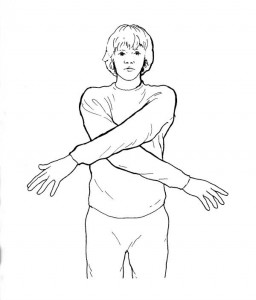 |
You need sufficient floor space to move easily, or even lie full length if necessary. It also helps to have loose clothing. Then you stand in the middle of your space, giving yourself time to explore what you feel and experience. |
Start by circling your arms. Take the arms above the head, down the sides of the body with the arms fully extended, then upward crossing the front of the trunk. In the full movement the hands are then forming wide circles that cross the front of your body. Do this until the movement is easy and flowing.
Then, as you are circling your arms with eyes closed, bring your awareness to the shape your hands are making in space. As you become aware of the shapes the hands are carving in space, watch what feelings you have as to how you would like to move. Give your body permission to doodle, to make any sort of shapes your feelings or body incline you to. Allow any sort of posture or movement, as active or quiet as you like. Allow sounds to accompany the movements if there is an urge to, and allow whatever feelings accompany them.
What you are doing doesn’t have to make sense. Nor does it have to comply with what other people might expect of you. Realise that you are allowing another part of yourself, perhaps a non verbal part, or a facet unknown to the rational mind, to express. With a non critical watching attitude, relax and let your body and feeling sense direct what happens.
There is no need to fiercely concentrate in order to wipe the mind clear of other influences. But you may need to hold back the part of the mind that always needs to know beforehand what you are going to do.
This is not like creative dance, in which there may exist a need to produce something pleasing for others to watch. With this exercise you need an open attitude in which your inner being can make its own adjustments, and movements, and feelings have a chance to express outside of rational criticism and demands of everyday life. Give yourself at least fifteen to thirty minutes in which to explore what spontaneous movements and feelings emerge.
The skill needs to be learned
This ability to allow life to stream through us in its own way is not a skill we are taught in our western culture. We are taught how to control, how important it is to repress anger or even immense joy, but we are not taught the balance of this – how to let go of control. Therefore the arm circling exercise needs to be repeated until the ’stiffness’ of our control is loosened and you can flow with what emerges spontaneously. When that begins to happen you will see that it is leading you along in a direction that is full of meaning and explains itself as it emerges.
Lily Kershaw – As It Seems [Official Music Video] – https://www.youtube.com/watch?v=utXz08ICZg4
As that happens you will not need to start with arm circling, but will be able to simply stand in your space and allow the process to happen. Wherever possible use this process, that I now call LifeStream, with friends who want to share it with you. This group practice enormously increases the power of it.
See Opening to Life; Lifestream – The Greatest is Often the Simplest
Life and Death – Chapter Links
Life and Death was a series of features written for and published in Yoga and Health.
I had experience in the many fields of thought about death, such as Christian Beliefs, Spiritualism, Yoga, Rosicrucianism, Theosophy, Anthroposophy, Buddhism, the Scientific Viewpoint and everyday experience. I had personal experience of out of body travel, and felt in a good place to be able to present these chapters.
These series, with additional material, are publishes in ebook format,
under the title Dreaming about Death.
Links to Chapters
1 – Nothing is Permanent – Except Change
2 – Spiritualism and Heaven
3 – The Mystery of Sleep and Death
4 – Heaven and Hell
5 – Sit Down You’re Rockin The Boat