Posts Tagged ‘intuition’
This is a little known way of using your intuition
A section quoted from Neal Criscuolo and Tony Crisp’s The Hand Book
A middle aged Gypsy woman rang my doorbell one day selling heather. She immediately began to tell me things about myself which it seemed to me it was unlikely she knew from other people. She told me I had started a couple of businesses which had not been a success; a near member of family had just had an injury; my son had recently gone into a uniformed service, and I was worried about him. It was correct about the businesses, but that information was not impressive. My brother in law had just had a nail go right through his foot at work. My son had just joined the RAF and her words brought tears to my eyes, much to my surprise.
As she told me these things, prior to each statement she said, “Now I am going to tell you something true”. These words were said ritualistically, almost like a prayer, then she would say things which I had the impression she had not thought about. I was not able to question her about this as she was a difficult woman to have an easy conversation with. She gave me the Gypsy’s curse because I wouldn’t pay her the money she demanded. This amused me as, having an Italian background, and having explored the unconscious workings of the mind for many years, I well understood the nature of curses and their attempt to mobilise unconscious fears of such things as illness. worrying events and accident.
The technique this episode illustrates can be called spontaneous voice. To use it one must learn to speak without ones thoughts constantly editing and criticising what is being said. Or at least, one must learn to direct the scanning and editing functions of ones mind.
The intuitive impressions one has, the information one has gathered unconsciously from whatever source, do not usually rise into clear conscious awareness. Thinking about what we do not already know is not possible. We only think with the information we already have, or is easily available. Creative leaps are a jump beyond what is known. So to access what is intuitively understood but not yet consciously recognised, we must use something different than conscious thought.
Focusing on another person and allowing oneself to speak without forethought, is a way of doing this. The unconscious functions which support the action of speech are already well established in fast searching for memories and information connected with whatever is being spoken about. Associated ideas, feelings, memories, along with the words to express, are all quickly accessed in the process of speech. The difference is that instead of presenting the process of speech with an outline of what needs to be said, you present it with a blank sheet, with only the name of the person at the top.
In reality it is a lot more formulated than that. Here are the steps helpful in using this approach.
1. Hold in mind clearly what you are about to do – this is most important the first dozen or so times you do it, after that you can simply remember the previous times the function was used. In other words decide to stop your conscious attempts to find information, or use ready made answers to the question you are going to ask. Imagine your body, mind and feelings as like keys on a piano, poised ready top respond, but not to your conscious efforts. Hold the picture of yourself standing aside – the part of you that has learnt to be concerned about what comes out of your mouth, whether it makes sense, what people are going to think about it, and so on – and you are going to let your sleeping dream self respond.
It helps to make any old noise such as animal noises and jog quickly in a circle around the space you are in before the next stage. This because you cannot think when moving quickly to get your answer, it has to come out of your depths. The jogging and the noises distract you, and that allows your intuitive function to emerge. While still jogging ask the question and then just let things happen. It doesn’t matter if a lot of rubbish comes out of you, because that is the way your inner being clears the ground on the way to making sense.
2. Make the decision that you are going to use your voice as a way of expressing what you already intuitively know. The first times you practice it will be best to do so by yourself, or with a friend you are completely relaxed with and who knows you are trying to develop your intuitive ability.
3. Now hold in mind that you are asking for helpful information about the person you are considering. It is actually of great value if the person – perhaps the friend you are practising with – actually asks you to tell them what your impressions of them are. As you ask for information remember to see the information you seek as existing unconsciously within yourself. In this way clarify the need for you to hold your conscious mind in an open receptive condition.
4. You can develop the receptive condition of mind and feelings by taking on a feeling of patient listening or waiting. If you have enjoyed a massage at some time, it is rather like the feeling of letting someone else make the effort while you relax. That is just what you need to do. Don’t struggle. Relax and let your voice be moved from within.
5. The next step is to begin to doodle with your voice. For the very first practice sessions it will help if you sit in the receptive condition, perhaps with eyes closed, and gently make a humming sound. Take hold of the subject’s hand, and in the back of your mind hold the realisation you are waiting for information about this person. As you do so let the humming sound move wherever your voice want to take it. Let your voice doodle, rather as your hand might with a pencil as you were thinking about something else.
6. To start with you might find you have an urge to make mumbling, struggling sounds as your voice is getting used to being moved by a level of your mind other than conscious thought or emotion. This is normal and will gradually go as your voice responds more readily and capably to your unconscious intuitions. Eventually you will be able to use this technique without the person in front of you knowing you were not speaking from conscious thought.
7. The step from ‘normal’ speaking and this speaking from the intuitive awareness may at first seem a big one. It is only habit and ideas of what you can and can’t do you are overcoming though. The way to gain this remarkably useful tool is to practice, and then practice, and practice again, just as you did when you learnt to speak in the first place – practice and play at it.
The Gypsy Secret
What the Gypsy woman was doing that is worth understanding was to use a short ritual to jump-start her spontaneous speaking. Through practice she had learnt that every time she said the words “Now I will tell you something true”, she called on her intuition to produce a result relevant to the person she was confronting.
Such a ritual need not be made obvious, but if it is, it makes it more powerful. The reason being that one puts oneself on the spot. Crisis is one of the best stimulants to wake the powers of the unconscious into expression. The fact that someone else knows you are going to address them from something other than a ‘normal’ state of mind will make them give you their full attention. Their attention helps to pull a powerful response from you.
As a part of the human survival ability, the capacity to predict the future is a well developed everyday part of life. So much so we often fail to notice ourselves doing it. When crossing a road we quickly take in factors related to sounds, car speeds, and our own physical condition, and predict the likelihood of being able to cross the road without injury. Based on information gathered, often unconsciously, we also attempt to asses or predict the outcome of relationships, job interviews, business ventures, and any course of action important to us.
If a detailed observation were made of the habits of ten people, one could predict fairly accurately what they would be doing for the next week, perhaps even pinpointing the time and place. For instance some would never visit a pub, while others would be frequently there.
Because the unconscious is the storehouse of millions of bits of observed information, and because it has a well developed function enabling us to scan information and predict from it, some dreams forecast the future. Such predictions may occur more frequently in a dream rather than as waking insight, because few people can put aside their likes and dislikes, prejudices and hopes sufficiently to allow such information into consciousness. While asleep some of these barriers drop and allow information to be presented.
Ed. Butler’s dream is about his work scene. Each detail was real and horrifying. Shortly afterwards, Rita was burnt just as in the dream.
Example: ‘ I was startled by the muffled but unmistakable sound of a nearby explosion. While unexpected, it wasn’t entirely unusual – the high energy propellants and oxidisers being synthesised and tested in the chemistry wing were hazardously unstable. When I heard the screams I froze for an instant, recognising that they could only be coming from Rita, the one woman chemist in the all male department. I rushed to the doorway of her laboratory. Peering through the smoke and fumes I saw a foot sticking out of the surrounding flames. I was only in my shirt sleeves, unprotected, not even wearing my lab coat, but I had to go into the flames. I grabbed Rita by the foot and noticed with horror that her stockings were melting from the heat. I pulled her back into the doorway and tugged at a chain that released gallons of water on her flaming body. When satisfied the fire was quenched, even though my own clothes still smouldered, I ran for the emergency phone.’ From Dream Network Bulletin, June 1985.
Some precognitive dreams appear to go beyond this ability to predict from information already held. So far there is no theory that is commonly accepted that explains this. A not too bizarre one however, is that our unconscious has access to a collective mind. With so much more information available, it can transcend the usual limitations when predicting from personal information. The speculative side of modern physics suggests an extension to this in saying the origins of our being lie beyond space and time. It we touch this aspect of ourselves, we may transcend our usual time-bound self, and see things in new ways – one of which might be precognition. See There Is A Huge Change Happening
Example: A dream told to me by a young man of 22. “I was in the jungles of Vietnam, standing near a railroad track, when I felt a sharp pain in the back of my neck. I felt myself rise out of my body, enter a large room, and sit down beside a young man. I asked him what had happened. He said: `We were both dead. I was killed in an automobile accident.’ I didn’t believe him. I saw two doors through which people were coming and going. Some looked happy, others unhappy. Then my name was called, and the young man said I was to go through one of these doors. I found myself standing in a large room facing a group of people seated behind a long table. The man presiding had an open book in front of him at which he looked from time to time. He spoke to me and said: `John Walter McGregor, you are physically dead and this is where you are judged. You have been found wanting because of your failure to heed the teachings of the woman, Nancy McGregor, your mother in this life.’ I insisted I was still alive. The man took me to the jungles of Vietnam and showed me my physical body lying there dead. He said again: `You are physically dead. You will, however, have another chance. You will return to earth in the body of a newborn baby, once again to learn these spiritual teachings.‘ Quoted from Dreams your Magic Mirror by Elsie Sechrist. One month later, in September of 1965, the man was sent to the jungles of Vietnam.
I believe this dream came as a symbolic warning to change his destructive attitude toward life lest his own life be cut short. This dream had a profound effect on him. He began to take religion seriously, and I am thankful to say that, after two years of service in the jungles around Danang, Vietnam, he is out of service and planning a career as a psychologist. Through this dream experience, the High Self was most effective in bringing about the desired change.
Example: I awoke, my heart beating rapidly, heavy beads of perspiration on my face; even catching my breath was difficult. I looked around my bedroom for some trace of reality, something to tell me I was safely at home and not frantically running to catch a connecting flight at the airport. In my dream I had lost my luggage and missed my flight. I couldn’t help wonder what connection existed between the dream and my coming flight later that morning. I dismissed it as a nightmare. Several hours later, however, the nightmare became reality when I missed a connecting flight because the plane was three hours late. I had to rush to another airline, catching a flight with a minute and half to spare. As in the dream, my luggage was lost.
The next examples are all from Shirley G. Because of space, only three of the dreams are quoted. Nevertheless, they are typical of dreams that do not seem to fall into the category of precognitive dreams arising from unconscious scanning or information already known.
Example: ‘I set out to dream the winner of a horse race each day for a week.
1 – Was driving down a country road and suddenly saw a glimpse of Emmerdale Farm down a side road. Following day: chosen horse ‘Emmerdale Farm’ came in first.
2 – Was working in a room when a man popped his head around the door and shouted excitedly ‘John, John, your uncle’s here’ and disappeared. I carried on working. Chosen horse: Uncle John. Came in first.
3 – What predictive dreams deal with appears to depend a great deal upon the dreamer and their preoccupations and deeply felt interests or anxieties. We can think of this rather like someone going into a library that has every possible type of information in it. What the person chooses to look at depends upon their current attitudes, fears, fascinations, etc. The following dream show a very different result to the anxiety type dream prediction.
4 – Was walking down a road, called into a house by a friend to have a chat. On the way out she opened the door and I saw a completely empty room except for a huge black fireplace. Door closed and I left the house. Chosen horse: Black Fire – which I insisted would only be placed – due to ‘fireplace’. Came in 2nd.’
Example: I dreamt that a female friend, Liz, and her husband David, with myself and my husband were busily and happily renovating an old barn to live in, and seemed to be living away from our home towns. All was blissful until, almost suddenly David and I were in love. We decided we must be honest and tell Liz. I told her and felt an overwhelming, powerful and radiant love coming from her, She was smiling warmly and said “That’s alright Shirley, I understand.” Still the glowing love was enveloping me as the dream trailed off. The following morning I heard Liz had died after the extraction of in infected wisdom tooth. S.P.
Example: I look back and describe myself at that time as a “straight psychology professor” having no knowledge of metaphysical events or higher consciousness studies. I was always taught that dreams went backward to reveal repressed sexual and aggressive impulses. Nowhere did I ever learn of a dream going forward in time to provide glimpses of future events. In fact, when I awoke from my accident dream, I looked at the car crash symbolically and wondered why I was trying to hurt or punish myself with such a violent action. Can you imagine my surprise, when I experienced the car accident three weeks later, in exact detail, as my brakes did indeed fail? This dream was the first of many informal lessons to follow.
Weeks after this spectacular car crash, I dreamed of another accident with brakes failing. Of course, this was ridiculous since I had purchased a brand new car to replace the totalled wreck. This time, sound effects were added to the dream as I heard a snap when I put my foot down on the brake. Again, wondering about my punitive gesture toward myself, I dismissed the dream since this couldn’t possibly happen to a brand new car. Again, the inside information was correct, as the brake cable snapped just days later. Marcia Rose Emery.
See: Example under body teeth; esp in dreams; foresight; prophetic dreams.
The ability to predict is an expression of the human supersenses. As humans we have an unconscious ability to read body language – so can assess other humans very quickly. Humans have an unimaginable ability to absorb information, not simply from books, but from everyday events. With it we constantly arrive at new insights and realisations. Out of this massive information we frequently correctly predict the future – not out of a bizarre ability, but from the information gathered about the present. All these abilities and more show in our dreams.
Seeing the future
However, at times our inner ability to look at the future jumps way beyond the usual process of predicting from what is known of the present and the past. Quantum physics begins to give us evidence that we live in the midst of a universe that is far more amazing than we have ever previously thought. We live in some ways as co-creators of this universe. But we each have a phenomenal potential. We each have possibilities beyond anything we can imagine. As human beings we haven’t even begun to really explore that potential and to use it in our everyday life. Part of this potential is an ability to transcend the usual way we relate to time and space, as show in some dreams in which the seemingly unknown future is clearly shown. See Precognition; ESP in Dreams; Using Your Intuition
Many dreams extend perception in different ways.
dreaming the future – Just before his title fight in 1947, Sugar Ray Robinson dreamt he was in the ring with Doyle. ‘I hit him a few good punches and he was on his back, his blank eyes staring up at me.’ Doyle never moved and the crowd were shouting ‘He’s dead! He’s dead!’ He was so upset by the dream Robinson asked Adkins, his trainer and promoter, to call off the fight. Adkins told him, ‘Dreams don’t come true. If they did I’d be a millionaire.’ In the eighth round Doyle went down from a left hook to the jaw. He never got up, and died the next day.
The problem is that many dreams felt to be predictive never come true. Often dreamers want to believe they have precognitive dreams, perhaps to feel they will do not want to be surprised by, and thereby anxious about, the future. When the baby son of Charles Lindbergh was kidnapped, and before it was known he was murdered, 1300 people sent ‘precognitive’ dreams concerning his fate in response to newspaper headlines. Only seven of these dreams included the three vital factors – that he was dead, naked and in a ditch.
Out of 8000 dreams in his Registry For Prophetic Dreams, Robert Nelson, who was sent the dreams prior to what was predicted, has found only 48 which bear detailed and recognisable connection with later events. See: prophetic dreams.
dreaming the dead See dreaming of death
dreaming together – The Poseidia Institute of Virginia Beach, USA have run a number of group ‘mutual dreaming’ experiments. Although the institute suggests very positive results, a critical survey of the dreams and reports reveals a lack of hard evidence. Like other areas of ESP dreaming, it can seldom ever be willed. But the dreams did show themes related to problems regarding intimate meeting. Also, some of the dreams were directly about the goal of dream meeting, as in the following example.
Example: ‘I find the group of people I am looking for. There were maybe six or more people. They were asleep on mattresses except for two or three. These were awake and waiting for me, and wearing small pointed hats such as Tibetan Lamas wear. In the dream I realised this meant they had achieved sufficient inner growth to remain awake in sleep. We started to communicate and were going to wake the others.’ Tom C. See: meeting in dreams.
There are ‘meeting’ dreams however, although these seldom occur under test conditions.
Example: ‘I dreamt my sister was attacking me with a pair of scissors. She backed me against a wall and stabbed me. During the day after the dream my sister phoned me at work and said she had an awful dream in which she stabbed me with scissors.’ D.
Example: My husband is in the Navy, serving on a ship in the Gulf. We’ve always been close, through 22 years. I dreamt we were making love, and could even smell him. It ended as lovemaking always does for us, with orgasm and a cuddle into deep sleep. I woke surprised he wasn’t next to me. He phoned next day to say he had the same dream, same night. Mrs. E.H. – Gosport
the dream as extended perception – Even everyday mental functions such as thought and memory occur largely unconsciously. During sleep, perhaps because we surrender our volition, what is left of self awareness enters the realm where the nine tenths of the iceberg of our mind is active. In this realm faculties can function which on waking seem unobtainable. A list of these would include –
1 Extending awareness to a point distant from the body, to witness events confirmed by other people. This is often called Out of Body Experience or OBE, but some of these experiences suggest the nature of consciousness and time may not be dualistic having to be either here or there. See: out of body experience.
The March 24,1974, New York Times Magazine contained a report about a dream that Lieutenant Colonel H. R. P. Dickson, a British political official in Kuwait, experienced in 1937. One day, a violent sand-storm carved a hole by a palm tree in his compound. That night, he dreamed he approached the hole and saw a sarcophagus at the bottom. Inside he discovered a shroud, and when he touched the shroud a beautiful maiden rose to life. As the dream continued, shouting strangers arrived and wanted to bury the girl alive in the desert, but the colonel chased them away.
Perplexed by his dream, Dickson consulted a local Bedouin woman who had a reputation as a dream interpreter. She explained that the girl symbolised wealth beneath the sands of Kuwait and the men trying to bury her were strangers from across the sea who wished to prevent its discovery. At that time, a British oil company crew had been drilling nothing but dry wells for two years at Bahrah on Kuwait Bay.
The Bedouin interpreter told Dickson he should move the team to the desert of Burgan and concentrate drilling activities by a lonely palm tree, where they would find great treasure. When the drillers laughed at Dickson’s urgings to move the team, he sailed to London and told his dream and its interpretation to the company executives. One of them, who believed in dreams, felt the dream interpreter’s instructions deserved a try. He cabled Kuwait and the team was moved about thirty miles south to Burgan. In May 1938, the drillers discovered huge oil deposits there in the desert by a lonely palm tree.
In a recent news program on television, a man who survived the Japanese prisoner of war camp in Singapore had been given a photograph of children by a dying soldier he did not know. The man had asked him to tell his family of his death, but did not give his name. The photograph was kept for forty odd years, the man still wanting to complete his promise but not knowing how. One night he dreamt he was told the man’s name. Enquiries soon found the family of the man, who had an identical photograph.
2 Being aware of the death or danger of a member of family. Kinship and love seem to be major factors in the way the unconscious functions. See: dead people dreams; Talking with the dead
3 Seeing into the workings of the body and diagnosing an illness before it becomes apparent to waking observation. Dr Vasali Kasatkin and Professor Medard Boss have specialised in the study of such dreams. In a recent dream told to me a man looked back into a bedroom and saw a piece of the wall fall away. Waves of water gushed from a main pipe. The dreamer struggled to hold back the piece of broken pipe. Within two weeks his colon burst and he had to have a major operation. See: meditation.
I – the author – witnessed a number of extraordinary dreams told me by my first wife Brenda. One of them has become a landmark for me of what is possible in dreams. One morning Brenda woke and told me she had dreamt about the baby of two of our friends. The friends, who I will call Jane and Bob, were living about 200 miles from us. We knew Jane was pregnant, and about a week or so before the dream we had received a short letter saying the baby, a boy had been born. We were not on the telephone at the time, so the letter was our only means of communication.
In the dream Brenda saw the baby and a voice from behind her told her the child was ill. Its illness, she was given to understand, was serious, and would need to be treated with a drug taken every day for the child’s life. The reason for this illness and the drug use, she was told, was because in a past life the person now born as the baby, had committed suicide using a drug.
I did not take the dream seriously, thinking it was some sort of personally symbolic dream. But we couldn’t seem to extract any personal meaning for Brenda, so just in case I sent an account of the dream to Jane and Bob. About a week later we had a letter from them saying that the letter and dream had crystallised an already existing anxiety about the baby. It had not been feeding well and was fretful. On taking it to the doctor nothing definite could be found but special tests were made in hospital. From these it was discovered the baby was dying. It lacked an enzyme which was needed to digest calcium. To compensate it was given a drug, which it has had to take every day of its life to make up for the lacking enzyme.
4 Access to a computer-like ability to sort through a massive store of information and experience to solve problems. These dreams are often confused with precognitive ability. Prediction does occur from these dreams, but it arises, as with weather prediction, from a massive gathering of information, most of which we have forgotten consciously. Morton Schatzman, in an article in New Scientist, showed how subjects can produce answers to complex mathematical problems in their dreams. See: the dream as process as computer; creativity and problem solving in dreams.
5 Tapping a collective mind which stores all experience, and so is sensed as godlike or holy. See: spiritual life in dreams .
6 It seems likely that before the development of speech the human animal communicated largely through body language. Some dreams suggest we still have this ability to read a persons health, sexual situation, intentions and even their past, through body shape, posture and tiny movements. See: Postures Movement And Body Language.
See: Cayce, Edgar; collective unconscious. See Also: hallucinations; altered states of consciousness..
Through the Eye of Dreams
There has been a conjuring trick performed in regard to our view of who we are. It is almost as if we have stepped into a photo booth, and instead of a realistic image of ourselves being produced we are given one with most of our features missing. The strange thing is we usually accept this distorted image of ourselves as real, though most of us feel odd about it, and some of us actually get around to searching for a different image.
What I mean is that we have the notion from the current popular mythology of reality that we are produced by the combination of our parent’s sperm and ovum. The genetic combination is, we believe, the print of who we are.
I know this is a massive simplification, and I am not saying it as a criticism, simply a statement of popular belief. Nevertheless it is a belief that shapes the concepts people have of themselves. But the sperm and ovum, the genes, do not provide language, they do not give us culture, books, music or religion, despite any connections there might be. Children raised by animals do not develop any of these culturally given enhancements. They are not innate. See Animal Children.
The myths of our times also suggest that our personality is either God given; or it is formed out of the whims and neurosis of our parents and events during our infancy; or perhaps it is just made that way like a piece of equipment stamped out in a factory or by the position of the stars at our birth, and there’s not much one can do about it. This modern myth goes on to suggest that the only eternal life any of us can hope for is that arising through procreation. It is only our genes, we are assured, that will live on if we successfully procreate and our children survive and prosper. Because of this, it is further explained, our sexual urge drives us all forward into the convoluted avenues of sexual relationships. And these are factors influencing how the image we have of ourselves comes out strangely distorted.
I sometimes think there is an odd quirk in human nature that makes us want only one answer to any riddle in life. It is as if there can only ever be one right thing, one truth about anything, and everything else is thereby false. This is a, ‘if religion is correct, then science is wrong’ type of reasoning, as if they are both looking at the same piece of the cosmos from the same direction. It is like the Indian story of the blind men describing the elephant. One has his hands on a leg, another on the trunk, and so on. None of them are able to see the whole animal and therefore have a distorted impression of it.
Therefore one must beware of the urge to avoid insecurity by hanging on to the tail of the elephant and feeling one is safe because at least we know what the beast is. It is in fact dubious whether we can ever know ‘the beast’, though it might be possible to have an intuition or sense of it. The universe and the mystery of life and consciousness are so vast that none of us can possibly hold all the factors involved in mind at any one time. Therefore we cannot possibly arrive at any inclusive understanding of the big questions – why am I here? What is life about? How did life come about?
Coming back to the distorted image we can arrive at of ourselves, if we take time to consider our origins, it can bring us a bit more toward a feeling of wholeness and sense of reality. For instance it is obvious and wonderful how the bodies of our parents, through the gift of their own genetic material, have shaped our own body and its inclinations. This much is now demonstrable, but where I want to go from here is to look at common human experience in an uncommon way, through the eye of a dream.
The Voice of My Dead Forebears
The dream is that of a man in his mid forties.
“I am walking along a cobbled road going slightly down–hill. I know as I dream that I am in Italy. I do not feel a stranger in this land, and am learning the language.” Ron.
Ron describes his exploration and insights into the dream by saying:
This was a very short dream and I didn’t think it had any real significance, but I was regularly exploring my dreams, and it interested me because I couldn’t understand what it referred to in showing me learning the language. I had never learned Italian and was not doing so.
When I relaxed and allowed the free flow of my associations and feelings, the first part of the dream was easy. My father was born in England of two Italian parents. So being in Italy, a country I had never visited myself, I could immediately feel and understand as referring to my family on my father’s side and the influences that has left in the way I think and live.
But I felt myself falling deeper into the dream. It was something I had learned to do. I not only kept the question ticking over quietly of what does the dream indicate, but at the same time I relaxed control of my thoughts, my body and emotions. This is like being half asleep in a state where the body can twitch spontaneously, and perhaps I can even hear myself making slight vocal sounds, and yet I am wide–awake watching what arises. Because of this state a flow of memories began to arise about my father, and I realised something I had only been partially aware of before.
My father had taken over the family shop when his father had died. The shop was in London, just over a mile away from the old Covent Garden fruit and vegetable market. Most days my father walked, pushing a barrow, and in later years drove to the market to buy produce for the shop. I often went with him, helping carry and load, and perhaps push the barrow. In my youth I wasn’t aware of it, but now in my flowing memories I realised that my father was very distant or cautious in his dealings with the market salesmen and porters. A distinct and overall realisation arose out of the many memories and impressions; it was that my father was expressing a particular type of caution in all his dealings with other people. I saw this as keeping who he was secret – keeping his head down.
As I saw this in my father it hit me with great power that this attitude had passed to me, and although I expressed it in a different way, I had inherited it with equal strength. Why? And, how?
The perception that was taking place was not like my normal thinking. It comprehensively gathered memories and put them together in a way that made patterns and themes stand out. So as the process of insight was taking place I saw just how the urge to keep my head down, not stand out in the crowd, not get involved with people, had influenced my actions. For a start I had never voted in my life. This was because I could never identify with groups pushing for power. I had avoided everyday social activity, although relationships with individuals were not threatening.
Now I started seeing how this attitude had passed to me so strongly. My thought, as I witnessed the flow of memories, was that perhaps such information was genetic, because my father had never talked to me much at all. He had certainly never urged me to keep out of the limelight – to keep my head down, and until now I hadn’t been aware that he had been doing it himself, so it wasn’t simply conscious emulation. I can only say that I ‘saw’ how it had happened. What I mean is that through the still flowing memory and feelings it was as if I could actually look into the heart of things and see how they worked. The insight I achieved was that we as humans, like other mammals, in our earliest years particularly, still learn like most mammals do, and that is not verbal at all. A massive amount of information is absorbed from our parents without any effort or awareness.
What Ron realised is that just as a fox cub ‘learns’ how to hunt from its parents, so we absorb the deeply etched survival strategies of our parents simply by being around them. If genes come into it anywhere, they perhaps create the reflex response that instinctively draws in the survival tactics that perhaps even our parents themselves have never really been aware they live by. In doing this the higher animals learn what cannot be passed on as instinct, what is not ‘hard wired’ into them. This holds in it a tremendous advantage because ‘hard wiring’ takes a long time. Through this faster method we learn what to be afraid of, what to eat, how to hunt, because the lessons learned by pain through many generations are exhibited in our parents behaviour in dealing with events. The experiments with apes in Japan, where Imo the macaque ape learned the ability to wash sweet potatoes to remove sand grains, show how this was passed on from this one female to the whole group, and then to subsequent young macaques, and illustrates how survival information is passed on non verbally for generations. An important aspect of this is that whatever of such information is held in the present generation, it is an accumulation of skills and responses learned over many generations, and is the fundamental survival strategies of that particular family or group line. Ron goes on to say:
The degree of this was staggering to me. It led me to wonder just where my father had got the information from, and although this was obvious from my own perception of where I had received the messages from, the resulting experience profoundly moved and impressed me. It taught me things about myself I don’t think I could have learned in any other way. A floodgate of impressions rushed into my awareness at such a pace I can only record the main ones.
Suddenly my mind let the power of the messages my father had carried and passed to me speak, as if they were alive. I experienced what appeared to be a direct connection with my far ancestors. This may sound strange, but my father had, as it were, handed me a recording. He and I had been impressed with the cover and it had led us to live in a particular way. But now I had put the recording on the player and the ancient originators expressed their own message.
Obviously this is only an analogy to convey the experience, but in some way the message played out in me from centuries back. From it I learned that my forebears had lived in Italy during a period of great religious and political tension. The pressures to conform had been enormous. Not only were my ancestors told to believe in a particular sort of God, but also to accept leadership from people they had no respect for. If they did not live this belief and submit to it they were killed or rejected by the community they had been born into. In their own words I heard them saying to me something like ‘The worst was they did not kill us, but they cut our vine at the roots. They burnt our land and they killed our children. If you want your sons to live, teach them not to hold their head up, but to keep their eyes on the ground.’
And out of that trauma the message had been passed to me many generations later. It was survival. I was still living it, but perhaps it was time to reappraise.
I Am an Ancient Thing
Ron’s description helps us look at what is a common experience, and in a different way, an established observation in biology. It is common knowledge that animals learn through example. It is common knowledge that traits pass on through generations. What is added here is the powerful way such behaviour can pass on in humans. It shows how we communicate behaviour to our children without any conscious intention. Looking through the eye of dreams we see here a psychological or psychic [ii] realm that extends beyond the mere transmission of behaviour. It includes or leads to meaning, to understanding ones roots. This may seem mysterious or unfeasible if one has not actually experienced the way the dream process puts apparently abstract experience into imagery leading to insight. [iii] If one has witnessed this process at work, what Ron speaks of does not seem remarkable.
Looking through the eye of Ron’s dream there is a suggestion that aspects of Ron’s personality did not begin with his birth. Parts of his personality preceded his birth, being carried and passed on by his father. This module or facet of Ron’s character had been formed hundreds of years previously. It had been part of the lives of his forebears, and had been carried forward into his life. It did not pass on to Ron through any genetic material. It entered him through absorption of the behaviour of his parent. So it is saying that just as the genes we receive are ancient and passed to us, this survival information is also ancient and passed on. It influences who we are as profoundly as any genes.
Of course, Ron is only seeing his connection with his father. There would also be packages of behaviour and information handed to him by his mother. [iv] So not only can one have a ‘gene pool’ from which our being is formed, there is also a ‘behavioural pool’ acting as a similar resource. This does not so much shape the body, but certainly gives form to the character and responses. In fact unlike the genetic passage where a set of genes in the mother is united with a set from the father, the behavioural pool may have several ‘sets’ or packages which can be triggered by different environmental circumstances. My experience suggests that the behavioural packages from the mother and father certainly do not splice as do the genes.
The behaviour Ron observed in himself, in his father and grandfather, although according to Ron’s insight it arose at a particular period in history, it obviously rested upon traits already existing in the family from an even more ancient past. So the trauma of persecution may have modified existing traits rather than set in place entirely new ones.
Because of pre–existing traits, another family might have responded quite differently to being subjugated. They might have pushed for dominance rather than anonymity. They may have aggressively opposed, sought opportunity to join the ranks of power, or actively supported as a subordinate.
This is supposition based on insufficient evidence; but if the basic idea of the passage of behaviour is correct, it shows human nature as having several dimensions to what forms who they know themselves to be. These are almost like different streams from the past meeting in the person, and in some way passing on into the future, perhaps separated again. For instance we have the stream arising from the body and its genetic material; we have the stream arising from cultural language with all its massive inbuilt data; we have the behavioural pool that we inherit, again with massive innate information. When we begin to look at what it is to be human from this perspective we see we are multi dimensional creatures, existing in the flow of huge streams of influence. And these streams themselves mingle in different ways creating a variety of experiences and further dimensions.
Coming back to Ron though, there is certainly a transitory and short lived aspect to him, in that his unique body and many of his personality traits will only exist during his physical life. But facets of Ron have existed for millions of years – in the genetic stream for instance. And even in his highly ephemeral personality itself, there are parts that have had a long life before Ron woke to his personal existence. For instance the language he was brought into existence by and the behavioural influences he absorbed.
This makes nonsense of the myth that we only have eternal life through procreation. It also suggests that if Ron identifies with the aspects of himself that are short lived, such as the transitory aspects of his body, his less permanent personality traits, his changing likes and dislikes, then he faces death. All that he thinks of as himself will perish. In this sense he cannot survive bodily death.
In fact it seems as if Western society faces the issue of death in a much more catastrophic way than other cultures. The reason for this is that many older cultures see the personality as transitory anyway, and identify more fully with the family ancestors and the longer lasting aspects of life.
It might be argued that as the behavioural traits passed on to Ron preceded him, he cannot really identify with them as himself, so cannot see them as an aspect of himself that has a long life. The problem here is that hardly anything in the personality is unique except perhaps the exact mixture of traits and responses, memories and dreams that make up that particular person. Everything is taken from somewhere else, or is a mixture or development of what already existed. We all identify with the contents of our mind, our language and our traits, yet these are not new with our own personal awakening as a person. So we cannot separate Ron from what he has inherited. It is still him. If it has a long life, then we must say aspects of Ron have a long life.
Once we grasp this idea of the passage of behavioural traits from generation to generation, I believe it can be observed fairly easily in everyday life. Much of folk beliefs suggest it without filling in the details. Such sayings as ‘like father like son’ – ‘like mother like daughter’ have the belief implicit in them. The generally held view that each nation has a different cultural identity also suggests it. In fact we often use the word culture to describe the behavioural traits peculiar to a particular group of people, in reference to their observable behaviour traits which are passed on from generation to generation throughout the group or nation. We are therefore talking about a behavioural pool with particular characteristics.
I have frequently observed family groups out shopping and seen the intense mimicry of a child for its father or mother, even to certain positions of the hands, or posture of the body. Such passage of very particular behavioural traits is especially noticeable in the learning of language. The unique sounds of certain words, even within one language such as English, are mimicked in an extraordinary way by children, creating a local dialect in which sounds are made that are often quite difficult for people outside of the area to make.
It is innate in us to soak in and mimic the behaviour of those close to us. That is obvious. All I am adding to that is the suggestion that deeply seated personality traits, and the shape of our psyche, are also radically influenced in the same way. Not only do we soak in actual behaviour, but we are capable of transforming the messages coded in behaviour into personal psychological experience such as described by Ron.
I Speak Therefore I Am
That our often closely guarded personality is made up of pieces of behaviour that existed long before we did, may be a strange idea to many people. The way we present our film stars and pop idols as special, or particularly talented; the way we often think of ourselves, is as hermetically sealed units that have been influenced from outside by environment and people, but on the whole we are unique. Sometimes people even adopt a superior attitude, as if to say ‘I am vastly different to the rest of humanity’. This makes it difficult for us to actually observe our origins.
If we think of an acorn, it is easy enough to believe that if we planted it, a tree would grow from it that would be very much the same as the trees from which its genetic material arose. In its particular growth however, factors of soil, weather and events would shape it to its own uniqueness. With human beings we think similarly, except we commonly leave out factors of great importance, factors which contribute to our personal existence in such a major way that to forget them is to be like the blind men with the elephant once more. For example a tree doesn’t learn speech, or the customs of its cultural group.
Particularly in past centuries, when there was a much closer relationship between humans and wild animals, it was noticed that if a baby was lost and raised by a creature of the wild, such as a she–wolf or bear, the child never became properly human. Being human is not innate. Something rubs off from functioning mature humans onto their babies to make them into human beings. The major differences are that the baby raised by an animal lacks self awareness; it cannot speak any language other than that of the animal it was raised by, and it lacks a sense of time; and in many cases there is a deep sense of connection with animals and the natural environment. Its reactions to surroundings are those of the animal it was raised by. Thus the behaviour traits it learned were not those of the human animal, but of the mammal that mothered it.
A headline in the Daily Star on April 17 1991, at the time the film Dances With Wolves was popular reads: “TRAGIC BOY’S DANCE IN WOLF’S LAIR.” It goes on to say:
A tragic orphan brought up by a pack of wild wolves will never be able to live like a normal man, say doctors. The boy who REALLY danced with the wolves was aged about seven when he was found 29 years ago in the wastes of Southern Russia by a team of oil explorers. He howled like a wolf and savagely bit one of the oil men who christened him Djuma – the Wolf Boy.
Professor Rufat Kazirbayev said doctors had battled to re–educate him to act like a normal human being – but failed. They are now giving up the fight.
“His mind is with the wolves. He will howl at the moon for the rest of his life,” he said.
Djuma, now about 36, is still in hospital. He still crawls on all fours, eats raw meat and bites when frightened. He can speak only disjointed phrases – “Mother dead. Father dead. Brother dead. Sister dead. Mother nice. Father bad.”
Dr. Anna Ticheenskaya said: “presumably his family were killed in a purge. He has shown us in sign language how his mother saved him by throwing herself over his body.”
Djuma has learned to brush his hair, clean his teeth and use the toilet “Like a trained animal.” But when taken to the zoo he howls as if he was urging the animals to take him to freedom. Sadly that will never happen. Djuma will probably spend the rest of his life in the clinic where, doctors say, he spends his days like a dog – half asleep and dreaming.
The autobiography of Helen Keller helps in understanding what may be the difference between an animal, or an animal man like Djuma and a human being with self awareness. Helen, made blind and deaf through illness prior to learning to speak, described how she lived in a dark unconscious world lacking any sense of self until the age of seven when she was taught the deaf and dumb language. At first her teacher’s fingers touching hers were simply a tactile but meaningless experience. Then, perhaps because she had learned one word prior to her illness, meaning flooded her darkness. She tells us that “Nothingness was blotted out.” Through language she became a person and developed a sense of self, whereas before there had been – nothing.
This ‘nothingness’ described by Helen Keller is difficult for most of us to imagine, having all our life been exposed to other human beings through behaviour and speech. Helen describes it as having no awareness of personal pain or events. She says that perhaps things happened to her, perhaps they were painful, but as she had no personal self to appreciate this, they were merely passing tactile sensations. She was not personally disturbed by them because she had no ‘person’ to be disturbed.
The learning of language was the pivot around which Helen’s self awareness evolved, with its attendant ability to think, to have a sense of ‘I’ or ‘me’ and all the personal relationships with others and the world arising from that. Without the learning of a complex language which holds in it the concept of ‘selfhood’ there is apparently no possibility of self awareness. Without the passage of the ‘behavioural pool’ from a human being to a human infant, there is no possibility of a self aware human maturing from the baby.
The information gathered from the many cases of ‘animal children’ suggests that not only do the behavioural traits of the fostering animal pass to the child, but also the state of soul can be thought of as a form of behavioural response which is also learned. In other words, self awareness, which is so taken for granted in our own life, is passed to us as a learned response by the humans who are our role models and mentors. Selfhood is not genetically given, it is a behavioural response.
The story of Imo the macaque mentioned earlier helps us imagine a possible first scene for the emergence of self awareness in the human species.
There must have been a gradual development of the complexity of language bringing the pre–human to the point where self awareness was ready to emerge, but hadn’t quite been realised. Then, perhaps an event or a particular situation in the life of the pre–human triggered the new awareness. Suddenly the pre–human was self aware and stepped into human experience.
This must have been a momentous experience for the individual or individuals it occurred to. If compared with the descriptions of people in our present times who achieve a new state of awareness such as Maurice Bucke describes in his book Cosmic Consciousness, it was probably a ‘religious’ experience – something appearing to have been visited upon the individual from a power exterior to them. In such cases the experience, the new state of awareness, usually only lasts a short time, but may become more prolonged as the individual is further exposed to it. One might even speculate that just as animals will repeat an action that provides food or pleasure, so the experience of self awareness in early pre–humans may have led to ritual performance of actions, or the re–creation of circumstances, that were part of the first experience. These I imagine as the roots of religious ritual. I believe such achievement of a new type of awareness by certain individuals is also behind traditions such as yoga and Sufism. This can be observed in particular in Subud in which one individual experienced what he was certain was a new experience and passed it on to others through contact. In his book The Origin of Consciousness in the Bicameral Mind, Julian Jaynes gives a detailed historical perspective of these beginnings in the not so distant past.
The following dream of Joan C. illustrates and further describes the collective life of early humans, and the experience of developing from it to self awareness. Joan’s work on the dream provides us with another example of the information possible to gain through the eye of dreams.
In my dream I was in the garden of a large house. To the right of the house, my right that is, I saw the garden had been changed. I realised that I knew the garden from childhood, and there used to be a large pool by the house in which we all bathed when young. The ground sloped up from the house and was rough, but part of it had been dug over. The care and skill with which this had been done deeply impressed me.
There were no direct associations I could make with the house or the pond, so I started allowing spontaneous material to enter into the dream, allowing my mind to roam freely and show me out of what images and feelings the dream had been fashioned.
I started with the pond, and had the most unexpected set of fantasies and feelings bubble up from within. The garden when we were children referred to a condition of mind, which I now experienced, in which a group shared a common awareness, and felt at one with their environment. In other words there was no separate identity. No one in the group knew themselves as an individual. I knew as I experienced this that it was about the early condition of human beings, and was represented in the Bible as the Garden of Eden. It was about the history of our development as human beings. It showed me that in the early stages of evolution all human beings lived in a state of awareness in which they had no sense of separation from nature itself. They had no sense of individual existence either, but lived in a sort of paradise where there was no idea of birth or death or right or wrong. They felt at one with each other in their small groups and with the forces of nature.
When I experienced this I understood at last what the story of Genesis meant. It was about stages of psychological development, not physical or mythical history. Humans had come out of the pool though, out of the collective awareness, and at that point I experienced a mass of impressions and images I still cannot completely understand. The images suggested that at first, maybe one or two humans climbed out of that pool, and they left a mark. They climbed out and put one stone on top of another. The images developed further into suggesting that many ancient monuments were an expression of this enormous sense of the newly found identity – of personal existence.
I understood this to mean that one or two humans had achieved personal identity. In that state they realised something about themselves – they could say ‘I am’. They could ask ‘Who am I?’ That had never been possible before.
I need to say what arose in me were not those words or memory or vision of definite events, but a sense of touching or experiencing an overall memory, a vast overall process. So I am trying to put into words what I sensed. It was such a wonderful thing, so full of experience, to see this that I want to try to describe it. At the same time, it was an immense process and difficult to capture.
What I felt was that the pool was a collective consciousness such as Jung speaks of, and that it still exists now in our unconscious. At the early stages of human development though, it was the everyday experience, but the individuals who attained self awareness began to build a new type of life. They left stone monuments, carvings, paintings in caves, stone circles, pyramids; each person, each group realising deep down that this new level of awareness was a thing to be given and built. The Sphinx is an image of this half way state of human and animal.
This is where words are difficult, but the dug ground in the dream depicts it. If the son of a farmer takes over the farm, his work and achievement are built upon what his father did with the land. The father’s work is built upon by the son, and is a continuation, of what his father did. Even if one was to take a piece of land which had never been farmed before, one would farm it with tools, experience and attitudes developed gradually through thousands of years of human effort. I saw that I, although I am not usually aware of it, am formed out of the ideas, words, attitudes, pleasure and pain left to me as a heritage by millions of people. If I had not been raised by modern humans I would, in fact, not have developed an identity. My identity is a gift to me from the great river of human beings who left a mark, one stone on top of another, a concept enshrined in art, a struggle or love immortalised in stone, a realisation and transcendence depicted in a religious ritual or in a new word.
The garden, the dug plot was myself, my personality. But my personality, the attitudes and reactions of its very foundations and structure, the words with which my mind realises its existence, are the living remains of countless other lives and their endeavour, their love, their ignoble failure, their genius and their prayers. I AM my ancestors. That I have also dug that plot by my work on my dreams, by trying to transform the unwieldy loam of myself into finer stuff, gives me a place in the river of life, in the eternal process of continuity.
Most important of all, perhaps, in such simple acts as writing out this dream, I leave a mark. I etch upon the world the sign of my own realisation, the changed lines of transformation. For self consciousness is a sort of collective consciousness which forever depends upon giving, and upon physical records of living beings to enshrine its existence. Without living beings who carry the words and responses gradually developed by myriad ancestors; without books, paintings, music, science and architecture, we have no existence as people. In one generation we could be swallowed up by that pool, that sea of self–forgetting symbolised by the waters that swallowed Noah’s contemporaries. Even now, without the love of giving, that sea can swallow us. That was my dream.
Joan’s description further illustrates how our mind, approached in the right way, can pour out realisations and insights that are deeply educational. It is a form of outpouring and mental function that few of us are ever taught to look to or use in our schooling. But it IS a common experience in the sense of it being described in all the cultures throughout history. It IS accessible.
Joan and Ron’s descriptions taken together also say that there is a function in the human mind that takes external information, such as language, behaviour and architecture, and treats it like a code. Perhaps if the example of the printed word is used this makes it easier to understand. A book might be a couple of hundred years old. A baby who grows and is taught the language of the book can eventually read it. As it is being read, what was a physical object unfolds in the child huge amounts of information and imagery. Perhaps it moves the child emotionally also. It may even explain aspects of their own existence they knew nothing about before.
That is not an exact analogy, but Ron and Joan suggest that the external objects of culture we see around us and take for granted, actually produce in us the release of a massive amount of information and deeply felt experience. Most often however, we fail to appreciate this as it is covered, or obscured by the dominant sensory impressions and taught responses, as already described.
When it is appreciated and released, the result is probably due to a complex interaction between genetically produced inclinations, the environment, and culturally provided education, plus an up–welling of unconscious material from the ocean of information we all live within. This fuller understanding of our cultural environment is probably necessary for optimum survival, but is not necessary to become a conscious individual stumbling along through life.
The View So Far
Looking through the eye of dreams and human experience, such as Ron and Joan’s dream–work and the account of Helen Keller, a situation is described stating that our personal identity rests on –
- The passage of behavioural traits from adults to the new born.
- The learning of language.
- The interaction between people affirming personal identity.
- A collective consciousness. This is created physically by the written and spoken word, but also by all other works of humanity such as music, art, architecture, and of course social structure. Its fundamental base is living human beings who have learned language and carry ancestral behavioural traits. In a sense, the enormity of who we are is external to us and our body and brain are decoding instruments.
- The collective consciousness is a code that can come to life in the individual. Only the cultural environment plus the personal response to it make a whole.
- A collective unconscious is the source of our personal existence.
See House of the Ancestors.
As an experiment while staying with my son at Cambridge he asked me questions to be responded to by spontaneous voice. To me, the responses were so marked I want to record at least one of them.
Spontaneous voice is a process I came across as I was experimenting with allowing the dream process while awake. While dreaming we spontaneously move, speak, eat, have sex, and all these arise while our conscious will is ‘asleep’ or surrendered. Therefore we can say the unconscious itself is speaking when we speak in dreams. When I allowed this while awake the results were often startling, as what was said frequently gave information or viewpoints there were totally new or unknown to me consciously. So the following question and its response about dreaming was not previously thoughts or idea I had consciously entertained.
The first question arose because we had been talking about what it was in humans that led most of us to be unaware of the possible wider life – the unconscious – they live in. This was not the exact question but it was certainly about the relationship between the conscious self and the unconscious.
My son asked me the question and I allowed spontaneous voice to respond to it.
The response was long, and I can only remember the highlights. It started by stating that to understand the question one needed to know that it had to do with information gathering through the senses, and the way we responded or reacted to this. I will try to state it verbatim.
To understand this you need to realise that the brain works in certain ways. It is something like the brain running a computer program, like a set of responses. Or it can be like something flowing – a stream – which creates channels. So our responses to information gathered is that it runs or triggers a program or set of responses. Or the reaction flows in already created channels.
But there is something else. To explain this, to build a view of it I will have to go back to how humans developed, go back a long way in time.
Early life-forms had something like a program from which they responded to their environment in a manner to survive. This was a set of responses. One could also think of it as a limited repertoire, or set of repertoires which enabled the creature to survive. If something was not in its repertoire the organism could not respond. But the system was also an information gathering one, as this linked with survival and survival strategies.
There was a dramatic leap to another situation which was still survival based. Instead of being limited to a certain set of responses – the problem solving response function was able to do what we call dream. That is, it could experiment with situations, replay events in new ways, and try different responses. This produced a remarkable potential far beyond the actual survival needs. It was as if the process could play at life or creativity, erecting situations, forming events, trying out variety.
It was this potential beyond need which reshaped the body/brain, and was the ground out of which humans could emerge. Creatures could experience much more than they were limited to by their physical environment. (As I write this it leads me to the exciting thought that dreaming, daydreaming, imagination and fantasy, so extends ones range of experience, that one doubles or trebles ones experiential life span, and becomes that much wiser or more experienced.)
With human beings, with the great information they could gather and manipulate in this ‘dreaming’ mode, a strange thing occurred. In the dreaming play or experiment with options, one option was posited which produced a whole new set of experiences and therefore the possibility of a way of gathering new information. Therefore the new option, which was one in which the wider awareness of the organism was shut out to allow a sense of individual existence, was guarded, held onto, isolated from the rest of awareness. It was like a small laboratory was walled off within a much larger structure to isolate the area within the smaller area. The other human creatures who had not themselves developed this new option in the ‘dreaming’ were infected with it by those who had – just as ideas or moods are infectious.
The barrier is very real, and is placed to prevent the disappearance of the isolated sense of self. It had to be isolated, because when this isolated sense of self is exposed to the wider information held by the individual, it doesn’t compute. It is an unreal sense. At least it is only partially true. There is no such thing as isolation or separation within the biological life process. It is rather like having a thousand eyes looking in to many different places and dimensions, and you looked only through one and said that one was the true reality of your perception.
The barrier only goes down when the individual reaches a certain stage of maturity – what we have named enlightenment.
See: Reaction to the unconscious – Levels of Awareness is Waking and Sleeping.
While staying in London with one of my sons I had the following strange dream and experience. In the dream I was a young man living in Italy. The surroundings gave me the impression of it being during a period several hundred years ago. I was walking through the streets of a town. As I did so I was thinking about the liver disease I had and about my plans to move to another town where a learned doctor lived that specialised in liver complaints. I wanted to not only be his patient but also his student, to learn what he knew about liver illnesses.
As I walked I started to sing Ave Maria – I believe it is Gounod’s version. My singing was beautiful, exhibiting wonderful voice control and expression of emotion. I am not sure of the sequence of this but there was a building I was looking at. People wanted to have the building restored but could not raise the money. So I had painted a huge mural on the building depicting scaffolding covering the house. This attracted public attention and interest in the house, and so money was raised. I realised that I was not just an artist but also an architect and musician.
It was on this thought, and with Ave Maria still sounding its lovely quality that I realised I was dreaming and became awake enough to observe and think about what was happening. I realised that as a musician I had very great ability as a composer, and decided to compose an ‘Ode to Mozart’. No sooner had I decided this than the music poured through my consciousness. So much so I heard it as if listening to an orchestra or record. The music soared and moved in a wonderful expression of human vision and transcendence. As this occurred I could observe the process of creativity or composition, which was spontaneous to an extraordinary degree. It appeared that by asking for or seeking the composition I had opened a window in my mind. Through it I could observe a huge and unlimited sea of mind or consciousness. In it was all that has ever existed, merged and yet distinct. Every human talent and thought was in it alive and vital. My ‘Ode to Mozart’ drew on this unfathomed depth of being. I knew as I observed this that the music itself, although precise and clear and Mozart’s own work, proclaimed the human ability to leap beyond boundaries into this immense and apparently limitless world of experience – to allow the mind to soar and fly, to move beyond its own conceptions and rejoice.
I wanted to test this amazing ability and asked the huge mind how I could compose ‘modern’ music. What followed was like being instructed. The thoughts arose as if I were being told, that music was a reflection of basic life processes. Using the example of a simple life form in the beginning of evolution, such as a single celled creature or a crystal, this was like one note sounding over and over. After doing this over and over for infinite repetition, the process of life stumbles upon or manages a slight change in itself. This is when the single celled creature develops other attributes and moves toward multiplicity of cells. This would be like the playing of different notes over and over. Then maybe another basic process has learned to play three different notes, and if these two meet they play a more complex music together.
To this meeting was added theme upon theme until an orchestral music was built up, and I was told, “This is your body, with its many different processes playing together.” Or it could be likened to society in which so many opposing ‘themes’ in the end form a whole.
Although the world of business and the world of dreams are often considered to be incompatible, this is not so. Once one realises that dreams may be the ‘printout’ of the most shrewd and capable computer we have access to, we can see them as a source of useful information.
If you are in business, there is information in your memory, along with considered projects, questions about problem areas, which have never been, and perhaps cannot be put on a computer. Also, there is no computer program outside your own mind that can handle and manipulate all the variables, the integrating of different information sources – written words, feeling hunches, spoken information, personal observation and experience – and then sift through and explore different combinations, and reach into pure creativity by leaping into the new.
Dreams should not be seen as oracles, but if you take their information into account along with your other sources, you will find them a real addition to your business equipment. See: creativity and problem solving dreams.
As for why this is a practical possibility a little information may help to clarify.
Our brain is segmented into what has been defined as three levels. The base level we share in common with reptiles and this deals with our flight and fight, habitual behaviour and sexual impulse.
The level above that is called the mammalian brain, and its technical name is the Limbic System. This is wrapped around the reptilian brain, and is something we share with other mammals such as cats, dogs and horses. It developed about 60 million years ago and deals with your emotions, feelings responses to people and events, the subtler inner life you feel in love and sex, problem solving, and it provides a deep wisdom about social and individual relationships. Dreams often use mammals or apes to portray the influence in your life of this part of your unconscious drives and intuitions.
The action of this brain is largely unconscious, but it does express its enormous insight into people, their body language, social situations, as feelings, hunches and dreams.
So here is one of the aspects of our mental functioning that greatly enlarges our waking assessment of a person or a situation.
There is also a function I have named mega-awareness. It is a mental activity found more often in dreams than in waking. It is an ability the mind has to scan enormous amounts of information at the same moment. We are doing it all the time when we speak and listen to replies. In a flash we scan for possible meanings of the words and the context of them. It happens so fast we usually miss what is happening. But our mind can do that with the millions of bits of information we have gathered, even those bits seen or heard out of the ‘corner of our eye’ so to speak.
What megawareness does is to summarize what it scans, putting together unrelated bits of information in new and creative ways, and our dreams are a major way these insights are expressed. This function can be greatly enhanced by actually pursuing a question and watching for a ‘felt’ or dreamt response. But sometimes the process present things we haven’t asked for because they are relevant to the important situations we face.
See: Using Your Intuition; creativity and problem solving dreams.
And He said, “Hear now my words: If there be a prophet among you, I the LORD will make myself known unto him in a vision, and will speak unto him in a dream” (Num. 12:6).
“I will pour out of My Spirit upon all flesh: and your sons and your daughters shall prophesy, and your young men shall see visions, and your old men shall dream dreams” (Acts 2:17).
“For God speaketh once, yea twice, yet man perceiveth it not. In a dream, in a vision of the night, when deep sleep falleth upon men, in slumberings upon the bed; Then He openeth the ears of men, and sealeth their instruction, That He may withdraw man from his purpose, and hide pride from man. He keepeth back his soul from the pit, and his life from perishing by the sword.” (Job 33:14- 18).
There are about 121 mentions of dreaming in the Bible and 89 mentions of sleep. (King James version.)The very first description of a dream is that in connection with Abraham.
Genesis 015:012 And when the sun was going down, a deep sleep fell upon Abram; and, lo, an horror of great darkness fell upon him. And – The Lord – he said unto Abram, Know of a surety that thy seed shall be a stranger in a land that is not theirs, and shall serve them; and they shall afflict them four hundred years; And also that nation, whom they shall serve, will I judge: and afterward shall they come out with great substance. And thou shalt go to thy fathers in peace; thou shalt be buried in a good old age. But in the fourth generation they shall come hither again: for the iniquity of the Amorites is not yet full.
From that point on dreams are mentioned openly in such phrases as ‘020:006 And God said unto him in a dream’ – or ‘020:003 But God came to Abimelech in a dream by night, and said to him’ or ‘028:012 And he dreamed’. But no dreams of women are mentioned in the Old Testament.
Most of us can understand that such dreams or visions as Abraham experienced, and later Jacob and Joseph, are not recognisable as the type most of us wake from and remember. One might say these are a ‘once in a lifetime’ kind of dream. Explaining these dreams, and criticising the modern regard for dreams, some Christians are inclined to believe that only in the past did God directly communicate with ordinary men and women, and such a relationship does not apply to us today.
It must be remembered however that these early tribal people did not emerge from a vacuum. They inherited from previous cultures views and concepts about all aspects of life including dreams. They also lived within a particular view of the world and a system of beliefs which coloured their dreams, what they expected of them, and their manner of reporting them. Therefore it is worth looking at this background to biblical dreams. But in modern terms it can still be seen that dreams come from our core self – whether we like to call that self God or Life – see Core; The Two Powers for an explanation.
The very first mention of sleep occurs when we are told that God caused Adam to fall into a deep sleep. These statements were written in Hebrew, a language whose alphabetical characters each had a symbolic meaning, much as the characters alpha and omega mean something by themselves in the Greek alphabet. The words ‘deep sleep’, when used in connection with Adam were ‘thareddemah’. The roots of this word – according to Fred Myers – are rad and dam. In the English language we use the ‘rad’ root in such words as radiate, radium, radical. The Hebrew word ‘radah’ means to rule to govern. The same root used as a ‘passive’ verb means to be insensible, to be fast asleep, or to lose consciousness and control.
The root ‘dam’ means to be connected through blood, similarity, kinship or identity. The whole word suggests a form of sleep in which the person loses self control and is directed by the will of another, perhaps as happens in hypnotic sleep.
This concept of sleep and dreams having the possibility of ones mind and experience being directed by another will, in fact the Divine will, lies at the root of the way dreams were considered in the Bible. Both Adam’s sleep, and Abraham’s vision, have to do with identity. With Adam something emerged from him that had a separate identity from himself, and which led to an awareness of self outside God. So this story is about the emerging of a personal will into an existence that had previously been linked wholly with the will of God.
If the concept of God has difficult associations we can substitute the idea of early humankind having little sense of separate identity from their environment and from their tribe. Their feeling of a collective identity with nature and their tribe we can give an overall name of God – the forces which gave them existence. A study of the Australian aborigines particularly illustrates this enormous identification with the tribal territory and with the tribe itself. With the Aborigines their sense of self was in direct relationship with the territory in which they lived, and their tribal group.
This is important because much of the story in Genesis is about a tribal people trying to attain and maintain an identity. This is true of most tribal people. The struggle to establish and maintain their identity as a group of people, and in competition with other tribes or kingdoms, explains much of their behaviour. Just as our body destroys millions of bacteria each day in its attempt to maintain its integrity, so the tribal peoples often killed their rivals as a part of establishing and maintaining their own existence, identity and territory. Belief systems such as the tribal religion were of immense importance in this. Abraham’s visionary communication with God – the overall and powerful factors underlying his existence – set a path which enabled Abraham’s people to survive as a group through experiences which could easily have disintegrated the tribal cohesion. A common religious belief acted as a social ‘glue’ and a means of establishing mutual direction and the ability to work toward a goal as a group. It was a form of agreed law which established order in the community. Anything threatening the religious belief threatened the community, just as much as bacteria that disrupt the integrated working of our body threaten our personal existence.
Looked at from this standpoint, many of the dreams reported in the Bible are about the direction an individual can take regarding the destiny of the family or nation. Such dreams were not only important to the individual, but also became landmarks and pointers for later generations. They were and still are great statements summarising the beliefs, possibilities and character of the people. They looked at possibilities from the collective viewpoint – the good of the tribe or group – and gave insights that would benefit the tribe or nation. In the book Black Elk Speaks, the American Indian Black Elk tells how many of his great visions were about the healing of tribal conflicts or uncertainties. See: Prayer And Dream Interpretation; Native American Dream Beliefs.
The vision of God, the dream in which the Divine is directly experienced within us is not isolated to any one culture. Remembering this helps one to gain a clearer picture of just what such dreams or visions are. For instance a Hindu visionary does not meet with the divine in the image of the Christian God, but with a vision of Krishna or Shiva. The Indian visionary or dreamer makes contact with their own sense of the collective via their personal cultural images of the divine. The American Indian visionary met their sense of the collective psyche or tribe through an image of their own totem animal or family spirit. If ones own identity is deeply embedded in one religious belief system, then such alien images as those belonging to another culture might be as threatening as the invasion of bacteria already mentioned. They would undermine ones sense of self based on a particular belief system.
If we can accept that as a human we have the capacity to touch parts of the mind that have the amazing ability to integrate personal and cultural information, and from it present a view of where current trends and social moods are leading, then we have an understanding from which insight into Biblical dreams and visions can arise. If it is also seen that the form of the vision is shaped by cultural ideas and feelings about divinity – the collective and underlying forces of personal existence – then many of the Biblical dreams become understandable.
As the Bible proceeds, the dreams mentioned become more linked with personal rather than social identity. Joseph’s dream of his brothers sheaves of wheat bowing down to him, and paying homage, is less to do with tribal direction than the vision of Abraham. (Genesis 37:05). But Pharaoh’s dream of the fat and thin cattle is back in the mould of a dream showing the way for his nation.
Example: 037:006 And he said unto them, Hear, I pray you, this dream which I have dreamed: For, behold, we were binding sheaves in the field, and, lo, my sheaf arose, and also stood upright; and, behold, your sheaves stood round about, and made obeisance to my sheaf. And his brethren said to him, Shalt thou indeed reign over us? or shalt thou indeed have dominion over us? And they hated him yet the more for his dreams, and for his words. And he dreamed yet another dream, and told it his brethren, and said, Behold, I have dreamed a dream more; and, behold, the sun and the moon and the eleven stars made obeisance to me.
Joseph and his family clearly understood that the sheaves of wheat in his dream represented themselves. The meaning of symbols and images was clearly understood by many ancient people. Perhaps they could not verbalise exactly what the image meant, but it was often a deeply felt part of their life. It is this aspect of the Bible which is often completely overlooked by readers today. Is the story of Adam and Eve talking about two individuals who were divinely created and walked the earth in a golden age? Is the story of Jonah and the whale literally true? Are the stories of Jesus about a historical character? Or are they wonderfully evocative images which tell of another sort of truth than that of historical fact?
This side of the Bible is incredibly rich. It stands beyond all the attempts to fix a literal and dogmatic meaning to it, and speaks of life experience which most of us can identify with and understand. If we look at the Bible as if it were a description of a dream instead of a statement of history, light shines through the stories and enlivens us.
Starting with the story of Adam and Eve, it is clearly about the beginning of life. It is about human consciousness and its beginnings. In the manner of dreams, where each part expresses some aspect of our own life and feelings, God, Adam, Eve and Eden are all aspects of the one being – the human being. In fact in Hebrew the word Adam is a plural word, not singular, so the story is talking about the human essence, not about a man and a woman.
And God said, Let us make man in our image, after our likeness: and let them have dominion over the fish of the sea, and over the fowl of the air, and over the cattle, and over all the earth, and over every creeping thing that creepeth upon the earth. See God and the Big Bang are the Same.
Notice that God is given to speak the word ‘us’ showing there are creative forces rather than one creator. Also the man who is created is referred to as ‘them’.
The Garden of Eden suggests a state of mind or a state of existence other than our present normal waking awareness. The story tells us that there was a condition humans lived in prior to their present one. This prior condition was lost. And if the descriptions in the story of the state of Eden are compared with the condition that Adam and Eve found themselves in after Eden was lost, we can see that the story suggests women and men at first had no will of their own. They responded to life out of their sense of connection with what is called God – their connection with their life process, with their innate and instinctive urges and insights.
This is not a revolutionary idea. Every one of us go through such enormous personal changes. From the condition of the womb, in which we know no language or organised thought, where there is no need to make an effort to breathe or exist, we are thrust into separation, into survival, into independent existence. But we still have no language or organised thoughts. In yet another fantastic leap, our brain takes in the programming of language and achieves self awareness and the sense of aloneness. Prior to this we had no concept of time or space.
So Adam – the human race – at first existed in a state in which there was no sense of time, without any personal identity. In an animal we would call this instinct. Instinct guides the animal without the animal needing to have any personal ideas or decisions. It doesn’t have to think, it responds. Many people have associated this life in Eden as the period we each spend in the womb, and when we are cast out of Eden that is birth. But the story has a larger picture. In fact human beings in their development have lived in a transitional period when they were guided by instinct, and later developed refined language and the ability to make personal decisions in some degree. In our growth from the womb we pass through the whole range of our developmental modes, right from the creature with gills to the air breathing life form with a developing sense of personal identity.
Reading about Eve (Aisha), and how she listened to promptings to do a deed her inner life, her habits, her instincts, forbade, the story takes us to the emergence of personal will. Interestingly, in the original Hebrew, up until this point in the story the word for mankind was always Adam. But as soon as this new being is formed the word for mankind is Aish, and the new being is Aisha. The new human being that has come about, Aish (Adam) says is ‘now bone of my bones, flesh of my flesh’ confirming that in fact the story is about one being, not two. But it is a new being with a will of its own.
Many years ago I read the true account of a Bali tribesman who had need one day to leave his tribal village. This was the first time in his life that he was going to depart from his people. As he got to the boundary of his tribal territory he fainted.
If we have been born and raised in a modern Western society, we will find it difficult to understand the enormous part the tribal group and the tribal beliefs play in the psyche of the tribesman. It is difficult for us to understand what it is like to feel so much a part of a group or a family that simply walking away from it can cause one to collapse. Developing a will of our own, learning to exist outside of our family and tribal group, has cost us a lot, and the story of Adam who becomes Aish and Aisha, sums up the price that is paid by modern humans as they meet the anxiety, the guilt, the loneliness of life as an individual. We are, like Aisha, caste out from a sense of belonging to the universe, nature, and our tribe. We have lost a feeling of being in harmony even within ourselves. We no longer have the innocence of an animal or a child. We are alone together.
The New Testament moves on and uses different symbols and images. The story of Mary’s virgin birth while married to an old man; of how a divine child is born, and how this wondrous child matures and heals others and is the way to regain heaven, is a further chapter in the story of human development.
Looking at the New Testament once more as a dream, Joseph represents the rational mind which is not capable of going beyond reason to touch any sense of personal wholeness. Only Mary, the integrated feelings and thoughts, which are capable of being virginal, without prior conception (without holding on to prior conceptions as to the nature of life as the rational mind does) can bring forth the birth of an intuition, a new response to oneself and ones environment, that transforms ones life. This is a living relationship with the mystery that underlies our life. If we generate a ‘Mary’ part of us, a part that is not held prisoner by habits of thought, stereotypes of behaviour, by habitual patterns of thinking, then we can begin to allow into consciousness what was previously impossible to know. Mary, the virginal or open state of mind and feelings, acts as a link between the identity or personality, and the deep unconscious life processes. This link allows the birth of realisations and inner change that brings healing and a possibility of experiencing the eternal aspect of oneself. This is a great boon considering the rational mind, the independent will, has closed the door to personal experience of the timeless. This experience of the transcendent, or ones own wholeness is what Christ represents. See The Inner Path of Christ.
The story of Joseph, Mary and Jesus is a continuation of the events depicted in the Old Testament. The emergent individual lost any sense of connection with the whole, and with the community of which he or she was a part. Erich Fromm, in his book Escape From Freedom, explains the recent historical events and psychological changes in people that have widened this gap between the security that was at one time felt by individuals with a sense of being part of nature, or part of a community. The shift the New Testament symbols depict is that of the individual rekindling an awareness of his/her connection with the living power of the creative power, nature and community. In fact one of the major rites of Christianity – communion – directly celebrates this. This communion is not a loss of self as portrayed in Eastern religious teachings, but a willing connection made between an aware individual and the whole.
Example: It was perhaps the dream experiences that led Saint Jerome to mistranslate the Hebrew word for witchcraft, anan, as “observing dreams” (in Latin, observo somnia) when commissioned to translate the Bible by Pope Damasus I. Anan appears ten times in the Hebrew Scriptures (the Old Testament), but Jerome translates it as “observing dreams” only three times, in such statements as, “you shall not practice augury nor observe dreams,” which more accurately reads, “you shall not practice augury or witchcraft.” These simple changes, which made the Bible appear to discourage attending to one’s dreams, significantly altered the course of how dreams were viewed for centuries.
Looked at through its symbols instead of its historical relevance, the Bible unfolds the drama not only of your personal growth toward maturity, toward an independent identity, and toward a greater realisation of your own potential, it also paints the great picture of the pathway humanity took toward personal awareness and a sense of separate identity. It depicts in its stories and characterisations, the wonder and difficulties of becoming an individual and of discovering satisfaction in ones life. See:archetype of Christ; meeting with Christ; Individuation; myths legends and fairy tales in dreams; spiritual life in dream
But remember Christianity as it is expressed today, was set in this way by the Roman Catholic church many years after Christianity started – The early Christians were name ‘Atheists Of The Ancient World’. Inhabitants of the Roman Empire had a variety of gods and goddesses, but there were people back then who would be considered early Christians. Ironically, these people were considered atheists by the ancient Romans because they didn’t pay tribute to any of the pagan gods.
But their refusal to acknowledge traditional pagan gods wasn’t the only reason early Christians were considered atheists. These Christians didn’t really practice an organized religion, had no temples or shrines, and no priests. As a result, these people were ostracized from society as salacious rumors regarding their lives would often float around.
This is the female within the male, shown as a woman in a man’s dream. Physically a man is predominantly male, but also has nipples and produces some female hormones. Psychologically, we may only express part of our potential in everyday life. In a man, the more feeling and caring side may be given less expression. Apart from this some functions, such as intuition and unconscious creativity may also be held in latency. These secondary or latent characteristics are depicted by the female in male dreams. The femaleness or maleness must not be confused with personality. The conscious personality is a very flexible and shapeshifting thing. It can be male or female in quality no matter what the body gender. But in dreams, the female is the receptive, creative aspect of this shapeshifting personality.

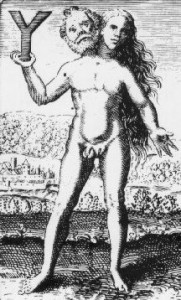 |
Jung was not the first to recognise that we are male and female. It was seen in ancient times.
|
| This is from an older culture and shows Shiva as a male and female figure. It was common knowledge in older cultures that our ultimate nature is everything – which includes male, female and animals, in fact all creation. |
 |
Krishna is shown surrounded by animals, as was the baby Jesus, showing that the divine part of us includes all creatures,
In general we can say the woman represents the man’s emotions, his nurturing and caring quality, forgiveness, his sense of what is natural and his connection with nature, its cycles and drives.
But such insights were also very much a part of our ancient culture. ”
Finds from Avalon Marsh, a bog outside Glastonbury in the UK whose name associates it with King Arthur. The ancient wooden track reassembled here helped people keep their feet dry crossing this wetland nearly 6,000 years ago. Also from Avalon Marsh is a rough wooden idol that’s contemporary with Stonehenge. It has “male and female attributes”, says the catalogue: breasts and a phallus.”
Through such images a man would recognise in people and animals the urges that link one to a mate, the strength to protect and nurture children, and the natural within himself. The anima also holds in it an expression of a man’s complex of feelings about women, gained as experience mostly from his mother – or lack of mother – but also from a synthesis of all his female contacts. So the whole realm of his personal experience of the female, along with the whole racial experience of woman can be represented by the woman in his dream, and is accessible through the image.
The anima is represented culturally in many symbols world-wide. Some of the best known are the Virgin Mary and Sophia in Christianity; Kwan Yin in Chinese mysticism; Kali in Hinduism; Pallas Athena in ancient Greece and Fatima in Islam. At a fundamental level the anima represents the many aspects of mother and nature. Like nature the aspects of the anima can be wonderfully creative and beautiful, powerfully destructive, or even beautifully dangerous. So it can also appear in a dream as a witch, a grandmother, an enigmatic female figure such as a woman of the woods, or a holy woman. Sometimes it is represented by an image such as a tigress, lioness, a woman in a cave, a ship or the sea.
In the Middle Ages there took place a perceptible spiritual differentiation in religious, poetical, and other cultural matters; and the fantasy world of the unconscious was recognised more clearly than before. During this period, the knightly cult of the lady signified an attempt to differentiate the feminine side of man’s nature in regard to the outer woman as well as in relation to the inner world.
The lady to whose service the knight pledged himself, and for whom he performed his heroic deeds, was naturally a personification of the anima. The name of the carrier of the Grail, in Wolfram von Eschenbach’s version of the legend, is especially significant: Conduir-amour (“guide in love matters”). She taught the hero to differentiate both his feelings and his behaviour toward women. Later, however, this individual and personal effort of developing the relationship with the anima was abandoned when her sublime aspect fused with the figure of the Virgin, who then became the object of boundless devotion and praise. When the anima, as Virgin, was conceived as being all-positive, her negative aspects found expression in the belief in witches.
In China the figure parallel to that of Mary is the goddess Kwan-Yin. A more popular Chinese anima-figure is the “Lady of the Moon,” who bestows the gift of poetry or music on her favourites and can even give them immortality. In India the same archetype is represented by Shakti.
Shakti – Primordial Energy
An aspect of the anima that is often overlooked is in the image of the virgin. It depicts a particular and mysterious potential of the human mind. The virgin represents the ability to clear the mind of preconceptions, and thus open it to intuition. This intuition can lead not only to becoming aware of the aspect of consciousness that is universal – the Self as Jung calls it – but also to forces of change that can transform ones personality. See
Jung stated that there are four stages in the development of ones relationship with the anima. The first is represented by Eve. This stage is a purely instinctual and biological one, and has to do with basic drives to reproduce, and the instinctive drives between mother and baby.
The second stage is a romantic and aesthetic one. Like the first, this still includes sexual elements, but also deals with the personality of the loved one and social processes.
Example of meeting the anima in a young man’s dream: I was at a party in a very large house set in its own grounds. I found the party frivolous, surface talk only, and unsatisfying to my inner feelings. It was dusk outside, but I stepped out of the French window on to the sloping lawns around the house. A large wood rose at the edge of the lawn and I entered it, eventually coming to a lodge house. The gatekeeper, the man who lived at the lodge house, told me I ought to be careful in the wood, as many strange creatures lived in it. I told him I thought I would be all right, and walked on. There were wolves in the wood, I saw them, and a strange serpent jabberwocky type of creature that was forever moving through the trees, but they did not harm me.
I walked on and suddenly came to a clearing deep in the wood. It was still quite light and in the clearing stood the most beautiful girl I have ever seen. She was naked, yet somehow this was natural, as she was brown, and like a creature of the woods. We stood and looked at each other, people from two different worlds, and I knew that if I left my ordinary life, and went into the woods with her, I would find a love such as I had never believed possible. But I also knew that I would be lost to the world; that I too would become a creature of the woods. I was in doubt what to do.
Then, to my amazement, out of the shadows at the edge of the wood, where he had been standing all the time watching me, the god Pan walked to the girl and looked at me. Around him walked tiny creatures of the forest, rabbits, mice, deer and others. Without words, he offered the girl to me and tried to persuade me to come with them to unearthly delights. Then an inner voice spoke to me, telling me to save myself, to resist or I would be lost. I felt a tremendous power of attraction from the girl, as if I longed for her beyond all else, as if she were the answer to all my longings and dreams; but the voice kept on at me, telling me to think of a woman I loved in the outer life, any woman, and thus save myself. I did, for I knew I would be lost otherwise, but there were tears in my eyes as I did so; and the scene faded, and I was back in the wood again, a wood without magic, or fairy love, or unearthly delights or the strange presence and power of the gods. It was just a wood, and I turned away.
The wood here represents all inner ideas and opinions and also the inner self beneath consciousness, the strange unearthly world of the unconscious that can make the drab world magical and full of meaning, turn women into goddesses through projecting strange powers and emotions on to them. Yet it is dire to lose oneself thus, for one may lose one’s sense of identity, be possessed by the gods, or powers of nature active in oneself, and lose contact with the outer life, and family and friends. This is why the dreamer had to think of someone in the Outer conscious life he loved, to re-establish ties with them, to re-stimulate his awareness at that level. But later he returned and blended with her. It is desribed in the example under the Mystical Marriage below. See – The Inner World
The third can be likened to the Virgin Mary.
It depicts a love that has developed possibilities beyond simply the biological, emotional, intellectual and social drives. It shows the possibility of deep self giving and the discovery of experience pouring into consciousness from the unconscious, the birth of intuitive insight. See: Lifestream.
The fourth stage leads to a new form of wisdom in the individual. This can be understood by an overview of the whole process leading through the four stages. To start with the individual’s identity and sense of self has emerged out of biological drives and the instinctual or unconscious reactions that take place between parent and child. The person gains a sense of self from the weakness or strength of their body, their physical prowess or lack of it, the power of their sexuality and how this is responded to by the opposite sex and others. If they have a positive identification with the society in which they live, and if their self expression meets with success or reward, then they may experience satisfaction in the first half of their life. If otherwise they may suffer some degree of depression, anxiety or emotional ill health. See Wild Side
In either case the person has been largely shaped by factors other than their own power to shape their life. They are trapped in what has formed them. The transformation of the relationship with the anima gradually alters this. The individual breaks through the ready made boundaries of their personality and discovers the forces – archetypes and experiences – which helped form them. The ensuing wrestle with self leads to personal insight into ones own life, and into the collective life of humanity. One gains insight into the collective forces, ideas, dynamics, which direct human life. This is spiritual insight. It enables the individual in some degree to gradually find motivation from other than the urge toward sexual reproduction, social power, aggressive domination and self aggrandisement. It isn’t an easy process, but a new type of person emerges from the work. See: The search for Self.
Example: Now I seemed to go into a condition of surrendered, and spontaneous movements arose from within. I reached out and drew the sword. The girl gasped and begged me not to touch, handle, the sword, as it was sacred, or only to be used by a special person. Then she suddenly saw, by my movements, that I was fulfilling the full ritual or ceremony of the sword. It was as if her people had a prophecy about the use of the sword, and whoever handled it in the right way was a leader for the people. Through the inner direction, I had used the sword correctly, and was this leader.
Now she knelt before me, head bowed, in Oriental fashion. The inner movements led me to bring the sword down on her neck – and touch it lightly. This was the last proof of the ritual being fulfilled. Quite without knowing it consciously I had fulfilled the ritual. Also, this last act was a rite of marriage. We were now man and wife. Our relationship was now different, and our depth of feeling for each other made whole.
This an example of a man meeting and integrating his anima, not acting it out by trying to be a physical female. Integrating our female does not mean dressing up in female clothes or even having an operation to change sex. That is further developing an unbalanced self. Integration means having both the female and the male self equally developed. That is wholeness. So therefore being firmly female, male or homosexual are all unbalanced. It takes courage and hard work to achieve this completeness. See Life’s Little Secrets
The negative side of the anima
Is shown as moodiness, irrational feelings, love that clings to what is painful or destructive; hunches that may be prophetic, or expressions of anxiety or jealousy. The dark anima may be depicted in dreams as a witch, or a woman who deals with evil spirits and calls up fear in the dreamer. This dark side of ones emotions is easily seen in the moods that lead to depression and despondency, the dark inner condition that engulfs any joy or achievement and leaves the person feeling irritable, touchy, unloved and unable to love. Perhaps this is why the witch may represent this aspect of our emotions, because unless one can uncover the roots of such despair, it may feel as if one were bewitched, haunted or cursed by such feelings. Or it may be that rather than darkness, one is haunted by the dreams of ideal and wonderful love that only lead one on to misery – a sort of chimera or mirage that tempts but provides no reality.
A slightly different side of this negative anima that Marie von Franz points out is that of the woman/mother who poisons everything, whose waspish, critical remarks hurt and constantly demean. This may live on in a man as self criticism. A slight twist on this is the man who considers himself an intellectual, but actually is possessed by an anima that does not allow real creative thought, but expresses opinions and fears as clever words or arguments. This enables the person to feel themselves always right, and actually avoid any real meeting with other people or life experience. Strangely, such men are often driven to pornography, in a desperate drive to meet denied personal needs.
One side of the anima – the female – that has an ancient history, is the ability the female has for exploring or contacting the unconscious. This is due to the receptiveness and ability to allow something other than her own will to live in her, as a woman does with love, with a foetus, and often with her man. This giving of oneself is sometimes represented by the breast or the womb. In literature and myth we find the theme of the woman guiding the man through the underworld a frequently recurring one – as with Dante and Beatrice, Theseus and Ariadne, Rider Haggard and She. The example dream also shows the female figure as a guide to the spiritual world, a world that was previously unconscious or unknown to the dreamer.
The wonder of the Anima
In talking about this archetype as a symbol, we must however remember what it is a symbol of. Usually any such female figure in a dream can, if explored thoroughly, lead one back to direct experiences in relationship with ones mother. Such primal experiences as we met in being born and nurtured in the extreme of our dependency as an infant, occurred to us prior to speech, prior to organised thinking and perception. They tend to crystallise around an abstract symbol at first rather than around a direct representation of ones mother. This is true of any potent and deeply felt experience that may be difficult to meet as an adult. Difficult because, as an adult we often avoid allowing volcanoes of emotions and reaction such as we see as natural in a baby. Difficult because we avoid feeling so helpless and dependent. See RECORDING
Example: Here one must come to terms with the androgenous psychic nature of man. The anxieties of every human being who ever doubted his own sexuality are true; they point at a wrinkle of the mind which cannot be smoothed away. And therapists who try to calm patients’ fears with reassurances are whistling down the wind. Reassurances will never obliterate the doubt in every man’s mind that he’s not quite all male, or the parallel doubt in woman’s mind, simply because the doubt is psychically valid. Of course, objectively it’s not true at all. Although scientists have pointed out a certain overlapping between the sexes in vestigial organs and hormones, most men are obviously men and women are women. This knowledge of biological similarities hardly prepares men and women for the subjective experience of bisexuality, which can only be explained by the plasticity of the imagination and the sense of identity. In every man’s mind are areas of consciousness that proclaim, in effect, “I am a woman!” In every woman’s psyche occurs the reverse. This is not a matter of observation and analysis but a conviction at the very seat of consciousness. Subjectively, existentially, nothing could be truer than that. Quoted from LSD Psychothery by W.V Caldwell
Whatever aspect of the anima is most pronounced in a man, there is a tendency to project it on to any woman he gets close to emotionally. The woman then appears to be an angel of light, or a destructive witch, or even a femme fatale. Unfortunately women reap the harvest of what has probably been sown by the man’s mother. Mother was the man’s first experience of love, and whatever lessons were learned – whether good or ill – will be lived out with his partner unless they can be changed. Whatever the situation, the man is challenged, perhaps by a love affair that tears his marriage apart, to meet in a more adult way the feelings that were generated in childhood, and may have remained at that level.
Whatever one may make of Jung’s ideas regarding the anima, they remain a useful definition of the variety of ways men handle their emotions and their relationship with a woman they love, or the woman within them. If one is to mature and grow as a person, the childlike dependencies and angers, the blaming and the idolisation must be met and transformed. In doing so one is led into, or uncovers, a wealth of experience within oneself that was previously unconscious. Out of this maturing and growing process the images of the anima as guide and initiator have arisen. All must meet themselves in one way or another in the process of maturing, just as we all dealt with emerging sexuality in one way or another in adolescence. At such a point, the myths and classical stories still portray to us a wealth of information which may support us on our own unique path.
Good dreamt relationship with or marrying the woman
Shows the man integrating his own real emotions, sensitivity and intuition. He is recognising not only his conscious needs, but also the deep needs of his nature within. This makes him more whole, balancing his exterior male qualities and his personal will. As this occurs he becomes less dependent upon an external female to feel whole. It also shows the man meeting his experience of his mother in a healing way. This enables the man to have a realistic relationship with an actual woman. It also brings a sense of connectedness between his conscious self and what he senses as Life, or as Bucky Fuller calls it, Universe. See: Archetype of the great mother below; example of difficulty in integrating anima.
To integrate the anima is often shown in a series of dream in we the man gradually gets closer and closer to the woman and eventually marries her. This can be a wonderful spiritual experience.
Example: My third marriage was to an entirely different type of girl. I met her after experiencing a peculiar sort of time shift, or entry into a new time, or something. She then came to me simply because attracted, and I loved her. She had brown wavy hair to her shoulders, in a round feminine face. Very loving and sympathetic, intelligent, devoted wife, housewife, mother, cook, etc. I remember she had a Bible in her hand. The dream finished with me building three new bedrooms upstairs. She was frightened I would go through another “time change” and leave her. But I assured her. In meeting her, my last wife said, “Weren’t you silly,” meaning marrying the other women when she was always waiting to really love me as I wished to be loved. I said something to the effect that I had been young and stupid, but realised my mistakes.
Example: I was courting an Indian girl on the beach. I had sex with her. All her family seemed to know this. We wanted to get married, and this meant terrific formalities. A banquet was given by her family, and a careful note was kept of what we chose to eat. In some way this was taken as omens, and it worked out unfavourably. We were told we could not marry. I thought seriously about this, and the problems of East marrying West, but still felt we could make a successful marriage, as we loved each other.
Example: As I looked back upon all that in what I am meeting today, I could see that it has been an enormous part of my personal growth over the years right the way back to childhood.
I have experienced a mystical marriage in myself. I am life – and although that is not true, at the same time it is true. In my being I am Krishna and Radha. In me they both live in a wonderful union of bliss. I am both the incarnation of godhead and also the worshipper before that wonder. That this wonder can live in us is beyond my understanding. That it can take on flesh – and that it does, every time a baby is born – leaves me in a state of wonder. I feel all this because I am that blissful union of Krishna and Radha. In myself I know the union and the love. I have been and am that sweet love forever joined. That the very creator of the universe can take on flesh, as it does every time a baby is born, brings me to my knees. This is beyond belief. Yet that is what I am seeing and experiencing as the truth. That is what I am experiencing in myself. I know that in this very existence, lost as I am in the sensory experiences of the world, and my feelings of isolation and physicality, I am at the same time, at the same moment, the godhead itself.
The examples give three stages of meeting the anima.
To be in conflict with the woman, or unable to make real physical and pleasurable contact with her: Suggests difficulty in meeting what may have been a painful or threatening experience of mother. This can lead to becoming an intellectual but emotionally barren man. Or being possessed in a negative way by the female traits, becoming emotionally unstable, opinionated and illogical. Actual relations with women will be difficult. Actual emotional or intimate merging is threatening because it brings the man close to the pain or fear connected with mother. Sex may be possible but not with a close feeling union. See: woman.
The Mystical Marriage
This marriage between the two sides of you is fairly clearly shown in dreams, and even the Bible tells how important this marriage is, “For many are invited, but few are chosen”
Here is a dream showing this wonderful and full union.
Example: I dreamt I was looking at a very large and old tree. I wondered if I could climb it but couldn’t see any way up it. But I noticed a large area without any bark, like an old wound, and I thought that area would become rotten and so the tree would become hollow and offer shelter to animals and humans.
Then I walked around the back of the tree and saw that the bark was like thick cables about 6-8 inches wide. I could then see a fairly easy way to climb the tree. So, I climbed up and the top of the tree was like a massive bell of a flower, like a crocus shape. And it was light and full of colour. Suddenly I saw a spirit, a beautiful female. It was the spirit of the tree. At this point I was semi awake, and I wanted to hold the beautiful spirit, but realised that the tree was a representation of my life, and so was the spirit of the tree. The spirit sat on me in a sexual position, so I was lying on my back and she was upright. She slowly took me into her, I mean the whole me, as if she was sucking my whole body into her. I realised that I had to die because she wanted to take all my experience of life and endeavour into her and fertilise herself to form a baby. So, I was ready to die and watched her form a new baby, a mixture of her and me.
“When you make the two into one, and when you make the inner as the outer, and the upper as the lower, and when you make male and female into a single one, so that the male shall not be male, and the female shall not be female: . . . then you will enter [the kingdom].” Quoted from ‘The Gnostic Apostle Thomas’
Useful Questions and Hints:
Can I recognise my own internal female, and if so what characteristics does it have?
How is my relationship with my internal woman – perhaps in some way a negative image of my mother – influencing my relationship with my female partner(s)?
In my dreams am I ready to marry or unite with my female?