Posts Tagged ‘superminds’
Animal Children – Superminds 13
The story of Mowgli, the boy who was lost in the jungle as a baby, and who was raised by wolves, although fiction, is based on fact. Throughout history, and in all parts of the world, children have been discovered who were loved and raised by an animal. The story of Romulus, who is said to have founded Rome in about 700 BC, and his brother Remus, says they were suckled by a she wolf, and discovered by a shepherd.
A baby raised by an animal is not something that only happened in the past though. A headline in the newspaper Daily Star on April 17 1991, at the time the film Dances With Wolves was popular reads: “TRAGIC BOY’S DANCE IN WOLF’S LAIR.” It goes on to say: A tragic orphan brought up by a pack of wild wolves will never be able to live like a normal man, say doctors. The boy who REALLY danced with the wolves was aged about seven when he was found 29 years ago in the wastes of Southern Russia by a team of oil explorers. He howled like a wolf and savagely bit one of the oil men who christened him Djuma – the Wolf Boy. |
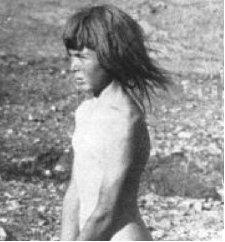 |
| The boy pictured was caught running with deer |
Professor Rufat Kazirbayev said doctors had battled to re-educate him to act like a normal human being – but failed. They are now giving up the fight. Professor Kazirbayev said that, “His mind is with the wolves. He will howl at the moon for the rest of his life”.
Djuma, now about 37, is still in hospital. He still crawls on all fours, eats raw meat and bites when frightened. He can speak only disjointed phrases – “Mother dead. Father dead. Brother dead. Sister dead. Mother nice. Father bad.”
Dr. Anna Ticheenskaya said: “presumably his family were killed in a political purge. He has shown us in sign language how, when his mother was killed, she saved him by throwing herself over his body.”
The man who is a wolf
Djuma has learned to brush his hair, clean his teeth and use the toilet “Like a trained animal.” But when taken to the zoo he howls as if he was urging the animals to take him to freedom. Sadly that will never happen. Djuma will probably spend the rest of his life in the clinic where, doctors say, he spends his days like a dog – half asleep and dreaming.
What the life of Djuma teaches us is that being human, being aware of oneself as a unique person, isn’t simply something that happens by itself as we grow. Djuma is still a wolf even though he has what we think is a human body and brain. Some of the things people like Djuma lack that you and I take for granted are a sense of time – meaning we are aware of a past and future; a certainty that we are a person with a name. This leads us to say things like, “I am Sam.” Or “I am Sarah.” So we have a sense of ‘I am’; because we have what we call identity, we have feelings such as being guilty, confident, shy; we also feel separate from other people and animals. Children brought up by animals, unless recovered very young, do not have a sense of time. They lack any feeling of personal identity, and they feel connected with other animals and nature. You might say they are like Adam or Eve, feeling at-one with nature. At seven, it was too late for Djuma to develop into a human. The special thing he lacked was other humans talking to him so he also could learn speech. So language is perhaps something like a piece of computer software our brain uses to gain identity – usually around the name we have been give – and to know time and separateness. This is no doubt why baptism or a social naming ceremony is such an important thing in some societies.
The animal boy of Aveyron
Victor, who was named The Wild Boy of Aveyron, was discovered in the French countryside in 1800. Aveyron is in the South of France, and the villagers captured a boy of about 11 or 12 who had been running wild and naked, even though it was winter. His body was marked with scars where he had fought with animals and been scratched due to his nakedness. Although the villagers tried to speak with Victor, he didn’t seem to pay attention to what was said, and so it was apparent he didn’t know any language. At first people thought he was deaf and mute. All he was interested in was trying to escape.
The story of Victor’s capture spread quickly and he was taken to Paris to be studied. At that time there was an idea that the natural human being was superior to the civilised person. This was called the idea of the ‘Noble Savage’. However, to the inhabitants of Paris, Victor showed no signs of nobility. He was described as, “a disgusting, slovenly boy, affected with spasmodic … convulsive motions… biting and scratching those who contradicted him, expressing no kind of affection for those who attended upon him”. He was therefore thought to be an idiot and was imprisoned in a home for deaf-mutes. Fortunately a young doctor named Jean-Marc Itard looked after him and tried to educate the ‘wild boy’. It was Dr. Itard who gave him the name Victor.
At first Victor learned quickly. Dr. Itard realised, from watching Victor, that he was not deaf, mute or stupid. He was a normal healthy boy, except that he had never been taught how to do all the things most of us take for granted, like sitting in a chair, using the toilet, meeting people without biting them. Within a few months Victor could sit in a chair, express his emotions without being violent, and he could even speak a few words, like ‘milk’, and ‘Oh God’, which was something Dr. Itard’s housekeeper, Mme. Guerin, often said. Victor also came to like Mme. Guerin, who fed and cared for him.
Victor’s learning slowed down after a few months to the point where he never learnt any more words. In his years with whatever animals had raised him, Victor had missed some vital stage of mental growth that would have opened to him the ability to learn continuously and easily. He never regained that loss. Like Djuma the wolf boy, he had missed the years when language and relationship with other people ‘taught’ him to recognise his own identity, and gave him the program enabling him to learn and even initiate new ideas and discoveries. Instead of imitating other human beings, he had learnt to imitate his animal parents. His imitation was too complete.
Victor stayed living in Paris with Mme. Guerin until the age of 40, when he died.
You could be a Wolf, or a Human, or a Star
There are many records of children brought up as babies by animals or completely left uncared for by parents. In the USA a girl baby had been kept in a chicken house, never spoken to our cared for, so she never became a human being. They, like Genie and others, never learnt to speak, and became trained but trapped animals. Most often they are unable to adapt to their life with humans. Speech appears to be like a computer program which when loaded into the human at the right time causes brain changes and the way the brain and our awareness works.
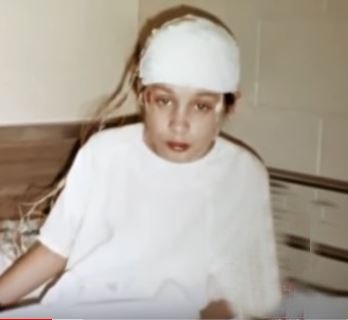
The picture of Genie who was totally neglected as a child see https://www.youtube.com/watch?v=gvSMgi23F3o
The life of Helen Keller throws an enormous light into such children’s ability to learn. Helen was struck dumb and blind at an early age when she had only learnt one word. She lived like an animal without self awareness until the age of eleven. Then she was taught by a deaf and dumb teacher and remembered the first word and quickly began the climb to become a human person.
Then, perhaps because she had learned one word prior to her illness, meaning flooded her darkness. She tells us that “Nothingness was blotted out.” Through language she became a person and developed a sense of self, whereas before there had been – nothing.
This ‘nothingness’ described by Helen Keller is difficult for most of us to imagine, having all our life been exposed to other human beings through behaviour and speech. Helen describes it as having no awareness of personal pain or events. She says that perhaps things happened to her, perhaps they were painful, but as she had no personal self to appreciate this, they were merely passing tactile sensations. She was not personally disturbed by them because she had no ‘person’ to be disturbed. Her story tells us that it is not our DNA which is the cause of our personality with its traits, it is a blend of so many things, including the learning of language, our cultural influence and our upbringing. See Helen Keller
The stories of these children’s lives shows us the enormous influence the early years of learning has on our mind, and how language is like a huge computer program that alters our natural awareness, allowing us to have self awareness and a personality. Isn’t it strange then that if in early childhood we can learn to be a wolf, a bear, or a human, that we don’t recognise this and train babies to be more than human? Perhaps such training would be a step toward reducing the murder, aggression and mental poverty amongst so many humans.
It also leads one to wonder what happened in human evolution to produce speech, and what was it like to swing between the animal type human like Djuma and Victor, and the fully linguistic human. Did they coexist? It is such an interesting subject, that a human being does not have any sense of identity, or develop what we call a personality by simply growing. If left they are nothing much unless raised by an animal that passes on millions of years of experience to the baby. Then it is a wolf or bear and not a human being. So we do not simply have a human personality unless we are taught the amazing program of speech and human thoughts and social responses. Many of us believe we are ourselves because we were born human. Not so. We are carefully fed programs and we are what we are by being taught it. We are programmed – and of course we can learn to recognise that programming and hopefully grow beyond it. See Genius and Habits
But because we were seeds planted by our parent and grew within a human womb, we have a very long history from such, because seeds are from other seeds from the very beginnings of life on earth. So apart from programming we each have an innate self from our heritage and environment. See Seed
What’s it like to be an animal?
Animals do not think using words as we do. They do not therefore speak to themselves or each other in the way we do. But they do feel things. They do respond with strong feelings or indifference to things. So if you want to see what it is like to be an animal, stop thinking about things with words and watch what you feel about people and events. Without deciding what is right or wrong, without asking anyone’s opinion, watch what you want to do from your feelings. Maybe you want to hide under the table like some dogs do. Or maybe you want to sit on someone’s lap, like a cat. For a while, can you dare to do that? If you let everyone know that at the moment you are a cat or a dog, I am sure it will be okay.
Return to Chapter Links – Go to Chapter Fourteen
Helen Keller – The Sighted Blind – Superminds 14
Until she was nineteen months old, Helen was a normal happy baby living with loving parents. At that age she had just started to talk, and had learnt one word when playing outside in the garden. It had started to rain and she loved the sensation and learnt the word rain, or water. Just at that time she became ill with scarlet fever. The illness was severe and it left Helen blind and deaf.
As Helen was born in 1880 there were no schools for the blind and deaf in the way there are now. She was therefore left to grow and learn as best she could. he thing she held in her hand. It seemed as if Helen was trapped forever in her dark, silent world.
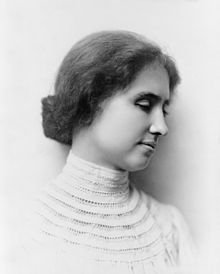 |
Being blind and deaf she was as cut off from being able to learn from her parents and teachers as the children reared by animals were. Like them, she grew wild, violent, and without any feeling about her own existence. Then, when she was six years old, her parents arranged for Anne Sullivan, a teacher of the deaf and dumb, to see if she could help Helen. Anne used the method of touching her fingers to Helen’s, and through movements spelling out words. She would, for instance, put an apple in Helen’s hand, then move her fingers to spell apple. It was very difficult. Helen could not make the leap to connect the movements on her fingers with the words being spelt out. |
The leap beyond darkness
One day there was a wonderful breakthrough. Anne had put one of Helen’s hands under water as it ran from a tap. She spelt out the word water with movements, and Helen suddenly made the extraordinary leap that we all make at some time, from knowing nothing but feelings, to being able to communicate and think. In describing that moment Helen has said, “Suddenly I felt… a thrill of returning thought; and somehow the mystery of language was revealed to me.” In trying to explain to people what it was like to live a life without words and thought, Helen said that although she existed, she didn’t know she existed. There was no pain because there was no ‘Helen’ to feel any pain, only a body with sensations. She existed as a sort of nothingness. When she remembered that one word, ‘water’, she said that “Nothingness was blotted out.” If she had never learnt that one word before becoming blind and deaf, she might have remained forever in her nothingness.
From the moment when Helen felt the water at her finger tips, woke up to being a person, and opened the door to being able to speak, it seemed that she could see with her finger tips. At that moment she “Suddenly … felt … a thrill of returning thought; and somehow the mystery of language was revealed.”
Because most us were much younger when the wonder of language and thought flowered in us, we may not remember such an amazing moment. But for Helen, waking up to what we take for granted came when she was old enough to appreciate it. Seeing with her fingers was not at all dull for her. “Sometimes it seems as if the very substance of my flesh were so many eyes looking out” she said. “I only know that the world I see with my fingers is alive, ruddy, and satisfying.”
I am ME!!
The excitement of being a person didn’t leave Helen. She wanted to know all about the world, and explore it with the sight, hearing and sensitivity of her ‘seeing’ fingers. Not only could she see with her fingers, through them she could also feel people’s emotions. She said: “Occasionally, if I am very fortunate, I place my hand gently on a small tree and feel the happy quiver of a bird in full song.” With my fingers I can “detect laughter, sorrow, and many other obvious emotions. I know my friends from the feel of their faces.”
Helen became famous throughout the world, wrote several books such as The Story of My Life, and lectured to people about being blind, and the wonders we could all ‘see’ in one way or another. Through her lectures and her books she raised money to help the handicapped. Many new techniques for helping the blind and deaf have been developed, helped by the impetus of Helen’s life and work.
People who met Helen often said that she appeared to be aware of things they had no sense of. She could feel a person’s presence and perhaps because her senses other than sight and hearing were so acutely developed, was aware of what was going on around her more than most people with normal vision and hearing.
From an animal I grew to be ME!
Unlike the animal children mentioned in another chapter, Helen was able to emerge into what we know as ordinary human life. What happened to Helen shows very clearly the importance of learning how to speak, or being involved in people communicating their thoughts and desires as one person to another. Some of the world’s great religions suggest that our personal existence is given us by God. Helen’s life, and the lives of the animal children suggest that our personal existence is actually given us by people around us when we are a baby, people who teach us to speak, and help us realise that we are a person. In looking back on her years before she knew herself as Helen, she says that it was like existing in a dream. She had at that time only physical sensations, and they passed quickly. Without any personal centre or name around which impressions could form like a crystal, they did not influence her in the way most of us are influenced, to be sad or happy.
Helen died in 1968.
What is it like to be blind and dumb?
When I was 18 I had an eye injury which caused me to have both eyes bandaged for six weeks while I was in a hospital bed. It was an extraordinary and wonderful experience. I met and responded to people in a very different way than I did when I could see them. Because you are not confused by how people look, you can have a much clearer feeling about what sort of person you are meeting.
When you have the support of those around you, it is well worth being blind for a day by keeping your eyes covered that long, and learning to move, eat, meet people, without the help of your sight.
Try it some time to discover a new world.
Return to Chapter Links – Go to Chapter Fifteen
I Died – But I’m Alive – Super Minds 17
When young Debbie N. was dying in hospital, she suddenly started saying to the nurses that her brother had come to meet her and he was telling her not to be afraid of death. The strange thing was that Debbie had never been told she had a brother who had died. Her parents were amazed when they knew what Debbie had said. They had kept their son’s death a secret.
Debbie had looked through the door of death as it opened to receive her. But some people pass through the door and come back to tell us what it was like.
Sam was a baby when his mother died.[1] He was still only four when something tragic and wonderful happened to him. He was playing with other boys near a mill-stream. As he was in the water, one of his friends pushed him into deeper water just as the mill-gates opened. Sam was dragged under by the flood and drowned. Other boys ran for help and Sam was pulled out, apparently dead.
Visiting the world of the dead
After tense minutes of resuscitation however, Sam breathed again. His father carried him home, and in his arms Sam excitedly told his father that something amazing had happened to him in the water. Sam said he felt himself dragged down into the water and everything went black and he seemed to sink further and further. Then he felt a change and experienced a rising feeling of floating upwards. Gradually it got lighter and he surface above the water in the waves of a great sea. Other people were surfacing too, and they were all carried toward the shore where people were waiting for them. As he got near the beach he saw his grandmother and grandfather waving to him. In front of them stood his mother, so pleased to see him. She bent down to lift him out of the water, catching hold of his arms. As she did so a cross she was wearing around her neck swung down in front of Sam’s face, and sparkling on the cross Sam saw seven jewels. Just at that moment Sam felt himself dragged back, down into the darkness again, and when he came out of the darkness he was on the river bank, and his father carried him home.
As he told this story, Sam’s father was very quiet, and never commented. It was only years later that he told Sam something he had kept as a precious secret. Sam’s mother had died suddenly just on her birthday. Before this Sam’s father had saved and bought a special present for her of a cross with seven jewels in it. It had been a surprise, and Sam’s father, telling nobody, opened his wife’s coffin one night before the burial, and with love placed the cross around her neck.. So when Sam told him about the cross, he was so ready to cry he had not said anything to Sam.
Leaving your body behind
Many children and adults have what is called a ‘near-death-experience’ or NDE. This may occur while they are ill, or due to an accident. For instance 11-year-old Brad Steiger was caught in the blades of a large piece of machinery on his parents farm in Iowa. He suffered several skull fractures as the metal blades hit his head. While on this borderline state between life and death, Brad felt himself drift away from his body and was able to watch what was happening from a distance. He could see his injured body on the ground, and saw his sister run for help. He could both watch his father carrying him, and feel something of the sensations of being in his father’s arms all at the same time. While out of the body he also became aware of knowledge beyond his usual ability, being able to see the patterns or processes in life. Although young, he felt he had been shown a plan of the universe and people’s life in it. He wanted to tell people that we are all part of eternal life, and are not alone in the universe.
When people experience being out of their body they are able to do and know things they are not usually capable of. When I was 18 and living in Germany, I had such an experience, and was able to see what my mother was doing in London. But a fascinating example of this appeared in the newspaper The Scotsman of February 27th, 1937. It reported a talk given by Sir Aukland Geddes, MD, to a meeting of the Royal Medical Society in Edinburgh. He described the case of a doctor friend who late at night was suddenly ill with acute gastro-enteritis. At ten o’clock the doctor had tried to ring for help, but found himself unable to move. Gradually he felt as if he were being split in two. One part was outside, and distinct from his body, the other still existing as the self in his body. The awareness outside his body grew stronger though, and the body consciousness disappeared. He was dying from his illness, and could watch his body from a distance. Then he began to realise he could not only see his body, but any other person or place he thought of or concentrated on, whether in London, Scotland, or anywhere. Whoever he thought of he could instantly be with and see what they were doing and knew what they were thinking.
Someone came into the room where his sick body was dying. He could witness that person running to the telephone to call a doctor, and the doctor answering on the distant telephone. Watching his own body and the body of those people he saw, it appeared to him that the brain was like a receiver not only of impressions from the three dimensional world our body exists in, but also from dimensions beyond that. So the mind was not in the brain, but the brain was in the midst of the mind, like a radio is within radio signals.
The brain is a radio set in an ocean of mind
Near death experiences suggest that our awareness can at times reach far beyond the limitations of our seeing, hearing and feeling. We live in a universe in which our mind is still a largely unknown territory. Scientifically we have travelled further within our solar system to map and understand it, than we have within the huge space of the human mind.
Perhaps yours will be the adventure and wonder of helping chart those infinite spaces of mind.
Return to Chapter Links or Go to Seventeen
[1] I have given fictitious names to Debbie and Sam, but they are real people.