Posts Tagged ‘death of self’
Compensation Theory of Dreaming
Jung, Hadfield and several other dream researchers believe the dream process is linked with homeostasis or self-regulation – the sort of self-regulation indicated in the observations of MacKenzie, means that the process underlying dream production helps keep psychological balance, just as homeostasis keeps body functions balanced by producing perspiration when hot, shivering when cold, and the almost miraculous minutiae of internal changes. Despite self-regulation or homeostasis being an obvious and fundamental process in the body, in nature and the cosmos as a whole, it still appears difficult for many people investigating the mind to accept a similar function psychologically. See: biological dream theory;computers and dreams; self-regulation dreams and fantasy; movements during sleep; science sleep and dreams; sleep walking; LifeStream; People’s Experience of LifeStream; Opening to Life
All our lives we try to achieve a balance of the contradictory opposites within us, and whether in our egos we succeed or fail, every function claimed by the ego is balanced by its opposite in the subconscious. Only in the fusion of infancy, or of sexual orgasm, or in religious ecstasy do we escape the psychic wound of division.
Put bluntly, dreams are said to compensate for conscious attitudes and personality traits. So the coldly intellectual man would have dreams expressive of feelings and the irrational as part of a compensatory process. The ascetic might dream of sensuous pleasures, and the lonely unloved child dream of affection and comfort. But this is only the most basic aspect of compensation and is demonstrated in the example below.
Somewhere within the total personality, however, there appears to be a continuing integrative force; though an individual may be overwhelmed by their life experience, some part of one’s mind still seems to observe, evaluate, comment, and even attempt to integrate this otherwise hidden material with the knowledge of conscious life. This may disappear for brief periods, when the fears or pain occurs, but for most of the time it is clearly at work. No one knows what type of ‘thinking’ this may be. It appears to be different both from ‘reality thinking’ and ‘autistic thinking,’ from the patterns of conscious thought and the imagery of fantasy a kind of bridge between two types of mental process. Lawrence Lessing, in a Fortune article on recent sleep research, has written: ‘At the same time recent evidence shows that there may well be a second, lower level of dreaming extending down even into deep sleep, consisting largely of abstract thoughts or isolated symbols, much harder to recall than the generally vivid, active imagery of rapid-eye-movement dreaming.’
Example: In his book Psychology in Service of The Soul, Leslie Weatherhead tells the story of a little girl who while on a visit to a zoo was given a coin to get a small chocolate bar from a vending machine. She eagerly asked for more coins to obtain all the bars in the machine. The mother refused. The next morning the girl said she dreamt her mother had come into her bedroom and thrown a lot of chocolate bars under her bed.
Jung’s view of compensation was far more inclusive however. He quotes, as an example the dream of an elderly general he met while sitting opposite him on a train journey. The general told Jung that he had dreamt he was on parade with younger officers while being inspected by the commander in chief. On reaching the general the commander asked him to define beauty. This surprised the general as he expected to be asked technical questions regarding his service. He was embarrassed and could not give a clear answer. The commander in chief then asked a young major the same question and received a clearer answer. The general experienced feelings of failure and his grief woke him. Jung’s questioning led the general to realise that the young major who successfully answered the query about beauty actually looked just like himself when he was that age and a major. Further questioning led to the information that at that age the general had been interested in art, but the pressure of work and the rigidity of the military life had eroded the interest. Jung goes on to suggest that the dream in his late life was helping to compensate for the one sided development necessitated by his army career. The dream in fact reminded the general of this neglected side of himself.
This concept of wholeness, linked with the Self, which such compensatory dreams connect with is best seen in the collection of many years dreams by an individual undertaking their own personal journey to self acceptance and integration. Through an overview of dreams gained in this way, the two aspects of compensation become much more clearly drawn. The dream work, aimed at meeting the neglected or hurt parts of oneself, opens the way to more pronounced compensation. A man who was investigating a feeling of lack in regard to his marriage, gives the following account.
Example: As I was exploring my feeling I suddenly began to change direction and realised that from the very earliest period of my life I had certain filters in place that influenced incoming sensory information. This had come about because I noticed how critical I was of our next-door – upstairs – neighbours, and in examining it saw that I had filters to search all information for danger. This burst open in intense feelings and awareness of being a ‘weak chick’. A powerful internal struggle and something like an ‘oh God no!’ feeling accompanied it. I then experienced what it was like to be a premature baby and so weak. Being born two months prematurely had thrown my infant self into a high state of anxious survival where everything was felt as a potential danger. So my filters were examining everything for danger. Everything that moved or made a noise was a potential threat to my existence.
At first with laughter, then with pain I saw that this had made me suspicious of my own mother. I had not fitted the ‘norm’ in terms of size, strength or behaviour, so not only had I lived with a ‘danger alert’ process going all the time, but also with the realisation I was not up to scratch. Instead of the full term child who is more adjusted to the environment I had emerged still in a condition adjusted to the womb. My psychological state was also, I felt, quite different, a sort of experience of the death world, the world before birth and after death.
Society, I felt, has a sort of labelling or measuring system. It has emerged out of biological criteria of survival and fitness, and is largely unconscious. People haven’t even acknowledged they are acting under such drives. ‘My genes are best, and everybody else’s are abnormal. But only the best of mine are going to get through’. Out of this I sensed that mothers who have children who are not ‘the best’ suffer a great internal struggle about their child. Part of them cries out, ‘That is no child of mine!’
So the people who are not seen as ‘fit’ are not given social rewards, starting with such rewards as recognition and warmth from ones own parents, and escalating from there into recognition and rewards from social groups and organisations. I personally felt as if I were not seen as fit for several reasons. My premature birth led me to be slightly less robust, and also my mixed cultural background during a time of war made me less fit. I didn’t have the right label attached. Christy D.
As can be seen, Christy feels himself much less capable and accepted by his mother than someone who has had a normal birth. He feels his premature birth left him always paces behind those born full term. He sums this up by saying:
Example: Due to constantly searching for something I had lost too soon – the security of my mother’s womb – due to feeling I never bonded with my mother, I had felt agonised most of my life that I couldn’t be an ordinary husband emotionally and sexually. I pushed and pushed to see if I could grow to this ordinariness and finally felt that I had arrived, only to find that I was too late. Not only had my wife entered the menopause and lost interest in a sexual relationship, but also my children had grown up and I had lost the huge satisfaction of being with them as youngsters. So here I am in my late fifties without a sexual relationship and without the loving contact of youngsters.
The gaps in Christy’s life are obvious, and the urge or need to compensate is also plain to see. In fact Christy has an experience that he describes as follows:
Example: I realised that because I had always felt inadequate in a certain degree, I had used religion as a means of compensation. Suddenly I saw the need for hero figures to use for compensatory purposes for individuals and groups. The person may not be able to live out some aspect of their life. They may not get a sexual partner; they may not get recognition in their work; perhaps people treat them as of no account. For some people an actual physical disability stops them from living out their life fully. The hero/ine figure is then used as an image that has several functions.
For instance nuns in a convent will not live out their ability to get married or have a child. The figure of Christ is used as a compensatory symbol for this in that they marry Christ and their passion is through meditation on his being. In this way people use a hero/ine figure to compensate for what is missing in their own life. They can live their unlived soul through the passion of Christ for instance.
The figure such as Christ represents our own wholeness and complete potential. To compensate for our own unlived areas we look to this figure and have a taste of what we are not expressing outwardly through identifying with the hero/ine. Meditations on the figure might produce great feelings of love, pain, wonder, and recognition – in fact whatever is missing in everyday relationships. The Christian festivals appear to be a way of living out via the image of Christ the passions of life that we might not meet in our everyday life. The birth, the struggle, the love, the death, can all be partaken of. We can share the passionate experience of living in this way, even though in our own actual life we might not be able to live such a passionate and eventful existence. And I suppose television does this for many people today.
At first I had a strong feeling this sort of compensation was used by people who are inadequate in some way, a path for the weak, and a path that I had taken myself. This suggested by inference that I was less capable of living a full life than most. I had a sneering feeling about how people use this as a crutch, but then realised I was judging once more. ‘I need a kick in the arse. I’ve got an ability to see, but I put all these judgements on things.’
As I looked at the situation more fully though I saw that in fact nobody lives a complete life. No one is completely whole, expressing every aspect of their potential. So in fact we all relate in some way to the Christ or other such figures who represents, or in some way ARE the total potential of human existence; a mighty example of what human life can achieve.
Now I came face to face with Christ. I felt knocked over emotionally by it. It was an experience of meeting the most amazing creature or being one could imagine. I stood in front of a god, something that totally transcended human existence. Gods are often depicted as having some great power of destruction or creativity. They might be like a human being magnified many times, with loves and hates, huge powers, throwing lightning bolts and so on. My experience didn’t show Christ as anything like this. The transcendence was in the manner of Christ’s consciousness. Here was a being with no real power in a worldly sense. This being hadn’t created the world and couldn’t influence world history through power.
The consciousness, the being of Christ, existed by a form of love so magnificent I could barely look upon it. If love is the right word, this love penetrated every living thing and absorbed their most intimate life experience. The Christ took in every aspect of existence without any judgement whatsoever. This was its life and sustenance. So one could say this wondrous creature was a sort of parasite living off the energy of life forms. But this is only a part of what I experienced. Through total acceptance it took in all. It took every tiny memory of each individual. But in return, if we can share its immense passion it offers us its own life that compared with our own is eternal.
I experienced that not only does one inherit the gift of eternal life through identification with Christ, but also we share the awareness of all life forms. Through this we participate in the life and passion of all beings present and past. As I met this I was on my knees as it were because I couldn’t help loving this wondrous being. I couldn’t help feeling my own smallness. I wanted to lose myself in this being and be washed through by its radiance and hugeness. To be in its presence was the most amazing thing. If you can imagine standing before a cosmic being that had arrived from some other galaxy, and was millions of years old, perhaps ageless, had no physical form except our own teeming lives, radiated love so much that you were engulfed in it, and simply by being in its presence shared its magnificent awareness, this might give some idea. Christy D.
Christy acknowledges his own need for compensation due to feelings of inadequacy. But he goes beyond this to see that each of us are in some measure incomplete and compensation in its largest sense is about finding awareness of the wholeness underlying our own life.
The description of compensation above is an example of something functional. To be able to survive crushing life experience is a real achievement, not an imagined one, and is therefore functional. Using an image to evoke hope and motivation doesn’t make it less of an achievement. The process of compensation also links with patterns of love and strength actually lived by others. They are then patterns remaining in the collective experience of humanity and can be accessed. When we touch these powerful racial memories we may clothe them in the image of our cultural hero or saviour.
To be clear about this, the power that is found is a release of our own potential emerging from our core self. So in this sense the compenstaory image is a graphic presentation of our own innate potential. This emerges from our unconscious clothed in whatever imagery or ideas we can accept or allow, as do dreams. It can also be evoked by using such images in a compensatory way.
See: – LifeStream; biological dream theory; self-regulation dreams and fantasy; movements during sleep; People’s Experience of LifeStream; Introduction to Dreams
The Archetype of Rebirth or Resurrection
The symbols of rebirth are: The cave; an egg; spring; the tree; the cross; dawn; emerging out of the sea; the snake; the bird; a seed; arising from the earth or faeces; green shoot from a dead branch or trunk; phoenix; drinking alcohol or blood red wine; flame; a pearl; the womb.
Rebirth is the Death of the Old Life
Rebirth is as difficult to face as death. It holds within it not just the memories of the struggles and difficulties of our own physical birth and growth, but also the challenge of becoming the unknown future, the dark possibility, the new. The dream of Andrew in the underground cavern below, is an example of positive rebirth. After realising himself as bodiless awareness he emerges from the cave, and finds himself near a tree.
Example: ‘A tremendous jolt of power poured into me from the tree. I saw that we had arrived at a place where a line of trees, about a 100 yards in length, stood very close together in a slight semicircle on the top of a bank. The trees had great spiritual power and the place was a holy temple. Two spiritual beings were there – an ancient Earth Being, and Christ.’ Andrew.
The next example is of a dream typical of meeting memories of physical birth. As can be seen, the experience is powerful enough to cause physical shaking.
Example: ‘All I can see of what I enter is a very narrow space with a light showing through. But immediately I enter I realise I have made a mistake for I am being forced swiftly through a dark, very narrow tunnel. I feel pain as I am dragged along and I hear loud banging noises which frighten me, but although they are loud they seem to come from inside my head. I feel terrified and breathless and very relieved when I wake before reaching the end of the tunnel. In fact as I write this account I am shivering.’ Female. Anon.
We usually face a deeply felt experience of death before encountering the archetype of rebirth. Neither the death nor the rebirth or resurrection are things that happen quickly. There may be dreams, waking subjective experiences or a short period in ones life when death or rebirth are felt very strongly – but the process as a whole is a psychological one which may take years to unfold and stabilise. With many experiences of archetypal nature, such as entering puberty and meeting the process that unfolds manhood or womanhood, we are working out psychic growth which involves our entire nature. Puberty is an excellent example of how an archetypal human process works in us individually, yet is very unique for each of us. At the same time however, while puberty is a well worn path which virtually everyone travels, some aspects of human possibilities, like death and rebirth, are not universal. Only comparatively few people really manage these points of growth.
Here is a very clear example of death and rebirth. It occurred when the man explored a dream of entering an old house that was lived in previously by his ancestors. Puma was a great cat that had leapt on him as he started his journey. Lurch was a figure representing the guardian of the threshold:
I started by imagining myself standing in the shadows of the house with Puma and Lurch. Then we walked together into the darkness. The subjective images took on a life of their own and I saw we were walking in a large underground space like great catacombs. The light was dim but we could see our surroundings, and not very far into the cave like space was a tomb on our right. It had the form of a low wall about a foot high in an oblong, and the wall surrounded a long stone in the centre, which was roughly body shaped.
As we drew level with the tomb an enormous change occurred in me. Suddenly I became a woman. It was no longer imagination. I was now completely experiencing myself as a woman whose tomb we had approached. As such I was torn by an immense pain of loss. As my complete identification deepened my body curled up with the pain as I was torn by wretched crying. Suzanne told me my voice changed as I cried out again and again for release from the pain of losing all my children, my husband, even my parents. My hands were clawing my legs in an effort to express the misery, and I was screaming that I could not bear to live any longer with such pain. I cried out to God to take me, for there was nothing left for me to live for. “Why? Why did this happen to me? Why has everything I loved been taken from me?”
There was no response to these awful cries and tearing sobs. But slowly a shift began. It seemed to me as an observer witnessing this awful pain, that by entering this place the spirit of that woman had woken in me. But as she had died in such unresolved agony of loss, that is what was met when she awoke. But gradually she realised she was alive again in a new way. She began to recognise that I was holding her within me. Because I was not frightened of pain and emotions, the misery could play itself out in me. And because my understanding of what was happening flowed into her awareness, she slowly saw and felt her loss in a different way. In fact we were both realising she was experiencing resurrection, and that in turn meant there was no final death as believed by many. Therefore there was no loss as she had originally felt it.
At this point something truly incredible occurred. She and I both realised she was one of my past dwelling places – past lives. But for her the viewpoint was slightly different; for she saw me as a continuation of a life that she had failed to be a part of because of the awful pain of loss. It had kept her from flowing into what was her future as my life.
From my perspective she was one of the past dwelling places the spirit that was at the core of my present personality had lived in and as. She was not one of my lives, because the personality that I am was unique and had not lived that woman’s life, but my spirit had. Because she was now part of me and me of her I asked her what she had brought into my life. Her reply was, “A woman’s love”.
Example: I’m imagining Christ emerging from the grave. Who is he now? Not the man he was even if he looks the same and more or less has the same qualities which you do and you don’t. So I think death needs to be factored in whenever there’s a break in the reality that you knew, and it’s not just you have to know it, but everyone around needs to know it. I’m reminded of after my father died, that when I met people, I felt I couldn’t be with them until I said that my father had died because that had changed everything and they couldn’t possibly know I was without that. So in the same way, anyone who’s died and come back is not the same.
I suppose I can say that whatever happens to you, even if the worse happens, you have something that can re-grow you, if you’ve lost everything, that means you haven’t lost everything, that basic clear quality, maybe it’s a new form, maybe it has gone on a few steps, but it’s still there if you listen to it. Don’t struggle with it unless it is a struggle, let it happen, don’t make it a big fight because you may be fighting against what is emerging.
The Great Cycles of Life
The cycle of death and rebirth happen mostly to people passing from adult maturity to old age. It connects with physical and psychological changes to do with altered relationship with life and society, and with ones own body and self image. The cycle may appear in young people however, if they face death, physically or in a deeply psychological way. In ageing ones relationship with children or procreation alters. Whereas they were at one time consuming and motivating drives, they are no longer sustaining or motivating. Work and ones relationship with society may also undergo a similar change. The identity one gained from having a place in society, and connections with other people through being a mother or in ones work, falls away. The personality, the attitudes, the hopes and ambitions built from the many years of life as a procreative, creative person meshed into society, dies through the lack of a relationship with the world that sustains it. This ‘death’ may be very painful, creating a great and sometimes crushing sense of pointlessness, of having no value in the world, of having nothing to live for. In some cases these feelings are triggered by the onset of menopause in women, or impotence in men – but also for men the absence of a sexual life or family life, or simply the process of ageing.
One man described it as, “The feeling of being paralysed, or being unable to move. It is not so much a physical impediment, but a sense of having no motivation, no ability to want anything, no drive to reach out.”
Fears may arise as to what is happening. Such fears are based on concepts we hold regarding ageing or death. The loss of identification with oneself as a procreative and higly motivated person may seem to be a sign of emerging incapability or even senility. The fear then sets up a conflict with the process of psychic growth.
A woman who had worked as a nurse, describes her experience of this as, “‘The feelings I have about dying, about losing my drive to live, link with ideas of being incapable as one is in hospital. Those are feelings or ideas I connect with it. Those images have made it – or are making it – hard to meet.”
However, such a felt death is only a precursor to the experience of resurrection, and this leads toward a new relationship with oneself and the world. The attitudes and way of life that was necessary as a procreative, work oriented individual whose self image was largely based on family background, physical looks, sexual potency, ability to get the goods of the world or gain power, steadily shifts. It moves toward a sense of self that is centred more on what there is on ones existence that is more timeless and less ravaged by change than the body, the emotions, ones intellectual concepts and the social scene.
Have I Lost Everything?
The change that takes place in this experience of an inwardly felt death, may at times feel like losing everything, shedding the past, becoming completely insecure. It usually leads to the realisation in ones life of parts of oneself that were never lived before, or never allowed expression before. There is not in the end a loss of anything, only a gaining that requires one to let go of the dominance of what was previously important. From this arises a feeling of wholeness and connection with the world and self in a new way. In her book about the individuation process, Jolande Jacobi says, ‘…. transformation is an integral component of the individuation process, which in turn follows a line of development whose goal is psychic-totality.’
Example: Last night, I very vividly had a lucid dream, where I saw a pregnant (very pregnant) women hanging from a rough rope in a bathroom. The bathroom was unfamiliar to me.
A dream expressive death and rebirth. The rope was death, the pregnancy was rebirth.
There is however, no final death or rebirth. The cycle is a fundamental process in nature, and therefore active too in the physical and psychological nature of humans. It is not only old age or approaching death causing the experience to arise. It can also happen during profound personal growth, when old fears, traumas and habits fall away and allow a completely new relationship with sexuality, with work, with being alive.
See: Life and Death.
Who Said Death Was The End
For the shorter Dream Dictionary entries see Death and Dead and also see the series Life and Death.
There is also a longer version published in eBook format – Dreaming about Death
Links to section headings:
Death can represent a fading or dying of some aspect of you
Who Said Death Was the Final End?
Death is an Energy Release
Journeying Beyond Dreams and Death
Death of oneself Death of someone close to us
Dreaming of a dead body
Dreaming of our own death
Some dreams are showing the state of those we love after death
Talking with those who have passed on
Death can represent a fading or dying of some aspect of you
The death of someone we know
The walking dead or rigor mortis
Thoughts about death
We can deal with our feelings of death
You can continue contact with the dead through your dreams
After death What Happens
Meeting death in any way can be awful, especially if you shy away from the awful caricature of death presented today as THE END. But if you dare to look the shrouded figure of death directly in the eyes, it transforms into the Naked Beauty. See Near death experience
In every moment of our life we face the possibility of death. In fact we only live because we are constantly dying. Our body is all the time dying as thousands of cells die, and in doing so the new and living body can continue. If we allow ourselves to realise that it illustrates the meaning of the phoenix – it is consumed by the flames, and yet it arose anew. We have the fire of life within us, we eat and feed the fire that consumes us and gives birth to us continuously. It is the warmth of our body, the warmth, even passion, of our emotions and that is life – continuous through death.
Example: This was not a dream, but a direct perception during sleep. I saw that a large part of my being was dying, and another part coming to life. Andy
Our bodies renew themselves every day: stomach cells renew every five days;
our skin cells are replaced every month; the skeleton is replaced every three months;
the raw material of DNA is replaced every 6 weeks; our brain cells are completely new every year.
The whole body is replaced every two years.
Every cell in your body listens to your self-talk and out-pictures the results Dr. Bruce Lipton, author of
Who Said Death Was the Final End?
I have heard it said or written times uncountable that nobody has ever come to tell us what is the other side of death. As no one has come back – so the argument goes – and so there is obviously no life after death.
That is a stupid argument because hundreds of thousands have come back and told us. It is an argument put forward by people who desperately keep their eyes closed and then say they cannot see anything. Because there is a massive collection of thousands of records of people who died and revived and so told us their experience of death.
See Near Death Experiences – The Wisdom Of Near Earth Experiences – The Truth Revealed – Life After Life – The Returning Dead – The Wonder of You
Death is an Energy Release
Many modern physicists, working with the information arising in experiments with quantum theory, tell us that our view of the world is based upon our blindness, and is very limited, and through its limitation, unreal. The implications of the theorem are enormous. Something can be in two places at once, in fact everywhere at the same moment. Apparently distant objects, or people, are intricately linked in an immediate way. There is no separate existence as we previously thought. Our view of the world is not one supported by the facts of physics. Time and space are transcended. People’s experiences of this dimension:
But death of anything also involves a tremendous release of energy as the form breaks down. But the various levels of energy involved in the death of a person are never lost, for energy cannot ever be lost, it is transferred and used elsewhere. A transformation takes place. The consciousness and energy that gave the body life also goes through a process of transformation into universal life.
It is not surprising therefore that the subject of death figures in many dreams. As with any major life event, in our dreams we meet death in various forms as part of our attempt to develop a working relationship with it. For instance we died when we left behind our childhood self to become an adolescent.
Such dreams enable us to become aware of what our deepest fears or feelings are regarding our own death, or the death of someone we love or know. But they also have the possibility of showing us what our fullest inner wisdom or intuitions are about what it means to die.
If we cannot meet the spectre of death, then our ability to live a full life will be diminished. At every turn death faces us in one way or another, and if we have not met and transformed fear into wonder, then we will be paralysed in expressing freely and lovingly to what life offers.
We have to remember though that what we first meet in dreams about death are the family and culturally inherited images and ideas of what death is. For instance Western culture gradually developed a view of the world based on early scientific theories. Namely that life is purely physical, and so there can be no survival of ones personal awareness at death. It is a view gradually being eroded by findings in quantum physics, and is not shared by many other cultures.
A man describes his experience when his father unexpectedly died.
A man had died. I was his son and had just been told. Walking along the road to my home in the dark evening I passed an empty house. – It silently said to me DEATH.
On my left as I walked was the undertaker’s. Again it spoke DEATH.
In the empty street a cold wind blew fallen leaves., telling me of my fathers DEATH.
Further along the way a house was brightly lit from within, and I could see people inside. It shouted to me LIFE.
A girl child rode by on a bicycle and she was LIFE.
Nearer home I met my young son and carried him in my arms, wrapped in my coat against the wind and I was holding LIFE.
And in that way I realised that always and everywhere, everything is living and dying. And pain dropped from me.
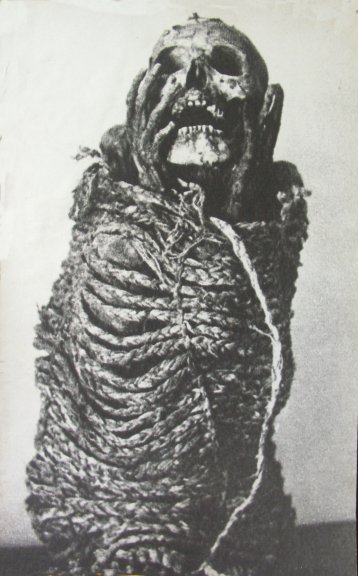 |
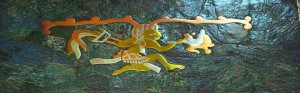
The skeleton in the image typifies this Western view of death. But the view in older cultures is that life continually flows through birth and death, as in the second illustration. (See: the book The Field, that examines latest findings in quantum physics in an understandable way). |
But many people dream that they have died and become distressed by it. But as far as I can tell such dreams are a necessary part of a natural development. The experience of death is a part of learning to go through change – as caterpillars do as the transform into butterflies. You cannot go through such personal changes unless you willing to let yourself die.
I feel strongly that all the new breed of children will need to learn how to die. It is like a process of transformation such we see caterpillars going through. In our life today there are stages of growth and points of massive transformation as one period of growth ends and another stage begins. |
 |
Learning to die was a method of passing through the transformation into the next stage of growth, and we are carving a way for children if they attempted the further stages of growth. Dreaming of our own death In the example below the dreamer does not face any great fear of death itself. The strongest feelings are of loss. Over a period of time the dreamer may move beyond such feelings of loss into exploring other possibilities of death.
I was due to be executed – what for I don’t know. I was not especially afraid of this, but my most vivid feelings were of great sadness at the people I was leaving behind, and for all the things I wanted to do in life, but would not now be able to. Then at the end I was watching myself being hanged. D.
This theme of facing death is quite frequently met, and it often leads to confronting what we really want to do before the end of this present life; what we want to express, say or give to those we love or are involved with; and what we want to achieve. So such a dream may wake us up from spending too much time in trivialities.
Examining many dreams dealing with death, it is noticeable that some dreamers are stuck in fearful or grief laden feelings, while others move on into a positive relationship with the ending of life. The difference appears to be centred on what level of emotion the dreamer can tolerate and accept, and how daring they are. Many people, on meeting death in their dream, awake with feelings of pain, fear, or dread. If they could fully meet those feelings they would pass on to develop a very different experience of death in their dreams. The following dreams illustrate this.
A young woman told me she had experienced a recurring nightmare of a piece of cloth touching her face. She would scream and scream and wake her family. One night her brother sat with her and made her meet those feelings depicted by the cloth. When she did so she realised it was her grandmother’s funeral shroud. She cried about the loss of her grandmother, felt her feelings about death, and was never troubled again by the nightmare. The dreamer in the following example meets her feelings through the actual events of the dream.
My mother in law died of cancer. I had watched the whole progression of her illness, and was very upset by her death. Shortly after she died the relatives gathered and began to sort through her belongings to share them out. That was the climax of my upset and distress, and I didn’t want any part of this sorting and taking her things. That night I dreamt I was in a room with all the relatives. They were sorting her things, and I felt my waking distress. Then my mother in law came into the room. She was very real and seemed happy. She said for me not to be upset as she didn’t at all mind her relatives taking her things. When I woke from the dream all the anxiety and upset had disappeared. It never returned.
Here is quote from a student of Jung.
“Most significantly, Herzog suggests that the experience of dying in a dream can symbolise a life-transformation. But this occurs only if the dreamer (1) can transcend the negative reaction to death’s image, and (2) be touched “by the dream’s deep resonance with the experience of death as transformation and also by the elemental power of enthusiastic joy in life.”5 This “transformation” occurs if one’s waking activity is affected such that the dreamer comes to terms with the vicissitudes of life, as well as the reality of death.”
Death can represent a fading or dying of some aspect of you
So dreaming of death is often not about the end of your or someone else’s life, but a means of showing how some aspect of your outer or inner life is fading, lost, or being superseded by a changed approach, so may be shown as dying. Other possibilities are that your love or drive to achieve something might die, and be shown as death in your dreams. The change from adolescence to puberty, or maturity to old age, is also often depicted in a dream as oneself dying. In this case it is a past way of life and identity that is passing away.
Dreaming of a dead body
This shows another aspect of death in dreams. Lost opportunities or unexpressed potentials in you are frequently shown in this way. All of us unconsciously learn attitudes or survival skills from parents and others, or we have a talent or gift that has got buried, denied or even killed out by events. If these or other facets of our personality are unrecognised or ‘buried’ they may be shown as dead. Sometimes we have killed the child or teenager in us because of difficulties or trauma at those ages, and these may be seen as a dead person in your dream, or even a corpse you find buried. Of course we may have ‘killed’ our parents in our dreams and find them buried. It is important to explore such dreams and bring the parts of you back to life. See Techniques for Exploring your Dreams
Some death dreams may show the awakening of new life in the dreamer. For instance, Sue explored a dream in which she was told her baby had died. She woke shaking with grief and tears. When she explored the dream she felt it showed her becoming alive enough to feel the grief of past pain, and the death of her hopes and love in a relationship that had just ended. She had suppressed her pain for so long. In now coming alive enough to feel her emotions, she was feeling at last that something she previously loved had died in her.
Example: My hands moved to my genital area and I had the strange and awful feeling my hips were not mine – that I was touching someone else’s body. The thighs and waist were my own, but in between was a dead, wasted area. I knew my sexuality was this stagnant, dead area. It was my manhood that had been wasted, the many wasted years of my life. My body felt such a stranger. I took my trousers off to feel myself more easily. Gradually I felt the area connected and my own again. I felt that I had dealt with the causes of my dead sexuality in past experiences, but I had never felt the actual deadness quite like this
We can deal with our feelings of death
Each of us meet our feelings and fears in different ways, and the next waking dream shows a very full meeting with death and its possibilities.
I knew I was dying and it was incredibly real. So real I wept deeply because I knew this was the end of everything and I would lose my children. All that I had created in life would be at an end too. But there was nothing I could do about that and I died. Then I seemed to be at a slight distance watching my dead body, and I saw my father, who had died some years before, come and carry the body over a threshold into a heavenly meadow. There a resurrection took place. My dead being was given new life. And the new life came from all that I had given to others, and all I had received from others, during my life. That was my spiritual life that survived death. A.C.
As can be seen from this beautiful experience, the dreamer meets the depth of feeling connected with the final ending of life, and then moves beyond it. So the last part of the dream is not an avoidance of pain, but an acceptance of the finality of death and how it is transcended by giving ourselves away to others, and receiving from them. It says that our spiritual life is a form of integrating all of our life activities and seeing what can be transferred from our limited life into the life universal. All that cannot be a part of the eternal cannot be a part of our life after death is burned out. Because dreaming about death is a very frequent theme, and has many aspects, you must look at any death dream you have had and see each part of it in context with the other parts of the dream. For instance the context of death in the first example is connected with hanging and final loss. In the second it starts similarly but ends quite differently.
Death of someone close to us
As explained above, this often refers to ones own feelings or talents that have been hurt, denied, or ‘killed out’ by events and your response to them. The following example illustrates this.
Example: ‘My son comes in and I see he is unwashed and seems preoccupied and as if he has not cared for himself for some days. I ask him what is wrong. He tells me his mother is dead. I then seem to know she has been dead for days, and my two sons have not told anyone. In fact my other son has not even accepted the fact.’ Anthony.
Anthony is a divorcee. Processing the dream he realised the two sons are ways he is relating to the death of his marriage – the children’s mother. Although the unconscious has a very real sense of its eternal nature and continuance after physical death, our conscious personality seldom shares this. Also we all we all carry within us ideas, behaviours, talents and ways of life from those now dead. The farmer today unconsciously uses the collective experience of humanity in farming. What innovation he does today his children or others will learn and carry into the future.
This aspect of a life beyond the physical is shown in many dreams. For instance a man I knew dreamt of walking with a friend of his. As they walked they came to a river. The friend crossed, but the dreamer was unable to. Even in the dream he felt crossing the river meant his friend had died. Some time later he discovered that his friend had died at about the time he experienced the dream.
As the dream points out, the friend died, but continued another type of life ‘across the river’. A woman told a similar dream to me. Her teenage son came down to breakfast looking very unhappy. When she asked him why he said he had a dream that deeply disturbed him. In it he was walking with a friend and the friend walked through a door. When her son tried to follow he could not pass through the door.
They could not find a rational explanation for the dream, but on arriving at school, her son heard that his friend had been killed in a motorbike accident on his way to school. The river and the door are often used in this way, suggesting a change to another dimension of life usually unreachable by the living. But some experiences give us a much clearer example of contact with our dead. The following is taken from the writings of Dr. Stanilav Grof and is a personal experience he met.
“In one particularly unnerving session a young man suffering from depression found himself in what seemed to be another dimension. It had an eerie luminescence, and although he could not see anyone he sensed that it was crowded with discarnate beings. Suddenly he sensed a presence very close to him, and to his surprise it began to communicate with him telepathically. It asked him to please contact a couple who lived in the Moravian city of Kromeriz and let them know that their son Ladislav was well taken care of and doing all right. It then gave him the couple’s name, street address, and telephone number.
The information meant nothing to either Grof or the young man and seemed totally unrelated to the young man’s problems and treatment. Still, Grof could not put it out of his mind. “After some hesitation and with mixed feelings, I finally decided to do what certainly would have made me the target of my colleagues’ jokes, had they found out,” says Grof. “I went to the telephone, dialled the number in Kromeriz, and asked if I could speak with Ladislav. To my astonishment, the woman on the other side of the line started to cry. When she calmed down, she told me with a broken voice: ‘Our son is not with us any more; he passed away, we lost him three weeks ago.’”
Here is a beautiful experience expressed as a poem.
Example: Today I noticed for the first time
A small brown mark on my left hand.
True I have been out in the sun,
But I never grow freckles.
This is one of those marks
Old people have on their hands.
I thought – or perhaps it was a hope
That I would never have
Such brown discolourations.
In my imagination of ageing
I had seen my skin wrinkled,
But clear and vibrant.
The mark was something
I noticed in the morning,
Looked at for a few moments
And passed from to other interests.
The day was full of things to enjoy.
At fifty I feel happier
And more vigorous
Than ever before.
Then, in the afternoon,
Sitting among friends
And in the midst of our enjoyment
The thought struck me –
Supposing I fall over!
Supposing I dropped to the floor
Right now.
I was with friends,
Friends to have wild fancies with.
So I followed my mood,
Allowing it to grow leaves and stem,
And remembered,
Though I had never really forgotten,
That my father had – one day –
Fallen over on his garden path.
Busy as ever with things to do
He was walking the path
Fell over
And never got up again.
That’s when I knew
More clearly than ever before
That I am slowly dying.
If I were a leaf on a tree,
The small brown mark would be
The first sign of Autumn
As change touched me
Making me golden.
Then I would fall
From the tree.
But I am not ready
To drop.
Though I am turning brown
There is something I need.
I have a will to spend myself
On my friends,
That I might fall
Feeling well
With the coming of winter.
Of a sudden
I see the face of Death.
I hear its voice.
I know it –
For we have met
Often and always.
Death has the features of
A child I made cry;
The profile of
My loved woman;
Your countenance.
Have I known you?
Then I have known Death.
Have I betrayed any?
Then I have betrayed Death.
And its face is beauty
For it is all things –
Naked,
Undressed of flesh,
Leafless,
Exposed,
Unclad Life –
Without the garment
That our selfhood is.
And the waters in me rose
To tears.
Bathing me in regret
That I had
So often
Forgotten
My love
For the
Naked Beauty.
Relating to The Dead
Our relationship with the dead should not be seen as the same as when alive, for we have left the body life behind and live in a dimension of experience without boundaries. Of course dreams try to help us with this but it can be difficult to understand. Below are parts of communications received.
“I am now part of your life. In this place of no boundaries it means our lives roll together. And this is part of the love that links those in life and those in death. I am also creating possibilities and situations in your life here and now.
From this dimension life and death are not separated, and that my friend Kevin partook of my life through the love developed between myself and him. The link was so pronounced that he also experienced my life as I lived it as there were no boundaries.”
You can continue contact with the dead through your dreams
There is yet another level connected with dreams about people we have known in life. This next dream and exploration of the dream shows how we can continue contact with the dead.
Example: Our son passed away on 12/22/2012. he was 24 years old. Today my 13 year old daughter told me she had a dream last night. She said she was looking in a mirror and saw her brother. She said at first it scared her then she was okay. She said she joined her brother. She said they were on a beach but it was nothing like she had ever seen. She said he was in a bright yellow shirt and tan shorts which she thought was a bit funny because he would have never worn that when he was alive.
She said the first thing she asked him was if there was a hell. She said he told her no but there was a place for those who had done really bad things to learn from them. She said that she asked a bunch of questions that he told her he wasn’t allowed to answer. She said she asked him if he missed everyone and he told her no because he could be with us whenever he wanted to. He told her he could go everywhere. He said both to beautiful and not so beautiful places. It was all his choice. He told her tell everyone he was okay. She also said he looked really good but not quite the same as he did when he was alive.
The above dream is exactly what can happen when we meet someone we love in a dream. Usually people’s minds are so full of beliefs and information that clogs up their ability to have such a clear dream. The mirror is first an indirect contact, but then the girl joined her brother in his experience of death. The answers she was given to her questions are exactly my own findings in regard to death.
Example: Yesterday my wife told me I had been calling out in my sleep, obviously dreaming. She said I had been calling my mother. She described it not as a cry of pain or anger, but as if urgently trying to get my mother’s attention.
My mother had died shortly before this dream, so I tried to explore the feeling of calling to my mother and experienced a spontaneous waking dream of my mother being in something like an old people’s home. She was very withdrawn and non-communicative, and as I explored the feeling of this I sensed she felt as if she had been abandoned and felt resentful and angry about this. She had died from multiple strokes and so was not aware of her process of death.
I could see that in fact she had not been abandoned, but was in a place where she was creating her own environment through her emotions and attitudes. I attempted to communicate with her but she refused to respond at all, and I was unsure if she really was withdrawn to a point where she couldn’t hear me, or if she was angry and so not responding. So I called to her aloud and said she must realise she was dead, not abandoned. She had failed to realise her new condition and so through resentment from feeling we had all left her, had created a growing isolation and barrier to being with others. I explained that if she remembered something of the love she had given and received in life, this would release her from the bondage of her loneliness, and bring her into contact with many people who wanted to be with her who were dead.
Here is a different approach.
Example: Did I tell you my dream about my Mother the day after she died? I kept hearing my name spoken (calling me) just as I’m waking up in the mornings……it was so strong today that I had said, “Yes” before I realized there was no one here but me.
And another thing…. the phone keeps ringing and no one is there when I pick it up…….it happens too many time to be a wrong number. I am thinking, who is out there trying to contact me? But some experiences give us a much clearer example of contact with our dead.
The following is taken from the writings of D. Stanilav Grof and is a personal experience he met.
“In one particularly unnerving session a young man suffering from depression found himself in what seemed to be another dimension. It had an eerie luminescence, and although he could not see anyone he sensed that it was crowded with discarnate beings.
Suddenly he sensed a presence very close to him, and to his surprise it began to communicate with him telepathically. It asked him to please contact a couple who lived in the Moravian city of Kromeriz and let them know that their son Ladislav was well taken care of and doing all right.
It then gave him the couple’s name, street address, and telephone number.
The information meant nothing to either Grof or the young man and seemed totally unrelated to the young man’s problems and treatment. Still, Grof could not put it out of his mind. “After some hesitation and with mixed feelings, I finally decided to do what certainly would have made me the target of my colleagues’ jokes, had they found out,” says Grof.
“I went to the telephone, dialled the number in Kromeriz, and asked if I could speak with Ladislav. To my astonishment, the woman on the other side of the line started to cry. When she calmed down, she told me with a broken voice: ‘Our son is not with us any more; he passed away, we lost him three weeks ago.’”
Some dreams are showing the state of those we love after death I believe the following dreams can really give a wonderful picture of this.
I walked around the corner, looked into the room my son was in when he was living here just a few months ago. He was in his bed, on the opposite side he slept on, alone, and sick. His face was pale white with large red areas on his cheeks from fever, he had a thermometer in his mouth which he removed to say, “Ma, I’m really sick.” Maybe he also said he feels terrible, I cant recall that specifically. Most people dream their loved ones smile, or tell ,them they are ok… this dream made me cry, and feel fearful for him. Despite the difficult feeling the mother felt in response to her dream of her dead son, it describes very clearly a stage of after death experience, the burning up of physical desires.
The next dream is even more clear in its symbolism.
My mother in law just passed on Aug 7th, 2010, she had cancer, and the process of her dying went rather quickly, we are a very close knit family, and my husband, sister in-laws, and especially the grandchildren are really having a hard time with her passing. However, I had this disturbing dream last night. In this dream, I was in a small soft lit room, and in this room around the 4 corners of the wall, there were framed pictures of my mother in law from a baby until adulthood even pictures of when she was ill before she passed. She looked up at me and it was my mother in law, her eyes were bulged and red, and she had tears coming down her face.
The pictures on the wall shows a full life review. This is recognisable what happens when you die. Of course it can be disturbing, after all you are reliving every moment.
Phyllis Atwater, who is an expert on near death experiences, and who has experienced them herself, says:
“For me it was a total reliving of every thought I had ever thought, every word I had ever spoken, and every deed I had ever done; plus, the effect of each thought, word and deed on everyone and anyone who had ever come within my environment or sphere of influence, whether I knew them or not (including unknown passers-by on the street).”
The fever shown in the previous dream is caused by the loss of a physical body. Without body we lose all physical desires, and that can be very difficult for some. It is like burning up of those desires that link your material life. There are other stages that we go through that you can read about in Rudolph Steiner’s Philosophy of Life and Death.
Several months after he started dreaming, Herb received some of the answers to questions he held at the time of his mother’s death. Did his mother have a message for him? Where had she gone? The veil between this life and the next was swept away in a dream:
I meet my mother as a young woman on a beautiful campus of higher learning, where there is always light. She is playing a violin here in a symphonic orchestra. She tells me that my ability will surpass my hopes and that my dreams will be a large part of the revelation of knowledge which will come through my higher self. “I had read of great Biblical prophets, such as Joseph, who had important dreams,” Herb says, “but I thought such talents were only for men such as he was, and not for such an insignificant person as myself.”
The next show how the dead can be helped by knowledge of the after death state.
My 20-year-old son, Max, died less than a month ago. I had a strong feeling when I first learned of his death that he had remained “earth bound”.
I can’t describe it exactly, but I felt very strongly that because his death was sudden and he wasn’t ready to go that he hadn’t moved on to the other side. I have prayed for a sign from him and he came to me in my dreams the past two nights.
The first night he said he wasn’t dead and I couldn’t convince him otherwise. He even said that he wouldn’t be ready to go for another “year and a half”. But I got to hug him and feel him and it was him. Last night he came to me at my house. He was sitting at the kitchen table and we just talked for a few minutes before I brought up the fact that he HAD to go into the light. He got a bit angry.
Then I told him that I knew about the drugs in Utah and he hung his head in shame. Then I told him he overdosed. At first he disagreed, I began to think about things that I could show him that would make him understand…like stuff from his funeral, but then he understood. Like he knew what I was thinking and was kinda like “don’t bother, I get it.”
I started to cry and we hugged and I began to tell him about all the books that I’ve read on the afterlife so that he wouldn’t be scared. He hugged me and asked me if our souls would always be together and I said yes, that if you’re close on earth that means the souls always stay together.
We left my house then and went to the other side. He was leery of going so I told him that once he got there he would probably see grandma Josephine and grandma Jean and that Baxter, his old dog, would probably even be there. I went further in with him, to try and find the souls he was meant to be with so that he wouldn’t be scared.
As we looked he began to feel more at ease. Drifting away from me and looking for himself. Then a crashing booming voice said something, I don’t remember what, but I knew I had to leave. So I went back to the tunnel that we had come in through and Max came, with another young man, about his age, they were wildly happy, riding what kinda looked like skateboards, but not. He took me back through the tunnel. He said he understood and that the other soul that was there with him was his friend and that they wreak havoc on the other side playing pranks and acting rambunctious.
I started to cry and he hugged me so tight and I told him I loved him so much and he whispered in my ear “I will see you soon”. He was completely calm and not upset anymore…like someone saying, “see you tomorrow” – like time wasn’t a big deal. I watched him skateboard away with the other soul and he turned back and gave me a huge smile and waved and I felt all over that he understood everything now.
The tunnel began to close in…getting smaller and smaller at his end of it so I had to turn around and walk through my side because I had to come back. I knew, even in the dream that I had helped him get there. Was this my sons spirit? Did I help him? I feel it was…and waking up today I feel better. I miss him terribly but I feel like he is safe and where he should be.
I put the above dream in because it is so clearly a healing dream. I know from personal experience what it is like to meet and know the joy you felt in helping your son. I know also that we are almost hypnotised into believing that when someone dies that is the end of them. But there are some dreams that are about the person still alive who is grieving so much it is a real pain to the dead person.
Example: Perhaps the most common dream experience in spirit communication is related to the message which in essence says, “I am fine and happy. Your grief, however, is holding me back and making me sad. You can help me greatly by trying to overcome your sorrow. You must stop grieving!”
People who grieve because of someone they love has died fail to understand the the person has not gone or left them. In fact, the ‘dead’ person is now more fully aware of those left behind, and is very influenced by what they feel. Please read Ex or a dreamed of ‘soul mate – what can I do?; Talking with the dead
Death can represent a fading or dying of some aspect of you.
Dreaming of death is often not about the end of your or someone else’s life, but a means of showing how some aspect of your outer or inner life is fading, lost, or being superseded by a changed approach, so may be shown as dying.
Other possibilities are that your love or drive to achieve something might die, and be shown as death in your dreams. The change from adolescence to puberty, or maturity to old age, is also often depicted in a dream as oneself dying. In this case it is a past way of life and identity that is passing away.
Dreaming of a dead body
This shows another aspect of death in dreams. Lost opportunities or unexpressed potentials in you are frequently shown in this way. All of us unconsciously learn attitudes or survival skills from parents and others, or we have a talent or gift that has got buried, denied or even killed out by events.
If these or other facets of our personality are unrecognised or ‘buried’ they may be shown as dead. Sometimes we have killed the child or teenager in us because of difficulties or trauma at those ages, and these may be seen as a dead person in your dream, or even a corpse you find buried.
Some death dreams may show the awakening of new life in the dreamer. For instance, Sue explored a dream in which she was told her baby had died. She woke shaking with grief and tears. When she explored the dream she felt it showed her becoming alive enough to feel the grief of past pain, and the death of her hopes and love in a relationship that had just ended. She had suppressed her pain for so long. In now coming alive enough to feel her emotions, she was feeling at last that something she previously loved had died in her.
If the death is someone we know
Sometimes, as in the example below, this shows a desire to be free of someone; or unexpressed aggression; perhaps one’s love for that person has ‘died’. We often ‘kill’ our parents in dreams as we move toward independence. Or we may want someone ‘out of the way’ so we do not have to compete for attention and love.
During my teens I was engaged to be married when I found a more attractive partner and was in considerable conflict. Consistently I dreamt I was at my fiancé’s funeral until it dawned on me the dream was telling me I wanted to be free of him. When I gave him up the dreams ceased. Mrs D.
Death of oneself
Death is an extremely important event facing all of us, and yet it is a mystery, so we often experimentally confront and explore it in our dreams. A dream about one’s own death may also show a retreat from the challenge of life, or a split between mind and body.
The experience of leaving the body is sometimes an expression of this schism between the ego and one’s life processes. Other possibilities are to do with the death of old patterns of living – one’s ‘old self’, the loss of the boundaries that limit your awareness to an identity connected only to your body. This latter is usually a willing surrender of self to the process.
The next examples depict what was mentioned above. It is a way of reminding ourselves to do now what is deeply in us before we die – especially regarding love.
I dreamt I have a weak heart that will be fatal. It is the practice of doctors in such cases to administer a tablet causing one painlessly to go to sleep – die. I am completely calm and accepting of my fate. But I suddenly realise I must leave notes for my parents and children. I must let them know how much I love them, must do this quickly before my time runs out.’ Mrs M.
Talking with those who have passed on
A friend I know, Sheila, her mother died suddenly about three weeks ago, on the seventh I think. Not knowing this I received a message to ask for healing in her name. I surrendered in LifeStream and experienced dying, rising out of the death of the body, saying farewell to physical experience, meeting in wonder, loved ones, and opening to the pulse of the inner life. I knew from this that Sheila’s mother was dead or dying. When I telephoned I discovered she was dead. Never before had I honestly felt I was in contact with the dead. A new world has opened for me.
I know from personal experience what it is like to talk as the apparently dead to the living. This is because I had an extraordinary out of body experience. I had suddenly felt as if I were shooting upwards and experienced a feeling of coming out of pressure and was now free – like a cork out of a bottle. Then I was awake and looking down at my sleeping body and suddenly felt terrified (I realised afterwards it was terror that I was dying).
Then I remembered reading about experiences such as this and was laughing uncontrollably through release from terror. Then I was travelling across the German countryside where I was living, curled up with my knees to my chest, and found myself standing in our sitting room at home in London. It was such an astonishing experience I stood in shock looking down at my body, feeling it and trying to understand.
My body felt solid and real and I was dressed in outdoor clothes not my pyjamas. Then with great enthusiasm I looked up and saw my mother sitting alone knitting, our Alsatian dog lying asleep in front of the gas fire. I felt sure my mother would see me because I felt physically present and absolutely and vitally awake in a way I had never experienced before.
So I called out to her, “Mum, look what has happened.” She stopped knitting for a moment but obviously didn’t see me or hear me. So I felt if I shouted this would reach her. “Mum” I shouted, “look it’s me Tony”. There was no obvious sign that she had heard me, but two things did happen. One was that I saw or realised that she had an upstairs side of her and a downstairs side. Her upstairs (conscious) side had no awareness of me, but her downstairs side (unconscious) gave me a wonderful welcome and I had the awareness of us knowing each other in a formless love.
Then at the same time my dog must have heard me shout because he woke and came rushing to me and was so full of love for me he rushed around where I stood barking and showing his joy.
I later heard from my mother saying she had had been alone that night as my father was out, and she had seen the dog get up and bark and jump around for no apparent reason. I learned enormous and important lessons from that. I realised that having no physical body the human living cannot usually hear us. They need physical sound to know we are present, but yet another part of her knew and responded. So I saw that if she had thought of me and spoken to me I would know, even though she might not be able to hear my reply – unless she was a medium or learned to listen to thoughts. The reason being that in the body most people cannot communicate via thoughts.
Since then I have learned more and see that whenever we think of the dead with warm feelings we are immediately in their presence. So all you need to do is to imagine them and talk to them, as if you would if they were there physically. Talk to them saying whatever it is you want to communicate.
In dreams you will be able to receive their answers. I learned also that my dog could hear and see me, and that he loved me. I know it sounds simple but it is. Communication with the dead is easy, but we make such a big thing of it. Remember that at death we have no physical organs to speak through, so it all has to be done through thoughts. Also that at the level of thoughts we create huge difficulties by what we think. So a thought such as, “I am not a medium so I cannot talk with my dead son” is like a brick wall that we have created and cannot get through.
Thoughts and imagination are incredible powerful and are real at the level of dreams and the dead – and of course our own inner world. I think that reading this book would help you to clearly tell you about the after death state. http://www.amazon.com/Closer-Light-Melvin-Morse/dp/0804108323/ref=sr_1_fkmr0_1?ie=UTF8&qid=1307353595&sr=1-1-fkmr0
Thoughts about death
There is a disinclination to deeply consider death in North Western culture. What passes for this is the excuse that physical death ends all life, when such a statement is observable not true. Nothing that we can see in the physical world exists outside of evolutionary connections with past objects or forms. Our language, our body, our personality, have all arisen out of what existed previously. The past is obviously alive in the present, so how can there be death to anything except the limited awareness people consider to be themselves, their ego?
Death is the great adventure of the psyche. The great undertaking of individuation takes us into the meeting with our birth and infant traumas. We face the monsters created by our sense of being unloved, of parental desertion or betrayal. The demons of self-doubt, of self-destructiveness, of worldly struggle and fear spring up to meet us on the journey and we have to do battle. The negative habits of our lifetime pull at us or bind us to our past unless we can break free. The instinctive hungers and drives, of reactive fear, challenge us.
Can we take the tiny boat of our self-awareness across their swirling and torrential waters? Can we swim in the whirlpool of desire and use its energy to achieve a new awareness and transcendence? Can we meet the unconscious influences of the archetypes and find some ability not to be lost in them?
Even if we can, after all these great feats, should we find our way through them, lies not an upliftment of our being into wonder – but death! What will we make of it?
Example: I was walking with my two sons, who were young children about seven and nine. We were in a huge cave like tunnel that was natural, and reasonably light. The boys were running around on a raised bank about five feet high that was against the cave/tunnel wall. They were looking for my mother and father who had gone into some holes of potholes in the cave wall. As they looked I became worried that they would get lost down the holes, especially my youngest son. This was because I called them – shouted for them in my anxiety – to come to me and get away from the holes. I could see Peter and he had stopped searching, but David was out of sight. Then I shouted again very loudly and with an urgent tone, and David came,
I woke at this point and went to the toilet. As I lay down again, thinking about the dream, it seemed obvious it was about death, and the fact my mother and father had gone into the blackness of the hole, and never been seen again. I wondered if the boys searching was to do with my own search in the unconscious for my parents, and what is death? Or now, as I write, whether it is about the danger of death for David.
Semi awake the dream carried on. I called the police and civil authorities to search for my parents. They could find traces of their passage deep down into the holes, but no sign of them. Then I decided to equip myself and go alone. The problem was that the deeper I went, the more inertia I felt. I was then saved myself by the civil authorities.
Then I find my parents in the depths, but they are no longer physical. They have gone deep, like a burrowing creature, to undergo a transformation, and have left physical life.
Example: It seemed a terrifying thing to be dead and descends into a crypt, lifeless and without motivation. Here I felt or experienced a very strong sense almost like a dead body, if it had awareness, might feel in a crypt.
This is quite difficult to describe. I suppose what I was experiencing was a sort of ready made or social image of death. The sort of fears we have about it. It had in it the sense of dust, decay and cobwebs – the quiet dead silence of the tomb. But here, right in the midst of death, I had the sense of eternal life, of resurrection. It seemed to me as if you could not have one without the other, and this was the meaning in Christian doctrine where it says you must experience death to be reborn.
I am not sure if it was at this point that many images of the mixture of death and birth came on me. I had the experience that one needed to be bitten by the snake and die before one can be reborn into that transcendent life.
But what came next was a long experience of exploring the view of life arising out of being a biological bag of water, wind, and shit. This went on for image after image of rampant wet sexuality or eating, of seeing nothing in life except physical existence. Again it is difficult to describe because of the huge variety of the images and scenes. I suppose the underlying thing I was searching for in this series of feelings and images of the very physical side of life, such as eating and fucking, and the question was, is this all there is?
There was an underlying morbidity in what I saw and felt. I think it is all summed up in the much used phrase, “Life’s a bitch and then we die”. But I think my view that I wanted to find the transcendental in all the aspects of life, but it was difficult within the way I was looking at these feelings or parts of life experience.
I thought, or at least I came to the conclusion, that they expressed the preoccupation with the body and the physical that most of us have in present times. We are preoccupied with the physical and with examining it in detail. We are all trying to arrive at an understanding of the meaning of things, of death, through this minute examination of the physical world. The longer I was involved in these images, the more it seemed ridiculous in the light of everyday knowledge that all things rely on each other, and that everything exists as an integrated part of the cosmos.
The theme of the dream then changed. The day before this session I had a long conversation with B. She had described some of the people she works with or cares for in the old people’s home. B. had described how frightened some of the people are of dying. Although they had lived a long and varied life, they had still not come to terms with death. In the dream I realised I was looking for some way of communicating certainty about the goodness of death to B. I wanted to be able to look her in the eye and tell her she would be cared for.
Tracing it back, when we go into death through the jaws of the hunter, the lion, what do we meet? If we go back far enough we discover not anger or lust, but the lion’s desire to feed its cubs, or to survive. We find ourselves back in, back behind things. Behind the snake, behind this tiger, behind the human being, behind the decay. If we go back far enough we find ourselves in the awareness of the pack, in the species, in the formative forces of survival and reproduction that lies behind things. We find ourselves in that mystery, in the jungle where the essence of life pervades the various forms.
From that place the viewpoint that we are nothing but a physical form, that we are a small cog in the wheels of life, that we must put up with what we have, seems ridiculous. From that place we look at ourselves and see what a fantastic piece of equipment our body and mind is. As a conscious person we are right in the middle of everything. To say, “Oh God, we are nothing but a piece of slime, a helpless pawn in the hands of destiny,” is ridiculous. We are the culmination of everything that has existed before. We are that growing tip, that exploring awareness, in touch with unimaginable potential. We are everything that can be. What can we do?
The walking dead or rigor mortis
Aspects of the dreamer that are denied, perhaps through fear. Dancing with or meeting death or dark figure: Facing up to death and experiencing or exploring possible ways of relating to it. Death of someone close to us:
As explained above, this often refers to one’s own feelings or talents that have been hurt, denied, or ‘killed out’ by events and your response to them. The following example illustrates this.
‘My son comes in and I see he is unwashed and seems preoccupied and as if he has not cared for himself for some days. I ask him what is wrong. He tells me his mother is dead. I then seem to know she has been dead for days, and my two sons have not told anyone. In fact, my other son has not even accepted the fact.’ Anthony.
Anthony is a divorcee. Processing the dream, he realised the two sons are ways he is relating to the death of his marriage – the children’s mother.
McCall recalls dreaming about her father a month after he died in September 2000. She was at a joyous community gathering where a hot air balloon was being launched. She saw her father sitting on a bench with her sister, in front of a church. “He was talking and laughing just as he had been in life. He was always the life of the party.” She leaned over to her sister and asks, “Dad’s so funny. Does he know he’s dead?” “Yes, I think he does,” her sister answers.
To McCall, the dream was powerful and healing. “It made me feel that he was OK.” Although the unconscious has a very real sense of its eternal nature and continuance after physical death, our conscious personality seldom shares this. Also we all we all carry within us ideas, behaviours, talents and ways of life from those now dead. The farmer today unconsciously uses the collective experience of humanity in farming. What innovation he does today his children or others will learn and carry into the future.
This aspect of a life beyond the physical is shown in many dreams. For instance, a man I knew dreamt of walking with a friend of his. As they walked they came to a river. The friend crossed, but the dreamer was unable to. Even in the dream he felt crossing the river meant his friend had died. Some time later he discovered that his friend had died at about the time he experienced the dream.
As the dream points out, the friend died, but continued another type of life ‘across the river’. A woman told a similar dream to me. Her teenage son came down to breakfast looking very unhappy. When she asked him why he said he had a dream that deeply disturbed him. In it he was walking with a friend and the friend walked through a door. When her son tried to follow he could not pass through the door.
They could not find a rational explanation for the dream, but on arriving at school, her son heard that his friend had been killed in a motorbike accident on his way to school. The river and the door are often used in this way, suggesting a change to another dimension of life usually unreachable by the living.
Idioms: Dead and buried; dead from the neck up/or neck down; dead to the world; play dead; dead to the world; dead tired; drop dead; stone dead; at death’s door; brush with death; death wish; kiss of death; sick to death.
Useful questions and hints:
What feelings about death does this dream highlight?
If I imagined the dream being carried forward, how would I change it? (For help doing this see Taking the Dream Forward.)
Am I changing and my past self dying?
If this is someone I know what are my feelings about them – and where are those feelings arising in me at the moment?
What part of myself have I killed?
Did an aspect of my potential get buried or killed in the past – if so what?
See: Life and Death; Life After Death; The Archetype of Rebirth or Resurrection – Life and Death – An Amazing Near Death Experience – Death and Dreams – Levels of Awareness in Waking and Dreaming – Near Death Experiences Journal.