Posts Tagged ‘Dream Encyclopedia’
Night Visions – Some Dreams Interpreted
In March SHE, professional dream researchers Hyone and Tony asked you to send in your unconscious experiences. Here, interpreted, is a selection from the many they received
My husband was killed in a mining accident five years ago. We had been married for just five months. I’m 26 now, and live alone in what was “our” house. Since he died I have had three broken relationships, and am now involved, gently, with someone else. I have no fears well, not apparent ones and have a responsible job. However, after my husband was killed, at first I had what I would have thought were normal dreams about him. Eventually, after a nightmarish phase where he turned on me. the dreams faded away. Then, after seeming to cope comparatively well, two years after his death I suffered a kind of backlash. I had some disturbing experiences. I was awakened by a peculiar heavy atmosphere around me. Then my whole body would start to be enveloped in the atmosphere, feet first. I would start to shake uncontrollably from top to toe as if by vibration. I didn’t want to go to wherever I felt I was going infinite blackness but felt less and less able to resist. Strangely I wasn’t afraid. It felt like an event rather than a dream. But once it started while I was dreaming. I was trying to get out of a car. I was clinging to the side of the car in the dream while the “event” took place. When I woke I was clinging to the bed in exactly the same way. Denise.
The shaking while you are awake and the event in the dreams are one and the same. Many people have told us about this sort of vibrating and shaking. It is a natural process by which the dream function releases tension or suppressed emotions. Don’t forget that we dream every night during dreams, our unconscious process clears up inner business which hasn’t been attended to during the day. But for many people the dream process breaks through into waking life. One woman who worked with us allowed the shaking to express itself freely. As it developed, emotions arose. She remembered her only baby which, because she was unmarried. she had handed over for adoption. She had returned home and started to cry, but a neighbour quickly stopped her. Now the crying she had withheld 17 years before flowed freely. Then the shaking stopped. the crying subsided and she felt relieved at last. Your vibrating, we believe, is an attempt by your subconscious to either release old hurt feelings or to make you aware of a new insight.
I’ve had two dreams on the same theme. In the first, one of my older sisters retrieved a young black cat from a broom cupboard. Apparently I had put it there and it hadn’t been fed for months. It was quite friendly, taking food and allowing me to groom it. In the second dream, I had been out in the snow with friends. On opening my front door there were two small black cats inside, little older than kittens. I hadn’t seen or fed then for weeks. They were thin but seemed to bear me is malice and accepted food. My own interpretation is either a guilty conscience about something, or I’m neglecting something I should be thinking about. Lesley W Brennan, Dundee
We are sent a lot of reports of dreams in which some poor hamster or cat has been forgotten in a basement or cupboard, perhaps for years. In this case both your interpretations are correct. You are guilty of neglect. Our guess is that these dreams occur after you have been out with friends or boyfriends, as shown in the second dream. But the snow indicates you may have been cold emotionally or sexually. The cats can be thought of as your pussy they refer to your sexuality. But not only that. Because you can direct your attention outwards to work and other people, or toward awareness of your needs or urges arising from the mysterious processes of life within you, the neglect can be about your own inner needs. Often we overlook, just as you overlooked the cats, that life asks something of us. Of course, your inner life includes your sexuality and the need to be held or groomed-your cats are a lovely way of symbolising that need. Therefore the dreams are an invitation to nourish and care for your inner needs with more awareness.
I dreamt two rows of four men are standing beside eight big targets. At a shout from their teacher, they jump out from behind the targets, fire their six shots and jump back again. Each time the slowest man is killed. But this time only one of the men dies. The teacher inspects the remaining men and searches them. He pulls out a baby girl from under one man’s clothes he’s been using it for protection. She is unharmed and is gurgling. The teacher heads the men to a river. He places the girl on the waves where she floats happily, still gurgling. He then pushes her under water. Here I become the baby. I can feel myself breathing water and my arms thrashing. It doesn’t hurt. Then everything goes black and I feel as if I’ve been given gas at the dentist’s. I am 17 and dreamt this while sitting exams. Because my father was going to work in Sweden, taking my mother and brother with him, I was about to move to live with an aunt. Helen Talbot, Harpenden, Herts.
Each of us, whether male or female, has our own personal baby within. It is the part of our nature which is the sum total of the reactions and feelings generated before we learn to speak. Many adults can’t bear being alone, for instance, and this is probably the “baby” in them feeling upset without company. We are uncertain about the first part of your dream, but the appearance of the teacher suggests it is connected with school. Perhaps you regarded exams as a kill-or-be-killed competition: if you are slow you go under. But the baby suggests you are using a reaction you learnt in babyhood to protect yourself against such feelings. You avoid experiencing any panicky emotions. In this way, you maintain a sense of wellbeing in difficult times. Going through bad experiences gives us an understanding of other people, which enables us to have intimate and satisfying relationships. Imagine watching a couple kissing through the eyes of someone who’d never experienced romantic or sexual emotion. It would appear a strange action. So your “baby” needs encouragement to open up to a wider range of feelings beyond the protective reaction of not responding, which is, as the dream suggests, a sort of death.
I dreamt I was awake in the night, my husband sleeping beside me. I heard the bedroom door open and somebody came quietly into the room. I was terrified and didn’t move. The person moved round the room, past me, to my husband’s side of the bed. I heard the click of a pistol being cocked, a shot, and I felt his body jerk and realised he had been shot dead. Stiff with fear I heard the footsteps return to me and stop. I felt a gun at my head. A man’s voice whispered, “Sleep well”. Then I felt my head explode and at the same time tasted blood rising in my throat. I am middle-aged, happily married and fully employed as a secretary. I have three grown up children, and we are a loving and close family. My nightmare still haunts me. Mrs M Mason, Denlon, Manchester.
This is one of the most dramatic nightmares we have come across. However, it expresses a fear which many women of your age have about their husband’s death. This is most likely an attempt, while asleep, to deal with the knowledge that husbands tend to die younger than wives. Consider the drama of the dream. In the darkness of night, when the cares and thoughts of the day are quiet, you become aware of a sense of dread. That the lights are out suggests you do not want to look at the feelings you have about the possibility your husband might die before you. And if he does, the plot you create in your dream shows you quickly following him. Yet if your family are as loving as you say, you should be secure enough to talk over your feelings, and find companionship. For you have cast death in a violent role. Try discussing your dream: if your husband knew how you felt, the night-time intruder might come in a more friendly guise.
I dreamt somebody gave me four fish to cook. They were black, plastic looking, with long luxurious hair down their spines, and bulbous eyes. Slitting the smooth skin I find black rubbery flesh which I cut into and taste. The person who gave them to me turns up with a plateful of cooked fish. The flesh has cooked pure white, like flakes of cod. I am told that to eat it raw is to swallow pure poison and suffer a violent death. I don’t have any (apparent) problems sexually, financially, physically or emotionally. Name and address supplied
The drawing which you sent of your dream fish looked rather like a penis with eyes and hair. But your dream is only indirectly sexual. Lovemaking is not simply a genital experience. In many ways it is also an athletic event; during sex, we are often emotionally aroused, and sometimes stimulated intellectually. Your fish represent the dynamic energies which underlie your personality, and not just your genital sexuality. Perhaps the faceless fish suggest you are imagining yourself as being without identity or personality. As humans much of the drama of our life arises out of the interplay between our conscious self, and the biological drives which we mask. So in that sense we are like penises and vaginas with faces. Your dream indicates that when you keep your natural drives in the dark, they are not healthy. Cooking is a civilising or social act. This suggests you need to let the raw side of your nature become more a part of your everyday life. Do you as a family share feelings and physical contact easily and often or is your household an over-civilised one in which you each have your own separate chairs? The four fish, we guess, means there are four of you in your family sharing the same pool of experience.
I am a divorcee, aged 40, and a mother of two. I had an awful relationship with my adoptive mother who trained me to believe I was muck. She only adopted me to be of use to her in her old age. My ex-husband seemed to be treating me in much the same way, so I had to divorce him. I thought all would be happy then, but it wasn’t. He abused the children. I suffer deep depressions and there is no cure for it. In my dream, my ex-husband, his girlfriend and I are in a flat. I am sitting in a big square hallway, which is painted dark green. I am waiting to give birth. Nobody wants me in the other rooms the kitchen for instance, which is bubbling with life. I produce the baby. It laughs and seems to like me. It does not judge or avoid me like the adults do. But the baby is taken from me and I wake before anything else can happen. Sandra, Liverpool.
The flat, your ex, his girlfriend and the baby are images depicting different ways you think about yourself and life. Whatever may have been the original cause, the dream shows you perpetuating your loneliness and negative outlook, and blaming others for it. You are a denying yourself hope and creativity represented by the baby. Self judgments such ‘I have no skills.’ ‘Nobody wants me’’ are a trap. You have escaped your first marriage, so you have the ability to climb over the wall of your self-created emotions. Your dream shows how you can do this. Don’t let the baby (you’re creative impulse and self confidence) be taken away by the sort of untruths you tell yourself in saying depression is not curable. So in your dream, hold that baby and fiercely protect it. Nourish it by letting your pleasure and love flow to it, and be rewarded by the change it brings to your life.
I rarely remember dreams, but this is a recurring one. l am back at the college at which I took my degree in English in 1942. I wander between the four floors and along the lengthy corridors, searching for my old room. I feel panicky when I can’t find it. Sometimes I’m aware that I’m about to take an exam and I’m terrified of failing. I’m a retired teacher, still doing private coaching. I want a childless divorcee. I live alone with my cat and have a devoted male friend who is an artist. My hobby is writing. I’ve had some success but desperately want more before it’s too late. At present nothing has been accepted, I suffer writer’s block and am losing heart. Hope Bunton, Preston, Lancs.
Searching for your college room indicates that you felt at home at college but are unable to discover your unique relationship with it. You have successfully taught English, but you have not succeeded in contributing something of yourself in writing. You must treasure and write about your experiences. Dreams recur when we are stuck in one way of viewing ourselves, like a record. If you savour your experience, and give your needle a nudge, what will emerge?
My 16-year-old daughter is under some tension as 0-levels loom. She has dreamt that she is in our living room looking through patio windows. In the next door neighbour’s garden she can see a huge gorilla rampaging up and down. She is terrified it might get over the fence, particularly when she realises that it is trying to reach a baby gorilla which is in our garden. Eventually the parent finds a way out into the street but the baby tries to get into the house and cannot because of the patio window. Barbara, Dunstable, Beds.
This dream shows that your daughter is heading towards mature sexuality and parenthood, not suffering pre-exam tension. In the language of dreams, anything moving towards you, such as the baby gorilla, shows a part of yourself rising into consciousness. At adolescence the procreative urge, connected with both sexuality and parenthood, moves from obscurity into the main living area of your life. That’s why your daughter is in the living room witnessing animals in a parent/child relationship. The restraining patio glass indicates that she’s holding off these natural urges. Learning to deal with ourselves at such a time of change is similar to learning how to drive a car. When we start we may feel anxious that the power we are handling in the car may run us into a wall. As a maturing personality strapped into the driving seat of our body, we meet waves of sexual impulse, storms of emotional reaction, and avalanches of ideas and sense impressions. The social pressures to compete in school exams and make decisions about career and future are a considerable load to hear. Some young adults suppress their inner urge to mature in social and sexual relationships, because they feel they cannot deal with them as well as the demands of schools. Perhaps that’s what your daughter is doing unconsciously. There is a suggestion that your daughter has no opportunity at home to discuss the biological and emotional changes she’s experiencing. Figuratively speaking, why not help your daughter to let the gorillas into your house?
My parents divorced when I was 14. My brother Dean lived with my father, and my sister and I lived with my mother. Dean is three years my junior, and four days after his 16th birthday I had a vivid and frightening dream which I wrote in my diary. In it Dean was on a hospital trolley being wheeled to the operating theatre. He had crashed on a motorbike. I remember looking at him, unconscious, with tubes everywhere, and not a scratch or a bruise on his body. The nurses said he had hurt his head and brain damage was suspected. In my dream Dean died. At the time he didn’t have a motorbike and had not talked of getting one. Seven months later I had a phone call to say Dean had been involved in a road accident. I was at the hospital the same day. He had brain damage and a blood clot had developed. Its position made it difficult to operate, so he had a 60/40 chance or living. There was not a mark on his body. He had tubes in him just like the dream. After lying in a coma for six weeks he recovered, but was left with irreversible brain damage. It wasn’t until the end or the year when I read through my diary that I realised the dream’s connection with Dean’s accident, h-have I got some kind of special powers? Tracy Winterflood, Ilford, Essex
No, you haven’t. Most people can have such dreams, especially if they stimulate them by wondering about the future. If we could record and collate what every person in the world dreamt in one single night, we would undoubtedly see a huge number of possible future events portrayed. But that could be explained as being the result of coincidence rather than prediction. However, we now know that we have in dreams access to our total experience. We also have what Tony and I call a random scanning action (RSA) which skims through memories. The questions which concern us during the day are directed towards purposeful search (PS). If we are daydreaming (RSA) and someone asks us for our address, we quickly change from RSA to PS. From the millions of bits of information in our memory, we remember our address. During dreams, PS causes us to consider issues which concern us – the well-being of our family, or why the cat’s fur’s falling out. In the same way as a satellite gives a weather forecaster a view of wind directions our PS action offers an overall view of information we have about family, ourselves and the world, and predicts possible outcomes. But from some dreams it seems possible that, in a way which is not yet clearly understood, our awareness can leap beyond the usual limitations of time and space and glimpse the future. The detail in your dream suggests it might be of this type.
Nutrition And Dreams
ONE morning I awoke from an unusual dream which I found difficult to understand. In the dream I was sitting silently in a Quaker meeting. A man entered the room and sat down on my right. Almost immediately he seemed to be moved from within to come over to me: he put his hand just in front of my right ear and said, ‘Did you know you have an ear condition?’ I told him I had not even thought of such a thing, which was true. He then said ‘Well, there is something wrong with your ear. It is caused by two things. Firstly you have an infection arising from a tooth, and you are also eating too much.’ There the dream ended.
Being accustomed to interpret my dreams symbolically, I tried to understand it in that light, but could not come up with any valid meaning. That morning I worked in the garden, earthing up potatoes. I noticed I had a slightly dry throat, but such things usually disappeared working outdoors. But as I worked the dryness spread to my left ear that began to ache slightly in the cold wind. This disappeared and spread to my right ear, which now persistently ached.
I naturally began to see the dream in a new light, I couldn’t believe there was anything wrong with my teeth as I had only recently visited the dentist, and he had said that my teeth were okay. However, it was only after many weeks that the earache eventually disappeared. During this time I felt lethargic and bloated after meals, and I experimented with smaller more frequent meals, which left me feeling cleaner and happier inside.
Know your body from the inside
I made an appointment with another dentist who found several cavities needing attention. One in particular just under the right ear, was the source of the problem, and as soon as it was dealt with, the earache disappeared.
Such dreams are quite common in those who watch the events of their dream life, and they can be explained scientifically. It has been discovered that the subtle sensations in the body, which are unnoticed consciously, are often dramatised in dreams. In this way, serious or minor illnesses are frequently diagnosed from dreams long before they make their appearance in evident symptoms. But quite apart from this, dreams often display a remarkable knowledge of what is needed by the body in particular circumstances. Also, such dreams are usually quite logical, as mine was.
In talking about such dreams in my book ‘Do You Dream?’, I mentioned the case of a pregnant woman. She was feeling very much under the weather and had a dream in which a voice told her she should take iron and calcium tablets. She followed the suggestion, taking kelp and iron, and soon regained her health. This same woman seems to have such dreams fairly frequently. At a time when her husband was ill through overwork, she dreamt that he should take vitamin A and more butter. Remembering the truth of her ‘pregnancy’ dream, he did this, and it was the beginning of his gradual recovery. It is worth stating that neither he nor his wife had previously given much attention to vitamin therapy.
Whatever the source of information is for our dreams, it certainly believes in using vitamins, minerals, and particular diets. Edgar Cayce, who was able to bring up information at will from a sleep state, nearly always gave nutritional and diet therapy to those who consulted him for their illness. (See: The Story of Edgar Cayce.) Again in a sleep state, he once gained the information that ‘Vitamins are the life force or creative energy of God from which the glands take those necessary influences to supply the energies which enable the various organs of the body to reproduce themselves’.
Such information is quite astonishing in that Cayce never studied medicine or dietetics. In fact his schooling finished when he was still a boy. Yet, again in sleep, he received the information that the B vitamins, besides aiding the function of the nerves, supply ‘to the chyle that ability for it to control the influence of fats, which is necessary to carry on the reproducing of oils that prevent the tenseness in the joints, or that prevent the joints from becoming atrophied or dry, or to creak.’
We have to remember that Cayce died in 1945, so most of such information was given in the 30’s. Yet he said of vitamin C that it supplies ‘the necessary influences to the flexes of every nature throughout the body, whether of a muscular or tendon nature, or a heart reaction, or a kidney contraction, the batting of the eye or the supplying of the saliva and the muscular forces in the face.’ A deficiency caused ‘bad eliminations from the incoordination of the excretory functioning of the alimentary canal, as well as the heart, liver and lungs, through the expelling of these forces that are a structural portion of the body.’
But he did say that it was best not to take supplementary vitamins over too long a period of time. This was because the body activities that produce these vitamins atrophy if oversupplied. Also, if there are too many vitamins, they become as drosses in the system. So balance is the key note of his suggestions.
Warnings from dreams
Something about one’s own dreams however, is that they are such a personal source of guidance. They take one’s own special situation into account. For instance I once experimented with a diet including several high protein supplements such as milk powder, lecithin powder, wheat germ and brewers yeast. I had felt easily tired before, but felt bursting with energy on this diet. But there was also a woolly mindedness and an oedema of the tongue. A dream at that time told me that too much protein over-stimulates the production of muscle tissue, and causes bloating of the system, thus the swollen tongue. Experimenting further I took only brewers yeast and wheat germ, and those in smaller quantities – two dessertspoons each. This dosage provided a satisfactory balance.
Other such personal advice is shown in a certain woman’s dream. She saw a cup of coffee decorated with a skull and crossbones. On being questioned she admitted to drinking 15 to 20 cups per day. The dream was a warning and she cut down to six cups per day.
Another woman on a crash reducing diet dreamt she had cut her stomach (abdomen) open, and was afraid of infection getting in. That is, she had literally opened herself up to infection because of the diet.
A similar diet dream occurred to a man. In the dream he was climbing a staircase, but on every step were salads and dairy produce. This is implying that every step of his self improvement or climb in life, depended on the right type of food.
A woman dreamt of a cow moving its bowels. She could not move out of the way in time, and the second cowpat hit her on the right shoulder. The dream had no significance until two days (2 cow pats) later when she had to stay in bed with a chest infection and bursitis of the right shoulder. The dream indicated that faecal matter needed to be cleansed from the system.
Dreams have been called ‘The Royal Road to the Unconscious’ – ‘A Meaningless Mess’ ‘The Language of the Soul,’ ‘Life’s Messages’ – or even ‘Irrational Association.’ But our dreams are not always a meaningless mess, or even messages from the gods. Perhaps they are sometimes simply plain common sense and the wisdom of the body speaking to us. See Functions of dreams
Out Of Body Experiences – Transcending the Body Experience
Because out of body experiences occur while the person is apparently asleep, they can be considered as manifestations of sleep phenomena, but they do not have the same characteristics as a typical dream. Even so the experiences most people meet are still in symbolic language – they are still dreaming. This is shown as them seeing themselves floating out of their body – which if we see through its symbolism is an interpretation of their sense of leaving one dimension and entering another. Whenever we dream we are out of our awareness of having a body, so there is never really any leaving the body, so I believe it be better named as bodiless experience.
While we sleep our conscious self is largely or totally unconscious, and while we dream our voluntary muscles are paralysed – therefore another will or motivating force moves our body. So we have a Conscious Will, and what I will call a Life Will. The first one we have experience of as we can move our arm or speak in everyday activities; but the second will is in full operation when we sleep and in fact runs all our important life processes like heart beat, breating, digestion and also dreams.
So humans live in two very different dimensions. The one most people identify with is the three dimensional physical world of the body. There a lot of rules to learn in this world; when very young we learn not to touch hot things; not to rush out into a road with moving cars. But as adults we have learnt not to step out into space while at a height because we will fall and have a major injury or die.
The second dimension is totally different and is experienced in dreams or deep levels of our mind/consciousness. It will surprise many people to realise that in this dimension you have no physical body – the body is not needed – although most people are so locked into thinking that their reality is their body, that they create a body image of themselves.
We haven’t actually left our body, but our consciousness has shifted to the quantum level, in which is beyond space and time. But as usual with our dreaming, we try to fit it into our waking level of experience. See There is a Huge Change Happening
It should not be called Out of Body Experience, but Transcending Body Experience. In the past we were taught that the basic part of us is atoms. So as such we were just physical bodies, with a physical brain, and of course as a physical body we know it can be destroyed or die. But in 1900 an amazing new science was born – quantum. It said that our basic being is not atoms but sub-if atomic-particles, energy, and these questioned much of past statements.
The implications of the quantum theorem are enormous. Something can be in two places at once. Apparently distant objects, or people, are intricately linked in an immediate way. There is no separate existence as we previously thought. Our view of the world is not one supported by the facts of physics. Time and space are transcended. David Bohm, an eminent physicist, goes as far as to say that all things in our observable universe are inextricable linked. Nothing has separate existence.
So dreams are seldom verifiable observations of external events occurring at the same time as the dream. Out of body experiences (OBE’s) frequently display an accurate observation of external events, not available to the sleeping person except by extraordinary means. This suggests that human consciousness is not limited to the limited range of awareness the body senses give. See Sleep Paralysis
Example: ‘At about two or three in the morning my wife Brenda and I were suddenly awoken from sleep by a noise. As we lifted our heads to hear we identified it as the handle on our children’s bedroom door being turned. The house only had two bedrooms, and the children’s room was directly opposite ours. Both of us had the same thought – ‘Oh no, it’s the children again.’ Much to our annoyance they had been waking in the middle of the night claiming it was morning and time to play. We had tried to suppress it, but here it was again.
As these thoughts went through our minds we heard the sound of feet clomping down the stairs. This was strange as the children usually stayed in their room. Brenda got up determined to get whoever it was back into bed. I heard her switch the light on, go down the stairs, switch the sitting room light on, and I followed her via the sounds of her movement as she looked in the kitchen and even toilet – we didn’t have a bathroom. Then up she came again and opened the children’s door – strange because we had assumed it had been opened. When she came back into our room she looked puzzled and a little scared. ‘They’re all asleep and in bed’ she said.
We talked over the mystery for some time trying to understand just how we had heard the door handle rattle then footsteps going down the stairs, yet the door wasn’t open. Also, the door handles on our doors were too high for the children to reach without standing on a chair. There was a stool in the children’s bedroom they used for that, yet it wasn’t even near the door when Brenda opened it.
Having no answer to the puzzle we stopped talking and settled to wait for sleep again. Suddenly a noise came from the children’s bedroom. It sounded like the stool being dragged and then the door handle turning again but the door not opening. ‘You go this time’ Brenda said, obviously disturbed.
I opened our door quickly just in time to see the opposite door handle turn again. Still the door didn’t open. I reached across, turned the handle and slowly opened the door. It stopped as something was blocking it. Just then my daughter Helen’s small face peered around the door – high because she was standing on the stool. Puzzled by what had happened, I was careful what I said to her. ‘What do you want love?’ I asked.
Unperturbed she replied, ‘I want to go to the toilet.’ The toilet was downstairs, through the sitting room, and through the kitchen.
Now I had a clue so asked, ‘Did you go downstairs before?’
‘Yes’ she said, ‘but mummy sent me back to bed!’.’ Tony C.
This is an unusual example of an OBE. Mostly they are described from the point of view of the person projecting and are therefore difficult to corroborate. Here, three people experience the OBE in their own way. From Tony and Brenda’s point of view what happened caused sensory stimuli, but only auditory. Helen’s statement says that she was sure she had physically walked down the stairs and been sent back to bed by her mother. Tony and Brenda felt there was a direct connection between what they were thinking and feeling – ‘get the children back to bed’ – and what Helen experienced as an objective reality.
OBE’s have been reported thousands of times in every culture and in every period of history. A more general experience of OBE than the above might include a feeling of rushing along a tunnel or release from a tight place prior to the awareness of independence from the body. In this first stage some people experience a sense of physical paralysis which may be frightening. Their awareness then seems to become an observing point outside the body, as well as the sense of paralysis. There is usually an intense awareness of oneself and surroundings, unlike dreaming or even lucidity. Some projectors feel they are even more vitally aware and rational than during the waking state. Looking back on ones body may occur here. At this very first stage of complete independence some people experience intense fear. This is most likely due to fearing that one is dying. I believe there is an unconscious connection between the exteriorisation of ones awareness and death.
While in the RAF stationed in Germany, I had read that some people travelled huge distances while asleep feeling they have left their body. I had gone to bed early trying to do this, failed and went to sleep. Then I was awoken by a feeling of rushing upward followed by a sense of sudden expansion, which I likened to a cork being pulled out of a wine bottle.
Then I looked down on my sleeping body. Suddenly I was terrified. I didn’t at the time understand this terror, but the thought came to me in a flash that this what was I had read about – i.e. people leaving their body in projection. The fear immediately vanished to be replaced by uncontrollable laughter. Looking back I think the terror arose because I was certain I was dying. The laughter came at the realisation this was not so, and was a release of tension brought about by the terror.
Then I was travelling across the German countryside where I was living, curled up with my knees to my chest. I could clearly see the countryside below me, and I noticed what were like radiations coming from certain points below. I wondered at the time whether they were from people praying or sending thoughts. Then I was over the sea and could observe the large amount of shipping near a Dutch harbour, but suddenly I found myself standing in our sitting room at home in London. It was such an astonishing experience I stood in shock looking down at my body, feeling it and trying to understand.
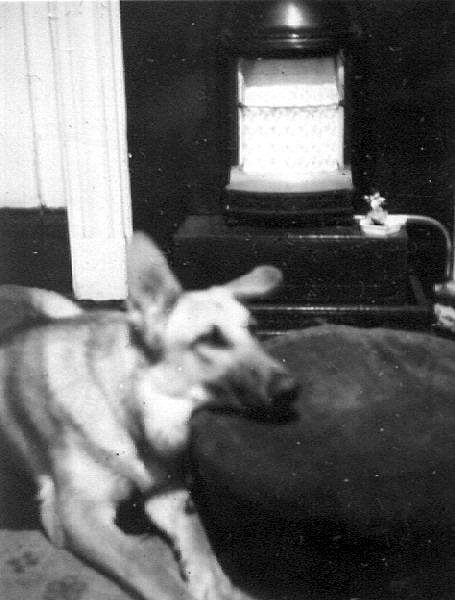
My body felt solid and real and I was dressed in outdoor clothes not my pajamas. Then with great enthusiasm I looked up and saw my mother sitting alone knitting, our Alsatian dog lying asleep in front of the gas fire. I felt sure my mother would see me because I felt physically present and absolutely and vitally awake in a way I had never experienced before. So I called out to her, “Mum, look what has happened.” She stopped knitting for a moment but obviously didn’t see me or hear me. So I felt if I shouted this would reach her. “Mum” I shouted, “look it’s me Tony”. My dog Vincent in front of the gas fire – 1956 There was no obvious sign that she had heard me, but two things did happen. One was that I saw or realised that she had an upstairs side of her and a downstairs side. Her upstairs (conscious) side had no awareness of me, but her downstairs side (unconscious) gave me a wonderful welcome and I had the awareness of us knowing each other in a formless love. Then at the same time my dog must have heard me shout because he woke and came rushing to me and was so full of love for me he rushed around where I stood barking and showing his joy. I later heard from my mother saying she had had been alone that night as my father was out, and she had seen the dog get up and bark and jump around for no apparent reason.
I learned enormous and important lessons from that. I saw that because I was present without a physical body my mother couldn’t hear me. She needed physical sound to know I was present, but yet another part of her knew and responded. From that I realised that I was dreaming, because I was also asleep in ‘Germany, and dressed in pyjamas, but here in this place body felt solid and real and I was dressed in outdoor clothes not my pajamas. I also realised that if my mother had thought of me and spoken to me in thought I would know, even though she might not be able to hear my reply – unless she was a medium or learned to listen to thoughts. The reason being that in the body most people cannot communicate via thoughts.
Once the awareness is independent of the body, the boundaries of time and space as they are known in the body do not exist. One can easily pass through walls, fly, travel to or immediately be in a far distant place, witnessing what may be, or appears to be, physically real there. We lived through a period where we saw only our physical structure which will be wiped out. Now science has seen that we are each fundamentally quantum – energy – and from this view they cannot find death. Ancient people saw the same thing and gave different words to describe it.
Sir Auckland Geddes, an eminent British Anatomist, describes his own OBE, which contains many of these features.
Example: Becoming suddenly and violently ill with gastro-enteritis he quickly became unable to move or phone for help. As this was occurring he noticed he had an ‘A’ and a ‘B’ consciousness. The ‘A’ was his normal awareness, and the ‘B’ was external to his body watching. From the ‘B’ self he could see not only his body, but also the house, garden and surrounds. He need only think of a friend or place and immediately he was there and was later able to find confirmation for his observations. In looking at his body, he noticed that the brain was only an end organ, like a condensing plate, upon which memory and awareness played. The mind, he said, was not in the brain, the brain was in the mind, like a radio in the play of signals. He then observed his daughter come in and discover his condition, saw her telephone a doctor friend, and saw the doctor also at the same time.
As OBE’s often occur at times of stress, a near-death-experience, great pain, or in deep withdrawal, they may have a link with such human and animal situations. In other words, OBE’s may have developed as an evolutionary or survival method to deal with death, near death, pain or stress.
For instance, many cases of OBE occur in a near death situation, where a person has ‘died’ of a heart attack for instance, and is later revived. Because of this there are attempts to consider the possibility of survival of death through study of these cases. In fact many people after experiencing an OBE have a very different view of death than prior to their experience. From the opposite point of view, that of the external observer who is not asleep, many OBE’s have been witnessed by relatives of people actually dying through war or accident. During the two world wars, many cases were reported and later corroborated, of seeing the dying person appear, and of them telling of their death, or silently communicating it. I believe this points out the deep connection between an OBE and dying, pain and stress. I have felt that the OBE is in fact the remains of something that existed in primitive animals as a survival mechanism. It was a way of communicating the cause of death to those with genetic bonding. This awareness would help in avoiding the same death.
Early attempts to explain OBE’s suggested a subtle or astral body, which is a double of our physical and mental self, but able to pass through walls and transcend the physical limitations of distance. It was said to be connected to the physical body during an OBE by a silver cord – a life line which kept the physical body alive. This is similar to the concept that the people we dream about are not creations of our own psyche, but real in their own right. This theory has limitations as it can be observed that many people in this condition have no silver cord, and have no body at all, but are simply a bodiless observer, or are an animal, a geometrical shape, a colour or sound. Analysis of many OBE’s therefore suggests that the ‘body’ and many of the other aspects of the experience are as much a creation of ones psyche as are the objects and people in a dream. It is tempting to think that we are our body, and any attack on it in dreams is an attack on us. But this is not so. See: identity and the dreamer.
Example: Had a very unusual dream last night. I was in an outdoor environment. It seemed a bit dark, or maybe morbid is the right word. I was with other people but none of them stood out to remain in memory. There was a definite awareness though of being near to a place that was haunted, and that a man was in trouble in the haunted place.
I decided to go and see if I could sort out the problem. I walked down a slope to where the centre of the haunting existed. It was an open space with an old double-decker bus in it. The only person on the bus was a middle-aged man who was sitting on the top deck leaning out of a window on the right hand side of the bus. I stood beneath him and looked up. He was staring in a glazed way and didn’t see me. I could see and feel that he was being hit by fantasies or hallucinations by whatever was the source of the haunting. This invasion of his mind was grabbing his attention so fully that he wasn’t aware of his surrounding or of me. I was sure that if he went any deeper into this mind stuff he wouldn’t be able to pull out. I waved my hand in his line of vision and banged my hand on the bus to make a noise and get his attention. At first it didn’t seem as if I would bring him out of it, but after a while he looked at me.
I shouted at him to pull out. I said that he had a wife and some more years of his life to live, so why lose himself into this entrancement. This didn’t seem to grab him so I shouted again and said that he would eventually slip into this empty mind world anyway – at death – so why not live with his wife the remaining years of his life. I was sure that if he lost awareness he would let himself starve.
I was aware that what he desired was to slip away into the void, into the awareness of the one life in which he lost any awareness of self. But I banged and shouted and he became more ‘present’. I then felt I had to confront whatever was the source of the powerful ‘haunting’ that was pulling him into the inner mind. I turned away from the man and saw just to my right a short distance from the bus an animal that was the ‘haunter’. It was a mammal of no particular type – a bit like a mixture of dog, rat and guinea pig. It seemed very ordinary and tame, and stood looking at me. I walked toward it and stretched out my hand. It was a tan colour with short fur and gave a feeling of being okay to approach, so I touched it to stroke. This was okay and I was thinking there was no problem when the creature leapt at my throat in a flash of movement and ripped my throat out.
This sounds disturbing but I simply observed this and thought to myself that stroking and trying to be friendly was no way of dealing with this thing. It was as if I was in command of the imagery in that I simply formed another body. The creature ripped out my throat again and dived into my body to eat it. I woke at this point and went for a pee. When I went back to sleep I carried on with the dream. The only way that felt as if I might deal with the creature was to have the meditative state of not having any goals, and not feeling panic at it’s attacks. In fact apart from the gory imagery, there was nothing to be frightened of, as the creature was only attacking my dream image of myself. As I wasn’t identified with that, it couldn’t hurt me. That was the end of the dream.
This means the person’s own unconscious concepts of self seem to be the factor which shapes the form of the OBE. If, therefore, one feels sure one must travel to a distant point, then in the OBE one travels. If one believes one is immediately there by the power of thought, one is there. If one cannot conceive of existing without a body, then one has a body, and so on. The silver cord, from this point of view, exists simply because the ‘dreamer’ feels it is necessary. If the second example is read, it can be seen that Tony at one point travels, then suddenly the travelling through the air ends and he is immediately hundreds of miles away in London. Also, although his sleeping body was in pyjamas, his projected body is wearing outdoor clothes, showing he is not experiencing himself as an ‘astral double’ or copy of his sleeping self. He has no sign of any silver cord, and his own impression afterwards was that the experience was largely a creation of imagery to suit his own beliefs, except that in some way it interfaced with reality. Therefore any theory about OBE’s needs to explain the mixture of reality and subjective experience in such events. For example, in this instance, Tony’s dog had an awareness of him, verified by Tony’s mother, and yet Tony’s experiences were not a part of the ‘real’ world in the usual sense.
Something that is very apparent from recorded experience of those who have died is that many people after death still feel that the body that died is them, and some never ever are able to let go of it. See Steiner Life after death
In a nutshell, the world of the OBE is created by the concepts of the ‘dreamer’. This world is experienced as physically real, in a similar way to the world of dreams. Yet it is neither a dream in the usual sense, nor is it a dream in which the person is highly lucid. There is a different quality about it than either dreaming or lucidity. The difference is that during an OBE the physical world can also be experienced and witnessed. So in trying to analyse events during an OBE, we must discover what aspects are created out of unconsciously held concepts, and what are witnessed physical world events or objects. Whatever the answer, this view of the OBE suggests there is no need for a person to travel to a site, or to have a silver cord, or in fact any sort of body at all.
What emerges is that consciousness can at certain times completely go beyond the limitations of space, location and time we usually accept. For instance it is very real for us to accept that if we wish to personally experience the streets of Tokyo or New York we will have to transport our body to those locations. If we go to New York we cannot at the same time experience Tokyo. With an OBE these rules do not apply. Consciousness does not have to travel. In some way it is already a timeless blanket throughout space. The OBE appears to be a process in which the person focuses on a particular spot, or several spots at once, within that three dimensional blanket. To accomplish the focusing they may utilise personal forms of imagery such as travelling to the spot, or going down a tunnel to the site, or having a projected body. But this imagery, although deeply experienced, appears to be only an aid to focusing awareness away from ones usual physical senses onto the ‘timeless blanket’ of consciousness pervading all space. See Big Bang.
This approach explains many aspects of the OBE, but there is still not a clear concept of what the relationship with the physical world is. If there is survival of death, then the OBE may be an anticipatory form, or a preparatory condition leading to the new form.
Many people mistake various other sleep experiences for an OBE. In fact the concept of a soul or spirit distinct from the body arose in pre-history from the experience of a dreamer going to a distant place while they slept. The dream of the distant or strange place was assumed to mean the dreamer actually travelled to somewhere else. But of course, actual experiences of OBE also occurred as frequently to our forebears as they do to us today.
The mistaken OBE can take many forms, as already explained. One of the most convincing however, is that occurring during the feeling of paralysis during the dream state.
What happens is that during the lucid experience of sleep paralysis the body senses are shut off and the person feels that they have left their body. But that is a symptom of lucidly being aware of the sleep state. See bodiless- sleep yet awake; paralysis while asleep.
See: Dimensions of Human Experience – Lucidity – altered states of consciousness; archetype of death and rebirth; death and dreams; ghost; hallucinations and hallucinogens.
Peer Dream Work
Here is wonderful way of really exploring and understanding your dream. I have taught it to many people and groups with remarkable results.
To quickly get to the parts you want click on the following:
Explore Dream Character of Object
Stand in the Role of Character or Object
Question the Dreamer about the Role He/She is in
Summarise What You Have Learnt
Use the body to discover dream power
Have a dialogue between two dream characters or objects
Response to Working with the Peer Dream Process
The way of working known as the Peer Dream Group came about from our experience that dreams are largely self explanatory if approached in the right way. An exterior expert or authority is not necessary for a profound experience of and insight into dreams if certain rules are respected and used. The dreamer is the ultimate expert on their own dream, and when treated as such, and supported in their exploration of their dream drama, they can powerfully explore and manifest the resources of their inner life.
Fundamentals of Practice – The suggestions that follow have arisen from fifty years of dream work. They have been particularly tested with a number of small groups, and are usually employed with groups of three to five people, but often with just two people working together.
The foundations of this practice rest on an understanding, or a standpoint accepted or taken by the listener and perhaps the dreamer. It is that the person before you is an expression of Life. Let’s forget anything about dream theory, because the very first step is to form an attitude to what is in front of you. Here is a being, a little chunk of life, and at the core of this living being, this living process, a process that has developed a sense of self, is the stuff of life. It is the stuff that makes heroes and saints, mothers, fathers, friends and foes. It is the essence from which arises the whole thrust of life. It is the living core of creative possibilities. If you look around you at what life does, you can see it can be a multitude of things. It can manifest as a lion or a flea, a giraffe or a tree. It is, at the same time, both a galaxy and an amoeba. And here it is in front of you as a living being. Here is an audio example of Tony exploring a dream: Dream Exploration
At the core is the freedom to choose
At the core of this being is that freedom to choose — that freedom that life expresses in its multiplicity of forms. Another word for that freedom is potential or creativity. So at the core of the person in front of you lies that potential, that creativity, that problem solving ability that life itself expresses. But perhaps with this being in front of you that freedom, that creative ability, that potential, has got lost, forgotten or buried in some way. So our work as the listener is to help them remember, help them find their way, to rediscover or uncover their creativity and problem solving ability. That creativity and ability to solve problems is always there inside them. That wonderful ability belongs to them. So it is not for us to solve their problem or to find the way for them. It is for us to help them uncover those possibilities within themselves.
Finding a partner
Step One – Find a partner you can relax with who can give sympathetic and non intrusive support. Agree with the partner that any confidences disclosed during the dream exploration will not be told to others. See listening skills
Tell The Dream
Step Two – The dreamer tells the dream. It is sometimes helpful for them to tell it in the first person present, as if they were experiencing the dream as they are telling it. The telling of the dream can include any relevant information, such as immediate associations, or events directly linked with the dream. The telling is not simply for the listeners, but for the dreamer. In telling the dream with skill, the dreamer discovers more about the dream and themselves.
Example – This is my dream. I am driving my car, alone. I can see a female friend and stop to offer her a lift. I partly want her to be impressed by my new car. She looks at me. Now she tells me she doesn’t want a lift and I am watching her walk off with a man I do not know. ………………. I have recently bought the car I am driving in the dream. I like it very much and like to have my friends ride in it. (Joel)
Ask Questions
Step Three – The helpers now ask the dreamer questions to clarify for themselves the imagery and drama of the dream. The questions at this point should not be to explore the dream, but simply to gain a clear image of the dream.
Example – Q: You didn’t describe the street you were driving along. Was it a shopping centre or quiet place? A: It was quite a crowded road, with people, not so many cars. I think this was also connected with my feeling of wanting to be seen in my new car. Q: Are you attracted to your female friend? A: Yes.
Explore a Dream Character or Object
Step Four – The dreamer next chooses one of the characters or images in the dream to explore. The character can be themselves as they appear in the dream, or any of the other people or things. It is important to realise that it does not matter if the character is someone known or not, or whether they are young or old. The character needs to be treated as an aspect of their dream, and not as if they were the living person exterior to the dream. In choosing an image to work with, such as a tree, cat, place, or an environment like the street in the example dream, it must again be treated as it appears in the dream, not as it may appear in real life. One can take any image from the dream to work with.
Stand in the Role of Character or Object or see Being the Person or Thing
Step Five – The dreamer stands in the role of the character or image they are using. So if they chose to be the car in the example dream above, they would close their eyes, enter into the feeling sense and imagery of the dream, and describe him or herself as the car. Literally you imagine yourself as that physical shape, as if your awareness has merged with the thing or person. Then let your immediate feelings and associations arise and be described. It is important to step into the image by getting into their body if it is a person, or take on the shape if it is an object. As I explained to a friend recently you do not even have to have a clear image of the thing or person, simply think of it as seen in your dream and then watch any thoughts or feeling that might arise – as if listening for a quiet voice or fantasy arising – but give it a minute or so.
Example – I am a car. Joel has recently purchased me, and he is driving me, largely because he feels I will help him gain respect from other people. I am quite a large car, and have a lot of power. But even with all this energy I do not make my own decisions. I am directed by Joel’s desires and wishes, and enable him to fulfil them more readily.
As can be see, it is important to speak as if you are the chosen thing as Joel did. If it was a person Joel worked on, He should not say, “I am a woman”, or “I am the woman who turned away” but, “I am Mary. I like Joel , but I can see he isn’t really interested in me – except as a trophy in his new car.” From this short description it can already be seen there is a suggestion the car represents Joel’s emotional and physical energy, directed by his desires and decisions. See also Talking As.
Question the Dreamer about the Role He/She is in
Step Six – The helpers now ask questions of the dreamer who stays in the role of the dream character or image. The questions must be directly related to the role the dreamer is in. So Joel, in the role of the car, could be asked – Are you a second-hand or new car? Who was driving you before Joel? Do you feel that Joel handles you well? What does it feel like to be directed where to go all the time? Do you have places you would like to go?
Joel should be helped to remain in role. If he slips out of it and stops describing himself as the car, gently remind him he is speaking as the car. Also the questions should be asked with an awareness of time necessary for the dreamer’s adequate response. So do not hurry the questions to the point where the dreamer cannot properly explore his or her associations and feeling responses. If emotions are stimulated by a question allow the dreamer to discover what the emotion is connected to.
By this is meant that an emotion is usually a response to something, and therefore gives information concerning what is moving us deeply. If a line of questioning is producing promising results, do not lead the dreamer off in another direction. For instance Joel may have been asked if he wants to get out of his car and follow the woman, and show some feelings about this. A question such as ‘Are there any shops in this street’? would take him completely away from such feelings.
To help ask relevant questions it is useful to be interested in the dreamer and their dream. Have a questioning mind in relationship to the dream. So do not have already fixed opinions about it. Be like a detective gradually unfolding the information and emotions behind the dream. As the dreamer answering the questions, let your helpers also know what you feel in response to their questions, or what memories or associations occur when a particular part of the dream is being explored.
I used to ask for a volunteer to demonstrate the steps of working. Because it was a demonstration I would interrupt wherever necessary. It took a while to wean some people from interpreting the person’s dream. Also, as you said, it takes a while to allow space for the dreamer to explore their feelings rather than just respond verbally. So I would point this out as the helpers worked if they jumped in too soon.
Also if the dreamer had got a strong response often a helper might try to take them off on another direction instead of waiting and then questioning in a way to further what the dreamer was experiencing.
Sometimes the group was as large as twenty, and after the initial demonstration I would put them in groups of about four or five and let them use the steps by themselves. I would wander around the groups or be ready to be called if needed. This was often in Greece at an alternative holiday centre and I had the group for two hours four times. What was amazing was how wonderfully skillful the groups got within about the second or third day. They did real work as deep as any therapists, and often deeper than many. If possible I restricted the groups to four so each group member could work a dream even if they took the whole session.
Example – Joel: When you asked me if I want to follow the woman I immediately realised that in real life I am holding myself back from letting my feelings about her show.
Summarise What You Have Learnt
Step Seven – When you have come to the end of what you can ask about the dream image, the dreamer should be asked to summarise what they have understood or gathered from what they have said or felt in response to the questions. To summarise effectively gather the essence of what you have said about the symbol and express it in everyday language. Imagine you are explaining to someone who knows nothing about yourself or the dream. Bring the dream out of its symbols into everyday comments about yourself. The helpers should reflect back to the dreamer what they have said, not their own opinions of the dream differing from what the dreamer has said. See Dream Processing, attached.
Example – A man dreamt about a grey, dull office. When he looked at what he said about the office, he rephrased it by saying, “The dream depicts the grey unimaginative social environment I grew up in after the second world war. It shaped the way I now think, and I want to change it toward more freedom of imagination and creativity.
Work through each of the symbols in the dream within the available time. A dream that leaves the dreamer unsatisfied, or in a difficult place, can usefully be approached by using the technique of carrying the dream forward.. The three following techniques describe how to carry the dream forward, how to use the body in dream exploration, and how to use dialogue between dream characters. These are extremely useful tools to occasionally use in peer dream work.
Carrying the dream forward
This technique is wonderfully effective, and can change habits and patterns that we may be locked in. It does this by giving our mind/brain a different pathway and experience. In test it was found that imagining a situation is 70% as effective as actually doing it.
So, imagine yourself in the dream and continue it as a fantasy or daydream. Consider what it is that troubles you or is not what you want in your dream. Now take time to think how you would alter it and how to have an ending that would satisfy you. Now you can, in your imagination, enter your dream and alter the dream in any way that satisfies. Experiment with it, play with it, until you find a fuller sense of self expression.
It is very important to note whether any anger or hostility is in the dream but not fully expressed. If so, let yourself imagine a full expression of the anger. It may be that as this is practised more anger is openly expressed in subsequent dreams. This is healthy, allowing such feelings to be vented and redirected into satisfying ways, individually and socially. In doing this do not ignore any feelings of resistance, pleasure or anxiety.
Satisfaction occurs only as we learn to acknowledge and integrate resistances and anxieties into what we express. This is a very important step. It gradually changes those of our habits which trap us in lack of satisfaction, poor creativity or inability to resolve problems.
Dr. Cartwright, who is Director of the Sleep Disorder Center at Rush Presbyterian Hospital in Chicago, recommends the same procedure. She suggests “that you rehearse new endings to disturbing dreams. For example, if your father always degrades you, visualize yourself telling him that you are not going to listen to his abuse any more.
Also imagine yourself stopping the dream while it is in mid-stream, and changing the ending to one which is empowering and dignified. Once you have practised these steps while awake, you will soon be able to recognize this bad dream once you are asleep and it recurs.
Dr. Cartwright says that most dreamers are surprised to learn how quickly they can end a bad dream – simply by willing themselves to wake up. Learning to stop a bad dream is an empowering experience in itself. With practice though, she says you will soon learn to change the ending of the dream to one which more closely resembles the ending satisfies you.
But if you simply use it to stop difficult feelings, you are blocking the most important functions of dreaming – to presenting of emotions or traumas that are blocking your creativity or well-being. See Trauma
Example: When my husband died, for quite a few times I had this funny dream. I was walking along a field and saw a lot of sheep guiding me, and I followed them. Suddenly they disappeared into a cave. I went in the cave and a row of mummies were there. One was wearing a medallion on a chain round its neck. The dream recurred quite often. One day Tony came to me and I told him the dream. He asked me to sit in a chair and relax, which I did. Then he said for me to go to the cave, and in my relaxed state I went and walked to the mummy with the medallion. Then he said take off the bandage from the top. As I unwound it the face of my husband was uncovered. I screamed and screamed and came out of the relaxation. Tony then said now let him go. I have never had that dream since. Betty E .
Use the body to discover dream power
The brain sends impulses to all the muscles to act on the movements we are making while in the dream. This is observable when we wake ourselves by thrashing about in bed, or kicking and shouting. A part of the brain inhibits these movements while we sleep.
The important factor is that a dream is more than a set of images and emotions, it is also frequently a powerful physical activity and self expression. If we explore a dream sitting quietly talking to a friend, even if we allow emotions to surface, we may miss important aspects of our dream process. Through physical movement the dream process releases tensions and deeply buried memories that are stored in our body. These do not release and heal by simply talking about them. It is often enough to realise this aspect of dream exploration for such spontaneous movements to emerge when necessary.
By being aware of the body’s need to occasionally be involved in expression of dream content, we may catch the cues and let these develop. Frequently all you need to do is to let the body doodle or fantasise while exploring a dream. Jung suggested this technique for times when the person was stuck in intellectual speculation. To practice it you can take a dream image and let the hands spontaneously doodle, watching what is gradually mimed or expressed.
When you have gained skill doing this, let the whole body take part in it. This can unfold aspects of dreams that the other approaches might no help with. See: Life’s Little Secrets. A fuller description of this process is contained in my book Liberating the Body.
Have a dialogue between two characters or objects
Every part of a dream, whether an object, person or animal, is alive with our own intelligence. Each part has been created out of ourselves in some way, and depicts some area of our own total being. We can therefore talk with them. Such dialogue is of great importance and very revealing.
To do this, imagine yourself as one of the characters, animals or objects in your dream. It may help at first to have two chairs – one empty and one you are sitting in. The character or object of your dream is in the empty chair. When you are ready to be that character move from your chair, sit in the empty chair and speak as that character. To answer or question the character from your own identity, move to the original chair and speak from your own character.
Be playful and curious in doing this. Question the character, and when you move to that role, let whatever your feelings are as that character motivate what you say and do. Exploring your dream in this way unfolds a great deal of information that would otherwise remain unconscious. It also enables you to make real changes in unconscious attitudes or habits, as you are literally dialogging with areas of character patterning or programming, and can change them.
Example: When I spoke as the new born baby of my dream I really felt as if this was me, newly born. I had had a difficult birth and my reaction was that I wanted nothing to do with life. I wanted to stay curled up like an egg, not getting involved in the exterior world.
The adult observing me could see how this aspect of my inner life had led me to be withdrawn from social activity all my life, so I explained this to the baby me, saying – I need you to be ready to meet the world. You are a part of me and if you continue to withdraw I lack the enthusiasm to get involved with other people. Back as the baby I felt totally vulnerable and didn’t want to take any risks – No I don’t want to come out of the egg. As the adult again I said – Look, if you remain curled up this is more of a gamble than actually getting out and taking risks in life. Just lying there anything can get you. I had recently seen a film about baby turtles hatching an rushing to the sea. Some of them got eaten by seagulls, but the faster they were the less likely to be caught. So I explained this to the baby me. As the baby this really got to me. I felt a change in me and a readiness to begin the journey of meeting life outside the womb. This change really made a difference to my everyday activities. A lifelong habit of being introverted gradually dropped away. Trevor P.
Response to Working with your own ability of the Peer Dream Process
An actual example of this is of a woman who wrote telling of a recurring dream in which she discovered a door in her house she had never seen before. Beyond it was a whole apartment she has never known or used. It was obviously an area of her life she had never lived in, but she had no idea what it was. So, the technique of exploring the dream while awake was explained, and she imagined walking into the new apartment and observing what she felt and what memories arose. A soon as she entered the apartment she began to remember and feel again things that had happened in her childhood. Her mother and father had separated when she was very young and her mother had constantly presented her father as weak and of no value. But the feelings that arose were of the love of beauty and art that her father had shared and helped unfold in her. But she had kept that part of her closed because of what her mother had said. Now it was open to her again and she could allow it to unfold further in her life. An important point here is that the woman did this working alone on her dream, not with professional help or supervision. See Dreams – Secrets of Power Dreaming – Potential
I wanted to write and let you know how well the peer dream group went tonight, especially as the feelings we experienced were and are so positive and so powerful. The kind that keeps you up for hours.
There were three women total tonight. Although I had expected a larger group and was disappointed when two people didn’t show, I knew that we could process a dream with the three of us. Writing this is like writing a dream right now – it’s hard to capture the fluidity of the evening, the flow of the feelings, the surfacing of the feelings and the recognition of the life circumstance(s) of the dreamer because she was allowed “to rest” in those feelings.
Two of us had your steps of the peer group process, and its flow was a great help. It seemed natural to move from one step to the next, and I must say the dreamer had little difficulty imagining herself as the two objects she chose to be (she later said it was like being in therapy in that a therapist would be the one to ask the questions to sit with).
We worked on the one dream, and had time to work through two of her images in the dream. It was a rich dream, and we know we only were able to touch on those two parts, but those two parts were so meaningful for her. I think the most enriching part of the evening, for me, was to see her gain insight as she was describing herself as an image in the dream. It was watching the change on her face, the way she was suddenly not speaking anymore. She saw meaning so clearly, so deeply.
In the end, she was comforted by the dream, and knew it “told” her she was ready for this circumstance in her life. She felt at peace. She “felt her depths”. Her whole demeanour relaxed.
After the dream work, we spent a lot of time discussing how we all felt during the process. For none of us had this experience before. Three important points about the process came up for the dreamer. The first was that the asking of the questions was extremely important. The dreamer stated she never would have thought to have asked herself the questions we asked her.
Secondly, the dreamer was grateful for the time she had to be the image in the dream and to stay with it. It enabled her to see it and feel it and learn what it was. And the third comment was the listeners’ reflections back to her as it enabled her to hear what she said, and to hear what she said with someone else using slightly different words than she used. That was powerful for her.
The other listener and I felt under no pressure at all. It was freeing for us to focus on the dreamer and the dream image. For in projective work, as the non-dreamer, it takes time and work to feel the dream as one’s own and to come up with one’s projections. The two of us as listeners were aware of how much we were not projecting, but I think we did well in not putting our own ideas about the dream into play. It wasn’t necessary to the process.
Finally, we discussed more about how this compared to our experience of projective group work, and we all came away with feeling that it was much more focused for both the dreamer and the listeners. However, as there are plenty of groups in this area that focus on projective work (which some of us will attend from time to time), we made another date to continue and form a dream group using your guidelines, your stuff, or whatever it is to be called. We liked it. For the first try at this, I am very pleased. Assured. Thanks for being there for me and us! LR
Movements During Sleep
While we sleep and dream the brain produces full muscular impulses in connection with the movements we are making in the dream. Adrian Morrison at the University of Pennsylvania, investigating narcolepsy, a condition producing sleep in the middle of activity, found that a small area of the brain, the pons, suppresses full muscular movement while we dream. If this area is damaged or suppressed humans or animals make full muscular movements while they are asleep in connection with what is dreamt. He observed that cats would stalk, crouch and spring at imaginary prey. These very important findings suggest a number of things.
1 – The unconscious process behind dreaming, apart from creating a non volitional fantasy in the dream, can also reproduce movements we have not consciously decided upon. This shows we have at least two centres of will which can direct body and mental processes. The waking will decides movements using voluntary muscles. The ‘dream or Life Will’ leads to spontaneous movements while we sleep and dream, but also while awake and passive in the sense described under the entry active/passive. See Functions of dreams
2 – Christopher Evans, linking with the work of Nicholas Humphrey at Cambridge University, sees the movements of the dreaming cats as expressions of survival ‘programs’ in the biological computer. These programs or strategies for survival need to be replayed in order not only to keep in practice, but also to modify and improve them in connection with the influx of extra experience and information. In the human realm, our survival strategies and the way we relate to our social, sexual, marriage and work roles, may also be replayed and modified in our dreaming.
Such movements are not linked simply to survival or social ‘programs’. Important agendas in dreaming are a) releasing painful emotions or trauma, and b) moving toward psychological growth. Also, the process producing these movements does not keep strictly to the realm of sleep. It is observable that many muscular spasms, ticks, or unwilled waking movements, arise from this source – the ‘will’ of the unconscious or dream – attempting to release trauma or initiate a necessary program of psychological growth. That such ‘dream’ activities as spontaneous movement or spontaneous verbalisation should occur during waking would appear to suggest that a dream must occur with them. Research shows this is unlikely. It does however, show that a dream may be imagery produced to express this mental, muscular, emotional, ‘self regulation’. The imagery may not be necessary if the process is consciously experienced.
Because the self regulatory process produces spontaneous movements, emotions and verbalisation, it is likely there is a connection between it and many ancient religious practices such as Pentecostalism, Shaktipat in India, Subud in Indonesia, Qi Gong in China and Seitai in Japan. These are forms of psychotherapy practised by other cultures. They create an environment in which practitioners can allow spontaneous movement and fantasy while awake. Because consciousness is then involved, and can cooperate with the self regulating or healing activities of the unconscious, such practice can lead to better health and utilisation of unconscious functions. The older religious forms of this practice relied on belief systems of spirits or gods. Once the connection between these practices and the dream process is realised, much in them which was obscure becomes understandable. In my books Mind and Movement and Liberating The Body, I explain the connection between the dream process, self regulatory healing, extended perception and waking consciousness. See Life’s Little Secrets
Robert Van de Castle quotes an example of this in his book Our Dreaming Mind. He describes a Gestalt dream workshop in which ‘Jean’ dreams she needs to make ‘fucking’ movements. As Jean is a very controlled person this is difficult. During her teens she learned to control her sexual feelings by tightening the muscles in her stomach, vagina and thighs, thus preventing the spontaneous expression of feelings which would have otherwise occurred. So in her dream she seeks a man who will make her obey him and have sex together. Then she would be able to let go of her guilt. In the workshop Jean is helped to let her body make these movements while awake. This released the flow of her pleasure and sociable good feelings.
Many people speak while asleep, or make movements others can observe. If such movement and vocalisation is allowed while awake, the process evident in dreams can become much more effective or efficient. A woman, W. who had learned to allow such waking spontaneous fantasy, vocalisation and movement says
‘My throat was permanently sore and red inside, sometimes it hurt a lot, other times not so much. There seemed to be no cure for it. Now the soreness and redness has gradually disappeared. This also I feel was a great tension area for me because I was afraid to speak my mind. Now if my throat feels sore and tight I realise my body is telling me I am withholding my speech. A lot of my painful throat tension was due to being very verbally suppressed as a child.
As I released my feelings in words through sessions of allowing the self regulatory process to express, this tension gradually drained away, and I was often led into singing and chanting quite clearly and strongly in sessions. I felt my throat to be much freer, and purer sound could come forth. I am not completely free in this area yet, but this will take time. My voice is already lower and more relaxed than it was.’
Dreams often attempt to break through such muscular or moral tensions. If they succeed, spontaneous movements occur. This enables the process of personal growth to be released, as well as the underlying tension its blockage produced. See: abreaction; compensation theory; healing and therapeutic action of dreams; night terrors; paralysis; science sleep and dreams; self-regulation dreams and fantasy; sleep walking.
Mystery Of Dreams
Do dreams take us to many places and many dimensions? Freud’s view of dreams saw them as primarily expressing sexual and childhood difficulties or repressions. Jung saw them as an expression of a personal potential and a means of healing and growth. Apart from their psychological indications, or their connection with our maturing process, dreams have also been shown to indicate activities in the body, and so have been used to diagnose illness. They have been used as creative agents, and lie behind a number of scientific discoveries. Writers and artists have found in them inspiration or fresh insights into creativity. For countless thousands of people, they have also been a time travel machine through which glimpses of the past and future were given – or a means of realising that consciousness can roam free of the physical body and witness events at a distance. Many people state they have had meaningful or even verifiable contact with the dead. Dreams also often have deeply spiritual themes, enabling the dreamer to feel contact with a universal existence and timeless aspect of themselves.
There are many definitions of dreams. They range from the ancient view of them being messages from the gods, through the idea of dreams as windows to our unconscious feelings and thoughts, to the modern view of them as neurological and chemical events.
However much one tries to fit the enormous range of dream phenomena into any one or several of these definitions, there is never a complete match.
Therefore dreams, like any life experience are transcendent. They transcend any attempt to give them a final definition. There is always in them an element which remains indefinable.
A cup for instance is in most cases made of a mineral. We can therefore see it as a manufactured object made of clay. But it can also be seen as a piece of art, as a mass of interacting molecules and atoms, as an outcrop of the universal substance, a religious symbol, a technological product. What one is the right description?
Dreams are even more mysterious and likewise have no single useful definition.
For about a third of our life we sleep, and most of that period is spent in one form of dreaming or another (REM or NREM dreaming (1)). This means that if you sleep for an average of seven hours a day and live 75 years, 22 YEARS OF YOUR LIFE ARE SPENT DREAMING.
Human life itself is strange and mysterious, and because dreams display the workings of our mind and imagination, they are among the most mysterious and fascinating aspects of our life. Tony Buzan, writing about the complexity and scope of the human brain, says that even comparing it with the vastness and intricacy of a galaxy is a modest analogy. This is because our three and a half pound brain mass has in it about ten billion nerve cells. Each of these cells can link with any of the others through patterned connections which outnumber in scope the atoms in the universe. As we think, as we experience and feel responses, as creativity expresses, our brain flashes through these unimaginable number of patterned connections thousands of times each second. This is beyond our normal ability to imagine, despite the fact it is happening to us personally. Buzan says, “At a mathematical level alone, the complexity is astounding. There are ten billion neurons in the brain and each one has a potential of connections of 1028 In more comprehensible terms, it means that if the theoretical number of potential connections were to be written out, we would get a figure beginning with 1 and followed by about ten million kilometres of noughts.”
The human mind has immense possibilities. We see the demonstration of this in the extraordinary things people do, either in their everyday life or in times of crisis. We know from laboratory evidence that people can consciously slow down their heartbeat, change the temperature of their body, solve mathematical problems as fast as any computer, heal their body of illness. Dreams, involving the unwilled action of the brain during sleep, express and often unveil something of the vastness of these inner resources.
The Many Facets Of Dreaming
Although there is no final agreement on what dreams are and what their value is, if we look at the various findings, dreams can be seen to hold in them something of all the many aspects of human life. Just as society overall has hospitals and churches, schools, libraries and sports facilities to cater for the physical, spiritual, mental and recreational needs of people, so dreams express these departments of ourselves.
Body Dreams – Bernard S. Seigal, M.D., assistant clinical professor of surgery, Yale University School of Medicine originated the ‘Exceptional Cancer Patient’ group therapy. Through encouraging his patients to tell their dreams and express their feelings via paintings, he found that patients often dreamt clearly about the condition of their body long before normal diagnostic methods could define the illness or healing. Other physicians, such as Kasatkin in Russia, have also drawn notice to this aspect of dreaming, and kept careful records of such dreams in patients.
Virtual Reality – Sigmund Freud recognised that dreams are different in quality to waking fantasies or daydreams. While dreaming we are usually convinced that our surroundings and what is happening, is completely real. This sense of complete immersion in the dream does not pervade our fantasies. Although during a nightmare this feeling of reality can cause us to be very frightened, the positive side to it is that dreams give us experience as full of impact, and therefore as educational as waking life.
Regulating – In experiments where volunteers were woken each time they began to dream, a breakdown in the efficiency of mind and body soon became apparent. The Swiss psychiatrist Carl Jung described dreams as compensatory. He was particularly referring to the way dreams help balance our conscious personality. According to this view, any extreme is compensated for by an expression of the opposite in our dreams. In this way, lack of love or success in our life may be compensated for by a very powerful release of dream imagery and experience. One may have a vision of ones dead mother or Christ for instance. Without such compensatory experience, continuing life in the face of failure and loneliness might be extremely difficult.
Personal Growth – The growth of our personality from infancy is a very complex interplay between largely unconscious factors in our body, our experience of our environment, and the way we integrate and deal with these different influences. Dreams do appear to present clear indications of what is emerging as transforming forces in oneself. They also definitely reveal past experience that through trauma may need to be met in order to live ones life more satisfyingly or efficiently. This is why they are so often used in psychotherapy. Because our mind integrates experience, as described below under Creativity, some investigators believe that during our dreaming we ‘upgrade’ such skills as social interaction, speech, etc., which also leads to personal growth. There is neurological evidence that brain cells undergo a learning process during dreaming. Also in the area of personal growth, inquiry into dreams such as recurring nightmares, shows them to be an attempt, occasionally successful, to bring to consciousness and release past traumas such as childhood abandonment, involvement in war environments, or car accidents.
Creativity – In 1912 Gestalt psychology was launched in Germany when Max Wertheimer published a paper on a visual illusion called apparent motion. Wertheimer had noticed that when we view a sequence of still pictures, as happens watching a film, we have the illusion of seeing movement. This perception of movement was different to the perception of its components – the many static images. This led to the understanding that many of the perceptions we have of the world around us, and many of the concepts we build, are radically different to the many pieces of information or experience they arise from. The sum is therefore different or greater than the parts. Sudden inspirations and creative leaps, when seen from this point of view, are usually a new ‘whole’ formed out of many parts which previously had no connection. The symbols and drama of dreams particularly express this creative forming of new experience and new realisations, new gestalts, out of the mass of separate pieces of experience or information.
Imagination – This has been listed separately to creativity because they are not necessarily the same. Imagination has been described as the “ability of the mind to be creative or resourceful.” To be creative or resourceful is considered highly admirable, yet being imaginative is frequently put down as a time waster. Most of the greatest things in the external world arose out of imagination. Such things as vacuum cleaners and pictures that could be sent through the air – TV – seemed outlandish to logical rational people when they were first mentioned. Dreams are possibly the most powerfully imaginative experiences we can have. Through them we can break free of the restrictions and lack of perception the logical mind has.
Exercise For The Psyche – Freud believed that dreams expressed repressed sexual desires such as sex and anger. Jung said that in dreams we compensate for what is not experienced in our life. Seen in a more positive light, we can each see that our daily life only allows us to live a small range of the things we would like to do or feel. The circumstances of our life may lead us to prevent ourselves from expressing openly the intensity of the love, the pain, the anger, the creativity we have inside us. In dreams such restrictions fall away to some degree, and our mind, our emotions and sexuality can unfold and we can discover our fuller range of expression and capability. Howard Roffwarg, a psychiatrist at Columbia University in New York, suggested that nervous activity during REM sleep helps to stimulate the developing brain in very young children, thus promoting the growth of neural connections necessary for learning. In adults, according to Roffwarg, REM serves, like physical exercise, to maintain tone in the central nervous system.
The Supersenses – Even if we cannot accept there are aspects of life that our senses and sensitive instruments do not show us, most of us agree that our mind, through our senses and emotions, can extrapolate from the thousands of bits of information we take in. For instance is we look at a person for a few minutes we might have few thoughts about what type of person they are. But if questioned carefully, we will realise that we have very definite impressions about them from the way they dress, stand, talk and move. In fact we ‘know’ a great deal about them. In our dreams we not only browse through the huge amount of information we have taken in and build insight or knowledge out of it, but sometimes we leap right beyond what our senses have enables us to gather, and arrive at true intuitive perception.
(2)What a waste of a wonderful resource, what criminal negligence it is if we therefore fail to remember dreams and gain enrichment from their fresh and unique perspectives, their ability to give pungent comments on our relationships and their possible outcome, and the opportunities dreams present to explore new approaches to our everyday life. What a loss if we do not discover the many splendored facets of our own mind and consciousness. As Robert Van De Castle says – You were issued a lifetime pass to free dreams at birth. Why not take advantage of it? (3)
Travelling Your Dreams – The Wonder of Imagination
If you are among the few people who cannot ever remember their dreams, you are missing one of the great wonders of human experience. To dream is to discover a virtual reality so authentic, that the people we meet, the sensations we experience, the dramas we are involved in, strike to our heart as deeply as the events we meet while awake. In fact sometimes the memory of dreams may stay with us for years, more potently than many everyday memories. The realm of sleep and dreams offers us a world so vastly different from waking, that our life may be enriched by happenings and realisations totally impossible otherwise. It has been said that travel broadens the mind. Dreams expand it far more. Without them, and without the act of imagination and fantasy that arises from such powers of the mind as dreams emerge from, we would indeed be impoverished. Without the process of mind that lies behind the inventive fancy of dreams, art, music, drama, literature and architecture would have remained starkly utilitarian. Imagination, in dreams or otherwise, is a divine power which lifts us out of today and transports us to yesterday, or to the future. Consider what it would be like if you could never remember details of the past, or think about what you would like to do in the future. Consider also what it would be like if you could never reshape in your remind or feelings, an event or words you have heard. There would be no comedy, no stories, no art, no drive to build something that is different.
Imagination changes the shape of the world, penetrates its external solidity to transform its shape and its events into innumerable fresh experiences. Imagination sees the wonderful possibilities in a piece of rock, or some coloured earth, and with them creates art. Imagination discovered the submarine and the motor car long before scientific endeavour developed the technology to manufacture them. (4) Even people who appear to lack this divine power while awake, can in dreams spread wings of fancy and find ingenious dramatic creation while they sleep.
If you are someone who not only remembers, but soaks up the lush dimensions of dreams, then you already know that your visions of the night allow you entrance into strange worlds, new ideas, fresh and sparkling perspectives, as well as horror movies of your own creation.
Are Dreams Meaningless?
The opinion that dreams are meaningless was frequently encountered while researching this book. People with this belief usually prescribe to the theory that dreams are flotsam of the mind, random wanderings of thought and feelings while the body and personality sleep. This approach to dreams arose from the rationalist view of human life and mind, from a lack of acquaintance with dreams, or from some areas of recent scientific research.. This view is not new. Shakespeare says “True, I talk of dreams, Which are the children of an idle brain, Begot of nothing but vain fantasy.”
The old concept of our dreaming mind tumbling through random bits of memory and imagination without any function or point was more recently enhanced or qualified by the theory arising from neurological research, that the sleeping brain uses dreaming as a sort of refuse disposal function. This is of course only one of many different scientific theories about dreams. Unfortunately it is one that has been grasped by people sceptical of the range of dream phenomena. When doing a computer search in the Bodleian Library in Oxford for recent papers on dream research that appeared in scientific journals, over three thousand papers were listed. In looking through abstracts of these, the spectrum of viewpoints is enormous. Certainly they do not as a whole point to refuse/flotsam theory.
One of the most carefully researched of recent scientific statements is that of Allan Hobson in his various papers and his book The Dreaming Brain.(5) Hobson rejects the idea of dreams being flotsam of the brain, but he does say they are constructed from random bits of memory and feeling responses. Like some other investigators, Dement for instance, who examine the fact that while dreaming the brain is shut off from external sensory stimuli. During this shutdown from external stimuli, and while dreaming, the brain is said to fire randomly, producing imagery and experience. Hobson says that because of the innate tendency of the brain to interpret and give meaning to sensory input, while dreaming, which appears to be real sensory input, we create some sort of order. The order, or theme of the dream, depends upon personal fears, hopes, predispositions and preoccupations. So although dreaming is said to originate in a random way, Hobson and Dement say the outcome can be examined to give clear information about the person who dreamt it because it was shaped by the dreamer’s predispositions. Hobson goes so far as to disagree with Freud that dreams have hidden and censored meaning. He believes that dreams are in fact transparently obvious in what they show of the dreamer’s feelings and motivations.
This approach to the possible meaning of dreams is not unlike the modern way medicine deals with things like urine, blood and tissue samples. These parts of the body and its products are not in themselves meaningful, but through examining them in particular ways we can gain immense amounts of information about the person. Researchers like Hall particularly looked at dreams in this way, searching a series of dreams for insight into the dreamer. But Jung had also mentioned this approach. This dream sampling is one of the easiest ways to discover insights, and will be dealt with more fully later.
The theories underlying quantum mechanics are very similar. Some of the latest thinking in connection with physics states that a careful examination of the phenomena underlying the physical world suggests that we can never finally know what reality is. All we do is give a name or definition to an observable aspect of the phenomena, and in observing and naming it, in some way we create what we call reality. So the argument which surrounds dreams – do they have an innate meaning – may be relevant to every aspect of our daily life.
Dream Meaning and Therapy
The history of dreams being used in some sort of healing context did not start with Freud at the beginning of the 1900’s. It trails back into pre-history through all the various human cultures. From the immense literature on the therapeutic use of dreams, especially from the most recent writings, there is no doubt that dreams have immense meaning, and can reveal things to the dreamer who explores them, that they were not previously aware of. Hobson questions this and states that dreams do not reveal anything that wasn’t in some way already known. As this is a view held by many of the scientific community, it has some weight, and Hobson backs it up by saying that he has kept a dream journal for many years, and has exposed himself to therapeutic uses of dreams.
Unfortunately this is one of those arguments which is like saying ‘I visited the South Seas and I didn’t find any pearl oysters. Therefore there are no pearl oysters.’ It is not a good analogy however, as there are pearls about which can be looked at. With a personal experience of arriving at understanding, it is so easy for other people to ignore it, or tell you how you actually arrived at it. Of course, ANY explanation of how we arrived at radical new insights is still only a theory, as quantum mechanics suggests. At a practical level however, any therapist using dreams, can observe that the greatest insight held in dreams can only be arrived at by people who have the ability to allow deep emotional response or expression in their dream work. Simple intellectual analysis of the dream by the dreamer or someone else does not give access to the immensely powerful pockets of experience held in dreams. Without this depth of experience, the insights do not arise. Like the pearl, it isn’t simply lying around on the surface to be picked up or read like a book. It takes personal courage to feel the intensity that lies within us, the sort of total feeling response that babies have. Many intellectuals, scientists among them, have a purely rational approach to dreams, and therefore fail to discover this important area of experience. This will be dealt with more fully later.
Dream Deprivation
A factor that is missing in many scientific arguments and even therapeutic arguments about whether dreams are functional and meaningful rather than random pieces of flotsam, is the question of their possible self-regulatory function. After the first and second world wars, hundreds of ex-soldiers suffered recurring nightmares about battle scenes. The dreams re-presented the original experience, often accompanied by the original body movements made to escape the horror being faced. Charles Rycroft, in his book anxiety and Neurosis, describes the observed results on people of unexpected disasters such as earthquakes and train accidents. Among other things they have a tendency to ‘waking actions and dreams in which the traumatic experience is repeated.’ He goes on to say that these repetitions in dreams or actions can be ‘thought of as manifestations of the healing process. By repeating the trauma the traumatised person is, as it were, trying to get it in front of himself again so that he can anticipate it, react anxiously to it and then assimilate or ‘get over’ it in the way he would any other distressing experience.’
Working with such dreams leads to the view that there is a self-regulatory process within our psyche, which attempts to find healing through the presentation of such traumatic incidents in dreams. Jung and Hadfield in particular supported this view of dreaming.
The findings in researching dream deprivation also link with this self-regulatory theory. Dr. Dement and others experimented with dream deprivation with many subjects. The most obvious finding was that if the REM – dreaming – period of sleep is disturbed or prevented by waking the subject each time the REM activity begins, the REM periods of dreaming quickly became more and more frequent. The experiments had to be abandoned because without the use of force it became impossible to stop REM sleep, and the subjects were becoming seriously effected. (6)
When the subjects were awoken during their normal sleep for similar periods of time, these critical effects did not arise. While such findings might be explained in a purely physiological way, the mind body unity prevents us from saying, ‘Yes but that is only the result of brain chemicals’. There is obviously a great need on the part of the body/mind to dream. If for no other reason, dreams thereby have a meaningful function.
When the subjects whose REM sleep had been prevented, were allowed normal undisturbed REM dreaming, a massive increase in REM dreaming occurred. This suggested to researchers that the brain has some real need for dreaming, and when deprived will later fulfil its need by increased activity. In the 1970’s research by Ramon Greenberg and Chester Pearlman suggested that REM sleep was an important ingredient in learning from experience. They deprived rats and mice of REM sleep and observed their performance while running a variety of mazes. It was found that loss of REM sleep – no loss of sleep altogether – hardly impaired the performance of running mazes already learnt. However, there was a marked drop in performance of learning new a new maze or performing new tasks of any complexity.
Similar research was later performed with human subjects and showed similar results. These findings led psychiatrists to believe our mind is doing serious work while we dream. It is integrating what has recently been learnt into our long-term memory and possibly practising how to use this in enhancing personal skills. REM may therefore be important in stimulating the development of connective links of thought in infants and young children. The theory would explain why humans, who are constantly adapting to meet new challenges, exhibit so much REM activity.
That dreams occur more frequently after a period of deprivation certainly shows their link with a regulatory process. Learning is also a part of our survival needs, and much of it would appear to occur in a self-regulatory way.
(1) The initials REM stand for ‘rapid eye movement’. This refers to the fact detailed later in the book, that in 1953 Aserinsky and Kleitman found rapid eye movements occurred while people slept. In 1957 the REM were linked with dreaming. Therefore sleep was observed to have two different phases, REM and NREM – non rapid eye movement, or non-REM. Later it was found that even during NREM sleep, a form of dreaming took place that is different to the REM dream with its pronounced imagery and drama.
(2) Van de Castle, Robert L. Our Dreaming Mind. Aquarian. London 1994.
(3) For instance Jules Verne wrote about submarines before they became a reality. Flying machines had been drawn by Leonardo da Vinci.
(4) In the USA by Basic Books, Inc., New York 1988. Published in UK by Penguin Books 1990.
- c(5) An expression of what is happening in the physical body. Some doctors consider dreams to show signs of illness long before they are evident in other ways. Women frequently know they are pregnant very early on through sleep awareness in a dream. See: body.
- A link between the sleeping mind and what is occurring externally. A person may be falling out of bed and dream of flying or falling for instance.
- A way of balancing the physiological and psychological activities in us. When a person is deprived of dreaming in experiments, a breakdown in mind and body quickly occurs. This type of dreaming can often be a safety valve releasing tension and emotion not dealt with in waking life. See: compensation theory; self-regulation dreams and fantasy; science and dreams.
- An enormously original source of insight and information. Dreams tap our memory, our experience, and scan information held in our unconscious to form new insights from old experience. Dreams often present to us summaries or details of experience we have been unable to access consciously. Sometimes this is as early as life in the womb. See: creativity and problem solving in dreams.
- A means of compensating for failure or deprivation in everyday life, and as a means of expressing the otherwise unacknowledged aspects of oneself. Such dreams are a move toward wholeness. See: compensation theory.
- In dreams we may be integrating new experience with what we have already gathered and digested. In this way our abilities, such as social skills, are gradually upgraded.
- Dreams often stand in place of actual experience. So through dreams we may experiment with new experience or practice things we have not yet done externally. For instance many young women dream in detail of giving birth. This function of what might be called ‘imagination’ is tremendously undervalued, but is a foundation upon which human survival is built.
- An means of exercise for the psyche or soul. Just as the body will become sick if not moved and stressed, so the mind and emotions need stimulus and exercise. Dreams fulfil this need.
- An expression of human supersenses. Humans have an unconscious ability to read body language – so they can assess other humans very quickly. Humans have an unimaginable ability to absorb information, not simply from books, but from everyday events. With it they constantly arrive at new insights and realisations. Humans frequently correctly predict the future – not out of a bizarre ability, but from the information gathered about the present. All these abilities and more show in our dreams. See: esp in dreams.
- A means of solving problems, or formulating creative ideas, both in our personal life, and also in relationships and work. Many people have produced highly creative work directly from dreams.
- A presentation in symbols of past traumatic experience. If met this can lead to deep psychological healing. Such dreams are therefore an attempt on the part of our spontaneous inner processes to bring about healing change. See: abreaction; compensation theory; nightmares.
- In the widest sense nearly all dreams act as a process of growth or a move toward maturing. Some dreams are very obviously presenting internal forces or dimensions of experience that might lead the conscious personality toward a greater balance and inclusiveness. See: Individuation.
- A way of reaching beyond the known world of experience and presenting intimations from the unknown. Many people have dreams in which ESP, out of the body experiences, and knowledge transcending time and space occur. This type of dream may indicate a link between the present person and people who had lived in the distant past; or between the dreamer and all existing life. Some of these dreams present powerful insights into how the transitory human personality may arise out of an eternal consciousness. They thus deal with the spiritual aspects of human nature.
c(6) beings. in the mid-1960s, a psychiatrist named Howard Roffwarg, at Columbia University in New York, suggested that nervous activity during REM sleep helps to stimulate the developing brain in very young children, thus promoting the growth of neural connections necessary for learning. In adults, according to Roffwarg, REM serves, like physical exercise, to maintain tone in the central nervous system.
The notion that REM could be a crucial ingredient in the learning process gained momentum during the 1970’s following the work of Boston psychiatrists Ramon Greenberg and Chester Pearlman. In the laboratory, Greenberg and Pearlman deprived rats and mice of REM sleep while training the animals to run through a variety of mazes. The researchers discovered that while REM loss caused test rodents to perform only slightly worse on simple routines that they had al-ready mastered, it had a markedly adverse impact on the animals’ ability to carry out more complex tasks or to learn new ones, of whatever degree of complexity.
Greenberg and Pearlman noted that the same pattern appeared to be true with people. Human volunteers who went without REM sleep could per-form routine activities without much trouble but had much greater difficulty tackling complicated word-memorising tasks. This finding led the psychiatrists to conclude that the mind is doing serious work when it dreams-specifically, it is incorporating newly learned information into a long-term memory bank. According to this theory, REM may thus be critical in stimulating the development of associative thought in infants and young children. The theory would also explain why humans, who must constantly adapt to meet new challenges, exhibit so much REM activity.
See: Your Guru the Dream for more Information.
Nightmares
Where do the fears come from that haunt us in our dreams?
Many dreams lead us to feel an intensity of emotion we may seldom if ever feel in waking life. If the emotions felt are frightening or disgusting we call the dream a nightmare. The nightmare is an attempt to make conscious the intense feelings from a trauma, unfortunately people often cannot deal with that intensity of emotion and repress what needed to be released.
Scientists use two categories to define different types of anxiety dream. The first definition is ‘REM anxiety dreams’, and the second is ‘night terrors’. The REM anxiety dream is one that occurs during REM (rapid eye movement) activity, in other words during a normal dreaming period. These are reported to occur most frequently during the last part of the sleep cycle – that is, just prior to waking. One usually remembers the imagery and feelings of these dreams clearly. Night terrors occur during the first two hours of sleep, mostly in stage four sleep – See: science sleep and dreams – and the dreamer has either no recall of imagery at all, or it is a single impression such as a physical sensation of heaviness or difficulty in breathing. After waking from such a dream experience, the person feels disoriented for some time afterwards. See: night terrors; Masters of Nightmares; the first example in abreaction is an example of a night terror.
One of the common features of a nightmare is that we are desperately trying to get away from a situation; feel stuck in a terrible condition; or meet fear or disgust in almost overwhelming degree, so that on waking we feel enormous relief it was just a dream. Because of the intensity of a nightmare we will remember it long after other dreams; remember even if we seldom ever recall other dreams. We may even worry about what it means for a long period of time, perhaps even years. Many people, on waking find the feelings, or sometimes even the imagery, continuing for some time. So for instance they may feel so much fear they have to switch all the lights on in the house.
A little Kuwaiti boy survived the Iraqi invasion of his country and was living without his father, a prisoner of war. But a recurring nightmare, of Saddam Hussein stabbing his brother to death, was prolonging the trauma.
One night he had a different dream: This time he carried the knife, becoming a hero who kills his nemesis. The emotional weight he carried disappeared. Altering recurring nightmares may hold a key to recovery for many victims of trauma, says Dr. Deidre Barrett, a professor of behavioral medicine and hypnotherapy at Harvard Medical School. Barrett spent a month in Kuwait City after the Gulf War training other therapists to treat post-traumatic stress disorder. She says, “Just changing something in the dream gives people such a sense of mastery in controlling things.”
“Just that sort of dramatic sense of confidence he had in a dream carried over into his waking life.” See Secrets of Power Dreaming
More than one in 20 adults in the United States say they have disturbing dreams, and more than twice as many children have nightmares. Trauma victims, whether students who witnessed the Columbine High School massacre, ethnic Albanian refugees or people who have been raped or attacked , often immediately have nightmares that recall their experience.
As so many dreams have been investigated in depth – using such varied approaches as hypnosis, exploration of associations and emotional content, and LSD psychotherapy, in which the person can explore usually unconscious memories, imagery and feelings – we can be certain we know what nightmares are. They arise from many causes.
- Unconscious memories of intense emotions – such as those arising in a child being left in a hospital without its mother. Many people who have been trapped in an awful situation, whether that is a dreadful marriage, a political or war prisoner, or a life situation one yearned to get out of, frequently dream they are back in the situation unable to get out.
- Intense anxiety produced – but not fully released at the time – by external situations such as involvement in war scenes; sexual assault – this applies to males as well as females, as males are frequently assaulted; being attacked and ones life threatened; involvement in a natural disaster such as flood or fire; car accident, etc. The nightmares of Vietnam veterans has been extensively studied for instance. Their nightmares closely parallel their actual combat experiences.
- Robert Van de Castle reports a slightly different source of nightmares. This has to do with guilt or future threat. He gives the example of Czech refugees who escaped to Switzerland during the Cold War. They managed this by saying they were taking a holiday, that was allowed, but not returning. The penalty for non-return was several years imprisonment. When one hundred of these refugees were interviewed, fifty six percent said they dreamed about being back in what was then their Soviet dominated homeland and unable to escape. Apart from the possibility of guilt, this is the same as 1. Sometimes this form of nightmare shows itself as a terror of being discovered as the perpetrator of some awful crime such as a murder.
- Childhood fears and trauma such as loss of parent; being lost or abandoned; fear of attack by stranger or parent; anxiety about own internal drives. These fears or trauma may arise from having experienced a difficult birth – See: the account of his nightmare given by Leon under active imagination; being put into hospital or some other form of separation from ones mother; or living continuously in an unloved condition.
- Many nightmares in adults also have a similar source as those listed in number 4, namely fear connected with internal drives such as aggression, sexuality and the process of growth and change – such as a youth meeting the changes of adolescence, loss of sexual characteristics, old age and death. So this is fear of the future and imagined events.
- Serious illness shown in the dream symbols.
- Precognition of fateful events.
- Possibly genetic influence in formation of character. Research has shown there is evidence that ones basic disposition is genetically determined. In a small percentage of people this means they are born with an anxious, shy characters that in our society often leads to depression. Other research, by Ernest Hartmann, determined that a small percentage of people had what Hartmann called ‘thin boundaries’. These people have a life long disposition towards frequent nightmares. It seems likely that the two pieces of research overlap. Perhaps Hartmann was not aware of the genetic research, though he does say there is perhaps a genetic basis for the tendency. See: night terrors.
- Threats to self esteem. We may either be faced by, or fear, the loss of something important to us, such as the failure of our relationship, loss of a child, being seen as stupid at work, or not coping with life in a way others approve of. Many professional people I have spoken to report dreams in which they experience themselves involved in some sort of critical situation at work. For instance a regular radio presenters nightmare is they dream the equipment fails, the CD player refuses to work, or they miss their prompt. Sometimes a deep sense of inadequacy haunts a person. This may be in terms of their sexual performance, their physical attractiveness, but may not be based on such obvious factors. In some cases it is rooted in their general but unconscious assessment of themselves measured against others. This may arise out of a family attitude of inferiority, or something like premature birth, where the baby/child feels some steps behind others, or is led to feel so by an anxious parent.
- Recurring nightmares – that is, those that happen again and again, weekly or even more frequently, and have the same basic plot. These are of course the same as ordinary nightmares. Their recurrence however is something to consider. See recurring.
Example of 1: I am a detective following clues regarding some sort of crime. They lead me in a large cellar, and within the cellar I come across the entrances of two tunnels. These are nearly the size of underground train tunnels, and are side by side leading away into pitch blackness. I decide to explore the tunnels and start to walk into one. I was overwhelmed by terror, as if the very darkness of the tunnel was a living force of fear that entered and consumed me. I screamed and screamed, writhing in uncontrollable fit like contractions. Nevertheless a part of me was observing what was happening and was amazed, realising I had found something of great importance. Andrew P.
Because Andrew explored this dream with me, I know the darkness was depicting fear he experienced while a 9 year old in hospital. He was given a rectal anaesthetic because he was about to have a nose operation. He fought and begged for the nurses to stop, but to no avail. This led to a very real feeling that humans were terrifyingly dangerous animals who would not respond even if you were on your knees begging. So trauma was the fear in the darkness.
Example for 2: ‘A THING is marauding around the rather bleak, dark house I am in with a small boy. To avoid it I lock myself in a room with the boy. The THING finds the room and tries to break the door down. I frantically try to hold it closed with my hands and one foot pressed against it, my back against a wall for leverage. It was a terrible struggle and I woke myself by screaming.’ Terry F.
When Terry allowed the sense of fear to arise in him while awake, he felt as he did when a child – the boy in the dream – during the bombing of the second world war. His sense of insecurity dating from that time had emerged when he left a secure job, and had arisen in the images of the nightmare. Understanding his fears he was able to avoid their usual paralysing influence.
For example of 4 see example in Doors under house and buildings.
Example of 5: I was alone in a house and asleep in bed. Something materialised or landed on the foot of the bed. It woke me a little and I felt afraid. I had the feeling it was some sort of entity materialising and coming for me in some way. It moved up the bed a little. I felt paralysed, partly by fear but also as if the ‘thing’ was influencing me. This made me more afraid of it. Then it moved up higher, not on my body but on the bed. I was very afraid and struggling against the paralysing influence. I managed to shout at it – I will destroy you. I will destroy you. As I shouted I pushed at it with my hand. This felt to me as if I were going to will its destruction and use my hand to smash it. I still felt a little uncertain of the outcome but I was very determined to fight it. At this point I woke up or was awakened by my wife. She asked me what I had been dreaming. Apparently I had been pushing her and shouting that I would destroy her. David P.
David explored his dream in depth and describes his insights as follows –
I started by considering the recent nightmare of the ‘thing’ at the foot of my bed. Gradually I began to feel tense throughout my body, with difficulty in breathing. The ‘thing’ seemed at first to be a woman’s vagina. There was a little feeling in this but not much. Then it slowly grew in intensity and I realised the ‘thing’ was death. Recently it is obvious from the mirror that my body is going through another period of rapid ageing. The dream was a dramatic representation of my feelings about this. Death was gradually creeping up on me, gradually overwhelming me and I was fighting it. As the session deepened I saw that in my feelings I felt that death had put its finger on me. The touch of death was like a disease though. Once touched the disease was incurable and gradually took over ones body. I could hardly breathe as I experienced this, and I understood the sort of emotions that might lie beneath asthma attacks. This struggle with death went on for some time. It was not terrible but was felt strongly. I also recognised that my wife Deb, has similar feelings about her ageing, and is communicating to me that her body is dying and unclean, especially her genitals, and this is off-putting. I see that when I shout I ‘I will destroy you!’ in a way it is my fear of being destroyed that is behind the emotion.
I began to wonder what to do about the situation. The feeling was that death was claiming me. So I wanted to face the truth about death, whatever it was. I wanted to walk right up to it and look it in the face and know whether death meant a final end. If it did I would rather know. As I approached death like this by imaging walking toward the THING, my feelings went through an amazing transformation. All the tension left me. I felt good, positive and with a sense of hope about life and death. This was so surprising and sudden I wondered what had produced it. I needed to be aware of how this change had occurred. So I retraced my steps to look at death and try to understand why it had lost its power of fear.
At first I saw that my tension and sense of death being or giving a disease was due to a view I had of it. When we look at the world only through our senses, death is obviously a terminal sickness that claims everyone. Someone said on TV the other day – Life is a sexually transmitted disease that produces a 100% mortality. Seen in this way death is the rotting corpse, the skeleton. The path to it is disease or breakdown. But in looking it in the face I saw another view of it. I saw the dead body, the corpse, the skeleton, as a form left behind by the process of life. When I looked at myself to see what ‘David’ is – I cannot separate myself from the process of life. That process leaves behind shells, bodies, tree trunks, but it goes on creating other forms.
Example of 6: ‘I dream night after night that a cat is gnawing at my throat’ Male from Landscapes of the Night, Coronet Books.
The dreamer had developing cancer of the throat. These physical illness dreams are not as common as the other classes of nightmare.
Example of 7: My husband, a pilot in the RAF, had recently lost a friend in an air crash. He woke one morning very troubled – he is usually a very positive person. He told me he had dreamt his friend was flying a black jet, and wanted my husband to fly with him. Although a simple dream my husband could not shake off the dark feelings. Shortly afterwards his own jet went down and he was killed in the crash. Anon.
Understanding the causes of nightmares enable us to deal with them. The things we run from in the nightmare need to be met while we are awake. We can do this by sitting and imagining ourselves back in the dream and facing or meeting what we were frightened of. Terry imagined himself opening the door he was fighting to keep closed. In doing this and remaining quiet he could feel the childhood feelings arising. Once he recognised them for what they were, the terror went out of them. The reason this change can occur is that when the fearful emotions originated, it was at an age, or within a circumstance, during which there were not the concepts, security or viewpoint to meet and deal with the fears. If they cannot be met at the time, they are encapsulated in a way to push them out of consciousness, and surrounded with layers of anxiety or psychosomatic symptoms. As an adult we may have matured to the point where we can now meet these powerful emotions in a transformative way. The new confidence and concepts brought to the old experience are the transformative agents. Of course sufficient ego strength must be developed first in order to do this. We may have learned to meet our emotions and redirect them in a satisfying way. Therefore many people find strengthening dreams occurring first in their exploration of dream content. It is often only later they start meeting nightmares.
A young woman told me she had experienced a recurring nightmare of a piece of cloth touching her face. She would scream and scream and wake her family. One night her brother sat with her and made her meet those feelings depicted by the cloth. When she did so she realised it was her grandmother’s funeral shroud. She cried about the loss of her grandmother, felt her feelings about death, and was never troubled again by the nightmare. The techniques given in processing dreams will help in meeting such feelings.
What can be learned from these people’s experience, and that arising from clinical work dealing with people such as the Vietnam veterans mentioned, is that even the simple act of imagining ourselves back in the nightmare and facing the frightening thing, will begin the process of changing our relationship with our internal fears. It may be helpful to think of this as walking around a film set examining the parts of the drama, and watching what one experiences, or what memories arise. In this way the monster on the screen is seen to be made of fabricated material and invested with our own emotions. Understanding – the new concept of it – changes our relationship with it.
Some people manage this transformative confrontation in the dream itself. Charlie, a man in his thirties who suffered a lot of anxiety, told me a dream in which he had been trapped in the basement of his home by a group of men belonging to a Mafia type organisation. They strapped him to a chair and were about to drill his teeth with a large power drill such as one drills metal with. Charlie managed to break free and grabbed the gun of one of the men. He then threw it down much to the astonishment of the men in the dream. When they asked him why he said – still in the dream – ‘All your power is imaginary. This organisation you belong to is all in your mind. I don’t need to be afraid of you.’ The threat then completely vanished and Charlie felt enormous pleasure.
What happened was that Charlie faced his fears and was realising how he is their creator. His own fearful imagination fills the world with threats that are not there. Not that the world is harmless, but one does not need to imagine fears. Thus Charlie related to his own emotions quite differently.
Apart from this in-depth meeting of ones feelings, a very powerful healing factor is to be able to talk over the nightmare and the feelings it engenders with someone else. The person who listens can be a trained counsellor, but does not have to be. The main thing is they need to be able to listen without judgement, and with intelligent but not intrusive questioning. See: peer group work. Many have been helped to move on from seriously disturbing nightmares by discussing them with other sufferers in a group specially formed for this function.
For nightmares such as those dealing with illness or prediction of a future fateful event, a slightly different approach is needed. At first encounter the dreamer may well feel there is little that can be done about these dreams. But experience collected from many people suggests this is not so. Taking the dreams about physical illness, these are often very direct. Perhaps the dreamer looks at an area of their body and sees its sickness; an animal may be gnawing some part of themselves, as in the example; there may be repeated dreams of extreme heat, volcanoes or fire. Bernard Seigal the American surgeon, always asked his patients what they dreamt. The reason being dreams often diagnosed illness long before he could hope to find it with x-rays or scans. Such dreams were not therefore always to be thought of as messengers of doom, merely as messengers giving information about what is happening in the body and its link with the mind. In writing about his work, Seigal explains many ways people can positively change their physical condition by honouring their own healing potential. Of course work with a sympathetic doctor. Have your condition checked. But do not fail to meet the factors in your dreams. Death is of course eventually inevitable, but as David shows in the example above, we need not meet it in terror.
Regarding the dreams of apparent prophetic doom, even these need to be seen as having the possibility of wonderful messengers warning us, rather than of a certified and final event. A fir alarm does not mean the building has burnt down, it means look out and hurry, otherwise the building might burn down. We have a built in warning system that tells us of all manner of crisis that might arise if we continue in the direction we are taking. This is everyday common sense and all of us meet it in day to day living. For instance if we walk to a busy road we look to see if the lights are right for us to cross, otherwise we might get killed. Dreams are just such warnings. If we deny them a place in our life, they may only be able to break through our resistance to knowing the consequences of our actions at a very late stage.
Acute analysis of the human situation does not portray human life as a pre-destined journey through unalterable events. Movement and stability jostle and change positions constantly. Of course our body and disposition are formed by factors already in place at out birth, such as a genetic heritage and the culture and circumstances we are born into. But mixed with this are the fear or courage we live by, the dullness or creativity we dare to exhibit. We can therefore, by shifting the way we are relating to the world around us and the people and creatures in it, shift what is emerging from the whole mass of interactions that becomes our future. All dreams are attempts on the part of our being to move toward wholeness and equilibrium. At times this may necessitate disturbance, just as vomiting does when the body discharges poisonous food. Nevertheless, difficult dreams are a way of bringing attention to areas of our experience we may be neglecting to look at, or even powerfully refusing to see. The shock of the dream is therefore more to do with the strength of our repression of the insight it brings. So prophetic dreams give us warning of events enabling us to either avoid what is portrayed, or be ready for it. Unfortunately many people simply bow their heads or react in a fearful way rather than take such dreams as usable information.
In older traditions of psychology such as occultism, yoga and Buddhism, nightmares are viewed as the meeting with ones innate tendencies or karma. In occultism a name is given to this meeting. It is called The Guardian of the Threshold. See: Secrets of Power Dreaming; precognition dreams; nightmares; nightmares abstract; night terrors.
Lucidity – The New Frontier
Lucidity Part 5
Sleep is a strange country. In it we lose sense of self in unconsciousness. Or dreams take us into realms of extraordinary experience in which we are still largely unaware. But throughout history there have been individuals who have described a different meeting with sleep. They wake up in what is usually a dark, unconscious world. Or in the midst of a dream they realise the situation and relate to the dream in a new and dynamic way. See Answer to Critics
This condition, usually called “lucid dreaming” holds in it enormous possibilities and advantages unavailable in normal sleep or dreaming. To understand these possibilities and something of what takes place in lucidity, it is helpful to realise that during sleep our sensory input is largely switched off, and while dreaming the voluntary muscles are paralysed.
Usually we enter this sightless, soundless, immobilised world of sleep unconsciously. But what would it be like to travel that deeply beyond sensory input, that deeply into the substrata of the mind and bodily functions with awareness? What would it be like to enter sleep with critical faculties, with active curiosity, and some ability to direct what we found? What would it be like to carry the bright torch of personal awareness into the depths of the usually unconscious body and mind?
Well, for some it is like an exploration of an archaeological dig, except it isn’t dead bones or fragments of a long past we find. But living experiences of the different levels of our past. See Levels of Awareness
Here is a frontier a few people have crossed. Like the frontiers of sea and sky that past generations conquered, this frontier of the mind holds enormous treasures and benefits. However, unlike the frontiers presented by the exploration of the oceans and space, the crossing of this frontier is open to us all if we are courageous enough to go on such a journey. See Archetype of the Search for Self
If we use the image of a large building to represent the mind and body, the upper levels above ground depict waking awareness and physical activity. But beneath ground level, in the place of sleep and the unconscious, there is far more space than above ground.
In these further spaces of the mind people have found access to the motivations, fears and responses that lie behind their waking success or failure. They have a gateway to the roots of creativity and innovation that can enrich their everyday life. The processes of our body, usually beyond control, can be influenced to improve health.
As one lucid dreamer described, “I literally woke up in sleep, and I could observe how my body was dealing with a chest infection, and how a rigid attitude I had was creating tension in my neck, and thus interfering with the healing process.”
Another lucid dreamer said that this new state is like a wonderful play area, or a gymnasium for the mind and emotions. This enabled him to stretch or enlarge his abilities, his perspectives, in a way that was difficult in waking life.
In brief, some of the possibilities of lucidity are:
1 – The ability to do the “housework” of your mind and emotions, cleaning up old conflicts, unhelpful responses and habits that generated in childhood.
2 – The possibility of working with the processes of healing in the bodymind and thereby enhancing your health.
3 – The unconscious has long been recognised as being a major resource used by great artists and musicians. So lucidity opens this treasure house of creativity.
4 – The unconscious is the generator of helpful hunches, of intuition and wider perception. This is partly because it holds the whole library of our memories and experience. It also creates new patterns of connectivity between previously unconnected pieces of gathered information. So lucidity brings a new sense organ.
5 – Quantum physics has begun to show that the roots of our being are not in the atom — the material object that led to our view we are only a body that lives and dies. The new view suggests that the very foundation of our being lives beyond time and space. In fact many lucid dreamers appear to experience or explore this condition. This enables them to witness events away from their sleeping body. Out of body and near death experiences are part of lucidity
6 – Real scientific research has helped to clarify how lucidity can be accessed. There are clear methods one can use to reach toward this personal experience of crossing a new frontier into an enlargement of our world and our abilities. This need not remain something only experienced in sleep.
See: Life’s Little Secrets; Techniques for Exploring your Dreams; for further suggestions Dream Yoga and Lucid Dreaming
Link to List of Chapters – Link to Part 6
The Magical Dream Machine
We all dream every night, so we each have what could be called a Magical Dream Machine.
To gain a feeling of this, imagine yourself entering one of those game machine areas where youngsters can ride a motorbike, or ski down a slope. But instead of a simulation of a car, you discover a large machine that you can climb into and become completely enclosed. When you close the door, contacts link onto your body and head in the complete darkness. It is quiet as all the external sounds disappear, and you relax your hold on your body and senses. Your whole experience of yourself shifts as the external world melts away, along with your awareness of your body. That is sleep.
But now – in the darkness a light glimmers. Gradually it takes shape. The shape of a person is suggested. In the time that follows he or she evolves form, moves, and you have full sensory experience. You are totally involved, with all your emotions and sexual responses. Changes occur and you love, fight, fear, murder or bring to life again the person, who can become an animal, a devil, God or a bodiless voice lost in a sombre countryside. Your experiences are totally real, and you move through heaven and hell, despair and joy, darkness and light. Scenes from your past can be revisited – or totally new experiences can be felt so clearly, you are enriched. That is a dream.
Seeing Is Not Believing
If you had been in such a machine, and on coming out of the total involvement of these moving experiences, you were told you had created it all yourself – that on the black screen you had, out of your fears, habits, secret longings and passion; out of your immense store of memories; with your unbelievable range of feelings and creativity – you had given form to urges and processes in your body and made this rich world of experience, what would you feel? Would you disclaim responsibility? Would you consider it meaningless? Would you realise what amazing creativity and potential you have?
In your dreams you create such a world and such experiences. But perhaps you have not taken time to consider the wonder of your creative process in dreams. Every night you create a new drama. You conjure out of your own being the people, the creatures, the surroundings of your dream. Then you give life to what you create – not only life but purpose and drama. You are a supreme dramatist, playwright, actor and actress. You are the great Creator – in your dreams. Considering this, have you ever wondered why that enormous creativity does not flow into your waking life? You can see that some people have that creativity and are enriched by it personally and financially. Why not you?
But what is the REAL world?
In considering how you reply to this, remember a few well-known facts about how you encounter the so-called ‘real’ world of waking life. Firstly, when you look at an object such as an orange or apple, remember that although you have the sense of seeing what colour and texture the fruit has, in fact all you are seeing is reflected light. You never see the actual colour of the object.
Also, as far as texture is concerned, this is a mystery to you. Texture depends entirely on what you approach the fruit with. If it is an electron microscope, then the texture is one of shifting swirling atoms and subatomic particles. If you were tiny the apple would have a very different appearance than it does to you at your present size. Also, remember that you never actually know what the apple feels like or looks like directly. Your eye takes in streams of light that are translated into nervous impulses transmitted along the optic nerve. In the brain these nerve impulses are again translated into an image that enables you to have some relationship with an apparently external world. In the same way the nerve endings on your fingers transmit signals that are translated into sensation.
Similarly the television picture you watch on a screen is translated from signals the TV set is sensitive to and changes into pictures, colour and sound. The signals are not in themselves images, colour or sound. So, like the TV, the world you feel so sure you are seeing and experiencing, is one your brain has created in order to enable you to deal with survival. Even so it is a translation of ‘the world’ that has been shaped by evolution and its limited needs. You only respond to very narrow wavebands of light and sound for instance. So you do not know much of what is actually going on in the world anyway. Your eye, as a lens produces an upside down image of your surroundings, and this is ‘corrected’ to help you move around more easily.
Considering that you only experience a virtual reality of the external world created by your brain – and that is itself limited to a tiny fraction of what is actually surrounding you – you cannot take seriously your perceptions of the world or people. There are so many radiations, energies, and depth upon depth of texture in the cosmos and objects around us, that in effect we are blind and deaf. See Inner World
You Are the Creator
So it is true to say that you live in a world, in conceptions of yourself and your surroundings that are a self-created virtual reality. You could just as correctly be asked the question of whether you accept that you create all you experience in regard to the objective world, as you could of the magical dream machine.
However, we are discussing dreams, but remember that what is said could equally as well refer to your waking life.
So, your dreams are a magical place in that you have the ability in them to create a totally real world. Do you discount them? Do you see that you create your own world of experience in them? If you do, have you wondered why you may have a propensity for creating what you do? Or why, with such creative potential, you might still lack self-confidence? Just as you create your surroundings in dreams, you also create the psychological and sensory world you live in. Understanding your dreams can help you to clarify why you at times create what does not satisfy you, and how to generate a whole new world of experience. You can take charge of your creativity and ride with it instead of being at its mercy. Such power, after all, can as easily produce misery and ill health as pleasure and ability – unless you learn to direct it. Such creativity can lead you into hell, or create a heaven.
A few magic words to remember to say to yourself – “I have the magical power of creation. So I can create a hell for myself or a heaven. I have immense ranges of ability and problem solving. So here I go in believing in myself!”
Amazing Storehouse of the Mind
Although you constantly use the huge storehouse of memory and developed skills in your everyday life, you may usually fail to recognise what you are doing, and what a miracle it is. As an example, you now hold in store millions of bits of information. By asking you a simple question such as ‘What is your present home address?’ I can call to conscious awareness a minute part of the information lying unconscious. If I were to present you with a bicycle, or you were dropped in deep water, the skill of cycling or swimming could also emerge from latency if you had previously learned those skills.
Apart from these aspects of your immense storage of information, there is also the possibility that by the right series of questions or experience, you could arrive at a creative synthesis of information already held. In other words something not previously held in memory could arise by putting together old ideas or experiences. With the right stimulus, in the same way you could bring to expression potential within you that is at the moment lying dormant.
While we dream we have a very full access to the storehouse of our experience. If we learn to use the dream process we can more capably use the riches of what usually lies unconscious like treasures at the bottom of the ocean. There is a natural process of putting together the separate pieces of your experience into creative new combinations. All of this can be accessed by exploring the treasures held in your dreams and the dream process. See Using Your Intuition; Clicking On
Mind Watching
Because of the many nature films shown on television we are now used to the idea of mature and intelligent adults spending days or years watching the behaviour of animals such as hyenas or chimpanzees. In her book In The Shadow of Man, Jane Von Lawick Goodall explains how, by watching chimpanzees and taking note of her observations, radical new insight into the behaviour of chimpanzees arose. She didn’t think beforehand what she expected to find, but simply observed and put together the information that arose. For instance on several occasions she saw the chimpanzees kill another animal and eat its flesh. The knowledge that chimpanzees were meat eaters was entirely new.
In a similar way, by observing dreams and laying bare the emotions and associated ideas and memories you have with your dream imagery, you gradually define your personality, its strengths and weaknesses, in a depth you had never managed previously. I have called this mind watching, but it covers every aspect of human nature, not simply the intellect or thinking. See Self Help
This mind watching through observation of your dreams first presents information about your personal experiences and memories and how they influenced your growth and influence present responses. Gradually the information arising from such watching leads beyond your present boundaries of self. It shows in many cases how your unique self has arisen from, and has indissoluble links with your forebears, with your culture, with the past as a whole, and with the cosmos itself. It leads from yourself to the edge of the known, and perhaps helps you take a few steps beyond that edge into the unknown, to create new understanding, and enter new dimensions of experience.
Remember that you are probably one of the millions of humans suffering amnesia. If you doubt this ask yourself why you do not remember your childhood. No doubt you have also forgotten your life as a baby. You fail to remember your life in the womb. Perhaps, more importantly, you have also forgotten your link with the rest of the cosmos. In fact you are an amnesiac, and by ‘dream watching’ your memory can gradually be restored. It takes time and perseverance, but gradually the time line of your existence will be filled with detail.
This mind watching also gradually reveals to you the many aspects of your mind’s working, and with such insight may come the growing ability to use these facets of yourself. Not only may you discover great vistas of personal memory, but also the roots of your creativity, the subtle senses of your emotions and unconscious, and the treasures of experience you have gathered.
The Path To Take
There are many methods you can use to discover the enormous content within your dreams. For instance look at the following features and explore them to discover what works best for you: Introduction to DreamWatching; The AmplificationMethod – PeerDream Group – Active Imagination.
Another method that can be used with great benefit if you are a person who meditates, is as follows:
The meditation method of dream understanding rests on the function of memory. The aim is to hold the dream in mind, and at the same time hold the question of what are the activities, passions, memories or pains in you that have formed the dream?
You hold this question in the same way that you hold any question – such as the one asked above about your address. Do not strive, and do not struggle to arrive at an answer. Simply sit and WATCH the dark space of your mind and feelings. Take note of whatever memories, feelings and fantasies arise.
It helps to think of your being as a keyboard that your unconscious knowledge and intuitions can play upon. Holding your self stiffly, in mind or body blocks this mobility. See the passage on using the body in dream work for further information.
This may not be a quick method. So be patient, even when nothing seems to be happening. The mind is a wonderfully responsive thing, and will attempt to present what you are seeking. But at first perhaps only stray memories or feelings will arise. Also, the insight might require you to feel something deeply, so be ready for that and let it happen if you can.
Over a period of days gradually more and more will arise, and it is worth the time spent in the exploration. But do not be content with airy-fairy insight. Do not make the dream a platitude or a cliché. Dreams are powerful expressions of your down to earth, here and now self. You will know if you have arrived at insight because it will be deeply moving and clarify areas of your life that were previously obscure.
It is important to consider what you have received and weigh it against practical observation. See if there is something you can learn from it and apply. Test it wherever practical. Do not be afraid to doubt it and try it against the world. If you are not accessing the best in yourself you need to know it. This avoids the trap of wanting your intuitions about your dream to be true at any cost. The intuitions arising from the meditation method are a valid way of gaining information, just as your senses are, or your ability to read. But your senses and your ability to read can also be ways in which false information is taken in. So your discrimination is needed when using your intuition, as it is in everyday life. The more you use it the more sharp your faculty will become. But discrimination must not act as a source of doubt that blocks your ability to receive spontaneous information.
The Hidden Buttons in the Machine
One of the things we take for granted in our experience of the world is that there are many possibilities hidden in nature that nature itself does not express. For instance lightning is one of the few ways nature expresses electricity. But as a species we have learned there are many other possibilities for the use of electricity. By directing it in various ways we can produce heat, light, sound, power to move things, and pictures as we see on the television, PC monitor or in the cinema.
This applies also to our own body and personality. The example we can use here is the drive towards sex. This has developed in us through millions of years of evolution in the process of reproduction. This gradual development has formed organs and traits, such as courting behaviour, that lead directly toward an attempt to plant the seeds or receive the seeds to reproduce.
In our own culture we largely accept this except where there is psychological trauma that may prevent a normal expression of sexual drive. We have the unconscious concept that there is no other possibility. This is rather like looking at lightning and saying, “Well, that’s how nature does it, and that is the only possible way it can be experienced.” But some other cultures have looked upon the sexual drive in a similar way that we have looked upon electricity. They have explored its possibilities.
To explain what they found, and its relevance to what is being said about your personal potential, we need to remember that in nature the electricity in the lightning simply earths itself. All that tremendous energy flows into the earth. What we have learned to do is to put something in between the flow, such as an electric fire or a television set. In this way the flow back to earth produces many different phenomena. New potentials of the electricity are manifest.
Although this is an analogy, we could say the same thing about human sexuality. The discharge of feelings and body fluids in sexual orgasm and ejaculation are like the flowing back to earth. Nature does its thing and the energy is gone. In most human sexuality today there is not even the possibility of reproduction. What other cultures have developed is the concept of this as energy. They say that this energy is potentially many other things than physical reproduction. So they divert the energy into the body toward the brain, rather than out of the body to be earthed. The results of this when successful are extended functions of the brain and senses.
The techniques and teachings lying behind yoga are fundamentally about recognising the potentials lying dormant in you and learning to use them. The eastern cultures, far more than is true in the West, have developed techniques to extend possibilities of human life. See Kundalini
Bringing this back to the “Magical Dream Machine”, once we recognise the enormous creative potential we have, and that we can see active in our dreams, we can begin to realise we are only at the foothills of the possibilities open to us. For a start, millions of tonnes of drugs are taken each year to deal with depression. Yet here we each are, capable of creating a full surround virtual reality, with extraordinary people and creatures, but we are still victims of our own feelings and fears. Isn’t that strange? Isn’t that a tragedy? See – Avoid Being Victims; Life’s Little Secrets; Archetype of the Paradigm –
Take the journey! Learn how your magical dream machine works. Find out which buttons you unconsciously press to create heaven and which buttons you press to create hell! Create your own music. Create your own life!
Man In Your Dreams
The man you dreamt of last night, more than likely represents the male you have the most important emotional bond with, or a male you either associates with love or else a man you would like to be a partner.
I Don’t Wish to See That!
Sometimes dreams about the man in your life may be attempting to express something you are trying not to see. Sarah repeatedly dreamt that her boy friend, Ron, had died, and she was attending his funeral. The dreams disturbed her and she wondered if they might be a prediction. Then she met another man whom she liked, and realised she had been trying to get away from Ron for ages, but didn’t know how to do it.
In fact many women have dreams or fantasies about their partner dying, sometimes out of worry, but frequently because it offers an easy way out of feeling trapped. In this way they are secretly hoping that no effort of will and confrontation will be demanded of them.
Of course an older woman dreaming her man is dead or dying will probably have a very different underlying cause for the dream. This may straightforwardly be an anxiety dream about their man dying – men die before women on average. The dream may be a way of looking at this and exploring or dealing with feelings in connection with the possibility that your partner’s life will end before yours.
Wider View
Ninety nine percent of the time, dreams are not prophesying what is going to happen to the man in your life. What they do pictorialise or dramatize is what you are feeling or fearing about him. A number of women have told me they frequently dream their man leaves them for another woman. I haven’t observed those particular men leaving yet, or even being unfaithful. What is obvious though is that the women who have these dreams experience a lot of unnecessary anxiety about being left. Therefore they dream about it, partly because that is what they are feeling, and partly as a safety valve for unexpressed emotions.
The Big One
Many dreams of the man we struggle with or dream of love with, are actually either a way we release the tension of our enormous desire for love – or are actually developing a relationship with the most important man in our life – our real soul mate. I am talking about your real other half, the man you are, under the influence of having a female body. See Womens creative power
But I suppose one of the most striking things I experienced in recent years is that a dream image is just a ‘front’ for massive data banks of experience and information. For instance, supposing we liken your memory to a huge filing system – rooms of it. Within those rooms there is a whole section marked ‘MAN’. Within that section of ‘MAN’ are countless folders with experience and information in about particular men in your life what you have learn or experienced – from father onwards.
Apart from that there is a big file or system of files dealing with what you inherited culturally about MAN, and also what you have absorbed from mother and other women. Then there is the media and books. There is so much. What particular aspect of all this a dream is expressing depends on how the dream presents, clothes, acts, speaks and relates as the man. So the dream image is a communication between your waking awareness and those massive files of information, and dealing with a particular aspect of your life and development. There is a whole book here somewhere. As for the female male, and the male female, this is one of those lifetime areas of growth we each face and achieve in lesser or greater degrees. Fundamentally we are without a particular gender, but in connection with our body we often have very marked female or male characteristics and responses to life. However, as we move through the major problems we are wrestling with we start meeting our other half and finding symbols of blending. Eventually the male and female are one in us, though we can easily continue to live as a male or female. A way of cutting through to direct understanding is to use Being the Person or Thing
If it is a man’s dream it is an aspect of your own personality expressing in your dreams. See Characters and People in Dreams
Dreams are ways in which the feeling urges which unconsciously direct so many of our decisions express themselves, are gratified, or are explored. Therefore the male, who appears almost as frequently in a woman’s dreams as her first love, is the man she is fantasying a romance with. For instance, Christine’s deepest impulse was to be wholly in a relationship with her husband Andrew. Difficulties he experienced in regard to sex frequently led him to withdraw his warmth, leaving Christine uncertain about where their life together was going. While alone visiting her family abroad, she met David, her own age, an old friend of the family, and separated from his wife. As Christine was depending on friends and relatives instead of hotels, David offered his own place.
Christine turned it down, but she dreamt she was secretly meeting David. The meetings were very pleasant, except that Christine constantly had the ‘looking over her shoulder’ feeling.
From the dream Christine realised that she was at least considering the idea of looking for another partner. There was still too much good in her relationship with Andrew, however, for her to sever connections with him and be wholehearted about another man. This is why the meetings in the dream were ‘secret’. In that situation though, there could be no real pleasure for her either with Andrew or another man. The dream was therefore a way in which she experimented with directions, and her reactions to them, in a safe way. It is like being able to do something quite different in life than you are doing, then wake up and find you are safely back with no changes. You are then left with the possibility of changing direction, or maintaining the present one.
A Dreamer’s Comment
As a 50-yr-old woman dreamer, I want to add that these men of ours may be more numerous and more varied in person than, perhaps, the men in a man’s dream. Yes, over time, one of the men might dominate, but I don’t believe he is necessarily the most important. The stranger may be absolutely as vital to our female Life as the “husband.”
See Archetype of the Animus; Surviving Love and Relationships; Learning to Love; Love; Teenage Girl’s Love Dreams; Archetype of the Lover