Author Archive
Sit Down – You’re Rocking the Boat
Life and Death Part 5
Dr. Karagulla, a famous neurologist, in her book Breakthrough to Creativity, has described an experiment she made with two doctors. To test heightened sensory perception she blindfolded one of the doctors and gave him a photograph. It was a medical picture of a pregnant woman. He was asked to pass his fingertips over the photograph and report any impressions and sensations. At this the other doctor began to protest that what she was asking was not possible. But at this point the blindfolded doctor began to speak of impressions which vividly described the picture he held. The other doctor began to protest so violently, and began to feel so ill, the experiment had to be terminated.
When we demonstrate, or even talk positively about a viewpoint that disagrees with another persons firmly held convictions of what is real, they may become violent, feel ill, faint or fail to hear what is being said. When Jung explained and demonstrated to Freud his ideas concerning man’s spiritual nature, Freud fainted. When Dr. Wilhelm Reich demonstrated a view of the universe and human existence not acceptable to his fellow scientists and society in America, his books were burnt, equipment smashed, and he was put in prison. In the past, social response was usually violent. Jesus was crucified for daring to actually demonstrate the validity of his views. Socrates was given the hemlock. Savonarola was crucified in Italy. Millions such as the Cathars in France, and the early Christians, were tortured and murdered. Somebody should have said to them – ‘Sit down, you’re rocking my boat. Shut up, you’re shattering my reality.’
In general life however, our present ideas of and relationship with reality, is not shattered except in extreme situations of stress of shock. Our existence is one of growing Self realisation and gradual adaptation and change to reality. New views and a changed relationship only occur to us when in some way we invite them, or seek them, or actually produce them. We cannot, except with much pain, and usually, sickness, stop ourselves growing up. We cannot, without similar results, stop ourselves moving toward a greater awareness of reality. It is in our nature to do so.
For instance, let us make an experiment in the process of dying. This will begin to show in a yet deeper manner, how we create our world, and how we break free of the very situations we create. If it is true we create, even unconsciously, our heaven and hell, then if we are to cope with our experience of death, and of course of life, it is as well to understand how we can consciously break the situation we find ourselves in. Up to a certain stage in our growth as people, this knowledge is not important or necessary. Without any effort or understanding on our part we are born, we grow, we perhaps marry and have children. We exist and die. The creative and destructive forces and cycles of the universe act in and through us without our being aware of them. They live us, and our life and death will travel on one way or another, carrying us along through experience after experience, quite spontaneously. But there comes a point in the process of becoming an individual where we begin to wonder where our actions, our likes, dislikes, fears, circumstances, sickness or health, our very existence, arise from. We seek to become conscious of who we are, where we came from, where we are going. We also seek to consciously direct our own experience, and this faces us with the nature of our being.
Mastering Fate
You may already feel you are the master of your own fate. But of course, if you chose not to eat, or drink, or breathe, or die, you would see your area of free will is quite tiny. Some people, facing impending death, are so horrified by the idea that some other power than their own will is moving them toward death, they commit suicide. Nevertheless, our area of will direction can expand. Let us make two experiments to see how we break through results to causes, and direct results by manipulating causes.
For the first experiment, seek to remember and record your dreams for some weeks. Everybody dreams, even if they do not remember, and the interest in the dream life will usually cause them to break through into consciousness. Watch for a dream that presents an area of fear or difficulty or paradox. If none of these appear, literally challenge life to show you something of your fears. Common dreams which arise in this way are – being chased or attacked by a creature or person -drowning – falling into a hole but hanging on grimly to the edge – diving into a pool or the sea, but being afraid of the depth – battles – impending darkness -cataclysm – etc.
A dream of this nature dreamt by a woman is as follows. ‘The ground is icy and very slippery. I notice an open window touching the ground in the wall of the Royal Oak Inn. It leads to a dark cellar. My feet seem to lead me there against my will, I’m afraid I shall fall in.’
A paradoxical dream may be a harmless snake – a tame tiger – an unexploded bomb – a nice murderer – and so on.
The nature of the experiment is, having found such a dream, to explore it. A dream is a result, and we wish to search for causes. From the evidence already presented, it seems likely death faces us with a heaven or hell rather like dreams. If we learn to pierce dreams and break through into underlying causes, we will have the ability to do the same during death, and to escape not only from our hell, but from our heaven, which also may be a prison.
Here is how we explore the dream and conduct the experiment. Supposing the dream is as the one above, a dark cellar you are afraid of, you now sit where, for a few minutes, you will not be disturbed and can be quiet with closed eyes. Relax your body by tensing the muscles and letting go of them. Relax the mind by letting go of opinions, moral judgements, your desires and will. In fact take the sort of attitude and feelings you allow to happen as you go to sleep – let go.
Now recreate in your mind’s eye the images of the dream. Stand in imagination before the cellar door – or see again the creature you ran from – or the unexploded bomb – or the deep pool. You do not have to have a perfect picture. Now do the thing you feared to do in the dream! Walk into the cellar – let the awful man or creature catch you – kick the unexploded bomb, dive into the pool.
Toward Inner Suppleness
If you have not let go of your preconceived opinions, moral judgements or self will, very little will happen. If you have become mentally fluid and supple however, you will suddenly find you have pierced right through the barrier of fear, of morality, of intellect, into the underlying causes of your dream feelings and imagery. In this way you may experience past events in your life that gave rise to the fear felt in the dream. You may release passions or anger held back by moral values, and because they are held in the unconscious, emerge in the sleep or death experience as a violent creature or person, creating inner circumstances we did not will. Or you may break through into parts of your nature quite unknown, and discover locked up love, wisdom, creativity, or a ‘voice from behind you telling you important information or givine valuable insights.’
You must understand from the start that to ‘wake up,’ to explore oneself in this way, to break through into other levels of reality, is not easy. To face your life and death experience in this way requires heroic qualities, perseverance, trust, an ability to surrender your ego, and much patience. The woman who dreamt of the dark cellar door eventually explored it, not consciously as above, but in a following dream. She opened the door and saw a huge engine room filled with smoke. Guards had been removed from fires. “I desperately wanted to close the door” she says, “but I felt that if I didn’t go down into the engine room and replace the guard, the fires might harm my children.
“So I climbed down and over the top of two engines. I fasten the guard securely round the fire. I stoke the other fires up, it is terribly hot and smoky. I must get out before I suffocate. But the engines are not working. I feel I must get them going first. There is a switch on the side of one of the engines, if I leave it I will be able to get out easily. If I press it I might not be able to get out at all.
“I decide to switch on. The room vibrates with life as the engines all begin to work. There are wheels going round and driving belts. It is very noisy. I start to climb through and over the engines. Lots of times I almost get trapped, but I wriggle free. Sweat pours off me as the room gets hotter. I begin to think I will never get out. Eventually I climb up the step ladder and through a trap door. I breathe a sigh of relief as I bolt it down.”
Prior to this dream the woman had felt fed up with her husband and children. Her emotions had been largely going out to another man. Her nerves were ‘in a shocking state,’ and she was quarrelling frequently at home. The dream shows her putting back the fire guard, which means her passions are now properly directed. The engines are representing her energy and flow of life; basically her health giving processes going on unconsciously with her. After the dream she says, “Funny, but I feel so much better, free somehow. My husband and I have got on better.” After this, things got very much better at home, although, of course, one dream does not metamorphose ones whole life or death.
It is true there comes a point in your development when inner values can be used to direct your outer behaviour, but generally the rules for physical life are different to those for the inner life. Brought up as we are on a tremendous amount of physical exterior experience, where fire burns, animals can rend us, cars smash or kill, people attack, rape or damage us, if not in body, then in reputation, it is no wonder we often fail to quickly see the rules governing inner experience. In the subjective and interior worlds of ourselves, quite different laws are involved; and in the transcendental these are different again.
The above experiment shows, if we persist in it, how in the world of inner experience, by walking directly into fear and danger we pass right through it into another dimension of experience, like Alice through the looking glass. Not only do we pass through it, but in doing so we usually undo it, as the woman did above, where she ‘undid’ the damaging flow of emotion outside marriage, and her irritability to children and husband. In the inner world things are back to front. It is not being hit by the pursuer that can cause us grievous harm, it is running away and avoiding the blow which can hurt us. For by avoiding it we are literally running away from ourself, and therefore not finding out why we desired to hit in the first place. The attacker, the depth, the door, the creature, are all ourself. When we dive into ourself; when we let our split-off anger hit us; when we let the ravaging wolf eat us; then we are allowing these parts to unite with consciousness and become known.
The tremendous impact of breaking through into another level of our being that this experiment affords if persisted in, shows where some ancient doctrines arose from. The yama and niyama of Yoga, which is one of its earliest stages, before meditation; and the Christian meekness, apply very definitely to inner levels of experience. The crucifixion is an example again of how if we consciously allow ourselves to meet the negative within, it thus becomes known and redeemed. The experiment also shows us some of the basic rules for entering into and metamorphosing our inner life. We face and walk into danger – fire – -darkness — the depths. We allow the attacker to hit us – the creature to eat us – the snake to bite – the awful sensualist to be unresisted. Strangely enough this comes to us loud and clear in the New Testament, Matthew 5: 39, where Jesus says – ‘But I say unto you, That ye resist not evil: but whosoever shall smite thee on the right cheek, turn to him the other also.’
Rock Your Own Boat
Such experiments and attitudes as the above, if persisted in, put us beyond the need for anyone else to rock our boat. We rock our own boat so vigorously that it soon turns over and we plunge into the depths of our being. If we are unprepared for this. we may very well experience nervous breakdown or collapse. If, through discipline and understanding, we have formed a ‘chalice’ for these energies to pour into, new values and expanded awareness will be ours, even if in small degrees.
After such experiments, we begin to see through direct experience, that what we call our conscious self is only a tiny part of our being. To believe this is all we are, and to base our decisions and actions upon conscious contents and reasoning alone, is to be one-sided and un-whole. Most of our being is left unconsidered if we do not also listen to our intuition, our dreams or our sense of wholeness. If we cannot remember large areas of our adult life, our childhood, life in the womb, and the state of being from which we as a present individual arose, we are not whole. No matter how blissful our meditations, if consciousness has not penetrated our past, our sleep and our birth, we are still only existing in a tiny portion of our total self.
From experience we begin to see certain disciplines or rules as necessary aspects of self remembering or conscious death. For the small part of self called consciousness to bear the impact of realising more of its totality, it has to become very strong and very supple. Strong, not to be swept away into fear or breakdown by the forces released, supple to allow them expression. The religions of the world begin to be seen not as ridiculous collections of superstitions, moral prejudices and fear, but as extraordinary deep and vast reservoirs of knowledge and human experience relating to the human encounter with our vaster existence. They are seen as ways of preparing your conscious self for a wider life. Obviously, much of the dogma of religion, no matter what faith, has given rise to violence, inducing fear and bigotry, but behind this, at their core, religions they have retained the ancient mysteries. Their disciplines are to strengthen the ego. But within such disciplines a non-discipline must also be cultivated in the capability of standing aside from moral judgements, emotions of like and dislike, and rigidly held intellectual opinions. In this fluid condition produced by the non-discipline, larger patterns of experience and awareness can build up. Our larger being thus begins to enter into consciousness. The wider self we meet in death, is known during life. We die while yet living. The change in consciousness during sleeping and waking begins also to become apparent.
Piercing the Veil
As has already been stressed, the impact upon our ego of the vast reaches of our being coming into its awareness, is tremendous. It is not unusual to hear of people experiencing heart attacks, or chest pains, or dissociation of mind, who too quickly pierce the veil. But in talking about the sleeping or waking state, the death and life experience, we must use the word consciousness in a particular way. According to those who have fully awoken in sleep, consciousness, or at least, sentience, has always existed, even prior to birth. Our life and death, sleeping and waking, are simply aspects of consciousness. Individual consciousness, however, only exists while awake in the body, unless one has penetrated sleep. The body senses limit consciousness to a small compass we call wakefulness, or self consciousness. The difference between this and sleep becomes apparent once we analyse it. In wakefulness we have a fairly strong sense of being apart from and individual to other people. We usually feel a sense of being able to decide or direct our actions. In some degree we can reason or analyse ideas or situations brought before us.
Looking at our experience of self in dreams, a very different situation is seen to exist. We are conscious of ourselves in quite a different way. Although existing as an individual in most dreams, the power of choice, of decision, of manipulating our affairs, is either much reduced or missing altogether. Our actions in dreams occur not because we have chosen to do them, but although we are involved in them, they arise from something other than our own sense of being. They are, to sum it up, spontaneous in an extraordinary degree. Our image of self in the dream is submerged deeply into this spontaneous occurrence. Only in waking can we ‘escape’ from this involvement. It is often said by people projecting consciousness, that they escape back to the body from something they cannot deal with on that plane. Certainly conscious decision, ideas, and plans do project into dreams, but seldom in any ordering or directing degree. If it does, frequently, then we have penetrated sleep with waking consciousness far more than most. But as we learn to raise this inner life into awareness, transformation takes place and we move more easily and independently in this inner world. When we are able to do this it becomes apparent that unless we can become awake, lucid, in dreams and sleep, we will probably remain to some extent lost in our unconscious fars and longings even in death.
Again, this is not something one has to take someone else’s word for. It is something everybody with patience can observe or experiment with for themselves. In some cases, people with a strong waking consciousness have penetrated dreams and largely taken over their direction. They may not allow them to actually know much of that inner world as they are too much in control. This would be rather like a human ego entering the body of a dog, and completely humanising it. The person would still not know what it is like to be a dog. If we can consciously enter into another condition, and by not interfering let it still exist, we can experience its quality.
Obviously, all these conclusions are open to question. Nobody exploring the physical or inner universe can hope to bring back and define all there is to know. Nevertheless, these are an extension or explanation of many ancient and widely held views based on experience. If there is any truth in them, a very different picture arises of death than held either by those who believe death to be the cessation of consciousness, or by those who believe personal awareness to be enormously expanded or glorified.
The views suggest that our sense of individuality survives the body’s death, just as it survives the loss of body sense during sleep. But its relationship with self experience is very much changed, as it is in dreams. Self willed direction, the ability to reason inductively, the faculty of standing aside from the spontaneous eruption of experience in which we are involved, are missing. We can say the sense of self is totally immersed in its own memories, drives, hates, loves, aspirations and abilities. In as much as you wakingly pierced your being during life, you can it now do so in death?
Heaven and Hell
Life and Death
Part Four
I SUPPOSE we have all at some time awoken, terrified, from a dream where a bull is chasing us. Or maybe our nightmare is one in which an evil old man or woman grabs at us. Or we open a door and see an awful monster in the shape of a deformed animal or human.
Most of us now know enough about dreams to realise that such terrible creatures are our own fears or guilt’s, hates or sexual urges, are given shape and character in our dreams. In the dream we see, as if outside of us, all our inner world of angers, loves, hates and desires. In the dream our innermost feelings, creativity, problems and triumphs are acted out in dramatic form before our gaze.
Here is a man’s experience of being in hell.
Example: I seemed to awaken in what I felt was a death pit. At this point my body felt as if it were bolted into a charnel pit. It was as if I were joined with dead bodies in a pit. I realised I was there amongst the dead looking for my father. I had an image of being on my back in the pit – above me an attractive woman in shorts was standing, attracting me.
I couldn’t go to her because I was fixed in the pit. I had a fantasy of finding this dead body of my father. I hugged and kissed him and the flesh fell off his skeleton. I had to accept he wasn’t going to respond – he was dead. The strange thing was that it didn’t seem to worry me that he was dead. I felt, “Well okay, his body hasn’t responded. It’s finished, but I want to make sure whether any part of him survived death.” Because of other experinces I feel there may be the possibility of some aspect of self surviving death. Yet I have never been able to make contact with my father or any other person out of the body. Neither have I conclusively felt or seen there was no possibility of survival. So am I hiding a fear of meeting the inevitability of death as the final end?
I went through a long experience of seeing that I had carried a feeling of death in my body. That is, that I was dying. I felt so apologetic to my body for doing such a thing to its beauty and aliveness. I apologised to my being for clothing it with a sense of dying instead of an appreciation of its aliveness. I had a vivid image of a river bed. Lots of small living modules, like coral, lined the bed. But muddy silt had covered them, so they couldn’t function well. I imagined a tide cleaning them, but it didn’t work. Then I tried a jet of water. I realised the image was representing cellular processes in my being that had got silted up, and were not working well. With the water jet I cleared the muck. But then I felt anxious the mud would settle again. By seeing that my eliminatory process could deal with the debris I managed to see the nodules in clean water, alive and cleansed. Then I went over my whole body. My brain caused a lot of difficulties. There was so much debris it was difficult to achieve a clear flow, but I eventually managed.
There is so much we are not taught in our schools that is fairly obvious is we look at our own experience. An example is that when we sleep we enter a death like state in which we lose any awareness of being a person – we are dead to the world. Ancient cultures actual stated that sleep is the little death, which it is. But strangely this absence of awareness of self is lit with fragments of a difference type of awareness – dreams. Yes, dreams light up the darkness of complete loss of self awareness. Why? People who have studied and explored the process of dreams and entered into them find they are not the replay of the days events or the removal of the garbage of the mind. See Levels of Awareness and Animals in your Brain
When you lose body awareness in sleep you dream – and dreams are images that are our inner world or condition expresses in a dream, and a dream is a communication between what has no recognised form as far as our personality or reasoning mind is concerned – remember we lose all awareness in sleep. So to do this it uses images of people, things and animals, as well as scenes that we might understand if we explore what we associate with the dream images. For instance a man dreamt of a tarot card reader. But in understanding how dreams work the tarot card reader represent his own intuition, because that is what he associates with being psychic.
This explain this more clearly a man who experienced apparently leaving his body, which was asleep in bed in Germany dressed in pyjamas, saw himself in his home in London dressed in his outdoor clothes. In the past people believed that such an extension of a person as an astral double of the sleeping person joined by a silver cord. But the projected person was not a double for he was wearing different clothes. See Talking with the dead
But the man saw no silver cord and was dressed differently. It was said earlier a dream is a communication between what has no recognised form – deep dreamless sleep – so it seems that the consciousness of the man was in a half way state – a dream state in which he could be whatever he believed himself to be. So people who were afraid the would die if not connected by a silver cord of course had one, and the man who had no such fear survived despite not having one. See Quantum Physics and There is a Huge Change Happening
So I conclude that after our body stops functioning we experience not the little death but are left in the formless world which is the world of dreams. This is why people who have memory of the death state see themselves in their physical forms, but changed because their state is a mirror of their inner world.
And that is where the experience of heaven and hell can be explained. Look at the nightmares people dream, the images of things they are terrified of, the things they run away from – all of them exist only in and through themselves.
Example: We create all these conflicts or inherit them, ourselves. I realise there was a war going on. Dream last night that hordes of faces looking at me I thought it was conflict now I see that it was people I know just looking at me. For so long I have felt at war, I deserve the V. C. So I’m nominating myself. I never did understand you, (friend) such opportunities, but you didn’t claim to have answers, you just said roll your sleeves up and come and join me in this adventure called life. What a crazy life, cripple or be crippled by. I said I love you, I didn’t say anything else.
I’ve often had sessions to deal with the pain, but lately the sessions leave me with space to live. Confusion in the street. No matter what I found it was no good. Was that why I was put away? because I didn’t have the answers. Two children having children ( my parents ) like kids themselves. There is nowhere to go. Live under guilt, the anger always mad. Worked with you over the years because of the pain. Nobody else understands. It’s all my own journey. Always thinking I’m not strong enough, not emotional enough. . . . . . . . . that has a yes to it. ( to friend) You did or you have found the right way, the right way. It does not accept or I deny the different aspects of life from politics to religion. etc. The Buddhists say they have found it but they walk about with the robes on – three meals a day. There is a choice as to whether the west to stay within it. In India – I saw three Buddhists with a rich couple, Big men, the main man was like a Mafia boss. Power. Why am I a Crystal, Clear Rock? Before it would be a struggle, turmoil, don’t want to know, don’t want to listen. I’ve lived the anger been the power I’ve lived off all my life. I’m beginning to feel like a lightweight.
Here again, as in dreams, we see the exteriorisation of inner fears or attitudes. Of course, such exteriorisation can also be of the positive, loving or balanced side of self.
In my out-of-the-body experience already described, my unconscious desires to be a civilian exteriorised into civvy clothes instead of pyjamas or RAF uniform. Lilly, and the other two people instructed by an outer ‘voice’ had exteriorised their transcendental self into a wise voice. Visions of Jesus, saints, gurus, God, or gods, are often a similar exteriorisation or projection outward of our own innermost nature.
In Spiritualism, this process of exteriorisation and projection is very pronounced. The voices heard, the personalities contacted, heaven or hell experienced after death, are nearly always seen as something other than or outside of self. But as in dreams, this heaven or hell is an exteriorisation of our own inner condition. Our inner hatred will be experienced as outer malicious creature or demons jabbing at us. Our love and wisdom will be seen as an outer wise man or Christlike figure.
But it is important to remember that like our experience on Earth, our experience in Heaven or Hell is a collective one. Just as the love or hate of individuals, their genius or ignorance, their creativeness or destructiveness, together have created the world as we know it – so the collective mind of the dead create, even more intensely, the condition, even though subjective, they experience.
Life in the World Unseen
In 1954 Anthony Borgia published a book which he said was dictated to him by a man who had died some years earlier. He was able to write this book, he says, due to being able to communicate easily with those in the bodiless existence, much as our previous experiment suggested. The book is called ‘Life in the World Unseen’.
Describing his travels in the ‘Dark Realms’, the bodiless author says ‘At close view it became clear that these dwellings were nothing more than hovels. The people living within these hovels were not necessarily those who upon earth had committed some crime in the eyes of the earth people. There were many who, without doing any harm, had never, never done any good to a single mortal upon earth. These people had lived entirely unto themselves, without a thought to others … The denizens of these lower spheres built up the appalling conditions of their inner life … Their bodies presented the outward appearance of the most hideous and repulsive malformations and distortions, the absolute reflection of their evil minds…
In the higher spheres the beauty of mind rejuvenates the features, sweeps away the signs of earthly cares, and presents to the eye that state of physical development we call the ‘prime life’.
The author goes on to say that neither the higher or lower spheres are places of reward or punishment. They are simply reflections of the people themselves. If it is punishment, it is only self inflicted. Any person at any moment, if they change their attitudes or state of mind, immediately experiences a changed environment. See Inner World Making
What we have gathered from our own experiments, and the experience of others, can now begin to be put together in a greater pattern of understanding.
First, the formless foundation of our being we enter each night in dreamless sleep, experiences the limitations and forms of physical existence in waking life. Out of the sense impressions and subjective experiences, out of language and the arising self awareness, we built a sense of self or personality. This personality is, without attempting a too complex definition, the essence of the countless experiences gathered.
Death is what you make it
We have also seen though, that people receive a positive input of experience not only through their senses. In many dreams, death experiences, or during prayer and meditation, there often comes, objectified as a voice or Teacher, a comment on, explanation of, teaching about, our outer life experience from the transcendental aspect of self.
The waking personality can therefore not only receive an experience of physical life through the senses, but can also be aware, in a dream, or in meditation, the transcendental self’s comments on its ‘life’. But perhaps we turn away from such comments. People very often objectify these intuitive insights and look upon them as arising from something other than themselves. God is looked upon as something distinct and separate from self, and perhaps worshiped or ignored. Nevertheless the commentary of the transcendent on our everyday experience generally leads not only to a synthesis or unity of our uncountable life experiences, but a uniting of self with a greater whole.
Perhaps J. W. Dunne’s explanation of life and death can help us to take the next step in understanding. Dunne was a scientist who carried out research into dreams and the consciousness of time. His best known book is ‘Experiment with Time‘. But this following description is from ‘Nothing Dies‘. I will try to simplify it.
Dunne asks us to imagine the experiences of our life, from birth to death, as a piano keyboard. We pass through experiences in sequence. This is like playing the notes in sequence one at a time from the left. He says however, that the transcendent aspect of self is beyond this sequence, and can look at the whole vast array of keys, or any mixture already experienced. But our ego consciousness perceives only each note in turn.
Wild jumble of dreams
There are, however, Dunne says, gaps in the keyboard where our ego is withdrawn from experiencing sequentially through our physical senses. In this condition we stare at all the keys we have already experienced and perhaps even those not yet reached by us. Instead of playing the notes in sequence, we now, like an untrained child, bang them here, there and any old where, making a hell of a noise. Thus, out of our stock of forms, experiences and emotions, we can create a wild jumble of dreams. We may have, in our sequential physical life, at one time seen an elephant. Years later we saw a steam roller, and now in the dream we have an elephant driving a steam roller.
A point Dunne did not make in this example is the part our preferences and fears play in this re-creation of images. Certain keys we may have a great preference for, others a great disgust or fear. Thus our personal likes and dislikes largely direct what keys we choose to play.
Dunne goes on to say that if the person now loses his sequential experience of the keyboard for good – i.e. they die – and gain control of their discordent key thumping, they can create MUSIC. ‘Think of what you can do!’ he says,
‘The whole range of musical composition lies before you, and this with an instrument, the keyboard of which is a lifetime of human experience of – every description. Do not fear or shirk the experience. The more varied it is, the finer becomes your instrument, and the richer the possible effects. There are great notes to be produced. – There are sombre tones. And there are other players operating other instruments giving the possibility of orchestral effects – effects which must increase in complexity and magnificence as agreement is reached between more and more performers; until, I am now scientifically certain, the Hand of a Great Conductor will become manifest, and we shall discover we are taking part in a Symphony of All Creation. The magnitude of your own share does not matter; for the smaller it may be, the better you will hear the whole. But, to hear that symphony, while playing your own part therein, is absorption.
Shortly after writing this book, Dunne stopped looking at his own sequential keyboard. Perhaps he is, even now, absorbed!
Unfortunately Dunne seems to be leaping ahead of our story, and quoting some of the later chapters at the beginning. In other words, he takes it for granted –
(a) that we realise what the score is when we die.
(b) that we know how to play the piano without practising or training.
(c) that we can, without having learned, co-operate harmoniously with the other players.
(d) that we recognise and follow the hand of the Great Conductor, even if we have denied such a thing all our life.
The point I am making is; why, when we flounder and ‘drown’ in our dreams during life, should we suddenly become great pianists or dreamers, as soon as death arrives? If we create a hell on earth in our family, social or national life by the expression of our lusts, hates, opinions and emotions we cannot, or do not wish to, control, will death suddenly make us a saint who can now direct every mood, face every fear, play every nuance of feeling?
Hell is of our doing
If we have not reached the point of maturity where we can admit that the hell we may experience here on earth in our marriage, our job, our family, our health, our society, is of our own making – and can only be changed by changing ourselves – how can we avoid creating a hell in the subjective experience of death?
If every manufactured thing is an expression of thought or desire, or even hatred or fear – such as bombs – we have to admit we make nine tenths of our physical experience by our individual and collective thoughts and emotions. It’s no good, like thousands do, crying out ‘why did God make this war’. God didn’t create the war, we did. Every shell, every rifle, every plane, every bomb: and if we fight hand to hand, we even initiate it with our nationalism or hate.
There is not enough space here to amass the necessary evidence, but humankind even creates conditions in the animal, vegetable – and mineral kingdoms, by their own state of thinking and feeling.
In dreams and in the death world, we can see immediately how we create our own heaven and hell by our state of soul. As I said earlier, it takes longer to impress the material world with our desires and plans – but this is what every house, every car, every tank and atom bomb is – an exteriorisation of our inner condition. And a family, a marriage, a nation, a war or peace, an earthly heaven or hell, are no less exteriorisations of our – yours and my – inner condition.
Changing our attitudes of mind
In The Book, it promises a new heaven and a new earth. We have begun to see, tentatively as yet, how we can create a new heaven from a hell, by simply changing our attitude of mind. But can you yet see how a new earth can be made? For earth can be transmuted as quickly as heaven. This so solid physical world is not quite what it seems, as science with its discovery of worlds beyond the atom has proved. This reality can metamorphose as quickly as a dream.
You may find this hard to believe, so let me give a few cases, all from one easily verifiable source – Kathryn Kuhlman’s book – I Believe in Miracles (published by Lakeland).
Kathryn Kuhlman holds regular services at Carnegie Auditorium in Pittsburgh, Pennsylvania. Seven thousand people crowd in regularly. The sick are carried in helpless on stretchers, and walk out. The maimed are healed, the dying given life. Take
Paul Gunn, for instance; his case is on records at the Presbyterian Hospital in Pittsburgh. When he was dying of advanced cancer of the lung, he attended a Kathryn Kuhlman service, and says, ‘Suddenly the power of God came down. It hit me and just for an instant the sensation of burning fire in my lung was more intense than it had ever been before. And then it was all over – just like that.’ Back at the hospital fresh X rays, lab tests and bronchoscopy showed no cancer whatsoever.
Kathryn Kuhlman often asks the vast assembly of people to concentrate their love and prayers on just one person. If mankind creates much of the physical world, their body included, with the power flowing through their mind and emotions, think of what is happening when 7,000 people all hold one idea for one person. The so called solid physical reality metamorphoses under the impact.
Kathryn Kuhlman also has a daily radio broadcast praying for the sick. Thousands listen and add their prayers to hers. Here is the story of Richard Kichline dying of transverse myelitis. His case is also on record at the Presbyterian Hospital in Pittsburgh.
Power of directed prayer
Richard’s family and a group of friends made a habit of listening to the daily prayer broadcast, and praying for Richard. One morning at 10.55, with a doctor by his side, the power of their directed prayer hit Richard. He says:
I felt the power of God go through my whole body I began to shake violently and uncontrollably (this shaking occurs in many of these healings). I suppose this lasted for four or five minutes. Then it stopped, and almost immediately I began to have sensation in my legs.’ Before this Richard was paralysed and without sensation. ‘The next day’, Richard says, ‘I was struck again by the Power at exactly the same time’. Shortly after this Richard was well and back at school. Another crack in reality?
Edith Erskine, dying of cancer of the liver, whose case is on record at Tarentum Hospital, Pennsylvania, is another of countless cases. Dr. Cross told her children, ‘Her liver is like your grandmother’s old lace curtain.’ A prayer request was sent to Kathryn Kuhlman’s radio programme. Her daughter Louise was with her in hospital listening to the broadcast as the request was read. She says:
In the middle of the prayer, the Power went through mother, and I couldn’t hold her in bed, so violently was she shaking and crying. A nurse came running in, and they began giving her hypodermics. They didn’t know what was wrong with her. But within a matter of days she was out of hospital. The doctors, having previously already decided on an operation, later opened her and found no trace of cancer, only scars on the liver where it had been.
Is this yet another crack in reality?
In her book ‘God can Do It Again‘, Kathryn Kuhlman lets people tell their own stories. Three doctors are among those who testify to the miraculous healings. Having carefully read the cases, maybe you will agree with me that the thousands of people praying with Kathryn Kuhlman, are creating a new earth. Having changed their inner state, the outer world is cracking up to reform itself. And if the majority of the world’s population directed their prayers and love and thought in common purposes, the whole world with its present deserts, wars, rampant diseases and famine, would metamorphose.
Releasing the power
I realise this may be impossible for most people to believe. But let us approach it experimentally again. Try it first of all on just a tiny part of the physical world – your own body. Find someone who can help you release what Kathryn Kuhlman calls ‘the Power’, and see what happens. I have tried it and it works. My old ‘reality’ is metamorphosing as my inner condition changes. I am not asking you to believe. You don’t need faith. All you need, and all I am asking you to do, is to try the experiment.
Remember, you may not have an immediate miracle. There are also slow miracles.
Link to Part five
The Mystery of Sleep and Death
Life and Death
Part Three
In experiments where the subjects were deprived of body sensations by suspension in water at blood heat, and with sound and vision totally shut out, strange results occurred. Some people quickly lost all awareness of self, despite not being asleep. Others experienced horrific or ecstatic fantasies or day dreams in which they seemed deeply involved. One friend who was in contact with young pilots undergoing sensory deprivation as part of their training, told me that they felt it was like an initiation into dying, or religion. There seem to be many levels of the experience, and only a few are able to dive deeply into themselves.
In working with people teaching them relaxation I have watched the same results. Some people may stay near the surface or go to sleep. Others delve deeply and experience ecstatic or psychologically disturbing emotions. A few go beyond images and emotions to a pure experience of their basic nature.
Some of these experiences are very similar to Spiritualism, but they have been achieved using a different theoretical background. What the Spiritualist claims is due to the intervention of a discarnate personality (as in the cases of healing and prophetic or philosophic insight), can also be explained as due to the unconscious. This is the view of psychology. The philosopher calls it the overself, The Christian, the Spirit, the man in the street thinks of it as intuition, and so on.
The voice talking in the three previously quoted cases is just such an example. Spiritualism explains the voice as one’s Spirit guide. In occultism, it is one’s inner master or guru. Psychology calls it the Self, Religion refers to it as God or an angel. In Yoga it is the Overself.
But whatever our description, it remains the same experience, coloured only by the expectations, beliefs and limitations we bring to it. As John Lilly says in ‘The Centre of the Cyclone‘, ‘I was to realise that the limits of one’s beliefs set the limits of the experiences. At the limits of one’s creative imagination (whatever that is!), there are a set of beliefs yet to be transcended. The learning process is on a vast scale.’
But we set out to examine the other problem. Spiritualism mentions the power of thought and emotion in the bodiless condition. We were going to test this experimentally.
Let our first experiment be this:
Look around you at any artificially produced items, and try to find one which is not the product of planning, imagination, desire, thought or experiment. In your imagination, trace backwards the process of its creation, whether it is the printed page in front of you, or a car, or shoes, or a building.
Somewhere, sometime, someone had an idea, a plan, a desire, a vision. Here and there we may find an exception in a spontaneous discovery. But even these usually arrive only to those who have spent long years preparing a fertile mind or awareness.
Usually, after the initial idea or desire, the person persists with it, and, working with the unwieldy materials at hand (wood, bricks, metal, a pen, a saw) gradually materialises, and realises, the idea. This takes time and effort because matter offers a lot of resistance to being moulded by our thoughts. Nevertheless, every man-made thing we see is the result of mind acting on matter through the medium of intelligence, imagination, skill, and the body.
People say ideas are intangible and dreams unreal or ephemeral. Yet all about us we see the impact, via the body, of these so called intangibles, when they have been acted upon. And such dreams or ideas have changed the course of history.
Now try another experiment: Sit comfortably and bring your hands up to your head. Press the thumbs in the ears to shut out any sound. Press the index fingers on the eyes to exclude the light. Take a deep breath and press the nostrils closed with the second fingers, and now place the last fingers pressing on the lips. Hold this as long as you can without breathing. Try it before reading on.
Well, perhaps you felt suddenly shut off from the world. Maybe you saw psychedelic flashing patterns and colours. Or perhaps you could feel yourself falling. The colours are those seen when LSD is taken, and spiritualist mediums also have such impressions. Yet you have neither taken LSD nor attempted to go into a trance. You don’t need to. You have paddled in the shallow waters of inner impressions.
Now try this third experiment.
You must have somebody to read the experiment to you slowly, while you sit comfortably and follow it in your imagination. After you have tried it, swap roles, and read it to your fellow experimenter. Then try it on others to note differences.
First it is necessary to prepare. Wash your face and hands. This is a symbolic cleansing of mind and body. So as you wash imagine your are cleansing not just your body but your mind and feelings.
Now, with the feeling as if you are entering a temple, take off your shoes and sit comfortably.
It is best to perform the experiment before reading on, or else virtually all its spontaneous (and therefore unsuggested) results, will be spoilt.
Now your partner stanrts reading the following. Read this slowly with pauses to allow the person being read to time to imagine what is suggested.
Close your eyes. Imagine a house, the house of your dreams. Place it wherever you would like. It can be in a field, on a mountain, in a town, in any surroundings that please you.
Now answer these questions, with your eyes still closed.
Is the house large or small?
Where is it situated?
Does it have trees near it?
If it has trees, are they large or small?
Does it have a garden?
If so, is the garden cultivated or natural?
Is the house modern or old?
What sort of contents are inside?
Take your time and explore.
Do many people visit you in the house.
If they do, what do you do inside the house with them?
Go and have a look in the bedrooms.
What do you see? Be as frank as you can.
Do you have a basement in the house? If so, what is it like and what is in it?
Again, take your time and explore in your imagination.
Is there a door or doors in the basement leading anywhere else?
If there is a door, explore through it and report what you find.
Now, even if you originally had no basement, search your house, in your imagination until you find a door leading to one.
Having found it, descend and see what is there. What do you see or feel?
If you are already in your basement, search for a blue door you previously missed. Open it and go through.
Beyond it is a circular tunnel. It is not man made, but natural.
Feel yourself walking along it.
Instead of going deeper, it steadily climbs, and you can see clearly enough.
If you are apprehensive, take someone or something with you which you feel will help you.
You climb for a long time, but do not surface. Instead you arrive at a fairly large oval cave with beautiful blue shining crystals everywhere. Look around and say what you feel, see or experience.
But at the other end of the cave there is another tunnel. You walk on and after some time you reach another cave.
In it sits a wonderful old person, somehow neither male nor female, but perhaps like an old man. He is sitting quietly in prayer or meditation.
What do you see in the cave, what do you feel?
Now speak to the ancient one and ask any questions you wish. These can be about problems that are troubling you, or about life, or whatever comes to mind What does the old one say?
Talk as long as you wish. Then take your time. Go back down the tunnel. Back to the basement. Close the blue door. Go up to the ground floor, and when you are ready, open your eyes.
For many, this will have been an extraordinary experience, so let me explain how it is possible.
Words are only symbols for real things. We are constantly thinking of real things in symbols, and even experience real things in the same way. Thus, a book, via the symbols of words, may stimulate us to anger, love, tears, fear, and so on.
We are used to habitually covering up the real thing with symbols such as words, images, form or ritual. We clothe experience in multitudinous ways. Therefore, in the example where Lilly projected himself out of his body to examine what he called ‘Spirit’, he clothed the naked experience with the images of the stile, the hill, the towns, and so on. BUT, these images are nevertheless real, and not to be thought of as illusion.
A baby is only an adult in the making. But because a baby is only one aspect of the totality of our growth, it doesn’t mean that it’s an illusion. It is not the whole but it is one of the aspects of the whole.
When we imagined the house, its basement, and the rest, we were doing very much the same thing as we do when we read a book. We look at symbols, and let our inner emotions and associations rise to give life to them.
Our inner self uses the symbol of the house to represent our own personality or being. We can see this in our speech mannerisms. We say things like – ‘they are putting up a facade’, ‘I have no room for him in my life’ ‘he has a mind like a sewer’, ‘they have shut themselves up in their ivory tower ‘.
The ground floor of the house is usually associated with your everyday life:- the kitchen is work or preparation:- the sitting-room is leisure, your bedroom is rest or relationship. The basement is your unconscious desires or fears, the library depicts study or knowledge.
inner and outer life
Thus when we imaginatively go into our house, we go into ourselves. Just as when we read a book, our inner self projects emotions and ideas (in the shape of images and feelings), onto the story. The placing of the house shows your basic likes, whether you wish to be in a crowded town – or not. The size is depicts how you see yourself, how you rate yourself. The trees are friends – near or far, many or few, big or small. The garden is self cultivation, or your inner and outer life. The age of the house shows perhaps whether you live in the past or present, but also often relates to how old you are, what period of time you emerged from. The contents show you your pet ideas and attitudes.
The basement, being the part of you which is usually unconscious, shows what desire or fears, wisdom or folly, you have deep within you. If there are doors, you have deep connections with other people or interests. The blue door is the one leading back deeper into yourself to the blue grotto the mother’s womb and beyond to the level of consciousness – the Self beyond birth or death, male or female.
discovering the death experience
Just as we explore our own inner emotions and ideas in a book, so in exploring the images of the house we have discovered, to some extent, the death experience. We allowed our Self, or Spirit, or Atman, to express itself through symbols, just as Lilly experienced the ‘Spirit’.
In the three cases mentioned in part two of this series, where a voice spoke and instructed, we have an example of one level of a person’s consciousness, experiencing communication with another level or aspect of self in the form of a voice.
I said earlier that we can roughly categorise our being as objective, subjective, interior and transcendental. In the voice, we see the transcendental talking to the interior or subjective. The transcendental, usually called the Self or Overself or Spirit, is also often clothed in the symbol of a guru, a saint, an angel, Jesus, Buddha, a great man or woman, or any symbol of higher awareness and authority.
When we dream of a guru, or voice behind us giving us advice, our conscious self is really receiving instruction from the Self. In our inner adventure we made some sort of contact with the formless level of our being through the symbol of the ancient one in the cave beyond the blue grotto. Perhaps this contact was hazy, or perhaps it was vivid, – perhaps it was only made after much difficulty, but it nevertheless shows us, in images, what we are receiving from our transcendental self.
What has all this got to do with sleep and death? How can it be an experimental death experience?
Taking the last first, I hope you have seen from the experiments we have done, death may be simply a removal of the body, leaving the rest of our being intact. The experiences of those who have died and been resuscitated suggests this. Removal of the objective world leaves us with our thoughts, emotions and unconscious beliefs and fears..
The cases quoted show how their temporary death was an exploration of these parts of their being. Lilly’s voice positively stated that the ego explores its own innate images garnered from objective experience. This is exactly what we have done in exploring our imagination. Leaving it there, however, may give the wrong impression, so let us look at sleep more fully.
dream consciousness
In sleep we ‘die’ to our body. Our pendulum of awareness, having swung well into our physical sense impressions during our waking, now swings the other way. Our objective, physical world recedes as consciousness withdraws from the senses. As sleep claims us, we step into the interior world of our thoughts and feelings, then deep into ourselves and into the dream consciousness. This plunge into ourselves takes us right into the transcendental level of our being. Gradually we travel back through the interior level of dreams and unconscious impressions, then right beyond images, feelings or even a sense of self. In this way every time we sleep we touch the void Buddhism describes. But we do so without awareness. This is called the transcendental because it transcends sense impressions, thought and feelings.
Dreams seem to be one of the balancing or regulating factors existing between the deep interior of self and the deep exterior. They balance our outer life and our transcendental. They are themselves a mixture of the world of forms we find in our physical life, and the formlessness of the transcendental.
When they are stopped by drugs or research programmes, the person quickly becomes neurotic or even psychotic. Dreams are the healing agent between the ego and the Self, between the caused and the cause. Considering that all of our sense of self, our physical senses, our thoughts and feelings can disappear when we sleep, seems obvious that the foundation or ground of our existence arises from the dark basement of our being lying beyond sense of self and body awareness..
we disappear during sleep
Put in another way, sleep and death show that most of what we call self – our personal awareness and desires – can subside into a basic level of being. This basic level connects to our conscious, personality level via dreams.
The point is that, apart from dreams, we as an ego, disappear during sleep. We reappear the next morning, but what happened to our personality, our consciousness of self in the meantime? Where did it go?
In some strange fashion this consciousness we call ‘I’ was withdrawn, like a snail into its shell. Our body was also lost sight of. True we could be aroused, but nevertheless for hours we were unaware of being a distinct personality, or of our body. But research has proved that we all dream. If you do not remember dreams, it means your daily death experience is an unconscious one. It means you are unable to maintain personal awareness beyond the borders of sleep – and death!
That is a big statement, but you prove it experimentally to yourself every night. Well – do you, or don’t you? Do you or do you not maintain personal awareness once your consciousness recedes from your physical senses during sleep? And, if death is the removal of the body and its physical senses, do you suppose some magic will occur to stop you losing personal awareness again? Or is it simply that you forget your other life outside of your physical body awareness?
maintaining awareness in death
Note well – I did not say you would cease to exist. You do not cease to exist when you dream and forget. You simply do not bring such dreams through to waking consciousness. It is a subtle point, but important. What I am saying is that you can only maintain your awareness of self in death as far as you can maintain it in sleep. I see that nearly all dreams show the person who dreams in the body they usually know themselves as. This suggests that we cannot get beyond seeing ourselves as a body with a particular gender and with the features we associate as oneself. I also see that nearly all people who are mediums communicating with the dead always describe them as the person exactly as they appeared in their life in the body. So I see that unless we have grown beyond the idea that our body is us we may not be able to remain conscious in the further regions of death.
Rudolph Steiner, in his exploration of the death state says, in the fifth level of death, “Here too we meet those great beings of all nations, religions and times who have trod the path before us. If we remain conscious at this stage, the wisdom and experience of these saints and masters, comes to us as fully as we can receive it”.
Here is a description in my book The House of the Ancestors of communicating with my dead friend Shaun.
“This communication was unlike any other I had experienced with Shaun previously. I started by asking my usual question as to what he was meeting now in his after death life. He told me that the process of losing himself had continued and he was now on a boundary, which if he passed over, he would no longer be the Shaun I had known.
I was trying to understand this and asking questions when suddenly Shaun was a woman, and engulfed me in wonderful female love. This was so unexpected and beautiful I wept. To be loved in that way by somebody I had known as a very masculine male was an extraordinary experience and very moving.
Gradually I recovered from the surprise and the feelings, and saw that Shaun was now male and female at the same time. He had not switched to becoming a female, but had enlarged to being both male and female. The losing of himself as he had been, and the adding of things that he could not experience while in the body, had led him to become this fuller very loving being. Now, he/she was a whole person.
As I experience this I wondered what the border was that he/she was now ready to cross, so asked him/her if she/he knew what was over the other side. She/he replied that it was very simple. “It is a life without boundaries.””
If you have achieved full consciousness throughout sleep – if you have fully woken up in your subjective, interior and transcendental level of self; if while awareness recedes from your body during sleep, you maintain full consciousness in the other levels of your being, death holds no mysteries for you. For you, unconsciousness in death no longer exists. This odd idea links the views which says we do not survive beyond death without religion, which says we do. From this point of view both are right.”
Also, through seeing ‘dreaming’ as an experience of the sort of apparently real world we create outside of bodily life, it helps us develop a concept of the power of our thoughts, attitudes and desires in forming an experience of death. In our experiment in the ‘house’, we can see that our unconscious ideas about ourself, our desires, fears, biases and loves, caused us to have a different experience of the house to that of anyone else. The unconscious hopes, fears, cultural background, all played a part in causing you to build up a particular type of house; to fill it with different objects; to find in it different pleasures or fears; and to draw out of the Ancient One different responses. In this interior world of yourself that you face during sleep or death, your actions during the day, your loves or hates, your joy or pain, your ambition or quest for knowledge, cause you to meet different images and situations in your dreams.
a world built of thoughts and desires
Built of thoughts and desires During an experience in which I consciously left my body asleep on the bed, I floated above it. Looking down at the sleeping body dressed in pyjamas. Looking down at the body near the ceiling, I saw that it was dressed in my civilian clothes. I say civilian clothes because I was then in the RAF. Having read that the projected body was an astral double dressed in pyjamas, I naturally wondered why I was in my civilian clothes.
I asked the question myself during the experience, and intuitively knew the answer from within. Unconsciously I always thought of myself as a civilian, never as an ‘airman’. I could not wait to get out of the RAF. At this level of being, thoughts were things. “Whatsoever a man thinketh, that he is.” This body and its clothes were literally built of my thoughts and desires.
Whereas in the physical world people shape matter by their thoughts and desires, but do it slowly, when the body is asleep or left behind, thought and creation are immediate. I was experiencing the world of mind, where I could create or destroy with a thought, and could wing or commune with all the subtlety and wonder of my released emotions and imagination. ‘I’ was discovering ‘me’.
Link to Part four
Spiritualism and Heaven
Life and Death
Part Two
At the age of sixty, Andrew Jackson Davis received his diploma of MD from the United States Medical College of New York. He had, in fact, been unofficially practising as a doctor for many years, but at this late date wished to have formal recognition. The year was 1886. Before this, Davis had used what he called his ‘superior condition’ as a means of diagnosis. In her book Breakthrough to Creativity Dr. Karagulla describes many of her colleagues and laymen who can do the same thing. They, like Davis, can see into the human being as if with X-ray eyes, and watch the activity not only of organs and cells, but also of energies at work.
Using this ability with a dying patient, Andrew Jackson Davis gives the following account of what he saw:
Now the head of the body became suddenly enveloped in a fine, soft, mellow, luminous atmosphere; and, as instantly, I saw the cerebrum and the cerebellum expand their most interior portions.
I saw them discontinue their appropriate galvanic functions; and then I saw that they became highly charged with the vital electricity and vital magnetism which permeates subordinate systems and structures. That is to say, the brain, as a whole, suddenly declared itself to be tenfold more positive over the lesser portions of the body than it ever was during the period of health. This phenomenon invariably precedes physical dissolution.Now the process of dying, or of the spirit’s departure from the body was fully begun. The brain began to attract the elements of electricity, of magnetism, of motion, of life, and of sensation, into its various and numerous departments. The head became intensely brilliant, and I particularly remarked that just in the same proportion as the extremities of the organism grew dark and cold, the brain appeared light and glowing.Now I saw (in the mellow, spiritual atmosphere which emanated from and encircled her head) the distinct outlines of the formation of another head. This more and more distinctly. While this spiritual head was being created out of, and above, the material head, I saw that the surrounding aroma from the material head was in great commotion. As the new head became more distinct and perfect, this brilliant atmosphere disappeared.
In the same way as the spiritual head was formed, I saw, in their natural, progressive order, the harmonious development of the neck, the shoulders, the breast and entire spiritual organisation. The spirit rose at right angles over the head or brain of the deserted body.
But before the dissolution between the spiritual and material bodies, I saw – playing energetically between the feet of the elevated spiritual body and the head of the prostrate physical body – a bright stream or current of vital electricity.
This taught me that what is customarily termed Death is just a Birth of the Spirit from a lower into a higher state; that an inferior body and mode of existence are exchanged for superior and corresponding endowments and capabilities of happiness. I learnt that the correspondence between the birth of a child into this world and the birth of the spirit from the material body into a higher world is absolutely complete – even to the umbilical cord, which was represented by the thread of vital electricity.

The Father of Spiritualism
DAVIS has been called by many the father of modern spiritualism. He died in 1910, leaving a legacy of many books, such as ‘The Principles of Nature’ – ‘Penetralia’ – ‘The Great Harmonia’ and ‘Death and The After Life.’ His books described (often rather wordily) what he saw of life and death, growth, sickness and health, with his ‘Superior faculty’. Before Darwin published his works, Davis had already written and published very clear details on evolution, and his uniqueness as a spiritualist is in his wide range and depth of comment on life and its experience.
In trying to understand death, we cannot put aside the enormous amount of human experience gathered and synthesised into modern spiritualism. Spiritualism, unlike most religions, did not arise out of the life or teachings of one person, such as Jesus, Buddha, or Mohammed. It is based on fairly common human experience such as clairvoyance, projection of consciousness from the body, contact with the dead, mediumship and psychism generally. But we have to realise, looking at Spiritualism, that it concentrates on one area of experience, and this must be taken into account. Without trying to be precise, we can describe the varieties of human experience as –
|
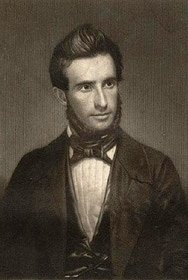
Andrew Jackson Davis |
What happens after death?
Having said this, let us look at what spiritualism tells us of life after death.
So far, the cases of death and return explain how spiritualists feel about the moment of death. But more can be said about what occurs from there on. Although many people quickly understand what has occurred to them, quite a number, due to lack of teaching or understanding, do not realise they are dead. So fixed is the idea that death is extinction, that when they find themselves, for instance after a car accident or sudden passing, fully conscious, and in no way different except for being invisible to most people, they are extremely confused.
A tremendous frustration grows, because although they appear to themselves exactly as in ‘life’, they lack the ability to be seen or heard by most of us in the body, and cannot move physical objects in the same way.
Some people in this state at first believe that some enormous conspiracy is underfoot to ignore them or to drive them mad. Arising dazed from a bad car crash, they fail to see their mangled body. and wander of to seek help. When nobody responds to them, or appears not to see them, tremendous confusion arises.
Dennis Wheatley, in his book ‘The Ka of Gifford Hillory‘, gives a fictional account of this, and Joan Grant, in her autobiography ‘Time out of Mind’ tells how during the world wars, she left her body asleep each night, and consciously helped the dead troops to realise their situation and find their way into the ‘death’ experience. Some of the things she did were verified by returning troops.
When we enter a swimming bath, we know it is pointless trying to walk. A different set of movements and reactions have to be used to deal with water. This is like entering an out-of-the-body existence. Most of the difficulties experienced are due to using our old values and reactions in a different ‘element’.
Two of the major problems are communication with those in the body, and the power of thought and desire. Both are easy enough to understand though. Let us take communication first.
I believe that all of the central ideas to be mentioned can be proved or disproved by your own experience. In fact there is an experimental way of approaching your own inner experience, so let us perform one of these experiments to determine difficulty in bodiless communication. This experimental approach is vital if we are not to get lost within opionions about psychic phenomena.
Try the experiment yourself
Have a partner for this experiment. Read from a book to your partner who should sit facing you. In doing so you are communicating ideas, images, emotions. Having performed this first part of the experiment, go on to the second part. Continue with the book, communicate with your partner without using your body!
If you perform this experiment hundreds of times, or even dozens of times, you will come to see two things at least.
- With most people, without using the body in speech, mime, expressions, etc., no conscious communication takes place.
- With those where it does occur, it is communication of a completely different order. It arises in fact as subtle inner urges, feelings, mental images, subjective sounds, emotions, or a sense of knowing.
Experimentally then, we can say if human consciousness does exist apart from a physical body, communication is almost impossible for most people, and where it does occur, it arises as subtle ideas, sensations, mental images, dreams or a sense of knowing. Obviously, neither the dead, nor the living, can usually communicate without using a physical body. So communication is not just a problem of the dead.
The second question, in regard to thought, power and desire, can also be approached experimentally. Our laboratory, as in the above experiment is ourselves. The above experiment shows that if there is coninuance of existence after death, communication with the dead is in no way different to life, except that one of the major factors – the body – has been removed in one of the participants. Because of this removal, the way we relate to others and ourselves is greatly altered, and often in unexpected ways. If we hold on to this idea of death being only life with the body removed, the experiences described become logical sequences of events instead of superstitions or seeming fantasy.
For instance, in our experiment, if we remove the influx of impressions via the body senses – i.e. if we remove the body – we have nothing to anchor us to sensory experiences and an objective world. Suddenly the whole bias of our existence is pushed into the subjective, interior realm of our thoughs and emotions – and perhaps the transcendental realm of experience also.
REMEMBER, these levels of your being have always existed, and in varying degrees you are acquainted with them. But if most of your life has been given to objective and casual subjective experience, the loss of body will at first seem like being pushed in the deep end of a swimming pool. If you have already, during life in the body, explored your inner life of thoughts and emotions, our interior and transcendental self, you already have experienced something of what you would find in the death state. This is why I say, death is only life with the body removed. Also, it is the reason for the statement that Yoga is a preparation for death – that is, when Yoga or extensive self exploration is used to explore the interior and transcendental levels of your being. See: Levels of Consciousness in Sleeping and Waking.
Death is like a dream – Full surround virtual reality
We will explore that idea more fully later. First though, let us return to the problem of desires and thoughts. Spiritualism tells us the ‘dead’ live in a land in many ways similar to physical life, except in its beauty, colour, lack of sickness, pain, war, and in the expanded possibilities life without the body offers.
In this land we can fly like birds, swim underwater like fish, communicate heart to heart, mind to mind, soul to soul, without the use of clumsy words.
We have a body, but it is a body at its prime, without weight or tiredness. We have clothes, but they are creations of our thoughts and unconscious dispositions, and we are clothed by our own love and wisdom, or lack of it. We experience heaven or hell, not as punishment or reward, but because we create our own environment by our own thoughts and emotions.
Here we explore music, the arts, creativeness, knowledge, relationships, without the limitations the body imposes, and with the added wonder of a new dimension of experience. We can see in colour, sound or telepathic communication between art work and observer – or artist and observer.
William Lilley, was a spiritual healer. He lived an extraordinary life, uniting in his practice the use of ordinary medicine, herbs, massage, manipulation, sound therapy, vibration therapy, along with a clairvoyant ability to look into the body and diagnose sickness. He was able to consciously ‘leave his body’ and visit the ‘Beautiful Place’, where he met the dead. His description of this is typical of many other people’s even to the ‘going through the mists’, but it contains an unusual element not often given – but he can describe it best:
|
|
When I am going into trance, I breathe in the Yoga method shown me by Dr. Letari. Immediately I get a sensation as though I am falling, or being pulled backwards. As this sensation comes to a climax, I seem to be travelling through space at terrific speed.
I have opened my eyes many times at this point, but the only vision I have is of passing through a dense fog. Then, quite suddenly, the fog clears and I am at a stile. I climb over this stile and immediately there is a voice speaking to me over my shoulder. This voice is always with me, explaining everything I see and everyone I meet. The stile seems to be on the edge of a large field, which rises gradually to the form of a hill. I walk up the hill, and beyond it I visit many places.
I have been to the Children’s Land many times and have spoken to children with whom I used to go to school, many of whom I did not know had died until I met them. I have paid visits too, to the Halls of Learning, which seem to me more like the Acropolis at Athens.
It is always the same stile, the same hill, the same voice, and it just seems like a large country with so many different towns to visit.
The most interesting and remarkable experience I ever had during these visits into the Spirit, happened before I went into trance. Several people had been speaking of consciousness. They had asked me to describe the Spirit. Was it solid? Did I appear solid? I promised them that if I could, I would find out.
I arrived at my stile, the voice came to me, and it evidently knew my desire, because it said “Feel the earth!” I did. It was solid. “Feel the grass beneath your feet!” I did. That was solid too, and even had dew on it. “Smell these flowers!” They were perfectly natural and had the usual perfume. In fact, everything around was natural. Then I was told, “Feel your body”. I did so. It was as solid as I am materially.
‘The voice then said, “Close your eyes; make your consciousness passive”, or as you would do when preparing for a trance state. “Now feel the earth beneath your feet!” There was nothing. “Open your eyes”. It wasn’t dark, it wasn’t light. “Feel at your body”. It wasn’t there. “Such is Spirit” said the voice. “Just a consciousness holding within it all experiences of your lifetime, all the joys and sorrows, your desires, achievements and failures, whence comes spiritual evolution. In your world of the material, you are able to examine matter; everything is matter. When you think of the spiritual, naturally you build in your consciousness another material world.”
There are very few comments on spiritualism, by a renowned spiritualist, quite as descriptive and cogent as this. But before we approach it, and the other quoted experiences, I will mention two more examples to complete the evidence, so to speak.
Going beyond time and space
Sir Aukland Geddes, MD, one time Professor of Anatomy, and also British Ambassador to the United States, reported an experience to a meeting of the Royal Medical Society in Edinburgh. It was reported the next day in the Scotsman of February 27th, 1937.
Sir Aukland read the account on behalf of a doctor who wished to remain anonymous. The man in question was stricken in the middle of the night with acute gastro enteritis. At ten o’clock he tried to ring for help, but found himself unable to move.
Gradually he found his consciousness split in two; one part was now outside, and distinct from, his body, the other still in his physical form. The exterior consciousness grew stronger as time passed, and eventually the body consciousness disappeared. The remaining consciousness, “which was now me, seemed to be altogether outside my body, which it could see.”
Then he began to realise he could see, not only his body, but any other person or place he thought of or concentrated on, whether in London, Scotland, or anywhere.
 |
‘The explanation I received – from what source I do not know – was that I was free in a time dimension of space wherein ‘now’ was in some way equivalent to ‘here’ in the ordinary three-dimensional space of everyday life. I next realised that my vision included not only ‘things’ in the ordinary three-dimensional world, but also ‘things’ in those four or more dimensional places I vas in.” |
I understood from my mentor that all our brains are just end organs projecting, as it were, from the three dimensional universe into the psychic stream and flowing with it into the fourth and fifth dimensions. Around each brain, as I saw it, there seemed to be what I can only describe as a condensation of the psychic stream, which formed in each case as though it were a cloud. but it was not a cloud.”
Beside this, he saw people’s thoughts and emotions in the form of a coloured cloud around them. Someone then discovered him in his sickness and telephoned for another doctor. Camphor was injected, his heart began to speed up, and to his intense annoyance he found himself drawn back into his body, and his heightened consciousness diminishing again.
The next account is of a woman’s dream. She says:
I was looking at a blotting paper. There were two small dots on it. As I looked. they spread wider and wider, merged, and began to cover the paper. As I watched, a voice spoke from behind, and explained that the small blots represented what people had been doing to themselves in order not to have children. Although the effects seemed small at the beginning, the results would spread, creating far wider effects than ever envisaged. Instead of over population, human infertility and impotence will occur because of the things people do to themselves. This would not only be in the individuals themselves, but in their children also. “Unto the third and fourth generation”. I was told also, how difficult “the blot” would be to remove once it had occurred. This was dreamt in the 1960’s.
Three interesting cases, each with a voice, or mentor or teacher, giving unusual information and speaking authoritatively. One is a dream, one a self induced trance, one a spontaneous near death experience, and yet they have very similar elements. It might be that we can understand death through understanding trance and sleep – or understand trance and sleep through death.
If, in our laboratory of self we experiment on dreams and consciousness, we may discover the face of death. There are two sayings which we find in every language, all over the world. One says ‘Sleep is the little death.’ The other says, ‘Death is the long sleep.’ Who then can be afraid of death, when we experience it nightly?
Link to Part three
Nothing is Permanent – except change
Life and Death
Part One
THERE is a legend about a woman who went to Buddha to ask him to bring her dead child back to life. He thought for a while, and said perhaps this could be done, if she first brought him a certain type of bean; but it had to be from the house of a family to whom death was not known. Eagerly she went from house to house, for this bean was a common food. But in each home she heard the story of how a wife, or husband, child, mother or father, or some relative had died. Slowly she realised that death had visited all, and the hurt ebbed from her own loss.
All religions, philosophers, mystics, sects and thinkers of the world, have explained death in their own way. Some have denied all consciousness after death, others have said that life itself was the real state of unconsciousness, and death, in reality, a waking up.
In a letter I received recently, a woman described an interesting experience:
‘I was desperately ill at the time, dying in fact, and I heard a voice counting, (the woman was having an anaesthetic) and knew that when it reached five there would be sweet oblivion, release from the pain and confusion.
The voice reached five. For a time there was a great noise and flashing lights, as if every cell in my body was exploding. For a few moments I knew nothing, and then there was awareness, but no pain, no confusion.
It was very dark, very quiet, very still. I could not speak, nor hear, nor see, nor move. At first I thought I must be asleep, and I made a great effort to wake up, but I could not. Why doesn’t someone wake me? I wondered; Perhaps I was dreaming, but no, I knew I was not because I was conscious of my thoughts. I became aware that I was not breathing, nor did I feel any need to breathe. I could feel no part of my body.
 |
I’m Dead!Suddenly, the truth hit me. I was dead! Can you possibly understand how I felt? It was such a huge unacceptable truth. DEAD! DEAD! DEAD! The word pounded on my consciousness. No – No, I cannot be dead. I cannot accept it. How can I think if I am dead? I put the thought away from me.
|
Then I thought of my family. I felt a deep regret that I hadn’t told them more often how very much I loved them, and I felt a deep sorrow that I would not see them again. I thought about my life, about the things I had done and seen; about the people I had known, and the places I had been. I thought about everything that was worth giving a thought to. How long had I been ‘dead’? Time seemed to have ceased to exist. Was it hours, days, years, or even centuries?
So far all my thoughts had been outwards. I had not dared to dwell on the thought that I was dead. But now I knew I must search deep into my mind, to find help for the panic which threatened to submerge me.
Who am I? What am I? Where am I? Have I always been like this? Perhaps this is my natural state, and if so, my life must have been a dream. But if it was – and suddenly the full implication hit me – neither the world nor mankind, really existed. I thought again of my ‘life’. Had it only been a dream, not real? But surely that was impossible!
It took ages for this possibility to sink in. It seemed an eternity before I came to the next inevitable thought. I must be God. But no, God and any kind of philosophy was of man’s creation; therefore, if mankind was only a large figment of my imagination, God would not exist.
I was alone. So utterly and absolutely alone. There was no space, no time, no anything. Even I myself did not exist except as a mind, a lonely consciousness, a still quiet awareness. I had come to the very beginning of thought, the birthplace of the soul. My mind had gone round and round in ever decreasing circles and had at last come to this void where there were no more thoughts, only awareness. My soul cried out in utter despair and loneliness. “Is there no other consciousness, no love, no comfort? Please God, help me.”Then I heard the words from another Being, another Mind. “I am the Father. The world was my Dream; Come!”
I was lifted up into the arms of God, a God whom I had thought could not exist. I knew then the “Peace that passeth all understanding”: that supreme joy, that Knowledge of the Ultimate Truth, that Absolute Ecstasy which I cannot begin to describe. There are no words for the complete Love and Light which enveloped me. I was a thought in the beautiful mind of God. I was in Heaven. It would be like this for eternity. But then I heard the words – “Go back now and tell them all about it.”
Slowly, very, very slowly, my senses returned. I was very dazed for a while. The doctors thought I would never come out of the anaesthetic. This happened three years ago, but I have never told anyone before because I suspected they would think me mad.

The problems posed by sleep and death were among the first that early men and women sought to understand. Their method of enquiry was by direct experience or intuition, as it revealed itself in dreams, or visions, or experiences such as that described above. For primitive peoples, dreams were as real as waking life; they were approached much as Freud approached them, as expressions of an inner life. Within the dream people spoke with their dead, and gained information concerning them. Direct experience was also gained by those who survived death, or who could consciously enter a death-like state.
The beautiful place
Today, all these avenues of enquiry are still open to us. The woman’s experience quoted is an extremely clearly expressed one of her sense that death is not the end of personal existence. Recently a friend of mine told me of a similar case. The friend works in a young adults’ centre, and four of the young men there were involved in a road accident. All four were seriously injured and unconscious. As my friend regularly practises prayer and meditation, she prayed for them. However, three of them never regained consciousness. But the fourth, a young man, eventually returned to physical awareness.
When he met my friend again, he told her an interesting story. While they were all unconscious, he said, they were all awake and together in a beautiful place. They suffered no pain and were happy there, and he told my friend of this because occasionally, while the four were in the ‘beautiful place’, they often became suddenly aware of her presence and support. For her this presence was an expression of her prayers.
All over the world, people have died and then been resuscitated. Electric shock, drowning, heart failure, medical operations, and many other causes, have brought about a cessation of breathing and heartbeat. Some have ‘died’ in this way for only a few seconds, others for longer. The people who have returned from the these experiences come from all walks of life, from all age groups, from all educational levels. Many of them had never previously thought about, or studied, the subject of dying. Yet the descriptions of their experiences are strangely alike. Not all remember anything. But those who do tell a similar tale.
Let me quote from two of these descriptions, and then give you a composite picture built up from many such experiences.
My Experience of Death
The first is a married woman, a friend of mine. She was taken to hospital seriously ill and in great pain. As she was on the danger list, her husband was called and sat with her. As time passed, she began to notice the pain lessening. Slowly, she reached the point where all pain and discomfort had gone. She felt strangely light and wonderful and was amazed to find herself floating above her body.
As she adjusted to this new situation, she became aware of a distant call – a beckoning beauty – an indefinable music, which urged her to go to it. This held out to her such a promise of wonder that she longed to be away, but she was intensely aware of her husband.
Her body had stopped breathing, but her husband was overcome with the desire for his wife to live, and she knew, in this transcendent state, his every thought. His soul was as visible to her as any landscape, and she saw his anguish, his love, the difficulties he felt facing bringing up their child alone.
Then she knew she could not go. She must hold on somehow and leave the ‘Promise’ until another time. And with this thought and decision, she sank into her body again.
Gradually, the pain and distorted consciousness returned, and it was weeks before she recovered properly. Both her husband and the nurses. told her afterwards that they thought she was dead, but that suddenly she seemed to come back to them.
Washed ashore
The second case is of a little boy. With his brothers and friends he went to bathe in a mill pool. He was only four or five at the time, and could not swim. In the recklessness of their-play, one of the children pushed him into deeper water. At that moment, the mill gates opened and water rushed through carrying him along. He was drowned – but some adults who were hastily called to the scene managed to pull him out and revive him.
 |
As his father carried him home in his arms, the little boy talked about his mother, who had died some years earlier and at first his father smiled at his story.The boy said that as he went under the water he felt himself sinking down and down into darkness. Then there was a change and he felt himself rising up slowly until at last he rose to the surface.He was in a huge sea. Around him, other people were also surfacing, and all were being gradually washed towards the nearby shore. There on the beach, people waited, and greeted those who were brought to them by the sea.
|
And as he himself drew near there on a small promontory were his grandparents waiting to welcome him – and in front – his mother, and she bent to draw him into her arms. She took hold of his hands and as she did so, a cross around her neck swung before his face. Sparkling in it were seven stones. But at that moment, something seemed to pull him away, and he sank into the sea and at last awoke on the riverbank.
The other half of the Story
At the conclusion of the story, his father’s condescending smile vanished. They were now at home and his father left the room, obviously deeply moved. Only years later did he tell his son the other half of the story.
The boy’s mother had died when her son was tiny and she had died on her birthday. For many weeks before, her husband had saved for a special present which he had kept secret. On her death, heart-broken, he had crept down to the coffin in the middle of the night, unscrewed the lid and given the present to his dead wife. It was a cross with seven stones, and the secret of it had been buried with her.
Putting together a picture of many such death experiences, we can begin to see a general view of what it might be like, what it certainly is for some, to die.
First of all comes a lessening and eventual disappearance of bodily sensations. Although all pain and physical awareness goes, most people are still conscious of their physical surroundings and of other people. In fact they often watch their own body breathe its last struggling breaths.
Usually people see themselves in a body, but it’s sometimes more perfect than the body they have just left. Their perceptions are nearly always enormously heightened in many ways. There seems to be no sensation of gravity or weight – the whole room or area can be seen instantaneously, as if with circular vision, and there is an awareness of the thoughts and emotions of those present.
Distant music
Sometimes a ‘dead’ relative or friend appears on the scene and leads the newly dead away to their new experience. But often a transition stage occurs. Distant music or scenery or voices, seem to call the person away. Here, thoughts and desires are immediate realities. The desire to stay roots one firmly to the spot – the desire to explore is itself sufficient to move one without any effort to walk.
This is what is meant by the term ‘earth bound soul’.
Those who have explored this level of awareness to some extent, say that due to circumstances being created by our innate thoughts, passions and desires, a person creates their own heaven and hell. Or alternatively, they may be bound to their physical surroundings, but minus a body. This inability to explore and mature into their new life, occurs because they are unable to let go of desires which can only be satisfied in a physical body – or else are possessed by malice for, or dependence on, someone still in the body.
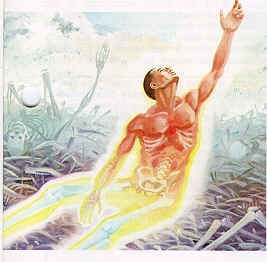 |
In her book ‘Twenty Years A Medium‘ Ursula Roberts gives an example of such a case. She had been called to a house because of some strange events. The house owners felt that some presence was trying to push them down the stairs, and when the wife climbed the stairs wearing a pearl necklace, she felt an unseen hand tear at the necklace, and break it.When she arrived to investigate, having clairvoyant vision Ursula Roberts noticed an old man standing at the top of the stairs. As she began to climb the stairs the old man threatened her, and told her that he would push her down the stairs. |
But she was used to dealing with the ‘dead’ in this way, and went up and asked him why he was making such a nuisance of himself. Angrily, he claimed that the present occupants had stolen his house, which should have passed to his children. When asked for proof, he led Mrs. Roberts to the basement and pointed to a space above a door. There, very dusty old papers were found proving that the father of the present occupants had cheated this old man out of his house. It was quickly given to his descendants and never again was there a troublesome presence on the stairs.
Free from painful thoughts
Joan Grant, in some of her books, also tells how she was able to free several suicides from their earthbound condition. In ‘Time out of Mind’ she describes the case of a man who had thrown himself in front of a train. By gradually freeing him of fixed and painful thoughts, and leading the direction of his ideas towards his daughter who was already dead, she led him out of his situation.
In our own culture, few of us are given any education in the matter of dying, and this may cause problems at the level of experience we are talking about. We may even have fixed and false ideas, which bind us to them. Nevertheless, most people who die and are then resuscitated, find an intuitive flow of guidance. Many go through one of the other early death experiences – namely, the re-experiencing of one’s entire life memories.
Awareness of the void
In general, the returned dead usually pass on from this experience to an awareness of the Beautiful Place, or, as Spiritualists call it, the Summerlands. From here, where old friends and new are met, they are snatched back into ‘life’. Very few, like the woman first quoted, go on through other aspects of dying, into direct awareness of the void, God and Eternity.
But if we are to gain an understanding of why such things occur, and realise the greater pattern of death, we cannot rest at merely repeating what others have said. We have to look into our own life and see its direction death-ward, and its point of entrance at birth.
We must look at the whole spectrum of human experience, belief and knowledge, not at just one of the many colours such as science or religion. Perhaps in this way we can begin to gain an inner awareness of dying. But more important still, maybe we will come to see what it is to LIVE!
Link to Part two