Author Archive
Meeting My Dead Parents
Then I entered the realm of death and so had to face and go beyond the fears and images people have of death, and I was shown my father. “I have fathered you my son,” he said. “but you have led many of us to new understandings.
From this I saw my father in quite a different way than when he was in the body. He looked as if he was now a person of importance because of the knowledge he was communicating. It felt to me as if he had flowered into his manhood. Another strange feeling I had was that, maybe because if our cultural feelings that we live in a world where we believe that the past can never be changed and is past, sometimes full of regrets and feeling about what we feel we should have done or been, I saw that what my father had done was in some way reaching through all the past generations. In some way the present changes the past just as the past has tremendous influence on our present life.
Regarding this Mansfield describes an experiment in quantum physics where one particle/wave of light from a distant star is made to pass through a series of mirrors along different arms. A single particle/wave is called a photon. As the single photon is passing through the series of mirrors, the method of observing it and measuring it is altered. This means that on its entry into the system the photon is a wave, but when the method of observing is changed into a photon, the photon becomes a particle. The astounding thing is that not only does it become a particle from that point on, but its nature is also changed in the millions of years in the past it took light to reach the present.
We live in an astonishing world and we too are astonishing.
Then I asked to see my mother. It was an amazing experience. I saw her face, young full, but as I looked at it a change happened, for the image of her face became the faces of countless women. As this happened I realised that the personality of my mother was produced or had a background of countless women. And in the end, is connected deeply within herself with a synthesise of all women – The Great Mother. See http://dreamhawk.com/dream-encyclopedia/archetype-of-the-great-mother/
I began to realise that I was confronting something difficult to explain, something that was a reality at a level or a dimension I had not met or experienced before. It was a huge being which I began to see was capable of taking in and holding every mother’s experience and person, and was itself a complete synthesis of all mothers; in fact She was The Mother of everything.
It was difficult for me as a human being to grasp its magnificence. I realised in my own small way why people in every culture kneel before the images of this Mother. In some wonderful way She was my mother and yet behind and working through my mother was The Great Mother.
I saw too that every woman I had loved or dreamed of was in a way a meeting with this Great Mother. Then, because I saw and felt in the presence of this Figure, hurts I had done to the nature of women, I wept and asked forgiveness. I was shown that it wasn’t what I had done to any woman, but the hurt I had given to the nature of womanhood, with its great drives and energies that make women want a child and love from a man. Then in forgiveness She took me into herself and I felt and still feel AWE.
Also, I saw that the Virgin Mary is far more than I had previously understood. When we kneel before her, we are kneeling before all mothers. She is wonder-full. It is the face of every, every face throughout the ages. She bears all the pain and wonder of every woman who bears a child. She is the Mother of all. And the wonder of it is too much for me to understand.
Life is a holy mystery. Why has it taken so long for me to understand – it is because during my life I have gathered/integrated more people into me, so became larger.
My sin against womanhood was that by stopping, when I did, the ability to have children through having a vasectomy. It wasn’t that I had a vasectomy, but I did it in response to my wife apparently becoming pregnant, and so in response I tramped upon her feelings of love and desire to have a child with me. It was actually a false pregnancy. I can’t even find words for it.
The Way Of Life
The greatest challenge in life arises from not being able to escape from oneself. That means not being able to avoid your own weaknesses, or escape to the whispered urges of your own amazing potential.
Meeting and dealing well with your own resources and potential also confronts you with the world around you. Whatever you choose to do, even if that is curling up in a ball in isolated withdrawal, you are still interacting with the world around you. You are still breathing. Therefore you would still be interacting with the bacterial life around you, and possible other living processes such as the trees, plants, and the minute moulds and fungi.
In general however, our interaction is immense and much of it unconscious. We usually have little awareness of the tremendous exchange of gases, fluids, bacteria – along with the social, verbal, sexual and sensual signals and interactions going on around us and influencing our own existence.
Yet there is something even more immense in which you are totally and inescapably involved. If you could be aware of the totality of what this is in any one moment, you might fall on your knees in awe. Yet because your focus of awareness is usually so narrowly fixed on what is known through your senses and thinking, you miss the meeting with this splendour and mystery.
I am talking about the fact that your existence depends upon the mysterious processes of life, and those processes in turn are an emanation of the formation of the universe, only an infinitesimally small fraction of which you are aware of at any one moment.
What follows in this book is a look at what the possibilities of your existence might be within this huge mystery we call Life.
The Missing Handbook
Despite the fact that you have innate possibilities, that your body and mind function in reasonably specific ways, and that the laws of nature are fairly stable, you do not arrive in the world with a handbook describing your potential and how to get the best out of yourself.
If you had just purchased a machine as complex and as wonderful as your own being, you would demand such a handbook from the manufacturer. Unfortunately, the universe, the planet, and the parents who brought you forth, do not supply such a helpful guide.
Of course, every culture has attempted its own handbook, its own definition of personal origins and possibilities. We see these in the religious, philosophical or political writings and statements of the ages. But these are often very local in terms of the needs of the times or of the specific difficulties faced through geographic, environmental or social conditions.
You Have Individual Needs And Direction
Although fundamental and important issues are dealt with in all of these early handbooks, many of us today cannot find personal instruction in them to meet our own individual challenges and temperament. In some ways personal growth is like that of a plant or tree. The tree does not take up ready-made leaves or fibre, but creates these from the minerals and substances it takes from the soil. We cannot arrive at anything like this wonderful transformation of raw information and experience until we recognise what our own being needs to take in, and what it rejects. Like the tree, we need access to a wide variety of possible sustenance before we can find and integrate what we need, and what transforms into our own personal beliefs and insights. But if you knew something of the essence of today’s scientific research findings, and the wisdom arrived at by different cultures throughout the ages, you mind more easily find the sustenance you need for your own personal growth and maturity. You might also find ways of utilising your own innate abilities and functions more effectively.
To this end what follows is presented as fertiliser for your own roots to feed on.
In The Beginning
To make the best use of your own potential and functions you must arrive at some understanding of who or what you are. This is a huge and complex question, and because of its complexity has to be approached by looking at the simplest factors first.
If you are capable of reading and understanding what is written on this page, you are probably able to affirm your own existence. This means you have a sense of yourself as distinct from any other person, animal or object. For most of us this is a central reality, and therefore a useful starting point. Nevertheless, there are complexities regarding your sense of self that require us to look further back. For instance the questions arise as to whether your sense of self arises from your bodily functions or whether it is self-existent in some way. If your sense of self is directly related to your body, what body is it related to? Is it your infant body, your twenty year old body, or a body you reach in old age? Sometimes we identify with a particular age we achieved, or a particular way our body looked, and not with the ever changing reality that is our body now. We may also see ourselves as being of a particular type or character. For instance you may hold particular religious, political or philosophical beliefs. If you counter this by saying that you do not believe in anything in particular, that itself is a philosophy. And each belief system leads you to see yourself in a different way, and to relate to the world and people around you in particular ways.
Nevertheless, no matter what you believe, or how you see yourself, each of us experience a variety of personal urges and conflicts. Can we therefore say, “I am this!” or “I am that!”? Our personality or self is made up of many different feeling states and urges, sometimes disturbingly so. The only stable thing in all of this is simply the sense of existence itself. It may be buffeted by emotions, intrigued by ideas or opinions, challenged by problems of health, but in the midst of all that it still stand firm.
So we come back to the questions of, “Who or what are you?” “What is the most basic fact of your being?” If we can discover something of that, if we can discover something of your foundations, then we might be able to build a conception of what your origins are, what you are capable of, and how you connect with the world around you.
The first step in discovering this faces you with the question of what your origins are. We are tempted at first to think our beginning rests with our parents and ancestors. Or maybe we look further back still and see that our real beginning, as echoed in the developmental stages of the embryo, are with the evolution of life on earth. But there can be little or no argument that if the universe did not exist, there would have been no earth for life to evolve on, and you would not have a body or awareness. So the story of your present existence has its beginning right at the formation of the universe.
This may seem a very abstract or theoretical thing to see as important in dealing with life in the here and now. But almost every ancient culture had what we now call a creation myth. These were considered very important, and the reason may be that the foundation of things is as important as the foundation of a house or building. With a poor foundation a building is weak and has no innate strength. Having some sense of your beginnings leads to a greater feeling of sureness and confidence in life. Your identity, or what you identify with as being your fundamental self, also grows out of an awareness of your origins. If you believe that you originated with your parents or your forebears, your sense of who you are will arise in a large measure from the quality or lack of it your parents and forebears displayed. But if you can accept the formula that without the formation of the universe you have no personal existence, then your own foundations go much further back than your parents, and are on a much grander scale.
If you have not explored this question before you may, as many people do, believe that your beginnings are with the formation of your body. But this is like saying; “This tree started its existence when I planted the seed of it in my garden.” This only leads to the question of where the seed came from, and so on backwards. Looked at in this way, your body is a budding out, a flowering, of cells that have an unbroken line right back to the beginning of life on our planet. Some theorists even believe that life on our planet was ‘seeded’ from particles entering our atmosphere from space. But without arguing that theory, we do know that the material our bodies are made of is ancient beyond the age of our own world. Our roots certainly go back a lot further than parents and grandparents.
Even so, these ideas might still leave you cold. After all, perhaps you are only aware of your own life and difficulties here and now. Maybe you cannot even remember much of your childhood, let alone any further back. So what relevance has such information?
- D. Laing, in his book Politics of Experience, writes:
We are born into a world where alienation awaits us. We are potentially men, but are in an alienated state, and this state is not simply a natural system. Alienation as our present destiny is achieved only by outrageous violence perpetrated by human beings on human beings.
In some degree we are all caught up in this violence. We see it occurring around us, and perhaps we are personally attacked in one way or another. For many of us even relationship and work are forms of violence imposed upon ourselves. If we are to find our way out of this, even in small degree, we must come to know ourselves more fully, even if that is painful.
The important point here is not whether these ideas are correct or not. They are only given to open your mind to possibilities. The important kernel is that the bedrock of your existence is the universe itself, and your fundamental origins are with the formation of the universe.
Within that statement lies buried an incredible possibility. To unfold that possibility and make it understandable it is helpful to look at how present and past thinkers and researchers explained the creation of the universe and life on Earth.
The creation myth of our times, based on the scientific practices of the present, is called the Big Bang Theory. I call it a creation myth not because I wish to discount it in any way, but simply as a way of remembering that science itself tells us its theories are forever being changed and developed. Also, past cultures had their own excellent ways of investigating the world around them. The mythology of an African tribe stated that one of the stars visible in the night sky had an invisible twin. To the naked eye this twin was not visible, and so it seemed the myth was pure make-believe. Neither was the twin visible to normal telescopes or binoculars. But with the greatly enhanced telescopes developed in recent years it was discovered that the visible star actually was a twin. It was a system with two suns.
Therefore I honour those ancient findings by classing our own experimental and observed data as a creation myth.
According to this creation myth of the Big Bang Theory, the universe began at a specific time. Authorities find that difficult to place precisely because of the enormous span of time between the beginning and now, but it is somewhere between ten and twenty billion years ago. Many commentaries rest at the figure of fifteen billion. That is, 15,000,000,000,000.
The theory became established in 1929 when the astronomer Edwin Hubble observed that the universe is constantly expanding. When the rate of expansion, and the state of expansion was run backwards, it could be seen that all the galaxies were moving outwards from one point. But this point does not exist as an area of space. Everywhere acts as a centre from which everything else is expanding away.
The idea of the Big Bang was not new however. In 1927, the Belgian priest Georges Lemaître suggested that the universe began with the explosion of a primeval atom. This idea came after observing the red shift in distant nebulas by astronomers. [1]
Hindu beliefs are also similar in some ways, and long predated western ideas.
Because light moves toward us at a known speed, and because of the enormous distances between stars and galaxies, when we observe a distant galaxy we are looking back into the past. So in looking at very distant galaxies we are experiencing the far distant past.
One of the most important features about this suggested[2] beginning of our universe is that prior to it there was no space or time. The Big Bang is said to have actually created time and space. This is a difficult concept to grasp right away, but its importance lies in the fact that some of the findings of physics in the last century suggest that there is still an aspect of the universe, and therefore of our own being, that exists in a spaceless and timeless condition.
But this condition prior to the creative explosion itself is still beyond the capability of present theorist’s and mathematics to explore. It therefore remains an ineffable mystery to science.
What is more defined however, are the stages the process of creation went through. In the Kingfishers Young People’s Book of Space, the stages of creation are explained as follows:
- The cosmos goes through a superfast ‘inflation’. Expanding from the size of an atom to that of a grapefruit in a tiny fraction of a second.
- Post inflation, the universe is a seething, hot soup of electrons, quarks and other particles.
- A rapidly cooling cosmos permits quarks to clump into protons and neutrons.
- Still too hot to form into atoms, charged electrons and protons prevent light from shining; the universe is a superhot fog.
- Electrons combine with protons and neutrons to form atoms, mostly hydrogen and helium. Light can finally shine.
- Gravity makes hydrogen and helium gas coalesce to form the giant clouds that will become galaxies; smaller clumps of gas collapse to form the first stars.
- As galaxies cluster together under gravity, the first stars die and spew heavy elements into space: these will eventually form into new stars and planets.
Some refinements that are left out of this sketch are that gravity did not at first exist. Also that as the cosmos came into being, tiny fluctuations created situations that would later allow galaxies to form, and the possibility of life to exist. One scientist called this the ‘finger of God’.
In other words, the development need not have gone the way it did. Other directions would have negated the possibility of life and personal awareness. Also, the death of the first stars produced materials that are the basis of our own world and therefore our body. Whatever way we like to explain it, the universe moved toward the possibility of life.
Some aspects of the Big Bang creation myth need to be looked at more closely. This because they connect directly with the theme of personal origins and the questions of who or what you are. In particular, because the fundamental nature of our universe, its own origins so to speak, rest in a timeless and spaceless condition, this needs exploring in a more here and now way. There are some strange facts about the nature of things suggesting that all times and all conditions are present at this moment. If this is so, the timeless and spaceless ground of existence is still a facet of your life today. Just as a reminder, remember that when we view distant galaxies, we are witnessing the far past. So there may be a clue in the nature of light.
Light was considered by classical physics to be either a wave or a particle. Careful experiments revealed the paradoxical nature of light. It is both a wave and a particle. Observed in one way it is a wave, observed in another way it is a particle. We can think of a particle as something similar to a small ball-bearing. A wave has the nature of ripples we see on the surface of water.
| Bell’s Inequality Theorem
Irish physicist John Stewart Bell put forward a quantum theorem that has revolutionised the way reality is considered. In brief, the theorem states that when two sub-microscopic particles are split and moved to a distance from each other, the action on, or of, particle ‘A’, is instantaneously reproduced with particle ‘B’. This interaction does not rely on any known link or communication and is considered to stand above normal physical laws of nature, as it is faster than light. Prior to such findings it was thought nothing could transcend the speed of light. Nick Herbert, in an interview published in High Frontiers writes: ‘THERE ARE LOTS OF THINGS that are being kept from the public as far as the subjects of physics and consciousness are concerned. Bell’s Theorem was proved in 1964, and it is still not taught in physics classes, and you don’t hear it on your science news programs. A theorem is a proof, and no one has found a flaw in this theorem. It’s such a simple proof that a high school kid can understand it. So physicists can understand it. They have various ways of trying to ignore it, but it can’t be refuted because it’s so simple.’ To quote Gary Zhukov, ‘Quantum mechanics is the theory. It has explained everything from subatomic particles to transistors to stellar energy. It has never failed. It has no competition.’ The implications of the theorem are enormous. Something can be in two places at once. Apparently distant objects, or people, are intricately linked in an immediate way. There is no separate existence as we previously thought. Our view of the world is not one supported by the facts of physics. Time and space are transcended. David Bohm, an eminent physicist, goes as far as to say that all things in our observable universe are inextricable linked. Nothing has separate existence. |
The fact that light is both a wave and a particle is astonishing enough. More astonishing is the fact that its nature changes according to the way we observe it. Regarding this Mansfield describes an experiment where one particle/wave is made to pass through a series of mirrors along different arms. A single particle/wave is called a photon. As the single photon is passing through the series of mirrors, the method of observing it and measuring it is altered. This means that on its entry into the system the photon is a wave, but when the method of observing is changed, the photon becomes a particle. The astounding thing is that not only does it become a particle from that point on, but its nature is also changed in the past. [i]
This demonstrable fact faces our rational mind with a conundrum or paradox. To quote Mansfield, ‘Now here is a real conceptual knot. It seems that our choice at the last possible moment determines what light did in the past.’ Mansfield goes on to say that if we made the experiment more dramatic it illustrates the enormity of the findings. To do this he suggests that instead of thinking of light passing through mirrors directing the light in different directions (arms), we think of the light reaching us from the stars. He says ‘Let the arms be billions of light years in length. Then we have a billion or so years between the interaction with the half-silvered mirror and the full-silvered mirror (used in the experiment). This means that my decision today effects what light did a billion years ago! This is too weird even for physicists, noted for their playful imagination, to contemplate. How could my decision today influence the universe billions of years ago?’
Therefore, when examining the model of our mind, we need to leave space on one of the walls for a door. It needs to be a door that opens onto a different sort of universe than the one we may previously have felt to be solid reality. It is a universe that alters its appearance – no, its very nature – according to the way we observe it. Each question we ask of the universe, each attitude with which we approach it, each viewpoint we take, reveals to us a different universe. The universe is therefore not separated from us. We are intrinsically a part of it, and are participating in it. In some way the universe is constantly being created by ourselves as participants. It seems as likely too, that the we the participants are constantly being created by the universe. And the past is not set in concrete. In some mysterious way it is linked with what we do in the present.
We cannot yet say these revelations of science explain coincidences. However, they do point out that the universe is stranger than we previously believed. Therefore the coincidences you experience or hear about may hopefully be an anomaly opening a new door for you. It is a door that can reveal more of yourself, and more about the world around you. Coincidences are like the cartoon cat who runs to the edge of a precipice and carries on running without falling. Suddenly the rules of the world we are so sure are fundamental truths, are thrown into question. Like the worm-holes or the time-warps now common in films and television, coincidences allow us entrance into other dimensions of experience.[ii]
[1] See: http://liftoff.msfc.nasa.gov/academy/universe/b_bang.html
[2] Suggested because the Big Bang Theory is not proved, only inferred from evidence.
[i] If you wish to explore this information further, read: Synchronicity, Science and Soul-Making by Victor Mansfield. Published by Open Court, USA. ISBN: 0-8126-9304-3. Call toll-free: 1-800-815-2280.
[ii] References to people, subjects and authors in the boxes – A more complete, detailed description about Bell’s Theorem and the “new” physics, can be found on Dr. Nick Herbert’s web page http://mail.cruzio.com/~quanta/index.htm :– Michael Talbot is the author of The Holographic Universe, published by Grafton Press. See a description of Bell’s Theorem on http://mail.cruzio.com/~quanta/bell.html – See Fritjof Capra’s book The Tao of Physics and Wholeness and the Implicate Order by David Bohm. Published by Routledge. ISBN: 0415119669.
Submarines In The Cosmic Deep
Latest Features
The artist above is Yuumei – Blurred Lines by Yuumei on DeviantArt

Your Amazing Life Journey
Did You Know About This?
A Journey Through Deaths Wonder
Archetype of the Mandala
Archetypes-Links to
Beginning of Us All
Bodiless Experience
Dreams – Messages from Your Highest
Edgar Cayce – His Wisdom
Fascinating People
Intuition – Using It
Learning the brake, gears and accelerator
Meetings with the Christ
Murdering or Killing Parents
Neal Criscuolo & Neil Crawford on choosing Employee Ownership-Profit Sharing
Opening to Life
Past Dwelling Places
Psychological Vomiting
Self-Regulation – Homeostasis
The Bare Bone’s Of Dreams
The Builder
The Flux
The Many Ways To A New Life
The Things Forming Us
The Way Of Life
The Way Within
Things I Wished I Had Had Been Taught Earlier in My Life
What Are Dreams
What Lies Under The Surface
Who Am I?
THE THINGS FORMING US
My body started jerking and moving in a pattern of activity that was very unexpected. It expressed a feeling of being trapped or pinned down around the area of the chest and solar plexus. My body felt very stiff and immobile and from the feelings I could not rise from the bed because of being held down. A few shouted phrases accompanied this. I said that the father carries the pattern for generations. I was referring to the pattern of achievement or lack of it that is passed on to the children. It was the attitudes of how to cope with social activity or work – the external world.
The movements gradually led to feelings. These expressed a living connection existing between my ancestors in Italy and myself. This surprised me because I had years ago gone through the realisations of what I carried from my father and his fathers – the subjugation by church and state. But this was different. It was not that I was still carrying the attitudes and fears, rather that because I dared to step out of dependence and subjugation by such authorities, deeper levels of influence of a transpersonal nature were being squeezed out of my body. I experienced the sense of our family having lived for generations under fear – fear of death – fear of what people would do to us if we didn’t conform. My breaking away from such conformity was the activity that was squeezing it out of my body.
I saw that having lived in those conditions for generations our body had changed – altered. Like wasps that at one period were individuals and then for generations lived as a colony and their body altered. I felt that such alterations had occurred in our family and they were being got rid of.
The phrases coming out of me at this point were that – ‘Fathers are a dying breed’. ‘Not to soon either’. ‘A terrible thing to carry all by oneself’. ‘Put in the role of God and got to go out into the world and prove oneself against all odds’.
I wondered here what it was that I was carrying in my body that was emerging. I asked myself what I was breaking free of. Certainly fear of the church. Fancy kissing the Popes finger – the ring – as if he were holy. Why did we do it?
Now a rush of insight arose. I saw that the Pope represents a function in the state or society. He represented the function of cohesion. The power to act as one body, one group, one will. I saw the church, and its ministers as representing the power which causes a nation or group to become like an anthill, or like a group of animals such as the mole-rats, to act as one organism. The individuals have to submerge their will and personal needs for the needs of the whole. This was represented by Christ on the cross – the pain of sacrificing one’s life for others.
This insight was deepened by seeing that all the functions of the individual were taken on by the state. For instance, to act as a single organism – the body of Christ – the worker cells would not function like the brain cells. That is, they would not make decisions of decide policies. This was taken over by a special group of men acting as special cells – rather like in a termites nest some termites are workers, some soldiers. They are specially reared and chemically stimulated to fulfil these roles. Worker bees are fed differently to the queen for instance. Thus in the group organism of human society there are different casts or levels of function. The means of stopping workers from taking on the role of independent decisions was by the use of force, threats, fear, murder, or even integration into the new order.
Looked at in this light religion was a very functional process which both represented, induced, and enforced the life of the social organism. It acted as a self-regulatory or healing function in the ‘body’ of the people also. It encouraged individuals to lose themselves in the good of the whole – to gives their lives to it. The overall person – the collective person – was represented by Christ. Christ also represented the life of the individual within the mass of cells.
Many modern individuals are learning to break free of the influence of groups and organisations. This is difficult though, because for huge periods of time that is all we knew. The old patterns are very deep, even in our body. Feeling free is not enough. It only proves itself when we can maintain it in the face of outside authority. I felt that the pressure of the group – the pressure to conform would subdue the working of some aspects of the glandular system and other body processes. It would lead to a fairly low energy type of person or group.
To come alive one would need to become capable of making one’s own decisions outside of the influence of the protection of ready made rules of conduct such as religion, politics and philosophy. Being free is frightening but wonderful. One leaves behind the responsibility to God and the need to do what God or parents say.
This may lead us to feel we are not part of the playground of life. I meant this in a real sense like the ‘games’ which go on in a children’s playground – top dog and underdog – gang enforcement – nationalism and suppression and aggravation of minority groups. I saw that in recent years I have myself been standing back from this everyday ‘playground’ and not getting involved. I have broken free from sets of belief systems and have not identified with another. But I have looked at other cultures in an attempt to see ‘what they’ve got’.
I went on to consider what was represented by Eastern religions, and to consider the ‘solutions’ they offered such as the void, nirvana, samadhi, etc. I had been reading ‘I Am That’ previously and this entered into what I realised.
As I explored the states of being suggested in Eastern practices I saw something I had never seen before. Firstly it was to do with the whole social situation of Eastern countries. Always the individual cells – the individual men women and children – were in stress in the sense that society pushed them to conformity. The cast system of India, the killing of students in the recent social conflict, the conformity seen in Japan, and the recent feudal systems; all pointed to individual stress, pain. I saw the image of the termite hill as representing this. If the mound satisfies the individual members then their needs are met. But supposing there was not enough oxygen in the mound, this would show as individual and collective distress.
The other telling point was that the information I had received about the ‘answers’ to life in the Eastern system were always suggested as a release from pain. Buddha’s nirvana was an extinguishing of the ego so there would be a release from the pain of life. The sight of death, illness, suffering in Buddha’s life was what motivated his search for an answer. The path of Buddhism is a way toward release from suffering. This suffering I realised as the individual ‘distress’ such as the termites might feel if their ‘social system’ were not actually supplying the needs of its individuals. The massive concretization of the caste system suggests this from another angle.
The reading of ‘I Am That’ also told me the same thing. In reply to questions as to what was the point of finding the state of being in which there was no self, was that all pain was gone. The statements of people asking the questions was also suggesting this. To quote from memory; ‘Even though I have periods of pleasure, pain always returns.’ This theme occurred often, suggesting the questioning Indians felt a lot of pain in their life. Why did they not see that although there is sometimes pain in one’s life, one always returns to pleasure unless you are not dealing with traumas you are unconscious of? See Psychological Vomiting
So, I saw the Eastern Path as ways that distressed individuals could find release. A method had been found in which all self could be lost, and the usual pain of individual existence would no longer operate. This was tremendously informative and freeing to me. For much of my life I had investigated and pursued understanding of various cultural wisdom, but I had never seen that some of it had arisen from such enormous social misery. For the individual to change society was less easy than destroying the state of mind which led to a sense of oneself. In destroying this all pain was gone too.
I realised that our own society exhibited such signs of distress, as did America, and most of Western society. Léon and I talked about this at one point and Léon said that individuals in our own society who did not fit in with the social order – were not functional in the ant heap – might be allowed to live because the conforming members might be frightened to see them dying on the street – as happens in India, middle East, Africa, etc.
There seemed to be quite a long period when I went in search of some sort of answer to this awful situation. If I had access to a wider awareness, as appeared to be the situation in the session, then it might be possible for me to find a workable solution to this distress. I realised I had put this question on myself for many years. My quest inwards was largely an attempt to find an ‘answer’ which would be healing to the individuals who used or lived it. I kept reminding myself at times in the session, as in the last one, that I wasn’t Jesus Christ. I wasn’t the saviour of the world. I hadn’t found an answer. But I felt that people who were trying to exist outside of the old patterns needed love and support, that I give freely to those who reach out for it.
In the search I spontaneously felt myself going into the ‘Path of Death’ seen in the previous session but not explored. This time I went into the experience. The imagery was that lizards, frogs, snakes were pouring up from down below – the pelvis. They ran along an old dry river bed – to the head. As this happened I realised I was going into the ‘reptile’ aspect of my brain (See Reptilian Brain) in which my breathing slows right down. This happened and I felt I was going into the presence of the animal temple, a contact with instinctive wisdom. At one point there was some movement which I didn’t quite understand about giving a body signal and it not being responded to. But I got into feeling that I could find no answer and wondered what I was doing in this type of awareness. I did feel that whatever animal we have loved we have the pattern of it as a resource.
LISTEN TO ME
I’d like to tell you about myself. My life didn’t actually begin at 13, but I started some things then which have been with me ever since. You know, on one or two days in your life it’s almost as if you suddenly wake up and without blinking an eyelid or having regrets, change your whole existence.
It was like that one morning, as I said, when I was thirteen. I’m an only child and I had a bedroom to myself. It had a door and a bed on one side and two large wall cupboards, a gas fire and a very large mirror on the other. I used to sleep without any clothes on, and when I got up that morning I couldn’t help noticing myself in that large wall mirror over the gas fire. True, I always did notice myself in it every day and looked to see how my acne was coming on – I’d been spotty since 11 – but on that morning I really did notice myself. I had a good look at not just my spots, but at my round shoulders, my narrow chest and my long thin legs. To see the latter I had to get near to the mirror and look down into it, so to speak, because it was quite high up. For the first time in all those years it really struck me that I didn’t like what I saw. I’d been hovering about that realisation for a long time. It’s easy enough to realise you don’t like Dicky Adams who sits next to you in school and who tried to grab my dick all the time, (At that time it was a thing every boy did, trying to grab each other’s dick. It was so pronounced I even wondered why I had never seen any of the male teachers grabbing to see what size dick they had), but to admit the same about yourself takes longer.
Actually, I’m still undecided whether I didn’t like what I saw, or felt I was destined for greater things. Come to think of it though, my view could have been helped by a pen friend I had. For some time I had been writing to a blonde, beautiful, Swedish girl. I believe her father was conductor of an orchestra; at least that’s what she told me, and she looked the part. After some months of writing weekly and eagerly awaiting each others letters, I sent her a photograph. Her next letter contained bad news. She told me that for family reasons she had to stop writing, and so ended what I had hoped was to be a long and growing romance.
The light of my dreams about travelling to Sweden and sharing sustaining love for each other had to be extinguished. Perhaps that was the darkness that had caused me to see myself in such a bad light. Or maybe it was my mother’s influence. Looking back, I can understand the situation, but at the time I could only take it where it hit me. You see, my parents owned a greengrocery shop in a small, attractive paved walk near St Pancras Church in London. It had belonged to my grandfather Nick, who was an Italian from near Amalfi. Just after the war Nick wanted to see his home again and so went to Italy for a holiday and died there. So my father, the youngest of five boys and three girls, took over the shop. Dad was a full-blooded Italian and mum just as full-blooded English. Not the quiet English rose, but with a lot of emotion and a temper she could express easily and some-times devastatingly, as many traders found out who tried to give her a raw deal. If she had something on her mind she would stew over it for hours or even days, going ominously quiet. Then suddenly she would start talking and with volcanic force the heat of her worried emotions would spill out. Not that there were many things which caused her that amount of emotion and anxiety. I can’t ever remember her flooding out strong over politics, hardship, the war, or clothes. The few things that roused her because they were her whole world were concern over the safety and well being of me her only child; my father and his very few glances at other women; internal family feuds, and being sold bad goods in shops or in life.
My mother was, and still is, one of those people who live almost entirely on the emotional level. Sex never meant much to her, and her mind she used to get things done with, not to clarify or explore, feelings were good enough for that. So the force of her life expended itself mainly through years of non-ceasing hard work, and the pleasures, worries, excitements of caring for her man and child. It was therefore both very satisfying and sometimes very difficult to be loved by mum.
When there is not much else in life for you except your feelings for your family they can be very intense. The amount of her oaring as it poured into her cooking, washing, working, painting the house, being with us, was enormous. But it was so intense she could as soon flatten you with it as nurse you when you were sick.
For instance, when I was six we lived in Amersham, Bucks. I went to school at St. Mary’s along School Lane, which ran past fields and a recreation ground. I hated school dinners so I walked home each day at dinner time and Mum had an arrangement with our next-door neighbour who cooked a meal for me because the war was on and mum went to work. Brian Spencer, a boy from my own class, also walked home. On one beautiful summer’s day we walked back to school together after having our dinner. School Lane starts from the High Street and passes through some rather fine houses and what was Goya’s Perfume Laboratories, where my mother worked at that time. Then the lane turns left and stretching uphill to the right is Rectory meadow. It was covered white with horse daisies, and in the heat of the day was a beautiful place to be. So we went into the field to gather horse daisies for our teacher. It didn’t seem to us we were there long, but when we arrived at school with our daisies, an ominous quiet existed instead of the usual shrieks, laughs and shouts of children at play. We felt very unnerved and walked slowly to our classroom door. Putting our ear against it we could hear a lesson was in progress. We stood outside for some time trying to find courage to open that huge wooden door that had huge metal studs on it and walk into the gaze of thirty children and teacher. I had never ever been late, and it seemed complicated to explain what had happened. We decided the best thing to do was not to disturb the lesson but play in the recreation ground until the afternoon break. We could then join the other children and go into our class when they did. Right, the problem was solved. Meanwhile, to pass the time we played on the swings, roundabout and rocking horse. Tiring of that, we moved down to the river Misbourne at the far end of the recreation ground, beyond the cricket pitch.
We climbed the willow trees there and imagined them to be tanks, aeroplanes, or just willow trees. Then we saw the sticklebacks in the river. So, with bottles found, in we went to trap the unwary minnows. This was so absorbing that when the children came out for playtime, and some even came and talked to us, it never entered my head to leave the magic of the river and go back into school. I was under a spell that put flight to all the world outside of childhood’s delight. I knew no hunger, time did not exist, and home was in another space and experience. There was only the river and delight.
When the children went home from school I was still lost in that world made up of water, jam jars, sticklebacks and joy. The daisies had been left and forgotten along my journey to the river; so had mothers, home and teatime. But suddenly, what I still remember as a dark thundery type of cloud loomed over us and blocked out the late sunshine. It was a tense, silent, oppressive sort of cloud. It was my mother.
I was pleased to see her and began to share the river with her and show her my catch of minnows. She didn’t appear to be interested. “Do you know what the time is?” She asked me. No, I didn’t have any idea of the time. It had taken me a long struggle to grasp what a minute was. Our neighbour had once told me when I asked, “Is my mother coming home?” She said she would be back in a minute. I asked her what a minute was. Mrs. Spilstead had a huge wall clock, and she went to it and put her finger on the glass above a pointed thing, which I know now was above the number ten, and said when the point went from the small black mark and reached the next mark, that was a minute. So I watched and begun an understanding of what minutes were. I saw when a minute began and ended while I looked out of her window trying to experience it. Hours were beyond me.
With my mother I tried again to share my pleasure of the afternoon. “It’s six o’clock” my mother went on, coldly, with tremendous restraint. “I’ve been worried sick about you. Some of the children said you hadn’t been to school. Why weren’t you there?” I tried to explain. My mother took my wrist and with a tight grip walked me home without further exchange. On the way as we got to Goya’s she stopped, still tightly gripping my arm and said. “You hurt me now I am going to hurt you.”
Despite being half Italian, I was a very fair-haired child with large hazel eyes in a wistful face with a pointed chin. Perhaps that evening my eyes were a little larger than usual and my face more wistful in trying to understand. When we arrived back at our cottage, with its two up and two downstairs rooms I was taken into the kitchen. She boiled water, and poured it into a large zinc tub, which she had to drag in from outside. We didn’t have any indoor taps and no heated water apart from saucepans on our gas stove. Slowly and silently she undressed me, washed me, and dried me. Then she brought clean clothes, Sunday best trousers and shoes, and began to dress me in them. I blurted out from my fear of this strangeness, asking what she was doing. It was quite simple. “I am going to take you away and put you in a home,” she said.
The threat was not an empty one. I had been experienced crippling abandonment several times already. The first time was at the death of my grandmother before I was two years old – my grand mother was like my mother because my mother was always working. The second time was when my parents put me in a convalescent hospital – my doctor at my premature birth threw my non breathing body aside and told my mother my mother that such babies never survived long – so she was still suffering from that threat. But me as a three year old it deepened the already wound of abandonment. As an adult I remember the awful terror when I was again hospitalised to have my tonsils removed I suffered terror that I had been given away again. hospital twice by the time I was six and it had crippled me emotionally.
So my mother maybe knew ways to hurt me. I reached out to her to hold on, but my arms felt small and weak. Beyond that I cannot remember. As I said, it was sometimes difficult to live with mother, but only sometimes. From that time I cut of any emotional connection with my mother and women. I remember on a bus when I purposely sat at a distance from she asked to sit next to her. I remember shouting back to her, “No, you old Cow!” So I never learnt to love a woman till many years later
Looking in the mirror on that day was a turning point. There is something in us that constantly gathers fresh information and adds it to our already large collection. Usually, whether it is information or experience; or simply information gathered from experience, it adds to our stockpile without radically altering us. But occasionally something in the nature of a catalyst comes along, and its very presence amongst all our past gatherings swirls them energetically into a new order creating a radical new realisation. Something clicks, and our life is altered in one way or another. Perhaps the almost unwanted fact that my pen friend had stopped writing the moment I sent my photograph had been the last straw. But the catalyst cannot act unless there is the right material for it to act on.
But what makes us swing one way and not another? Which way would I swing as I looked at myself? My childhood fear of being sent away, added to my pen friend turning away, were the influences causing me to see the poor shape I was in. But there were other factors, with other influences.
For instance, when I was about twelve my friend Eddy had told me about masturbation. It sounded a bit improbable but I went straight home and shut myself in the sitting room to experiment. It was a reasonably safe place because my parents were busy in the shop that was directly underneath the sitting-room. If anyone came up the stairs I could have heard them and terminated my scientific curiosity. But that first exploration led not to delight but to fear. Things seemed to be progressing well when suddenly the vital part of me blew up in the middle with a bulge like a weakened bicycle inner tube. The bulge was the size of – believe me – a golf ball, right there in the middle. To my distressed imagination, if that bulge were a part of the event, the end result could very well be explosion. I’d seen exploding cigars – not a pretty sight.
But fortunately the explorative spirit in mankind cannot be extinguished by minor setbacks. I don’t know how, but that threatened disaster never arose again, and I went on to a happy and frequent involvement with myself. Maybe, looking back it was a little too often. I did look a bit pale, and it certainly was harder to run and jump aboard buses than it had been. So much so that after coming back from a camping holiday with Eddy, and just at the point where I was moving out of the most intense part of my love affair with myself, my mother sent me for a chest X ray, fearing I had TB.
The result proved my chest was okay, but I don’t think it got through to my mother. I say this because one day soon after, she was waiting for me in the kitchen when I came home from school. I had a key of my own to get in what we called the side door. It was actually our front door, but we called it ‘side door’ because it was at the side of the shop. From the door a long passageway led the length of the shop to the stairs and the kitchen door on the left. The passage was usually piled high with sacks of potatoes or crates of oranges. I made my way past these and found my mother doing ironing. She hardly spoke, so I knew it was one of her silent times.
Gradually she began to get around to it by telling me she had changed the beds and put clean sheets on. Then she said, “I’ve got a bone to pick with you.” My heart began to pound slightly, sort of first gear. She had said that to me only once before in my life. I had been about five or six at the time and still living in Amersham. It was wartime and two of my cousins, Sylvia and Boysie, older than me, had been living with us in our tiny cottage next to the British Legion. Directly behind the cottage was a field, and in part of the field was a fair sized orchard. We had got into the orchard and picked pocketfuls of apples and ate them. They were deliciously ripe, crisp and bursting with juice and flavour like only freshly picked apples can be. I was absorbed in my third apple when distant shouts began. The orchard belonged to some rich people who lived two doors up from us, and their gardener was fast approaching through the various fences. Sid, another cousin, Sylvia and Boysie fled screaming with me, and I quickly got the feeling of the situation and fled too. The only thing was my legs were shorter than theirs and those of the gardener. He was shouting us to stop, and roaring about knowing who we were.
It was like one of those bad dreams where your legs feel as if they are moving in slow motion, while the rest of you desires to move at lightning speed. The dream got worse when he caught me and I stood paralysed, still clasping some apples. My cousins watched from the safe distance of a couple of hundred yards while he took my apples and threatened eruptions. It was when I got home I heard those words “I’ve got a bone to pick with you.” I had never heard the saying before, and my young mind raced through all its associations and imaginations to understand. Understanding didn’t come until it was explained the gardener had paid a visit. My mother was pretty towering in a rage, but she could tower for as well as against. And in this case I believe the gardener got the worst of it in the end for victimising a six year old.
But this time, as my mother ironed sheets, I did have an association with bone picking. It meant I had done something wrong. Thus the fight or flight reaction shoved my heart into first gear. “You’ve been playing with yourself haven’t you,” she said. It was not a question it was a statement. It didn’t mean anything to me anyway. I knew what bone picking was now, but I didn’t know this one. I told her so. “You know what I mean” she said, “I’ve seen the marks on the sheets.”
Several things happened. I put two and two together and they made four. My heart went into second gear, and I tried to swallow something that didn’t want to be swallowed, and made it difficult to talk. It wasn’t what my mother had said, it was that she was now going into full erupt, and the power behind the words hit me. “Please don’t do it – Please! Daddy and I love you. Don’t you understand what you are doing to yourself? Don’t you understand we don’t want to lose you? We don’t want you to die? And if you keep on, you’ll die. Do you understand that? You’ll die!”
My heart had jumped straight into fourth, or maybe even fifth, but my body still had the brake on. It was a strange feeling to walk slowly out of that room almost paralysed, with a solid lump in my throat. We never spoke about that again, ever. It wasn’t necessary. I had got the message. It was only many years later that the pieces of the puzzle fell together because of something I heard on the wireless, making my mother’s intensity understandable. She was obviously frightened I had TB. What I hadn’t understood was that in those days some people with TB had an overactive sexual activity that helped, in their condition, to deteriorate their health. They died. My mother was frightened I would kill myself on the old banjo, and from that day on, so was I. So a battle of wills started, my will against myself. Previously I had never felt sex to be a problem, but it was now. The fear of premature death had etched itself into my emotions. Oh well, it was easily avoided. All I needed to do was give up loving myself. So I did.
But then in my sleep I began to make myself happy again, and would wake to find the act accomplished. Up until then I had only been frightened, now I was scared stiff. I had the awful feeling some horrible life-negating power possessed me, so that even in my sleep I was not master of myself. For a thirteen year old to face the realisation that we are largely only conduits for natural and biological drives to express through, and not individuals in our own right, was heavy going. I believe this was one of the first steps that led me in later years to an exploration of yoga. It also eventually led me to realise that when we set ourselves against our own nature as I did, we create a devil, perhaps even the Devil, because of the fear, temptation, struggle and division we create in ourselves.
None of those fine points really bothered me at the time. I was in on the fight, and my reaction to the insidious sleep invasions on my decision to stop was to wear a tight swimming costume in bed. The difficulty of dealing with the tight costume woke me up and I reinforced my waking decision, even though the part of me that operated while I slept complained like hell. Anyway, tight pants and abdominal tension won the day. But can you ever win against yourself? It was a paradoxical victory that for eight years I never masturbated or had a wet dream.
Nevertheless, victories are victories. Having discovered my newly fledged willpower, even if it was born of fear, I realised I had a power for change in my life. So where do we go from here?
Remember, I was looking in the mirror. So what if I did look a bit round shouldered, spotty and narrow chested. Hadn’t I conquered Old Nick himself with all his temptations? If I could master Himself with a pair of tight pants and a little muscular tension, I could surely do something with a pair of undecided shoulders and an unforthcoming chest. I might even be able to do something with my hairy legs. They didn’t matter as much because I had to get near to the mirror and look down into it to see them. But perhaps I could get them a suntan or something.
By the way, I have to explain that in one of the left hand cupboards as I faced that mirror, central above the gas fire, I kept my collection of Tarzan books and comics. Just after the war few, if any, were in print, but I had scoured the bookshops in Charing Cross Road to swell my stock, which I read with great intent and seriousness.
My true self, I knew, was hidden to casual observers by my appearance of thinness, and deceptively pale face. This hidden self was only revealed to close friends like Eddy who could take the revelation without nervous laughter. During daylight my disguise was in full force. I purposely avoided looking people fully in the eye at that time, lest the proud fire and certainty alight in my own eyes shocked them. But at night I could slip silent and unseen through the London back streets, using all the jungle craft and amazingly finely trained senses I had acquired from the deep intimacy of days spent with Tarzan, Lord of the jungle.
There were two big problems in being a silent deadly predator roaming London’s streets at night, looking in at lighted windows with a sneer at the poor civilised folk inside who didn’t know what it was like to run wild and free with the wolf pack. (Oh, I forgot to tell you I had read Mowgli and been one of the wolf pack before I was a colleague of Tarzan’s.) Firstly, I had to be home before nine-thirty so as to rise fresh for school. The second problem was that I didn’t want to remain hidden. I wanted everyone to know what a tiger I really was – especially girls and my father.
There was a boy at school, Martin Stevens, who was shorter than I was, wore glasses, which I didn’t, but could lope like a wolf for mile after mile, which I couldn’t. Our school was Marylebone Secondary, a small building in Marylebone High Street, with a graveyard next to its playground. From there we sometimes went for cross-country runs in Regents Park. Although I was slim and agile, with longer legs than Martin, the run always ended with Martin in front running along with as much ease as if he were out for a Sunday afternoon stroll, and me creasing myself to keep up with Fatty Atkinson and half blind Skinny Arkle at the end of the crowd. It honestly didn’t sit down easily with the tiger in me.
Martin also had broad shoulders and muscles bulging all over his bronzed body. I asked him once how he got to be like that. He said he was born like it. Can you imagine it though, mothers baby peering out owlishly from behind its glasses while it ripples its Herculean muscles? As an afterthought though, he showed me a monstrous rock which for some obscure reason just happened to be in his tatty Hampstead Road garden. He told me that from early childhood he kept attempting to lift that rock. Eventually he managed it. He actually demonstrated while I was there. Veins bulged on his neck and temples like he was going to blow a fuse, but he did it. I believe I had a go afterwards, but I mercifully forget the details.
I think it was in the Hotspur comic published then, there was a character called Wilson who perhaps did this rock-lifting stunt in his childhood. I suppose old Martin had read it too. I remember Wilson could put himself in a trance and be frozen in a block of ice, as well as out-wrestle, out-box, outrun or outwit all the other people he met. Strangely, Wilson was a very slim intellectual looking guy with keen blue eyes. I was forgetting I had fought and thought my way through all Wilson’s adventures too. I liked him. He could tap the powers of the mind as well as the body. While he was in that block of ice he went into meditation and caused his body heat to rise so much it melted the ice. He didn’t need to breathe because he had mastered breath control more than any yogi. Maybe that’s where I got the idea from as to what I could do with myself as I stood in front of the mirror.
Somehow that inner tiger had to be let out. From my mother I had got self-restraint. Independence through killing any connection, and a passionate involvement in whatever I was interested in. From Tarzan I had learned to love my body and feel the pleasure of its capabilities. Mowgli had given me the gift of finding the balance between the wild animal in me and civilised manhood. Wilson? Well he had acquired all his abilities by training himself hour after long month. Heaving rocks was a gift from Martin.
As I stood in front of the mirror all those influences surged and arranged themselves in me. Suddenly I knew what I would do. It was difficult, but if I could meet the devil and win, I could do this. I would stop riding the bus- back to school at dinner – time and walk instead. And while I walked I would practise deep breathing exercises. This would be my first step. Wasn’t it Wilson who had been a sickly child who had regenerated himself through years of training? Eventually he achieved amazing self-mastership. That was good enough for me. I would get there too. Fatty Atkinson and Skinny Arkle would have to put up with running at the back by themselves.
I started my regime the very next day. The old habit, started in my childhood, died hard. I still did not like school dinners so rode the 18 or 30 buses from Harley Street to Euston Station to eat at midday. But now I began to walk back the two miles instead of bussing. My system was to breathe in as I walked three steps, hold my breath for one step, then breathe out for three steps. To keep this up for two miles took concentration. Quite a few people stared at me as I paced up the Euston Road. I don’t think it was just the regular paces and breathing that drew the stares. There were finer points to the practise. To really exercise the chest one had to breathe in and out fully. Breathing right out, as far as I was concerned, meant collapsing the chest down as far as it would go. This gave me a rather crumpled up bent over appearance. On the other hand, breathing right in meant expanding the chest as high as it would go, starting the breath in the abdomen, and ending by raising the shoulders so the top lobes of the lungs were filled. As I was pacing along I would go through the cycle every seven paces of being bent over, gradually straightening up and throwing out my 32’’ chest, then lifting my shoulders up to my ears. I suppose it must have looked strange to passers by, but nobody actually stopped me and asked me what I was doing.
Anyway, who cared, the results were terrific. In the first week I gained an amazing one inch on my chest. During the next fortnight I gained another inch, and at longer intervals other inches crowded on. True I got some pretty good chest pains as my rib cage was dragged willy-nilly into expanded existence. But it was a wonderful feeling to know that I could alter my condition, that I could, through my own efforts, become something other than I was. I was so impressed I took the next step.
You already have the basic idea of the shape of our house. Looking at it from the street, first was the shop, with our side door on the right. Behind the shop was our kitchen, about a third the size of the shop. The passage ran from the side door, past the kitchen, down a few steps to the toilet and a back door leading to a small smoke-blackened garden. The first and second floors also had a big front room and a smaller back room, and right on top was a large attic which my cousin Sylvia slept in, as her parents lived on the second floor.
Right down underneath was an enormous basement. Its big front room was the size of the shop plus all the area taken up by the passage. This led, in the front, to big coal cellars underneath the street.
They had manholes to drop the coal through. I found a rusted shotgun, air rifle and other delights in these. But at the back of the basement was a bathroom with a huge boiler in one corner. The latter was just an enormous earthenware bowl about a foot and a half across with a fireplace underneath. In this way clothes could be boiled and laundered. It was the washing machine of the times. We often used it.
From the bathroom large folding doors opened into an area, a walled in square pit, in the garden. And from this, underneath the toilet on the ground floor, was another cellar. This was full of many things, mostly vacuum cleaner hoses. My Uncle Tony, second eldest of my father’s brothers, had a good thing going during the war selling renovated vacuums. I believe he started by selling new Hoovers. He travelled all over the country in a little Morris Seven trying to sell cleaners. But he discovered that if the customer wasn’t interested in a new Hoover, they were often very interested in a cheaper renovated cleaner. In the end he sold so many second-hand cleaners he left Hoovers and set up his own business, and the hoses were the results of some black market deal. He had sold a lot but there were still a lot left. And underneath those I discovered a set of James Grose weights. My Uncle Lou had been a bodybuilding enthusiast in his youth and had left his weights in the cellar. I can still remember the magic of that find, and all the million remembered events it led me to.
So that was my next step. I didn’t have a handy rock in my garden, but I certainly had weights in the cellar. I took them out, wire-brushed the rust off, gave them a coat of blue paint, and started exercising in the bathroom. The results weren’t quite as explosive as my chest growth, but things did start happening. I began to develop obvious and well-formed muscles. The whole thing got to me so much I carried a tape measure around with me and measured my biceps and chest once or twice a day.
I really believe this was only blatantly a check on how big my muscles were growing. Deep down was the fear that if I didn’t keep an eye on them, these delightful additions to my appearance might surreptitiously melt away. After being a nobody so long, boys in my class were beginning to put me in the same category as Martin and Do-Do Gray. I still couldn’t run like Martin, but I could keep pace with Fatty Atkinson and Skinny Arkle and look beautiful. I couldn’t fight like Do Do, but I certainly looked rough and tough and tigerish. It was a good feeling to have boys come up and ask to see and put their hands around my biceps, or bring a friend along to admire the show, and go away looking at their own arms. I was even chosen for team games now. I didn’t play any better, but I gave the team class and frightened the smaller members of the other team.
There was only one small cloud in my otherwise blue sky. One day as I stood in the bathroom stripped to the waist doing a vigorous exercise, I noticed strange wheezing noises coming out of my chest. It was actually caused by the air being pumped in and out of the lungs by powerful movement instead of breathing. I didn’t know that at the time, and there were other factors that tipped my imagination into the negative.
My mother’s pre-occupation with TB for instance. Also, in that very bathroom I had witnessed something that didn’t help me. Nick, my Italian grandfather, had been a widower for years when we moved to London after the war. Living with him as his friend he had a very big built Italian woman, Maria. She was a handsome and impressive woman in the way an opera singer of the old type was. I remember she always dressed very smartly. Well, one day there was a crowd of us in the bathroom, Maria, my mother, my Aunt Millie – Sylvia’s mother from upstairs – and myself. It was washday and everybody was sorting out what to put in the copper to boil. I was having a great time looking after the fire to boil up the water. Then suddenly Maria began to scream and clutch her ample chest and look as if she was choking. Panic and confusion reigned, but somebody got a chair and Maria was sat on it. I don’t know what I was doing, probably standing open-mouthed and wide-eyed. All I can remember is what I saw and heard, as if I were everybody else and not myself. I was so involved. Then Maria managed to ask for some tablets she had. When these were taken things began to calm again and I learned that this was a heart attack. Afterwards I heard that Maria had already experienced some of these attacks, and if she had many more they would kill her. So as far as I was concerned that’s what it looked like when death clutched at you. It went for the chest. That time she evaded it. It didn’t always get you when it came.
Also I had a mongrel dog about that time. He wasn’t far off being as old as I was, so was a big part of my life. I had taught him a number of things, like shutting the door. He rushed at it and leapt, slamming the door. His name was Bucky, but some people called him Fucky, because he was very keen in that direction. It was difficult when women in fur coats sat in our house, because Buck took them for bitches and made love to their legs. Once, as Millie was scrubbing the side doorstep a bitch walked by and Bucky leapt straight over Millie onto that bitch.
I had taught him to leap over the wall at the end of the garden. It was very high but he ran up it and managed to clamber over into the waste land beyond. We spent hours together there. But one day as we went over the wall I saw his back legs were less agile than usual. Shortly after that he couldn’t make that wall at all. He had hard pad, and Buck was put down. That evening when the shop was closed and we sat in the kitchen together, Mum, Dad and myself, we looked at each other and all burst into tears. We talked about Buck and cried like that for a long time, remembering his peculiarities. How he loved to look out of Millie’s top window, and if he saw us coming along the street he would run barking to the stairs and launch himself down them to the side door. Ah well, he was dead.
Death comes to all of us – but if that was it making noises in my chest, I was going to squirm as hard as I could to break loose. But it wasn’t easy. Soon afterwards I discovered I’d got a pain in my chest just about where my heart was. Things began to look bad, I thought. At thirteen I was too young to die. Well, I would go to the doctor.
Our doctor was a woman of very large proportions. Not only was she tall, but she had enormous breasts and everything else to go with it. Also she looked as if she washed so frequently you could almost see through her skin. I had never been to the doctor by myself before. When my turn came I went in, explained about my chest pain – a sort of stabbing, aching pain, and was asked to strip to the waist. I was pleased about that. Even if I was deathly ill, she could see I had fought it all the way with my firm muscular body. I think her name was Kathleen. Her hands were as clean as the rest of her. She listened, probed and tapped, then sat back quietly looking at me. I sat expectantly, almost happily, waiting for the diagnosis. She asked me how old I was and why I had come. Then suddenly she got really angry and said I was a bloody hypochondriac. I hurriedly put on my tee shirt again, and pursued by further invective about needing to be ashamed of myself being a hypochondriac at my age, I fled.
I didn’t know what a hypochondriac was, but she hadn’t acted as if it were any immediate threat. Maybe it was a slower death than heart attacks or hard pad. In that case I might last for ages. I might even reach my twenties. My chest pain eased. It was good to be alive being a hypochondriac in the bloom of youth wasn’t such a bad thing.
When I got home the dictionary told me the problem was not in the body but in the soul. So? Well, if I could develop a bigger chest through deep breathing maybe there were things people did to their soul to liven it up. If there were, I would do it.
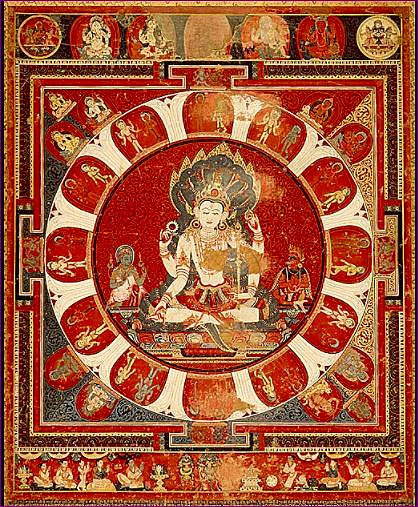
Archetype of the Mandala
If one could produce a graphic image of the whole of human nature, many different forms might be integrated within an overall shape, such as a circle or square. Also, if it were possible to have a visual presentation of a person’s inner world of mind, weaknesses, strengths, order, confusion, and quality, each person would appear differently. Some would be internally jumbled, divided and ugly; others symmetrical, integrated and beautiful.
|
|||||||
|
|
Who Am I?
Who am I?
Who am I?
Who am I?
Don’t you know?
Who am I?
Don’t you know?
I am he.
Don’t you know,
Who I am?
I am he.
I am he.
Don’t you know
Who I am?
I am he
Who knows.
I am he who knows.
Who knows
How to say –
I am he who
Knows how to say
I love you!
I love you!
I love you.
Count Arthur Tarnowski
Today is the 8th anniversary of my father’s death. As I’ve experienced more systems change training I’ve been remembering and praying to my father on an almost daily basis. He understood systems change, geopolitics, history and the challenges we’re experiencing in our life. He was born into the Polish Aristocracy in 1929, was a member of the Polish Resistance and hid Jews in the ceiling above where Nazis we’re living. He was then starved in prison only to escape and be on the run travelling underground with a price on his head. He came to the UK with nothing as a war-torn refugee. He set out backpacking from 1953–1958 working as a guide in places of antiquity like Egypt, Greece, Turkey, Iran and Iraq. He was setting up a company to take students overland to India in the ’50s with a mission to prevent future violence through better understanding and empathy between East and West. He would live as most of the world did — often on the streets to build up his understanding of the human condition. He was writing the first guide books for how to travel on a shoestring budget. In 1958 he was writing the first backpacker guidebook for Bali and contracted polio. He spent 2 years in hospital and the rest of his life paralysed fro the waist down and in a wheelchair.
He then spent 4 years preparing for a historic expedition where he travelled around the world between 1964–1967 in his wheelchair on the Unbeaten Track Expedition. He filmed documentaries for the BBC, wrote for the Readers Digest, published the Unbeaten Track book and touched the lives of many thousands of people. He then devoted much of his life to the work of Baba Amte and the Anandwan community in India. He became the adopted son of Baba, one of India’s most notable social workers and whom Gandhi called the ‘Conqueror of fear’. He visited Baba almost every year from 1964 until he could no longer travel in 2010–44 times. He created a rehabilitation Center that trained many thousands of handicapped people in vocational employment skills. He undoubtedly lived life as a great ancestor.
But who was my father to me? He was a profoundly inspiring friend and parent. I grew up travelling much of the world with him. Most years we’d travel to India at Christmas, Turkey at Easter and all sorts of places in the Summer — from the Silk Route through Pakistan into the Himalayas to the length and breadth of Iran. With him, as an intrepid guide, we’d live as locals do with a never-ending enquiry into the state of the world.
I feel privileged beyond any words for the parents I was born to. Everything was a lesson with my father. I learnt about the population explosion, regenerative farming, water irrigation, past Civilisations, Spartan values, health, education, food systems, all forms of mythology, religion and spirituality, initiation rituals, geopolitics, and so much more. He wanted my brother and I to have the broadest education possible. Dad made it clear to me that I would experience a complete societal collapse in my lifetime and that I could do something about it. In fact, I believed he trained me for my own Dharma. He often said ‘Society is one missed meal from anarchy’. He raised me with a sense that our Polish nobility was nothing to do with our castles, titles and wealth. It was about how you show up in a time of crisis. He’d remind that true nobility sits in the heart. The virtues he passed on from 28 generations of Tarnowski’s were rectitude, honour, self-command and above all courage. I’ve never met a greater living example of what it means to live life as a great ancestor to the future.
As I spend often 8 hours a day playing the Unified Planet Game speaking of systems change and envisioning a brighter future, I’m reminded of my father’s lessons on an almost daily basis. I feel so grateful to have an unshakable clarity for my own purpose and commitment to make conscious choices anchored to a vision of a thriving future for all life. There is no greater inheritance than this. I believe this is the practice of living one’s life as a great ancestor to future generations.
As I’ve spent more time in ritual and prayer to honour my ancestors, I’ve learnt a great deal about my own life and legacy. In my prayers, I often enter a council of my ancestors guiding my choices and actions. I don’t believe it is random that my seventh generation grandparents are Catherine The Great, Empress of Russia and John Jacob Astor. It is not random that every one of my ancestral lines made their mark on history. The more I listen the more I can hear the music of my family. When we recognise the music we can dance to its melody. I believe the answer to bridging the chasm between left and right politics and win-lose finite games is to go back in time in order to go forwards. I believe if more of us could connect to our ancestry and history we could connect with our future. The ancient and the future are kismetly entwined. This is something every indigenous tradition has known and practised intimately. As Ram Dass said ‘We’re all just walking each other home’.
Today, I am holding vigil space for my father. I invite his continued wisdom and guidance on how I show up in response to the needs of the world. I bow in gratitude to his never-ending lessons that provided me the richest of soil to grow deep roots into my soul purpose. I have lost in life my best friend, mentor and father. But through our love, I’ve gained so much more.
I close with a randomly chosen passage from Dad’s book, the Unbeaten Track:
“By the time we reached India in September 1964, we had clocked up 10,000 miles; by the end of that year, the mileometer showed 21,000. Although I always made a point of calling in at hospitals, normally in the larger cities, we spent most of our time in the country, well away from main towns and trunk roads. After a while, we felt that we had never known modern conveniences. We camped out wherever our fancy took us, a long way from camping site regulations and restrictions; we shared the simple life with the villagers we met, and felt honoured when they invited us in to share a meal, or to spend the night with mud walls and thatch around us.
But there was‘ no inverted snobbery about this. Since four Asians out of five live in villages, in conditions that would strike most Westerners as primitive beyond belief, it seemed to me that if my ‘random sampling’ of the disabled was to be fair and acceptable, we should spend roughly four times as much time off the beaten track as we spent in the cities. But as the weeks turned to months, I realised that the pattern was very different from what I had visualized, sitting in the cosy warmth of a London flat.
As I talked with cripples, day after day, from early morning until late at night, in their homes or in the streets, sharing their hopes and problems, I entered a new world, a world of hopelessness and misery that few Westerners have ever penetrated. This may sound conceited, but most visitors from abroad seldom stray far from a well-worn path, scurrying busily between their tourist hotel, some ancient monument and perhaps the clinical, germ-free atmosphere of the modern hospital ward.
The more immersed I became in this work, the more I found that my own values and outlook were beginning to change. Meeting an orphaned child lying on the pavement with both legs amputated, my own problems and worries appeared ridiculous in comparison. After all, what does a tax demand, or a better flat, or a vacation abroad really mean when confronted by someone who is literally starving, whose last meal several days previously consisted of undigested grains rinsed from cow droppings? What price a smart kitchen, or a new car, when you meet a crippled girl condemned to a life of begging because her parents can’t afford tuppence a day for her bus fare to school? Many argue that such comparisons are unrealistic and unfair. Up to a point, they may be right. But they have never lived, I suspect, in the East, and have never had the opportunity of finding out for themselves how the less fortunate live, how little is asked of life.”
Last photo taken in Bali in 1958 before contracting polio and being wheelchair bound.
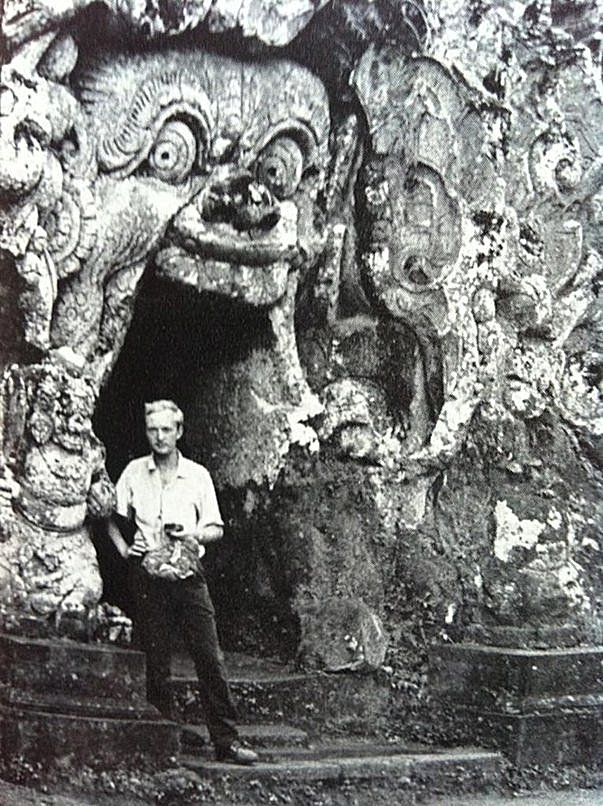
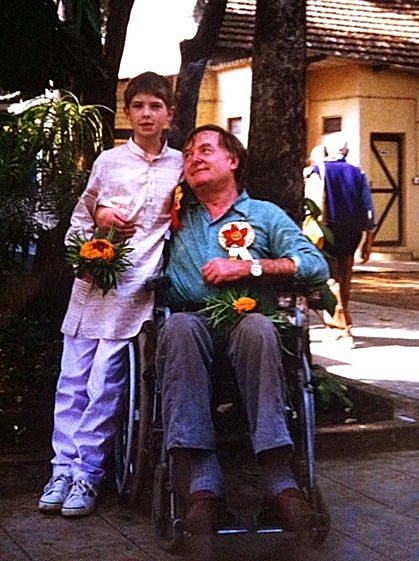
Fascinating People
|