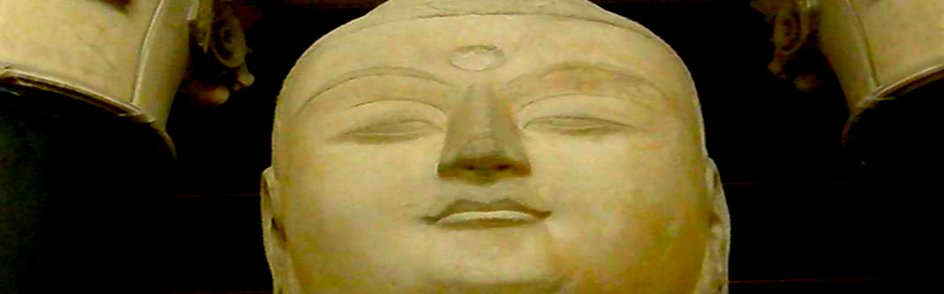
The Archetype of the Buddha
The archetype of the Buddha has a long history, longer than that of the Christian Christ. It has a different emphasis than Christ however, although there are similarities. In general the Buddha depicts the going beyond self into the void, the letting go of ego into the reality of what lies beyond it, rather than the movement toward a belief system or a historical character, or the survival of death.
Also, because of his life story, a story that is confirmed, unlike the Christian myths surrounding Jesus, tells of how Siddhartha sets out on a search for a way beyond pain and death. The search is long but he finds what is sought in enlightenment and becomes the Buddha. In a similar way Jesus becomes the Christ at baptism.
Therefore the Buddha archetype holds in it the strength, persistence and way of searching for and finding a way beyond the limitations of self. The archetype is enormously powerful and can be seen as active in countless people’s lives living today.
The negative side of the archetype is that it sets up a goal called enlightenment. In this mode a person might spend fruitless years searching for something that is not a goal, but an absence of action, a letting go of ego goals. On the positive side the archetype holds in it power to transcend and let go of the limiting factors of ones personal life, instinctive drives and socially imprinted behaviours. Because a religious figure such as Christ and Buddha have many similarities in their social and personal impact, it is worth reading the christ entry below. See: void.
‘I was sitting opposite someone during an enlightenment intensive workshop. We had been posing the question for days – “Who are you?” Suddenly I realised that it was a silly question, because I was the answer. All thought stopped and I existed as the answer. My being had always been this. In this state there was an awareness of being connected with everything around me, in the beginning of creation. This was the first day. While in the state of simple existence I was able to observe many things I am usually not aware of. For instance while I simply existed, my usual pattern of behaviour and thought went through contortions to be the centre of awareness again. I could see them almost like habits, systems, that have life, like a body does, and they were dying and twitching in their death throes. Also I saw that I knew that all thought is like a mimic, so all our thinking is like photocopies, without any real life. Also as I saw this I had an image of a monkey that was actually my normal thinking self running alongside my every motion and trying to mimic it. It was almost as if as I as a person walked along, another mechanical person ran alongside trying to keep up and mimicking everything I did in an attempt to be alive and real. Yet thought can never be life.’
Another person says, ‘Unexpectedly everything changed and my fundamental self was something that existed throughout all time. It didn’t have a beginning or end. There was no goal to achieve. I am.’
Useful Questions and Hints:
Have I been confronted by an influence that I feel threatens to take away much of what I consider to be vitally me?
Has the Buddha archetype touched me and opened an experience of unconditional freedom and bliss?
Am I using this archetype as a goal that I am desperate to reach?
Try Being the Person of Thing.