Author Archive
Eugene Aserinsky
In 1953 Aserinsky, while working under the direction of Kleitman in a sleep study laboratory, was the first to observe the Rapid Eye Movements – REM – now known to occur during dreaming. As Aserinsky had observed this in the sleep of babies, it was first assumed only to occur with infants. Later investigation proved it to occur with all people observed. This finding started a period of intense research into the psycho-physical functioning of dreams.
Allan Hobson considers that it was probably the combination of Aserinsky’s innocence, and Kleitman’s experience, that led to the observation of this breakthrough information. During his graduate schooling Aserinsky worked at studying attention in children. His observations led him to note that eye closure was connected with a lapse of attention. This led to the decision to record eyelid movement using the electrooculogram (EOG). This is an important link in the chain leading to the discovery of REM, as children often exhibit REM immediately they fall asleep, especially during daytime naps, whereas adults take longer for the REM’s to appear. Aserinsky therefore quickly noticed that his subjects showed REM when they slept. Kleitman thought there was probably a connection between the REM’s and dreaming. Kleitman and Aserinsky therefore tested the theory using adult subjects. They connected sleeping adults to an electroencephalograph – EEC – and EOG. They were thus able to observe the periodic alternation of REM and non-REM sleep during each night of sleep.
By waking subjects during REM and non-REM sleep, they were able to ascertain that dreams were accompanied by REM activity. When REM’s were detected, the sleeper was woken. The first 27 wakenings produced 20 dreams. As a control, 23 sleepers were then awakened when the record showed no sign of REM’s; and 19 of them failed to recollect a dream. Kleitman and Aserinsky then tested their theory on larger numbers. In the first 190 arousals during the REM bursts, 152 yielded dream reports. These finding were reported in 1953 in Science. Later, in 1955, another report titled ‘Phase of Ocular Motility Occurring in Sleep’ appeared in the Journal of Applied Physiology. It described how other physiological functions also changed with sleep.
William Dement later confirmed the findings. See: Kleitman, Nathaniel; science sleep and dreams.
Some interesting human information about Aserinsky’s discovery is that the child he used as his first subject was his own son, 8 year old Armond. Aserinsky had managed to find a broken-down electroencephalograph machine, which had been abandoned in a university basement. He wanted to tape electrodes near Armond’s eyes, using the machine like a lie detector. But for weeks the machine kept malfunctioning. Each time he fixed one problem the machine would develop another fault. But during this period the pens attached to the EEG would occasionally interrupt their slow, wavy tracing of Armond’s eye movements and begin marking spiky peaks and valleys. This suggested the brain was as active in sleep as it was during waking. This didn’t make sense to Aserinsky at the time, and he felt the machine was still malfunctioning. In those years scientist thought the brain entered a quiet phase during sleep.
Kleitman thought that either Aserinsky had made a remarkable discovery, or that the machine was still not working. The manufacturers of the machine were phoned but offered no help. The leading authority on EEG was phoned, only to suggest that Aserinsky abandon the project. Aserinsky says of this ‘If I had a suicidal nature, this would have been the time. I was married, I had a child, I’d been in universities for twelve years with no degree to show for it. I’d already spent a couple of years horsing around on this. I was absolutely finished.’
He persisted however, and realised that if he recorded each eye independently, and if the pens moved in tandem, then the machine was not malfunctioning. This led to one of the greatest breakthroughs in history on the nature of sleep and dreaming.
Tony’s Intuitive Voice
This feature is simply a quote from my journal from May 1990. I was letting my intuition speak, and asking it questions. As it deals with things that apply to all of us, I present it here.
In my youth I was looking for something. I wanted to find a teacher. I wanted to find ways into what I felt was another world. I read, I meditated. I joined the Rosicrucians and pinned my hopes to them. And behind the search was a powerful drive.
In more recent years I realised part of the drive was an alternative to the sort of relationship I might have had with my father. But there was another side to the urge which is still with me and has survived all the changes.
What is that?
From here on I let my intuition speak.
There is a part of this man which he has never actually involved in his present life. It has never been expressed. It has never been incarnated. It is almost as if it was not born with him. It has never expressed through the body. It hasn’t made itself real through the body. So it is almost as if it has been a spiritual twin, a ghost, a spirit guide. It is influencing his life – God, what a story – and yet is so frustrated. Frustrated all the time because it can’t live its life. It is pushing and pushing this person toward what it wants to do, yet it is not felt as wholly Tony. It is not something he had built into his life and trusts, and so he does not live it in the same way as he lives the other areas of his life.
How can this be integrated into his life?
If I attempt to answer this question I have to gather pieces of information to make it understandable. And the first piece of information is this man’s life, his life, his own personal development. He has become somebody who is not generally seen as a spiritual person. This even though he is seen to write and deal with this area of the spirit, he is not seen to be a spiritual person. It is not a view people have of him. There is a conflict in himself about this, as he senses that within himself an enormous area of his experience and feeling are to do with the spiritual. This is a strange paradox.
There is another aspect of this which has to do with the way he lives his life. He lives as if he has not got any connection with the spiritual. He does not act out any contact with the spiritual. He does not publicly meditate, go to church, lead groups or classes to do with the spiritual. He does not promulgate these areas either. He is not outwardly involved in the spiritual either. There is a part of this puzzle which has to do with the period in which we live.
In these times, and in this culture we have a certain view, or a certain way of doing things. It does not encourage people to express or live the hidden side of their nature – except in a psychic manner such as telling fortunes or giving people psychic readings. In Eastern countries you do not have to produce anything to be supported as a monk or sanyassin. In this country you have to produce the goods. You have to be more commercial. You need a product if you are to be considered. So the question has to look at those things.
The part of Tony which has not incarnated is a part which has access to those things, to the powers of the spirit, and could express them or demonstrate them.
When I look at the question though, I see there is a problem which is a part of Tony’s nature. It has created this division. When he was born there was a struggle about incarnation. He didn’t want to be incarnated. He didn’t want to face again the experience of the world. So a very large part of him was cut off from involvement and expression. It was pulled back or held back. It did not directly build the body or build the experience it might have done otherwise.
In considering how he might bring that part of him into expression now, there is still a possibility it can be done. As always it is involved in giving himself to others. The more you give that part of self to others the more it is built into the life of the body – the more it is expressed and expressible in the world. The more there is willingness to expose it and give it to others, the more it grows.
Is he ready to develop a working situation with other people from that point of view? He is making moves to declare this side of himself openly, and this is the beginning.
Another aspect is that he does not need to worry about it. If the relationship with the Self is enlarged it happens by itself. It will come of its own accord. It is like hairs on a mans chin. They grow when he reaches a certain stage of development. One does not have to keep rubbing in lotions to make them grow. That is unnecessary worry.
So it is more important what has to be undone in Tony’s life rather than what has to be done.
What has to be undone in his life?
He has already realised today something about the question of ambition. A book he read many years ago – Light On The Path – says at the very beginning ‘Kill out ambition’. When he first read that all those years ago he couldn’t find any understanding of it.
What is there one needs? What is there one could hope for if one is already all things. Ambition is a misconception. It is an ignorance. It is a part of the problem which holds back the realisation of the Self. To feel that we must strive for something to get satisfaction is the problem. Yet avoiding ambition has nothing to do with doing or being or being active. It has nothing to do with that. In fact the book goes on to say one must work or strive as those do who are ambitious. Of course one does, one lives, one breathes – non of this matters. The business of not doing things, of feeling that if I do such a thing I will not be spiritual is quite ridiculous. One is already the Self. One is already the one totality. We have cut ourselves off from awareness of our oneness by all these attitudes and beliefs we have taken in – that we have to grab and strive and grasp for ourselves alone. We do not, not from that point of view.
There are many processes of belief which can trap consciousness, which stop it taking wing, flying into that immensity, going home. That is why the film ET was so moving for many people. This lost creature from a much wider life, a much more inclusive life, a much more powerful life, a much more connected life, is lost, trapped and injured in our everyday life here. It is the story of the human spirit and it’s desire to go home again. Its attempt to regain its original state – not to be lost and deserted in the physical state. That means to be lost in sense impressions and in the belief that we are cut off and separate.
The film illustrates the importance to re-establish connection. We have to use whatever is at hand to do that, as ET does in the film. We live in the belief we are alone and separate. We believe it therefore we create it. We create a prison out of our beliefs.
Is this one of the things I need to undo, the belief that I am alone?
In the past there was a period in human evolution where it was necessary to be shut off from that connection with what we call God but is more understandable as the creative force giving us all Life. That was the fall mentioned in the Bible. Immense periods of time elapsed. What it was for, what it means, there was a process which occurred which was to limit human beings. It is difficult to talk about this.
It was a period when human beings fell, became smaller, became more involved in the processes of the Earth. They built around them a body in a way they had not done before. They created a situation which cut them off from each other. They could only see each other through the senses, hear each other through their ears, touch each other through their fingers and flesh. That wasn’t the situation before.
There is a story about this event. And the story is about a man falling in love with a woman. We call it the story of Adam and Eve. And in this love there generates a temptation. The temptation is such that a situation is created. To have the experience of such love, to do that, they had to unbalance themselves. To have the form of love which might exist between a she dog and a male dog, to experience that drive, they had to unbalance themselves, they had to cut off a part of their nature – the male or female. They had to repress it, to push it down, to hold it at bay, to make it unconscious. Otherwise that love could not occur. That relationship could not occur. And this was the original sin as spoken of in the Bible. It is that at some time we have denied a part of ourselves and we are still experiencing the consequences of that. We have built a body, a world, a way of life around it. Each of us are haunted by the story of the stranger who knows and loves us yet we do not know them, or we run from them; the loved one who is unearthly, the beloved we can never find. We are haunted by this search for love. We attempt to recreate it in relationships with each other. But of course we never actually find it, although we resurrect something of our own being in our attempts to love each other, to forgive, to give something of ourselves to the other, to support each other in that loneliness.
As Francis Bacon said, “The universe must not be narrowed down to the limit of our understanding, but our understanding must be stretched and enlarged to take in the image of the universe as it is discovered.”
It is in this quality of compassion for each other that we can begin to resurrect the denied part of ourselves. The part of ourselves that was lost, pushed away, wilfully denied for the sake of experience.
There is a part of the story which suggests that at first it was not too serious. The beings could pull in and out of the isolated condition. Edgar Cayce tells this story.
As Tony I find it hard to believe though. I can make sense of this feeling of something we long for. It is something which is so difficult for us to admit. It is that we have created this ourselves – this incompleteness. When we get near to touching that wholeness again, we don’t want it. We don’t want it. We don’t actually want it!
When I look into that past and see that period when I – we – pulled away, and chose to abandon the life of the One, the life of community, I see that I wanted to make something myself. There was a desire for power. A desire to live in a way which enhanced my own being, in a way which made it something unique, something godlike. I wanted to be like my father. I wanted to have all that power. I wanted to do it alone. I was not by myself in this. The difficulty is that whoever made that decision, actually created a movement. We created a sort of current. We caused a massive flow of energy in a particular direction. Once we had set it into motion because we willed it, we got carried along in it, carried along in our own creativity, in our own desire, in our own expectations. It was like a great dream. A huge creative process was begun. We created a world, we created a life, we created a whole set of processes. We became the victims of our own creativity. In this case the word victim simply means we eat what we have created.
When we begin to wake up – When we begin to look at what we have done with our dream, we begin to experience a sense of guilt. Yet there is no blame. There is no blame. But it is the guilt which stops us going back. We attempt to justify ourselves. We press on. I am perfectly okay by myself. I don’t need anyone. It is the story of the prodigal son.
One of the difficulties confronting us is that we actually repress or hide from ourselves the knowledge of who we are. We deny it from ourselves. It is difficult to accept because we are ashamed. Ashamed that we have lived in a pig-sty and eaten the food of the pigs.
This is what is burning in me – I cannot believe this. This is a fantasy. A huge fantasy I am wanting for some reason. If it were not a fantasy why don’t I live in my father’s house? Why can’t I reach out a hand and say to sick people ‘Take up your bed and walk’. It stops me living that life. I cannot believe this. That is what I confront as I begin to touch these feelings.
Is that because there is such a strong I? What is this I which cannot believe?
Tony speaking – “It is the observer. The part of me which observes. I observe, in a long life time I haven’t actually met someone who exhibits that kingship. I have read about such people, but there is always someone else who demonstrates they are a fraud, and can actually do the ‘trick’ themselves. It wouldn’t even be a proof if one saw it. It would only be a proof if one did it oneself. The only thing I have ever done like that is the projection from my body to my home in London. Then I could never repeat it, so how is that proof? Even that becomes questionable because since then I have come across people who have a body-mind split out of loneliness or inner problems, and they exhibit projection, but no proof. So is it me creating it again – creating my need to have such proof. I also know that in a dream we can create any such experience. Unless I can wake up in my sleep and observe your body and see a problem in your liver and say go to your doctor now and have an examination – and this was confirmed, and then could do this several times – that would be proof.”
Despite a long life of trying I get to the point of disbelief.
I have been praying for my son – that I might be able to demonstrate a projection, to take away that feeling of death in life he has. But I cannot make it a reality. I can’t even make it a reality for myself.
Now it is like someone talking to me saying – Tony, look, supposing that all these things said are not true – the fall, having a wider life, the inner connections with all things. Nevertheless you are faced with your human life here and now. It still becomes fairly obvious that what you believe and think you begin to live and make real. You are therefore in a trap of your own creation. It is not like somebody else can take it away from you. It is no good appealing to God to take it away from you, because it is you who have the power of creating it or recreating it. It cannot be taken away from you. You made this trap. You have to find the combination yourself and undo it.
Whatever you find when you open the door, well, you will find whatever you will find. But that is for you to discover. But it remains that you cannot live as anything, as yourself, as you are unless you recreate yourself. In simple words, if you are living disbelief, then you are living disbelief. You are actually living a belief in limitations. So you create your own limitations. If you live a belief that you have wider possibilities – even if that belief is that you have a right to talk to your neighbour, then perhaps you will go to them and say ‘can I have a spoonful of sugar’. Even in that small act you have still stepped beyond your previous limitations. You have created a wider life. So who knows where the boundaries are? Who knows that if you say I will go beyond that boundary what will be there?
This question of wanting to project and show your son, implies that if you had been able to do that from the time you were 18, there would have been massive consequences as you had not dealt with all the unconscious muck still inside you.
There is a direction which is opening in front of you. In the next few weeks you will define more fully the work you want to do. You will begin to present it. You will extend yourself into the world more fully. The world is you. You are the world. If you extend yourself more fully, then it extends to you, and you extend yourself into that inner world at the same time. This is where you will find your pathway, and this is how you will find your way back. Each of us have our own pathway, as we have to unlock the prison we have made of our own creativity.
In a months time there will be a person you will contact who will help you. It is almost like a direction your life is taking at the moment. I have a sense of something. It is like radio waves reaching out. As you change you tune in to a different spectrum of incoming signals. You are changing what you are transmitting, and so you are receiving different inputs. The radio wave transmitting also is itself the aerial. You are also changing what you are creating in life. I have the word meeting, or wanting or looking coming though and can’t define it.
The change in what you transmit changes what you do, but also who you meet. You have actually changed what you are putting out. In doing so you have opened yourself to people you would never have met before. So in a months time there is a meeting as there is something developing. It is not that the meeting is a momentous one. It is that it is an avenue. It will start something, in bringing something about. It will offer us an avenue – it opens a direction – the possibility of a direction, and you might feel ready to take that direction. It is just like something opening. You will say let us take that direction, as it will have a mutual attraction.
Being Born
For many people inner-directed movement is largely an enjoyment of their body’s activity with some accompanying shift of feelings as the movements are enjoyed. In fact there is no need to deeply explore the realms of the psyche to gain great enjoyment and benefits from its use. However, I would not be properly describing what is achievable through the technique, if I did not give a small introduction to what might be found within the enormous realms of your mind and memory. The approaches given below are therefore for those who wish to open the door to an exploration of their own interior world of experience.
There is a warning needs to be sounded here though. The experience of your own inner life is very real. It may put you in contact with areas of yourself you may not have met before as an adult. Therefore unless you already have experience of working therapeutically – as with psychotherapy – it is best to use this aspects of inner-directed movement only with a supportive group to start with. It is a bit like learning to swim. If you did use the approaches below successfully they might introduce you to the deep waters of your feelings. So, like swimming, until you gain confidence in dealing with the new environment, it is best to learn with others. Of course, if you have already worked in this way there is no problem. Or if you are a group leader working therapeutically, the approaches are gentle ways into personal growth.
The following approaches are described for those who wish to explore something of the psychologically therapeutic side of inner-directed movement. If you are content with your experience of the practice as it is, there is no need at all to explore the mental and emotional side of yourself.
Being born was one of the great moments of your life. Not only is it an important physical event, but it is also a truly powerful process psychologically. That unborn babies have rememberable experiences, and that birth itself leaves strong memories and influences, although not yet generally accepted, appears to be well documented. Thousands of people have now recovered memories of birth through various forms of therapy, meditation and hypnosis. Some of these areas of experience suggest consciousness is in some degree continuous throughout all levels of being. (See The Secret Life Of The Unborn Child by Dr. Thomas Verny, MD., and John Kelly – Sphere Books Ltd., 1982. In USA by Summit Books 1981)
To take the path of birth in inner-directed movement may mean recovering memories of your own birth and how it influenced your development. Such memories are completely non verbal and are composed purely of physical and emotional experience and body postures and movements. Apart from personal memories though, you may discover the power of renewal and the urge to grow expressed in the symbol of birth. This symbolic way experiencing was described well by Judith – in chapter three – when she felt like a crocus flower, struggling to open. In this way you might touch resources within yourself that have the possibility for you of emerging from old and restricting emotions, habits and ways of life.
1 – If possible do this with two or three friends who are supportive and used to the action of inner-directed movement. This is not because it is unsafe to do otherwise, but because with friends you can create an excellent ‘womb’ environment.
2 – If with friends, create your ‘space’ with enough room for you all to occupy a place close together on a soft duvet or blanket on the floor. Sit together making contact through holding hands, and centre down into the mood of what you are doing. Imagine yourself slipping backwards to the time when you were in the womb. When ready break contact and take an appropriate position in the middle of the blanket. Try curling up, knees to chest. Your two or three friends should now make close physical contact and cover you with their bodies so you are comfortable but enclosed in the warmth of their physical contact.
3 – Once this has been done relax and wait for inner-directed movements to arise. There is no need to concentrate on the theme of being born. It is enough for you to have thought about this at the beginning. Now you can let go of any thoughts and wait and watch.
4 – Do not attempt to make anything happen, or perform something for your friends. If all you do is to lie there for half an hour without movement, just do that. It is a very rewarding experience just to be quiet and close to friends in this non-verbal way. But you will probably find that after a few minutes there are changes of feeling occurring within you, and waves of impulse leading to some sort of movement or expression of feelings. Let these waves roll through you. Any movements that occur will come in waves too, so drop into quiet resting between them, and let the process unfold.
5 – If practising by yourself – or alone in a group – imagine yourself going back in time and size to the point where you are in the womb ready to be born. Take up a position on your blanket that expresses this as nearly as you can. Then allow inner-directed movement as described above in 3 & 4 above.
6 – What emerges will be unique to yourself. But in general it may feel like a direct experience of your own birth and relationship with your mother. Or it may be felt as an experience of psychological birth – a leaving behind of past attitudes and ways of expressing yourself that you have outgrown. It might be that you realise that for much of your life you have hardly been alive, and at last you are born and are living.
7 – Perhaps what happened was incomplete, and you will need to use the path again to carry it further. Birth is such a major feature, you will need to come back to this theme anyway to really find the treasure of insights and energy dormant in it.
8 – Whatever has arisen it is helpful to write it down and consider if you can see any relevance to your everyday life. For instance Joe, who used this path in his forties, experienced a difficult birth. He discovered a strong feeling of not wanting to be born, of a desire to avoid life by staying in the womb. He found this of great help in understanding the way he felt about life. His birth had been two months premature, so he could understand the feelings of not being ready to be involved in life. He had always had strong feelings of not wanting to participate in what other people were doing, of wanting to withdraw at social gatherings. On practising the ‘birth’ pathway again the feeling of withdrawal gradually receded and was replaced by a readiness to be involved in life. This made an observable difference to the way he met other people and was ready to be a part of activities.
If you practised with friends or within a group, share your experience with them and talk over what relevance you feel there might be with your everyday life. Also, ask for their comments on what they felt or observed. It is important to clarify for yourself what habits of feeling or attitude your birth has left, and how you wish to change these. For instance Joe was left with the habit of withdrawing from involvement with others.
The Pathway of birth offers the discovery of change in the amount of yourself you can bring to expression in relationship and work. It develops the ability to drop the past and to leave what is outgrown behind. Facets of yourself that were never really alive before can be born and live.
The Baby And Child
One of the tragedies of adult life is that you may have forgotten your childhood. You may still remember events and dates, but the intensity of feelings, the real insight into the world of childhood may be lost.
Can you remember how it was to live before time began for instance? The sense of time is learned. Prior to being able to speak, and previous to your concept of time, you lived in eternity. Days lasted forever. A week was infinite in its multitude of impressions and experience.
Can you remember your first love affair – with your mother? Being your first, its wonder or devastation has coloured all your love since. But if you can’t remember then you are living out the wonder or pain without awareness.
Discovering your internal baby and child is to find some of the great secrets of your life. Many of the decisions you make about work or sexual partners have their roots there. What may appear as destiny often starts from deeply felt experiences in your childhood. Who you consider yourself to be is not an immutable reality. Your genetic inheritance gave you a foundation, but what was built upon that was due to the events of your childhood. If you are not entirely satisfied with the results, a lot of DIY alterations can take place.
1 – You are going back along the time track of your life. Leaving behind the many things you have collected as you moved into the adult years – bank accounts, bills, mortgage, work, family responsibilities, dependents, the car, the musts and shoulds and should nots.
2 – Although you can target a particular time of your childhood simply by thinking about it for a few moments, leave it open. Stand in your space, with or without music, and allow
whatever movements and emotions arise. Do not be in a hurry. Sometimes it takes quite a time to gradually build the inner change necessary to recreate childhood feeling states. Remember that many years of childhood were without refined language. This means the experiences of that period were wholly physical sensation, movement and emotions. That is not to say you didn’t have a mind, but its perceptions were very immediate and not filtered through words and past associations. Give yourself time and opportunity to drop the top layers of yourself and your present habits of experiencing the world.
3 – Do not get confused by thinking that you have to act like a child to make this a successful experience. What you are doing is to give yourself time and opportunity to have an inner experience of your child self. So it does not matter that externally you do not act or speak like a child.
4 – The likely response is that you will experience some feelings, some event from childhood, that is important in your life because of its effect. As childhood is such a vulnerable period, to get to free flowing feelings on this Pathway may take time. The clearing of hurt emotions and attitudes might be necessary first. Nevertheless, this is an extremely worthwhile process.
5 – Many of your important habits were formed during your childhood. As an example – if you were an only child and had to spend much time alone, you may have got into the habit of suppressing your desire for company. If this habit persists it becomes felt as normal. In fact it is neither normal or abnormal, it is simply the way you have shaped yourself. In adult life you might therefore find it strange or difficult to be with groups of people. If this becomes a nuisance, and you want to change, it would be helpful to see this character trait as a habit rather than an immutable part of yourself. If you identify with it as yourself, there will be some resistance to change.
6 – It is important to consider what you experience in your childhood Pathway in the light of what habits it has formed. Many habits are very supportive, we might then call them a skill, such as language.
The baby and childhood pathway allows some of the most permanent and importantly positive life changes to occur through clearing the accumulation of emotional debris built up during early growth. Resistance to positive change often has its roots in this area. This is not only because of ‘emotional debris‘ but some of the most durable and defended habits were put into operation or developed in this period of your growth. The reason we generated these habits was nearly always out of necessity at the time. The habits helped us to survive – THEN – but may be self defeating and undermining today. Once their rationale is seen it becomes easier to change these habits.
An aboriginal woman’s story
THIS WEEK I met an aborigine woman and heard what she represented and what has happened to her people!
She told me her story…………no different to many of the woman of her race. Her mother was raped by a white man and she was the result. Her Mother used to spread dark earth over her baby’s body to make it look more dark skinned so that her tribe wouldn’t have difficulty in accepting her, and that she would be the same colour as her brother’s and sisters, as her mother was married and had children already by her aboriginal husband, who took the white fella’s child into his family group.
The Missionaries came along and said that a white man’s child couldn’t live like that and took the child away from her parents with the government fully supporting that act. The government officials told the parents that they were never to see that child again, not to attempt to make any contact with her. So she was taught in a missionary school and was indoctrinated with the ways of the white man. As she says she could have gone to that school each day and lived with her parents, she didn’t have to be taken from them. She learnt well the white man’s ways and ended up marrying a white man. She did a man’s job on the station that he owned. She went mustering with them, and she was a very good stock woman and earned her way
Then she got news that her parent had never given up the will to find her and they were on their way to the station. When she told her husband he said that he was having no aborigine sleeping under his roof and told her to clean out the saddle room for her parents to sleep in. With tears she cleaned out the saddle room for them, as she was deeply distressed. When her parents arrived she told her husband that she wasn’t going to work on the farm but spend time with them.
One day, as she was showing her mother around the station they came to the lily pond and her mother was very impressed with all the ‘food’ in the pond and said she wanted to gather some. The woman said lots of times when she had passed that pond on horse back, she had an urge to get into it but didn’t, as no white person did. So mother and daughter waded in and started to eat the tender young juicy shoots of the lily. All the cattle came and stood along the fence as they had never seen anything like it before. She said that she was happy, seeing all the cattle very solemn faced watching both her and her mother enjoying the water and the food.
Her husband came back and could see all the cattle standing along the fence and wondered why, so rode over to see what was happening. He was shocked to see his wife in the pond…………he ordered her out yelling at her that she was behaving like a Jin. She quietly said to him, haven’t you noticed all these years, that I AM a JIN. ( She is dark skinned.) Her mother was crying………. but she said she felt very strong and knew what she wanted to do.
When they got back to the house she told her Mother that she was coming back to her people. Her mother started to cry again and said, but that means you will leave your husband and that would be breaking aboriginal law. The woman felt that she was dammed if she did and was dammed if she didn’t, so she took the children, knowing what she was asking of them and left with her parents. She said it was an unhappy marriage right from the start but as is the aboriginal way, she got on with her life and did her best in the situation.
She now is traveling around Australia, with all her belongings in two bags, as she says aborigines don’t need lots of possessions, it isn’t their way………..telling her story and trying to find a way of meeting and living together, with the white people and her people, as she has lived very fully both ways and so she feels she HAS something to say!
Her children have had contact with their father up until his death and she is on a small pension now. She is through the pain of her people and has accepted that the great spirit has brought this time of suffering to her people, that they don’t know why, but they are looking for a way to be accepted as equal, different people with the white man. I am very open at the moment, I had tears rolling down my face as I listened to her story.
Adventures On The London Underground
Jamming thirty prime and active human beings into an eight-foot by six-foot enclosure is simple enough, one just calls it a railway carriage and leaves the rest to the ingenuity or brute force and ignorance of the aspiring passengers. It is a method that never fails to bring out the human quirks that are often not apparent at a greater remove. A nervous twitch at zero distance can become an annoying sexual threat, and tolerance is often just an improper word, not used in the more mature subway circles.
I suppose nerves are okay at a safe footage away, but when a complete stranger starts twitching against one’s back, it can become worrying. This is especially so when there is the equivalent of a ton of assorted people gently but firmly compacting you against the subway psychopath behind you.
My own experience of sub humanity is a long and varied history of daily travels. It took me a while to learn the rules and become accepted. But you learn the game fast otherwise you wouldn’t get home.
Rule number one is that nothing is impossible. In fact impossibility, like the human concepts of time and space, is purely illusionary.
Out of this arises rule number two, which is that the human frame is capable of infinite compression within the confines of an underground railway carriage. The practical application of this being, “There’s always room for one more inside.”
Translated into terms of action this means that if there is floor space to get one shoe in the carriage, it must follow that the rest of the body will fit also. Sometimes this theory is debated hotly in the field. Or sometimes it needs one to hang onto the overhead handrail with both hands and swing inwards on the offending bodies with vigour. But the opposing arguments usually give way to actual demonstration.
In the particular rule book that I was nurtured on, rule number three is loosely defined as, “Never give your seat to a lady if you can possibly get some other hothead to do it.” A classic demonstration of this came to my notice only the other day. The carriage seats had already been filled when an old, and obviously tired lady got in. She walked over and stood holding the strap directly in front of two determined males. One of them was a youngish man who was apparently untroubled by any conscience, and who with hardly a glance at the old lady, went on with his own private daydream. But the other, a slightly older man, was obviously a person of finer breeding and sympathies, whose conscience was not so easily passed over. For some moments he still kept his seat, obviously ill at ease. Then, like a thunderbolt out of the blue he turned to his neighbour and bellowed, “Get up and give the lady a seat!”
The reaction was instantaneous. The man leapt out of his seat as if he had been ejected. It was only moments later that he realised what had hit him, but all he could do in his shocked state was to regard the now satisfied gentleman with open-mouthed wonder.
One of the well tried “sure” methods for the fair sex to get a seat is to faint or throw a fit. I’ve seen this work time and time again even in peak seat grabbing periods. The only drawback however, is that very often some wise guy will insist on carrying the girl out into the fresh air at the next stop. In such cases she will end up with a seat, but it will be on the platform instead of the train. But at least there is a 50-50 chance of success.
Even after many years of close study however, I still find it difficult to classify sub humanity under any one type, there are so many conflicting cases that come to mind. I remember an incident one Christmas Eve. It was on a part of the intricate underground network I had never travelled before, and every male in that particular carriage seemed as if they had taken one or two drinks too many. I didn’t see what started it, but a scuffling drew my attention to a couple of men halfway down the long carriage. They were standing side-by-side in the open space between the sliding doors. All I could see was a slim young man, slightly drunk, giving what seemed to me friendly digs to the stomach to a short dumpy middle-aged man with spectacles. The latter didn’t retaliate or move away. With a sheepish look on his face he simply stood shoulder to shoulder next to his opponent, removing and replacing his spectacles at regular intervals.
The slim one, who I shall call Charlie, then turned to face Spectacles and gave him another couple of playful digs to his ample abdomen. Spectacles still didn’t move away, shout, or give any ferocious signs of his disapproval, but continued the activity with his glasses as if Charlie didn’t exist. Whatever it was that was eating Charlie didn’t give him any peace even after his sporting attack. So he grabbed the folded newspaper that Spectacles held, wrenched it from his grasp and hit him over the head with it a couple of times. Then, with quick precise movements he tore half of the paper into small fragments and, throwing them up into the air, caused a lovely Christmassy effect of artificial snow to fall upon the bald head of Spectacles.
I must add that there was something slightly comic about this whole setting, as both of the men had the unsteady ludicrous attitude of the drunk, and the blows and attacks were thus softened into play acting by their intoxication. But a touch of drama was swiftly moving into the scene. Charlie was just about to renew his offensive when a rather big shadow fell upon him. It was cast by a muscular six-foot three frame, and the hand of that frame caught Charlie by the shoulder. It fell upon him mightily and swung him round to receive the other hand that was already swinging up to give Charlie a crashing blow on his undefended chin. I heard the impact of it ten yards away in the crowded carriage. Then the big hand came up again to Charlie’s face. But this time it was with a warning finger waving before his very sober countenance, and I heard him being told to, “Pack it up, or else you’ll get another one,” and he did just that.
Don’t get the wrong impression that the London Underground is full of six-foot three knights in shining armour who are ready at a moments notice to protect and succour the needy. Rule number three of the travellers code is also taken to heart in other directions. One can be very lonely in a crowd down below. There was the old man for instance, lying full-length across the door space. People didn’t seem worried as to whether he was ill, drunk or just exhausted. When the doors slid open they stepped over him without so much as a glance.
A female friend told me she was once in a carriage where several youths snatched a woman’s hat from her head, and threw it around the carriage to each other. The woman was brought very near to tears by their stupidity, but not a male made any move to help her. It wasn’t happening to them, why should they worry?
But if it is happening to you, and you are big enough and strong enough to do something about it, then it can even be amusing. One night, into a carriage already occupied by the eternal drunk, a crowd of student opera enthusiasts noisily made their entrance. The drunk was a Cockney, slim, short, and with an alcoholic humour. He insisted on wandering up and down the carriage looking dreamily into everyone’s face. As he came upon the newly arrived travellers, his interest was immediately captured by the biggest of the young men. “Aven’t you got luvly curly ‘air,” he said. And wobbling slightly, hanging onto a strap, he leaned close to his new bosom pal. “You know, you got some of the loveliest curly ‘air I ever seen,” he said, smiling.
This sentimental show of friendship delighted the students, but naturally embarrassed Curly. Yet despite Curly’s embarrassment, his alcoholic friend felt no sense of shame for the fine thing budding between them. “For goodness sake go and sit down man,” Curly said.
His friend wasn’t to be dissuaded so easily however. “If I ‘ad such a luvly ‘air as all that, I would be ever so proud of it I would.” And the warm fumes of his laugh bathed Curly in the unwelcome atmosphere of a distant bar.
By this time Curly’s friends were all but egging the drunk on to even more romantic expressions of his admiration for his big hairy friend. But Curly was unable to share their humour. He stood up and took the little man by the scruff of his neck just as they were stopping at a station. As the doors opened he marched him firmly out onto the platform, and getting on again he effectively barred the entrance.
“This isn’t my stop Curly,” little man said, still smiling trustingly at his large friend. Then, when the doors closed, and Curly went and sat down, he moved along to the open window slits. Twisting his head and putting his mouth into a window gap he said again in a slightly puzzled tone, “This isn’t my station you know.” And as the train pulled slowly along the platform, his diminutive figure ran along with it, his mouth still pressed to the window slits, his voice, still puzzled, following Curly into the distance saying, “I’d like you to know this wasn’t my stop Curly.”
Apart from the comic figure of the eternal drunk, the underground often brings to light the wit or as some would prefer to call him, the “nitwit”. On one train journey between Piccadilly and Baker Street, I noticed a middle-aged Greek lady who didn’t seem to be enjoying herself one bit. I couldn’t help but look at her, as my head was turned in that direction when the doors closed. I believe my briefcase was also about two people away at the time, hanging limp from an outstretched arm. It also had been in that unfortunate position when the doors closed.
But getting back to the Greek lady, she had been pushed into the narrow space between the seats, and was backed up onto a small young Cockney. The rocking movement of the train was introducing their backs to each other in the most intimate, and what I would have thought, fascinating manner. But instead of being interested, or even of oblivious of what after all is an unavoidable facet of rush-hour journeys, she was positively repulsed. Every few moments as the train’s rolling brought them together, her arm instinctively came up, elbow first, and poked him in the back. Our young hero managed to tolerate this for the first few vicious jabs. Then, with a cheeky smile, and a voice a that carried to the furthest ends of the compartment, he looked round to her and said, “What’s up with you dear? If you think I’m trying to seduce you I can think of far better places to do it than this! So be a good girl and stop poking me in the back with your flipping elbow will you?”
After a tiring day at work, the crowd enjoyed the free entertainment, and a sea of smiling faces were turned towards the woman. Needless to say, she got off at the next stop without saying a word, and without another jab.
A friend of mine told me an experience she had with another wit. He was actually an acquaintance she hadn’t seen for some time. Seeing him as she got into the carriage, she went and sat down next to him. After a talk and a few laughs, the train pulled into his destination and he got up to go. Pausing at the door he looked back and said, “Cheerio.” Then, as if in afterthought, he called to her loudly, “By the way — are you still living with that black man?” He then disappeared along the platform. My friend enjoyed the joke immensely — afterwards. But for the rest of that journey she couldn’t help but notice all the curious eyes, scrutinising her. As she said later, “With a friend like him, who needs enemies?”
Apart from the occasional fight, people on the underground are human enough. There are of course a few travellers who should never embark on their journey during a rush hour. I’m talking about those who take every little shove or stumble to mean open aggression. I am reminded immediately of the portly gentleman who got pushed unceremoniously into a carriage at Oxford Street. When the doors opened and the crowd poured in he came with them, but probably a little quicker than he had anticipated. However, the unfortunate man who was behind him got blamed for the whole show. They ended up face-to-face in front of a priest. It was pointed out to the portly gent by the other man that, “When the crowd moves, I move with it, and I can assure you I was not deliberately butting you in the back.”
But for his trouble, and over the blushing and blanching head of the priest, he got called all the ignorant porkers and illegal people under the sun.
Then the old lady who spoiled her flowers comes to mind. I still don’t know why she did it, but it was an impressive sight seeing her, again and again, hit the offending male over the head with her daffodils. It was a beautiful flourish too, when the male in question, obviously aggravated by the action, took the flowers forcibly from her and tossed them willy-nilly over the heads of the crowd.
Or occasionally, but not often, one might be cursed by coming across an intruder. In case you don’t know what an intruder is, it is one of those people who act as if they were from a different race of beings, or perhaps even a different planet. They look like humans. When they are sitting still one might even swear that they were humans, but as soon as they open their mouth and speak, they destroy the terrible illusion. I have, to be frank, only ever being confronted by two of them at close quarters, so I can’t be called an expert. But even from such short observation I can see that they have features of a decidedly alien nature. They might masquerade as normal people, but for one thing may have never been taught that railway employees are allowed to do things without having to consult them first. Another deficiency in their education is that they still believe all activities on the railway – perhaps the world – are done explicitly for themselves alone. Possibly the poor creatures never had parents to teach them these sad but true principles. Possibly life has allowed circumstances to let this illusion remain with them. Whatever it is, I met my first underground alien in a carriage at a terminus station. There were two trains on the same platform, and two of us had entered the wrong train. The other person was dressed as a city type, spotless white shirt, ruddy complexion, striped trousers, the lot. Fortunately for both of us a ticket inspector noticed us. Opening one of the doors and poking his head in he said, “It’s the front four coaches you want for the 7:10. These coaches not be going out until 8:10.
I was indeed grateful as it wasn’t far off from being 7:10 and I could easily have missed the train if he hadn’t warned us. But my companion was far from being pleased. “What did you say?” he said, in a very exasperated and pompous voice. “Do you mean to say that this train isn’t leaving until 8:10?”
“That’s right sir,” the ticket collector said. “It’s the front four coaches you want for the 7:10.”
I was just hurriedly collecting my pieces together when the city gent dropped what he obviously thought was a bombshell.
“I am not leaving this train!” he said, and made a sort of jerky rigid movement in his seat as if to say that he was rooting himself in.
The ticket collector’s face was also very expressive of something. I think it was either shock or bewilderment. For a while he just stared at the gent with his mouth slightly open. Then, seeming to realise what the score was he said, “Well sir, it was on the notice board, and it’s the front train you want.”
“I don’t care where it is,” the gent immediately replied. “I was not told, and I am not moving from this train. So you had better go and get somebody in authority and do something about it quickly!”
I can only leave it to your imagination how the ticket collector shifted him. I ran for my train and left them to it.
Strangely enough the next alien I met was on the same train some weeks later. This time I got on the front four coaches as prescribed. There were only two other people in the carriage, a woman and a city type — not the same one however. I had not realised it, but the coaches had to be uncoupled from those at the rear, and meanwhile the lights went out.
It was very peaceful in the carriage with the lights out. I was just beginning to enjoy it, and wonder what happened during the war when the blackouts were on, when there was a sudden explosive movement behind me. It was the city toff. He literally leapt from his seat to the door where a porter was passing. “My God man, what’s happened to the lights,” he bawled?
The porter, not realising he was being got at, answered with a smile, “They’re uncoupling the train sir, and the lights will come on in a minute.”
But this wasn’t clear enough logic for the city toff. “Look here, this isn’t good enough you know. You can’t just go and switch my damned lights off without telling me – it’s disgusting!”
I don’t think the porter had ever realised that there was something disgusting about the lights going off. But he took it in his stride. “If you would just like to wait a while sir,” he said, “the lights will come on again.”
“I should jolly well think so,” the toff said. “And don’t let this happen again, or I shall have something more to say.” And with that he went and sat back in his seat, still mumbling.
Some of my most memorable moments have been spent underground, and this will probably be true of the future too. But I cannot end without mentioning the underground innocent. He was only four, and the underground was new to him. His mother and father had brought him to London for the day. After his hometown in the country London was exciting. He enjoyed the shopping immensely, especially when his mother bought him a new pair of shoes. He was so proud of them that he insisted on wearing them right away. On their way home they used the underground for part of the journey, and were forced to witness one of those unfortunate scenes that sometimes occur on the tube. The little boy and his parents were standing very close to a man and woman in the gangway. The woman suddenly turned on the land and slapped him full on the face with all her might, saying at the same time, “Keep your dirty hands off me.”
The man, without a word, pushed his way to the alarm handle and pulled it down hard. When the train rattled into the next station all hell broke loose as the inspector ran to the carriage and tried to settle the bitter and earnest argument that waged between the two opponents. They had to be taken off the train because there seemed no solution to the discord, and as the train pulled away, the argument was still going on.
As soon as he got home, the little boy insisted on seeing his grandmother to show her his new shoes. “Aren’t they lovely,” she said, as he held out a foot to show her.
“Yes,” he replied, “and as I was coming home there was a very naughty lady on the train. She stepped on my new shoes — so do you know what I did — I pinched her bottom.”
Alfred Adler – 1870-1937
Born in Vienna, Austria – (February 7, 1870 – May 28, 1937). Studied medicine, later became a disciple of Freud. In 1911 Adler diverged from Freud over the sexual impulse being all important in human behaviour. He saw people as goal oriented, with an urge toward personal growth and wholeness – this is often summarised as ‘the will to power’. He did not give to the unconscious the enormous power that Freud did. Instead he saw social drives, the training arising from ones cultural heritage, and family influences, as being the prime forces in our behaviour and feelings. But he saw that these primal influences could be modified by an individual in a personal way, so that each of us develop personal styles in dealing with our life. This style or stance became an organising centre around which the person’s life emerged.
Notable figures in subsequent schools of psychotherapy were influenced byt him. These include Rollo May, Viktor Frankl, Abraham Maslow and Albert Ellis. In many ways he was ahead of his times, and the devlopment of these wereconsistent with the later neo-Freudian insights such as seen in the works of Karen Horney, Harry Stack Sullivan and Erich Fromm.
After receiving his medical degree from the university of Vienna, he started work as an ophalmologist. Because his office was opposite a circus park some of his early clients were performers, and it is possibly from these he learned a great deal that conributed to his ideas about organ inferiorities and compensation.
Along with Freud and Jung, Adler was one of the founding giants in the field of depth psychology and the influence of the unconscious.
It was Adler who originated the term ‘inferiority complex’. This arose out of his view that as babies and young children, much of our feeling life is a compensation for a sense of inferiority or inadequacy. In childhood a person may learn to compensate for such feelings by either pushing toward superior performance in some area, or by aggressive action, or perhaps even withdrawal or non involvement. Adler also defined the influence of family position or birth order on the character of the child. For instance he said that an only child would have the following characteristics – ‘Likes being the center of adult attention. Often has difficulty sharing with peers. Prefers adult company and uses adult language.’
Although Adler’s original view was that humans are principally selfish, criticism over this point led him to investigate the social side of human nature. He went on to appreciate that from birth we are enmeshed in a web of social relationships. In the early stages of developing this area of life, an individual may well use social relationships for personal or selfish gains. With growth however, the selfish motive is gradually replaced by the social interest. In 1929 he said that ‘Social interest is the true and inevitable compensation for all the natural weaknesses of individual human beings.’
His view of dreams was that we can clearly see our aggressive impulses and desire for fulfilment in them. Dreams can also help the dreamer define two often conflicting aspects of their experience – their image or sense of themselves, and their sense of what is socially acceptable. Because we strive from our earliest years to have some control over ourselves and surroundings, we may develop a style of life around a sense of inferiority or lack of power. So a person who feels vulnerable may become aggressive to compensate. Adler therefore felt that in our dreams we not only see what we think of ourselves, and what our environmental situation is, but also find a definition of our techniques for satisfying our drive to deal with and succeed in the world. He called his approach Individual Psychology.
Because Adler did not see the individual as dominated by their unconscious drives, he did not use dreams as much as Freud or Jung in his practice. His focus was not so much on what was happening unconsciously in the person’s life. Instead he wanted to know what the style or stance the person was creating in living their life. Adler looked to dreams as a guide to this stance or style. For instance the second example under people illustrates how the dreamer is taking a very independent style in his response to leadership and conformity. In other dreams quite different styles may be illustrated. The active or passive role or stance is one that is easy to look for. Others to observe might be dependence or independence, optimism or pessimism.
Adler did not see there being a great boundary between the conscious and unconscious personality. He felt the person could be observed to have the same attitudes and fears in dreams as they exhibited in waking life. From this standpoint the dream is not something disconnected with ones known personality, but a process which is attempting to add to or evolve the life style the person has adopted. Therefore he did not, as Jung, believe the dream had a wealth of cultural or collective wisdom, or was an expression of a more complete self. As a support to the active personality he described them as ‘pictures which will arouse the emotions we need for our purposes, that is, for solving problems confronting us at the time of the dream, in accordance with the particular style of life which is ours.’ For Adler, the dream was ‘a tentative feeler toward the future’; ‘a dress-rehearsal for life,’ in which the dreamer reveals his hopes, fears, and plans for the future.’ And he did admit that the person is wiser than they know.
This becomes clearer when we remember that some of the fundamental ideas Adler presented were that as an individual we are goal oriented. Our goal is to survive not only in the world, but within society. Not only do we aim to survive, but we also hope to flourish. So whereas Freud saw a great deal of dreaming as an attempt to satisfy infantile needs, Adler saw the individual seeking solution enabling them to go forward to a goal. From the fantasy of dreams the person could draw resources, or practise a style, enabling them to meet the needs of the moment more fully.
Therefore the dream from Adler’s viewpoint might be seen as a resource of emotional tools which through decisions made about present circumstances, the person would draw upon and use when needed.
As he did not attempt to see a wealth of meaning in specific symbols, Adler gave generalised significance to themes arising in dreams. Some of these he described as: – Dreaming of paralysis arose from feeling hopeless about a problem confronting one, or feeling it had no solution. Dreaming of travelling was an expression of ones direction and progress in life. Dreaming of falling reflected fears about loss of face and falling in social favour. He said this was a theme often dreamt by neurotics.
Dreaming of flying was a theme referring to problem solving and positive confidence. They portray the overcoming of obstacles and occur to people who are directing their life to positive ends. Being nude in ones dreams expresses concern about being seen by others as having imperfections, or feeling ones imperfections exposed to view. Dreaming about people who are dead suggests the person is still influenced by that person and has not become independent of them. The roles taken in dreams was taken to illustrate the style we take in waking life.
Yoga and Dreams
One of the impressive observations to be found in the literature on yoga practices, yet seldom if at all in Western physiology or psychology, is the connection between the breath and the mind. Such yoga teachings state that there is always a connection between the breath and mental states. It can be observed for instance that when angry a person’s breath is agitated and quite different to when the person is mentally focused on something like a mathematical problem. There is yet another difference in the breathing and the mental state when the person is asleep.
Using the control of the breath, the posture of the body, and other disciplines, practitioners of the various types of yoga in India and other countries in the Far East, explored the dimensions of the mind. From such explorations traditional yoga defined four basic modes of consciousness. These are: 1] Waking consciousness. 2] Consciousness while asleep and dreaming. 3] Consciousness while asleep but not dreaming. 4] Cataleptic consciousness.
Different levels of consciousness
One could add to this the condition of being asleep and dreaming, yet awake in the dream. Apart from waking consciousness, one is usually asleep/unconscious while experiencing these levels or modes of consciousness. But through the discipline of meditation or breath control, the practitioner can gradually enter into these ‘sleep’ modes while still maintaining a form of waking awareness. In modern dream terminology this is called lucidity. See Bodiless – Waking Lucid Dreaming
This has in it something of the situation one faces when entering into a different environment than is considered normal for human life. For instance swimming under water confronts us with quite a different experience of ourselves and the environment than in our normal everyday life of walking around on the surface of the earth. In fact dreams often use the image of the sea, or swimming under water to portray this entrance into our sub-conscious or sub-ordinary life. The reason this ability to remain lucid in sleep is sought, often through long years of discipline, is because of the greatly enlarged realm of mental and physical possibilities open to the successful practitioner. Principally however, it is to find a level of consciousness beyond the limitations presented by ‘normal’ dualistic experiences of thoughts, emotions, pain, pleasure and ignorance.
Entering consciously into the realm of sleep and dreams confronts us with a very different environment or experience than we are used to in waking. Our conscious personality had developed around the experience of life through the physical senses and thoughts. It experiences itself as part of a body – perhaps even as the body. Because of this the loss of body sensation is frequently equated with death. The personality is also used to perceiving all things other than its own body, thoughts and emotions as belonging to an exterior and separate world and beings. It is thus very dualistic in its interpretation of what is experienced, and this dualism is difficult to drop as consciousness enters what is virtually an alien world of experience. In waking, any person or animal we perceive, we can be fairly certain they are an exterior reality. When diving beyond the level of waking consciousness, these rules do not apply. Any being one meets may very well be an objectification of, or unacknowledged aspects of, oneself.
There are other differences. In sleep the brain and senses function quite differently to what they do while awake. While dreaming the body is paralysed due to the brain inhibiting nerve impulses to the voluntary muscles. Any waking awareness or lucidity that remains, feels itself much more totally influenced by spontaneous forces, as demonstrated by the dream process itself, where enormous anxieties, sexual feelings, and spontaneous physical movements are experienced. There is nothing really dangerous about this, but unless one recognises it very clearly as an awareness of the powerful forces of the psyche and body seen without their shielding cover of dull waking consciousness, it can be extremely disturbing. The following example illustrates how someone enters such an experience, and the first levels of what may be found.
Bodiless awareness
Example: When I was sixteen I took a course in relaxation. The main exercise was to sit or lie, then limb by limb, first tense, then relax the voluntary muscles. The idea was to gradually diminish the amount of tension, so eventually one simply had the feeling of tension, reversed to the feeling of letting go. I practised this assiduously for about three months, with quite good results. Then one evening I had been out with friends to a restaurant and arrived home fairly late. I got into bed without doing my exercise of relaxation and was about to go to sleep, but thought better of it. Doing the exercise in bed I went over and over my body. Suddenly I lost all awareness or sensation of my right arm. Then my left arm disappeared in the same way. Then all bodily sense of weight, size, shape, or breathing vanished. It was almost a shock, like falling out of a small room into limitless space. Even thoughts had almost entirely gone. There seemed to be a suggestion of their action a vast distance away. Without size or shape I felt as if there were no boundaries to my being. I had never experienced anything like this before.
After that I could get to this experience almost every time I sat and used the relaxation technique. In doing so I felt I had reached an incredibly important place. I sensed it was some sort of jumping off place for untapped possibilities of the mind. I never did manage to go beyond it at that stage of my life though, and felt frustration. I felt at the time, and still do, that I had learnt how to go to sleep and yet remained awake.
The aim of yoga in relationship to dreams is to move through their apparent reality by remaining lucid in sleep as described above. Perhaps another way of describing it is to see if the dream can be resolved into its constituent components. The reason being that the practitioner of traditional yoga was or is in search of the real – something that does not break down under analysis or awareness. One of the examples of this is told in yoga when the teacher asks the student to say what a house is. Gradually the student is led to see that it is a sum of parts, the bricks, the mortar, the wood, the nails, the windows, and so on. In breaking it down to its parts it disappears as a house. Similarly when human personality is looked at in the same way, it is not a stable reality, but a sum of parts. So the yogi is looking to see what lies behind the parts, until there is something indivisible. In fact yoga philosophy claims a self existent reality is discoverable as the noise of our thoughts and emotions are quietened. An example of this is described below, and excellently shows the sequence of such discovery.
Example: I had been exploring my dreams as fully as I could, and also trying to get under the surface of my mind, so to speak. Then one night I had the following dream. In it I was looking at a plant, rather like a fern. As I watched it unfolded rapidly, its leaves growing before me. At that point I suddenly became aware that there was an unfolding process in my body as long held tensions dropped away, and the dream image of the plant was an expression of this.
Then I was fully awake in my dream and realised that my dream, perhaps any dream, was an expression in images of actual events occurring unconsciously in myself. I felt enormous excitement, as if I were witnessing something of great importance.
activity. The process and the image were one thing, perhaps like an electrical spark creating light. The light isn’t the electricity, but at the same time it wouldn’t be there without electrical power, and it is a visual experience of what would otherwise be invisible or unknown. The dream plant was a visual and feeling way of knowing what was occurring inside myself.
Awake in sleep – lucid dreaming
Not very long afterwards I had another dream of a similar nature. This time as I dreamt I woke up again, and because of the previous dream, realised that the things I could see around me in the dream, were projections of my own inner processes.
Once again I felt incredibly excited because it was a totally different situation to what I had ever been before. I wanted to make use of it, so I pursued the question of what of myself were the images portraying. Straight away I seemed to burst through a surface and there were no longer dream images. Instead I was directly perceiving activities in my body.
It is quite difficult to describe, but I could see that all the time the processes were on the move, like flowing streams, many of them, meeting and interacting. In particular I noticed two things. I had a chest infection at the time, probably a virus, and I could ‘see’ the processes of my body – not seen as blood flow, or nerves, but almost like flows of energy manifesting as forms – dealing with the infection. It reminded me of something quite plant like as the healing process or action circulated or flowed along delicate channels.
Then my attention turned to the area of my body corresponding with my neck. I describe it this way because my sense of my body was quite different to what it is normally. It appeared to me more, as I have said, like flows of interacting energy. In my neck there was a problem due, as I could see to an emotional attitude that was causing muscular tension. The tension was interfering with the healthy movement of activities and energy between trunk and head. It was obvious that if the blockage remained, it would gradually lead to actual physical illness. The offending emotion was what one might call pride, self righteousness or stiff necked.
Still later this was followed by a third dream that was a sort of culmination. Once more I woke up in sleep and dreams. I broke through the dream imagery to the realm of constant movement and activity which underlie the dreaming process. Once established there, recalling the previous two dreams, I wondered if there were other levels still. Perhaps this level was itself an expression of something still unmet. I immediately felt the world of change dissolve, as did my sense of self. What was left was existence but without focus, without differentiation. It wasn’t as if ‘I’ didn’t exist, but any focus had gone and ‘I’ had melted into a vast ocean or universe of awareness in which there were no opposites. It simply was, perpetual, unmoving, yet the source of all the changing world I thought of as reality.
Yet somehow, although I did not have a focused self to carry on thinking, my question was still apparently working, for there was a level beyond that which I now awoke in – still in the sleep state. ‘I’ along with the world of change existed, but at the same time as the world of change, ‘I’ was involved, merged, inextricable at one with the changeless. In this state I realised that in everyday life my mind slaughtered this wonder and presented the world to me as if everything were divided, and there was only change and death. Or that my normal self was a long way off from this changeless self, giving the feeling that one had to do something extraordinary to get to it. The fact I now saw was that in the midst of the changing and dying, the changeless and deathless abides. The rational mind finds it hard to accept such a contradiction. But I think this is because we usually see only our surface self, which lives and dies. Francis P.
This wonderfully descriptive series of experience summarises what is sought by yoga in connection with dreams. Although some authors tend to suggest all manner of wonderful powers waiting in lucidity and the meditation on dreams through yoga, I believe the jewel of the philosophy is that one can approach dreams in a manner to find ones way through the tangle of emotions, fears and concepts they present. If one can, like the story of the prince in Sleeping Beauty, cut through the ancient tangle of ones inherited ‘mind stuff’ and habits, then one can awake the princes. When this happens a marriage between the personality with its life in change and death, can realise its everlasting union with the changeless and abiding. This is ‘yoga’ as the word translates as ‘union’.
As for how this is done, there are so many experts claiming to say how one might achieve this. The truth is there is not any one way that assures a method of dropping the ignorance which veils from us the fact, as Francis says above, that we already have this union with the everlasting and changeless, or the Self as Jung calls it. Any approach to our dreams that gets us beyond mere interpretation however, and which has in it the drive to find the real within ourselves, soon brings forth dreams which begin to define our personal way of dropping the ignorance of our mind and emotions, and meeting our karma, or inherited tendencies, which veil our own Self. Another example depicts this.
Example: I had started recording my dreams and had three in a series about killing a rabbit. I had been practising yoga almost fanatically, and felt the dreams must be telling me something important to recur so quickly. I spent hours trying to analyse their meaning, but ended only with the feeling of intellectual ideas that were dry. Then I wondered what I associated with rabbits from actual experience with them. Immediately things began to flow. I had been born and raised in a rural market town. My playground was the fields. I had seen rabbits day after day, watched them at play as babies, heard them screaming in snares, killed them myself with a stick during harvesting as the combine pushed them into the middle of the wheat. So it was easy for me to see they represented soft beauty, vulnerable life. At the time I had been very cynical about my ideals regarding God, as despite all my effort I didn’t seem to find anything real. I therefore felt the killing of the rabbits was my own killing of the tender ideals I had in the growing area of myself – the wheat.
My guru the dream
Two night later I had a dream that has been my teacher ever since. In it I was on a moorland with my dog, and was leading a group of people in our common search for God. I didn’t know where this search should take us, but was walking along hoping to find the way. We came to a barbed wire fence, and on the other side a rabbit sat. I immediately sent my dog after it, as in the other dreams, to catch it. But as my dog caught it the rabbit bit him and he stood back respectfully. Now instead of a rabbit what confronted me was a magnificent hare, pink in colour. It looked straight at me and spoke, asking me where I was going. I said we were looking for God. The hare said that it would be best if I returned to my home and got on with everyday life. This really enraged me. I had read so many books each authoritatively saying what the real truth was about finding spiritual awareness, but each different to the other, or criticising the other. So I said angrily that the hare was just another of these damned authorities telling me what to do.
The hare looked at me for a moment then completely disappeared. After about five seconds it reappeared. I felt it had done this to show me that it had full control over itself, and in fact I was deeply impressed, accepting it as a master. It then said very gently something like, “What you are looking for is yourself. You cannot find this by a frantic search. You can only find it by allowing yourself to grow. Then what you seek will emerge into your experience. Do this in your everyday life.” Anthony.
In the thirty eighth yoga aphorism, Patanjali suggests that one can quieten the mind and find initiation or instruction from a master “by meditation on the knowledge gained through dream or sleep.” What Anthony experienced above in his dream has the quality written of by Patanjali. In his meeting with the hare Anthony felt he had met the quality of teaching and initiation one might get from a ‘master’ or guru. The instruction was very pertinent, although difficult to put into practise. Anthony had become dependent on his long hours of yoga and meditation. Without them he felt he would never make any spiritual progress, so he was dependent rather as one might be with a drug. Stopping the practices faced him with fears of ‘not getting anywhere’ or ‘not progressing’.
In yoga terms a person who has an abiding awareness of the Self may be called a master or guru. In the yoga teachings outlined by Patanjali, a student may be initiated by a glance from the master, by a touch, a word, or a master may appear to them in a dream or a waking vision. In regard to the above dream, Anthony might be tempted to feel that such a guru had entered his unconscious life. Through the dream he was initiated by glance and word, and of course by the dream itself. In this way the clarity or wisdom of the guru has penetrated him. It is best not to think of this in terms of telepathy or spirits meeting each other, as these are extremely clumsy concepts of this type of influence.
Another possibility put forward in yoga is that the student may have opened his or her own personality to the realm of a living master and found the influence in this way. But the most profound of the teachings are at pains to point out there is only one Self and thus only one Master or Guru. In this sense such dreams of instruction result from the dreamer having allowed their relationship with the Self to penetrate their waking personality.
Although there is a great deal made in yoga literature of how meeting a certain guru may cause a student to experience a realisation of the Self, if one penetratingly studies the literature and the experience, a teacher can show you where a door is, but it can only be opened by yourself. So ultimately you are your own initiator in relationship with the one Self. In our dreams we often accomplish this remarkable entrance into new and expanded experience, and in Anthony’s dream the hare is certainly a symbol of the Self. Truly, in dreams we meet and have union with the Self, as Francis describes above.
Another aspect of yoga that is seen in dreams with great richness is the use of symbols to synthesise immense amounts of information. For instance Jung has written at great length about the appearance of mandalas in dreams of people of Western origin. The Concise Oxford Dictionary defines the word mandala as: “a symbolic circular figure representing the universe in various religions. Psychologically: such a symbol in a dream, representing the dreamer’s search for completeness and self-unity”.
Touching the eternal
The word itself is from the Sanskrit, and means circle. In connection with dreams it refers to any image, symbols or movement such as a dance, that is circular. Jung writes that, in regard to schizophrenics, in whose dreams and fantasies mandala type imagery is frequent, “….it is easy to see how the severe pattern imposed by a circular image of this kind compensates the disorder and confusion of the psychic state – namely, through the construction of a central point to which everything is related, or by a concentric arrangement of the disordered multiplicity and of contradictory and irreconcilable elements. This is evidently an attempt at self-healing on the part of Nature, which does not spring from conscious reflection but from instinctive impulse.” Quoted from Mandala Symbolism by C. G. Jung, published by Princeton University Press.
Dreams or fantasies containing such symbols are often of great power, and very impressive to the person experiencing them.
Example: I looked up at the wall above the bed. It was an unlikely shade of green, but what was remarkable was that on the clear expanse of the wall I could see a huge circle, alive and full of movement. My attention was riveted by this amazing circle. At its centre was an unmoving emptiness, nothingness. Yet out of this void sprung all the forms of life as plants, trees, animals and people. They were constantly emerging from the pool of emptiness, dancing in time to music. All this stream of emerging life moved weaving in time with the sound, in and out of the other each other to the periphery of the great circle. Here it turned and with equal complexity and rhythm moved back to the void. At its return it was lost, dissolved, in that unmoving emptiness. As I witnessed the whole moving circle I realised it portrayed a great truth of life. D. D.
What D. D. describes is a powerful symbol not of just one aspect of himself or his life. The symbol encompasses birth life and death. It portrays origins and goals. It is personal in that D. D. can identify his own existence as being part of a vast connected movement of life and creation, and yet the symbol also refers to life in a universal sense. Such a symbol therefore incorporates vast amounts of vision or information. These transforming symbols need not be in the form of a mandala as with the circle in the example.
Example: “I walked past a married couple who were walking up the hill too. As I passed I heard them say something about a shepherd. Looking up the hill I saw the sheep, then The Shepherd. A beautiful aura of many colours surrounded The Shepherd. I looked and felt joy and exuberance rise in me, and I ran to the couple saying it was THE SHEPHERD.” Brian C.
This dream shows how the transforming symbol can be in the form of a human being. In Anthony’s dream the hare has the same sort of quality. In fact the transforming symbol can take any form. In talking about his dream, Brian said that being near the shepherd was so wonderful it is a feeling he often returns to when he needs to feel love.
The power of such symbols in connection with yoga is because they are a source of power and connection. The moving mandala D. D. saw was used by him for many years as the subject of his meditation. He also used it as a focus for deeper exploration of his own psyche. As such it acted as a form of ready made link between waking consciousness and the most profound levels of the unconscious or the Self. As Jung suggests, the transforming symbol can be a healing influence, the connection through which the healing and integrating power of the Changeless or the Self, enters and helps to integrate and give wisdom to the conscious personality. Without a personal transforming symbol one would have to use a ready made and cultural one such as the Cross, a Tibetan yantra or an Amerindian sand painting. But these ready made symbols often lack the personal and deeply felt experience and inner associations occurring in a dreamt or fantasised symbol. It is the sort of difference between reading about something and understanding it, and having a personal experience of it. Our own dreamt transforming symbol gives us personal experience of what it is like to know our life as part of a whole, or to know the melting of personal consciousness into the whole. Such experience usually melts like a snowflake in the sun. It’s power to transform is lost in the fragmentary experience of waking life. But through returning in some way to the memory of the symbol, we can continue to allow its latent power to flow into our waking life.
Dreams can act as our guru in the practice of yoga in any of its forms. For instance one of the reason one might seek a deeply perceptive guru is for detailed aid and advice in the practice of ones meditation or spiritual disciplines. It is a very rare guru indeed who can match the depth of insight and universal wisdom, coupled with intimate knowledge of ones personal history, that dreams portray. There are many examples that could be given of this. But three will suffice to illustrate the use and results of using dreams to guide ones yoga practice. Anthony, whose ‘hare’ dream has already been quoted, was practising physical yoga as well as various forms of meditation. He could not observe obvious signs of progress but wondered if there was any influence at all on the subtler levels of his being. Turning to his dreams, he found confirmation.
Example: Before I started my serious yoga practice my wife and I had been talking about whether there were any ghosts in the house. That night I dreamt I sat in bed and challenged any ghosts to show themselves, certain I could handle them. There was no response, and feeling rather smug I lay down to go to sleep. Just then the door creaked open, and in walked two black men who looked as if they had climbed out of an old grave. Their flesh was falling off them and they were blank eyed. I was terrified and made the sign of the cross and said a few holy words to ward them off. It worked and they went, but not for long. This time all my signs and prayers didn’t get rid of them and they put their dead hands around my throat strangling me. I woke screaming and frightened.
Gaining mental strength through yoga
Some years later I dreamt of these two black men again, this time on an underground train. They were no longer zombies and were well dressed. One of them still went for my throat though. I caught his hands and wrestled with him, pulling his hands down, overpowering him. As I did so I realised this was what yoga had done – given me the strength to meet this attack.
After another long period of time another dream came in which I was sitting with this black man in a circle with other people meditating. We were all opening ourselves to the spiritual power. Suddenly the power took hold of my whole body and moved me around the room, along with the chair I was sitting in. Then I experienced it moving my mouth and vocal organs, speaking through me. The word flowed through me talking to the group about the spiritual life. Afterward the black man came to me and asked if I had really been moved, or was I acting. I said as far as I knew it had been spontaneous, not acted. He said he would like to surrender to that same influence with me.
What I gathered from these dreams was that originally I had repressed parts of my own natural sexual feelings, shown as the black men. They were dead because I had killed this part of myself as a teenager But I was deeply frightened of these urges because of what had happened in adolescence. Therefore, in my meditation, in trying to enter more fully into myself, I always turned back through fear, because in meeting more of myself, I met these black men – my own sexual urges. My practice of yoga had gradually helped me find strength in meeting this part of myself, show in the second dream. There was also a change going on in my unconscious – the underground train – as the men were healthy and well dressed.
The last dream of the series shows me opening my life to the influence of the spirit. There is a lot more wholeness in my life now as the people were all sitting in a circle. Now the black man is there with me without conflict. That area of my life is now ready to be changed and healed by the power flowing into my conscious life by being able to accept myself more wholly. Anthony.
The word yoga is usually translated to mean union, or to unite. The unity is between ones individual life and the universal existence that yoga claims we are all a part of. The shift from a sense of isolated and independent physical and psychological existence, to that of union with the one life usually occurs in stages. There are classic phases of it. An obvious part of these changes is what Anthony has describes as ‘being able to accept myself more wholly’. Considering that as Francis’ experiences suggest, one is only apparently isolated from the changeless due to ones dependence on sensory impressions, the acceptance of oneself in total is the whole journey. To find oneself is to find the Self. On the way to this wholeness one may pass through the most extraordinary experiences, one of which is a death and rebirth, as the self dependent on a limited view of itself in the world dies, and a wider view emerges.
No matter where one is on this journey toward oneself, dreams are there as a constant guide, spanning as they do the distance between the one great life, and our tiny individual existence. Respect is due to the Guru. See: the self under archetypes; compensation theory; lucidity; mandala; paralysis; movements during sleep; spiritual life in dreams; reincarnation and dreams.
The Squatting and Standing Meditation
To use this meditation you need a space to easily move around in, or lie full length if necessary. Stand in this space, preferably on a carpet or mat. Create a condition in yourself of relaxed ease, like a keyboard ready to be played. The keyboard in this case is your body’s ability to move, your feelings, imagination, sexuality and memory. When ready take an in-breath and slightly open the head and shoulders backwards. Then on the outbreath drop down into the squatting position, relaxing as much as possible. If the squat is difficult use a block of wood or a book to put your heels on. If it is still difficult use a low chair or stool. Repeat the movement a few times to familiarise yourself with it. When you have done this, take time to become aware of the different way you feel in the up position and the down.
The down and up are opposite poles of how we express ourselves not only physically but psychologically. The down expresses sleep, rest, withdrawal and non-involvement.
The up expresses activity, involvement and confrontation. When we emerge from the womb, our being is confronted by a different world. In the womb there was little change. There was no otherness such as other objects or people to deal with. There was no need to reach out for your needs because food came automatically. In life outside the womb, food does not come automatically, certainly not as we mature. There are other people and objects to deal with. Change is occurring all the time. If as a baby we found no comfort or love when we were born, it could be that we did easily adapt to this new life. Perhaps we did not want to be involved in its change, its opposites, its necessity to find our own needs and to cope with other people. We may have wished to stay in the womb condition because there was no reward in emerging from it. So although our body matured, we might not have developed into an outgoing explorative person. This might lead us to be quiet and unexpressive, not wishing to be involved in what is going on around us.
The squat posture is expressive of this type of non involvement with the exterior world. But of course there is another side to withdrawal – it is also an aspect of a healthy life. If we do not honour our healthy need to sleep, to have times of privacy or cycles of lessened outer expression, then we suffer stress. So the squat also represents our ability to rest and to allow ourselves the attainment of relaxed, non-active pleasurable feelings. This could be called our warm comfortable place.
The standing position expresses our involvement in the exterior world of change, opposites, and needs which require expenditure of effort.
It would be ideal if each of us could move easily between these antipodes of our being. But we tend to have a greater ease in one or the other, and this is expressed in our feeling sense of each posture. It is because of this the postures can be used as a meditation. Through the postures we can be led to awareness of the feeling sense telling us how we react to squatting or standing. From that you can learn to allow your inner awareness to express what relationship you have with being down or up.
So, from becoming aware of the difference you it is helpful for you either to write down or describe to yourself what the difference is.
Feeling Low – Feeling High
Now, if I were leading you in this meditation, I would say to you:
Okay, we are now going to continue the exercise a little further. When I suggested you do the movement, you were going up and down because you were willing to follow my instructions. Having accepted what I asked you, the movements you made were partly automatic. What I want you to do now is to discover how your feelings respond to the movement. Some of you probably described feeling more comfortable while down, and some of you preferred to be up. These preferences are part of the way your feelings react to everyday life, often unconsciously. What we are going to do is to honour those feelings and find out what they are telling you. So start from the standing posture, go down into the squat, and this time, if you feel no impulse to get up, stay down. Follow the impulse with your body. In other words, if you feel like going right down onto the floor, do so. It might be that during the time of the exercise, to which we are going to give ten/twenty minutes, you will not feel any feelings to get up at all, in which case stay with whatever position or movement your impulse leads you to. It might be that your feeling changes, and after a while you have an urge to stand. Or perhaps you do not have a nice feeling about being down, and have an impulse to stand right away. Therefore, think of what we are doing as an exercise in being aware of, and expressing your subtle feelings. This is helpful because often we automatically do things without having the full backing of our feelings, and this causes some degree of tension or conflict. In listening to our feelings and giving them an opportunity to express themselves we are reducing the tension, and also learning what our feeling-needs are. Give yourself time now, to explore what you feel about standing and going down.
Everybody has their own personal reaction to this exercise. In general there are three basics: [A] Not wanting to stand. [B] Not wanting to go down. [C] Moving reasonably well between the opposites.
Now take time to clarify or write down your feelings again. Here is a mans feelings about the exercise.
I started with the first warm-up exercise suggested in Liberating the Body, but I do not experience relaxation when down in the squat. I feel energized and alive when standing, but collapsed, tired, weak, closed-up, isolated and “down” when in the squat, particularly when I drop my head. It is uncomfortable and I feel like I’m dying. Try as I may, even spending more time in the squat while meditating, there is no improvement. It is a position I do not find relaxing at all. My body extremely dislikes a squat.
It may be that I drop too quickly, but the drop is like a massive letting go and my body likes the feeling of dropping quickly and exhaling strongly. It also likes rising a little slower and relishing in the feeling of being energised – like its batteries are being quick-charged. When standing awhile longer to relish the feeling, the power increases. I feel strong.
The meditation afterwards had exactly the same effect. The feelings seem to be stronger though. It is as if the feelings are more pronounced when the body is stationary. It is almost like the feelings express themselves better or have more energy. I found my body involuntarily responding during the meditation. Shoulders sag forward and down when I relive the drop and straighten up and backwards when I relive the rise. Even if I concentrate on keeping them still, when I get to the rise, I realise my shoulders had dropped because I feel my shoulders and head moving up and backwards.
I do not wish to get stuck at the warm-up exercises, but I also do not want to by-pass what my body is trying to say. Shall I try exercise 2 or stay with the squat until it is cleared of the strong feelings?
To me there is something very primitive – almost pre-historic – about the squat. It fits in well with the authenticity-thing. The exercise feels meaningful and I hope to do it early every morning while A. and my son are fast asleep.
Okay, I’m back after another session. This time I did it more slowly, deliberately and with more awareness. Both the exercise and the meditation work well. It is as if the slower drop causes less of a shock to the system. The body lets go gradually and more completely too. There is a sense of relaxation too. But I’d like to get behind the feelings aroused by the fast drop.
Phew, it seems that the simple warm-up exercises get one’s being going.
Whatever it is, it will almost certainly be relevant to you own life situation. This is important, so do not think this is merely a loosening up exercise. The meditation is an expression of an inner process that expresses through this method very capably, and although it is gentle, what you meet is a part of your own healing and self-regulatory activity.
At a recent workshop one man found his feelings led him to a rather tense standing position. It seemed to express an attempt to avoid going down. It turned out that he had experienced a loss of self confidence which he had only recently moved out of, and he was anxious that he might drop back into it. The exercise showed, however, that his anxiety was causing tension, which he needed to move beyond.
A woman in the workshop felt loath to get up. It felt to her as if standing would require a great deal of strength, even aggression. This expressed her sense of difficulty in expressing herself as a woman, and her feeling of being in competition with men.
Just these two examples show that the person was facing important issues in their life. This approach to unfolding the best in you can be an available avenue for many people to meet and resolve such difficult feeling areas and aspects of their growth, and allow more of their potential. It does not need high intellectual attainment to be of real service in helping them toward such resolution. But it does need the strength of the teacher’s support and their skill in creating an environment where such healing can take place. If you are using this meditation in a group, people should be given an opportunity to discuss the connection between what they experienced during the exercise and its link with their everyday life. The aim is not to find answers to the person’s life situation but to bring greater awareness to it. See Listening Skills
The Arm/Hand Circling Meditation
This is a useful technique to learn the first stages of allowing your inner being to express spontaneously. It is a way of gradually loosening tensions and blockages. But must be practiced several times to really feel your way into it.
It is good to try a preparatory exercise first, one to give you a direct experience of spontaneous movement.
But it is good to get the feel of something that is easy to do first. A simple way you might be able to learn the beginnings of this it may help to first learn how to yawn spontaneously. You can do this by acting out a few yawns till they come spontaneously. Let them come and let the rest of your body join in if an urge to stretch comes. This is to learn how to recognise and allow your body and feelings to express spontaneously. When you can allow spontaneous yawns and stretches, then try the arm circling.
Spontaneous Arm Movement
This is a simple and enjoyable technique which gives a direct experience of spontaneous movement. You need to stand about a foot away from a wall, side on. Start with your right side. You are going to lift your right arm sideways, but because you are near the wall you will only manage to lift it part of the way. So when the back of your hand touches the wall, press it hard against the wall as if trying to complete the movement of lifting the arm. Using a reasonable amount of effort stay with the hand pressing against the wall for about twenty seconds. Then move so you face away from the wall, and with eyes closed relax your arm and be aware of what happens. Try it before reading on, and use the left arm afterwards.
For some people nothing happens. In which case I suggest you loosen your arms by consciously moving them to get your blood circulating, then try again.
What we have done is to attempt to make a movement. Because the wall prevented this, the body was not able to complete the movement you asked it to make. Therefore a muscular charge built up in the deltoid muscle. When you stepped away from the wall the arm, if relaxed, was then free to complete the movement. So possibly your arm rose from your side as if weightless, thus discharging its energy. Some people need several tries before they can find the right body feeling to allow the arm its movement. It is easy to prevent it moving because the impulse is quite a subtle one. The point of the exercise however, is to learn a relationship with oneself in which a subtle impulse can express. The movement the arm makes, and how it feels to experience an un-willed movement, is so similar to LifeStream we are thus provided with an experimental experience of the real thing. Therefore it is helpful either to practice the technique until you can do it, or use it a number of times to establish your relationship with the feeling of it. This sense of allowing movement can then be used in LifeStream itself.
Arm Circling Movement
For the next exercise you need sufficient floor space to move easily, or even lie full length if necessary. It also helps to have loose clothing.. You start by standing in the middle of your floor space, giving yourself time to explore what you feel and experience. Start by circling your arms. Take the arms above the head, down to the lower front of the body fairly slowly, with the arms fully extended, then upward crossing the front of the trunk. In the full movement the hands are then forming wide circles that cross the front of your body. This arm circling is simply to help you learn how to allow spontaneous movement. It is a way of working with the natural forces within you.
So, as you are circling your arms with eyes closed, bring your awareness to the shapes your hands are making in space. As you become aware of the shapes the hands are carving in space, watch what feelings you have as to how you would like to move. Give yourself permission to doodle, to make any sort of shapes your feelings or body incline you to. Allow any sort of posture or movement, as active or quiet as you like.
If they arise, allow sounds to accompany the movements, and allow whatever feelings accompany them. Hold the attitude that what you are doing doesn’t have to make sense. Nor does it have to comply with what other people might expect of you. Realise that you are allowing another part of yourself, perhaps a non verbal part, or a facet unknown to the rational mind, to express.
With a non critical watching attitude, relax and let your body and feeling sense direct what happens. There is no need to fiercely concentrate in order to wipe the mind clear of other influences. But you may need to relax the part of the mind that always needs to know beforehand what you are going to do.
This is not like creative dance, in which there may exist a need to produce something pleasing for others to watch. With this exercise you need an open area in which your inner being can make its own adjustments, and movement and feeling has a chance to express outside of rational criticism and demands of everyday life.
Give yourself at least fifteen minutes in which to explore what spontaneous movements and feelings emerge. Below is a summary of what may happen in this practice.
- Although the movements may at first appear haphazard and irrational, if you allow them to continue without criticism, they usually express – perhaps only over a period of several sessions – a particular theme or point.
- Like a dream, the theme or drama often symbolises your life situation, or something within you, such as the remaining emotions or attitudes from past experience, or a creative realisation. Or the movements may be expressive of the body’s own need to release energy or mobilise itself and its urges.
- There are obvious stages or depths to the experience. Movement is often the first. Feelings and fantasy can then combine with the movement. Only with a few people do they occur without each other. If met in the right way the movements, fantasy and sounds can lead to insight into what is being expressed. In other words the symbolic movements, if that is what they are, can give way to rational understanding. This is not because one has thought out a plausible explanation for what happens. It is because your critical, conscious mind has watched the spontaneous working of what usually only occurs in dreams while you are unconsciousness. This gives automatic feedback to the unconscious mind and it can speed up it processing and problem solving. A communication takes place between the unconscious and conscious mind.
- If what emerges is symbolic then it is help to ask the spontaneous process to clarify what it represents. The first time this happened to me I didn’t understand that the movements were symbols. I experienced creating a huge world which was so heavy it crushed me, pushing me to the floor and paralysed me. Slowly I gained strength, stood up and threw off the world. It was three months later, as I was describing the experience to a friend that realisation hit me like a wonderful insight. The world I had created was one made up of religious rules that in fact had made me ill trying to live them by controlling everything. The spontaneous Life Process in me had given me the strength to see them and cast them off.
Example of allowing the Spontaneous Life Process to Heal Us
Here is a woman’s experience that describes her experience.
“Perhaps two minutes passed when I felt a distinct twitching around my brow, which was repeated, and then it spread down my face, a downward pressing movement. My face was involved then in a big muscular movement, pressing down, seeming to flatten the face, and then spread down the body towards the feet. Gradually my whole body became involved in big waves of pressing movement which flowed down, lifting and tossing my legs, so that my heels were banging on the floor. Wave succeeded wave. I did as Tony said, and let it happen, using the skills to relax which I had learnt. I wasn’t afraid, although I couldn’t imagine what was happening to me. Instead I felt happy and elated, warmed through. I knew I had found something of great significance, but it was many months before I could put words to it. It remained an intriguing mystery, like a dropping away of chains, or a touching of promise, while I passed through the pain of divorce. I feel that my experience that day released considerable energy. It did not break my marriage – that would have happened anyway. But I received strength which I used for my needs at that time. Months later it came to me with the force of revelation, that I had been born that day.”
From the point of view of the meditation is a way of entering into the usually unconscious processes of the mind and working with them. Usually the only way you let go so fully and allow the spontaneous action of our inner nature is when we sleep and dream.
Because if you experience spontaneous movement you are on the beginning of an amazing experience, you may need further instruction. It is good to practice it once a week until you begin to understand and work with the action taking place in you.
See: LifeStream. People’s Experiences of LifeStream ; Practice of LifeStream; Life’s Little Secrets.
The Beetles and Meditation
This feature was published in Psychology magazine just after the Beetles declared themselves pupils of the Maharishi. While it is dated in some ways, the information about meditation is still applicable.
The Beetles publicly declared themselves pupils of a Yogi. His Holiness Maharishi Mahesh Yogi practises his theory of transcendental meditation.
You do not have to be a Beatle to gain the benefits of inner experience through meditation. Neither do you have to travel to the remotest parts of the world. All you need is a place to sit-and the will-power to persevere.
NOW that the Beetles have taken the – latest step in their search for satisfaction, and publicly declared themselves pupils of a yogi, there is bound to he something of a rush to be “in” and meditate.
Unfortunately for the commercial market, meditation is not something like hash, that can be taken, or the mini skirt that can be bought in the fashionable parlours. But no doubt commerce will find a way round this.
As commerce moves pretty quickly, I feel it would be helpful to the prospective customers, to give a brief outline describing just what meditation is and does It is my hope that in this way a few at least may be spared the futility of buying shoddy goods.
Getting back to the Beetles, their particular teacher, Maharishi Mahesh Yogi, promulgates one of the time-worn eastern methods of meditation known as Mantra Yoga. Starting from this, we can begin to see what meditation is all about. The word mantra designates a holy word or sentence, and yoga, translated, means union. Our English word yoke has more or less the same meaning, and has probably arisen from the same source.
In the Srimad Bhagavatam, one of India’s literary classics, it says “Seated in a secluded place, free from all disturbing thoughts of the world, one must first repeat in one’s mind the sacred word OM (AUM) with understanding – of its meaning. By this practice alone one gains control of Prana and of the mind. With the discriminating faculty as a – guide, one should, with the help of the mind, draw the senses and the sense organs completely away from the objects of the world. Let the devotee now meditate upon the Lord. Let him be absorbed in him. When absorption comes, there arises a great calmness, a transcendental bliss. That is the supreme goal, the abode of Vishnu, the kingdom of heaven.”
Mental repetition
This, simply, is the type of meditation the Beetles have been taught. It is the mental repetition of a sacred word or sentence. Their teacher does not use the word OM, but one of the other classic sentences such as Om Tat Sat, or Klim, Krishnaya, Govindaya, Gopi-jana, Vallabhaya, Swaha, or even the well known Om Mani Padme Hum.
The sentence should be repeated quickly over and over for twenty minutes. Do not try to understand it, for the aim is to push the practitioner beyond thinking into another level. It can lead into a waking sleep state where you lose awareness of your body. This is where transformation can take place as the dregs of mind empty out till you reach the clearness within.
In reading the instructions in the Srimad Bhagavatam, however, we have to realise that it is a translation. It is also an expression of a culture extremely different to our own, using some words that are not even directly translatable. As language is an expression of a society’s psychology, we must realise from such untranslatable words that we must not hasten to project our own philosophy upon what we read. Two words in particular stand out Om and Prana.
As Om is often written Aum, and pronounced as such, we can see with little difficulty its lingual connections with our own word AMEN. Amen, in our present usage, may in fact have been borrowed from the Far East. Described briefly, the word Aum means the positive and negative forces in the universe joined in manifestation. In human terms, we might say it describes the mother and father joining and forming a child. But Aum signifies them not as individuals, but as an essence behind the complete process.
Thus, if one is to practise this type of meditation properly, apart from the mere repetition of the word, one has to realise and experience the meaning of the word in relation to oneself. Briefly, this may be done by seeing one’s body as a receptive and directive vehicle (the mother) into which the forces and potential of life (the father) enter and express as personal consciousness (the child).
The other word, Prana, has been translated as bio-energy, vital life force, or Cosmic Solar Energy. The text says one gains control of Prana through meditation. This would mean that one brings under greater control the life forces within one’s body. Also mentioned are “the Lord”, “Vishnu” and “the kingdom of heaven”.
Three basic forces
In the Hindu trinity, we have Brahma, Vishnu and Siva. These are the three basic forces or processes of the universe. In order, creation, preservation and destruction. To meditate on the Lord, and to become absorbed in the Lord, would possibly refer to Brahma, or the creative forces of the universe, as they enter into oneself i.e. one’s very life process in the body. The abode of Vishnu is, I think, self explanatory, and the Kingdom of Heaven leads us to an attempt to understand the whole goal of meditation and yoga.
I cannot be sure, but it is fairly certain that the term Kingdom of Heaven is a translation of the word Samadhi. Simply put, this means that one experiences a conscious merging into the universe as a whole. For reasons stated later, it is almost impossible to describe this experience. The results of the experience, however, are easier to describe. It appears to remove all sense of sin or shame. Fear of death disappears under the certainty of life. There is a stream of love, wisdom and power springing up within. This does not have to be produced. A door has been opened, and it pours out spontaneously. Health improves, peace descends and there is a sense of belonging.
This type of meditation attempts to go beyond thinking, into the realm of direct experience. For instance, when a baby looks at a book, it experiences it directly, and differently to an educated adult. Because of our associations with reading, and the other concrete ideas we have gained about books, we experience the book largely through our ideas about it. The same applies to the process of our life. Life itself, in the baby, is self satisfying. In the adult, the personality is the slave of various ideas, fears, ambitions, ideals, and social pressures. In deep meditation, one breaks the chains of these enslaving forces picked up during growth. In rising from our meditation, we carry some of this freedom, vision and detachment with us. For instance, as a very simple example, it is one thing to like nice clothes or a car, but when we are dejected without them, irritable, or even driven to criminal activities, we are the slave of the desire. Because meditation has the possibility of taking us beyond concrete thought, which expresses itself in words, the difficulty of description arises, also the possibility of release.
All of these methods are doorways to the unconscious . . . the Pandora’s Box which contains all man’s hopes and fears, beauty and disillusionment.”
Seeking union with life
Mantra Yoga is but one form of seeking union with life as a whole. It is but one of the methods that slowly initiates our conscious self into the seven tenths of our mind which lies outside of our normal awareness. Other forms are Raja Yoga, Prana Yoga, Hatha Yoga, Gnani Yoga, Karma Yoga, and others. Despite the fact that we in the west have not been entirely left behind in having traditional “yoga” methods, I use the eastern terms because they include all our own methods.
Raja Yoga is the development of the mind and its powers. Prana Yoga – the control of breath and vital forces. Hatha Yoga – the physical discipline of exercises and the evolution of one 5 body. Gnani Yoga – the attempt to understand life. Karma Yoga – the method of activity based on universal knowledge. There is also Bhakti Yoga, the union through prayer and adoration, or absolute surrender.
It is not necessary to describe in detail these various methods and the meditations they prescribe, for each one encroaches and is mixed with the others – and none are completely distinct. The great Yogi, in fact, combines aspects of them all. One’s personal characteristics will, by themselves, incline one more strongly towards one type. For instance, one may be naturally devotional, or else inquisitive of mind, socially active, or given to thought, or physical expression. Thus, one of these may be one’s forte -but the other sides should be practised to balance one’s personality.
Out of all of these, certain methods stand out, all of them classical and almost universal.
One of these is called by the Tibetans “Going Beyond” to find transcendent insight. This is a direct attempt to take one’s awareness beyond its limitations of concrete thoughts. In sleep, one quite naturally goes “Beyond”, into the realm of primal consciousness, but one’s spark of self-awareness lit during the day, does not survive the journey to enjoy the view. Wilhelm Reich, in his book The Discovery 0f the Orgone (Reich being one of the outstanding modern psychiatrists), says, “The character structure of man today, who is perpetuating a patriarchal authoritarian culture some four to six thousand years old, is characterised by an armouring against nature within himself, and social misery outside himself. This armouring of the character is the basis of loneliness, helplessness, craving for authority, fear of responsibility, mystical longing, sexual misery, of impotent rebelliousness as well as of resignation of an unnatural and pathological type.”
Cease all thoughts
To practise going beyond, one attempts to allow, not force, all thoughts to cease, and yet remain conscious. Imagine yourself dropping every thought and feeling into a deep well, and keep doing it as each thought arises. This direct method is extremely difficult, and other methods, such as Mantra are used. Nada, Prana and Hatha are all used in a variety of ways. Nada, for instance, starts as Mantra meditation, but instead of using a word or words, one listens to internal sounds, and through degrees learns to become immersed in them, experiencing beyond thought. If one presses one’s thumbs on the ears, closing them, a ringing sound, or various other sounds may be heard. The sound of the heartbeat or breath is also used.
In Prana and Hatha, which are much linked, a variety of breathing exercises and body postures are used. These are of immense value to those who find themselves a prey to their own mind and emotions, and cannot control them in normal attempts. A simple but
effective Prana-Hatha method is to breath as slowly and smoothly as possible, meanwhile keeping one’s awareness on the act of breathing while sitting still.
To the devotional temperament, Bahkti, or the complete abandonment to the will of God, is a short-path. Such practitioners must remember, however, that complete abandonment presupposes that they come without preconceived ideas as to what the Divine Will may ask of them. If they come laden with traditional rules of conduct, they are not free to the will they supposedly are surrendering to.
One of the best known and presently acceptable methods of meditation, is the practice of self-questioning. Instead of repeating a sentence, one repeats the question WHO (or what) AM I. The practice period should last at least ten minutes, attempting to break through the limitations of self-awareness.
A warning…
These are but a few of the meditational methods, briefly stated. Most practitioners of meditation suggest, as does the Beetles’ teacher, using the meditation once or twice a day. No mention of meditation is complete, however, without a warning. All of these methods are doorways to the unconscious. As the unconscious is not merely a magic password to Utopia, but is the Pandora’s Box which contains all the hopes and fears, beauty and disillusionment men and women are heir to, dangers exist. A teacher with experience of meditation is a great help, as is a serious review of one’s reasons for practising. As a further aid to meet the various experiences on the long road of meditation some knowledge of present-day psychology is a boon. Also, one should have at least an intellectual contact with the doctrines of one of the major world religions. It must be remembered that such religions were, at their inception, living expressions of a direct contact with the unconscious. It must also be remembered that present-day religious attitudes, in many cases, are purely self-conscious attempts to copy what were direct contacts with the Beyond. The reason I suggest having this background is because all the ancient landmarks of inner experience can be found when read with eyes of experience.
I leave you with the thought that you do not have to be a Beatle to benefit from meditation. Neither do you have to travel to remote parts of the world. There is a saying that to practice. all one needs is a spot to sit, and perseverance. Then consider the words “Be still, and know that I am God”.
Sai Baba (of Shirdi)
It is not known when Sai Baba was born, where he came from, or who his parents were. The term Sai Baba means simply, Saintly Father. He appeared in Shirdi, which is a little village in India, at about the age of sixteen, and stayed there till the end of his physical life in 1918.
Between the years of his appearance at Shirdi, and his transition, his life was an extraordinary succession of miracles and deep communion with his pupils. Like Ramana, he had no need to enter a trance to experience the Unconditional state, but was constantly aware of all things. Through this he would often describe a stranger’s whole life in detail. As the Unconditional is in all things, so Sai Baba was in all life. As an example of this, there is the experience of Adam Dalali, a pupil of Sai Baba. “Some time previously a poor Malwari had come to his house to ask for food and he gave him four annas and sent him to a Malwari hotel. When he went to Shirdi, Sai Baba immediately said ‘I went to this man’s house and he sent me to a Malwari hotel.’” (From “The Incredible Sai Baba” by A. Osborne. Rider & Co.) In such cases he usually spoke in the first person as if physically involved in the incident. His life illustrated the saying of Christ, “Inasmuch as you do it to one of the least of these, you do it also to me.”
One day a lady asked Sai Baba to come and eat with her. Having prepared special dishes with all her love and capability, she was horrified to see a stray dog just about to eat from the table. She drove it away and left to tell Sai Baba the meal was ready. When she asked him to come he said, “No, you drove me away when I wanted it; now I don’t want it.”
Curing the sick and childless in miraculous ways happened constantly. One old man, grandfather of a pupil, when led before Sai Baba bowed and said, “Baba, I can’t see.” “You will,” Sai Baba replied. He laid his hands on the old man’s head and he could immediately see.
He would, and still does, appear to people in their dreams, either requesting them to visit him at Shirdi, or giving them spiritual instruction. Often these people had never seen or heard of him before, yet came under his influence. As his consciousness had realised its timeless eternal nature, he is still as powerful to help those who turn to him today, as he ever was in his physical body. But the Master, whether in the body or out of it, demands something of us—namely surrender of self to his divine will. Very often, in curing people, he would ask them to let go of their prejudices or self-will. One colourful illustration of this is the experience of Dada Kelkar. Being a strict Brahmin he would not touch onions. Not only this, he hated the sight of them. Having visited Shirdi with a party of people, Dada became enraged when one lady began to cut up onions for her meal. This very much upset the woman. Some hours later Dada’s granddaughter developed a pain in her eyes, and began to cry. Dada immediately went to Sai Baba and asked him to cure it. Sai Baba, who knew nothing of the argument, told him to rub the girl’s eyes with onion. When he asked where he could get the onion from, Sai Baba pointed to the woman he had argued with.
To Sai Baba, however, his miracles were only a means of developing trust and faith in people. He said, “I give people what they want in the hope that they will begin to want what I want to give them.” These other gifts, were of the Spirit. Mrs Manager, one of his devotees, says of him;” One’s first impression of Sai Baba was of his eyes. There was such a power and penetration in his gaze that no one could long look him in the eyes. One felt that he was reading one through and through. Soon one lowered one’s eyes and bowed down. One felt that he was not only in one’s heart but in every atom of one’s body. A few words or a gesture would reveal to one that Sai Baba knew all about the past and present and even the future and about everything else. There was nothing else to do but to submit trustfully and surrender oneself to him.”
As one was not bowing down to a man, but to the divine acting through a man, one was thus relating to God. Sai Baba said, “I shall remain active and vigorous even after leaving this earthly body. I am ever living to help those who come to me and surrender, and seek refuge in me. If you cast your burden on me I will bear it.”
Life and Teaching of Sai Baba of Shirdi; Shirdi Websitee.
George Washington Carver
Dr Carver was not born great in the sense of family or opportunity. His mother was a coloured slave on a Missouri plantation. While still a tiny baby, slave raiders rode down on the farm and carried off the mother and child. Moses Carver, the owner of the plantation, rode in pursuit all the way to Arkansas. The baby was eventually found, and returned in exchange for a horse. The mother was never heard of again.
Being a sickly child, he was given light housework to do, and allowed much time to wander along the path of his own interests. For some time he was not named. Eventually, however, he was called George Washington because of his characteristic of telling the truth. He was also given the name of Carver for want of another.
During the many leisure hours of his childhood, George wandered in the woods, drawn to all the plants and creatures he met there. Without any formal education he began to show many remarkable talents. The plant life of the woods was drawn and sketched. He became a fine cook and householder. He also had secretly established in the woods a small botanical garden, where he had collected many curious plants. Through the ability he showed in healing these plants of diseases or insect pests, he soon became known as the ‘plant doctor.’ This remained with him to the end of his life, people sending sick plants to him from enormous distances for his help.
Music and painting also came naturally to him, but the Carvers had no money to spend on his education. Finding an old blue speller, however, he spent hours with this learning to read, this being his only source of education until he was ten. At this age he discovered a log school in a nearby town, and working at chores and odd jobs, he attended. For one year he slept wherever he could find a sheltered spot, but at the end of that time had learnt all that the teacher could offer.
Still seeking education, for something now seemed to drive him on relentlessly, he moved to Fort Scott in Kansas. Here he washed dishes, laundered, cooked, kept house, to earn his keep for seven years while he worked his way through high school. Still pushed on by his drive for education, and having received the high school diploma, he wondered where to go next. All the southern colleges were closed to Negroes and having saved his rail fare because of an offered scholarship in a northern university, he was again disappointed on arrival—they also refused ‘coloureds’. Eventually he was accepted at Simpson College, and received his Bachelors Degree in Science at Iowa State College. In 1896 he received his Master’s Degree.
Although he was then given a faculty at Ames, in charge of the bacteriological laboratory, greenhouse and systematic botany, his life work was still awaiting him. This began with a call back south to Tuskegee. It was here, with little salary, no equipment and in barren surroundings, that he became known as a saint and scientist—the “Man who Talks with Flowers.”
The American South was at that time a devastated place. For years the farmers had continually planted cotton, until now, with boll weevils and impoverished soil and soul, many farmers attempted to keep their families on about $300 a year. Seeing all this as his train carried him south, Dr Carver felt a spiritual inrush of purpose. Here was the task his whole ambitious drive had been leading to—the regeneration of the south that had rejected him. Also in the preceding years, as the flowering of his energy carried him through the difficulties of education, something else had opened in him. He had learnt how to pray.
Because of this, when he began his task of re-educating the South and travelled out with a mule and cart laden with plants and seeds, he gave more, much more, than agricultural information. Preaching crop rotation, and the planting of peanuts and sweet potatoes, he gradually led the way to rich fields and crops again, along with new spiritual harvests. Jim Hardwick, talking about one of these lectures says, “One day he came to the town where I lived and gave an address on his discoveries of the peanut. I went to the lecture expecting to learn about science and came away knowing more about prayer than I had ever learned in the theological schools. And to cap the climax, when the old gentleman was leaving the hall he turned to me, where I stood transfixed and inspired, and said, “I want you to be one of my boys!”
But Jim Hardwick had come from Southern parents, whose family had owned slaves. He says, “For a ‘nigger’ to assume the right of adopting me into his family—even his spiritual family, as in this case—was brazen effrontery to my pride. I recoiled from it.” It took Jim several days of wrestling with this inbuilt pride before this barrier fell away, and he shared the inner life of Dr Carver. To quote him again, when that happened, “instantly it seemed that his spirit filled that room. . . . A peace entered me, and my problems fell away.”
However, a climax came in his work that extended it beyond the bounds of any expectation. So successful were his efforts and agricultural reform, that farm after farm hearkened. The soil change and crop production spoke for themselves, until one year the harvest of peanuts and sweet potatoes were so big, the market could not absorb them. Shocked at this outcome of his work, and seeing the threat of a disaster, he went into his laboratory to pray. He did not ask for government aid, or demands to stop planting. In his own words, “I went into my laboratory and said ‘Dear Mr Creator, please tell me what the universe was made for?’ The Creator answered, ‘You want to know too much for that little mind of yours. Ask for something more your size.’
“Then I asked, ‘Dear Mr Creator, tell me what man was made for?’ Again the great Creator replied, ‘Little man, you are still asking too much. Cut down the extent of your request, and improve the intent.’”
“So then I asked, ‘Please, Mr Creator, will you tell me why the peanut was made?’”
“‘That’s better, but even then it’s infinite. What do you want to know about the peanut?’”
“‘Mr Creator, can I make milk out of the peanut?’”
“‘What kind of milk do you want, good Jersey milk or just plain boarding-house milk?’”
“‘Good Jersey milk.’”
“And then the great Creator taught me how to take the peanut apart and put it together again.”
The result was that for days and nights he locked himself in his laboratory. When he emerged he knew God and he had solved the problem. From that event came face powders, printers ink, butter, shampoo, creosote, vinegar, dandruff cure, instant coffee, dyes, rubberoid compound, soaps, wood stains, and hundreds of uses for the peanut and sweet potato. Dr Carver said that, “The great Creator gave us three kingdoms, the animal, vegetable and mineral. Now he has added a fourth, the synthetic kingdom.”
So what were this man’s secrets? Maybe his own words will explain once more. For on being asked how he talked with flowers he said, “When I touch that flower, I am not merely touching that flower. I am touching infinity.” He also said, “You have to love it enough. Anything will give up its secrets if you love it enough. Not only have I found that when I talk to the little flower or to the peanut they will give up their secrets, but I have found that when I silently commune with people they give up their secrets also—if you love them enough.”
See Wikipedia entry on George; The Story of George Washington Carver.
Return to Chapter Links – Go to Chapter Fifteen
The Man and the Master
A story about Cheiro (Count Louis Hamon)
Printed in The July 1965 issue of Prediction in the UK.
The many guests in the ballroom crowded round to hear the contest of words and will. “You are a charlatan and a fool if you believe I can’t see through your pose. Your only power is the credulity of others. The greater the fools that come to you, the greater your so called power.” From such a lovely young girl, spoilt beauty though she might be, these were harsh words to cast at one with such an enormous reputation. But the man remained calm, smiling slightly at the girl’s vehemence.
“After such abuse I should be angry, but I prefer not to argue. Will you not apologise and let us end this?”
Under control now, the girl laughed musically. “Because you have all these gaping women here at your beck and call, do you trunk you can bring me to your feet, too?”
His reply, emphasised by his rugged handsomeness and fame, were heard throughout the now quiet hall. “I do not think – I know – I can. Come, now, apologise! If not, then at midnight you shall come and kneel at my feet in humble apology.”
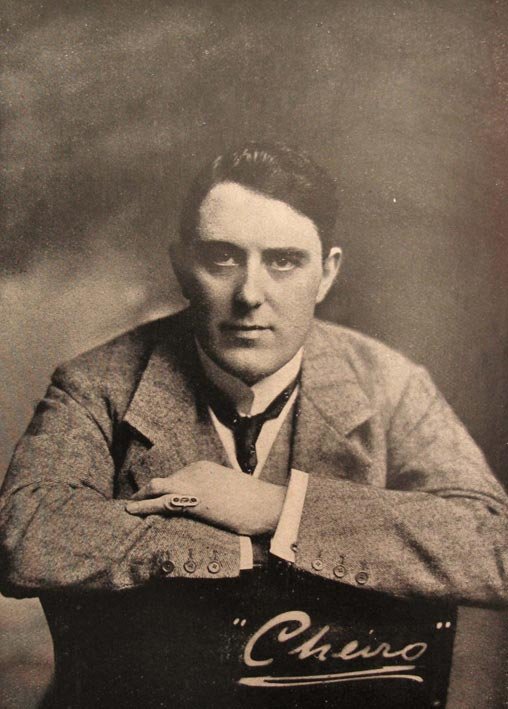 |
The girl strained forward towards him as if about to spring. “You are not only a fool, you’re raving mad. At midnight I shall be asleep. In fact I am going to bed now – good night!”And with that she made a grand exit from the room.A challenging situation indeed, but the women in the ballroom were with him as a body; the men could only speculate on the strange meaning of the little drama. But their speculations needed little patience, for midnight was close at hand. |
The man, in his immaculate evening dress, stepped to the door opening on to the stairs and opened it. Explaining the great need for silence to the intrigued guests, he switched off the lights, leaving the hall lit only by a blazing fire in the open hearth.
In the centre of the room he stood, apart from the others, silent and impressive. Silence indeed was everywhere. Except for the sparkling fire and a distant clock striking twelve.
Even as it ended a lithe figure glided into the room dressed only in a thin silk night-gown. Walking directly to him, her beautiful young limbs showing clearly against the firelight, she knelt before him and bowed her head to the floor in supplication.
Why Cheiro Left
It was a scene that etched itself deeply on all who watched, like some ancient magical ritual stirring in its mystery. The spell was only broken when the man quietly commanded the girl to return to her bed, and moments later he left the house that she might not he embarrassed by his presence in the morning.
The girl’s name we are not told. The man’s name was Cheiro.
In the occult world of the beginning of this century, Spiritualism Theosophy and Anthroposophy had all stormed into the public’s notice. Yet alone, by sheer genius and magnetism Cheiro enter intimately, not only into the life and welfare of thousands of individuals, but also into the welfare and progress of society itself.
Most people who know his work see him as a great palmist, seer and numerologist. He was more than that. He was, and he retmains, a mystery.
In trying to penetrate this mystery we find that his real name was Count Louis Hamon. We also find his biographer, Edith Halford Nelson, dedicating her book Out of the Silence to “Cheiro A Rosicrucian”. Among his own writings we cannot find any claims connecting him with this Order. But neither did he confess openly to many of his own other achievements.
Apart from the foreword, after reading his ‘Confessions’ he appears to he an interesting but harmless person. Yet he was a man of many guises and many abilities. Besides his occult career, his path often took him into the role of secret agent. This would be either for a minister, or in connection with private schemes that affected the financiers of the country.
The Same Spirit
Yet to students of his life, his actions are only hints of the spirit that moved him, the same spirit, quoting Madame Blavatsky, “that incarnated into the great occultist Cagliostro”.
Cagliostro’s life is as deeply interesting as Cheiro’s, but made stranger still by the age in which he lived, and the obscuring hand of time. Rigely Evans says of him-:
“It is not enough to say that Cagliostro posed as a magician or stood forth as the apostle of a mystic religion . . . Cagliostro impressed himself deeply in the history of his time. Princes and nobles thronged to his magic operations, and prostrated themselves before him for hours”.
He, with the Compte de St Germain, watered the current that swelled into the French Revolution. Although Rudolph Steiner disagreed with Blavatsky in her idea of Cheiro being a reincarnation of Cagliostro, Edith Halford Nelson, from her years of intimate dealing with Cheiro, was inclined to agree with Blavatsky.
From her early childhood she had recurring dreams of an ancient eastern city in which a tall, dominating figure predominated. In later years, because of certain features, she was able to recognise the city as Alexandria.
Affinity With Biographer
As for the gentle Greek philosopher, to whom later dreams gave the name of Demetrius Phalerus founder of the Alexandrian library, she met him face to face when she was seventeen. His name? Cheiro!
There seemed to be some strange affinity between them linking their lives at points. On impulse she entered his Bond Street consulting rooms to have her palm read. She found it crowded with people waiting on a chance of an unfilled appointment.
The secretary was just explaining that all appointments were booked for two weeks when Cheiro, showing two clients out, noticed her. Immediately he called her into his room despite his secretary’s protests.
Later, he induced a trance state in her in which she recalled glimpses of their togetherness in past existences – past times in which she states that he was perhaps Akhenaton, but definitely Cagliostro and Demetrius Phalerus.
There must be many so called occultists who claim, either openly or obscurely, that they are the incarnation of such men. Something so refreshing about Cheiro was that firstly, he made no such claims, and secondly, his life and abilities made such claims unnecessary. Where needed, others recognised him for what he was and that was enough for him.
One day, for instance, while he was in St Peter’s at Rome after having attended the Mass, he noticed an old man looking at him analytically. I say old, because the man gave the impression of great age, yet his features and bearing had great virility about them.
The Mysterious Package
After a few moments the man came over and apologised for his strange behaviour, and told Cheiro that he believed he had something of interest for him. “Please be here at this hour tomorrow,” he said.
Cheiro, being naturally inquisitive, and intrigued by something indefinably mysterious about the man, could hardly wait for the time of his appointment to arrive. When at last it did, the mysterious gentleman came to him, and with little ceremony handed him a package. The contents of the package he said were a sacred trust his family had held. Now the moment had come for them to be returned to their rightful owner – Cheiro.
As strangely as he came into Cheiro’s life, his exit was as mysterious, and Cheiro hurried back to his hotel, eager to examine the contents of the package.
These can be described in a few words. They were translations of manuscripts of extreme age, giving particulars of occult and alchemical formulas of very great use to Cheiro in his work. It is thought that they were part of the collection of manuscripts at one time in the Alexandrian Library.
Hand of a mummy
At another time in his life he was given the hand of an Egyptian mummy, by an Arab mystic. The Arab recognised him as one who would resurrect the ancient art of palmistry, and gave him the hand of an Egyptian mummy that had been passed down for generations, that together they might work out their destiny.
It was because he was a man of immense experience and worldliness that so many great and humble men and women sought his aid and advice. They knew that apart from his insight as a seer, they would he confronted with a man who would understand and sympathise through having lived life to the full.
A seer? Yes. A mystic as well, but also a lover, an adventurer, and most important of all, a man. Who but he could be seen by a Tibetan Monk as an “Incarnate”; by a woman as a lover, and by a mystic as the “Master”?
Who Was He
“As mentioned in his memoirs, Cheiro acquired his expertise in India. As a teenager, he traveled to the Bombay port of Apollo Bunder. There, he met his Guru, an Indian Brahmin, who took him to his village in the valley of the Konkan region of Maharashtra. Later Cheiro was permitted by Brahmans to study an ancient book that has many studies on hands; the pages of the book were made of human skin and written with gold and it is still guarded and protected with great care. After studying thoroughly for two years, he returned to London and started his career as a palmist.
Cheiro was reluctant to marry but was aware that he was destined to marry late in life. This did happen after a woman took care of him during a serious illness. A separate chapter is devoted to this matter in his memoirs.
Cheiro had a wide following of famous European and American clients during the late 19th and early 20th centuries. He read palms and told the fortunes of famous celebrities like Mark Twain, W. T. Stead, Sarah Bernhardt, Mata Hari, Oscar Wilde, Grover Cleveland, Thomas Edison, the Prince of Wales, General Kitchener, William Ewart Gladstone, and Joseph Chamberlain. He documented his sittings with these clients by asking them to sign a guest book he kept for the purpose, in which he encouraged them to comment on their experiences as subjects of his character analyses and predictions. Of the Prince of Wales, he wrote that “I would not be surprised if he did not give up everything, including his right to be crowned, for the woman he loved.” Cheiro also predicted that the Jews would return to Palestine and the country would again be called Israel.
After some years in London, and many world travels, Cheiro moved to America. He spent his final years in Hollywood, seeing as many as twenty clients a day and doing some screenwriting before his death there in 1936 following a heart attack. His widow, the Countess Lena Hamon, said her 70-year-old husband, who had been a friend and adviser to film actors late in life, and to European aristocracy and royalty in his early career, had predicted his own death to the hour the day before he died.
Cheiro claimed that he never understood his unique gifts, and he is believed to have lost those in 1906. One charge of mis-handling of a client’s money resulted in his being imprisoned. Some accounts of his later life say that after his release from prison, he retained neither his money nor his friends, with his once rich and powerful acquaintances ceasing to want anything to do with him”. Quoted from Wikipedia
His death and burial was reported as follows:
Fortune Teller’s Ashes Buried After 9 Years
Exclusive to ‘The Mail’
LONDON, Saturday. — The ashes of Cheiro, world famous fortune-teller to kings and princes, are at peace after nine years’ wandering round the world.
WHEN he died in America in 1936 he exacted a death-bed promise from bis wife to bury his ashes with his kindred occult spirit, who was his stepson, John Hartland. and herself on death. The widow travelled the world carrying his ashes .in a little metal casket, and only returned to England recently, when she sent the casket to be interred in her son’s grave at MelthamCemetery, near Huddersfield, Yorkshire.
‘My son and husband were in separable because both had psychic powers,’ she said. ‘Although my son was untrained, he had second sight and could foretell happenings in the next few months in the family circle. He was buried in 1942. ‘A psychic sympathy bound them together, and my husband did not want us separated in death.’ When Cheiro died, three strange things happened — the clock struck one three times, the house was fiIled with the overpowering fragrance of flowers though there were no flowers in the house, and the stairs creaked heavily, though no one was using them.
Cheiro was born William John Warner, of Bray Wicklow, Ireland. He could trace his family to the Hamons of Normandy, and so by deed poll changed his name to Count Louis le Warner Hamon.
His 63-year-old British-born widow is called Countess Mena Hamon.
http://trove.nla.gov.au/ndp/del/article/57479263
Yoga and Japan Part 2
A Japanese Yoga Class
Taking part in the yoga class, my wife Hyone and I could easily have mistaken it for a class in Birmingham or London. The same leotards or jeans being worn by the women in the class; the same postures being practised: the same situation of teacher leading a group, and the same quiet, centred stretching and relaxation. Yet we were in Japan, and all the people, apart from ourselves, were brown skinned Orientals. A small shrine to the gods of Shinto was fixed high on the wall in one corner, the custom for all large rooms and each house. Also, something that fascinated me in the room was an extraordinary 2ft square paraffin heater fired by electricity, giving no smell whatsoever. It heated the large room to the sort of warmth needed for conformable yoga.
KOSEI MORI, the teacher, is short compared with Europeans. He is 40 years old, married, with three children. The hall in which the class is being taken is not simply a hired hall, but Kosei’s HOME and yoga centre. The hall is on the first floor of a building that does not appear very large from the outside, but has a small shop front displaying goods and signs to do with the classes Kosei takes. Although there were only a few people in the class we attended, being in the afternoon, Kosei estimated there were 5 to 6 hundred members associated with the centre, which is his full time work.
Because the centre has to support him and his family, Kosei charges about £1.70 per person. He also advertises, and we had first seen mention of the centre on a bus poster. In Japan, buses are full of advertisements.
From our point of view, Kosei’s approach to yoga is very modern. He does not attempt to be a guru, but has the pupil teacher relationship common in the West. The classes themselves also have to fulfil the popular demand for a situation where a group of people can practise exercises and stretches to keep physically fit and, in the case of the ladies, attractive. The centre also has treatment rooms, sells health aids such as vitamins, and is geared to peoples self help needs regarding health. So on the surface anyway, there is very little oriental mystery about the centre. Like most of the many full-time yoga centres in Japan, it caters for the practical needs of people in a large town.
However, Kosei does see his work as being something more than altering the surface shape and flexibility of people. He has travelled to India, and tries to keep his class presentation firmly based on yogic traditions. His own teacher is a Japanese man named Sahoda, who is well known in Japan for his teachings and writings on yoga. But Kosei also has links with the Sivananda Divine Life Society in India. His great ambition is to enable many people to experience the change yoga can make in their life. His statement is that “being healthy is being happy.”
Before his full time involvement with yoga Kosei was a successful fashion designer. His interest in yoga developed out of seeing that many people were beautiful on the exterior, few had the same sort of beauty within themselves. Even with most of the forms of keeping healthy, he feels they are geared only to growth and health of body, not to mind and insight into life also. His particular love of yoga arises out of his certainty that it deals with the whole person, and leads to an inner growth. “You know,” he said “that when you are using yoga something inside as well as outside is changing. This change leads toward a wider love; love to all life.”
The inner change Kosei spoke of, he felt was something of prime importance. Because of the increasing amount of individual and social breakdown, he believes a harmonious relationship with ones own being can be the most important factor in survival.
The postures Kosei used in the class were all classic postures, such as the Bow, The Triangle, The Cobra, The Plough. This, more than anything else, shows his adherence to Indian traditions. After every series of three or four stretches he led the class into one or two minutes of relaxation in the Corpse posture. At the end of the postures he used five minutes of gentle breath control, then a longer relaxation. He stresses the teaching of relaxation, during, between and after the postures. At no time during his demonstration of the postures did his face or body show any signs of strain. The actual techniques of relaxation he uses are the well know intentional relaxation by tensing and relaxing each part of the body.
Kosei has been involved in yoga for nine years and his centre open for three. Visiting his centre, in the midst of a large and busy city – Kanazawa – the most powerful impression for me was the universality of yoga in the world today. The postures, the approach, the aims, were so much the same as classes on the other side of the world, one cannot help but see the same spirit, the same breath of life in them all.
When we left the centre over an hour after we arrived, we were confronted by something I can’t imagine finding elsewhere. We had taken a taxi to the centre, and on emerging from the building, there was the same taxi waiting nearby in the busy road. As soon as he saw us he hurried out of his car to present us with an umbrella we had left in the car. For over an hour he had gone backwards and forwards in the hope of finding us again. But that is part of the yoga of Japan.
Buddhist yoga in Japan
The friends who had invited me to teach in Japan had arranged for me to meet Buddhist monks, and some teachers and practitioners of traditional Japanese techniques of health and harmony. As my visit was comparatively short these meetings could not continue to the depth I would have liked, but are nevertheless worth sharing. Just as Japan took Buddhism and developed particular facets of it in an extraordinary way, such as in Zen; so I believe other spiritual teachings and practical therapeutic techniques have been developed by the Japanese into their own forms of ‘yoga’ or ways to harmony.
The first Buddhist ‘monk’ I was taken to meet was in charge of a fairly modern sect. The monk was old but alert, completely shaven head, many gold teeth, and with a feeling of sureness and calm which is found in some old people who have come to terms with themselves and life. I was surprised and interested when Tomiko, my friend and interpreter, told me the ‘monk’ was a women. She had adopted a son who was training to be the monk of the temple when she died. Squatting on our heels we were served clear green tea and small wrapped sweets. Apparently most Buddhist sects do not have weekly or frequent services in which worshippers take part. The public only visit a temple on special occasions, such as marriage, or certain festivals during the year. This temple was different. Those who supported the temple visited frequently.
As I did not have time to gradually learn from these two monks I soon asked what particular techniques of meditation, healing or consciousness expansion they taught. Their response was very guarded and I was told the traditional Buddhist teaching that you could not find anything through the efforts of the mind or rigorous use of ‘techniques’. Several questions I asked were thrown back to me in that way, and I began to despair that I would be allowed a glimpse into the inner life of these two human beings who had devoted their lives to one of the forms of Buddhism.
Ritual instruments
I then tried a different approach. The temple had many symbolic statues and pieces of equipment very similar in appearance to Tibetan ritualistic implements. So I asked the meaning and function of some of them. At this the young male monk suddenly came alive and with much enthusiasm explained their use in the rituals. Most of them, such as the horsehair fly whisk, the bell, the incense, were used to call the notice of the spiritual world to the monk/priest, and to ward off evil influences. It seemed, from what was being said, this aspect of Buddhism saw human consciousness moved, uplifted or dashed by the forces of mind, emotion and instinct. The ritual implements focused and directed attention in ways to helpfully deal with fears and disruptive attitudes. The subtle forces of mind could thereby be led through innate difficulties and dangers to transcendence.
The cleansing breathe
I was then shown a breath technique which seems to be widely used in Japan, and preceded the practice of meditation or prayer. Sitting on ones heels, or in a cross-legged posture one takes a deep breath and imagines all the evils and sickness or darkness leaving the body as one expels the air. As one breathes in, one imagines breathing in infinity, or, breathing in from infinity. A cleaner feeling of this may arise if we imagine we are taking in some part or feeling of all things. The outbreath and in-breath, with the images of expelling darkness and inhaling all things, are repeated twice more.
By the end of the meeting we were sharing real warmth and enthusiastic contact. As I was going the young monk pointed to his fairly long hair and said “I have stopped shaving my head, for a while at least, because I have recently married.” We both shared laughter when I replied that I had already had my hair long for some time, and I was now beginning to shorten it.”
A Japanese yoga teacher
Toward the end of my stay I met two people who added much to my experience of yoga in Japan. The first was Masaharu Iwasaki, a young man who acted as my interpreter during my days in Kyoto. He works as an acupuncturist and yoga teacher. He described his yoga class as having little to do with postures, mostly taking as its theme breath control and meditations. He explained to me that one of the oldest forms of therapeutic yoga in Japan was still used by some Buddhist monks. It consisted of the patient recounting to the monk the story of their life starting from the present and moving backwards. Masaharu San stressed that particular attention was given to relationships, and the person was encouraged and helped to feel any anger, tears or pain they still had in connection with past events or people.
Later I met Yuzuru Katagiri, who is a lecturer at Kyoto Seika College. Yuzuru San taught me and explained many details of another traditional form of Japanese yoga called Seitai (pron. sayt-eye). This technique has similarities to an ancient form of yoga still taught in India called Shaktipat or Kriya yoga. Actually the roots or meaning of the word Seitai and Shakti are similar. Both words are to do with the release and direction of the biological or potential energy in our being.
The magic of Seitai
Seitai was brought up to date in recent time’s by Noguchi San, who taught it in the form I am going to describe. Also, Seitai has three forms. These are:
a) Katsugen Undo. This is the form of Seitai in which a person practises alone, or separately in a group.
b) Yuki. In this form two people work together, communicating by touch.
c) Soho. This is used only by, for instance, a doctor who is trained in Seitai. The word means operation or treatment, and the therapist does something to the body of the client.
Noguchi San taught that by the regular use of Seitai many illnesses or despondent feelings could he healed. This was done through the release of the self regulatory healing energies in ones system expressing as spontaneous movements. These energies or functions are particularly at work during sleep. They lead to movements during sleeping and dreaming. But through Seitai they are released into conscious action and increased in effectiveness. In Japan, the Katsugen Undo form of Seitai is very popular, and is often to be seen in women’s magazines and the general press. But it also has its deeply philosophical side, because Seitai can lead to personal experience of what religion and spiritual teachings speak of.
Outwardly the practise of Seitai appears to be very simple. Here are the basic movements of Katsugen Undo.
1. Kneeling on the floor without shoes or restricting or tight clothing, sit on the heels. With awareness and quiet place fingertips on solar plexus. This is to help oneself test or be aware of whether this area is relaxed.
When ready, breathe in, and as the breath is released allow the head and trunk to relax forward to the floor. Also, imagine breathing out evil, ill health or inner darkness.
While the head is down, relax until ready to come up. Then repeat the process until a deeper feeling of relaxation comes. Noguchi taught that it is permissible during this to yawn. In fact yawning is the sign relaxation deepening.
2) This movement is much more dynamic. Sitting on heels turn head and shoulders to the right. At the same time lift hips from heels slightly, perhaps three or four inches, and breathe in. Hold the position for a moment then suddenly let the breath out powerfully and drop back on to the heel’s bringing head and trunk to centre again.
Repeat this to alternate sides until you feel you have satisfied yourself in the movement. If one side feels more difficult than the other do the last twist to that side.
3) Now place thumbs in the palms of hands and hold down tightly with fingers. Raise the arms so the upper arms are horizontal, with hands up, still sitting on heels. On a slow out-breath gather tension or strength to the base of the back of the neck by pulling head and arms slightly back. Then suddenly relax and drop arms. This is to be done no more than three times.
4) As soon as the last movement is finished take on a relaxed and allowing state of body and mind. Let the body, breathe, voice and feelings move as spontaneous impulse suggests. Do not attempt to think what to do, but allow your being to move or relax from its own sensations and feelings. Any movement is permissible, so one does not have to stay in the kneeling position. This is the most important part of Katsugen Undo and Seitai as a whole, and half an hour or more can be given to the movements arising. As one learns to put the mind into a watching, non interfering state, ones being can be allowed to doodle freely, and perform its healing, releasing and balancing action. Perhaps gradually or very soon, it will be seen that although the movements and feelings are non volitional or irrational, a theme of action arises, sometimes very creatively. But beware of trying to direct what occurs into making sense. That simply limits the action. Be content to leave this space of time open for ones being to do whatever occurs, even if it is quite meaningless.
Noguchi San wrote, “There are some who try to force difficult thoughts into the heads of little children. Soon having enough the children will only tire and yawn. Some try to force nutrients into sickly persons. But a living creature only takes into itself what meets its own ability.”
Japanese Landscapes
Everywhere I went in Japan I saw forest covered mountains. I was told they could not be cleared of trees to be farmed because the soil is so sandy the rains would soon erode them. The tree covered peaks became for me a symbol of the spiritual life. While in Japan I experienced a great sense of liberation, my spirit free from clinging, and seeing the mountains, being near to them increased this feeling, lifting it up. I imagined pilgrims of the past walking into the mountains as they let go of the worldly life; climbing into a joy with their staff and robe.
The God of the Jungle
So on one of my last evenings in Kyoto a friend and I left the town and climbed into the hills. We sat among trees on one slope, looking across a small valley to the brooding presence of the mountains opposite. Sitting huddled together against the evening cold and the occasional rain the darkness came as we talked and watched.
Some time past eleven we decided to walk down to look at some of the Temples and shrines on the lower hillside. We knew the path quite well because we had been along it in daylight on another occasion. Picking our way in single file through the jungle we came to a clearing. We both knew two stone monuments stood at the far edge of the clearing, we had examined them in detail the day before. But suddenly both of us were stopped by the sense of a powerful presence. She reached out for my hand, and we stood experiencing but not seeing, something immense over and around the stones. I felt as if I had been privileged to stumble upon a jungle clearing in which a god dwelt, and it was around such the ancients built temples. This was a jungle god of death, related to the forces of the earth and the decay of vegetation and life amidst the trees. It seemed to me I was standing near something akin to a humming cable carrying enormous electricity, and I felt the same care and respect one would have in that situation.
 The stone represents two of the great and venerated forces of nature – the Negative and Positive; the Female and the Male. The base bears the lotus blossom in the centre of which a phallic symbols pushes forth. My friend later wrote: “As a wickerwork of light and shadows, as a life death place.” But it can also be a wickerwork of Female and Male in which the paradox of the unity of both sexes is experience as one amazing enlightenment.
“Sitting before the mountain, listening, I heard you saying all was just a feather blowing in the wind. This sentence came over me as a strong feeling. I looked up at the hills along the valley through the night, and I knew in that moment –
You are not held by any arms.
No arms of final answers.
No arms of any beginning.
From shell to shell to shell.
Through a corridor, but without walls,
This is your destiny, but without path
You are going along a valley
Through the night
That is endlessly transparent.
Then we met the stones, who faced me without face. I was terrified and could not answer. But beside, in the small tree, I heard the voice of a bird, and what it was singing was life-death; twisted together in the same breath. Why this bird goes on singing? Why are we born? Feel it.”
The eternal decaying spirit of life
For me, as I stood and felt the impact of this eternal yet decaying spirit of Life, I understood that in some way it was created out of the energies of nature by the collective life experience and veneration of generations of Japanese men and women. It was the essence of their experience in regard to death and eternity, collected through the long years of human life in the jungles of Asia. To touch this god with consciousness as we were doing was to have the honour of sharing the collective wisdom of the Japanese spirit.
My friend goes on to say – “we went on, and before we came to the abandoned door, we saw the jungle in the twilight. It was the same place we saw at noon in the daylight; but now it was all changed. I felt it as the voice of the bird: as a wickerwork of light and shadows, as a life death place. Then in the morning beside you I heard the same bird singing before the window; but now so beautifully, so life-fully as I had never heard a bird singing before. It was the counterpoint to the night-bird voice.
“Back in Kanazawa I stayed writing nearly day and night for not to burst, because the experience of that night exploded in me like a volcano. When I had almost written all out of me I recognised this was like an inner experience of the beginning of the Ten Ox herding Pictures: searching for the ox…. lost in the jungle… seeing the traces….. by the stream and under the tree….. seeing the ox….. and, on yonder branch a nightingale was cheerfully singing. What we heard actually the Japanese nightingale called uginsa.” See Ox Herding
Impending sense of death
My own next day was full also. It was spent alone, my only companion being the most powerful sense of impending death I had ever experienced. I recognised this as an almost certain consequence of coming so near to such a powerful archetype, but I still felt death would arrive soon. Yet I made peace with death, and felt ready and willing if it came. Then in the late afternoon I had an urge to enter the mountain jungle again, to find the greater feeling of liberation. I walked up out of a suburb of Kyoto, along a quiet pathway by the side of a canal. No people were about. Houses were set back distant from the canal. And as I walked by, my feet quiet in the dust, the dogs barked. In my being I felt they knew that death had passed near, and had called out. But I could find no path into the jungle, it was fenced, only one to a Buddhist Temple graveyard. Eventually I turned back, feeling the loneliness and sadness of my journey. Then suddenly the presence was gone. Perhaps for a while I had taken a closer walk with the spirit of death and renewal. We had become more fully acquainted, and it had passed on into the jungle I was not yet to enter again.
It is worth realising the the Japanese do not have anything that can be thought of as religion with a God separated from human awareness. Buddhism is not a religion and denies the exists of God. In my own attempt to understand, I see their belief system as, “Created out of the energies of nature by the collective life experience and veneration of generations of Japanese men and women.” The Japanese see the wonder in nature and natural phenomena which are often approached with great reverence. 
The photo shows a Japanese woman with her shopping bag in front of her showing reverence for the stone statue. At another meeting my wife and I were sitting outside of a place to eat, and I saw just a couple of shops away an open fronted temple. A woman who had no difficulty in going through movements in public view of what seemed worship, so I said to our female Japanese translator, “Your people are very religious,” indicating the woman outside the temple. The translator, Hiroko I believe her name was looked very puzzled at my question and said no it was not religious. So I see their actions as maybe a way of working with obvious laws of nature, not an invisible God – the rising Sun, the giver of all life.
The next day I journeyed across Japan and from a lifting jet plane I said a sincere Sayonara – Goodbye, feeling showered by blessings.
Yoga in Japan Part 1
In 1984 Tony Crisp went to teach in Japan, and in his evocative two-part report he gives his impression of the social and spiritual attitudes he found in
Hong Kong and Kanazawa
In the middle of 1981 a letter arrived out of the blue inviting me to teach in Japan. It was from an American Dennis Hoerner who with an enthusiastic group of Japanese, and some Europeans had started a Bioenergy Centre in Kanazawa.
I was asked to lead two or more Life Energy Groups”, or as we usually called them, Bioenergy Workshops. The description of these workshops in the leaflet sent me said All the Life energy Group workshops are rooted in the philosophical and practical concept, derived from the work of people like Wilhelm Reich, that ‘health’ means the harmony of the mental, physical and spiritual aspects of the human being. Each of our group leaders, although different in style of working, strives towards the goal of harmonious integration of body, mind, and soul.”
My immediate question was, how had I been so lucky? David Boadella had already held Bioenergy workshops in Kanazawa and had recommended me; David is one of England’s most authoritative and active writers and teachers on Reich and Bioenergy. He felt it important that my approach to modern psychotherapy from the standpoint of meditation, and through it the tapping of the self regulating (homeostatic), self healing forces active in each of us, needed representation.
So in November I found myself on a flight heading first for Hong Kong, where I would have a one day stay before continuing to Tokyo. I remember the flight for its good food, its real fruit drinks served on demand, and Mr Lee, a Hong Kong businessman who sat next to me smoking incessantly. But I was grateful for his easy friendliness and realised as he talked that he lived in a mental world which considered everything in terms of money, business and family. When I walked the streets of Kowloon and Hong Kong I understood his view. So many millions of people struggled to earn a living in such a small area of land, you either survived or went under. There is no social security or welfare benefits to ease the burden of business failure or loss of employment.
But despite the enormous differences between the rich and poor, Hong Kong is a very friendly place. The Chinese find it easy to come up and talk to you in the street. On one occasion I stood outside a bank early in the morning with my suitcases, waiting for it to open to get Hong Kong dollars. I wanted to take a taxi as my cases were too heavy to carry far, and had no local cash. As I waited two young women came up to me smiling and asked if I were lost, and I explained about the taxi and bank. Their response was, well, why not go by bus, it was only 15 cents. When I explained I didn’t even have 15 cents they thought it a huge joke. put the money in my hand, and walked off to work.
Because business is so competitive, to look casually in a shop window often means the proprietor may quickly be beside you strongly urging you inside. This occurred to me at a clothes shop. The Indian owner had an unfortunate skin condition which caused him to be piebald. He assured me I needed a suit, which he could make from any of the materials he showed me, and have it ready the next day. I explained I never wore a suit, but this didn’t deter him.
In between our wrangling and my trying not to stare at the snow white areas on his brown face, I noticed he had a picture of his Guru on a shelf in the shop. While trying to sell me a shirt, he also mentioned yoga, and said a class was being held nearby. The teacher was a Professor Po.
With him still calling down the street after me about suits and shirts I went in search of the Professor. The place was difficult to find because so many shops are crammed in such small space, or share a single doorway. The entrance was actually that of a restaurant, but a doorman assured me the Professor was on the third floor.
As I emerged from the lift two Chinese women tried to show me to a table to eat. When I asked for the Professor they asked if I wanted the strip show in the restaurant. Eventually, by demonstrating yoga postures, they understood, saying Ah, Professor Po, and pointing to the left. When I got there the place was full of tables and chairs. It was explained to me that the Professor only used the space in the mornings, early, before the restaurant opened. Space was so scarce; he had already gone.
THE TEMPLE
My first evening in Hong Kong coincided with the time I was usually preparing to get up and have breakfast – when everyone around me was getting ready to sleep. I felt as lively as a cricket. Feeling I ought to rest if I could, I went to bed at midnight and managed two hours sleep before it escaped me completely . The night air of I long Kong. even in November, was beautifully warm. I usually hate bathing. but now after an hour’s yoga postures I had great pleasure in taking a long hot shower at three in the morning. During the day. because of the scarcity, water is turned off, so I made the most of the dark hours.
Afterwards I stood on the balcony of my room looking across the harbour to the island of I bong Kong. The lights o)f many colours rose from sea level up the mountain. As the plane had landed the lights had looked like fine oriental jewellery made of finest gems shining with inner light, woven into towers of filigree. A taxi driver later told me it was known locally as Oriental Pearl.
As the dark hours passed I sat and wrote letters home. Gradually people began to throng in the streets again. Because the shops stay open till nine or eleven at night, they have a slow start in the morning. mostly opening at ten. But many people were about early, and at seven I decided once again to seek the inner life of the Chinese in what was left of my short stay.
On my map I found a Buddhist Temple marked near the YMCA where I was staying, just off Nathan Street. I found the road, which served as a vegetable market; great square lorries were parked waiting to be unloaded. Only a few people were about. At the kerb a barrow stall stood with varieties of joss sticks for sale. At the end of the road a new skyscraper rose looking as if it were still in its original wrapping with the scaffolding of bamboo covering its entire surface. But I could not find a Buddhist Temple. I asked someone, who didn’t know, but asked someone else – and there was the Buddhist Temple next to the joss stick stall.
How had I missed it? An ornate and colourful gate. small but attractive, stood before a neat row of pillars covered with plants. This turned to the right and before me stood a huge open fire boiler like a large whisky still. Wondering, I entered the door beyond the boiler, a large passage led to the left. A small cot bed, recently slept in stood in the space; beyond was an area with odd tables and bits of wood stored. I went back and out to check if I had entered the correct door. There weren’t any others. This was the temple. Going in, I saw a woman who appeared also to be using the area to sleep in. Beyond the market stall table affairs, something vaguely like an altar stood. Nobody spoke English there, so I couldn’t enquire, but it looked like the temple also served as a dormitory, and at present was more dormitory than temple to meditate in.
THE PARK
Feeling somewhat disillusioned I walked across the road and found the entrance to Kowloon Park. It was about 7.15. As I got further into the park I noticed more and more people. Then, as I came to the main area of the park I realised my discovery. All around men and women, very young and gnarled old, were practising Tai Chi Chuan,
Alone, in groups, in circles around trees, under cover, in the open, people were happily exercising. talking. laughing, gracefully moving. Some of them used wooden swords in a form of Tai chi Chuan I had not seen before. But here in the open air, in the early morning I had found the happy temple of the Chinese. It was so beautiful to see the very old exercising just as happily as the young. Completely without shyness they stood anywhere in the park, many alone, doing traditional Tai Chi Chuan, or whatever movements they enjoyed. What a happy people they looked, and with such lovely traditions, which took them out so early too share the morning with each other exercising.
Later I found a Taoist Temple, small but attractive. To reach it I had walked through a street market near the Airport. Many strange creatures were on sale for food live frogs and turtles, chicks hatching there in the road – some shops specialised entirely in joss sticks and the aromatic wood they are made from could be seen being ground. Chinese Health Clinics were also right there in the midst of the market , exuding strong smells of camphorated oils, and people being treated in view, with the enormous variety of herbs, seeds. and substances standing visible. But the Temple stood beyond the noise, many joss sticks burning outside and drums beating within. A ceremony was in swing when I arrived. To sky and earth, incense smoke and prayers were offered.
As I sat and watched, sharing veneration with them, I could feel within me understanding and contact with these ancient Gods. Here in the worship was evident the collected wisdom and love of the people I had seen in the market. Out of their collective struggle against illness poverty, and death – from their shared pleasure and pain, this attitude too nature, its energies and the cosmos, had arisen. It was older and wider than any individual, and the gods themselves perhaps were made out of human longing, loving, and transcendence. I felt respect.
THE ARRIVAL
My first workshops was to be held in Kanazawa, a university town, and centre of ancient crafts. The great Zen teacher Suzuki was born and studied in this town.
I arrived in darkness very tired,. and my first impressions came as I stepped out of the car which had driven me from the local airport, for I had flown from Tokyo. The quiet after the engine noise revealed the sounds of cicadas calling in the night. Across from where I was going to stay a typical modern Japanese bungalow greeted me. The front garden, a few feet wide and one foot deep, held in it the beauty of the shaped trees I was too meet everywhere. And going into Dennis’s house I had my first social lesson; take your shoes off. It became to me a symbol of Japan, the shoes removed and left just outside the front door. Even in large civic buildings one still removes shoes. But large amounts of slippers are supplied, and to the toilet yet another type of slipper are there to change into.
Dennis has a Japanese wife, Tomoko. Their home mixed East and West for me. That night I slept on the futon, the Japanese folding mattress used on the floor. It is comfortable and practical because it is so easy to use or store. I insisted on going for a walk before sleep though, and my hosts were worried I would get lost. Kanazawa’s streets are designed to confuse invading soldiers, like a maze. I didn’t get lost, but it did start to rain, and on my way back I saw Tomoko coming to meet me with an umbrella. That was my next social lesson. Japanese, next to the slipper rack, have lots of umbrellas. Japanese couldn’t grasp the idea that I didn’t mind getting wet.
The next morning Dennis introduced me to Kanazawa. There are so many new impressions I could mention, but some of my delights were seeing men sweeping a river clean and, with brush and dustpan, cleaning leaves from it. The leaves weren’t blocking it. just untidy. I saw women digging roads along with the men and working in the municipal gardens. Trees were being tied up for winter to protect them from the snow. Japanese love trees. When one main road was built in Kanazawa the lovely old firs were left standing. and they jut right out into the road. Many people in Kanazawa wore gauze face masks. In England the general idea is that the Japanese did this because of the smog in cities, but the air of Kanazawa felt clean. The masks were worn because the wearer had a cold, and thus would protect others from their infection.
THE WORK
That afternoon I worked with three women individually. It was my first real contact with the oriental soul in a Therapy session. My work is based on two main principles. One is the practical use of awareness meditation techniques to help individuals become conscious themselves of what they are doing in and with their life to create problems. The other is teaching individuals how to release their own self regulatory healing and growth forces.
I was amazed and somewhat bewildered by the time the three sessions had ended. Each of them had exhibited exactly the same life situation – lack of emotional pleasure and warmth in their marriage. Obviously I had met this in European men and women, but never so stereotyped, one after the other. In one woman’s face I felt I saw not just her struggle and misery, but that of the collective soul of Japanese women. So much hunger for contact and love. I had also expected rather passive, reticent women; instead I found a degree of directness, frankness. and daring seldom found in European women. They were directly willing to explore emotions and physical contact with me, to see what they were doing in a relationship.
I found them not at all neurotic but painfully locked in accepted social attitudes, just ready to energetically change these when they understood how. Two of the women went home and used what had been learnt, and both husbands agreed to attend future workshops.
Yet another difference between East and West. Mostly it is women in the West who wish to improve the quality of their life in the emotional sense.
Later one of the women wrote to me. The letter is an example of the directness and honesty.
Thank you very much for embracing me warmly. I can now find what is lacking in my life. First time I met you I was expecting sexual satisfaction very much, but our being together was very comfortable and cosy. I gradually find my irritation that I am not fully satisfied by my husband owes almost to my attitude to him. That’s to say, I don’t see him as a living creature who is also eager to be warmed by me. By my change to him, we find each other that we are a better partner than we think we are. Thank you for being kind to me. I’ll remember you every time I find myself happy.
See Life’s Little Secrets – Meeting yourself
Ramana Maharshi
Ramana was born on December 29th, 1879, at Tiruchuzhi in South India. His father was an uncertified pleader, which is a sort of rural lawyer, and as a child, Ramana showed no sign of his later experiences. At school he was athletic; football, wrestling and swimming being his main enjoyments. He had an amazing memory, being able to repeat a lesson once heard, but was not thought of as bright.
Just after his sixteenth birthday, however, a strange experience came to him. Sitting alone he suddenly felt a violent fear of death. There was no sickness, only the thought, “I am going to die.” The shock of this drove him into an immediate self-analysis. He asked himself “What is it that is dying? This body dies.” With this thought he dramatised the enquiry by laying with body stiff, holding his breath, imitating a corpse. He went on to ask himself, “But with the death of this body am I dead? Is the body I?” This drove his enquiry inwards until there awakened that consciousness of THAT. He says, “Fear of death vanished once and for all. Absorption in the Self continued from that time on.”
The results upon his outer life were quite marked, although he told no one of his experience. He says, “Whatever work was given, whatever teasing or annoyance there was, I would put up with it quietly. The former ego that had resented and retaliated had disappeared. I stopped going out with friends to play games, and preferred solitude. I would often sit alone especially in a posture suitable for meditation, and become absorbed in the Self, the Spirit, the force or current which constituted me.”
His everyday life suffered however, and on a remark from his brother that his home was no use to one who acted like a Yogi, he left home for Arunachala, which is a holy mountain. From this time, until his death in 1950, he stayed near or on the Holy Mountain of Arunachala. He sought no disciples and made no effort to go about preaching of his insight. For some length of time, day and night were spent in meditation, his whole consciousness immersed in that “current” of his being revealed to him earlier. For many years he did not even speak, but sat quiet and still, immersed in that he had discovered within. This did not stop others noticing the blessedness of his presence, and soon crowds would visit just to see or sit near him, even though he never spoke or seemed to notice them. As time passed however, he began to answer questions in writing, and later on began speaking again.
Later, in describing this part of his life, he said, “Sometimes I opened my eyes and it was morning, sometimes it was evening; I did not know when the sun rose or when it set.” He compared this experience with a bucket being lowered by rope into a well, and then being drawn out. In other words, the ego dips into the unconditional, but can emerge again. His eventual condition was however, like the river entering the sea. That is, the ego is now merged into the unconditional, and yet one is still aware of the physical world, and can go about normal duties without loss of that consciousness. In the first one, the ego disappears only at deeper levels of consciousness. In the second, the unconditional bliss is felt at all times, in all situations.
With the growth in number of those who came as disciples to him, he took up residence on the slopes of Arunachala itself. He still maintained silence in these early years on the Holy Hill. So why did many make the long journey up the mountain to see him? Arthur Osborne, one of Ramana’s European disciples, says, “It was not only seekers after Truth who were drawn to him but simple people, children, even animals. Young children from the town of Tiruvannamalai would climb the hill to Virupaksha Cave, sit near him, play around him, and go back feeling happy. Squirrels and monkeys would come up to him and eat out of his hand.”
Outwardly from this time on, his life is empty of the exciting events one so often meets in famous biographies, but the richness of Ramana’s life, lived in the unconditional state, was one of inner relationships with the thousands who visited him. Unless we account these inner contacts he made with those who came, his life must appear empty and uneventful. For each day was spent seated, hardly speaking, or quietly performing every-day chores as in cleaning vegetables for the day’s meal.
H. Humphreys, writing to a friend in London about Ramana, says, “On reaching the cave we sat before him at his feet and said nothing. We sat thus for a long time and I felt lifted out of myself. For half an hour I looked into the Maharshi’s eyes, which never changed their expression of deep contemplation. I began to realise somewhat that the body is the Temple of the Holy Ghost; I could feel only that his body was not the man: it was the instrument of God, merely a sitting, motionless corpse from which God was radiating terrifically. My own feelings were indescribable.”
Paul Brunton, a journalist who had visited a number of so-called Masters, and had left each one still sceptical, also visited Ramana and wrote: “It is an ancient theory of mine that one can take the inventory of a man’s soul from his eyes. But before those of the Maharshi I hesitate, puzzled and baffled.
“I cannot turn my gaze away from him. My initial bewilderment, my perplexity at being totally ignored, slowly fade away as this strange fascination begins to grip me more firmly. But it is not till the second hour of the uncommon scene that I become aware of a silent, resistless change which is taking place within my mind.”
“I know only that a steady river of quietness seems to be flowing near me, that a great peace is penetrating the inner reaches of my being, and that my thought-tortured brain is beginning to arrive at some rest.”
One of those who stayed to serve him and become a disciple, arrived with a different problem than the quest for truth or understanding. Echammal had been a happy wife and mother, but before twenty-five she lost her husband, her only son, then her only daughter. Her grief and torture were such that she could not even stay in the vicinity of her previous home. She travelled to Gokarnam to serve the holy men there, but found no respite from her agony. Returning home, friends told her that many had found peace in Ramana’s presence. Immediately she set out. She had relatives in Tiruvannamalai, but she did not visit them, knowing it would increase her suffering by reviving memories. She climbed the hill and stood before Ramana in silence, not telling her misery. For a whole hour she stood and looked. Then she turned, her burden lifted and gone.
See: Ramana Website: Ramana Maharshi and the Path of Self-Knowledge.