Author Archive
Edgar Cayce
Carrie was sitting in her living room when Edgar Cayce entered. Her husband, Dr House, had asked him to come because of the emergency. As they entered, Carrie nursed her baby on her lap. The baby was quiet now, but not for long. Its convulsions had begun to come every twenty minutes. Two other doctors were already in the room. One of them, recognising Cayce, said, “If you’re going to fool with that faker, I’m through.” He went.
Dr House and his remaining colleague, Dr J. B. Jackson followed Edgar into the bedroom across the hall. Once there, Cayce loosened his collar, lay on the bed and went to sleep. Sitting nearby, and watched by Dr Jackson, Dr House read from a slip of paper,
“Now the body is assuming its normal forces, and will give the information that is required of it. You will have before you the body of Thomas Burr House, Jnr. You will go over the body carefully, telling us the condition you find there, and what may be done to correct anything which is wrong. You will speak distinctly, at a normal rate, and you will answer the questions which I will put to you.” After a pause, Cayce, still asleep, said in a clear voice,
“Yes, we have the body.” There followed a minute description of the baby’s illness, its causes, and what could be done to help. When Edgar woke, only Dr House remained in the room with him. Dr Jackson had gone back to Carrie and was arguing with her. “Mrs House, please don’t do as this man suggests. What he has prescribed for your baby is poison.”
Carrie’s reply came as Edgar and Dr House came into the room. “When I was pregnant with my baby, you were one of the doctors who diagnosed my condition as a tumour of the abdomen, and wanted to operate. It was Edgar who said that I was pregnant and had a locked bowel. Well, here is my baby to prove you and the other doctors wrong, and Edgar right. Again you tell me not to trust him, but I’m going to do whatever he says.”
Her husband, now sitting near her said, “What Edgar prescribes is an overdose of belladonna. You know yourself how poisonous that is. Of course, he gives an antidote, but what if it doesn’t work?”
Carrie sighed. “The baby is dying. We must do something, and what else is there for us to do to save him except Edgar’s suggestions? Go and get the belladonna, I’ll give it to him myself!”
When it arrived, Carrie administered it. Quickly the baby relaxed and fell asleep, while Dr House prepared the antidote. Edgar looked on tensely. Dr Jackson, also watching, said, “You mentioned something else, a peach tree poultice, whatever that is.” Glad of something to do, Edgar went to prepare it. Picking green shoots from a peach tree, he prepared a brew with hot water, dipped towels in it, and swathed the baby.
The hours seemed endless as they bathed and watched the baby. Then, as he arrived with yet another fresh towel, Carrie looked up smiling. “He’s better Edgar. I knew if anybody could save him it would be you!”
Moved by this demonstration of his own strange power, Edgar walked out into the garden. It was dark, and he looked at the sky. After a minute Dr House joined him. “Do you still have doubts?” he asked. “You cured Carrie, and now you have saved the boy’s life with this trance thing of yours. To most people it looks foolish, but it’s the most dependable foolishness I know. I have no other course now but to believe in it myself.”
Edgar Cayce is certainly one of the most amazing men in American history. Born in Hopkinsville, he died in his sixties in 1945, in Virginia. At an early age he discovered that he could put himself into a trance-like sleep at will. In this condition he could answer any question on any subject. His answers were couched in the terms of the question, i.e. medical, scientific, philosophical, historical, etc. Thus, although his education was little, and he was often described as illiterate, the answers given to questions were yet couched in technical terms unknown to his conscious mind. Politicians, businessmen, scientists, priests, all visited him to see how he could help them while he was asleep. In this way, he dictated fourteen million words on thousands of different subjects. When asked during a trance how he could give such varied and amazing information, he said, “Edgar Cayce’s mind is amenable to suggestion, the same as all other sub-conscious minds, but in addition thereto it has the power to interpret to the objective mind of others what it has acquired from the subconscious state of other individuals of the same kind. The subconscious mind forgets nothing. The conscious mind receives the impressions from without and transfers all thought to the subconscious, where it remains even though the conscious be destroyed.”
Whether we question this or not, his life seems to prove that he tapped the knowledge of the ages. For the sick, he would prescribe drugs not yet on the market, but being released, or those of men long dead and obscure. Once, when working with a number of doctors, he prescribed a medicine none of them had heard of, or could find listed. They advertised in a medical journal seeking its prescription, but meanwhile asked Cayce to describe it while in trance. Later a letter arrived from France, from a practising doctor. It said that no wonder they could not find the preparation, it had been invented by the man’s father, and never published. However, the enclosed details tallied exactly with those Cayce gave in trance.
First a hospital, then a large association, grew up around Edgar Cayce’s work. His life was spent helping the sick, and throwing light upon the mystery of life. His “readings” have now been collected, and are investigated by doctors, psychiatrists, priests, and thousands of laymen. Certainly his life demonstrated man’s emergence from the Timeless and Eternal.
In this sleep state he could verbally respond to peoples questions, and using medical terms he did not know consciously, diagnose illness in people, even at a distance. He could speak foreign languages he had never learned, and get information he had no conscious access to. Because of this he was asked to the White House twice. At one period a hospital was built in which he worked with six doctors, diagnosing from his sleep condition.
In his self induced sleep state, when asked how he managed to get information about the past, about people at a distance, etc., he replied that every person has access to what he called the cosmic mind – Jung’s collective unconscious – while they sleep, but few people can bring this contact through to conscious expression. He also maintained that prolonged working with one’s dreams gradually made conscious this contact with our cosmic life. The information garnered from Cayce’s unconscious in this manner, suggested that humans are cosmic beings. A lifetime is a brief interlude of learning in an eternal pilgrimage through time and space. The conscious personality we so often raise so high, is but a temporary experience assumed by an older larger being, the Spirit, the Individuality, or Self as Jung called it. The ego dies at death, but the Spirit/Individuality absorbs its experience. Dreams are the meeting point between this older self and the personality it assumes but briefly.
The phenomena of Cayce’s life is not unique. Other men and women in the past have exhibited a similar faculty. Cayce is however, a modern example of the practical possibilities connected with the collective unconscious.
Cayce’s biography is There is a River, and Seer Out of Season, are astonishing and inspiring books to read. Cayce dictated 14,000,000 words from his sleep state. A record of these is kept at The Association for Research and Enlightenment, Virginia Beach, USA.
Ramakrishna
Ramakrishna was born in 1836 in Bengal. His parents were poor but very pious, his father having been dispossessed of all he owned because he had refused to bear false witness for a great landowner. Ramakrishna is said to have been a very beautiful child, whose first spiritual experience came at the age of six. He tells us that while wandering along between rice fields, eating puffed rice, “I raised my eyes to the sky as I munched my rice. I saw a great black cloud spreading rapidly until it covered the heavens. Suddenly at the edge of the cloud a flight of snow-white cranes passed over my head. The contrast was so beautiful that my spirit wandered far away. I lost consciousness and fell to the ground. The puffed rice was scattered. Somebody picked me up and carried me home.”
From the age of twenty he became a priest of the Temple of Kali at Dakshineswar. Kali is the Divine Mother, the wife of God who brings forth all form. To her worship Ramakrishna gave himself in a way it is difficult to imagine. Carried away by visions, frenzies, fevers and trances, he was almost lost to the world for ten years. After many years, there came to him a woman known as the Bhairavi Brahmani (Brahmin Nun) who taught him to untangle the meaning of his visions and experiences. Then having found a stability within his revelation, another teacher came, Tota Puri (the naked one). Until the coming of Tota Pun, Ramakrishna had worshipped as a Bhakti, through forms and images of the gods, not so much outwardly, but through contact with the living forces emerging as forms within. Tota Puri taught him how to go into the formless.
Ramakrishna says of this, “Tota Puri taught me to detach my mind from all objects and to plunge it into the heart of the Atman (self). But despite all my efforts, I could not cross the realm of name and form and lead my spirit to the Unconditional state. I had no difficulty in detaching my mind from all objects with the one exception of the too familiar form of the radiant Mother, the essence of pure knowledge, who appeared before me as a living reality. I said to Tota Puri in despair, ‘It is no good, I shall never succeed in lifting my spirit to the “Unconditioned” state and find myself face to face with the Atman.’ He replied severely, ‘What! You say you cannot? You must!’ Looking about him, he found a piece of glass. He took it and stuck the point between my eyes, saying, ‘Concentrate your mind on that point.’ Then I began to meditate with all my might, and as soon as the gracious form of the Divine Mother appeared I used my discrimination as a sword, and I clove Her in two. The last barrier fell and my spirit immediately precipitated itself beyond the plane of the ‘conditional’, and I lost myself in Samadhi (unconditioned bliss).
“The Universe was extinguished. Space itself was no more. At first the shadows of ideas floated in the obscure depths of the mind. Monotonously a feeble consciousness of the ego went on ticking. Then that stopped too. Nothing remained but Existence. The soul was lost in Self. Dualism was blotted out. Finite and infinite space were as one.”
In this state, Ramakrishna remained as rigid as a corpse for days on end, much to the astonishment of Tota Puri, to whom he had now become, not the pupil, but the master. He stayed in the cataleptic state so long, that his body all but died. He himself says that he tempted providence. When he returned he was ill with dysentery for six months. Yet even before he was well, he began an investigation of all the great religions, and found that they all led to the same path.
It was not until 1867 that he began to communicate with the world again, and unfold deeps of wisdom, love and power. And not until 1874 that he began to preach, and slowly attract sincere disciples to him. The first of these were two cousins, one a medical student and complete atheist, the other a family man.
The results of his presence upon his close disciples, as with the other Masters, acted powerfully upon their inner nature. Vivekananda, his greatest propagandist, describes his second visit to Ramakrishna as follows: “I found him sitting alone on his small bed. He was glad to see me, and called me affectionately to sit near him on one side of the bed. But a moment later I saw him convulse with some emotion. His eyes were fixed upon me, he muttered under his breath, and drew slowly nearer. I thought he was going to make some eccentric remark as on the previous occasion. But before I could stop him he placed his right foot upon my body. The contact was terrible. With my eyes open I saw the walls and everything in the room whirling and vanishing into nothingness…. The whole universe and my own individuality were at the same time almost lost in a nameless void, which swallowed up everything that is. I was terrified, and believed I was face to face with death. I could not stop myself from crying out, ‘What are you doing? I have parents at home’. Then he began to laugh, and passing his hand over my chest, he said, ‘All right. Let us leave it at that for the moment! It will come, all in good time!’ He had no sooner said these words than the strange phenomena disappeared.
Another disciple said of him. “There he lived without any book-learning whatsoever; this great intellect never learnt even to write his own name, but the most brilliant graduates of our university found in him an intellectual giant.”
He lived until August 15th, 1886. At nightfall he became unconscious, and all thought him to be dead. But towards midnight he awoke and was sat up. He talked for a while, then in ringing tones called out the name of the Divine Mother and lay back. Passing into an ecstasy he stayed in the body for another half hour, then passed on.
Website; Ramakrishna and His Disciples.
Sri Haranath
Thousands of Indians alive today believe that a remarkable holy man, who was born in 1865, was the promised reincarnation of a saint, and an embodiment of the god Krishna -Taken from Man Myth and Magic Number 43.
THE REINCARNATION of Gouranga, the 16th-century saint who was renowned throughout India as an embodiment of Krishna, was prophesied in 1592 by Manohardas Goswami, a Bengali sage. Exactly 273 years later, on 1 July 1865, Sri Haranath was born at Sonamukhi – which means ‘Golden Mouth’ – in western Bengal, the son of a Brahmin. His disciples believe that he was the reincarnation of the saint and that he came, as he had come before, to distribute Krishna prem (divine love) on a vast scale.
It is related that Haranath’s father, Jayaram Banerji, while on a visit to Calcutta had a dream in which a sadhu (holy man) visited his house at Sonamukhi and requested hospitality of his wife, Sundari Devi. Being overwhelmed by the radiance of the sadhu, she admitted him to a magnificent temple of Shiva which Jayaram had built before leaving for Calcutta. There she served the sadhu devotedly and locked the outer gates of the temple after the evening ritual. Next morning there was no trace of the sadhu, although the temple walls were too high to scale.
So vivid was the dream that Jayaram returned immediately to Sonamukhi and related it to his wife. He was astonished to learn that a sadhu had indeed been received by Sundari the previous evening. Soon after these events, Haranath was born. His unusual life and, later, his appearance, suggested that he and the sadhu were identical.
The saintly Gouranga (or Krishna Chaitanya, as he is sometimes called) had fired all India with his ecstatic chanting of Krishna’s name; but his mission had not been wholly fulfilled. Being a sannyasin (celibate sadhu) his life was incomprehensible to the mass of the people. Consequently, as the centuries passed his influence waned and a new impulse became necessary. This was initiated by Haranath. He lived the life of an ordinary householder engaged in worldly activities. He married Kusuma Kumari Devi when he was 14 years old, she being nine at the time. Later in life he implied that Kusuma was Vishnupriya, who had been the wife of Gouranga before he renounced all worldly ties to tread the austere path.
Very early in life Haranath is said to have manifested strange powers. His mother would conceal various objects in fun and he would locate them immediately, unerringly, no matter how far from the house she hid them. He frequently went into trances and, while studying for his degree at the Burdwan Raj College, Calcutta in 1889, fell into such profound ecstasies that he could only be aroused with difficulty. He would then roam the Calcutta streets, unconscious of his surroundings. His college days were spent listlessly. He had no real interest in worldly knowledge; his mind was continually being absorbed by a mysterious inner power and he spent most of his waking life in the contemplation of spiritual truths. Because of this he did not pass his B.A. examination, for which he sat three times. With characteristic resignation to the will of Krishna he told a devotee: ‘I could not possibly have passed if I had appeared a lakh (100,000) times more, because no worldly object could then attract me.
Chanting the Name of Krishna
When not lost in meditation he was busy organising parties in which the chanting of Krishna’s name and the commemorating of Krishna’s divine activities were the dominant features.
Haranath earned his living in government service in Kashmir. He raised a family, thereby fulfilling one of the chief duties of a householder according to Hindu thought. But his love was seen to flow out to all beings and his small family soon increased to embrace many tens of thousands in India and other places.
Although living at a great distance from his wife and family during the 20 years of his service in Kashmir from 1893 to 1913, he asked his devotees always to couple her name with his, thus forming the sacred incantation or mantra ‘Kusuma Haranath’. The full and tremendous potency of the mantra would, he said, be discovered only after his death.
Haranath exercised superhuman powers that affected all kinds of people, many of whom were personally unknown to him. There are cases on record of his conversion of vicious people into saints, of ferocious animals into harmless and affectionate companions. He could leave his physical body at will and travel on the astral plane in order to warn his devotees and friends of impending dangers, saving their lives or enabling them to avoid agonies of mind and body. He had the power of hearing spirit voices and communing with divine beings, of seeing through opaque bodies, and visiting the abodes of Vishnu, Krishna and other gods. He also possessed the power of clairvoyance to a very high degree. He never claimed any of these powers as his own, always referring them to Krishna alone.
Crazy with the Love of God
During the time of his service in Kashmir there were some who recognised him as an avatar (direct incarnation) of Krishna, but to the majority of his devotees he was Pagal Haranath, so called because he was crazy (pa go l) with the love of God. He imparted his mood of divine joy to all, regardless of caste, age, sex or creed. He wrote thousands of letters during his life; they all extolled the efficacy of ‘taking name’ (repeating a divine name) and showed the way in which Krishna himself could be ensnared by his devotee in the net of love and longing.
Haranath said of the sage Narada, that he gave salvation through his harp; of Krishna, that he gave salvation through his flute; while he claimed his own pen to be sufficient means of salvation in the present age. The first volume of his letters appeared in 1910 under the title Pa gal Haranath, and it is today the main devotional book of his followers. Like all the letters that flowed unceasingly from his pen, Pa gal Haranath is steeped in divine love.
Haranath had no equal as a healer, and relieved sufferers by absorbing diseases into his own body. For hours and sometimes days afterwards his body registered the symptoms and agonies of the sufferer; yet he described the sensations as blissful. Such was his overwhelming love for humanity, especially the weak and the vicious, that he was willing to assume all their burdens. The only fee he asked was that they should chant aloud, or repeat mentally, ‘ any divine name that melted their hearts’, such as Radha-Krishna, Rama, Vishnu, Christ or Gouranga. It began to be customary for those he healed or enlightened to repeat the name Kusuma Haranath, and this is still done by multitudes in India and elsewhere today.
| Haranath is recognised by many Indians as an avatar, a divine personality whose mission was to initiate a spiritual rebirth among Hindus: he was clairvoyant, had remarkable powers of healing and was said to travel on the astral plane and commune with spirits |
Dead for Ten Hours
The most critical experience in Haranath’s life occurred in April 1896. He was about to journey from Jammu to Srinagar but on stepping into the carriage he lost consciousness. This occurred at three in the afternoon. He remained absolutely inert until one o’clock the following morning and was given up for dead. His heart had stopped beating, all signs of life had disappeared, and his travelling companions made arrangements for the body to be cremated. During the ten hours of death, however, Haranath claimed to have experienced the most intense interior activity. This included communion with a Mahapurusha (Great Being) whom he had seen before as a child of five while out walking with his elder brother. On this first occasion a vast form had hovered over them, as high as a two-storeyed building close by. He had at that time been mysteriously absorbed into the Mahapurusha; now it was the latter’s turn to be absorbed into Haranath.
This great being was none other than Haranath’s own self – Gouranga; and when he returned to life at one o’clock the following day, the merging had been accomplished. Haranath remained silent about the full significance of this experience. But his complexion underwent a permanent change to a fair golden hue (Gouranga means the golden one). Haranath became literally the one who spoke golden truths from a golden mouth’, as Manohardas had prophesied centuries earlier.
During the period of ‘death’ it is said that the Mahapurusha dismembered Haranath’s body into 64 parts. This he did in order to effect some kind of spiritual regeneration. On reassembling them, three were found to be missing. Haranath urged that these would not be necessary. He was anxious to re-enter the body again, not because he feared death or what might follow, nor because he cared particularly about living in a bodily form, but because of the anxiety which he knew his mother felt at that moment, having become telepathically aware of his sudden ‘death’. The Mahapurusha therefore made up the missing parts with ‘earthly-matter taken from the hills’, and Haranath revived.
Haranath left his reconstituted body permanently in May 1927. His followers explain that his devotees had become too numerous for individual attention and he consequently became universal once more so that he could appear to all who needed him, as Krishna himself had appeared to each of his devotees, intimately and uniquely.
Kenneth Grant
Meditation With Seed – Try this remarkable meditation
In classical yoga there is one definition of meditation which states it is of two types. One type is meditation with seed; the other is meditation without seed. The first means we take a subject for meditation, or use a meditation technique such as mantra or breath control, or have a goal. So in this type we have a starting point to grow from, a central theme, or an organising discipline. But meditation without seed is the opposite. There is only being, existing, without goal or aim or focal discipline, except freeing oneself from any form or direction which arises. For information about meditation Without Seed see Without Seed
About forty years ago, while leading a weekly meditation group, I took the first type of meditation literally. I gave each of the group a seed to meditate on. The idea to do this had arisen because I believe one of the main reasons meditation has been used through the ages is as a means to awaken new types of perception.
In yoga this is usually referred to as expanded consciousness, or becoming-one with the subject of meditation. Andrew Jackson Davis called it The Superior Condition. When he used such expanded awareness he could ‘see’ the physiological, energetic, and cosmic activities within human beings and was able to diagnose and treat illness. He was also able to look into the workings of nature and understand the place of human beings in the cosmos. Writing about his findings early in the last century he described the process of evolution, and published it prior to Darwin’s findings.
Davis, after having written such books as The Great Harmonia, became a medical doctor late in life, so as to practise medicine with less hindrance. Another doctor, M. A. Bucke, wrote in his book, Cosmic Consciousness, his belief that the human species is moving toward this new type of awareness.
But it was from Rudolph Steiner I evolved the technique of the Seed Meditation. Steiner himself had the expanded faculty of perception, and with it, amongst other things, made a study of how men and women without this faculty could begin to develop it. In his book Knowledge of The Higher Worlds, he gives one of the basic exercises of perception. He suggests taking a piece of dead wood, and a living plant and looking at each in turn. As we look we need to take note of not only what we think and feel, but particularly of what other subtle responses occur in our being. We also compare the responses which arise in connection with the dead object with those occurring with the living thing
SEEING DEEP
THE GROWING SEED – An mp3 audio of preparation for seed meditation – the seed step two – the seed meditation
When this faculty of ESP occurs which enables us to see deeply into the nature of things, it comes as an uprush into consciousness of deep experience of the thing we are considering; or as an amazing overall view of countless pieces of information and experience we had never before put together. Sometimes it even comes as an expansion of our being so great that we take in at a glance activities in the universe which our tiny viewpoint, centred on eyes, ears, fingers and thoughts, could never accomplish.
So this early exercise is to help us become aware of responses in our being within and beyond the usual direction we focus our attention. That is, when we seek information we usually direct attention to our senses, our tissue reactions as in emotions, our thoughts, our memories or conclusions from them – but we seldom note our postural response, temperature change, alteration in our energy level, fantasy eruption, sexual impulse, inclination of will; and most important, the composite experience which can only emerge when each is allowed to add its dimension of experience.
Even though this is a basic exercise, when I and my group practised on our seed we still didn’t arrive at observable results. So I gradually formulated an extension of the meditation which nearly everyone can gain something from. Like any other form of meditation it needs to be done regularly over a period of time for its benefits to become usable, and, for some people, it will at first be nothing more than an exercise in conscious thought.
If practised with understanding, however, it exercises our intuitive faculty, mobilising it sufficiently to awaken it. But it is still a first step. So when the intuitive appears, further meditations are necessary to bring it to the point where it becomes a practical extension to our already existing faculties.
The first step is to obtain a seed. Any sort of seed will do. But it may be helpful if it is something like a pea, on which the ‘germ’, the point from where it grows, is visible. Then look at the seed in as many ways as you can, i.e. as a piece of matter, as food, as a shape, as a feel, as a smell, under a magnifying glass, and so on.
Then think about what you have seen and what you already know. Consider what you can learn from it. In what ways are there any similarities between it and you (i.e. you were a seed in your mother’s womb?). Think about stages of growth. And take your time.
Next consider what you feel about the seed. Are you feeling disinterested amazed – curious – confused – empty? Take time over those phases of the meditation. Do not attempt to do it all on one day. It may even help to plant the seed on wet cloth or against the inside of a glass jar where you can see it swell and grow.
The next phase of the meditation needs a particular setting. The meditation is a means of opening to all of the aspects of our being in a way we may not have done before. So we need a setting where we can give attention to what is occurring in our being; where we can explore our spontaneous responses and not be disturbed. The place needs to be warm enough to be comfortable in, and with a blanket or something soft underfoot. Clothing needs to be loose enough to move around in easily
When you are ready, stand in the middle of your blanket. If possible, feel thanks to nature and its processes for your existence – and toward fellow human beings for their shared work and thought. The meditation has now begun. From the feelings of thanks, turn your attention to the idea of a dried seed. It can be any sort of seed, but preferably the type you have already considered and maybe planted. But this time we are not thinking about the seed, just holding the idea of it gently in mind. We are leaving thought behind and exploring another way of experiencing.
Without trying to be completely rational or scientific, what might it feel like to be a seed? Does it feel like a seed to simply stand with arms by sides? Does it feel like a dried up seed with arms raised above ones head? Watching this subtle sense of what feels unlike or like the seed, experiment with body positions until you find a position which feels for you like an expression of a dried seed. There is no ‘right’ position, only what feels right for you.
Don’t struggle with this meditation – enjoy it. Once you feel reasonably satisfied with your position, imagine what a dried seed might feel like inside. Is it waiting, sleeping, unconscious? Whatever you imagine it to be, allow your own inner condition to be as nearly like it as you can. Then check over details. Do the limbs and head feel right for a dried seed? Can you allow yourself to dwell in the inner condition?
The next stage is very important, so do not move into it until you have satisfied yourself with these first stages. Next we move gently into what may be called imaginative, spontaneous, or intuitive meditation. To do this we allow our body and feelings to fantasise or imagine, just as we have done so far in finding the position of the seed, but more flowingly now.
So, give your body and mind permission to express themselves freely and without prior consideration, in expressing the seed receiving rain in warm soil. The seed absorbs the moisture and the process of growth is triggered. The seed puts out root and stem and becomes a seedling, then progresses through its whole cycle of growth, blossoms, seeds, and dying.
When doing this meditation give yourself at least fifteen to thirty minutes to complete it. Unlike many forms of meditation this is without struggle, and usually the whole sequence of growth flows out of us as we allow our being the freedom to express.
And there are surprises in it too. Many people find the meditation has its own dynamic, and they can only grow to a certain stage, or the unfolding story throws up unplanned details. These details of how our own growth in the meditation occurs are relevant to our own life situation. For instance, finding it difficult to put down roots might point to your difficulty in staying in any one place, and so on.
The meditation is an exercise in allowing our own unconscious feelings and wisdom about ourself and life to express more freely. So it can usefully be practised regularly. I would not suggest every day for most people, but certainly once or twice a week. Each period of meditation will produce something slightly different, enlarging on or continuing the theme previously dealt with. Only a personal experience of this amazing ability to produce the new can convince one of the creativity we each have within us.
VARIATION FOR THE GROUP
There is another form of this seed meditation which is a great pleasure to use, and is helpful in developing a new ease and warmth in relationships. I have used it with a number of groups, and if it is led up to slowly and time given for people to feel their way in without a sense of rush or pressure, it leaves them feeling much more in contact with themselves and others.
This is basically the same as already described but done as a small group of three, four, or at the most, five. The members of the group need to have already experienced the seed meditation done individually before they attempt it as a group. This is not absolutely necessary, but it helps. It helps also if each person has at least once practised two other meditations – the Earth and Water meditation.
These are done in just the same way as the seed meditation. The instructions I usually give are as follows: Stand in a relaxed open manner, and hold in mind the idea or word ‘earth’ (or water). Just as you did with the seed meditation explore what postures and/or movements express for you the feelings and ideas connected with the earth from which all growing things arise. Allow yourself to explore the meditations, letting spontaneous fantasy or movements to arise if they occur.
After the individuals have established themselves in these three (seed – earth – water) meditations they come together as a group and decide who is going to be the seed, and who earth and water. I usually suggest that when they are ready, the seed takes up the dried seed position and waits for the stimulus toward growth to arise out of the relationship with the persons in the role of earth and water. When and if this occurs, then the course of their meditation is the same as doing the seed alone, but with added dimensions. How, in terms of human relationship in the meditation, does the growing seed take up the water and minerals and lift them to the sun and build a form?
To the earth and water their meditation is similar but reversed. How do they penetrate with water and warmth, in human terms, the enfolded seed, to release its growth? And then, how to enter into the life forces of the plant as it unfolds?
Here is a loved friend’s response to using the seed group.
Example: … most people put their loved ones into hospital and see them for one hour, at visiting time and leave the rest up to the staff to do…….I’m sure that is why the Katoomba Hospital gave us all so much space to nurse and be with Mummy, as it was way out of their normal experience of how family members are with their elderly dying, (apart from young children where it is a very different reaction going on.) The staff just kept saying she is a very lucky woman to have so much love poring out to her at the end of her life, it was infectious too… as staff members felt the difference when they walked into the room and wanted to be part of it. Remember the love generated in the Seed Groups, that was the only reason that I came back after the first time with Annie Moat……because I felt the love…..and felt that I could trust these people with my battered being while I took a look inside to find more of me.
IT ASKS MORE OF US –
Some people are at first reticent or have never explored these possibilities in human relationships, unless perhaps they trained in drama or dance. If the meditation is entered into enthusiastically though, it becomes a learning and growing experience. The seed grows and releases warm feelings and pleasures in its own unfoldment that touch the earth and water and involve them in the drama of its own experience.
It is very rewarding and helpful for the group to share what they experienced after the meditation has finished. The actual meditation should be entirely non-verbal – although some groups are vocal in that they feel the expression of sounds, humming or emotive sound a part of their experience. But the sharing of the experience at the end is a release and completion of what went before. Then, the group can allow someone else to be the seed.
The seed meditation used in these ways is an extremely simple way of starting or developing one of the most important aspects of yoga -namely, allowing the emergence into consciousness of material from our wider awareness. It does this in a gentle way acceptable to a large number of people. This leads to a gradual expansion of consciousness as we touch more parts of our nature, bringing about spiritual growth.
We learn to work with the spontaneous process in us, active also in dreaming, which brings to consciousness parts of ourselves otherwise ignored. As we integrate piece after piece of our inner life we literally grow as a person. We absorb into our waking self more of our personal past, more of our heritage as a mammal and life process, more of the treasures of culture and spirit left us by humanity. Our life of spirit has begun.
Being a seed in a group gives us a social opportunity to receive a sort of powerful healing we seldom receive in our society – the healing of touch. Laying on of hands has always been recognised as a way of helping a tired or sick body back to health. Modern doctors and nurses are now recognising the importance of this. They are learning to hold patients’ hands, to be warm, to touch. In the seed meditation the earth and water can gently relax and open the seed with their touch. So the meditation is one of healing as well as growing.
The group meditation is of enormous help in learning to touch, to allow into ones own experience, a part of someone else’s inner life, and to help another human being begin the miraculous process of exploring the height, depth and music of their own being. So make yourself a seed bed and grow a little. See Life’s Little Secrets
Example: Judith, who teaches a yoga class, describes her use of this approach to LifeStream as follows:
“….I felt as if I were the bud of a crocus. I seemed to be slowly unfolding with difficulty. Not until I fully opened did I feel a great relief. The results of this have made me feel very positive in my outlook, and far happier…..I am a trainee yoga teacher and have been teaching for three years. I have a small class of fourteen students who are keen and attend regularly. I decided to have my students try this to see how they would react. I explained it as well as I could, and the feedback I got was:- A man in his thirties said, ‘I felt I was in a womb. It was very comfortable, cosy and dark. I wanted to stay there. I didn’t want to come away – it was so peaceful. I have never experienced anything like it before.’ He was very impressed. A woman in her thirties felt like throwing her arms around and kicking her legs. ‘I felt I wanted to give birth and was about to deliver.’ She didn’t fling herself about, but held back. I think it was a pity she didn’t let go.
Perhaps I didn’t explain the whole procedure clearly enough for them to understand that it was entirely free movements. The majority acted out being flowers. Only one in the class thought it was a lot of ‘bloody rubbish’, her words. She didn’t even try. She thought she would feel stupid acting out a seed. I personally was surprised at the outcome, that so much should happen first time.”
When using the starting point of the seed, or water, etc., we are giving the unconscious a ready made structure to work with. Because we may be unfamiliar with a completely unstructured approach to our inner processes, such a structure gives at least some sense of familiarity and confidence. Even so, some people find they want everything fully described, scripted or choreographed. The very point of LifeStream however, is to begin moving beyond the known in ourselves, towards creative newness and the unexpected. So even if some anxiety is felt, as with the woman Judith describes who defends her anxiety of the unknown by calling the exercise ‘bloody rubbish’, one needs to gradually move beyond such resistant feelings.
Jesse Watkins Experience of Enlightenment
Because each person, in their conversation with their wholeness, converses with the highest authority, I will quote from R. D. Laing’s book “The Politics of Experience.” The book mentions the experience of Jesse Watkins. In the chapter ‘A Ten Day Voyage,’ Dr Laing quotes Jesse Watkins’s own description of his inner experiences. The barriers between Jesse’s known self, and wider self had been broken down by overwork, fatigue, a dog bite, and a visit to hospital. Below is quoted some of his description of what he saw of himself.
“But I had a feeling at times of an enormous journey in front, quite, er, a fantastic journey, and it seemed that I had got an understanding of things which I’d been trying to understand for a long time, problems of good and evil and so on, and that I had solved it inasmuch that I had come to the conclusion, with all the feelings that I had at the time, that I was more—more than I had always imagined myself, not just existing now, but I had existed since the very beginning, from the lowest form of life to the present time, and that that was the sum of my real experiences, and that what I was doing was experiencing them again. And that then, occasionally I had this sort of vista ahead of me … ahead of me was lying the most horrific journey, the only way I can describe it is a journey to the final sort of business of being aware of all—everything. It was such a horrifying experience to suddenly feel, that I immediately shut myself off from it because I couldn’t contemplate it, because it sort of shivered me up—I was unable to take it…”
He goes on to say, “I had feelings of gods, not only God but gods as it were, of beings which are far above us capable of, er, dealing with the situation that I was incapable of dealing with, that were in charge and running things and, urn, at the end of it, everybody had to take on the job at the top. And it was this business that made it such a devastating thing to contemplate, that at some period in the existence of oneself, one had to take on this job, even for only a momentary period, because you had arrived then at an awareness of everything. What was beyond that I don’t know. At the time I felt that God himself was a madman… because he’s got this enormous load of having to be aware and governing and running things—and that all of us had to come up and finally get to the point where we had to experience that ourselves.., the journey is there and every single one of us has got to go through it, and everything— you can’t dodge it… the purpose of everything and the whole of existence is, er, to equip you to take another step, and another step, and another step, and so on.
It’s an experience that, um, we have at some stage to go through, but that was only one, and that many more—a fantastic number of things have got to impinge upon us until we gradually build ourselves up into an acceptance of reality, and a greater and greater acceptance of reality and what really exists.”
Jesse was “at sea” in this inner condition for ten whole days. Finally he felt that he couldn’t take it any more and closed down the barriers again. He says, “I was suddenly confronted with something so much greater than oneself, with so many more experiences, with so much awareness, so much that you couldn’t take it.”
“I didn’t have the capacity for experiencing it. I experienced it for a moment or two but it was like a sudden blast of light, wind, or whatever you like to put it as, against you so that you feel that you’re too naked and alone to be able to withstand it; you’re not strong enough. It’s like a child or an animal suddenly confronted—or being aware of—an adult’s experiences for him, for instance. The grown-up person has experienced a lot in their life time, they’ve built up gradually their capacity for experiencing life and looking at things… And I was facing things then that I just hadn’t got the equipment to deal with.
Jesse goes on to say that most of us are only equipped for just the very experiences we are going through in life. Any more, or any suddenly widened consciousness, might be too much. Just as the baby is not equipped to face the full sexual experience, or of being alone, nor are most of us equipped for any full cosmic experience, or for “taking it all by ourselves.” Those great souls who appear to have this ability, usually say that repeated earth lives have prepared them for it.
The Cosmic Ocean
Edgar Cayce, on the same theme, (in “There is a River” by Thomas Sugrue) says that “The plan for the soul was a cycle of experience, unlimited in scope and duration, in which the new individual would come to know creation in all its aspects, at the discretion of will. The cycle would be completed when the desire of will was no longer different from the thought of God. The consciousness of the new individual would then merge with its spiritual consciousness of identity with God, and the soul would return to its source as the companion it was intended to be.”
Cayce has also, with the synthesis of Sugrue, explained this return to God. “The idea that a return to God means a loss of individuality is paradoxical, since God is aware of everything that happens and must therefore be aware of the consciousness of each individual (we might understand this if we realise that our memory is aware—or records—all we do, yet we are not consciously aware of all our memory. Author’s note). Thus the return of the soul is the return of the image to that which imagined it. . . When a soul returns to God it becomes aware of itself not only as part of God, but as part of every other soul, and everything. What is lost is the ego—the desire to do other than the will of God. When the soul returns to God the ego is voluntarily relinquished; this is the symbology of the crucifixion.”
Naturally, there are those who have returned to their Self (God, Source, Atman, etc.) in this way. Sometimes they incarnate, or take on a body again, to help those of us still trapped in our own ego. We may name these as Jesus, Buddha, Mohammed, and the modern avatars such as Ramana, Ramakrishna and Sai Baba. Cayce says that during man’s early involvement in matter, there was still direct realisation of the Source, but, “gradually, life after life, they descended into earthiness, into less mentality, less consciousness of the mind force. They remembered their true selves only in dreams, in stories and fables handed down from one generation to another. Religion came into being: a ritual of longing for lost memories. The arts were born: music, numbers, and geometry. Finally man was left with a conscious mind definitely separated from his own individuality. (i.e. awareness of wholeness). He now calls this individuality the subconscious mind; his awareness of earth is the conscious mind. The subconscious mind influenced the conscious mind—gave it, in fact, its stature, breadth, and quality. It became the body under the suit of clothes. Only in sleep was it disrobed.”
In this state—”He built up theories for what he felt— but no longer knew—to be true. Philosophy and theology resulted. He began to look around him and discover, in the earth, secrets which he carried within himself but could no longer reach with his consciousness. The result was science.”
Taking the word ‘individuality’ to mean whole awareness, and complete remembrance of all earth lives, Cayce explains how man realises his lost paradise. “Man is at all times the total of what he has been and done, what he has fought and defended, what he has hated and loved… No soul takes on flesh without a general plan for the experience ahead. The personality expressed through the body is one of many the individuality might have assumed. Its job is to work on one or several phases of Karma of the individuality. No task is undertaken which is too much for the personality to which it is assigned. Choice of incarnation is usually made at conception, when the channel of expression is opened by the parents. A pattern is made by the mingling of the soul patterns of the parents. A soul whose karma approximates to these conditions will be attracted by the opportunity presented. The body is formed in the womb according to the pattern made by the mingling soul forces of the parents. This is the metaphysical symbolism of the 47th problem of Euclid: the square of the hypotenuse of a right angled triangle is equal to the sum of the squares of the other two sides.
“Thus a personality is only an aspect of an individuality.
A soul deciding to experience earth again, might assume any of several personalities . . . Because the incarnations only reflect their problems (their blessings as well as their handicaps), usually the Karma of more than one (previous life) can be undertaken in a single life; if the life is successful, considerable progress is made towards freedom from flesh. The personality is shaped by three or four incarnations, the portions of the earthly experience on which the individuality wants to work. The emotions and talents of the person reflect the incarnations. The dreams, visions, meditations—the deep, closely guarded self-consciousness of the personality is the pattern of experience.”
Concerning our times, Cayce says, “At present man is in a state of great spiritual darkness—the darkness which precedes dawn. He has carried his scepticism to the point where it is forcing him to conclusions he knows intuitively are wrong. At the same time he has carried his investigation of natural phenomena to the point where it is disproving all it seemed to prove in the beginning. Free will is finding that all roads lead to the same destination. Science, theology, and philosophy, having no desire to join forces, are approaching a point of merger. Scepticism faces destruction by its own hand.”
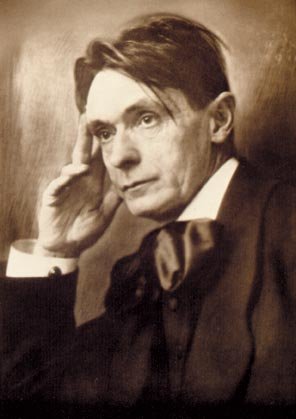
Rudolph Steiner’s Genius – Life After Death
Around 1907, Steiner began working collaboratively in a variety of artistic media, including drama, the movement arts (developing a new artistic form, eurythmy) and architecture, culminating in the building of the Goetheanum, a cultural centre to house all the arts. In the third phase of his work, beginning after World War I, Steiner worked to establish various practical endeavors, including Waldorf education, biodynamic agriculture, and anthroposophical medicine. (Quoted from Wikipedia)
 |
|
When he was nine years old, Steiner believed that he saw the spirit of an aunt who had died in a far-off town asking him to help her at a time when neither he nor his family knew of the woman’s death. Steiner later related that as a child he felt “that one must carry the knowledge of the spiritual world within oneself after the fashion other external learning. Steiner carried this ability to see beyond the physical world into his adult life in an extraordinary degree. He formulated the knowledge he gained in this way and called it Anthroposophy. The work of a genius.
Steiner’s work is so huge covering so many subjects I have given here a small taste of it.
WHILE engaged as a tutor for a mentally backward child, Rudolph Steiner studied the child’s inner life. He was able to do this through being able to observe things clearly, though not by physical sense organs. This clairvoyance, he says, gave him entrance into the soul life of the child. He found that mental retardation, showing as physical malformation also, was due to an unbalance in the moral qualities of the soul. Working with the child and aiding it inwardly and outwardly, the child reached normalcy. In adulthood, the once-backward child became a doctor. As an example of what can be done with a child who is diagnosed by experts as mentally backwards, see http://www.youtube.com/watch?v=vNZVV4Ciccg
As a child, Steiner clearly experienced a non-physical world and beings as real to him as the physical world of his body. At first he could not reconcile this spiritual world with his experience of the physical, or with the education he received. Over the years, however, through constant attempts to understand modern science, while not denying his spiritual awareness, he found a unity.
In his early years, his spiritual experience had existed as something apart from his physical life. But through 40 years of constant search, contact with Goethe’s writings, and a self-imposed discipline of directing his attention to the physical world, he broke through to a vision of the spiritual reality permeating physical existence. The inner and the outer were then united in a common reality, not a duality. Only then, after so many years of discipline and search, did he begin to teach. In a huge number of lectures and books, covering the whole compass of existence from child education to farming, from past history to development of spiritual sight, Steiner gave his teachings.
In such books as Theosophy, Knowledge of the Higher Worlds, and Life Between Death and Rebirth, he gives his observations on man’s past, his life and his death. Because his descriptions of death are so detailed, they have been given here as well s could be done in such a small compass. See Dimensions of Human Experience
Steiner says that man has three levels of being the physical body, the soul and the spirit. The physical body is permanently under process of change. Its keynote is impermanence, and between its birth and its passing away stretch a continuous process of change.
At death it is no longer conscious in the same way as in life, or even at birth. This consciousness, that is absent at death, and undeveloped or unformulated at birth, is the soul, our individual awareness. Just as the body feeds upon matter in the form of food, and thus gradually builds up a defined physical body, so the soul feeds upon the sense impressions and experiences gained through the body. With them it builds up a defined ‘body’ of perception or self-awareness. We often think of this as our ‘self’ or personality. The sense impressions are in themselves impermanent. As soon as the smell of cooking bread is removed, the impression has gone. But the soul faculty of memory gives a certain permanency to one’s physical existence.
Before the soul or body can be properly understood, one has to grasp an idea of the spirit. As can be seen from the very casual analysis of the soul above, it experiences and is rooted in the transitory world of the body through the senses. Yet if it only partook of the body, we would have no enduring personality, but wander from one sense impression to another, and be moved hither and thither by these. But an element of permanence penetrates these impressions in the form of memory, thought and understanding.
Through these a person can gain something that is more durable. Through many sense impressions regarding physical existence, mankind have built up an understanding of gravity, physics, medicine, music and religion. Even without sense impressions, man can live in these thoughts, which can be passed onto other men and women. Such are the things the soul builds its ‘body’ with, but it does so only through the influence of permanency introduced into it by the spirit. If the keynote of the body is impermanence, the keynote of soul is balance, and that of the spirit changelessness. Through the influence of the spirit, the soul brings understanding and some permanency to the ever-changing sense impressions. And just as the soul feeds on sense impressions, so the spirit feeds on soul realisations, and extends them into universal consciousness and applicability. There is also a flow from spirit to body, for the chaotic mineral substances gain a measure of permanency in form and organisation through the power of spirit expressing through consciousness. The human will can also act from its feelings and thoughts, thus metamorphosing the physical world.
Experience Into Knowledge
The body gains form by repeatedly eating substance. The soul gains definition of consciousness by repeated daily experiences of sensory impressions, and feeding on ideas, feelings and actions given in books or other cultural products. The Spirit self defines its own realm by feeding upon the higher experiences and realisations of the soul, through repeated earth lives. These past lives are not remembered easily because the new soul that developed in the new body had no past connections because it has a new brain. The soul or personality is built from the local memories stored in the new brain. So memories of the past can only be attained by a deep awareness of the spirit.
We can gain a clearer idea of Spirit if we observe certain dreams or meditations. The images and emotions, worldly or personal concepts grasped by our soul, in some dreams or meditations, are suddenly transformed into a universal truth.
 |
For instance, the experience of motherhood can be transformed into a realisation of a general principle that permeates all living things, perhaps by seeing it everywhere in human and animal lives. The personal is thus transformed into the universal and timeless. The supernatural or cosmic thus enters into the mundane daily events of our life. This is the work of the spirit. The organs of perception in the body are the senses, in the soul they are attributes such as patience, morals, understanding, and in the Spirit its universal realisations. |
In sleep and death, consciousness gradually withdraws from the physical into its own centre, rather like a snail withdrawing into its shell. This disappearance of personal awareness in sleep is an entrance into the world of death. The half way meeting between the wisdom of the spirit and waking consciousness is experienced as dreams.
At death, Steiner says, the influence of soul and spirit are disconnected from the body. It is left with only its own forces, and breaks up due to lack of a unifying and enduring influence. The Spirit is no longer immersed in the physical world through the soul, but it is still locked to the soul world through the souls experiences. The soul may be saturated with physical concepts, desires and impulses, which as they are, cannot be integrated into the spiritual ‘body’, just as food, without digestion cannot integrate with our physical body. As such it usually sees itself as the body and gender it lived in and as, but it may realise itself as a younger and healthier person.
The spirit however is neither male or female but everything, so the newly dead may only develop into the state of wholeness slowly, but will live in the idea and image of the body just departed.
Usually the first thing experienced at death is a vivid re-experiencing of one’s whole life in reverse order. These memories, Steiner states, are only experienced in this way when the formative energies of our being are separated from their action upon the matter of our body. Occasionally, he say, a temporary separation is brought about by a shock, a bad fall, or electric shock, and the person then has the same experience. Bennet, writing about his experiences in Subud, tells how he was able to actually enter into his wife’s experience of her past memories as she died. Some Gurus of the East, such as Sri Ramana, say they help their disciples by giving them strength as they face these memories. But in fact it has also been seen that some ordinary people deeply share the death experiences of those they are with.
Many people as they die experience a flight toward the light. This is most likely because they cannot yet experience themselves as the male female formless being they are, and so plunge toward the light still living in an image of their old body; that is usually what they experience in dreams. See Archetype of the Shapeshifter
The essence of a lifetime is thus extracted. Now begins what is for most people a purifying experience. In life we can choose to act from the direction or impulse given us by our whole being, or spirit; or we can choose to act from impulses arising from just one aspect of self, such as the body, sexual desire, intellect, emotion etc. Steiner points out that the desire to eat, for instance, is basically an urge arising from the Spirit, as it wishes to take part in physical experience.
But frequently we extend this urge and eat just for the pleasure of tasting, or being in company, through insecurity and so on. This also applies, of course, to sexuality, emotions and thinking. If our activities had arisen purely out of spiritual impulse, we would experience no purification. However, we have built into our soul nature, many longings and desires that can only be fulfilled through the body, which are out of harmony with the spirit. In a sense we are possessed by these desires because we have no control over them but have control over us.
There is thus experienced a period of burning desires; as these longings consume themselves in their own fire. During this time, one lives again through memories of life, but only those that were out of harmony with one’s innermost nature. Not only does one remember such deeds and emotions, but also experiences them as happening to oneself. Thus pain given to others, destruction wrought in the world, loneliness and fear sown, are now gone through personally. As with all these experiences, many people go through them during life, and are thus already cleansed.
In succession, similar cleansings occur in regard to one’s likes and dislikes, the idea of body and its form being oneself, and other connections with corporeal life. Steiner says that suicides particularly suffer such inner reactions.
Love Dissolves Barriers
In the body, our relationships with friends, family and strangers, is coloured by our emotions, angers, wisdom and so on. After death, our relationships with dead family and friends is seen to be much more influenced by these things. It seems we share their live intimately.
As the negative aspects of self are burnt out, there opens depth upon depth of entrance into other beings. From within begins to emerge the flow of direct knowledge and love that we blocked by our dislikes, prejudices and desires. As the ideas of oneself being a physical form drops away, as the realisation that dawns that lasting pleasure arises from within, and is not dependent upon physical objects or activities, one begins to become and to see others as beings of light and tones. These streaming colours and sounds, one gradually realised, are not separate or distinct from all else. They begin to be seen as flowing from greater beings, or a greater being, than oneself, and flowing through all. But through one’s own activities, loves, and thinking, one has woven these tones and colours in a unique fashion. Barriers of separation between others and ourselves melt away, and real union and love exists at this level. We can then, Steiner says, ‘live in each other without that separation which all companionship must experience in the physical world.
What Steiner is presenting in these descriptions, is the detailed activity of the spirit, withdrawing into itself the fruits of experience gathered in the body. The difference between sleep and death is seen to be that in sleep, the process is frequently interfered with by fresh bundles of waking physical experience. In death, there is an uninterrupted withdrawal into Self. As can be seen, this consists of a gradual gathering of all the fruits – memories – a sifting and cleansing of them, and then a transmuting them into the universal and formless life of the Spirit. Steiner does not say this, but from other sources it seems that only inasmuch as we have built into conscious waking life, some experience of the spirit, can this be a conscious thing.
So far, what has been done is, Steiner says, all part of the soul world. With the achievement of experiencing oneself and others as beings of light and tone, there comes now an entrance into the lowest levels of the spiritual world. What had been a vision of tones and colours, is now seen to be ordered and enclosed by the archetypes, the non-physical moulds of Spirit. Here we break through the outer appearance of sound and colour to the underlying intelligence, power and love, in their creative moulds. These are the gods. Steiner tries to arouse in us an understanding of this by asking us to have before us the image of a physical and alive person. We must then imagine the actual physical matter of the person disappearing, leaving a vacuum in space. We must then imagine we are seeing all the exchanges of energy, flow of sensation, motivating forces, moving and flowing through the body, there apparent in the space the physical body, occupied. In this way, he says, we have a concept of the archetypal forms we meet in this level of the spiritual world. We meet the building blocks of all forms, all plants, all creatures, all mental and artistic creations here. This is the most formed, the most material level of spirit. See The Gods
We have been taught that there is only one God, but some of the things we must note here are that ‘God’ said, “let us” – creat in our image, referring to himself as Elohim, the many. So God is not here a single being. For the word Elohim is translated as God in most bibles, but its meaning is gods. Why else does Genesis say, “let us.”
The second level of Spirit is akin to, not forms, but the blood flowing through the body. The archetypal energies are unified by one life flowing through all. The experience of this unifying life is the second level. In the third level is that of unified feeling.
Steiner points out that in fact, there are no levels in the soul or Spirit experience. There are only finer more rarefied aspects of our one being. They are spoken of as levels simply because the more refined levels do not appear to consciousness until we have matured through the others. Talking about the unifying life in the second level, Steiner says, ‘It is there the living Unity which is present in everything. Of this also only a reflection appears to man during earthly life. And this reflection expresses itself in every form of reverence that a man pays to the whole, to the Unity and Harmony of the Universe.’
He goes on to say, ‘While in the first region, one is in company with those souls with whom one has been linked by the closest ties during the preceding physical life, in the second region one enters the domain of all those with whom one felt oneself to be united in a wider sense: through a common reverence through a common religious confession, and so on,’ But one is not torn from intimate contact with one’s family by entrance into the other contacts. They are simply additions to what already exist. We do not ‘enter’ these regions, but attain in ourselves the capacity to perceive that which previously we could not see.
The Fruits Of Awareness
The third region of spirit is where we became aware of the drives that in life have led us to give ourselves to our fellows. One here is immersed in a communal feeling. ‘All that a person has carried out in his life on earth in the service of the community, in selfless devotion to his fellow men, will bear fruit here.’
Through these regions of experience, a soul is gradually seeing the fruits of its life in wider and wider contexts. Slowly the soul sees itself as it relates to the universe as a whole. In the fourth region, there confronts the soul, what it has gathered of the universal creative ideas and impulses. Works of art, scientific discoveries, music, architecture, have universal and eternal appeal, only inasmuch as a man or woman embodies these universal creative forces in their individual work. But such creative impulse can also be in regard to parenthood, farming, literature, or even washing dishes, as brother Lawrence proved. He brought the eternal into kitchen work.
When we come to the fifth region, we come to what is frequently called, ‘the Self.’ Here we find the matrix, not of our personal karma, but of our eternal selfhood, the divine individual we could become. It is the awareness and impulse behind all the many earth lives, and is the essence of all these lives, yet not them. This it is that often appears to us as our guardian angel or Christ or a great spiritual being. Here is the archetype, the architectural plan, for our real self, our maturity in God.
When we come to this region we see how well or badly we have realised these eternal attributes of our eternal selfhood in our physical life. We gain a view of the many past lives, and how we have again and again sought to become this being that we potentially are. A summary of the past, and a plan for the future comes into being when we measure the fruits of our life against our Self. These fruits are also seen in the light of the eternal wisdom, love and power, shining through the Self. Due to the fact the Self dies to its realm, and is nailed to matter, suffering the loss of awareness of existence in the divine, life after life, that our soul may achieve eternal life, it has a Christ like love, patience and gentleness. Here too we meet those great beings of all nations, religions and times who have trod the path before us. If we remain conscious at this stage, the wisdom and experience of these saints and masters, comes to us as fully as we can receive it.
In the sixth region, one sees how our life has accorded not only with our own Self, but with the ‘true being of the world’. We see ourselves as we exist, in or out of harmony with that world consciousness, that essence of all beings, sometimes called the Christ, or Krishna. Here is the judging, the self judging, of the ‘quick and the dead.’
And finally, in this withdrawal, the seventh region is reached, ‘quick or dead’, asleep or awake to the highest in us. For some are asleep at they reach these levels.
‘The man stands here’ says Steiner, ‘in the presence of the “Life-kernels”, which have been transplanted from higher worlds into the three (body, soul, spirit) bodies which have been described, in order that in them they may fulfil their tasks.’ These ‘tasks’, expressing through the self, mediated by the soul, and materialised by the body, usually motivate us unconsciously through our body organs. In this seventh region, if consciousness remains, we know ourselves as the whole cosmos of sun, moon, planets, and stars; as all beings, creatures and kingdoms. When we look at these through our physical eyes, we are looking at our own wholeness. The ‘Life kernel’ is the doorway to other ‘cosmic beings’. ‘The life between death and a new birth,’ Steiner writes, ‘is really a living through the world of stars: but this means, through the spirit of the world of stars,’ not the physical stars.
Having made this ascent to the innermost of its nature, the essence of the whole cosmos, there now comes for most of us, a return to a fresh physical experience.
The Return
There awakens a ‘desire’ or direction, to perfect one’s own being and that of the earth. ‘Thy will be done on Earth as it is in Heaven,’ is an impulse from this region. Depending upon what fruits were brought to each region, this descent enables certain things, qualities or strengths to be ‘claimed’ from each level of our being. A new spiritual ‘seed’ or ‘germ’ is fashioned which will play its part in fashioning our body. The essence of the future personality chooses the hereditary line and its parents. Steiner says the parents provide a seed bed of physical substance, impregnated with their own characteristics of body and psyche. At conception, the material substance is broken down into the germinal level of chaos, in which all physical form is dissolved. The spirit ‘germ’ of the new being takes hold of this.
At birth the ‘germ’ of the future personality and body, is clothed with physical substance drawn from the parents, along with inherited temperamental qualities. Working with these as materials is the essence of the past life and death experience. This spiritual impulse, takes the ‘model’ given by the parents, and works into it the pattern it brings from its central experience. So there comes into being, through life and death, another life upon the earth.
Just as there was a reliving of life at death, so just prior to birth there is a reliving of death. ‘He sees a tableau which this time displays all the hindrances he must remove, if his evolution is to make further progress. And what he sees becomes the starting point of forces that he must carry with him into a new life. See Journeying Beyond Dreams and Death
Pak Subuh
Out of those men mentioned here, whose veils obscuring their divine nature have been to some extent removed, Pak Subuh is the only one still alive in the body (1970). He was born on 22nd June, 1901 in Semarang, Java. During his own life, that influence which has expressed through him, has become a world wide experience. This movement is called SUBUD, and is dedicated to passing on to those who seek it, the same influence that Pak Subuh has passed to them.
In his youth, Pak Subuh sought out numerous spiritual teachers. He went from one to another until he met Kjai Abdurrahman, whose pupil he became, though the teacher would give him no practices to perform, and no initiation, maintaining that his initiation (inner revelation of wider consciousness) would come from a non-human source. Pak Subuh eventually left this teacher, but sought no more. He married at about the age of twenty-six, and while no longer seeking a guru, as a Moslem he still practised his religion.
Then to quote H. Rofe, his first European pupil: “One night, about the year 1925, he was out walking alone when he had a vision of a bright ball of light above him, resembling the sun. While he was contemplating this vision the ball touched his head and he began to quiver and shake as if attacked by the ague. He recalled the predictions of his early death, and it seemed to him that he had now reached the fatal age. He returned home, lay down on his bed and prepared to die peacefully. But as soon as he lay down in a state of complete relaxation a strange force raised him up to a standing position beside the bed and impelled him to go through the ritual of the Muslim prayer, quite independently of his own will or intention.” This, apart from the leading to prayer, is almost exactly like Ramana’s experience at sixteen, but it is the release of this force, or inner power, outside of the human will or intention that Pak Subuh passes on to his pupils, and is passed on to others in Subud.
At the time of this experience he was employed as a book-keeper by the Kasjumi Muslim political party. Each night after the first, through surrendering to it, this power that Pak Subuh calls the Universal Life Force, led him through many spiritual experiences of a cleansing nature, for a 1000 nights. At the end of this time he had a climactic experience. His consciousness in a vision ascended to the sun (source of life—Prana), and he saw that the sun only reflected its light from beyond our solar system (Prana or life force is only an aspect of our dual being, it has its source beyond duality in the unconditional). In the centre of the sun yawned a great hole through which he was about to pass, when a voice warned him that if he went beyond, he would not return to his body. This he should do, as he had a task of giving something to the world. Gradually his awareness returned to the body, which had been cataleptic, but which now gradually revived.
From that time on he was completely changed, his ego having died to his divine self. Although at the time he had six small children, he was bade from within to cease work to give his life to the inner work. When his relatives kept on at him to think of his wife and children he ignored them, but his wife, upset by their criticism talked with him about this decision. He said, “It was a Divine command that I should no longer accept paid employment from men; the onus of caring for our welfare has been assumed entirely by God. Have faith and you will see that we will be well provided for; we shall lack nothing essential. But if you force me to choose between God and you, then we shall have to part.”
That was in 1932, when Pak Subuh began passing on to others the spiritual current he had received. Again it is interesting that Ramana also used the word current. Like those who came in contact with Ramana, Sai Baba or Dr Carver, Pak Subuh found that it was enough for him to stand or sit quietly in the presence of those who were totally relaxed for them to feel the stirring of the force within them.
H. Rofe says that “The training implies the growth of new organs which can apprehend what is already present but unperceived: it does not mean that something formerly absent will arise.”
The movement of Subud that has grown out of this, through Husein Rofe, has spread throughout the world. Although Pak Subuh is a Muslim, the movement has no religious training, dogma, or philosophical tenets that have to be believed, it is open to all. It is only necessary to be able to completely relax, and give way to that which arises from beyond one’s own desires, mentality and self. It does however, imply the being of God, or a divine source though it does not attempt to define this. In Indonesia, a prominent communist argued that Subud must be a hoax, as it suggested the presence of God, which was disproved by science. After the man had finished his long talk, Pak Subuh asked simply, “Do you want to know the Truth, whatever it may be?” The outcome was that the man said he did, and agreed to open himself to the force. He was thereby so profoundly shaken by his experience, that he came again and again, and became a devoted member of Subud.
Long before Rofe visited Java in 1950, Pak Subuh had prophesied that the movement would spread around the world. Even before 1937 he told this to his pupils, and said that before he died he would have 200,000 pupils. Yet even when Rofe first met him, he had only about 50. Now they can be counted in thousands. As with all the great teachers from whom a movement originates, Pak Subuh says he gives nothing that is new. That which is experienced, has always been, in the life of men. And, like Sai Baba or Ramana, to receive the grace of the guru, one still has to surrender self-will.
The Feman
The hanger was immense. It was created within the rock of a mountain, and made me, Nefir, feel as if I were outdoors under a stone-grey sky. I often visited this colossal space to experience the feeling of ancient times created by this old space craft. My race had not built the craft or carved the hanger in the mountain. The Fe People had found the prodigious cave and the galaxy ships, made in times so unimaginably ancient they seemed alien to the Fe. But the long passage of time was part of their thread of life. Mystery and the exotic were everyday and not questioned, made real as they were by long custom and by the mist that clouded the endless past they inherited.
Today was a festival to be celebrated by all Fe. While the sun was in the sky on this day, gods and goddesses might be seen. On this day Fewomen {Pronounced Fee-women} would be surging power through the systems of the ancient ships, perhaps moving them in order to evoke the past. Without apparently leaving their own time or space, those within the ships would thus be engulfed in a past so strange they would seem to be in an exotic dream, estranged from their own life and person. Even now as he watched, people were in the moving craft, and Nefir could imagine their experience from the many times he had himself been moved beyond himself in the belly of the ancient craft. Taken from themselves by the twisting of time within the ships, they would not be the person who had entered the craft. In some alternate aeon they would be living a life wondrous by its difference. The million common informative associations of their everyday life gone, replaced by a million more, different and shifted to place them in another life and time.
Nefir had not planned to come today. Many people had been walking on the road to the hanger, and he had become caught in their mood. Indeed the question of why he had come had risen to his thoughts. It made him pause, watching people, some of them friends, move to the different skycraft while he stood leaning against the rock wall. But he knew there were no accidents. Fate was crafted by the tidal forces of the skies and the living mind of the People – even the gods. So what was entering his destiny this day?
As he stood against the rock watching the gentle streaming flow of his thoughts, one of the great ships, shaped like a rounded streamlined fish, drifted toward him. It floated almost mute inches above the rock floor. As it drew near, Nefir could feel the past, the unbelievably ancient, begin to fill his consciousness. Time was black on the body of the huge fish-craft. Dark on substance that was stainless – yet the passage of aeons had etched it with an overcast of mystery, so old was it.
Even though he stood outside of it the craft’s magic took Nefir into itself. The hurrying moments slowed their pace leaving his body dancing a ballet of infinitely slow motion. Or perhaps time had touched its finger to Nefir’s mind and sent it spinning so fast that all else lived on at the speed of a flowers growth? His barely moving eyes watched the craft hang above the ground and exude noiselessly toward him like rising yeast in bread. It crept, it menaced, it longed quietly for him, but time itself held it at bay. And in the cave, where sound hung single noted in the throat of eternity, Nefir knew in his mercuric mind that someone wished to crush him against the rock wall – crush him with the ancient ship.
And from that knowledge he implored, he screamed, he wept upon his body to move. Such acceleration had time given his mind, he watched each muscle’s twitch, each eyelid’s inclination between his tears. And speed too allowed him to run questioningly, questingly along each avenue of thought, each thoroughfare of his mind – WHY KILL ME? – WHO WISHES ME DEAD? – CAN I ESCAPE? – WHAT IS MY LIFE? – OH LIFE, WHAT IS DEATH? And as he ran the pathways of his mind he smelt the odour of each path, saw their population of memories and imagery. He collected the multitude of answers and images the paths offered as he ran, and knew wonder in his questing, woven as it was between his tears.
But one answer stopped his questing and stopped his supplication. It ran through his slothful veins and nerves even as he watched. His fleet mind observed each tiny movement of skin and hand signalling it to him. For by each cry in his mind, by every flutter of fear he felt, by every questing, he saw his body moved or hindered. By his fear his muscles were paralysed, his body trapped against the rock wall, confused in its tiny movements to escape. Like a rodent caught in the light from a hunter’s lantern, scuttering this way and that but not escaping – so his body swung in indecision.
And as if by some wisdom gained in a time unknown to him, Nefir knew with calm what he must do. He stopped his questing, standing calm and still within the fleetness of his mind, amidst the slow eternity of his body. Speaking to each fibre of his being he called up its eagerness like a lover calls the heartbeat of the beloved, showing it in a thought how to leap. In his mind he sprang upon a protruding fin of the great device oozing toward him. Breaking the barrier of time, his body was instantly upon the fin of the craft.
The grip of slowness broken, Nefir jumped from the fin to the cave floor again, away from the direction of movement of the ship. He had already, in running the thoroughfares of his mind, seen Sinta as the pilot of the threatening craft. She was high cast even among women, and he could, with the information he had, find no motive for her action. Neither could he find reason enough to confront her with his accusation. He did not doubt his sense of approaching death.
He simply observed the way of the Fe, in which a low ranking male would need more than his own certainties to meet in contest a female of her rank.
Nefir walked from the hanger into the warm and gentle sunshine. It was the fourth season of the pentamerous year – the season of ageing and giving of fruitfulness. It was a calm season but Nefir did not feel calm. His heart and mind were still racing, but the warmth of the sun, the jovial atmosphere of the people and the mood of the day began to smooth the peak of his disquiet.
He stood for a while looking at the scene. The land was dry, the road to the hanger unpaved, winding through the rolling hillocks. His people, as he, had light olive coloured skin and hazel eyes. Nefir wore his brown hair nearly shoulder length, and his build was slim but muscular from work. His clothing had a roughness about its surface which told of it being hand made. There was no sign in his face or body of years of toil. Along with the physical solidness and strength were signs of long refinement, generations deep, intelligence etched from more than his own lifetime.
Walking back to the small town of Trinos, to reach home before the festival processions, he passed one of the outdoors water pools the Fe loved. It was on the outskirts of Trinos, lying among mature trees and grass. The pool was tiled and surrounded by slabs of smooth tiling, and full of crystal clear water. Nefir was calmer now, but still wondering, both about what might have led Sinta to attempt killing him, and also the flavour of his minds fleetness remained. The trees and feelings of intent involvement coming from the people in the pool led his attention away from his preoccupations and he welcomed it. He joined a group around the pool. Several of them looked up briefly, first to his face, then to the insignia of family, social rank and situation all Fe wore. Two of the females looked again at his features seeing from his insignia that he was unattached to a woman.
The pool was alive with the movement of seven or eight men. They were being trained in the resources of the warm blooded sea creatures. One of these beautiful animals was in the water among them, playing and teasing them. Nefir opened his feeling and mind to what was created in mood and experience before him. He had not himself been allowed the training, as he was still an unattached male, and he wished to absorb whatever he could from the group in the pool.
One of the swimmers, a lithe male in his late twenties, hair streaming in the water, naked and tanned, caught and held the dolphin. Together they rolled in the water and Nefir felt the climbing intensity of sexual love and excitement in the movements of the pair. It was a part of the training to call forth the fire of passion, breath on it to make it flame and roar, and plunge it into the living energy and responses of the person or animal being learnt from. What one loved in this way, one gained the strength of – this was a knowledge one was reared with in the Fe People. In this way Nefir was already his father and his mother and several of his teachers. He had them now within his as living potentials he could call upon and allow expression in his life when he needed. When this happened it was like calling forth their living abilities and presence within him. He could see life as they saw it. Whatever talents they had were his – but only through love. Love has a great function in nature. It connects. In its most basic form in mating it gives to another being the complete and full physical potential of ones body in the seeds and eggs of sex. The Fe knew this, and taught their young to mate at other levels too in order to be enriched, not only with another beings body, but with their whole life experience. The beauty and valuable lessons animals can give in this way were held in high esteem, and their love and learning were earnestly sought. Without such capacity to learn through love, and without having earned the love and entrance into other beings in this way, a Fewoman or Feman were considered uneducated, even uneducatable.
Even as he watched, Nefir could sense the beginnings of change in the body of the man riding the dolphin. The rhythm of his breath became easier, making it a pleasure to stay under the water for long periods. There was a shift also in the man’s mind and view of the things around him. He was beginning to slip into the different mental life of the mammal he was linked to through his love. A new dimension of vision and insight was opening, but Nefir could only touch the fringes of it through his own rapport. It was a magical change, a transformation which stirred in Nefir memories of his own times of alchemical change which had left in him the wider dimensions of his own present life.
These feelings reminded Nefir suddenly that the reason he was walking back was to once more be in the presence of Mara. She would be in the parade that took place as the Sun was in the last quarter of the heavens. Even as he left the pool and walked on toward Trinos he could feel the stirring of his emotions as he anticipated the meeting with Mara. It was almost impossible not to love one of the immortals, and Mara was one of the great goddesses of the Fe. If you were ill at ease, sick in your own mind, then you might not feel the love Mara called up in you. Nefir felt certain, as most Fe did, that after being close to one of the gods or goddesses for even a short time, it would be obvious that while their body would die just as ones own, the consciousness living in them was eternal, was seeing life from a vast viewpoint. They appeared to experience life beyond a sense of time and space and had powers outside the normal.
Nefir had been taken to see Mara as a child. His family had links with her from when Mara had lived in other bodies in the past – so she told them. The memory of that first meeting was still clear. It was in a garden. There was hot sunshine of a mid season’s heat. Nefir was looking for insects and butterflies while his parents walked and talked with Mara. It had been like any other visit to parental friends until Mara had gently taken his hand and lifted him into her arms. He had started to struggle free, disliking the attention of strangers. In doing so he had looked at Mara, looked her in the eyes to communicate his displeasure, and realised in a rush of awareness that he knew her. The memory seemed to come from some great obscure place within him, and it brought with it a torrent of pleasure, a sense of wonder and privilege that he had been allowed to get near this radiant love.
The memory of this replayed as he stood on the flat rooftop of his home. The sun shone from behind him as he watched the river of people flow along the curving road passing within sixty paces of his house. To the right the land dropped slightly to open areas unbuilt on. The road approached in an arc from a point in front of Nefir, then wound uphill and again away in front to the left. Coming slowly up the slight incline of the hill was a wooden tower about three times head height. It was not a heavy device, being on wheels and pushed and pulled by the crowded procession. On its top was a flat square area three paces on a side. It was protected by a raised rail and carpeted. In the centre of this platform sat Mara, quietly looking around as if on some necessary and interesting journey and not a festive procession. Other similar platforms had already passed, each with a special woman, man or animal. Each had special places in the lives of the Fe, and the music and songs played and sung as the people watched and walked, flowed and moved with the changing procession.
The tower was still slightly to Nefir’s right and Mara had not apparently seen him. As she slowly moved nearer she casually looked at him. Even though sixty paces away Nefir felt her power grip his body. Her love filled him and washed clean tensions Nefir had not even been aware of. He longed to be nearer to her and would have run down out of the house to be nearer and walk and run by her side, but she still gripped him. He heard her voice like it was speaking beside him. “I am always with you Nefir. There is no separation – but come!”
He found himself flying from his rooftop, carried easily by what seemed to be his own desire to be near her. He flew above the singing walking throng, and he experienced the energy of their song become the power with which he flew, the motive force of his transport. Then he was with Mara, filled with her presence. Her plain clear face with a subtle smile for him. Flowers were thrown onto the platform from below and Nefir stood against the railing surrounding the platform enjoying the new view of the procession – himself now a part of the display.
Nefir had with him a small apparatus for capturing images. He used it on Mara several times. She gave no sign of being interested or aggravated by it. Many of the Fe wanted such images of her, and because of his nearness to her, he had been asked to create them. The task over he relaxed and allowed himself to enjoy the experience of slowly moving to the centre of Trinos, to the great square. The processions from the four main directions entering the city would meet there. The physical collection of power in the form of the people and the gods would become a pool of experience which all would bath in to some degree. All things aged and died, and the festival was a time of learning and healing. In the pool of experience, the collective mind and body of the Fe, there was the healing of fears of death; there was adjustment to ageing; there was the learning of wisdom to recognise the new opportunities of the season of ones life.
Nefir could sense, first in his body, then in his emotions and mind, the building of the pool. In his body there was at first tension and coldness. It was the build-up of energy which then released into his system. The cold disappeared. In its place came a delightful sensitivity starting with his genitals and moving up to his head. The singing became quieter, yet deeper and with more power. When in the square itself the power was immense. Like many others, Nefir wept. In his case it was because he knew with great tenderness and passion that his season was that of mating and producing, either children, or the experience of a partners love in the heart of a woman.
Nefir looked across the packed square where the platform of Siranon, the god whose symbol was fire, stood amidst many flaming torches. Waves of feeling flowed through the mass of people as if they were a sea whose great waves lifted them in its swell as they swam suspended in its water. Mara rose and stood beside him. It seemed to Nefir that she was neither uplifted nor dropped by the waves, but was in some place which was beyond movement and change, although still the sea.
Quietness came in the square. It was the time of taking into oneself the waters of experience and absorbing them
The Friendly Ghost
It wasn’t that Jack. Hadson liked the ghost. As he explained to me in the pub one evening after work, ghosts aren’t things one can come to terms with easily. So it was difficult for him to find any affection for it. On the few occasions he did talk to me about it, the word he used to describe his feelings was grateful, nothing stronger than that. And of course, he had good reason to be grateful!
You see, Jack’s ghost wasn’t one of the chain rattling variety, or the type that threw things. It was one of the footsteps and door opening kind. Mind you, it always closed the doors after it, or should I say ‘she’ – for although it had never actually been seen, it somehow sounded and felt like an old lady.
Emily, for that’s what Jack called her, was not only accepted as one of the family – at least by Jack – she seemed to be part and parcel of the house itself. Jack’s home was one of those pleasant not too big family houses in Cheam, and a vintage model. It must have collected Emily in its early years, because she came with the house when Jack Hadson’s father in law gave the house to his daughter as a wedding present.
Being quite frequent in her visits, it wasn’t long before Jack and his new wife Susan were introduced to Emily. She always made her appearances in the evening. She was punctual and usually arrived at about the same time, as if she were arriving home from shopping, or some regular visit or task. She would first be heard at the outer door of the entrance porch. It would open and close. Then her neat little footsteps could be heard click clicking over the tiled floor to the front door proper. At this time of day it was never locked, and like the first door it would be opened and closed. Then, more quietly, she walked over the carpeted floor to the stairs. It was always the same. Emily would walk up the stairs and past the bedrooms, coming undecidedly to a halt at one of the doors.
As he was something of a philosophical man, after her first few visits Jack quickly adjusted to Emily’s presence. But prior to this adjustment there was much consternation, accompanied by a generous amount of running up and down the stairs, peering hesitantly in the darkened bedrooms, and some self questioning as to the state of their minds. Emily was a quiet unassuming sort of ghost though, and it was seen that she meant nobody any harm.
Well, let’s say that Jack Hadson saw it that way. I have never quite decided what it was with Susan. It could have been that she resented the presence of another woman in the house, being so newly wed. Perhaps it was nerves. Or it might have been something in the family, because her sister Jane was just as restless and twittery when Emily announced her presence at the doors.
Thinking about it, that’s probably what it was – an inherited nervous disposition – because I remember an incident with Jane one Christmas Eve. By that time the family had enlarged to include a small son, Billy, and a boxer dog, Sam. Jane was baby-sitting, looking after Billy and Sam while Susan and Jack went up to town to do some last minute shopping and have a meal together.
Jane was busy enjoying a quiet time reading a book. I say ‘busy’ because Jane had a way of making relaxation appear like hard work sometimes. Suddenly the dog disturbed her by giving a low growl and going to the door of the room. This was immediately followed by the porch door closing. Jane felt pleased because she was certain Jack and Susan were back earlier than they had thought. The idea of spending the evening with them pleased her. When Jane went to greet them however, there was nothing but an empty hall and the sound of Emily’s footsteps just beginning to mount the stairs. Emily alone was bad enough for Jane’s health, but she could have surmounted that problem if it hadn’t been for Sam. In the most peculiar fashion he went bounding up the stairs, his eyes wide and legs twitching in a way it would be difficult to demonstrate. As Sam got near the top of the stairs he began to moan and howl suggesting he was ill or in pain. When the poor dog reached the landing he stopped and looked desperately back at Jane standing open mouthed at the foot of the stairs, gave a mighty twitch and threw a most amazing fit, eyes rolling, tongue out and foam coming from its mouth between moans.
Seeing this Jane passed out. So I suppose it was just nerves with Susan too.
It was probably the same nervous tendency expressing in a different way that caused Billy’s asthma. It was something that developed in Billy over the years, and Jack Hadson had come to know just when the boy was going to have an attack. He said it was something to do with the weather . I can’t remember if it was the dampness, the still air or both. He always seemed to know when his boy was in for a bad night though. Working with him as I did over the years, I saw him proved right on many such evenings. And it was on just such a night that Emily showed her true colours.
It was a November evening with all the necessary weather conditions, including a little fog – and that was back when fog was deadly with chimney smoke and car fumes. Jack Hadson left work early in anticipation of a rotten night for Billy. I remember him swearing about the weather, and about whatever fate caused his son so much pain and struggle. And sure enough when he arrive home Billy had already started the first stages. Billy was their only child and it was obvious Jack loved him more than he was able to tell. Susan couldn’t cope with seeing Billy fighting for life, so it was always Jack who sat with him, nursing him through. In any case he could never rest until the lad was at ease again.
Jack knew the routine well, and just what to do as Billy struggled harder and harder to breath. But as the hours passed, the attack developed into the worst Jack had seen. Every effort to breathe Billy made, Jack felt in himself like some foreign object savaging his feelings. As Billy failed to respond to any of Jack’s efforts to ease the struggle, an old enenmy Jack knew well from other times engulfed him – helplessness. Eventually Jack phoned the doctor and waited impatiently.
He sat by the bedside, hating to see his boy literally fight for every breath. Yet he was unable to leave the bedside. He found he couldn’t stop himself compulsively looking at his watch every few moments. Long past the time Jack had set in his mind for the arrival of the doctor, he was still alone with Billy and the struggle. He stared at his son’s mauve face, with fears building inside him in an intensity of concern over whether Billy would survive the battle going on in his body. In his desperation he even prayed for help. He had never seen his boy like this before.
After many more insistent looks at his watch he heard a movement downstairs and footsteps. The doctor had visited frequently enough to know the way to the bedroom and Jack felt relief as he went to the bedroom door with a desire to get the doctor to Billy’s side as quickly as he could. He could see from the top of the stairs though that it wasn’t the doctor. It was Emily mounting quite determinedly step by step toward him.
He swore as anger flashed for moments; anger at his son’s asthma, anger and bitterness that a ghost arrived in the middle of his pain. The anger was still burning as he stood on the landing and Emily’s footsteps passed him into the room. Then Jack went back into the bedroom himself. He sat down and put his head in his hands, but something was missing. Something odd tugged at the fringe of his attention. He looked quickly around the room not understanding what was bothering him before it hit him – it was the boy. Fear washed away any traces of anger as he realised Billy had stopped the fight for breath! Frantically he bent over the quiet body of his son. Billy’s breathing was peaceful and regular. He was fast asleep. The attack had vanished.
That was how Jack Hadson came to be grateful to a ghost named Emily. Of course he never actually says it straight out. But whenever he tells the story it’s obvious he gives Emily full credit for Billy’s recovery that night. That’s my feeling too.
By the way, Jack Hadson moved from Cheam. So you wouldn’t find him by looking in the phone book. He and his family left. But I’m sure if you found the right house, Emily would still be there
Ghoulygars
It was ages and ages before Joyce met the Bear in real life again. Of course she would often sit and talk to it on the floor, but it never replied; didn’t even twinkle its eyes. She told it all the things she thought about, even the very unlikely things, or things she could hardly believe herself. She also asked the Bear hundreds of questions, all to no avail.
But of course, she hadn’t worked the magic that makes things come alive. She hadn’t felt sorry and cried. The truth is that after seeing the great rising she felt so happy for so long that she just couldn’t. It went on for such a long time that she even began to wonder if it really happened. Her mother had said, “Dont be silly, it was only a dream.” And the way her mother had said it had made her feel that dreams were not as good as other things. In any case, she had been awake.
So after waiting for weeks, and worrying about it for days, and wondering about what her mother had said, she began to see the Bear as grown-ups saw him, just a piece of carpeting on the floor.
This was too much for her. The loneliness began to come back, and she felt so sorry for the Bear just lying there, that she knelt down on poor Bear and wept.
She hadn’t done it purposely. Real magic is seldom done just when you want to do it. Her unhappiness had worked it. After having cried for some time, most of her sadness had dropped away in her tears. Now she just knelt on the rug, her face buried in the bears fur. She didnt expect anything to happen. She wasnt even thinking about it, or about anything. It was enough just to be close to what was left for her of Bear.
It is impossible for Joyce to say exactly how long she stayed like that before the happiness came. But come it did. Not just being empty of sadness either, but a real feeling of being happy.
Gradually the feeling of having lost the Bear disappeared. In its place was a feeling that the Bear was there, not a dried up skin, but a living growling bear. Even then it took her a while to notice that she was now gently moving up and down. When she did, nobody was more surprised than she to realise that she was rising and falling because the Bear was breathing again. Then she almost fell off him in her excitement. “Youre back! You’re back!” she shouted. Then crossly she said, “But where have you been all this time? Why haven’t you spoken to me or anything?”
The Bear didn’t answer, but slowly sat up and stretched, sliding Joyce off his back. She immediately ran around and stood in front of him, “Why did you stay away?” she asked again.
The Bear still did not reply, only leisurely finished his stretching. Then, as he had done before, gently licked where the tears had streaked Joyces face. He bad to bend his head to do this, as he was such a big bear, even sitting down.
Still not pacified Joyce said, “You left me alone so long I even began to think it hadn’t really happened, not you or the horses or anything.”
The Bear sat up on his back legs and looked down his nose at Joyce.
In a grumbly low down bear voice he said, “Really? Really! Whats all this really? You remember it don’t you? You were happy afterwards werent you? What do you mean then, really?”
Joyce felt a little bit silly now for having mentioned it. “Well” she said, “my mother told me it was only a dream, and you never spoke to me, and I began to wonder….”
She didn’t have time to say any more because the Bear brought his front paws down with a plonk, his nose very close to Joyce’s. “Only a dream!” he roared.
Somehow Joyce wasn’t too frightened. She felt that he meant well.
“Only a dream,” he muttered to himself in a growl. Then very slowly and rumbling, “Only… .a… dream!” Ho looked her straight in the eye, his nose even closer. “That is Ghoulygar talk. Dont be taken in by it. Dyou hear me?”
The last few words were so loud she could not have missed hearing them even with wool in her ears. “But my mother…” she began – but never managed to finish.
“Be careful” the Bear roared, “or else youll start being a grown-up like most of the others.”
“But my…” Joyce began again.
“STOP!” shouted the Bear, “Dont you know what youre doing? Carry on like that and you will age years in the next few minutes. Has nobody ever taught you how people grow up and become old?”
Joyce thought for a few minutes.
“Well, it’s because” with each year the body grows, and you learn more, and you can leave school then, and you don’t have to eat what you don’t want to eat, and its because you get better at things.”
The Bear sat back on his haunches and did what, for a Bear, is laughing. “And being so clever is what makes their faces all wrinkled and their body bent, and stops them playing or laughing? Have YOU ever seen cats or dogs or bears, even old ones, who stop playing or have wrinkles, or are bent?”
Joyce wondered what this was all about, but said, “No,” anyway because it was the truth.
“Of course” you haven’t,” the Bear went on, because they never get caught by the Ghoulygars. And that’s mostly because we dont talk at least not such a lot of nonsense as you humans do. Look at the trouble your mother caused for instance.”
“What trouble?” Joyce asked.
“What trouble? Why, you disbelieving in me and the great rising of course. Didn’t you talk to me? Didn’t you go to the seashore with us? Didn’t you see the rising? Then a few words and you no longer believed. Let me tell you that would never happy to a bear.” The Bear scratched himself with a back paw. “Some people’s feet have the most awful feel about them when they stand on you,” he said, looking at Joyce out of the corner of his eye as he scratched behind his ear. “But with all their talking, they don’t tell you anything important like how to watch out for Ghoulygars. Well, maybe a few humans do say. But most other humans dont talk about things like that.”
“Well, I don’t even know what you are talking about,” Joyce said. “Anyway I’ve not seen anything that makes people old and wrinkled, or bent up like you said.”
The Bear sneezed as he got the last of the dust from his coat. Then he shook himself just to make sure and said, “Hmmph, a fat lot you know about anything. You didn’t even know about the rising. Besides, you can’t see Ghoulygars very often.”
“Why not?” Joyce asked.
“Because they are not really there at all – except when you let them be.”
Joyce wasn’t sure whether that was supposed to be funny or not, so she only laughed a little bit. “I still dont know what you mean,” she said.
The Bear walked towards the kitchen. He stopped at the door and locked over his shoulder. “Come on, he said, “if you want to see Ghoulygars, I’ll show you some.” Then he left.
Joyce followed him quickly, wondering if her mother were likely to come home while the Bear was in the kitchen. When she caught up with him he was standing next to the stove looking at the cellar door. Then he lifted the latch with his nose, pulled the door open with a paw, and stared down the dark stairs. He sniffed a few times and then sneezed. Bloomin mice!” he grumbled, and sneezed again. Looking back he saw Joyce staring at him. “Im allergic to them,” he explained. Standing back away from the steps he said “Now come here and walk down the steps.”
Joyce walked to the cellar stairs, went down one step, then the next one more slowly, and then stopped. “I dont want to,” she said, one hand on the wall, and the other still on the door post.
“Why not?” Bear asked, sitting back with his tongue out.
‘Well it’s dark and I can’t see the steps.”
“You can feel,” the Bear said.
“But I might fall, or touch something,” she said, looking back over her shoulder.
“What? Something soft and wet that will jump,” the Bear said, saying “jump” very quickly.
Joyce clambered up the two steps into the kitchen. “Don’t say things like that, you frighten me,” she said, breathing very quickly.
“I didnt frighten you,” he replied. “You were already frightened but you wouldn’t admit it. Yet you know that there are only boxes of apples, a pile of old magazines, some suitcases and tools down there. Nothing at all down there to be frightened of, yet you were, even before I said Jump! and that’s what a Ghoulygar is!”
“But I didn’t see anything, and anyway, it is frightening down there. I bet you wouldn’t go down there without the light on – there are mice down there.”
The Bear got up and walked to the cellar door, then stopped and looked back at Joyce. It’s not good to be frightened; not unless there is something to be frightened of. But you don’t often see Ghoulygars, you only feel them like you did. If you are always frightened, unhappy, cant sleep, hate everyone, don’t like babies, dogs or animals, or cant stop working, even when there is no need, thats Ghoulygars. See what I mean about them don’t you?” he asked; then turned and walked down the stairs, his claws click clicking on the stone steps. Joyce stood at the top of the stairs watching him disappear into the dark.
Just at that moment the kitchen door opened and Joyces mother came in humming a tune and carrying a shopping basket. Joyce gasped, slightly frightened and excited all at once. Frightened because she felt that anything she did with the Bear would not be really understood by her parents, and excited because she had so much wanted her mother to see and believe in the Bear.
“What on earth are you doing, Joyce?” her mother asked, closing the door and putting her shopping on the table. “I’ve told you before that cellar is dangerous. Have you been down there?”
Joyce simply stood at the cellar door not knowing how to explain. “No, I didn’t go down there,” was all she managed to say.
“Well, shut the door and come away then,” her mother said, sighing and shaking her head.
“But the Bears down there,” Joyce said, “He was telling me about Ghoulygars, and I bet him he wouldnt go down and he did.”
“Oh, for goodness sake. You don’t have to make up such ridiculous stories just because I caught you doing something you shouldn’t.” Her mother walked to the cellar door and was just about to shut it when there was the sound of a distant sneeze. With her eyes slightly wider open than usual, she looked at Joyce and said, “What was that?”
With a mixture of smile and worry on her face, Joyce said, “Thats the boar, he’s allergic to mice you see.”
With a very determined expression, he mother lit a candle that was left for lighting the cellar when there was not sufficient reason for lighting the pressure lamp, and started walking down the stairs.
A few steps down she stopped, holding the candle up higher, and peered into the half lit cellar. “Is anybody there?” she asked.
Joyce, who was just behind her, also looked into the half-light trying to see the Bear. Not realising that her mother had stopped, she bumped into her, making her jump so much she almost dropped the candle. “Dont do that,” she said irritably. “You almost had me down the stairs.”
“That’s the Ghoulygars here,” Joyce said soulfully.
“What on earth are you on about now?”
“Making you feel frightened,” Joyce went on, “Thats what the Beer said, and he seems to know about things like that. This cellar is probably full of them. Maybe they are like a mist squirming about at the bottom trying to crawl up the stairs to us.”
“Oh, don’t talk rot, Joyce,” her mother said, holding the candle out in front and quickly looking at the foot of the stairs. “Of course Im not frightened. Its just that these steps are terribly dangerous. Come on now, hold my hand so you don’t fall, and we’ll see who’s frightened.”
Step by step they carefully descended the stairs, Joyce’ mother holding the candle well out in front. They came to the bottom and began to walk across the cellar floor, but suddenly her mother stopped and gasped, “Oh my goodness, what’s that?”
Of course it was only the Bearskin draped over a box of apples. Joyce’s mother looked so relieved when Joyce showed her it was only the skin, and nobody seemed more pleased to get out of the cellar. But that’s Ghoulygars for you!
The Great Rising
One night, tired of her parents’ talk, Joyce crept unseen out of the house. She had sat for what seemed like hours, listening to what the grown ups of her family were saying. None of their talk about governments, work, worries or plans was at all interesting. And when she had tried to mention something really important, like her friend’s white rabbit that had recently given birth to eight babies – or how she could now walk the whole length of the orchard wall without falling – they told her to “Be quiet dear.”
She hurt so much inside when they spoke to her in that way that she felt as if she would just shrivel up like a dry leaf. She was certain that was what had happened to the Bear in the front room who was now used as a rug. Grown-ups must have kept on at it about, “You must chew with your mouth closed – Don’t roar so loud – Why won’t you answer when I speak to you? – Don’t be such a fool.” – And so on and on until it couldn’t stand living any longer, and shrivelled up into a rug. Now it couldn’t feel anything anymore, because it didn’t even twitch or move; not even if you stamped on it. Joyce had tried it several times.
So much did she feel this was true tonight, that before she crept out of the house she lifted up the flat head of the Bear, looked into its staring glass eyes, and held it close for a few moments. “I’m sorry,” she whispered, “I do love you really, even though I jumped on you; and even though you never speak to me.” Then she put his head gently down and went out silently.
Even though it was night, it was quite light out. A full moon made everything look bright and still. Joyce could see perfectly well to walk down the steps from the door to the sloping garden. For a few moments she stood leaning on her favourite rock, wondering what she was going to do now she was out. It wasn’t really a wondering. More like a looking inside herself watching all the things she wanted to do come to mind, and seeing which one was the most interesting.
For a while it seemed like a good idea to see if she could walk the orchard wall in the dark. She walked left, passed the vegetable garden, across the lawn, to the orchard. “Maybe,” she thought, “One day I will be able to jump the gap where the gate is, instead of having to scramble across the gate top.”
When she got to the wall, however, and stood there ready to climb up, she felt a little bit frightened. Not about walking the wall, but about the orchard. She could see where the moon cast a deep black shadow from the wall, like a pit. And the orchard looked so quiet and still she could almost feel it. She was scared that if she did stumble, she might fall down and down into that black pit of the wall’s shadow. Even if she didn’t fall it felt like trespassing. Not that she could see anything, but it wouldn’t be trespassing into anything she could see. It would be a disturbance of that thing she could feel, a disturbance of the orchard. So she just stood and looked over the wall at the shadows of the trees; at the feeling.
She had watched it for quite a long time before she suddenly realised that there was another head beside her own, looking over the orchard wall. Then her body became quite rigid with fear and she couldn’t move. She screamed, but all that came out was a small “Oh!”
At this the great hairy head turned towards her, and its deep voice said, “Quiet in there tonight isn’t it? Of course it gets a lot noisier when the blossoms come out you know.”
Joyce was still unable to move. Bat she did manage to say, “It’s… it’s, the Bear.” She said it more to herself than anybody else, because she was trying to convince herself it was true. Meanwhile the Bear looked back at the orchard; and after what seemed a long pause, Joyce eventually managed to say, “How ever did it happen?”
The Bear sat heavily down and turned its enormous head towards her again. “You felt sorry for me, and dropped a tear on me,” it said.
Joyce didn’t feel quite so paralysed by fright now, and managed to stammer, “D.. d …did I really? I didn’t know I was crying.”
The Bear didn’t say anything. But after a moment, gently licked her face where the single tear had left its mark. Its tongue and breath were very warm on her face. Without quite knowing why, Joyce stumbled forward and hugged the Bear very close, just as she had done on her way out of the house, and began to cry, as one cries when a friend has been found who had been thought lost forever.
This time she cried many tears onto the Bear’s deep coat, and found herself saying, over and over, “Oh Bear, I am so unhappy.” This was strange, because she had not really felt unhappy until then. But perhaps what she really meant was that she had not known how lonely she had felt among the grown-ups until the Bear had come along.
Meanwhile the Bear did not seem to notice all this, but from within his own quiet watched the quiet of the orchard. When, after a few minutes, things had settled down again, he said, “I thought you had come out to watch the great rising.”
Joyce was still very close to him, and although he had not moved, she felt he was also very close to her. “I don’t even know what it is,” she replied.
The Bear mumbled something deep in its chest about “People!” and “Not knowing about the great rising?” and eventually, “I better take you myself. It’s not even my job,” he grumbled. Your Fairy Godmother should have done it just before you were seven. But I suppose they shut her out of the house.” And before Joyce even had time to ask him what he meant about the ‘rising’, ‘Fairy Godmothers,’ why ‘before seven’ and who had shut her out; the Bear had started ambling back across the lawn. Joyce managed to catch up and cling onto his fur with one hand just as they passed the vegetable garden. She did manage to ask him what he meant as they went by the house, but he only grunted or growled, or whatever it was. After that it was all she could do to keep up as they went down the steps to the gate, onto the road. Then down the very steep slope of Home Lane to the main road, and then at a trot to the beach. Fortunately nobody was about, but if you know that road at all, from Home Lane to the sea, you will know that there are very few houses, and seldom if ever anybody about, except in the holiday season. So they reached the sea without meeting anybody.
The tide was going out, and the Bear did not stop until they had reached that part of the beach beyond the rocks, where the sand begins. He stood for some time looking about, sniffing the air, then sat down.
In her hurried scramble over the rocks and pools Joyce had managed to get her feet wet, and as usual, a strong breeze was blowing. Despite her hurried trot with the Bear, she was already beginning to feel cold. After all, she had no coat over her woollen dress. She began to wonder what it was all about, but didn’t like to ask the Bear again. Then, as if he knew what she was thinking, he said, “Shh. We have to wait; it is only beginning. If you are cold, come in close to me.”
This she did, sheltering close in to the Bear against the wind, but she was still cold.
As she waited, watching the sea uncover more of the sand, she began to wish she could think of a good reason to go home. Everything had happened so quickly. Only now did her doubts have time to speak to her.
‘What was the great rising? Was it dangerous? Was the Bear really tame? Wasn’t it bedtime anyway? Mummy really would be cross. She should never have crept out.” All these thoughts and more came to worry her, yet there was something else also. Despite the scariness of it there was also an excitement. The farther the tide went out the more excited and expectant she became. It was almost as if she expected the sea to reveal or uncover something she had never seen before. Every few moments she would glance again at the waves falling back from the sand, searching to see if the waves had left something from the deep stranded on the beach. It was only her excitement and searching that kept her, when her fears would have run her home.
It was not from the sea that the unexpected came however. Something made her look back to where the sea wall ran along the road. At first she didn’t see what had made her look, for it had stopped among the shadows. Then it stepped out and began delicately walking between the rocks to the sea. Joyce recognised it almost at once. It was one of the ponies from the field near Chapel Cottage.
Her first thought was to wonder how it had got out, and what it was doing on the beach. Then she decided that she must try to drive it back, or call somebody. It stood for a moment among the rocks looking out to sea. It shuddered slightly, then whinnied as if calling, making a strange thrill of excitement rise in Joyce. Then it began to walk forward again. Joyce was just about to shout and drive it back, when another movement caught her attention. This time it was a strange horse. It stood at the top of the other slope to the beach, the one nearest Home Lane, sniffing the air nervously. Yet before it could decide what to do, another horse pushed past it, clattering down the cobbled slope, neighing and whinnying. It ran and danced among the rocks, down to the sea, and suddenly its excitement spread to the others making them eager to be in the waves.
Almost before she could recover from these first surprises, there were yet more horses, and more and more besides, calling and playing on the beach. From that moment on it was difficult for her to remember all that happened. She was uncertain whether she ran off from the Bear, or whether the Bear had left her. But she ran down to the sea and splashed in the waves, laughing at the ponies playing and calling in the water. They pushed and kicked and jostled each other; ran and swam. The wind blew their manes and tails out like wet streamers, and the movements of their bodies were beautiful. Even the way they stood and trampled on the water and called out to sea was like a wonderful dance; and Joyce vaguely wondered why she didn’t feel cold as she took off her clothes to run and splash in the water as they did. She caught the tail of one and it stabbed the sand with its hooves, rushing them along the beach, only to stop suddenly deep in the waves, and call and cry, and then roll and thrash in the water, to rise laughing with a roll of wild eyes, showing their whites, and shaking the high held head.
On and on they played until the sand stretched away from the rocks; and Joyce splashing amongst them, caught the mane of one as it swam near, and clung to its back naked. Rising from the waves it cantered the beach, untroubled by Joyce upon its back. Feeling its body beneath her it was as if they were a part of each other. The horse her speed and strength, and she its heightened joy. A fire seemed to burn deep inside her body, and rush flames of warmth down her legs, and up into her arms and head.
Stopping, the horse sniffed the wind and called eagerly, listening, with its whole body held poised, as if waiting a reply. Then tossing its head it scrambled through the narrow gap of rocks to the next beach, where already other horses stood or played. Something had called them, and was calling them now, for they stood waiting, or swam out into the waves. For as Joyce’s mount entered the sea again, before her gaze, clear in the moonlight, there rose from the waters the lovely shapes of the horses from the deep. Up out of the waves they rose and shook, stamping and breathing heavily, rearing and thrashing their limbs in the shallows.
Then the horses from the land met, mingling with the creatures of the deep; and Joyce smelt the sweet smell of their breath, and knew the feeling of them. She knew also the meaning of the great rising. For she saw for herself, one of the mysterious things the great waters hide, and what it is to be a live creature among living creatures.
It was this she tried to explain when her mother found her fast asleep on the bear rug, quite without clothes, and clinging to the fur of the mat. Her mother smiled at her sleepy talk of horses and waves, bears and the deep sea. But she never could explain the seaweed in her hair.
How The Birds Came

When the sun was half way up the sky one morning, and the birds were still noisy looking for food, Mwanga was sitting with two of his grandchildren. Aiya the boy was seven, and Lilla the girl was seven and a half. The compound was quiet because the adults had gone to visit people in other compounds to borrow things like a hoe or some seeds. Or perhaps they had gone to sit under a tree, because it was one of those days that seemed to carry happiness in the air, and people could smile at each other easily.
Mwanga, Lilla and Aiya had found a comfortable place in the morning sun, and Mwanga was trying to tell the children how to understand what birds were saying. He said, “I am listening to the birds all the time and I hear what they are saying and what stories they tell. It fills my heart with love Lilla.”
Lilla sat listening for a while, but looked puzzled. “I don’t hear them speak anything to me Mwanga. Why do you hear them?”
Aiya didn’t say anything. He just sat staring at Mwanga. He knew he loved Mwanga, but he didn’t think it was because of anything Mwanga had said. His grandfather saw the love shining out of his eyes and smiled at him.
Just then a mother bird with her two young fledglings flew to the ground near the cattle enclosure. She was pecking up small insects. As she did so her two youngsters were crouching with their feathers fluffed up to make themselves look as much like babies as possible, and they were chattering all the time. Then the mother bird would give a loud whistling call to them and put food into their mouths.
Mwanga pointed to them and said, “You can surely hear what they are saying to each other can’t you?!”
“The babies are saying – ‘Feed me! Feed me’!” Aiya said, hunching himself up like one of the babies.
“And they are saying – ‘I can’t find any food! I can’t find any food’!” Lilla said laughing.
“So what is the mother saying to them?” Mwanga asked.
Lilla started with, “She is saying ‘Look, here is some food’!”
Then Aiya continued, “She is saying, ‘This is how you find your own food. Watch me! Watch me’!
“That is good” Mwanga said laughing. “So you CAN hear what the birds are saying.”
“Well I didn’t know you meant like that Mwanga” Aiya said, “and I still don’t know what makes you love them when they speak.
“Ah” Mwanga said, still smiling, “that only comes when you have fed your babies too, and seen them grow until they can find their own food. Then your heart listens also and you know what the mother bird feels. You know that all living things have a connection, and that connection brings love bubbling up like a spring from mysterious places.”
The children didn’t speak for a while. Then Lilla spoke as if she were still thinking deeply about what Mwanga had said. “I still don’t hear them telling me a story like you say they do with you Mwanga.”
“Stories take a bit more practice at listening Lilla” he said. “Birds only have a few words they can speak, but each word means lots of different things. That’s because birds have to say all they feel and know using the few words they have.”
Mwanga paused for a while pondering, then said, “When I was a small boy about your age I noticed many birds would often sit together. They would talk with each other. They weren’t eating and they weren’t mating. They were standing, fluttering their wings and talking with each other. At that time I wondered what they were saying. Slowly I learnt you must watch what the birds are doing as well as what they are saying. Only then can you hear the story.”
“Tell us what story the birds were speaking to each other Mwanga” Aiya asked.
“I will try Aiya” Mwanga replied. “But it is a difficult story to tell. You see, birds, like our tribe, have their own history. With our tribe each year we tell the history of our people. We sing what has happened to our tribe, and some parts we dance. Each of us remembers that history because out of it we have strength and wisdom in our own spirit. When the birds get together in a big group and flutter their wings, they are singing and dancing their history. If they didn’t do that they would lose their strength and forget how to make their nests.”
“So each different sort of bird is like a tribe!” Lilla said.
“Yes” Mwanga agreed. “But at the beginning, all the different birds history is the same story, and that tells how the birds came to fly, and that is the story I will tell you today as we watch and listen to the birds.”
Lilla and Aiya moved so they could face Mwanga as he told the story. Sometimes he used his hands and eyes as he spoke the words, and they wanted to see this. When they were ready, Mwanga started by saying, “When the birds tell their history they say to each other that in their sleep and dreams they remember all the years birds have flown in the sky. But the great dreams tell them of a time when there were no birds. In those days no birds flew to the trees, and the sky had no sounds in it apart from the wind. The clouds moved across the sky, and they were the only things to fly except for the insects and the leaves dropped by the trees. Nowhere in all the land, nor in all the water were there any birds.”
He paused to let this strange idea fill the children’s imagination. Aiya was looking at him with eyes wide. “In those days long ago” Mwanga continued, “sometimes the earth roared and the sea and sky cried. Then the earth was dark and there was fire in the sky as the hills and rivers were being shaped by powerful spirits.
“At that time there were great djinn spirits who lived in the mountains and the rivers. They were the ones shaping the land. And one of these, Kakudra, lived in a mountain above a swamp, where there were many flies.”
“What is a djinn?” Aiya interrupted.
“It’s the invisible power behind things we can see happening in the world around us, like the lightning and thunder, but we don’t know how they happen. So we give the invisible power a name. Kakudra must have been a djinn who shaped the mountains and the animals. And because he lived on a mountain above a swamp the flies were always landing on his nose and his eyes, and this made him angry.”
Mwanga slapped at the flies that were even then landing on his forehead. “When Kakudra looked across the land from his mountain he saw there was nothing in the air to catch the flies. He thought that if only the lizards had wings, they could chase the flies and eat them.”
“Like the swallows do” Lilla said.
“Just like the swallows” Mwanga said. “So Kakudra took up a lizard that was lying on a fallen tree in the sun. He pulled and pulled at the skin under the lizard’s front legs until the lizard cried. Then he pulled some more until the skin was stretched back from the legs like wings.
“Then Kakudra lifted the lizard up above his head and threw it into the air down the mountain. The lizard spread its legs out wide to land, but the wind took it as the stretched skin spread like wings, and it floated on the air until it landed in the swamp at the bottom of the mountain.”
“Was it hurt?” they both asked.
“It was very sore from where Kakudra had stretched it’s skin” Mwanga said, “But as it had floated on the wind it didn’t bruise itself much when it landed in the swamp. That was good because with his power Kakudra called the lizard back up the mountain and lifted it above his head. Before he threw the lizard again he said to it, ‘Glide on the air around the mountain and eat the flies.’ Then he threw the lizard high into the air and the wind took it again. But it took many throws and some more bruises before the lizard learnt to chase the flies in the air.”
“I wouldn’t want to be thrown down the mountain if I were the lizard” Aiya said defiantly.
“It was dangerous and frightening” Mwanga agreed. “But don’t forget the lizard was now catching a lot more flies. That is why the birds say this is a great part of their history, because it reminds them that to catch more flies you might get a few bruises.”
“I burnt my fingers a few times when I was first learning to cook” Lilla said, holding her beautiful long brown fingers up to show Mwanga.
He looked at the small burn marks on the tips of her fingers. “That is what happens sometimes when we learn something new” he said. “But Kakudra was pleased that the lizard had faced the dangers. He put a spell on the lizard so all its children would have skin stretched from their front legs to their back. And he told the lizard to jump from tree tops to chase flies so he would not have to constantly throw it into the air.”
“But it still wasn’t like the birds” Aiya remarked.
“That is true. But look at the chickens there” he said, pointing to the chickens wandering around the compound trying to find food. If you look at their legs, you can see they still have scales on them like lizards. Only slowly did the rest of their body change. The change happened because to catch flies and to avoid enemies, the lizard and its children gradually learnt to jump into the air and move their arms so rapidly they could fly instead of glide. This was difficult. It was a struggle and some other lizards were jealous and also learnt to fly.
“So that is how the birds came into the air, because Kakudra was angry with the flies. And as it was such a great thing to have done, the birds still tell this story to their children.”
The First Vision
When all the adults and children in a compound have worked to till the earth and grow a crop of root vegetables or corn, the harvest is very precious. Not only has everyone helped to make the soil ready and plant the seeds, but also because the sun is so hot water has to be brought to the plants to help them survive the blistering sun.
But there is still more to do. The plants have to be guarded against all the birds and animals that might eat them. If the crop were unguarded and eaten there would be no food, even for the children.
To guard just such a crop as this, a group of boys aged between eight and twelve were walking from the compound to the fields. Mwanga, the old witch-doctor and story teller of his people, walked with them. One of the youngest of the boys, Dindin, who was eight and just a bit frightened to be so far away from the compound, asked Mwanga when he had first chased the birds away from the fields.
“When I was your age Dindin” Mwanga replied, “I often went with the other boys to make noises at the birds. But the first time I guarded a crop alone was when I had been alive for nine years.”
Dindin couldn’t believe he would get a lot braver in just one year. “That was very small” he said.
Mwanga looked at him and smiled. “I was a child like you Dindin. That was my first time to be left to care for the harvest alone. I was very proud. My father had walked with me to the field. My father smiled as he left me.”
“Weren’t you frightened Mwanga?” Dindin asked.
“At first I was too proud Dindin. Sometimes men guarded the field without help, and this was my first time to be a man. I knew I must try not to fall asleep as the sun grew hot. I must frighten the birds, and I must keep away the cattle that might try to eat the crop. That was what my father had said to me.”
Mwanga walked along quietly for a few moments, looking at the other boys. He was old and thin and muscular. He said, “When my father had gone I made a picture in my head of having a bigger body, and being as strong as a man. I saw myself standing tall like my father. I walked up and down the field shouting. I made so much noise nothing dared come near, not even a mouse. But I was only nine. I grew tired from being so big and I fell asleep.”
Most of the boys laughed. They banged the sticks they were carrying to whack any wandering cattle with on the ground. Only Dindin looked worried.
Mwanga watched him and carried on with his story. “But Dindin, when I slept I had a vision. It was not a dream, it was a vision. It was my first vision.”
Now the boys who had banged their sticks grew quiet. They knew that to have a vision was something to be respected. Only those who could see beyond what the eyes looked at could have a vision.
“In that vision” Mwanga said, “I was standing in the field and I was looking at the sky, watching for birds. In the sky a bird flew from the East. At first it was a long way across the sky and very small. But it came closer and closer growing bigger until it landed just outside of the field. It stood as tall as I, and its wings spread longer than my two arms.”
Dindin was searching the sky to make sure there were no such birds about. “what did the bird do Mwanga?” some of the other boys asked.
“It looked at me and asked me to let it eat. I said to it, ‘I must drive you away. I must drive you away’ and I waved my stick. ‘My father has told me I must not let any birds eat.’ But the bird wasn’t frightened of me. It held up its head and called and cried, calling a flock, a black cloud of birds. They descended upon the field and they ate. I ran into the field trying to drive them away, but there were too many.”
Dindin still looked worried. “I don’t know if I like this story yet Mwanga” he said.
“Well, Dindin, you asked me if I was frightened looking after the crop alone. When I couldn’t drive the birds away, then I was afraid. I was fearful that I was still a child and I would never become a man. And I cried like a child.
“When I did that the big bird walked toward me and spoke to me and told me to watch. Then it opened its wings and flew high till it was small in the sky again. It called to me from the height. The words it said were, ‘In the pastures when the crops grow high, you will lead your tribe. There will be a bad time. You will lead your tribe through this bad time.’ Then the bird flew to the ground again and stood before me. It said ‘Do not leave me hungry Mwanga, for I can lift your eyes high. When I am so high I can see all the earth. Do not leave me hungry.’
Then I stopped crying. I took what was left in the field in my hands and I fed that bird.”
“Why Mwanga?” The boys shouted, “Why, when it had called the birds to eat the crop?”
Mwanga stopped walking, for they were near the fields now, and the boys looked at him. “That great bird is the Bird of Vision” he told them, looking right into their eyes. When it was so high it could see when I was born and when I would die. It told me I would lead my people through bad years. Such a bird one must give honour to.”
“What happened then Mwanga?” Dindin asked.
“Then I woke, for I had seen my vision in my sleep. The crops were still good. There were no birds, and I was proud, that I was no longer a child, even though I had slept, for I had seen my first vision.”
“Will I see a vision?” Dindin said.
“Perhaps you will” Mwanga replied, as they walked into the small fields, “For you are growing into a fine man, and a vision would show you your strength.
So Dindin walked into the field with his stick feeling it was a good day.
Man With The Dark Head
On a day when a number of people from the compound were walking to a village some miles away to sell produce at the market, the talk turned to whether the rains would come on time. The river was the flow of life to all the tribe and animals, and being drier than usual, it was something important to talk about. Without water the crops and animals would die. As Mwanga was a respected elder of the tribe they asked him if he thought the rain would be heavy. He walked along with them silently for a while, then said, “If we are a happy people, then the rains will be full. But if there is division among us, then is the time to worry about the rain.”
This seemed a mysterious answer so they asked him what he meant by it. He said, “The talk of rain reminds me of a story told me many years ago in my early years of being a father. An old woman of the tribe told it to me, and I will try to say it just as she spoke it to me, because it answers the question.”
He paused for a while to borrow a coloured scarf from one of the women, and arranged it around his chest as if he were no longer a man. Then as he started to walk again he walked as if he had carried many a child on his hip, just as old women of the tribe do. Everyone laughed, especially the children walking with them, and Mwanga laughed too. But then he looked serious and started to tell the story just as though he were the old women. Tallking like he was eanestly remembering he said, “In the autumn that came when the river was dry, there was very little food. But a little rain came in the winter and we managed to find enough food to keep the animals alive and feed the children. My belly was small then. I have never had such a small belly as in that winter.”
Mwanga made sad noises, just as women do to let out their sorrow and not hold it inside like a thorn in the foot. He said, “When the spring came we hoped for a change with the new year. The dark spirit that had stopped the rain falling was still troubling our people. Many of us were afraid and we wept. Someone thought we should move, that we had been cursed and we would all die. So spoke my own fear. It was like a shadow that crept into my hut at night and whispered that unless I ran away my baby and I would die. I know fear spoke to the hearts of many of us like a shadow at night. It told us to run away from this place.”
Mwanga knew that when the river was low, there was always some fear that if the water got lower and dried up, everybody would have to leave their homes and try to find somewhere else they could live. So the story was saying what was in the heart of each person, especially the women with children.
Now, still sounding a little like an old woman remembering her past, Mwanga spoke as if the troubles were something happening for those walking with him. He said, “In the past our tribe have been proud, and our people have been strong. We remembered this as the shadow of fear spoke to us, and the spirits of our family came close to us. They strengthened us and told us not to run like frightened dogs.”
Mwanga’s voice became wistful, and there were tears at the corner of his eyes. “But my child was two years old, my breasts were very dry, I was trying to feed my child with husks of last year’s harvest, and there was nothing to eat.”
The women in the group moaned at the thought of this. Some of them cried because this was the story of their tribe, and it felt to them like they too had lived through this dark time and feared for their baby. Brindy, the mother of twins cried loudest. How would she have fed two babies at a time like that. “What did we do not to run away Mwanga?” she asked.
Mwanga wiped his eyes with the scarf wrapped around his chest. “Let me finish the story as the woman” he said. “Then you will find out.” So returning to his role of the aged woman of the tribe he continued. “At that time when there was no water left anywhere, Nhadrach Dandra, the man with the dark head, as we called him, who lived by himself outside of the compound, asked for food and we had none. We told him this and he said if we found him a woman he would lift the curse. For when Nhadrach Dandra was living outside of the village as a youth, no woman had chosen him at the dance of choosing.”
“How could he lift the curse?” the man named Adega asked. “Did he know magic Mwanga?”
Someone else told Adega to let Mwanga finish the story.
Mwanga carried on without attempting to reply to the questions. “There was a woman Bantwa, who said she would be his wife if rain came within a week. Rain came within three days and it was heavy. Then rain came again and we were saved.”
Everybody clapped and laughed. “It rained” they cried. And Adega shouted out, “He did know magic!”
When they had quietened they asked Mwanga what happened after it had rained. He took of the scarf around his chest, to show he was no longer the old woman, and said, “Then Nhadrach Dandra and his new wife were with the tribe and he became a father. With water the woman’s breasts became full and her child lived. The tribe had food. The cattle gave milk. We, the children of those people are still here.”
Adega, still thinking about Nhadrach Dandra said, “But did the man with the dark head know magic? If not how did he know it would rain?”
“The old woman told me Nhadrach Dandra had no dream. He had no vision. He was not a man of magic. He was a boy who was left outside of the tribe until he found a wife. The woman told me the story because that is what happened. There is no other reason.”
Some of the women laughed and said, “Finding a wife strong enough to make you a father is magic enough.” And they walked on to the village market to sell their produce.
Mwanga Flies To The Moon
An MP3 audio file of the story of how Mwanga Flies to the Moon.
When the moon was very bright one night, everyone in the compound was sitting enjoying the feeling of having food inside them. They sat close to the fire because with the moon so bright the sky was clear and it was cool. When most of the babies had fallen asleep someone asked Mwanga to tell a story.
Mwanga was sitting with a coloured blanket around his shoulders, his dark face shining from the fire and the moonlight. For a while he turned his face full to the moon. Then he looked around to see if everyone was listening, and said “On a night not so long ago the moon was big like it is now, and growing bigger. I had been woken in the deep of night when all of you in the huts were asleep. Perhaps it was an animal crying in the darkness. I do not know. But as I was listening I thought I could hear the moon whispering to me, so I went out of the hut and sat as I am sitting now, near to the embers of the fire.”
He looked meaningfully at the dying fire, and catching his meaning someone threw more wood on and for a moment the sparks flew up into the night’s darkness.
“As I sat,” Mwanga continued, “I felt as if I were the only one alive in all the world. Only a buffalo coughing somewhere was my companion in the darkness. But I could hear the stars talking. Some stars cry, and some stars sing. Each of them tells a story, but on that night it was the moon who spoke to me.”
“Did it tell you a story Mwanga?” Brindy, the woman who had given birth to twins asked.
“No,” Mwanga said thoughtfully, “On that night it asked me if I had ever left the earth and flown to the moon.”
He paused to let the excited talk die down. “That is very strange!” someone called.
Mwanga nodded, and sat closer to the fire. He waved his hands to stop them talking. “I said to the moon that I had never flown to it. I told it I had never even seen the crows, or the great dark winged bird, the ibis, do such a thing. It said to me that if I lift up my mind, if I think of the moon, then I could fly to it.”
“We’ve never heard you tell this before Mwanga” several people called.
“This is because I was frightened when the moon called me to fly to it, and I didn’t want to tell you how old Mwanga had been afraid of the moon. I was afraid because even if I did get to the moon, would I ever be able to come back? Even on the highest hills I have stood upon, the moon has been no bigger or nearer. It is sister to the sun who we can never touch, even if we throw spears from the top of the mountain.”
All eyes were on him and people nodded their heads in agreement.
“I was frightened that if I went to the moon I would never see my wife or my children again. Perhaps the moon would call me so far away I would get lost in the sky, and nobody would be able to find me, nor would I be able to find my way back!”
Mwanga gave a deep sigh as he felt the sadness of being so alone. “But I flew there” he said. “Despite my fear I stood upon the Moon and darkness was in the sky. There was no light from the stars. I was alone.”
There were gasps from the villagers at the thought of being so far away from home and their kin, but no one interrupted.
“Then from far away on my right I saw a man walking to me.” Mwanga pointed across the fire as if the man were indeed walking toward him. Some dark heads even turned to look into the night. “The man had his head bowed, but as he came close he lifted up his head and looked at me. I was full of dread, knowing it was my uncle from my mother’s family, who was dead. My belly felt empty and strange. I fell on my knees thinking I must have died, and nobody had been with me.” Mwanga beat on the hard earth with his hands.
“But my uncle called for me to stand. He came closer and said to me, ‘It is not your time to die, Mwanga, even though you are old. Listen and follow me’. Then he led me across the Moon to a dark hole in the ground. In that cave was a woman I had never met before. She was not of my tribe. She lifted her head with her eyes closed. Then she opened her mouth and only sand fell from inside her.”
Mwanga wrapped his arms about himself, pulling his blanket closer. “I was so afraid my body shook. But my uncle smiled and pushed the woman’s mouth open, making me look inside. Her mouth was dry and full of sand. She was dead!”
Some of the villagers made small moans, but Mwanga continued with bright eyes. “My uncle said, ‘This is what you have been afraid of Mwanga. You have feared your mouth would be full of sand when you died.’ His words gripped my heart so hard I cried, my tears falling onto the dry sand.”
Then a great shout came out of Mwanga, a mixture of pain and much joy and wonder. It made the dogs wake and bark as if they too wanted to shout with the same great feeling. Mwanga looked around at his friends and family, his face alive with his emotion. With a slight sob in his voice he said, “My uncle made me look at him. He opened his mouth. His teeth were young. He was not dead. His mouth was not full of sand. He led me out of that hole in the ground. He said to me, ‘When you die Mwanga you will face that woman whose mouth is full of sand, but now you have seen her you will not be afraid’.”
Some of the villagers reached out to touch Mwanga, to be closer to his spirit as it spoke to them through his words. He held them with the strength of his heart.
“Then my uncle took me to a large compound, a big place with many people. I had known them all, and they had all died. Their mouths were not full of sand. In that place I was greeted and made to feel welcome. I did not feel alone.”
Then Mwanga was silent and for some time the whole village sat quietly taking into themselves what Mwanga had told them, and what he had given them of himself. Then in a very gentle voice, but one touched with triumph, Mwanga said, “In the hour we die and we are buried in the ground and our mouths fill with sand, our spirit flies away and is not lost, and is not lonely. It is met and loved by those who are our kin. This the moon showed me on the night I was alone but for the cough of the buffalo and the crying and singing stars.”
Then Brindy, the woman who had twins, started singing, quietly at first. She sang, “In the hour we die and we are buried in the ground and our mouths fill with sand, our spirit flies away and is not lost, and is not lonely.” She sang the words over and over until the others joined in, and the sound was glorious. People stood up singing, and slowly danced around the fire, letting their body express their joy as they sang the words – Our spirit flies away, and is not lost, and is not lonely.
The Story The Rain and Wind Tell
Here is an MP3 audio file of The Story the Rain and Wind Tell
Africa is one of the oldest countries on the face of the Earth. The animals and people have been there a long time. One evening as the sun was sinking, with thunder clouds gathering, the crickets and the birds were calling, and the evening seemed as old as the world. Sitting outside his hut watching for the coming rain, Mwanga seemed just as old. His face was as lined and full of the marks of the sun and wind as the dry ground. He sat so still one could believe he had nowhere to go. Perhaps he had lived so long he had already been there!
His ancient face didn’t stop the children sitting with him to watch the sky change and the sun sink. Just then it started to rain. Slow big drops at first, that made a good sound hitting the dust. Mwanga’s face seemed to shine with some wonderful unshared vision, and he smiled with pleasure. “Tell us Mwanga.” the children said. “Tell us where your smile comes from.”
“The rain is speaking to me” he said quietly.
“The rain is speaking to him,” they said to each other. Then to him, “What does it say?”
Mwanga touched his hands to his head as if he hadn’t heard them. It was a salute, a movement of his spirit through his body, giving his wonder to the increasing rain. As if he were listening intently he said, “Listen. It is always speaking. Listen to what it is saying now. It is talking about all things that are wet and give life, like blood. It is talking about making rivers flow. It is telling me how thirsty the earth is after lying for so long in the sun.”
He paused and stretched out a hand into the falling rain. His thin sun blackened arm was soon wet, and his face shone again. “The rain says that the grass and trees have drunk the water deep from the earth’s breast, and the new seeds are waiting. It tells me that when things are born, it is water that gives them life. It is talking about the birth of all the things you see, and how they came out of the water. How the water was given, and with it came life, and we were born out of the water.”
Little Sandwa took his arm to make him look at her. “How did I get born from the water Mwanga?” she asked, her eyes wide.
Without taking his eyes from hers, Mwanga said, “The rain is telling me about your mother Sandwa. It says your mother has a great lake inside herself where all the small animals live. Mother loved you so much that when she looked into the lake inside herself she saw all the animals, and she chose you! She chose you, because she loved you so much!”
Then he looked at the others and said, “This is the story the rain tells us. How your mother looked into the lake and chose you. She drew you out of the water with her love and made you.”
Sandwa clapped her hands together and smiled.
But Denda, who was a little younger than Sandwa, shook Mwanga’s hand. He looked a little uncertain when he asked, “But where was I before my mother drew me out of the water Mwanga?”
Mwanga was quiet for some time, listening intently to the rain, now splashing on the wet compound. He shook his head slightly. “This the rain doesn’t tell me Denda. I must listen to the wind. Only the wind knows that story.” He listened again and the children with him, hearing the wind hitting the rain hard against the huts and making a noise in the trees and roof.
Mwanga held his thin arm out into the rain again, cupping his hand until it had a little water in it. He drank this noisily. Then he said, “The wind blows the rain and moves the trees. It lifts up the dust when the earth is dry, and blows the flies away from the cattle. You can watch it coming from a great distance, moving toward you across the brown earth, picking up things, playing with them and dropping them.”
He moved his hands and body as if he were indeed the sinuous wind. “It gathers all the things that life has left, the dust, the leaves and the bones of things, and it plays with them. Sometimes it lifts them high into the sky, and that is what happened to you” he said, looking at Denda. Then he picked Denda up to sit on his lap.
“There was a time long ago when you were like a leaf fallen from a tree, and the wind lifted you high into the sky. And the wind held you there for many seasons because it loved you, and wanted you with it there in the blue space between the clouds. But you got lonely. You wanted to see your mother and father again, and your brothers and sisters. You wanted to play with the dog and tease the cattle as you always did in the past. So the wind grew quiet one day, and just as your mother and father were lying together in love; just at that time when they were crying – you know how when they are loving they cry – ‘Ahaa. Ahaaee.’ Like this they cry.”
He looked at the children and they laughed and made the sound themselves like a laughing cry. Then Mwanga went on, “Just then the wind blew into their mouths. It blew you into your mother’s mouth, and she drew you in as she was laughing. And your father loved her so much he pushed you deep into your mothers belly, until you were anchored there. Then you became part of that lake until she drew you out. And that is the story of what happened to you before you were born. It has happened to you many times. You were the dust, and the wind played with you and lifted you into the sky until you were lonely again, and wanted to be with your mother and your father, your sisters and your brothers, and wanted to tease the cattle once more and play with the dog.”
The children looked at Mwanga as he finished and sat silently watching the rain. After some silence they all moved close to him and looked at the rain too.