Author Archive
Are You Imprisoned by a Paradigm
Are you aware that millions of people are in the grip of thoughts and beliefs that controls them, imprisons them, and denies them their full potential. It is generally called the paradigm of the western mind. It could also be called the worldview or even the religion of most western people – religion because actually it is a belief system. However, if you asked most people in the streets of western cities about it, they would not say they believed it is a paradigm. They would insist it is reality!
The American Heritage Dictionary defines a paradigm as – “A set of assumptions, concepts, values, and practices that constitutes a way of viewing reality for the community that shares them, especially in an intellectual discipline.”
We could say, in regard to the western mind, that many of us share ‘assumptions, concepts, values’ and prejudices that are at the base of how we believe life to be, and we consider to be reality. However, if we examine this ‘reality’ we see it is made up of a set of theories and beliefs that have become culturally and generally accepted. The imprisoning aspect of this is that we take these assumptions, these theories of what reality is, to be reality itself. We actually see and live in the world as if the shifting theories are concretely real.
In its simplest form, the paradigm mentioned can be described as having arisen from the mechanistic ideas of Newtonian physics, in which the universe was seen as a huge mechanical device. As Newtonian physics developed, the fundamental particle of the universe was defined as the atom. Nothing in scientific research at the time could prove that anything existed beyond the atom, and the atom is a physical object. Therefore, nothing other than physical substance was ‘real’. This, so it appeared, disproved the possibility of personal awareness being anything other than some trick of chemicals, molecules and atoms in the brain and body. Personal awareness does not exist except as a product of the physical brain. There could be no spirit or life after death because, after all, we are only atoms! Nothing in our consciousness can exist unless it is produced by the brain.
Breakthrough
Recently a feature about near death experiences appeared in New Scientist – (issue 2573 of 17 October 2006, page 48-50). It examined the subject and attempted to explain it all by brain chemicals or REM dreaming, still seen in the light of physical brain activities. To remain in this narrow paradigm (set of beliefs or theories), it left out any phenomena such as people who were apparently without any brain activity, and so completely unconscious, being able to report events at a distance from their seemingly dead body. This is typical of how this paradigm limits individuals within its grasp. It literally controls personal perceptions so that the subject actually sees the world, experiences reality, exactly as it dictates reality to be.
Richard Tarnas, in his book Cosmos and Psyche, says of this paradigm of the western mind, “As with all powerful myths, we have been, and many perhaps remain, largely unconscious of this historical paradigm’s hold on our collective imagination. It animates the vast majority of contemporary books and essays, editorial columns, book reviews, science articles, research papers, and television documentaries, as well as political, social, and economic policies. It is so familiar to us, so close to our perception, that in many respects it has become our common sense, the form and foundation of our self image as modern humans.”
Edward Sapir and his student Benjamin Whorf studied several languages and found that the Hopis could create a consistent universe without using our meanings for time, energy, space and matter. In other words they saw the universe and their external and internal reality according to their paradigm, and that paradigm was very different to that of western society. They went on to say that we lump together isolated perceptions into a totality – we have to be taught this – and what we are taught is what everybody agrees on. The world is an agreement. But what lies beyond our agreement? What lies beyond our paradigm?
Reality of You
In 1900 Max Planck proposed a revolutionary new view of the universe in publishing the quantum theory. Since then the theory has gathered strength through an enormous amount of research, and is suggesting a universe in which the atom is by no means the fundamental material of our body or the cosmos. In fact it says that the core of our being is an almost indescribable condition of infinite potential. They go so far as to say that we are co-creators of the world we live in, as our personal awareness changes the nature of the things surrounding us.
Research into the particles and processes beyond the atom is also opening the door to what is described as a multidimensional universe, or as David Deutsch calls it, the multiverse, or multiple universes.
Of course, this is another paradigm. It is another set of theories offering another way of experiencing reality. But reality is simply what it is, and human theories or religious beliefs, while they help us understand and relate to reality, are not reality itself. You and I, in our fullness are reality. To meet reality we must enter into self enquiry, not just with intellectual questions, but with the willingness to experience ourselves beyond the boundaries of our normal paradigm and prejudices.
To step out of the paradigm of the western mind, or any other paradigm, the path of self enquiry and direct experience of the reality you are is the only way. In the past this has often been called ‘illumination’ or ‘enlightenment’ – but think of it simply as direct experience of yourself.
Useful questions are:
What paradigm am I living within and controlled by?
How can I open the windows of this paradigm I am within and look beyond it?
Have I ever had glimpses beyond the paradigm I grew up in?
See: lifestream; the magical dream machine; fundamental process; Life and Death – Part 1.
Recovery from a Life of Pain
{short description of image}
In most of my early life I felt alone and in pain about feeling alone and alienated. Whether dwelling in myself or involved in the outside world there was no difference.
| As the seventies merged into the eighties I went through several years of constant pain on top of the pain of depression I was usually in. I had tried everything to find a way out of that pain, meditation, psychotherapy, LSD sessions to explore its source, but nowhere could I find any relief. Then I had a dream in which I was walking along on the flat roof of a university building, and in my right hand I was carrying the head of a man stripped of flesh, and in my left hand a bag containing the dismembered body of that man. As I looked from the roof I saw a man draw up in a car park below and I threw the head to fall near him. He picked it up thinking it was plastic, but then dropped it in horror. |  |
I was running dream groups at the time, and in one of them toward the end of the weekend, some of the group offered to listen while I explored the dream. I explored it much as I do when using the seed approach, opening to what arose within. Quickly I felt the depth of the dream. The man was myself. I had torn myself apart trying to deal with the constant pain. I had even put before other people the awful situation I was in, and they had pulled back.
But the greatest impact came as I went deeper into the dream. I realised with absolute certainty that there was no way out of my situation. It was quite terrible to realise I was forever trapped. But at the same time I realised that love was like breathing. I couldn’t, didn’t want to, stop loving either my children or my new wife Hyone. As long as I could, I would suffer the pain the conflict produced.
The realisation there was no escape had a profound effect on me. My whole inner being collapsed. What was the point of struggling and searching if there was no possible way out? So I completely gave up. There was no more point in carrying on, but that meant total giving up, even to ideas of suicide. I gave up everything. When I did that everything went quiet. Even my breathing slowed down, until it seemed I barely existed. Then suddenly, breakthrough.
Everything fell away and I entered a new relationship with myself that lasted for three days. I recognised it as what the Buddhists and Hindus call moksha or liberation. During those three days I experience total freedom from pain, total freedom in regard to every choice I could make, and I existed all the time in NOW.
During this time I recognised why there had been no apparent way out of that pain. It was because I, my awareness of self, had been enmeshed in a terrible net of attitudes, thoughts and beliefs that constantly created the misery.
Of course the enormous awareness of freedom disappeared after the three days. But I had seen clearly what was creating the pain, and what liberation consisted of. I, like most of us, had created a world, inside and out, made up of habitual responses to events, relationship and situations. These responses were like buttons that could be pressed again and again by events and circumstances. When pressed they would play the same feelings over and over again, as many times as the button was pressed.
 |
Some of my buttons were to do with the culture in which I had been raised, a culture full of feelings about guilt, right and wrong, success and failure. It is a culture that is deeply attached to pain and suffering. One of its basic icons is a man tortured on a cross. |
In leaving my children to go with Hyone I had been guilty of all of the things that are seen as failure and subject to guilt in my culture. I was guilty of being a bad father. I was a failure in my first marriage. I was wrong to do what I had done. I was being torn apart by all those feelings of guilt and wrongness.
But the experience had shown me that I was not actually those feelings. They were like alien circuits imprinted by parents, culture and others around me. I had seen that my real being was a sort of strange emptiness which was open to everything but held on to nothing. I was not even really a man or woman, or even the body. So, I just got down on my hands and knees, as it were, and started reclaiming the life the experience of emptiness had shown me I already had underneath what had been plastered on me.
It was quite hard work, but I have moved a long way into that freedom. Freedom to love, freedom to be loved, freedom to be with or without someone, freedom to not tear myself apart with guilt, with feelings of failure; freedom from patterns of response that could play for ever if I kept pressing the buttons. I wake each day now in an ocean of peace instead of anxiety and the tearing conflicts I was previously immersed in.
What sometimes puzzles me is how to communicate that to others. Different if I were some sort of enlightened hero. Then I could simply stand up and be recognised. Instead, what I find is that in my ordinary humanness I am able to love a little more fully, fail a little more easily, succeed with less pomp, and enjoy being in the arms and body of those who love me. Oh yes, and the wonder of being in my tiny garden.
But if I attempt to describe how I reclaimed the real me; how I gradually removed the slabs of cultural programming and childhood miseries that had held me prisoner – prisoner of pain and disillusionment, then it is quite simple.
|
Firstly I held on to the recognition that the me locked in pain and depression was the result of cultural conditioning and childhood events, not my fundamental self. As I have moved out of that I look around and see that people usually accept pain, grief, misery of loss and depression as natural. In fact they are frequently extremely defensive of these things, holding on to them for dear life. |
|
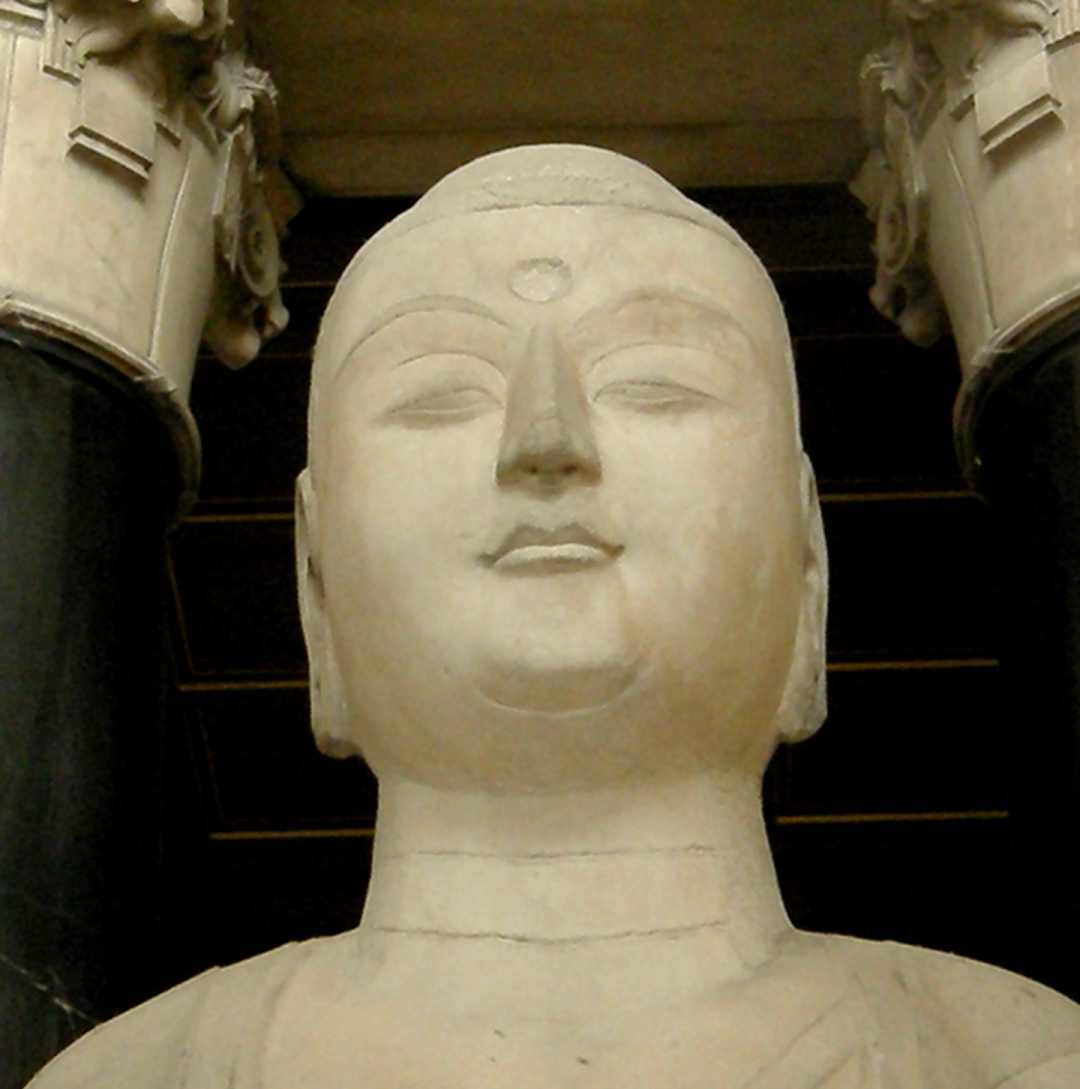
As I said to a friend recently, do you think the Buddha’s smile would disappear if one of his family died, or a lover left him?
Next I began to rewire what I saw as the crazy circuits that had been created in my childhood and youth. For instance as a child I was taught that many things were bad and wrong, and I should feel really guilty or hang my head if I did them. This all seemed to be built around a presupposition that a child is innately bad if not trained to be ‘good’. Yet in my three days of liberation I had seen that there was a natural compassion in me for all beings. There was no need to beat it into me as had been done when young. If a child is ‘bad’ it is only because of the environment it has been raised in.
Also I was taught to blame and be blamed. Yet blaming things on others, and being blamed is a terrible trap that makes victims of us. Victims because we do not take responsibility for what we feel and do. Also, schooling had taught me that there were only a few winners, and if you were not in the top three in spite of all your efforts, you might as well give up because nobody was going to pay you any attention, and you could never get social rewards.
I noticed that when I was in certain environments – such as being with my ex-wife after the divorce – some of these circuits would be called into play. This is what I meant by buttons being pressed. So I would experience intense and devastating guilt.
Therefore as I observed this happening I would literally stop what I was doing and rewire that circuit. This was done by connecting it with a new set of responses, and it had to be done many times before it was really established. But each time it was done it got easier until there was no more effort involved.
What I reminded myself each time was what I had seen and experienced in my days of freedom. Namely that at each moment we are free to choose a direction or response. But beyond that, my core self is not a thought or an emotion. It is pure and naked awareness. So I re-established the choice not to be conditioned by fear, guilt, social pressure, or a sense of right or wrong or duty. Morality comes from insight into what is before you and an awareness of your own being in the here and now, and your relationship with the greater whole of which you are an intrinsic part. It comes from your core self.
Part of it all
In Christianity there is something called Practising the Presence. This was described by Brother Lawrence who sustained a war wound that left him crippled and in constant physical pain, but he said the practice of remembering the presence of God had “perfectly set me free from the world.” In different words, this seems to me to be a similar practice. It is one that gradually removes from you the destructive and illusory connections your previous life built in you. So when I did find myself once more trapped in pains and worries; again trying to possess another person, or feel desperately dependent upon them or hateful to them, I would remind myself of my own state of freedom and compassion. This has nothing to do with positive thinking in which you try to hypnotise yourself to believe something that all your old circuits deny. This is a process of slow and thorough recovery through re-creation of your ‘wiring’.

The secret oral teaching of Tibetan Buddhism explained it in a slightly different way. The intructions to what they called ‘going beyond’ were to stop “the disordered activity of the mind which unceasingly devotes itself to the work of the builder erecting ideas, creating an imaginary world in which it shuts itself like a chrysalis in a cocoon”. The aim in the Tibetan teachings is to recognise the attitudes, beliefs, emotions, thoughts and habits for what they are – mental and empotional creations that vanish like mist as the next image, feeling or thought arises.
Even the ideas and passionate beliefs we have about who and what we are should be seen in this way. We identify so strongly with the ever shifting changing body, and believe we are it, that this too constitutes an illusion that can lead to pain. When one manages to drop this ‘disordered activity of the mind’ then one experiences what the Tibetans call, Transcendent Insight, a state of liberation.
I have experienced this liberation again several times, but not because of the misery of the first one. Each time I experienced that amazing freedom and the gentle bliss it brings.
I recognise that not all of us have the blessing of meeting that, but we can all start rewiring those terrible circuits that may have been visited upon us as children and youths.
Remember, your fundamental self is free of social conditioning, and even of the limitations of your body. It stands beyond pain and conflict. It does not depend upon external circumstances for its existence, compassion and power. It is self-existent and an expression of the underlying cause of the universe.
Remember also, you do not need to repeat those things like affirmations. You move toward the reality of them by living them.
This was the sort of peace you were born with.
The fantastic and simple truth is that you already have what you seek. That is hard to believe sometimes, and the reason you may not at this moment be experiencing this ocean of peace is that you are holding yourself back.
Think about it for a moment. From birth onwards you have been trained, coerced, bribed or beaten to behave in a particular way. You are taught to obey certain codes of behaviour, or even venerate beliefs and disciplines that are really not natural to you – are not really YOU!
Gradually you learn to bury the magnificent truth that you are. You cannot allow much that is your heritage, and through depression, lonliness, emotional longing, you sense its loss.
Start moving toward who you are by recognising how you hold yourself back. Let the real you emer
Can We Prepare for Death?
Chris: Do you think we can prepare ourselves for death?
Tony: I believe there is a great deal to be learned from the accounts people have given of their near death experiences. Very often in these accounts we learn that the person goes through a review of their life. This review enables them to fully experience each moment of their life, each aspect of relationships, what other people felt in such relationships. They experienced again the many decisions or turning points in their life. Such reviews are a sort of harvesting of their experience. In some cases the person even says that a being of light led them into and through the review and asked them what they had brought, what they had gathered from their life.
Today, many people have learned, through various forms of psychotherapy, through drugs or meditation, to experience such reviews of their life. They are seldom done in one full session as happens in the near death experience. But they are still a profound meeting with what one has harvested and what one has thereby learned from the powerful moments in one’s life. I believe this harvesting of experience is a way of getting ready for a huge transition. We have been living a life that is full of very personal experience, and the transition is to a life that is getting nearer to the universal. So anything that does not have something of the universal in it cannot pass over into this new life. Seehttps://dreamhawk.com/poems/death-is-the-loss/
To me this is a form of dying before you die. To do this requires a level of openness and surrender to what we have defined as ones spiritual life. So the surrender, the review, is to me a way of clearing the past, so that when you do die there is less work to be done as you have already learned to do the work and have carried out some of it.
The following is realisations brought back from a near death experience – quoted from book The Wonder of You by Lynn Russell.
Example: In all my thoughts, feelings and actions, because I had designed or chosen my own destiny before taking on a physical body, I discovered that I had personally chosen to take on a physical body and have the life experiences I was having. I realized I had wasted time in suffering and what I should have been doing was using my freedom to choose true love, and not pain, in all that came into my life. I realized that there was no judging or punishing God like religions say there is and it was my mind with an expanded consciousness that judged itself and sifted its actions through the filter of perfect, conscious love.
The only other preparation for death that I can see as being really relevant is to recognise what you identify with. Do you fully identify with your body? Or have you managed to glimpse and identify at all with the permanent aspect of yourself? If you begin to find an identification with the constant in your being, then that is perhaps one of the most powerful ways of preparing for death.
At the moment I feel strongly that all the new breed of children would need to learn how to die. It was like a process of transformation such as a caterpillar goes through. In our life today there are stages of growth and points of massive transformation as one period of growth ends and another stage begins. Learning to die was a method of passing through the transformation into the next stage of growth, and I was carving a way for my children if they attempted the further stages of growth. I see several people getting near it in their dreams.
But there is something that we often forget about that is important when we think of death – it is birth. Where do we begin? At birth, at conception? – but that is like not being able to see that the seed planted at conception was the result of millions of years of lives in the past. But even that was not the beginning because our actual beginning was what we presently know as the Big Bang. I believe from searching in the unconscious that the Big Bang involved a form of awareness of consciousness that is hard for us to understand, yet it lies within and behind all phenomena. That makes it universal and of course involved in our own life and death. We are used to thinking of ourselves as a body, yet behind it is the universal consciousness. When we ‘die’ we pass through an enormous change of losing our body consciousness and transforming into the consciousnesses that is involved with our creation. If you have never been able to let go of your belief you are simply a body, you may go to sleep in the process of transformation. See Steiner Life after death
Chris: You told me that when you were at my mother’s funeral something happened to you that was very impressive. What was that?
Tony: In describing this I have to say first that I did not go to your mother’s funeral with any sense of seeking an experience or looking for some sort of insight into what was going on. I went to be with you as your friend. And, as you know, the service was far from inspiring. The priest was stumbling over what he was reading, didn’t remember your mother’s name, and so there was some level of irritation with most of us because of what was happening.
Chris: He couldn’t even get the right name. It certainly wasn’t a celebration of my mother’s life in any sensitive way.
Tony: So I wasn’t moved by the ceremony. I was there involved in what was going on around me. But suddenly it seemed that something opened in me and I could see or sense that all the people there, although they were not attempting to do what I was now sensing, were producing something by their very presence as a group. The funeral itself, the fact that everybody was there to be part of your mother’s funeral, acted as some sort of focus. It focussed their attention, their feelings and their thoughts as a lens might do. It focused all their mental and emotional energy on your mother’s spirit. I saw her lifted, buoyed up by it. I suppose it would be right to say it was almost like she was brought awake by it also. So she was energised and lifted up to be with her chosen spiritual love, who was Christ. And what I had thought to be a funeral became a wedding as she was united with her love. That was a very wonderful thing to see.
Chris: Do you then believe in reincarnation?
Tony: I don’t necessarily believe in it in the sense of one’s personality being transported into another lifetime. But taking into account what was said about life being a balance between the changing and the constant, about the essence that lies behind the forms, and that the essence absorbs experience; taking that into account I believe the essence dips into different forms again and again.
However, I realise that sounds somewhat impersonal and I find my experience of it is not impersonal at all. I don’t think, for instance, that Tony as a distinct personality will be reincarnated at some time. What I do see is that Tony is a small part of the spirit that has existed throughout all-time. That spirit, of which I as Tony only reflect a small part, when I die will absorb the lessons of this life. At some other period that spirit will dip into human life again.
The reason I believe that is because I appear to have memories of past individuals whose lives link with mine in the present. There are aspects of those lives that influence this life.
Rose
This same rose will never bloom again, but a similar rose will arise from the same roots..
But there is a way of thinking about this that I believe makes it reasonably straightforward. It doesn’t seem to be a mysterious thing, and I don’t know why people make of it such a mystery. If you look at a tree, you can see it incorporates many, many past trees. It didn’t suddenly emerge out of a vacuum, out of nothing. It has its present existence out of what existed in the past. Of course, because in our culture we still are labouring under the world view that the atom is the fundamental particle or material in the universe, we still see ourselves and a tree as simply a physical process. All our calculations about this leave out the factor of consciousness. Even trees have a form of sentience. They respond to light, to weather conditions, to their environment. Did Tony suddenly gain the type of awareness, perceptions, concepts suddenly in the here and now? Of course I didn’t. Thousands of people pre-existed me who gave words, concepts skills that have together formed who I am. There are ideas, longings, weaknesses and blindness of which I am a very particular mixture. As I have gained insight into my being it really does seem that I am part of a stream of influence flowing through history.
Death is Life Without Form
Chris: What is it like when we die?
Tony: I had another similar experience, again in a seed group, while working in Spain. This time the experience led me to see that what we call death is in fact life unclothed. What I mean is that when we look at each other, or at the world of nature, we see life expressed in form. But usually we do not look to see what is behind that form. We do not see the universal principle that enters into the myriad forms of life.
So what I experienced in Spain was that as the forms drop away, what we are left with is life without its clothing. We meet the essence of what gives us life, what gives the people around us existence, what exists in animals and plants, what animates and informs the children and people we love. Then we know we have met death in every moment of life, because life and death are one and the same. We have seen death in every face we look upon.
I tried to put my experience into words in the following way:
Of a sudden I see the face of Death. I hear its voice. I know it – For we have met Often and always. Death has the features of A child I made cry; The profile of My loved woman; Your countenance. Have I known you? Then I have known Death. Have I betrayed any? Then I have betrayed Death. And its face is beauty. For it is all things – Naked, Undressed of flesh, Leafless, Exposed, Unclad Life – Without the garment That our selfhood is. See What Happens When We Die?
And the waters in me rose To tears. Bathing me in regret That I had So often Forgotten My love For the Naked Beauty.
The message of this experience is very similar to what I learned from the first experience in Greece. It is that because the essence of life lies behind all its forms, what we give or receive from each other we give and receive from life itself. Therefore life itself remembers, and our life exists in the essence that lies behind all things.
Another experience explains something that is again very similar in its message, but looks at it from another angle. This time it was during an exploration of a dream that I met death face-to-face.
I dreamt I was in my bed and was woken by something falling onto the foot of the bed — or that I could feel moving at the foot of the bed. The dream was very real because all my surroundings were exactly the same as in waking life. I was very frightened of whatever it was crawling up towards me over the top of the bed. I caught hold of it in my right hand, gripping very tightly, and saying, “I will destroy you. I will destroy you!”
When I explored the dream I came across a very strong fear of death. This was so strong I could hardly breathe and felt I was having an asthma attack. But in fact it was fear that was paralysing me. I had noticed the signs of ageing in my body and this had prompted my feelings about death. But here it was creeping up on me, and if it touched me I felt it would pervade my whole body and kill me. But I wanted to confront death. In the imagery of the dream here it was, and I wanted to walk up to face it and know the truth of it. So I let feelings of fear consume me without trying to suppress them or run away from them. It felt as if I were walking way up close to this threatening creature to look it in the eye. And when I did that suddenly all fear and tension had gone. I could breathe easily again.
That was surprising and I couldn’t understand how I could move so fast from one feeling to another. So I backtracked to see if I could play the whole thing through again in slow motion to understand how to meet death with calmness.
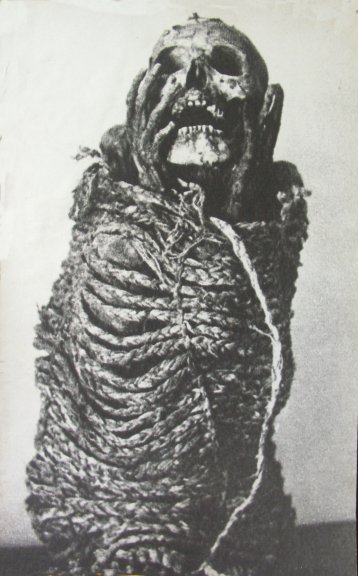
| What I saw as I did this was that it was all to do with identification. My fear had arisen because I identified my real self with my body. And my body I identified with the corpses of rabbits I had seen in the field, eaten away by maggots, and that was my image of death. Because I identified with the rotting corpse my feelings responded with fear and paralysis as I came face-to-face with death. But there was a part of me that felt so alive despite what was happening to my body. In that way I was identified with life, with the spirit, the essence that gave life to my body. As soon as I identified with that the fear disappeared.
An Egyptian burial – British Museum
|
 |
So once again we have here a reference to the constant, the permanent, the unchanging that lies within or behind the changing and impermanent. That is really the kernel of anything I have to say about death.
We only miss seeing this when we hold on to concrete ideas about what our life is or means. We only miss it when we believe we know what life and death are really about. Such rigid certainty about what is in the end our own ignorance shuts us off from any further knowing. It is only as we drop our concrete ideas of things; only as we learn the art of unknowing, that we open to the mystery of things and perhaps can gain a glimpse beyond the boundaries of our everyday concepts.
We Are Co-creators in the Cosmos
Chris: This has reminded me of something you talked about in regard to physical substance — matter. You said that modern physics has shown that we change it by looking at it. What are the implications of that?
Tony: That is an amazing idea isn’t it?
Considering that quantum physics now assures us that subatomic particles can change their very nature simply by us observing them, I often wonder if, when we look at a flower and feel how beautiful it is, we in some way change it.
In his book Holographic Universe, Michael Talbot gives an understandable description of this. He says that, ‘Physicists have found compelling evidence that the only time electrons and other “quanta” manifest as particles is when we are looking at them. At all other times they behave as waves. This is as strange as owning a bowling ball that traces a single line down the lane while you are watching it, but leaves a wave pattern every time you blink your eyes.’
We usually see the world as bounded by time and three dimensions. But another extraordinary statement about the world around us is one put forward by Irish physicist John Stewart Bell. It is a quantum theorem that has revolutionised the way reality is considered. In brief, the theorem states that when two sub-microscopic particles are split and moved to a distance from each other, the action on, or of, particle ‘A’, is instantaneously reproduced with particle ‘B’. This interaction does not rely on any known link or communication and is considered to stand above normal physical laws of nature, as it is faster than light. Prior to such findings it was thought nothing could transcend the speed of light. See Feature by Talbot.
Despite these findings we still hear scientists talking about the solid and time bound world in which nothing can move faster than light. I guess we all live in the past in one way or another, and in fact our world view, considering these new findings, is still dragging somewhere in the 19th century.
Chick
The everyday events in life are still miraculous
Newtonian physics, in which the atom was the fundamental and immutable particle in the universe, gradually robbed us of a magical view of our environment that existed previously, and still exists in many tribal cultures.
This reminds me of something I read in Lyle Watson’s book Supernature. He said that having written about some of the strange things that could be observed, which many scientists would never investigate because they appear to be completely impossible from their present view of the universe, a man in Italy wrote to him asking for Lyle to come and witness something his young son did. Lyle followed through on the request, and while observing the young boy of about four years old, the father rolled a tennis ball to his son. The son played with it for a while, and without any apparent struggle rolled the ball back. But now the ball was inside out without any break in its surface.
Lyle then took another ball and wrote his name on the outside of it. He rolled the ball to the boy and in a few minutes it was rolled back inside out.
Later, with witnesses, Lyle cut the second ball open and there was his signature on the inside of what had been an unbroken ball.
What Lyle says is that our present scientific view sees what he witnessed as completely impossible. It is against most of the fundamental things that our science states are laws of our universe, making what happened out of the question.
Having said that, here we are living in the world where it seems impossible for us to turn tennis balls inside out without cutting them in some way; distances have to be crossed physically by some means of transport; people appear to be completely separate from us in mind and body; death appears to be a final end; we feel hemmed in by the limits of our ability to know — so what does it mean that a four year old boy turned a tennis ball inside out?
Well, the new physics begins to give us evidence that we live in the midst of a universe that is far more amazing than we have ever previously thought. We live in some ways as co-creators of this universe. But my deepest feelings about what this means is that we each have a phenomenal potential. We each have possibilities beyond anything we can imagine. As human beings we haven’t even begun to really explore that potential and to use it in our everyday life. To me that is the most important path forward for each of us.
Personally I find it amazing that many Christians, who profess deep belief in their Bible, can’t see and accept that. In Genesis it says, “Let us make man in our image, after our likeness …. And God created man in his own image, in the image of God created he him; male and female created he them.” That means we have the potential of being godlike. Miracles are part of our nature!
See Huge Change – Quantum Physics
It’s For You
I could hear your dog barking
When you answered the phone.
And your voice was so clear, so near.
Then a fire truck went by,
All those miles away,
Outside your house.
Or were you in the garden then,
As you talked with me?
What a wonder,
To have you standing so close to me,
Breathing your words in my ear,
Laughing and excited.
And I can almost touch you
Through the phone.
One by one your words
Fill up my heart
With your warmth.
And here I am,
In my little room,
Half the world away.
You are in day,
And I am in night,
Hoping my kisses
Reach you as clearly as my words,
And my love wraps you
As tenderly
As yours does me.
Tony Crisp
Copyright ©2002 Tony Crisp
Knowing You Knowing Me
Do I know you?
Yes, my eyes know you.
On seeing you a smile
Dances on my face
And in my eyes.
If I were a puppy
I would wag my tail.
Do you know me?
Yes, your lips know me.
They know every soft touch of my mouth.
Your lips have caressed
My face, my throat and my eyes.
Your lips know me
And speak love to my body.
Do I know you?
Yes, my fingers know you.
They have sped and roamed
Over every glade and woodland,
Each peak or dell of you.
My fingers have talked with yours
In their own soft language.
If there is knowing,
My fingers have it.
Do you know me?
Yes, even in your deeps you know me.
Has my body not bathed you in its waters?
And has not your being
Taken the essence of me through your skin?
There, under the surface,
In the life of the blood
My particles roam with yours,
And you know me,
And I know you.
Do I know you?
Yes, I know you.
For I have kissed
The flower that blooms at night.
And in kissing
My tongue has sipped the nectar
From the heart of the flower.
And my fingers
With gentle caress
Have excited the soft petals
And loved the flower.
Yes, I know you –
And you know me.
Tony Crisp
Copyright ©2002 Tony Crisp
The Monster
I am telling you son,
There are monsters about.
And I am not saying this
To give you bad dreams at night.
You need to know, so that,
If you suddenly meet one
You will understand what to do.
You are my son,
And I am trying to
Give you the best I can.
But I have to tell you
That I only know
What I have experienced.
As far as I can see,
A monster builds up slowly
Over the years of your life.
I am not sure, but I think
They start as germs
That feed on pains you feel.
You don’t know they exist
Until one day, a person,
Someone you have let
Get really close to you,
Suddenly stabs you
Where all the years of pain
Have slowly congealed.
It is such a shock you
Reel back, bleeding and raging.
And there in front of you
Stands the monster,
Unclothed of its human form,
Leaving you confused and wounded.
The awful thing is
It changes back into
The friendly human form again.
So in the years that follow
You are forever wary,
Wondering in what person
The monster now lurks.
Copyright ©2008 Tony Crisp
Your Guru The Body – Part Eleven
Sexuality
To give an idea of how inner-directed movement relates to sex, it is helpful to think of how a plant puts forth its sexuality – its flower. The flower is produced only at a certain point in the growth or cycle of the plant, and the flower is usually very different in shape and colour to the leaves or stem. The visual experience of watching a plant form a small bud that gradually grows and opens to a flower is exciting. The process is vulnerable though. If you think of something interfering with the flowering, inhibiting it at some level, then the flower exists, perhaps only as potential, but is not yet functioning fully.
The complex opening of human personality and sexuality has some kinship with this. Certain aspects of it can easily be inhibited in their flowering – perhaps the materials of experience are not yet sufficient – or the spontaneous instincts which usually inform and shape the maturing are withheld, suppressed, turned away from their task and from full opening. Because inner-directed movement builds a link between your natural inner life and your conscious self, any aspects of your possible growth that have not emerged may be allowed to begin their growth. This is not an overnight thing, but it is a wonderful possibility. In fact few of us can reach maturity without some aspect of our nature, whether sexual, emotional or mental, being left behind, hurt or perhaps not given enough attention because other areas of activity were demanded by the needs of the time.
The action of inner-directed movement takes you away from the specific external needs which may have caused unbalanced tendencies in your nature. Because you let go of particular surface directions – because you do not set out to perform specific exercises, or work on particular issues, your internal self-regulating function can begin to express the areas of your nature that have been inhibited.
The Mind And Emotions
After some weeks of teaching a group of people in the small town of Porlock in Somerset, Julie, a woman in the group, told me something new had come into her life from what we had been practising. She said, “I never knew before that I have an inner life. This is such a wonderful thing for me.”
My understanding of what Julie was telling me was that she had never previously known what riches of experience and creativity, of insight and perception she already owned. She had thought of herself as just another housewife and mother, not unintelligent, but an unimportant person among billions of other unremarkable people living and dying.
The treasure Julie found that can be discovered through inner-directed movement is not to be confused with the realisation of intelligence or personal ability. A young and brilliant college student, Len, was recently describing to me his own realisation of his inner life through this practice. He said:
“I know this may sound strange, but the most powerful thing for me was that I realised I am alive. The realisation was accompanied by the sense of being life. I now know I am life and life is not just a chemical reaction or a set of biological drives or responses. As life I am always exploring, reaching out, becoming, learning what I am capable of and what I am. Just to exist is itself a great pleasure and miracle.”
As with Julie, Len’s realisation during inner-directed movement was not about his own intellectual ability or personal value. He had already proved his intellectual brilliance and ability in his scholastic performance. This had not given him the sense of being alive and liberated though. The contact with his own vital inner life enabled him to realise he was more than he thought he was. He learned through his own experience that the essential part of himself did not begin or end with his body, his emotions or his thoughts. From this arose a sense of freedom and liberation he had not known before.
Len’s changed experience of life was the result of just a few sessions of inner directed movement using the open approach. Previously he had been very reticent in relationships, yet often felt lonely. As he learned to let his own love shine out, he found it easier to make friends. He says:
“At first I found it difficult to let go enough for my body to freely express. When I did learn to do this my movements were very strong. At the time I was lying on my bed because my movements had started from quietness and stillness. They became so strong I fell off the bed at one point. My impression was that without realising it I had been holding back enormous amounts of my own energy. It was when I let the full current of my energy be expressed that I could achieve a new experience of myself. It is like having a dimmer switch on a light in an internal room, and all the time you have it just glimmering, and the room looks dark and dismal. Then one day you turn the power up and the whole room is transformed. All the colours glow, and features not seen before stand out.”
For many people this sort of release only occurs in times of crisis, high emotion, or if they are challenged by a public appearance and let themselves express at full power. At other times the dimming effect of social or intellectual conditioning anxieties, or not knowing how to let go, make us feel less than we really are. In fact you are more than you have ever believed.
Touching this vastness brings with it a sense of great wonder. In a recent letter to me Len describes what he feels when he touches what he calls ‘life’ through inner-directed movement.
“When I remember life and cry, as I am now, it is not sadness, it is everything. It is the beauty, the tragedy, the joy, the vastness, the thrill, the miracle, the mystery. It is a love from the depths of life of all creatures who have the courage to love, to embrace life in its vastness. From the firefly flashing its statement to the night, or the sparrow fetching worms for its young, to the dog running with joy toward me.”
Inner-directed movement gives you access to a new and vital experience of yourself outside the patterns of emotion and trains of thought from which you usually erect your self-image. It leads to a discovery of your own unique inner life more fully than most forms of meditation or mental disciplines.
Your Guru The Body – Part Ten
The Freedom To Be Yourself
One of the first person’s I taught inner-directed movement to was Maria, a woman in her sixties. Maria was married, had a lovely country cottage, but had not been outdoors for months. She was suffering from aches and pains in her arms, felt life had lost its interest, and asked for help. Maria quickly learned to relax enough to allow her body freedom to express without inhibiting self-criticism. Her movements were slow and tentative at first but soon included her whole body, producing feelings of pleasure. To allow such movements Maria had to learn how to give her body and feelings time in which to explore unplanned movement – movement arising from her own subtle body impulses. Such subtle urges are often overlooked, or are crowded out by ones thoughts of what one ought to be doing, or what is appropriate in the circumstances. So Maria created a mood, and gave herself time, in which she could allow irrational movement – movement that had not been thought-out beforehand, or given by someone else. Such movements are usually quite different to the sort of things one finds recommended in exercise books. The reason being that they are often unique mixtures of exercise, dance, mime, and generally letting oneself go enough to do what might have otherwise be seen as ridiculous. Nevertheless, such irrational expression is very satisfying. In Maria’s case she started with slow arm movements. Gradually the rest of her body was included in an expression of pleasure and sensual enjoyment in which she rolled and squirmed on the floor – movements and feelings that surprised Maria.
Within three weeks Maria went out with her husband, and bought new clothes, something she hadn’t done for years. She told me she realised she had been holding back all her pleasure, all her positive drive and feelings. In fact Maria had unconsciously been holding back HERSELF. In liberating her body and emotions she had liberated herself from the prison of her own depression. Frequently depression or lack of enthusiasm for life occurs through the suppression of our own feelings – the stagnation of our urge to move and live.
The freedom and release which arises from inner-directed movement is also evident in what happened to Jim. A group using inner-directed movement started in Bristol, UK. Jim, an unmarried gas fitter, bored with his work and life, joined the group. Within a couple of weeks Jim had learned to give his body and feelings freedom to move. He was amazed at how fertile an imagination he had when he stopped holding himself back. His movements were creative and deeply felt. Less than two months had passed before Jim had given up his job, found a woman whom he married, and together they started working in a Steiner School for children. Jim also had been holding himself back.
Both of these examples show that inner-directed movement is basically a way of allowing what is already innate in you to be expressed more fully or easily. Put in the simplest of terms, by restraining the way you express in movement and voice, you may be inhibiting important parts of your physical or psychological nature.
Finding Yourself Anew
Leslie Kenton, the author of many books on self-help with diet and exercise, in writing about inner directed movement, says:
Often, as a result of trauma, life stress and social or family situations that are not naturally supportive of individual growth and development, we become separated from our own feeling sense or we tend to relegate it to the level of insignificance. When this happens, one’s life tends to become strongly habitual, mechanical, and eventually largely unsatisfying, no matter what kind of worldly success, excitement and glitter it may contain. For any real sense of joy, satisfaction or meaning can only come when the inner and outer being are linked up and when what Crisp calls the feeling sense is allowed the freedom to regulate both physiological and psychological processes.
Sometimes the experience of inner-directed movement can be enormously joyous, particularly when the energy is flowing freely. At other times it can be very difficult. That occurs where there is some kind of energy block – when one’s vitality is temporarily trapped into some internal conflict or there are chronic areas of tension in the body that have not yet been resolved. But what is remarkable about the technique is that by going with the individual physical movements which occur, such tensions are not only gradually worked out, leaving your body stronger, straighter and more alive than before, but also the imagery and memories which occur in the process can bring exceptional insight.
I watched one woman. who was using the technique for the first time, lie quietly breathing. She then found that her hands began to move gently as though she was exploring the texture and quality of space near her body. Crisp encouraged her to go with these fine movements. Gradually they developed into larger stroking gestures in the air around her. Her imaging facilities came into play as the physical movements continued and she sensed that she was in what she later described as a kind of womb. But instead of being dark it was permeated with light, immensely safe and beautiful. Then gradually her torso and shoulders began to move as well until slowly she emerged from this extraordinary womb world into clear air and more light. She began to weep quietly, stunned by the power and the beauty of an experience which had come quite spontaneously from within her. When she later began to try and make sense of the imagery that accompanied the movements she realised that her own feeling sense (which until then she had not even been aware of) had created for her a physical expression of the particular life situation she was in at the moment. She was on the verge of a new beginning as far as her work life was concerned, and had been feeling rather unsettled and anxious about it. She found this experience enormously helpful because it made her realise that the career changes she had planned had not been motivated by some capricious wish but were very much in line with the direction in which her deepest self was leading her. She also discovered through this experience that she does indeed have a feeling sense which she can experience for herself and that if she listens to it, it will express a summary of her life situation at any particular time or help her work through whatever blocks or tensions she experiences.
Taking time to listen to the needs of your own being is truly one of the most important, and most nourishing of things we can do. Whether you use the ‘open approach’ or the ‘seed’ doesn’t matter. What matters is that you create time and an environment allowing your own potential to express and become known.
Your Guru The Body – Part Nine
There is an extension to the Seed Approach. It is to use the basic seed approach in a group format.
When using the starting point of the seed you are giving the unconscious a ready-made structure to work with. Because you may be unfamiliar with a completely unstructured approach to your inner processes, such a structure gives at least some sense of familiarity and confidence. Even so, some people find they want everything fully described, scripted or choreographed. The very point of using this approach, however, is to begin moving beyond the known in yourself, towards creative newness and the unexpected. If you cannot do this, you will not be able to discover what is presently unknown in your unconscious. You will not be able to open the meaning of an obscure dream symbol. So even if some anxiety is felt, you need to gradually move beyond such resistant feelings.
To use this approach a few extra things need to be learned. This is because the group action is an integrated one, and needs some structure to help it in the early stages. So if you are working with a group of three or four, and one of the group is the seed, the other two or three can be in the roles of earth and water to the seed. The aim is to support the growth of whoever is the seed by physical and emotional contact.
Whoever is the Seed starts by standing in the middle of the others, who take time to make contact with her/him. They allow time to find an attitude that enables them to get closer physically and emotionally than in usual social roles. So without forcing or acting mechanically, the members touch and draw near to the Seed. When this is established the Seed curls up on a prepared space – with blanket or cushions – on the floor. The members draw near and make contact again. Get close, cover the Seed’s body with yours, penetrate with your touch, as earth and water does with a seed.
As a guide to this, it is helpful to consider in human terms, if you are in the water role, how you would penetrate the seed to stimulate its growth process? If you are in the earth role, again in human terms, how would you relate to the seed to give it a medium in which or from which to grow? If you are in the seed role, then you allow your spontaneous reaction to this. Allow yourself to move in any way that arises, just as occurred in the ‘seed alone’ approach. Do this without considering what you should do. Trust your inner process. You do not need to hold on to the roles rigidly. If you find you are being led into a spontaneous response, allow it. But remember, it is the Seed’s time, not yours. Do not take over the action, but support that of the Seed.
The group is an intimate one. It has many dimensions of experience possible. Not only is it a meeting of people in a way not usually possible socially, but it is also a place to learn human contact, how to give caring and support to another human being, and how to communicate with others non-verbally. The support it gives can allow a very deep release of inner feelings, of creative spontaneity, of self-discovery.
Because there are so many different ways people experience the seed group, I will quote a few responses.
“I’ve never been with people in that way before. I think it was the first time I really relaxed with a group.” — “When I was the seed I didn’t have any urge to move or grow at all. At first this worried me. I kept wondering if the others would be bored or disappointed. When I told them, the worry disappeared; they were all just enjoying being close.” — “Being the helper was great. I got so much pleasure from supporting and being near the Seed and the others in the group. But when it was my turn to be the Seed I didn’t enjoy that at all. I felt restless and claustrophobic and quickly pulled out. It has made me realise for the first time in my life that I find it difficult to receive that sort of closeness from others. I have to be the giver.” — “Until I became the seed I had never realised how hungry I was to have other people near me. I wanted to hold and touch in a way I had never allowed myself before. Since then it has been easy for me to hold people, babies, my wife, with more giving than I could in the past.” — “First I was just curled up. I felt comfortable, and relaxed into whatever happened spontaneously while the others completely covered my body with theirs. It really was like being planted. After a while a flicker of movement arose pushing my head out. This came in waves, increasing in strength, until my head was pushing out and up like a plant growing. I didn’t try to think what I ought to do, just went with the pleasure of it. In the early stages this didn’t seem to involve the others, although I could feel them close. But by the time I was up on my knees there was such pleasure flowing through me, such joy at being close, being able to feel the soft skin of a face against mine, that my pleasure involved the others. It is the nearest thing to making love without sex I have ever come across. I felt all the flow, the contact, without in any way going into areas that are unacceptable. When I was standing, growing from the sheer energy of movement welling up from within, we all seemed to be one moving, living process. I felt I had given something of myself to the others without saying one word. And I also experienced them as distinct qualities around me. At the end I could sit with them for a long time, holding hands, head on them, without the need to speak.”
I have used the seed group with just three people, or with a hundred or more. Each group become self-initiating, each person taking it in turn to be the Seed, and to be supported by the others. Whoever is the Seed, it is up to them to determine how long to be in the middle. Obviously this depends to some extent on available time, but also on the dynamics of what they experience. It might take quite a long time for what is unfolding to complete itself. It might be short. So the Seed needs to occasionally tell their supporters what is happening, just to keep them in touch. The Seed also needs to decide when to finish. When this is done sit up and relax for a while, and share the experience by perhaps telling what happened more fully, and what it was like to be in the supporting role.
Everything good is costly, and the development of personality is one of the most costly of all things. It is a question of yea-saying to oneself, of taking the self as the most serious of tasks, keeping conscious of everything done, and keeping it constantly before one’s eyes in all its dubious aspects–truly a task that touches us to the core. Carl Jung, in Secret of the Golden Flower.
Your Guru The Body – Part Eight
Being able to move, and being alive are tightly bound together. All the life processes in us express as movement of one sort or another. To breathe, to laugh, to make love, to feel anger or joy, is to move. When any important life-movements such as those taking place in the intestines, the heart, the genitals are inhibited, then we are less alive, less healthy. Every emotion we feel has its corresponding movement in action, in a body posture or in subtle changes in our muscles. When powerful emotions such as love or anger are not expressed they become ‘held-back-movement’. We usually call this tension. As such tension deepens it becomes psychosomatic illness – pain without apparent physical malfunction. In its worse form it becomes actual illness. Some of the most common ‘movements’ we hold back are those connected with love, sex, anger, fear, crying, emotional pain and sometimes even laughter and joy. In our dreams we often attempt to express movements that are suppressed during our waking life. Unfortunately our habits of tension are so deep we may not manage to find release even while asleep. (From Dreams and Dreaming by Tony Crisp)
In the previous seven steps, the fundamental secrets of how to follow the thread of your subtle life processes have been given. Life is movement. In its movement Life laughs and cries, it sings. Life also dances, and it explores the wonders of its own sentience through imagination, imagery, the rousing of memories and creative fantasy.
So if you have followed the seven steps you may have begun to experience this dance of life, this song. Perhaps you have even experienced some leap of imagination or flight of consciousness into its huge ocean of possibilities. But of course there is more, much more, to experience. And to find this you need to come again and again to the listening, to the growth of the seed or the dance of your body in its movements or struggles.
Therefore, rather than give another approach to use, time will be taken to explain a little bit about what you are doing, and what you are opening to within yourself.
During 1968, while teaching relaxation techniques to people at the Tyringham Naturopathic Clinic in Buckinghamshire, UK, I found the first clues to an exciting possibility in human beings. I had been teaching the usual form of relaxation in which one consciously tenses the muscles, then relaxes them. As an aid to people experiencing the pleasure of dropping tension as fully as possible, I often went to each person in the class and gently lifted an arm or leg. The aim was to give them the experience of someone else moving their body, so they could give up their own effort or tension.
I found that many people’s limbs were very difficult to move because they were rigid with tension. Surprisingly when I asked the person how they felt, they would usually say they felt relaxed and comfortable. Meeting this in person after person, no matter their age or sex, led me to realise how ineffective ‘normal’ forms of relaxation and stress release were. Also, more important, it showed that many of us are living with quite enormous unconscious tensions operating in us. Unconscious because the people I tested were unaware of their tenseness, and ‘felt’ relaxed. Yet to maintain the sort of muscular effort that makes an arm or leg difficult to move uses a great deal of energy. If you lived with such tensions, because of the energy wasted in maintaining them, you would have less energy to use in the other departments of your life.
The next step of discovery came when I found that if a person was helped to allow the tension in an arm or leg to remain, and if the person could allow their body and feelings freedom, the limb would start to shake as the tension released, then to move spontaneously. Fortunately I had read reports of such movement from throughout recorded history, so I had some idea of what to expect. Nevertheless it took some years to begin to be able to explain in modern concepts. I mean by this that older reports explained the experience in terms of religious belief or in ancient approaches such as acupuncture or the chakra system of yoga.
In observing people allowing spontaneous movements, and in trying to understand the wide range of experience they met, I found a particular image helpful. For instance, consider how you might see yourself if a film were made of you like those showing speeded-up plant growth. On such films you see the plant moving and growing with incredible vigour. Its leaves and flowers open with powerful movement. If the film showed you from conception onwards, you would see amazing change and expansion. An extraordinary process would be seen causing your body and mind to unfold. You would observe incredible amounts of movement, many of them spontaneous. The movements in the womb, in babyhood and even in your adult sleep, you would see as inner-directed, and powerful. You would notice that as you gradually matured, conscious control of movement became more prevalent. But still your sleep movements, breathing, yawning, stretching, laughter and tears kept you in touch with the incredibly wise process which directed your overall growth and survival. It is this often forgotten, but very real process underlying your original growth and continued existence that you allow into a new level of expression when you relax fully.
However, to do nothing and wait, to be patient with ones own internal creative process is not a quality highly developed in many of us in today’s world. Yet this is vital if you wish to work with this miraculous process of growth and integration within yourself.
The Swiss psychiatrist, Carl Jung, called this process the ‘transcendent function’. He named it this because he witnessed it enabling people to grow beyond problems that crippled them, problems that had appeared insoluble. Writing about this he says, ‘Here and there it happened in my practice that a patient grew beyond the dark possibilities within himself, and the observation of the fact was an experience of the foremost importance to me. …. I therefore asked myself whether this possibility of outgrowing, or further psychic development, was not normal, while to remain caught in a conflict was something pathological. Everyone must posses that higher level [of possible growth], at least in embryonic form, and in favourable circumstances, must be able to develop the possibility.
Jung goes on to say, ‘What then did these people do in order to achieve the progress which freed them? As far as I could see they did nothing but let things happen… The art of letting things happen, action in non action, letting go of oneself, as taught by Master Eckhart, became a key for me… The key is this: we must be able to let things happen in the psyche. For us, this becomes a real art of which few people know anything. Consciousness is forever interfering, helping, correcting, and negating, and never leaving the simple growth of the psychic processes in peace. It would be a simple enough thing to do if only simplicity were not the most difficult of all things.’ (Quoted from Secret of the Golden Flower by Wilhelm and Jung)
Yes, simplicity and letting things happen is difficult. We do keep interfering. We rationalise what is happening and explain it away. We erect goals because of something we have read or heard, and strive in a direction other than our own internal process moves toward. We think we know best and so ignore the incredible overall viewpoint our internal awareness has.
Another viewpoint of the process is stated by J. A. Hadfield, a psychiatrist who specialised in working with dreams. He says, ‘There is in the psyche an automatic movement toward readjustment, towards an equilibrium, toward a restoration of the balance of our personality. This automatic adaptation of the organism is one of the main functions of the dream as indeed it is of bodily functions and of the personality as a whole. This idea need not cause us much concern for this automatic self-regulating process is a well-known phenomenon in Physics and Physiology. The function of compensation which Jung has emphasised appears to be one of the means by which this automatic adaptation takes place, for the expression of repressed tendencies has the effect of getting rid of conflict in the personality. For the time being, it is true, the release may make the conflict more acute as the repressed emotions emerge, and we have violent dreams from which we wake with a start. But by this means, the balance of our personality is restored.’ (Quoted from Dreams and Nightmares by J. A. Hadfield) See The Secret Power for more information about self-regulation.
Eastern practitioners describe the practice in a different way. In the book The Secret of the Golden Flower, from which the quote from Jung is taken, the Chinese method of transcendent meditation is described. The book uses deeply symbolic language, but basically it is saying that to reach transcendence, you must allow your internal energies to circulate according to their own nature. This is achieved by action in non-action – by allowing things to happen while holding the conscious self quiet.
Some approaches to this, Such as Subud in Indonesia, and Shaktipat in India are very active in the way they express this action in no-action. For instance, in his article Between Coma and Convulsion, in the magazine Energy and Character, David Boadella quotes the report of a westerner studying the self-regulatory practices in India. Although this is a recent account, the yoga practice it describes has been used for many centuries in India:
I have been in India for about four months now and I thought the readers of Energy and Character might be interested in the similarities between Reichian work and Shaktipat or Kriya Yoga. The Sanscrit word ‘shakti’ means energy, bio-energy, or more correctly, bio-cosmic energy. Shaktipat is a practice that is described as the loosening of this energy by a guru from the way it may be blocked in us. When this shakti energy is loosened and no longer tightly bound by the control of the conscious mind it begins to circulate in the body. It is then said to open up energy channels or pathways, and usually begins to manifest in what are known as ‘kriya’. Kriyas are spontaneous movements of the body and of the respiratory system.
The explanation for this is that the shakti is opening or purifying obstructions in the energy pathways, that the individual is working out the results of past actions and experience, and that an evolutionary process is allowed to unfold which eventually will result in an expansion of awareness.
In this kind of meditation the individual sits still, but not rigidly; he doesn’t concentrate in any way, but simply relaxes as much as possible and permits the energy to do its thing. The energy is of course thought of as ultimately cosmic or divine. Hence the path of enlightenment lies in relinquishing ego control and identifications and allowing this bio-cosmic energy to express itself and lead us. The final results of this process are the opening of the highest brain centres in a new type of consciousness in which the individual merges with the universal consciousness. The total process takes a very long time but this should not dissuade us as each stage has its own rewards.
Remember that working alone is fine, but using these approaches with sympathetic companions often deepens the experience, and gives support.
Your Guru The Body – Part Seven
First there is our personality or awareness. This offers itself and is acted upon – and there is that which acts upon it which men have given uncountable names. These two are really one, but are seen as such only later. Sri Aurobindo says: ‘One commences in a method, but the work is taken up by a Grace from above, from that to which one aspires. It was in this last way that I myself came by the mind’s absolute silence, unimaginable to me before I had its actual experience’.
After his initial years of meditation, Gopi Krishna came to see that ‘Contrary to the belief which attributes spiritual growth to purely psychic causes, to extreme self denial and renunciation or to an extraordinary degree of religious fervour, I found that a man can rise from the normal to a higher level or consciousness by a continuous biological process as regular as any other activity of the body.’
The energies of this higher consciousness in man and woman are a natural process. It is as natural as the arrival of teeth in the child, or sexuality in adolescence. In fact it is a continuation of the same process. But it seems as if this process of growth which extrudes the body, brings about human consciousness and personality, washes us up onto a seashore from the ocean of Life processes. To grow beyond the point of ordinary everyday awareness, it appears that we must agree to go along with life – must consciously decide that this is what we want – we must co-operate with the process or else be stranded on the shore.
How do we do this? First you have to recognise clearly that some process, some force, causes you to exist. You can call this what you wish, it doesn’t matter. It remains what it is. Next recognise that this process that you are, causes changes in your life, and is apparent as growth and maturing. It does this by integrating your life and everyday experience. Next, decide to go along with this process. Offer yourself as you are to it. Let things happen – allow changes to take place. You will be shown the way.
This path does not attempt to crush the ego, the appetites, or the instincts. Rather, it hands them over living so that they can be transformed to higher levels of expression, and reach towards fuller self-realisation in everyday life. So this opening, this ability to allow things to happen, just during the time of the exercise, is what we are aiming for.
Now you are ready to use one of the most productive of the approaches – the Growing Seed approach.
- Repeat the step of finding a position and feeling of a dried seed. When you find a position and inner feeling that suit you, take the next step by letting yourself explore, with body movements, postures, and awareness of your feelings, what might happen when you as the seed are planted in warm moist soil and begin to grow. Continue your feeling exploration to find what will occur when you as the seed grow, put out leaves, blossoms and fulfil your cycle. Explore the whole cycle of the seed’s expression. Don’t think about what the growth of the seed means. What you are looking for is that you explore your own feeling sense in regard to the seed’s growth.
- What this means is that as the dried seed you wait with the open, keyboard feeling that you have been practising. Don’t make things happen. Surrender your effort. It doesn’t matter if no movements occur. The waiting and openness are the important things.
- It might be that as the seed you feel very strongly you do not want to grow. In which case remain in the form of the seed until you feel a change and an urge to grow, or until your session time is finished.
- When you sense the experience has finished, rest quietly for about five minutes and end the session.
The following quote from a letter I received gives an idea of the wide range of experience that can arise from this approach. Judith describes her use of this ‘seed’ approach to inner-directed movement as follows:
I am a trainee yoga teacher and have been teaching for three years. I have a small class of fourteen students who are keen and attend regularly. I decided to have my students try the seed approach to see how they would react. I explained it as well as I could, and the feedback I got was as follows – A man in his thirties said, ‘I felt I was in a womb. It was very comfortable, cosy and dark. I wanted to stay there. I didn’t want to come away – it was so peaceful. I have never experienced anything like it before’. He was very impressed.
A woman in her thirties felt like throwing her arms around and kicking her legs. ‘I felt I wanted to give birth and was about to deliver’. She didn’t fling herself about, but held back. I think it was a pity she didn’t let go. Perhaps I didn’t explain the whole procedure clearly enough for them to understand that it was entirely free movements. The majority acted out being flowers. Only one in the class thought it was a lot of ‘bloody rubbish’, her words. She didn’t even try. She thought she would feel stupid acting out a seed.
I was surprised at the outcome, that so much should happen first time. I personally felt as if I became the bud of a crocus. I seemed to be slowly unfolding with difficulty. Not until I fully opened did I feel a great relief. The results of this have made me feel very positive in my outlook, and far happier.
Experiencing your growth as the seed is enjoyable without any concern about what it might do or be beneficial for. Its possibilities are worth understanding though. Judith’s experience of feeling difficulty in opening, and great relief when opened, typifies its action.
What this means is made clear by the experience of a man, Graham, whom I worked with personally. He found that while being the seed he had no urge whatsoever to grow. He lay on the ground for the whole period and felt how wonderful it was that he didn’t have to actively express himself.
When we talked this over Graham told me he could easily see the connection this had with his life. He said that although he was energetic, and as a male nurse had to deal actively with people all day, he never felt he was really present as himself. As a person he hid behind his role as a nurse and seldom exposed his real feelings to other people. In fact he wondered if he had ever really expressed actively what he felt or believed.
Graham then used the seed approach again. This time he felt the urge to grow and emerge from his non-expression. He gradually opened out from a curled up position and slowly moved, with hesitations, to a kneeling position. At that point he stopped. He explained that standing up – being present with his own feelings and potential with other people – was so new to him, that the half way position was as far as he could grow at that time. Nevertheless, it gave him an exultant feeling to be at last, for what he felt as the first time in his life, daring to go into the world as a real human being. He felt sure that in following sessions of the seed approach he would progressively emerge more fully.
The seed approach deals specifically with your growth as a person. It helps you work out, through creative movement, any restriction in expressing your potential and your physical energy. People who have not lived out their own inner needs, or are inexpressive physically, will find this helpful. But the seed approach goes far beyond that. It is a meditation in growing toward your own potential, and in doing so growing beyond any darkness and pain within you.
Your Guru The Body – Part Six
By now you have hopefully felt something of the wonder of experiencing new and creative arising from the unknown, the unconscious, within you. If you haven’t, then you need to go back over the previous steps again. If you still have not touched that spontaneous spring of creativity and feeling, only then take this next step.
At this point we need to reflect for a while and absorb a bit more understanding about what you are doing. For instance the practice has its roots in pre-history. It is also well documented in all the historic periods, and is used in various ways in modern psychological therapies.
If you recognise that the basis of the practice is an opening of body and mind to what can appear to be a beneficent influence arising from something other than your conscious will, you will see how this relates to historical approaches. If you take away the religious views of the times, the cultural trappings, you will recognise the practice in the earliest forms of Christianity, in Shaktipat as used by thousands in India, of Subud as it is still used throughout the world, of Seitai in Japan, and so on up to the approach described by Wilhelm Reich in his early work.
In a later step a reading list will be given for those who wish to explore these references. Meanwhile, please realise that there are many ways to explain what happens when your conscious mind becomes receptive and you allow the sort of movement you have explored. Basically they are:
The influence arises from a transcendent source and cleanses and uplifts the practitioner.
- The influence is an expression of the fundamental self-regulatory processes of body and mind, as witnessed in the activity of dreams.
- In life and sleep we have two powerful actions working in us. The first is our waking experience based on having a body, its limitations, vulnerabilities and a particular gender. Our second is the power that gave us life and continues to express as spontaneous movement in dreams, in our breathing and heartbeat – our life. This I have given the description as the Life Will.While we sleep our conscious self is largely or totally unconscious, and while we sleep and dream our voluntary muscles are paralysed – therefore another will or motivating force moves our body. So we have a Conscious Will, and what I will call a Life Will. The first one we have experience of as we can move our arm or speak in everyday activities; but the second will takes over when we sleep. See Sleep ParalysisThis Life will can move us to speak, to move our body, and in fact do things that we cannot do with our Conscious Will, all that while we sleep and dream. As Freud pointed out this inner will has full access to our memories.
The influence is a natural release of unconscious material.
Some commentators of the process have called it a ‘current’. Aurobindo for instance wrote that to reach the “new country within us” we must first learn how “ to leave the old one behind.” We do this, he said, by learning to quieten the constant chatter that goes on in our mind. We do it by in some measure making our conscious mind and body receptive. When we do this a current of influence works on us. In Aurobindo’s own words, “The surest way toward this integral fulfilment is to find the Master of the Secret who dwells within us, open ourselves constantly to the Divine Power which is also the Divine Wisdom and Love, and trust it to effect the conversion.” This brings about a “conversion or transformation through the descent and working of the higher still concealed supramental principle.”
As explained, there are many different ways of explaining this, and the words Aurobindo uses are just one way. Others will be given as we travel on.
The problem with quieting the mind is that it is so difficult and tricky. Even having a goal such as quietness during a meditative practice is an activity of mind. Allowing spontaneous movement and expression is a way past that difficulty. When the spontaneous arises we can watch it with our conscious mind much as when one watches someone dance or mime. This is sufficient quietness to allow the mysteries of your life process to express.
The beauty of the steps given here is that they do not need any prior belief. They do not need long years of meditation to begin to experience the influence, the current, of a transforming influence. The steps may appear frivolous or undignified compared with some methods. But their wonder is that almost anyone can directly begin to catch the thread of their inner transforming influence.
The last step is important. If you find expressing yourself vocally is difficult, use the step again and again. What happens as you use the process of opening to the transforming current that expresses as movement, is that gradual refinement takes place. At first it might be that you experience just movement. If you carry on, feelings and vocalisation follow. The feelings open like the doorway to an enormously enlarged world. Then gradually the mind itself becomes more fluid and receptive. Visual mobility arises. A greater intuitive perception opens. But this takes time. Imagine if your body were stiff and painful to move, it would take a long time to bring it to a state of fluidity and grace.
Remember that all the miraculous and mysterious forces of life express as movement. Life breathes us. We might interfere with it, but even a baby without self-consciousness or will breathes. So who is making the movement? Life laughs and loves through us in the movements we make. Crying, having a baby, making love, feeling joy, sneezing, vomiting, heartbeat. all express as movement and sounds. Becoming receptive to the more subtle movements is a way of learning from the greatest teacher of all – Life.
The next step takes you in a slightly different direction. It is one that has many possibilities that will gradually be explored. It is one in which a form of communication occurs between the most everyday and the most transcendent in you. It is called The Seed Approach. This will be approached slowly, and in this step only the first part will be attempted.
The Seed
Create your environment again, with sufficient space, clothing allowing mobility – loose and soft if possible, without tight undergarments. If you use music, have it playing quite softly. Again it should be music that does not grab the attention too much.
The important thing about the ‘seed’ approach is that you are purposely not imagining a specific movement for your body to follow. You are only holding an idea, an outline, and to follow it your body and feelings must move into the unknown and play creatively. So let your body feel its way slowly into finding its posture or movement. Don’t get frustrated if in this first practise little happens. Remember that these inner-directed movements are a learnt skill, and you are still learning.
Not only is this an exercise for your feeling sense, but it is also a way the process of inner-directed movement can express. You can consider it a success if some aspect of what arises is spontaneous or unexpected. So at first it doesn’t matter if the session feels mechanical and contrived. Having those feelings mean you are sensing what is happening, and you can thereby refine your technique with their help. By letting go of the controlling urge, you can let the spontaneous and creative part of you express.
1 – Stand in the centre of your space and raise your arms above your head. Hold them so they are quite extended but slightly apart.
2 – With eyes closed, bring to mind the idea or image of an unplanted seed. It can be any sort of seed.
3 – Notice whether your body in its present posture feels as if it is expressing the form and condition of the seed. The aim is to consider how you and your body feel in relationship to the idea and sense you have of the seed. Many people find, for instance, that having the arms extended does not ‘feel’ like an unplanted seed. Don’t struggle with this. It is just an experiment, play with it, have fun.
4 – If you do not notice such feelings of difference between your extended posture and the idea of a seed, try another approach. Remember the experiment in which, after raising your arms above your head several times, you let your arms find their own way to move. Once more follow the subtle urges of your being. Play with the feelings of what it would be like to have the shape of the seed; to be waiting for the right conditions to grow and express all your hidden potential of leaves and flowers. Let your body play with these ideas or feelings, just as you let it move when you allowed your arms to find their own way upwards. Do not make this an intellectual inquiry. Use your body and feelings, even if this is a new for you. Explore in this way until you feel you have found a position that is satisfying. Take your time. Notice whether the arms and head are right. Would a seed that is not growing feel alert, sleeping, or waiting? See if you can find an inner mood that for you feels like a seed. Do not attempt to think the whole thing out or consider it scientifically. Let whatever feeling sense you have guide you.
Take your time with this. As the dry seed, are you asleep, are you waiting, what does it feel like inside you? Dwell in whatever you feel. Notice whether, once you find an inner mood that feels right, your body expresses this. Wriggle or move into what feels right.
Use this step several times during the week until you feel at ease with it. It only need take a few minutes each time.
Inner-directed movements, occurring as they do when you relax deeply, arise from the unconscious processes that control your existence and growth. It a fuller expression of what lies behind the growth of your body and mind. It is what enables you to maintain a stable existence amidst the ever-moving forces of your environment. It holds all the systems of your being integrated in common purpose and is the foundation of consciousness. It is not something distant or separate from you, but is innately in everything you are and do.
Your Guru The Body – Part Seven
Your Guru the Dream – Step Five
Exploring your dream forwards is not used as a ‘feel good’ technique. That is not its aim. It is not an attempt to make everything feel okay. If that were its aim this would not be a master class in dreamwork. It would be more of a class in positive thinking and how to avoid negative feelings. As this is important time will be taken with it.
If you have a car and hear a screeching noise coming from the engine, it will probably not help to get a blanket and put it over the engine to deaden the noise. Nor will the noise go away if you get a spray can and paint the engine a nice bright colour. However, if you understand a little of how the engine works, then you might realise that the fan belt is loose, and tightening it will stop the noise.
This is not a precise analogy, but dreams can help you to understand what makes you feel the way you do, and also what has brought you to the set of experiences you face. With that understanding you can make real changes in your life. If we look at a precise example using the following dream, this will become clear.
I was at a very large school. Looking around I came to a large gymnasium. Near the end where I stood was a diving board, about 20ft. off the ground. Girls were learning to dive off the board and land flat on their back on the floor. If they landed flat they didn’t hurt themselves – like falling backwards standing up. I was sure they would hurt themselves and it was difficult to watch.
This was dreamt by Des, a man in his forties. If we look at the themes we can see that it shows a learning situation for the man, indicated by the school. Although Des doesn’t put this into words, he is in the role of a spectator, so is observing something that he can learn from. He is witnessing something that he finds disturbing, and as we read it, sounds risky. The girls are in fact taking a risk, but learning to do so in a way that does not damage them.
If we shorten this we can say the dream is about learning something linked with risk taking, about how that might be done without harm.
This become clearer when we realise that Des had recently changed from being an employee to becoming self-employed. He was feeling a lot of anxiety about where his next week’s income was coming from, and how long he could last living in this new way.
We explored his dream and he experienced the diving board as depicting the big jump he was taking into the unknown. He was afraid he was going to land ‘flat on his back’. In English this suggest loss of control, and being ‘on ones back’ links with illness or defeat. (The use of idioms in dreams will be dealt with later.) The girls, he felt, represented his daring, in taking his new step in career, and also his vulnerability. All this was easy for him to realise, but it didn’t take away his anxiety. Therefore we worked on carrying the dream forward while honouring his feelings – i.e. not pushing away any of his fears or resistances.
Des sat and relaxed, imagining himself back in his dream, feeling anxious the girls might damage themselves. He changed the scene slightly by turning the gymnasium floor into a swimming pool. This shifted the mood from one of possible danger to one of fun or play. However, Des could not feel that he could export this feeling of fun to his work situation. Of course it would make it slightly better if he could feel the new step was fun, but this was not very believable to him, so was not useful.
Then he had an urge to climb up on the board as one of the girls and dive off. As he did this he felt the full flow of his anxiety. Even so he managed to land on his back on the bare floor. So, like the girls in the dream, he climbed up again and repeated the dive. After running through this a number of times Des opened his eyes and smiled. He said, ‘It’s just a feeling. Anxiety, I mean. It’s just a feeling.’
When I asked him to expand on this he replied, ‘When I dive off that board I feel anxious. But when I repeat it over and over I start to recognise that it is like a tape playing. The feeling doesn’t actually do me any harm, it’s just something that plays in certain situations. What I learn from this is that feelings don’t harm me unless I hold onto them. I can have the feeling of falling flat on my back and get up from it and take another risk. It’s okay. My anxiety isn’t a reflection of reality, only of how I feel. There is a big difference.’
Des continued in his self-employment, with gradually lessening anxiety, and is still self-employed years later.
As you can see, carrying the dream forward doesn’t simply mean changing the scene to make it happier, it means exploring, trying out new things until you find something that really works, really helps you find a new relationship with what you are facing. When it works well, this is a wonderful technique. Allied with the definition of themes, it enables you to make the dream into a real personal workshop for transformation.
| In moving the dream images toward satisfaction you will notice that there are points of change. For instance, an anxious feeling may change into determination; a feeling of being withdrawn may change into one of self-expression. Frequently we can recognise the first feeling as a habitual one, which is often a part of our conscious life. It is therefore helpful, using the image of the dream, to practice transforming the unsatisfying feeling into the satisfying one. Doing this allows you to break through walls that may have trapped you for years. This way lies greater freedom. (Quoted from The Instant Dream Book by Tony Crisp) |
Bill, a man Hyone and I worked with in the counselling role, had felt since childhood that he was physically unattractive. He had developed this feeling about himself because his mother had never shown any pleasure in handling his body as a baby. All his childhood messes and dribbles had been treated as repulsive and dirty and these feelings surrounded him in his personal prison. We asked him to feel his need for making contact with us, and, when he was ready, reach out for us, but not to do so as a mechanical action. For ten or fifteen minutes he could not move. His walls of negative feeling were so strong, but gradually and with deep emotion, he came to us and held us, feeling our pleasure in response to him.
Your dreams afford you the same opportunity. Use them to move out of the prison you may have lived in for years.
Because this is such an important technique I will give one more example. Each person works slightly differently, so this gives you a wider frame of reference.
I am taking part in a horse race. I am on my horse at the starting gate, but I am held up as the others get away and have to ride up the side to try to catch up. The others are ahead and go over the first jump, but when I get to it the size changes and it looms above me. It is now a massive steel structure and there is no way I can get past it to continue the race.
In this dream the man, Pete, is certainly not passive, but an active participant with a group of people. But he is meeting a problem which is not resolved in the dream. When I asked him what he felt in the dream, he said mostly a sense of frustration and failure. These, he said applied to his life situation. He was in his early thirties, and had tried a number of jobs, but still felt uncertain about what he wanted to do. He had not maintained a steady relationship either, although he wanted to settle with a girl and have a family. ‘So I feel I’m part of the human race; I’m participating, as in the dream, but I got left behind at the starting post. I muffed school and never trained for a career because I was uncertain of what I wanted to do. Now I look around and see my friends way ahead of me, settled into work and marriage while I’m still trying to get going.’
We then worked on how Pete could alter the dream to find greater satisfaction? The dream had been created out of his own attitudes and emotions. So what could he do to create a different life experience for himself?
Pete saw himself in the race again and arrived at the jump. No matter how he tried he couldn’t reduce the size of it. But then he realised there were so many other options open to him. For instance, why had he created his dream as a race, with such a sense of competition? In the role of competitor, because of his beginnings, he couldn’t help but meet feelings of failure. But what if it wasn’t a race?
Once he realised this Pete could simply enjoy riding the horse. Then the image of the racetrack disappeared and Pete saw himself riding through countryside, enjoying feelings of pleasure at his sense of freedom.
The experience of changing a feeling of failure into one of pleasure showed Pete the situation he had been creating in his own life. While he was feeling a failure due to the attitude that life is a great competition that you either win or lose, he gave up exploring the opportunities and pleasures that actually existed for him. In reality, although he had no regular job, he had involved himself deeply in learning psychotherapy and counselling. This interest was very real for him, but it seemed to be no part of the competitive world he felt around him. As soon as he dropped his unconscious drive to compete, he allowed himself to be more seriously involved in counselling, and was offered a scholarship in the USA to further his studies. He is at present living in California.
Practice this step often. It is very rewarding, but does need some involvement of feelings. Use it until you deepen your experience of it.
See Your Guru the Dream – Step Five
Your Guru the Dream – Step Four
| Your life is more than a day. It is more than a year. It includes a thousand hopes, countless pleasures, and pains beyond memory. Your life is not even your own, but a vast wonderful weaving of many others into your being. Even the animals and landscapes, the houses you have loved or feared are intricately a part of you. So, shall a painting capture you, or words, or a photograph tell all that you are? No. Only your dreams can display the mystery of your years, and the many things your life has brought forth. (Quoted from Dreams and Dreaming by Tony Crisp) |
At the end of Step Three you were asked to try writing out a summary of what you learned from looking at Barry’s dream. To help you understand what this means, here is an example. This example is not given as a suggestion of what the ‘correct’ response is. Each of us will arrive at different insights. The person whose dream it is can be the only one to say whether what is arrived at expands their awareness of themselves, and helps transform their life. That expanded awareness and transformed life is, in the end, the only test for effective dream understanding. A dream understanding that does not transform in some way, means there is still more to discover about the dream.
Barry’s dream opens with him on a road. This suggests he is taking, or is about to take a direction that links with his past pain as a child in hospital. One could say that something is emerging in his experience that confronts him with the residues of that past time in the hospital. But latter parts of the dream, namely the scene of relationship with his wife, particularly say that what he faces from the past influences his present relationship.
The scene of the precipice shows this direction or emerging influence as something that can have very serious psychological implications. The dream, in showing Barry falling to his death after ineffectively calling to his wife for help, spells out this possibility. It says that Barry faces the possibility of marital break-up, and personal dramatic change. The death literally says his present way of life might end, may die, and pass away.
If we open the scene where Barry is calling for help, this describes a very painful and maybe even frightening situation in which Barry feels, rightly or wrongly, that he is alone, that his wife is not bonded to him emotionally in any way that would help him in facing his feelings of loss and abandonment.
Having practised this particular approach to dreams, and we will look at others as we proceed, use it on some of your own important dreams. Do not be in a hurry to arrive at the final summary. Perhaps there is no final summary. New insights can arise from reading the summary once you have produced it.
We could have taken a wonderfully uplifting dream to look at instead of Barry’s serious dream of warning. However, if you are dealing with nightmares, or difficult dreams, the uplifting dream would have been no help in meeting your own situation. We are looking at the most serious right away, and seeing how we can find healing change, help or strength.
There is an important issue here though. If you, along with the many others using this master course of dreams, were together with me, and we looked at the question of what would be the best outcome for Barry, there would be various and divergent answers. Therefore it might be better to ask the question of what may be possible in the situation, rather than what ought to be done.
Like yourself if you were in that situation, Barry was faced by:
- What he wanted – to stay in his marriage.
- What his situation was – the meeting with internal and external factors that stressed him and the relationship.
- What potential Barry and the situation had – enormous variety of choices.
- What Barry could actually bring about in fact – the actual outcome he arrived at. Namely a separation from his wife, and a gradual meeting with the inner traumas that created his feelings of conflict and abandonment.
At any point in Barry’s journey toward healing, a different choice made would have led him to a different conclusion. This is an enormously important fact in dealing with dreams.
| When we meet a dream, we are not meeting a concrete prediction. We are not meeting a concrete situation. What we are meeting is an often amazingly perceptive statement of what our present situation is, what likely outcomes are, and sometimes possible changes that can be made. In the dream we are possibly dealing with infinite potential. But we are also dealing with what our personal qualities are, and what we can make real of that potential. |
So our next step is to play with the dream, to wrestle with it, explore it, and perhaps discover what its infinite potential is, and what we can manifest of that potential.
Carrying the dream forward
So, try imagining yourself in the dream and continue it as a fantasy or daydream. Alter the dream in any way that satisfies you. Experiment with it, play with it, until you find a fuller sense of self-expression or satisfaction.
It is very important to note whether any anger or hostility is in the dream but not fully expressed. If so, let yourself imagine a full expression of the anger. It may be that as this is practised more anger is openly expressed in subsequent dreams. This is healthy, allowing such feelings to be vented and redirected into satisfying ways, individually and socially. Remember that in this place of dream and imagination, you are hurting no one. It is a safe place to allow any feeling or fantasy. Remember that you are not aiming emotions at anyone, simply venting them if they are there to vent.
In imaginatively exploring your dream do not ignore any feelings of resistance, pleasure or anxiety. Satisfaction occurs only as you learn to acknowledge and integrate resistances and anxieties into what you express. This is a very important step. It gradually changes those of your habits that trap you in lack of satisfaction, poor creativity or inability to resolve problems.
Remember that the aim of this step is to explore the dream, to walk into it so to speak, and play with changes you can make that would make the dream more satisfying. In making these changes you might meet with resistance. In other words the images of the dream, the scene you are imagining, your feelings, might be difficult to handle or spontaneously move somewhere else. These are important points because they show what stops you from changing your external life. So take your time to meet these resistances.
In the next step we will look more fully at this method.