Author Archive
Growing up to Love
Surviving Tomorrow
Part Five
Tony Crisp
We all know the first need of survival is to breathe. If a newborn baby fails to breathe it will die very quickly. After that comes water and food. Then there are less urgent needs such as shelter, ones without which life would be less comfortable, less satisfying, and would leave us ‘hungry’ for something. One of these needs is love.
However, in our times we have developed a rather strange definition of love. Somehow we have, in our literature and drama, and of course in our personal experience, believed love to be some sort of magic relationship, a sort of soul mate, that if we find, we will live ‘happily ever after’, a wonderful sexual partner. But in fact few if any of us find such a mate, and ‘love’ relationships are usually only partly satisfying, or often deeply painful.
However, without love – defined differently – none of us would have survived physically or psychologically.
Whatever partner we are with we still carry our problems unless they have been resolved. Also, nature itself is dynamically in states of opposition that attempt resolution. It is a resolution that often never arrives. Thus the earth swings around the sun. The great ocean currents are constantly on the move as warm and cold meet. Resolution is impossible. Marriage simply puts us into close contact with challenge. To meet this needs real personal and interpersonal awareness – self awareness. It needs honesty of a type you may previously not have developed in yourself. It calls for this honesty to be used in communication of great intimacy in which, although great emotions may throw their lightning bolts, there needs to be underlying good will – in fact love and respect.
This awareness, honesty and communication needs to be learned. It is not usually natural to us. Learning it immediately confronts us with the enormous defences we usually live within. We find ourselves face to face with shocking revelations about ourselves, and the opening of doors that reveal secrets that are difficult to speak or even feel. This growing up, this move toward real adulthood is only for those who are determined enough and strong enough to move through their own defences, lies and unconsciousness toward their own truth.
Birth has already been mentioned, and without someone there to meet us, and in meeting give years of their life to supporting and nurturing us during infancy, we would not survive. Not only is the giving of food and protection necessary, but also, if we are to grow into a reasonably well adjusted and happy adult, that caring person, and many others, also need to give a lot of themselves.
Somewhere in this giving and supporting of life lies a more fundamental definition of love. What has already been said above about birth is an introduction to this. Birth demonstrates to us some wonderful things about the mechanisms of love we might take for granted, but that are true at many levels. The forming baby links to its mother through the umbilical cord. This remarkable link brings nourishment to the forming child, and is an enormous self giving of the mother’s being to that of her baby. In a very real way, the umbilical cord is the flow of life. If it were cut without any substitute the baby would die.

Firstly through the mother’s breast. Through that connection it again receives nourishment, but it also receives in the milk things that help it meet the infections and threats confronting it in the external world. Again, connection means survival.
Connection means life
At an even more subtle level another connection is attempted that isn’t always achieved. The baby attempts to form a living bond with its mother. In all mammals this level of connection is vital. Without it the baby will die unless it forms that bond with another adult. However, the bond is not simply that of having someone to feed you and protect you from harm. That simply feeds the infant body. But within that body is an infant consciousness, a living, feeling, learning and wonderful being. This ‘consciousness body’ also needs feeding to survive and grow. Babies abandoned and brought up by animals never become a human being. They remain at the psychological level of the animal rearing them. i Such connection means a sharing of caring love, of ideas and thoughts, and a way of helping the infant consciousness to find ways to learn, to explore, to be curious and adventurous. See Programmed
These fundamental facts of biological and psychological life go on being true up the scale of human experience. They may not be as visible as the physical sperm and ovum merging, or the umbilical cord, but if you examine your own feelings and experience you can see them yourself. Understanding them and working with what is understood is vital for surviving in a changing world. A baby certainly faces change, and so do we. Love, in the form of vital connections at a physical and psychological level, is fundamental to human life. We need love, and we need connections.
Returning to basics again, it is obvious that the food we take in is central to our growth and continued existence. By food is meant the body and substance, and all they contain, of plants and animals. Those animal and plant substances are transformed into personal substance and awareness. Maybe this is a bit philosophical, but I believe that Life, in the form of its plants and animals, gives of itself to itself as a form of love. Life on this planet is fundamentally about giving and receiving from each other. You might view that as killing and taking; or you can see the wider picture or overview of it and see it as a universal process of symbiotic relationship.
However, we do not need the philosophy to see that the giving of language, the sharing of emotions and ideas, the flow that occurs in intimate relationships such as exist between mothers and their children, is what enables us to grow into a person who can talk and think. Without that you would, like the babies reared by animals, have no personal awareness. Self awareness, personality, personal existence, is not innate. It is not God given. It is a gift self aware people give to their children and each other. We literally create each other. Without such flowing, self giving – loving – connections we are either stunted in our growth, as are many fostered or abused children, or our growth stops at some point. We take each other in just as we take in the bodies of plants and animals. That is love.
Enabling, fostering and developing that sort of love does not usually last long in the romantic ‘I’ll die without you’ feelings many of us associate with love in today’s world. But, to be honest, if we do ‘fall in love’ with someone, and experience the incredible intensity of connection with that person, a huge flow is created. In that magic connection enormous amounts of exchange go on. This is because it is exactly like a psychic umbilical cord through which we give of each other, usually without being aware of what is happening. If it works well we absorb different ways of behaving or responding, different ideas or information. Perhaps we experience a different way of seeing the world and our life in it. At its most profound it opens us to experience the huge universal truths underlying existence – the wonder of birth and motherhood; the universality of having a mate; the power of nest building and how it links us with countless other forms of life.
| There is a ‘but’ though. It usually doesn’t last long. When it ends there is often an inflow of negative feelings, even a breakup of the relationship, along with the accusations of failure and betrayal aimed either at ones partner or oneself.
Let us be clear about this. We are the product, an end of the line creature arising out of the need to survive incredibly challenging environments and earth changes. The imperative through our evolutionary past was to survive and procreate – whatever that took. On top of that, as is clear from the animal reared children, who we know ourselves to be is largely a product of the programming and responses other humans put into us. Living completely out of context with what was natural for us over millions of years, being raised in ways that very often lack the intense body to body, passionate emotional caring connection we need to nurture our growth, we are out of touch with what might instinctively create individual and social groupings to satisfy us. |
|

Devoid of the innate guidance animals have that relates them spontaneously to each other and their environment, we are stranded, left largely to our own resources. For many of us, having our instinctive love injured either by parents who themselves didn’t know how to really connect physically, we do not know how to love fully – except maybe in a very dependent, needy and painful way. As such perhaps we need to learn how to ‘make love’. Not being able to rely on our rather disturbed habitual responses that were put into us as we grew; put in by a society that in no way demonstrates real lessons of love and survival; we need to form our own loving relationships out of an awareness of what is fundamental.
Having sex as a pastime, as a form of no handed masturbation in which we make no real connection with a partner, is not fundamental. Making fun relationships is not fundamental to the way life works. Most interactions in nature, even to the frequent sexual interactions of Bonobo apes, have individual and social meaning. Such interaction are for bonding and connection. But those are just suggestions, and the best way forward for each of us is to honestly admit what is or is not working. And when something is not working, we need to avoid blaming everyone and everything else. That doesn’t mean completely blaming oneself. That is anti-productive. It means daring to look closely at what assumptions, pains, feelings of dependency, loneliness or other factors contributed to what did not work – in both partners.
It might be easy to completely blame a partner who simply walks away from a relationship. However, you were the person who chose to connect with that partner. Why? If you don’t understand that you might do it again, or avoid all further relationships.
Pain in relationships, tremendous dependence, fear of abandonment, jealousy and desire to control or constantly reject or hurt ones partner, can all be understood if we recognise and work with what has been explained about the fundamental process of love.
So let us revisit some of what has been said in a new way by seeing how love passes through very clear stages.
First Stage – The Womb
Life in the womb is typified by complete dependence and helplessness. This means enormous possibility of feeling vulnerable. And if you don’t believe a foetus can feel or experience anything, think again. There is enormous evidence from the various approaches to psychotherapy that there is great sentience from the beginning.ii While there is not personal awareness, there is certainly a process of learning that involves developing responses to what is being met. For instance it is now understood that the developing child can be powerfully influenced by what the mother eats, drinks or experiences. Some recent findings show that the foetus actually adjusts to foods and other external conditions. There is in fact a growing body of research which attempts to understand the prenate as an intelligent and sentient being.
However, the aim here is not to explore the proof of prenatal sentience, but to summarise what problems might arise in adult life due to disturbances at that period of our development. Remember that this period of development is one of incredible sensitivity to influences such as drugs, including alcohol and nicotine. It is the most fundamental level of love, during which complete dependency and vulnerability exists.
Basic to stages of growth is the understanding that further development takes us into the next stage. If the particular stage is disturbed or injured in some way, then further development can be obstructed. What often gets in the way of us seeing that such damage to further development has taken place is that the body continues to mature and grow. However, the psychological or emotional development can remain at an infant or foetal level while the body ages. In fact some people remain deeply dependent throughout life, and find it impossible to survive alone.
Stage Two – Infancy
At birth we slowly emerge from the complete dependency experienced as a foetus. But we are still deeply dependent upon the loved person for ones needs, physical, emotional and social. The only difference is that if our connection with the mother fails, another person can take over our caring. If this has actually happened in ones own infancy, it can lead to the need always for more than one source of ‘love’.
This stage is typified by great anger, jealousy or pain if the loved one relates to anyone else, is lost, or threatens to leave. In an adult who has not matured beyond this stage, threatened loss of connection leads to enormous feeling reactions that may also be felt at a time of emotional withdrawal of the partner, even if there is no sign of them withdrawing physically. There is a desire for unconditional love and a need to be always with the loved one. In an adult with this level of love, sex may be a part of the relationship, but the main need is a bonded connection. This is sometimes felt as a need to have the loved person want you as much, or as desperately, as you want/need them.
Possibly the greatest fear, one that can trigger great anger, or an enormous desire to placate or earn love, is the threat or fear of being abandoned. Many so called adult relationships have actually not matured beyond this stage of love. The loss of a partner results in enormous emotional pain, anger, attempts to placate or regain the loved one, and feelings of personal worthlessness – I’m not good and unwanted – can haunt the abandoned partner.
It is from this level of emotional development that the frequent refrain heard in popular music arises – I can’t live without you. True – the baby cannot live without a loving mother.
Stage Three – Adolescence
This stage of love is about the long process of gradually becoming independent of the parent or parents. There are many strategies people use to attain this or move toward it. Anger or loathing for parents can enable the risky move of leaving them. ‘Falling in love’ with someone can unfasten the emotional and economic dependence on parents or carers and fix it on someone else. The break may be made without this transference of affection by fixing ones attention on attaining a degree or new situation in life.
Other possible facets of the adolescent stage of love may be anxiety, uncertainty or clumsiness concerning emotional and sexual contact with the opposite sex; desire to explore many relationships; discovering what ones boundaries and needs are; powerful sexual drive.
In this stage any partner will probably be loved for the person’s own needs – for example the person might need to get away from family and the ‘loved one’ is an aid to this. There may be great romantic feelings and spontaneous love which are hard to maintain in face of difficulties.
The signs of this stage of love in adulthood are usually seen as enormous emotional responses, highs and lows, to relationship. This can lead to depression, alcohol dependency and active aggression or desire to break up the relationship because of the emotional turmoil they bring about. Part of the stress is linked with the drive to become independent, so the dependent connection with a partner can result in a see-saw – be with get away from – response.
Remember, this is a time of enormous adjustment and change, physically, emotionally and socially. If these changes have not been navigated in actual adolescence, they will still be facing us as an adult in the relationships we enter into.
Stage Four – Adult Love
We do not usually emerge into the ability to love without the dependency, pain, jealousy and angers of infancy and childhood in easy progression. Many adults never manage adult love, but remain stuck in various adaptations to infant, child or adolescent love. Adult love brings with it a growing sense of recognising the needs of our partner yet not denying our own. It enables the ability to be something for the partner’s sake without losing ones own independence or will.
This means a real awareness of the issues that colour or influence relationship, and meeting them as partners. Independence and closeness or connection is achieved together. We become caring sexual partners through discovering each others needs and vulnerability, and supporting each other in them as far as we are able. This is done not through fear of abandonment or losing love, not through fear or avoidance of loneliness, but through admiration, respect and a working connection that has mutual advantage and nourishment in it.
My partner is a grown up child
Taking all the above into account, what do you think it would be like to fall in love with or get married to someone who is only four or six years old emotionally? If you can’t remember being that young, love at that age means being incredibly dependent, with an enormous need for attention, possibly very jealous if someone else gets the love you desperately want; and if you lose a parent/loved one at that age it is devastating, even life threatening. But it may mean, because of early hurts, being unable to feel or express love.
I know this story very deeply, because it happens to be mine. Soon after my premature birth my ageing grandmother took over my rearing – my mother was working almost every day – so my grandmother became my first great love. But this first love of mine died before I was two. It left a very sensitive wound of loss in me.
I suppose I was one of the lucky ones as my mother took over after my grandma’s death. However, the wound was pierced once more when I was put in a hospital at three without any warning. The terror of feeling I was unwanted and was now losing my mother was beyond easy description. Then, at five my mother decided to punish me for being late home from school. Okay, she was worried, but she said to me, ‘You hurt me, and now I am going to hurt you.’ She did. She stripped me, bathed me, telling me she was sending me to the orphanage.
Remember the wound of loss? Well that really opened it up and deepened it. I was on my knees begging not to be hurt like that again. But it didn’t have the effect my mother wanted. Of course it was only an awful threat, but it was real to me, and I responded by cutting my mother out of my life as completely as I could. I cut out all love I felt for her and killed any emotional connection. It wasn’t a conscious act, more like an attempt at survival as I struggled with the apparent fact that my mother could get rid of me at any time.
It was a tragic act, and unfortunately the tragedy went two ways. My mother never received the love from her son that she could have had, and I never learned to let my love grow beyond that of a five year old. I married and helped raise five children, was capable, a hard worker and provider, but didn’t now how to love. My mother of father had never showed me, but I did have the buried memory of my grandmother.
Part of the tragedy of the lost love that had occurred in my life and can be seen in countless other lives if you look around, is that most of us have actually buried our childhood so have no awareness at all of what love is or what has been lost. So as a married adult I thought that what I was experiencing daily was natural. What gradually woke me up was what I could see concerning the way I dealt with my children. It horrified me enough to start probing to find out what the problem was. Also there was something like a buried agony in me that set me searching for something I couldn’t define. I was desperately lost in ‘normal’ life. It was and is the ‘normal’ life I see many people still lost in. Maybe your child self didn’t get buried for the same reasons mine did, but are you still searching? Do you sense something is missing? Is there a hole inside that you try to cover up with enormous external activity, ambition, alcohol or medication? Do you recognise some of the signs from what was described above about the ages of love?
My story continues in both a tragic and a transformative way. My terrible need to find what was missing drove me to leave my wife and children. I found a woman who for the first time in my life I could explore a loving relationship with. To my amazement I discovered I was a five year old emotionally – even though in other ways I was a capable and creative adult. I couldn’t let my new wife out of my sight. I was intensely jealous, and was terrified of loss. But like a shattered war victim who has buried awful memories I gradually uncovered my past. Slowly I learned to grow up to love. The empty space has gone. I am no longer desperately searching for someone who will make it alright. Loss is no longer a terror, and I honestly believe I can love without those pains.
We are all different, and I am not suffering the illusion that if I pay thousands of dollars to a millionaire she or he will be able to tell me how to get rich. It is pointless to tell you the circuitous route and the magical moments of my personal journey. But I can tell you some of the landmarks of the road to transformation from being a baby in love.
Opening the doorway to love
The doorway to change is opened by honestly admitting your emotional age and recognising that it is not normal, as our culture suggests, to feel agony or huge grief in loss. Those arise, as do jealousy, rage, and all the other responses to relationship we develop, through childhood hurts, from an almost universal sickness of our times. The fundamental needs of childhood are almost never met by modern parenting within the environment of today’s commercial and industrial world. The love sickness is seen everywhere.
There is an enormous amount of ways we could have reacted to our own love problems as a child. Those reactions remain almost totally unconscious in adulthood. Some that I have witnessed are:
- Being intellectually capable and dealing with love and relationship like a captain in command of a ship – in control – never letting it get out of hand or allowing the emergence of emotions.
- Enormous pain or discomfort if you become intimate or get emotionally close to the person you are involved with. This causes a kickback that leads you to pull away from the person. The approach and retreat goes on again and again.
- Terrible urgency to avoid being alone or without a partner. This can lead to the awful feelings that you are unwanted, unloved, or of no account in the world.
- Dreams or fears that your partner will leave you for someone else – or even die.
- Avoidance of the opposite sex, sexual connection, or of a loving, caring and prolonged relationship.
- The inability to love – i.e. to deeply give of oneself – or the rejection of love from another.
- Enormous introversion or enormous extroversion
- Brutality or hurtfulness in relationship. This can be in the form of subtle accusations or criticisms masked as rational comments.
- Fear of death.
- Release through pornography or sexual diversions.
After the admittance of your emotional age, the next landmark is to recognise what the signs of adult love might be. This may be an ideal goal as few of us reach the zenith of adult love. However, having walked some of the way myself and seen it in others, the sign of adult love is its unconditional nature. We see this in some parents. Their love doesn’t change or diminish when their children leave home and go with other partners. Such love is unconditional. It is not grasping or controlling. It does not lead to sulking or great pain, but has achieved emotional independence. Therefore it offers these things to those loved.
As I say, this is an ideal, but mature love is when we accept that the person we care for is a separate and unique individual with their own needs and directions in life. We do not love them if they obey all our needs arising out of our fears and pains. We love them simply because they are who they are, because we respect and admire them, and we allow them the freedom that hopefully we give ourselves.
Caring and honesty are a part of this acceptance into and allows us into a wider life. One needs to be honest in ones dealing with other people and oneself. This is obvious in that the wider life IS made up of other people. Unless one has achieved a trustworthy place in the hearts of friends and those near you, then you are obviously not let into the deeper aspects of their life because they cannot trust you with little things, let alone their soul or affections. This means there are various levels of marriage and love arising from this trust. There is a form of marriage that spans time and different personalities. In this form of marriage you have learned to trust someone so well you had agreed deep within self to unite your life with them for ones entire existence. This was not a conscious decision and ritual. It happened because there was nothing between yourself and the other person that could interfere with continued sympathetic contact no matter what the life situation. It didn’t matter what the gender situation was between people who married in this way. The link was one of care and trust, and it spanned many physical existences.
This is an unconditional love. It doesn’t place the conditions on the other person of only being loved or lovable when they remain our satellite. When we do that we make of them a possession, somebody manipulated by our own moods, fears, emotional blackmail, or underhanded tricks. If we are grown up in love and our partner leaves us or goes with someone else, having matured we will have already seen that as a possibility (come on, look around). It will mean difficult changes, but not ‘heartbreak’, not depression or long years of grief or anger. It will also mean that because we love that person we will continue to be interested in their welfare and be glad if they are happy. If that sort of love is not possible for you start asking yourself why, and look at the roots of you own love. Remember your youth and childhood. It is a slow thing to regain such memories, but that is the way to becoming whole. If you don’t know who you are you are really only half a person, only half remembering who you are.
To grow up and become a mature lover takes courage. Each time we try to possess the other person, lash out at them through jealousy, curtail their life through our fears and insecurities, we need to stop and say, “This is childhood behaviour. I will not let this anger, possessiveness, jealousy or emotional blackmail be perpetrated on the person I presumably love. I will face this and deal with it as my personal difficulty. I will not rationalise and excuse it by saying to my partner that I love them. That is an underhanded excuse. It is not love.”
Recognising the Face of Love
The next stage in growing up to love is another act of recognition. What you are looking for in this is whether you are seeking someone else to assure you of love. You cannot find love while you believe it depends on someone else. That is child love again that depends on the parent for all needs – perhaps even for survival.
This is a difficult one as our whole social and cultural mythology surrounding love is that we need someone else to provide it. That is true in childhood, but not in adulthood. The lie of it can be seen when we look at those abnormally dependent partners who constantly clamour for attention for fear of loss or competition. If we see that as abnormal and childlike, what is the opposite of it?
If you honestly explore where jealousy, fear of abandonment, dependency on your partner arises from, I know from experience in tracing my own and many other people’s love problems, that they arise from childhood.
Perhaps you will have to accept this on trust, but love is not something you possess or develop. It is like life itself, given to you as a part of your existence. It flows through you, and that flow may have been damaged or twisted during your life, but it is still fundamentally there in you and can be released by undoing the knots. Then it is yours whether you are with a partner or not. Love is then a meeting of equals who shine the precious flow of this wonder on each other and magnify it. We do not claw at each other trying to get what is missing in ourselves.
There are no quick fix tricks in this opening to love, just as there are no quick fix tricks to growing physically from childhood to adulthood. Both of them flow from the core processes of life in you, and need you to work with and honour that process. Physically you do not honour it by not eating good food, not sleeping, exposing yourself to excessive stress and ignoring injuries and sickness. You do not honour your personal growth to maturity by denying you have a relationship with the Life that gives you existence, and that its gift of love and wellbeing may have been injured or twisted in some way.
Just as you would tend a gash in your leg, so you need to heal the wounds to love. A wounded leg would severely limit your ability to function in life. Wounded love is no less a difficulty in living your best.
Getting a better sex life using dreams
ANYONE who explores the unconscious life processes in any depth, discovers that within us, beneath the veneer of modern social training and culture dwells a beast, an animal in fact the human animal. Unfortunately, until recent in-depth studies of wild animals occurred, Western culture regarded the lives of animals as bestial, governed by raw aggression, lust and lack of care. Now that animal behaviour is known to have deeply ingrained rules of behaviour which avoid unnecessary aggression, which act as an expression of caring for the young and for group survival, we need also to revise our conception of our own innate naturalness.
In their book The Human Race, Terence Dixon and Martin Lucas give the example of a male Orang-utan at Chester Zoo which was said to have wilfully murdered members of its family. But studies of Orang-utans in the wild show them to be peaceful creatures The reason for the killing was that in their natural habitat they are monogamous, and the children leave their parents at sexual maturity. Sometimes the father drives them away. As the Chester Orang-utan was always confined in a small cage with his wife and sexually mature children, he tried to drive them away to be independent. As it was not possible to leave, his instinctive attacks continued and the children died from their injuries. Was it not the enforced and unnatural social situation which was the real murderer?
Within the unconscious most Europeans have a similar situation. Entering the unconscious is like entering a primordial world which has been formed by tens of thousands of years of survival experience by the human race. There are deeply rooted taboos, built by generation after generation accepting as true certain facts such as the wrongness of inter breeding. just as the Orang-utan is instinctively monogamous, and has this inbuilt morality, so we too have inbuilt moral codes. However, we have created a social system which in many ways ignores these basic needs and drives and actually creates non-functional or socially ill humans. So we have inside, not only a natural morality, sociability and sexuality, but also in many cases, an angry, perplexed animal, sick because it has been made to live in an unnatural environment like the Orang-utan. Our identity and our ability to relate to other humans sexually, develops out of our childhood experience of parents and family. Because we are human animals who live in conditions which have put us in a stress situation, we tend to damage the growth of our children at its very roots; at birth, at breast feeding and in the lack of close and long physical contact. The fact is that a ‘great deal of the violence that occurs in modern Western society is directed towards children by their parents.’ 1 The NSPCC gives the figures for 1980 alone as, 65 children under the age of 15 killed by parents, 759 seriously injured, and 5,800 injured.
What tends to be overlooked is that the above figures only illustrate the obvious physical cruelty. But the vast bulk of infant cruelty goes on as apparently normal behaviour in modern society. In so called primitive societies the baby is never separated from its mother until it is psychologically and physically ready to do so of its own accord. Separation is in fact the major trauma for a baby. Yet we think nothing of immediate separation at birth because of hospital routine; the separation of baby in prams and cots; no actual skin contact for many babies at all because they are bottle fed.
We see the results in our world today as increasing numbers of non-functional human beings. Many of us cannot maintain a bonded relationship with the opposite sex; we cannot enjoy pleasurable love making; and we have no joy in our children. Sexual deviation and homosexuality are accepted as part of our world instead of signs that as a society we are creating human animals who have lost basic human/animal traits.
We need to realise, of course, that it is not the right of every animal, human or otherwise, to be completely free of problems. Even animals have sexual problems and anxieties. Fortunately human beings have a great capacity to reprogram negative habits and make changes in themselves. Where changes cannot be made, such as altering physical factors, humans also have the ability to develop a different attitude to the same situation. Because of these abilities we do not have to return to the inbuilt patterns of morality from times past; nor remain in an unsatisfactory present-day social, sexual personality structure. We have the ability to produce change in ourselves, but not by ignoring or glossing over the unconscious processes of our being, their centuries long conditioning, and their millions of year old survival drives. We do not teach a dog to become a guide to the blind by simply talking to it. It becomes a guide dog by working with its reactions to punishment and rewards, and its natural feelings of love and herding. So our own drives can be directed to new’ levels of expression aid achievement by understanding them.
As a baby aid child our sexuality is completely uninhibited. Here is a dream which shows this. It is the earliest dream the person can remember from childhood.
‘I am lying face up cradled in my aunt’s knickers. She still has them on, so my own naked body is pressed against hers. I am quite small, in that my head does not emerge from her pants, but at the same time I feel my normal size. My aunt walks around normally while I am pressed up against her, and I have an incredibly thrilling feeling of orgasm all the time, and very deep sensual pleasure too. Then my aunt passes faeces, and this is like being bathed in ecstasy. It is so strong it woke me up. I am not sure of my age at the time, but I believe it was pre-school.’
Here the child has no problems in using images and feelings freely to express intense sexual pleasure. There is no sense of guilt, wrongness or shame about any aspect of the dream.
This next dream of C.N.B. a Navajo Indian, shows a struggle with the whole process of desire. So much so that the dream never reaches direct sexuality.
‘I dreamt a bad dream about a dog. I went to hogan, but I do not know who it belonged to. Then this grey dog chased me. He got hold of my pants and tore ‘em off. Then Mrs. Armijo got hold of the dog and pulled him away. The dog tore Mrs. Armijo’s dress to pieces. We were then both fighting the dog. I was talking in my dream and my wife woke me up. I told my wife nothing was the matter.
The dream suggests that C.N.B. strongly desired Mrs. Armijo, and she him, but he fought the wild desire even in his dream. This leaves him still unsatisfied. No matter what code he chooses to live by during the day, there is no point in frustrating himself at night also. In fact the first step in releasing one’s sexual potential is to begin to drop the limitations we place on ourselves not only in dreams, but also in our fantasy life. In taking such a dream on to a conclusion, one should allow even the wildest fantasies.
In her book, Myself and I, Constance Newland describes her experience of sixteen LSD therapy sessions. Her given reason for entering therapy was frigidity, which led to sex being painful and unpleasant. Helped by the de-inhibiting influence of the drug, Constance gradually allowed deeper and fuller fantasy experiences until she contacted the feelings and memories which led to the physical tensions, emotional feelings and distorted impressions which underlay her frigidity. During those sessions she fantasised such things as making love to her partner; eating a desert full of hard boiled eggs; being a long scream through a tunnel; tearing her mother apart in murderous rage; being a man making love, and killing her sister. Yet her most powerful and healing session she describes as:
‘… a holy experience. During this hour, with no drug or stimulus other than music, I had uncovered forgotten emotions and experiences of unbelievable reality.’ Later, describing how she changed from an overweight, unattractive woman to a slim and attractive female by finding her independence, she says, ‘I would like to emphasise that I achieved this cure for myself. I believe one can achieve psychic health without recourse to therapy. It is only when one fights a consistently losing battle against an important problem one needs help.’
Without any drug, by using fantasy and allowing her emotions to be felt, Constance plumbed the depths of her being, and brought about positive life changes.
Fantasy is the language of the unconscious processes. By its use the unconscious thinks out or works out our problems or ways of farther growth. By working with the unconscious in its labour, the process of problem solving can be speeded up enormously. As problem solving also relates to our growth, its improvement is akin to speeding up our evolution as a person. The unconscious cannot look back upon its own processes and analyse them, or ask varied questions as our waking mind can. In a certain sense the unconscious is like an amazing computer which although having enormous potential, only does what it is programmed to do.
Programs or habits are put into our unconscious originally by actual experiences and our thought/feeling reaction to them. Working with fantasy is a way of replaying these experiences and our reactions. Because we are consciously involved we can watch what is happening and ask questions or give feedback. It is helpful also to realise that fantasy is not simply a thing of the mind. A dancer who improvises is fantasising with their body. A singer who explores and idea for a song is fantasising with their voice. And an actor fantasies with his emotions, body and voice. In their cases we recognise fantasy as a highly productive tool of creativity. It is a means of exploring the new, the yet undiscovered. When we employ it with our dreams, it is also highly productive in self discovery and problem solving. By exploring a fantasy with images we can achieve a great deal. If we allow our body, voice and emotions to express in movement, sound and feelings, the pleasures, the pains, the joy, the uncertainty and the peace of our fantasy journey, the depth of discovery will be enormously increased. By allowing the body to move, we can release deep-seated physical tensions which are being touched by the fantasy.
Some important features of how to use fantasy are shown in this series of dreams and fantasies of Brian, as he explored his own sexual feelings.
‘It started with a dream in which I was in the First World War in Germany. The Germans had taken a hill we had been defending, and I had been captured. I had learned to allow fantasy which included my body and feelings, and when I continued the dream I fantasised, in a very deep sense, being a prisoner and being tied to a bed. German officers tortured me by crushing my left foot, but I wouldn’t give information. During the fantasy my body actually took on the position of being tied and tortured, and I cried out with the pain. It all seemed real to me, and knowing my name as that soldier, I thought it must be memories of a past life.
‘Because I couldn’t understand or feel conclusive about the first fantasy session I undertook another to explore further. The fantasy continued as if it was something very real. Because I would not talk I was strapped on the bed face down and a line of German soldiers came and, one after the other, buggered me. I lived this all out with my body and feelings too, and I really understood what people meant when they say ‘I feel buggered:’ It was as if my personality had been smashed, broken, and I was just a body walking around. I had at one period relived incidents from my childhood using this method, and this experience was just as real and deeply felt. So again I concluded I must be remembering a past life. I was not happily married, and continually struggled with my sexuality, and I thought perhaps past-life experiences accounted for these inbuilt difficulties.
‘On talking this over with a friend however, I noticed when I came to the past-life idea, I didn’t look her in the eye, and I thought I must be avoiding looking at something in myself.
‘I tried a third fantasy session, and the talk with P. must have gone deep because I seemed now to relive being attacked by two youths while I was a teenager in London. This was so realistic I had to ask my parents if I had ever come home bashed, as if I had been assaulted. They, and I, were mystified. How can one live out an event which never happened? It was so real, and I felt as if it had happened to me. I felt confused for several days.
‘Then I had a dream in which an army was on the move. Some sort of national upheaval was taking place. The army was made up of teenage males. They were very ‘cocky’ and were looking out for girls. I felt bitter about their herd feelings.
‘After that I dreamt I went to look at some chickens in the garden of a house I used to live in. A large cockerel was amongst them, and to my amused pleasure began to chase the hens. They all ran madly away. My father came along and said the chickens wouldn’t lay with that hen chasing them. I said it wasn’t a chicken but a cockerel, and they would soon calm down. My mother now came and I said the chickens would stop running eventually because the cockerel was bigger than they. She said, no, it wasn’t the size, but the manner and attitude of his approach which could cause an instinctive response in them.
‘When I worked on this dream I fantasised that I was the cockerel, but I couldn’t manage to give myself a real cockerel comb, or powerful neck. This showed me something from my unconscious was not going along with my fantasy. In observing the feeling I had a sort of explosion of realisation. Here I was, in a male body, yet in regard to most men I felt ‘chicken’, subservient or as if I was trying to get them to like me. I was like a chicken in a cockerel’s body. I realised I had developed that because I was always trying to get my father to give me some sign of approval or praise, and none ever came. So I had been going round trying to find an admiring father figure in other men. Also I could see the feeling showed me as chicken’, scared of being a sexual male with woman. Not only because I was uncertain of myself as a male, but because my mother had scared shit out of me about sex. From thirteen to twenty-one I never even had a wet dream, let alone a girl friend or masturbation, I was so scared.
‘From that explosion of realisation all the other things fell into place. I remembered that as a teenager my uncle had given me a set of volumes about the war. I used to sit and look through the photos for ages. My dream and fantasy had taken the war as an expression of my own terrible inner conflict about sex. I had been a prisoner of that conflict, and had been tortured by it. My left foot was my inner feelings of confidence to stand up or support myself as a man. The buggery and the attack by youths were one and the same thing. Because I never masturbated, allowed myself a wet dream, or any flow of sexuality, the pressure of sexual drive had been introverted. Again and again I had felt that pressure as an attack which I resisted, until I was buggered as a youthful personality.
‘The reason it had presented as past lives or a fantasy attack by youths was because I would sooner see it as several lives away, or as anything except feeling the fact that I had never properly turned into a man. I had resisted that so strongly my unconscious could only express the information in stories which represented the truth in the fantasy of past lives. It was only when I questioned the fantasy, and would not accept it at face value because it never actually gave me insight into my present problem or resolved it, that it was connected with my everyday life of today.
‘I had one more dream in this series which shows something of the outcome. I was in a small hall with my wife, C. We were in an area like a bar enclosure for serving drinks. The whole place was dimly lit. I touched C. then ran my hands under her clothes. She responded tremendously and we fell to the floor. She was really emotional and kept crying out for me to do ‘something’ with her legs. I forget exactly what. Then some people slowly walked into the hall from another room. Apparently they were a group interested in spiritualism, and I believe I was supposed to give them a talk. I said to C. to hold it because of the people, but she was so deep into her desires she went on demanding I have sex with her. I fought to break free, and it was quite difficult. I walked out of the bar and confronted a youngish man. We walked into another room where we talked.
‘When I began to work on this dream it was very difficult. After a while I dropped my efforts and my thoughts wandered. At first I took this to be idle day dreaming, then realised I was thinking about my time in the RAF when I took turns to work behind the bar. There was also an N.C.O.’s bar, in which the sergeant often locked himself and had it away with various women. I realised this connected with the bar of my dream. It was at that bar I had met H . my second girl friend, I took her on the Sussex downs and we just lay looking at the stars. She always looked so unhappy. No wonder she was so frustrated, I wanted to be seduced even then. Poor girl tried her hardest without actually losing her femininity and doing it for me.
The pattern of the dream then made sense. I had broken away, during those years, from sexual connection with women and turned to men, just as I did in the dream. All I wanted was to talk about philosophy and spiritualism. As I realised this, strong feelings arose in my abdomen, like warmth and sexual longing.
‘A powerful urge to masturbate arose from this, but I wanted to share it with a woman. My wife was out. I went next door to see if my youngest son was okay there. Looking at the full breasts of P., the neighbour, I felt tremendous sexual longing, like hunger deep in my belly. I felt sex was like eating or sleeping. It had no great end solution or answer in it, and it was not a thing to aim for like a goal which would make one happy, but should be enjoyed for what it is. When my wife came home we made love. It was very full and
lasted a long time.
In drawing out the information here, several things need emphasising;
a) Brian did not set out to work on his sexual difficulties. He simply worked on the war dream. This shows how the dream process is always looking at problem areas. By working with the process it was carried forward in a way it would not have been capable of without waking consciousness. For instance, there was a strong resistance for Brian to actually acknowledge his own ‘hen’ feelings. This would have prevented the area of feeling from being consciously known if he had not pressed on through the confusion determined to understand.
b) The drive toward understanding and insight is one of the main safeguards against being lost in meaninglessness and confusion in the unconscious world of fantasy. Some spiritualistic and psychic researchers get lost in this labyrinth of fantasy because they do not recognise how personal problems are portrayed in dramatic plots, exterior beings and past lives by the unconscious. We must never forget that the unconscious dreams. It is the great dramatist. At a moment’s notice it can create a story about ourselves in any guise and any form, in symbols we will allow into consciousness.
If it is dance we will permit then we will dance out an expression of our own inner pains and wonder. If it is a paintbrush we wield, then we paint; or a dowsing rod, or a sword, or a past-life hope, or spirits of the dead; whatever it is, the master artist, the great dreamer, weaves its wisdom, sings its song, plays out its wondrous theme of life and death, its majesty of love and struggle toward becoming in the midst of being.
By always seeking to find the connection between the dream life and the objective world of waking experience, or common human experience, we integrate our being. Brian integrated his fantasies of past lives with his present day life of teenage sexual conflict, and marital difficulty. But if he had remained in the world of past-life fantasies, he would never quite discover insight and real change in his present-day life.
c) Brian worked out his new understanding of himself and a release of his deep physical sexual hunger, through a series of dreams and fantasies. Constance Newland also found change through a series. Both suffered confusion during the series. So if a dream cannot be carried to immediate satisfaction it is perfectly normal. The unconscious factors which prevent us from creating the satisfying images or feelings need to be honoured and explored.
d) At one point Brian nearly missed the relevance of his fantasy by thinking it was ‘an idle day dream.’ The unconscious is incredibly responsive to the requests of the conscious self. If it were not so we would be unable to remember the countless pieces of information we do during each day. Once we have set a question to the unconscious, such as, what is the relevance of this dream to my life, or what is it telling me, the unconscious will attempt to respond, so long as we will allow it to do so.
However, there is a problem. Imagine a friend who has an amazing amount of information about life in general and also yourself, and you ask him a question. Let’s say the question is, Why do I feel irritable with my husband? or, What is this dream telling me?
Supposing also that having asked, you never stop talking in order to listen for the reply; that you have already demanded that any reply must not deal with anything to do with religion or politics. The reply must not stir your emotions in ways you do not like; it must not contradict your own prejudices about life; it must not mention your inadequacies; it must not use four letter words, and most important etc., etc.
Brian was so busy trying to work on his last dream that he didn’t give the unconscious a chance to respond until he gave up. So we need to be quiet and watch. if we are holding tightly to our emotions, imagination, sexuality and attitudes, how can it respond? What means has it other than our own being? Even apparently silly little things like a song coming suddenly to mind have meaning.
Brian’s series of dreams and his work on them graphically depict what has already been said, that sex is not simply an isolated part of our being. Sex is intimately connected in Brian’s life with his self image whether he is a hen or a cockerel; with his relationships, with his mother and father and with his philosophy of life, in which he sees sex not as a goal in itself but as a basic pleasure enjoyed for its own sake.
This dream of Barbara’s shows the relationship side of sex.
‘My husband and I were in bed together. I was feeling hurt as he had his back to me and was masturbating. I was thinking, ‘Why turn your back on me?’ Then he turned over and faced me. He had his legs and thighs close to me, and with his legs apart he openly started to masturbate again. This time somehow I felt he wasn’t cutting me off, and I could and did share the feeling of quiet peace and pleasure.
This is a problem solving dream in that the original feeling of being left out has been dealt with by the end of the dream. If Barbara’s dream had ended before her husband turned over, it would have left a feeling of tenseness. The dream also shows Barbara feeling her husband does not need her to gain his pleasure. She resolves this difficult relationship situation by creating a feeling of being willing to share his pleasure. Perhaps that would have been the solution she would have found had she carried the unfinished dream on in visualisation. In either case she had found a way of relating to her husband in a satisfying way. Both Barbara and Derek agreed the dream was a clear summing up of the way they were relating to each other at the time. Where Derek turns to Barbara is the point of change in the dream. If we take it literally it is a turning point in their relationship. The turning point is that he offers and she is willing to share his pleasure in his sense of independence. This sharing within independence is a point of growth many couples meet, and some founder on. The turning point in the dream is so important that Barbara and Derek need to make themselves very aware of it, and use the feelings it expresses in everyday interactions.
STEP SEVEN
12. What is the Turning Point?
If we look at Brian’s series of dreams in this light, there is also an apparent turning point. It begins when he is not satisfied with fantasies which do not complete the connection between his fantasy life and his lived life. But the change really occurred when he had the sudden insight into his feelings of looking for a praising father and being scared of sex. When he saw how he had pulled away from a sexual relationship out of that fear, and involved himself in philosophy and spiritualism, he was able to drop the tension in his abdomen and felt his sexual hunger. Brian’s turning point, therefore, was in recognising what had been an unconscious choice, of avoiding sexual relationships because he inwardly felt female and was frightened of sex.
These turning points are like keys which unlock habitual feeling responses to a situation, allowing satisfying changes to be made. Because habits do not usually disappear overnight, these keys must be used many times in the relationship, until a new habit is formed. Therefore, the key needs to be made very conscious, written down, and frequently remembered. Or, better still, practice the change from the locked, unsatisfactory feeling state to the unlocked satisfying one. So question number four Is there something I need to practice? needs to be used here.
THE INTIMATE SIDE OF SEX
Dreams often portray the ceremony of marriage as a purely social act. This does not belittle it, because a respect for the power of the group, and a regard for social requirements is sensible. But actual unity of two people in marriage, as far as dreams are concerned, begins or ends in the flow or withdrawal of loving intimacy. In this sense, a couple who have had the church ceremony, but who cannot share this intimacy, or are actually destructive toward one another, are not married. Dreams are extremely frank about this as is the following:
‘My wife and I were in a hotel. She was lying back on a couch, and I had my thumb in her vagina. I asked her if it were pleasurable and she told me she couldn’t feel anything.’
The dreamer, Don, worked on the dream in a group. His comments are:
‘The course leader had asked us to tell our dream to the members of our group and notice what we felt as we did so. I began to tell my dream and immediately blushed because I knew exactly what it meant, and didn’t like what it showed me about myself. It meant that sex was a kind of comforting thumb suck for me. Because it wasn’t an act of giving, my wife received no emotional nourishment at all. I didn’t actually love her, I was using her body for my pleasure only, in a sort of no-handed masturbation.’
Dreams show that a part of our nature is deeply disturbed by loveless sex, in or out of marriage. This applies to men and women equally, although the following is a man’s experience.
‘I can’t actually remember what the dream was, but I awoke from it in the early hours of the morning, with a tremendous feeling of being dirty. I got out of bed trying not to disturb my wife, and went into the bathroom and cried. I had to wash my genitals to get rid of the feeling of uncleanness because of the many times I had sex without sharing love with my wife. I’m Christian enough to worry about what that means, because I just haven’t been able to rouse a love for my wife. Now I feel that adultery can happen within marriage. It doesn’t mean having sex with someone you’re not married to, but with someone you don’t love.’
When that flow between a couple, whether man and woman or woman to woman occurs, something very special, or even mysterious, happens. We communicate and meet each other at levels which are often beyond our perception.
Peter and Chris had not made love for a while, and were feeling a sense of distance between them that they both knew could be removed if they met sexually. During the day Peter felt attraction for Chris and several times held her warmly. He did not continue the loving embrace because he had quite a lot of work to do at one point; he was also aware of a slight coldness on Chris’ part, and also several friends called on them. When they went to bed the feeling of distance was still there, but during the night Peter reached for Chris, but she did not respond. Later Chris reached for Peter, and he did not respond.
When they woke up the next morning they still hadn’t met, and the feeling of distance and coldness was an almost physical reality. At that point Chris told Peter her dream of the night.
She said, ‘I was lying in bed with you. We felt close and warm with each other. You started to reach out to me to share our good feelings, and a woman come to the door and wanted to ask us something. You drew away from me and when the woman received her information she went away satisfied. I saw you had got dressed and were putting on shoes to go out. I sensed you had given up trying to reach out and I felt hurt and alone and cut off from you.
‘Then I was aware of you being back in bed with me, but I still had the hurt, alone feelings inside myself. There was no talking in my dream, and I woke up.
Peter then said to Chris that the dream was an almost exact duplicate of what had happened the day before. He wanted to get close but people kept calling. Then he felt Chris’ coldness and kept his distance. Chris’ response was that she thought he just didn’t want her. They were then able to clearly see the thoughts and feelings creating the difficulty and talk about them. All the feelings of distance disappeared, and they enjoyed holding and touching and pleasuring each other.
Marriages can be made, broken and mended, over and over, if both partners wish to make love. At first, love, or that warm gush of passion, caring, self-giving and tenderness may be spontaneous. But in most long standing relationships the delicate tendrils of feeling which are the links between the couple are hurt and draw back. With no inner links, the couple are now divorced, with or without any social agreement of that. But if they want to, they can repair the link. And in most marriages this breaking and mending goes on again and again. It is a healthy process, not a sign of failure. Dreams are of great help in this, because, as these dreams show, they frankly state the true relationship between the couple. This helps them to understand and repair any breaks, or intensify the bonds.
One can actually incubate a dream to show what stands between oneself and one’s partner by mutually deciding to meet in one’s dreams. The reason this works is because dreams do not lie, and they pictorialise the subtle feelings we have which block deep intimacy. To actually meet, not only in our surface personality, but deep in ourselves, the hesitations, secrets and blocks need to be removed.
Here are the dreams of a couple who decided to meet each other in their dreams.
Husband ‘I was with my wife Jenny in a room. It reminded me of the bedroom of a house I lived in with my first wife. Jenny asked me to move a wardrobe for her. I did so by standing with my back to it and pressing my hand onto its ceiling. I put it against another wall, and saw I had damaged the top. The wardrobe looked worn out and, I thought needed throwing away.
‘To me, the dream suggests I am carrying something from my first marriage into my present relationship. It felt like something shabby. When I looked at the feeling it was to do with the process of divorce. Part of me feels it is shabby, something ideally I would never do. Yet I have. I don’t want go to back to my early way of life, yet I am carrying this feeling of shabbiness, of second best, into my relationship. I can see I need to get rid of it.’
Wife ‘All I can remember is that it had something to do with very expensive toilets. They were all very clean. My impression was they were all tiled and unusual. As I looked and saw they were all low lying, I saw that jerseys were being washed in each one. I thought someone had been washing the woollens, and had left them in the water to soak. Then I went to a loo opposite to those, but a woman came to the loo at the same time. She squatted next to the loo I used.
Then Terry – my husband – I, amid another couple had arranged to meet. I was a bit anxious because we hadn’t arranged exactly where we were going to meet. Though I felt deep in me that I knew where to meet if I relaxed my anxiety.
What I feel the dream is saying is that I am holding back my creativity still. I have had a lot of loo dreams. In most of them the loos have been dirty, and I have been cleaning them. These loos are clean, which seems to me to show that a lot of difficult or unsure feelings about myself have been cleared.
‘The night before the dream I saw a snatch of a program about woollen garments on television. I felt it to be very creative, and so the dream is saying I’m removing difficulties from my creativity.
That’s why I’m not meeting Terry completely, or why I’m unsure of myself in that meeting, because inside I don’t feel complete yet. I see the other couple, making the foursome, and meaning that each of us had a part of ourselves we do not express. To be whole we need to meet it. So Terry comes with his other half and I with mine.’
THE SPIRITUAL SIDE OF SEX
The question of whether we can merge with our flow of feelings as well as with our body is of first importance in a real relationship. The following dream demonstrates this.
‘During the night as I was holding my wife I experienced something which was not a dream. It was as if my whole body was full of feelings not emotions. There was as enormous range of feelings, all the time changing. It was incredibly thrilling to be full of the feelings and pleasures one had always desired. It felt almost as though I were a group of people, and all our feelings were being poured into a common centre, and we were all drawing from that centre. I kept thinking, I must remember how this is done. But I could never analyse it and woke up.
‘I then held my wife sexually, waiting for that strange thing, total body feeling, to come into the act. It didn’t, so I waited for the act to arise out of a common flow of feelings between us. That didn’t happen either. Turning away from my wife, I felt the act would be completed inside myself In fact, I then dreamt of an oriental woman with whom the orgasm completed itself.’
just as we may dream of sexual experience before we actually encounter it, so we can dream of a deep merging with a partner before we achieve it in real life. Also, to merge in such a way need not necessitate sexual penetration at all. Mothers feel merged with their children; friends merge when their love overflows; great actors or singers merge with us during a performance, and our being experiences that merging when we feel the immensity and wonder of life. That is sex too.
At such times there appears to be a tangible exchange of energy, of feelings, of mutual respect and understanding, and of ourselves. In this way a sexual act or relationship are a means of nourishment. We are slowly enlarged by it as a person. Something of the other person enters us and stays. Perhaps we partake of their humour, their wisdom, their impatient attack of life, or their piercing cynicism. I can look within myself and see still living in me something of a friend’s generosity, another friend’s eager exuberance and courage in love; and yet another one’s questioning mind. In being thus entered by them I have grown to be a bigger person.
That is not only a law of life which brings health and change it is also a practical fact for those who for one reason or another, find physical sexual intercourse untenable. Practical in that our life is still worth living if we can mate and love with our mind and heart, and share the essence of our life and wisdom with those who love us with a smile, an open ear or a held hand. Is there less love between a grandparent and grandchild than between two young lovers? Does a craftsman give less of themselves to a student than they? I know that my ability to write is born of a love thousands of years old. A love that was passed from teacher to student even through dark and terrible times, until it was given to me, still bright and eager. Remember, that also is love. And it demonstrates yet another of the great facts of loving and making love, that what we give of ourselves to others lives on and is, perhaps, the only part of us life blesses with eternal existence.
Bedroom Blackmail
Do you blackmail your lover in bed? Despite being the most physical of acts, fulfilling sex also needs skilful handling of the subtle slides of ourself too. Many couples I have asked about this admit that one of the most frequent causes of their sexual misery is bedroom blackmail.
For instance, a few weeks after their marriage, Tim got into bed with Peggy and found her withdrawn and unapproachable. Previously they had enjoyed frequent lovemaking, but now Peggy wouldn’t be touched, she wouldn’t speak to him, and making love was out of the question. Eventually Tim managed to get an explanation. Peggy said she would have nothing to do with him because he had a row with her mother. The row had been about Peggy’s mother attempting to dominate their newly founded household. Tim wanted them to make their own decisions, but Peggy said unless he changed, there would be no sex. Tom felt he could not change and develop their life together as he wished it to be. Peggy therefore maintained her no sex policy for six months.
The event took place twenty years ago. The intimacy and trust which was emerging in their relationship never fully returned.
Unfortunately, almost anything we feel strongly which conflicts with our partner, cannot help but change the subtle feelings of warmth, respect and pleasure which are basic in sharing not only our body, but ourselves. Whether in work or love, emotional attitudes we have either motivate or restrict us. If we have had an unresolved argument with someone at work, it will almost certainly rob us of whatever sort of energy and enthusiasm we usually arouse to carry us through the day. In love-making, unless we feel at ease with each other, it is difficult to allow the flow of feelings and pleasure which lead to the highly erotic and emotional exchange out of which satisfaction arises.
What occurred between Peggy and Tim shows that if the subtle differences which stand in the way of such sharing are not carefully dealt with, they can remain to block a full exchange for decades. It seems to be generally true that in the beginning of most relationships there is a time of spontaneous attraction and sexual excitement. This is followed, as with Peggy and Tim, by confrontation of situations where conflict or hurt arises. The spontaneous love is frequently broken at this time, may 0 e for ever. But in many oases one learns to make love. We learn how to create it again purposefully. Perhaps we learn how to become a partner instead of a blackmailer.
Ruth and Frank are a couple I talked with who are in the middle of trying to make that sort of change. Ruth feels she is not treated as a person by Frank or her children. She also says that from her point of view there is something missing in their relationship. It is that Frank seldom shares his feelings with her, or really gives of himself as a person. “If I go out of the house,” she says, “Frank doesn’t feel at ease, and I believe it is because he has never put anything of himself into it.”
When asked about this situation and Ruth’s feelings, Frank said that as far as he was concerned there didn’t seem to be any problem in the relationship. He found it difficult to see any other viewpoint than his own, and literally got up, refused to talk and walked out. Ruth’s response at that time, and at other similar times, was to sleep alone in a separate bed. Ruth is a romantic at heart and says that Frank’s answer to the problem he denies exists, will be to make love. Ruth finds it impossible to rebuff him at such a time to claim a hearing. If she sleeps in a separate bed, however, she feels she has at least made a stand for what she wants. After about two days Frank will arrive with flowers and much warmth, and Ruth returns to the same bed. Overall, the problem remains unsolved though, and the cycle will repeat itself.
Looking from outside of the relationship at what is being done, it is difficult to condemn Ruth’s bedroom blackmail. While Frank refuses to seriously consider that they have a problem, one of the few ways Ruth can impress him with her seriousness is to stop sex. Probably the prime stumbling block here is that if Frank admits he does not share his feelings, he will be faced by the need to change. While he refuses to see a problem, he can maintain his present lifestyle by occasional visits to the florist. If Frank refuses to see what is in front of him, Ruth’s growing frustration could reach the point where her sexual withdrawal stops being a lever to gain a hearing and becomes a statement of her choice. Instead of saying “Listen to me or I will stop sleeping with you,” she might say “I no longer choose to share myself with a man who will not share himself with me.”
Bedroom blackmail does seem to be more often a woman’s tactic than a man’s. This may be a heritage from times when women had little else to take away from a man than her ‘favour’. In those times it at least gave her a bargaining point. Today, women need to be aware that they have a lot more to offer than motherhood and sex. Many now own their house, have a car, and earn as much or more than their man. In other ways too, they are less dependent on their male for survival. So issues can be, and as far as possible should be, dealt with outside the bedroom. But the sexes do seem to have a generally different approach to this. Again and again women have said to me, “He thinks that if he can get into bed with me the whole problem is solved and forgotten.” So if women are quicker to use a ‘no sex’ policy to enforce a hearing, men are certainly quicker to use a ‘get her to bed’ tactic to avoid dealing6 with relationship problems. Unfortunately, what may arise out of a couple unconsciously playing these two tactics is a stalemate, which put into words states: “If you don’t, I won’t!” “If you don’t go to bed with me, I won’t change the situation.'” or “If you don’t change the situation, I won’t go to bed with you!”
Barry and Stella typify the sort of stagnant position this can lead to. Barry is married with two children. He never established a caring relationship with his wife, and began to do so with Stella, who is single and younger. Growing closer to Stella brought Barry into the stress of a marriage break-up and possible divorce. Also, he is torn in two directions by his emotions, which urge him to be with his two children and with Stella. He compromises by moving backward and forward, trying to find certainty in himself about what he is doing. His changeability during this period is a constant anxiety to Stella, who cries a great deal and begins to steadily nag Barry. She also becomes completely disinterested in their sexual life, and eventually refuses any more sex unless Barry makes a firm decision. He feels he has been trying to do just that, and is confused by Stella’s withdrawal. And if Stella, who now has his child, becomes as uncompromising as his wife, he feels he might as well support his child and look for other company. Stella, hurt so many times, and insecure during her pregnancy, will not trust her emotions to him any more. Barry, pulling out of one miserable relationship, is scared to commit himself to another which promises to be a repeat performance. He has the urge to make it okay by making love to Stella, which she refuses, or gives only her body to. Stella wants to resolve it by having Barry prove his love by committing himself totally to her, asking her to marry him and having no further relationship with his wife.
As a third person, it seems obvious that neither Stella’s or Barry’s approach will work. There is no way they can stop being the people they are and conform to each others wishes. Stella cannot stop being a young woman who has never been married, and desires, to the point of anguish, to be the wife of the man she gave herself to and who fathered her baby. Barry cannot stop being a man who has built deep ties with his children and wife. He cannot stop the conflict and guilt he experienced in breaking the family unit he helped build.
Although they cannot suddenly stop being the persons they are, it might be possible for them to recognise just who it is they are living with, what their partners needs are, and whether or not they are willing to meet them in some of those needs.
In fact, this is what Stella and Barry are attempting. Barry has agreed to a divorce. His wife is allowing him to take his children to Stella’s house, which was previously forbidden. Barry is also putting himself more fully into his work to provide for both his families, and is making a move to a better home for Stella and himself.
Stella finds it difficult to forget the past hurts and fully give herself emotionally, but has dropped her ‘no sex’ standpoint. She has begun to work on herself with a therapist, to deal with her emotional ‘sore points’ from childhood. This, she hopes, will help her react less painfully to the here and now events in her relationship.
To bring oneself out of the bedroom blackmail game into a problem solving relationship, needs mutual honesty and some acquired skill. It is not possible to do this when one of you really wants to end the relationship, and uses sexual withdrawal to bring it about. However, few of us are totally one thing or another. Frequently, a part of our feelings urges us to quit, and admittance of those feelings, although they may shock, usually leads to a solution. This is because admittance of the urge to quit most often gives us insight into why. For instance, Stella’s withdrawal emerged from a desire to end the relationship unless Barry could give her marriage and security. So her need is security. Knowing that, both of them may meet that need in whatever degree they can without committing themselves. This removes the breaking point from the relationship.
Therefore, the skill one needs to acquire is that of honestly stating what one wants, and the attempt at understanding what one’s partner wants. When this is done, practical moves can he made to meeting each others needs. No one can be completely responsible for another adult’s needs, so such an agreement can only be made when we do not wholly depend on each other for satisfaction.
Tom and Liz illustrate this point by the way they are dealing with a major conflict in their marriage. Tom’s work places him in close contact with a reasonable number of women. He is an affectionate person, sexually alive, and enjoys the contact with women his work brings. Despite this, he has never had a full sexual involvement with anyone but his wife.
Liz doesn’t share her affection with other men, and is painfully jealous of other women relating to Tom. So much so that although she realises Tom is not having affairs with women, she has at times been ready to end their marriage. When confronted by this, Tom finds that if he shuts off his love of people in general, his love for Liz also stops. When he allows himself a reasonable amount of freedom, then he has warmth for Liz.
Recently Liz realised that Tom was enjoying the contact with one of the women he worked with. She felt so hurt inside, as if it were a ‘she or me’ choice, that she withdrew emotionally and physically from Tom, although sleeping in the same bed. At the time she occasionally worked late, and she came home one evening to find Tom asleep in the single bed of their spare room. She went to bed alone, but was upset and could not sleep. So she woke Tom and asked him what the hell was going on. He said, “I’m in here because I don’t want to act out we’re close and loving when you are cut off. It’s so bloody uncomfortable being in bed with you. I might as well accept that you don’t want to be near me, and sleep alone. I can’t be bullied into being a different person, Liz. All you are doing is pushing me to be dishonest. Even if I became a tame yes-man and did just what you are emotionally blackmailing me into doing, would you then respect me as a person?”
Liz admitted that was not what she wanted. “But I can’t stop having these feelings either. I know I can’t blame you for my misery, but it doesn’t help if you reject me by sleeping in here.”
Tom felt he hadn’t rejected her. “I’m not a rapist, Liz. If you push me away I’m not going to fight you. I’m just not going to be emotionally battered because of your fears, and I’m in here because you couldn’t even bear to get your foot near me in bed.”
Making love, like making a home, means creating something good, perhaps out of unlikely materials. Liz, crying with her feelings, reached out to hold Tom. He was ready to hold her too, and share the warm and supportive feelings that are the heart of their marriage. If he had rejected her at that point it would have been hitting back and creating a bigger gap between them. If he was so deeply hurt by her rejection that he must hit back, he would need at least to share his hurt feelings to make it understandable. We can forgive someone who, when we tap them on the shoulder, hits us, if they explain their shoulder is broken and their hitting was a reaction from pain. Without the pain, the hit would have been malice.
Liz and Tom pulled out of a miserable situation by being honest. Tom was honest in making real what was happening in bed, and by not being blackmailed into becoming a person who had warmth only for Liz. Liz was honest by not hiding her feelings, which she had partially done in bed, and by not blaming Tom for her own misery.
Honesty and the sort of non-compromising forgiveness which enables you to make love, not war, in unpromising circumstances, are two alternatives to bedroom blackmail. Is blackmail your chosen weapon, or have you learnt something new?
Tiredness after Sex
I have been assured, many times, by well-meaning men and women, that ejaculation can never result in tiredness. These well-meaning people have also assured me that if there is any resulting tiredness it is purely psychological, and that to deal with such tiredness or exhaustion one would need to explore it in a psychotherapeutic setting.
My present response to such statements is a gentle smile. Since the very beginning of my sexual activity at the age of eleven, I have experienced tiredness, or even exhaustion, after ejaculation. The tiredness was sometimes so extreme that it blighted my otherwise wonderfully pleasant sexual experience. It led me to avoid a sexual relationship with my wife or partner, and this had extremely negative consequences in the relationship. It also led to years of misery and a sense of inadequacy as a male. So I explored every avenue I could to deal with the problem.
One of these avenues was indeed psychotherapy. I did not explore this tentatively. My problem caused me so much misery I threw myself with abandon into attempting a cure. I plumbed my depths using a variety of approaches. Other problems, such as those arising from infant trauma at birth, difficulties in the relationship with my mother and father, were uncovered and dealt with. But dig as I might, I could never find a psychological basis for the tiredness following ejaculation. But eventually The Final Healing
Sex is energy
I did in fact discover feelings of guilt regarding masturbation that were planted with great energy by my mother. But these were gradually dealt with and disappeared. That confrontation by my mother occurred to me at age thirteen. Yet I clearly remember from the very first time I masturbated at eleven, an event showing the physiological result of ejaculation. The tiredness usually takes some hours after ejaculation to arise, no matter how thrilling, full, or otherwise the sexual experience might be. In that early memory, some hours after masturbation I ran to catch a bus. London buses in those days had an open platform at the end that you could run and jump onto. As I ran to jump onto the platform I realised it was really difficult to move my limbs because I felt so tired. Subsequent experiences strengthened the connection in my mind between such episodes of tiredness and ejaculation.
Another factor adds to my viewpoint of such tiredness being physiological rather than psychological. I have always been a very active person physically and psychologically. I love exercise and being fit. Even in my middle sixties I still have a strong muscular body. But throughout my life I have suffered from lack of energy – tiredness. It has always seemed to me that my premature birth has something to do with that. I have no proof of this, but comparing myself with other people I feel as if my body wasn’t quite fully formed, and my metabolism is never quite as efficient as it might be. But that is only a guess. What I have observed as a fact though, is that for most of my life I have had to manage my energy like a bank balance. I had to be careful of my expenditure because my balance is so low I easily tipped over into the red. My observation with other people is that they can expend enormous amounts of energy and not tip over into the red. I guess there are many people like myself who have to nurse their energy levels to live a normal life.
What I am leading to is that when my bank balance of energy is very high, I can experience ejaculation and have no following exhaustion. But if my balance is low, exhaustion will follow ejaculation. It throws me right over into the red.
The ‘Bank Balance’ of love making
This leads me to conclude that ejaculation actually involves a large expenditure of energy. If you have a high “bank balance” of energy, this is like somebody with a lot of money who can spend easily without going into the red and facing problems climbing back into credit again. But if, like myself, you are a low energy person, then orgasm – or to be more precise – ejaculation, leads to some level of tiredness. This is physiological, although it might be made worse by psychological elements also.
Something that is very strange about this is that the mention of tiredness after sex seems to be almost taboo. Whenever I mention it in conversation, as I do where it is relevant because it has been such an important factor in my life, people maintain with great energy that it is purely psychological. Looking in many sexual handbooks I cannot even find a mention of tiredness in the index or text. Try it for yourself. Do a search on the Internet. If you search for something like vitamins to enhance sexual performance, you will find a whole list of sites to link with. If you put in the words tiredness after sex, you will be lucky if you get four or five sites listed.
It is also strange that some males who have assured me they never feel tired after sex, I can often observe them sleeping for most of the next day after they have spent time with a sexual partner. What is the problem here? Why is it such a forbidden thing to mention? Why does everybody try to assure me it is psychological? Is there some fear attached to this?
Any study of wild animals in relationship to their mating habits, shows that some of them die after the mating season because it has been such an enormous expenditure of their resources. Sometimes I wonder if the great pressure underlying advertising and the sale of books on sexuality, stating that sex is nothing but glory and leads to an enhancement of ones being, arises because there is so much profit to be made in that market. Sex is often problematic. It has social, emotional, economic and health factors that can lead to difficulties. If this were not so relationships would be much easier and less fraught.
Eastern teachings on sexual harmony
However, before you read on, I must say that I am mentioning these things because I found a way through the problem, and I want to express the many aspects of the situation before I come to the point of sharing the solution I found. My reason being that there is so little written about this subject and I wish to explore it with you.
If you have been researching this area of tiredness after sex for any length of time, you will probably have encountered ideas arising from esoteric Chinese beliefs, yoga disciplines such as Tantric practices, and other ideas about the subtle energies within human beings. My experience of these teachings is that they can be highly exaggerated, strangely mysterious, or downright misleading. However, within some of them there are pointers of real practical help.
Of course, some of these comments apply to the thousands of straightforward books about sex. Perhaps one of the most misleading approaches to sex is presenting it as the be all and end all of life. Again and again it is suggested that if only you could do it all correctly, or had a large enough penis, or could orgasm frequently, you would have a majestic relationship and have achieved spiritual enlightenment. This goal orienting, this dangling of carrots, is a great snare that you may become entangled in.
Yes, I do now experience wonderful orgasms without tiredness. But I experience similar wonderful feelings while walking in my garden, seeing wild animals, or achieving something I have been working toward. Looking upon sex as a means toward final life happiness is as much of an illusion as thinking that having a certain amount of money, achieving fame, or getting a good pass in your studies, will resolve all your pains and life difficulties. Like every other aspect of life, sex can be a great pleasure or a great misery. But it is not something to hang your hopes of happiness on.
What the eastern teachings do state clearly again and again however, is that sexual activity and especially ejaculation uses energy and can be depleting. They describe sexual activity as one way of expressing the potential that lies at your core. A way of picturing this is to think of your psychobiological energy as building up, rather as it might in a battery. But it is better to think of it as a wave rolling in toward the shore. But in this case it is more like waves depicted when showing sound or radio waves. The wave builds up its crest, and then the wave discharges its power and is flattened. In a sense, the energy is grounded, rather like it is when lightning flashes. With sexual energy the grounding or discharge that happens in ejaculation and can become the basis of another physical life form – a baby. See Energy Sex and Dreams
The wave theory of sex
What the eastern teachings suggest is that the energy should not be grounded or discharged. It should be lifted up to its peak, and then, instead of discharge it can be held there and pushed higher. If this can be achieved we burst into a new dimension of experience and expression. In the natural course of life, if your energy is left to do its own thing, it will usually build up its wave height, and then discharge in some way. The natural processes in you attempt this because one of your main drives is reproduction. But just as we have learned to understand natural processes such as electrical discharge, and use them for our own purposes, such as light and heat, so also the natural flow of psychobiological energy can be used in a way to leap beyond its habitual course.
Remember that your psychobiological energy expresses in many different ways. It can express as motor energy in muscular movement; it expresses all the time as the self-regulating processes of regeneration and repair in your body; it expresses as the urges you feel to eat and breathe, to make love and to communicate; it is the energy behind your emotions, you’re thinking, speaking, and behind the higher functions of creativity and inspiration. What the eastern teachings say, and I believe rightly so, is that if this psychobiological energy is redirected in the right way, then it can lead to what in the east is called Liberation or Enlightenment. What this means is that you arrive at an enormous synthesising of your whole life experience, and understanding beyond rationalisation, in which you know your essential self.
But perhaps the most important thing to recognise here in regard to this energy and the subject of sexual tiredness is that the psychobiological energy is the way that Life itself expresses. It is the energy that forms and maintains your body. Of course you could call it a process rather than energy. But it is still a process that moves, that directs, that effects change. So bear with me if I use the word energy. It is also the energy lying behind emotion, thinking, fantasy, dreaming, and the whole realm of experience we call self.
This is important to recognise. The reason being that if your energy is grounded, or discharged time after time, there is less chance of it building up to flow into different forms of mental and emotional activity. As Freud so rightly pointed out, frustrated or repressed sexual energy can easily become neurosis. It is the energy of life and flows into mental and emotional experiences that seem completely real, completely absorbing. So if you take the path I suggest that enables you to achieve an orgasm without ejaculation, you must understand that it will challenge you in certain ways.
Greater energy will heal and unveil weaknesses
I needed to be specific about this to help you clearly understand the situation. If an enormous amount of energy is passed through any machine or circuit, the weak parts will be revealed in some way. In the human being the build up of psychobiological energy actually attempts a revitalisation and harmonising of mind and body. But in doing so it pushes toward consciousness the problems, such as childhood trauma, limiting ideas and concepts or beliefs, and physical problems, that stand in the way of that revitalisation. It doesn’t simply wipe them away. It pushes them into your awareness, into your life experience. Previously they were unconscious and buried within you prior to the energy buildup. There is usually resistance toward meeting such feelings or problems. And if they are not met and dealt with, the energy might flow into the craziest of fantasies or beliefs.
There is a simple way of dealing with that possibility. It is to remember that the energy or process behind your existence is life itself. As such it is enormously creative. It has in it the power of life and death. Every possible experience that human beings speak of arise out of it. There is nothing other than the process of life. Everything relates to it. Therefore you, as an expression of that Life, are also incredibly creative. With the energy of your Life you can create a heaven or hell in your own experience. You can create a sense of God or the devil, angels or demons, and death pits or exuberant life. So as long as you remember that whatever you meet is a projection, a manifestation, of your own creativity, and you own it as such, you will be able to handle the enormously increased potential arising from the following practices. See Inner World – Avoid Being Victims
It must be understood that the things I am about to describe are principally for the male. However, some of what has already been said, and some of what will be described, can be useful for a female to use and understand.
The natural inclination in sexual orgasm has been described as a wave that presses mightily toward discharge. There is a tremendous urge toward ejaculation in the male, and in the female a discharge of lubricating fluid and other excretions. In the male, every natural urge is toward planting his seeds, or laying his eggs. In the woman there are similar urges, but toward wanting the male inside her and urging him to fertilise her. Obviously, for personal reasons, these urges are often frustrated in one way or another to avoid pregnancy and its consequences, or are not really acknowledged.
Don’t spill your wonderful life energy
It is very important to understand these natural urges in yourself. If you are to succeed in moving from the misery of exhaustion after sex, you have to learn to work with these waves of energy within yourself, and not to be in conflict with them. What you will learn is not massive control, but the gradual development of a new possibility in your experience of sexuality. In fact you will learn to gradually lead the drive to plant your seeds – the cresting wave – up into your being as heightened feelings, instead of it spilling out of your body in the discharged wave. You will do this by learning to masturbate in a new way.
So, to start with, recall to memory the times and the experience of ejaculation. Remember those moments when your body reaches the cresting wave, like going past a point of balance, and dropping into full of ejaculation. It is that point, that balance, that we have to work with. The urge to go past that point of balance is intense and natural, but that does not mean it cannot be changed. Evolution in humans and animals only occurs because there are almost unlimited possibilities of change and development. This means that although it is natural for you to fall over the edge into its activation, this can be changed. It is a part of the possibilities you hold within yourself.
One of the things that getting near to that point of balance without tipping over into ejaculation causes, is massive fantasy. This arises anyway as sexual energy rises in its cresting wave, but it is stronger when you get right up to the crest. The fantasy takes hold of your mind and emotions and makes almost any woman appear wonderfully attractive, and in owmen’s fantasy like a wonderful loving man. It makes attractive women appear like angels, angels you must make love to. See Cupid’s Poisoned Arrow
The learning experience of masturbation
The change that you can bring about is that instead of toppling over the edge into ejaculation, the energy that produces ejaculation and such fantasies is redirected into an internal and heightened experience of orgasm without ejaculation. This is done by what I call playing on the edge. I sometimes think of it as dancing on the rim of the volcano without falling in. This is done by using masturbation as a practising of the new approach. Personally, I don’t think this is worth trying with a partner to start with, only once you have learned to master it through masturbation.
The practice is as follows:
1) You need time alone during which you will not be disturbed. This can be anywhere you feel secure and can relax.
2) Before you even start you must learn to relax. Relaxation is a key feature of transforming your sexual impulse. Without relaxation the experience of sex remains genital, and it is difficult for it to transform into non-ejaculative orgasm. Rather than attempt to teach relaxation here, and make this feature very wordy, I suggest you inquire into relaxation elsewhere. Lessons in Relaxation Part 1
3) So, in a relaxed state, touch your body – not genitals yet – slowly and gently. The aim is to gradually awaken the pleasurable feelings in yourself and to relax you further. If you enjoy cream or oil being rubbed on your body, do this to yourself and slowly move to touching your genitals. It doesn’t matter in the least if no erection occurs. It is an exercise in slowness, relaxation, and the development of pleasure.
4) Make slow movements across the penis rather than up and down. I call this “playing the guitar”. If you are a woman the same applies, but with the clitoris. It can excite the sexual pleasure without leading directly to ejaculation. Gradually make this movement more intense. Use the tips of your fingers to press hard at the root of the penis, still crossways. One of the things you are aiming at is to reduce sensitivity, and this rough handling can help to do this. It thereby enables a much fuller contact with your partner before any process of ejaculation occurs.
5) Now you are reaching the point of the exercise. Slowly make the movements more intense. Do this until you begin to get near to that point of balance, the crest of the wave, that leads to ejaculation. There will be an intense urge to complete the process, and thus ejaculated. But before you get to that point, stop, relax, let the whole urgency of genital feelings gradually melt and slow down.
6) When your being has pulled back from that crest, start again. Move toward the crest of the wave once more and draw back. Do this three times. And DO NOT take the process to the point of ejaculation.
7) There is a difficult point here that you must gradually learn. As already stressed, every urge in you will push you toward ejaculation. Of course there is a certain satisfaction in the ejaculation. But there is also a satisfaction in heightened feelings of pleasure. So what you are trying to do with this practice of dancing on the edge is to gain great satisfaction without falling into the volcano. This can only be done if you learn to gradually relax more and more until the excitation in your body can express very fully. I need to be specific about this so you will understand what is meant.
Relaxation is a major key
If you cannot let your body’s excitation lead to spontaneous movement, spontaneous sound or moans, then you still have had a lot to learn about relaxation. Relaxation means freedom. It is the freedom to move, to cry out; and especially the freedom to feel extraordinary depths of emotion, fantasy or inner experience. This freedom is a key factor. Without it you will not reach the enhanced sexual orgasmic experience that is possible through non-ejaculation. All that will happen is that you will feel frustrated because ejaculation has not taken place, and there has been nothing else to satisfy you.
The practice of non-ejaculative masturbation, dancing on the edge as I have called it, will take some time to become accustomed to. Don’t forget that your body is gradually learning a new skill. Give it time. Do not be discouraged by failure. Even when you have learned the process well, there will still be times when your body actually needs to ejaculate. You will know when this skill is being learned because sometimes you will reach great pleasure without ejaculating, and you will feel satisfied afterwards. See Life’s Little Secrets
You must remember however that you have frustrated one of the most urgent drives in nature – the drive to procreate and to do that by planting your seeds. Therefore, afterwards, your sexual feelings will be heightened. Your erections do not disappear simply because you have experienced orgasm. When you apply this to your partner, even when she is satisfied, your erections will still be maintained.
In fact, I believe some cases of inability to attain an erection, are due to unacknowledged depletion from too frequent sexual activity with ejaculation. Erection returns once the frequency of ejaculation is lessened.
Dancing on the edge of the volcano
As you practice this non-ejaculative masturbation and learn to draw back from the edge and relax, a turning point occurs. Your sensitivity decreases in terms of the urge to ejaculate. Gradually you go right over the edge without ejaculation. In other words you move beyond ejaculation into enormous orgasmic feelings that flow right through your body. In fact this is an important point because, through your relaxation, you need to learn to allow the pleasure to flow up your body rather than out of your penis. If you are blocking this through tension, or by not allowing your body and feelings free expression, this point of transition cannot occur. But when it does, it is an extraordinary experience. You are them ready to begin to enjoy that freedom with a partner.
Do not be upset if you cannot immediately transform your ability in masturbation to non-ejaculative orgasm with your partner. Be patient with yourself. Also, help your partner to understand your need to stop and relax at certain points. If you have a partner who frantically wishes to push on with powerful movements at the point that you need to slow down, then you will simply be frustrated in your efforts to experience this new pleasure with each other. If you can work together however, then your partner can also move on to full enjoyment of multiple orgasms without your needing ejaculation. This is because after a certain point you can completely allow your own full movements, and the movements of your partner. In fact tremendous joy comes from being able to move on and on without tipping over the edge.
Now I find that I can have more orgasms than my partners, because they are still experiencing their own form of ejaculation.
I have kept the instructions simple. Remember that it takes time to learn. Give yourself that time. Practice until you can get to the edge and draw back again and again. When you can manage that together with your partner you will have a completely new sense of yourself, and an open doorway to a new experience of life.
The Final Healing
I was born prematurely in the 1930’s, before great efforts were made to care for such babies.
So my premature body was thrown aside after its umbilical cord was cut and I was not breathing. This led to the infant me meeting death, but fortunately my grandmother took hold of my body and bathed it in hot and cold water and my breathing started.
I learnt to go deeper into myself by using the techniques that allowed me to have such an experience – Opening to Life – LifeStream and LifeStream – People Experiences Using It
“I am so alone. Even when someone loves me I can’t feel it. I want to change. I don’t want to keep hurting. My wife feels like she is feeling like she isn’t there at an emotional level. But that is the feeling world I have lived in – who is there for me? I was part of something and I lost it. I was part of something that was good, and I lost it. I was a part of a woman and I lost her. I was rejected. Now I face this struggle just to exist, just to breath, just to be. This feeling of life being a terrible struggle just to keep going has pervaded me all my life. I’ve got to struggle to exist just to keep alive. Got to struggle just to keep alive! GOT TO STRUGGLE TO EXIST – JUST TO KEEP ALIVE! GOT TO STRUGGLE BECAUSE THERE’S NOTHING THERE. I WANT SOMETHING TO HOLD ONTO. I’VE GOT TO STRUGGLE JUST TO KEEP ALIVE.
I cry like a baby. The question burns in me – Why is life like this? I cry again. Then I realise that at first when I was born I was too small and undeveloped even to be able to cry properly, so I couldn’t let out my misery. It is such a relief to cry now and be understood, to have known what I felt at that terrible time.
I am aware of my connection with my stream of life having been broken – the umbilical cord. What I realise as the adult watching this, is that because of its proximity to the genitals, there is an unconscious connection made between the genitals and the connection I seek to sustain my life. So even as a baby I am reaching for that connection with my genitals. I want to be fed. I attempt to reconnect through my genitals, but the pain of the separation is so acute even when I do try in adulthood through sex, the pain of the separation turns me back. This is the story of the Garden of Eden. I was in the garden and was cast out. Now when I attempt to return, an angel with a burning sword turns me back. Not only was it painful every time I attempted reconnection/sex, but I had the unconscious expectation to be fed, to be nourished. Instead of that every time I had sex I felt cheated, deceived and betrayed. I was not fed, but deeply sucked dry of what small nourishment I had managed to build up. I wasn’t fed, I was fed upon by a predator. Each sexual act was a betrayal, a predation, and a torturous pain. Yet I had to find my way to the garden again, because there lay the secret of my genesis and myself. So, I would return, to be wounded once more. It is even painful to look back on those years of misery now. Why is life so painful?”
I now am able to experience ejaculation without feeling like I am dying.
Some Interesting and Helpful Comments
Hi, Tony. I just read your article about Sex and Tiredness. It’s exactly my
experience – and I’ve gone through exactly your experience of finding very
little information about the situation for several years. I put a little of
my own story below, but I’ll put my question here at the top. You seem to
have walked a similar path to the one I’m on now. I’ve had similar energy
concerns all my life. Right now I want to get into a good relationship with
my nutrition, and I wonder –
Do you have any tips on where to start to get to know nutrition?
And a little of my story, in case you’re interested.
I’ve also been at a seemingly low energy level all my life, and I’ve always
had to be very careful and selective, in the same way you describe, about
where I spend my energy. I’ve made leaps and bounds over the past years in
coming to a place where I have a healthy relationship with sex, and raising
my general operating level of energy, and just becoming happy with life. I
explored the psychological aspects of feeling bad after sex, and uncovered
and eliminated them. But even with the taboo/guilt about masturbation and
sex removed, I found I continued feeling tiredness, exhaustion, or even
dropping straight into a kind of instant depression after ejaculation. So
after going through the long process of becoming comfortable with my
sexuality, I’m tackling what seems to be the next thing on my path to health
– nutrition. I seem to have completely ignored the physical component. Which
is a little funny, because it’s clearly the most obvious 🙂
So any tips or pointers you can offer will be appreciated. Thanks for your
time. Loved the article!
All the best, N…..
(The thing I found most helpful was Co-enzyme Q10 – or ubiquinone. It was an enormous help. But I took the dose from 30 to 100 mlg per day and it triggered severe vertigo which stopped as soon as I stopped taking it. )
Oh, also, I’ve had my sights set on multiple orgasms for years now. I had so
much crap to clear out before I could really start making progress towards
it. Reading your success story with it has got me inspired. So thanks for
that! It came at the perfect time, actually, since I’ve been doing exactly
the exercise you describe with masturbation this week, and really feeling
more relaxed than was possible for me before. Just that whole energy of
tension and the need to ejaculate has kind of faded away, replaced with this
new ability to just get higher and higher every time. I’m not quite there
yet, but I feel like I’m on the way.
All the best again 🙂 N…
Hey Tony. Thanks a ton for the enzyme recommendation. I’ll definitely check it out. I’d be really interested in hearing about the homeopathy approach. There are a few homeopathy clinics nearby; I hadn’t even thought to go in there with this.
Thanks for sharing your insights about the root of this for you. It gives me something to think about. As far as I know, I didn’t have a premature birth. But I’ve always seemed physically a bit smaller than other people, for my age. I thought of that when I first read your article. I’d say I’ve always felt a kind of striving for nourishment that I just couldn’t seem to find anywhere. Would you say you’ve stopped looking for that now, or have you learned to live with it? And thanks for just the pure encouragement! It’s really nice to hear an understanding voice! N…
>>>>>>>>>>>>>>>>>><<<<<<<<<<<<<<<<<<<<
Dear Tony, I discovered your excellent article about tiredness after ejaculating, a few years ago. I kept a note of it and finally came to a point where I had the time and space, and need, to try it. I have always experienced tiredness after ejaculating. If I have sexual activity in the morning, it can often ruin the whole day, and whenever I have come it leaves me irritable afterwards until I have a nice sleep. I have also found it can affect my immune system and cause skin breakouts.
I have been experimenting with your techniques but must confess I am stuck. Here’s where:
“As you practice this non-ejaculative masturbation and learn to draw back from the edge and relax, a turning point occurs. Your sensitivity decreases in terms of the urge to ejaculate. Gradually you go right over the edge without ejaculation.”
I wonder if you could clarify exactly how to reach this turning point. What I have tried so far is thus:
1. Relax, enjoy myself, be rough in the foreplay, try to desensitise down there
2. Nearly come 3 times, but stop just before then relax, even soften
3. I do find a change in sensation, a much ‘deeper’ sensation inside the penis, and often pleasurable waves down to my feet
4. However whenever I play on the edge like this, I can’t seem to get to the stage you mention – and inevitably the only other way it goes when it has had enough of me playing, is involuntary ejaculation – albeit more pleasurable!
Can you help me out with this “turning point” please? Are there any techniques to move the orgasm away from the penis, yet whilst still masturbating with the very same penis?! Should I be tensing the muscle that holds back the come, or pushing, or leaving it be? I find holding it back sends the waves down my legs which I assumed would work but doesn’t.
Many thanks in advance. C.
Hi C. – Sorry to take so long replying. Seem to run out of time lately.
It was so interesting to read what you wrote about your own tiredness, and especially the irritability. I used to experience that badly. Wasn’t at all sociable. Here is a bit from my journal of 1983 – Last weekend was terrible, physically and emotionally, because I ejaculated again. It is so terrible a result I am frightened of facing such consequences again. Yet where can I stand? If I ejaculate I feel exhausted and angry that my body and life betrays me. I want to leave my marriage because I cannot look forward to years of misery over sex. If I avoid sex then tension and frustration builds up between us, and once more the marriage is so unsatisfying it palls for both of us.
I haven’t got a ready made response regarding where you have got to in the technique. This is because I haven’t worked closely with enough people to have gained ways of helping others in this. So I am trying to trawl through my own experience to remember what happened.
Because I haven’t got a sure-fire answer Chris, I have to admit that what I am going to suggest is what I remember of the process in myself, and you will have to see if it applies to you. I say this because I was working on myself from many different angles, exercise, breath control techniques and psychotherapy, so I am not sure exactly where some of the effects came from.
What happened for me at the point you mention is that I began to imagine or try to help the energy/pleasure that you say goes down to your feet, to flow up to my chest and head. This is a yoga concept, but over the years it has helped enormously. What this gradually did was to allow the drive that usually pushes toward ejaculation to transform into emotional pleasure. I started feeling enormous pleasure and to cry out with it. So in a way the flow came up to my head and out of my mouth.
So part of the process was to help the purely genital feelings to flow up the trunk. I remember when I was masturbating that I focussed on dropping any tensions in my trunk and throat. This allowed pleasure felt in the genitals to move up to expression as movement and sound – but also also generalised pleasure instead of genitally focussed pleasure.
I never found the tensing the muscles to stop ejaculation to work. A Chinese book about the process suggests grabbing the penis and squeezing, but I always found once the involuntary spasms of the muscles that propel the semen and sperm has started it is pointless to stop it. It reminds me of the saying – when rape is inevitable lay back and enjoy it.
I also had a vasectomy, but that didn’t change the resulting tiredness one iota.
I am not sure, but I think the technique of slow breathing helped. See the slow breath feature.
Throw this backward and forward with me if you need to Chris. I am interested in what results you get as I would like to improve hat I have already written. So if you have suggestions or find a way through, let me know. Best wishes – Tony
>>>>>>>>>>>>>>>>>><<<<<<<<<<<<<<<<<<<<
Dear Tony. Thank you very much for your article on tiredness after ejaculation. It is very personal and courageous. I have experienced very a very similar response since the age of 26 and have come to a very similar method for working with it. I have also found some mineral suppliments (Calcium citrate, Zinc chelate amino acid, Iron) and some homoeopathic medicines (Sepia, Calc phos, tissue salts and a number of others) that have helped a great deal over the last 12 years. But what an experience of life to have to live with — in fact when it is really difficult, my entire mental functioning can come to a grinding halt for several days — a disaster when trying also to be productive at work… I came to a similar conclusion to you as to ‘dancing on the edge’ — could keep it going for hours! But my partner and I are trying for our second child — no dancing on the edge allowed…!
Anyway, just wanted to say thanks. A great article. I have decided to look further into it and what other people have experienced, but you are quite right that very little is ever talked about in relation to this. Interestingly, this type of response is talked about quite a lot in the homoeopathic literature (part of the reason that led me to become a homoeopath). Thanks and best wishes. D…
Dylan Forbes
Ages of Love
Love and relationships are the most complex experiences we can meet in life. Unfortunately many of us have never grown beyond the baby or adolescent love stage. If you recognise and admit it you can start moving on. But unfortunately our culture tends to believe it is normal to stay at an infantile level of love.
The following stages of love may help in defining this.
Baby love:
The great lessons of love have their beginnings in the womb or at mother’s breast – if she offers it. The lessons or etch into us at our very foundations and colour our whole life. They either lead us to either be a person who is sure of their own value and stands with something of value to share with others – or a person who is forever lost in the great emotions of jealousy or fear of abandonment. At this level of love they are completely dependent upon the loved person for one’s needs, physical, emotional and social. Great anger, jealousy or pain if the loved one relates to anyone else, is lost, or threatens to leave. Also not being able to mature beyond this age may lead to men seeking pornography or even being too immature to develop a moral nature and have murderous instincts that are natural to young children.
Birth has not yet been mentioned, and without someone there to meet us, and in meeting give years of their life to supporting and nurturing us during infancy, we would not survive. Not only is the giving of food/the breast and protection necessary, but also, if we are to grow into a reasonably well adjusted and happy adult, that a caring person, and many others, also need to give a lot of themselves.
Somewhere in this giving and supporting of life lies a more fundamental definition of love. Birth is an introduction to this. Birth demonstrates to us some wonderful things about the mechanisms of love we might take for granted, but that are true at many levels. The forming baby links to its mother through the umbilical cord. This remarkable link brings nourishment to the forming child, and is an enormous self giving of the mother’s being to that of her baby. In a very real way, the umbilical cord is the flow of life. If it were cut without any substitute the baby would die. This is the world of the baby, which is a deeply feeling, emotional and responsive world – It is our first level of love.
Many of us fail to develop beyond this first level of love and in an adult this enormous feeling reaction may also be felt at a time of emotional withdrawal of the partner, even if there is no sign of them withdrawing physically. There is a desire for unconditional love and a need to be always with the loved one. In an adult with this level of love, sex may be a part of the relationship, but the main need is a bonded connection. This is sometimes felt as a need to have the loved person want you as much, or as desperately, as you want/need them. Obviously many people never develop beyond this level.
Example: A man come to visit me as a psychotherapist, having driven many miles for the visit. He told me that his wife threatens to end their marriage unless he can stop his enormous jealousy every time she simply looks at or talks to another man. He admitted that in fact he has such reactions. So I asked him when he remembered having similar feelings. He sat quiet for a while and then said, “When I was five.” I then took time to help him see that such feelings were natural for children of that age because for millions of years any sign if losing ones mother meant desertion and death. That was why one would crazilly try to keep the bond intact. If you hadn’t out grown it you would be driven by the same enormous feelings in any relationship.
I explained that I too had suffered enormous jealousy and had to use what I called Parenting Yourself – Fortunately I had some insight into what was happening as I experienced all the drama of feelings a child feels in relationship with its mother. I met intense feelings that drove me to want to be near my loved mother/wife all the time. I would follow her from room to room like a dog for fear of losing her – not only had I cut off from my mother, but she had sowed the seed of terror that she would abandon me. Also for the first time in my life I felt intense jealousy and would turn up unexpectedly at the house to see if my new wife was with another man. The tricks of survival I had learned in childhood also surfaced. So, I had to learn to parent myself in way that I could raise myself into a non dependent, non-grasping and non-jealous adult. I had a sort of mantra which I held in mind when things got tough – “Love without grasping – Power without breaking or bending other lives – Wisdom through which love can flow.”
Of course that meant moving into and through emotional adolescence. Believe me, none of it was easy on my wife. Our poor partner gets hit by all the miseries of childhood we meet in our growth.
Remember that the first lesson of love was with ones mother, and whatever happened between you built your very first lessons of love, and they are the foundations upon which and any further feelings of love are built or crumble.
Possibly the greatest fear, that can trigger great anger or an enormous desire to placate or earn love, is the threat or fear of being abandoned. See Beware of Love
An example of how young children feel about being supplanted by another can be seen in this young boy who was born to a native woman whose world was the jungle. The boy was here first born and was raised with all care such mothers give to their child. But she became pregnant again when her son was about four. When the baby was born the boy became slowly anxious. Then one day looking at the baby he said, “Can’t we take it into the jungle and leave it their.” Quoted from a BBC documentary.
Many adults in today’s world never manage to grow beyond the baby or child level of love.
Adolescent love:
Initial uncertainty or clumsiness concerning emotional and sexual contact. Desire to explore many relationships. Still finding out what ones boundaries and needs are. Great sexual drive. Partner will probably be loved for dreamers own needs – for example the dreamer wants a family and loves the partner to gain that end; the dreamer loves the partner because in that way they can get away from the parental home. Great romantic feelings and spontaneous love which are not easy to maintain in face of difficulties.
Sexual Love
Having sex is often called ‘Making Love’ — but often it has nothing to do with love, but is an instinctive urge as ancient and as powerful as the urge to survive. It is in fact not created by our self, but our awareness is possessed by it. Love is the overall caring and support of another, and sometimes love may enter into it, but in many cases such as rape or as casual sex, it has no place.
Adult or Unconditional love:
Growing sense of recognising needs of partner yet not denying ones own. Ability to be something for the partner’s sake without losing ones own independence or will. Becoming aware of the issues that colour or influence relationship, and meeting them as partners. Independence and closeness together. Caring sexual partners through discovering each others needs and vulnerability. It can lead to needs and directions that are not considered natural. For instance many people desperately want a partner, but those who have developed an adult love can live easily without such need.
At this level of love we offer freedom to those we love, and of course we therefore expect freedom in return. But that can be very painful to those who are still in other ages of love.
My grandmother told me, that God has given us the gift of love, and that was a special thing, like a gift of the spirit. She led me to the sense that this gift is like a potential. It isn’t something fully formed. It is a rare thing, and difficult in our world to fully live it, to make it real in the physical world. But this is what the gift is for, to make real, to live and let it shine. She said that although we will have to work at it, it can be done, and that this love can bring us a sort of happiness few have.
But it is important to realise that we are all dual beings. Which exist strung between enormous duality – sleep and waking, male and female, pain and pleasure, light and darkness, life and death, and death and resurrection. To be whole we need to accept and meet these opposites. In the pursuit of love we need to recognise that we must integrate the other gender to become whole.
What happens in a relationship that doesn’t integrate ones own inner opposite is that when we take a person into a close partner we actually integrate them into us as our male or female. Then if the relationship breaks up it feels like a part of us has been torn out – painfully. If we have become whole however, not such pain can occur, for we have our own inner male/female. See archetype of the anima and archetype of the animus
“When you make the two into one, and when you make the inner as the outer, and the upper as the lower, and when you make male and female into a single one, so that the male shall not be male, and the female shall not be female: . . . then you will enter [the kingdom].” Quoted from ‘The Gnostic Apostle Thomas’
>>>>>>>>>>>>>>>>>>>>>>><<<<<<<<<<<<<<<<<<<<
An Old Mans Thoughts
Love and attraction for a partner are full of strange feelings. These feeling are made weird largely by the ideas and feelings we have inherited from our culture – love for ever lasting; the Right one; Soul Mates – and other strange ideas.
From the view of Spirit that I have tried to look at life from, we are all whole and have no need of sexual partners or marriage.
“..for people will neither marry nor be given in marriage; they will be like the angels in heaven.” Matthew 22:30
But life in the body is a different matter, and because the physical world is all split into dualism/opposites, and because we are mammalian animals who have only recently attained a measure of self awareness, we have millions of years of instinct in us to seek a partner.
That means we find self awareness very stressful for we are bombarded with our instincts to have sex, and at the same time have personal awareness built out of cultural beliefs which in many women are twisted into huge romantic dreams. WOW!!! It is the way it keeps us looking.
In human life our unbalanced life, caused by believing and feeling that we have to have a partner, makes us constantly search for a man/woman. That is fine and natural, but it is turned into a bloody mess by our amazing romantic fantasies, or by neurotic tendencies caused by the misplaced sexual urge. For as far as I understand from three or four partners, and several love affairs, and from looking at people’s dreams of love, the thing we are really seeking is our own wholeness. See https://dreamhawk.com/dream-encyclopedia/archetype-of-the-animus-the-male-in-the-female or https://dreamhawk.com/dream-encyclopedia/archetype-of-the-anima-the-female-in-the-male/
Of course traumas we received as a baby or child screws us up in relationships sometimes for a lifetime. See https://dreamhawk.com/dream-dictionary/trauma/#Kicks
So we can make do with a decent partner because it takes the edge off the search for wholeness. If we get too deep into believing we have found it in marriage, it tears us apart when it ends. But if you adjust your feelings to see a partner as a good friend and sexual partner without getting yourself screw up by jealousy or feelings about cheating, or all the other things people even commit suicide over, you are onto a good thing.
Beware of Love
The following stages of love may help in defining this.
Baby love:
Completely dependent upon the loved person for ones needs, physical, emotional and social. Great anger, jealousy or pain if the loved one relates to anyone else, is lost, or threatens to leave. In an adult this enormous feeling reaction may also be felt at a time of emotional withdrawal of the partner, even if there is no sign of them withdrawing physically. There is a desire for unconditional love and a need to be always with the loved one. In an adult with this level of love, sex may be a part of the relationship, but the main need is a bonded connection. This is sometimes felt as a need to have the loved person want you as much, or as desperately, as you want/need them. Obviously many people never develop beyond this level.
Possibly the greatest fear, that can trigger great anger or an enormous desire to placate or earn love, is the threat or fear of being abandoned.
Adolescent love:
Initial uncertainty or clumsiness concerning emotional and sexual contact. Desire to explore many relationships. Still finding out what ones boundaries and needs are. Great sexual drive. Partner will probably be loved for dreamers own needs – for example the dreamer wants a family and loves the partner to gain that end; the dreamer loves the partner because in that way they can get away from parental home. Great romantic feelings and spontaneous love which are not easy to maintain in face of difficulties.
Many women often remaing at this age, and search for romantic teenage love dreams their whole life, causing much emotional pain. Men may not move from the very genital phase of this period, so go on a life long search for the next woman’s vagina to fill with their dreamed of big penis and great manhood.
Adult love:
Growing sense of recognising needs of partner yet not denying ones own. Ability to be something for the partner’s sake without losing ones own independence or will. Becoming aware of the issues that colour or influence relationship, and meeting them as partners. Independence and closeness together. Caring sexual partners through discovering each others needs and vulnerability. It can lead to needs and directions that are not considered natural. For instance many people desperately want a partner, but those who have developed an adult love can live easily without such need.
At this level of love we offer freedom to those we love, and of course we therefore expect freedom in return. But that can be very painful to those who are still in other ages of love. Very few people grow beyond the baby stage, therefore the pain when a partner dies or leaves.
Example: As I examine these feelings I don’t see it to have any relevance to the ideas of male dominance. I feel it is equally true for women. It is not the case of, look, I am your man, therefore I have sexual rights to you. It has got nothing to do with that. In fact, that is out of date. The relationship should be nothing like that. The relationship that I sense arises out of a feeling for and caring for each other and being mutually supportive. It arises out of recognising each other’s actual human needs for warmth, for sex, for being affirmed. If we want to call that love, well and good. Except that love is sometimes often associated with possessiveness, domination, and childlike dependence on one’s partner. To me, this new sort of love – or maybe it’s an old sort of love – is a type of organic Christianity. It is a type of love and care that takes account of one’s real needs as a person and as a member of society.
But it is important to realise that we are all dual beings. We exist strung between enormous duality – sleep and waking, male and female, pain and pleasure, light and darkness, life and death, and death and resurrection. To be whole we need to accept and meet these opposites. In the pursuit of love we need to recognise that that we must integrate the other gender to become whole.
What happens in a relationship that doesn’t integrate one’s own inner opposite is that when we take a person into a close partner we actually integrate them into us as our male or female. Then if the relationship breaks up it feels like a part of us has been torn out – painfully. If we have become whole however, not such pain can occur, for we have our own inner male/female. See archetype of the anima and archetype of the animus
People say they are falling in love or that they are ‘making love’ when actually they are having sex, often without any care for each other and are driven by the instinctive drive to mate. But unlike many animals and birds which are very choosy about their mate we are lost in dreams and desire for sex.
Most of us so not fall in love but fall into infantile or childlike behaviour and so in films and the media it is shown as normal to ‘fall’in that way and normal to suffer the pains of childhood – most likely through not being mothered as the baby’s instincts tell it it should be. See A Pygmy Model for Beautiful Parenting

Beware of Love
Okay, so it’s a strange title, Beware of Love, but it’s true. When somebody says they love you they are usually telling a big lie.
What they really mean is, “I will be nice to you and share myself with you as long as you do exactly what I want you to do.”
In detail this means that I will have all those exotic and erotic feelings about you as long as you don’t dare look at another person, and as long as you fulfil all my needs of dependency, fear, and all the other hang-ups I don’t really admit to myself.
That is the baby stage of love.
The word love in the English language is a crazy word. If you look up its meaning it simply says that you love somebody, or care about them. That is really no definition at all. And when most people tell you they love you, what they really mean is, “I will let all my childhood dependency, unfulfilled need for love and attention that I didn’t get from my parents; and all my fears of being abandoned, all my need to possess somebody and have them do what I wish, and of course all my sexual needs, be projected onto you”. That is one hell of a load to put on someone – and to carry.
Most of us have not actually matured to the point of being capable of love. The very roots of love arise out of the incredible survival drives of a baby totally desiring its mother to give utter and complete attention to it. Without that attention, millions of years of survival in harsh environments, tell the baby it will die. So it holds on to that connection with its mother or carer with every jungle trick it knows. These includes tantrums, acting out sickness, sulking, anger, emotional cut off to see if the parent still cares; and if you haven’t outgrown those, then you will use them in your adult relationships.
Quite honestly, few of us have outgrown them, so we are mostly five or six year olds when it comes to the business of love. I remember a man driving many miles to consult me because, as he said, “My wife is going to leave me if I do not change.” He explained that his wife said that he was so jealous that if she talked to another man it would cause a row. So I asked him to remember the first time he felt like that. It took him a while before he said, “I was about five”. I then explained that he had not learnt to grow emotionally since then. I also explained that I, in my mid forties, had married again, and discovered much to my horror that I had regressed to a four years old in relationship to my wife, and I needed to be near her and follow her around. Realising what was happening I started leaning to grow, and went through childhood, teenage and on. the man went on his way with a new intent.
Often we make a satellite character of the person we “love”. In other words we try to make them swing around us in the way that suits our emotional and physical needs. Notice how many people have breakdowns, depression, or even commit suicide when their partner leaves them, goes with another person or dies. Those things point to pretty desperate internal situations – in other words the baby level of feeling response.
What ‘lovers’ are really saying is, “I will love you if – if you don’t go against any of my childhood needs – if you remain my possession – if you don’t do those things that remind me I am a vulnerable baby and open up that incredible pit of feeling.”
Mature love is when we accept that the person we care for is a separate and unique individual with their own needs and directions in life. We do not love them “if”. We love them simply because they are who they are, because we respect and admire them, and we allow them the freedom that hopefully we give ourselves. This is a level of unconditional love. It doesn’t place the conditions on the other person of only being loved or lovable when they remain our satellite. When we do that we make of them a possession, somebody manipulated by our own moods, emotional blackmail, or underhanded tricks. If we are grown up in love and our partner leaves us or goes with someone else, having matured we will have already seen that as a possibility (come on, look around. There are only a few marriages that survive). It will mean difficult changes, but not ‘heartbreak’, not depression or long years of grief. It will also mean that because we love that person we will continue to be interested in their welfare and be glad if they are happy.
To grow up and become a mature lover takes courage. Each time we try to possess the other person, lash out at them through jealousy, curtail their life through our fears and insecurities, we need to stop and say, “This is childhood behaviour. I will not let this anger, possessiveness, jealousy or emotional blackmail be perpetrated on the person I presumably love. I will face this and deal with it as a problem in my character, and will not rationalise and excuse it by saying to my partner that I love them. That is an underhanded excuse. It is not love.”
Love for someone can be a strange thing, wonderful but sometimes painful. I have traced love back into the deeps of dreams and myself, and I found that although love has many faces, your mother or partner for instance, it has in the end only one source and it flows through all if we allow it. So don’t be hard on yourself, but let love flow through until it becomes one great love that is everyone – it is Life itself.
So, how about it? How about growing up?
Also we are always alone. It is that which drives us on to seek others so frantically. If we love, it must be out of this realisation of aloneness and death, of not being, of the Nothing. Then human existence is seen as a poignant togetherness against the nothingness that is actually everything. All importance and rigidness drop away, and there is only a tenderness.
See Learning to Love
People’s Experiences of LifeStream
LifeStream is a way of opening yourself to the healing and teaching power of Life. Below are some peoples verbatim accounts of what they met. See LifeStream; Life’s Little Secrets.
If you have not done this before you need to leave yourself open to whatever arises spontaneously. This is not done by searching but by noticing any idea or memory that presents itself and mentioning it and allowing any accompanying emotions. Amazingly one thing leads to another and you are taken on a journey into the previously hidden depths of yourself. So it is important to have a map of the journey you may meet.
You are trying to go deeper into yourself than ever before. that means that just under the surface of your human personality is a level of yourself we call the unconscious, and the first level of your awareness is where you have hidden from, or repressed all your hurtful or shameful experiences; all your childhood trauma and hurts, all that you haven’t faced in yourself.
Many people as their awareness reaches beyond what they feel is their normal self they feel scared or even terrified. Such resistances cause us to create awful dreams and fears as a means of avoiding our own inner world and its fears and wonders. This was of course known through ages and today we know it as Pandora’s Box. But it is not about the horror’s most people believe it is, for Pandora starts with the word Pan which in English means All, the gift, and it means “the gift”, thus “the all-endowed”, “all-gifted” or “all-giving” – not the giver of evil at all – realise the evil is live spelt backwards, and so is all that we have not lived fully and so becomes sickness within us. She gives everything to us, evil in us, pain we hold onto, but everything for it means when we pass through these difficulties we meet our own Wonder.
As an example of this a practice called LifeStream was used by Rita, a nurse who had been hospitalised with psychiatric problems, describes what happened to her when she let go of her ’self control’ in what at the time we called self-regulation, (SR), but now name LifeStream.
The other day I found myself walking into the sea and shouting, ‘Hey sea, I love you’ and it really came up from my boots. We get stuck in the bad stuff and don’t let ourselves feel the good.
A couple of months back I went through, with M. the event of my son’s birth. It was thought he might not live and I had been super controlled from the nurses point of view. I hadn’t given way to anguish at the thought this child might not live. But when he was born healthy, what I wanted to do, much more than that, was to shriek with joy, and I hadn’t allowed that. We think so often, being a puritan society, it’s only the pain we have got to face, but it seems we have got to open those channels of joy too. It’s too easy to become hooked on the masochistic element. When I began to let myself experience joy in SR I even began to think I was no longer doing real self regulation because it was so pleasurable.
A woman’s first experience of LifeStream
I was especially struck by the sentence, “Don’t enter LifeStream unless you are prepared to enter into it fully and are prepared to be part of the long process” I had undergone what at the time was a frightening experience for me – leaving my body – it was while I was very ill in hospital, so I had apprehensions that similar things might happen again.
I was reassured. Indeed they might happen again but it would be in a position to learn from them rather than for them. I pondered for a while. I was in a fairly depressed state really. I badly needed help. More than anything I wanted to help myself. I decided to give it a try. It was a serious decision, not made lightly, and I was prepared to commit myself as fully as I was able at the time to the process but I felt very apprehensive.
My attitude to LS (LifeStream) then changed. I thought, yes, this is it. It can’t be faked. It is possible for someone to pretend it’s happening but that they would know they were pretending. I had been afraid I was acting and pretending. But when it came it very definitely wasn’t that.
To people coming into LS I would say not to base their expectations on anything you have been told or read about it. It is very individual. It is easy to be discouraged if you have been with very noisy people, and your experiences are not noisy. It would be easy thing to believe, ‘I’m not having the real thing.’ This may be linked with me because it happened when I had given up. I stopped expecting anything to happen. After three months of, to me, nothing happening, but my lying there for ninety minutes listening to other people making a noise. But in the way a lot happened because my feelings and thoughts had changed considerably in those three months. I had gone through fear, contempt, attempting to cut it down to size, saying it wasn’t a valid experience for those people. I was very much the outsider for a long time. Then, when I had given up any hope something happening, it happened to me.
Rita Expresses Herself
“I was in such pain, and words having failed me I was pumped full of Largactyl and put in a psychiatric ward on my own. And I became terribly aggressive, which I am not really.
When I could release all this in SR, I stopped being frightened. I wasn’t so primitive. I never actually attacked anybody else but I was very frightened I would. I was so full of aggression it was going in and trying to get out. Yet it seemed it was a force which didn’t necessarily need to destroy me or anybody else if it was allowed to get out. I didn’t really want to kill anybody or myself. It was the pressure in this force which was held back.
When I first went to the SR group I thought everybody had gone completely mad. I was still quite paranoid, I think, and the place where we did SR backs on to the hospital where I worked. I was very frightened doctors or nurses would come over, recognise me and think I had flipped again and I would get carried off and put inside. I was very frightened but it has gone now completely. Then, I stopped thinking people were mad after time. They were not mad because they came together again at the end of the session. It was just noise, and the actual experience seemed identical to those I had seen and experienced in hospital. Then I started to think people were hysterical, in the sense that they were all acting out, and it was all very self indulgent and it didn’t get them anywhere.
I didn’t understand it, and this kept on for three months. I kept going. I don’t really know why, but I did. Then it was Easter and I went on a diet. The children were away and I was in the house on my own, and I thought, “I’ll try this self regulation on my own. Maybe it’s being with other people stopped it”. I went straight into it for an hour and half and I became like a tiny baby. It was a very real experience. It was really happening. I felt like a baby. I was a baby. The sounds coming out were those of a baby. Yet there was this marvellous bit of me which was still completely in touch with what was happening outside of the experience. It was watching, and I knew I would be all right, I knew I was going to come out of it. For me it was a real big breakthrough. I stopped being frightened. Up until then I had been stuck. I was very frightened of making a noise. Then some time later I had, not one, but two of pneumatic drills outside my house and I had the really big session making a hell of a noise.
My attitude to SR then changed. I thought, yes, this is it. It can’t be faked. It is possible for someone to pretend it’s happening but they would know they were pretending. I had been afraid I would start to play act and pretend. But when it happened it very definitely wasn’t that.
To people coming into SR I would say not to base their expectations on anything they had been told or read about it. It is very individual. It is easy to be discouraged if you have been with very noisy people, and your experiences are not noisy. It would be easy to think, ‘I’m not having the real thing.’ May be with me it happened when I had given up. I stopped expecting anything to happen. After three months of, to me, nothing happening except by lying there for 90 minutes listening to other people making a noise. Yet in a way a lot happened because my feelings and thoughts had changed considerably in those three months. I had gone through fear, contempt, attempting to cut it down to size, saying he wasn’t a valid experience for those people. I was very much the outsider for a long time. Then, when I had given up any hope of something happening, it happened to me.
What SR has done for me, or what change it has made is a very major thing. In a very real sense it had saved my life. I had thought about nothing but suicide for three years, and that hasn’t happened since; but once, and I have been in some very sticky situations. I have been very mad but I haven’t been what I call depressed or beyond hope. I don’t hate myself as much now. I didn’t have any self respect. I have respect for myself now and I am a lot more choosy about relationships because of that. I don’t feel people are doing me a favour any more by liking me. I think I am a lot stronger. People at work say I am alive, and friends have seen a big change in me.”
Rita a Second Experience
Her second letter expresses the change she found even in those few months, even though she still very much under way.
“I felt after a session of SR last night that it was truly possible to let go of chunks of one’s past and almost be reborn. During the session I had found a lot of pure sound coming out of me – not the first time I have been taken over by a sound, whether a stream or shared out of rage, so that it flooded out of my whole being – it was an exciting session were at last I felt able to stand up and explore space. I have been doing so since September, it now being April, and apart from a few sessions where I sat up it has been mainly lying on my face or stomach or in a foetal position – much of what has come up had been pre-verbal and fear expression as a young child and babies longing for his parents, and rage that I had been misunderstood and abused. I got into SR easily I suppose because I was more than ready for it, having a history of bottled up emotions that led to several breakdowns and a spell in a mental hospital. Difficulty is in creating the psychological independence from parental possessive clutches – psychic castration by my parents – so I started letting go and yelling at once – there were difficulties. I felt pretty depressed for months, full of shit, hating myself, therefore unable to love others; alone and lonely, longing for contact, even though living with someone and a growing baby. There were times when nothing came through and defences and blockages would not be abandoned.
People’s support, coupled with the other coursework we do here at Ashram, and life processes, gradually eroded those defensive alliances until I felt myself opened and rediscovered my essential nature such as I have found. In a sense I feel enlightened. Nothing amazing and psychedelic, but initiated into living or the possibility of living that they had different more total level of contact all the time.”
John, a 54 year old, says of this process:
“The body postures and movements were near miraculous to me because during the previous nine years, two serious accidents and a disease had resulted in five separate spinal fractures. For a period I had been encased from hips to jaw in a metal and leather support harness; for years I had endured great pain, and never in my prayers for help had I really hoped for the return of mobility of movement which was now shown in my childlike SR play movements.
The return of mobility is the only one of the blessings I have enjoyed since beginning self-regulation. For many years I had experienced consistently poor health; a lifetime of asthma, compounded by TB in both lungs, and poor digestion with its attendant consequences had all produced a dismal attenuation of minimal well being with serious illness. In the first four weeks of my SR I felt great draughts of air pouring into my lungs. At the end of eighteen months my chest had expanded by four inches, which I discovered when I bought new underwear. My spine was moving more freely than it had for years; my indigestion, with its accompanying constipation, had disappeared. I am fitter than I have been for the previous forty five years.”
Rita, a nurse who had been hospitalised with psychiatric problems
Rita, a nurse who had been hospitalised with psychiatric problems, describes what happened to her when she let go of her ’self control’ in what at the time we called self-regulation, (SR), but now name LifeStream.
“In most every part of me I have felt energy stirring or moving since I started SR. I look different now. When I look in the mirror I see I am a different shape. I am much stronger than I was. I think this is because I am not wasting energy now. I am also less afraid of my feelings. I was a very passionate person and would get into arguments about everything. Now I can be more detached. I never thought I would be like that. Somehow ones energy gets re-organised in self regulation. You get rid of the stuff which is potentially destructive, and you are left with what is really a force for growth.
The process of SR seems so sensible to me. Having had a fairly good medical training the idea of homeostasis and energy being blocked, even though it may not be charted in Gray’s Anatomy, is very straightforward. It seems no more puzzling, although it’s mystical. The process is trying to do its work, whether we open to it or not in our body. It is quicker and easier if you give it the right conditions. Most of the time, almost deliberately we give it adverse conditions. All we need to do is take the concrete off so it can grow. This force seems to be there all the time.
When I started SR I wasn’t prepared for the violence of the feelings or the strength, immediacy and freshness of them, and the fact it was real.
Our society deals so much in second-hand experience. The immediacy of it really took my breath away. I am beginning to allow myself now a glimpse of what we often put down as so much religiosity.
I am allowing myself now, having had almost an overdose of grieving and anguish, to open up to the other extreme which I have never experienced very much, which is the sheer joy of living. The other day I found myself walking into the sea and shouting, ‘Hey sea, I love you’ and it really came up from my boots. We get stuck in the bad stuff and don’t let ourselves feel the good.
A couple of months back I went through, with M. the event of my son’s birth. It was thought he might not live and I had been super controlled from the nurses point of view. I hadn’t given way to anguish at the thought this child might not live. But when he was born healthy, what I wanted to do, much more than that, was to shriek with joy, and I hadn’t allowed that. We think so often, being a puritan society, it’s only the pain we have got to face, but it seems we have got to open those channels of joy too. It’s too easy to become hooked on the masochistic element. When I began to let myself experience joy in SR I even began to think I was no longer doing real self regulation because it was so pleasurable.
A Beginners Experience
I found the LifeStream information on your site a few days ago and have been going back whenever I get some free time. It’s really different from anything I’ve tried before, and if it helps speed up the dream work, that’s great! Already I did the arm circles exercise and had an interesting realization about half way through. First off, I really enjoyed this exercise, it felt freeing to me even just shortly after beginning. Actually there were moments of joy in it. What came about was that I twirled my body around in circles and left my arms and shoulders very relaxed, so my arms floated just a little bit away from my body as I went around. As I did this, I had a memory come to me from when I was a little 4, 5, 6 year old girl. My mother would encourage us to spin ourselves around, faster and faster, until eventually we fell to the floor, and sometimes crashed into the wall and/or bumped heads with one another. This hurt! However, my mother found great pleasure in this, she would laugh and say, do it again.
And then I was holding myself and I imagine comforting the child inside me who learned that in order to make the person you love happy, it is OK to be hurt. That isn’t worded especially well, but that’s what I came up with. Anyhow, I had a good session with this and intend to repeat it and to read more about the LifeStream process. So thank you for sharing this with me. It seems a remarkably simple and very effective way of getting to those things that we hide so well. Who knew? And I liked doing it, which is also remarkable. Getting myself to sit and meditate for long periods is not easy. Here I get to do whatever moves me – sing, dance, sway, laugh and cry, etc. Cheers for that. I am curious to know what my next session will be like.
Her Second Go!
I had another interesting arm circles session. I haven’t had an uninteresting one yet. 🙂 I went into the exercise thinking about this dream I had about having to throw my baby boy back into the green sea to keep him safe. I’ve been confused about this dream for awhile now and thought perhaps I could gain some clarity. After being in the movement for a bit I felt a voice say, be the baby. I had a hard time feeling that at all. Then I found myself making repetitive motions with my arms, the motions you make if you have jumped into deep water and you are swimming up. I did it over and over till my arms were too tired to do more. I thought to try being the dolphin or the sea turtle who had initially rescued the baby at sea, but that didn’t happen.
Eventually I was on the floor in a variation of the child’s pose, only my arms were around my face and head to block any light, my forehead on the floor. I closed my eyes and saw myself as a small child, and she wailed at me furiously, he hurt me… and this deep pain rose up from her, and her fists were flying in uncontrolled anger, and from her mouth came many loud wailings, not screams, not crying, something more powerful and expressive. Then I saw her arms over her head, pounding furiously on his torso area but she knew no satisfaction, no relief from her blows, her small arms were nothing more then tapping on his muscular body. They bounced off him and he didn’t feel her, he had no thought whatsoever about her emotional tirade against him. And here is where I finally, consciously knew her great distress of feeling absolutely powerless. I knew it as my own at last, it is that feeling I have had so many times, but vaguely, as though I couldn’t name it or place it. I am powerless. I am full of rage. And I have no place to go with it. Pounding on this man and he swats me away like a fly buzzing around his face.
And to her I said, remember how much you love Popeye, and how his arms could become powerful and muscular by eating his spinach? Imagine that you have this power now. Imagine that your arms are big and muscular, and your blows to him will be felt and he will back away from you, that he will feel your strength and you will know the satisfaction of landing each punch. They will not bounce off. He can no longer use you as his thing. He has power over you no more. And so she did, she was like a boxer in the ring, landing punches in his abdomen, that was as high up as she could reach. He backed up, he shielded himself from her blows. She knew he felt her anger and her strength, and he could not deny her presence. To feel the rage and to have the power to defend herself, it was freeing. I stood up then and came out of that place with her, and I held her and swayed back and forth for a bit, comforting and reassuring her.
It brings such good feelings to come through these exercises with yet more healing, more awakening, more wholeness.
A Turning Point in Realising
The first time I was moved without understanding what happened to me, was I didn’t understand that the movements were symbols. I experienced creating a huge world which was so heavy it crushed me, pushing me to the floor and paralysed me.
Slowly I gained strength, stood up and threw off the world. But it was three months later, as I was describing the experience to a friend, that realisation hit me like a wonderful insight. The world I had created was one made up of religious rules that in fact had made me ill trying to live them by controlling everything. The spontaneous Life Process in me had given me the strength to see them and cast them off.
Ann’s experiences are fairly typical.
“After practising the action of LifeStream for nearly 2 years there are considerable physical changes which I am aware of, in myself. They are not dramatic in the sense of “pick up thy bed and walk” but have come about gradually.
I was always a very cold person – I felt shrivelled up with cold, and wore numerous jerseys to keep warm. I ached with cold, and being thin I felt these keenly. Now however I haven’t worn a vest for a year, I am far more often warm than cold, and feel so much more alive because of this -my feet were usually cold, now I always wear sandals and they are warm – as are my hands. I feel so much more energy and joy in living. I feel it flow through me.
I was often sick with diarrhoea for 48 hours – several times during the year – but not since I began SR because I feel that the sickness and diarrhoea was a form of tension release for me, which I no longer need in this form.
My throat was permanently sore and red inside, sometimes it hurt a lot, other times not so much. There seemed to be no cure for it. Now the soreness and redness has gradually disappeared. This also I feel was a great tension area for me because I was afraid to speak my mind. Now if my throat feels sore and tight I am being told that I am withholding my speech. A lot of my painful throat tension was due to being very verbally suppressed as a child.
As I released my feelings in words through sessions, this tension gradually drained away, and I was often led into singing and chanting quite clearly and strongly in sessions. I felt my throat to be much freer and purer sound could come forth. I am not completely free in this area yet, but this will take time. My voice is already lower and more relaxed than it was.
I had a habit of tilting my head on one side when I sat still – many people noticed this, more than I did. This has vanished now, of its own accord. I believe that I always leaned my head to the left because I was so strongly emotionally motivated – that as I began to develop the capacity for receiving insight into my behaviour patterns – that as I grew in confidence – and I was more able to talk and discuss things, that I became more balanced and my head straightened.
I used to keep my shoulders permanently raised, accompanied by breath-holding. This became my natural position especially in times of stress. Gradually over the two years my shoulders have dropped and my breathing is freer. Yet I do not consciously remember this change taking place. Now, when I raise my shoulders and my breath on purpose, I am amazed to realise that I used to live like this most of the time.
In watching myself more closely over the year I notice that I have dropped another habit of keeping my hands clenched. Again I didn’t especially notice that I stopped doing this, but I have. It was another ‘holding on’ tension. “Keeping a grip on myself”. I no longer need to do this, so my hands remain open.
In none of these examples did I set out to ‘try to stop doing them, or deliberately alter my physical pattern. These changes occurred and I opened more to myself in SR I have always suffered from constipation since childhood. It has been a great inconvenience, and in recent years I resorted to using suppositories to assist elimination. This was coupled with a lot of ‘wind’ and internal discomfort. Now I do not suffer from these troubles. I find that I can digest raw vegetables and fruit skins easily, and because of this I eat and enjoy more useful foods – it is a circle now which has self-regulated, from being a tense viscous circle before to a freer, more open circle. Yet again it happened over two years – which perhaps is not really slowly, when I had been suffering for nearly 30 years as my memory recalls. I was literally ‘tied up’ inside – full of nervous tension and ‘holding back from life’.
My eyes used to water, and feel weak often, especially in times of stress, also a long-standing habit, now they are getting stronger as I am ‘seeing’ myself more clearly.
I considered myself to be a ‘normally functioning person’ two years ago – not a freak. Probably few people would have noticed anything amiss. I had perfected excellent camouflage, and I handled myself well. Now I can look back and – amazed at how strong human beings are. How I could have gone on year after year, imposing such strains on my system. But I did, as many of us do. It was not until I had self regulated for two and a half years that I begun to understand fully what real living is. Not being manipulated by fears and tensions -’not pushing on’ a self in the morning – dropping those many ‘Self’s. The ‘coping self’ – there are so many – and then the let-down when it didn’t always work out – when things went wrong.
None of these tensions are necessary. Now that I live more fully from what I call my intuitive centre, I find that increasingly I self regulate in situations. I instinctively know what is needed and follow this.
Sometimes I find myself ‘off centre’ but I know when this is happening so can watch to see why – this may take a few days or weeks if a big block is coming up.
Best of all is MYSELF which is so wonderful.’”
A breakthrough to a new level
A friend I know, Sheila, her mother died suddenly about three weeks ago, on the seventh I think. Not knowing this I received a message to ask for healing in her name. I surrendered in LifeStream and experienced dying, rising out of the death of the body, saying farewell to physical experience, meeting in wonder, loved ones, and opening to the pulse of the inner life. I knew from this that Sheila’s mother was dead or dying. When I telephoned I discovered she was dead. Never before had I honestly felt I was in contact with the dead. A new world has opened for me.
Some SR experiences are not simply movements to mobilise the body, or sounds to mobilise expressions of feelings and thought. For some there are sessions in which they express in voice, inner feelings and body movements, being a Negro, an Indian, an Oriental, European or Arab. Or else there arises very clear feelings or being a dog, lion, pre-historic man, snake, etc. Sometimes these are definitely linked with a problem such as is seen with Reich’s patient being a fish, but that is not always so.
Mark – I had Been So Good I had to Be Bad
“At the beginning I had a sequence about being good, ‘I’m good. I was so good. God, I’m good. Love me, I’m good. I don’t swear. I don’t eat meat. I don’t go out with women. Love me God. You’ve got love me I’m so good. I wanted to love. Go on, love me. Please, please, love me.’
Then it switched to – “I’m waiting. Look, I’m waiting. I’m waiting God.”
In the first sequence I realise why for so many years and the past I have not sworn, and had acted as morally cold. It was all an attempt to be loved. In the second sequence I was also being that good boy who was passive and waited, had never pushed in front, longing to noticed for his long suffering and self denial.
These cleared and a third sequence arose. In this I was shouting – ‘I’m young. And three weeks old. My love was killed when I was three weeks old. So young. She (mother) killed me. I screamed and screamed and screamed and no one came. You cow, you killed me. You killer.’
It swung to me saying, ‘You killer. I’ll kill you. I’ll kill her. I’m going to kill her like this (my hands rose to kill, but fell back) I can’t. I can’t kill her… Yes I can… I can kill her.’
This conflict of can and can’t went on for some time then suddenly a vivid fantasy developed. At first a woman, then my mother. I was trying to kill her but my efforts were ineffectual. She kept reappearing whole and well. This time I was the man in the dream with the pick. I attacked the (superior) mother. A great killing glee came on me. I ripped into the body with the pick. I hacked at their head, guts and genitals with terrific pleasure. This time the body split up and stayed dead. I had killed her.”
The Influence of Sound
Sounds have played a very big part in my experience of LifeStream. Early on it was mostly about healing old hurts.
As I lay on the floor, I felt as if I were falling, falling into immensity, into my Self. I cried out a little. Also a very bad pain developed in the back of my head, and I cried and held my head. I cried with a high sound like a baby. Gradually this mounted, and the pain went.
I sucked my thumb and wept, jumbled sounds pouring out in the crying. Then the sounds developed into words, and I cried out again and again for my mother – “Mummy – mummy – mummy. I want my mummy.” It went on and on and became even more intense. It was as if a door opened, and I knew not only my own misery, but also the misery, hurt, rejection and loneliness of children all over the world.
But gradually it changed.
It ended by my gently and lovingly holding myself in my arms, and singing my love to God.
This one strange bark seems to tie all this up together. It was not just a bark. Suddenly I had inwardly become a dog that barked. My soul experienced the condition of a barking dog.
Tony’s Experience of Insight
The experience of the energy pouring through me, and enjoyment it brought, left a deep impression on me. It was this that led me to realise just how much my confidence had been hit by rejection of SR, and of course my own fears coming up. The realisation came because of the tremendous comparison.
After the meditation, because I had directly experienced the energy and felt the joy, I felt a completely different attitude towards teaching. Yes, I had something positive and beautiful to show. My recent months of uncertainty, of searching around for what to teach, were due to having lost contact with that wonder within. After the meditation there was no uncertainty about what to teach, or why.
I have something wonderful to offer – LifeStream – and it brings me to this joy – it brings others to this joy – to this new world of experience. It is bloody hard, but it is worth it. As I walked home I saw human life so differently. People who live in bodies, in awful situations, what does it matter? How ridiculous to take worldly achievements or failure so seriously when there is another dimension of experience that makes it all appear differently. Would any of my children seek and find this wonderful thing? I felt my struggle had made their way easier. Maybe the way would be easier for many others too.
A Real Experience of Seeing
Another way of picturing what happened to Jesse is to imagine what it would be like if you had lived in a small town all your life, then one day you went up in a helicopter, high above the town. Suddenly you would be able to see all the different places you had been at different times in your life. It would all be visible in one glance. Not only would you see all the places you had been, but places previously unknown would be visible.
Jesse Watkins, in his journey into mind, said that “I was more than I had ever imagined myself. Not only was I living my life now, but I had existed from the very beginning of time, from the lowest form of life up to the present. The real me was all that experience. Then at times I could see ahead beyond even the awareness I now had, to where we become aware of it all.”
His feeling of extending backwards expanded, and he became aware of directly experiencing life as an animal. In fact he felt he had actually been all sorts of animals, all life forms from the lowest up to the human. So at times he felt like a squirming blob of life without brain, then like a rhinoceros, and a baby. Jesse was fully in each experience, as we are in a dream which we are totally convinced is real. It was completely real to Jesse.
Quickly this went into a series of notes I had experienced before while chanting, but now I could feel words forming, and it began to express as intense up rising mood. In a way that was uplifting to me the song rose in scale and volume, and the words were, “Lord I’m coming. Lord I’m coming. Wait for me Lord. I’m coming. I’m rising up. I’m climbing the mountain to you. I’m coming Lord, but it’s hard. I’m climbing but I keep falling. Help me, I’m so lonely and it’s painful. But I’m coming Lord.”
Annette had joined in the song, and for the first time in the group I felt something pouring out of me and connecting me to the others. No doubt Annette singing with me helped. But then I burst into tears, heartbroken tears of longing, of spiritual pain. During all this next part Annette carried on singing.
Knowing A New World of Experience
It was like dreaming while awake. I moved to the curtains and pulled them apart. This revealed the immensity of a clear night sky, filled with brilliant stars. As I looked at this natural splendour, a star fell to earth, leaving me with a sense that something wonderful had happened that I must go in search of. As occurs in dreams, there was a sudden shift, and I was a herder of flocks, a shepherd, looking for the star that had come to earth. Others were searching too, and when we found what we were looking for, I was astonished to discover it was a baby.
I was not in any way asleep, or in a trance. My evaluative rational self was keenly observing all that happened, but not interfering. Nevertheless, profoundly felt imagery and feelings flooded my awareness. I realised I was experiencing the New Testament story of the birth. But this did not seem to interfere with the flow of what poured into my feelings. My whole body felt the wonder of the baby and I fell to my knees before it. I knew as if intuitively, that all the cosmos had somehow come alive as this helpless vulnerable child. I was so overwhelmed, all I could say over and over, between sobbing cries was, ‘A baby’ – ‘A baby.’
The flowing emotions and the opened intuitive sense informed me that what I knelt before in tears was not a particular child. It was every baby ever born. For the first time I had been allowed to experience the enormity of birth, the holiness of every baby.
A thirty five year old man experiences a wonderful dance
The stamping started, but this time quite unlike the other times, in that my hands and arms soon became involved. I began to turn into the right as if feeling or searching for something with my hand. Having turned right around, it then seemed I found the right spot, and my right-hand began to circle wider and wider, eventually pointing straight up – the rest of the body as if pushing something up. Then a dance began. My stamping, or jumping, was part of the dance. It expressed defiance, warrior-ship, vital manhood. Something above I was holding at bay. Gradually it crushed me down and down until I was on the floor, but still with my right arm raised. Then, from the very position of defeat, strength weld up in me and I fought upward, pushing the adversary up. Then with both arms above my head I held the adversary and smashed it down on the floor with great triumph. Then gradually both hands were pushing down, another flow, I fought it down and down, going on to my knees and vanquishing it.
Standing erect again I was danced on, in an even more beautiful episode. This time my right-hand went up, with first and last fingers raised erect. I felt as if I were in a huge arena, faces, a great multitude, watching. My raised arm and fingers were a sign of victory. I had won. Slowly and with dignity I turned to the left and right, displaying the sign of victory to the multitude. But now I suddenly became aware I had been, or was, wounded. My left hand went to the wound below my heart. Yet still I faced the throng with dignity and victory. As I did so though I became week as death came upon me. But even as I crumpled as life left me, I held that my hand, the victory, and fell a crumpled heap, into death.
I lay in death for some time, and then was moved into the fetal position. Life was renewing me. Gradually I opened up. My head lifted higher and higher, and began slowly to sway side-to-side, rising up and up until I sat between my heels. My body now swaying, moved more and more rapidly in a dance of wonderful beauty, like flames leaping up from a fire, the body weaving, the arms moving like leaping flames, or life pouring out in constant weaving movement, up and down, in a way a friend described as seaweed moved in the waves. Perhaps the message was – death in victory – Life in Death.
Here a man describes a healing experience
Also, for some time I have been experiencing an extremely stiff lower back. This is not a new problem but it had become very intense. Sometimes it took me half an hour in the morning to stand up straight. Yesterday when I got out of bed it was difficult to stand up properly. So as I used LifeStream and I asked for help with this problem, and for healing. A series of movements followed that I had never done before. It is difficult to describe the movements, but it was like a cowering down and at the same time bending to the left and twisting one’s trunk sideways and up. Then the same thing happened to the right. The sense I had of it was that my lower vertebrae were being opened sideways and twisting. Anyway, the pain of my lower back was immediately relieved, and this morning when I got out of bed there was no stiffness whatsoever. So I am continuing the movements. How wonderful that this sort of healing can occur, when so many people resort to painkillers to deal with such things.
Mark describes one of these sessions like this:
“Started this session very quickly, singing in some foreign language, and foot stamping. The song wasn’t really coming out very well, but my right arm began to swing round and round, and this seemed to lead through bark-like sounds to full African singing. I don’t think I have ever sung as noisily or as lustily as I did in this session. Gradually the singing chant became more and more forceful and fluent. Now I was surrendered into it deeply, and a torrent of words and chant poured out. I really felt like an African Chief chanting to a great crowd of people, not only in the sounds, but in my feelings flowing. The chant became even more forceful, filling the hall with sound, and finally in a tremendous roar or bellow, I called out, just as if warriors had been roused up and up, and the roar sent them on their way to battle.”
MAC describes his interesting experience
Today, with Avril I surrendered, and my sessions started with playful sounds, and then quite a lot about being a boy. This was repeated over and over, “I am a boy. Not a girl.” This was interspersed with many repetitions of, “Yes. No. Yes. No.” Sometimes it would lead to my saying I am not a girl, I am a boy!
In observing and thinking about this as it happened, I thought it might be some childhood trait or habit I was dealing with, or even childhood obstinacy of some sort. But it gradually developed into the circling arm movements, accompanied by the, “Yes. No.” The yes and the no coincided with the direction of the energy flow upwards or downwards.
There was a part also where I was saying, “I am. I am my life.” This has been a theme that occurred occasionally for some time. I took it simply to be a very general statement.
I was still wondering what this was about and so asked the process to help me understand. Gradually it became clear that the yes and no was a switch. For instance, life energy can be expressed in any number of ways. It can be movement, sexuality, thought, emotion, writing, swimming, and so on. The direction, or the way we direct, our energy, comes about through the yes/no action. Perhaps we do it unconsciously, but we are always applying the switch of yes or no to direct each movement, each action, each thought even.
So what was being gradually explained to me was how this action worked, and that the yes no switch not only directed our energy, but in the way I was using it, it was also a sort of generator. The action was that I was using it to circularise energy and in some way build it up and to create a new pattern.
There was still a great deal about this that I did not understand. So I asked again what was happening. As I did this I had a very powerful feeling of emotion in my chest, but it was unexpressed emotion. Then, as the circulation of energy continued the emotion in the chest burst out as very deep sobbing that took me down on my knees.
Although this was deeply felt, I did not understand what the emotion was connected with. So again I asked for help – “Please help me. Help me understand.”
Again I was taken down on my knees with the very powerful sobbing. In between this there was laughter, positive feelings. And the cycle occurred about three, perhaps four times. Then a slight difference occurred. With great joy and love my arms pointed up and I said, “You are doing this. You are doing this to me.”
It felt as if I were addressing Christ or God – certainly a being I had a loving relationship with. Then I asked again for understanding.
The feeling in the chest arose once more with powerful emotional response. But this time it did not take me down to my knees. Instead I began to feel the quality of it. I saw/knew that the Mystery that is existence is gradually unfolding itself in my being. It is creating a new pattern in me. I understood that we live our life out of patterns. For instance reproduction is a very ancient pattern, a natural pattern or direction that we express ourselves in, our energy in. But there are other patterns. The Mystery holds within it other possibilities, other patterns. Because I had surrendered to the Mystery, it was forming another pattern in my being. It was changing me so it could more fully express and be known in me.
I understood that this is something that is happening worldwide to many people. This is the second coming.
Yesterday during surrender it felt as if the Highest/Christ explained to me about my dream of the farmer/Shepherd. It was very brief. Simply that I am being called to work. This will be reasonably soon in the future, and I will understand what it is as it arrives. There was a brief explanation of the Flux dream also – the communion of souls.
Tara entry into herself
Tony told me to feel the impulse to move backwards very slowly, shuffling off the pillow. Eventually I turn myself around and onto my knees. I am aware that Tony is keeping a watchful eye to make sure I don’t hurt myself. I move myself onto my left side and feel Tony’s presence behind me as a buffer. It’s very comforting to know that he is there containing me. And yet I manage to get myself in quite a tangle at this point. I feel hemmed in, ungainly, awkward, knotted up, clumsy (again there are parallels with my life right now!) I feel the impulse to rise but can find nothing solid to hold onto. I try the cushion but it moves. I flail my right arm around looking for something to no avail. Although I am aware that Tony is there and that in theory I could use him to lever myself up, I am reluctant to do so for fear that I might hurt him and also due to a very familiar sense that somehow I don’t have permission to be that familiar. Reflecting on this later, I see that I actually isolate myself because I tend not to reach out for help. I know that I will have to summon up the momentum to raise myself up. Eventually of course I do, heaving myself up onto my knees and then slowly and rather clumsily to my feet, encumbered as I am by the blanket. I turn and face the sunlight. I allow myself to bask in it, suddenly at peace. I shuffle round to face different directions, until after a while I feel once again the desire to travel groundwards and hang down from the waist, surrendering to gravity, until gradually, bending my knees, I go down once again, completing a whole life cycle.
Afternoon session: Your old stories are defunct
I sit down and and as I tune in I receive the message, ‘Your old stories are defunct.’
Tony then gets me to do rapid eye movements (REM), moving my open eyes quickly down from top left to bottom right and then going within. I feel that to cleanse the gunge that lies deep in my belly, instead of pulling at the rope we could insert a hollow tube through my mouth and have water come in and cleanse that way. I do REM in the opposite direction from top right to bottom left.
As the cleansing programme begins I become aware of a fibre glass or man-made structure, something like a Michelin man, riveted together. There seems to be encrusted material caked on in places, rather like temporary dental filling or Polyfilla. As it has been there for quite some time it is quite hard to remove and I become aware that to do so could mean the whole structure will fall apart. Tony assures me that it is safe to let it die. As the water continues to jet onto the filler I become aware of a new born life form which has been protected by the structure. Its skin is slightly mottled and I become acutely aware of its breathing and the strong sense of magic pervading from and all around the creature. The creature lies in a crib in the centre of a room, alert, curious, enchanted and I am fascinated by this incredible discovery. From death new life miraculously arises! Beneath the man made structure behold a faery child! I reconnected with the magic that lies at my very core; the newness, the freshness, the playfulness and innocence. I am renewed! Untouched, at the centre, whole, safe, breathing, alive, wondrous beating heart, coupled with the capacity to come to each moment afresh and be fascinated by what I discover. This is my birthright!
Shaktipat – an Indian Practice
I have been in India for about four months now and I thought you might be interested in the similarities between Reichian work and Shaktipat or Kriya Yoga. The Sanscrit word ‘shakti’ means energy, bio-energy, or more correctly, bio- cosmic energy. Shaktipat is a practice which is described as the loosening of this energy by a guru from the way it may be blocked in us. When this shakti energy is loosened and no longer tightly bound by the control of the conscious mind it begins to circulate in the body. It is then said to open up energy channels or pathways, and usually begins to manifest in what are known as ‘kriya’. Kriyas are spontaneous movements of the body and of the respiratory system. One interesting aspect of kriyas, which resemble Reichian abreaction, is that they very often manifest as highly involved asanas (body postures) and as mudras (meditational postures involving the hands). I have seen many persons who practice shakipat enter a phase of intense energy flow in which breathing becomes rapid and involuntary and in which people begin with great rapidity to do asanas they never knew and which they ordinarily would never have been able to perform. Although the conscious practice of asanas facilitates this process, true hatha yoga (Indian techniques using physiological processes to integrate ones being) occurs involuntarily in this kriya phase. The burst of energy that results is sometimes astounding and may continue for well over an hour. The movements in some individuals are so intense and frantic they appear dangerous. In other persons the movements are soft, delicate and flowing. Thus some persons may breathe like locomotives, beat themselves repeatedly, stand on their heads, bellow, twist their limbs in the most unbelievable postures; others begin to dance harmoniously, to sing softly in languages they have never learned, to become playful and flirtatious and to utter strange sounds.
The explanation for this is that the shakti is opening or purifying obstructions in the energy pathways, that the individual is working out the results of past actions and experience, and that an evolutionary process is allowed to unfold which eventually will result in an expansion of awareness.
In this kind of meditation the individual sits still, but not rigidly; he doesn’t concentrate in any way, but simply relaxes as much as possible and permits the energy to do its thing. The energy is of course thought of as ultimately cosmic or divine. Hence the path of enlightenment lies in relinquishing ego control and identifications and allowing this bio-cosmic energy to express itself and lead us. The final results of this process is the opening of the highest brain centres in a new type of consciousness in which the individual merges with the universal consciousness. The total process takes a very long time but this should not dissuade us as each stage has its own rewards. The bodily spasms, automatic breathing, asanas, contortions and reflex patterns that manifest spontaneously as the energy gains momentum all serve to purify the organism. Though some of these phenomena may sound strange they are not experienced as unpleasant once the practitioner no longer totally identifies with bodily processes. Thus the meditator can be totally in their body without identifying totally with its experiences.
Tom has had very clear experiences of this energy at work.
He had always since youth, been interested in keeping his body healthy and mobile. About a year before he started SR he had this experience. He says:
“I had a peculiar conscious and semi conscious experience without dream images. I cannot remember ever having had it before. My hips and pubic area vibrated. Moved is not the right word, nor shook, as the movement was as quick as that produced by an electric vibrator. I have seen this movement, or something like it, on a buck rabbit during mating. Not really a backward or forward movement, but a very rapid vibration. This occurred with me quite spontaneously and I relaxed and let it happen. There was no erection. It happened for fairly long periods four or five times, then as I became more conscious, disappeared.”
Many people experience this vibratory energy during SR, but as Tom’s experiences are fairly clear I will continue to quote him. After about two years of SR the experience came back.
Tom, in a journal of his experiences says:
“Recently my body has been vibrating more consciously than ever before, i.e. even in waking it has remained. Also, some nights it feels as if it is flowing deeply into P’s (his wife) being. Sometimes she is aware of this too.”
Janov points out that his ‘post primal’ patients experience a different, more conscious sleep. This is my own findings in LifeStream. Gradually a different experience of sleeping occurs. Sometimes one wakes up in sleep. That is, like Tom, although deep asleep, there is an awareness of what is occurring in oneself. How far this can develop I have no means of knowing, but there seems from the evidence I have, typified from Tom’s experience, that the conscious release and experience of one’s core energy as we contact it in sleep and waking SR, leads to quite a different sort of relationship between the opposite and same sexes than we generally know.
This came home to me recently when attending a weekend where most of the people practised SR. I noticed a very different sort of relationship operated between some of the people. I will quote Tom again to explain.
“I was talking to R. who I had never met before. We were alone in the small hall as the others were outside eating. It seemed like an ordinary conversation but suddenly my body began to vibrate and then to shake heavily.
R. could accept this so I did not stop it as I could have done. I sat holding R’s hand and it seemed to me as if my central being wanted to express something to R. It seemed quite beyond verbal expression.”
Gradually this expression from the core defines for people. It is as if our own released energy reaches out and calls up the other person’s life energy. If this happens it may not be pleasant to be near the person. For our own energy to move in great excitation may be very painful because our past agonies have not been cleared.
One woman said of such a contact, ‘It made me realise how I have thrown the beauty of my life away along with the rubbish. This was so painful I felt on the verge of tears all the next day. And when Andrew spoke to me I couldn’t hold it back any longer.”
Another person describes it as follows:
‘The worst day for me was undoubtedly the one where A, letting that other part of himself flow out to me, pushed me into the appalling realisation that I’d been shutting life out and still was. And for the rest of that awful day and the ones to follow there was nowhere to hide, nowhere to go.”
One can only wonder what, in marriage, as a parent with children, with friends and animals, it is really like to contact each other Core to Core.
In LifeStream we often are led to directly relate to our sexuality. Most people at some point in their journey into LifeStream find, if they remain open, they are led to masturbate. Few of us have, in the prevailing attitudes of our culture, properly fulfilled the urge to masturbate when it arose in childhood and youth. As this urge arises and is fulfilled, and the problem attending it worked out, a new feeling grows in us. It appears as a strong feeling of independence. The pleasure in fully released masturbation is so intense and complete we realise we do not need anybody else to fulfil us sexually. Out of this sense of independence a lot of compulsive dependence upon others falls away. In its place comes a desire to share our intense pleasure with someone of our choice. We see this in Mark’s experience where the melting longing feeling arose after his desire to masturbate. The desire to share and give pleasure is quite different to the need for someone else to give us pleasure.
For some people this process is a great struggle and not over quickly. Just to permit sexual feeling to flow more fully is difficult.
Ann says of an early phase of her LifeStream:
“At first the new energy took the form of tremendous sexual feelings. For three months I was engulfed in my own sexuality. I felt the need to masturbate several times a day. I was quite overwhelmed by the strength of these feelings. It was a relief when it died away, because I was not really ready to deal with my whole sexuality. However, by permitting the masturbation I was allowing my sexual feelings to come through and leaving the door open for what might follow.”
The lengthy persistence of Ann’s urge to masturbate is not typical. We might understand it by remembering Rita’s insights into her ascending – into compulsive eating – or descending – into compulsive sexuality – energy. There is a world of difference between basic sexual need and compulsive sexual desire. Rita had begun to find that it was not simply a case of letting herself eat or have sex to find satisfaction through LifeStream. The LifeStream had exposed her compulsion not her need. Until she recognised it for what it was, the problem behind it could not be felt.
Tom shows us another side of this in one of his sessions.
“I had woke that morning with a headache. This was very unusual so I knew another lump of pain was ready to come up. For some weeks my sessions had all been centred around being a tiny baby left to cry. As that baby I had hungered for my mother with every ounce of my being. I don’t suppose many adults can conceive of a condition where any feeling or desire is totally engulfing. We are used to thinking of that sort of being swallowed up and possessed by a feeling as madness. Because of the pain most of us feel when we really begin to experience our deep yearning we do relate to our deepest feelings in a sick mad way. Yet a baby is neither sick nor mad, but it is totally engulfed in its feelings.
I had been experiencing this in the sessions, and how as a baby I had killed my longing when nobody came. And because of that I had not as an adult been able to really let myself feel deeply in relationships. Or when I did begin to go deep into a feeling relationship with someone it brought great pain. So I thought the thing coming up was another lump of baby pain.
As soon as I had an opportunity I had a session. I had been sitting in with a friend while she had a session, and now we swapped roles. As I lay down the pain in the head increased. I felt sick and dizzy. My body began to jerk and it was like words being forcefully squeezed out of my body. It feels as if those words, and the emotions pouring out with them, were literally in the body, like juice is in an apple, and the process of SR, squeezes out this painful juice.
At first the words were just a jumble of noise being pushed out as my body cramped up and squeezed. Then I was shouting out ‘I’ve got VD I’ve got VD’ Then every so often I would gasp out ‘A father…s father…’
I didn’t understand at this point what it was meaning, but I knew from the past it would explain itself if I let it come, and there was no need to analyse or think it out.
Now the body contractions became deeper and I could feel some real deep emotion in my chest just beginning to come up. ‘Dirty, I’m dirty,’ I was shouting. ‘I’m a father and I’m dirty’. Then my body just gave a big heave like I was having a baby or something, or a tooth out, and I was just one frozen block of pain, and a great moan of pain came out. I was sobbing and moaning about my children. Hardly able to say it because of the pain and sobbing, nevertheless the words squeezed out of me ‘D…. Duh …Does.. a… Does a father…’ I just couldn’t go on for a while. My body contorted up with this inner emotional pain again, and a sort of bellow of it came up from deep down. Then the words came again. ‘Does a father…Does a father kill his children?’
I couldn’t take it. I just wept. I knew that’s what I had been doing for years. That’s what most of us are doing, only we can’t and won’t see it. But even though we hide from it, the pain of it is there like poison juice in our body. Now mine was being squeezed out and the words were like pips forcing out of my mouth.
Tony Describes an Opening
I had relaxed deeply and entered a state of lucidity in which I felt like I was falling down a very deep hole. This wasn’t frightening, but reminded me of Alice in the rabbit hole. As I fell I passed through memories of things that had hurt me during my life, like the time I broke my nose.
Then I hit the bottom, experiencing a womb like feeling of great peace. I realised as I observed, that it wasn’t the womb, but the very basic level of my personal awareness. But there was still a current carrying me back further, and I resisted, fearing I would lose my identity. But then I suddenly realised there was nothing to fear. After all, I did this every time I went to sleep – trusting myself to the bosom of the deep. But usually I lose awarness, but as I let go I maintained consciousness, and so began to explore the deeps of sleep. So I slipped into what I have called the ocean of consciousness, and it caught me and started growing me as if from a tiny seed. I knew as this happened that it was this power that had grown me in the first place, and that there was so much more of me to discover than I presently knew. Then the Immense Life spoke to me. “Come to me each day like this (with an open heart to the power that had grown me) and I will know myself in you.”
A man experiencing the release of the trauma of feeling castrated
The leg thrashing became intense. My arms were held by my sides as if I were trained or fixed to a wall or the floor. My legs and hips thrashed wildly, as if trying to avoid something. The movements became more and more intense. Then I leapt about with my legs threshing to avoid something, someone, but always with the arms held by the side. I literally leapt about violently, twisting on my arms. Then my hips moved up. The attack now was aimed at my buttocks, and I now jumped about crab like, arms fixed, hips raised as high as possible, legs dancing to keep the hips away. I realised I was reliving the torture of being castrated.
Then the movements calmed for a while. I sobbed very slightly, lying on my side, hanging from my arms. I felt lonely, terribly lonely, for it, longing for the nearness of someone I loved. My face was against my left bicep. It was the only human comfort I could find – myself. I rolled my head back and forth across the softness of my bicep. Then, as my aloneness became more intense, I suckled my bicep like a breast, longing for the warmth only I could give myself at that moment.
My legs were now stretched out and apart as if I were on a rack or held flat I began to cry out, then to scream the most agonised sounds I have ever heard. My whole body convulsed in an attempt to escape, convulsed and twisted and I screamed- I screamed the awful scream of indescribable pain. It was a shout, a bellow. My throat bled that night because of those cries. Then I lay on my back crying. My hand went to my penis, it had been cut off. Over and over I cried out, “Oh God! Oh God!” Then, “Why God, why? Why God? Why God?”
Gradually these cries quietened. I began to shiver with cold. I had a fever and was cold all at once. My teeth chattered, my whole body shook. My face assumed a skull like grin with the lips drawn back. The body twisted slowly and became largely paralysed. Only the right foot, at one point, could still move. My hands were claw like. The body twisted back, and slowly I died. It was peaceful.
I later realised it wasn’t a physical trauma, but the agony of being castrated psychologically through the relationship with my mother.
JOAN GIVES A VIVID EXPLANATION
Sunday Morning: Long, long session with Helen as the seed. I feel especially ‘with’ her. Is it because I have cleared some of my own rubbish I have more room for others? Although there is some struggle, some tears, Helen’s experience seems a very positive one. Her body moves easily, smoothly, rhythmically. There are wave-like movements through her whole body and I feel her movement in mine. I don’t think my body moves much, if at all, but there is a kind of resonance which I have not experienced before – a kind of physical empathy, harmony. During this time I experienced a kind of split in myself for though I did not feel less with Helen I became aware of Sally undergoing a very traumatic birth experience in another group. She talked more than most, and the picture she presented was very vivid. By the time Helen was ready to sit up it was time for tea and someone brought her a cup. We sat for a while and then moved out to join the others. As we went out I noticed Sally, wrapped in a blanket on the floor.
“Another major lesson for me – though’ it was several weeks afterwards before I realised just how important. Not only anger to be afraid of, but loving as Well. I had long realised that I was afraid of loving but gradually I have begun to explore and found that I could do it and it doesn’t hurt. But this was the first time that I was so clearly aware that loving was the only possible response in the situation I was in, and though there were escape routes available I made a conscious choice not to use them. There are nearly always escape routes available if we want to avoid something – even love.
“A few moments later Sally came out of the room and as she approached I asked if she was alright and touched her on the shoulder. She put her arms around my neck and began to cry. Joan joined me and together we held her as she became more and more distressed. She kept saying that it was such a shock. We took her back into the seed room. I was rather afraid at this point, I doubted my capacity to cope and I considered asking Tony or someone more experienced than I to help. It then occurred to me that all she needed was love, that love was all anybody could give her and ‘that I was as capable of giving it as anyone in that room – if I wasn’t afraid to give it. So I gave it and eventually Sally became quiet, peaceful. She thanked us for caring – we hadn’t even been in her group!’ I said that we are all in the same group and not only inside the room.”
“Then Joan was the seed. This was special. Joan came to my class as a new pupil to me as a new teacher, she is now a teacher herself. We have grown together, shared many experiences. She witnessed some of my outbursts in self-regulation, and this seemed to trigger something in her. I know something of her personal circumstances, some of the pressures and tensions, and have watched her own opening up. Almost before we pushed her she started crying “Don’t touch me! don’t push me!” My feelings were that she must be pushed. Again, on the floor she started to struggle and my feeling was to exert some pressure to hold her down. I felt that if there was no pressure she wouldn’t fight, if there was too much she would give up. I felt she needed to fight, that there was a great deal of fight in her and that once she gains experience and confidence she will do so. She is equal to the struggle. I never thought about her in this way until that moment and realised the right degree of pressure can be helpful. Throughout the whole thing I felt that things were stirring but were as yet unfocussed – indeed they were being diffused in order that this should not happen.
Such group work, as can be seen, can have very special significance for a person, and reveal them to themselves very deeply. But it must be remembered in considering these several techniques I have described, that the real work is taking place in our own person. What we do as an individual or in a group may aid or block the source and energies of our own being, but we must never forget that what is thus done is only a gross physical expression of the most important and most subtle fact of all. Our own relationship with ourselves is so subtle and to start, invisible to us, we may need to act it out in the visible world in order to see just what we are doing to the energies of our hunger, sex, love and thought. But if we can simplify this way of learning a new relationship with self, all the better, even if it means discarding all the techniques and doctrines ever written. For self-regulation is a very simple thing. All it needs is that we do not stand in our own way; that we let our own being be what it is. If we can learn to do this without exterior aids or groups all the better.
A patient of Jung, realising this fact, wrote “Out of evil much good has come to me. By keeping quiet, repressing nothing, remaining attentive, and hand in hand with that, by accepting reality – taking things. – as they are, and not as I wanted them to be – by doing all this, rare knowledge has come to me, and rare powers as well, such as I could never have imagined before. I always thought that, when we accept things, they overpower us in one way or another. Now this is not true at all, and it is only by accepting them that one can define an attitude toward them. So now I intend playing the game of life, being receptive to whatever comes to me, good and bad, light and shadow that are forever shifting, and, in this way, also accepting my own nature with its positive and negative sides. Thus everything becomes more alive to me. What a fool I was! How I tried to force everything to go according to my idea!”
Methods of Awakening
Here are some of the classic ways of extending awareness and realising your wider life:
To become a whole and happy person you need to accept all that you are.
Here is an interesting example of someone finding this:
Example: One person, “looking for herself, came upon a tightly closed box. Tearing it open – in her fantasy – she found inside a lovely rose, and realised that she had been enclosed in a box of Puritanism, of self denial and physical shame. The outer petals of the rose, pink and mauve, seemed to whirl and dance; they sent her fancy spinning off like a ballerina into flowered landscapes of delicious femininity. The inner petals were shaded from the light, obscure and mysterious. Here the colours darkened to deep crimson and velvet purple. They reflected her deep animality. These she avoided, until she realised that it took both the light and the dark to make a lovely rose. She could not have one without the other. Gradually the rose became a nourishing symbol in her life and growth.”
The walls which shut us out from our own wholeness can be made of fear, or as in the dream, Puritanism, shame and self denial. It takes all of us to be whole and beautiful, the lights and the dark. Only when they merge can we see the wonder that we are.
Jung suggested that to begin this we should watch how we continually edit and block our thoughts and feelings, and learn to allow them. He said “I have often seen individuals who simply outgrew a problem which had destroyed others. This ‘outgrowing’, as I called it previously, revealed itself on further experience to be the raising of the level of consciousness.”
He added, “What then did these people do in order to achieve the progress which freed them? As far as I could see they did nothing but let things happen… The art of letting things happen, action in non action, letting go of oneself, as taught by Master Eckhart, became a key for me… The key is this: we must be able to let things happen in the psyche. For us, this becomes a real art of which few people know anything. Consciousness is forever interfering, helping, correcting, and negating, and never leaving the simple growth of the psychic processes in peace. It would be a simple enough thing to do if only simplicity were not the most difficult of all things.”
A way of “letting things happen” might be learned by using the Life’s Little Secrets also see Arm Circling Meditation
A powerful means of dealing with emotional pain or feeling stuck
We are often held back because we are holding back on ourselves. Your voice is one of the great ways of expressing what might be held back.
This is a very simple way of encouraging the flow of self expression. Although simple it can be very satisfying and helpful to do. Have plenty of space for this. You will need room to pace about without feeling restricted. So comfortable clothes are also important. The length of time can be anything from ten minutes at the minimum, to an hour, depending on how absorbed you are in what arises.
1 – Start by walking around your space. Aim to get an easy flowing pace without having to worry about where you are walking or having to change direction.
2 – When you feel easy and relaxed in your pacing start thinking what you feel or what you want to deal with in you life. Now see if you can make any sound that connects or expresses what you feel. Let it come from the place or feeling that senses it in your body, or from what you are exploring, and let it come out strong. If it is an animal let out any sort of sound that feels like animals. Whatever comes to mind, whatever arises spontaneously, allow it to flow through into the sounds made and the pacing. This will probably mean that what you express and feel will change as time passes. It may become very emotional. Don’t be frightened of your emotions. Remember that we often shut ourselves out from our own wholeness with fear.
3 – It is important to have something of the ‘keyboard’ open feeling in yourself as you use this approach. Let whatever ridiculous, beautiful, painful or meaningful things you feel about yourself during the practice be expressed as fully as you can in the pacing and the expression of your voice. The Keyboard Condition
Love for what you are
I dreamt I was looking at a large and beautiful beast, and as I looked at this beast I noticed that its eyes were being hurt. Arrows were being fired at its eyes, and javelins thrown. I wondered who could be doing this, and stepped forward to take out the javelins and the arrows.
I wondered what the arrows and javelins could be, and was it I throwing them, firing them? Gradually it clarified that we continually injure this wonderful process in us. Being aware is a special state that acts in all manner of ways for this great ancient being or process is that behind our existence. It is the process of life which is there with us as we go through our conception. As that we are simply a mass of cells, which then slowly evolves into an aquatic creature with gills, and slowly on to form a body that can breath air. So we are very much an animal who has only recently become self aware. Consciousness is its eyes and ears, its fingers and mouth, its means of experience, and its way of learning.
And whatever we feed back to that fundamental part of us is deeply felt. Perhaps this is not a very accurate description, but it is like a loving and willing dog that out of its instinctive being tries to do all that we ask of it, tries to grow, tries to learn. But it is so sensitive, so when we are angry with it, or frustrated, or direct criticism at it, it cowers, it feels failure, its exuberance diminishes. So also with this great wonderful beast within, this mysterious process of life that is at our core. It withdraws. But we can also call it out into further expression, enabling it to extend beyond its previous capabilities, by loving it, by acknowledging its wonder, by calling it forth.
That is a wonderful way to lead our inner being forward, by loving it and working with it toward being more that we were.
Other ways you might try are:
1) Repeating a word or phrase quickly over and over for at least twenty minutes. The aim of this is not so much to gain understanding of the word or phrase, although sometimes particular words were used because of their associations, but to keep the mind one pointed and to draw it away from wandering into thoughts and feelings. In essence it was a way of quieting the mind and allowing other levels of awareness to become known. For instance you could use the word RAMA as the focus. Do not try to find any meaning in the word, but keep your attention away from the usual wandering mind.
People who have achieved their wholeness have left messages of ways of doing it, a follows:
“The Self is the Self and there is no such thing as realising it. For who is to realise what, and how, when all that exists is the Self and nothing but the Self.” Sri Ramana Maharshi
“Then I was slowly filled with bliss. The bliss wasn’t about anything, it had always been there, the fundamental me, but I had been so full of my searching and hope it hadn’t been apparent. I experienced it now because I had become empty. I realised this was the bliss Buddha spoke about. It was the peace that was beyond understanding mentioned in Christianity. I didn’t feel anything had produced this bliss; it was the self-existent base of me. I could see that it was because I had dared to let go of the things I had felt were so important.”
This life – of enlightenment – is just a describer, and one of the things it sees is that this state does not belong to anyone. It’s not something you can get from someone. It’s who everyone is. From here, the highest volume is the sound of the infinite ocean that we all are. Suzanne Sega.
Since there is nothing to meditate on, there is no meditation. Since there is nowhere to go astray, there is no going astray. Although there is an innumerable variety of profound practices, they do not exist for your mind in its true state.
Since there are no two such things as practice and practitioner, if, by those who practice or do not practice, the practitioner of practice is seen to not exist, thereupon the goal of practice is reached and also the end of practice itself. Padmasambhava
Many people have managed it through the words of T. S Elliot:
I said to my soul, be still and wait without hope
For hope would be hope for the wrong thing; wait without love
For love would be love of the wrong thing; there is yet faith
But the faith and the love and the hope are all in the waiting.
Wait without thought, for you are not ready for thought: So, the darkness shall be the light, and the stillness the dancing.
Some years ago, I tried to do as Eliot suggested; for weeks I gave up doing my daily yoga postures, the hours of meditation and sat without any expectations as I waited for the unknown. It worked.
Liberation is achieved by the practice of non-activity, say the Masters of the Secret Teachings. What is, according to them, non-activity? — Let us first of all notice that it has nothing in common with the quietism of certain Christian or oriental mystics. Ought one to believe that it consists in inertia and that the disciples of the Master’s who honour it are exhorted to abstain from doing anything whatever? — Certainly not.
In the first place, it is impossible for a living being to do nothing. To exist is, in itself, a kind of activity. The doctrine of non-action does not in any way aim at those actions which are habitual in life: eating, sleeping, walking, speaking, reading, studying, etc. In contradistinction to the Taoist mystics who, in general, consider that the practice of non-activity requires complete isolation in a hermitage, the Masters of the Secret Teachings, although prone to appreciate “the joys of solitude”, do not consider them in any way indispensable. As for the practice of non-activity itself, they judge it absolutely necessary for the production of the state of deliverance (tharpa).
They never tire of repeating the classic simile of the two chains. Whether one is bound by an iron chain or by a golden chain means, in both cases, to be bound. The activity used in the practice of virtue is the chain of gold while that utilized in evil deeds is the iron chain. Both imprison the doer.
What then is this activity from which one ought to abstain? — It is the disordered activity of the mind which, unceasingly, devotes itself to the work of a builder erecting ideas, creating an imaginary world in which it shuts itself like a chrysalis in its cocoon. (Quoted from The Secret Oral Teachings of Tibetan Buddhist Sects – By Alexandra David Neal and Lama Yongden).
2) Controlling the breathing in one way or another. It was probably observed that people in sleep, and in altered states of consciousness, breathed differently. My own guess is that these different types of breath were copied to see if they would produce such states of mind and body. Rapid breathing for instance, if carried on for some period of time tends to break down the usual threshold that exists between the conscious and the unconscious, and can be used to enable breakthroughs if you are stuck. Whereas very slow breathing has the effect of quieting the mind and emotions until, as with the repetition of a word or phrase, great quietness exists allowing another level of awareness to be known. This is a little bit like the hibernation that some animals enter into. And in fact the consciousness, or the state of consciousness that it produces, appears to be very similar.
3) Because dreams are projections into waking awareness of the deeper layers of consciousness, exploration of dreams is one of the great methods of extending awareness into the wider ranges of consciousness. I am not talking about interpreting dreams, but of exploring them, as described in Peer Dream Work.
4) Drugs, such as plants and herbs that have mind altering effects, have been used from the very earliest times to transport awareness into other dimensions of experience. Again, these were probably discovered by accident by early human beings, and then felt to be holy in one way or another. Some tribal people such as those in South American for instance and Africa, and others still involved in the shamanic traditions, still use such herbs or plants today.
It must be remembered that such traditional methods have nothing in common with the drug use today in which most ‘takers’ either seek a pleasure kick or use a drug to avoid real life and become addicts. It is important to realise that such drugs loosen the doorway to our unconscious, and all manner of traumas, fears or the ghosts of them escape. Then it can cause enormous problems for those who do not fully understand working with dreams or a therapeutic process that knows how to deal with the unconscious. It is important to realise that what emerges is symbolic and unless met in that way it leaves the person with even more to deal with than previously. If met as if you are meeting dream images then you can clear and integrate what is being released. So please read such features as -See Mushrooms and Hallucinogens – Different Levels of Your Mind – Easy Dream Interpretation – How it Flows
5) Almost anything that enlivens, excites, uplifts or stimulates the human being has the potential to introduce them to altered states of consciousness. Therefore such things as dancing, singing, athletics, dramatic performance, sex, can all at times lead into a very different experience of oneself and ones perceptions. Probably because of this, love, and the direction of loving feelings toward the unknown, the abstract, or a concept of God, has been used throughout the ages by worshippers in the various religions. I believe what this does is to lead the energy from an outward expression through the genitals or the body, up the trunk into the brain. Here it enlivens parts of the brain that were probably under- stimulated previously, and produces altered states of awareness. One particularly sees descriptions of this method in the writings about what is called in India, Shakti, prana and tantra or Tantric sex.
But dancing, singing or exciting the body is not enough, one also has to develop a particular state of mind or being. See The Keyboard Condition which explains.
6) A practice that one also finds used in various ways in many past cultures is one in which the conscious will is surrendered, and one gives oneself over to spontaneous physical movement, vocal expression, emotions and imagination or fantasy. When the practitioner has really learned to give themselves to this practice, what arises is very much like a vivid waking dream. In fact it is probably the dream process breaking through into consciousness and interacting more fully with the waking critical mind. This method, to act as a power to mature the personality, needs to be interacted with consciously. In other words one needs to penetrate the symbolism of what arises as one does with dreams. This approach is very obvious in early Christianity in the Pentecostal experience. It is also seen in Subud, Seitai, the form of yoga called Shaktipat, and in some forms of psychotherapy such as early Reichian work.
But surrender means just that – surrender of ones body, surrender of ones sexuality, surrender of ones hungers, surrender of ones emotions, surrender of ones vocal ability, surrender of ones thoughts, imagination and beliefs. Thus also the surrender of the belief in God or the disbelief in God. We exist in a state of unknowing to discover the mystery behind our existence. If we don’t surrender, then we are saying we already know.
7) A powerful approach taken from Zen Buddhism and Indian traditions is to simply ask oneself the question, “Who am I?” Of course, this enquiry into self must be continued diligently until there is a breakthrough. It is something that definitely brings enlightenment, but only if one has achieved the Keyboard Condition mentioned above. It is best to work with a partner who ask the question for five minutes, then change, and continue the cycle for at least 8 hours, or for several days. The idea is not to think up an answer but to watch what you are experiencing each moment and report it to your partner. You can also go to an Enlightenment Intensive – If you want to experience enlightenment try Enlightenment Intensives in the USA or UK it really works. It has for thousands.
8) One of the oldest of methods is that of simple self awareness. I suppose you could call it non-identification. What I mean by this is that usually we deeply identify with our body, with our thoughts, our emotions, and often very deeply with our beliefs. By recognising the passing quality of your body sensations, your thoughts and feelings, you discover a freedom and spiritual life you were previously cocooned within. Usually the central fact of our awareness, the core of existence, is possessed by thoughts and emotions, or the idea that we are our body. That possession falls away as you simply watch your thoughts and feelings and recognise them for what they are. This is not a case of repressing or controlling them, simply recognising them and not being possessed by them.
9) In the practices of yoga one of the paths is called karma yoga. I know that the fundamentals of this are described in the Bhagavad Gita. It is there talked of as a way of living without attachment to ends or rewards. But I would like to describe it from a slightly different perspective. The things I have been talking about revolve around the first subject, the origin of things. As explained there, every tiny particle, everything we see around us, is part of that fragmented body of the original state of things. Everything is an expression of that, holding within it the potential of the source of existence. Nothing arises that is not a direct expression of that almighty creative act. Nothing can stand outside of the impulses and influences that were set in place at the beginning. Therefore, everything in our life is part and parcel of what we seek in a spiritual quest. We do not need to travel away from the ordinary and everyday events and surroundings to come face to face with the holy. We can therefore meet each day with that sense of relating constantly to the divine – and that is a spiritual path.
I have not specifically mentioned meditation because there are so many approaches to it, and in the end they are very similar to the things already mentioned.
And a great and often repressed way
Then the throat pain became unbearable. I investigated it and I became aware of doom. If I didn’t fight it, doom would take over. I was weary of fighting it so I let doom take over and sank into the doom and it was then that I found myself at the foot of the great being and total acceptance of my life. Spontaneously, before I knew it I was offering everything as a sacrifice, including past mistakes and cock-ups, and that I had to do this.
And then there were the images again of clefts: the earth, female genitals, undersea-ocean crusts opening and something, as yet formless, emerging. This, I suspect, is my creativity in the world.
Most people are so terrified of pain they make it long lasting and worse by repressing it.
Meeting the Animal
This approach is quite playful and enjoyable. It might introduce you to movements and feelings you were not in touch with before.
To meet the animal in you is not only to contact the part of yourself stuck in fixed repertoires of response to people and situations. Such fixed responses – which might be as simple as only saying ‘Good morning’ to the people you meet in the street and never getting beyond that to deeper friendship – trap you. They are habits of behaviour that need reorganisation. But there is also the wonderful wisdom of your internal animal as well, with its deep understanding of relationships and body language. The meeting with your ‘animal’ can therefore be multi-faceted. It is in the mammals that playful behaviour developed and is very marked. Many humans have lost this easy physical contact and playfulness with each other, and this can be regained through meeting your ‘animal’.
The experience of your internal animals, or the traits you have gathered through love from animals you have known, may surface during your general practise of inner-directed movement. To touch it directly you can try this path to the animals.
1 – After setting up your ‘space’ drop any arising thoughts as well as you can for about fifteen minutes. During this time hold your attention on your physical sensations and inner feelings.
2 – Allow any movements and responses to external noises and environment to arise only from your physical sensations – sight, touch, smell, taste, hearing – and from feelings such as comfort, discomfort, pleasure, pain, restlessness, tiredness, but not from your thinking. Explore your environment from this basic level of yourself – comfort, discomfort and your feelings. Look for a comfortable place like a dog. Rub against the furniture like a cat. If you are with friends using this path, meet each other without speech, but through smell and physical contact.
3 – As you enter into this allow your inner-directed movements to emerge, with the permission for your inner animal to express itself. Let it lead you along and show you its view of the world and its wisdom or its needs in your life.
4 – When you begin to get the feel of this, start with the awareness of physical and feeling responses again while crawling or lying on the floor. From the feelings of an animal, sensitive to sound, feeling its own instinctive aliveness and desire to survive – its survival anxiety – take time to see if you can stand up. See if you can discover what it means to stand up with all your senses and feelings working.
5 – Another approach is to start again from basic physical and sensory awareness. Move about in this for a while, then explore what it might have been like for the human animal to become self conscious, to realise its own body, to look at itself in water/mirror with a sense of ‘I’.
Giving permission for the animal within you to emerge enlarges your experience of yourself and the world. It can help heal the hurts and reactive fears this aspect of yourself feels, because it is the animal – i.e. the basic biological – that fears are felt. Passion for life can be regained, for it is the animal that feels honest and strong feelings about life. Your body can regain its natural pride and pleasure in movement, and the war between the intellect and the basic drives can be resolved. Through it you can gain new levels of perception of other people and society, and even find new abilities.
Gaining Insight Into Your Dreams
Below are described simple techniques that make it possible to quickly gain information from your dreams. They have been put as a series of questions.
What is the background to the dream?
The most important aspects of your everyday life may have influenced the dream or feature in it. Briefly consider any aspects of your life that connect with what appears in the dream.
Example: “I have a plane to catch. I get to the plane but the suitcase is never big enough for my clothing which I have left behind. I am always anxious about stuff left behind. I wake still with the feeling of anxiety.” Jane. LBC.
When asked, Jane said plane flights had been a big feature in her life. She had moved home often, travelling to different parts of the world, leaving friends and loved one’s behind. This background therefore suggests Jane still feels anxious about all she has left behind in her moving.
If you find obvious connections such as that in your dream consider what that means in terms of the events and situations shown in your dream. For instance Jane’s dream shows her feeling anxious about what has been left behind. So she needs to acknowledge that and seek ways of understanding why she feels that way, and what is it in her present situation that she still feels has been lost or left. Methods will be given below that will help you do this.
What is the main action in the dream?
There is often an overall activity such as walking, looking, worrying, building something, or trying to escape. Define what the action is and give it a name, such as those listed or something like ‘waiting’ – ‘searching’ – ‘following’.
To understand what your definition means, activities such as walking or building a house represent just what they show – going somewhere and building something new, or repairing something in your life. Walking can simply represent taking a direction in life or going somewhere, and building can be seen as creating something new or developing what already exists in your life. When you have defined the action, look for further information in the entries in the on-site Dream Dictionary, such as swimming, sitting, climbing, or working. Having considered the general meaning of whatever your dream action is, consider if it is expressive of something you are doing in waking life, and what the dream plot and characters comment on this.
A simple example of this is as follows:
Dreamt I was involved in having a prostitute work for me. Terry.
On looking at my dream and wondering why the prostitute was working for me it was obviously to do with love and sex. What it showed me was that I always try to use love and sex for personal gain. It always has to be on my terms instead of loving a person for their own sake.
What is your role in the dream?
Are you a friend, lover, soldier, dictator, watcher or participant in the dream? Consider this in relationship with your everyday life, especially in connection with how the dream presents it.
The different roles you play in your dreams, such as actor, lawyer, soldier or cook, usually represent the different abilities, weaknesses or interests you have. We all have different roles in everyday life. So a woman can be cook, lover, mother, counsellor, businesswoman, accountant, etc. A man can be a worker, father, a gardener, a handyman or builder, a chauffeur, artist, and so on. What is important is to see if you can get at is why the dream is showing you in that role and how it is relevant to your life at the moment. Therefore define what skills the role has, and see what the dream is commenting on them in regard to yourself. Where possible, look for the entry on the role in Dream Dictionary.
Other characters in your dream will also suggest other roles that are worth defining in realtoinship with yourself. Using the approach suggested in Be a different character can help define these roles.
Are you active or passive in the dream?
By passive is meant not taking the leading role, being only an observer, being directed by other people and events. It can also mean you are abused, bullied, or constantly end in unsatisfactory or unfulfilled situations in your dreams.
If you recognise these situations in your dreams consider if you live similar attitudes in your life. In other words are you passively accepting what happens to you and how people relate to you? Do you need to wait for other people to direct or give you motivation?
For the sake of research, a group of young women in a creative writing class was divided into two groups – those who were spontaneously creative in their written work and those who were not. They were then asked to record their dreams over a period of time. The non-creative girls had a large percentage of dreams in which they were sexually passive, accepted secondary roles and felt vulnerable. The creative girls had a high percentage of dreams in which they were actively satisfying themselves, creating non-conventional settings and experiencing open sexual encounters. The results show that habitual attitudes and responses to everyday life are reflected in what we dream.
Enormous change can be made in your life if you recognise an overall tendency in your dreams such as being passive. The change can come about by using the technique described below, of carrying the dream forward – in the section Am I meeting what I fear or dislike in my dream?.
What do you feel in the dream?
Many dreams can be understood simply by what you feel in the dream. If you take the images away from the dream and simply look at what is felt and look for those feelings in your everyday life, you can often arrive at understanding. So define what is felt emotionally and physically.
In the physical sense are you tired, cold, relaxed or hungry? In the emotional sense did you feel sad, angry, lost, tender or frightened anywhere in the dream? This helps clarify what feelings your dream is dealing with. It is important also to define whether the feelings in the dream were satisfyingly expressed or whether held back. If held back they might need fuller expression. See: Emotions and Mood in Dreams. Consider where the feelings of the dream appear in your everyday life, and what comment the dream is making about them.
What is the drama in the dream?
Each dream is a little piece of life drama. Try to define what your dream is saying by looking at it as if it were a scene you had witnessed on television or in a film.
Example: I was in the basement of what seemed like a house I used to live in. I was perhaps washing up or tidying the place. I looked to my right where there was a door leading to old coal cellars. Through it walked the ghost of a cat, shining with a white light. Seeing the cat terrified me. I was so frightened that when someone walked down the stairs to my left, I was sure it was a dark shape coming to do me harm.
In the example it is deep fear that is dramatised. But the setting suggests the dreamer is in a known and easy place – his old home. But being a basement it suggests an area of himself he seldom frequents. It is ‘downstairs’ or in memories usually in the dark. The cat, despite being frightening to the dreamer, doesn’t harm him, and in fact is shining. So what is dramatised is a mixture of fear about something haunting him from his past experiece, and something with possibly beautiful qualities. In other words he is being ‘haunted’ by old feelings in his otherwise well organised everyday life. The dream shows the feelings originating from events experienced in a previous house or period of his life.
When you look at your dream in this way, take the setting first. This is like the backdrop of a theatre or the first scenes in a film. They tell the story of where and in what economic, in what mood or atmosphere, and what period of time the drama takes place. When you define what the drama is suggesting, see if you can link this with feelings or situations you face at the moment. If so what is your dream suggesting about those things?
The following dream illustrates a setting.
Dreamt I was in a large building in a room full of people. I was looking for the way. The building was like my old school and also a hospital. In looking for my way I went into another room. A class was taking place. There was a woman teaching who looked like a nun, but also a sister or matron of the hospital. When I saw her I felt very great respect for her, and saluted her as one might a guru. Somebody, perhaps this woman, gave me directions. It seemed to be a U shaped route- that is, an introverted U.
The first part of the dream is the setting. It is a situation involving the dreamer in contact with many people – thus social relationships. It is also a school and hospital, suggesting learning, or the dreamer’s past experience of school, and healing or sickness. The action of the dream is to do with looking for the ‘way’, his direction in life. Then the drama of the dream takes place. It shows an awareness of personal direction arising out of felt respect.
So the dream shows the person feeling lost, and thus looking for ‘direction’. This also means learning something and moving toward a healing or healthy change.
Is there a ‘because’ factor in the dream?
In many dreams something happens, fails to happen, or appears, because! For instance, trapped in a room you find a door to escape through. All is dark beyond and you do not go through the door ‘because’ you are frightened of the dark. In this case the because factor is fear. If tis were your dream it would suggest you are trapped in an unsatisfying life situation through fear of opportunity or the unknown. Understanding the because factor can help you become aware of what is holding you back, or aiding your progress in waking life.
What is the because factor in your dream?
Looking at the ‘I’
If you have written the dream down, look to see where you have used the word ‘I’. For instance a man dreaming about running toward tunnels said “I had to decide which tunnel to enter.” If this is simplified we can see that the person is saying they were making a decision.
So take note of whatever is said after the word ‘I’ – whether I want; I was willing; I didn’t like; I left it behind, etc. – and consider what connection such things have to everyday life. What decisions in waking life was the man making who dreamt of tunnels for example?
Am I meeting the things I fear or dislike in my dream?
Because a dream is an entirely inward thing, we create it completely out of our own internal feelings, images, creativity, habits and insights. So even the monsters of your dream are a part of yourself. If you run from them it is only aspects of yourself you are avoiding – basically feelings you are unwilling to meet; memories you don’t want to face; talents and potential you deny. But you can never escape yourself, so you might as well find a way of internal ease. Through defining what feelings, events or situations occur in the dream you may be able to clarify what it is you are avoiding.
It is also helpful to replay the dream several times while awake and relaxed, and imagine facing or meeting the things you fear or are running away from. It is of enormous help also to rephrase, or rescript the underlying messages attached to your fears.
For instance you may have had very reasonable fears as a baby/child that your mother would abandon you – perhaps because you went into hospital and felt abandoned. So the original message might have been, “The person I love and utterly depend upon can leave me and I am powerless to make her love me in a way to bind her to me.” The new message might be, “I am not a baby any longer, and can actually survive alone, though I love having a partner to share love with. So I don’t need to feel complete panic when there is any sign of them withdrawing or getting emotionally distant.”
This needs to be done over and over again to develop a new habit of relaxed relationship or response to a life situation. Sometimes it is a shift of attitude you need. The following dream illustrates this.
I ran away from home because I was found out for skipping school. I ended up in a chip shop with some friends. I saw my brothers and a friend out of the window. They told me my older sister had died of a heart attack. Then with my sister’s boyfriend, who told me she was already buried, and only my mum had been at the funeral. Cathy – Teletext
Cathy makes the move of being independent in her dream, but does so to avoid problems rather than face them. Being independent – running away from home – means making your own decisions and being strong enough to live them. If Cathy did leave her family behind like this she would worry if any mishap occurred. It’s a big step to sink or swim by yourself, and let others do the same. So Cathy could try being independent using another attitude than ‘running away’. See: nightmares; carrying the dream forward under peer dream work; spiritual life in dreams .
What economic, political, social or sexual situation does the dream show you in?
None of us exist in a vacuum. Like fish immersed in water, we live, sometimes unconsciously, in a social environment; in a paradigm that colours the way we see the world; in an economic situation; in a gender that relates us to other people and opportunities in particular ways; and sometimes within the boundaries set by religious beliefs, family attitudes or personal habits. These factors may not be shouting at you from the foreground, but it can enormously enlarge the information your dream portrays if you can see what background they give to the foreground of the dream.
What does the dream mean?
We alone create the dream while asleep. Therefore, by looking at each symbol or aspect of the dream, we can discover from what feelings, thoughts or experience, what drive or what insight we have created the drama of the dream. In a playful relaxed way, express whatever you think, feel, remember or fantasy when you hold each symbol in mind. Say or write it all, even the seemingly trivial or ‘dangerous’ bits. It helps to act out in imagination the part of each thing if you can. For instance as a house you might describe yourself as “a bit old, but with open doors for family and friends to come in and out. I feel solid and dependable, but I sense there is something hidden in my cellar.”
Such statements often graphically portray you. Consider whatever information you gather as descriptive of your waking life. Try to summarise it, as this will aid the gaining of insight. For further information on how to do this see Step Four in Peer Dreamwork.
When doing this remember that dreams are multidimensional in a certain sense, just like words in a sentence. Morton Hunt, in his book The Universe Within illustrates how words have an unusual dimension. For instance, what do you make of the following sentence? “Mary heard the ice-cream truck coming down the street. She remembered her birthday money and ran into the house.”
You have probably already got an image of Mary, her age, skin colour, an approximation of what she is dressed in, and what she is doing. You believe she is going to buy an ice cream and she is young. But where does it say this in the sentence? And if you change any of the words – say truck for bus or money for gun, an entirely new image of Mary arises.
The factors relating to how we extract meaning out of words and images is crucial when considering our dreams. In our dreams any one factor – such as Mary, alters enormously in its meaning because of its context with the other dream factors, such as objects, people, setting and plot or theme. Get a sense of this overall connection when looking at the various parts of your dream.
Can you amplify the dream?
You will need the help of one or two friends to use this method. The basis is to take the role of each part of the dream, as described above. This may seem strange at first, but persist. Supposing your name is Julia and you dreamt you were carrying an umbrella, but failed to use it even though it was raining, you would talk in the first person present – “I am an umbrella. Julia is carrying me but for some reason doesn’t use me.” Having finished saying what you could about yourself, your friends then ask you questions about yourself as the dream figure or object. These questions need to be simple and directly about the dream symbol. So they could ask – Are you an old umbrella? Does Julia know she is carrying you? What is your function as an umbrella? Are you big enough to shelter Julia and someone else? – and so on.
The aim of the questions is to draw out information about the symbol being explored. If it is a known person or object you are in the role of – your father for instance – the replies to the questions need to be answered from the point of view of what happened in the dream, rather than as in real life. Listen to what you are saying about yourself as the dream symbol, and when your questioners have finished, review your statements to see if you can see how they refer to your life and yourself.
If you are asking the questions, even if you have ideas regarding the dream, do not attempt to interpret. Put your ideas into simple questions the dreamer can respond to. Maintain a sense of curiosity and attempt to understand – to make the dream plain in an everyday language sense. Lead the dreamer toward seeing what the dream means through the questions. When you have exhausted your questions ask the dreamer to summarise what they have gathered from their replies. For more information about this see Step Four in Peer Dreamwork
Summarise –
To summarise effectively gather the essence of what you have said about each symbol and the dream as a whole and express it in everyday language. Imagine you are explaining to someone who knows nothing about yourself or the dream. Bring the dream out of its symbols into everyday comments about yourself.
For instance a man dreamt about a grey, dull office. When he looked at what he said about the office, he realised he was talking about the grey, unimaginative world he grew up in after the second world war, and how it shaped him.
See: Introduction to Dream Watching for full leads to useful features on exploring your dreams.
Carrying the dream forward
Imagine yourself in the dream and continue it as a fantasy or daydream. Alter the dream in any way that satisfies. Experiment with it, play with it, until you find a fuller sense of self expression. It is very important to note whether any anger or hostility is in the dream but not fully expressed. If so, imagine a full expression of the anger or feelings. It may be that as this is practised more anger is openly expressed in subsequent dreams. This is healthy, allowing such feelings to be vented and redirected into satisfying ways. In doing this do not ignore any feelings of resistance, pleasure or anxiety. Satisfaction occurs only as we learn to acknowledge and integrate resistances and anxieties into what we express.
If there are resistances to changing the dream, these show there is a difference in what you want, and what you feel unconsciously, or what your core self wishes. If you can, relate to any feelings of resistance as if they are sources or voices of realisation and information. Do not push them aside, but let them unfold to see if you can understand where they are arising form and what their message is. Only then can you move on, having cleared a blockage within you.
This is a very important step. It gradually changes those of our habits that trap us in lack of satisfaction, poor creativity or inability to resolve problems.
Example: When my husband died, for quite a few times I had this funny dream. I was walking along a field and saw a lot of sheep guiding me, and I followed them. Suddenly they disappeared into a cave. I went in the cave and a row of mummies were there. One was wearing a medallion on a chain round its neck. The dream recurred quite often. One day Tony came to me and I told him the dream. He asked me to sit in a chair and relax, which I did. Then he said for me to go to the cave, and in my relaxed state I went and walked to the mummy with the medallion. Then he said take off the bandage from the top. As I unwound it the face of my dead husband was uncovered. I screamed and screamed and came out of the relaxation. Tony then said now let him go. I have never had that dream since. Betty E.
Use the body to discover dream power
The brain sends impulses to all the muscles to act on the movements we are making while dreaming, but usually a part of the brain inhibits these movements while we dream. Occasionally however the action of the dream wakes us enough for these impulses to move or cry out to break through the inhibition and we observe ourselves thrashing about in bed, or kicking and shouting.
The important factor is that a dream is more than a set of images and emotions, frequently it is also powerful urges to express physically and emotionally. These are usually movements and emotions we are not allowing ourselves to express while awake, otherwise we would not be dreaming them.
If we explore a dream sitting quietly talking to a friend, even if we allow emotions to surface, we may miss important aspects of our dream process. Through physical movement the dream process releases tensions and deeply buried memories that are stored in our body. These do not release and heal by simply talking about them. Exploring a dream while awake appears to avoid the inhibitory influence and spontaneous impulses to move can express.
It is often enough to realise this aspect of dream exploration is possible for such spontaneous movements to emerge when necessary. By being aware of the body’s need to occasionally be involved in expression of dream content, we may catch the cues and let these develop. Frequently all you need to do is to let the body doodle or fantasise while exploring a dream.
Jung suggested this technique for times when the person was stuck in intellectual speculation. To practice it you can take a dream image and let the hands spontaneously doodle, watching what is gradually mimed or expressed. When you have gained skill doing this, let the whole body take part in it. This can unfold aspects of dreams that the other approaches might no help with. See: Sleep Movements. A fuller description of this process is contained in my books Mind and Movement and Liberating the Body.
Be a different character, or have a dialogue between two characters or objects
Every part of a dream, whether an object, person or animal, is alive with your own intelligence. Each part has been created out of you in some way, and depicts some area of your own total being. You can therefore talk with a dream person, animal or object. Such dialogue is of great importance and very revealing.
To do this, imagine yourself as one of the characters, animals or objects in your dream, as described above. It may help at first to have two chairs – one empty and one you are sitting in. The character or object of your dream is in the empty chair. When you are ready to be that character move from your chair, sit in the empty chair and speak as that character. To answer or question the character from your own identity, move to the original chair and speak from your own character.
Be playful and curious in doing this. Question the character, and when you move to that role, let whatever your feelings are as that character motivate what you say and do. Exploring your dream in this way unfolds a great deal of information that would otherwise remain unconscious. It also enables you to make real changes in unconscious attitudes or habits, as you are literally dialoguing with areas of character patterning or programming, and can change them or learn from them.
People often say ‘But is what I am saying true or relevant?’ They ask this because they are worried that if they let themselves play they will confuse themselves or produce something meaningless. It doesn’t matter if what you say and do is complete fantasy. Everything you produce is like a piece of a jigsaw puzzle. It either has relevance to your life and fits in by explaining something to you, or it doesn’t. If it doesn’t explain anything, or fit into your life, put it to one side.
Example: When I spoke as the new born baby of my dream I really felt as if this was me, newly born. I had a difficult birth and my reaction was that I wanted nothing to do with life. I wanted to stay curled up like an egg, not getting involved in the exterior world.
My adult observing self could see how this baby part of me had led me to be withdrawn from social activity all my life, so I explained this to the baby me, saying – I need you to be ready to meet the world with me. You are a part of me and if you continue to withdraw I lack the enthusiasm to get involved with other people. So I really need you.
Back as the baby I felt totally vulnerable and didn’t want to take any risks, said, “No I don’t want to come out of the egg.”
As the adult again I said – “Look, if you remain curled up this is more of a gamble than actually getting out and taking risks in life. Just lying there anything can get you.”
As the baby this really got to me. I felt a change in me and a readiness to begin the journey of meeting life outside the womb.
This change really made a difference to my everyday activities. A lifelong habit of being introverted gradually dropped away. Trevor P.
Seeking Inner Guidance
It is important to connect with the best in you, with the mass of unconscious life experience and intuition you hold within, with the shoreless sea of life of which you are a part. It is not like fortune telling or Ouija boards or a party trick. It is a meeting with the extra stores of wisdom in yourself. But do not think of the information or insight you gain as if it were an oracle, or prophecy. You are the creator of your life. You ask for inner help to gain more insight, more information from which to make wise decisions – not to search for something to hand decisions over to.
The possible uses for Inquiry are:
Help to understand life problems – Unravelling the meaning of a dream – Information about illness and what might be done to help – Fresh insights into any research project – Suggestions for creative ideas about work – Finding lost objects – Help in making difficult decisions – Deeper understanding of a person you are dealing with in your work or in your relationships – Insight into your spiritual life and growth.
At first in using what is suggested your response may be ‘stiff’, but even so you will usually get a direct reaction. A more fluid or subtle response – one in which greater detail or insight arises – comes with practice. The following steps are designed to help even the least intuitive of people find greater access to their own wider awareness. If you find your experience of inner-directed movement is very fluid, has full emotional response and leads to insights, these first stages are not necessary. Move on the section on Advanced Options of Extending Your Awareness.
First Steps in Extending Your Awareness
Imagine you are going to communicate with a part of yourself that has an unlimited amount of information and influence to share with you. What this dimension of yourself gives you will be in direct response to what you ask. So the question you ask will be the factor shaping the response. Therefore it is occasionally worth asking what is the right question to get effective help. Remember that all you receive has to pass through your own body, your emotions and your mind. YOU are the instrument that transforms the communication into understandable experience. If your body is full of tensions and drugs there will obviously be interference. If your emotions are taut with anxiety, flooded with disbelief, there will be blockages. If your mind is rigid in its opinions, locked into habits of thought, you will need to practise listening and receiving. Even if you can be ready to drop these for a few moments the channel can clear. So it might be worth while reading Keyboard Condition – Virgin – Intuition – Using It
One of the basic actions of inner-directed movement is to make your body and psyche more mobile. This mobility gradually produces a greater intuitive link with your unconscious, and thus the collective experience and creative impulse of your life.
1 – Because the basic level of your intuitive sense tends to express itself as body movements and symbols, it brings a quicker response if you use these from the start, and gradually drop them as your ability refines.
2 – Create your ‘space’ and environment as described in the initial practises. Use background music if it helps.
3 – Stand in the middle of your space and do two or three of the warming up movements.
- In this first movement you start from a standing position, with feet slightly apart.
- Take an in-breath, and as you reach the high point of inhalation take head and arms slightly backwards to widen the chest.
- From the standing position you then begin to breathe out and bend the knees so that you can drop into a squat. Let your arms move forward and up so the hands come palms together near to the face and expel your breath while dropping into the squatting position .
- At this point you should be squatting with head relaxed forward. Rest there for a moment and then carry the movement on by breathing in and rising back to the first position again. This means you have slowly stood as you breathed-in, and expanded the rib cage again by opening the arms slightly backwards and apart, letting the head drop slightly back.
- Repeat the cycle of Squatting and rising in your own time.
- Now ‘meditate’ the movement for about a minute. This means standing or sitting with eyes closed and imagining doing the movement, but hardly moving your body. Try to reproduce the feelings of the movement. Feel the relaxed, down condition, then move into the up, dynamic feeling. This is an important exercise in becoming aware of the subtle feelings connected with movement, and learning to mobilise them.
Second movement:
The knees and ankles should be kept relaxed, as should the hips themselves, so they adapt to the circling. The breathing should then also find its own rhythm. Generally it is out as the hips swing forward, and in as they swing backwards. This is because the chest is slightly compressed as the hips are forward if the head is floating erect.
- Begin from a standing position as the first, but feet slightly farther apart, about shoulder width.
- Keeping your head and shoulders more or less floating in the same position, circle the hips horizontally. The pelvis is taken gradually into a wide circle.
- At half time rotate the hips in the opposite direction for the rest of the time.
- Meditate the movement for about one minute. You can stand or sit to do this.
Third Movement:
This movement uses the legs a lot more, and introduces more spinal twist. Because you are reaching forwards with the opposite hand to the bent kneed, there is a common tendency for people to extend the whole trunk forward too, and that is unnecessary. The trunk curves upright from the trailing leg. The breathing sequence for this is out as you lunge, in as you centre again.
When you are reasonably capable at the movement try doing it as slowly as possible. Make the breath slow, and move in time with the breath – out as you lunge and in as you centre. This is a very powerful movement so don’t attempt too many repetitions at first.
- You start with feet about a metre apart in a standing position, with the hands palms together in front of the chest.
- Turn the left foot to point to the left and turn the trunk to face in that direction also.
- Let the left knee bend until the hips drop right down near the left heel. To make this easier, let the left heel rise if necessary. In other words, don’t try to keep the foot flat on the floor unless this is easy. Meanwhile the right leg is trailing, forming an curve from the floor up along the spine. The right knee is on the floor but hardly bent.
- As you lunge to the left, let the right hand reach forward in the direction you are lunging. The right arm stretches out backward toward the right foot – i.e., in the same direction as the right foot. This gives a slight spinal twist.
- From the lunge position, using the strength of the left leg, push back into the upright position until the trunk faces forward, and bring the hands to the centred position in front of the chest again.
- From the centred position you lunge to the right. Don’t forget that it is now the left arm you extend forwards – always the opposite hand.
- Pause in the lunge, then, using the strength of the right leg push up and centre again.
- With a slight pause at each lunge, and while ‘centred’, repeat the movement alternatively to left and right.
- Meditate on the movement, remembering to get the ‘centred’ poised feeling between each imagined lunge.
4 – Get into the responsive ‘piano key’ feeling. Now mentally ask the question how your body will give you a ‘no’ signal. Each person has a different way of signalling ‘no’. So your signal may be head shaking, a particular movement of a hand or some other part of your body.
5 – Getting this ‘no’ response is the first step in a growing communication between your conscious self and your unconscious faculties. It is your practise area of having a to and fro ‘conversation’. Try it a few times until you are clear about the signal. If there is any uncertainty ask your unconscious for clarification.

Always remember – every part of you is vitally alive and full of intelligence. Your body and mind will respond and communicate if you can listen.
6 – Now ask for the ‘yes’ response. Your body will move and give another movement to signify a positive response.
7 – Although the yes and no response is very basic, it has enormous uses, and many questions you need clarification on can be explored deeply by investigating in this way. All the amazing processes of computers are founded on series of yes and no responses. Investigating a health question for instance, you could ask if your diet was okay in general. If there was a yes response, you could ask if there was a particular aspect of diet that was at fault. Depending on whether there was a yes or no response, you could frame further questions.
8 – When you have practised using this yes and no response, you can enlarge the vocabulary used in the communication. Your unconscious will readily accept or even suggest symbols or symbolic movement. This means you could set up a sort of ‘keyboard’ representing aspects of the question you want to pursue.
I watched a very capable and impressive dowser work, and was struck by the excellent system he had for communicating with his unconscious source of information. He found water by allowing a series of movements with his wand, so at that stage the movements and their strength were the symbols he worked with. Once he had found the site however, he tested for depth. He did this by simply calling out a depth and watching the reaction. So he called out “20 feet – 30 feet – 40 feet” until the agreed reaction occurred.
This is rather like the yes/no reaction already dealt with, but it has a difference. The reaction has already been agreed, so you do not have to go through a lot of yes/no questions.
9 – I have found some useful ways of putting this into practise. You can create a visual or imaginary symbolic map on the floor. A very elementary one would be a straight line. If you stood on the straight line stretching to your right and left, behind you could represent the past, and ahead of you the future. Behind you could represent your inner world, in front of you the external world. Your movements in relationship to this line would describe what area of experience – past/future, inner/outer – you were exploring.
10 – Symbolic movements such as turning to face backwards or reaching forwards could equally well be used to represent these same concepts. Or you can ask what body movements represent the various aspects of the question you are exploring. Thus if you were exploring a business question and calling on your innate experience and intuition to look at a problem, you could create a map of the different areas such as manufacture; finance; work force; etc. Or you could ask what movements represented these before you started.
Although this may sound clumsy, and it certainly is less streamlined than the more accomplished ways of enhancing insight, it is amazing how much information can be gained in this way with practise. Also, for people who think they completely lack the intuitive faculty, these stages are ways to make accessible what appeared unobtainable.
Advanced Options of Extending Your Intuition
As with many skills the basics of Inquiry are easily learnt, but the adept phases take more discipline to acquire. Your own body, your emotions and mind are the instruments being used. Therefore the ability to amplify, to create or focus on certain states of mind and body are necessary for expertise. Your own wishes and fantasies can easily shift or shape what emerges in your awareness. Doubts about your ability to reach into the unlimited dimension of mind can shut the door completely to any result. So being able to reasonably quieten your mind is essential for the more refined and extended intuitive perception. But a quiet mind does not mean one held so tight and immobile no impressions can arise in it.
Similarly the emotions and body need to be held in a receptive state – what has already been called the ‘piano key‘ condition. Both these are fundamental to the practice of inner-directed movement anyway, but they need to be worked with even more consciously for extended perception. You need to develop the attitude of an observer without fixed opinions – both on allowing a response to the question, and also in connection with whatever may be received. This freedom from opinion needs to be something you can take on when you choose to, and as with quietness of mind, does not need to be something rigid.
The state of mind or consciousness that we call normal is simply the one we experience most. In terms of evolution and education it is the one which has arisen because it offers the most survival value, or is culturally created – that is, it enables us to survive in or fit society. None of these factors make normal awareness anything more than one of many possibilities. There is no reason we should maintain this habitual state simply because circumstances have induced it.
It’s value is in preventing you from taking the information received and accepting it as infallible – to see the information received as infallible would be to have an opinion in regard to it. By considering what emerges in a non opinionated way, you can more readily assess its usefulness and relatedness in connection with the original question.
Learning From Your Wholeness
To get a good response from Inquiry at a level more subtle than physical movement you will need to have practised spontaneous movement for some months. Then the subtle responses of your mind and energy will be ready to receive the delicate impressions from your wider unconscious.
Using Inquiry is not a strange or unconventional practise. Your being is always responding to the people you meet, the events you live through in subtle feeling responses and intuitions. You have these things occurring in yourself now. Inquiry is simply taking time to listen to what is already happening inside you, and learning to improve your skill in becoming more aware of this facet of your life. As your experience of inner-directed movement grows, there will be a developing subtlety in what arises. Gradually your interior feeling senses will operate more fluidly. Your voice will be exercised and used spontaneously as with the body. So you will be able to speak, sing, cry the depths of your being. In this way, when you make an Inquiry, you will not depend just on physical mime, but may receive through mental imagery and insight, through shifts in your subtle feelings and sensations, or through the spontaneous expression of your voice.
Here are the useful stages of approach to Inquiry.
1 – If you are very fluid using such movement you will not need a special setting in which to use Inquiry, you could do it walking along a busy street talking with a friend. It is only when you are in the early stages you may need exterior help. For instance some people using their intuition need cards, or to look at someone’s hands. So if this is the first time you are using Inquiry set your environment as with the ‘open approach’ ‘virgin’.
2 – Clarify what your question is. The wider awareness you are approaching responds most fully when you have a sincere need.
3 – Ask the question and open your being to respond as fully as you are able. Be ready for the response to move you physically, sexually, emotionally, mentally and vocally. In other words, allow your whole being to be receptive. Observe what arises in a similar manner to watching a television screen when viewing a good film – that is, let the story, the plot, or the information, explain itself. Do not at this stage try to shape or question it.
There are many forms of communication – mime, drama, emotions, words, imagery and fantasy, and combinations of these. The more you can allow your body, voice, emotions and mind to freely express, the more this dialogue, this exchange, can take place.
4 – Note what you receive by writing it down or talking it into a tape recorder. Once the response has unfolded its theme – the mime of the body movements; the story of the fantasy; the statement of your vocalisation – then you need work with the response, asking questions to clarify the subject which was probably expressed as mime or symbols; so you may need further enquiry to make it clear in your understanding of what is being received.
5 – Consider what you have received and weigh it against practical observation. See if there is something you can learn from it and apply. Test it wherever practical. Do not be afraid to doubt it and try it against the world. If you are not accessing the best in yourself you need to know it. This avoids the trap of wanting intuition to work at any cost. Intuition is a valid way of gaining information, just as your senses are, or your ability to read. But your senses and your ability to read can also be ways in which false information is taken in. So your discrimination is needed when using your intuition as it is in everyday life. The more you use it the more sharp your faculty will become. But discrimination must not act as a source of doubt that blocks your ability to receive spontaneous movements and impressions.
Relax Into the Big You
A MAN who had recently begun a nature cure at a clinic told me his sleep had become almost non existent in the last few days. He also complained of feeling morbid, unhappy and deeply depressed. Yet he had been living on the most nutritious and healthy diet; no cares or circumstantial worries pressed for solution, and beautiful countryside, quiet, peaceful, lovely, surrounded him on all sides. What then had he been doing to arrive at his state of sleeplessness, tension and depression?
The answer is really quite simple. He had been RELAXING!
Dr. Guirdham, in his book COSMIC FACTORS IN DISEASE, says: ‘Many airmen, or members of submarine crews lived through their arduous experiences without showing nervous symptoms, only to break down when afforded rest. They had, in active warfare, the anodyne of a finite aim. When transferred to more peaceful conditions, the emptiness with which they were confronted was more than they could endure.’
The individual, in going beyond merely a superficial relaxation, comes face to face with himself. The man at the clinic had lost the purpose of his everyday life; its duties and responsibilities were the outer discipline that held his loosely-knit personality traits in a semblance of order and co-operation.
With the removal of this discipline, however, his personality, as it was, could not easily hold together, and began to break down into another, more harmonious condition. If the process were followed through, it leads to an outer self more in alignment with the cosmic and natural patterns of life around us. But the ego cries out against the changes, holds back, and causes itself unnecessary pain.
A clash between the inner forces
The case in question is an interesting one. The man had entered the clinic due to a heart condition, possibly of nervous origin. The healing forces, as they were released, began to change his condition to an harmonious one. In doing so, it created a clash between the inner forces as they attempted to express through into the outer ego, with its own aims, hopes and fears.
Relaxation, taken as a total therapy, has many levels. The first, and most obvious level is to allow tension in the voluntary muscles to drop away. If we tense the muscles, then allow the tension to drop, we notice the first and only real law of relaxation. Namely, relaxation is simply the absence of tension. Tension on this level represents personal effort, conscious or otherwise.
Most people can reach this level fairly easily by tensing and slowly relaxing the muscle groups a number of times. Each time, tense less, until there is simply the feeling of tension, followed by the feeling of relaxation. One should then allow the awareness to sink into the continuing feeling of letting go.
At this point, people may learn to go into the most beautiful feelings of peace and healing, or difficulties may already begin to appear, as in the clinic patient. Any unconscious or semi-conscious tensions or fears may come to the surface.
There are so many likely causes of these that it is impossible to more than hint at them. But they may to some extent be explained in the next level.
The relaxation of the physical body is the most superficial. The relaxation of the mental emotional body has a far greater significance in regard to cosmic experience. It also takes more to achieve. Yet the simple rule still applies – relaxation is the absence of tension, i.e. personal effort.
Example: A womand was trying to allow a healing process to occur and was toled to, “Do notjhing but let things happen.” As she was doing these she was asked to say what she was experiencing. She said that she was feeliiing tension in her abdomen – a sign of emerging internal difficukties. She went on to say, “I relaxed them away.” That was a sign that instead of allowing her body to discharge the tension she carried on repressing it. See Getting Rid Of
A fear of death
Undoubtedly the most frequent and obvious fear that occurs as one touches the first real experiences of relaxation is that of death. Time and again one hears it said, ‘I felt myself slipping into something huge and vast. I have never experienced anything like that before. I felt I might not be able to come back, or, would lose myself, so I drew back.
When asked if they were in fact frightened that they were dying, the answer is invariably a simple ‘Yes’.
Such statements are enormously significant and descriptive. For they begin to describe what it is one is relaxing into. For relaxation in its deepest sense is a cosmic experience, a remembering to some extent, of our total self. And the gospels of the world unite in explaining the Bible command: ‘Be still-and know that I am God.’
Because we are seeking the greatest good in relaxation and self-surrender, we cannot expect to attain it in a few days, or without sacrifice. For in the end relaxation is the deepest type of self-sacrifice. It is because of this that so many resistances occur.
Going back to the description of the primary fear, we see that it is not a fear of extinction. The person going beyond superficial relaxation to cosmic experience realises as never before that consciousness is not limited to that of the senses, nor to the limitations of personal memory and self-awareness.
When people say that they are afraid of dying, it is not meant in the sense of the materialist who describes death as total cessation of awareness and self. The thing they are touching is so vast that their fear is really’ that of being lost, like a drop of water lost in the mighty ocean. It is the ego, the I, fearing it will not be able to hold on to its own sense of being, but will be swallowed up in the hugeness.
Physical symptoms of fear
Apart from the actual feeling of fear, certain physical symptoms often accompany this stage. One of the commonest is the rapid beating of the heart. This is sometimes quite frightening in itself, as the heart in some people beats thunderously. Naturally, unless warned otherwise, one may suspect that the heart is weakened. But as Kipling says, ‘It is fear, little brother, it is fear.
In other cases, it is the solar plexus that beats like a heart, and palpitates heavily. It can in fact be almost any part of the body that responds to the slightly frightening excitement touching a new dimension of experience. We may also attempt to block the further development of our contact, due to the expansion of awareness and the sensitivity it brings.
Dr. Wilhelm Reich has probably revealed more details of the way human beings block cosmic contact than any other published writer dealing with clinical therapeutics.
In his book ‘Discovery of the Orgone’ (cosmic energy) he calls these blockages ‘muscle-armouring’. In his experiments he was able to measure the flow of cosmic energy around the human body. It flowed up the spine to the head, then down the front of the body. It could there be expressed as the feelings and emotions of giving and surrender behind the sexual act. Or it is expressed and felt as the flow of sensation and emotion in any part of the body.
When we feel a tingling vibrating sensation mounting the spine while listening to stirring music, we are actually experiencing an influx or rapid movement of cosmic energy in our body. This can be blocked in any part of its flow by muscular emotional tension.
The blocked flow of this energy, which acting upon the processes of our body is the basis for human consciousness and emotions, becomes disease and illness. The release of this flow in deep relaxation is the release of the healing force-cosmic contact.
Some of the classical blockages that Dr. Reich discovered in developing his particular therapy were tension at the brow causing wrinkled forehead; clenched teeth due to holding back of emotions; shallow breathing; shoulders held back like a soldier; tense abdomen restraining sexual feelings and normal ‘belly’ feelings; this blocks natural bowel movements causing constipation, tension and pains in neck and sometimes in arms, etc.
In regard to some of the more common human ailments, psychotherapy and relaxation clinicians have discovered psychological tensions underlying many of them. These attitudes of thought and emotion are blockages or tensions in the inner self, the mental and emotional body, causing physical ills. In one’s search for happiness and harmony, one comes to terms with these through facing oneself.
In the box are listed a few of these ailments with their associated mental emotional conditions. These mentotional (i.e. mental-emotional) conditions, if met, sometimes resolve the ailment.
The mentotional attitudes mentioned are simply a few of the many, sometimes becoming fairly obvious as we face ourselves. Also, there is no one method of dissolving them to find the natural flow of our relationship with the cosmic.
The method of dropping physical tension mentioned is enormously beneficial to start with. A useful technique for getting at the mentotional attitudes is as follows: having practised the foregoing technique until you become aware both of body tensions during the day, and also inner feelings while at rest, start becoming aware of your facial condition. To begin with do this only while relaxing.
| ACIDOSIS – INVERTED ANGERANAEMIA – ANXIETY AND FEARARTHRITIS – OVER CONSCIENTIOUS-EMOTIONAL CONFLICTS
ASTHMA – INABILITY TO “BREATHE” IN PRESENT ENVIRONMENT – BREATHLESS THROUGH SHOCK CATARRH – FRUSTRATION DIABETES – TENSE-INSTABILITY HAEMORRHOIDS – IDEAS OF SELF-GUILT HEADACHES – UNWILLINGNESS TO FACE COMING SITUATION INSOMNIA – UNRESOLVED CONFLICTS LIVER – SENSITIVENESS TO CRITICISM-RESENTMENT-PREJUDICE STIFF NECK – OVER – IDEALISTIC-ATTEMPTS TO REACH TOO HIGH- FEAR OF FAILURE NEURASTHENIA – INABILITY TO ACCEPT DEFEAT SCIATICA – FRUSTRATED AGGRESSION VERTIGO – CONFUSION |
At first, practise expressing on your face the attitudes and emotions of anxiety, fear, stubbornness, crying, laughing, praying, etc. After expressing each feeling on the face, try to allow the face to become quite blank and free of any of them. (I underline any because although positive thinking achieves much good, it can become as obsessional and as blocking to the ever-moving cosmic force as any negative thoughts!)
Having done this, see whether the face is still expressing an emotion or idea that has become frozen on it. Drop it all away, not only from the face, but from the whole body.
Having expressed several ideas so far, it is now necessary to look at them again. Every apparent truth in life has an opposite that is equally true. We have seen that tension can become sickness and disease; a means of putting us Out of phase with the cosmic forces.
Yet tension is a necessity. Tension is a natural product of activity, and activity expresses these opposites excellently. It puts out and takes in, both giving and receiving. It contracts and relaxes, moves and rests, on and on.
The middle path
Just as tension and relaxation are the necessary opposites of life for the third, the middle path to be realised, so too the emotions we feel are normal reactions to our life experience. The inharmony, the disease, only occurs when we become trapped in any of the things we feel or do.
It comes when we take tension, relaxation, joy and fear, and hold on to them, and carry them out of their proper context in life. The fish can safely leap out of water in the joy of exhilarated movement, but it dies if it remains out for too long. In our everyday life we, too, may stray from our natural element – the cosmic harmony – but we, too, suffer the consequence if we remain out of harmony too long.
Relaxation, in its fullest sense, is not simply a matter of lying still, of becoming surrendered: it is not merely a matter of sitting quietly for a few minutes each day. Relaxation is also action which is in harmony with what we can feel of our total self.
We must attempt to act in accord with our deepest feelings. Our whole day ideally should be a casting of ourselves upon the cosmic ocean of force, so that our activities are the product of resonance between ourself and cosmic activity. Our moments of quiet become periods of conscious bathing in the deep waters; a climax of the loving affair between ourself and life.
The moments of quiet
It should not be a striving to realise God or the cosmic. These are realised, and seen all around us in our friends and family, in the life of our planet. We need only hold a child close to be holding God to our bosom. Our moments of quiet should be rather like a gentle kiss between the known and the unknown, the seen and the unseen, the realised with the yet to come.
There is only one life expressing through us all. In our relaxation and moments of quiet, this is slowly realised simply as a realisation of the world of form which comes to us by opening our eyes. In the book THE CENTAUR, by Algernon Blackwood, the storyteller speaks the same words:
‘Death and grave, indeed, had lost their victory. For in the of wider consciousness beyond this transient physical phase he saw all loved ones joined and safe, as separate words up-gathered each to each in the parent sentence that explains them. The sentence in the paragraph, the paragraph in the whole grand story all achieved and so at length into the eternal library of God that consummates the whole.’
In the one life we approach in relaxation, we are all thoughts in the mind of God, or as Blackwood has suggested, words in the one great ‘Book of Life’. As such, when we relax, some of us may see and feel near those we love whom we had thought dead. We do not find them by time and space, but rather as deep and lovely parts of our self-our greater self-that has lain unconscious yet alive, and has now risen to our awareness once again.
Relaxing means remembering
To relax is not simply to become inert or to surrender, it is also the courage of action in cosmic accord. The art of relaxation is the art of being strong enough to be ourselves, in the greatest sense of the word.
It is also the art of remembering. Life already has all the answers. It created us, and all about us. It but remains for us to remember who and what we are: to bring to light what we already know. Our homesickness will drive us on. For we yearn to find again our eternal home in the cosmic deeps, to return into our natural harmony.
Dr. Reich, although opposed by his contemporaries; society, and even his own scientific training, yet pressed on to discover one of the most hopeful of all his findings. No matter how sick, physically or mentally, his patients were, he was able to demonstrate that beneath the tangle and rubbish they had accumulated, there lay a happy, healthy being. No matter how neurotic his patients, by facing them with their own attitudes and blocks, and helping them to drop them, he released in them their own state of harmony.
If you are struggling in the morass of your own mind and emotions, and can see no way out-pray and wait quietly, for in the one life, help is already trying to come in.
Relaxation Therapy
Recently I was present while a woman, her eyes rolled up, re-experienced having a tooth out as a five-year-old. She said to me afterwards, “It was strange, I even remembered the dreams I had while under anaesthetic.” Her body had moved spontaneously into the position she had held as a child under gas – even to the rolled up eyes.
What may seem even stranger to many is that the woman was not hypnotised; she was not under the influence of LSD or any similar drugs, nor had she done anything of this nature before.
Another woman I watched go through what looked like the movements of giving birth. Her body tensed and pushed quite by itself. Afterwards she explained what she had experienced. “Some years ago,” she said, “I did something I had not thought of since. I lived in Spain, had an affair with a man and became pregnant. Already having three children, I had an abortion. Just now it was as if I gave birth to that child. Life seemed to speak to me from within and said, ‘When you aborted, you hurt me.'”
From what she went on to tell me “Life” did not then condemn her, but went on to complete the inner cycle she had cut off and wounded all those years ago. Seeing thus how we wound Life or God in us, and how we can be forgiven and healed, I cannot help but compare such experiences with Christ’s words – “I come not to condemn, but to redeem.”
Like the first woman, this person was not on drugs or under hypnotism. Both of them were simply relaxing. In doing so, using the technique given in Relaxation Therapy, they experienced spontaneous healing of past shocks, pains, wounds to the soul, childhood traumas, or inner conflicts. Such people also often seem to realise Life talking to them, explaining, teaching, and strengthening. Other people are led from within to experience body movements to heal some physical illness – or re-experience past lives as they are cleansed of previous pains or mistakes – or find songs of love and praise pour from them.
How can all this arise from the simple act of relaxation? Is it in fact some new form of meditation?
To answer those questions, let me remind you of a few facts you perhaps take so much for granted you have most likely forgotten.- They are, after all, such basic truths you have in all likelihood overlooked them and built your life on things more complex.
First of all, our body is self regulating. In other words, it spontaneously grows from conception to maturity in all its fantastic complexity. Blood pressure, heartbeat, body salts, size, shape, circulation, digestion, healing, etc., etc., etc., etc., are all dealt with by this same spontaneous self regulatory system. This is accepted by doctors and physiologists as the very foundation upon which all else exists in physiology and medicine.
As for the mind, Dr. J. A. Hadfield says in Dreams and Nightmares, “there is in the psyche an automatic movement towards an equilibrium, towards a restoration of the balance of our personality. This automatic adaptation of the organism is one of the main functions of the dream, as indeed it is of bodily functions and of the personality as a whole.
‘This idea need not cause us much concern for this automatic, self regulating process is a well known phenomenon in physics and in physiology.”
What a statement! The most basic law of our being need not concern us? Because of this attitude, most doctors, therapists, psychologists, and laymen have in fact done just that – overlooked the greatest power in our being.
Let us look at some of the basic facts now known about dreaming. Laboratory tests which stopped people dreaming in a few days led to the subjects becoming mentally and physically ill. As Hadfield says, the dream is one of the ways self regulation occurs. If we block it we become sick in body and soul. But other research has shown that even in sleep and dreams we block this self regulatory activity to a large extent. Moral rigidities, guilts, a sense of sin, fear, intellectual rigidness, all influence our dreams. Freud found that because of shame and an idea of sin in regard to sex, sexual desires in dreams have to be disguised or only partially expressed.
But what is it that regulates us. Well, people have called it different names. Something unites our thousand billion body cells into a single organism. Something grew as from two sex cells. Something matured our personality from infancy on wards. Something keeps all our organs and systems working. Some. thing unites the various soul functions such as emotions, desires thoughts, intuition. What is it? Well, we exist, therefore it is. We can call it the Unifying Principle or the Self.
We can gain an idea of this from an analogy. A tulip bulb extrudes leaves, stem and flower in the spring. This flower, these leaves have never existed before. They are unique. When they fade and wither they have gone never to return. But the bulb draws back the essence from the leaves. Next spring another stem arises and a flower blooms. This flower too is unique. It has never existed before, will never exist again. But if it looks deep into its source, it finds the bulb from which it grew, and therein finds a connection with all the other flowers which bloomed in past years.
The Self is like the bulb. Our present body and personality are like the flower which flourishes and dies. Yet our essence is withdrawn into the Self, and will give rise to further “lives”.
Dr. Wilhelm Reich found that a force or energy created our body and flowed through it uniting all the cells, organs, systems and consciousness into a vital union. If we block this life force through guilt, muscular tensions, or if past shocks or hurts have introduced subtle patterns of tension, this flow is disturbed and disease follows.
Now perhaps we can answer the questions – How can this arise from relaxation? and is this a new form of meditation?
Relaxation Therapy simply releases muscular tensions and self regulation is allowed to function with less interference. The factor behind dreams and life in general is thereby released into consciousness.
In other words, we are helped to consciously hand our being over to the Self. Healing, teaching and growing then emerge as spontaneously as our heart beat, or our growth from babyhood. It is not new, it is as old as life. Part of this process of growth and healing is that all our fears, hates. pains are thrust out. Most people are shaken up quite a lot as these come out. And I am reminded once more of Jesus casting out demons, causing the person to shake and cry out. This is exactly what happens; not from any outer power but from the simple fact of self regulation. Or should I say Self regulation?
Relaxation Therapy has no secrets, no teachings, no copyright, no trained therapists, for there is only one therapist, one teacher, one secret -the Self. Any person who totally surrenders to God is practising Relaxation Therapy. Anyone who comes daily to Life – the Overself -the Unifying Principle – whatever you like to call it daily in complete surrender will have exactly the same experiences. Read the autobiography of St. Theresa where she has spontaneous body movements-read about India’s saints, Ramakrishna and Mother, who danced when led from within, or were cleansed in this way. Read of Franz Mesmer and his spontaneous cures as people experienced spasms and healing crises. Read about the powerful body shaking as the power of God moves through those healed during a Kathryn Kuhlman miracle service. Read Dr. Wilhelm Reich’s descriptions of patients moving spontaneously as he helped them to release the “life force”. Read about Subud and its exercises. Read about Zen archery or fencing. No, it is not new, just another name for the oldest relationship man knows and yet forever fights shy of – surrender to God.
After all that you may still be asking what Relaxation Therapy is. I can now put it very simply. It is a technique used to relax blocks against the self regulating process. Initially one is helped to do this, but then the whole action is between yourself and your Self. After this initial help people usually start experiencing such things as described earlier. Although no further outside help is needed after this initial release of self regulation, most people practise in groups, but not all. This is for several reasons, one being simply for mutual support, as the experiences are often very intense and perhaps unlike anything ever experienced before. Having others with us travelling the same road is a tremendous support. Those who have had more experience than ourselves can sometimes be helpful in other ways also.
Although self regulation is like electricity – open to anybody in any country, of any race, skin or belief-there are only comparatively few people in the world consciously using it as yet. Although God has been mentioned, no belief is necessary to gain release of self regulation. After all, atheists and blasphemers still breathe and live. Self regulation is everybody’s support, and all can release this power to consciousness. But like the act of movement some people bring such grace and joy to it there is a world of difference between their gesture and that of another. So, too, the quality of trust, patience, perseverance and surrender we bring to self regulation gives to some a fuller experience than to others.
I have since renamed Relaxation Therapy to LifeStream – Opening to Life – People’s Experience of LifeStream.
Wider Awareness
Exending Your Awareness
In wider awareness you leave the limited view of the three-dimensional world most of us are trapped in and enter a world beyond time and space. So, forget the clumsy explanations of telepathy and precognition, for they are explanations arising from the body’s limited senses. Beyond time we are aware of all time, past, present and future – all at once. So, we do not look into the future, but in this dimesion we are it. Our life in the body is to learn important lessons by being locked in time, space and our body, with its gender and limitations. See The Paradigm
Travelling into the depths of the mind, which is sometimes depicted as climbing a mountain or going ito a deep cave, or even diving in the sea, is not an uncommon experience in dreams, and is described even in ancient myths and folklore. To get some insight into what it can be like to experience it, it is helpful to think of our personality, our experience of being awake and knowing who we are, as being like water in a goldfish bowl. See Super Heroes and Mythical Creatures – Mountain Path
The water has a shape given it by the restrictions of the bowl. If it had awareness it might say it was round. If we poured the water into the sea or a river however, the person the water knew itself as might feel it was dying as its boundaries melted away. Similarly, like most of us, we only know life through the limitations of our body senses and through the things we had be brought up to believe. We probably believe we ARE the shape of our body, and we can only do what it can do. However, as can be seen from the lives of some of the people who have extended their awareness, our mind can sometimes reach completely beyond the body senses. When we first find the narrow walls of our senses disappearing, most of us feel some panic, and may fear we are dying. Some people having an anesthetic feel this fear. See Out of body experience
Imagine you are going to communicate with a part of yourself that has an unlimited amount of information and influence to share with you. What this dimension of yourself gives you will be in direct response to what you ask. So, the question, interest or urgent drive in you will be the factor shaping the response. Therefore, it is occasionally worth asking what the right question is to get effective help. Remember that all you receive must pass through your own body, your emotions and your mind. YOU are the instrument that transforms the communication into understandable experience. If your body is full of tensions and drugs there will obviously be interference. If your emotions are taut with anxiety, flooded with disbelief, there will be blockages. If your mind is rigid in its opinions, locked into habits of thought, you will need to practise listening and receiving. Even if you can be ready to drop these for a few moments the channel can clear. The realisation by quan tum physics that we exist in a holographic universe suggests that the physical world we believe to be real is in fact illusion. Energy fields are decoded by our brains into a 3D picture, to give the illusion of a physical world. See A Huge Change is Happening
Not that you immediately have fully extended awareness, but aspects of that wonder do trickle through. See Dimensions of Human Experience – Going Beyond – LifeStream
One of the basic actions of LifeStream is to make your body and psyche more mobile. This mobility gradually produces a greater intuitive link with your unconscious, and thus the collective experience and creative impulse of your life. See Opening to Life – Lucid Dreaming – LifeStream
Basics of Intuitive Activity
1 – In various forms dowsing has been known throughout history and the world. In early European history dowsing became associated with a rod or forked stick, and was used to help find water, precious metals in the soil, coal, and lost objects. Despite the scientific scepticism of our times dowsing is still widely used even by government departments – because it works.
All these forms of dowsing, even when a rod is used, depend upon the involuntary responses acting through the body in answer to a question. If you tied a dowsing rod on the front of a wheelbarrow and pushed it around hoping to find water, you would search in vain because it needs the body’s sensitivity to respond in spontanieous movements – thus the stick moves.
Evelyn Penrose, a famous dowser said that, “I was nearly thrown off my feet. I grabbed his arm to steady myself. ‘Water’ I gasped. ‘Water! Lots and lots of water’. I can never stand over underground water without being swung about, and the greater the amount of water the greater the reaction.” At that point it was not the stick that was important but her body’s reactions.
Because the basic level of your intuitive sense tends to express itself as body movements and symbols, it brings a quicker response if you use these from the start, and gradually drop them as your ability refines.
2 – First take time to create the right setting for the practice. You need a reasonable space – something at least the size of a single blanket, so you can feel free to move without bumping into things. Play some music that is flowing, but without a strong beat. Music also ‘gives permission’ for easier self-expression in that you are less worried about making a noise or moving.
3 – Stand in the middle of your space and do two or three of the warming up movements.
4 – Get into the responsive ‘keyboard’ feeling – the feeling that you are like a piano key which is ever ready to respond and be moved. Now mentally ask the question how your body will give you a ‘no’ signal. Each person has a different way of signalling ‘no’. So, your signal may be head shaking, a particular movement of a hand or some other part of your body. See Keyboard Condition
5 – Getting this ‘no’ response is the first step in a growing communication between your conscious self and your unconscious faculties. It is your practice area of having a to and fro ‘conversation’. Try it a few times until you are clear about the signal. If there is any uncertainty, ask your unconscious for clarification.
Always remember – every part of you is vitally alive and full of intelligence. Your body and mind will respond and communicate if you can listen.
6 – Now ask for the ‘yes’ response. Your body will move and give another movement to signify a positive response.
7 – Although the yes and no response are very basic, it has enormous uses, and many questions you need clarification on can be explored deeply by investigating in this way. All the amazing processes of computers are founded on series of yes and no responses. Investigating a health question for instance, you could ask if your diet was okay in general. If there was a yes response, you could ask if there was a particular aspect of diet that was at fault. Depending on whether there was a yes or no response, you could frame further questions.
8 – When you have practised using this yes and no response, you can enlarge the vocabulary used in the communication. Your unconscious will readily accept or even suggest symbols or symbolic movement. This means you could set up a sort of ‘keyboard’ representing aspects of the question you want to pursue.
I watched a very capable and impressive dowser work and was struck by the excellent system he had for communicating with his unconscious source of information. He found water by allowing a series of movements with his wand, so at that stage the movements and their strength were the symbols he worked with. Once he had found the site however, he tested for depth. He did this by simply calling out a depth and watching the reaction. So, he called out “20 feet – 30 feet – 40 feet” until the agreed reaction occurred.
This is rather like the yes/no reaction already dealt with, but it has a difference. The reaction has already been agreed, so he does not have to go through a lot of yes/no questions.
9 – I have found some useful ways of putting this into practise. You can create a visual or imaginary symbolic map on the floor. A very elementary one would be a straight line. If you stood on the straight line stretching to your right and left, behind you could represent the past, and ahead of you the future. Behind you could represent your inner world, in front of you the external world. Your movements in relationship to this line would describe what area of experience – past/future, inner/outer – you were exploring.
10 – Symbolic movements such as turning to face backwards or reaching forwards could equally well be used to represent these same concepts. Or you can ask what body movements represent the various aspects of the question you are exploring. Thus, if you were exploring a business question and calling on your innate experience and intuition to look at a problem, you could create a map of the different areas such as manufacture; finance; work force; etc. Or you could ask what movements represented these before you started.
Although this may sound clumsy, and it certainly is less streamlined than the more accomplished ways of enhancing insight, it is amazing how much information can be gained in this way with practise. Also, for people who think they completely lack the intuitive faculty, these stages are ways to make accessible what appeared unobtainable.
Advanced Options of Extending Your Intuition
As with many skills the basics of Inner Inquiry are easily learned, but the adept phases take more discipline to acquire. Your own body, your emotions and mind are the instruments being used. Therefore, the ability to amplify, to create or focus on certain states of mind and body are necessary for expertise. Your own wishes and fantasies can easily shift or shape what emerges in your awareness. Doubts about your ability to reach into the unlimited dimension of mind can shut the door completely to any result. So being able to reasonably quieten your mind is essential for the more refined and extended intuitive perception. But a quiet mind does not mean one held so tight and immobile no impressions can arise in it.
Similarly, the emotions and body need to be held in a receptive state – what has already been called the ‘keyboard’ condition. Both these are fundamental to the allowing of spontaneous movement anyway, but they need to be worked with even more consciously for extended perception. You need to develop the attitude of an observer without fixed opinions – both on allowing a response to the question and in connection with whatever may be received. This freedom from opinion needs to be something you can take on when you choose to, and as with quietness of mind, does not need to be something rigid.
The state of mind or consciousness that we call normal is simply the one we experience most. In terms of evolution and education it is the one which has arisen because it offers the most survival value, or is culturally created – that is, it enables us to survive in or fit society. None of these factors make normal awareness anything more than one of many possibilities. There is no reason we should maintain this habitual state simply because circumstances have induced it. See Programmed
Its value is in preventing you from taking the information received and accepting it as infallible – to see the information received as infallible would be to have an opinion in regard to it. By considering what emerges in a non opinionated way, you can more readily assess its usefulness and relatedness in connection with the original question.
Learning from Your Wholeness
To get a good response from Inquiry at a level more subtle than physical movement you will need to have practised Opening to Life for some months. Then the subtle responses of your mind and energy will be ready to receive the delicate impressions from your wider unconscious.
Using Inquiry is not a strange or unconventional practise. Your being is always responding to the people you meet, the events you live through in subtle feeling responses and intuitions. You have these things occurring in yourself now. Inquiry is simply taking time to listen to what is already happening inside you and learning to improve your skill in becoming more aware of this facet of your life. As your experience of inner-directed movement grows, there will be a developing subtlety in what arises. Gradually your interior feeling senses will operate more fluidly. Your voice will be exercised and used spontaneously as with the body. So, you will be able to speak, sing, cry from the depths of your being. In this way, when you make an Inquiry, you will not depend just on physical mime, but may receive through mental imagery and insight, through shifts in your subtle feelings and sensations, or through the spontaneous expression of your voice.
Here are the useful stages of approach to Inquiry.
1 – If you are very fluid using spontaneous movements you will not need a special setting in which to use Inquiry, you could do it walking along a busy street talking with a friend. It is only when you are in the early stages you may need exterior help. For instance, some people using their intuition need tarot cards, or to look at someone’s hands or at a crystal ball. So, if this is the first time you are using Inquiry set your environment as with the ‘open approach’ to inner-directed movement.
2 – Clarify what your question is. The wider awareness you are approaching responds most fully when you have a sincere need.
3 – Ask the question and open your being to respond as fully as you are able. Be ready for the response to move you physically, sexually, emotionally, mentally and vocally. In other words, allow your whole being to be receptive. Observe what arises in a similar manner to watching a television screen when viewing a good film – that is, let the story, the plot, or the information, explain itself. Do not at this stage try to shape or question it.
There are many forms of communication – mime, drama, emotions, words, imagery and fantasy, and combinations of these. The more you can allow your body, voice, emotions and mind to freely express, the more this dialogue, this exchange, can take place.
4 – Note what you receive by writing it down or talking it into a tape recorder. Once the response has unfolded its theme – the mime of the body movements; the story of the fantasy; the statement of your vocalisation – then work with the response, asking questions to clarify the subject until you are clear in your understanding of what is being received.
5 – Consider what you have received and weigh it against practical observation. See if there is something you can learn from it and apply. Test it wherever practical. Do not be afraid to doubt it and try it against the world. If you are not accessing the best in yourself, you need to know it. This avoids the trap of wanting intuition to work at any cost. Intuition is a valid way of gaining information, just as your senses are, or your ability to read. But your senses and your ability to read can also be ways in which false information is taken in. So, your discrimination is needed when using your intuition as it is in everyday life. The more you use it the sharper your faculty will become. But discrimination must not act as a source of doubt that blocks your ability to receive spontaneous movements and impressions. See Using Your Intuition — Mammal Brain – Opening to Life – Water Wonderland
There Is Work To Be Done
We Need to Clear out or Transform Old Social and Instinctive Patterns
Although we are now used to thinking of our body as an end result of evolutionary processes, we may seldom think of our mind or personality as also being shaped by evolution.
To explain what is meant it helps to think of something like the female pelvis and childbearing in terms of evolution. Not only has the female pelvis much enlarged compared with that of early primates, but also the upright posture has added complications of supporting the developing child, and maintaining circulation. The breasts have also enlarged as females maintained sexual availability throughout their actively sexual years. So present situations in the body have arisen from the past.
In terms of the mind and personality, early hunter gatherers had a very different mind-set than the present educated human adult. Nevertheless, just as early hominids started the move toward the erect posture, and so laid the foundations for present body form, so our ancient forebears laid a mental foundation for our psychological structure and patterns today. An obvious one is the terror of abandonment felt by children. This inbuilt emotional response is built upon millions of years during which abandonment meant death. To lose ones parents usually meant we faced death.
{short description of image}
Early tribal groups and hunter gatherers also started the process of electing or following a leader, a tendency still enormously potent in many modern people. During the development of such fundamental traits there was also the inclination in many groups to be ruled in a male dominated way.
But there are yet more subtle ways in which our forebears left their mark in our present personality or mind. Julian Jaynes in his book The Origin of Consciousness in the Breakdown of the Bicameral Mind, or Dr. Richard Maurice Bucke in his book Cosmic Consciousness, both show how the human mind or personality has developed through various evolutionary stages to reach our modern perception of the world. Bucke breaks it down into three stages. These being Simple Consciousness such as an animal has, lacking any sense of self awareness: Self Consciousness such as most of us experience today, giving us a sense of being an independent and self aware person: Cosmic Consciousness, which brings to the person both a sense of personal identity, but also an aware connection of being an intrinsic part of the cosmos.
Both Jaynes and Bucke point out that the evolutionary shift in how the personality experiences itself, also radically shifts the way the person experiences and sees the world. For instance, children raised by animals instead of human parents, do not develop a sense of self. They have no self awareness, no sense of time, but exist instead in a feeling or awareness of connection with the natural world around them. See Animal Children. and Feral Children. Writing about such findings Dr. Jan Strydom & Susan du Plessis say that:
If one reads these stories, one simply has to agree with Ashley Montagu, who stated in his book On Being Human that being human is not a status with which, but to which, one is born. While every creature that is classified physically as man is thereby called Homo sapiens, no such creature is really human until it exhibits the behavior characteristics of a human being. He, however, adds that one cannot deny the status of being human to a newborn baby because it cannot talk, cannot walk erect or reveal any of the other behavior characteristics of human beings. The way in which he reconciles this apparent contradiction with his previous statement is by pointing to the promise the baby shows of being able to develop the behavior characteristics of human beings. The wonderful thing about a baby is its promise, not its performance — a promise that can only come true with the required help and assistance. The development of Homo sapiens, however great the promise might be, into a human being with behavior characteristics of human beings, requires more than just being kept alive physically. A child only becomes a human being thanks to education.
The essence of Montagu’s message is that being human must be learned. Viewed differently, it can be stated that there is nothing that any human being knows, or can do, that he has not learned. This of course excludes natural body functions, such as breathing, as well as the reflexes, for example the involuntary closing of the eye when an object approaches it. This is a characteristic, which very clearly distinguishes man from the animals. See: Right to Read.
What is not mentioned in this discussion, but hinted at in Bucke’s listing of the three states, is that the promise a baby has in becoming a human being, is shaped almost entirely by what is passed on to it by its parents, teachers and culture. This is an incredibly important point in considering the evolution of mind or personality. The new born baby, if raised by a wolf mother, becomes a wolf. It does not become a human person. If it is raised by a bear it becomes a bear. If it is raised by an ignorant and brutal mother and culture it becomes an ignorant and brutal person. If it is raised with love and nourished emotionally and intellectually, it becomes someone capable of love and high intelligence.
However, there is still something that is not said here. It is that as a human baby we are potentially anything, and being raised as a human being might be as limiting to our potential as being raised a wolf would be in regard to our potential to learn language. This may sound a silly idea, but if the baby were raised by a being superior to humans, the likelihood is that the baby would become a fuller type of being. In a fictional way, Robert Heinlein explores this in his book Stranger in a Strange Land.
The point being made is that what you are today is largely due not to some innate pattern within you, not to something that is intrinsically you, but to the shaping forces of the language you learned, the attitudes and mind-set, and to the viewpoints or worldview of the family and culture you were raised in. Of course, you are also dragging what we might call an ‘evolutionary tail’ with you – certain predispositions due to long exposure to the physical and social environment. But an enormous part of your nature is patterns of behaviour, viewpoints and responses to situations you absorbed in infancy and since. These were programmed in and can to some degree be programmed out. It is true to say you are a VICTIM of the culture you were raised in and suffer its crippling limitations.
Patterns such as intolerance of other human beings because of their skin colour, religion or opinions; going to war rather than confronting differences in a creative way; the desecration of our own host – the earth; the carrying forward of negative behavioural responses for generations – these are not patterns worth keeping. They need to be transformed.
When a person opens to and explores their innate potential, the process or processes that lie behind ones ability to grow beyond what one is at present capable of, often bring about a new condition, a new being. In fact the old myths of death and rebirth are very relevant in this. A new you emerges, sometimes uncomfortably due to the enormous changes incurred. And this appears to arise from the core of Life process itself. It is as if Life has a pattern it is expressing – a pattern that your conscious self was not aware of and had not the skill to imagine or create. I call this the New Pattern. It is something I sense is emerging in many people today. My speculation is that Life is already preparing many people for changes in the world that are developing beneath the surface of what we know and can observe. See Life Stream
I know this sounds as if what I am calling Life has a sort of fatherly eye on us and is offering an advanced pattern of human personality if we are willing to accept it. As far as I can gain insight into the process, it is more complex than that. Your conscious human personality is only a tiny part of your whole being. Consciousness is a fraction of your total self. Underneath that, spreading into areas of mind that are diffuse and universal, your personality connects with a much wider sentience. This collective unconscious, as Carl Jung called it, is constantly absorbing human experience. J. B. Priestley called it the White Flame of Life (See Priestley’s description). As far as I can understand, this core sentience learns. It constantly takes in the vast ocean of human experience and summarises it, as Priestly suggests. From this summary arises possibilities. In fact it is almost as if part of the action is a probability generator, a tendency to move toward emerging probabilities or trends. So the new pattern is possibly emerging from collective human experience, and the direction and vision emerging from that.
As far as personal experience is concerned, this new pattern comes about partly by a transformation of your old or present behaviour and responses. It comes through a healing of childhood trauma, a gradual entrance into your earliest memories and experiences in a process of re-evaluation and reprogramming. But it digs even further back than that, transforming the ancient heritage you carry with you; taking all the lessons you have gathered and finding their essential power relevant to today. The emergence of the new pattern is also a meeting with the many values, responses and needs we hold in our relationships with each other, and particularly with those we love deeply. In many cases it enters into the way you work, into the way you live your life and into your creativity and what you put out into the world and other people’s lives.
The new pattern emerges out of your relationship with your core, as explained above.
Bar
The Dark Mass of Negative Past we Carry Can Now be Dealt With
There have always been methods and pathways leading toward personal transformation. Although healing techniques have had a bias toward physical injuries and ills, they have also always included methods dealing with psychological ills and toward personal growth. In most cultures religion and its systems dealt with ways of dealing with the heavy load of darkness an individual might be carrying. In most societies, the move toward, or the search for what was called the ‘spiritual’ life was the pathway to such healing or change.
It is a generalisation, but in the past religious beliefs pointed followers away from the world, away from everyday life. There was an enormous motivation to leave behind the everyday, and enter a monastery, a convent, become a hermit, or renounce the world in some way. In the Christian tradition it was gradually taught that everyday life, sexuality, was sinful and in some way denied the person from transformation.
During the last century an enormous shift took place as these old values were re-examined and a whole new realm of experience discovered and explored. I am referring to the entrance into the unconscious through using dreams, psychoanalysis, psychoactive drugs, and new approaches to meditation and working with the body. This development of psychotherapy had never been a feature of past cultures. Nowhere in ancient texts can you find a description of dealing with the birth trauma during meditation or a spiritual experience. Nowhere can you find mention of healing childhood pains and cleaning the unconscious of its store of past darkness and family disfunction. Nowhere was there a mention of dealing with sexual abuse as a child.
What can be seen in the past was an attempt to escape from the pain of life, typified by Buddhism and Eastern mysticism. What can be seen is a symbolic approach to dealing with the need to cleanse and heal this swamp of internal sickness. Demons, angels, spirits, malformed animals and humans are mentioned again and again in connection with the spiritual path. Devils are met and done battle with – but these symbolic representations of inner conflict, guilt and trauma, were never picked apart to arrive at the here and now events of the person’s life. The events of the individuals life that had given rise to these internal horrors were never arrived at.
These techniques of psychotherapy, along with the willingness of Western people to face the real horrors of experience that lie in their past, rather than to simply do battle with them symbolically in the form of spirits and demons, or to develop a state of mind that simply blanked them out by denying personal existence, is a huge step forward in transforming us individually, and therefore transforming society and the world.
{short description of image}
Dream Jaguar – Artwork by Carlos Caban
In saying this I am not suggesting that any one school of thought, such as Freudian or Jungian, has in it the completeness that is emerging as Western thought and practice develops. Freud never really integrated the levels of awareness beyond the usual waking personality. He never acknowledged that the human personality emerges from something that existed before it – a core life process. It is what Jung called the Self. But Jung nowhere writes about dealing with infantile traumas, or the cleansing of the huge backlog of misery and inherited life lessons we all carry. It is only the emerging therapists, teachers and healers who are integrating the wide spectrum of human experience, and helping people to deal with it. In their own life they demonstrate the merging of the essence of East and West, the integration of the everyday with the transcendent core of their being. These are the true healers and social activists of our time. Quietly and persistently they are changing the world. See: Cultural Creatives and The Great Work.
In this new approach, nothing needs to be killed or denied. There is no attempt to kill the human personality, the sexual urges, or the dynamics of everyday existence. Instead everything is brought to the process of transformation. It is thereby uplifted and renewed. Strangely this is very much the message found in the New Testament where we are told to judge not, to turn the other cheek, to love all. If these are applied to our own inner multitude of drives, animal instincts and multiple personality traits, they are profoundly transforming. See Religion Society and Identity.
Meetings with the Christ
In my experience, the Christ is of every racial type, and of Female and Male. The Christ is the essence of all human life, of every human being, and expresses as every age, from baby to death, so it is with us at every part of our journey through life. In the west we have been exposed to a male dominated view so long we call Christ Him. Remember that Jesus became the Christ at baptism. It was something that overshadowed him and was not him.
Christ is not the only historical figure with these god like associations. Krishna and Shiva in the Indian culture, Mohammed in Islamic culture, and Quetzalcoatl/ Kukulkán/ Gukumatz in the South American culture, all have the same sort of power. Some aspects of the Buddha are approached for redemption and there are many saviour heroes from other cultures such as Anansi in Africa, Cúchulainn in Eire, Osiris in Egypt and Hercules in Greece. Apollonius of Tyana is also recorded as living a sacred life. But Christianity is simply a new expression of an ancient theme.
Mithra was born in a cave, and on the 25th December. He was born of a Virgin. He travelled far and wide as a teacher and illuminator of men. His great festivals were the winter solstice and the Spring equinox (Christmas and Easter). He had twelve companions or disciples (the twelve months). He was buried in a tomb, from which however he rose again; and his resurrection was celebrated yearly with great rejoicings. He was called Savior and Mediator, and sometimes figured as a Lamb; and sacramental feasts in remembrance of him were held by his followers.
Osiris was born on the 361st day of the year, say the 27th December. He too, like Mithra and Dionysus, was a great traveller. As King of Egypt he taught men civil arts, and “tamed them by music and gentleness, not by force of arms”; he was the discoverer of corn and wine. But he was betrayed by Typhon, the power of darkness, and slain and dismembered. “This happened,”says Plutarch, “on the 17th of the month Athyr, when the sun enters into the Scorpion” (the sign of the Zodiac which indicates the oncoming of Winter). His body was placed in a box, but afterwards, on the 19th, came again to life, and, as in the cults of Mithra, Dionysus, Adonis and others, so in the cult of Osiris, an image placed in a coffin was brought out before the worshippers and saluted with glad cries of “Osiris is risen.” “His sufferings, his death and his resurrection were enacted year by year in a great mystery-play at Abydos.” Quoted from Pagan and Christain Creeds by Edward Carpenter
“I know I hung on the wind-swept tree Nine nights through, Pierced by a spear, dedicated to Odin, I myself to myself.”
There is, above all, the self-sacrifice of the hero-saviour: as Toynbee puts it in A Study of History, ‘A very god who dies for different worlds under diverse names-for a Minoan World as Zagreus, for a Sumeric World as Tammuz, for a Hittite World as Attis, for a Scandinavian World as Balder, for a Syriac World as Adonis (“Our Lord”), for an Egyptian World as Osiris, for a Shi’i World as Husayn, for a Christian World as Christ.’
Depending upon the culture we were raised in, we will unconsciously put an image to the power of change and transformation that we experience. People in all ages, all cultures and all social circumstances have experienced what is often felt to be a divine influence touching them in some way.
I believe through observation that such long held and powerful traditional beliefs are based on something functional. The being given these different names is I believe that each of us have, perhaps deep in their unconscious, a sense of connectedness with the whole, with the cosmos. Perhaps it is best to call this our own wholeness, which incorporates all the light and darkness in us, all the expressed and the potential. We may be little aware of this, but those who can see it as the conscious awareness of the collected essence of all life forms that can interact and influence us.
Introduction by David Boadella
In the last years of his life Wilhelm Reich wrote his book “The Murder of Christ“ in which he took the image of Jesus as a symbol for the clarity and innocence of the human essence. He saw the murder of Christ as a foundational expression of the wounds we give to ourselves and others when we act without awareness. Earlier Jung had written a book (Aion) on the transpersonal and archetypal aspects of the Christ story.
In my book “Whoever is near to me is near to the fire: impressions of Jesus the Heretic”
(1984), I sought to look at philosophical, psychopolitical, and therapeutic aspects of the message and meaning of Jesus.
In his new article, which is intensely personal, Tony Crisp writes of the transpersonal and existential significance for him of his encounters with the figure of Christ, in imagery, in deep feelings, in states of self-transcendence, and heightened awareness; and how these illuminated his understanding of birth, sexuality, death, and the extraordinary within the ordinary.
Tony Crisp points out that the figure of Christ as a personalisation of the essence of human existence, is nevertheless culturally determined, and that for the Hindu such a vision could be experienced as a meeting with Krishna, or for a Buddhist, as the discovery of his Buddha nature. One does not therefore need to be a Christian to appreciate the richness of experience and expression evoked by Tony Crisp in the account of his experiences, and his inner journey.
Foreword
Despite the wonderful things I write about here. I wish to stress that I am an ordinary person, who has lived a very ordinary life, working at such things as a photographer, nine years as a kitchen porter, and then many years as a plumber, decorator and handyman. I learned from my experiences that every person has within them the wonder that I was privileged to experience. I feel that nobody should make out they are in some way better than others, or more spiritual, for as I saw, we are all born with the same amazing potential. Okay some of us carry a very heavy load, but that doesn’t make us superior.
I had very little education as I was asked to leave school as soon as I reached fifteen. I believe that any education I received has come from reading and from the wonder of learning to be like a keyboard on which something higher than my normal personality could play.
The only reason these experiences came to me was that for nine years I tried to become an open heart. I allowed all of my emotions and physical feelings, pleasure as well as pain. I tried to learn not to repress emotions and hold my breath as so many do. As Jung said, “Do not edit what emerges. Do nothing but let things happen.” That is what I tried to learn for those nine years.
But each of us can experience such a meeting. It can emerge when conscious mind takes on a listening and non–interfering attitude. It is a state of being which is free of preconceptions; is receptive and open to the yet unknown. But many people have managed it through the words of T. S Elliot who rightly told us to:
I said to my soul, be still and wait without hope
For hope would be hope for the wrong thing; wait without love
For love would be love of the wrong thing; there is yet faith
But the faith and the love and the hope are all in the waiting.
Wait without thought, for you are not ready for thought:
So, the darkness shall be the light, and the stillness the dancing.
Meetings with Christ
In the early Seventies I became involved in a small peer group whose aim was to explore what happened if you stopped editing or controlling what you expressed physically or psychologically. This involved allowing, as far as we were able, any movement our body made without conscious direction, and any sounds, emotions and fantasies that arose unwilled.
The theory behind the practice was that the body tries to rid itself of irritants or poisons through such mechanisms as eyes watering, sneezing, coughing or vomiting. So this self-regulatory process which in the medical language is called homeostasis and is a natural process, but in medicine it was thought it would discharge physically, but Carl Jung and other doctors say it also works psychologically also, can discharge trauma or stress if we did not constantly control or direct body and mind. We didn’t feel this was a new technique, as there are many historical references to it in different cultures. We also felt, because of its historical mentions, that it might open previously unrealised potential or spiritual experience. See Life’s Little Secrets
The First Meeting
Our group met weekly, and it was in this environment I experienced my first powerful meeting with Christ. I had been allowing the process for two years, with very satisfying results. A great many childhood events had surfaced leading to insight and integration of previously unconscious experiences or body tensions. For instance, one of the first was that I relived the experience of my tonsil operation as a six year old.
The process often took weeks to work through a particular theme or event. So it was not a surprise when one evening a new theme started that led me to feel I had blood on my hands. However, it was puzzling and slightly disorientating to have such a strong feeling that I had killed someone. The feelings were just as strong and real as any I had met in connection with verifiable events such as that mentioned regarding my tonsils operation as a six-year-old. So I was very curious to see what surfaced at the next meeting.
This started quietly, and at first seemed to have no connection with blood on my hands. Our group-room was quite large, and I stood with plenty of space around me. Unlike most of my previous sessions, I experienced a powerful subjective imagery of standing before large heavy curtains. It was like dreaming while awake. I moved to the curtains and pulled them apart. This revealed the immensity of a clear night sky, filled with brilliant stars. As I looked at this natural splendour, a star fell to earth, leaving me with a sense that something wonderful had happened that I must go in search of. As occurs in the dreaming process, there was a sudden shift, and I was a herder of flocks, a shepherd, looking for the star that had come to earth. Others were searching too, and when we found what we were looking for, I was astonished to discover it was a baby.
A Baby
I was not in any way asleep, or in a trance. My evaluative rational self was keenly observing all that happened, but not interfering. Nevertheless, profoundly felt imagery and feelings flooded my awareness. I realised I was experiencing the New Testament story of the birth. But this did not seem to interfere with the flow of what poured into my feelings. My whole body felt the wonder of the baby and I fell to my knees before it. I knew as if intuitively, that all the cosmos had somehow come alive as this helpless vulnerable child. I was so overwhelmed, all I could say over and over, between sobbing cries was, ‘A baby’ – ‘A baby.’
The flowing emotions and the opened intuitive sense informed me that what I knelt before in tears was not a particular child. It was every baby ever born. For the first time I had been allowed to experience the enormity of birth, the holiness of every baby. An angel seemed to appear by the child.
Suddenly the scene changed again, and I was standing with others by the side of a dusty unpaved road. People were excitedly waiting for someone, and I was curious to see who it was.
It was a man, and as he walked the road he saw me and came toward me.
 |
This part is difficult to describe, as I feel incapable of communicating the power of the event. The man was ordinary in appearance, but as he got near to me it seemed as if a great force surrounded him that penetrated me completely. The force was love, buffeting me like waves I could barely tolerate. The man stood before me and took my hands and said, ‘You are my disciple.’ |
At this, love so immense touched me that I fell backwards, the contact too painful for me to bear, and the man walked on.
I knew who he was. I also knew, because it was welling up from within me as sure knowledge that he was the man I had killed. It was his blood I had on my hands. It was his death I felt guilty of. But he, in some strange paradoxical way, was myself. He was the cosmic mystery I have been born as. He was the very best of myself I had killed, murdered. He was my youthful sexuality I had suffocated to death, helped by the tenets of a religion that was supposed to be teaching his way, the way of life, the way of recognising one’s cosmic link.
The impact of that meeting was extraordinary. Unable to stop the emotions surfacing, I felt impelled to move to each person in the group rubbing my hands on them. It seemed to me that a magical influence had touched my hands and I wanted everyone around me to receive some of that magic. Even years afterwards, when describing the event, the wonder of it can penetrate me again, and I am overcome by emotion. One time, while sitting telling two women friends the story, I experienced an expanding of awareness, a sense of transcending my usual state of mind, and visible waves of movement ran up my trunk. These were like peristaltic movements of the gut, but they were moving up my trunk, obvious to my two friends and myself. I had never previously experienced anything like it, and have never since. It seemed at the time as if my being had become a conduit for an enormous energy that I did not understand intellectually. How it managed to create a wave like movement over different muscle groups and skin I do not know.
The meeting presented Christ paradoxically as something exterior to me, and at the same time something that was a fundamental and integral part of my own nature. As an exterior influence, Christ touched my awareness and told me I was his disciple, suggesting I could learn from him and co-operate in his doings. In fact many other people have similar meetings to my own. So Christ is not simply my own personal subjective experience. I remember for instance working as a therapist with a woman who was exploring issues to do with her marriage. The subject of Christ or religion had not been mentioned, but the woman, lying on a couch, went quiet during the session. I suddenly felt an unmistakable shift in the room. Without any prompting from me she said with great joy, ‘I feel the presence of Christ. I have sought this all my life but it has never happened before.’ I winessed a similar meeting with at least two other people. One, a man in a group I was leading in Athens came forward with tears in his eyes to tell me he had just met Christ for the first time in his life.
In such meetings one has a distinct impression that Christ is a disembodied influence of great stature, who touches and moves many individuals, and is certainly alive and active in today’s world. A Christian might define the experience I had as a meeting with the living Christ, who was calling me to him. Jung would probably say I came face to face with an archetype, and was being enlarged or healed by its influence. But there are, of course, many other ways of defining it. The philosopher Carl Popper says that our reality has three levels or worlds. World One consists of physical objects, such as a hand, a stone, or a cat. World Two is the many states of mind or awareness we experience. World Three is thoughts, feelings, with their many products, such as stories, ideas, and concepts.
From this point of view of Christ might be a dweller in World Three, and Richard Dawkins has given the name ‘meme’ to World Three objects. Anything that can be transmitted from one mind to another Dawkins calls a meme. He says that memes are alive, because they can propagate themselves, passing from one person to another. Ideas, beliefs, theories, reproducing themselves in other minds, actually create physical structures by forming connections in the brain. Like a virus, it may positively or negatively alter the individual it inhabits. In fact some religious sects treat ideas that might destroy their own possessing memes as if they were virulent bacterial or viral attacks. A meme, idea, or legend, such as that regarding Christ, can outlive the individual and survive for thousands of years, even going through processes of evolutionary change.
The other aspect of this paradoxical meeting, Christ as a fundamental and integral part of myself, is easier to understand. This was recognisable, even in the meeting, as my own potential. It was a potential that had been thwarted or ‘murdered’ in its flowering. But the portrayal of this potential was dramatically shown as transcending the limitations of the body and its senses. Christ as the core of myself, was eternal and unbounded. The experience has been a constant reminder for me not to completely identify with the limitations, sensibility and frailties of my body.
The Second Meeting
I do not have my journals with me as I write this, to check the correct sequence of the meetings that followed in the 25 years since the first. But each of them appears to be more about instruction or education than the first. Though each one was a reminder or reconnection with transcendence. As with the first, the subsequent meetings were not sought, but arose as spontaneous events connected with my own attempted growth toward wholeness.
Because the murder of my own sexual feelings in adolescence, already mentioned, was such an important feature of my own self-acceptance, two of the meetings were a further unfolding of this issue. In the first of these, amidst other feelings and insights, the sense of the enormity of the presence of Christ suddenly arrived. I use the word enormity because the experience is often one of meeting someone or something so huge, so beyond the apparent limitations of human life that I, and others, are often overwhelmed by awe. At other times the awareness of Christ brings with it a feeling of communicating with a knowledge, or base of information, that seems to be all knowing, or all inclusive. Sometimes this means a penetrating insight that strips away one’s own lies and reveals unconscious motivations in a gentle way.
It was this knowledge aspect I received in the second meeting. This time there was no subjective imagery as there was in the first. But if I put the experience into images to make it clearer, then it was like standing with this all seeing presence, and him/it explaining to me how many of my feelings and fears about sexuality were not based on reality. This communication was not verbal, but a flashing interplay of thoughts and feelings. |
 |
What was pointed out to me in this way was that what we call love is rooted in cosmic and biological facts. Involved in this is a sort of dying or self-giving apparent in what happens between the sperm and ovum. When the sperm penetrates the ovum, they give to each other their most vital treasure, their genes. Each of them dies to what they were, and their blending becomes something new and unique. Christ showed me that this complete giving of themselves was the foundation of human existence and love. If we could allow even a small part of this into our everyday life, then we would begin to experience the love that underpins the phenomenal universe.
Having grown up in a Christian culture that at the time (1937) disseminated a sense of guilt, dirtiness and shame about sex, and in a culture in which open sexual feelings were largely taboo, this was an enormous shift in perspective for me. But the instruction went on. Christ showed/told me, in this lightning fast dialogue, that the very sexual urges I had killed in myself, were the most powerful energies of transcendence open to me. He told me, in a way that let me to experience for myself, that every sexual act, no matter how base, or violent, had in it the actual move toward another person. It was an opening of oneself to another being, however degraded that might be in a situation such as rape. That opening, that need, if allowed and nurtured, can lead toward transcending one’s own personal boundaries, and allowing another being into one’s most intimate and guarded self. It was not a condoning of rape, but a way of showing me that the sex drive has in it the urge toward transcendence, toward going beyond oneself. Beyond this too, I was shown how the sexual drive in both genders, transcends all the boundaries that can keep people apart. Boundaries such as racial differences, skin colour, religious beliefs, political ideology, personal temperament, and even age. I saw that if the flower of sex is allowed to open in us, then we can move toward giving ourselves to our partner and or children, and receiving from them, in a way that makes us more than we were. We might even experience the melting of our personal fears and boundaries to the extent of experiencing a merging or oneness with the person we love. This, in turn, can open us to knowing our existence as an integral and undivided part of the cosmos.
In this meeting with Christ there was also the message that sex is not confined simply to genital contact. Any form of giving or receiving is also a form of sex, if something in the giving or receiving enters a person and bears fruit. Parents give themselves in this way when they feed their children, or work to support them. Teachers can enrich and be enriched in the same way. Because of this, each of us are an integration, or partial integration, of thousands of people, and the cultural or personal gifts they gave us. Also implicit in this message was the view that because what we give to others lives on in them after our death, and is even passed on to others, this forms the basis for our spiritual life, that continues after our own death.
Once these things had been pointed out to me I could not help but see them as facts in everyday life. I could see that sex leads us to reach out to another person, and moves us toward including them in ourselves in some degree. It was obvious that the sexual response in humans does lead to transcending boundaries of class, religion, skin colour and divergent temperament. So what I received in that meeting has had a profound effect on me, leading to changes in the way I see and relate to sexuality.
Cosmic Sex
The second of these meetings connected with sexuality was possibly one of the most profound of any such experiences I have had the privilege to encounter. It began in a question I was asking myself regarding the causality of the traumas that had arisen in my life. I felt at the time that I could trace the sexual distress in my life back to events and relationship issues in connection with my mother. I had seen where my distress arose from, so that was no longer a problem. However, seeing how certain events linked with present-day problems, I wondered what causes lay behind the original events. I suppose it was rather like the question asked in the New Testament – Why was this man born blind?
My question was why have these events occurred in my life? Seeing adult distress causally linked with childhood events, made me wonder if the chain of cause and event ran back beyond my childhood and birth. After all, if causality is operative from the trauma onwards, why not from the trauma backwards? If I remember correctly, this is precisely the line of reasoning expressed in the New Testament. Was it he – the blind man – or his parents who sinned?
As I opened to whatever feelings, imagery or body responses might arise in response to the question, the first level of experience was a gradual intensification of felt pain. At that time it was unclear what was happening. In looking back though I liken it to giving birth. The process working in me was pushing at the boundaries of my ego, pressing against the limitations of what I could allow myself to experience, bursting through and breaking down barriers until what I could allow was bigger than anything I had experienced before. So there was much roaring and crying-out, like a hurt animal. But oddly, there was no pain in my body or emotions. It seemed to be some other subtle part of me that was being stretched.
When this had been achieved I was suddenly aware of, or in the presence of, an extraordinary process in nature. I felt it to be an order of existence, or a being. What I was confronted by was all of these things at once. So I will call it a being, and say that I recognised this being as Christ. This being penetrated the entire time and space of the earth and all life on it, from a dimension that was a part of the fabric of the cosmos. This being in some way gained nourishment from the experienced awareness or sentience of living creatures on earth. Therefore the statement about becoming a part of the body of Christ seemed literally true. One’s personal consciousness could be absorbed into this cosmic entity. However, this absorption was in no way destructive. The personal awareness was not absorbed and lost, but absorbed and preserved as a living consciousness. As this entity was, in terms of human life, eternal, then one gained eternal life. But nothing in the person absorbed that did not harmonise with the cosmic all-embracing connections and sympathies of this being could be allowed in. The very heart of this all-embracing sympathy is what we might call love. But human love is often another name for dependence or self-grasping. But this Christ love was a continual giving up of self in a way that went beyond my understanding. We see some of this in nature in the way some creatures form a symbiotic relationship that transcends their separate existences. We see this in our body in the way the countless cells give their lives to the existence of the whole. When this goes wrong and a self-centred cell starts reproducing, we call it a disease – cancer.
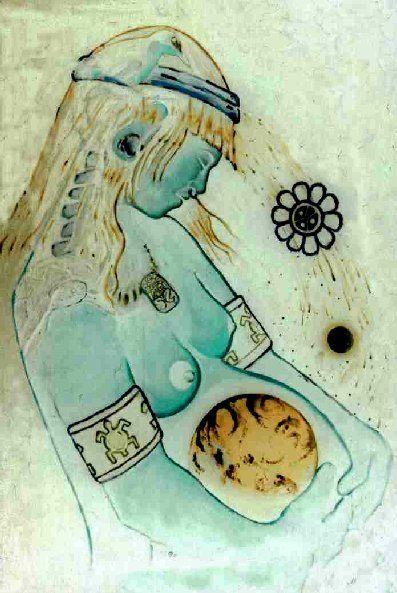 |
As my awareness was taken more and more into this immense being, I was allowed to see things about human life, and my own personal life, that answered my question as to causality. Some of what I experienced went beyond what I could understand. But I will try to record what is still indelibly imprinted in my memory. Firstly, Christ appeared to be a form of Shepherd, it’s flock – for christ was neither male or female – being humanity. Christ’s work is to penetrate the very existence and life experience of every person on earth – alive or dead. Everything each of us think, feel or do, is also experienced by that being standing beyond the limitations of time or space. Christ takes it all, experiences it all, with a love or compassion that stands above any form of condemnation or judgement. In some way human experience is the food of Christ. But this tolerance has to end at death. |
Then, Christ, or this process in nature, if you prefer to think of it as that, fully absorbs the entire memories and experience of the person. It seemed to me that without this there could be no personal survival of death. In fact, standing before the Christ, there seemed nothing in my own life that was fine enough, universal enough, to survive and become a functioning part of cosmic life. It was only this extraordinary being, winnowing through every act of each dying person, trying to find some deed, some seed of universal love and life that can be preserved, or taken as a basis for further growth, that enables us to continue, that allows us existence in the body of eternity. That extraordinary love tries to preserve and further the life of each one of us. Thus the parable of the lost sheep. I think this might also explain why many people who have a near death experience, meet a being of light, under the influence of whom they relive every detail of their life. This is of course refering to the human personality, not to the human spirit.
I said Christ was a shepherd. But equally I saw Christ as an Ark. The only way I can explain this is to ask you to imagine a being that has been able to develop a symbiotic relationship with all life forms at the level of sentience or consciousness. In our own view of life, such a being is incredibly highly evolved. But also imagine that this being does not have a physical body, existing outside the limitations of time and space as we usually know it.
As I witnessed this being, my mental processes formed images of it in an attempt to make it understandable to my own thinking. The image I saw was of an immense being standing in space by earth, absorbing all human experience. This being was an Ark because, from what was being shown me, even if humanity destroyed itself, all its experience would be preserved and expressed again in another time and place. Nothing of importance would be lost. Even such an apparently small thing as a child’s love for its Grandma would be preserved and allowed to live again.
Something I saw, but did not comprehend, was that Christ not only linked with all human life through an extraordinary form of total acceptance of every type of experience, but also the whole focused openness or surrender of this being was on something beyond anything I was capable of experiencing or understanding.
Continuum of Lives
What then happened, or what I was shown, was personal. I could see that the difficulties in my life, the causes of sexual struggles, had their roots in the past, in the life of a man who was rigidly authoritarian, and had killed love in some of his children. This was done by tearing them away from marriage outside their own religion. They were therefore pushed into loveless relationships. The being of Christ so interacted with human affairs that a birth, and the life that follows, is woven out of such past threads. Thus my own inability to love had arisen as a way of learning what a tragedy life without love is, and what pain it brings. There was a statement made that the present life arises because it expresses the highest common denominator of the past.
| This made sense at the time, but does not mean much as I write because my awareness is not expanded as it was. What was and is clear though, is that there was no suggestion of punishment, only an offering of situations from which we can learn. The life of that past man, and others I saw, did not leave me with any feeling that I, Tony, had been that man. What was clear was that the experiences and attitudes that constitute Tony, flowed from those past lives and are an intimate part of who I am now. This seemed as matter of fact, as anyone involved in, for example, nursing, expressing something of the attitudes and skills lived by Florence Nightingale. But I did sense that what is called my spirit was the thread connecting my life with that past man. |  |
There followed scenes that related to one of my sons, explaining events describing connections and relationship we had mutually experienced in the past. This was something I had not been seeking, but that made sense of things happening in his and my life.
Then the whole experience shifted and my awareness was filled with the sense of knowing or meeting the beginning of things. Once more Christ stood before me. Not as it were in a body, but I was overwhelmed by the presence of a great being that appeared to be a part of all things and all time. Christ lifted up my consciousness, causing me to feel as if my awareness also spread over the immensity of time, and from this condition I was shown the beginning of things.
I cannot say I saw this, more that I experienced the condition of the beginning. And this condition was the gathering together of what I understood to be a whole universe that had previously existed. All that had existed had come to such unity that although this beginning was physical, it was also, in its unity, a being. It had awareness.
As I experienced this I felt as if a resolution between science and religion had taken place in me. For here was something like the cosmic egg science suggests preceded the ‘big bang’. But what had been left out, I realised, was this consciousness, this immense being.
In retrospect, it also suggests to me the difficult question of Elohim being many beings and yet one. For all life had here found a unity in one immense being beyond my comprehension. It was, in fact, difficult to grasp because I was overcome by emotion as I witnessed this.
As I opened to this enormous perception, there was a deepening of understanding, in which Christ aided my comprehension. For I realised that the oneness or unity of this being was unbroken. It was everything, and nothing could exist outside of it. Even if it were to create anything, that thing would not have existence outside of the one.
This condition of ‘all-one’ had led to a form of aloneness. This was as near as my human understanding could grasp. Christ in fact said to me – ‘You must understand, this is your perception of it.’
Love is the Greatest Thing
Out of this aloneness, this great consciousness had longed that other beings might exist. But in its present form this was impossible. Then I understood something that tore my heart to pieces, as it still does today when I dwell on the memory of the experience. This being purposefully went about destroying itself so that our present universe – we – might have existence. It was such a wondrous action for it was done in such a way, with such skill, with such love and self-sacrifice, such art and science, that its very death was a magnificent creative act. In other words its death struck into action forces and effects that created our universe in all its variety. This death is what we know as the ‘big bang’.
As I experienced this, I realised that everything that exists is a part of that wondrous being. There is nothing that is not of its love. So that whatever arises in the universe arises out of, and as, THAT. The human sense of God is a realisation of the very substance of our own existence. The awe we might feel is from an intuition of what has been given us as our own being.
And as that great unity of energy and consciousness died, its very last impulse was for those new beings who might arise from its death. The impulse that flashed out we call love. It flashed through the universe permeating its every particle, in a way that we cannot yet perceive, but which is like a touch upon the pulsating chaotic movements of particles and lives.
We are the seeds of that love. We are God. And in our small portion of the universe, we face a particular lesson through the shortness of our bodily lives. We face death. Yet that is the greatest of things. For that is the heart of everything, the very act of love out of which our lives have been formed. If we discover the secret of death, we discover our creator and eternal nature.
Back to My Beginnings
A very different aspect of the Christ was encountered at a time I was experiencing massive emergence into awareness of material connected with my premature birth. I had been born two months premature prior to the time when such baby’s were placed in intensive care. The memories arising showed me how vulnerable I felt, how unprepared to breath or digest, how much I rejected life outside the womb. These experiences led me to feel that my vulnerability caused my mother to feel anxious about me, and not to give me the confident holding and emotional support I needed. This apparently disturbed my grandmother, because she took over caring for me. Unfortunately she died before I was two. So I lost my ‘mother’ at an early age, leading to conflict about where my home was, where my grandmother had gone, and who could I find love with.
I saw, as more and more of this painful material arose, that having lost my love and support externally, having rejected external life at birth, I turned inward for consolation and unconsciously created or found someone or something to get love from within myself.
To quote from an entry in my journal made at that time:
For instance nuns in a convent will not live out their ability to get married or have a child. They may use the figure of Christ as a compensatory symbol for this, in that they marry Christ and their passion is through meditation on his being. In this way people might use a hero/ine figure to compensate for what is missing in their own life. They can live their own unlived soul through the passion of Christ for instance.
A figure such as Christ can represent our own wholeness and complete potential. To compensate for our own unlived areas we might look to this figure and have a taste of what we are not expressing outwardly, through identifying with the hero/ine. Meditations on the figure might produce great feelings of love, pain, wonder, recognition – in fact whatever is missing in everyday relationships. The Christian festivals appear to be a way of living out, via the image of Christ, the passions of life that we might not meet fully in our everyday life. The birth, the struggle, the love, the death, can all be partaken of. We can share the passionate experience of living in this way, even though in our own actual life we might not be able to live such a passionate and eventful existence. And I suppose television does this for many people today.
 |
|
As I looked at the situation more fully though I saw that in fact nobody lives a completely whole life. No one lives their total potential. So in fact we all relate in some way to the Christ figure who represents, or in some way IS the total potential of human existence. Such a figure is a mighty example of what human life can achieve.
Now I came face to face with Christ. I felt knocked over emotionally by it. It was an experience of meeting the most amazing creature or being one could imagine. I stood in front of a god, something that totally transcended human existence. Gods are often depicted as having some great power of destruction or creativity. They might be like a human being magnified many times, with loves and hates, huge powers, and so on. My experience didn’t show Christ as anything like that. The transcendence was in the manner of Christ’s consciousness. Here was a being with no real power in a worldly sense. This being hadn’t created the world and couldn’t influence world history through power. But this being did have an awareness that was constantly experiencing the totality of human life. So wide and ancient was the experience of this being, to become conscious of it in any degree is to feel awe, and to be confronted by the littleness of human life.
The insight of how I needed Christ as a compensatory figure has not stopped my relationship with him in other ways. It has not produced an ‘either or’ situation in which my insights lead me to see Christ either as a compensatory figure, or as a divine being. I believe the human psyche is extraordinary enough to encompass both experiences, and still have room for other explanations.
The experiences could be explained as totally compensatory, in the Jungian sense of fulfilling some sort of psychic need or imbalance. They could be explained as extraordinary fantasy arising from fervent religious hopes or beliefs. But this is similar to compensation. They could be seen as expressing psychological or natural truths in emotive symbols. There might even be some suggestion of cultural pressures and norms struggling for some sort of balance in the psyche. They could, of course, as some believe, be the meaningless flotsam and jetsam of the dream state.
Regarding the last theory, based on my own sense of what happens, I believe the dream process is in fact involved. At least, I see the interpretative, image forming process at work. It is the same process the brain uses in interpreting sensory nerve impulses from our eyes, ears, nose, tongue and touch. In doing so it forms an integrated view of the world around us. I also believe that at times awareness can expand beyond our senses and touch things our senses cannot reveal to us of extra or para-sensory impressions. These para, or extra-sensory impressions are treated in just the same way visual impulses are – they are interpreted into images, emotions, ideas, understandable to the receiving personality.
I believe this is true of at least some of the experiences described here. This because before the experience itself, there is usually a sense of massive expansion of my field of awareness and flowering of mental/emotional energy and flow of associations. This is frequently painful at some level of my being, as if I’m being stretched, and previous boundaries burst. Also I have no doubt that what I experience is culturally determined. If I were a Hindu, I would most likely have a meeting with Krishna. Nevertheless, I still believe my awareness met, or touched, or was confronted by, a transcendent force or principle of some sort. It is a principle that can bring major changes in the person’s perspectives, their direction, their health even.
Considering that some research into human awareness suggests that nothing experienced is ultimately external to consciousness, then if I am right in suggesting there is a transcendent principle, the meeting is a meeting with myself. At times a merging of self with what at first feels like an immense otherness, takes place. At such times there is no sense of separation.
As for what might bring about such a meeting, I see this as quite simple. It can come from anything that expands awareness, as long as the person has a capacity to tolerate pain, pleasure, and mental shifts to an unusual degree. One has to become in some way like a responsive keyboard upon which the transcendent in you can play.
For myself this came slowly over years of surrendering my editing and controlling attitudes, as described in the beginning. Even so, during my first meeting the experience was still too painful, so I reeled away from it.
Others I have spoken to arrived at the meeting because of some great tragedy in their life that had torn down their usual boundaries. Great grief, great pain, cuts through the soul to bring the meeting. But great love alone can do it, expanding and introducing, all in the same moment.
For many, the meeting comes when they are near to death. Whatever brings it, it is an enlargement of the self. Except for a few, who swing into ego identification – I am the Christ – the meeting makes one more whole, more complete – even though each meeting might only be a step on the way.
One of my most joyous of these meetings happened in Athens. I had been working on the island of Skyros, and had experienced a great deal of love and warmth there.
In Athens I had about three days to spare before my flight back to the UK. So I went to stay at an ashram I had heard existed in the city. I joined in the daily routine of morning yoga postures and meditation, and also led one or two group activities. The meeting happened during one of the morning meditations in which I was a participant. There was nothing different or particularly stimulating about the events leading up to the meeting. Four or five others were sitting quietly with eyes closed after a group chant. The change came quite quickly, and I have to describe it almost as a story to make it understandable. The feeling of that wonderful presence filled me. I had to slow my breathing to contain the loud crying and gasps of wonder I experience when near that presence. Christ had come to my house to ask if he could live with me. I didn’t know how this could be happening to me. I’m not a particularly good person and I hadn’t done anything to deserve this. But the love I felt swept all those feelings aside. Every chair, every cup or piece of cutlery now seemed special because he was in my house. I was so excited I ran out to tell all my friends. I wanted them all to meet him.When they started to arrive I didn’t know what to say. How do you introduce somebody to God? But I needn’t have worried. He knew them all by name as if they were old friends. They all talked and laughed so warmly it opened my eyes to something about Him I had never known before. It is that God is the light in our life that leads us to make friends, to be interested in each other’s lives in a caring way, to reach out in friendship after an argument, to know what it is like to be married and have children, and care for others. When we allow those parts of our life to grow in us we let God grow. It is all so everyday and matter of fact we overlook how wonderful it is. I have friends who look up at the stars to find meaning in life. But God is right here with me living in my house and saying hello to my friends by their first names.
All these feelings lived in me as I sat with the others in meditation. When I opened my eyes the people in the group were beginning to leave. One woman, sitting on my right, looked at me and said, ‘I had the most wonderful meditation!’ She looked at me as if I ought to know what she was talking about.
 |
The next day, still feeling uplifted by the experience, I travelled to Athens airport to catch my plane back to England. As usual at the airport, there were people everywhere waiting for their flights. Some were sleeping on the floor. Others were sitting in various parts of the building. I found a space sitting on the floor with my back against a wall in the midst of many others doing the same thing. As I sat there thinking back on the events of the previous day, I looked up to see a Greek man walking across the open space in front of me with his small daughter. He was holding her hand, and it looked as if she had only recently learned to walk. Just as they were in front of me, about six or seven metres away, the child looked at me, let go of her father’s hand, and ran to me with arms wide. She ran into my arms to be hugged. I kissed her and she ran back to her father and they walked on. The people each side of me were astonished and asked me if I knew the child. I told them I had never seen her before. But inside myself I felt sure the small girl had seen the love and the light that were living in my house. |
I Am a Shape Shifter
For myself, I am a shapeshifter, and the following came out of a long search for what is real.
Now a new and really quite upsetting, critical, experience unfolded. These experiences are very real, just like living in a world, a large situation that is deeply felt. In this situation I saw and felt lucidity as a process, or a possibility, sought and developed by people who are basically inadequate in meeting the so-called real demands of life. Because of this, because they seek an alternative to what is difficult for them they attempt to inhabit a sort of existence between worlds. I suppose I have called it living in the cracks of life. Finding an environment that is not threatening and where the usual rules of society and physical life do not apply. In this view I could see lucidity as a sort of drug to be taken to deal with stress. The world that one can inhabit and explore as lucidity was one of a type inhabited by dropouts, hippies and others seeking an alternative way of being – but not in a positive dynamic sense.
I had never looked at it in that light before and seeing, experiencing it, so clearly was something of a shock. I could only say to myself, “Okay. Yes, I can see that as a possibility. I can’t deny that may have some truth in it.”
In what I saw and felt about this, Christ was involved in it in some way. Once again, Christ, or the belief in Christ, was depicted as a drug for those who cannot really cope with life. Somehow it was a doorway, or way out, for people who were not dealing with life adequately. This was of course deepened by Christ being depicted as someone who came to save the derelicts of life, the prostitutes, the lame, and the blind. This was also quite difficult for me to really see clearly – that the Christ was for the dispossessed.
It was coming to my memory of something that had been experienced at a previous time many years ago, in which I saw that the people who were in some way not functioning well had the seeds of transformation in them. For instance, a “healthy” male who is well adjusted and easy with his sexuality, is dynamic in a work scene and achieves success in that realm, will probably not look for change or attempt to find a different relationship with their sexuality or their personality structure. So those who do have problems, and confront them with their own inadequacy, are more likely to seek transformation.
But in what I was experiencing somehow that didn’t play much of a part, and I suppose it was more by way of looking at the situation from another standpoint; the standpoint of being the “normal” person. Perhaps like seeing meditation, lucidity, alternative lifestyles, in that way.
There is a play here on the natural. I mean there is a playing around with an exploration of that subject. It is a look at the masculine world of the penis – I’ve got it, I’m fertile, Ill fuck whatever is about. There is a play on that, and a play on Christ. It is as if one is for the adequate powerful male, and the other is for the dispossessed.
This part of the exploration, regarding Christ, poses a question that I didn’t find a particular answer for in this part of the experience. The question is about what Christ is in terms of human experience. I suppose my best and most down-to-earth guess or summary of what I have learned is that Christ is an archetypal image surrounding the human attempt to transform, to access inner potential and move towards —being a different type of human being.
I am saying that there is a sort of socially felt threat about pain, about death, about crucifixion. Crucifixion, yes.
The most extraordinary thing happened here. The only way I can describe it is to say that it felt as if I am standing in an open space in a town without any other people about. But what I was standing in was the many images, felt threats, fears, longings that assail human beings. So in one sense I was standing in the middle of a dream, and I was surrounded by the images of the felt threats, fears, hopes, that in fact impact on human consciousness every day. They impact in a way that are for many people torments, perhaps even life-threatening, and that for some may lead to suicide. But as I stood in the middle of these things and they came at me one after the other in the form of images and emotions such as fear, so images that were deeply felt, I was like a burning flame. I don’t mean that I looked like a flame. I mean that as each image impacted on my consciousness it burnt out. I was naked consciousness, and as each form, as each image attacked my nakedness it was burnt away, perhaps by my recognition of it as simply an emotion, a feeling, an image that in itself was a passing show of things.
I don’t think I have ever before felt such an amazing feeling as that magical sense of being able to stand amidst anything and everything that came towards me and yet remaining as pure, naked awareness. Most of us take our emotions and thoughts as a very personal truth instead of a passing show. Taking the naked awareness approach I could see any opinion I had as a part of the passing show – and if you say what about destructive and murderous thoughts that you might be prey to if you left yourself open? Well, they would be seen in the same light – a passing show that is burnt away by the wonder of emptiness.
This led me on to looking at, or wondering, why, as human beings we should be so dominated by images and imagery. In particular I was thinking about how our culture, and how we as individuals, are so manipulated by the images that are thrust at us day after day week after week, and year after year. The images of the big powerful male, the beautiful female, big tits and perfect teeth, the whole business.
So many things happened here it is difficult to remember them all and to record them in any sort of real sequence. But it seemed to me, and it was an incredibly powerful experience to find my way through, that the influence of the emotional images deeply pervades us. It leads so many women to have breast implants. It leads so many men to attempt to lengthen or increase the size of their penis. It leads to the taking of drugs to enhance sexuality where there should be no sexuality because there’s no feeling or life behind it. It leads to a culture in which millions of human beings are led to want the next gadget, it leads millions of us into a consumer society where we constantly feel the need to get something, to buy something, to be a consumer.
But also, at the end of burning through all the imagery, and the recognition of what an extraordinary thing that was, I stood in the middle of something that I did not at first recognise and so was once more caught up in. What I mean by this is that my nakedness burnt through image after image, emotion after emotion, but suddenly one came that appeared to be real to me and so I was carried along by it, became lost in it. And what I became lost in was the sense of purposelessness that I see as underlying much of our culture, and also one of the big driving forces in being consumers. In imagery this was like looking around and seeing okay, I am this naked consciousness, but so what? Here I stand in the middle of rather grubby and ugly streets and houses. Here I exist in the middle of a culture whose games have no great quality to excite me. Is that all I am? Is there nothing else?
What is important here is that for many of us the meaninglessness, the purposelessness, is as real as bricks and mortar.
I suppose from this level in the experience I want to say to Andrew, a man I had been discussing his dilemma with, “I can see the big struggle in connection with his image that is put out that, to put crudely, is something like you are either a prick or a loser or you are not – you are either a proper man or you are not. And because I’m standing in this place of awareness I have to laugh at this. I laugh not because it isn’t powerful. After all I have just been through the ages of struggle finding my way through just those images. It wasn’t easy. But having come through them I can laugh and say, “Hey, there is more to life than just feeling like you are a loser, or being able to have sex like a horse.”
Here I delved as deeply as I could into the nature of Andrew. I wanted to see where the struggle arose from in him. I wanted to put my finger on the heart of his pain and struggle. Strangely, I couldn’t find any deadly neurosis or terrible inner situation. What I did see was that he was always, like so many of us, a victim of the underlying forces of our society, manipulated by the extraordinary images that are put out and against which we are supposed to measure ourselves. It also came to mind that this is why he is writing his book on the media. In fact the media is very important to him because it is one of the huge factors in his psychological life. It is a potent force in his soul. And because of this he is giving a great deal of attention and energy to it for his own survival. There is something he is trying to understand about it. And as far as I could see what he needs to understand is that he has been put under a spell by the false image of manhood or womanhood presented in our society.
Another factor that I saw in him was that his father had been, as it were, completely surrendered to his wife and had no will of his own. I didn’t take time to investigate why this was so, but felt that he had somehow been kicked in by his attempt to relate to his woman. And I saw that Andrew had inherited the behaviour patterns of his father, and the patterns lived by his father in his ways of surviving. It was a way of life that depended hugely on established and secure methods of livelihood.
As I emerged from this feeling I needed to say to Andrew, “Andrew, you are a man! There is nothing I can see in your nature that says otherwise.” But I did see that Andrew has worked to move free of the patterns he has inherited from his father, and perhaps from his forebears beyond that. And I did see that Andrew can let go of what he takes to be security. I believe events in his life are giving him that opportunity at the moment.
I moved on to seeing, experiencing, that lucidity opens one’s eyes to many possibilities. I guess it is something like walking about on the insides of people. Another way of saying it is that one gets behind the surface of things, and sees what is going on behind the surface of people, of society, of politics. That is not always comfortable, because in seeing that you also begin to see yourself in a new light, and not always in a complimentary one. Nevertheless it is a transforming experience.
The experience of being naked awareness, of burning through image after image, feeling after feeling, viewpoint after viewpoint, left a great impression. Out of it realisations were emerging. The major one was that there is no danger in being awake in ones dreams, but one must beware, or be aware of, the fact that sometimes, as happened with myself in meeting the feeling of pointlessness, one can become possessed by the image, at least for a while. When that happens the image, the emotion, the viewpoint takes on a concrete reality, a supreme sense that there is nothing beyond it. Perhaps a way of describing this is to say that if you could imagine that you are standing in an open space, and by some trick of technology an image of a house is built around you, with walls, furniture, windows, etc. If you can imagine that you discover in imagery that the doors are locked, then you are completely trapped. But you are trapped by nothing but what you believe to be real.
Perhaps the central secret of this is that what happens in life and in our dreams is that what we do tend to see as real is created out of our own mind stuff. It is created out of our own emotions, our own fears and hopes. There is no way out of that unless we recognise the material it is made out of it is the energy of our own consciousness. In fact that is exactly what dreams are, apparently real surroundings, people and animals that we are in the middle of. Yet if we could recognise that we could escape from any awful situation in our dreams – and in our mind, the whole structure of what we felt so real and terrified of would fall apart.
As an example of this here is a lucid dream I had:
Before waking this morning I had an extraordinary lucid experience that involved some imagery. One of the clearest of these images was of me in a maze. The walls of the maze were made of hedges, as the whole thing was outdoors. But I realised, because I was lucid in the experience, that I had purposely created the maze as an experiment.
The point of the experiment was that the maze was complicated enough to make it difficult for me to find my way out. So, confronted by the difficulty of emerging from this dream maze, because of the lucidity, I could understand that this was a dream image, and in doing so I simply realised myself as pure awareness and transcended the maze.
I then experimented again and again with this, moving beyond the imagery into pure awareness. This was such an extraordinary experience and realisation it is difficult to put into words with enough impact to make it real.
What it led me to become clear about was that all dreams involve our personal awareness in an environment or imagery of one sort or another. Usually we feel the dream imagery to be so real, and the feelings we experience because of the imagery to also be real, that in a very concrete sense we are trapped. So if we were in a prison cell in a dream, then there would be no way out of that cell without a key. But realising oneself as pure awareness means there is no prison, there is no entrapment, there are no walls to hold you. The imagery of the dream is then seen as simply that – imagery – stuff of the mind that we have conjured and become identified with and lost or trapped in. Even imagery with positive feelings is a form of trap if we identify with them. See Masters of Nightmares
I repeat again, this was an extraordinary experience. And of course it relates to everyday life. The more I look at the experience the more I realise that virtually everybody on our planet is trapped in a prison of their own emotions, thoughts and beliefs. To recognise this in any reasonable degree leads to an extraordinary sense of freedom. To see that we live our life trapped in the world of thoughts, of emotions, of sexual drives, of fears or beliefs, is astonishing.
This is so like the ending scenes in the film Matrix, that I am sure whoever wrote the script had a profound awareness of this. The hero of Matrix breaks through the surface appearance of things and enters into the very programming of the apparent world around him. This is what happens when we wake up to what underlies all our experience whether as a physically external world, or as our own dream world.
The point is that whatever we believe we are; whatever we believe the world is; it becomes that because we create it out of our mind stuff. I am not suggesting that the external world is a figment of our imagination. What I am saying is that our feelings about it, our perception of it, is shaped by our own innate nature. Truly, the Buddhist search for Moksha, or freedom/liberation, does arise by recognising that all experiences are a play of consciousness.
Here I was playing with the different things that we might believe ourselves to be. “I am a ballerina.” “I am a stud.” “I am a failure.” “I am just a pussy.” These are the things that people believe and unfortunately become. Of course there is no problem in becoming something. It is wonderful to materialise, to create something in the world. The problem is when you believe yourself to be that and get lost in the role.
If you are caught out in these images it is like being possessed by a demon. It diminishes your realisation of who you are. This is I felt, is what my new plans and new ideas for my writing are about.
In my search for meaning as I passed through the images I came to a point of just standing, existing, in an empty space. I laughed as I realised there was no climax to this story. There’s no giant explosion.
I looked back upon what I had experienced and had a strong feeling that people do not want the sort of freedom that I had found. They somehow want a life that binds them to their balls or their tits or what they want have enough money to buy.
My attention then turned to people that I knew. I asked myself, what about people like Andrew, Sylvia, Frank and Ellen. What I felt just then about freedom was that there is absolutely nothing to find if you to attain that liberation. There is nothing at the end of the journey. I know this is an old theme and troubled me for years around the time I went to Australia and just before. So as I was facing this I had some reservations about what was going on.
This led me into a playful mood where I was talking, as if to a hidden dimension that was playing hide and seek. I was saying, “Hi ya. I can see you.”
The other day, while Andrew was with me and we were walking, a local bitch/dog came up to me. I squatted down as a result, and felt at ease to show Andrew what it really wanted. Slowly it lay down and went over onto its back because it wanted me to rub its breasts. As I felt, one of its powerful urges was to have pups and have its breasts sucked. Now, to deal with that urge, to get some satisfaction, it needs its breasts rubbed.
I mention this because as human beings we tend to hide many of our real needs. We deny ourselves so much that we express our needs in very peculiar ways or in roundabout fashions. The dog was beautiful because it had none of our ridiculous sense of shame or shyness. Her fundamental instinct is to give through her breasts. It is just kindness to rub her breasts.
I am just standing here in the middle of things as far as I can see, and standing in the middle of all the creatures, in the middle of other human beings. What theory have I got about that?
I believe that we do possess a force like that; a force outside of money and politics; outside of capitalism – although obviously we live within the framework of things.
I need to deal with that sense of defeat. I am measuring myself. I am measuring myself against whatever it is that Frank is suffering from. I need to deal with it – a sense of defeat? What is it? It is as if there is nothing around me, nothing to reach for, nothing that has been achieved. My God, what a huge, terrible spell that is. Because there is nothing there, there is nothing worth looking for. Who is putting that out?
I meant by this question, that because I was in this place in behind things, behind the outward events of life, behind the scenes as it were, I felt as if there was something being put into that space to influence people, to give them a sense of pointlessness. I understood that I was in a place that was, or depicted, the ocean of mind that people in our society swim in, or exist in. I guess another way of putting it is that the influences, the ideas, the social pressures we meet, were depicted by this place.
Of course there is nothing there except our own creativity. What people do not realise, and often choose not to realise, is that everything around us comes from our own creativity. I first realised this when I saw how we have shaped the fields, the houses, the animals and plants around us. There is very little in the world not touched by humans and their creativity. But when I look at the impoverished houses of the majority of humans, and see what we are capable of, I wonder why? Why blame it on some source outside of us? Can’t we see that our mind and feelings are creating an awful situation, and often a deadly and criminal one? We say life is without meaning, hoping something else; someone else, even God is blamed. Yet if we look at who actually made the mess of our cities, our lives and our own inner self it is us – you and I. And every time I have met Christ in me it has been an experience that gives me hope for us humans.
I think that if we are going to work with the shadow we have to recognise the nature of things we are working with.
Into A Dream
On the morning of January the sixteenth of two thousand and eleven, I woke from a dream that did not seem to have any great promise in it. But being a Sunday morning I told my dream to Ros and asked her if she would listen while I explored it.
In the dream I had arrived to my home and entered it, although it wasn’t any home I recognised while awake. It was simply two rooms, and I lived alone. The rooms were big and oblong without any entrance hall. So I walked straight into the first room through a door on the right of the room. I cannot remember any details of that room, but it seemed empty of features.
The entrance to the next room had a large doorway at the right, and the room was the same size and shape. I remember going toward it and seeing a curtain of light cotton material was across it. That was new and I wondered how it had got there; and as I reach out to pull it aside someone caught my hand through the curtain and held it before I went in. I immediately knew it was my dead mother’s strong hand gripping mine.
I must have withdrawn my hand, because the second time I went to pull the curtain aside the same thing happened, but with differences. This time I felt my mother catch my hand through the curtain, but I was aware of changes as we held hands. At one point her hand became very large, almost masculine. Then I was in the room and there were my mother and father; mother being very welcoming and my father at the far end of the room and seeming distant.
Also I saw that my mother and father had put a curtain up across were the bed was at the left end of the room. The curtain was partly drawn over the bed area and I thought that I didn’t like being curtained off, but preferred it being light. And that was the end of the dream.
Then I woke up and told the dream to Ros and we explored it.
The first part of the dream I looked at was the rooms. In imagining myself as them, taking on the shape and structure I felt very empty, as if there was no life there, and I was alone. This reminded me of the time I felt I had completed the inner journey and got to the Source, but all I found was an empty room, and that was very difficult. Looking back it lasted for years, until I got used to knowing that I had to live in the present moment, and live without hope.
I hadn’t thought of this dream being anything about death, so I was exploring about my mother and father, imagining myself as them and watching the feelings that arose, and so many things began to happen and realisations or insights pouring up that I cannot remember the sequence, so will simply say what I remember.
I felt that my father was very distant from me, not just physically. And when I questioned this he said, “Do not get near me, I am going somewhere.” I felt that he was in the process of a big change, and so I should leave him to it; but I couldn’t define what the change was.
Then I felt a lot about the curtain and realised that it wasn’t, as I thought, a great barrier between life and death, but a very fine veil which we can even feel each other through – as my mother’s hand was so real and palpable to me. Then I began to really feel my mother’s presence and wept at the strength of it. Somewhere about here I was thinking about the absence of furniture and people in the room, and suddenly I realised this was something I had control over. I saw that I had chosen to shut myself off from other people, and I could change it. Then suddenly the room was full of people sitting around and talking and drinking; also full of wonderful furniture and art. But I realised that was how I imagined it, and who my real invisible friends were. Then the imagined room changed.
I was still holding my mother’s hand and gradually a felt change occurred. I was overwhelmed by the feeling of love and the being of Christ there with me and holding me. He said “I held your hand a long time ago when I made you mine. But Tony I have never let go of you.”
That realisation tore me open and I cried so much and so loudly, knowing the presence was and always had been with me. He said, “I am with you as myself, as a baby, as a youth, as a man, even as an old man and also in the death of my body– I am who people call God.” And I saw him there in all ages, knowing as I felt all this that the wonderful being could meet me at any point. I knew the meaning of what the Roman Catholics do when they choose a baby and it is paraded through the streets. It is that every child that is born has the Christ in them.
I couldn’t help feeling enormous waves of emotion flowing through as I realised all this. But there was even more to come.
He reminded me that in our culture he is seen in a particular form, but that was because we are from a male dominated past. In other cultures he is known by many names, such as Yahweh and Ashera, Isis and Osiris, Krishna and Radha – the male and female. But while I was in this wonderful state I was shown that He/It could be any form, because He/It was Life itself, and was everything and everywhere.
At this point I experienced the spiritual marriage, in which ones personal awareness was merged/married to the Divine. It is difficult to be able to define this experience, but at the time I felt that my being was now linked in a wonderful way of sharing the experience with ever woman I had felt care and love for – we were all sharing in the celebration.
So much was being passed to me. I was reminded of the time when my uncle died and I was there as a very young teenager at the funeral. As they lowered his body into the grave, my auntie Julie and her children burst out in load sounds of pain. I stood there at the graves edge and said very loudly, “What are you crying about. That is not him. He is elsewhere than in that body.” Maybe not those words but the idea, and I was impressed that this was the Christ talking to them as a child, and I was doing his work. And the impression went on to remind me that I had been asked to work – answering peoples queries about their dreams – and that I should still do this as a worker in the vineyard. And that I was a messenger – nothing more, nothing less. That the veil had been passed through and I would continue to be a better messenger in His name.
What does it mean that Christ died for us?
I asked this to Christ – If you gave your life for us, if you died for us, I want to know how. I want to be able to understand. (Broken words through crying) I want to know how. If Christ did that for me, I want to know how. I heard it, but I can’t see it. I want to know how. Show me.
Breaks off here with a laugh – I need to pee first before you show me, otherwise I can’t concentrate.
The mystery of Christ dying then opened to me and it was so simple. It was the inner realisation we have that LIFE, in the form of animals and humans, perhaps our family ancestors, gave or give their life that we might live, that we might exist. This once more pushed me deep into emotions and gratitude.
Then I felt that I was Life and Love. I was telling people that I was always there waiting for them. I knew their love, like the mother who although falling apart emotionally or physically, yet always has the food on the table. Why didn’t they come and claim the love waiting for them? All they needed would be to lose a few tears, to cry in meeting what held them back. All they needed to do was to say sorry to me – Life. Not because I needed it, but because they needed to say it to swing their heart around to me again. I didn’t need them to be perfect, but simply to come to me.
Life then tells me that I have learned to love. I find that difficult to see. But life showed me that when someone is angry I simply pull back a bit and say to myself, Wow, that’s a heavy one. But I am still there. I don’t cut them out of my heart. If someone is going through hell I sit with them and I say to myself, “God this is some bummer”, but I don’t run away or shut them out of my life.
And that is love; strange because I had never thought of it as such. I thought it was normal to be like that. I have often puzzled about people saying there was so much love at Ashram, my home. I could never see it. But put like this I can see that Ashram (The place I lived and worked at in therapy groups) was brimming over with love.
My Ending Experience that Started Many Years Back.
I want to end not with another meeting with Christ as a being, but something I experienced in a similar way.
The Chakras – Part 2
Talking with God
DESPITE the cry of materialism that has rung round the world, with its signature tune of ‘God is dead’, more people than ever are arriving at something new. In the past, God was largely ‘owned’ by the priests. The man in the street was threatened, warned, told and talked to about God, but in Western culture, neither he nor it seems the priests, seldom ever experienced what they were talking about. When religious authorities were trying to stamp out the American Indian church, the Indian priest said, ‘You go to church to talk aboutGod. We go to talk to God.’ Many ordinary people, outside any religious group, are now doing the same thing.
In the meantime, although some teachers are treating the subject of Chakras and Kundalini as if they were a huge secret and something ordinary mortals should know nothing about, hundreds of people are gaining direct experience.
Here is a letter from a woman who, when practising a form of Bhakti-Yoga in which she offers her whole life to God, describes the experience that followed:
‘This occurs at any time and any place and the beginning of it makes me feel sleepy. It seems, it begins either at the base of the spine, or at the rectum, then travels on to the sex organs accompanied by a burning feeling, and pins and needles on the surface area. From there, it ascends to the point of the navel, then upwards to the solar plexus. One can liken its ascent to a burning hand.
At the solar plexus the heat becomes more intense, it makes my middle feel sick. Still climbing it reaches my chest, around the heart. It seems here to be groping for the very inner-most centre as if the very soul resided there. This brings forth groans. I feel like pouring forth all the love in my being.
It travels on and burns my throat, then upward to the space between my eyebrows and the bridge of my nose seems prickly. For some unknown reason I burst into tears, but as it moves upwards from there and fills a circle on the crown of my head, (and rests there indefinitely) all is peace and light.
She also says, ‘I do not appear to be guiding the power with my mind, as it seems to be strongest if I try to fix my mind on something else. Eileen Garratt echoes the same opinion. She writes: ‘I have heard it said that in “supernatural” sensing, concentration and meditation are necessary. But this seems contrary to anything which I have learned from my own experience in clairvoyance telepathy and projection. I would say that an ease, a nonchalance about the process, are prerequisites to the production of such states.’
She says later that complete relaxation and surrender of the conscious self, allows the superconscious self to become dynamic and active at a conscious level. This exactly matches what the other woman does in ‘surrendering to God’.
It was said earlier that man’s body is like a radio receiver immersed in a sea of cosmic energy. The effect on the Chakras which form energy centres for the body is rather like the filaments of electric light bulbs which do not glow until the current flows.
Similarities
People may describe the Chakras in different ways, but their vision of them must be the result of their own inner experiences. Nevertheless there have been certain similarities running through many of the descriptions. The effect of the glowing of the Chakras through the so-called release of Kundalini is not the same as the direct action of cosmic energy. This situation is more like the bombardment of atoms by radiation. The atom accepts the surplus energy for a while, but then ejects it again in the form of light – hence the ‘glow’. Ultimately if the process is too accelerated, there might be what could be considered an ‘atomic blast’, which would be that uncontrolled arousal of Kundalini whose dangers have caused so much division amongst the teachers of Yoga.
Thus, the arousal of Kundalini is not the effect of outside cosmic power, but the release of cosmic power that has long been individualised within the particular person. As was already said, the creative sound was negative and positive, earth and sun. The Kundalini took the materials of earth and gradually ‘wove’ a form through which, it could realise itself as an individual being.
The cosmic mind thus becomes incarnated in a physical body, which gives it a sense of being separate and individual instead of universal. The sperm and ovum in the womb, present a pattern with which the Kundalini, also directed by our own past lives, builds a body. The body has in it, even if only ‘in embryo’, all the possibilities of expressing the qualities of the cosmic wholeness.
Just as the baby has sexual organs which it does not yet use for intercourse – so the ‘magnetic’ field, connecting with the nervous system and glands, has in it the Chakras, which only as we mature as individuals, actually become a part of our conscious experience. In order to understand this, it may be helpful to think of ourselves as a strange sort of science fiction plants, growing out of another dimension, into time and space; starting as a speck of matter in our mother’s womb.
Latent qualities flower
As this human plant grows, latent qualities in it flower. The Kundalini is the power behind the growth, we direct it by our attitudes, our desires, lust, cooperation or inhibition. But human growth goes beyond the development of the baby, and matures into the dimensions of emotion, mind, and eventually, an awareness of our cosmic being. The Chakras are like senses which are sensitive to energies, more subtle than sound, or light. But they are also organs which express energy, as do our hands, legs, genitals or larynx.
The woman originally quoted, mentioned eight points at which the Kundalini seemed to produce heat: base of the spine, sexual organs, navel, solar plexus, heart, throat, brow and crown. The Hopi Indians speak of only five centres, Indian tradition lists seven, Buddhism six, and some traditions, such as the Rosicrucians, list as many as twelve. Can all these be right?
We have to remember that a lot of books are written purely from intellectual conjecture or study, without any direct experience or insight. On the other hand, the magnetic field or aura, in which the Chakras exist, has its own network of nadis (translated as points where energy interacts or meets), which are quite different to the physical nerves.
Vortexes of activity
It has many points where vortices of activity occur – hundreds of points – and so one could list many Chakras. It is possible that different researches have determined different centres as the mainones. Also, the subtle body, or auric body, is more plastic and changeable than the physical. Just as we can develop huge biceps by special diet and exercise, so some of the Chakras might become enlarged through special activities or problems of the individual. We cannot therefore be dogmatic, as there is room enough in creation for variety of skins, of religions, of foods, of abilities and, no doubt, of Chakras.
{short description of image}
Perhaps the easiest way to think of the Chakras is to see them as focussed aspects of human awareness and experience. For instance one can focus solely on the sense impressions of touch or sight. This can be shifted to being lost in thought, or carried along by sexuality, or perhaps adrift in emotions. Each of these is a very different ‘world’ of experience. The Chakras are simply a way of saying, this is the part of the body where we are most aware of this aspect of experience and awareness. This is a focal point where you might discover more of your potential for life and awareness.
But let us list the main Chakras as given by various authorities. Starting from the bottom, we have the Root Chakras, or Muladhara Chakra. This is said to have four petals, or main functions.
This is why the Chakras are often called Lotuses, because of these petals, or direction of energy in the vortice. The root Chakra is described as being between the rectum and sexual organs. Remember that Chakras themselves are in our magnetic field or subtle body and are not part of the physical body. Nevertheless their roots, so to speak, connect with various parts of our physical structure. This will be dealt with later. Edgar Cayce and Yoga both list Root Chakra as being red in colour.
* * *
The next one is the Abdominal or Swadihisthana Chakra. This traditionally has six petals, and is just above the sexual organs. Traditional Yoga gives this as vermilion. Cayce describes it as orange.
* * *
Then comes the Naval or Manipuraka Chakra. This is above the navel in the area of the solar plexus, with ten petals. Yoga gives it as blue, Cayce as yellow.
* * *
Above this is the Heart, or Anahata Chakra. This lies between the breasts, with twelve petals. Yoga colour is orange red, Cayce lists it as green.
* * *
At the base of the throat is the Throat or Vishuddha Chakra. This has sixteen petals of ‘smoky purple hue’ (Yoga). Cayce gives it as blue or grey blue.
* * *
Between the eyebrows, or in the middle of the forehead, is the Brow, or Ajna Chakra. This has two petals. Yoga gives it as white, Cayce as indigo.
* * *
Where the baby’s fontanel appears, on the top of the head, is just above the centre of the Crown or Sahasrara Chakra. This has a thousand Petals, and is clear as light (Yoga). Cayce gives it as violet.
* * *
A description developed by Leadbeater in the Theosophical Society, lists the positions as follows:
1 above the genitals.
2 over the navel.
3 over the spleen – ie. lower left ribs.
4 over the heart or left breast.
5 lower throat.
6 Brow.
7 Crown.
Dr. Wilhelm Reich never wrote of Chakras, but through his own line of scientific research, he defined seven body segments. Starting from a background of physics and Freudian psychiatry, he gradually came to see and demonstrate that human personality and the body were expressions of a cosmic sea of energy. (Discovery of the Orgone – Panther).
He believed that this cosmic energy, radiating from the sun, has in it latent qualities which express in matter. In the human being, these basic qualities of orgone energy express as a movement, pulsation, expansion and contraction, orgasm, emotion, consciousness and the ability for life in us to look into and respond to life in other living beings.
Self-regulating morality
Reich said that out of a harmonious relationship with our own life force, or orgonomic functioning, arose self-regulating morality, love, desire to work and create and to further understand self. But most individuals, he found, were blocking the functioning of the orgone energy in them. Through tests, he found that the energy flowed up the spine, over the head and down the front of the body. In its flow it gave rise to pleasurable ‘streaming’ throughout the body. Emotions were an expression of this streaming. That is, feelings of tenderness, love, sexuality, crying, self-realisation and insight into others, were the results of the orgone streaming freely through us.
But if we had been taught to block crying, tenderness, love, sexuality, self regulated creativity, and replace it with rigid morals, social conduct, and forced learning or working, a tension or block occurred in the muscular system, which held back the streaming. This not only changed the personality, but it also resulted in mental and physical illness and pain. Even cancer, he saw as a result of blocked orgone energy.
Relaxing the blocks
The therapy he developed as a result of his research was centred on helping the person to relax any blocks and allow the orgone energy to flow freely again. This was difficult with many people as they were terrified of crying, sexuality, love or tenderness. He also demonstrated that this cosmic energy ‘radiates’, but he did not go as far as defining an aura. The seven body segments he speaks of are:
1. Scalp and eyes – he describes each one as a circular zone around the body, so this would include ears and the back of the head.
2. Mouth
3. Neck
4. Chest
5. Diaphragm and solar plexus.
6. Abdomen below the ribs – ie abdominal muscles.
7. Pelvis, which includes sexual organs, rectum and colon.
While these do not fit in exactly with Chakra positions, what he lists as signs of blockages in these areas helps us enormously to understand personal growth, as will be seen when we deal with particular Chakras