Author Archive
Historical Perspectives – On the Primary Connection Between Parents and child
| The current emphasis on the importance of the primary connection between parents and infants is a relatively new phenomenon. For example, biblical references to the relationship between parents and children often emphasize the child’s obligations to the parent, but little mention is made of the parent’s obligations to the child, other than to provide discipline. Emotional connection with infants was actively discouraged through the middle-ages. Some have attributed this to the fact that infant mortality rates were so high, the implication being that parents simply waited to see if the child would survive before an emotional commitment was made. Of course, there are always exceptions to the cultural norm and, even during those times, individual parents did recognize and value the uniqueness of their infants. There are cultural differences that could be explored but for purposes of this column, we will focus on Western psychology’s contribution to thinking about the parent-infant connection.Freud’s work first drew attention to the importance of the first three years of life and challenged the prevailing belief that young children and infants were incapable of thinking and feeling and, therefore, what was done to and with them was of no importance. A comparison can be made between the attitudes a century later towards preborn and newborn babies.Although Freud’s work eventually led him to the conclusion that very early memories reported by his patients were based in fantasy rather than actual events, he opened the door to investigation of very early experience. His conclusion that thoughts and feelings can be as important an influence on our lives as actual events allowed psychoanalytic investigations to continue in the face of much opposition to accepting the possibility of widespread immoral sexual acts committed against children by their parents. That debate still rages, updated as questions about the validity of repressed memory. At the base of it is the importance of early experience, whether that experience is based in actual events, fantasy, or a combination of both. The difficulty with Freud’s approach, once he came to the conclusion that he was dealing with fantasy, was, and is, the impossibility of proving or disproving his theories.
Melanie Klein (1932) carried the emphasis on the influence of fantasy and internal experience to the extreme, stating that children’s emotional problems are almost entirely due to fantasies generated from internal conflict between aggressive and libidinal drives, rather than to events in the external world. As a result of this theoretical perspective, she forbade John Bowlby to talk to the mother of a three-year-old whom he analyzed under her supervision (Bowlby, 1987). Bowlby had, due to previous experience in working with children, come to believe that actual family experiences were much more important. In his early theoretical papers Bowlby (1940) revealed his interest in the intergenerational transmission of attachment relations and the possibility of helping children by helping parents. This position, although developed independently, is compatible with object relations theories such as those of Fairbairn (1952) and Winnicott (1965). Partially in reaction to Klein’s approach, Bowlby became intent on developing his theories with a sound basis in empirical validation. Attachment theory was the result. Developed in collaboration with Mary Ainsworth (see Ainsworth and Bowlby, 1991), attachment theory draws on not only psychoanalysis, but concepts from ethology, cybernetics, information processing and developmental psychology. Mary Ainsworth developed the empirical methodology to test some of Bowlby’s ideas and also contributed the concept that the attachment figure provides a secure base from which an infant can explore the world. Another primary contribution of attachment theory is the concept that, by understanding early development, we can enhance human experience. The focus is changing from negative influences and understanding of what goes wrong to understanding what goes right and how to contribute to that positive influence. As opposed to Freud’s focus on negative sexual and aggressive influences, we are now emphasizing understanding of the powerful human emotions connected with attachment and bonding–in other words, love. For those readers looking for a more in-depth discussion of attachment theory, I refer you to Goldberg (1995) Attachment Theory: Social, Developmental, and Clinical Perspectives. This book is a comprehensive addition to the literature. Based on an October 1993 conference in Toronto to honor Bowlby and take stock of his theory of attachment, its origins, influences and implications, Goldberg’s book provides a solid foundation for understanding attachment theory. Bowlby and Ainsworth’s primary gift to those of us investigating earlier origins of attachment (i.e., prenatal and perinatal) is the grounding in empirical studies. This book is not only a tribute to Bowlby, but a foundation for many other researchers and clinicians seeking to understand our very earliest experiences as human beings. Magnificent living theories and powerful methodologies lead to changes in individual perceptions and to changes in social structures. Our next update will move to the work of Klaus, Kennell, and Klaus (1995) to explore the building of foundations for secure attachment and independence and the impact of this theory on hospital practices. References Ainsworth, M. & Bowlby, J. (1991). An ethological approach to personality development. American Psychologist, 46, 331-341. Bowlby, J. (1940). The influence of early environment in the development of neurosis and neurotic character. International Journal of Psychoanalysis, 21, 1-25. Bowlby, J. (1987). Colloquium presented at the University of Virginia. Fairbairn, W. (1952). An object-relations theory of the personality. New York: Basic Books. Goldberg, S., Muir, R. & Kerr, J. (1995). Attachment Theory: Social, developmental, and clinical perspectives. Hillsdale, NJ: The Analytic Press. Klein, M. (1932). The Psychoanalysis of Children. London: Hogarth Press. Winnicott, D. (1965). The Maturational Process and the Facilitating Environment. New York: International Universities Press. |
Cherub – Prebirth Meetings with your Baby
Quite a few people these days maintain they’ve been ‘touched by an angel.’ Others have an equally mysterious sense of being trailed by a cherub! Susan Clarke, for example, describes it this way: “During the months before my son was conceived, I could almost ‘see’ this little male cherub floating above my head, laughing.”
In a previous column, Steven and his wife described Steven’s initial vision of a beautiful toddler, a vision that was followed by a series of contacts with the same charming child. “He seemed to be continually tapping us on our shoulders, reminding us of his presence,” said Miriam. This kind of gentle persistence is apparent in many accounts of communication before conception. In many cases, the communicating presence is perceived as a baby or very young child, often manifesting a definite personality. It’s not surprising therefore that some people refer to their visitor as “a cherub.”
One woman speaks of the visits she received as a “courting relationship.” Trilby writes, “I most emphatically had an experience of contact with my little darling before he was conceived. In short, I just perceived a presence near me (with the awareness centered at my third eye) that always caused me to look slightly upward. As I paid more attention to the presence I began to apprehend it as a small flame, similar to what one sees off a lit candle. This ‘courting’ relationship went on for several months before I conceived. During those months I felt as if I were being tailed, and every now and then I’d be aware that somebody was trying to get my attention. It all felt very romantic.”
While some people have visual impressions, for others the communication comes in a different form. In Sarah Hinze’s book Coming From the Light, a mother writes, “My experience with the unborn is very simple. We had five children, plus one miscarriage, and were trying, at this point, not to have another baby. But in quiet moments, I would hear a small, almost audible voice say, ‘My name is James, and I’m ready to be born.'”
A Hovering Presence
Becky began to correspond with me while pregnant with her first child. She described in detail her experience of a pre-conception presence. “In November of last year I began to be aware of a little spirit presence hovering around me,” she wrote. “At first the awareness was dim, then it became so noticeable that I felt it whirring above my right shoulder.” Her story continues:
“A month or so after the dawning of this contact, I began to talk about it with people close to me. Several related that this was a common experience for women about to become pregnant. When I heard this, my inner eyes widened. For a while around this time, my little baby spirit seemed to have wandered away. I wondered if I should have kept its presence a secret. After the turn of the year, the spirit reappeared, this time hovering in front of my left hip.”
Now Becky gained a visual sense of a baby. “She looked to be about six months old, dark blue eyes and dark brown hair, clearly an animated little girl. I tried to have dialogues with her in my imagination from time to time. She seemed to be communicating to me that I should hurry, that she could not wait much longer, that I had to heal my wounds in order for her to have a safe home to dwell in.” As Becky continued to postpone conception, the presence gradually grew smaller until it was only a dot, “still hovering but no longer communicating.” A week after it disappeared, Becky discovered that she was pregnant.
Becky wrote when her daughter was a year old, “Since her birth, my sense of our pre-pregnancy communing is even more grounded, partly because of the perspective of hindsight and partly because she truly is the baby spirit who visited me, physically as well as personality-wise. I will never get over how magical it is, from the pre-beginning all the way through and beyond.”
Playing Peek-a-Boo
Like the “laughing cherub” mentioned above, the visitor in the following story seems to express a playful, joyous spirit. Cambria Henderson writes, “I was busy in the kitchen, cleaning up after lunch for my three year old son, two year old daughter and one year old baby. It had been a hectic morning, but they were all quietly napping at the moment. Or so I thought!
“I heard the giggle behind me and supposed that my son was playing ‘peek-a-boo’ with me. I felt the glee, as my little one peeked around the corner, saw me, and then quickly withdrew before I could turn around. If he weren’t so delighted with himself (and so cute!) I would have scolded him and sent him back to bed. But that happy little giggle had me completely charmed.
“I went busily about my work, cleaning the countertops, pretending not to hear. I suddenly caught a reflection of a sweet little face, in the mirror that was sitting on my counter. I turned quickly, hoping to surprise and delight him and then chase him back to his bed with hugs and tickles. However, I was the one to be surprised! As my little one turned to run down the hallway, I realized that he had taken all of his clothes off. All I could see was the bare backside of this precious child.
“I thought it strange, as I went after him, that when I turned the hall corner, I couldn’t see him. I didn’t think he could run quite that fast. I also noticed and thought it strange that my house suddenly became very quiet. I stopped in front of the door to the nursery, thinking I would play a trick on him. I decided I would sneak up on him. The burst of laughter from him, when I startled him, would tickle my heart forever.
“I plastered myself up against the wall and slowly started sneaking around the doorway, suppressing my own giggles. Suddenly, I stopped short. I couldn’t believe what I was seeing. All three of my children were quietly napping in their beds. All three of them fully dressed! I stood in the doorway in amazement. Who was my little visitor? Where did he go? And why did he choose to visit me and be so playful? I didn’t know. I didn’t have any answers.
“Many years later, as my youngest child was playing a game of ‘peek-a-boo’ with me, after getting out of the tub, she turned and ran down the hallway, giggling with delight. She was so pleased with herself, being such a tease with mom. A feeling of deja-vu swept over me, and it all came rushing back. I suddenly realized that she had been my child visitor. I had had the incredible opportunity of sharing a sweet, loving moment with my child, five years prior to her birth.”
A Grandmother’s Story
Most pre-conception contacts are experienced by parents-to-be, but this is not always the case. Grandparents, siblings, other family members and friends may also sense a communicating presence. Sheila Berry enjoyed many visits from her grandsons, from a realm that seems to be simultaneously after death and before birth.
In October, 1994, Sheila’s daughter-in-law gave birth prematurely to twin boys. “The smaller of the two boys had only half a heart and could not survive,” Sheila explains. “Moreover, the twins were in a single amniotic sac, a very rare occurrence. Because of the single sac, attempts to take the smaller twin resulted in the loss of both babies.” Sheila tried to deal with the loss by denying that the babies were real persons. But a year later, they became very real to her. During a group meditation at an A.R.E. conference (Association for Research and Enlightenment), Sheila suddenly felt her grandsons’ presence –a lively, bubbling presence. She relates:
“They stayed with me through the end of the conference, and I kept ‘hearing’ them say, ‘We have to get our mom a birthday gift.’ After the conference concluded, my husband and I stopped at the A.R.E. Visitor Center and went into the book store. I said nothing to my husband, but let the twins guide me in finding a gift for their mother. Angel wind chimes? No. A poster? No, not quite right. A tape or CD? No. Then my husband approached, holding out a book he had found: ‘Our Children Forever,’ messages to parents from their children, discerned by the psychic George Anderson. Yes! And they were clear about the inscription, too: ‘To our Mom, from your boys. Happy birthday. We love you.’
“Initially, I would feel the presence of both twins, but that gradually changed over the next year. It was as if the smaller twin stepped to the background; he had accomplished what he set out to do in that brief expression of spirit in flesh, and was content where he was. The larger twin, Taylor, began to ‘come around’ by himself. I would feel him around me from time to time in much the same way I had at the conference.
“When I learned in 1995 that my daughter-in-law was again pregnant, I understood why. But about three months into that pregnancy, when I once again felt Taylor’s presence, there was a strong sense of sadness around him. I knew something was wrong and called my daughter-in-law. She confirmed what she had just learned, that the fetus she carried was too deformed to survive. ‘Try again,’ I told her, prodded by the soul who wanted to be her child. ‘You’ll have a healthy baby the next time.’
“In March of 1997, I suddenly felt his presence again. This time it was bubbly and vital, playful and almost teasing. I called my daughter-in-law. ‘Are you pregnant,’ I asked, and she said she thought so, but no one knew yet, not even my son. But her son knew. He came around to visit me less and less as the pregnancy progressed and he fitted himself to his new life. On October 13, 1997, exactly three years after his first try, Taylor was born to the parents he was determined to have.”
Choice or Destiny?
These marvelous stories may lead us to conclude that the makeup of our families is a prearranged destiny. But is there evidence that choice also plays a part? In the next column, we’ll look at experiences that suggest the possibilities of creative freedom and flexibility.
Please consider sharing your own stories of communication before conception, through future installments of this column. Contact me, Elisabeth Hallett, by email at soultrek@montana.com, or at P.O.Box 705, Hamilton, MT 59840.
Special thanks to Sarah Hinze for the story by Cambria Henderson; to Sheila Berry for A Grandmother’s Story, and to Susan, Trilby, and Becky, contributors to Soul Trek: Meeting Our Children on the Way to Birth.
Gladys Taylor McGarey – Pioneer of Pre-Birth Communication
Elisabeth Hallett
See Elisabeth’s site and books at Light Hearts
As we become familiar with stories of pre-birth communication, the way we look at babies begins to change. That change must be reflected in how we handle pregnancy and birth, and in how we treat our children. To the well-known family physician Gladys McGarey, babies are “old souls in new bodies,” aware and involved in the process of their own birth from before conception. And she has the experience to back up her beliefs.
Gladys Taylor McGarey is a doctor twice over, trained in both allopathic medicine and homeopathy. In a career spanning five decades, she has courageously faced opposition and explored therapies beyond the medical mainstream. She is a founder of the American Holistic Medical Association and past president of that organization. Still practicing in Scottsdale, Arizona, she also serves on the staff of NIH’s Office of Alternative Medicine. But Dr. McGarey is a hero to me for a more particular reason. Nearly twenty years ago, she pioneered the concept of “soul communication” with unborn children.
In her 1980 book Born To Live, Dr. McGarey makes the bold statement, “It is reasonable… to believe that we are in reality dealing with a ready-formed individual personality when we usher a baby into this world.” This respectful attitude toward babies underlies Dr. McGarey’s approach to the pregnant women in her care. “I often ask the mother to try to make contact with the baby,” she explains. “I ask her to record her dreams and see if she can contact the baby, also to write letters to the baby telling him how she feels about things, and talk to him, trying to establish an early, helpful soul communication.”
It’s no longer so unusual to advocate talking to a child in the womb, but it’s rarely suggested that we might also try listening and being receptive to impressions and communication coming from the baby. Dr. McGarey has been a pioneer in recognizing that pre-birth communication is a two-way flow. In Born To Live, she shares remarkable stories of contact between parent and child-to-be. As the attending physician, she has an insider’s view of these events and is able to put them in context of the mother’s life experiences and the family situation.
According to Dr. McGarey, contact happens in various ways. For example, she writes: “I have seen (pregnant) women who discover emotions foreign to their nature and experience, emotions they could not understand. As we watched their dreams, we began to understand that they were apparently picking up psychically the emotions and feelings of the incoming entity. The baby, of course, has feelings and emotions, residuals perhaps from an earlier incarnation.”
One story illustrates Dr. McGarey’s contention that family planning may be a mutual process, with the child-to-be playing an important part in the arrangements. This family already had four children and had decided that four was enough. However, several years after the fourth arrived, the mother was taking a shower and she saw a blue light appear in the top corner of the shower. Instinctively, she knew what the blue light meant. Another entity was wanting to make its appearance. “Go away,” she said, “You know I don’t need any more kids!”
A month later, the blue light came back. Again the same dialogue. And again it happened. And again. Finally, the reluctant mother gave in to the persistence of whatever the blue light meant, and she became pregnant. Child number five arrived, a boy, and her family was larger. And more complicated, of course, but more enjoyable.
Two years passed by. The mother of five had not ceased to take showers. And the blue light came on once again. This time, she didn’t have the energy to fight it any longer. It was almost as if she was getting a message from these two souls, as the blue light came on, that said, “Look, this is the place where I’m supposed to be. You are the people I am needing to live with, and this is the right time. So please get ready for me, cause I’m coming.”
Dr. McGarey remarks, “It seems likely that babies do really choose their parents; only some, like the “blue light” babies, are more persistent than others.”
The past twenty years have seen enormous controversy surrounding abortion. Dr. McGarey considers abortion from the viewpoint of the child soul, which she maintains is aware and telepathic and has some power of choice. In her new book, The Physician Within You, she writes: “In all the struggles between the pro-choice and pro-life factions, no one seemed interested in what the child thought.” Dr. McGarey believes that in some cases communication offers an alternative to abortion.
In one instance, a young woman was facing an untimely pregnancy but did not wish to have a medical abortion. She made a practice of talking to the child, suggesting it would be better for him to move on, yet leaving the choice to him. One night, she recalls, “I was able to move my consciousness down to my uterus. It felt like a cavernous, secure shelter. In a rather suspended yet elevated space, this soul and I had some serious communication. It felt completely natural. I explained that it wasn’t the right time for me to become a mother. With love I let him know that it had nothing to do with him. I urged him to find another mother.” The following day, she spontaneously miscarried.
The story of Susan, from The Physician Within You, takes pre-birth communication full circle and illustrates the apparent flexibility of “family planning.” Susan found herself pregnant at seventeen, just as she was about to enter college. She decided to talk to the child, whom she perceived as a girl. Speaking softly, she explained why it was the wrong time for her to have a baby, promising, “You will only be away a little while. We will be together again.” Soon afterward, she miscarried.
Two years later, Susan’s best friend Fran, who was older and married, had her first baby. The night of the birth, Susan woke to hear a child’s voice announcing, “Mama, I’m coming back.”
“As I heard the child’s voice I jumped out of bed,” says Susan. “I could almost feel her presence… A thrill of joy swept over me. In that moment I knew it was my little girl – a promise fulfilled. I could hardly wait to see her. Nobody thought anything of my rushing over to the hospital. I was family.”
“From the beginning we had this special bond,” Susan says, “like we both knew of our previous connection. I thought of her as my child. She would throw up her arms to greet me with the happiest smile. When she was able to toddle she would rush into my arms. I could see that Fran and her husband were amused.”
Wishful thinking? An important point is that Susan had kept secret both her own earlier pregnancy and her impressions of Fran’s daughter. When the little girl was three, her mother was again pregnant and Susan was visiting. Sitting on Susan’s lap, the child suddenly asked, “Do you remember when I was in your tummy?”
“No, honey,” Susan said, “you were in your mother’s tummy.”
The child shook her head. “Not that first time.” Uncertain of how to respond, Susan asked, “What did you do in my tummy?”
Sadly the little girl replied, “I cried.”
“Why did you cry?”
“Because they said I couldn’t stay. They said it wasn’t the time. They pulled me back.”
“Who were they?” Susan finally asked.
“The same ones that brought me to you.”
Some doctors may wonder why they don’t hear about pre-birth communication from the pregnant women in their care. While gathering stories for my own book, it was remarkable to me how often women confided that they had been afraid to share their experience with anyone. As Dr. McGarey observes, “These things really happen. Perhaps I hear about them because I am willing to listen to these women who have feelings and experiences they don’t want to have disregarded or made fun of.”
Dr. McGarey’s holistic approach to medical care is detailed in her new book, with Jess Stearn The Physician Within You: Medicine For the Millennium (1997). Two chapters are devoted to pregnancy, birth, and babies. But it’s well worth tracking down a copy of Born To Live for the full story of Dr. McGarey’s philosophy of childbirth and many other remarkable stories of “old souls in new bodies.”
References:
Gladys Taylor McGarey (1980), Born To Live: A Holistic Approach to Childbirth (Available from Gladys McGarey Medical Foundation, 7350 E. Stetson Dr. #120, Scottsdale, AZ 85251.)
Gladys Taylor McGarey with Jess Stearn, (1997), The Physician Within You: Medicine for the Millennium (Deerfield Beach, FL: Health Communications, Inc.)
Editor’s Note: I am currently planning a new book on pre-birth communication, and invite you to share your experiences and insights. Please e-mail me at soultrek@montana.com or write to Elisabeth Hallett, P.O. Box 705, Hamilton MT 59840
Meetings with an Unborn Child
Elisabeth Hallett
In these columns, we go out on a limb to catch a glimpse of patterns that can’t be seen from safer ground. The “limb” on which our explorations depend is the premise of pre-existence-that we exist in some form before conception. With that premise, we’re free to consider the implications of parents’ pre-birth communication experiences and the revealing comments of young children. As we shall see, it is exciting when the evidence from these two sources overlaps.
The stories in this installment suggest one of the most intriguing patterns of possible connection between parent and child. Imagine the situation: In childhood, you encounter your own future son or daughter as a companion who visits your dreams and reveries or flashes across your mind’s eye at odd moments.
Margaret writes, “I knew and played with my three sons (two yet to be born) when I was still a child. I had many recurring dreams, around age seven, of riding bikes with three boys who were my sons, even though they were about my age or older. Always the oldest was the most clear to me, and the other two didn’t connect quite as strongly, though they were all firmly present. I always thought the oldest was cute. He was also really nice, smart, thoughtful, and took his responsibilities seriously, looking after his brothers and guiding our play. But he was still fun.” Margaret clearly identifies her childhood dream playmate with her firstborn son. The next story is more complex and raises the question of how such an identification is made. Donna recalls: “Right around the time I reached menarche, I became aware of a loving, guiding female presence. I think I always knew she would be with me as my daughter. I don’t remember analyzing much, only accepting. I decided then that my first child would be a girl and her name would be Kirsten. Later I decided wedlock was a horrible idea and I’d never bind myself thus, nor would I ever bear a child. Still Kirsten was with me. Certain places, certain people would bring her to mind. A blond girl would appear, spontaneously, in my mind’s eye. As I approached my twenties, I began to ‘see’ her as a four-year-old. I could ‘see’ or be aware of the little girl in my peripheral vision-and only as long as I didn’t look.
“A few more years and the desire to have babies struck. Suddenly marriage seemed tolerable. My first child was a girl, and I named her Kirsten. Once we were home and settled in and starting to learn each other, I realized that this little person wasn’t Kirsten. After a bout with colic we fell in love and still are.”
Donna bore three more children, all boys, and felt that her family was complete. She thought her youngest son might be the embodiment of the female presence she had sensed for so long. However, she continues, “As the kids grew, I started having the emotional freedom to start meditating again. When I relaxed, I began noticing a glowing white disc with a lavender rim. It was always waiting. Then I read “Models of Love” and was overwhelmed at one point by the beauty of childbearing. As I was glorying, I saw a pillar of light next to me, and I knew I would have another child.” Finally, Donna conceived her last child. “In a meditation the glowing white disc featured a purple fetus. I knew I was pregnant. I knew it was my girl.” Cicely was born eleven years to the day after Kirsten. “Cicely has always been with me,” says Donna. “This being is her.”
We may ask, “How do you know?” But the answer is a mystery. The sense of recognition, which may be completely convincing to the one experiencing it, is really not open to objective validation. Linda, an English mother, identifies her firstborn daughter as the girl she met in a vivid dream years earlier. As she says, “There has never been any doubt in my mind that it was her-I knew it the moment she was born.”
There is a hidden aspect to these stories which may be coincidental, or it may point to a deeper meaning behind these experiences. Linda was eighteen-nearly grown up-when she dreamed of her future daughter. She says, “I knew that this girl was my daughter… I remember feeling so happy that she had shown herself to me, especially as I had quite a hard time growing up and it was like a little message of hope and happiness for me to help me along when I needed it. I wasn’t planning on kids at the time as I was preparing for University and travel. I also didn’t feel any urgency with the dream-she wasn’t saying, ‘Have me now.’ She was just saying, ‘Hello-this is what you have to look forward to!'”
Like Linda, each of the young girls in this survey was coping with difficult situations around the time of her initial experience-from simple loneliness to sexual abuse. Donna moved at thirteen to a place she hated, and recalls that she “retreated into herself” for years. Margaret, who dreamed of bike riding with her three sons, says, “I think they felt bad for me because I didn’t have many friends, and I had been recently assaulted by a distant family member. The nice innocent fun we had riding our bikes, plus the slightly protective feeling I got from the eldest boy, helped me get through that time.”
With these circumstances in mind it would be easy to say, Aha!–these girls created imaginary friends to help cope with their stressful situations. But it seems equally possible that here is a special grace and kindness in life’ s patterns, whereby an unhappy child can be comforted and companioned by her own future children. After all, they would have an interest in the welfare of their intended mother.
What of the enigmatic memories that little children express, usually between the ages of three and seven? Do they ever provide evidence for these early connections? Brent was six years old when he began relating what seemed to be memories of a previous lifetime with an abusive father, ending in an early death. Among other details, he told his mother that he had chosen her. She took advantage of a moment when Brent was quietly absorbed in play to seek more information.
“I asked him why he chose me. He told me very matter-of-factly that he knew he couldn’t stand to live like that with that other dad any more, and his mother had somehow disappeared, and so he looked for another mom. And he saw me, but when I was a little girl. Then he came back to me when I was an adult and chose to be born to me because he liked me. He answered promptly, without thinking about any of this for a second! As I wrapped my arms around him and gave him a big kiss on the cheek and looked into his blue eyes, I told him, Brent, I am so glad that you chose me. I love being your mom and you don’t have to worry ever, because I will keep you safe and love you forever. He smiled and withdrew to get on with his playing with his army tank!”
The final story is a rare treasure because it includes evidence from both sources: a mother’s childhood experience and her child’s mysterious remark. From Australia, Jenny writes: “When I was 10 years old I did a drawing of how I would like to look if I was beautiful. It turned out great, which was weird because I was just past stick figures. My eleven-year-old sister instantly grabbed it and criticized it. “The eyes are too slanted, cheekbones too high, jaw too square for this kind of face,” she said. She then changed it, saying she just wanted to fix it for me. I was really upset and took the drawing away to make it right. I couldn’t start again because I couldn’t really draw. To me it was a miracle. The drawing seemed to take on a life of its own. I began talking to the girl in the picture. She was the classic ‘invisible friend.’ I could really sense her there and occasionally I thought I heard her answer.
“Then when I was fourteen our family went to see ‘South Pacific’ at the movies. When the girl called Liat on Bali Hai came on, I thought, ‘Wow, she looks a lot like my ‘invisible girl.’ On the way home, I was thinking ‘I wonder why she looks like her. Maybe I should call her Liat.’ Then I heard her respond! ‘Because I’m part Islander and my name is Lee but you can call me Liat.’ She was yelling in my ear and I looked around to see if anyone else could hear. Naturally they couldn’t.
“I guess I had always been kind of weird compared with other people. My Scottish Nanna said I was fey. This time I thought, I’m really crazy now. My invisible friend refused to go away so I asked her who she was. She said she was my daughter. That was a stunner. I asked her when she would be born. ‘When you’re thirty-six.’ ‘Don’t I have any choice?’ ‘You have already chosen,’ she said.
“Liat hung around for years. We continued to talk and argue, discussing all kinds of metaphysical things. Sometimes she didn’t know much more than I did. Other times she amazed me with her knowledge. Occasionally I would get images of her at different times in her life. She was really beautiful.”
By the time Jenny was nearly thirty-six, she was twice married and divorced and had four sons. Now Liat started communicating about being born soon. “I banished her,” says Jenny, “but she came back and sat in the background not saying much.” Jenny soon found herself involved in a love affair and despite precautions she became pregnant. “I told Colin all about our future daughter and described her. He brought me a photo of one of his sisters. She looked uncannily like Liat. When I explained about the island girl, he said ‘Yes, that’s the Samoan in her.’ He just accepted everything. When she was born, Colin named our little girl Amy-Lee. I hadn’t told him the name I had used all those years.
“When Amy turned three she said, ‘Mummy, I used to know you when you were a little girl, didn’t I.’ It was a statement. She is six now and beautiful. Who knows what the future holds for her-she is already extraordinary and much loved by many people.”
Editor’s Note:
Special thanks to Jenny Strong for permission to reprint part of her story. Her full account can be read online at MuseNet.
Spirit-Child: The Aboriginal Experience of Pre-Birth Communication
by Elizabeth Carman and Neil Carman, Ph.D.
The stories that we hear of pre-birth communication are typically about a woman sensing contact with her future child — so much so, that it is difficult to keep the subject from being classified as “just” a women’s issue. How fascinating, therefore, to learn of a culture where it is primarily the men who experience contact before conception. This article, excerpted from Cosmic Cradle, a forthcoming book by Elizabeth Carman and Neil Carman, Ph.D., presents stories from Aboriginal groups as reported in anthropological research. It offers a glimpse into a world imbued with very different assumptions from our own, reminding us of the plasticity of the human psyche.
Cosmic Cradle (publication scheduled for early 2000) is an extraordinary compendium of evidence for the most mysterious phase of human existence–the stage before conception. It brings together traditional accounts, little-known historic references, and interviews with contemporary Americans. This broad-based research makes it clear that the experience of pre-birth communication has been known and recorded throughout history and across cultures world-wide. More information is available online at CosmicCradle.com or email Elizabeth Carman.
Communications with the unborn may be as old as human life itself. Aboriginal peoples of Australia, a territory slightly larger than the U.S., had unique economic, political, social, and linguistic characteristics. At the same time, they shared one extraordinary belief: conceiving a child is founded in a spiritual event–a “spirit-child” selects his parents and this event enables biology to take its course. A Forrest River Aborigine, as a prime example, dreams of a spirit-child playing with his spears or with his wife’s paper bark; the husband thrusts the spirit-child towards his wife and it enters by her foot. Conception then proceeds into pregnancy (except in certain cases where conception occurs several years later).
The term “spirit-child” roughly equates with the Western concept of the soul. Aside from that similarity, the Aboriginal pre-conception paradigm contrasts with science’s understanding of pregnancy. The first anthropologists to hear Aboriginal pre-conception reports assumed that the spirit-child pre-empted the role of male sperm, and labeled this notion “the most elementary belief concerning the genesis of the individual.”
Even more puzzling, Aborigines held their belief after learning about biological conception as an accidental collision of sperm and egg. They contended that sexual intercourse, though it may prepare the way for the child’s entry into the womb, by itself is not the sole cause of conception–since a spirit-child is necessary. As elucidated by anthropologist Ashley Montagu(1):
The Aboriginal world is essentially a spiritual world, and material acts are invested with a spiritual significance… The spiritual origin of children is the fundamental belief, and among the most important stays of the social fabric. It is absurd then to think…intercourse could be the cause of a child.
A contemporary researcher who lived with the Aborigines explains the spirit-child concept(2):
The new life which has chosen to enter the woman is a complete entity who has originated at some time in the long distant past, and is immeasurably more ancient and completely independent of any living person.
Perception of spirit-children depends upon intuitive ability. Aborigines generally agree that the spirit-children are tiny, fully developed babies. Four versions follow:
Ngalia: Spirit-children have dark hair with light-colored streaks. They sit under shady trees, waiting for a compatible mother to pass by. Meanwhile they eat the gum of acacia trees, and drink morning dew.
Tiwi: Spirit-children are small dark-skinned people who are two to three inches high, but reach nine inches in maturity.
Western Australian Aborigines: Spirit-children are as small as walnuts and wander over the land, playing in pools like ordinary children.
Central Australian Arunta: A spirit-child is the germ of a complete pre-formed individual, about the size of a tiny, red, round pebble.
Fertility and the Mind Body Connection
Column Editor’s Note: Teresa Robertson offers preconception sessions to assist clients to connect with an unborn child, to promote fertility, to heal pregnancy losses such as miscarriage and abortion, and to assist adoptive parents to connect with their unborn children. For more information about long distance sessions, lectures, or workshops please call (303)258-3904.Teresa’s contact information is: In Health Teresa Robertson RN,CNM, MS Intuitive Counselor 3011 N. Broadway, Suite 23 Boulder, CO, 80304, USA. Email: tann@indra.com
One Couple’s Story
Emily and Nicholas, a vibrantly healthy couple in their late thirties, were unable to conceive despite all medical tests affirming their ability to do so. After two years of working with traditional infertility specialists, several insemination efforts, and three months of fertility drugs, Emily was still not pregnant. A friend gifted her with a preconception session.
During this session, Emily used a simple guided visualization exercise in which she explored and conversed with her ovaries, tubes and uterus. While communicating in this open-hearted manner with her body, Emily discovered and healed the block that had prevented her from having this little boy being who was hovering just above her shoulder. Below, Emily shares her experience.
“When I looked into my right tube I suddenly felt something dark stuffed there. Teresa asked me if I had ever experienced any sexual or reproductive trauma. I then shared with her that I had an abortion when I was nineteen. When I dialogued with this tube further I realized that this is where I had stored the trauma surrounding that abortion. My abortion experience had involved a great deal of heartache and pressure from my boyfriend at the time, who begged me to have the baby and marry him. I loved him deeply, but I was consumed with guilt resulting from a very religious upbringing that clearly defined premarital sex as both sinful and shameful. This, combined with the intense fear of my family’s reaction and taking on the responsibility of marriage and a family, played heavily as I made the heart-breaking decision to abort – an act that also was prohibited by my church.
“Teresa helped me to make this connection that my body simply made a decision to protect me from any future trauma of this nature by never getting pregnant again! Once I identified this phenomenon, I was able to empty this darkness out of my tube by simply connecting the tube to the center of the earth and asking for it to release. I also employed a wonderful visualization using colors that are healing for me, to wash my uterus and to reline it with warmth and welcoming energy for this little being. Once this area was clear and clean I was able to easily connect with the little boy spirit who wanted to come to me and Nicholas. Upon going home, Nicholas and I constructed a ‘Baby Altar,’ in order to welcome this baby boy spirit to come into our lives.”
A few days later, Emily conceived after making love with her husband, and nine months later joyfully gave birth to her son Adam.
Emily’s story dramatically illustrates how connecting and communicating with your body and your unborn child can increase your fertility and your ability to conceive. Over the past four years, during preconception sessions with women and their partners, I have frequently witnessed miracles like Emily’s. The extent of fertility intervention these women have employed has included herbs, acupuncture, intrauterine insemination, IVF and donor egg IVF. Time and time again I have witnessed that when a woman authentically connects to her body, and begins to listen and honor her body’s inner truth and wisdom, she cultivates a feedback relationship with her body and her unborn child. As a result, a dramatic shift occurs in her belief in and ability to conceive.
The success of using meditation, visualization and journaling techniques to heal and cultivate fertility has been strongly documented by Alice Domar in Healing Mind, Healthy Woman and by Niravi Payne in The Language of Fertility. Fifty percent of women who have participated in Domar’s groups, in which meditation, relaxation, and journaling techniques are employed, were able to conceive and give birth. In contrast, only 20% of women who solely used traditional “infertility treatments” were able to conceive. Niravi Payne’s work focuses on illuminating and healing family secrets and beliefs surrounding fertility. Her program also reports increased pregnancy and birth rates for her clients.
We live in a time in which a commonly held belief is that our fertility is diminished and that we need outside help to conceive. This belief has become very evident for women in the “baby boomer generation” who have embraced and mastered the male aspect qualities of doing and making it happen – yet conceiving eludes them. Creating a baby is a receptive act that requires embracing and using our female aspect. For many women, there exists an inner conflict and imbalance between their inner female and male aspects. As many women have learned to accomplish success by relying strongly on utilizing their male aspect, many have forsaken, forgotten and invalidated their female side. This female side includes qualities and abilities such as to be vulnerable, open and to receive.
The all too common picture I witness, is the career woman who is creating, doing, and nurturing everyone else and has no time to receive or give to herself because to do so would be perceived as a weakness. Instead of interpreting their bodies’ not conceiving as a message or cry for help, often these women further invalidate their bodies as being “non-productive” and “an infertile failure,” and often force their bodies to create from an empty well. As Christianne Northrup, MD writes: “Many infertile women are working 60-80 hours a week and are exhausted; then they pursue having a child as though they were writing a PhD dissertation. Conceiving a child is a receptive act, not a marathon event that can be programmed into your Day Timer.”
How often does a woman who is on the fertility merry-go-round hear someone tell her to just go home and relax? Yet rarely does someone actually sit with this woman and demonstrate to her how to do this. I have heard countless stories of women who gave up trying to get pregnant, who then got pregnant after going away with their husband to just have fun. In the past year, I have witnessed two women conceiving on their own, after “failing” IVF cycles! Both these women had stopped focusing on their in-ability to get pregnant and had rediscovered their creativity when they conceived.
Sure, it is easy advice to say just let go of being in control or stop trying so hard. However, anyone who has wanted anything desperately knows that can be a near impossible feat. That is where meditation, relaxation, journaling and visualization techniques can be of vital assistance.
Meditating and relaxation exercise can serve as empowering processes which can assist you to reconnect to your core self as the creator of your baby. More importantly, they teach how to relinquish control. As mentioned before, conceiving a baby is a receptive creative act, so often the work and exercises I explore with my clients include exercises which connect a woman to her female creative power (as described in Emily’s story) and cultivate skills to relinquish control.
Physiologically, meditation and/or relaxation exercises are known to decrease blood pressure, to lower heart rate, and to decrease the production of stress hormones. A study in Italy found that “an increased vulnerability to stress is associated with a poor outcome in in-vitro fertilization – embryo transfer treatment.” Dr. Lorraine Bonner explains the connection between stress and decreased fertility. “The mind-body knows that in situations of extreme tension our sex organs are our most expendable parts. The mind-body knows that when times are tough, that is not the time to make a baby.”
Meditation also stimulates the pineal gland. This gland produces several hormones, two of which are serotonin (necessary for libido and well-being) and melatonin (another hormone connected with feelings of relaxation and well-being), which in turn stimulate the pituitary gland. The pituitary is the gland which predominantly regulates female reproductive hormones such as FSH (follicle stimulating hormone which matures the eggs in the ovaries), estrogen, progesterone, and oxytocin in labor.
It is possible for meditation/visualization techniques to work with your body to enhance and/or change the level of certain hormones. For two years my dentist extensively tracked the relationship between food, supplements, and saliva pH in order to learn which foods optimally affect the pH of the saliva. One day he realized that his patients could simply convert their saliva pH by thinking about eating, or thinking about the desired pH level!
Consulting with the Child
Susan and David integrated communicating and meditating with their unborn child, to infuse their individual sacred and loving essence as a couple into the procedure of an intrauterine insemination. During a session one week before their anticipated insemination, they connected with their unborn child and dialogued with her about her specific needs and desires for this insemination. They learned that she wanted candles, soft music, and communication with her before and during the insemination. Susan says, “I remember her asking for chocolate truffles because I was avoiding sugar and chocolate at the time.”
During the break before the insemination, Susan and David went to a nearby park, cuddled and shared a luscious picnic lunch and connected with Amanda. David shares, “A year before Amanda was born I wrote lyrics to a song which I feel was channeled by our baby. During our picnic lunch and the insemination we read her lyrics. We continue to celebrate Amanda’s conception day as a day to honor and to reaffirm Amanda as a spiritual being; this always includes reading her lyrics.”
I urge you to not approach meditation/relaxation as another regime, project or task to get you pregnant. I would, however, invite you to covet this quiet time as a time to rejuvenate, refresh and to give to yourself regardless of what the outcome will be. Create for yourself opportunities to go inside to release the pressures and stresses of trying to get pregnant. Use this time to nourish yourself by authentically communicating with your body and to develop a relationship of working in cooperation with your body, instead of commanding and directing your body to perform and to produce. Love your body for where she is right now instead of invalidating yourself for failing to conceive. As you embrace this quiet space, don’t be surprised to find yourself feeling more empowered, alive and fertile.
References:
Christianne Northrup (1998), Women’s Bodies, Women’s Wisdom, (2nd edition). New York: Bantam, page 418.
Christianne Northrup, Health Wisdom for Women Newsletter, July 1997, page 6.
Niravi Payne (1997), The Language of Fertility. New York: Harmony Books, page 37.
Alice Domar (1997), Healthy Body, Health Mind. New York: Doubleday and Company
Julia Indichova (1998), Inconceivable: Winning the Fertility Game. Adell Press
Midwife, Intuitive, and Healer: A Conversation with Teresa Robertson
Column Editor’s Note: Teresa Robertson, RN, CNM, MSN, conducts private pre-conception sessions to help her clients connect with their unborn children, to promote fertility, heal pregnancy losses such as miscarriage and abortion, and to help adoptive parents connect with their children-to-be. Two of her articles are available in this column: “Fertility and the Mind-Body Connection” and “Communicating with your Unborn Child.” In this conversation, Teresa offers further insights into her work and personal experiences, in response to questions from Elisabeth Hallett, author of Soul Trek: Meeting Our Children on the Way to Birth. Teresa’s contact information is: In Health Teresa Robertson RN,CNM, MS Intuitive Counselor 3011 N. Broadway, Suite 23 Boulder, CO, 80304, USA www.BirthIntuitive.com www.LivingIntuitiveResources.com Tel: 303-258-3904. Email: tann@indra.com
Q. Teresa, your articles bring up many new ideas. Thank you for giving us this opportunity to learn more about your work. I often hear from people who are looking for ways to encourage a child to come into their lives. One of the practices you have mentioned is the “baby altar.” Please tell us more about this intriguing idea.
A: The baby altar is a way to create physical space within your home for an unborn child. It can also serve as a spiritual focus. Creating a baby altar is one of the things I urge anyone to do in preparation for conception or during pregnancy. Of course, my use of the word altar reflects my Catholic upbringing — substitute any word (puja, shrine etc.) which has significance for you.
The baby altar delineates a specific energetic space for the spirit of your baby. For several reasons, the bedroom is often chosen as its location. People with specific meditation rooms might wish to create a separate baby altar there. Your bedroom is usually a quieter and more private space, therefore it is an area that will gain the least attention and influence from other people. Secondly, for many couples the bedroom is their sanctuary and so contains that kind of energy already. Thirdly, your bedroom is where you are awake and sleepy — times you may feel more connected to spiritual realms and/or the world of dreams. And finally, your bedroom is often the location where you will be making love to conceive this baby.
The size of the altar and number of items on it are not important, but the intention of the space is. Again, maybe this is a reflection of my Catholic background, but I see a candle as an essential component of an altar. For many people the flame of a candle represents the essence of a soul quality, the spirit of life force, the spark of creativity. There are so many candle choices available now with many different colors, scents, shapes and sizes. I like to suggest placing a baby picture of each parent on the altar. Other objects which can be used include (but are not limited to) special cards, fertility symbols or amulets, baby booties, shells, stones, crystals, flowers or a plant.
Q: I’m intrigued that you mention putting baby pictures of the parents-to-be on the altar. Is there a special significance to this, a reason that you suggest baby pictures?
A: I mention placing pictures of the parents on the altar for several reasons. I first started talking about baby altars with pregnant couples. When a baby is born, these pictures come out anyway. The baby will be born from each parent’s essence, so both their pictures would be a draw. Secondly, the baby or soul essence of an individual is so apparent in a baby picture. This assists with drawing a baby essence to that other baby essence. And finally, for the parent-to-be it is important to get in touch with oneself as a baby. Often a baby picture captures a person’s original spark and love of life, their soul purpose or mission. Adults can glean an enormous amount of information from their baby pictures, and these pictures can also open the doorway to healing.
Q: I love the idea of putting baby pictures on the altar. I was particularly struck by it because I have a baby picture of myself on my bedroom wall where I often see it. It shows me with a big happy, trusting grin, and when I look at it I feel like I’m seeing my original nature as I came into the world, confident of finding it a good place to be!
While your work is primarily with women, we know that perhaps 35% of fertility problems derive from the prospective father. Can the meditation and relaxation exercises, such as you teach to women, also help men with fertility problems?
A: My experience with men and fertility has always been initiated by the women. I have not seen a man who came to me presenting with concerns about his fertility. However, while working with women alone or in a couple situation about fertility (often these are couples doing intrauterine inseminations or IVF), I have included visualization for the man. That is not to say that I could not work with a man, it is just that I initially don’t get approached for that kind of issue. I suspect that for a man there is a lot of shame accompanying a fertility problem since in our culture fertility is seen as being linked with virility.
For such a man I would first assess his nutritional status and use of supplements. I would teach him how to reset his sperm count, quality, and motility through the use of visualization. I would also explore with him any ambivalence and fear he may have about the possibility of pregnancy. In my experience, especially in working with women pursuing IVF, the partner often has ambivalence about becoming a parent, which frequently includes fear about their relationship changing and failing.
Q: Teresa, as I understand it, your work focuses on helping parents-to-be to make a real connection with their children before birth or even before conception. Do you find that most people are able to do so, with your guidance?
A: Yes. Many also have powerful experiences in meditative states or while dreaming, and really enjoy receiving validation of their experience.
Q: Is your participation an important ingredient to facilitate the connection?
A: Yes and no. I strongly believe and promote this field of my work to be self empowering — so that someone doesn’t need to seek someone outside of themselves to talk to their unborn baby. However, it really depends on who is trying to connect, why, and what state of being they are in. Also, if someone has a block or a blind spot it is often useful to have an outside person to help clear any blockages and facilitate the communication. We are raised and immersed within a culture which tells us that only “crazy” or special “psychic” people are able to hear or see spirits. Clients often use the time I spend with them to learn how they receive this information — do they know it, sense it, smell it, hear it or see it?
It is essential to approach this experience and techniques with an open mind and heart and with the quality of neutrality. It is also important to communicate in a manner which is cooperative and in which negotiations are made on both sides so that each party (parent and unborn child) is fully seen and heard. Trying to connect in order to orchestrate or engineer a certain fertility or birthing experience will evoke more of controlling energy and probably will not prove to be satisfying.
Q: I have many questions about communicating with one’s unborn child. Is there any way to tell the difference between genuinely connecting and just having a wishful daydream?
A: That’s a great question. In my experience there is nothing more authentic than when a parent first connects with their unborn child. When they feel that vibration of heat or sound, or hear “I love you” or “Everything is okay, you are doing a good job” — there is nothing to shake that knowledge.
What usually helps is to be in a relaxed, open, and non-judgmental state. The first experiences of connecting will often be visceral in nature — the parents-to-be will know, feel, or sense something which will be difficult to put into words. They will know that it is true in their bodies, not in their heads. After validation of that experience they will start to see colors or hear words. My job is to support and to validate them to trust their intuition and the way they get that information.
Q: I have a sense of what you mean when you say the parents will know the communication is true in their bodies, not in their heads. But I’m not sure I fully understand. Could you explain more about this?
A: It is a knowing within their heart, body, soul that this is true. They may sense a vibration of hot or cold, may hear the baby’s voice or (if already pregnant) the baby may start to move or kick. It is a visceral, gut knowing and understanding. They will know from every cell of who they are that this is true.
Q: Teresa, how did you first come to know and understand the possibility of communicating with the unborn child? And also, how did you develop the techniques you use with your clients?
A: I first learned about and joined APPPAH in 1985. During that time I worked at the Omega Institute for Holistic Studies and was waking up to many healing concepts and ideas. “Grokking” (intuitively understanding) the spirit of the baby and his/her involvement in the birthing process became a part of what I was learning, along with an increased respect for power of the mind/body/spirit connection.
During 1987-89 I worked as a clinical coordinator for a first trimester abortion clinic. My involvement and connection with unborn babies became heightened because of this work and from reading a book named A Difficult Decision,* a compassionate book about abortion. Many times while witnessing an abortion procedure I would see or sense the spirit of the baby leave.
Early on I had a patient who needed a repeat procedure. What she shared with me dramatically changed my counseling approach. She said, in reference to her pregnancy, “I just wasn’t ready to let go of that part of me and my boyfriend last week.” From that moment on, I have talked to women who are considering terminating a pregnancy or who are miscarrying, advising them to connect with the baby and say goodbye in order to let go.
In 1989 I moved to Colorado to finally become a midwife. My approach during school and later in my practice was to promote bonding between all members of the family and their baby during pregnancy, birth and the postpartum period. One of my favorite (although not most skilled) things to do during a prenatal visit was to draw the baby on the mom’s belly. I always attempted to ask the baby’s permission when touching it either externally or during a vaginal exam. In these ways I was connecting with those babies.
Six years ago, a woman who did psychic readings on new babies and families came to my office and gave me a complimentary reading. We became friends, and eventually I studied with her for two years. The gift of that study enabled me to understand all of the input I receive and to discern what was mine and what was someone else’s. This study provided the finishing touch to present my work as I share it today. However, the style and flavor of my work very much incorporates all of my study and growth over the past twenty years. The work I now share with women and their families thoroughly integrates all of who I am: the midwife, the intuitive, and the healer.
A Psychotherapeutic Experience of Premature Birth
Without hesitation I begin to feel my connection with another human being. I experience that being connected with another human being is a fundamental part of life and procreation. If something threatens that connection, then it is life threatening – the reason being, I am in the womb! To lose my connection threatens my life. But my life is threatened. I am expelled from the womb before my body and soul are mature enough to be ready to be separated, ready enough to undertake life disconnected from the placenta. I feel incredibly vulnerable. Each sound, whether a bird singing or a car going by, is a possible threat to my existence. I had been physically and psychically attached to my mother. Now the bond is broken.
I realise as I experience this that the broken bond, the feeling of life threatening isolation, enormously increased my sensitivity to threats. It set me up for what happened at three when I was placed in a convalescent home and was deeply traumatised. In itself the short absence of my mother was not as potentially traumatising as it turned out to be. But because of the birth experience, I was already traumatised to abandonment. To be hit by it again increased the volume of it enormously.
I wasnt properly formed, so it was very traumatic to be separated as a baby. I am trying to heal this at the moment. I feel the struggle of resisting what has happened to me. I cry out that I dont want to be born. I am not ready. I feel deeply alone. There is in me a sense that tells me I shouldnt be alone. It is like something that pushes me to seek not to be alone. I feel lost. Im not ready for this world. Im feeling awful.
In fact I do feel awful, like I am ill and can barely move, or move only with effort and concentration. I go on to say that I have felt awful most of my fucking life. I can see from the feelings I am meeting how they have contributed to my lifelong feelings of being lost and cut off – alone. I have always called it independence, and perhaps seen the positive side of it more than the negative. But it has been a source of restlessness and a spur to seeking a bonding with someone. Of course I want to find the security of the womb. I want to know someone is deeply committed and bonded to me.
I am so alone. Even when someone loves me I cant feel it. I want to change. I dont want to keep hurting Hy by living like she isnt there at an emotional level. But that is the feeling world I have lived in – who is there for me? I was part of something and I lost it. I was part of something that was good, and I lost it. I was a part of a woman and I lost her. I was rejected. I was rejected. Now I face this struggle just to exist, just to breath, just to be. This feeling of life being a terrible struggle just to keep going has pervaded me all my life. I’ve got to struggle to exist just to keep alive. Got to struggle just to keep alive! GOT TO STRUGGLE TO EXIST – JUST TO KEEP ALIVE! GOT TO STRUGGLE BECAUSE THERE’S NOTHING THERE. I WANT SOMETHING TO HOLD ONTO. I’VE GOT TO STRUGGLE JUST TO KEEP ALIVE.
I cry like a baby. The question burns in me – Why is life like this? I cry again. Then I realise that at first when I was born I was too small and undeveloped even to be able to cry properly, so I couldnt let out my misery. It is such a relief to cry now and be understood, to have known what I felt at that terrible time.
I am aware of my connection with my stream of life having been broken – the umbilical cord. What I realise as the adult watching this, is that because of its proximity to the genitals, there is an unconscious connection made between the genitals and the connection I seek to sustain my life. So even as a baby I am reaching for that connection with my genitals. I want to be fed. I attempt to reconnect through my genitals, but the pain of the separation is so acute even when I do try in adulthood, the pain of the separation turns me back. This is the story of the Garden Of Eden. I was in the garden and was cast out. Now when I attempt to return, an angel with a burning sword turns me back. Not only was it painful every time I attempted reconnection, but I had the unconscious expectation to be fed, to be nourished. Instead of that every time I had sex I felt cheated, deceived and betrayed. I was not fed, but deeply sucked dry of what small nourishment I had managed to build up. I wasnt fed, I was fed upon by a predator. Each sexual act was a betrayal, a predation, and a torturous pain. Yet I had to find my way to the garden again, because there lay the secret of my genesis and myself. So I would return, to be wounded once more. It is even painful to look back on those years of misery now. Why is life so painful?
Seen from this level of experience, that of the uterine baby, God is a projection. You were in connection with a great creator, the mother. You were at one with them, but now you have been cast out of the Garden of Eden, so you have lost your contact with God, the creator in whose bosom you had existed. Perhaps that is why I searched so long for God.
The Archetype of the Hero-ine
Archetype of the hero/ine – The archetype of the hero/ine has fascinated, taught, even ennobled human beings for thousands of years. It appears as Hercules; Ulysses; Christ; Athena; Krishna; St. Theresa; Mohammed; Mary; Phyllis Wheatley; Boadicea; Superman; Florence Nightingale; a great game hunter; Joan of Arc; Anastasia from Brazil; or any Big Man in your dreams or films, or TV hero such as Captain Kirk or Dr Who.
We are the hero/ine of our own life. We brave great dangers, face monsters, pass through difficult initiations. Fundamental to the whole drama of the hero/ine is the evolution of our own identity from the depths of unconsciousness in the physical process of conception, through to developing self awareness as an adult. From the great ocean of collective culture, language and society we struggle toward the emergence of ourselves as a mature individual. To do this we face death and rebirth several times when we metamorphose from baby to child; from child to adolescent; from adolescent to adult; from adult with youthful body to ageing body. It is such an incredible journey, so heroic, so impossible of achievement, so fraught with dangers and triumphs. It is the greatest story in the world, and each of us live it. Perhaps some of us fall on the way, or get lost in the intricacies and challenges, dangers and pleasures of a certain part of the journey, as stories like the odyssey portray.
We find the story told over and over symbolically in all the ‘holy’ books as the birth of the divine child; the journey of the hero/ine through dangers and trials; the creation of the world – our personal awareness; the birth and life of Moses. All these stories pertain to the difficulties we face and means we use to BE. They are about the art of keeping balance amidst the multitude of forces acting on our human psyche and our body. The hero/ine is the one who dares even though they feel afraid and in pain, who makes the journey despite being encumbered by the chains and parasitic creatures of childhood trauma, of habitual and instinctive fears, of cultural ignorance.
In this journey, the avoidance of fear and pain in our society, where chemical anodynes or tranquillisers are sought to remove any tiny discomfort, is a great tragedy. Not that we need to become masochists, but we miss our own wholeness through fear of our own power to experience deeply, and be enriched by the immensity of our own genesis and history. In other cultures, the ability to meet pain and fear were considered spiritual strengths. They still are. The following example shows one person meeting the sort of fears and uncertainties, the despair and shadows we all face in our journey. It is typical of the journey undertaken by the hero/ine.
As I looked at my present situation, as I was wondering how to come to terms with being a second-class sort of person in a second-class life situation. I started thinking about all the potential and mental possibilities I have touched in the past. How could it be that I had come through so many things, grown beyond myself in so many ways, and yet at the moment I am locked in this apparent decay and decline? Has all the past been an illusion? Have I declined so much that all the power and wonder of my previous life is now lost to me?
Having asked this question I had an insight that I had got into a negative feedback loop. Because I had got stuck in this place, then I feared I was stuck in this place, which produced the certainty I was stuck, which produced the inability to move out. I was feeding back to myself images of failure and feelings of unattractiveness, and all the other negative feelings we all meet during the week. Instead of looking at them and seeing them as passing feelings, I was taking them as impressions of reality and drowning in them. I was accepting them as true and starting to live them. That then confirmed the negatives – and so it goes on.
I tried to find the way out of the loop. The only way out I could find was the realisation that the loop has no end. There is only one thing to do – stop it playing. Grab it and stop the crazy record. To help with this, to help grab the thing and kill it, I obviously would have to realise it as untrue. If I still believe the loop to be playing a truth, then I only strengthen the action. So for its cessation I need to realise that my sense of self is a constantly moving fragile thing that has no stable reality. I am not ANY ONE THING – so how can I be a failure, or a success, or great, or of no account, or any thought or feeling? No one thought or feeling can represent my reality. No feeling, or sense of myself, is anything more than a sense, a feeling, it is not ME. So how could this feeling represent some sort of permanent personal reality?
Although the struggle described above is subtle, it is nevertheless one that takes strength, resources and determination to meet and overcome. Those are the qualities necessary for the heroic experience of life. Those are the qualities we each have at out core, otherwise we would not exist today. As the sperm and ovum you were the great hero/ine of the enormous journey leading to birth. Millions died in the attempt, but you were the winner. You are the survivor of ten million generations of ancestors, struggling, developing new strategies, on the heroic journey from the earliest mammals to your life today.
Jung felt that the hero/ine myth dates to pre-history. To understand this, we must remember that ancient people thought in a much more pictorial way than perhaps we do today. Inner feelings such as fear and sexuality, drives which might push toward actions that were outside of the tribal taboos, were often depicted as spirits or demons. Even today many people use the image of the Devil to depict personal urges that are socially forbidden or repressed for one reason or another. In such ancient communities, everything was public because there were no massive prisons, or hospitals, or homes for the elderly to hide the unfortunate side of life. So primitive people intimately knew what madness and death looked like. They knew what disease did to the body. They could see what happened when a community turned against an individual and stoned, speared or strangled them.
Therefore, to witness an individual stand against a taboo, to walk calmly into death, to be unafraid in the midst of the demon of illness – such people left enormous impressions on those who witnessed it. It showed in the most graphic way that one could live without fear; one could meet death – perhaps even resurrect, either from a serious and incapacitating depression, or as would occasionally be seen, a person arise again from the apparent death of catalepsy or a near death experience. The people who were seen to emerge in those ways were hero/ines.
The hero/ine depicts our own powers of transformation, of courage, of problem solving and the ability to meet and pass through the tribulations of our life. We meet and emerge from self-doubt. We vanquish anger and lovelessness. We discover hope and motivation in the midst of despair and feelings of pointlessness. These monsters, or dragons, these demons that can rob us of the will to live; these dark creatures of our own mind that can literally lead to illness or suicide, the hero/ine meets and conquers. Underneath all these qualities another fact is demonstrated by the hero/ine, either in the external world or in dreams. It is that at the core of our being is an incredible potential that can be drawn upon. The hero-ine demonstrates this. But of course we may simple explain it away by saying the hero-ine was born different, or with greater strength or divinity. This is what Christianity does to the figure of Christ. It therefore takes away the responsibility that might otherwise cause us to wonder why we are not claiming our own potential. For at the core of each of us is the miracle of life itself; and at the core of life stands a sparkling ever shifting mystery.
One of the important factors of the hero/ine image is that although basically the hero/ine is shown to have had a humble birth, and be an ordinary person, they draw upon strengths and have guardian figures or teachers that others do not make use of. Joseph L. Henderson, writing on Ancient Myths and Modern Man in Man and His Symbols, points out that Perseus had Athena; Theseus had Poseidon. This, Henderson points out, represents the wholeness of oneself (ones potential) from which we can draw strength – the conscious personality that we identify as ourselves, expressing as it does only a tiny part of the totality of our possibilities and experience.
This tutelary figure is one of the ways the unconscious depicts the unbelievably rich and unimaginably immense cultural information we have absorbed, along with the innate potential arising from the process of life that carries us miraculously through conception and life in the womb.
There are very real hero/ines who daily enrich our life – Edison with the electric light bulb; Florence Nightingale with her concept of nursing. All of these figures stand over us and are part of our unconscious experience here in our daily life. Because our unconscious tends to portray a function – in this case the synthesis of immense information – as an image or character, the guardian or god figure well expresses the enormity of our unconscious knowledge. See: the sixth and seventh paragraphs under religion and dreams.
Part of the journey of the hero is to find the Golden Fleece, to escape from the belly of the whale, to face the sirens, to confront the Minotaur. All these are representative of real everyday situations that some or all of us are facing now. Particularly they depict the journey from identifying oneself as the ego and body, to finding the real core of who and what we are. This core lies at the deepest level of the unconscious. This is not because it is hidden or buried, but because it is so much a part of everything, so exposed, that only a form of inaction or letting go can reveal it. This is why the story of the pearl of great price is told of it. But between the conscious personality and the Core lie real creatures of fear and pain – our childhood traumas and fears; our cultural and social fears and ignorance; our personal, family and national prejudices, angers and karma. Each night in sleep we drop to our core. But likewise we all fall into the underworld of sleep like the Sleeping Beauty and meet these shadows we have not dared face – the dweller of the threshold. This is why so many people cannot sleep, and must drug themselves. Far better the stance of the daring hero-ine, who dares to face them and find the holy grail of deep peace and connection with their own timeless self. See: guardian of the threshold.
Jung makes a point of saying that if we identify in any way with the hero/ine archetype, we must be careful of the possibility of exaggerated pride – hubris – that sometimes comes with it. Such pride can lead to unrealistic self evaluation and the attempts to accomplish impossible dreams. He mentions a man who felt himself capable almost of flying, and who eventually fell from a mountain. Jung intimates that the man may have in fact stepped into space out of his hubris. The aim is to access your potential while still recognising your personal smallness in the scheme of things.
Lastly, the death of the hero/ine is often an important part of the theme the unconscious portrays in this symbol. One of the main features of the hero/ine is the way they lead us into greater self expression, fuller maturity. But once the maturity is reached, once the new is attained, then one needs to drop the means of achievement and live the new life. The journey to a new land may require attitudes and activities which when we get there are no longer needed. The farmers who travelled West in America needed to drop their nomadic life once they had arrived. See: Archetype of death; Archetype of rebirth; individuation.
Useful Questions and Hints:
Can I recognise that the life process in me is heroic in its constant facing of life’s challenges?
Can I as a person live some of this heroism in my daily life and relationships?
What are the life challenges, inwardly and outwardly, that I face? Can I define them and look at my strategy to deal with them?
Dare I explore a new way of being by using Arm Circling Meditation.
Archetype of the Ascetic/Hermit
In his book Sex – Death – Enlightenment Mark Matousek tells how his direction in life was completely turned around when he saw signs of the Aid’s virus in a close friend, and realised he might have the virus himself. From someone totally immersed in the world of competitive New York work, sex and money making, he became more of an ascetic and hermit. Illness, loss, death, often turn people around to meet an aspect of themselves which is an archetypal form of behaviour – that of the person whose awareness is turned toward the non-material, toward realising themselves as part of something universal, toward the possibility of meeting a deathless self, toward a withdrawal or even avoidance of social life and involvement with others.
The archetype of the ascetic or monk is latent in each of us. As a form of human behaviour it has an immensely long history and is seen in all cultures. It may even be that some animals exhibit it, as in many chimpanzee groups, there is a ‘monk’ who lives alone and refrains from the activities of his group. In dreams and visions, the ascetic links us with experience that comes from beyond our personal life and memories. It arises out of a sense of connection with something that unites all the separate people, creatures and objects in the universe. Our relationship with the ascetic or monk depicts our involvement with the rest of life and with this sense of the Whole. In action it may point to a turning of the energies usually expressed in outward action and ambition in a new direction, usually inward toward self exploration or understanding. Perhaps the newly directed energy now goes toward self transformation. Part of this new direction is often the discipline of the mind, emotions and even sexuality.
The monk can also depict turning away from everyday life, the rejection of what the world offers, or a fear of or sense of inadequacy in connection with external life and society and sex. Difficulties with or withdrawal from sex frequently play some part in this drawing back from life. Sometimes this arises out of feelings of pain or alienation of some sort, or rejection of the sexual roles.
Withdrawal does not of course always mean ineffectiveness. Monks have in the past, and in some countries still do, form very large parts of a community, and have been and are great and effective workers in certain areas.
At a personal level the ascetic may connect with feelings of pain or failure in our experience of how we relate to sex or society. Through such pains we may have withdrawn our enthusiasm or involvement in what life offers. Positively it represents an internal question we may be unconsciously asking – what is the value of worldly goods, of worldly activities? What or who am I? Am I anything other than this changing body and constantly shifting emotions and thoughts? The denial of personal urges and hungers can lead to strength and ability to stand independently of the needs that control most people. It can also be an expression of fear and weakness, as when a person becomes anorexic through denial of their need to eat. The redirection of our energy can flow in two major directions. Negatively it can bring to life all the neuroses latent in the personal make-up. Or the can use the energy like a wonder tool to meet and transform the neuroses into more available energy and break through into a wider world of possibilities. See archetype of the outsider.
Useful Questions and Hints:
Is the ascetic influencing the way you relate to the world and people?
Are there difficulties I experience relating to sex or relationship – or do I feel repulsed by either of these?
Is my ascetic one that leads me to an awareness of unity and the world of mind beyond the limitations of my waking personality?
What if anything have I gained from my ascetic?
To explore more fully the meaning of your dream see Processing Dreams.
Archetype of the Great Mother
Life or nature has awarness and memmory. Life existed quite capably for millions of years before the self-aware human personality came on the scene. In all that time the ancestors of the modern human being survived without having a rational mind to reason with, or self consciousness to ask such questions as ‘What do I do about this?’ Nevertheless survival strategies were still developed in their unconscious intelligence – we call this amazing consciousness, ‘instincths’.
So, Life has an enormous memmory of motherhood going back through many forms of animal life, and this memory is expressed in dreams or visions of the Great Mother. Every human mother has as a background or support the power of the Great Mother.



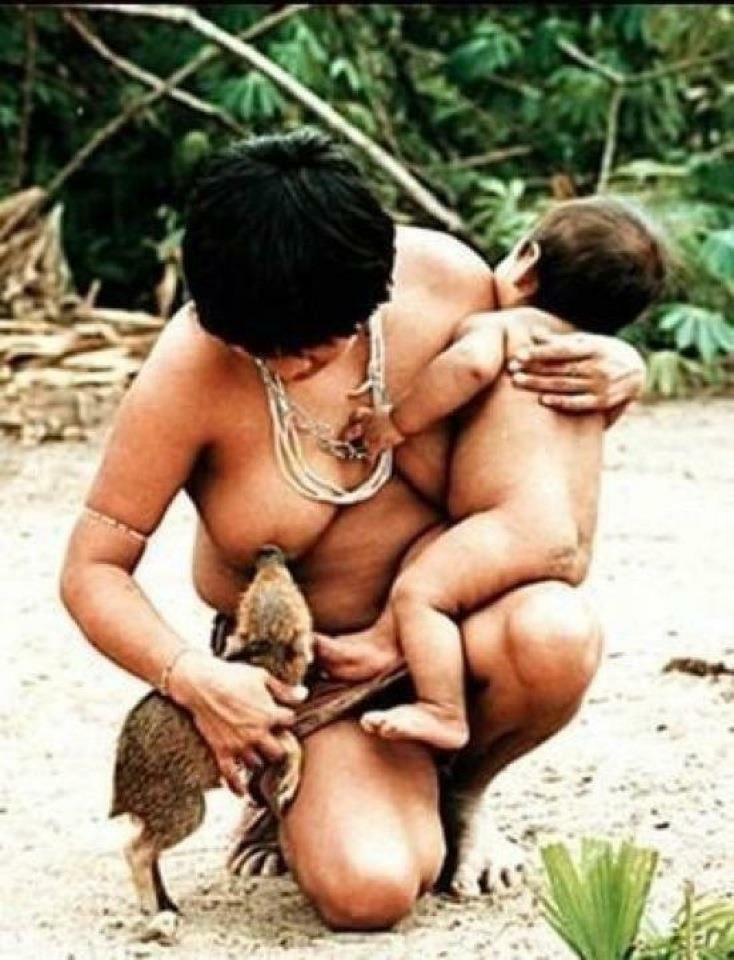
The symbols of this archetype are Isis; Virgin Mary; Lakshmi; sometimes one’s own mother; a divine female; an old or ageless woman; the Earth; a blue grotto; the sea; a hole, as shown in the first illustration; a whale; a cave, a tree, blood or the colour of blood. Whatever the image it often contains great religious feeling or spiritual uplift. After all, our mother was the most powerful being in our early world. ‘Did she admire hunters; then we would kill dragons and cleanse the world. Did she feel the weight of the world; then we would be the peace maker and bring her joy.’ (W.V. Caldwell).
 |
The symbols of mother represent not simply our relationship with her, but also how the mother influence enters into our own growth, our move toward independence and mature love. As a baby we do not feel separate from mother. The gradual separation is difficult. In some people it is never managed, even though they separate physically. Their mother, or their sense of their mother within them, still directs their decisions. The old joke about ‘My mother wouldn’t like this’ is true. |
| Shrine to the mother goddess |
In many older cultures this break was worked out in the custom of tribal ritual. At a certain age the children were taken from their parents home and lived together with the other young males or females. Today we have to manage these subtleties of our psyche alone. A woman must find a way of transforming the pleasure – or absence of it – of her mother’s breast into a love for a male. If she cannot she may wish to return to the breast of another female, or be the man her father never was for her. A man must find a way of transforming his unconscious desire for his mother into love of a woman which is more than a dependent or demanding baby or youth. If he cannot he may seek his mother in a likely woman, ignoring who that woman is as a real person. And this acceptance of our mother as she really is – a human being – precedes the acceptance of ourselves as we really are.
But the archetype of the great mother is more than simply a residue of our relationship with our own mother. Motherhood on our planet is as old as life. So the archetype holds in it all that experience, all those patterns of behaviour, whether of the mother wolf with her cubs, or the eagle rearing its young. To touch such enormous wealth of experience is to be penetrated by the holy. Something so beyond the limitations of our own small personality enters us and leaves its imprint. The constant stream of visitors to the shrine of the Mother at Lourdes in France continues because people touch the mystery of the Great Mother there. Such shrines have developed throughout the world, dedicated to the Mother as met in the widely different cultures and periods of time. |
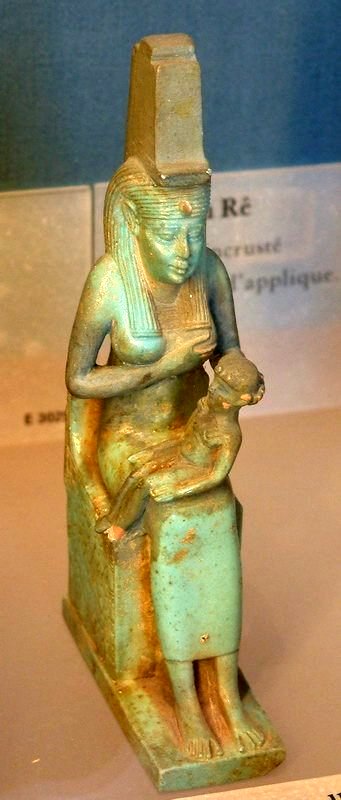 |
| Isis and Horus |
Example: I had the experience of finding myself sinking deep beyond my personality, my conscious self, and facing enormous forces or beings I had never been aware of. It started with a feeling of dying, and after experiencing that I felt the presence of my dead mother. I saw her face as a young mother, my mother. But then with fascination I saw her face was one face amongst countless others. I began to realise that I was confronting something difficult to explain, something that was a reality at a level or a dimension I had not met or experienced before. It was a huge being which I began to see was capable of taking in and holding every mothers experience and person, and was itself a complete synthesis of all mothers, in fact She was The Mother of everything. It was difficult for me as a human being to grasp its magnificence. I realised in my own small way why people in every culture kneel before the images of this Mother. In some wonderful way She was my mother and yet behind and working through my mother was The Mother. I saw too that every woman I had loved or dreamed of was a meeting with this Great Mother, because every woman is from this force in nature so every woman has it as her prime self. Then, because I saw and felt in the presence of this Figure, hurts I had done to the nature of women, I wept and asked forgiveness. I was shown that it wasn’t what I had done to any woman, but the hurt I had given to the nature of womanhood, with its great drives and energies that make women want a child and love from a man. Then in forgiveness She took me into herself and I felt and still feel AWE.
 |
The symbols of the great mother hold in them our awareness, unconscious as it may be, of the forces of nature active in us. These forces, in the guise sometimes of a beautiful woman dancing or beckoning, are both wonderful and dangerous. The dance of nature is unconscious. If we get in its way without awareness we may be ground under its heel, as it dances on its beautiful way. We see this not only in natural disasters such as earthquakes which wreck towns, but also in our own emotional and sexual energies which, if not cared for and deeply respected, can be enormously destructive. |
To meet this aspect of ourselves we must be both admiring of the natural in and around us, but also resourceful. The danger for a man might be that he loses himself in desire for all women or one woman. For a woman, that she becomes a spiritual whore, thinking she can uplift all through her womb. The point for the woman is that she is only incidentally part of the creative act of childbirth. The processes of creation are far deeper than her personality. To feel she is personally holding all that power can lead to hubris.
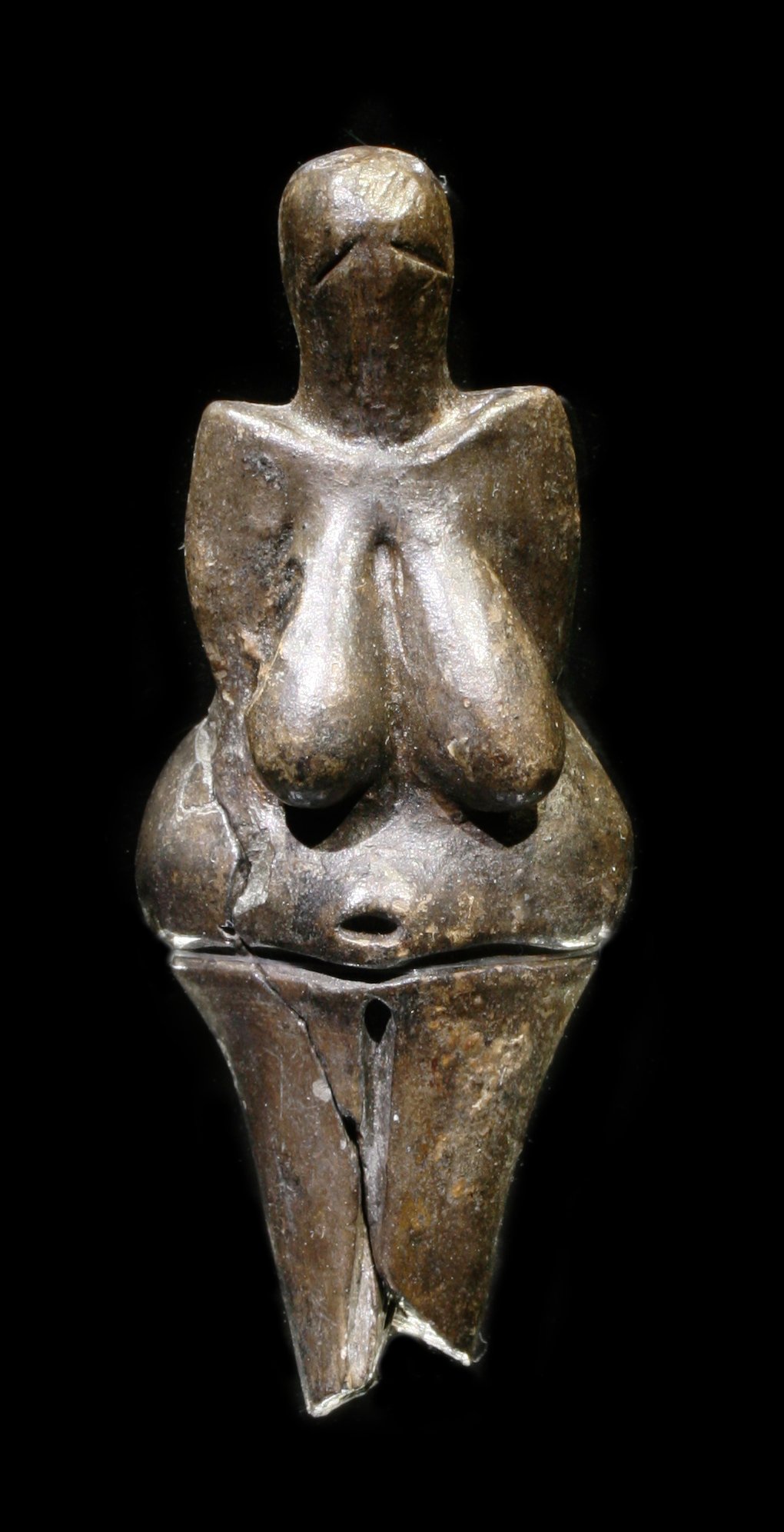 |
The positive aspect of the archetype is seen in the wonder of healing evident at shrines dedicated to her. The mother is also the great source of nourishment, or fertility, of bringing forth the new in a creative act. She represents the condition in which we can stand beyond preconceptions and receive an influx of divine newness.The symbols and archetype of the Great Mother are incredibly old. The figurines of the woman carved in pre-history graphically display an archetypal image of woman. The mystery of woman in those times was very great, for it was not realised that the sex act was connected with the birth of a child. |
| The image shown is from 29,000 years ago |
Therefore the place of males in this greatest of wonders had no significance except perhaps as a provider. This most ancient of mysteries is still presented in our present culture by the archetypal image of the Virgin Mary – the woman holding the child. In the past she was known in her various guises as Athena – the shaker of spears; Ishtar; Cybele; Rhea; Astarte; the Egyptian Isis; Demeter; Hecate; Diana; Venus; Quan Yin; Rhada, Ishtar, Aphrodite, Freya, Kali, Cybele, Magna Mater, Hera, Durga, Devi, and Shakti.
The most ancient of these mother goddesses is the Earth itself, mother to us all. P. W. MARTIN says ‘She is the maiden. She is the earth mother. She is the queen of the underworld. She is the goddess of war, the goddess of nature, the goddess of love, the goddess of marriage, the mountain goddess, the goddess of the chase, the goddess of herds, goddess of agriculture, goddess of fecundity, goddess of the moon.’ Her blood, and all women’s blood, flowing onto the earth, during her menstruation, is the miracle of Life, creation and death. Every woman who allows her blood to flow, takes part in the life of the Great Mother, as she and every menstruating woman, allows the death of the old and the birth of a new possibility for the continuance of life on Earth – a great and miraculous act.
As can be seen, the aspects, the powers, therefore the personal relationship with this archetype are varied. The great mother can be devouring and destructive like the Indian goddess Kali. She can be loving and healing like the Fairy Godmother. What this means in personal experience is that if one meets with the loving aspect, a man may feel permeated by love, bathed in it as if he were in great peace in the womb of all life.
A young woman may develop a fixation upon an older woman such as a female teacher, and devote enormous energy to emulate her or be of service to her. Conversely, experiencing the effect of the devouring mother, a woman might hold fast to her children, using every bonding and binding force she can. This negative aspect of the mother directly connects with feelings of dread about death.
The image of the cave – one of the symbols of the Great Mother – may indicate not only a holy place full of divine light, but also a death pit crawling with corruption. Recent explorations of the psyche show that such a symbol acts in a similar way to an icon on a computer screen. The picture the icon displays may be of a printer. When we click on the icon a distant printer reproduces what is on the screen. The icon is not the printer, but the icon has full connection with the printer and the picture indicates its function.
| So whatever image of the Great Mother we meet, it is only a synthesis of something much more potent and full of action and feelings than itself. But the image is full of clues as to what lies latent in it if we activate it. The recent findings mentioned show that the cave or the negative mother images often connect with prenatal experiences, particularly with awful experiences of birth, shown as hell and the tortures of hell. In past cultures such imagery, while full of meaning, was never defined beyond its mythological aspect. One of the great developments of recent times is to trace the way the unconscious produces such imagery to depict life experiences which are deeply buried or completely non-verbal. See: Dimensions of Human Experience – Levels of the Mind. | 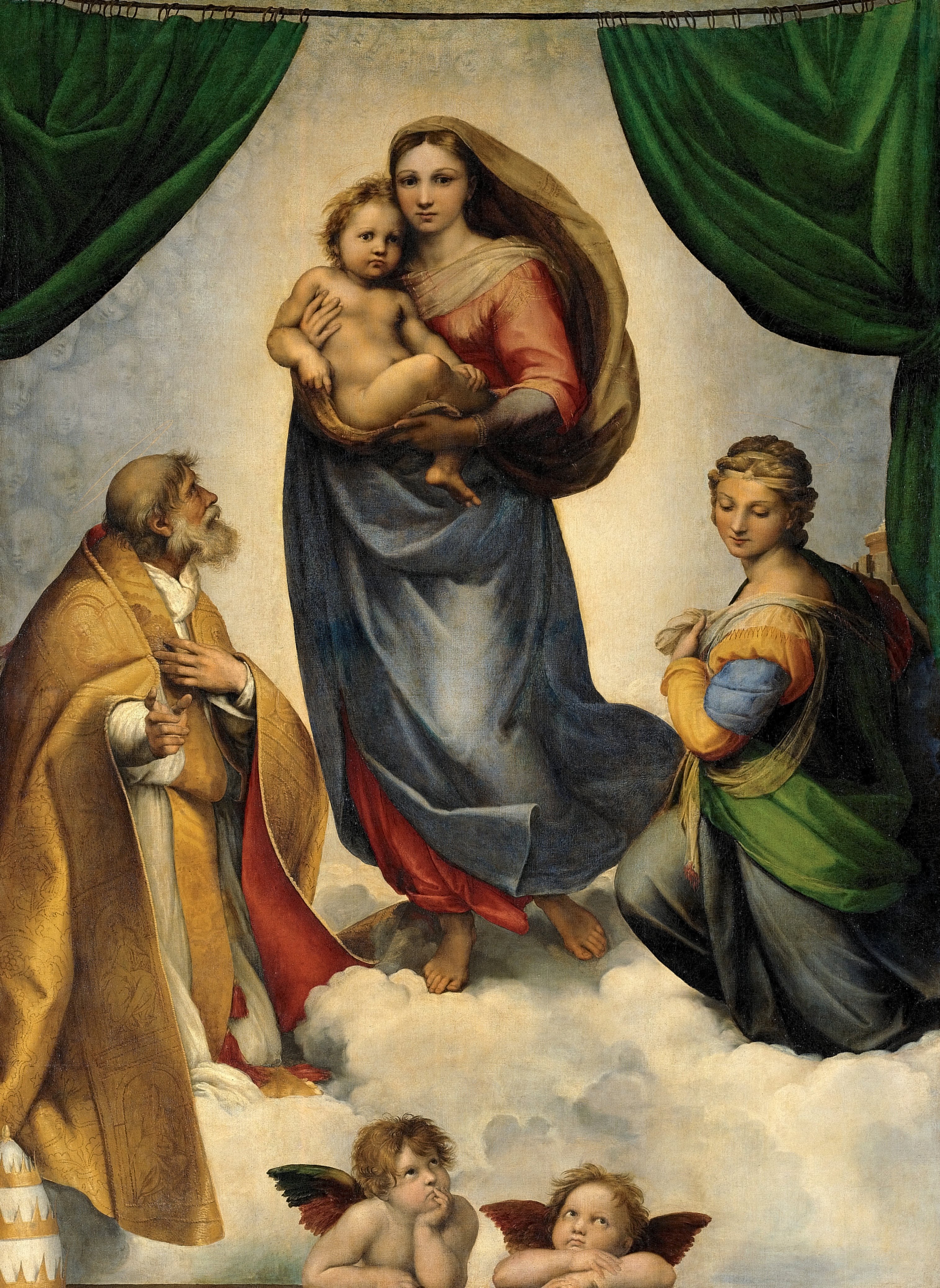 |
A modern portrayal of the Great Mother |
The Great Mother may not have these connections for us personally, but may represent unformed, or largely unconscious feelings we have about how we are linked with the process of life, and have within us the splendour of this mystery. For a woman this may be particularly potent at times. It connects her with the forces of death and renewal occurring within her during every menstruation. It connects her with the tremendous link with natural forces of mothering and the strength of womanhood and the female principle in the Earth and universe. After all, it is from the earth, matter, Mater, that our body is formed, and at death will return. Below a man describes his feelings and imagery experienced when he explored a dream in which a bull is being led up a meadow toward a cow – the cow being one of the symbols of the Great Mother.
Example: The sexual drive cannot be dragged, it will be led, and it must be treated as intelligent, as a living creature or process. In the dream the bull, depicting my sexual drive, is following, is willing to be led. And it is being led by the woman. This means that the cow, the woman, the earth, always leads the sexual drive in the male animal. All things are born by the great cow, the earth. The earth holds all the seeds in it. I am kneeling and honouring the Great Cow. The woman was leading me because she represents this power. In youth I, the bull, fed at the teats of the cow. Even now I suck the teats of the Great Cow, mother earth, as I eat the grass. The mother can also destroy. Anthony.
In her book The Once and Future Goddess Elinor Gadon writes that for her ‘In the late twentieth century there is a growing awareness that we are doomed as a species and planet unless we have a radical change of consciousness. The re-emergence of the Goddess is becoming the symbol and metaphor for this transformation of culture.’ But I believe that it is the re-emergence of the self we have all lost – the integration of all we are, male, female and pure consciousness.
Useful Questions and Hints:
Do I know how to accept this deeply unconscious creative process in me to take hold of my being and express through me?
What times in my life have I met or experienced this power of the goddess, of nature working in and around me?
In my relationships with women can I or do I recognise the goddess in them?
It might give results if you use Talking As – Being the Person or Thing
Archetype of the Goddess
A great deal has been made by some authors of the enormity of the difference between the man and the woman. Therefore the goddess aspect of our nature has been talked about as if it were something completely outside the nature of man, and the male god aspect as something foreign to a woman. Dreams do not portray human nature in that way. Of course cultures such as that in the west have passed through a largely male dominated phase, but in past ages the balance was the other way. The important fact is that we each hold the full potential of male and female within us, though physiologically in most cases we are polarised one way or another. However, the deeper one digs the more fully whole one is. That is why the feature on god/goddess above does not stress gender in any way.
As the oldest form of worship, of feelings of awe, were in regard to the woman and her ability to give birth, goddess worship was probably the first human religion. It recognised the miraculous power resident in a woman’s being, the bloodiness and wonder of an emerging new life, and the close link this had with death. Such powerful responses are still very much part of our inner life. The goddess still walks among us. For each woman who is a mother is a goddess, having given birth to Life. See: archetype of the god/goddess; Goddess–holy oriental woman under woman.
Somewhere, deep below the surface of your waking mind, this stream of life starts its flow. In underground caverns it moves through channels formed in ancient times, bringing life to all those tiny lives that, separate or in unity, form the shell you call your body. Remember, for it is one of the greatest truths, that the waters flowing through that gate are the very spirit of the Great Life, the spirit that some have called Creator of the Worlds. Out of it the stars and the multitude of life forms have arisen. Within the universe of yourself you are a young god or goddess playing at creation with the stuff of life. Whatever thought or feeling, longing or emotion you harbour takes form, and is given life, beautiful or awful as it might be. And when you do not own that power, when you push back any part of that flow into the dark caverns of your mind, where fears and wounds, black angers or unspent vengeance lurk in shadows, they are given life. They grow strong until they wrestle with you, invade the living tissues of your body with their sickness, or burst out into the world as action.
There comes into the world now, children whose very nature bears witness to the needs humanity faces. It will be among them the great leaders will be found. Among them are the catalysts of action. Their seeds, in the wombs of mothers open to the Great Life, have already sprung to life, swell into growth and emerge to share life with us. The young will teach the old, for among them are great ones arriving to take part in these momentous times.
She was and is the revelation –
There for any to see the splendour
Of this most ancient goddess –
Revealed and revealing –
While I knew all the ancient fires
That burn in worship,
And heard the voices
Singing to her flowering.
But women are all goddesses within, but many cannot find it in themselves, for it is ancient – for women have a much older and more wonderful inner woman. Yes, you grew from a seed, but no plant or creature grows from a dead seed, and each living seed carries within it all the past gathered from all its forebears. So, the seed in your mother’s womb is as old as and even older than human kind, and you carry that wisdom or memories in you. But in this life you developed a new brain, and the memories you gathered this time are what you built your personality from, but beneath that is a very huge and ancient self.
Example: I could then see a fairly easy way to climb the great tree. So, I climbed up and the top of the tree was like a massive bell of a flower, like a crocus shape. And it was light and colourful. Suddenly I saw a spirit, a beautiful female. It was the spirit of the tree. At this point I was semi awake, and I wanted to hold the beautiful spirit, but realised that the tree was a representation of my life, and so was the spirit of the tree. The spirit sat on me in a sexual position, so I was lying on my back and she was upright. She slowly took me into her, I mean the whole me, as if she was sucking my whole body into her. I realised that I had to die because she wanted to take all my experience of life and endeavour into her and fertilise herself to form a baby. So, I was ready to die and watched her form a new baby, a mixture of her and me.
Useful Questions and Hints:
As a man can I recognise the goddess aspect of the woman who is my mate?
As a woman can I recognise the goddess aspect of myself?
How do I relate to the goddess?
Can I explore her divinity in myself by using Talking As?
Archetype of God/Goddess
This archetype arises out of the paradox of human existence. If an ancient human being saw a modern adult step out of a helicopter, talk to distant people using a small decorated ‘stone’ (mobile phone) they held in their hand, and produced images immediately using a digital camera or video, they would believe the person to be a god. The paradox is that what the ancient man or woman see as a god is a fulfilment or projection of their own potential. They are the ancestor of this modern person.
A fundamental process of what we call the mind or consciousness is to give form or words to abstract experiences or things sensed. When we dream this becomes amazingly obvious. The emotions, conflicts, sexual urges we feel are put into imagery and drama in our dreams. If we strip away the images we are left with raw feelings insights and urges. The dream imagery makes it all so much more memorable and clear. If we experience fear while we sleep that might be memorable. But if we dream of being chased by a two headed monster like a snake, that sticks with our waking awareness with greater intensity.
The point being made is that even the most subtle things we sense – out of the corner of our eye as it were – can be dramatically represented in imagery either while awake or asleep. While awake such realisations are called visions, but are expressions of the same dream, process breaking through into waking. See: hallucinations and hallucinogens.
The development of self awareness presented the human animal with an enormous and perhaps traumatic change. Prior to having any sense of being a person, the early human being was constantly directed either by instincts or learned behaviour common to the group. They didn’t have to make decisions or think about what to do. Millions of years of experience had etched instinctive responses into them. Also, tens of thousands, or even millions of years of collective learned behaviour was passed on in the same way non-human mammals pass on skill to their young. As an example of this, a wonderful study of the African wild dogs showed the power of this. The dogs had been wiped out in a large area and attempts were being made to reintroduce them. A documentary film showed two packs of dogs. The one pack were established, and had arisen from an unbroken line of descent and social relationship for thousands of years. The second pack had been reared in captivity and released in the wild with some support. The descended pack showed enormous social skills in acknowledging and supporting each other’s rank, in working together to hunt, in feeding the pups and mutually caring for them, and in sharing food with those who stayed to care for the young. See The Conjuring Trick
The released pack didn’t have any of those skills. The information was not being passed on to them from a previous generation. They couldn’t work together. They fought amongst themselves instead of respecting leadership. They didn’t share food but fought over it. They all quickly died. The unspoken wisdom of generations had not been passed to them. They had no survival skills. Perhaps this reminds us of some people in our society today, whose parents pass on terrible or anti social survival skills, and points to possible causes.
The arising of self awareness was like a massive new input impinging on this ready made wisdom early human beings lived with. When the split came and the new self awareness became more dominant there was a great sense of loss, and what had been an everyday part of them was now felt as distant or exterior to them. Because the instinctive or unconscious survival wisdom had been everything to them, their dream process of giving form to such an intangible, showed it as a great parental figure. It was the great Mother/Father out of which they had emerged. In fact becoming self aware was akin to being born, to emerging from an immense and ancient womb. This is clearly stated in story form in Genesis. It says, “And the eyes of them both were opened, and they knew that they were naked; and they sewed fig-leaves together, and made themselves aprons. And they heard the voice of Jehovah God walking in the garden in the cool of the day: and the man and his wife hid themselves from the presence of Jehovah God amongst the trees of the garden. And Jehovah God called unto the man, and said unto him, Where art thou? And he said, I heard thy voice in the garden, and I was afraid, because I was naked; and I hid myself.”
If we take Jehovah here to mean the enormous ocean of mind, instincts and behaviour early humans were guided by, and the awakening to the arising of self awareness, then the fear is that of being swallowed up, of losing their new and vulnerable identity in that ocean of creative life. They were truly naked of the instinctive knowledge that had previously guided and supported. Ancient races such as the Kalahari Bushmen in fact say their great fear is the loss of soul – identity – by being swallowed up again in unconsciousness. i.e. in loss of self awareness.
Obviously this is conjecture, but it is conjecture based on anthropological studies, on the exploration of the deep unconscious in modern people, and in recovered experience from depth psychology. The outcome in ancient and modern humans is that there is still a sense, an ‘out of the corner of the eye’ awareness of the enormous depths of mind within us shading right back to pre-consciousness and even cellular life within. We sense this as the creative matrix out of which we have arisen. We sense it as having enormous potential. After all, if we have evolved from pre-conscious human animals, and they from ape like forms, a human could emerge from us that would be as god like to us as we would appear to an ancient predecessor. Therefore the god archetype is an expression of what we sense as our own potential and of the enormity of life and cosmic processes out of which we have existence.
The archetype itself, or what lies behind it, is beyond any one definition. But being what we are, and considering that we constantly try to define and give substance to such important processes, past cultures have given many forms and attributes to their expression of god or God. They have even at times defined aspects of what they experienced as the underlying forces of life and personal awareness, and we therefore have the goddesses and gods.
This archetype has a very powerful influence in everybody’s life simply because it is about our own fundamental potential and origins. How you relate to it shows the level of connection or conflict you have with your own resources and origins. It also shows how far you have come in your mature understanding of how your inner life functions. In some ways the difficulties and stages we go through in our relationship with our mother and father are similar to the acceptance, rejection, killing of, or deep dependence we have in relationship with what is called God. We may of course relate to this archetypal power in us like a child frightened of a parent; like an obedient child who wants to conform; like a rebellious child who seeks their own independence; like an angry or confused person who denies any link with their origins; like someone who has lost their memory, and so has not recognition of their ancestry; like an adult who has come to terms with their origins and has integrated into their own processes of mind and emotions, the matrix of strengths and weaknesses inherited.
None of us can escape the source of our own existence. We can, however, relate to it in many different ways. These ways are depicted in the New Testament as the manner in which people related to Christ. Taking Christ as a symbol of the cosmic web of sentient life, people can love it, wash their hands of it, crucify it, ignore it, be healed by it, lie about it, offer themselves to it, worship it – and so on and on. The stance we take in our relationship with this larger life we are an integral part of, is the basic stuff of how we live, and the quality of our life.
I witnessed a man talking to a woman he was confronting, “Religion;” he said, “that’s surely a direction for failures and people who can’t really cope with facing reality.”
And the woman he was accusing of this inability to face reality said, “You poor man! Is your mind or awareness so tiny that you have never realised the forces and processes of your own body are beyond anything you understand? Can’t you see that your very existence is brought about by things so far beyond your knowledge that it is only a statement of your impoverishment to suggest an awareness of God is an expression of some sort of smallness and failure. Have you never understood that? Have you not seen that religion is not only an acknowledgement of what we fail to understand and yet depend upon, but it is also an opening to it, a willingness to relate to it? It can also be something far more even than that. It can be an active loving relationship with what gives you life. And such love is an exchange, a sharing, and a way of merging one with another. It is an exchange – a sharing of bodily fluids – the very substance of life.
Imagine that; a glorious love affair with the very spirit of life! A love affair with the invisible and forever indefinable. Is that something you are afraid of?”
Here is an example of a man exploring expanded consciousness and God.
Example: A major point is however, that these different forms of cognition are not in themselves ‘truth’. They are simply ways we can organise experience and information.
At this point there arose a question about what the ‘mind space’ is. It didn’t arise in those words, but was certainly about what the space is that one appears to inhabit as expanded awareness. It feels as if one is exterior to ones body, filling space and yet without form. So does mind exist outside of the body?
My sense at that moment was that in fact there are no real spaces in the universe. Everything is connected. Nothing can occur without some link or influence upon or from something else. Everything works because it has developed a relatedness or relationship with everything else, according to its size and place. Therefore the planets do what they do because of their relationship to the sun, their size and nature. This led on to a view or feeling that at death the personal awareness can exist, but not in a void. It does so within the organic ‘space’ of living human beings. It does so out of relatedness.
I then slipped into an immense experience of the universe as God. Unfortunately the tape recorder battery ran out at this point, so what I said is not recorded, but I have memory of the overall experience, though the details are gone.
As I experienced it our known universe is a huge integrated ‘body’. In its totality this is what we call God. The universe, or God, is not all there is. What we know as God is only one being among other realities. In other words, the being of God came about because in a period before our universe it gradually evolved into total relationship with reality. In doing so it created what I have called its body, our universe. The universe is a particular sort of organism that can exist in a special way because it relates to the wider reality in which it has its life. There are other such beings creating different ‘realities’ within the greater reality. I felt several times with much emotion, how much pain the being had faced to move through all the change it had to be capable of being God.
Our universe is set up so there is the possibility of life occurring. Although God is a being of an order we cannot really comprehend, it still has a relationship with us. The relationship is strangely paradoxical. It is at one level completely impersonal. This has to be so otherwise there is not an open arena for development to take place. But God cannot help but be personally involved as well wherever someone opens to this relationship. After all, the very nature of the universe as I saw it earlier is relatedness. So there is an active love, like a flashing touch here and there, invisible in general. I saw it as something causing minute parts of our body or world to flash with energy for a moment, then move on to cause other patterns of energy to touch the world. Perhaps this is similar to the way the brain works, where patterns of activity or energetic process occurs – but this is speculation.
One cannot help but be a part of this immense being, yet one can, in ones life, be at odds with it, be unsympathetic to it. This causes a condition of stress within oneself, and within ones relationship with it. But I felt that if one completely accepts ones place in this being, even though one is a minute and seemingly insignificant part of it, then one is aligned with its huge universal life and purpose. Then one become part of its ‘circulation’ more fully and is revivified is some way.
My personal consciousness is the limited area of God that I have made my own through millennia of conditioning and learned response. But the huge ocean of awareness that is this larger being’s life and consciousness is ours to share. It is at once the thing that remains permanent, and yet it is the very substance of change too.
I gave myself to God as fully as I was able, and in this state of awareness of the larger life, looked at my own life and future. I felt that the future lay in moving around the world a bit, as if we are evolving into a free floating population that is emerging in the world. I felt almost as if I knew where I was going to be born next time around. It would be south of Japan on one of the pacific islands. The mixture of high grade Anglo Saxon with Chinese oriental and South Pacific I felt was something I needed. The Chinese awareness of the inner life and ease with it; the Anglo Saxon acute rational mind, and the Polynesian sensuality. I particularly need to warm up in the sense of my sensual side being a bit undeveloped.
had a very real sense of God being incredible near at hand. This was strange because I had been brought up to believe that one had to be very special to get near and know God. Yet God is everywhere and everything. If I can’t find God, it is only because I keep my eyes and soul closed. Or else I am so busy feeling I have to be holy and spiritual I miss the meeting.
I spent some time wondering what one was supposed to do having ‘found’ God. I had thought one would be imbued with some sort of zeal to go out and teach, as with the Christian enthusiasm. But I could find nothing of this. I saw that everybody is in that presence, so it is ridiculous to think everyone must rush out and tell everyone else they have found God. But my RC background, I could see, had planted so many misconceptions about hell and damnation, about threats of excommunication and being pushed out of God’s presence.
Useful Questions and Hints:
Can I recognise that fundamentally my existence depends upon the creative processes of the universe, and that I am at base the potential of life?
How do I relate to that mystery of the divine or wondrous at the core of myself?
Am I taking responsibility for my own potential, or do I project it outwards as a god figure, or deny it all together?
See Enlightenment – Jesse Watkins Enlightenment – Philosophy From The Edgar Cayce Readings
Archetype of the Fugitive
To forever feel you must avoid intimate human contact; to forever be running from something that is hard to define; to never be able to feel that where one is in life is home, is a place to relax in, is a place where you can feel peace and look around and take in the world, instead of looking around to see where danger is – these are signs of the fundamental feeling of alienation or aloneness.
All of these have anxiety or the fear reaction as their root. As fear is one of the major reactions to life, archetypical patterns of behaviour have developed around the fear response. The description of the little boy at the beginning of the section on archetypes who was lost and running frantically is an example of behaviour which is not developed out of personal experience, but is instinctive or archetypical.
In modern Western culture, where religious, social, family and work connections are no longer as stable or meaningful as they were just a few generations ago, many of us face this sense of alienation or of not belonging. Richard Tarnas, in his book Cosmos and Psyche says that this situation of finding ourselves alienated from the world, from nature, from each other and the cosmos, is a crisis Western society and individuals are facing at the moment. This makes it an archetypal influence in our lives, affecting almost all of us.
Being the fugitive in our dream, or relating to one, may also suggest an avoidance of something. The fear may be that of being overwhelmed by ones urges, such as anger or sexual desire; it may be a response to past hurts that we find difficult to meet. It may, as often happens, be a habit which developed in earliest infancy as a survival fear reaction to not feeling safe – such as might happen to a premature baby who was not held and made to feel wanted, and is therefore exposed to the overwhelming sense of abandonment.
The following example is typical of a basic anxiety reaction to something that may have no external reality – based perhaps on past pains or fears, or present worried speculation about what MIGHT happen in ones life. The thing one is running from remains unclear because we don’t know what it is. The old bogey man fear is shaking chains out of sight, and our hair stands on end. It is helpful to stop and face such fears and recognise them as chimera we create out of our own memories or worries. See: anxiety; nightmare; Am I meeting the things I fear in my dream under processing dreams.
I am in a light, green forest, no gaps in trees. I am running away from something and am very frightened. I can hear loud breathing, like someone is running. I keep running and bang into a tree while looking behind me. I think I see a very unshaped, black very tall thing. I fall down to the ground. Time passes, maybe a few seconds. I looked behind me again and start running. Looking behind me I see the black thing. All around me is like bad home movies, all jumping up and down. I can see myself from the air, then wake. Poppy S.
That is a very powerful description of being a fugitive from fear.
N. D. Browne, in a paper published in the International Journal of Psycho Analysis, (December 1987) states that one of the causes of fugitive dreams is ‘early sexual overstimulation – leading as it does to precocious erotization and rage.’ To protect against being overwhelmed by sensations and emotion, and thus the fear of losing oneself, or self control, the person remains apart from others to disguise rage and inner deadness.
However, that is only one possible reason for our meeting with the fugitive archetype. Other reasons are that at some time in your life you may have made a life decision that you are different from others, do not fit into the group you live in, are an immigrant from another culture living in what might feel like an alien environment or social atmosphere, or that you have faced harsh accusations or judgement at some time.
The positive side of this archetype is that you are no longer captured or immersed in the view of life or social responses that are taken for granted around you. For instance your peers may believe that it is a great pleasure to get drunk each weekend, but your alienation from them enables you to escape from that worldview. It might have the same influence in regard to religion, politics and the general worldview around you. It might also enable you to take new directions, explore unusual ways of doing things or thinking about things. It can therefore be a useful influence to creativity. See Archetype of the Outcast.
The negative side to the influence is that we might really feel antagonistic to the group around us, and thus be unable to interact with them. It can also lead to feeling isolated and abandoned. Sometimes enormous anger and destructiveness arises out of this, and is probably involved in a great deal of social destructiveness or terrorism.
Useful Questions and Hints:
Am I aware of feelings of isolation or of avoiding others – if so can I recognise their source in the past or present?
Am I running away from or avoiding some of my own feelings through fear, guilt or shame?
Do I feel I don’t fit into modern society, or sense a lack of connection and isolation?
Archetype of the Female Choice
For thousands of years women have been faced by a terrible choice in some situations. Having been seen as possessions or goods in many cultures, their capture and unwilling possession by another tribe or culture faced them with this awful choice. The decision they had to make was whether to place themselves, whether to take a stand or attitude as a wife of this unchosen male, or whether to be his slave or in some cases live as a prostitute.
Sometimes it was other circumstances than capture that put women in this position. The choice was between starvation or prostitution, which also held in it the possibility of being a type of slave. The enormous length of time that women have been faced by these choices have made this into an archetype that often appears in women’s dreams or fantasies, and still, in some parts of the world, as something they meet in their everyday life.
To some extent the potential this archetype brings into a woman’s life offers a great strength. Not that men have not faced similar hard choices, but women have been more fully challenged in this area. The strength it brings is that of being able to make changes in their attitude or emotional state to meet exterior needs. One woman called it ‘the steel’ the strength to deal with awful life situations.
The negative side of this archetype is that of feeling the ultimate victim and pawn of men. The positive is of feeling you can direct your life and possess your own soul no matter what outer circumstances do to you. The difference is one of choice.
On explore this I wrote:
She – a woman born in London and was shipped out to Australia – is saying to the lady, who is well meaning and wants to help, but also secretly wants to understand how or why the woman is so angry and independent, that she doesn’t even begin to understand. How can she help if she doesn’t understand. The lady asks why the woman is rejecting her. The reply is that she isn’t rejecting HER, it is all the stupidity the woman is living that she rejects, though sometimes she can’t find the words to say exactly what the stupidity is. But the relationship is about finding out.
As I understand it at the moment, the woman has been pushed into being aware in a rudimentary way of how the class system pushes women of lower birth into a terrible dilemma. In the time I explored with my wife, I stood in the role of the woman and described how those in positions of authority, and that meant almost anyone born into greater wealth and education, all used it to manipulate the lower class. It was used like a pressure to push women into taking a man in one form or another. As the woman I felt that I had avoided prostitution by accepting that men wanted sex, so I could choose either to have it unwillingly with one man or with many. I chose the one man option, and did what was necessary to keep myself in that role, as the other options were worse.
Useful Questions and Hints:
Where am I placing myself in this situation?
Do I really understand the difference between ‘have to’ and ‘decide to’ or ‘want to’?
Am I feeling like a victim or in possession of myself?
Try using Practical techniques for exploring your dreams.
The Archetype of Fear
The images of fear can be darkness; an unknown something approaching you; losing control in some way; a dark and monstrous figure or animal; an obscure but powerful ‘thing’ that is threatening to engulf or destroy you; or death in its various forms such as disease, ageing, or meeting an opponent, etc.
As a human being you are not simply a creature that responds automatically to your environment. Even intelligent animals such as chimpanzees and foxes do not simply responded to their environment instinctively. They learn certain types of behaviour from their parents, from experience, and from their fellow animals. They, like us, are capable of learning. Our own relationship with parents, other human beings and animals during infancy, passes on to us an enormous amount of information through our ability to copy behaviour, through word of mouth, through our own experience, and through reading or viewing. So many of us have awful images or sense of fear haunting us from being passed on.
The instincts that inform us, and the cultural or personal information we acquire, are both the result of enormous amounts of past experience. Instinctive behaviour has developed over millions of years of dealing with survival. In a similar way cultural responses that we absorb are the result of experiences faced by millions of people. Both of these sources can be described by the word archetypal. By this is meant that no one particular person, experience or piece of information lies behind an instinct or a cultural response. Such responses are usually the synthesis arrived at over thousands of years, perhaps millions.
In this sense archetypal behaviour is the synthesis of thousands of people’s response to situations. These archetypes are often more easily seen, not so much in our own personal experience, but certainly in how some things are portrayed in art, in literature, and in popular or group responses to things that we might confront.
However, it is difficult to categorise such responses as clearly instinctive, cultural or personal. If we take the example of pain for instance, some individuals in tribal cultures seem to have a very high tolerance for pain, whereas many people in European based cultures have a much lower tolerance. So we cannot say that a response to pain is instinctive. Even if it is instinctive to remove your hand from something that burns, there still seems to be a cultural element to the response.
In looking at general responses to human situations, there are however particular things that often stimulate fear. Of course, physical or emotional pain is one. There are many other things that are much more subtle though. Fear of death for instance, can be seen as a sort of archetypal response to something that is essentially unreal until we actually meet the experience of death. Watching someone else diving into water is not the same as doing it oneself. In the watching you are only having a subjective response. In doing it oneself all ones body senses and feeling responses are involved. Observing the death we see around us is similar. It is not an experience of death. Only those who have a near death experience can say they have met death.
Another such fear is the loss of what we usually call identity or personality. The illustration of such fear is often portrayed in films as an alien creature, a disease, or an encroaching influence gradually taking over ones body and mind. But this fear is not always expressed in an obvious way. Sometimes it is connected with the losing of what one identifies with. For instance you may be blessed with an attractive and healthy body, and as this ages and loses its attractiveness, you may feel great stress, and struggle with enormous vigour to maintain the features that are slipping away. Such struggles arise out of the fear of losing oneself, or at least losing the sense of oneself connected with appearance, work, success, or financial standing – the loss of identity.
Something that is not as obvious but nevertheless can be seen to cause enormous depression and even illness in human beings is our connection with meaning. As human beings we struggle to give meaning to the world and to our own lives. People often despair if they are not involved in a meaningful task, work or relationship. The meanings we give to our life and the world may be expressed in religious, scientific, or aesthetic beliefs. If these beliefs are threatened or questioned we may experience anger or stress. Enormous effort and expense are often involved in creating an expression of these beliefs in our outer life, and an attempt to support them or their reality. Any threat to them may cause great fear or anger. This can be seen in religious sects and their fight against anything that threatens their beliefs.
Examples of fear in dreams are as follows.
I go upstairs to a bedroom to get a weapon. When I enter the darkened room, I sense that someone is there. I fall onto my stomach on the bed and there I am paralyzed, unable to move, extremely fearful that I will be attacked while I am in this vulnerable position, feebly kicking my feet, sure that the ‘enemy’ is somewhere in this darkened room with me. I keep expecting to kick someone, but I can’t really tell if I ever do. I am in a state of complete panic. PG.
I dreamt I was sitting on a pier when I suddenly I had a feeling of danger. I safely pulled my feet out of the water when a shark rose out of the water really angry with me for pulling my feet out. I woke up frightened and couldn’t fall asleep again for the rest of the night. ARE dream.
Dreams also show how we can deal with our fears, sometimes paradoxically.
I dreamt that I was being approached by a tiger. I was in fear believing that the tiger would attack me. I decided not to fight or run but instead do nothing. When the tiger reached me, it was friendly. I could hear it communicating to me that if I did not fear it, it would not attack. ARE dream.
The paradox is of not being frightened of what is, in the dream, frightening. Yet that is the way through fear, to face, in the dream or in ones exploration of your dreams, what is frightening. This can be done using the methods given under peer dream work.
Fear is fundamental to life, but for humans, because of our ability to think and hold images of things we are not actually meeting at the moment, fear can become a constant threat. Therefore the facing of fear, the meeting and dealing with the many images of fear we meet, is extraordinarily transformative. See: fear – dealing with. Also see the Dreams are Like Computer Games.
Death through fear is fairly common, and is reported by some doctors in connection with surgical operations, especially in the past. In 1887 Dr. Crile had watched helpless as his friend, William Lyndman died of shock after amputation of both legs. My uncle also died of the shock of losing his arm. My uncle, like William had lost little blood, and no vital organs were injured. Crile went on to develop anaesthesia and blood transfusion to counteract death through shock. But some forms of shock appeared to be outside any physical cause. In 1898 Crile was on an army transporter off Cuba and examined a young officer who was delirious with fear due to facing his first battle. He was as deep in shock as if his legs had been crushed by a wagon as William Lyndman’s had. This led Crile to become interested in exopthalmic goitre, an illness which produces a similar type of anxiety condition. Despite the use of anaesthetics, no one had successfully operated on such a goitre condition. Every patient died. Crile discovered why when he attempted such an operation in 1905.
While under anaesthesia the patient’s heart rate rose to 218 and the body temperature rose to a dangerous level. Despite no physical injury or infection, the patient died that night with a temperature of 109.6 F. Crile realised from his previous observations that it was fear that had killed the patient. Therefore he told his next patient, a young woman who needed the goitre operation, that he was going to give her a simple inhalation treatment. When she breathed in the anaesthetic, she therefore thought she was having a ‘treatment’ not an operation. She was the first person to survive the operation for exopthalmic goitre. Crile called it “stealing the goitre”, and was so impressed by the influence of emotion on the body he constantly stressed the importance of self control, and taught that calmness is strength.
Useful Questions and Hints:
Have any of my dreams been examples of facing and dealing with fear? If so what can I learn from them?
What does my dream and its drama suggest I am frightened of?
Am I paralysed by my fear, or can I confront it?