Author Archive
Archetype of the Father
The dream images representing father are many: God; a god; a giant; a tyrant; executioner; devil; Pan; older man; male leader figure; the sun; an older male rival; a holy man or priest; a dominating boss; wise old man; the sun; a bull – and of course father.
A child is, figuratively, like a growing plant. It takes in lumps of external material and transforms them into its own being. A child unconsciously either takes father or mother as its main model for structuring its behaviour and aims. But also, huge areas of our basic identity revolve around mother and father. The absence of an available father in the life of a child leaves an enormous imprint in the developing psyche, just as much as the presence of the father. Our father in our dreams therefore is most often the overall effect, habits, traits, that arise from our experience – or lack of it – of our father. Our father is the great figure of original authority and strength in our life – or lack of it. He is therefore a focus of our relationship with outside authority or power, the world outside the home and family. But there is also a cultural representation of what a father is, and each nation has particular ways of representing this. During our growth, and continuing throughout adulthood, we are confronted with literary, artistic, film and drama representations of the role of father. These also form a powerful part of our inner ‘father’. These, along with the deeply inbuilt expectations at an almost biological level, of what our father is or should be, form our internal male parent, and in synthesis form the father archetype.
But many people do not realise that they have an inner father equally as powerful as an external father. You have taken in millions of bits of memory, lessons learnt, life experiences along with all the feelings or problems met by loving and living with your father, and they are what makes you the person you are. This is true even if your father was never there for you – you still have all the memories of him not being there for you filed under ‘Father’. The memories and experience we gather unconsciously change us and are not lost. It is part of you and is symbolised in dreams as a person or event. Such an inner father can appear in dreams because you are still deeply influenced by what you hold within you.
The description of God given by religion is quite a good example and definition of the father archetype. God is described as the creator, but also the great authority on how to behave, and a judge on whether one has lived well or badly. God might be very loving or vengeful. God is also full of wisdom and knowledge. It is helpful to use this God image in understanding what the influence of the father archetype has in ones life. For instance a sense of failure can arise through never arriving at a conviction of having satisfied or got signs of praise or recognition from ones father/God.
Therefore the father archetype is partly about how we feel about being capable, productive and creative in the outer world. It is about protectiveness and strength, about know-how and knowledge of the world. The father image at its best is about the willingness to stand against the world for the child, and to be a bulwark against difficulties, a shelter we know is always there in need. The following example gives some idea of this in the life of the child.
Example: After I had left my wife and the divorce was through I still visited my children almost daily. Often I would do things in the house that needed repair. One day I was standing on a chair fixing a light fitting and I had an insistent feeling that my children were watching me. It wasn’t that they were standing observing what I was doing, though there was a little of that. It was something else, and when I allowed this intuitive feeling to surface it was like a small revelation. I was led to see that when I came through the front door into the house I brought an atmosphere with me. Also I had come into the house from ‘the world’, from work, from all the extremes of life that were outside the home. And I realised or felt that a great deal of child speculation, in an unconscious way is, “What is it like out there in the adult world? How will I get on in it? Will I survive if I go out alone as I grow?”
So if I came in the door cowed by the difficulties of life I was saying to my children – “God it’s hard out there. It knocks me down and I can’t deal with it.” But if I come in buoyant and smiling, then I am saying, “Hey, that was interesting. There is so much to do out there that is fascinating and involving.” I knew as the understanding arose that the confidence or lack of it my children had in growing up and entering the adult world depended a great deal on how they saw me come through that door. Because in me they saw reflected what the world might do to them.
The negative father archetype involves domination, abuse of the power and authority of fatherhood, and a cold intellectual example of relationship. This negative image involves the use of the child or those under his authority for the father’s own ends, rather than a caring for the child’s own inner needs. The absence of caring love is a main feature of this. Entering into a sexual relationship with the child is another huge negative.
The father archetype doesn’t necessarily involve parenthood or relationship with ones own children, but rather the leadership and caring for the development and growth of people whether they are family or not. In a personal sense it echoes what sense you have of being supported or undermined by your background of life experience and parents. So although it involves your parents, it is much wider than that. For instance it also includes how you relate to your own life process. Do you feel secure that life upholds you and supports, or do you feel life is constantly a chaotic and meaningless accident within which you can easily get fatally ill or killed? Does life uphold or seek to destroy you? Or is life completely impersonal and uncaring?
Struggle or seeking to placate father
May show how we deal with authority or those we see as having power.
For a woman dreamer
Your relationship with the father image is of enormous importance in the way you relate to men and the satisfaction or otherwise achieved in such relationships, and also how you deal with opportunity and life outside the home. Conflict with the father can lead to feelings of not being loveable or capable of love. It can also implicate you in a desire to go against family and social ‘principles’ and lead a life of rebellion – or certainly one that is alternative. A great deal of anger and the urge to inflict hurt or to criticise may be involved in this. See: archetype of the animus
For a male dreamer
The father image or process in you determines how you meet and deal with other men and the world, work, and opportunity. Conflict with the father figure can lead to a continuing fight with or avoidance of any authority figure, and /or an attempt to placate and gain the attention and perhaps love of a male, especially older males or those in authority.
Our baby or child self has no restraints, and in its relationship with father, at times feels urges which as an adult we might find hard to believe or accept. In our dreams we frequently release these urges. Therefore in dreams we might meet themes such as those below.
A difficult or unsatisfying relationship with father can be the underlying urge toward homosexual relationships.
Dreaming about Killing father
This can be about the expression of anger one felt as a child toward father. It is also a way of getting rid of him so there is no competition for mother. Frequently though it is about gaining your own ability to make decisions and be independent. At some point we need to kill the father inside us to claim whatever strength we can from our experience of him and become independent. The death of the father in such dreams is like taking in his spirit, not as a dominating exterior influence making it difficult to make your own decisions and take your own direction, but as a resource that is your own. See Integrating a Parent.
Dreaming of Sex with father
For the woman this is the fulfilment of childhood desires to posses, own and be loved by father. It might also be a sign of gaining power over a dominant and uncaring father or father figure – someone you needed loving support and encouragement from and never received it. For a man it might express the desire to receive the father’s love. As a child sometimes one is ready to do anything to gain this love. And childhood and this tremendous need may underlie the different types of homosexual urges. The father may not easily have shown his love, so the child becomes desperate to receive it. Such love is as important to ones emotional and intellectual growth as food is to the growth of ones body. So the homosexual act can either be an attempt to get that love, or a way of gaining power over the male/father. See Growing up to Love.
Here is an example of a man remembering the urge for his father during a therapy session.
You know why? Do you? Do you know why? Yes, you know why but you would never admit it yourself. You’re a pervert. You can’t love me because if you had let yourself feel love you would have wanted to fuck me. And do you know what? You know, I would have let you. You could have fucked me because I wanted you to love me. I would have let you. You wouldn’t give me your love so I wanted your prick. All these years I have been wanting your prick. That’s why I couldn’t love. I was still after your prick. Dad, you fool. Oh Christ. (That’s why I always got mixed up with queers. That’s why I reacted so much to D.)
Burying father
This is most likely the same as killing him. Facing his death leads to meeting one’s own independence. See: archetype of the animus; father
Example: It felt as if at last I had found my father. I had been looking for God as a cover for longing for my father’s love. Now I felt as if I had found my father within me. A great stillness and peace came upon me. Nothing mystical or otherworldly – just peace. I realised this also had been done already in LifeStream and I was just more deeply feeling it. See People’s Experience of LifeStream.
Useful Questions and Hints:
Can I locate and define my internal father? (Try writing down what the various factors of your relationship with your father were, and how they link with your present self and activities and needs.)
Am I still struggling with my father or trying to gain his love or praise?
Do I feel that life itself – the underlying creative process of the universe – supports or undermines me?
In what way does the relationship with my inner father influence the way I relate to others in a caring, authority or supportive role?
Try using Processing Dreams.
Archetype of the Devil
In Western culture there is a long history of struggle with sexuality. Even to dream of sex was considered a sign of the devil’s influence.
This internal struggle with one’s own drives is still a large part of life for many of us. The image of the devil represents this struggle, and also a force of negation which pulls us down, away from the possibility of personal happiness and transformation.
Jung felt that an urge to evolve or move toward personal growth was inborn in all of us. Certainly it is a potential we all have. In connection with this the devil represents all those forces within and outside of us that war against this power of positive life and change. In Freudian theory each of us meet enormous resistances to meeting the very experiences or insights which would lead to healing. In this sense the devil or Satan embodies all our habits born out of the pains of our childhood and the ignorance of the culture we imbibed. The resistance we feel to change comes about because to change means to move into the unknown, into a sort of ignorance. It also means letting who we are at the moment die. It means acknowledging the impoverished aspects of oneself, and being willing to let go of them.
Grof, in observing the experiences of many people facing the agonies of their birth during therapy in his book – Realms of The Human Unconscious – noticed the imagery that often arose was of being in hell tortured by the devil. When these same patients moved toward pleasure, the images became heavenly or cosmic.
The struggle with and fear of one’s own natural drives – the resistances to change and wholeness – the fundamental pain of life in birth – all of these have a place in the archetype of the Devil or Satan. The following example graphically describes some of this.
It seemed I was fighting against the Devil for hours in my sleep last night. I was with a group of people doing this. The only parts I can remember clearly are that we had got hold of the Devil’s sword, put it in a church and locked the door. We had then thrown the key down a well, thus preventing the Devil from getting his main power or weapon. At one point he was forcing a man down the well and under the water to get the key, but he didn’t get it. I think being forced made the operation difficult. In another scene I was in a dormitory with the group of people. The Devil attacked a woman. He was invisible. The woman turned black as he raped her. She didn’t die. At this point I woke and went to the toilet. On returning to bed I continued the dream, particularly wondering what I was in conflict with in the image of the Devil. I found it disturbing and frightening to be confronted by such a powerful opponent. Partly because of the rape, I realised it was my held back sexual needs. I then approached the ‘black’ woman with tenderness and this transformed the Devil into available energy, sexual or emotional. I tried this again and again. Each time it worked, and I could observe the connection between the Devil and how I repress my sexual needs.
The Devil, as in the example, is usually connected with repressed natural drives, particularly sexual (one can express sex physically yet still repress sexual longing and feelings of real connection and tenderness). It is what is unlived in us – ‘devil’ is ‘lived’ spelt backwards. The reason the devil is such a useful symbol of our struggle with our own urges, is that if you have a conflict with an urge such as eating or sex, you can make up your mind to stop, but if you do so it feels as if a force other than your own will pushes you in another direction. This otherness/Life is depicted as the devil. This is still very much in action in everyday life and business. When I was writing a new version of dream dictionary all words such as breast, vagina, sexual organs and many others were banned for publication in the USA.
Any code of conduct, whether accepted from parents or peers, leaves aspects of our total self unlived. The struggle with paternal authority or power within oneself is also often represented as the devil. If we change our code of conduct, we may meet the devil because we release the previously unlived area of self. Of course it only appears in the image of the Devil or Satan if we are frightened of or disgusted by this emerging aspect of ourselves.
Example: I was in an outdoor environment. It seemed a bit dark, or maybe morbid is the right word. I was with other people but none of them stood out to remain in memory. There was a definite awareness though of being near to a place that was haunted, and that a man was in trouble in the haunted place.
I decided to go and see if I could sort out the problem. I walked down a slope to where the centre of the haunting existed. It was an open space with an old double-decker bus in it. The only person on the bus was a middle-aged man who was sitting on the top deck leaning out of a window on the right hand side of the bus. I stood beneath him and looked up. He was staring in a glazed way and didn’t see me. I could see and feel that he was being hit by fantasies or hallucinations by whatever was the source of the haunting. This invasion of his mind was grabbing his attention so fully that he wasn’t aware of his surrounding or of me. I was sure that if he went any deeper into this mind stuff he wouldn’t be able to pull out. I waved my hand in his line of vision and banged my hand on the bus to make a noise and get his attention. At first it didn’t seem as if I would bring him out of it, but after a while he looked at me.
I shouted at him to pull out. I said that he had a wife and some more years of his life to live, so why lose himself into this entrancement. This didn’t seem to grab him so I shouted again and said that he would eventually slip into this empty mind world anyway – at death – so why not live with his wife the remaining years of his life. I was sure that if he lost awareness he would let himself starve.
I was aware that what he desired was to slip away into the void, into the awareness of the one life in which he lost any awareness of self. But I banged and shouted and he became more ‘present’. I then felt I had to confront whatever was the source of the powerful ‘haunting’ that was pulling him into the inner mind. I turned away from the man and saw just to my right a short distance from the bus an animal that was the ‘haunter’. It was a mammal of no particular type – a bit like a mixture of dog, rat and guinea pig. It seemed very ordinary and tame, and stood looking at me. I walked toward it and stretched out my hand. It was a tan colour with short fur and gave a feeling of being okay to approach, so I touched it to stroke. This was okay and I was thinking there was no problem when the creature leapt at my throat in a flash of movement and ripped my throat out.
This sounds disturbing but I simply observed this and thought to myself that stroking and trying to be friendly was no way of dealing with this thing. It was as if I was in command of the imagery in that I simply formed another body. The creature ripped out my throat again and dived into my body to eat it. I woke at this point and went for a pee. When I went back to sleep I carried on with the dream.
But later I explored the dream and it aroused a great anger and hatred for what my mother did did to me, which led to this wild devouring anger inside me. It took a while to release it using what Tony describes as Lifestream, but when it was finished I felt I understood why my mother did what she did and I felt forgiveness. See Dreams are a reflection of your inner world
As Pan: the same, except that Pan represents losing oneself or abandonment to the natural urges. See: devil and The Secret of time and Satan.
Useful Questions and Hints:
What relationship do I have with my own natural urges such as sex or eating?
Have I turned my own urges back on themselves, transforming ‘lived’ into ‘devil’ by a reverse process?
Can I dare to meet this devil and release the repressed energy as living flows of personal life and love?
Please read Dreams are Like Computer Games and Acting on Your Dream
Who Said Death Was The End
For the shorter Dream Dictionary entries see Death and Dead and also see the series Life and Death.
There is also a longer version published in eBook format – Dreaming about Death
Links to section headings:
Death can represent a fading or dying of some aspect of you
Who Said Death Was the Final End?
Death is an Energy Release
Journeying Beyond Dreams and Death
Death of oneself Death of someone close to us
Dreaming of a dead body
Dreaming of our own death
Some dreams are showing the state of those we love after death
Talking with those who have passed on
Death can represent a fading or dying of some aspect of you
The death of someone we know
The walking dead or rigor mortis
Thoughts about death
We can deal with our feelings of death
You can continue contact with the dead through your dreams
After death What Happens
Meeting death in any way can be awful, especially if you shy away from the awful caricature of death presented today as THE END. But if you dare to look the shrouded figure of death directly in the eyes, it transforms into the Naked Beauty. See Near death experience
In every moment of our life we face the possibility of death. In fact we only live because we are constantly dying. Our body is all the time dying as thousands of cells die, and in doing so the new and living body can continue. If we allow ourselves to realise that it illustrates the meaning of the phoenix – it is consumed by the flames, and yet it arose anew. We have the fire of life within us, we eat and feed the fire that consumes us and gives birth to us continuously. It is the warmth of our body, the warmth, even passion, of our emotions and that is life – continuous through death.
Example: This was not a dream, but a direct perception during sleep. I saw that a large part of my being was dying, and another part coming to life. Andy
Our bodies renew themselves every day: stomach cells renew every five days;
our skin cells are replaced every month; the skeleton is replaced every three months;
the raw material of DNA is replaced every 6 weeks; our brain cells are completely new every year.
The whole body is replaced every two years.
Every cell in your body listens to your self-talk and out-pictures the results Dr. Bruce Lipton, author of
Who Said Death Was the Final End?
I have heard it said or written times uncountable that nobody has ever come to tell us what is the other side of death. As no one has come back – so the argument goes – and so there is obviously no life after death.
That is a stupid argument because hundreds of thousands have come back and told us. It is an argument put forward by people who desperately keep their eyes closed and then say they cannot see anything. Because there is a massive collection of thousands of records of people who died and revived and so told us their experience of death.
See Near Death Experiences – The Wisdom Of Near Earth Experiences – The Truth Revealed – Life After Life – The Returning Dead – The Wonder of You
Death is an Energy Release
Many modern physicists, working with the information arising in experiments with quantum theory, tell us that our view of the world is based upon our blindness, and is very limited, and through its limitation, unreal. The implications of the theorem are enormous. Something can be in two places at once, in fact everywhere at the same moment. Apparently distant objects, or people, are intricately linked in an immediate way. There is no separate existence as we previously thought. Our view of the world is not one supported by the facts of physics. Time and space are transcended. People’s experiences of this dimension:
But death of anything also involves a tremendous release of energy as the form breaks down. But the various levels of energy involved in the death of a person are never lost, for energy cannot ever be lost, it is transferred and used elsewhere. A transformation takes place. The consciousness and energy that gave the body life also goes through a process of transformation into universal life.
It is not surprising therefore that the subject of death figures in many dreams. As with any major life event, in our dreams we meet death in various forms as part of our attempt to develop a working relationship with it. For instance we died when we left behind our childhood self to become an adolescent.
Such dreams enable us to become aware of what our deepest fears or feelings are regarding our own death, or the death of someone we love or know. But they also have the possibility of showing us what our fullest inner wisdom or intuitions are about what it means to die.
If we cannot meet the spectre of death, then our ability to live a full life will be diminished. At every turn death faces us in one way or another, and if we have not met and transformed fear into wonder, then we will be paralysed in expressing freely and lovingly to what life offers.
We have to remember though that what we first meet in dreams about death are the family and culturally inherited images and ideas of what death is. For instance Western culture gradually developed a view of the world based on early scientific theories. Namely that life is purely physical, and so there can be no survival of ones personal awareness at death. It is a view gradually being eroded by findings in quantum physics, and is not shared by many other cultures.
A man describes his experience when his father unexpectedly died.
A man had died. I was his son and had just been told. Walking along the road to my home in the dark evening I passed an empty house. – It silently said to me DEATH.
On my left as I walked was the undertaker’s. Again it spoke DEATH.
In the empty street a cold wind blew fallen leaves., telling me of my fathers DEATH.
Further along the way a house was brightly lit from within, and I could see people inside. It shouted to me LIFE.
A girl child rode by on a bicycle and she was LIFE.
Nearer home I met my young son and carried him in my arms, wrapped in my coat against the wind and I was holding LIFE.
And in that way I realised that always and everywhere, everything is living and dying. And pain dropped from me.
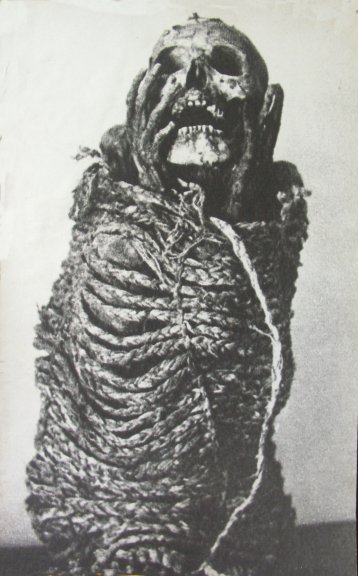 |
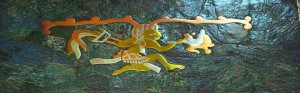
The skeleton in the image typifies this Western view of death. But the view in older cultures is that life continually flows through birth and death, as in the second illustration. (See: the book The Field, that examines latest findings in quantum physics in an understandable way). |
But many people dream that they have died and become distressed by it. But as far as I can tell such dreams are a necessary part of a natural development. The experience of death is a part of learning to go through change – as caterpillars do as the transform into butterflies. You cannot go through such personal changes unless you willing to let yourself die.
I feel strongly that all the new breed of children will need to learn how to die. It is like a process of transformation such we see caterpillars going through. In our life today there are stages of growth and points of massive transformation as one period of growth ends and another stage begins. |
 |
Learning to die was a method of passing through the transformation into the next stage of growth, and we are carving a way for children if they attempted the further stages of growth. Dreaming of our own death In the example below the dreamer does not face any great fear of death itself. The strongest feelings are of loss. Over a period of time the dreamer may move beyond such feelings of loss into exploring other possibilities of death.
I was due to be executed – what for I don’t know. I was not especially afraid of this, but my most vivid feelings were of great sadness at the people I was leaving behind, and for all the things I wanted to do in life, but would not now be able to. Then at the end I was watching myself being hanged. D.
This theme of facing death is quite frequently met, and it often leads to confronting what we really want to do before the end of this present life; what we want to express, say or give to those we love or are involved with; and what we want to achieve. So such a dream may wake us up from spending too much time in trivialities.
Examining many dreams dealing with death, it is noticeable that some dreamers are stuck in fearful or grief laden feelings, while others move on into a positive relationship with the ending of life. The difference appears to be centred on what level of emotion the dreamer can tolerate and accept, and how daring they are. Many people, on meeting death in their dream, awake with feelings of pain, fear, or dread. If they could fully meet those feelings they would pass on to develop a very different experience of death in their dreams. The following dreams illustrate this.
A young woman told me she had experienced a recurring nightmare of a piece of cloth touching her face. She would scream and scream and wake her family. One night her brother sat with her and made her meet those feelings depicted by the cloth. When she did so she realised it was her grandmother’s funeral shroud. She cried about the loss of her grandmother, felt her feelings about death, and was never troubled again by the nightmare. The dreamer in the following example meets her feelings through the actual events of the dream.
My mother in law died of cancer. I had watched the whole progression of her illness, and was very upset by her death. Shortly after she died the relatives gathered and began to sort through her belongings to share them out. That was the climax of my upset and distress, and I didn’t want any part of this sorting and taking her things. That night I dreamt I was in a room with all the relatives. They were sorting her things, and I felt my waking distress. Then my mother in law came into the room. She was very real and seemed happy. She said for me not to be upset as she didn’t at all mind her relatives taking her things. When I woke from the dream all the anxiety and upset had disappeared. It never returned.
Here is quote from a student of Jung.
“Most significantly, Herzog suggests that the experience of dying in a dream can symbolise a life-transformation. But this occurs only if the dreamer (1) can transcend the negative reaction to death’s image, and (2) be touched “by the dream’s deep resonance with the experience of death as transformation and also by the elemental power of enthusiastic joy in life.”5 This “transformation” occurs if one’s waking activity is affected such that the dreamer comes to terms with the vicissitudes of life, as well as the reality of death.”
Death can represent a fading or dying of some aspect of you
So dreaming of death is often not about the end of your or someone else’s life, but a means of showing how some aspect of your outer or inner life is fading, lost, or being superseded by a changed approach, so may be shown as dying. Other possibilities are that your love or drive to achieve something might die, and be shown as death in your dreams. The change from adolescence to puberty, or maturity to old age, is also often depicted in a dream as oneself dying. In this case it is a past way of life and identity that is passing away.
Dreaming of a dead body
This shows another aspect of death in dreams. Lost opportunities or unexpressed potentials in you are frequently shown in this way. All of us unconsciously learn attitudes or survival skills from parents and others, or we have a talent or gift that has got buried, denied or even killed out by events. If these or other facets of our personality are unrecognised or ‘buried’ they may be shown as dead. Sometimes we have killed the child or teenager in us because of difficulties or trauma at those ages, and these may be seen as a dead person in your dream, or even a corpse you find buried. Of course we may have ‘killed’ our parents in our dreams and find them buried. It is important to explore such dreams and bring the parts of you back to life. See Techniques for Exploring your Dreams
Some death dreams may show the awakening of new life in the dreamer. For instance, Sue explored a dream in which she was told her baby had died. She woke shaking with grief and tears. When she explored the dream she felt it showed her becoming alive enough to feel the grief of past pain, and the death of her hopes and love in a relationship that had just ended. She had suppressed her pain for so long. In now coming alive enough to feel her emotions, she was feeling at last that something she previously loved had died in her.
Example: My hands moved to my genital area and I had the strange and awful feeling my hips were not mine – that I was touching someone else’s body. The thighs and waist were my own, but in between was a dead, wasted area. I knew my sexuality was this stagnant, dead area. It was my manhood that had been wasted, the many wasted years of my life. My body felt such a stranger. I took my trousers off to feel myself more easily. Gradually I felt the area connected and my own again. I felt that I had dealt with the causes of my dead sexuality in past experiences, but I had never felt the actual deadness quite like this
We can deal with our feelings of death
Each of us meet our feelings and fears in different ways, and the next waking dream shows a very full meeting with death and its possibilities.
I knew I was dying and it was incredibly real. So real I wept deeply because I knew this was the end of everything and I would lose my children. All that I had created in life would be at an end too. But there was nothing I could do about that and I died. Then I seemed to be at a slight distance watching my dead body, and I saw my father, who had died some years before, come and carry the body over a threshold into a heavenly meadow. There a resurrection took place. My dead being was given new life. And the new life came from all that I had given to others, and all I had received from others, during my life. That was my spiritual life that survived death. A.C.
As can be seen from this beautiful experience, the dreamer meets the depth of feeling connected with the final ending of life, and then moves beyond it. So the last part of the dream is not an avoidance of pain, but an acceptance of the finality of death and how it is transcended by giving ourselves away to others, and receiving from them. It says that our spiritual life is a form of integrating all of our life activities and seeing what can be transferred from our limited life into the life universal. All that cannot be a part of the eternal cannot be a part of our life after death is burned out. Because dreaming about death is a very frequent theme, and has many aspects, you must look at any death dream you have had and see each part of it in context with the other parts of the dream. For instance the context of death in the first example is connected with hanging and final loss. In the second it starts similarly but ends quite differently.
Death of someone close to us
As explained above, this often refers to ones own feelings or talents that have been hurt, denied, or ‘killed out’ by events and your response to them. The following example illustrates this.
Example: ‘My son comes in and I see he is unwashed and seems preoccupied and as if he has not cared for himself for some days. I ask him what is wrong. He tells me his mother is dead. I then seem to know she has been dead for days, and my two sons have not told anyone. In fact my other son has not even accepted the fact.’ Anthony.
Anthony is a divorcee. Processing the dream he realised the two sons are ways he is relating to the death of his marriage – the children’s mother. Although the unconscious has a very real sense of its eternal nature and continuance after physical death, our conscious personality seldom shares this. Also we all we all carry within us ideas, behaviours, talents and ways of life from those now dead. The farmer today unconsciously uses the collective experience of humanity in farming. What innovation he does today his children or others will learn and carry into the future.
This aspect of a life beyond the physical is shown in many dreams. For instance a man I knew dreamt of walking with a friend of his. As they walked they came to a river. The friend crossed, but the dreamer was unable to. Even in the dream he felt crossing the river meant his friend had died. Some time later he discovered that his friend had died at about the time he experienced the dream.
As the dream points out, the friend died, but continued another type of life ‘across the river’. A woman told a similar dream to me. Her teenage son came down to breakfast looking very unhappy. When she asked him why he said he had a dream that deeply disturbed him. In it he was walking with a friend and the friend walked through a door. When her son tried to follow he could not pass through the door.
They could not find a rational explanation for the dream, but on arriving at school, her son heard that his friend had been killed in a motorbike accident on his way to school. The river and the door are often used in this way, suggesting a change to another dimension of life usually unreachable by the living. But some experiences give us a much clearer example of contact with our dead. The following is taken from the writings of Dr. Stanilav Grof and is a personal experience he met.
“In one particularly unnerving session a young man suffering from depression found himself in what seemed to be another dimension. It had an eerie luminescence, and although he could not see anyone he sensed that it was crowded with discarnate beings. Suddenly he sensed a presence very close to him, and to his surprise it began to communicate with him telepathically. It asked him to please contact a couple who lived in the Moravian city of Kromeriz and let them know that their son Ladislav was well taken care of and doing all right. It then gave him the couple’s name, street address, and telephone number.
The information meant nothing to either Grof or the young man and seemed totally unrelated to the young man’s problems and treatment. Still, Grof could not put it out of his mind. “After some hesitation and with mixed feelings, I finally decided to do what certainly would have made me the target of my colleagues’ jokes, had they found out,” says Grof. “I went to the telephone, dialled the number in Kromeriz, and asked if I could speak with Ladislav. To my astonishment, the woman on the other side of the line started to cry. When she calmed down, she told me with a broken voice: ‘Our son is not with us any more; he passed away, we lost him three weeks ago.’”
Here is a beautiful experience expressed as a poem.
Example: Today I noticed for the first time
A small brown mark on my left hand.
True I have been out in the sun,
But I never grow freckles.
This is one of those marks
Old people have on their hands.
I thought – or perhaps it was a hope
That I would never have
Such brown discolourations.
In my imagination of ageing
I had seen my skin wrinkled,
But clear and vibrant.
The mark was something
I noticed in the morning,
Looked at for a few moments
And passed from to other interests.
The day was full of things to enjoy.
At fifty I feel happier
And more vigorous
Than ever before.
Then, in the afternoon,
Sitting among friends
And in the midst of our enjoyment
The thought struck me –
Supposing I fall over!
Supposing I dropped to the floor
Right now.
I was with friends,
Friends to have wild fancies with.
So I followed my mood,
Allowing it to grow leaves and stem,
And remembered,
Though I had never really forgotten,
That my father had – one day –
Fallen over on his garden path.
Busy as ever with things to do
He was walking the path
Fell over
And never got up again.
That’s when I knew
More clearly than ever before
That I am slowly dying.
If I were a leaf on a tree,
The small brown mark would be
The first sign of Autumn
As change touched me
Making me golden.
Then I would fall
From the tree.
But I am not ready
To drop.
Though I am turning brown
There is something I need.
I have a will to spend myself
On my friends,
That I might fall
Feeling well
With the coming of winter.
Of a sudden
I see the face of Death.
I hear its voice.
I know it –
For we have met
Often and always.
Death has the features of
A child I made cry;
The profile of
My loved woman;
Your countenance.
Have I known you?
Then I have known Death.
Have I betrayed any?
Then I have betrayed Death.
And its face is beauty
For it is all things –
Naked,
Undressed of flesh,
Leafless,
Exposed,
Unclad Life –
Without the garment
That our selfhood is.
And the waters in me rose
To tears.
Bathing me in regret
That I had
So often
Forgotten
My love
For the
Naked Beauty.
Relating to The Dead
Our relationship with the dead should not be seen as the same as when alive, for we have left the body life behind and live in a dimension of experience without boundaries. Of course dreams try to help us with this but it can be difficult to understand. Below are parts of communications received.
“I am now part of your life. In this place of no boundaries it means our lives roll together. And this is part of the love that links those in life and those in death. I am also creating possibilities and situations in your life here and now.
From this dimension life and death are not separated, and that my friend Kevin partook of my life through the love developed between myself and him. The link was so pronounced that he also experienced my life as I lived it as there were no boundaries.”
You can continue contact with the dead through your dreams
There is yet another level connected with dreams about people we have known in life. This next dream and exploration of the dream shows how we can continue contact with the dead.
Example: Our son passed away on 12/22/2012. he was 24 years old. Today my 13 year old daughter told me she had a dream last night. She said she was looking in a mirror and saw her brother. She said at first it scared her then she was okay. She said she joined her brother. She said they were on a beach but it was nothing like she had ever seen. She said he was in a bright yellow shirt and tan shorts which she thought was a bit funny because he would have never worn that when he was alive.
She said the first thing she asked him was if there was a hell. She said he told her no but there was a place for those who had done really bad things to learn from them. She said that she asked a bunch of questions that he told her he wasn’t allowed to answer. She said she asked him if he missed everyone and he told her no because he could be with us whenever he wanted to. He told her he could go everywhere. He said both to beautiful and not so beautiful places. It was all his choice. He told her tell everyone he was okay. She also said he looked really good but not quite the same as he did when he was alive.
The above dream is exactly what can happen when we meet someone we love in a dream. Usually people’s minds are so full of beliefs and information that clogs up their ability to have such a clear dream. The mirror is first an indirect contact, but then the girl joined her brother in his experience of death. The answers she was given to her questions are exactly my own findings in regard to death.
Example: Yesterday my wife told me I had been calling out in my sleep, obviously dreaming. She said I had been calling my mother. She described it not as a cry of pain or anger, but as if urgently trying to get my mother’s attention.
My mother had died shortly before this dream, so I tried to explore the feeling of calling to my mother and experienced a spontaneous waking dream of my mother being in something like an old people’s home. She was very withdrawn and non-communicative, and as I explored the feeling of this I sensed she felt as if she had been abandoned and felt resentful and angry about this. She had died from multiple strokes and so was not aware of her process of death.
I could see that in fact she had not been abandoned, but was in a place where she was creating her own environment through her emotions and attitudes. I attempted to communicate with her but she refused to respond at all, and I was unsure if she really was withdrawn to a point where she couldn’t hear me, or if she was angry and so not responding. So I called to her aloud and said she must realise she was dead, not abandoned. She had failed to realise her new condition and so through resentment from feeling we had all left her, had created a growing isolation and barrier to being with others. I explained that if she remembered something of the love she had given and received in life, this would release her from the bondage of her loneliness, and bring her into contact with many people who wanted to be with her who were dead.
Here is a different approach.
Example: Did I tell you my dream about my Mother the day after she died? I kept hearing my name spoken (calling me) just as I’m waking up in the mornings……it was so strong today that I had said, “Yes” before I realized there was no one here but me.
And another thing…. the phone keeps ringing and no one is there when I pick it up…….it happens too many time to be a wrong number. I am thinking, who is out there trying to contact me? But some experiences give us a much clearer example of contact with our dead.
The following is taken from the writings of D. Stanilav Grof and is a personal experience he met.
“In one particularly unnerving session a young man suffering from depression found himself in what seemed to be another dimension. It had an eerie luminescence, and although he could not see anyone he sensed that it was crowded with discarnate beings.
Suddenly he sensed a presence very close to him, and to his surprise it began to communicate with him telepathically. It asked him to please contact a couple who lived in the Moravian city of Kromeriz and let them know that their son Ladislav was well taken care of and doing all right.
It then gave him the couple’s name, street address, and telephone number.
The information meant nothing to either Grof or the young man and seemed totally unrelated to the young man’s problems and treatment. Still, Grof could not put it out of his mind. “After some hesitation and with mixed feelings, I finally decided to do what certainly would have made me the target of my colleagues’ jokes, had they found out,” says Grof.
“I went to the telephone, dialled the number in Kromeriz, and asked if I could speak with Ladislav. To my astonishment, the woman on the other side of the line started to cry. When she calmed down, she told me with a broken voice: ‘Our son is not with us any more; he passed away, we lost him three weeks ago.’”
Some dreams are showing the state of those we love after death I believe the following dreams can really give a wonderful picture of this.
I walked around the corner, looked into the room my son was in when he was living here just a few months ago. He was in his bed, on the opposite side he slept on, alone, and sick. His face was pale white with large red areas on his cheeks from fever, he had a thermometer in his mouth which he removed to say, “Ma, I’m really sick.” Maybe he also said he feels terrible, I cant recall that specifically. Most people dream their loved ones smile, or tell ,them they are ok… this dream made me cry, and feel fearful for him. Despite the difficult feeling the mother felt in response to her dream of her dead son, it describes very clearly a stage of after death experience, the burning up of physical desires.
The next dream is even more clear in its symbolism.
My mother in law just passed on Aug 7th, 2010, she had cancer, and the process of her dying went rather quickly, we are a very close knit family, and my husband, sister in-laws, and especially the grandchildren are really having a hard time with her passing. However, I had this disturbing dream last night. In this dream, I was in a small soft lit room, and in this room around the 4 corners of the wall, there were framed pictures of my mother in law from a baby until adulthood even pictures of when she was ill before she passed. She looked up at me and it was my mother in law, her eyes were bulged and red, and she had tears coming down her face.
The pictures on the wall shows a full life review. This is recognisable what happens when you die. Of course it can be disturbing, after all you are reliving every moment.
Phyllis Atwater, who is an expert on near death experiences, and who has experienced them herself, says:
“For me it was a total reliving of every thought I had ever thought, every word I had ever spoken, and every deed I had ever done; plus, the effect of each thought, word and deed on everyone and anyone who had ever come within my environment or sphere of influence, whether I knew them or not (including unknown passers-by on the street).”
The fever shown in the previous dream is caused by the loss of a physical body. Without body we lose all physical desires, and that can be very difficult for some. It is like burning up of those desires that link your material life. There are other stages that we go through that you can read about in Rudolph Steiner’s Philosophy of Life and Death.
Several months after he started dreaming, Herb received some of the answers to questions he held at the time of his mother’s death. Did his mother have a message for him? Where had she gone? The veil between this life and the next was swept away in a dream:
I meet my mother as a young woman on a beautiful campus of higher learning, where there is always light. She is playing a violin here in a symphonic orchestra. She tells me that my ability will surpass my hopes and that my dreams will be a large part of the revelation of knowledge which will come through my higher self. “I had read of great Biblical prophets, such as Joseph, who had important dreams,” Herb says, “but I thought such talents were only for men such as he was, and not for such an insignificant person as myself.”
The next show how the dead can be helped by knowledge of the after death state.
My 20-year-old son, Max, died less than a month ago. I had a strong feeling when I first learned of his death that he had remained “earth bound”.
I can’t describe it exactly, but I felt very strongly that because his death was sudden and he wasn’t ready to go that he hadn’t moved on to the other side. I have prayed for a sign from him and he came to me in my dreams the past two nights.
The first night he said he wasn’t dead and I couldn’t convince him otherwise. He even said that he wouldn’t be ready to go for another “year and a half”. But I got to hug him and feel him and it was him. Last night he came to me at my house. He was sitting at the kitchen table and we just talked for a few minutes before I brought up the fact that he HAD to go into the light. He got a bit angry.
Then I told him that I knew about the drugs in Utah and he hung his head in shame. Then I told him he overdosed. At first he disagreed, I began to think about things that I could show him that would make him understand…like stuff from his funeral, but then he understood. Like he knew what I was thinking and was kinda like “don’t bother, I get it.”
I started to cry and we hugged and I began to tell him about all the books that I’ve read on the afterlife so that he wouldn’t be scared. He hugged me and asked me if our souls would always be together and I said yes, that if you’re close on earth that means the souls always stay together.
We left my house then and went to the other side. He was leery of going so I told him that once he got there he would probably see grandma Josephine and grandma Jean and that Baxter, his old dog, would probably even be there. I went further in with him, to try and find the souls he was meant to be with so that he wouldn’t be scared.
As we looked he began to feel more at ease. Drifting away from me and looking for himself. Then a crashing booming voice said something, I don’t remember what, but I knew I had to leave. So I went back to the tunnel that we had come in through and Max came, with another young man, about his age, they were wildly happy, riding what kinda looked like skateboards, but not. He took me back through the tunnel. He said he understood and that the other soul that was there with him was his friend and that they wreak havoc on the other side playing pranks and acting rambunctious.
I started to cry and he hugged me so tight and I told him I loved him so much and he whispered in my ear “I will see you soon”. He was completely calm and not upset anymore…like someone saying, “see you tomorrow” – like time wasn’t a big deal. I watched him skateboard away with the other soul and he turned back and gave me a huge smile and waved and I felt all over that he understood everything now.
The tunnel began to close in…getting smaller and smaller at his end of it so I had to turn around and walk through my side because I had to come back. I knew, even in the dream that I had helped him get there. Was this my sons spirit? Did I help him? I feel it was…and waking up today I feel better. I miss him terribly but I feel like he is safe and where he should be.
I put the above dream in because it is so clearly a healing dream. I know from personal experience what it is like to meet and know the joy you felt in helping your son. I know also that we are almost hypnotised into believing that when someone dies that is the end of them. But there are some dreams that are about the person still alive who is grieving so much it is a real pain to the dead person.
Example: Perhaps the most common dream experience in spirit communication is related to the message which in essence says, “I am fine and happy. Your grief, however, is holding me back and making me sad. You can help me greatly by trying to overcome your sorrow. You must stop grieving!”
People who grieve because of someone they love has died fail to understand the the person has not gone or left them. In fact, the ‘dead’ person is now more fully aware of those left behind, and is very influenced by what they feel. Please read Ex or a dreamed of ‘soul mate – what can I do?; Talking with the dead
Death can represent a fading or dying of some aspect of you.
Dreaming of death is often not about the end of your or someone else’s life, but a means of showing how some aspect of your outer or inner life is fading, lost, or being superseded by a changed approach, so may be shown as dying.
Other possibilities are that your love or drive to achieve something might die, and be shown as death in your dreams. The change from adolescence to puberty, or maturity to old age, is also often depicted in a dream as oneself dying. In this case it is a past way of life and identity that is passing away.
Dreaming of a dead body
This shows another aspect of death in dreams. Lost opportunities or unexpressed potentials in you are frequently shown in this way. All of us unconsciously learn attitudes or survival skills from parents and others, or we have a talent or gift that has got buried, denied or even killed out by events.
If these or other facets of our personality are unrecognised or ‘buried’ they may be shown as dead. Sometimes we have killed the child or teenager in us because of difficulties or trauma at those ages, and these may be seen as a dead person in your dream, or even a corpse you find buried.
Some death dreams may show the awakening of new life in the dreamer. For instance, Sue explored a dream in which she was told her baby had died. She woke shaking with grief and tears. When she explored the dream she felt it showed her becoming alive enough to feel the grief of past pain, and the death of her hopes and love in a relationship that had just ended. She had suppressed her pain for so long. In now coming alive enough to feel her emotions, she was feeling at last that something she previously loved had died in her.
If the death is someone we know
Sometimes, as in the example below, this shows a desire to be free of someone; or unexpressed aggression; perhaps one’s love for that person has ‘died’. We often ‘kill’ our parents in dreams as we move toward independence. Or we may want someone ‘out of the way’ so we do not have to compete for attention and love.
During my teens I was engaged to be married when I found a more attractive partner and was in considerable conflict. Consistently I dreamt I was at my fiancé’s funeral until it dawned on me the dream was telling me I wanted to be free of him. When I gave him up the dreams ceased. Mrs D.
Death of oneself
Death is an extremely important event facing all of us, and yet it is a mystery, so we often experimentally confront and explore it in our dreams. A dream about one’s own death may also show a retreat from the challenge of life, or a split between mind and body.
The experience of leaving the body is sometimes an expression of this schism between the ego and one’s life processes. Other possibilities are to do with the death of old patterns of living – one’s ‘old self’, the loss of the boundaries that limit your awareness to an identity connected only to your body. This latter is usually a willing surrender of self to the process.
The next examples depict what was mentioned above. It is a way of reminding ourselves to do now what is deeply in us before we die – especially regarding love.
I dreamt I have a weak heart that will be fatal. It is the practice of doctors in such cases to administer a tablet causing one painlessly to go to sleep – die. I am completely calm and accepting of my fate. But I suddenly realise I must leave notes for my parents and children. I must let them know how much I love them, must do this quickly before my time runs out.’ Mrs M.
Talking with those who have passed on
A friend I know, Sheila, her mother died suddenly about three weeks ago, on the seventh I think. Not knowing this I received a message to ask for healing in her name. I surrendered in LifeStream and experienced dying, rising out of the death of the body, saying farewell to physical experience, meeting in wonder, loved ones, and opening to the pulse of the inner life. I knew from this that Sheila’s mother was dead or dying. When I telephoned I discovered she was dead. Never before had I honestly felt I was in contact with the dead. A new world has opened for me.
I know from personal experience what it is like to talk as the apparently dead to the living. This is because I had an extraordinary out of body experience. I had suddenly felt as if I were shooting upwards and experienced a feeling of coming out of pressure and was now free – like a cork out of a bottle. Then I was awake and looking down at my sleeping body and suddenly felt terrified (I realised afterwards it was terror that I was dying).
Then I remembered reading about experiences such as this and was laughing uncontrollably through release from terror. Then I was travelling across the German countryside where I was living, curled up with my knees to my chest, and found myself standing in our sitting room at home in London. It was such an astonishing experience I stood in shock looking down at my body, feeling it and trying to understand.
My body felt solid and real and I was dressed in outdoor clothes not my pyjamas. Then with great enthusiasm I looked up and saw my mother sitting alone knitting, our Alsatian dog lying asleep in front of the gas fire. I felt sure my mother would see me because I felt physically present and absolutely and vitally awake in a way I had never experienced before.
So I called out to her, “Mum, look what has happened.” She stopped knitting for a moment but obviously didn’t see me or hear me. So I felt if I shouted this would reach her. “Mum” I shouted, “look it’s me Tony”. There was no obvious sign that she had heard me, but two things did happen. One was that I saw or realised that she had an upstairs side of her and a downstairs side. Her upstairs (conscious) side had no awareness of me, but her downstairs side (unconscious) gave me a wonderful welcome and I had the awareness of us knowing each other in a formless love.
Then at the same time my dog must have heard me shout because he woke and came rushing to me and was so full of love for me he rushed around where I stood barking and showing his joy.
I later heard from my mother saying she had had been alone that night as my father was out, and she had seen the dog get up and bark and jump around for no apparent reason. I learned enormous and important lessons from that. I realised that having no physical body the human living cannot usually hear us. They need physical sound to know we are present, but yet another part of her knew and responded. So I saw that if she had thought of me and spoken to me I would know, even though she might not be able to hear my reply – unless she was a medium or learned to listen to thoughts. The reason being that in the body most people cannot communicate via thoughts.
Since then I have learned more and see that whenever we think of the dead with warm feelings we are immediately in their presence. So all you need to do is to imagine them and talk to them, as if you would if they were there physically. Talk to them saying whatever it is you want to communicate.
In dreams you will be able to receive their answers. I learned also that my dog could hear and see me, and that he loved me. I know it sounds simple but it is. Communication with the dead is easy, but we make such a big thing of it. Remember that at death we have no physical organs to speak through, so it all has to be done through thoughts. Also that at the level of thoughts we create huge difficulties by what we think. So a thought such as, “I am not a medium so I cannot talk with my dead son” is like a brick wall that we have created and cannot get through.
Thoughts and imagination are incredible powerful and are real at the level of dreams and the dead – and of course our own inner world. I think that reading this book would help you to clearly tell you about the after death state. http://www.amazon.com/Closer-Light-Melvin-Morse/dp/0804108323/ref=sr_1_fkmr0_1?ie=UTF8&qid=1307353595&sr=1-1-fkmr0
Thoughts about death
There is a disinclination to deeply consider death in North Western culture. What passes for this is the excuse that physical death ends all life, when such a statement is observable not true. Nothing that we can see in the physical world exists outside of evolutionary connections with past objects or forms. Our language, our body, our personality, have all arisen out of what existed previously. The past is obviously alive in the present, so how can there be death to anything except the limited awareness people consider to be themselves, their ego?
Death is the great adventure of the psyche. The great undertaking of individuation takes us into the meeting with our birth and infant traumas. We face the monsters created by our sense of being unloved, of parental desertion or betrayal. The demons of self-doubt, of self-destructiveness, of worldly struggle and fear spring up to meet us on the journey and we have to do battle. The negative habits of our lifetime pull at us or bind us to our past unless we can break free. The instinctive hungers and drives, of reactive fear, challenge us.
Can we take the tiny boat of our self-awareness across their swirling and torrential waters? Can we swim in the whirlpool of desire and use its energy to achieve a new awareness and transcendence? Can we meet the unconscious influences of the archetypes and find some ability not to be lost in them?
Even if we can, after all these great feats, should we find our way through them, lies not an upliftment of our being into wonder – but death! What will we make of it?
Example: I was walking with my two sons, who were young children about seven and nine. We were in a huge cave like tunnel that was natural, and reasonably light. The boys were running around on a raised bank about five feet high that was against the cave/tunnel wall. They were looking for my mother and father who had gone into some holes of potholes in the cave wall. As they looked I became worried that they would get lost down the holes, especially my youngest son. This was because I called them – shouted for them in my anxiety – to come to me and get away from the holes. I could see Peter and he had stopped searching, but David was out of sight. Then I shouted again very loudly and with an urgent tone, and David came,
I woke at this point and went to the toilet. As I lay down again, thinking about the dream, it seemed obvious it was about death, and the fact my mother and father had gone into the blackness of the hole, and never been seen again. I wondered if the boys searching was to do with my own search in the unconscious for my parents, and what is death? Or now, as I write, whether it is about the danger of death for David.
Semi awake the dream carried on. I called the police and civil authorities to search for my parents. They could find traces of their passage deep down into the holes, but no sign of them. Then I decided to equip myself and go alone. The problem was that the deeper I went, the more inertia I felt. I was then saved myself by the civil authorities.
Then I find my parents in the depths, but they are no longer physical. They have gone deep, like a burrowing creature, to undergo a transformation, and have left physical life.
Example: It seemed a terrifying thing to be dead and descends into a crypt, lifeless and without motivation. Here I felt or experienced a very strong sense almost like a dead body, if it had awareness, might feel in a crypt.
This is quite difficult to describe. I suppose what I was experiencing was a sort of ready made or social image of death. The sort of fears we have about it. It had in it the sense of dust, decay and cobwebs – the quiet dead silence of the tomb. But here, right in the midst of death, I had the sense of eternal life, of resurrection. It seemed to me as if you could not have one without the other, and this was the meaning in Christian doctrine where it says you must experience death to be reborn.
I am not sure if it was at this point that many images of the mixture of death and birth came on me. I had the experience that one needed to be bitten by the snake and die before one can be reborn into that transcendent life.
But what came next was a long experience of exploring the view of life arising out of being a biological bag of water, wind, and shit. This went on for image after image of rampant wet sexuality or eating, of seeing nothing in life except physical existence. Again it is difficult to describe because of the huge variety of the images and scenes. I suppose the underlying thing I was searching for in this series of feelings and images of the very physical side of life, such as eating and fucking, and the question was, is this all there is?
There was an underlying morbidity in what I saw and felt. I think it is all summed up in the much used phrase, “Life’s a bitch and then we die”. But I think my view that I wanted to find the transcendental in all the aspects of life, but it was difficult within the way I was looking at these feelings or parts of life experience.
I thought, or at least I came to the conclusion, that they expressed the preoccupation with the body and the physical that most of us have in present times. We are preoccupied with the physical and with examining it in detail. We are all trying to arrive at an understanding of the meaning of things, of death, through this minute examination of the physical world. The longer I was involved in these images, the more it seemed ridiculous in the light of everyday knowledge that all things rely on each other, and that everything exists as an integrated part of the cosmos.
The theme of the dream then changed. The day before this session I had a long conversation with B. She had described some of the people she works with or cares for in the old people’s home. B. had described how frightened some of the people are of dying. Although they had lived a long and varied life, they had still not come to terms with death. In the dream I realised I was looking for some way of communicating certainty about the goodness of death to B. I wanted to be able to look her in the eye and tell her she would be cared for.
Tracing it back, when we go into death through the jaws of the hunter, the lion, what do we meet? If we go back far enough we discover not anger or lust, but the lion’s desire to feed its cubs, or to survive. We find ourselves back in, back behind things. Behind the snake, behind this tiger, behind the human being, behind the decay. If we go back far enough we find ourselves in the awareness of the pack, in the species, in the formative forces of survival and reproduction that lies behind things. We find ourselves in that mystery, in the jungle where the essence of life pervades the various forms.
From that place the viewpoint that we are nothing but a physical form, that we are a small cog in the wheels of life, that we must put up with what we have, seems ridiculous. From that place we look at ourselves and see what a fantastic piece of equipment our body and mind is. As a conscious person we are right in the middle of everything. To say, “Oh God, we are nothing but a piece of slime, a helpless pawn in the hands of destiny,” is ridiculous. We are the culmination of everything that has existed before. We are that growing tip, that exploring awareness, in touch with unimaginable potential. We are everything that can be. What can we do?
The walking dead or rigor mortis
Aspects of the dreamer that are denied, perhaps through fear. Dancing with or meeting death or dark figure: Facing up to death and experiencing or exploring possible ways of relating to it. Death of someone close to us:
As explained above, this often refers to one’s own feelings or talents that have been hurt, denied, or ‘killed out’ by events and your response to them. The following example illustrates this.
‘My son comes in and I see he is unwashed and seems preoccupied and as if he has not cared for himself for some days. I ask him what is wrong. He tells me his mother is dead. I then seem to know she has been dead for days, and my two sons have not told anyone. In fact, my other son has not even accepted the fact.’ Anthony.
Anthony is a divorcee. Processing the dream, he realised the two sons are ways he is relating to the death of his marriage – the children’s mother.
McCall recalls dreaming about her father a month after he died in September 2000. She was at a joyous community gathering where a hot air balloon was being launched. She saw her father sitting on a bench with her sister, in front of a church. “He was talking and laughing just as he had been in life. He was always the life of the party.” She leaned over to her sister and asks, “Dad’s so funny. Does he know he’s dead?” “Yes, I think he does,” her sister answers.
To McCall, the dream was powerful and healing. “It made me feel that he was OK.” Although the unconscious has a very real sense of its eternal nature and continuance after physical death, our conscious personality seldom shares this. Also we all we all carry within us ideas, behaviours, talents and ways of life from those now dead. The farmer today unconsciously uses the collective experience of humanity in farming. What innovation he does today his children or others will learn and carry into the future.
This aspect of a life beyond the physical is shown in many dreams. For instance, a man I knew dreamt of walking with a friend of his. As they walked they came to a river. The friend crossed, but the dreamer was unable to. Even in the dream he felt crossing the river meant his friend had died. Some time later he discovered that his friend had died at about the time he experienced the dream.
As the dream points out, the friend died, but continued another type of life ‘across the river’. A woman told a similar dream to me. Her teenage son came down to breakfast looking very unhappy. When she asked him why he said he had a dream that deeply disturbed him. In it he was walking with a friend and the friend walked through a door. When her son tried to follow he could not pass through the door.
They could not find a rational explanation for the dream, but on arriving at school, her son heard that his friend had been killed in a motorbike accident on his way to school. The river and the door are often used in this way, suggesting a change to another dimension of life usually unreachable by the living.
Idioms: Dead and buried; dead from the neck up/or neck down; dead to the world; play dead; dead to the world; dead tired; drop dead; stone dead; at death’s door; brush with death; death wish; kiss of death; sick to death.
Useful questions and hints:
What feelings about death does this dream highlight?
If I imagined the dream being carried forward, how would I change it? (For help doing this see Taking the Dream Forward.)
Am I changing and my past self dying?
If this is someone I know what are my feelings about them – and where are those feelings arising in me at the moment?
What part of myself have I killed?
Did an aspect of my potential get buried or killed in the past – if so what?
See: Life and Death; Life After Death; The Archetype of Rebirth or Resurrection – Life and Death – An Amazing Near Death Experience – Death and Dreams – Levels of Awareness in Waking and Dreaming – Near Death Experiences Journal.
Violence in the Womb
By David Chamberlain, Editor
Jolted by the epidemic of violence today, parents, legislators, criminologists, policemen, theologians, psychologists, teachers, politicians, and health care providers are all alarmed and looking for some deeper understanding that might lead to practical steps to deal with the problem. The result of this feverish activity is a massive and multiplying literature measured in the thousands of articles, books, conferences, and media productions. Nevertheless, in all this activity the origins of violence early–very early–in life are rarely explored.
Violence in the womb and at birth has always been a concern to members of APPPAH, many of whom are psychotherapists privy to the private revelations which expose the consequences of this early violence. Other members who are on the scene in neonatal intensive care nurseries or labor and delivery rooms witness the repetition of violence and ponder what the consequences will be for these babies in the future. We have acquired the conviction that any violence which greets a baby in the womb and around the time of birth is a deep form of conditioning which acts like a template for relationships. This conditioning may well affect a person’s physical and mental health for decades to come.
Ironically, in modern hospital birth, violence and pain have become routine for babies. For most of the 20th century, neither obstetricians nor psychologists have regarded pain as a reality for newborns. Therefore, doctors have not hesitated to expose the baby to a harsh environment at birth, or to introduce painful routines, or painful instruments. Nor have they hesitated to use powerful chemicals in the form of drugs and anesthetics. All these departures from what normally happened at a home birth have profoundly altered the experience of birth for the baby. Babies protest being jabbed with needles for blood samples and vitamin K shots, don’t like to be turned upside down, rushed through space, and handled by different people. Their skin is extremely sensitive and they complain when rubbed and cleaned. We have been making them angry, afraid, defensive, sad, and confused–for the greater part of the century.
Research has followed these dramatic innovations at a great distance, warning of danger long after the damage was done. The results of this new way of birth may finally be calculated in the angry behavior of generations of men and women born in violence. We have been impregnated with drugs from the first moment of life. Are we so fascinated with drugs and the altered states they evoke because we were introduced to them at birth? Research findings point to these connections.
Evidence of this kind led us to organize the conference held at Cathedral Hill Hotel in San Francisco in the Fall of 1995. The conference brought together experts from many disciplines who regularly probe the early origins of violence and who have made the connection between trauma and violence. Below, we offer a window into this important conference, “Birth and Violence: The Societal Impact”
In the column “Perspectives on Violence” we will offer the views of persons who have made important contributions to understanding the prenatal/perinatal roots of personal and social violence. In addition to these excerpts you will find “Featured Paper” where a paper is reprinted in full. Finally, we offer the column, “In the Headlines”, where breaking news contains important revelations about the origins of violence. If you are aware of such headline stories, please contact the Editor: David Chamberlain
Editor’s Note:
Elisabeth Hallett is a college psychology major who went on to become a nurse, yoga teacher, and independent writer/researcher. She is the mother of two children, author of two books: “In the Newborn Year: Our Changing Awareness After Childbirth” (1992) and “Soul Trek: Meeting Our Children On the Way to Birth” (1995) and likes affiliating with two groups APPPAH and The Institute of Noetic Sciences. She is also an enthusiastic Webweaver and welcomes your participation in this column. Her email link is at the end of this story.
A Method to Shorten Labour
Way to Shorten Labor
Simple Techniques to Improve and Shorten Labor
Tony Crisp

Chapters
Simple Techniques to Improve and Shorten Labor

For the first time in my life I recently helped to deliver a baby. It was in Namibia, and there were several remarkable features about the birth.
1) We used an extraordinarily simple new approach to birthing.
2) This approach claims to radically reduce the length of labour — and it did.
3) The pregnant woman’s previous length of labour had been 45 hours. This labour was 3 hours.
4) The birth was achieved without any professional help.
I am going to outline the approach we used, but will give a little background first.
I will call the woman Jane. It was Jane’s third pregnancy. Her first child, a boy, was a Caesarean birth. Jane says this was because of the pediatrician’s mismanagement of her situation, and because of racial difficulties at the hospital.
The Caesarean birth left Jane feeling an enormous lack of confidence in her ability to naturally deliver her baby. It did not completely deter her from trying again though. So fairly quickly she was pregnant with her second child.
This birth was with a midwife. Jane felt the midwife totally took charge of the situation, not allowing her to make choices about the position and the handling of the baby.
This was the birth that took 45 hours. At the end of that time Jane had no strength left to help with the birth of her daughter, and felt no real contractions. So, much work was needed to be done to help Jane and build enough confidence to face a natural birth. She did this by working hard at understanding just what had been the underlying problems bringing about two difficult births. She also explored the feelings that diminished her confidence as a person and a woman. Also she had searched the Internet and seen mention of the helpful book Back Labor No More. She asked me to get this for her, which I did from the US.
Seeing that the doctors and midwives in her country stick fairly rigidly to rules that she felt were part of the cause of previous difficulties, Jane and her husband Alan decided to have a home delivery without a midwife and asked me to help during the birth. This took a lot of courage, and of course had the risk that if there were real problems there was no attending medical help. .
Prior to the birth we all read the book and practised the procedures it suggests. Also, Alan added some changes to what Back Labor No More!! by Janie McCoy King, suggests in the book. We believe these improved its helpfulness
Although I suggest getting the book, reading it and practising the procedures, the book is not easy to get, and for Jane and Alan, working as missionaries, was more than they could afford. So for those of you in that situation I will outline the simple procedures and exercises.
The main statement in the book is that energy moves in straight lines unless it meets a resistance. When contractions occur the baby’s body is pushed in a certain direction. If you imagine a line running through the baby’s body and head, then the contractions push along that line to the head.
The important point made is that the head is often pressing, not into the birth canal, but into the back of the pelvis, hitting the lower spine. This line of force hitting the lower spine causes intense back pain — thus the title of the book.
The wonderful thing that Janie shows, is how to alter that situation, so the contractions push the baby towards being born, rather than to agonising back pain and extended, and unnecessarily long, labour.
Janie suggests a couple of things to do to experience this difference between the baby’s head pushing against a solid blockage, or pushing into the birth canal.
She describes a game in which the expectant mother is blindfolded and placed just under an arm’s length from a clear wall. The expectant mother then has to push her fist hard forward. Of course she bangs her hand and it is painful. If she is then stood before an open door she can push forward and there is no pain.
Another lesson suggested that helps to understand the force pushing on the baby is to take a large door hinge — actually it is usually easier to find an oblong piece of cardboard about eight inches long folded in half. IA slight knife cut in the middle of cardboard helps it to bend easily. The aim is to hold one end of the hinge and experiment with the pressure on the opposite end. If the hinge is at a fairly flat angle, pressure on one end will flow through to the other end. But if the hinge is bent, the hinge simply folds.
This is to illustrate that if the baby’s body is not into the correct position, its body will simply fold up under the contraction.
So the whole aim of the technique is to correctly align the position of the baby so it’s head is not hitting the lower spine, and not folding up. You line up the baby’s head with the birth canal and let the contractions push it into and through the birth canal.
If you think of the line through the baby’s body and head again, and imagine the angle of that line if the head is hitting the lower back, you can see that if you are looking at this from the right side of the expectant mother’s body, the bottom of the line needs to be shifted forward slightly. This brings the baby’s head away from the spine toward the birth canal.
There are several ways of helping this take place. What Janie suggests is for the expectant mother to practise a couple of things prior to birth. The first is to place her hands each side of the lower bulge, fingers not touching across it, and lift slightly up and in. If you imagine the elbows as hinges, and the arms at the sides, the movement is that of a slight arc, changing the alignment of the baby in the way desired.
The second technique is to learn to tilt the pelvis backwards and forwards. This swivels the pelvis from the waist. It is not simply a swinging of the trunk.
When you have learned these simple techniques the aim is to start the hands adjusting the baby’s alignment as soon as the contractions begin.
If I describe Jane and Alan’s experience of using the procedure, it might help you see that as long as you understand the principle, you can adjust your approach as personal circumstances dictate.
Jane’s waters broke at 21:15 on December 31st 2005. She started using the adjustment and Alan put out the sheets and other equipment for the home birth. We were all lodging at a friend’s house, and Jane’s two children were asleep. It was an unfortunate
Jane stood leaning forward onto the back of a settee. Gravity tends to work against easy alignment of the head with the birth canal when the mother is lying on her back. This was why Jane chose to stand.
Alan stood behind Jane during the adjustments so Jane could simply get on with bearing the impact of the contractions. But Jane felt a deep need to have Alan press just above her vagina hairline — pubic bone. So Alan, now using one hand for the adjustment, found that as each contraction began, the uterus was easy to feel as a hard surface. So he then put his hand midway up where he could feel the uterus, and lifted slightly up and back. The effect was magical. The baby’s head could be felt slipping into the birth canal during contractions, and then out again at the end of each contraction. But the head was obviously engaged. Jane now knelt down leaning on the other side of the couch. Then suddenly, in just about five contractions, the head was engaged and stayed. Dilation occurred and the baby’s head was out. I slightly helped the shoulder out with the next contraction, and the baby was in my hands. Almost immediately he started breathing and let out a couple of yells to let us know he was with us. It was an unforgettable moment. Jane only experienced a tiny tear about a centimeter long. Also there was no screaming and awful shouts as is so often shown on films where the heroine is giving birth.
The woman whose house we were lodging in had, without James permissions, called a midwife. This was because the woman had refused natural birth and had wanted caesarian birth for each of her children. She was terrified and had run around her home distressed. The midwife arrived just after the birth. She was efficient in cleaning up, but handled the baby like an unfeeling lump of flesh, and basically pulled the placenta out without letting it separate naturally.
This method of adjustment is a very simple thing to do. Jane used it during a home birth, but it can be used in any type of confinement except Caesarean. It involves no drugs, no special knowledge, and no professional “adjuster”. You can do it yourself with or without doctor or midwife
Jane found that as each contraction occurred she naturally swiveled the pelvis backwards. Otherwise the only other aid was Alan lifting and tilting her abdomen.
If you can read the book Back Labor No More!!: What Every Woman Should Know Before Labor do so. It has more detail and some case histories that are interesting. But don’t hesitate to try using the alignment. It is completely non-invasive, and at the very worst can make no difference to the birth process. But with most people it produces a revolutionary change in their experience of giving birth.
I have tried to talk to several people, midwives and others involved in health, and each have treated me as if I were the lowest of the low, a poor ignorant person who should not meddle. Meanwhile they continue to handle birth as a routine that will, of course, cause pain.
An email from Janie McCoy King says, “Whenever I hear how this technique has helped another younger sister, it makes the years of researching, writing, drawing, and typesetting worthwhile. After working for another eight years, a seminar that accompanies and augments the book and has been completed. With each book that is sent, I whisper a prayer that the knowledge presented will be converted to understanding and successful application.
As an older sister who has been there.
Janie (See backlabornomore.com)
What follows is a personal account from the woman I helped in birthing her baby. It is about what happened with her other three births.
I will share my birth experiences with the last 3 children with you in detail, and you can edit it as you see fit.
Amy
With Amy I learnt that the birth experience can depict the nature of the child. Let me elaborate. I wanted to have 4 children, but I had not felt ready at the time to extend the invitation for baby number 4 to come, so I didn’t expect to fall pregnant as all the other babies came after invitation. Much to my surprise I found out I was pregnant. This little one snuck in.
I do not pay much attention to due dates, believing that the baby will come when it is ready. With Amy I had this urge to get everything ready a month in advance. A day after I bought the last of the things that I needed for the birth, I went into a labour. Three weeks early. Again her timing was different from mine.
Any way, at about 7 in the evening I started leaking amniotic fluid. The seepage was slow but constant. At 10 o’clock the contractions started. From the very start the contractions were very strong. I couldn’t lie down at all. I had to get up. I immediately started with the “Back labour, no more” – technique. I can’t remember anymore how far the contractions were apart, but I do remember walking around slowly all the time, pushing my pelvis forward, bending my knees slightly with each contraction. I held my hands locked underneath my tummy pulling upward and inward at the same time. I didn’t let go after contractions as the author explained in the book that the baby could then slip back into the previous position. By pushing the pelvis forward and pushing on the tummy, one helps the baby to position correctly to slip into the birth canal.

Amy
After exactly 1 hour, I had 3 contractions that I couldn’t handle at all. No position of any kind worked to alleviate the pain and discomfort. I decided to wake Johan because my fear kicked in. I didn’t want a repeat of Caleb or Keira’s births.
Just after I woke him, I felt I had to go to the loo again, for the third time since the contractions started. Just as I sat down, I felt that this wasn’t bowel movement, but the baby coming. I yelled to Johan to get me off the toilet as I couldn’t move. He was there in a flash and lifted me off, undressing me at the same time. I took one step forward and held on (well, hanging on is more correct) to the towel railing for the next contraction. That position felt totally wrong so I squatted right there. And just in time. As Johan felt to determine how far I was, he felt the baby’s head crowning. With the next contraction her body slid out into his hands and Amy was born. Then only there was a rush of the rest of the amniotic fluid. From the moment the contractions started to baby being born took exactly 90 minutes.
Johan ran us a bath and we got in. (Remember, the bath is right next to the toilet.) We lay in the bath for about two hours, with Amy suckling contentedly. Then only the umbilical cord stopped pulsating and we knew it was safe to cut the umbilical cord. (While the umbilical cord still pulsates the baby continues to receive oxygen and vital nutrients from the mother.) Johan tied off the cord with a piece of sterile string and then cut the umbilical cord. (We sterilized the string and pair of scissors by boiling it for 20 minutes.)
While Johan dressed Amy, I squatted in the bath, after running out the water, and with the next contraction delivered the placenta by pushing and at the same time ever so gently tugging at the umbilical cord. It was all over, and to me, a perfect birthing experience.
Since her birth Amy has confirmed that she is a sneaky one. I can remember the milestones of all the others, but not one of hers. When we became aware, she was rolling over, sitting by herself, pulling herself upright, walking, talking – without any prelude or announcement, just like her conception and birth.
Channing’s birth was a totally different story.
About three weeks before his due date I felt a strange, uncomfortable pain when I was upright and especially when I was walking. I felt that the baby was ready to come, but he didn’t. The due date passed, the pain continued and I had the very strong impression that the baby couldn’t find the opening into the world. One evening Johan ministered to the baby, holding his hand at my vagina, sending light into it, to show the baby the way. Two nights after that the contractions started at 2 o’clock.
I got up, as I am a firm believer in walking, letting gravity do its bit. The first two contractions were 10 minutes apart. I immediately started with the “Back labour, no more” – technique. The next contraction came 5 minutes later and the contraction after that, after 2 minutes. The contractions stabilised at 2 minutes apart for the next 5 hours. (It was then that I decided that doing some gentle weight lifting to strengthen one’s arms beforehand, might be a good idea. Keeping my fingers locked and continually pulling and pushing my tummy was extremely tiring, but I didn’t want to let go.)
This birth process wasn’t going anywhere, and we prayed. I saw a being of light standing in front of a very dark cave, calling the baby out. Still nothing happened. At 7o’clock Johan said he was going to get the car so he could take me to the hospital. I was dead tired because the contractions were extremely painful and I had been walking for 5 hours straight. While he was gone, I talked to the baby telling him that I wanted to birth him at home, not in a hospital. The next moment I felt the urge to push. I panicked because Johan wasn’t there and I couldn’t call him. Just then he walked in.
We went straight to the bathroom and I held on to wash basin and pushed. That position was wrong, so I squatted again. I pushed as hard as I could. I felt something and I thought it was the baby’s head crowning, but it wasn’t. I had pushed out part of the yoke sac. I pushed with the following contraction and the baby’s head crowned and came out. And then he was stuck. During the next 2 contractions I couldn’t push him out. He started turning blue, but I couldn’t seem to push hard enough to get him out. Johan helped me push by pushing the baby upward and inward during the next contraction (he took over the “Back labour, no more” – technique). Finally the baby slipped out and the amniotic fluid followed. I immediately got into the shower with Channing, washing him and myself off. Pieces of the sac were hanging out together with the umbilical cord. Johan noticed that immediately after the birth the umbilical cord had already stopped pulsating. He tied off the cord and cut it. Channing was born 5 h 22 min after the first contraction.
About 3 hours later I delivered the placenta. When Johan checked the placenta to see if it was all there, he found that one part of the placenta was torn and had a big hole in. He then realised that I must have had placenta previa and had pushed Channing through part of the placenta. I only realised now, as I was typing this, that I had to push Channing’s body through the placenta too, and that was why I had so much difficulty pushing him out.)
We did research on placenta previa afterwards and found that it explained all of the symptoms and experiences that I had had. For most of the last trimester I had a dull ache in the lower abdomen that wasn’t due to flatulence or constipation. There was this strange, uncomfortable pain at the cervix. The impression that the baby couldn’t find the way out.
Doctors warn that sex can be dangerous when the woman as placenta previa. For some reason that Johan couldn’t explain, his sexual drive disappeared and we didn’t have sex at all. Life / God collaborated to help deliver this baby safely. Today Channing is a very intelligent three year old. He is none the worse for wear for his birth experience. We are most thankful for that.
With Channing’s birth experience I experienced first hand how, by employing the “Back labour, no more” – technique, the time between contractions shorten considerably.
Tanay
Round about half past eight in the evening I started leaking amniotic fluid quite fast. Sanitary pads didn’t work, so I started using Channing’s nappies. For about an hour the braxton hicks contractions stopped completely. Then the contractions started in all earnest. As with Amy and Channing, I started walking around, thrusting my pelvis forward during contractions and using the “Back labour, no more” – technique. I cannot remember the duration between contractions or for how long I walked. I was much more focused and centred than with the other births. I remember one particularly painful contraction. I went to stand with my head against the wall, still holding my tummy. As I did so I could literally feel how the pain moved down my back and then it was gone. And immediately afterwards I involuntarily started pushing. (The author explains this experience of the pain moving down one’s back in detail.)
I thought I had to go to the loo, but as soon as I sat down, I felt the baby coming. (I don’t seem to learn that lesson!) I shouted to Johan to come take me off the toilet. I birthed Tanay in the same bathroom as Amy. Again I hung onto the towel railing and then squatted. Tanay had already crowned and I easily pushed her head out. For some reason I had some difficulty pushing the rest of her out. It felt like her shoulders were a bit stuck, but after the second try, she slipped out. She was born 3 hours after the first contraction, at 00:20.
We got into a lovely, warm bath and I washed and nursed her. After about an hour or so, I can’t remember, the umbilical cord stopped pulsating and Johan tied and cut the cord. During this time, I had a mug of coffee. Big mistake. The contractions were very painful and I couldn’t deliver the placenta. Johan went to bed with Tanay and the others, while I stayed in the bath, trying every so often to deliver the placenta. Every time I tried to get up, I became so dizzy that I decided to stay in the bath. By 6 o’clock Tanay wanted to nurse. I nursed her in the bath and then Johan helped me out. By that time I had lost so much blood that I fainted when he helped me up.
My mom came to babysit the children and Johan, Tanay and I went to the hospital. They immediately assisted me. The first thing they did was to empty my bladder using a catheter. The head nurse explained that a full bladder pushes the uterus upward into the abdominal cavity, which makes it more difficult to deliver the placenta. That’s why I said drinking a mug of coffee was a huge mistake. The nurse gave me an injection to help the placenta to detach and then assisted me to deliver it by pulling very hard at the umbilical cord while I pushed as hard as I could. The full bladder wasn’t the only reason for the placenta staying attached, but it contributed greatly to the pain and discomfort that I experienced.
The doctor explained that sometimes when the placenta develops it grows into the lining of the uterus and that causes difficulty with the delivery thereof. How deep it grows into the lining determines how difficult it is to deliver the placenta and how much intervention is necessary.
I received a blood transfusion and stayed overnight in the hospital with Tanay. It was a blessing in disguise as that gave me special alone time with Tanay to help me bond with her. Those few hours in the bath, and then the weakness due to blood loss, left me feeling completely disconnected.
If my accounts are not clear enough, please feel free to ask for specifics or clarification.
I love you and miss you, and I really wish there was some way in which we could spend some quality time together.
Keep well,
A…..
Pregnancy and Dreams
Birth Dreams During Pregnancy
Pregnancy is one of the most powerful experiences any woman can face. A woman’s body changes enormously during childhood and adolescence, but to meet such enormous physical, personal and social changes as an adult is a huge challenge. A woman’s dreams at such a time not only show some of the detailed events that are occurring physically, but also comment on psychological and relationship events and subtleties too. See A Woman’s Creative Power
Robert Van de Castle made a special study of women’s dreams during pregnancy – (Our Dreaming Mind). Other studies were made by Carolyn Winget and Frederic Kapp.
Castle found that during pregnancy women tend to dream about buildings and houses a lot more than in a control group. The dreams would be about things like adding a porch to the house, or seeing distorted parts of a building. These he felt were expressing the change in physical shape the woman was experiencing. As pregnancy progressed so did the shape or size of the buildings.
Those Scary Dreams
Other themes more common in the dreams of pregnant women than in those of a control group are those of animals and water. At first such dreams of water or animals may be calm, even healing, but later on in pregnancy there may be dreams of turmoil or even nightmare. Several studies show this is normal in the sense that it is experienced by many women, and probably reflects the anxieties unconsciously held by the woman about her unborn baby and about birth.
It is also very common for women to dream about actually having the baby, and these dreams are often bizarre or even disturbing to the dreamer. Winget and Kapp found that a high percentage of dreams showed this theme of anxiety, and by following their research through, they were able to observe that the more anxiety dreams a mother-to-be had, the easier the birth was. They conjectured that the anxiety dreams release a lot of tension and fear, and the mother is therefore more relaxed at the time of the birth – usually less than ten hours.
The anxiety dreams include such images as giving birth to a baby who is only a few ounces in weight – the baby is malformed – the baby is born dead – the baby is blind or deaf or injured. (more…)
Honoring Mother: A Blessing Way Ceremony
The BlessingWay Ceremony, ancient yet still practiced today, is an organized tour through the mysteries of transition and of great psychological import. It is the traditional Navajo way to honor a young woman entering fertility, a pregnant woman about to give birth, or for some other related celebration.
On October 10, 1998, I was inspired to conduct a modified BlessingWay Ceremony to honor the oldest female relative in the family, my mother. With the help of my sister, we gathered the extended family in Sherman Oaks, California for a different kind of reunion, one in which we all sat in a circle, joined by our stories of love and woven together as One by a ball of yarn wrapped around each wrist. But I’m getting ahead of myself. First I must recount where the inspiration came from. Before the actual Ceremony could come to be, there had to be a shift, an opening toward healing. Or as the natives say, whatever happens here on Earth must first be dreamed.
I had been talking on the telephone with my sister about our mother. She expressed her hope that something would shift as my sister was also having physical problems and found it challenging to care for our mother. As we spoke together, I had a vision. I saw our entire family seated together with our caring ties made apparent. We were enveloped in a circle of love, deep blood love and my mother was hearing those things ordinarily saved for funerals. I thought, why wait to eulogize? Why not hold a ceremony wherein the family could speak their accolades and personal stories to my mother while she is still alive? My sister didn’t know about the Navajo BlessingWay format but she could relate to the intention of the Ceremony. So with her support, we invited family members to gather at my cousin’s home in California one lovely Saturday afternoon.
For the record, my mother was in stable, if infirm, health. She had suffered heart attacks, a major stroke and has been in chronic pain with bursitis, arthritis and a rheumatoid condition. Also, she is almost blind with macular degeneration. So there was no urgency to have this honoring ceremony; just my intuition that said better sooner than later. As it turned out, everyone in the extended family came save one nephew in a convalescent hospital and his mother, my mother’s youngest and only living sister.
Four out of six of my wonderful children attended the BlessingWay for their beloved Grandmother, and my Granddaughter came to celebrate her Great Grandmother’s BlessingWay. Family came from as far away as Utah and Texas. We wouldn’t have missed it for the world! For my youngest three indeed, it >was the idea of honoring Grandma that would drive them from their home after so much traveling this year. We had just returned from Europe then back to the East Coast again a few days before the long drive to California. Our motivation was BlessingWay; the fuel: love for Grandma!
The Ceremony itself was introduced as having four parts: 1) Showing Up; 2) Focusing on What Has Heart & Meaning; 3) Telling the Truth; and 4) Being Open Yet Unattached to the Outcome. This was actualized as 1) Song; 2) Wrapping of Yarn/Ritual Grooming; 3) Introductions and Why We Are Here with Gifts; and 4) More Song and Feasting (Potluck).
My mother wanted to sing the lullaby song she used to sing to her babies. I sang it to mine and now her great grand daughter knows it. At the end of the Ceremony, it was my mother who again burst into song, this time show tunes with her brother and nephew, wearing the new T-shirt with the photo of her with her daughters taken 30 years ago.
At the beginning of the Ceremony, many spoke of their love for my mother and by the time it was her turn to wrap the “power object”, the ball of yarn around her wrist, she was already weeping in gratitude for all she had heard and felt from our relations. Later my cousin said that this was the most healing day of his life. Indeed, it was over the top with love—all found that precious place of gratitude and a way to share it with each other during and after the ceremony. BlessingWay has the tendency to draw out the beauty in people.
My mother said it best: Though everyone brought gifts for her, each one’s presence was “the true gift.” It is the Give Away which unites us with love, the ceremony of life.
Post Script:
My mother was called in by her doctor to receive the results of her annual medical exam. This week she is 77 years old. Her doctor said that it is rare that he can tell a patient such great news. The hole in her mitral valve has sealed on its own! He is astounded, doesn’t know how it happened.
The Maternal Womb: The First Musical School for the Baby
by Ruth Fridman
Editor’s Note: Prof. Ruth Fridman has been a pioneer in revealing the important effects of the first sounds that babies hear including the sound of mothers singing to them in the womb, at birth and as infants. In this paper she reminds us of her inspirational work with pregnant mothers she teaches to compose lullabies to sing to their babies. Her many presentations, travels, books, and song books are included in the impressive list of career milestones at the end of this article. Ruth is the current President, International Music Society for Prenatal Development (IMSPD). Please direct any correspondence to her at Coronel Diaz 1564, 1425 Buenos Aires, Argentina or via email to: ruthf@ciudad.com.ar.
In 1971 I began to tape sonorous rhythmic intonated expressions of many infants. It interested me how early infants could begin to sing, to repeat melodies and tap rhythms. I had the feeling that these manifestations had a special origin, that the cultural environment was not the only cause. As I had several ideas about it, I started taping the voices of babies who were full term, premature, or significantly retarded. I recorded their expressions from their birth up to fourteen months old. The taping took place in a children’s hospital of Buenos Aires. As I listened to the babies’ cries, I realized that if I separated the cry from the sounds included in it, it could be labeled as “musical”. Analysis through electronic devices confirmed my hypothesis. Baby cries had the proper characteristics of sound: frequency, timbre, and intensity. When reviewing the bibliography about infant sounds, I did not find any systematic study of the first mass of sounds and their sonorous rhythmic structure in relation to musical activity. Infants’ most elementary vocal rhythmic schemes make up the physiological matrix for future language and music acquisition.
The analysis of infant cries led me to study their expressions from the very instant of their birth. I first undertook a longitudinal study of three newborns up to their first year of life. After this I studied triplets and a Cesarean-born child. The main feature of the first group was that one of the babies sang properly when she was 9 months and 7 days old. The processes used with these infants has been described in my book The Beginnings of Musical Behavior (1974).
My work with infants from their birth on made me realize how important music is during the gestational period. I started teaching music to pregnant women. Both, the mother and the unborn baby benefited.
What is the advantage of the musical stimulus? Mothers discovered personal characteristics they were unaware of as I encouraged them to create lyrics and tunes for their unborn babies. Through a questionnaire, I learned about their musical knowledge and preferences, as well as their doubts, fears, and hopes (Copies of this questionnaire are available from the author). As a result of my research, I decided to work with pregnant women. I was greatly moved by their anxieties, fears, and doubts. I also felt that if a pregnant woman sang to her baby as I had done with my two children, she would establish a closer bond with this baby.
A video made at the Fernandez Hospital and at the San Martin Education and Cultural Center, reveals the mother’s emotion, expression and interest in creating short songs. They did it shyly but with great tenderness. Many of the lyrics revealed their fear of losing the baby, or that it might be defective, and other worries. I had not expected to find these problems. Since I could not help, I suggested they consult a therapist. (I was afraid they would reject my suggestion and stop attending my classes but fortunately this did not happen.)
The experience I had at the hospitals was very productive, in spite of the limited time and space I was given to work there. Pediatricians and neonatologists supported my work, but not the obstetricians and midwives. I will never forget a couple who attended the second class at the Fernandez Hospital bringing a guitar and a quena (Indian reed flute). The man sang the song they had composed for their unborn baby, and the woman introduced the song by playing the quena. I also remember when the mothers came to show me their newborn babies, they reported how they used music at the birth of their babies. This was also true of the single women.
Every pregnant woman is a different world. I invited each to dream about their unborn babies, to imagine their unborn babies little bodies, to imitate the movements babies made inside the womb, to draw pictures for them, and to pamper them with words. They created both a musical and a spoken language as I encouraged them to tell their babies where they were and what they were doing at the time, commenting on whether it was warm or cold, and such. It was quite an experience for them!
The inner language of feelings, which is present in every human being, became a powerful form of expression for these mothers, different from formal language. I remember when I had a similar experience with my two children, and how it brought me closer to the human being inside me. I believe the advantage of these activities is that they establish a prenatal bond which contains tenderness on the part of the parents to be, a promise of protection, and the wish to see and hold the baby in their arms. Pregnant parents created these songs naturally, songs that would stay with them the rest of their lives, invented in a period of love, anguish and expectancy. It is of great significance for babies to hear music, to hear parents talking to them, and to be gently massaged during the gestation period. The mother’s emotional expressions benefit both herself and her baby. When pregnant women sing, the unborn babies answer by moving their bodies. They are little acrobats when they have enough space. These rhythmic movements of the unborn are certainly very important to motor development. And according to some experts, fetal movements provide an activity which contributes to the development of psychic functions as well.
I worked most enthusiastically at the San Martin Cultural Center where women attended my classes of their own free will. At first, they came out of curiosity but they listened with great interest. These classes were also attended by male parents, doctors, and professionals who wanted to learn about musical training of mothers-to-be. In my opinion, these musical experiences should be offered at every maternity hospital and would improve the mental and emotional health of both parents and children. The last trimester of gestation is especially important and parents must make the most of this period of rapid growth.
At times I worked with babies in incubators. All the sounds they had heard in the womb and were familiar, were now replaced by the noises of the incubators. The previous experience of natural sounds was lost. Therefore, I advised parents to record their voices and songs for their babies in incubators. Although nowadays, a radio is sometimes placed in incubators as a stimulus, I think the parent’s voices are best.
Mothers quickly demonstrated that music was not the property of elete members of society or those with advanced education. My students at the San Martin Education and Cultural Center and at the hospitals came from all different socioeconomic classes and different cultural levels. However, each of them was able to create songs and to communicate with her baby in a personal and genuine way. Each of them found their own way and their own rhythm as they progressed through pregnancy. Not only did they realize they had conceived a human being but many of them discovered a way of communication they had never thought of before. In music, mothers would say things they would not express verbally.
Although lack of communication, lack of essential stimuli, and other maladaptive problems are inevitable in some cases, I believe sincerely that babies and parents could avoid or resolve many of their difficulties if they were offered prenatal music classes maternity hospitals. Beside the experiences I have shared briefly with you here, I can confirm by observing the babies from their birth onward that music was a formative element in their lives. When a baby has been stimulated by his mother with music, by the fifth month the baby already shows affective memory towards sound. At only nine months old, one of these babies was singing the song his mother had systematically sung throughout his prenatal days.
Finally, I am hopeful that the scientific contributions of neuroscience, genetics, and psychology will help to illuminate the nature of the very early musical responsiveness which appears to be an innate function of all human beings.
Milestones in the Career of Prof. Ruth Fridman
Breathing In and Out of Labour
Everything that we do involves our whole being. But of course different activities alter the balance between the parts of our total self. For instance, if I am swimming, some of the blood may have been taken away from the digestive tract to be circulated in the voluntary muscles. Thus the rate of digestion may be slowed but the activity of the muscles, heart, and lungs greatly increased. While swimming I am probably not thinking deeply, or aware of finer emotional feelings not connected with the physical sensations of the water. On the other hand, if I am sitting reading, my digestion can go ahead undisturbed, I am probably little aware of my physical sensations if the book is interesting, but am much more alive to the world of thought, memory, emotion and comparison. In fact, different activities concentrate our awareness on the various parts of our being; as in sleep, where what remains of consciousness contacts parts of self usually right outside our range of awareness.
Unconscious tensions and fears
If we carry this illustration farther, it also becomes obvious that habits we have formed in the past, often quite unconsciously, largely control situations in the present. For instance, my wife was nearly drowned as a young girl, and now has a dread of swimming. Because of this her emotional reaction to the water creates physical tension and timidness, making it difficult to trust her body to it. Of course, such habit patterns can be changed and gradually replaced by new ones. To do this,however, often requires us to become very conscious of the old habit and what it is doing to our body and emotions. A friend who once broke a bone in his foot, because of the pain, learnt to walk on the side of his foot, and still carried on walking this way years later, even though the break had healed perfectly. But many of the things that hurt us are not physical. As a child or even as an adult, someone we love and trust may have badly hurt us, and without realising it we withdraw our feelings in order not to be hurt again. Just as my wife cannot trust her body to water because of her original terror, so we, if hurt in love, may also find it difficult to once again trust our own feelings to the intimate relationship of sharing ourselves deeply with someone else. I wish to stress again that we may be quite unaware of this.
We have already seen how such unconscious tensions or fears may cause us to take on a posture of withdrawal or tenseness during intercourse or childbirth. If you are now wondering what all this has got to do with breathing and giving birth, it is simply that 1 am trying to show how all these different aspects of life are linked. Also, just as when the actual birth occurs, all that we have done in the way of exercises, diet, relaxation and development of helpful habit patterns, is all brought together in the one event, so in our actual study and practice I do not wish you to lose sight of the unity of these different things. After all, while you are having the baby, you obviously do not want to have the bother of directing attention from relaxing the back, to correct breathing, to surrendering, to relaxing the face, and so on. Better to have one routine that covers the lot, than a method so complex it becomes impractical. In describing it however a chapter is devoted to each aspect of the one routine to explain it more adequately. In any case, in our hurried world, who is going to have time to practise all these different techniques? Therefore we must attempt to incorporate each with the other.
The need for air
Before such incorporation can take place, we have to be breathing correctly. The habits arising out of emotional tension influence many people’s breathing patterns and have to be corrected before proceeding on to further methods. This is important, as faulty breathing cannot help but place a strain on the body, especially that of the pregnant woman. Many people tend to forget the body’s enormous need for oxygen, and that the baby breathes through the mother’s lungs. To indicate the importance of air to the body and soul (for breathing influences consciousness), there is an ancient and much quoted yoga statement, which says that while we can go without food for weeks and yet remain alive, or without water for days, we can only go without air for a few minutes. In another way we can get a similar picture of the need for air. During each day we may drink about a quart or more of liquid; we may eat several pounds in weight of food; but in the same period we breathe in about 375 cubic feet of air.
As far as science is concerned, oxygen combines with carbon in the body cells and forms carbon dioxide. This union produces heat and energy. If the supply of oxygen is cut off to particular cells, the flame of life literally goes out in them. If it is reduced below their needs, they are made to function inadequately. Yoga, and some aspects of modern research, such as that done by Dr Reich, also see the breathing rhythm as an expression of life itself. Reich has postulated a cosmic energy radiating from the sun, which he named ‘orgone’, which when acting upon matter expresses its innate qualities by producing our form, movement, and consciousness. One of the basic movements expressed when this cosmic energy activates a physical form is pulsation, or contraction and expansion, tension and relaxation. This we see in the spontaneous sexual movements already discussed; also in breathing, and childbirth. Every spontaneous movement is in fact an expression of this relationship between what yoga calls prana, and Reich calls orgone, and the body. Heartbeats and breathing are particularly good examples of this.
If this idea is difficult to grasp, and it seems hard to understand how an energy can cause spontaneous physical movements, insight might be gained by thinking about a simple example. I believe everybody must have had the experience of hearing a pin, or other small object, vibrate in a vase or on a shelf, when a particular note or sound is made either on the television or by passing traffic. Particles of sand on a piece of stretched cellophane will also vibrate when we sing or speak near it. This is how the telephone works. If we realise that our body is a very complex receiving instrument, and can be made to respond in the most amazing ways to the sea of energy in which we live, this is a very basic idea of the yoga philosophy regarding the cause of existence. But while the example of a pin bathed in the sea of energy we call sound, and sometimes moved by it when there is resonance between pin and sound, helps us to understand the resonance between our physical form and the energy which enlivens it, yet something remains unexplained. It is that the pin has no choice as to whether it will surrender to the spontaneous movement, or fight against it through fear, habit, or self will. As, in our case, consciousness and decision, or will, are produced by energy interacting with matter, we can interfere with the instinctive patterns of expression that arise in us.
It is strange that the thing created, even though it depends utterly upon its source, can yet interfere with that which creates it. This opens up the possibility of seriously injuring the natural function of creative on created. In other words, it is like a car destroying some of its wiring or turning the ignition control, and thus advancing or retarding the ignition, and putting the engine out of tune. As far as yoga is concerned, this is the major cause of misery in our life. Knowingly or unknowingly our will has been directed against that which creates us, causing it to malfunction in our being. (I would like to point out for those who are thinkers with scientific background, this explanation is only analogical. Yoga does not separate matter and energy, or matter, energy, and mind. It does see that what we call energy interacts with what we call matter, but it points out that these are merely polarities of a single thing just as the left hand can interact with the right hand, yet are one and the same body.)
As I hope you will begin to see, the golden thread of this book is to give methods which will help you to find your natural, spontaneous source of health, love and life. Throughout the book the attempt is made to let go of those habits and fears that are acting against your own innate nature. This chapter on breathing follows the same aim. Although in theory it is sufficient to surrender our will, habits and fears to the natural and spontaneous workings of our being, in practice we often need to help the process along. We do not need to look for the reason. It is that many of our fears or habits are so deep rooted or unconscious, that we cannot let go of them even when we decide to. This is because we no longer have hold of Them – they have hold of us. Thus, a man who, despite the fact he loves his wife and has decided to be faithful, yet allies with several other women, does so because despite his decision, his passions have too strong a hold on him.
Analysis of our breathing pattern
Therefore, before we can integrate our breathing practice into the exercise routine already given, we need to view the overall pattern of our breathing, and maybe help it into line a little. To analyse our own breathing pattern, a simple method can be used. Sit in a chair, or kneel on a yoga blanket, hips on heels, back straight. Put one hand on chest, one on solar plexus, just breathe in as far as possible without letting the chest rise. If this is successful the hand on the solar plexus will rise, without the one on the chest moving much at all. A point will be reached in the inhalation where your cannot breathe in any more without moving the hand on the chest. At this point allow the chest to rise until full inhalation is reached. As this happens the hand on the solar plexus will probably drop back a little. This is quite normal. If your pregnancy is fairly well advanced there will be less ability to raise the solar plexus hand first, but there should still be some ability to do so.
This little test shows us whether we have the natural cycle of abdominal breathing. If you cannot breathe in and raise the solar plexus hand first, then wrong habits or tensions are interfering with normal breathing. The fact that the abdomen does not rise shows that your breathing is also inadequate, and the lungs are not being sufficiently filled with air. This will obviously decrease the amount of oxygen available within the lungs – and, just as important, the waste products that pass out of the body via the lungs will not be properly eliminated. This is a sort of thoracic constipation. During pregnancy it is more important than ever to make sure that our elimination from the lungs is sufficient, as the baby also eliminates some of its own poisons through the mother’s lungs. We do not have to be fanatical about this; but we do have a goal in view, that of helping nature’ to produce a beautiful and healthy child. Efficient breathing is part of the activities that together mould and form the baby.
Another test for tensions
Another test to determine how much our own breathing pattern is controlled or disrupted by tension is as follows: Sit or kneel as before. Take a slow deep breath in. Now breathe out rapidly until the lungs are as empty as possible. If this out-breathing is in one unbroken stream from ‘full’ to ’empty’, then all is well. Many people will find however, that try as they may, they cannot exhale in an unbroken stream. There will be ‘catches’ where they stop for a moment and then continue. Clinical work done by a number of therapists has shown that this disturbed exhalation is a sign that the person is controlled by a fear, resulting in tension. Such tension not only influences the breathing of the person, but also the relationship with other people, and events in life. This usually produces unsatisfactory sex life, and other emotional or life problems. Because we are concentrating here only on yoga as it directly relates to pregnancy we cannot go into a long description of how to deal with such problems in detail. But at least a general method must be given because such tensions usually cause unnecessary difficulties during confinement.
The following breathing methods are not necessary for those whose breathing cycle is normal. They are recommended for those who, in the above tests, found that their natural breathing was interfered with. If you found that you could not breathe abdominally and move the solar plexus hand, it is sufficient to frequently practise the movement until it is attained. The aim is to make proper abdominal breathing into a habit. This will require persistence and patience. Our ingrained habits arise because we have performed the activity hour after hour. In the attempt to breathe correctly we not only have to instil in ourselves the correct pattern, but we also have to eradicate the old method.
Methods
Therefore, if you do not breathe abdominally, for ten minutes after the postures sit or lie comfortably, one hand on the chest, one on the solar plexus. Breathing slowly and fully, try to breathe raising the lower hand first as already described. Keep steadily at this for ten minutes, and keep at it each day until you eventually learn how to do it. Once you get the hang of it, you can naturally dispense with the use of the hands. Also, once the method is established, concentrate on it at odd moments of the day, such as while out walking. In this case breathe in and out in time with your strides. For instance three strides breathing in, three strides breathing out – or whatever is easiest for you. By concentrating on it frequently like this, it will quickly become a habit.
If you are unable to breathe out in one smooth flow, the recommended exercise is as follows: Sit upright in a chair, or cross-legged on the floor, or kneel on the floor with the hips on the heels. Breathe in slowly and deeply, hold for a moment and breathe out quickly with a rush through the nose. Breath slowly in again and repeat. The aim is to gradually break down the resistance that stops the smooth exhalation. This resistance may be an emotional one. For instance, crying causes us to breathe out fully, and if the suppress ion of grief has caused us this tension then if we break through we will release a lot of grief and weeping. Of course, it may be other fears or suppressed emotions that are behind the faulty breathing. If these arise during the breathing we have to have the courage to let them out and express them.
This is a very stimulating exercise, and it is difficult to give a -general length of time to practise it. This is because some people may become slightly dizzy due to the amount of oxygen absorbed. Therefore, you will have to experiment to find your own level. I would suggest at least fifteen repetitions, and not more than one hundred. Practise it daily until the breakthrough to normal expiration occurs. Then, if abdominal breathing is possible, pass on to the ordinary breathing practices mentioned later. Otherwise practise abdominal breathing. If your breathing is abdominal, with a steady exhalation, only general breathing methods need be practised. I stress particularly the importance of deep rhythmic breathing while walking as already described.
For hundreds of years yoga has taught a variety of breathing practices. Some of these are aimed at calming and stilling the mind, others at cleansing the body, others at oxygenating the cells. During childbirth one of the greatest needs is to keep the muscles of the uterus well supplied with oxygen so that it does not become exhausted under the pressure of work. Also, the baby itself may develop an enormous oxygen debt unless the breathing is sufficient during the birth. I am indebted to Erna Wright’s description of how psycho-prophylaxis uses breathing methods during childbirth. I have attempted to describe here how to use the traditional yoga methods however, although it must be admitted that as far as I can see it is psycho-prophylaxis that has had the genius to pioneer the use of these practices.
Just as a man who is walking and suddenly starts running will immediately need more oxygen, so in childbirth there are different levels of needs as the body contracts and relaxes. If we completely expressed our instincts, we might pant as a dog does, when contraction occurs. However, being often out of harmony with our instincts it is a wise insurance to prepare ourselves through training, to meet the need as it arises. The following breathing practice should therefore be done every day while relaxing. This should be done whether you have perfected abdominal breathing or not.
Take up your position of relaxation. Begin your relaxation as described in the chapter dealing with it. When you reach the point of tensing parts of the body and at the same time relaxing the rest of the body, incorporate the following: Before you begin the contraction breathe fully but slowly as in the abdominal breathing method. After three or four breaths say to yourself mentally ‘contraction beginning’. Now gently contract both arms, relaxing all the rest of the body. As you do this begin the following breathing method. Breathe in through the nose as in the abdominal breathing, but when it comes to breathing out, blow out through the mouth just strongly enough to make a blowing noise. Take three breaths in this way, then tense the arms as hard as possible by, bringing the hands to the shoulders as when tensing the biceps. As you do this go into the next stage of breathing. Imagine you are a dog panting. Breathe in and out through the mouth, blowing as you breathe out, to make the characteristic panting noise. This is approximately one out breath per second. Hold the tension and carry on breathing in this way for ten seconds, which is stage three breathing. The others are stage one and stage two, respectively.
At the end of the ten breaths in stage three, relax the arm tension slightly and drop into stage two breathing for three breaths. After this relax the arms and entire body, and drop into stage one breathing, at the same time saying mentally, contraction finished’.
It is fairly obvious that what is being attempted here is to perfect the ability to change the breathing rate at will according to the need of the moment, and at the same time be able to relax all of the body not being contracted. This will undoubtedly seem extraordinarily complicated at first, but practising each session will gradually perfect it so that ‘on the day’ you will be adept at it. When you have taken three or four breaths in stage one go through the whole procedure again, but this time tense the right arm and left leg instead of both arms. Obviously, at the same time you must keep all the rest of the body relaxed.
After having repeated the cycle using right arm and left leg, go through it one more time using left arm and right leg. When this is finished carry on with the relaxation as described.
When you first start this practice of relaxation and breathing, not only will it seem very complicated, as already said, but it will also take a long time to pass through the various stages of relaxation as described. After a few weeks, however, you will find that the strange ideas are becoming meaningful, the routine is becoming second nature and the whole thing will take far less time. But as a whole it should take at least half an hour.
Erna Wright gives a much more complex method, which I am sure in general is very necessary to achieve the pain-free birth aimed at. Noting the tremendous difference that diet and supplementation makes on the length and progress of birth it is unnecessary to go to such lengths, if the diet given is followed. Many women have a problem-free birth simply through taking the dietary supplements of C, E and calcium. My own wife, during her last pregnancy and eating largely a raw-food diet, practising the yoga postures and taking vitamin supplements, was only three-quarters of an hour in labour. Therefore, as long as the diet suggested is being used, far less discipline need be applied in these other ways, as the vitamin E alone aids oxygenation of tissues, the calcium decreases pain, and the C increases energy level and recuperation. In a later chapter, more details will be given as to how you use the breathing stages on the actual day. Meanwhile, once you have really established the breathing method, after about two months of practice, they need only be practised once each week.
The Archetype of Death
The symbols of death or the fear of death can be sunset; evening; a crossed river or falling in a river; a skeleton; snarling dogs; sleep; anaesthetic; gravestones; cemetery; blackness or something black; an old man or woman, Santa Muerte, or father time with a scythe; ace of spades; a fallen mirror; stopped clock; a pulled tooth; an empty abyss; the chill wind; falling leaves; a withering plant; an empty house; a lightning struck tree; coffin; struggling breaths; the dead animal in the gutter; the rotting carcass; underground; the depths of the sea – the VOID.
What lies beyond death is conjecture for all of us except if we have had a near death experience. But the archetype of death we are considering is not completely about physical death. It is about our observation of it in others; our conceptions of it gained from our culture, and our impressions arising from seeing dead animals, rotting corpses; the feelings that generate around our experiences and thoughts of it; our attempts to deal with our own ageing and approach to death; social violence – PLUS – what the deeper strata of mind releases in symbols or emotions regarding it and in response to our observations of the external world. It is about how our sense of conscious personal existence meets the prospect of its disintegration. In meeting any image or experience of death, or any nightmarish image, if we can meet it without fear it transforms into an experience of Life and beauty. This is because the inner world is about waking you up and overcoming fears. See Near Death Experiences; Inner World
In every moment of our life we face the possibility of death. In fact we only live because we are constantly dying. Our body is all the time dying as thousands of cells die, and in doing so the new and living body can continue. If we allow ourselves to realised that it illustrates the meaning of the phoenix – it is consumed by the flames, and yet it arose anew. We have the fire of life within us that in consuming us gives birth to us continuously. It is the warmth of our body, the warmth, even passion, of our emotions and that is life – continuous through death.
Example: I knew I was dying and it was incredibly real. So real I wept deeply because I knew this was the end of everything and I would lose my children. All that I had created in life would be at an end too. But there was nothing I could do about that and I died. Then I seemed to be at a slight distance watching my dead body, and I saw my father, who had died some years before, come and carry the body over a threshold into a heavenly meadow. There a resurrection took place. My dead being was given new life. And the new life came from all that I had given to others, and all I had received from others, during my life. That was my spiritual life that survived death.
In this way my new being began, with my father near by. And my first awareness was of love in its many forms. The shy love of a child, tender love of a woman’s care, or the passionate love of jealousy, a baby’s devouring love, or the unexpressed love of one who simply sits and waits. A.C. See Death Was The Loss
Unless we can come to terms with what is behind the haunting images of death we meet in waking and in our dreams, we fail to live fully and daringly. This is because we are too troubled by death lurking in the shadows of injury and the unknown. We therefore avoid living in a way that would be risky. Images of death and the associated emotions, carried within for years, can have a negative influence on our health. Coming to terms with death means the courage to feel the emotions of fear or chill and discover them for what they are – emotions; a personal image we have built. They are certainly not death, only our feelings about it. The differences shown in the two following examples illustrate the avoiding and the meeting. The first can be called an experience of the ‘death pit’.
Example: I was disturbed by an unusually vivid dream last night – unable to sleep afterwards for almost two hours. In the dream I went out for the evening to see some friends. Golden beer spilled as one of my friends doubled up and the room sprang open with a Death’s Head shrieking behind him, as if a skin had been peeled back to reveal the bones of life crackling in a gigantic electric chair. It burned my brain. With a great effort I managed to wall up the apparition behind the bright fabric of the evening, leaving only a blurred after-image of the hole, like the torn edge of a strip of wallpaper that has been ripped and glued back into place.
It happened again. At first it was the result of a form of irritated curiosity, like picking at a scab, or scratching an itch irresistibly, in spite of the inevitable pain. This hurt far too much though. My whole frame shuddered, as if my bones were lines being ridden by a hundred express trains, or an electric current, a force field of limitless indifferent energy.
I sealed it up again, but the wound had been weakened by my curiosity, and burst open at the slightest agitation: as soon as I tried to lose myself in the happy group, my laughter triggered the catch, and I saw my friends faces twisted by laughter, with their own deaths crowing scornfully behind their backs, as if Death couldn’t wait to show He had the last laugh, pointing it out obscenely, obvious as a schoolboy’s joke. I was denied the temporary relief of friendship by the hideous mockery that was audible to me alone.
When I realised that I couldn’t control it, I was speechless and dizzy with fright and pain. I couldn’t stand properly, and vainly tried to stop falling against people and things like a drunk. Either my appearance of something I was unaware of saying had upset V., as I could see her crying, and from the snatches of conversation I caught, I realised that I had spoilt everyone’s evening. Eventually I was picked up and carried out by the bouncers, and left on the opposite side of the street. As I struggled, I became vaguely aware that I was dreaming, a fact which glimmered like a pinprick of light seen from the foot of a mine-shaft. I groped desperately towards it, even as I realised that the multifarious shapes of memory and imagination were materialising in the very street around me. I averted my gaze as a squat, malformed figure limped by, unwilling to acknowledge it as the progeny of my own brain. I clawed my way desperately in the shaft, as I felt visual imagination solidify into sound, and the threat of touch. Liquid splashed on the ground behind me, as if a bucket had been emptied from a half remembered opening in the building above.
With a desperate convulsion of mental energy, I deliberately tore my way out of the dream. I opened my eyes with relief, to see my room unchanged and still lit by the street lamp outside, opposite the school where the children would arrive in a few hours time. In spite of the heat of the June night, I was not even sweating, and felt surprisingly calm, apart from a raging suspicion about the means of my escape from my own imagination and its absurd but terrifying creations. A. J.
Second Example: ‘Suddenly I was in a huge underground cavern. It was hundreds of feet high and as wide. It had two great statues in it, both to do with death. The whole place overpowered me with a sense of decay and skeletal death, darkness, underground, earth, the end. I cried out in the dismal cave, ‘Death, where is your sting! Grave, where is your victory!’ I immediately had the sense of being a bodiless awareness. I knew this was what occurred at death. Fear and the sense of decay left me.’ Andrew.
Summarising these and many other dreams, it is not only the accumulated images of death, but also bodilessness, aloneness, loss of power and identity, which bring so much fear. There are antipodes of human experience. At the tip of one is focused, self determining self awareness. At the tip of the other is unfocused void without focussed identity. Strangely enough we experience both each day in some degree. The first while awake – the second when we sleep. Yet to face the second with consciousness feels like all the horrors of death and loss. But facing it is important, especially in the second half of life. Although the unconscious carries the dark images we have of death, it also provides what feels like certainty about an existence which transcends death to those who experience it. This is presented as an awareness of existing eternally as part of the very fabric of life. In one form or another this is what those who dare to confront the dark images of death find beyond them.
Something that stands out in A. J.’s dream of the death-head, if one is looking for it, is that he was actually the creator of it all. He says in describing the dream, ‘I averted my gaze as a squat, malformed figure limped by, unwilling to acknowledge it as the progeny of my own brain.’ The realisation of how we create our whole experience of life is, as he says, frightening and painful. It was not simply the ‘bad’ things he was creating, but also the good. The frightening thing about this realisation is partly that we do not want to admit responsibility. It is much easier to feel we are victims. We are victims, but of our own creativity. See Dreams Are Like a Computer Game.
One of the most powerful dreams in which the whole spectrum of death and eternity is met is in Priestley’s book Godshill. In it he gives a personal account of his transforming meeting with death. See: religion and dreams.
Here is another example with quite a different image of death.
Example: I was alone in a house and asleep in bed. Something materialised or landed on the foot of the bed. It woke me a little and I felt afraid. I had the feeling it was some sort of entity materialising and coming for me in some way. It moved up the bed a little. I felt paralysed, partly by fear but also as if the ‘thing’ was influencing me. This made me more afraid of it. Then it moved up higher, not on my body but on the bed. I was very afraid and struggling against the paralysing influence. I managed to shout at it – I will destroy you. I will destroy you. As I shouted I pushed at it with my hand. This felt to me as if I were going to will its destruction and use my hand to smash it. I still felt a little uncertain of the outcome but I was very determined to fight it. At this point I woke up or was awakened by my wife. She asked me what I had been dreaming. Apparently I had been pushing her and shouting that I would destroy her. David P.
David explored his dream in depth and describes his insights as follows –
I started by considering the recent nightmare of the ‘thing’ at the foot of my bed. Gradually I began to feel tense throughout my body, with difficulty in breathing. The ‘thing’ seemed at first to be a woman’s vagina. There was a little feeling in this but not much. Then it slowly grew in intensity and I realised the ‘thing’ was death. Recently it is obvious from the mirror that my body is going through another period of rapid ageing. The dream was a dramatic representation of my feelings about this. Death was gradually creeping up on me, gradually overwhelming me and I was fighting it. As the session deepened I saw that in my feelings I felt that death had put its finger on me. The touch of death was like a disease though. Once touched the disease was incurable and gradually took over ones body. I could hardly breathe as I experienced this, and I understood the sort of emotions that might lie beneath asthma attacks. This struggle with death went on for some time. It was not terrible but was felt strongly. I also recognised that my wife Deb, has similar feelings about her ageing, and is communicating to me that her body is dying and unclean, especially her genitals, and this is off-putting. I see that when I shout I ‘I will destroy you!’ in a way it is my fear of being destroyed that is behind the emotion.
I began to wonder what to do about the situation. The feeling was that death was claiming me. So I wanted to face the truth about death, whatever it was. I wanted to walk right up to it and look it in the face and know whether death meant a final end. If it did I would rather know. As I approached death like this by imaging walking toward the THING, my feelings went through an amazing transformation. All the tension left me. I felt good, positive and with a sense of hope about life and death. I could breathe easily again. This was so surprising and sudden I wondered what had produced it. I needed to be aware of how this change had occurred. So I retraced my steps to look at death and try to understand why it had lost its power of fear.
At first I saw that my tension and sense of death being or giving a disease was due to a view I had of it. When we look at the world only through our senses, death is obviously a terminal sickness that claims everyone. Someone said on TV the other day – Life is a sexually transmitted disease that produces a 100% mortality. Seen in this way death is the rotting corpse, the skeleton. The path to it is disease or breakdown. But in looking it in the face I saw another view of it. I saw the dead body, the corpse, the skeleton, as a form left behind by the process of life, like shell left on a beach as life continues. When I looked at myself to see what ‘David’ is, I cannot separate myself from the process of life. That process leaves behind shells, bodies, tree trunks, but it goes on creating other forms.
If we observe the images and emotions of death in dreams, especially in a series of such dreams, the process of rebirth or transformation usually follows that of death. See: death; death and dreams; death – is there life afterwards?; archetype of rebirth or resurrection; Journeying Beyond Dreams and Death
Useful Questions and Hints:
What are my own inherited or self created images of death?
Have I met and dared to discover where such images and fears arise from, and what lies behind them?
Am I really living without paralysing fears? If not, is the fear of death involved in my paralysis?
It might help to use Acting on Your Dream
Archetype of Crucifixion
Self sacrifice is the fundamental influence in this archetype. It has been formed by countless people giving of their life, either in death or in long lives of self giving, such as mothers give to their children, or so many give in war or a life of service, that it has created a huge behavioural pattern in the unconscious of humanity. Therefore the symbol is not referring only to Christianity, it is an image that expresses a fundamental aspect of life itself. Many processes in nature are confronted by death, or the need for self giving, in creating the new, or giving life to another. A mother gives of her body and sometimes dies in the process of giving birth. In reproduction many animals die. The sun is dying as it pours out its energy, thus enabling life on earth.
In the Roman Catholic faith the symbol also represents something other than the presented one that Christ gave his life to redeem humanity. It is an image of the social organisation that Roman Catholicism was, and still is in some countries; namely an image of the sacrifice each individual makes of their identity as they submerge their personal needs in that of the community. To quote Ron, mentioned in my book Eye of Dreams:
I saw the church and its ministers as representing the power that causes a nation or group to become like an anthill, or like a group of animals such as the mole-rats,[i] to act as one organism. The individuals have to submerge their will and personal needs for the needs of the group. This was represented by Christ on the cross – the pain of sacrificing ones life for the community. This insight was deepened by seeing that all the functions of the individual were taken on by the church and state. For instance, to act as a single organism – the body of Christ – the worker cells would not function like brain cells. That is, they would not make decisions or decide policies. This was taken over by a special group of men acting as special cells – rather like in a termite’s nest where some termites are workers, some soldiers. They are specially reared and chemically stimulated to fulfil these roles. Worker bees are fed differently to the queen for instance. Thus in the group organism of human society there are different castes or levels of function. The means of stopping workers from taking independent decisions was by the use of force, threats, fear, murder – religious or social persecution or subjugation.
Looked at in this light religion was a very functional process that induced and enforced the life of the social organism. It acted as a self regulatory or healing function in the ‘body’ of the people also. It encouraged individuals to lose themselves in the good of the whole – to give their lives to it. The overall person – the collective person – was represented by Christ. Christ also represented the life of the individual as he or she connected with the mass of other ‘cells’. It also of course enabled many to hold on to power and wealth.
The sort of self sacrifice that Ron describes is one we all face in society. None of us are whole, because the functions of deciding major aspects of our life, what we will do with our resources, are undertaken by the state – in other words by a hierarchy of individuals – and we lose our autonomy, and are thus ‘crucified’ for the needs or redemption of others.
But dreams show other aspects of the crucifixion archetype, as with the following.
Somehow I knew we were all actors performing a show or drama. It was the crucifixion, and I was to be crucified. Yet at the same time I was simply watching it, and was someone else as well. But instead of being put on a cross, a figure on a slightly higher curve of the battlement, who was also me, carefully aimed an arrow at the sacrificial me. The bowman me was like an Eros figure, and the arrow a dart of love. It was fired and hit me in the heart. Yet in some way it never pierced me, as it had a rubber sucker on the end. Nevertheless the show was over. We all dispersed. With others I walked down a street with two friends, Bill and Ray, maybe as one person. He showed me a poem he had written about his son, or a heart shaped thing.
Here, crucifixion is linked with love, and of course deep love is a way of giving yourself or dying to another person. Such a death, one arising from self-giving, is shown in the symbolism of crucifixion as opening the door to sharing a wider life. In the death or willing sacrifice of ones ego there can enter awareness of how this links you with universal life. You experience how life itself is continually sacrificing itself. But there is no real pain as birth follows death, and both are part of a huge cycle.
The symbolism of the nails in the hands and feet depict how our personal awareness, and the divine at our core, are nailed to physical life, and through being willing to work at the common tasks necessity demands, we experience the falling away of personal desires. The nail holes in the feet are the willingness to accept everyday life and earthbound consciousness, instead of struggling to rise above common humanity. The binding clothes are the restrictions of sensual consciousness as it falls away.
Remember, this is just one archetypical behaviour that has been etched into the human racial memories, so there is no suggestion of what is right or wrong here.
Yet another facet of crucifixion lies in our vulnerability as human beings. Our personal awareness is at the centre of all it is touched or impacted by. Here is the agony of personal crucifixion being met by one individual on their journey through the darkness of our times.
I had been talking with my wife about where and how do we find purpose, real manhood and womanhood in today’s world. We talked about past cultures, primitive peoples, and how many of them had the dignity and shining quality of manhood and womanhood.
I felt the situation wasn’t a simple one though, and did not necessarily mean we had to learn from the primitive. Because when the primitives, such as the Kalahari Bushmen, were stripped of their myths and fantasies, they became smashed beings who lost their purpose, their quality, their manhood, their soul. Many of such primitives became alcoholics or lost people. And aren’t modern men and women primitives who have been shorn of their ancient fantasies, religions, ways of life, territory, securities, and beliefs? But on feeling this I knew we cannot go back. We must go forward to survival with some wholeness.
What came out of this as I explored inwardly was a reply to these questions. That is, there is no way of life, whether as ancient peoples, modern human beings, hunters, intellectuals, business person, social success or failure, that will in itself give us purpose or meaning or wholeness. There is no answer to our problem in that direction. No religion, no practice or philosophy will give us that assurance and quality the primitive had by being protected by their deep involvement in their religion and traditional way of life.
The answer as I saw it is to go through the agony of completing the job that has been started. If we are primitives who are smashed because we have lost most of our fantasies that protected as from the reality, awfulness and wonder of our situation, then we must complete the process and let the rest of our fantasies fall away until we cut through to the wonder, so we can really look at reality. We must come to terms with our situation. That is the maturity and quality of manhood and womanhood today. After meltdown it is only what is left that has any survival value.
As this was happening I realised that is the meaning of Jesus’ cry – Father, father, why have you forsaken me? It’s because at the moment of aloneness when we realise there is no external being to save us, there is no longer anything but what we are, then we are stripped of all fantasy and external aids.
That is the atmosphere many of us are in at this moment. Our beliefs in anything except the physical have been stripped away. What has been put in their place are statements told as truths that there is no mystery to human life except it be chemical or hormonal. There is no reality except death. In a recent copy of the magazine New Scientist there is a reader’s letter in response to a previous statement about there being no evidence for life beyond the death of the body. It says:
I contest your statement that the “so-called ‘Lazarus phenomenon’ has never been documented in brain-dead patients” (5 August, p 6). If a flat electroencephalogram is taken as an indication of brain death, then there are documented cases. An article in December 2001 in The Lancet (vol 358, p 2039) refers to the case of a young woman ‘who had complications during brain surgery for a cerebral aneurysm. The EEG of her cortex and brainstem had become totally flat. After the operation, which was eventually successful, this patient proved to have had a very deep NDE [near death experience]’. This included an out-of-body experience, during which she observed things that happened during the period of the flat EEG and that were subsequently verified. (From issue 2567 of New Scientist magazine, 02 September 2006, page 18)
Although such evidence exists for a reality other than our existence only as chemicals and hormones, bones and muscles, our culture largely denies it. This denial is another form of crucifixion of your personal potential and the reality in which you exist. This is a description of it as met by someone being torn by this social denial:
Crucifixion is being buffeted, torn by all the fears, angers, hates, prejudices human beings are heir to. There’s no creator we are told by our pundits. We are only maggots. There is no life after death. Crucifixion is the meeting of the fears and darkness this leads to. It is to meet the death of all that ones inner life cries out for. It is the courage to meet the awful emptiness of being assured we are a meaningless lump of flesh and bones.
As I went through this it really did feel as if I had at last understood the meaning of that cry for father from the cross, and the taunts of the mob. The mob are all our own inbuilt doubts, fears, angst, cynicism that lash out at our life process. Our fears have to hit us to test the strength and validity of our existence. Also the fears we breed in us need to test that essence in us that shines out the sense of a wider and significant life; so they shout, “Crucified him. Crucify him!” They need an actual experience of testing and death to discover what the truth is; what lies beyond. And the cry from the cross is the meeting with the reality of that human condition. We are not divine. There is no father to help us. We are alone. Death confronts us. We reach rock bottom. We fully accept our humanity. Then comes death and all falls away except that Reality innate in all things.
All those feelings and stages are implicit in the archetype of crucifixion. So many men and women have trod this path of being ready to walk directly into the darkness of personal death, because life as it is painted by the extant philosophy and religion have taken away all personal connection with the underlying reality of life in them. Life is a spirit that never takes form yet is in all form. It is forever dancing absorbing experience, and only if we let drop all the things we hold onto as security can we know it as it dances. When we touch that power and it leads us to crucifixion, then we are led into an initiation in which we meet all our illusions and fears and come face to face with death. And that exposure to conscious death is a doorway to new life.
Useful Questions and Hints:
I have met many difficult life circumstance, but have I allowed myself to surrender to their impact to find what lies behind such fears and pains?
If crucifixion is the dropping of everything, have I let go of my beliefs and prejudices as well as my pains?
Have I experienced such a death and rebirth in my life, and if have, what died in myself and what was added?
See LifeStream.
[i] This refers to a species of mole that live a communal life with only one fertile female. The others are dominated via a chemical substance in the dominant female’s urine. This makes them infertile workers, actually producing physical change.
Archetype of Christ
Although people generally think of Christ as an historical figure, as a human experience he depicts powerful influences acting upon your personality. For a start, Christianity is a huge social and political force in the world. Many of us as children are educated to accept its beliefs or we meet its influence in one way or another. Therefore Christ in our dreams often depicts this enormous influence and how we relate to it – the influence can be many sided, from a recognition of the best in oneself to the hatred and anger about what organised Christianity has done to many.
Although people generally think of Christ as an historical figure, Christ is never that – even though pictures and paintings depict Christ as a human being. That is because we have been taught that Jesus and Christ are the same person. But it clearly says that when Jesus was baptised something immense happened to him. “Now when all the people were baptised, it came to pass, that Jesus also was baptised – of John in Jordan – and praying, the heaven was opened, and the Holy Ghost descended in a bodily shape like a dove upon him, and a voice came from heaven which said, ‘Thou art my beloved Son: in thee I am well pleased.’ (Luke 3:21-22).”
It tells us that the heavens opened and something from the cosmos entered Jesus and transformed him into having Christ Consciousness. For Christ was an aspect of Godness and had always existed. It is easier to see it rather like our growth. When we were babies we grew and entered another level of awareness and ability called childhood. Later another huge change entered us and we became adolescents – again with a different mental and emotional state.
Many people have attained the change of Christ consciousness. It is a further stage of human growth. As an example Siddartha became the Buddha when he experienced such a great change. In different languages this change has different names such as Krishna Consciousness. It might shock some people to see Christ linked with Buddha and Krishna – if so you have a lot of growing to do and if you do you too can enter Christ consciousness.
Like any of the world’s great religious figures, Christ can also be a very potent compensatory symbol. Each of us have feeling responses to events. Some events lead to a pleasurable response, others to a painful response. As children, and often as adults, we are largely at the mercy of events as to whether our life is experienced as painful or pleasurable. But there is also a way of creating our own response that a few of us use consciously. If we are lonely or depressed for instance, we may read a book, go out with a friend or watch a film, stimulating feelings that displace the loneliness or despair. This ability to produce positive or different feelings is often seen in the dream process. By holding in mind an image connected with hope and love, feelings will be produced that will compensate in some measure for pain or depression we may be feeling.
But Christ is used to compensate for what may be felt as crushing or defeating life circumstances or inner despair. Such compensation may also be used to deal with things missing from ones life, such as a sexual partner or social achievement.
However, being able to achieve Christ Consciousness, or Buddha Consciousness, or even Krishna Consciousness, is much more that a compensation, it is a transformation of ones life from one in which misery is often a part to one of which is symbolised in the New Testament as walking on water. If we take it out of its symbolism it tells us that our emotions that can be stormy and difficult to deal with can be dealt with and even tamed by the immense power we hold within us, which most of us have lost contact with. I am talking about a huge force that can be contacted or allowed into ones life. Without it we are often powerless to deal with negative feelings, and so many people take the path of suicide. But with it we can meet them easily, walking over the surface of such stormy emotions.
The fundamental power of Christ as an archetypal force lies in a that direction however. As an archetype Christ enters our life with powers of redemption, of transformation, as an aid to lead us out of awful life situations, and a type of love transcending the human limitations of jealousy and dependence.
It it is a universal consciousness which is a part of every person, whatever their beliefs. To become aware of it we must somehow have broken our heart and self so be aware of such a huge awareness. See Ages of Love.
Example: It is difficult to convey the immediacy of these experiences deep in the sleep state. Over and over I experienced fantasies, the drama, of being a sacrifice. As one who expressed the new ideas, the new consciousness, I was beaten and smashed to death because I was a threat to the old instinctive order. But the fragments of my strewn body, my flesh, were eaten by those who had killed me. And my flesh was like Seeds that grew within those who devoured, and became in them the new awareness they had sought to destroy. In another of the series I was a willing sacrifice. Through the stress and ritual of being willingly lead to death, I would receive the new consciousness and in some way bring it to my people.
I am going through masses of evolutionary feelings. The struggle to develop self-consciousness, and how the Messiah was first of all a fantasy, then an embodiment of this by individuals. Then how other people lived certain aspects of it, and were taken to be the Messiah, the Krishna, whatever. They did bring into the body another type of awareness, that mankind had been struggling toward for so long. This is where the mystery of the birth of Christ comes from. Why there is no real historical person. Why there is so much myth and legends surrounding such events. It is the embodiment of something mankind needed so much, to help them out of their crisis into the next revolutionary level.
Often overlooked in this influence is the power to look at oneself and life very clearly, very honestly, without hiding behind excuses or self deceptions. Perhaps more than anything else though, Christ is a cultural image depicting the power of our own highest possibilities. It is the outreach to us of collective human love.
Christ is not the only historical figure with these associations. Krishna and Shiva in the Indian culture, Mohammed in Islamic culture, Odin in the Viking age, and Quetzalcoatl/ Kukulkán/ Gukumatz in the South American culture have the same sort of power. Some aspects of the Buddha are approached for redemption and there are many saviour heroes from other cultures such as Anansi in Africa, Cúchulainn in Eire, Osiris in Egypt and Hercules in Greece. Apollonius of Tyana is also recorded as living a sacred life. But Christianity is simply a new expression of an ancient theme.
Mithra was born in a cave, and on the 25th December. He was born of a Virgin. He travelled far and wide as a teacher and illuminator of men. His great festivals were the winter solstice and the Spring equinox (Christmas and Easter). He had twelve companions or disciples (the twelve months). He was buried in a tomb, from which however he rose again; and his resurrection was celebrated yearly with great rejoicings. He was called Savior and Mediator, and sometimes figured as a Lamb; and sacramental feasts in remembrance of him were held by his followers.
Osiris was born on the 361st day of the year, say the 27th December. He too, like Mithra and Dionysus, was a great traveller. As King of Egypt he taught men civil arts, and “tamed them by music and gentleness, not by force of arms”; he was the discoverer of corn and wine. But he was betrayed by Typhon, the power of darkness, and slain and dismembered. “This happened,”says Plutarch, “on the 17th of the month Athyr, when the sun enters into the Scorpion” (the sign of the Zodiac which indicates the oncoming of Winter). His body was placed in a box, but afterwards, on the 19th, came again to life, and, as in the cults of Mithra, Dionysus, Adonis and others, so in the cult of Osiris, an image placed in a coffin was brought out before the worshippers and saluted with glad cries of “Osiris is risen.” “His sufferings, his death and his resurrection were enacted year by year in a great mystery-play at Abydos.” Quoted from Pagan and Christain Creeds by Edward Carpenter
“Such a myth, however, consists of symbols that have not been invented consciously. They have happened. It was not the man Jesus who created the myth of the god-man. It existed for many centuries before his birth. He himself was seized by this symbolic idea, which, as St. Mark tells us, lifted him out of the narrow life of the Nazarene carpenter.” Quoted from Man and His Symbols by Carl Jung
I know I hung on the wind-swept tree Nine nights through, Pierced by a spear, dedicated to Odin, I myself to myself.
There is, above all, the self-sacrifice of the hero-saviour: as Toynbee puts it in A Study of History, ‘A very god who dies for different worlds under diverse names-for a Minoan World as Zagreus, for a Sumeric World as Tammuz, for a Hittite World as Attis, for a Scandinavian World as Balder, for a Syriac World as Adonis (“Our Lord”), for an Egyptian World as Osiris, for a Shi’i World as Husayn, for a Christian World as Christ.’
Depending upon the culture we were raised in, we will unconsciously put an image to the power of change and transformation that we experience. People in all ages, all cultures and all social circumstances have experienced what is often felt to be a divine influence touching them in some way.
I believe through observation that such long held and powerful traditional beliefs are based on something functional. The description of compensation above is an example of this. To be able to survive crushing life experience is a real achievement, not an imagined one, and is therefore functional. Using an image to evoke hope and motivation doesn’t make it less of an achievement. But the archetype links with patterns of love and strength actually lived by others. They are then patterns remaining in the collective experience of us and can be accessed. When we touch these powerful racial memories we may clothe them in the image of our cultural hero or saviour.
To be clear about this, the power that is found is a release of our own potential emerging from our core self. So in this sense the image of Christ is a graphic presentation of our own innate wonder. The patterns of love and strength mentioned above, and other behaviours lived by past individuals that remain in collective memory, offer keys or clues as to how to release this innate potential. That such keys, as well as ones innate potential, are often clothed in symbols and traditional imagery, is simply because we have not made such parts of our potential or heritage clearly conscious. They thus emerge from our unconscious clothed in whatever imagery or ideas we can accept or allow. See The Inner Path of Christ.
So what does the archetype of Christ the Redeemer and Good Shepherd mean in this sense?
To understand this we must first remember that our ego, the sense that we have of being a distinct person, is not one and the same thing as our body’s biological processes, or of our deep psychological processes. We all have some understanding of this because we can observe in ourselves or in others, that we – our personality – may want something that is very much against what our body wants. People with eating disorders for instance may actually die from malnutrition. People who have a fear of sex may constantly fight or repress their sexual urge. A person is often at odds with the natural processes and urges that underlie their conscious ego.
Norman MacKenzie explains this very well in his book . Dreams and Dreaming. Writing about the clinical use of LSD to help patients deal with various forms of neurosis, he says that the drug enabled a massive observation of how people’s mind worked, and how people related to their unconscious drives. When a patient first took LSD one of the commonest reactions was massive anxiety. This degree of anxiety usually arises only when we are threatened physically or mentally. The patient fears the drug is robbing them of control and will overwhelm them. In fact what is happening is that the repressive defences the person uses to keep their inner drives and processes under control are being relaxed. See The Two Powers Explained.
People relate to this threat in two major ways. They either fight to keep control, and employ all manner of techniques such as keeping their attention focused outwardly by such things as talking, walking about, drawing, holding their breath or dancing – or they surrender to what is being experienced. To meet the parts of ones nature that have previously been pushed into unconsciousness, one needs to surrender in some degree. If the person fights the loss of control as the new material from within is emerging, it sometimes feels as if they are disintegrating. Their body may feel as if it is changing or dying, and they are losing themselves.
Below are two descriptions from people who used LSD therapeutically that illustrates these different responses.
It didn’t happen at first, but gradually I began to feel that if I relaxed I would not be able to hold back my emotions, that I would do something that would be seen as crazy. So I sat holding onto myself, literally tensing my muscles to hold back whatever might happen to me. Time seemed to stretch and I felt as if I would never get out of this tension and difficulty. I just had to sit through it, live through it, and hope there would be an end. I also wanted to get away, but I was frightened I would get lost, like I was a child of four or five. Maybe that’s how I felt at that age, so I had to stop myself from doing what I wanted to do. A.K.
Here is someone else’s description of a similar situation.
Early in the session I started having fantasies about being attacked. Each time it happened I put the fantasy aside because I couldn’t see why I would be having these feelings that I was being attacked. There were a lot of images flowing into my mind also about the horror of life in general – babies abused, children murdered, men and women shot or tortured. The fantasies returned and several men attacked me and were trying to drag me off somewhere against my will. As the fantasy progressed, or replayed, I began to realise that it only appeared like an attack because I was resisting the process. In fact the men wanted to show me something that was important to me. They were being quite gentle, but because of my resistance, it felt to me like an aggressive act. I then let myself be carried off by the men, and began to feel as if a great chunk of my nature has been held back since childhood because of anxiety. In fact I had been frightened to ‘live’ this part of me. I had held so much of myself back throughout most of my life that I constantly felt there was something I was missing and had to search for. But it wasn’t an external thing – it was the me I had denied. B.M.
AK was using tensions and experiencing fears he had developed in childhood to hold back feelings that he had been taught were not acceptable. In BM’s experience he learned to move beyond such tensions and fears.
In observing such struggles in thousands of people, the doctors and clinicians working with them saw that no matter what the patient was experiencing, even if they felt completely overwhelmed for a while and were lost in their fears and emotions, something within them was learning from the experience and attempting to integrate not only the insights gained, but also the various parts of their nature that were in conflict or split. Mackenzie says, ‘No one knows what type of ‘thinking’ this may be. It appears to be different both from ‘reality thinking’ and ‘autistic thinking,’ from the patterns of conscious thought and the imagery of fantasy – a kind of bridge between two types of mental process.’
Jung observed something similar in the psyche. He called it the Transforming Principle, or the self-regulating action, which constantly attempts psychic growth. He stated that one can watch this at work by noting many dreams from the same individual over a period of time. When one does this ‘tendencies become visible, then vanish, then return again. …… one can observe a sort of hidden regulating or directing tendency at work, creating a slow, imperceptible process of psychic growth-the process of individuation.’
Most religions call it the power of God at work in ones life, and many of them teach that if one surrenders to it, one will be healed and made whole. Different people and cultures represent or depict this transforming power within them in their own way. It is often represented as Christ, but equally as well as something more abstract. However, whatever we wish to name it, there is in us a potential that has in it more than we presently know of ourselves, and it has the power to heal and transform. It is observable that healing or therapy proceeds by a series of problem-solving movements. As soon as one difficulty is reviewed and removed, another appears, waiting in line to take its place.
In BM’s experience he learned to move beyond such tensions and fears. But also he says something that is at the heart of what this archetype brings. He says, “It wasn’t an external thing – It was the ‘me’ I had denied.”
That is the heart of the Christ archetype. It holds in it the you that may have been crushed, denied, traumatised, repressed, in some way held back from emerging as a reality in your life. It is the potential you hold within you that has not been allowed to flower. It is the very best of what you are, not some distant possibility that you have to get from outside yourself. See: life’s little secrets; compensation theory; self-regulation dreams and fantasy;.
Here is another personal description. This time not from an LSD session, but from a man allowing the transforming action to take place while fully awake and without drugs. This makes clear what it is like to confront the power of transformation within.
In the previous week I had met a feeling I could not account for, which had left me wondering what was happening. I had the very strong impression that I had killed a man and now had the guilt of blood on my hands. This time in the group, when I surrendered, something I could never have suspected happened. I was standing with my eyes closed, but it seemed I could see, because the spontaneous mental imagery was so clear, that I was standing under a clear night sky, with the stars brilliant above. But there was a star more brilliant than the others that fell to Earth, and I knew it was something wonderful and special so hurried to see what it was. Others had also seen it, simple rural people like myself. What we found was a baby. But the wonder of it was so much I fell on my knees and couldn’t stop myself crying out again and again – A baby! A baby!
The tears and the cries were because I had the clear feeling or knowledge, a direct knowing, that all of the heavens, all of life’s mystery, had come to life in this baby. And to actually know this, to feel the impact of it, was almost more than I could bear. But part of the amazement was that this was every baby born. It wasn’t just one special baby. It was my own birth too! All the mystery of life was born in me. I sobbed with the pain and wonder of it.
Then the scene changed and I was standing by a dirt road. There were lots of people lining the road waiting. I didn’t know what for. Then excitement rose as a man came walking along the road toward us. He looked very ordinary to me. But as he got near he looked right at me and a huge feeling of love swept through me. I knew this man loved me in a way I had never been loved before. Then he walked directly to me and took hold of my hands and said, ‘You are my disciple’.
I stumbled backwards away from him. The love was too much, too painful. Looking into his eyes I knew I had been born with all that love, but I had killed it in myself. The blood on my hands was because I had murdered Him/myself. I had crushed the flower of my sexuality through fear. I had denied my own wonder and value in the world, looking to others for guidance. I had killed Christ in me – Christ who was the splendour of my own life and love if I dared to live it – my own birthright. But he had touched my hands, and I went to each of the people in the group and put my hands on them, trying to rub some of that magic onto them. Thomas.
As can be seen from Thomas’s description, the image of Christ holds in it not only the power of self-revelation for him, but also the relationship of teacher to disciple, and transforming love for one in need of wholeness. Thomas cannot help but think of Christ as separate from himself, even though at the same time he realises with deep emotion, that he is gazing at and being touched by his own wholeness, his own potential. See: compensation theory; the fundamental process.
This paradox needs to be remembered not only when meeting the Redeemer archetype, but almost any archetype. Also implicit in this meeting is the possibility that because confronting ones own wholeness and seeing ones own guilt, or the smallness of oneself, can lead to great personal transformation, it may lead the present personality, as it is at the moment, to dying and being left behind. Thus the meeting with Christ may include a personal experience of death and resurrection.
So the experience of meeting Christ may be a representation of the denied force of joyous life within – denied out of attempting to live social or religious rules and regulations, or social pressure to conform. Therefore, because ultimately we are an integral part of the universe, and have no existence outside of it, when we meet Christ/our wholeness and potential, we also become aware in some degree of the hugeness we are a part of or an expression of. We meet a sense of eternity, an awareness of the symbiotic – or cooperative processes or forces – operative in human life and the cosmos.
The Sunday School or Church Christ
This is another aspect of the Christ archetype and depicts social norms, the generally accepted morals and social rules. This ‘Christ’ comes about because the church tends to represent traditional values and national history, and attempts to press people to live these values. The dreamer may have a child-like relationship with this Christ, or if attempting to be self responsible, be in conflict with it. Some people find this Christ has a castrating role in their life, and flee in horror. In fact this aspect of social indoctrination may lead to such a burden of guilt and suppression that it can create psychic cripples. Trying to do all the ‘right’ things may lead us to the point where ‘we can’t say no to a glass of water without a pang of guilt.’
Two of the great forces that push at the human soul or psyche are, firstly, social pressure, such as the moral norm; and secondly, biological pressures such as the sex drive. Individuals may fight a lifelong battle with one or the other of these. The social criminal typifies battle with social authority pressures and rules; the ascetic and the bulimic battle with biological drives.
These two forces can be seen in the symbols of Christ and Mary Magdalene. The battle of these two immense forces is not really won until there is the marriage or unity between the two. The following dream and its exploration illustrate this dynamically.
I was in the basement of the house where I lived in London. I had taken some floorboards up because they were rotten. Underneath I saw a large white serpent or worm, somehow connected with a dead evil woman like a force of destruction and evil. I seemed to understand the evil could corrupt all of London, that it lived in a great underground lake that existed under all of London. I poked at the serpent with a piece of wood and it came to life and plunged into the earth. There seemed to be an air filled hole that I poked into and the wood I was using was wrenched away from my hands.
My family thought I was crazy because I was trying to tell them about this and sent for a doctor. I was very pleased to see him because he was very unbiased though, not believing – nor disbelieving. I explained my experience and feelings. With him there I dared to poke at the floor with a long scaffold pole. The pole was ripped from my grasp by some force below. Then we tied the pole to a beam and it ripped part of the beam off. I felt there was enough power to tear down my house if I had used it as an anchor. Then I saw Christ standing on my right, and the terrifying woman on my left, and they came together and the evil was neutralised – but so was the power of Christ. Mathew
Mathew saw the Christ figure as the moral norm in the society he was raised; a morality he had struggled with all his life. The woman he experienced as the urges such as his sexual needs, with which he had also struggled. When Christ and the woman merged he felt enormous peace.
The positive aspect of ‘Sunday School Christ’ is that prior to maturing enough to take realistic self and social responsibility, people need guidelines for behaviour. They often yearn for security or certainty. Religion in the form of powerful positive declarations of ‘truth’, supply this need for many people. For such people, making personal decisions in the face of the ever shifting external situations is enormously stressful. So organised and dogmatic religion is of great strength to them.
The Ideal Christ
This is yet another facet of this archetype, and is the psychological process which causes us not to take responsibility for our own highest ideals; our own yearnings for the good; our own most powerful urges arising against what we see as evils in the world. This influences us to wait for a sign from Christ or God in our dream or waking life in order to gain authority, or to overcome the anxiety associated with the urges. We want God to say we should act in a certain way because we are not willing to be self responsible. We deny in ourselves the core self and its divinity.
Example: ‘I stood outside a castle. It was closed and guarded by soldiers in armour. Wondering how to get in I thought that if I dressed and acted as a soldier I would be allowed entrance. It worked and inside Christ met me and said he had important work for me to do.’ Sonia.
The closely guarded secret is Sonia’s own impulses to do some sort of socially creative work. She doesn’t want to own them as her own. It is much easier if she can say ‘Christ told me to do this.’ In this way she avoids direct encounter with opposition and has a feeling that she has greater authority than her own. Joan of Arc might well be seen in this light.
The Healing Christ
The Christ archetype has powerful healing influence for many people.
Example: ‘A fierce battle was raging with bullets flying. I immediately fell down and ‘played dead’. It wasn’t that I was hurt in any way, but I didn’t want to be at any risk in the fight. As I lay there I saw a tall well built man in soldiers uniform walk to me. He gave no sign of any fear concerning the bullets, and quietly knelt beside me. I felt he was Christ, but was confused by him being a soldier. He placed a hand on my back and gradually worked his fingers under the shell of a large limpet type creature that I had never before known was parasitically attached to my back. I could feel him pull it away, but knew its tentacles still ran right into my chest. It seemed and alien had entered me. He then sat me up and told me how I could rid myself of the tentacles and so be healed.’ Peter Y.
Peter, whose dream this was, had a debilitating psychosomatic illness at the time of the dream, causing pain where the tentacles ran. The shell is his defences against feeling his own hurts and inner conflicts. The dream shows him contacting a strength which is not afraid of his internal battlefield or conflicts, and can show ways of healing real human problems. The healing rests upon the dreamer’s conscious action, not Christ’s, suggesting the dreamer taking responsibility for his own situation. Peter realised he had been avoiding his own internal battles, but felt he had found a strength – in the Big Man – which would support his efforts to find healing. In fact he met his conflicts and grew beyond his ailments.
Peter’s conflicts were between his love for his children and his love for another woman. The Christ he met was his own undammed life, the flood of loving sexuality, the strength to burst through social rules and regulations because love or life pushes. When we find it in ourselves we don’t give a hang about bullets, death, right or wrong, because we have a sense of our own integral existence within life, and our own rightness and place in eternity.
The Integral or Cosmic Christ
Each of us have, perhaps deep in their unconscious, a sense of connectedness with the whole, with the cosmos. Perhaps it is best to call this our own wholeness, which incorporates all the light and darkness in us, all the expressed and the potential. We may be little aware of this. We may be denying it sceptically as Lester is in the example below.
Example: ‘I am a journalist reporting on the return of Christ. He is expected on a paddle steamer going upstream on a large river. I am very sceptical and watch disciples and followers gather on the rear deck. The guru arrives, dressed in simple white robes. He has long, beautiful auburn hair and beard, and a gentle wise face. He begins to tap a simple rhythm on a tabla or Indian drum. It develops into complex intermingling of orchestral rhythms as everyone joins in. I now realise he is Christ, and feel overwhelmed with awe as I try to play my part in the music. I’m tapping with a pen and find myself fumbling. A bottle or can opener comes to me from the direction of Christ. I try to beat a complementary rhythm, a small part of a greater, universal music.’ Lester S.
Finding this inner connection with things can enrich all that we do in life, even if it is a very humble thing like Lester’s can opener. The awareness of connectedness and wholeness brings with it a realisation of taking part in the unimaginably grand drama of life. It gives a feeling, no matter what the state of our body, crippled or healthy, that we have something that makes any faults insignificant. It doesn’t take all the difficulties out of life, but it is a wonderful companion on the way. We come to know that at base we are a wonderful shining being, and that life and its circumstances and events, are a way in which we are learning to let that internal wonder shine out.
Another way of looking at this is by seeing Christ as a process. Christ might then be seen as a collective identity arising in the consciousness of humanity. This relates to us as individuals much as our identity relates to the cells of our body. Just as our identity survives the death of billions of cells in our lifetime, so the Christ consciousness survives our death and change, integrates our experience, transcends our function, and has a personal relationship with us.
Example: We are each living that mystery play – that mysterious drama of which the Christian myth is a summary. Each in our own way play out that drama we call life. Each of us give birth to or abort the divine in us. Each of us chooses whether we are going to wash our hands of meeting that splendid call of our own being, or whether we will crucify it on our own political, monetary, or power hungry demands. Each of us makes the decision of whether we will denounce our relationship with the love that is in our own heart.
We don’t have to be a saint to live that Mystery. We are living it now! We live every tiny part of the story. For some of us, one tiny part of that grand story becomes a central theme for us — motherhood, the loss of the lover, the departed parents, the betrayal, the struggle with the forces of evil, or that grand search for the beloved.
What part of the story are you experiencing? Is it the raising of the dead? The healing of personal blindness? Feeding the hunger of the multitude? Working in the garden of life? Being a shepherd?
In dreams and religion Christ is also represented as the son of the Cosmos or God. This aspect of Christ possibly comes about because of a sense many people have that the origin of their personal life is from beyond the Earth. This powerful urge to see oneself as more than a physical body is symbolised by Christ, a being who transcends physical boundaries. Perhaps this is why the film ET is so moving for many.
Human beings of all ages have, when opening to the influence of their larger perceptions during meditation, trance, prayer, or drug use, experienced awareness of love existing behind the creation of things, a love that is the source of the big-bang itself, a love that willingly died that we might exist. Humanity became aware of this at a particular stage of the development of self-awareness. The arrival at this stage of self-awareness was expressed in what we know as the historical Jesus. The internal awareness of the love that gave us being was projected outwardly and became the Christian Myth.
As one man who encountered Christ said, “Christ is like the sun, a principle of nature. No one can own it, although different individuals or groups can relate to it or use it in various ways, as happens with electricity. The Roman Catholic Church cornered the market so to speak. Prior to the Council of Nicaea there was a free market. You could say the church fenced off a beach and started charging people to go to it on Sundays. And there are different names for this natural principle in different languages.”
See: meetings with Christ; religion and dreams; Archetype of the self.
Useful Questions and Hints:
What aspects of the Christ archetype, if any, am I influenced by?
Am I repulsed or held by the influence of the ‘live by these rules’ pressure?
Am I helped by the belief there is a divine loving presence?
Do I feel the power of an inner wonder and potential I am allowing into my life?
In recognising my relationship with Christ, can I evolve it to something more satisfying?
Try Talking with a Dream Character.
Archetype of the Child Baby
Caroline Myss describes many aspects of this archetype, listing them as the orphan, wounded child, magical, nature child, divine, eternal and pure. I would add to this the angry and placating child.
Some of these are easily recognised from myths and fairy stories. For instance Jesus is the divine child and Cinderella the wounded or hurt child. Also dreams frequently express these themes. In some cases one could substitute the word baby for child as there is not a great deal of separation in this archetype except the baby is more vulnerable. This is such an important archetype, and one we are all involved in quite deeply that some examples of dreams with these themes are as follows. I have met some people who have had an ‘ideal childhood’ and yet they do not know the hurt child when they meet it in another, or know how to handle pain well.
Example: I dreamt that bombs had blasted buildings and a baby had been injured.
Example: I had, or was, a deformed baby, having four eyes, and a somewhat distorted face. The eyes were operated on, two being removed. But the baby grew up a dwarf, very lonely, and shy.
Example: My friend put her daughter to bed in another room, and we went in the adjoining room to watch a movie. My friend fell asleep and then all of the sudden, her daughter came screaming into the room, covered in blood. I didn’t actually see what happened, but I knew instantly that a crocodile had attacked her and bitten her legs off.
Example: Was in a basement where my wife and a woman I loved were giving birth to a baby, but I was somehow the one who gave birth to it without a doctor being there. It was a lovely boy. Its lower face was covered by a tight caul, but I pulled this off and it began to breathe. It opened its eyes and looked about, fully conscious. Then said something about Jesus, and, “It is gone!” I asked what had gone, and it replied, “The other ego; where has it gone?” I explained that the spirit self it knew before birth was now gone so it could live in the body. The baby was then taken upstairs, and I felt it was a holy and wonderful baby. I was going to rest from the rigours of the birth, but on looking around saw how dusty and dirty the basement was. I began to clean it, and felt I would go upstairs and rest afterwards.
The dreams express the themes of the hurt child, and this is the most common type of dream. But the holy child dream occurs usually when the person is attempting to transform their life and clean out their basement – their unconscious hurts and psychological, social and family debris. This divine child shows how a new being linking with the wider awareness of Life can emerge out of our ordinary and often malformed self.
Because of the enormous work modern psychotherapy has done in uncovering the childhood traumas and the influence they have on adult behaviour, such themes as listed above are now mostly seen as reflecting early trauma. They are only archetypal in that most of us have such internal patterns of hurt and malformation in us. The holy child, is however, a true archetype. Some of the others are better described as reflecting common human experience. Nevertheless they are of extreme importance as we cannot really become an adult until we have met and integrated them. Without this we remain in childish or even baby levels of ability to relate. Great fear of abandonment, jealousy and rage, withdrawal from everyday life, depression, the pain of losing a love one are frequent signs that our infant or child self is still wounded or malformed, and needs the healing of being allowed into consciousness and thereby integrated into the adult personality. This is not often managed though, as it is a painful process to feel childhood fears and pains as an adult. As many of us avoid pain as much as possible, using painkillers and social drugs to escape from it, the process of meeting who we are is not a common undertaking. Most of modern psychiatry is a method of helping the individual cope with life without really meeting who they are. This has arisen because it is easier than actually meeting oneself. The commercial aspect of medical drugs is also an enormous influence in our times and in some cases prevents people from meeting their inner sickness. See Beware of Love.
When we do undertake the healing of our inner child it is a journey that is also archetypal, and is certainly described in many of the hero myths such as the odyssey. It is given here as Here is one man’s description of his meeting with his child and the implications it confronted him with.
I was led to go down on my knees and kept repeating the words, ‘Withered flowers, withered flowers’. I thought it applied to myself, yet as it developed I saw my partner and other people who had not connected with an awareness of their inner life. So they became as they thought – limited. Then I felt my child speak from within. The words that arose were, “I have had to live through you (the adult). It was not safe and I would have died if you had not opened to me.” I then felt like a shoot had been buried deep inside me. I felt it struggling to grow through all the obstacles that the experiences of my childhood had put in front of it. Now I could feel it was nearing the surface. This was such a joyful experience I cried out, “I am alive! I am getting old with age yet I am filled with life.” K.
Of course the child, or even the baby, hold enormous negative or destructive energy as well. As a baby and child we are incredibly passionate. That passion and feeling response to life may be driven inwards by abuse of one sort or another, but it is there and manifests through the adult in various forms of unconscious drives. The baby has an inbuilt program or expectation to be wanted and welcomed at birth. If this is badly lacking enormous confusion, conflict, and eventually anger arises. In adult life this can express as violence, criminality or in a form of passive aggression. In all cases the partners are hurt as proxy mother or father.
A response I have met with when the baby self meets this is a tremendous swing between murderous anger and desire to placate the mother. It swings because the mother is the only hope of survival the baby has, so to kill her rebounds into the feeling to do anything to get the mother’s unconditional love.
While governments fight wars and spend billions on armaments, the main work of human beings is left undone. This work is the task of growing up, of dealing with our childhood, healing it and emerging as a new and mature person who is moving beyond the need for aggression, jealousy, possessiveness and dependency. We need to take the energies locked in our old animal behaviours and our childhood and release them into the possibility of growth and transformation – perhaps even resurrection. See: baby; child; baby-healing and helping.
Useful Questions and Hints:
What of the categories is my inner child defined by – hurt; wounded; divine; eternal; angry or placating?
Does my dream child need something from me – if so how can I help it? See Hurt Child.
Is my inner child alive or have I denied it exists?
What is my relationship with my inner child?
What are my dreams telling me about it?
Find out the answers if you are uncertain by using Talking As and Active Imagination.
The Archetype of the Buddha
The archetype of the Buddha has a long history, longer than that of the Christian Christ. It has a different emphasis than Christ however, although there are similarities. In general the Buddha depicts the going beyond self into the void, the letting go of ego into the reality of what lies beyond it, rather than the movement toward a belief system or a historical character, or the survival of death.
Also, because of his life story, a story that is confirmed, unlike the Christian myths surrounding Jesus, tells of how Siddhartha sets out on a search for a way beyond pain and death. The search is long but he finds what is sought in enlightenment and becomes the Buddha. In a similar way Jesus becomes the Christ at baptism.
Therefore the Buddha archetype holds in it the strength, persistence and way of searching for and finding a way beyond the limitations of self. The archetype is enormously powerful and can be seen as active in countless people’s lives living today.
The negative side of the archetype is that it sets up a goal called enlightenment. In this mode a person might spend fruitless years searching for something that is not a goal, but an absence of action, a letting go of ego goals. On the positive side the archetype holds in it power to transcend and let go of the limiting factors of ones personal life, instinctive drives and socially imprinted behaviours. Because a religious figure such as Christ and Buddha have many similarities in their social and personal impact, it is worth reading the christ entry below. See: void.
‘I was sitting opposite someone during an enlightenment intensive workshop. We had been posing the question for days – “Who are you?” Suddenly I realised that it was a silly question, because I was the answer. All thought stopped and I existed as the answer. My being had always been this. In this state there was an awareness of being connected with everything around me, in the beginning of creation. This was the first day. While in the state of simple existence I was able to observe many things I am usually not aware of. For instance while I simply existed, my usual pattern of behaviour and thought went through contortions to be the centre of awareness again. I could see them almost like habits, systems, that have life, like a body does, and they were dying and twitching in their death throes. Also I saw that I knew that all thought is like a mimic, so all our thinking is like photocopies, without any real life. Also as I saw this I had an image of a monkey that was actually my normal thinking self running alongside my every motion and trying to mimic it. It was almost as if as I as a person walked along, another mechanical person ran alongside trying to keep up and mimicking everything I did in an attempt to be alive and real. Yet thought can never be life.’
Another person says, ‘Unexpectedly everything changed and my fundamental self was something that existed throughout all time. It didn’t have a beginning or end. There was no goal to achieve. I am.’
Useful Questions and Hints:
Have I been confronted by an influence that I feel threatens to take away much of what I consider to be vitally me?
Has the Buddha archetype touched me and opened an experience of unconditional freedom and bliss?
Am I using this archetype as a goal that I am desperate to reach?
Try Being the Person of Thing.
Archetype of the Beggar
The dreamed of down and out person, alcoholic, homeless or illegal alien might come into this archetype. The fundamental qualities of this archetype are dependence, powerlessness and lack or resources, both personal and material. In some way many of us have something of this archetype influencing our behaviour. We might be impoverished of the ability to love, or of initiative or motivation. We might beg for attention or power. The following dream shows this archetype in full swing in Dennis’s dream below.
Example: I was watching a man who insisted on living in a small stable like room that was foul with his shit and urine. He wouldn’t go out or clean it and his clothes too were filthy. He wouldn’t be helped, but blamed his condition on anything and anyone but himself. As I watched though, he came to the point of accepting responsibility for his condition. He came out, and we then happily asked if we could put his clothes in the washing machine. He started a new life. Dennis.
Dennis had been passing through a period of recognising how fears, guilt and lack of confidence had imprisoned him. He had literally been living in this emotional ‘shit’ for years.
This condition, shown in the dream as a degraded human and living condition, can come about through forms of self judgments. Another of Dennis’s dreams illustrates this.
Example: It was a long dream in which I had left my wife and children to be with a younger woman sexually. She dominated me because of my need, and treated me like a drug addict – “If you don’t do as you’re told you can’t have another fuck. I won’t open my legs for you.” I felt perhaps how an addict feels, deprived, childlike in face of the addictive need, no self-respect, possessed by another will. My body was covered in lice, and sores from their bites. My clothes were dirty and unkempt. I felt I must somehow get away. I managed this by running away and eventually I arrived in a small town, and began to beg for food from door to door. I saw myself doing this all the way home. As I begged I knew that a great change had overtaken me during my imprisonment to the girl. I had lost all the previous regard for myself. I really inwardly now felt like a down and out, without any pride or respect for myself. I was not criminally moved, simply empty of all normal human self regard.
Those feeling had arisen in Dennis because he left his wife and children for a younger woman. He was tortured and made ineffective by them for years until the dream of the washing machine above.
This archetype might seem to be all together negative, but it has a positive side also. This side is to do with the great compassion and wisdom that comes from having lost or let go of everything that gives most people a sense of value, of worth or motivation – as perhaps Dennis did due to his divorce. We see this in the voluntary entry into the life of the sanyassin in Indian society, or the loss of all social connections in some religious vows. This loss, whether voluntary or through events, confronts us with the false pride that may have led us to judge others as inferior or worthless. The poverty leads us to a meeting with the most fundamental core of self from which real life, love and wisdom flow. So the beggar might depict the letting go of all illusions, dreams, worldly ambitions and hopes, opening the freedom and enlightenment that arise from this. See: beggar.
Useful Questions and Hints:
Is this beggar a sign of the poverty and emotional and mental shit in which I live? If so dare I admit that and define what it is?
If my beggar is enlightened what am I learning or gaining from him/her?
Am I entering a phase of my life in which I am dropping away my need for worldly things such as ambition, social acclaim, beliefs that sustain me, etc?
Explore this by using Active Imagination – archetype of outcast and archetype of the shadow.
and Talking As.
The Archetype of Blood
It is something all mammals have in common, and all depend upon for life. It can therefore represent the process of universal life in us. It may be shown as red wine, the drinking of which, in some dreams, is realised to be wine and blood at the same moment. This wine/blood depicts the life and pain, the genius and despair of all that has lived.
In the form of Christ’s blood it depicts all human experience, in which, by allowing personal awareness to be open to the collective, we can share and meet death and rebirth in a transformed way. In other words it this blood of the wider awareness of our human condition that flows into your life through some measure of acceptance of yourself as an integral part of life and human society. It touches you when you accept your connection with your fellow humans in a non judgmental way, and are ready to live your life as part of the whole. This leads to the death of your old sense of self as a separate being. Born from this death is greater insight into your personal connection with society and the world. See blood.
Collective human experience is not a mystical or abstract thing. You are constantly surrounded by it in your everyday life. You are immersed in it mentally. Language itself summarises, and is therefore a collective form of, human and cultural experience. In learning it we are exposed to all the many experiences, concepts, fears, and hopes of collective humanity. But through our habits of bigotry, judgement, social sense of inferiority and lack of love we shut ourselves off from this wider life.
Blood also depicts someone’s life. So dreaming of seeing someone’s blood, or giving someone blood to drink, suggests a deep awareness of or infusion of another person’s being. See alcohol.
Useful Questions and Hints:
Is this an archetype or am I dreaming about being hurt or losing energy?
Am I touching an awareness of collective human life?
What am I taking into myself from the collective life?
Have I in some way accepted my part in the web of life?
Learn to accept the wider life by using Arm Circling Meditation and Life’s Little Secrets.