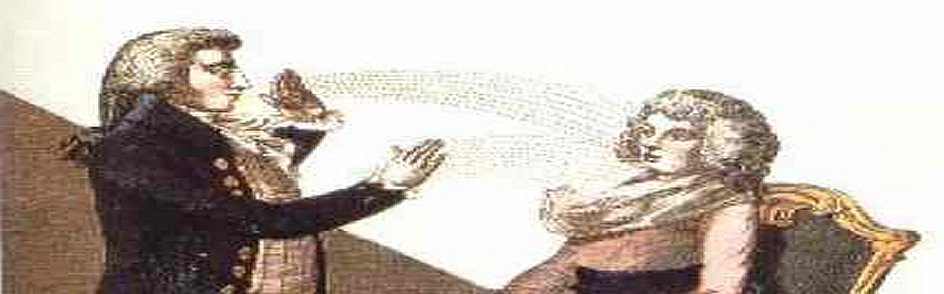
Mesmer – Father of Modern Psychotherapy
In about the year 1775 Mesmer, a qualified doctor three times over, began to experiment with magnets. He found that patients who had previously been incurable were healed when these were placed on their bodies. For a year he had a mania for experimenting with magnets in quite extraordinary ways. But within that period he realised the same healing results could be obtained without using the magnets. He found that simply by stroking or touching the patient along the line of the nerves, the muscles would begin to twitch. This twitching, he said, should not cause alarm, even if it led, as it usually did, to an intensification of the patient’s symptoms or even convulsive movements. Throughout these releases, noisy and explosive though they were, he saw how patients could experience a healing of the distressing symptoms.
Prior to this time these convulsive releases were considered to be the work of devils or spirits. This attitude arose out of Christian belief, and Jesus and the disciples clearly used the same technique. In the New Testament are descriptions of people cured by these convulsive releases. Mesmer is a transforming link with our own times because his approach to this phenomena was an experimental and evaluative one. Nevertheless he was still bound to the past by his belief that another human beings presence was necessary to act as a channel for a cosmic energy to reach the sick person. Thus he still remained, in this aspect, in connection with the guru as agent of change tradition.
Stefan Zweig, in his book Mental Healers, describes Mesmer’s way of working as follows:
With a serious and dignified mien, calmly, slowly, radiating tranquillity he would draw near to the patients. At his proximity a gentle fit of trembling would spread through the assembly. He wore a lilac robe, thus calling up the image of a Zoroastrian or Indian magician.
Usually no great time elapsed before one or the other of the company would begin to tremble, then the limbs would twitch convulsively, and the patient would break out in perspiration, scream or groan. No sooner had such tokens manifested themselves in one member of the chain, than the others too, would feel the onset of the famous crisis which was to bring relief. Some would fall to the ground and go into convulsions, others would laugh shrilly, others would scream, and choke, and dance like dervishes, others would appear to faint or sink into a hypnotic sleep. According to Mesmer’s ‘theory of crisis’ the malady had to be provoked into its utmost marge of development, it had so to speak to be sweated out of the organism if the body was to retain healthy.
The importance of Mesmer to the history of homeostasis is that, to the individuals who claim to have ‘discovered’ a new approach to human ills via abreaction, or say they have channelled a new cosmic force for the use of humanity, Mesmer stands as a direct contradiction. Three hundred years ago, despite his exotic dress and manner, he ran individual and group psychotherapy of a very successful nature. Although he thought of himself as a channel for a cosmic energy, he nevertheless recognised an agent other than technical psychiatric skill at work. Perhaps the ‘cosmic energy’ theory was not so far out either, as Reich revived it in new form in our own century. The work of Mesmer gradually moved into greater and greater complication — people dancing around trees for instance — instead of simplification and clarity. Out of it came Mesmerism which took the form of positive suggestion, completely leaving behind the aspect of allowing the organism to discharge its own tension and negativity. The spontaneous forces capable of self healing were ignored — even suppressed. The vainglorious power or forceful skill of the mesmerist or therapist took its place.
If you read widely enough you begin to see that throughout the ages, in the different religions and traditional practices of East and West, there was a certain similarity. This was not apparent unless you could see right through to what the fundamental essence of the practices were. For instance one of the books I read was the life of Anton Mesmer, the father in the West of what has become hypnotism and psychotherapy. What Mesmer stumbled upon was that, while experimenting with magnets on patients who had some physical or psychological problem, they began to tremble or experience spontaneous movements and often relived the source of their trauma and arrived at a cure.
When I put this together with the description of the Christian Pentecost or the practice of Seitai in Japan, I saw that fundamentally they were the same. With Mesmer he thought at first it was the magnets producing the release, but later discarded the idea and thought that perhaps it was his own personal magnetism. But when I compare that with what happened at Pentecost, and other similar practices East and West, I saw that fundamentally it was about the person relaxing and allowing spontaneous movements to occur. See Life’s Little Secrets
Mesmerism led to a perception among “therapists” that the entire social order could have resulted from suggestion. Many viewed mesmerism not just as a means of correcting the problems of an individual but as a means of changing society. Quite a few of the men who signed the early documents triggering the French Revolution were also members of Franz Mesmer’s Society of Harmony.
One of the responses of the establishment was to proscribe mesmerism, and later hypnosis. Mesmerism remained officially banned for almost a hundred years; it took the influence of the most famous clinician of his day, Jean-Martin Charcot, to bring it back to the scientific domain.
The approach started by Mesmer has never completely died out. While living in Russia in 1912 Sir Paul Dukes met Lev Lvovitch who used a self regulatory method to deal with a variety of illnesses. He would stroke patients limbs and induce shaking and trembling. In his book Unending Quest he describes the case of a boy whose legs were paralysed. “There was a broken exclamation from the boy in the middle of the room. ‘It’s b-b—beginning!’ The lad was quivering from head to foot so much that he had to hold on to his chair.” After several treatments Dukes observed that the boy’s condition improved, and in a few weeks he was cured.
Only in very recent years has any serious scientific work been done in understanding what takes place in this healing which arises from within — with or without the help of an outside agent. Despite this research there is still virtually no socially established ways in which individuals are taught to trust their own internal processes. People in the West, and especially those trained in the helping professions, are forever committing the crime against human nature of ‘doing something’ to it, and seldom letting ‘It’ do something to them. Nevertheless some individuals and groups have done a tremendous amount to make us aware of our lack, and point out ways of overcoming it. Freud does not leave us with any sense of there being a powerful and helpful self—regulatory action in us. He gives no sense of finding a transformative power with which one can work toward spontaneous analysis and self help. But in Jung we find again and again very clear reference to what has been named in this book as homeostasis. See Functions of dreams
Comments
I never had a need to know my website.
I have always studied psychology. This is a very interesting site. Found it through a Facebook friend.