Author Archive
Archetype of the Home
Archetype of Marriage
Brick In The Wall
Gnosticism Gnostic Texts
GNOSTICISM
By an Unknown Editor
What is Gnosticism?
Gnosis and gnosticism are still rather arcane terms, though in the last two decades the words have been increasingly encountered in the vocabulary of contemporary society. Gnosis derives from Greek, and connotes “knowledge” or the “act of knowing”. (On first hearing, it is sometimes confused with another more common term of the same root but opposite sense: agnostic, literally “not knowing”, a knower of nothing.) The Greek language differentiates between rational, propositional knowledge, and the distinct form of knowing obtained not by reason, but by personal experience or perception. It is this latter knowledge, gained from experience, from an interior spark of comprehension, that constitutes gnosis.
In the first century of the Christian era this term, Gnostic, began to be used to denote a prominent, even if somewhat heterodox, segment of the diverse new Christian community. Among these early followers of Christ, it appears that an elite group delineated themselves from the greater household of the Church by claiming not simply a belief in Christ and his message, but a “special witness” or revelatory experience of the divine. It was this experience, this gnosis, which–so these Gnostics claimed–set the true follower of Christ apart from his fellows. Stephan Hoeller explains that these Gnostic Christians held a “conviction that direct, personal and absolute knowledge of the authentic truths of existence is accessible to human beings, and, moreover, that the attainment of such knowledge must always constitute the supreme achievement of human life.”
What the “authentic truths of existence” affirmed by the Gnostics were will be briefly reviewed below. But a historical overview of the early Church might first be useful. In the initial decades of the Christian church–the period when we find first mention of “Gnostic” Christians–no orthodoxy, or single acceptable format of Christian thought, had yet been defined. During this first century of Christianity modern scholarship suggests Gnosticism was of many currents sweeping the deep waters of the new religion. The ultimate course Christianity, and Western culture with it, would take was undecided at that early moment; Gnosticism was one of forces forming that destiny.
 |
|
That Gnosticism was, at least briefly, in the mainstream of Christianity is witnessed by the fact that one of the most prominent and influential early Gnostic teachers, Valentinus, may have been in consideration during the mid-second century for election as the Bishop of Rome. Valentinus serves well as a model of the Gnostic teacher. Born in Alexandria around A.D. 100, Valentinus had rapidly distinguished himself as an extraordinary teacher and leader in the highly educated and diverse Alexandrian Christian community. In the middle of his life, around A.D. 140, he migrated from Alexandria to the Church’s evolving capital, Rome, where he played an active role in the public life of the Church. A prime characteristic of the Gnostics was their propensity for claiming to be keepers of secret teachings, gospels, traditions, rituals, and successions within the Church — sacred matters for which many Christians were (in Gnostic opinion) simply either not prepared or not properly inclined. Valentinus, true to this Gnostic penchant, professed a special apostolic sanction. He maintained he had been personally initiated by one Theudas, a disciple and initiate of the Apostle Paul, and that he possessed knowledge of teachings and perhaps rituals which were being forgotten by the developing opposition that became Christian orthodoxy. Though an influential member of the Roman church in the mid-second century, by the end of his life some twenty years later he had been forced from the public eye and branded a heretic.
While the historical and theological details are far too complex for proper explication here, the tide of history can be said to have turned against Gnosticism in the middle of the second century. No Gnostic after Valentinus would ever come so near prominence in the greater Church. Gnosticism’s secret knowledge, its continuing revelations and production of new scripture, its ascetheticism and paradoxically contrasting libertine postures, were met with increasing suspicion. By A.D. 180, Irenaeus, Bishop of Lyon, was publishing his attacks on Gnosticism as heresy, a work to be continued with increasing vehemence by the orthodox church Fathers throughout the next century.
The orthodox catholic church was deeply and profoundly influenced by the struggle against Gnosticism in the second and third centuries. Formulations of many central traditions in orthodox theology came as reflections and shadows of this confrontation with the Gnosis. But by the end of the fourth century the struggle with the classical Gnosticism represented in the Nag Hammadi texts was essentially over; the evolving orthodox ecclesia had added the force of political correctness to dogmatic denunciation, and with this sword so-called “heresy” was painfully cut from the Christian body. Gnosticism, which had perhaps already passed its prime, was eradicated, its remaining teachers murdered or driven into exile, and its sacred books destroyed. All that remained for scholars seeking to understand Gnosticism in later centuries were the denunciations and fragments preserved in the patristic heresiologies.
Discovery of the Nag Hammadi Library
It was on a December day in the year of 1945, near the town of Nag Hammadi in Upper Egypt, that the course of Gnostic studies was radically renewed and forever changed. An Arab peasant, digging around a boulder in search of fertilizer for his fields, happened that day upon an old, rather large red earthenware jar. Hoping to have found buried treasure, and with due hesitation and apprehension about the jinn, the genie or spirit who might attend such an hoard, he smashed the jar open with his pick. Inside he discovered no treasure and no genie, but books: more than a dozen old papyrus books, bound in golden brown leather. Little did he realize that he had found an extraordinary collection of ancient texts, manuscripts hidden up a millennium and a half before (probably deposited in the jar around the year 390 by monks from the nearby monastery of St. Pachomius) to escape destruction under order of the emerging orthodox Church in its violent expunging of all heterodoxy and heresy.
How the Nag Hammadi manuscripts eventually passed into scholarly hands, is a fascinating even if too lengthy story to here relate. But today, now fifty years since being unearthed and more than two decades after final translation and publication in English as The Nag Hammadi Library, their importance has become astoundingly clear: These thirteen beautiful papyrus codices containing fifty-two sacred texts are the long lost “Gnostic Gospels”, a last extant testament of what orthodox Christianity perceived to be its most dangerous and insidious challenge, the feared opponent that the Patristic heresiologists had reviled under many different names, but most commonly as Gnosticism. The discovery of these documents has radically revised our understanding of Gnosticism and the early Christian church.
Overview of Gnostic Teachings
With that abbreviated historical interlude completed, we might again ask, “What was it that these “knowers” knew?” What made them such dangerous heretics? The complexities of Gnosticism are legion, making any generalizations wisely suspect. While several systems for defining and categorizing Gnosticism have been proposed over the years, none has yet gained any general acceptance. So with advance warning that this is most certainly not a definitive summary of Gnosticism and its many permutations, we will outline just four elements generally agreed to be characteristic of Gnostic thought.
The first essential characteristic of Gnosticism was introduced above: Gnosticism asserts that “direct, personal and absolute knowledge of the authentic truths of existence is accessible to human beings,” and that the attainment of such knowledge is the supreme achievement of human life. Gnosis, remember, is not a rational, propositional, logical understanding, but a knowing acquired by experience. The Gnostics were not much interested in dogma or coherent, rational theology–a fact which makes the study of Gnosticism particularly difficult for individuals with “bookkeeper mentalities”. (Perhaps for this very same reason, consideration of the Gnostic vision is often a most gratifying undertaking for persons gifted with a poetic ear, as Harold Bloom has amply witnessed in his last several books). One just cannot cipher up Gnosticism into syllogistic dogmatic affirmations. The Gnostics cherished the ongoing force of divine revelation–Gnosis was the creative experience of revelation, a rushing progression of understanding, and not a static creed. Carl Gustav Jung, the great Swiss psychologist and a life-long student of Gnosticism in its various historical permutations, affirms, “we find in Gnosticism what was lacking in the centuries that followed: a belief in the efficacy of individual revelation and individual knowledge. This belief was rooted in the proud feeling of man’s affinity with the gods….
In his recent popular study, The American Religion, Harold Bloom suggests a second characteristic of Gnosticism that might help us conceptually circumscribe its mysterious heart. Gnosticism, says Bloom, “is a knowing, by and of an uncreated self, or self-within-the self, and [this] knowledge leads to freedom….” Primary among all the revelatory perceptions a Gnostic might reach was the profound awakening that came with knowledge that something within him was uncreated. The Gnostics called this “uncreated self” the divine seed, the pearl, the spark of knowing: consciousness, intelligence, light. And this seed of intellect was the self-same substance of God, it was man’s authentic reality; it was the glory of humankind and the divine alike. If woman or man truly came to gnosis of this spark, she understood that she was truly free: Not contingent, not a conception of sin, not a flawed crust of flesh, but the stuff of God, and the conduit of God’s immanent realization. There was always a paradoxical cognizance of duality in experiencing this “self-within-a-self”. How could it not be paradoxical: By all rational perception, man clearly was not God, and yet in essential truth, was Godly. This conundrum was a Gnostic mystery, and its knowing was their greatest treasure.
The creator god, the one who claimed in evolving orthodox dogma to have made man, and to own him, the god who would have man contingent upon him, born ex nihilo by his will, was a lying demon and not God at all. Gnostics called him by many names — many of them deprecatory — names like “Saklas”, the blind one; “Samael”, god of the blind; or “the Demiurge”, the lesser power.
Theodotus, a Gnostic teacher writing in Asia Minor between A.D. 140 and 160, explained that the sacred strength of gnosis reveals “who we were, what we have become, where we have been cast out of, where we are bound for, what we have been purified of, what generation and regeneration are.” ” Yet”, the eminent scholar of Gnosticism, Elaine Pagels, comments in exegesis, “to know oneself, at the deepest level, is simultaneously to know God: this is the secret of gnosis…. Self-knowledge is knowledge of God; the self and the divine are identical.”
The Gospel of Thomas , one of the Gnostic texts found preserved in the Nag Hammadi Library, gives these words of the living Jesus: Jesus said, `I am not your master. Because you have drunk, you have become drunk from the bubbling stream which I have measured out. He who will drink from my mouth will become as I am: I myself shall become he, and the things that are hidden will be revealed to him.’
He who will drink from my mouth will become as I am: What a remarkably heretical image! The Gospel of Thomas, from which we take that text, is an extraordinary scripture. Professor Helmut Koester of Harvard University notes that though ultimately this Gospel was condemned and destroyed by the evolving orthodox church, it may be as old or older than the four canonical gospels preserved, and even have served as a source document to them. This brings us to the third prominent element in our brief summary of Gnosticism: its reverence for texts and scriptures unaccepted by the orthodox fold. The Gnostic experience was mythopoetic – in story and allegory, and perhaps also in ritual enactments, Gnosticism sought expression of subtle, visionary insights inexpressible by rational proposition or dogmatic affirmation.
For the Gnostics, revelation was the nature of Gnosis: and for all the visions vouchsafed them, they affirmed a certainty that God would yet reveal many great and wonderful things. Irritated by their profusion of “inspired texts” and myths–most particularly their penchant for amplifying the story of Adam and Eve, and of the spiritual creation which they viewed as preceding the material realization of creation– Ireneaus complains in his classic second century refutation of Gnosticism, that every one of them generates something new, day by day, according to his ability; for no one is deemed perfect [or, mature], who does not develop…some mighty fiction.
The fourth characteristic that we might delineate to understand classical Gnosticism is the most difficult of the four to succinctly untangle, and also one of the most disturbing to subsequent orthodox theology. This is the image of God as a diad or duality. While affirming the ultimate unity and integrity of the Divine, Gnosticism noted in its experiential encounter with the numinous, dualistic, contrasting manifestations and qualities. Consider the Gnostic affirmation that man, in some essential reality, is also God. This is a statement tinged with duality: Man, though not God, is. Another idea, offered by the Manichaean gnostic Faustus, that both matter (hyle) and the divine spirit are uncreated and coeternal was violently attacked by Augustine in his essay Contra Faustum as heretical, dualistic thinking.
In many of the Nag Hammadi Gnostic texts God is imaged not just as a duality, or diad, but as a unity of masculine and feminine elements. Though their language is specifically Christian and unmistakably related to the Jewish tradition, Gnostic sources continually use sexual symbolism to describe God. Prof. Pagels explains;
One group of gnostic sources claims to have received a secret tradition from Jesus through James and through Mary Magdalene [who the Gnostics revered as consort to Jesus]. Members of this group prayed to both the divine Father and Mother:
`From Thee, Father, and through Thee, Mother, the two immortal names, Parents of the divine being, and thou, dweller in heaven, humanity, of the mighty name…’
Several trends within Gnosticism saw in God a union of two disparate natures, a union well imaged with sexual symbolism. Gnostics honored the feminine nature and, in reflection, Prof. Elaine Pagels has argued that Christian Gnostic women enjoyed a far greater degree of social and ecclesiastical equality than their orthodox sisters. Jesus himself, taught some Gnostics, had prefigured this mystic relationship: His most beloved disciple had been a woman, Mary Magdalene, his consort. The Gospel of Philip relates “…the companion of the Savior is Mary Magdalene. But Christ loved her more than all the disciples, and used to kiss her often on her mouth. The rest of the disciples were offended… They said to him, “Why do you love her more than all of us? The Savior answered and said to them, “Why do I not love you as I love her?”
The most mysterious and sacred of all Gnostic rituals may have played upon this perception of God as “duality seeking unity.” The Gospel of Philip (which in its entirety might be read as a commentary on Gnostic ritual) relates that the Lord established five great sacraments or mysteries: “a baptism and a chrism, and a eucharist, and a redemption, and a bridal chamber.” Whether this ultimate sacrament of the bridal chamber was a ritual enacted by a man and women, an allegorical term for a mystical experience, or a union of both, we do not know. Only hints are given in Gnostic texts about what this sacrament might be:
Christ came to rectify the separation…and join the two components; and to give life unto those who had died by separation and join them together. Now a woman joins with her husband in the bridal [chamber], and those who have joined in the bridal [chamber] will not re-separate.
We are left with our poetic imaginations to consider what this might mean. Orthodox polemicists frequently accused Gnostics of unorthodox sexual behavior. But exactly how these ideas and images played out in human affairs remains historically uncertain.
Classical Christian Gnosticism vanished from the Western world during the fourth and fifth centuries. But the Gnostic world view — with its affirmation of individual revelation granting certain knowledge; comprehension of humankind’s true uncreated nature and inherent affinity or even identity with God; and its perception of duality, or even in an extreme statement, of masculine and feminine elements seeking union within the divine–was not so easily extinguished. Such perceptions continued in various forms to course through Western culture, though, perforce, often in very occult ways. Gnosticism was, and remains today, a living tradition, a tradition eternally reborn in the gnosis kardia of humankind.
Gnosticway http://www.gnosticway.org/principles.htm
Principles
We, the members of this Ministry hold the Holy Scriptures as contained in the New Testaments, the Gnostic Scriptures, and the Apocryphal writings of the early church as our rule of Faith and Practice.
Our main purpose is to enrich the lives of all peoples through our service to the Christian Word and Christ, who is Jesus. We do this regardless of race, gender, sexual orientation, background or other church or religious affiliations.
We believe in one God, Christ, the Holy Spirit and the divinely inspired writings of the Bible as well as apocryphal works.
We believe in the power of prayer when properly applied.
We believe that Men and Women should be given the opportunity to become useful citizens, doing meaningful work and be encouraged to help others find their purpose and higher self image.
We believe in allowing individual responsibility and spiritual growth, and in allowing each person to do God’s work as it is revealed to them.
We further declare and agree:
Creation is the extension of the Creator and is the Creator.
The Creator is all in all, the beginingless beginning and the end without end. The creation is the sonship of the creator and is one with the creator.
Nothing and no one stands between the sonship and the creator.
Truth is accessible, knowable, and all inclusive.
Truth allows for every experience for everyone so that truth may be known.
Truth is equal to love.
Love is all embracing and all inclusive.
Truth and love as each individual understands and lives is what leads each one to greater understanding the truth of Creation and Creator.
All wisdom teachings that promote unconditional love and brotherhood are accepted and embraced.
All teachers of unconditional love and brotherhood are accepted and embraced.
No book or writing or person of any kind is greater than the individual and personal relation to Creator.
Creator’s perfect love is expressed through each one, and each one’s desires. We are extensions of love, the love of the Creator.
We are extensions of each other.
The sonship is one.
The Creator, being perfect, is beyond worship and praise and possesses no ego.
The Creator and Creation is held in awe.
Each one, therefore, is also held in awe and in love to the best of one’s ability.
Where we may fall short in this love we know that love is also in us being renewed and restored and expanded.
There is no ultimate destination except here where love has placed us to be that love that we are in the ways that we understand.
The Kingdom of Heaven is here and now, within and without, seen and unseen, therefore love and blessings are not to be withheld from one another in preparation for another Heaven which exists in the sky and solely after physical death and transformation.
In the understanding that we are each other, we seek to harm no one in any way to the best of our understanding. War, capital punishment, human rights violations are seen as contrary to our understanding yet condemnation for anything, by any one is also contrary to our understanding.
All is forgiven, forever, without limit.
Truth/Love is all there is, even when beyond comprehension or understanding by anyone including ourselves.
We believe in allowing all beliefs and ideas, knowing that the underlying truth cannot be changed and that love, being our true nature, has no concern for it’s existence, as it is all in all, regardless of opinion.
We are free, creative, creations, and co-creators, as Creator extends all that it is to all, always in all ways so that truth/love may always be and become more of itself without end.
We hereby declare our loyalty to the President of the United States of America and to the Constitution of the United States of America. We pledge allegiance to the Republic of the United States of America.
However, as members of the community of Christ as well as peace-loving and law-abiding citizens, we claim our heritage and natural right to worship God according to these dictates and our own conscience. Therefore, we abhor war, for we believe that the shedding of human blood or the taking of human life in anger is contrary to the teachings of our Lord, Christ, who is Jesus. Moreover, as a body of Christians we are adverse to war in all of its forms, and believe in the peaceful settlement of all disputes. Therefore, we claim the right to not participate in military service, actions, or causes.
We further believe in the right of divine judgment. Therefore as members of the community of Christ we do not participate as judges or jurors in trials which could strip a human being of life, liberty, or property. God alone knows all that is required to make judgment.
We believe that God, Creator of the Universe, has spoken to Mankind in the past and continues to speak today. Therefore, we hold as sacred inspired texts of the modern age as well as those contained in what is traditionally called “the Bible.”
We believe that the Old Testament was replaced by Christ’s revelations and teachings when he took human form. Therefore, precepts and laws of the Old Testament have been replaced by Christ’s fundamental teachings: Love the Lord your God with all your heart and all your soul. Love your neighbor as yourself. This statement underscores the base belief that all are connected in God and Creation and Christ.
Our Beliefs
We believe in the Divinity of all Humans and creation.
We believe that life has no beginning and no end.
We believe that each person through their direct connection with God, Universe, or Creator can create whatever they choose in their life.
We believe that Jesus (Jeshua ben Josef) embodied the full Sophia (Wisdom) of God and Creation, revealing this potential in everyone.
We believe that the message Jesus brought was culturally appropriate to those He spoke to and who respond even now to His message.
We believe that all religions and spiritual paths serve ultimate Truth and Divinity.
We believe that souls continue to exist in non-physical form after physical death even as they are connected to non-physical now.
We believe that all mankind has been endowed with prophetic and spiritual abilities.
We believe that divination is simply a pathway to clearer self understanding.
We believe in Universal Love expressed in all forms.
We believe in the right of the individual to choose their moral and spiritual path.
We believe that all decisions made in love with the New Covenant as a guideline are appropriate.
We believe in the New Covenant of Christ: Love the Lord, your God, with all your heart and with all your soul and Love your neighbor as yourself.
We believe in the validity of all documents truly expressing Christ’s love and God’s love in the world, be they canonical or apocryphal.
We believe that the “rites” of the church are secondary to a direct relationship with God and are not necessary for any type of “salvation.”
We believe that the message of God’s eternal and unbounded love is not expressed in only one form, Christianity. We therefore, believe the practice of “evangelism” or the attempts to subvert other spiritual paths to Christianity by fear, force, or law is inappropriate.
Movements of Life
The series of movements were arrived at in a special way. After I had learnt to allow spontaneous movement and my body and mind felt expressive in it, I found the spontaneous movements would respond to a question. For example if I had a dream that puzzled me, I could ask what a particular figure in it represented, and my body would respond spontaneously in a descriptive mime. Because the information the mime presented often added to what I knew consciously, I felt the ‘answer’ that arose through movement was expressing unconscious insights.
One day I was experimenting with this question and response, and asked what would be a helpful way to bring the body and mind to harmony. I was astonished as an extremely long and detailed response flowed spontaneously from me. Movement after movement arose apparently from my unconscious, along with an understanding of how the movements influenced basic biological and psychological processes such as introversion and extroversion of energy and awareness. As I used these movements, I realised they are not simply exercises to make the body active and stimulated. For instance if I cannot breathe properly I am not functioning well. If my hips are locked in tension and my pelvis cannot express tender sexual feelings, or if my abdomen is tight and my internal organs cannot digest food properly, then the basic urges of life are being interfered with. The exercises loosen the body in a way to allow a more fuller expression of these basic life-movements – such as the expansion and contraction of the chest in relationship to the spine; the swinging pelvis expressing sexuality and its connection with the chest, neck and head. Tensions restricting the way life-processes expresses in movements such as breathing lie at the root of much physical and psychological illness.
The following movements are those I learnt that day. If you enjoy them and have time, by all means do the movements consecutively. They are excellent for health in themselves, but they are not spontaneous movement. They are given to warm your body and help mobilisation and internal balancing.
Use these movements at least three times over a period of a week or so, before going on to the next phase. Practice each movement for between one minute to three minutes, depending on your energy and time. Try doing them with music sometime to see if it aids the good feelings they can produce. Later suggestions for types of music are given in detail. At this point something fairly flowing without too much drama in it.
These are only warm-up movements, they are not inner-directed movement. Inner-directed movement, once learnt, can be used easily and for a few minutes. There is not a long list of ‘movements’ to use in the proper practice, although there are a variety of ways you can use it.
It is helpful to ‘meditate’ on some of the movements after performing them. This means that you try to recreate the feelings, or sensation of the movement again without allowing your body to make the movement. The idea is to exercise your inner awareness and feelings of energy movement. So in the third of the movements, the pelvic swing, you would create the feeling of the hips pushing forward and up, followed by the pulling back and down of the pelvis. This meditation exercise is important as it enables you to gain some control of your inner feelings. Often such feelings are stimulated by external events or unconscious worries. Your meditation is harmonising and balancing these feelings.
These movements take time, so if you are not able to do them all in sequence, do those you can within the time available and work through the other movements during future sessions. You need a reasonable space – something at least the size of a single blanket, so you can feel free to move without bumping into things.
Squatting and Rising
This first movement you start from a standing position. With feet slightly apart you take an in-breath, and as you reach the high point of inhalation you take head and arms backwards to really open up the chest. From that standing position with head back you then begin to breath out and bend the knees so that you can drop quickly into a squat. As you do so let the arms move forward and up so the hands come palms together near to the face. Meanwhile you drop into a squatting position expelling your breath fast as you go down. You rest there for a moment and then the movement carries on by breathing in and rising back up to the first position again. So you slowly stand as you breath in, then when standing expand the rib cage again by opening the arms slightly backwards and apart, and taking the head slightly back.
When you get used to the movement, going down into the squat position should be done fairly fast with the out-breath quite strong so there is an audible blowing of air out of the lungs. It can be done gently, but if possible, do it strongly as the body drops. Let the hips go down as far as you comfortably can, and let the head collapse down too so the body is relaxed. Some people need to put their heels on books to make squatting comfortable, so do that if necessary. The hands come forward in a scything movement until they meet just above the dropped head. If you cannot squat so low, use a stool or chair to sit on as you go down, so you only drop a short way.
At least two feeling states are involved in this movement. One is the standing erect and ‘open’ feeling. The other is the down, closed and relaxed feeling. When you feel fluid in the movement see if you can enhance these feeling changes as you move between the opposites of up and down. While down feel the relaxed letting-go feeling. While up feel the active, energetic feeling.
- In this first movement you start from a standing position, with feet slightly apart.
- Take an in-breath, and as you reach the high point of inhalation take head and arms slightly backwards to widen the chest.
- From the standing position you then begin to breathe out and bend the knees so that you can drop into a squat. Let your arms move forward and up so the hands come palms together near to the face and expel your breath while dropping into the squatting position .
- At this point you should be squatting with head relaxed forward. Rest there for a moment and then carry the movement on by breathing in and rising back to the first position again. This means you have slowly stood as you breathed-in, and expanded the rib cage again by opening the arms slightly backwards and apart, letting the head drop slightly back.
- Repeat the cycle of Squatting and rising in your own time.
- Now ‘meditate’ the movement for about a minute. This means standing or sitting with eyes closed and imagining doing the movement, but hardly moving your body. Try to reproduce the feelings of the movement. Feel the relaxed, down condition, then move into the up, dynamic feeling. This is an important exercise in becoming aware of the subtle feelings connected with movement, and learning to mobilise them.
Circling the Hips
Suggestions – To get the movement satisfyingly mobile, it is helpful to imagine yourself standing in the middle of a large barrel. The aim is then to run your hips around the inside of the barrel, touching it all the way around. This helps to get the full circling of the pelvis. So, as the hips are circling back the trunk is bent slightly forward, but still with the head high. The hips should go well out to the side, and as they swing to the front they should be far forward enough to cause the trunk to be inclined slightly backwards. If you cannot manage this at first, simply do what you can.
The knees and ankles should be kept relaxed, as should the hips themselves, so they adapt to the circling. The breathing should then also find its own rhythm. Generally it is out as the hips swing forward, and in as they swing backwards. This is because the chest is slightly compressed as the hips are forward if the head is floating erect.
1 Begin from a standing position as the first, but feet slightly farther apart, about shoulder width.
2 Keeping your head and shoulders more or less floating in the same position, circle the hips horizontally. The pelvis is taken gradually into a wide circle.
3 At half time rotate the hips in the opposite direction for the rest of the time.
4 Meditate the movement for about one minute. You can stand or sit to do this.
Pelvic Swing
Suggestions – If you imagine a vertical circle – seen from one side of your body – and move the hips around it fluidly while letting the legs and trunk follow, that is the movement. Although simple this is an important movement as far as becoming aware of the subtler side of your own being is concerned.
The movement is similar to the backward and forward movement of sexual intercourse, except that it is circular and involves bending and straightening the legs. But it does still involve the pelvis swinging backwards and forwards. Do the movement until you can feel your body loosening and flowing more easily. Then, do the movement slowly, being aware of the different feelings of the pelvis being forward and backward. These feelings are quite subtle, but are strong enough to be easily noticed if the movement is done with awareness of the change.
1 Standing with your feet about a foot apart move your pelvis backwards – as if starting to sit down – to begin a circle. This half sitting position brings the head and trunk forward and bends the knees slightly .
2 Start to push the hips well forward. As you do so the knees are straightened again, and this completes the full circle with the hips in a way that describes or ‘draws’ a vertical circle.
3 Do the movement in a way that keeps the hips swinging in the circle in a continuous flow.
4 Meditate the movement while sitting or standing.
Roller Skating
Suggestions – If possible let most of the movement occur from below the navel. You can keep your eyes looking ahead, your arms swinging in time with the hips as well to let the body move fully. But it is the lower back that is being worked here. The movement massages the lower internal organs as well, so you may get the stitch until you adapt to the exercise. Do the movement fairly vigorously. If you do get the stitch, don’t stop altogether, just slow down. The movement will then massage the area of discomfort.
1 Stand with feet a little wider than shoulder width, with trunk bent forward and knees bent also. Your back should be reasonably straight although at an incline.
2 Now swing the hips from side to side, making the lowest part of the spine alternate to the left and right.
3 When finished meditate the movement.
Swinging the Trunk
Suggestions – Be careful to check how slippery your feet are on the floor surface. If you cannot easily maintain a feet wide position, it may help to stand with bare feet. The movement is an active one, with a light pause as you reach top and bottom. Some people like to allow their arms to extend in a wide arc as they come up. It feels more balanced. Also, as you come to the upright position with the in-breath, let the head drop back slightly, and arms extend sideways and back to increase the chest stretch. This balances the deep exhalation accomplished by dropping the trunk forward.
This is a very pleasing movement, and because it connects with the breath cycle, develops a particular rhythm. If you can manage it without becoming giddy, let the exhaling of breath as you go down be quite energetic.
1 Stand with the feet about twice shoulder width.
2 Let your head and trunk drop forward, and the arms hang relaxed, allowing the spine to be gently stretched.
3 When you feel your spine has adapted to the position, from an out-breath swing your head and trunk to the left, allowing it to roll over and up to the standing position as you breathe in.
4 Drop the trunk downwards in the mid-line again, breathing out – do it fairly fast – then roll head and trunk to the right as you come up and breathe-in again.
5 Continue the cycle with a slight pause at the high and low of each swing.
6 When finished meditate the movement, reproducing the relaxed drooping feeling, and the active, ‘up’ feeling.
Surrendering Backwards
This movement works the abdominal muscles quite strongly, and needs to be approached slowly until you feel confident and able in it. It is not primarily a physical exercise. It is an expression of letting-go of self, of surrendering. You start with feet about shoulder width apart. The aim of the movement is not to see how far backwards you can go. It is to express the feeling of letting go of self, of dropping control in a disciplined way. At first, when the head and shoulders are back, hold the position for a very short time, then recover to the upright stance. As you get used to the movement, you can stay in the surrendered position longer – just as long as is comfortable – then recover.
1 From an in- breath you drop your head slowly back and breathe out, allowing your head, shoulders and trunk to drop slightly backwards with the arms limp.
2 If you are comfortable in that breathe as normally as you can while your trunk is backwards.
3 Hold for a short time then return to the upright position.
4 Repeat several times.
5 Meditate on the movement, moving between the surrendered feeling and the taking control upright feeling.
Sideways Lunge
This movement uses the legs a lot more, and introduces more spinal twist. Because you are reaching forwards with the opposite hand to the bent kneed, there is a common tendency for people to extend the whole trunk forward too, and that is unnecessary. The trunk curves upright from the trailing leg. The breathing sequence for this is out as you lunge, in as you centre again.
When you are reasonably capable at the movement try doing it as slowly as possible. Make the breath slow, and move in time with the breath – out as you lunge and in as you centre. This is a very powerful movement so don’t attempt too many repetitions at first.
1 You start with feet about a metre apart in a standing position, with the hands palms together in front of the chest.
2 Turn the left foot to point to the left and turn the trunk to face in that direction also.
3 Let the left knee bend until the hips drop right down near the left heel. To make this easier, let the left heel rise if necessary. In other words, don’t try to keep the foot flat on the floor unless this is easy. Meanwhile the right leg is trailing, forming an curve from the floor up along the spine. The right knee is on the floor but hardly bent.
4 As you lunge to the left, let the right hand reach forward in the direction you are lunging. The right arm stretches out backward toward the right foot – i.e., in the same direction as the right foot. This gives a slight spinal twist.
5 From the lunge position, using the strength of the left leg, push back into the upright position until the trunk faces forward, and bring the hands to the centred position in front of the chest again.
6 From the centred position you lunge to the right. Don’t forget that it is now the left arm you extend forwards – always the opposite hand.
7 Pause in the lunge, then, using the strength of the right leg push up and centre again.
8 With a slight pause at each lunge, and while ‘centred’, repeat the movement alternatively to left and right.
9 Meditate on the movement, remembering to get the ‘centred’ poised feeling between each imagined lunge.
Spinal Twist
This is more of a spinal twist, more so than the last. The arms are extended describing a wide arc, and coming to rest where you feel comfortable, but not floppy. The breath cycle is to complete exhalation as the spinal twist is complete, and to complete inhalation as you reach midpoint between the left and right twist. Like the previous exercise, if the breathing is united with the movement, it makes for a more satisfying experience. Once you have got the feel for integrating breathing and movement, perform this one fairly slowly and purposefully.
1 – Stand with feet a little wider than shoulder width and with hands at your sides.
2 – Leading with the head, turn to the left, letting your arms describe a wide circle, and continuing their movement when head and trunk can turn no further. As the trunk turns to the left, let the feet and knees accommodate the twist, so when you have turned as far as you can to the left, your left knee is slightly bent in a semi lunge to allow the fullest twist, and your foot is pointing to the left.
3 – Now turn from there to the right, going round as far as you can, fairly slowly to let the feet and legs change.
4 – Continue this slow swing, making sure you allow a semi-lunge at the end of each swing. This gives a little more twist.
5 – |Meditate on the movement.
The Swinging Rib-cage
This exercise aims at mobilising the rib cage in one of its movements seldom made in everyday life. To make sure your movement is actually doing what it should, it is helpful at first to practice in front of a mirror. Keeping the hips still and rib-case centred, hold your index fingers about two inches away from each side of your lower ribs. Now see if you can swing the ribs sideways towards the extended but still finger without swaying the whole trunk and hips sideways as well. At first it might be that you do not know just what muscles to move to accomplish this, but with practise it becomes simple.
Like one of the earlier movements, this one may cause you to develop a `stitch’ if you do it fairly actively. This is because it strongly massages the internal organs, and this is a healthful stimulus to them. It may also cause an unusual bellows action with the lungs, causing a pumping of air in and out of the lungs without actually breathing. This is quite normal for the movement, and is not harmful. No need to meditate this one.
1 – Keeping the hips still, swing the lower ribs slightly sideways. If you do this with the right side of the rib-case, it causes the left shoulder to drop, and the right to rise. When you alternately swing to the right and left, the shoulders alternately rise and fall also.
2 – Therefore, if you lift and drop the shoulders alternately, this may help produce the extending of the rib-case, but not necessarily so. Many people move their shoulders thus, or swing their hips energetically, without their rib-case being mobilised at all.
3 – Swing alternatively left and right until you can do the movement easily.
The Crawl
Your attention has been moving up the body in this series of exercises, and so are concentrating more on the chest and shoulders at the moment. This exercise is primarily to mobilise the shoulders and rib-case in relationship to the spine. But it also brings the arms into action in more than a supporting role.
It helps if you imagine the hands are pulling backwards through water. Meanwhile, the head and hips should remain facing forward, so the shoulders swing around the steady spine. The movement can be done slowly but strongly, or fast and energetically. This is a wonderful movement to massage neck and lungs.
1 – Start by standing with feet about shoulder width apart.
2 – Be aware of the knees, and keep them very slightly bent and relaxed.
3 – Keeping your head and hips still make the swimming movements of the ‘crawl’ with your arms. This means the right arm swings up and forward above the head as the left arm is low and moving backwards. Then the left arm is up and forward as the right drops.
4 – The movement is a slow circling of the arms.
5 – Finish with the still meditation of the movement.
The Breath Meditation
This is more of a meditation than an exercise, but is important in mobilising inner feelings that lie behind movements. When you begin this meditation, do not be in a hurry to open the hands to let the feeling of pleasure radiate out. In fact, let the hands be as spontaneous in expressing what you feel as you can. It may be that your hands thereby move a great deal, or very little. If there is an urge to move the hands in other ways than suggested allow this to happen.
1 – Stand in a comfortable balanced position with the hands in front of the chest, palms together and eyes closed.
2 – Imagine that as you breathe-in, the air is fanning a small glowing coal inside the chest. The incoming air makes the coal glow gently, and you breathe slowly and with awareness. This coal is just a symbol of the subtle pleasure sensations generated by slow purposeful inhalation. If you can be directly aware of this pleasure, dispense with the image of the coal.
3 – In either case, let the hands indicate the amount of this glow or pleasure. Let them do this by moving apart, so if the pleasure is intense the hands reach wide. As you exhale and the glow fades, let the hands come together. But if there is little felt, then the hands remain unopened.
Honey Plus Cinnamon
I haven’t tested these, but having had seven bee hives, and seen its curative power with open wounds, I fancy trying these.
Great information!! Cinnamon and Honey…! Drug companies won’t like this one getting around.
Facts on Honey and Cinnamon:
It is found that a mix of honey and cinnamon cures most diseases. Honey is produced in most of the countries of the world. Scientists of today also note honey as very effective medicine for all kinds of diseases. Honey can be used without side effects which is also a plus. Today’s science says that even though honey is sweet, when it is taken in the right dosage as a medicine, it does not harm even diabetic patients. Researched by western scientists:
HEART DISEASES: Make a paste of honey and cinnamon powder, put it on toast instead of jelly and jam and eat it regularly for breakfast. It reduces the cholesterol and could potentially save one from heart attack. Also, even if you have already had an attack studies show you could be kept miles away from the next attack. Regular use of cinnamon honey strengthens the heart beat. In America and Canada, various nursing homes have treated patients successfully and have found that as one ages the arteries and veins lose their flexibility and get clogged; honey and cinnamon revitalize the arteries and the veins.
 |
||
ARTHRITIS: Arthritis patients can benefit by taking one cup of hot water with two tablespoons of honey and one small teaspoon of cinnamon powder. When taken daily even chronic arthritis can be cured. In a recent research conducted at the Copenhagen University, it was found that when the doctors treated their patients with a mixture of one tablespoon Honey and half teaspoon Cinnamon powder before breakfast, they found that within a week (out of the 200 people so treated) practically 73 patients were totally relieved of pain — and within a month, most all the patients who could not walk or move around because of arthritis now started walking without pain.
BLADDER INFECTIONS: Take two tablespoons of cinnamon powder and one teaspoon of honey in a glass of lukewarm water and drink it. It destroys the germs in the bladder….who knew?
CHOLESTEROL: Two tablespoons of honey and three teaspoons of Cinnamon Powder mixed in 16 ounces of tea water given to a cholesterol patient was found to reduce the level of cholesterol in the blood by 10 percent within two hours. As mentioned for arthritic patients, when taken three times a day, any chronic cholesterol-could be cured. According to information received in the said Journal, pure honey taken with food daily relieves complaints of cholesterol.
COLDS: Those suffering from common or severe colds should take one tablespoon lukewarm honey with 1/4 spoon cinnamon powder daily for three days. This process will cure most chronic cough, cold, and, clear the sinuses, and it’s delicious too!
UPSET STOMACH: Honey taken with cinnamon powder cures stomach ache and also is said to clear stomach ulcers from its root.
GAS: According to the studies done in India and Japan, it is revealed that when Honey is taken with cinnamon powder the stomach is relieved of gas.
IMMUNE SYSTEM: Daily use of honey and cinnamon powder strengthens the immune system and protects the body from bacterial and viral attacks. Scientists have found that honey has various vitamins and iron in large amounts. Constant use of Honey strengthens the white blood corpuscles (where DNA is contained) to fight bacterial and viral diseases.
INDIGESTION: Cinnamon powder sprinkled on two tablespoons of honey taken before food is eaten relieves acidity and digests the heaviest of meals
INFLUENZA: A scientist in Spain has proved that honey contains a natural ‘Ingredient’ which kills the influenza germs and saves the patient from flu.
LONGEVITY: Tea made with honey and cinnamon powder, when taken regularly, arrests the ravages of old age. Use four teaspoons of honey, one teaspoon of cinnamon powder, and three cups of boiling water to make a tea. Drink 1/4 cup, three to four times a day. It keeps the skin fresh and soft and arrests old age. Life spans increase and even a 100 year old will start performing the chores of a 20-year-old.
RASPY OR SORE THROAT: When throat has a tickle or is raspy, take one tablespoon of honey and sip until gone. Repeat every three hours until throat is without symptoms.
PIMPLES: Three tablespoons of honey and one teaspoon of cinnamon powder paste. Apply this paste on the pimples before sleeping and wash it off the next morning with warm water. When done daily for two weeks, it removes all pimples from the root.
SKIN INFECTIONS:Applying honey and cinnamon powder in equal parts on the affected parts cures eczema, ringworm and all types of skin Infections.
WEIGHT LOSS:Daily in the morning one half hour before breakfast and on an empty stomach, and at night before sleeping, drink honey and cinnamon powder boiled in one cup of water. When taken regularly, it reduces the weight of even the most obese person. Also, drinking this mixture regularly does not allow the fat to accumulate in the body even though the person may eat a high calorie diet.
FATIGUE: Recent studies have shown that the sugar content of honey is more helpful rather than being detrimental to the strength of the body. Senior citizens who take honey and cinnamon powder in equal parts are more alert and flexible. Dr. Milton, who has done research, says that a half tablespoon of honey taken in a glass of water and sprinkled with cinnamon powder, even when the vitality of the body starts to decrease, when taken daily after brushing and in the afternoon at about 3:00 P.M., the vitality of the body increases within a week.
BAD BREATH: People of South America, gargle with one teaspoon of honey and cinnamon powder mixed in hot water first thing in the morning so their breath stays fresh throughout the day.
HEARING LOSS: Daily morning and night honey and cinnamon powder, taken in equal parts restores hearing.
Dear Me
By Brenda Blake
My dear Me – I am writing this to you as I wish to see you out of emotional and mental pain.
I can speak to you with real knowledge of you as I am you, the deeper and wiser you.
I want to tell you that I have great love for you and proud of the path you have taken and been true to for all these years.
Your knowledge is vast, your love and compassion also.
It pains me that you do not recognise this and own it. It’s as if you have glimpses, then moments when you let it go so I am writing to you not just to remind you of this greater being that you are, but to try and get you to stay with me always you know that looking outside for your answers does not work, that it is within the you that you think you are.
Though there have been several moments of knowing how vast- endless you really are.
I want you to surrender your painful emotions and thoughts to me, believe me when I say you will not feel empty or lost.
I have and always will be here with you, I know in your moments of silence you know that, and I know that you trust me completely.
You have been willing to work with me since childhood when you asked me to show you your shadow, not labelling who you asked, but followed my teachings regardless.
Trust me again as your life unfolds as the pain is taken away as the feelings of having to do it all on your own dissolves.
And you are reborn.
B.O.
Windmill
Windmills are used to drive millstones to grind corn to flour – in dream terms this means to make your personality in it ntaural form – the grain which is a seed – into flour – your ability to digest and understnad what you are experiencing. See Seed – Digest
The wind that drives it is an invisible force that can be gentle, but can ‘blow’ you into experiences that may be difficult – “The wind blows where it wants, and you hear the sound thereof, but can not tell from where it comes, and where it goes.” John 3:8
Journey Inwards
On an August day in the year 2017, I had the great pleasure of spending time with my life long friend Brenda O’Grady. As I have quoted elsewhere, “Where two or three are gathered together in My name, I am there in the midst of them.”
My take on this quote, that has been proved to me over and over by my experience, is that when even two people are together to explore and understand the inner life, a greater power to do so is experienced. It always feels to me that it is something beyond what I am capable of being or doing by myself.
On that day I set out to find the answer to a question I had been asking myself with no valuable results. The question was, “Is there anything arising from within me that I am not seeing, or is worth understanding?”
So, listening to the quietness within I sat with eyes closed and observed what arose. At first nothing but random spontaneous movements of my head. Movements suggesting looking for something. Then, quite soon something subtle began as the memory of my first dream of ‘The House of the Ancestors‘. It was such a pointed and significant dream, for I looked through a hole in the floor of this grand old house, and tried to bring up things belonging to my forbears using a rope, with no luck.
But while exploring what meaning the dreamt held within it, I realised I had the key to be able to open myself to what the message of my ancestors told me. But in today’s exploring I had passed that way before, and quickly went deeper, finding myself in the great catacombs or cavern. As I passed the grave of the woman, one of my spirits of a past dwelling place, who had died in the enormous pain of losing all her family, all that was dear to her, it was no longer alive with her pain but was an empty grave, so I passed by it. See Woman’s Pain
Now the whole experience deepened for I was going deeper into myself, my past and my history. I had images of walking down a slope, still in the great cavern, and I met another level of human history, the life of the jungle.
I travelled deep into the wooded mind of remembered things, into the jungled heart of forgotten faiths. And there in buried strata of memories, I stumbled into a grand temple, alive and watching, weighing me.
For there, rank upon rank of creatures dwelt and looked upon me from ancient eyes. Eyes informed from the cascading forms flowing from the depths of time. Before my kind could walk the earth, those eyes were old. Emerging, mating, dying, in the torrent of their rising and falling flesh. Yet in the very midst of the torrential change, the timeless patterns gleamed. Shone in their life lustered eyes as I stood before them. Then wordless the questions came. And in silence they asked me –
When you have hunted and gathered from field or flesh, do you share what you have with your mate?
When young spring out of the womb, can you give of your body to them, and rise above conflict to protect them?
When you meet one of your kind, can you treat them with respect according to their place in the pack?
There was no need for me to answer for they read my heart. No perfect record there, but I had laboured long to feed my cubs. My mate had eaten as I had eaten. The wounds upon my body to survive were worn with pride.
And so that mighty gathering took me then as one to them. My inner beast rose up to take the blessing, all conflict between us gone. I the animal! I the human!
Now I went deeper than the level of the forest to an older stratum of life, and as I walked down the slope I was among the great animals from the prehistoric dinosaur period. I had met them before when a volcanic type of eruption from the bowels of the earth spewed up a prehistoric monster in my dream. But later images of great prehistoric creatures had arisen, like they were part of my essential being and I must open to them. I felt fear about this at the time, but opened to accept them into myself. I still felt fear but let them in. Then the voice came. It was the voice of Life, yet Life and I are one.
The voice led me to experience a question I had felt, that our times were without the direction and purpose of past times, given as they were then, aims and goals by religion, war or politics, and given cohesion also. I felt our times lacked these. The inner response was of a person bent over many things studiously examining them. Yes, our society lacked a direction, but look, this was right.
What we are doing is to carefully examine in a new way, the whole mass of human experience and culture of past and present. We are weighing it, testing it, evaluating it, and filing it. We are not taking on trust any past claims. Out of this evaluation will, or is arising slowly a new view of human existence. It is a view built not on ideals or hopes or dreams, but of a frank acceptance of what we are. Out of this will grow the desire to remodel our society upon the real needs of human existence. Out of it is arising a shift in relationships, work, schooling, family life, everything.
People will begin to break free of unconscious patterns of behaviour and choose to work out new ways of living and loving. Sexuality is one of the big realms of change. Here I saw a lightning flash of images. From a modern man and woman the images changed, flash, flash, to primitive couples, animal coupling, right back in evolution. The sexual position of the male mounting the female, I saw as having left a very deep biological patterning of behaviour which is difficult to erase. The woman, from this patterning, seeks a less dominant role with her partner. Also there is the pattern to be intimate with the dominant male in a group, even if he is not her chosen partner. In this way safety and security is gained for herself and her mate and offspring.
Such patterning I could see needs to be made conscious, accept it as existing, and then the images bound in it gradually unconsciously redirected into other ways of relating.
All that flowed from my connection with the very ancient, but it linked with a dream of me walking. Then I came to a large body of water, a lake. It was on the site where much building or building excavations had taken place. The water had filled the building foundations. In the lake were prehistoric animals. I felt it was like a “lost world” where these creatures still lived on.
One creature rose from the water and I felt afraid. It was like a big cone. A lorry went by fast as I watched. Then I hurried away, but the creature was following and spoke to me in a human voice.
But later I became the ancient being. Everything hurts so much. Living and being a basic/human is so painful in today’s world, I just wanted to stop the hurting so much. It all hurts so much. The life of today does not harmonise with the ancient being we have been and still are in many ways, so we feel pain.
I experienced myself as the mystery of life became a beast, an ape/man, experiencing the agony and wonder of growing from being an animal to becoming a human. I understood in a flash the meaning of the creatures in the swamp dream. I am life – ancient, prehistoric life, meeting the demands of today’s world, today’s social scene, today’s conscious self and its decisions. It is the ancient self my inner research has uncovered in its dealings, yet I have been running away. That is because my feelings self has been so hurt and in pain.
Yes, I understood, the beast in me has a healthy fear of much that goes on in today’s world. Fear is a guardian that protected ancient beast from uncountable dangers for millions of years. Yes, there were so many real dangers that fear and anxiety gave us the strength to run from. Yes, the healthy beast in us today still feels fear and anxiety as it looks out of its eyes as a modern human. It must not be crushed or repressed. Gradually it will grow and fear less. Given the time, and let it grow slowly beyond its fear.
So as I walked among the giant creatures and the small and tiny animals that lived with them, they were at ease with me and I with them, for at this level of our being we are all kin.
Then I was led to experience something very moving emotionally. I went deeper into the exploration than ever before, and suddenly realised that my house – of the ancestors and of my personal life – had been built on Holy Ground.
It is difficult to explain the effect it had on me. Maybe it was several things all at once. I had reached the end of the road for there was nowhere else to go, for I had reached Home, the beginning of my existence. Also the enormous realisation that my being, my life and existence had emerged, been built on, something inexplicably wonderful. It was connected with something that had no shape, no gender and nothing to show – except it was holy. So much so I went down on my knees, realising my own humility. See Big Bang
In its presence there were no kings or queens, no leaders, no great beings or angels, no gurus and followers, because being near it we were all of equal importance.
I the human – the ordinary – the extraordinary
I explored by using Opening to Life
Yuki – Touch Healing – Touch Play
In the Far East there is a concept concerning human energy or life force which they call Ki. In China it is called Chi, as in Tai Chi. Haruchika Noguchi was the founder of Sei Tai a Japanese method of healing movement. He describes Ki as the force behind the form of the body and its processes, he was the founder of Sei Tai. He says it is the Ki that directs cellular processes, and causes them to grow in the correct shape and size to form our human body. The movement of our heart, for instance, is not the same, Noguchi says, as a piece of chalk being moved around. Our movements come from within, directed by Ki. In its expression, Ki is felt as our motivations. From these motivations we move an arm or leg. But more important still, without motivations, as occurs with some people who retire and lose their motivations, their being loses its health. Therefore, Noguchi says that instead of treating the shell, the body, one ought in such cases to treat the Ki and to restore the quality of its positive motivations.
 |
|||
Noguchi |
Most ancient cultures have developed explanations of this subtle energy field within and around the body. Western science and medicine is now beginning to be able to demonstrate it also. Dr. Dolores Krieger, who is a professor of nursing at New York University became interested in the subject after studying the work of Oscar Esteban, a Hungarian healer. After studying with Dora Kunz, Kreiger was able to work with the energy field in effective healing. She went on to teach ‘therapeutic touch’ to nurses in a master’s level course at New York University.
Valerie Hunt, a professor of kinesiology at UCLA has been able to demonstrate the presence and importance of the energy field using a electromyograph. This is an electronic device measuring electrical activity in the muscles.
The Japanese teach that when you place your hands on another persons body, you respond to it. You will feel the energy field if you take time to watch your sensations with awareness. Sometimes your hands feel cold, or there is the sensation of ants crawling on them. If there is a cold response, it may be that there is a lack of vitality in that part of their body. You must continue Yuki – that is, directing Ki energy – until the hands return to normal. They also say that you will gradually learn to work with these subtle feelings with greater discernment through practise. Noguchi says that on the part of the person receiving Yuki there are observable changes. Their pulse rate increases, they feel more relaxed and sometimes sleepy. The effects are 1) relaxation. 2) heightened sensitivity. 3) discharge. There is certainly a very real help from Yuki, and at present there is much research into how such techniques can be used in healing the sick.
The way I was taught yuki was very simple and without any theoretical background. It is as follows:
The Practice Of Yuki
1 – The starting point is that the receiver can choose whether to lie down, sit or stand. They become quiet and receptive to the giver. The giver allows their own inner-directed movements, as occurs in katsugen-undo. But the giver holds in mind that what they are allowing is in response to the receiver. I have found a useful way to begin is to be about three feet away from the receiver and hold your hands out towards them as if warming your hands. From there follow the delicate urges to move. The idea is not to massage the person, but touch is allowed as you simply follow what your hands and body want to do.
2 – The receiver can also allow their own movements in response to the contact with the giver. In watching the Japanese use yuki, there were all levels of response. Sometimes the receiver remains very quiet, even sleepy. Other times both partners move into a lovely dance of responsive spontaneous movement and contact – or a fast moving play with lots of laughter. The contact may be delicate or full. Very often the hands of the giver do not touch the receiver, but move at a distance from them.
3 – The receiver is to be respected. In Western groups who were unfamiliar with ‘tenshin’ or waiting, on occasion I have seen the giver drop any openness to the needs of the receiver and consciously decide what ought to happen, and drag a receiver to their feet. The giver felt that was where they ought to go. The inner situation or movements of the receiver were thus completely ignored. This non respect for another person’s integrity is not the way to use yuki. The interaction between giver and receiver in yuki, if allowed to develop naturally, often shifts to a mutual giving and receiving.
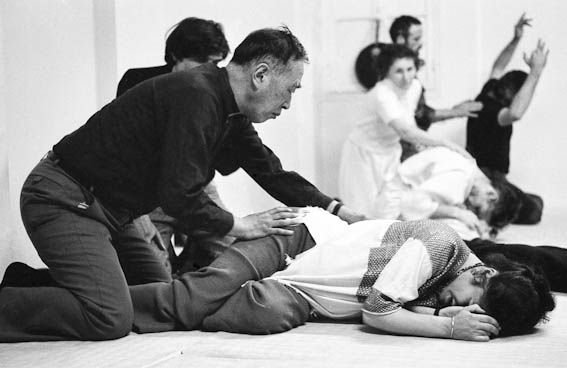 |
People using Yuki |
The experience of yuki is one of the most delightful facets of Sei Tai. Not only does it develop sensitivity in a relationship, but it also enables two people to discover a world of non verbal communication and meeting. It develops the sensitivity of responsiveness necessary in intimate relationships. Finding that the Japanese had developed this gentle way of strangers meeting and touching showed me an unsuspected side to their culture. Teaching it in the West people have sincerely thanked me for showing them how to discover their own beauty and flow in meeting another person.
Working With A Sick Person
The Japanese practitioners of Seitai say that yuki can be useful if a person is feeling unwell. If the person you are giving yuki to is actually ill, there need be no change in the way you give it. It is best if you have practised inner-directed movement for some time to feel easy with allowing spontaneous movement. It is enough to hold the sick person in mind and open yourself to what arises from within. It doesn’t even matter if physical contact is not made.
To Start Your Own Spontaneous Movement
What follows is not the method used by Sei Tai, but something I developed. In Sei Tai no vocal sounds are ever used. I found great release by allowing spontaneous sound emerge from me. It adds an emotional dimension to an otherwise silent practice.
1 – When ready, stand in the space, listen to the music and drop unnecessary tensions. Remind yourself that for the next few minutes you are going to let your body play. You are going to let it off the lead.
2 – Open your mouth wide with head slightly dropped back and simulate yawns. As you do so notice whether a natural yawn starts to make itself felt. If it does, allow it to take over and have a really luxurious yawn. Any following impulse to yawn again should be allowed.
3 – Let the yawns come one after the other if they want to. Without acting it out, let the impulse to yawn take over your body, not just your mouth and face. So if the urge to move includes the arms or elsewhere, let it happen.
Intuition-Many Ways
How Intuition Works
Examples of Intuition
Intuition As The Highest Probability
The High Art Of Intuition
Learning Intuitive Hand Analysis
The Spontaneous Voice Approach
The Gypsy Secret
The Intuitive Imagery Approach
The Intuitive Feeling Approach
Counselling People through Intuition
Becoming An Accomplished Intuitive

Intuition is defined as the ‘immediate apprehension by the mind without reasoning – or immediate insight. Most often we think of intuition as knowing something without having gathered information about it through our senses or through previous thought.
In films and fiction the intuitive person has often been depicted as a mysterious stranger who meets someone and can tell them facts about themselves, about their future and past, without any exterior information. The characterisation may portray them as having occult or mysterious powers, or as employing spirits or demonic forces. Such portrayals show us the common conceptions people have of such human abilities as intuition.
Because of the change in peoples perception of this faculty in recent years, many modern films show the intuitive person as being a highly evolved alien from another world, or as someone having developed faculties previously slumbering, or as having used technology to enhance their mind.
From this we can see there are a number of ways intuition is explained. They range through communion with the Devil; the help of disembodied spirits; clairvoyance and telepathy, latent human faculties; using the unconscious mind; trickery; and training the mind to work with its latent faculties.
How Intuition Works
Recently while driving quite fast around a large roundabout a car pulled out in front of me from one of the side roads. The driver gave no signals so I was uncertain if he was going to carry on across my path, or take the next exit off the roundabout. I immediately pulled across to get behind him. This all happened fast and so there was no time to reason at length about what to do.
In this case one could say I acted intuitively – that is without rational thought. In the reference book The Oxford Companion To The Mind, it says of intuition that in fact we are all using intuition all the time, in that we do not often go through the steps of logically examining an argument before making a decision. “In this sense” the book says, “almost all judgements and behaviour are intuitive.”
The writer goes on to say that ‘women’s intuition’ may be largely the result of subtle and almost subliminal cues arising from gestures, snippets of conversation and gathered knowledge of behaviour patterns and motivations in social action.
Returning to the example of the car, the driver who pulled out actually took the next turning off, so I could have driven across his path. The safest bet however, was to follow behind. After the act, with more time, this could all be reasoned out and the decision analysed. At the time however, I needed intuition because of the speed. Intuition in this case was the result of unconscious or subliminal experience of driving gathered over many years, called upon and expressed as automatic or intuitive response.
So from what has already been said, intuition can arise from:
Gathered experience that has not all been made conscious at the time of the intuitive response. This experience might be a special area of study such as medicine, motor engineering or hand analysis; or it might be general such as the everyday life experience of people and social interactions. This form of intuition can afterwards be examined and with time the sources of it be explained or known.
Cues given us by other people in their behaviour, facial expressions, clothing, speech and speech tones, posture and movements. Study of intuition arising from these show that each of us in fact gather an enormous amount of information about each other within a few seconds of meeting. Such information usually remains unconscious unless we take time to carefully examine and express what our impressions were of the person, and what we have concluded about them.
An overall summary of this mass of gathered information can arise as a hunch, or an ‘intuitive’ feeling of like or dislike, trust or mistrust. If such feeling responses are explored however, details may be made conscious about the person being considered.
Because of the many experiments now proving the quantum theory, we now longer have to wonder how intuition without and feedback can work. Many modern physicists, working with the information arising in experiments with quantum theory, tell us that our view of the world is based upon our blindness, and is very limited, and through its limitation, unreal. Yet this view we take to be the REAL universe. For instance we are only able to see a tiny fraction of the visible spectrum of light and as small amount of audible sound, so we are almost blind and deaf to the world around us.
To quote Gary Zukav from his book the Dancing Wu Li Masters, “The implications of the theorem are enormous. Something can be in two places at once. Apparently distant objects, or people, are intricately linked in an immediate way. There is no separate existence as we previously thought. Our view of the world is not one supported by the facts of physics. Time and space are transcended. David Bohm, an eminent physicist, goes as far as to say that all things in our observable universe are inextricable linked. Nothing has separate existence.”
Some forms of intuition are explained by this approach, as one person’s mind is said to connect to all others in a quantum manner, in the unconscious. In this way, questions or inquiry about a particular person will draw information pertaining to them from the enormous unconscious.
Examples of Intuition
In our lifetime most of us have personal experiences of at least one of these forms of intuition. The following account is an example of the second form of intuition – cues given us by others.
While teaching in Japan I was staying for a few days with a family in which the wife was Japanese and the husband American. I was asked to act as counsellor to the wife, who was experiencing psychosomatic pain in the chest, and general anxiety. The way I work is to have the person allow their body and voice free expression so innate tensions can be released. The woman quickly began to cough and choke and express signs of emotional and physical struggle, but without being able to say what emotions the choking was connected to. I felt rather lost as I had not known the woman for long, and she gave no other information. So I used my intuitive faculty, asking for help.
Immediately a powerful series of images and feelings arose. They outlined a cultural and personal conflict regarding relationship. The woman was pregnant, and my intuition suggested she was terrified that once she had given birth, her husband would find another woman. I said to her, “Is this about your husband and the baby?” She immediately cried out “Don’t leave me! Don’t leave me!” Tears and sobbing about being left followed.
Amazed at this very direct insight into what was troubling the woman I later wondered how my unconscious had known this, because consciously I had not suspected the fear she expressed. I asked my unconscious where it had got this information. Straightaway a memory arose of an event two days prior to the counselling session. I had been teaching the woman how to make bread. During this I had remarked that I thought her baby would be beautiful as it would be a mixture of East and West. Her reply in a slightly subdued voice was “I suppose so”. My unconscious had put this together with other bits of information picked up regarding the culture and couple, and extrapolated its intuition of her conflict.
The intuitive insight described above shows clearly how our unconscious not only absorbs the minutiae of daily experience, but also how it examines these in connection with the other bits of information gathered, and extracts possible meaning from them. If we used such a faculty often, we would make conscious a mass of realisations that otherwise might not easily break through the threshold between conscious and unconscious to become known.
In connection with hand analysis here is an example of how this can work. It was experience by one of the authors.
I had been talking at a communal dinner table to some of the people around me about hand analysis. Some of them had asked me to look at their hands. In quite a light hearted manner I had done so. Afterwards a woman I had not made any real connection with previously came to me and asked if I would look at her hands and tell her what I could see. As we were both in a hurry at that point I said I would try to do so within the next few days.
It was about two days later I sat down with her and told her what I could by examining the lines on her hands. This seemed rather dry so I said if she didn’t mind I would see what I could get from an intuitive reading. She agreed and I closed my eyes and decided to try to use the image approach. From this two strong pictures arose, describing two different situations. In the first the woman was shown being forced to change her life because an event had pushed her into the change. I described this to her as a big change that had occurred in her life, but it was not at all what she had wanted. I felt she was now living the results of this event, and still trying to find her own place in it.
The second picture showed her in a quiet receptive situation, reading, but with an invisible presence trying to support her with its love. I described this to her as a man who cared for her but had died, and was now, according to the impression, trying to support her and make his love known to her.
The woman identified with the first statement immediately. Her husband, after a marriage of many years, left her to live with another woman. This had forced unwanted changes into her life which were still influencing her. We talked this over for a while then I asked her what place if any did the pictured dead person have in her life. She immediately started sobbing, and told me that after her husband left her, a good friend of his became her lover. This man had made her feel wanted and cared for in a way she had not known before. He never left his wife, and their relationship remained a secret. He had died six weeks ago and she was still mourning his death. So the image telling of his support brought a lot of emotion, and meant a great deal to her.
This is not a perfect example of intuition, but the author was deeply impressed at the time. If it had been stated that the first event causing changes had been a divorce, and the second man had been a lover, this would have been detailed enough to be undeniably a direct perception of the woman’s life experience, without previously knowing her history. Even so it is still a good example of how intuition can be used in hand analysis and counselling people.
Because the woman was met at a place frequented by many single women, some of what was said could have been inferred or extrapolated. Even so, this does not depreciate the value of intuition. It can focus attention and draw conclusions from scattered impressions and unconscious information.
Intuition As The Highest Probability
One of the factors I have noticed in watching people use intuitive faculties, is how the mind functions when we ask ourselves a question. One day my daughter came to me from another room in our house with her hands behind her back. Playfully she asked me what she was holding. At that moment I was for some reason in a mode of deep self perception, and could observe some of what was taking place at lightning speed in my mind. A mental scan was occurring which presented likely objects. There was also a filter acting to drop out of the selection those objects that did not meet a whole list of criteria such as – What was in the other rooms and not this? What might my daughter temperamentally choose? What topics of conversation had preceded the event? What did her action tell me, and so on?
This all happened very fast and it is difficult to particularise, but it was obvious that what my computing function of mind was doing was to look for the highest probability within its points of reference and filtering. What I said within seconds was “Banana” because this is what I arrived at as the highest probability. My daughter was amazed and asked me how I did it. It had appeared magical, yet it was based on basic mental functioning and being able to let the mind scan freely, and critically appraise its scan results – i.e. filter out the negative hits.
If we learn to appreciate and use some of such processes, we can begin to ‘think’ in a radically new way.
It is important to realise that if we start to use these dormant faculties, we will almost certainly start to approach them with traditional values, unless we have carefully re-evaluated the subject. The characterisations in drama mentioned above are examples of these general conceptions of intuition. If we were asked to find the hidden secrets of a person’s character without conversing with them or using detective work, we might well revert to using a Ouija board in a spiritualistic seance.
These factors of traditional values may lead many people who use an intuitive faculty do so in a sort of mental vacuum, or in a hermetically sealed belief system. Because the mind works better when we relax, such belief systems may be useful in giving the person confidence. But such systems often have enormous limitations, in that one would have to remain within the belief system for the faculty to work. If the subject of intuition is understood in a general sense outside of such belief systems however, I believe such understanding can help the faculty of intuition flower.
The High Art Of Intuition
The highest form of intuitive response to another person is the one described above as accessing the collective unconscious. When this occurs it does not have the signs of extrapolation, or unconsciously taking in the cues from people through their gestures, clothes, voice, and so on. It jumps beyond what information one has received personally, and presents direct perception of things beyond ones knowing. This is comparatively rare. It might be compared with the sort of connections we make daily on the telephone. Usually they are local, or individual calls. Only certain people have massive computer and telephone connections world-wide to access information beyond their personal or work domain. When this occurs, information about almost anybody might be accessed. This is like accessing the collective unconscious. In fact the massive growth of communication technology is giving us a material example of what can apparently take place naturally in the human mind.
Learning Intuitive Hand Analysis
There are several ways of using the intuitive ability we each have. Your own most effective approach will no doubt depend upon your character. If you are a person who looks at life mostly through your feelings, then using these would be quicker than using the imagery or scanning approach. If you use your intellect most of the time, the scanning technique might be best. Or if you are imaginative and use imagery a great deal this approach would suit you.
To flex and develop your ability however, there are several techniques you need to practice. These should be used frequently until you feel at ease using them and gain a reasonably clear response each time. At the very start use them in an experimental way. They often work best when you are talking to another person, so you need a friend or friends to practice with. Tell them you are learning the technique and want to see if it will work with them. They can even try it with you, and tell you their impressions.
The Spontaneous Voice Approach
A middle aged Gypsy woman rang my doorbell one day selling heather. She immediately began to tell me things about myself which it seemed to me it was unlikely she knew from other people. She told me I had started a couple of businesses which had not been a success; a near member of family had just had an injury; my son had recently gone into a uniformed service, and I was worried about him. It was correct about the businesses, but that information was not impressive. My brother in law had just had a nail go right through his foot at work. My son had just joined the RAF and her words brought tears to my eyes, much to my surprise.
As she told me these things, prior to each statement she said, “Now I am going to tell you something true”. These words were said ritualistically, almost like a prayer, then she would say things which I had the impression she had not thought about. I was not able to question her about this as she was a difficult woman to have an easy conversation with. She gave me the Gypsy’s curse because I wouldn’t pay her the money she demanded. This amused me as, having an Italian background, and having explored the unconscious workings of the mind for many years, I well understood the nature of curses and their attempt to mobilise unconscious fears of such things as illness. worrying events and accident.
The technique this episode illustrates can be called spontaneous voice. To use it one must learn to speak without ones thoughts constantly editing and criticising what is being said. Or at least, one must learn to direct the scanning and editing functions of ones mind.
The intuitive impressions one has, the information one has gathered unconsciously from whatever source, do not usually rise into clear conscious awareness. Thinking about what we do not already know is not possible. We only think with the information we already have, or is easily available. Creative leaps are a jump beyond what is known. So to access what is intuitively understood but not yet consciously recognised, we must use something different than conscious thought.
Focusing on another person and allowing oneself to speak without forethought, is a way of doing this. The unconscious functions which support the action of speech are already well established in fast searching for memories and information connected with whatever is being spoken about. Associated ideas, feelings, memories, along with the words to express, are all quickly accessed in the process of speech. The difference is that instead of presenting the process of speech with an outline of what needs to be said, you present it with a blank sheet, with only the name of the person at the top.
In reality it is a lot more formulated than that. Here are the steps helpful in using this approach.
1.Hold in mind clearly what you are about to do – this is most important the first dozen or so times you do it, after that you can simply remember the previous times the function was used. In other words decide to stop your conscious attempts to find information, or use ready made answers to the question you are going to ask. Imagine your body, mind and feelings as like keys on a piano, poised ready top respond, but not to your conscious efforts. Hold the picture of yourself standing aside – the part of you that has learnt to be concerned about what comes out of your mouth, whether it makes sense, what people are going to think about it, and so on – and you are going to let your sleeping dream self respond.
1 – Stand with eyes closed. Become aware of your breathing rhythm. Slowly deepen it but do not speed it up. If anything make it slower and fuller. When you feel at ease with this add a sound to the outbreath. It is easiest to use the aaaaahhhh sound at first.
Keep this going until you feel the sound flowing out easily and reasonably smoothly. Then move the sound around by changing the volume. Make it soft, make it loud. Try the different volumes of your voice and the different levels of power.
Next try shifting the feeling quality. Make different sounds to see what variety of feelings you can discover or express. If you hit a satisfying sound, something you can enjoy, move it to express laughter, change it into sadness, thoughtfulness, anger, hurt – in fact try it in all sorts of pitches and feeling qualities.
 |
This can be very entertaining because the voice is an incredible instrument, so enjoy yourself with the instrument you have played since babyhood. If words find their way into what you are doing let them – but see what range of feelings you can express with them. For example try making animal sounds, and when well into it set your voice free to do what IT not what YOU want. |
When you have finished playing the instrument of your voice, relax quietly on the floor for a minute or so. This quiet period after the voice exercise is often very healing. It can produce very real internal peace.
2.Make the decision that you are going to use your voice as a way of expressing what you already intuitively know. The first times you practice it will be best to do so by yourself, or with a friend you are completely relaxed with and who knows you are trying to develop your intuitive ability.
3.Now hold in mind that you are asking for helpful information about the person you are considering. It is actually of great value if the person – perhaps the friend you are practising with – actually asks you to tell them what your impressions of them are. As you ask for information remember to see the information you seek as existing unconsciously within yourself. In this way clarify the need for you to hold your conscious mind in an open receptive condition.
4.You can develop the receptive condition of mind and feelings by taking on a feeling of patient listening or waiting. If you have enjoyed a massage at some time, it is rather like the feeling of letting someone else make the effort while you relax. That is just what you need to do. Don’t struggle. Relax and let your voice be moved from within.
5.The next step is to begin to doodle with your voice. For the very first practice sessions it will help if you sit in the receptive condition, perhaps with eyes closed, and gently make a humming sound. Take hold of the subject’s hand, and in the back of your mind hold the realisation you are waiting for information about this person. As you do so let the humming sound move wherever your voice want to take it. Let your voice doodle, rather as your hand might with a pencil as you were thinking about something else.
6.To start with you might find you have an urge to make mumbling, struggling sounds as your voice is getting used to being moved by a level of your mind other than conscious thought or emotion. This is normal and will gradually go as your voice responds more readily and capably to your unconscious intuitions. Eventually you will be able to use this technique without the person in front of you knowing you were not speaking from conscious thought.
7.The step from ‘normal’ speaking and this speaking from the intuitive awareness may at first seem a big one. It is only habit and ideas of what you can and can’t do you are overcoming though. The way to gain this remarkably useful tool is to practice, and then practice, and practice again, just as you did when you learnt to speak in the first place – practice and play at it.
The Gypsy Secret

What the Gypsy woman was doing that is worth understanding was to use a short ritual to jump-start her spontaneous speaking. Through practice she had learnt that every time she said the words “Now I will tell you something true”, she called on her intuition to produce a result relevant to the person she was confronting.
Such a ritual need not be made obvious, but if it is, it makes it more powerful. The reason being that one puts oneself on the spot. Crisis is one of the best stimulants to wake the powers of the unconscious into expression. The fact that someone else knows you are going to address them from something other than a ‘normal’ state of mind will make them give you their full attention. Their attention helps to pull a powerful response from you.
The Intuitive Imagery Approach
All the ways one might call on intuition are based on the way we call on our memory and experience to respond in everyday life. When someone asks us what our name or telephone number is, we do not have to struggle to find the answer. The question itself provokes the response. We witness the response and tell it to the questioner.
This is precisely the same action we perform when using intuition – except we may need to look in a slightly different direction within ourselves for where or how the response appears.
If you give a little consideration to how memory responses occur, you will realise that it might come in various ways. Many of our most frequently used memories, such as our name, address or telephone number, have long been coded into words. Some things we store as an image, and only express in words when describing. Thirdly our memories may be stored as emotions or feeling tones.
Usually we allow our inner responses to the demands we make occur with hardly any awareness. We barely notice what happens when we use our resources of skill or memory. In developing access to our intuition however, we may at first need to use our faculties a bit more consciously. If we do not do this, our old habits of simply accessing memory and the already known information will probably assert itself instead of the intuition. Habits are very powerful, and until we get our intuition well grounded, we need to consciously direct the process. This is not a great task however.
The imagery approach asks the unconscious to present information about the person in the form of a picture, a symbol, or a moving tableau. This is easy for the unconscious. It naturally forms imagery around inner material that has not been put into words or been formally thought about. It does this every time we dream. As the unconscious is a master of this technique we do not need to develop this aspect of it. What we do need to learn is to observe the imagery produced when we use the technique.
The steps to learning and using this technique are as follows:
1.First it is necessary to turn your attention away from usual exterior impressions or trains of thought and clear a quiet space within yourself. This is like having a busy telephone line on which you are always telephoning friends, so there is no space for an incoming call. You must create a comparatively empty space. An easy way to do this is to learn how to watch the screen of your consciousness and observe what is happening on it.
To learn this sit comfortably alone, or preferably with a friend you can practice with. Close your eyes and notice what you are feeling in your body, whether it is comfortable, tense, warm, cold etc. Whatever you notice report it to your partner, or speak it quietly to yourself. Do not develop a conversation with your partner, simply report your observations in a few words.
Go on to observe what is happening with your feelings. Notice whether you feel sad, calm, irritated, jubilant, etc. This might be a new thing for you, but see if you can put into words what you observe.
Notice next what thoughts and mental images float into consciousness. Catch these fleeting impressions by speaking them to yourself or friend. Continue with an overall view of what is happening within you for about ten to fifteen minutes. In other words notice physical, emotional and mental experience and report it.
This first step needs to be practised enough times to make you feel easy with it. It is so important you could use it for months and still gain from it. At times you might find emotions arising strongly. Do not be afraid of this. Observe and allow them to be felt. They will gradually fade away, perhaps having led to personal insights. Unless your emotions are free enough to be felt in this way, they are not available to be used as senses in responding to other people.
2.To take self-observation and description into intuitive appreciation of another person, you set the process going in a slightly different way. As you relax prior to self-observation, mentally say to yourself “I now want my unconscious to present in picture form any intuitions it has of the person before me (or I am asking about)”.
3.After this close your eyes and self-observe just as was done in the previous exercise. Hold the idea that you are particularly looking for mental images. Accept that your unconscious will immediately present a mental picture relating to what you have asked. If you are relaxed and not throwing up masses of self doubts, or conscious attempts to think of answers to your question, a picture will emerge.
Take whatever emerges as relevant to the person you are inquiring about. The picture may not be like a painting in which all the characters are still. It may come as moving scenes. For some people it comes with accompanying emotions and subtle feelings a part of the information.
4.Observe until you feel you have got a sense of the scene. This may mean that you see the picture but you have no idea of what it means. You may be able to ask your unconscious to help you understand what it represents, and this can bring clarity. If this does not occur report what you have seen to the person concerned and ask them if what is described means anything to them. If so ask them to explain. If they want to know more you can then ask for further images to explore the direction more.
The unconscious can be questioned just as a friend can. Remember that the original response was from a question – what is intuited regarding this person? So to explore whatever the issue in the person’s life is more deeply presents no problem. In fact it is always helpful to ask the person if they have further questions about what has been said.
5.When you first start practice this with people you feel at ease with. When you have gained confidence and experience you will feel ready to meet and express your intuitions to strangers.
The Intuitive Feeling Approach
Using the sensitivity of your feelings instead of images or speech is only a difference of approach than technique. Most of what had been said above about the image and speech methods is valid. The practice of self-observation is necessary prior to using the feelings for intuition. Then instead of asking for images to explain what is intuited, you ask for shifts in your own inner feelings to explain your intuitions.
The reason for explaining these different paths to the same goal is because of people’s basic differences. Some people already unconsciously watch their feeling reaction in relationships. They already have expertise and perhaps only need to channel it. Others are more used to imagining situations, playing them through in their mind rather like a drama. Others function through words very fluently.
No matter how you see yourself however, whether verbal, visual or feeling, do not be put off trying the other approaches. Occasionally switching from one to another with the same person can provide different results if you get stuck.
Counselling People through Intuition
In actually using intuition with a person who seeks your advice, there are things to apply just as in any other practice or skill. One of the first things to remember is that you are often dealing with very intimate and personal aspects of the person’s life. Therefore if you are going to develop this skill to the point where people will want to seek you out, you must learn the first principle of counselling – confidentiality. What you reveal to yourself and the person before you is to remain confidential and not spoken to others.
Never speak as if you are seeing the future as it will be. Make sure what is said is spoken of as possibilities arising out of the person’s current attitudes and choices. This keeps their mind free of depression arising from feeling trapped in an unavoidable future.
Realise that what you are seeing is most likely representing the situation the person is in at the moment and how they feel about it. I once visited a very intuitive woman who told me events that had happened in my life and many things about myself. She went on to say that from what she could see everything I tried in the future would lead nowhere. There appeared to be no success in relationships, and every avenue in work and endeavour seemed a dead end also.
What she failed to tell me, and had perhaps not understood about her own gift, was that the picture she painted was of my mood and fears at the time. I had recently been through divorce, felt terribly torn about what had happened, and from my pain saw all my future as grey and a continuance of my present despair. Her failure to point this out to me, to help me see how my dejection was creating a view of life that stopped me moving forward confidently, was a black mark on her otherwise great skill. I felt terrible for a day after her words, then realised for myself that she was merely reflecting my mood, and went forward to create my own future. If you can remain aware of this, you can be of great help to people, who constantly need reminding how their inner moods are creative powers for ill or good.
If you are going to use this ability often, learn some basic counselling skills such as those offered by the Samaritans or Co-Counselling. Both of them are offered at minimum cost, and are of great importance. If you cannot meet human emotions or pain without trying to repress it or make it better by trite advice, do not set yourself up as someone who can counsel others using the hand. Tell people openly that you are doing it for amusement and nothing more.
Counselling skills are not connected with huge amounts of technical information and diagnosis of other people’s condition. They are mainly to do with learning how to keep quiet, not giving other people advice, and how to help someone realise their own problem solving capacity.
One of the greatest of human tendencies is to feel that because we have managed to survive in life in what ever degree we have, we are an expert on relationships, in business, in the spiritual secrets of life. Because we have learnt to use our intuition does not make us great sages or wise in the ways of life. Present your information and help the person find their own decisions.
Another powerful urge in many psychics I have watched, and of course in most of us not skilled in meeting human emotions, is to try to ‘make things okay’ for the person who cries in our presence, or shows anger about some life situation. People often need to release emotions, especially if you reveal a side of themselves they have not exposed publicly. In most cases you do not have to ‘do’ anything about this beside being with the person supportingly and sympathetically. If you have not set yourself up as a therapist, you need not get into that role. In fact keep out of it, lest you encourage the person to move into a dependent relationship with you.
The person can of course ask questions, and all you need do is to respond from your intuition or from what can be seen in the person’s hand. This giving of information is of great help, and need not be pushed into advice giving or coercion to live in a particular way that is the expression of your own horizons, restraints, fears and hopes. It is important to clarify the difference between advice and information.
Becoming An Accomplished Intuitive
A great deal of healing and problem solving can occur if you can find doorways into a persons hurts, strengths and difficulties through your intuition. But unfortunately most psychics are awful counsellors, and this is why it has been suggested that some level of counselling skill be learnt.
As you gain experience, aim to be skilled in what you do. Learn to communicate with your own unconscious, ask questions of it, doubt and explore until you find better performance and clarity. It is important for you to be clear about what you are doing when using intuition. Recognise honestly that just like any other faculty, such as reasoning, intuition has its limitations. Test your own ability to find out its level of accuracy. Give this a percentage mark if you can, so you can look your client in the eye and say something like – I have tried to ascertain the accuracy of my intuitive ability, and I find it is about 60%.
The more fully you understand that your unconscious is already an everyday part of your life, constantly providing background information, words in speech, habitual skills such as walking and writing, the easier you will feel about using its other faculties. Also, understanding how readily it responds to daily requests – for instance we may not have ridden a bicycle for years, yet can get on a bike and ride off – helps us to see how we can organise our use of it. Instead of simply asking what you intuitively perceive of a person, for instance, you could set up a series of questions so an all round response could be given them. You could start with physical health and work through, giving them a very full life-reading, covering work, relationships, and spiritual life. See Using Your Intuition
Drugs an End User
Let’s get it straight – we ALL take strong drugs. We are all forever in the midst of CHANGE.
I am one of those people who doesn’t habitually drink tea or coffee. If I have a mild cup of tea I literally cannot sleep that night because it is such a massive stimulant. During the sleepless hours my mind is fantastically efficient and works tirelessly at examining issues confronting me. The drug caffeine is strong, it is mind altering. Living in war torn Britain as a child I didn’t get to drink coffee in those years. The first time I drank it, when I was about fifteen, I almost fell over with the impact it had on me.
Caffeine, alcohol, nicotine, painkillers, tranquilizers, thousands of prescription drugs, cannabis, LSD, psilocybin, Ecstasy, cocaine, heroin – we regularly take several of these. And don’t argue the point that some drugs are ‘worse’ than others, as if there is a moral superiority issue somewhere here. There isn’t. There are too many crippled lives from the use of alcohol – too many deaths from nicotine – too many hyper-stressed people burning out their reserves from the use of caffeine – to argue in that direction. The interesting question is – Why do we take drugs?
To sum it all up we take them to make some sort of change in ourselves. It may be a change in health, a means of rousing energy, or very often it is an attempt to change a mood or an anxiety. In older societies drugs such as coffee or cocaine were taken occasionally. A hunter carried a few coffee beans to use when there was extra need of energy to acquire food. Hallucinogens were taken as part of a social religious experience. Today, we seem to take them on demand, rather like the rat with its brain wired to give it pleasure when it presses a button – so it continually presses the button.
Take nicotine for instance – in only seconds one puff of a cigarette takes nicotine to the brain. The drug stimulates the release of brain chemicals, such as acetylcholine. This helps trigger alertness in mind and body. Later the brain begins to release chemicals called beta-endorphins which calm and relax. Powerful changes. But do we need to KEEP pressing the button? Wouldn’t it be better to use them like power tools, just when you need them? I have an electric saw, but I don’t go around constantly sawing things up.
In his book My Six Convicts (Hamish Hamilton, 1951) Donald Powell Wilson describes the results of drug-use research in Leavenworth Penitentiary. He sums up by saying there is no such thing as drug addiction, only addictive personalities. So perhaps we face the question of what shall we do with the power saw if we are can stop compulsively sawing things up?
With stimulants like caffeine the adjustment is easy to understand. Instead of pushing ourselves with the drug, we need to acknowledge our tiredness and rest. When a friend stopped habitually drinking tea she felt tired for a couple of weeks. She was compensating for living on her energy reserves, and rested to rebuild them. Her natural high energy then returned. If she needed an emergency boost, tea or coffee was at hand as a real power tool.
It was pointed out to me by one of my sons that there is a more subversive side to tea, coffee, nicotine and alcohol. He sees them as a means of maintaining the status quo. By manipulating our energy and feelings with these socially accepted drugs, we can fit into situations that would otherwise cause powerful negative responses. In brief we wouldn’t ‘walk that way’ without the drugs.
William Burroughs, author of Naked Lunch, and ex-addict, says that lots of “people take street drugs all their life to feel normal.” Some of the causes for addictive use of such drugs as heroine are – being born poor, and having abusive, addictive or dependent parents. Jonathan Kozol calls this the “sledgehammer of dispossession.” One feels isolated and alienated. All ones responses appear to produce negations instead of social rewards. This leads to a constant sense of failure.
Burroughs goes on to say being in “the middle class carries the privilege of access to socially sanctioned drugs that are safer and more specific in their effects than street drugs.” The middle class are therefore heavy drug users, but do it legally because they can afford medical and psychological counseling. They use drugs for the same reason as the dispossessed and alienated – to deal with physiological or psychological difficulties.
Looked at in this way the two are morally indistinguishable in terms of the reasons the drugs are taken and the results they produce. What then is an illicit, and what a licit drug? And “how might a substance like Prozac enter into the competitive world of business?”
Looking at these questions I see myself as an End User. Whether I am dealing with social influence, alienation, level of wealth or an addictive personality structure, I am at the sharp end of it all. In my need to manipulate my own vulnerability, anxiety and downright malfunction toward surviving, I have to find out just what tools I have at hand. Also I have to decide what I am going to use the tools for – and this is what I see as the vital component. Shall I use the tools to anesthetize myself so I can cope with things as they are without heartbreak or massive anger? Shall I use them to disguise myself in the crowd, like alcohol does for many people in social situations? Shall I take drugs like vitamin pills, to make me have a sense of extra power despite my inadequacy to cope naturally? Shall I take drugs to aid an inquiring mind and a courageous heart? Shall I take drugs because I am so bloody desperate for change that I want some sort of bomb to blow up the fewking past and all it has left me with?
Drugs have changed us and changed what we have done to the world and to each other. Is that the scary bit about drugs like LSD and psilocybin? In the 60’s when these drugs were being legally used clinically to help people deal with various forms of neurosis, I read as much as I could about them, and became involved with R. D. Laing in a minor way. Through this contact I was able to experience LSD in a therapeutic setting. I realised from what I read and from my own experience, there were at least three distinct ways one could direct the influence of the drug. These are 1- Tripping. By this I mean responding to the release of mental and emotional phenomena without any real understanding of what is happening, and without arriving at any insights into ones own life and past. Despite Huxley’s good reputation in regard to his book Doors of Perception, nowhere in his experiences does he arrive at insights into his own childhood or history. He was tripping. 2- Problem Solving. Stafford and Golightly explored something quite different.
They created a setting with experts in different fields, such as engineering, architecture, design, who each had a real problem in their work they had failed to resolve. By talking this over, defining what was known, and exactly what was sought, in each field, and then exposing each person to the drug, they demonstrated that very marked problem solving could occur. (See their book LSD – The Problem Solving Drug). 3- Personal Healing. The possibility of LSD as an agent for personal insight leading to healing change was explored worldwide. Constance Newland, describing her release from frigidity in Myself And I, depicts a completely different experience to either Huxley’s or the cases mentioned by Golightly and Stafford. To find change she had to meet the dark places in herself.
Such drugs do not, as is commonly believed, create alien fantasies and fears. They merely pull back the curtains we may have hung around us to shut out the obvious about ourselves. They throw light on the shadowy parts of ourselves we may prefer to keep in darkness. They enable our mind to put together the jigsaw pieces of our experience and see the picture made. They release from the dungeon we may have imprisoned it in, the tiny child we once were who was perhaps tragically and agonisingly deformed in its emotional growth – and we meet such a child through experiencing its heartfelt fear, the pain it couldn’t bear alone, the sense of abandonment it fell beneath.
A friend who was left in an orphanage by his parent as a small child, described one of his own sessions in these words –
“Despite being 48, I had never before really admitted to myself that I was alone, that I had been abandoned in the orphanage. I had always lived in the hope that someone actually wanted me. With the realisation that I was an orphan, another great wave of emotion tore through me.
When the emotions had subsided I then turned toward the dogs – a dream he had about dogs tearing a man apart – as they came at me. I began to feel the sickness that I have experienced for years when feeling alone. But I just shrugged and let the feeling wash over me. I could see I have always ended up in hell by that route and I realised that the hell I feel in having been abandoned will never be anything else. The dogs I had dreamt if I could feel were attacks of the anxieties that have torn me apart for years, anxieties about relationship and whether I am loved. I could see from these feelings that the dogs of my anxieties have consumed two thirds of my energy, two thirds of my life, constantly tearing me apart. I also saw that as a kid I didn’t have enough information to redirect the energy elsewhere.”
Such insights, and meeting such powerful emotions and understanding their source can produce very great personal change. Insight changes the way we see relationships, the way we relate to authority, the direction of our life. These changes flow out into society. Is that perhaps a major reason why such drugs have been made illegal – not only as street drugs, but also in their use as therapeutic agents? *
With power tools you can build something with the materials you have, or you can tear up the joint. As an end user, it’s your choice. And there might be things in the dark that are worth having, worth meeting.
*************************
* The American Federal Drug Administration are currently testing a psychoactive drug called Ibogaine. It is claimed to wipe out drug addiction in some people by revealing the childhood foundations of their addiction.
Buddhist teachings of Life After Death
A Synthesis of the Buddhist teachings of Life After Death – The Bardo
Edited by Johan Engelbrecht
Second Bardo: The Period of Hallucinations (Chonyid Bardo)
Introduction
If the Primary Clear Light is not recognized, there remains the possibility of maintaining the Secondary Clear Light. If that is lost, then comes the Chonyid Bardo, the period of karmic illusions or intense hallucinatory mixtures of game reality. It is very important that the instructions be remembered – they can have great influence and effect.
During this period, the flow of consciousness, microscopically clear and intense, is interrupted by fleeting attempts to rationalize and interpret. But the normal game-playing ego is not functioning effectively. There exist, therefore, unlimited possibilities for, on the one hand, delightful sensuous, intellectual and emotional novelties if one floats with the current; and, on the other hand, fearful ambuscades of confusion and terror if one tries to impose his will on the experience.
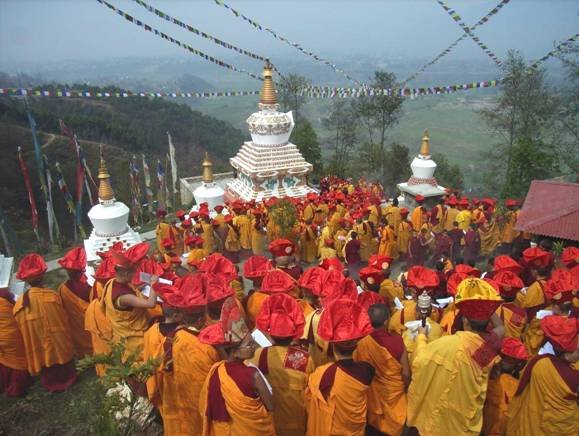 |
The purpose of this part of the manual is to prepare the person for the choice points which arise during this stage. Strange sounds, weird sights and disturbed visions may occur. These can awe, frighten and terrify unless one is prepared.
The experienced person will be able to maintain the recognition that all perceptions come from within and will be able to sit quietly, controlling his expanded awareness like a phantasmagoric multi-dimensional television set: the most acute and sensitive hallucinations – visual, auditory, touch, smell, physical and bodily; the most exquisite reactions, compassionate insight into the self, the world. The key is inaction: passive integration with all that occurs around you. If you try to impose your will, use your mind, rationalize, seek explanations, you will get caught in hallucinatory whirlpools. The motto: peace, acceptance. It is all an ever-changing panorama. You are temporarily removed from the world of game. Enjoy it.
The inexperienced and those to who ego control is important may find this passivity impossible. If you cannot remain inactive and subdue your will, then the one certain activity which can reduce panic and pull you out of hallucinatory mind-games is physical contact with another person. Go to the guide or to another participant and put your head on his lap or chest; put your face next to his and concentrate on the movement and sound of his inspiration. Breathe deeply and feel the air rush in and the sighing release. This is the oldest form of living communication; the brotherhood of breath. The guide’s hand on your forehead may add to the relaxation.
Contact with another participant may be misunderstood and provoke sexual hallucinations. For this reason, helping contact should be made explicit by prearrangement. Unprepared participants may impose sexual fears or fantasies on the contact. Turn them off; they are karmic illusory productions.
The tender, gentle, supportive huddling together of participants is a natural development during the second phase. Do not try to rationalize this contact. Human beings and, for that matter, most all mobile terrestrial creatures have been huddling together during long, dark confused nights for several hundred thousand years.
Breathe in and breathe out with you companions. We are all one! That’s what your breath is telling you.
Explanation of the Second Bardo
The underlying problem of the Second Bardo is that any and every shape – human, divine, diabolical, heroic, evil, animal, thing – which the human brain conjures up or the past life recalls, can present itself to consciousness: shapes and forms and sounds whirling by endlessly.
The underlying solution – repeated again and again – is to recognize that your brain is producing the visions. They do not exist. Nothing exists except as your consciousness gives it life.
You are standing on the threshold of recognizing the truth: there is no reality behind any of the phenomena of the ego-loss state, save the illusions stored up in your own mind either as accretions from game (Sangsaric) experience or as gifts from organic physical nature and its billion-year old past history. Recognition of this truth gives liberation.
There is, of course, no way of classifying the infinite permutations and combinations of visionary elements. The cortex contains file-cards for billions of images from the history of the person, of the race, and of living forms. Any of these, at the rate of a hundred million per second (according to neuro-physiologists), can flood into awareness. Bobbing around in this brilliant, symphonic sea of imagery is the remnant of the conceptual mind. On the endless watery turbulence of the Pacific Ocean bobs a tiny open mouth shouting (between saline mouthfuls), “Order! System! Explain all this!”
One cannot predict what visions will occur, nor their sequence. One can only urge the participants to shut the mouth, breathe through the nose, and turn off the fidgety, rationalizing mind. But only the experienced person of mystical bent can do this (and thus remain in serene enlightenment). The unprepared person will be confused or, worse, panicky: the intellectual struggle to control the ocean.
In order to guide the person, to help him organize his visions into explicable units, the Chonyid Bardo was written. There are two sections: (1) Seven Peaceful Deities with their symmetrically opposed ego traps. (2) Eight Wrathful Deities who can be joyfully accepted as visionary productions, or fled from in terror.
Each of the Seven Peaceful Deities (bisexual Father-Mother figures) are accompanied by consorts, attendants, lesser deities, saints, angels, heroes. Each of the Wrathful Deities is similarly accompanied. Lights, symbolic objects, beautiful, horrid, threatening, seething, are likewise seen.
If read literally, The Tibetan Book of the Dead would have you expect the “Master of All Visible Shapes” (or his opposite, the fondness for stupidity) on the first day; the “Immovable Deity of Happiness” and his consort, attendants and opposite on the second, etc. The manual should, of course, not be used rigidly, exoterically, but should be taken in its esoteric, allegorical form.
Read from this perspective, we see that the lamas have listed or named a thousand images which can boil up in the ever-changing jeweled mosaic of the retina (that multi-layered swamp of billions of rods and cones, infiltrated, like a Persian rug or a Mayan carving, with countless multi-colored capillaries). By preparatory reading of the manual and by its repetition during the experience, the novice is led via suggestion to recognize this fantastic retinal kaleidoscope.
Most important, he is told that they come from within. All deities and demons, all heavens and hells are internal.
The student with a particular interest in Tibetan or Tantric Buddhism should steep himself in the text of the Chonyid Bardo. He should obtain colored plates of the fourteen dramas of the Bardo, and he should arrange to have the guide lead him through the prescribed sequence during the drug session. This will provide an unforgettable series of liberations and will permit the devotee to emerge from the experience “reincarnated” in the lamaist tradition.
The aim of this manual is to make available the general outline of the Tibetan Book and to translate it into psychedelic English. For this reason we shall not present the detailed sequence of lamaist hallucinations but, rather, list some apparitions commonly reported by Westerners.
Following the Tibetan Thodo, we have classified Second Bardo visions into seven types:
- The Source or Creator Vision
- The Internal Flow of Archetypal Processes
- The Fire-Flow of Internal Unity
- The Wave-Vibration Structure of External Forms
- The Vibratory Waves of External Unity
- “The Retinal Circus”
- “The Magic Theatre” [We owe the phrase “retinal circus” to Henri Michaux (Miserable Miracle), and the term “magic theatre” to Hermann Hesse (Steppenwolf).
Visions 2 and 3 involve closed eyes and no contact with external stimuli. In Vision 2 the internal imagery is primarily conceptual. The experience can range from revelation and insight to confusion and chaos, but the cognitive, intellectual meaning is paramount. In Vision 3 the internal imagery is primarily emotional. The experience can range from love and ecstatic unity to fear, distrust and isolation.
Visions 4 and 5 involve open eyes and rapt attention to external stimuli, such as sounds, lights, touch, etc. In Vision 4 the external imagery is primarily conceptual and in Vision 5 emotional factors predominate.
The sevenfold table just defined bears some similarity to the mandalic schema of the Peaceful Deities listed for the Second Bardo in The Tibetan Book of the Dead.
The Peaceful Visions
Vision 1: The Source (Eyes closed, external stimuli ignored)
[The first Peaceful Deity listed by the Bardo Thodol is the Bhagavan Vairochana who occupies the center of the mandala of the five Dhyani-Buddhas. His attributes of source- power have been translated into those of the monotheistic creator of Western religions.]
The White Light, or First Bardo energy, may be interpreted as God the Creator. The Spreader of the Seed. The Power which makes all shapes visible. Seed of all that is. Sovereign Power. The All-Powerful. The Central Sun. The One Truth. The Source of all Organic Life. The Divine Mother. The Female Creative Principle. Mother of the Space of Heaven. Radiant Father-Mother. Magnificent revelations, both spiritual and philosophic, can occur at this point making the highest union of experience and intellect. But, because of bad karma (usually religious beliefs of a monotheistic or punitive nature), the glorious light of the seed wisdom it can produce awe and terror. The person will wish to flee and will beget a fondness for the dull white light symbolizing stupidity.
Persons from a Judaeo-Christian background conceive of an enormous gulf between divinity (which is “up there”) and the self (“down here”). Christian mystics’ claims to unity with divine radiance has always posed problems for theologians who are committed to the cosmological subject-object distinction. Most Westerners, therefore, find it difficult to attain unity with the source-light.
If the guide ascertains that the voyager is struggling with thoughts or feelings about the creative source energy, he can read the appropriate instructions. (Instructions for Vision 1: The Source)
Vision 2: The Internal Flow of Archetypal Processes (Eyes closed, external stimuli ignored; intellectual aspects)
If the undifferentiated light of the First Bardo or of the Source Energy is lost, luminous waves of differentiated forms can flood through the consciousness. The person’s mind begins to identify these figures, that is, to label them and experience revelations about the life process. [Lama Govinda tells us that Amoghasiddhi represents “… the mysterious activity of spiritual forces, which work removed from the senses, invisible and imperceptible, with the aim of guiding the individual (or, more properly: all living beings) towards the maturity of knowledge and liberation. The yellow light of an (inner) sun invisible to human eyes… (in which the unfathomable space of the universe seems to open itself) for the serene mystic green of Amoghasiddhi…. On the elementary plane this all-pervading power corresponds to the element of air – the principle of movement and extension, of life and breath (prana).” Lama Govinda: Foundations of Tibetan Mysticism. Lodon: E. P. Dutton & Co., Inc., 1959, p.120.
The fifth day of the Baro Thodol confronts the deceased with the Bhagavan Buddha Amoghasiddhi, Almighty Conqueror, from the green Norther realm of Successful Performance of Best Actions, attended by a Divine Mother, and two Bodhisattvas representing the mental functions of “equilibrium, immutability, and almighty power” and “clearer of obscurations.”]
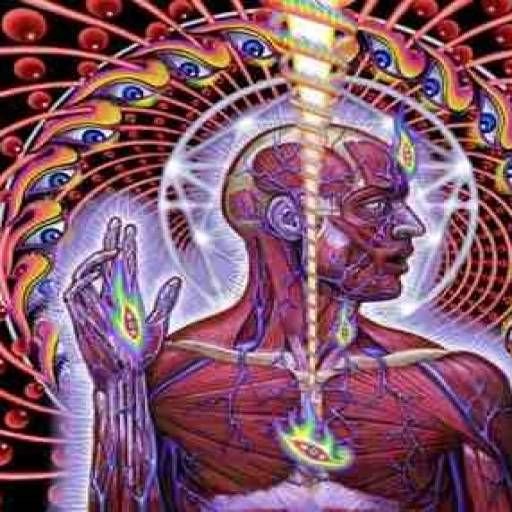 |
|
Specifically, the subject is caught up in an endless flow of colored forms, microbiological shapes, cellular acrobatics, capillary whirling. The cortex is turned in on molecular processes which are completely new and strange: a Niagara of abstract designs; the life-stream flowing, flowing.
These visions might perhaps be described as pure sensations of cellular and sub-cellular processes. It is uncertain whether they involve the retina and/or the visual cortex, or whether they are flashes of direct, molecular sensation in other areas of the central nervous system. They are subjectively described as internal visions.
Another class of internal process images involves sound. Again we do not know whether these sensations originate in the auditory apparatus and/or in the auditory cortex, or whether they are flashes of direct, molecular sensations in other areas. They are subjectively described as internal sounds: clicking, thudding, clashing, soughing, ringing, tapping, moaning, shrill whistles. [The Tibetan Book includes a brilliant discussion of internal process noises. “… innumerable (other) kinds of musical instruments, filling (with music) the whole world-systems and causing them to vibrate, to quake and tremble with sounds so mighty as to daze one’s brain….”
“Tibetan lamas, in chanting their rituals, employ seven (or eight) sorts of musical instruments: big drums, cymbals (commonly brass), conch shells, bells (like the handbells used in the Christian Mass Service), timbrels, small clarionets (sounding like Highland bagpipes), big trumpets, and human thighbone trumpets. Although the combined sounds of these instruments are far from being melodious, the lamas maintain that they psychically produce in the devotee an attitude of deep veneration and faith, because they are the counterparts of the natural sounds which one’s own body is heard producing when the fingers are put in the ears to shut out external sounds. Stopping the ears thus, there are heard a thudding sound, like that of a big drum being beaten; a clashing sound, as of cymbals; a soughing sound, as of a wind moving through a forest – as when a conch-shell is bone; a ringing as of bells; a sharp tapping sound, as when a timbrel is used; a moaning sound, like that of a clarionet; a bass moaning sound, as if made with a big trumpet; and a shriller sound, as of a thigh-bone trumpet.”
“Not only is this interesting as a theory of Tibetan sacred music, but it gives the clue to the esoteric interpretation of the symbolical natural sounds of Truth (referred to in the second paragraph following, and elsewhere in our text), which are said to be, or to proceed from, the intellectual faculties within the human mentality.” – (Evans-Wentz, p. 128)] These noises, like the visions, are direct sensations unencumbered by mental concepts. Raw, molecular, dancing units of energy.
The minds sweeps in and out of this evolutionary stream, creating cosmological revelations. Dozens of mythical and Darwinian insights flash into awareness. The person is allowed to glance back down the flow of time and to perceive how the life energy continually manifests itself in forms, transient, alwasy changing, reforming. Microscopic forms merge with primal creative myths. The mirror of consciousness is held up to the life stream.
As long as the person floats with the current, he is exposed to a billion-year lesson in cosmology. But the drag of the mind is always present. The tendency to impose arbitrary, isolating order on the organic process.
Sometimes the voyager feels he should report back his vision. He converts the life flow into a cosmic ink-blot test – attempts to label each form. “Now I see a peacock’s tail. Now Muslim knights in colored armor. Oh, now a waterfall of jewels. Now, Chinese music. Now, gem-like serpents, etc.” Verbalizations of this sort dull the light, stop the flow and should not be encouraged.
Another trap is that of imposing a sexual interpretation. The dancing, playful flow of life is, in the most reverant sense, sexual. Forms merging, spinning together, reproducing. Eros in its countless manifestations. The Tibetans refer to the female Bodhisattvas Pushpema, personification of blossoms, and Lasema, the “Belle”, depicted holding a mirror in a coquettish attitude. Keep the pure, spontaneous awareness of the Mirror-like Wisdom. Laugh joyously at the tricks of the life process, forever decking out forms in seductive, enticing patterns to keep the dance going. If the voyager interprets the visions of Eros in terms of his personal sexual game model, and attempts to think or plan – “what should I do? what role should I play?” – he is likely to slip down into the Thrid Bardo. Sexual plots dominate his awareness, the flow fades, the mirror tarnishes, and he is rudely reborn as a confused, thinking being.
Still another impasse is the imposition of physical symptom games upon the biological flow. The new somatic sensations may be interpreted as symptoms. If it is new, it must be bad. Any organ of the body may be selected as the focus of the “illness.” People whose primary expectation when taking a psychedelic substance is medical, are particularly likely to fall into this trap. Medical doctors are, in fact, extremely prone and can imagine colorful diseases and fatal attacks.
In the case of the most widely-used psychedelics (LSD, psilocybin, etc.), it is safe to say that such bodily effects are virtually never the direct effect of the drug. The drug acts only on the brain and activates central neural patterns. All physical symptoms are created by the mind. Bodily sickness is a sign that the ego is fighting to maintain or regain its hold over an outpouring of feeling, over a dissolution of emotional boundaries.
If the person complains of physical symptoms such as nausea or pain, the guide should read him the Instructions for Physical Symptoms.
The negative, wrathful counterpart to this vision occurs if the voyager reacts with fear to the powerful flow of life forms. Such a reaction is attributable to the cumulated result of game playing (karma) dominated by anger or stupidity. A nightmarish hell-world may ensue. The visual forms appear like a confusing chaos of cheap, ugly dime-store objects, brassy, vulgar and useless. The person may become terrified at the prospect of being engulfed by them. The awesome sounds may be heard as hideous, clashing, oppressive, grating noises. The person will attempt to escape from these perceptions into restless external activity (talking, moving around, etc.) or into conceptual, analytic, mental activity.
The experience is the same, the intellectual interpretation is different. Instead of revelation, there is confusion; instead of calm joy, there is fear. The guide, recognizing the voyager to be in such a state, can help him get free, by reading the Instructions for Vision 2.
Vision 3: The Fire-Flow of Internal Unity (Eyes closed, external stimuli ignored, emotional aspects)
The First Bardo instructions should keep you face-to-face with the void-ecstasy. Yet there are classes of men who, having carried over karmic conflict about feeling-inhibition, prove unable to hold the pure experience beyond all feelings, and slip into emotionally toned visions. The undifferentiated energy of the First Bardo is woven into visionary games in the form of intense feelings. Exquisite, intense, pulsating sensations of unity and love will be felt; the negative counterpart is feelings of attachment, greed, isolation and bodily concerns.
It comes about this way: the pure flow of energy loses its white void quality and becomes sensed as intense feelings. An emotional game is imposed. Incredible new physical sensations pulse through the body. The glow of life is felt flooding along veins. One merges into a unitive ocean of orgastic, fluid electricity, [The Peaceful Deity of the Bardo Thodol personifying this vision is the Buddha Amitabbha, the all-discriminating wisdom and feeling, boundless light, representing life eternal. Lama Govinda writes that “The deep red light of discriminating inner vision shines forth from his heart… fire corresponds to him and thus, according to the ancient traditional symbolism, the eye and the function of seeing.” (Govinda, op. cit., p. 120.) With the Bhagavan Amitabbha comes the Bodhisattva Chenrazee, embodiment of mercy or compassion, the great pitier ever on the lookout to discover distress and to succour the troubled. He is joined by the Bodhisattva “Glorious Gentle-voiced One,” and the femal incarnates “song” and “light.”] the endless flow of shared-life, of love.
Visions related to the circulatory system are common. The subject tumbles down through his own arterial network. The motor of the heart reverberates as one with the pulsing of all life. The heart then breaks, and red fire bleeds out to merge with all living beings. All living organisms are throbbing together. One is joyfully aware of the two-billion-year-old electric sexual dance; one is at last divested of robot clothes and limbs and undulates in the endless chain of living forms.
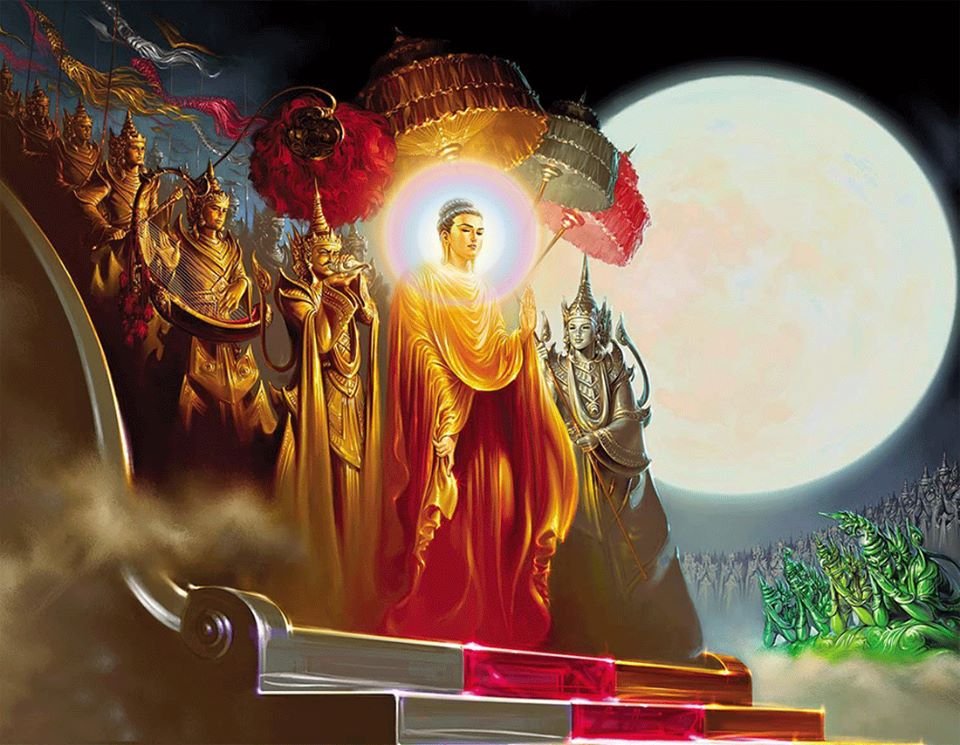 |
|
Dominating this ecstatic state is the feeling of intense love. You are a joyful part of all life. The memory of former delusions of self-hood and differentiation invokes exultant laughter.
All the harsh, dry, brittle angularity of game life is melted. You drift off – soft, rounded, moist, warm. Merged with all life. You may feel yourself floating out and down into a warm sea. Your individuality and autonomy of movement are moistly disappearing. Your control is surrendered to the total organism. Blissful passivity. Ecstatic, orgiastic, undulating unity. All worries and concerns wash away. All is gained as everything is given up. There is organic revelation. Every cell in your body is singing its song of freedom – the entire biological universe is in harmony, liberated from the censorship and control of you and your restricted ambitions.
But wait! You, You, are disappearing into the unity. You are being swallowed up by the ecstatic undulation. Your ego, that one tiny remaining strand of self, screams STOP! You are terrified by the pull of the glorious, dazzling, transparent, radiant red light. You wrench yourself out of the life-flow, drawn by your intense attachment to your old desires. There is a terrible rending as your roots tear out of the life matrix – a ripping of your fibres and veins away from the greater body to which you were attached. And when you have cut yourself off from the fire-flow of life the throbbing stops, the ecstasy ceases, your limbs harden and stiffen into angular forms, your plastic doll body has regained its orientation. There you sit, isolated from the stream of life, impotent master of your desires and appetites, miserable.
While you are floating down the evolutionary river, there comes a sense of limitless self-less power. The delight of flowing cosmic belongingness. The astounding discovery that consciousness can tune in to an infinite number of organic levels. There are billions of cellular processes in your body, each with its universe of experience – an endless variety of ecstasies. The simple joys and pains and burdens of your ego represent one set of experiences – a repetitious, dusty set. As you slip into the fire-flow of biological energy, series after series of experiential sets flash by. You are no longer encapsulated in the structure of ego and tribe.
But through panic and a desire to latch on to the familiar, you shut off the flow, open your eyes; then the flowingness is lost. The potentiality to move from one level of consciousness to another is gone. Your fear and desire to control have driven you to settle for one static site of consciousness. To use the Eastern or genetic metaphor, you have frozen the dance of energy and committed yourself to one incarnation, and you have done it out of fear.
When this happens, there are several steps which can take you back to the biological flow (and from there to the First Bardo). First, close your eyes. Lie on you stomach and let you body sink through the floor, merge with the surroundings. Feel the hard, square edges of your body soften and start to move in the bloodstream. Let the rhythm of breathing become tide flow. Bodily contact is probably the most effective method of softening hardened surfaces. No movement. No body games. Close physical contact with another invariably brings about the unity of fire-flow. Your blood begins to flow into the other’s body. His breathing pours into your lungs. You both drift down the capillary river.
Another form of life process images is the flow of auditory sensations. The endless series of abstract sounds (described in the preceding vision) bounce through awareness. The emotional reaction to these can be neutral or can involve intense feelings of unity, or of annoyed fear.
The positive reaction occurs when the subject merges with the sound flow. The thudding drum of the heart is sensed as the basic anthem of humanity. The whooshing sough of the breath as the rushing river of all life. Overwhelming feelings of love, gratitude and oneness funnel into the moment of sound, into each note of the biological concerto.
But, as always, the voyager may intrude his personality with its wants and opinions. He may not “like” the noise. His judgmental ego may be aesthetically offended by the sounds of life. The heart thud is, after all, monotonous; the natural music of the inner ear, with its clicks and hums and whistles, lacks the romantic symmetries of Beethoven. The terrible separation of “me” from my body occurs. Horrible. Out of my control. Turn it off.
The trained guide can usually sense when ego-attachment threatens to pull the person out of the unitive flow. At this time he can guide the voyager by reading the Instructions for Vision 3.
Vision 4: The Wave-Vibration Structure of External Forms (Eyes open or rapt involvement with external stimuli; intellectual aspects)
The pure, content-free light of the First Bardo probably involves basic electrical wave energy. This is nameless, indescribable, because it is far beyond any concepts which we now possess. Some future atomic physicist may be able to classify this energy. Perhaps it will always be ineffable for a nervous system such as that of homo sapiens. Can an organic system “comprehend” the vastly more efficient inorganic? At any event, most persons, even the most illuminated, find it impossible to maintain experiential contact with this void-light and slip back to imposing mental structures, hallucinatory and revelatory, upon the flow.
Thus we are brought to another frequent vision which involves intense, rapt, unitive awareness of external stimuli. If the eyes are open, this super-reality effect can be visual. The penetrating impact of other stimuli can also set off revelatory imagery.
It comes about this way. The subject’s awareness is suddenly invaded by an outside stimulus. His attention is captured, but his old conceptual mind is not functioning. But other sensitivities are engaged. He experiences direct sensation. The raw “is-ness.” He sees, not objects, but patterns of light waves. He hears, not “music” or “meaningful” sound, but acoustic waves. He is struck with the sudden revelation that all sensation and perception are based on wave vibrations. That the world around him which heretofore had an illusory solidity, is nothing more than a play of physical waves. That he is involved in a cosmic television show which has no more substantiality than the images on his TV picture tube. [The Peaceful Deity of the Thodol personifying this vision is Akshobhya. According to Lama Govinda, “In the light of the Mirror-like Wisdom … things are freed from their “thingness,” their isolation, without being deprived of their form; they are divested of their materiality, without being dissolved, because the creative principle of the mind, which is at the bottom of all form and materiality, is recognized as the active side of the universal Store Consciousness (alaya-vijnana), on the surface of which forms arise and pass away, like the waves on the surface of the ocean….” (Govinda, op. cit., p. 119.)
The atomic structure of matter is, of course, known to us intellectually, but never experienced by the adult except in states of intense altered consciousness. Learning from a physics textbook about the wave structure of matter is one thing. Experiencing it – being in it – with the old, familiar, gross, hallucinatory comfort of “solid” things gone and unavailable, is quite another matter.
If these super-real visions involve wave phenomena, then the external world takes on a radiance and a revelation that is staggeringly clear. The experienced insight that the world of phenomena exists in the form of waves, electronic images, can produce a sense of illuminated power. Everything is experienced as consciousness.
These exultant radiations should be recognized as productions of your own internal processes. You should not attempt to control or conceptualize. This can come later. There is the danger of hallucinatory freezing. The subject rushes back (sometimes literally) to the three-dimensional reality, convinced of the fixed “truth” of one experienced revelation. Many misguided mystics and many persons called insane have fallen into this ambuscade. This is like making a still photograph of a television pattern and shouting that one has finally seized the truth. All is ecstatic electric Maya, the two-billion-year dance of waves. No one part of it is more real than another. Everything at all moments is shimmering with all the meaning.
So far we have considered the positive radiance of clarity; but there are fearful negative aspects of the fourth vision. When the subject senses that his “world” is fragmenting into waves, he may become terrified. “He,” “me,” “I” are dissolving! The world around me is supposed to sit, static and dead, quietly awaiting my manipulation. But these passive things have changed into a shimmering dance of living energy! The Maya nature of phenomena creates panic. Where is the solid base? Every thing, every concept, every form upon which one rests one’s mind collapses into electrical vibrations lacking solidity.
The face of the guide or of one’s beloved friend becomes a dancing mosaic of impulses on one’s cortex. “My consciousness” has created everything of which I am conscious. I have kinescoped my world, my loved ones, myself. All are just shimmering energy patterns. Instead of clarity and exultant power, there is confusion. The subject staggers around, grasping at electron-patterns, striving to freeze them back into the familiar robot forms.
All solidity is gone. All phenomena are paper images pasted on the glass screen of consciousness. For the unprepared, or for the person whose karmic residue stresses control, the discovery of the wave-nature of all structure, the Maya revelation, is a disastrous web of uncertainty.
We have discussed only the visual aspects of the fourth vision. Auditory phenomena are of equal importance. Here the solid, labelled nature of auditory patterns is lost, and the mechanical impact of sound hitting the eardrum is registered. In some cases, sound becomes converted into pure sensation, and synesthesia (mixture of sense modalities) occurs. Sounds are experienced as colors. External sensations hitting the cortex are recorded as molecular events, ineffable.
The most dramatic auditory visions occur with music. Just as any object radiates a pattern of electrons and can become the essense of all energy, so can any note of music be sensed as naked energy trembling in space, timeless. The movement of notes, like the shuttling of oscillograph beams. Each capturing all energy, the electric core of the universe. Nothing existing except the needle-clear resonance on the tympanic membrane. Unforgettable revelations about the nature of reality occur at these moments.
But the hellish interpretation is also possible. As the learned structure of sound collapses, the direct impact of waves can be sensed as noise. For one who is compelled to institute order, his order, on the world around him, it is at least annoying and often disturbing to have the raw tattoo of sound resonating in consciousness.
Noise! What an irreverent concept. Is not everything noise; all sensation the divine pattern of wave energy, meaningless only to those who insist on imposing their own meaning?
Preparation is the key to a serene passage through this visionary territory. The subject who has studied this manual will be able, when face to face with the phenomenon, to recognize and flow with it.
The sensitive guide will be ready to pick up, on any cue, that the subject is wandering in the fourth vision. If the voyager’s eyes are open (indicating visual reactions), he can read the Instructions for Vision 4.
If the guide senses that the voyager is experiencing the fragmentation of external sound into wave vibrations, he can amend the instructions appropriately (changing the visuaol references to auditory).
Vision 5: The Vibratory Waves of External Unity (Eyes open, or rapt involvement with external stimuli; emotional aspects)
As the learned perceptions disappear and the structure of the external world disintegrates into direct wave phenomena, the aim is to amintain a pure, conten-free awareness (First Bardo). Despite the preparations, one is likely to be led backwards by one’s own mental inclinations into two hallucinatory or revelatory interpretations of reality. One reaction leads to the intellectual clarity or frightened confusion of the fourth vision (just described). Another interpretation is the emotional reaction to the fragmentation of differentiated forms. One can be engulfed in ecstatic unity, or one can slip into isolated egotism. The Bardol Thodol calls the former the “Wisdom of Equality” and the latter the “quagmire of worldly existence accruing from violent egotism.” [The Peaceful Deity of the fifth vision comes in the form of the Bhagavan Ratnasambhava, born of a jewel. He is embraced by the Divine Mother, She of the Buddha Eyes, and accompanied by the Bodhisattvas, womb of the sky, All-good, and those holding incense and rosary. “On the elementary plane Ratnasambhava corresponds to the earth, which carries and nourishes all beings with the equanimity and patience of a mother, in whose eyes all beings, borne by her, are equal.” (Govinda, op. cit., p. 119.)] In the state of radiant unity, one senses that there is only one network of energy in the universe and that all things and all sentient beings are momentary manifestations of the single pattern. When egotistic interpretations are imposed on the fifth vision, the “plastic doll” phenomena are experienced. Differentiated forms are seen as inorganic, dull, mass-produced, shabby, plastic, and all persons (including self) are seen as lifeless mannequins isolated from the vibrant dance of energy, which has been lost.
The experiential data of this vision are similar to that of the fourth vision. All artifactual learned structure collapses back to energy vibrations. The awareness is dominated not by revelatory clarity but by shimmering unity. The subject is entranced by the silent, whirling play of forces. Exquisite forms dance by him, all surrounding objects radiate energy, brilliant emanations. His own body is seen as a play of forces. If he looks in a mirror, he sees a shining mosaic of particles. The sense of his own wave structure becomes stronger. A feeling of melting, floating off. The body is no longer a separate unit but a cluster of vibrations sending and receiving energy – a phase of the dance of energy which has been going on for millennia.
A sense of profound one-ness, a feeling of the unity of all energy. Superficial differences of role, cast, status, sex, species, form, power, size, beauty, even the distinctions between inorganic and living energy, disappear before the ecstatic union of all in one. All gestures, words, acts and events are equivalent in value – all are manifestations of the one consciousness which pervades everything. “You,” “I” and “he” are gone, “my” thoughts are “ours,” “your” feelings are “mine.” Communication is unnecessary, since complete communion exists. A person can sense another’s feeling and mood directly, as if they were his own. By a glance, whole lifetimes and words can be transmitted. If all are at peace, the vibrations are “in phase.” If there is discord, “out of phase” vibrations will be set up which will be felt like discordant music. Bodies melt into waves. Objects in the environment – lights, tree, plants, flowers – seem to open and welcome you: they are part of you. You are both simply different pulses of the same vibrations. A pure feeling of ecstatic harmony with all beings is the keynote of this vision.
But as before, terrors can occur. Unity requires ecstatic self-sacrifice. Loss of ego brings fright to the unprepared. The fragmentation of form into waves can bring the most terrible fear known to man: the ultimate epistemological revelation.
The fact of the matter is that all apparent forms of matter and body are momentary clusters of energy. We are little more than flickers on a multidimensional television screen. This realization directly experienced can be delightful. You suddenly wake up from the delusion of separate form and hook up to the cosmic dance. Consciousness slides along the wave matrices, silently at the speed of light.
The terror comes with the discovery of transience. Nothing is fixed, no form solid. Everything you can experience is “nothing but” electrical waves. You feel ultimately tricked. A victim of the great television producer. Distrust. The people around you are lifeless television robots. The world around you is a facade, a stage set. You are a helpless marionette, a plastic doll in a plastic world.
If others attempt to help, they are seen as wooden, waxen, feelingless, cold, grotesque, maniacal, space-fiction monsters. You are unable to feel. “I am dead. I will never live and feel again.” In wild panic you may attempt to force feeling back – by action, by shouting. You will then enter the Third Bardo stage and be reborn in an unpleasant way.
The best method to escape from fifth vision terrors is to remember this manual, relax, and swing with the wave dance. Or to communicate to the guide that you are in a plastic doll phase, and he will guide you back.
Another solution is to move to the internal biological flow. Follow the instructions given in the third vision: close your eyes, lie prone, seek bodily contact, float down into your bodily stream. In so doing, you are recapitulating the evolutionary sequence. For billions of years, inorganic energy danced the cosmic round before the biological rhythm began. Don’t rush it.
If the guide senses that the person is experiencing plastic doll visions or is afraid of the uncontrollability of his own feeling, he should read to him the Instructions for Vision 5.
Vision 6: “The Retinal Circus”
Each of the Second Bardo visions thus far described was one aspect of the “experiencing of reality.” The inner fire or outer waves, apprehended intellectually or emotionally – each vision with its correspondent traps. Each of the “Peaceful Deities” appears with its attendant “Wrathful Deities.” To maintain any of these visions for any length of time requires a certain degree of concentration or “one-pointedness” of mind, as well as the ability to recognize them and not to be afraid. Thus, for most persons, the experience may pass through one or more of these phases without the voyager being able to hold them or stay with them. He may open and close his eyes, he may become alternately absorbed in internal sensations and external forms. The experience may be chaotic, beautiful, thrilling, incomprehensible, magical, ever-changing. [In the Bardo Thodol, on the sixth day appear the radiant lights of the combined Five Wisdoms of the Dhyani-Buddhas, the protective deities (gatekeepers of the mandala) and the Buddhas of the Six Realms of game-existence. According to Lama Govinda: “The Inner Way of Vajra-Sattva, consists in the combination of the rays of the Wisdoms of the four Dhyani-Buddhas and their absorption within one’s own heart – in other words, in the recognition that all these radiances are the emanations of one’s own mind in a state of perfect tranquility and serenity, a state in which the mind reveals its true universal nature.” (Govinda, op., cit., p. 262.)]
He will travel freely through many worlds or experience – from direct contact with life-process forms and images, he may pass to visions of human game-forms. He may see and understand with unimagined clarity and brilliance various social and self-games that he and others play. His own struggles in karmic (game) existence will appear pitiful and laughable. Ecstatic freedom of consciousness is the keynote of this vision. Exploration of unimagined realms. Theatrical adventures. Plays within plays within plays. Symbols change into things symbolized and vice versa. Words become things, thoughts are music, music is smelled, sounds are touched, complete interchangeability of the senses.
All things are possible. All feelings are possible. A person may “try on” various moods like so many pieces of clothing. Subjects and objects whirl, transform, change into each other, merge, fuse, disperse again. External objects dance and sing. The mind plays upon them as upon a musical instrument. They assume any form, significance or quality upon command. They are admired, adored, analyzed, examined, changed, made beautiful or ugly, large or small, important or trivial, useful, dangerous, magical or incomprehensible. They may be reacted to with wonder, amazement, humor, veneration, love, disgust, fascination, horror, delight, fear, ecstasy.
Like a computer with unlimited access to any programs, the mind roams freely. Personal and racial memories bubble up to the surface of consciousness, inter-play with fantasies, wishes, dreams and external objects. A present event becomes charged with profound emotional significance, a cosmic phenomenon becomes identical with some personal quirk. Metaphysical problems are juggled and bounced around. Pure “primary process,” spontaneous outopouring of association, opposites merging, images fusing, condensing, shifting, collapsing, expanding, merging, connecting.
This kaleidoscopic vision of game-reality may be frightening and confusing to an ill-prepared subject. Instead of exquisite clarity of many-levelled perception, he will experience a confused chaos of uncontrollable, meaningless forms. Instead of delight at the playful acrobatics of the free intellect, there will be anxious clinging to an elusive order. Morbid and scatological hallucinations may occur, evoking disgust and shame.
As before, this negative vision occurs only if the person attempts to control or rationalize the magic panorama. Relax and accept whatever comes. Remember that all visions are created by your mind, the happy and the unhappy, the beautiful and the ugly, the delightful and the horrifying. Your consciousness is creator, performer and spectator of the “retinal circus.”
If the guide senses that the voyager is in or seems to be in the “retinal circus” vision, he may read to him the appropriate instructions Instructions for Vision 6: “The Retinal Circus”.
Vision 7: “The Magic Theatre”
If the voyager was unable to maintain the passive serenity necessary for the contemplation of the previous visions (the peaceful deities), he moves now into a more dramatic and active phase. The play of forms and things becomes the play of heroic figures, superhuman spirits and demigods. [In the Tibetan Handbook, this is described as the vision of the five “Knowledge-Holding Deities,” arranged in a mandala form, each embraced by Dakinis, in an ecstatic dance. The Knowledge-holding Deities symbolize “the highest level of individual or humanly conceivable knowledge, as attained in the consciousness of great Yogis, inspired thinkers or similar heroes of the spirit. They represent the last step before the “breaking-through” towards the universal consciousness – or the first on the return from there to the plane of human knowledge.” (Govinda, op. cit., p. 202.) The Dakinis are female embodiments of knowledge, representing the inspirational impluses of consciousness leading to break-through. The other four Knowledge-Holders, besides the central Lord of Dance, are: the Knowledge-holder abiding in the earth, the Knowledge-holder who has power over the duration of life, the Knowledge-holder of the Great Symbol, and the Knowledge-holder of Spontaneous Realization.] You may see radiating figures in human forms. The “Lotus Lord of Dance”: the supreme image of a demi-god who perceives the effects of all actions. The prince of movement, dancing in an ecstatic embrace with his female counterpart. Heroes, heroines, celestial warriors, male and female demi-gods, angels, fairies – the exact form of these figures will depend on the person’s background and tradition. Archetypal figures in the forms of characters from Greek, Egyptian, Nordic, Celtic, Aztec, Persian, Indian, Chinese mythology. The shapes differ, the source is the same: they are the concrete embodiments of aspects of the person’s own psyche. Archetypal forces below verbal awareness and expressible only in symbolic form. The figures are often extremely colorful and accompanied by a variety of awe-inspiring sounds. If the voyager is prepared and in a relaxed, detached frame of mind, he is exposed to a fascinating and dazzling display of dramatic creativity. The Cosmic Theatre. The Divine Comedy. If his eyes are open, he may visualize the other voyagers as representing these figures. The face of a friend may turn into that of a young boy, a baby, the child-god; into a heroic stature, a wise old man; a woman, animal, goddess, sea-mother, young girl, nymph, elf, goblin, leprechaun. Images of the great painters arise as the familiar representations of these spirits. The images are inexhaustible and manifold. An illuminating voyage into the areas where the personal consciousness merges with the supra-individual.
The danger is that the voyager becomes frightened by or unduly attracted to these powerful figures. The forces represented by them may be more intense than he was prepared for. Inability or unwillingness to recognize them as products of one’s mind, leads to escape into animalistic pursuits. The person may become involved in the pursuit of power, lust, wealth and descend into Third Bardo rebirth struggles.
If the guide senses that the voyager is caught in this trap, the appropriate instructions may be used Intructions for Vision 7: “The Magic Theatre”.
The Wrathful Visions (Second Bardo Nightmares)
Seven Second Bardo visions have been described. At each one of them, the voyager could recognize what he saw and be liberated. Multitudes will be liberated by that recognition; and although multitudes obtain liberation in that manner, the number of sentient beings being great, evil karma powerful, obscurations dense, propensities of too long standing, the Wheel of Ignorance and Illusion becomes neither exhausted nor accelerated. Despite the confrontations, there is a vast preponderance of those who wander downwards unliberated.
Thus, in the Tibetan Thodo, after the seven peaceful deities, there come seven visions of wrathful deities, fifty-eight in number, male and female, “flame-enhaloed, wrathful, blood-drinking.” These Herukas as they are called, will not be described in detail, especially since Westerners are liable to experience the wrathful deities in different forms. Instead of many-headed fierce mythological demons, they are more likely to be engulfed and ground by impersonal machinery, manipulated by scientific, torturing control-devices and other space-fiction horrors. [Some general remarks about the Tibetan interpretation of these visions. The Wrathful Deities are regarded as “only the former Peaceful Deities in changed aspect.” Lama Govinda writes: “The peaceful forms of Dhyani-Buddhas represent the highest ideal of Buddhahood in its completed, final, static condition of ultimate attainment or perfection, seen retrospectively as it were, as a state of complete rest and harmony. The Herukas, on the other hand, which are described as “blood-drinking,” angry or “terrifying” deities – are merely the dynamic aspect of enlightenment, the process of becoming a Buddha, of attaining illumination, as symbolized by the Buddha’s struggle with the Hosts of Mara…. The ecstatic figures, heroic and terrifying, express the act of breaking through towards the unthinkable, the intellectually “Unattainable.” They represent the leap over the chasm, which yawns between an intellectual surface consciousness and the intuitive supra-personal depth-consciousness.” (Govinda, op. cit., pp. 198, 202.)]
The Tibetans regard the nightmare visions as primarily intellectual products. They assign them to the Brain chakra, whereas the peaceful deities are assigned to the Heart chakra and the Knowledge-Holding deities to the intermediate Throat chakra. They are the reactions of the mind to the process of consciousness-expansion. They represent the attempts of the intellect to maintain its threatened boundaries. They symbolize the struggle of breaking through to ego-loss understanding and awareness.
Because of the terror and awe they produce, recognition is difficult. Yet in a way it is also easier in that, since these negative hallucinations command all attention, the mind is alert and therefore through trying to escape from fear and terror, people get involved in psychotic states and suffer. But with the aid of this manual and the presence of a guide, the voyager will recognize these hell visions as soon as he sees them, and welcome them like old friends.
Again, when psychologists, philosophers, and psychiatrists, who do not know these teachings, experience ego-loss – however assiduously they may have devoted themselves to academic study and however clever they may have been in expounding intellectual theories – none of the higher phenomena will appear. This is because they are unable to recognize the visions occurring in these psychedelic experiences. Suddenly seeing something they had never seen before and possessing no intellectual concepts, they view it as inimical; and, antagonistic feelings arising, they pass into miserable states. Thus, if one has not had practical experience with these teachings, the radiances and lights will not appear.
Those who believe in these doctrines even though they may seem to be unrefined, irregular in performance of duties, inelegant in habits, and perhaps even unable to practice the doctrine successfully – let no one doubt them or be disrespectful towards them, but pay reverence to their mystic faith. That alone will enable them to attain liberation. Elegance and efficiency of devotional practice are not necessary – just acquaintance with and trust in these teachings.
Well-prepared persons need not experience Second Bardo hell visions at all. Right from the beginning they can pass into paradisiacal states led by heroes, heroines, angels and super-spirits. “They will merge into rainbow radiance; there will be sun-showers, sweet scent of incense in the air, music in the skies, radiances.”
This manual is indispensable to those students who are unprepared. Those proficient in meditation will recognize the Clear Light at the moment of ego-loss and will enter the Blissful Void (Dharma-Kaya). They will also recognize the positive and negative visions of the Second Bardo and obtain illumination (Sambhogha-Kaya); and being reborn on a higher level will become inspired saints or teachers (Nirmana-Kaya). The study and pursuit of enlightenment can always be taken up again at the point where it was broken by the last ego-loss, thus ensuring continuity of karma.
by the use of this manual, enlightenment can be obtained without meditation, through hearing alone. It can liberate even very heavy ego-game players. The distinction between those who know it and those who do not becomes very clear. Enlightenment follows instantly. Those who have been reached by it cannot have prolonged negative experiences.
The teaching concerning the hell-visions is the same as before; recognize them to be your own thought-forms, relax, float downstream. The Instructions for the Wrathful Visions may be read. If, after this, recognition is still impossible and liberation is not obtained, then the voyager will descend into the Third Bardo, the Period of Re-Entry.
Conclusion of Second Bardo
However much experience one may have had, there is always the possibility of delusions occurring in these psychedelic states. Those with practice in meditation recognize the truth as soon as the experience begins. Reading this manual beforehand is important. Having some degree of self-knowledge is helpful at the moment of ego-death.
Meditation on the various positive and negative archetypal forms is very important for Second Bardo phases. Therefore, read this manual, keep it, remember it, bear it in mind, read it regularly; let the words and meanings be very clear; they should not be forgotten, even under extreme duress. It is called “The Great Liberation by Hearing” because even those with selfish deeds on their conscience can be liberated if they hear it. If heard only once, it can be efficacious because even though not understood, it will be remembered during the psychedelic state, since the mind is more lucid then. It should be proclaimed to all living persons; it should be read over the pillows of ill persons; it should be read to dying persons; it should be broadcast.
Those who meet this doctrine are fortunate. It is not easy to encounter. Even when read, it is difficult to comprehend. Liberation will be won simply through not disbelieving it upon hearing it.
Here ends the Second Bardo the Period of Hallucinations
Third Bardo: The Period of Re-entry (Sidpa Bardo)
Introduction
If, in the second Bardo, the voyager is incapable of holding on to the knowledge that the peaceful and wrathful visions were projections of his own mind, but became attracted to or frightened by one or more of them, he will enter the Third Bardo. In this period he struggles to regain routine reality and his ego; the Tibetans call it the Bardo of “seeking rebirth.” It is the period in which the consciousness makes the transition from transcendent reality to the reality of ordinary waking life. The teachings of this manual are of the utmost importance if one wishes to make a peaceful and enlightened re-entry and avoid a violent or unpleasant one.
In the original Bardo Thodol the aim of the teachings is “liberation,” i.e., release from the cycle of birth and death. Interpreted esoterically, this means that the aim is to remain at the stage of perfect illumination and not to return to social game reality.
Only persons of extremely advanced spiritual development are able to accomplish this, by exercising the Transference Principle at the moment of ego-death. For average persons who undertake a psychedelic voyage, the return to game reality is inevitable. Such persons can and should use this part of the manual for the following purposes:
to free themselves from Third Bardo traps;
- to prolong the session, thus assuring a maximum degree of illumination;
- to select a favorable re-entry, i.e., to return to a wiser and more peaceful post-session personality.
Although no definite time estimates can be given, the Tibetans estimate that about 50% of the entire psychedelic experience is spent in the Third Bardo by most normal people. At times, as indicated in the Introduction, someone may move straight to the re-entry period if he is unprepared for or frightened by the ego-loss experiences of the first two Bardos.
The types of re-entry made can profoundly color the person’s subsequent attitudes and feelings about himself and the world, for weeks or even months afterwards. A session which has been predominantly negative and fearful can still be turned to great advantage and much can be learned from it, provided the re-entry is positive and highly conscious. Conversely, a happy and revelatory experience can be made valueless by a fearful or negative re-entry.
The key instructions of the Third Bardo are: (1) do nothing, stay calm, passive and relaxed, no matter what happens; and (2) recognize where you are. If you do not recognize you will be driven by fear to make a premature and unfavorable re-entry. Only by recognizing can you maintain that state of calm, passive concentration necessary for a favorable re-entry. That is why so many recognition-points are given. If you fail on one, it is always possible, up to the very end, to succeed on another. Hence these teachings should be read carefully and remembered well.
In the following sections some of the characteristic Third Bardo experiences are described. In Part IV instructions are given appropriate to each section. At this stage in a psychedelic session the voyager is usually capable of telling the guide verbally what he is experiencing, so that the appropriate sections can be read. A wise guide can often sense the precise nature of the ego’s struggle without words. The voyager will usually not experience all of these states, but only one or some of them; or sometimes the return to reality can take completely new and unusual turns. In such a case the general instructions for the Third Bardo should be emphasized Third Bardo: Preliminary Instructions
I. General Description of the Third Bardo
Normally, the person descends, step by step, into lower (more constricted) states of consciousness. Each step downwards may be preceded by a swooning into unconsciousness. Occasionally the descent may be sudden, and the person will find himself jolted back to a vision of reality which by contrast with the preceding phases seems dull, static, hard, angular, ugly and puppet-like. Such changes can induce fear and horror and he may struggle desperately to regain familiar reality. He may get trapped into irrational or even bestial perspectives which then dominate his entire consciousness. These narrow primitive elements stem from aspects of his personal history which are usually repressed. The more enlightened consciousness of the first two Bardos and the civilized elements of ordinary waking life are shelved in favor of powerful, obsessive primitive impulses, which in fact are merely faded and incoherent instinctual parts of the voyager’s total personality. The suggestibility of Bardo consciousness makes them seem all-powerful and overwhelming.
On the other hand, the voyager may also feel that he possesses supernormal powers of perception and movement, that he can perform miracles, extraordinary feats of bodily control etc. The Tibetan book definitely attributes paranormal faculties to the consciousness of the Bardo voyager and explains it as due to the fact that the Bardo-consciousness encompasses future elements as well as past. Hence clairvoyance, telepathy, ESP, etc. are said to be possible. Objective evidence does not indicate whether this sense of increased perceptiveness is real or illusory. We therefore leave this as an open question, to be decided by empirical evidence.
This then is the first recognition point of the Third Bardo. The feeling of supernormal perception and performance. Assuming that it is valid, the manual warns the voyager not to be fascinated by his heightened powers, and not to exercise them. In yogic practice, the most advanced of the lamas teach the disciple not to strive after psychic powers of this nature for their own sake; for until the disciple is morally fit to use them wisely, they become a serious impediment to his higher spiritual development. Not until the selfish, game-involved nature of man is completely mastered is he safe in using them.
A second sign of Third Bardo existence are experiences of panic, torture and persecution. They are distinguished from the wrathful visions of the Second Bardo in that they definitely seem to involve the person’s own “skin-encapsulated ego.” Mind-controlling manipulative figures and demons of hideous aspects may be hallucinated. The form that these torturing demons take will depend on the person’s cultural background. Where Tibetans saw demons and beasts of prey, a Westerner may see impersonal machinery grinding, or depersonalizing and controlling devices of different futuristic varieties. Visions of world destruction, dying in space-fiction modes, and hallucinations of being engulfed by destructive powers will likewise come; and sounds of the mind-controlling apparatus, of the “combine’s fog machinery,” of the gears which move the scenery of the puppet show, of angry overflowing seas, and of the roaring fire and of fierce winds springing up, and of mocking laughter.
When these sounds and visions come, the first impulse will be to flee from them in panic and terror, not caring where one goes, so long as one goes out. In psychedelic drug experiences, the person may at this time plead or demand to be brought “out of it” through antidotes and tranquillizers. The person may see himself as about to fall down deep, terrifying precipices. These symbolize the so-called evil passions which, like narcotic drugs, enslave and bind mankind to existence in game-networks (sangsara): anger, lust, stupidity, pride or egoism, jealousy, and control-power. Such experiences, just as the previous one of enhanced power, should be regarded as recognizing features of the Third Bardo. One should neither flee the pain nor pursue the pleasure. Recognition is all that is necessary – and recognition depends upon preparation.
A third sign is a kind of restless, unhappy wandering which may be purely mental or may involve actual physical movement. The person feels as if driven by winds (winds of karma) or shunted around mechanically. There may be brief respites at certain places or scenes in the “ordinary” human world. Like a person travelling alone at night along a highway, having his attention arrested by prominent landmarks, great isolated trees, houses, bridgeheads, temples, hot-dog stands, etc., the person in the re-entry period has similar experiences. He may demand to return to familiar haunts in the human world. But any such external placation is temporary and soon the restless wandering will recommence. There may come a desperate desire to phone or otherwise contact your family, your doctor, your friends and appeal to them to pull you out of the state. This desire should be resisted. The guide and the fellow voyagers can be of best assistance. One should not try to involve others in one’s hallucinatory world. The attempt will fail anyway since outsiders are usually unable to understand what is happening. Again, merely to recognize these desires as Third Bardo manifestations is already the first step toward liberation.
A fourth, rather common experience is the following: the person may feel stupid and full of incoherent thoughts, whereas everyone else seems to be perfectly knowing and wise. This leads to feelings of guilt and inadequacy and in extreme from to the Judgment Vision, to be described below. This feeling of stupidity is merely the natural result of the limited perspective under which the consciousness is operating in this Bardo. Calm, relaxed acceptance and trust will enable the voyager to win liberation at this point
Another experience, the fifth recognizing feature, which is especially impressive when it occurs suddenly, is the feeling of being dead, cut off from surrounding life, and full of misery. The person may with a jolt awake from some trance-like swoon and experience himself and the others as lifeless robots, performing wooden meaningless gestures. He may feel that he will never come back and will lament his miserable state.
Again, such fantasies are to be recognized as the attempts of the ego to regain control. In the true state of ego-death, as it occurs in the First or Second Bardos, such complaints are never uttered.
Sixth, one may have the feeling of being oppressed or crushed or squeezed into cracks and crevices amidst rocks and boulders. Or the person may feel that a kind of metallic net or cage may encompass him. This symbolizes the attempt prematurely to enter an ego-robot which is unfitting or unequipped to deal with the expanded consciousness. Therefore one should relax the panicky desire to regain an ego.
A Seventh aspect is a kind of grey twilight-like light suffusing everything, which is in marked contrast to the brilliantly radiating lights and colors of the earlier stages of the voyage. Objects, instead of shining, glowing and vibrating, are now dully colored, shabby and angular.
The passages Third Bardo: Preliminary Instructions contain general instructions for the Third Bardo state and its recognizable features. Any or all of the passages may be read when the guide senses that the voyager is beginning to return to the ego.
II. Re-entry Visions
In the preceding section the symptoms of re-entry were described, the signs that the voyager is tryihng to regain his ego. In this section are described visions of the types of re-entry one can make.
The Tibetan manual conceives of the voyager as returning eventually to one of six worlds of game existence (sangsara). That is, the re-entry to the ego can take place on one of six levels, or as one of six personality types. Two of these are higher than the normal human, three are lower. The highest, most illuminated, level is that of the devas, who are what Westerners would call saints, sages or divine teachers. They are the most enlightened people walking the earth. Gautama Buddha, Lao Tse, Christ. The second level is that of the asuras, who may be called titans or heroes, people with a more than human degree of power and vision. The third level is that of most normal human beings, struggling through game-networks, occasionally breaking free. The fourth level is that of primitive and animalistic incarnations. In this category we have the dog and the cock, symbolic of hyper-sexuality concomitant with jealousy; the pig, symbolizing lustful stupidity and uncleanliness; the industrious, hoarding ant; the insect or worm signifying an earthy or grovelling disposition; the snake, flashing in anger; the ape, full of rampaging primitive power; the snarling “wolf of the steppes;” the bird, soaring freely. Many more could be enumerated. In all cultures of the world people have adopted identities in the image of animals. In childhood and in dreams it is a process familiar to all. The fifth level is that of neurotics, frustrated lifeless spirits forever pursuing unsatisfied desires; the sixth and lowest level is hell or psychosis. Less than one percent of ego- transcendent experiences end in sainthood or psychosis. Most persons return to the normal human level.
According to The Tibetan Book of the Dead, each of the six game worlds or levels of existence is associated with a characteristic sort of thraldom, from which non-game experiences give temporary freedom: (1) existence as a deva, or saint, although more desirable than the others, is concomitant with an ever-recurring round of pleasure, free game ecstasy; (2) existence as an asura, or titan, is concomitant with incessant heroic warfare; (3) helplessness and slavery are characteristic of animal existence; (4) torments of unsatisfied needs and wants are characteristic of the existence of pretas, or unhappy spirits; (5) the characteristic impediments of human existence are inertia, smug ignorance, physical or psychological handicaps or various sorts.
According to the Bardo Thodol, the level one is detined for is determined by one’s karma. During the period of the Third Bardo premonitory signs and visions of the different levels appear, that for which one is heading appearing most clearly. For example, the voyager may feel full of godlike power (asuras), or he may feel himself stirred by primitive or bestial impulses, or he may experience that all-pervasive frustration of the unhappy neurotics, or shudder at the tortures of a self-created hell.
The chances of making a favorable re-entry are increased if the process is allowed to take its own natural course, without effort or struggle. One should avoid pursuing or fleeing any of the visions, but meditate calmly on the knowledge that all levels exist in the Buddha also.
One can recognize and examine the signs as they appear and learn a great deal about oneself in a very short time. Although it is unwise to struggle against or flee the visions that come in this period, the Instructions for Re-entry Visions are designed to help the voyager regain First Bardo transcendence. In this way, if the person finds himself about to return to a personality or ego which he finds inappropriate to his new knowledge about himself, he can, by following the instructions, prevent this and make a fresh re-entry.
III. The All-Determining Influence of Thought
Liberation may be obtained, by such confrontation, even though previously it was not. If, however, liberation is not obtained even after these confrontations, further earnest and continued application is essential.
Should you feel attachment to material possessions, to old games and activities, or if you get any because other people are still involved in pursuits that you have renounced, this will affect the psychological balance in such a way that even if destined to return at a higher level, you will actually re-enter on a lower level in the world of unsatisfied spirits (neurosis). On the other hand, even if you do feel attached to worldly games that you have renounced, you will not be able to play them, and they will be of no use to you. Therefore abandon weakness and attachment to them; cast them away wholly; renounce them from your heart. No matter who may be enjoying your possessions, or taking your role, have no feelings of miserliness or jealousy, but be prepared to renounce them willingly. Think that you are offering them to your internal freedom and to your expaned consciousness. Abide in the feeling of non-attachment, devoid of weakness and craving.
Again, when the activities of the other members of the session are wrong, careless, inattentive or distracting, when the agreement or contract is broken, and when purity of intention is lost by any participant, and frivolity and laxness take over (all of which can clearly be seen by the Bardo voyager) you may feel lack of faith and begin to doubt your beliefs. You will be able to perceive any anxiety or fear, any selfish actions, ego-centric conduct and manipulative behavior. You may think: “Alas! they are playing me false, they have cheated and deceived.” If you think thus, you will become extremely depressed, and through great resentment you will acquire disbelief and loss of faith, instead of affection and humble trust. Since this affects the psychological balance, re-entry will certainly be made on an unpleasant level.
Such thinking will not only be of no use, but it will do great harm. However improper the behavior of other, think thus: “What? How can the words of a Buddha be inappropriate? It is like the reflection of blemishes on my own face which I see in a mirror; my own thoughts must be impure. As for these others, they are noble in body, holy in speech, and the Buddha is within them: their actions are lessons for me.”
Thus thinking, put your trust in your companions and exercise sincere love towards them. Then whatever they do will be to your benefit. The exercise of that love is very important; do not forget this!
Again, even if you were destined to return to a lower level and are already going into that existence, yet through the good deeds of friends, relatives, participants, learned teachers who devote themselves wholeheartedly to the correct performance of beneficent rituals, the delight from your feeling greatly cheered at seeing them will, by its own virtue, so affect the psychological balance that even though heading downwards, you may yet rise to a higher and happier level. Therefore you should not create selfish thoughts, but exercise pure affection and humble faith towards all, impartially. This is highly important. Hence be extremely careful.
The Instructions for the All-Determing Influence of Thought are useful in any phase of the Third Bardo, but particularly if the voyager is reacting with suspicion or resentment to other members of the group, or to his own friends and relatives.
IV. Judgment Visions
The judgment vision may come: the Third Bardo blame game. “Your good genius will count up your good deeds with white pebbles, the evil genius the evil deeds with black pebbles.” A judgment scene is a central part of many religious systems, and the vision can assume various forms. Westerners are most likely to see it in the well-known Christian version. The Tibetans give a psychological interpretation to thisas to all the other visions. The Judge, or Lord of Death, symbolizes conscience itself in its stern aspect of impartiality and love of righteousness. The “Mirror of Karma” (the Christian Judgment Book), consulted by the Judge, is memory. Different parts of the ego will come forward, some offering lame excuses to meet accusations, others ascribing baser motives to various deeds, counting apparently neutral deeds among the black ones; still others offering justifications or requests for pardon. The mirror of memory reflects clearly; lying and subterfuge will be of no avail. Be not frightened, tell no lies, face truth fearlessly.
No you may imagine yourself surrounded by figures who wish to torment, torture or ridicule you (the “Executive Furies of the Robot Lord of Death”). These merciless figures may be internal or they may involve the people around you, seen as pitiless, mocking, superior. Remember that fear and guilt and persecuting, mocking figures are your own hallucinations. Your own guilt machine. Your personality is a collection of thought-patterns and void. It cannot be harmed or injured. “Swords cannot pierce it, fire cannot burn it.” Free yourself from your own hallucinations. In reality there is no such thing as the Lord of Death, or a justice-dispensing god or demon or spirit. Act so as to recognize this.
Recognize that you are in the Third Bardo. Meditate upon your ideal symbol. If you do not know how to meditate, then merely analyze with great care the real nature of that which is frightening you: “Reality” is nothing but a voidness (Dharma-Kaya). That voidness is not of the voidness of nothingness, but a voidness at the true nature of which you feel awed, and before which your consciousness shines more clearly and lucidly. [That is the state of mind known as “Sambhoga-Kaya.” In that state, you experience, with unbearable intensity, Voidness and Brightness inseparable – the Voidness bright by nature and the Brightness inseparable from the Voidness – a state of the primordial or unmodified consciousness, which is the Adi-Kaya. And the power of this, shining unobstructedly, will radiate everywhere; it is the Nirmana-Kaya.
These refer to the fundamental Wisdom Teachings of the Bardo Thodol. In all Tibetan systems of yoga, realization of the Voidness is the one great aim. To realize it is to attain the unconditioned Dharma-Kaya, or “Divine Body of Truth,” the primordial state of uncreatedness, of the supra-mundane All-Consciousness. The Dharma-Kaya is the highest of the three bodies of the Buddha and of all Buddhas and beings who have perfect enlightenment. The other two bodies are the Sambhoga-Kaya or “Divine Body of Perfect Endowment” and the Nirmana-Kaya or “Divine Body of Incarnation.” Adi-Kaya is synonymous with Dharma-Kaya. The Dharma-Kaya is primordial, formless Essential Wisdom; it is true experience freed from all error or inherent or accidental obscuration. It includes both Nirvana and Sangsara, which are polar states of consciousness, but in the realm of pure consciousness identical. The Sambhoga-Kaya embodies, as in the five Dhyani Buddhas, Reflected or Modified Wisdom; and the Nirmana-Kaya embodies, as in the Human Buddhas, Practical or Incarnate Widom. All enlightened beings who are reborn in this or any other world with full consciousness, as workers for the betterment of their fellow creatures, are said to be Nirmana-Kaya incarnates. Lama Kazi Dawa-Samdup, the translator of the Bardo Thodol, held that the Adi-Buddha, and all deities associated with the Dharma-Kaya, are not to be regarded as personal deities, but as personifications of primordial and universal forces, laws or spiritual influences. “In the boundless panorama of the existing and visible universe, whatever shapes appear, whatever sounds vibrate, whatever radiances illuminate, or whatever consciousnesses cognize, all are the play of manifestation in the Tri-Kaya, the Three-fold Principle of the Cause of All Causes, the Primordial Trinity. Impenetrating all, is the All-Pervading Essence of Spirit, which is Mind. It is uncreated, impersonal, self-existing, immaterial and indestructible.” The Tri-Kaya is the esoteric trinity and corresponds to the exoteric trinity of Buddha, the Scriptures and the Priesthood (or your own divinity, this manual and your companions).
If the voyager is struggling with guilt and penance hallucinations, the Instructions for Judgment Visions may be read.
V. Sexual Visions
Sexual visions are extremely frequent during the Third Bardo. You may see or imagine males and females copulating. [According to Jung. (“Psychological Commentary” to The Tibetan Book of the Dead, Evans-Wentz edition, p. xiii), “Freud’s theory is the first attempt made in the West to investigate, as if from below, from the animal sphere of instinct the psychic territory that corresponds in Tantric Lamaism to the Sidpa Bardo.” The vision described here, in which the person sees mother and father in sexual intercourse, corresponds to the “primal scene” in psychoanalysis. At this level, then, we begin to see a remarkable convergence of Eastern and Western psychology. Note also the exact correspondence to the psychoanalytic theory of the Oedipus Complex.] This vision may be internal or it may involve the people around you. You may hallucinate multi-person orgies and experience both desire and shame, attraction and disgust. You may wonder what sexual performance is expected of you and have doubts about your ability to perform at this time.
When these visions occur, remember to withhold yourself from action or attachment. Have faith and float gently with the stream. Trust in the unity of life and in your companions.
If you attempt to enter into your old ego because you are attracted or repulsed, if you try to join or escape from the orgy you are hallucinating, you will re-enter on an animal or neurotic level. If you become conscious of “maleness,” hatred of the father together with jealousy and attraction towards the mother will be experienced; if you become conscious of “femaleness,” hatred of the mother together with attraction and fondness for the father is experienced.
It is perhaps needless to say that this kind of self-centered sexuality has little in common with the sexuality of transpersonal experiences. Physical union can be one expression or manifestation of cosmic union.
Visions of sexual union may sometimes be followed by visions of conception – you may actually visualize the sperm uniting with the ovum – , of intra-uterine life and birth through the womb. Some people claim to have re-lived their own physical birth in psychedelic sessions and occasionally confirming evidence for such claims has been put forward. Whether this is so or not may be left as a question to be decided by empirical evidence. Sometimes the birth visions will be clearly symbolic – e.g., emergence from a cocoon, breaking out of a shell, etc.
Whether the birth vision is constructed from memory or fantasy, the psychedelic voyager should try to recognize the signs indicating the type of personality that is being reborn.
The Instructions for Sexual Visions may be read to the voyager who is struggling with sexual hallucinations.
VI. Methods for Preventing the Re-Entry
Although many confrontations and recognition points have been given, the person may be ill-prepared and still be wandering back to game reality. It is of advantage to postpone the return for as long as possible, thus maximizing the degree of enlightenment in the subsequent personality. For this reason four meditative methods are given for prolonging the ego-loss state. They are (1) meditation on the Buddha or guide; (2) concentration on good games; (3) meditation on illusion; and (4) meditation on the void. See the Four Methods of Preventing Re-entry. Each one attempts to lead the voyager back to the First Bardo central stream of energy from which he has been separated by game involvements. One may ask how these meditative methods, which seem difficult for the ordinary person, can be effective. The answer given in the Tibetan Bardo Thodol is that due to the increased suggestibility and openness of the mind in the psychedelic state these methods can be used by anyone, regardless of intellectual capacity, or proficiency in meditation.
VII. Methods of Choosing the Post-Session Personality
Choosing the post-session ego is an extremely profound art and should not be undertaken carelessly or hastily. One should not return fleeing from hallucinated tormentors. Such re-entry will tend to bring the person to one of the three lower levels. One should first banish the fear by visualizing one’s protective figure or the Buddha; then choose calmly and impartially.
The limited foreknowledge available to the voyager should be used to make a wise choice. In the Tibetan tradition each of the levels of game-existence is associated with a particular color and also certain geographical symbols. These may be different for twentieth-century Westerners. Each person has to learn to decode his own internal road map. The Tibetan indicators may be used as a starting point. The purpose is clear: one should follow the signs of the three higher types and shun those of the three lower. One should follow light and pleasant visions and shun dark and dreary ones.
The world of saints (devas) is said to shine with a white light and to be preceded by visions of delightful temples and jewelled mansions. The world of heroes (asuras) has a green light and is signalled by magical forests and fire images. The ordinary human world has a yellow light. Animal existence is foreshadowed by a blue light and images of caves and deep holes in the earth. The world of neurotics or unsatisfied spirits has a red light and visions of desolate plains and forest wastes. The hell world emits a smoke-colored light and is preceded by sounds of wailing, visions of gloomy lands, black and white houses and black roads along which you have to travel.
Use your foresight to choose a good post-session robot. Do not be attracted to your old ego. Whether you choose to pursue power, or status, or wisdom, or learning, or servitude, or whatever, choose impartially, without being attracted or repelled. Enter into game existence with good grace, voluntarily and freely. Visualize it as a celestial mansion, i.e., as an opportunity to exercise game-ecstasy. Have faith in the protection of the deities and choose. The mood of complete impartiality is important since you may be in error. A game that appears good may later turn out to be bad. Complete impartiality, freedom from want or fear, ensure that a maximally wise choice is made.
As you return you see spread out before you the world, your former life, a planet full of fascinating objects and events. Each aspect of the return trip can be a delightful discovery. Soon you will be descending to take your place in worldly events. The key to this return voyage is simply this: take it easy, slowly, naturally. Enjoy every second. Don’t rush. Don’t be attached to your old games. Recognize that you are in the re-entry period. Do not return with any emotional pressure. Everything you see and touch can glow with radiance. Each moment can be a joyous discovery.
Here end the Third Bardo, The Period of Re-Entry
The Tibetan Book of the Dead
First Bardo: The Period of Ego-Loss or Non-Game Ecstasy (Chikhai Bardo)
Second Bardo: The Period of Hallucinations (Chonyid Bardo)
Third Bardo: The Period of Re-Entry (Sidpa Bardo)
General Conclusion
Well-prepared students with advanced spiritual understanding can use the “Transference” principle at the moment of ego-death and need not traverse subsequent Bardo states. They will rise to a state of illumination and remain there throughout the entire period. Others, who are a little less experienced in spiritual discipline, will recognize the Clear Light in the second stage of the First Bardo and will then win liberation. Others, at a still less advanced level, may be liberated while experiencing one of the positive or negative visions of the Second Bardo. Since there are several turning points, liberation can be obtained at one or the other through recognition at moments of confrontation. Those of very weak karmic connection, i.e., those who have been involved in heavy ego-dominated game-playing, will have to wander downwards to the Third Bardo. Again, many points for liberation have been charted. The weakest persons will fall under the influence of guilt and terror. For weaker persons there are various graded teachings for preventing the return to routine-reality, or at least for choosing it wisely. Through applying the methods of visualization described, they should be able to experience the benefits of the session. Even those persons whose familiar routines are primitive and egocentric can be prevented from entering into misery. Once they have experienced, for however short a period, the great beauty and power of free awareness, they may, in the next period, meet with a guide or friend who will initiate them further into the way.
The way in which this teaching is effective, even for a voyager already in the Sidpa Bardo, is as follows: each person has some positive and some negative game-residues (karma). The continuity of consciousness has been broken by an ego-death for which the person was not prepared. The teachings are like a trough in a broken water drain, temporarily restoring the continuity with positive karma. As stated before, the extreme suggestibility or detached quality of consciousness in this state ensures the efficacy of listening to the doctrine. The teaching embedded in this Manual may be compared to a catapult which can direct the person towards the goal of liberation. Or like the moving of a big wooden beam, which is so heavy that a hundred men cannot carry it, but by being floated on water it can be easily moved. Or it is like controlling a horse’s bit and course by the use of a bridle.
Therefore, these teachings should be vividly impressed on the voyager, again and again. This Manual may also be used more generally. It should be recited as often as possible and committed to memory as far as possible. When ego-death or final death comes, recognize the symptoms, recite the Manual to yourself, and reflect upon the meaning. If you cannot do it yourself, ask a friend to read it to you. There is no doubt as to its liberative power.
It liberates by being seen or heard, without need of ritual or complex meditation. This Profound Teaching liberates those of great evil karma through the Secret Pathway. One should not forget its meaning and the words, even though pursued by seven mastiffs. By this Select Teaching, one obtains Buddhahood at the moment of ego-loss. Were the Buddhas of past, present and future to seek, they could not find any doctrine transcending this.
Here ends the Bardo Thodol, known as The Tibetan Book of the Dead
Some Technical Comments about Psychedelic Sessions
1. Use of This Manual
The most important use of this manual is for preparatory reading. Having read the Tibetan Manual, one can immediately recognize symptoms and experiences which might otherwise be terrifying, only because of lack of understanding as to what was happening. Recognition is the key word.
Secondly, this guidebook may be used to avoid paranoid traps or to regain the First Bardo transcendence if it has been lost. If the experience starts with light, peace, mystic unity, understanding, and if it continues along this path, then there is no need to remember this manual of have this manual re-read to you. Like a road map, we consult it only when lost, or when we wish to change course. Usually, however, the ego clings to its old games. There may be momentary discomfort or confusion. If this happens, the others present should not be sympathetic or show alarm. They should be prepared to stay calm and restrain their “helping games.” In particular, the “doctor” role should be avoided.
If at any time you find yourself struggling to get back to routine reality, you can (by pre-arrangement) have a more experienced person, a fellow-voyager, or a trusted observer read parts of this manual to you.
Passages suitable for reading during the session are given in Part IV below. Each major descriptive section of the Tibetan Book has an appropriate instruction text. One may want to pre-record selected passages and simply flick on the recorder when desired. The aim of these instruction texts is always to lead the voyager back to the original First Bardo transcendence and to help maintain that as long as possible.
A third use would be to construct a “program” for a session using passages from the text. The aim would be to lead the voyager to one of the visions deliberately, or through a sequence of visions. The guide or friend could read the relevant passages, show slides or pictures or symbolic figures of processes, play carefully selected music, etc. One can envision a high art of programming psychedelic sessions, in which symbolic manipulations and presentations would lead the voyager through ecstatic visionary Bead Games.
2. Planning a Session
In planning a session, the first question to be decided is “what is the goal?” Classic Hinduism suggest four possibilities:
For increased personal power, intellectual understanding, sharpened insight into self and culture, improvement of life situation, accelerated learning, professional growth.
- For duty, help of others, providing care, rehabilitation, rebirth for fellow men.
- For fun, sensuous enjoyment, aesthetic pleasure, interpersonal closeness, pure experience.
- For transcendence, liberation from ego and space-time limits; attainment of mystical union.
This manual aims primarily at the latter goal – that of liberation-enlightenment. This emphasis does not preclude attainment of the other goals – in fact, it guarantees their attainment because illumination requires that the person be able to step out beyond game problems of personality, role, and professional status. The initiate can decide beforehand to devote the psychedelic experience to any of the four goals. The manual will be of assistance in any event.
If there are several people having a session together they should either agree collaboratively on a goal, or at least be aware of each other’s goals. If the session is to be “programmed” then the participants should either agree on or design a program collaboratively, or they should agree to let one member of the group do the programming. Unexpected or undesired manipulations by one of the participants can easily “trap the other voyagers into paranoid Third Bardo delusions.
The voyager, especially in an individual session, may also wish to have either an extroverted or an introverted experience. In the extroverted transcendent experience, the self is ecstatically fused with external objects (e.g. flowers, or other people). In the introverted state, the self is ecstatically fused with internal life processes (lights, energy-waves, bodily events, biological forms, etc.). Of course, either the extroverted or the introverted state may be negative rather than positive, depending on the attitude of the voyager. Also it may be primarily conceptual or primarily emotional. The eight types of experience thus derived (four positive and four negative) have been described more fully in Visions 2 to 5 of the Second Bardo.
For the extroverted mystic experience one would bring to the session objects or symbols to guide the awareness in the desired direction. Candles, pictures,books, incense, music or recorded passages. An introverted mystic experience requires the elimination of all stimulation; no light, no sound, no smell, no movement.
The mode of communication with the other participants should also be agreed on beforehand. You may agree on certain signals, silently indicating companionship. You may arrange for physical contact – clasping hands, embracing. These means of communication should be pre-arranged to avoid game-misinterpretations that may develop during the heightened sensitivity of ego-transcendence.
3. Drugs and Dosages
A wide variety of chemicals and plants have psychedelic (“mind manifesting”) effects. The most widely used substances are listed here together with dosages adequate for a normal adult of average size. The dosage to be taken depends, of course, on the goal of the session. Two figures are therefore given. The first column indicates a dosage which should be sufficient for an inexperienced person to enter the transcendental worlds described in this manual. The second column gives a smaller dosage figure, which may be used by more experienced persons or by participants in a group session.
LSD-25 (lysergic acid diethylamide) 200-500 micrograms 100-200 micrograms
Mescaline 600-800 mg 300-500 mg
Psilocybin 40-60 mg 20-30 mg
The time of onset, when the drugs are taken orally on an empty stomach, is approximately 20-30 minutes for LSD and psilocybin, and one to two hours for mescaline. The duration of the session is usually eight to ten hours for LSD and mescaline, and five to six hours for psilocybin. DMT (dimethyltryptamine), when injected intramuscularly in dosages of 50-60 mg, gives an experience approximately equivalent to 500 micrograms of LSD, but which lasts only 30 minutes.
Some person have found it useful to take other drugs before the session. A very anxious person, for example, may take 30 to 40 mg of Librium about on hour earlier, to calm and relax himself. Methedrine has also been used to induced a pleasant, euphoric mood prior to the session. Sometimes, with excessively nervous persons, it is advisable to stagger the drug administration: for example, 200 micrograms of LSD may be taken initially, and a “booster” of another 200 micrograms may be taken after the person has become familiar with some of the effects of the psychedelic state. Nausea may sometimes occur. Usually this is a mental symptom, indicating fear, and should be regarded as such. Sometimes, however, particularly with the use of morning-glory seeds and peyote, the nausea can have a physiological cause. Anti-nauseant drugs such as Marezine, Bonamine, Dramamine or Tigan, may be taken beforehand to prevent this.
If a person becomes trapped in a repetitive game-routine during a session, it is sometimes possible to “break the set” by administering 50 mg of DMT, or even 25 mg of Dexedrine or Methedrine. Such additional dosages, of course, should only be given with the person’s own knowledge and consent.
Should external emergencies call for it, Thorazine (100-200 mg, i.m.) or other phenothiazine-type tranquilizers will terminate the effects of psychedelic drugs. Antidotes should not be used simply because the voyager or the guide is frightened. Instead, the appropriate sections of the Third Bardo should be read. [Further, more detailed suggestions concerning dosage may be found in a paper by Gary M. Fisher: “Some Comments Concerning Dosage Levels of Psychedelic Compounds for Psychotherapeutic Experiences.” Psychedelic Review, I, no.2, pp. 208-218, 1963.]
4. Preparation
Psychedelic chemicals are not drugs in the usual sense of the word. There is no specific reaction, no expected sequence of events, somatic or psychological.
The specific reaction has little to do with the chemical and is chiefly a function of set and setting; preparation and environment. The better the preparation, the more ecstatic and revelatory the session. In initial sessions and with unprepared persons, setting – particularly the actions of others – is most important. With persons who have prepared thoughtfully and seriously, the setting is less important.
There are two aspects of set: long-range and immediate.
Long-range set refers to the personal history, the enduring personality. The kind of person you are – your fears, desires, conflicts, guilts, secret passions – determines how you interpret and manage any situation you enter, including a psychedelic session. Perhaps more important are the reflex mechanisms used when dealing with anxiety – the defenses, the protective maneuvers typically employed. Flexibility, basic trust, religious faith, human openness, courage, interpersonal warmth, creativity, are characteristics which allow for fun and easy learning. Rigidity, desire to control, distrust, cynicism, narrowness, cowardice, coldness, are characteristics which make any new situation threatening. Most important is insight. No matter how many cracks in the record, the person who has some understanding of his own recording machinery, who can recognize when he is not functioning as he would wish, is better able to adapt to any challenge – even the sudden collapse of his ego.
The most careful preparation would include some discussion of the personality characteristics and some planning with the guide as to how to handle expected emotional reactions when they occur.
Immediate set refers to the expectations about the session itself. Session preparation is of critical importance in determining how the experience unfolds. People tend naturally to impose their personal and social game perspectives on any new situation. Careful thought should precede the session to prevent narrow sets being imposed.
Medical expectations. Some ill-prepared subjects unconsciously impose a medical model on the experience. They look for symptoms, interpret each new sensation in terms of sickness/health, place the guide in a doctor-role, and, if anxiety develops, demand chemical rebirth – i.e., tranquilizers. Occasionally one hears of casual, ill-planned, non-guided sessions which end in the subject demanding to be hospitalized, etc. It is even more problem-provoking if the guide employs a medical model, watches for symptoms, and keeps hospitalization in mind to fall back on, as protection for himself.
Rebellion against convention may be the motive of some people who take the drug. The idea of doing something “far out” or vaguely naughty is a naive set which can color the experience.
Intellectual expectations are appropriate when subjects have had much psychedelic experience. Indeed, LSD offers vast possibilities for accelerated learning and scientific-scholarly research. But for initial sessions, intellectual reactions can become traps. The Tibetan Manual never tires of warning about the dangers of rationalization. “Turn you mind off” is the best advice for novitiates. Control of your consciousness is like flight instruction. After you have learned how to move your consciousness around – into ego-loss and back, at will – then intellectual exercises can be incorporated into the psychedelic experience. The last stage of the session is the best time to examine concepts. The objective of this particular manual is to free you from you verbal mind for as long as possible.
Religious expectations invite the same advice as intellectual set. Again, the subject in early sessions is best advised to float with the stream, stay “up” as long as possible, and postpone theological interpretations until the end of the session, or to later sessions.
Recreational and aesthetic expectations are natural. The psychedelic experience, without question, provides ecstatic moments which dwarf any personal or cultural game. Pure sensation can capture awareness. Interpersonal intimacy reaches Himalayan heights. Aesthetic delights – musical, artistic, botanical, natural – are raised to the millionth power. But all these reactions can be Third Bardo ego games: “I am having this ecstasy. How lucky I am!” Such reactions can become tender traps, preventing the subject from reaching pure ego-loss (First Bardo) or the glories of Second Bardo creativity.
Planned expectations. This manual prepares the person for a mystical experience according to the Tibetan model. The Sages of the Snowy Ranges have developed a most sophisticated and precise understanding of human psychology, and the student who studies this manual will become oriented for a voyage which is much richer in scope and meaning than any Western psychological theory. We remain aware, however, that the Bardo Thodol model of consciousness is a human artifact, a Second Bardo hallucination, however grand its scope.
Some practical recommendations. The subject should set aside at least three days for his experience; a day before, the session day, and a follow-up day. This scheduling guarantees a reduction in external pressure and a more sober commitment to the voyage.
Talking to others who have taken the voyage is excellent preparation, although the Second Bardo hallucinatory quality of all descriptions should be recognized. Observing a session is another valuable preliminary. The opportunity to see others during and after a session shapes expectations.
Reading books about mystical experience is a standard orientation procedure. Reading the accounts of others’ experiences is another possibility (Aldous Huxley, Alan Watts, and Gordon Wasson have written powerful accounts).
Meditation is probably the best preparation for a psychedelic session. Those who have spent time in the solitary attempt to manage the mind, to eliminate thought and to reach higher stages of concentration, are the best candidates for a psychedelic session. When the ego-loss state occurs, they are ready. They recognize the process as an end eagerly awaited, rather than a strange event ill-understood.
5. The Setting
The first and most important thing to remember, in the preparation for a psychedelic session, is to provide a setting which is removed from one’s usual social and interpersonal games and which is as free as possible from unforeseen distractions and intrusions. The voyager should make sure that he will not be disturbed by visitors or telephone calls, since these will often jar him into hallucinatory activity. Trust in the surroundings and privacy are necessary.
A period of time (usually at least three days) should be set aside in which the experience will run its natural course and there will be sufficient time for reflections and meditation. It is important to keep schedules open for three days and to make these arrangements beforehand. A too-hasty return to game-involvements will blur the clarity of the vision and reduce the potential for learning. If the experience was with a group, it is very useful to stay together after the session in order to share and exchange experiences.
There are differences between night sessions and day sessions. Many people report that they are more comfortable in the evening and consequently that their experiences are deeper and richer. The person should choose the time of day that seems right according to his own temperament at first. Later, he may wish to experience the difference between night and day sessions.
Similarly, there are differences between sessions out-of-doors and indoors. Natural settings such as gardens, beaches, forests, and open country have specific influences which one may or may not wish to incur. The essential thing is to feel as comfortable as possible in the surroundings, whether in one’s living room or under the night sky. A familiarity with the surroundings may help one to feel confident in hallucinatory periods. If the session is held indoors, one must consider the arrangement of the room and the specific objects one may wish to see and hear during the experience.
Music, lighting, the availability of food and drink, should be considered beforehand. Most people report no desire for food during the height of the experience, and then, later on, prefer to have simple, ancient foods like bread, cheese, wine, and fresh fruit. Hunger is usually not the issue. The senses are wide open, and the taste and smell of a fresh orange are unforgettable.
In group sessions, the arrangement of the room is quite important. People usually will not feel like walking or moving very much for a long period, and either beds or mattresses should be provided. The arrangement of the beds or mattresses can vary. One suggestion is to place the heads of the beds together to form a star pattern. Perhaps one may want to place a few beds together and keep one or two some distance apart for anyone who wishes to remain aside for some time. Often, the availability of an extra room is desirable for someone who wishes to be in seclusion for a period.
If it is desired to listen to music or to reflect on paintings or religious objects, one should arrange these so that everyone in the group feels comfortable with what they are hearing or seeing. In a group session, all decisions about goals, setting, etc. should be made with collaboration and openness.
6. The Psychedelic Guide
For initial sessions, the attitude and behavior of the guide are critical factors. He possesses enormous power to shape the experience. With the cognitive mind suspended, the subject is in a heightened state of suggestibility. The guide can move consciousness with the slightest gesture or reaction.
The key issue here is the guide’s ability to turn off his own ego and social games – in particular, to muffle his own power needs and his fears. To be there relaxed, solid, accepting, secure. The Tao wisdom of creative quietism. To sense all and do nothing except to let the subject know your wise presence.
A psychedelic session lasts up to twelve hours and produces moments of intense, intense, INTENSE reactivity. The guide must never be bored, talkative, intellectualizing. He must remain calm during the long periods of swirling mindlessness.
He is the ground control in the airport tower. Always there to receive messages and queries from high-flying aircraft. Always ready to help navigate their course, to help them reach their destination. An airport-tower-operator who imposes his own personality, his own games upon the pilot is unheard of. The pilots have their own flight plan, their own goals, and ground control is there, ever waiting to be of service.
The pilot is reassured to know that an expert who has guided thousands of flights is down there, available for help. But suppose the flier has reason to suspect that ground control is harboring his own motives and might be manipulating the plane toward selfish goals. The bond of security and confidence would crumble.
It goes without saying, then, that the guide should have had considerable experience in psychedelic sessions himself and in guiding others. To administer psychedelics without personal experience is unethical and dangerous.
The greatest problem faced by human beings in general, and the psychedelic guide in particular, is fear. Fear of the unknown. Fear of losing control. Fear of trusting the genetic process and your companions. From our own research studies and our investigations into sessions run by others – serious professionals or adventurous bohemians – we have been led to the conclusion that almost every negative LSD reaction has been caused by fear on the part of the guide which has augmented the transient fear of the subject. When the guide acts to protect himself, he communicates his concern to the subject.
The guide must remain passively sensitive and intuitively relaxed for several hours. This is a difficult assignment for most Westerners. For this reason, we have sought ways to assist the guide in maintaining a state of alert quietism in which he is poised with ready flexibility. The most certain way to achieve this state is for the guide to take a low dose of the psychedelic with the subject. Routine procedure is to have one trained person participate in the experience and one staff member present in ground control without psychedelic aid.
The knowledge that one experienced guide is “up” and keeping the subject company, is of inestimable value; intimacy and communication; cosmic companionship; the security of having a trained pilot flying at your wing tip; the scuba diver’s security in the presence of an expert comrade in the deep.
It is not recommended that guides take large doses during sessions for new subjects. The less experienced he is, the more likely will the subject impose Second and Third Bardo hallucinations. These intense games affect the experienced guide, who is likely to be in a state of mindless void. The guide is then pulled into the hallucinatory field of the subject, and may have difficulty orienting himself. During the First Bardo there are no familiar fixed landmarks, no place to put your foot, no solid concept upon which to base your thinking. All is flux. Decisive Second Bardo action on the part of the subject can structure the guide’s flow if he has taken a heavy dose.
The role of the psychedelic guide is perhaps the most exciting and inspiring role in society. He is literally a liberator, one who provides illumination, one who frees men from their life-long internal bondage. To be present at the moment of awakening, to share the ecstatic revelation when the voyager discovers the wonder and awe of the divine life-process, is for many the most gratifying part to play in the evolutionary drama. The role of the psychedelic guide has a built-in protection against professionalism and didactic oneupmanship. The psychedelic liberation is so powerful that it far outstrips earthly game ambitions. Awe and gratitude – rather than pride – are the rewards of this new profession.
7. Composition of the Group
The most effective use of this manual will be for the experience of one person with a guide. However, the manual will be useful in a group also. When used in a group session, the following suggestions will be most helpful in planning.
The important thing to remember in organizing a group session is to have knowledge of and trust in the fellow voyagers. Trust in oneself and in one’s companions is essential. If preparing for an experience with strangers, it is very important to share as much time and space as possible with them prior to the session. The participants should set collaborative goals and explore mutually their expectations and feelings and past experiences.
The size of the group should depend to some extent on how much experience the participants have had. Initially, small groups are preferable to larger ones. In any case, group experiences exceeding six or seven people are demonstrably less profound and generate more paranoid hallucinations. If planning for a group session of five or six people, it is preferable to have at least two guides present. One will take the psychedelic substance and the other, who does not, serves as a practical guide to take care of such concerns as changing the recordings, providing food, etc., and if necessary or desired, reading selections from the manual. If it is possible, one of the guides should be an experienced woman who can provide an atmosphere of spiritual nurturing and comfort.
It is sometimes advisable that the initial session of married couples be separate in order that the exploration of their marriage game not dominate the session. With some experience in consciousness-expansion, the marriage game like others may be explored for any purpose – increased intimacy, clearer communication, exploration of the foundations of the sexual, mating relationship, etc.
Instructions for Use during a Psychedelic Session
First Bardo Instructions
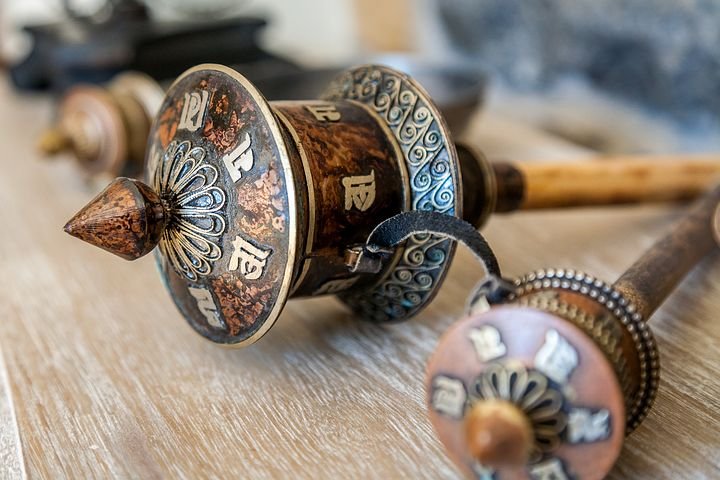 |
|
O (name of voyager)
The time has come for you to seek new levels of reality.
Your ego and the (name) game are about to cease.
Your are about to be set face to face with the Clear Light
Your are about to experience it in its reality.
In the ego-free state, wherein all things are like the void and cloudless sky,
And the naked spotless intellect is like a transparent vacuum;
At this moment, know yourself and abide in that state.
O (name of voyager),
That which is called ego-death is coming to you.
Remember:
This is now the hour of death and rebirth;
Take advantage of this temporary death to obtain the perfect state –
Enlightenment.
Concentrate on the unity of all living beings.
Hold onto the Clear Light.
Use it to attain understanding and love.
If you cannot maintain the bliss of illumination and if you are slipping back into contact with the external world,
Remember:
The hallucinations which you may now experience,
The visions and insights,
Will teach you much about yourself and the world.
The veil of routine perception will be torn from you eyes.
Remember the unity of all living things.
Remember the bliss of the Clear Light.
Let it guide you through the visions of this experience.
Let it guide you through your new life to come.
If you feel confused; call upon the memory of your friends and the power of the person whom you most admire.
O (name),
Try to reach and keep the experience of the Clear Light.
Remember:
The light is the life energy.
The endless flame of life.
An ever-changing surging turmoil of color may engulf your vision.
This is the ceaseless transformation of energy.
The life process.
Do not fear it.
Surrender to it.
Join it.
It is part of you.
You are part of it.
Remember also:
Beyond the restless flowing electricity of life is the ultimate reality –
The Void.
Your own awareness, not formed into anything possessing form or color, is naturally void.
The Final Reality.
The All Good.
The All Peaceful.
The Light.
The Radiance.
The movement is the fire of life from which we all come.
Join it.
It is part of you.
Beyond the light of life is the peaceful silence of the void.
The quiet bliss beyond all transformations.
The Buddha smile.
The Void is not nothingness.
The Void is beginning and end itself.
Unobstructed; shining, thrilling, blissful.
Diamond consciousness.
The All-Good Buddha.
Your own consciousness, not formed into anything,
No thought, no vision, no color, is void.
The intellect shining and blissful and silent –
This is the state of perfect enlightenment.
Your own consciousness, shining, void and inseparable from the great body of radiance, has no birth, nor death.
It is the immutable light which the Tibetans call Buddha Amitabha,
The awareness of the formless beginning.
Knowing this is enough.
Recognize the voidness of your own consciousness to be Buddhahood.
Keep this recognition and you will maintain the state of the divine mind of the Buddha.
Second Bardo Preliminary Instructions
Remember:
In this session you experience three Bardos,
Three states of ego-loss.
First there is the Clear Light of Reality.
Next there are fantastically varied game hallucinations.
Later you will reach the stage of Re-Entry
Of regaining an ego.
O friend,
You may experience ego-transcendence,
Departure from your old self.
But you are not the only one.
It comes to all at some time.
You are fortunate to have this gratuitously given rebirth experience.
Do not cling in fondness and weakness to your old self.
Even though you cling to your mind, you have lost the power to keep it.
You can gain nothing by struggling in this hallucinatory world.
Be not attached.
Be not weak.
Whatever fear or terror may come to you
Forget not these words.
Take their meaning into your heart.
Go forward.
Herein lies the vital secret of recognition.
O friend, remember:
When body and mind separate, you experience a glimpse of the pure truth –
Subtle, sparkling, bright,
Dazzling, glorious, and radiantly awesome,
In appearance like a mirage moving across a landscape in springtime.
One continuous stream of vibrations.
Be not daunted thereby,
Nor terrified, nor awed.
That is the radiance of your own true nature.
Recognize it.
From the midst of that radiance
Comes the natural sound of reality,
Reverberating like a thousand thunders simultaneously sounding.
That is the natural sound of your own life process.
Be not daunted thereby,
Nor terrified, nor awed.
It is sufficient for you to know that these apparitions are your own thought-forms.
If you do not recognize your own thought forms,
If you forget your preparation,
The lights will daunt you,
The sounds will awe you,
The rays will terrify you,
The people around you will confuse you.
Remember the key to the teachings.
O friend,
These realms are not come from somewhere outside your self,
They come from within and shine upon you.
The revelations too are not come from somewhere else;
They exist from eternity within the faculties of your own intellect.
Know them to be of that nature.
The key to enlightenment and serenity during this period of ten thousand visions is simply this:
Relax.
Merge yourself with them.
Blissfully accept the wonders of your own creativity.
Become neither attached nor afraid,
Neither be attracted nor repulsed.
Above all, do nothing about the visions.
They exist only within you.
Instructions for Vision 1: The Source (Eyes closed, external stimuli ignored)
O nobly-born, listen carefully:
The Radiant Energy of the Seed
From which come all living forms,
Shoots forth and strikes against you
With a light so brilliant that you will scarcely be able to look at it.
Do not be frightened.
This is the Source Energy which has been radiating for billions of years,
Ever manifesting itself in different forms.
Accept it.
Do not try to intellectualize it.
Do not play games with it.
Merge with it.
Let it flow through you.
Lose yourself in it.
Fuse in the Halo of Rainbow Light
Into the core of the energy dance.
Obtain Buddhahood in the Central Realm of the Densely Packed.
Instructions for Physical Symptoms
O friend, listen carefully.
The bodily symptoms you are having are not drug-effects.
They indicate that you are struggling against the awareness of feelings which surpass your normal experience.
You cannot control these universal energy-waves.
Let the feelings melt all over you.
Become part of them.
Sink into them and through them.
Allow yourself to pulsate with the vibrations surrounding you.
Relax.
Do not struggle.
Your symptoms will disappear as soon as all trace of ego-centered striving disappears.
Accept them as the message of the body.
Welcome them. Enjoy them.
Instructions for Vision 2: The Internal Flow of Archetypal Processes (Eyes closed, external stimuli ignored; intellectual aspects)
O nobly born, listen carefully:
The life flow is whirling through you.
An endless parade of pure forms and sounds,
Dazzlingly brilliant,
Ever-changing.
Do not try to control it.
Flow with it.
Experience the ancient cosmic myths of creation and manifestation.
Do not try to understand;
There is plenty of time for that later.
Merge with it.
Let it flow through you.
There is no need to act or think.
You are being taught the great lessons of evolution, creation, reproduction.
If you try to stop it, you may fall into hell-worlds and endure unbearable misery generated by your own mind.
Avoid game interpretations.
Avoid thinking, talking and doing.
Keep faith in the life flow.
Trust your companions on this watery journey.
Merge in Rainbow Light,
Into the Heart of The River of Created Forms.
Obtain Buddhahood in the Realm called Pre-Eminently Happy.
Instructions for Vision 3: The Fire-Flow of Internal Unity (Eyes closed, external stimuli ignored, emotional aspects)
O nobly born, listen carefully:
You are flowing outward into the fluid unity of life.
The ecstasy of organic fire glows in every cell.
The hard, dry, brittle husks of your ego are washing out,
Washing out to the endless sea of creation.
Flow with it.
Feel the pulse of the sun’s heart.
Let the red Buddha Amitabha sweep you along.
Do not fear the ecstasy.
Do not resist the flow.
Remember, all the exultant power comes from within.
Release your attachment.
Recognize the wisdom of your own blood.
Trust the tide-force pulling you into unity with all living forms.
Let your heart burst in love for all life.
Let your warm blood gush out into the ocean of all life.
Do not be attached to the ecstatic power;
It comes from you.
Let it flow.
Do not try to hold on to your old bodily fears.
Let your body merge with the warm flux.
Let your roots sink into the warm life body.
Merge into the Heart-Glow of the Buddha Amitabha.
Float in the Rainbow Sea.
Attain Buddhahood in the Realm named Exultant Love.
Instructions for Vision 4: The Wave-Vibration Structure of External Forms (Eyes open, rapt involvement with the external visual stimuli, intellectual aspects)
O nobly born, listen carefully:
At this point you can become aware of the wave structure of the world around you.
Everything you see dissolves into energy vibrations.
Look closely and you will tune in on the electric dance of energy.
There are no longer things and persons but only the direct flow of particles.
Consciousness will now leave your body and flow into the stream of wave rhythm.
There is no need for talk or action.
Let your brain become a receiving set for the radiance.
All interpretations are the products of your own mind.
Dispel them. Have no fear.
Exult in the natural power of your own brain,
The wisdom of your own electricity.
Abide in the state of quietude.
As the three-dimensional world fragments, you may feel panic;
You may beget a fondness for the heavy dull world of objects you are leaving.
At this time, fear not the transparent, radiant, dazzling wave energy.
Allow your intellect to rest.
Fear not the hook-rays of the light of life,
The basic structure of matter,
The basic form of wave communication.
Watch quietly and receive the message.
You will now experience directly the revelation of primal forms.
Instructions for Vision 5: The Vibratory Waves of External Unity (Eyes open; rapt involvement with external stimuli such as lights, or movements; emotional aspects)
O nobly born, listen carefully:
You are experiencing the unity of all living forms.
If people seem to you rubbery and lifeless, like plastic puppets,
Be not afraid.
This is only the attempt of the ego to maintain its separate identity.
Allow yourself to feel the unity of all.
Merge with the world around you.
Be not afraid.
Enjoy the dance of the puppets.
They are created by your own mind.
Allow yourself to relax and feel the ecstatic energy-vibrations pulsing through you.
Enjoy the feeling of complete one-ness with all life and all matter.
The glowing radiance is a reflection of your own consciousness.
It is one aspect of your divine nature.
Do not be attached to your old human self.
Do not be alarmed at the new and strange feelings you are having.
If you are attracted to your old self,
You will be reborn shortly for another round of game-existence.
Exercise humble trust and remain fearless.
You will merge into the heart of the Blessed Ratnasambhava,
In a Halo of Rainbow Light,
And attain liberation in the Realm Endowed with Glory.
Instructions for Vision 6: “The Retinal Circus”
O nobly born, listen well:
You are now witnessing the magical dance of forms.
Ecstatic kaleidoscopic patterns explode around you.
All possible shapes come to life before you eyes.
The retinal circus.
The ceaseless play of elements –
Earth, water, air, fire,
In ever-changing forms and manifestations,
Dazzles you with its complexity and variety.
Relax and enjoy the rushing stream.
Do not become attached to any vision or revelation.
Let everything flow through you.
If unpleasant experiences come,
Let them flit by with the rest.
Do not struggle against them.
It all comes from within you.
This is the great lesson in the creativity and power of the brain, freed from its learned structures.
Let the cascade of images and associations take you where it will.
Meditate calmly on the knowledge that all these visions are emanations of your own consciousness.
This way you can obtain self-knowledge and be liberated.
Instructions for Vision 7: “The Magic Theatre”
O nobly born, listen well:
You are now in the magic theatre of heroes and demons.
Mythical superhuman figures.
Demons, goddesses, celestial warriors, giants,
Angels, Bodhisattvas, dwarfs, crusaders,
Elves, devils, saints, and sorcerers,
Infernal spirits, goblins, knights and emperors.
The Lotus Lord of Dance.
The Wise Old Man. The Divine Child.
The Trickster, The Shapeshifter.
The tamer of monsters.
The mother of gods, the witch.
The moon king. The wanderer.
The whole divine theatre of figures representing the highest reaches of human knowledge.
Do not be afraid of them.
They are within you.
Your own creative intellect is the master magician of them all.
Recognize the figures as aspects of your self.
The whole fantastic comedy takes place within you.
Do not become attached to the figures.
Remember the teachings.
You may still attain liberation.
Instructions for the Wrathful Visions
O nobly born, listen carefully:
You were unable to maintain the perfect Clear Light of the First Bardo.
Or the serene peaceful visions of the Second.
You are now entering Second Bardo nightmares.
Recognize them.
They are your own thought-forms made visible and audible.
They are products of your own mind with its back to the wall.
They indicate that you are close to liberation.
Do not fear them.
No harm can come to you from these hallucinations.
They are your own thoughts in frightening aspect.
They are old friends.
Welcome them. Merge with them. Join them.
Lose yourself in them.
They are yours.
Whatever you see, no matter how strange and terrifying,
Remember above all that it comes from within you.
Hold onto that knowledge.
As soon as you recognize that, you will obtain liberation.
If you do not recognize them,
Torture and punishment will ensue.
But these too are but the radiances of your own intellect.
They are immaterial.
Voidness cannot injure voidness.
None of the peaceful or wrathful visions,
Blood-drinking demons, machines, monsters, or devils,
Exist in reality
Only within your skull.
This will dissipate your fear. Remember it well.
Third Bardo: Preliminary Instructions
O (name), listen well:
You are now entering the Third Bardo.
Before, while experiencing the peaceful and wrathful visions of the
Second Bardo,
You could not recognize them.
Through fear you became unconscious.
Now, as you recover,
Your consciousness rises up,
Like a trout leaping forth out of water,
Striving for its original form.
Your former ego has started to operate again.
Do not struggle to figure things out.
If through weakness you are attracted to action and thinking,
You will have to wander amidst the world of game existence,
And suffer pain.
Relax your restless mind.
O (name), you have been unable to recognize the archetypal forms of the
Second Bardo.
You have come down this far.
Now, if you wish to see the truth,
Your mind must rest without distraction.
There is nothing to do,
Nothing to think.
Float back to the unobscured, primordial, bright, void state of your intellect.
In this way you will obtain liberation.
If you are unable to relax your mind,
Meditate on (name of protective figure)
Meditate on your friends (name)
Think of them with profound love and trust,
As overshadowing the crown of your head.
This is of great importance.
Be not distracted.
O (name),
You may now feel the power to perform miraculous feats,
To perceive and communicate with extrasensory power,
To change shape, size and number,
To traverse space and time instantly.
These feelings come to you naturally,
Not through any merit on your part.
Do not desire them.
Do not attempt to exercise them.
Recognize them as signs that you are in the Third Bardo,
In the period of re-entry into the normal world.
O (name),
If you have not understood the above,
At this moment,
As a result of your own mental set,
Frightening visions may come.
Gusts of wind and icy blasts,
Humming and clicking of the controlling machinery,
Mocking laughter.
You may imagine terror producing remarks:
“Guilty,” “stupid,” inadequate,” “nasty.”
Such imagined taunts and paranoid nightmares
Are the residues of selfish, ego-dominated game-playing.
Fear them not.
They are your own mental products.
Remember that you are in the Third Bardo.
You are struggling to re-enter the denser atmosphere of routine game existence.
Let this re-entry be smooth and slow.
Do not attempt to use force of will-power.
O (name),
As you are driven here and there by the ever-moving winds of karma,
Your mind, having no resting place or focus,
Is like a feather tossed about by the wind,
Or like a rider on the horse or breath,
Ceaselessly and involuntarily you will wander about,
Calling in despair for your old ego.
Your mind races along until you are exhausted and miserable.
Do not hold on to thoughts.
Allow the mind to rest in its unmodified state.
Meditate on the oneness of all energy.
Thus you will be free of sorrow, terror, and confusion.
O (name)
You may feel confused and bewildered.
You may be wondering about your sanity.
You may look at your fellow voyagers and friends,
And sense that they cannot understand you.
You may think; “I am dead! What shall I do?,”
And feel great misery,
Just like a fish cast out of water on red-hot embers.
You may wonder whether you will ever return.
Familiar places, relatives, people known to you appear as in a dream,
Or through a glass darkly.
If you are having such experiences,
Thinking will be of no avail.
Do not struggle to explain.
This is the natural result of your own mental program.
Such feelings indicate that you are in the Third Bardo.
Trust your guide,
Trust your companions,
Trust the Compassionate Buddha,
Meditate calmly and without distraction.
O (name),
You may now feel as if you are being oppressed and squeezed,
Like between rocks and boulders,
Or like inside a cage or prison.
Remember:
These are signs that you are trying to force a return to your ego.
There may be a dull, gray light
Suffusing all objects with a murky glow.
These are all signs of the Third Bardo.
Do not struggle to return.
The re-entry will happen by itself.
Recognize where you are.
Recognition will lead to liberation.
Instructions for Re-entry Visions
O (name),
You have still not understood what is happening
So far you have been searching for your past personality.
Unable to find it, you may begin to feel that you will never be the same again,
That you will come back a changed person.
Saddened by this you will feel self-pity,
You will attempt to find your ego, to regain control.
So thinking, you will wander here and there,
Ceaselessly and distractedly.
Different images of your future self will be seen by you;
The one you are headed for will be seen most clearly.
The special art of these teachings is particularly important at this moment.
Whatever image you see,
Meditate upon it as coming from the Buddha –
That level of existence also exists in the Buddha.
This is an exceedingly profound art.
It will free you from your present confusion.
Meditate upon (name of protective ideal) for as long as possible.
Visualize him as a form produced by a magician,
Then let his image melt away,
Starting with the extremities,
Till nothing remains visible.
Put yourself in a state of Clearness and Voidness;
Abide in that state for a while.
Then meditate again on your protective ideal.
Then again on the Clear Light.
Do this alternately.
Afterwards, allow your own mind also to melt away gradually.
Wherever the air pervades, consciousness pervades.
Wherever consciousness pervades, serene ecstasy pervades.
Abide tranquilly in the uncreated state of serenity.
In that state, paranoid rebirth will be prevented.
Perfect enlightenment will be gained.
Instructions for the All-Determining Influence of Thought
O (name), you may now experience momentary joy,
Followed by momentary sorrow,
Of great intensity,
Like the stretching and relaxing of a catapult.
You will go through sharp mood swings,
All determined by karma.
Be not in the least attached to the joys nor displeased by the sorrows.
The actions of your friends or companions may evoke anger or shame in you.
If you get angry or depressed,
You will immediately have an experience of hell.
No matter what people are doing,
Make sure that no angry thought can arise.
Meditate upon love for them.
Even at this late stage of the session
You are only one second away from a life-changing joyous discovery.
Remember that each of your companions is Buddha within.
You mind in its present state having no focus or integrating force,
Being light and continuously moving,
Whatever thought occurs to you,
Positive or negative,
Will wield great power.
You are extremely suggestible
Therefore think not of selfish things.
Recall your preparation for the session.
Show pure affection and humble faith.
Through hearing these words,
Recollection will come.
Recollection will be followed by recognition and liberation.
Instructions for Judgment Visions
O (name), if you are experiencing a vision of judgment and guilt,
Listen carefully:
That you are suffering like this
Is the result of your own mental set.
Your karma.
No one is doing anything to you.
There is nothing to do.
Your own mind is creating the problem.
Accordingly float into meditation.
Remember your former beliefs.
Remember the teachings of this manual.
Remember the friendly presence of you companions.
If you do not know how to meditate
Concentrate on any single object or sensation.
Hold this (hand the wanderer an object),
Concentrate on the reality of this,
Recognize the illusory nature of existence and phenomena.
This moment is of great importance.
If you are distracted now it will take you a long time to get out of the quagmire of misery.
Up till now the Bardo experiences have come to you and you have not recognized them.
You have been distracted.
On this account you have experienced fear and terror.
Even though unsuccessful thus far
You may recognize and obtain liberation here.
Your session can still become ecstatic and revelatory.
If you do not know how to meditate, remember (person’s ideal).
Remember your companions
Remember this manual.
Think of all these fears and terrifying apparitions as being your own ideal,
Or as the compassionate one.
They are divine tests.
Remember your guide.
Repeat the names over and over.
Even though you fall,
You will not be hurt.
Instructions for Sexual Visions
O (name),
At this time you may see visions of mating couples.
You are convinced that an orgy is about to take place.
Desire and anticipation seize you,
You wonder what sexual performance is expected of you.
When these visions occur,
Remember to withhold yourself from action or attachment.
Humbly exercise your faith.
Float with the stream.
Trust the process with great fervency.
Meditation and trust in the unity of life are the keys.
If you attempt to enter into your old personality because you are attracted or repulsed,
If you try to join the orgy you are hallucinating,
You will be reborn on an animal level.
You will experience possessive desire and jealousy,
You will suffer stupidity and misery.
If you wish to avoid these miseries
Listen and recognize.
Reject the feelings of attraction or repulsion.
Remember the downward pull opposing enlightenment is strong in you.
Meditate upon unity with your fellow voyagers.
Abandon jealousy,
Be neither attracted nor repulsed by your sexual hallucinations.
If you are you will wander in misery a long time.
Repeat these words to yourself.
And meditate on them.
Four Methods of Preventing Re-entry
First Method: Meditation on the Buddha
O (name), tranquilly meditate upon your protective figure (name).
He is like the reflecting of the moon in water.
He is apparent yet non-existent.
Like illusion produced by magic.
If you have no special protective figure,
Meditate upon the Buddha or upon me.
With this in mind meditate tranquilly.
Then causing the visualized form of your protective ideal
To melt away from the extremities,
Meditate, without any thought-forming, upon the Void Clear Light.
This is a very profound art.
By virtue of it rebirth is postponed.
A more illuminated future is assured
.
Second Method: Meditation on Good Games
(Name), You are now wandering in the Third Bardo.
As a sign of this, look into a mirror and you will not see your usual self
(show the wanderer a mirror).
At this time you must form a single, firm resolve in your mind.
This is very important.
It is like directing the course of a horse by the use of the reins.
Whatever you desire will come to pass.
Think not of evil actions which might turn the course of your mind.
Remember your spiritual relationship with me,
Or with anyone from whom you have received teaching.
Persevere with good games.
This is essential.
Be not distracted.
Here lies the boundary line between going up or down.
If you give way to indecision for even a second,
You will have to suffer misery for a long, long time,
Trapped in your old habits and games.
This is the moment.
Hold fast to one single purpose.
Remember good games.
Resolve to act according to your highest insight.
This is a time when earnestness and pure love are necessary.
Abandon jealousy.
Meditate upon laughter and trust.
Bear this well at heart.
Third Method: Meditation on Illusion
If still going down and not liberated,
Meditate as follows:
The sexual activities, the manipulation machinery, the mocking laughter, dashing sounds and terrifying apparitions,
Indeed all phenomena
Are in their nature, illusions.
However they may appear, in truth they are unreal and fake.
They are like dreams and apparitions,
Non-permanent, non-fixed.
What advantage is there in being attached to them,
Or being afraid of them?
All these are hallucinations of the mind.
The mind itself does not exist,
Therefore why should they?
Only through taking these illusions for real will you wander around in this confused existence.
All these are like dreams,
Like echoes,
Like cities of clouds,
Like mirages,
Like mirrored forms,
Like phantasmagoria,
The moon seen in water.
Not real even for a moment.
By holding one-pointedly to that train of thought.
The belief that they are real is dissipated,
And liberation is attained.
Fourth Method: Meditation on the Void
“All substances are part of my own consciousness.
This consciousness is vacuous, unborn, and unceasing.”
Thus meditating,
Allow the mind to rest in the uncreated state.
Like the pouring of water into water,
The mind should be allowed its own easy mental posture
In its natural, unmodified condition, clear and vibrant.
By maintaining this relaxed, uncreated state of mind
Rebirth into routine game-reality is sure to be prevented.
Meditate on this until you are certainly free.
Instructions for Choosing the Post-Session Personality
(Name), Listen:
It is almost time to return.
Make the selection of your future personality according to the best teaching.
Listen well:
The signs and characteristics of the level of existence to come
Will appear to you in premonitory visions.
Recognize them.
When you find that you have to return to reality,
Try to follow the pleasant delightful visions.
Avoid the dark unpleasant ones.
If you return in panic, a fearful state will follow,
If you strive to escape dark, gloomy scenes, an unhappy state will follow,
If you return in radiance, a happy state will follow.
Your mental state now will affect your subsequent level of being.
Whatever you choose,
Choose impartially,
Without attraction or repulsion.
Enter into game-existence with good grace.
Voluntarily and freely.
Remain calm.
Remember the teachings.
Leaving Darkness
Something else happened that I want to record, and I’m not sure quite how it occurred. It was a very vivid fantasy in which I believe I was again talking with a being such as a dead friend. It might have been someone who called himself Alumina. What first happened was that I was suddenly shot into a dream state, yet I was still awake.
In this state I had a very distinct image, along with a feeling, of a small bird fluttering close my head. What was incredibly clear and real was the way its wings were fluttering. I could really see and feel that they were not simply waving up-and-down but vibrating at great speed.
The bird kept fluttering near me, and I realised it was trying to attract my attention so I would follow it. So, in fact I did and it led me into a condition of great darkness. I could see or hear nothing. But the bird led on and I trusted it and we came to what was recognisably a dark cave from which were slowly emerging hundreds, perhaps thousands of people. I understood as I saw this that an enormous number of people throughout the world were now emerging from a dark place. I realised that there was the need for many workers to meet them and help them to learn to live life within the light.
Darkness to Light
As I did so the colours got lighter and lighter. It felt as if something was going faster and faster. Yes, kaleidoscopic patterns were moving and changing faster, speeding up and getting lighter. First of all just colour, movement and intensity, then it burst into a direct awareness of energy in my being vibrating faster and faster. I could feel it moving each side of my spine, actually vibrating. It got more and more intense until suddenly it felt like the energy had cleared all its pathways and was vibrating at tremendous speed without barriers. It was an incredible experience yet at the same time not at all strange.
I had read about this, and expected bliss, strange awareness, entrance into other dimensions, contact with nonphysical intelligence’s, or a view of life that was goal oriented. Something like – Aha, so life leads to this wider awareness – or meeting other minds – or fresh worlds – but no. It was all very ordinary in an extraordinary way. There was the energy. It was vibrating in a physically apparent way, just as it does when I sleep, only faster. It had reached a point where it seemed to clear out last remaining obstacles to stream freely. But it didn’t put me in touch with disincarnate entities, other dimensions, bliss, or a hidden life, or divine purpose.
What it did do was to increase what I already had. It gave more. This incredible energy I saw, experienced, that it didn’t do anything in particular, but on the other hand it would do anything. If I turned my energy into fear or self-destructive patterns, then I could be a lot more frightened and self-destructive with that amount of energy. Like a man who drinks and one who paints. With more money or energy they could respectively drink or paint a lot more. If I used my energy toward creativity and life enhancement, then that’s what the energy would do. It could heal or cause illness, give peace or restlessness, wisdom or folly. It would fill whatever one put before it. In my case it was being used to look at life and myself and cleanse body and consciousness of sickness and limiting painful or anxious attitudes, and that was what it was doing.
In fact it cleared so much pain, darkness and anxiety out of mel, I felt a peaceful joy shining from me and no longer blocked by the anxieties I have felt of late. It brought clearness, calm confidence, and open warmth. It brought more, in the same sense light brings more in a dark room. Consider this. The room we are in is in darkness. With a little light vague shapes are apparent but no colour. With more light shapes begin to take on meaning as to what they are, and dim shades of colour appear. More still and hidden details in the shapes become obvious and colours begin to blaze out. More still and things hidden in the colours show. The room has not changed. No other doors have opened on fresh dimensions. No other intelligences met. The room changes only in the appreciation and awareness we have of it.
See: Creativity and problem solving in dreams; Being the Person or Thing; Intuition – Using It.
Department Store
Because such a large store can supply all your needs, from food, perfume, clothing to electrics, it is like a one stop shop.
Why are you visiting the store – making choices or decisions, looking for something, being with friends, looking for someone, hoping to see famous people? If so, ask youreslf what is urging you there.
People often dream of spending leasure time in the store, or even sleeping there overnight, suggesting filling all your needs. So it can be a form of social centre, a place you feel easy in, so suggests finding a special attitude within you.
Example: I am in a huge department store (like a Las Vegas-style hotel, skyscraper) where lingerie is piled high to the very, very high ceiling. I am in awe. “Why do you think people come here?” they (my male friends) say to me. (Some black boys tell us how to be smart shoppers and get coupons and points which can be traded in for reduced prices. Later I make fun of them – accidentally – to their faces.) When I turn back to show these guys the lingerie boxes piled to the ceiling there is a huge green curtain in front of them, but the guys have already seemed to know what I am talking about anyway. I can’t get over all this lingerie being piled this way and in such a large building.
Exampl: I was in the bathroom of a large department store, sitting on the toilet. It was crowded. People would peek in. There were two men in the lobby area by the sinks. A woman questioned them and they laughed. They were really women dressed like men. Then I saw George Hamilton, a star, come in. He came over to me and peeked in. I was a little embarrassed because my butt was showing. I got up and he wanted to hug me. That was O.K. He suggested we go to his hotel room to make love. I said, “No, I don’t want to,” because I wanted him to care for me, or be caring and then the sex would be good.
Example: In this dream, I seemed to be on the top floor of what looked like a high rise department store. It was very crowded with a great any people looking at all the glittering shop windows, for some reason I was not aware of, they seemed to draw a lot of attention. I was looking for something that you could eat, for a special purpose. Something that had a special purpose, rather like the magic mushroom in Alice in Wonderland.
I was given, or came in possession of two very small round objects, the shape, size and colour, of the old English pennies and half pennies of my childhood. They were round, brown, and very small, and had a special effect on you when you ate them. I was aware that they could bring about inner changes when you had eaten them, and seemed to open you up in some way to the awareness of something beyond the day to day experiences of ordinary everyday life. It seemed that it opened you up to the beauty, goodness, and loving kindness of another existence that was in the air, everywhere, you could see it wherever you looked. Impossible to fully describe, but harmonies just playing out in tiny glittering spots of shining Light and Colour, that extended everywhere, and in some way opened you up to a different would, to change your relationship to yourself and your Inner Being. I knew that it would have a deep effect for Healing and Good.
It seemed that I alone, at that moment, saw the potential of the deep inner effects of eating them. I tried to find some more, to offer to others, but it seemed that the two that I had were all that there were. I felt that many others could experience what I did, by something deep within coming to the surface, but somehow they were not yet ready to wake up to it. It seemed that its presence was everywhere but not being absorbed by the people gathered there.