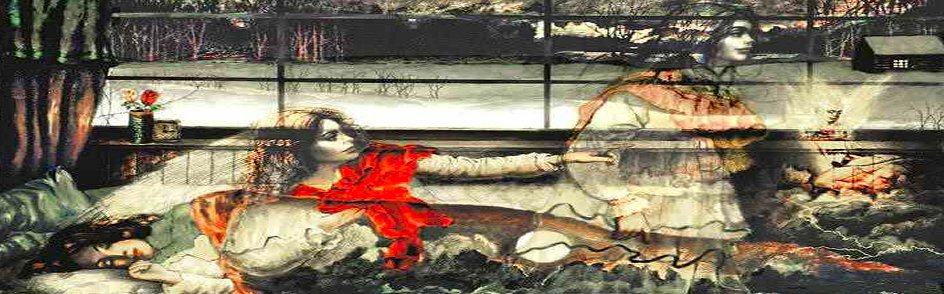
Anaesthesia the Mind and Dreams
Although anaesthetics are often thought of only as a means of reducing pain, several drugs used as anaesthetics may also produce powerful psychological effects. Winston Churchill reported an extraordinary vision experienced during anaesthesia. During it he reached a state of mind in which he felt that his awareness encompassed all that existed and was to be known. In this exalted state he was gradually aware there was another horizon forming beyond his present knowledge. Then he broke through to this new realm, gradually reached the point of once more feeling he encompassed it all, only to find another horizon.
Modern research tends to call this experience the ‘ecstatic state’. Other terms for it are ‘cosmic consciousness’, vision or revelation. William James, when experimenting with nitrous oxide, reported a similar experience. During it he felt he knew the secret of the universe and all in it. On awakening however all he could recall in detail was the verse – ‘Higamus Hogumus women are monogamous – Hogumus Higamus, men are polygamous.’ As he was an influential thinker for many years this led to the standpoint that such experiences were of little value. See: a new look at enlightenment; secret of the universe dreams.
On going into or emerging from anaesthesia some people report the remembrance of dreams that had occurred in the past, or the recurrence of a nightmare which had been previously experienced. In the latter situation the nightmare is usually one which expresses some traumatic past experience, such as an actual battle scene or motor accident. In my own observation of such trauma being re-presented in dreams or in abreacted experience, this appearance during anaesthesia once more suggests a link with a self-regulatory process active in the psyche. See: Life’s Little Secrets; compensation theory; self-regulation dreams and fantasy.
Quite a number of people report the experience of standing apart from their body during anaesthesia. This out of body experience – OBE – is now well documented, and cases have been followed up by investigating the circumstances and the information provided by the person experiencing the OBE. In several cases for instance, the person under anaesthetic is taken into a room they have never seen before and operated on by people they have not met. They experience the separation of their awareness from their anaesthetised body and not only observe the people in the room and their actions and conversation, but also sometimes go exploring adjacent rooms. Their descriptions have frequently completely tied in with the facts of the location they were operated in, the people present, and the adjacent rooms.
See: Going Beyond – Dimensions of Human Experience; Talking with Dead; near death experiences; esp in dreams; out of body experience.
In the book Ishi – The Last of his Tribe, by Theodora Kroeber, Ishi, a Native American unspoilt by exposure to Western life styles, was allowed to witness a tonsil operation on a child. He was horrified to see the child put into a sleep state by a man who had not himself been initiated into consciously entering the inner worlds of the unconscious. He was vitally aware that without such knowledge the anaesthetist was exposing the child to many real dangers. In fact many people have been left with psychological scars from lack of awareness on the part of surgeons and anaesthetists, of what is being experienced by the person being anaesthetised. See: The Labours of Hero Cules, a straightforward description of what it was like to remember an actual tonsil operation.
A patient under anaesthesia for a short operation told of ‘a complete revelation about the ultimate truth of everything. I understood the ‘entire works.’ It was a tremendous illumination. I was filled with unspeakable joy.’
But another description of a child being anaesthetised during a nose operation:
Example: As I explored the dream it worked out as my struggled to avoid the rectal anesthesia as a child. I didn’t experience the emotions of that, only the movements and intuitions about its connection with the dream. That is, I kept saying, “I didn’t hurt anybody. I didn’t.” This was expressive of a sense that the pain inflicted to my face (nose) during the operation, must be because I had done something wrong. I could see that I associated inflicted pain with the punishment a parent gave because of some “bad” action. I could not understand why the pain had been inflicted on me.
Also, I felt that religion itself was a projection out of the unconscious, from such fundamental premises. In other words, inflicted pain equals punishment. Pain equals God’s punishment.
Because I felt I was dying during the anesthetic, the sense of death equated with pain and people hurting one. At the time of the anesthetic my conscious identity had been plunged with awareness deep into the unconscious. The loss of shape or senses was felt to be death. So a conditioned reflex had been set. During anesthesia I had fought desperately with the nurses – for my life. What I was fighting for my life and kicked and struggled so much I had kicked the bottle of anaesthetic out of the nurses grasp and it broke. Then I was held as a fresh bottle was used and the anaesthetic was poured into my rectum – it couldn’t be given by nose – and I have a memory of the nurses saying, “Don’t do that!” To me it was like a hypnotic command saying, “Don’t fight for your life. Give up!” That was kept in me till I relived it using LifeStream.
Comments
Tony, I recently had an experience under IV sedation during an oral surgery. I really would like to talk to someone about this! !
I went through a surgery last week – seconds before I woke up I dreamt of exactly what I saw 20 years earlier when waking up after an anesthesia….two doctors telling me to wake up and they were showing me their waving hands and were singing a song…amazing!!
You entered the unconscious, a completely different world with different events. See https://dreamhawk.com/inner-life/the-unconscious-2/ and https://dreamhawk.com/dream-encyclopedia/dimensions-of-human-experience/
This was very interesting and has confirmed my unexplainable, life- changing experience with anesthesia. It was during a c-section and birth of my daughter 30 years ago. I have continued to research ,and attempt to find answers for my experience. I cannot explain it in words, it was simply beyond anything in the realm of anything human. I was first awake when the doctor cut me, I remember the intense pain ,and his exact words at the time of incision. I wanted to scream , but no noise could come. Next I remember traveling into another realm of being. It was a very simplified version of perhaps protons, neutrons, electrons, and light in a positive negative, or neutral state of existence in complete darkness, of what I later interpreted to be space?? I was no longer human , but a part of all being- God perhaps, but at that time it was only energy. I was extremely content with being this molecule or whatever it was- energy ,somehow apart of it all,, understanding our very creation and existence, and thinking I had died .I no longer wanted to return to my earthly being. I remember being quite angry upon waking up, until I was reminded of my new baby. I immediately insisted that I had died during the procedure, which was denied by doctors. I have spent the last 30 years trying to explain what happened to me, and this article confirms that others have also had this experience. I have since changed my religious beliefs, became extremely interested in physics, and I am no longer fearful of death .Thank you, for giving the reassurance that I am not alone .
You are absolutely correct !
This is exactly I had experienced too..being a molecule and the protons and neutrons..
Have you read the book Many Lives Many Masters by Dr.Brian Weiss ?
Rahul – Thanks for letting me know about your feedback.
No I haven’t read Many Lives Many Masters. I don’t get much time to read.
Tony