
Science Sleep and Dreams
In 1937, through the use of the electroencephalograph EEG measuring tiny electrical brain impulses, Loomis and his associates discovered that the form of brain-waves change with the onset of sleep. The next leap forward in understanding came when Aserinsky and Kleitman found rapid eye movements REM in 1953. In 1957 the REM were linked with dreaming. This defined sleep into two different observable states, REM sleep, and NREM non rapid eye movement, pronounced non-REM sleep. Within NREM three different stages have been identified. These are defined by the different EEG patterns of electrical activity in the brain. They are measured by their height amplitude and frequency of up and down movement. There are also electrical changes occurring in the muscles EMG, and in movement of the eyeballs EOG.
While awake the height is low and frequency fast. As we relax prior to sleep the EEG shifts to what are called alpha waves, with an 8 to 12 cps cycles per second, called alpha waves. Stage one of sleep is the transition between this drowsy state of alpha waves to sleeping, in which theta waves occur, with a 3 to 7 cps.
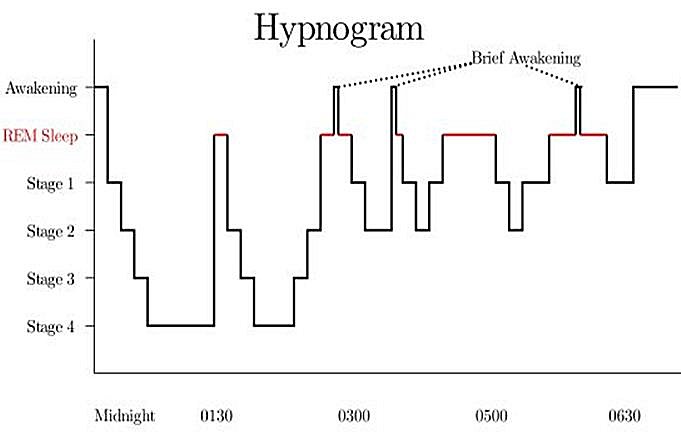 |
In this first stage we experience random images and thoughts. This lasts about ten minutes followed by stage two, in which ‘sleep spindles’ occur that have 12 to 14 cps on the EEG. These last from a half to two seconds, with ‘K’ complexes following, that are slow large EEG waves. About half our sleep period is spent in this second stage of sleep. Deep sleep is reached when our brain exhibits Delta waves, with 1/2 to 2 cps. |
After approximately an hour and a half from falling into deep sleep, an exciting change occurs. We return to level two and REM’s occur. Suddenly the brain is alert and active, though the person is asleep and difficult to wake. This level has been called paradoxical sleep because of this fact. Voluntary muscular activity is suppressed and the body is essentially paralysed. See Sleep paralysis
Morrison has pointed out that although the brain is transmitting full muscular activity messages, these are usually suppressed by an area of the brain in the pons. But bursts of short actions occur, such as rapid eyeball jerks, twitches of the muscles, changes in the size of the pupil, contractions in the middle ear, and erection of the penis. It may be that similar excitation occurs in the vagina. Also, ‘autonomic storms’ occur, during which large erratic changes occur in heart rate, blood pressure, breathing rate, and in other autonomic nervous system functions. These are the changes accompanying our dreams. See – It is important the 2 wills
If we slept for eight hours, a typical pattern would be to pass into Delta sleep, stay there for about seventy to ninety minutes, then return to stage two and dream for about five minutes. We then move back into Delta sleep, stay for a short period and shift back to level two, but without dreaming, then back into level three. The next return to stage two is longer, almost an hour, with a period of dreaming lasting about nineteen minutes, and also a short period of return to waking. There is only one short period of return to stage three sleep that occurs nearly four hours after falling asleep. From there on we remain in level two sleep, with three or four lengthening periods of dreaming, and returns to brief wakefulness. So in an average sleep period we would dream five or even six times. The average amount of body shifting is once every fifteen minutes.
facts and figures In undergoing 205 hours of sleep deprivation, four healthy males showed various physiological and psychological changes. Some of these were headache, lack of concentration, hallucination, memory loss, tremor, and in some, paranoia. In all cases one night’s sleep restored normal functioning.
One in ten people who complain of excessive daytime drowsiness suffer from sleep apnea, that is a stoppage of breathing while asleep. See: sleep apnea; insomnia.
A condition called narcolepsy causes sufferers to fall asleep at inappropriate times – while having sex – walking – playing tennis – working.
As we age we usually sleep less. Our REM sleep in particular decreases sharply. See: movements during sleep; paralysis; sleep – need for.
There was for long the opinion that dreams were caused by a late, heavy meal, or eating highly stimulating foods. One could call this the ‘indigestion’ theory.
Some experimentation was also undertaken in the realm of dreams produced by outside influences. Thus, a number of people have slept and been exposed to drops of water, ticking, sounds, scents, bells, electrical brain stimuli and even hypnotic suggestion. All of these produced dreams in some way explain the stimulus. For instance, Alexandre Arnoux writes how, when in a rest camp, he dreamt that the Germans had sent over a poisonous gas smelling of quinces. He awoke gasping for breath, only to see that his friend had just entered the room eating a quince. Another writer, Massey, on having water dropped on his face, dreamt he was in Italy, drinking wine and perspiring heavily. In the case of the electrical probe to the brain, particular memories were evoked, clear and distinct.
Another popular theory is that dreams are the uncontrolled wanderings of the sleeping mind. This theory sees the images of dreams as occurring due to the natural psychological law of association of ideas. Thus, as we drift into sleep, we may be entertaining the idea of a bicycle. The idea bicycle associates with journey, journey with someone we wish to see, this with fear of their not being there to welcome us, which links with our walking alone, etc.
J. A. Hadfield, in his excellent book Dreams and Nightmares, lists all these ideas and more. He points out that each of these ideas is true as far as it goes, but none of them explain all factors about dreams. Recent experiments have shown that even outside stimulus does not produce the dream, it merely enters into its images. Nor is a dream merely past memories, as a dream often uses images in unique formation, and we have to ask ourselves what has reshaped the images of our memory. In the dream of Arnoux, for instance, the smell of quince definitely enters into the dream, but if we are honest, we have to admit that an interior fear and terror is also expressive in the dream, and can thus be used as a means of self analysis.
The findings in researching also link with this self-regulatory theory. Dr. Dement and others experimented with dream deprivation with many subjects. The most obvious finding was that if the REM – dreaming – period of sleep is disturbed or prevented by waking the subject each time the REM activity begins, the REM periods of dreaming quickly became more and more frequent. The experiments had to be abandoned because without the use of force it became impossible to stop REM sleep, and the subjects were becoming seriously effected. There is obviously a great need on the part of the body/mind to dream. If for no other reason, dreams thereby have a meaningful function. When a person is deprived of dreaming in experiments, a breakdown in mind and body quickly occurs. This type of dreaming can often be a safety valve releasing tension and emotion not dealt with in waking life. See Dream Deprivation; Life’s Little Secrets