Author Archive
The Great and Ancient Secret – Part Nine
How Are You Holding Yourself Back?
What you deny in yourself, what you edit out of what you allow yourself to think and feel, is all part of how you might be holding back your own creativity, your own talents, and your own innate Secret.
Let us be clear about this. There are thousands of books on the market on how to succeed and become rich, or how to be a great lover or creative genius. Courses are run on the same subjects and to enter them you have to be rich anyway because they charge so much.
Mostly these are about techniques such as saying that to become rich you must save a percentage of what you earn, and then you must find ways make your money work for you, not you work for your money. Or to be a good partner or lover you must use sexual techniques, or learn to communicate with your partner honestly. You must learn to Make Love, not just do it.
But a lot of them simply tell you to hold the idea and feeling that you are a success, and to constantly visualise being wealthy, attractive, or successful.
Such instructions are fine and they may help you in some degree, but if you are all the time holding out on yourself, denying yourself, crushing your creativity, then you have less to bring to whatever else you do or try to achieve – or even what you have already achieved.
But The Secret is a step beyond those things. Again, let us be clear about this even at the cost of repetition.
From the early 1940’s onwards new tools were used in psychotherapy. Such psychotropic agents such as Ritalin and Psilocybin were used to plumb the depths and heights of human awareness. Never before had researchers, psychologists and psychiatrists been able to peer into the human mind and emotions so clearly. It was like having an x-ray or scanner of the human psyche. Such books as Stanislav Grof’s work, Realms of the Human Unconscious, describe what was found.
What was uncovered was extraordinary. Grof summed up his years of clinical experience by saying, ‘There is at present little doubt in my mind that our current understanding of the universe, of the nature of reality, and particularly of human beings, is superficial, incorrect, and incomplete.’
It was seen that not only do each of us have an inbuilt power and drive toward our own transformation and self realisation that is often blocked, but we have at our core the same power and potential that lies behind the emergence of our universe.
Perhaps that seems like an exaggeration. Maybe, but there are reasons why it appears like that. For one, the equipment you have is a big filter. Secondly, many of the other reasons have been explained above.
Taking the first – the equipment: consider for a few moments what life on this planet can do. It can fly, it can live under water, it can hibernate for months or years and then suddenly become active again. It can be incredibly small or amazingly big. It can express genius, cunning, aggression, love, great artistry, incredible memory and learning ability either as instinct or as learned skills.
Okay, I could go on, but think about it. Fundamentally Life is innately the same in all the varied creatures suggested above. It is just the ‘equipment’ – the body form – that enables one or the other things that Life can do. Birds fly and fishes swim because of the physical equipment they have. But Life has infinite potential, only parts of which are expressed in its living creatures.
You have a body form that has a lot of built in deficiencies, but also immense possibilities. You can’t smell or hear nearly as acutely as many animals. Your sight could almost be considered as blindness measured against the spectrum of light. You are quite weak physically when put against a chimpanzee. BUT – you have an incredible talent. With your self awareness you can look into the way you function and you can re-program yourself and transform the heritage you have been left by evolution, education and culture. You have the ability to self direct, and not just be a product of old instinctive drives. You can access your potential and help it unfold – a limitless potential. Mind and imagination can leap beyond boundaries – as we have done by creating machines that fly and telephones. But there are boundaries within us to leap beyond too.
More than anything else, your consciousness can turn away at times from the limitations of your senses, and when it does you can find an infinite ocean of awareness; a multidimensional cosmos of consciousness; a unfathomable source of information and creativity. See: Edgar Cayce.
Staying with Question One
Finding out how you hold yourself back is so important you need to stay with it for some time. To help clarify the question – to look at it from a different viewpoint – I will use a tree as an analogy.
A tree grows from a seed that is, compared with the tree’s mature size, tiny. So do you. The sperm and ovum are minute.
Within the seed is the potential of the full grown tree, but many things can interfere with the complete unfolding and growth. A harsh climate, poor soil, attack by disease or an exterior force, overcrowding and insufficient light can all be causes of poor growth.
Are these factors in what holds back your own potential?
Let us take them in turn.
A harsh climate: What was your childhood situation and environment? Napoleon said that as the twig is bent so the tree grows. That is obviously true of human life. We know it only too well now from studies of the childhood and home environment of psychopaths and abusers. Hitler’s past abuse went back many generations.
Even if your childhood was good there may have been particular events that left marks and blockages. Sometimes things that may be thought of as inconsequential are important. A woman I worked with demonstrated to me two such things. In one she remembered herself as a child taking her first steps. She was holding a cup and fell. The cup broke and cut her lip badly. Her mother was upset and scolded her. The resulting impact was that she felt any independent activity toward independence was likely to be painful and end disastrously. Subtle but life shaping.
The second thing was that she became pregnant and did not feel she could raise the child. She did not want to have an abortion so decided to give the child for adoption at birth. When the time came she felt such connection with her baby that its loss was painful. She was given no counselling and returned home and started sobbing to release her pain. Her neighbour came in however and instead of supporting her release, urged her to stop crying. Seventeen years later in her work with me she released that pain. It had been blocking her flow of love and feelings all those years.
What are the events that have led to blocks in you? And what attitudes or lessons have those events led to?
The Great and Ancient Secret – Part Eight
The Liberated Mind
Most of us are raised and live within enormous limitations. In this way our innate genius and creativity is stunted, trampled on, or held back in some way.
The limitations may differ with each of us. While involved in creative workshops I was often able to observe people learning to sing. I heard people in middle life say that when they were a child a teacher had told them they couldn’t sing and had no singing voice. They had never attempted to sing since.
Taken in a general way, that happens to many of us. Somewhere along the line we have learned or been told that we are not capable, we haven’t got the talent, who are we to think we could achieve things; or perhaps our performance according to tests set by a commercially oriented world suggest we are lacking something – and so we do not sing our song.
For many however, events in childhood and our education have formed the enormous barriers we face.
Such barriers to unfolding who we are extend far beyond that however. We live in a world where a tiny portion of the population own most of the wealth and property. So we may see our economic status as a barrier. We have also been educated in a society that has been developed in ways to control, segregate, and manipulate. David Korten, in his book The Great Turning, a book that spells out in detail the way people are trying to break away from the forces of Empire and International Business governing their lives, says:
The real intention of the United States was articulated in U.S. State Department Policy Planning Study 23, a top-secret document written in 1948 by George Kennan, a leading architect of the post-World War II world:
“We have about 50% of the world’s wealth, but only 6.3% of its population… In this situation we cannot fail to be the object of envy and resentment. Our real task in the coming period is to devise a pattern of relationships which will permit us to maintain this position of disparity… To do so, we will have to dispense with all sentimentality and day-dreaming; and our intention will have to be concentrated everywhere on our immediate national objectives… We should cease to talk about vague… unreal objectives such as human rights, the raising of living standards, and democratization. The day is not far off when we are going to have to deal in straight power concepts. The less we are then hampered by idealistic slogans, the better.”
He goes on to say, on his website:
“The corporate consolidation of power is merely a contemporary manifestation of ‘Empire’: the organization of society by hierarchies of domination grounded in violent chauvinisms of race, gender, religion, nationality, language, and class. The result has been the same for 5,000 years; fortune for the few and misery for the many. Increasingly destructive of children, family, community, and nature, the way of Empire is leading to environmental and social collapse.”
As I said at the very beginning of this series, ‘Virtually every society up to our present time has been built on a hierarchy. The upper levels of the hierarchy usually do everything in their power to maintain their advantage. To do so they live on the work and productivity of those in the lower levels of the hierarchy. In the U.S. and the UK today, recent figures show that the gap between the very wealthy, the middle and lower wage earners has widened enormously in the last 20 years. The struggle is still on to maintain the status quo.
A Boston Globe cartoon shows two bosses in a fancy office saying to three workers: “Why should you have a minimum wage – We don’t have a maximum wage.”
From the end of the 1970’s till the end of the 1990’s the income level of the lowest fifth of workers in the US fell from $9300 to $8700. The middle earning rose from $31,000 to $33,200. The highest earners rose from $256,000 to $644,000 in the same period. Also the length of life, health and opportunity within those groups also reflected their income. So the children of those at the highest level were much more likely to live longer and be rich in adulthood than those at lower income levels.
That, I am sure, constitutes a class system in the US, producing many of the inequalities we saw in work opportunity, personal well being, and wealth in the past in Britain. In the UK it is called class. In the US the same thing is called – money; wealth!
In the past, becoming conscious of this system, and showing signs of freedom from it, often meant death. It was wise to keep the organisations, the teachings and the techniques that led to freedom of mind and spirit Secret.’ Today there is a huge shift in the paradigm people live within. Like the goldfish in the first illustration, people are leaping beyond the social, political and racial stereotypes and habitual attitudes and worldview they have inherited. We can now more openly move to personal liberation. See Programmed
I have spent most of my life gradually finding my way out, and helping others find their way out of the limitations built into us, or placed on us – perhaps even by ourselves. The struggle has been to emerge from the influence of generations of our forebears being raised in religious, national and political systems of control and threat; immersion in and education by a system developed around class, (social or economic); being trained to believe in and conform to a way of life that reflects huge distortions of who we are and what the universe and the world is. Such training is usually called education or religious training. For instance I was born in a small country town where men and women were burnt at the stake for daring to read their own bible.
Added to that are personal psychological injuries to our psyche brought about because, as said above, we are raised in a system that reflects huge distortions in understanding who and what human beings are.
Having said that, I do not have a view of the world to sell you or promote to you – other than what I have just said. What I have come to understand is that each of us have our own wonderful genius that will tell us what we need to know about the world and ourselves. It is dynamic and responsive to what faces us in life and the system in which we live. When it is active in your life it brings enormous creativity and innovation to what you do. So all I want to attempt is to show you ways you can gradually drop the barriers that have prevented you from knowing yourself in that way. I want to see if I can help you recognise those barriers and then move beyond them into the wonderful experience of the liberated mind.
Questions you need to ask yourself
The very first step in finding liberation is to become aware of the things that prevent it. So give time to the following questions. Don’t rush through them. Take days or even weeks with each one. Dropping away the limitations that may have taken generations to be built into you takes time and work.
Question One
Recently I was involved as an observer and participant in a workshop run by a capable and intelligent woman. It was obvious as she worked that she was mature, well balanced, with a lot of integrated life experience. Afterwards, as we were parting, I said to her, “You are a lovely woman.” Immediately and with some energy she said, “No I’m not!”
She had a built in response to deny her own beauty and capability. So the first question to ask yourself is –
What am I denying of myself?
This question can be framed in a number of ways. Carl Jung put it in another way by say, “What am I editing?”
We deny or edit in all manner of ways. We might have a habitual inner voice that tells us how inadequate we are, or what a failure we are. I worked with one woman who was gradually learning to recognise the things that were holding the best in her back. She told me as we worked, “It is amazing how we are so influenced by what our parents tell us, carrying it around with us, not realizing how much it affects how we live out our lives into and throughout adulthood. And it is amazing how we can come to know we aren’t what they say we are, yet there it is holding us back in some way. I hold back because so deep within me is the fear that I might be wrong.”
Another woman I worked with was constantly humilated at school. Not only was she humiliated when she got soemthing wrong, but also when she got something right.
For many of us, our parents were raised and educated in a social situation that was deeply controlled by political or religious do’s and don’ts, the domination by authority figures or the threat of unemployment. They may thus have raised us in the same way, a way helping us to deny any spark that would make us stand out. To survive they had to conform, and often they passed that terrbile lesson on to us.
But we also do it to ourselves by comparing our body, our social standing, our wealth or some other factors with those who appear more attractive, popular or successful.
From such past events, from failure in the system, or humiliation or abuse, we develop deeply engraved habitual responses to people, opportunity and events.
So, how are you denying yourself? What are you not daring to do? What are you not worthy of? What is wrong to think or feel?
See Opening to Life – Opening yourself to your bigger You
The Great and Ancient Secret – Part Seven
The Simple Truth
Well yes, we could look at the classic approaches, and there are dozens of them. But don’t you sense some confusion already in what has been said – you should do this; this has to be done before you do that; this is the best way- or maybe that would suit you better! It’s a maze you could get lost in. It’s a Babel of voices and opinions. There is so much crud offered to us in our world today, probably someone trying to sell you something packaged in extraordinarily attractive wrappings. And why are they trying to sell it or convince you of how good it is? Well, if you dig deep, it is because they haven’t found the Great Secret themselves, and they need you to give them some of your wealth to give them a security and confidence they lack. They need you to swell their numbers so they can themselves feel they are doing the right thing.
Take a while to consider how insecure those people are. When they get wealth or power they keep hold of it in every way possible. They trample others and deny them a fair share of what they have worked for. Look around, they even call out the army or police to maintain their hold on things.
nd why do we follow such people? Why do we get involved in organisations, paths and methods?
Well, its because we fail to open to the wonderful being we already are.
Honestly, its an old, old story. It is the fullness of life you were born with that is your real treasure. What we are all seeking is that wonderful creative life we veil and hide, deny or crucify within us. There aren’t any secret ways to help you to unveil that and accept it when, as it is always doing, it knocks on your door. It isn’t in any particular faith, or meditation or understanding of ‘dreams’. It doesn’t need any special breathing technique or secret vitamin.
What it does need is the sort of guts it takes to live your life fully; to feel everything that life puts in front of you; to let your deepest passions be expressed – the best in you not the worst. Not fear or despair or uncertainty. Those are shadows getting in the way of your own light – and it is that light of your innermost self that is the Secret.
Of course you must not avoid the shadows. Meeting them with the confidence that you are opening to something beyond them gives you the confidence to face them. And in confronting them you gain the understanding of where and how those shadows, those lumps of pain or anger entered you.
How do you do that?
Most of us have been brought up to believe we exist as something separated from the great creation of our universe. We feel lost in the immensity of what surrounds us; a speck amidst teeming millions – what have we got to offer?
If you take time to look at how you exist you will see that it is not through some talent or skill of your own. I know you might get proud and sometimes people get big headed because they believe they have ‘made it’. Success, acclaim, money, and they lose sight of the basic things – they don’t beat their own heart. They don’t produce their own food, make their own clothes. Build their own dwelling. It isn’t their conscious ego that keeps them breathing while they sleep. It is LIFE – and the whole process of the universe is behind that.
If we fail to acknowledge that; if we fail to open to it, then we are dead, blind, lost in a crazy world. Life, the spirit that gives us existence, is constantly a part of your daily life. It is forever trying to lead you toward the full flowering of who you are. Real success, real creativity, riches, wonderful sex and love, all emerge from that flowering.
Life speaks to us all the time, not as a great voice from the sky, but in all we meet each day, in the animals we connect with, through parenthood and love, through being able to really see other people, in being able to respond to what knocks on our door. Some people experience it when they love an animal, or feel wonder in nature. Others feel the passion of it when they get fascinated by a line of study or work. Whether it a a great passion, love or wonder, it is that opening and stirring inside of you that is Life speaking to you. Listen to it and follow where it leads. It is leading you to your own wonderful Secret.
Life told us all this 2000 years ago. Forget names like Jesus or Christ, it was Life speaking. Forget the churches and the dogma, the rules and regulations, go straight to the source.
Life told us that, “The Kingdom of God is inside you and all around you, not in buildings of wood and stone. Split a piece of wood and you’ll find me, lift a stone and I’m there”.
Life showed us how to live without judging people or ourselves. Life didn’t turn the prostitute away, or the sick. Life loved unconditionally, not grasping because of ones own insecurity and needs. Life said that we each have the wonder in us, but we deny it, crucify it because it doesn’t bow down to authorities or rulers. And it isn’t something that happened in past times. That same life is calling to us now – “Let me into your life. Let me heal your blindness and paralysis. Let me wake you from the dead. Come to me as a little child, or as a lover, opening your being to me. Drop your preconceptions and I will live in you.”
I ask you to imagine that – a glorious love affair with the very spirit of life! A love affair with the invisible and forever indefinable, the infinitely creative. Is that something you are afraid of?
Can you open your being to the invisible unknown that lives you? Can you trust what you can never grasp and yet you constantly know as your existence? Can you open with love to the invisible and indefinable?
Why not say YES to it?
The Great and Ancient Secret – Part Six
The Subtle Trick
As I hope is becoming clear, the many different traditions have a great deal in common. Although they explain things in very different ways, when you examine what they teach carefully, the essential meaning is the same.
But now we are faced with what is done to quiet the mind and to stand before the Secret of Life with ‘naked intent’, like an empty cup, or like a virgin. And here once more it must be remembered that the finger pointing is not the moon.
Throughout the long millennia of human history men and women have done certain things in order to go beyond their usual experience of themselves. Perhaps it was to seek healing, to be capable of conceiving a child, to know their connection with the universe more fully, or to have a clearer vision of their potential and life direction. Everything from flagellation to lonely vigils, fasting to repetition of prayers or phrases, feats of enormous self discipline to whirling in circles like the dervishes have been used. And once again, if you analyse what any of these techniques do, you will see that they break the hold of the habitual state of mind. They lead to an altered state of consciousness. If you can grasp what they are all pointing to it makes the way enormously clearer. In doing that it means you do not get caught in the web of the promotional statements broadcast by the different sects and doctrines.
To make things clear we need to look at some of the major or classic techniques used to experience the Secret. And as we look at them, remember that you already are the Secret. So the techniques are not to develop within you this magical thing; they are not a way of earning God’s blessing by being good or obedient; they are not a means of becoming something other than you already are. Think of it more like having a magical and beautiful lake in the middle of a garden that has gone wild and is overgrown. What you are doing is to clear the growth so the magical shining lake is revealed.
Om mani padme hum – the jewel of your being is within the lotus of your unfolding.
Another way of looking at the way to the Secret is to realise that you are already all that you can be. Like an acorn, you already have the potential of the full grown tree within you. To manifest and know it you need to allow yourself to be all that you can be. The techniques are to remove obstacles and allow unfolding. They are not in any way the jewel within you.
The Many Paths to the One
I suppose the many paths can be summarised by saying they all fall within the description of meditation, prayer, discipline, or a particular way of life.
Almost undoubtedly it is the last one, a particular way of life, that is the most widely practised. This is because whether we look at Christianity, Buddhism, Judaism, Islam, Shintoism, Native American Spirituality, the religions of black Africa, Hinduism; Taoism; Paganism, or even New Age or Humanistic practices, they all end up being things the practitioners change or are asked to change in their outer or inner lives. The person makes adjustments to their otherwise ‘natural’ or habitual way of living and doing things. In this way, even though it might be a very gentle change, they are confronting the habits and feelings that most people are slaves to. As the more rigorous methods are looked at you will see that is fundamental to them all.
I know the word ‘slaves’ is a strong word, but it needs to be. Most of us are without any awareness of why we are doing what we do, or living in the way we do. Of course we rationalise why we act in the way we do, but that is common even to acute paranoia.
But mostly we simply go along with what circumstances or our feelings and urges lead us to do. If that were not so youngsters would not start smoking and drinking to the level they do knowing the effects of those drugs.
But there are levels even within this general layer of proposed ways of life and behaviour. Worship, prayer or meditation, or action of one form or another is general to all of them. They may argue about their differences, but they are all proposing similar aims.
Worship and prayer are easy for us to see the underlying significance. Both of them shift the person’s attention away from their own individual life in some degree, and create an altered state of awareness in which they are open to something beyond their limited life and self. It doesn’t matter what belief system you look at, or what name the spirit or god is given, basically the person is ready to be influenced in some measure by something beyond self. In some cases there is even an active awe or love as part of that opening.
Opening to the possibility there is something beyond the self we know is a fundamental, even in psychotherapy.
Meditation on What?
Meditation is slightly more complex as there are so many possible results and types, but I think it is safe to say there is an underlying aim, and that is to find or create a change. The change might be the achievement of a different experience or a new insight, but the act of meditating aims at changing the state of mind that already exists. Usually it moves from being lost or deeply involved in the state of mind and feelings produced by daily tasks and events, to something that is less involved and perhaps far removed from them.
The methods of meditation are so many it would be foolish to try to look at them in detail, and the point here is to consider those that are directly connected with revealing the Secret. And this is where the subtle trick comes in. So we will look in detail at some of the classic approaches, and also at the strange trick they play.
The Great and Ancient Secret – Part Five
Paradox of the Opposites
Niyama is the opposite to the disciplines of restraint and control. Without it you would be unbalanced. My view of this is different to that stated by many writers, who, I believe, do not really understand these early instructions. Yama is restraint and control, niyama is about release, letting go so that in further stages you can allow discharge if it is necessary. But its need is much deeper than that. The Secret is potent. It flows into you and changes you. But it does not act against your will. Unless you can let go the process of transformation cannot happen.
Traditionally niyama is translated as observances. These include opening to ones teacher, daily worship, and Patanjali gives one as surrender of self. What I am trying to do in my definition above is to state the essence and essential.
Two of the great forces active in your life are control and release. We see this in every full breath – the active drawing in, and the release as we breathe out. To some extent you can control your actions, your breathing, perhaps even your emotions; but these are tiny in comparison with what you cannot control. The controlling aspect of yama is, I believe, a means of strengthening oneself in order to meet and allow the action of what you cannot control – or what should not be controlled. Part of what emerges from the uncontrolled is the process of your developmental growth and ageing. What is vital to understand in connection with this is that we have two wills active in us. There is your conscious will with which you can direct the way you move or speak, and there is the unconscious will that directs your heartbeat and all the millions of other functions underlying your existence.
This is not a new idea. Many ancient thinkers and writers have expressed it in one way or another. For instance Jakob Boehme who lived between 1575 and 1624 wrote that:
Thou must consider that there are in thy Soul two Wills, an inferior Will, which is for driving thee to Things without and below; and a superior Will, which is for drawing to Things within and above. These two Wills are now set together, as it were, Back to Back, and in a direct Contrariety to each other; but in the Beginning, it was not so. (See: Jacob Behmen)
St. Augustine stated it even more strongly in saying:
The new will which I began to have was not yet strong enough to overcome that other will, strengthened by long indulgence. So these two wills, one old, one new, one carnal, the other spiritual, contended with each other and disturbed my soul.
Part of the instructions to allow the Ancient Secret to be experienced was that in our usual life, often blighted by sorrows or difficulties, our conscious will is in many ways in conflict with what Boehme has call the superior will. This is still obvious today if you look around. Countless people struggle, even to their death, with the natural will of their appetite for food. Just as many or more people have a conflict with their sexual drive, their breathing or going to the toilet. Even sleep is difficult for many.
In these struggles we see how the personality is in some way conflicting or struggling against the larger internal will. Of course these are extreme cases, but from the point of view of experiencing the Secret most of us are out of harmony with the wider will that gives us life. The process of Life itself is often blocked, distorted or misdirected in some way in most of us. The signs of this are the loneliness, despair, depression, suicidal impulses, sense of meaningless or feelings of being isolated from life and cut off from oneself. Because of this learning to let go, to drop control, to open to what past cultures have seen as the inner divine is vital for health and to live fully. Quite apart from any rewards of knowing the Secret such as the wonderful freedom and creativity it brings, it is also a healing process that clears out and deals with things from the past that cloud ones mind and heart.
Summary of the First Steps
We can now distil some of what has been said into simpler form.
To recap, Victor Gollancz said it was a ‘contrite heart’ that was the turning point for him. The Ox Herding Pictures show the recognition of another living process with a will of its own – the ox. So this is about the meeting of the two wills. Sufism suggests the losing of oneself – the letting go. But this is also about the two wills in that your conscious ego lets go to know the deeper will. Tolstoy suggested fasting, and that is akin to yama.
So we have control and discipline to strengthen. But at the same time we have the letting go of control. And although that seems to be a loss of discipline, it is usually difficult to do unless you have gained sufficient self control. That is part of the paradox or contradiction of the way. If you have not learned the strength of meeting your unconscious habits and fears, when you let go they will take control. The strength needed is to keep the open space clear so something other than your old hurts, fears, sexual lust and narcissistic urges can emerge.
One of the Eastern statements of instruction says that you must become like an empty cup. If you are not empty nothing new can flow in.
Such teachings are almost universal, although they are expressed in different ways or in symbols. For instance in the little book of instruction titled The Voice of the Silence, the very first words say:
THESE instructions are for those ignorant of the dangers of the lower forces in the psyche. He who would hear the voice of ‘the Soundless Sound’, and comprehend it, has to learn to abstract awareness from the external world. Having become indifferent to objects of perception, the pupil must seek out the ruler of the senses, the Thought-Producer, he who awakes illusion.
The Mind is the great Slayer of the Real.
Let the Disciple slay the Slayer.
The teachings of Patanjali, the great commentator on ancient yoga practice, about taking the first steps is similar, but worded differently.
Yoga is restraining the mind-stuff (Chitta) from taking various forms (Vrittis). At that time (the time of concentration) the seer (Purusha) rests in his own (unmodified) state. At other times (other than that of concentration) the seer is identified with the modifications.
Putting this is modern language, it says that seeking the unity of self means quieting the normal and habitual manifestations of thought and emotion. When this is achieved the practitioner experiences themselves beyond the surface illusion of their senses and thoughts. When this is not done the practitioner is lost in the illusory world of thoughts and feelings.
The Christian mystics also give a similar instruction. In the classic The Cloud of Unknowing, the unknown author, writing about 500 AD, tells us to approach with ‘naked intent’. But the title of the book tells it all – to stand before that Secret without knowing. Here is both a letting go of all you hold in your personality, and at the same time a quieting of the wayward mind and soul.
But in the original Christian symbols the same is told in a different way. Taken as a symbol instead of a historical character, the Virgin Mary shows us how to approach that forever indefinable Secret – like a young woman freshly become fertile and open with all her heart to the invisible that gives life.
The Great and Ancient Secret – Part Four
From Weakness to Strength
If you are to succeed in uncovering the Secret there are certain things you have to recognise about human nature, and why preparation is sometimes necessary.
Self awareness is an incredibly fragile and new situation in the living creatures of this planet. We are adapting to self awareness from the level of awareness an animal has. As animals we did not have a focussed awareness capable of worrying about success or failure, or how ugly or beautiful we are. Self awareness brings many stresses. If you doubt that look around at how many people break down in our society, or who only manage to continue facing life with the help of medical or street drugs, alcohol or nicotine. How many people do you know who are constantly taking antidepressants?
Also as a human animal we were not designed to live and work the way we do. It is an enormous stress to live and survive in modern society.
If you don’t recognise your vulnerability and levels of stress you will probably find the expansion of awareness and depth of experience that arises as you uncover the Secret to be intolerable. Your ego or sense of self has to be strengthened.
I know some approaches, some traditions, give a very simple method for transformation and touching the wonderful freedom the Secret brings. For instance I know a woman who practised Transcendental Meditation for twenty five years and yet had never dipped under the surface of her conscious mind, and didn’t know how to when I sat with her. Of course we have the other end of the spectrum in Suzanne Segal who experienced continuous expanded awareness after using TM. However, Suzanne is an exception not a norm. Uncovering the Secret takes work and as the parable of the pearl of great price suggests, we need to give all of ourselves to it.
In the recent craze about The Secret, which offers to show you the way to riches and the gratification of what you want, we perhaps see a strange expression of our consumer society where the dream is offered you of instant gratification. Of course, sometimes it is offered at a price. However, my experience of working with many people is that you cannot know the Secret without certain qualities and skills. And the Secret is about a great deal more than gratification of ones ego desires.
What is Yama and Niyama?
The word ‘yama’ means ‘restraint’ or ‘control’. This ‘restraint’ applies to rules of conduct. In traditional yoga they are listed as ten in number and are: Non-Injuring; Non-Lying; Non-Stealing; Non-Attachment to Sensual Desires; Non-Attachment to Grievances; Non-Immersion in Inertia; Non-Attachment to Self Interests; Non-Attachment to Conceptions of Self; Non-Gluttony; Cleanliness.
At first these sound like all that stuff in religion about being good – doing the right things. Well, if you take them at face value without understanding things, that is what they would be. But what other way can we see them?
Well, yama is important because as human beings we are largely the slave of our instincts, emotions and mental conceptions. Members of opposing political or religious factions may fight to the death. This is not because there is a basic enmity, but because neither can let go of their opinions or their social indoctrinations. Remember also what was said previously about being victims. Becoming free of such habitual motives, fears and responses is not done by simply visualising a happy ending or financial success. Facing the internal reservoir of past experience and trauma is not achieved by someone who cannot deal with their own emotions and sexuality, and are the victims of their own urges and darkness. If we lie, we have not the courage to face that which made us lie, and therefore lack the courage to meet ourselves. The desire to injure includes the ability to injure or destroy subtle parts of your own nature that are struggling to be expressed, and so on. The rules are not intended to be merely moralistic, but to awaken latent possibilities within the individual. The Secret is the core of yourself. You cannot get there except by meeting yourself – all of yourself, and allowing it to live.
I agree that is a heavy bundle up there under the definition of yama. But you need to start somewhere, and what you can’t manage at the beginning will gradually become possible as you grow. But do NOT take those disciplines on yourself as if they are somehow spiritual needs. You will not get there by being good and doing all the ‘right’ things. They are simply guidelines, and something as simple as fasting or trying to move toward non-attachment can develop a great deal of personal strength and decisiveness. Believe me, you need to develop some level of strength, otherwise you will run away like a scared child when you start to meet your own inner depths of feelings and the enormity of the being you are. Your ego, what you usually call, self, is a tiny fraction of who you are. If you are scared you cannot let go of your defences.
But remember, the suggestions of yama are not the Secret. They are only guidelines, and there is an ancient saying that when you look at someone pointing at the moon, do not confuse the finger with the moon. Yama is just a finger.
The Great and Ancient Secret – Part Three
Releasing the Infinite Potential
How Can We Release that Infinite Potential?
A couple of times in recent months I heard a well known public figure saying with great enthusiasm that we all have within us a wonderful central self that if we access it brings bliss, health and creativity. He was almost shouting this message, and he said it was open to everyone of any age. He made it seem incredibly easy to find.
Personally I started a search for that Secret when I was thirteen. But it wasn’t until my mid thirties that I experienced it in any depth. And it wasn’t that I didn’t throw myself into the quest fully – I did. I really needed to find the release promised.
After years of depression and emotional pain I was desperate. But there are, for many of us, hurdles to overcome. I write this feature because of that. As far as I am capable I want to define the stages, the barriers and the needs of the journey. I want to do this by looking at all the many pathways to this core experience and comparing them so you can see what is at the heart of them all. I hope this will enable you to see more clearly where you are going and how to get there. I want to give you a better map than I had.
Well, we are all unique, so each of us starts from a different place. But you have to remember from the very beginning that you already have what you seek. You must know there is nowhere to go, nothing to attain or grasp. You are already what you seek. Krishnamurti said, “Truth is a pathless land.” But we live a paradox, so there is a journey and a path to follow. You will move from darkness to light, but you will arrive at where you began, at the paradoxical nowhere.
BUT – you probably exist in a state of blindness or unconsciousness, so you cannot ‘see’ or realise who and what you are.
What the secret methods of the past and present help you to do is to heal or change that blindness and unconsciousness. You are brought to life – full wonderful life – from a condition of dormancy. That lack of life, that unconsciousness, is a deeply engrained habit. In most cases deepened and fastened to you by generations of forebears living in a similar condition. It takes work to gradually confront those habits. It takes courage and determination to meet and acknowledge your own part in killing the wonder that you are. It takes the ability to feel great emotion and excitation in order to allow the pains and traumas of yesterday and past upheavals to surface and be healed. It takes patience to allow the growth of what is dormant within you take place, and to be the careful detective investigating your own life path.
That is the equipment you will need. Take heed.
First Steps on the Trackless Way
So where do we start, and what equipment do we need?
To quote Krishnamurti more fully:
Truth is a pathless land, and you cannot approach it by any path whatsoever, by any religion, by any sect. That is my point of view, and I adhere to that absolutely and unconditionally. Truth, being limitless, unconditioned, unapproachable by any path whatsoever, cannot be organized; nor should any organization be formed to lead or to coerce people along any particular path.
In 2005 I went to San Francisco to be with a friend. While there I had a very unusual experience. While wide awake and sitting alone I was suddenly shot into a dream state, yet I was still awake. In this state I had a very distinct image and sensation of a small bird fluttering close to my head. What was incredibly clear and real was the way its wings were fluttering. I could really see and feel that they were not simply waving up-and-down but vibrating at great speed. The bird kept fluttering near me, and I realised it was trying to attract my attention so I would follow it. So I did and it led me into a condition of great darkness. I could see or hear nothing except the bird. It led on and I trusted it, and we came to what was recognisably a dark cave from which were slowly emerging hundreds, perhaps thousands of people. I understood as I saw this that an enormous number of people throughout the world were now emerging from a dark place. I realised that there was the need for many workers to meet them and help them to learn to live life within the light.
Of course the darkness mentioned is what was called ‘blindness’ earlier on. It is a situation millions of people exist in without realising it, and in our present times a huge number of people are slowly emerging from it.
To understand that more clearly, think of the time when everybody was convinced the earth was the centre of the universe, and the sun and stars all circled it. Then Galileo stated that Copernicus’s theory of the sun being the centre of our solar system – heliocentrism – was correct from his observations. At the time this was so shocking the Catholic Church tried to make him withdraw his statement. So in the conviction the earth was central to the universe the people of the time exhibited the sort of blindness mentioned. They were living in a darkness of the mind that later generations emerged from.
Nevertheless Krishnamurti spent his adult life teaching this pathless way.
In 2005 I went to San Francisco to be with a friend. While there I had a very unusual experience. While wide awake and sitting alone I was suddenly shot into a dream state, yet I was still awake. In this state I had a very distinct image and sensation of a small bird fluttering close to my head. What was incredibly clear and real was the way its wings were fluttering. I could really see and feel that they were not simply waving up-and-down but vibrating at great speed. The bird kept fluttering near me, and I realised it was trying to attract my attention so I would follow it. So I did and it led me into a condition of great darkness. I could see or hear nothing except the bird. It led on and I trusted it, and we came to what was recognisably a dark cave from which were slowly emerging hundreds, perhaps thousands of people. I understood as I saw this that an enormous number of people throughout the world were now emerging from a dark place. I realised that there was the need for many workers to meet them and help them to learn to live life within the light.
Of course the darkness mentioned is what was called ‘blindness’ earlier on. It is a situation millions of people exist in without realising it, and in our present times a huge number of people are slowly emerging from it.
To understand that more clearly, think of the time when everybody was convinced the earth was the centre of the universe, and the sun and stars all circled it. Then Galileo stated that Copernicus’s theory of the sun being the centre of our solar system – heliocentrism – was correct from his observations. At the time this was so shocking the Catholic Church tried to make him withdraw his statement. So in the conviction the earth was central to the universe the people of the time exhibited the sort of blindness mentioned. They were living in a darkness of the mind that later generations emerged from.
As another example of this, Dr. Karagulla, a famous neurologist, in her book Breakthrough to Creativity, has described an experiment she made with two doctors. To test heightened sensory perception she blindfolded one of the doctors and gave him a photograph. It was a medical picture of a pregnant woman. He was asked to pass his fingertips over the photograph and report any impressions and sensations. At this the other doctor began to protest that what she was asking was not possible. But at this point the blindfolded doctor began to speak of impressions which vividly described the picture he held. The other doctor began to protest so violently, and began to feel so ill, the experiment had to be terminated.
The blindness is not skin deep. When we confront something that questions the blindness we may feel very threatened and even ill. The way must be walked with care.
So in regard to the first steps on this journey we have to go slowly. Strangely, the great Secret could be told you now in as little as three words. Unfortunately it would be very, very difficult for you to believe it or understand its truth. If that were not so you would already know it from personal experience, and it is certainly stated openly enough and frequently enough.
The direction most traditions and teachers of the Secret have taken is not to state it outright, but to give people ways of experiencing it for themselves. The first steps of this are given in slightly different forms by different traditional paths.
In the yoga teaching the first step is the practice of yama and niyama. Roughly translated these mean restraint and non-restraint, and will be looked at more closely shortly.
Leo Tolstoy, the author of War and Peace, wrote that the first step for a Christian would be fasting. Obviously this is another statement of restraint of ones appetites.
In a Chinese teaching of the steps on the journey of discovery it is illustrated by what are known as the Ox Herding Pictures. In different versions of these there are from nine to twelve pictures illustrating the stages of finding and living the Secret. But in each of them the first picture shows the person going along in their daily life on a country track and suddenly becoming aware of an Ox’s footprints in the mud.
Victor Gollancz the famous publisher, in his book From Darkness to Light, tells of his own first step. He says:
For an hour past I have been the prey of a vague anxiety; I recognise my old enemy – – – It is a sense of void and anguish; a sense of something lacking: what? Love, peace, God perhaps? The essence of my hell was outlawry. By the sin which, as I felt, I had committed, I had broken the links that united me with universal living: I was separate, alone, without lot or part in the everything. I had deprived myself, treacherously, of it: I had deprived it, quite as treacherously, of me.
One forenoon, when my terror and despair seemed to be at their height, and after a total insomnia that had lasted for twenty-two days, and every muscle and nerve ached, I set out for a walk with my wife. We went very slowly. About half an hour later we turned, sharply, left, into a dark and narrow path that descended: and soon came out into a great open space – a sort of water meadow, with herds grazing, and a high inland cliff just in front of us. There was dappled sunlight everywhere, and a slight breeze. I felt suddenly very still: and then I heard the inland cliff, and the grass and water and sky, say very distinctly to me “A humble and a contrite heart He will not despise.” When I say I heard them say it, I mean, quite literally, that I heard them say it; a voice came from them: but they were also themselves the voice, and the voice was also within me I said to my wife “The trouble is over”, and that night I slept a little.
For many this is the first step. The events of their life, their health, their inner state of pain or loss, of emptiness and lack of meaning, helps that initial shift.
In Sufism, the side of Islam that seeks direct experience rather than intellectual information or dogma. Ansari of Herat wrote that, ‘When you lose yourself, you find the Beloved.” There is no other secret. I don’t know any more than this. Ansari is saying something similar to what Victor Gollancz has shown – when you are ready to let go of your old life, or have outgrown it, the new will appear.
But there is also a mention of another great doorway to the Secret – love and the beloved. For some it is not pain, ill health or despair that brings the first steps, but wonder and love of what they recognise as that which gives them life.
Opening the Door
To draw sense out of the several viewpoints mentioned above, we can say there are two or three aspects to the first steps. One is discipline as suggested by yama and niyama. There are several reasons this is a part of discovering what you already are. Firstly the habits, then the blindness. The past we carry is often so deeply engraved, that it is only passed through with perseverance. It doesn’t usually melt without a struggle.
Also we are often only half alive. As we unfurl the enormous energies that have been buried or suppressed they begin to flow and express. That is fine, but habits have dug deep channels in us through which those energy xpressed in the past. As the new energy flows it will by habit course through those old channels; channels of anger, depression; feelings of abandonment; failure – surely you know them well?
Those were difficult enough to meet in the past, but think what they will feel like with an increased flow.
Yama and Niyama are to train yourself in new ways of meeting this energy, as well as learning what are new skills enabling you to deal with those energies in a new way.
How Can We Release that Infinite Potential?
A couple of times in recent months I heard a well known public figure saying with great enthusiasm that we all have within us a wonderful central self that if we access it brings bliss, health and creativity. He was almost shouting this message, and he said it was open to everyone of any age. He made it seem incredibly easy to find.
Personally I started a search for that Secret when I was thirteen. But it wasn’t until my mid thirties that I experienced it in any depth. And it wasn’t that I didn’t throw myself into the quest fully – I did. I really needed to find the release promised.
After years of depression and emotional pain I was desperate. But there are, for many of us, hurdles to overcome. I write this feature because of that. As far as I am capable I want to define the stages, the barriers and the needs of the journey. I want to do this by looking at all the many pathways to this core experience and comparing them so you can see what is at the heart of them all. I hope this will enable you to see more clearly where you are going and how to get there. I want to give you a better map than I had.
Well, we are all unique, so each of us starts from a different place. But you have to remember from the very beginning that you already have what you seek. You must know there is nowhere to go, nothing to attain or grasp. You are already what you seek. Krishnamurti said, “Truth is a pathless land.” But we live a paradox, so there is a journey and a path to follow. You will move from darkness to light, but you will arrive at where you began, at the paradoxical nowhere.
BUT – you probably exist in a state of blindness or unconsciousness, so you cannot ‘see’ or realise who and what you are.
What the secret methods of the past and present help you to do is to heal or change that blindness and unconsciousness. You are brought to life – full wonderful life – from a condition of dormancy. That lack of life, that unconsciousness, is a deeply engrained habit. In most cases deepened and fastened to you by generations of forebears living in a similar condition. It takes work to gradually confront those habits. It takes courage and determination to meet and acknowledge your own part in killing the wonder that you are. It takes the ability to feel great emotion and excitation in order to allow the pains and traumas of yesterday and past upheavals to surface and be healed. It takes patience to allow the growth of what is dormant within you take place, and to be the careful detective investigating your own life path.
That is the equipment you will need. Take heed.
First Steps on the Trackless Way
So where do we start, and what equipment do we need?
To quote Krishnamurti more fully:
Truth is a pathless land, and you cannot approach it by any path whatsoever, by any religion, by any sect. That is my point of view, and I adhere to that absolutely and unconditionally. Truth, being limitless, unconditioned, unapproachable by any path whatsoever, cannot be organized; nor should any organization be formed to lead or to coerce people along any particular path.
In 2005 I went to San Francisco to be with a friend. While there I had a very unusual experience. While wide awake and sitting alone I was suddenly shot into a dream state, yet I was still awake. In this state I had a very distinct image and sensation of a small bird fluttering close to my head. What was incredibly clear and real was the way its wings were fluttering. I could really see and feel that they were not simply waving up-and-down but vibrating at great speed. The bird kept fluttering near me, and I realised it was trying to attract my attention so I would follow it. So I did and it led me into a condition of great darkness. I could see or hear nothing except the bird. It led on and I trusted it, and we came to what was recognisably a dark cave from which were slowly emerging hundreds, perhaps thousands of people. I understood as I saw this that an enormous number of people throughout the world were now emerging from a dark place. I realised that there was the need for many workers to meet them and help them to learn to live life within the light.
Of course the darkness mentioned is what was called ‘blindness’ earlier on. It is a situation millions of people exist in without realising it, and in our present times a huge number of people are slowly emerging from it.
To understand that more clearly, think of the time when everybody was convinced the earth was the centre of the universe, and the sun and stars all circled it. Then Galileo stated that Copernicus’s theory of the sun being the centre of our solar system – heliocentrism – was correct from his observations. At the time this was so shocking the Catholic Church tried to make him withdraw his statement. So in the conviction the earth was central to the universe the people of the time exhibited the sort of blindness mentioned. They were living in a darkness of the mind that later generations emerged from.
Nevertheless Krishnamurti spent his adult life teaching this pathless way.
In 2005 I went to San Francisco to be with a friend. While there I had a very unusual experience. While wide awake and sitting alone I was suddenly shot into a dream state, yet I was still awake. In this state I had a very distinct image and sensation of a small bird fluttering close to my head. What was incredibly clear and real was the way its wings were fluttering. I could really see and feel that they were not simply waving up-and-down but vibrating at great speed. The bird kept fluttering near me, and I realised it was trying to attract my attention so I would follow it. So I did and it led me into a condition of great darkness. I could see or hear nothing except the bird. It led on and I trusted it, and we came to what was recognisably a dark cave from which were slowly emerging hundreds, perhaps thousands of people. I understood as I saw this that an enormous number of people throughout the world were now emerging from a dark place. I realised that there was the need for many workers to meet them and help them to learn to live life within the light.
Of course the darkness mentioned is what was called ‘blindness’ earlier on. It is a situation millions of people exist in without realising it, and in our present times a huge number of people are slowly emerging from it.
To understand that more clearly, think of the time when everybody was convinced the earth was the centre of the universe, and the sun and stars all circled it. Then Galileo stated that Copernicus’s theory of the sun being the centre of our solar system – heliocentrism – was correct from his observations. At the time this was so shocking the Catholic Church tried to make him withdraw his statement. So in the conviction the earth was central to the universe the people of the time exhibited the sort of blindness mentioned. They were living in a darkness of the mind that later generations emerged from.
As another example of this, Dr. Karagulla, a famous neurologist, in her book Breakthrough to Creativity, has described an experiment she made with two doctors. To test heightened sensory perception she blindfolded one of the doctors and gave him a photograph. It was a medical picture of a pregnant woman. He was asked to pass his fingertips over the photograph and report any impressions and sensations. At this the other doctor began to protest that what she was asking was not possible. But at this point the blindfolded doctor began to speak of impressions which vividly described the picture he held. The other doctor began to protest so violently, and began to feel so ill, the experiment had to be terminated.
The blindness is not skin deep. When we confront something that questions the blindness we may feel very threatened and even ill. The way must be walked with care.
So in regard to the first steps on this journey we have to go slowly. Strangely, the great Secret could be told you now in as little as three words. Unfortunately it would be very, very difficult for you to believe it or understand its truth. If that were not so you would already know it from personal experience, and it is certainly stated openly enough and frequently enough.
The direction most traditions and teachers of the Secret have taken is not to state it outright, but to give people ways of experiencing it for themselves. The first steps of this are given in slightly different forms by different traditional paths.
In the yoga teaching the first step is the practice of yama and niyama. Roughly translated these mean restraint and non-restraint, and will be looked at more closely shortly.
Leo Tolstoy, the author of War and Peace, wrote that the first step for a Christian would be fasting. Obviously this is another statement of restraint of ones appetites.
In a Chinese teaching of the steps on the journey of discovery it is illustrated by what are known as the Ox Herding Pictures. In different versions of these there are from nine to twelve pictures illustrating the stages of finding and living the Secret. But in each of them the first picture shows the person going along in their daily life on a country track and suddenly becoming aware of an Ox’s footprints in the mud.
Victor Gollancz the famous publisher, in his book From Darkness to Light, tells of his own first step. He says:
For an hour past I have been the prey of a vague anxiety; I recognise my old enemy – – – It is a sense of void and anguish; a sense of something lacking: what? Love, peace, God perhaps? The essence of my hell was outlawry. By the sin which, as I felt, I had committed, I had broken the links that united me with universal living: I was separate, alone, without lot or part in the everything. I had deprived myself, treacherously, of it: I had deprived it, quite as treacherously, of me.
One forenoon, when my terror and despair seemed to be at their height, and after a total insomnia that had lasted for twenty-two days, and every muscle and nerve ached, I set out for a walk with my wife. We went very slowly. About half an hour later we turned, sharply, left, into a dark and narrow path that descended: and soon came out into a great open space – a sort of water meadow, with herds grazing, and a high inland cliff just in front of us. There was dappled sunlight everywhere, and a slight breeze. I felt suddenly very still: and then I heard the inland cliff, and the grass and water and sky, say very distinctly to me “A humble and a contrite heart He will not despise.” When I say I heard them say it, I mean, quite literally, that I heard them say it; a voice came from them: but they were also themselves the voice, and the voice was also within me I said to my wife “The trouble is over”, and that night I slept a little.
For many this is the first step. The events of their life, their health, their inner state of pain or loss, of emptiness and lack of meaning, helps that initial shift.
In Sufism, the side of Islam that seeks direct experience rather than intellectual information or dogma. Ansari of Herat wrote that, ‘When you lose yourself, you find the Beloved.” There is no other secret. I don’t know any more than this. Ansari is saying something similar to what Victor Gollancz has shown – when you are ready to let go of your old life, or have outgrown it, the new will appear.
But there is also a mention of another great doorway to the Secret – love and the beloved. For some it is not pain, ill health or despair that brings the first steps, but wonder and love of what they recognise as that which gives them life.
Opening the Door
To draw sense out of the several viewpoints mentioned above, we can say there are two or three aspects to the first steps. One is discipline as suggested by yama and niyama. There are several reasons this is a part of discovering what you already are. Firstly the habits, then the blindness. The past we carry is often so deeply engraved, that it is only passed through with perseverance. It doesn’t usually melt without a struggle.
Also we are often only half alive. As we unfurl the enormous energies that have been buried or suppressed they begin to flow and express. That is fine, but habits have dug deep channels in us through which those energy xpressed in the past. As the new energy flows it will by habit course through those old channels; channels of anger, depression; feelings of abandonment; failure – surely you know them well?
Those were difficult enough to meet in the past, but think what they will feel like with an increased flow.
Yama and Niyama are to train yourself in new ways of meeting this energy, as well as learning what are new skills enabling you to deal with those energies in a new way.
The Great and Ancient Secret – Part Two
Knowledge of the Ancients
Although modern scientific investigation has demonstrated how little our eyes see and ears hear, and how our brain is responsible for creating a virtual world enabling us to survive and move around reasonably well, those things have been known for thousands of years. In 500 BC Buddha was teaching that the world around us that we take to be so real is actually an illusion. Even that far back it was understood that our senses do not show us the ‘real’ world. People have sometimes felt threatened by that statement, but all it is suggesting is that we see or apprehend so little of what surrounds us and we exist as, that we arrive at a misleading impression of i
Some past cultures gave an enormous amount of time to exploring what really is the situation of the human being. They realised that the natural human person is the result of the past – or what we are calling evolution. Who we know ourselves to be is limited if we remain in our natural condition. Also, in this ‘natural’ condition we are largely victims.
This situation of being a victim is a central and key point so time will be taken with it.
We are all born victims of circumstance. But we need not remain a victim.
Your ‘natural’ response to your environment is to be influenced by it. A disturbing event would stimulate you to feel fear, a calming event to feel pleasure. Your moods are usually influenced by what happens to you. So being in prison would in general be more depressing than being free. Being rejected would cause more pain than being admired or loved. People go through extraordinary emotional pain when someone they ‘love’ leaves them or dies.
Our emotions and feelings about ourselves are like a keyboard that is played upon by people and events. If we are praised or rewarded our self confidence and therefore performance will usually be enhanced. That is fine except it means we will usually depend upon the world to create our moods and our sense of our own value. This makes us victims. We may not be dependent on a drug, but on praise, success, money, being admired or wanted. Without them we may experience the lows the drug user does on withdrawal.
However, the ancient explorers discovered an extraordinary possibility. This dream of Ed’s explains it.
I was in a prison with several others – all in one cell. It felt as if I had been in the prison for years. I was standing near the bars angry and shouting about the injustice of my incarceration.
As I stood raging I suddenly realised that all my anger was having no affect on the world. I was the only one suffering it. I saw that the peace and freedom I wanted from release I could have now by letting go of my anger. I would then be in peace, and would be free of my own negative emotions. So I let go of he feelings I had about my judges and gaolers, and a change came over me. In the following years I learned to drop the other ideas and emotions I tortured myself with. Then one day I woke and was filled with joy until my bliss filled the cell. In this way all had changed for me. In a strange way I was now utterly free even though in prison.
The greatest prison of all, the greatest of torturers, is our own thoughts, emotions and our concepts or ideas. While Ed felt angry and held the idea he had been wrongly accused, he was tormented and trapped – imprisoned in his own ideas and emotions. To have received a public apology and released would have changed his feelings, but he would still have remained a passive victim of events. Instead he found in his dream the greatest freedom of all – a blissful freedom – the release from his ‘natural’ mind and emotions.
Return to Base
What the ancients realised is that our past, our culture, our childhood and events in it, have all shaped us in a particular way. Mostly that leaves us victims of events and our own thoughts and feelings. We call that natural. Listen to people around you.
They see it as natural to feel depressed, to fear death, to constantly live in stress.
The ancient explorers of human nature saw that as natural. But they also saw that whatever the forces of nature were that had produced us, they also held in them infinite possibilities. If you doubt this look around at the creatures and life forms that have arisen from those early single celled life forms.
Whatever you have become because of the shaping influence of the past and your present life, you still basically have infinite potential. Science is on the verge of demonstrating this in a physical sense. A recent news release said that the ability of zebrafish to regenerate nearly any cell type is helping U.S. scientists mimic cell loss that occurs in diseases such as Parkinson’s and diabetes. Researchers demonstrated evidence that the zebrafish’s regenerating ability repaired its heart within two months after the removal of 20 percent of it. “What we are pinning everything on is the idea that humans also have this capacity, but it’s sort of locked up,” said Jeff Mumm, a biologist at the Medical College of Georgia. “The forefront of medicine is not what humans are limited to, but what biology can do,” said Mumm.
‘It’s sort of locked up!’ That is exactly what the ancients found in regard to our infinite potential. But their main finding was not in the physical realm, but in that of transformation of self. They found a way of releasing human potential that lifted the person beyond depression, pain, and the limitations of their sense bound body.
Unfolding this potential gives you a direct overall view of who you are in the scheme of things. Perhaps this can be explained by saying that mostly we consider things from what we feel, who we are at this day, this week, this time in our life, along with our needs, fears, demands and difficulties or opportunities. But, if you imagine that you are somehow enlarged so you not only know your life here and now, but at the same time you experience all the years of your life at once. This massive awareness leads to amazing insights from the very depths of you, into who you are, what you are and what you are actively pursuing. But the unfolding takes you beyond even that, and to your personal experience is added everything else.
This has been described as the perception that the universe is a totally integrated and unified whole and that you are part of it. You know that the whole cosmos is a unity and you have a place in it that is meaningful. Self-boundaries are lost as you become integrated with the rest of existence; however, self-identity and individual awareness persist.
In these further spaces of awareness people have found access to the motivations, fears and responses that lie behind their waking success or failure. They have a gateway to the roots of creativity and innovation that can enrich their everyday life. The processes of the body, usually beyond control, can be influenced to improve health.
That is all part of the Ancient Secret.
The Great and Ancient Secret – Part One
If we look beyond the blaring events of war and change even a casual study of history reveals to us a frequent mention of secrets. The secrets might connect with ancient mysterious cults, such as the Eleusinian mysteries, the Rosicrucians or the Freemasons. But those are occidental mystery schools, and there are plenty of oriental secrets and secret societies also.
David V. Barrett, author of Secret Societies: From the Ancient and Arcane to the Modern and Clandestine, defines such societies as giving, “carefully graded and progressed teachings” that are “available only to selected individuals”. These teachings lead to “hidden (and ‘unique’) truths” that bring “personal benefits beyond the reach and even the understanding of the uninitiated.”
But why were they secret and what did they teach?
The two questions are linked because they relate to each other. The organizations were secret because they led individuals to a completely new way of experiencing themselves. They led to freedom of the mind and spirit. In societies governed or even enslaved by the state or religion, that was a very dangerous thing to offer.
Virtually every society up to our present times has been built on a hierarchy. The upper levels of the hierarchy usually do everything in their power to maintain their advantage. To do so they live on the work and productivity of those in the lower levels of the hierarchy. In the U.S. and the UK today, recent figures show that the gap between the very wealthy, the middle and lower wage earners has widened enormously in the last 20 years. The struggle is still on to maintain the status quo. [i]
In the past, becoming conscious of this system, and showing signs of freedom from it, often meant death. It was wise to keep the organisations, the teachings and the techniques that led to freedom of mind and spirit Secret.
In recent times Steve Biko said that, “The most potent weapon in the hands of the oppressor is the mind of the oppressed.” [ii]
But what were the secrets that were so carefully hidden and protected?
Well, sometimes they were information and sometimes they were techniques to be practiced. Strangely enough, after studying the secrets for 50 years, it seems to me that they are incredibly simple. So it doesn’t appear they were hidden because of their complexity. They were hidden because of the revolutionary change they could affect in the life of the person.
A case in point is evident in the book titled, The Secret of the Golden Flower. It is subtitled, A Chinese Book of Life, and was written by an unknown author in the 700’s to record what had been a long oral tradition. In very symbolical language it describes a technique that transforms the practitioner. The language used is often as follows; ‘In the square inch field of the square foot house, life can be regulated. In the middle of the square inch dwells the splendour. In the purple hall of the city of jade dwells the God of Utmost Emptiness and Life.’
Commentary in such books helps, but to most modern readers that language is totally obscure. However, if one has read widely enough the similarity between this and other traditions becomes obvious, and it is seen that this Secret has been stated in every language, and in countless ways.
So What is the Secret?
If you were told the Secret straight out you would probably either not recognise its importance, or would not really understand it and how it works. So some background is necessary.
The fact of life on our planet is fundamental to understanding the secret. All the countless bacteria, viruses, lichens, moulds, plants and creatures proliferating on our world all started from the same simple beginning of single celled organisms. If we look at the phenomenal range of life forms these became, and if we remember that as far as we know, this variety developed from bacteria and single cell creatures, we can see that the process behind the variety has infinite possibilities. The process behind the emergence of life can as easily become a flea as an elephant, a human or a bird.
The important point being made is that this variety could not have developed if there was not a potential for its appearance. The shaping influence of evolution then played its part in directing or expressing aspects of the potential. Some of the latest findings in regard to the quantum level of the universe and our being, suggest that at base the universe can be thought of as infinite potential.
The next step in understanding the Secret is to remember that as a human person you are an animal – a mammal. What you are today has largely been shaped by the condition, size and features of our planet, the environments and changes your ancestors met and survived, and to a smaller extent by human action and intelligence.
That background and its shaping influence has been called evolution; and without arguing the correctness or otherwise of that theory, let us use the word for convenience. Let it mean the shaping influences and the effects of past experience and conditions.
What is important here is where it has placed you, and in what way your body and experience have been shaped by whatever shaping force you accept. Comparisons with other living creatures help us gain an insight into where we stand as far as equipment and awareness is concerned. For instance we cannot smell nearly as acutely as a dog, nor see distances with as much detail as a hawk. We cannot hear in the same way as a bat, nor swim under water like a dolphin. But we do have self awareness and the ability to create complex constructions in a way animals do not.
What we understand from this is that evolution has shaped us in a particular way, mostly to survive in a dangerous world and to respond quickly and intelligently to threat and needs. This has given us eyesight to see food or threats. But it is sight that only shows us a tiny fraction of what is there in light. Huge areas of the ‘world’ are either invisible, unheard or unfelt. Nevertheless this is what we call ‘reality’. And it is upon this impoverished awareness of the universe around us that we base our understanding and response to life and what faces us.
Also, research has shown that what we know of the world is incredibly misleading if we do not understand how our senses work. As an example, take the texture of an orange skin. Really this is a mystery to you. Texture depends entirely on what you approach the fruit with. Your fingers and nerve endings are designed to give you a rough approximation of what your body contacts. This again is designed principally for survival and food gathering. If you examined the orange skin with an electron microscope, then the texture is one of shifting swirling atoms and subatomic particles. If you were tiny the orange would have a very different appearance than it does to you at your present size.
Remember also that you never actually know what the orange feels or looks like directly. Your eye takes in streams of light that are translated into nervous impulses and transmitted along the optic nerve. In the brain these nerve impulses are again translated, this time into an image that enables you to have some relationship with an apparently external world. In the same way the nerve endings on your fingers transmit signals that are translated into sensation. What your brain shows you is not the external world, only a sort of virtual reality of it.
Knowledge of the Ancients – Part Two
Although modern scientific investigation has demonstrated how little our eyes see and ears hear, and how our brain is responsible for creating a virtual world enabling us to survive and move around reasonably well, those things have been known for thousands of years. In 500 BC Buddha was teaching that the world around us that we take to be so real is actually an illusion. Even that far back it was understood that our senses do not show us the ‘real’ world. People have sometimes felt threatened by that statement, but all it is suggesting is that we see or apprehend so little of what surrounds us and we exist as, that we arrive at a misleading impression of it.
Some past cultures gave an enormous amount of time to exploring what really is the situation of the human being. They realised that the natural human person is the result of the past – or what we are calling evolution. Who we know ourselves to be is limited if we remain in our natural condition. Also, in this ‘natural’ condition we are largely victims.
This situation of being a victim is a central and key point so time will be taken with it.
We are all born victims of circumstance. But we need not remain a victim.
Your ‘natural’ response to your environment is to be influenced by it. A disturbing event would stimulate you to feel fear, a calming event to feel pleasure. Your moods are usually influenced by what happens to you. So being in prison would in general be more depressing than being free. Being rejected would cause more pain than being admired or loved. People go through extraordinary emotional pain when someone they ‘love’ leaves them or dies.
Our emotions and feelings about ourselves are like a keyboard that is played upon by people and events. If we are praised or rewarded our self confidence and therefore performance will usually be enhanced. That is fine except it means we will usually depend upon the world to create our moods and our sense of our own value. This makes us victims. We may not be dependent on a drug, but on praise, success, money, being admired or wanted. Without them we may experience the lows the drug user does on withdrawal.
However, the ancient explorers discovered an extraordinary possibility. This dream of Ed’s explains it.
I was in a prison with several others – all in one cell. It felt as if I had been in the prison for years. I was standing near the bars angry and shouting about the injustice of my incarceration.
As I stood raging I suddenly realised that all my anger was having no affect on the world. I was the only one suffering it. I saw that the peace and freedom I wanted from release I could have now by letting go of my anger. I would then be in peace, and would be free of my own negative emotions. So I let go of he feelings I had about my judges and gaolers, and a change came over me. In the following years I learned to drop the other ideas and emotions I tortured myself with. Then one day I woke and was filled with joy until my bliss filled the cell. In this way all had changed for me. In a strange way I was now utterly free even though in prison.
The greatest prison of all, the greatest of torturers, is our own thoughts, emotions and our concepts or ideas. While Ed felt angry and held the idea he had been wrongly accused, he was tormented and trapped – imprisoned in his own ideas and emotions. To have received a public apology and released would have changed his feelings, but he would still have remained a passive victim of events. Instead he found in his dream the greatest freedom of all – a blissful freedom – the release from his ‘natural’ mind and emotions.
Return to Base
What the ancients realised is that our past, our culture, our childhood and events in it, have all shaped us in a particular way. Mostly that leaves us victims of events and our own thoughts and feelings. We call that natural. Listen to people around you. They see it as natural to feel depressed, to fear death, to constantly live in stress.
The ancient explorers of human nature saw that as natural. But they also saw that whatever the forces of nature were that had produced us, they also held in them infinite possibilities. If you doubt this look around at the creatures and life forms that have arisen from those early single celled life forms.
Whatever you have become because of the shaping influence of the past and your present life, you still basically have infinite potential. Science is on the verge of demonstrating this in a physical sense. A recent news release said that the ability of zebrafish to regenerate nearly any cell type is helping U.S. scientists mimic cell loss that occurs in diseases such as Parkinson’s and diabetes. Researchers demonstrated evidence that the zebrafish’s regenerating ability repaired its heart within two months after the removal of 20 percent of it. “What we are pinning everything on is the idea that humans also have this capacity, but it’s sort of locked up,” said Jeff Mumm, a biologist at the Medical College of Georgia. “The forefront of medicine is not what humans are limited to, but what biology can do,” said Mumm.
“It’s sort of locked up!” That is exactly what the ancients found in regard to our infinite potential. But their main finding was not in the physical realm, but in that of transformation of self. They found a way of releasing human potential that lifted the person beyond depression, pain, and the limitations of their sense bound body.
Unfolding this potential gives you a direct overall view of who you are in the scheme of things. Perhaps this can be explained by saying that mostly we consider things from what we feel, who we are at this day, this week, this time in our life, along with our needs, fears, demands and difficulties or opportunities. But, if you imagine that you are somehow enlarged so you not only know your life here and now, but at the same time you experience all the years of your life at once. This massive awareness leads to amazing insights from the very depths of you, into who you are, what you are and what you are actively pursuing. But the unfolding takes you beyond even that, and to your personal experience is added everything else.
This has been described as the perception that the universe is a totally integrated and unified whole and that you are part of it. You know that the whole cosmos is a unity and you have a place in it that is meaningful. Self-boundaries are lost as you become integrated with the rest of existence; however, self-identity and individual awareness persist.
In these further spaces of awareness people have found access to the motivations, fears and responses that lie behind their waking success or failure. They have a gateway to the roots of creativity and innovation that can enrich their everyday life. The processes of the body, usually beyond control, can be influenced to improve health.
That is all part of the Ancient Secret.
How Can We Release that Infinite Potential? – Part Three
A couple of times in recent months I heard a well known public figure saying with great enthusiasm that we all have within us a wonderful central self that if we access it brings bliss, health and creativity. He was almost shouting this message, and he said it was open to everyone of any age. He made it seem incredibly easy to find.
Personally I started a search for that Secret when I was thirteen. But it wasn’t until my mid thirties that I experienced it in any depth. And it wasn’t that I didn’t throw myself into the quest fully – I did. I really needed to find the release promised. After years of depression and emotional pain I was desperate. But there are, for many of us, hurdles to overcome. I write this feature because of that. As far as I am capable I want to define the stages, the barriers and the needs of the journey. I want to do this by looking at all the many pathways to this core experience and comparing them so you can see what is at the heart of them all. I hope this will enable you to see more clearly where you are going and how to get there. I want to give you a better map than I had.
So where do we start, and what equipment do we need?
Well, we are all unique, so each of us starts from a different place. But you have to remember from the very beginning that you already have what you seek. You must know there is nowhere to go, nothing to attain or grasp. You are already what you seek. Krishnamurti said, “Truth is a pathless land.” But we live a paradox, so there is a journey and a path to follow. You will move from darkness to light, darkness means ignirance of our real condition, and light means awareness or knowledge; but you will arrive at where you began, at the paradoxical nowhere.
BUT – you probably exist in a state of unconsciousness, so you cannot ‘see’ or realise who and what you are.
What the secret methods of the past and present help you to do is to heal or change that blindness and unconsciousness. You are brought to life – full wonderful life – from a condition of dormancy. That lack of life, that unconsciousness, is a deeply engrained habit. In most cases deepened and fastened to you by generations of forebears living in a similar condition. It takes work to gradually confront those habits. It takes courage and determination to meet and acknowledge your own part in killing the wonder that you are. It takes the ability to feel great emotion and excitation in order to allow the pains and traumas of yesterday and past upheavals to surface and be healed. It takes patience to allow the growth of what is dormant within you take place, and to be the careful detective investigating your own life path.
That is the equipment you will need. Take heed.
First Steps on the Trackless Way
To quote Krishnamurti more fully:
Truth is a pathless land, and you cannot approach it by any path whatsoever, by any religion, by any sect. That is my point of view, and I adhere to that absolutely and unconditionally. Truth, being limitless, unconditioned, unapproachable by any path whatsoever, cannot be organized; nor should any organization be formed to lead or to coerce people along any particular path.
Nevertheless Krishnamurti spent his adult life teaching this pathless way.
In 2005 I went to San Francisco to be with a friend. While there I had a very unusual experience. While wide awake and sitting alone I was suddenly shot into a dream state, yet I was still awake. In this state I had a very distinct image and sensation of a small bird fluttering close to my head. What was incredibly clear and real was the way its wings were fluttering. I could really see and feel that they were not simply waving up-and-down but vibrating at great speed. The bird kept fluttering near me, and I realised it was trying to attract my attention so I would follow it. So I did and it led me into a condition of great darkness. I could see or hear nothing except the bird. It led on and I trusted it, and we came to what was recognisably a dark cave from which were slowly emerging hundreds, perhaps thousands of people. I understood as I saw this that an enormous number of people throughout the world were now emerging from a dark place. I realised that there was the need for many workers to meet them and help them to learn to live life within the light.
Of course the darkness mentioned is what was called ‘blindness’ earlier on. It is a situation millions of people exist in without realising it, and in our present times a huge number of people are slowly emerging from it.
To understand that more clearly, think of the time when everybody was convinced the earth was the centre of the universe, and the sun and stars all circled it. Then Galileo stated that Copernicus’s theory of the sun being the centre of our solar system – heliocentrism – was correct from his observations. At the time this was so shocking the Catholic Church tried to make him withdraw his statement. So in the conviction the earth was central to the universe the people of the time exhibited the sort of blindness mentioned. They were living in a darkness of the mind that later generations emerged from.
As another example of this, Dr. Karagulla, a famous neurologist, in her book Breakthrough to Creativity, has described an experiment she made with two doctors. To test heightened sensory perception she blindfolded one of the doctors and gave him a photograph. It was a medical picture of a pregnant woman. He was asked to pass his fingertips over the photograph and report any impressions and sensations. At this the other doctor began to protest that what she was asking was not possible. But at this point the blindfolded doctor began to speak of impressions which vividly described the picture he held. The other doctor began to protest so violently, and began to feel so ill, the experiment had to be terminated.
The blindness is not skin deep. When we confront something that questions the blindness we may feel very threatened and even ill. The way must be walked with care.
So in regard to the first steps on this journey we have to go slowly. Strangely, the great Secret could be told you now in as little as three words. Unfortunately it would be very, very difficult for you to believe it or understand its truth. If that were not so you would already know it from personal experience, and it is certainly stated openly enough and frequently enough.
So the direction most traditions and teachers of the Secret have taken is not to state it outright, but to give people ways of experiencing it for themselves. The first steps of this are given in slightly different forms by different traditional paths.
In the yoga teaching the first step is the practice of yama and niyama. Roughly translated these mean restraint and non-restraint, and will be looked at more closely shortly.
Leo Tolstoy, the author of War and Peace, wrote that the first step for a Christian would be fasting. Obviously this is another statement of restraint of ones appetites.
In a Chinese teaching of the steps on the journey of discovery it is illustrated by what are known as the Ox Herding Pictures. In different versions of these there are from nine to twelve pictures illustrating the stages of finding and living the Secret. But in each of them the first picture shows the person going along in their daily life on a country track and suddenly becoming aware of an Ox’s footprints in the mud.
Victor Gollancz the famous publisher, in his book From Darkness to Light, tells of his own first step. He says:
For an hour past I have been the prey of a vague anxiety; I recognise my old enemy – – – It is a sense of void and anguish; a sense of something lacking: what? Love, peace, God perhaps? The essence of my hell was outlawry. By the sin which, as I felt, I had committed, I had broken the links that united me with universal living: I was separate, alone, without lot or part in the everything. I had deprived myself, treacherously, of it: I had deprived it, quite as treacherously, of me.
One forenoon, when my terror and despair seemed to be at their height, and after a total insomnia that had lasted for twenty-two days, and every muscle and nerve ached, I set out for a walk with my wife. We went very slowly. About half an hour later we turned, sharply, left, into a dark and narrow path that descended: and soon came out into a great open space – a sort of water meadow, with herds grazing, and a high inland cliff just in front of us. There was dappled sunlight everywhere, and a slight breeze. I felt suddenly very still: and then I heard the inland cliff, and the grass and water and sky, say very distinctly to me ‘A humble and a contrite heart He will not despise.’ When I say I heard them say it, I mean, quite literally, that I heard them say it; a voice came from them: but they were also themselves the voice, and the voice was also within me I said to my wife ‘The trouble is over’, and that night I slept a little.”
For many this is the first step. The events of their life, their health, their inner state of pain or loss, of emptiness and lack of meaning, helps that initial shift.
In Sufism, the side of Islam that seeks direct experience rather than intellectual information or dogma. Ansari of Herat wrote that, “When you lose yourself, you find the Beloved.” There is no other secret. I don’t know any more than this.” Ansari is saying something similar to what Victor Gollancz has shown – when you are ready to let go of your old life, or have outgrown it, the new will appear.
But there is also a mention of another great doorway to the Secret – love and the beloved. For some it is not pain, ill health or despair that brings the first steps, but wonder and love of what they recognise as that which gives them life.
Opening the Door
To draw sense out of the several viewpoints mentioned above, we can say there are two or three aspects to the first steps. One is discipline as suggested by yama and niyama. There are several reasons this is a part of discovering what you already are. Firstly the habits. The blindness, the past we carry, is often so deeply engraved, that it is only passed through with perseverance. It doesn’t usually melt without a struggle.
Also we are often only half alive. As we unfurl the enormous energies that have been buried or suppressed they begin to flow and express. That is fine, but habits have dug deep channels in us through which that energy has expressed in the past. As the new energy flows it will by habit course through those old channels; channels of anger, depression; feelings of abandonment; failure – surely you know them well?
Those were difficult enough to meet in the past, but think what they will feel like with an increased flow.
Yama and Niyama are to train yourself in new ways of meeting this energy, as well as learning what are possibly new skills enabling you to deal with those energies in a new way.
From Weakness to Strength – Part Four
If you are to succeed in uncovering the Secret there are certain things you have to recognise about human nature, and why preparation in sometimes necessary.
Self awareness is an incredibly fragile and new situation in the living creatures of this planet. If you doubt that look around at how many people break down in our society, or who only manage to continue facing life with the help of medical or street drugs, alcohol or nicotine. How many people do you know who are constantly taking antidepressants?
Also as a human animal we were not designed to live and work the way we do. It is an enormous stress to live and survive in modern society.
If you don’t recognise your vulnerability and levels of stress you will probably find the expansion of awareness and depth of experience that arises as you uncover the Secret to be intolerable.
I know some approaches, some traditions, give a very simple method for transformation and touching the wonderful freedom the Secret brings. For instance I know a woman who practised Transcendental Meditation for twenty five years and yet had never dipped under the surface of her conscious mind, and didn’t know how to when I sat with her. Of course we have the other end of the spectrum in Suzanne Segal who experienced continuous expanded awareness after using TM. However, Suzanne is an exception not a norm. Uncovering the Secret takes work and as the parable of the pearl of great price suggests, we need to give all of ourselves to it.
In the recent craze about The Secret, which offers to show you the way to riches and the gratification of what you want, we perhaps see a strange expression of our consumer society where the dream is offered you of instant gratification. Of course, sometimes it is offered at a price. However, my experience of working with many people, is that you cannot know the Secret without certain qualities and skills.
What is Yama and Niyama?
The word “yama” means “restraint” or “control”. This “restraint” applies to rules of conduct. In traditional yoga they are listed as ten in number and are: Non-Injuring; Non-Lying; Non-Stealing; Non-Attachment to Sensual Desires; Non-Attachment to Grievances; Non-Immersion in Inertia; Non-Attachment to Self Interests; Non-Attachment to Conceptions of Self; Non-Gluttony; Cleanliness.
At first these sound like all that stuff in religion about being good – doing the right things. Well, if you take them at face value without understanding things, that is what they would be. But what other way can we see them?
Well, yama is important because as human beings we are largely the slave of our instincts, emotions and mental conceptions. Members of opposing political or religious factions may fight to the death. This is not because there is a basic enmity, but because neither can let go of their opinions or their social indoctrinations. Remember also what was said previously about being victims. Becoming free of such habitual motives, fears and responses is not done by simply visualising a happy ending or financial success. Facing the internal reservoir of past experience and trauma is not achieved by someone who cannot deal with their own emotions and sexuality, and are the victims of their own urges and darkness. If we lie, we have not the courage to face that which made us lie, and therefore lack the courage to meet ourselves. The desire to injure includes the ability to injure or destroy subtle parts of your own nature that are struggling to be expressed, and so on. The rules are not intended to be merely moralistic, but to awaken latent possibilities within the individual. The Secret is the core of yourself. You cannot get there except by meeting yourself – all of yourself, and allowing it to live.
I agree that is a heavy bundle up there under the definition of yama. But you need to start somewhere, and what you can’t manage at the beginning will gradually become possible as you grow. But do NOT take those disciplines on yourself as if they are somehow spiritual needs. You will not get there by being good and doing all the ‘right’ things. They are simply guidelines, and something as simple as fasting or trying to move toward non-attachment can develop a great deal of personal strength and decisiveness. Believe me, you need to develop some level of strength, otherwise you will run away like a scared child when you start to meet your own inner depths of feelings and the enormity of the being you are. Your ego, what you usually call, self, is a tiny fraction of who you are. If you are scared you cannot let go of your defences.
But remember, the suggestions of yama are not the Secret. They are only guidelines, and there is an ancient saying that when you look at someone pointing at the moon, do not confuse the finger with the moon. Yama is just a finger.
Paradox of the Opposites – Part Five
Niyama is the opposite to the disciplines of restraint and control. Without it you would be unbalanced. My view of this is different to that stated by many writers, who, I believe, do not really understand these early instructions. Yama is restraint and control, niyama is about release, letting go so that in further stages you can allow discharge if it is necessary.
Traditionally niyama is translated as observances. These include opening to ones teacher, daily worship, and Patanjali gives one as surrender of self. What I am trying to do in my definition above is to state the essence and essential.
Two of the great forces active in your life are control and lack of control. To some extent you can control your actions, your breathing, perhaps even your emotions; but these are tiny in comparison with what you cannot control. The controlling aspect of yama is, I believe, a means of strengthening oneself in order to meet and allow the action of what you cannot control – or what should not be controlled. Part of what emerges from the uncontrolled is the process of your developmental growth and ageing. What is vital to understand in connection with this is that we have two wills active in us. There is your conscious will with which you can direct the way you move or speak, and there is the unconscious will that directs your heartbeat and all the millions of other functions underlying your existence.
This is not a new idea. Many ancient thinkers and writers have expressed it in one way or another. For instance Jakob Boehme who lived between 1575 and1624 wrote that:
Thou must consider that there are in thy Soul two Wills, an inferior Will, which is for driving thee to Things without and below; and a superior Will, which is for drawing to Things within and above. These two Wills are now set together, as it were, Back to Back, and in a direct Contrariety to each other; but in the Beginning, it was not so. (See: Jacob Behmen)
St. Augustine stated it even more strongly in saying:
The new will which I began to have was not yet strong enough to overcome that other will, strengthened by long indulgence. So these two wills, one old, one new, one carnal, the other spiritual, contended with each other and disturbed my soul.
Part of the instructions to allow the Ancient Secret to be experienced was that in our usual life, often blighted by sorrows or difficulties, our conscious will is in many ways in conflict with what Boehme has call the superior will. This is still obvious today if you look around. Countless people struggle, even to their death, with the natural will of their appetite for food. Just as many or more people have a conflict with their sexual drive, their breathing or going to the toilet. Even sleep is difficult for many.
In these struggles we see how the personality is in some way conflicting or struggling against the larger internal will. Of course these are extreme cases, but from the point of view of experiencing the Secret most of us are out of harmony with the wider will that gives us life. The process of Life itself is often block, distorted or misdirected in some way in most of us. The signs of this are the loneliness, despair, depression, suicidal impulses, sense of meaningless or feelings of being isolated from life and cut off from oneself. Because of this learning to let go, to drop control, to open to what past cultures have seen as the inner divine is vital for health and to live fully. Quite apart from any rewards of knowing the Secret such as the wonderful freedom and creativity it brings, it is also a healing process that clears out and deal with things from the past that cloud ones mind and heart.
Summary of the First Steps
We can now distil some of what has been said into simpler form.
To recap, Victor Gollancz said it was a ‘contrite heart’ that was the turning point for him. The Ox Herding Pictures show the recognition of another living process with a will of its own – the ox. So this is about the meeting of the two wills. Sufism suggests the losing of oneself – the letting go. But this is also about the two wills in that your conscious ego lets go to know the deeper will. Tolstoy suggested fasting, and that is akin to yama.
So we have control and discipline to strengthen. But at the same time we have the letting go of control. And although that seems to be a loss of discipline, it is usually difficult to do unless you have gained sufficient self control. That is part of the paradox or contradiction of the way. If you have not learned the strength of meeting your unconscious habits and fears, when you let go they will take control. The strength needed is to keep the open space clear so something other than your old hurts, fears, sexual lust and narcissistic urges can emerge.
One of the Eastern statements of instruction says that you must become like an empty cup. If you are not empty nothing new can flow in.
Such teachings are almost universal, although they are expressed in different ways or in symbols. For instance in the little book of instruction titles The Voice of the Silence, the very first words say:
THESE instructions are for those ignorant of the dangers of the lower forces in the psyche. He who would hear the voice of ‘the Soundless Sound,” and comprehend it, has to learn to abstract awareness from the external world.
Having become indifferent to objects of perception, the pupil must seek out the ruler of the senses, the Thought-Producer, he who awakes illusion.
The Mind is the great Slayer of the Real.
Let the Disciple slay the Slayer.
The teachings of Patanjali about taking the first steps is similar, but worded differently.
Yoga is restraining the mind-stuff (Chitta) from taking various forms (Vrittis). At that time (the time of concentration) the seer (Purusha) rests in his own (unmodified) state. At other times (other than that of concentration) the seer is identified with the modifications.
Putting this is modern language, it says that seeking the unity of self means quieting the normal and habitual manifestations of thought and emotion. When this is achieved the practitioner experiences themselves beyond the surface illusion of their senses and thoughts. When this is not done the practitioner is lost in the illusory world of thoughts and feelings.
The Christian mystics also give a similar instruction. In the classic The Cloud of Unknowing, the unknown author, writing about 500 AD, tells us to approach with ‘naked intent’. But the title of the book tells it all – to stand before that Secret without knowing. Here is both a letting go of all you hold in your personality, and at the same time a quieting of the wayward mind and soul.
But in the original Christian symbols the same is told in a different way. Taken as a symbol instead of a historical character, the Virgin Mary shows us how to approach that forever indefinable Secret – like a young woman freshly become fertile and open with all her heart to the invisible that gives life.
The Subtle Trick – Part Six
As I hope is becoming clear, the many different traditions have a great deal in common. Although they explain things in very different ways, when you examine what they teach carefully, the essential meaning is the same.
But now we are faced with what is done to quiet the mind and to stand before the Secret of Life with ‘naked intent’, like an empty cup, or like a virgin. And here once more it must be remembered that the finger pointing is not the moon.
Throughout the long millennia of human history men and women have done certain things in order to go beyond their usual experience of themselves. Perhaps it was to seek healing, to be capable of conceiving a child, to know their connection with the universe more fully, or to have a clearer vision of their potential and life direction. Everything from flagellation to lonely vigils, fasting to repetition of prayers or phrases, feats of enormous self discipline to whirling in circles like the dervishes have been used. And once again, if you analyse what any of these techniques do, you will see that they break the hold of the habitual state of mind. They lead to an altered state of consciousness. If you can grasp what they are all pointing to it makes the way enormously clearer. In doing that it means you do not get caught in the web of the promotional statements broadcast by the different sects and doctrines.
To make things clear we need to look at some of the major or classic techniques used experience the Secret. And as we look at them, remember that you already are the Secret. So the techniques are not to develop within you this magical thing; they are not a way of earning God’s blessing by being good or obedient; they are not a means of becoming something other than you already are. Think of it more like having a magical and beautiful lake in the middle of a garden that has gone wild and is overgrown. What you are doing is to clear the growth so the magical shining lake is revealed.
Om mani padme hum – the jewel of your being is within the lotus of your unfolding.
Another way of looking at the way to the Secret is to realise that you are already all that you can be. Like an acorn, you already have the potential of the full grown tree within you. To manifest and know it you need to allow yourself to be all that you can be. The techniques are to remove obstacles and allow unfolding. They are not in any way the jewel within you.
The Many Paths to the One
I suppose the many paths can be summarised by saying they all fall within the description of meditation, prayer, discipline, or a particular way of life.
Almost undoubtedly it is the last one, a particular way of life, that is the most widely practised. This is because whether we look at Christianity, Buddhism, Judaism, Islam, Shintoism, Native American Spirituality, the religions of black Africa, Hinduism; Taoism; Paganism, or even New Age or Humanistic practices, they all end up being things the practitioners change or are asked to change in their outer or inner lives. The person makes adjustments to their otherwise ‘natural’ or habitual way of living and doing things. In this way, even though it might be a very gentle change, they are confronting the habits and feelings that most people are slaves to. As the more rigorous methods are looked at you will see that is fundamental to them all.
I know the word ‘slaves’ is a strong word, but it needs to be. Most of us are without any awareness of why we are doing what we do or living in the way we do. Of course we rationalise why we act in the way we do, but that is common even to acute paranoia. But mostly we simply go along with what circumstances or our feelings and urges lead us to do. If that were not so youngsters would not start smoking and drinking to the level they do knowing the effects of those drugs.
But there are levels even within this general layer of proposed ways of life and behaviour. Worship, prayer or meditation of one form or another is general to all of them. They may argue about their differences, but they are all proposing similar aims.
Worship and prayer are easy for us to see the underlying significance. Both of them shift the person’s attention away from their own individual life in some degree, and create an altered state of awareness in which they are open to something beyond their limited life and self. It doesn’t matter what belief system you look at, or what name the spirit or god is given, basically the person is ready to be influenced in some measure by something beyond self. In some cases there is even an active awe or love as part of that opening.
Opening to the possibility there is something beyond the self we know is a fundamental, even in psychotherapy.
Meditation on What?
Meditation is slightly more complex as there are so many possible results and types, but I think it is safe to say there is an underlying aim, and that is to find or create a change. The change might be the achievement of a different experience or a new insight, but the act of meditating aims at changing the state of mind that already exists. Usually it moves from being lost or deeply involved in the state of mind and feelings produced by daily tasks and events, to something that is less involved and perhaps far removed from them.
The methods of meditation are so many it would be foolish to try to look at them in detail, and the point here is to consider those that are directly connected with revealing the Secret. And this is where the subtle trick comes in. So we will look in detail at some of the classic approaches, and also at the strange trick they play.
The Simple Truth – Part Seven
Well yes, we could look at the classic approaches, and there are dozens of them. But don’t you sense some confusion already in what has been said – you should do this; this has to be done before you do that; this is the best way- or maybe that would suit you better! It’s a maze you could get lost in. It’s a Babel of voices and opinions. There is so much crud offered to us in our world today, probably someone trying to sell you something packaged in extraordinarily attractive wrappings. And why are they trying to sell it or convince you of how good it is? Well, if you dig deep, it is because they haven’t found the Great Secret themselves, and they need you to give them some of your wealth to give them a security and confidence they lack. They need you to swell their numbers so they can themselves feel they are doing the right thing.
And why do we follow such people? Why do we get involved in organisations, paths and methods?
Well, its because we fail to open to the wonderful being we already are.
Honestly, its an old, old story. It is the fullness of life you were born. What we are all seeking is that wonderful creative life we veil and hide, deny or crucify within us. There aren’t any secret ways to help you to unveil that and accept it when, as it is always doing, it knocks on your door. It isn’t in any particular faith, or meditation or understanding of ‘dreams’. It doesn’t need any special breathing technique or secret vitamin.
What it does need is the sort of guts it takes to live your life fully; to feel everything that life puts in front of you; to let your deepest passions be expressed – the best in you not the worst. Not fear or despair or uncertainty. Those are shadows getting in the way of your own light – and it is that light of your innermost self that is the Secret.
How do you do that?
Most of us have been brought up to believe we exist as something separated from the great creation of our universe. We feel lost in the immensity of what surrounds us; a speck amidst teaming millions – what have we got to offer?
If you take time to look at how you exist you will see that it is not through some talent or skill of your own. I know you might get proud and sometimes people get big headed because they believe they have ‘made it’. Success, acclaim, money, and they lose sight of the basic things – they don’t beat their own heart. They don’t produce their own food, make their own clothes. Build their own dwelling. It isn’t their conscious ego that keeps them breathing while they sleep. It is LIFE – the whole process of the universe is behind that.
If we fail to acknowledge that; if we fail to open to it, then we are dead, blind, lost in a crazy world. Life, the spirit that gives us existence, is constantly a part of your daily life. It is forever trying to lead you toward the full flowering of who you are. Real success, real creativity, riches, wonderful sex and love, all emerge from that flowering.
Life speaks to us all the time, not as a great voice from the sky, but in all we meet each day, in the animals we connect with, through parenthood and love, through being able to really see other people, in being able to respond to what knocks on our door.
Life told us all this 2000 years ago. Forget names like Jesus or Christ, it was Life speaking. Forget the churches and the dogma, the rules and regulations, go straight to the source.
Life told us that, “The Kingdom of God is inside you and all around you, not in buildings of wood and stone. Split a piece of wood and you’ll find me, lift a stone and I’m there”.
Life showed us how to live without judging people or ourselves. Life didn’t turn the prostitute away, or the sick. Life loved unconditionally, not grasping because of ones own insecurity and needs. Life said that we each have the wonder in us, but we deny it, crucify it because it doesn’t bow down to authorities or rulers. And it isn’t something that happened in past times. That same life is calling to us now – “Let me into your life. Let me heal your blindness and paralysis. Let me wake you from the dead. Come to me as a little child, or as a lover, opening your being to me. Drop your preconceptions and I will live in you.”
I ask you to imagine that – a glorious love affair with the very spirit of life! A love affair with the invisible and forever indefinable, the infinitely creative. Is that something you are afraid of?”
The Liberated Mind – Part Eight
Most of us are raised and live within enormous limitations. In this way our innate genius and creativity is stunted, trampled on, or held back in some way.
The limitations may differ with each of us. While involved in creative workshops I was often able to observe people learning to sing. I heard people in middle life say that when they were a child a teacher had told them they couldn’t sing and had no singing voice. They had never attempted to sing since.
Taken in a general way, that happens to many of us. Somewhere along the line we have learned or been told that we are not capable, we haven’t got the talent, who are we to think we could achieve things; or perhaps our performance according to tests set by a commercially oriented world suggest we are lacking something – and so we do not sing our song.
Such barriers to unfolding who we are extend far beyond that however. We live in a world where a tiny portion of the population own most of the wealth and property. So we may see our economic status as a barrier. We have also been educated in a society that has been developed in ways to control, segregate, and manipulate. David Korten, in his book The Great Turning, a book that spells out in detail the way people are trying to break away from the forces of Empire and International Business governing their lives, says:
The real intention of the United States was articulated in U.S. State Department Policy Planning Study 23, a top-secret document written in 1948 by George Kennan, a leading architect of the post-World War II world:
“We have about 50% of the world’s wealth, but only 6.3% of its population… In this situation we cannot fail to be the object of envy and resentment. Our real task in the coming period is to devise a pattern of relationships which will permit us to maintain this position of disparity… To do so, we will have to dispense with all sentimentality and day-dreaming; and our intention will have to be concentrated everywhere on our immediate national objectives… We should cease to talk about vague… unreal objectives such as human rights, the raising of living standards, and democratization. The day is not far off when we are going to have to deal in straight power concepts. The less we are then hampered by idealistic slogans, the better.”
He goes on to say, on his website:
The corporate consolidation of power is merely a contemporary manifestation of “Empire”: the organization of society by hierarchies of domination grounded in violent chauvinisms of race, gender, religion, nationality, language, and class. The result has been the same for 5,000 years; fortune for the few and misery for the many. Increasingly destructive of children, family, community, and nature, the way of Empire is leading to environmental and social collapse.
As I said at the very beginning of this series, “Virtually every society up to our present time has been built on a hierarchy. The upper levels of the hierarchy usually do everything in their power to maintain their advantage. To do so they live on the work and productivity of those in the lower levels of the hierarchy. In the U.S. and the UK today, recent figures show that the gap between the very wealthy, the middle and lower wage earners has widened enormously in the last 20 years. The struggle is still on to maintain the status quo. [iii]
In the past, becoming conscious of this system, and showing signs of freedom from it, often meant death. It was wise to keep the organisations, the teachings and the techniques that led to freedom of mind and spirit Secret.”
I have spent most of my life gradually finding my way out, and helping others find their way out of the limitations built into us, or placed on us – perhaps even by ourselves. The struggle has been to emerge from the influence of generations of our forebears being raised in religious and political systems of control and threat; immersion in and education by a system developed around class, (social or economic); being trained to believe in and conform to a way of life that reflects huge distortions of who we are and what the universe and the world is. Such training is usually called education or religious training. For instance I was born in a small country town where men and women were burnt at the stake for daring to read their own bible.
Added to that are personal psychological injuries to our psyche brought about because, as said above, we are raised in a system that reflects huge distortions in understanding who and what human beings are.
Having said that, I do not have a view of the world to sell you or promote to you – other than what I have just said. What I have come to understand is that each of us have our own wonderful genius that will tell us what we need to know about the world and ourselves. It is dynamic and responsive to what faces us in life and the system in which we live. When it is active in your life it brings enormous creativity and innovation to what you do. So all I want to attempt is to show you ways you can gradually drop the barriers that have prevented you from knowing yourself in that way. I want to see if I can help you recognise those barriers and then move beyond them into the wonderful experience of the liberated mind.
Questions you need to ask yourself
The very first step in finding liberation is to become aware of the things that prevent it. So give time to the following questions. Don’t rush through them. Take days or even weeks with each one. Dropping away the limitations that may have taken generations to be built into you takes time and work.
1. Recently I was involved as an observer and participant in a workshop run by a capable and intelligent woman. It was obvious as she worked that she was mature, well balanced, with a lot of integrated life experience. Afterwards, as we were parting, I said to her, “You are a lovely woman.” Immediately and with some energy she said, “No I’m not!”
She had a built in response to deny her own beauty and capability. So the first question to ask yourself is – What am I denying of myself?
This question can be framed in a number of ways. Carl Jung put it in another way by say, “What am I editing?”
We deny or edit in all manner of ways. We might have a habitual inner voice that tells us how inadequate we are, or what a failure we are. I worked with one woman who was gradually learning to recognise the things that were holding the best in her back. She told me as we worked, “It is amazing how we are so influenced by what our parents tell us, carrying it around with us, not realizing how much it affects how we live out our lives into and throughout adulthood. And it is amazing how we can come to know we aren’t what they say we are, yet there it is holding us back in some way. I hold back because so deep within me is the fear that I might be wrong.”
For many of us, our parents were raised and educated in a social situation that was deeply controlled by political or religious do’s and don’ts, the domination by authority figures or the threat of unemployment. They may thus have raised us in the same way, a way helping us to deny any spark that would make us stand out.
But we also do it to ourselves by comparing our body, our social standing, our wealth or some other factors with those who appear more attractive, popular or successful.
So, how are you denying yourself? What are you not daring to do? What are you not worthy of? What is wrong to think or feel?
How Are You Holding Yourself Back? – Part Nine
What you deny in yourself, what you edit out of what you allow yourself to think and feel, is all part of how you might be holding back your own creativity, your own talents, and your own innate Secret.
Let us be clear about this. There are thousands of books on the market on how to succeed and become rich, or how to be a great lover or creative genius. Courses are run on the same subjects and to enter them you have to be rich anyway because they charge so much.
Mostly these are about techniques such as saying that to become rich you must save a percentage of what you earn, and then you must find ways make your money work for you, not you work for your money. Or to be a good partner or lover you must use sexual techniques, or learn to communicate with your partner honestly. You must learn to Make Love, not just do it.
Such instructions are fine and they may help you in some degree, but if you are all the time holding out on yourself, denying yourself, crushing your creativity, then you have less to bring to whatever else you do or try to achieve – or even what you have already achieved.
But The Secret is even a step beyond those things. Again, let us be clear about this even at the cost of repetition.
From the early 1940’s onwards new tools were used in psychotherapy. Such psychotropic agents such as Ritalin and Psilocybin were used to plumb the depths and heights of human awareness. Never before had researchers, psychologists and psychiatrists been able to peer into the human mind and emotions so clearly. It was like having an x-ray or scanner of the human psyche. Such books as Stanislav Grof’s work, Realms of the Human Unconscious, describe what was found.
What was uncovered was extraordinary. Grof summed up his years of clinical experience by saying, “There is at present little doubt in my mind that our current understanding of the universe, of the nature of reality, and particularly of human beings, is superficial, incorrect, and incomplete.”
It was seen that not only do each of us have an inbuilt power and drive toward our own transformation and self realisation that is often blocked, but we have at our core the same power and potential that lies behind the emergence of our universe.
Perhaps that seems like an exaggeration. Maybe, but there are reasons why it appears like that. For one, the equipment you have is a big filter. Secondly, many of the other reasons have been explained above.
Taking the first – the equipment: consider for a few moments what life on this planet can do. It can fly, it can live under water, it can hibernate for months or years and then suddenly become active again. It can be incredibly small or amazingly big. It can express genius, cunning, aggression, love, great artistry, incredible memory and learning ability either as instinct or as learned skills.
Okay, I could go on, but think about it. Fundamentally Life is innately the same in all the varied creatures suggested above. It is just the ‘equipment’ – the body form – that enables one or the other things that Life can do. Birds fly and fishes swim because of the physical equipment they have. But Life has infinite potential, only parts of which are expressed in its living creatures.
You have a body form that has a lot of built in deficiencies, but also immense possibilities. You can’t smell or hear nearly as acutely as many animals. Your sight could almost be considered as blindness measured against the spectrum of light. You are quite weak physically when put against a chimpanzee. BUT – you have an incredible talent. With your self awareness you can look into the way you function and you can re-program yourself and transform the heritage you have been left by evolution, education and culture. You have the ability to self direct, and not just be a product of old instinctive drives. You can access your potential and help it unfold – a limitless potential. Mind and imagination can leap beyond boundaries – as we have done by creating machines that fly and telephones. But there are boundaries within us to leap beyond too.
Staying with Question One
Finding out how you hold yourself back is so important you need to stay with it for some time. To help clarify the question – to look at it from a different viewpoint – I will use a tree as an analogy.
A tree grows from a seed that is, compared with the tree’s mature size, tiny. So do you. The sperm and ovum are minute.
Within the seed is the potential of the full grown tree, but many things can interfere with the complete unfolding and growth. A harsh climate, poor soil, attack by disease or an exterior force, overcrowding and insufficient light can all be causes of poor growth.
Are these factors in what holds back your own potential?
Let us take them in turn.
A harsh climate: What was your childhood situation and environment? Napoleon said that as the twig is bent so the tree grows. That is obviously true of human life. We know it only too well now from studies of the childhood and home environment of psychopaths and abusers. Hitler’s past abuse went back many generations.
Even if your childhood was good there may have been particular events that left marks and blockages. Sometimes things that may be thought of as inconsequential are important. A woman I worked with demonstrated to me two such things. In one she remembered herself as a child taking her first steps. She was holding a cup and fell. The cup broke and cut her lip badly. Her mother was upset and scolded her. The resulting impact was that she felt any independent activity toward independence was likely to be painful and end disastrously. Subtle but life shaping.
The second thing was that she became pregnant and did not feel she could raise the child. She did not want to have an abortion so decided to give the child for adoption at birth. When the time came she felt such connection with her baby that its loss was painful. She was given no counselling and returned home and started sobbing to release her pain. Her neighbour came in however and instead of supporting her release, urged her to stop crying. Seventeen years later in her work with me she released that pain. It had been blocking her flow of love and feelings all those years.
What are the events that have led to blocks in you? And what attitudes or lessons have those events led to?
Ideas:
I need to use the Life Decisions information at some point.
Need to make it very clear that success, sexual and loving ability, self ease, all come from allowing oneself to emerge. Whatever success one has is only a fraction of what can be done if you are not fully grown.
Excitation
What Pavlovian – conditioned responses do I have, and what set them in place? What feelings or images of fear or repugnance do they trigger? So as I look at this nightmare scenario – these nightmare images – I recognise them for what they are and pass through them, seeing, as it were, the projectors that produce the images. I can see that the is images project from some of one’s most profound childhood terrors. They can erupt all those old feelings about such things as their, torture, abandonment, sex. And I look into these images to see what lies behind the outer form.
Now I think I switch channels and have a sense of myself from which I say, “I am much older than my years, for I have drawn up on the wisdom of my ancestors and their experience. And I have not seen their wisdom as if these were laws and taboos to be laid in place for ever. I see them as things to be understood and venerated has great wisdom relating to their time and their circumstances. I see their wisdom and something to be taken and re-evaluated in terms of what is needful in today’s world. In this way I sit amongst you as an elder who is older than my years.
I have knelt at the alter of my ancestors and learned their wisdom. But I have also knelt at the alter the ancestors of other tribes and peoples and learned of their wisdom too. In this way I have been enlarged.
Today, enlightenment requires a lot more than it did in the past. In the past people were a part of a tradition. They were sheltered by it, enriched by it, and expressed it in their enlightenment. Often the culture around them supported what they were doing and the direction they were taking. Today’s enlightened person is in a different league. They have, if they have truly reached that point, integrated all the great traditions of the past. They have felt their essence and are a part of the essence. That essence lives in them. They are not particularly Jewish or Christian, but they are, at the same time, deeply Jewish, or Christian, Muslim or Buddhist. They are a Zen monk. They are a native American warrior or squaw. They are all of those things, and that means they are moving beyond what’s there was in the past. Yet it is the same wonderful ancient way, moving beyond forms, traversing the formless, melting back into the origin of things. This is a very strange place to be because there is nowhere to go. There is nowhere that I am not. Yet I am still this skeleton. I am still this old man, this Tony, with his penis and balls. I am still that. I still have arms to hold you with. I am still that. I still have eyes to look at you through. Why should that not be so?
Spirituality, in its best form does not mean unworldliness. It means the insight into the world. It means being more fully a part of it, creativity a part of it. It means being in possession of who you are, your being, your possibilities, you’re outreach. The spiritual path means not being afraid. It means daring to experience, not simply for the sake of experiencing, not simply having a screw for the sensation of it, but in a way to look at and digest what you experience. It means seeing what the experience means, what it holds in it and what part has in the scheme of things.
Then there is the spirit – the spirit. That is represented in each culture by the national religion. That is always, in each culture, a doorway to go beyond. In each culture, religion is a doorway enabling us to go beyond forms. It enables us to go beyond all that has existed in the influences of our life. It opens the doorway to touch something that stands beyond – beyond the beyond. And if we can bring something of that back into our everyday life, we are a genius. We are a genius of life. We are a genius of creativity. We are a genius of love. We are a genius of being a mother or father. We bring, by touching what stands beyond, something new into being. It is ever, ever, new.
We cannot take out the treasure we have been bequeathed if we are not willing to meet our mother and father, if we cannot find our way through old angers and hates, and pains. If we cannot see beyond the limitations on weaknesses of our times; if we cannot tap the enormous cultural heritage that has been given us; if we cannot reach beyond that into the spirit of things, then we cannot inherit that vast treasure we have inherited. If a person cannot do that then they cannot bring that treasure to awareness; they will never know the details of it. But to know it is there, to honor it, is important.
For instance one could start with something like, “What age are you? What biological age are you? What psychological age are you?”
This could continue with the questions such as, “in what way are our those things influencing any relationship you are in or your ability to relate? What are the dynamics of that?
[i] The day of Friday the Thirteenth, 1307, which began so uneventfully, was the beginning of one of the world’s most enduring mysteries, and one of its greatest tragedies. On that morning, Philippe le Bel, the King of France, in collusion with the Pope, gave orders for the arrest of over one hundred knights of the Order of the Temple, on charges of heresy. Over the next seven years, dozens were tortured, tried, and executed. Many more were imprisoned. The Grand Master of the order, Jacques De Molay, was broken and burned at the stake.
[ii] Steve Biko was an anti-apartheid activist in South Africa in the 1960s and early 1970s. A student leader, he later founded the Black Consciousness Movement which would empower and mobilize much of the urban black population.
[iii] A Boston Globe cartoon shows two bosses in a fancy office saying to three workers: “Why should you have a minimum wage? We don’t have a maximum wage.”
From the end of the 1970’s till the end of the 1990’s the income level of the lowest fifth of workers in the US fell from 9300 to 8700. The middle earning rose from 31,000 to 33,200. The highest earners rose from 256,000 to 644,000 in the same period. Also the length of life, health and opportunity within those groups also reflected their income. So the children of those at the highest level were much more likely to live longer and be rich in adulthood than those at lower income levels.
That, I am sure, constitutes a class system in the US, producing many of the inequalities we saw in work opportunity, personal well being, and wealth in the past. In the UK it is called class. In the US the same thing is called – money; wealth!
Some Call it Inspiration
WHEN Edison sat through lonely nights as a telegraphist in a small mountain town, and listened to the ideas tumble up from within him, he discovered a great secret.
In his own words he said, ‘I became aware of messages or directions coming clearly into my mind as I sat through the long nights, and began the work I was directed to do’.
contact with your inner self
Apart from the individuals who acclaim this inner voice of wisdom, all the great religions of the past and present teach that such a contact with one’s inner self is the essence of a true religious life.
In the world of today, practical psychology has discovered the reason why such methods work. The subconscious, with its enormous memory of facts and experience, its ability to synthesise the same and re-present it, along with its subtle contact with other minds and the one Great Mind, is a source of inspiration and factual knowledge without equal.
In the ancient world, seeking contact with the subconscious and superconscious was called meditation. In the ancient schools of the Essenes, of the Therapeuti, of Pythagoras, and of Eleusis, each student was taught methods of finding this Inner Voice. It was felt that this was important above all other considerations of life; and whatever activity a man followed, this would always be a strength.
preparations for meditation
When the question has been etched into the thoughts and feelings, it then has to be dismissed. A passive effort has to be made to become unthinking, so that we can become aware of the ideas, feelings, or realisations arising from within. It is exactly the type of mental attitude we take when carefully listening to a barely audible sound that we are seeking to analyse. In this case it is not a listening to something outside you, but a listening to your inner response to the question. Sometimes it helps to get on with something else but leaving the door open to impressions connected with the quesiton. It is exactly the same as when you cannot remember someone’s name. Searching actively for it often gets in teh way. Relaxing and getting on with soemthing else allows it to surface.
the problem of the broken guitar
A friend recently tried this method over a practical question. His guitar had been knocked over and broken. On taking it to several musical instrument shops, he was told that to repair it would cost at least forty or more pounds. As he was saving hard to be married, this was more than he could reasonably afford at the time.
No matter which way he looked at it, it seemed as though the guitar would have to remain broken. Yet he badly wanted it repaired, so he decided to try the method of meditation we had been discussing a few days earlier. He went through the whole procedure religiously, and sat for minute after minute with an expectant waiting. Yet for all his effort, nothing happened and, believing the whole experiment a failure, he decided to give in to what seemed inevitable. But at that very moment a name flashed into his mind, and in that same instant, he intuitively knew that his problem was solved.
The name was that of an old instrument maker who owned a shop where my friend had lived in his childhood. He had completely forgotten about the man until that very minute. Being only a few miles away from the shop he went there immediately.
The old man, on examining the guitar, and being asked how much the repair would be, replied: ‘Oh, about five pounds, no more!’
telepathy and the book seller
The amazing thing about such information from this source is that it often links us up with other people in a manner difficult to explain.
At one period in my life I ran a book business. Not being able to stock every book of the type in which I specialised, there were naturally many titles which deserved space on my shelves.
At the time I had just read the book, There Is a River by Thomas Sugrue. It was a biography of Edgar Cayce, and it impressed me so much I wanted to stock it. So after several days I decided to write to the Association of Researh and Enlightenment who publish books about the work of Cayce.
following our hunches
Many people try to explain away such experience and others like it, but they still remain important fact in the life and work of many people. Even if we like to call it coincidence, by following the advice of one’s ‘hunches,’ such coincidences can be brought about more often. I only know that, through following this particular prompting, a facet was added to my business that was highly rewarding in ways of service and finance.
There are plenty of theories to explain such events. Psychology, New Thought, psychiatry, religion, and mysticism, all have their own particular level of explanation. Such explanations are interesting, but most important of all is the fact that the principle works. It works not only in the quietness of a cloistered life, but also in the push and shove of modern business, in the competitive atmosphere of today’s industry, and in the hard and fast demands of twentieth century technology.
In regard to the latter, we have the example of Dr. George Washington Carver. Recognised as one of the great American scientists, he devoted his energies to a regeneration of agriculture in southern United States. He discovered three hundred new uses for the peanut, and one hundred and fifty for the sweet potato. From these, he synthesised many products for home and industry. Besides Edison, an organisation offered him enormous sums of money to join them, but he declined in order to devote himself to these other problems.
Because of the unusual manner in which his discoveries were made, Dr. Carver was often called ‘the man who talks to flowers.’ See his biography in George Washington Carver.
how our hidden nature is manifest
Yet from the host of modern men and women who hold converse with their hidden nature, we see that the utterances of this nature can make themselves known to us in innumerable ways. It may be just an idea, a hunch, or an urge. It may come to us as a sudden realisation or intuition. In this case it seems as if we suddenly know a fact or series of facts without the laborious effort of reason and
deduction. With some people it is neither a voice, an idea, nor a realisation. Rather, it is as if they see it in picture form, like a vivid waking dream.
The subconscious, the inner self, or whatever we like to call it, has strange means of gathering its information. It is like a mental radio, and picks up impressions from a multitude of sources. The question is not whether our unconscious self has this remarkable type of awareness, but how we may bring the results of it to our attention. Learning to listen to our hunches and inspirations and to take them seriously, is the most obvious answer.
See: Using Your Intuition.
Rituals of Beauty
A feature by Leslie Kenton published in Harpers And Queen
AWAKE IN A DREAM
Rituals of movement are vital to health and beauty. However, most physical movements tend to be disconnected from the psyche. They are things you do mechanically and which although they can be decorative, are fundamentally without significance.
Coex (short for consciousness-expansion) a ritual of movement discovered and then developed over many years by yoga and dream expert Tony Crisp, is different. It is a form of spontaneous movement which is wrought with meaning. Instead of being imposed on your body from without, in a mechanical way, it arises naturally from within. Indeed coex is not so much a ritual of movement as a ritual of allowing movement to take place. It is a remarkable tool for eliminating long-term tensions, for realigning the body and for building that essential bridge between one’s inner being and its authentic outer expression – a bridge which I believe to be absolutely necessary to lasting health and beauty. Crisp himself is wont to say that the ultimate purpose of coex is simply ‘to touch the beauty that is within one, to own it, and to allow its free expression’. In the process, practising coex regularly, say once or twice a week for an hour, tends to uncover whatever conflicts exist between ones inner and outer being, to free energy and vitality which has been locked into such conflicts, and to slowly, organically, begin to put things right through your movements and postures.
The subtle feeling sense
Tall, lean and lanky, Tony Crisp is an unassuming man in his mid-forties with the perseverance of a goat and the humility of a monk. He is best known for his work with yoga and his exceptionally good books on dreams. Crisp is someone who never accepts anything until he has proved it for himself. He is forever asking questions and constantly reminding you that whatever answers he now has are only partial answers and that meanwhile he continues his search. Working quietly with coex over many years with a great variety of people, he has come to believe that each of us has a powerful ‘feeling sense’ – a kind of subtle sixth sense which responds both to one’s internal and external world. This feeling sense (some psychologists call it the ‘self’, others the ‘inner being’, still others simply ‘the unconscious’) also holds within itself the total experience of one’s life – even those things which have been consciously forgotten – and has the key to whatever biochemical, physiological or psychic changes are necessary to any particular time to achieve high-level health, as well as the free expression of one’s individual nature or destiny.
Crisp is by no means alone in working to develop means of activating this feeling sense. It is also a major focus of work for many psychologists researching on the phenomenon of self-healing, as well as for physicians working in the fascinating new field of psycho-immunology – the attempt to unravel the mysteries of’ the mind-body continuum. But what is so remarkable about the coex system is that it is so simple to learn, and once learnt can be practised on one’s own, and that for most people it proves to be so powerfully effective.
Often, as a result of trauma, life stress and social or family situations which are not naturally supportive of individual growth and development, we become separated from our own feeling sense or we tend to relegate it to the level of insignificance. When this happens, one’s life tends to become strongly habitual, mechanical, and eventually largely unsatisfying, no matter what kind of worldly success, excitement and glitter it may contain. For any real sense of joy, satisfaction or meaning can only come when the inner and outer being are linked up and when what Crisp calls the feeling sense is allowed the freedom to regulate both physiological and psychological processes. That’s where coex comes in.
Spontaneous movement
 |
Putting coex into practise is enormously simple. It is rather like exploring a waking dream. It consists of little more than letting yourself relax deeply while maintaining a kind of passive mental alertness and then allowing whatever spontaneous movements no matter how small to take place. For many people this happens the first time they try the technique. For others Crisp has worked out specific imaginative exercises you can do to trigger an awareness and the expression of feeling sense on physical terms. |
Coex is done either standing at ease in the middle of a room or lying relaxed on a firm surface. It can be remarkably beautiful. I watched one woman. who was using the technique for the first time, lie quietly breathing. She then found that her hands began to move gently as though she was exploring the texture and quality of space near her body. Crisp encouraged her to go with these fine movements. Gradually they developed into larger stroking gestures in the air around her. Her imaging facilities came into play as the physical movements continued and she sensed that she was in what she later described as a kind of womb. But instead of being dark it was permeated with light, immensely safe and beautiful. Then gradually her torso and shoulders began to move as well until slowly she emerged from this extraordinary womb world into clear air and more light. She began to weep quietly, stunned by the power and the beauty of an experience which had come quite spontaneously from within her. When she later began to try and make sense of the imagery that accompanied the movements she realised that her own feeling sense (which until then she had not even been aware of) had created for her a physical expression of the particular life situation she was in at the moment. She was on the verge of a new beginning as far as her work life was concerned, and had been feeling rather unsettled and anxious about it. She found this coex experience enormously helpful because it made her realise that the career changes she had planned had not been motivated by some capricious wish but were very much in line with the direction in which her deepest self was leading her. She also discovered through this experience that she does indeed have a feeling sense which she can experience for herself and that if she listens to it, it will express a summary of her life situation at any particular time or help her work through whatever blocks or tensions she experiences.
Crisp has come to believe that this kind of information and power rises from the part of our being which holds the total experience of life. Once you contact it and open up communications with it, he insists, you can then begin asking questions like, ‘OK, what can I do about this or that?’ and you start to establish a good communication between the inner and outer being. ‘People who have never been aware of this before discover how creative they are in the sense that something flows out of them,’ says Crisp. ‘And they discover that a particular posture or movement has great meaning for them. They not only contact the overall creative process which has brought them into being as a person, they also touch something which is an awareness of their life overall, seen as a whole rather than in fragments such as physical health, their mental well-being, their work, their sex life, and so on.
Sometimes the coex experience can be enormously joyous, particularly when the energy is flowing freely. At other times it can be very difficult. That occurs where there is some kind of energy block – when one’s vitality is temporarily trapped into some internal conflict or there are chronic areas of tension in the body which have not yet been resolved. But what is remarkable about the technique is that by going with the individual physical movements which occur, such tensions are not only gradually worked out, leaving your body stronger, straighter and more alive than before, but also the imagery and memories which occur in the process can bring exceptional insight.
A link with ancient traditions
An accomplished yoga teacher with a training in bioenergetics and considerable knowledge of various religious traditions and psychological practices, Crisp had long been conscious that there is in the West a powerful and usually unconscious longing for transcendence. It is out of such longing that what one might call the ‘supermarkets of transcendence’ have grown up – the extraordinary variety of meditational techniques and spiritual practices which have caught many people in their webs.
Many people, perhaps dissatisfied with their Christian background, take up some foreign religion or practice, and after the honeymoon of excitement is over, they feel that they have exchanged one rather restricting set of beliefs and values for another. Why? Because, Crisp says, real transformation can come only when there is an integration between the conscious self and the feeling sense. Then a person begins to discover and to develop his own values – values which, because they are entirely personal and authentic, will continue to grow and change infinitely so there is never a sense of being closed into a system. But how, he asked himself years ago, could one encourage this to happen?
Through reading masses of literature about self-help and exploring consciousness-expanding and psychological methods throughout history, as well as working with students in classes to help them relieve tension and stress, he began to see that there was already a technique which has been used in every major culture of the world and which was both potent and effective. It is a method which, instead of relaxing away tension, brings about its active release through physical movement. In Japan this method is traditionally known as Seitai. There, individuals or groups have traditionally met together and after performing three ritual postures allowed spontaneous movement to take place. In India it is known as Shaktipat.
Through his work with dreams and his in-depth study of dream function, Crisp knew that during sleep each of us experiences spontaneous movements while we are dreaming. Most of these movements are only barely expressed through the body: they show themselves as twitches or small leg or hand twitches. Sometimes however they are more exaggerated so that we even awaken ourselves by speaking or shouting in a dream. Many scientists studying this phenomenon in sleep laboratories have come to believe that these movements are part of a self-regulating or self-healing process which happens to all of us while we are sleeping. Crisp has discovered that when you take on a passive state of mind while awake, the same process can occur – indeed, that’s what Seitai and Shaktipat are all about – but with an important difference. For, since you are awake, you can consciously work with and direct the process as well as becoming much more aware of its significance and its meaning. Such awareness, he discovered, also appears to increase the efficiency of the process. Just as we often express important feelings or information about our health or life through the content of our dreams, so the same process shapes the drama of our movements and our feelings while practising coex.
In the beginning was the seed
Since not everyone is able to experience that communication between their feeling sense and spontaneous physical movement the first time they use coex, Crisp has worked out a couple of simple imaginary exercises which help many people to begin to get the feel of it. The first he calls the dry seed. It relates to certain aspects of human experience, such as life in the womb, but has no significance in itself and is merely a kind of introduction to coex. For once you have practised it a couple of times it can lead you to an experience of just how strong a bridge can be built between your inner and outer world and to deal with any specific problems on which you may want to work.
If you want to try the ‘dry seed’ exercises you simply need to set aside a few minutes in a place where you are reasonably sure of not being disturbed. Make sure you are dressed in comfortable clothes and low shoes (barefoot if you prefer). Now try standing with your feet apart and your arms extending upwards or, if you prefer, lie flat on a firm surface, arms stretched above your head. Does this feel to you like an image of a dried seed? If not, then begin to explore your feeling sense in regard to body postures and movement in order to discover what does express this image. If the first exercise expresses it, then explore it and find if there are subtle changes you would like to make until you find your own personal expression of the dried seed. Each person has a different feeling sense so that when the exercise is practised in a group you end up with many different postures. It will probably take you about five minutes to explore this feeling. Once you have begun to experience the felt sense in regard to this dried seed image then you can tune into it more easily for other exercises such as one he called the ‘planted seed’ or, far more important, simply call upon it to allow spontaneous movement which is not based on any exercise or externally derived image. To do this, Crisp suggests that, either standing at ease or lying comfortably, you simply allow your body movements take you. In many cases your body will continue for lengthy periods to go through a particular movement which slowly alleviates long-term tension. In others, as in the case of the woman who found herself in the womb of light the experience is as permeated with spontaneously generated imagery as it is with spontaneously generated movement.
When Tony Crisp himself first began to practise coex he had suffered for a long time from chronic pain between his shoulders, particularly when he was driving. His first spontaneous movements were shoulder circling. ‘I used the coex technique about an hour a week and was amazed that for a whole hour my shoulders continued their spontaneous movement. If I attempted to consciously exercise, I need an enormous effort of will to continue such movements even for a few minutes. But in coex most people find such movements effortless.’ After several weeks his shoulder tension disappeared and never returned so he could drive long distances without any pain.
Good communication
Once you have begun to establish this communication between what Crisp calls the feeling sense and your outer awareness, what use is it? First, it can dramatically improve both the look and functioning of your body and make your movements naturally graceful while raising overall energy levels. Also, there appears to be a spontaneous healing ability in each of us, which we can activate by allowing the feeling sense expression in our emotions and movement. Finally, according to a growing number of psychologists, attempting first physical and then psychological growth appears to be one of the major drives in people. Coming in touch with the feeling sense can help you untangle whatever knots or blocks may be interfering with your further personal growth. You can use it to explore any question which is important in regard to work or relationships or to any area of your life. Having defined the question as succinctly or clearly as you can, then explore it with spontaneous movement and simply watch without criticism what emerges. There may be what seems like meaningless movements. If you allow these without criticism, a ‘theme’ usually arises, Then you only need to gently keep the question which you have asked in mind, while looking at what the movements are dramatising or expressing through your body, to see how the feeling sense is commenting on the question. One can gradually learn to allow one’s feelings and even one’s voice and imagery to express as freely as the body is expressing. Then you work with this process until you get a clear response. When you do finally integrate this response it often feels as if your unconscious self has just been waiting for this to happen and you get a pleasant sense of integration. Sometimes, movements or feelings will seem to express a particular drama which repeats itself over and over again. This usually shows that one may have got stuck in habitual ways of expressing oneself. When this occurs, you can actually begin to see what is happening instead of it remaining unconscious and so can then take steps towards redirecting your energies.
Once you have learnt the coex technique, it can be helpful to put aside an hour at least once a week or perhaps twice, looking at areas of your life or health with which you need help. It is, of course, important to remember that with every coex experience you are dealing with the dream function. This means that the experience of the practice can express powerful emotions and drama in a symbolic form. Some people for instance will experience what appears to be a past life or a dream where one discovers a body which has been buried. Crisp is very clear about all this. He says, ‘In meeting these we must understand them as symbols of our inner conditions, not representations of outer realities. And we then need to ask the question, “What is the meaning of this?” until the coex process goes beyond the symbol into bringing up an understanding of its connection with everyday life.’
Simple but profound Coex is so simple that anyone, once they learn the technique, can practice it on their own. But it is often better and easier practised with a friend, whose role is simply to be there with you both as a silent companion and also when the movement and images start to come to remind you of the question to which you may be seeking an answer. Until now Crisp has been teaching coex only to select groups in Britain and abroad, feeling that he had to get the technique right before he could write about it in book form or teach it to a wider audience. Now, however, he is holding moderately priced training sessions, some for psychologists and those who wish to teach the technique and others for interested laymen who simply want to make use of it in their own lives. It is, I believe, the most interesting tool for growth and consciousness expansion I have come across in a decade. See also: Liberating The Body; Rituals of Beauty. and Mind and Movement.
Glandular Types
FOR those interested in the human personality, possibly the most diverting medical information of recent years is that concerning the glands. Their influence upon our personality is so marked, and our mental, emotional and physical well-being so closely synchronised with their activity that we cannot afford to ignore them.
Despite many years of research they still remain largely cloaked in mystery. But it is known that excessive or deficient activity of any one gland can produce a glandular type. And in producing these types, it is generally accepted that the Pineal, Pituitary, Thyroid, Thymus, Adrenals and Gonads are the most important.
The completely balanced human being is so rare that you yourself may be a glandular type. One or two of your glands may be a little more active, or a little more sluggish than the others, thus pushing particular aspects of your personality and mentality to the forefront.
PINEAL-CENTRED TYPE
The pineal is a tiny organ placed approximately at the centre of the head. In size it is little bigger than a grain of wheat. If comparatively little is known about the glands as a whole, the pineal is the most mysterious of them all. Descartes described it as the seat of the soul, and some authorities do claim that it is in some way responsible for imagination and the easy association of ideas. In other words it might be called the bridge between the conscious and the subconscious mind.
When this gland is above average in activity it has a marked influence on the imaginative faculties. If one were a pineal-centred person, then one might easily be labelled “psychic,” for one would see the unobvious in life far more than most. One would have an excellent memory, be precocious. Also, such a person would undoubtedly be much attracted to the opposite sex, but in an idealistic and poetical manner.
In this group we have those who achieved the heights of spiritual love and poetical insight.
PITUITARY-CENTRED TYPE
If you are one in whom the pituitary is extremely active, you will again have distinctive features. You will be tall and angular, usually highly intelligent, with large long bones that are not covered by a great amount of flesh. In fact, you will tend to be rather slim, firm fleshed and with irregular features. Not only will you have a rather aggressive attitude to all your pursuits, but this aggressiveness will colour your sexual and mental life too.
The hyperpituitary type is well sexed, alert, of positive attitude, and with enormous energy.
WITH YOUR GLANDS
This gland has two lobes or portions to it, lying as it does near the front of the brain at the root of the nose and above the palate. Both lobes have to be active in the balanced man and woman. But in the man, the frontal lobe should dominate if the man is not to develop female tendencies of emotionalism, soft, round features and retiring disposition. The opposite is true of women, and the result is an aggressive, hard-fleshed woman, lacking the sympathies and sensitivity of femininity. This may typify some types of career women.
ADRENAL-CENTRED TYPE
The adrenals are seated just above the kidneys in the lower back. In one sense these two glands can be called the glands of conflict. They can explode energy into the muscular system in emergencies and crises. They are stimulated through fear, anger, pain, etc., and enable us to make extraordinary physical effort in times of stress. It is interesting to note that savage animals such as the tiger have the outer body of their adrenals developed to a far greater degree than timid animals.
The adrenal centred person is usually dark-skinned, sometimes red-haired and with an enormous driving force. As the adrenals cause moles, such persons may be subject to them. These people often have a great depth of dramatic force they can draw on to impress, or even control others. Thus they may be called the slave drivers of the world, their fiery temperament making all but the strong-willed obey their desires.
When there is an overactive adrenal action, the man’s energy and aggressiveness becomes cruelty and intolerance. However, if this activity is balanced by good action in the other glands, such men will be the great thinkers, the man of power who uses it wisely. This gives great emotional range and feeling, and this brings the power of the man into sympathy with his fellow beings.
If a woman has greatly active adrenals, she will often be lacking in the physical attributes of femininity, such as curves and hairlessness.
Dr. M. W. Kapp, in his book Glands-Our In visible Guardians mentions a point of interest to educators. He says that young children often lack sufficient adrenal action. Because of this they will lack the necessary iodine and phosphorus supply from the thyroid, which aids in mental registration of impressions. Thus they do not have the physical ability to learn easily.
These same children, when the sex glands become active, and stimulate the adrenals, often surprise themselves with their new ability to study and learn.
GONAD-CENTRED TYPE
Our body is not a collection of organs working separately, but a collection of separate organs working together. Each organ is influenced by every other organ in some measure, and this is especially true of the glands. Although we have taken them separately, the sex organs for instance, which in the woman are her breasts, ovaries and uterus, and in the man, testes, lingam and prostate gland, are intimately linked with the other glands, and in fact the whole body. For instance the thymus seems to retard sexual maturing, whereas the adrenals accelerate, and the thyroid and pituitary enliven.
The influence of the sex organs can be seen where persons have been castrated (been made eunuchs) before puberty. In these cases the men develop no hair on their face or body, voice remains high, and their mentality and body movements are sluggish. They are undependable, suspicious and lazy. In the female her body grows hair, and she develops the male characteristics of deeper voice, flat chest and square hips
In normal life these characteristics remain true in some degree where the sex organs are not sufficiently active. Repression of normal sexual activity often starts a similar process.
As for the balanced men and women of this type, they are described under “Ideal Types.”
THYMUS-CENTRED TYPE
As already mentioned, the thymus has a great influence upon the sex characteristics and sexual life of each person. It lies at the base of the throat at the upper chest, and in early childhood (up to six or seven) is very large and active. Sometimes, however, it does not become as inactive as it should, and we then have hyperthymus persons.
These people carry childhood traits into adult life. Their skin is soft and rounded, there is little sex differentiation, as the organs have been retarded in their development. Thus the thymus-centred male will lack the aggressiveness and dominant emotional attitude of the balanced man, while the women seem sexless and lack the retiring disposition.
The thymus-centred person is often one in whom unbalanced attraction towards his or her own sex is a pathological situation, and not a development from mental or emotional disturbance. The sex organs of such people have been retarded in their normal development, and thus their body is not receiving sufficient male or female hormones to polarise and stabilise them in their own sex.
One also finds that their moral nature does not become mature, and also, because of a pathological cause, they can sometimes become inveterate liars or even criminals.
THYROID-CENTRED TYPE
The thyroid is situated in the throat, lying each side of the windpipe. It is linked intimately with the brain, sex glands and adrenals. It is a gland of action and mental activity. At the extremes of thyroid action we have the terribly nervous and energetic person who cannot sit down, with slightly bulging eyes. Their skin is flushed; they have symmetrical features, even teeth; and they are temperamental. Although active C and energetic, they are susceptible to shock and extremes of worry and grief unless balanced by the other glands.
At the other end of the scale, where the thyroid is lacking in activity, the person tends to be short, obese, with a marked lack of energy, mental and physical. The skin is coarse, and the general impression is an unhealthy one. They lack any personal magnetism the hyperthyroid may have, and lack also a good circulation and zest for life.
IDEAL TYPES
It is obvious that with the types described above, there must be countless variations and degrees of glandular activity, producing innumerable types of personality and physical appearance. Also, in thought at least, there must bean ideal type of balanced man and women.
In describing these, the man would have all the male distinctions of hair on face and body, lean muscular physique, deep voice, square hips, tough skin and powerful bone structure. He will be well sexed, but not given to excess in its expression. His energy, mental responsiveness and dramatic faculty will give him much personal magnetism. Not only will he have a ready humour, but will at any time be ready for seriousness, and sometimes even tears. Although aggressive, his character will be balanced by his striving for what is best in himself and others, and by his sympathy and understanding of those around him.
He will be respected and liked by both sexes. He will also realise in himself the energy to persist and succeed in his chosen field, and the confidence to attempt his highest ideals and obtain his desires. Such a man would, through ready contact with his whole nature, make an appeal to its visually, emotionally and spiritually. Possibly we might list the late President Kennedy as a man to till this role.
The ideal woman, besides having the last-mentioned appeal to its, would have a flesh plump soft skin, hairless face, rounded full hips and breasts, high voice, weaker muscular system and lighter bones. Although no less intelligent than the man, her outlook would be more sensitive and social, less commercial and aggressive than the man’s.
She is the backbone and background of the family and race. Her personal culture, sympathies and refinement have the power to bring her man to a realisation of his finest art in his chosen field. She is the greatest power the governments of the world have, to produce a new race; for out of man comes woman -and out of woman comes man.
While it is true that the state of our glands and other organs are in many cases directly responsible for the way we think, the way we feel and our appetites; it is also trite that our feelings, thoughts, and acts also directly influence our glands and body. If we are nice to them, they are nice to us. So here are a few things most of its can do to bring our system to greater balance and harmony.
SMOKING affects the gonads adversely, and because of the carbon monoxide we inhale, ruins our red blood cells.
DRINKING alcohol stimulates the glands to activity because it is a poison that must be got rid of. But the overstimulation thus caused helps destroy the very delicate balance of the glandular system.
DEEP REGULAR NOSE BREATHING stimulates the pituitary to a healthy action, as does harmonious resonant singing.
FEAR, stress, worry and tenseness over-work the adrenals, destroy the correct digestive functioning, and generally harm the body. Set aside a time to relax, to listen to beautiful music, to read elevating thoughts and to practice inner peace.
SEX should not be a casual pleasure, it is a creative force. Used without thought, or repressed continually, it damages our normal creativity and the links of human sympathy. Try to follow the sex urge only when it is led into activity by a feeling of love for one’s partner.
If one but uses common sense, eats wholesome foods that are untampered with, drinks plenty of fluids, breathes correctly and often takes exercise, life and one’s glands will be one’s friends for many happy years.
Expanding the Mind
What we can say with some certainty is that we are capable of extending our awareness far beyond the limitations that are generally accepted.
Chris: Under what circumstances or conditions can we do those things?
Tony: Looking back at the information that past cultures left us, it seems likely that early human beings at first accidentally stumbled on the possibilities of extending their awareness. For instance we still have thousands of records of near death experiences occurring to people in the past, and still happening today. One of the common features of such experiences is the person witnessing verifiable events occurring at a distance from them, or at a time when they appeared to be in a coma with their eyes closed.
There are also many records collected by anthropologists and also verified, of tribal people dreaming of particular herbal remedies to cure ills. Some of these dreamt remedies have been taken into the modern pharmacopoeia. Namely such things as quinine. Also, in the past and in today’s world, sometimes dreams present information that the dreamer does not have, has not learned, has not heard, and has in no way taken into themselves from outside.
From such experiences older cultures gradually developed the concept of having a soul that could dissociates from or be independent of the body. Some cultures, especially those in India and the Far East, explored ways of purposefully bringing about such extended awareness. It seems as if at a certain period the human body and mind became a laboratory in which those cultures tried out all manner of things to see what the results would be.
Of course, some of the techniques used were quite crazy. This probably arose because the underlying principles were not really understood. For instance, fasting gradually reduces the physical and emotional energy to a point where the mind and emotions become very quiet. But the active principle, so to speak, is not the fasting, but the quietness of the mind and emotions.
It was also noticed that to really explore these further reaches of consciousness certain qualities were necessary. A certain amount of confidence and fearlessness were needed to meet the further reaches of mind. Some cultures, such as the native American Indians, also realised that if one could not meet a reasonable amount of pain, then you could not really dive very deeply into that wider awareness; if for no other reason than the wider awareness breaking through the narrow and limiting boundaries of the ego of personality can be felt as emotional and sometimes physical pain.
Every Seven Years (7) You Change
I have republished the book and have improved and enlarged it enormously. The whole book is now available in ebook and in paperback in the USA – UK – Australia – Brazil – Canada – France – Espana – India – Italy – Japan – Mexico – Netherlands
EVERY SEVEN YEARS YOU CHANGE
Does your personality change too?
By Tony Crisp
2nd Edition
Copyright © Tony Crisp 2018
ISBN 9781916438309
All rights reserved
Most cells in your body are renewed over a period of time.
Does your personality change, too?

About the Author
Tony Crisp is an internationally renowned expert on dreams and their interpretation and is the author of the bestselling Dream Dictionary: An A to Z Guide to Understanding Your Unconscious Mind. Based on material from thousands of dreams gathered during three decades of research, Dictionary has become a classic of the genre with a previous version being translated into seven languages worldwide, and working as a psychotherapist for twenty years he gathered a wide understanding of the human condition.
Tony has worked at the vanguard of the personal development and self-help movement for more than fifty years, co-founding in the 1970s one of the first human growth centres in the UK. In addition to teaching and leading groups in self-development and yoga, Tony has worked variously as a photographer, journalist, writer, psychotherapist and broadcaster both in the UK and abroad, acting as LBC’s resident dream therapist for seven years.
Tony’s website, DreamHawk.com, is one of the longest running dream interpretation sites in existence, with thousands of people accessing its database of dream symbols, interpretations and reference material every day. He has five children and currently lives alone in a cottage in Wales.
Table of Contents
Introduction
The First Cycle: 0-7 Years
The Second Cycle: 7-14 Years
The Third Cycle: 14-21 Years
The Fourth Cycle: 21-28 Years
The Fifth Cycle: 28-35 Years
The Sixth Cycle: 35-42 Years
The Seventh Cycle: 42-49 Years
The Eighth Cycle: 49-56 Years
The Ninth Cycle: 56-63 Years
The Tenth Cycle: 63-70 Years
The Eleventh Cycle: 70-77 Years
The Twelfth Cycle: 77-84 Years onwards
Living Forever
INTRODUCTION
Are you the same person now that you were fifteen years ago? In fact, are you the same person you were just seven years ago? Most of us have heard the old saying that every cell in the body is changed over a period of seven years; but recent investigation has uncovered facts of far more significance to us as human beings. This concerns the emotional, physical and mental changes that seem to occur in approximate seven-year intervals.
Of course, there are no fixed boundaries and so we may achieve these levels of maturity at any period of our lives. So what follows are simply the general changes you may find. Rudolph Steiner, the great teacher of Anthroposophy, said that the seven-year cycles continue throughout life, and are of the utmost importance to doctors, teachers, psychiatrists and the social sciences. Without some smattering of these changes it is difficult for anyone to understand the relationship of any given individual with his or her environment.
I have tried to summarise what Steiner, myself and others have said about the cycles. By way of introduction, I feel it is important to say that as humans, in fact as any life form, we are creatures of great polarities.
We exist strung between enormous duality – sleep and waking, male and female, pain and pleasure, light and darkness, life and death, and death and resurrection, war and peace, matter and anti-matter, negative and positive, the void and bodily existence. To be whole we need to accept and meet these opposites. In the pursuit of love we need to recognise that we must integrate the other gender to become whole.
One of the great paradoxes of our lives is that we constantly go through such enormous changes every day. Each of us is immersed in a ‘river’ of constant change. If you think about it, you have been carried, pushed, impelled by this current as you were moved through babyhood, childhood, teenage and adulthood, and there are more stages of growth beyond adulthood. And as we pass through these changes we die to our old self in order to change to the new. We actually experience ‘dying’ but most people are so out of touch with death, because they are scared of it, that they do not recognise the experience as such.
I use the words ‘death’, ‘life’ and ‘inner world’ a great deal, and to make what I write understandable I need to explain where I get these ideas from, because most people do not understand.
To start with, while we sleep our conscious self is largely or totally unconscious, and while we dream our voluntary muscles are paralysed – therefore another will or motivating force moves our body and creates our dreams. So, in life and sleep we have two powerful actions working in us. The first is our waking experience based on having a body, its limitations, vulnerabilities and a particular gender. This is our Conscious Will. Our second Will is the power that gives us Life and in fact runs all our important life processes, such as our heartbeat, breathing and digestion, and in sleep continues to express as dreams. This is our ‘life’, to which I have given the description Life Will.
That is not a new idea. Many ancient thinkers and writers have expressed it in one way or another. For instance, Jakob Boehme, who lived between 1575 and 1624, wrote:
Thou must consider that there are in thy Soul two Wills, an inferiour Will, which is for driving thee to Things without and below; and a superior Will, which is for drawing to Things within and above. These two Wills are now set together, as it were, Back to Back, and in a direct Contrariety to each other; but in the Beginning, it was not so.
Here is an experience of my own
In 1953, when I was sixteen, and already deeply interested in the possibilities of the human mind, I took a course in deep relaxation. I practised every day for three months, tensing my muscles, relaxing them, then passing my awareness over and over my body, dropping the feeling of tension and letting go. After three months I was quite proficient. One evening, after coming home from dining out with friends, I went to bed thinking I would leave my usual practice, but in the end decided to practice even though it was late. After going over my body several times I suddenly lost my right arm. I had no sensation of it other than space, hugeness. Then I lost my left arm, and – my whole body. It was like falling through a trap-door into the stars. I had no sense of having a body. Thoughts had ceased, except for a murmur apparently a thousand miles away. Yet in blackness, in immensity, in absence of thought I existed vitally as bodiless awareness. We think that we are our body because we have no other experience of our existence. So, we identify with our body and so are terrified of dying – which in a sense is what we do every time we go to sleep and leave our sense of a body behind.
“I felt at the time, and still believe it correct, that I had fallen asleep yet remained awake. Waking, critical awareness had been taken through the magic doors of sleep into a universe we seldom ever see – deep dreamless sleep.”
The world I entered was a completely different world than waking consciousness – I call it the ‘inner world’, and it gives one access to areas of experience normal waking life does not.
Now, coming to my use of the word ‘death’, I use it to mean that any one of us can enter the inner world if we know how to die to our own ego and conscious, thinking mind. So, as described above, I have learnt to die to my conscious self by entering that amazing and huge world.
So when I mention Life in this work, I am referencing the huge possibilities that are open to us all, once we have learnt how to still the ego and calm the surface life in order to access our inner world.
Finally, it is worth mentioning that in addition to the summaries included in this short book of the work of others in relation to life cycles, my own observations on the subject arise from having lived a long and full life, much of which has been given over to the study of my own and others’ inner lives, with the result being that I am able at times to have a broader view than many.

The First Cycle: 0-7 Years
One of the most important of these cycles is the first, from birth to seven years of age. Its importance lies in the fact that it is the beginning of everything, the foundation upon which the later structure will be built. Birth gives individual life to an infant body. Even at birth, this small being already has its given potential of intelligence, creativity and personality. But this potential has to come to terms with its environment, which includes its own body. In a human being we cannot have awareness without consciousness; we cannot have thinking without the tools of thought such as language, concepts or ideas. So during our early years we are largely moved by the instincts of hunger, need for love, survival, protection and support, along with pain and the impact of our environment. All this while we build up the inner, mental structures that in later years will allow us to think, to feel, and to be aware of ourselves as an individual.
The most important of these inputs is that of the unconscious behavioural responses we learn. From the moment you are born, perhaps even prior to that, you are learning, or there are pressed upon you, responses to what you are experiencing. The culture you are born into is a huge ready-made set of behavioural responses. For instance, an Australian aborigine would easily respond to a huge living grub/caterpillar by eating it. This would be a very difficult behavioural response for most Northern Europeans or Americans. As babies we learnt everything from whether we respond to opportunity with fear or eagerness; to love with fear of warmth; to food as a glutton or with healthy appetite.
At birth there is a very different physical and glandular system than in later years. For a start the sexual organs have not developed, meaning responses to sex and sensation are very global. Also the thymus is very large and in later years becomes smaller. It has been said this, in these early years, gives the child a very primitive response to truth, right and wrong, and what later become moral codes. So the child only slowly develops any real sense of social morality. In a way a baby is a wild animal, and only slowly develops ‘human’ qualities.
But something so mysterious happens to us during this first seven year cycle that once done it can never be fully undone. The Roman Catholic Church recognises this by saying that if they can have the first seven years of a child’s life that is all they need to insure a lifelong influence. Napoleon also observed that as the twig is bent, so the tree will grow. This is borne out by seeing the cases of children who have been lost and brought up by animals during these formative years. Even with the best tuition they never learn to become a self aware personality as we know it. Time is a mystery to them, and even though their brain size and function is normal, they never approach the usual capabilities that education gives to modern women and men.
So, in the first cycle we pass through an incredible process of learning. This includes motor movements, speech, relationship to ourselves and to our environment. And that means learning a vast amount about what is useful, entertaining or harmful; about what responses we get from others, and developing habits of response that may be difficult to change in later years. We learn a sense of personal awareness and move toward becoming an individual. In other words, we learn to say “I” and know what we mean.
The learning of language is like a powerful computer programme that gives us the ability to develop an identity and self awareness. This is shown again by children reared by animals. Language also adds limitations which we can overcome if we recognise them. The life of Helen Keller throws an enormous light on such children’s ability to learn. Helen was struck dumb and blind at an early age when she had only learnt one word, so was like a child reared by an animal. She lived life as such without self awareness until the age of eleven. Then she was taught by a deaf and dumb teacher and remembered the first word and quickly began the climb to become a human person. [Source: The Story of My Life by Helen Keller].
The stories of such children’s lives show us the enormous influence the early years of learning have on our mind, and how language is like a huge computer programme that alters our natural awareness, allowing us to have self awareness and a personality.
Rudolf Steiner would add that during this first stage of development the developing inner forces are working to transform the body of the child from one that was inherited from the parents, to one that represents the full personality of the child.
Emotional Age
Something often overlooked about the stages of growth is one’s emotional age.
From age zero we are completely dependent upon the loved person for our needs, physical, emotional and social. Great anger, jealousy or pain are felt if the loved one relates to anyone else, is lost, or threatens to leave. If we do not mature beyond this emotional age, in adulthood this enormous feeling reaction may also be felt at a time of emotional withdrawal of the partner, even if there is no sign of an actual physical withdrawal on their part. In the infant and toddler there is a desire for unconditional love and a need to be always with the loved one. In an adult with this developmental level of love, sex may be a part of the relationship, but the main need is a bonded connection. This is sometimes felt as a need to have the loved person want us as much, or as desperately, as we want/need them; possibly the greatest fear, one that can trigger great anger or an enormous desire to placate or earn love, is the threat or fear of being abandoned. Obviously many people never develop beyond this level.
The point is that certainly in the past, and still today in many parts of the world, abandonment means death. The greatest and most prominent drive in a baby animal is to stay connected with its parent or group; if it doesn’t it will almost certainly die. That instinct has been built into us as vulnerable animals for millions of years. The baby cannot help but feel that imperative. It will react with tremendous emotional force, swinging between extremes of placation and murderous rage. In a baby that can simply be noisy, but many adult still carry this ‘baby’ inside them, and its responses can be tragic for them, or even end in murder.
This is so important, that if during this and/or the next, second cycle, any feelings that you were abandoned or lacked love were felt, then you need to be aware that you have a huge time bomb that can be triggered in your life.
Adult men and women with that time bomb in them can become painful victims of their desperate need for ‘love’. This can happen at any time of life, even the late sixties or beyond.
A woman can be triggered by any signs that a man or woman ‘loves’ her, and can be so hypnotised by such attention that she becomes a sexual slave for a man, and when he has finished with her, or she demands a loving and not just sexual relationship, is cast off, often leaving great painful wounds.
A man can equally fall in the same way. So it is important to recognise whether you have been the victim of abandonment, sexual assault as a child, or just unloving parenting. If so, recognise you are very vulnerable when someone takes an interest in you.
Another very important part of a child’s life that is barely recognised in our culture is that we all learn enormous amounts in a similar way to how a fox cub learns from its parents – without any verbal communication. Just as a fox cub ‘learns’ how to hunt from its parents, so we absorb the deeply etched survival strategies of our parents simply by being around them. The process instinctively draws in the survival tactics that perhaps even our parents themselves have never really been aware they live by. In doing this the higher animals learn what cannot be passed on as instinct, what is not ‘hard wired’ into them. This holds in it a tremendous advantage because ‘hard wiring’ takes a long time.
So, not only can one have a ‘gene pool’ from which our body is formed, there is also a ‘behavioural pool’ acting as a similar resource. This does not so much shape the body, but certainly gives form to the character and responses. But we absorb not only the helpful attitudes and behaviour of our parents but also the awful strategies many people use to survive.
So if we can develop something of the ability to stand outside the attitudes that most of us identify as ‘us’, it is useful to see if we can find and assess these deeply buried behaviours.
The Second Cycle: 7-14 years
The second cycle, from seven to fourteen, continues this growth. The concepts and association of ideas and emotions that began in the first cycle begin to be discovered by the child. The physical changes also prepare the growing personality for the next stage. The thymus gland decreases rapidly in size, allowing the development of a sense of right and wrong and social responsibility. A sign of this physical and psychological growth is the loss of our milk teeth and the emergence of our adult teeth. This marks an entrance into a new maturity.
The child has learned, with the advent of its concepts and developing emotions, to create an inner world of its own. It is a world of heroes, heroines, danger and vivid imagination. As the thymus fades, and the sexual organs develop, the personality glides into the turbulent world of puberty and adolescence.
Sometimes it is already evident, even from the preceding cycle, the direction of interest and activity the child will take in maturity. Although for the very observant this might be seen in very early years, it becomes more evident as one approaches puberty. This may show itself in what they play at imagine themselves as. I noticed my son often playing with aeroplanes; as an adult he learnt fly and also the skill of hang gliding. Sometimes this love cannot support them financially but they choose it as a second path.
In all, this cycle is a time of inner expansion when we begin to experience and test abilities in the broader sense of the outside world. We may learn to share and interact, controlling earlier instincts in favour of group dynamics. The habits learned in the first cycle are now part of the character of the growing child.
Erik Erikson and his theory of personality
Erik Erikson was a psychoanalyst known for his theory on psychological development of human beings. The development of identity seems to have been one of Erikson’s greatest concerns in his own life as well as in his theory. He studied the Montessori Method of education, which focused on child development and sexual stages. He is best known for his book, Childhood and Society. His notes on childhood development are therefore helpful in understanding the growth stages we need to pass through.
Competence – Industry vs. Inferiority: School-age/6-11. Child comparing self-worth to others (such as in a classroom environment). Child can recognize major disparities in personal abilities relative to other children. Erikson places some emphasis on the teacher, who should ensure that children do not feel inferior.
Fidelity – Identity vs. Role Confusion: Adolescent/12 years till 18. Questioning of self. Who am I, how do I fit in? Where am I going in life? Erikson believes that if the parents allow the child to explore, they will conclude their own identity. However, if the parents continually push him/her to conform to their views, the teen will face identity confusion.
Intimacy vs. Isolation: This is the first stage of adult development. This development usually happens during young adulthood, which is between the ages of 18 to 35. Dating, marriage, family and friendships are important during this stage in life. By successfully forming loving relationships with other people, individuals are able to experience love and intimacy. Those who fail to form lasting relationships may feel isolated and alone.
On ego identity versus role confusion, ego identity enables each person to have a sense of individuality. According to Barbara Engler in her book Personality Theories (2006), when role confusion occurs, “the inability to conceive of oneself as a productive member is a great danger; it can occur during adolescence, when looking for an occupation.”
Because in the West we are often pushed to become a part of the huge industrialisation of society, and through the influence of some parents’ belief that they know in what direction their child should go, young adults are often left in conflict about their own innate direction.
Here is an extract from a dream, as an example:
I am at my original flat but come across an extra room or sometimes a part to the flat no one knows about. I am always surprised when I find it, but inside myself I know of its existence. It is as though it belonged to me although I am unaware of ever having used it. It is usually a bedroom but sometimes a lounge with a bed in it. It’s obviously lived in. The bed is unmade and it’s a little untidy but comfortable. I feel very familiar with it but recognise none of the contents as mine.
The dreamer explored this dream and discovered it held her artistic abilities left to her from her father’s influence. Because the father and mother didn’t get on well, he left. The mother subsequently told her daughter that her father didn’t amount to much and to forget him. So, she was delighted to find within her the gifts he had left her. See Individuation
The Third Cycle: 14-21 years
This is the third cycle, from fourteen to twenty-one. During it we become conscious of ourselves in a new way, and with a different relationship to life. One might say we become ‘self-conscious’. The emotional range expands in all directions and with this a new appreciation of music, art, literature and people begins. It is found for instance that at puberty the ability to distinguish subtler tones of colour and sound develops. Besides this the person might go through the difficult struggle of breaking away from home life and/or parental influence. It naturally produces conflict as the person learns some degree of independence. Also, the opposite sex, or sex as an urgent impulse, often becomes all important as the new emotions pour in upon our personality.
Because as I write this as I have reached the age of 85 and so have lost most of the glandular and sexual impulses that are incredibly powerful in a teenager. This has led me to have a new view of the range of feelings, many youths experience which gives them a different relationship to religion, relationships, and life’s mysteries. Something I have realised through this is that ‘falling in love’ as it is called is purely a glandular event. It fires enormous stimulus to our emotions and leads us to see certain men or women as wonderful. Of course that is nature at work in us, and if the urge is traumatised it leads to neurotic behaviour. Understanding that we can work with instead of being dominated by it.
All this huge change, as one approaches twenty-one, produces an individual with some sense of social and individual responsibility, or if not that the beginning or a sense of a direction or life purpose. This might not be recognised as such at the time. But it is a time of searching for life purpose, independence, a realization of choices plus a testing of social and personal limitations as well as an awareness of a burgeoning sexuality. As this is a traumatic period of life for most of us, it is also likely to be a time of many unforgettable dreams. See Exploring a Dream
Just before or during this cycle females face a great adjustment: the start of menstruation. For a young woman this may be particularly potent for it confronts her with the fact that she is part of nature’s cycles, that her body is not totally her own and that Life in her has its own agenda. It connects her with the forces of death and renewal occurring within her during every menstruation. It connects her with the tremendous link with natural forces of mothering and the strength of womanhood and the female principle in nature.
Because of the new range of feelings, many youths experience a different relationship with religion and life’s mysteries. All this, as one approaches the age of twenty-one, produces an individual with some sense of social and individual responsibility; or if not that, the beginning of a sense of a direction or life purpose. This might not be recognised as such at the time. But it is a time of searching for life purpose, independence, a realization of choices plus a testing of social and personal limitations as well as an awareness of a burgeoning sexuality. As this is a traumatic period of life for most of us, it is also likely to be a time of many unforgettable dreams.
The period is a time of adding maturity, dignity and poise to the person. If these changes have not occurred by the age of twenty-one, then the person has in some way not covered necessary aspects of development, and both psychology and the law recognise that they are lacking maturity.
This third cycle is also one of great and sweeping changes, sexually, physically, emotionally, morally and mentally. Such enormous changes often do not occur without an experience of loss. In this case the world of childhood is fading, or it might even be torn away, leaving scars.
It is also a time when many new features of the personality have their beginning, i.e. the religious sense, appreciation of the beautiful, of music, literature and art etc. Although such things have their beginnings here, they sometimes remain undeveloped until later years.
Because of these changes, and because such a lot is being revealed in these years, it is obvious why so much thought should be given to early marriage. Because of one’s changing viewpoint, the particular partner one would choose at the age of seventeen or eighteen is likely to be different to the partner chosen at twenty-one and beyond. See Surviving Love and Relationships
The emotional development at this age is possibly seen as initial uncertainty or clumsiness concerning emotional and sexual contact. It often involves desire to explore many relationships, unless there are forces of introversion or personal and social uncertainty at work. We are still finding out what our boundaries and needs are, and the sexual drive is in full flood. Any partner we have at this time may be loved for one’s own needs, rather than out of recognition for who the other person is. The person during this cycle may experience great emotions of romantic and spontaneous love, that are often difficult to maintain in face of challenges we meet in developing a more mature personality.
Many women often remain at this stage of emotional development, and search for romantic teenage love dreams their whole life, causing much emotional pain. Men may not move from the very genital phase of this period, so go on a lifelong search for the next woman’s vagina to fill with their dreamed of big penis and great manhood.
An example of a woman’s dream explains this:
Example: I dreamt of being with a woman who was desperately seeking a man. I was also with my own female companion. I believe the woman had been suddenly dropped by her man, and I and my partner were close and with her.
Still in the semi-awake state I tried ‘being’ the woman, and had a very clear response. I experienced being her, but was also me with experience of seeing into myself in some degree. I saw that the woman, like most of us, was a female creature whose instinctive drive was to find a mate. But she was not aware of this as an instinctive drive but as a personal feeling. As such she had become, like many women and men, lost in a huge web of personal ideas about whether they were attractive, sexy, with many complications about love, gender mixed with childhood unconscious traumas and the heartbreak all that brings.
In some degree, to become a mature and full individual we must accept that we are not alone but an integral part of the huge process of life and therefore of everyone and everything. One of the great areas of learning for this period of time connects with how we meet other adults outside our family. We begin to turn toward strangers for important reasons such as intimate attention and appreciation; looking for a mate; finding others to work with or acknowledge our own ideas such as music, writing, etc. We try to make things happen in human society, and so meet the co-operation and antagonism of others more fully than protected childhood and its groupings allowed.
During the change from adolescent to adult, one of the greatest of our childhood needs becomes apparent in the way we meet situations, and the choices we make. The need is for parental enthusiastic love and recognition of oneself as a unique person. If we have not received this love we carry in us such pain and need, it influences all our decisions. Even without any maltreatment, the lack of love traumatises us. There are so few of us who have actually received this love to the degree we needed, that the dealing with this inner lack is one of the major tasks before us if we are to reach our full potential. This is often worked out in our relationships and the tribulations that arise out of our desperate need for, or pain regarding, intimacy.
Becoming a Woman
In this cycle which last from thirteen to twenty you go through the massive change of leaving your childhood and facing becoming a woman. In today’s world girls are bombarded with images and suggestions of what it is to be a woman. This happens very strongly in the western world where huge forces of advertising and influence for commercial interests have developed very powerful methods to gain a way into your life. So I am going to say things to you that you may not accept or believe at first, but I feel are important for you to have heard.
First, you are an animal, a female mammal. To have reached the point of becoming a human female you went through millions of years of animal life. If you doubt that you must realise that you are left with a reptile and mammal brain as well as the human brain.
The neurologist Paul MacLean gave a definition of these physiological and psychological facts of our brain in 1990. He said that these levels of the brain work like “three interconnected biological computers, each with its own special intelligence, its own subjectivity, its own sense of time and space and its own memory”.
Prior to MacLean’s findings it was assumed that the highest level of the brain, the neocortex, the human brain, dominating the other lower levels. MacLean, and since him others (Earl K. Miller), have found this is not so. In fact Miller was recently able to demonstrate that the older brain learns fast, and it gradually ‘trains’ the prefrontal cortex.
Returning to MacLean’s definition the base brain is the Reptilian. The next level he called the Mammalian or Monkey Brain, and the third is called the Neomammalian or Human Brain. See Levels of the Brain
To ignore that we carry our animal past with us and that we are still very influence by our past, can lead us to live in a way leading to enormous confusion and emotional pain, because in doing so we are living a life in conflict with oneself. Such conflict can lead to the depression, being lost in relationships, painful or passionate, and anxiety and panic attacks.
It can also help us to realise that consciousness on our planet started in the slime of creation, the slime we return to, to procreate. And from that slime which is a vehicle for our seed to exist in, our awareness goes through the whole process of evolution, the dividing of cells, as happens in plant growth, the forming of structure and organs as with animals, the creation of a creature with gills such as fish use, and on to a human form ready to breathe air, carrying our seed onwards.
Yes, you grew from a seed, but no plant or creature grows from a dead seed, and each living seed carries within it all the past gathered from all its forebears. So, the seed in your mother’s womb is as old as and even older than human kind, and you carry that wisdom or memories in you. But in this life you developed a new brain, and the memories you gathered this time are what you built your personality from, but beneath that is a very huge and ancient self. For in a real way, you are simply a conscious personality riding an ancient beast, your body. If you value this wonderful animal you ride, you will care for its needs; it needs exercise, food it has been eating for millions of years that has not been made by manufacturers, like white flour and white sugar products; so eating and drinking what nature produces, and a need for sexual expression in some form.
Being in touch with your ancient self is the way to wholeness. It might help you to make contact with that wonderful wisdom and growth energy if you try Intuition – Using It
Because the cell that you grew from has a vast life experience, for the cell started its life when life began on Earth. A cell doesn’t become old it is immortal, for it keeps dividing and doesn’t die. Of course it produces your human body, but to do that it does not produce an exact copy because it does this to experience a separate self you call your ego or personality. In that way it gathers new experience which is carried forward in the eternal sex cells.
So, as a human woman you have a massive background of being many, many life forms. What was said above points to you arising not simply through evolution but through immense cosmic principles, a form of cosmic mould or archetype. Older cultures recognised that and though up the title of Great Mother. For somewhere, deep below the surface of your waking mind, this stream of life starts its flow. In underground caverns it moves through channels formed in ancient times, bringing life to all those tiny lives that, separate or in unity, form the shell you call your body. Within the universe of yourself you are a young goddess playing at creation with the stuff of life. Whatever thought or feeling, longing or emotion you harbour takes form, and is given life, beautiful or awful as it might be. And when you do not own that power, when you push back any part of that flow into the dark caverns of your mind, where fears and wounds, black angers or unspent vengeance lurk in shadows, they are given life. They grow strong until they wrestle with you, invade the living tissues of your body with their sickness, or burst out into the world as action.
“There for any to see the splendour – Of this most ancient goddess – Revealed and revealing – She was and is the revelation.”
So never think you are simply a no account human female. For though you arise from an ancient mould, the same as any mammal, you have a uniqueness through personal memories, we call personality.
It is important to see if you can feel the lioness within you, because otherwise you might remain one of those helpless modern screaming females who are victims to their own fears and panic and end up being hurt, abused or even murdered. Of course, there are thousands of other strategies you are capable of once you are open to your wider self.
Sometime see if you can explode in angry energy – it helps if someone threatens you. Believe me it is possible, and if you learn a few self defence moves it gives you so much more confidence. The throat is a point to understand as you do not need to dance around if you can hit it.
The wider self can also warn you about opportunity or danger.
Another big part of being an adolescence, and something that will become a dominating part of you is your sexual nature. Remember that you evolved from animals, and sex was a natural part of their existence. As such they didn’t think about it, study it or wonder if they were good at it – after all, they/we have had millions of years living with it – they just did it.
So, don’t make it terribly personal, because sex has been an urge not just for millions of years, but billions. Because, honestly you are basically another mammal driven on by nature itself. But as humans we make the whole business very complicated by our thoughts, our emotional reactions, and from the immense advertising cleverly disguised as truth. You cannot completely escape from its influenced, but you might be able to mitigate it a little by understanding what you are facing.
Example: I dreamt of being with a woman who was desperately seeking a man. I was also with my own female companion. I believe the woman had been suddenly dropped by her man, and I and my partner were close and with her.
Still in the semi-awake state I tried ‘being’ the woman, and had a very clear response. I experienced being her, but was also me with experience of seeing into myself in some degree. I saw that the woman, like most of us, was a female creature whose instinctive drive was to find a mate. But she was not aware of this as an instinctive drive but as a personal feeling. As such she had become, like many women and men, lost in a huge web of personal ideas about whether she was attractive, sexy, with many complications about love, gender mixed with childhood unconscious traumas and the heartbreak all that brings.
A huge adaptation you will meet concerns your sexual feelings, which in turn includes your emotions, your self image, your dress sense and many others things. We are each unique, and because of factors such as self confidence, level of physical and psychological strength, traumas we may hold within us, difficulties or ability in meeting challenges we will choose different paths to sexual expression. To list the main ones:
- A heterosexual and long term relationship; with or without children
- Relationships with a number of partners, none of which you choose to stay with long.
- A polygamous relationship either with one man and several women, or a single woman with several men.
- A homosexual relation ship with just one partner or with several different partners.
- No sexual relations but a friendly partnership, or a non sexual life without partners; also maybe a religious loving life.
- Quite a number of people are neither one nor the other, so are married with children but are also homosexual.
- Some choose to either act out becoming the opposite sex, or have a sex change.
In one sense we have enormous choices how we express sexually. In another sense we may be pushed to choose because of fears, traumas, or programming by parents, peers, and social and media influence. See Programmed
All of us are born with genius as a fundamental part of us. But of course things get in the way of it expressing. Our body for instance, our programming from parents and culture, also our inherited attitudes such as – “I was always told I was no good and would not amount to anything.” When or if you are feeling hopeless and helpless watch this http://www.youtube.com/watch?v=vNZVV4Ciccg
Your personal consciousness is a mirror in which your innermost hopes, longings, fears/terrors and genius are made real. They are made real of how you react to and experience people, animals and relationships. Perhaps your genius has been buried deep, but it is there by the immense number of lives that left traces of genius, or persistence against odds, of curiosity or love. See Ancestors 2 – Seed
If you are unclear about that take time to recognise that as a personality you are almost totally unaware of what is taking place in your body right now. You are not aware as personal experience of the huge history of evolutionary changes your being has gone through in order to become you. You perhaps have little conscious insight into the massive background of social, religious and family influences that go together to enable you to function as an individual and a social entity. Your self consciousness may not include awareness of how your present personality was shaped out of those influences. Maybe you do not know what the major life lessons are that confront you, or what your innate genius and passions are.
In general you are barely awake of whom you are! But that is not unusual; most of us are in the same boat. Only here and there does an individual wake up with such wide awareness and shine with light, love and creativity. Yet that light and love is in everyone. See Edgar Cayce – Individuation
Any journey we take into uncertainty takes trust in ones own innate processes and genius. Without calling it genius, it takes trust in oneself, ones own innermost voice. In general we are barely awake to who we are! But that is not unusual, most of us are in the same boat. Only here and there does an individual wake up with such wide awareness and shine with light, love and creativity. See On Being A Man
The Fourth Cycle: 21-28 years
The cycle that follows from twenty-one to twenty-eight, can more or less be called a process of enlargement and refinement. It is the period when we mentally and emotionally enter into adulthood. We start to build the foundations of our careers and intimate relationships with a driving energy that we hope will gain us entry and respect in the larger world.
One of the most marked features of this cycle is the developing sense of discrimination. The faculties of insight, intuition, judgement and understanding begin to come to the fore. The personality softens and begins to mellow. The sparks of interest that were awakened in the previous cycles begin to be developed along more definite lines. The abilities of the last cycle also flourish. The adult emotional age may begin to emerge if one has successfully grown through the previous levels. This shows as a growing sense of recognition of the needs of one’s partner, while not denying one’s own. It is followed by an ability to be something for the partner’s sake without losing one’s own independence or will. One becomes more aware of the issues that colour or influence relationships and meeting them in co-operation with others. Independence and connection can appear together instead of opposite ends of a spectrum. We move toward becoming caring sexual partners through discovering each other’s needs and vulnerability.
Sometimes we make people into our satellites in a relationship. We do not see them as themselves, but as someone or something which serves our personal needs or fears. We use the person much as we might use a car, as something waiting to fulfil us. I use the word satellite though because we see the person as someone attached to us, orbiting around us, responding to our signals.
This is really about not recognising that each person is unique and different from ourselves. This factor of difference in other people is of immense importance and underlines a lot of human problems and misunderstandings. Even so, if that is recognised and understood, independence and connection can appear together instead of opposite ends of a spectrum.
In this cycle we also begin to confront the issues that we were born with or which arose through the challenges and pains of our infancy and childhood. These usually show as the way in which we handle intimate relationships, whether or not we can really meet in partnership with the opposite sex, and how we respond to the external world, its challenges and opportunities.
At this time what is revealed may not be addressed as a personal problem or issues to be healed or re-evaluated. Such issues will be faced more directly later if not dealt with now.
The Fifth Cycle: 28-35 years
The changes become more subtle as the years pass. This cycle is one where the creative process of mind becomes most active. Researchers and inventors seem to make their greatest advances during these years. It is interesting to note that physical science finds evidence of the reason for this in the fact that the association centres of the brain come to their peak efficiency at about thirty-five years of age.
This is even more interesting when we see that most of the great religious teachers and philosophers came to some vital experience at thirty-five. Jesus, Buddha, St Paul, Dante and Jacob Boehme were all in the region of thirty-five years of age at the point of their greatest insights. It would seem then, that if there is an inspirational influence at work in the life, it would possibly reach its peak during these years around the age of thirty-five.
Here we take stock of ourselves and the emotional influences that have shaped our personality. We begin to determine what is ‘us’ and what traits we have been pressured by family, peers or society to adopt. It is also a time in which we begin to ask ourselves the big questions of who and what we are, that is if we have not done so beforehand. Who or what are you?
If you have never wondered about this it might be worth trying to because as I mentioned elsewhere, if you haven’t given time to learning how to improve the quality of your life – not the quality of your house or work – it is worth investing some of your efforts in doing so, because later years may present you with what you have not dealt with inside you.
A first step in this direction is to recognise that your personality did not arise out of your own efforts. Then you offer yourself to be acted upon by whatever underlies your existence. And this offering means some measure of becoming empty, of becoming receptive or surrendered to an action other than that of your own thoughts, your own emotions, anxieties and habits.
A technique that is ages old is to sit daily and ask that question for at least twenty minutes – Who am I, or what am I? That is the total practice, but its simplicity hides a great deal of hidden value. Although it may sound very cerebral – that one sits and responds to a question – in fact the thinking mind is transcended and you come to realise that you are the answer, not your thoughts or emotions, not what your work is or your dreams are – but you.
A person using this practice described it to me as follows:
I had been posing the question for days, ‘Who are you?’ Suddenly I realised that it was a silly question, because I was the answer. All thought then stopped and I existed as the answer. My being had always been this. In this state there was an awareness of being connected with everything around me, in the beginning of creation. This was the first day.
You need to be clear that you already are this Self, but perhaps you haven’t realised it. If you are it, why haven’t you realised it?
The answer is that the noise of your thinking, your desires, your concepts of yourself and the world are like loud music covering up the simple melody that constantly plays as yourself. Your awareness of existing has been lost in an enormous mass of language and feelings about who you are, what you are, what the world and life are, and these you take to be real. As explained at the beginning, these are only attempts at copying reality.
What is meant by that is that virtually everybody believes their thoughts and ideas are reality. But our thoughts are all word and concept based, and words are sounds or images attached to what is experienced and are like photocopies of reality. Reality doesn’t have words or thoughts, it just is, and the real you is exactly the same. When you think of a friend or loved one, your thoughts and feelings about them are simply that – your thoughts and feelings.
As T S Eliot wrote, in The Four Quartets:
I said to my soul, be still, and wait without hope
For hope would be hope for the wrong thing; wait without love
For love would be love of the wrong thing; there is yet faith
But the faith and the love and the hope are all in the waiting.
Wait without thought, for you are not ready for thought:
So the darkness shall be the light, and the stillness the dancing.
This is mentioned because you are about to enter your greatest period of creative realisation. Make use of it. Even practising the waiting as Eliot described would be excellent. I imagined waiting for a friend without expectations, feeling that when they arrived I would feel a tap on my shoulder. It worked.
But of immense importance for you health is –
Here we take stock of ourselves and the emotional influences that have shaped our body and personality. We begin to determine what is us and what traits we have been pressured by family, peers or society to adopt. Something that we might over look is a long view of our health. In trying to advise people and having myself live a long life there is something I learnt of vital importance, For example my father died and 63 of high blood pressure. He was apparently healthy apart form one medical operation on his prostrate. It was not cancerous. Also my mother gad several stroke attacks and she died from one as did her father.
What has that got to do with you? Your parents gave you the gift of their genetic makeup and it passes on. So my father left me the gift of high blood pressure. My mother the gift of tendency toward strokes. It is only now in my eighties that
I really understand my and your need to be aware of these hidden gifts. Despite having an excellent diet. 20 or more years a vegetarian and teaching yoga and other healthy practices I still live with high blood pressure and had a real killer stroke. I only survived through the real skill of the surgeons at the Hampstead Royal Free Hospital in London. See Tony’s Experience of Stroke
So my advice is to check your families health to see what illnesses they suffered or what killed them. Then find out how you can avoid them. Often it isnot the regular doctors who advise preventing illness as most doctors usually prescribe what they feel cures the disease not prevent it. For example, Dr. Noakes made a statement to the public in South Africa that the ‘normal’ foods they ate are the cause of the many illnesses they experience. The normal foods are those manufactured that we eat. The main ones are all products made with white flour that is highly manufactured and is no longer a natural food. This includes many of our staple dietary floods such white bread, pizzas, pancakes, white sugar and white rice. He suggested a low carbohydrate and hi fat diet. He saw that the manufactured foods were causing many of the ‘civilised’ illnesses. Strangely enough, cancer of the digestive system is vey common in today’s population, yet many year ago I read that no native Africans even suffer from cancer of the colon. Doctors said it was because the native people always had plenty of roughage in their diet, yet I see people scrap off the skins of carrots, and potatoes eating only the outside of apples neglecting the core full of roughage. I take a multi vitamin and mineral capsule each day – my insurance.
The Sixth Cycle: 35-42 years
From the thirty-fifth to the forty-second year, depending upon one’s personality and what one’s circumstances allow, one begins to feel a new restlessness. In some degree a desire to share whatever one has gained through life with others comes to the surface. Thus we find many successful business men building libraries, or aiding colleges and the arts at this period in their life. What has been developed or realised can be taken to greater subtlety during this period. This is almost like unfolding something, perhaps similar to the way a flower unfolds a bud that has been developing in earlier phases of its growth.
This period is when we reassess the results of what we are doing externally in our life. Our relationships, careers, habits and the ways we interact are all put under scrutiny and modified or changed. It’s a time of facing up to what does and what doesn’t satisfy us.
You may reach heights of realisation and creativity not touched previously. The profound breakthrough of one’s innate genius that emerges around this time will no doubt be expressed in some degree. However, whatever is attained or realised will be enlarged and synthesised in later periods.
You are about to enter the most creative period of your life. I see it as a burst that opens in us that colour all the years afterwards. But you need to be ready to burst, like flowers do, that are green one moment and then suddenly burst into colour.
In your dreams you create a world and experiences which are new every night. To bring forth the new is a sign of great creative genius – and that is you. But perhaps you have not taken time to consider the wonder of your creative process in dreams. Every night you create a new drama. You conjure out of your own being the people, the creatures, the surroundings of your dream. Then you give life to what you create; not only life but purpose and drama. You are a supreme dramatist, playwright, actor and actress. You are the great Creator in your dreams. Considering this, have you ever wondered why that enormous creativity does not flow into your waking life? You can see that some people have that creativity and are enriched by it personally and financially. Why not you?
Well, the answer is simple – we hold ourselves back. We do not allow that passion, that ability to feel all the wonder of all the characters we hold within us, and dream about, to enter our conscious life. Most of us have inbuilt mechanisms which prevent this spontaneous creative activity. Think about it – do you like meeting the new, the force of wonderful change in your life; can you face your own passionate emotions, your fears and wonder? If not, you are holding back the force of Life in you. Life is a passionate, living, moving, evolutionary thing, and dreams are a product of life.
I remember watching a young lovely woman who had just had a cast taken off her broken arm, who was talking noisily to a group of her friends. Suddenly she slipped on the wet floor and banged her arm. She lay on the floor crying with the pain, and immediately all her friends scattered and left her lying alone. Why were tears or pain so awful?
Another memory strikes me as an example of such avoidance. I and a friend were sitting on a slope of a park outside of the children’s enclosure of a zoo. It was a lovely summer day and many family groups were also sitting and enjoying the view. Many animals were wandering about mixing with the children in the zoo. Suddenly a male donkey mounted a female donkey. An explosion of people happened as parents picked up their children and literally ran away. It struck me that people are frightened of Life.
Life is a mystery whose secrets we as a species try to learn, but so far often fail to fully understand. A large text book on the biology of living creatures, states, that “Life is a mystery”. But you are an expression of that mystery. Therefore, although you may not intellectually understand the depths of what you are, nevertheless, you are that mystery discovering itself. By allowing the depths of your being to unfold, you move closer to knowing the mystery you are.
You can take the first steps toward this by recognising that any beliefs you have about what you are, are incomplete. You do not know the full nature of your body, mind, or the universe, and therefore you do not know, even if you are very well educated, the full extent of what you are. To drop such preconceptions, opinions and beliefs is the first step. To stand before oneself naked of preconceptions is to begin the process of opening to your potential.
The Seventh Cycle: 42-49 years
In the next cycle from forty-two until forty-nine a major change usually takes place. It is as if one takes all of one’s life experience up to this age and begins to digest it, and extract from it new ideals and a new direction in life. There is often tremendous unrest in this period and that following it. The unlived aspects of life cry out to be recognised and allowed. The desire to make a mark in life if it has not already been achieved presses for action here.
At this point it occurs to many of us that we have reached the mid-point of our life and from here on there will be a decline. Even if this is not so it is often felt very strongly and acted upon in one way of another. People change partners, life directions, and even attempt major personal changes, although these latter may have begun in the last cycle.
Sexual urges are primarily based on reproduction. So, in the middle age, many men often leave the marriage to go with a younger woman.
The woman may find her impulse and passion for sex at this time changes too. Of course, we are often very active sexually at this period, but our society has not built into its accepted standards such radical changes. The old idea of marriage for life was partly built around the fact that many people did not live past thirty, so a great deal of pain and change goes on at this time. The spiritual aspect of these needs must be defined and explored. For example, is there an alternative to the reproductive urge cycle in the older male and female?
Also, the emotional age and the maturing of love may at last show signs of an unconditional love. If this is not appearing in small degree, it might be one is still locked in earlier ages of emotional development. Strangely, many of us maintain the emotional age of a child right into mature years, feeling all the fear of abandonment, jealousy and possessiveness of our childhood. Many divorces and new directions appear around this period.
In these years we move from old stereotypical roles with a new-found confidence in our individuality. We are prepared to please our self, rather than society and gain a real understanding of our uniqueness, accompanied by a sense of urgency to express our true self before it gets too late.
I include the following dreams to illustrate some of what is met in this and perhaps the next period.
I am a mature 40 year-old, don’t normally dream, and am not unduly fanciful, but this dream has really shaken me. It felt like death. In the dream, my husband and I are at some sort of social club. The people there are ex-workmates of mine and I am having a wonderful time and am very popular. My husband is enjoying my enjoyment. Then he and I are travelling down a country lane in an open horse-drawn carriage. It is very dark and is in the area we used to live in. We come to a hump-backed-bridge, and as we arrive at the brow of the bridge a voice says, ‘Fair lady, come to me.’ My body is suddenly lying flat and starts to rise. I float and everything is black, warm and peaceful. Then great fear comes over me and I cry out my husband’s name over and over. I get colder and slip in and out of the blackness. Then I start to wake up. It takes a tremendous effort, as my body is very heavy. I am extremely cold and absolutely terrified, with a feeling of horror. There seems to be something evil here. I force myself to get up in the dark and go downstairs. Even with the light on I feel the presence of great evil.
The first part of this woman’s dream and what she says of herself shows her as an outgoing person, with a happy disposition. She likes people, and they like her; she is probably good looking, and healthy. She feels herself successful in her work, and has left having acquired friends. The relationship she has with her husband is also depicted as one in which pleasure can be allowed within caring independence. Her dream image of herself is therefore created out of her own confidence. Dreams frequently summarise the quality of one’s life and the ‘story so far’ in their first scene.
The second scene is made up of several parts – the journey, the woman’s relationship with her husband, the force of nature symbolised by the horses and the countryside, and the unknown seen as the bridge and the voice. To understand what this reveals of the dreamer, look at the vital clues: what she has said about herself and what she felt in the dream. If you strip away images to see what attitudes or emotions are exposed, you can see the forces behind the dream plot. The most poignant statement she makes is in saying, ‘It felt like death.’
If we consider the central image of the dream, the hump-backed bridge, in relation to what she says about her age, the feelings of death’s approach make sense. When you approach a hump-backed bridge you climb, but at the very brow, the descent begins. Isn’t that a powerful symbol of life? In our younger years our strength, sexuality and ability to meet life with resourcefulness and independence increase, until middle age, when the decline sets in. You cross over – as this woman crosses the bridge – from one type of experience or view of life to another. The passage of time is seen here as the horses pulling her carriage inexorably towards the change.
But the dream’s beauty, its depth and drama, are in the voice, and in the discovery of how death ‘feels’. They tell us something about women’s inner lives, plural. They reveal how, in her prime, a woman confronts change and the view of death in a way few men do. “Fair lady” the voice of change calls, “come to me.” And it beckons the dreamer towards a hefty mid-life crisis, asking her to exchange her sexual peak, her firm body, her fertility, for the different perspective of post-menopause.
Some people create nocturnal horror movies when leaving school or sitting exams. But middle age is just another phase of life, with as much potential for growth and love as any other phase – and as much room for failure. This woman fears what she imagines middle age will do to her. The dream isn’t an intuition of her future, which is an invitation to a new form of identity – the darkness. Darkness in dreams is often an example of stepping beyond our three-dimensional experience of the world in a body, and an offer of life in a new dimension beyond our knowledge of three dimensions. But it is so new and vast an experience that many people react in fear or terror.
Many women – men too of course – gain their sense of value as a person from their ‘attractiveness’; losing whatever it is that makes them sexually desirable and socially popular – or fearing that they are losing it – will lead to a significant change in their way of life and their feelings about themselves. This is what makes the dreamer call for her husband. This is what produces the feeling of isolation and terror. A woman needs reassurance and love at this point in her life. She may behave indecisively and deflect the advances of her man through a lack of self-esteem. Fortunately, the human personality is resilient. Even though we are reared to identify ourselves with what our body looks like, what it can do, what sex it is, what age it is, and how others react to it, we can grow to mature independence without constant reassurance.
I feel a huge misunderstanding exist in people about their rights, their ability to be in charge of their life and body. We have a dual responsibility – 1: Responsibility for our personal actions and reactions. 2: A responsibility to Life within us, that is all the time causing our existence and consciousness.
If you are uncertain of that try holding your breath as long as you possible can. Life process take over. The same with stopping a sneeze or vomiting, you may hold it back but you cannot stop it – for Life is largely in control of your life.
You may say that is all automatic. My view is that we have not realised that we are basically instinctive animals that have attained self awareness, and our culture has not helped us to recognise that we have all the worst of animal instincts without any training to help us transform our reactions – as many tribal people do. Also, we are almost all carrying huge infant traumas from childhood.
But there is more, while we sleep our conscious self is largely or totally unconscious, and while we dream our voluntary muscles are paralysed – therefore another will or motivating force moves our body. So we have a Conscious Will, and what I will call a Life Will. The first one we have experience of as we can move our arm or speak in everyday activities; but the second will takes over when we sleep. See Sleep Paralysis
This Life will can move us to speak, to move our body, and in fact do things that we cannot do with our Conscious Will and in fact runs all our important life processes like heart beat, digestion and also dreams, as shown in dreams.
Life Will created your body and pre-existed you as a person you know today. It was working in you prior to your ability to speak or know in the way you do now. But of course it has fantastic wisdom and skills, as can be seen in animals. In thinking about this remember that no plant or creature grows from a dead seed, and each living seed carries within it all the past gathered from all its forebears. So, the seed in your mother’s womb is as old as and even older than human kind, and you carry that wisdom or memories in you. But in this life you developed a new brain, and the memories, education and programming you gathered this time are what you built your personality from, but beneath that is a very ancient self.
It is this ancient self or Life Will that if we are completely out of phase with it we are out of phase with what give us life.
There is a philosophy being promoted that you are fully in control of your life, and can get anything you set your heart on. While there is some truth in that, it is also as unbalanced as saying that to have full control is the way to be. Letting go of control is equally necessary. There is a middle way. We certainly cannot control the Universe, but we can learn to work in greater harmony with the forces of nature and intelligences we are interwoven with. For example you have no control of your digestive process, the process that pushes you through the ageing process as you pass through childhood, adolescence, that mature years and on to old age.
Carl Jung says that, “An ability to control one’s emotions that may be very desirable from one point of view would be a questionable accomplishment from another, for it would deprive social intercourse of variety, colour, and warmth.” Also it would deprive you of the guidance the Life Will can give. See Opening to Life
Such resistance of the life in us causes us to create awful dreams and fears as a means of avoiding our own inner world and its wonders. We feel that we will be swallowed up by something evil and we will die. It is important to say that when we meet the experience of powerlessness through becoming aware of the hugeness of our life, of which we are usually unaware, it feels like something alien or attacking and it is a shock. This is shown in the woman’s dream as “I am extremely cold and absolutely terrified, with a feeling of horror. There seems to be something evil here.”
Here is a dream from John H., in the same age period:
I recently reached my fortieth birthday and dreamt I was walking uphill. It was quite tough going. When I got to the top I saw the road on the other side was very steep. I felt frightened of going down it. I looked around and saw that the top of the hill stretched away on each side, so there was plenty of space, like a plateau. I realise that I can walk around and there is no hurry to go down the hill.
I commented on this dream by saying that before the dreamer actually got to middle age he obviously had the idea that it leads directly to a fast decline – going downhill. His dream corrects this by showing that in fact he has worked hard to climb to a plateau of ability and possibilities that he can now explore. Each portion of life has its rewards, and in fact the dream depicts this period of his life as more relaxed than the first half.
To balance this view a little, if there are still past difficulties to be faced, these will certainly present themselves. But a drive in many people is in some way to actualise them, to express themselves in a satisfying way. If we use the analogy of a plant, it is as if they have grown and reached full stature, but for some reason have not flowered and spread seeds. They have not produced fruit.
There is no one way in which people feel or seek this fruition prior to death. But it does become an imperative for many. It may involve receiving or giving love. It might be a need for expression in one of the arts, or simply in breaking away from habits and roaming the world. The next dream illustrates this theme.
I flew over a farmyard and a large pig saw me and began to chase me, along with her piglets, as a dog might, but with the sense that she wanted to eat me. She chased me snapping and leaping into the air trying to ‘get’ me. I felt a bit apprehensive at times that she would get my leg. This lowered my confidence in flying and I began to worry about altitude and flew over a barbed wire fence and the pig and her young could not follow. I flew low over small trees that were just coming into leaf. They were beautiful soft green leaves. I knew it was autumn and the leaves were only just coming out because it had been a cloudy, overcast summer. I felt the leaves would have time to mature because the sun would be out in the autumn, and the trees would not die.
The dreamer was in his fifties at the time of the dream and had distinct feelings of something missing from his life. He felt very clearly that the late autumn expressed how he felt, that the best of his life, his fruition had not yet occurred. This was because ‘it had been a cloudy, overcast summer.’ By this he meant his life had so many difficulties to deal with, he had not had a chance to ‘flower’. But the dream promised there was still time. In fact he actualised so much from there on.
And here is another dream example showing the same thing:
I am in a bicycle race with many other people. I came to a very long hill. It is difficult and I have to push my bicycle. It takes me until midday. When at the top I meet a lot of family. Then I cycle on, realising that because the road is flat, I can go much further before nightfall than I covered in the morning.
The man was in his late forties at the time of the dream. It shows him feeling as if the first half of his life has been a long difficult climb. His assessment or intuition of the second half of his life is that it will achieve much more, cover more ground, and that he will have more human and warm relationships, represented by his family. The bicycle represents his personal efforts to deal with life and his place in the human race; and as it suggests, he can go much further before nightfall – death – than he achieved in the morning of his life. This actually occurred for this man.
The Eighth Cycle: 49-56 years
In this cycle from ages forty-nine to fifty-six and the cycles that follow, the physical changes bring about a mental or spiritual climax. The slow decline of physical prowess and vitality forces the person to direct their attention inwards more frequently. Any problems of personality, such as maladjustment and repressions, will undoubtedly become more urgent in these years, impacting upon one’s marriage and professional life alike. The problem is that we have to learn to live with ourselves in a new way. We slowly have to adapt to our new-old body, and habits of long-standing do not die easily.
Usually our life situation begins to change in this stage. There is the start of a great shift and adjustment, both in terms of external activities, but also in how we deal with and feel about relationships. Part of the difficulty is that we have lived a long life as a younger person, and the old ways of dealing with things is often difficult to let go as things change. The opportunity to experiment more fully in life helps us to reassess ourselves and what new way of relating and being suits us or is satisfying.
The psychiatrist Carl Jung and others such as Nietzsche developed a whole theory about this period of life that Jung called Individuation. Perhaps the influence of this began in the cycles during our forties but becomes more marked now. As an individual we may come to recognise that our make-up is formed out of the collective experience of our family and the culture we have been exposed to. The question, ‘Who am I?’ leads us to look more fully into what makes us who we are. This awareness and the insight gained from it transforms us. The change is that of becoming more fully independent of the forces and culture that formed us. This means we create something new of who we are, and perhaps leave something of this new self in the world by what we do, create or live.
This is when we take an inventory of our life. It’s a time of spiritual questioning and review of our life purpose. If we haven’t successfully understood who we are by this stage and achieved our goals, then some degree of depression, moodiness and turmoil will plague both our waking life and our dreams.
The Ninth Cycle: 56-63 years
This period is often a time of inner tranquillity and acceptance. Being more at peace with ourselves and more accepting of where we are and what we have achieved marks this period. But many things that were lying unlived within us might arise at this time, too, either as a form of unrest, or as directly living out those things that duty or work – or even self-restraints – kept us from doing or being.
We are leaving middle age behind and are entering, maybe slowly, old age, with all it brings with it. It may bring changes in our health, our sexual feelings and family connections in some form. It may be that we have stepped back from the intense feeling of being a parent or a lover, and this opens whole new ways of relating to opportunity and ourselves, and, of course, others.
Dirk Gillabel [1993, for the website Soul-Guidance] writes the following about the process:
This means that one becomes a person, an individual, a totally integrated personality. It is a process of self-realization during which one integrates those contents of the psyche that have the ability to become conscious. It is a search for totality. It is an experience that could be formulated as the discovery of the divine in yourself, or the discovery of the totality of your Self. This does not always happen without pain, but it is necessary to accept many things that normally we would shy away from. Once a person has accepted the contents of his unconsciousness and has reached the goal of the individuation process, he is conscious of his relationships with everything that lives, with the entire cosmos.
During these years we may meet feelings or situations that can be devastating, but there are ways through.
I remember a sunny day when I lay for hours in Port Meadow, Oxford, trying to find the roots of my desperate situation and depression of that time. As I looked deeply at who I am and what I felt, the gloom of my situation gradually got worse. I was estranged from a wonderful wife by my own doing. I had started a small business that was going nowhere and my finances were dwindling. I had in the past been very creative and yet at that moment it seemed all of that wonderful spring had dried up. It felt as if the person I had been had died, and in his place was a feeling of emptiness and disillusion.
As I experienced all this I was wondering how to come to terms with being a second-class sort of person in a second-class life situation. I started thinking about all the potential and mental possibilities I had touched in the past. How could it be that I had come through so many things, transcended myself in so many ways, and yet at this moment was locked in apparent decay and decline?
The question was like a bomb that exploded in me. It began to fracture the apparently real environment of gloom and death in which I was encased. Having asked the question, I could see I had fallen into a negative feedback loop. Because I was stuck in this place I feared I was a failure, which produced the certainty I didn’t have the resources to change, which produced the feelings of despair, that set going the certainty it was real and the inability to move on.
The changes I faced at that time were loss of employment, apparent loss of creativity that over most of my life had led me to produce saleable ideas, loss of a great relationship in marriage, homelessness, loss of contacts that had been doorways to employment, and my age, which was sixty, acting as a barrier to getting work. It was quite a load to face all at once, but I came through to an even better life than had existed previously.
What I learned in those years is that everyone has an inner genius that can meet any circumstance life throws at it. Although this is true, our personal genius is usually locked up and made ineffective by early education, social programming and personal fears or attitudes. This is so important it needs to be spelled out:
- There are lots of ways we can react to a problem. We can run away, hide, make out it doesn’t exist by denial, try to get help from someone else, identify with it, fight the situation, change position, find a different attitude, experiment with it to see what works, pray for guidance, get drunk or drug ourselves, and so on. My reaction was to admit directly I had an awful problem and employ the inner genius that is within us all to solve it. This cannot happen if one is scared of facing and feeling the emotions of the problem in the first place.
- Another way to react to the problem is by identification with the situation. By this I mean that I saw that what I experienced was really true, was the real me. When I felt a failure I really believed I was. When I felt my body aching and depleted I believed I was an ageing and defeated old man. I am many years older than sixty now and my body is still fine and flexible, and I went on to relate to a woman twenty-seven years younger than I. Understanding what you identify with and what you believe yourself to be is one of the great secrets underlying how to meet challenges and change.
- When people read about the things I have said above they may think I am a special person, born with many talents. But that is another excuse for you to fail. I am actually the son of a shop assistant and factory worker and was thrown out of school early having failed at most lessons. At the age of twenty-one I still didn’t know the alphabet and couldn’t write a proper page of text. We all have it in us to change.
- You are not alone in your attempts to survive. That incredible wisdom that is millions of years old with experience of life on this earth, and has met just about every calamity, world changes, meteor strikes, ice ages, droughts, floods, changing continents and disease can throw at us, is within you at this moment. Also, you are part of a web of life; you are the child of countless survivors – your ancestors – and all of that is in the seed planted in your mother’s womb. So use it!
The Tenth Cycle: 63-70 years
Now we have deeper acceptance and understanding of the people in our life. We appreciate the differences between ourselves and our friends and look to the good rather than the bad in people. This is a period where our accumulated experience seeks new creative outlets. Maybe we have the role of being an ‘elder’ of our tribe/family; in that way we have so many years of life experience, and we find pleasure in sharing it or even teaching it in some form.
A particularly noticeable process that occurs here is a conscious or unconscious sifting of life experience and moving toward what is the essence and best of what one has been or learned from the years and experiences. Sometimes, if we can actually be aware of and work with this process, it leads to a sense of being lost or uncertain. By this is meant that for most of us external needs have dictated the direction of much that we have done or was needed of us. Now, a great deal of this external pressure is removed. With its loss we realise that a great many choices or directions are open to us. It is like standing at cross roads with many directions. Which one do we want to take? Often it requires us to stand and observe before any direction from our own core wishes emerges. If during your life you have never worked at dealing with the difficulties and weaknesses or pains innate in you, then this period can lead to great confusion and the meeting of many shadows that you may not yet have developed the skills to deal with previously.
This is also a time in life when natural inner processes lead us to a greater awareness of what lies beyond death. Things fall away naturally if you let them. A greater detachment from things of the world arises and this in itself is a foretaste of death, in which we can let go of all that we have held onto. We realise in some degree that we have an inner life as important as the outer life and from that we learn to let go of much that was so important to us. That is a move toward death – not the loss of self, but the beginning of the realisation that we are more than a body; in that way we go gentle into that night and are not scared of death as Dylan Thomas’s famous refrain, “Do not go gentle into that good night” suggests.
Here is Erik Erikson again, talking about this period of life:
This stage affects the age group of 65 and on. During this time an individual has reached the last chapter in their life and retirement is approaching or has already taken place. Many people, who have achieved what was important to them, look back on their lives and feel great accomplishment and a sense of integrity. Conversely, those who had a difficult time during middle adulthood may look back and feel a sense of despair.
The Eleventh Cycle: 70-77 years
If the issues met in the previous cycles have been dealt with, then there is a new awareness of the subtle sides of life, and a changed relationship with those we love or come in contact with. There is a greater unconditional love and acceptance. By this is meant that awareness of the depths and subtleties of one’s own self are known more fully. If you are a person who has an active inner life, it can happen that the huge harvest of gathered life experience that was sifted and synthesised into clearer and more streamlined, or simpler concepts and meanings, is now expressed in your life and dealings with others. You may not be as powerful and active in the outer world, but you are gaining strength and effectiveness on people’s inner life if you are still healthy.
But if you have had an active and creative life, you will have learnt how to deal with life’s changes, as always, depending upon how well you dealt with the problems and traumas of your early life. You will hopefully have learnt from long experience how to deal with such difficulties.
As an example, a man in his late forties who entered his inner world by using a therapeutic way of working called the ‘Keyboard Condition’ told me:
I began with a knotted feeling in my stomach, went inside myself and found a lump that I had kept deep within that no one could touch or ever has done. I spilt the lump and there appeared two halves of a walnut with a picture of my mother and father in each half as they were when I was a child. As I looked the two halves crumpled into dust. This was the secret I have carried since childhood that I had parents unlike the other children in the orphanage, yet the truth was I too was left behind in the orphanage by my parents. The emotions really came to the surface and I really cried. After this wave passed I was left in a very passive state. I then went into the telephone box I dreamt of and tried to make the call to reconnect, but again another shock, there was nobody to connect with, again the realisation that I was an orphan. Another great wave of emotion tore me apart. I then turned toward the dogs as they came at me, I began to feel the sickness that I have always experienced in exploring my feelings, but I just shrugged and let the feeling wash over me, it felt like I have always ended up in hell by that route, and I realised afterwards that hell is hell and will never be anything else.
I felt that there was something deeper and so I kept to a centre line, again there was no feeling. Then the crisis broke through, and there I was in the kids home as my father was leaving, I saw my self, or I should say my being, go out to him. I felt that if I loved him he wouldn’t leave us. I then saw that I was already bonded to my mother and in that moment of transference there was guilt and I was caught in the middle, then he left creating a schism in which I was left in my spine with a personality on either side. Schizophrenia is the word that describes what this state about: Schizophrenia is a mental disease marked by a breakdown in the relationship between thoughts, feelings, and actions, frequently accompanied by delusions and retreat from social life. I then felt what I would call the primal scream emerge from my being and then I was through. I then saw the dogs that attacked me in my dream as my anxieties that have taken up two thirds of my being constantly tearing me apart, also saw that as a kid I didn’t have enough information to redirect the energy elsewhere.
The following letter is an excellent example of a person who through long therapeutic activity has met their inner traumas:
Hi Tony – You probably won’t remember me, I used to come to Combe Martin in the 1980s on Richard and Juliana’s Intensives Psychotherapy workshops… I remember fondly how we all enjoyed your and Hy’s wonderful cooking!
Just wanted to say that as I approach old age (nearly 70), welcome changes are happening. Firstly, I’m accessing information I never knew I had, mainly evident in my enthusiasm for University Challenge on TV where I will often find the correct answers to questions on disparate subjects, they just seem to pop out of my head without consciously thinking which, in addition to surprising me, are sometimes not even guessed correctly by any of the eight panellists!
Secondly, synchronous-type occurrences are becoming more frequent. Things such as suddenly thinking of a friend I’ve not thought about for maybe weeks, only to have him or her then call or text me less than a minute later!
Also, the wider, world view you write of is becoming stronger in me, where I get a (intuitive) sense of the world at large, a strong feeling for the multitude and mass of humanity, and principally its collective suffering, which is a much more expansive experience than previously I’ve had most of my life i.e. my own small world and its restricted boundaries.
I’ve enjoyed, as I get older, the growth of my intuition, and celebrate its development in contrast to left-hemisphere mental (?) attributes such as intellect, objectivity, etc. I’m both fascinated and pleased to find your writings on these subjects, and more, on your website. It feels appropriate that I have come across your site at this time in my life.
Thanks for sharing all your wisdom on the site.
Best wishes. P
The Twelfth Cycle: 77-84 years onwards
During the three preceding cycles a new self developed. This emerged out of a summary and synthesis of all that we had lived. Perhaps, if a person has given attention to their inner life, doorways of perception were opened through which was seen how our present life is a continuum of the long past, of ancestors and other influences. From this new self and widened perception we are acting and living in the world in a different way. The essence of the purpose, love and ideas we lived by is given new expression.
Something that I believe happens as we age, or if we meet stress or a shock, is that the threshold between our waking life and our underworld breaks down. Then these dark creatures begin to emerge. We see this in countless thousands of people in today’s world who only manage to carry on existing through the use of anti-depressants and other medical drugs.
To most people it seems highly unlikely that nearly all of us carry this dark world within us consisting of childhood miseries and of repressed parts of ourselves that were never allowed to grow. But most people have not, even for a moment, broken through that threshold into the darkness and light of that interior realm. And even if they have, they usually rush headlong for some means of pushing it back into the darkness. At least in part this is an explanation for the amount of alcohol, tobacco and other drugs that decrease our awareness.
I believe that the suffering we see in the elderly is at least in part due to them never having met and integrated the creatures of light and darkness in their underworld.
But there is another world than the darkness. It is a world of growing awareness, a world in which you can heal and transform.
We have had a long life, but of course a part of us has existed since the beginning of Life on this planet. For no plant or creature grows from a dead seed, and each living seed carries within it all the past gathered from all its forebears. So, the seed in our mother’s womb is as old as and even older than human kind, and we carry that wisdom or memories within us.
As for what Life is, it is like asking who are you? It is no good answering that you are a woman or man, or that you are a success or failure, a TV personality or a housewife because they are just words you have been taught apply to yourself. Words are sounds or signs we have associated with experiences of reality. Dog is a word we have fixed to a reality, so words are like photocopies of reality that we use and we believe to be reality.
Death is another word we use and often scare ourselves with – but in reality is not found in words. When we say someone has died, what we are really saying is tha that person body is no longer functioning. that has been defined by the findings of quantum physics and other disciplines. Stanislav Grof, looking at this from another angle says: “What was uncovered was extraordinary. Grof summed up his years of clinical experience by saying, “There is at present little doubt in my mind that our current understanding of the universe, of the nature of reality, and particularly of human beings, is superficial, incorrect, and incomplete.”
To quote Gary Zukav, ‘Quantum mechanics is the theory. It has explained everything from subatomic particles to transistors to stellar energy. It has never failed. It has no competition.’ The implications of the theorem are enormous. Something can be in two places at once. Apparently distant objects, or people, are intricately linked in an immediate way. There is no separate existence as we previously thought. Our view of the world is not one supported by the facts of physics. Time and space are transcended. David Bohm, an eminent physicist, goes as far as to say that all things in our observable universe are inextricable linked. Nothing has separate existence.
Might we not speculate then, by saying that the biggest physical change of all – death – may be but a prerequisite for yet another cycle of life; an initiation into an entirely new type of awareness? In fact it can happen that from the last cycle onwards, if we dare to experience our inner life reasonably fully, we will already have experienced what naked awareness, reality, is like, or have penetrated the reality of what is called death in some way.
Meeting death while alive – relinquishing all we have considered to be the reason for our personal existence – dropping the urge to grasp what have been the goals of our life, such as sex, money, power, self-expression – brings a new life in which we realise our intimate oneness with life. And although this seems like an end as we enter it, as we die to it, the vastness of it promises new and wondrous life. It is an end to the life we have led up to this point. But ends are beginnings in the wider life. For at our very centre is the ever-shifting mystery that is life itself.
I said earlier that Life is a mystery, and as a mystery is little understood. But here is something that I feel captures something of that mystery. It is a quote by J. B. Priestley from his book Rain Upon Godshill:
Just before I went to America, during the exhausting weeks when I was busy with my Time Plays, I had such a dream, and I think it left a greater impression on my mind than any experience I had ever known before, awake or in dreams, and said more to me about this life than any book I have ever read. The setting of the dream was quite simple, and owed something to the fact that not long before my wife had visited the lighthouse here at St Catherine’s to do some bird ringing. I dreamt I was standing at the top of a very high tower, alone, looking down upon myriads of birds all flying in one direction; every kind of bird was there, all the birds in the world. It was a noble sight, this vast aerial river of birds. But now in some mysterious fashion the gear was changed, and time speeded up, so that I saw generations of birds, watched them break their shells, flutter into life, mate, weaken, falter and die. Wings grew only to crumble; bodies were sleek, and then, in a flash bled and shrivelled; and death struck everywhere at every second. What was the use of all this blind struggle towards life, this eager trying of wings, this hurried mating, this flight and surge, all this gigantic meaningless effort?
As I stared down, seeming to see every creature’s ignoble little history almost at a glance, I felt sick at heart. It would be better if not one of them, if not one of us, had been born, if the struggle ceased for ever. I stood on my tower, still alone, desperately unhappy. But now the gear was changed again, and the time went faster still, and it was rushing by at such a rate, that the birds could not show any movement, but were like an enormous plain sown with feathers. But along this plain, flickering through the bodies themselves, there now passed a sort of white flame, trembling, dancing, then hurrying on; and as soon as I saw it I knew that this white flame was life itself, the very quintessence of being; and then it came to me, in a rocket burst of ecstasy, that nothing mattered, nothing could ever matter, because nothing else was real but this quivering and hurrying lambency of being. Birds, men and creatures not yet shaped and coloured, all were of no account except so far as this flame of life travelled through them. It left nothing to mourn over behind it; what I had thought was tragedy was mere emptiness or a shadow show; for now all real feeling was caught and purified and danced on ecstatically with the white flame of life. I had never before felt such deep happiness as I knew at the end of my dream of the tower and the birds.
About three years ago I came across a feature that said, “If you can live for twenty more years you can live forever. That is because of the rapid progress medical science is making, and in twenty years we should see advance in genetic and microscopic agents that can repair bones and other organs, making it possible to renew your failing body.
(My son Leon who gained a Science degree at Cambridge and has been studying ageing and the reversing of it for ages. Recently he found scientific results showing that substances can be taken which if taken for a year reduces ones signs of age by two years. He says the substances are Thorne Research – ResveraCel – Nicotinamide Riboside with Resveratrol and Cofactors – Which supports Healthy Aging – NMN Pure Nicotinamide Mononucleotide NMN goes deep below the surface, addressing the root cause of Ageing” NADIOL Helps support low ATP (energy) cells, to increase energy.and also Vitamin D3 3,000 IU & Vitamin K2 is a source of Vitamin D3, which contributes to the maintenance of normal muscle function, normal bones and normal function of the immune system. And a source of Vitamin K2 which contributes to the maintenance of normal bones and normal blood clotting.)
Then recently a headline in the Guardian newspaper said, “Extreme biohacking: the tech guru who spent $250,000 trying to live forever.” The report goes on to say, “Faguet intends to live for ever, merging with robots and becoming an ultra-human. If that goal sounds creepy, laughable or unrealistic, it’s helpful to remember that it is one shared by many influential figures in Silicon Valley. Tesla’s Elon Musk has repeatedly argued that humans need to become cyborgs to survive the inevitable robot uprising and hopes to usher in an era of transhumanism with his new brain-computer interface company, Neuralink. Bill Maris, founder and former CEO of Google Ventures, the search giant’s venture capital arm, went on to say, the sole aim of which is to “solve death”. Last November, Sean Parker, the former Facebook president, described his vision of the future thus: “Because I’m a billionaire, I’m going to have access to better healthcare so… I’m going to be, like, 160 and I’m going to be part of this class of immortal overlords.” As much as Faguet likes to think of himself as a rebel pioneer, he’s an emblem of a far wider movement in the wealthy world he inhabits.”
Obviously, we as human beings carry some things we inherited from our animal past – the shortness of life. Some trees live for thousands of years, so why shouldn’t we with some manipulation? Technology is moving in that direction fast.
The sun gives of itself as it is dying. Through its dying, life can exist on earth. This is part and parcel of the processes out of which our universe has emerged. Also, what I see as the beginning of things, the origin of our universe and ourselves, was a massive change, a death was the beginning of our universe – the Big Bang. But I saw that our corner, our small part of the universe, has certain qualities that maybe others parts do not. One of them, especially regarding us is the shortness of life. We are tiny, short lived, biological creatures that have emerged out of the amazing processes of this world in its interplay with the cosmos and evolving life. We can see ourselves in one sense as little bags of shit. We can be thought of as little digestive reproducing bags. But we hold such amazing potential, there has always been a possibility of more in human life.
As this species we have managed to emerge beyond the level of awareness of other living forms of this earth. We have developed complex language and enormous curiosity and creativity. But the shortness of our life is a big factor in our experience of ourselves. I was shown that this shortness of life is really important for us. This because an essential part of the mystery of the universe is death. Of course, what I am about to say will probably be dismissed by many but death I have seen as an immense digestive and absorbing of our whole life experience, and in doing so offers an integration and upgrade and from that a new life.
As I repeat often, “No plant or creature grows from a dead seed, and each living seed carries within it all the past gathered from all its forebears. So, the seed in your mother’s womb is as old as and even older than human kind, and you carry that wisdom or memories in you. But in this life, you developed a new brain, and the memories, education and programming you gathered this time are what you built your personality from, but beneath that is a very ancient self. To explore it see Opening to Life
Therefore, death is an enormous key to understanding the universe and life. Understanding death means that we become capable of letting go of ourselves, of delivering ourselves, of being able to give ourselves away to the mystery underlying our existence. The importance of this is because, if what has been said above is correct, then death is at the very centre of the mystery of life. It is at the foundation of our physical being. It is behind the urge that leads parents to a sort of death in giving themselves to the new being that emerges, to parents giving of themselves to their offspring.
Breaking News
I am now 84, do not need glasses to see well, no need for hearing aid, my memory is still good, and I discovered a way of carrying on doing well.
I wrote at the very beginning if this feature that, “We go through such enormous changes every day. Each of us is immersed in a ‘river’ of constant change. If you think about it, you have been carried, pushed, impelled by this current as you were moved through babyhood, childhood, teenage and adulthood, and there are more stages of growth beyond adulthood.
Maybe you have never given attention to that push that drives you onwards, except at this point in your life you may feel like getting rid of the damn thing driving you nearer to death. In fact you may be struggling to fight death and whatever moves you nearer to it. But I am not talking about the sicknesses many are trying to deal with at this period of life, I only am including those who are still afloat nut don’t wish to die because they see the sign of death has touched their body and it disturbs them.
What I am about to say may seem like I am hurrying you on your way to the end – but I tested it and the end seems further away. Your attitude of fighting off death is doing more to hurry you on. The reason is that the very force that has pushed you on through a whole life of experience is still doing its upmost to keep you going, and negative attitudes do not help. Yes we are going to die sometime, and maybe our attitudes and life style are not helping, but working with the process of Life that grew you from the cell planted in your mother’s womb and has done its best ever since is the very best option.
Something that works for me is to imagine myself being carried along by the ‘river of constant change’ mentioned, and not go fighting it like Dylan Thomas did, “Do not go gentle into that good night.‘
See also Why Are People So Scared of Getting Mentally and Physically Healthy?
Firstly the self-regulatory process underlying the fact that your body and mind are still functioning without your conscious effort, holds in it the continuous move to heal whatever hurts you experienced. It does this by pushing those experiences toward your conscious awareness in any way it can. The depressed feelings, psychosomatic body pains, irrational reaction we have to some situations, and of course the strange and sometimes frightening dreams we experience, are all ways this process attempts to make conscious what was hidden.
Secondly, the difficulties we need to deal with are all lined up just beneath conscious awareness, like a queue behind a closed door waiting to come through.
Thirdly, the reason things do not surface, become known and resolved is because we resist them. These resistances are obvious and need to be meet for healing to take place. Dreamers wake with terror from a nightmare for instance and desire nothing more than to blot it out from their feelings. The nightmare is an attempt to make conscious the intense feelings from a trauma, but we resist this because we have not learned the ability to witness such feelings and personal emotions without fear.
Another resistance is the automatic withdrawal from pain. Just as we automatically draw our hand away from a hot surface, so we draw our awareness away from a painful memory. The methods we use are many – using redirected attention, as when we rush to entertainment, alcohol, talking with friends, nicotine, breath holding, and so on.
Such resistances are the main reason we do not find healing through dreaming, even though dreams are constantly trying to heal us. Of course another one seen in massive number of dreams is fear. Fear acts just like pain to make us avoid/resist the action of dreams.
So recognising these processes in oneself is the first step to self-discovery
An example of this from the life of Norman Cousins, who was at one time the editor of Newsweek in America. At a time when he faced enormous stress and became seriously ill and was hospitalised. In the hospital his condition degenerated. One day one of the doctors on his case left a note for a colleague who was to examine him later. Being puzzled and troubled about his condition Norman opened the envelope and read the note. It said, I feel we are losing Norman.
This was naturally a great shock to him. He had not realised how serious his illness was. Understanding now that the doctors felt doubt about being able to help him, he made efforts to help himself. He carefully considered his activities during the last year. It was obvious as he reviewed them that the year had been particularly stressful, culminating in the tension in Moscow. So his next step was to ask his wife to bring him books about stress. As he read through them he saw that in essence they were saying that during stress our glandular system produces substances which enter the bloodstream and have a destructive effect on the body and its health. During periods of pleasure and relaxation the glandular system produces substances which enter the bloodstream and are constructive to the body and health.
Norman was then faced with an enormous decision – whether to take his health into his own hands. He decided yes and had himself discharged from hospital and taken to a hotel apartment. He was in such physical pain he could hardly move, so had to remain almost immobile. He had friends set up a cine film projector and screen near his bed, and had them show all his favourite comedy films. In his bed he chuckled, laughed and roared at the antics of the great film comedians, and he discovered that for every hour of laughter, he had an hour of release from pain.
Over the following days his condition radically improved. That is to say, even such fundamental things as the condition of blood, which was part of his illness, changed for the better. During this period he also took very high doses of Vitamin C, which he had been told aided healthy collagen formation in the body. In two weeks he was back at work, his pain and illness gone. He had fought the battle of physical pain and negative emotions and had won.
Do You Want To Take Your Health Into Your Own Hands?
Well, maybe not entirely, but like Norman there are things you can do.
Is it not a sobering thought to realise that more and more of our race, through its growing diet of chemicals and manufactured food, are being born with malformations? Joan Grant, during an archaeological dig in the Middle East, collected forty sets of teeth. She says that there were ‘children’s teeth, middle-aged teeth, teeth of men who were so old that the surface of the molars was ground almost smooth and in none of the forty sets she collected was there a single decayed tooth, nor a jaw abscess, nor a wisdom tooth that had not grown in exact alignment with the rest.’
But it is not simply malformations but serious illnesses that are the result of our modern diet. So, in today’s world many, many of us are slowly creating illness in our bodies through our daily diet. For example Dr. Noakes made a statement to the public in South Africa that the ‘normal’ foods they ate are the cause of the many illnesses they experience. The normal foods are those that are manufactured that we eat. The main ones are all products made with white flour and white rice and the use of white sugar, all of which are highly manufactured and is no longer a natural food. This includes many of our staple dietary floods such white bread, cakes of all sorts, biscuits, pizzas, pancakes, white sugar, and white rice.
The main damage the ‘normal’ diet does is to deny us enough of certain vitamins such as the B group, vitamins A, E, D and sometimes C which were usually provided by eating enormous amounts vegetables, whole grains as in wholegrain wheat and rice and being exposed to sunlight. So it is wise to take a multi vitamin and mineral tablet daily as a precaution. Without the B vitamin group people suffer swollen ankles, white hair in their late sixties, neuralgic pain, especially back of the legs. But also many of us lack the enormous protection given by vitamin A, D and E. An example was that while in Australia I learnt that many native Australian’s who live in the centre of the land suffer badly from eye conditions, but those aboriginals who lived on the coast had perfect eyes. The reason being that on the coast they ate oily fish rich in Vitamin A. So it is also wise to regularly take this perhaps as Cod Liver Oil.
My son Leon who is a graduate of Cambridge University, UK, has made a study of how one can prolong ones life. His suggestions are to take these capsules, they are not medications but life enhancers.
Fisetin – Advanced Pterostilbene – Trans Resveratrol – NMN – Tru Niagen – Turkey Tail – Lions Mane
They are all available on Amazon or any good health store.
Sex
Yes, as you age many will find their sexual ability to slowly disappear. I am 85 now and find it is a wonderful freedom to not be under the influence of having all the time to want or seek out a sexual partner. I know many people do not cherish such freedom and fight to keep it active by drugs etc. Personally being without the huge waves of hormonal sexual impulse I see my sense of beauty for all living things has grown tremendously. Something I have realised through this is that ‘falling in love’ as it is called is purely a glandular event. It fires enormous stimulus to our emotions and leads us to see certain men or women as wonderful. Of course that is nature at work in us, and if the urge is traumatised it leads to neurotic behaviour. Understanding that we can work with instead of being dominated by it.
Does the Breakdown of the Brain Mean the Loss of Personality?
Chris: Most people believe that the breakdown of the physical brain is the breakdown of the person. Having watched my mother suffer Alzheimer’s, this is very real to me. It is also a very real situation for most other people. What do you feel about that?
Tony: The more we explore these questions, the more frequently I come back to this statement or recognition that everything around us is paradoxical. I believe that we fail to understand the nature of the universe unless we recognise its fundamental condition of being paradoxical.
I believe this also applies to what we see in terms of the link between the mind, the personality and body.
One way of looking at this situation is to use the analogy of a television set. Supposing some of the fine circuitry in a television becomes slightly damaged. For us looking at the television we would see a distorted image. Perhaps the sound quality would not be as good. Maybe the image flickers or is distorted in one way or another. To understand what is happening we might first believe that the signal being transmitted is at fault. That is, of course, a possibility. But if we ruled that out, then we would believe that there was some problem within the physical structure of the TV.
As you can see, this is quite an interesting example of the way we might look at a person who has suffered some form of brain injury or mental illness. Does their inability to express in the way we were used to mean that they as a person — their signal — is at fault? Or does it mean that there is simply a brain injury, meaning they cannot express themselves as fully as they did in the past?
What many of us tend to do is to believe that the brain and the personality are one and the same. From this point of view the physical damage or illness means loss of personality because we believe there is no separation between the body ans the mind. It is interesting, because we have just been discussing quantum physics, to also see this in what might be a quantum viewpoint. If we do that we can say that condition one, and condition two, both exist at the same time. This brings us back to the paradox mentioned at the beginning. It does and doesn’t mean the loss of personality.
After I experienced a severe stroke, leaving me without speech and was paralysed on my right side, slowly I gained further insight into what I was experiencing. I noticed that I could read and understand the notices on the hospital ward walls. Also I knew what I wanted to express, but the mechanism of expression was now broken. So when I did try to find the words it was like looking into a vast empty space and reaching into it without success. When I think about it now, we all reach into the immense empty space of the mind and memory when we try to speak, but if you observe what occurs the words drop right into your mouth. But in my experience of stroke there were no words coming. The delivery system was broken – or as Jill Bolte Taylor says, ‘You are not a dummy, you are wounded.’
In that wonderful state of mind I looked at the faces of my family and friends and ‘read’ what they felt with extraordinary awareness. I could see and respond to the deep panic they felt at the thought that I might be dying; I could see the sureness and love in the face of death, the strange struggle between loving and holding back, and the tender presence they felt – but I could not respond. So I observed that the brain is simply a mechanism enabling a link with me and the functions of the body. See: My Experience of Stroke
Here is an image of a brain known to be in a vegetative state, and yet the brain activity is vast
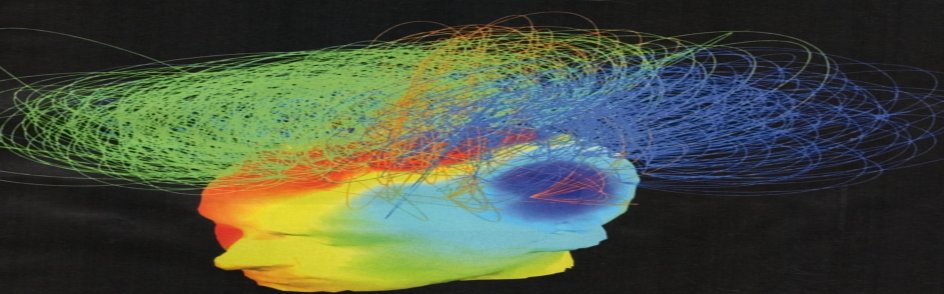
Signs of consciousness in People who are Considered Vegetative
Earlier I mentioned that Sir Auckland Geddes said that from his observation while he was dying, the brain was in the mind, not the mind in the brain. I believe what he was suggesting is that the mind does not have a physical location in the same way that the brain does. It is akin to the relationship between a radio set and the radio signals that are transmitted and picked up by the set. The set has a location in time and space. The transmitted radio waves do not have the same sort of small location.
My own sense of this is that the source of our personal awareness exists throughout time and space in the way that we can barely understand. But I am not suggesting at all that our waking awareness shares this condition. What we call self, our sense of self, is just a small part of the transmission that is really our total mind or being. So, of course brain damage depletes or even destroys that self most of us know. However, from the point of view I am explaining, that is just the signal, or part of the signal, that is being distorted or lost by the faulty equipment. The signal itself remains. I was still there even though my brain was severely damaged.
What our culture hasn’t yet done is to find what that signal is. In other words we haven’t yet really found out what consciousness is.
Earlier I was saying that what survives is the spirit. I see the Spirit is experienced when we are able to see
We can gain a clearer idea of Spirit if we observe certain dreams or meditations. The images and emotions, worldly or personal concepts grasped by our soul, in some dreams or meditations, are suddenly transformed into a universal truth.
 |
For instance, the experience of motherhood can be transformed into a realisation of a general principle that permeates all living things, perhaps by seeing it everywhere in human and animal lives. The personal is thus transformed into the universal and timeless. The supernatural or cosmic thus enters into the mundane daily events of our life. This is the work of the spirit. The organs of perception in the body are the senses, in the soul they are attributes such as patience, morals, understanding, and in the Spirit its universal realisations. |
Well, scientifically we cannot yet identify something that records the experiences of human life and survives physical death. That isn’t to say it doesn’t exist. Science is shifting its boundaries all the time. So all we have is personal experience, and this is given us by people who have experienced the fundamental core of their mind or consciousness. This lies underneath or outside of thinking and feelings. The nearest I can personally describe it is in what was said about the mirror and the images we see in it. The images are the passing impressions of thoughts and emotions. The mirror is consciousness itself in which all the thoughts, sensations and feelings take place. We mistake the thoughts and feelings for our real self. Therefore we feel certain that we die when the body ends.
As an example of this, I remind you of what was said about Grof’s experience when the dead Ladislav gave his name, telephone number and home address to one of Grof’s patients, in order to tell his mother that he had survived death and was okay. (See: mention of Ladislav.)
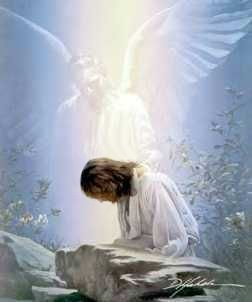 |
Chris: So you don’t think the mind is dependent on the brain?
Tony: Yes, the mind is dependent on the brain as far as expressing through the physical body and in the physical world is concerned. But I don’t see that it is dependent upon the physical brain for its existence and survival. The mind does need the brain in order to gain experience of time and space, pain, and the many situations that arise from feeling ourselves isolated and alone in a physical body. |
Chris: You feel certain then, that the mind has an independent existence?
Tony: Yes. And I believe we can see examples of this in other ways than thinking of Grof’s communication with the dead. It has happened to me a number of times to have an awareness of things that related in no way to information in my brain. In such cases I believe that areas of our mind that we call the unconscious, reach out beyond anything our physical senses tell us, and gather information, or know through means of unity with other minds, things that we have no knowledge of through our body. This suggests that mind, while operating through the body, also has an independent life beyond it.
The experiences of my stroke has confirmed my sense of the way I saw the mind or ones identity. When I could manage to speak, I would say to friends and family, ‘I am still here, but my mechanism of expression is broken.’ I felt completely whole within myself, but was aware there were things that were now damaged and could be re-built. So it seems to me that the brain damage did not damage ME, but my ability to function well through my body. So again I see that what people feel is the real the – the brain – is simple a mechanism for physical expression. Ones consciousness of existing can stand apart from the brain.
My most impressive experience of this was during my first marriage. One morning Brenda woke and told me she had dreamt about the baby of two of our friends. The friends, who I will call Jane and Bob, were living about 200 miles from us. We knew Jane was pregnant, and about a week or so before the dream we had received a short letter saying their baby, a boy, had been born. We were not on the telephone at the time, so the letter was our only means of communication.
In the dream Brenda saw the baby and a voice from behind her told her the child was ill. Its illness, she was given to understand, was serious, and would need to be treated with a drug taken every day of the child’s life. The reason for this illness and the drug use, she was told, was because in a past life the person now born as the baby had committed suicide using a drug.
I didn’t take the dream seriously, thinking it was some sort of personally symbolic dream. But we couldn’t seem to extract any personal meaning for Brenda, so just in case I sent an account of the dream to Jane and Bob. About a week later we had a letter from them saying that the letter and dream had crystallised their already existing anxiety about the baby. It had not been feeding well and was fretful. On taking it to the doctor nothing definite could be found but special tests were made in hospital. From these it was discovered the baby was dying. It lacked an enzyme which was needed to digest calcium. To compensate it was given a drug, which it has had to take every day of its life to make up for the lacking enzyme.
I don’t think there can be any clearer example than that of the mind having some level of separate existence from the brain. See also https://dreamhawk.com/dream-encyclopedia/dreaming-of-death/#Talking
Having personally witnessed those events they are very real to me. But I do wonder at people who completely deny the possibility of what I have said. I wonder if there is some level of fear attached to it. In many cases there seems to be a complete denial in them, and there is always the suggestion that I, or other people like me, have made up such stories or have completely misinterpreted them in some way. All I know is that the child is still alive. He still takes his drug every day, and I wonder how they explain the fact that my wife stated all that information to me before the parents themselves knew what the problem with their child was.
In all this examination of whether there is awareness existing independently of the body, it is important to remember some fundamental things already said about our own present scientific philosophy. The first thing is that time and space were non-existent prior to the Big Bang. Secondly, Bell’s Theorem points out that sub-atomic particles exist in a way that transcends time and space. Therefore, the fundamental particles of your own body exist beyond any limitations of time, space and the three dimensions we see as ‘reality’. There is no better argument than this for the human spirit – an aspect of our nature that is not limited to time, space and death.
I have explored this more fully in The Brain Mind Split. Also, read Lynne McTaggarts book The Field for the latest researches regarding the fundamental level of existence, and how it absorbs and remembers all experience – in the UK – in the USA.
Chris: The other day I watched a program on the television in which a man was talking about his relationship with the recent Korean air crash. He said that he was a frequent air traveller, but before boarding that plane he heard a voice saying to him not to get on the plane. He said, “Look, I travel all the time. Why should I hear a voice like that? I think somebody was trying to tell me something.” His explanation of it was that he felt there was some sort of guardian or person caring for him. So I feel this is another example of what you are saying.
Consciousness – The Brain Mind Body Split
If you read widely on the subject of dreams or the nature of consciousness, you come across a huge division when the writers consider the meaning of extra sensory dreams or experiences. On one side of the divide there are those who attempt at all odds to maintain a position that is perhaps summarized by saying the brain and the neurological processes of the body are the sole source of personal awareness.
I recently came across an Internet thread in which this argument was being presented to a respondent representing the other side of the division. His statement was that if you could remove the brain from the person, and still have evidence of personal awareness, then he would be convinced awareness could exist apart from the physical body and the brain. See The Spinal Brain
This is a bit like saying – If you remove the circuit from a television and still get a picture, then it would prove the existence of the signal.
The argument on the other side of the division was that personal awareness was not limited to the body and brain. In other words the death of the physical body – the brain – need not be the end of awareness.
There are certain huge problems with this argument, and the problems exist on both sides. So what follows is an attempt to look more carefully at why the problem exists, and possible new ways of looking at it. See Archetype of the Paradigm
For instance, if consciousness survives bodily death, it is not the body as we know it. Therefore to remove the brain from the body would stop any possibility of consciousness expressing through or as that physical form. That in no way proves consciousness does not still exist in a way other than linked with a functioning physical body. Death of the body occurs when the body is badly injured, has suffered a bad illness or is dying from old age and so cannot support the intricacies of consciousness, then consciousness can longer function in the body.
We call that state unconsciousness and we swing between that and waking awareness regularly – the two great polarities of human life. But the fact is that we are not unconscious in the sleep state. I know people may mention dreams, but dreams only occur as that base human condition of sleep moves awareness almost to waking to produce dreams.
But here is another view of death, what is it? Strange question because you have known it all your life. Haven’t you realised that every time you go to sleep you die? If you haven’t realised that, then why does your precious personality vanish in sleep? Where does your self awareness and thinking mind disappear to in sleep and we say we are unconscious, and isn’t loss of all of our awareness and consciousness what we assume death is? But a single cell, which is a seed from which all life forms evolved from, doesn’t become old or die because it is immortal, for it keeps dividing and doesn’t die. In dividing it constantly creates copies of itself, but as it does so it gathers new experience, it changes what is copied, so becomes the ‘seed’ for multi-cellular organism. We all started from the original one cell, and we, you and I, are the result of gathered experience.
No plant or creature grows from a dead seed, and each living seed carries within it all the past gathered from all its forebears. So, the seed in your mother’s womb is as old as and even older than human kind, and you carry that wisdom or memories in you. But in this life you developed a new brain, and the memories, education and programming you gathered this time are what you built your personality from, but beneath that is a very ancient self.
Finding this very ancient self, hidden as it is by all your personal thinking and opinions, you find you are free from all the painful emotions, suicidal urges and personal hurts. To explore it see Opening to Life
So, the argument is obviously undertaken using words. And the words used express the concepts we have concerning what we call reality. The argument is therefore often about what is real, and what concepts of reality or the underlying nature of the universe and human experience the person arguing holds as true. See Tony’s Experience of Stroke
Also, people talk about truth as if it is something they personally own or know. If there is such a thing as absolute truth, it would include an understanding of every minute aspect of the universe and how it came into being, and every interaction it involves here and now. As none of us have that stupendous cosmic vision in which we hold everything in mind at the one moment, we are simply amusing ourselves with examining ideas that are minute fragments of the whole. So in that vein I will continue.
Are you just your brain?
So on one side, and this is perhaps putting it crudely, there is the standpoint that there is nothing else except matter and energy. From this point of view all human experience and all human possibilities can only be understood by understanding the physiological and neurological processes of the body. Anything that is not explainable by this approach is considered an illusion, personal hallucination (caused of course by physiological and neurological problems), or wish fulfillment.
On the other side of the argument it is stated that there are aspects of human nature that are not limited to the physical or neurological processes of the body. These are sometimes called the human spirit. The problem with this is that the language we use to describe these possibilities is based largely upon what is observed through our sense of the physical world, and the concepts that arise from such observations. In other words the language is largely inadequate.
But many modern physicists, working with the information arising in experiments with quantum theory, tell us that our view of the world is based upon our blindness, and is very limited, and through its limitation, unreal. Yet this view we take to be the REAL universe. For instance we are only able to see a tiny fraction of the visible spectrum of light and as small amount of audible sound, so we are almost blind and deaf to the world around us.
To quote Gary Zukav, ‘Quantum mechanics is the theory. It has explained everything from subatomic particles to transistors to stellar energy. It has never failed. It has no competition.’ The implications of the theorem are enormous. Something can be in two places at once. Apparently distant objects, or people, are intricately linked in an immediate way. There is no separate existence as we previously thought. Our view of the world is not one supported by the facts of physics. Time and space are transcended. David Bohm, an eminent physicist, goes as far as to say that all things in our observable universe are inextricable linked. Nothing has separate existence.
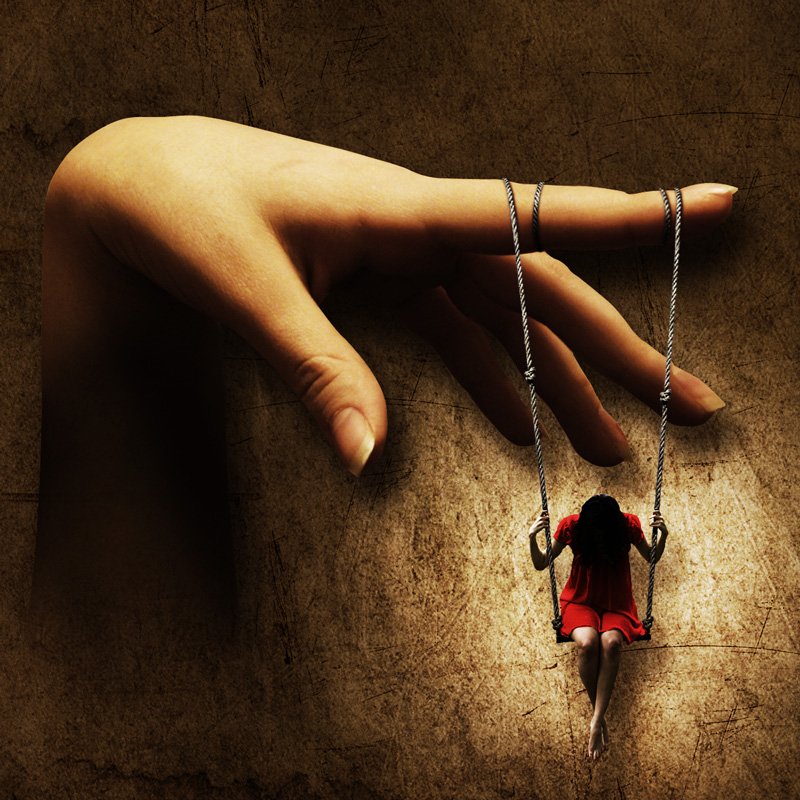 |
Looming over the discussion is the problem of consciousness. What is it that allows us to be conscious? What is it that enables us to have a sense of personal existence? So far neither side have managed to develop any sustainable proof or argument that tells us what consciousness is or how it works. This alone undermines the argument regarding personal awareness being only a phenomenon of the body and brain, which therefore ends at damage to or death of the body and brain. See Big Bang and God are the Same |
However, central to the argument are certain human experiences. The arguments and the attempts to describe or negate these experiences do not in any way void the experiences. If you have a feeling you call anger, any description of it or attempt to negate it as a real experience doesn’t in any way change the experience. All it does is to attempt a description or insight into what it is. In the film Contact, Ellie, a scientist played by Jodie Foster, is being questioned about her disbelief in God by Palmer Joss, played by Matthew McConaughey. Ellie says to Palmer that there is no evidence for God scientifically, and that he cannot therefore prove his belief. She tells him she is looking for something tangible and provable. So Palmer very gently asks her if she loved her father who is now dead. Ellie, who in fact loved her father very deeply, says that yes, of course she did. Palmer then, again gently, asks her to prove it to him. Of course there was no scientific proof of what was a personal experience.
Some years ago, while working as a nurse I met and dealt with a number of people who were suffering, or had suffered, the effects of a stroke. What emerged from conversation with those who eventually learned to easily communicate again, was that while they were unable to communicate because of brain damage, they still felt themselves as a whole person. They still knew what they wanted to say or do, but their body would or couldn’t respond. They felt enormously frustrated. The brain damage had not taken away their sense of self but had damaged their ability to express through the body, suggesting that the body is a means of experiencing physicals life. Over time, as the brain repaired or re-routed its processing, they could again move and talk.
Your mind is more than your brain
We might use the image of a driver and a car as an analogy of this. If the car engine will not work, or is damaged, it doesn’t mean the driver does not exist, or that he or she does not know perfectly well where they want to go or what they want to do.
Elsewhere I have often mentioned something I witnessed early in my life that for me showed a flaw in the argument that the mind, or what one is aware of, is limited to the brain and to what we know through our senses, and then extrapolate from.
One morning my wife Brenda woke and told me she had dreamt about the baby of two of our friends. The friends, who I will call Jane and Bob, were living about 200 miles from us. We knew Jane was pregnant, and about a week or so before the dream we had received a short letter saying their baby, a boy, had been born. We didn’t have a telephone at the time, so the letter was our only means of communication.
In the dream Brenda saw the baby and a voice from behind her told her the child was ill. Its illness, she was given to understand, was serious, and would need to be treated with a drug taken every day of the child’s life. The reason for this illness and the drug use, she was told, was because in a past life the being now born as the baby had committed suicide using a drug.
I didn’t take the dream seriously, thinking it was some sort of personally symbolic dream. But we couldn’t seem to extract any personal meaning for Brenda, so just in case I sent an account of the dream to Jane and Bob. About a week later we had a letter from them saying that the letter and dream had crystallised their already existing anxiety about the baby. It had not been feeding well and was fretful. On taking the baby to the doctor nothing definite could be found, but special tests were made in hospital. From these it was discovered the baby was dying. It lacked an enzyme that was needed to digest calcium. To compensate it was given a drug, which it has had to take every day of its life to make up for the lacking enzyme.
I don’t think there can be any clearer example than that, of the mind having some level of input other than information gathered through the physical senses and therefore what is already known in the brain. I use the example because it is not hearsay. It didn’t happen to somebody else who reported it to me. I witnessed every step of it. Recently I met the baby of that dream again. He is now a man of 35, and still needing the daily drug.
Particularly interesting also are the cases of near death experience (NDE) because in many of these the brain has been inactive for quite long periods of time. With no sign of brain or heart activity the person was yet still aware of the physical surroundings, or of events at another level of experience. Psychologist Susan Blackmore, who at one time argued on the side of the neurology and physical brain viewpoint, said that there is a purely physical explanation for these events, and suggests that the experiences are recollections of what happens as consciousness is lost or as it is regained, but not while unconscious. She says the induction of endorphins might cause heightened awareness with tranquility, and Dr. Blackmore sees no reason to postulate a separation of mind and brain.
The mind body split
What is interesting to note in Dr. Blackmore’s explanation is the mention of the separation of mind and brain. This in fact is the core of the argument. It is also the stumbling block over which any attempt to analyse consciousness falls. And at the core of these concepts and the argument is the fact that our viewpoint of matter and of physical existence is such that it cannot in its old form conceive of a brain mind separation.
However, despite this argument, people continue, whether due to an NDE, an out of body experience, dreams such as experienced by my wife Brenda, or other extensions of awareness beyond sensory impressions, to witness verifiable external events while apparently unable to do so according to scientific theory. Such events reported are often out of sight of their body, and so couldn’t be something witnessed as consciousness of their physical senses was lost.
Because of this, Sam Parnia, clinical research fellow at the University of Southampton, and Peter Fenwick, consultant neuropsychiatrist at the University of London, argue that the evidence suggests a separation of mind and brain. They claim that the mind can live on when the brain is dead, suggesting that near death experiences can be retained in the mind and then refixed in the brain as it recovers so that they can be subsequently recalled. This is an interesting concept, but it might not be necessary to postulate such a separation between mind and brain to explain the events. |
 |
If you consider these two arguments, I think you will see that while Susan Blackmore has a massive cultural and scientific backlog of evidence and viewpoints on her side, Sam Parnia and Peter Fenwick yet dare to put forward an argument that is weak in terms of physiological science, because their evidence is so compelling. In confronting popular scientific opinion their argument falls down because it has no physiological proof. But Blackmore’s argument falls down because it completely denies the evidence Parnia and Fenwick are looking at.
Again and again, those arguing the side of dead brain dead person, completely deny the existence of a real and verifiable extension of awareness in NDE or out of body personal awareness at a distance from the body. They deny it because their argument has no way of realistically explaining it.
As was said earlier, this is an argument using words and concepts that are not adequate to really find a meeting point between evidence and established ideas of physics and neurology. However, the new physics in the form of quantum mechanics, along with new ideas about consciousness, might be offering us such a meeting point.
From the old viewpoints about the nature of the observable universe, especially as it arose from the mechanistic ideas of Newtonian physics, in which the universe was seen as a huge mechanical device, the basis of which was the atom, the only way in which awareness could exist when the brain was dead would be through a separation of mind from body. Part of this concept lies in seeing matter, the atom, as a sort of inert substance that is totally devoid of any awareness, and in no way influenced by mind or thoughts. The problem for thinkers using this concept of existence was that from the organisation of such atoms in the human body personal awareness arose. But how can awareness arise from something that itself is totally devoid of awareness, or does not have the potential of consciousness? This was a question Newtonian physics has never been able to answer.
Remember all arguments are theories
However, all scientific and all philosophical statements are theories. They are the best we can produce at the time. So with the new evidence from quantum mechanics, in which it is seen that sub-atomic particles are actually influenced and fundamentally changed by observation, a whole new viewpoint of existence is emerging. (See: Corenotes.) Not only are sub-atomic particles seen to change their very nature when observed, and thus responds to mind, they also can communicate with each other beyond the speed of light.
One of the emerging realisations from this is that the world of mind, imagination and subjective experience are not separate from the external real world as we usually believe.
Michael Talbot says that “virtually all of our common-sense prejudices about the world are based on the premise that subjective and objective reality are very much separate. That is why synchronicities seem so baffling and inexplicable to us. But if there is ultimately no division between the physical world and our inner psychological processes, then we must be prepared to change more than just our common-sense understanding of the universe, for the implications are staggering.” (From The Holographic Universe).
Although this is by no means generally accepted, many physicists observing quantum phenomena say that every particle is constantly in touch with every other particle in the universe, and this take place beyond the limitations of time and space. This is stated in Bells Inequality Theorem. As its title suggests, it is a theory, though it has yet to be disproved.
University of London physicist David Bohm, a protégé of Einstein’s and one of the world’s most respected quantum physicists, in exploring this theory developed it further from his observations of sub-atomic particles. At the Berkeley Radiation Laboratory Bohm worked on plasmas. This is a gas with a high density of electrons and positive ions, with atoms that have a positive charge. He was astonished to find that in this state the electrons stopped behaving like individuals and started exhibiting signs of being part of an interconnected whole. In this form the huge numbers of electrons were well-organised. Like a living creature, the plasma constantly regenerated itself and enclosed all impurities in a wall in the same way that a biological organism might encase a foreign substance in a cyst. Bohm had the impression the electron sea was alive.
From such observations Bohm began to understand that these phenomena pointed to a revolutionary view of locality. We are steeped in the conviction, because of our view of the world through the limited view of our physical senses, that everything has a distinct location. But what Bohm arrived at was that at the quantum level the separation of location ceased to exist. There existed what physicists call non-locality.
The struggle with words
These are such mind altering ideas that we need to take time to absorb them. They are not saying that at the physical everyday level things do not have separate existence. But they are saying that underlying this appearance is non-separation, non-locality. If one can begin to grasp this, the argument about the mind body separation loses its difficulty. How can there be separation when there is non-locality at the basis of our existence?
We are still of course trying to build a sense of something with words. And this must be understood as the best way at the moment to pass on ideas, even if what is passed on is still in process. In fact Bohm, in writing about this to his fellow scientists, some of whom felt the mystery of quantum mechanics was fully explained, pointed out that the universe might well be infinite, so we never arrive at a full understanding, and are always in process.
 |
Therefore excuse what follows, what must be only an attempt with words, to give a view of the brain and consciousness that in some ways reflects what has been said above. It is not a new view, but an attempt has been made to enlarge on it in connection with the brain and personal awareness. |
Firstly, looking around, it is fairly obvious that as human beings we have very different levels of awareness and intelligence. Because of their physiology and perhaps illness, some people are barely aware or awake. Others are incredibly alert, creative and responsive.
Looking beyond humans, we can see that animals are also aware in similar ways. But they lack the self awareness, the sense of identity that enables us to build, create, and invent with such abandon. And beyond the mammals we see yet other ways of being aware. In fact awareness or sentience goes in a sliding scale right the way back down the life forms. There is no point where sentience begins. Even if we go back to plants and amoeba, they are still responding to their environment and have some level of awareness. What they lack is something like the brain that acts as a special organ of awareness. It organises the process of awareness and the inputs awareness receives through the senses.
This becomes more obvious when we consider humans who in one way or another have lost their senses. When a person is blind or deaf, a whole area of input and stimulation is lost. And this can continue right back to the point of being in a vegetative state if their special organs of perception and consciousness are damaged. Does that mean they have lost consciousness? Or does it mean they have lost sensory impressions, but their consciousness is still there?
Have I lost my mind?
We might ask the question here as to whether in such cases, as with stroke victims, consciousness has been lost, or is it that the special organs of awareness, perception and motor activity have been damaged?
The work of Karl Pribram, a neurophysiologist at Stanford University, gives further insight into this. His experience of working with fellow neurologist Lashley confronted him with astounding phenomena. Lashley had trained rats to perform a variety of tasks, such as run a maze. Then he removed parts of their brains and re-tested them. He wanted to see what parts he would need to cut out to remove the memory of what had been learned. But no matter what portion of their brains he cut out, he could not remove their memories. Even with massive portions of their brains removed, their memories remained intact. Pribram found that a similar thing occurred with humans who had, perhaps through injury or illness, lost even massive parts of their brain. So Pribram felt that memory was not localised in the brain, but existed in what was probably a holographic form, where each part contains the whole.
Pribram was very attracted to the work of Bohm because of what Bohm had uncovered about non-locality. This because another way of thinking about non-locality is to see it like a hologram where every part of the universe has in it the whole.
So the proposal is that consciousness is what Bernard Rensch calls panprotopsychic. It means that consciousness is present in all matter in some form. If this is true it would mean that the form of consciousness we know as humans is potentially there in all matter, and as the process of life developed into greater complexity, with specialised organs of awareness, the potential could manifest. In doing so it would manifest at different levels as the complexity of form evolved.
It would also mean that all matter is mind/consciousness, and mind only becomes focussed as personality because of the form and function of the body and brain. However, with the loss of body and brain, consciousness is not lost as it is basically the universe. Without the focussing action of the brain, the universe is sentient as an unfocussed immensity of mind, carrying in it all experience. From this viewpoint everything around us is mind, is a fundamental part of consciousness, and is part of the whole, but expressing as different qualities or functions. As such there can never be a mind body split, as they are one and the same. But as mind, from this standpoint, is all matter, there is no loss of what has been experienced as ones personal life. See You Are a Dual Being and – Out of Body Experiences
If consciousness is fundamental in all the matter and energy around us, and if that is the basis of our own awareness, focussed as it is on sense impressions via the brain, then experiences of extra sensory perception are no mystery. There is a threshold in us between what experiences we have gathered through our body, through our senses, and the Hugeness beyond our own sense of self. That Hugeness holds, in perhaps an unfocussed way, all experience. To know within the Hugeness what is happening to someone thousands of miles away is easy. And that Hugeness only knows experience in the three dimensional world of our body by generating a life form through the processes developed slowly over millions of years on this planet. We are its eyes ears and curiosity in the three dimensional world. See Answer to Critics
From this viewpoint there is only one Mind, and we are each small reflections of it, knowing the world and our life through its consciousness.The universe is sentient, and we are an expression of its awareness. To quote from my book Coincidences, “I needed to go to the toilet to pee, and this created many bubbles in the water. As I watched something caught my attention, for it seemed that each small bubble was an eye looking up at me. Wondering what this could mean I looked more closely, to see not eyes, but I’s. Each bubble had a tiny reflection of me in it. I was amused because there were dozens of tiny copies of me all looking up at me with their separate existence. |
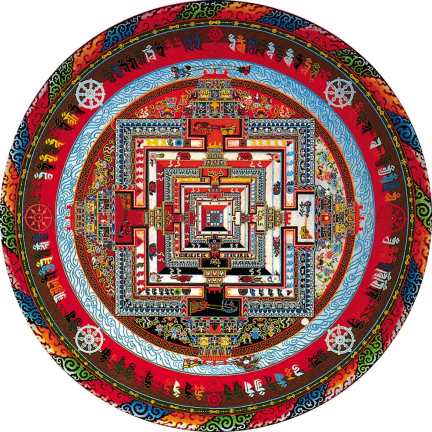
Consciousness is everywhere |
I felt how true it was that each of us are like little bubbles, all in our own small sphere of experience. Then it struck me that although all of these tiny individuals appeared to have a separate identity, a separate body in space; and although they all had eyes with which they were looking at the world, they only had awareness out of my own consciousness. In fact they had no existence outside of me. Unknowingly they were all reflections of me.
Suddenly, and with some apprehension, I realised the meaning of this interesting fantasy that my unconscious had been communicating. I am a bubble. My personal awareness, although it seems distinct and separate, is in fact the reflection of one great consciousness pervading the universe. So who am I when my bubble bursts, as it must, and I return to my source? The fear I first felt has long melted. It has been replaced by joy as I have explored what it means to burst and return home.”
See: archetype of the paradigm; Life’s Little Secrets – Talking with the dead – What we Need to Remember About Us
.