Author Archive
Beyond the Limitations of the Body
In one particularly unnerving session a young man suffering from depression found himself in what seemed to be another dimension. It had an eerie luminescence, and although he could not see anyone he sensed that it was crowded with discarnate beings. Suddenly he sensed a presence very close to him, and to his surprise it began to communicate with him telepathically. It asked him to please contact a couple who lived in the Moravian city of Kromeriz and let them know that their son Ladislav was well taken care of and doing all right. It then gave him the couple’s name, street address, and telephone number.
The information meant nothing to either Grof or the young man and seemed totally unrelated to the young man’s problems and treatment. Still, Grof could not put it out of his mind. “After some hesitation and with mixed feelings, I finally decided to do what certainly would have made me the target of my colleagues’ jokes, had they found out,” says Grof. “I went to the telephone, dialled the number in Kromeriz, and asked if I could speak with Ladislav. To my astonishment, the woman on the other side of the line started to cry. When she calmed down, she told me with a broken voice: ‘Our son is not with us any more; he passed away, we lost him three weeks ago.’”
Grof also gives examples of people remembering events that occurred to their parents or grandparents long before they were born and of which they previously knew nothing. Some memories seem to come from periods far in the past, and the patients were able to describe in detail events and environment they were remembering.
The Mind Reaches beyond the Body
Chris: So you don’t think the mind is dependent on the brain?
Tony: Yes, the mind is dependent on the brain as far as expressing through the physical body and in the physical world is concerned. But I don’t see that it is dependent upon the physical brain for its existence and survival. The mind does need the brain in order to gain experience of time and space, pain, and the many situations that arise from feeling ourselves isolated and alone in a physical body.
Chris: You feel certain then, that the mind has an independent existence?
Tony: Yes. And I believe we can see examples of this in other ways than thinking of Grof’s communication with the dead. It has happened to me a number of times to have an awareness of things that related in no way to information in my brain. In such cases I believe that areas of our mind that we call the unconscious, reach out beyond anything our physical senses tell us, and gather information, or know through means of unity with other minds, things that we have no knowledge of through our body. This suggests that mind, while operating through the
My most impressive experience of this was during my first marriage. One morning Brenda woke and told me she had dreamt about the baby of two of our friends. The friends, who I will call Jane and Bob,were living about 200 miles from us. We knew Jane was pregnant, and about a week or so before the dream we had received a short letter saying their baby, a boy, had been born. We were not on the telephone at the time, so the letter was our only means of communication.
In the dream Brenda saw the baby and a voice from behind her told her the child was ill. Its illness, she was given to understand, was serious, and would need to be treated with a drug taken every day of the child’s life. The reason for this illness and the drug use, she was told, was because in a past life the person now born as the baby had committed suicide using a drug.
I didn’t take the dream seriously, thinking it was some sort of personally symbolic dream. But we couldn’t seem to extract any personal meaning for Brenda, so just in case I sent an account of the dream to Jane and Bob. About a week later we had a letter from them saying that the letter and dream had crystallised their already existing anxiety about the baby. It had not been feeding well and was fretful. On taking it to the doctor nothing definite could be found but special tests were made in hospital. From these it was discovered the baby was dying. It lacked an enzyme which was needed to digest calcium. To compensate it was given a drug, which it has had to take every day of its life to make up for the lacking enzyme.
I don’t think there can be any clearer example than that of the mind having some level of separate existence from the brain.
Having personally witnessed those events they are very real to me. But I do wonder at people who completely deny the possibility of what I have said. I wonder if there is some level of fear attached to it. In many cases there seems to be a complete denial in them, and there is always the suggestion that I, or other people like me, have made up such stories or have completely misinterpreted them in some way. All I know is that the child is still alive. He still takes his drug every day, and I wonder how they explain the fact that my wife stated all that information to me before the parents themselves knew what the problem with their child was.
In all this examination of whether there is awareness existing independently of the body, it is important to remember some fundamental things already said about our own present scientific philosophy. The first thing is that time and space were non-existent prior to the Big Bang. Secondly, Bell’s Theorem points out that sub-atomic particles exist in a way that transcends time and space. Therefore, the fundamental particles of your own body exist beyond any limitations of time, space and the three dimensions we see as ‘reality’. There is no better argument than this for the human spirit – an aspect of our nature that is not limited to time, space and death.
I have explored this more fully in The Brain Mind Split. Also, read Lynne McTaggarts book The Field for the latest researches regarding the fundamental level of existence, and how it absorbs and remembers all experience – in the UK – in the USA.
Chris: The other day I watched a program on the television in which a man was talking about his relationship with the recent Korean air crash. He said that he was a frequent air traveller, but before boarding that plane he heard a voice saying to him not to get on the plane. He said, “Look, I travel all the time. Why should I hear a voice like that? I think somebody was trying to tell me something.” His explanation of it was that he felt there was some sort of guardian or person caring for him. So I feel this is another example of what you are saying
Expanding Mind
Chris: Under what circumstances or conditions can we do those things?
Tony: Looking back at the information that past cultures left us, it seems likely that early human beings at first accidentally stumbled on the possibilities of extending their awareness. For instance we still have thousands of records of near death experiences occurring to people in the past, and still happening today. One of the common features of such experiences is the person witnessing verifiable events occurring at a distance from them, or at a time when they appeared to be in a coma with their eyes closed.
There are also many records collected by anthropologists and also verified, of tribal people dreaming of particular herbal remedies to cure ills. Some of these dreamt remedies have been taken into the modern pharmacopoeia. Namely such things as quinine. Also, in the past and in today’s world, sometimes dreams present information that the dreamer does not have, has not learned, has not heard, and has in no way taken into themselves from outside.
From such experiences older cultures gradually developed the concept of having a soul that could dissociates from or be independent of the body. Some cultures, especially those in India and the Far East, explored ways of purposefully bringing about such extended awareness. It seems as if at a certain period the human body and mind became a laboratory in which those cultures tried out all manner of things to see what the results would be.
Of course, some of the techniques used were quite crazy. This probably arose because the underlying principles were not really understood. For instance, fasting gradually reduces the physical and emotional energy to a point where the mind and emotions become very quiet. But the active principle, so to speak, is not the fasting, but the quietness of the mind and emotions.
It was also noticed that to really explore these further reaches of consciousness certain qualities were necessary. A certain amount of confidence and fearlessness were needed to meet the further reaches of mind. Some cultures, such as the native American Indians, also realised that if one could not meet a reasonable amount of pain, then you could not really dive very deeply into that wider awareness; if for no other reason than the wider awareness breaking through the narrow and limiting boundaries of the ego of personality can be felt as pain.
Brain Levels and Dreams
The Spinal Brain
The Reptilian Brain
The Mammalian Brain –
The Neo-Mammalian Brain
Conditioned Reflexes
The Reptile Brain and Territorialism
Cause and Effect in our Life
As the twig is bent so the tree grows
Where Did We Begin
Our Storied Self
Our Spinal and Organ Brain –
Back to the Mammal
The Seventh Brain
During the last century an enormously expanded understanding of the human mind and consciousness has arisen. In other cultures much of what our own scientifically oriented culture has arrived at had already been stated. However, it is important for the western individual to gain insight from their own perspective, as much from past cultures is stated in language that is often not properly understood, and we often fail to really grasp what is being presented.
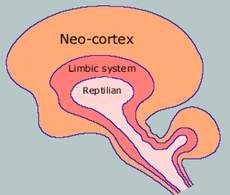 |
So in beginning to consider the levels of our everyday awareness and how this links with our physical brain, we can look at what anatomy, physiology and psychology have defined. For example it is now known that in the womb we start off at the very primitive level of cellular production. Then our forming body goes through a fish stage and has gills. Slowly it moves toward an air breathing body. And all these evolutionary changes leave their mark, for we have at least four levels of brain – the spinal – the reptilian – the mammalian and then the human. |
Basically the brain is separated into two halves, generally called the left and right hemispheres. But it is now understood that our brain developed its sections over the long span of evolutionary history. Because of this it has, within and also separate from the two hemispheres, a number of levels. As our present brain evolved it developed four separate ‘brains’ or levels, each with its own memory, motor and other functions (David J Mahoney, 1991). Each new level, as it developed, elaborated on and extended the function of the preceding levels. So, from the spinal cord the hindbrain and midbrain developed. The first level of brain that developed beyond the spinal cord has been called the Reptilian Brain. This is because what we carry within our human brain is still found in reptiles. This ‘brain’ often encompasses several parts of the physical brain.
The neurologist Paul MacLean gave a definition of these physiological and psychological facts of our brain in 1990. He said that these levels of the brain work like “three interconnected biological computers, [each] with its own special intelligence, its own subjectivity, its own sense of time and space and its own memory”.
Prior to MacLean’s findings it was assumed that the highest level of the brain, the neocortex, dominated the other, lower levels. MacLean, and since him others (Earl K. Miller), have found this is not so. In fact Miller was recently able to demonstrate that the older brain learns fast, and it gradually ‘trains’ the prefrontal cortex.
Returning to MacLean’s definition the base brain is the Reptilian. The next level he called the Mammalian or Monkey Brain, and the third is called the Neomammalian or Human Brain.
The Reptilian and Avian Brain
Taking the Reptilian Brain first, this is sometimes called the ‘R-complex’, and includes the brain stem and the cerebellum. It carries our genetically transmitted ‘instinctive’ behaviour such as suckling at the breast as a baby, aggressive response as with and including territorial defensiveness, the courtship and mating behaviours in reproduction. That is what people often think of their personal loving feelings, but is largely their instincts going for it. One of the best known expressions of this brain is the ‘flight, fight, freeze or faint’ response in survival situations and of course panic attacks.
This brain deals with behaviour that is either innate, as described above, is learned and has become habitual, or is a conditioned response. If it is habitual we can repeat it without having to learn it or be very aware of how we do it – as with riding a bicycle or driving a car once we have mastered the skill.
The ‘R’ (reptilian – which also includes birds) brain deals with those responses and actions, behaviours and attitudes, that we express without much awareness, or erupt from us because of an external stimuli. It has great strength, but also can lead to powerful anti social behaviour and psychosomatic illness. This is because it links intricately with our unconscious physical and psychological systems and with our self regulatory functions. So it throws into consciousness things that might detract us from a direction, a decisions or a relationship. This might not be rational as far as we are consciously aware, but is nearly always based on past experience that throws up a red danger signal, or a ‘yes’ response. There is no moral judgements at this level of our awareness. The ‘R’ brain simply gives rise to acts in ways it has learned that enable survival, reproduction and food gathering. In actual lizards it has a limited range of behavioural responses.
Unfortunately, we as the human animal, is a victim of irrational fears, anxiety and apprehension. For instance in the example the person is constantly faced by fear of injury and death. Yet there is no real threat there. Whenever we dream its images are not like real life, because a dream is nothing like outer life where things could hurt you, but is an image like on a cinema screen that even if a gun is pointed at you and fired it can do no damage – except if you run in fear. So all the things that scare you are simply your own fears projected onto the screen of your sleeping mind.
(Here the difference between the outer world where things can kill you and the inner world we experience in sleep – where whenever we dream its images are not like real life, because a dream is nothing like outer life where things could hurt you, but is like an image like on a cinema screen, so that even if a gun is pointed at you and fired it can do no damage – except if you run in fear; so, all the things that scare you are simply your own fears projected onto the screen of your sleeping mind. In the early days of moving pictures, a film was shown of a train coming fast toward them; the viewers all fled in terror, fearing the train would crush them. That is exactly the same response if you are terrified of any thing you dream of. See Masters of Nightmares)
Example: Now a huge unknown creature began to enter into my awareness. I felt the presence of an enormous creature rising to the surface of something like a swamp or a body of water. At first I thought it might be a whale, but as I paid attention to what was happening it defined into a huge crocodile/alligator.
This huge creature looked at me and said, “Mathew, join me.”
I laughed at this because it was so huge, and with so many associations of swallowing things, that I said something like, “What do you mean join you? Don’t you mean that you want to eat me?”
The creature replied to me, “No. No, it’s not like that, I’m just like a submarine. I have all these lives in me. I have many, many lives in me. I am life. I contain the many. You can swim this ocean alone Mathew, if you wish. Or you can join me, you can join the many. You can always, if you choose to live your independent life again and leave us.”
I laughed here because I had the image of me being independent, stripping off, diving over the side of the boat into the ocean and swimming off. It is something I have often done in the sea, swimming long distances alone, or off to an island out to sea, by myself.
I began to give myself to that great creature which I now understood as the collective unconscious, the unity of lives. It felt as if it was absolving me, much as I had experienced earlier on. (One of those strange and beautiful, and also moving coincidences just happened. I am reading this in using voice recognition, and it is proving to be very accurate. But in the sentence where I said that I felt it was – and the word was supposed to be absorbing me – the software used the word absolving. And here I am again, back in the ocean, weeping as I know there is no judgement on the life I have led so alone and cut off.)
Science has demonstrated that unless kids (and other mammals) are given deep emotional connection (“attachment”) from birth by parents or others, infant neurological systems just don’t develop well. The infant brain literally requires programming by an adult’s eyes and facial expressions to begin to program its own neurons.
What goes wrong from “conception to 36 months” can fry our reptilian/avian brain and put it in permanent fight-flight or freeze (dissociation shutdown).
Example: I had a dream that I went into a nature enclosure/wild animal reserve with a few friends. I did not know these people in real life but in the dream they were 2 men, one quite reckless, the other relaxed and resourceful. There was also a woman who in the dream was my sister; she was bold, beautiful and fearless. I felt anxious in the dream, with a foreboding that something bad would happen. We were driving a sort of buggy cart, and all the time I kept saying we needed to get back as it was getting late.
When we stopped in the bear enclosure, and I was terrified we were going to be attacked, but when we looked down a whole family of bears were sleeping beneath us. We carried on. It started to get late as we approached the area where I knew the lions would be. I kept seeing flashes of lions and had the feeling they were hunting us. I became very scared, like my foreboding was coming true. Hearing screams from the reckless man we were with, we realised he’d been attacked and killed, so we tried to escape, we were on foot and losing the light, it was terrifying. The resourceful man was looking out for me, protecting me.
We managed to get near to civilisation and buildings, but the lions were closing in. My beautiful strong sister (in the dream) tried to run to a nearby tent, and was suddenly attacked by a huge fearsome lion, she was fighting him with all her strength and at points she looked to be dominating, but he slowly overpowered her and each time she fought hard, he hit her with his huge powerful paws and started biting into her skin and killing her. I watched her fight over and over to near death and felt terrified and powerless to do anything to stop it. Other people by this time were watching and some had guns but they did not shoot the lion. I woke up feeling very scared!
Except in stress or survival situations we usually modify and augment our internal reptilian responses. But occasionally the cerebral influence gets distracted or knocked out by drugs, such as alcohol, or exhaustion or some form of stress. Then our reptile or monkey brain can live through us again without having to hide in the obscurity of the unconscious or sleep. At such a time we might make love for the first time in our life with total passion, sensation and abandonment of guilt. A sudden extra awareness as if with sharpened senses might arise, enabling us to precisely read another person’s body language and non-verbal communication. This brain also enables us to act in dangerous situations with enormous speed, strength and without having to think. MacLean says another important function of this ‘R’ brain is ‘homing’. This means it gives us the ability to return to a base state of being after reaching out for a mate or food. Mahoney (1991) sees this as being involved in the human ability to create a sense of an external reality within the ever changing sensory and social impressions we live within. This ‘brain’ is also the seat of what Ivan Pavlov called conditional reflexes. (See the feature on Conditioned Reflexes.)
The lower brain, moreover, seems to be the source of profound emotional responses that are beyond our conscious control. We cannot deliberately decide to feel love or hate, anxiety or aggression any more than we can consciously influence our rate of growth.
Example: I dreamt I was outdoors walking through open ground, maybe at times gardens. I was with others – not sure who, and we frequently came across large snakes which we reacted to as if they were venomous. Then I came across a lot of them and they swarmed onto me. I froze, terrified that if I made a move I would be fatally bitten. But they just swarmed over my body and got under my clothes without harming me. Gradually I relaxed and slowly began to move about with the snakes still on me. They started to feel like a built in defense system which would attack anyone who was aggressive to me. At one point several large and aggressive dogs walked past me. They turned as if thinking about attacking, then appeared to sense the snakes and ran off cowed. As time passed the snakes felt like part of my body.
Example: Dreamt that a snake – a huge python – had raised me. I had the sense that it had cradled me in its coils when I was a baby, and that it had taught me without words how to survive. This was a sort of jungle/life wisdom.
But there is a darker side too. A young man of usually gentle behaviour, whose work in his home town in USA was to spray peoples lawn with a powerful weed killer, abruptly murdered one of his clients. He had suddenly, and quite out of character, wanted to urinate while working. Instead of finding a toilet he had peed in the customer’s garden. She had come out and complained to him, whereupon he killed her.
Findings show that one of the chemicals in the weed killer produces a diuretic effect making one want to urinate. It also acts on the brain, and possibly inhibits the cerebrum and cerebellum. If that is so, what the young gardener was left with was his reptilian responses without moral judgement.
In dreams we express our reptilian side of ourselves in such dreams as:
Example: Last night, prior to going to sleep I explored the coloured snake dream. When I imagined myself as the snake I clearly felt I had no voice. I could not speak, and my existence was of being impelled by impulse and response to the environment. At its peak this was a very subtle feeling of existing as unconscious life – a living being that finds its way through experience without thought. I felt there was great richness in the snake, but it was still unconscious, so unknown. This was shown by the many colours.
The Mammalian Brain
The functions of the second, Mammalian brain that exist within the Human ‘brain’, MacLean likened to the skills shown in mammals such as wild dogs and apes. Whereas the lizards do not demonstrate mutual activity in hunting or caring for young, mammals show enormous awareness of bonding, caring for young, group activity, hierarchy and recognition of family and pack. They also have a much bigger pool of behavioural responses and can learn even more. This part of your human ‘brain’ integrates and refines the functions of the reptilian brain. It provides emotional range and intensity, and gives a greater complexity to what motivates or deters us. It is this greater awareness of how we relate to others, and the social structure in which we exist, along with a sense of what place in it we occupy, that enables us to modify and coordinate the impulses arising from the reptilian brain.
Unlike the human brain which often experience depression and feeling lost or aggression towards others, the mammalian brain recognises proper relationships within the herd or pack. Here too lie the beginnings of being able to reflect and learn from experience in that way.
At times when we tap the resources of this brain we discover enormous insights and wisdom concerning relationships and social interactions. But at first people have dreams of attempting to run away or even kill this part of them, for that is what they have been doing when faced by the natural and even wild side of their nature.
But if this part of you is accepted then we can see the meaning behind body language, the social hierarchy, and also real parenting. Unfortunately many people who become aware of this part of their own functioning either pull back in fear, try to kill or run from experiencing it. But killing or avoiding it is that you are killing or avoiding parts of your own wonderful spectrum of life and living.
Example: I realised and experienced this personally when exploring a dream about prehistoric creatures rising from a swamp. I described it as follows: “I understood in a flash the meaning of the creatures in the swamp dream. I am life – ancient, prehistoric life, meeting the demands of today’s world, today’s social scene, today’s conscious self and its decisions. It is the ancient self my inner research has uncovered in its dealings, yet I have been running away because my feelings self has been so hurt and in pain. I called it an ancient beast. Consciousness is riding an ancient beast and it is very beautiful.
As I sat with my eyes closed I heard Ralph walked from his room to the toilet and urinate, then come into the kitchen. My hearing was tremendously sensitive, like that of a beast. I could tell, from what I heard, what sort of person Ralph was. I knew, as the beast, how he related to our small group – for he knew us as a group within the larger social group. I knew that the ancient social rules of the beast still expressed through us unconsciously. I am the dominant male in the group. Hyone the dominant female. Ralph expressed his unconscious respect for this by the way he walked. His walk expressed care, thoughtfulness, self-control, respect perhaps too much of himself held back by concern and respect. I told him he was a careful beast. I don’t think he understood.
That incredible awareness is a wonderful thing. How much more loving, more helpful, more harmonious, people would be if we were aware like that most of the time, and could direct our life from it. That is what I want, not the ability to hold my breath for a long time. And that awareness comes from an aliveness and acceptance of the beast in us – our mammalian brain.
As I sat I became aware of my right arm, its relaxed state, its loose weight hanging, without effort and free. It was in a passive and heavy state until I moved my finger. Movement was a sinuous flow, a weaving through space, a movement of energy in extension. I moved my hand up. It was a wonderful experience, so mobile, graceful and beautiful to feel. This, added to the world of the beast’s social perceptions, was an addition to the good things our body and soul offers us. There is so much wonder still to claim and extend in our beast.”
Example: The role then came to life and spontaneously I as Vince the dog went to Alan and stood up on my hind legs with my paws on his chest, looking into his eyes. I wanted to communicate something to him.
The communication was so strong that I as Alan felt it and will describe it. Vincent reminded me of the many things we had shared in life. As this happened I felt such love – the love I really had felt for that beautiful dog. As I felt this Vincent and I became one being. I remember carrying him in my arms when he was young because, as a runt he was so nervous that at times he couldn’t even walk. I remember going everywhere with him as I walked London. I also knew that Vincent represented for me the ability to see into the invisible worlds – psychic sight and sensing. He had demonstrated it to me at least twice.
As all these memories poured through me I felt deep emotions pouring up and started crying. Crying because Vincent was helping me be aware of things I had not put together before. Lately I have been trying to extend personal awareness again, into lucidity and into the world. The emotions I was feeling were due to a realisation, and as this happened I knew what the previous dream of Vincent meant. I understood because various bits of memory came together to form a whole.
Example: The other day, while Andrew was with me and we were walking, a local bitch/dog came up to me. I squatted down as a result, and felt at ease to show Andrew what it really wanted. Slowly it lay down and went over onto its back because it wanted me to rub its breasts. As I felt, one of its powerful urges was to have pups and have its breasts sucked. Now, to deal with that urge, to get some satisfaction, it needs its breasts rubbed.
I mention this because as human beings we tend to hide many of our real needs. We deny ourselves so much that we express our needs in very peculiar ways or in roundabout fashions. The dog was beautiful because it had none of our ridiculous sense of shame or shyness. Her fundamental instinct is to give through her breasts. It is just kindness to rub her breasts.
But like any mammal, a horse for instance, can be scared and bolt, creating havoc, especially when such feelings explode in the human mind. But we have as part of our instinctive nature many sides to our mammalian brain. It can express as loving behaviour, defensive and protective, or downright aggressive – as dogs are often expressed in our dreams.
Example: In most American dreams, the animal character usually frightened and attacked the dreamer and seemed to represent fear of the dreamer’s instinctual drives. Among native populations, the dreamer was usually engaged in some hunting or fishing pursuit of the animal who more often represented a potential dinner.
Example: When I left my first wife and was living with my present wife, we shared a lovely country cottage in a small hamlet. Although beautiful, the few months I lived there were an emotional hell because I was away from my children, I could not find a job and because of the of the divorce the pain was hellish.
My second wife and I then moved to be nearer my children. We had left some beehives at the previous cottage however, and so six months later we started driving back to collect them. On the way I started experiencing severe stomach pains. The suddenness of this, and the fact I couldn’t think of any physical cause for the pain made me investigate my feelings. As soon as I did this it was obvious that a part of my nature which was usually unconscious, was just like my dog, responding in a conditioned reflexive way. The cottage was a place of torment – why were we going back? More to the point, how could it stop me going back? How could it deter me from facing that pain again? As soon as I explained this to the animal feelings I had, and told them (by speaking to myself as one would to a dog to calm it) that we were not staying there and the painful situations no longer existed, the pain went and never came back. Pete
In dreams we express the mammalian side of ourselves in such dreams as:
Example: In my dream I was in a field and saw what I thought was a huge black bull in the distance. I felt fearful then it bolted towards me. I lay down in the grass terrified but it was a beautiful big black horse and he lay down beside me and licked my face as though he was kissing me. I felt good and I felt happy and relieved that I wasn’t harmed by the bull but really surprised by the horse acting like that to me.
The Neomammalian or Human Brain
The Neomammalian or Human brain, known as the neocortex, takes up 85% of the total size of the brain. Despite its size it may not be the most powerful. An American advertising company, describing the three brains in its instructions to planning advertising campaigns says, ‘Our Reptilian Brain is more powerful than the Limbic (emotional) Brain, which in turn is more powerful that the Cortex (thinking) Brain. It is best to take all three brains into account when planning a marketing/branding campaign.’
Nevertheless, it is this ‘brain’ that is involved in much of our daily life in activities such as speaking, writing, reading and doing skilled tasks. MacLean describes this,’brain’ as “the mother of invention and father of abstract thought”. With it we are able to learn the complexities of language and analysis, along with self awareness and examination. It gives us the ability to reprogram old behaviour patterns to some extent, and to be personally aware of our relationship with others, rather than simply responding from old behavioural patterns. It, if linked with the older brains, can become very wise in its understanding of being human.
Conditioned Reflexes
Even so we must not overrate this human ‘brain’ and its abilities. Human beings in general are still largely moved by the old reptilian and mammalian urges, pushed into war, conflict and murder, territorialism and old mating patterns in ways that are far from rational. Most of us are urged to action by factors that are still completely or largely unconscious, arising as they do from levels of our being we know little of. Two examples of this follow. See Avoid Being Victims
Pete in the above example meets a very clear experience of a conditioned reflex. The conditioning occurred because of the painful situation of living in the ‘lovely cottage’, and was directly linked with the cottage itself. So when Pete sets out, quite rationally, to go back to the cottage, his reptilian and mammalian ‘brains’ respond with danger signals – ‘It hurt last time and it will probably hurt again!!!’ Fortunately Pete understands enough to help his ‘R’ and ‘M’ brains to drop their danger signal. Part of the importance of this example is that the two ancient brains do not neatly send a verbal or intellectual signal saying, ‘Please Pete, be aware we are frightened because of the pain experienced in that place before.’ That is not how animals function. They experience immediate primitive pain or fear in their body and emotions, enough to turn them away from possible danger. And that is exactly how our own ‘R’ brain communicates with us still. Such communication results in what we call psychosomatic illness, irrational fears, and panic attacks.
However, the ‘R’ brain can also release quite another type of response, as described in the following example.
When I got home from work, as I ate my lunch, my wife Barbara, told me how she had looked at a dream that morning and released a lot of resentment about me and my mother, and the damage we had done to her. I asked if it had just been noise or had she released feelings with it, as mostly what she does is without feelings. She resented my question and suddenly her face contorted with rage and she punched me in the body which was okay. But then she hit me in the face and I was punching her, feeling satisfaction at expression of my anger. It was all over in perhaps two or three seconds, but I had landed perhaps five or more heavy blows. Barbara was in a defensive position shouting out that I was a pig, and crying deeply. She went upstairs and I followed her and helped her release more of what was coming out. Most of it was anger she had been hitting herself with. She told me afterwards it was all to do with being left by her mother when her brother was born, and anger at her brother. But it had led me to discover more of my dangerous animal. Mike F.
In what Mike describes we see two explosions of violence emerging suddenly and without warning – very sure signs that the fight or flight response latent in the ‘R’ brain, or a conditioned reflex has been activated. In Barbara’s case the conditioned reflex was set up by her pain and anger at the arrival of her brother, and by resentments in her relationship with Mike and his mother. But what Mike says about his own immediate and powerful violence is, ‘I later came to understand that the only reason I hit Barbara was because she hit me hard on the face. Because of my eye and nose injury I seem to have developed a reflex that doesn’t even reach my brain. My body simply reacts to protect my eyesight, like a knee jerk reaction.’
This is a very telling piece of information. Mike had in fact previously experienced an eye injury that left him partially blind. It led him to feel very defensive about his other eye, the loss of which would have left him completely blind. His nose had also been smashed as a child, so he was doubly defensive. But up until that moment he had not known that a response could simply occur out of his body, without him feeling any personal anger.
Mike’s conditioning was his double injury to his face. His reflexive action was violence to protect himself from further injury. But we would be mistaken if we left Mike in the equation. Even without a conscious personality the response would have happened. If Mike were an animal without what we call self awareness, the response would have been the same. Such conditioning bypasses the conscious self.
As an example of this, some years ago I was taking a large and friendly Alsatian dog belonging to a friend for a walk. We had been playing with a stick and the dog, Sultan, was still carrying the stick in his mouth. Suddenly Sultan saw a black Labrador dog in a nearby truck. He immediately went into a frenzy of rage. I had him held tightly on a lead, so he couldn’t attack the dog, but the stick in his mouth was shredded.
This would again seem like an irrational response if we didn’t know that Sultan had been attacked by a black Labrador when he was a pup. Mike’s response was just the same as Sultan’s. We need to remember that we are all animals, and we still carry the ‘R’ brain. We can however, mitigate such responses by understanding their origins and releasing or reprogramming the conditioned response.
Here is an example of a dream showing the physical connection with a dream horse.
So I put my hands each side of its head with my face touching its nose, and we entered into a sort of very gentle and quiet communication. The horse closed its eyes as if it were deeply relaxed, and I could feel the enormous peace we were sharing. As this happened I became fairly lucid and was aware that my body was vibrating quite powerfully, as it has often done in the past.
And her is another one illustrating relationship with the horse we are.
John was with me. There was a young but large, slightly long haired horse with us. It was the size of the medium sized cart horses of my childhood. I had been helping or encouraging John to ride the horse, but he found this difficult and didn’t manage it for long. So I got on the horse and started riding it to show John how it was done. John became very excited about this. I had the sense that he really wanted to know or see that it was possible. Or maybe the excitement was that I could demonstrate that it could be done.
So I got on the horse and rode it across the brow of the hill, following a footpath across the ploughed furrows. As we were crossing the brow, or coming to it, the horse broke into an exuberant gallop. He ran as horses run sometimes as they gallop in high spirits – not in any particular direction. At first I felt concerned about this. Firstly in case I was unseated – but that was okay and there was no sense of falling off. Secondly because the horse galloped off the path across the ploughed furrows. But even with that I began to relax.
Here we see an example of the first man struggling to control his natural urges, and the second man allowing himself freedom to express his animal. See Conditioned Reflexes
The Reptile Brain and Territorial Fighting
When we understand that the ‘R’ brain is the seat of territorial and ritual behaviour, out of which arises the feeling of needing a base, a home, a territory in which you are safe, we can see another cause of aggression as individuals or a group of people feel their ‘territory’ is being invaded. Street gangs as well as nations go to war out of just such drives.
MacLean suggested that without a basic security, physically or emotionally, people are unlikely to extend their learning or be ready for change. This might also apply to some people who are labelled slow or dumb. The reason might be that they are too busy trying to seek emotional or physical safety to take in greater subtleties.
Because each part of the brain influences us in its own special way, and as MacLean says, ‘each with its own memory, motor and other functions,’ there may at times be conflicting drives at work within us. Dreams particularly illustrate these conflicts in a variety of ways. A nightmare is an example of this. The older levels of mind lying behind the Neo-Mammalian or Human (‘H’) brain are very active in survival drives, which in turn are part of the self-regulatory or homeostatic process keeping our body alive and psyche in balance and growing. (See: self regulation.).)
A nightmare is an attempt by the ‘R’ and ‘M’ brains to release and re-evaluate old trauma that has caused conditioned reflexes that may be interfering with the efficiency and well-being connected with our present physical and social survival. Such re-evaluation occurs when we become fully aware of the original feelings and events involved in the trauma that conditioned us. In a very real sense the nightmare is a symbolic presentation of an original situation full of important information. But it has got hermetically sealed within layers of resistances or defences – basically fear, avoidance of pain, and feelings of threat – so that we cannot integrate and understand what is causing such things as depression or apparently irrational avoidances, anger, violence, panic attacks or phobias.
The Neo-Mammalian Brian
The conflict is between the homeostatic action that attempts the healing by re-presenting the experience, and our conscious self – what we call me or I. Actually it is more complex than that as we all have an automatic avoidal mechanism to pain or what we fear, and as the re-experiencing of the initial trauma or conditioning often involves emotional or physical pain, we unconsciously avoid such re-emergence. This is what Freud observed and called resistances or repression. See Resistances
A strange loop may occur in this conflict. The self-regulatory process attempts to release into your awareness – through a dream or a waking experience – the fears and pains of the original event. But we might, as a vulnerable ego, be terribly afraid of feeling fear or emotional pain, so we repress the experience. The result – conflict, tiredness, depression, etc.
Other dreams illustrating lesser conflicts are when we are in argument or a fight or flight situation with other characters or animals in the dream.
So if you look at an illustration or model of our brain it is easy to see the ‘R’ brain as a real physical part of you. What you may miss altogether though is that it is also a very real facet or level of your total awareness.
Cause and Effect in our Experience
Being human is something like being on a moving strip that constantly transports us past scenes, landscapes and interactive experiences. Each thing we pass through is a real experience, but as we look back we see that what we have left behind fades into twilight, then darkness. Perhaps here and there in the far distance a few things still have some light on them – but not many considering what we have passed through.
In front of us the strip becomes a haze too, and so we are largely experiencing only what is here and now. However, there are some remarkable features about this moving strip. If we watch carefully we can see the law of cause and effect is at work. How we are responding to what we are passing through at the moment is conditioned by what we experienced in the past, and how we reacted and interacted with it. Also, what emerges out of the haze in front of us is also largely forming out of what we are doing, thinking, desiring at the moment, and how we are interacting with the people and world around us. That is not a totally consistent thing because we are also part of the world, and the unexpected does arise, but if we really trace its details we might still discover the flow of cause and effect.
As the twig is bent so the tree grows
The amazing thing about the strip is that although looking forward or back gives only indistinct awareness as what is apparent to us fades into twilight or darkness, what we passed through is still there. Our personal waking awareness only allows us a view of a short length of the strip. However, it is known from people’s experience of therapy in which they meet again experiences from childhood or birth, but also from conception, that we can in fact move into what appears lost in darkness (the unconscious) and throw light on it again. (See the birth example under active imagination.) There is an action in our ‘mind’ that synthesises and summarises what we have experienced and from that directs our present actions and feelings.
Perhaps most misunderstood or ignored is another factor of this strip on which we ride. Where did it begin? Remember that it has just been said that the light of waking awareness can enter into dark places usually unconscious.
Where Did You Begin?
Did the trip begin when you first realised yourself as a person? Did it begin when you were born? Was your real beginning at the moment of conception?
If conception was your real beginning, remember that conception could not have happened if the two cells that united had not been alive. And where did that aliveness begin? If you really trace it back, that aliveness began at the very first moments of life on earth, and continued its journey through to the present. Yet even that is rather a limited assessment. Life only emerged because the universe existed and offers the potential for life to manifest. To say that ‘I’ didn’t exist way back then is only a way of saying, ‘I did not have personal awareness; focussed self awareness with a name.’ That may be so, although some people will argue that. But if we accept that, it still doesn’t mean that what supports and underlies your personal awareness did not exist till the light of your self awareness lit up. The living processes and cells that give you existence have been there for a very long time. The Beginning of Us All
So, if we put together these suggestions – that the light of your waking awareness can be carried back into what is usually the gloom of your unconscious; and that your being is a lot older than your personal awareness, the possibility is that you can explore, delve into, bring to awareness, the deep living processes of your cells, your life processes, your ancestral heritage, the reptilian and mammalian past that you carry in the very structures of your body and psyche. Those things exist in the dark cellar of our ‘unconscious’. When we turn our focussed self-awareness on them it is like walking down into that cellar with a torch.
Although that is an amazing possibility, it is not uncommon for people to experience it. In certain circumstances we can be aware of the deepest levels of our body, its functions, organs and tiny cellular activities. The Psychiatrist Stanislav Grof, in his book Realms of the Human Unconscious, gives details of people experiencing vivid and specific awareness of what he calls Organ, Tissue, and Cellular Consciousness. Also, Dr. Bernie S. Siegel started the Exceptional Cancer Patient Clinic through his experience that patient’s dreams showed what was happening in their body. Such dreams diagnosed their illness long before present technology could.
To consciously enter into these levels of our own interior is to meet a very different world than we are used to in everyday waking life. Usually we meet these deep levels in our dreams or in the imagery the unconscious uses to portray what it holds. In doing this there is revealed to us the intimate life of our body and how it is inextricable linked with our personality, its loves and fears. Here is the account one man gives of his realisations about this.
Over the past few weeks, slowly a deeper realisation has come regarding the results of unconscious fears of illness, or negative attitudes. These are not simply ideas or feelings as many believe, but are inextricably woven into the structure and cells of our body. Bringing them out of the body is like tearing a growth, a fungus or structure out from the fabric of our intellect, emotions, and body, that had become built into them. These may even be apparent to our imagination as dark frightening shapes or creatures that have been living in us like parasites. One man in my yoga class during the vowel sounds (chanting) said, ‘As you began the sounds I had the terrifying sensation that you were calling a dark shape out of my body.’ Questioning him afterwards I discovered that he had a fear of weakness regarding his heart, and the ‘dark shape’ was probably a representation or embodiment of that fear. The fact that the sounds seemed to call it out of him would suggest that a master of that inner world would actually be able to call these dark shapes out of us by their words and the power of their own conquest that lay behind it.
The Many Storied Self
So behind or within the physiology of our brain is the personal experience of how it expresses. In many Eastern and some traditional Western esoteric teaching about the human soul and spirit, such as in alchemy, the Pythagoreans and Rosicrucians, the inner life of a person was shown to have many levels. This could be likened to a house with seven levels, each with different characteristics. (See: Levels of Awareness; Dimensions of Human Experience.) Entering these various levels is a matter of focussing attention in different ways. In waking awareness for instance – the ground level of awareness – our consciousness is almost totally consumed with sensory impressions. If we turn off the flood coming in from our senses, as we do in sleep, then we experience other levels or dimensions of our totality. The following description is from a woman who was involved in a meditation group lasting several days. Gradually she penetrated levels of awareness not usually open to her.
During the weekend I had two dreams, although I was awake at the time. In the first I was going to sleep but was not unconscious, and had a very vivid experience. It was accompanied by an active feeling sense as well, so that I felt an emotional response to what I was ‘dreaming’ as one does in an actual dream. I was in a huge indoor aquarium. The water was very clear, but had a slight yellowish or straw colour tinge to it. I was swimming under the water looking at the many creatures. I had a sense of being within a very ancient environment. The creatures were all primordial, each functioning in its own distinct way, some of which would be dangerous to me if I related to them wrongly – i.e. if I let them contact my skin, or get into my cavities. But I was fascinated and felt a sense of wonder and privilege. As I swam I began to feel that I was actually looking within myself to the ancient processes of the blood and cells. I had a sense that we are all the time immersed in this ancient aquarium, relating to its creatures one way or another.
When we take waking awareness to these levels we can begin to interact with what we find in a healing, learning or constructive way. The following example is from a man experiencing a full immersion in quite a deep level of his inner life. As can be seen, imagery and symbolism are still potent ways in which he meets the reality of his inner life. Interesting too that at base he realises that the creative centre of his being, the level of himself that formed or created him, ‘has the same face’ as he.
As I was exploring the several dreams of a ‘secret place underground’ I was led to remember that millions of cells in my body die all the time. I intuitively knew or realised this connected with the ‘secret place underground’ dreams. As soon as I thought of the dream in an attempt to understand it I was inside my body. I realised I could communicate with my cells and organs – that we can all do this. It is a faculty we all have but which is usually unconscious so seen mostly in dreams. A realisation grew in me showing me that we are all Princes and Princesses. We have all been given a vast kingdom to care for and rule. It is the kingdom of our body. The billions of subjects are our cells. Our self awareness is their collective experience, but also their god, their ruler. I realised my fear of death had given my subjects a sense of there being no future for them – so why should they strive to live vitally to the end? Putting those fears on them was not a wise rulership.
With growing wonder I saw that if I were a prince, who was the king? Why had I not sworn my allegiance to the King? Then I met my creator, my King, my Heavenly Father. I loved Him/Her/It (the very foundation of myself) so intensely, I gave my being to what had created me. This was what all my subjects had been waiting for. Now they knew that on the battlefield of life, when the end came to us all, we would be drawn back to the Heavenly city and our existence honoured there in the eternal. All that was vitally ours would live on. In fact, the more cells I carried through into this merging with the creative centre of myself, the healthier body could be formed now and in future sojourns in time and space. The face of the Creator still seemed to be my own face.
The Spinal, Organ and Cellular Brain
Long before the reptilian brain formed, creatures still lived and survived because of the development of their nervous system, what we call the spinal cord. But even prior to that development, single and multicellular creatures responded to their environment, sought food, and reproduced. Their behavioural responses were very limited, but that was simply because their physiology had not developed complexity. Considering that we are ‘ you and I ‘ the surviving cells of those earliest creatures, we can see the potential innate in them is now expressed as our own complexity and enlarged behavioural repertoire.
To quote from the feature on self-regulation:
The level after level of safety factors built into our system are nothing short of incredible. For adequate functioning our blood pressure needs to be at about 110 to 120 (i.e. it displaces 110 millimeters of mercury). It can drop to 70-80 before a critical situation arises in which tissue may die because blood is not reaching it. If we lose a lot of blood, even as much as 30 or 40 percent, the self-regulatory process maintains adequate blood pressure by constricting the blood vessels. This action is controlled by a part of the brain. If that brain area is injured or destroyed, other centres take control. If they are eliminated, ganglia in the sympathetic nervous system direct the action. If they too are eliminated the walls of the arteries and veins themselves regulate their own activity.
As is so clearly expressed in that description, control centres are capable of acting at every level of our being, not just the brain or nervous system. In fact, what is slowly coming to be realised, but has been said already by people who have explored their inner life, each cell is an intelligent being. But its intelligence and agency only attain self awareness if we are able to touch it by entering its world with focussed self awareness.
When we are able to do that very fully, effects on sick areas of our body and mind are produced that are considered miraculous or impossible, or are perhaps labelled as ‘spontaneous remission’, by the medical fraternity. We are able to tap a vast source of information, transcend the usual limits of time and space, and discover our own roots in the universe itself. For more information on this see Michael Talbot’s book The Holographic Universe, Hadad the Rogue Yogi.
However, the intelligence in the cells might go beyond simple ability to reproduce and survive. In a recent (November 22nd 2006 BBC 4 broadcast), Ian and Lynda Gammons explained how, after Lynda had donated one of her kidneys to save her husbands life, he underwent very marked personality changes. In fact, after being married for thirty years and developing habits of living together such as Ian hating shopping, gardening and cooking, he suddenly showed insight into household needs, enjoyed shopping and gardening, and now does all the family cooking. The transplant took place in October 2005, and Ian says the apparent opening in him of a sharing Lynda’s inner disposition is still developing. In fact they have begun to have exactly the same dreams.
Dr Paul Pearsall, Clinical Professor at the University of Hawaii, after his own hip cancer and what it revealed to him about the depths of his body, went on to study the experiences of transplants and explains, in his book The Heart’s Code, about even more extraordinary cases of cellular memory.
Recently – June 2007 – Canadian biologists discovered that plants have “complex social behaviors such as altruism towards relatives.” This was revealed by watching how plants in the same ‘family’ “do not increase their root growth while sharing a pot with siblings or family. But if they share a pot with a stranger, they “get competitive and start growing more roots, which allows them to grab water and mineral nutrients before their neighbors get them.” The study appears in the Royal Society Journal Biology Letters. It shows yet again that consciousness is not unique to mammals. The whole universe demonstrates sentience at various levels of complexity.
So, the more fully you move your self awareness into the realm of your organs, cells, and beyond, the wider your horizons of awareness become. Perhaps this is a simplistic way of looking at it, but considering that we have all developed from the same simple cells, we are all related and ‘know’ each other at the cellular level. However, some thinkers in quantum physics say that it goes beyond that. Their statement is that the fundamental material or energy of the universe is sentient and holds all experience.
Touching it means we share that huge awareness and timelessness that is the foundation of our own existence.
Back to the Mammalian Brain
As already said, each of the higher ‘brains’ extends and modifies the preceding level. So the ‘M’ brain extends the basic responses of the ‘R’ brain, and modifies it by controlling aggression and informing the flight or fight, mating, and food gathering responses. It does this through its much enhanced and extended emotional range, along with its ability to have insight into social and interpersonal situations.
The major areas the ‘M’ brain deals with can be observed in the behaviour of mammals when compared to reptiles. Although the caring for young is seen in some measure in reptiles – the crocodile for instance – it becomes much more marked in warm blooded creatures, and especially in mammals. Mammals have also markedly developed ways of working as groups, special cooperation in mating, social awareness and a hierarchy of roles. In particular they have an expanded range of what we call emotions. The word emotion comes from the Latin ‘e movere’ meaning to move, and in the case of emotions means to be moved, to have our feelings, and therefore our responses changed. Such ‘moving’ experiences are very important in connecting us with another person, such as our mate or children. Without emotions life often feels empty or meaningless. If people have been injured in regard to experiencing their ‘feelings’ they often find it difficult to make decisions or to relate to people other than in practical ways or even brutal ways. They lack empathy.
Whereas the ‘R’ brain deals in survival, self-defense and counter-attack responses such as feeding, fighting, fleeing and reproduction, and is moved, but not by subtle feelings, only the drive to survive and the fear of death, the ‘M” brain is part of the drive that has led mammals to develop breasts. They give if themselves to their young for long periods; unlike the reptiles that are on their own when they hatch from the egg. The mammal male and female protect their young over what is for their life span a long period of time. Mammals teach their young strategies of survival and social interaction. In mammals other than humans they do this solely through the young learning by example. This occurs in human young as well, but is supplemented by verbal and other forms of education.
Another aspect of the ‘M’ brain is its tendency to defend territory, fight for or display for a mate. Together these tendencies led to the formation of what we call family. It is the ‘M’ or primate brain and its tendencies that lies behind what we see in human society as strategy or planning, group action, hierarchy, cooperation, religious feelings – i.e. recognition of fellowship and common origins – and the ability to sympathise or empathise with others. It is this ‘feeling’ level of our experience that is so often hurt and made ill in human society and the way of life developed in industrial societies. This is because in the reptile there was no childhood as we know it. There was no innate and dominating need to be cared for and ‘loved’ in a very specific way. When these needs are not fulfilled in us during our rearing, important aspects of our potential do not develop. Many men and women in their forties and beyond admit that they do not know how to love, or what love is. It has been so damaged or unfulfilled in them in infancy that it never emerged in their experience. Such undeveloped ‘mammals’ can be very aggressive, anti society, and murderous. They lack the finer feelings that enable sympathy and empathy. A dream partly showing this is below. See Learning How To Love.
Example: I dreamt a small animal was clinging to my chest. It gave me the strong feeling of its animal nature, and was like a small bulging eyed monkey or lemur. As it clung it had one of my hands held firmly in its mouth using it as a teat. Its teeth were slightly painful. I knew it did this on account of being frightened, and I, with others, was taking it back to where it had escaped from.
The dream clearly shows the vulnerable ‘mammalian’ feelings of the dreamer, and how this part of him is frightened and lost in the human world. The next dream illustrates another aspect of how we deal with these different levels in us of the reptile and the primate.
Example: I was in a room, or storeroom, full of chimpanzees. I had to leave them. Some of them opened the door. It was not locked, and I didn’t lock it, but I went back in and asked them not to open the door, as there was a busy road nearby, and they might get run over. As I spoke, one was standing with me who was now almost as tall as myself. Its features had become almost human, female. She seemed very sad, perhaps because she was only half human. I felt deep links of sympathy.
The person whose dream this was explored their feelings connected with the dream and explained their conclusions as follows.
When I was in the room with the chimpanzees I was feeling that I was dealing with a part of me that was not as integrated with the modern world as ‘I’ am. I feel this part of me as very loving, but it has a different relationship with things, and it needs to be protected from certain things, as suggested by the warning about the road. So the chimpanzees are powers or abilities I have, but they are not yet integrated fully into my everyday life. But being in the room together means we are now being brought together, being integrated. The room is a gathering point, in a journey toward being made human. I mean by this that although people call themselves human, we are really only half formed. We have not yet integrated these older parts of ourselves and so are rather disintegrated and liable to breakdown. I guess this can be seen in modern society where so many people need medication or other aids to live a functioning life. I experience the female chimpanzee as a special feeling of love that flows into my life; something from beyond myself that transforms me and helps me to become whole.
The dream shows how the world of today, the consumer society, the industrial world, is harmful to that natural and loving life in us. We need to be aware that we are living in an environment that is dangerous, just as dangerous as a jungle with predators. If it were not so the countless people who break down and become mentally ill would not occur.
A man who dreamt of having to deal with a dead ‘ape man’ who gradually came to life, comments on his dream as follows.
The monkey man feels like my own earthly, primitive, caveman strength. The sexuality, the total life of my body. As a ‘civilized’ man I am frightened and somewhat ashamed of it. It was dead and is coming to life. The doctor in the dream I can experience as my good, strong, positive emotions that have been so apparent lately, and are having a healing influence on the way I relate to the ape man. In fact that part of me is coming to life again. In the past I have seen myself as a fairly pathetic, or ordinary human animal. I know that I am one of the mass of human beings – half animal, half man. But I have an urge to grow, to know myself more fully.
The ape man me is the part that feels the anxiety and agony of the human condition – that is able to look at and get to know other people more deeply through knowing in myself how human I am. Maybe that’s what love is?
The ‘M’ brain also has a form of thinking and language. But it’s thinking is largely in what we see as dreams or fantasy, the exploring of ‘ideas’ through imagination, in relationships or dramatic events.
But one form of behaviour that is unique to mammals is play. This joyfulness and abandonment is seen in all manner of mammals. However, in both mammals and humans the ‘R’ brain is still very active and ready to strike out aggressively at others. But when extended self-awareness really wakes up and feels secure, it becomes joyfulness, and is transformed into the energy of wider awareness. See: Energy Sex and Dreams.
When we enter the ‘M’ brain with awareness we experience a greatly increased perception of what is happening in relationships, is social situations, and in children. Here is a description of what this is like.
While working in the kitchen of a hotel on the dishwasher, I was standing cleaning a worktop. About five or so metres in front of me the elderly boss of the hotel was talking to one of the waitresses. It seemed to be just light stuff about how many customers were about this season. Then I happened to look up at them and suddenly the whole way I saw them changed. Every tiny movement they made was like a massive flow of understanding pouring into me. Everything was changed. I could ‘see’ that they were ‘talking’ to each other through tiny shifts in their body and face. But they were probably not aware of this, as the signals were to a part of them that understood but was perhaps not conscious, only felt. And as I watched I could ‘see’ a column of energy connecting them at the solar plexus, which I understood showed they had a sexual time together. Seeing this I realised that when we have sex with someone we form this energy connection with them and we flow into each other in some way. Later I asked F. is she had at some time had sex with the boss. She admitted she had.
Our forebears, and especially mammals, probably saw or see in this way all the time. Without language they ‘read’ each other’s body language and inner disposition. They needed to in order to survive. They also understand the world, as the above dreamer suggests, through what is ‘felt’.
The Seventh Brain
Life often moves beyond what it has expressed as and through. We see this in the brain the lizard developed as it moved from being just a spinal creature. We see it in the mammals as they moved to a fuller range of responses and behaviours beyond the reptile. In humans their development of language and cooperation, creativity and invention is seen in their larger and more complex brain. But in many humans in the past and today, there is an expression and speculation about a fourth brain.
However, older civilisations than our own, and some that explored the reaches of mind through generations or even centuries, have said that we have at least seven levels of consciousness. This is quite understandable when we see how they are explained. It isn’t that we have seven levels in the physical brain. What these older cultures say is that consciousness is not located just in the brain, and doesn’t depend on it.
There is as yet no agreement in the west as to just what these levels of awareness are, or what their organs are, but there seems some evidence from people who experience their functioning, even if only temporary, that there are groups of cells throughout the body, and some areas at the very top of the brain, that are not fully functioning in most people. These areas are sometimes stimulated or awoken by events or disciplines such as meditation or self-enquiry. Chuck Pettis. Talking about his own experience of the fourth brain, says, ‘I have hypothesized a “Fourth Brain” that has these characteristics: Compassionate, loving. Equanimous. Ethical. No emotions. No thoughts. Pure, formless. Unconscious and conscious merge and are one. I would add to this “Fully intuitive” – that is, a mind that doesn’t think, but just experiences and thus has perfect knowledge without “thought”.’ For a fuller description of these see: chakras.
Other people have said that the fourth brain function is a unifying of the other brains. This leads to a profound awareness of all you meet around you and within. What Chuck calls fully intuitive is a good description. Your awareness encompasses vast amounts of insight all at once and arrives at understanding not from thinking, but from direct insight.
Carl Jung said that the key to this change in awareness comes through action in non-action. He goes on to say it arises from letting things happen within ones life; not controlling all the time, and not editing what is thought and felt. Aiming to be still would be a form of massive editing, unless it arose spontaneously from non-interference.
However, there is an important point here. It is that if you stop editing, and let things happen as Jung suggests, material that had been repressed and unconscious starts to emerge. If you are still totally identified with your emotions, your body sensations, your sexual urges and thoughts, then you could be tossed around like a rag doll by a dog.
Non identification, the still awareness within the midst of thoughts, emotions and urges, is vital. Only in that way can you meet and transform the backlog of material and life experience that has been pushed into unconsciousness. Only involved detachment can bring that about. Exercises in self observation or Vipassana meditation are excellent training to develop that condition. Exploring the dramas and emotions of your dreams is also a wonderful training ground. See MANY WAYS TO A NEW LIFE; Methods of Awakening; Life’s Little Secrets.
So, coming back to the experience of this new potential in humans, it involves a direct experience of what you are looking at, sometimes even a massive overall view of things. Perhaps it can be explained by saying that mostly we consider things from what we feel, who we are at this time in our life, its needs, fears, demands and difficulties or opportunities. But, if you imagine that you are somehow enlarged so you not only know your life here and now, but at the same time you experience all the years of your life at once. This massive awareness leads to amazing insights from the very depths of you into who you are, what you are and what you are actively pursuing. But the ‘fourth brain’ takes us beyond even that, and to our personal experience is added everything else.
There are many dimensions or levels that this fourth mind opens us to. There is such an enormous literature on this that it is difficult to summarise it, but basically we are looking at the emergence of a new type of woman and man.
In these further spaces of the mind people have found access to the motivations, fears and responses that lie behind their waking success or failure. They have a gateway to the roots of creativity and innovation that can enrich their everyday life. The processes of the body, usually beyond control, can be influenced to improve health.
In these further spaces of the mind people have found access to the motivations, fears and responses that lie behind their waking success or failure. They have a gateway to the roots of creativity and innovation that can enrich their everyday life. The processes of our body, usually beyond control, can be influenced to improve health.
To finish, Eileen Garret, in her book My Life, says, ‘’In each phase of evolution all changes in states of consciousness become enveloped in an external form appropriate to its degree of being. Higher states would inevitably evolve corresponding forms of being. And this I know to be true from my own personal experience of seeing and living in supernormal areas’.
See: Four Great Meditation; brain-left right hemispheres; reptiles; Going Beyond; the fundamental process.
Useful questions are:
In what ways can I recognise the action of my reptilian and mammalian brains in my daily life?
Am I denying or mishandling the normal and natural drives of these parts of me?
Where in my dreams can I see the contact with and influence of these different brains?
Have there been times in my life when I felt the fourth brain functioning?
The Bliss of Becoming One!
It is difficult bringing love back to life
I was born into a definite male body and into an era in which there was a powerful line drawn between male and female. Being male was something I never questioned consciously. However, my first marriage was a largely loveless one. Both myself and my wife had been raised in such a way that love had either not entered into our experience as children, or else it had been put to death by the way parents interacted with us. Observing what this led to in my own relationship with our beautiful children pushed me to attempt change.
It was slow and hard, but the body of my dead love was gradually brought to life. As this happened it became a pain to observe how my wife, who had not managed to grow as quickly, was dealing with the children. This led to an extraordinary strategy on my part, one I had no conscious awareness that I was doing at the time. It was only later, through exploring unconscious content through dreams, that an awareness dawned.
I reported this at the time as follows – At this point in the exploring the dream and my responses I suddenly felt myself as a woman. I realised that I have become a woman. It was quite a shock to feel this so clearly, and I didn’t want to look at my wife who was with me. There was an impulse to cover it up. I said, to her ‘I am the object of my desire’. I could have my own orgasm as I did in the dream with W. This connects with the dream in which I held the young woman and felt her orgasm as my own.
This led on to feeling the powerful drive to guard my eggs. As the woman I feel strong animal urges to protect my unborn young, my eggs, with my life. I felt as if I were crouching over my eggs, guarding them, warding off anything and anybody. I then went through a fantasy, or action replay, that at first I only slightly identified with, but gradually really felt as my own. It was the feeling of conflict over who a baby belonged to. I could experience the deep connection in me with ‘my’ baby, and the struggle with some other person about whom the baby belonged to. I was saying, this is MY baby. It’s mine. Look, you can see the likeness, it even looks like me. It’s mine! I really felt as if someone had tried to take my child from me and I felt the torment of that.
This switched to feelings about my own children, particularly my sons. The odd thought arose in me that they desperately needed a mother. I asked myself, what does it mean they desperately needed a mother? They had a mother. Yes but they wanted somebody they could suckle up to. They needed to be loved by a woman and their actual mother wasn’t capable of that.
I wanted to give all of myself to my children
Here I experienced a clear sense of the physical closeness and body contact I wanted to give my children, and they needed from their mother. Then I went through real anger about my wife. I had let her be in the mother role, but in watching her with my son D. I saw how her intense anxiety had made her inadequate. I was desperately frustrated at seeing my woman fucking up my babies. Having been hurt as a baby and child I wanted to keep my children from that sort of harm, and here she was living out the sort of fears that had led my mother to cripple me emotionally and sexually. I was so angry that my rage led to the desperate act of me pushing between her and the children. I supplanted her, putting my body and soul in between the children and her. I was saying to them here is my body, you can eat me. I love you so much I give myself to you completely. Drink my blood, I am yours. I love you. I am not suggesting that I become an ideal parent, only that I was busting a gut to try to be.
In this way I had deeply taken on the female, mother, role. I had done this not simply in a surface way, but deeply into my psyche. I had undertaken a coup d’etat with my wife, trying to take over her place to avert the harm I felt she was doing. And although I had become deeply feminine, this had been done as a strong male act out of anger and care. I felt it as beehive stuff where one queen usurps another.
As explained, this enormous shift in myself was not at first conscious, and it had happened out of anger and attempts to care for my children. But as it became conscious it began to transform me in quite wonderful ways.
At first it was gradual and strange as my wholly male identity slipped away. It felt as if something was missing, as if I was losing something. But I began to see that it wasn’t that I was losing something, I was expanding and gaining something that really had always been mine, but buried. Cultural attitudes and personal ideas and feelings about who I was had pushed my wholeness, my feminine, into the background. As it emerged my life changed. Becoming whole led to an entrance into a wonderful peace, sometimes a bliss that is always in the background. Considering that I had for years suffered depression and constant emotional pain, this was and is extraordinary.

This flower has both female and male sexual organs
Whereas love had originally been dead in me, it had now come to life. But it was a love that I could see was different to the rather one sided and often emotionally crippled love I had experienced in my early life, and that I witnessed in most of the people around me. Crippled love is grasping. It is constantly searching for someone to make it whole. It is jealous and possessive. It is often enormously dependent, experiences enormous and even crippling pain when a partner dies or is lost.
This love from wholeness is much more fully unconditional. I do not need my partner to make me whole. I can love them as an individual and am not dependent on them for my wellbeing. I love them because they are lovable and not out of desperate need.
I am still heterosexual in my sexual relationships. My love does not express as controlling or exclusive. This puts me in some conflict at times with present day morals and rules, but love is a delight. In whatever state of wholeness I have arrived at, I see much heterosexual and homosexual relationship as expressions of some level of emotional damage and wounded love.
As for those close to me, and I say this only for the record as I don’t see myself like this, they tell me they have not been loved like this before. For me in these relationships it is a great joy to feel the full flow of a woman’s love and to feel I am not damaging it. After all, I understand it.
I am an old man now, in my seventies, and still capable of sexual love without drugs. But the great blessing is to wake each day bathed in an ocean of peace, and to know that peace in virtually everything I do.
On Being A Man
Marion is a well known physicist and a successful and married businessman! That is not a contradiction. Nor is Marion a male version of the female name. Nevertheless, Marion is a businessman, and presently runs her/his own business which employs seventy people. Before that she/he was a well paid and sought after physicist.
Even with wig, jewellery and female clothes, Marion does not look very much like a woman. Her face is craggy and furrowed more deeply than a woman’s subcutaneous fat and female hormones allow. Marion’s hands are muscular and wide, as are her shoulders. But living in the role of a male has been difficult, largely because her female self needs recognition and expression. After all, Marion is fundamentally female. But dressing as a female while you have a physically male body is not acceptable in most male work environments, especially if the male body concerned is known to have a wife and children.
Out of this Marion has felt constantly under pressure, acting out a role in the male world of business and everyday life.
So why do I call Marion a she? It is because Marion’s mother was the eldest child in a family of thirteen – and the only female! This led her to the firm determination that if she became a mother she would bear a girl. Tragically the first child she bore was male. Keeping the fact a secret she told everybody her baby was a girl. The baby girl was Marion – who the mother dressed as a female, taught to be a female, and gave all the toys and companions appropriate to a girl until the age of five. Then, pregnant again Marion’s mother bore the physically female girl she had longed for. From the moment she knew she had her girl, she had boys clothes purchased for Marion, had her hair cut short and in moments, to outward appearances anyway, metamorphosed her into a boy. Marion had the body of a male, but her soul was female. Unable to accept the forced change Marion flung off the boys clothes and ran away from home. It was winter. Snow was on the ground. She contracted pneumonia and nearly died. Therefore it has been etched into Marion’s experience that her female self is open to deadly attack.
How do I get to be a man?
Being a man is more than simply having a biologically male body. As can be seen from Marion’s experience it also means believing oneself to be male. Marion, who lives away from his/her wife and family in order to dress and live as a woman, told me the family find it impossible to accept the need to be feminine. Therefore, to be a female also means, in relationships with family and work, social acceptance of the role.
While the male role is often presented as one of freedom and great opportunity, for many males it means being trapped in a boring or dangerous job for most of the years of their life to support a family. I remember comforting a male friend as he wept angrily about the death of his father, who had died prematurely from coal dust inhaled during years working for the Gas Board shovelling coal into a furnace.
This contradicts the general opinion of it being a male dominated world. In fact many males feel dominated by their role, by their need to work, and by people in positions of power. No wonder, when, in times of war the male is expected to play the part of soldier; in times of peace that of work machine which is supposed to be able to function efficiently for fifty weeks every year, with a couple of weeks off to play. It may even be a secret envy of males that they cannot ever bear a baby. From this viewpoint nothing which male genius has crafted or conjured compares with bearing a living child.
The physical and psychological aspects of what we call maleness also place one in line for another type of expectation from others. Bernard, a man in his thirties who had left his wife and work to escape from such expectations, asked me whether I felt I had given my parents or my wife satisfaction. I understood the question perfectly because, as a male, it refers to things which have at times been very difficult. It is very hard for parents not to want the ‘best’ for their son – and of course for their daughter. For the son this does not necessarily mean brilliance at school or work, but certainly achievement of something which appears to the parents to be psychological steadiness; work which is socially accepted as worthwhile and reasonably paid; and probably a marriage which is fruitful or at least ‘happy’. These amount to the achievement of financial, emotional and physical independence. For the young male still living at home, they are huge milestones – perhaps unspoken, but nevertheless potent.
There are also expectations involved in being a partner in marriage or sex. The awful dragging down of self esteem that arises from not being able to be the husband or lover that brings fulfilment to ones partner ruins the life of many men. The pain of not getting it right, of not being able to be the person your partner could feel happy with, the sight of the love fading from the face of the woman you want so much to give your best to, may end in violent outbursts.
I love you mum, BUT!
In the end, the parents or lover we ‘please’ through any achievement or capability in our life may be internal – our own judgement of whether we have lived up to what we would like to be. Nevertheless, social and family recognition are still important. Desmond, whose father died some years before the time when Desmond felt most successful, still misses being able to share what he is doing with his father, even though Desmond is in his late forties. Also, he is clear that his own satisfaction with himself has partly come about through finding work which is recognised by others as worthwhile.
This question of being satisfied with oneself in relation to others, has a great deal of bearing on maleness, and in fact whether a male actually feels he has attained maleness. In talking to me about this Gerald, an ex-teacher said, “Because I have a son I often wonder how he will manage to arrive at being sure he is a man. I am sure this is largely because it took me such a long time myself. One of the things which was a help to me was switching from a sedentary job to one in the building trade. Not only do I now mix with men who are very down to earth and masculine, but also in building work I produce something very visible, something I can be proud of and others admire and want me for. Compared with this teaching is very much more abstract and open to criticism.”
I never knew how to be a husband
He goes on to say, “But for me, the most important element of feeling I am a man has taken place in regard to my wife, Elaine. For many years I didn’t know how to love, and wasn’t stable in loving, so kept unsettling Elaine as far as feeling we had a lasting relationship. I would not have seen this some years ago, but in retrospect I can see that I didn’t know how to meet the full flood of my wife’s female nature. I don’t mean anything fanciful by this, but straightforward things. I believe that in general a healthy woman wants to procreate, either by having children or in a career; she wants to co-create a home life with her man; she wants to be loved physically and emotionally; she wants to be able to experience her ups and downs without her man collapsing when she feels a failure or achieves success. I see that when I am unable to meet my woman fully in those areas I feel diminished as a man – but when I meet them at their flood and ride their power I feel wonderfully masculine and alive. Unfortunately for many years I couldn’t meet her in that way. That was bloody painful.”
Bernard and Gerald intimate that their sense of manhood arises not only from their own self evaluation, but also from interaction with others. They suggest that their manhood is co-created through their interaction with the world. Yet in one area, that of male sex drive, this co-creativity is frequently seen as irrelevant. Also, although in recent years female issues have been loudly and often angrily voiced, little has been energetically said for maleness. While I may accept responsibility for what I do with my sex drive; do I also have to accept responsibility for having my sex drive stimulated over and over again by female crutches, thighs, behinds and breasts bared or revealed by tightly clinging veils of clothing?
The male sex drive is frequently pointed at as if individual males are wholly and personally responsible for it. The male moth who flies miles under the impress of an instinctive drive to mate cannot be accused of personal responsibility. Richard, a family man in his thirties, says, “Whenever I try to explain this to female friends they appear not to understand, or take the attitude that I must be a ‘dirty old man’. I don’t see it like that at all. I have this drive which persists year after year like a constant pressure. I have never attacked a female, never had sex with a woman who is not agreeable. What aggravates me is that I am expected to control my drive to avoid those possibilities, but women will not take responsibility for triggering my sexual impulse again and again by the way they dress or give signals.”
Not all men feel like this because not all men have the same level of sexual drive. While some men, because of their physical body type, have no appreciable drive, others, also because of their physiology, have such a strong drive it is an almost constant pressure, even a stress. A stress because, if healthy, the constant pressure to breathe or eat can usually be easily allowed, but the pressure for sexual release has a lot more difficulties surrounding it. Because of these factors I believe the male is actually asked to be more sexually responsible in our society than a woman, although it is usually thought to be the opposite way around.
Does being virile make me a man?
But being a male in relationship with a female is a lot more complex than that suggested by just the sexual equation. Being a male also involves some degree of struggle to leave ones mother behind. Simon, an interior decorator, left home in his late teens and married in his early twenties. Now nearing his forties he is still, in a certain sense, trying to leave home. Although married he seldom lived for long with his wife – he felt himself swallowed up by her emotionally, controlled by her likes and dislikes. He lived for short periods with a succession of girlfriends, interspersed with living with his mother whom he also felt emotionally swallowed by. He left his wife and lived with a new woman friend, but could not maintain the relationship – and the story continues. Simon swings between desperately wanting his woman companion/mother and trying to be emotionally independent, and so leaving her. This struggle is not uncommon, and of course, the anger, resentment and desperate need which are originally about mother, are placed firmly on the wife or girl friend. The actions, which ideally would have been relevant to adolescence and independence, are played out again and again within adult relationships. It is a real criticism of our society that it does little or nothing in a social sense to help young adults, male and female, to work out this enormously potent issue of identity and independence. See Beware of Love
Being a man and moving toward emotional autonomy is possibly more difficult now than it has been in the past. Certain aspects of experience which are necessary to meet during masculine growth were ready made in the past, despite the fact our society apparently holds the ideal of independence more than past cultures. In smaller communities, in groups with a stronger national, religious or family identification, there was less need to be independent in forming an identity and role for oneself. At times, ones surname or tribal name alone was a ready made statement of who you were, your background, beliefs, caste, and what quality of man you might be. Whether one was enemy or friend, marriageable or taboo, was clearer. Decision making was easier because most groups had a more unified set of customs or religious practices, therefore there was less pressure on individuals to make personal decisions. In fact, being different was not good form. Those who stuck their head up above the group often had it taken off. The man may even have been helped to leave parents and move into a sense of kinship with adult males via initiation ceremonies and trials. Today, ‘A’ levels and university qualifications are not quite the same thing. On the street your name may mean nothing; there is no ready made role for you; social security or state aid may in fact develop a sense of being a second class citizen. Being out of work can even rob one of the identity and social acclaim gained through employment.
I was initiated into manhood the hard way
Today’s initiation into manhood does not consist of being circumcised without anaesthetic, or having a grass mat of stinging ants put on your chest. It most likely occurs when a man confronts the impact of the world, then manages to carry on life with his head up. This courage in sensitivity might mean becoming aware of the forces of illness waiting in the wings for their chance on us; seeing how much of a nothing we are when viewed against the teeming millions of other humans, and what competition exists in whatever our chosen direction; confronting our own internal world of fears, angers, pains and destructive habits; meeting the fact of death, fallibility and the infinity of our ignorance; recognising and accepting the variety of human beings, their experience, life or beliefs.
The sensitive perception of these issues can cripple the ‘manhood’ in one, and make one so afraid of death that we fail to live; so anxious about failure we dare not move toward satisfying expression of ourself; so frightened of emotional pain we do not risk our heart in love; so much wanting to avoid social condemnation we never stand tall in a crowd in case we appear different. There is a story told about Pythagoras, that each new student to his school had to prove themselves by spending the night in a lonely cave said to be full of ghosts. To move from youth to manhood is not simply a matter of physical ageing. Many sixty year old males are still emotionally dependent schoolboys. Maturity to manhood means walking into the cave of our own fears and illusions.
In some Mediterranean countries, the move from boyhood to manhood seems to need the taking up of a shot gun and using it to hunt. These are hangovers from the past when manhood might be proved by killing an animal for food, or surviving a sea journey or war. A new adventure is emerging though. For many men it appears to take more courage to learn to love and give oneself to ones children or to feel their fear of death than to climb a mountain. Rescuing our childhood from oblivion and facing the emotional pain which has imprisoned our spontaneity and mental mobility might be more frightening and need greater personal qualities than sailing a boat through a storm. This new manhood is not measured so much in terms of how many other men are subservient to us, how much financial power we have, or whether we know martial arts. It is to do with whether we are still the captive of narrow nationalism or religious or political bigotry. Are we still locked in conflict with others simply because they were born into different religious beliefs, or have a different skin colour? Do we still live a life dictated by unconscious fears which we rationalise into a philosophy or political view? Have we still avoided our initiatory cave in the school of manhood?
The new manhood, simply because it has to be achieved during times of greater automation and therefore greater unemployment, has to accomplish a sense of positive identity without the certain help of a work role. For many, it means confronting real independence. As a man we must live and love, meet changes and make decisions without the support or authority of close family life – away from people we grew up with – without political, religious, trade union or other group power to augment our own. This is the new manhood.
*********************************************************
Marion recently underwent the sex change operation. As a physical female Marion then fell in love with a young woman of 26 and experienced the excruciating conflict of wanting to love the younger woman as if she, Marion, were still a male.
Aphorisms
1. You have no existence outside of the universe.
2. We cannot define, scientifically or otherwise, the original state of the universe, other than saying it is the central reality from which all else emerged. Even time and space did not exist in the primal state.
3. Although this central reality is indefinable, it is observably the ground from which all existence has emerged.
4. This central reality is absolute in that, being the ground from which all else has emerged, it does not depend upon anything else for its existence.
5. Being self-existent, and beyond definition, it is not a thing, person, or changing aspect of time or space.
6. Although this central reality is unknowable, we nevertheless have a relationship with it.
7. If you were asked to define life, you could not define it in a way to satisfy everybody. Nevertheless you know life through your own existence.
8. Defining and experiencing are two different things. Even though you know life by experiencing it, you cannot define it except in a limited manner.
9. This mystery of the central reality permeates all that we do or are, all that exists. Out of it time, space, substance and personal existence have emerged. And although the mystery is therefore revealed/immanent, at the same time it remains unknowable/transcendent.
10. Because the ground of your existence lies beyond these polar opposites, it is a paradox to the thinking mind.
11. Nevertheless, you know the paradox by experiencing life, not by thinking or by emotion. It is neither light or darkness, but out of it both can come. In its expression it is known and definable, though remaining transcendent.
12. Because you know life by experiencing it, in a similar way you know the central reality because you experience it as your life. (Remember that you have no existence outside of the Universe, so you exist as an expression of that prime cause. Remember also that you cannot define your own existence.)
13. To find your experience of your central reality, look beyond what is definable and concrete. Experience your being outside of what is changeable, dependent upon something else, or subject to space and time – then you will know your fundamental self.
14. Everything that has arisen in your life, your growth, your experiences, have emerged in some way from the central reality or core of your being.
15. If you identify with the things in your life such as your concept of your body, your looks, your achievement, your failure, or even your form of love, it is a link with some form of ignorance, limitation or source of pain. Your basic identity is the central reality – the core – forever formless and yet taking on form.
16. To identify with the products of time and change is to become a prisoner in what is formed. Identifying with your core frees you from the walls of entrapment. From the core comes the power to transcend.
17. Perhaps one of the sayings that best sums this up is not, “Be still and know that I am God” – but, “Be still and know that you are God.”
18. Realising that you will know that your Core self came about the same time and way of the creation of the universe, in that way you will see you are a part of it – undivided.
See: archetype of the paradigm.
Autobiography of a Premature Baby
I am now one of the silver haired males in our society. While I was still a dark haired young man I used to think I would end my days as someone extraordinary. The reason being that I was taking risks in unconventional ways, delving deeply into the unconscious, meeting things that most people try to avoid in themselves. However, I now appear to myself as a person on the street you wouldn’t give a second glance to. I do not have an important role. People do not look to me for something. I am not an accredited expert in any field – accredited by the establishment that is. But in gaining my silver haired status I made an incredible journey. It was not a journey to the lost islands of the Pacific, or a sojourn with a hidden Amazonian tribe. It was a journey into myself. It was an Odyssey through adventures that took courage. At times it scared the pants off me. On that journey I met the savage that dwells in us all. I had to search into dungeons to find my abandoned and terrified infant self. I struggled with the snake of sexual power, and fought and made friends with the dogs and creatures of my own instincts. Finding beings of light and love I knelt before them to gain their wholeness and wisdom, and climbed the mountain beyond their cave to see the view and from that view found healing.
It was certainly a journey that only a few others were willing to take with me. It was also a voyage to the source of the living rivers that flow into the world as you and me. In other words I managed to find my way Home, back to the Source, into the wonderful Garden. I walked in the High Pasture and gave myself to that shimmering ever-shifting eternal moment that is at the heart of all things.
That is why I want to tell you my story.
My birth took place about ten in the morning on May the tenth 1937. I was born in the upstairs room of a small house in Amersham High Street, nearly opposite what used to be the old fire station. My birth was two months premature, and in the thirties there was no nearby hospital intensive care unit for me to be nurtured in. My hearsay is that my mother had a prolonged and difficult labour due to the conception taking place at the end of a fallopian tube. At my birth the attending doctor pronounced me dead, threw my body to one side on the bed, and said, “Let’s look after the mother.”
His aside was to my grandmother who took no regard of his suggestion and quickly carried me off to dip me in hot and cold water to start me breathing. My life is a testament to her skill. She had mothered thirteen children herself, some of whom had died, and I have a sense of her bearing an old and deep wisdom passed on through generations of women. I can barely glimpse the motivations she might have felt, and it leaves me with the question as to why she gave me life.
What I missed out of the story was that the gap between my thrown aside body and my grandmothers resurrection was that I had a near death experience. That because my lifeline, my umbilical cord, was cut early and I was not breathing, so the delay led to my dying. I know many people cannot believe that a baby can remember such things. Well true they cannot remember as we do with words and images, but all life forms have enormous emotional responses and are known to experience a conditioned reflex. Whatever it was caused my baby self to remember, the experience left me with the desire to share the experience, to communicate to others about the wonder that we all are, about health of our body and amazing world death reveals to us. See The Baby Who Became Tony
It took ages to realise that I was born a runt – a small or weak person – that could not function as normal healthy people can. I didn’t realise the extent of its influence until I journeyed to Australia and had to have a full medical examination to enter. The woman doctor, a very efficient and straight-out person, asked me did I know I was born prematurely? I said I did and asked her how she knew. She said, look at the roof of your mouth, it shows your body never completed its growth.
I am one of the unborn. I have maintained a level of awareness that is natural in the womb, but that most people leave behind before they are born. This enables me to do things in my mind that are not easy for other people. The so called religious seers are freaks, people like me who maintain unusual levels of awareness. They look at life through different perspectives. I look at life through the eyes of the afterlife, or the prebirth, but it fucks up my ‘normal’ life quite extensively.”
When I was born childbirth was surrounded by very different attitudes than exist today. The shadow of enormous mortality still fell over mothers and babies, and it influenced doctors. Antibiotics didn’t exist. Infant care was not developed to the degree it is now. The doctor was telling my mother and grandmother a straightforward and accepted truth of the times – ‘Why attempt to give life to this premature and tiny baby? It will be difficult to rear, more prone to illness, and it will be harder for it to cope with life. It isn’t breathing at the moment, so forget it and try again for a healthy baby. Leave it’.
I ask such a question because the doctor’s words were not flung out casually. Each of us is a witness to our times. We all exist within a huge web of influences and understandings, and if I try to grasp the view from which the doctor’s words arose, there is sense in what he implied. If we have children and say to one of them as he or she goes out the door, “Be careful”, we don’t need to mention all the things in today’s world that one needs to be careful of. If the child is old enough to manage the streets alone, they can already fill in most of the details about dangers they should avoid, such as drug pushers, muggers, child molesters, and other violent children.
The moment of our destiny
I am still uncertain if there is any truth in modern astrology, but I do know the moment and experience of our birth stamps us with indelible marks of destiny. It cuts us with injuries. It plants seeds of opportunity, and unfolds countless connections with the past out of which we can weave a future. Our birth does this in very apparent ways, not at all mysterious. But perhaps we overlook or ignore them. A lively extrovert Australian male doctor once told me part of his life story that explains this. Two of the big birth factors for him were that both his parents were Jewish, and both parents were the sole surviving members of their respective families after the Holocaust. This had coloured his life so much that he was led to the realisation he could be murdered for no other reason than being himself – in the case of his forebears this meant being Jewish. Out of our conversations he had come to realise for the first time, and with a shock, that this unconscious realisation of unreasonable death had been a push from within for him to work hard to become a doctor. His equally unconscious reasoning about this had been that if he managed to become a doctor, then he would be the last one to be thrown overboard when murder was on the loose – even murderers need doctors.
Apart from my premature birth, the shaping forces in my own life were the year, the mixed cultural background provided by my parents, and their different temperaments. But there are roots of influence underlying birth itself, and those roots draw sustenance from our conception. It is from the wonder of that moment that our life unfolds or blossoms to whatever colour and form it does. The moments of love that led to conception create a subtle matrix that shapes us. I have no formed memories of those moments my mother and father shared. But when my heart and mind are still, with that sort of silence one gets in the early mornings when the world is not full of countless sounds, and you can hear small creatures move with quiet footfall across the earth, then I can feel the ripples still rolling through my being from that mating.
Ripples of conception
In that silence what I experience is the courage my parents displayed in their marriage. Courage because my mother was a simple country girl, and my father was an Italian immigrant. Or at least he was the youngest child of two Italian immigrants living in London. I also sense an impression of my mother’s unquestioning dedication to my father. I’m not suggesting she was without conflicts. But I believe she was unconscious of them, and so the flow of her life was toward my father. And from my father I feel the enormous force of containment. The force leading him to always hold himself back, to never give himself away, except on very rare occasions. Sex must have been something quite wonderful and tragic for my parents. Wonderful in that my mother’s passion and my father’s containment met. Tragic in that it must have called upon my father to give himself away, and thereby threatened his defences.
The year of our birth is important too. My nativity was just before the Second World War, so I lived my childhood through that incredible period in a country deeply involved in war. Unlike many children living in Britain at that time, the physical events of the war didn’t leave much of an imprint on me. I remember guns going off as a regular background to nights. Rifle shells were easy to find around the fields from the training activities of troops or Home Guard mock battles. Strips of aluminium foil often littered the fields, dropped by enemy aircraft to fool the radar. The sound of the siren warning of an air raid attack made my hair lift and feelings run up my spine, but I didn’t feel any great fear, living as we did, thirty miles outside London. In a way there was a certain amount of entertainment value in what was happening. The gas mask drills for instance were quite ridiculous, as was the drill to get all the children out of the school into the nearby air-raid shelter. This shelter, attached to St. Mary’s School in Old Amersham was a farce. It was s single thickness brick walled building about sixty metres away from the school. Tightly packed, all the children and teachers could just about fit into the shelter, all of it above ground. If the area had been bombed, the shelter offered less protection than the thick walled old school. Being all in one small place, a bomb could have killed us all. The only valuable feature of the shelter was that it didn’t have windows, so there was no danger from being injured by flying glass due to bomb blast.
The other entertainments were the troops marching through the streets in mile long lines, moving across the countryside. I lived in Whielden Street next door to the British Legion hall. This was used as stores for army supplies, and there were often American soldiers just across the fence from where I played in our garden. The British troops were friendly but quiet, but the Americans seemed to carry a completely different aura with them. They were cocky and loud, confident and colourful. It felt to me as a child as if wherever they were, the world was different around them. This was partly that living in a country where all the important items of everyday living were rationed or unobtainable, seeing Americans produce substances such as chewing gum that I had never ever seen before was magical. British people were very grey in comparison. They didn’t laugh and talk as loudly, they didn’t play so easily, they didn’t acquire things with such ease. American comics at that time seemed almost as if they came from another planet. Comparing them with Beano or Dandy, or the text filled Hotspur, led to a feeling that America was full of available BB air rifles, bubble gum, and booklets on personal magnetism and sex appeal. The fact that Superman and Batman are still a part of world imagery, whereas the heroes of British comics such as Strang The Mighty, Wilson the mystic superman, and Desperate Dan are forgotten or only local heroes, shows how godlike the American imagination seemed at that time.
Betty, my mother, was however, much more impressive than the war or the Americans in engraving indelible marks on my soul. I was her first and only baby, and I believe my size and vulnerability frightened her into believing I was always on the verge of death – which of course I was in the beginning. Being only four pounds in weight, suffering jaundice, and not moving about with great signs of life, I believe created some anxiety in my mother.
She was a country girl born in Amersham. Her father was from Irish stock with the name of Banning, and her mother from English parents by the name of Atkins. I see my mother as being an uncomplicated woman without much subtlety, but powerful, strong and very shrewd in her assessment of people. I don’t think she was capable of intellectual thought, but her instincts were clear enough, and one image I have of her is that of a cow, and I don’t mean this as an insult, but as a description. It’s an image that explains to me some of the things she did to me as a child, and how she responded to me.
The mad cow
For instance a cow simply gets on with what is happening to it. If it’s frightened it feels fear and runs. If it is angry it throws its head around and throws its body about in total abandonment. It doesn’t mince about being diplomatic. My mother had that sort of directness. Although she was innocent to the extent that when my father, after seven years of courting first kissed her, she was convinced and terrified that she must have become pregnant. When I was born she related to me in a primal way. The missing eight weeks of development in the womb meant it was difficult for me to digest anything. I was on the brink of death. So imagine a wild cow whose calf doesn’t show much signs of life. It is imperative if the calf is to survive that it get on its feet quickly, that it moves around and looks lively. So when I try to understand the things my mother did, it makes sense that she saw me like this and gave me a good kick now and again to get me on my feet and looking lively. She had no subtlety remember, and didn’t think about things. She simply responded. If I didn’t stand up then I would die, so a good kick might stimulate me into being a bit more alive. I think this was heightened with my mother because she had several heftily built sisters who produced babies weighing in at the magnitude of 9 pounds. My tiny frame of 4 pounds appeared tragically fragile beside them.
The kicks my mother gave me all related to threats of leaving me or giving me away. These would perhaps have been felt as mild parental emotional beatings except that my mother didn’t connect with me easily at birth because of my fragility. In fact my grandmother took over my rearing until she died when I was eighteen months old. This meant that I had not connected fully with my mother or she with me. My grandmother had been my mother. When she died I lost the one who had mothered me, and I felt abandoned, as I had felt at birth.
So at three when I was taken away to a convalescent home because of my sickly constitution, my world fell to pieces. The wound of abandonment cut into me at birth, then at the loss of my grandmother, was ripped open again, and it took over fifty years to put some of the pieces back together again. I wasn’t long in the home, but that I was there at all stabbed a blade of pain and fear into me that left a wound that didn’t heal. The convalescent home shattered whatever frail sense of being wanted I had been able to build in the intervening years. Going into hospital again at six to have my tonsils removed, opened the injury again and deepened it.
What is so strange is how little parents understand about the inner world their baby or child lives in. Perhaps it’s because most of us manage to brick up memories of childhood so it is all but lost except for a few snapshots and what they portray. Without remembering how it felt, the adult has no idea of what they faced and how they dealt with it themselves as a baby. I have to conclude this bricking up, this building of an impenetrable wall against feeling ones early years, has been going on for generations. It must be so otherwise adults could never treat children the way they do. As a group we could never expose them to the tortures involved in some aspects of school, hospital, and in fact everyday life as it occurs in many families.
What lies under the surface?
As an adult I learnt how to knock out the bricks between my adult self and the feeling memories of myself as a baby and child. The horrors behind the wall shocked me as I realised what had happened to me and was happening all around me to other children. It may seem strange for adults with their wall still firmly in place when I say that I can remember being born. I can remember what it felt like to be dying because I couldn’t digest properly – what it felt like to need with terrible urgency that my mother hold me close as if I were still in the womb, and not let me go or put me down until I was mature enough to want to exist apart from her. I can remember that my whole being made a decision at that time to have nothing to do with this new world outside the womb. It was painful. It hurt. It was terrifying. There was no welcome or warmth in it to make me want to get involved in it. Is it surprising then that all my feelings curled up in a ball like a hedgehog to shut the world out? Is it surprising that it wasn’t until I was in my mid forties that I managed to learn how to meet this little curled up ball of feelings that was my baby self, and help it unfold? In doing so I realised that many of the dropouts, drug addicts and alcoholics in our society are in a similar inner state as I was – curled up and trying to withdraw from the world entirely – if only their body would let them. If only the bloody body wouldn’t keep growing and demanding new things from them physically, sexually, emotionally and socially.
As a baby there isn’t anything else in the world apart from your need for your mother, your need to feed, your need to be wanted. There aren’t any neat diversions like watching the tele, going out to a club or bar that is so noisy you can’t even feel your own thoughts and body, taking in enough booze to sedate you, or fucking constantly to keep ones emotions away from what it’s like to be alone. There aren’t any handy tranquillisers to keep your noisy soul at bay. There aren’t any dealers selling dope. As a baby you have no bank account from which to pay an unwilling mum to induce her to provide your emotional needs, to make her stay with you instead of farming you out to a child minder.
If you have ever fallen in love – really up to your eyeballs in love – and the person you want and need to be with desperately is completely indifferent to you, then you begin to understand what it feels like to exist as a baby with its tremendous capacity to want love. You begin to understand what it is like to know you are on your own, that you are simply a lodger in the house. The question the baby asks with its whole being is “Do you want me?”
Mum – I love you!
If the baby could put its feelings into words it would say, “I don’t want to hear all these excuses about ‘Yes mummy loves you, but now she’s going out with her friends, or she needs time alone.’ That’s all bullshit. If you love someone you want them to be with you wherever you go. My love for you isn’t a head-trip. It isn’t a bloody quiz. It isn’t a game of the month on TV. It’s ME. It’s my whole life. If I am going to give you my love I want to know – I want to KNOW – I want to know beyond any doubt, whether you’re trustworthy – whether I can trust you!”
If you think that is what someone would feel who is totally dependent, you’re right. The baby is built, deep down etched in, to be totally dependent. It’s called a survival instinct.
When I was meeting such feelings and pondering if they were a form of sickness or a natural situation, I was lucky enough to watch a nature documentary on British television about a herd of elephants. The film centred on a baby elephant that had become separated from its mother and the herd. The separation had come about because the baby had got stuck in deep mud at the edge of a waterhole. Hyenas were not far away, and the baby knew instinctively that if it cried out for help it might attract the hyenas, which meant death. So it remained silent but desperate, because it would die anyway trapped in the mud. Then it heard a group other than its own herd nearby. A dominant female always leads such herds. The baby called and the herd came, recognised the baby didn’t belong to the group and started to leave. The baby cried so desperately the dominant female tried to pull the baby out, but failed, and the group started to walk off. The baby called again, and this time the group succeeded in pulling the calf out of the mud and adopted it.
The point is that certainly in the past, and still today in many parts of the world, abandonment means death. The greatest and most prominent drive in a baby animal is to stay connected with its parent or group. If it doesn’t it will almost certainly die. That instinct has been built into us as vulnerable animals for millions of years. The baby cannot help but feel that imperative.
When I met the feelings involved in being apparently abandoned in the convalescent home, for six weeks I couldn’t function normally because the emerging emotions and states of mind were so strong. If you have never had an actual experience of this nature it may not be possible for you to understand or believe. But I will try to explain.
Remember that what you take for granted as an adult is not operative in the baby and young child. For instance a sense of time is something you learned as you gained the ability to speak and grasp certain concepts such as morning, midday, evening, a new day, minutes, hours, etc. Before that you lived in a timeless world without beginning or end. A day, even a minute is eternal. So when a mother says, stay there I will only be five minutes, to the mother that seems very reasonable. But to the child it has no meaning whatsoever, and the length of her departure is only measured in terms of its own inner feelings. If it misses its mother, the pain is eternal. Perhaps that’s where the concept of Hell originated.
Also, from the drives and needs a baby and young child operate from, it doesn’t compute that a mother would let her baby be separated from it. Remember that it has the imperative to stay near, to go everywhere the parent or family group go. So just as we can add 2 and 2 and arrive at 4, but it doesn’t compute if we say it adds to 5. So with the baby it doesn’t add up that the mother would leave it anywhere. The baby’s drive is to stay close. If the mother and family don’t match that, an extraordinary confusion grows in the baby’s feelings. It isn’t that the baby can think this out. Like any young animal, it responds from the fundamental information built in, such as instincts. So what it arrives at in an intuitive or instinctive way is that it isn’t loved. It feels it is of no value and has been abandoned. This leads to an enormous internal kick that stimulates other instinctive responses. There is murderous rage on the one hand, and a tremendous desire to please the mother by doing everything that would make one acceptable and lovable. When older children exhibit either of these two responses by murdering their parents, or continually placating them by behaviour or gifts, such behaviour probably arises from this level of feeling response.
Hit the ground running
The instinctive or automatic responses that follow after that are complex, in that the baby can go in one of several different directions. But one of the first actions is to seek the mother or try to attract her attention. Like the elephant, the baby may cry out. But also like the elephant, the cry will only go out if there is hope of response, not if the child feels hopeless and vulnerable. If succour – a breast – is offered, at first it will not be taken unless it is the mother’s. But if the mother fails to arrive, the next stage is to accept the breast that is offered, while continuing to hope for and seek the mother. In adult behaviour this can lead to a person taking multiple lovers while trying to establish a safe relationship with one person.
Another possibility is that because the baby is not getting nourished by knowing deep down in its guts that it is wanted, it may develop a compensatory inner life. It may turn inwards and find an image – such as Jesus, God, an imagined person or a dead relative – from which it can receive unquestioned love. Many of the classic forms of prayer or meditation can be seen as this process in action. The person closes their eyes and creates an experience of bliss or transcendence out of their own emotional and mental energy. In the end this is a sort of auto-stimulation, but it has a very real advantage if the child – or adult – doesn’t get nourished by external love. The internal image enables the child to continue its inner psychological and emotional growth without an external source of love. For the adult it enables them to continue living in what may be harsh or impoverished external conditions – for instance without a sexual partner. The inner compensatory figure or image may later be difficult to give up. After all, external people have proved themselves unreliable with the child. But the change can be made from an internal to an external love.
I believe all the reactions described happen on a purely reactive or instinctive level, and are almost entirely unconscious. As happens when we have driven a car for years, most of the things we do are not noticed, as they are so deeply habitual. What fascinated me as I discovered them in myself and others, is how level after level of survival reactions are built into us.
I was recently reading an old book by Tony Buzan and Terence Dixon – The Evolving Brain – in which they describe the work of professor Luria. Luria defined that the brain operates on system functioning rather than on area functioning. He described this using the example of the respiratory system. The lungs are usually enabled to inhale and expel air because the large muscle of the diaphragm does most of the work. If the diaphragm is made inert with an injection, the muscles in the ribs – the intercostals – take over. If the intercostals are also put out of action the muscles in the windpipe – trachea – take over.
Similar actions or fail-safe systems are built into the body at every point, particularly noticeable in the circulatory system. What Luria was pointing out was that the brain, like the body, has interconnected activity. Just as the lungs do not work simply through the action of the diaphragm, so the brain doesn’t enable us to see or speak with one area of its lobes. What I have seen in regard to levels of response in connection with survival of our identity seems to have a similar basis. If one level doesn’t work, or doesn’t meet with the necessary requirements, then another level of reaction arises. I think this is particularly true regarding birth, childhood and parenting – both giving and receiving. With my mother for instance, my premature birth triggered in her quite a different set of responses than if I had been a healthy full-term baby weighing nine pounds like her sisters babies. Intuitively, I feel the way my mother behaved toward me was based on experience that she didn’t gather in her own lifetime. It wasn’t personal knowledge, no more than the way a bird builds its nest is personal knowledge. I have the view that her actions came from a collective experience gradually gathered through untold generations, and through unimaginably vast periods of time. Because my birth, with its pain and stress, both on my mother and myself, had pushed us both beyond the resources of our personal life, I believe we both became wise from this collective wisdom.
The inner language
Something that started me thinking along these lines was a dream I had in the early eighties. In it I was walking down a sloping cobbled road in Italy, a country I had at that time never visited. I knew in the dream that I was there to learn the language. The dream didn’t seem particularly important, but at the time I was exploring dreams by taking time to allow spontaneous feelings, memories and associations that might occur in connection with the dream. As soon as I started exploring this dream the connection with Italy was obvious. My father was full-blooded Italian although born in London. So this dream had something to do with my family background. I didn’t understand what learning the language referred to, because I had never learned the language, nor had my father. But as I allowed feelings and associations to arise something quite remarkable happened. Lots of different pieces of my life and the things I experienced in myself and in connection with my father came together, forming a larger picture, a greater understanding. I was about forty-four at the time of the dream, and up till then had not voted. Politics, or involvement in any other mass organisation was something I avoided. I didn’t know why. I had always taken it simply as an expression of my personality, perhaps of my ideals. What emerged more and more clearly as I entered the dream, was that my father had passed on to me a deeply etched message that any such organisations were dangerous, and this was why I had avoided involvement.
At this point I couldn’t see, and I didn’t understand, how this message had been passed to me. My father hardly ever talked to me. He had certainly never talked to me about such issues, or impressed on me with fervent tone that I must avoid organisations. But the process behind the dream was still unfolding, allowing deeply unconscious material to surface and be known. The bricks were coming down between me and my child self, and I saw with deep awareness that my father hadn’t needed to speak to me about these things, his every small mannerism, his relationship with other men, his whole approach to life, had been telling it to me all the time. It had been a purely non-verbal communication. It was as deep and as soundless as the communication the mother bitch gives to her pups when she licks them clean after birth, when she picks them up in her mouth, when she gives them her milk. So my father had passed his soul to me in silence and in quiet union, and my own soul had understood in its own silence. Now, out of that silence my soul was speaking to me and unfolding what it had learned of the language of Italy.
The way I had learned from my father was the way all mammals learn from parents, by a sort of mental osmosis of behaviour. The fox has no words to use in passing on to its offspring the lessons of survival learnt – how to hunt for instance. But the lessons pass down generation after generation because mammals can absorb enormous amounts of information non-verbally. A wonderful study of the African wild dogs showed exactly the value and wonder of this. The dogs had been wiped out in a large area and attempts were being made to reintroduce them. A documentary film showed two packs of dogs. The one pack were established, and had arisen from an unbroken line of descent and social relationship for thousands of years. The second pack had been reared in captivity and released in the wild with some support. The descended pack showed enormous social skills in acknowledging and supporting each other’s rank, in working together to hunt, in feeding the pups and mutually caring for them, and in sharing food with those who stayed to care for the young.
That ancient wisdom
The released pack didn’t have any of these skills. The information was not being passed on to them from a previous generation. They couldn’t work together. They fought amongst themselves instead of respecting leadership. They didn’t share food but fought over it. They all quickly died. The unspoken wisdom of generations had not been passed to them. They had no survival skills. They died.
Similarly a study of an elephant reared in captivity showed the same sort of story. When the reared elephant met herd elephants, it didn’t know how to greet them. It didn’t know how to relate within a group. It didn’t know how to care for the young or rear its own young. Although it had the shape of an elephant, it wasn’t really an elephant. An elephant is not simply a particular body shape. It is also a set of responses honed to enable it to survive within its group and environment. This extra dimension, which is so often overlooked, especially in human babies, is passed on from generation to generation wordlessly. It is automatically absorbed in babyhood through a sort of recorded impression of behaviour in parents and family.
The experiments in Japan where macaque apes were fed rice, showed this aspect of learning in detail. Imo, a female of the troop, learnt to scoop up the grains of rice the apes were being fed on a beach, carry them to the sea, and wash off the sand grains. This was completely new behaviour for the troop of apes. Soon however, other troop members learned how to wash their rice through seeing Imo do it. As new babies were born they adopted the behaviour until it was common practice for the whole troop. Hundreds of years later the troop could still be practising the wise responses started by Imo, though she is long dead. But the behaviour of the troop taken as a whole has been developed from many such great innovators as Imo, and passed from generation to generation by living example, absorbed wordlessly even while at the breast.
So I do not see the collective wisdom my mother and grandmother exhibited as something mysterious or ethereal. It is a visible and living thing passed on through a sort of love that enables the baby and child to copy intimately the behavioural responses of parents, other people, and even animals it loves. Through this love we absorb another being into ourselves. We absorb from them even what they may not be aware of having themselves, because most of their behaviour is unconscious. Their most meaningful and ancient self – a being and self that did not begin with birth and does not end with death, is absorbed if we have loved and are loved.
If one grasps this fundamental fact of how we learn, and how wisdom is passed from ancient times through the living, then I think it becomes obvious that not only is there a family tradition of passed wisdom and survival skills, but there is also a national or cultural behavioural pool. We are now used to thinking in terms of a genetic pool, with its richness or limitations because of the smallness of the group. We need also to recognise that there is a behavioural pool which can also be rich or impoverished, and we need to be aware what is being taught at this level, and whether it strengthens or weakens a child, and thereby society, for the business of life and love.
What my father passed to me in this way unfolded in a most profound way. To give an impression of what it was like to experience this I can only say it was as if my father had in my childhood given me a cassette with music on that was all the time influencing my life. But I had the volume turned down, so I was never consciously aware of what the music was, or my feelings responding to it. Working on the dream turned the volume up to the point where I was deeply aware and responding. The similarity between the package my father gave me and a music cassette or CD also lies in the latency of the music on the cassette. On the cassette the music is simply a series of magnetic impulses or digital messages. Only when the cassette is put on a player of some sort and the produced music is listened to does it become a human experience one can respond to, think about and perhaps express verbally or in other ways. What was on the cassette leaps into three dimensions. This is especially so if the cassette has video recordings on it. The signals on the cassette are not images. But when we play the cassette we can SEE what it held latent. So the package my father gave me opened when I ‘played’ it, and I could ‘see’ what was latent in it.
I don’t think that is surprising. After all, our brain is doing it every moment as we take in signals of light or sound and translate them into impressions we can see or hear in a meaningful way. So when I explored the dream a massive amount of information opened up and I ‘saw’ what my father had given me through the love I had for him. It was something his father had passed to him, and so back for generations. It had arisen in our family from a time of religious and political persecution in Italy. The central message passed on through each generation for perhaps hundreds of years was, ‘keep your head down’. This was why I hadn’t voted or got involved in any form of organisations or public work.
As the message opened I could see why. During the period of persecution, any sign, any thinking or action that was in opposition to what was thought or decreed by the religious and political establishment was rewarded with death. But it wasn’t necessarily death of oneself. Often ones children were slaughtered, and ones fields and crops burnt. This was more awful to us than personal death. Our vine had been cut off at the roots. Our family vine could no longer grow if children and land were destroyed. Therefore to survive in those times my forbears had kept their thoughts and beliefs to themselves. They had lowered their eyes. The men had burnt inside but kept quiet. It wasn’t a good policy even to tell neighbours what one really thought. So this led to a deep secretiveness about who one was. In the end it might even be that one lost sight of oneself in this subterfuge, this deadly hiding and waiting.
I heard the shouts of my ancient family echoing down through the centuries. ‘Just because someone calls himself a king doesn’t mean he’s a man. He can’t even fuck his own wife, yet he wants us to bow down to him. And if we don’t he has what he calls an army, who are paid thugs, to kill us. The bastards even took our religion and turned it into something to chain and frighten us with through death and hell.’
So this wealth of experience and passion from my mother and father, from my ancient forebears, was all part of my birth. I was born not only into a body, a place and a time, but also into a great pool of family and cultural experience. Discovering it led me to connect with the world much more realistically than I had previously. The difficulties and strengths of my life now have a context that I never knew previously.
The collective memory
The long diversion was to explain what I gradually uncovered about the depths of collective memory that my mother drew on in some of her reactions to me as a tiny premature baby. Sometimes I call what she did the ‘one tit’ theory. What I mean is that if a child is healthy and strong, the mother feels her child has a good chance of survival. Without the constant fear that her child will die, the mother simply gets on with feeding her baby. In this case the mother is all the baby needs. This is the one tit, or one mum situation. But if the mother is constantly anxious because the child is sickly, then perhaps unconsciously she works out ways her baby can survive. What if she herself dies, what will happen to her child then? It is so weak and needy it couldn’t help itself, so she has to knock survival traits into it – reach out for other tits if the one tit or source of sustenance disappears – don’t depend on the one mother but stand on your own feet. If the shit hits the fan, don’t rush around looking for your mother to help you, she might not be there, so when your feet hit the ground run for cover yourself, go for whatever protection is around.
This ties in with what I have already said about my mother as the cow who kicks its calf to make sure it will get up and move around to show signs of life. Once anxiety switches on in a mother it does strange things to her relationship with the baby, and what she discovers in herself. When my son Leon was working for a year prior to entering Cambridge University, he met people who owned wolfhounds, and often walked the dogs. I went with him a couple of times. The dogs were kept in a large pen, but one of them, a bitch, was kept in the house because she had recently given birth to pups. When we went to the house to let the owner of the dogs know we were going to walk them, the bitch came to the door to look at us. As soon as she saw we were strangers she rushed back to her pups to check they were okay. Then, for the short period we were there she continued to come and look at us with obvious tension, and then run back to check her pups.
If one observes animals for any length of time, it is soon obvious that anxiety is one of the most frequent responses in their daily life. From the amount of drugs taken which tranquillise the system against anxiety, such as alcohol, nicotine and the mass of prescribed medications, humans meet anxiety as much as or more than the rest of the animal kingdom. What was interesting about the wolfhound bitch was she so obviously lived out her natural anxiety as part of her way of caring for her pups. People, especially women with babies, often don’t allow themselves to be so direct about anxiety, or they feel terrified of feeling afraid. It then becomes an illness.
My mother’s anxiety lasted throughout my youth and expressed in ways that left psychological scars that deeply changed the directions I took in life. As an example, one Spring when I was about six, I had walked home from school for lunch. I hated school meals and so walked back to our next-door neighbour’s, Mrs Spilstead, who fed me while my mother was at work. There was only one other boy who also walked home at lunchtime. I remember his name was Brian Spencer. On that day we met up on the way back to school while walking along Whielden Street where we both lived. There was no problem in crossing Amersham High Street in those days, as there were so few cars about. At the beginning of School Lane there used to be a wonderful open meadow rising up a steep hill to The Rectory. Now it has buildings at its foot, but then there were only giant horse chestnut trees and a huge expanse of grass. As we were passing, the thousands of Michaelmas daisies in the meadow were too much, too many, too glorious to ignore. We climbed up the bank and into the waist high grass to pick the daisies. It was our plan to give them to our teacher. On arriving at school however, we must have lingered too long in Rectory Meadow, as all the children were in class. The massive oak door of our class, facing directly on to the playground, was closed and formidable with its large iron studs pointing out to us. We stood looking at it for a while, daisies drooping in our hands. It seemed to me too difficult to open that massive door and face all those enquiring eyes. So I thought the best plan was to play in the Recreation Ground across the road from the school until playtime. Then we could mingle with the children and enter class without crisis.
Beyond time
I don’t know what happened to the daisies. I do clearly remember that we got deeply involved in catching sticklebacks in the small river – the Misbourne – at the end of the Rec as we called it. When playtime came our classmates flowed over the Rec and watched us for a while with our arms deep in the scented Misbourne. I don’t know why, but no thought of school ever came into my mind. Somehow the river, the fish, erased all concepts of school and of time. I have no recollection of purposely setting myself against going back to school. It simply never occurred to me that I needed to. The river and the willows along its bank were all. Even when the children reappeared again the spell wasn’t broken. The information never even got anywhere near to telling me that time had passed and I would be expected to return home. For those hours I had returned to a younger age where there were no goals, no appointments, no expectations, only the moment.
There are several indelible images of what then happened. One of them is of myself, still with arms into the river, bent and intent, suddenly aware that a shadow had fallen over me. It was my mother. I was so pleased to see her. I tried to share the wonderful river, but I was pulled away.
I can remember the exact place where the next image was engraved into me. My hand was being held firmly by my mother as we walked along Church Street, on the left hand side before getting to what used to be Goya’s scent factory. There is a blank as to what had been said before that. I know I had been questioned as to why I hadn’t returned home on time, and why I had missed school. I had explained as well as a six year old child can. Suddenly my mother said, “You hurt me. Now I am going to hurt you.”
She never explained how I had hurt her, but I suppose she meant she had been worried sick when I didn’t return home at the usual time. Then followed the third ingrained image. My mother took me home, undressed me, bathed me – we had a large zinc bath then which had to be filled from saucepans and placed in the middle of the kitchen floor. She then dressed me in my Sunday best clothes and told me I was going to be put in a children’s home.
I had not known my mother to make threats she didn’t carry out. So I took this as a statement of her plans. Remember that I already knew the pain of the convalescent home, and behind that the sense of being motherless at the death of my grandmother. There was already a pit of terror in me called ‘Abandonment’. The threat of being thrown to that monster again tore me open. I clung to my mother begging her to keep me, and the scene fades in my memory as I cling to her begging and sobbing.
The result was that from then onwards I cut my mother out of my heart and cast her aside. I would no longer sit next to her or treat her with respect. I would no longer trust a woman with my love. I started calling her ‘an old cow’ – another way of helping myself kill out my feelings for her and my emotional dependence on her. Being that independent turned into a wonderful strength, but a terrible weakness. I was much more individual than most boys. As a young man called into the armed force for national service, I was far less prone to homesickness than most, and not given to depending on a girl friend to help me feel wanted. Even at forty, I had been married for years without ever knowing what it was to have an emotional bond with my wife. It took my second marriage to show me the pleasure, and reintroduce me to the pain, of actually learning to love someone again.
On the positive side however, the wisdom of what I have called the ‘one tit’ or ‘multiple tit’ theory, fostered the ability in me to be independent and helped me develop survival skills. Having met people whose mothers expressed their anxiety in a smothering way, perhaps by trying to make their child totally secure and protected, I am glad my mother had the instincts of a wild cow and gave me a hefty kick now and again to get me on my feet and teach me to growl at the world and occasionally bare my teeth. Nevertheless, it was a hard lesson.
Birth revisited
The memories of my own birth were not the only ones I was privileged to witness. I worked for over twenty years as a psychotherapist using a technique that encouraged and supported spontaneous expression of movement, fantasy and feelings. I called this Self Regulation, or more recently LifeStream. I was helped to define this approach partly from Carl Jung’s description of the techniques he used to enable people to find meaningful communication with, and release of, their previously unconscious inner life. He encouraged people to use their hands to fantasy, and also to dance or draw. He personally used a process of spontaneous voice – speaking to oneself. My approach to these types of phenomena was widened by descriptions of the process as used by other people such as Wilhelm Reich, but especially from other past or present cultures.
This may sound as if I set out to explore these techniques as a professional. This is only true in a small degree. I felt desperately unhappy and depressed, with awful psychosomatic pain for years of my life. So my search was out of this desperation. It was out of my need to find ways out of the misery.
Overall these approaches, as varied as the original Pentecost, Subud in Indonesia, and Seitai in Japan, show that if one can learn to drop conscious direction of ones body and mind, and become open and receptive, what was previously unconscious can emerge and be expressed through mime, sound, and vivid fantasy, that is often as powerful and convincing as a dream. In fact I believe it is the same process at work in these experiences as is functioning while we dream. This process, which leads to fantasy and creation of some form of drama or story line, is fundamental to us.
Unless one has experienced the power and immediacy of this release of previously unknown and unexpected material, it is easy to think that people create a sort of illusionary fantasy, something like a daydream. When the individual works well with their own receptiveness of body and mind, there is, however, an observable and developing experience of memories and insights that gradually bring a radically enlarged perception of oneself and ones life history. This is very different to the sort of wandering we do in daydreaming, with very different results. The power of these experiences is often enormous, with explosive or deep emotions. What is experienced, if met in a way to explore its foundation in the real issues of ones life rather than idealised hopes or goals, leads to a piecing together of the powerful formative experiences in ones life. Out of this arises the ability to further ones growth, and from the gathered insights, produce changes in habits and fears that had bound one for years.
Jung called this process the Transcendent Function. This name arises because overall the process produces an observable movement toward greater wholeness of the personality. It also eventually leads to a transcendent experience. This action, described by many other people than Jung, and in many different cultural approaches, was most likely seen as a religious or spiritual process in the past because of this tendency toward wholeness, and the way it leads toward a new life transcending the old.
During this work I often watched and was involved in people experiencing what appeared to be direct memories of being born. This is quite different to the experience of birth as a psychological function. What I mean is that if one watches dreams for any period of time, the subject of, or the experience of, birth, occurs to most people fairly often. As a dream theme it may not be about the event of ones actual birth. It depicts the emergence of some new part of ones personality. For instance a woman who had recently ended a ten-year relationship dreamt she gave birth to a girl child. When she explored the dream and entered into the role of the baby, very distinct insight arose that the image was about the change in herself, the new and still vulnerable part of her that was emerging now she had found the courage to start life in a fresh way. This sort of psychological birth into a fresh start, or a new venture, is quite different to meeting the memories of ones own birth. If one has recovered such memories it appears strange and awful that medical practice, educational policies, general social behaviour, appear to be completely blind to the immense importance of the birth experience in the development of each of us. I said earlier that I remember what it was like to feel myself on the edge of death as a baby, and to be constantly starving. Feelings of that intensity do not simply melt away as one ages. They etch indelible responses into ones emotions. They set patterns of behaviour that calcify in later years.
Before Abraham was – I am
Many adults think of babies as incapable of intense learning or conscious response to anything. Certainly if one remembers birth or life in the womb, there is no sense of being a conscious person as occurs later in life. There is no sense of identity in the way we achieve it in adulthood. But we do have extremely sensitive receptive faculties and responses. Even a tree or a plant can be seen to respond very quickly to light or water, and a baby has an immensely more complex nervous system and brain than a plant.
Talking about this complexity of our nervous system, but particularly our brain with its ten billion neurones, John Rader Platt says, “If this property of complexity could somehow be transformed into visible brightness so that it could stand forth more clearly to our senses, the biological world would become a walking field of light compared to the physical world. The sun with its great eruptions would fade to a pale simplicity compared to a rose bush. An earthworm would be a beacon, a dog would be a city of light, and human beings would stand out like blazing suns of complexity, flashing bursts of meaning to each other through the dull night of the physical world between. We would hurt each other’s eyes. Look at the haloed heads of your rare and complex companions. Is it not so?”
Somehow we get a completely reversed picture of what a baby is. Most people consider an adult far more capable of learning than a baby. Yet an adult has absorbed many traits that have already defined and restricted their reactions. The adult has learned to repress emotions and hide their own truth – perhaps even to the point of forgetting it themselves. The baby hasn’t learnt any of these defences and limitations. The world of experience is completely new and unfiltered. It isn’t wearing a bullet-proof jacket and leggings to protect it from the emotional and physical hits that come its way.
It must be observable to all of us that a woman who has had a destructive love affair, finds it harder to relate to a man openly if she dares to enter another relationship. It isn’t that the woman has sat down and said to herself – “I was badly hurt in that last relationship. To avoid getting hurt again I am going to be very cautious and guarded. I will react nervously to any move a man makes toward me.” She doesn’t need to do this. It is built into all of us as a fundamental learning process that if something hurts us we react without thought to it next time it confronts us. When the baby is hurt it learns a reaction. It doesn’t need words for that reaction, and as that baby becomes a man or woman, the reaction shapes the way they deal with the events of their life and how they think about their experience.
There were several powerful reactions I learned from my own birth. I discovered the first on the list because in my early forties an attitude that had been a part of my character all my life became troublesome. I had always been something of a loner, but in my forties the lack of any drive to get involved in what was going on around me became troublesome because it conflicted with the work I was doing. I was teaching, and the desire to withdraw and avoid involvement was intense. When I explored this using the technique described above, I was amazed when the process led to a gradual regression back to the moment of birth. I want to make it plain that I am not suggesting that I somehow went back in time to relive my birth, or that I replayed a sort of tape recording of my birth events. What I did meet was the pattern of feelings and reactions that announced themselves as having arisen at the time of my birth.
In the process of self-regulation the body is often powerfully involved through its spontaneous movement, and such movements are commonly accompanied by profoundly deep emotions. In this experience my body curled up as the emotions connected with my desire to withdraw unfolded. But it wasn’t the physical activity that I became immersed in, it was the enveloping awareness of a deep need to be wanted. I sensed myself as a sentient but not self-conscious being, and an observing part of my mind took this in. I was newly born and an instinctive desire to be held and wanted filled me. At that time I was not aware of any difficulties. If there were any, or if there had been any, they were of no consequence if I could be held and wanted in the way a loving mother wants her baby. I felt sure as the observing part of me watched this, that this was a deeply rooted instinct. I believe all babies have this natural impulse and expectation to be received and wanted. When I was in that state of regression, I didn’t feel as if I was imagining what a baby felt like – I WAS the baby. There was no sense of being the adult Tony other than an observing point of awareness. I was a scrap of life informed by something that felt like life itself, vast and dark, of which I was an integral part. If there was any crying, it wasn’t I who was crying because as yet there was no ‘I’. It was life, with its awful sensitivity and capacity to feel that cried. What expected to be held and wanted was this dark and vast life of which the baby me was a part. We call that instinct, as if instinct is some sort of encoded message. But as the baby it didn’t seem like that. It seemed that out of the dark hugeness of my awareness I knew I should be welcome. When there was no welcome, no warm mother to hold me, only further difficulties, my whole being reacted. A desire burned in me to withdraw into the darkness, to get lost back into the hugeness and not feel the torment of this experience.
At that time I felt like an egg, like a chick in the egg. Somehow my shell had been taken away and all I wanted was to curl up and not have to be alive. Events were not offering me what my instinct had led me to expect. Without any certainty of being wanted, I was exposed, alone and vulnerable. There was nothing for me to unfold for or want to live for.
Prior to this experience I had watched a documentary on the hatching of turtles on a beach. They were all impelled to run toward the sea, and if they made it they were comparatively safe. But on the way the seagulls swooped and ate many of them. As the baby I had no impulse to run for the sea. I was too aware of the dangers to want to move. I didn’t even want to be without a shell. There was no way the baby me wanted to unfold and participate in the adult life of Tony. But as Tony, observing this part of myself that had decided right at the beginning not to get involved in the difficulties or possibilities of life, I realised I had to find a way to induce it to change. If I did not manage this, a whole spectrum of my energy and potential would be missing.
A dialogue began between my adult self and this curled up ball of feeling deep at the core of me. I tried to convince it that I needed the enthusiasm for life that it had withdrawn through its retreat from experience. Its only response was to curl up tighter and set itself against any possibility of opening. I could see that the baby in me had a great fear of being attacked, because it felt so unprotected due to not having a sense of connection with its mother. But the image of the baby turtles appealed to it, and its response was that it didn’t want to run because it would get eaten. However, I suddenly realised that meeting the risks of life didn’t necessarily heighten vulnerability. So I communicated to my baby self that lying curled up as it was, made it more open to attack than if it ran. At least if it uncurled and ran it would stand a chance. This was so obvious once pointed out that I could sense a swing of feelings in the baby. It was ready to begin being a part of my life now in an active way. And this marked a major turning point in my life.
Life before birth
Remembering ones own birth, and watching as other people encounter their own memory, suggests what modern quantum physics is beginning to appreciate, that awareness is not something that only occurs in an animal after birth. In some degree it is present in everything at all times. It may even be a fundamental fact of the universe. (1) Certainly thousands of people have now been able to remember their own prenatal life and the events of their birth. But they particularly have recall of the feelings surrounding their birth, and the long lasting influence it had on adulthood.
What I have gathered of this as someone who has gone through the experience of being a union of sperm and ovum, a foetus and a baby delivered out of the womb, is that in some way I experienced it all. I don’t mean Tony was present as a sort of phantom personality. I do mean that when Tony as a personality came on the scene, I was the recipient of all the unconscious influences the passage through the strange and wonderful worlds of conception, gestation and birth left with me. In turning self-awareness back on its roots, the recorded traces of my journey are available to me. It is not available as distinct and formed visual or vocal impressions, the sort most of us call memory, but as subtle feelings and reactions, explosive emotions and antipathies. It can be ‘played’ just as the information my father passed to me could be played.
From these I have learned that life in the womb is a time of connection. There is little or no sense of separation, or existing as a distinct being. It is only looking back on this from the perspective of self-awareness that one can analyse the state at all, or put words to it. At the time there is no centre of perception that can say ‘I see’ or ‘I feel’. There is simply existence and experience. There is no feeling of a marked boundary between oneself or ones mother, or ones own existence and that of all other living things. If the experience can be described at all, then perhaps it is like being a finger on the right hand. As that finger you have a distinct physical form. If you had eyes and looked out from them you would see other fingers that were distinct and separated from yourself. Your movements and experiences would be different from theirs. Your experience gathered in this way would lead to the conclusion that there was no connection between you and other fingers, even if you have arisen from a common source. But if you could turn your awareness inwards and travel down into yourself, you would discover that there is no distinct separation from yourself and the hand, from yourself and the body, from yourself and the other fingers, eyes and organs. In fact you are one and the same body expressing its different functions and needs. You would know that your pain or pleasure is known by the whole body in some degree.
The unborn baby lives in this world of connection or union. There is an emerging sense of difference as the baby matures and nears birth, but the sense of unity is still there and remains after birth, gradually diminishing as language is learned and identity emerges. The feeling of difference has its roots in such things as the experience of ones own heartbeat and the pulsing pleasure this radiates throughout ones whole system, and how this varies from the pulsations arising from the mother’s heartbeat. When the two rhythms cross each other and beat as one, the flooding pleasure increases. Maybe such heightened pleasure is even the roots of love, the hope that two hearts can beat as one, the desire to feel in union with another identity, another system of beats, responses and rhythms.
What I am calling the roots of love can at times develop in the unborn baby into feeling supported or undermined by the attitudes and emotional state of the mother. The baby does not have a personality that can feel confident or anxious, but it is nevertheless capable of experiencing pain and pleasure, well-being or fear. The baby feels the mother’s emotional state. There is nothing mysterious about this. It isn’t necessarily mystical or strange. We don’t think it mysterious if we walk into a room and immediately sense tension. Hundreds of small cues tell us what is happening, and we react to that with our own feelings. Perhaps we ourselves feel anxious and tense. So too the baby, a life form with enormous intelligence, sensitivity and feeling response, can pick up the cues given by the mother’s physical reactions, her heartbeat, breathing and quality of movement and even voice. The quality and quantity of the mother’s pain and pleasure, wonder or defeat, love or anger, will in some way contribute to the baby’s development and later tendencies.
These are not simply my own ideas. Dr. Thomas Verny and John Kelly, in their book The Secret Life of the Unborn Child, show the possibility of degrees of consciousness existing in the unborn baby from the time of conception. The Journal of Experimental Psychology published a report by Dr. Spelt on how unborn babies learned to kick in response to an applied vibration. Dr. Michael Lieberman showed how an unborn child grows emotionally agitated, shown by its heartbeat quickening, each time its mother thinks about smoking. Smoking lowers the oxygen in the bloodstream, so causing an unpleasant sensation to the baby.
Obstetric physiologist, Michelle Clements has shown that the unborn child has musical preferences. The foetus doesn’t like rock music for instance, but enjoys flute music or gentle sounds. Dr. Dominic Papura, through measurement of the baby’s brain waves while still in the womb, discovered that not only does the baby have periods of waking and sleeping, but while asleep it dreams. And although there is as yet no conclusive research on this, Dr. Verny believes that many mothers experience the baby communicating its needs to the mother in her dreams.(2)
I remember – I remember!
Stanislav Grof, a European psychiatrist who witnessed thousands of sessions in which patients were given LSD to help them explore their psychological difficulties, found that it was common for patients to experience what it was like to be in the womb. Grof originally thought these were some sort of fantasy stimulated by the drug. The cases were all recorded however, and patient after patient described similar experiences, and gave details of events that only a deep knowledge of embryology would have made possible. The details of circulation in the placenta, the internal environment and its sounds, and even biochemical changes taking place, were all described by patients, along with the more obvious information of how their mother felt, and what happened to her while they were in the womb.
Grof tried to find out if these assertions linked with external facts, and questioned mothers and family. In many cases he was able to verify what the patient had discovered and described while remembering their prenatal and postnatal experiences. Some of the people involved were themselves biologists, psychiatrists and psychologists, as all staff had to undergo experience of LSD as part of their training to better support patients.
First and foremost, the forming baby is aware of being wanted or not. We are not speaking here of passing moods of anxiety in the mother about whether she will cope or whether she ought to have had the baby, but the deep down rejection of the developing being she carries inside her. The mother of a newborn baby, who turned its head away from her offered breast, admitted to the doctor that she hadn’t wanted the baby. She had it because her husband wanted a child. When put to the breast of a stranger, the baby fed happily, but continued its refusal of its mother. Studies of such babies as they grow, show that as children their sense of rejection influences them in their adult life. They find it more difficult to make friends, and spend much time alone. Conversely, babies actively talked to and loved in the womb, show greater tendency to be happy and more sociable as adults. They also have less physical illness.
Our memory also starts in the womb. Boris Brott, conductor of the Ontario Orchestra, had been mystified by his ability to know the flow of pieces of cello music without seeing the score. When mentioning this to his mother, who was a cello player, she asked what pieces they were. The mystery was solved when all the scores were ones she had played while pregnant.
For mothers who form an emotional link of communication with their baby during pregnancy, holding the baby in their arms after their birth is not the meeting of strangers, but an established love continued.
As the unborn baby I need to be loved in the womb and when I emerge. To the baby, whoever loves it is its mother, as shown by the baby turning its head away from its mother’s breast. What we call love, the deep committed connection, the empathic understanding of what the baby experiences and needs, is as vital to the baby’s development as food. My mother, through her anxiety could not supply the amount of love I needed, but my grandmother loved me with a fierce passion that had in it the power and courage I needed in facing my feelings of being on the edge of death for so long. My grandmother was my mother, and when she died I spent years unconsciously looking for that quality of love again, feeling that my natural mother was simply a woman looking after me.
I see this as a clear indication that a baby may need more than one ‘mother’. The old fashioned nanny is still a wonderful thing, if the nanny is a woman who deeply loves the baby and understands its world. Emotional connection is deeply important, and a woman who feels she can leave her baby in the care of a baby sitter or child minder whom the baby hasn’t chosen as its love partner doesn’t understand this. Such practice is as awful as suggesting that because we are going to be away for awhile, we will hire a woman/man of our choosing, to be a sexual partner for our wife/husband until we get back. In many ways the baby is much more choosy than the adult about who it is going to relate to and trust itself with. So to pay a surrogate mother is as bizarre as the hired sexual partner.
At birth the baby needs to be wanted. It expects to be welcomed and connected with in a very primitive way. I once sat in on a lecture about sociology and infants in Third World countries. In the following discussion there was some talk of bonding and I suggested how much the baby needs this. One woman said, half under her breath, “How do you define bonding”, as if it were some intellectual inquiry.
To the baby there is nothing intellectual about it. It needs as ferocious and physical a love as the wolf bitch gives to its pups. It needs the same sort of growl in the throat of the mother if a dubious stranger gets near. It needs the wonderful panting pleasure of giving ones tits. It doesn’t want the poison in the sort of love that says, “There darling. Mummy’s changed your nappy and fed you the bottle, and now I’m going out to visit friends. After all, mummy is an individual, and needs her drinkee with pals.”
Personally, having been born prematurely and helped to survive, I question whether my grandmother did me a favour. I know all that stuff about life is what you make it despite handicaps. I know it and I practice it. But it still doesn’t take away the fact I have lived with an almost constant sense of struggle that started in those first weeks of my life when I was struggling to survive. It’s a hell of a thing to feel that I have never caught up. It never happened in childhood, and it never happened in adulthood.
I can’t deal with this!
Being positive doesn’t take away the fact that my mouth never had time to develop properly, so my teeth are badly overcrowded in an extraordinarily narrow palate. It hasn’t stopped me feeling as if energy is like having a bank balance that keeps slipping into the red, and has to be carefully nursed to climb into the black again. Low energy reserves play havoc with your sex life. It made me resentful that on the one hand I had the urge, and on the other if I allowed it I was exhausted to the point of despair, often leading to infection. (3)
Being premature led me to become an introvert, always trying to find the heaven of the womb again to make up for feeling I had been pushed out before my time. I told this to a woman recently and she said “For goodness sake. Every man is trying to get back into the womb.” She was referring to the desire for sex, and that isn’t what I mean. I mean withdrawal. I mean the desire to fade back into the background of things where one no longer exists as an individual. I mean longing for death. And again, I am not talking about being suicidal. The drive to suicide is something else. I have been there a couple of times and it is different. What I am describing isn’t that. It is the hope, the longing, to go home again to the place where you can abandon all effort, abandon oneself – die.
I have actually been there a few times, so I know the place, or the state well. When it happens ones breathing stops spontaneously and you simply exist, all thinking and self melts away. It is a wonderful place to be, and makes me wonder if this is what yogis and fakirs aim at when they do their extraordinary breath holding practices.
So I writhe when I read about or hear about doctors and parents keeping wildly premature babies alive by all sorts of artificial means. I personally feel it is deeply cruel. For a start the baby needs enormous physical and emotional contact, yet is shut off in an incubator. Secondly, if my own experience is any measure, the sense of being unfit to meet external life is a burden to carry, and can last a lifetime. I was only eight weeks premature, and some of the premature babies kept alive today far exceed that. My love and compassion goes out to them. It goes out to you if you were born prematurely. We probably share similar pains and pleasures. So my love leads me to say to doctors and parents who are dealing with the issue of prematurity – please, please consider very carefully what your motives are for keeping alive such vulnerable little beings. Have some pity.
As a baby I was never an individual until I ripped my emotions apart from my mother through the repeated pain she gave me. I never wanted a life apart from her. I was in love with her with the most passionate and demanding feelings known. The baby expects this same ardour from its mother, this same desire to be continually in each other’s presence. The Oriental women and primitives have got it right when they carry their babies about on their back continuously until there is a natural development in the child to start exploring its environment.
As the baby I also need to be part of a group who wants me and gives me a name, and recognises my character, permitting it to flower. As a baby I am the great primitive. I am not a digitised recording of life. I am life, and I grow from old roots. Plant me in rich soil where women have tits filled with milk they want to share, and who love holding babies in skin to skin contact. Let me grow where people recognise that humans are part of the natural world in which reproduction, parenting, and mutual caring are the most important facts of life. Please don’t plant the seed of me in an industrialised culture in which women have to grab at machines and offices separated from their babies. Please don’t grow me stunted like that again. This time was too much. See page on Tony’s Other Personal Articles; LifeStream.
NOTES
(1) See the argument put forward by Jim de Wit on page 70 of Gary Zukav’s book The Dancing Wu Li Masters – Rider, 1993. The book is a fascinating survey of quantum mechanics.
(2) Elisabeth Hallett writes – About a dozen years ago, I stumbled across a mystery. I was working on a book about the postpartum bonding time, gathering parents’ personal stories, when I was struck by an unexpected fact. Quite a few parents emphasized that their connection with their baby had begun long before the actual birth. They told of sensing contact and communication during pregnancy–and in some of the most spine-tingling accounts, even before conception itself. Contact Elisabeth at soultrek@montana.com
(3) Smaller babies age faster and, by their 60s, have a more papery skin, a weaker grip and a slower brain than their heavier counterparts, a study has found. Those of lighter weight at one year will also go on to have cloudier eye lenses – an early indication that cataracts may develop – and worse hearing than their heavier peers.
Researchers believe that such ageing is programmed into us in the womb by factors such as the mother’s nutrition or hormone levels. The findings come from studies of birth and growth records in ledgers put together from 1911 onwards by nurses in north Hertfordshire worried then about the high infant death rate.
Dr Avan Aihie Sayer, of the Medical Research Council’s Environmental Epidemiology unit, Southampton University, followed up 850 of these babies – now aged 64 to 74 – in seeking a connection between foetus growth and the ageing process. Her findings relate to babies within the normal size range when they were one – from 18lb to 26lb. Babies of 18lb at the age of 12 months were on average 26 per cent more deaf when they were older, and had 16 per cent more cloudy eye lenses and four per cent thinner skins than did people who had been 26lb when they were one.
Being Born
For many people inner-directed movement is largely an enjoyment of their body’s activity with some accompanying shift of feelings as the movements are enjoyed. In fact there is no need to deeply explore the realms of the psyche to gain great enjoyment and benefits from its use. However, I would not be properly describing what is achievable through the technique, if I did not give a small introduction to what might be found within the enormous realms of your mind and memory. The approaches given below are therefore for those who wish to open the door to an exploration of their own interior world of experience.
There is a warning needs to be sounded here though. The experience of your own inner life is very real. It may put you in contact with areas of yourself you may not have met before as an adult. Therefore unless you already have experience of working therapeutically – as with psychotherapy – it is best to use this aspects of inner-directed movement only with a supportive group to start with. It is a bit like learning to swim. If you did use the approaches below successfully they might introduce you to the deep waters of your feelings. So, like swimming, until you gain confidence in dealing with the new environment, it is best to learn with others. Of course, if you have already worked in this way there is no problem. Or if you are a group leader working therapeutically, the approaches are gentle ways into personal growth.
The following approaches are described for those who wish to explore something of the psychologically therapeutic side of inner-directed movement. If you are content with your experience of the practice as it is, there is no need at all to explore the mental and emotional side of yourself.
Being born was one of the great moments of your life. Not only is it an important physical event, but it is also a truly powerful process psychologically. That unborn babies have rememberable experiences, and that birth itself leaves strong memories and influences, although not yet generally accepted, appears to be well documented. Thousands of people have now recovered memories of birth through various forms of therapy, meditation and hypnosis. Some of these areas of experience suggest consciousness is in some degree continuous throughout all levels of being. (See The Secret Life Of The Unborn Child by Dr. Thomas Verny, MD., and John Kelly – Sphere Books Ltd., 1982. In USA by Summit Books 1981)
To take the path of birth in inner-directed movement may mean recovering memories of your own birth and how it influenced your development. Such memories are completely non verbal and are composed purely of physical and emotional experience and body postures and movements. Apart from personal memories though, you may discover the power of renewal and the urge to grow expressed in the symbol of birth. This symbolic way experiencing was described well by Judith – in chapter three – when she felt like a crocus flower, struggling to open. In this way you might touch resources within yourself that have the possibility for you of emerging from old and restricting emotions, habits and ways of life.
1 – If possible do this with two or three friends who are supportive and used to the action of inner-directed movement. This is not because it is unsafe to do otherwise, but because with friends you can create an excellent ‘womb’ environment.
2 – If with friends, create your ‘space’ with enough room for you all to occupy a place close together on a soft duvet or blanket on the floor. Sit together making contact through holding hands, and centre down into the mood of what you are doing. Imagine yourself slipping backwards to the time when you were in the womb. When ready break contact and take an appropriate position in the middle of the blanket. Try curling up, knees to chest. Your two or three friends should now make close physical contact and cover you with their bodies so you are comfortable but enclosed in the warmth of their physical contact.
3 – Once this has been done relax and wait for inner-directed movements to arise. There is no need to concentrate on the theme of being born. It is enough for you to have thought about this at the beginning. Now you can let go of any thoughts and wait and watch.
4 – Do not attempt to make anything happen, or perform something for your friends. If all you do is to lie there for half an hour without movement, just do that. It is a very rewarding experience just to be quiet and close to friends in this non-verbal way. But you will probably find that after a few minutes there are changes of feeling occurring within you, and waves of impulse leading to some sort of movement or expression of feelings. Let these waves roll through you. Any movements that occur will come in waves too, so drop into quiet resting between them, and let the process unfold.
5 – If practising by yourself – or alone in a group – imagine yourself going back in time and size to the point where you are in the womb ready to be born. Take up a position on your blanket that expresses this as nearly as you can. Then allow inner-directed movement as described above in 3 & 4 above.
6 – What emerges will be unique to yourself. But in general it may feel like a direct experience of your own birth and relationship with your mother. Or it may be felt as an experience of psychological birth – a leaving behind of past attitudes and ways of expressing yourself that you have outgrown. It might be that you realise that for much of your life you have hardly been alive, and at last you are born and are living.
7 – Perhaps what happened was incomplete, and you will need to use the path again to carry it further. Birth is such a major feature, you will need to come back to this theme anyway to really find the treasure of insights and energy dormant in it.
8 – Whatever has arisen it is helpful to write it down and consider if you can see any relevance to your everyday life. For instance Joe, who used this path in his forties, experienced a difficult birth. He discovered a strong feeling of not wanting to be born, of a desire to avoid life by staying in the womb. He found this of great help in understanding the way he felt about life. His birth had been two months premature, so he could understand the feelings of not being ready to be involved in life. He had always had strong feelings of not wanting to participate in what other people were doing, of wanting to withdraw at social gatherings. On practising the ‘birth’ pathway again the feeling of withdrawal gradually receded and was replaced by a readiness to be involved in life. This made an observable difference to the way he met other people and was ready to be a part of activities.
If you practised with friends or within a group, share your experience with them and talk over what relevance you feel there might be with your everyday life. Also, ask for their comments on what they felt or observed. It is important to clarify for yourself what habits of feeling or attitude your birth has left, and how you wish to change these. For instance Joe was left with the habit of withdrawing from involvement with others.
The Pathway of birth offers the discovery of change in the amount of yourself you can bring to expression in relationship and work. It develops the ability to drop the past and to leave what is outgrown behind. Facets of yourself that were never really alive before can be born and live.
Becoming Ourselves
My life has been blessed by a sense. Sometimes I call that sense long view or wider awareness. I am not alone in having that sense, but among the teeming millions of world population those who have it are comparatively few. And just as it is important for other specialists of human experience or knowledge to share their learning – whether it is in medicine, biology or whatever – so it seems to me important to communicate the information gathered from this long view. If those who have this sense can share it clearly, then it can become a force in the total of human wisdom, out of which we create our future from the unknown.
The sense itself is not mysterious when understood, so I will take time to explain it. My own arrival came about from two important drives in my life. One was the passionate curiosity I have always felt concerning the potentials of the human mind. The other was the depressions and psychosomatic ill health I suffered due to a few painful childhood experiences. Out of these a number of interests and activities grew in my life. I tried to find workable techniques or procedures that would allow real and testable entrance into the usually unconscious areas of being; and at the same time things to produce real change in my conscious life, healing the sources of depression and illness. Although this took many years I eventually did learn to enter into my being deeply enough to find healing. For instance the painful emotions, fears and tensions were re-experienced which had been introduced into my being from a tonsil operation as a six year old, during which I felt my parents had given me away: Also I relived the emotions of being put into a convalescent hospital as a three year old.
The Inner Vision
These deeply interior pieces of experience were enabled to come to consciousness because over some years I had learnt an allowing non repressive, non judgemental state of mind. This is more difficult than it sounds because most of us have an instinctive reaction to avoid pain. Because it is interior pain doesn’t make it easier to face and allow. In fact, because interior pains usually have many confusing states of mind they may be more difficult than physical pain. Yet this ability to meet the fullness of ones experience, pain or pleasure, threatening to selfhood or comforting, is the central key to the process of consciously exploring ones roots.
Because of this I can understand why the courage to face pain/fear/emotion/sexuality is highlighted in folklore, religion and the initiation rites of many tribal or racial groups. These are the raw energies of our inner life. These are the rivers, mountains and angry seas of experience we will meet and have to traverse in some way if we are to go beyond conscious experience into the depth and heights of what is usually unconscious in us.
Imagine then, finding in yourself the ability to remember, and deeply experience with feelings and insight, piece after piece of your personal history. Not just memory of events and days, but also of the interior process of growth and maturity, and the vast timeless world of the pre-verbal baby. Imagine going back along ones time track to discover you do not begin at birth, but a whole world of experience has preceded that in the womb. And beyond that, prior to conception, yet another world quite different to that of birth or womb. The awareness we have of human life cannot help but widen. Values change, relationships with people, work, life, subtly alter. New ranges of response to particular situations arise.
{short description of image}
Once we have learned to allow unconscious trauma and early memories into awareness, the ability to become conscious of even deeper experiences follows. The track of our physical growth is only one of the directions possible to explore with this sense. As the various pieces of ones experience fit together a wide view of where ones identity has emerged from arises. It becomes obvious we as individuals are directly linked and emerging from the whole process of evolution and the historic drama. Consciousness bursts beyond the boundaries of personal memories, and now touches the living forces at work in oneself which flow into it from the entire past of ones family, race and culture.
The Light Born as a Babe
I will try to gather some of the impressions gained from gazing into the worlds revealed when this happens. For although from our limited memory we believe we live in time, and have a beginning and end, as our awareness stretches beyond babyhood, and discovers the forces from which it arose, we meet the timeless impulse of life, majestically traversing the ages in all creatures. We live in the midst of this timelessness, our own being partaking of it, with no beginning, no end, no goals or purpose other than we give ourselves from convictions, beliefs or fears.
{short description of image}
We are the essential consciousness of life itself, the very light, and born as a babe, like the good book says, for a while forgetful of what we are. And at the very centre of our existence is just Being. No great powers or ecstasies; only a conscious space. But one from which we can, aware or otherwise, create our own love or anger, pain or liberation, or whatever dreams of gods and angels we so desire to people the cosmos with.
Then there seem to me to be mysteries and wonders. For looking back I see all life, all consciousness, collected as it were in a great ocean or pool, in which there was no sense of separateness or identity. Then out of that ocean onto the shore of self awareness, perhaps for moments only at first, a daring creature crawled and said “I am”. Doing so they left a mark – footprints, two stones rolled together, marks on a rock, a cave painting. And those still in the ocean looked out upon them and wondered, until a spark was struck in them too. Perhaps struggling for a closer view they emerged and gasping also exclaimed – I am – and added another rock.
So the ocean is the world of sleep, babyhood, life of the nameless herd, consciousness immersed completely in the streams of instinct, reproduction, eating, sleeping and the senses, the collective unconsciousness. But the shore is the pathway of consciousness, the spoken word, art, drama, music, architecture, education and questioning enquiry, the collective consciousness, from which a babe is given a soul of its own, as it is taken from the collective unconscious of the great waters of life.
The Long View
Looking at ourselves from the view of our one individual life, it would seem as if we have arrived – we have attained self awareness and self direction. But from the long view, when consciousness stands back from its moorings in the present, and allows the sense of its own agelessness to come upon it, then this present self is but a mote in a huge panorama of life. It is one among billions, a moment in timelessness, a stride in the great journey of lifes infinite unfolding change. Then it can be seen that consciousness is still largely immersed in the grip of instinctive drives of aggression, territory, sex and domination. As we look around us in the world and into our own being it is obvious our consciousness is still chained to the world of thoughts, fears, emotions and drives which are the animal alive and untransformed in us. So for humanity the great struggle, seen from the wider view, is not whether we can heal cancer, or maintain peace in a warring world, but whether we can emerge into consciousness; whether we can bring our being out of the raging waters of the collective unconscious, of the twisted world of thoughts, values and ever shifting emotions, into real human awareness directing its own faculties instead of unconsciously being led by them. And from the long view also can be seen the other struggle where person dominates person. Where one, a little more witting than another, turns and directs them in their half sleep, for personal gain. People enslaved by people. Not in iron chains, but with social rules, financial illusions presented as truths, backed by thugs dressed as soldiers and police. So the struggle of person against person, the human farmers manipulating the human cattle, calls out in groans to the spirit.
If, from the mountain peak of awareness one could view only the struggle and conflict of humanity it would be a saddening experience. From that vantage point one can also search out the countryside of the human condition for new pastures, alternative routes, possibilities. While struggling to climb the slopes I heard people talking about God’s Plan for humanity. They suggested a great destiny worked out despite human weakness. Perhaps my eyes are too dim to see it; or perhaps it is not there to see. I can only report the view I gained. And at the greatest altitude, outside of time, space and identity, there is no past or future, no mind. The phenomenon of the cosmos is a dance of infinite and continuing change, and there can be no one planned direction in infinite change. Nor, from eternity that encompasses all, does it matter whether the tiny life germs on a single planet survive or not. Do we mourn the loss of thousands of skin cells daily? From a nearer view, a creature that has not learned, and cannot learn, to harness the tides of its own aggression and possessiveness, its own mind and emotion, cannot survive its own rise into consciousness anyway. The story of Noah could happen again. For it tells us of the conscious identities in ancient budding humanity, being so overwhelmed by the instinctive drives of sex, self grasping, the fight to dominate, that the waters of the unconscious swallowed them up. Only a handful survived, bringing, in a transformative sense, their animal drives with them. If it had not been so the climb to consciousness may have been delayed an unimaginable length of time, or missed our species altogether. For self awareness is a gift from one conscious being to another – a link in the ever present need for giving – education, language, care in infancy. Babies reared by animals never attain it. We could lose it in one generation in a non-caring world.
Whatever we like to name the urge in humans towards caring and sharing, toward non grasping and avoidance of domination of one person by another – it is out of this that the environment for the individual move toward awareness can occur. Just as we have the drive in us to grasp for ourselves and procreate, so, from the lives of thousands of men and women who led lives of giving, there has been planted in us the seed of the urge to become a part of a wider human experience. If we let it live in us, it will connect us with the endeavours of other people of good will all over the world.
Our Animal Heritage
In our animal heritage too lies a precious jewel. Early human beings perhaps developed it prior to the ability to think. Imagine one of our forebears, in an environment high enough in dangers and hardships to create constant alertness to survive. Imagine them standing on watch for the group to alert them of enemies, or the movement of creatures vital to their survival. From the vantage point a huge stretch of land spreads away, and with a biological computer equal to our own, greater than any electronic device in our times – they watch. A swirl of dust, a movement of birds, sounds faint and distant. Life itself may depend on knowing what those faint impressions are – yet no one piece of information is certain enough – but their computer brain, from generations of such experiences leaps to a gestalt, a whole made out of the thousand tiny parts of sense impressions, and seemingly intuits knowledge of the distant source of dust. In primitive societies the faculty is still observable.
Today we do not need to watch the horizon or read the sounds of nature around us in order to catch our next meal. But the faculty is still in us dormant. And if we are to survive as a species, we do need watchers of an horizon of a different sort. Today the faculty can work for us in another way. Are we not the worried survivors of the French and Russian revolutions, the Vietnam war, two world wars, and threats of terrorism? If we were not so worried world armament expenses would not be what they are. Have we not witnessed the incredible power of nature suppressed and ruled by a group so out of touch with the natural energies in the human animal, they were destroyed in the revolutions and wars named? When the intellect is out of touch with the collective forces of life, and tries to direct the world, nature itself, in humans or environmental forces, revolts. And our watchers today, trained in the use of their own biological computer, could take in the many thousands of pieces of information arising from world society in music, media, art, television, cultural changes, daily events, and allow their ancient sense to leap to gestalts about directions of collective mood, creativity, aggression and politics. We can listen as well to nature, our own precious planet, to see how our often egoistic activities are touching the wellsprings of energy and consciousness of our world.
That is my view from the mountain.
The Therapist Practitioner Client Dilemma
I use the word practitioner to represent those skilled professionals such as psychotherapists, osteopaths, acupuncturists, and all those who are charging a fee to a client seeking help.
Having worked as such a practitioner for over twenty years I have been forced to confront the dilemma now facing not only practitioners, but also clients seeking their help. To boldly state what the dilemma is, let me say that when I was a youth I worked in my father’s shop. He sold vegetables and other groceries. The transactions were very straightforward. The customer/client would enter the agreement for something like potatoes and a tin of soup. There was an agreed price and the goods were taken away. If there was a problem with the goods they could be returned and exchanged. Satisfaction was therefore reached a hundred percent of the time.
In today’s marketplace, especially in the competitive European and American markets, any faulty goods, or goods that are not satisfying, can be exchanged. Or they can be taken back and the client’s money returned.
This is not the case in the marketplace of practitioners using such skills as psychotherapy, osteopathy, etc. To give an example, a long-time friend who was struggling with his homosexual tendencies attended a very well-known and high-ranking psychiatrist. In search of change in his life he paid over $10,000 to the practitioner. There was no observable change in himself, yet he could not ask for his money back.
Another friend, a woman suffering from arthritis, attended several practitioners all of whom gave her a very positive suggestion that she could be helped. In no case, with no practitioner, was there any sign of change. She spent a great deal of time and a lot of money seeking help, and when no change occurred she could not ask for her money back.
I am not suggesting in any way that no clients gain help from such practitioners. But the point is that before such transactions begin there should be some statement, some agreement of what can honestly and realistically be achieved. For instance my female friend was very thoroughly checked over prior to treatment by one of the practitioners. Surely, as a professional with long experience, he must know what the chances are of producing any change in her before he induces her to spend hundreds of pounds on the treatment he offers?
Obviously, in some of these treatments, the client must bring qualities or activities to what is given. For instance, in some cases there may be a need for certain types of diet or exercise. Having observed my female friend closely, she applied all these needs rigorously. So, even taking this into account there is still a failing in the promise of many practitioners.
As a practitioner I know that there is a temptation to keep clients coming because, after all, with no clients there is no income. But that temptation is overstepped radically when the practitioner does not honestly tell the client that no change can be produced, or that treatment is given with no effect and there is no offer of returned fee.
Talking to one frustrated client of such a practitioner, she told me that all of the practitioners were so glowingly positive that she had felt real hope for change. She said, “At least such positive attitudes were a change from the non-communication and negative views of doctors.” However, such positive attitudes did not cure the complaint she sought to heal.
I wonder in fact if such positive attitudes are part of the need to gain clients and an income, or a form of defence against the knowledge that in many cases change cannot be brought about in the life and body of the client.
My suggestion to any client approaching practitioners is to be aware of this situation and ask for a very definite statement of possible change from the treatment being sought. It is also worth saying that if there is promise of change and no change can be brought about, does the practitioner offer a return of the fee. After all, this is common practice in most other forms of transaction.
I suggest also to practitioners that they become more honest in regard to what they are capable of. This means checking with clients to see what change if any has been brought about. It means facing failure and recognising where personal limitations are. It means being honest with clients about what those limitations are in regard to the clients needs. It means facing ones own skills and reaching out for more — more skill — more insight — more humanity.
The Most Powerful Reaction
Is something I met many times, it is that the so called therapist has never explored thier own depths and so whenver a client starts really experiencing a trauma, start crying or trying to heal, the ‘therapist’ stops them. I see this as a fear the therapist has never faced and so tries to stop it all.
Once while helping a woman who was obviously discharging strong emotions a social worker shouted that this must be stopped. The woman who was crying was obviously happy with what was happening, but the social worker whose job it was to help people was obviously terrified.
Another time I was not leading the group but a woman chose me to work with her, she quickly showed sings of releasing a long held traumatic emotions. She was near to doing this when the leaders came and demanded she must stop. The woman was keen to carry on, but distance prevented me carrying on working with her.
The therapist usually has some escape method such as telling the client, “You mustn’t upset yourself/me by crying and feeling your pain – it is in the past so let go of it.”
One woman who worked with us allowed the shaking to express itself freely. As it developed, emotions arose. She remembered her only baby which, because she was unmarried, she had handed over for adoption. She had returned home and started to cry, but a neighbour quickly stopped her. Now the crying she had withheld 17 years before flowed freely. Afterwards the shaking stopped, the crying subsided and she felt relieved at last.
The Breath of Life
“If we are sick we have
to remember it may
have taken years of
working against our
deeper nature to bring about the illness.”
IN Genesis it says, “And the Lord God formed man of the dust of the ground, and breathed into his nostrils the breath of life; and man became a living soul”
Breathing has been linked in some way with most of the world faiths. Early man noticed and was impressed by the fact that if a new-born babe did not breathe it did not live. He also saw that at death one suddenly ceased this continuous and rhythmic movement of breathing. So breathing became synonymous with living. There is a Hindu saying which remarks, “A man can go without food for weeks, without water for days, without air for only a few minutes.’
Seen as the difference between a living and dead body, breathing certainly expresses that subtle process we call life. The mysterious rise and fall of the chest, if pondered upon, can be seen as a direct and easily discernible result of life. When life is no longer expressing through the body, the movement stops. If, by attempting to hold our breath for a long period, we stop that movement, we are pitting our will against the processes and will of life. Eventually our conscious will is overcome, if only through fainting.
Taken literally, the quotation from Genesis also directly links the act of breathing with the “soul.” In the Bible soul and spirit are used differently, although we often confuse them today. The soul usually refers to a person’s sense of being a distinct being, of individuality, of “I,” ones emotions and sensations. In brief – oneself. The spirit, on the other hand, is an expression of what is universal in us, such as the action of life. This action is the sum total of an incredible web of interconnected activities and interdependencies, not only in ones body, but also in the universe around us. For instance our need to breathe links with processes in every cell in our body, but it also links with the action of plants producing oxygen, and thereby the action of the sun and light on the plants. These interlinked processes, going beyond our awareness, are often called God. So in this sense, God touches our soul, or consciousness of self.
I breathe, therefore I feel
In this way, our soul can indeed be seen to link with breathing. Strong emotions radically alter the normal rhythm of breath. In crying, for instance, which is one of the extreme changes of breathing rate due to emotion, we have an excellent example. When passions are repressed, the breathing can be seen to be gasping between long intervals of tightly-held breath. In fact, by holding the breath we restrain the free outflowing of passion. Because passions express themselves in positive muscular movements of chest, diaphragm and abdomen, muscular tension and breath-holding block the ready flow of such feelings. While long, slow, or steady deep breathing, as in sleep, reflects a calmer mental and emotional activity. But even in sleep, if a stirring dream occurs, the breathing again changes.
Underlying any of these variations in breathing lie the nervous impulses to muscles and cells actually stimulating the type of movement we see. The act of breathing is only an outward manifestation of the flow and pulsation of what we call “nervous energy.” In many cases of heart palpitations, for instance, the heart is perfectly sound physically. The heavy, untimely, and sometimes painful pulsations are due to irregular and disordered nervous impulses.
Such disordered nervous impulses account not only for palpitations and difficult breathing, as in some cases of asthma, but also for adverse stomach and bowel activity (or inactivity), circulation, pains in various parts of the body, skin complaints, and the so called “stress conditions.”
Yet taking a step still further inward, irregular nervous impulses are usually, if not always, due to a disordered soul. We know from our own experience that if we allow our thoughts to dwell freely on the subject of physical sex, definite feelings and emotions can be released, besides the actual physical changes that can result. Our complete nervous system, believe it or not, is largely under our conscious control, as the above illustration shows. The guests, or thoughts, we entertain in our soul are the controlling factor that order or disorder the nervous currents of our body.
The great magnet
A helpful analogy is that of the pile of iron filings. When scattered about it can simply be a “mess.” But bring them into close contact with a magnet, and immediately they are whisked into patterns and defined lines of force, able to carry the magnetic influence.
In like manner our soul may be a disorderly pile of thoughts, ambitions, daydreams and fears. But bring it into contact with the great magnet of of the life process within us, with the willingness to let it bring order into our conscious life, as it does to the cells in our body, and we too can become meaningful, magnetic and extend lines of force into the world.
We might even use a similar analogy to explain spiritual healing. A magnet, by itself, may not be able to strongly influence a pin a foot away. But if pin after pin is suspended end to end from the magnet, it may easily lift up the very same pin at the same distance.
So a human being, who feels sick and far away from being truly alive, may yet be helped by the line of attraction formed by healing friends, extending from the physical world into the distance of the unseen, and thus “lifting us up.”
Although we have wandered much from the main theme of breathing, it is all to good purpose, and a little further wandering will be helpful. The mention made of controlling passions might easily be misunderstood, for instance. So also the slight reference to sexual feeling. There are such extremes of thought over these things that misinterpretation is almost inevitable. Some believe to deny all human feelings. Others stress that one should give into them entirely and be “natural.” But much to the consternation of extremists, the real spiritual life seems to be a mixture of both, complete freedom within complete control.
Getting back to the magnet, nothing is cast out from the magnet’s influence except that which is not influenced by the magnet. Bits of dust and wood fall away naturally as the real metal is attracted. Basically, all our emotions and instincts are “natural” and beautiful. But they may be misplaced, and harmful as a fire is harmful in the middle of the floor, yet the naked flame is perfectly safe in the hearth. When they are lifted up by the Great Magnet, they come under the higher discipline, where they can express freely and safely.
Neither is it compatible with the magnetic influence to let God do all the work. The pins actually become little magnets, occasionally having to renew their magnetism by fresh contact with the magnet.
Remember the rules …
But remember the rules-like poles repel, unlike attract. We give to receive, we take to lose is one way of putting it. Or-to receive from God we must become receptive. The end of the pin near the positive pole of the magnet is negative. The part of us near God’s outflowing also has to be negative, or receptive. But the other end of the pin thus becomes positive. So, the spiritual life is not only a mixture of freedom and discipline, breathing in and breathing out. It is also a mixture of being still, and being active. Not only of surrendering oneself for God’s will to act through us, but also a standing on our own feet and getting on with the job of life and personal growth through our own efforts.
So, having said that much, we can come back to breathing. We may also see that, while our disordered soul should be held up to the Great Magnet, we should also do something about it ourselves.
One of the things we can do is to actually bring to order the sequence and rhythm of our breathing. Just as the nervous impulses control breathing, so, if we regulate our breathing, we also control the nervous impulses. When we hold our breath for a long time, for instance, we hold off all the impulses that usually compel breathing. We have thus controlled them. This is not what is meant by regulated breathing. I do not mean one should hold the breath for uncomfortable lengths of time. But proper breath control is one of the most wonderful ways of helping to cure nervous disorders.
It does not replace the Great Magnet. But it does help to bring us nearer His influence, and the guidance of those linking with His magnetism.
If we are sick, we have to remember that it may have taken years of working against our deeper nature to bring about the illness. To be restored to health, we must allow at least more than a week or month. Regular patient practice will undo the nervous tangles, however, and help us to surrender to the greater magnetism. Listed below, then, are two wonderful methods of breath control.
Take it slowly and create peace
One of the least complicated and yet profoundly effective methods is slow breathing. This is much slower and more purposeful than normal breathing. One imagines a feather near one’s nose, hardly moved by the passage of air. Yet not so slow it becomes uncomfortable and one has to gasp for breath. Breathing in as fully as one can without allowing the chest to rise, one then lets the chest expand and fill.
Starting with five minutes’ practice, slowly work up to ten or fifteen minutes, and reap the reward of peace and stillness this method brings to the whole system.
A simplified Eastern practice is as follows. As always, breathe in through the nose, sitting with straight back. Breathe in to a count of four seconds, hold the breath for sixteen seconds, and breathe out to a count of eight. Naturally the count can be adapted to personal capacity. There should be no strain or hurried gasping of breath. All should be fully under control and with ease. Again start with five minutes and progress. It is the controlled easy repetitions that count, not the length of time one can hold one’s breath. Patient perseverance will bring a sense of peace and ease, a dropping of the burdens that oppress. And, above all, an easier turning to the Great Magnet.
See: The Slow Breath
Migraine – Self Help
During my fifties I suffered the most excruciating migraine headaches.
When they occurred I was completely unable to work properly, and felt both as if I were going to vomit and have diarrhoea. Sometimes the migraines would occur as often as twice a week.
Having always been interested in trying to understand what causes something to happen in my body rather than simply dealing with symptoms, I tried many ways to define what was causing the migraines. For instance I have often taken vitamins, and at the time I wondered if they were contributing. But when I stopped them migraines still occurred.
I went through all manner of such tests to see what the contributing factor was, and one thing that I did notice always occurred when a migraine started melting, was that I passed a lot of urine.
However, at that point I did not completely connect with what that meant. The insight was arrived at when I was teaching in Northern Ireland. I was taking a weekend conference and was lodging with a family who were involved in running it, and so was eating with them. The food they gave me was very wholesome but incredibly salty.
{short description of image}
Research has shown that during a migraine swelling occurs and the brain cells became starved of oxygen. The nerve cells are damaged — specifically the dendrites, the long, thin spikes that stretch from one nerve cell to another.
On the last day of the conference I had a terrible migraine. It felt as if an explosion had taken place inside me and I would be sick at any moment. It was difficult to think or carry on leading the group, and when the group finished I simply sat on the floor almost curled up holding my head. It is difficult to describe exactly what the feelings in my head were, but it felt as if my brain were being drowned and pressurised all at the same time.
It was my good luck that a woman doctor was one of the participants at the conference. She asked me what was happening and I explained about my migraine. I also explained that I had been trying to understand causes of the migraines, and the various things I had tried. I also said that in some way retention of fluid must play a part as I always passed a lot of urine when the migraine broke.
Remembering the very salty meals and realising that salt causes the body to retain more fluid, both of us put these factors together to point the finger at salt.
Dandelion in bloom
The kindly doctor then told me to sit still and not move. She went off somewhere and came back shortly with a cup of black coffee. Caffeine is a powerful diuretic, and not being a coffee drinker it had a very pronounced effect on me.
The effect was magical. Within a very short time I could feel the migraine beginning to fade. I also started passing a great deal of fluid from my system.
Since then I have known exactly what to do if a migraine begins or I feel it on the horizon. I immediately use something that will help my body to get rid of excess fluid. Coffee, for me is too much of a stimulant, so I tend to use some other form of diuretic. Cocoa is a gentler form of caffeine, as is black chocolate, and gree tea is wonderfully helpful. But mostly I avoid salt in my diet.
Strangely, having talked to other migraine sufferers, some will not accept that salt might in any way cause a migraine. One man in particular loads his meals with salt and consistently suffers migraines. He has tried all the medical help you can get, and painkillers, migraine tablets, with no result.
If that is you, what harm is there in trying a salt reduced diet, and using a diuretic when you do have a migraine or feel it coming?
Other things that can help maintain a reduced level of fluid in your system are vitamin C, dandelion coffee has a gentle effect, and dandelion extract is stronger. The B vitamins help the body to discharge excess fluid also. Nettle leaf (Urtica dioica) is used with good effects.
However, you will need to experiment to find your own best relationship with the use of salt and substances mentioned to reduce fluid in your system.
Managing Stress – Part 3
Life Is Movement
While I was teaching relaxation I learnt that, when we truly relax, our bodies make spontaneous movements which express our own unique needs. This can be seen in yawning and stretching – movements which will not occur unless we feel at ease. From watching the people I worked with I came to understand that the quiet passivity we usually associate with relaxation is in fact only a small part of what the body wants to do to recharge. Spontaneous movements, if allowed, can develop into dynamic self -expression not only of the body, but also of voice and feelings. A wealth of unexpected possibilities can emerge: release of tension, unique exercises, healing of body and mind, and the development of your intuition are just a few examples.
Nothing in the realm of systematic exercises such as aerobics or yoga can compare with these spontaneous – or inner-directed-movements. They arise from your own unconscious knowledge of your personal and unique needs. This includes such diversity as your need for physical stimulus if you have a sedentary job; laughter and play if you are too serious; and specific movements to mobilise stiff areas of your body or stimulate internal organs that are underactive. In particular they appear to attempt a balancing and awakening of your being to new levels of satisfying expression. Because such movements are not just empty physical activity, but combine and integrate body and mind, they bring about a healthier mental and emotional life.
The range of these spontaneous movements arising from your unconscious is difficult to believe unless you have experienced them. This is because most of us allow only a tiny part of the creative potential we have. It is impossible to list all the aspects I have witnessed in people’s self expression. All movement and the feeling quality of movement is open to you when you begin to liberate your body in this way.
The Beginnings of Inner-Directed Movement
You already know of how to relax enough to allow the beginnings of allowing your body to make its own spontaneous movements. Yawning and sneezing are examples of the side of this process you can already allow. If you breathe in harmful dust your body makes the spontaneous movement of sneezing to protect the lungs and rid itself of the dust. Other similar movements are coughing, shivering when you are cold, and watering of your eyes. In these ways your body self-regulates and protects itself. But this is just the tip of the iceberg in regard to what you are capable of if you understand and learn to work with this process. It is the very edge of what you innately know about your own mental and physical needs and how to satisfy them.
It may seem strange I am suggesting that the process behind something as ordinary as yawning can have a potential which can revolutionise the way you feel about yourself, can improve the mobility and well-being of your body and mind, and can reveal your intuition and creativity. But that is what I have witnessed in helping people use inner-directed movement. Not only do you know, through inner-directed movement, just what your body needs to keep it functioning healthily, but also you know how to keep the feelings and mind mobile and healthy too. An intuitive function opens within yourself that can inform you wisely on important areas of your life.
This is understandable if certain facts are remembered. To grow physically, and psychologically your being moves and directs itself from its own unconscious resources. You see this in everyday things such as your heartbeat, digestive movements, perspiration, and even your ability to speak without searching for every word or worrying about what gestures you make. The important processes of your being, such as breathing, nearly all express as inner-directed movement – that is, movements you do not have to consciously think about or copy from outside. They are movements that arise from your unconscious mental and physical life. The difference between a dead body and a live one is movement. All the gross and most subtle aspects of your life are expressed as movement. Laughter, crying, lovemaking are all powerful movements, largely inner-directed. Such movements integrate the different aspects of yourself. For instance love making is not just a physical activity, but blends emotions, personal needs, as well as deeper instinctive drives. In fact you, as a living being, are a master of expressive movement, but you may be holding yourself back. Having no self confidence doesn’t remove your skill. I have discovered that even shy people, as they learn to relax deeply, have a world of splendid expressive movement inside them waiting to become known.
The organising principle that regulates the growth and shape of your body expresses through inner-directed movement. It is the unconscious self-regulating process of life in you. Its action continues working night and day. It is common to all of us, but few of us know how to work with it consciously to allow its magic to unfold more fully. This is possible through inner-directed movement.
In helping people to learn how to relax enough to allow such simple movements as yawning to extend into fuller spontaneous movement I witnessed people discovering the wide range of exercises, mimes and feelings their body could express unexpectedly. As people learnt to really relax they opened the door to abilities within their body and mind that had previously remained unconscious. For those who made this discovery it was rather like the dream some people experience in which they have lived in a house for years, then one day they find a door leading to a whole wing of the building they have never known before.
When they open to inner-directed movement, people find it is:-
1 – A fuller expression of the natural power that regulates the body and mind. This can lead to physical and mental health. The contact is sensed as an awareness of the essence of life active in them.
2 – An inbuilt and spontaneous urge to move and express the parts of oneself inhibited by the specialised environment of family, society or work. This is an urge toward wholeness. Wholeness because when the concentration upon a limited area of yourself such as thoughts or emotions is relaxed, then a greater symphony of expression between mind body and spirit occurs.
3 – Creative and intuitive abilities of the mind. This is frequently experienced as spontaneous visualisation.
Your Unconscious Source of Life and Growth
To get an even clearer picture of what it is you tap during inner-directed movement, it is helpful to consider how you might see yourself if a film were made of you like those showing speeded-up plant growth. On such films you see the plant moving and growing with incredible vigour. Its leaves and flowers open with powerful movement. If the film showed you from conception onwards, you would see amazing change and expansion. An extraordinary process would be seen causing your body and mind to unfold. You would observe incredible amounts of movement, many of them spontaneous. The movements in the womb, in babyhood and even in your adult sleep, you would see as inner-directed, and powerful. You would notice that as you gradually matured, conscious control of movement became more prevalent. But still your sleep movements, breathing, yawning, stretching, laughter and tears kept you in touch with the incredibly wise process which directs your overall growth and survival. It is the often forgotten, but very real process underlying your original growth and continued existence, that you allow into a new level of expression when you relax fully.
Inner-directed movements, occurring as they do when you relax deeply, arise from the unconscious processes that control your existence and growth. It a fuller expression of what lies behind the growth of your body and mind. It is what enables you to maintain a stable existence amidst the ever moving forces of your environment. It holds all the systems of your being integrated in common purpose and is the foundation of consciousness. It is not something distant or separate from you, but is innately in everything you are and do.
Freedom To Be Yourself
One of the first person’s I taught inner-directed movement to was a woman in her sixties. Maria was married, had a lovely country cottage, but had not been outdoors for months. She was suffering from aches and pains in her arms, felt life had lost its interest, and asked for help. Maria quickly learned to relax enough to allow her body freedom to express without inhibiting self criticism. Her movements were slow and tentative at first but soon included her whole body, producing feelings of pleasure. To allow such movements Maria had to learn how to give her body and feelings time in which to explore unplanned movement – movement arising from her own subtle body impulses. Such subtle urges are often overlooked, or are crowded out by ones thoughts of what one ought to be doing, or what is appropriate in the circumstances. So Maria created a mood, and gave herself time, in which she could allow irrational movement – movement that had not been thought-out beforehand, or given by someone else. Such movements are usually quite different to the sort of things one finds recommended in exercise books. The reason being that they are often unique mixtures of exercise, dance, mime, and generally letting oneself go enough to do what might have otherwise be seen as ridiculous. Nevertheless, such irrational expression is very satisfying. In Maria’s case she started with slow arm movements. Gradually the rest of her body was included in an expression of pleasure and sensual enjoyment in which she rolled and squirmed on the floor – movements and feelings that surprised Maria.
Within three weeks Maria went out with her husband, and bought new clothes, something she hadn’t done for years. She told me she realised she had been holding back all her pleasure, all her positive drive and feelings. In fact Maria had unconsciously been holding back HERSELF. In liberating her body and emotions she had liberated herself from the prison of her own depression. Frequently depression or lack of enthusiasm for life occurs through the suppression of our own feelings – the stagnation of our urge to move and live.
The freedom and release which arises from inner-directed movement is also evident in what happened to Jim. A group using inner-directed movement started in Bristol. Jim, an unmarried gas fitter, bored with his work and life, joined the group. Within a couple of weeks Jim had learnt to give his body and feelings freedom to move. He was amazed at how fertile an imagination he had when he stopped holding himself back. His movements were creative and deeply felt. Less than two months had passed before Jim had given up his job, found a woman whom he married, and together they started working in a Steiner School for children. Jim also had been holding himself back.
Both of these examples show that inner-directed movement is basically a way of allowing what is already innate in oneself to be expressed more fully or easily. Put in the simplest of terms, by restraining the way you express in movement and voice, you may be inhibiting important parts of your physical or psychological nature.
How Do You Learn Inner-Directed Movement?
Learning inner-directed movement is in part learning how to drop the inhibitions and physical tensions you may be applying to yourself unconsciously. So the first stages are a series of physical and mental exercises that help you drop unnecessary inhibitions enough to let your body, emotions and voice express in ways you may previously have restrained because of social or personal expectations. As you learn to allow yourself to express more freely, then you will learn how to work with the emerging inner-directed movements in various ways.
What Will Happen If I Really Let Go?
For most of us to ‘let go’ or deeply relax enough to allow inner-directed movement is a learnt skill. To learn anything new means you tread new ground, you open yourself to new experience. This is certainly true of inner-directed movement. What you learn is largely non intellectual. It is something you experience rather than think. Because it involves movement it opens you to the realm of what you sense and perceive through body postures and feelings. This is an extraordinarily rich area, much overlooked in general schooling.
In his book The Turning Point, Fritjof Capra, writing about the tendency in Western culture to overemphasis the intellectual capacity of the mind to the point where we see the universe and earth as mechanical systems, says, “Retreating into our minds, we have forgotten how to ‘think’ with our bodies, how to use them as agents of knowing.” Later, describing the effect the intellectual and mechanistic view has had on modern medicine and the lay person’s approach to their body, he says we are led to see our body as a machine “which is prone to constant failure unless supervised by doctors and treated with medication. The notion of the organism’s inherent healing power is not communicated, and trust in ones own organism not promoted.”
This ‘knowing’ through your body and heart has many dimensions of experience. Some of the possibilities of what you might find can be illustrated from my own and other people’s experiences. When my friends Sheila Johns, Mike Tanner and I first realised the possibilities of spontaneous movement in 1972, we created an environment in which we could explore. This meant dropping our usual expectations of behaviour, and allowing ourselves great freedom of possible self expression. We took time to listen to how our body and emotions wanted to announce themselves. We let ourselves move in ways we had not preconceived. We followed the usually unacknowledged impulses in our body and soul. I was amazed over and over again by what emerged from us.
One of the earliest experiences for me was that while sitting quietly one day, my head began to move backwards. It was a gentle movement and I could have stopped it at any point. In fact I was so interested in it I tried to help it – tried to make it happen, and the movement stopped. Later, when I learnt to remain in a more relaxed state while my body moved, the spontaneous motion started again and my body re-enacted having my tonsils out as a six year old. Tensions had remained in my neck for all the years between six and thirty four, and now that I had actually relaxed in the right way, my body could discharge the inner disturbance. Just prior to starting inner-directed movement my neck tension had got so bad that as I lay down to sleep at night my head pulled backwards painfully. After the release during inner-directed movement the pain never recurred.
Less specifically I remember that at first I would repeat really peculiar movements, what seemed an endless number of times. I felt that my body was working at freeing itself from habitual postures, attitudes and the results of past experience as well as massaging internal organs. Gradually my movements became freer and more mobile – although since my teens I had exercised and stretched regularly. Also the movements became mobility of my feelings as well as my body. For the first time in my life I realised that my soul, my psyche, had also been tense and stiff, and was being gently made more responsive, alive and whole.
This mobilising of my psyche was effected by lots of movements in which I expressed powerful feelings. For instance I remember once doing a forceful stamping dance in which I felt like a Japanese warrior. My voice also came into full play with such dances and movements. I need to stress that I had never danced before in my life, and I found such movements surprising. So apart from the purely physical movements during inner-directed movement, there is also as aspect some people experience in which there is a fuller experience of inner feelings.
Because of such encounters, and there were dozens of them, I felt I was allowing myself to experience something extraordinary. The experiences arising spontaneously from within created a sense of wonder in me. I recognised I was touching a secret which existed in everyone. The secret is that we are much more than we usually suspect. We are capable of more than we dare imagine, and have access to internal founts of healing, adventure and wisdom, and experience that can enlarge and liberate us, not only physically but in our psyche as well. Our unconscious is full of creativity and splendid experience.
Voice As Well As Body
As already suggested, the voice is also one of the important aspects of inner-directed movement. It is one of the areas of our life in which many inhibiting factors may occur. When sound and movement combine, as they do in this practice, a huge realm of experience and healing is possible. This is described by Joan as follows. “Nothing else I have ever done is comparable to my experiences with inner-directed movement. When I began attending the group I honestly envied some people their ability to let-go and say through their voice and body what was obviously deeply important to them and just as deeply satisfying. Seeing myself today I realise I have reached that sort of freedom and enjoyment.
Friends ask me just what it is I do in the group. I just say I let my body express freely and they nearly always have a look of puzzlement. As far as they are concerned they already relax their body, but it doesn’t dance or sing like mine. I don’t even bother to explain as I know from experience they will not understand unless they do it themselves. All I know is that I have experienced all manner of magical things. I have felt the joyous abandonment of a baby and the fire of my body’s power and sexuality. More than anything else though, I have discovered I am a much wider and deeper person than I ever knew before.”
Because I have not simply been a teacher, but have practised inner-directed movement myself, I am just as much an enthusiast as Joan. I have no difficulty at all in being positive about what has come into my life from the practice. I look back from my mid fifties, to when I began at thirty four, and see that my body is far more mobile now. It is unbelievable to consider the attitudes and moral rigidity I lived with in my early thirties, and how tired I felt constantly, as well as how depressed. The dark cloud I lived under, or in, has gone. Of course I had to meet some of the difficult emotions I had stored inside myself. Gradually ‘blue sky’ peeped through as the clouds I had unwittingly created in my life cleared. Also, because inner-directed movement puts you in touch with your creative centre, after twenty years I am not through, I am still learning from the process.
Managing Stress – Part 4
Meditation With Seed
What follows is an excellent mthod of learning innerdirectedmovement.
In classical yoga there is one definition of meditation which states it is of two types. One type is meditation with seed; the other is meditation without seed. The first means we take a subject for meditation, or use a meditation technique such as mantra or breath control, or have a goal. So in this type we have a starting point to grow from, a central theme, or an organising discipline. But meditation without seed is the opposite. There is only being, existing, without goal or aim or focal discipline, except freeing oneself from any form or direction which arises.
About forty years ago, while leading a weekly meditation group, I took the first type of meditation literally. I gave each of the group a seed to meditate on. The idea to do this had arisen because I believe one of the main reasons meditation has been used through the ages is as a means to awaken new types of perception.
In yoga this is usually referred to as expanded consciousness, or becoming-one with the subject of meditation. Andrew Jackson Davis called it The Superior Condition. When he used such expanded awareness he could ‘see’ the physiological, energetic, and cosmic activities within human beings and was able to diagnose and treat illness. He was also able to look into the workings of nature and understand the place of human beings in the cosmos. Writing about his findings early in the last century he described the process of evolution, and published it prior to Darwin’s findings.
Davis, after having written such books as The Great Harmonia, became a medical doctor late in life, so as to practise medicine with less hindrance. Another doctor, M. A. Bucke, wrote in his book, Cosmic Consciousness, his belief that the human species is moving toward this new type of awareness.
But it was from Rudolph Steiner I evolved the technique of the Seed Meditation. Steiner himself had the expanded faculty of perception, and with it, amongst other things, made a study of how men and women without this faculty could begin to develop it. In his book Knowledge of The Higher Worlds, he gives one of the basic exercises of perception. He suggests taking a piece of dead wood, and a living plant and looking at each in turn. As we look we need to take note of not only what we think and feel, but particularly of what other subtle responses occur in our being. We also compare the responses which arise in connection with the dead object with those occurring with the living thing.
SEEING DEEP
When this faculty of ESP occurs which enables us to see deeply into the nature of things, it comes as an uprush into consciousness of deep experience of the thing we are considering; or as an amazing overall view of countless pieces of information and experience we had never before put together. Sometimes it even comes as an expansion of our being so great that we take in at a glance activities in the universe which our tiny viewpoint, centred on eyes, ears, fingers and thoughts, could never accomplish.
So this early exercise is to help us become aware of responses in our being within and beyond the usual direction we focus our attention. That is, when we seek information we usually direct attention to our senses, our tissue reactions as in emotions, our thoughts, our memories or conclusions from them – but we seldom note our postural response, temperature change, alteration in our energy level, fantasy eruption, sexual impulse, inclination of will; and most important, the composite experience which can only emerge when each is allowed to add its dimension of experience.
Even though this is a basic exercise, when I and my group practised on our seed we still didn’t arrive at observable results. So I gradually formulated an extension of the meditation which nearly everyone can gain something from. Like any other form of meditation it needs to be done regularly over a period of time for its benefits to become usable, and, for some people, it will at first be nothing more than an exercise in conscious thought.
If practised with understanding, however, it exercises our intuitive faculty, mobilising it sufficiently to awaken it. But it is still a first step. So when the intuitive appears, further meditations are necessary to bring it to the point where it becomes a practical extension to our already existing faculties.
The first step is to obtain a seed. Any sort of seed will do. But it may be helpful if it is something like a pea, on which the ‘germ’, the point from where it grows, is visible. Then look at the seed in as many ways as you can, i.e. as a piece of matter, as food, as a shape, as a feel, as a smell, under a magnifying glass, and so on.
Then think about what you have seen and what you already know. Consider what you can learn from it. In what ways are there any similarities between it and you (i.e. you were a seed in your mother’s womb?). Think about stages of growth. And take your time.
Next consider what you feel about the seed. Are you feeling disinterested amazed – curious – confused – empty? Take time over those phases of the meditation. Do not attempt to do it all on one day. It may even help to plant the seed on wet cloth or against the inside of a glass jar where you can see it swell and grow.
The next phase of the meditation needs a particular setting. The meditation is a means of opening to all of the aspects of our being in a way we may not have done before. So we need a setting where we can give attention to what is occurring in our being; where we can explore our spontaneous responses and not be disturbed. The place needs to be warm enough to be comfortable in, and with a blanket or something soft underfoot. Clothing needs to be loose enough to move around in easily
When you are ready, stand in the middle of your blanket. If possible, feel thanks to nature and its processes for your existence – and toward fellow human beings for their shared work and thought. The meditation has now begun. From the feelings of thanks, turn your attention to the idea of a dried seed. It can be any sort of seed, but preferably the type you have already considered and maybe planted. But this time we are not thinking about the seed, just holding the idea of it gently in mind. We are leaving thought behind and exploring another way of experiencing.
Without trying to be completely rational or scientific, what might it feel like to be a seed? Does it feel like a seed to simply stand with arms by sides? Does it feel like a dried up seed with arms raised above ones head? Watching this subtle sense of what feels unlike or like the seed, experiment with body positions until you find a position which feels for you like an expression of a dried seed. There is no ‘right’ position, only what feels right for you.
Don’t struggle with this meditation – enjoy it. Once you feel reasonably satisfied with your position, imagine what a dried seed might feel like inside. Is it waiting, sleeping, unconscious? Whatever you imagine it to be, allow your own inner condition to be as nearly like it as you can. Then check over details. Do the limbs and head feel right for a dried seed? Can you allow yourself to dwell in the inner condition?
THE GROWING SEED
The next stage is very important, so do not move into it until you have satisfied yourself with these first stages. Next we move gently into what may be called imaginative, spontaneous, or intuitive meditation. To do this we allow our body and feelings to fantasise or imagine, just as we have done so far in finding the position of the seed, but more flowingly now.
So, give your body and mind permission to express themselves freely and without prior consideration, in expressing the seed receiving rain in warm soil. The seed absorbs the moisture and the process of growth is triggered. The seed puts out root and stem and becomes a seedling, then progresses through its whole cycle of growth, blossoms, seeds, and dying.
When doing this meditation give yourself at least fifteen to thirty minutes to complete it. Unlike many forms of meditation this is without struggle, and usually the whole sequence of growth flows out of us as we allow our being the freedom to express.
And there are surprises in it too. Many people find the meditation has its own dynamic, and they can only grow to a certain stage, or the unfolding story throws up unplanned details. These details of how our own growth in the meditation occurs are relevant to our own life situation. For instance, finding it difficult to put down roots might point to your difficulty in staying in any one place, and so on.
The meditation is an exercise in allowing our own unconscious feelings and wisdom about ourself and life to express more freely. So it can usefully be practised regularly. I would not suggest every day for most people, but certainly once or twice a week. Each period of meditation will produce something slightly different, enlarging on or continuing the theme previously dealt with. Only a personal experience of this amazing ability to produce the new can convince one of the creativity we each have within us.
VARIATION FOR THE GROUP
There is another form of this seed meditation which is a great pleasure to use, and is helpful in developing a new ease and warmth in relationships. I have used it with a number of groups, and if it is led up to slowly and time given for people to feel their way in without a sense of rush or pressure, it leaves them feeling much more in contact with themselves and others.
This is basically the same as already described but done as a small group of three, four, or at the most, five. The members of the group need to have already experienced the seed meditation done individually before they attempt it as a group. This is not absolutely necessary, but it helps. It helps also if each person has at least once practised two other meditations – the Earth and Water meditation.
These are done in just the same way as the seed meditation. The instructions I usually give are as follows: Stand in a relaxed open manner, and hold in mind the idea or word ‘earth’ (or water). Just as you did with the seed meditation explore what postures and/or movements express for you the feelings and ideas connected with the earth from which all growing things arise. Allow yourself to explore the meditations, letting spontaneous fantasy or movements to arise if they occur.
After the individuals have established themselves in these three (seed – earth – water) meditations they come together as a group and decide who is going to be the seed, and who earth and water. I usually suggest that when they are ready, the seed takes up the dried seed position and waits for the stimulus toward growth to arise out of the relationship with the persons in the role of earth and water. When and if this occurs, then the course of their meditation is the same as doing the seed alone, but with added dimensions. How, in terms of human relationship in the meditation, does the growing seed take up the water and minerals and lift them to the sun and build a form?
To the earth and water their meditation is similar but reversed. How do they penetrate with water and warmth, in human terms, the enfolded seed, to release its growth? And then, how to enter into the life forces of the plant as it unfolds?
IT ASKS MORE OF US
Some people are at first reticent or have never explored these possibilities in human relationships, unless perhaps they trained in drama or dance. If the meditation is entered into enthusiastically though, it becomes a learning and growing experience. The seed grows and releases warm feelings and pleasures in its own unfoldment that touch the earth and water and involve them in the drama of its own experience.
It is very rewarding and helpful for the group to share what they experienced after the meditation has finished. The actual meditation should be entirely non-verbal – although some groups are vocal in that they feel the expression of sounds, humming or emotive sound a part of their experience. But the sharing of the experience at the end is a release and completion of what went before. Then, the group can allow someone else to be the seed.
The seed meditation used in these ways is an extremely simple way of starting or developing one of the most important aspects of yoga -namely, allowing the emergence into consciousness of material from our wider awareness. It does this in a gentle way acceptable to a large number of people. This leads to a gradual expansion of consciousness as we touch more parts of our nature, bringing about spiritual growth.
We learn to work with the spontaneous process in us, active also in dreaming, which brings to consciousness parts of ourselves otherwise ignored. As we integrate piece after piece of our inner life we literally grow as a person. We absorb into our waking self more of our personal past, more of our heritage as a mammal and life process, more of the treasures of culture and spirit left us by humanity. Our life of spirit has begun.
Being a seed in a group gives us a social opportunity to receive a sort of powerful healing we seldom receive in our society – the healing of touch. Laying on of hands has always been recognised as a way of helping a tired or sick body back to health. Modern doctors and nurses are now recognising the importance of this. They are learning to hold patients’ hands, to be warm, to touch. In the seed meditation the earth and water can gently relax and open the seed with their touch. So the meditation is one of healing as well as growing.
The group meditation is of enormous help in learning to touch, to allow into ones own experience, a part of someone else’s inner life, and to help another human being begin the miraculous process of exploring the height, depth and music of their own being. So make yourself a seed bed and grow a little.
Links
Andrew Jackson Davis
Thoughts On The Seed Group
Rituals of Beauty
Mind and Movement
Liberating the Body
Transformation
Rituals of Beauty – Mention of Coex
Managing Stress – Part 2
Living With Stress
It is not a new idea that stress is the cause of up to 80% of illness. Over two thousand years ago Plato said “all diseases of the body proceed from the mind or soul.” There is newness however in the greater clarity with which we can now see the connection between emotions mind and body.
For instance people living near London’s Heathrow Airport, have 31% more likelihood of a ‘nervous breakdown’ than people living in a lower stress area. Research in the USA showed that the chances of developing a psychological disorder requiring hospitalisation were 29% greater for those living under the Jetways near major airports.
EMOTIONS CAN MAKE YOU ILL
In certain departments of a large company, the placing of executives in a new organization system of decision making proved to be very inefficient. Their frustration with the structure of their job was not only reflected in lowered sales and increased infighting, but in a high frequency of psychosomatic complaints.
Emotional arousal is a common cause of stress. Imagine the difference between waking slowly, and someone waking you shouting “fire – fire!”
None of us have the same response to a situation though. Therefore some people can flourish in situations others would find distressing. Perhaps this is why Epictetus observed that “Men are not disturbed by things, but by the view they take of them.”
STRESS AT WORK AND IN RELATIONSHIPS
The romantic notion that people need the warmth of human contact to survive, has gained a solid empirical foundation because of resent research. The enormous human need for love and a meaningful social role is clarified by research into what happens when we lack the company and appreciation of others.
A huge research program which looked at health, activities, social behaviour, and the death rate of more than seven thousand people, showed that being a loner, and unconnected with social activities is a cause of shorter life expectancy. People of all age groups, who had little social contact were prone to illness and early death. Isolation had more negative influence on their health than factors of finance or general health before isolation. Also, isolated people more frequently engaged in poor health behaviour – smoking, drinking, overeating, irregular eating and inadequate sleep. The lack of social contacts had a greater influence over early ill health and death than any or all of the poor health practises. The survey therefore showed that likelihood of early death can be predicted better by knowing how isolated or connected a person is than by knowledge of the persons smoking history, though smoking clearly increases likelihood of ill health.
STRESS IS NOT ALL IN THE MIND
The frequent mention of stress regarding emotional or social shock, such as the loss of a partner in a relationship, or loss of a job and the money that went with it, may lead us to see stress as only related to the mind and emotions. Much stress is physical or physiological though. This is obvious when we remember that exposure to heat or cold is dangerous or even fatal. Stress is also environmental, such as subjection to polluting fumes, dust, radiation or chemicals.
Despite the involvement of psychological factors, the cause of much stress on the body is overeating, or taking such substances into the body as alcohol, nicotine, pain killers and sugar. Stunkard said that of all the addictions the greatest killer is overeating.
STRESS IS WORK WITHOUT HEART?
Because we spend so much of our life in relationships of various kinds, and at work, love and work can be areas where much of the stress in our life occurs.
The major cause of work stress is – OVERLOAD. Demands beyond our ability skill or desired commitment. Overload can be created by jobs in which there is excessive and often-conflicting information about ones expected role. We play it cool here, don’t be pushy – but you’d better be productive and exceed the quota. Uncertainty about what is expected of you, lack of clear indication of how best to do your job, ambiguous presentation of who is your superior, poor working conditions – all contribute to work stress. It is also stressful if you cannot make decisions about how you do your work.
Air traffic controllers at O’Hare Airport, should stick to the rule of keeping aircraft five miles apart. If they did so the amount of air traffic they handle would grind to a halt. So they are encouraged to break the rules. The conflict and workload causes them to be four times more likely to have high blood pressure than other airport workers in responsible jobs. Twice as many suffer peptic ulcers, as do airmen. They also have a higher rate of anxiety, insomnia, depression and irritability.
AND IS LOVE HARD WORK?
Underlying most critical life events is a separation from other people. Someone dies, you move away, you get another job, you’re promoted, graduate, or demoted, but in all cases you are distanced from your previous associates. Even a positive event such as marriage often involves a separation from an established network of friends and family.
Healthy men whose wives had breast cancer were observed. Fifteen of the wives died; after these deaths, disease-killing lymphocytes measured in their husbands blood dropped substantially in activity. Clearly, a stressful experience had negatively influenced the immune system.
In a study investigating the history of early psychic traumas in 450 cancer patients, 72% (as compared to only 10% of a non-cancerous control group) were found to have suffered an experience of tragic loss in early life. It was thought that the cancer patients had, as children, had responded to their crises with feelings of guilt and self-blame. During early life these feelings were submerged. A shock, usually loss of partner, many years later, released the negative potential lying latent. Usually the first symptoms of cancer appeared from six months to eight years after this second life crisis.
WAYS THROUGH THE JUNGLE OF STRESS
If your roof had a hole in it and rain was damaging your belongings and comfort, you would surely quickly do something to deal with the problem. If you were depressed though, or suffering pain of bereavement, or lowered esteem through job loss, you might very well suffer in silence, and without hope of being able to positively contend with the problem. Our own feelings are so personal we often fail to see them as something alien. Instead we take them to our bosom as a part of ourselves.
Instead of the hole in the roof image, we might liken this to having a malfunction in our car that, when we press the screen wash button, instead of spraying the screen it sprays us inside the car! We often unconsciously trigger our own positive and negative emotions by taking certain ideas or views of ourselves as true. Or the feelings are habits that were formed in our childhood or early years. As such they can be changed, just as the car spray could be.
If we stop to consider for a while we have a whole array of body and mood changing tools available.
THE BODY – SUPPRESSED DESIRES CAUSE TENSION
If you think of your body as an animal, such as a dog or a horse, that you are responsible for, you have an excellent foundation for dealing with physical stress. The horse would need fresh air to breath, good quality food to eat, enough exercise and stimulation, and outlets for its social and sexual drives.
Your body – or in our imagery your horse – is not by itself tense. But your body is ‘ridden’ by your mind and emotions that may constantly suggest that it prepares for action or dangers. Each time you think of an activity your body prepares to do it. So if you lie in bed thinking about things you need to do tomorrow, the muscles are actually tensing and trying to fulfil the ‘action’ urges being sent them. Desires which are suppressed such as sexuality or aggression, even love and pleasure, cause similar tension.
Therefore any pleasurable physical activity such as walking, swimming, and exercising in company with others, allows the body to release some of its suppressed movements. Once its inhibited activity is allowed, it can relax and get on with its basic self-healing and internal housework. If you can allow times when the body can move spontaneously, as happens in Qi Gong, Coex and Subud, this is an even more direct way of releasing these tensions.
PROGRESSIVE RELAXATION
Progressive relaxation is an important technique to learn. It helps practitioners to become aware of their state of tension and to relax surface tensions – i.e. in the voluntary muscles. It is learnt by sitting or lying comfortably, and one at a time, slightly tensing a group of muscles such as those in the legs, then slowly relaxing them. Move from legs to hips and abdomen, to chest and back, to arms and neck, and lastly face and scalp. When the head has been relaxed start back at the legs and repeat. Each time tense a little less until there is only the feeling of tension followed by the feeling of relaxation. The attention may wander again and again, perhaps to get lost in thoughts, but gently bring it back to just the physical sensation of the tension and relaxation. This last point is important, because it is when the mind loses its busy thinking and is involved in just physical sensation that deep and healing relaxation occurs.
Pleasuring the body is one of the great relaxing and healing agents. You can use the nervous system to do this. The face, feet and genitals are main centres for nerve ends. In particular the genitals and mouth are centres for pleasure. If the body is ‘cut off’ from these areas and their sensations of pleasure, tension builds, and unless released can end in some sort of irritability, a sense of isolation and aloneness or explosive catharsis. Simple ways of using this fact are to place warm flannels on the face, genitals, hands and feet.
SEX – THE GREAT RELAXER
Due to the confused way our culture views sexuality, frequently perceiving it as indecent or sinful, we often fail to see how its frustration is the source of much tension and misery. The sexual, mating and parenting drive in humans can be likened to a battery. It charges up and needs to discharge its physical and emotional energy frequently, or else the energy transforms into negative feelings such as physical tension and backache, aggressiveness, feelings of being cut off or unwanted, anxiety, disinterest in other people or depression.
We may depend on another person or people to release our tension, as in social friendship, caring for our children and sexual intercourse. But if we are not in a satisfying relationship, the ‘horse’ is still our responsibility. Pleasurable massage or masturbation are real needs, as important as food is to the body. A very shrewd woman doctor, when dealing with highly tense female patients, gave them a cream to vigorously rub into the vagina once a day. She told them they had a rash and the cream was necessary, thus getting past their censor and enabling them to find relaxation.
MIND AND EMOTIONS – THE POWER OF LIFE OR DEATH
Edouard Coue said that when the imagination and the intellect argue, the imagination always wins. Each of us have noticed this when we see a face in the crowd that we imagine to be that of someone we love. Our heart speeds even though the person is not who we imagined them to be.
This power is wonderful and awful. Wonderful because it enables us to imaginatively enjoy books, pictures and films – awful because we can also imagine fears and illnesses which stress and injure the body, besides making our own mental life a misery.
Ramakrishna, an Indian sage, said that worries and thoughts are like pigeons that flutter around us each day because we have fed them so often in the past. If we stop feeding them we break the habit and they go away. It helps to have a practice that breaks the habit because of its influence. The progressive relaxation already mentioned quiets the thoughts. If we add to this a simple practice of holding attention on the breath and a word, it increases its effectiveness enormously. After relaxing for a few minutes using the progressive technique, you then bring your attention to your breathing. Do not attempt to alter or control the breathing, simply watch it. As you are doing this mentally sound the word AUM as you are breathing out. It is the sort of noise you would make if you added sound to breathing out with the mouth fully open then slowly closing it. As you breath in simply be aware of your body as it takes in the air. Then repeat AUM on the out breath, and repeat for at least ten minutes.
RECOGNISING THE BEAST
By recognising and appraising your stress situation you can often change it dramatically. A man who was living alone for a long period, and also worked at home by himself, experienced frequent feelings of loneliness, depression and restlessness. When he stood back from the situation he could see that his symptoms immediately disappeared when he had company. He therefore reorganised his daily routines. He regularly met with friends, made sure he went out of the house lunch times and mornings for walks, and in the evenings at home, read or pursued something he could enjoy. He thus avoided resorting to excessive eating and alcohol to compensate for his need for company.
In a series of studies focussed on how a person can be helped to promote their own health, one researcher set up an information booth at New York World Fair. He found that many people most in need of the preventative action refuse it in an attempt to maintain their illusion of personal invulnerability. In appraising our situation we need to be aware of this negative coping technique and seek the aid of down to earth friends to look at our life style.
CAN WE BUY HAPPINESS?
We have all become too intolerant of pain and anxiety and too eager to reach for the quick and easy solution – even though we know intellectually that happiness is not going to come commercially pre-packaged. Our body and personality are the dwelling we live in. Using this metaphor, if the walls need repainting, going out for a drink with friends, or taking a flight to Bermuda will not paint the walls. The flight might make us more relaxed about doing the painting, but it will not do it.
DEPRESSION IS A DIRTY HABIT
Much of our own stress is caused by habits we perpetuate –
* Habits of thought, as when we meet a difficulty and we immediately think we are a failure and so cripple ourselves regarding effective and positive action to solve the problem.
* Habits of activity. We may be lonely but remain at home reading or too busy in our work to take time to socialise and meet new people.
* Habits in relationship. When your partner shows any sign of withdrawing emotionally, perhaps because they are tired, you may habitually feel threatened, and react with irritation or anger.
In recent years a new approach has developed to overcome feeling low, tense or unimportant. It is noticeable that if we think about something depressing, then our body slightly takes a different posture, and our feelings drop. Turning this around, if we hold our body and face in a happy and confident posture, then our feelings shift too. Of course we need to work at this, but it is effective.
Peter had become very depressed after his divorce. Although now living with a very loving and caring woman, he was ruining the relationship with his moods. After thinking what a failure he had been in his first marriage, and now in this relationship, he felt deeply depressed again and stood staring out of the bedroom window. Eileen, his present partner came home obviously bright and happy. As she walked into the bedroom Peter her face lose its sparkle and her shoulders sag as she saw his apathy. It shocked him to see he wasn’t building the love and satisfaction between them he had hoped. It was obvious to him Eileen had lost her bounce because of how he looked. So he straightened his posture, put on a smile, walked over to Eileen with an expression of pleasure at seeing her, and put his arm around her. There was an immediate change in her, and Peter himself felt enjoyment at the lighter mood created between them.
He was deeply impressed by what had happened. He used the approach day after day to create the sort of life he wanted for himself. What was at first acting became new habits and a new reality. Peter had taken up the brush and repainted his walls. So can you.