Author Archive
The LifeStream
Each of us grew from a tiny fertilised seed in our mother’s womb. Wisdom innate in that tiny cell, in your mother’s body and in how the universe works, enabled and directed the amazing journey of growth. That journey is perhaps the most incredible of any life form on our planet. From a very fundamental level of life your being moved from a single cell to a bundle of cells. Then it developed from being an aquatic creature toward forming a body capable of living in and breathing air. At birth you transformed from being fully immersed in water to breathing air and beginning independent life.
If, as we see with some plant growth, these changes were filmed and speeded up, we would witness an extraordinary process of growth and energy flow. In fact energy streams through your forming body, directed by innate wisdom. LifeStream is a name for the innate within this wisdom and the activity and life-giving flow and the growth of body and mind it manifests.
In many ways your whole existence as an individual person occurs because your body is like a conduit through which energy flows and expresses in various ways. Air, water and food flow through you continuously, and without that flow you would not have conscious life. See Wild Side
So, no plant or creature grows from a dead seed, and each living seed carries within it all the past gathered from all its forebears. So, the seed in your mother’s womb is as old as and even older than human kind, and you carry that wisdom or memories in you. But in this life you developed a new brain, and the memories you gathered this time are what you built your personality from, but beneath that is a very ancient self.
Of course, the process of growth doesn’t end at birth. Level after level of growth unfolds as you mature. New abilities appear, such as walking and talking; although these are not innate. You learn to walk and you learn to talk, but you do not learn how to keep your heart beating, heal a wound, or maintain all the systems in your being. And because much adult change comes about from learning skills and abilities, you may feel that the process of LifeStream is no longer growing you. In fact you may completely forget how the process grew you, and how it maintains your existence in every moment. You might even have habits of eating, lifestyle and attitudes that constantly undermine its efficiency. Many people live in a way suggesting they believe health and illness can only be dealt with by external means such as medicines, doctors, and other health professionals. This is very evident in the practices surrounding childbirth. In many countries now childbirth is treated like an illness needing surgical or medical skill, rather than a natural process. See Every 7 Years you Change
Example: The process of self regulation (SR) seems so sensible to me. Having had a fairly good medical training the idea of homeostasis and energy being blocked, even though it may not be charted in Gray’s Anatomy, is very straightforward. It seems no more puzzling, although it’s mystical. The process is trying to do its work, whether we open to it or not in our body. It is quicker and easier if you give it the right conditions. Most of the time, almost deliberately we give it adverse conditions. All we need to do is take the concrete off so it can grow. This force seems to be there all the time.
When I started SR I wasn’t prepared for the violence of the feelings or the strength, immediacy and freshness of them, and the fact it was real.
Our society deals so much in second-hand experience. The immediacy of it really took my breath away. I am beginning to allow myself now a glimpse of what we often put down as so much religiosity. See People’s Experience of LifeStream – SR
The Great Flow
This streaming river of life is something we all experience but usually fail to understand. Each of us are immersed in a ‘river’ of constant change. If you think about it you have been carried, pushed, impelled by this current as you were moved through babyhood, childhood, teenage and adulthood. It is the current if Life. This current then carries us on through old and through gates of death. All the time we are faced by decisions, and each decision directs us on a different path, helping to create our future. And this force of growth and change. and is fought like hell by many as we are afraid of such changes, especially getting old and facing death.
Also the inner force or wisdom that formed us is not a new thing in each person’s life, but is as ancient as life itself, and so we are an outcrop of that Timeless and Ancient something. It is the real teacher or guru, and it always cares for you, even when it leads you through difficulties.
Unfortunately I have learned by seeing so many dreams from people all over the world, that we are usually frightened of Life in us. This is very obvious when someone experiences sleep paralysis and the Life Process takes over from the conscious self and personality; they experience terror. This is gradually overcome when we realise that our personality, although we think of it as our whole life and self, is only a tiny little thing and quite vulnerable.
Helpful Information
LifeStream is something to experience, not something we are taught. The simplest way of describing LifeStream is to say it is a process of allowing parts of ourselves to express that in everyday life may never have had opportunity to declare themselves.
For instance, a group practising LifeStream creates a supportive environment in which the members of the group can feel safe enough to permit spontaneous body movement, sound and emotion. In most social settings, or even practising alone, we usually restrain everything except what may be acceptable to others, expedient in the situation, or judged as correct. This means that we may not give ourselves the freedom elsewhere to allow our own creative imagination – our body to discharge tension through movement – experience our intuitive process – and our full range of feeling responses. In this way, we gradually diminish ourselves, blocking out much of ourselves that is not of immediate use in everyday affairs. We may in fact diminish our relationship with Life itself.
Honouring simple movement is important in LifeStream because all the processes and expressions of life in us show as the swing between movement and relaxation. The heartbeat, breathing and the movement of the intestines are examples of this. Most emotions, such as crying or laughing or making love, also involve strong physical movements. If we block expression of our basic living drives and feelings, we not only build up internal tension, but we also interfere with the delicate ways our being balances, heals and expresses itself. The wonderful freedom in the practice of LifeStream reintroduces us to the ability of our being to heal, balance and reach for its own psychological growth.
Each practice can lasts for about one hour. It is useful during this period to consciously let go of everyday life and hold in mind that you have an hour before you during which you can spend time with your own innermost life process. Some people like to imagine they are coming to the Core of their being asking it to guide them into and through whatever is most important for them to experience for their personal healing and growth. Each member of the group then stands and finds a space in the room, and with eyes closed allows the spontaneous experience of LifeStream to begin. If you are new to LifeStream a member of the group will start you in the practice by suggesting arm movements following which the spontaneous movements can be allowed. See Core Self
During the hour leave yourself open to allow movement, sounds, feelings, or whatever impulses are felt. For instance, we constantly experience the urge to move our chest to breathe. Unless we hold our breath this is a gentle impulse. If we remain open in body and mind during LifeStream, any similar urges to move and express – ones which would normally be overlooked or suppressed – can be allowed. It might be there is no urge to move, but you are overcome by tiredness. If so, follow the urge and rest or even sleep. Or an urge to yawn might arise. So, allow it without judgement and see where it leads. It is important to allow even what may seem silly or meaningless without stopping it. Whether active or quiet, remain open and free to respond during the hour. After you finish sit quietly for a few minutes. See People’s Experience of LifeStream
It is helpful to remember, especially if what occurred for you in the session was a deeply felt experience, that it only occurred because you made an agreement with yourself to allow it. Therefore, although it was spontaneous and unexpected, it was still an expression of your own will to allow. To stop the process, you simply reverse your decision, thinking to yourself something like – During this session it was appropriate to allow myself freedom of movement fantasy and sound, but now I will again assume my usual social behaviour. This is my choice.
If it was a group experience, after the period of quietness, it will be asked of the group members if they have anything they would like to say or ask about their experience. There is no need whatsoever to speak at all. But if you do want to say what your experience was, or want to ask other members general questions about the practice, this is the time to do so. We may thus find support or insight from each other.
The practice of LifeStream and the format of the group is based on several simple principles. For instance, no attempt is made to teach members LifeStream in any group. This is because experience has shown that each of us have a great wealth of wisdom, self healing and problem solving abilities. Such personal and interior abilities may be unconscious, but become apparent in the experiences met in LifeStream, and are enhanced by honouring them by not attempting to instruct people. This also lies behind the absence of any attempt to act as therapist regarding peoples psychological or physical health. Although the need for experts such as doctors and psychotherapists is not denied, nevertheless, our enormous internal powers of healing and growth are so often subtly repressed, even by people apparently attempting to stimulate their functioning, that in LifeStream we take a radical stand in self help and self trust.
Therefore, during the group practice, we do not support each other by means of any physical contact or verbal interaction. There is no expert in the group suggesting what to do. There is no teacher apart from your own internal unconscious wisdom. There are however, people in the group, or involved in supporting the group, who have many years experience of the action of LifeStream. These women and men can be looked to for guidance and support.
LifeStream is not a new practice. It has existed in its present form since 1972. It has its roots in traditional approaches which have existed in various cultures for thousands of years. Some of these practices still exist today, but LifeStream attempts to approach the experience of meeting our most interior self in a way generally acceptable in today’s world. The extraordinary depth of experience met by some people in LifeStream, is thought to connect with the self regulatory process in each of us which produces dreams, linking it with one of our most fundamental and natural of healing and creative activities.
What Gives You Life?
Because awareness and a fuller relationship with what underlies your existence is basic to LifeStream, it is important to clarify how you relate to this or see it. To start with it is wonderfully helpful to clearly acknowledge that your conscious personality, thoughts, beliefs and way of life, may be out of touch with your deeper and life giving self.
This is not about a belief, such as a belief in God. You do not have to believe in your existence, you are convinced of it because you exist. So we are not looking for a new belief here, just a fuller acquaintance with your own existence. Therefore take time to consider what you think or feel underlies your life. Do you think of yourself as caused by chemical processes, biological activities, or maybe even mechanical and unconscious forces? Perhaps you believe that God created you. Whatever you believe, can you completely define how that came about? Another way of asking this question is to say do you know everything about what causes you to exist? For instance, although we now know a great deal about life processes in biological science, that science still recognises that life is a mystery. Can you take that attitude to your own origins? Can you accept that at the base of your being is a mystery you do not fully understand? If you can admit you do not fully know, can you let go of present convictions or beliefs and open to that mystery?
Try this simple approach to get closer to this. Sit quietly where you will not be disturbed for a minute or so. Close your eyes, become aware of your breathing, then put your hand under your clothes so you can feel your heart beating.
There you have it. The conscious you is touching and directly experiencing in a quiet moment how that mystery we call life is right there in every moment of your being spontaneously giving you existence. You can feel it moving right under your hand. You know it is not your conscious will, knowledge or beliefs that are pulsing that beautiful movement. Right now life is breathing you and beating your heart. And that is just the very evident surface signs of what it is doing. Feel it! Do you really fully understand that? Isn’t that an amazing miracle and mystery? Wouldn’t it be wise and wonderful to get to know that mystery directly and more fully?
Infinite Potential
LifeStream, as an approach to that mystery, says we each have enourmous possibilities we have not tapped yet. If we look at the phenomenal range of life forms on this planet, and if we remember that as far as we know, this enormous variety all developed from the same bacteria and single cell creatures that were the origins of life on this planet, we can see that the process behind the variety has infinite possibilities. The variety could not have developed if there was not a potential for its appearance. The shaping influence of environment and its connection with evolution then played its part in directing or exploring the potential. Some of the latest findings in regard to the quantum level of the universe, and therefore of our being, suggest that at base the universe can be thought of as infinite potential.
Up until the arrival of self-awareness, any change in human beings was produced by evolutionary processes interacting with climate, environment and the ecological situation. With the arrival of self-awareness we could begin to work with our own inner potential. Human beings began to develop methods to change their condition physically, mentally and spiritually. Some cultures, particularly those of the East, gave enormous importance to this. However, most of us simply want to improve the quality of our life emotionally, our relationships, our health, or our creativity. These are all within the scope of what is possible with LifeStream.
So let us look at how it works, and how it can be done
Fundamentally LifeStream is about growth, about human potential. Particularly it is about the potential still unexpressed within us. Because it is about growth we can use the analogy of other things that we see around us that grow. For instance a plant or tree may attain a certain size, and in that sense its growth has finished. But then it can produce flowers, fruit and seeds. However, certain weather or soil conditions might inhibit either its growth or its ability to produce flowers and seeds.
Any seed, at its first stage of growth, still holds within it the potential for fuller growth. My experience of working with LifeStream is that every person I have worked with discovers they still have massive growth potential, no matter what age they are. The seed they grew from is not yet fully expressed – in fact may never be.
With ourselves the way we are reared in childhood, the way we are educated and the society into which we mature, involve many factors that can inhibit growth beyond what is seen as normal around us. One of the main factors of human growth is that we copy the behaviour of those near us, and we learn the worldview or ideas of those around us. But most of the people around us are often quite limited in their perceptions, their creativity or their ability to reach beyond their present state of growth. So one of the most important questions put to you in LifeStream is – How are you holding yourself back? See Archetype of the Paradigm
A dramatic and extreme example of this inhibited growth — or perhaps it is better to call it inhibited potential — can be seen in those babies reared by animals. Cases of such children have been recorded all over the world, where babies had been lost and female animals such as a wolf or bear have succoured the baby, or their parents have deserted them. In such cases the baby never developed into a human being, could not walk upright or speak, but exhibited all the characteristics of the animals they were reared with. Being ‘human’ is not innate – it is a learned skill. See: Feral Children. Becoming more than the you that you are at the moment is not innate. It is a learned skill.
Being Reared a Human is Limiting
Being reared by other human beings therefore suggests we inherit the inhibiting factors and problems of other human beings. But because at the core of our life process an infinite potential dwells, we can open to and allow further growth. After all, do we wish to perpetuate the murderous tendencies we see expressed in two world wars and continuing national and local conflicts; in political, commercial and religious manipulation? See Programmed
Sometimes this wisdom at our core, this infinite potential to change, expresses in very simple ways. Some years ago I was talking about how our body knows how to heal itself, and a man told me that he had suffered prolonged back pain. He said that while he was in a bar he was talking to a friend about his back problem and realised as he spoke that his body had started making a movement involving his hips. He continued practising this movement afterwards and his back pain was healed.
But the possibility of allowing our being to show us how to heal our physical ills is only one of the possibilities that LifeStream offers. Another man, K. P., on reading an article I had written about LifeStream, e-mailed me telling of his own experience. While meditating he had the urge to move spontaneously. When he allowed this it led to blissful and rapid movements that lasted for about ten minutes. He said that, “When I got up I found myself totally euphoric and able to see in “artistic mode” all the time. I have never felt better than that day. I was absolutely incandescent with joy; without really knowing why.”
K. P. told me that by the term artistic mode he meant the ability to see his surroundings in a way that he never previously experienced, enabling greater artistic expression. The joy he experienced is something that comes to many people who learn to open to their core self. Infinite potential means exactly what it says. There is no end to the wonders we can experience or the person we can become. See Edgar Cayce
What Are You Really Capable of?
Lyle Watson, a scientist and biologist, in researching human potential for one of his books, was asked by a boy’s father in Italy to observe his four-year old son. In Watson’s presence the father rolled his son an ordinary tennis ball. A little while later the boy rolled it back. The ball was turned inside out without any cuts or damage to its surface. Watson then signed his name on another tennis ball and the boy repeated the change. Later Watson cut open the ball in front of witnesses, revealing his signature on the inside of the ball.
Thousands of such cases exist of children or adults doing what are seen as impossible actions by our present and outdated Newtonian and dualistic scientific understanding. To do what that child did, the boy would need to have been able to function in dimensions, or in ways, completely beyond what many people consider to be the real and only world of three dimensions in time and space. Fortunately the leading edge of science now begins to explain how such things may be possible. They are, in the end, not supernatural or impossible, but involve aspects of the universe around us that the worldview we were raised in completely denies. This is why it has been said earlier that being raised as a human being within a certain worldview is one of the great limitations inhibiting our potential and growth.
The case of the four-year old boy changing the condition of the tennis ball is an extreme case, but history and the present-day is full of people’s descriptions of their discovery of, entrance into, and exploration of, dimensions of experience that are beyond everyday three-dimensional sensory based life. This is often named the spiritual or psychic world. I am simply calling it human potential, and am not claiming we will all be able to turn tennis balls inside out by the end of the year.
What I do see in connection to LifeStream is that there is MORE in your nature that you can unfold when you learn to allow the streaming life that grew you from a seed to continue its unfolding. There is MORE when you learn to consciously cooperate with the mystery of life in you. Mostly we tend to block or interfere with its attempts to heal and unfold us.
But how do we allow the LifeStream?
There are many ways of doing this, some more profoundly affective than others. Here are some pointers.
Life is a mystery that as a species we try and try to learn the secrets of, but so far often fail to fully understand. You are an expression of that mystery. Therefore, although you may not intellectually understand the depths of what you are, nevertheless, you are that mystery discovering itself. By allowing the depths of your being to unfold, you move closer to knowing the mystery you are. You can take the first steps toward this by recognising that any beliefs you have about what you are, are incomplete. You do not know the full nature of your body, mind, or the universe, and therefore you do not know, even if you are very well educated, the full extent of what you are. To drop such preconceptions, opinions and beliefs is the first step. To stand before oneself naked of preconceptions is to begin the process of opening to your potential.
We can allow life to unfold us by recognising that our conscious identity has the tendency to believe it knows what it needs, what is true, and what is false. However, life on this planet has been around for millions of years and has a lot of unconscious information about how we are formed and what we are capable of.
Life expresses as movement, feelings, sexual drive, awareness, along with the other fundamentals such as absorption and excretion, self regulation (homeostasis), breathing and ability to respond. Life in the form of animals, without any self awareness, expresses in these ways. Recognising this shows us that it doesn’t take conscious will and self awareness to exist and live within the environment. In fact a fundamental of LifeStream is that to remain healthy physically and psychologically we need to let go of our conscious personality regularly and allow Life to move us in its own spontaneous way. When we sleep our conscious needs and desires are surrendered. But Life still maintains all our systems without our conscious help. At that time it creates dreams during which we move and even speak spontaneously without conscious volition. It is this deep core of self we need to open to often, allowing our infinite potential to express.
How do you open the door to your own real self?
One way of describing it is to say that you become the dance partner who is led. You dance with life every day anyway, but usually you want to make the decisions about what steps to take, what way to twirl, when to finish. Opening the door to the streaming life means that you open your body, your mind and your feelings to being guided by your partner, who has led the dance from the very beginning – Life.
Let’s imagine it. Here I am as the dance instructor, and you are standing with your partner, Life. So, is your body ready to move? Are your feelings and thoughts ready to enter fully into the dance? Are there points of view that you are keeping hold of and will not surrender to the dance? Can you move and be uplifted and thrown down? Are you ready to dance the drama of love, the darkness of pain, the sunlight of discovery? The dance is always creative. So can you let go of what you already know, what you have already done, and the moves already made, and let Life move you wonderfully into the unknown?
Can you do that? Can you stand and drop your control and allow what arises spontaneously to flow through you? If you need help, see Arm Circling Meditation – Opening to Life
Example: As I stood on what I have called the borderline, that interface with the highest in oneself, I understood that the interaction needed to be complete. One needed to bring everything of oneself to that meeting. This is because the relationship is a transforming one. If you do not come to the meeting completely it is like leaving half of you, or some of you, outside the door. Therefore the process cannot work in you. Also it means you’re not really opening to the process.
So I came to that frontier with everything that I had. I came with everything that I am, everyone and everything that I love, everything that I possess. And I understood that the process, although it is no form of judgment, nevertheless cannot help but reveal the shadows, the lies, the falsehoods one brings. Because of this it can be a meeting that we might avoid or resist, because we may not wish to lose or have revealed certain parts of what we are, what we hold onto, or what we have hidden within ourselves. I stood with my partner too, willing to lose her if necessary. This was quite a wonderful feeling. I understood why Abraham was asked to bring his son to the Mount and sacrifice him. It had nothing to do with killing his son. It represents a willingness to come with everything that you love with the risk that you might lose it. Or at least, it might be revealed to you that it has no real value or place in your life.
What this means is that for a given length of time, about 30 to 60 minutes once a week, you allow your body, feelings, voice, sexuality and mind be moved spontaneously, as happens in dreams. The arm circling exercise helps to learn this.
Much of the time we edit or control what we allow ourselves to think or feel. Dropping this form of judgment, if only for short periods while you open to the mystery you are, is important. At first it may cause some concern because you are unblocking part of the flow, and it may start pushing out some of the attitudes, past experiences and habits that have been blocking your greater flow. Usually those things would have been cleansed in the normal LifeStream, but unconscious tensions and resistances prevent the healing. This is why we have to consciously take in hand the work of dropping our self-control for periods of time.
Animals, being the unselfconscious manifestation of how life expresses, when they are ill are spontaneously moved to seek or do things to help the healing process. Animals seek to survive, and learn in the process. Often they are informed by what we call intuition and instinct. But we have those possibilities also, but often muffle them by our conscious desires and thoughts. So open your mind and imagination to the mystery at your core. Let it unfold its wisdom to you intuitively or in images.
Opening to the LifeStream in this way starts the process during which you remember your origins. It is a time of letting the power that gives you Life flow more fully into awareness. It is a time you allow your potential and creativity to unfold. It is a time of cleansing and healing, equally as important as your daily wash. It is also a time when you open to allowing your hidden needs to be known and dealt with. In opening to the mystery you also become more conscious of being an integral part of the society and world you live in. You begin to feel your connection with the life of this planet and the universe that is the constant stage upon which you live your life.
Come to the mystery at least several times each week — or daily if you can. Lots of people believe they do this in their prayers or meditation. But in most cases what is happening is that they still hold on to the almost unconscious attitude that this means being still, not making a noise, controlling their thoughts and emotions, blocking their sexual feelings and bodily movements. So their meditations are actually a form of interfering with the real flow.
See: Mind and Movement: Self Regulation.
That Much Power Needs Understanding
Opening to the mystery is a powerful thing to do. It brings real change and growth. Opening to that sort of power needs to be understood, and there are certain skills and attitudes that can be of great value.
For many people, opening in the ways described leads to a period of cleansing. Negative emotions, residues of past trauma, physical problems, are brought to the surface to be dispelled. This is not a comfortable process. But it is one of the ways life works in us. When we eat something poisonous our healing process can lead to vomiting the poison from our system. When we breathe in dust we sneeze. So when we are harbouring painful destructive emotions or memories our healing process tries to discharge them. It takes a while to learn how to allow this to happen without feeling anxious.
It is one of the big human frailties that we blame someone else, or other people, for our feelings or situation. Accepting personal responsibility for your own state of mind, feelings or situation, is a huge step toward positive change in your life. Of course this is a big generalisation. Workers who are exploited by employers and paid inadequate wages, while employers cream off most of the profits, may be seen as justified in blaming their situation on the bosses. However, by not blaming, the employee may still realise it is up to them to do something about the situation. That was how human rights were fought for.
Be in a learning relationship with the mystery at your core. Question what arises. Ask what is meant. Be like a detective following clues. Many of the deepest parts of your nature emerge in stages as they unfold. Often your core self expresses in symbolic experiences as do dreams. That is the language of the unconscious. Do not be satisfied with the symbols. Question them during the process until you arrive at insights that give you understanding of how what is experienced links with your everyday life and situation. See How it Flows
Your physical growth took years. Your personal spiritual growth also takes time. Processes of growth in nature develop structures and organs as they move towards something. The plant develops stem and leaves before it opens its flower. So your own inner growth may need to develop things before it can manifest certain parts of you. The mystery is beyond imagination in its enormity. Some people have called it the Hugeness. Sometimes courage and strength need to be developed before you can be healed of certain things, or experience other dimensions of yourself.
The mystery of life that you are is paradoxical. You can never pin it down to being this or that one thing. It is both very personal — in fact manifesting as your own unique personality — and it is at the same time completely impersonal. By all means learn and define what you learn, but never believe you have found the complete truth. Being paradoxical, whatever truth you arrive at you can be sure the opposite is also true. Holding rigidly to beliefs prevents further learning.
Learn self observation. With the non-blaming approach, examine the way you respond to people and events. See what is behind the response. Notice what habits you have, and where they stem from. Learn to observe the constant and subtle play of feelings, thoughts and imagery that takes place within you. See Habits
At one point in the New Testament it says, “Where two or three people are gathered together in my name, there I am.” Whatever you might interpret that to mean, it is observable that when we open to Life in the company of one or more people who are also approaching that mystery in the same way, it enormously increases the power of what you experience. Even if there is just one person with you who honours the process of LifeStream, it can make an enormous difference to the depth and power of what you meet within.
To follow through on this see https://dreamhawk.com/body-and-mind/the-arm-circling-meditation/ and – https://dreamhawk.com/body-and-mind/peoples-experiences-of-lifestream/ – http://dreamhawk.com/approaches-to-being/lifes-little-secrets/
Life After Death?
Chris: I am wondering what you understand about the subject of life after death. What do you think happens to you when you die?
Tony: I have formed a fairly clear idea of this from experiences I met over the last 30 years. So from these I have worked out something that, for me at least, is not only based on my own, but also on other people’s experience.
I know that if you went out to people in the street and asked if they believe in life after death, some would smile and say they do not believe that there is any life continuing after physical death. In fact they might have a sort of supercilious view of those who do believe, because as far as they are concerned there is no evidence at all that consciousness survives physical death.
What I feel about this is that they are simply not educated in this area. They have not read the vast amount of information by serious researchers who have investigated the subject. There is even laboratory research done by Charles Tart showing evidence that consciousness can exist separated from the body. But such beliefs are ridiculous because hundreds of thousands of people have come back and told us – not through mediums but personally (See: The Wonder of You and Charles Tart‘s experiment.
It is because of this level of disbelief that I am taking time to preface what I want to say.
In the film Contact, Ellie, a scientist played by Jodie Foster, is being questioned about her disbelief in God by Palmer Joss, played by Matthew McConaughey. Ellie says to Palmer that there is no evidence for God scientifically, and that he cannot therefore prove his belief. She tells him she is looking for something tangible and provable. So Palmer very gently asks her if she loved her father who is now dead. Ellie, who in fact loved her father very deeply, says that yes, of course she did. Palmer then, again gently, asks her to prove it to him.
Many of the things we take for granted in life, and believe in very fully, are extremely subjective when we look at them directly as Joss asked Ellie to do. Such things are very difficult to grasp and pin down on a laboratory table to investigate. And when we look at the subject of life after death, we are talking about whether consciousness survives the death of the body. In doing so we have to remember in the first place that consciousness itself is by no means understandable scientifically. Nobody has yet arrived at an agreeable definition of what it is — certainly not in any laboratory sense. As far as how it exists or what its possibilities are, we are at the foot of a mountain, most of which is covered in clouds. So to scientifically say there is or is not life after death is not possible. We do not know scientifically whether awareness survives the body’s breakdown. What we can do though is to look at subjective human experience, just as Joss asked Ellie to do. So to prove the existence of consciousness after the death of the body means we are entering an area beyond what we can at the moment measure with instruments. See Near death experience; Dimensions of Human Experience; Death – dreaming of
Therefore what I am going to say is about subjective experience connected with consciousness. My experience of this is as real to me as the pains and pleasures of love that I have experienced, but hard to produce any physical model of. It is not like a piece of tissue you can put under the microscope. But I must add that the advances in brain scanning might be taking us nearer to understanding.
The first step in this is to recognise that our physical body, like any other thing that has a beginning also has an end. It dies. Change is a fundamental part of cosmic and physical events. The personality, what we call self, also has a beginning, it develops, and it ends. Those are observable and basic facts of physical life. The question is, does anything of that personality survive? Does self awareness exist beyond physical death?
Well, would your personal awareness survive the loss of an arm? Would ‘you’ survive losing both legs? What is the difference then between losing your whole body?
To answer that question it is helpful to recognise that within change there are certain constants. Within the changing seasons of the year, the seasons themselves remain as an overlying constant. This paradox is everywhere in nature. Wherever there is death there is also a constant. For instance the human body that is born and dies, has also been alive since the beginning of life on this planet. It is the unbroken trail of cellular lives from the beginning. Nowhere in that line was there death, otherwise you would not exist as a physical body. Your body is also, in every moment, changing. Yet along with that change there is a constancy that gives you continued life day by day, despite the death of millions of cells.
We also have to carefully look at what we consider survival after death means. Do we mean that our personality, exactly as it is, continues in some way? But that doesn’t even happen while we are alive. We are constantly going through change and transformation of one sort or another. Strangely enough, despite the incredibly powerful changes that occur from infancy to possible old age, there is still a sense of constancy within all that change.
Then we come to the question of what it is to be a person anyway. If we take a look at your body, as already suggested, it is an outcrop of living cells that have subdivided and subdivided through millions of years. It certainly wasn’t formed by you personally, but by the action and lives of thousands of previous beings and various environments.
As for your sense of self, that probably depends on the language you learned and viewpoints it contains about life, and what it is to be a person. Whatever you believe, those beliefs did not originate with you. All of them are thousands of years old. Do you honestly believe you in any way originated what you think or how you look at the world? Do you honestly believe that you exist without any influence from the past? Do you honestly believe that your present personality has not inherited massive amounts from other beings who pre-existed you? See: Archetype of the Paradigm
Well, you may agree that you have inherited, incorporated, and are expressing a great deal from what pre existed you. But in common with a prevailing belief that also pre-existed you, you may see this as a purely physical phenomena. But we come back to the question of what is consciousness. What is this consciousness that knows itself? Evidence suggests that it is not simply a product of the brain. In fact, Sir Auckland Geddes, and one-time British diplomat to the US, who himself met a powerful near death experience, said that the mind is not in the brain, the brain is in the mind.
After I experienced a serious stroke during which I lost ability to speak and to use the right side of my body, I could see that ‘I’ was still existing but I had lost the mechanism that enabled physical speech. The hole in my brain had not wiped out any of ‘me’. See Tony’s Experience of Stroke; Quantum – A Huge Change is Happening
However, remember another fundamental. If you were born blind no careful words on my part, no crafted explanations, could give you an experience of light and colour. If you lived amongst people, the majority of whom were blind, and you yourself were blind, and only a few people talked of light, you would probably think them quite irrational and a little crazy. Perhaps they would need to be pitied. Similarly, if you knew nothing of love, no talk of mine could convince you of its existence. You would probably think me fanciful and with a vivid imagination.
So, take time to consider what constancy within change means in your life and your death. Take time to consider what it means that your life is an expression of what lived prior to your own physical birth. Take time to recognise that what you are convinced of in terms of consciousness needing the body is simply a long held THEORY that started with Newtonian physics which believed that the atom was the fundamental particle in the universe, and so all things were material. That ‘truth’, now moved on from, meant death was the end of awareness. Read the investigations into near death experiences. Ask yourself what you are at the very base of your being, when arms, legs, body and brain have gone. In the widest sense, how is it you exist? Somewhere in those speculations I believe you will gain insight into how your living and dying body and personality can also be a part of a constant that does not die. See: Closer to the Light.
The strongest personal evidence for me of survival arose from an incredible out of body experience I had. During it I became aware of what was happening hundreds of miles away and visited my mother, and this was later verified. From this I understood that whatever my personal consciousness is, it could operate quite separately from my physical senses and body. In a way that I still do not understand, in that state I could observe what was happening in what we call the physical world, and could in a very limited way, interact with it. Since that time I have had many other experiences that have developed my view of life after death more fully.
My present viewpoint is perhaps explainable by something that we each experience. Early in each day there are things that you do that you pass on during the day to other experiences. But even late in the day you can look back and remember what you did. The strange thing about this is that the event and its direct experiences are gone. In a sense they are dead, yet the memory of them remains. You might even say that the person you were at that time, during those moments, died. Yet here you are, remembering the events, and having a sense of continuity.
If there is survival after death, there must presumably be something that continues to exist despite the body and brain dying. Well, that isn’t an unusual thing in nature. In fact it is quite an everyday process. The tulip that blooms in spring dies and rots away, yet beneath the soil the bulb remains and will next year produce another tulip flower that is quite unique, yet emerging from the same source. It absorbed the essence of the previous flower and creates anew. To read on go to Life Within Change.
An important question is, if we survive death why cannot we communicate with the dead? The answer is evident to anyone who thinks about it. The dead no longer have a physical mouth to make sound with. With us humans we do all communication with our mouth or body. The dead communicate with thoughts and feelings. When I left my body and visited my mother I could see her and tried to communicate but it was as if she couldn’t hear me. So I tried shouting, but still she didn’t respond – but my dog who was asleep woke and saw me and jumped around me with joy. You see, my mother was not able to communicate via thoughts. Try it yourself – communicate with someone sitting opposite without any physical signs using thoughts. That is why we feel we cannot communicate with the dead. But in dreams it does happen often.
I Am
This is a very simple way of encouraging the flow of self expression. Although simple it can be very satisfying and interesting to do. Have plenty of space for this. You will need room to pace about without feeling restricted. So comfortable clothes are also important. The length of time can be anything from ten minutes at the minimum, to half an hour, depending on how absorbed you are in what arises.
1 – Start by walking around your space. Aim to get an easy flowing pace without having to worry about where you are walking or having to change direction.
2 – When you feel easy and relaxed in your pacing start repeating the words ‘I AM’. Keep repeating this as you pace and allow yourself to complete the sentence in any way that occurs. So you might simply keep on saying I AM, but the feeling of it might change. Or you might say, ‘I am bored of this’ – ‘I am feeling frustrated’ – I am always getting myself into arguments’ – ‘I am so happy’. Whatever comes to mind, whatever arises spontaneously, allow it to flow through into words and the pacing. This will probably mean that what you say and feel will change as time passes.
3 – It is important to have something of the ‘piano key’ open feeling in yourself as you use this approach. Let whatever ridiculous, beautiful, painful or meaningful things you feel about yourself during the practice be stated as fully as you can in the pacing and the ‘I Am’ statements.
Genesis – The Beginning of Things
Chris: How would you describe the origins of things?
Tony: The passions of my early life — I suppose that’s what they were — led me in the past to read an enormous amount of books. But gradually over the years certain things have happened to me that I have drawn a tremendous amount of information from. For instance I had an incredible experience during which I felt as if I had gone back to the beginning of things.
Nebula
Nebula
I had been wondering about difficulties in my life. I could see that they were causal. They had arisen from relationships with, for instance, my mother. But those events in themselves had been caused by things previous to them. So I was asking myself what was behind those events.
During the experience in question I felt I was at the very beginning of the universe. I knew and experienced that beginning of things as a huge awareness. There was no separation in it at all. I had the impression that prior to it a whole universe had existed that had gradually sunk back, melted, or synthesised into this single great ocean of substance and awareness. Although to be more precise I guess I should describe it as a whole condensed universe that was also consciousness.
So from a huge universe in which had existed all manner of life forms, what I met had gradually synthesised into an immense and unimaginable single awareness. I felt that this was what our present science has seen as existing prior to the Big Bang. But the description is mine not that of science. It must be remembered that present scientific theory sees that the condition prior to the Big Bang was beyond time and space. Time and space were created by the Big Bang.
This view of a consciousness, a type of being existing prior to the emergence of the universe is not of course a new thing. Hindu philosophy talks of the universe as expanding and contracting over immense periods of time. It also states that fundamental to all existence is a form of consciousness. They describe this expansion and contraction as the breathing in and out of Brahm. But I felt that what our own science has not stated, or perhaps has not yet found, is the awareness or consciousness underlying everything.
I saw, I experienced, I felt with great emotion, that this consciousness was alone. In human terms that is the only way I can describe it. It was one immense consciousness without division, without separation anywhere in it. Nothing could exist outside of it. Even if it imagined something other than itself, that would still be an undivided part of itself. But because of what I am calling aloneness, the being, the consciousness wanted to create otherness. It wanted other beings to share its existence, its wonder.
So the only thing it could do to enable the existence of others was to die, to destroy itself. Therefore, as far as I can put this into words, with the enormous skill, with great art, with an ability to plan and foresee the results beyond what we can understand, it set about its own death. It did this with enormous love. And that death and that love is what our present culture calls the Big Bang.
My experience was that the Big Bang was an act of enormously creative self giving. It did this so others might exist. It was the only way in which the possibility of other beings having an existence outside of itself could come about. It was almost like seeding itself.
Diving into the Depths of Mind
Chris: When you mention the unconscious, what do you mean?
Tony: Something that has struck me very powerfully over the years is how we as a people relate to what I am calling the unconscious or unconsciousness. In the teachings of Buddhism we are told that fundamentally there is only the Void. This Void we tend to think of as a huge nothingness, a vacuum in which the human personality will disappear. This can seem very frightening, that behind everything is a sort of nothingness. The amusing thing is that this is an everyday human experience. When we fall into sleep we lose any sense of self. We have dropped into that Void. Our personality has indeed, as far as we are concerned, melted away and disappeared. Yet the next morning we awake and all is well. We have survived the Void.
Even so, there is something that can take our breath away in confronting the unconscious. Perhaps this is understandable only if you have used snorkelling equipment to swim in deep water. Some years ago I was swimming along the edge of an island in the Mediterranean. I had my goggles on and was enjoying the view of the seabed about 15 feet below me. Suddenly, and quite unexpectedly, I swam over the edge of a sheer precipice under the water. I could not see the bottom of that precipice, and the water was very clear. It literally took my breath away and I scrambled back to shallower water. Then, only bit by bit, did I dare to swim out into that amazing depth.
That has great similarities to how it feels the first time that we consciously begin to enter into the deep waters of knowing who we are – taking consciousness into what was unconscious. It is so huge, contains so much, sweeps so far beyond our usual waking vision that we feel very much like I did as I went over the edge of that precipice.
So the spiritual path is about some level of daring, of being explorative, of gaining a glimpse of or an experience of what lies under the surface of our individual life. It is, I believe, also a part of the spiritual path to gradually learn to live in those depths and express and create from what you find there.
It is the change from sinking unconsciously into sleep, and diving into those depths with awareness. I have tried to describe this more fully in my book Eye of Dreams.
Therefore, when I talk about the unconscious, I mean it is an area of ourselves that for one reason or another we cannot yet see. This is understandable in that from an evolutionary standpoint self-awareness is a very new and quite fragile thing. It is very vulnerable and in our times and culture breaks down very easily. If we look around immense numbers of people need artificial aids to survive. They need medical drugs such as antidepressants; they need the use of alcohol, nicotine or caffeine to help them face their everyday life. We are fragile creatures. Therefore I believe we keep our eyes closed until we are ready to see the enormity of our existence.
This enormity, and meeting it, is what I see as the spiritual path. We do not exist without the universe. We have no existence at the moment outside of the earth. And our existence depends upon the energy of the sun, of being a part of the ecology of our planet, and of our whole relationship with what we call consciousness, which very often we link with some strange material processes of our brain. If we look at ourselves clearly we see that we are an undifferentiated part, a totally enmeshed part, of the huge biological and cosmic process. The spiritual path, the entrance of awareness into that dark aspect of our own being, is fundamentally a becoming aware of that greater connection, of that at-one-ness with the universe in which we exist. That is why Bucke called it cosmic consciousness.
The essentials of the spiritual path, I see as being very much the same as the essentials of going to sleep. In other words we cannot go to sleep while we hang on grimly to self-control or focused thinking. We have to let go of our conscious will. We have to surrender our waking self to that spontaneous action of sleep. We hand over to another level of will which expresses as dreams. That takes trust. It takes courage. It takes time.
Some teachings talk of it as surrender, a yielding to the divine. However, because the idea of a God is foreign to many people, I believe it easier to see it as a surrender to what is innate in oneself. This surrender is simply a form of stilling the conscious mind to allow other aspects of self to express. It is an opening of self to receive something that has not yet emerged into the small bright light of our personal awareness.
Some teachings express it as the stilling of thought. In traditional yoga one first trained the body to be still. Once the body had become strong and could sit for a long period of time then the mind was slowed down through breath control and meditation techniques.
For a different type of temperament the process of love has been used. In this approach the love was a form of surrender in which one’s feeling self was opened to receive something beyond ones conscious personality.
As can be seen, there is a common thread in these approaches. Although they may appear quite different on the surface, they are all a form of opening the conscious self to something that it does not yet include. Fundamentally we can think of it as a letting go of preconceived ideas, concepts, goals and attitudes. A clearing of our mind and feelings so that something new can be born into the experience of who we are. Some people describe it as a state of unknowing, or an undoing of knowing.
{short description of image}
Sometimes the spiritual path has been called the way of liberation. This is because when we begin to experience that wider self we look back and see that we were previously a sort of prisoner in a small world that we created out of our concepts and beliefs, our convictions and fears. This small prison cell of our ego, our personality, is what the wider awareness liberates us from.
See The Unconscious – Methods of Awakening
Contraction – Expansion
This is similar to the ‘seed approach’. The only difference is that instead of taking the idea of a seed and allowing your being to explore it spontaneously, you take the idea first of contraction, then expansion.
This is to do with fundamental life processes. If you watch your chest for a while you will observe its contractions and expansions in breathing. Your heart too constantly contracts and expands. Sleeping and waking contract and expand consciousness. Life and death are an expansion and contraction. Perhaps even the universe goes through such a cycle.
1 – Create and stand in your space – with or without music.
2 – Observe for a minute or so the contraction and expansion of your chest. As you do so allow the feeling of letting yourself drop more fully into the contraction and emptiness. Contraction might also be defined as giving up, feeling empty of any urge to do anything, dropping out of social activity. Allow your body to find its own spontaneous expression of this in posture, movement, and even sound if there is an urge to do so.
3 – If you find it difficult to find a spontaneous posture of contraction, try kneeling on the floor and going down into a heap or curling up in a ball. This is a position of contraction.
4 – As you go into your expression of contraction hold in mind that you will wait in the contraction to see if any urge toward expansion occurs. This may take time, or not happen at all, so be willing to wait.
5 – Explore how your body as a whole contracts. What does this mean as far as a posture or movement is concerned? What does it feel like inside? What does it mean in your life?
6 – If movements and feelings arise leading to expansion, go along with them. Just observe and let yourself take in what arises.
7 – If there are conflicts or painful memories holding you in one of the attitudes – contraction or expansion – these will be discharged during the practice.
Using the pathway of expansion and contraction heals any area of your being locked in one or the other of these opposites. The practice enables you to learn to move easily in and out of these opposites that play such a big part in life. If you are stuck in an expansionary attitude, then the practice will balance you – or vice versa.
Becoming Ourselves
My life has been blessed by a sense. Sometimes I call that sense long view or wider awareness. I am not alone in having that sense, but among the teeming millions of world population those who have it are comparatively few. And just as it is important for other specialists of human experience or knowledge to share their learning – whether it is in medicine, biology or whatever – so it seems to me important to communicate the information gathered from this long view. If those who have this sense can share it clearly, then it can become a force in the total of human wisdom, out of which we create our future from the unknown.
The sense itself is not mysterious when understood, so I will take time to explain it. My own arrival came about from two important drives in my life. One was the passionate curiosity I have always felt concerning the potentials of the human mind. The other was the depressions and psychosomatic ill health I suffered due to a few painful childhood experiences. Out of these a number of interests and activities grew in my life. I tried to find workable techniques or procedures that would allow real and testable entrance into the usually unconscious areas of being; and at the same time things to produce real change in my conscious life, healing the sources of depression and illness. Although this took many years I eventually did learn to enter into my being deeply enough to find healing. For instance the painful emotions, fears and tensions were re-experienced which had been introduced into my being from a tonsil operation as a six year old, during which I felt my parents had given me away: Also I relived the emotions of being put into a convalescent hospital as a three year old.
The Inner Vision
These deeply interior pieces of experience were enabled to come to consciousness because over some years I had learnt an allowing non repressive, non judgemental state of mind. This is more difficult than it sounds because most of us have an instinctive reaction to avoid pain. Because it is interior pain doesn’t make it easier to face and allow. In fact, because interior pains usually have many confusing states of mind they may be more difficult than physical pain. Yet this ability to meet the fullness of ones experience, pain or pleasure, threatening to selfhood or comforting, is the central key to the process of consciously exploring ones roots.
Because of this I can understand why the courage to face pain/fear/emotion/sexuality is highlighted in folklore, religion and the initiation rites of many tribal or racial groups. These are the raw energies of our inner life. These are the rivers, mountains and angry seas of experience we will meet and have to traverse in some way if we are to go beyond conscious experience into the depth and heights of what is usually unconscious in us.
| Imagine then, finding in yourself the ability to remember, and deeply experience with feelings and insight, piece after piece of your personal history. Not just memory of events and days, but also of the interior process of growth and maturity, and the vast timeless world of the pre-verbal baby. Imagine going back along ones time track to discover you do not begin at birth, but a whole world of experience has preceded that in the womb. And beyond that, prior to conception, yet another world quite different to that of birth or womb. The awareness we have of human life cannot help but widen. Values change, relationships with people, work, life, subtly alter. New ranges of response to particular situations arise. | 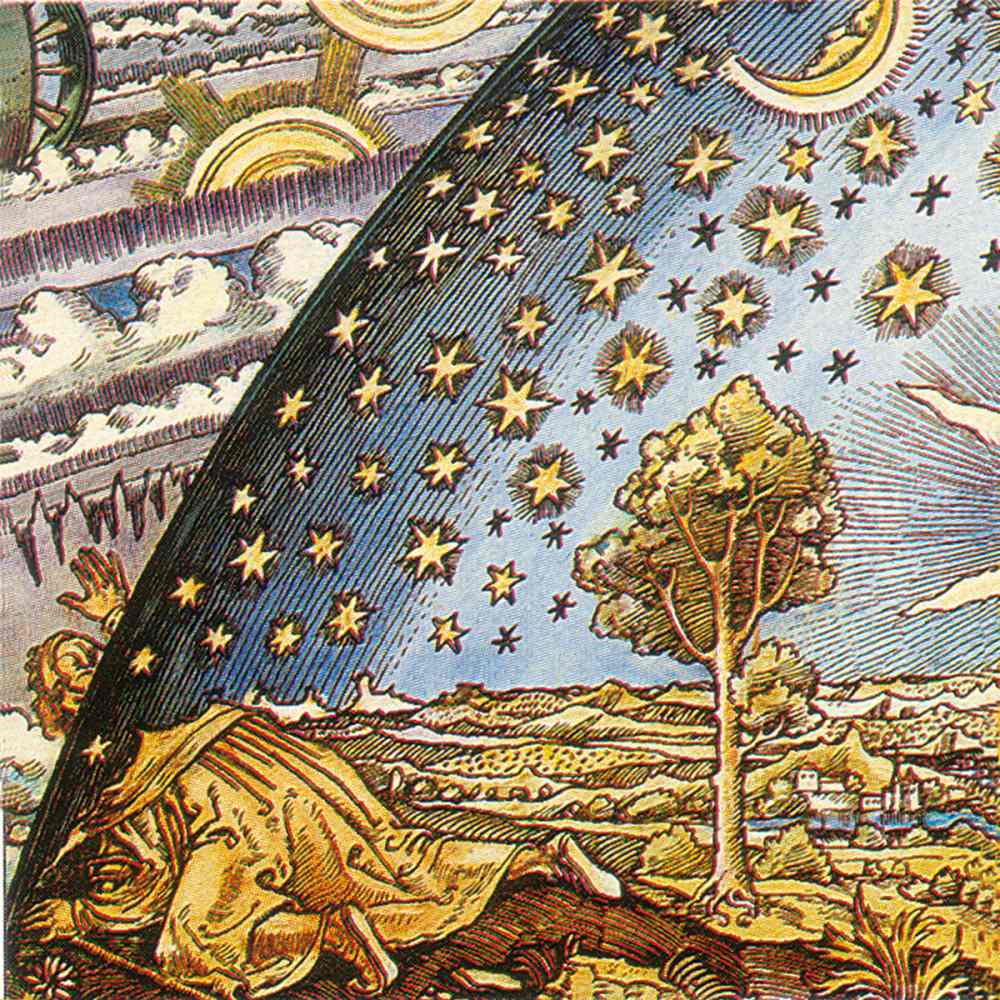
|
Once we have learned to allow unconscious trauma and early memories into awareness, the ability to become conscious of even deeper experiences follows. The track of our physical growth is only one of the directions possible to explore with this sense. As the various pieces of ones experience fit together a wide view of where ones identity has emerged from arises. It becomes obvious we as individuals are directly linked and emerging from the whole process of evolution and the historic drama. Consciousness bursts beyond the boundaries of personal memories, and now touches the living forces at work in oneself which flow into it from the entire past of ones family, race and culture.
The Light Born as a Babe
I will try to gather some of the impressions gained from gazing into the worlds revealed when this happens. For although from our limited memory we believe we live in time, and have a beginning and end, as our awareness stretches beyond babyhood, and discovers the forces from which it arose, we meet the timeless impulse of life, majestically traversing the ages in all creatures. We live in the midst of this timelessness, our own being partaking of it, with no beginning, no end, no goals or purpose other than we give ourselves from convictions, beliefs or fears.

|
We are the essential consciousness of life itself, the very light, and born as a babe, like the good book says, for a while forgetful of what we are. And at the very centre of our existence is just Being. No great powers or ecstasies; only a conscious space. But one from which we can, aware or otherwise, create our own love or anger, pain or liberation, or whatever dreams of gods and angels we so desire to people the cosmos with. |
Then there seem to me to be mysteries and wonders. For looking back I see all life, all consciousness, collected as it were in a great ocean or pool, in which there was no sense of separateness or identity. Then out of that ocean onto the shore of self awareness, perhaps for moments only at first, a daring creature crawled and said “I am”. Doing so they left a mark – footprints, two stones rolled together, marks on a rock, a cave painting. And those still in the ocean looked out upon them and wondered, until a spark was struck in them too. Perhaps struggling for a closer view they emerged and gasping also exclaimed – I am – and added another rock.
So the ocean is the world of sleep, babyhood, life of the nameless herd, consciousness immersed completely in the streams of instinct, reproduction, eating, sleeping and the senses, the collective unconsciousness. But the shore is the pathway of consciousness, the spoken word, art, drama, music, architecture, education and questioning enquiry, the collective consciousness, from which a babe is given a soul of its own, as it is taken from the collective unconscious of the great waters of life.
The Long View
Looking at ourselves from the view of our one individual life, it would seem as if we have arrived – we have attained self awareness and self direction. But from the long view, when consciousness stands back from its moorings in the present, and allows the sense of its own agelessness to come upon it, then this present self is but a mote in a huge panorama of life. It is one among billions, a moment in timelessness, a stride in the great journey of lifes infinite unfolding change. Then it can be seen that consciousness is still largely immersed in the grip of instinctive drives of aggression, territory, sex and domination. As we look around us in the world and into our own being it is obvious our consciousness is still chained to the world of thoughts, fears, emotions and drives which are the animal alive and untransformed in us. So for humanity the great struggle, seen from the wider view, is not whether we can heal cancer, or maintain peace in a warring world, but whether we can emerge into consciousness; whether we can bring our being out of the raging waters of the collective unconscious, of the twisted world of thoughts, values and ever shifting emotions, into real human awareness directing its own faculties instead of unconsciously being led by them. And from the long view also can be seen the other struggle where person dominates person. Where one, a little more witting than another, turns and directs them in their half sleep, for personal gain. People enslaved by people. Not in iron chains, but with social rules, financial illusions presented as truths, backed by thugs dressed as soldiers and police. So the struggle of person against person, the human farmers manipulating the human cattle, calls out in groans to the spirit.
If, from the mountain peak of awareness one could view only the struggle and conflict of humanity it would be a saddening experience. From that vantage point one can also search out the countryside of the human condition for new pastures, alternative routes, possibilities. While struggling to climb the slopes I heard people talking about God’s Plan for humanity. They suggested a great destiny worked out despite human weakness. Perhaps my eyes are too dim to see it; or perhaps it is not there to see. I can only report the view I gained. And at the greatest altitude, outside of time, space and identity, there is no past or future, no mind. The phenomenon of the cosmos is a dance of infinite and continuing change, and there can be no one planned direction in infinite change. Nor, from eternity that encompasses all, does it matter whether the tiny life germs on a single planet survive or not. Do we mourn the loss of thousands of skin cells daily? From a nearer view, a creature that has not learned, and cannot learn, to harness the tides of its own aggression and possessiveness, its own mind and emotion, cannot survive its own rise into consciousness anyway. The story of Noah could happen again. For it tells us of the conscious identities in ancient budding humanity, being so overwhelmed by the instinctive drives of sex, self grasping, the fight to dominate, that the waters of the unconscious swallowed them up. Only a handful survived, bringing, in a transformative sense, their animal drives with them. If it had not been so the climb to consciousness may have been delayed an unimaginable length of time, or missed our species altogether. For self awareness is a gift from one conscious being to another – a link in the ever present need for giving – education, language, care in infancy. Babies reared by animals never attain it. We could lose it in one generation in a non-caring world.
Whatever we like to name the urge in humans towards caring and sharing, toward non grasping and avoidance of domination of one person by another – it is out of this that the environment for the individual move toward awareness can occur. Just as we have the drive in us to grasp for ourselves and procreate, so, from the lives of thousands of men and women who led lives of giving, there has been planted in us the seed of the urge to become a part of a wider human experience. If we let it live in us, it will connect us with the endeavours of other people of good will all over the world.
Our Animal Heritage
In our animal heritage too lies a precious jewel. Early human beings perhaps developed it prior to the ability to think. Imagine one of our forebears, in an environment high enough in dangers and hardships to create constant alertness to survive. Imagine them standing on watch for the group to alert them of enemies, or the movement of creatures vital to their survival. From the vantage point a huge stretch of land spreads away, and with a biological computer equal to our own, greater than any electronic device in our times – they watch. A swirl of dust, a movement of birds, sounds faint and distant. Life itself may depend on knowing what those faint impressions are – yet no one piece of information is certain enough – but their computer brain, from generations of such experiences leaps to a gestalt, a whole made out of the thousand tiny parts of sense impressions, and seemingly intuits knowledge of the distant source of dust. In primitive societies the faculty is still observable.
Today we do not need to watch the horizon or read the sounds of nature around us in order to catch our next meal. But the faculty is still in us dormant. And if we are to survive as a species, we do need watchers of an horizon of a different sort. Today the faculty can work for us in another way. Are we not the worried survivors of the French and Russian revolutions, the Vietnam war, two world wars, and threats of terrorism? If we were not so worried world armament expenses would not be what they are. Have we not witnessed the incredible power of nature suppressed and ruled by a group so out of touch with the natural energies in the human animal, they were destroyed in the revolutions and wars named? When the intellect is out of touch with the collective forces of life, and tries to direct the world, nature itself, in humans or environmental forces, revolts. And our watchers today, trained in the use of their own biological computer, could take in the many thousands of pieces of information arising from world society in music, media, art, television, cultural changes, daily events, and allow their ancient sense to leap to gestalts about directions of collective mood, creativity, aggression and politics. We can listen as well to nature, our own precious planet, to see how our often egoistic activities are touching the wellsprings of energy and consciousness of our world.
That is my view from the mountain.
Using Your Intuition 2
Gipsy Magic
The Spontaneous Voice Approach
A middle aged Gypsy woman rang my doorbell one day selling heather. She immediately began to tell me things about myself which it seemed to me it was unlikely she knew from other people. She told me I had started a couple of businesses which had not been a success; a near member of family had just had an injury; my son had recently gone into a uniformed service, and I was worried about him. It was correct about the businesses, but that information was not impressive. My brother in law had just had a nail go right through his foot at work. My son had just joined the RAF and her words brought tears to my eyes, much to my surprise.
As she told me these things, prior to each statement she said, “Now I am going to tell you something true”. These words were said ritualistically, almost like a prayer, then she would say things which I had the impression she had not thought about. I was not able to question her about this as she was a difficult woman to have an easy conversation with. She gave me the Gypsy’s curse because I wouldn’t pay her the money she demanded. This amused me as, having an Italian background, and having explored the unconscious workings of the mind for many years, I well understood the nature of curses and their attempt to mobilise unconscious fears of such things as illness. worrying events and accident.
The technique this episode illustrates can be called spontaneous voice. To use it one must learn to speak without ones thoughts constantly editing and criticising what is being said. Or at least, one must learn to direct the scanning and editing functions of ones mind.
The intuitive impressions one has, the information one has gathered unconsciously from whatever source, do not usually rise into clear conscious awareness. Thinking about what we do not already know is not possible. We only think with the information we already have, or is easily available. Creative leaps are a jump beyond what is known. So to access what is intuitively understood but not yet consciously recognised, we must use something different than conscious thought.
Focusing on another person and allowing oneself to speak without forethought, is a way of doing this. The unconscious functions which support the action of speech are already well established in fast searching for memories and information connected with whatever is being spoken about. Associated ideas, feelings, memories, along with the words to express, are all quickly accessed in the process of speech. The difference is that instead of presenting the process of speech with an outline of what needs to be said, you present it with a blank sheet, with only the name of the person at the top.
In reality it is a lot more formulated than that. Here are the steps helpful in using this approach.
Hold in mind clearly what you are about to do – this is most important the first dozen or so times you do it, after that you can simply remember the previous times the function was used. In other words decide to stop your conscious attempts to find. See Intuition – Using It
Going Deeper – Reaching Further
What has been described already is the bare bones of how to use your intuitive ability. The exercises given are aimed at showing how to take the first steps. Personally, when I started I could not get any mental impressions at all, but I could, after learning to let my body move with exercises such as yawning, get a physical response. This was rather as a dowser does with a stick or pendulum. At first my hips moved spontaneously in a sideways or backwards and forwards movement as a yes or no response to any question I asked.
As I continued to use this approach though, it quickly developed greater subtlety. The next stage was that my body moved more fully and acted out or mimed a response, rather like with charades. If I didn’t understand what arose I would say so and another mime or movement would gradually lead me to clearer understanding.
Then quite suddenly another dimension opened up allowing full subjective imagery rather like waking dreams. In other words, they were inner experiences that led to fuller insights than the body movements allowed. After that the voice sprang into operation and I could allow my unconscious to speak out what the answer was, often accompanied by the inner images or understanding.
Perhaps I took the long route as there are simpler and easier ways that I will explain now. But I know that for some the imagination, imagery and spontaneous voice are outside their experience to start with, and they need to start right in the body. So I will explain ways of approaching various situations, and some techniques to use that might work for you.
Testing Your Response
Let us try some things that will explore how your mind and body respond now you have done the exercises given in the previous section.
The first test is to see if you can use an image to explore a situation. I learned this type of approach by watching Dr. Dina Glouberman work with a group and individuals. She explains it in her book Life Choices – Life Changes. She uses images to release the sleeping giant within. If it works for you it is a very simply and direct way to access your intuition and its resources.
First Test – Using Your Imagination
Relax!!!
You need about ten minutes free time for this, and also to be sitting comfortably without interruptions.
Start by realising that this is just something to play at to develop a skill and to see if you can use it easily at this stage.
Next it is helpful to relax unnecessary tension by slightly tensing your body, especially your face and genital area. Then slowly let the tension melt away and continue with the feeling of dropping expressions from your face, and tensions from your pelvis. Take time with the next thing. There are no goals for you to reach, so no right or wrong. It is simply something to imagine.
With eyes closed and relaxed, imagine yourself as a bird in a cage. Notice what it feels like and what you do as the bird. You do not have to have clear imagery to do this, simply hold the idea and see what arises. Do the exercise before you read on.
A great wonder about that exercise is that everybody who does it has a different experience, even though there are similarities. But the important questions are:
1. Did you manage to get involved in the imagery and go through a sequence of experiences?
2. Can you relate what happened to your everyday personality and the way you approach life? If not take time now to wonder about that.
3. Did it involve or were you aware of feelings in any degree?
If you answered yes to these questions, then you have the ability to use imagery as a means to explore your intuition and work with your usually unconscious sleeping giant. If you could not work with the exercise, then try the other tests that follow.
If you got a clear result from the ‘bird in the cage’ test, you can access your intuition by creating an image that suits or represents your query or need. So to get an idea of a rewarding direction, hold an image of several roads representing the possibilities open to you. Explore them in the same way you did with the bird in the cage. Then hold the image of a road that represents the unknown possibility. When finished compare results to see what felt the most rewarding.
A problem you want a response about can be set up to explore by holding the image of a standing outside a circle, and within the circle is both the problem and its answer. You then imagine stepping into the circle and observing what you feel and meet. If you do not get a clear answer the first time, try it again until it resolves.
Second Test – Allowing Spontaneous Movement
If you managed Exercise Three and experienced spontaneous movement this second test will help you to start using the skill for ‘mining’ your intuition. If you did not manage Exercise Three, practice until you begin to get results. If you got more from the bird in the cage test, then follow through on using imagery – as suggested above – rather than body work. This is why we are using these tests – to see what your best direction is.
Start by using Exercise Three to initiate spontaneous movement. If you have practised enough to allow spontaneous or ‘inner directed’ movement without using the arm circling, then you can simply stand in your space and take the keyboard condition.
When you know you are ready to allow a spontaneous response ask what signal your body will give for a ‘no’ response. If you get a clear reaction ask what movement or posture signifies a ‘yes’ response. If you do not get a response continue to experiment, as sometimes your body/mind needs to either loosen up or to discharge other movements or feelings before it is free enough to respond.
The above approach is one that most people can get a response from and build upon. It is very basic, but as explained earlier in describing my own experience, it can lead into greater subtlety with practice.
Third Test – Understanding the Symbolism of Mime
This test should only be used if you got a clear response when using the second test. Once again you are approaching your wider awareness or intuition using your body. But you are adding something to this.
The most frequent way our unconscious mind or processes express themselves or extend toward waking consciousness is in symbols, as in dreams and visions. But the symbolism the unconscious uses is not necessarily images. It can express in mime or dance, in posture or facial expression. In fact is has four recognised levels of expression. The level furthest from waking understanding is physiological, and is seen in psychosomatic conditions or experiences. So one might experience this as a pain, muscular tension or physical sensation that does not appear to have a physical cause. Deeply suppressed or internalised states of mind or memories often show themselves in this way.
The next level is gestural or postural. It is well recognised that gestures or postures are a form of non-verbal communication. This is easily observed in animals as they signal to one another. This gestural language emerges as we learn to express our feelings and needs through physical movement in infancy. See Gesture.
Certain gestures or postures such as bowing or pointing are well known, but the unconscious is often very subtle in how it expresses. Such gestures or postures have become an intrinsic part of many holy rituals all over the world. The North American Indians in their Sacred Pipe Dance when the pipe is offered to the compass directions have ‘fragments of the rich gestural symbolism of’ the Native American cultural heritage.
The Hugeness of the Unconscious
The third level is symbolic, mythic or what we experience as dreams. This is a level seen in many older cultures where truths are expressed in the forms of myths and stories. At this level we express our intuitions and needs through symbolic action, as when, feeling trapped we fight authority figures instead of having direct insight into our problem. We may act out what we feel, or what our life situation is, in a dream, in dramatic actions or play.
The verbal-analytic is the fourth level. We have reached this point when we gain direct insight into situations, symbolic actions, dreams or situations and can clearly explain their meaning and relevance to our waking life. At this level we can take the dream, mime, drama or myth out of its symbolism and explain its underlying meaning.
The test we are going to use is based on the symbolic or mythic level. What is often not understood is that if we set up a symbolic situation the unconscious will eagerly grasp a language it understands and use it to respond to our questions. Remember, the unconscious isn’t a denatured and polite lady or gentleman though. It is nature, it is untamed, but if you approach with understanding and the sort of love that tames horses, it will love you in return. So it will not always answer your question until you have given it space to fulfill its own needs. So don’t be surprised if sometimes it goes off on a tack of its own.
For this test you need to set up your ‘space’ again. Because you might move around a little you will need enough space to take a few steps in any direction with your eyes closed without banging into anything. You also need something to act as a dividing line, such as a rope or a piece of tape on the floor or carpet. This needs to be about four feet wide.
Creating Your Own Symbols
This line is the symbol you are setting up, and we are going to use it to explore what can be called Life Theatre. You will stand on one side of the line and take on the keyboard condition. On the other side of the line is something you are going to explore while in that open permitting condition. You will take your time to watch and allow changes of feeling, body movement, imagery or even speech if it comes spontaneously. Don’t worry if nothing seems to happen at first. You are practising something new. Be patient and hold the attitude that it doesn’t matter if nothing of note arises. If you start pushing for results you will only bring your conscious thinking and decision making into play, and you can do that any old time. For the moment you are letting another part of you stretch its limbs and express.
So, on the other side of the line can be the ‘future’ – or it can be an issue in your life you want to explore – or the answer to a question that is important to you. Take time to decide what it is and keep it simple this first time. Don’t run three issues or questions into one.
Having decided what you want to explore, in your imagination place it firmly on the other side of the line. You don’t need to fiercely concentrate for this. Just stand easy in the keyboard condition, stand near the line, and let your body and feelings explore.
Give yourself time to do this, and when you have finished write down what you found.
If you can use imagery or imagination easier than your body responses, you can still set up the rope and see your problem or what you seek on the other side of the division. Then, within that imagery watch your feelings and what happens as you start to slowly move across the line
To End On a Simple Method
Having asked your question, take the feeling of listening for an answer, as you would if you had asked a friend you respect. But you are in a noisy room – your mind – so you must not let your reasoning mind but in. You friend will address you by name and then you will listen for their reply. It may be in words that come into your mind or you seem to hear, or it may be feelings or pictures.
If successful you will have accessed you wider awareness, and you will know because you will have received greater understanding.
Are There Parallel Universes?
Chris: So what do you think about the idea of parallel universes?
Tony: David Deutsch, an Oxford University Professor describes parallel universes as the multiverse. What has been discovered in exploring quantum mechanics is that a universe must exist for every physical possibility. He goes on to say that quantum theory leaves no doubt that other universes exist in exactly the same sense that the single Universe that we see exists. He states, “This is not a matter of interpretation. It is a logical consequence of quantum theory.”
For us to make any sense out of this we need to understand a little bit more about fundamentals of quantum physics. Classical physics maintained that an object or an action can only be what it is and where it is. It cannot be in one position in time and space, and also in another position in time and space at the same moment.
However, because of the findings in quantum physics that a subatomic particle when observed is a particle, and when not observed a wave, a new way of looking at the universe had to be arrived at. In quantum mechanics particles can be two things at once.
This paradoxical state has been applied to the idea of building a quantum computer. In conventional computers working with digital code, something is either a 0 or a 1. Digital code is built up from a combination of these two numbers. But a quantum computer can work in a paradoxical way. It can calculate using the 0 and 1 as a single possibility. So ‘yes’ and ‘no’ – right and wrong – light and dark are all a part of the paradox and are not separate.
One of the experiments in quantum physics is to project a single photon of light to a half silvered mirror that allows the photon to both continue straight on in its direction, and also to reflect it at right angles. Classical physics would say that a single particle such as a photon cannot do the two things at once. It would either continue straight on its path or be reflected at right angles. But quantum physics shows that it can in fact be both at once.
These are some of the factors that underlie the statement that there are parallel universes.
The nearest I have come to understanding this in any personal sense came about through using the technique of meditation called Enlightenment Intensive. During this something happened that seemed to me to be an experience of the central situation of our universe. It is very difficult to describe, and so I have to use a story to help produce a particular idea or realisation.
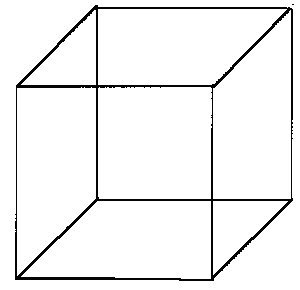
Are you looking at this from above or from the side? The cube is both things at once, but you can only see it as one or the other – unless you try! |
So imagine for a while that you are sitting looking at a wristwatch that has a second hand moving around the dial. As you look you notice that the movement stops, and you gradually realise that time has stopped. You begin to think about this, and after many speculations arrive at some understanding of it. But no time has passed. |
You now begin to think about your life, and in doing so you explore all possible choices you could make, and the directions that could arise from those choices and actions. This is an incredible undertaking, but you finally arrive at every conceivable possibility. But no time has passed.
So you begin to think about another person that you know, and likewise you explore every possible direction they might take, and all the consequences that could arise out of being who they are, and what the results in the world would be of the many possibilities of their life. Having done this, no time has passed.
In this way you explore every living human being and the consequences of their lives through infinite duration. No time has passed.
What I am trying to illustrate by the story is that my experience during the meditation suggested that at the very core of our universe, and therefore of our existence, is a condition outside of time and space. And in that condition every possible direction, thought, action, decision and outcome has already been explored and is, at that level, already a reality. At the time I really felt that each of these realities could have physical existence. At that level, I as a person was in reality all of the many possibilities that I could be. I was a murderer, an alcoholic, a genius, a pervert, an artist, a dropout, single, married, everything!
What I sensed at the time, and I still fail to understand intellectually in detail, is that any of those possibilities could be made real in the here and now. I could claim any of those possibilities, and because they already exist, they could manifest in my life now. This, I understood, as being how spontaneous and immediate miracles of healing occurred to some people. But I did see that any part of the huge potential could be made real by building it by actions, as such you work hard at materialising it.
When I compare this to Deutsch’s view of parralel universes I feel that there is still a tendency for him to see these incredibly different dimensions of experience in something of a materialistic fashion. Instead of saying all possibilities are here and now in that one amazing state, he builds an idea of lots of copies existing as innumerable material universes.
So there are other ways of looking at the possibility of parallel universes. One of these is to realise that our sense organs give us a very limited view of the universe around us. There is the possibility that there are forms of life having no need of a physical body. Just as radio and television transmissions and signals picked up by mobile phones, exist, or coexist, in the space we move around in and make our life in, so other beings can exist and coexist in the space we know without us being aware of them; that is unless we can have an ability to sense and then transform the signal into our own awareness.
Many years ago when I had an out of body experience, I stood before my mother and she could not see me. That was very strange because I was very apparent and real to myself. I existed in the same room, the same space, as she did, and yet she had no awareness of me. Yet my dog, who had been asleep in front of the gas fire, did see me and responded. What I realised from this was that if my mother could have been aware of my thoughts and feelings, then she would have known of my presence. But because she, in common with most of us, cannot be aware of what I think and feel unless I express it physically in some way by facial expression, or words, then beings existing at that level are invisible to us.
So in that sense we can say there are parallel universes existing with us here and now. We experience this for ourselves daily in being aware of our own personal experiences that are largely hidden from others unless we express them in some way. Therefore the universe of our own person coexists with the billions of other unique universes around us.
Native American Dream Beliefs
The Headings Are:
Dreams as guidance in life
Sacred Fasting
Dream and visions
Healing Experiences
A Failed Initiation
Dream doorway to wider awareness
Tribal Elders
See also The Iroquoin Dream Cult
In considering the beliefs of the Native American peoples, there is not a single belief system. Each tribe developed their own relationship with their inner life as it connected with and contributed to their external environment and needs. In looking at the fairly pure statements of traditional Amerindians in such books as Black Elk Speaks, and Ishi, it is fairly obvious however that dreams were generally considered as a form of reality or information to be highly regarded. Black Elk became a revered medicine man of his tribe through the initiatory process of his dreams and their revelation. His dreams revealed rituals to be performed by the tribe which aided in healing social tensions. But these deeply perceptive social or psychological insights into his own people which arose in his dreams, are only one of many facets the Native American peoples found in their dream life. And of course Black Elk is only one of the men and women of the Native American people who were visionaries.
Dreams as guidance in life
Ishi explains how his dream of what turned out to be the coming of the railroad and the train, was central to his whole life and its tragedy. Nevertheless his dreams warned him of the presaging deadly events for his tribe, and helped him find strength to meet what came about.
As already pointed out, personal initiation was one of the most fundamental of the facets. Individuals, through prayer, fasting and lonely vigils, sought from their dreams, a vision of their destiny as an individual, and an image to aid a personal link with the Spirit pervading all life. With such a dream the young man or woman could feel themselves to be a real part of their group and their environment. But even this cannot be taken as a generalisation. R.F. Benedict reported in The Vision In Plains Culture (American Anthropologist Vol. 24 1922) that among the Arapahoe, the Gros Ventre and in all the Western Plains peoples north and south, puberty fasting for a vision did not occur.
Nevertheless, although details varied as to when and how such dreams were sought, the visionary dream was held as sacred. Sometimes the ways of seeking these visions were very quiet, as when retiring to ones lodge, and sometimes very drastic, when braves suspended themselves from poles on hooks.
Sacred fasting
Fasting has been used as a spiritual discipline by many past cultures, but it has not been really understood. For fasting is not primarily a form of personal cleansing or a self punishment for ones ‘sins’ but a way of learning to become a real human being who is no longer the slave of their animal appetites. For otherwise we are all addicts – addicts to eating too much or too little; addicts to wanting to be important; addicts to sex; addicts to power, money and ego, even to killing or maiming others – and many other things.
“When I fasted for 14 days without any food, just water, I slowly discovered what real quietness was. My energy for turbid emotions, for sexual activity, for thinking and trying to think things out, just faded away. They were all aspects not of my central self or spirit – which I discovered was a quiet awreness – but of my bodys animals desires.” See Ox Herding – Victim – Avoiding Being My Own
When I fasted I was about ten years old, that being the age at which grandparents generally desire their grandchildren to fast. My parents never bothered me at all about fasting, and I don’t suppose I should have fasted at all if I hadn’t a grandparent at that time.
About the middle of the little bear month, that is, February, my grandmother came to my house to fetch me. I did not know what she wanted of me. After two days she told me why she had come. So the next morning I received very little to eat and drink. At noon I didn’t get anything to eat at all, and at night I only got a bit of bread and water.
There were about seven of us fasting at the same time. All day we would play together, watching each other lest anyone eat during the day. We were to keep this up for ten days. However, at the end of the fifth day I became so hungry that, after my grandmother had gone to sleep, I got up and had a good meal. In the morning, she found out that I had eaten during the night and I had to start all over again. This time I was very careful to keep the fast, for I didn’t want to begin on another ten days.
After a while, they built me a little wigwam. It was standing on four poles and about three to four feet from the ground. This was my sleeping-place. My little wigwam was built quite a distance from the house, under an oak tree. I don’t know whether it was the custom to have the young boy fast under a particular tree or not. I believe the wigwam was built in the most convenient place for the old folks to watch it during the day.
The first morning my grandmother told me not to accept the first one that came, for there are many spirits who will try to deceive you, and if one accepts their blessings he will surely be led on to destruction.
The first four nights I slept very soundly and did not dream of anything. On the fifth night, however, I dreamt that a large bird came to me. It was very beautiful and promised me many things. However, I made up my mind not to accept the gift of the first one who appeared. So I refused, and when it disappeared from view, I saw that it was only a chickadee.
The next morning, when my grandmother came to visit me I told her that a chickadee had appeared in my dream and that it had offered me many things. She assured me that the chickadee had deceived many people who had been led to accept this offering.
Then a few nights passed and I did not dream of anything. On the eighth night, another big bird appeared to me and I determined to accept its gift, for I was tired of waiting and of being confined in my little fasting wigwam. In my dream of this bird, he took me far to the north where everything was covered with ice. There I saw many of the same kind of birds. Some were very old. They offered me long life and immunity from disease. It was quite a different blessing from that which the chickadee had offered, so I accepted. Then the bird who had come after me, brought me to my fasting wigwam again. When he left me, he told me to watch him before he was out of sight. I did so and saw that he was a white loon.
In the morning when my grandmother came to me, I told her of my experience with the white loons and she was very happy about it, for the white loons are supposed to bless very few people. Since then, I have been called White Loon.
Not only did White Loon gain his name from his dream, and therefore his adult identity, and whatever respect gained by it from his family and tribe, but he also gained the image of himself as living into old age and having freedom from disease. These are very precious gifts no matter what period of history we consider, or what ‘tribe’. In a modern city, thousands live without any satisfying sense of connection with, or feeling they are respected by, their ‘tribe’. Many live under constant fear of serious illness or early death, and businesses are built catering to such fears.
The Pueblo Indians
Jung, writing about a meeting with some Pueblo Indians in the USA, explains that their religion rests upon the belief that through their frequent ritual, they help the sun to rise each day. Without their tribal attention to the sun, they are sure the sun will no longer rise. “This idea,” Jung explains, “absurd to us, that a ritual act can magically affect the sun is, upon closer examination, no less irrational but far more familiar to us than might at first be assumed. Our Christian religion – like every other incidentally – is permeated by the idea that special acts or a special kind of action can influence God – for example through certain rites or by prayer, or by a morality pleasing to the divinity.
The point Jung makes overall however is that through their beliefs the Pueblo Indians as a group of people, have an intense peace and satisfaction with their life. This deep peace and inner happiness is seldom shared by more ‘rational’ modern communities. I am not trying to argue for irrationality, but the comparison does, I believe, highlight something that arose from the Amerindian beliefs and use of dreams for guidance and spiritual sustenance. Namely how a belief system, no matter if it is irrational, acts as a psychic immune system against the ‘germs’ of despair, inferiority and meaninglessness.
This pride and sense of belonging that was often a marked feature of such tribal peoples prior to the coming of the white races, illustrates one of the main functions of the dreaming process – the psychological compensation or self-regulatory process – and how it acts on the personality if it is deeply accepted. Because the native peoples of America had such trust in the products of their unconscious in dreams and visions, the compensatory images presented were of great benefit, and fulfilled their task of keeping the balance in the individualised identity. Unfortunately the rational attitudes of the invading nationalities, questioning the power of the dream and vision as they did, offered nothing to take the place of the dream. At least, nothing that produced such an obvious sense of pride and tribal and personal identity.
Something that becomes apparent in looking at dreams such as White Loon’s is that the cultural attitudes and beliefs White Loon was educated in dominate the content of his dreams. The coming of the chickadee in early dreams was an accepted part of the vision fast, and can be found in many other such dreams of people in his culture while fasting. When an Indian became a Christian, through exposure to a different set of cultural ideas, his or her dream content changed radically. Nevertheless, many dreams were of a personal psychological nature also, showing the individual relationships with the culture and their own inner life. Even though White Loon’s dream of the birds is very deeply cultural, it is interesting that birds often have the same sort of significance in modern dreams. It was out of this sort of observation that Jung developed his theory of the archetypes and the collective unconscious.
Dream and visions
Something else that is apparent in comparing the visions experienced by native Americans with those of present day individuals – perhaps those using LSD or experiencing visions due to stress such as illness – is that the native Americans entered their visions with some understanding of what to expect and how to deal with the experience. Our own cultural attitudes frequently put us at odds with our own unconscious processes and visionary upsurge. Many people who are confronted by the opening of the unconscious and the events that follow, believe they are going mad, or that they will be overpowered by forces that are antagonistic to them, and will sweep them to their doom. Neither do many people, trained in modern Western ideals of behaviour, know how to exist in the land of vision. Just as few desert people know how to swim, and would feel fear if dropped into deep water, so the person who falls into an altered state of consciousness from the world of modern materialistic thinking, may feel great fear instead of pleasure and the ability to ‘swim’ in it. Even the many people who ‘interpret’ their dreams, have seldom moved beyond the level of thinking, and know nothing through experience of the deep waters of the unconscious. See: abreaction; active imagination.
Like other primitive cultures, dreams were seen by the Amerindians as having certain marked features that could be gained from them. There could be an initiatory dream such as we have already considered. There could also be dreams telling where to hunt; dreams showing a new ritual giving some sort of power such as warding off illness, or finding a new relationship with everyday life, or attracting a lover; dreams could show the use of a herb for medicine; dreams might be caused by some sort of evil within ones body, or an external evil such as someone wishing you harm or an evil spirit; there could be a shared dream with another person; the dream might be a revelation from someone who was dead and now in the spirit world; or a dream, as in the third example below, could be a map supporting and guiding the dreamer throughout their whole life. Dreams were often considered to be bad or good. If a dream were considered bad something had to be done about it, such as a cleansing or healing ritual.
As an example of an Indians attitudes to dreams, this statement of White Hair, a medicine man, is interesting. “Every dream that takes place is certain to happen. Whenever the evil spirits influence it, it is certain to happen. Whenever we dream a bad dream we get a medicine man to perform sing and say prayers which will banish the spirit.”
The following description by a medicine man explains how he had a dream showing him a new medicine. He says, “I saw a dog that had been shot through the neck and kidneys. I felt sorry for the dog and carried him home and took care of him. I slept with the dog beside me. While there I had a bad dream. The dream changed and the dog became a man. It spoke to me and said, ‘Now I will give you some roots for medicine and show you how to use them. Whenever you see someone who is ill and feel sorry for him, use this medicine and he will be well.’ One of these medicines is good for sore throat.”
The following is a fasting dream/vision recorded by Father Lalemont, a Jesuit priest working among the Indians.
At the age of about sixteen a youth went alone to a place where he fasted for sixteen days. At the end of this time he suddenly heard a voice in the sky saying, “Take care of this man and let him end his fast.” Then he saw an old man of great beauty come down from the sky. The old man came to him, and looking at him kindly said, “Have courage, I will take care of your life. It is a fortunate thing for you to have taken me for your master. None of the demons who haunt these countries will have any power to harm you. One day you will see your own hair as white as mine. You will have four children, the first two and last will be males, and the third will be a girl. After that your wife will hold the relation of a sister to you.” As he finished speaking the old man offered him a raw piece of human flesh to eat. When the boy turned his head away in horror, the old man then offered him a piece of bear’s fat, saying, “Eat this then.” After eating it, the old man disappeared, but came again at crucial periods in the person’s life. At manhood he did have four children as described. After his fourth, “a certain infirmity compelled him to continence” He also lived to old age, thus having white hair, and as the eating of the bear fat symbolised, became a gifted hunter with second sight for finding game. The man himself felt that had he eaten the human flesh in the vision, he would have been a warrior instead of a hunter.
Such dreams as the above, about the use of a herbal root for medicine, show how many herbal treatments, not only among the Amerindians, but from tribal people throughout the world, came about. In fact many tribes attributed the origins of many of their cultural artefacts, their religion, the use of fire, to a specific dream experienced by a past tribal member.
Because of the great many Amerindian tribes, and their different dream beliefs, it is impossible to summarise the views of life, death and human origins arising from their dreams and visions. The following description of the beliefs of the Naskapi Indians is so pure and simple however, that it probably holds in it many of the beliefs of other tribes. It is taken from Man And His Symbols by Carl Jung, published by Aldus Books, 1964. It is from the section on The Process Of Individuation by Marie L. Von Franz.
Healing Experiences
Frank Takes Gun, national president of the Native American Church, says: At fourteen, I first used Father Peyote. This was on the Crow Reservation in Montana, and I was proud to know that my people had a medicine that was God-powerful. Listen to me, peyote does have many amazing powers. I have seen a blind boy regain his sight from taking it. Indians with ailments that hospital doctors couldn’t cure have become healthy again after a peyote prayer meeting. Once a Crow boy was to have his infected leg cut off by reservation doctors. After a peyote ceremony, it grew well again.
This may be considered only exuberant witch-doctor talk, but reliable observers have confirmed that these economically deprived peoples are in better-than average health and that when they do become sick and turn to peyote, the drug seems to help them. Louise Spindler, an anthropologist who worked among the Menomonee tribe, said that the women “peyotists” often kept a can of ground peyote for brewing into tea. They used it in “an informal fashion for such things as childbirth, ear-aches, or for inspiration for beadwork patterns.”
Dr. Peck also made such an observation and, in fact, first became interested in LSD as a result of having seen the effects of peyote: When I went into general practice as a country doctor in Texas, I was very impressed that some of our Latin American patients, despite their poverty and living conditions, were extremely healthy. One day, I asked one of my patients how he stayed so healthy, and he told me that he chewed peyote buttons then, I became interested in these drugs that could promise physical as well as mental health.
A Failed Initiation
It is great to find a personal account of Native American initiation in the modern world. But here it is as reported.
The inward journey does not always turn out this way. The following account (published in Psychiatry, February 1949) of the phantasy of a Chippewa Indian woman of 34 living in Northern Wisconsin, furnishes an interesting comparison. It presents the contrast of a widely different background, both of personality and environment. It brings in the same characteristic symbolism. And it shows how such an experience can remain unrealised.
‘The third time I went through the Midewiwin (the Chippewa Medicine Dance), I went through because I had a vision that I should do that. We were living out in the woods at that time. Everything was still and quiet there. I was lying on a bed. I got to thinking of things I’d done way back in my younger days. I thought about my relatives and my friends, my parents who were dead and gone. I had no one to call upon except for my old man.
I lay still, and my mind was working all the time. Then I said out loud, so that I could be heard: “What is there that I didn’t do right? Everything that I can remember I thought I did right. What is wrong with me that I have so many visions of different things and different people?” All that summer I had had visions of people and things. I said aloud again, “Maybe the Almighty has mercy on people who see all these visions.
Here, most authentically, is the first stage: the feeling that ‘there is something wrong about us as we naturally stand’. The way of development now lies open. As William James puts it: ‘The individual, so far as he suffers from his wrongness and criticises it, is to that extent consciously beyond it, and in at least possible touch with something higher, if anything higher exist.’
‘Then I had a vision that I was walking along a narrow trail through the brush-no tall trees. It was a beautiful day. No wind. Plenty of sunshine. I walked along this trail for about an hour until I heard the sound of tinkling bells in the distance. As I came nearer to the sound, I saw four men sitting around something that was round. Above their heads was something across the sky like a rainbow. One of these men called me his grandchild. He said, “You are supposed to tell the people once in a while when you are in trouble about something you know, something that’s in you. Let them know what’s in you. Don’t pay any attention if people laugh at you. If they do, they’re not throwing jokes at you; they’re throwing jokes at themselves.” One real old white-haired man sat at the far end of that round thing. He pointed to his snow-white hair. He told me that my hair would be just like his some day, if I did what I was told. “We are the ones that asked you to come here, because you are in trouble and don’t know which way to turn. There are four things that I want you to remember-North, East, South and West. On all of these four there sits a man who waits and wants to receive your tobacco. You have a name that you bear, which means a great deal to me. Your name means a whole lot. As you go along, you’ll realise this. Your thinking power is working real hard. It will get you somewhere, if you listen to it.”
Here is the mandala symbolism, as in the vision of the sword and the cross-the four old men sitting around something that is round. The woman is told there is something she knows, something in her, that she should tell people. She is, at the same time, given her orientation-four things to remember, North, East, South and West. And she is reminded of her name.
‘Then another real old man spoke. “It’s been a long time since you thought of your grandfather. I like to receive your tobacco once in a while too. I’m the one that suggested to this man the name that you are called by. Don’t be afraid of me because I’m big. I will tell you what you are supposed to do once in a while. You are supposed to put out food, like meat and corn, and put some tobacco into the fire or on the ground when I go by. You do your own speaking (i.e. to the spirits). Nobody else needs to do it. I am the one who will listen.”
Then I said, “Oh, I’m the one who made a mistake. I never thought that I would ever make such a big mistake. Sometimes when I think of the things I’ve done, I thought I’d done them right; but I didn’t.”‘
As later transpires, the mistake was that the woman gave no tobacco to the people she was named after, i.e. did not adequately realise the name, and consequently did not find her true being-again as in the sword and cross vision.
‘Me said, “Sometimes we see you in this certain kind of dance. You are holding the precious flag (the feather flag held by the person who addresses the spirits). That flag belongs to us. Before you speak or do anything, offer some tobacco. If you have no tobacco, you have to give the price for your tobacco.” That’s just what I do now. If I can’t speak, I have somebody speak for me.
Then I went on from this place along the trail a little ways. I bear and see some more. This man has his finger up in the air. He’s talking. He’s from the South. This is a different man. There’s a thing about four feet high-just a stick sticking in the ground. The man takes the stick and hands it to me. “If you lean on this stick,” he said, “you’ll use two of them later on, as you go along the road, if you do just what I tell you. (To ‘walk with two sticks’ is synonymous with long life). Go to your great adviser (the old priest to whom she is married) and tell him what you have seen.”‘
Mere is good counsel. The chief difficulty in all experience the other side of consciousness is adequate realisation. If the woman tells her ‘great adviser’, there is a better chance of holding the experience and bringing it into life.
“As I was corning back along this trail, I saw a great big snake about this big around (six inches). He raised his head about this high (four feet) from the ground. “Don’t be afraid of me,” he said. “Just go back and tell your adviser what you have seen. If you don’t you won’t be able to walk.” Then he pointed and said, “Look over there.” I looked and saw myself lying flat on my back. Then the snake said, “But if you do what I tell you and tell all that you know, everything will be all right. I want to come into that place (her home). I like that place. It makes no difference how it looks. I’m coming there just the same. I’ll go along now.” Then I walked back home along the trail. That was all. Then I made preparations for going through the Midewiwin.’
This is the encounter with the snake, the embodiment of the unconscious; and again the good counsel for realisation-’ tell your adviser.
‘One afternoon, after I’d made all of my preparations for joining the Midewiwin again, I was all alone at home. The door was open about four inches. I looked at the door and saw this person coming in. I felt kind of scared. He was an unexpected visitor. He came in a few feet and said, “I have come at last.” He looked around, turned over on his side and ,made himself at home. Then he spoke to me: “If you take care of me like you should, I will do a lot of things for you, because I am the one that suggested all this to you. When you start, have the prettiest dress you’ve got. I know that I am welcome here. Don’t be afraid of me, because I have come a long ways to see you.” That’s all he said. Then he became a snake and went out.’
This is the ‘bringing home’ of the embodiment of the unconscious, as a separate, uncanny but helpful presence. As the ensuing passage shows, it is the snake that leads to the way.
‘That’s just the way that thing (the hide) looked. I got a snake hide that third time I joined. He (the snake) is the one that put these things into my mind and set me to thinking. I’d wondered what was wrong, because I’d never kept thinking and seeing things like that before. He’s the one that suggested I join the Midewiwin. He also asked me if I wanted a drink. I said, No, not when I entered his house (the Mide lodge).
One of the old men spoke to me when I was in the lodge, the third time I joined. Me said, “When you come tomorrow, dress as nice as you can. That’s how this person wanted you to enter this house.” That’s just what I did. He said, “When you go along this road, do the best you can. Pay attention to what is before you, not what is behind you. When you speak, watch your tongue. After you get through here and know what to do, watch your step for the next two or three years. If you do, he’ll take you along this road just as he suggested. This road never comes to an end. ,pay no attention to the side roads. Pay attention to the road that s in front of you. This is his (the snake’s) road, and this is his home. 1f you take care of yourself, he will do the rest. Your thought belongs to no one but you. Don’t listen to any kind of wind that’s blowing about you. Just turn the other way and do the best you can. He will know, because you’re the person he intended to enter his house. He has picked a person from our midst who happens to be you. He thought that you were the most wonderful thing that God has created. That’s why he picked your home to be his home; he liked that place. And this little thing that I’ve got in my hand (a tiny blue and white shell) belongs to him.”‘
Here is the deep centre (the equivalent of the jasper stone in the sword and cross vision), the something from the depths which ‘be-longs’ to the snake. The old man continues:
“Whatever you say and do-he knows all about it. Don t think that he doesn’t hear whatever you say, because he does. He has become one of the wonderful members of your household.” Then this old man pointed to my head. “See how your hair is today. As you go along this road, your hair will change to a different colour. This thing (the blue and white shell) will take you along the road that we are going to teach you about.” Then he touched the tip of my ear. “These things you own yourself. They belong to nobody but you. The thing that has happened to you is the most wonderful thing I have ever heard of. I have heard of that happening in olden times. Back in my days I heard that people had such a vision like that. It is the most wonderful thing that can happen to a person on this earth. Don’t be afraid to give what you’ve got; because later on, in years to come, you will get paid for it. As you go along this road, you will be using one stick. Maybe by that time you will have grand-children, and you will be able to tell them about this wonderful thing that has happened to you. As you go along to the end of this road, you will be using two sticks. You will still be walking toward this wonderful house that you have seen. This (the shell) is the one that owns it.” ‘
In the Midewiwin third initiation a shell is supposed to be magically ‘shot’ into the candidate from a snake hide, which is referred to during the ceremony as a ‘gun’. Here is the authentic symbolism of the deep centre: that which takes her along the road; that which owns the wonderful house towards which she is travelling; that which enters into and transforms the personality. The old man concludes:
‘”In maybe five or six years from now, you will be entitled to join again. I hope that I may still be here to see it and know what it’s all about. I’m telling you this again, to impress it on your mind. Don’t regret the things that you did in your younger days. You have made only one mistake. Don’t let it happen again.”
(The interviewer asks: What mistake was that?)
“I didn’t give no tobacco to the people I was named after . . .”
When you join the Midewiwin the third time, they tell you that the snake is wrapped all around the earth. He may scare you, but he doesn’t mean to. When I joined that time, they told me that if I had anything nice that grew from the earth-like blackberries-I should give a feast. But I didn’t do it, because the berries were all gone by then; and three months later I gave my hide away; so there was no use in giving a feast to the snake.’
The end is failure. ‘Three months later I gave my hide away.’ The experience has passed her by. The woman to whom these images came saw them as she might a film. She was aware of the archetypal processes with the natural awareness of the quasi-primitive, but she had not the means of incorporating their value into consciousness. The revelation itself was admirably complete: the mandala; the name; the snake; the deep centre. The way she is shown is, in effect, the resolution of the fundamental opposites of consciousness and the unconscious. ‘This road never comes to an end. Pay no attention to the side roads. Pay attention to the road that’s in front of you.’ But she could not hold the experience. All the transforming symbols were there but not the necessary realisation. Quoted from Experiment in Depth by P. W. Martin
Dream doorway to wider awareness
The inner centre, the Self, or the guiding spirit of a person “is realised in an exceptionally pure, unspoilt form by the Naskapi Indians, who still exist in the forests of the Labrador peninsula. These simple people are hunters who live in isolated family groups, so far from one another that they have not been able to evolve tribal customs or collective religious beliefs and ceremonies. In his lifelong solitude the Naskapi hunter has to rely on his own inner voices and unconscious revelations; he has no religious teachers who tell him what he should believe, no rituals, festivals or customs to help him along. In his basic view of life the soul of man is simply an ‘Inner companion’ whom, he calls ‘My Friend’ or ‘Mista peo’, meaning ‘Great Man’. Mista peo dwells I the heart and is immortal. In the moment of death, or just before, he leaves the individual, and later reincarnates himself in another being.
Those Naskapi who pay attention to their dreams and who try to find their meaning and test their truth can enter into a greater connection with the Great Man. He favours such people and sends them more and better dreams. Thus the major obligation of an individual Naskapi is to follow the instructions given by his dreams, and then to give permanent form to their contents in art. Lies and dishonesty drive the Great Man away from one’s inner realm, whereas generosity and love of his neighbours and of animals attract him and give him life. Dreams give the Naskapi complete ability to find his way in life, not only in the inner world but also in the outer world of nature. They help him to foretell the weather and give him invaluable guidance in his hunting, upon which his life depends…… Just as the Naskapi have noticed that a person who is receptive to the Great Man gets better and more helpful dreams, we could add that the inborn Great Man becomes more real within the receptive person than in those who neglect him. Such a person also becomes a more complete human being.”
Tribal Elders
Becoming a tribal elder is a natural accompaniment of soul growth: As the individual grows in stature and in grace, bringing the personal will ever more into alignment with the Creators will and developing the talents it had earned in its long journey of earth sojourns, the personal evidence would mount for the promise of being and expression of the Creator.
These elders perceived as a matter of fact and direct consciousness the redeeming presence (within each unit-member of the group) of the larger life to which she or he belonged. This larger life was a reality– “a Presence to be felt and known”; and whether he or she called it by the name of a Totem-animal, or by the name of a Nature-divinity, or by the name of some gracious human-limbed God or what-not–or even by the great name of Humanity itself, it was still in any case the living incarnate Being by the realization of whose presence the little mortal could be lifted out of exile and error and death and suffering into splendor and life eternal.
 |
 |
 |
|
In American Indian education, within each tribe elders, “are repositories of cultural and philosophical knowledge and are the transmitters of such information,” including, “basic beliefs and teachings, encouraging…faith in the Great Spirit, the Creator”. “The fact acknowledged in most Indian societies: Certain individuals, by virtue of qualifications and knowledge, are recognized by the Indian communities as the ultimately qualified reservoirs of aboriginal skills.” The role of elder is featured within and without classrooms, conferences, ceremonies, and homes.
The following definition is from a study of the role in a specific tribe:
A point of reference: those people who have earned the respect of their own community and who are looked upon as elders in their own society…We have misused the role of elder through our ignorance and failure to see that not all elders are spiritualleaders and not all old people are elders
— Roderick Mark (1985)
Here is a persons experience in becoming an elder: “What arose was the sense that I need to move into being an elder in my tribe. I need to become more of a father figure, letting go of personal possession. There was a real sense of loss, of saying goodbye to something that I longed for. But gradually it came, and I felt I could let go of wanting to possess my woman, and being willing to act as a father or a loving friend. This felt like a huge development. It felt like an initiation that I was passing through, and if I could not have let go I would not have passed the initiation. As it happened, I did let go. I did pass the initiation. I did become an elder of my tribe. So, to tell you what I feel Life spoke to me, I need to stand in the right space, a place you have not met me in yet. In this place I am the elder of my tribe. This is my lodge and I welcome you in. Welcoming is not a courtesy. It is offered to you because of who you are. My name in this place is both Pathfinder and Recorder. They are names given me by the spirit years ago. I listen now as an elder, as a man, and as the spirit of things.”
See: Iroquoian dream cult; Spirit-Child: The Aboriginal Experience of Pre-Birth Communication.
Altered States of Consciousness
Dreams themselves are an altered state of consciousness. The term – ASC – refers to a significant change in what is considered a normal waking awareness. Therefore a dream is an excellent example of an ASC. For instance in dreams or in a state where the sense of self is diminished, people can sometimes do or experience things they cannot in ‘normal’ waking consciousness. Problems can be solved in an intuitive way; perception is heightened; some people look ahead to future events, or experience a view of things far distant from their physical body; there is also the possibility of generally impossible healing processes released in the body; memories of early childhood or even life in the womb are more readily accessible in a dream or ASC state than in normal life. Of course, it has to be said that although such things are possible, the run of the mill altered state in dreams of fantasies, has little or nothing of these splendid possibilities. Therefore part of the study of ASC’s is to discover how we can, as humans, learn to use our own potential more adequately. See:esp in dreams; the definitions of dreaming under Freud; out of body experience; dream yoga.
The strange or unusual phenomena met in ASC’s are no longer seen as something simply believed by the gullible. Researchers have been able to witness or record many of them, but there is still no commonly held theory to explain the more radical phenomena such as extraordinary healing or separation of ones self awareness from the body’s location. For instance the yogi Swami Rama demonstrated an altered state in the laboratory conditions of the Menninger Foundation. While wired to record alterations in brain and body he held his right hand in front of him palm up, and while observed by several scientists, caused the left side of his hand to turn bright red, and the right side to become ashen grey. The measuring instruments showed that he had managed to create a temperature difference of 10 degrees Fahrenheit between the two sides of his hand. In explaining what he does, yogi Rama says that ‘All of the body is in the mind, but not all of the mind is in the body.’
In 1947 a Dutchman, Mirin Dajo, demonstrated to audiences in the Corso Theatre in Zurich, that he could allow an assistant to plunge a fencing foil right through his body, even through vital organs, without any apparent harm. Dajo did not bleed at the removal of the foil, and only a faint red line marked where the foil had pierced. A Swiss doctor, Hans Naegeli-Osjord, hearing of Dajo’s alleged wild talent, induced him to allow scientific investigation of what happened when he was pierced. In the Zurich Cantonal hospital many people, including doctor Naegeli-Osjord, doctor Werner Brunner, the chief of surgery at the hospital, and a number of other doctors, students, and journalist observed and reported on the experiment. In front of them Dajo stripped to the waist and after spending some time in meditation, had his assistant once more plunge the steel through him. This should have damaged vital organs, but there was no apparent harm, although the witnesses were shocked. Dajo was then asked to allow an x ray to be taken with the rapier still in place. He agreed, walked to the x ray theatre with the foil still in place. The result of the x ray undeniably showed Dajo was pierced through vital organs. At a later date Dajo was again examined by scientists in Basel, and this time allowed the doctors themselves to pierce him. Each time there was no apparent harm. This case was reported by the German physicist Alfred Stelter in his book Psi-Healing.
Many other people than Dajo have demonstrated the same ability and others abilities equally strange. In most cases the person has found a way through prayer or meditation, or perhaps through the excitation caused by an extreme situation, to radically alter their state of mind and emotion. While in the ASC their body or mental abilities are radically different to when in an everyday state of mind.
This is demonstrated by a witnessed account of ASC in St. Bernadette of Lourdes. Dr. Dozous, the municipal physician of Lourdes was present with other people while Bernadette was in an ecstasy brought on by prayer and love of God. Dr. Dozous reports that he saw Bernadette’s hand move while she was in ecstasy, becoming so close to a burning candle the flame licked around her fingers. Dozous timed the event and says it was a full ten minutes before Bernadette came out of her trance – ASC. There was no observable damage to her hand. Dr. Dozous says ‘I saw it with my own eyes. But I swear, if anyone had tried to make me believe such a story I would have laughed him to scorn.’
A dream itself IS an ASC. In most dreams however, we do not often demonstrate such radically altered talents. Nevertheless, there are differences we can all note. Foremost is the fact that with eyes closed we have managed to create an apparently real world surrounding us which is purely personal and not witnessed by other people in the same room. In this world of our conjuring we feel ourselves completely involved, capable of experiencing all the emotions and responses we would feel if in fact the events we meet in the dream occurred in the waking world. If we make love in our dream we not only feel real passion, our body may also produce all the signs of actual love making, such as ejaculation, that would occur if one had a physical partner. Technically this ability to see a dream as an external reality is called hallucination. Occasionally this occurs while we are awake or using a drug.
Although dream hallucination is taken for granted, it has enormous potential. In our nightly dreams we often touch only a tiny part of this potential. This is understandable if one considers that in the sexual dreams mentioned our body fully takes part in what is being dreamt. This could mean that if we dreamt of our body being hot on one side and freezing on the other, there is the likelihood that we would, like Swami Rama, produce a marked difference of temperature on the opposite sides of our body. In fact people who have learned biofeedback techniques can do this in some measure.
Making one part of our body hot and another cold may not be of great practical benefit, although it probably has a marked healing effect if the extra blood is directed to sick parts of the body. Supposing however, we could dream in a way enabling us to see what was happening in our body, to recognise signs of illness and heal them. This would be a wonderful addition to our natural healing process. This is not a fantasy, it happens with a few people, and understanding the process can help us conscious work with it. Similarly, people have learned to work with the dream process to ‘dream’ traumatic episodes of their birth, babyhood or childhood. In doing so they uncover the powerful reactions that were experienced or decisions made which have subsequently influenced their lives negatively. They also manage to meet the person or baby they were at that period of their life, and help it integrate more fully with the present situation. See: Lucid Dreaming; lucidity – awake in sleep; dream yoga.
Realistic Time Travel
This may sound strange. How does one meet the baby that one was all those years ago? Fortunately present day computer simulation has helped us to understand some of the talents we ourselves have but seldom use. A dream of flying an aeroplane is a sort of computer simulation of the event. It is in fact far more realistic than the present day simulators. We feel totally involved. Our dreaming mind can take all the factors and memories it has in store, rather like the computer in Star Trek which creates holographic scenes the crew can choose to exist within, and likewise produces holographic simulations. Most commonly we do this not with aeroplane flight but by simulating actual people. With its own mysterious processes, our mind produces apparently exterior people in our dreams. These people of our dreams have their own independent action and idiosyncrasies. We might like them, love them or be frightened of them while we dream. Some of these ‘people’ are simulations of our own youth, childhood, and baby self. Through such dream simulation we have a far more profound experience of that part of our life than we ever would by simply thinking about ourselves at that age. By interacting with the simulations one can more fully learn about the difficulties and experiences of oneself at that period. We can discover the subtleties of how we are relating to that part of our experience now. From such knowledge we can then re-program the results of our own past. See Processing Dreams; Acting on Your Dream.
Although we are often not in the habit of believing that we can usefully interact with a dream image – which in our culture is frequently seen as ‘only imagination’ – we can nevertheless produce powerful personal changes in this way, and there are plenty of examples in psychology and in everyday life of the power and reality of such interaction. In computer use for instance, it is now commonplace to have an image on the screen that connects us either with information stored on the hard disk, or will evoke a programmed response linked with the image. So by moving our cursor to an image and clicking on it we can start a program such as a word processor; or we can cause to be displayed information such as a book, music or a photograph, that is stored on the hard disk. In a similar way, by learning to use an ASC, such as the dream state or a condition in which you are engrossed in a directed fantasy – such as meditation or prayer – and by using a dream image in such fantasy, you can evoke responses from parts of you usually inaccessible.
The World Beyond The Senses
The creation of a fully dimensional world, filled with varied and complex scenes, objects, plants, animals and people with which we can interact, is only one of the aspects of the ASC we call dreaming. The shutting down of the input from the physical senses is equally important and offering interesting possibilities.
While awake we are bombarded by impression pouring in from eyes, ears, tongue, nose and skin. We know from experience that if we ignore these messages we place ourselves in peril of dire physical injury or social mistake. If we fail to notice the object at the head of the stairs, we may well fall and suffer injury affecting us for the rest of our life. Such consequences lead us to consider what the senses and our brain’s interpretative faculties present to us as very REAL. So real that many people cannot believe there can be any other way the universe and the world can appear. However, instead of calling the world as we know it through the senses the ‘real world’, it would be more accurate to call it the world as it appears due to our size, composition, culture and the senses we commonly use. The world seen through a powerful microscope or telescope is very different, and our senses only show us very limited aspects of the universe that can be enhanced by such instruments.
If we were the size of an atom, or even a molecule for instance, reality would appear completely different to us. The incredible speed with which we, as an atom, interact with our environment would give us a totally different view of time and space. Years of activity for our atomic self would be only a second of time to our bodily self. The solid surfaces of our bodily view of the world, would become easily penetrable by our atomic self. Vastly different attractions and repulsions, would apply. Gravity and space would be totally different experiences.
Again, if we were completely a water being, once more, surfaces that are solid to us in our physical body, would easily be penetrated by our water body. A tree would not be a dense object from which we were totally separate. Instead we would participate in its life, flowing through its whole structure, being an intimate part of it, then passing on to other experiences radically different.
Similarly, the closing down of our sensory impressions in sleep and dreams, produces an ASC that opens us to a completely different relationship with reality. (By reality I here mean the universe as it is, rather than how we perceive it. This reality can be related to in an infinite number of ways.) If met consciously rather than in the unconsciousness of sleep, the experience of sensory shutdown is so different to waking awareness that at first our interpretative faculties – the functions in the brain that attempt to put meaning to the impressions received – often fall back onto a sensory or materialistic view of the experiences occurring. See Dimensions of Human Experience; The Next Step.
This can be illustrated by an experience I had while working in Japan. After being in Japan for some weeks, and not understanding the language I was surrounded by, I had gone with a group of Japanese students to a restaurant for lunch. As we approached the door it was opened by one of the restaurant staff. I heard him greet the females with the words ‘Bonjour Madame’. I thought it must be fashionable to speak in French in the restaurants. On later mentioning it to the people I was with everyone was mystified. No one apart from myself had heard anything spoken in French. Some days later in similar circumstances while actually sitting at table I heard a waiter say to one of the women ‘Merci Madame.’ I immediately said to them something like, ‘You see, they do speak in French.’ Once more everyone was mystified as no one had heard any French spoken. But no one was more mystified than myself. I had clearly heard the man speak in French.
I believe the explanation is that surrounded by a foreign language, my brain’s interpretative faculty was working overtime to put meaning to the sounds constantly directed at me by obvious attempts to communicate by the Japanese I was meeting. Occasionally the setting and situation – as in every conversation – were taken as major clues, and my brain interpreted the sounds as foreign, and yet ones I understood – therefore putting them into French. I literally ‘heard’ the words spoken.
Although unusual, this must happen to many people. After all, our brain is constantly creating the sounds we hear and putting meaning to them. If this were not so all spoken sounds would remain meaningless. Similarly we are constantly constructing an image of the world from the impressions given by our senses or our inner workings of the mind. In connection with the loss of sensory input, the impressions we gain via senses other than our physical ones, are likewise ordered by our mind into forms of perception that will have some sort of meaning to us. The radio and TV signals in the atmosphere are meaningless to us until we interpret them through the circuit of the receiving set. See Magical Dream Machine.
Something illustrating this happened to me while working with a friend, John, who owned a hotel. I was mending something for him on a flat roof of his private house. Meanwhile he had driven away to the hotel. About twenty minutes after he had gone I heard him shout my name with great urgency. In fact he called me twice. I was puzzled and thought he must have returned without me noticing. As the tone of voice carried urgency I climbed off the roof and went in search of him. Moments later the telephone rang in his house. It was John, still at the hotel. He had just turned the water on for the first time after a spell of cold weather, and bad pipe bursts were apparent all over the hotel. He had rushed to the phone to call me for help. In some way I had ‘heard’ him call before he reached the telephone.
The hotel was about a mile away on the other side of the town. There was obviously no way I could have heard his voice with my physical ears. So whatever signal John’s anguished desire for my presence created, my mind had turned it into what appeared to be his actual voice calling me. That was understandable to me, while the subtle energies generated by John’s anguish, although obviously apprehended by some part of my mind, were not sensible to me. That John had not actually spoken my name until he reached the telephone is an important detail. Through it we gain some clarity of how this subtle side of our mind works. It was not a sound that I had in some way psychically heard at a distance. It was a powerful emotion and a desire to contact me in John that my mind sensed and presented as the actual sound of my name being called. I had experienced an ASC. See The Next Step.
For the sake of carrying this into realms about which a lot of confusion exists, let us say that John is no longer a physical being. He has no body, and so therefore has no physically apparent voice, no hands to signal, and no legs to move across the surface of the world. For the sake of the example let us define John as a bodiless self awareness who has impulses and realisations as we do, but with no means of expressing them in the dimension of physicality we know through the size, composition and senses of our body. Therefore we cannot see John, we cannot hear him or sense him with any of our five body senses. He doesn’t have any shape or weight, and he doesn’t take up any space in the generally accepted way. Like a radio signal without any means of translation into physical sound, John apparently doesn’t exist – at least not if we look for him with our eyes, ears, nose, touch or taste. This strange experience of existing and yet not being seen occurred to me once during an out of body experience in which I stood in front of my mother. I could witness all that she was doing and what was happening in the room, but was deeply frustrated because despite calling her name, she appeared to have no awareness of me at all. See: Talking With the Dead.
Considering the example of my hearing John calling me while he was a mile away, his unspoken call was known by me. So there is the possibility that John as a bodiless mind could also be known by a similar process. Whatever desire or communication he generated as a personal impulse might be sensed by my mind and translated into a sensory experience. In the actual event I ‘heard’ him. Or to put it another way the part of my mind that can create apparent speech in dreams was possibly at work and caused a waking experience of ‘dreaming’ or hallucinating the sound. Sometimes the word hallucination is defined, as in the Concise Oxford Dictionary, as ‘the apparent or alleged perception of an object not actually present.’ Hallucinate is defined as ‘produce illusions in the mind of (a person).’ And the etymology of the words is from the Latin ‘hallucinari’ – to wander in mind, and the Greek ‘alluso’ – to be uneasy. But if we accept the experience of ‘hearing’ a distant person when they call silently but with anguish, then hallucination does not mean an illusion. It means the creation of a consciously knowable experience from something that was not perceptible with physical senses. It means the translation into apparently audible sound, of something that was previously intangible physically. See Explain Hallucination.
Time has been taken to explain this at length because many altered states of consciousness produce phenomena which seem irrational unless we understand clearly that what we experience as common in dreams – the production of apparently real sounds, sensations, sight, taste, smell and emotions – is the simplest answer to what is seen, heard, felt or experienced during an ASC such as occurs in sensory deprivation. See: The Two Powers; lucidity – awake in sleep; yoga and dreams.
When sensory input is decreased, there is greater likelihood we will be aware of impressions arising from this mental realm. There is quite a big difference however, between the sensory deprivation produced artificially by placing a person in a sound proofed room or special sensory deprivation chamber, than there is through the dropping of sensory impression during sleep. Artificial sensory deprivation frequently produces great confusion or deepened feelings of despair or depression. Researchers have often thought of this as meaning that beneath the surface of the human psyche there was a fundamental chaos, only ordered by the physical brain and its rational components. For instance individuals who had experienced some form of psychosis but recovered, would often exhibit marked worsening of their condition if placed in sensory deprivation. From the experience of those who have deeply explored their own unconscious contents however, such statements only suggest that the person still carries many internal traumas and unresolved conflicts – perhaps deeply etched memories of childhood, such as a difficult birth. When these have been dealt with the chaotic experiences disappear. But I know from personal experience that as the unconscious clutter is cleared b such methods a LifeStream there is no madness but clear consciousness. See People’s Experience of LifeStream.
I have seen that prior to my own inner explorations and meeting with childhood traumas, if illness led me to become delirious I would be totally lost in the whirl of emotions and imagery that arose. In later years however, after meeting many aspects of myself in a healing way, and again delirious, although the imagery arose as before, it was no longer threatening or overwhelming. If one has never experienced this meeting with one’s own childhood self, even if one has taken drugs or experienced hallucinations through other means, it is very difficult to understand the immensely powerful role such past experiences play in producing current hallucination and mood swings. In a certain sense, people who have never cleaned out the Aegean Stables of their own childhood or adult trauma are under a constant ASC caused by internal trauma. Such permanent ASC’s produce a view of the world related to the underlying traumas or habit patterns. A common example is that the opposite sex may be forever figures of tension or threat; or if not that, then producing in us enormous dependent longings and desires.
Even though the sleep form of sensory deprivation is generally less threatening than the artificial, in either case one comes face to face with ones own internal content. For any real exploration of self which goes beyond the limits of the physical senses and cultural norms, these internal contents – our own history and its results – must be met and integrated. It is this meeting that gives the fuel or material for the emergence of a wider awareness growing out of the limitations of everyday experience. See: guardian of the threshold.
What Produces An ASC?
When Charles Tart, the writer/editor of the book Altered States of Consciousness, investigated the subject in the 60’s, it was difficult when the evidence was gathered in, to say exactly what can stimulate an ASC. The reason being that almost anything can be the trigger. It has been said that to list the triggers becomes comic in that one has to include almost everything from scratching ones ear to taking a drug such as alcohol or LSD. Even something as common as a drink of coffee can produce an altered state. Sometimes there is apparently no obvious trigger at all. My experience of hearing John’s voice calling occurred without me even knowing what it was until the telephone call. Perhaps many experiences of altered state happen in this way and go unnoticed.
However there are classic ways of producing ASC’s, and each culture has its own traditional methods. But because there are so many different ‘places’ an ASC can take us – everything from apparent time travel to contact with the dead – it has to be understood that some of the techniques relate to specific areas of experience. Alcohol for instance has a general tendency to make one less capable physically and to deaden ones sensitivity. Some of the best known techniques are listed below.
* Meditation and prayer in their many forms. These may use imagery and fantasy; the mental repetition of a phrase, question or prayer; the stilling of the thoughts and emotions; the evoking of love and passion for a god or God; the directing of attention along particular pathways. This latter may be done by concentrating deeply on a question or problem. In these ways one calls on what is ‘out of sight’ within the psyche to respond. One that I have successfully used is called Enlightenment Intensive.
* Body postures, movements and dance. Experiments with some body postures in particular setting have produced marked changes in states of awareness. See Body Posture and Religious Altered States of Consciousness by Felicitas D. Goodman which appeared in The Journal of Humanistic Psychology, Summer 1986. Also see Magnetism and Magic by Baron Du Potet De Sennevoy.
Allowing spontaneous body movements, as occurs in many forms of sacred practices such as early Pentecostalism, Shaktipat in India, Subud in Indonesia, Setai in Japan, can quickly lead to pronounced ASC’s. See: movements during sleep. Given movements, such as the dance of the Dervishes, is also a way many cultures use to produce particular forms of ASC. In many of these practices, the results may be due to the movements or posture helping the person to let go of their thinking and will, enabling an easier emergence of unconscious material usually suppressed by dominant processes. The whirling of the Dervishes is particularly expressive of this. See The LifeStream.
* Consciously directing the breathing in some way. See: yoga and dreams. Because the breathing is so intimately connected with body processes, mood and emotion, consciously changing it can be a powerful form of producing an ASC. In general, fast full breathing is an accelerator. It speeds heart, over oxygenates, and reproduces the sort of physical state of excitement, high activity and high emotion such as laughing or crying. It reduces the muscular and psychological barriers we may habitually hold to prevent ourselves openly expressing emotions through the physical movements of sobbing or laughing. This is why it is used a great deal in popular therapy movements such as Rebirthing and Grof’s Holotropic Breathwork. Its use may produce the release of long held emotions or spontaneous fantasy, including powerful body movements and emotions. The fantasies are explained in many ways, such as memories of past lives, release of childhood trauma. This needs careful handling. See: martial art for the mind.
In the opposite direction slowing the breath brings control of emotions, a slowing of the mental processes, and when used successfully produces an ASC where the thoughts stop and one moves into a completely different experience of oneself.
* Use of stress, such as fasting, isolation, warfare, disorientation, etc. Any form of stress can trigger a marked ASC. Fasting was often used probably because it is a fairly controllable form of stress, and might even produce a sense of dying. Many people have an ASC following a car accident, or during any natural upheaval such as an earthquake or flood, or after a medical operation. In R. D. Laing’s book ‘The Politics of Experience.’ the ASC of Jesse Watkins is quoted. The barriers between Jesse’s known self, and wider self had been broken down by a change of job and lifestyle, overwork, fatigue, a dog bite, and a visit to hospital. Jesse describes part of his experience as follows:-
‘I had a feeling at times of an enormous journey in front, quite, er, a fantastic journey, and it seemed that I had got an understanding of things which I’d been trying to understand for a long time, problems of good and evil and so on, and that I had solved it inasmuch that I had come to the conclusion, with all the feelings that I had at the time, that I was more, more than I had always imagined myself, not just existing now, but I had existed since the very beginning, from the lowest form of life to the present time, and that that was the sum of my real experiences, and that what I was doing was experiencing them again. And that then, occasionally I had this sort of vista ahead of me … ahead of me was lying the most horrific journey, the only way I can describe it is a journey to the final sort of business of being aware of all – everything. It was such a horrifying experience to suddenly feel, that I immediately shut myself off from it because I couldn’t contemplate it, because it sort of shivered me up – I was unable to take it…’ See Jesse Watkin’s ASC.
* Penetrating ones dreams through learning to move beyond their surface imagery to the underlying emotions, past experiences and realisations from which they emerge, is a classic way of experiencing ASC’s. The reason for this has already been described above in the example given of the image on the screen of a computer which links to a program on the hard disk. The dream image has direct links with memories or processes that are not on the screen of waking awareness until accessed via the image.
In fact dreams can be thought of as a computer game with full surround virtual reality. In such games you can be killed a thousand times and yet you survive to deal with the monsters again. That is unless you learn a way through and go on through the levels. But unlike those games in dreams there is a wonderful intelligence behind the dreams we have, and if you listen and learn from it you will find a real mastership – not a false one of denying any fear or repressing anything that threatens you.
Example: Once I had got into the dream image I was working on, my emotions started flowing easily in response to what I was considering in the dream. This wasn’t like crying about something, but more like a stream of feelings that let me really know what my deepest reactions were. This led me to experience something I will have to describe in pictures, but was really more like directly knowing something without any pictures or fantasy. Also I don’t know why looking at the dream led me to this. Perhaps it was simply that I had opened my eyes to it in some way. What happened was that I seemed to go through the ground to what lies underneath. I don’t literally mean under the earth, but underneath people, underneath the events in life, what is usually hidden, only I felt it as like going into a vast place underneath everything – the unconscious.
The first thing I saw was my youngest son. He was crouched just below the surface, unable to break through to the outside – what we call everyday life. This was a revelation because it explained so much about his behaviour. It showed me exactly what difficulties he was facing. Lots of people never get to even glimpse this hidden world of beings and energies, but my son had always known it and been held by it, almost like he had never been born from it. Seeing him at first deeply concerned me. But I understood that this was his life. Although it was difficult he would learn things denied to most people. He would know them instinctively because he was a native to this underneath world, the place inside us. So I stored the memory and moved on.
I found that I could think of anyone I knew and gain insights into what they were like inside. This was because this place, or condition I was in was like a space underneath a town. From here you could get into anyone’s house. You could touch the roots of trees and all living things, because they all emerged from here. My own sense of myself was different too. I knew without doubt that I had existed throughout all time. If I asked a question about the past, I knew just what had happened then, the whole struggle of humanity to grow, to meet itself. I knew because my central self had been a part of it all.
Then I came to what I called the Temple of The Animals. Again I have to describe it as a picture, a scene, but it was more like a direct knowing or experience. Here all that lived was gathered together. Not only as rank upon rank of animals in a great amphitheatre, but gathered in being linked as one mind, one spirit, knowing each other. So that when I walked into the temple I met this vast spirit which was as ancient as life, and had experienced all that life had done on this planet, and knew all the wisdom of its immense experience. And this great spirit looked upon me and knew me. It entered my own spirit looking to see if I knew how to love my mate and care for my children. It did this, as I understood it, because central to all that life had done in its many forms, was this great theme of self giving in caring for offspring and mate. It had learned how to love, and if I had not learned that lesson, I couldn’t receive the blessing it could give. As it was, it judged I had sufficiently learned the lesson of giving myself. Then I received the blessing of sharing a small part of its wisdom and ancient love. A. T.
* Herbs, drugs, and various forms of diet have been associated with altered states of consciousness since the beginning of history. Some people believe that drugs such as psilocybin were the source of many religious visionary teachings and divine insights. This seems unlikely considering how many things can lead to an ASC. The readiness with which some drugs, or herbs containing hallucinatory drugs, can lead to powerful ASC’s, does however, make them one of the major pathways toward the wealth of experience provided by ASC’s. As with anything which can provoke powerful hallucinations and emotions, there are dangers attached to the use of such drugs. When we want to drive a car, which is also a dangerous undertaking, society provides means of learning how to safely handle the vehicle, but such drugs are easily accessible, and yet there is no schooling in their safe usage. See: hallucinations and hallucinogens.
* Excitation of various forms, whether sexual, emotional, physical such as described in rapid breathing, can lead to experiencing an ASC. Some of these forms of excitation are described in the other sections above.
* Not interfering with the workings of ones psyche is probably the simplest and most fundamental form of allowing ASC’s. This approach is taught in many of the traditional schools such as Buddhism, Christian mysticism, Islamic mysticism, Subud, and most recently by Carl Jung in his methods of accessing the unconscious. In Buddhism Vipassana meditation is the way of not interfering, not giving oneself a goal in meditation. One simply observes what the mind and emotions do when one stops forever editing or directing. In Christian mysticism the book The Cloud of Unknowing describes a similar process, but from a very different standpoint.
Carl Jung clearly writes about this approach. In describing what some of his patients did to outgrow what appeared to be insoluble problems, he writes, ‘What then did these people do in order to achieve the progress which freed them? As far as I could see they did nothing but let things happen… The art of letting things happen, action in non action, letting go of oneself, as taught by Master Eckhart, became a key for me… The key is this: we must be able to let things happen in the psyche. For us, this becomes a real art of which few people know anything. Consciousness is forever interfering, helping, correcting, and negating, and never leaving the simple growth of the psychic processes in peace. It would be a simple enough thing to do if only simplicity were not the most difficult of all things. It consists solely in watching objectively the development of any fragment of fantasy. Quoted from Jung’s commentary in the book Secret Of The Golden Flower, by Richard Wilhelm, published by Routledge and Kegan Paul.
The possible reason for the efficacy of this approach may be twofold. Firstly through simple self-observation one gradually arrives at a form of insight which leads to a transcending of ones ego as it stood prior to the insights. One may even arrive at a massive ASC – an insight into the impermanence of the ego, and the experience of liberation arising from it. Also, considering that dreams are spontaneous, and according to some theories, self-regulating, any success at non interference will give greater freedom to the process which produces dreams.
My own experience with many people suggests there is an inbuilt process in us which attempts to move toward a form of self realisation beyond the boundaries of the ego and the sense impressions. As this pushes ones inner content to the surface, and as such content may include very painful infantile experience, most of us persist in ‘interfering’ – or as Jung says, ‘helping, correcting, and negating’. See Life’s little Secrets
While ASC’s, such as those arising in an LSD session, may appear strange, wonderful or frightening, recent attempts to understand the forces at work producing them suggests they arise from something other than random fantasy. In most cases investigation usually links them either with a self-regulating process in the psyche, or with the overall process of personal growth, such as we face when passing through adolescence. Writing of the latter in Jung’s book Man and His Symbols, Marie von Franz says, ‘Thus our dream life creates a meandering pattern in which individual strands or tendencies become visible, then vanish, then return again. If one watches this meandering design over a long period of time, one can observe a sort of hidden regulating or directing tendency at work, creating a slow, imperceptible process of psychic growth-the process of individuation. Gradually a wider and more mature personality emerges, and by degrees becomes effective and even visible to others…. The organising centre from which the regulatory effect stems seems to be a sort of ‘nuclear atom’ in our psychic system. One could also call it the inventor, organiser, and source of dream images. Jung called this centre the ‘Self’ and described it as the totality of the whole psyche, in order to distinguish it from the ‘ego,’ which constitutes only a small part of the total psyche.’
* Spontaneous mental images while awake which later prove to reflect reality in some way whether past present or future.
Example: While at work I was waiting for the process in the photographic tanks to run its course and started thinking about whether one could make the mind receptive. I tried and immediately had a clear picture in my mind of a friend’s daughter, Diana. She was someone I seldom ever thought about, so I felt it interesting she would come to mind as soon as I tried to be receptive. Suddenly the picture changed and was replaced by a baby. Again it changed, rather like a slide show, and now the baby had a crown on its head and was obviously a boy.
This all impressed me because I couldn’t see any personal associational links between what I had been thinking and Diana, and then between Diana and a baby. So when, about ten days later I had reason to telephone Diana’s mother, and after dealing with business told her I wanted to check something, and asked if Diana was pregnant. She laughed, and when I asked why said, ‘We don’t know. She has just gone to the doctor today to find out.’ It turned out Diana was pregnant and she later gave birth to a son. Justin E.
* The hearing of sounds, or people talking to one, without any physical presence being responsible for the sounds or voices.
Example: I had been meditating a great deal without any apparent results. This led to the question of just how did God manifest if you opened your life to the spirit. One night I had woken because I needed to go to the toilet. Just as I was approaching my bed again I heard a voice speaking to me. It was very clear and seemed to come from everywhere in the room. It said, ‘You have asked how God touches a human life. Now watch closely.’
This was an extraordinary experience and nothing like it had happened to me before, so I was naturally fascinated to see what happened. I couldn’t sleep that night, expecting something else as dramatic to occur. Nothing did, but shortly afterwards I began to experience the release of painful emotions and memories from years back. It was like being cleansed. This went on for years and led to a full meeting with God. It was my first experience of LifeStream
* Experiencing the past as if it is happening.
* Holding an object and having an inner perception of its past, along with the people and events it was involved with. Some people with this ability have been working with archaeologists with marked results.
* Being a catalyst for massive healing change in someone else’s body or mind. See the book I Believe In Miracles by Kathryn Kuhlman for examples.
* Producing a change in the seeming reality of the present environment. In his book The Holographic Universe, Michael Talbot describes an experience of his own where this happened, and gives cases of other people. This form of ASC involves a transformation of what we experience as reality. So a person producing the ASC might make it appear as if the room one was sitting in was suddenly a meadow.
* Extending awareness to any point outside ones own body. Reports have said that both the Russian and American secret investigation services were using people to remotely view each other’s activities. Projection of consciousness – OBE, or out of body experience – is something many people have at some time, so is a common form of ASC. See: out of body experience; and the book The Field by Lynne McTaggart in which she describes this very fully.
* Realisation of oneself as an integral part of the universe, and as having existed infinitely and eternally. See: spiritual life in dreams; spiritual path in dreams.
* Insight into how past events prior to your own are intimately connected with your present life. This is often called memory of past lives, but if carefully examined might better be called memory of connection with lives prior to this present ego.
* Ability to connect with an apparently infinite mind, containing all that has ever existed, and the potential of all that will exist. Aurobindo, exploring this form of ASC has written that this level of awareness is not as it first appears an infinite mind, and is not God. Rather it is the sum total of all that has happened so far. Therefore, as the example about music in inspiration in dreams shows, this collective consciousness holds an available living presence of everybody who has ever lived, which can be drawn upon in further creativity or expression.
* Going beyond paradox. In this ASC a state of consciousness is reached where all the opposites of life are resolved, where everything is true and untrue at the same time. It is what Buddhists call the Void, in which there is no form, no ego, no certainty, no past, no future, no beginning to move from and no goal to reach. Although it can be a disturbing experience when first met, it has the possibility of bringing enormous liberation. This is because our ego and our usual values are usually embedded in concepts that can only ever be either this or that; only ever be partially true; only ever be a fragment of reality. One might for instance develop ones identity out of being male or female, out of being honest or a villain. The Void strips all this away. Nothing one can think, nothing one can aim at as a standard, is anything more than an insignificant molecule of information in the vast ocean of energy and consciousness. It doesn’t matter whether we think about the sun or a mote of dust, a thought is never ever more than a definition from a particular viewpoint of something that is multidimensional and beyond any final definition.
* An experience of energy flowing from the base of the trunk, or the feet, right to the top of the head. As this happens one is aware of the mind suddenly functioning in a way one may never have experienced before. It is as if we have flown high and now have an overall view of things, therefore reaching insights one could never achieve before. This is because all the information is available so easily and quickly, as if one were an eagle flying and taking in vast areas at the same moment. See: aura.
* Meeting the great AUM or AMEN, the essence of life itself, which may announce itself as ‘I AM THAT I AM’.
* Sensing the presence of the dead, and perhaps receiving information from them in some form. The information may be in the form of a feeling, such as that we are loved. Or it may be in the form of insight or words.
* Finding lost objects, dowsing for water or other minerals, extending the sense in a variety of ways.
* Experiencing great creativity. This is sometimes like being possessed so powerfully by the creative impulse that while it is upon one there is nothing else one wishes to do. So people may go for long periods without eating, drinking or sleeping. See: creativity dreaming and problem solving.
* Being able to meet fire without being burnt, injury without being injured, wounds without pain, poison without reaction, death without fear.
* Insight into those around you. This is like one suddenly is able to see not simply the physical form of people and the colour of their skin and clothes, but in some strange way one also ‘sees’ what they are thinking and feeling, what quality of person they are, what attitudes they carry, what relationship they have with others, what cosmic forces have shaped their body, what dead people are connected to them, what the state of their physical body is – i.e. what health status. This may include the seeing of the aura or energy fields. See The Gift by Mia Dolan, in which she describes clearly her experience of these abilities.
* Creating an electric current or a burning force, or an energy that can move physical objects or heal people of illness.
* Causing to appear on ones body what one meditates. Padre Pio, the stigmatist, caused to appear on his hands the nails he meditated upon in the hands of his saviour. Some people are able to make any image quickly appear on their skin. In his book My Six Convicts – chapter 16, Dr. Donald Powell Wilson describes how Hadad, one of the convicts he studied, was able to make any shape appear as a welt on his skin. But Hadad also demonstrated to several doctors at Leavenworth Penitentiary, how he could cause a three day halt in the seizures suffered by cases of severe epilepsy in the prison’s psychiatric ward.
In older cultures, ASC’s were frequently sought as a part of the person’s life; as a way to heal psychological or physical illness; as a way of solving a problem, such as where to hunt or whether and where to fight an invader. I believe it is Charles Tart who says in the early part of his book Altered States of Consciousness, that in fact such older cultures felt that if a person could not experience an ASC they were in some way crippled. It is a great misfortune or misunderstanding that in our Western culture, people seek such experiences often for no other reason than ‘an experience – a trip’, something to provide a distraction. It is dangerous to play with the creative forces of ones own personality. But it is a great blessing to approach them to seek ones own essential spirit and expanded possibilities. See Going Beyond
Using Your Intuition – 1
Intuition. We all have it, often hidden though it may be – but it can be developed and used. It is what links the small world of everyday life, limited as it is by only being aware of 1% of visible light, and 1% of audible sound, along with the other limitations, with the enormous world of our inner self. Without an active intuition we are virtually blind and deaf.
During one October my wife Hyone, two of our children and I, visited her brother who was living at the time near Totnes in the south of England, about a hundred miles from us. We stayed overnight and began to drive back the next day, stopping on the open moorland of Dartmoor for sandwiches and a toilet break.
Within a minute or so Hyone realised she no longer had her glasses. None of us could remember when we had last seen her with them, but she felt reasonably sure she had them after leaving Totnes. So we all searched the area, and especially where Hyone had been to the toilet. The rest of us gave up after ten minutes, but Hyone carried on her search for at least half an hour but then gave up feeling she must have left them at Totnes. No glasses.
At home days went by and the glasses didn’t turn up at Totnes. We let the situation slide into weeks, then months, until Hy began to have frequent headaches and we were faced with the expense of new spectacles. So we looked over what had happened again. We had searched the area of moor and heather at the time, but now four months had passed. Even if the glasses had been dropped, would they still be there? Was it worth a seventy-mile drive to search an area we had already combed? Should we simply buy another pair?
Because we could not answer those questions we were indecisive, so I suggested we ask our intuition. Using a simple technique which allows the unconscious to express its information, we asked the whereabouts of the spectacles. My response was blankness, then the feeling of futility about asking definite information in such a silly way; then suddenly image after image came of the spectacles on the small bank where Hy went to the toilet. I saw them hidden under heather, or in a hole in the bank.
Hy’s response to seeking help from her intuition was physical. She had the urge to squat down, which she thought was silly until she equated it with the moor. When we shared our separate responses and realised they coincided, we set out there and then for Dartmoor.
A couple of hours later we managed to find the spot where we had parked that day four months earlier. Hy walked straight to the place she had squatted in and there among heather, on the bank were the spectacles, lightly snow-covered but none the worse.
Perhaps there are better examples of intuition, but I can talk about this one in the first person. It shows the process can be used consciously, and that it can be a help in problem solving or in decision making.
How does it work? Well, there are as many explanations as there are schools of thought about the human mind. Perhaps each of them explains a facet of the process, and some we can ourselves observe in action.
Three Theories about how Intuition Works
Two of the most likely explanations for many experiences of intuition are the computer and subliminal impressions theories. The first one sees the human brain in some ways like a computer: it is a problem-solving organ and continually computes probabilities. I remember once my daughter coming in from another room and suddenly asking me what she held in her hands hidden behind her back. For some reason I was able to observe my thought processes working with lightning speed, checking through the thousands of pieces of information on hand such as her tone of voice, where she had been, likes and dislikes, inclinations, who else in the house, objects in the house, what could she carry in her hand, etc., etc. In about a second I replied “Banana”, and her mouth dropped open in surprise. Somehow my brain process had sorted out the highest probability and got it right. Many experiences of intuition are just that, a computation of highest probability.
Our memory stores millions of pieces of information gathered throughout our lifetime. Nothing is forgotten, and it would be strange indeed if from that vast storehouse of information our computer couldn’t come up with some very shrewd observations or calculations about most things important to us. Much of this action occurs beneath the threshold of our waking consciousness though, and any important question we do not rigidly hold in consciousness can be processed by our unconscious mental processes.
Like any good computer, and the human brain is the best there is for general purposes, this function of the mind sifts already held information, collects relevant data, and cross references otherwise unlinked pieces of experiences or memory. It does this spontaneously for any question we seriously consider, or any life problem that confronts us.
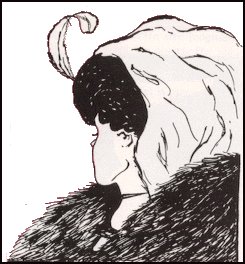
Can you see the two faces? |
Every word we hear spoken by someone else, every word we speak, is compared with past memories of its associations, evaluated for meaning against tone of voice, situation in which said, context in sentence, and relevance to other words used. This occurs so fast we are usually unaware of it, so to make use of this function consciously needs practice and awareness.
So we can touch what is a gestalt which arises from the piecing together of millions of separate pieces of memory. No one piece would have given us an answer, but a completely new picture/realisation arises from an overview of all we have stored. Every time we look at newsprint photos we are knowing a gestalt. From thousands of dots of different hues we make a whole picture. At this time a massive amount of separate experience or learning is experience all at the same moment. This happens when you allow the deepest parts of your nature freedom to express its content.
Here is an explanation of exploring intuition. At first I could sense something but not see it or describe it. Then gradually it became open to observation or verbalisation. This was because I was able to watch its formation out of the ‘corner of my eye’. Instead of taking information being presented and keeping it closely in mind, I held it loosely in consciousness, while also allowing many of the other factors being expressed in the past to remain in sight as well. This is like not focusing on any one part of a landscape or of objects in front of one, but letting ones gaze be inclusive. What happens is that if one looked at one object at a time, that is all one would see. In allowing an overall gaze though, the pattern formed by the many separate objects can be seen, just like flying above a landscape allows old ditches and hedges to be seen because of different colouring, which could not have been noticed close up.
But there are other amazing functions that go on beneath waking awareness that intuition can tap. The unconscious constantly synthesises and cross references the information and life experience gathered. It extracts meaning from it in a way that ordinary thinking does not. From this is develops a global view. For instance, if you could see all the years of your life at once – the global view – you would be able to see how certain things erupt into your life again and again. You would see themes, interests, mistakes and creative action so clearly in that vast view. Such a view is exactly what the intuitive faculty is capable of accessing.
The Second Way Intuition Works
The second possible explanation for intuition, subliminal impressions, needs to be experienced to be thoroughly believed or understood. In considering how some very intuitive people come by their information, I had never seriously thought of subliminal impressions as likely until I experienced it. The theory states that we are constantly receiving far more information via our senses than is ever recognised consciously. But this in no way describes what it is like to receive this extra information.
The first time I experienced it was with a feeling akin to shock, the impact was so great. I was at work, cleaning a work top, and four metres away the head of the business was casually talking to one of the employees, a female. Both of them were in their early sixties. The conversation was about the weather, customers, and chit-chat. I was disinterested until, glancing up at them, I realised I was seeing them in a way I had never seen anyone else before. It only lasted for about two or three seconds, but in that short time what I saw told me a great deal about them. My senses noticed all the tiny movements of face, hands, and limbs; heard nuances of vocal sound; caught fleeting expressions; and from these many separate pieces of information an overall understanding arose that portrayed to my awareness what emotions and drives moved deep in these two people, causing the tiny ripples of movement on the surface.
I could see these two people were linking to each other with an energetic power line that did not show in their actual conversation, only in the usually unnoticed small movements and body positions which accompanied it. I could see, much to my surprise, they had formed this link via sexual intercourse.
Later I was able to confirm this observation. The woman in question thought I was psychic when I shared my insight with her, and wondered if I could see other secrets of her life. There was no psychism in this at all, however, only awareness of perceptions gained via my physical senses, which I now presume are available to us all the time if we can tap them.
What I understood from it was that before the development of speech as a main form of communication, the human animal, like other animals, communicated via body signals. These were understood as easily as we now understand speech. Over time this ability became unconscious; buried like old roads and pathways. It only now surfaces occasionally unless we try to access it.
The Third Way Intuition Works
The theory of the third way states that each of us has a core level of our being that is constantly at one with the universe. In the past this appeared ridiculous to thinkers and the analytical mind, but in the last century, with the development of quantum physics, it has been seen as rational – i.e. explainable within our scientific parameters. See There is a Huge Change Happening
For instance Edgar Cayce could be asked any question and give replies about subjects he had never read about or learned – clear medical diagnosis for instance. His explanation was that we each have three levels to our being. We have an experience of the world through our body and senses. In this world we feel separate and distinct from all else and mostly live in our personal memories and skills.
Then we have an intermediate world we know as thoughts, imagination, spontaneous mental images, sleep and dreams. In this level much of the limitations of the ‘body world’ drop away, and it reflects the sort of mental processes described above, and sometimes things known or sensed from the next level.
The third level he called Cosmic Mind, and it was not limited to personal experience, but held in it all that had been experienced through the ages. (See Huge Change Happening; Dimensions of Human Experience; Edgar Cayce; Levels of the Mind in Waking and Dreaming.) Intuition from that source leaps right beyond your own limitations and personal resources.
Ways of Using Intuition
The Swiss psychiatrist Jung felt that humans can tap this cosmic source of information other than through their own brain computer’s hidden workings or subliminal impressions of sensory perceptions. He simply called this intuition. An explanation arising from his own work is that each of us has strata of consciousness going beyond personal waking awareness. These he called the unconscious and the collective unconscious. The latter is a field of consciousness or awareness we share with all living things, in which your being and my being mingle.
In that mingling there might be the possibility of consciously knowing each other’s thoughts or doings, if it could be made conscious. Edgar Cayce explained from his own state of seer-ship that each of us has unconscious awareness of each other’s life, health and being, but only a few people can bring this knowledge to waking awareness.
I believe there are ways we can make more use of our own level of intuition, because from a position of having no observable intuition at all, I have been able to use intuition often enough and well enough to make it an extra tool in problem solving or decision making. I have shown others how to do this, and see from this that it is a skill that can be developed or enhanced. Also, an aspect of intuition that is often overlooked is that it opens a doorway to creativity.
Recently, after working hard for weeks on end, I took a day off to rest and ruminate. Alone I walked to a beautiful beach near my home. To reach it I climbed down the two hundred steps on the tree-covered cliffs. With the tide out I crossed to a nearby island and sat for some hours, quietly looking back at the land.
In that non striving state of mind, a sense of things floated up from deep within which I had not experienced before. Yes, I had looked at those cliffs many times, but never before had the crumbling mass appeared like a huge dead tree, rotting, full of holes and crevices. Only now did I see the age of the rocks, and how they were decaying. And never before could I see how thin the film of life, of vegetation was, which spread its fingers across them, gaining its life from the dying energies of the earth and the sun. The death of the sun as it loses it energy was so obviously the precursor of life. Life, I could see so plainly, could not exist without death. Do we only touch the hem of some great scheme of things with our normal awareness, separating cosmos and symbols in our littleness?
Whether we seek to use our intuition to find a lost object, consider a business opportunity or look at the great processes of the cosmos, one of the first things we need to learn is to place our thoughts, emotions and body in a balanced or poised condition. Rigid control is as useless as uncontrolled reactions. We do not need to control our thinking process, but to be aware of looking beyond it for a while to our other sources of information, i.e. to allow feelings, spontaneous imagery, fantasy, body language, and sensations.
Intuition is not a god voice telling us what to do or what is absolute truth. It is another way of arriving at understanding and greatly complements thinking and emotion. And something we need to be aware of is that we are dealing with a subjective process. Just as we find it difficult to remember simple facts or words when in a stress situation, such as an interview, or when we feel inadequate, so intuition is much influenced by the attitudes we bring to it.
Actually, in the facet of our being we call our mind, in which intuition and extended awareness take place, a thought or attitude is as solid and real as a brick wall is in the world of our body. If we have feelings that we can’t do this thing called intuition, or if we have a sense it is ridiculous, then of course it is!
That is the first thing to remember about any mental work or creativity. What you think, feel or imagine is totally real at its own level. Each shift of thought or feeling creates a completely different world within you. The world of doubt or cynicism has totally different possibilities to the world of open mindedness. There is never any need to struggle to ‘believe’ in something. All that is needed is the putting aside of disbelief, cynicism and the other mental worlds you create with your thoughts and emotions, and that you usually live in without realising how you are limiting yourself.
In my own experience with the spectacles, I went through a phase of feeling what I was doing was stupid and time wasting. Or you might feel only special or mysterious people have the intuitive faculty. Such attitudes need to be gently seen for what they are, habitual, cultural responses to the subject, and put aside.
The Keyboard Condition and Spontaneous Voice
I have called this necessary state of mind and body the Keyboard Condition. In other words you learn to hold your body, emotions, imagination, sexuality and memories like a keyboard that can be played on by your inner self. In this way you are holding your body free to move spontaneously; you are letting go of any control or resistances you might have in connection with your emotions; you are relinquishing your thoughts and goals, and you are leaving the stage free for what arising spontaneously – all to be able to respond to something other than your conscious will – all ready to be moved by your intuition.
Remember that when you go to sleep another will creates dreams, body movement, emotions, and all the phenomena of dreams without your conscious will needing to be active. It is this inner process, or inner self, that expresses when you can create the Keyboard Condition.
Also, each person may receive intuitive information in a slightly different way. For some it comes as a physical movement (such as Hy squatting) or as when a dowser holds his rod. Often it arises as spontaneous images like a daydream. Some people find themselves talking aloud from other than conscious volition; while others receive through emotional shifts. In each case, however, something spontaneous and unplanned is allowed to arise into consciousness, whether in movement, images, sounds, or emotions, or even direct knowing, exactly as dreams do. See also Keyboard Condition; Prayer and Dream Interpretation
Allowing Spontaneous Voice
Spontaneous voice is something I came across while I was experimenting with allowing the dream process while awake. While dreaming we spontaneously move, speak, eat, have sex and all these arise while our conscious will is ‘asleep’ or surrendered. Therefore we can say the unconscious itself is speaking when we speak in dreams. In fact when we experience a dream we are allowing the unconscious or inner self to communicate. But dreams are often not easy to immediately understand. But while awake we interpret what arises much more quickly. So when I allowed myself to ‘dream’ while awake the results were often startling, as what was said frequently gave information or viewpoints that were totally new or unknown to me consciously. I could ask questions about almost anything and gain an informative response. The unconscious, and of course the cosmic mind, are immense databanks of information and experience. Asking a question starts a ‘search’ and ‘synthesising’ process that sorts immense amounts of data to find something matching the question. The exercises below explain ways of learning to allow your unconscious and cosmic mind to activate your speech.
So you need to practise a condition of body, mind, and feelings that allows unplanned fantasy in whatever way it is going to arise. Jung taught some of his patients to allow their hands to fantasise while they watched without planning moves or interfering, judging, or criticising. And of course, as already said one of the big interference’s is the thought or feeling that nothing of importance can come of such an irrational activity. Perhaps at first nothing does arise, but maybe our intuition is a little rusty from years of non use and needs limbering up. How would you be physically if you had been tied and gagged for years and now someone asked you to move and speak? At first you would barely be able to move, and only mumbling would come out of your mouth. So it is a learning process to gain this skill. Practice is necessary, just as one would with the piano or typing.
Opening the Door to a Fuller Life and Intuition
At first try exercises such as these:
Exercise One – Allowing the Spontaneous as a Doorway to Intuition
One of the easiest ways to begin to relax is to learn how to allowing something spontaneous to arise other than what you consciously think or decide. To do this, use your body’s own urge to express spontaneous movement, as with yawning. To do this first take time to create the right setting for the practice. You need a reasonable space – something at least the size of a single blanket, so you can feel free to move without bumping into things. Play some music that is flowing, but without a strong beat. Music also ‘gives permission’ for easier self-expression in that you are less worried about making a noise or moving.
When ready, stand in the space, listen to the music and drop unnecessary tensions. Remind yourself that for the next few minutes you are going to let your body play. You are going to let it off the lead. Create the keyboard condition as fully as you can. Now open your mouth wide with head slightly dropped back and simulate yawns. As you do so notice whether a natural yawn starts to make itself felt. If it does, allow it to take over and have a really luxurious yawn. Any following impulse to yawn again should be allowed.
Let the yawns come one after the other if they want to. Without acting it out, let the impulse to yawn take over your body, not just your mouth and face. So if the urge to move includes stretching the arms or elsewhere, let it happen. Let your body really play with this.
Exercise Two – Allowing Body to Really Relax
This next approach is a slight advance on the last – and remember this is a learning process. Stand in your ‘space’ again and give yourself over to the enjoyment of having time to really indulge your own natural feelings and body pleasure.
Now tense your whole body and face. Clench your fists and your jaw. Really hold tight and hold the tension for about thirty seconds. Now slowly drop all the tension and create the keyboard condition as fully as you can. Let yourself release the tension in any way your body wants to. If that is yawning or stretching, then let them take over if they become spontaneous. If the yawning or stretching develops into other movements, let them. In the same way you would normally allow your body to express itself in a yawn, let it express itself in whatever other form of movement, postures or stretches arise. Maybe you want to be noisy, so allow whatever noises you want to make, however ‘silly’. If this flows into movements following the music, don’t hold yourself back. Or your movements might not follow the music, but have a direction of their own. This is playtime with your body and imagination, so enjoy it. What has gone before has simply been preparatory. Now you can do what you want.
Exercise Three – Playing With the Voice
Again, here is a continuation of the last method. Stand in your ‘space’ where and when you can be undisturbed. Give yourself fifteen or more minutes in which you will put aside directed activity of mind and body, and allow your body, feelings, and voice to doodle.
To start, use the tension as in the last method. Then let tension melt, create the keyboard condition, and start circling your arms in front of your body so they make big circles above your head and down to pelvis height.
When that is established notice and allow your arms, voice, feelings, whole body, to move wherever impulse takes you. I do not mean impulses of thinking such as ‘Well maybe now I’ll jump up and down a bit. OK, what shall I do now?” But putting aside your constant directing self let things happen, even if that means nothing at all and feeling sleepy and curling up on the floor. This is free space, and do not interfere by trying to understand what is happening. Allow the process to describe itself if it is going to.
Exercise Four – Using Self Watching
Sit comfortably and create the keyboard condition. Now watch the thoughts and daydreams that arise without interference. Note each one, but for the given length of time do not direct. I believe the intuitive process is connected with the dream process, and expresses most often in images, symbols, and fantasies. When the body expresses this it often starts as movement that become mime. The mime must be seen as symbolic communication. Ask the process for help understanding. It is very responsive once you learn to work with it.
This self observation or self watching method is sometimes hard to do by oneself. If you can get a sympathetic or interested partner to join with you though, it increases the power of it enormously. So, with a partner, take turns for one to observe, and one to sit and give a running commentary on what thoughts, what body sensations, what emotions arise spontaneously. It is important not to repress anything or direct the process.
This method, with a partner, is one of the most powerful and useful mental tools you can develop. Apart from being a doorway to explore questions, it is also a way to find personal growth, healing and insights. Once you have learned to allow depths of feeling, body movement or fantasy, then you can ask questions or choose to explore aspects of yourself that need attention or healing. Therefore you could explore a particular life situation or response, such as anger or jealousy using this method.
Exercise Five – Using Excitement and Talking to Access Your Intuition
Something that has struck me over the years about how what we know unconsciously can arise into our waking awareness, is the place excitement or excitation plays. Maybe the word stimulation could replace excitation, but when we are highly stimulated or excited, the spontaneous and creative can flow much more easily. A method Hy and I used in group work when there was plenty of room to move, was to ask the group to walk in a big circle – fast. Then, when they had got their body really moving they had to start talking aloud to themselves. I told them to say any old thing that came into their mind, and say it aloud. It is difficult to think clearly while being very active, so the words gradually became spontaneous. We then took time to define a question that was important to each of us. One woman was a nurse facing stress in her work. Another was a man looking for a creative shift in his relationship. Whatever their question they then started the fast walk again, talked aloud, and dropped the question into their action. They then let any old words and feelings arise. They could stop when they got a result. Within five minutes they had all stopped and each of them had a very satisfying response that had broken through as they walked and spoke.
When you have learned how to allow the spontaneous uprising of feelings, movement or speech, then you can bring a question to the process and watch what response arises. But you need to be able to allow the inner self to speak without interference before that can work well.
Getting in the Flow
Researchers exploring how creativity is accessed found that athletes say they are “in the zone” when they are fully physically and mentally functioning. They tell of vision sharpening, time shifting into slow motion, and their alertness and physical skill reaching a peak. Scientists have dubbed this phenomenon “flow” and recognise it has biochemical causes.
For instance there are special docking sites on brain cells for certain neuro-chemicals connected with the brain’s opiate receptors. Endorphins bind these opiate receptors and dampen pain, and produce the elation-nicknamed the “runner’s high” that is felt after prolonged exercise. The neuroscientist Candace Pert also believes that opiate receptors play a role in creativity. They “filter reality” that allows an altered state of consciousness.
I believe this is why ‘excitation’ can play such an important part in intuition and accessing your potential. During such excitation at times I was able to see how the process worked, and with that understanding learn how to do it myself without the stimulus. So using the approaches described, take note of how you function, and gradually refine it. It needs practice, but so does any great skill.
When Hy and I gained useful information regarding her glasses, we started by leaving our body, mind, and emotions open to spontaneous movement or fantasy. We also asked a specific question. Until one has loosened up in the exercises given above, it may be quite fruitless to try a direct question. (In times of great crises one sometimes breaks through all the barriers and the process works without practice). But when you are fairly adept at the exercises any sort of question can be asked. It can be about health, work, relationships, children, dreams, or creative ideas.
{short description of image}
You Are Infinitely More Than You Are Conscious Of
Your inner self, your unconscious, or whatever you want to call it, is much more that a passive responding system. The processes that built your body and keep it running are not passive. Even as a tiny unborn baby you had a powerful integrity that defended itself against infection and harm. That is very active and has an agenda of its own. Overall it moves wherever possible, and in as much as you allow it, toward healing injuries of body and psyche, toward your growth of mind and understanding. Particularly it at first tries to clear out all the old hurts and defences you use that stifle you and hold back your innate wonder and creativity. I call it ‘doing the housework’.
This level of you is not the same as your conscious mind and memories. Although it has motivation and direction, as it does in repairing or regulating your body systems, it does not do it from focussed and word dominated decision making. As far as I can myself put it into words, it is like a sleeping giant that has massive knowledge, strength and skill, but responds instinctively without conscious thought. But when your conscious abilities link with this sleeping giant it wakes and demonstrates its incredible potential.
Because of the many experiments now proving the quantum theory, we now longer have to wonder how intuition without any feedback can work. Many modern physicists, working with the information arising in experiments with quantum theory, tell us that our view of the world is based upon our blindness, and is very limited, and through its limitation, unreal. Yet this view we take to be the REAL universe. For instance we are only able to see a tiny fraction of the visible spectrum of light and as small amount of audible sound, so we are almost blind and deaf to the world around us.
To quote Gary Zukav from his book the Dancing Wu Li Masters, “The implications of the theorem are enormous. Something can be in two places at once. Apparently distant objects, or people, are intricately linked in an immediate way. There is no separate existence as we previously thought. Our view of the world is not one supported by the facts of physics. Time and space are transcended. David Bohm, an eminent physicist, goes as far as to say that all things in our observable universe are inextricable linked. Nothing has separate existence.”
So remember that what you are opening to is responsive. It is incredibly wise, having millions of years of experience of life that is all involved now in the processes of your body and mind. But it is not an intelligence like your conscious mind. It is more like nature that reaches and retreats out of an unfocused but nevertheless vast awareness. The fact you can hold and ask a question and evaluate what arises is enormously important when it connects with this sleeping giant. Together you can uncover wonders. But remember it has its own needs that in many ways are more important than the needs and worries of your limited conscious awareness.
To get the best out of the process, always seek the end result of actually understanding. I have found, in teaching people practical ways of using intuition, we can have a conversation or develop communication with the process. The first uprisings of intuition may be in symbols in images or body movements, or in bold verbal statements, depending upon how it shows itself. The process must not be left at this stage, but led to an expression of further information which unfolds the meaning and leads to understanding. For instance, Hy’s squatting was only a symbolic body movement, a mime, until it connected with her past squat and was understood to refer to the spot. So if your body mimes something, you need to ask what it is trying to describe by holding that question in your mind.
Never forget that your unconscious holds everything that you are. It is not only wise, but also just under the surface are all your personal fears and prejudices, all your cultural clichés and limitations. Sometimes we have to wade through these – the ‘housework’ – before we can get at useful information and insights. To ‘wade through’ you have to avoid being satisfied with apparently prophetic or sweeping statements that do not bear up to analysis or bring actual results. That level of your unconscious is full of amazing promises – wish fulfilment hoaxes. What you receive must be critically measured against real events and your history. So you can receive lies and fears as well as truth. In fact many things that people say is their gut feeling or intuition is the voice of their own anxieties or wishes.
Freud found most people have powerful resistances to actually seeing or experiencing the truth about themselves. So sometimes we need to cut through these brambles to reach the Sleeping Beauty.
This is where your conscious rational and critical evaluation comes in. Without it you may be adrift in symbols and the expression of attitudes that need to be transformed. All the time aim to link what arises from within to your own here and now history and what can be observed externally.
As an example of this, some years ago a friend of mine developed cataracts. When I opened to my intuitive process, without seeking it I experienced a huge flow of energy through my being that suggested my friend was being healed. I was amazed but watched to see what would happen. After many weeks of this no change occurred to my friend. So I did what I should have done earlier, asked my unconscious what the hell it was presenting me with. The response was immediate and fully understandable. In my youth I had longed to be a healer, but had never been successful. The longing over years had set up hopes, expectations, and, most important, massive connections with emotional energy. What I had experienced was the energy those patterns set in place. I had seen my own inner functioning, not any real ability to heal. That was the end of it.
Such exploration through seeking answers is the way to find real growth and healing. One woman, after having a hysterectomy, wanted to look at her life situation and received the words, “I am a work machine”. When she explored this a bit more by asking the question, “What does that refer to in my everyday life and feelings?” there arose memories of many incidents in her life as a farmer’s wife, in which she felt she worked for her family like a machine, without pleasure or personal motive. But then, beyond that arose a wonderful experience of herself as an essential person beyond her body situation or exterior events of her life. She knew her wonderful potential and light. This helped her to re-evaluate her relationships. It arose through asking for further understanding. The process was led to connection with everyday, here-and-now life, and not left in the limbo of symbols or oracular statements.
Some years ago a friend of mine, Cliff, broke the neck of his guitar and couldn’t afford to get it mended because he was saving to get married, and the price at the local shop was high. I suggested he sit quietly for a while and imagine standing right in the center of a large round room, representing his mind, doors all around, and say to himself that he was allowing all the doors of his mind to open, so he could access information that would solve his problem. When I saw him the next day he told me he sat and did what I suggested and nothing happened. Then he smiled and said, “But as soon as I gave up I remembered an old music shop near where I used to live. I knew this was the answer, so I drove there right away. I showed the shop owner the guitar and he said he could fix it for a fraction of the price asked at the other shop.” Cliff created a situation in which he opened himself to the wider influx of memories or impressions than he usually allowed. Nothing happened until he ‘let go’ in the keyboard condition and allowed his intuition to express.
Learning to use our intuition is as useful as being able to reason or count. I believe developing it as part of our mental equipment is an important step in human growth. It changes the way we relate to our own being, and, I feel, reveals new horizons in regard to our relationship with nature and our creativity.
Why not try it?
Rewards of Intuition
Just as you use your memory and experience in almost every aspect of your life, so intuition applies to virtually everything you do. But I am not referring to the way some people use things such as Tarot cards or psychics as ways to deal with anxiety and indecision, constantly seeking to know the future and wanting assurance.
Intuition is one of the greatest of life skills you can use in living a life that is creative and expressive of your own relationship with the immense potential, mass of information and perceptions you carry unconsciously. Therefore, just as many of us now use the Internet to gain more information and insight into projects, business plans, ways of dealing with relationship and supporting our children or partner, so we can access our intuition to enlarge our grasp of things, and open doors to enormous creativity and insight. Many top rank professionals, doctors, engineers and therapists daily use their intuition in their work. (Dr. Shafica Karagulla, an international neurologist, has explored the professional use of intuition in her book Breakthrough to Creativity)
Some of us feel we do not have any intuition, but in fact we all use intuition every day – often called wisdom or experience – more than we do reasoning or thinking about things. This is because we seldom take time in daily life to analyse and reason about situations. Instead we act on what we feel, or on the impulses arising from within that come from past experience. So intuition frequently arises as a strong feeling, a direct perception of what is needed or what people sometimes call a hunch or gut feeling. But if we have not learned to know the difference between intuition and anxiety, or hunches and feelings arising from anger, or ingrained patterns of behaviour, we can easily act on habits, prejudices or fears. So the ability to use intuition consciously and well needs some training and practice. In many older cultures some people were trained in this way. Their intuitive faculties were then tested to see if they could receive accurate information and guidance. And if you use the methods described above, you need to test what arises against reality.
Example: While working in Japan teaching LifeStream, I was asked to show a young Japanese women how to use the technique. She was experiencing feelings of tension and discomfort in her chest, and could not understand their cause.
She was married to a Westerner and pregnant with their first child. As she allowed the spontaneous movements of LifeStream she began coughing and choking. This continued for some time without change and I became puzzled as to what her body was expressing. When I asked her if she could feel what was behind her movements she shook her head. Wondering whether my unconscious had understood her body language I sought it’s help through using intuition.
Straightaway a flow of impression and feelings arose which suggested that Akiko feared her husband would look for another woman after her child was born. I therefore suggested to her that the feeling in her chest was connected with her husband and the baby. She exploded into tears, as she had apparently been holding back that very fear for some time without expressing it.
In an attempt to understand where my unconscious had gathered this helpful piece of information I later explored the impressions. I saw that what had appeared to come almost magically to mind from nowhere was based on a forgotten sentence she had spoken to me two days before about her coming baby. I had said that the baby would probably be quite a beautiful mixture of East and West. In a rather diffident voice she had said, “I hope so.” At the time I had not attached any great importance to this mixture of words and feelings. Yet my unconscious had understood very well what she was saying.
Trances Spirit Healing and Possession
Carol Laderman, an anthropologist who went to study childbirth practices in Malaysia, found that shamanic healers, who it was thought had disappeared 75 years ago, were still an everyday part of village life, (Science Digest July 1983, Trances That Heal—Rites Rituals and Brain Chemicals). To study their methods she became the apprentice of Pak Long Awang, himself a traditional shamanic healer. It is interesting that although she is highly educated in Western thought, she has the same fear of the unconscious as Philip Zimbardo. She says,
For almost two years after my arrival in the village, I refused to undergo one of the shaman’s trances. Having become a member of Pak Long’s entourage, I had attended healing ceremonies with growing regularity; the shaman had even adopted me as his own daughter. Still, as a Westerner and a scientist, I was afraid to enter trances — afraid I might embarrass myself or, worse, never come out at all. My reluctance became a standing joke among the villagers.
She goes on to say what some of the healing sessions she attended were like. A very fat woman for instance, who regularly experienced depression because of her awkwardness and girth, while ‘entranced’ by the music of drums and gongs, and Pak Long’s chants, rose from her ‘sleeping mat’ with the grace of a lithe young girl and danced the role of the beautiful princess in the Malay Opera before a delighted audience of friends and neighbours. Afterwards her ailment disappeared.
Eventually Carol took the plunge herself.
As the vibrations of the drums and gongs entered my body, my eyes seemed to glaze over. As the music became louder my mouth opened, trembling uncontrollably. I began to feel cold winds blowing inside my chest, winds that increased in intensity as the music swelled and accelerated until it felt as if a hurricane was raging within my heart. I put my hands on my chest to try to calm it, but instead I began to move my shoulders and then the upper part of my body as if I were about to get up and dance. With the last vestiges of my self control, I prevented myself; I still feared embarrassment But as the music swelled to a climax I began to move my head so quickly and violently that, had I not been in trance, my neck would undoubtedly have snapped.
What Carol Laderman describes appears to be just the same sort of movements as those experienced in ‘Shaktipat’ and in modern homeostasis. The approach, however, is quite different. In Shaktipat ‘trance’ is achieved by the individual sitting “still, but not rigidly; he does not concentrate in any way, but simply relaxes.” In Malaysian shamanism, trance is entered “through cultural cues, ritual props, incantations, songs and stories. Percussive music, a steady, musical pulse.” In modern homeostasis similar states can be experienced simply by allowing spontaneous movement. So it seems as if all that is important is that the persons own fears, cultural theories and needs are respected. For instance in Haiti, the trance is often accompanied by ‘possession’ by the god Ghede, which is manifested by a particular physical posture.
Summary of The Approaches To Inner-Directed Movement
In summarising what has been said about the various approaches to inner-directed movement, I am brought back to the very first paragraph in the Introduction to this book. Inner-directed movement is about RELAXATION. By letting-go of physical tensions and rigid attitudes or anxieties, we free ourself to express more fully, more confidently. We allow what Jung calls the self liberating power. This process is already working in each of us as the self-regulating activity behind our own growth and present survival, behind our dreams. By opening more fully to its activity however, we allow aspects of it to express that were only potentials beforehand. (Later I changes the name to LifeStream.)
My own belief is that behind all the phenomena spoken of that arise from inner-directed movement, there lies a simple natural process. Just as self-regulation is the most likely force behind the movements and spontaneous experience, I see the potency of individuation behind the varied phenomena. By individuation I mean the action that moves us toward growing up physically and mentally. It is especially noticeable during our childhood and teenage, but we see it at work throughout our life in our maturing. ((1))
I am not, however, saying there is nothing extraordinary or magical about these forces in us. Of course they are natural and a vital part of everyone’s life, but the natural is not bounded by materialistic views. Our individual life is inextricably interwoven with our local environment, the world and the cosmos.
I do not believe this interior intuition or vision of nature’s secrets is a supernatural process. A very large part is due to the mind’s ability to scan huge amounts of small bits of information and experience and see them as a whole, as patterns or structures. Therefore, the very ordinary experiences and memories we have of walking down a street, of seeing our family and friends in their everyday experience of life, of witnessing the seasons, of being involved in change, are all crammed with information. When all the tiny pieces are put together we see certain cycles, certain processes working at all levels of existence. In this way we glimpse the powers of nature, of Life, touching the world and our personal existence.
While the older or God centred approaches to inner-directed movement deal mostly with the personal relationship of oneself with the whole and with society, the more modern approaches explain more about ones relationship with oneself. So Mesmer, Jung and Reich have a great deal to say about psychological processes that act as barriers to the person finding peace and satisfaction. They believe that by working with the natural in the person – the self-regulatory process – by stopping personal conscious effort and, as Jung put it, ‘letting things happen’ without interference, one can grow beyond previously insoluble problems.
Our awareness of being a separate individual rests upon an immense and ancient structure. Our being stretches right the way back from the conscious sense of self through the unconscious organ functions of our body, beyond the cells and molecules, into the atomic and sub-atomic to the mystery of what we have yet to find out about the foundations of life. Even if we never know all, there is certainly the possibility of meeting with that wonderful essence of life that is in every aspect of ourself. The essence that is totally ourself because it is in all, just as heat pervades all objects in a room no matter what their material shape or size.
The Simplicity Of Letting-Go Needs Working At
Profound subtleties lie behind the simplicity of letting-go and letting things happen. Many of the tensions or character attitudes that hold us back from liberation of body and mind are unconscious. A simple test on seven or eight people will demonstrate this. To see this for yourself have a friend sit in a chair with their hands relaxed on their lap, and tell them you are going to move their hands and arms. Tell them you are going to do the work, so there is no need for them to make any effort. Then gently take one of their hands and support the arm at the elbow with your other hand. Slowly move their hand and arm, noticing how much resistance there is in their arm, how much they unconsciously try to help you. You will find in some subjects an uncontrollable urge to do the movements themselves, creating resistances. In many people the tension in their arms will be sufficient, if you move the arm slowly, to take your hands away at some point, and their arm or arms will remain suspended in the air through unconscious tension.
The person whose arms you moved will feel quite relaxed, they will certainly not be aware that they had tensions sufficient to suspend an arm for quite a long period. These powerful tensions are throughout the body, and especially noticeable in the arms, legs, neck and jaw. Being unconscious they are not under the voluntary control of the person. They do not know they have them, so they do not know how to let go of them. If you have someone do the same test on yourself you will be helped to recognise the state of your own tensions. The same manner of working can be used on the legs and the neck. If the person has learnt inner-directed movement, and can allow spontaneous movement or response of feelings while the tension is in place, or being massaged, a melting of the tension can take place.
Having worked with people who have massive unconscious tensions in their muscles, I have found it is not simply a matter of pointing them out and the person relaxing them. This causes confusion because they are not available to conscious control. What Reich found was that such tensions only melted when the emotional or attitudinal energy involved in them is discharged through movement and expressed emotions. It may take years to melt such tension one by one from yourself through inner-directed movement. As each one is unlocked, so the energy used to hold the tension in place for years, and the energy it restrained from expression, is now available for your everyday use and enjoyment.
What Is Attainable?
To say what is realistically attainable is difficult because each person is unique. Some people never learn to swim, others swim the English Channel easily. The range of the possible is enormous.
However, a fuller maturity is attainable. In the Collins dictionary the word maturity is defined as ‘full development’. It means you can more fully develop those qualities and abilities that are innately yours, but may not have previously emerged.
Part of this maturity or full development is also self responsibility. People who are used to blaming God, their parents, the government, their spouse, for their misery or situation, gradually find their own power to change their life and their character. This is not always an easy transformation, because after all it is convenient to blame someone else.
Maturity may mean being capable of love or giving oneself to someone else. It may mean being easy and at peace with sex, or coming to terms with the world and people as they are instead of how our fear or prejudice might wish them. It can mean feeling okay with technology and religion, yet also wanting to produce positive change in the world.
In the end it is simply about being able to live your life as fully as you can.
(1) This growth expresses not only as powerful physiological processes but also as dynamic psychological forces. As such it links with the process behind dreaming and fantasy that is an intimate and important part of psychological growth and change. I believe this is why the apparently fantastic – deeply moving subjective experience and myth building – is so frequently a part of this process of maturing.
The Charismatic or Pentecostal Movements
The Charismatic Or Pentecostal Movements
One of the best known traditional approaches to inner-directed movement in our own culture is that which lies at the roots of Christianity. In reading Acts of The Apostles in the New Testament, in which the experience of Pentecost is described, a definite impression of a group practising inner-directed movement is given. The group had an open allowing state of mind by surrendering to what to them was a holy influence – the Spirit. They also openly expressed themselves vocally in what is called tongues. This is not a rational singing of a hymn or song with known words. It is the expression of irrational sounds freely flowing, sometimes beautiful, sometimes harsh. Movement was also a part of the experience, so much so they are said to have been thought of as drunk while they were allowing the spirit to move them.
Because of the sense of wonder and awareness of harmony between oneself and the rest of nature that occurs during some phases of inner-directed movement, it is not surprising, given that past cultures tended to explain natural phenomena in religious terms, that their explanation of what happened was God centred.
Of great interest however is that the experience was seen as a healing and cleansing one. It was one that led the participants to feel great joy. They felt it so important they wanted to communicate it to others.
Some of the group developed unusual abilities in terms of how they related to their own unconscious content and what I have called the dream process. They could, while awake, experience what appeared to be lucid waking dreams. Very moving experiences often emerged during this practice. Also, they demonstrated speaking in tongues, as it has been called by the Christian church. This is I feel an example of the dream process being accessed by our conscious mind. Because we join the unconscious and the conscious there is a marked difference in the responses.
To explain this in another way, people experiencing the spontaneous voice felt they were simply accessing another part of themselves that is usually called “the unconscious”. This spontaneous voice would respond to questions from the person experiencing it. And because of that it was sometimes used in an attempt to understand dreams. Even when such interpretations were received, they were not taken as absolute truths, but as extensions to what could be arrived at by normal conscious thinking. In fact, often such interpretations were truly helpful, and sometimes quite startling.
As time went by, the freedom and spontaneity went out of the practice and became ritualised ceremony and stated dogma. Today the Pentecostal experience is being once again revived under the name of the Charismatic Movement. Because it is still strictly within a Christian belief structure, it may only have something to offer to Christians who want a freer and more joyous way of expressing their faith. My experience of it is that, like other approaches with strict rules of behaviour, there is a self limiting factor to it that sometimes causes people to miss discovering some of the important dimensions of themselves possible through inner-directed movement.
Availability
Most towns have a church given to the Pentecostal approach.
Costs
Usually based on donations. Whatever you feel you want to contribute.
Contact
Assemblies of God Headquarters, 106/114 Talbot Street, Nottingham, NG1 5GH. Tel: 0602 474 525. Elim Pentecostal Church Headquarters, P.O. Box 38, Cheltenham, Gloucestershire, GL50 3HN. Tel: 0242 519904.
Shaktipat – The Indian Approach
The word Shakti is Sanskrit. It refers to movement and energy, as the English word ‘shake’.
The practice is described as a letting-go of one’s conscious ego enough to let an internal energy flow freely through one’s body and mind. In the Indian tradition the original release is seen as arising through contact with a guru, although this is not an absolute rule. As the energy begins to flow the practitioner begins to move spontaneously, doing postures they had perhaps never done before, and singing in ways they had not practised or known previously.
These movements and sounds are known as kriyas. They might occur while the person is practising alone, but group practice is also used.
I do not have a great deal of experience with this approach. From what I have observed there is a very strong Hindu religious and yoga belief system surrounding shaktipat. The guru is of great importance. Before the kriyas begin, a great deal of chanting is used, so it is not so directly movement-centred as some of the other approaches described here. But I have seen a photograph of a large group of people, perhaps a hundred or more, using shaktipat in the open air. It appeared to be directly movement-based.
Availability
There are centres in most Western countries, and of course in India.
Cost
Although the attendance at a centre is not costly – I stayed at the Ashram in Ganeshpuri for £2 per night inclusive of two meals – the attendance of courses can be very expensive.
Contact
Gurudev,
Siddha Peeth,
Pin 401602,
Ganeshpuri,
District Thana,
Maharashtra,
India.
Siddha Yoga Centre,
Conford Park House,
Conford.
Nr. Liphook,
Hants, GU30 7QP.
Telephone 0428 725130.
SYDA Foundation,
New York, 12779,
USA.
Shaktipat- The Indian Way to Enlightenment
In his article Between Coma and Convulsion, in Energy and Character, David Boadella quotes the report of a person studying the self—regulatory practices in India. Although this is a recent account, the yoga practice it describes has been used for many centuries in India:
I have been in India for about four months now and I thought the readers of Energy and Character might be interested in the similarities between Reichian work and Shaktipat or Kriya Yoga. The Sanscrit word ‘shakti’ means energy, bio-energy, or more correctly, bio— cosmic energy. Shaktipat is a practice which is described as the loosening of this energy by a guru from the way it may be blocked in us. When this shakti energy is loosened and no longer tightly bound by the control of the conscious mind it begins to circulate in the body. It is then said to open up energy channels or pathways, and usually begins to manifest in what are known as ‘kriya’. Kriyas are spontaneous movements of the body and of the respiratory system. One interesting aspect of kriyas, which resemble Reichian abreaction, is that they very often manifest as highly involved asanas (body postures) and as mudras (meditational postures involving the hands). I have seen many persons who practice shakipat enter a phase of intense energy flow in which breathing becomes rapid and involuntary and in which people begin with great rapidity to do asanas they never knew and which they ordinarily would never have been able to perform. Although the conscious practice of asanas facilitates this process, true hatha yoga (Indian techniques using physiological processes to integrate ones being) occurs involuntarily in this kriya phase. The burst of energy that results is sometimes astounding and may continue for well over an hour. The movements in some individuals are so intense and frantic they appear dangerous. In other persons the movements are soft, delicate and flowing. Thus some persons may breathe like locomotives, beat themselves repeatedly, stand on their heads, bellow, twist their limbs in the most unbelievable postures; others begin to dance harmoniously, to sing softly in languages they have never learned, to become playful and flirtatious and to utter strange sounds.
The explanation for this is that the shakti is opening or purifying obstructions in the energy pathways, that the individual is working out the results of past actions and experience, and that an evolutionary process is allowed to unfold which eventually will result in an expansion of awareness.
In this kind of meditation the individual sits still, but not rigidly; he doesn’t concentrate in any way, but simply relaxes as much as possible and permits the energy to do its thing. The energy is of course thought of as ultimately cosmic or divine. Hence the path of enlightenment lies in relinquishing ego control and identifications and allowing this bio—cosmic energy to express itself and lead us. The final results of this process is the opening of the highest brain centres in a new type of consciousness in which the individual merges with the universal consciousness. The total process takes a very long time but this should not dissuade us as each stage has its own rewards. The bodily spasms, automatic breathing, asanas, contortions and reflex patterns that manifest spontaneously as the energy gains momentum all serve to purify the organism. Though some of these phenomena may sound strange they are not experienced as unpleasant once the practitioner no longer totally identifies with bodily processes. Thus the meditator can be totally in their body without identifying totally with its experiences.
See an Occidental approach to Shaktipat – Life’s Little Secrets; LifeStream; – Opening to Life and – People’s Experience of LifeStream