Author Archive
The act of baptism long pre-dated the early Christian community. One can find water for purification outside very ancient temples. Therefore the tradition of baptism is older than the historical Christian church. It had its ascendance in the love a mother felt for her children, and beyond that the love she felt and gave to other children. Beyond that still, a loving woman might suckle a creature and extend her love beyond the normal boundaries. She might hold that other child, or that creature, with the same tenderness that she held her own baby. In such a moment she would know something that was beyond herself. It is something that flows through all of us. We symbolise it as the milk, the wine, or the blood. It is the flow of love that comes from beyond our own small personality.
The urge that enables us to reach out to another person who is not our own kin, or to another creature, is a small awareness of that universal life and consciousness that pervades all things. It is an expression of the Mystery that we can perhaps never understand, that is Life.
Baptism represents a conscious opening or an introduction to that Life. It is also an entrance into the recognition of the wider family; of that mysterious body we call Life. We become brothers and sisters in a wider community. It takes some skill to recognise who these brothers and sisters are, and what part they might play in your life. Calling yourself a Christian does not necessarily mean you have been truly baptised in that spirit of life and love. In fact you might still be imprisoned by attitudes of bigotry, class, creed, skin colour or gender.
Fundamentally, baptism means a change in the stance or condition of your inner attitudes. It means relinquishing fixed opinions and having an open mind. It means opening the doors of your being to new experiences, to new possibilities, pleasurable and painful. It means learning to love without bending others to your will, without grasping them for your own needs. It also means becoming a channel for that river of Life to flow through. In this way we can become workers in the vineyard – that is, co-workers with the processes of growth and evolution in the worlds of nature. But more than anything it means being washed clean in the river of Life.
Example: For some time I had been earnestly surrendering my life to the action of God by offering my body and mind in any way. I was feeling very ill and depressed at the time, and longed for healing, but could feel no definite change. Nevertheless I sat every day with a ‘waiting’ or ‘open’ attitude. I deeply pondered the question of how the action of God showed itself. Maybe I wasn’t aware of it. But I had noticed that while I slept my body experienced a subtle vibration, like you feel when you put your fingers on a smooth running electric motor; even my wife could feel it if she touched my body. But I could observe no changes in myself from this. It felt like a river of energy was flowing through me, like baptism.
Then one night, B., my wife, got out of bed because the baby was crying. When she had settled I got up and went to the toilet. Just as I was getting into bed again I heard a voice speaking to me. Literally a loud voice came from everywhere around me. It said, “You have asked what are the results of God’s activity upon one – now watch closely.” This was an extraordinary thing to experience, and waiting for sleep to overtake me again I had a mood of expectation, waiting for something to be shown me. In the morning I remembered the following dream.
I was in a huge theatre, or amphitheatre. The stage was on my right. The part of the play I observed was where the actor walked up to a mirror and looked at himself. Then somehow the activity gradually began to take place on my left. First of all an orchestra was playing on a slope facing left. Then everybody was moving to see a big event that was going to take place on the left. This was at the opposite end to the stage.
Two days later I was massively plunge into the inner workings of the spirit. See Life’s Little Secrets.
Rather like the artist archetype, the negative aspect of this is a hollow living out of baptism. We see this in some religious communities where an external ritual takes the place of the inner experience. The person is then influenced to live out a way of life dictated by the organisation or the social norm rather than by the flow of living experience connecting the person with their source.
Useful Questions and Hints:
Was my baptism an experience of life washing me clean? If so what was I cleansed of?
What change has the experience of baptism made in my life?
Was my baptism a ritual that did not touch me inwardly?
See People’s Experience of LifeStream – also Talking As.
Vengeance, or the urge to right a perceived wrong are very powerful forces in some people’s lives. For some people it is a way of life, as when they fight for the homeless or downtrodden, or give their time to helping others who do no have or cannot pay for their skill. That is a positive relationship with this archetype.
The negative influence of this archetypical behaviour is seen in acts of terrorism where an individual or group are driven to kill others in the name of a personally believed right or grudge. Like many archetypes this acts not only on an individual, but sometimes upon a government or a nation. Then we see a nation using its force to act upon another because it sees them as having committed some crime against them. For some people this is a way of life. Family feuds are an example of this.
Her is a dream example of righting a wrong. The dreamer also realised the feelings he had about his school years and how brutal they were.
Example: I was attending an adult class with about 20/30 people, mostly men, in it. The teacher came in. He said something and a man asked a question, or spoke back. The teacher got really angry and hit him with a walking stick. Someone else in the class remarked on the beating and was attacked also. A man sitting next to me on my left said that if the teacher hit him he wouldn’t sit and take it. But as the second man was hit my companion said something like – Bloody hell. The teacher landed two mighty blows on his arse, but he didn’t move. I said in horror, “Good God,” whereupon the teacher moved to hit me. I stood up and said, “If you hit me with that thing I will whack you in the fucking ear.” I felt fired up ready to fight. He backed off and threatened to get the headmaster in. I told him to try it. He said if I could do better, do it. So I took over the class and it went really well.
Then I seemed to be witnessing a young man making love to a girl in a room. A teacher burst into the room and got angry with the couple. The young man was not at all cowed. He said, “You burst into a private room without knocking. We happen to be young adults. I want an apology.”
The teacher was silent for a time then apologised. The young man then said, “Thank you Sir. I am proud to acknowledge you as my teacher.”
Useful Questions and Hints:
If this archetype is active in my life, what is the wrong I am working against, and are my ways of dealing with it valid?
Anger often has very personal roots originating in personal failure in sex, in society, and these are vented on others rather than being dealt with in yourself – does that apply to me?
Could this wrong be righted by cooperation rather than destructiveness?
Use Processing Dreams to explore the issues in your dream.
This archetype is not about whether we are athletic in an external sense, but about the dedication, the strength or drive to succeed we can tap into in our everyday, our working life and our personal urge to change. A handicapped person who challenges themselves to positively meet life with a smile and vigour is as much tapping into the athlete archetype as an Olympic winner. This also connects with people who change the health and state of their body through continued exercise and good living.
The archetype can also be a wonderful role model for other people, and sometimes with it well developed they become teachers of skills to others. They can act as a ‘show you how’ person.
The negative side of the archetype is the attitude that leads a person to use their strength of body or purpose to bully, threaten or injure others. It may manifest as a form of showing off how strong, powerful or sexual you are; or at least posing as such.
Useful Questions and Hints:
Does this influence enter my life in a strengthening way or as an urge to dominate or impress others?
If the athlete archetype is acting positively in me, what particular qualities is it bringing to me and how can I enhance or continue to develop them?
See active imagination or acting on your dream.
This includes authors, actors, playwrights, chefs, musicians, sculptors, etc. The fundamental influence of this archetype is toward giving form either to what is at present formless in the depths of the human spirit or society, or formless in oneself. It is also about bringing something new to the world, so is sometimes akin to childbirth, parenthood or prophecy. Sometimes the power of this archetype leads to an enormous drive to do something outstanding that will claim attention from others. But often it is a drive within the person to give form to an influence they barely understand themselves, and as it comes into being is as much a surprise to the creative artist as it is to her or his audience. See art and dreams.
The negative aspect of this is the urge to live out a hollow copy of the artistic life, perhaps living in self imposed poverty or eccentric behaviour to give form to their need to be acknowledged as an artist. Or they may spend all their own or someone else’s wealth in a desperate bid to create something that is worthless. Caroline Myss, in her book Sacred Contracts, suggests that supporting such a person is as much an influence of the negative artist archetype as being the crazy artist.
Useful Questions and Hints:
If the artist is a powerful force within my life, what is it I am trying to give form to?
Do I believe that to be an artist I have to be eccentric or live in ways to give me a confidence I don’t have?
What have I learned from the artist archetype?
Try using Talking As and Processing Dreams to explore your dream.
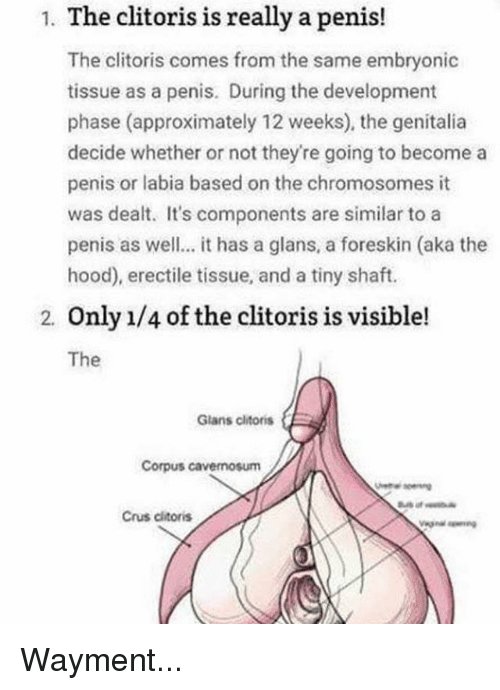
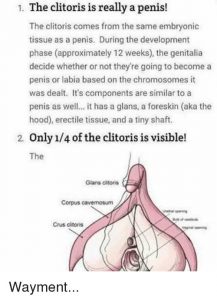
The male within the female, is shown as a man in a woman’s dreams. Physically a woman is predominantly female, but also has a clitoris and produces some male hormones. Psychologically, we may only express part of our potential in everyday life. In a woman, the more physically dynamic, intellectual and socially challenging side of herself such as assertiveness and taking charge of situations may be given less expression. Apart from this some features, such as innovation and creative rational thought, may be held in latency. Even if this is not true for the modern woman, there are features of her full potential that are held as secondary or latent characteristics, and are depicted by the male in female dreams.
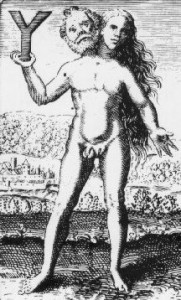 |
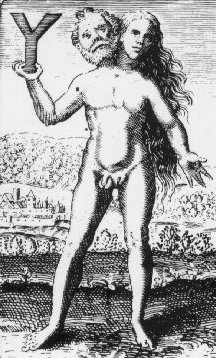
Jung was not the first to recognise that we are male and female. It was seen in ancient times.
|
In general we can say the man in a woman’s dreams represents the woman’s mental and social power, her ability to act creatively in ‘the world’. It also holds in it an expression of her complex of feelings about men, gained as experience mostly from her relationship with – or lack of relationship with – her father. The animus is also a synthesis of all her male contacts. So the whole realm of her experience of the male can be represented by the man in her dream, and is accessible through the image. Femaleness or maleness must not be confused with personality as expressed as her body. The conscious personality is a very flexible and shapeshifting thing. See Programmed
|
 |
|
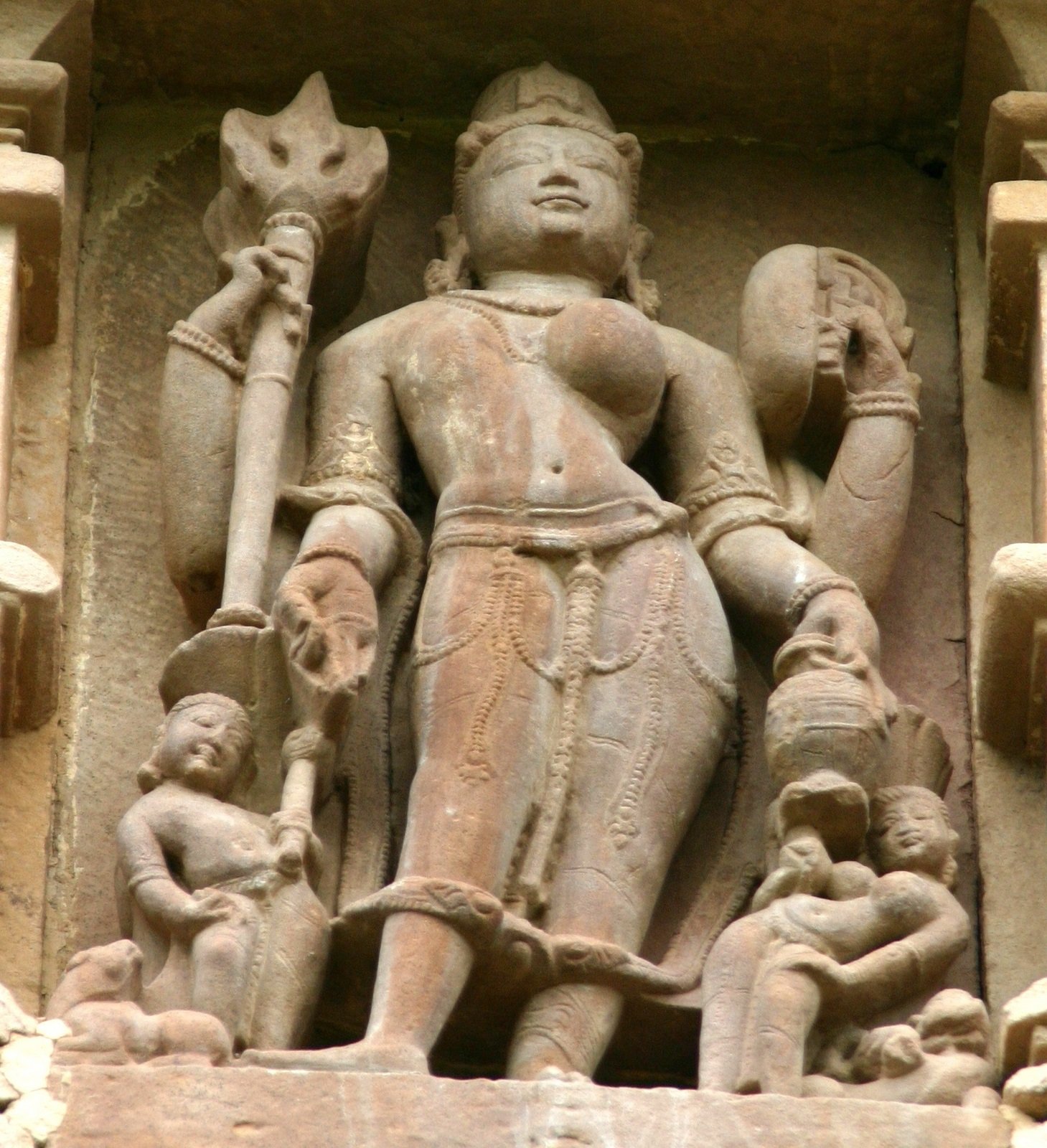
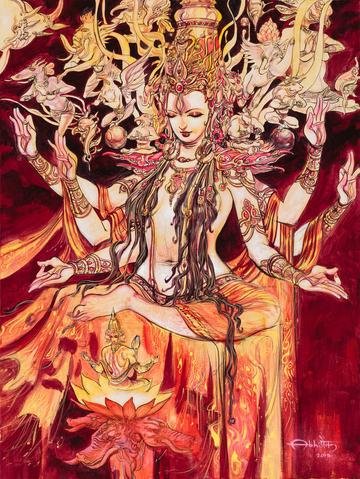
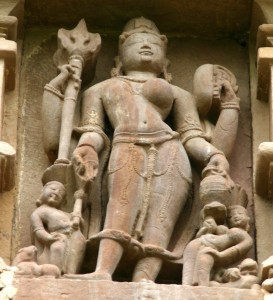
The Hindu male figure of Shiva with female breast. This is from an older culture and shows Shiva as a male and female figure. It was common knowledge in older cultures that our ultimate nature is everything – which includes male, female and animals. in fact all creation.
|
It can be male or female in quality no matter what the body gender. But in dreams, the male is the facet of dynamic action that projects into the world of this shapeshifting personality.
 |
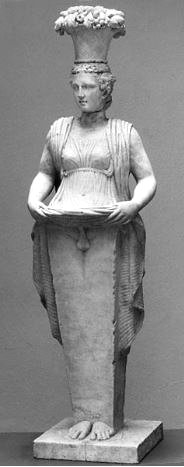
An ancient statue of an Aphroditus – a female with a male genitals.
One of the earliest surviving images from Athens is a fragment (late 4th century BC), found in the Athenian agora, of a clay mould for a terracotta figurine. The figurine would have stood about 30 cm high, represented in a style known as άνασυρόμενος (anasyromenos), a female lifting her dress to reveal male genitals,[7] a gesture that was believed to have apotropaic qualities, averting evil influences and bestowing good luck.
|
|
|
As Jung says in Man and His Symbols:
“The animus, just like the anima, exhibits four stages of development as male images in women’s dreams or fantasies. He first appears as a personification of mere physical power-for instance, as an athletic champion or “muscle man.” In the next stage he possesses initiative and the capacity for planned action. In the third phase, the animus becomes the “word,” often appearing as a professor or clergyman. Finally, in his fourth manifestation, the animus is the incarnation of meaning. On this highest level he becomes (like the anima) a mediator of the religious experience whereby life acquires new meaning. He gives the woman spiritual firmness, an invisible inner support that compensates for her outer softness. The animus in his most developed form sometimes connects the woman’s mind with the spiritual evolution of her age, and can thereby make her even more receptive than a man to new creative ideas. It is for this reason that in earlier times women were used by many nations as diviners and seers. The creative boldness of their positive animus at times expresses thoughts and ideas that stimulate men to new enterprises”.
The animus can be depicted in a dream by an heroic or spiritual male figure, by her brother or father, a giant, a lion or bull. The animus can be wonderfully creative or powerfully destructive, depending upon ones relationship with it. Cultural symbols one may use are of leader figures from either national or religious backgrounds; a male dwarf; a medicine man such as a shaman, or a man the woman is marrying. The negative aspect of the animus may show as the seducer, the man who imprisons or leads her into danger or tortures or beats her. The positive animus shows as the man who solves problems, shows how things work, exhibits love despite trials, and is the deliverer from death. P. W. Martin says that more than anything else the animus figure has two characteristic marks: energy and ambivalence.
Marie von Franz says of the animus that it often takes the negative form of a ‘sacred conviction’ in a woman rather than erotic fantasies. When a woman has such an animus impulse working in her she may be recognised by the way she preaches her particular ‘sacred conviction’ in a loud and sometimes masculinised voice. She may even impose such beliefs on others in ‘brutal emotional scenes’. Such a woman may be at times obstinate, cold and inaccessible. An example of a woman with such a sacred conviction is Joan of Arc. While Bluebeard is an example of a negative animus figure.
These convictions a woman may hold are related to the present situation or the woman’s own personality. They simply ARE. The negative animus may also lead a woman into destructive relationship with her husband or children. Von Franz quotes the story of a woman who showed her a picture of the woman’s son who died by drowning at 27. The woman commented that ‘I prefer it this way: better than giving him away to another woman.’ Such hidden possessiveness and domination can lead to awful situations in those related to such a woman, making it difficult for children to become independent, and husbands to become men.
Good relationship with or marrying the man
Shows the woman integrating her own ability to be independent and capable in outwardly active terms. This makes her more whole, balancing her ‘female’ qualities. She would then be less dependent upon an external male to feel whole. It also shows the woman meeting her experience of her father in a healing way. This enables the woman to have a realistic relationship with an actual man. It also brings a sense of connectedness between her conscious self and what she senses as the ‘commercial’ world. See: Archetype of the father; Digest.
This marriage – a sacred marriage – may take many dreams and personal growth to find an actual full marriage in ones inner world. This can be seen also in the integration of the female in the male. See Integrating the female in the male
Example: The girl was confiding in me; telling me she’d met the man of her dreams and she was so happy. The man turned out the be a married man in his 70s whom I would probably characterise as being a good, kind person but who is also rather bound up with getting things ‘right’ – he likes loads of meetings and organisation. The young girl who was called Mary was naive, bubbly and not particularly bright.
Maybe there is a clue in the name Mary. The old guy, Joseph married the young girl Mary and couldn’t or didn’t father the child. So she had a virgin birth. But such stories are actually fables, that need to be understood. Joseph worked with wood, the already grown – the intellect. As your dream suggests, more interested in organising and getting things right, all typical of an intellectual approach. Mary, as a young girl represents someone who is not conditioned by pre-conceived ideas. In effect she is a virgin ready to receive something special. So if we consider that your dream has a little of that in, it certainly doesn’t suggest the old man and the young girl getting together. Also I think you may be looking at this from an intellectually analytical viewpoint. And maybe the young girl has a lot of possibilities that you could mature with some patience. Maybe even to a virgin birth of wonderful new possibilities, when you let go of preconceived ideas. See How I Became A Virgin
A vast number of myths and fairy tales tell of a prince, turned by witchcraft into a wild animal or monster, who is redeemed by the love of a girl-a process symbolising the manner in which the animus becomes conscious. Very often the heroine is not allowed to ask questions about her mysterious, unknown lover and husband; or she meets him only in the dark and may never look at him. The implication is that, by blindly trusting and loving him, she will be able to redeem her bridegroom. But this never succeeds. She always breaks her promise and finally finds her lover again only after a long, difficult quest and much suffering.
The parallel in life is that the conscious attention a woman has to give to her animus problem takes much time and involves a lot of suffering. But if she realises who and what her animus is and what he does to her, and if she faces these realities instead of allowing herself to be possessed, her animus can turn into an invaluable inner companion who endows her with the masculine qualities of initiative, courage, objectivity, and spiritual wisdom. Quoted from The process of individuation by Marie von Franz in Man and his Symbols by Carl Jung.
Example: I told my family members…they were all sitting at a large dining room table…that I was marrying Jesus. It was an odd dream as they were all there in one place…they were mostly the women in my family who have neither been strong for themselves or supportive of me…pretty toxic.
In this dream the woman is taking a real step to integrate with her ideal man – Jesus often represents the best, our whole enormous potential that is usually not expressed by us. There are still things in the way though, the opinions and influence of her family. See Potential
Here is a dream of the union achieved.
Example: In my being I am Radha and Krishna. In me they both live in a wonderful union of bliss. I am both the incarnation of godhead and also the worshipper before that wonder. That this wonder can live in me is beyond my understanding. I feel all this because I am that blissful union of Krishna and Radha. In myself I know the union and the love. I have been and am that sweet love forever joined.
Integrating ones male self is not done by acting it out by trying to be a physical male. Integrating our male does not mean dressing up in male clothes or even having an operation. That is further developing an unbalanced self. Integration means having both the female and the male self equally developed. That is wholeness. So therefore being firmly female, male or homosexual are all unbalanced. It takes courage and hard work to achieve. See Life’s Little Secrets
Negative relationship with ones animus
By nursing secret destructive attitudes, a wife can drive her husband, and a mother her children, into illness, accident, or even death. Or she may decide to keep the children from marrying-a deeply hidden form of evil that rarely comes to the surface of the mother’s conscious mind. (A naive old woman once said to me, while showing me a picture of her son, who was drowned when he was 27: “I prefer it this way: it’s better than giving him away to another woman.”)
A strange passivity and paralysis of all feeling, or a deep insecurity that can lead almost to a sense of nullity, may sometimes be the result of an unconscious animus opinion. In the depths of the woman’s being, the animus whispers: “You are hopeless. what’s the use of trying? There is no point in doing anything. Life will never change for the better.”
Unfortunately, whenever one of these personifications of the unconscious takes possession of our mind, it seems as if we ourselves are having such thoughts and feelings.
The ego identifies with them to the point where it is unable to detach them and see them for what they are. One is really “possessed” by the figure from the unconscious. Only after the possession has fallen away does one realise with horror that one has said and done things diametrically opposed to one’s real thoughts and feelings-that one has been the prey of an alien psychic factor.
Like the anima, the animus does not merely consist of negative qualities such as brutality, recklessness, empty talk, and silent, obstinate, evil ideas. He too has a very positive and valuable side; he too can build a bridge to the Self through his creative activity. The following dream of a woman of 45 may help to illustrate this point:
Two veiled figures climb onto the balcony and into the house. They are swathed in black hooded coats, and they seem to want to torment me and my sister. She hides under the bed, but they pull her out with a broom and torture her. Then it is my turn. The leader of the two pushes me against the wall, making magical gestures before my face. In the meantime his helper makes a sketch on the wall, and when I see it, I say (in order to seem friendly), “Oh! But this is well drawn!” Now suddenly my tormentor has the noble head of an artist, and he says proudly, “Yes, indeed,” and begins to clean his spectacles.
The sadistic aspect of these two figures was well known to the dreamer, for in reality she frequently suffered bad attacks of anxiety during which she was haunted by the thought that people she loved were in great danger – or even that they were dead. But the fact that the animus figure in the dream is double suggests that the burglars personify a psychic factor that is dual in its effect, and that could be something quite different from these tormenting thoughts. The sister of the dreamer, who runs away from the men, is caught and tortured. In reality this sister died when fairly young. She had been artistically gifted, but had made very little use of her talent. Next the dream reveals that the veiled burglars are actually disguised artists, and that if the dreamer recognises their gifts (which are her own), they will give up their evil intentions. Quoted from Man and his Symbols by Carl Jung
To be in conflict with the man, or unable to make real physical and pleasurable contact with him
Suggests difficulty in meeting what may have been a painful or threatening experience of father or some other man. This can lead to lack of ability to make clear judgements, and lack of decisiveness in areas outside of feeling values. She is prone to acceptance of collective or long held social norms without question; family or national attitudes not applicable to present situations; and ‘reasoning’ which actually arises out of emotions connected to such family or social norms. Actual relations with men will be difficult, or entered into simply as a duty. Emotional or intimate merging is threatening because it brings the woman close to the conflicts and pain connected with father/man. Sex may be possible but not a close feeling union. See: man.
The Mystical Marriage
This marriage between the two sides of you is fairly clearly shown in dreams, and even the Bible tells how important this marriage is, “For many are invited, but few are chosen”
“When you make the two into one, and when you make the inner as the outer, and the upper as the lower, and when you make male and female into a single one, so that the male shall not be male, and the female shall not be female: . . . then you will enter [the kingdom].” Quoted from ‘The Gnostic Apostle Thomas’
Useful Questions and Hints:
Am I still at odds with my internal male – if so what still stands in the way of unity?
If I have found unity with my inner male what has this brought into my life?
Is my form of reasoning really a form of intense emotional conviction?
What are my dreams saying about how I can find a greater unity with my male self?
Try these to work on or heal any aspect of the animus – Talking As – Processing Dreams – Active Imagination.
This is the female within the male, shown as a woman in a man’s dream. Physically a man is predominantly male, but also has nipples and produces some female hormones. Psychologically, we may only express part of our potential in everyday life. In a man, the more feeling and caring side may be given less expression. Apart from this some functions, such as intuition and unconscious creativity may also be held in latency. These secondary or latent characteristics are depicted by the female in male dreams. The femaleness or maleness must not be confused with personality. The conscious personality is a very flexible and shapeshifting thing. It can be male or female in quality no matter what the body gender. But in dreams, the female is the receptive, creative aspect of this shapeshifting personality.
|
Jung was not the first to recognise that we are male and female. It was seen in ancient times.
|
| This is from an older culture and shows Shiva as a male and female figure. It was common knowledge in older cultures that our ultimate nature is everything – which includes male, female and animals, in fact all creation. |
|
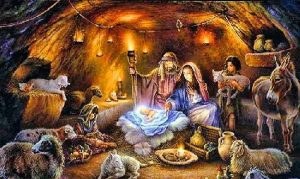
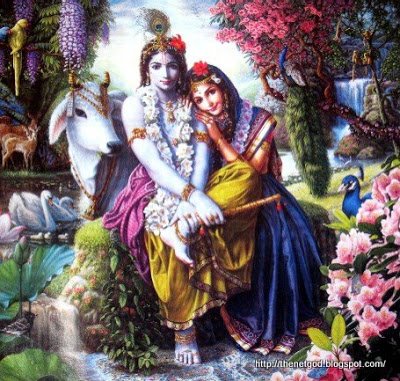
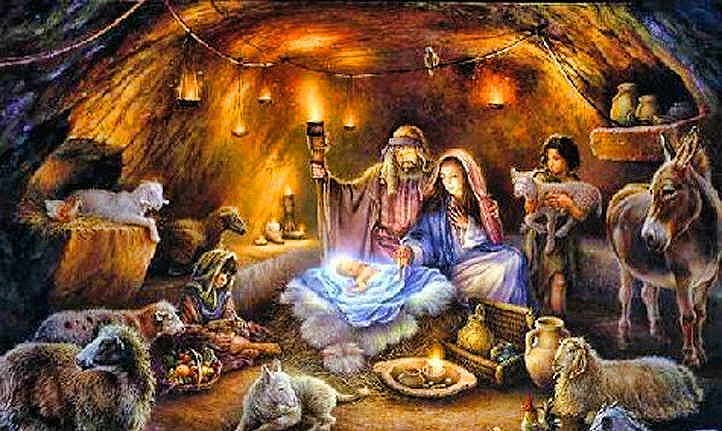
Krishna is shown surrounded by animals, as was the baby Jesus, showing that the divine part of us includes all creatures,
In general we can say the woman represents the man’s emotions, his nurturing and caring quality, forgiveness, his sense of what is natural and his connection with nature, its cycles and drives.
But such insights were also very much a part of our ancient culture. ”
Finds from Avalon Marsh, a bog outside Glastonbury in the UK whose name associates it with King Arthur. The ancient wooden track reassembled here helped people keep their feet dry crossing this wetland nearly 6,000 years ago. Also from Avalon Marsh is a rough wooden idol that’s contemporary with Stonehenge. It has “male and female attributes”, says the catalogue: breasts and a phallus.”
Through such images a man would recognise in people and animals the urges that link one to a mate, the strength to protect and nurture children, and the natural within himself. The anima also holds in it an expression of a man’s complex of feelings about women, gained as experience mostly from his mother – or lack of mother – but also from a synthesis of all his female contacts. So the whole realm of his personal experience of the female, along with the whole racial experience of woman can be represented by the woman in his dream, and is accessible through the image.
The anima is represented culturally in many symbols world-wide. Some of the best known are the Virgin Mary and Sophia in Christianity; Kwan Yin in Chinese mysticism; Kali in Hinduism; Pallas Athena in ancient Greece and Fatima in Islam. At a fundamental level the anima represents the many aspects of mother and nature. Like nature the aspects of the anima can be wonderfully creative and beautiful, powerfully destructive, or even beautifully dangerous. So it can also appear in a dream as a witch, a grandmother, an enigmatic female figure such as a woman of the woods, or a holy woman. Sometimes it is represented by an image such as a tigress, lioness, a woman in a cave, a ship or the sea.
In the Middle Ages there took place a perceptible spiritual differentiation in religious, poetical, and other cultural matters; and the fantasy world of the unconscious was recognised more clearly than before. During this period, the knightly cult of the lady signified an attempt to differentiate the feminine side of man’s nature in regard to the outer woman as well as in relation to the inner world.
The lady to whose service the knight pledged himself, and for whom he performed his heroic deeds, was naturally a personification of the anima. The name of the carrier of the Grail, in Wolfram von Eschenbach’s version of the legend, is especially significant: Conduir-amour (“guide in love matters”). She taught the hero to differentiate both his feelings and his behaviour toward women. Later, however, this individual and personal effort of developing the relationship with the anima was abandoned when her sublime aspect fused with the figure of the Virgin, who then became the object of boundless devotion and praise. When the anima, as Virgin, was conceived as being all-positive, her negative aspects found expression in the belief in witches.
In China the figure parallel to that of Mary is the goddess Kwan-Yin. A more popular Chinese anima-figure is the “Lady of the Moon,” who bestows the gift of poetry or music on her favourites and can even give them immortality. In India the same archetype is represented by Shakti.
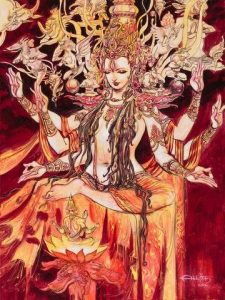
Shakti – Primordial Energy
An aspect of the anima that is often overlooked is in the image of the virgin. It depicts a particular and mysterious potential of the human mind. The virgin represents the ability to clear the mind of preconceptions, and thus open it to intuition. This intuition can lead not only to becoming aware of the aspect of consciousness that is universal – the Self as Jung calls it – but also to forces of change that can transform ones personality. See
Jung stated that there are four stages in the development of ones relationship with the anima. The first is represented by Eve. This stage is a purely instinctual and biological one, and has to do with basic drives to reproduce, and the instinctive drives between mother and baby.
The second stage is a romantic and aesthetic one. Like the first, this still includes sexual elements, but also deals with the personality of the loved one and social processes.
Example of meeting the anima in a young man’s dream: I was at a party in a very large house set in its own grounds. I found the party frivolous, surface talk only, and unsatisfying to my inner feelings. It was dusk outside, but I stepped out of the French window on to the sloping lawns around the house. A large wood rose at the edge of the lawn and I entered it, eventually coming to a lodge house. The gatekeeper, the man who lived at the lodge house, told me I ought to be careful in the wood, as many strange creatures lived in it. I told him I thought I would be all right, and walked on. There were wolves in the wood, I saw them, and a strange serpent jabberwocky type of creature that was forever moving through the trees, but they did not harm me.
I walked on and suddenly came to a clearing deep in the wood. It was still quite light and in the clearing stood the most beautiful girl I have ever seen. She was naked, yet somehow this was natural, as she was brown, and like a creature of the woods. We stood and looked at each other, people from two different worlds, and I knew that if I left my ordinary life, and went into the woods with her, I would find a love such as I had never believed possible. But I also knew that I would be lost to the world; that I too would become a creature of the woods. I was in doubt what to do.
Then, to my amazement, out of the shadows at the edge of the wood, where he had been standing all the time watching me, the god Pan walked to the girl and looked at me. Around him walked tiny creatures of the forest, rabbits, mice, deer and others. Without words, he offered the girl to me and tried to persuade me to come with them to unearthly delights. Then an inner voice spoke to me, telling me to save myself, to resist or I would be lost. I felt a tremendous power of attraction from the girl, as if I longed for her beyond all else, as if she were the answer to all my longings and dreams; but the voice kept on at me, telling me to think of a woman I loved in the outer life, any woman, and thus save myself. I did, for I knew I would be lost otherwise, but there were tears in my eyes as I did so; and the scene faded, and I was back in the wood again, a wood without magic, or fairy love, or unearthly delights or the strange presence and power of the gods. It was just a wood, and I turned away.
The wood here represents all inner ideas and opinions and also the inner self beneath consciousness, the strange unearthly world of the unconscious that can make the drab world magical and full of meaning, turn women into goddesses through projecting strange powers and emotions on to them. Yet it is dire to lose oneself thus, for one may lose one’s sense of identity, be possessed by the gods, or powers of nature active in oneself, and lose contact with the outer life, and family and friends. This is why the dreamer had to think of someone in the Outer conscious life he loved, to re-establish ties with them, to re-stimulate his awareness at that level. But later he returned and blended with her. It is desribed in the example under the Mystical Marriage below. See – The Inner World
The third can be likened to the Virgin Mary.
It depicts a love that has developed possibilities beyond simply the biological, emotional, intellectual and social drives. It shows the possibility of deep self giving and the discovery of experience pouring into consciousness from the unconscious, the birth of intuitive insight. See: Lifestream.
The fourth stage leads to a new form of wisdom in the individual. This can be understood by an overview of the whole process leading through the four stages. To start with the individual’s identity and sense of self has emerged out of biological drives and the instinctual or unconscious reactions that take place between parent and child. The person gains a sense of self from the weakness or strength of their body, their physical prowess or lack of it, the power of their sexuality and how this is responded to by the opposite sex and others. If they have a positive identification with the society in which they live, and if their self expression meets with success or reward, then they may experience satisfaction in the first half of their life. If otherwise they may suffer some degree of depression, anxiety or emotional ill health. See Wild Side
In either case the person has been largely shaped by factors other than their own power to shape their life. They are trapped in what has formed them. The transformation of the relationship with the anima gradually alters this. The individual breaks through the ready made boundaries of their personality and discovers the forces – archetypes and experiences – which helped form them. The ensuing wrestle with self leads to personal insight into ones own life, and into the collective life of humanity. One gains insight into the collective forces, ideas, dynamics, which direct human life. This is spiritual insight. It enables the individual in some degree to gradually find motivation from other than the urge toward sexual reproduction, social power, aggressive domination and self aggrandisement. It isn’t an easy process, but a new type of person emerges from the work. See: The search for Self.
Example: Now I seemed to go into a condition of surrendered, and spontaneous movements arose from within. I reached out and drew the sword. The girl gasped and begged me not to touch, handle, the sword, as it was sacred, or only to be used by a special person. Then she suddenly saw, by my movements, that I was fulfilling the full ritual or ceremony of the sword. It was as if her people had a prophecy about the use of the sword, and whoever handled it in the right way was a leader for the people. Through the inner direction, I had used the sword correctly, and was this leader.
Now she knelt before me, head bowed, in Oriental fashion. The inner movements led me to bring the sword down on her neck – and touch it lightly. This was the last proof of the ritual being fulfilled. Quite without knowing it consciously I had fulfilled the ritual. Also, this last act was a rite of marriage. We were now man and wife. Our relationship was now different, and our depth of feeling for each other made whole.
This an example of a man meeting and integrating his anima, not acting it out by trying to be a physical female. Integrating our female does not mean dressing up in female clothes or even having an operation to change sex. That is further developing an unbalanced self. Integration means having both the female and the male self equally developed. That is wholeness. So therefore being firmly female, male or homosexual are all unbalanced. It takes courage and hard work to achieve this completeness. See Life’s Little Secrets
The negative side of the anima
Is shown as moodiness, irrational feelings, love that clings to what is painful or destructive; hunches that may be prophetic, or expressions of anxiety or jealousy. The dark anima may be depicted in dreams as a witch, or a woman who deals with evil spirits and calls up fear in the dreamer. This dark side of ones emotions is easily seen in the moods that lead to depression and despondency, the dark inner condition that engulfs any joy or achievement and leaves the person feeling irritable, touchy, unloved and unable to love. Perhaps this is why the witch may represent this aspect of our emotions, because unless one can uncover the roots of such despair, it may feel as if one were bewitched, haunted or cursed by such feelings. Or it may be that rather than darkness, one is haunted by the dreams of ideal and wonderful love that only lead one on to misery – a sort of chimera or mirage that tempts but provides no reality.
A slightly different side of this negative anima that Marie von Franz points out is that of the woman/mother who poisons everything, whose waspish, critical remarks hurt and constantly demean. This may live on in a man as self criticism. A slight twist on this is the man who considers himself an intellectual, but actually is possessed by an anima that does not allow real creative thought, but expresses opinions and fears as clever words or arguments. This enables the person to feel themselves always right, and actually avoid any real meeting with other people or life experience. Strangely, such men are often driven to pornography, in a desperate drive to meet denied personal needs.
One side of the anima – the female – that has an ancient history, is the ability the female has for exploring or contacting the unconscious. This is due to the receptiveness and ability to allow something other than her own will to live in her, as a woman does with love, with a foetus, and often with her man. This giving of oneself is sometimes represented by the breast or the womb. In literature and myth we find the theme of the woman guiding the man through the underworld a frequently recurring one – as with Dante and Beatrice, Theseus and Ariadne, Rider Haggard and She. The example dream also shows the female figure as a guide to the spiritual world, a world that was previously unconscious or unknown to the dreamer.
The wonder of the Anima
In talking about this archetype as a symbol, we must however remember what it is a symbol of. Usually any such female figure in a dream can, if explored thoroughly, lead one back to direct experiences in relationship with ones mother. Such primal experiences as we met in being born and nurtured in the extreme of our dependency as an infant, occurred to us prior to speech, prior to organised thinking and perception. They tend to crystallise around an abstract symbol at first rather than around a direct representation of ones mother. This is true of any potent and deeply felt experience that may be difficult to meet as an adult. Difficult because, as an adult we often avoid allowing volcanoes of emotions and reaction such as we see as natural in a baby. Difficult because we avoid feeling so helpless and dependent. See RECORDING
Example: Here one must come to terms with the androgenous psychic nature of man. The anxieties of every human being who ever doubted his own sexuality are true; they point at a wrinkle of the mind which cannot be smoothed away. And therapists who try to calm patients’ fears with reassurances are whistling down the wind. Reassurances will never obliterate the doubt in every man’s mind that he’s not quite all male, or the parallel doubt in woman’s mind, simply because the doubt is psychically valid. Of course, objectively it’s not true at all. Although scientists have pointed out a certain overlapping between the sexes in vestigial organs and hormones, most men are obviously men and women are women. This knowledge of biological similarities hardly prepares men and women for the subjective experience of bisexuality, which can only be explained by the plasticity of the imagination and the sense of identity. In every man’s mind are areas of consciousness that proclaim, in effect, “I am a woman!” In every woman’s psyche occurs the reverse. This is not a matter of observation and analysis but a conviction at the very seat of consciousness. Subjectively, existentially, nothing could be truer than that. Quoted from LSD Psychothery by W.V Caldwell
Whatever aspect of the anima is most pronounced in a man, there is a tendency to project it on to any woman he gets close to emotionally. The woman then appears to be an angel of light, or a destructive witch, or even a femme fatale. Unfortunately women reap the harvest of what has probably been sown by the man’s mother. Mother was the man’s first experience of love, and whatever lessons were learned – whether good or ill – will be lived out with his partner unless they can be changed. Whatever the situation, the man is challenged, perhaps by a love affair that tears his marriage apart, to meet in a more adult way the feelings that were generated in childhood, and may have remained at that level.
Whatever one may make of Jung’s ideas regarding the anima, they remain a useful definition of the variety of ways men handle their emotions and their relationship with a woman they love, or the woman within them. If one is to mature and grow as a person, the childlike dependencies and angers, the blaming and the idolisation must be met and transformed. In doing so one is led into, or uncovers, a wealth of experience within oneself that was previously unconscious. Out of this maturing and growing process the images of the anima as guide and initiator have arisen. All must meet themselves in one way or another in the process of maturing, just as we all dealt with emerging sexuality in one way or another in adolescence. At such a point, the myths and classical stories still portray to us a wealth of information which may support us on our own unique path.
Good dreamt relationship with or marrying the woman
Shows the man integrating his own real emotions, sensitivity and intuition. He is recognising not only his conscious needs, but also the deep needs of his nature within. This makes him more whole, balancing his exterior male qualities and his personal will. As this occurs he becomes less dependent upon an external female to feel whole. It also shows the man meeting his experience of his mother in a healing way. This enables the man to have a realistic relationship with an actual woman. It also brings a sense of connectedness between his conscious self and what he senses as Life, or as Bucky Fuller calls it, Universe. See: Archetype of the great mother below; example of difficulty in integrating anima.
To integrate the anima is often shown in a series of dream in we the man gradually gets closer and closer to the woman and eventually marries her. This can be a wonderful spiritual experience.
Example: My third marriage was to an entirely different type of girl. I met her after experiencing a peculiar sort of time shift, or entry into a new time, or something. She then came to me simply because attracted, and I loved her. She had brown wavy hair to her shoulders, in a round feminine face. Very loving and sympathetic, intelligent, devoted wife, housewife, mother, cook, etc. I remember she had a Bible in her hand. The dream finished with me building three new bedrooms upstairs. She was frightened I would go through another “time change” and leave her. But I assured her. In meeting her, my last wife said, “Weren’t you silly,” meaning marrying the other women when she was always waiting to really love me as I wished to be loved. I said something to the effect that I had been young and stupid, but realised my mistakes.
Example: I was courting an Indian girl on the beach. I had sex with her. All her family seemed to know this. We wanted to get married, and this meant terrific formalities. A banquet was given by her family, and a careful note was kept of what we chose to eat. In some way this was taken as omens, and it worked out unfavourably. We were told we could not marry. I thought seriously about this, and the problems of East marrying West, but still felt we could make a successful marriage, as we loved each other.
Example: As I looked back upon all that in what I am meeting today, I could see that it has been an enormous part of my personal growth over the years right the way back to childhood.
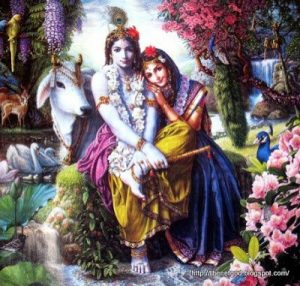
I have experienced a mystical marriage in myself. I am life – and although that is not true, at the same time it is true. In my being I am Krishna and Radha. In me they both live in a wonderful union of bliss. I am both the incarnation of godhead and also the worshipper before that wonder. That this wonder can live in us is beyond my understanding. That it can take on flesh – and that it does, every time a baby is born – leaves me in a state of wonder. I feel all this because I am that blissful union of Krishna and Radha. In myself I know the union and the love. I have been and am that sweet love forever joined. That the very creator of the universe can take on flesh, as it does every time a baby is born, brings me to my knees. This is beyond belief. Yet that is what I am seeing and experiencing as the truth. That is what I am experiencing in myself. I know that in this very existence, lost as I am in the sensory experiences of the world, and my feelings of isolation and physicality, I am at the same time, at the same moment, the godhead itself.
The examples give three stages of meeting the anima.
To be in conflict with the woman, or unable to make real physical and pleasurable contact with her: Suggests difficulty in meeting what may have been a painful or threatening experience of mother. This can lead to becoming an intellectual but emotionally barren man. Or being possessed in a negative way by the female traits, becoming emotionally unstable, opinionated and illogical. Actual relations with women will be difficult. Actual emotional or intimate merging is threatening because it brings the man close to the pain or fear connected with mother. Sex may be possible but not with a close feeling union. See: woman.
The Mystical Marriage
This marriage between the two sides of you is fairly clearly shown in dreams, and even the Bible tells how important this marriage is, “For many are invited, but few are chosen”
Here is a dream showing this wonderful and full union.
Example: I dreamt I was looking at a very large and old tree. I wondered if I could climb it but couldn’t see any way up it. But I noticed a large area without any bark, like an old wound, and I thought that area would become rotten and so the tree would become hollow and offer shelter to animals and humans.
Then I walked around the back of the tree and saw that the bark was like thick cables about 6-8 inches wide. I could then see a fairly easy way to climb the tree. So, I climbed up and the top of the tree was like a massive bell of a flower, like a crocus shape. And it was light and full of colour. Suddenly I saw a spirit, a beautiful female. It was the spirit of the tree. At this point I was semi awake, and I wanted to hold the beautiful spirit, but realised that the tree was a representation of my life, and so was the spirit of the tree. The spirit sat on me in a sexual position, so I was lying on my back and she was upright. She slowly took me into her, I mean the whole me, as if she was sucking my whole body into her. I realised that I had to die because she wanted to take all my experience of life and endeavour into her and fertilise herself to form a baby. So, I was ready to die and watched her form a new baby, a mixture of her and me.
“When you make the two into one, and when you make the inner as the outer, and the upper as the lower, and when you make male and female into a single one, so that the male shall not be male, and the female shall not be female: . . . then you will enter [the kingdom].” Quoted from ‘The Gnostic Apostle Thomas’
Useful Questions and Hints:
Can I recognise my own internal female, and if so what characteristics does it have?
How is my relationship with my internal woman – perhaps in some way a negative image of my mother – influencing my relationship with my female partner(s)?
In my dreams am I ready to marry or unite with my female?
The archetype of the alchemist is similar to that of the magician, wizard or even scientist. As with any archetype the alchemist depicts processes or forces within you, and with the alchemist it is about transformation. A negative aspect of this is the sense of superiority that possesses some people, leading them to a conviction they are in control of the forces of nature and can manifest magical powers or perform miracles at will. Sometimes, to achieve a result, the person operating under this archetype will use trickery, lies and threats or pressure, as with those who subtly pressurise others to do their bidding.
The positive influence of this archetype is in the release of a patient and persevering attempt to investigate and understand the unconscious processes of life and thereby, through meeting ones own inner and external processes, to arrive at transformation.
Useful Questions and Hints:
If I have met this archetype in my dreams, what have I learned from it about transformation?
Do I deal with some relationships by feeling superior to others?
Do I feel I have magic powers that other’s do not possess?
Try using Talking As to define dream character.
A page with all Archetypes listed.
Although the word archetype has a long history, Carl Jung used it to express something specific he observed in human nature. He said the archetypes are a tendency or instinctive trend in the human unconscious to express certain motifs or themes. These themes, such as death and rebirth are found throughout history and present day cultures. Jung saw them as universal, and as existing innately within what he called the collective unconscious. They are particularly apparent in religious beliefs, in literature and in the arts.
One of the important features of archetypes is they are not learned behaviour, but behaviour that is in some way innate, or unconsciously formulated or absorbed. For instance while walking near a sea-front with my wife, we saw a small boy running frantically and crying. It was near a road, so I picked him up in case he ran blindly in front of a car. As I held him his legs were still moving as if he were running. He had lost his mother and was completely panicked. As I held him I could hear his mother calling for him. I shouted back and she came and collected him, assuring him of her care.
The child did not have to learn how to feel afraid if he was separated from his parents. He didn’t have to be taught how to feel terror and to do all he could to regain contact. It is a universal response for children to feel emotional pain at the loss of a parent, and to do all they can physically or symbolically, to re-establish contact. You could say the boy was experiencing archetypical behaviour. This innate behaviour has probably arisen out of millions of years during which to be separated from ones parents or group meant probable death.
This bonding behaviour is common to most mammals, and is an example of archetypal responses. The urge to find a partner and reproduce is also an archetype, as is nest or home building, caring for young, and the urge to gain respect within ones social group. We each have an innate urge toward wholeness in some form, and toward the emergence and flowering of our own being. We each face such experiences, along with birth and death, in one way or another, in common with all other human beings past or present. The enormity of such experiences in our life are often expressed in themes of art, myths, or symbols such as the mandala, the cross, sunrise and sunset. The little boy’s loss of his parents and the enormity of what he felt is seen in many folk tales such as Babes in the Wood. Such symbols and stories remind us in some degree of the mystery involved in the fact that not only are we as an individual sharing the experience of being a man or woman, but this has happened to people since the beginning of the human race, and will continue after our life has ended. So although our life is a personal event, it is also part of an inconceivably immense continuum. Our personal life plays out themes or patterns which have been lived and added to thousands or millions of times before.
It is this collective experience which can be considered as the archetype. For instance if we could superimpose all the male faces, and all the female faces, of everyone alive today in two separate images, the resulting images would be the graphic archetype of a human male and a human female. The images would include all the features, all the racial types, all degrees of intelligence and honour. In terms of such experiences as puberty, marriage and death, the collective human experience creates such an archetype. The difficult question is how?
But it must be understood that the archetypes are all originated by human responses and behaviour – or at least by the behaviour of life forms on this planet. The holy, the devilish are all expressions of ourselves which we project as outer figures.
Jung differentiated between instincts and archetypes however. Although both are universal potentialities within us, the instincts are inherited tendencies toward behaviour, such as sex and the flight or fight response. An archetype Jung said is an inherited tendency toward certain mental or feeling responses. For instance the myth of the hero/heroine or saviour figure is world-wide and in all cultures. Because Jung believed that dreams frequently express the archetypal tendencies within the individual, he often turned to myths, fairy stories or religious motifs, to illustrate the contents of a dream. Seeing such themes arise in the dreams of people who had not studied world religions or mythology, Jung believed that far from religious and mythological stories having been consciously invented by historical authors, they had arisen directly from the unconscious in dreams or visions, and had simply been reported. Anyone who has spent time exploring the depths of their own dreams will find sympathy with and proof of this view. But as such they are still arising from human experience, but one which originates in the unconscious ability to have an overview of human experience and provides images of its findings
However, there is another important way of considering archetypes. It is that certain processes in nature and therefore in human life, reflect processes that are part of the very foundation of cosmic functioning. For instance stars are born from the death of other stars and solar systems. Birth follows death. Resurrection and new life arises out of cataclysmic destruction. Also, the very structure of our universe, as understood in quantum physics, shows how the immanent, the here and now, the limited and the physically real, is at the same time one and the same as the timeless and transcendent.
The personal experience of being a woman or man, of birth, childhood and death, are all expressions of cosmic processes, and can be understood much more deeply when seen as such. These archetypal patterns are true not only in cosmic events, but also in the most minute of human affairs.
Another way of understanding an archetype and how it came about is to consider something like a house. The earliest of human types erected shelters when these were needed. Some of the apes did the same. Over the millennia since those early beginnings people have seen what was done in the past and developed it. The old types of houses are still built around the central essence of what those early house builders had in mind. But now the house as a general object is an immense range of possibilities built around a central and ancient human and animal behaviour. This essence of house, this immense collection of behaviours humans have gradually developed around house construction is an archetype. It is an essence of all the behaviours employed in building a house. It is a deeply buried pattern of racial and cultural memory. It influences current house builders just as it influenced ancient ancestors. It is also a living thing, constantly absorbing whatever is new and being a source of creativity an influence in present individuals.
An expression of these archetypal forces lies at the heart of all major religions. As Barbara Sproul points out in her book Primal Myths, we unfortunately confuse a mythological account of an archetypal pattern with an historical account. Or we look at the mythologies of the past and see them as statements of ignorance, instead of wonderful summaries of insight into these great patterns of human behaviour, thought and feelings that pervade our life.
We see this wisdom and shrewd summary of insight in the pantheon of gods and goddesses some ancient cultures erected. Many of these gods were expressions of archetypal themes, such as death, rebirth, and womanhood. In other words, behaviour or experience repeated times beyond count. A sheep dog has in itself a greater propensity to herd animals under direction than many other dog breeds. Through rituals and worship of the gods, perhaps ancient people touched similar reservoirs of strength and healing innate in themselves, buried there by the immense number of lives that left traces of genius, or persistence against odds, of curiosity or love. Without such, the individual might find it more difficult to face the fact that death waits at the end of life, or to allow sexuality to emerge into their life at puberty. From the collective experience could arise ways of dealing with problems, or strengths, that did not reside directly in the person’s conscious personality. The negative side of this is that occasionally a person completely identifies with an archetype. For instance one may meet the archetype of Christ and come to believe that one is now the incarnation of Christ and ones mission is saviour of the world. Such powerful identifications cause dangerous alienation from a down to earth relationship with people and life. In some cultures, such as India, this may not be to harmful, in that other people may accept the identification and see the person as a guru or divine incarnation.
Another way of looking at this is of seeing that as our body and human personality are expressions of forces and processes in nature – archetypal forces and processes – we have within us enormous reserves of strength, creativity and survival. When faced by difficulties or crisis in life, turning to these reserves brings much greater power to our life than if we face them with our own limited conscious resources.
A girl suffering from anorexia told me a dream in which she was cutting off her own breasts with scissors. It takes little imagination to see the dream as portraying the development of her sexual traits – her breasts – and depicts her trying to rid herself of them. Perhaps she ‘cuts them off’ by not eating, and thus not giving her body and psyche enough energy and nourishment to mature. In the past, it would have been recommended that she give offerings to a goddess, thus aligning her with the unconscious archetype or power to become a woman. Such methods were the form of psychotherapy used by ancient cultures.
Jung’s theory of the archetypes has never been generally accepted, perhaps because it is difficult to test objectively. In more recent years however, through the tremendously amplified access to the unconscious made possible in psychiatry through such drugs as LSD, a lot more information about unconscious imagery has been made available. From this it seems possible that certain synthesising aspects of the mind produce images to represent huge areas of personal experience, i.e. the Mystic Mother or Madonna representing our accumulated positive experience of our mother, as well as the fundamental female processes seen in the fertility of the earth; and the witch as representing the frightening and negative aspect. These symbols, already presented to us outwardly through our cultural art and religious images, appear to become focal points for personal experience and realisations to crystallise around, often with enormous emotional power. Also, language and literature themselves present immense variety about all aspects of human existence and how we can usefully meet it. Each of these inputs can add to personal experience, understanding, and feelings. These cultural inputs influence our relationship with hugely important aspects of our life, such as marriage, childbirth and social relationship. Also, the fundamental processes of nature that are involved in marriage and giving birth, as seen in the unity of the sun’s energy, allied with the earth’s fertility, bringing forth life, lie behind all our human experiences.
The propensity for human beings of widely separated cultures, language, age, or gender, to meet with the same symbols in their dreams, fantasies or religious feelings suggests, not necessarily a collective unconscious, but certainly an innate sensing of collective human experience, and a meeting with the forces of the cosmos active in us. Because the mass of experience we hold, or live within, is largely unconscious, it does seem likely that when we are unguarded in our sleep, or at times of stress or heightened feelings, the themes and images connected with archetypal experience would emerge. At such times our dreams depict aspects of our individual relationship with this collective human experience, with Life itself, or what we have harvested from it. Such dreams suggest that the essence of all experience is somehow available to us, and that we are directly part of the huge processes of the cosmos.
For instance if a married woman with two children falls in love with a man outside of her marriage, and her family and cultural values stress the wrongness of such feelings, she is likely to experience enormous conflict. This conflict could lead to depression, withdrawal or suicide. But in the end what she is struggling with is the opposition between personal drives – her love for the man – and her cultural and family standards. If we look at the way men and women live and survive throughout the world, then such standards appear purely local. They are not innate. So underlying the ‘local’ customs she is trying to honour but is in conflict with, exists a human potential for many different ways of dealing with love and attraction. This enormous human potential is one of the archetypes, and is represented by light, a holy figure such as Christ, or a sparkling ocean. To consciously meet this archetype could reduce or remove the conflict.
Our largely unconscious connection with the massive potential that we hold within, and our direct existence within the warp and woof of cosmic and natural forces, forms a dynamic ever moving and developing process that our conscious and apparently independent personality interacts with. This is much like our relationship with language, which existed prior to our birth, and which we only use and become a living expression of during our short lives. Language is a reservoir of past thought and endeavour, a huge and wondrous living force which holds in it the essence of all great lives and thoughts. Within language can be found as much history as can ever be found by archaeological digs. From it we gain personal self awareness and interpersonal communication. We may add to it and use it, but it is never limited to our personal self. In fact much of our meeting with collective human experience may be a meeting with language and all it conveys and produces in us.
If we could become conscious of an entire language, we would see how we and the language we use has emerged out of an immense history, an amalgamation of all human experience, constantly shifting. We would have a vision of the extraordinary mind, love, pain, and multifaceted nature of human life. This would be a god-like experience. It is perhaps the sense of such huge and real reservoirs of human experience that we sense unconsciously, and erect a god or archetypal image around.
The simplest definition of the archetypes is that they are symbols of our own enormous potential. In particular they depict potential that still remains unconscious, and the details of archetypal dreams shows us how we are relating to that potential.
But a simple way of thinking about an archetype is to consider what your reaction to the idea of death is. Whatever your response is, such as dread, avoidance of thinking about it, desire for it, you may consider it to be very personal. But your response is typical of millions of other human beings. It is also coloured and even promoted by the culture in which you live, the literature and art of your culture, or that you have been exposed to. Such collective human responses to the major life situation we face, are therefore archetypes – patterns of behaviour laid down and deepened by millions of human lives.
Whatever may be the explanation of these archetypal images and intuitions, they are important because they give us a sense of how we as an individual, and human beings collectively, have been able to develop our identity amidst enormous forces of unconsciousness, collectivity and external stresses. They depict graphically the universal levels of experience out of which our personal self is woven. They also give some personal experience of how at some level of our being we are intricately intermeshed with all creatures, with all the cosmos. This is no longer simply an imaginative or mystical idea. It is also one which is expressed by scientific thinkers such as Bohm, who says ‘Deep down the consciousness of mankind is one.’ See: collective unconscious.
The following gives a vivid example of a potently archetypal dream, which in its drama gives C. A. an immediate experience of his conscious personality being part of something vaster and more ancient. The dream has in it a number of archetypal symbols – the star; light; the female; marriage or unity; and the eternal circle of life.
Example: Before I went to sleep that night I focused on the question – Who am I, really?
The dream was vivid, and still gives me shivers to this day. I dreamed that I looked up and there was this incredible star that was emanating points of light in the sky. It got brighter and brighter and the bottom-most point reached down to where I was and transported me up to the star. The points of light came out from the centre in all directions, and I found myself on the end of one of the horizontal points. A wonderful (female) voice spoke to me and said this is who you are, and I had the strong sense of being located at the end of the horizontal light bar. Then she said and this is who you are and carried (transported in some way) me to the next bar of light, where I saw another version (incarnation?) of myself (in a different time and place, although I knew that the essence of this version of me was really me). She continued transporting me from bar to bar where I experienced myself in many different versions in the past, present, and future. I had different skills and interests that were the focal point of each version of myself–a musician in one, a farmer in another. Some of the versions were females, although I experienced the same sense of self in all of them. Then she returned me to the horizontal bar of my current self and said to me that all of this is who I am, but that now she was going to show me who I really am. Then she drew me into the centre of the star (light, energy source) where I merged with her and could see each of the emanating points of light as manifestations of a single source or spirit. It was one of the most incredible feelings of being integrated and whole that I’ve ever experienced, and I basked in the feeling for a while just absorbing and soaking it in. Then she returned me to myself (with a cosmic wink) and I slept peacefully for the rest of the night. Ever since then I haven’t felt the need to ask who or what I am, and I’ve seen my various abilities and struggles in life in a totally new way. C.A.
When considering any of the archetypal forces that act on our psyche, it needs to be remembered that there is never a single way of relating to them. It is helpful to use Hubbard’s concept of the panther on the stairs to identify the different ways we can relate to an archetype. For instance, if there were a black panther on the stairs of our house, there are several ways we could relate to it. We could attack it, flee from it, avoid it, ignore/neglect it (for instance by making out it wasn’t really there), succumb to it, or we might even make friends with it, or learn from it through observing it.
Similarly, with one of the most powerful of archetypal confrontations we can face, that of death, we might relate to it in a particular way. Perhaps we run from the image in our dreams, or even make out it isn’t there. It is therefore worth remembering that whatever stance we find ourselves in, there ARE other possibilities.
What is the difference between a normal dream symbol and an archetype?
If you begin to explore your feelings and associations with an archetype it starts to take you beyond what you personally have previously known and experienced. The archetype is a pattern or influence in a level of consciousness that, while it is a deeper level of your own being, yet is at the same time a collective pattern formed by many human beings or even animals. It is often full of collective wisdom and energy, both positive and negative, depending upon how you relate to it. In the original Greek and Roman the word referred to a template, mould, copy, pattern or model. So there could be an archetype of the human body. Such an archetype would not look like any one person or gender, but include all forms, all types of human body. In the way it is used here it refers to this type of fundamental and inclusive pattern formed by immense numbers of human actions and responses to particular life situations or environments. Being such huge sources of influence we as an individual can draw from them particular needs or energy.
Example: Now it seemed as if my awareness went beyond the frontier. This was a very visual experience. I was seeing a vast desert and I knew this represented immense periods of time, perhaps what we call eternity. So it could be called the Desert of Eternity. Here and there in the desert were huge rock formations, a little bit like what one sees in Monument Valley in Arizona. But these rock formations were not plain or slightly coloured rock. Also they were immense. They had the appearance of massive mosaics – brightly coloured mosaics. But the mosaics did not form illustrations or patterns. However, some pieces of the mosaics were larger than others. And each piece might be in itself multicoloured and a sort of miniature pictograph.
As I looked at these massive formations I understood that they had been carved or created through events in the passage of time. Each mosaic, each part of the overall mosaic, had been formed by enormous creative acts, or by long-standing actions. So these latter were like ideograms or archetypes. So, for instance, mother creatures have cared for, fought for, died for their young. This pattern of behaviour has been so enormously potent and perhaps we can use the word successful, that it has created, shaped aspects of eternity. It has left its pattern, its artwork, on time itself. Thus eternity honours that pattern by giving it a place in the very structure of itself. No one being created such a mosaic in the formations. Such a mosaic was large and had in it the essence of all the lives that formed it.
 |
|
So the rock formations and the mosaics on them represented influences that will flow into the future. They were sources of power or influence that shaped the phenomenal world. They were the body under the coat so to speak. |
Am I more influenced by certain archetypes more than others?
You probably are, and reading through the descriptions and questions below may help you define what patterns you link with most strongly.
Can I change the way archetypes influence me?
All of us live in a powerful archetype called a paradigm. Other words meaning something similar are groupthink, mindset and worldview. For instance during the 19th century the common paradigm or world view was that described by the physics of the time. It seemed to know all the answers, saw the atom as the fundamental form of matter, and thus stated there was nothing beyond the physical form and brain. This led to a view of the world we called materialism. The materialistic viewpoint was a paradigm. So many people lived it and believed it that it had immense influence on individuals, and still does. It more or less created or helped create the way they saw the world and how they related to life events. But in 1906 Max Planck published what has come to be known as his quantum theory. This, with Einstein’s theory or relativity and all that arose from them, revolutionised physics and created a huge paradigm shift; one that is still only slowly entering general personal awareness. From this new paradigm the atom was by no means the fundamental particle, Human observation or consciousness was seen to be a powerful factor in how sub atomic particles manifested.
The point being made is that if you are aware that your world view is most likely formed out of an extant paradigm or world view, and this is a form of archetype, the awareness of this enables you to not be controlled by the archetype and capable of extending or rejecting it.
Some research suggests that our dream animal may represent a conscious phobia, and that left handed people, or those from a family in which left-handedness is frequent, may suffer phobia more frequently than people who are right handed. This is thought to arise out of the way the two brain hemispheres inter-relate. For instance the left hemisphere deals with rational thought and verbal concepts; the right deals with non-verbal ideas and feeling responses.
In most men and in right-handed people, the division of activity between the brain hemispheres is marked. In these cases the two hemispheres are said to be ‘lateralised.’ But in women and people who are left-handed, the brain’s hemispheres share many functions and are not so segregated, and the hemispheres are less lateralised.
In studying the frequency of animal phobias in left-handed people, the psychologist Paul Chemtob, found that left-handedness occurred in twenty percent of phobics whose problem was bad enough for them to seek treatment. Chemtob believes that where the lateralisation of the brain is high, the rational left side of the brain inhibits the action of the feeling responses in the right. In left-handed people however, this inhibiting action is not so pronounced, so the feeling reactions arising in the right brain hemisphere more readily break through into consciousness. This may explain why ninety five percent of phobic sufferers are women, and many of the men are left handed.
Connecting this with the animals we dream about, waking animal phobias, unless rooted in an actual encounter with an animal – for instance being bitten by a dog – may still represent our personal struggle with and fear of our own instinctive reactions and feelings. It is also probably true that all of us, left-handed or not, experience deeply moving feeling reactions such as anxiety in response to many events of our everyday life. But as Chemtob’s findings suggest, some people are physiologically, and thus also psychologically, better equipped to deal with such high levels of impulse than others. This can be thought of as a stronger or more resistant threshold for impulses such as fear or aggression to pass through before they impact upon the conscious personality. Therefore, in some people, such as women in general, and the left-handed in particular, their ‘animal’ is a much more insistent beast in their life.
It was nearing Christmas – the 5th of December 2008 – and I had promised I would attend a party in London with my friend CJ. It was a long journey from Wales, and I also wanted to see Joe who I had spent a lot of time with as he was growing to adulthood. I needed to hurry back to Wales so I had kept the mention of my stay in London just to CJ and Joe. I wanted to see the doctor as soon as I arrived back as I had been experiencing powerful irregular heart beats, something I had experienced most of my life.
I arrived early in London and set out to walk to Caledonian Road from Paddington Station to the flat Joe shared with some friends. As I walked I noticed chest pains to the right and left. Having known chest pains for forty years of my life I didn’t think they were an extreme indication of anything.
Seeing Joe is always a good experience as he greets me like an affectionate son. We sat and talked, catching up with news, and the conversation turned to altered states of human experience. So I found the Jill Bolte Taylor video on the Internet and we watched the video of her experience of her stroke and the wonderful experience it unlocked for her. Tony’s Video Talking about his Stoke.
Then it was time to leave as CJ had arrived to take me to the party. I felt fine and ready to go. I stood at the top of a long flight of stairs to the street, turned to give Joe a good-bye hug, CJ having walked to the bottom of the stairs. At that point I noticed that I couldn’t see anything to my right. I turned slightly to the right wondering what was happening to my sight. There had been no warning signs of pain or aches in my head. Then it seemed to me that I collapsed down on my knees, and reaching over to my right arm and leg I realised they were cold and lifeless. At that moment I began to lose focussed awareness.
| Joe thought I was joking with him, having just watched the Jill Bolte Taylor video in which she explains her experience of stroke. But here my experience of the stroke diverts from what Joe and CJ observed. Joe says that as I started to walk toward the top of the stairs his feeling turned to shock. Looking up at me from the bottom of the stairs CJ also knew something was wrong and shouted to Joe to grab me. |
|
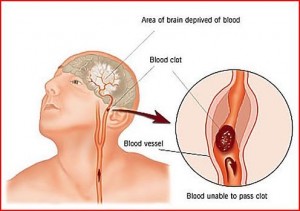 |
Fortunately Joe caught me, as CJ ran back up stairs, and together they sat me on the top step, to prevent me falling head first down the stairs. For a minute they gently tried to get my attention; tried to get me to speak and to move my arms, thinking at first that maybe I was just having a dizzy spell. But at the point where my body had completely slumped and was being held by CJ, Joe called for an ambulance. Both Joe and CJ say that the TV adverts they have since seen, warning about signs of stroke, do not portray the severity of what happened to me. For them it wasn’t a slight drooping of mouth or eye, but a complete collapse of one side of my face and body. I realised from their descriptions that the left side of my face was trying to speak, but the right side was now dead, and the struggle between right and left was not good to see. CJ said that she felt the life draining out of me as if I were dying in her arms. Her view at this point was that my face was so contorted I looked like a gargoyle. I was making inarticulate noises and my tongue was moving in an uncontrolled way.
I think it is worth mentioning the enormous difference between my experience and that of those who observed me. In regard to my mention of collapsing onto my knees, Joe’s notes clearly describe this.
You actually stayed standing for at least a few minutes. You were exploring the handle of your suitcase but you seemed to have lost understanding of how it worked or what it was. You even tried to walk to the top of the stairs and would have fallen if CJ and I hadn’t helped you into a sort of recovery position against the wall in the hallway.
And then, in regard to me saying I lost focussed awareness:
What startled me was that this seemed to happen almost instantly. We had just hugged and when you stood up again from trying to pick up your bag, you could no longer make eye contact, there was no recognition. It was such a strange turn in your behaviour that I asked you if you were having a stroke! You didn’t reply – but it was the loss of eye contact and apparent awareness that worried us enough to call the ambulance so quickly.
All this happened for me without any pain or fear or panic, and it was my good fortune to have a quick response team nearby. The paramedic arrived on motorbike literally in one minute, and the ambulance arrived ten minutes later. (Thank you So much!) After their initial tests and diagnosis, they picked me up and put me in the ambulance. Luck was with me as well to be taken to The Royal Free Hospital in Hampstead, which has a great stroke unit, and also to be given a ‘clot buster’ drip into my arm. This quickly disperses the clot blocking the vein to the brain. Without that the damage to my brain it would have been much more severe. If the stroke had occurred in Wales I was told I would not have been given that saving aid.
What I recall from the ride in the ambulance is that I have a knack of curling up somewhere inside of myself when any severe injury is met, as when I lost most of the sight from my left eye. So I went to that safe place and gave myself over to those who were caring for me. And that care was wonderful, so much skill and knowledge shared, and so much love given. CJ and Joe were with me almost constantly for days on end. My children, Leon and Neal were there so fast too. Helen, Quentin, Mark and my grandson Ruairi arrived the next day having travelled long distances to be with me, and my cousin Robert and other friends such as Dina arrived too. Thank you so much for that. It still stirs me emotionally when I remember that time. I am still moved a great deal for that obvious care and love and was there and holding me in the world. It was like I had been in a train crash and been hit badly.
When I arrived at the hospital I started feeling slightly clear again. I remember being told I was going to have a scan and being wheeled into a lift and then out to the room where I was put into the scanner. Leon describes what happened next as follows:
When we arrived Tony had just come out of the CT scan and receiving a ‘clot buster’ injection (intravenous) that would continue for about two hours. He was conscious, looking at people and seemed to recognise them, but could not talk and appeared not to understand what was being said. He had started to be able to move his right side a little bit. The doctor said Tony had immediately showed signs of recovery as soon as the treatment started. By about three to four hours later he could move his right arm and leg slightly and attempt to say things, but no understandable words came out.
From that point on I feel I was aware of experiencing something wonderful, and so was more aware of what was happening around me, and what was said even though I couldn’t respond verbally. The stroke seemed to be severe as I still could not move and I wet the bed because of no control. But an extraordinary and unexpected thing had occurred; I was in a state of wonderful and deeply felt peace. Gradually I realised what had happened and described it as existing under a ceiling of speech, a ceiling that cut out awareness of words, and so freed me of all the conflicts, decision making, and social mannerisms that arose from being lost in words and the thoughts that arise from them. I experienced it almost as a visual thing, this great ceiling above which was the complicated world of speech, and under which was great peace.
I see now that my awareness of personality and body awareness had been damaged because if brain damage, and I had been switched over to what I had developed through years of entering what I originally called the ‘downstairs awareness’. Our consciousness has several levels and I had learnt to enter this level partly by entering the dream level. See Summing Up
I think this was why Leon felt that I ‘appeared not to understand what was being said.’ The peace was so great and unbroken that I could stare at my children without any usual social expressions and signs of response. It was a great experience to stare and read their many emotions, and imagine reaching out to them and hug them trying to communicate the peace I felt.
Of course, from their point of view I probably looked a mess, as due to the stroke the right side of my face, so I have been told, was still sagging. But I wasn’t aware of that – just peace and calm love. But I could not move, I couldn’t speak and had lost control of my body, to the extent that I wet the bed until a nurse put a catheter in my body. I wasn’t ‘with it’ at all.
Slowly I gained further insight into what I was experiencing. I noticed that I could read and understand the notices on the hospital ward walls. Also I knew what I wanted to express, but the mechanism of expression was now broken. So when I did try to find the words it was like looking into a vast empty space and reaching into it without success. When I think about it now, we all reach into the immense empty space of the mind and memory when we try to speak, but if you observe what occurs the words drop right into your mouth. But in my experience of stroke there were no words coming. The delivery system was broken – or as Jill Bolte Taylor says, ‘You are not a dummy, you are wounded.’
| In that wonderful state of mind I looked at the faces of my family and friends and ‘read’ what they felt with extraordinary awareness. I could see and respond to the deep panic at their thought that I might be dying; the sureness and love in the face of death, the strange struggle between loving and holding back, and the tender presence. But because of my brain damage I could express none of that, so I see the brain as a method to express through the body, and the body was not the vital ME. |
|
 Tony’s family gathering the day he left hospital Tony’s family gathering the day he left hospital |
These experiences had a profound effect on the way I saw the mind or one’s identity. When I could manage to speak, I would say to friends and family, ‘I am still here, but my mechanism of expression is broken.’ I felt completely whole within myself, but was aware there were things that were now damaged and could be re-built. So it seems to me that the brain damage did not damage ME, but my ability to function well through my body. Please see this amazing video – Here is a wonderful video showing how a mucked up brain is not the person behind it.
Having nursed stroke victims, I know many of them experience fear, anxiety, tears and even depression, but I had none of those difficulties, maybe because most people identify fully with their body, so they all experience fear of death or loss of themselves. My life has led me to realise that we are more than our body. See Criticism – Answers To – Biographical Information
So for instance, when I first came to write anything, although I knew what I wanted to say, the connection was now so scrambled that it came out as a strange mixture, as shown in this email I sent.
“I sense you feeling in a new pathway in your footpath, your foot and your heating in your sole. You will giving the trackway and your breathless as it follows. There are only colours and tries that we collect from the many thinksing ine our way.
How the wind move and I am stand in the darkness and quietness. I see what a emotions whirling about in frightened. I see the hands and faces as them small by we all. And I takes their hands and held them cross to me. For that it we tell us if our life.
If that is love, then I take it and it give and take and another not time also.”
Here is another example from a bit later as words were coming easier:
“Hi Jill – One day I will speak and I will listen. I fell into a wordless silence, and then put my head up in a quietness. Now I came by with a few words – words. They are rare and wonderful. But the silence is even brighter. Tony”
I want to say with great strength that the BRAIN IS NOT YOU – it is an organ that links you with your body and thus enables speech and movement. See this wonderful video which demonstrates the difference between the brain and YOU. See https://www.youtube.com/watch?v=vNZVV4Ciccg also see Signs of consciousness in People who are Considered Vegetative
So I emphasise that the brain is a link with the body, and its damage does not damage you, but your ability to express. So when people are suffering Alzheimer’s, what we see is the result of the deterioration to the brain not the deterioration of them. By ‘them’ I mean the process of Life that gives consciousness, life and movement to the body and is missing in death. See
Something I realised is that my ability to watch, observe and understand clearly was probably due to my having developed the ability to switch between waking consciousness and waking lucid dreaming. See Waking Lucid Dreaming – Talking with the dead And https://www.youtube.com/watch?v=vNZVV4Ciccg
I was discharged from hospital within a few days, and prior to that I was tested to see if I could walk and speak well. One of the things I was asked was if I had stairs in my house. Two nurses accompanied me to some stairs and were very dubious when I told them I could climb them two at a time, and were amazed when I did. Also with the speech therapist I ran through the tests well, showing I had basic language functioning again. I stress this because when I walked out of hospital I could carry my luggage, and had no pain in my body. So in that condition Helen drove me back home to Wales. While there I insisted on taking her for a long walk up the local mountain.
Helen left a day later, and it was after that I felt things go radically wrong. My ability to walk almost became zero so that I was constantly stumbling or falling. A walk I went on with Leon on January the 4th, up the same mountain I walked with Helen, saw me falling over at least thirty times, fortunately on grass. The strength in my arms and legs also decreased to the point where I couldn’t turn over in bed, and standing up from being on my knees was a really difficult task. And then there was the pain that seemed to eat into my joints; pains and weakness caused by the drugs taken. (I believe it was the drug statins I was taking because later I stopped taking them and an immediate increase in strength occurred See). So getting up in the morning I described as ‘climbing out of hell’. I did learn that moving and stretching got me through though. Something that was also lost with the stroke was my ability to respond emotionally and sexually. At that time it felt I could feel no emotions at all, as if I were wrapped in thick cotton wool. This has gradually changed as emotions lit up again, but still no ability to fully express sexually, so no ability to get an erection..
Fortunately for me I never did lose the inner feeling of peace or the sense of ‘I am still here’! In writing to Joe about his I said. “I have been through a merry ride since I saw you – finding my way through aftermaths – and I was never much good at maths anyway.”
Some weeks after returning home I went for an appointment with a speech therapist. She took me through several tests and told me that I had done well, and there wasn’t anything else I could usefully do with her. She was fascinated by the speed of the recovery and so asked me about the clot buster and how quickly did it work. But then she asked me something else that helped me clarify my experience of stroke.
|
|
 Tony two weeks after the stroke Tony two weeks after the stroke |
She asked me if I had cried a lot, felt frustrated or experienced anger. I said no, I haven’t experienced any of those. I tried to explain why, but I could see she wasn’t interested in a long explanation. I did say that I had already dealt with the emotions most people stumble over, and as I had learnt not to identify with myself as a body, or speech, I felt I existed apart from the physical.
At one appointment with a stroke specialist I asked how it happened that I left hospital mobile and feeling well, and then became much more severely afflicted. She told me that often the brain swells after a stroke and so damages the brain further.
One of the specialists told me while I was in hospital that, ‘With a stroke such as you’ve had, you’ll never write again.’ I didn’t believe that. Six months later I can write, but not creatively as I did when I could write poetry. Yet again I have not felt frustrated at the loss of something that was a massive part of my life. Perhaps this is again due to learning not to identify myself as a writer, or anything else. I can do things, but I am not those things. I believe that is incredibly important in whatever life situation you find yourself in. This fundamental truth lies at the heart of the great meditation disciplines. Through them you find what is essentially you. That essence is formless, nothingness, yet within the darkness is everything. This is seen in what was said above about finding the right words in speaking. If I look into myself, there is a great void, emptiness, a nothing that is at the same time everything. Miraculously things emerge from the emptiness. So I believe that acknowledging the apparent nothingness and recognising it as the source of everything you call self, sets you free. I have realised again and again that the wonderful nothing that is everything is the essence of all living things – animals, plants even rocks – and the only thing that stops them expressing the same intelligence as us is their ‘equipment/body’ isn’t as sophisticated. That really came home to me when my own equipment was damaged.
A friend, Dina Glouberman, who visited me while I was still recovering my ability to speak and move wrote the following:
The thing about fear for other people is that you cannot do much about it; you are not really standing in your own ground and finding out where you are; you are trying to live in someone else’s shoes. Ever try to walk in shoes that don’t fit you? You just waddle around and get nowhere fast.
When Tony had his stroke, I was deeply worried about him and afraid for him. And although his having a stroke affected my own life in many important ways, potentially losing me a wonderful friendship and a partnership in this book, it didn’t occur to me that I should have any feelings about that. He was the one with the problem, he was the one suffering this massive crisis, and not me. So I went into shock about his life, rather than about my own.
But I finally worked out that he in fact was not the one with the problem because he was okay in himself. He was peaceful, he didn’t mind having the stroke, and for him it was just another part of his life path. I was the one with the problem because I was simply not as peaceful and accepting as he was. And it was my feelings I had to stay with before I rushed to help him.
I had to be able to say to this man with a stroke, who couldn’t speak, “This is bloody awful and I don’t like it one bit” Sounds selfish and bad, and yet it would have been much more respectful of him and of me.
Instead of that I was ultra nice and ultimately condescending, because he was not with it, and I supposedly was. And the next morning I went into shock, because I had gone beyond my limits and didn’t know it.
I will never forget a group I ran some years ago, at Easter in Skyros, when one quite wonderful participant had a brain tumour. She was a doctor herself and knew how poor her chances were, and in fact she died within the year. Yet, when people in the group felt diffident about working on their emotional issues when her problem was so much greater, she said “You insult my humanity when you won’t let me care for you as well as you care for me.”
When we stop insulting the humanity of those we love or are trying to help, we start being able to stand in our own ground, see in our own light, and really be able to reach out and be helpful if this is needed. We will be there and they will be there. And that is enough.
Dina Glouberman’s Interview with Tony 8 months later –
Dina: When we last interviewed you, we were focussed on how you received the changes in you when the stroke hit. I’d now like to ask you, when you said that you lost all the old landmarks, what did you lose at that time, or soon after?
Tony: I lost my speech, obviously, and I lost my ability to use my right side, which came back quickly but then faltered a lot later on. I didn’t notice at first, but I noticed soon after, but I noticed when I wrote to a friend who I had a lot of love for, and I suppose she was asking me if I still loved her, and I said, “Look, because I don’t know who I am in that area, I feel as if all emotions have gone, so I can’t say whether I loved anyone or not, I didn’t feel anything, no response, no love, nothing. So I felt like I’d lost my soul in some way, but I wasn’t sure what that meant. Having no feelings, I didn’t feel bad about it or good about it, just no emotional response. It felt like I was wrapped in cotton wool, nothing could get in or out. Looking back from where I am now, I can see that gradually little bits of emotion began to break through. I watched a film and I felt moved. Something moved in me for the first time. And then gradually it came back, until recently, talking to Dakota again, I had immense emotional response. But an aspect that I lost and hasn’t come back is my ability to respond sexually, no erection, no ejaculation, nothing.”
So I could respond emotionally but not as far as sexual feelings are concerned. Also, I was told that probably by a year I would be fully recovered. I am just at 8 months and don’t feel I am any nearer walking well. I used to walk to my village and back, which was 3 miles there and back, and I can do it, but it takes a lot of concentration, and it feels like I cannot manage to walk properly, you can’t keep up that sort of concentration.
As far as writing, because that has been a very big part of my life, I lost it completely, and seemed to have no interest in it whatsoever. I couldn’t raise interest. It was difficult to even to write short emails. So I got very behind. But suddenly one day I wanted to write my experience of the stroke and I sat down to write it. But it’s like the walking. I can do little things fine. But any major big job I find difficult. I guess it will come back, as it was promised I would fully recover. In terms of writing, I used to love writing poetry. It was never a task, and it never needed correction. And I could probably write poetry, but it wouldn’t be the same. It used to well up and form itself in me, but I haven’t had that at all since.
My intuition, sometimes I think I’ve lost it, but then I went to a meditation course recently, and I was amazed what pours up from the unconscious still. Incredible. But no poetry so far.
Before the stroke also I suffered a lot of dizziness, and had real trouble with it, it ruined some days. It had been coming on for 15 years. It used to come once a year, but then about three years ago it started coming more often. Since the stroke, I haven’t had the reappearance of it. That was a real bonus for me because it was a real pain. I don’t think it was connected to the stroke, but they say sometimes the setting for the balance mechanism goes, and maybe it reset itself. It was torture. Please don’t let it come back again. I don’t want to be tortured.
But I found out from a recent news report that the experience of vertigo is one of the signs of approaching stroke.
I suppose also the way I feel about myself. As I am aware of myself here at this moment, I feel very alive and about 30, but when I move around, I realise how much I’ve aged in terms of my body and what it can do. I feel as if I’ve aged 10 or 15 years. I’m bent over sometimes. So while I move, perception of myself and how people see me, it doesn’t bother me, I quite like it because I can appear like an old man, which I am I guess. I think it gives me a lot more understanding of people’s infirmities. I see people who have had an injury who can’t walk properly and I see them walking with a stick. I feel compassion for them. I feel I am in a wonderful community of age. I say hello to them sometimes, even though I don’t know them.
As far as my inner life is concerned, I feel as if something quite amazing has happened. I feel as if a seal has been put on this personality, a seal, which has said, yes, this is good. I developed a lot of confidence over the years. But this is different. I don’t care what I do where I go or how people see me, because it’s me. In the past, I often felt unsure of who I was, or how I appeared but I don’t feel that any more. It’s okay to be me, who I am. I haven’t taught for 20 years, and suddenly I feel I have something to teach, and it’s happened that it’s come my way to do it. It’s a sort of humility of being like so many other people who have gone this way, are going this way, nearer to death, and what have I got to lose, and somehow age gives you permission to say whatever you like or do whatever you like. I accept who I am. Because I am. And I feel good about that.
I had this thing in the meditation course where I was pushed into a kind of uncertainty because of the ideas they were putting forward, and I spent time looking at it, and I felt the emergence of this ‘me’ I had met many times in my life, this wonderful surge of life, which is pushing you up, pushing you up, forever growing you, reaching you up, through the soil. You once said to me I am like a force of nature. That’s how I feel, nature itself, pushing up. I felt this tremendous thing of being a human animal and how I am at the end of a long line of forbears who have survived, and to do that, took tremendous courage and strength. I feel, “Fuck it, I’m here, and I want to press forward and add to what they’ve done. I want to add to what they’ve done, to make some of it right where they’d struggled with it.”
Dina: When you were peaceful about the stroke, was that just because you weren’t feeling anything?
Tony: No, that feeling of peace was extraordinary, and it carried on in me, I’d reached it before the stroke, but now it is there solid in me. Of course developing words, you start thinking this and that and it gets in the way, but you can return to it any time. It’s like returning to a pre-verbal self I suppose, and pre-time.
Dina: People might think that peace is a feeling and you said you didn’t have feelings.
Tony: I think people mix up emotions which are here, there and everywhere, with this, which is a state; it is something that has no cause, if something has a cause, it is caused by something else, but this is simply it, causeless. In Hindu philosophy they say fundamentally you are satchitananda – being, consciousness, bliss, and this is where I am more fully than I ever have been before.
Dina: In other terms if it has a cause then it is fundamentally empty, but it sounds this peace of yours isn’t empty, it simply is.
Tony: People mix up what is their fundamental nature with what their emotional response to life events is. If we could quiet all our thoughts feelings and emotions and find our very foundation, our basic nature, not the effect of a cause, but what we are made of, it is blissful love, consciousness and being. It is one and the same as what people call God – for we are all in essence what created us out of its own being.
Dinah: You said once that they told you that you would never write again but now you are saying they say you will be completely healed in a year.
Tony: That was someone else. It was one young specialist who looked at me and said “You will never write again.” How does he know?
Dina: Could it be that this newer doctor is saying that whatever will heal will do by a year, but that you might not get everything back?
Tony: He didn’t say that. I think he based it on what he called a remarkable recovery. He felt at that sort of speed I would be fully recovered.
Dina: When we spoke yesterday during the session, I felt as if emotionally you had not been with me, and I had been feeling lonely and assuming that it was because you were in love with someone else. But it is not in your nature not to love whoever you are with who you care about. So I thought it’s because your feelings weren’t fully back. But now you’re saying that your love has come back, but I wasn’t feeling it fully until last night? So I’m confused about that.
Tony: Let’s put it this way: I am still developing the ability to respond, but the sexual part hasn’t come back so I feel that means I don’t respond in the same way. I believe that having full sexual feelings is very magnetic and draws one to people male or female but without it is a different way of relating.
Dina: So it’s as if we had to learn to bridge that gap, which maybe you’ve learned with some other people.
Tony: I’m not sure if I do. I don’t know if she feels close and I’m just going along with it. I don’t know. I used to feel sexual feelings like a magnet that pulls me. I certainly don’t feel that. I certainly don’t feel sexual hunger either, which makes a big difference.
Dina: So when you said you were in love with her and thought you could be her partner, what was that if it wasn’t the old feeling?
Tony: It was a tremendous exchange of ideas and working together and feeling close and feeling excited about what we could do. She is ready to go in with me and work and teach it. And she’s working with dreams and LifeStream which is probably ninety percent of my inner life, and she’s in there with me. I haven’t met that before. It’s like bloody hell, who is this woman; she’s in there with me.
Dina: What I see is that when D. decided to get back with you, she surrendered, she loved you, and she crawled right in there with you. Whereas I didn’t surrender in that way. I loved you, but I came with my own world and you with yours and tried to put them together, which is very different. I had a conversation with a man not long ago, where he explained that the reason he wouldn’t be interested in me was he thought I was too independent and it was, as we talked about it, like I was a queen in my domain, meeting a king in his, and he wanted me to join him in his domain, rather than bring the two together. And I suppose Sheba went to Solomon, and in Rumi’s poem she brought her golden throne with her, and Rumi said she didn’t need it. So she came into his domain, and that may be what I didn’t do.
Tony: I don’t think we could have done that. D. hasn’t given up who she is, in fact she is who she is, and what I’ve wanted for ages was someone I could pass on what I’ve learned.
Dina: And I’m not that person. I’m not your student although you are my teacher. I feel very strongly that you’re my teacher and I’m your gadfly making you keep going rather than rest on your laurels. And that is my nature. I’m a catalyst. So I guess it’s harder for me to have a successful male female relationship because of that.
But do you love me?
Tony. Yes, I do. I found it very strongly this morning as I saw you sleeping.
Dina: And how had you been feeling about me while I’d been here before our session last night.
Tony: I felt about you. What I feel about you is that you are very curious about finding things out, and I love that and I love you for that. And you won’t rest until you find out what is really going on. I was feeling love but not romance because we kept talking about what we would do with this. But that’s gone because the sexual feelings are gone.
Dina: I think for me, something was missing, and I felt you had withdrawn.
Tony: I can see now that I feel as if something is being asked of me that I can’t provide so I feel a bit of heartache.
Dina: I also wonder if working on the book itself felt a bit like maybe something was being asked of you that you could no longer provide, so somewhere you withdrew a bit and you came back last night.
Tony: I can’t come back fully.
Dina: Could it be that you felt I wanted from you sexuality which you couldn’t provide, even the sexual feelings rather than the behaviour, and partnership in a book which maybe was gone for you a bit.
Tony: It had gone altogether. What I felt was that I couldn’t even follow where you were going. I had nothing in me about the book or what you wanted to do. Like losing feelings, I had lost it. It’s coming back but it’s not the same.
And of course sexual attraction has such an effect on how you are with people. And when you interviewed me, we could feel it, but it has died even more since then. Died out.
Dina: When I tune into you I feel in my heart a kind of compassion. I feel your sexuality will come back but it come through the heart. It will not be direct any more. I believe it’s going to have another route. Like the brain that changes itself, a new set of connection.
Dina: What I’m reflecting is that when one person changes everyone around changes and this is true when someone is enlightened or when they’re angry or whatever. We are in inter-being relationship with people. But if we don’t fully understand what has happened to the other person, we cannot fully understand what we are feeling.
Tony: I’m feeling this feeling: Please don’t ask me to be who I was because I’m becoming somebody new. I don’t even know what I’m going to become. But I want to go on. I don’t want to be held back. I want to push on. I really want to. I guess I’ve been mourning the old me. Somehow it feels as if it’s dying. I guess I have to really, I suppose resurrection is a new you, it’s a new life. I have an image of me crawling out or emerging from an old carcass.
Things are always changing of course, but this was such a radical change, so enormous. I love you. I love you. I feel like I love life because it continuously brings us into the new, continually, continually, continually. The new me is still very young. I am letting go of the old but I don’t know who the new me will be quite.
Dina: If you did know, what would he be like?
Tony: Tony laughs. I feel much more delicate in love and I would move quickly and easily from place to place, more mercurial I think. I think, please don’t ask me for love that holds me. I cannot be held. An Imp learning such a wonderful freedom. I can give you love that can never stay still but always becomes. I’ll be much more in touch with the eternal part of me. I feel like the human part of me is dying, beautifully dying. I felt this coming on me before the stroke. The stroke has really hit the old me. I can’t find any more than that.
Dina: The interesting thing was that before I came to France, I got this message inside: Don’t sleep with Tony. And at that point, I hadn’t even considered it yet. I was a bit shocked. But I realised why. I think I’m too vulnerable to love and be left somehow. And to compete with so many other women. I couldn’t do it.
I was going to say that here: we got to death and resurrection which is important. I saw last night the death mask. I saw your face as a skeleton and that was the only psychedelic thing I saw and I thought it was about your dying in the future, but actually you’ve already died and are being resurrected and this explains a lot in my own feelings as well because if I believe you are the same person I’m going to be mighty confused. You’re not. You are also. You are totally recognisable and all these new qualities were already there in the making so in a sense there’s nothing completely new. And yet there was a death in between and that changes everyone.
I’m imagining Christ emerging from the grave. Who is he now? Not the man he was even if he looks the same and more or less has the same qualities which you do and you don’t. So I think death needs to be factored in whenever there’s a break in the reality that you knew, and it’s not just you have to know it, but everyone around needs to know it. I’m reminded of after my father died, that when I met people, I felt I couldn’t be with them until I said that my father had died because that had changed everything and they couldn’t possibly know I was without that. So in the same way, anyone who’s died and come back is not the same.
Tony: Every experience changes you.
Dina: But this is more than an experience, it’s the end of experience of a kind, of the personality kind, you didn’t have it for a while.
Tony: I wasn’t there as the old me at all.
Dina: So when you say, I’m still here, you’re not talking about the same thing everyone thinks you are talking about. What are you saying?
Tony: That quietness underneath everything, that’s who I am. Whatever it is that is me, shorn of body or whatever, that’s me. And that’s what motivates me even if it doesn’t come through the body. I think a lot about the seed or the seeds, and each of us has a certain quality that may get degraded in its growth. I feel as if I’m very much in touch with that process of unfolding. If you cut down a tree, it sprouts new shoots. Same tree but it’s different.
Dina: As someone who has died and is being resurrected slowly, what do you want to communicate in this book?
Tony: I suppose I can say that whatever happens to you, even if the worse happens, you have something that can regrow you, if you’ve lost everything, that means you haven’t lost everything, that basic clear quality, maybe it’s a new form, maybe it has gone on a few steps, but it’s still there if you listen to it.
Don’t struggle with it unless it is a struggle, let it happen, don’t make it a big fight because you may be fighting against what is emerging.
I watched a woman on YouTube that had a stroke that kept saying, “I’m a failure”.
I don’t feel a failure. I feel something is working in me.
Dina: This is really the same message I gave about burnout because people feel a failure and the images there are also of the phoenix rising from the ashes.
Tony: People hold these awful images of failure. She said, “I’m not a person”. How can you not be a person for God’s sake? It’s like this great stone blocking the way out for the resurrection. The stone has to roll away. If they’ve got it in front of them they need to push it away.
Dina: This book has the thought about preparing for change, that we need to strengthen that in us that will never change, and this is what is so clear in the stroke, that everything that seemed important in the eyes of the world fell away, and still that in you, which you had strengthened all your life, carried you through.
This book also has a thought which came up last night, that you need to strengthen yourself not just to carry you through your own changes, but also to be available to help direct changes in the direction that is good for the world.
How do these two thoughts fit together? Does your new state of mind or being help you be available for the transformation of the world?
Tony: I think so because I don’t feel attached or driven so I can be there easily without stress. I have something to offer if people wish for it, if they can take hold of it, and I’d love to pass that on to a few people so that it can develop or grow in their lives. I used to have tremendous kickbacks whenever I taught. I’d teach something positive and I would have this tremendous kickback, like being kicked because I felt unworthy. And I don’t feel that anymore. I’m not attached to an end. I guess I wanted to feel I was successful or something. And also I want to tell somebody what happened to me in that meditation course.
Please don’t say it to anyone else. I was made a *****. This thing came on me, it was like a big headdress, a thing that connected me with this wider awareness, and I’m still not sure what to make of it or whether to believe it. I haven’t told anyone else. But I recognise that there are lots of ****** but it means I have reached a certain stage of growth. It’s that which gave me that authority I feel. It was handed to me. I was told I’d been initiated in two other paths, Christianity and Life. And I had received it this time because I was in a direct line of succession so I could receive it. They had kept true to a tradition they had tried to honour and I felt it was very pure and it passed through to me and I received it. It was an enormous experience.
Dina: How do you feel about it?
Tony: I love it (crying), not the fact that I’ve been made *****, but that I’d been touched with something wonderful. And I felt that I had authority to teach such as I never had before. Laughs. I’m just a silly old man. I’m a silly old man that I stumble around the place. I can see myself hardly able to walk (laughing). (Cries). I received a very great honour. I feel very moved. (Crying tears of joy).
Dina: Doesn’t surprise. That’s why I said to you today, do you think you’re *****. Because you show all the signs of it. I won’t say that in the book. It’s wrong to do that. It’s got to be secret. Thank you for telling me.
Tony: Thank you for hearing it. I needed to tell somebody.
I was initiated in east and west. Life is the oldest one because it doesn’t have a creed. It’s just life poking up in people.
Dina: How are you feeling?
Tony: Very open (cries) Quite vulnerable. I’d like to stay open and receive whatever I can. Maybe there’s something to learn from this. In some way that I don’t understand, I have an effect on people, but I don’t understand it. I love to touch people’s lives in some way.
Dina: I feel completion is good and what I’m hearing is that sense of completion. It’s not that there’s not more to learn. I don’t think you should do it now. I think you should rest in the completion before things move on again.
Tony: I didn’t realise what impact it had on me. You had to be so bloody quiet there, I didn’t realise how it felt.
Dina: What does completion feel like?
Tony: I immediately felt it as authority to go out and do what is needed. I don’t need to understand, I just need to go and do it. That is authority. That thing that was like a big headdress that was put on me, I felt it drive into me, like spikes going into my head, like an apparatus that connects with other dimensions I suppose.
Dina: So it’s an honour but it’s also a responsibility, can’t just behave as you used to. So I think that’s the mark of the reality of what you experienced that you didn’t just take it as I’m so wonderful, but as of now I can offer something even better, and that is the ***** path, it’s the teacher. And don’t’ forget, after ****** the laundry.
So there’s something more you need to say about this. About how completion or ***** feels. If you let it in how would it be?
Tony. I haven’t let myself know it yet. I was just beginning to. It’s being received from above, things streaming into me. I don’t know what they are but I can feel it. Oh God thank you. (Crying). I also received the crown of thorns, human suffering, to know human suffering.
Dina: So you received in my terms the Love path of the Christ, the wisdom path of another path, and also the One Life path which is more ancient but also underlies all the others. So it’s as if you are the completion or the bringing together of ancient and relatively modern traditions. That is good. That is not chopped liver.
Tony: (Kneels down and cries). How can I deal with this? I’m told I need to stand up and not to kneel. I’ve been told that a while back. I need to stand up and be proud. This is what we all have, this wonder. (He cries and laughs). I thought it was something only the worthy have. We all have it, why did I need to kneel in front of it instead of allowing it to be in me, to grow in me, to be me. I didn’t realise I could be such an ordinary guy and still be what I am. I suppose that’s the story of an ordinary working class guy, the carpenter’s son, and mine is the story of the greengrocer’s son. It takes some adjusting to. I just asked if there was a promise made years ago, if you come to me each day like this I will know myself in you. Is that promise true? They said, “Yes darling, that is true.” I feel God is very much a woman at the moment. So loving. Thank you. Thank you. Thank you, thank you, thank you.
Dina: It occurs to me that receiving these initiations is made safer by the death you went through because it doesn’t go through your ego, which it might have at one time.

I am still learning to walk, talk and write with fluency. I realised that the stroke in many ways took me back to being a baby in my abilities. As a baby I did not know how to walk and talk. I had to developed those brain circuits by constant practise. Realising that I was back in the baby ability I knew I could develop them again by practise. But I am heartened by knowing the wonderful research described in the book, The Brain that Changes Itself, by Norman Doidge.
What it shows conclusively is that someone with only half a brain can develop into a full person. This is because whatever you think, feel or do, creates sets of brain circuits. So that is how a child learns to walk and talk. But even if part of the brain is damaged, by practising again and again, as a child does, you develop circuits in other part of the brain. This is because the brain has plenty of room. This also explains the depressing circuits that get built up. If you grew in a way that developed feelings of depression, then that is what you have in your life. To change that you would have to start over with new circuits developing happy feelings.
So I am working away to develop again what was destroyed. I am lucky to do so with such a feeling of peace and with so much love from those who make my life worthwhile.
Later
I am now 82, some eleven years later, and of course older. Despite the claim that constant practice brings a full recovery, my walking has got worse, true I do not walk the miles I used to, but the truth is I can’t. Now I often fall asleep in the afternoons, and don’t have the strength or energy I used to. Apart from that my memory is pretty good. I still love writing and feel in myself like a young man, but not physically, although after the stroke for ages I didn’t have the strength even to turnover in bed, to get out of bed I had to fall out and crawl but now I can easily turnover and even sit up without help.
The walk up the hills with my daughter Helen.
The animals we dream of express the wealth of our own feelings and depth of our unconscious understanding of life.
Few of the things we do as an individual in today’s world are uniquely human. Like other animals we build dwellings, we eat, sleep and reproduce. We care for our young with the same passion and self sacrifice seen in other mammals. We follow leaders and develop hierarchy as do wolves and primates. Above all else, we share with our fellow creatures our existence in a physical body we have inherited from a long line of forebears and pre-human animals. From this long past we carry traits and urges, fears and dispositions that underpin our self aware human personality. In dreams, these largely unconscious responses to what we face in life are shown as animals. See Animals in your Brain
For instance some of these traits we know as the flight, fight or freeze response; as the new born baby’s instinct to suckle and bond with its parent; as our urge to find a partner and mate; and particularly we see it in the drive to survive and thrive. But there are many more subtle aspects of the animal inheritance we carry with us. Some of these we see in our social behaviour, as when we shrewdly asses a person’s character, or discover what we call the ‘chemistry’ that exists between us and another person. Such things arise largely from our unconscious intuitions and senses. Such senses and responses were developed over millions of years by our animal forbears. In fact we are like a small face on top of a long line of beautiful animals.
This ancient heritage that dreams portray as our animal is not simply a psychological belief. It is built into our body and is very evident in the fact that we have three interwoven brains. The most ancient brain, one we share with reptiles and birds is called the R complex – R for reptilian. This part of your brain deals with deeply instinctive behaviour such as flight or fight, swallowing, automatic reflexes, inbuilt mating behaviour, territorial defence and aggression. This R complex developed about 200 million years ago and is still an underpinning part of what influences your behaviour today. Dreams often portray these urges in you as snakes or lizards.
The second part of your brain is called the Limbic System. This is wrapped around the R complex, and is something we share with other mammals such as cats, dogs and horses. It developed about 60 million years ago and deals with your emotions, feelings responses to people and events, the subtler inner life you feel in love and sex, and it provides a deep wisdom about social and individual relationships. Dreams often use mammals or apes to portray the influence in your life of this part of your unconscious drives and intuitions.
Many people are frightened or terrified of their dream animals. That is rather like being terrified of a picture on a cinema screen, for dreams are nothing more than moving images on the screen four sleeping mind. Like a computer game you can be attacked or even killed many times but you are still whole and unhurt. Face up to the animals in your dreams and make friends of them, because they are really helpful assets to have. See Inner World
Useful questions:
Is there any concern about the animal’s health?
Is there an indication the animal has been injured?
Does love, caring or affection enter into the dream?
The third part of your brain is the Cortex. This is unique to humans and takes up five sixths of the brain mass. It deals with all the things that are distinctly human, such as logical thought, writing, analysis, self awareness and conscious movements.
An American advertising company, describing these three brains in its instructions to planning advertising campaigns says, “Our Reptilian Brain is more powerful than the Limbic (emotional) Brain, which in turn is more powerful that the Cortex (thinking) Brain. It is best to take all three brains into account when planning a marketing/branding campaign.” See Animals.
Meeting your dream animals
What has been said about your three brains and what sort of dream arises from them is of course a generalisation. When you are looking at your own animal dreams you want to know specifically how they refer to you. So we will move from the general to the specific in looking at the dream meanings of animals such as a dog, cat, snake, horse, tiger and elephant. Those are mentioned because they are, in the order given, the most frequently dreamed of animals.
As explained in an earlier chapter, these are not to be thought of as symbols. They are more like computer desktop icons that if you connect with them lead you to awareness of, and ability to work with, what are usually unconscious processes in you. To gain even the beginnings of insight into your dream animals, you first need to remember that you as a person are a tiny spark of consciousness. You are a little bit of self awareness riding an incredibly ancient animal you call your body. Remember that your body has formed from cells and genetic information that has gradually developed over millions of years. It holds that information in it unconsciously. To actually make a living connection with your dream animals see Acting in your Dream
 |
To gain an understanding of your dream animals, it is helpful to imagine that you are the keeper of a prehistoric type of human being. As such you would need to be aware what the correct diet is for this big creature; what type of dwelling it needs; what are its sexual and emotional needs; what frightens it or causes it stress; what amount of exercise keeps it healthy, what its stages of growth are and how it can best develop through those stages; and what satisfies it in relationships with others of its kind? Your animal dreams are showing you exactly those issues. They are giving you insight into how to care for the instinctive, the spontaneous and natural in you. |
Therefore ask yourself the following questions about your animal dreams, and write down any responses. If the answer is no to a question, move on the next one:
Is your dream animal struggling to survive?
Survival is the most powerful and fundamental drive in your body and personality. Survival skills today are often linked with managing to remain alive in difficult terrain or harsh countryside, but we all live in the midst of challenges even in civilised surroundings. Your everyday social, work and political environments confront you with enormous difficulties. Also, every cell in your being is trying to survive. Your body and its systems are constantly involved in maintaining balance amidst powerful counter influences, or even against your own bad habits. Understanding what difficulties you face in surviving, and what resources you have to handle them is a huge step toward a better life. If you had the reptilian brain and the mammalian brains removed you would not function.
Therefore define if you can what your dream animal is struggling with or against in its efforts to survive. Look for connections with your everyday life. In doing so remember that the dream is putting into graphic form, perhaps like a mime, something that needs to be lifted into everyday words and perceptions.
We all have so many aspects to what we need in life to survive as a whole person. We might be doing very well in work or social recognition, but our need for warmth and love might be struggling. So it is helpful to list the facets of your own life, such as physical health, mental health and vitality, emotional needs, finance, acclaim, and so on, and asses their survival rating.
Is the animal domesticated or wild?
This illustrates the difference between urges within yourself that you have completely socialised or learned to cooperate with, and those that are in conflict with your conscious actions or what other people expect of you. An example of this can be seen in youthful rebellion, and in the difference between what is instinctive and spontaneous in a young person, such as aggression or fear, and what is expected of them by others. The rebellious youth might allow their unsocialised urges to express as criminal acts, or disruptive social behaviour. On the other hand they might express it in the form of music or art that, while it is still anti establishment, is rewarded, as with the Rolling Stones.
So the need here is to recognise what of your feelings or urges are involved, and ask yourself if the wild is healthy as it is, or does it need a better relationship with your social or work activities? On the other hand, sometimes social restraints or needs deaden the spontaneous and natural in oneself, and so need to be reduced for greater personal harmony.
- Is there any concern about the animal’s health?
- Is there an indication the animal has been injured?
- Does love, caring or affection enter into the dream?
We have inherited and enlarged the great tenderness and care seen in other mammals.
- Are sexual feelings involved?
- Does the animal show unusual intelligence or ability to speak?
- Is the animal giving advice or showing you something?
- Are baby animals involved?
- Is the animal attacking or being attacked?
- Is there a herd or group of these animals?
- Has the animal been neglected or mutilated?
- Are you trapped by or running away from an animal?
Like any other animal, human beings have developed certain physical and behavioural traits. Some of these traits, such as a new born baby attempting to suckle the breast, and attempting to bond with its mother, are rooted in millions of years of past experience and can be thought of as instinctive. To be abandoned by ones mother, even for a short time, was a life threatening danger in the past, and is still felt as such today by an infant because of the millions of years of imprinted experience.
We can observe such instinctive traits in a dog in such behaviour as cocking of the leg in male dogs. We can see some of our own traits in such things as the human desire to elect leaders. Many of these habits are psycho-biological or social. In our dreams we represent these drives or habits in the form of various animals. Our restrained sex drive or aggression may be shown in our dream as a dog on a lead. The power of drives such as the urge to parenthood via sex might be shown as a horse which we are trying to control. More than anything else though, our dream animal represents our powerful feeling reactions to situations – reactions developed through centuries of human experience in frequently terrible situations. This aspect of ourselves is rooted in the older portions of the brain. The feeling reactions indicated are those such as the fight or flight reaction; the drive to protect property or territory even to the point of killing another human being; the urge, often not accepted in its naked power, to find a mate and to have sex in order to procreate; the desire to have standing and recognition in ones social group; the drive for dominance – or the resulting depression or sickness if no recognition or place in the group is found. See: animals in our brain.
Because dreams exhibit a powerfully precise way of using symbols, there is a difference in meaning between the wild animals and the domesticated animals we dream of. In general the domesticated animal such as a cat or horse represent urges we have more conscious control over and are therefore less threatening to our conscious desire to be in charge. The wild animals in our dreams often pose a much greater threat to our ego, but nevertheless offer rich rewards if we can develop a working relationship with them. After all they are aspects of ourselves, so the relationship can release more of our usable potential.
Example: I am sitting in the hotel staff room eating lunch at a large dining table. One by one I am joined by perhaps a dozen women. The atmosphere is pleasant, easy and light hearted. I enjoy the feeling of being the only male among a dozen attractive women. Then I notice a strange thing. One by one all the girls around me turn into cats, but carry on laughing and talking as if nothing is happening. I find this interesting and not alarming. I am aware each girl turns into the sort of cat that is right for her – a vivacious redhead becomes a purring orange tabby; an aloof, slightly superior lady becomes a Siamese; the only ex-girlfriend of mine present becomes a black witches familiar.
I remember turning to my left and asking: ‘Tell me Rebecca, how did you do this?’ The Rebecca cat giggles with a human voice and says: ‘He doesn’t have a clue, does he?’ As I look at the Rebecca cat I realise she still has her human eyes. This I realise is true of all the cats, they have human eyes in feline faces. As I realise this one says: ‘I think he’s beginning to understand now’ and laughs. Paul C. Teletext.
This graphic dream so well illustrates how our human personality exists within our animal drives and urges.
The animal in our dreams has commonly been seen only as the sex drive. A careful examination of animal dreams shows this to be untrue. The animal represents all aspects of sexuality and relationship. If this wider sexuality in an individual is damaged or traumatised, the person might become a parent who has lost the natural bonding and care for their child; an individual who has no sense of social status or responsibility; is criminally violent; or someone with disturbed and misplaced sexuality, a person unable to love or care for someone else. See: what does the animal in my dream mean.
Dominating or attempting to kill the animal in us can cause tension, depression and illness. The escape into dry intellectualism that might occur if the ‘animal’ aspect of oneself is denied, can be a cause of internal conflict. Complete permissiveness is no answer either. Our higher brain functions need expression also. So one of the challenges of maturing is how to meet and relate to our ‘animals’, and perhaps bring them into expression in a satisfying way. Such drives are fundamentally a push toward LIFE. Our dreams are selective in what animal is used to portray our situation. For instance a dog or horse are creatures that have been socialised for thousands of years, whereas a dinosaur has no history of socialisation. These different animals – domesticated or wild – can therefore be used to represent the socialised or untrained elements of ourselves.
In considering what our dream animal communicates to us, consider how you feel about that animal, what view you have of it, whether it excites, disgusts or frightens you. Is it funny because it exhibits some aspect of human nature so openly, like monkeys making love in public? Is it to be envied because it is so honest, like the dog growling at someone it doesn’t like or is frightened of, and giving obvious affection to someone it has a link with? With such straightforward questions we can arrive at what our dream animals represents to us personally.
Antiphon, a Greek living in the fourth century BC., wrote the first known descriptive book of dreams. It was designed to be used for practical, and professional interpretations. He maintained that dreams are not created by supernatural powers but natural conditions. In the second century AD. a similar book was written by Artemidorus, a Greek physician who lived in Rome. He claimed to have gathered his information from ancient sources, possible from the Egyptian dream and the dream book dating from the second millennium BC. He may have used works from the Assurbanipal library, later destroyed, which held one of the most complete collections of dream literature. Artemidorus classified dreams into dreams, visions, oracles, fantasies and apparitions. He stated two classes of dreams; the somnium, which forecast events, and the insomnium, which are concerned with present matters. For the somnium dreams Artemidorus gave a dream dictionary. He said Abyss meant an impending danger, a dream of warning. Candle: to see one being lighted forecasts a birth; to exhibit a lighted candle augers contentment and prosperity; a dimly burning candle shows sickness, sadness and delay. This latter is taken from folklore of the times, and because dreams tend to use commonly used verbal images, was probably true. He maintained that a persons name – that is their identity, and the family, national and social background from which they arose – has bearing on what their dream means.
Plato 429 – 347 BC. said that even good men dream of uncontrolled and violent actions, including sexual aggression. These actions are not committed by good men while awake, but criminals act them out without guilt. Democritus said that dreams are not products of ethereal soul, but of visual impressions which influence our imagination. Aristotle 383 – 322 stated that dreams can predict future events. Earlier Hippocrates, the ‘father of medicine’ discovered that dreams can reveal the onset of organic illness. Such dreams, he said, can be seen as being illogically representing external reality.
Hippocrates was born on the island of Kos. On the island was the famous temple dedicated to Aesculapius the god of medicine. There were about 300 such temples in Greece alone, dedicated to healing through the use of dreams. Hippocrates was an Aesculapian, and learned his form of dream interpretation from them. In such temples the patient would have to ritually cleanse themselves by washing, and abstain from sex, alcohol and even food. They would then be led into what was sometimes a subterranean room in which were harmless snakes – these were the symbol of the god, and are the probable connecting link with the present day use of snakes to represent the healing professions. Prior to sleep the participants were led in evening payers to the god, and thus creating an atmosphere in which dreams of healing were induced. In the morning the patients were asked their dream, and it was expected they would dream an answer to their illness or problem. There are many attestations to the efficacy of this technique from patients.
“But how did a small, dirty, crowded city, surrounded by enemies and swathed in olive oil, manage to change the world? Was Athenian genius simply the convergence of “a happy set of circumstances,” as the historian Peter Watson has put it, or did the Athenians make their luck? This question has stumped historians and archaeologists for centuries, but the answer may lie in what we already know about life in Athens back in the day.
The ancient Athenians enjoyed a deeply intimate relationship with their city. Civic life was not optional, and the Athenians had a word for those who refused to participate in public affairs: idiotes. There was no such thing as an aloof, apathetic Athenian. “The man who took no interest in the affairs of state was not a man who minded his own business,” wrote the ancient historian Thucydides, “but a man who had no business being in Athens at all.” When it came to public projects, the Athenians spent lavishly. (And, if they could help it, with other people’s money—they paid for the construction of the Parthenon, among other things, with funds from the Delian League, an alliance of several Greek city-states formed to fend off the Persians.)
All of ancient Athens displayed a combination of the linear and the bent, the orderly and the chaotic. The Parthenon, perhaps the most famous structure of the ancient world, looks like the epitome of linear thinking, rational thought frozen in stone, but this is an illusion: The building has not a single straight line. Each column bends slightly this way or that. Within the city walls, you’d find both a clear-cut legal code and a frenzied marketplace, ruler-straight statues and streets that follow no discernible order.
In retrospect, many aspects of Athenian life—including the layout and character of the city itself—were conducive to creative thinking. The ancient Greeks did everything outdoors. A house was less a home than a dormitory, a place where most people spent fewer than 30 waking minutes each day. The rest of the time was spent in the marketplace, or working out at the gymnasium or the wrestling grounds, or perhaps strolling along the rolling hills that surround the city. Unlike today, the Greeks didn’t differentiate between physical and mental activity; Plato’s famous Academy, the progenitor of the modern university, was as much an athletic facility as an intellectual one. The Greeks viewed body and mind as two inseparable parts of a whole: A fit mind not attached to a fit body rendered both incomplete.
And in their efforts to nourish their minds, the Athenians built the world’s first global city. Master shipbuilders and sailors, they journeyed to Egypt, Mesopotamia, and beyond, bringing back the alphabet from the Phoenicians, medicine and sculpture from the Egyptians, mathematics from the Babylonians, literature from the Sumerians. The Athenians felt no shame in their intellectual pilfering. Of course, they took those borrowed ideas and put their own stamp on them—or, as Plato put it (with more than a touch of hubris): “What the Greeks borrow from foreigners, they perfect.”
Athens also welcomed foreigners themselves. They lived in profoundly insecure times, but rather than walling themselves off from the outside world like the Spartans, the Athenians allowed outsiders to roam the city freely even during wartime, often to the city’s benefit. (Some of the best-known sophists, for example, were foreign-born.)
It was part of what made Athens Athens—openness to foreign goods, new ideas, and, perhaps most importantly, odd people and strange ideas.
The city had more than its fair share of prominent homegrown eccentrics. Hippodamus, the father of urban planning, was known for his long hair, expensive jewelry, and cheap clothing, which he never changed, winter or summer. Athenians mocked Hippodamus for his eccentricities, yet they still assigned him the vital job of building their port city, Piraeus. The writer Diogenes, who regularly ridiculed the famous and powerful, lived in a wine barrel; the philosopher Cratylus, determined never to contradict himself, communicated only through simple gestures.
While they didn’t know that their time in the sun would be so brief, the Athenians did know, as their famed historian Herodotus once noted, that “human happiness never remains long in the same place.” Neither, it seems, does genius. ”
See: Aristides and the First Dream Diary
From all that has been said, a whole collection of methods present themselves suggesting how we can understand a dream. I suppose one could use all these methods on a single dream, and arrive at a whole spectrum of information. But the question now arises as to whether the interpretation is correct. After all the effort, is it right? It is not just a question of whether the answer satisfies us; it must also enlighten us. It must do even more than that. What we arrive at must fit the events and symbols of the dream, and unveil the characters of our inner life that have clothed themselves in the forms and events of the dream. The interpretation should make sense to other people also, so that if explained, they too can easily see the connection between dream and interpretation. The interpretation should be able to stand the test of time as well.
One of the biggest temptations in analysing our dreams, the thing that most often leads to a false interpretation, is to attempt a purely arbitrary translation of the symbols. By this is meant that because one dreams of a bag, a large key and a snake, one should not therefore immediately denominate these as ‘sexual symbols’. They may be; and we have to keep this possibility in mind. But the dreamer may be a locksmith who is having difficulty opening an important bag. In which case the symbols represent a problem and not sexual intercourse. And he may have a friend who keeps snakes, by one of which he was nearly bitten. So the snake might mean fear of death. This is why one has to be careful to find one’s own associations with the symbols. Only when we cannot find a personal association; or the dream setting does not point to the possible meaning, should we try a general interpretation. Jung has said that if the dreamer finds difficulty in arriving at an association, he would ask him to describe the symbol in his own words, as if Jung knew nothing about it. Therefore, if one dreamt of a table, one would say, ‘It is a thing usually made of wood and having four supports. Upon these a flat surface is fixed, so that one can place objects, food, books, etc., on it at a level nearer one’s hands or mouth.’ Or at least, one would describe it as one saw it.
As for how we can test the interpretation, dissatisfaction is the biggest clue to our inadequate understanding of the dream. If there are factors in the dream which we have not explained, or if the interpretation does not bring to light the inner feelings that shaped the dream, then one will always have a feeling of dissatisfaction. It is as if two parts of a puzzle have not been properly fitted together, or, although the pieces fit, the colours do not quite match. Thus arises the feeling of not having found the right solution.
On the other hand, when the right understanding is arrived at, a very profound thing happens. There is usually a feeling of thrill, a sudden pleasure of exaltation, a feeling of being on the track. This is usually accompanied by a sense of seeing deeply into yourself, sometimes into parts of your being never bared to view before. In all, there is a feeling of pleasure and achievement, of certainty. One is usually somewhat amazed at the wisdom of dreams, despite having felt the same many times before.
Another test of the interpretation’s accuracy, and a guard against arbitrariness, is to see whether it fits everyday experience. A dream nearly always deals with things one has experienced in one way or another. Therefore, if an interpretation does not fit or explain our actual experience, then it should be placed to one side. We must beware of using words we do not understand. For instance, we may read that Jung has said a dark-haired woman can represent a man’s anima, or female nature, while a dominant man in a woman’s dreams represents her animus. Or that Freud suggests that some cutting or scissors dreams might symbolise a fear of castration. But do we really, in our own experience, know what these mean? Can we see them in our own life? It is certainly not sufficient to label our dream symbols this, that or the other. If these ideas are true, then we shall see them in our own experience. We may not give them the same name even; but one that describes them to us! This is not to say that a knowledge of these ideas is not extremely helpful. It may even help us to see these things in our own experience. But we must beware of using such ideas without seeing them in ourselves. Therefore we have to look at ourselves and ask, ‘What part of me does this dream symbol represent? What experience is it dealing with?’ And when the word experience is used this does not simply mean events in the outer world. It means emotions, attitudes, ideas, response to people and events, relationships with others, with self, and with Life.
Sometimes, however, the dream deals with things that have not yet happened, but are about to happen. I am not here dealing with prophetic dreams. When a woman has a tummy ache and says, ‘Ah, my period is beginning’, she is not prophesying. She is speaking from past experience. In a similar way, the dream often sees that things are about to begin that are not outwardly obvious to us. For instance, a man dreamt that a bull broke loose and rushed into a field of cows. Shortly afterwards he was almost carried away by a release of sexual desires he had kept ‘chained up’. His inward feelings had warned of this in the dream. Yet outwardly he could see no sign of it. So with some dreams we have to see if ‘time’ reveals their meaning. Or to put it another way, we may interpret the dream satisfactorily but find no signs of it in our experience. Then it is for time to bring it into the realm of the real.
An example of arbitrary interpretation can be seen in this dream. ‘An unconventional looking postman delivered a registered package. But I didn’t open it.’ This was taken to mean that due to an Unconventional experience, the dreamer had realised something. Something had ‘registered’ on his consciousness, but he had not explored the possibilities of it. Although this seemed to fit the symbols, and no other ideas were forthcoming yet the dreamer could not, despite a lot of searching within, discover an experience of something registering that he had not explored. The registered package is a double symbol, because it also suggests something valuable contained in it. Therefore, despite a seemingly good interpretation, when it came down to testing it, no satisfaction was forthcoming. Which makes us realise that proper interpretation lies not only in reading the symbols, but in seeing the understanding applied to our life.
We can sum up the tests for interpretation then, as: Does it satisfy us? Does it explain us? Does it enlighten us? Can we see it as a part of our experience in the past, present or future? Above all, does it help us carry on with the business of living?
A great preoccupation of humans has always been ‘What intention does the world have in regard to ME?’ And also, ‘What do I want in regard to the world?’ If we understand that the sense of ‘me’ or ‘I’ includes all one holds dear, such as family, ‘tribe’, reproduction, hunting or business and general survival, then we have in a nutshell the essence of many dreams. We seek to deal in our dreams with the things that threaten these interests, whether they emerge from within us as urges or emotions, or from an external source. Dreams allow us to explore these difficulties of meeting our inner and outer worlds, and perhaps to find courage, resources or wisdom in facing them. The fact that the dreams of many ancient peoples included confronting gods or demons need not seem strange to us considering our present day dreams – see examples below. Whether the wisdom comes out of the mouth of a god or computer in our dream, the result is much the same. Whether fear arises out of the image of a ghost or an alien, it is still our own emotion we are meeting. See dream yoga.
All analysis of dreams rests upon concepts of what a dream is, what the events or images in the dream represent, and what we feel about them. Analysing dreams has a very long history, and this history shows the various concepts different cultures had about dreams and dreaming. But the analysis of a dream must not be confused with exploring a dream or using something like active imagination or the amplification method. Analysis is largely an intellectual approach while the other methods tend to encourage the dreamer toward direct personal experience, or allow unconscious content to emerge. See: Greece (ancient) dream beliefs; history of dream beliefs; religion and dreams; spiritual life in dreams; peer dream work.
Most societies, ancient and modern, have had professional dream interpreters. India had its Brahmin oneirocritics; in Japan the om myoshi; the Hasidic rabbis in Europe fulfilled this role; in ancient Egypt the pa-hery-tep; ancient Greece had the priesthood within the Asclepian temples given to dreams; among the Aztecs, dream interpretation and divination were the prerogative of the priestly class teopexqui, the Masters of Secret Things; in today’s world the Freudian and Jungian psychoanalysts fulfil this role – the author has worked as resident analyst for television’s channel four Teletext in the UK, New Zealand Teletext, London Broadcasting Company, as well as a major national newspaper.
Some of the most ancient written documents are about dream interpretation and are direct expressions of the attempt to understand or interpret dreams. The Chester Beatty papyrus on dreams for instance, dates from 1250 BC, from Egypt. This contains records of 200 dreams and their interpretations according to the priests of Horus.
Most social roles that survive for such long periods of time fulfil some useful purpose. The most fundamental purpose of dream analysis is probably that of reducing tension and anxiety in the dreamer. In skillful use of dream interpretation there may also be a powerful shift in the dreamer towards greater understanding of their life situation, or their internal process. With such understanding they find themselves in greater accord with themselves and their social and general environment. As with any role however, there is also the aspect of manipulation and control of ideas and behaviour that can occur when a lay person seeks the advice of priest or professional. Some such analysis of dreams, in the past and today, have most likely been ways of influencing the individual to fit present social or political norms or expectations, or to serve in some measure to maintain the role of the interpreter socially and economically.
Different cultures and ages approached dream interpretation in different ways. But one of the fundamental early ideas concerning what a dream meant has become folk philosophy. It has influenced thinking in regard to the mind and spirit to this day. Perhaps the most obvious example of this is that because many dreams place the dreamer in surroundings different to those in which they sleep, early thinkers were convinced this meant the human awareness or spirit left the body during sleep and travelled to far regions, or perhaps even to other worlds of the spirit. The idea of the personal awareness being able to leave the body gave rise to much speculation about the nature of human life. It became a fundamental belief that the mind or consciousness and the body were quite separate, but during life joined together in some way, perhaps like a letter in an envelope, or water within a tree. This view dominated the way personal awareness or consciousness was thought about for millennia, and was undoubtedly influenced by observation of such phenomena as out of body or near death experiences. In many people’s mind this duality is still a prime way of thinking about such phenomena of the mind as out of OBE’s and NDE’s. In fact, even with a much wider base of cultural viewpoints and philosophical and scientific debate and experiment with which to approach such phenomena, they are still not easily explained. There are however, completely different standpoints to approach the phenomena from. See: out of body experience; consciousness – the body mind split.
The Kalapalo Indians of central Brazil are a Carib-speaking community of fewer than 200 people. To the Kalapalo, dreaming represents an experience of life that frees the imagination and memory, and dreams must be interpreted with reference to the future of the dreamer.
The interpretation of dreams requires special linguistic resources that might be different from those appropriate for speaking about the ordinary waking life. Dreaming is believed to occur when, during sleep, an individual’s “interactive self” awakens and wanders until it achieves an experience. The dream experience begins when the interactive self stops wandering and starts to participate actively in some event.
According to the Kalapalo, the process of remembering is responsible for the experience of particular images, which can be associated with the memory of recent events. Dreaming is claimed to be a means of communication with powerful beings who visit the sleeper and are drawn to the interactive self when it detaches itself from a person’s physical body and begins to wander about. The appearance of powerful beings in their dreams allows the Kalapalo to acquire direct knowledge about them and about their properties, which can be subsequently used in waking life (in the event that the vision is not fatal). A person who experiences frequent and successful contacts with a powerful being becomes a shaman, after a period of apprenticeship. Quoted from Dream Enclopedia by R. Lewis James and Evelyne Dorothy Oliver.
The mental and spiritual world the ancients lived in can fairly easily be understood by our own present day dreams. This is because some of our dreams emerge from the primordial in us, such as ancient psychological and cultural patterns laid down over millennia. Therefore in our dreams we may meet with a rock, a tree or an animal that can speak to us. We face and have to deal with evil or benign spirits. We talk with our dead parents. We have warning or problem solving dreams. We are told by wise beings what will be the outcome of a situation. We experience landscapes or events that are awful or wonderful. All that has changed over the ages is the explanations given to such dreams, and the personal feelings involved.
We learn from this that we have an innate tendency in our dreams to portray the world around us, even if it is a rock, as having consciousness and intention. Other ways of putting it are that we project meaning onto the world around us, or that we have powerful emotional and thought associations with all that we experience. Of immense importance also is that we create an image of things we sense ‘out of the corner of our eye’ but cannot or do not have a clear concept of. In our dreams these obscure perceptions appear as definite images or beings with which or with whom we have a relationship. Therefore such things as social pressure, the collective or cultural character, are given form, as we find in cartoon characters such as John Bull representing the British, and Uncle Sam representing the Americans collectively.
A great preoccupation of humans has always been ‘What intention does the world have in regard to ME?’ And also, ‘What do I want in regard to the world?’ If we understand that the sense of ‘me’ or ‘I’ includes all one holds dear, such as family, ‘tribe’, reproduction, hunting or business and general survival, then we have in a nutshell the essence of many dreams. We seek to deal in our dreams with the things that threaten these interests, whether they emerge from within us as urges or emotions, or from an external source. Dreams allow us to explore these difficulties of meeting our inner and outer worlds, and perhaps to find courage, resources or wisdom in facing them. The fact that the dreams of many ancient peoples included confronting gods or demons need not seem strange to us considering our present day dreams – see examples below. Whether the wisdom comes out of the mouth of a god or computer in our dream, the result is much the same. Whether fear arises out of the image of a ghost or an alien, it is still our own emotion we are meeting. See dream yoga.
Example: My toddler was on the landing and he had red silk shorts on with plastic pants half pulled up over the shorts. I ask him how he got like that as he is too small to do it himself. Then behind him my husband just appeared and said he had dressed him, but I knew my husband was out and this must be an apparition or something really evil. I was extremely frightened and ran into our bedroom and saw my husband floating over the bed head. Then I woke. Mrs. H. C.
Example: There were a few strangers in a chemistry laboratory, with myself – one at each table all waiting for something. Suddenly we all looked at a large house spider on the wall. At the same time one of us, it seemed to be me, turned into some sort of evil monster-man. We all ran away terrified, while he rampaged round the building. Mrs. K.L.S.
Example: I was in an ancient room. It had the feeling of it being an old church. Then my wife and I were in bed in the room. A middle aged woman was in the room. She was a ghost. I felt afraid of her, but to confront the fear I reached out my hand to her. I was crying out in my sleep from fear. As she took my hand I was amazed and shocked to feel it as physically real. I cried out ‘I can feel you – I can feel you!’ She was also surprised. I had the impression this level or dimension was recognised by ‘them’. She said to companions ‘I do not understand, ‘He is from the fourth level.’ I then said I wanted to understand. A.T.
Example: I was with a young boy and went to his house. I believe his mother was there and a cat. The vivid part was that the cat spoke to me. It spoke in a rather female voice, very clearly. As it spoke I felt great amazement. I had lots of thoughts about how it had learned language – that it could speak because of human language – what did language do to its mind – and so on. I didn’t reach any conclusions. I noticed as it spoke that it had tiny lips, but they were perfectly formed like a woman’s. They had lipstick on – or at least were red and attractive. I cannot remember what the cat said, but this didn’t seem to be important. It was the fact it spoke that was so wonderful. I left the house and was asking people whether they had ever heard a cat talking – still full of wonder. A.T.
The major difference between the way ancient people interpreted their dreams and the way we generally approach them today is that ancient people were certain the dream was real, whereas we have a certainty of its illusionary quality. This enormous difference meant that ancient peoples generally approached their dreams with a conviction they could find help, healing or information from them. See what we need to remember about dreams.
In many cases in the past, dreams were looked to for signs of prophecy about important issues such as ones health, long life, fertility, wealth or victory in a battle. For instance an ancient Babylonian prayer reads: ‘Either let me see it in a dream, or let it be discovered by divination, or let a divinely inspired man declare it, or let all the priests find out by incubation whatever I demand of them.’
In the oldest known book, the story of Gilgamesh, it is told how Enkidu, the king’s great friend, dreamt an awful prediction of his own death. ‘There is the house whose people sit in darkness; dust is their food and clay their meat. They are clothed like birds with wings for covering, they see no light, they sit in darkness. I entered the house of dust and I saw the kings of the earth, their crowns put away forever; rulers and princes, all those who once wore kingly crowns and ruled the world in the days of old. And there was Ereshkigal the Queen of the Underworld; and Belit-Sheri squatted in front of her, she who is recorder of the gods and keeps the book of death. She held a tablet from which she read. She raised her head, she saw me and spoke: ‘Who has brought this one here?’ Then I awoke like a man drained of blood who wanders alone in a waste of rushes; like one whom the bailiff has seized and his heart pounds with terror.’
Enkidu goes on to say – ‘The dream was marvellous but the terror was great; we must treasure the dream whatever the terror; for the dream has shown that misery comes at last to the healthy man, the end of life is sorrow.’ Following the dream Enkidu became increasingly ill and died twelve days later.
The dreams that have come down to us in such written form are of course greatly memorable. The following is another example of this – The night before (the parents of Alexander the Great) lay in wedded bed, the bride dreamed that lightning fell into her belly, and that withal, there was a great light fire that dispersed itself all about into divers flames. King Philip her husband also, shortly after he was married, dreamed that he did seal his wife’s belly, and that the seal wherewith he sealed, left behind the print of a lion. Certain wizards and soothsayers, told Philip that this dream gave him warning to look straightly to his wife. But Aristander Telmesian answered again, that it signified his wife was conceived with child, for that they do not seal a vessel that hath nothing in it: and that she was with child with a boy, which should have a lion’s heart. From Plutarch’s ‘The Life of Alexander the Great’, AD 100.
A dream such as this is also reported by the mother of Buddha prior to his birth. (See Buddhism and dreams.) It is also much the same as Mary’s vision prior to her conception of Jesus. In fact in the Jewish and Moslem traditions regarding dreams, an encounter with God in a dream was regarded of very great importance, and was not seen as different to a vision or waking encounter with God or an angel. For more everyday dreams however, we must read those collected by anthropologists from present day tribal people. See: Native American dream beliefs; Babylonian dream beliefs; Hebrew dream beliefs; Iroquoian dream cult; Islamic dream traditions; Chinese Dream Beliefs; Mesopotamian Dream Beliefs; Australian Aborigine Dream Beliefs.
We can generalise and say that Babylonian dream interpreters tended to see dreams as being either good or bad. The good were sent by supportive gods, and the bad by demons. The Babylonians had a goddess of dreams named Mamu. The function of the priests of Mamu was to prevent bad dreams.
The Assyrians believed dreams to be mostly omens of good or ill luck. Like the Babylonians they tried to deal with the possible fate following from bad dreams. In fact this sense of an ill fate being presaged by bad dreams was common to most ancient cultures. But this was gradually extended in Egyptian, Greek and Roman culture. This development of what people expected to find in their dreams probably arose from folk wisdom arising from observation of actual events. Diodorus for instance said that ‘in Egypt, dreams are regarded with religious reverence, especially as means of indicating remedies in illnesses’; and that ‘the prayers of worshipers are often rewarded by the indication of a remedy in a dream.’ An Egyptian prayer to this effect reads ‘Turn thy face to-wards me. Tis thou who dost accomplish miracles and art benevolent in all thy doings; ‘tis thou who givest children to him that hath none. Tis thou who hast created magic, and established the heavens and the earth and the lower world; ‘tis thou who canst – grant me the means of saving all.’
This idea of dreams being a source of information that can help heal a physical illness, or as a source of inspiration in making difficult decisions is widespread in ancient cultures. The Egyptian story of Satni tells of Mahituukhit going to the temple of Imuthes in ancient Memphis, praying to the god, then falling asleep in the temple. She then received a dream from the god showing a cure for her infertility. The god said to her ‘When tomorrow morning breaks, go thou to the fountain of Satni, thy husband; there thou shalt find growing a plant of colocasia; pull it up, leaves and all, and with it make a potion which thou shalt give to thy husband: then shalt thou sleep with him, and that very night shalt thou conceive.’ It was common in seeking such dreams as the above to prepare by ritual fasting and bathing as a means of purification and then to sleep in the temple.
These early forms of dream analysis arose then out of a quite limited set of values. A dream was either good or bad. A dream either prognosticated good or ill fortune. It illuminated the way to death or to regained health. Lastly the dream may be a message from a god showing a wise decision in life, battle or politics. Therefore early analysis was limited to such views, as is show in the account of Pharaoh’s dream of the seven fat kine and the seven thin kine who ate the fat cattle. The dream and its interpretation, showing the future of the nation’s fortune, was both a dream about a dire fate, and about a political or state decision.
The Huron and Seneca Indians of America had a view of the dreams which stands in the balance between the ancient world and the modern psychological concept of dreams. They saw dreams as expressing psychological tension and unexpressed desires. This was a definite forerunner of modern understanding. Nevertheless the main sources of modern dream interpretation lie in the ancient dream interpreters such as Artemidorus who wrote the Oneirocriticus – Interpretation of Dreams – in AD 200; in the commentaries on dreams of Aristotle which so influenced Western thinking; and in the early criticisms such as we find in Cicero, in which he says – ‘Even if true interpretations of dreams could exist, it is certainly not in the possession of those who profess it, for these people are the lowest and most ignorant of the people.’ He reached this view by observing that dreams were infinitely variable, and one could observe that different people having the same dream did not experience the same results. One could not therefore base any conclusive conclusion upon them. He ended by saying ‘Let us reject, therefore, this divination of dreams, as well as all other kinds. For, to speak truly, that superstition has extended itself through all nations, and has oppressed the intellectual energies of all men, and has betrayed them into endless imbecilities.’ However it is apparent in what Cicero says that he is talking about the interpretation of dreams which sees them all as divinatory.
Aristotle moved beyond this viewpoint and was perhaps the first to leave a record of careful and analytical thought about dreams and sleep that link with today’s approach in which information is gathered and sifted. His suggestions in regard to how one might analyse dreams are summed up in three short essays: On Sleep and Dreams, On Sleep, and On Divination Through Sleep. See: Aristotle on dreams.
Strangely, European history appears to have been a slide into the deeps of superstitious imaginations regarding dreams and dreaming. It was a state of mind which appears to have had no links with the clarity of past cultures, or observations of collective experience. During this period all manner of fantastic explanations of dreams arose. The ancient dream dictionaries, the first of which was written by Artemidorus, and was published in the second century BC – were slowly degraded into statements of good luck or bad luck unconnected with cultural symbolism such as was found in Artemidorus original work. The influence of these European dream dictionaries are still found on sale in book shops today. Raphael’s Dictionary of Dreams, and the like are still purchased and read, and are modern expressions of this dark period of European psychological learning regarding dreams.
During this time dreams were also linked with numerology. In 1654 The Palace of the Curious was published in France. It explained how algebra and the laws of chance are means by which we can interpret the most puzzling of dreams. This became a tradition and many dream dictionaries published today still explain dreams in this way. Alongside these there were many claiming to explain dreams according to ancient Egyptian wisdom. As Norman Mackenzie says in his excellent review of these books in his Dreams and Dreaming, these ‘modern dream books represent the most degenerate form of what was once regarded as a divine art; they lack any real religious or magical sanction, and are simply an expression of popular superstition, like the belief in lucky numbers, lucky colours or birthstones. Whatever meaning may once have lain behind the symbols and the interpretation has long been lost.’
There were however lights within this gloom. Amidst the darkness created by a repression of any attempt to explore fresh understanding, there were still groups and individuals who attempted to discover and protect what was good of ancient thought, and what might be uncovered by personal observation. An illustration is this quote of Paracelsus rediscovered by Jung. ‘That which the dream shows is the shadow of such wisdom as exists in the man, even if during his waking state he may know nothing about it; for we ought to know that God has given us our own wisdom and knowledge, reason, and the power to perceive the past and the future; but we do not know it, because we are fooling away our time with outward and perishing things, and are asleep in regard to that which is real within ourselves.’
Although Sigmund Freud is popularly thought of as the founder of modern therapeutic analysis of dreams, many other people set the scene for him by careful observation and experiment. Freud encouraged clients to relax on a couch and allow free association of ideas arise in connection with aspects of their dream. In this way he helped the person move from the surface images – manifest content – of the dream, to the underlying emotions, fantasies and wishes – latent content – often connected with early childhood. Because dreams use condensation – a mass of different ideas or experiences all represented by one dream image or event – Freud stated that the manifest content was ‘meagre’ compared with the ‘richness and variety’ of latent content. If one succeeds in touching the feelings and memories usually connected with a dream image, this becomes apparent because of the depth of insight and experience that arise. Although ideally the Freudian analyst helps the client discover their own experience of their dream, it can occur that the analyst puts to the client ready made views of the dream. Out of this has occurred the idea of someone else ‘analysing’ or telling us about our dream. See: Freud, Sigmund; latent content; manifest content.
Carl Jung used a different approach. He applied amplification, helped the client explore their associations, used active imagination, and stuck to the structure of the dream. Because what arises for the dreamer is frequently still shaped and presented according to the information and experience of the therapist, again the dream work might still be largely verbal and intellectual, rather than experiential. See: amplification; active imagination; association of ideas with dream; Jung, Carl.
In the approach of Fritz Perls Gestalt Therapy and Moreno’s Psychodrama the approach to dream analysis is almost entirely experiential. The person exploring the dream acts out or verbalises each role or aspect of the dream. If one dreamt of a house, in using the Gestalt approach, one might start by saying, ‘I am a house’ and then go on to describe oneself just as one is as the particular house in the dream. It is important, even if the house were one existing externally, not to attempt a description of the external house, but to stay with the house as it was in the dream. This is like amplification, except the client gives all the information. This can be a very dramatic and emotional because we begin to consciously reveal the immense realms of experience usually hidden behind the image. When successful this leads to personal insights into behaviour and creativity. So this is experiential rather than analytical. See: gestalt dream work.
Modern dream analysis, if not limited to the approach of one clinical school such as Freudian or Jungian, is a very rich technique. It spans the best of the ancient cultures such as the use of dreams for help in decision making or healing of physical health. It incorporates techniques that enable dreams to be accessed by any intelligent person in order to be enriched by them. Many tools are available in this modern eclectic approach, tools that enable one to mine the various treasures from ones inner life of dreams. But foremost among the additions to the jewels of understanding garnered in the past, is that of insight into ones personal psychological history and personal traumas. This I believe is unique to our times, and not fully appreciated generally. From this new skill a way is being developed to integrate the many aspects of ones own multifaceted being. See: amplification; gestalt dream work; processing dreams; psychodrama and dreams.
Although anaesthetics are often thought of only as a means of reducing pain, several drugs used as anaesthetics may also produce powerful psychological effects. Winston Churchill reported an extraordinary vision experienced during anaesthesia. During it he reached a state of mind in which he felt that his awareness encompassed all that existed and was to be known. In this exalted state he was gradually aware there was another horizon forming beyond his present knowledge. Then he broke through to this new realm, gradually reached the point of once more feeling he encompassed it all, only to find another horizon.
Modern research tends to call this experience the ‘ecstatic state’. Other terms for it are ‘cosmic consciousness’, vision or revelation. William James, when experimenting with nitrous oxide, reported a similar experience. During it he felt he knew the secret of the universe and all in it. On awakening however all he could recall in detail was the verse – ‘Higamus Hogumus women are monogamous – Hogumus Higamus, men are polygamous.’ As he was an influential thinker for many years this led to the standpoint that such experiences were of little value. See: a new look at enlightenment; secret of the universe dreams.
On going into or emerging from anaesthesia some people report the remembrance of dreams that had occurred in the past, or the recurrence of a nightmare which had been previously experienced. In the latter situation the nightmare is usually one which expresses some traumatic past experience, such as an actual battle scene or motor accident. In my own observation of such trauma being re-presented in dreams or in abreacted experience, this appearance during anaesthesia once more suggests a link with a self-regulatory process active in the psyche. See: Life’s Little Secrets; compensation theory; self-regulation dreams and fantasy.
Quite a number of people report the experience of standing apart from their body during anaesthesia. This out of body experience – OBE – is now well documented, and cases have been followed up by investigating the circumstances and the information provided by the person experiencing the OBE. In several cases for instance, the person under anaesthetic is taken into a room they have never seen before and operated on by people they have not met. They experience the separation of their awareness from their anaesthetised body and not only observe the people in the room and their actions and conversation, but also sometimes go exploring adjacent rooms. Their descriptions have frequently completely tied in with the facts of the location they were operated in, the people present, and the adjacent rooms.
See: Going Beyond – Dimensions of Human Experience; Talking with Dead; near death experiences; esp in dreams; out of body experience.
In the book Ishi – The Last of his Tribe, by Theodora Kroeber, Ishi, a Native American unspoilt by exposure to Western life styles, was allowed to witness a tonsil operation on a child. He was horrified to see the child put into a sleep state by a man who had not himself been initiated into consciously entering the inner worlds of the unconscious. He was vitally aware that without such knowledge the anaesthetist was exposing the child to many real dangers. In fact many people have been left with psychological scars from lack of awareness on the part of surgeons and anaesthetists, of what is being experienced by the person being anaesthetised. See: The Labours of Hero Cules, a straightforward description of what it was like to remember an actual tonsil operation.
A patient under anaesthesia for a short operation told of ‘a complete revelation about the ultimate truth of everything. I understood the ‘entire works.’ It was a tremendous illumination. I was filled with unspeakable joy.’
But another description of a child being anaesthetised during a nose operation:
Example: As I explored the dream it worked out as my struggled to avoid the rectal anesthesia as a child. I didn’t experience the emotions of that, only the movements and intuitions about its connection with the dream. That is, I kept saying, “I didn’t hurt anybody. I didn’t.” This was expressive of a sense that the pain inflicted to my face (nose) during the operation, must be because I had done something wrong. I could see that I associated inflicted pain with the punishment a parent gave because of some “bad” action. I could not understand why the pain had been inflicted on me.
Also, I felt that religion itself was a projection out of the unconscious, from such fundamental premises. In other words, inflicted pain equals punishment. Pain equals God’s punishment.
Because I felt I was dying during the anesthetic, the sense of death equated with pain and people hurting one. At the time of the anesthetic my conscious identity had been plunged with awareness deep into the unconscious. The loss of shape or senses was felt to be death. So a conditioned reflex had been set. During anesthesia I had fought desperately with the nurses – for my life. What I was fighting for my life and kicked and struggled so much I had kicked the bottle of anaesthetic out of the nurses grasp and it broke. Then I was held as a fresh bottle was used and the anaesthetic was poured into my rectum – it couldn’t be given by nose – and I have a memory of the nurses saying, “Don’t do that!” To me it was like a hypnotic command saying, “Don’t fight for your life. Give up!” That was kept in me till I relived it using LifeStream.