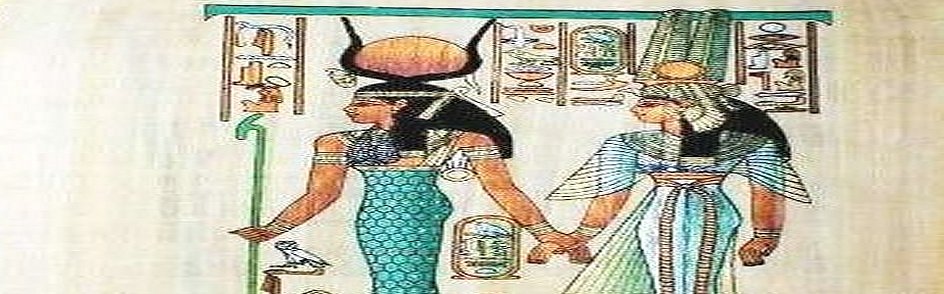
Archetype of the Goddess
A great deal has been made by some authors of the enormity of the difference between the man and the woman. Therefore the goddess aspect of our nature has been talked about as if it were something completely outside the nature of man, and the male god aspect as something foreign to a woman. Dreams do not portray human nature in that way. Of course cultures such as that in the west have passed through a largely male dominated phase, but in past ages the balance was the other way. The important fact is that we each hold the full potential of male and female within us, though physiologically in most cases we are polarised one way or another. However, the deeper one digs the more fully whole one is. That is why the feature on god/goddess above does not stress gender in any way.
As the oldest form of worship, of feelings of awe, were in regard to the woman and her ability to give birth, goddess worship was probably the first human religion. It recognised the miraculous power resident in a woman’s being, the bloodiness and wonder of an emerging new life, and the close link this had with death. Such powerful responses are still very much part of our inner life. The goddess still walks among us. For each woman who is a mother is a goddess, having given birth to Life. See: archetype of the god/goddess; Goddess–holy oriental woman under woman.
Somewhere, deep below the surface of your waking mind, this stream of life starts its flow. In underground caverns it moves through channels formed in ancient times, bringing life to all those tiny lives that, separate or in unity, form the shell you call your body. Remember, for it is one of the greatest truths, that the waters flowing through that gate are the very spirit of the Great Life, the spirit that some have called Creator of the Worlds. Out of it the stars and the multitude of life forms have arisen. Within the universe of yourself you are a young god or goddess playing at creation with the stuff of life. Whatever thought or feeling, longing or emotion you harbour takes form, and is given life, beautiful or awful as it might be. And when you do not own that power, when you push back any part of that flow into the dark caverns of your mind, where fears and wounds, black angers or unspent vengeance lurk in shadows, they are given life. They grow strong until they wrestle with you, invade the living tissues of your body with their sickness, or burst out into the world as action.
There comes into the world now, children whose very nature bears witness to the needs humanity faces. It will be among them the great leaders will be found. Among them are the catalysts of action. Their seeds, in the wombs of mothers open to the Great Life, have already sprung to life, swell into growth and emerge to share life with us. The young will teach the old, for among them are great ones arriving to take part in these momentous times.
She was and is the revelation –
There for any to see the splendour
Of this most ancient goddess –
Revealed and revealing –
While I knew all the ancient fires
That burn in worship,
And heard the voices
Singing to her flowering.
But women are all goddesses within, but many cannot find it in themselves, for it is ancient – for women have a much older and more wonderful inner woman. Yes, you grew from a seed, but no plant or creature grows from a dead seed, and each living seed carries within it all the past gathered from all its forebears. So, the seed in your mother’s womb is as old as and even older than human kind, and you carry that wisdom or memories in you. But in this life you developed a new brain, and the memories you gathered this time are what you built your personality from, but beneath that is a very huge and ancient self.
Example: I could then see a fairly easy way to climb the great tree. So, I climbed up and the top of the tree was like a massive bell of a flower, like a crocus shape. And it was light and colourful. Suddenly I saw a spirit, a beautiful female. It was the spirit of the tree. At this point I was semi awake, and I wanted to hold the beautiful spirit, but realised that the tree was a representation of my life, and so was the spirit of the tree. The spirit sat on me in a sexual position, so I was lying on my back and she was upright. She slowly took me into her, I mean the whole me, as if she was sucking my whole body into her. I realised that I had to die because she wanted to take all my experience of life and endeavour into her and fertilise herself to form a baby. So, I was ready to die and watched her form a new baby, a mixture of her and me.
Useful Questions and Hints:
As a man can I recognise the goddess aspect of the woman who is my mate?
As a woman can I recognise the goddess aspect of myself?
How do I relate to the goddess?
Can I explore her divinity in myself by using Talking As?