Eugene Aserinsky
In 1953 Aserinsky, while working under the direction of Kleitman in a sleep study laboratory, was the first to observe the Rapid Eye Movements – REM – now known to occur during dreaming. As Aserinsky had observed this in the sleep of babies, it was first assumed only to occur with infants. Later investigation proved it to occur with all people observed. This finding started a period of intense research into the psycho-physical functioning of dreams.
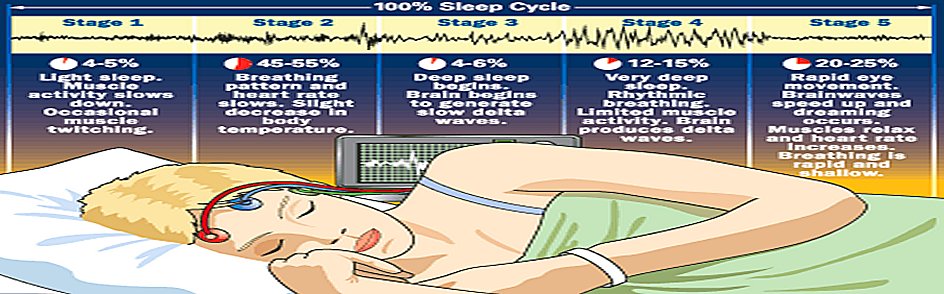
Allan Hobson considers that it was probably the combination of Aserinsky’s innocence, and Kleitman’s experience, that led to the observation of this breakthrough information. During his graduate schooling Aserinsky worked at studying attention in children. His observations led him to note that eye closure was connected with a lapse of attention. This led to the decision to record eyelid movement using the electrooculogram (EOG). This is an important link in the chain leading to the discovery of REM, as children often exhibit REM immediately they fall asleep, especially during daytime naps, whereas adults take longer for the REM’s to appear. Aserinsky therefore quickly noticed that his subjects showed REM when they slept. Kleitman thought there was probably a connection between the REM’s and dreaming. Kleitman and Aserinsky therefore tested the theory using adult subjects. They connected sleeping adults to an electroencephalograph – EEC – and EOG. They were thus able to observe the periodic alternation of REM and non-REM sleep during each night of sleep.
By waking subjects during REM and non-REM sleep, they were able to ascertain that dreams were accompanied by REM activity. When REM’s were detected, the sleeper was woken. The first 27 wakenings produced 20 dreams. As a control, 23 sleepers were then awakened when the record showed no sign of REM’s; and 19 of them failed to recollect a dream. Kleitman and Aserinsky then tested their theory on larger numbers. In the first 190 arousals during the REM bursts, 152 yielded dream reports. These finding were reported in 1953 in Science. Later, in 1955, another report titled ‘Phase of Ocular Motility Occurring in Sleep’ appeared in the Journal of Applied Physiology. It described how other physiological functions also changed with sleep.
William Dement later confirmed the findings. See: Kleitman, Nathaniel; science sleep and dreams.
Some interesting human information about Aserinsky’s discovery is that the child he used as his first subject was his own son, 8 year old Armond. Aserinsky had managed to find a broken-down electroencephalograph machine, which had been abandoned in a university basement. He wanted to tape electrodes near Armond’s eyes, using the machine like a lie detector. But for weeks the machine kept malfunctioning. Each time he fixed one problem the machine would develop another fault. But during this period the pens attached to the EEG would occasionally interrupt their slow, wavy tracing of Armond’s eye movements and begin marking spiky peaks and valleys. This suggested the brain was as active in sleep as it was during waking. This didn’t make sense to Aserinsky at the time, and he felt the machine was still malfunctioning. In those years scientist thought the brain entered a quiet phase during sleep.
Kleitman thought that either Aserinsky had made a remarkable discovery, or that the machine was still not working. The manufacturers of the machine were phoned but offered no help. The leading authority on EEG was phoned, only to suggest that Aserinsky abandon the project. Aserinsky says of this ‘If I had a suicidal nature, this would have been the time. I was married, I had a child, I’d been in universities for twelve years with no degree to show for it. I’d already spent a couple of years horsing around on this. I was absolutely finished.’
He persisted however, and realised that if he recorded each eye independently, and if the pens moved in tandem, then the machine was not malfunctioning. This led to one of the greatest breakthroughs in history on the nature of sleep and dreaming.
Comments
I was the first woman in the EEG study of sleep and dreams. My dissertation was sponsored by Dement in 1960.
Recently, after finishing a manuscript on those years, I was wondering why Aserinsky was studying the all night sleep of a subject at that time-don’t remember reading anything about it. Your article was very helpful. Thank you.
Judith – It means a great deal to me to recieve feed back like that. Thank you.
Tony
Dr. Gene Aserinsky was a dear, dear friend of ours and he will always be remembered not only as a grand person but as a well respected physician. Also we miss his great sense of humor and miss him terribly. This comment is written on behalf for Dr. Fernando & Maria Dominguez of Huntington, WV and Dr. Cesar & Cora Navarro of Getafe, Madrid.
Thank you for comments.
Gene Aserinsky was a great man, and has left his mark firmly in history.
Tony
This is a good description of Aserinsky and everyone should read it. Especially if they have a project on him.
Thanks Jeremy. I loved researching such features and writing them.
Tony