This colourful and delightful book has one of the best introductions to dreams and understanding them – along with How To Do It. Oh yes, it also has a full dictionary of dream symbols.
Its is available now from Amazon in the UKin USAand also in Australia – Brazil – Canada – France – Espana – India – Italy – Japan – Mexico – Netherlands through Amazon
Here is a tiny peep into the book:
THE AMAZING EXPERIENCE OF DREAMING
Research into dreaming has shown that each of us dreams about four or five times each night. While we dream, our voluntary muscles no longer respond to our attempts to move, and our eyes move rapidly under closed eyelids. Our muscles are paralyzed in this way because if they were not, we would actually run around or act out what we are dreaming. Animals in which the brain area that blocks such impulses has been damaged do live out their dream in movement, practicing hunting or survival tactics. So we see that dreaming extends your range of experience to the point where you double or treble your experiential life span; while dreaming, it is as if you are living what is being dreamt.
WHAT WE CAN LEARN
This ability of the mind to play with experience or information, to rearrange it and try it in different guises, as one does in dreaming, is fundamental to the creativity and functioning of human life. Dreams reveal to you what you fail to see about yourself while awake. They show the directions you are taking in life and unveil things that lie beyond the boundaries of your five senses. But their information is sometimes obscured in apparently strange drama or feelings. Using the techniques presented within the following pages will enable you to gain insights that can transform the way you live, allowing you to release old tensions and hurts.
Whether we are aware of it or not, when we write our whole body takes on a certain posture, a mood or emotion may be present as we write. Our age and state of health, as they underlie our movements, also express in the subtle actions of writing. Therefore the marks we have made on paper are the result of what is going on in our body and mind at the time of writing. What the Master, Schermann, did was to project the process backwards to build up a living impression of all the feelings, the movements, and the type of body and mind that created it.
Cornelius Tabori, a journalist who investigated Schermann in Austria, describes in his book My Occult Diary (Rider. UK. 1951) what happened when Tabori showed the graphologist an envelope written by a woman Schermann did not know and had never met. He says, “Schermann looked at it briefly and then started to work. He described the woman’s hair colour, how she looked, her figure, even her face. Suddenly she seemed to come alive before me in Schermann himself, because he imitated her voice and the body movements she made. To my amazement he told me the story of her life. It was uncanny the way he had become part of her, and told me exactly about settings, people and objects important to her, even to talks we had shared. I had never experienced anything like it before.”
Something that no other graphologist had ever managed before Schermann was his ability to look at a person, then reproduce their handwriting. This is one of the clues to his great skill. His insights into handwriting, linked it completely with the person and all aspects of their body and mind. Because of this he was often asked by doctors to diagnose a persons illness by looking at a sample of their handwriting.
Graphology is the study of handwriting, and has many uses. Some businesses ask a skilled graphologist to examine the handwriting of people seeking top jobs in their company. The graphologist would describe the person’s strengths and weaknesses. Individuals often seek help from a graphologist to show what training would be the best use of their natural talents. The police use handwriting experts in cases of forgery.
One of the greatest of modern graphologist was a man by the name of Herr Schermann. From early childhood, Herr Schermann, instead of collecting stamps or badges was fascinated by envelopes. He amassed a huge collection and would sit looking at the handwriting, telling himself stories about the people who had written them, trying to form a picture of them. His interest didn’t disappear as he grew. Although like any graphologist he studied how people shaped their letters, what slant was on the words, how powerful the force used in writing, he also had another dimension to his skill. He appeared to ‘see’ the person who had written the words he studied. Some sense beyond those of sight, hearing, smell, taste and feel was operative. Some intelligence beyond a clever mind was at work.
An image in the handwriting
Herr Schermann often worked with the police. One of his most famous cases was regarding a bank forgery. His work on this case far exceeded analysis of whether the writing belonged to the person it was stated as. On 28th June, 1922, the Wiener Bank received a letter from a man signing himself as Herman Zagg. The letter said that on the 23rd of June £80,000 had been deposited in Zagg’s account. It asked the Wiener Bank to transfer all of the money to another account in Anglo Bank.
The account was checked, and the money was there. The transfer would have proceeded except that through the carelessness of the junior bank clerk who was to enter the transfer, the pay slip did not get dealt with for two days. Therefore, to make sure the money was still in the account, and to avoid being caught for negligence, the clerk went to the carbon copy of the entry instead of into the bookkeeping office. He was amazed to find there was no entry for the account. He therefore hurriedly told this to his seniors. It was then discovered that someone had written in the £80,000 at the bottom of the day’s entries. The writing appeared to be that of the young woman who wrote up the entries. She was therefore suspected of forging the entry to get the money. Someone was immediately sent to the address Herman Zagg had given. No one of that name lived there. Obviously someone within the bank was the forger, and was working with an outside accomplice.
The police were asked to investigate, but could not discover who the forger or accomplice were. Schermann was then asked by the bank to help. Firstly he looked at the letter received by the bank from Zagg. “The person who wrote this is a tall, fat man,” he said. “His work calls for much concentration, has led to eye strain, and needs little physical activity. Most of the time he is bending over his work. It is not mental work, but he needs to be precise and accurate. He is probably a watchmaker or goldsmith.”
From this the bank could assume the writer posing as Zagg was not one of the staff of the bank. Even so, whoever made the entry in the bank ledger must be an employee. Therefore Schermann was asked to look at the handwriting of fifty of the people working at the bank. Among the fifty was a man named L.B. who Schermann said was the forger. It was not the young woman in charge of the ledger. “This man,” Schermann said, “is someone who has long planned this crime. He studied the writing of the woman for a long time, and is an artist at copying people’s handwriting. He needed an outside accomplice. I have a mental picture of him persuading the goldsmith, promising much gold for him to work with. L.B. knows the forgery has been discovered. Therefore I need a sample of his handwriting today. To see what he is planning.”
Genius at work
Looking at the new sample, Sherman’s analysis was that “The man knows he is going to be discovered. Yesterday he explained to his parents that he has committed a crime, and asked them to forgive him. Both parents are ill, and his mother said she would commit suicide if he were sent to prison. It would be difficult for his father to survive also. I can see L.B. is going to say he is innocent until the very end. If you agree not to tell the police I will get him to confess. I want him to remain free to support his parents.”
The promise was given as, so far, no money had actually been stolen. The young man was then called to the office and accused of the crime. As Schermann had foretold, he maintained he had nothing whatever to do with the forgery. Then Schermann asked him to write and sign the following:
“Wiener Bank-Verein
Organisations-Bureau
I have nothing to do with the hundred millions. Vienna 11 July 1922”
Writing these few words betrayed L.B’s secret motives. The man’s first name was Ludwig, but he had started to sign his name as ‘Loui(s). He quickly crossed out this mistake and wrote Ludwig. Looking at this Schermann faced him and told he had taken a goldsmith as an accomplice, and that he had told this man his plans to escape to Paris and use the name Louis. The forger’s confidence shattered and he gave a full confession. The accomplice he named turned out to be a goldsmith who was eighteen stone (252 pounds) in weight. So Schermann had not only correctly assessed the forger and his motives, but had also given an exact description of the accomplice. The forger also gave details of his sick parents that confirmed Schermann’s accuracy.
The young forger was dismissed from his job, but no police action was sought. Due to Schermann’s kindness, the man was able to continue his life without a criminal record. He later wrote a letter thanking Schermann for saving him from prison and complete disgrace.
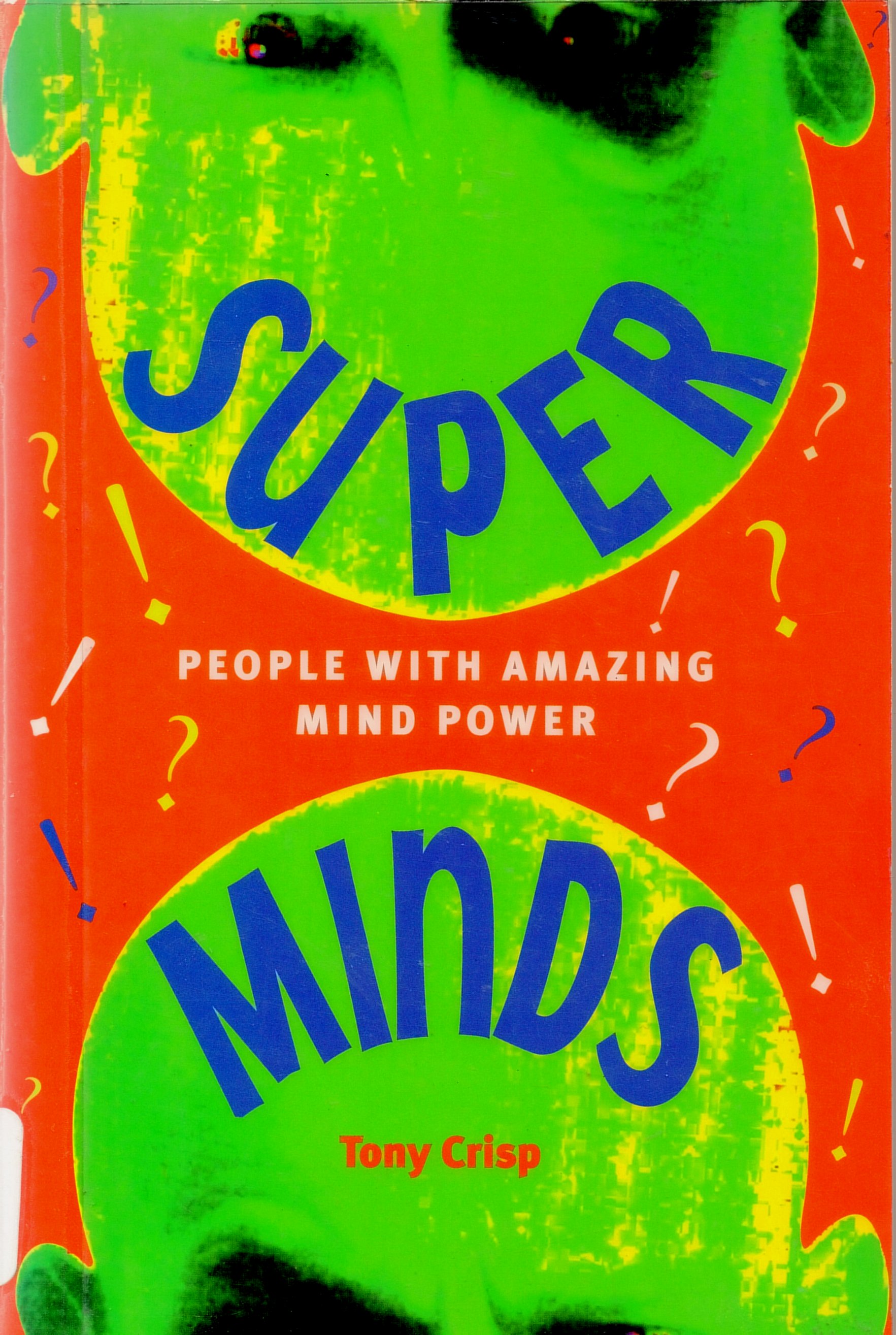
The above is a chapter from Super Minds – People With Amazing Mind Power. Available from Amazon in the UK and USA – see https://dreamhawk.com/news/34051/ for options and list of all the chapters.
Super Minds is a series of true life stories of weird and wonderful minds. Like the man who could remember EVERYTHING that ever happened to him, or the extraordinary abilities of the boy brought up by WOLVES.
Or the girl who could read her friends’ MINDS and the man who could suddenly speak foreign languages NEVER having learnt them! But that’s not all! YOU have an amazing mind too, and this book shows you how to make the most of its hidden powers!
A great deal has been written about using the postures to aid such conditions as arthritis, hypertension, etc. But I want to show that we can use the postures specifically to heal PEOPLE.
By people I mean the personality in the living body. But what are people, and what is a person? It is quite a complex subject. Yet if we cannot have some fairly clear view of what a person is, we will approach one in a hazy way. And, of course, the hazy approach might be toward oneself.
The term personality usually means the essence of all the characteristics and responses by which we differentiate between one person and another. One aspect of this is, of course, their body, its sex, shape, skin colouring, voice quality etc. But people have different ways of going about things. For instance a friend Bill, when I introduced a girl friend, took me to one side and asked me – seriously – if I realised women had smaller brains than men, and what on earth was I doing with a female. Bill was in his late forties and not married.
Even if I hadn’t been able to see or hear Bill, his response to the situation was recognisably different to that of other friends. If we could draw a graph of all Bill’s responses to life, his graph would be completely different from many people. In fact it might be that everyone had a slightly different graph, rather like finger prints. Nevertheless there would be similarities. Some people would be high in attraction to the opposite sex, others would be low. Some graphs would show highly developed intellects, others highly developed emotional response, and so on.
To simplify this even further, instead of seeing the personality as a graph, consider it as represented by a house. Let us use a grand house which has many rooms. The rooms include a dining room, a nursery, a library, workshop, bedrooms, a games room, a small chapel, a large cellar, and an adequate sick bay. Dreams often use such a house to represent the different facets and functions of ourself. The dining room is our urge to eat; the sick bay our healing processes; the library our intellect; the bedroom our sex life or sleep; the cellar our unconscious; the nursery our childhood experiences, and the workshop our skills. Of course we have many other aspects of self than symbolised by this particular house. Some dream houses include a turret above the roof from which one can see the sky, stars, and countryside. It symbolises our sense of the cosmos and relationship with it.
For example many people are either centred on their genitals, stomach, emotions or intellect. To be whole we need a balance between our body its movements, our genitals, our hungers, our emotional feelings, our voice speech and song, our ability to see and gain understanding of what is viewed, our head with our thinking our memory and higher brain functions such as creativity, intuition and spiritual insight.
If we translate the different graphs of people into the rooms of the house, what we might see is that some people spend all their life in the kitchen and perhaps don’t even realise there is a beautiful library or turret in their house. As a personality their whole life is so bounded by their activities of caring for their children and doing the housework that they consider themselves to be only those things. Perhaps when their family leave home and husband dies or divorces they have a breakdown because there is nothing left for them or of them. Or perhaps we have a young man, Bill, whose life is spent in the boxing ring in the games room. He sees life as a fight in which he has to be tough and ready to defend himself. He considers himself to be a’ man .
If we look around we see some people trapped in the cellar of their instinctive drives and fears. Some people move about in the turret, library and dining room, but never go to the bedroom or games room. Others are frequently in the workshop, bedroom, and library, but do not even believe there is a turret or cellar. Wholeness means that we are not trapped in any one area of ourself. It has in it something similar to the yoga ideal of liberation, which in one sense means we are no longer locked into identification with any aspect of ourself.
FRAGMENTS AND FUNDAMENTALS
Bringing this back to ways of wholeness through bodywork, a simple example will illustrate how it can function. Bill, the boxer, has a particular relationship with his body. His personality, identified as it is with the picture of himself as a tough, manly fighter, expresses through the body in postures and movements which express this image of himself. Any other urges which arise from the other facets of himself, such as tenderness, or feelings of vulnerability, may be pushed out of awareness. If we asked Bill to take on a yoga stretch such as the Tree (Vrksasana), and do it in the quiet mood it needs, he would move out of the usual ways he expresses physically. He would be gently moving beyond the boxing ring feelings in himself, into areas he may not have felt before.
Some macho males night feel foolish in the Tree because it is a soft, although concentrated, posture. But it is because of this very aspect of body work that it can be used toward personal wholeness. Therefore, if we build a theoretical map of the basic ways people are fragmented, and what sort of posture or movement would balance it, we have the start of useful therapeutic ways of using our body.
Many great thinkers and physicians have attempted to define a human being in a way useful in healing. Carl Jung said each one of us have a main way we relate to the world. We respond through our FEELINGS, or our THINKING, our SENSES, or our INTUITION. Overall, he said, we are either INTROVERT or EXTROVERT.
Karen Horney, a woman psychiatrist, said there are three basic reactions or movements we make in life. They are TOWARD – AGAINST – AWAY. Toward is when we feel loving “toward” someone, or giving them something, or reach out to them warmly with our body. Against is when we dislike or oppose someone, push them away. Away is when we have interests outside or are disinterested in someone or walk away without a feeling connection.
It is also important to recognise that there is a MERGING and EMERGING aspect of human nature. When we are a baby in the womb, and even after we have been born, we are very “merged” with our mother. When making love, and there is a time of losing oneself during intimacy, there is a “merged” experience. When we grow and gradually depend less and less on our parents, then we are “emerging”. When we have got close to someone and then want to get on with other activities we “emerge”, or break the connection in the degree of intimacy which existed.
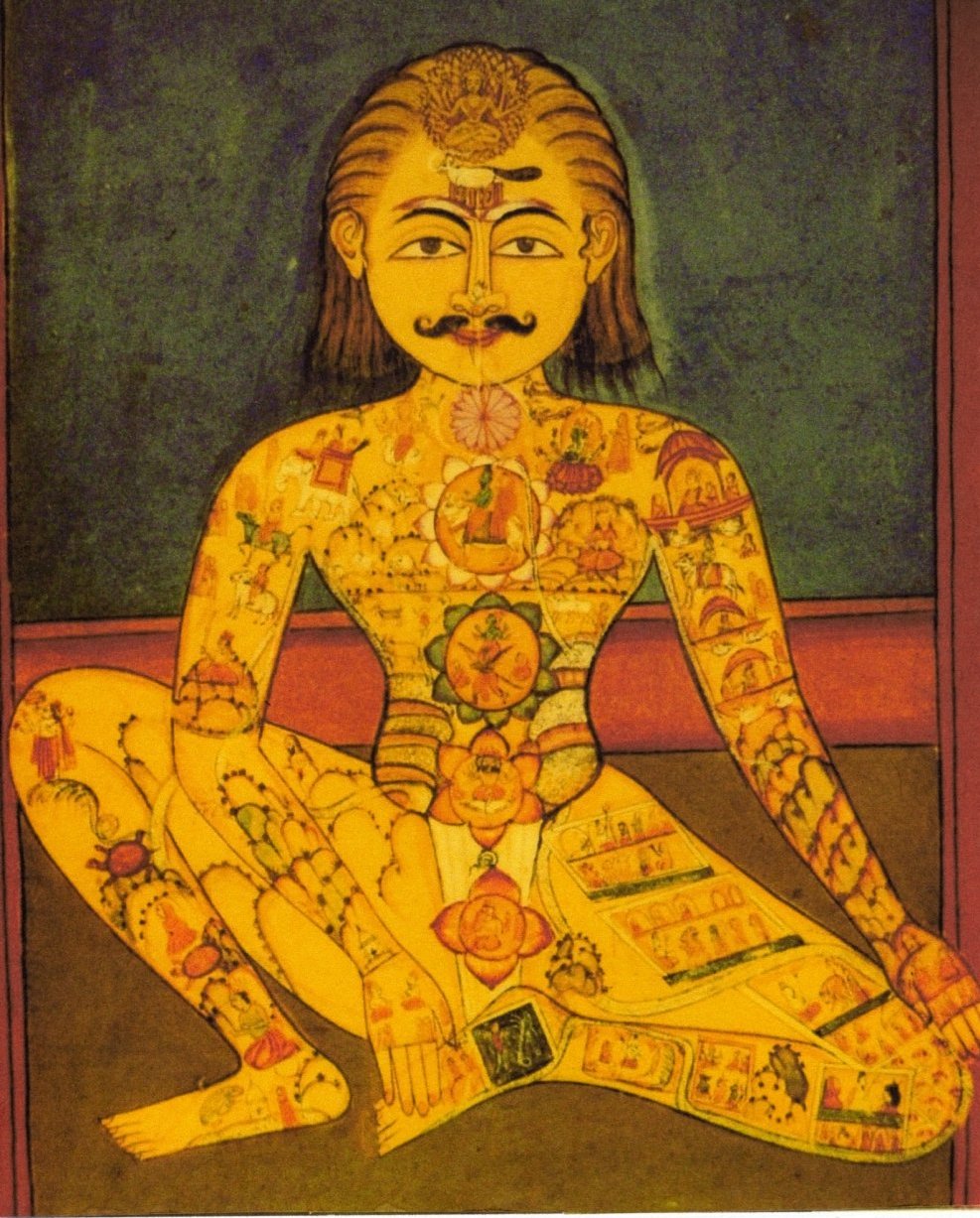
Perhaps the most comprehensive view of human nature is that represented by the yoga illustration of the chakras. But to start with, let us consider some of the views stated above. One of the fundamentals of human existence is expressed in sleeping and waking. These extremes enter into many other areas of life in some degree. Sleeping is a profound expression of introversion or withdrawal; while waking is an example of extroversion or self expression. The consideration of withdrawal and expression is a useful place to begin learning how to use the body in attaining wholeness.
Few of us express ourselves very fully. When we watch an athlete or gymnast and compare the way we walk or move with them, our own movements will probably appear withdrawn or not expressive. We seldom express our feelings very openly, or really explore our own creativity. Generally we can live with this state without great disturbance, but sometimes our non expressiveness becomes troublesome. We can call this state WITHDRAWAL.
Some years ago I was asked to help a woman in her sixties. She was experiencing rheumatic type pains in her arms, frequently felt depressed, and didn’t go out of her house much. Her physical movements were cautious, and so overall she comes within the category of being withdrawn. I helped her to begin making strong movements with her arms, and gradually with the rest of her body. This stimulated her feelings of pleasure in her body, helped her to express rather than withdraw, and within a few weeks she no longer had her arm pains. She started going out again, bought herself a new outfit of clothes, and her depression lifted.
Withdrawal shows itself in many degrees, and might be obviously vocal or emotional rather than physical. Also, withdrawal is given many names, such as the person being quiet; shy; lethargic; a drop out; cautious; nervous; depressed; etc. Sometimes a person confuses their withdrawal with their identity. In other words they say, “But that’s how I am. I’m just a quiet person.” What this really means is that their withdrawal is such a habit, or is so long standing, they believe it is them, rather than simply a way they express. So they may be trapped in it. Coming out of withdrawal is not simply a matter of leaping about and being “expressive”, however. If we are going to work with this situation we therefore need to understand a little of its causes.
As already explained, the everyday form of extreme withdrawal is sleep – and of course death. If we could not withdraw we could not balance our extroverted activities. We would be trapped in “Expression”. Prenatal life is also a form of healthy withdrawal. In adult life, withdrawal is only a problem when we cannot move easily in and out of it. If we consider how we moved out of the “withdrawal” of babyhood though, it helps us to understand how we may be stuck in it. Firstly we begin to express ourselves through reaching out for our needs, crying to be fed. If these are satisfied we can stretch further in learning to walk, talk, explore, climb, shout, and discover the complexities of social life and relationships. If at any point there is pain, shock or non satisfaction, the urge to extend oneself is either not satisfied, hurt or shocked, and draws back.
The subtle urges to reach out, to express oneself, to explore are life forces which lie behind the growth of ourselves as a person. We cannot see them as easily as one might a leg or head, so they are often overlooked. But they are vitally important. Four child specialists at the John Hopkins Hospital in Baltimore carried out an experiment relevant to this. Twelve children, ranging in age from three to eleven, had been placed in their care. All of them were only half the average height for their age. Investigation had shown that all of them came from quarrelling, unhappy, disturbed families. They were placed in a convalescent home with a peaceful environment, and then grew rapidly. In a year one seven-year-old grew twelve inches.
Some of the children returned home, and despite their abnormally large appetites, their growth stopped. Tests on their growth hormones showed that within a few days of returning home the growth hormones ceased to circulate. In his book “The Puzzled Body” Caron Kent shows how adults whose impulse to grow had been withdrawn in childhood experienced amazing changes in their body when they released their growth energies.
THE FEELING IN THE POSTURE
When we emerge from the womb, our being is confronted by a different world. In the womb there was little change. There was no otherness such as other objects or people to deal with. There was no need to reach out for one’s needs because food came automatically. In life outside the womb, food might not come automatically, certainly not as we mature. There are other people and objects to deal with. Change is occurring all the time. If as a baby we find no comfort or love when we are born, it could be that we do not have any urge to adapt to this new life. Perhaps we do not want to be involved in its change, its opposites, its need to find our own needs and to cope with other people. We may wish to stay in the womb condition. So although our body matures, we might not develop into an outgoing explorative person. We might “drop out”, or withdraw into alcoholism. In milder forms we might be quiet and inexpressive, not wishing to be involved in what is going on around us.
Therefore, when we use body movements or postures to help ourselves or someone else to wholeness, we may meet the feelings which are behind the withdrawal. There is no problem in that. We simply need to be aware that we might arouse the original feelings of hurt, shock, or decision, and when we do so be ready to feel and re-evaluate them.
In helpfully dealing with withdrawal we will need to know what postures express it. The two most direct are the Child Posture and the Corpse posture. In helping someone work on withdrawal I often use the Squat, as long as it is comfortable. Whatever posture we use, we need to start with eyes closed while in it, and let ourselves relax and feel comfortable in it. If you are aware of how you feel in the posture, you may not have a spontaneous urge to come out of it. That feeling is important, and must not be dismissed. It is the evidence of what has happened to your growth/expressive impulse, and must be honoured and worked with.
Let us assume you are working with the squat posture. While in it with eyes closed, let the head drop, muscles relax, and realise it is a physical expression of not having to look at people; of not expressing actively in the world. When you have got the feeling of relaxing, of withdrawing into a comfortable non-activity, gradually unfold and stand up. As you stand, breathe in. As you come erect take your arms slightly backwards to open and stretch your rib cage. Let the head go back slightly as well, so the whole posture is dynamic and open. Be aware of the different feeling in this posture than in the squat. Now move into the squat again. As you do down breathe out and relax. Move between the down, withdrawn posture, and the up, expressive, dynamic posture, noticing the different feeling in each. If you are using the yoga stretch the Child posture, you could emerge into the Camel.
But you need to be aware of the different feeling in each and learn to alternate between them with awareness. Whatever postures you use, aim at bringing more of yourself into the dynamic posture (more of your feelings, more pleasure, more awareness, or more energetic intention); and aim at letting go more in the withdrawn posture. Recognise that you need to be able to allow yourself a comfortable place, a resting place, a place of privacy. There is no sin about withdrawal. As already said, it is only a difficulty if you are stuck there.
That is sufficient for a general workout in regard to withdrawal. Once you become aware of the different feeling states in withdrawing and expressing, then you can use the same principle in many postures. If withdrawal is a real problem though, you will need to add a bit more to the practice. Use the same approach, but when in the withdrawn posture, do not automatically come up. Recognise your need to stay “down”. Give yourself permission to stay in the comfortable down position until you can feel an urge in yourself to get up. Don’t try to push away the urge to stay down. Watch it, put words to it expressive of how it feels. Notice any change of feeling. See if any impulse comes to move – not a thought, not a disciplined command. We are working with the subtle feelings which are behind withdrawal.
As you are down, see if you can recognise where or how the urge to stay “down” influences your everyday life. If you have not discovered a drive to get up within ten minutes, get up anyway, and come back to the posture on another day, until you can feel an urge from within yourself to stand up. It may take several practice sessions, so be patient. You may have been relating to that part of yourself in an impatient way before, feeling that it “must” get on with life. Such drives in us will not be bullied, but they will respond to being listened to. That, surely, is part of yoga – not to kill (any part of oneself), but to approach it with compassion.
Once you contact the feeling in you which is ready to emerge into the world and be involved in its change, its difficulties and opportunities, allow the feeling to flow into the expressive postures you do, and in body movements such as standing, walking, and working. Move between the squatting and standing again, letting the urge to express flow into the standing, and the ability to let go to be felt in the squatting. Many of the opposites in yoga, such as bending forward and backward, are ways of approaching such a balance between the different polarities of our being. Doing them with awareness of how we feel in them greatly increases their efficiency.
If we approach our body as if it were purely a muscular and mechanical function, we will miss a great deal of its mystery. The very movements we make are responses to thoughts and feelings. Some of our most exquisite movements arise out of love and tenderness, or patient craft. Because our body is made up of cells, and what we call SELF arises out of the feelings and consciousness life in those cells generates, we must honour the body with feelings and wisdom. If we approach it with those attitudes, it will speak to us more of its unique experience.
Intuitions about the cosmos; the perhaps almost unnoticeable promptings or motivations which occur through life leading us in a particular direction – destiny; hopes or wishes. In some dreams a star or stars, represent what is eternal or unchanging in your nature; your most central being or spirit; also the subtle influences that shape and direct you. See: star under shapes and symbols.
None of us exist without the influence of stars. Our Sun is a star and without its influence we would not have appeared. And that is a massive influence.
Looking at the stars in dreams shows you seeing beyond the everyday life and seeing the grand and underlying cosmic forces which are part of your being.
A shooting star coming down to Earth – is a magnificent sign. I think it points to a message of great importance for you – a message of the wonder of your own birth and all it will lead to. It represents an impulse coming to your awareness, that arises from the hugeness you have within you.
Many people as their awareness reaches beyond what they feel is their normal self feel scared. Such resistances cause us to create awful dreams and fears as a means of avoiding our own inner world and its wonders. We feel that we will be swallowed up and we will die. It is important to say that when we meet the experience of powerlessness through becoming aware of the hugeness of your Life, which we are usually unaware if, it can feel like something alien or attacking, and it is a shock.
Each Interprets in His Own Way the Music of Heaven
Chinese Proverb
Many of us have lost touch with the natural world and do not honour it as part of our life as many native peoples do, and this we can learn from our inner world and our dreams. We do not tend to the hurts we feel as a natural animal that we are, so become sick in our soul – a soul that we deny we have.
In fact many ancient and some older civilisations still surviving, such the Australian Aborigines and the Native Americans, felt that if a person was not aware of their inner world they were in some way crippled.
So in life and sleep we have two powerful actions working in us. The first is our waking experience based on having a body, its limitations, vulnerabilities and a particular gender. Our second is the power that gave us life and continues to express as dreams, in our breathing and heartbeat – our life. This I have given the description as the Life Will.
While we sleep our conscious self is largely or totally unconscious, and while we dream our voluntary muscles are paralysed – therefore another will or motivating force moves our body. So we have a Conscious Will, and what I will call a Life Will. The first one we have experience of as we can move our arm or speak in everyday activities; but the second will takes over when we sleep. See Sleep Paralysis
This Life will can move us to speak, to move our body, and in fact do things that we cannot do with our Conscious Will and in fact runs all our important life processes like heart beat, digestion and also dreams. It is the Life will that expresses as our inner world.
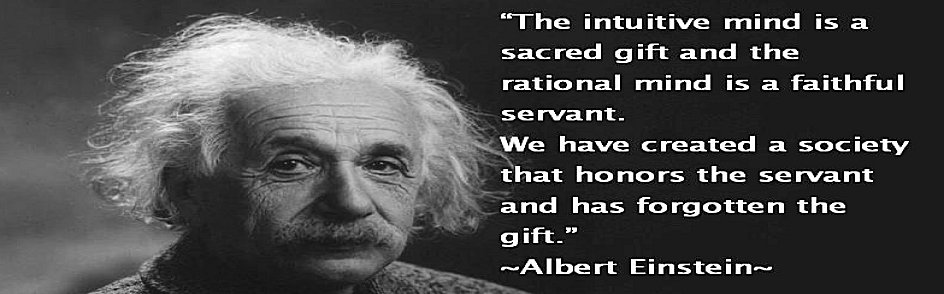
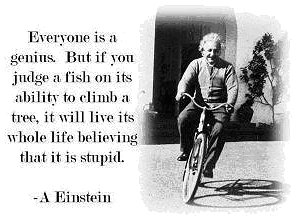
Many people are in touch and are guided by their intuition, which is the same as exploring their inner world. It is the inner creative self that artists and musicians are in touch with. Many of them find it by expressing themselves without thinking or planning, but letting their inner world/life flow spontaneously. They are creative because they are able to express from a huge experience we all have within us. But of course being able to be in tune with your inner world is not only found in artists and musician but also in mothers, women who find inspiration in work and living, in anybody with an open receptive mind as with Einstein – children are especially living more in their inner world, and should not be put down or criticised for being what has been called ‘imaginative or telling lies about what they are experiencing.
The huge experience comes from being a seed in your mothers womb, because no plant or creature grows from a dead seed, and each living seed carries within it all the past gathered from all its forebears. So, the seed in your mother’s womb is as old as and even older than human kind, and you carry that wisdom or memories in you. But in this life you developed a new brain, and the memories you gathered this time are what you built your personality from, but beneath that is a very ancient self, a huge experience of life from the beginning. See Using Your Intuition and Opening to Life
How to Reach or Enhance Contact With Your Inner Genius
I said above that many people find it by expressing themselves without thinking or planning, but letting their inner world/life flow spontaneously. So in such cases they may have learnt how to do it unconsciously. But learning how to do it step by step makes it more available and understandable. So let’s take our first steps into the amazing resource we all have.
So, the first step is to recognise something of what we are trying to enter. I have called that the inner world, but there are many other names people have put to it over the centuries. Some of these are the subconscious and unconscious; the psychic world; enlightenment; the spirit; intuition; the spiritual world; hallucinations; lucid waking dreaming; kundalini experience; superconsciousness; Buddha awareness; samadhi; Christ Consciousness; Krishna Consciousness; Heavenly awareness; and many others.
Of course there are many levels of it, from the Everything of the unconscious to the clear awareness of oneness and unity. But I list them all because each of them starts with being unknown to the conscious ego. The lowest levels of consciousness are just as unknown as the highest. This means we have to learn to watch, listen and learn.
Just as these bears do, not from learning the lessons of survival from their mother’s speech, but from watching with every fibre of their being, and then copying. And that is still true for us, for the most fundamental lessons we learn from parents are not via speech but from unconscious copying. For more insight into that see Conjuring Trick
This is the very basic learning method and was how we gained so much information when very young. We learn to copy mother’s expression, to speak, to avoid hot surfaces and a thousand other things without ever going to school. Look at the cubs expression, they are watching, listening and learning intensely from their mother – the basic learning method, without words. Unfortunately, if mother and father are a neurotic mess, you have a lot to relearn.
Although this feature is about the inner world, the world of everyday life is also extremely important. In our everyday life we exist in this moment more than anything else. So, we do what is necessary to deal with what confronts us at the time. To do so we use what we have learnt and what personal attitudes we have to meet life’s experiences. In doing so we are using what talents we have or lack in our personality.
Our inner life is like entering an immense and many faceted library. But entering the library does not immediately make you wise because it doesn’t respond unless you have questions you seek answers too.
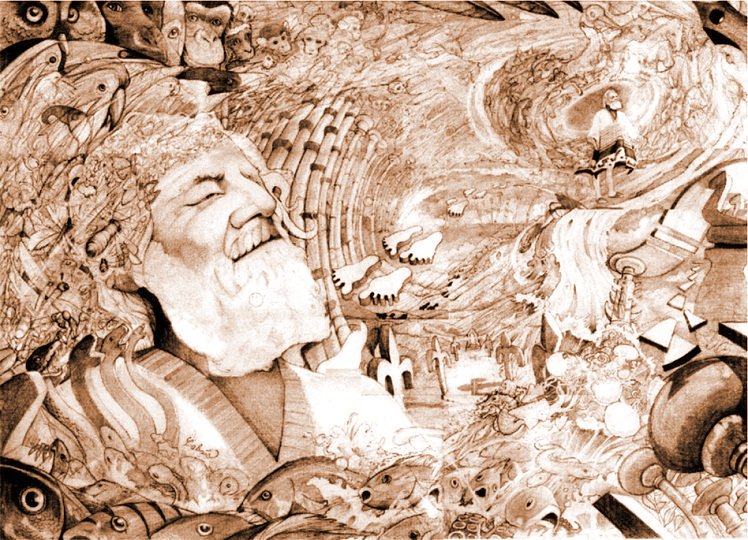
Otherwise it is just like Carlos Caban’s drawing of the inner world, containing thousands of links with what we all hold within us. There is so much of it that if you are suddenly opened to it without preparation you might feel you are losing yourself or badly scared.
Step One
There is a great deal written about killing out the ego, that in order to be able to be more aware of the spiritual world one needed to diminish the ego. For example the fundamental aim of Buddhism is to find liberation from the things that bind consciousness to illusory concepts of oneself. This goal, called Liberation or Nirvana, is sometimes described as the blowing out of the sense of self or one’s ego. Also a meditation exercise used by some of Ramana Maharshi’s students was, every time they used the word ‘I’ they cut their arm as a means to stop them thinking about their ego/themselves.
Of course there are many levels of our awareness, from the Everything of the unconscious to the clear awareness of self consciousness. But all of them start with being unknown to the conscious ego.
But of course to be able to let go of something we first have to make sure it is not in control of us, meaning, we can let go of our ego while our ego has such a controlling grasp on us. Our emotions, fears and impulses often have such a hold on people. Mary people are in so much emotional pain they say the can’ t bear it, and some commit suicide. I liken this to a wild tiger loose in your house that keeps biting you – causing the emotional pain. But if in some way you were strong enough you could get hold of the tiger and it could do no harm.
Recently I was explaining to a friend that I wasn’t eating that day and they decided to also eat no more that day. But as the evening came on they quietly ate and ate. Most of us are like that, we are helpless when it comes to resisting our impulses, like the impulse to eat, the sexual impulse, or the impulses arising from our traumas. So you cannot let go of something that has got control of you.
We cannot let go of something that has hold of us – so a strong ego, not an absence of ego is needed if we are to enter the depths of our consciousness and what waits for us there. See Going Beyond
To help us to strengthen our ego so that we can actually let go of it and ourselves it might help to use some of the following.
Carl Jung said that the reason we no longer are able to experience God is that we cannot bow low enough
Physical movement: In traditional use of yoga postures the aim was to be able to sit without movement for three hours, and to do it each day for three months, because it took a long time to retrain the inner wildness. The postures were to strengthen the body in order to be able to do that.
Sexual expression is another way the instinctive self expresses. Again it should not be harnessed by repression, but by gradually leading up the body into higher forms of energy release. See Energy Sex and Dreams
Hunger for food or sensual satisfaction is also instinctive. This can be seen when a new born baby has the urge to do after it starts to breathe is to reconnect and feed from the breast. So regular fasting was an ancient method, but it should not be done from the attitude that one must lose weight. See Fasting
The emotions and their instinctive expression in humans can be experienced as panic attacks, painful emotional reactions to relationships, suicidal tendencies, and generally being shattered by your emotions. This generally links with disturbed breathing patterns such as breath holding and not be able to breath smoothly. A traditional way of healing this is by using controlled breathing. Ways of doing this are – but remember, it takes time to change lifetime habits – so see 1-4-2 Breath Control and The Breath Meditation
The voice is another way of instinctive expression. I have met a few people who cannot stop talking, and a way to deal with it is to become aware of it and harness it. Some of the great beings who took this path tell their story.
In 1927 Buckminster Fuller stood on the shore of Lake Michigan contemplating suicide. He said to himself: ‘I’ve done the best I know how and it hasn’t worked.’ He was still grieving the loss of a daughter who had died five years earlier; his business had just failed. He was penniless and 32 years old. He wondered how he could support his wife and newly born baby, but, after struggling with his despair for hours in the dark and the freezing wind, he decided to live the rest of life like an experiment. He wanted to discover whether the golden rule of life was dog eat dog. He would find out by seeing what could be physically demonstrated. To free his mind of conditioned thinking and reflexes he stopped talking for a year. He is now known for many, many achievements.
Fuller said that he had experienced a profound incident which would provide direction and purpose for his life. He felt as though he was suspended several feet above the ground enclosed in a white sphere of light. A voice spoke directly to Fuller, and declared:
“From now on you need never await temporal attestation to your thought. You think the truth. You do not have the right to eliminate yourself. You do not belong to you. You belong to Universe. Your significance will remain forever obscure to you, but you may assume that you are fulfilling your role if you apply yourself to converting your experiences to the highest advantage of others.”[10]
Mental activity is another escape route. It is a way people sometimes use to prevent them for experience other aspects of the mind or consciousness. Many disciplines tell people to stop thinking, to quieten their mental activity. That is one way but there is also Intuition which leads one past the age old responses. Also try Opening to Life
Step Two
This step is designed for those who consider themsevles as having no intuition and do not believe they have an inner world.
There are multifaceted ways of sensing things. If you consider an early human being, prior to the emergence of complex speech and the ability to think in the abstract symbols we call words, all their thought would most likely have been in images like a waking dream. A human couple in the dawn of our history, standing in wild terrain and seeing dust on the horizon, would need to know very quickly whether the dust was a sign of food to eat or an enemy to run from.
Without the tool of thought using words, they would have relied upon their inner response, and their unconscious scanning of experience and instincts. The result would have been experienced as urges to movement and emotion, and as mental imagery. I believe it is because of this long period in our past history, when our ancestors relied on what we might now call intuition – this rapid scanning of information beneath conscious awareness – that we have this latent ability of insight without reasoning.
To get this movement response there is an easy way. At first you may be ‘stiff’ in your response, but even so you will usually get a direct reaction. A more fluid or subtle response – one in which greater detail or insight arises – comes with practice. The following steps are designed to help even the least intuitive of people find greater access to their own wider awareness.
The Oxford Companion To The Mind, it says of intuition that in fact we are all using intuition all the time, in that we do not often go through the steps of logically examining an argument before making a decision. “In this sense” the book says, “almost all judgements and behaviour are intuitive.”
The writer goes on to say that ‘women’s intuition’ may be largely the result of subtle and almost subliminal cues arising from gestures, snippets of conversation and gathered knowledge of behaviour patterns and motivations in social action. So, recently while driving quite fast around a large roundabout a car pulled out in front of me from one of the side roads. The driver gave no signals so I was uncertain if he was going to carry on across my path, or take the next exit off the roundabout. I immediately pulled across to get behind him. This all happened fast and so there was no time to reason at length about what to do.
Returning to the example of the car, the driver who pulled out actually took the next turning off, so I could have driven across his path. The safest bet however, was to follow behind. After the act, with more time, this could all be reasoned out and the decision analysed. At the time however, I needed intuition because of the speed. Intuition in this case was the result of unconscious or subliminal experience of driving gathered over many years, called upon and expressed as automatic or intuitive response.
Imagine you are going to communicate with a part of yourself that has an unlimited amount of information and influence to share with you. What this dimension of yourself gives you will be in direct response to what you ask. So the question you ask will be the factor shaping the response. Therefore it is occasionally worth asking what is the right question to get effective help. Remember that all you receive has to pass through your own body, your emotions and your mind. YOU are the instrument that transforms the communication into understandable experience. If your body is full of tensions, alcohol and drugs there will obviously be interference. If your emotions are taut with anxiety, flooded with disbelief, there will be blockages. If your mind is rigid in its opinions, locked into habits of thought, you will need to practice listening and receiving. Even if you can be ready to drop these for a few moments the channel can clear.
We can call it body dowsing. Dowsing is not always connected with a stick or rod though. Navaho Indians in the United States practise what they call ‘trembling hands.’ After a simple ritual they allow their hands to move spontaneously. From these movements they understand questions asked of them. The American anthropologist Dr. Clyde Kluckhohn and his wife investigated a practitioner on a Navaho reservation. Mrs. Kluckhohn had lost her handbag three days previously so asked the practitioner, Gregorio, if he could find it. Standing in the open air on a hill, and after rubbing corn pollen on his hands, Gregorio was able to tell them the location of the handbag. This was later confirmed.
Many dowsers claim that when they held the dowsing rod and walked above an underground stream, the rod would move and twist independently. Dowsers in other cultures didn’t use a stick or pendulum, but experienced the awareness of the water as spontaneous body movements or sensations. Therefore it is most likely that the rod is moved by unconscious sensitivity acting on the body. If this were not so, fixing a rod on the front of push chair and pushing it above an underground stream would also cause the rod to move. It doesn’t.
Because the basic level of your intuitive sense tends to express itself as body movements and symbols, it brings a quicker response if you use these from the start, and gradually drop them as your ability refines.
First get into the responsive ‘piano key’ feeling. This is to let your body and emotions become like piano keys, ready to response to delicate touches, by dropping tensions and rigid ideas and feelings. Maybe practice it.
Now mentally ask the question how your body will give you a ‘no’ signal. Each person has a different way of signalling ‘no’. So your signal may be head shaking, a particular movement of a hand or some other part of your body. Remember, to get the ‘No’ signal you must be like piano keys, it must not be done by thinking but by allowing spontaneous movement. If you don’t know what that is, watch your breathing, and try yawning a few times till it happens by itself.
Getting this ‘no’ response is the first step in a growing communication between your conscious self and your unconscious faculties. It is your practice area of having a to and fro ‘conversation’. Try it a few times until you are clear about the signal. If there is any uncertainty ask your unconscious for clarification.
Always remember – every part of you is vitally alive and full of intelligence. Your body and mind will respond and communicate if you can listen.
Now ask for the ‘yes’ response. Your body will move and give another movement to signify a positive response.
Although the yes and no response is very basic, it has enormous uses, and many questions you need clarification on can be explored deeply by investigating in this way. All the amazing processes of computers are founded on series of yes and no responses. Investigating a health question for instance, you could ask if your diet was okay in general. If there was a yes response, you could ask if there was a particular aspect of diet that was at fault. Depending on whether there was a yes or no response, you could frame further questions.
When you have practiced using this yes and no response, you can enlarge the vocabulary used in the communication. Your unconscious will readily accept or even suggest symbols or symbolic movement. This means you could set up a sort of ‘keyboard’ representing aspects of the question you want to pursue. See Life’s Little Secrets and Intuition – Using It
I watched a very capable and impressive dowser work, and was struck by the excellent system he had for communicating with his unconscious source of information. He found water by allowing a series of movements with his wand, so at that stage the movements and their strength were the symbols he worked with. Once he had found the site however, he tested for depth. He did this by simply calling out a depth and watching the reaction. So he called out “20 feet – 30 feet – 40 feet” until the agreed reaction occurred.
This is rather like the yes/no reaction already dealt with, but it has a difference. The reaction has already been agreed, so he does not have to go through a lot of yes/no questions.
6 – I have found some useful ways of putting this into practise. You can create a visual or imaginary symbolic map on the floor. A very elementary one would be a straight line. If you stood on the straight line stretching to your right and left, behind you could represent the past, and ahead of you the future. Behind you could represent your inner world, in front of you the external world. Your movements in relationship to this line would describe what area of experience – past/future, inner/outer – you were exploring.
7 – Symbolic movements such as turning to face backwards or reaching forwards could equally well be used to represent these same concepts. Or you can ask what body movements represent the various aspects of the question you are exploring. Thus if you were exploring a business question and calling on your innate experience and intuition to look at a problem, you could create a map of the different areas such as manufacture; finance; work force; etc. Or you could ask what movements represented these before you started.
Although this may sound clumsy, and it certainly is less streamlined than the more accomplished ways of enhancing insight, it is amazing how much information can be gained in this way with practise. Also, for people who think they completely lack the intuitive faculty, these stages are ways to make accessible what appeared unobtainable.
As with many skills the basics of Inquiry are easily learnt, but the adept phases take more discipline to acquire. Your own body, your emotions and mind are the instruments being used. Therefore the ability to amplify, to create or focus on certain states of mind and body are necessary for expertise. Your own wishes and fantasies can easily shift or shape what emerges in your awareness. Doubts about your ability to reach into the unlimited dimension of mind can shut the door completely to any result. So being able to reasonably quieten your mind is essential for the more refined and extended intuitive perception. But a quiet mind does not mean one held so tight and immobile no impressions can arise in it.
Similarly the emotions and body need to be held in a receptive state – what has already been called the ‘piano key‘ condition. Both these are fundamental to the practice of inner-directed movement anyway, but they need to be worked with even more consciously for extended perception. You need to develop the attitude of an observer without fixed opinions – both on allowing a response to the question, and also in connection with whatever may be received. This freedom from opinion needs to be something you can take on when you choose to, and as with quietness of mind, does not need to be something rigid.
The state of mind or consciousness that we call normal is simply the one we experience most. In terms of evolution and education it is the one which has arisen because it offers the most survival value, or is culturally created – that is, it enables us to survive in or fit society. None of these factors make normal awareness anything more than one of many possibilities. There is no reason we should maintain this habitual state simply because circumstances have induced it.
It’s value is in preventing you from taking the information received and accepting it as infallible – to see the information received as infallible would be to have an opinion in regard to it. By considering what emerges in a non opinionated way, you can more readily assess its usefulness and relatedness in connection with the original question.
Learning From Your Wholeness
To get a good response from Inquiry at a level more subtle than physical movement you will need to have practised deep relaxation for some months. Then the subtle responses of your mind and energy will be ready to receive the delicate impressions from your wider unconscious. You can learn this by using Opening to Life
Using Inquiry is not a strange or unconventional practise. Your being is always responding to the people you meet, the events you live through in subtle feeling responses and intuitions. You have these things occurring in yourself now. Inquiry is simply taking time to listen to what is already happening inside you, and learning to improve your skill in becoming more aware of this facet of your life. As your experience of inner-directed movement grows, there will be a developing subtlety in what arises. Gradually your interior feeling senses will operate more fluidly. Your voice will be exercised and used spontaneously as with the body. So you will be able to speak, sing, cry the depths of your being. In this way, when you make an Inquiry, you will not depend just on physical mime, but may receive through mental imagery and insight, through shifts in your subtle feelings and sensations, or through the spontaneous expression of your voice.
Intuition is one of the greatest of life skills you can use in living a life that is creative and expressive of your own relationship with the immense potential, mass of information and perceptions you carry unconsciously. Therefore, just as many of us now use the Internet to gain more information and insight into projects, business plans, ways of dealing with relationship and supporting our children or partner, so we can access our intuition to enlarge our grasp of things, and open doors to enormous creativity and insight. Many top rank professionals, doctors, engineers and therapists daily use their intuition in their work. (Dr. Shafica Karagulla, an international neurologist, has explored the professional use of intuition in her book Breakthrough to Creativity)
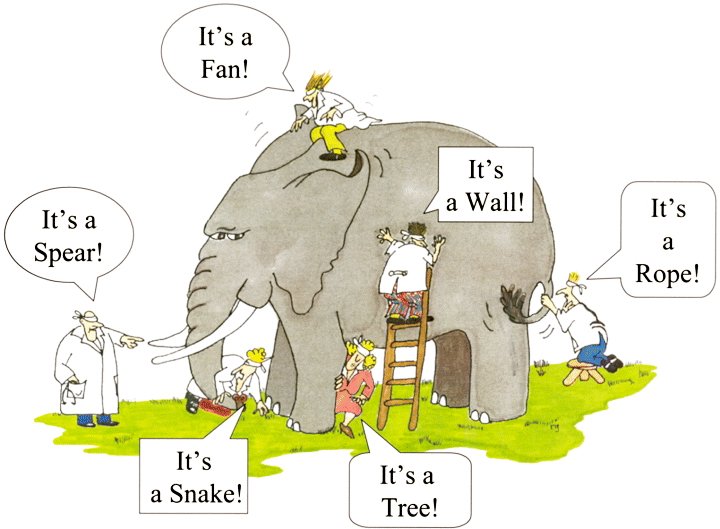
This is a story of a group of blind men, who have never come across an elephant before and who learn and conceptualise what the elephant is like by touching it. Each blind man feels a different part of the elephant’s body, but only one part, such as the side or the tusk. They then describe the elephant based on their limited experience and their descriptions of the elephant are different from each other. In some versions, they come to suspect that the other person is dishonest and they come to blows. The moral of the parable is that humans have a tendency to claim absolute truth based on their limited, subjective experience as they ignore other people’s limited, subjective experiences which may be equally true.
A Discussion Between Charles Tart and Lucidity Letter Editor, Jayne Gackenbach, Examining Similarities Between
CHARLES TART and JAYNE GACKENBACH
University of California, Davis;Athabasca University and University of Alberta, Edmonton, Canada
Gackenbach: In a recent review of your book Waking Up, John Wren-Lewis said it was very relevant to those interested in lucid dreaming.
Tart: I was very honored that he would say that it is must reading for people who are into lucid dreams since lucid dreaming is mentioned only once in the book. You see, lucid waking is the topic of greatest interest to me nowadays.
Some spiritual traditions use an analogy that we live in a dream. In many dreams, you get pushed around by events. You’re not very smart. You don’t re-member important, relevant knowledge. You’re inconsistent. You don’t call on all your resources. You get in these terrible situations, but then you wake up! Not only does the dream problem disappear, but you’re so much smarter by comparison. Smarter from the point of view of the waking state, right?
Now some spiritual traditions have used this as an analogy. They say that in our waking state (where we think we’re so smart and intelligent), we’re just as stupid compared to what could be. So that, in a sense, there’s a kind of lucidity that could happen in ordinary waking. My Waking Up book is really about lucid waking; that would have been a good title. . .
Gackenbach: What’s your dream recall like these days?
Tart: I’ve given my unconscious the instruction, “If it’s important, please make me remember it.” Otherwise there are other things I’m more interested in. I used to be an extremely high recaller. I used to wake up, and if I bothered to write my dreams down, I’d spend an hour a morning at it! Now I typically recall part of a dream on waking. I scan it quickly to see if there’s some kind of message or something exciting: if not, I let it go. Lucid waking is much more important to me than the lucid dreaming.
Gackenbach: As I understand the Ouspensky-Gurdjieff material, upon which your book is based, there’s essentially an asking of a critical question, a self-reflectiveness, an attempt, purposely, to reflect on what you’re saying and doing as much as pos-sible through the day.
Tart: It’s not usually expressed as a question, but if you did, it would be asking yourself something like, “What am I doing right now, what am I feeling right now, what am I perceiving right now, what’s my state right now?” You could do it that way, but it’s usually not done in such a verbal formation.
Gackenbach: How is it usually done?
Tart: It’s an immediate shift of attention to being conscious of the normally unconscious. Once you do it, you realize that our ordinary state is that we’re “lost.” We don’t know what’s going on much of the time. We’re just as passive in ordinary life as we are in dreams. Events happen and our mental processes react. Buttons get pushed, to use that wonderful old sixties language and our conditioned responses occur. A set of mental scenarios begin. Normally you’re just running on automatic with these things all the time. Becoming self-reflective, you consciously see your-self doing these things. As you pay enhanced attention more and more, you begin to get an option to be present to your experience more continuously, and to both have more control and be more open to new experience.
Gackenbach: Is there a distinction between being (I like the term) “present to your experience,” and the concept of “witnessing” while awake, sleeping, dreaming—twenty-four hours?
Tart: Witnessing is a concept I’d be very happy to use. There are a number of ways to observe yourself. Some ways are biased or have built-in preferences. For exam-ple, lots of people observe themselves from their superego. Your superego has a listing of what is good and bad. It watches you and gives you a shot of anxiety when it thinks you are doing something bad. That’s not what I’m talking about. In the first place, superego witnessing is automated. In the second place it’s not yours, it was conditioned into you by outside forces—society, your parents and so forth.
There’s another kind of witnessing where you look at everything from a spe-cific point of view. For instance, you could get into some spiritual system that said, you should recite this mantra all day long and you will go to heaven or achieve bliss or something like that. So you are intellectually interpreting everything that comes in in terms of keeping the mantra as an organizing core. But you’ve still got a par-ticular point of view.
Behavior therapy is a kind of self-observation, usually of a rather limited sort. Write down every time you do a certain thing. It’s a very specific kind of self ob-servation. The kind of self-remembering I’m talking about says, in the most abstract sense to be fully present to everything that happens and be fully aware of being present there.
Gackenbach: So the “effort” aspect is not there?
Tart: There is an effort but it is a small effort. It’s not much . . . The effort is to remember to do it, because what you discover is that you’re constantly swept away by phenomena. Gurdjieff once put it that the idea we automatically have self-consciousness must be a cruel joke played upon us. In point of fact, most of the time we are not fully conscious. I can say from my experience, unfortunately, it’s true. Most of the time there’s nobody home. Gurdjieff put it very strongly. We’re machines; we’re running on automatic. You know the East has a similar sort of idea that we live in samsara or maya. It’s translated to mean the world isn’t real, but that’s not the correct translation. It’s a recognition that we’re constantly filtering our experiences through an automated psychological superstructure that distorts our per-ceptions of reality. In that sense we live in illusion. You know the thing that really amuses me? The East has the idea that we live in a state of illusion, but western psychology has the nuts and bolts of just how we live in illusion down to a very fine degree of precision. We know the way we construct what we call reality and we know about defense mechanisms. We just don’t put it together somehow. We don’t question our idea that we’re conscious and have free will.
Gackenbach: What about the new work in perception and imagery? It deals with the inner interplay at higher levels—one affects the other—it’s not just that one is the other.
Tart: That’s clarifying the nuts and bolts issues. The reality is that we open our eyes and assume there’s a real world out there. It’s a very handy working assumption. Some stimuli hit our sense organs. Some neural impulses are produced, and we assume that we see things as they are. But I think psychology now makes it clear that there are all sorts of abstractive, constructive, additive processes that interfere with a realistic perception of the world.
One of the analogies that I use in the Waking Up book is that we live in a world simulator, like a flight simulator. When you’re in one of those things you think you’re in the cockpit of a plane. It does all the appropriate things [and the view from the window looks “real”]. We live inside our world simulator. Not only that, we love it. Not only that, we don’t know we’re in it, which is a dangerous thing. Once you get the idea that you might be distorting things, there’s an obvious moral. Pay more attention, dummy! Check up on yourself! But until you get that idea, you don’t check up on yourself. You don’t make the effort to know it. I look a little more clearly. I watch my reactions while I’m looking to see if they’re distorting things.
For example, you’re making the effort to be more present to experience: you look at someone, and it’s immediately unpleasant. You notice you turned away. Wait a minute, who turned away? I didn’t decide to turn away. My God, I’ve got some automatic reaction: when I see such and such, I automatically turn my head. Who’s running this show? Maybe you make yourself look back, and you feel sick. Can you stay present to exactly what the experience of feeling sick is like? Can you learn to stay in reality and study yourself? Watch your reactions? And eventually get back to seeing reality? Eventually you see that this actual person doesn’t make you sick at all, but he really reminds you of this [other] guy who pisses you off no end. Your mind is just automatically turning anybody who’s tall into this guy, or some-thing like that.
Gackenbach: Paul Tholey has a strong viewpoint which most people in lucidity work agree with. The crucial way to obtain lucidity, he’s decided, is to ask the critical question, “Am I awake, or am I asleep?” and while awake, force an awareness of the state, of the nature of the state. Eventually it will translate into sleeping. That’s a view we see a lot in the lucidity literature. Is this what you’re speaking of?
Tart: I lecture on it to my students all the time, advising them to observe themselves.
Gackenbach: I’ve learned from people I’ve been working with at the Maharishi International University (MIU) that the Maharishi some 30 years ago met a few of Gurdjieff’s students in England. What he felt (I gather to some extent based on those experiences, although it may be that there are other reasons) was that the Gurdjieff method was too forced. Witnessing, he feels, is a natural state of the organism. It will emerge naturally. His technique, of course, is through the practice of Transcendental Meditation. The witness will emerge at various times in the cycle of sleep, dream, waking, hypnagogic, whatever. It will naturally emerge. The problem with the other technique, as he understood it, was that there was a force element. And that’s of course exactly what Paul’s saying. Can you respond to that?
Tart: There certainly is a forced element. There’s several things I could say about that. One is that Eastern teachers tend to come from cultures that have much more faith than we do, that things will happen, right? Just say your mantra and things will eventually happen. We Westerners, we’re impatient. We don’t have that much faith and we want to make sure we do it right. So we tend to force.
Now I’m quite aware that forcing can ruin a technique. I’ve ruined experience many times by adding a too forced quality. “Force” does something useful, but it too easily puts a tension and a constriction in there. It doesn’t need to be in the process; you can use just the right amount. One of the things I’m personally working on now is to get the “superego” as it were, out of the self-remembering process.
Gackenbach: I’ve been interviewing long-term meditators who witness and I’m trying to identify to what extent it is like lucidity. It seems that an active/passive model is a pretty good one for distinguishing between them. Lucidity basically [involves] a physically and psychologically aroused, actively involved participant. With witnessing there’s more of the predominance of the observer. It’s non-involved—almost like a movie screen. It can go either way, from lucidity to witnessing or from witnessing to lucidity. Some will argue that lucidity is a first step to witnessing, that it’s a developmental sequence. I wonder if it can flip back and forth.
Tart: I’d be more inclined toward that.
Gackenbach: I think, in fact, that you can probably call witnessing, “lucidity” as well. Quiet lucidity versus active lucidity.
Tart: Based on all the literature I’ve read and on my own experience of it, I would say that lucidity in a dream is an altered state of consciousness. Whether or not there is self-remembering in a lucid dream is an entirely separate dimension. In a lucid dream a person experiences a shift in the qualities of consciousness. So the way my mind is operating feels more like waking than sleeping, and includes factual know-ledge: I’m actually in bed dreaming, still, or I remember how to operate this kind of equipment in real life so I can operate it in dreams. Lucidity brings an ordinary level of conscious knowledge into the dream, which in a sense is a higher state phenom-enon. You, your ability, your freedom of operation throughout the dream world clearly goes up when it becomes lucid—when you know you’re dreaming.
Now, the kind of lucid waking I’m talking about, self-remembering, involves a big jump up from the ordinary waking state. So, you could have a lucid dream that did not involve self-remembering, but in theory (I haven’t done it and I don’t know anybody who has) someone who’s good at self-remembering could have an ordinary dream, turn it into a lucid dream, and still not be self-remembering. They could then begin to self-remember within the lucid dream itself and go up to another level.
Gackenbach: To paraphrase then: When you know you’re dreaming then either it follows or simultaneously you have full recall of your memories, you have volition and control at much higher level. Is that self-remembering or is self-remembering even beyond that?
Tart: Self-remembering is beyond that stage. Right now, here I am in the ordinary state not doing the process of self-remembering. Here in my ordinary state I have a certain vantage point with lots of knowledge, but my knowledge. My ordinary identity carries a framework, an emotional-cognitive framework, that organizes everything going on—what’s important to me, what’s not important. Things are being processed through my personality. That also happens in the lucid dream: your ordinary waking personality now becomes the processing center rather than the usual greatly “shrunken” dream personality center.
If I’m self-remembering, by contrast, when you ask me who am I, I could give you a conventional answer if I think that’s what you want to hear: all the facilities of ordinary waking consciousness are available. But the truth of who I am is that I’m not my personality anymore. It’s hard to express in words, but I am a process that can know. That process has a tremendous amount of freedom compared to my ordi-nary personality. It’s far more open-minded, it has far more access to possibilities.
Gackenbach: Is there a sense of separateness?
Tart: “Separateness” is a poor word to use for this. It’s not like I’m standing behind myself. Or that I’m “detached” in the sense of not caring about what’s going on. I may be more vividly aware of ordinary experiences than I normally am. The ordinary world becomes a little more real. But simultaneously it seems it is just a particular flux of phenomena at this time. I’m not identifying with it.
Gackenbach: As I understand it, that’s what my colleagues at MIU call “witnessing.” It naturally emerges as a function of meditation. This is almost identical to the kinds of things you’re saying.
Tart: Possibly meditation does produce very similar results.
Gackenbach: Then in sleep, and specifically in dreams, how are these states the same or different? I’m beginning to wonder if you can’t be both lucid and witnessing or self-remembering simultaneously. Or one or the other.
Tart: You lost me.
Gackenbach: By way of explanation, let me tell you about this interview I had with this mathematics professor who’s been meditating for seventeen years and has very clear experiences. I think because he’s not a behavioral scientist, he’s able to communicate better, without jargon. He described how he conceptualizes the continuum from the stage of dream lucidity to the stage of witnessing. First he saw them in developmental sequence. The first step is consciousness; you know you’re dreaming. It’s minimal lucidity, as we would name it. The actor-observer roles change in the sequence. In lucidity you know you’re dreaming; the actor’s very dominant. The observer’s there but it’s not as dominant a role. Then, as you move into witnessing, the actor becomes more suppressed and the observer role more dominant.
Tart: So in a paradoxical way you lose the freedom to change things that occur in lucid dreams and you let the dream run passively again?
Gackenbach: Yes, the passivity is the big dynamic. Not only that, the dream begins to fade. You realize you’re dreaming—everything out there is my fantasy, is me. Everything goes very naturally. I’m not going to make it go away, but rather let it continue. You still have a self-representation of the body. That goes. You still have a representation of the self but it’s not a “physical” self. Then that goes. You’re left with awareness of awareness. Then you go into that and the experience opens again, but it is not “sensory” experience; rather it is conceptually based. So he talks about living mathematical constructs at that point.
Tart: He probably goes to the world of Platonic forms. Where else—what would a mathematician’s idea of nirvana be—Platonic forms, formulas!
Gackenbach: He sees it as some kind of abstract algebra, that’s his area. It goes further. But after that, I had no idea what the guy was talkin’ about.
Tart: Let me distinguish two categories now in terms of self observation and self-remembering. One is what I’ve been describing to you. It’s very prominent in the Gurdjieff tradition, and the place it’s almost exclusively done is in the midst of ordinary life. We’re being bombarded with sensory impressions, we’re socially inter-acting, the phone could ring, there’s lots and lots of input. Now let’s operate on a model which I find works well for a lot of things, namely that the total amount of attention available to us is fixed, but we can divide it up. With self-remembering, instead of your attention becoming all absorbed in either outside events or the inter-nal processes triggered off by them, you keep a part of it free to observe the rest. Instead of letting a hundred percent get lost in phenomena, you keep, say, ten per-cent in self-remembering. Paradoxically, this makes the other ninety percent more vivid, but at the same time, you’re not so trapped in the particulars of experience.
Now let’s look at Buddhist vipasana meditation, which I’m trying to learn to do well. In vipasana meditation you sit down in a place that’s extremely quiet com-pared to ordinary life. Nobody’s going to talk to you; there’s nothing you have to do. It’s a reasonably undisturbed place. You sit still. All the body stuff is greatly reduced. You just try to clearly observe whatever happens in your mind—you make no attempt to control it. There’s no good or bad thing you try for, there’s no control you exert. You just try to be clearly aware of whatever is happening. Now you’re doing something that’s much like self-remembering. But, in a sense, the “noise level” is way down, so instead of self-remembering where it’s all terribly agitated by external events, vipasana is self-remembering down here where there’s much less confusion. Thus you can begin to observe much subtler aspects of mental function. So this process, carried out from two different places, could lead to different things.
Now, let’s follow the vipasana meditation model. I may be sitting with my mind wandering (which is usually what happens, because it’s hard to do!) But then I focus for a moment, I’m paying clear attention to whatever sensations come and go in my body. There’s a line of sensations in my leg, e.g. it comes and goes. That starts to raise a thought and I see how the thought starts to rise. I watch the process but then it just fades. I’m tuning into the finer, subtler thought. Vipasana can become much deeper as your perception of a thought becomes finer and finer. It’s like you turn a microscope on your sensations, and, as you zoom and focus the microscope, the power gets higher and higher. There comes a point where, when you look at any-thing, it dissolves into nothing but vibrations. A friend of mine who’s a very experienced meditator describes it this way. Any sensation—a painful sensation, a pleasant sensation, whatever—that he looks at closely in this vipasana way dis-solves into vibration. You can then reach a kind of psychological state where all the usual objects of the world we experience, including your body and your sense of self, just become vibratory waves. A lot of people would call that a highly enlightened state.
Gackenbach: But there’s still more.
Tart: Yes, I don’t think that’s the only way it can go. In the Tibetan tradition of Dzogchen meditation, that kind of thing can happen in meditation, and then you intentionally destroy it because you’re getting caught up in it, which is a form of subjectivity. If you become proficient, you’re able to simultaneously contact that in-credibly expanded, nonverbal, holistic view of reality while in the midst and flux of everyday life, being good at living everyday life. So there’s various directions you can go in.
Gackenbach: I have talked about this at length with my colleagues at MIU, particularly the concept of the quiet, and the subtleties.
Tart: Let me give you a view of either lucidity or witnessing. It’s a totally relative view. There’s a continuum. At one extreme you are totally caught up in whatever’s happening. The other opposite end is that you are totally out of it. Now there are varying degrees of [lucidity along this continuum]. For instance, even simple animals make cognitive maps of their environment. In a sense, that’s a kind of lucidity. It may be a very mechanical kind of thing, like a conditioned response. But there’s a sense in which lucidity or witnessing gives us some perspective on experience while it’s happening. Even in ordinary consciousness we bring some perspective, some cognitive maps.
Self-remembering, which I’m talking about, introduces a new dimension. Self-remembering does not mean you have some point of view that you claim is higher. It means you exercise a bit of volition to try to be totally open to whatever is hap-pening at the moment. It’s very different from all our ordinary acts of cognition using the conceptual tools already given you.
Gackenbach: So it’s passive?
Tart: No, no. Self-remembering is not passive. It’s definitely active in a sense that you must make a small effort to do it. It’s not automatic. It’s always a certain kind of effort. But it’s not the usual kind of effort. Usual efforts not only have force behind them, they have a direction and goal. Here the effort is simply to pay attention openly but not force it in any particular direction. I’m saying you can use “lucidity” or “wit-nessing” to describe two levels of an operation. You have immediate experience and another level of perspective on experience. This can be purely mechanically-operated kinds of perspectives. But there’s another kind of lucidity or witnessing whose goal is the transcendence of all concepts, all dualities, all formulations and it involves simply an effort toward openness.
Gackenbach: It’s active in the sense of doing, it’s happening, and in the sense that there’s some effort. It’s passive in the sense that, if you start to act on what you’re experiencing, you lose the experience: mood making.
Tart: Now that’s an important difference. To me, looking at it from a Gurdjieff perspective, losing it means you haven’t learned how to do it very well. There are techniques that are essentially passive—more witnessing and the universe will be revealed to you, right? And there are techniques that bring full knowledge and are not totally passive; there are times that require action by you.
Gackenbach: That’s it exactly. According to my colleagues at MIU you take time to cultivate the state through meditation, but that for most of the day you go about your business. The self-remembering or witness perspective spontaneously emerges from time to time.
Tart: Is it supposed to happen by itself as a result of your meditation periods?
Gackenbach: Yes, you don’t force it.
Tart: This is a traditional model, but I don’t think it is completely adequate. Let me illustrate. Recently I was in a Buddhist group meeting and a woman there was complaining that after she’d been to a retreat for a couple of weeks, where she’d been so mindful, that it all faded within a few hours of going home! She just couldn’t be mindful at home. That’s a very common experience. Now the traditions usually say just keep up your meditation mindfulness practice, do your sitting every day and eventually it will start to transfer. Indeed, all of them admonish you to transfer it to everyday life, but, the classic Eastern traditions that I know actually don’t have much in the way of skillful means for transferring mindfulness to everyday life. They don’t have much technology for how you do it. The Gurdjieff tradition, on the other hand, by and large doesn’t teach people passive sitting meditation. It starts you right off practicing mindfulness in the midst of life. So I’m writing a paper for the Journal of Humanistic Psychology comparing these two traditions and suggesting some ways to take this mindfulness and start practicing it in situations closer to ordinary life. Then it’ll transfer to the everyday life we lead—it will give us “lucid waking.”
“The main objective of therapy is to create optimal conditions for the subject to experience the ego death and the subsequent transcendence into the so-called peak experience. It is an ecstatic state, characterized by the loss of boundaries between the subject and the objective world, with ensuing feelings of unity with other people, nature, the entire Universe, and God. In most instances this experience is content less and is accompanied by visions of brilliant white or golden light, rainbow spectra or elaborate designs resembling peacock feathers. It can, however, be associated with archetypal figurative visions of deities or divine personages from various cultural frameworks. LSD subjects give various descriptions of this condition, based on their educational background and intellectual orientation. They speak about cosmic unity, unio mystica, mysterium tremendum, cosmic consciousness, union with God, Atman-Brahman union, Samadhi, satori, moksha, or the harmony of the spheres.”
There are many other descriptions of ego death, in fact the term Ego Death is misleading, because nothing dies in this process of enormous transformation and the process of growth, instead it is a huge enlargement, a massive shift of our ideas and experience of who and what we are. The history of those who obviously have experienced this enlightened state, does not show that their experience of themselves has disappeared, it has been transformed. If fact they can develop the ability to have both, the ego awareness and the transformed awareness
Here is a description from the book Myself and I by Constance Newland – Real name Thelma Moss – the story of a woman courageously exploring her life problems.
“Once again I found myself submerging into the sparkling black which was no longer buzzing, nor frightening, but filled with pinpoints of light . . . and I was dissolving into those pinpoints of light… yes, I was dissolving out of the matter which was my body into the energy of those pinpoints of light which grew brighter and brighter, obliterating the blackness and becoming a light which was All Energy.
I dissolved into the Nothing which is Everything.
Transcendence.
In the transcendence, revelation:
There was no climactic moment of release. There was no shattering or explosion. There was only further expansion and further fulfillment. It was as if I had become the expanding universe, spreading further and further in every direction, and through the universe of Me there flowed a mighty force, the Life Force, which was like an inexhaustible fountain of fire or air or water, a fountain of eternal replenishment.”
Where was the death in that. She later returned to academia in the mid-1960s, studying at the UCLA Neuropsychiatric Institute and interning at the Wadsworth Veterans Hospital; she earned her Ph.D. in psychology from UCLA and became a professor at the same institution. For a time in the 1970s she led UCLA’s parapsychology laboratory (while it existed). She explored a wide range of specific subjects in parapsychology (hypnosis, ghosts, levitation, alternative medicine), though her research on Kirlian photography was the most significant theme in her work for the remainder of her career. She made several trips to the Soviet Union to explore Russian work in the field, and wrote two books on that and related subjects, plus lesser works.
Where was the death in all of that – not a death but a transformation.
Here are more peoples experiences:
Another person describes it by saying, ‘I was sitting opposite someone during an enlightenment intensive workshop. We had been posing the question for days – “Who are you?” Suddenly I realised that it was a silly question, because I was the answer. All thought stopped and I existed as the answer. My being had always been this. In this state there was an awareness of being connected with everything around me, in the beginning of creation. This was the first day.
While in this state of simple existence I was able to observe many things I am usually not aware of. For instance while I simply existed, my usual pattern of personal behaviour and thought went through contortions to be the centre of attention again. I could see them almost like habits, systems, that have life, like a body does, and they were dying and twitching in their death throes. Also I saw that I knew that all thought is like a mimic, so all our thinking is like photocopies, without any real life. Also as I saw this I had an image of a monkey that was actually my normal thinking self running alongside my every motion and trying to mimic it. It was almost as if as I as a person walked along, another mechanical person ran alongside trying to keep up and mimicking everything I did in an attempt to be alive and real. Yet thought can never be life.’
Another person says, ‘Unexpectedly everything changed and my fundamental self was something that existed throughout all time. It didn’t have a beginning or end. There was no goal to achieve. I am.
I am a wave on a shoreless sea.
From no beginning
I travel to no goal,
Making my movements stillness.
Constantly I am arriving
And departing,
Being born and dying.
I am always with you
And yet have never been.’
Slightly different but still the same enlightenment. ‘Everything seemed to slip away and I felt as if I melted back into the primal being of the universe. It didn’t seem as if my ego was gone, just melted into everything else. It was blissful.’
I work as a trauma therapist with refugees and have been overwhelmed at work. I had the following interesting dream lately and would like some help unfolding it…
Dreamt I am fascinated by a small angelic child in the waiting room of my office. Her mother is trying to place her on her brother’s head but it’s not working out. I ask if I can play with her. The mom says yes and leaves us alone. I take out my raccoon puppet and start to play with her feet. Right away the child, who is also somehow a very sweet and contented lamb lies down and rests. We lie together very cosy and content. I am surprised how fast she lay down. I see a beautiful orange butterfly. It lands on first the lambs face then my own face. It is a magical moment although I am slightly nervous as the butterfly tugs the skin of my face. I say Fai Ling (lamb’s name) do you see the butterfly? I don’t have a camera to capture the moment. I am glad Fai Ling and I are alone with this moment. Then I wake!
I am confused about what aspect of my life is failing…my sweetness? Any questions or nudges welcome. Thanks!
Camille – Moments are often so full of wonder and power. We cannot hold on to them for they are part of change. We cannot even often capture the magic with a camera, but we can remember them and let the memory live is us at times.
To quote from the Butterfly entry, “A butterfly can also be such a seemingly fragile creature, and yet can fly up to 2000 miles. So it can signify not only your vulnerable nature but also your wonderful strength.” You dream has so many moments of interactions and relationship, and ends in a magical experience. Yet you say you have a feeling of failure.
It might be that you cannot yet see the answer you have in you.
While recently leading a group practising movement, I was struck again by how creative we all are if given an environment in which we can allow our originality. One woman in the group, exhausted from the demands of her job, experienced deep relaxation out of which enthusiasm and pleasurable energy arose, leading her to dance and bathe in her own joy. A man explored his relationship with love, and saw that he needed to gather to himself the love he received from others to call out his own resources of affection. A woman who worked as a nurse met the painful emotions arising from observing the difficulties of a mentally retarded patient. Her creative movements led her to find a way of accepting the reality of life’s difficulties. The pain cleared and she felt was ready to give a more flowing response to others in difficulty.
The nurse experienced shifting her position and seeing that she could simply be her loving self, perhaps as you were with your angelic lamb. See https://dreamhawk.com/news/my-body-is-a-moving-sea/Perhaps you can find you answer there.”
Another wonderful story is told where a single mother, trained as a nurse so she could apply for a post as a private nurse with a rich family. This was so her daughter could live with her in the house she worked in. After her training she applied and got exactly what she sought, nursing a man – but she never saw the patient.
When she did she was led into a room by her employer, and saw a cage around the bed and imprisoned in the cage was a man smeared with his own feaces, and obviously mentally retarded. The nurse was surprised but thought, “Oh well, lets get on with it.”
The patient was not dangerous, but when she opened the cage to start cleaning him, the moment she touched him she felt enormous disgust and revulsion. It happened each time although days past, and she felt that she would have to leave – but she faced a conflict because of her daughter was happy there.
She had read about Edgar Cayce, the amazing seer, and wrote to him explaining her situation. Cayce did a ‘Life Reading’ for her and said that she had been the patients mother several times, and each time she had pulled back each time he was meeting difficulties in his life. This resulted in his slipping deeper and deeper into slipping back into a mentally unstable state. Cayce went onto say that the man was almost losing his humanity, but if she could bear to care for him he would slowly turn around and move toward healing. See https://dreamhawk.com/interesting-people/edgar-cayce-and-the-cosmic-mind-superminds/
The nurse tried to do that and over months the cage was taken away, the man no loner smeared himself with his feaces. In fact he began to follow her around like a loving dog, with the same affection. Not long after that he died. And a follow up reading from Cayce said that the body he had was no longer suitable, because the man was now on a upward path in his evolution, and her loving attention was what the man needed.
Many of our life’s difficulties probably could be explained if only we had access to our full memories. See https://dreamhawk.com/dream-dictionary/seed/
There are many records of children brought up as babies by animals or completely left uncared for by parents. In the USA a girl baby had been kept in a chicken house, never spoken to or cared for, so they never became human. They, like Genie and others, never learnt to speak, and became trained but trapped animals. Most often they are unable to adapt to their life with humans. Speech appears to be like a computer program which when loaded into the human at the right time causes brain changes and the way the brain and our awareness works.
The picture of Genie who was totally neglected as a child see https://www.youtube.com/watch?v=gvSMgi23F3o
The life of Helen Keller throws an enormous light into such children’s ability to learn. Helen was struck dumb and blind at an early age when she had only learnt one word. She lived like an animal without self awareness until the age of eleven. Then she was taught by a deaf and dumb teacher and remembered the first word and quickly began the climb to become a human person. See Helen Keller
Then, perhaps because she had learned one word prior to her illness, meaning flooded her darkness. She tells us that “Nothingness was blotted out.” Through language she became a person and developed a sense of self, whereas before there had been – nothing.
This ‘nothingness’ described by Helen Keller is difficult for most of us to imagine, having all our life been exposed to other human beings through behaviour and speech. Helen describes it as having no awareness of personal pain or events. She says that perhaps things happened to her, perhaps they were painful, but as she had no personal self to appreciate this, they were merely passing tactile sensations. She was not personally disturbed by them because she had no ‘person’ to be disturbed.
The Wolf Boy
A baby raised by an animal is not something that only happened in the past though. A headline in the newspaper Daily Star on April 17 1991, at the time the film Dances With Wolves was popular reads: “TRAGIC BOY’S DANCE IN WOLF’S LAIR.” It goes on to say: A tragic orphan brought up by a pack of wild wolves will never be able to live like a normal man, say doctors. The boy who REALLY danced with the wolves was aged about seven when he was found 29 years ago in the wastes of Southern Russia by a team of oil explorers. He howled like a wolf and savagely bit one of the oil men who christened him Djuma – the Wolf Boy.
Djuma, now about 37, is still in hospital. He still crawls on all fours, eats raw meat and bites when frightened. He can speak only disjointed phrases – “Mother dead. Father dead. Brother dead. Sister dead. Mother nice. Father bad.”Professor Rufat Kazirbayev said doctors had battled to re-educate him to act like a normal human being – but failed. They are now giving up the fight. Professor
Dr. Anna Ticheenskaya said: “presumably his family were killed in a political purge. He has shown us in sign language how, when his mother was killed, she saved him by throwing herself over his body.”
The man who is a wolf
Djuma has learned to brush his hair, clean his teeth and use the toilet “Like a trained animal.” But when taken to the zoo he howls as if he was urging the animals to take him to freedom. Sadly that will never happen. Djuma will probably spend the rest of his life in the clinic where, doctors say, he spends his days like a dog – half asleep and dreaming.
What the life of Djuma teaches us is that being human, being aware of oneself as a unique person, isn’t simply something that happens by itself as we grow. Djuma is still a wolf even though he has what we think is a human body and brain. Some of the things people like Djuma lack that you and I take for granted are a sense of time – meaning we are aware of a past and future; a certainty that we are a person with a name. This leads us to say things like, “I am Sam.” Or “I am Sarah.” So we have a sense of ‘I am’; because we have what we call identity, we have feelings such as being guilty, confident, shy; we also feel separate from other people and animals. Children brought up by animals, unless recovered very young, do not have a sense of time. They lack any feeling of personal identity, and they feel connected with other animals and nature. You might say they are like Adam or Eve, feeling at-one with nature. At seven, it was too late for Djuma to develop into a human. The special thing he lacked was other humans talking to him so he also could learn speech. So language is perhaps something like a piece of computer software our brain uses to gain identity – usually around the name we have been give – and to know time and separateness. This is no doubt why baptism or a social naming ceremony is such anything in some societies. For learning word/concepts like ‘Me -You – I’ are foundtions upon whic you can build an identity, a personality.
The animal boy of Aveyron
The stories of these children’s lives shows us the enormous influence the early years of learning has on our mind, and how language is like a huge computer program that alters our natural awareness, allowing us to have self awareness and a personality. Isn’t it strange then that if in early childhood we can learn to be a wolf, a bear, or a human, that we don’t recognise this and train babies to be more than human? Perhaps such training would be a step toward reducing the murder, aggression and mental poverty amongst so many humans.
It also leads one to wonder what happened in human evolution to produce speech, and what was it like to swing between the animal type human like Djuma and Victor, and the fully linguistic human. Did they coexist? It is such an interesting subject, that a human being does not have any sense of identity, or develop what we call a personality by simply growing. If left they are nothing much unless raised by an animal that passes on millions of years of experience to the baby. Then it is a wolf or bear and not a human being. So we do not simply have a human personality unless we are taught the amazing program of speech and human thoughts and social responses. Many of us believe we are ourselves because we were born human. Not so. We are carefully fed programs and we are what we are by being taught it. We are programmed – and of course we can learn to recognise that programming and hopefully grow beyond it. See Geniusand Habits
But because we were seeds planted by our parent and grew within a human womb, we have a very long history from such, because seeds are from other seeds from the very beginnings of life on earth. So apart from programming we each have an innate self from our heritage and environment. See Seed
What’s it like to be an animal?
Animals do not think using words as we do. They do not therefore speak to themselves or each other in the way we do. But they do feel things. They do respond with strong feelings or indifference to things. So if you want to see what it is like to be an animal, stop thinking about thingswith words and watch what you feel about people and events. Without deciding what is right or wrong, without asking anyone’s opinion, watch what you want to do from your feelings. Maybe you want to hide under the table like some dogs do. Or maybe you want to sit on someone’s lap, like a cat. For a while, can you dare to do that? If you let everyone know that at the moment you are a cat or a dog, I am sure it will be okay.
When you enter this cycle of growth and change that you pass through as you reach thirteen and slowly become twenty, you experience the massive change of leaving your childhood and facing becoming a woman. In today’s world girls are bombarded with images and suggestions of what it is to be a woman. This happens very strongly in the western world where huge forces of advertising and influence for commercial interests have developed very powerful methods to gain a way into your life. So I am going to say things to you that you may not accept or believe at first, but I feel are important for you to have heard.
First, you are an animal, a female mammal. To have reached the point of becoming a human female you went through millions of years of animal life. If you doubt that you must realise that you are left with a reptile and mammal brain as well as the human brain.
The neurologist Paul MacLean gave a definition of these physiological and psychological facts of our brain in 1990. He said that these levels of the brain work like “three interconnected biological computers, each with its own special intelligence, its own subjectivity, its own sense of time and space and its own memory”.
Prior to MacLean’s findings it was assumed that the highest level of the brain, the neocortex, the human brain, dominating the other lower levels. MacLean, and since him others (Earl K. Miller), have found this is not so. In fact Miller was recently able to demonstrate that the older brain learns fast, and it gradually ‘trains’ the prefrontal cortex.
Returning to MacLean’s definition the base brain is the Reptilian. The next level he called the Mammalian or Monkey Brain, and the third is called the Neomammalian or Human Brain. See Levels of the Brain
To ignore that we carry our animal past with us and that we are still very influence by our past, can lead us to live in a way leading to enormous confusion and emotional pain, because in doing so we are living a life in conflict with oneself. Such conflict can lead to the depression, being lost in relationships, painful or passionate, and anxiety and panic attacks.
It can also help us to realise that consciousness on our planet started in the slime of creation, the slime we return to, to procreate. And from that slime which is a vehicle for our seed to exist in, our awareness goes through the whole process of evolution, the dividing of cells, as happens in plant growth, the forming of structure and organs as with animals, the creation of a creature with gills such as fish use, and on to a human form ready to breathe air, carrying our seed onwards.
Yes, you grew from a seed, but no plant or creature grows from a dead seed, and each living seed carries within it all the past gathered from all its forebears. So, the seed in your mother’s womb is as old as and even older than human kind, and you carry that wisdom or memories in you. But in this life you developed a new brain, and the memories you gathered this time are what you built your personality from, but beneath that is a very huge and ancient self. For in a real way, you are simply a conscious personality riding an ancient beast, your body. If you value this wonderful animal you ride, you will care for its needs; it needs exercise, food it has been eating for millions of years that has not been made by manufacturers, like white flour and white sugar products; so eating and drinking what nature produces, and a need for sexual expression in some form.
Being in touch with your ancient self is the way to wholeness. It might help you to make contact with that wonderful wisdom and growth energy if you try Intuition – Using It
Because the cell that you grew from has a vast life experience, for the cell started its life when life began on Earth. A cell doesn’t become old it is immortal, for it keeps dividing and doesn’t die. Of course it produces your human body, but to do that it does not produce an exact copy because it does this to experience a separate self you call your ego or personality. In that way it gathers new experience which is carried forward in the eternal sex cells.
So, as a human woman you have a massive background of being many, many life forms. What was said above points to you arising not simply through evolution but through immense cosmic principles, a form of cosmic mould or archetype. Older cultures recognised that and though up the title of Great Mother. For somewhere, deep below the surface of your waking mind, this stream of life starts its flow. In underground caverns it moves through channels formed in ancient times, bringing life to all those tiny lives that, separate or in unity, form the shell you call your body. Within the universe of yourself you are a young goddess playing at creation with the stuff of life. Whatever thought or feeling, longing or emotion you harbour takes form, and is given life, beautiful or awful as it might be. And when you do not own that power, when you push back any part of that flow into the dark caverns of your mind, where fears and wounds, black angers or unspent vengeance lurk in shadows, they are given life. They grow strong until they wrestle with you, invade the living tissues of your body with their sickness, or burst out into the world as action.
“There for any to see the splendour – Of this most ancient goddess – Revealed and revealing – She was and is the revelation.”
So never think you are simply a no account human female. For though you arise from an ancient mould, the same as any mammal, you have a uniqueness through personal memories, we call that personality.
It is important to see if you can feel the lioness within you, because otherwise you might remain one of those helpless modern screaming females who are victims to their own fears and panic and end up being hurt, abused or even murdered. Of course, there are thousands of other strategies you are capable of once you are open to your wider self.
Sometime see if you can explode in angry energy – it helps if someone threatens you. Believe me it is possible, and if you learn a few self defence moves it gives you so much more confidence.
The wider self can also warn you about opportunity or danger.
But because you are from mammal stock, you will probably feel a great urge to find a partner. For many people it is a very difficult challenge to find the right one. All I need to say about that is that often it doesn’t work out the way our dreams, longings and emotions have painted it. My findings are that you cannot find the ‘right’ one until you have found yourself.
The Long View
You also need something of a long view, again difficult if you feel you are ‘in love’.
Relationships, whether heterosexual or homosexual, fail, even with the starting point of intense love. Figures differ from fifty percent failure in the US, to one in three in the UK. Hetro or homo are about the same. Statistics show there is a huge decline in marriage, with a swing to living together without the ceremony. Also there is a massive increase in adults without a partner. It has risen from six point five to thirty percent since 1960.
Even though you have attained some level of self-awareness, the process that brought you into being still functions within you to continue your existence. Without it you would immediately cease to be. In fact most of the vital processes within you still occur without any conscious effort or participation on your part. Your ego, your conscious self, is a tiny and almost insignificant part of the process. However, what you do, what you think and what you feel can enhance or interfere with that core process.
The most important part of anything; a person, a machine, an organisation, a fruit, is the core of it. An apple is an example: the core carries the seeds, that are the most important thing as far as its life is concerned. The same goes for the person who may believe their body, the external them, is the most important, but it is their core being that is the most important and carries their essential self. Ways of connecting with your core self are Opening to Lifeand Water Wonderland
Sex
Another big part of being an adolescence, and something that will become a dominate part of you is your sexual nature. Remember that you evolved from animals, and sex was a natural part of their existence. As such they didn’t think about it, study it or wonder if they were good at it – after all, they/we have had millions of years living with it – they just did it.
So, don’t make it terribly personal, because sex has been an urge not just for millions of years, but billions. Because, honestly you are basically another mammal driven on by nature itself. But as humans we make the whole business very complicated by our thoughts, our emotional reactions, and from the immense advertising cleverly disguised as truth. You cannot completely escape from its influenced, but you might be able to mitigate it a little by understanding what you are facing.
Example: I dreamt of being with a woman who was desperately seeking a man. I was also with my own female companion. I believe the woman had been suddenly dropped by her man, and I and my partner were close and with her.
Still in the semi-awake state I tried ‘being’ the woman, and had a very clear response. I experienced being her, but was also me with experience of seeing into myself in some degree. I saw that the woman, like most of us, was a female creature whose instinctive drive was to find a mate. But she was not aware of this as an instinctive drive but as a personal feeling. As such she had become, like many women and men, lost in a huge web of personal ideas about whether they were attractive, sexy, with many complications about love, gender mixed with childhood unconscious traumas and the heartbreak all that brings.
A huge adaptation you will meet concerns your sexual feelings, which in turn includes your emotions, your self image, your dress sense and many others things. We are each unique, and because of factors such as self confidence, level of physical and psychological strength, traumas we may hold within us, difficulties or ability in meeting challenges we will choose different paths to sexual expression. To list he main ones:
A heterosexual and long term relationship; with or without children.
Relationships with a number of partners, none of which you choose to stay with long.A polygamous relationship either with one man and several women, or a single woman with several men.
A homosexual relation ship with just one partner or with several different partners.
No sexual relations but a friendly partnership, or a non sexual life without partners; also maybe a religious loving life.
Quite a number of people are neither one nor the other, so are married with children but are also homosexual.
Some choose to either act out becoming the opposite sex, or have a sex change.
In one sense we have enormous choices how we express sexually. In another sense we may be pushed to choose because of fears, traumas, or programming by parents, peers, and social and media influence. See Programmed
All of us are born with genius as a fundamental part of us. But of course things get in the way of it expressing. Our body for instance, our programming from parents and culture, also our inherited attitudes such as – “I was always told I was no good and would not amount to anything.” When or if you are feeling hopeless and helpless watch this http://www.youtube.com/watch?v=vNZVV4Ciccg
Your personal consciousness is a mirror in which your innermost hopes, longings, fears/terrors and genius are made real. They are made real of how you react to and experience people, animals and relationships. Perhaps your genius has been buried deep, but it is there by the immense number of lives that left traces of genius, or persistence against odds, of curiosity or love. See Ancestors 2 – Seed
If you are unclear about that take time to recognise that as a personality you are almost totally unaware of what is taking place in your body right now. You are not aware as personal experience of the huge history of evolutionary changes your being has gone through in order to become you. You perhaps have little conscious insight into the massive background of social, religious and family influences that go together to enable you to function as an individual and a social entity. Your self consciousness may not include awareness of how your present personality was shaped out of those influences. Maybe you do not know what the major life lessons are that confront you, or what your innate genius and passions are.
In general you are barely awake of whom you are! But that is not unusual; most of us are in the same boat. Only here and there does an individual wake up with such wide awareness and shine with light, love and creativity. Yet that light and love is in everyone. See Edgar Cayce
Any journey we take into uncertainty takes trust in ones own innate processes and genius. Without calling it genius, it takes trust in oneself, ones own innermost voice. In general we are barely awake to who we are! But that is not unusual, most of us are in the same boat. Only here and there does an individual wake up with such wide awareness and shine with light, love and creativity.
Meeting with Your Sexual Power
A good example of your sexual power is the way electricity exists in a house. First, we have the supply of electricity into the house. The wires carrying the supply to the house are not in themselves the electricity. The current is invisible, but it has great potential for good or harm. So we usually deal with it carefully, and have means of controlling it via insulation, fuses and switches. When the electricity is wired into the house, its potential can be expressed in a huge variety of ways. It can manifest as heat, light, and power to move or do things, such as with a drill or vacuum cleaner. It can produce sound or images as with television, and can, via programs for the computer, manifest in almost magical ways, storing and retrieving huge amounts of information and manipulating it.
The usefulness of this image of the house with its electricity is that we can use it as an analogy of energy in your own life. Your potential can express as cellular activity, or physical movement. You can experience it as sexual drive and its pleasure and pain, as emotions, as sight, hearing, sensation, smell and taste. You can express it as thinking, and vocalising in speech or singing, or as the creation of a personal virtual reality, as you do in fantasy and dreams.
You cannot really own your sexual drive, for it as an expression of Life, that you can relate to in various ways, make decisions about, but cannot completely control. If we manage to repress it then it tends to become different tendencies, and can divert its energy in the way described where is says, “we will choose different paths to sexual expression. To list he main ones:”
But such enormous energy can also become destructive.
Example: I am in overalls working in a house. I am kneeling on the floor. The house is not familiar to me. In some way I had hold of, or was connected with, a large electric cable. The cable was live with electricity, and it touched my right shoulder. The effect was excruciating and shocking pain. The most intense memory is of struggling to pull the cable away from myself, fighting to stay conscious against the terrible current lashing through me. I screamed out for my mother, who I was sure was in the building somewhere, to switch off the electricity. I knew I only had a little time because I could not survive that current long. I have a vague sense that the current stopped, and then the current and struggle started again. Steve.
The dream portrays a dangerous situation. We know that touching an uninsulated electrical supply wire can kill. But what are these dreams saying about human potential being so dangerous? But the electricity in the dream was found by the dreamer to be his own powerful energy turned inwards, short-circuited by what he felt to be the criticism, the rejection, non-understanding of his two last women partners. “I felt that I had tried and tried, while preserving my own integrity, to live in the way they wanted me to become. But this felt as if it was an enormous self-denial at times. It was a self-denial that created this almost death dealing introversion of energy.”
Steve felt the electricity illustrated how his enormous emotional and physical energy was being turned back on himself. Steve expressed a lot of his love through work, supporting and helping others. But in his relationship he had felt deeply criticised. And through this criticism had been holding back his flow of love. In other words his energy was being interiorised, turned back on itself. This is depicted as the electricity flowing into his body. Steve realised from the dream that he must not allow past or present criticisms to cause him to hold back his positive flow of life and love.
The damage such in-turned or negative emotions can do is enormous. Many years ago a woman who could hardly walk came to stay with my wife and I. She hobbled along using two sticks. Within a week, without any treatment, she could walk normally. She told us with great enthusiasm that she now knew what had caused her illness. Three years previously her son had married and had asked if he and his new wife could lodge in his parent’s house for a few weeks while they looked for a house of their own. His mother felt resentful that he and his wife had stayed for years and made no effort to move out. But being a Christian woman she kept her feelings to herself. She ended the story by saying, “Being on holiday away from the situation has allowed me to be free of the resentment, and this has healed my legs. So I know what I am going to do when I get home. I am going to tell my son and his wife to pack their things and move out.”
If we look back to what was said about energy, and remember that at base our psychobiological energy is pure potential, this ties in with what is emerging about how our we see our gender. Our energy can express as anything, creative or destructive. Also, within ourselves, we can be anything, any gender, any age, and any disposition.
This may at first seem to be an exaggeration. But if you have kept a record of your feelings and tendencies over a period of years you will see the extraordinary number of people, of creatures, of places and situations you create while you sleep. For instance, Bob actually felt what it was like to be totally loved by a woman, and to have his being merged with hers in his dream. We could argue with this and say, yes but that is just a dream, and has nothing to do with reality, with waking life. But if you have that viewpoint, it is just an assumption you make based on what you have experienced so far. See Archetype of the AnimusandArchetype of the Anima
Whatever name you give to that enormous potential underlying your existence, whether you call it Life, Chaos, God, The Mystery, it is the source of your physical existence. We struggle with words, with concepts, when we approach that Mystery. Even the words used here, such as energy and potential, are simply attempts to define something that in the end is more than the words we use to describe it. We struggle to understand how we exist. With great passion and one pointedness we have learned some of the secrets, as in recognition of DNA and the genetic code. But if you have followed what has been said above, such enquiry leads us beyond forms, beyond definitions. They suggest that the flow of energy that you call your sexual drive and your urge to parenthood, does not in the end belong to you. Yes, you can restrain it, deny it, completely give yourself over to it, or even attempt to wash your hands of it. You can add quality or brutality to the way it is expressed. But in the end it is like a river that flows on, and passes through you.
And isn’t love like that too? Do you ever possess it? Dreams suggest that the painful love so many of our painful cultural love songs mention arises out of our attempts to control or possess this natural flow, this wonder that is not ours to possess. We relate to it so personally.
This wonderful wood carving shows a woman taking flight. In the world of the physical body we cannot suddenly sprout wings; but in the inner world of our mind and heart, we can ascend on wings of wonder and inspiration. For at base we are pure potential, and with that you can fly to great heights, in life, in the arts, in being a mother or lover, so take flight.
Removing the germ and the bran takes away all the food value, leaving simply massive amount of carbohydrates. So as soon as the whit flour or white rice starts digestive, it turns to sugar, the arch fattener.
Bleached White Flour
Main article: Flour bleaching agent
“Bleached flour” is any refined flour with a whitening agent added. “Refined flour” has had the germ and bran removed and is typically referred to as “white flour”.
Bleached flour is artificially aged using a bleaching agent, a maturing agent, or both. A bleaching agent would affect only the carotenoids in the flour; a maturing agent affects gluten development. A maturing agent may either strengthen or weaken gluten development.
Bleached white flour
Wholewheat Flour
Click to see the – Health Effects of Whole Wheat Flour vs Enriched White Flour
Additives
The four most common additives used as bleaching/maturing agents in the US are:
potassium bromate – Listed as an ingredient, it is a maturing agent that strengthens gluten development. It does not bleach.
benzoyl peroxide – Bleaches, but does not act as a maturing agent. It has no effect on gluten.
ascorbic acid Listed as an ingredient, either as an indication that the flour was matured using ascorbic acid or that a small amount is added as a dough enhancer. It is a maturing agent that strengthens gluten development, but does not bleach.
chlorine gas – Used as both a bleaching agent and a maturing agent. Weakens gluten development and oxidizes starches, making it easier for the flour to absorb water and swell, resulting in thicker batters and stiffer doughs. The retarded gluten formation is desirable in cakes, cookies, and biscuits as it would otherwise make them tougher and bread-like. The modification of starches in the flour allows the use of wetter doughs (making for a moister end product) without destroying the structure necessary for light fluffy cakes and biscuits.[10] Chlorinated flour allows cakes and other baked goods to set faster, rise better, the fat to be distributed more evenly, with less vulnerability to collapse.
The fact is that ALL alcohol is a poison in your body. Also it dulls down your sensitivity to your feelings, “We’d both grown up with an alcoholic parent, and knew the misery this brought even in adulthood. I was amazed to find that, like me, she’d experienced a frustrating pattern with unavailable men in her life. She’d been involved with alcoholics and dope smokers in the past, too, and none of her relationships had lasted very long.
Alcohol and the barbiturate drugs used in tranquillisers are described as having a downer effect on one’s body and mind. They deaden sensitivity and awareness and thus appear to remove such things as fear of airplanes, and anxiety in contact with groups of people. But they do not remove the cause of these tensions; only temporarily subdue our awareness of them. Thus, a middle aged woman who had a horror of spiders, during a test on the effects of alcohol, could only enter a room with a spider in it after she had consumed a quarter of a bottle of vodka. When the alcohol’s effects wore off, so did her courage.
After I experienced a devastating stroke leaving me paralysed I underwent many tests and even more doctors examinations. Something that struck me was the first question they asked at each examination was, “How much do you drink and smoke?”
When I assured them I didn’t drink or smoke, they said I had an excellent chance of living longer.
One study quantified the cost to the UK of all forms of alcohol misuse in 2001 as £18.5 to 20 billion. All economic health costs in the United States in 2006 have been estimated at $223.5 billion.[173]
Many people suffering from anxiety and depression drink intentionally to reduce stress and improve mood (23, 24). This may work for a few hours, but will worsen overall mental health and lead to a vicious cycle.
Alcohol consumption is a risk factor for cancers of the mouth, throat, colon, breast, and liver
Even light alcohol consumption, of 1 drink per day, is linked to a 20% increased risk of mouth and throat cancer (59, 60).
The risk increases with the daily amount consumed. More than 4 drinks daily appear to cause a five-fold increase in the risk of mouth and throat cancer, and also increase the risk of breast, colon and liver cancer (58, 59, 61, 62).
What Happens To Your Body When You Give Up Alcohol
The physical and mental changes that take place after you’ve ditched the booze. Did you ever stop to think those happy hours were actually making you less happy? Easing off alcohol—for even just one month—has been found to make influential changes in people’s health. Not only can you can make serious progress toward increasing your chances of losing weight, but you can also lower your cancer risk, boost your heart health, and even have better sex.
If, like many millions of Americans, you drink alcoholic beverages frequently, you might be interested to know how your body may change if you cut out beer, wine and liquor for a while. Whether it’s for a day, a week, or even a month, it can make a difference. Check ’em out now and revisit them when you need to strengthen your willpower.
While I was working as a psychotherapist, an alcoholic told me something of his effects of stopping drinking. His doctor had told him that if he didn’t stop he would be dead very soon. But he said that really apply because when he stop drinking it wasn’t death that was confronting him but all the emotions that alcohol had prevented him from facing – everything from anxiety about paying his rent, to the awfulness of feeling what had happened in his relationships.
Cure
We have now treated sixty alcoholics, and half are no longer alcoholic after one treatment of psychedelic therapy; so we do see that these drugs such LSD and has great potential for changing people.
Here is a woman’s description of her first ‘psychedelic drug’ experience.
Example: I am so grateful to you for giving me the opportunity to experience that state of being. The interesting thing is that I expected the experience to feel alien but actually it all felt like a very familiar world for me – I felt immediately at home, in a world that I could navigate and comprehend. The imagery, the language, and the being seemed “first nature”. Much, much more so than everyday “reality”.
I felt that I was able to appreciate the whole of my issue all at once (unlike our everyday awareness that can only focus on certain aspects at any one time) and that the component parts were “activated”. Since then these activations have been growing and joining up. See Life’s Little Secrets
Cancer Research
According to Cancer Research UK, alcohol causes seven types of cancer, including breast, mouth and bowel cancer.
“All types of alcoholic drink can cause cancer,” warns the charity.
“Alcohol gets broken down into a harmful chemical and can also affect our body’s chemical signals, making cancer more likely to develop.”
Research into the causal mechanisms has also shed light on the destructive impact alcohol can have on DNA.
Despite the billions raised, invested and spent on cancer research, a cure for cancer has not been found. That speaks to the intractability of cancerous cells, which are hard to stop once they proliferate. However, the knowledge gained in the pursuit of finding a cure has been invaluable. We now have a much more sophisticated understanding of the causes and risk factors. One stone unturned is alcohol consumption.
“Alcohol is broken down via a strict process and converted into energy. And it’s acetaldehyde, at the centre of this chain, that’s the weakest link,” explains Cancer Research UK.
Dr Dawn Harper on signs of vitamin B12 and vitamin D deficiency
We have been told again and again that the Life Force or Kundalini, when released from its old patterns of instinctive animal expressions such as the urge for sex, the urge to over eat, or even to grab as much of the worldly treasure as we can and hold onto it, rises up the trunk awakening other centers until it reaches the top of the head. But that is only half the truth, for the rising energy rises from the roots of your being and there is a downflow from the future that reshapes us, it has been called. “The Woman Clothed With The Sun”. It is about your inner intuitive female reaching beyond our known self.
Example: As I did so the colours got lighter and lighter. It felt as if something was going faster and faster. Yes, kaleidoscopic patterns were moving and changing faster, speeding up and getting lighter. First of all just colour, movement and intensity, then it burst into a direct awareness of energy in my being vibrating faster and faster. I could feel it moving upwards each side of my spine, actually vibrating. It got more and more intense until suddenly it felt like the energy had cleared all its pathways and was vibrating at tremendous speed without barriers. It was an incredible experience yet at the same time not at all strange.
Example: Then the landscape changes. There are trees, plants and animals in brilliant colour. I wonder what this means, and the landscape begins to spin until the colours blend and shimmer. Suddenly my body seems to open to them, as if they are spinning inside of me, and with a most glorious feeling, a sensation of vibrating energy pours up my trunk to my head.
But because we are all dual creatures and so live in a dual world, ‘upwards’ is always balanced with ‘downwards’. Even our brain has two halves with different functions which balance each other. We as human beings are deeply involved in such duality and often are lost in struggles to balance it – it is sex, female and male.
So the downward flow of the Life Energy is as important as the upward flow, but is generally overlooked. Strange because it is firmly rooted in Western culture.
Matthew 3:16: “And Jesus, when He was baptized, went up straightway out of the water; and lo, the heavens were opened unto Him, and He saw the Spirit of God descending like a dove and lighting upon Him; and lo a voice from heaven saying: This is my beloved Son in whom I am well pleased.”Both the rising and the descending are shown in the quote, “… when He was baptised, went up straightway out of the water.” He was down in the water and so rose up out of it. Then came the descent of the dove.
The quote is lost in symbolism, but because patterns are repeated in all levels of life we can see the same in plant life. In a seed its energy is latent until placed in the right conditions where its potential can express. Then from a fundamental place it first roots into its source of nourishment, in the human seed into the wall of the womb through it roots/placenta. Then it unfolds upwards and eventually seeks another source of energy to complement its potential which it has gathered from the past gathered as its food store or energy held in the seed, and from all its forebears/previous growths. No plant or tree grows from a dead seed, and each living seed carries within it all its gathered experience.
But that is its past, its spotential, but to grow it needs the energy it receives from the sun, the descending energy, enabling it to gather new experience and hold in any seeds it produces. That is plant growth, here is an example of human geowth.
Example: I began to realise, or be shown, in my inner world, what had happened. My past practice to grow had unbalanced my Sun and Moon. My moon that had predominated. This was the Life Energy I had released in a past session, the vegetative God of the moon. That is, one aspect of the one Life expressing through evolution – expressing from deep within matter and the body. This is like the energy locked in a seed which grows it until it reaches up above earth. I could see why Reich called his method vegetotherapy – because the energy released was that bound up in the vegetative system of our body, in our emotions, muscles, sexual organs and glands. And although I had released this to a fair degree, I had hardly touched my Life of the Sun god or released it. This was the descending power of Light.
What had been a conflict now resolved itself. I had been polarised in the negative side of the Life energy. The cold, inward, in drawn, lethargic, inactive aspect. I must now open to my positive, outgoing, hot, digestive, fiery Life. This I did, and the Sun was on top of my head, and the Moon at the base of my spine. For a while they were separate, but then I knew them as one Life expressing into ways, and my Sun and Moon merged. Now I could surrender to the one united Life.
While we sleep our conscious self is largely or totally unconscious, and while we sleep and dream our voluntary muscles are paralysed – therefore another will or motivating force moves our body. So we have a Conscious Will, and what I will call a Life Will. The first one we have experience of as we can move our arm or speak in everyday activities; but the second will takes over when we sleep. See Sleep Paralysis
This Life will can cause us to spontaneously speak, to move our body, and in fact do things that we cannot do with our Conscious Will, all that while we sleep and dream. The duality of our two wills can work together to move the conscious personality to greater balance. SeeSelf-Regulation – Homeostasis
The next is a man’s experience during a session in which he surrendering his whole self to the life force. I understand such experiences to be the way our being works, again within its duality, as a self regulating process. I define it as follows:
Example: Gradually the moans subsided after my body had twisted and shook and struggled, crying out in the struggle. The moans stopped. A slow dance began in which my fire of life lifted up and the divine fire descended into my being.
And now a very graphic dream of the downflowing energy.
This morning I dreamt I was in a house. I believe other people were in it too. From beyond sight in the sky a thin crystal clear column descended into the house. It looked like water but it had the consistency of a gel. Also it did not flow down in a torrent as water would, but flowed slowly downward into the house. I felt it was the descent of some special influence or substance coming from dimension beyond our own, and connected with non physical beings. It was about three inches across and I stood underneath it at one point.
As I stood there the gel slowly covered me and I felt that when I was completely covered I need not breathe. I guess this was rather like being in the womb. I wanted to share this experience with other people so I imagined them standing under the column.
Then I became slightly lucid and for ages existed in a condition in which I experienced being in a wonderful condition of peace, receiving the down flow of influence of the column of gel.
On using the method of identifying with the column and ither if the dream images, the man experienced the following:
I am a column that is flowing from way, way beyond here. My feeling is that in identifying with the column and touching this huge stillness. It seems as if it is trying to tell me something. But it is difficult for it to get the words. But eventually the words came, the words formed themselves in my mouth. They did not flow from my head as usual, but from deep in my body, thus the difficult for it to form the words:
“I met life in you.”
There was again a struggle to say something here but it did not come out clearly.
“I am a flow. I am like anything that moves. I can give. I can love. I can touch. I am touching life in you. I touch – like that! I am touching your life. I am giving love.”
So, I am saying to life, “Flow into me. Be me. What the hell is my life worth anyway – I give it to you. It is yours. Have it! What is our everyday life anyway? We eat, with sleep, we work at tasks that are probably quite meaningless in the big picture, we have sex, and what is the point of all that? I would sooner my life was part of the meaningful whole. Here I am.”
Now a most extraordinary thing happened. I experience feelings of being made love to, but not through the genitals, but through my head right the way through my being down into my genitals. For a long time it felt as if I didn’t need to breathe, and in fact I seemed to exist without breathing for quite a long time. There was a feeling of tremendous quietness. Inside something gently moving through the openness in my head down my being, flowing to my genitals. Once there it was like it opened something. It changed something. Then, gradually, that influence of change started moving up my being. I could feel it particularly touch and change things in places like my solar plexus and my heart. When it reached my throat I could feel it tickling and opening something there. It really felt painful as it went through these places, particularly as it reached into my head. It wasn’t a physical pain, but it felt as if something deep inside me was being stretched and opened, and that stretching was painful at a subtle level. I cried out in the pain. I wept. I cried out in pleasure – the mixture of pleasure and pain, just as if I were being made love to in a wonderful and delicate and yet painful way. As it touched and passed through my head I cried out, “Why? Why?”
Then it said, “It is finished. I love you.”
Sri Aurobindo was one of the great explorers of the inner world of humans. His writings are prolific, but his thought and work are masterfully expressed in a smaller format by Satprem in the book Sri Aurobindo – The Adventure of Consciousness. It is well worth reading, but here is a quote that spells out the descending Divine Force.
In Aurobindo’s own words, “When the Peace is established, this higher or Divine Force from above can descend and work in us. It descends usually first into the head and liberates inner mind centres, then into the heart centre, then into the navel and other vital centres, them into the sacral region and below. It works at the same time for perfection as well as liberation. It takes up the whole nature part by part and deals with it, rejecting what has to be rejected, sublimating what has to be sublimated, creating what has to be created. It integrates, harmonizes, establishes a new rhythm in the nature.”